
ChemistryQ1–71 of 71 questions
Page 1 of 1 · English
1
ChemistryEasyMCQKCET · 2013
Which one of the following sets of ions represents the collection of isoelectronic species?
A
$K^{+}, Cl^{-}, Mg^{2+}, Sc^{3+}$
B
$Na^{+}, Ca^{2+}, Sc^{3+}, F^{-}$
C
$K^{+}, Ca^{2+}, Sc^{3+}, Cl^{-}$
D
$Na^{+}, Mg^{2+}, Al^{3+}, Cl^{-}$
Solution
(C) Isoelectronic species are those which have the same number of electrons.
For option $C$:
$K^{+} = 19 - 1 = 18 \text{ electrons}$
$Ca^{2+} = 20 - 2 = 18 \text{ electrons}$
$Sc^{3+} = 21 - 3 = 18 \text{ electrons}$
$Cl^{-} = 17 + 1 = 18 \text{ electrons}$
Since all these ions have $18$ electrons,they are isoelectronic.
For option $C$:
$K^{+} = 19 - 1 = 18 \text{ electrons}$
$Ca^{2+} = 20 - 2 = 18 \text{ electrons}$
$Sc^{3+} = 21 - 3 = 18 \text{ electrons}$
$Cl^{-} = 17 + 1 = 18 \text{ electrons}$
Since all these ions have $18$ electrons,they are isoelectronic.
0 likesView Solution
2
ChemistryMCQKCET · 2013
$A$ group of atoms can function as a ligand only when
A
It is a small molecule
B
It has an unshared electron pair
C
It is a negatively charged ion
D
It is a positively charged ion
Solution
(B) ligand is defined as an atom,molecule,or ion that can donate at least one pair of electrons to a central metal atom or ion to form a coordinate covalent bond. Therefore,the essential requirement for a species to act as a ligand is the presence of at least one unshared (lone) pair of electrons.
0 likesView Solution
3
ChemistryMCQKCET · 2013
The modulus and amplitude of $\frac{1 + 2i}{1 - (1 - i)^2}$ are
A
$\sqrt{2}$ and $\frac{\pi}{6}$
B
$1$ and $0$
C
$1$ and $\frac{\pi}{3}$
D
$1$ and $\frac{\pi}{4}$
Solution
(B) Let $z = \frac{1 + 2i}{1 - (1 - i)^2}$.
First,simplify the denominator: $(1 - i)^2 = 1^2 + i^2 - 2i = 1 - 1 - 2i = -2i$.
So,$z = \frac{1 + 2i}{1 - (-2i)} = \frac{1 + 2i}{1 + 2i} = 1$.
We can write $z$ as $1 + 0i$.
The modulus $|z| = \sqrt{1^2 + 0^2} = 1$.
The amplitude $\theta = \tan^{-1}(\frac{0}{1}) = 0$.
First,simplify the denominator: $(1 - i)^2 = 1^2 + i^2 - 2i = 1 - 1 - 2i = -2i$.
So,$z = \frac{1 + 2i}{1 - (-2i)} = \frac{1 + 2i}{1 + 2i} = 1$.
We can write $z$ as $1 + 0i$.
The modulus $|z| = \sqrt{1^2 + 0^2} = 1$.
The amplitude $\theta = \tan^{-1}(\frac{0}{1}) = 0$.
0 likesView Solution
4
ChemistryMCQKCET · 2013
The general solution of $\sin x - \cos x = \sqrt{2}$,for any integer $n$ is
A
$n\pi$
B
$2n\pi + \frac{3\pi}{4}$
C
$2n\pi$
D
$(2n + 1)\pi$
Solution
(B) Given equation: $\sin x - \cos x = \sqrt{2}$
Divide both sides by $\sqrt{2}$:
$\frac{1}{\sqrt{2}} \sin x - \frac{1}{\sqrt{2}} \cos x = 1$
Using the identity $\sin(x - \frac{\pi}{4}) = \sin x \cos \frac{\pi}{4} - \cos x \sin \frac{\pi}{4}$:
$\sin(x - \frac{\pi}{4}) = 1$
We know that $\sin \theta = 1$ implies $\theta = 2n\pi + \frac{\pi}{2}$ for any integer $n$.
So,$x - \frac{\pi}{4} = 2n\pi + \frac{\pi}{2}$
$x = 2n\pi + \frac{\pi}{2} + \frac{\pi}{4}$
$x = 2n\pi + \frac{3\pi}{4}$
Divide both sides by $\sqrt{2}$:
$\frac{1}{\sqrt{2}} \sin x - \frac{1}{\sqrt{2}} \cos x = 1$
Using the identity $\sin(x - \frac{\pi}{4}) = \sin x \cos \frac{\pi}{4} - \cos x \sin \frac{\pi}{4}$:
$\sin(x - \frac{\pi}{4}) = 1$
We know that $\sin \theta = 1$ implies $\theta = 2n\pi + \frac{\pi}{2}$ for any integer $n$.
So,$x - \frac{\pi}{4} = 2n\pi + \frac{\pi}{2}$
$x = 2n\pi + \frac{\pi}{2} + \frac{\pi}{4}$
$x = 2n\pi + \frac{3\pi}{4}$
0 likesView Solution
5
ChemistryMCQKCET · 2013
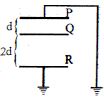
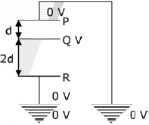
See the diagram. The area of each plate is $2.0\ m^2$ and $d = 2 \times 10^{-3}\ m$. $A$ charge of $8.85 \times 10^{-8}\ C$ is given to plate $Q$. Then the potential of $Q$ becomes......$V$.
A
$13$
B
$10$
C
$6.67$
D
$8.825$
Solution
(C) The system consists of two capacitors connected in parallel between plate $Q$ and the grounded plates $P$ and $R$.
The capacitance of the first capacitor (between $Q$ and $P$) is $C_1 = \frac{\epsilon_0 A}{d}$.
The capacitance of the second capacitor (between $Q$ and $R$) is $C_2 = \frac{\epsilon_0 A}{2d}$.
Since both capacitors are connected in parallel,the equivalent capacitance is $C_{eff} = C_1 + C_2 = \frac{\epsilon_0 A}{d} + \frac{\epsilon_0 A}{2d} = \frac{3 \epsilon_0 A}{2d}$.
Given $A = 2.0\ m^2$,$d = 2 \times 10^{-3}\ m$,and $\epsilon_0 = 8.85 \times 10^{-12}\ F/m$,we have:
$C_{eff} = \frac{3 \times 8.85 \times 10^{-12} \times 2.0}{2 \times 2 \times 10^{-3}} = \frac{3 \times 8.85 \times 10^{-12}}{2 \times 10^{-3}} = 1.5 \times 8.85 \times 10^{-9}\ F$.
The potential $V$ of plate $Q$ is given by $V = \frac{q}{C_{eff}}$.
Substituting the values: $V = \frac{8.85 \times 10^{-8}}{1.5 \times 8.85 \times 10^{-9}} = \frac{10^{-8}}{1.5 \times 10^{-9}} = \frac{10}{1.5} = 6.67\ V$.
The capacitance of the first capacitor (between $Q$ and $P$) is $C_1 = \frac{\epsilon_0 A}{d}$.
The capacitance of the second capacitor (between $Q$ and $R$) is $C_2 = \frac{\epsilon_0 A}{2d}$.
Since both capacitors are connected in parallel,the equivalent capacitance is $C_{eff} = C_1 + C_2 = \frac{\epsilon_0 A}{d} + \frac{\epsilon_0 A}{2d} = \frac{3 \epsilon_0 A}{2d}$.
Given $A = 2.0\ m^2$,$d = 2 \times 10^{-3}\ m$,and $\epsilon_0 = 8.85 \times 10^{-12}\ F/m$,we have:
$C_{eff} = \frac{3 \times 8.85 \times 10^{-12} \times 2.0}{2 \times 2 \times 10^{-3}} = \frac{3 \times 8.85 \times 10^{-12}}{2 \times 10^{-3}} = 1.5 \times 8.85 \times 10^{-9}\ F$.
The potential $V$ of plate $Q$ is given by $V = \frac{q}{C_{eff}}$.
Substituting the values: $V = \frac{8.85 \times 10^{-8}}{1.5 \times 8.85 \times 10^{-9}} = \frac{10^{-8}}{1.5 \times 10^{-9}} = \frac{10}{1.5} = 6.67\ V$.
0 likesView Solution
6
ChemistryMCQKCET · 2013
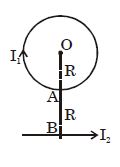
In the diagram,$I_1$ and $I_2$ are the strengths of the currents in the loop and the infinitely long straight conductor,respectively. Given $OA = AB = R$. The net magnetic field at the centre $O$ is zero. Then the ratio of the currents in the loop and the straight conductor $(I_1/I_2)$ is:
A
$\pi$
B
$2\pi$
C
$\frac{1}{\pi}$
D
$\frac{1}{2\pi}$
Solution
(D) The magnetic field at the centre $O$ due to the circular loop of radius $R$ carrying current $I_1$ is given by $B_1 = \frac{\mu_0 I_1}{2R}$ (directed outwards).
The magnetic field at point $O$ due to the infinitely long straight wire carrying current $I_2$ at a distance $d = OA + AB = R + R = 2R$ is given by $B_2 = \frac{\mu_0 I_2}{2\pi d} = \frac{\mu_0 I_2}{2\pi (2R)} = \frac{\mu_0 I_2}{4\pi R}$ (directed inwards).
Since the net magnetic field at $O$ is zero,the magnitudes of the magnetic fields must be equal:
$B_1 = B_2$
$\frac{\mu_0 I_1}{2R} = \frac{\mu_0 I_2}{4\pi R}$
Canceling common terms $\mu_0$ and $R$ from both sides:
$\frac{I_1}{2} = \frac{I_2}{4\pi}$
Rearranging to find the ratio $I_1/I_2$:
$\frac{I_1}{I_2} = \frac{2}{4\pi} = \frac{1}{2\pi}$
Therefore,the correct option is $D$.
The magnetic field at point $O$ due to the infinitely long straight wire carrying current $I_2$ at a distance $d = OA + AB = R + R = 2R$ is given by $B_2 = \frac{\mu_0 I_2}{2\pi d} = \frac{\mu_0 I_2}{2\pi (2R)} = \frac{\mu_0 I_2}{4\pi R}$ (directed inwards).
Since the net magnetic field at $O$ is zero,the magnitudes of the magnetic fields must be equal:
$B_1 = B_2$
$\frac{\mu_0 I_1}{2R} = \frac{\mu_0 I_2}{4\pi R}$
Canceling common terms $\mu_0$ and $R$ from both sides:
$\frac{I_1}{2} = \frac{I_2}{4\pi}$
Rearranging to find the ratio $I_1/I_2$:
$\frac{I_1}{I_2} = \frac{2}{4\pi} = \frac{1}{2\pi}$
Therefore,the correct option is $D$.
0 likesView Solution
7
ChemistryMCQKCET · 2013
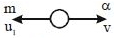
$A$ nucleus $_Z{X^A}$ emits an $\alpha$-particle with velocity $v$. The recoil speed of the daughter nucleus is
A
$\frac{A - 4}{4v}$
B
$\frac{4v}{A - 4}$
C
$v$
D
$\frac{v}{4}$
Solution
(B) Initially,the nucleus is at rest,so the total initial momentum is $0$.
By the law of conservation of linear momentum,the final momentum must also be $0$.
Let $M_d$ be the mass of the daughter nucleus and $M_{\alpha}$ be the mass of the $\alpha$-particle.
The mass of the $\alpha$-particle is approximately $4$ units,and the mass of the daughter nucleus is $(A - 4)$ units.
Let $v_1$ be the recoil velocity of the daughter nucleus.
According to the conservation of momentum:
$M_d v_1 = M_{\alpha} v$
$(A - 4) v_1 = 4v$
$v_1 = \frac{4v}{A - 4}$
By the law of conservation of linear momentum,the final momentum must also be $0$.
Let $M_d$ be the mass of the daughter nucleus and $M_{\alpha}$ be the mass of the $\alpha$-particle.
The mass of the $\alpha$-particle is approximately $4$ units,and the mass of the daughter nucleus is $(A - 4)$ units.
Let $v_1$ be the recoil velocity of the daughter nucleus.
According to the conservation of momentum:
$M_d v_1 = M_{\alpha} v$
$(A - 4) v_1 = 4v$
$v_1 = \frac{4v}{A - 4}$
0 likesView Solution
8
ChemistryMCQKCET · 2013
$A$ series combination of resistor $(R)$ and capacitor $(C)$ is connected to an $A$.$C$. source of angular frequency $\omega$. Keeping the voltage same,if the frequency is changed to $\omega / 3$,the current becomes half of the original current. Then the ratio of the capacitive reactance and resistance at the former frequency is
A
$\sqrt{0.6}$
B
$\sqrt{3}$
C
$\sqrt{2}$
D
$\sqrt{6}$
Solution
(A) The impedance of the circuit is $Z = \sqrt{R^2 + X_C^2}$.
When the angular frequency is changed to $\omega' = \omega / 3$,the capacitive reactance becomes $X_C' = \frac{1}{\omega' C} = \frac{1}{(\omega/3) C} = 3 X_C$.
The new impedance is $Z' = \sqrt{R^2 + (3X_C)^2} = \sqrt{R^2 + 9X_C^2}$.
Given that the current becomes half,$I' = I/2$,which implies $Z' = 2Z$.
Substituting the expressions,we get $2 \sqrt{R^2 + X_C^2} = \sqrt{R^2 + 9X_C^2}$.
Squaring both sides,$4(R^2 + X_C^2) = R^2 + 9X_C^2$.
$4R^2 + 4X_C^2 = R^2 + 9X_C^2$.
$3R^2 = 5X_C^2$.
Therefore,$\frac{X_C^2}{R^2} = \frac{3}{5} = 0.6$.
Thus,the ratio $\frac{X_C}{R} = \sqrt{0.6}$.
When the angular frequency is changed to $\omega' = \omega / 3$,the capacitive reactance becomes $X_C' = \frac{1}{\omega' C} = \frac{1}{(\omega/3) C} = 3 X_C$.
The new impedance is $Z' = \sqrt{R^2 + (3X_C)^2} = \sqrt{R^2 + 9X_C^2}$.
Given that the current becomes half,$I' = I/2$,which implies $Z' = 2Z$.
Substituting the expressions,we get $2 \sqrt{R^2 + X_C^2} = \sqrt{R^2 + 9X_C^2}$.
Squaring both sides,$4(R^2 + X_C^2) = R^2 + 9X_C^2$.
$4R^2 + 4X_C^2 = R^2 + 9X_C^2$.
$3R^2 = 5X_C^2$.
Therefore,$\frac{X_C^2}{R^2} = \frac{3}{5} = 0.6$.
Thus,the ratio $\frac{X_C}{R} = \sqrt{0.6}$.
0 likesView Solution
9
ChemistryMCQKCET · 2013
The number of disulphide linkages present in insulin are
A
$4$
B
$3$
C
$2$
D
$1$
Solution
(B) Insulin is a peptide hormone composed of two polypeptide chains,referred to as the $A$ chain and $B$ chain.
These two chains are linked together by two inter-chain disulphide bonds.
Additionally,there is one intra-chain disulphide bond present within the $A$ chain.
Therefore,the total number of disulphide linkages in insulin is $2 + 1 = 3$.
These two chains are linked together by two inter-chain disulphide bonds.
Additionally,there is one intra-chain disulphide bond present within the $A$ chain.
Therefore,the total number of disulphide linkages in insulin is $2 + 1 = 3$.
0 likesView Solution
10
ChemistryEasyMCQKCET · 2013
The number of anti-bonding electrons present in $O_{2}^{-}$ molecular ion is
A
$8$
B
$6$
C
$5$
D
$7$
Solution
(D) The total number of electrons in $O_{2}^{-}$ is $8 + 8 + 1 = 17$.
The molecular orbital configuration of $O_{2}^{-}$ is: $\sigma 1s^{2}, \sigma^{*} 1s^{2}, \sigma 2s^{2}, \sigma^{*} 2s^{2}, \sigma 2p_{z}^{2}, \pi 2p_{x}^{2} = \pi 2p_{y}^{2}, \pi^{*} 2p_{x}^{2} = \pi^{*} 2p_{y}^{1}$.
Anti-bonding electrons are those in orbitals denoted with an asterisk $(*)$.
Number of anti-bonding electrons $= 2(\sigma^{*} 1s) + 2(\sigma^{*} 2s) + 2(\pi^{*} 2p_{x}) + 1(\pi^{*} 2p_{y}) = 7$.
The molecular orbital configuration of $O_{2}^{-}$ is: $\sigma 1s^{2}, \sigma^{*} 1s^{2}, \sigma 2s^{2}, \sigma^{*} 2s^{2}, \sigma 2p_{z}^{2}, \pi 2p_{x}^{2} = \pi 2p_{y}^{2}, \pi^{*} 2p_{x}^{2} = \pi^{*} 2p_{y}^{1}$.
Anti-bonding electrons are those in orbitals denoted with an asterisk $(*)$.
Number of anti-bonding electrons $= 2(\sigma^{*} 1s) + 2(\sigma^{*} 2s) + 2(\pi^{*} 2p_{x}) + 1(\pi^{*} 2p_{y}) = 7$.
0 likesView Solution
11
ChemistryEasyMCQKCET · 2013
Intramolecular hydrogen bonding is formed in
A
$H_2O$
B
salicylaldehyde
C
$NH_3$
D
benzophenone
Solution
(B) Intramolecular hydrogen bonding occurs within a single molecule. It typically happens in compounds where a hydrogen atom is bonded to a highly electronegative atom (like $O$,$N$,or $F$) and is positioned close to another electronegative atom within the same molecule,allowing for the formation of a stable ring structure. In salicylaldehyde,the hydrogen atom of the hydroxyl $(-OH)$ group is close to the oxygen atom of the aldehyde $(-CHO)$ group,leading to the formation of an intramolecular hydrogen bond. $H_2O$ and $NH_3$ exhibit intermolecular hydrogen bonding,while benzophenone lacks the necessary donor group ($-OH$,$-NH_2$,etc.) for hydrogen bonding.
0 likesView Solution
12
ChemistryMediumMCQKCET · 2013
The yield of the products in the reaction,$A_{2(g)} + 2B_{(g)} \rightleftharpoons C_{(g)} + Q \ kJ$ would be higher at
A
high temperature and high pressure
B
high temperature and low pressure
C
low temperature and high pressure
D
low temperature and low pressure
Solution
(C) The given reaction is $A_{2(g)} + 2B_{(g)} \rightleftharpoons C_{(g)} + Q \ kJ$.
Since the reaction releases heat $(+Q \ kJ)$,it is an exothermic reaction.
According to Le Chatelier's principle,for an exothermic reaction,a decrease in temperature favors the forward reaction,thereby increasing the yield of the products.
Furthermore,the number of moles of gaseous reactants is $1 + 2 = 3$,while the number of moles of gaseous products is $1$.
Since the forward reaction proceeds with a decrease in the number of gaseous molecules,an increase in pressure will shift the equilibrium toward the product side.
Therefore,low temperature and high pressure favor the formation of products.
Since the reaction releases heat $(+Q \ kJ)$,it is an exothermic reaction.
According to Le Chatelier's principle,for an exothermic reaction,a decrease in temperature favors the forward reaction,thereby increasing the yield of the products.
Furthermore,the number of moles of gaseous reactants is $1 + 2 = 3$,while the number of moles of gaseous products is $1$.
Since the forward reaction proceeds with a decrease in the number of gaseous molecules,an increase in pressure will shift the equilibrium toward the product side.
Therefore,low temperature and high pressure favor the formation of products.
0 likesView Solution
13
ChemistryEasyMCQKCET · 2013
The electronic configuration of $Cu^{2+}$ ion is
A
$[Ar] 3d^8 4s^1$
B
$[Ar] 3d^9 4s^0$
C
$[Ar] 3d^7 4s^2$
D
$[Ar] 3d^8 4s^0$
Solution
(B) The atomic number of copper $(Cu)$ is $29$.
The ground state electronic configuration of $Cu$ is $[Ar] 3d^{10} 4s^1$.
To form the $Cu^{2+}$ ion,two electrons are removed,one from the $4s$ orbital and one from the $3d$ orbital.
Therefore,the electronic configuration of $Cu^{2+}$ is $[Ar] 3d^9 4s^0$.
The ground state electronic configuration of $Cu$ is $[Ar] 3d^{10} 4s^1$.
To form the $Cu^{2+}$ ion,two electrons are removed,one from the $4s$ orbital and one from the $3d$ orbital.
Therefore,the electronic configuration of $Cu^{2+}$ is $[Ar] 3d^9 4s^0$.
0 likesView Solution
14
ChemistryEasyMCQKCET · 2013
Alkali metals have negative reduction potential and hence they behave as
A
oxidising agents
B
Lewis bases
C
reducing agents
D
electrolytes
Solution
(C) Standard reduction potential is a measure of the tendency of an element to lose electrons in an aqueous solution.
More negative the reduction potential,higher is the ability of the element to lose electrons,and hence stronger is the reducing character.
Therefore,alkali metals behave as reducing agents.
More negative the reduction potential,higher is the ability of the element to lose electrons,and hence stronger is the reducing character.
Therefore,alkali metals behave as reducing agents.
0 likesView Solution
15
ChemistryEasyMCQKCET · 2013
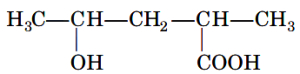
The $IUPAC$ name of the compound shown in the image is:
A
$4-$hydroxy$-2-$methylpentanoic acid
B
$2-$hydroxy$-4-$methylpentanoic acid
C
$4-$hydroxy$-2-$methylpentan$-1-$oic acid
D
$2-$hydroxy$-4-$methylpentan$-1-$oic acid
Solution
(A) $1$. Identify the principal functional group: The $-COOH$ group is the principal functional group,so the parent chain is named as a pentanoic acid.
$2$. Number the chain: Start numbering from the carbon of the $-COOH$ group as $C-1$. The chain is numbered to give the lowest possible locants to the substituents.
$3$. Identify substituents: There is a methyl group at $C-2$ and a hydroxy group at $C-4$.
$4$. Alphabetical order: 'Hydroxy' comes before 'methyl'.
$5$. Final name: Combining these,the $IUPAC$ name is $4-$hydroxy$-2-$methylpentanoic acid.
$2$. Number the chain: Start numbering from the carbon of the $-COOH$ group as $C-1$. The chain is numbered to give the lowest possible locants to the substituents.
$3$. Identify substituents: There is a methyl group at $C-2$ and a hydroxy group at $C-4$.
$4$. Alphabetical order: 'Hydroxy' comes before 'methyl'.
$5$. Final name: Combining these,the $IUPAC$ name is $4-$hydroxy$-2-$methylpentanoic acid.
0 likesView Solution
16
ChemistryEasyMCQKCET · 2013
Mesomeric effect involves
A
delocalisation of $\pi$-electrons
B
delocalisation of $\sigma$-electrons
C
partial displacement of electrons
D
delocalisation of $\pi$ and $\sigma$-electrons
Solution
(A) Resonance or mesomeric effect is defined as the polarity produced in a molecule by the interaction of two $\pi$-bonds or between a $\pi$-bond and a lone pair of electrons present on an adjacent atom.
It involves the complete delocalisation of $\pi$-electrons through the conjugated system.
There are two types of mesomeric effect:
$1$. $+M$ effect: Observed when the direction of electron displacement is away from an atom or substituent group attached to the conjugated system,e.g.,$-halogen$,$-OH$,$-NH_2$.
$2$. $-M$ effect: Observed when the transfer of electrons is towards the atom or substituent group attached to the conjugated system,e.g.,$-NO_2$,$-COOH$.
It involves the complete delocalisation of $\pi$-electrons through the conjugated system.
There are two types of mesomeric effect:
$1$. $+M$ effect: Observed when the direction of electron displacement is away from an atom or substituent group attached to the conjugated system,e.g.,$-halogen$,$-OH$,$-NH_2$.
$2$. $-M$ effect: Observed when the transfer of electrons is towards the atom or substituent group attached to the conjugated system,e.g.,$-NO_2$,$-COOH$.
0 likesView Solution
17
ChemistryMediumMCQKCET · 2013
The number of optical isomers of the compound $CH_{3}CHBrCHBrCOOH$ is
A
$0$
B
$1$
C
$3$
D
$4$
Solution
(D) The given compound is $CH_{3}CHBrCHBrCOOH$. It contains two chiral carbon atoms $(n=2)$.
Since the molecule is unsymmetrical (the two ends are different: $-CH_{3}$ and $-COOH$),it cannot be divided into two equal halves.
For an unsymmetrical molecule,the number of optical isomers is given by $2^{n}$,where $n$ is the number of chiral centers.
Here,$n=2$,so the number of optical isomers $= 2^{2} = 4$.
These $4$ isomers consist of $2$ pairs of enantiomers,and there are no meso forms $(m=0)$.
Thus,the total number of optical isomers is $4$.
Since the molecule is unsymmetrical (the two ends are different: $-CH_{3}$ and $-COOH$),it cannot be divided into two equal halves.
For an unsymmetrical molecule,the number of optical isomers is given by $2^{n}$,where $n$ is the number of chiral centers.
Here,$n=2$,so the number of optical isomers $= 2^{2} = 4$.
These $4$ isomers consist of $2$ pairs of enantiomers,and there are no meso forms $(m=0)$.
Thus,the total number of optical isomers is $4$.
0 likesView Solution
18
ChemistryEasyMCQKCET · 2013
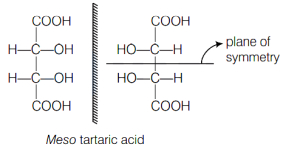
Meso compounds do not show optical activity because
A
they do not contain chiral carbon atoms
B
they have non-superimposable mirror images
C
they contain plane of symmetry
D
they do not contain plane of symmetry
Solution
(C) The correct answer is $C$. Meso compounds are those compounds whose molecules are superimposable on their mirror images despite the presence of asymmetric carbon atoms.
This is due to internal compensation.
The two halves of the molecule rotate the plane of polarised light in opposite directions and hence cancel the effect of each other,making the molecule optically inactive.
Thus,the optical inactivity in meso compounds is due to the presence of a plane of symmetry or molecular symmetry,which leads to internal compensation.
This is due to internal compensation.
The two halves of the molecule rotate the plane of polarised light in opposite directions and hence cancel the effect of each other,making the molecule optically inactive.
Thus,the optical inactivity in meso compounds is due to the presence of a plane of symmetry or molecular symmetry,which leads to internal compensation.
0 likesView Solution
19
ChemistryEasyMCQKCET · 2013
Least energetic conformation of cyclohexane is
A
chair conformation
B
boat conformation
C
cis conformation
D
$E-Z$ form
Solution
(A) Cyclohexane exists in various conformations,primarily the chair and boat forms.
In the chair conformation,all $C-H$ bonds on adjacent carbon atoms are in a staggered (skew) position,which minimizes torsional strain.
In the boat conformation,some $C-H$ bonds are eclipsed,leading to torsional strain. Additionally,there is steric repulsion between the hydrogen atoms at the $1$ and $4$ positions (flagpole interactions).
Because the boat conformation has higher total strain than the chair conformation,it is less stable.
Therefore,the chair conformation is the most stable and least energetic conformation of cyclohexane.
In the chair conformation,all $C-H$ bonds on adjacent carbon atoms are in a staggered (skew) position,which minimizes torsional strain.
In the boat conformation,some $C-H$ bonds are eclipsed,leading to torsional strain. Additionally,there is steric repulsion between the hydrogen atoms at the $1$ and $4$ positions (flagpole interactions).
Because the boat conformation has higher total strain than the chair conformation,it is less stable.
Therefore,the chair conformation is the most stable and least energetic conformation of cyclohexane.
0 likesView Solution
20
ChemistryEasyMCQKCET · 2013
Acetone and propanal are
A
functional isomers
B
position isomers
C
geometrical isomers
D
optical isomers
Solution
(A) The molecular formula for both acetone $(CH_3COCH_3)$ and propanal $(CH_3CH_2CHO)$ is $C_3H_6O$.
Acetone contains a ketonic functional group $(>C=O)$,while propanal contains an aldehydic functional group $(-CHO)$.
Since they have the same molecular formula but different functional groups,they are classified as functional isomers.
Acetone contains a ketonic functional group $(>C=O)$,while propanal contains an aldehydic functional group $(-CHO)$.
Since they have the same molecular formula but different functional groups,they are classified as functional isomers.
0 likesView Solution
21
ChemistryEasyMCQKCET · 2013
The cycloalkane formed when $1,4$-dibromopentane is heated with sodium is:
A
methyl cyclobutane
B
cyclopentane
C
cyclobutane
D
methyl cyclopentane
Solution
(A) When $1,4$-dibromopentane is treated with sodium metal,an intramolecular Wurtz reaction occurs.
This leads to the formation of a four-membered ring with a methyl substituent.
The reaction is represented as:
$CH_3-CH(Br)-CH_2-CH_2-CH_2-Br + 2Na \rightarrow \text{Methylcyclobutane} + 2NaBr$.
Thus,the product formed is methyl cyclobutane.
This leads to the formation of a four-membered ring with a methyl substituent.
The reaction is represented as:
$CH_3-CH(Br)-CH_2-CH_2-CH_2-Br + 2Na \rightarrow \text{Methylcyclobutane} + 2NaBr$.
Thus,the product formed is methyl cyclobutane.
0 likesView Solution
22
ChemistryEasyMCQKCET · 2013
$Methane$ can be converted into $ethane$ by the reactions
A
chlorination followed by the reaction with alcoholic $KOH$
B
chlorination followed by the reaction with aqueous $KOH$
C
chlorination followed by $Wurtz$ reaction
D
chlorination followed by decarboxylation
Solution
(C) The chlorination of $methane$ is carried out by treating it with chlorine in the presence of ultraviolet light or by heating the reaction mixture to $520-670 \ K$.
$CH_{4} + Cl_{2} \xrightarrow{hv \ or \ \Delta} CH_{3}Cl + HCl$
This $methyl \ chloride$ reacts with metallic $Na$ in the presence of dry ether to form a symmetrical alkane with a higher number of carbon atoms $(ethane)$.
$2CH_{3}Cl + 2Na \xrightarrow{\text{dry ether}} CH_{3}-CH_{3} + 2NaCl$
This reaction is called the $Wurtz$ reaction.
$CH_{4} + Cl_{2} \xrightarrow{hv \ or \ \Delta} CH_{3}Cl + HCl$
This $methyl \ chloride$ reacts with metallic $Na$ in the presence of dry ether to form a symmetrical alkane with a higher number of carbon atoms $(ethane)$.
$2CH_{3}Cl + 2Na \xrightarrow{\text{dry ether}} CH_{3}-CH_{3} + 2NaCl$
This reaction is called the $Wurtz$ reaction.
0 likesView Solution
23
ChemistryEasyMCQKCET · 2013
The conjugate base of $H_{2}PO_{4}^{-}$ is:
A
$HPO_{4}^{-}$
B
$HPO_{4}^{2-}$
C
$H_{3}PO_{4}$
D
$PO_{4}^{3-}$
Solution
(B) conjugate acid-base pair differs by a single proton $(H^{+})$.
To find the conjugate base of an acid,we remove one proton $(H^{+})$ from the species:
$H_{2}PO_{4}^{-} \rightarrow H^{+} + HPO_{4}^{2-}$
Therefore,the conjugate base of $H_{2}PO_{4}^{-}$ is $HPO_{4}^{2-}$.
To find the conjugate base of an acid,we remove one proton $(H^{+})$ from the species:
$H_{2}PO_{4}^{-} \rightarrow H^{+} + HPO_{4}^{2-}$
Therefore,the conjugate base of $H_{2}PO_{4}^{-}$ is $HPO_{4}^{2-}$.
0 likesView Solution
24
ChemistryEasyMCQKCET · 2013
Identify a species which is not a Bronsted acid but a Lewis acid.
A
$BF_{3}$
B
$H_{3}O^{+}$
C
$NH_{3}$
D
$HCl$
Solution
(A) Bronsted acid is defined as a substance that has a tendency to donate a proton $(H^{+})$.
Conversely,a Lewis acid is defined as a substance that is capable of accepting a lone pair of electrons.
$H_{3}O^{+}$,$NH_{3}$ (as a conjugate acid),and $HCl$ contain $H^{+}$ ions and can act as Bronsted acids.
$BF_{3}$ is an electron-deficient molecule with an incomplete octet on the boron atom,making it an electron pair acceptor,which classifies it as a Lewis acid.
Conversely,a Lewis acid is defined as a substance that is capable of accepting a lone pair of electrons.
$H_{3}O^{+}$,$NH_{3}$ (as a conjugate acid),and $HCl$ contain $H^{+}$ ions and can act as Bronsted acids.
$BF_{3}$ is an electron-deficient molecule with an incomplete octet on the boron atom,making it an electron pair acceptor,which classifies it as a Lewis acid.
0 likesView Solution
25
ChemistryDifficultMCQKCET · 2013
The $pH$ of $10^{-8} \ M \ HCl$ solution is
A
$8$
B
$6.9586$
C
more than $8$
D
slightly more than $7$
Solution
(B) Since $HCl$ is an acid,its $pH$ must be less than $7$.
For very dilute solutions of strong acids,the contribution of $H^+$ ions from the auto-ionization of water cannot be neglected.
From $HCl$,$[H^+]_{acid} = 10^{-8} \ M$.
From water,$[H^+]_{water} = 10^{-7} \ M$.
Total $[H^+] = 10^{-8} + 10^{-7} = 10^{-8}(1 + 10) = 11 \times 10^{-8} \ M$.
$pH = -\log[H^+] = -\log(11 \times 10^{-8}) = -(\log 11 + \log 10^{-8}) = -(1.0414 - 8) = 6.9586$.
For very dilute solutions of strong acids,the contribution of $H^+$ ions from the auto-ionization of water cannot be neglected.
From $HCl$,$[H^+]_{acid} = 10^{-8} \ M$.
From water,$[H^+]_{water} = 10^{-7} \ M$.
Total $[H^+] = 10^{-8} + 10^{-7} = 10^{-8}(1 + 10) = 11 \times 10^{-8} \ M$.
$pH = -\log[H^+] = -\log(11 \times 10^{-8}) = -(\log 11 + \log 10^{-8}) = -(1.0414 - 8) = 6.9586$.
0 likesView Solution
26
ChemistryMediumMCQKCET · 2013
An example of a neutral buffer is:
A
$NH_4OH$ and $NH_4Cl$
B
$CH_3COOH$ and $CH_3COONa$
C
$CH_3COOH$ and $NH_4OH$
D
Citric acid and sodium citrate
Solution
(C) buffer solution is classified based on the $pH$ of the solution.
$1$. Acidic buffers consist of a weak acid and its salt with a strong base (e.g.,$CH_3COOH$ and $CH_3COONa$).
$2$. Basic buffers consist of a weak base and its salt with a strong acid (e.g.,$NH_4OH$ and $NH_4Cl$).
$3$. $A$ neutral buffer is typically formed by the mixture of a weak acid and a weak base,such as $CH_3COOH$ and $NH_4OH$,which results in a solution with a $pH$ near $7$.
$1$. Acidic buffers consist of a weak acid and its salt with a strong base (e.g.,$CH_3COOH$ and $CH_3COONa$).
$2$. Basic buffers consist of a weak base and its salt with a strong acid (e.g.,$NH_4OH$ and $NH_4Cl$).
$3$. $A$ neutral buffer is typically formed by the mixture of a weak acid and a weak base,such as $CH_3COOH$ and $NH_4OH$,which results in a solution with a $pH$ near $7$.
0 likesView Solution
27
ChemistryEasyMCQKCET · 2013
Hybridised states of carbon in graphite and diamond are respectively
A
$sp^{3}, sp^{3}$
B
$sp^{3}, sp^{2}$
C
$sp^{2}, sp^{2}$
D
$sp^{2}, sp^{3}$
Solution
(D) In graphite,each carbon atom is $sp^{2}$ hybridised and linked to three other carbon atoms in a hexagonal planar structure.
In diamond,each carbon atom is $sp^{3}$ hybridised and linked to four other carbon atoms in a tetrahedral geometry via strong $C-C$ $\sigma$-bonds.
Therefore,the hybridisation states for graphite and diamond are $sp^{2}$ and $sp^{3}$ respectively.
In diamond,each carbon atom is $sp^{3}$ hybridised and linked to four other carbon atoms in a tetrahedral geometry via strong $C-C$ $\sigma$-bonds.
Therefore,the hybridisation states for graphite and diamond are $sp^{2}$ and $sp^{3}$ respectively.
0 likesView Solution
28
ChemistryMediumMCQKCET · 2013
In the reaction,$2 FeSO_{4} + H_{2} SO_{4} + H_{2} O_{2} \longrightarrow Fe_{2}(SO_{4})_{3} + 2 H_{2} O$,the oxidising agent is
A
$FeSO_{4}$
B
$H_{2} SO_{4}$
C
$H_{2} O_{2}$
D
$Methyl \ cyclopentane$
Solution
(C) In the given reaction,the oxidation state of iron $(Fe)$ increases from $+2$ in $FeSO_{4}$ to $+3$ in $Fe_{2}(SO_{4})_{3}$.
This indicates that $FeSO_{4}$ is being oxidised.
Hydrogen peroxide $(H_{2} O_{2})$ is a powerful oxidising agent that accepts electrons and gets reduced to water $(H_{2} O)$.
Therefore,$H_{2} O_{2}$ acts as the oxidising agent in this reaction.
This indicates that $FeSO_{4}$ is being oxidised.
Hydrogen peroxide $(H_{2} O_{2})$ is a powerful oxidising agent that accepts electrons and gets reduced to water $(H_{2} O)$.
Therefore,$H_{2} O_{2}$ acts as the oxidising agent in this reaction.
0 likesView Solution
29
ChemistryMediumMCQKCET · 2013
Metallic lustre is due to
A
high density of metals
B
high polish on the surface of metals
C
reflection of light by mobile electrons
D
chemical inertness of metals
Solution
(C) The lustre of metals is due to the presence of free or mobile electrons in the metallic lattice.
When light strikes the surface of the metal,these mobile electrons absorb the energy of the incident light and then re-emit it.
This reflection of light by the mobile electrons gives the metal its characteristic shiny appearance or lustre.
When light strikes the surface of the metal,these mobile electrons absorb the energy of the incident light and then re-emit it.
This reflection of light by the mobile electrons gives the metal its characteristic shiny appearance or lustre.
0 likesView Solution
30
ChemistryEasyMCQKCET · 2013
Which of the following is diamagnetic?
A
$H_{2}^{+}$
B
$He_{2}^{+}$
C
$O_{2}$
D
$N_{2}$
Solution
(D) To determine the magnetic property,we look at the Molecular Orbital $(MO)$ configuration of each species:
$H_{2}^{+}$ ($1$ electron): $\sigma 1s^{1}$ (Paramagnetic due to $1$ unpaired electron).
$He_{2}^{+}$ ($3$ electrons): $\sigma 1s^{2}, \sigma^{*} 1s^{1}$ (Paramagnetic due to $1$ unpaired electron).
$O_{2}$ ($16$ electrons): $\sigma 1s^{2}, \sigma^{*} 1s^{2}, \sigma 2s^{2}, \sigma^{*} 2s^{2}, \sigma 2p_{x}^{2}, \pi 2p_{y}^{2} = \pi 2p_{z}^{2}, \pi^{*} 2p_{y}^{1} = \pi^{*} 2p_{z}^{1}$ (Paramagnetic due to $2$ unpaired electrons).
$N_{2}$ ($14$ electrons): $\sigma 1s^{2}, \sigma^{*} 1s^{2}, \sigma 2s^{2}, \sigma^{*} 2s^{2}, \pi 2p_{y}^{2} = \pi 2p_{z}^{2}, \sigma 2p_{x}^{2}$ (Diamagnetic as all electrons are paired).
Therefore,$N_{2}$ is the correct answer.
$H_{2}^{+}$ ($1$ electron): $\sigma 1s^{1}$ (Paramagnetic due to $1$ unpaired electron).
$He_{2}^{+}$ ($3$ electrons): $\sigma 1s^{2}, \sigma^{*} 1s^{1}$ (Paramagnetic due to $1$ unpaired electron).
$O_{2}$ ($16$ electrons): $\sigma 1s^{2}, \sigma^{*} 1s^{2}, \sigma 2s^{2}, \sigma^{*} 2s^{2}, \sigma 2p_{x}^{2}, \pi 2p_{y}^{2} = \pi 2p_{z}^{2}, \pi^{*} 2p_{y}^{1} = \pi^{*} 2p_{z}^{1}$ (Paramagnetic due to $2$ unpaired electrons).
$N_{2}$ ($14$ electrons): $\sigma 1s^{2}, \sigma^{*} 1s^{2}, \sigma 2s^{2}, \sigma^{*} 2s^{2}, \pi 2p_{y}^{2} = \pi 2p_{z}^{2}, \sigma 2p_{x}^{2}$ (Diamagnetic as all electrons are paired).
Therefore,$N_{2}$ is the correct answer.
0 likesView Solution
31
ChemistryMCQKCET · 2013
Which of the following is not a colligative property?
A
Elevation in boiling point
B
Depression in freezing point
C
Osmotic pressure
D
Lowering of vapour pressure
Solution
(D) Colligative properties are those properties of ideal solutions that depend only on the number of solute particles (molecules or ions) dissolved in a definite amount of solvent,and not on the nature of the solute.
The four main colligative properties are:
$(i)$ Relative lowering of vapour pressure.
$(ii)$ Osmotic pressure.
$(iii)$ Elevation in boiling point.
$(iv)$ Depression in freezing point.
Note that 'Lowering of vapour pressure' is not a colligative property; rather,the 'Relative lowering of vapour pressure' is. Therefore,option $D$ is the correct answer.
The four main colligative properties are:
$(i)$ Relative lowering of vapour pressure.
$(ii)$ Osmotic pressure.
$(iii)$ Elevation in boiling point.
$(iv)$ Depression in freezing point.
Note that 'Lowering of vapour pressure' is not a colligative property; rather,the 'Relative lowering of vapour pressure' is. Therefore,option $D$ is the correct answer.
0 likesView Solution
32
ChemistryMCQKCET · 2013
Which of the following aqueous solutions will exhibit the highest boiling point?
A
$0.01 \ M$ urea
B
$0.01 \ M \ KNO_{3}$
C
$0.01 \ M \ Na_{2}SO_{4}$
D
$0.015 \ M \ C_{6}H_{12}O_{6}$
Solution
(C) The elevation in boiling point is a colligative property,which depends on the van't Hoff factor $(i)$ and the molar concentration $(M)$. The formula is $\Delta T_{b} = i \times K_{b} \times m$.
$1.$ $0.01 \ M$ urea: $i = 1$,effective concentration = $0.01 \times 1 = 0.01 \ M$.
$2.$ $0.01 \ M \ KNO_{3}$: $i = 2$ $(K^{+} + NO_{3}^{-})$,effective concentration = $0.01 \times 2 = 0.02 \ M$.
$3.$ $0.01 \ M \ Na_{2}SO_{4}$: $i = 3$ $(2Na^{+} + SO_{4}^{2-})$,effective concentration = $0.01 \times 3 = 0.03 \ M$.
$4.$ $0.015 \ M \ C_{6}H_{12}O_{6}$: $i = 1$,effective concentration = $0.015 \times 1 = 0.015 \ M$.
Since $0.01 \ M \ Na_{2}SO_{4}$ has the highest effective concentration of particles,it will exhibit the highest boiling point.
$1.$ $0.01 \ M$ urea: $i = 1$,effective concentration = $0.01 \times 1 = 0.01 \ M$.
$2.$ $0.01 \ M \ KNO_{3}$: $i = 2$ $(K^{+} + NO_{3}^{-})$,effective concentration = $0.01 \times 2 = 0.02 \ M$.
$3.$ $0.01 \ M \ Na_{2}SO_{4}$: $i = 3$ $(2Na^{+} + SO_{4}^{2-})$,effective concentration = $0.01 \times 3 = 0.03 \ M$.
$4.$ $0.015 \ M \ C_{6}H_{12}O_{6}$: $i = 1$,effective concentration = $0.015 \times 1 = 0.015 \ M$.
Since $0.01 \ M \ Na_{2}SO_{4}$ has the highest effective concentration of particles,it will exhibit the highest boiling point.
0 likesView Solution
33
ChemistryDifficultMCQKCET · 2013
The number of water molecules present in a drop of water weighing $0.018 \ g$ is
A
$6.022 \times 10^{26}$
B
$6.022 \times 10^{23}$
C
$6.022 \times 10^{19}$
D
$6.022 \times 10^{20}$
Solution
(D) The molar mass of $H_{2}O$ is $18 \ g/mol$.
$18 \ g$ of $H_{2}O$ contains $6.022 \times 10^{23}$ molecules.
Therefore,$0.018 \ g$ of $H_{2}O$ contains:
$\text{Number of molecules} = \frac{\text{Given mass}}{\text{Molar mass}} \times N_{A}$
$= \frac{0.018 \ g}{18 \ g/mol} \times 6.022 \times 10^{23} \text{ molecules/mol}$
$= 0.001 \times 6.022 \times 10^{23}$
$= 6.022 \times 10^{20} \text{ molecules}$.
$18 \ g$ of $H_{2}O$ contains $6.022 \times 10^{23}$ molecules.
Therefore,$0.018 \ g$ of $H_{2}O$ contains:
$\text{Number of molecules} = \frac{\text{Given mass}}{\text{Molar mass}} \times N_{A}$
$= \frac{0.018 \ g}{18 \ g/mol} \times 6.022 \times 10^{23} \text{ molecules/mol}$
$= 0.001 \times 6.022 \times 10^{23}$
$= 6.022 \times 10^{20} \text{ molecules}$.
0 likesView Solution
34
ChemistryMediumMCQKCET · 2013
The mass of $112 \ cm^3$ of $NH_3$ gas at $STP$ is (in $g$)
A
$0.085$
B
$0.850$
C
$8.500$
D
$80.500$
Solution
(A) $1 \ mol$ of $NH_3 = 17 \ g = 22400 \ cm^3$ at $STP$.
Since $22400 \ cm^3$ of $NH_3$ at $STP$ has a mass of $17 \ g$.
Therefore,the mass of $112 \ cm^3$ of $NH_3$ at $STP$ is calculated as:
$\text{Mass} = \frac{17 \ g}{22400 \ cm^3} \times 112 \ cm^3 = 0.085 \ g$.
Since $22400 \ cm^3$ of $NH_3$ at $STP$ has a mass of $17 \ g$.
Therefore,the mass of $112 \ cm^3$ of $NH_3$ at $STP$ is calculated as:
$\text{Mass} = \frac{17 \ g}{22400 \ cm^3} \times 112 \ cm^3 = 0.085 \ g$.
0 likesView Solution
35
ChemistryDifficultMCQKCET · 2013
The empirical formula of a compound is $CH_2O$ and its molecular mass is $90$. The molecular formula of the compound is:
A
$C_3H_6O_3$
B
$C_2H_4O_2$
C
$C_6H_{12}O_6$
D
$CH_2O$
Solution
(A) The empirical formula of the compound is $CH_2O$.
Empirical formula mass $= (1 \times 12) + (2 \times 1) + (1 \times 16) = 30 \ g/mol$.
Molecular mass $= 90 \ g/mol$.
Calculate the value of $n$ using the formula: $n = \frac{\text{Molecular mass}}{\text{Empirical formula mass}} = \frac{90}{30} = 3$.
The molecular formula is given by $n \times (\text{Empirical formula}) = 3 \times CH_2O = C_3H_6O_3$.
Empirical formula mass $= (1 \times 12) + (2 \times 1) + (1 \times 16) = 30 \ g/mol$.
Molecular mass $= 90 \ g/mol$.
Calculate the value of $n$ using the formula: $n = \frac{\text{Molecular mass}}{\text{Empirical formula mass}} = \frac{90}{30} = 3$.
The molecular formula is given by $n \times (\text{Empirical formula}) = 3 \times CH_2O = C_3H_6O_3$.
0 likesView Solution
36
ChemistryMediumMCQKCET · 2013
Which of the following gases has the highest value of $RMS$ velocity at $298 \ K$?
A
$CH_{4}$
B
$CO$
C
$Cl_{2}$
D
$CO_{2}$
Solution
(A) The root mean square $(RMS)$ velocity of a gas is given by the formula $v_{\text{rms}} = \sqrt{\frac{3RT}{M}}$.
Since $R$ and $T$ are constant for all gases at a given temperature,the $RMS$ velocity is inversely proportional to the square root of the molar mass,i.e.,$v_{\text{rms}} \propto \frac{1}{\sqrt{M}}$.
Comparing the molar masses $(M)$:
$CH_{4} = 16 \ g/mol$
$CO = 28 \ g/mol$
$Cl_{2} = 71 \ g/mol$
$CO_{2} = 44 \ g/mol$
Since $CH_{4}$ has the lowest molar mass,it will have the highest $RMS$ velocity.
Since $R$ and $T$ are constant for all gases at a given temperature,the $RMS$ velocity is inversely proportional to the square root of the molar mass,i.e.,$v_{\text{rms}} \propto \frac{1}{\sqrt{M}}$.
Comparing the molar masses $(M)$:
$CH_{4} = 16 \ g/mol$
$CO = 28 \ g/mol$
$Cl_{2} = 71 \ g/mol$
$CO_{2} = 44 \ g/mol$
Since $CH_{4}$ has the lowest molar mass,it will have the highest $RMS$ velocity.
0 likesView Solution
37
ChemistryMCQKCET · 2013
Which one of the following sets of ions represents the collection of isoelectronic species?
A
$K^{+}, Cl^{-}, Mg^{2+}, Sc^{3+}$
B
$Na^{+}, Ca^{2+}, Sc^{3+}, F^{-}$
C
$K^{+}, Ca^{2+}, Sc^{3+}, Cl^{-}$
D
$Na^{+}, Mg^{2+}, Al^{3+}, Cl^{-}$
Solution
(C) Isoelectronic species are those that have the same number of electrons.
Calculating the number of electrons for each ion:
$K^{+} = 19 - 1 = 18$
$Ca^{2+} = 20 - 2 = 18$
$Sc^{3+} = 21 - 3 = 18$
$Cl^{-} = 17 + 1 = 18$
Since all ions in option $C$ have $18$ electrons,they are isoelectronic.
Calculating the number of electrons for each ion:
$K^{+} = 19 - 1 = 18$
$Ca^{2+} = 20 - 2 = 18$
$Sc^{3+} = 21 - 3 = 18$
$Cl^{-} = 17 + 1 = 18$
Since all ions in option $C$ have $18$ electrons,they are isoelectronic.
0 likesView Solution
38
ChemistryDifficultMCQKCET · 2013
Given the thermochemical equation,$2 H_{2(g)} + O_{2(g)} \rightarrow 2 H_2O_{(l)}$; $\Delta H = -571.6 \ kJ$. The heat of decomposition of water is:
A
$ -571.6 \ kJ $
B
$ +571.6 \ kJ $
C
$ -1143.2 \ kJ $
D
$ +285.8 \ kJ $
Solution
(D) The given thermochemical equation is:
$2 H_{2(g)} + O_{2(g)} \rightarrow 2 H_2O_{(l)}$; $\Delta H = -571.6 \ kJ$
The decomposition of water is represented by the reverse reaction:
$H_2O_{(l)} \rightarrow H_{2(g)} + \frac{1}{2} O_{2(g)}$
To obtain this,we reverse the given equation and divide it by $2$:
$\Delta H_{\text{decomposition}} = -(\frac{\Delta H}{2}) = -(\frac{-571.6 \ kJ}{2}) = +285.8 \ kJ$
Thus,the heat of decomposition of water is $+285.8 \ kJ$.
$2 H_{2(g)} + O_{2(g)} \rightarrow 2 H_2O_{(l)}$; $\Delta H = -571.6 \ kJ$
The decomposition of water is represented by the reverse reaction:
$H_2O_{(l)} \rightarrow H_{2(g)} + \frac{1}{2} O_{2(g)}$
To obtain this,we reverse the given equation and divide it by $2$:
$\Delta H_{\text{decomposition}} = -(\frac{\Delta H}{2}) = -(\frac{-571.6 \ kJ}{2}) = +285.8 \ kJ$
Thus,the heat of decomposition of water is $+285.8 \ kJ$.
0 likesView Solution
39
ChemistryMediumMCQKCET · 2013
The process is spontaneous at the given temperature,if
A
$ \Delta H $ is positive and $ \Delta S $ is negative
B
$ \Delta H $ is negative and $ \Delta S $ is positive
C
$ \Delta H $ is positive and $ \Delta S $ is positive
D
$ \Delta H $ is positive and $ \Delta S $ is equal to zero
Solution
(B) According to Gibbs' energy equation,$ \Delta G = \Delta H - T \Delta S $.
For a process to be spontaneous,$ \Delta G $ must be negative.
When $ \Delta H $ is negative (exothermic) and $ \Delta S $ is positive (increase in entropy),the term $ -T \Delta S $ becomes negative.
Thus,$ \Delta G = (\text{negative}) - (\text{positive}) = \text{negative}$.
Therefore,the process is spontaneous at all temperatures when $ \Delta H < 0 $ and $ \Delta S > 0 $.
For a process to be spontaneous,$ \Delta G $ must be negative.
When $ \Delta H $ is negative (exothermic) and $ \Delta S $ is positive (increase in entropy),the term $ -T \Delta S $ becomes negative.
Thus,$ \Delta G = (\text{negative}) - (\text{positive}) = \text{negative}$.
Therefore,the process is spontaneous at all temperatures when $ \Delta H < 0 $ and $ \Delta S > 0 $.
0 likesView Solution
40
ChemistryEasyMCQKCET · 2013
The value of entropy of the universe is
A
increasing
B
decreasing
C
constant
D
zero
Solution
(A) According to the second law of thermodynamics,all spontaneous processes are thermodynamically irreversible and are accompanied by a net increase in entropy.
Therefore,for all spontaneous processes,the total entropy change (sum of the entropy changes of the system and the surroundings) is positive.
This implies that the entropy of the universe is continuously increasing.
Therefore,for all spontaneous processes,the total entropy change (sum of the entropy changes of the system and the surroundings) is positive.
This implies that the entropy of the universe is continuously increasing.
0 likesView Solution
41
ChemistryDifficultMCQKCET · 2013
Which of the following aqueous solutions will exhibit the highest boiling point?
A
$0.01 \ M$ Urea
B
$0.01 \ M \ KNO_3$
C
$0.01 \ M \ Na_2SO_4$
D
$0.015 \ M \ C_6H_{12}O_6$
Solution
(C) The elevation in boiling point is given by the formula: $\Delta T_b = i \cdot K_b \cdot m$.
Since $K_b$ is constant for the same solvent (water) and assuming molality $m \approx M$,the boiling point depends on the product of the van't Hoff factor $(i)$ and molarity $(M)$.
Calculating $i \times M$ for each:
$A$: Urea is a non-electrolyte,$i = 1$. $1 \times 0.01 = 0.01$.
$B$: $KNO_3 \rightarrow K^+ + NO_3^-$,$i = 2$. $2 \times 0.01 = 0.02$.
$C$: $Na_2SO_4 \rightarrow 2Na^+ + SO_4^{2-}$,$i = 3$. $3 \times 0.01 = 0.03$.
$D$: Glucose $(C_6H_{12}O_6)$ is a non-electrolyte,$i = 1$. $1 \times 0.015 = 0.015$.
Since the product $i \times M$ is highest for $Na_2SO_4$,it will exhibit the highest boiling point.
Since $K_b$ is constant for the same solvent (water) and assuming molality $m \approx M$,the boiling point depends on the product of the van't Hoff factor $(i)$ and molarity $(M)$.
Calculating $i \times M$ for each:
$A$: Urea is a non-electrolyte,$i = 1$. $1 \times 0.01 = 0.01$.
$B$: $KNO_3 \rightarrow K^+ + NO_3^-$,$i = 2$. $2 \times 0.01 = 0.02$.
$C$: $Na_2SO_4 \rightarrow 2Na^+ + SO_4^{2-}$,$i = 3$. $3 \times 0.01 = 0.03$.
$D$: Glucose $(C_6H_{12}O_6)$ is a non-electrolyte,$i = 1$. $1 \times 0.015 = 0.015$.
Since the product $i \times M$ is highest for $Na_2SO_4$,it will exhibit the highest boiling point.
0 likesView Solution
42
ChemistryEasyMCQKCET · 2013
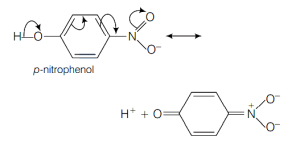
Which of the following is strongly acidic?
A
Phenol
B
$o$-cresol
C
$p$-nitrophenol
D
$p$-cresol
Solution
(C) The acidity of phenols is due to the greater resonance stabilization of the phenoxide ion relative to phenol. Electron withdrawing groups $(EWG)$ like $-NO_{2}$ stabilize the phenoxide ion by dispersing the negative charge,which increases the acidity of phenols.
Conversely,electron donating groups $(EDG)$ like alkyl groups destabilize the phenoxide ion by intensifying the negative charge,which decreases the acidic strength of phenols.
Since the methyl group has a $+I$ effect,which is stronger at the $o$-position than at the $p$-position (as the $+I$ effect decreases with distance),$o$-cresol is a weaker acid than $p$-cresol.
Therefore,the order of acidic strength is: $p$-nitrophenol $>$ phenol $>$ $p$-cresol $>$ $o$-cresol.
Conversely,electron donating groups $(EDG)$ like alkyl groups destabilize the phenoxide ion by intensifying the negative charge,which decreases the acidic strength of phenols.
Since the methyl group has a $+I$ effect,which is stronger at the $o$-position than at the $p$-position (as the $+I$ effect decreases with distance),$o$-cresol is a weaker acid than $p$-cresol.
Therefore,the order of acidic strength is: $p$-nitrophenol $>$ phenol $>$ $p$-cresol $>$ $o$-cresol.
0 likesView Solution
43
ChemistryEasyMCQKCET · 2013
The reagent used to distinguish between acetaldehyde and benzaldehyde is
A
Tollen's reagent
B
Fehling's solution
C
$2,4-$dinitrophenylhydrazine
D
semicarbazide
Solution
(B) Acetaldehyde is an aliphatic aldehyde,while benzaldehyde is an aromatic aldehyde.
Fehling's solution is a mild oxidizing agent that can oxidize aliphatic aldehydes (like acetaldehyde) to their corresponding carboxylic acids,resulting in a red precipitate of cuprous oxide $(Cu_2O)$.
However,aromatic aldehydes (like benzaldehyde) are not strong enough to be oxidized by Fehling's solution.
Therefore,Fehling's solution can be used to distinguish between acetaldehyde and benzaldehyde.
Tollen's reagent reacts with both aliphatic and aromatic aldehydes,so it cannot distinguish between them.
Fehling's solution is a mild oxidizing agent that can oxidize aliphatic aldehydes (like acetaldehyde) to their corresponding carboxylic acids,resulting in a red precipitate of cuprous oxide $(Cu_2O)$.
However,aromatic aldehydes (like benzaldehyde) are not strong enough to be oxidized by Fehling's solution.
Therefore,Fehling's solution can be used to distinguish between acetaldehyde and benzaldehyde.
Tollen's reagent reacts with both aliphatic and aromatic aldehydes,so it cannot distinguish between them.
0 likesView Solution
44
ChemistryMediumMCQKCET · 2013
Which one of the following reagents is used to obtain an amine by heating it with an amide?
A
$Br_{2}$ in aqueous $KOH$
B
$Br_{2}$ in alcoholic $KOH$
C
$Cl_{2}$ in sodium
D
Sodium in ether
Solution
(A) The reaction described is the Hofmann bromamide degradation reaction.
In this reaction,an amide is treated with bromine $(Br_{2})$ and an aqueous solution of a strong base like potassium hydroxide $(KOH)$ to produce a primary amine.
The reaction is as follows:
$R-CONH_{2} + Br_{2} + 4KOH \rightarrow R-NH_{2} + K_{2}CO_{3} + 2KBr + 2H_{2}O$
This reaction is used to decrease the carbon chain length by one carbon atom,which is removed as a carbonate ion $(CO_{3}^{2-})$.
In this reaction,an amide is treated with bromine $(Br_{2})$ and an aqueous solution of a strong base like potassium hydroxide $(KOH)$ to produce a primary amine.
The reaction is as follows:
$R-CONH_{2} + Br_{2} + 4KOH \rightarrow R-NH_{2} + K_{2}CO_{3} + 2KBr + 2H_{2}O$
This reaction is used to decrease the carbon chain length by one carbon atom,which is removed as a carbonate ion $(CO_{3}^{2-})$.
0 likesView Solution
45
ChemistryEasyMCQKCET · 2013
Glucose when reduced with $HI$ and red phosphorus gives
A
$n$-hexane
B
$n$-heptane
C
$n$-pentane
D
$n$-octane
Solution
(A) When glucose is heated with $HI$ and red phosphorus,it undergoes complete reduction to form $n$-hexane. The reaction is as follows:
$CHO-(CHOH)_4-CH_2OH \xrightarrow{HI/\text{red } P} CH_3-(CH_2)_4-CH_3$ ($n$-hexane).
This reaction confirms that glucose contains a straight chain of six carbon atoms.
$CHO-(CHOH)_4-CH_2OH \xrightarrow{HI/\text{red } P} CH_3-(CH_2)_4-CH_3$ ($n$-hexane).
This reaction confirms that glucose contains a straight chain of six carbon atoms.
0 likesView Solution
46
ChemistryMediumMCQKCET · 2013
When formic acid is heated with conc. $H_{2}SO_{4}$,the gas evolved is
A
Only $CO_{2}$
B
Only $CO$
C
a mixture of $CO$ and $CO_{2}$
D
a mixture of $SO_{2}$ and $CO_{2}$
Solution
(B) Formic acid $(HCOOH)$ undergoes dehydration when heated with concentrated sulfuric acid $(H_{2}SO_{4})$.
$HCOOH \xrightarrow{\text{conc. } H_{2}SO_{4}} CO + H_{2}O$
The concentrated $H_{2}SO_{4}$ acts as a dehydrating agent,removing a water molecule from the formic acid to produce carbon monoxide $(CO)$ gas.
$HCOOH \xrightarrow{\text{conc. } H_{2}SO_{4}} CO + H_{2}O$
The concentrated $H_{2}SO_{4}$ acts as a dehydrating agent,removing a water molecule from the formic acid to produce carbon monoxide $(CO)$ gas.
0 likesView Solution
47
ChemistryEasyMCQKCET · 2013
$d^{2}sp^{3}$ hybridisation of the atomic orbitals gives
A
square planar structure
B
triangular structure
C
tetrahedral structure
D
octahedral structure
Solution
(D) When $1$ $s$,$3$ $p$ and $2$ $d$-orbitals belonging to the same shell of an atom mix together to form six new equivalent orbitals,the type of hybridisation is called $d^{2}sp^{3}$ or octahedral hybridisation.
The new orbitals are called $d^{2}sp^{3}$ or octahedral orbitals.
These orbitals are directed towards the corners of an octahedron,resulting in an octahedral geometry.
The new orbitals are called $d^{2}sp^{3}$ or octahedral orbitals.
These orbitals are directed towards the corners of an octahedron,resulting in an octahedral geometry.
0 likesView Solution
48
ChemistryEasyMCQKCET · 2013
The rate of reaction increases with a rise in temperature because of:
A
increase in the number of activated molecules
B
increase in energy of activation
C
decrease in energy of activation
D
increase in the number of effective collisions
Solution
(D) For a collision to be effective,the colliding molecules must possess energy equal to or greater than a specific value known as the threshold energy. At room temperature,most reactant molecules have energy less than this threshold value. When the temperature increases,the kinetic energy of the reactant molecules increases,leading to a higher fraction of molecules possessing energy equal to or greater than the threshold energy. Consequently,the number of effective collisions per unit time increases,which results in an increase in the rate of reaction.
0 likesView Solution
49
ChemistryDifficultMCQKCET · 2013
The temperature coefficient of a reaction is $2$. When the temperature is increased from $30^{\circ} C$ to $90^{\circ} C$,the rate of reaction is increased by: (in $times$)
A
$60$
B
$64$
C
$150$
D
$400$
Solution
(B) The temperature coefficient $(n)$ is defined as the ratio of rate constants at temperatures differing by $10^{\circ} C$:
$n = \frac{k_{T+10}}{k_T} = 2$.
This means for every $10^{\circ} C$ rise in temperature,the rate of reaction doubles.
The total rise in temperature is $\Delta T = 90^{\circ} C - 30^{\circ} C = 60^{\circ} C$.
The number of $10^{\circ} C$ intervals is $x = \frac{60}{10} = 6$.
The rate of reaction increases by a factor of $n^x = 2^6$.
$2^6 = 2 \times 2 \times 2 \times 2 \times 2 \times 2 = 64$.
Therefore,the rate of reaction increases by $64$ times.
$n = \frac{k_{T+10}}{k_T} = 2$.
This means for every $10^{\circ} C$ rise in temperature,the rate of reaction doubles.
The total rise in temperature is $\Delta T = 90^{\circ} C - 30^{\circ} C = 60^{\circ} C$.
The number of $10^{\circ} C$ intervals is $x = \frac{60}{10} = 6$.
The rate of reaction increases by a factor of $n^x = 2^6$.
$2^6 = 2 \times 2 \times 2 \times 2 \times 2 \times 2 = 64$.
Therefore,the rate of reaction increases by $64$ times.
0 likesView Solution
50
ChemistryDifficultMCQKCET · 2013
If $50 \%$ of the reactant is converted into a product in a first order reaction in $25 \ min$,how much of it would react in $100 \ min$ (in $\%$)?
A
$93.75$
B
$87.5$
C
$75$
D
$100$
Solution
(A) For a first order reaction,the half-life $t_{1/2} = 25 \ min$.
The number of half-lives $n$ in $100 \ min$ is calculated as $n = \frac{100 \ min}{25 \ min} = 4$.
The amount of reactant remaining after $n$ half-lives is given by $\frac{A_0}{2^n}$.
Amount remaining $= \frac{100}{2^4} = \frac{100}{16} = 6.25 \%$.
The amount of reactant converted into product $= 100 \% - 6.25 \% = 93.75 \%$.
The number of half-lives $n$ in $100 \ min$ is calculated as $n = \frac{100 \ min}{25 \ min} = 4$.
The amount of reactant remaining after $n$ half-lives is given by $\frac{A_0}{2^n}$.
Amount remaining $= \frac{100}{2^4} = \frac{100}{16} = 6.25 \%$.
The amount of reactant converted into product $= 100 \% - 6.25 \% = 93.75 \%$.
0 likesView Solution
51
ChemistryMediumMCQKCET · 2013
The number of disulphide linkages present in insulin are
A
$1$
B
$2$
C
$3$
D
$4$
Solution
(C) Insulin is composed of two peptide chains referred to as the $A$ chain and $B$ chain.
The $A$ chain consists of $21$ amino acid residues and the $B$ chain consists of $30$ amino acid residues.
These two chains are linked together by two inter-chain disulphide bridges.
Additionally,there is one intra-chain disulphide bridge within the $A$ chain.
Therefore,the total number of disulphide linkages in insulin is $3$.
The $A$ chain consists of $21$ amino acid residues and the $B$ chain consists of $30$ amino acid residues.
These two chains are linked together by two inter-chain disulphide bridges.
Additionally,there is one intra-chain disulphide bridge within the $A$ chain.
Therefore,the total number of disulphide linkages in insulin is $3$.
0 likesView Solution
52
ChemistryDifficultMCQKCET · 2013
Oils are liquids at room temperature since they contain a higher percentage of
A
oleates
B
palmitates
C
stearates
D
myristates
Solution
(A) Oils are liquids at room temperature because they contain a high proportion of unsaturated fatty acid residues,such as oleic acid,linoleic acid,and linolenic acid. These residues form esters known as oleates. In contrast,fats are solids at room temperature and contain a high proportion of saturated fatty acid residues like myristic,palmitic,and stearic acids. For example,glyceryl trioleate (triolein) is an oil,while glyceryl tristearate (tristearin) is a fat.
0 likesView Solution
53
ChemistryMediumMCQKCET · 2013
$A$ group of atoms can function as a ligand only when
A
it is a small molecule
B
it has an unshared electron pair
C
it is a negatively charged ion
D
it is a positively charged ion
Solution
(B) ligand is defined as an atom,molecule,or ion that donates at least one pair of electrons to the central metal atom or ion to form a coordinate bond.
Since ligands donate electron pairs,they act as $Lewis$ bases.
Therefore,the essential requirement for a species to act as a ligand is the presence of at least one unshared electron pair (lone pair) that can be donated to the metal center.
Since ligands donate electron pairs,they act as $Lewis$ bases.
Therefore,the essential requirement for a species to act as a ligand is the presence of at least one unshared electron pair (lone pair) that can be donated to the metal center.
0 likesView Solution
54
ChemistryEasyMCQKCET · 2013
Which one of the following shows the highest magnetic moment?
A
$Fe^{2+}$
B
$Co^{2+}$
C
$Cr^{3+}$
D
$Ni^{2+}$
Solution
(A) The magnetic moment $(\mu)$ is related to the number of unpaired electrons $(n)$ by the formula: $\mu = \sqrt{n(n+2)} \ BM$.
Greater the number of unpaired electrons,higher is the magnetic moment.
Let us determine the number of unpaired electrons for each ion:
$Cr^{3+}$ $(3d^3)$: $n = 3$
$Fe^{2+}$ $(3d^6)$: $n = 4$
$Co^{2+}$ $(3d^7)$: $n = 3$
$Ni^{2+}$ $(3d^8)$: $n = 2$
Since $Fe^{2+}$ has the maximum number of unpaired electrons $(n=4)$,it exhibits the highest magnetic moment.
Greater the number of unpaired electrons,higher is the magnetic moment.
Let us determine the number of unpaired electrons for each ion:
$Cr^{3+}$ $(3d^3)$: $n = 3$
$Fe^{2+}$ $(3d^6)$: $n = 4$
$Co^{2+}$ $(3d^7)$: $n = 3$
$Ni^{2+}$ $(3d^8)$: $n = 2$
Since $Fe^{2+}$ has the maximum number of unpaired electrons $(n=4)$,it exhibits the highest magnetic moment.
0 likesView Solution
55
ChemistryEasyMCQKCET · 2013
In a transition series,with an increase in atomic number,the paramagnetism:
A
increases gradually
B
decreases gradually
C
first increases to a maximum and then decreases
D
first decreases to a minimum and then increases
Solution
(C) The paramagnetism of transition elements in a given series depends on the number of unpaired electrons in the $d$-orbitals.
As we move from left to right across a transition series,the number of unpaired electrons increases until the $d^5$ configuration is reached.
Consequently,the paramagnetism increases to a maximum value at the $d^5$ configuration.
Beyond $d^5$,the electrons begin to pair up in the $d$-orbitals ($d^6$ to $d^{10}$),which leads to a decrease in the number of unpaired electrons and thus a decrease in paramagnetism.
Therefore,the paramagnetism first increases to a maximum and then decreases.
As we move from left to right across a transition series,the number of unpaired electrons increases until the $d^5$ configuration is reached.
Consequently,the paramagnetism increases to a maximum value at the $d^5$ configuration.
Beyond $d^5$,the electrons begin to pair up in the $d$-orbitals ($d^6$ to $d^{10}$),which leads to a decrease in the number of unpaired electrons and thus a decrease in paramagnetism.
Therefore,the paramagnetism first increases to a maximum and then decreases.
0 likesView Solution
56
ChemistryDifficultMCQKCET · 2013
The $emf$ of a galvanic cell constituted with the electrodes $Zn^{2+} | Zn$ $(-0.76 \ V)$ and $Fe^{2+} | Fe$ $(-0.41 \ V)$ is
A
$-0.35 \ V$
B
$+1.17 \ V$
C
$+0.35 \ V$
D
$-1.17 \ V$
Solution
(C) The standard reduction potentials are $E^o_{Zn^{2+}/Zn} = -0.76 \ V$ and $E^o_{Fe^{2+}/Fe} = -0.41 \ V$.
In a galvanic cell,the electrode with the higher reduction potential acts as the cathode and the one with the lower reduction potential acts as the anode.
$E^o_{cell} = E^o_{cathode} - E^o_{anode}$
$E^o_{cell} = (-0.41 \ V) - (-0.76 \ V) = -0.41 \ V + 0.76 \ V = +0.35 \ V$.
In a galvanic cell,the electrode with the higher reduction potential acts as the cathode and the one with the lower reduction potential acts as the anode.
$E^o_{cell} = E^o_{cathode} - E^o_{anode}$
$E^o_{cell} = (-0.41 \ V) - (-0.76 \ V) = -0.41 \ V + 0.76 \ V = +0.35 \ V$.
0 likesView Solution
57
ChemistryEasyMCQKCET · 2013
When limestone is heated,$CO_{2}$ is given off. The metallurgical operation is
A
smelting
B
reduction
C
calcination
D
roasting
Solution
(C) Calcination is the process of converting an ore into its oxide by heating it strongly below its melting point in the absence or limited supply of air. Carbonate ores are converted into their respective oxides by the loss of carbon dioxide.
$CaCO_{3} \stackrel{\Delta}{\longrightarrow} CaO + CO_{2} \uparrow$
$CaCO_{3} \stackrel{\Delta}{\longrightarrow} CaO + CO_{2} \uparrow$
0 likesView Solution
58
ChemistryEasyMCQKCET · 2013
The process of zone refining is used in the purification of
A
$Al$
B
$Ge$
C
$Cu$
D
$Ag$
Solution
(B) Zone refining is a method used to obtain metals of very high purity.
It is based on the principle that the impurities are more soluble in the melt than in the solid state of the metal.
Metals like $Si$,$Ge$,and $Ga$,which are used in semiconductor devices,are purified by this method.
It is based on the principle that the impurities are more soluble in the melt than in the solid state of the metal.
Metals like $Si$,$Ge$,and $Ga$,which are used in semiconductor devices,are purified by this method.
0 likesView Solution
59
ChemistryMediumMCQKCET · 2013
Which of the following pairs are correctly matched?
| | Reactants | Products |
|---|---|---|
| $I.$ | $RX + AgOH(aq)$ | $RH$ |
| $II.$ | $RX + AgCN(alc)$ | $RNC$ |
| $III.$ | $RX + KCN(alc)$ | $RNC$ |
| $IV.$ | $RX + Na(ether)$ | $R-R$ |
| | Reactants | Products |
|---|---|---|
| $I.$ | $RX + AgOH(aq)$ | $RH$ |
| $II.$ | $RX + AgCN(alc)$ | $RNC$ |
| $III.$ | $RX + KCN(alc)$ | $RNC$ |
| $IV.$ | $RX + Na(ether)$ | $R-R$ |
A
Only $I$
B
$I$ and $II$
C
$II$ and $IV$
D
$III$ and $IV$
Solution
(C) Let us analyze each reaction:
$I.$ $RX + AgOH(aq) \longrightarrow ROH + AgX$. The product is an alcohol $(ROH)$,not an alkane $(RH)$. So,$I$ is incorrect.
$II.$ $RX + AgCN(alc) \longrightarrow RNC + AgX$. This is a correct reaction where alkyl isocyanide is formed.
$III.$ $RX + KCN(alc) \longrightarrow RCN + KX$. The product is alkyl cyanide $(RCN)$,not isocyanide $(RNC)$. So,$III$ is incorrect.
$IV.$ $RX + Na(ether) \longrightarrow R-R + 2NaX$. This is the Wurtz reaction,which correctly forms an alkane $(R-R)$.
Thus,pairs $II$ and $IV$ are correctly matched.
$I.$ $RX + AgOH(aq) \longrightarrow ROH + AgX$. The product is an alcohol $(ROH)$,not an alkane $(RH)$. So,$I$ is incorrect.
$II.$ $RX + AgCN(alc) \longrightarrow RNC + AgX$. This is a correct reaction where alkyl isocyanide is formed.
$III.$ $RX + KCN(alc) \longrightarrow RCN + KX$. The product is alkyl cyanide $(RCN)$,not isocyanide $(RNC)$. So,$III$ is incorrect.
$IV.$ $RX + Na(ether) \longrightarrow R-R + 2NaX$. This is the Wurtz reaction,which correctly forms an alkane $(R-R)$.
Thus,pairs $II$ and $IV$ are correctly matched.
0 likesView Solution
60
ChemistryEasyMCQKCET · 2013
What is the compound formed when a mixture of calcium acetate and calcium formate is subjected to dry distillation?
A
acetone
B
acetaldehyde
C
benzaldehyde
D
acetophenone
Solution
(B) The dry distillation of a mixture of calcium acetate $(CH_3COO)_2Ca$ and calcium formate $(HCOO)_2Ca$ results in the formation of acetaldehyde $(CH_3CHO)$ and calcium carbonate $(CaCO_3)$.
The chemical reaction is as follows:
$(CH_3COO)_2Ca + (HCOO)_2Ca \xrightarrow{\text{dry distillation}} 2CH_3CHO + 2CaCO_3$
The chemical reaction is as follows:
$(CH_3COO)_2Ca + (HCOO)_2Ca \xrightarrow{\text{dry distillation}} 2CH_3CHO + 2CaCO_3$
0 likesView Solution
61
ChemistryDifficultMCQKCET · 2013
An alkyl bromide $(X)$ reacts with sodium in ether to form $4,5-$diethyl octane. The compound $X$ is:
A
$CH_{3}(CH_{2})_{3}CH_{2}Br$
B
$CH_{3}(CH_{2})_{5}CH_{2}Br$
C
$CH_{3}(CH_{2})_{3}CH(Br)CH_{3}$
D
$CH_{3}(CH_{2})_{2}CH(Br)CH_{2}CH_{3}$
Solution
(D) The $Wurtz$ reaction involves the coupling of two alkyl halide molecules in the presence of metallic $Na$ and dry ether to form a symmetrical alkane.
The product $4,5-$diethyl octane has the structure $CH_{3}CH_{2}CH_{2}CH(CH_{2}CH_{3})CH(CH_{2}CH_{3})CH_{2}CH_{2}CH_{3}$.
This molecule is formed by the coupling of two $3-$bromohexane units at the $C-3$ position.
Therefore,the alkyl bromide $(X)$ is $3-$bromohexane,which is $CH_{3}CH_{2}CH_{2}CH(Br)CH_{2}CH_{3}$.
The product $4,5-$diethyl octane has the structure $CH_{3}CH_{2}CH_{2}CH(CH_{2}CH_{3})CH(CH_{2}CH_{3})CH_{2}CH_{2}CH_{3}$.
This molecule is formed by the coupling of two $3-$bromohexane units at the $C-3$ position.
Therefore,the alkyl bromide $(X)$ is $3-$bromohexane,which is $CH_{3}CH_{2}CH_{2}CH(Br)CH_{2}CH_{3}$.
0 likesView Solution
62
ChemistryEasyMCQKCET · 2013
Conversion of benzene to acetophenone can be brought about by
A
Wurtz reaction
B
Wurtz-Fittig's reaction
C
Friedel-Crafts alkylation
D
Friedel-Crafts acylation
Solution
(D) The conversion of benzene to acetophenone is achieved by reacting benzene with acetyl chloride $(CH_3COCl)$ in the presence of an anhydrous Lewis acid catalyst like $AlCl_3$.
This reaction is a specific type of electrophilic aromatic substitution known as Friedel-Crafts acylation,where an acyl group $(-COCH_3)$ is introduced into the benzene ring.
The reaction is represented as:
$C_6H_6 + CH_3COCl \xrightarrow{AlCl_3} C_6H_5COCH_3 + HCl$
This reaction is a specific type of electrophilic aromatic substitution known as Friedel-Crafts acylation,where an acyl group $(-COCH_3)$ is introduced into the benzene ring.
The reaction is represented as:
$C_6H_6 + CH_3COCl \xrightarrow{AlCl_3} C_6H_5COCH_3 + HCl$
0 likesView Solution
63
ChemistryEasyMCQKCET · 2013
Excess of $PCl_{5}$ reacts with concentrated $H_{2}SO_{4}$ to give:
A
chlorosulphuric acid
B
sulphurous acid
C
sulphuryl chloride
D
thionyl chloride
Solution
(C) When excess $PCl_{5}$ reacts with concentrated $H_{2}SO_{4}$,the hydroxyl groups of the acid are replaced by chlorine atoms to form sulphuryl chloride $(SO_{2}Cl_{2})$.
The chemical reaction is as follows:
$SO_{2}(OH)_{2} + 2PCl_{5} \rightarrow SO_{2}Cl_{2} + 2POCl_{3} + 2HCl$
The chemical reaction is as follows:
$SO_{2}(OH)_{2} + 2PCl_{5} \rightarrow SO_{2}Cl_{2} + 2POCl_{3} + 2HCl$
0 likesView Solution
64
ChemistryEasyMCQKCET · 2013
Which of the following is employed in flash tubes in photography?
A
$Ar$
B
$Ne$
C
$Kr$
D
$Xe$
Solution
(D) Xenon $(Xe)$ is used in discharge tubes for producing a high-speed flash of bluish light,which is used in high-speed photography.
0 likesView Solution
65
ChemistryEasyMCQKCET · 2013
In Buna-$S$,the symbol $Bu$ stands for
A
$1-$butene
B
$n-$butene
C
$2-$butene
D
butadiene
Solution
(D) When a mixture of $1,3-$butadiene and styrene in the ratio of $3:1$ undergoes copolymerisation in the presence of sodium,it forms a styrene-butadiene copolymer,commonly known as styrene-butadiene rubber $(SBR)$ or Buna-$S$.
In the name Buna-$S$,'$Bu$' stands for butadiene,'$Na$' stands for sodium (which acts as the polymerising agent),and '$S$' stands for styrene.
In the name Buna-$S$,'$Bu$' stands for butadiene,'$Na$' stands for sodium (which acts as the polymerising agent),and '$S$' stands for styrene.
0 likesView Solution
66
ChemistryEasyMCQKCET · 2013
In a face-centred cubic $(fcc)$ lattice,how many unit cells share a single face?
A
$2$
B
$4$
C
$6$
D
$8$
Solution
(A) In a crystal lattice,a face is common to two adjacent unit cells.
Therefore,each face of a unit cell is shared equally by $2$ unit cells.
Therefore,each face of a unit cell is shared equally by $2$ unit cells.
0 likesView Solution
67
ChemistryEasyMCQKCET · 2013
Which of the following is not a colligative property?
A
Osmotic pressure
B
Optical activity
C
Depression in freezing point
D
Elevation in boiling point
Solution
(B) Colligative properties are properties of solutions that depend only on the number of solute particles present in a given amount of solvent,not on their identity.
Common colligative properties include:
$1$. Relative lowering of vapour pressure
$2$. Elevation in boiling point
$3$. Depression in freezing point
$4$. Osmotic pressure
Optical activity is a property related to the interaction of a substance with plane-polarized light and is not dependent on the number of solute particles.
Therefore,optical activity is not a colligative property.
Common colligative properties include:
$1$. Relative lowering of vapour pressure
$2$. Elevation in boiling point
$3$. Depression in freezing point
$4$. Osmotic pressure
Optical activity is a property related to the interaction of a substance with plane-polarized light and is not dependent on the number of solute particles.
Therefore,optical activity is not a colligative property.
0 likesView Solution
68
ChemistryMediumMCQKCET · 2013
$3 \ g$ of urea is dissolved in $45 \ g$ of $H_2O$. The relative lowering in vapour pressure is
A
$0.05$
B
$0.04$
C
$0.02$
D
$0.01$
Solution
(C) The relative lowering of vapour pressure is given by the formula: $\frac{p^{\circ}-p_s}{p^{\circ}} = \frac{n_2}{n_1+n_2}$
where $p^{\circ}$ is the vapour pressure of the pure solvent,$p_s$ is the vapour pressure of the solution,$n_2$ is the number of moles of the solute (urea),and $n_1$ is the number of moles of the solvent $(H_2O)$.
Molar mass of urea $(NH_2CONH_2)$ = $60 \ g/mol$.
$n_2 = \frac{w_2}{M_2} = \frac{3 \ g}{60 \ g/mol} = 0.05 \ mol$.
Molar mass of $H_2O = 18 \ g/mol$.
$n_1 = \frac{w_1}{M_1} = \frac{45 \ g}{18 \ g/mol} = 2.5 \ mol$.
Substituting the values: $\frac{p^{\circ}-p_s}{p^{\circ}} = \frac{0.05}{2.5 + 0.05} = \frac{0.05}{2.55} \approx 0.0196 \approx 0.02$.
where $p^{\circ}$ is the vapour pressure of the pure solvent,$p_s$ is the vapour pressure of the solution,$n_2$ is the number of moles of the solute (urea),and $n_1$ is the number of moles of the solvent $(H_2O)$.
Molar mass of urea $(NH_2CONH_2)$ = $60 \ g/mol$.
$n_2 = \frac{w_2}{M_2} = \frac{3 \ g}{60 \ g/mol} = 0.05 \ mol$.
Molar mass of $H_2O = 18 \ g/mol$.
$n_1 = \frac{w_1}{M_1} = \frac{45 \ g}{18 \ g/mol} = 2.5 \ mol$.
Substituting the values: $\frac{p^{\circ}-p_s}{p^{\circ}} = \frac{0.05}{2.5 + 0.05} = \frac{0.05}{2.55} \approx 0.0196 \approx 0.02$.
0 likesView Solution
69
ChemistryEasyMCQKCET · 2013
Adsorption theory is applicable for
A
homogeneous catalysis
B
heterogeneous catalysis
C
autocatalysis
D
induced catalysis
Solution
(B) Adsorption theory is applicable for solid catalysts which show heterogeneous catalysis.
According to this theory,the gaseous reactants are adsorbed on the surface of the solid catalyst.
As a result,the concentration of the reactants increases on the surface and hence the rate of reaction increases.
According to this theory,the gaseous reactants are adsorbed on the surface of the solid catalyst.
As a result,the concentration of the reactants increases on the surface and hence the rate of reaction increases.
0 likesView Solution
70
ChemistryEasyMCQKCET · 2013
The stability of a lyophobic colloid is due to
A
adsorption of covalent molecules on the colloid
B
the size of the particles
C
the charge on the particles
D
Tyndall effect
Solution
(C) The stability of a lyophobic colloidal solution is primarily due to the presence of electrical charges on the colloidal particles.
Because all particles carry the same type of charge (either positive or negative),they repel each other.
This electrostatic repulsion prevents the particles from coming close enough to coalesce and settle down,thereby maintaining the stability of the colloid.
Because all particles carry the same type of charge (either positive or negative),they repel each other.
This electrostatic repulsion prevents the particles from coming close enough to coalesce and settle down,thereby maintaining the stability of the colloid.
0 likesView Solution
71
ChemistryMediumMCQKCET · 2013
Which of the following cations will have the minimum flocculation value for arsenic sulphide sol?
A
$Na^{+}$
B
$Mg^{2+}$
C
$Ca^{2+}$
D
$Al^{3+}$
Solution
(D) The minimum amount of an electrolyte that must be added to one litre of a colloidal solution to bring about complete coagulation is called the coagulation or flocculation value of the electrolyte.
According to the Hardy-Schulze rule,the greater the valency of the coagulating or flocculating ion,the smaller the quantity of the electrolyte required to coagulate a definite amount of the colloidal sol.
Arsenic sulphide sol is a negatively charged sol.
Therefore,it is coagulated by cations.
The effectiveness of cations follows the order: $Al^{3+} > Ca^{2+} = Mg^{2+} > Na^{+}$.
Since the flocculation value is inversely proportional to the coagulating power,the order of flocculation value is: $Na^{+} > Ca^{2+} = Mg^{2+} > Al^{3+}$.
Thus,$Al^{3+}$ has the minimum flocculation value.
According to the Hardy-Schulze rule,the greater the valency of the coagulating or flocculating ion,the smaller the quantity of the electrolyte required to coagulate a definite amount of the colloidal sol.
Arsenic sulphide sol is a negatively charged sol.
Therefore,it is coagulated by cations.
The effectiveness of cations follows the order: $Al^{3+} > Ca^{2+} = Mg^{2+} > Na^{+}$.
Since the flocculation value is inversely proportional to the coagulating power,the order of flocculation value is: $Na^{+} > Ca^{2+} = Mg^{2+} > Al^{3+}$.
Thus,$Al^{3+}$ has the minimum flocculation value.
0 likesView Solution
Vedclass Products
For Students
Vedclass Test Series
Mock tests in real KCET style covering Chemistry with performance analysis. 5-day free trial.
Start Free TrialFor Teachers
Exam Paper Generator
Generate Set A/B/C/D Chemistry papers from 7.5L+ questions in 2 minutes. 3 chapters free.
Try FreeFor Institutes
Online Exam Module
Run live KCET mock exams with unlimited students, 360° analytics & white-label branding.
See DemoFrequently Asked Questions
How many Chemistry questions are in KCET 2013?
There are 71 Chemistry questions from the KCET 2013 paper on Vedclass, each with a detailed step-by-step solution in English.
Are KCET 2013 Chemistry solutions available in English?
Yes. All solutions on this page are in English. You can also switch to English or Hindi using the language buttons above the questions.
Can I practice KCET 2013 Chemistry as a timed test?
Yes. Use the Vedclass Test Series to attempt a full KCET mock test covering Chemistry with time limits and instant score analysis.
Can teachers create Chemistry papers from KCET previous year questions?
Yes. The Vedclass Exam Paper Generator lets teachers mix KCET Chemistry questions and generate Set A/B/C/D papers in minutes.
For Teachers & Institutes
Build a Custom Chemistry Paper
Pick KCET 2013 Chemistry questions, set difficulty, and generate Set A/B/C/D in 2 minutes.