
MathematicsQ1–60 of 60 questions
Page 1 of 1 · English
1
MathematicsMediumMCQKCET · 2013
The smallest positive divisor greater than $1$ of a composite number $a$ is
A
$< \sqrt{a}$
B
$= \sqrt{a}$
C
$> \sqrt{a}$
D
$\leq \sqrt{a}$
Solution
(D) Let $d$ be the smallest divisor of a composite number $a$ such that $1 < d < a$.
If $d > \sqrt{a}$,then the other divisor $a/d$ must also be greater than $\sqrt{a}$ because $a/d < a/\sqrt{a} = \sqrt{a}$.
This implies $a/d$ is a divisor smaller than $d$,which contradicts the assumption that $d$ is the smallest divisor greater than $1$.
Therefore,the smallest divisor $d$ must satisfy $d \leq \sqrt{a}$.
If $d > \sqrt{a}$,then the other divisor $a/d$ must also be greater than $\sqrt{a}$ because $a/d < a/\sqrt{a} = \sqrt{a}$.
This implies $a/d$ is a divisor smaller than $d$,which contradicts the assumption that $d$ is the smallest divisor greater than $1$.
Therefore,the smallest divisor $d$ must satisfy $d \leq \sqrt{a}$.
0 likesView Solution
2
MathematicsMediumMCQKCET · 2013
If the roots of the equation $x^{3}+a x^{2}+b x+c=0$ are in $AP$,then $2 a^{3}-9 a b$ is equal to (in $c$)
A
$9$
B
$18$
C
$27$
D
$-27$
Solution
(D) Given equation is $x^{3}+a x^{2}+b x+c=0$.
Let the roots be $(\alpha, \beta, \gamma)$. Since they are in $AP$,we have $2 \beta = \alpha + \gamma$.
From the sum of roots,$\alpha + \beta + \gamma = -a$.
Substituting $\alpha + \gamma = 2 \beta$,we get $3 \beta = -a$,so $\beta = -\frac{a}{3}$.
Since $\beta$ is a root,it satisfies the equation:
$(-\frac{a}{3})^{3} + a(-\frac{a}{3})^{2} + b(-\frac{a}{3}) + c = 0$.
$-\frac{a^{3}}{27} + \frac{a^{3}}{9} - \frac{ab}{3} + c = 0$.
Multiplying by $27$,we get $-a^{3} + 3a^{3} - 9ab + 27c = 0$.
$2a^{3} - 9ab + 27c = 0$.
Therefore,$2a^{3} - 9ab = -27c$.
Let the roots be $(\alpha, \beta, \gamma)$. Since they are in $AP$,we have $2 \beta = \alpha + \gamma$.
From the sum of roots,$\alpha + \beta + \gamma = -a$.
Substituting $\alpha + \gamma = 2 \beta$,we get $3 \beta = -a$,so $\beta = -\frac{a}{3}$.
Since $\beta$ is a root,it satisfies the equation:
$(-\frac{a}{3})^{3} + a(-\frac{a}{3})^{2} + b(-\frac{a}{3}) + c = 0$.
$-\frac{a^{3}}{27} + \frac{a^{3}}{9} - \frac{ab}{3} + c = 0$.
Multiplying by $27$,we get $-a^{3} + 3a^{3} - 9ab + 27c = 0$.
$2a^{3} - 9ab + 27c = 0$.
Therefore,$2a^{3} - 9ab = -27c$.
0 likesView Solution
3
MathematicsEasyMCQKCET · 2013
The modulus and amplitude of $\frac{1+2i}{1-(1-i)^{2}}$ are
A
$\sqrt{2}$ and $\frac{\pi}{6}$
B
$1$ and $\frac{\pi}{4}$
C
$1$ and $0$
D
$1$ and $\frac{\pi}{3}$
Solution
(C) Let $z = \frac{1+2i}{1-(1-i)^{2}}$.
First,simplify the denominator: $(1-i)^{2} = 1^{2} + i^{2} - 2i = 1 - 1 - 2i = -2i$.
Substitute this back into the expression for $z$:
$z = \frac{1+2i}{1 - (-2i)} = \frac{1+2i}{1+2i} = 1$.
Thus,$z = 1 + 0i$.
The modulus is $|z| = \sqrt{1^{2} + 0^{2}} = 1$.
The amplitude (argument) is $\theta = \tan^{-1}\left(\frac{0}{1}\right) = 0$.
First,simplify the denominator: $(1-i)^{2} = 1^{2} + i^{2} - 2i = 1 - 1 - 2i = -2i$.
Substitute this back into the expression for $z$:
$z = \frac{1+2i}{1 - (-2i)} = \frac{1+2i}{1+2i} = 1$.
Thus,$z = 1 + 0i$.
The modulus is $|z| = \sqrt{1^{2} + 0^{2}} = 1$.
The amplitude (argument) is $\theta = \tan^{-1}\left(\frac{0}{1}\right) = 0$.
0 likesView Solution
4
MathematicsEasyMCQKCET · 2013
If $2x = -1 + \sqrt{3}i$,then the value of $(1 - x^2 + x)^6 - (1 - x + x^2)^6$ is
A
$32$
B
$64$
C
$-64$
D
$0$
Solution
(D) Given,$2x = -1 + i\sqrt{3}$.
$x = \frac{-1 + i\sqrt{3}}{2} = \omega$,where $\omega$ is a complex cube root of unity.
We know that $1 + \omega + \omega^2 = 0$,which implies $1 + \omega = -\omega^2$ and $1 + \omega^2 = -\omega$.
Substituting $x = \omega$ into the expression:
$(1 - \omega^2 + \omega)^6 - (1 - \omega + \omega^2)^6$
$= (-\omega^2 - \omega^2)^6 - (-\omega - \omega)^6$
$= (-2\omega^2)^6 - (-2\omega)^6$
$= 2^6 \cdot \omega^{12} - 2^6 \cdot \omega^6$
Since $\omega^3 = 1$,we have $\omega^6 = 1$ and $\omega^{12} = 1$.
$= 64(1) - 64(1) = 0$.
$x = \frac{-1 + i\sqrt{3}}{2} = \omega$,where $\omega$ is a complex cube root of unity.
We know that $1 + \omega + \omega^2 = 0$,which implies $1 + \omega = -\omega^2$ and $1 + \omega^2 = -\omega$.
Substituting $x = \omega$ into the expression:
$(1 - \omega^2 + \omega)^6 - (1 - \omega + \omega^2)^6$
$= (-\omega^2 - \omega^2)^6 - (-\omega - \omega)^6$
$= (-2\omega^2)^6 - (-2\omega)^6$
$= 2^6 \cdot \omega^{12} - 2^6 \cdot \omega^6$
Since $\omega^3 = 1$,we have $\omega^6 = 1$ and $\omega^{12} = 1$.
$= 64(1) - 64(1) = 0$.
0 likesView Solution
5
MathematicsDifficultMCQKCET · 2013
The sum of the series,$\frac{1}{2 \cdot 3} \cdot 2 + \frac{2}{3 \cdot 4} \cdot 2^{2} + \frac{3}{4 \cdot 5} \cdot 2^{3} + \ldots$ up to $n$ terms is
A
$\frac{2^{n+1}}{n+2} + 1$
B
$\frac{2^{n+1}}{n+2} - 1$
C
$\frac{2^{n+1}}{n+2} + 2$
D
$\frac{2^{n+1}}{n+2} - 2$
Solution
(B) The $n$-th term of the series is given by $T_n = \frac{n}{(n+1)(n+2)} \cdot 2^n$.
Using partial fractions,we can write $\frac{n}{(n+1)(n+2)} = \frac{2}{n+2} - \frac{1}{n+1}$.
Thus,$T_n = \left( \frac{2}{n+2} - \frac{1}{n+1} \right) 2^n = \frac{2^{n+1}}{n+2} - \frac{2^n}{n+1}$.
Let $f(n) = \frac{2^n}{n+1}$. Then $T_n = f(n+1) - f(n)$.
The sum $S_n = \sum_{k=1}^n T_k = \sum_{k=1}^n (f(k+1) - f(k)) = f(n+1) - f(1)$.
Since $f(n+1) = \frac{2^{n+1}}{n+2}$ and $f(1) = \frac{2^1}{1+1} = 1$,we have $S_n = \frac{2^{n+1}}{n+2} - 1$.
Using partial fractions,we can write $\frac{n}{(n+1)(n+2)} = \frac{2}{n+2} - \frac{1}{n+1}$.
Thus,$T_n = \left( \frac{2}{n+2} - \frac{1}{n+1} \right) 2^n = \frac{2^{n+1}}{n+2} - \frac{2^n}{n+1}$.
Let $f(n) = \frac{2^n}{n+1}$. Then $T_n = f(n+1) - f(n)$.
The sum $S_n = \sum_{k=1}^n T_k = \sum_{k=1}^n (f(k+1) - f(k)) = f(n+1) - f(1)$.
Since $f(n+1) = \frac{2^{n+1}}{n+2}$ and $f(1) = \frac{2^1}{1+1} = 1$,we have $S_n = \frac{2^{n+1}}{n+2} - 1$.
0 likesView Solution
6
MathematicsMediumMCQKCET · 2013
The remainder when $10^{10} \cdot (10^{10} + 1) \cdot (10^{10} + 2)$ is divided by $6$ is
A
$2$
B
$4$
C
$0$
D
$6$
Solution
(C) Let $n = 10^{10}$. The expression becomes $n(n+1)(n+2)$.
This is the product of $3$ consecutive integers.
The product of any $k$ consecutive integers is always divisible by $k!$.
Therefore,$n(n+1)(n+2)$ is divisible by $3! = 3 \times 2 \times 1 = 6$.
Since the expression is perfectly divisible by $6$,the remainder is $0$.
This is the product of $3$ consecutive integers.
The product of any $k$ consecutive integers is always divisible by $k!$.
Therefore,$n(n+1)(n+2)$ is divisible by $3! = 3 \times 2 \times 1 = 6$.
Since the expression is perfectly divisible by $6$,the remainder is $0$.
0 likesView Solution
7
MathematicsDifficultMCQKCET · 2013
If the value of $C_{0}+2 \cdot C_{1}+3 \cdot C_{2}+\ldots+(n+1) \cdot C_{n}=576$,then $n$ is equal to
A
$7$
B
$5$
C
$6$
D
$9$
Solution
(A) We are given the sum $S = \sum_{k=0}^{n} (k+1) C_{k} = 576$.
We know that $\sum_{k=0}^{n} C_{k} x^{k} = (1+x)^{n}$.
Multiplying by $x$,we get $\sum_{k=0}^{n} C_{k} x^{k+1} = x(1+x)^{n}$.
Differentiating with respect to $x$: $\sum_{k=0}^{n} (k+1) C_{k} x^{k} = (1+x)^{n} + nx(1+x)^{n-1}$.
Setting $x=1$,we get $\sum_{k=0}^{n} (k+1) C_{k} = (1+1)^{n} + n(1)(1+1)^{n-1} = 2^{n} + n \cdot 2^{n-1}$.
This simplifies to $2^{n-1}(2+n) = 576$.
We can write $576 = 64 \times 9 = 2^{6} \times 9 = 2^{7-1}(7+2)$.
Comparing $2^{n-1}(n+2) = 2^{7-1}(7+2)$,we get $n=7$.
We know that $\sum_{k=0}^{n} C_{k} x^{k} = (1+x)^{n}$.
Multiplying by $x$,we get $\sum_{k=0}^{n} C_{k} x^{k+1} = x(1+x)^{n}$.
Differentiating with respect to $x$: $\sum_{k=0}^{n} (k+1) C_{k} x^{k} = (1+x)^{n} + nx(1+x)^{n-1}$.
Setting $x=1$,we get $\sum_{k=0}^{n} (k+1) C_{k} = (1+1)^{n} + n(1)(1+1)^{n-1} = 2^{n} + n \cdot 2^{n-1}$.
This simplifies to $2^{n-1}(2+n) = 576$.
We can write $576 = 64 \times 9 = 2^{6} \times 9 = 2^{7-1}(7+2)$.
Comparing $2^{n-1}(n+2) = 2^{7-1}(7+2)$,we get $n=7$.
0 likesView Solution
8
MathematicsEasyMCQKCET · 2013
The value of $\log(\sin 1^{\circ}) \cdot \log(\sin 2^{\circ}) \cdot \log(\sin 3^{\circ}) \dots \log(\sin 179^{\circ})$ is:
A
is positive
B
is negative
C
lies between $1$ and $180$
D
is zero
Solution
(D) The given expression is $P = \log(\sin 1^{\circ}) \cdot \log(\sin 2^{\circ}) \cdot \dots \cdot \log(\sin 90^{\circ}) \cdot \dots \cdot \log(\sin 179^{\circ})$.
We know that $\sin 90^{\circ} = 1$.
Therefore,the term $\log(\sin 90^{\circ}) = \log(1) = 0$.
Since the expression is a product of terms including $\log(\sin 90^{\circ})$,the entire product becomes $0$ because any number multiplied by $0$ is $0$.
Thus,the value is $0$.
We know that $\sin 90^{\circ} = 1$.
Therefore,the term $\log(\sin 90^{\circ}) = \log(1) = 0$.
Since the expression is a product of terms including $\log(\sin 90^{\circ})$,the entire product becomes $0$ because any number multiplied by $0$ is $0$.
Thus,the value is $0$.
0 likesView Solution
9
MathematicsDifficultMCQKCET · 2013
If $\sin x - \sin y = \frac{1}{2}$ and $\cos x - \cos y = 1$,then $\tan(x + y)$ is equal to
A
$\frac{3}{8}$
B
$-\frac{3}{8}$
C
$\frac{4}{3}$
D
$-\frac{4}{3}$
Solution
(C) Given,$\sin x - \sin y = \frac{1}{2} \dots (i)$ and $\cos x - \cos y = 1 \dots (ii)$.
Using sum-to-product formulas:
$2 \cos \left(\frac{x+y}{2}\right) \sin \left(\frac{x-y}{2}\right) = \frac{1}{2} \dots (iii)$
$-2 \sin \left(\frac{x+y}{2}\right) \sin \left(\frac{x-y}{2}\right) = 1 \dots (iv)$
Dividing $(iv)$ by $(iii)$:
$\frac{-2 \sin \left(\frac{x+y}{2}\right) \sin \left(\frac{x-y}{2}\right)}{2 \cos \left(\frac{x+y}{2}\right) \sin \left(\frac{x-y}{2}\right)} = \frac{1}{1/2}$
$-\tan \left(\frac{x+y}{2}\right) = 2 \implies \tan \left(\frac{x+y}{2}\right) = -2$.
Using the formula $\tan(2\theta) = \frac{2\tan \theta}{1 - \tan^2 \theta}$ where $\theta = \frac{x+y}{2}$:
$\tan(x+y) = \frac{2 \tan \left(\frac{x+y}{2}\right)}{1 - \tan^2 \left(\frac{x+y}{2}\right)} = \frac{2(-2)}{1 - (-2)^2} = \frac{-4}{1 - 4} = \frac{-4}{-3} = \frac{4}{3}$.
Using sum-to-product formulas:
$2 \cos \left(\frac{x+y}{2}\right) \sin \left(\frac{x-y}{2}\right) = \frac{1}{2} \dots (iii)$
$-2 \sin \left(\frac{x+y}{2}\right) \sin \left(\frac{x-y}{2}\right) = 1 \dots (iv)$
Dividing $(iv)$ by $(iii)$:
$\frac{-2 \sin \left(\frac{x+y}{2}\right) \sin \left(\frac{x-y}{2}\right)}{2 \cos \left(\frac{x+y}{2}\right) \sin \left(\frac{x-y}{2}\right)} = \frac{1}{1/2}$
$-\tan \left(\frac{x+y}{2}\right) = 2 \implies \tan \left(\frac{x+y}{2}\right) = -2$.
Using the formula $\tan(2\theta) = \frac{2\tan \theta}{1 - \tan^2 \theta}$ where $\theta = \frac{x+y}{2}$:
$\tan(x+y) = \frac{2 \tan \left(\frac{x+y}{2}\right)}{1 - \tan^2 \left(\frac{x+y}{2}\right)} = \frac{2(-2)}{1 - (-2)^2} = \frac{-4}{1 - 4} = \frac{-4}{-3} = \frac{4}{3}$.
0 likesView Solution
10
MathematicsMediumMCQKCET · 2013
The general solution of $\sin x - \cos x = \sqrt{2}$,for any integer $n$ is
A
$2n\pi + \frac{3\pi}{4}$
B
$n\pi$
C
$(2n+1)\pi$
D
$2n\pi$
Solution
(A) Given,$\sin x - \cos x = \sqrt{2}$
Divide both sides by $\sqrt{2}$:
$\frac{1}{\sqrt{2}} \sin x - \frac{1}{\sqrt{2}} \cos x = 1$
Using $\cos \frac{\pi}{4} = \frac{1}{\sqrt{2}}$ and $\sin \frac{\pi}{4} = \frac{1}{\sqrt{2}}$,we get:
$\sin x \cos \frac{\pi}{4} - \cos x \sin \frac{\pi}{4} = 1$
Using the identity $\sin(A-B) = \sin A \cos B - \cos A \sin B$:
$\sin(x - \frac{\pi}{4}) = 1$
Since $\sin \theta = 1$ implies $\theta = 2n\pi + \frac{\pi}{2}$:
$x - \frac{\pi}{4} = 2n\pi + \frac{\pi}{2}$
$x = 2n\pi + \frac{\pi}{2} + \frac{\pi}{4}$
$x = 2n\pi + \frac{3\pi}{4}$
Divide both sides by $\sqrt{2}$:
$\frac{1}{\sqrt{2}} \sin x - \frac{1}{\sqrt{2}} \cos x = 1$
Using $\cos \frac{\pi}{4} = \frac{1}{\sqrt{2}}$ and $\sin \frac{\pi}{4} = \frac{1}{\sqrt{2}}$,we get:
$\sin x \cos \frac{\pi}{4} - \cos x \sin \frac{\pi}{4} = 1$
Using the identity $\sin(A-B) = \sin A \cos B - \cos A \sin B$:
$\sin(x - \frac{\pi}{4}) = 1$
Since $\sin \theta = 1$ implies $\theta = 2n\pi + \frac{\pi}{2}$:
$x - \frac{\pi}{4} = 2n\pi + \frac{\pi}{2}$
$x = 2n\pi + \frac{\pi}{2} + \frac{\pi}{4}$
$x = 2n\pi + \frac{3\pi}{4}$
0 likesView Solution
11
MathematicsMediumMCQKCET · 2013
The angle between the lines $\sin^{2} \alpha \cdot y^{2} - 2xy \cdot \cos^{2} \alpha + (\cos^{2} \alpha - 1) x^{2} = 0$ is
A
$90^{\circ}$
B
$\alpha$
C
$\frac{\alpha}{2}$
D
$2 \alpha$
Solution
(A) The given equation of the pair of straight lines is $(\cos^{2} \alpha - 1) x^{2} - 2 \cos^{2} \alpha \cdot xy + \sin^{2} \alpha y^{2} = 0$.
Comparing this with the general equation $ax^{2} + 2hxy + by^{2} = 0$,we get:
$a = \cos^{2} \alpha - 1 = -\sin^{2} \alpha$,
$h = -\cos^{2} \alpha$,
$b = \sin^{2} \alpha$.
Let $\theta$ be the angle between the lines. The formula for the angle is $\tan \theta = \left| \frac{2 \sqrt{h^{2} - ab}}{a + b} \right|$.
Substituting the values:
$a + b = -\sin^{2} \alpha + \sin^{2} \alpha = 0$.
Since the denominator is $0$,the value of $\tan \theta$ is undefined,which implies $\theta = 90^{\circ}$.
Thus,the lines are perpendicular.
Comparing this with the general equation $ax^{2} + 2hxy + by^{2} = 0$,we get:
$a = \cos^{2} \alpha - 1 = -\sin^{2} \alpha$,
$h = -\cos^{2} \alpha$,
$b = \sin^{2} \alpha$.
Let $\theta$ be the angle between the lines. The formula for the angle is $\tan \theta = \left| \frac{2 \sqrt{h^{2} - ab}}{a + b} \right|$.
Substituting the values:
$a + b = -\sin^{2} \alpha + \sin^{2} \alpha = 0$.
Since the denominator is $0$,the value of $\tan \theta$ is undefined,which implies $\theta = 90^{\circ}$.
Thus,the lines are perpendicular.
0 likesView Solution
12
MathematicsDifficultMCQKCET · 2013
$A \equiv (\cos \theta, \sin \theta)$ and $B \equiv (\sin \theta, -\cos \theta)$ are two points. The locus of the centroid of $\triangle OAB$,where $O$ is the origin,is
A
$x^{2} + y^{2} = 3$
B
$9x^{2} + 9y^{2} = 2$
C
$2x^{2} + 2y^{2} = 9$
D
$3x^{2} + 3y^{2} = 2$
Solution
(B) Let the coordinates of the vertices of $\triangle OAB$ be $O(0, 0)$,$A(\cos \theta, \sin \theta)$,and $B(\sin \theta, -\cos \theta)$.
Let the centroid of $\triangle OAB$ be $(h, k)$.
The formula for the centroid $(h, k)$ of a triangle with vertices $(x_1, y_1)$,$(x_2, y_2)$,and $(x_3, y_3)$ is given by $h = \frac{x_1 + x_2 + x_3}{3}$ and $k = \frac{y_1 + y_2 + y_3}{3}$.
Substituting the given coordinates:
$h = \frac{0 + \cos \theta + \sin \theta}{3} \Rightarrow 3h = \cos \theta + \sin \theta$ ... $(i)$
$k = \frac{0 + \sin \theta - \cos \theta}{3} \Rightarrow 3k = \sin \theta - \cos \theta$ ... (ii)
To find the locus,we eliminate $\theta$ by squaring and adding equations $(i)$ and (ii):
$(3h)^{2} + (3k)^{2} = (\cos \theta + \sin \theta)^{2} + (\sin \theta - \cos \theta)^{2}$
$9h^{2} + 9k^{2} = (\cos^{2} \theta + \sin^{2} \theta + 2\sin \theta \cos \theta) + (\sin^{2} \theta + \cos^{2} \theta - 2\sin \theta \cos \theta)$
$9h^{2} + 9k^{2} = 1 + 1 = 2$
Replacing $(h, k)$ with $(x, y)$,the locus is $9x^{2} + 9y^{2} = 2$.
Let the centroid of $\triangle OAB$ be $(h, k)$.
The formula for the centroid $(h, k)$ of a triangle with vertices $(x_1, y_1)$,$(x_2, y_2)$,and $(x_3, y_3)$ is given by $h = \frac{x_1 + x_2 + x_3}{3}$ and $k = \frac{y_1 + y_2 + y_3}{3}$.
Substituting the given coordinates:
$h = \frac{0 + \cos \theta + \sin \theta}{3} \Rightarrow 3h = \cos \theta + \sin \theta$ ... $(i)$
$k = \frac{0 + \sin \theta - \cos \theta}{3} \Rightarrow 3k = \sin \theta - \cos \theta$ ... (ii)
To find the locus,we eliminate $\theta$ by squaring and adding equations $(i)$ and (ii):
$(3h)^{2} + (3k)^{2} = (\cos \theta + \sin \theta)^{2} + (\sin \theta - \cos \theta)^{2}$
$9h^{2} + 9k^{2} = (\cos^{2} \theta + \sin^{2} \theta + 2\sin \theta \cos \theta) + (\sin^{2} \theta + \cos^{2} \theta - 2\sin \theta \cos \theta)$
$9h^{2} + 9k^{2} = 1 + 1 = 2$
Replacing $(h, k)$ with $(x, y)$,the locus is $9x^{2} + 9y^{2} = 2$.
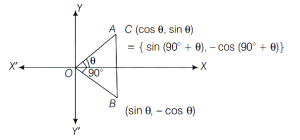
0 likesView Solution
13
MathematicsDifficultMCQKCET · 2013
The minimum area of the triangle formed by the variable line $3 \cos \theta \cdot x + 4 \sin \theta \cdot y = 12$ and the coordinate axes is
A
$144$
B
$\frac{25}{2}$
C
$\frac{49}{4}$
D
$12$
Solution
(D) The given equation of the line is $3 \cos \theta \cdot x + 4 \sin \theta \cdot y = 12$.
Dividing by $12$,we get the intercept form:
$\frac{x}{4 / \cos \theta} + \frac{y}{3 / \sin \theta} = 1$.
This line intersects the coordinate axes at $A\left(\frac{4}{\cos \theta}, 0\right)$ and $B\left(0, \frac{3}{\sin \theta}\right)$.
The area of $\triangle OAB$ is given by:
$\Delta = \frac{1}{2} \times |OA| \times |OB| = \frac{1}{2} \times \left| \frac{4}{\cos \theta} \right| \times \left| \frac{3}{\sin \theta} \right| = \frac{6}{|\sin \theta \cos \theta|} = \frac{12}{|\sin 2 \theta|}$.
For the area to be minimum,$|\sin 2 \theta|$ must be maximum. Since the maximum value of $|\sin 2 \theta|$ is $1$,the minimum area is:
$\Delta_{\min} = \frac{12}{1} = 12$.
Dividing by $12$,we get the intercept form:
$\frac{x}{4 / \cos \theta} + \frac{y}{3 / \sin \theta} = 1$.
This line intersects the coordinate axes at $A\left(\frac{4}{\cos \theta}, 0\right)$ and $B\left(0, \frac{3}{\sin \theta}\right)$.
The area of $\triangle OAB$ is given by:
$\Delta = \frac{1}{2} \times |OA| \times |OB| = \frac{1}{2} \times \left| \frac{4}{\cos \theta} \right| \times \left| \frac{3}{\sin \theta} \right| = \frac{6}{|\sin \theta \cos \theta|} = \frac{12}{|\sin 2 \theta|}$.
For the area to be minimum,$|\sin 2 \theta|$ must be maximum. Since the maximum value of $|\sin 2 \theta|$ is $1$,the minimum area is:
$\Delta_{\min} = \frac{12}{1} = 12$.
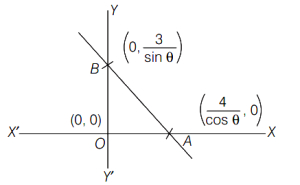
0 likesView Solution
14
MathematicsMediumMCQKCET · 2013
If the line $6x - 7y + 8 + \lambda(3x - y + 5) = 0$ is parallel to the $y$-axis,then $\lambda$ is equal to
A
$-7$
B
$-2$
C
$7$
D
$2$
Solution
(A) The given equation of the line is $6x - 7y + 8 + \lambda(3x - y + 5) = 0$.
Rearranging the terms in $x$ and $y$:
$(6 + 3\lambda)x - (7 + \lambda)y + (8 + 5\lambda) = 0$.
For a line to be parallel to the $y$-axis,the coefficient of $y$ must be zero,and the coefficient of $x$ must be non-zero.
Setting the coefficient of $y$ to zero:
$-(7 + \lambda) = 0$
$\lambda + 7 = 0$
$\lambda = -7$.
Checking the coefficient of $x$ for $\lambda = -7$:
$6 + 3(-7) = 6 - 21 = -15 \neq 0$.
Thus,the line is $x = \text{constant}$,which is parallel to the $y$-axis.
Rearranging the terms in $x$ and $y$:
$(6 + 3\lambda)x - (7 + \lambda)y + (8 + 5\lambda) = 0$.
For a line to be parallel to the $y$-axis,the coefficient of $y$ must be zero,and the coefficient of $x$ must be non-zero.
Setting the coefficient of $y$ to zero:
$-(7 + \lambda) = 0$
$\lambda + 7 = 0$
$\lambda = -7$.
Checking the coefficient of $x$ for $\lambda = -7$:
$6 + 3(-7) = 6 - 21 = -15 \neq 0$.
Thus,the line is $x = \text{constant}$,which is parallel to the $y$-axis.
0 likesView Solution
15
MathematicsMediumMCQKCET · 2013
The area of the circle having its centre at $(3,4)$ and touching the line $5x+12y-11=0$ is
A
$16 \pi$ sq units
B
$4 \pi$ sq units
C
$12 \pi$ sq units
D
$25 \pi$ sq units
Solution
(A) Given,the centre of the circle is $C(3,4)$.
Since the circle touches the line $5x+12y-11=0$,the radius $r$ of the circle is equal to the perpendicular distance from the centre $(3,4)$ to the line.
The perpendicular distance $d$ from a point $(x_1, y_1)$ to the line $ax+by+c=0$ is given by $d = \frac{|ax_1+by_1+c|}{\sqrt{a^2+b^2}}$.
Substituting the values,we get:
$r = \frac{|5(3)+12(4)-11|}{\sqrt{5^2+12^2}}$
$r = \frac{|15+48-11|}{\sqrt{25+144}}$
$r = \frac{|52|}{\sqrt{169}}$
$r = \frac{52}{13} = 4$.
The area of the circle is given by $\pi r^2$.
Area $= \pi(4)^2 = 16\pi$ sq units.
Since the circle touches the line $5x+12y-11=0$,the radius $r$ of the circle is equal to the perpendicular distance from the centre $(3,4)$ to the line.
The perpendicular distance $d$ from a point $(x_1, y_1)$ to the line $ax+by+c=0$ is given by $d = \frac{|ax_1+by_1+c|}{\sqrt{a^2+b^2}}$.
Substituting the values,we get:
$r = \frac{|5(3)+12(4)-11|}{\sqrt{5^2+12^2}}$
$r = \frac{|15+48-11|}{\sqrt{25+144}}$
$r = \frac{|52|}{\sqrt{169}}$
$r = \frac{52}{13} = 4$.
The area of the circle is given by $\pi r^2$.
Area $= \pi(4)^2 = 16\pi$ sq units.
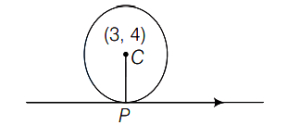
0 likesView Solution
16
MathematicsEasyMCQKCET · 2013
$A$ tangent is drawn to the circle $2x^{2} + 2y^{2} - 3x + 4y = 0$ at point $A$ and it meets the line $x + y = 3$ at $B(2, 1)$. Then,the length of $AB$ is equal to:
A
$\sqrt{10}$
B
$2$
C
$2\sqrt{2}$
D
$0$
Solution
(B) The equation of the circle is $2x^{2} + 2y^{2} - 3x + 4y = 0$. Dividing by $2$,we get the standard form: $x^{2} + y^{2} - \frac{3}{2}x + 2y = 0$.
Here,$AB$ represents the length of the tangent from point $B(2, 1)$ to the circle.
The length of the tangent from a point $(x_{1}, y_{1})$ to a circle $x^{2} + y^{2} + 2gx + 2fy + c = 0$ is given by $\sqrt{x_{1}^{2} + y_{1}^{2} + 2gx_{1} + 2fy_{1} + c}$.
Substituting the coordinates of $B(2, 1)$ into the circle equation:
$AB = \sqrt{(2)^{2} + (1)^{2} - \frac{3}{2}(2) + 2(1)}$
$AB = \sqrt{4 + 1 - 3 + 2}$
$AB = \sqrt{4} = 2 \text{ units}$.
Here,$AB$ represents the length of the tangent from point $B(2, 1)$ to the circle.
The length of the tangent from a point $(x_{1}, y_{1})$ to a circle $x^{2} + y^{2} + 2gx + 2fy + c = 0$ is given by $\sqrt{x_{1}^{2} + y_{1}^{2} + 2gx_{1} + 2fy_{1} + c}$.
Substituting the coordinates of $B(2, 1)$ into the circle equation:
$AB = \sqrt{(2)^{2} + (1)^{2} - \frac{3}{2}(2) + 2(1)}$
$AB = \sqrt{4 + 1 - 3 + 2}$
$AB = \sqrt{4} = 2 \text{ units}$.
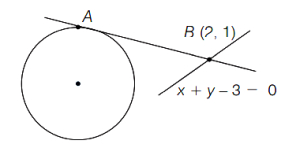
0 likesView Solution
17
MathematicsEasyMCQKCET · 2013
The length of the chord of the circle $x^{2}+y^{2}+3x+2y-8=0$ intercepted by the $y$-axis is
A
$3$
B
$8$
C
$9$
D
$6$
Solution
(D) The given equation of the circle is $x^{2}+y^{2}+3x+2y-8=0$.
Comparing this with the general equation $x^{2}+y^{2}+2gx+2fy+c=0$,we get $g=\frac{3}{2}$,$f=1$,and $c=-8$.
The length of the intercept made by the $y$-axis is given by the formula $2\sqrt{f^{2}-c}$.
Substituting the values,we get:
Length $= 2\sqrt{(1)^{2}-(-8)}$
$= 2\sqrt{1+8}$
$= 2\sqrt{9}$
$= 2 \times 3 = 6$.
Comparing this with the general equation $x^{2}+y^{2}+2gx+2fy+c=0$,we get $g=\frac{3}{2}$,$f=1$,and $c=-8$.
The length of the intercept made by the $y$-axis is given by the formula $2\sqrt{f^{2}-c}$.
Substituting the values,we get:
Length $= 2\sqrt{(1)^{2}-(-8)}$
$= 2\sqrt{1+8}$
$= 2\sqrt{9}$
$= 2 \times 3 = 6$.
0 likesView Solution
18
MathematicsEasyMCQKCET · 2013
The number of real circles cutting orthogonally the circle $x^{2}+y^{2}+2x-2y+7=0$ is
A
$0$
B
$1$
C
$2$
D
Infinitely many
Solution
(A) The given equation of the circle is $x^{2}+y^{2}+2x-2y+7=0$.
Comparing this with the standard form $x^{2}+y^{2}+2gx+2fy+c=0$,we get $g=1$,$f=-1$,and $c=7$.
The radius $r$ of the circle is given by $r = \sqrt{g^{2}+f^{2}-c}$.
Substituting the values,$r = \sqrt{1^{2}+(-1)^{2}-7} = \sqrt{1+1-7} = \sqrt{-5}$.
Since the radius is $\sqrt{-5}$,which is an imaginary number,the given equation does not represent a real circle.
Therefore,there are no real circles that can cut an imaginary circle orthogonally.
Thus,the number of such real circles is $0$.
Comparing this with the standard form $x^{2}+y^{2}+2gx+2fy+c=0$,we get $g=1$,$f=-1$,and $c=7$.
The radius $r$ of the circle is given by $r = \sqrt{g^{2}+f^{2}-c}$.
Substituting the values,$r = \sqrt{1^{2}+(-1)^{2}-7} = \sqrt{1+1-7} = \sqrt{-5}$.
Since the radius is $\sqrt{-5}$,which is an imaginary number,the given equation does not represent a real circle.
Therefore,there are no real circles that can cut an imaginary circle orthogonally.
Thus,the number of such real circles is $0$.
0 likesView Solution
19
MathematicsEasyMCQKCET · 2013
The equation of the tangent to the parabola $y^{2}=4x$ inclined at an angle of $\frac{\pi}{4}$ to the positive direction of $x$-axis is:
A
$x+y-4=0$
B
$x-y+4=0$
C
$x-y-1=0$
D
$x-y+1=0$
Solution
(D) Given,the equation of the parabola is $y^{2}=4x$.
Comparing with $y^{2}=4ax$,we get $a=1$.
The equation of the tangent to the parabola in slope form is $y=mx+\frac{a}{m}$.
Substituting $a=1$,we get $y=mx+\frac{1}{m} \quad (i)$.
The tangent is inclined at an angle of $\frac{\pi}{4}$ to the positive direction of the $x$-axis,so the slope $m = \tan(\frac{\pi}{4}) = 1$.
Substituting $m=1$ into equation $(i)$,we get $y = (1)x + \frac{1}{1}$.
This simplifies to $y = x + 1$,or $x - y + 1 = 0$.
Comparing with $y^{2}=4ax$,we get $a=1$.
The equation of the tangent to the parabola in slope form is $y=mx+\frac{a}{m}$.
Substituting $a=1$,we get $y=mx+\frac{1}{m} \quad (i)$.
The tangent is inclined at an angle of $\frac{\pi}{4}$ to the positive direction of the $x$-axis,so the slope $m = \tan(\frac{\pi}{4}) = 1$.
Substituting $m=1$ into equation $(i)$,we get $y = (1)x + \frac{1}{1}$.
This simplifies to $y = x + 1$,or $x - y + 1 = 0$.
0 likesView Solution
20
MathematicsMediumMCQKCET · 2013
The sum of the squares of the eccentricities of the conics $\frac{x^{2}}{4}+\frac{y^{2}}{3}=1$ and $\frac{x^{2}}{4}-\frac{y^{2}}{3}=1$ is
A
$2$
B
$\sqrt{\frac{7}{3}}$
C
$\sqrt{7}$
D
$\sqrt{3}$
Solution
(A) Given,the equation of the ellipse is $\frac{x^{2}}{4}+\frac{y^{2}}{3}=1$.
Here,$a^{2}=4$ and $b^{2}=3$.
The eccentricity of the ellipse is $e_{1}=\sqrt{1-\frac{b^{2}}{a^{2}}}=\sqrt{1-\frac{3}{4}}=\sqrt{\frac{1}{4}}=\frac{1}{2}$.
Given,the equation of the hyperbola is $\frac{x^{2}}{4}-\frac{y^{2}}{3}=1$.
Here,$a^{2}=4$ and $b^{2}=3$.
The eccentricity of the hyperbola is $e_{2}=\sqrt{1+\frac{b^{2}}{a^{2}}}=\sqrt{1+\frac{3}{4}}=\sqrt{\frac{7}{4}}=\frac{\sqrt{7}}{2}$.
The sum of the squares of the eccentricities is $e_{1}^{2}+e_{2}^{2} = (\frac{1}{2})^{2} + (\frac{\sqrt{7}}{2})^{2} = \frac{1}{4} + \frac{7}{4} = \frac{8}{4} = 2$.
Here,$a^{2}=4$ and $b^{2}=3$.
The eccentricity of the ellipse is $e_{1}=\sqrt{1-\frac{b^{2}}{a^{2}}}=\sqrt{1-\frac{3}{4}}=\sqrt{\frac{1}{4}}=\frac{1}{2}$.
Given,the equation of the hyperbola is $\frac{x^{2}}{4}-\frac{y^{2}}{3}=1$.
Here,$a^{2}=4$ and $b^{2}=3$.
The eccentricity of the hyperbola is $e_{2}=\sqrt{1+\frac{b^{2}}{a^{2}}}=\sqrt{1+\frac{3}{4}}=\sqrt{\frac{7}{4}}=\frac{\sqrt{7}}{2}$.
The sum of the squares of the eccentricities is $e_{1}^{2}+e_{2}^{2} = (\frac{1}{2})^{2} + (\frac{\sqrt{7}}{2})^{2} = \frac{1}{4} + \frac{7}{4} = \frac{8}{4} = 2$.
0 likesView Solution
21
MathematicsMediumMCQKCET · 2013
If the area of the auxiliary circle of the ellipse $\frac{x^{2}}{a^{2}}+\frac{y^{2}}{b^{2}}=1$ (where $a > b$) is twice the area of the ellipse,then the eccentricity of the ellipse is
A
$\frac{1}{\sqrt{3}}$
B
$\frac{1}{2}$
C
$\frac{1}{\sqrt{2}}$
D
$\frac{\sqrt{3}}{2}$
Solution
(D) The equation of the auxiliary circle of the ellipse $\frac{x^{2}}{a^{2}}+\frac{y^{2}}{b^{2}}=1$ is $x^{2}+y^{2}=a^{2}$.
Area of the auxiliary circle $= \pi a^{2}$.
Area of the ellipse $= \pi ab$.
According to the problem,the area of the auxiliary circle is twice the area of the ellipse:
$\pi a^{2} = 2(\pi ab)$
$a^{2} = 2ab$
$a = 2b \Rightarrow b = \frac{a}{2}$.
The eccentricity $e$ of the ellipse is given by:
$e = \sqrt{1 - \frac{b^{2}}{a^{2}}}$
$e = \sqrt{1 - \frac{(a/2)^{2}}{a^{2}}}$
$e = \sqrt{1 - \frac{a^{2}/4}{a^{2}}}$
$e = \sqrt{1 - \frac{1}{4}} = \sqrt{\frac{3}{4}} = \frac{\sqrt{3}}{2}$.
Area of the auxiliary circle $= \pi a^{2}$.
Area of the ellipse $= \pi ab$.
According to the problem,the area of the auxiliary circle is twice the area of the ellipse:
$\pi a^{2} = 2(\pi ab)$
$a^{2} = 2ab$
$a = 2b \Rightarrow b = \frac{a}{2}$.
The eccentricity $e$ of the ellipse is given by:
$e = \sqrt{1 - \frac{b^{2}}{a^{2}}}$
$e = \sqrt{1 - \frac{(a/2)^{2}}{a^{2}}}$
$e = \sqrt{1 - \frac{a^{2}/4}{a^{2}}}$
$e = \sqrt{1 - \frac{1}{4}} = \sqrt{\frac{3}{4}} = \frac{\sqrt{3}}{2}$.
0 likesView Solution
22
MathematicsDifficultMCQKCET · 2013
If the distance between the foci and the distance between the directrices of the hyperbola $\frac{x^{2}}{a^{2}}-\frac{y^{2}}{b^{2}}=1$ are in the ratio $3: 2$,then $a: b$ is
A
$\sqrt{2}: 1$
B
$1: 2$
C
$\sqrt{3}: \sqrt{2}$
D
$2: 1$
Solution
(A) The given equation of the hyperbola is $\frac{x^{2}}{a^{2}}-\frac{y^{2}}{b^{2}}=1$.
Distance between the foci $= 2ae$.
Distance between the directrices $= \frac{2a}{e}$.
Given the ratio is $3: 2$,so $\frac{2ae}{2a/e} = \frac{3}{2}$.
This simplifies to $e^{2} = \frac{3}{2}$.
We know that for a hyperbola,$e = \sqrt{1 + \frac{b^{2}}{a^{2}}}$,so $e^{2} = 1 + \frac{b^{2}}{a^{2}}$.
Substituting $e^{2} = \frac{3}{2}$,we get $1 + \frac{b^{2}}{a^{2}} = \frac{3}{2}$.
$\frac{b^{2}}{a^{2}} = \frac{3}{2} - 1 = \frac{1}{2}$.
Therefore,$\frac{b}{a} = \frac{1}{\sqrt{2}}$,which implies $\frac{a}{b} = \sqrt{2}: 1$.
Distance between the foci $= 2ae$.
Distance between the directrices $= \frac{2a}{e}$.
Given the ratio is $3: 2$,so $\frac{2ae}{2a/e} = \frac{3}{2}$.
This simplifies to $e^{2} = \frac{3}{2}$.
We know that for a hyperbola,$e = \sqrt{1 + \frac{b^{2}}{a^{2}}}$,so $e^{2} = 1 + \frac{b^{2}}{a^{2}}$.
Substituting $e^{2} = \frac{3}{2}$,we get $1 + \frac{b^{2}}{a^{2}} = \frac{3}{2}$.
$\frac{b^{2}}{a^{2}} = \frac{3}{2} - 1 = \frac{1}{2}$.
Therefore,$\frac{b}{a} = \frac{1}{\sqrt{2}}$,which implies $\frac{a}{b} = \sqrt{2}: 1$.
0 likesView Solution
23
MathematicsEasyMCQKCET · 2013
$\lim _{x \rightarrow 0} \frac{\log _{e}(1+x)}{3^{x}-1}$ is equal to
A
$\log _{e} 3$
B
$0$
C
$\log _{3} e$
D
$1$
Solution
(C) Given limit: $\lim _{x \rightarrow 0} \frac{\log _{e}(1+x)}{3^{x}-1}$
This is in the indeterminate form $\frac{0}{0}$.
Applying $L$'Hospital's rule by differentiating the numerator and denominator with respect to $x$:
$= \lim _{x \rightarrow 0} \frac{\frac{d}{dx}(\log _{e}(1+x))}{\frac{d}{dx}(3^{x}-1)}$
$= \lim _{x \rightarrow 0} \frac{\frac{1}{1+x}}{3^{x} \cdot \log _{e} 3}$
Substituting $x = 0$:
$= \frac{\frac{1}{1+0}}{3^{0} \cdot \log _{e} 3} = \frac{1}{1 \cdot \log _{e} 3} = \frac{1}{\log _{e} 3}$
Using the property $\frac{1}{\log _{a} b} = \log _{b} a$,we get:
$= \log _{3} e$
This is in the indeterminate form $\frac{0}{0}$.
Applying $L$'Hospital's rule by differentiating the numerator and denominator with respect to $x$:
$= \lim _{x \rightarrow 0} \frac{\frac{d}{dx}(\log _{e}(1+x))}{\frac{d}{dx}(3^{x}-1)}$
$= \lim _{x \rightarrow 0} \frac{\frac{1}{1+x}}{3^{x} \cdot \log _{e} 3}$
Substituting $x = 0$:
$= \frac{\frac{1}{1+0}}{3^{0} \cdot \log _{e} 3} = \frac{1}{1 \cdot \log _{e} 3} = \frac{1}{\log _{e} 3}$
Using the property $\frac{1}{\log _{a} b} = \log _{b} a$,we get:
$= \log _{3} e$
0 likesView Solution
24
MathematicsEasyMCQKCET · 2013
The inverse of the proposition $(p \wedge \sim q) \rightarrow r$ is:
A
$(\sim r) \rightarrow (\sim p) \vee q$
B
$(\sim p) \vee q \rightarrow (\sim r)$
C
$r \rightarrow p \wedge (\sim q)$
D
$(\sim p) \vee (\sim q) \rightarrow r$
Solution
(B) The given proposition is $(p \wedge \sim q) \rightarrow r$.
The inverse of a conditional statement $A \rightarrow B$ is defined as $\sim A \rightarrow \sim B$.
Here,$A = (p \wedge \sim q)$ and $B = r$.
Therefore,the inverse is $\sim (p \wedge \sim q) \rightarrow \sim r$.
Using De Morgan's Law,$\sim (p \wedge \sim q) \equiv \sim p \vee \sim (\sim q) \equiv \sim p \vee q$.
Thus,the inverse is $(\sim p) \vee q \rightarrow (\sim r)$.
The inverse of a conditional statement $A \rightarrow B$ is defined as $\sim A \rightarrow \sim B$.
Here,$A = (p \wedge \sim q)$ and $B = r$.
Therefore,the inverse is $\sim (p \wedge \sim q) \rightarrow \sim r$.
Using De Morgan's Law,$\sim (p \wedge \sim q) \equiv \sim p \vee \sim (\sim q) \equiv \sim p \vee q$.
Thus,the inverse is $(\sim p) \vee q \rightarrow (\sim r)$.
0 likesView Solution
25
MathematicsEasyMCQKCET · 2013
$A$ value of $x$ satisfying $150 x \equiv 35 \pmod{31}$ is
A
$14$
B
$22$
C
$24$
D
$12$
Solution
(C) Given,$150 x \equiv 35 \pmod{31}$.
First,simplify the congruence by dividing by the common factor $5$ (since $\gcd(5, 31) = 1$):
$30 x \equiv 7 \pmod{31}$.
We can write $30$ as $-1 \pmod{31}$:
$-x \equiv 7 \pmod{31}$.
Multiplying both sides by $-1$:
$x \equiv -7 \pmod{31}$.
To find the positive residue,add $31$:
$x \equiv -7 + 31 \pmod{31} \Rightarrow x \equiv 24 \pmod{31}$.
Thus,$x = 24$ satisfies the given congruence.
First,simplify the congruence by dividing by the common factor $5$ (since $\gcd(5, 31) = 1$):
$30 x \equiv 7 \pmod{31}$.
We can write $30$ as $-1 \pmod{31}$:
$-x \equiv 7 \pmod{31}$.
Multiplying both sides by $-1$:
$x \equiv -7 \pmod{31}$.
To find the positive residue,add $31$:
$x \equiv -7 + 31 \pmod{31} \Rightarrow x \equiv 24 \pmod{31}$.
Thus,$x = 24$ satisfies the given congruence.
0 likesView Solution
26
MathematicsEasyMCQKCET · 2013
In a $\Delta ABC$,if $\frac{\cos A}{a}=\frac{\cos B}{b}=\frac{\cos C}{c}$ and $a=2$,then its area is
A
$2 \sqrt{3}$
B
$\sqrt{3}$
C
$\frac{\sqrt{3}}{2}$
D
$\frac{\sqrt{3}}{4}$
Solution
(B) Given,in $\triangle ABC$,$\frac{\cos A}{a}=\frac{\cos B}{b}=\frac{\cos C}{c} \dots (i)$
From the sine rule,$\frac{\sin A}{a}=\frac{\sin B}{b}=\frac{\sin C}{c} \dots (ii)$
Dividing Eq. $(ii)$ by Eq. $(i)$,we get $\tan A = \tan B = \tan C$.
Since $A, B, C$ are angles of a triangle,$A = B = C$.
Thus,$\triangle ABC$ is an equilateral triangle.
Since $A+B+C = 180^{\circ}$,we have $3A = 180^{\circ}$,so $A = B = C = 60^{\circ}$.
The area of an equilateral triangle is given by $\frac{\sqrt{3}}{4} a^2$.
Given $a = 2$,the area is $\frac{\sqrt{3}}{4} (2)^2 = \frac{\sqrt{3}}{4} \times 4 = \sqrt{3}$.
From the sine rule,$\frac{\sin A}{a}=\frac{\sin B}{b}=\frac{\sin C}{c} \dots (ii)$
Dividing Eq. $(ii)$ by Eq. $(i)$,we get $\tan A = \tan B = \tan C$.
Since $A, B, C$ are angles of a triangle,$A = B = C$.
Thus,$\triangle ABC$ is an equilateral triangle.
Since $A+B+C = 180^{\circ}$,we have $3A = 180^{\circ}$,so $A = B = C = 60^{\circ}$.
The area of an equilateral triangle is given by $\frac{\sqrt{3}}{4} a^2$.
Given $a = 2$,the area is $\frac{\sqrt{3}}{4} (2)^2 = \frac{\sqrt{3}}{4} \times 4 = \sqrt{3}$.
0 likesView Solution
27
MathematicsDifficultMCQKCET · 2013
If $\sin ^{-1} a$ is the acute angle between the curves $x^{2}+y^{2}=4 x$ and $x^{2}+y^{2}=8$ at $(2,2)$,then $a$ is equal to
A
$1$
B
$0$
C
$\frac{1}{\sqrt{2}}$
D
$\frac{\sqrt{3}}{2}$
Solution
(C) The given curves are $x^{2}+y^{2}=4x$ and $x^{2}+y^{2}=8$.
For the first curve $x^{2}+y^{2}=4x$,differentiating with respect to $x$ gives $2x + 2y \frac{dy}{dx} = 4$,so $\frac{dy}{dx} = \frac{2-x}{y}$.
At the point $(2,2)$,the slope $m_{1} = \frac{2-2}{2} = 0$.
For the second curve $x^{2}+y^{2}=8$,differentiating with respect to $x$ gives $2x + 2y \frac{dy}{dx} = 0$,so $\frac{dy}{dx} = -\frac{x}{y}$.
At the point $(2,2)$,the slope $m_{2} = -\frac{2}{2} = -1$.
The angle $\theta$ between the curves is given by $\tan \theta = \left| \frac{m_{1}-m_{2}}{1+m_{1}m_{2}} \right|$.
Substituting the values,$\tan \theta = \left| \frac{0 - (-1)}{1 + (0)(-1)} \right| = \left| \frac{1}{1} \right| = 1$.
Since $\tan \theta = 1$,we have $\theta = 45^{\circ}$.
Given that $\theta = \sin^{-1} a$,we have $\sin^{-1} a = 45^{\circ}$,which implies $a = \sin 45^{\circ} = \frac{1}{\sqrt{2}}$.
For the first curve $x^{2}+y^{2}=4x$,differentiating with respect to $x$ gives $2x + 2y \frac{dy}{dx} = 4$,so $\frac{dy}{dx} = \frac{2-x}{y}$.
At the point $(2,2)$,the slope $m_{1} = \frac{2-2}{2} = 0$.
For the second curve $x^{2}+y^{2}=8$,differentiating with respect to $x$ gives $2x + 2y \frac{dy}{dx} = 0$,so $\frac{dy}{dx} = -\frac{x}{y}$.
At the point $(2,2)$,the slope $m_{2} = -\frac{2}{2} = -1$.
The angle $\theta$ between the curves is given by $\tan \theta = \left| \frac{m_{1}-m_{2}}{1+m_{1}m_{2}} \right|$.
Substituting the values,$\tan \theta = \left| \frac{0 - (-1)}{1 + (0)(-1)} \right| = \left| \frac{1}{1} \right| = 1$.
Since $\tan \theta = 1$,we have $\theta = 45^{\circ}$.
Given that $\theta = \sin^{-1} a$,we have $\sin^{-1} a = 45^{\circ}$,which implies $a = \sin 45^{\circ} = \frac{1}{\sqrt{2}}$.
0 likesView Solution
28
MathematicsEasyMCQKCET · 2013
In a regular graph of $15$ vertices,the sum of the degrees of the vertices is $60$. Then,the degree of each vertex is:
A
$5$
B
$3$
C
$4$
D
$2$
Solution
(C) Let the degree of each vertex be $K$.
Since the graph is regular,every vertex has the same degree $K$.
The sum of the degrees of all vertices in a graph is given by the product of the number of vertices and the degree of each vertex.
Given that there are $15$ vertices and the sum of their degrees is $60$,we have:
$15 \times K = 60$
Dividing both sides by $15$,we get:
$K = \frac{60}{15} = 4$
Therefore,the degree of each vertex is $4$.
Since the graph is regular,every vertex has the same degree $K$.
The sum of the degrees of all vertices in a graph is given by the product of the number of vertices and the degree of each vertex.
Given that there are $15$ vertices and the sum of their degrees is $60$,we have:
$15 \times K = 60$
Dividing both sides by $15$,we get:
$K = \frac{60}{15} = 4$
Therefore,the degree of each vertex is $4$.
0 likesView Solution
29
MathematicsMediumMCQKCET · 2013
In a group $(G, *)$,for some element $a$ of $G$,if $a^{2}=e$,where $e$ is the identity element,then
A
$a=a^{-1}$
B
$a=\sqrt{e}$
C
$a=\frac{1}{a^{2}}$
D
$a=e$
Solution
(A) Given that $a^{2} = e$ in the group $(G, *)$.
Multiplying both sides by $a^{-1}$ (the inverse of $a$):
$a^{-1} * (a * a) = a^{-1} * e$
$(a^{-1} * a) * a = a^{-1}$
$e * a = a^{-1}$
$a = a^{-1}$
Multiplying both sides by $a^{-1}$ (the inverse of $a$):
$a^{-1} * (a * a) = a^{-1} * e$
$(a^{-1} * a) * a = a^{-1}$
$e * a = a^{-1}$
$a = a^{-1}$
0 likesView Solution
30
MathematicsDifficultMCQKCET · 2013
In the set of integers $(Z, *)$,if $a * b = a + b - n, \forall a, b \in Z$,where $n$ is a fixed integer,then the inverse of $(-n)$ is:
A
$n$
B
$-n$
C
$-3n$
D
$3n$
Solution
(D) Given,in a group $(Z, *)$,the operation is defined as $a * b = a + b - n$ for all $a, b \in Z$.
First,we find the identity element $e$ such that $a * e = a$.
$a + e - n = a \implies e = n$.
Now,to find the inverse of $(-n)$,let the inverse be $x$ such that $(-n) * x = e$.
Since $e = n$,we have $(-n) * x = n$.
Using the definition of the operation:
$(-n) + x - n = n$.
$x - 2n = n$.
$x = 3n$.
Thus,the inverse of $(-n)$ is $3n$.
First,we find the identity element $e$ such that $a * e = a$.
$a + e - n = a \implies e = n$.
Now,to find the inverse of $(-n)$,let the inverse be $x$ such that $(-n) * x = e$.
Since $e = n$,we have $(-n) * x = n$.
Using the definition of the operation:
$(-n) + x - n = n$.
$x - 2n = n$.
$x = 3n$.
Thus,the inverse of $(-n)$ is $3n$.
0 likesView Solution
31
MathematicsEasyMCQKCET · 2013
If $A$ and $B$ are square matrices of order $n$ such that $A^{2}-B^{2}=(A-B)(A+B)$,then which of the following will be true?
A
Either $A$ or $B$ is zero matrix
B
$A=B$
C
$A B=B A$
D
Either $A$ or $B$ is identity matrix
Solution
(C) Given that $A$ and $B$ are square matrices of order $n$ such that $A^{2}-B^{2}=(A-B)(A+B)$.
Expanding the right-hand side using the distributive property of matrix multiplication:
$(A-B)(A+B) = A(A+B) - B(A+B) = A^{2} + AB - BA - B^{2}$.
Equating this to the left-hand side:
$A^{2} - B^{2} = A^{2} + AB - BA - B^{2}$.
Subtracting $A^{2} - B^{2}$ from both sides,we get:
$0 = AB - BA$.
Therefore,$AB = BA$.
This implies that the matrices $A$ and $B$ must commute.
Expanding the right-hand side using the distributive property of matrix multiplication:
$(A-B)(A+B) = A(A+B) - B(A+B) = A^{2} + AB - BA - B^{2}$.
Equating this to the left-hand side:
$A^{2} - B^{2} = A^{2} + AB - BA - B^{2}$.
Subtracting $A^{2} - B^{2}$ from both sides,we get:
$0 = AB - BA$.
Therefore,$AB = BA$.
This implies that the matrices $A$ and $B$ must commute.
0 likesView Solution
32
MathematicsEasyMCQKCET · 2013
If the matrix $\left[\begin{array}{rr}2 & 3 \\ 5 & -1\end{array}\right]=A+B$,where $A$ is symmetric and $B$ is skew-symmetric,then $B$ is equal to
A
$\left[\begin{array}{cc}2 & 4 \\ 4 & -1\end{array}\right]$
B
$\left[\begin{array}{rr}0 & -2 \\ 2 & 0\end{array}\right]$
C
$\left[\begin{array}{rr}0 & 1 \\ -1 & 0\end{array}\right]$
D
$\left[\begin{array}{rr}0 & -1 \\ 1 & 0\end{array}\right]$
Solution
(D) Given,$C = \left[\begin{array}{rr}2 & 3 \\ 5 & -1\end{array}\right] = A+B$.
We know that any square matrix $C$ can be uniquely expressed as the sum of a symmetric matrix $A$ and a skew-symmetric matrix $B$,where $A = \frac{1}{2}(C+C^T)$ and $B = \frac{1}{2}(C-C^T)$.
First,find the transpose of $C$: $C^T = \left[\begin{array}{rr}2 & 5 \\ 3 & -1\end{array}\right]$.
Now,calculate $B = \frac{1}{2}(C-C^T)$:
$B = \frac{1}{2} \left( \left[\begin{array}{rr}2 & 3 \\ 5 & -1\end{array}\right] - \left[\begin{array}{rr}2 & 5 \\ 3 & -1\end{array}\right] \right)$
$B = \frac{1}{2} \left[\begin{array}{rr}2-2 & 3-5 \\ 5-3 & -1-(-1)\end{array}\right]$
$B = \frac{1}{2} \left[\begin{array}{rr}0 & -2 \\ 2 & 0\end{array}\right]$
$B = \left[\begin{array}{rr}0 & -1 \\ 1 & 0\end{array}\right]$.
We know that any square matrix $C$ can be uniquely expressed as the sum of a symmetric matrix $A$ and a skew-symmetric matrix $B$,where $A = \frac{1}{2}(C+C^T)$ and $B = \frac{1}{2}(C-C^T)$.
First,find the transpose of $C$: $C^T = \left[\begin{array}{rr}2 & 5 \\ 3 & -1\end{array}\right]$.
Now,calculate $B = \frac{1}{2}(C-C^T)$:
$B = \frac{1}{2} \left( \left[\begin{array}{rr}2 & 3 \\ 5 & -1\end{array}\right] - \left[\begin{array}{rr}2 & 5 \\ 3 & -1\end{array}\right] \right)$
$B = \frac{1}{2} \left[\begin{array}{rr}2-2 & 3-5 \\ 5-3 & -1-(-1)\end{array}\right]$
$B = \frac{1}{2} \left[\begin{array}{rr}0 & -2 \\ 2 & 0\end{array}\right]$
$B = \left[\begin{array}{rr}0 & -1 \\ 1 & 0\end{array}\right]$.
0 likesView Solution
33
MathematicsEasyMCQKCET · 2013
If the determinant of the adjoint of a (real) matrix of order $3$ is $25$,then the determinant of the inverse of the matrix is
A
$0.2$
B
$\pm 5$
C
$\frac{1}{\sqrt[5]{625}}$
D
$\pm 0.2$
Solution
(D) Given,the determinant of the adjoint of a (real) matrix $A$ of order $n=3$ is $|\operatorname{adj} A| = 25$.
We know the property $|\operatorname{adj} A| = |A|^{n-1}$.
Substituting $n=3$,we get $|\operatorname{adj} A| = |A|^{3-1} = |A|^2$.
Thus,$|A|^2 = 25$,which implies $|A| = \pm 5$.
We need to find the determinant of the inverse of the matrix,which is $|A^{-1}|$.
Using the property $|A^{-1}| = \frac{1}{|A|}$,we get $|A^{-1}| = \frac{1}{\pm 5} = \pm 0.2$.
We know the property $|\operatorname{adj} A| = |A|^{n-1}$.
Substituting $n=3$,we get $|\operatorname{adj} A| = |A|^{3-1} = |A|^2$.
Thus,$|A|^2 = 25$,which implies $|A| = \pm 5$.
We need to find the determinant of the inverse of the matrix,which is $|A^{-1}|$.
Using the property $|A^{-1}| = \frac{1}{|A|}$,we get $|A^{-1}| = \frac{1}{\pm 5} = \pm 0.2$.
0 likesView Solution
34
MathematicsEasyMCQKCET · 2013
If $A = \begin{bmatrix} \alpha & 2 \\ 2 & \alpha \end{bmatrix}$ and $|A^{3}| = 125$,then $\alpha$ is equal to
A
$\pm 1$
B
$\pm 2$
C
$\pm 3$
D
$\pm 5$
Solution
(C) Given,$A = \begin{bmatrix} \alpha & 2 \\ 2 & \alpha \end{bmatrix}$.
First,we calculate the determinant of $A$:
$|A| = \begin{vmatrix} \alpha & 2 \\ 2 & \alpha \end{vmatrix} = \alpha^{2} - 4 \quad (i)$.
We are given that $|A^{3}| = 125$.
Using the property of determinants $|A^{n}| = |A|^{n}$,we have:
$|A|^{3} = 125$.
Taking the cube root on both sides:
$|A| = \sqrt[3]{125} = 5$.
Now,substitute $|A| = 5$ into equation $(i)$:
$5 = \alpha^{2} - 4$.
$\alpha^{2} = 5 + 4 = 9$.
Taking the square root on both sides:
$\alpha = \pm 3$.
First,we calculate the determinant of $A$:
$|A| = \begin{vmatrix} \alpha & 2 \\ 2 & \alpha \end{vmatrix} = \alpha^{2} - 4 \quad (i)$.
We are given that $|A^{3}| = 125$.
Using the property of determinants $|A^{n}| = |A|^{n}$,we have:
$|A|^{3} = 125$.
Taking the cube root on both sides:
$|A| = \sqrt[3]{125} = 5$.
Now,substitute $|A| = 5$ into equation $(i)$:
$5 = \alpha^{2} - 4$.
$\alpha^{2} = 5 + 4 = 9$.
Taking the square root on both sides:
$\alpha = \pm 3$.
0 likesView Solution
35
MathematicsMediumMCQKCET · 2013
If $A = \begin{vmatrix} x & 1 & 1 \\ 1 & x & 1 \\ 1 & 1 & x \end{vmatrix}$ and $B = \begin{vmatrix} x & 1 \\ 1 & x \end{vmatrix}$,then $\frac{dA}{dx}$ is equal to
A
$3B+1$
B
$3B$
C
$-3B$
D
$1-3B$
Solution
(B) Given,$A = \begin{vmatrix} x & 1 & 1 \\ 1 & x & 1 \\ 1 & 1 & x \end{vmatrix}$
Expanding along the first row:
$A = x(x^2 - 1) - 1(x - 1) + 1(1 - x)$
$A = x^3 - x - x + 1 + 1 - x$
$A = x^3 - 3x + 2$
Differentiating with respect to $x$:
$\frac{dA}{dx} = 3x^2 - 3$ ... $(i)$
Also,given $B = \begin{vmatrix} x & 1 \\ 1 & x \end{vmatrix} = x^2 - 1$
Multiplying by $3$:
$3B = 3(x^2 - 1) = 3x^2 - 3$ ... $(ii)$
From equations $(i)$ and $(ii)$,we get:
$\frac{dA}{dx} = 3B$
Expanding along the first row:
$A = x(x^2 - 1) - 1(x - 1) + 1(1 - x)$
$A = x^3 - x - x + 1 + 1 - x$
$A = x^3 - 3x + 2$
Differentiating with respect to $x$:
$\frac{dA}{dx} = 3x^2 - 3$ ... $(i)$
Also,given $B = \begin{vmatrix} x & 1 \\ 1 & x \end{vmatrix} = x^2 - 1$
Multiplying by $3$:
$3B = 3(x^2 - 1) = 3x^2 - 3$ ... $(ii)$
From equations $(i)$ and $(ii)$,we get:
$\frac{dA}{dx} = 3B$
0 likesView Solution
36
MathematicsDifficultMCQKCET · 2013
$\cos \left(2 \cos ^{-1} \frac{1}{5}+\sin ^{-1} \frac{1}{5}\right)$ is equal to
A
$\frac{1}{5}$
B
$\frac{-2 \sqrt{6}}{5}$
C
$-\frac{1}{5}$
D
$\frac{\sqrt{6}}{5}$
Solution
(B) Let the given expression be $E = \cos \left(2 \cos ^{-1} \frac{1}{5}+\sin ^{-1} \frac{1}{5}\right)$.
We can rewrite the expression as $E = \cos \left(\cos ^{-1} \frac{1}{5} + \left(\cos ^{-1} \frac{1}{5} + \sin ^{-1} \frac{1}{5}\right)\right)$.
Using the identity $\cos ^{-1} x + \sin ^{-1} x = \frac{\pi}{2}$,we have $\cos ^{-1} \frac{1}{5} + \sin ^{-1} \frac{1}{5} = \frac{\pi}{2}$.
Substituting this into the expression,we get $E = \cos \left(\cos ^{-1} \frac{1}{5} + \frac{\pi}{2}\right)$.
Using the trigonometric identity $\cos \left(\theta + \frac{\pi}{2}\right) = -\sin \theta$,we have $E = -\sin \left(\cos ^{-1} \frac{1}{5}\right)$.
Let $\theta = \cos ^{-1} \frac{1}{5}$,then $\cos \theta = \frac{1}{5}$.
Since $\sin \theta = \sqrt{1 - \cos^2 \theta}$,we have $\sin \theta = \sqrt{1 - \left(\frac{1}{5}\right)^2} = \sqrt{1 - \frac{1}{25}} = \sqrt{\frac{24}{25}} = \frac{2 \sqrt{6}}{5}$.
Therefore,$E = -\frac{2 \sqrt{6}}{5}$.
We can rewrite the expression as $E = \cos \left(\cos ^{-1} \frac{1}{5} + \left(\cos ^{-1} \frac{1}{5} + \sin ^{-1} \frac{1}{5}\right)\right)$.
Using the identity $\cos ^{-1} x + \sin ^{-1} x = \frac{\pi}{2}$,we have $\cos ^{-1} \frac{1}{5} + \sin ^{-1} \frac{1}{5} = \frac{\pi}{2}$.
Substituting this into the expression,we get $E = \cos \left(\cos ^{-1} \frac{1}{5} + \frac{\pi}{2}\right)$.
Using the trigonometric identity $\cos \left(\theta + \frac{\pi}{2}\right) = -\sin \theta$,we have $E = -\sin \left(\cos ^{-1} \frac{1}{5}\right)$.
Let $\theta = \cos ^{-1} \frac{1}{5}$,then $\cos \theta = \frac{1}{5}$.
Since $\sin \theta = \sqrt{1 - \cos^2 \theta}$,we have $\sin \theta = \sqrt{1 - \left(\frac{1}{5}\right)^2} = \sqrt{1 - \frac{1}{25}} = \sqrt{\frac{24}{25}} = \frac{2 \sqrt{6}}{5}$.
Therefore,$E = -\frac{2 \sqrt{6}}{5}$.
0 likesView Solution
37
MathematicsEasyMCQKCET · 2013
The value of $\tan ^{-1}\left(\frac{x}{y}\right)-\tan ^{-1}\left(\frac{x-y}{x+y}\right)$ (where,$x, y>0$) is
A
$\frac{\pi}{4}$
B
$-\frac{\pi}{4}$
C
$\frac{\pi}{2}$
D
$-\frac{\pi}{2}$
Solution
(A) We use the formula $\tan ^{-1} A - \tan ^{-1} B = \tan ^{-1} \left( \frac{A-B}{1+AB} \right)$.
Let $A = \frac{x}{y}$ and $B = \frac{x-y}{x+y}$.
Then,$\tan ^{-1} \left( \frac{x}{y} \right) - \tan ^{-1} \left( \frac{x-y}{x+y} \right) = \tan ^{-1} \left( \frac{\frac{x}{y} - \frac{x-y}{x+y}}{1 + \frac{x}{y} \cdot \frac{x-y}{x+y}} \right)$.
Simplifying the numerator: $\frac{x(x+y) - y(x-y)}{y(x+y)} = \frac{x^2 + xy - xy + y^2}{y(x+y)} = \frac{x^2 + y^2}{y(x+y)}$.
Simplifying the denominator: $1 + \frac{x^2 - xy}{y(x+y)} = \frac{xy + y^2 + x^2 - xy}{y(x+y)} = \frac{x^2 + y^2}{y(x+y)}$.
Thus,the expression becomes $\tan ^{-1} \left( \frac{\frac{x^2 + y^2}{y(x+y)}}{\frac{x^2 + y^2}{y(x+y)}} \right) = \tan ^{-1}(1)$.
Since $\tan ^{-1}(1) = \frac{\pi}{4}$,the final value is $\frac{\pi}{4}$.
Let $A = \frac{x}{y}$ and $B = \frac{x-y}{x+y}$.
Then,$\tan ^{-1} \left( \frac{x}{y} \right) - \tan ^{-1} \left( \frac{x-y}{x+y} \right) = \tan ^{-1} \left( \frac{\frac{x}{y} - \frac{x-y}{x+y}}{1 + \frac{x}{y} \cdot \frac{x-y}{x+y}} \right)$.
Simplifying the numerator: $\frac{x(x+y) - y(x-y)}{y(x+y)} = \frac{x^2 + xy - xy + y^2}{y(x+y)} = \frac{x^2 + y^2}{y(x+y)}$.
Simplifying the denominator: $1 + \frac{x^2 - xy}{y(x+y)} = \frac{xy + y^2 + x^2 - xy}{y(x+y)} = \frac{x^2 + y^2}{y(x+y)}$.
Thus,the expression becomes $\tan ^{-1} \left( \frac{\frac{x^2 + y^2}{y(x+y)}}{\frac{x^2 + y^2}{y(x+y)}} \right) = \tan ^{-1}(1)$.
Since $\tan ^{-1}(1) = \frac{\pi}{4}$,the final value is $\frac{\pi}{4}$.
0 likesView Solution
38
MathematicsEasyMCQKCET · 2013
The range of the function $f(x)=\sin [x]$,where $-\frac{\pi}{4} < x < \frac{\pi}{4}$ and $[x]$ denotes the greatest integer $\leq x$,is
A
$\{0\}$
B
$\{0, -1\}$
C
$\{0, \pm \sin 1\}$
D
$\{0, -\sin 1\}$
Solution
(D) Given the function $f(x) = \sin [x]$ for $-\frac{\pi}{4} < x < \frac{\pi}{4}$.
We know that $\frac{\pi}{4} \approx 0.785$ and $-\frac{\pi}{4} \approx -0.785$.
The interval for $x$ is $(-0.785, 0.785)$.
For $x \in [0, 0.785)$,the greatest integer value $[x] = 0$. Thus,$f(x) = \sin(0) = 0$.
For $x \in (-0.785, 0)$,the greatest integer value $[x] = -1$. Thus,$f(x) = \sin(-1) = -\sin(1)$.
Therefore,the range of the function is $\{0, -\sin 1\}$.
We know that $\frac{\pi}{4} \approx 0.785$ and $-\frac{\pi}{4} \approx -0.785$.
The interval for $x$ is $(-0.785, 0.785)$.
For $x \in [0, 0.785)$,the greatest integer value $[x] = 0$. Thus,$f(x) = \sin(0) = 0$.
For $x \in (-0.785, 0)$,the greatest integer value $[x] = -1$. Thus,$f(x) = \sin(-1) = -\sin(1)$.
Therefore,the range of the function is $\{0, -\sin 1\}$.
0 likesView Solution
39
MathematicsEasyMCQKCET · 2013
If $f(x) = \begin{cases} x, & \text{if } x \text{ is irrational} \\ 0, & \text{if } x \text{ is rational} \end{cases}$,then $f$ is
A
continuous everywhere
B
discontinuous everywhere
C
continuous only at $x=0$
D
continuous at all rational numbers
Solution
(C) Given,$f(x) = \begin{cases} x, & \text{if } x \text{ is irrational} \\ 0, & \text{if } x \text{ is rational} \end{cases}$.
For any $a \neq 0$,consider a sequence of rational numbers $r_n \to a$ and a sequence of irrational numbers $i_n \to a$.
Then $\lim_{n \to \infty} f(r_n) = \lim_{n \to \infty} 0 = 0$ and $\lim_{n \to \infty} f(i_n) = \lim_{n \to \infty} i_n = a$.
Since $0 \neq a$ for $a \neq 0$,the limit $\lim_{x \to a} f(x)$ does not exist for $a \neq 0$.
At $x=0$,$\lim_{x \to 0} f(x) = 0$ because for any sequence $x_n \to 0$,$f(x_n)$ is either $x_n$ (if $x_n$ is irrational) or $0$ (if $x_n$ is rational),both of which approach $0$.
Since $f(0) = 0$,the function is continuous only at $x=0$.
For any $a \neq 0$,consider a sequence of rational numbers $r_n \to a$ and a sequence of irrational numbers $i_n \to a$.
Then $\lim_{n \to \infty} f(r_n) = \lim_{n \to \infty} 0 = 0$ and $\lim_{n \to \infty} f(i_n) = \lim_{n \to \infty} i_n = a$.
Since $0 \neq a$ for $a \neq 0$,the limit $\lim_{x \to a} f(x)$ does not exist for $a \neq 0$.
At $x=0$,$\lim_{x \to 0} f(x) = 0$ because for any sequence $x_n \to 0$,$f(x_n)$ is either $x_n$ (if $x_n$ is irrational) or $0$ (if $x_n$ is rational),both of which approach $0$.
Since $f(0) = 0$,the function is continuous only at $x=0$.
0 likesView Solution
40
MathematicsMediumMCQKCET · 2013
If $f(x) = \begin{cases} 2a - x & \text{when } -a < x < a \\ 3x - 2a & \text{when } a \leq x \end{cases}$,then which of the following is true?
A
$f(x)$ is not differentiable at $x = a$
B
$f(x)$ is discontinuous at $x = a$
C
$f(x)$ is continuous for all $x < a$
D
$f(x)$ is differentiable for all $x \geq a$
Solution
(A) Given,$f(x) = \begin{cases} 2a - x & \text{when } -a < x < a \\ 3x - 2a & \text{when } a \leq x \end{cases}$.
First,check for continuity at $x = a$:
Left-hand limit: $\lim_{x \to a^-} f(x) = \lim_{x \to a^-} (2a - x) = 2a - a = a$.
Right-hand limit: $\lim_{x \to a^+} f(x) = \lim_{x \to a^+} (3x - 2a) = 3a - 2a = a$.
Value of function: $f(a) = 3(a) - 2a = a$.
Since $\lim_{x \to a^-} f(x) = \lim_{x \to a^+} f(x) = f(a)$,the function is continuous at $x = a$.
Now,check for differentiability at $x = a$:
Left-hand derivative: $Lf'(a) = \frac{d}{dx}(2a - x) = -1$.
Right-hand derivative: $Rf'(a) = \frac{d}{dx}(3x - 2a) = 3$.
Since $Lf'(a) \neq Rf'(a)$,the function $f(x)$ is not differentiable at $x = a$.
First,check for continuity at $x = a$:
Left-hand limit: $\lim_{x \to a^-} f(x) = \lim_{x \to a^-} (2a - x) = 2a - a = a$.
Right-hand limit: $\lim_{x \to a^+} f(x) = \lim_{x \to a^+} (3x - 2a) = 3a - 2a = a$.
Value of function: $f(a) = 3(a) - 2a = a$.
Since $\lim_{x \to a^-} f(x) = \lim_{x \to a^+} f(x) = f(a)$,the function is continuous at $x = a$.
Now,check for differentiability at $x = a$:
Left-hand derivative: $Lf'(a) = \frac{d}{dx}(2a - x) = -1$.
Right-hand derivative: $Rf'(a) = \frac{d}{dx}(3x - 2a) = 3$.
Since $Lf'(a) \neq Rf'(a)$,the function $f(x)$ is not differentiable at $x = a$.
0 likesView Solution
41
MathematicsMediumMCQKCET · 2013
If $f(x)=\cos ^{-1}\left[\frac{1}{\sqrt{13}}(2 \cos x-3 \sin x)\right]$,then $f^{\prime}(0.5)$ is equal to
A
$0.5$
B
$1$
C
$0$
D
$-1$
Solution
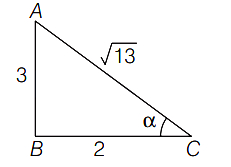
(B) Given,$f(x)=\cos ^{-1}\left\{\frac{2}{\sqrt{13}} \cos x-\frac{3}{\sqrt{13}} \sin x\right\}$.
Let $\cos \alpha = \frac{2}{\sqrt{13}}$ and $\sin \alpha = \frac{3}{\sqrt{13}}$.
Then,$f(x)=\cos ^{-1}(\cos \alpha \cos x - \sin \alpha \sin x)$.
Using the trigonometric identity $\cos(A+B) = \cos A \cos B - \sin A \sin B$,we get:
$f(x) = \cos ^{-1}(\cos(x+\alpha)) = x+\alpha$.
Now,differentiating with respect to $x$:
$f^{\prime}(x) = \frac{d}{dx}(x+\alpha) = 1 + 0 = 1$.
Therefore,$f^{\prime}(0.5) = 1$.
Let $\cos \alpha = \frac{2}{\sqrt{13}}$ and $\sin \alpha = \frac{3}{\sqrt{13}}$.
Then,$f(x)=\cos ^{-1}(\cos \alpha \cos x - \sin \alpha \sin x)$.
Using the trigonometric identity $\cos(A+B) = \cos A \cos B - \sin A \sin B$,we get:
$f(x) = \cos ^{-1}(\cos(x+\alpha)) = x+\alpha$.
Now,differentiating with respect to $x$:
$f^{\prime}(x) = \frac{d}{dx}(x+\alpha) = 1 + 0 = 1$.
Therefore,$f^{\prime}(0.5) = 1$.
0 likesView Solution
42
MathematicsDifficultMCQKCET · 2013
If $x+y=\tan ^{-1} y$ and $\frac{d^{2} y}{d x^{2}}=f(y) \frac{d y}{d x}$,then $f(y)$ is equal to
A
$\frac{-2}{y^{3}}$
B
$\frac{2}{y^{3}}$
C
$\frac{1}{y}$
D
$\frac{-1}{y}$
Solution
(B) Given,$x+y=\tan ^{-1} y$.
Differentiating both sides with respect to $x$,we get:
$1 + \frac{dy}{dx} = \frac{1}{1+y^2} \cdot \frac{dy}{dx}$
Rearranging the terms:
$\frac{dy}{dx} \left( \frac{1}{1+y^2} - 1 \right) = 1$
$\frac{dy}{dx} \left( \frac{1 - 1 - y^2}{1+y^2} \right) = 1$
$\frac{dy}{dx} \left( \frac{-y^2}{1+y^2} \right) = 1$
$\frac{dy}{dx} = -\frac{1+y^2}{y^2} = -\left( \frac{1}{y^2} + 1 \right)$
Now,differentiating again with respect to $x$:
$\frac{d^2y}{dx^2} = -\frac{d}{dx} (y^{-2} + 1)$
$\frac{d^2y}{dx^2} = -(-2y^{-3}) \cdot \frac{dy}{dx}$
$\frac{d^2y}{dx^2} = \frac{2}{y^3} \cdot \frac{dy}{dx}$
Comparing this with the given equation $\frac{d^2y}{dx^2} = f(y) \frac{dy}{dx}$,we get $f(y) = \frac{2}{y^3}$.
Differentiating both sides with respect to $x$,we get:
$1 + \frac{dy}{dx} = \frac{1}{1+y^2} \cdot \frac{dy}{dx}$
Rearranging the terms:
$\frac{dy}{dx} \left( \frac{1}{1+y^2} - 1 \right) = 1$
$\frac{dy}{dx} \left( \frac{1 - 1 - y^2}{1+y^2} \right) = 1$
$\frac{dy}{dx} \left( \frac{-y^2}{1+y^2} \right) = 1$
$\frac{dy}{dx} = -\frac{1+y^2}{y^2} = -\left( \frac{1}{y^2} + 1 \right)$
Now,differentiating again with respect to $x$:
$\frac{d^2y}{dx^2} = -\frac{d}{dx} (y^{-2} + 1)$
$\frac{d^2y}{dx^2} = -(-2y^{-3}) \cdot \frac{dy}{dx}$
$\frac{d^2y}{dx^2} = \frac{2}{y^3} \cdot \frac{dy}{dx}$
Comparing this with the given equation $\frac{d^2y}{dx^2} = f(y) \frac{dy}{dx}$,we get $f(y) = \frac{2}{y^3}$.
0 likesView Solution
43
MathematicsMediumMCQKCET · 2013
If the length of the subtangent at any point to the curve $x y^{n}=a$ is proportional to the abscissa,then $n$ is
A
any non-zero real number
B
$2$
C
$-2$
D
$1$
Solution
(A) Given,the curve is $x y^{n} = a$.
On differentiating with respect to $x$,we get:
$x \cdot n y^{n-1} \cdot \frac{dy}{dx} + y^{n} = 0$
$\Rightarrow y^{n-1} [x n \frac{dy}{dx} + y] = 0$
Since $y \neq 0$,we have $x n \frac{dy}{dx} + y = 0$,which implies $\frac{dy}{dx} = -\frac{y}{nx}$.
The length of the subtangent is given by $|\frac{y}{dy/dx}|$.
Substituting the value of $\frac{dy}{dx}$:
Length of subtangent $= |\frac{y}{-y/nx}| = |nx| = |n| |x|$.
Since the length of the subtangent is proportional to the abscissa $x$,the value $|n|$ must be a constant.
Thus,$n$ can be any non-zero real number.
On differentiating with respect to $x$,we get:
$x \cdot n y^{n-1} \cdot \frac{dy}{dx} + y^{n} = 0$
$\Rightarrow y^{n-1} [x n \frac{dy}{dx} + y] = 0$
Since $y \neq 0$,we have $x n \frac{dy}{dx} + y = 0$,which implies $\frac{dy}{dx} = -\frac{y}{nx}$.
The length of the subtangent is given by $|\frac{y}{dy/dx}|$.
Substituting the value of $\frac{dy}{dx}$:
Length of subtangent $= |\frac{y}{-y/nx}| = |nx| = |n| |x|$.
Since the length of the subtangent is proportional to the abscissa $x$,the value $|n|$ must be a constant.
Thus,$n$ can be any non-zero real number.
0 likesView Solution
44
MathematicsEasyMCQKCET · 2013
The function $f(x)=\frac{x}{3}+\frac{3}{x}$ decreases in the interval
A
$(-3,3)$
B
$(-\infty, 3)$
C
$(3, \infty)$
D
$(-9,9)$
Solution
(A) Given,$f(x) = \frac{x}{3} + \frac{3}{x}$.
On differentiating with respect to $x$,we get:
$f^{\prime}(x) = \frac{1}{3} - \frac{3}{x^2}$.
For the function to be decreasing,we must have $f^{\prime}(x) < 0$.
$\frac{1}{3} - \frac{3}{x^2} < 0$
$\frac{1}{3} < \frac{3}{x^2}$
$x^2 < 9$
Taking the square root on both sides,we get $|x| < 3$,which implies $x \in (-3, 3)$.
Note that at $x=0$,the function is undefined,but the interval $(-3, 3)$ is the standard solution for the inequality $x^2 < 9$.
On differentiating with respect to $x$,we get:
$f^{\prime}(x) = \frac{1}{3} - \frac{3}{x^2}$.
For the function to be decreasing,we must have $f^{\prime}(x) < 0$.
$\frac{1}{3} - \frac{3}{x^2} < 0$
$\frac{1}{3} < \frac{3}{x^2}$
$x^2 < 9$
Taking the square root on both sides,we get $|x| < 3$,which implies $x \in (-3, 3)$.
Note that at $x=0$,the function is undefined,but the interval $(-3, 3)$ is the standard solution for the inequality $x^2 < 9$.
0 likesView Solution
45
MathematicsDifficultMCQKCET · 2013
The maximum area of a rectangle that can be inscribed in a circle of radius $2 \text{ units}$ is
A
$8 \pi \text{ sq units}$
B
$4 \text{ sq units}$
C
$5 \text{ sq units}$
D
$8 \text{ sq units}$
Solution
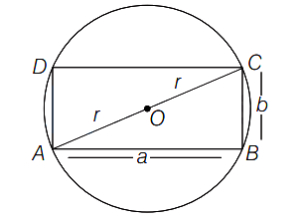
(D) Let the length of the rectangle be $a$ and the breadth be $b$. The diagonal of the rectangle is the diameter of the circle,so $d = 2r = 2(2) = 4$.
In the right-angled triangle formed by the diagonal,$a^2 + b^2 = d^2 = 4^2 = 16$.
The area of the rectangle is $A = a \cdot b$.
Since $b = \sqrt{16 - a^2}$,we have $A = a \sqrt{16 - a^2}$.
To maximize $A$,we maximize $A^2 = f(a) = a^2(16 - a^2) = 16a^2 - a^4$.
Differentiating with respect to $a$: $f'(a) = 32a - 4a^3$.
Setting $f'(a) = 0$,we get $4a(8 - a^2) = 0$. Since $a > 0$,$a^2 = 8$,so $a = 2\sqrt{2}$.
Then $b = \sqrt{16 - 8} = \sqrt{8} = 2\sqrt{2}$.
The maximum area is $A = (2\sqrt{2})(2\sqrt{2}) = 8 \text{ sq units}$.
In the right-angled triangle formed by the diagonal,$a^2 + b^2 = d^2 = 4^2 = 16$.
The area of the rectangle is $A = a \cdot b$.
Since $b = \sqrt{16 - a^2}$,we have $A = a \sqrt{16 - a^2}$.
To maximize $A$,we maximize $A^2 = f(a) = a^2(16 - a^2) = 16a^2 - a^4$.
Differentiating with respect to $a$: $f'(a) = 32a - 4a^3$.
Setting $f'(a) = 0$,we get $4a(8 - a^2) = 0$. Since $a > 0$,$a^2 = 8$,so $a = 2\sqrt{2}$.
Then $b = \sqrt{16 - 8} = \sqrt{8} = 2\sqrt{2}$.
The maximum area is $A = (2\sqrt{2})(2\sqrt{2}) = 8 \text{ sq units}$.
0 likesView Solution
46
MathematicsMediumMCQKCET · 2013
$\int \frac{\cos ^{n-1} x}{\sin ^{n+1} x} d x$ (where,$n \neq 0$) is equal to
A
$\frac{\cot ^{n} x}{n}+C$
B
$\frac{-\cot ^{n-1} x}{n-1}+C$
C
$\frac{-\cot ^{n} x}{n}+C$
D
$\frac{\cot ^{n-1} x}{n-1}+C$
Solution
(C) Let $I = \int \frac{\cos ^{n-1} x}{\sin ^{n+1} x} d x$.
We can rewrite the integrand as:
$I = \int \frac{\cos ^{n-1} x}{\sin ^{n-1} x \cdot \sin^2 x} d x = \int \cot^{n-1} x \cdot \csc^2 x d x$.
Let $t = \cot x$.
Then $dt = -\csc^2 x d x$,which implies $\csc^2 x d x = -dt$.
Substituting these into the integral:
$I = \int t^{n-1} (-dt) = -\int t^{n-1} dt$.
Using the power rule for integration $\int x^n dx = \frac{x^{n+1}}{n+1} + C$:
$I = -\frac{t^n}{n} + C$.
Substituting $t = \cot x$ back:
$I = -\frac{\cot^n x}{n} + C$.
We can rewrite the integrand as:
$I = \int \frac{\cos ^{n-1} x}{\sin ^{n-1} x \cdot \sin^2 x} d x = \int \cot^{n-1} x \cdot \csc^2 x d x$.
Let $t = \cot x$.
Then $dt = -\csc^2 x d x$,which implies $\csc^2 x d x = -dt$.
Substituting these into the integral:
$I = \int t^{n-1} (-dt) = -\int t^{n-1} dt$.
Using the power rule for integration $\int x^n dx = \frac{x^{n+1}}{n+1} + C$:
$I = -\frac{t^n}{n} + C$.
Substituting $t = \cot x$ back:
$I = -\frac{\cot^n x}{n} + C$.
0 likesView Solution
47
MathematicsMediumMCQKCET · 2013
$\int \frac{(x-1) e^{x}}{(x+1)^{3}} d x$ is equal to
A
$\frac{e^{x}}{x+1}+C$
B
$\frac{e^{x}}{(x+1)^{2}}+C$
C
$\frac{e^{x}}{(x+1)^{3}}+C$
D
$\frac{x \cdot e^{x}}{(x+1)}+C$
Solution
(B) Let $I = \int \frac{x-1}{(x+1)^{3}} e^{x} d x$.
We can rewrite the numerator as $(x+1)-2$:
$I = \int \frac{(x+1)-2}{(x+1)^{3}} e^{x} d x$
$I = \int \left( \frac{x+1}{(x+1)^{3}} - \frac{2}{(x+1)^{3}} \right) e^{x} d x$
$I = \int \frac{e^{x}}{(x+1)^{2}} d x - \int \frac{2 e^{x}}{(x+1)^{3}} d x$.
Now,apply integration by parts to the first integral $\int \frac{e^{x}}{(x+1)^{2}} d x$,taking $u = \frac{1}{(x+1)^{2}}$ and $dv = e^{x} dx$:
$du = -2(x+1)^{-3} dx$ and $v = e^{x}$.
$\int \frac{e^{x}}{(x+1)^{2}} d x = \frac{e^{x}}{(x+1)^{2}} - \int e^{x} \left( -\frac{2}{(x+1)^{3}} \right) d x$
$= \frac{e^{x}}{(x+1)^{2}} + \int \frac{2 e^{x}}{(x+1)^{3}} d x$.
Substituting this back into the expression for $I$:
$I = \left( \frac{e^{x}}{(x+1)^{2}} + \int \frac{2 e^{x}}{(x+1)^{3}} d x \right) - \int \frac{2 e^{x}}{(x+1)^{3}} d x$
$I = \frac{e^{x}}{(x+1)^{2}} + C$.
We can rewrite the numerator as $(x+1)-2$:
$I = \int \frac{(x+1)-2}{(x+1)^{3}} e^{x} d x$
$I = \int \left( \frac{x+1}{(x+1)^{3}} - \frac{2}{(x+1)^{3}} \right) e^{x} d x$
$I = \int \frac{e^{x}}{(x+1)^{2}} d x - \int \frac{2 e^{x}}{(x+1)^{3}} d x$.
Now,apply integration by parts to the first integral $\int \frac{e^{x}}{(x+1)^{2}} d x$,taking $u = \frac{1}{(x+1)^{2}}$ and $dv = e^{x} dx$:
$du = -2(x+1)^{-3} dx$ and $v = e^{x}$.
$\int \frac{e^{x}}{(x+1)^{2}} d x = \frac{e^{x}}{(x+1)^{2}} - \int e^{x} \left( -\frac{2}{(x+1)^{3}} \right) d x$
$= \frac{e^{x}}{(x+1)^{2}} + \int \frac{2 e^{x}}{(x+1)^{3}} d x$.
Substituting this back into the expression for $I$:
$I = \left( \frac{e^{x}}{(x+1)^{2}} + \int \frac{2 e^{x}}{(x+1)^{3}} d x \right) - \int \frac{2 e^{x}}{(x+1)^{3}} d x$
$I = \frac{e^{x}}{(x+1)^{2}} + C$.
0 likesView Solution
48
MathematicsEasyMCQKCET · 2013
If $\frac{(x+1)^{2}}{x^{3}+x}=\frac{A}{x}+\frac{Bx+C}{x^{2}+1}$,then $\sin^{-1} A + \tan^{-1} B + \sec^{-1} C$ is equal to
A
$\frac{\pi}{2}$
B
$\frac{\pi}{6}$
C
$0$
D
$\frac{5\pi}{6}$
Solution
(D) Given,$\frac{(x+1)^{2}}{x^{3}+x} = \frac{A}{x} + \frac{Bx+C}{x^{2}+1} \dots (i)$
Multiplying both sides by $x(x^{2}+1)$,we get:
$(x+1)^{2} = A(x^{2}+1) + (Bx+C)x$
$x^{2} + 2x + 1 = Ax^{2} + A + Bx^{2} + Cx$
$x^{2} + 2x + 1 = (A+B)x^{2} + Cx + A$
Comparing the coefficients of $x^{2}$,$x$,and the constant term on both sides:
$A+B = 1$
$C = 2$
$A = 1$
Substituting $A=1$ into $A+B=1$,we get $1+B=1$,so $B=0$.
Now,we need to calculate $\sin^{-1} A + \tan^{-1} B + \sec^{-1} C$:
$\sin^{-1}(1) + \tan^{-1}(0) + \sec^{-1}(2)$
$= \frac{\pi}{2} + 0 + \frac{\pi}{3}$
$= \frac{3\pi + 2\pi}{6} = \frac{5\pi}{6}$
Multiplying both sides by $x(x^{2}+1)$,we get:
$(x+1)^{2} = A(x^{2}+1) + (Bx+C)x$
$x^{2} + 2x + 1 = Ax^{2} + A + Bx^{2} + Cx$
$x^{2} + 2x + 1 = (A+B)x^{2} + Cx + A$
Comparing the coefficients of $x^{2}$,$x$,and the constant term on both sides:
$A+B = 1$
$C = 2$
$A = 1$
Substituting $A=1$ into $A+B=1$,we get $1+B=1$,so $B=0$.
Now,we need to calculate $\sin^{-1} A + \tan^{-1} B + \sec^{-1} C$:
$\sin^{-1}(1) + \tan^{-1}(0) + \sec^{-1}(2)$
$= \frac{\pi}{2} + 0 + \frac{\pi}{3}$
$= \frac{3\pi + 2\pi}{6} = \frac{5\pi}{6}$
0 likesView Solution
49
MathematicsMediumMCQKCET · 2013
If $I_{1}=\int_{0}^{\pi / 2} x \sin x \, dx$ and $I_{2}=\int_{0}^{\pi / 2} x \cos x \, dx$,then which one of the following is true?
A
$I_{1}=I_{2}$
B
$I_{1}+I_{2}=0$
C
$I_{1}=\frac{\pi}{2} I_{2}$
D
$I_{1}+I_{2}=\frac{\pi}{2}$
Solution
(D) We are given $I_{1} = \int_{0}^{\pi / 2} x \sin x \, dx$ and $I_{2} = \int_{0}^{\pi / 2} x \cos x \, dx$.
Using integration by parts,$\int u \, dv = uv - \int v \, du$.
For $I_{1}$,let $u = x$ and $dv = \sin x \, dx$. Then $du = dx$ and $v = -\cos x$.
$I_{1} = [x(-\cos x)]_{0}^{\pi / 2} - \int_{0}^{\pi / 2} (-\cos x) \, dx = [0 - 0] + [\sin x]_{0}^{\pi / 2} = 1 - 0 = 1$.
For $I_{2}$,let $u = x$ and $dv = \cos x \, dx$. Then $du = dx$ and $v = \sin x$.
$I_{2} = [x \sin x]_{0}^{\pi / 2} - \int_{0}^{\pi / 2} \sin x \, dx = [\frac{\pi}{2} \sin(\frac{\pi}{2}) - 0] - [-\cos x]_{0}^{\pi / 2} = \frac{\pi}{2} - [-(0 - 1)] = \frac{\pi}{2} - 1$.
Adding the two results,$I_{1} + I_{2} = 1 + (\frac{\pi}{2} - 1) = \frac{\pi}{2}$.
Thus,the correct option is $D$.
Using integration by parts,$\int u \, dv = uv - \int v \, du$.
For $I_{1}$,let $u = x$ and $dv = \sin x \, dx$. Then $du = dx$ and $v = -\cos x$.
$I_{1} = [x(-\cos x)]_{0}^{\pi / 2} - \int_{0}^{\pi / 2} (-\cos x) \, dx = [0 - 0] + [\sin x]_{0}^{\pi / 2} = 1 - 0 = 1$.
For $I_{2}$,let $u = x$ and $dv = \cos x \, dx$. Then $du = dx$ and $v = \sin x$.
$I_{2} = [x \sin x]_{0}^{\pi / 2} - \int_{0}^{\pi / 2} \sin x \, dx = [\frac{\pi}{2} \sin(\frac{\pi}{2}) - 0] - [-\cos x]_{0}^{\pi / 2} = \frac{\pi}{2} - [-(0 - 1)] = \frac{\pi}{2} - 1$.
Adding the two results,$I_{1} + I_{2} = 1 + (\frac{\pi}{2} - 1) = \frac{\pi}{2}$.
Thus,the correct option is $D$.
0 likesView Solution
50
MathematicsEasyMCQKCET · 2013
The value of $\int_{-1}^{2} \frac{|x|}{x} d x$ is
A
$0$
B
$1$
C
$2$
D
$3$
Solution
(B) Let $I = \int_{-1}^{2} \frac{|x|}{x} d x$.
We know that $|x| = \begin{cases} x, & \text{if } x \geq 0 \\ -x, & \text{if } x < 0 \end{cases}$.
Splitting the integral at $x = 0$,we get:
$I = \int_{-1}^{0} \frac{-x}{x} d x + \int_{0}^{2} \frac{x}{x} d x$
$I = \int_{-1}^{0} (-1) d x + \int_{0}^{2} (1) d x$
$I = -[x]_{-1}^{0} + [x]_{0}^{2}$
$I = -(0 - (-1)) + (2 - 0)$
$I = -(1) + 2$
$I = 1$.
We know that $|x| = \begin{cases} x, & \text{if } x \geq 0 \\ -x, & \text{if } x < 0 \end{cases}$.
Splitting the integral at $x = 0$,we get:
$I = \int_{-1}^{0} \frac{-x}{x} d x + \int_{0}^{2} \frac{x}{x} d x$
$I = \int_{-1}^{0} (-1) d x + \int_{0}^{2} (1) d x$
$I = -[x]_{-1}^{0} + [x]_{0}^{2}$
$I = -(0 - (-1)) + (2 - 0)$
$I = -(1) + 2$
$I = 1$.
0 likesView Solution
51
MathematicsEasyMCQKCET · 2013
$\int_{0}^{\pi} \frac{\cos ^{4} x}{\cos ^{4} x+\sin ^{4} x} d x$ is equal to
A
$\frac{\pi}{4}$
B
$\frac{\pi}{2}$
C
$\frac{\pi}{8}$
D
$\pi$
Solution
(B) Let $I = \int_{0}^{\pi} \frac{\cos ^{4} x}{\sin ^{4} x+\cos ^{4} x} d x$.
Since $f(\pi - x) = \frac{\cos^4(\pi - x)}{\sin^4(\pi - x) + \cos^4(\pi - x)} = \frac{(-\cos x)^4}{(\sin x)^4 + (-\cos x)^4} = \frac{\cos^4 x}{\sin^4 x + \cos^4 x} = f(x)$,we use the property $\int_{0}^{2a} f(x) dx = 2 \int_{0}^{a} f(x) dx$.
Thus,$I = 2 \int_{0}^{\pi / 2} \frac{\cos ^{4} x}{\sin ^{4} x+\cos ^{4} x} d x \dots (i)$.
Using the property $\int_{0}^{a} f(x) dx = \int_{0}^{a} f(a-x) dx$:
$I = 2 \int_{0}^{\pi / 2} \frac{\cos ^{4}(\frac{\pi}{2}-x)}{\sin ^{4}(\frac{\pi}{2}-x)+\cos ^{4}(\frac{\pi}{2}-x)} d x = 2 \int_{0}^{\pi / 2} \frac{\sin ^{4} x}{\cos ^{4} x+\sin ^{4} x} d x \dots (ii)$.
Adding $(i)$ and $(ii)$:
$2I = 2 \int_{0}^{\pi / 2} \frac{\cos^4 x + \sin^4 x}{\sin^4 x + \cos^4 x} dx = 2 \int_{0}^{\pi / 2} 1 dx = 2[x]_{0}^{\pi / 2} = 2(\frac{\pi}{2}) = \pi$.
Therefore,$I = \frac{\pi}{2}$.
Since $f(\pi - x) = \frac{\cos^4(\pi - x)}{\sin^4(\pi - x) + \cos^4(\pi - x)} = \frac{(-\cos x)^4}{(\sin x)^4 + (-\cos x)^4} = \frac{\cos^4 x}{\sin^4 x + \cos^4 x} = f(x)$,we use the property $\int_{0}^{2a} f(x) dx = 2 \int_{0}^{a} f(x) dx$.
Thus,$I = 2 \int_{0}^{\pi / 2} \frac{\cos ^{4} x}{\sin ^{4} x+\cos ^{4} x} d x \dots (i)$.
Using the property $\int_{0}^{a} f(x) dx = \int_{0}^{a} f(a-x) dx$:
$I = 2 \int_{0}^{\pi / 2} \frac{\cos ^{4}(\frac{\pi}{2}-x)}{\sin ^{4}(\frac{\pi}{2}-x)+\cos ^{4}(\frac{\pi}{2}-x)} d x = 2 \int_{0}^{\pi / 2} \frac{\sin ^{4} x}{\cos ^{4} x+\sin ^{4} x} d x \dots (ii)$.
Adding $(i)$ and $(ii)$:
$2I = 2 \int_{0}^{\pi / 2} \frac{\cos^4 x + \sin^4 x}{\sin^4 x + \cos^4 x} dx = 2 \int_{0}^{\pi / 2} 1 dx = 2[x]_{0}^{\pi / 2} = 2(\frac{\pi}{2}) = \pi$.
Therefore,$I = \frac{\pi}{2}$.
0 likesView Solution
52
MathematicsEasyMCQKCET · 2013
The area bounded by the curve $y = \sin \left(\frac{x}{3}\right)$,the $x$-axis,and the lines $x = 0$ and $x = 3\pi$ is
A
$9$
B
$0$
C
$6$
D
$3$
Solution
(C) The required area is given by the integral $\int_{0}^{3\pi} y \, dx = \int_{0}^{3\pi} \sin \left(\frac{x}{3}\right) \, dx$.
Let $t = \frac{x}{3}$,then $dx = 3 \, dt$.
When $x = 0$,$t = 0$.
When $x = 3\pi$,$t = \pi$.
Substituting these into the integral,we get:
Area $= \int_{0}^{\pi} \sin(t) \cdot 3 \, dt = 3 \int_{0}^{\pi} \sin(t) \, dt$.
$= 3 [-\cos(t)]_{0}^{\pi}$.
$= -3 [\cos(\pi) - \cos(0)]$.
$= -3 [-1 - 1] = -3(-2) = 6$.
Thus,the area is $6$ square units.
Let $t = \frac{x}{3}$,then $dx = 3 \, dt$.
When $x = 0$,$t = 0$.
When $x = 3\pi$,$t = \pi$.
Substituting these into the integral,we get:
Area $= \int_{0}^{\pi} \sin(t) \cdot 3 \, dt = 3 \int_{0}^{\pi} \sin(t) \, dt$.
$= 3 [-\cos(t)]_{0}^{\pi}$.
$= -3 [\cos(\pi) - \cos(0)]$.
$= -3 [-1 - 1] = -3(-2) = 6$.
Thus,the area is $6$ square units.
0 likesView Solution
53
MathematicsMediumMCQKCET · 2013
If $m$ and $n$ are the order and degree of the differential equation $\left(y^{\prime \prime}\right)^{5}+4 \cdot \frac{\left(y^{\prime \prime}\right)^{3}}{y^{\prime \prime \prime}}+y^{\prime \prime \prime}=\sin x$,then:
A
$m=3, n=5$
B
$m=3, n=1$
C
$m=3, n=3$
D
$m=3, n=2$
Solution
(D) The given differential equation is $\left(y^{\prime \prime}\right)^{5}+4 \cdot \frac{\left(y^{\prime \prime}\right)^{3}}{y^{\prime \prime \prime}}+y^{\prime \prime \prime}=\sin x$.
To find the order and degree,we must eliminate the fraction by multiplying the entire equation by $y^{\prime \prime \prime}$.
Multiplying by $y^{\prime \prime \prime}$,we get: $\left(y^{\prime \prime}\right)^{5} \cdot y^{\prime \prime \prime} + 4 \cdot \left(y^{\prime \prime}\right)^{3} + \left(y^{\prime \prime \prime}\right)^{2} = \sin x \cdot y^{\prime \prime \prime}$.
The highest order derivative present is $y^{\prime \prime \prime}$,so the order $m = 3$.
The degree $n$ is the power of the highest order derivative after the equation is expressed as a polynomial in derivatives.
The term with the highest order derivative is $\left(y^{\prime \prime \prime}\right)^{2}$,so the degree $n = 2$.
To find the order and degree,we must eliminate the fraction by multiplying the entire equation by $y^{\prime \prime \prime}$.
Multiplying by $y^{\prime \prime \prime}$,we get: $\left(y^{\prime \prime}\right)^{5} \cdot y^{\prime \prime \prime} + 4 \cdot \left(y^{\prime \prime}\right)^{3} + \left(y^{\prime \prime \prime}\right)^{2} = \sin x \cdot y^{\prime \prime \prime}$.
The highest order derivative present is $y^{\prime \prime \prime}$,so the order $m = 3$.
The degree $n$ is the power of the highest order derivative after the equation is expressed as a polynomial in derivatives.
The term with the highest order derivative is $\left(y^{\prime \prime \prime}\right)^{2}$,so the degree $n = 2$.
0 likesView Solution
54
MathematicsDifficultMCQKCET · 2013
If $f(x)$ is a function such that $f^{\prime \prime}(x)+f(x)=0$ and $g(x)=[f(x)]^{2}+[f^{\prime}(x)]^{2}$ and $g(3)=8$,then $g(8)$ is equal to
A
$0$
B
$3$
C
$5$
D
$8$
Solution
(D) Given,$f^{\prime \prime}(x)+f(x)=0$ ... $(i)$
And $g(x)=[f(x)]^{2}+[f^{\prime}(x)]^{2}$.
Differentiating $g(x)$ with respect to $x$:
$g^{\prime}(x) = 2f(x)f^{\prime}(x) + 2f^{\prime}(x)f^{\prime \prime}(x)$
Substitute $f^{\prime \prime}(x) = -f(x)$ from equation $(i)$:
$g^{\prime}(x) = 2f(x)f^{\prime}(x) + 2f^{\prime}(x)(-f(x))$
$g^{\prime}(x) = 2f(x)f^{\prime}(x) - 2f(x)f^{\prime}(x) = 0$.
Since the derivative of $g(x)$ is $0$,$g(x)$ is a constant function.
Given $g(3) = 8$,therefore $g(x) = 8$ for all $x$.
Thus,$g(8) = 8$.
And $g(x)=[f(x)]^{2}+[f^{\prime}(x)]^{2}$.
Differentiating $g(x)$ with respect to $x$:
$g^{\prime}(x) = 2f(x)f^{\prime}(x) + 2f^{\prime}(x)f^{\prime \prime}(x)$
Substitute $f^{\prime \prime}(x) = -f(x)$ from equation $(i)$:
$g^{\prime}(x) = 2f(x)f^{\prime}(x) + 2f^{\prime}(x)(-f(x))$
$g^{\prime}(x) = 2f(x)f^{\prime}(x) - 2f(x)f^{\prime}(x) = 0$.
Since the derivative of $g(x)$ is $0$,$g(x)$ is a constant function.
Given $g(3) = 8$,therefore $g(x) = 8$ for all $x$.
Thus,$g(8) = 8$.
0 likesView Solution
55
MathematicsMediumMCQKCET · 2013
The general solution of the differential equation $\sqrt{1-x^{2} y^{2}} \cdot dx = y \cdot dx + x \cdot dy$ is
A
$\sin (xy) = x + C$
B
$\sin ^{-1}(xy) + x = C$
C
$\sin (x + C) = xy$
D
$\sin (xy) + x = C$
Solution
(C) Given differential equation is $\sqrt{1-x^{2} y^{2}} \cdot dx = y \cdot dx + x \cdot dy$.
We know that $d(xy) = y \cdot dx + x \cdot dy$.
Substituting this into the equation,we get $\sqrt{1-(xy)^{2}} \cdot dx = d(xy)$.
Rearranging the terms,we have $dx = \frac{d(xy)}{\sqrt{1-(xy)^{2}}}$.
Integrating both sides,we get $\int dx = \int \frac{d(xy)}{\sqrt{1-(xy)^{2}}}$.
This results in $x = \sin^{-1}(xy) + C$.
Taking the sine of both sides,we get $\sin(x - C) = xy$,which is equivalent to $\sin(x + C) = xy$ (where $C$ is an arbitrary constant).
We know that $d(xy) = y \cdot dx + x \cdot dy$.
Substituting this into the equation,we get $\sqrt{1-(xy)^{2}} \cdot dx = d(xy)$.
Rearranging the terms,we have $dx = \frac{d(xy)}{\sqrt{1-(xy)^{2}}}$.
Integrating both sides,we get $\int dx = \int \frac{d(xy)}{\sqrt{1-(xy)^{2}}}$.
This results in $x = \sin^{-1}(xy) + C$.
Taking the sine of both sides,we get $\sin(x - C) = xy$,which is equivalent to $\sin(x + C) = xy$ (where $C$ is an arbitrary constant).
0 likesView Solution
56
MathematicsDifficultMCQKCET · 2013
If $f(x) = f'(x) + f''(x) + f'''(x) + \ldots$ and $f(0) = 1$,then $f(x)$ is equal to
A
$e^{x / 2}$
B
$e^{x}$
C
$e^{2 x}$
D
$e^{4 x}$
Solution
(A) Given the equation: $f(x) = f'(x) + f''(x) + f'''(x) + \ldots$
Assume $f(x) = e^{kx}$. Then $f'(x) = ke^{kx}$,$f''(x) = k^2e^{kx}$,$f'''(x) = k^3e^{kx}$,and so on.
Substituting these into the given equation:
$e^{kx} = ke^{kx} + k^2e^{kx} + k^3e^{kx} + \ldots$
Dividing by $e^{kx}$ (since $e^{kx} \neq 0$):
$1 = k + k^2 + k^3 + \ldots$
This is an infinite geometric series with first term $a = k$ and common ratio $r = k$.
The sum of an infinite geometric series is given by $S = \frac{a}{1-r}$ for $|r| < 1$.
So,$1 = \frac{k}{1-k}$.
$1 - k = k \implies 2k = 1 \implies k = \frac{1}{2}$.
Thus,$f(x) = Ce^{x/2}$.
Given $f(0) = 1$,we have $Ce^0 = 1$,which implies $C = 1$.
Therefore,$f(x) = e^{x/2}$.
Assume $f(x) = e^{kx}$. Then $f'(x) = ke^{kx}$,$f''(x) = k^2e^{kx}$,$f'''(x) = k^3e^{kx}$,and so on.
Substituting these into the given equation:
$e^{kx} = ke^{kx} + k^2e^{kx} + k^3e^{kx} + \ldots$
Dividing by $e^{kx}$ (since $e^{kx} \neq 0$):
$1 = k + k^2 + k^3 + \ldots$
This is an infinite geometric series with first term $a = k$ and common ratio $r = k$.
The sum of an infinite geometric series is given by $S = \frac{a}{1-r}$ for $|r| < 1$.
So,$1 = \frac{k}{1-k}$.
$1 - k = k \implies 2k = 1 \implies k = \frac{1}{2}$.
Thus,$f(x) = Ce^{x/2}$.
Given $f(0) = 1$,we have $Ce^0 = 1$,which implies $C = 1$.
Therefore,$f(x) = e^{x/2}$.
0 likesView Solution
57
MathematicsEasyMCQKCET · 2013
If $a \perp b$ and $(a+b) \perp (a+mb)$,then $m$ is equal to
A
$-1$
B
$1$
C
$-\frac{|a|^{2}}{|b|^{2}}$
D
$0$
Solution
(C) Given that $a \perp b$,therefore the dot product $a \cdot b = 0$.
Since $(a+b) \perp (a+mb)$,their dot product must be zero:
$(a+b) \cdot (a+mb) = 0$
Expanding the dot product:
$a \cdot a + m(a \cdot b) + (b \cdot a) + m(b \cdot b) = 0$
Substituting $a \cdot b = 0$ and $b \cdot a = 0$:
$|a|^{2} + m(0) + 0 + m|b|^{2} = 0$
$|a|^{2} + m|b|^{2} = 0$
Solving for $m$:
$m|b|^{2} = -|a|^{2}$
$m = -\frac{|a|^{2}}{|b|^{2}}$
Since $(a+b) \perp (a+mb)$,their dot product must be zero:
$(a+b) \cdot (a+mb) = 0$
Expanding the dot product:
$a \cdot a + m(a \cdot b) + (b \cdot a) + m(b \cdot b) = 0$
Substituting $a \cdot b = 0$ and $b \cdot a = 0$:
$|a|^{2} + m(0) + 0 + m|b|^{2} = 0$
$|a|^{2} + m|b|^{2} = 0$
Solving for $m$:
$m|b|^{2} = -|a|^{2}$
$m = -\frac{|a|^{2}}{|b|^{2}}$
0 likesView Solution
58
MathematicsEasyMCQKCET · 2013
If $a, b$ and $c$ are unit vectors such that $a+b+c=0$,then $a \cdot b+b \cdot c+c \cdot a$ is equal to
A
$\frac{3}{2}$
B
$-\frac{3}{2}$
C
$\frac{2}{3}$
D
$\frac{1}{2}$
Solution
(B) Given that $a, b$ and $c$ are unit vectors.
Therefore,$|a| = |b| = |c| = 1 \dots (i) $
We are given the equation $a+b+c = 0$.
Squaring both sides,we get:
$|a+b+c|^2 = |0|^2$
$|a|^2 + |b|^2 + |c|^2 + 2(a \cdot b + b \cdot c + c \cdot a) = 0$
Substituting the values from $(i)$:
$1 + 1 + 1 + 2(a \cdot b + b \cdot c + c \cdot a) = 0$
$3 + 2(a \cdot b + b \cdot c + c \cdot a) = 0$
$2(a \cdot b + b \cdot c + c \cdot a) = -3$
$a \cdot b + b \cdot c + c \cdot a = -\frac{3}{2}$
Therefore,$|a| = |b| = |c| = 1 \dots (i) $
We are given the equation $a+b+c = 0$.
Squaring both sides,we get:
$|a+b+c|^2 = |0|^2$
$|a|^2 + |b|^2 + |c|^2 + 2(a \cdot b + b \cdot c + c \cdot a) = 0$
Substituting the values from $(i)$:
$1 + 1 + 1 + 2(a \cdot b + b \cdot c + c \cdot a) = 0$
$3 + 2(a \cdot b + b \cdot c + c \cdot a) = 0$
$2(a \cdot b + b \cdot c + c \cdot a) = -3$
$a \cdot b + b \cdot c + c \cdot a = -\frac{3}{2}$
0 likesView Solution
59
MathematicsEasyMCQKCET · 2013
If $a$ is a vector perpendicular to both $b$ and $c$,then
A
$a \cdot (b \times c) = 0$
B
$a \times (b \times c) = 0$
C
$a \times (b + c) = 0$
D
$a + (b + c) = 0$
Solution
(B) Given,$a$ is perpendicular to both $b$ and $c$.
Then,$a \cdot b = 0$ and $a \cdot c = 0$ ... $(i)$
Now,using the vector triple product formula:
$a \times (b \times c) = (a \cdot c) b - (a \cdot b) c$
Substituting the values from Eq. $(i)$:
$a \times (b \times c) = (0) b - (0) c$
$a \times (b \times c) = 0 - 0 = 0$
Therefore,the correct option is $B$.
Then,$a \cdot b = 0$ and $a \cdot c = 0$ ... $(i)$
Now,using the vector triple product formula:
$a \times (b \times c) = (a \cdot c) b - (a \cdot b) c$
Substituting the values from Eq. $(i)$:
$a \times (b \times c) = (0) b - (0) c$
$a \times (b \times c) = 0 - 0 = 0$
Therefore,the correct option is $B$.
0 likesView Solution
60
MathematicsMediumMCQKCET · 2013
If $a=(1,2,3), b=(2,-1,1), c=(3,2,1)$ and $a \times(b \times c)=\alpha a+\beta b+\gamma c$,then
A
$\alpha=1, \beta=10, \gamma=3$
B
$\alpha=0, \beta=10, \gamma=-3$
C
$\alpha+\beta+\gamma=8$
D
$\alpha=\beta=\gamma=0$
Solution
(B) Given vectors are $a = (1, 2, 3)$,$b = (2, -1, 1)$,and $c = (3, 2, 1)$.
Using the vector triple product formula: $a \times (b \times c) = (a \cdot c)b - (a \cdot b)c$.
First,calculate the dot products:
$a \cdot c = (1)(3) + (2)(2) + (3)(1) = 3 + 4 + 3 = 10$.
$a \cdot b = (1)(2) + (2)(-1) + (3)(1) = 2 - 2 + 3 = 3$.
Substituting these into the formula:
$a \times (b \times c) = 10b - 3c$.
We are given $a \times (b \times c) = \alpha a + \beta b + \gamma c$.
Therefore,$0a + 10b - 3c = \alpha a + \beta b + \gamma c$.
Comparing the coefficients of $a, b,$ and $c$,we get:
$\alpha = 0, \beta = 10, \gamma = -3$.
Using the vector triple product formula: $a \times (b \times c) = (a \cdot c)b - (a \cdot b)c$.
First,calculate the dot products:
$a \cdot c = (1)(3) + (2)(2) + (3)(1) = 3 + 4 + 3 = 10$.
$a \cdot b = (1)(2) + (2)(-1) + (3)(1) = 2 - 2 + 3 = 3$.
Substituting these into the formula:
$a \times (b \times c) = 10b - 3c$.
We are given $a \times (b \times c) = \alpha a + \beta b + \gamma c$.
Therefore,$0a + 10b - 3c = \alpha a + \beta b + \gamma c$.
Comparing the coefficients of $a, b,$ and $c$,we get:
$\alpha = 0, \beta = 10, \gamma = -3$.
0 likesView Solution
Vedclass Products
For Students
Vedclass Test Series
Mock tests in real KCET style covering Mathematics with performance analysis. 5-day free trial.
Start Free TrialFor Teachers
Exam Paper Generator
Generate Set A/B/C/D Mathematics papers from 7.5L+ questions in 2 minutes. 3 chapters free.
Try FreeFor Institutes
Online Exam Module
Run live KCET mock exams with unlimited students, 360° analytics & white-label branding.
See DemoFrequently Asked Questions
How many Mathematics questions are in KCET 2013?
There are 60 Mathematics questions from the KCET 2013 paper on Vedclass, each with a detailed step-by-step solution in English.
Are KCET 2013 Mathematics solutions available in English?
Yes. All solutions on this page are in English. You can also switch to English or Hindi using the language buttons above the questions.
Can I practice KCET 2013 Mathematics as a timed test?
Yes. Use the Vedclass Test Series to attempt a full KCET mock test covering Mathematics with time limits and instant score analysis.
Can teachers create Mathematics papers from KCET previous year questions?
Yes. The Vedclass Exam Paper Generator lets teachers mix KCET Mathematics questions and generate Set A/B/C/D papers in minutes.
For Teachers & Institutes
Build a Custom Mathematics Paper
Pick KCET 2013 Mathematics questions, set difficulty, and generate Set A/B/C/D in 2 minutes.