
BiologyQ1–24 of 24 questions
Page 1 of 1 · English
1
BiologyEasyMCQKCET · 2013
Which taxonomic term may be suggested for any rank in the classification?
A
Class
B
Order
C
Species
D
Taxon
Solution
(D) The correct answer is $D$.
$Taxon$ is a scientific term used to represent a group of organisms at any level or rank in the biological classification system.
It is a general term that can refer to any taxonomic category,such as $Species$,$Genus$,$Family$,$Order$,$Class$,$Phylum$,or $Kingdom$.
$Taxon$ is a scientific term used to represent a group of organisms at any level or rank in the biological classification system.
It is a general term that can refer to any taxonomic category,such as $Species$,$Genus$,$Family$,$Order$,$Class$,$Phylum$,or $Kingdom$.
0 likesView Solution
2
BiologyEasyMCQKCET · 2013
$A$ bivalent of meiosis $I$ consists of
A
four chromatids and two centromeres
B
two chromatids and one centromere
C
two chromatids and two centromeres
D
four chromatids and four centromeres
Solution
(A) The correct answer is $A$.
During the prophase $I$ of meiosis,homologous chromosomes pair up to form a structure known as a bivalent or tetrad.
Each homologous chromosome consists of two sister chromatids joined by a single centromere.
Since a bivalent consists of two homologous chromosomes,it contains a total of $4$ chromatids ($2$ from each chromosome) and $2$ centromeres ($1$ from each chromosome).
During the prophase $I$ of meiosis,homologous chromosomes pair up to form a structure known as a bivalent or tetrad.
Each homologous chromosome consists of two sister chromatids joined by a single centromere.
Since a bivalent consists of two homologous chromosomes,it contains a total of $4$ chromatids ($2$ from each chromosome) and $2$ centromeres ($1$ from each chromosome).
0 likesView Solution
3
BiologyEasyMCQKCET · 2013
Electrons from excited chlorophyll molecules of photosystem $II$ are accepted first by
A
ferredoxin
B
phaeophytin
C
cytochrome $b$
D
cytochrome $f$
Solution
(B) The correct answer is $B$.
Electrons from excited chlorophyll molecules of photosystem $II$ ($PS$ $II$) are first accepted by phaeophytin.
Phaeophytin acts as the primary electron acceptor in the light-dependent reactions of photosynthesis.
After receiving the electrons,phaeophytin transfers them to the plastoquinone $(PQ)$ pool,which then initiates the electron transport chain.
Electrons from excited chlorophyll molecules of photosystem $II$ ($PS$ $II$) are first accepted by phaeophytin.
Phaeophytin acts as the primary electron acceptor in the light-dependent reactions of photosynthesis.
After receiving the electrons,phaeophytin transfers them to the plastoquinone $(PQ)$ pool,which then initiates the electron transport chain.
0 likesView Solution
4
BiologyEasyMCQKCET · 2013
Oxidative decarboxylation occurs during the formation of
A
citric acid and succinic acid
B
citric acid and oxaloacetic acid
C
acetyl CoA and succinyl CoA
D
oxaloacetic acid and oxalosuccinic acid
Solution
(C) The correct answer is $C$. Oxidative decarboxylation occurs during the formation of both acetyl CoA from pyruvate and succinyl CoA from $\alpha$-ketoglutarate.
In these reactions,a carboxyl group is removed as $CO_2$,and $NAD^+$ is reduced to $NADH$.
These steps are key parts of cellular respiration,particularly in the link reaction (pyruvate to acetyl CoA) and the Krebs cycle ($\alpha$-ketoglutarate to succinyl CoA).
$1. \text{Pyruvate} + CoA + NAD^+ \longrightarrow \text{Acetyl CoA} + CO_2 + NADH + H^+$
This reaction is catalyzed by the enzyme pyruvate dehydrogenase.
$2. \alpha\text{-Ketoglutarate} + CoA + NAD^+ \longrightarrow \text{Succinyl CoA} + CO_2 + NADH + H^+$
This reaction is catalyzed by the enzyme $\alpha$-ketoglutarate dehydrogenase.
In these reactions,a carboxyl group is removed as $CO_2$,and $NAD^+$ is reduced to $NADH$.
These steps are key parts of cellular respiration,particularly in the link reaction (pyruvate to acetyl CoA) and the Krebs cycle ($\alpha$-ketoglutarate to succinyl CoA).
$1. \text{Pyruvate} + CoA + NAD^+ \longrightarrow \text{Acetyl CoA} + CO_2 + NADH + H^+$
This reaction is catalyzed by the enzyme pyruvate dehydrogenase.
$2. \alpha\text{-Ketoglutarate} + CoA + NAD^+ \longrightarrow \text{Succinyl CoA} + CO_2 + NADH + H^+$
This reaction is catalyzed by the enzyme $\alpha$-ketoglutarate dehydrogenase.
0 likesView Solution
5
BiologyEasyMCQKCET · 2013
During the transport of gases,to maintain the ionic balance,chloride ions shift from
A
RBCs to plasma
B
plasma to RBCs
C
lungs to blood
D
blood to lungs
Solution
(B) The correct answer is $B$.
During the transport of carbon dioxide,bicarbonate ions $(HCO_3^-)$ are produced inside the red blood cells $(RBCs)$ and diffuse out into the plasma.
To maintain the electrical neutrality (ionic balance) of the $RBCs$,chloride ions $(Cl^-)$ move from the plasma into the $RBCs$.
This process is known as the chloride shift or the Hamburger phenomenon.
During the transport of carbon dioxide,bicarbonate ions $(HCO_3^-)$ are produced inside the red blood cells $(RBCs)$ and diffuse out into the plasma.
To maintain the electrical neutrality (ionic balance) of the $RBCs$,chloride ions $(Cl^-)$ move from the plasma into the $RBCs$.
This process is known as the chloride shift or the Hamburger phenomenon.
0 likesView Solution
6
BiologyEasyMCQKCET · 2013
Maximum amount of oxygen is exchanged from the blood in the . . . . . . .
A
arteries of the body
B
capillaries surrounding tissue cells
C
capillaries surrounding the alveoli
D
left auricle of the heart
Solution
(B) The exchange of gases between the blood and the tissues occurs through the systemic capillaries.
Oxygenated blood reaches the tissues via systemic arteries,which branch into a network of capillaries.
Since the partial pressure of oxygen $(pO_2)$ is lower in the tissue cells compared to the blood in the capillaries,oxygen dissociates from oxyhemoglobin and diffuses into the tissues.
Therefore,the maximum exchange of oxygen from the blood to the cells occurs in the capillaries surrounding the tissue cells.
Oxygenated blood reaches the tissues via systemic arteries,which branch into a network of capillaries.
Since the partial pressure of oxygen $(pO_2)$ is lower in the tissue cells compared to the blood in the capillaries,oxygen dissociates from oxyhemoglobin and diffuses into the tissues.
Therefore,the maximum exchange of oxygen from the blood to the cells occurs in the capillaries surrounding the tissue cells.
0 likesView Solution
7
BiologyEasyMCQKCET · 2013
Left auricle receives pure blood from the:
A
pulmonary veins
B
pulmonary artery
C
superior vena cava
D
inferior vena cava
Solution
(A) Pure (oxygenated) blood from the lungs is carried back to the heart by the pulmonary veins,which empty into the left auricle (atrium).
From there,the blood moves to the left ventricle to be pumped to the rest of the body.
From there,the blood moves to the left ventricle to be pumped to the rest of the body.
0 likesView Solution
8
BiologyEasyMCQKCET · 2013
Match the entries in Column-$I$ with those of Column-$II$ and choose the correct answer given below.
| Column-$I$ | Column-$II$ |
|---|---|
| $A$. $FSH$ | $(p)$ Normal growth |
| $B$. $GH$ | $(q)$ Ovulation |
| $C$. Prolactin | $(r)$ Parturition |
| $D$. Oxytocin | $(s)$ Water diuresis |
| $(t)$ Milk secretion |
A
$A-(q), B-(p), C-(t), D-(r)$
B
$A-(q), B-(p), C-(t), D-(s)$
C
$A-(p), B-(t), C-(t), D-(q)$
D
$A-(q), B-(t), C-(d), D-(r)$
Solution
(A) $A-q, B-p, C-t, D-r$
$1$. $FSH$ (Follicle-Stimulating Hormone) stimulates the development of ovarian follicles and is involved in the process of ovulation.
$2$. $GH$ (Growth Hormone) is responsible for the normal growth and development of the body.
$3$. Prolactin is a hormone that stimulates the mammary glands to produce milk (milk secretion).
$4$. Oxytocin acts on the smooth muscles of the uterus and stimulates their contraction during childbirth, a process known as parturition.
$1$. $FSH$ (Follicle-Stimulating Hormone) stimulates the development of ovarian follicles and is involved in the process of ovulation.
$2$. $GH$ (Growth Hormone) is responsible for the normal growth and development of the body.
$3$. Prolactin is a hormone that stimulates the mammary glands to produce milk (milk secretion).
$4$. Oxytocin acts on the smooth muscles of the uterus and stimulates their contraction during childbirth, a process known as parturition.
0 likesView Solution
9
BiologyEasyMCQKCET · 2013
Which of the following does not belong to Kingdom Monera?
A
Slime moulds
B
Mycoplasma
C
Eubacteria
D
Archaebacteria
Solution
(A) The correct answer is $A$.
Kingdom Monera consists of prokaryotic organisms,which include $Mycoplasma$,$Eubacteria$,and $Archaebacteria$.
Slime moulds are classified under Kingdom Protista because they are eukaryotic organisms.
Therefore,slime moulds do not belong to Kingdom Monera.
Kingdom Monera consists of prokaryotic organisms,which include $Mycoplasma$,$Eubacteria$,and $Archaebacteria$.
Slime moulds are classified under Kingdom Protista because they are eukaryotic organisms.
Therefore,slime moulds do not belong to Kingdom Monera.
0 likesView Solution
10
BiologyEasyMCQKCET · 2013
Mosses and ferns are
A
Thallophytes of plant kingdom
B
Angiosperms of plant kingdom
C
Gymnosperms of plant kingdom
D
Amphibians of plant kingdom
Solution
(D) Amphibians of plant kingdom.
Mosses (Bryophytes) and ferns (Pteridophytes) are referred to as the "amphibians of the plant kingdom".
This is because they require water for the process of fertilization, as their male gametes are motile and need a water medium to reach the female gametes.
This dependency on water for reproduction is analogous to the life cycle of amphibians in the animal kingdom.
Mosses (Bryophytes) and ferns (Pteridophytes) are referred to as the "amphibians of the plant kingdom".
This is because they require water for the process of fertilization, as their male gametes are motile and need a water medium to reach the female gametes.
This dependency on water for reproduction is analogous to the life cycle of amphibians in the animal kingdom.
0 likesView Solution
11
BiologyEasyMCQKCET · 2013
In which of the following phyla does the adult show radial symmetry,while the larva shows bilateral symmetry?
A
Annelids
B
Arthropods
C
Molluscs
D
Echinodermata
Solution
(D) The correct answer is $D$.
In the phylum $Echinodermata$,adult animals exhibit radial symmetry,while their larval stages exhibit bilateral symmetry.
This transition in symmetry from bilateral in the larval stage to radial in the adult form is a characteristic feature of echinoderms.
In contrast,$Annelids$,$Arthropods$,and $Molluscs$ exhibit bilateral symmetry throughout their life cycles.
In the phylum $Echinodermata$,adult animals exhibit radial symmetry,while their larval stages exhibit bilateral symmetry.
This transition in symmetry from bilateral in the larval stage to radial in the adult form is a characteristic feature of echinoderms.
In contrast,$Annelids$,$Arthropods$,and $Molluscs$ exhibit bilateral symmetry throughout their life cycles.
0 likesView Solution
12
BiologyEasyMCQKCET · 2013
Match the following list of animals with their level of organisation and choose the correct sequence.
| Column $I$ | Column $II$ |
|---|---|
| $A$. Organ level | $p$. Pheretima |
| $B$. Cellular aggregate level | $q$. Fasciola |
| $C$. Tissue level | $r$. Spongilla |
| $D$. Organ system level | $s$. Obelia |
A
$A-s, B-r, C-p, D-q$
B
$A-s, B-q, C-r, D-p$
C
$A-q, B-s, C-r, D-p$
D
$A-q, B-r, C-s, D-p$
Solution
(D) The levels of organization in animals are classified as follows:
$1$. $A$. Organ level: $Fasciola$ (Platyhelminthes) exhibits organ level of organization.
$2$. $B$. Cellular aggregate level: $Spongilla$ (Porifera) exhibits cellular aggregate level of organization.
$3$. $C$. Tissue level: $Obelia$ (Cnidaria) exhibits tissue level of organization.
$4$. $D$. Organ system level: $Pheretima$ (Annelida) exhibits organ system level of organization.
Therefore,the correct matching is $A-q, B-r, C-s, D-p$.
$1$. $A$. Organ level: $Fasciola$ (Platyhelminthes) exhibits organ level of organization.
$2$. $B$. Cellular aggregate level: $Spongilla$ (Porifera) exhibits cellular aggregate level of organization.
$3$. $C$. Tissue level: $Obelia$ (Cnidaria) exhibits tissue level of organization.
$4$. $D$. Organ system level: $Pheretima$ (Annelida) exhibits organ system level of organization.
Therefore,the correct matching is $A-q, B-r, C-s, D-p$.
0 likesView Solution
13
BiologyEasyMCQKCET · 2013
Which one of the following groups of three animals is correctly matched with their one characteristic morphological feature?
A
| Animals | Morphological features |
|---|---|
| $A$. Centipede,Prawn,Sea urchin | Jointed appendages |
B
| Animals | Morphological features |
|---|---|
| $B$. Cockroach,Locust,Taenia | Metameric segmentation |
C
| Animals | Morphological features |
|---|---|
| $C$. Scorpion,Spider,Cockroach | Ventral solid nerve cord |
D
| Animals | Morphological features |
|---|---|
| $D$. Liver fluke,Sea anemone,Sea cucumber | Bilateral symmetry |
Solution
(C) The correct option is $C$.
$1$. Scorpion,Spider,and Cockroach all belong to the phylum Arthropoda. $A$ characteristic feature of arthropods is the presence of a ventral solid nerve cord.
$2$. In option $A$,Sea urchin (Echinodermata) does not have jointed appendages; these are characteristic of Arthropoda.
$3$. In option $B$,Taenia (Platyhelminthes) is acoelomate and does not exhibit metameric segmentation.
$4$. In option $D$,Sea anemone (Cnidaria) exhibits radial symmetry,not bilateral symmetry.
$1$. Scorpion,Spider,and Cockroach all belong to the phylum Arthropoda. $A$ characteristic feature of arthropods is the presence of a ventral solid nerve cord.
$2$. In option $A$,Sea urchin (Echinodermata) does not have jointed appendages; these are characteristic of Arthropoda.
$3$. In option $B$,Taenia (Platyhelminthes) is acoelomate and does not exhibit metameric segmentation.
$4$. In option $D$,Sea anemone (Cnidaria) exhibits radial symmetry,not bilateral symmetry.
0 likesView Solution
14
BiologyEasyMCQKCET · 2013
The floral formula given below is that of:
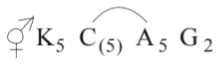
A
Hibiscus
B
Banana
C
Tulip
D
Vinca
Solution
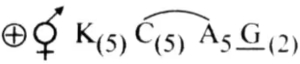
The correct answer is $(D)$ Vinca.
The provided floral formula is: $\oplus$
The provided floral formula is: $\oplus$
0 likesView Solution
15
BiologyEasyMCQKCET · 2013
The opening and closing of stomata is controlled by the activity of
A
guard cells
B
epidermal cells
C
mesophyll cells
D
lenticels
Solution
(A) The correct answer is $A$.
Stomata are small pores present on the surface of leaves.
The opening and closing of these stomata are regulated by the turgor pressure changes within the $guard cells$.
When $guard cells$ become turgid, the stoma opens, and when they become flaccid, the stoma closes.
These cells are specialized epidermal cells that surround the stomatal pore.
Stomata are small pores present on the surface of leaves.
The opening and closing of these stomata are regulated by the turgor pressure changes within the $guard cells$.
When $guard cells$ become turgid, the stoma opens, and when they become flaccid, the stoma closes.
These cells are specialized epidermal cells that surround the stomatal pore.
0 likesView Solution
16
BiologyEasyMCQKCET · 2013
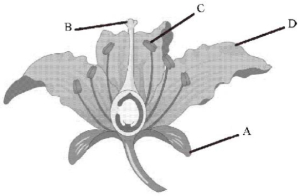
The diagram given denotes the various parts of a typical flower. Identify the labelled parts $A$,$B$,$C$,and $D$ and choose the correct option.
A
$A$-Petals,$B$-Sepals,$C$-Stamens,$D$-Pistil
B
$A$-Sepals,$B$-Pistil,$C$-Petals,$D$-Stamens
C
$A$-Sepals,$B$-Pistil,$C$-Stamens,$D$-Petals
D
$A$-Sepals,$B$-Petals,$C$-Pistil,$D$-Stamens
Solution
(C) The correct option is $C$.
In the given diagram of a typical flower:
$A$ represents the Sepals (Calyx),which are the outermost whorl.
$B$ represents the Pistil (Gynoecium),which is the female reproductive part.
$C$ represents the Stamens (Androecium),which are the male reproductive parts.
$D$ represents the Petals (Corolla),which are the brightly colored parts of the flower.
Therefore,the correct sequence is $A$-Sepals,$B$-Pistil,$C$-Stamens,$D$-Petals.
In the given diagram of a typical flower:
$A$ represents the Sepals (Calyx),which are the outermost whorl.
$B$ represents the Pistil (Gynoecium),which is the female reproductive part.
$C$ represents the Stamens (Androecium),which are the male reproductive parts.
$D$ represents the Petals (Corolla),which are the brightly colored parts of the flower.
Therefore,the correct sequence is $A$-Sepals,$B$-Pistil,$C$-Stamens,$D$-Petals.
0 likesView Solution
17
BiologyEasyMCQKCET · 2013
The embryo sac of an angiosperm is made up of
A
$8$ cells
B
$7$ cells and $8$ nuclei
C
$8$ nuclei
D
$8$ cells and $7$ nuclei
Solution
(B) The correct answer is $B$.
An angiosperm embryo sac,also known as the female gametophyte,typically follows the $Polygonum$ type of development.
It consists of $7$ cells: $1$ egg cell,$2$ synergids,$3$ antipodal cells,and $1$ large central cell.
Although there are $7$ cells,there are $8$ nuclei because the central cell contains $2$ polar nuclei,while the other $6$ cells each contain $1$ nucleus.
An angiosperm embryo sac,also known as the female gametophyte,typically follows the $Polygonum$ type of development.
It consists of $7$ cells: $1$ egg cell,$2$ synergids,$3$ antipodal cells,and $1$ large central cell.
Although there are $7$ cells,there are $8$ nuclei because the central cell contains $2$ polar nuclei,while the other $6$ cells each contain $1$ nucleus.
0 likesView Solution
18
BiologyEasyMCQKCET · 2013
Read the statements $A$ and $B$ and identify the correct choice from those given.
Statement $A$: Women are at the peak of conception on the $14^{\text{th}}$ day of the menstrual cycle.
Statement $B$: Vasectomy is the method normally employed to avoid conception in females.
Statement $A$: Women are at the peak of conception on the $14^{\text{th}}$ day of the menstrual cycle.
Statement $B$: Vasectomy is the method normally employed to avoid conception in females.
A
Statement $A$ is incorrect,$B$ is correct.
B
Statement $A$ is correct,$B$ is incorrect.
C
Both the statements are correct.
D
Both the statements are incorrect.
Solution
(B) Statement $A$ is correct: Ovulation typically occurs around the $14^{\text{th}}$ day of a $28$-day menstrual cycle due to the $LH$ surge,making this the most fertile period for conception.
Statement $B$ is incorrect: Vasectomy is a surgical method of male sterilization where the vasa deferentia are cut and tied. The method used for female sterilization is called tubectomy.
Therefore,Statement $A$ is correct and Statement $B$ is incorrect.
Statement $B$ is incorrect: Vasectomy is a surgical method of male sterilization where the vasa deferentia are cut and tied. The method used for female sterilization is called tubectomy.
Therefore,Statement $A$ is correct and Statement $B$ is incorrect.
0 likesView Solution
19
BiologyEasyMCQKCET · 2013
The appearance of chancre and rashes all over the body are the symptoms of
A
gonorrhoea
B
$AIDS$
C
syphilis
D
fever
Solution
(C) The correct answer is $C$.
Chancre (a painless ulcer) and rashes all over the body are characteristic symptoms of syphilis, which is caused by the bacterium $Treponema pallidum$.
$A$. Gonorrhoea is caused by $Neisseria gonorrhoeae$ and typically presents with genital discharge and pain during urination.
$B$. $AIDS$ is caused by the $HIV$ virus and primarily weakens the immune system, leading to various opportunistic infections.
$D$. Fever is a general clinical sign or symptom associated with many conditions and is not a specific disease characterized by chancres.
Chancre (a painless ulcer) and rashes all over the body are characteristic symptoms of syphilis, which is caused by the bacterium $Treponema pallidum$.
$A$. Gonorrhoea is caused by $Neisseria gonorrhoeae$ and typically presents with genital discharge and pain during urination.
$B$. $AIDS$ is caused by the $HIV$ virus and primarily weakens the immune system, leading to various opportunistic infections.
$D$. Fever is a general clinical sign or symptom associated with many conditions and is not a specific disease characterized by chancres.
0 likesView Solution
20
BiologyEasyMCQKCET · 2013
Gynaecomastia is the symptom of
A
Klinefelter's syndrome
B
Down's syndrome
C
Turner's syndrome
D
cri du chat syndrome
Solution
(A) . Klinefelter's syndrome.
Gynaecomastia,which is the development of enlarged breast tissue in males,is a characteristic symptom of Klinefelter's syndrome.
Klinefelter's syndrome is a genetic condition caused by chromosomal aneuploidy where males possess an extra $X$ chromosome,resulting in an $XXY$ genotype.
This condition leads to symptoms such as reduced testosterone levels,small testes,reduced fertility,and the development of female-like secondary sexual characteristics,including gynaecomastia.
Gynaecomastia,which is the development of enlarged breast tissue in males,is a characteristic symptom of Klinefelter's syndrome.
Klinefelter's syndrome is a genetic condition caused by chromosomal aneuploidy where males possess an extra $X$ chromosome,resulting in an $XXY$ genotype.
This condition leads to symptoms such as reduced testosterone levels,small testes,reduced fertility,and the development of female-like secondary sexual characteristics,including gynaecomastia.
0 likesView Solution
21
BiologyEasyMCQKCET · 2013
Which of the following statements is correct?
A
Each back cross is a test cross.
B
Each test cross is a back cross.
C
Crossing $F_2$ with $F_1$ is a test cross.
D
Crossing $F_2$ with $P_1$ is called a test cross.
Solution
(B) The correct statement is $B$.
$A$ back cross is defined as the cross of an $F_1$ hybrid with either of its parents ($P_1$ or $P_2$).
$A$ test cross is a specific type of back cross where an individual of unknown genotype (usually $F_1$ or $F_2$ generation) is crossed with a homozygous recessive parent.
Since a test cross is a subset of back crosses,it is correct to say that every test cross is a back cross,but not every back cross is a test cross.
$A$ back cross is defined as the cross of an $F_1$ hybrid with either of its parents ($P_1$ or $P_2$).
$A$ test cross is a specific type of back cross where an individual of unknown genotype (usually $F_1$ or $F_2$ generation) is crossed with a homozygous recessive parent.
Since a test cross is a subset of back crosses,it is correct to say that every test cross is a back cross,but not every back cross is a test cross.
0 likesView Solution
22
BiologyEasyMCQKCET · 2013
The branch of biology that deals with the study of fossil animals is known as
A
parabiology
B
phylogeny
C
paleontology
D
parazoology
Solution
(C) The correct answer is $C$.
Paleontology is the branch of biology and geology that deals with the study of fossil animals and plants.
It focuses on the analysis of fossils to understand ancient life forms,their structure,and their evolutionary history.
Paleontology is the branch of biology and geology that deals with the study of fossil animals and plants.
It focuses on the analysis of fossils to understand ancient life forms,their structure,and their evolutionary history.
0 likesView Solution
23
BiologyEasyMCQKCET · 2013
Interferons are the protein molecules produced from the
A
normal cells
B
infected host cells
C
macrophages
D
$B$ lymphocytes
Solution
(B) $Interferons$ are protein molecules produced by virus-infected host cells.
They help in the defense against viral infections by signaling neighboring cells to enhance their antiviral defenses.
While normal cells can produce other proteins,$Interferons$ specifically come from infected cells.
They help in the defense against viral infections by signaling neighboring cells to enhance their antiviral defenses.
While normal cells can produce other proteins,$Interferons$ specifically come from infected cells.
0 likesView Solution
24
BiologyEasyMCQKCET · 2013
$EcoRI$ cleaves the $DNA$ strands to produce
A
blunt ends
B
sticky ends
C
satellite ends
D
ori replication end
Solution
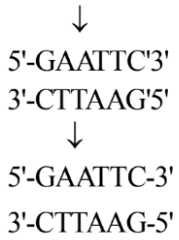
(B) $EcoRI$ is a restriction enzyme isolated from the bacterium $Escherichia$ $coli$. It cuts $DNA$ at the palindromic sequence $5'-GAATTC-3'$,specifically between the $G$ and $A$ on each strand. This staggered cleavage produces single-stranded overhangs known as sticky ends,which facilitate the joining of $DNA$ fragments.
0 likesView Solution
Vedclass Products
For Students
Vedclass Test Series
Mock tests in real KCET style covering Biology with performance analysis. 5-day free trial.
Start Free TrialFor Teachers
Exam Paper Generator
Generate Set A/B/C/D Biology papers from 7.5L+ questions in 2 minutes. 3 chapters free.
Try FreeFor Institutes
Online Exam Module
Run live KCET mock exams with unlimited students, 360° analytics & white-label branding.
See DemoFrequently Asked Questions
How many Biology questions are in KCET 2013?
There are 24 Biology questions from the KCET 2013 paper on Vedclass, each with a detailed step-by-step solution in English.
Are KCET 2013 Biology solutions available in English?
Yes. All solutions on this page are in English. You can also switch to English or Hindi using the language buttons above the questions.
Can I practice KCET 2013 Biology as a timed test?
Yes. Use the Vedclass Test Series to attempt a full KCET mock test covering Biology with time limits and instant score analysis.
Can teachers create Biology papers from KCET previous year questions?
Yes. The Vedclass Exam Paper Generator lets teachers mix KCET Biology questions and generate Set A/B/C/D papers in minutes.
For Teachers & Institutes
Build a Custom Biology Paper
Pick KCET 2013 Biology questions, set difficulty, and generate Set A/B/C/D in 2 minutes.