
PhysicsQ1–60 of 60 questions
Page 1 of 1 · English
1
PhysicsEasyMCQKCET · 2013
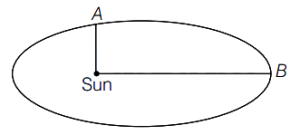
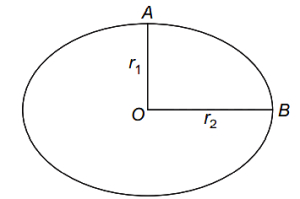
Earth is moving around the sun in an elliptical orbit as shown. The ratio of $OB$ and $OA$ is $R$. Then the ratio of Earth's velocities at $A$ and $B$ is
A
$R^{-1}$
B
$\sqrt{R}$
C
$R$
D
$R^{2/3}$
Solution
(C) In central force motion,the angular momentum of the body remains conserved.
Angular momentum is given by $L = \vec{r} \times \vec{p} = mvr \sin \theta$.
At points $A$ and $B$,the velocity vector is perpendicular to the position vector,so $\theta = 90^\circ$ and $\sin 90^\circ = 1$.
Thus,$L = mvr$.
Let $v_A$ and $v_B$ be the speeds of the Earth at $A$ and $B$,respectively,and $r_A = OA$ and $r_B = OB$ be the distances from the Sun.
By conservation of angular momentum:
$m v_A r_A = m v_B r_B$
$\Rightarrow \frac{v_A}{v_B} = \frac{r_B}{r_A} = \frac{OB}{OA}$
Given that $\frac{OB}{OA} = R$,we have $\frac{v_A}{v_B} = R$.
Therefore,the ratio of Earth's velocities at $A$ and $B$ is $R$.
Angular momentum is given by $L = \vec{r} \times \vec{p} = mvr \sin \theta$.
At points $A$ and $B$,the velocity vector is perpendicular to the position vector,so $\theta = 90^\circ$ and $\sin 90^\circ = 1$.
Thus,$L = mvr$.
Let $v_A$ and $v_B$ be the speeds of the Earth at $A$ and $B$,respectively,and $r_A = OA$ and $r_B = OB$ be the distances from the Sun.
By conservation of angular momentum:
$m v_A r_A = m v_B r_B$
$\Rightarrow \frac{v_A}{v_B} = \frac{r_B}{r_A} = \frac{OB}{OA}$
Given that $\frac{OB}{OA} = R$,we have $\frac{v_A}{v_B} = R$.
Therefore,the ratio of Earth's velocities at $A$ and $B$ is $R$.
0 likesView Solution
2
PhysicsEasyMCQKCET · 2013
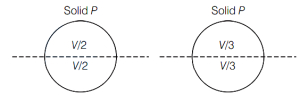
Two solids $P$ and $Q$ float in water. It is observed that $P$ floats with half of its volume immersed and $Q$ floats with $\frac{2}{3}$ of its volume immersed. The ratio of densities of $P$ and $Q$ is
A
$\frac{4}{3}$
B
$\frac{3}{4}$
C
$\frac{2}{3}$
D
$\frac{3}{2}$
Solution
(B) According to the law of floatation,for a body floating in equilibrium,the weight of the body is equal to the buoyant force (weight of the displaced liquid).
Let $V$ be the total volume of each solid,$\rho_P$ and $\rho_Q$ be their densities,and $\rho_w$ be the density of water.
For solid $P$: $V \rho_P g = (V/2) \rho_w g \Rightarrow \rho_P = \frac{1}{2} \rho_w$.
For solid $Q$: $V \rho_Q g = (2V/3) \rho_w g \Rightarrow \rho_Q = \frac{2}{3} \rho_w$.
The ratio of densities is $\frac{\rho_P}{\rho_Q} = \frac{\frac{1}{2} \rho_w}{\frac{2}{3} \rho_w} = \frac{1}{2} \times \frac{3}{2} = \frac{3}{4}$.
Let $V$ be the total volume of each solid,$\rho_P$ and $\rho_Q$ be their densities,and $\rho_w$ be the density of water.
For solid $P$: $V \rho_P g = (V/2) \rho_w g \Rightarrow \rho_P = \frac{1}{2} \rho_w$.
For solid $Q$: $V \rho_Q g = (2V/3) \rho_w g \Rightarrow \rho_Q = \frac{2}{3} \rho_w$.
The ratio of densities is $\frac{\rho_P}{\rho_Q} = \frac{\frac{1}{2} \rho_w}{\frac{2}{3} \rho_w} = \frac{1}{2} \times \frac{3}{2} = \frac{3}{4}$.
0 likesView Solution
3
PhysicsMediumMCQKCET · 2013
In a lift moving up with an acceleration of $5 \,m/s^2$, a ball is dropped from a height of $1.25 \,m$. The time taken by the ball to reach the floor of the lift is ... (nearly) $(g=10 \,m/s^2)$ (in $\,s$)
A
$0.3$
B
$0.2$
C
$0.16$
D
$0.4$
Solution
(D) When the lift is moving upwards with an acceleration $a$, the effective acceleration of the ball relative to the lift is $a_{eff} = g + a$.
Given: $g = 10 \,m/s^2$, $a = 5 \,m/s^2$, $s = 1.25 \,m$, and initial velocity $u = 0$.
Therefore, $a_{eff} = 10 + 5 = 15 \,m/s^2$.
Using the equation of motion $s = ut + \frac{1}{2} a_{eff} t^2$:
$1.25 = 0 \times t + \frac{1}{2} \times 15 \times t^2$
$1.25 = 7.5 \times t^2$
$t^2 = \frac{1.25}{7.5} = \frac{1}{6} \approx 0.166 \,s^2$
$t = \sqrt{0.166} \approx 0.4 \,s$.
Given: $g = 10 \,m/s^2$, $a = 5 \,m/s^2$, $s = 1.25 \,m$, and initial velocity $u = 0$.
Therefore, $a_{eff} = 10 + 5 = 15 \,m/s^2$.
Using the equation of motion $s = ut + \frac{1}{2} a_{eff} t^2$:
$1.25 = 0 \times t + \frac{1}{2} \times 15 \times t^2$
$1.25 = 7.5 \times t^2$
$t^2 = \frac{1.25}{7.5} = \frac{1}{6} \approx 0.166 \,s^2$
$t = \sqrt{0.166} \approx 0.4 \,s$.
0 likesView Solution
4
PhysicsMediumMCQKCET · 2013
$A$ projectile is projected at $10 \ m/s$ by making an angle of $60^{\circ}$ to the horizontal. After some time,its velocity makes an angle of $30^{\circ}$ to the horizontal. Its speed at this instant is:
A
$\frac{10}{\sqrt{3}} \ m/s$
B
$10 \sqrt{3} \ m/s$
C
$\frac{5}{\sqrt{3}} \ m/s$
D
$5 \sqrt{3} \ m/s$
Solution
(A) In projectile motion,the horizontal component of velocity remains constant throughout the flight because there is no acceleration in the horizontal direction.
Initial horizontal component of velocity: $u_x = u \cos 60^{\circ} = 10 \times \frac{1}{2} = 5 \ m/s$.
Let the speed at the later instant be $v$. The horizontal component of velocity at this instant is $v_x = v \cos 30^{\circ}$.
Since $u_x = v_x$,we have:
$5 = v \cos 30^{\circ}$
$5 = v \times \frac{\sqrt{3}}{2}$
$v = \frac{10}{\sqrt{3}} \ m/s$.
Initial horizontal component of velocity: $u_x = u \cos 60^{\circ} = 10 \times \frac{1}{2} = 5 \ m/s$.
Let the speed at the later instant be $v$. The horizontal component of velocity at this instant is $v_x = v \cos 30^{\circ}$.
Since $u_x = v_x$,we have:
$5 = v \cos 30^{\circ}$
$5 = v \times \frac{\sqrt{3}}{2}$
$v = \frac{10}{\sqrt{3}} \ m/s$.
0 likesView Solution
5
PhysicsMediumMCQKCET · 2013
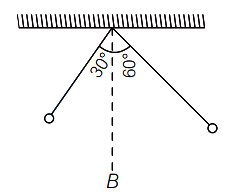
From a fixed support,two small identical spheres are suspended by means of strings of length $1 \,m$ each. They are pulled aside as shown and then released. $B$ is the mean position. Then the two spheres collide
A
at $B$ after $0.25 \,s$
B
at $B$ after $0.5 \,s$
C
on the right side of $B$ after some time
D
on the right side of $B$ when the strings are inclined at $15^{\circ}$ with $B$
Solution
(B) The time period of a simple pendulum is given by $T = 2 \pi \sqrt{\frac{l}{g}}$.
Given $l = 1 \,m$ and taking $g = 10 \,m/s^2$ (or $\pi^2 \approx 10$),we have $T = 2 \pi \sqrt{\frac{1}{10}} \approx 2 \,s$.
For a simple pendulum,the time taken to travel from the extreme position to the mean position $(B)$ is $\frac{T}{4}$.
Since both spheres are released from their respective extreme positions,they will both reach the mean position $B$ at time $t = \frac{T}{4} = \frac{2}{4} = 0.5 \,s$.
Therefore,the two spheres will collide at the mean position $B$ after $0.5 \,s$.
Given $l = 1 \,m$ and taking $g = 10 \,m/s^2$ (or $\pi^2 \approx 10$),we have $T = 2 \pi \sqrt{\frac{1}{10}} \approx 2 \,s$.
For a simple pendulum,the time taken to travel from the extreme position to the mean position $(B)$ is $\frac{T}{4}$.
Since both spheres are released from their respective extreme positions,they will both reach the mean position $B$ at time $t = \frac{T}{4} = \frac{2}{4} = 0.5 \,s$.
Therefore,the two spheres will collide at the mean position $B$ after $0.5 \,s$.
0 likesView Solution
6
PhysicsDifficultMCQKCET · 2013
$A$ solid cylinder of radius $R$ made of a material of thermal conductivity $K_{1}$ is surrounded by a cylindrical shell of inner radius $R$ and outer radius $2R$ made of a material of thermal conductivity $K_{2}$. The two ends of the combined system are maintained at two different temperatures. There is no loss of heat across the cylindrical surface and the system is in steady state. The effective thermal conductivity of the system is
A
$K_{1}+K_{2}$
B
$\frac{K_{1} K_{2}}{K_{1}+K_{2}}$
C
$\frac{2 K_{1}+K_{2}}{4}$
D
$\frac{K_{1}+3 K_{2}}{4}$
Solution
(D) The system consists of two parallel paths for heat flow: the inner solid cylinder and the outer cylindrical shell.
Since the system is in a steady state and there is no heat loss across the cylindrical surface,the total heat flow $Q_{\text{total}}$ is the sum of heat flows through the two parts: $Q_{\text{total}} = Q_{1} + Q_{2}$.
The rate of heat flow is given by $Q = \frac{KA \Delta \theta}{L}$.
For the inner cylinder,area $A_{1} = \pi R^{2}$.
For the outer shell,area $A_{2} = \pi (2R)^{2} - \pi R^{2} = 3\pi R^{2}$.
The total area is $A = A_{1} + A_{2} = 4\pi R^{2}$.
Equating the heat flow: $\frac{K(4\pi R^{2}) \Delta \theta}{L} = \frac{K_{1}(\pi R^{2}) \Delta \theta}{L} + \frac{K_{2}(3\pi R^{2}) \Delta \theta}{L}$.
Canceling common terms $\frac{\pi R^{2} \Delta \theta}{L}$ from both sides:
$4K = K_{1} + 3K_{2}$.
Therefore,the effective thermal conductivity is $K = \frac{K_{1} + 3K_{2}}{4}$.
Since the system is in a steady state and there is no heat loss across the cylindrical surface,the total heat flow $Q_{\text{total}}$ is the sum of heat flows through the two parts: $Q_{\text{total}} = Q_{1} + Q_{2}$.
The rate of heat flow is given by $Q = \frac{KA \Delta \theta}{L}$.
For the inner cylinder,area $A_{1} = \pi R^{2}$.
For the outer shell,area $A_{2} = \pi (2R)^{2} - \pi R^{2} = 3\pi R^{2}$.
The total area is $A = A_{1} + A_{2} = 4\pi R^{2}$.
Equating the heat flow: $\frac{K(4\pi R^{2}) \Delta \theta}{L} = \frac{K_{1}(\pi R^{2}) \Delta \theta}{L} + \frac{K_{2}(3\pi R^{2}) \Delta \theta}{L}$.
Canceling common terms $\frac{\pi R^{2} \Delta \theta}{L}$ from both sides:
$4K = K_{1} + 3K_{2}$.
Therefore,the effective thermal conductivity is $K = \frac{K_{1} + 3K_{2}}{4}$.
0 likesView Solution
7
PhysicsMediumMCQKCET · 2013
Two stars $A$ and $B$ radiate maximum energy at the wavelengths of $360 \ nm$ and $480 \ nm$ respectively. Then the ratio of the surface temperatures of $A$ and $B$ is
A
$3: 4$
B
$81: 256$
C
$4: 3$
D
$256: 81$
Solution
(C) According to Wien's displacement law,the product of the wavelength of maximum emission and the absolute temperature is constant: $\lambda T = b$.
Therefore,$\lambda_A T_A = \lambda_B T_B$.
This implies the ratio of temperatures is inversely proportional to the ratio of wavelengths: $\frac{T_A}{T_B} = \frac{\lambda_B}{\lambda_A}$.
Given $\lambda_A = 360 \ nm$ and $\lambda_B = 480 \ nm$.
Substituting the values: $\frac{T_A}{T_B} = \frac{480}{360} = \frac{4}{3}$.
Thus,the ratio of the surface temperatures of $A$ and $B$ is $4: 3$.
Therefore,$\lambda_A T_A = \lambda_B T_B$.
This implies the ratio of temperatures is inversely proportional to the ratio of wavelengths: $\frac{T_A}{T_B} = \frac{\lambda_B}{\lambda_A}$.
Given $\lambda_A = 360 \ nm$ and $\lambda_B = 480 \ nm$.
Substituting the values: $\frac{T_A}{T_B} = \frac{480}{360} = \frac{4}{3}$.
Thus,the ratio of the surface temperatures of $A$ and $B$ is $4: 3$.
0 likesView Solution
8
PhysicsMediumMCQKCET · 2013
For which combination of working temperatures of source and sink,the efficiency of Carnot's heat engine is maximum?
A
$600 \ K, 400 \ K$
B
$400 \ K, 200 \ K$
C
$500 \ K, 300 \ K$
D
$300 \ K, 100 \ K$
Solution
(D) The efficiency of a Carnot heat engine is given by the formula $\eta = 1 - \frac{T_2}{T_1}$,where $T_1$ is the temperature of the source and $T_2$ is the temperature of the sink.
For option $A$: $\eta_A = 1 - \frac{400}{600} = 1 - \frac{2}{3} = \frac{1}{3} \approx 0.333$.
For option $B$: $\eta_B = 1 - \frac{200}{400} = 1 - \frac{1}{2} = \frac{1}{2} = 0.500$.
For option $C$: $\eta_C = 1 - \frac{300}{500} = 1 - \frac{3}{5} = \frac{2}{5} = 0.400$.
For option $D$: $\eta_D = 1 - \frac{100}{300} = 1 - \frac{1}{3} = \frac{2}{3} \approx 0.667$.
Comparing the values,$\eta_D$ is the maximum efficiency.
Therefore,the correct combination is $T_1 = 300 \ K$ and $T_2 = 100 \ K$.
For option $A$: $\eta_A = 1 - \frac{400}{600} = 1 - \frac{2}{3} = \frac{1}{3} \approx 0.333$.
For option $B$: $\eta_B = 1 - \frac{200}{400} = 1 - \frac{1}{2} = \frac{1}{2} = 0.500$.
For option $C$: $\eta_C = 1 - \frac{300}{500} = 1 - \frac{3}{5} = \frac{2}{5} = 0.400$.
For option $D$: $\eta_D = 1 - \frac{100}{300} = 1 - \frac{1}{3} = \frac{2}{3} \approx 0.667$.
Comparing the values,$\eta_D$ is the maximum efficiency.
Therefore,the correct combination is $T_1 = 300 \ K$ and $T_2 = 100 \ K$.
0 likesView Solution
9
PhysicsEasyMCQKCET · 2013
Which one of the following is not correct?
A
Dimensional formula of thermal conductivity $(K)$ is $M^{1} L^{1} T^{-3} K^{-1}$
B
Dimensional formula of potential $(V)$ is $M^{1} L^{2} T^{3} A^{-1}$
C
Dimensional formula of permeability of free space $(\mu_{0})$ is $M^{1} L^{1} T^{-2} A^{-2}$
D
None of the above
Solution
(B) $1$. Thermal conductivity $(K)$: From $Q = \frac{KA(T_2 - T_1)t}{d}$,we get $[K] = [M^{1} L^{1} T^{-3} K^{-1}]$. This is correct.
$2$. Potential $(V)$: $V = \frac{W}{q}$. $[V] = \frac{[M^{1} L^{2} T^{-2}]}{[A^{1} T^{1}]} = [M^{1} L^{2} T^{-3} A^{-1}]$. The given option $B$ states $[M^{1} L^{2} T^{3} A^{-1}]$,which is incorrect.
$3$. Permeability of free space $(\mu_{0})$: From $F = \frac{\mu_{0} I_1 I_2 L}{2\pi d}$,we get $[\mu_{0}] = [M^{1} L^{1} T^{-2} A^{-2}]$. This is correct.
Therefore,option $B$ is the incorrect statement.
$2$. Potential $(V)$: $V = \frac{W}{q}$. $[V] = \frac{[M^{1} L^{2} T^{-2}]}{[A^{1} T^{1}]} = [M^{1} L^{2} T^{-3} A^{-1}]$. The given option $B$ states $[M^{1} L^{2} T^{3} A^{-1}]$,which is incorrect.
$3$. Permeability of free space $(\mu_{0})$: From $F = \frac{\mu_{0} I_1 I_2 L}{2\pi d}$,we get $[\mu_{0}] = [M^{1} L^{1} T^{-2} A^{-2}]$. This is correct.
Therefore,option $B$ is the incorrect statement.
0 likesView Solution
10
PhysicsMediumMCQKCET · 2013
The equation of a transverse wave is given by $y=0.05 \sin \pi(2 t-0.02 x)$,where $x, y$ are in metre and $t$ is in second. The minimum distance of separation between two particles which are in phase and the wave velocity are respectively
A
$50 \ m, 50 \ ms^{-1}$
B
$100 \ m, 100 \ ms^{-1}$
C
$50 \ m, 100 \ ms^{-1}$
D
$100 \ m, 50 \ ms^{-1}$
Solution
(B) Given equation: $y=0.05 \sin \pi(2 t-0.02 x)$
Expanding the equation: $y=0.05 \sin (2 \pi t - 0.02 \pi x)$
Comparing this with the standard wave equation $y=a \sin (\omega t - k x)$:
Angular frequency $\omega = 2 \pi \ rad/s$
Wave number $k = 0.02 \pi \ m^{-1}$
The minimum distance between two particles in phase is the wavelength $\lambda$.
Since $k = \frac{2 \pi}{\lambda}$,we have $\lambda = \frac{2 \pi}{k} = \frac{2 \pi}{0.02 \pi} = \frac{2}{0.02} = 100 \ m$.
The wave velocity $v$ is given by $v = \frac{\omega}{k}$.
$v = \frac{2 \pi}{0.02 \pi} = \frac{2}{0.02} = 100 \ m/s$.
Expanding the equation: $y=0.05 \sin (2 \pi t - 0.02 \pi x)$
Comparing this with the standard wave equation $y=a \sin (\omega t - k x)$:
Angular frequency $\omega = 2 \pi \ rad/s$
Wave number $k = 0.02 \pi \ m^{-1}$
The minimum distance between two particles in phase is the wavelength $\lambda$.
Since $k = \frac{2 \pi}{\lambda}$,we have $\lambda = \frac{2 \pi}{k} = \frac{2 \pi}{0.02 \pi} = \frac{2}{0.02} = 100 \ m$.
The wave velocity $v$ is given by $v = \frac{\omega}{k}$.
$v = \frac{2 \pi}{0.02 \pi} = \frac{2}{0.02} = 100 \ m/s$.
0 likesView Solution
11
PhysicsEasyMCQKCET · 2013
$A$ person with a vibrating tuning fork of frequency $338 \,Hz$ is moving towards a vertical wall with a speed of $2 \,ms^{-1}$. The velocity of sound in air is $340 \,ms^{-1}$. The number of beats heard by that person per second is
A
$2$
B
$4$
C
$6$
D
$8$
Solution
(B) The person is moving towards a wall with a tuning fork. The frequency of the sound heard directly from the fork is $f = 338 \,Hz$.
The frequency of the sound reflected from the wall, $f'$, is perceived by the moving observer. Since the observer is moving towards the wall, the reflected sound acts as a source at rest and the observer is moving towards it.
The formula for the frequency of the reflected sound heard by the observer is $f' = f \left( \frac{v + v_0}{v - v_s} \right)$.
Here, the source (the wall reflecting the sound) is at rest, so $v_s = 0$. The observer is moving towards the wall with $v_0 = 2 \,ms^{-1}$.
Thus, $f' = f \left( \frac{v + v_0}{v} \right) = 338 \left( \frac{340 + 2}{340} \right) = 338 \left( \frac{342}{340} \right) = 338 \times 1.00588 \approx 340 \,Hz$.
The beat frequency is the difference between the reflected frequency and the original frequency: $\Delta f = f' - f = 340 - 338 = 2 \,Hz$.
Wait, let's re-evaluate: The observer is moving towards the wall. The sound reaches the wall and reflects back. The frequency of the reflected sound as heard by the observer is $f' = f \left( \frac{v + v_0}{v - v_0} \right)$ is incorrect because the source is the wall. The correct approach is: The wall receives sound of frequency $f_{wall} = f \left( \frac{v}{v - v_0} \right)$. The wall reflects this frequency, and the observer moving towards the wall receives $f' = f_{wall} \left( \frac{v + v_0}{v} \right) = f \left( \frac{v + v_0}{v - v_0} \right)$.
Calculating: $f' = 338 \left( \frac{340 + 2}{340 - 2} \right) = 338 \left( \frac{342}{338} \right) = 342 \,Hz$.
Beat frequency = $f' - f = 342 - 338 = 4 \,Hz$.
The frequency of the sound reflected from the wall, $f'$, is perceived by the moving observer. Since the observer is moving towards the wall, the reflected sound acts as a source at rest and the observer is moving towards it.
The formula for the frequency of the reflected sound heard by the observer is $f' = f \left( \frac{v + v_0}{v - v_s} \right)$.
Here, the source (the wall reflecting the sound) is at rest, so $v_s = 0$. The observer is moving towards the wall with $v_0 = 2 \,ms^{-1}$.
Thus, $f' = f \left( \frac{v + v_0}{v} \right) = 338 \left( \frac{340 + 2}{340} \right) = 338 \left( \frac{342}{340} \right) = 338 \times 1.00588 \approx 340 \,Hz$.
The beat frequency is the difference between the reflected frequency and the original frequency: $\Delta f = f' - f = 340 - 338 = 2 \,Hz$.
Wait, let's re-evaluate: The observer is moving towards the wall. The sound reaches the wall and reflects back. The frequency of the reflected sound as heard by the observer is $f' = f \left( \frac{v + v_0}{v - v_0} \right)$ is incorrect because the source is the wall. The correct approach is: The wall receives sound of frequency $f_{wall} = f \left( \frac{v}{v - v_0} \right)$. The wall reflects this frequency, and the observer moving towards the wall receives $f' = f_{wall} \left( \frac{v + v_0}{v} \right) = f \left( \frac{v + v_0}{v - v_0} \right)$.
Calculating: $f' = 338 \left( \frac{340 + 2}{340 - 2} \right) = 338 \left( \frac{342}{338} \right) = 342 \,Hz$.
Beat frequency = $f' - f = 342 - 338 = 4 \,Hz$.
0 likesView Solution
12
PhysicsEasyMCQKCET · 2013
The frequency of the second overtone of an open pipe is equal to the frequency of the first overtone of a closed pipe. The ratio of the lengths of the open pipe to the closed pipe is
A
$2: 1$
B
$1: 2$
C
$1: 3$
D
$3: 1$
Solution
(A) For an open pipe of length $L_o$,the frequency of the $n^{th}$ harmonic is $f_n = \frac{n v}{2 L_o}$. The second overtone corresponds to the $3^{rd}$ harmonic $(n=3)$,so $f_{o} = \frac{3 v}{2 L_o}$.
For a closed pipe of length $L_c$,the frequency of the $n^{th}$ harmonic is $f_n = \frac{(2n-1) v}{4 L_c}$. The first overtone corresponds to the $3^{rd}$ harmonic $(n=2)$,so $f_{c} = \frac{3 v}{4 L_c}$.
Given that $f_o = f_c$,we have $\frac{3 v}{2 L_o} = \frac{3 v}{4 L_c}$.
Simplifying this,we get $\frac{1}{2 L_o} = \frac{1}{4 L_c}$,which implies $\frac{L_o}{L_c} = \frac{4}{2} = \frac{2}{1}$.
For a closed pipe of length $L_c$,the frequency of the $n^{th}$ harmonic is $f_n = \frac{(2n-1) v}{4 L_c}$. The first overtone corresponds to the $3^{rd}$ harmonic $(n=2)$,so $f_{c} = \frac{3 v}{4 L_c}$.
Given that $f_o = f_c$,we have $\frac{3 v}{2 L_o} = \frac{3 v}{4 L_c}$.
Simplifying this,we get $\frac{1}{2 L_o} = \frac{1}{4 L_c}$,which implies $\frac{L_o}{L_c} = \frac{4}{2} = \frac{2}{1}$.
0 likesView Solution
13
PhysicsEasyMCQKCET · 2013
$A$ gun fires a small bullet with kinetic energy $K$. Then the kinetic energy of the gun while recoiling is
A
$K$
B
more than $K$
C
less than $K$
D
$\sqrt{K}$
Solution
(C) According to the law of conservation of linear momentum,the magnitude of momentum of the gun $(p_g)$ and the bullet $(p_b)$ must be equal after firing,i.e.,$p_g = p_b = p$.
The kinetic energy $K$ of an object of mass $m$ with momentum $p$ is given by the relation $K = \frac{p^2}{2m}$.
Since the momentum $p$ is the same for both the gun and the bullet,we have $K \propto \frac{1}{m}$.
Because the mass of the gun $(M)$ is much greater than the mass of the bullet $(m)$,the kinetic energy of the gun $(K_g = \frac{p^2}{2M})$ will be significantly less than the kinetic energy of the bullet $(K_b = \frac{p^2}{2m})$.
Therefore,the kinetic energy of the gun is less than $K$.
The kinetic energy $K$ of an object of mass $m$ with momentum $p$ is given by the relation $K = \frac{p^2}{2m}$.
Since the momentum $p$ is the same for both the gun and the bullet,we have $K \propto \frac{1}{m}$.
Because the mass of the gun $(M)$ is much greater than the mass of the bullet $(m)$,the kinetic energy of the gun $(K_g = \frac{p^2}{2M})$ will be significantly less than the kinetic energy of the bullet $(K_b = \frac{p^2}{2m})$.
Therefore,the kinetic energy of the gun is less than $K$.
0 likesView Solution
14
PhysicsMediumMCQKCET · 2013
$A$ truck accelerates from speed $v$ to $2v$. The work done during this process is:
A
three times the work done in accelerating it from rest to $v$
B
the same as the work done in accelerating it from rest to $v$
C
four times the work done in accelerating it from rest to $v$
D
less than the work done in accelerating it from rest to $v$
Solution
(A) According to the work-energy theorem,the work done is equal to the change in kinetic energy.
Work done to accelerate from $0$ to $v$ is $W_1 = \frac{1}{2}mv^2 - 0 = \frac{1}{2}mv^2$.
Work done to accelerate from $v$ to $2v$ is $W_2 = \Delta K = \frac{1}{2}m(2v)^2 - \frac{1}{2}mv^2$.
$W_2 = \frac{1}{2}m(4v^2) - \frac{1}{2}mv^2 = 2mv^2 - 0.5mv^2 = 1.5mv^2$.
Comparing $W_2$ with $W_1$:
$W_2 = 3 \times (\frac{1}{2}mv^2) = 3W_1$.
Therefore,the work done is three times the work done in accelerating it from rest to $v$.
Work done to accelerate from $0$ to $v$ is $W_1 = \frac{1}{2}mv^2 - 0 = \frac{1}{2}mv^2$.
Work done to accelerate from $v$ to $2v$ is $W_2 = \Delta K = \frac{1}{2}m(2v)^2 - \frac{1}{2}mv^2$.
$W_2 = \frac{1}{2}m(4v^2) - \frac{1}{2}mv^2 = 2mv^2 - 0.5mv^2 = 1.5mv^2$.
Comparing $W_2$ with $W_1$:
$W_2 = 3 \times (\frac{1}{2}mv^2) = 3W_1$.
Therefore,the work done is three times the work done in accelerating it from rest to $v$.
0 likesView Solution
15
PhysicsDifficultMCQKCET · 2013
$A$ series combination of resistor $R$ and capacitor $C$ is connected to an $A$.$C$. source of angular frequency $\omega$. Keeping the voltage same,if the frequency is changed to $\frac{\omega}{3}$,the current becomes half of the original current. Then the ratio of capacitive reactance and resistance at the former frequency is
A
$\sqrt{0.6}$
B
$\sqrt{6}$
C
$\sqrt{3}$
D
$\sqrt{2}$
Solution
(A) The initial impedance is $Z = \sqrt{R^2 + X_c^2}$,where $X_c = \frac{1}{\omega C}$.
The initial current is $I = \frac{V}{Z}$.
When the frequency changes to $\omega' = \frac{\omega}{3}$,the new capacitive reactance is $X_c' = \frac{1}{\omega' C} = \frac{1}{(\omega/3) C} = 3X_c$.
The new impedance is $Z' = \sqrt{R^2 + (X_c')^2} = \sqrt{R^2 + (3X_c)^2}$.
Given that the new current $I' = \frac{I}{2}$,we have $\frac{V}{Z'} = \frac{1}{2} \frac{V}{Z}$,which implies $Z' = 2Z$.
Squaring both sides,$(Z')^2 = 4Z^2$,so $R^2 + 9X_c^2 = 4(R^2 + X_c^2)$.
$R^2 + 9X_c^2 = 4R^2 + 4X_c^2$.
$5X_c^2 = 3R^2$.
$\frac{X_c^2}{R^2} = \frac{3}{5} = 0.6$.
Therefore,the ratio $\frac{X_c}{R} = \sqrt{0.6}$.
The initial current is $I = \frac{V}{Z}$.
When the frequency changes to $\omega' = \frac{\omega}{3}$,the new capacitive reactance is $X_c' = \frac{1}{\omega' C} = \frac{1}{(\omega/3) C} = 3X_c$.
The new impedance is $Z' = \sqrt{R^2 + (X_c')^2} = \sqrt{R^2 + (3X_c)^2}$.
Given that the new current $I' = \frac{I}{2}$,we have $\frac{V}{Z'} = \frac{1}{2} \frac{V}{Z}$,which implies $Z' = 2Z$.
Squaring both sides,$(Z')^2 = 4Z^2$,so $R^2 + 9X_c^2 = 4(R^2 + X_c^2)$.
$R^2 + 9X_c^2 = 4R^2 + 4X_c^2$.
$5X_c^2 = 3R^2$.
$\frac{X_c^2}{R^2} = \frac{3}{5} = 0.6$.
Therefore,the ratio $\frac{X_c}{R} = \sqrt{0.6}$.
0 likesView Solution
16
PhysicsEasyMCQKCET · 2013
In an $R-L-C$ series circuit, the potential difference across each element is $20 \, V$. If the value of the resistance $R$ is doubled, what will be the potential difference across $R, L$, and $C$ respectively?
A
$20 \, V, 10 \, V, 10 \, V$
B
$20 \, V, 20 \, V, 20 \, V$
C
$20 \, V, 40 \, V, 40 \, V$
D
$10 \, V, 20 \, V, 20 \, V$
Solution
(A) Initially, the potential difference across each element is $V_R = V_L = V_C = 20 \, V$. Since $V_L = V_C$, the circuit is at resonance, meaning the impedance $Z = R$. The source voltage is $V = V_R = 20 \, V$.
When the resistance $R$ is doubled to $2R$, the new impedance becomes $Z' = \sqrt{(2R)^2 + (X_L - X_C)^2}$. Since $X_L = X_C$ at resonance, $Z' = 2R$.
The new current in the circuit is $I' = V / Z' = V / (2R) = I / 2$, where $I$ is the original current.
The new potential difference across the resistor is $V_R' = I' \times (2R) = (I/2) \times (2R) = IR = 20 \, V$.
The new potential difference across the inductor is $V_L' = I' X_L = (I/2) X_L = V_L / 2 = 20 / 2 = 10 \, V$.
The new potential difference across the capacitor is $V_C' = I' X_C = (I/2) X_C = V_C / 2 = 20 / 2 = 10 \, V$.
Thus, the new potential differences are $20 \, V, 10 \, V, 10 \, V$.
When the resistance $R$ is doubled to $2R$, the new impedance becomes $Z' = \sqrt{(2R)^2 + (X_L - X_C)^2}$. Since $X_L = X_C$ at resonance, $Z' = 2R$.
The new current in the circuit is $I' = V / Z' = V / (2R) = I / 2$, where $I$ is the original current.
The new potential difference across the resistor is $V_R' = I' \times (2R) = (I/2) \times (2R) = IR = 20 \, V$.
The new potential difference across the inductor is $V_L' = I' X_L = (I/2) X_L = V_L / 2 = 20 / 2 = 10 \, V$.
The new potential difference across the capacitor is $V_C' = I' X_C = (I/2) X_C = V_C / 2 = 20 / 2 = 10 \, V$.
Thus, the new potential differences are $20 \, V, 10 \, V, 10 \, V$.
0 likesView Solution
17
PhysicsEasyMCQKCET · 2013
For a transformer,the turns ratio is $3$ and its efficiency is $0.75$. The current flowing in the primary coil is $2 \,A$ and the voltage applied to it is $100 \,V$. Then the voltage and the current flowing in the secondary coil are ... respectively.
A
$150 \,V, 1.5 \,A$
B
$300 \,V, 0.5 \,A$
C
$300 \,V, 1.5 \,A$
D
$150 \,V, 0.5 \,A$
Solution
(B) Given: Turns ratio $\frac{n_{s}}{n_{p}} = 3$,Efficiency $\eta = 0.75$,Primary current $I_{p} = 2 \,A$,Primary voltage $V_{p} = 100 \,V$.
For a transformer,the voltage ratio is equal to the turns ratio: $\frac{V_{s}}{V_{p}} = \frac{n_{s}}{n_{p}} = 3$.
Therefore,$V_{s} = 3 \times V_{p} = 3 \times 100 \,V = 300 \,V$.
Efficiency $\eta$ is defined as the ratio of output power to input power: $\eta = \frac{V_{s} I_{s}}{V_{p} I_{p}}$.
Substituting the values: $0.75 = \frac{300 \times I_{s}}{100 \times 2}$.
$0.75 = \frac{300 \times I_{s}}{200} = 1.5 \times I_{s}$.
$I_{s} = \frac{0.75}{1.5} = 0.5 \,A$.
Thus,the secondary voltage is $300 \,V$ and the secondary current is $0.5 \,A$.
For a transformer,the voltage ratio is equal to the turns ratio: $\frac{V_{s}}{V_{p}} = \frac{n_{s}}{n_{p}} = 3$.
Therefore,$V_{s} = 3 \times V_{p} = 3 \times 100 \,V = 300 \,V$.
Efficiency $\eta$ is defined as the ratio of output power to input power: $\eta = \frac{V_{s} I_{s}}{V_{p} I_{p}}$.
Substituting the values: $0.75 = \frac{300 \times I_{s}}{100 \times 2}$.
$0.75 = \frac{300 \times I_{s}}{200} = 1.5 \times I_{s}$.
$I_{s} = \frac{0.75}{1.5} = 0.5 \,A$.
Thus,the secondary voltage is $300 \,V$ and the secondary current is $0.5 \,A$.
0 likesView Solution
18
PhysicsEasyMCQKCET · 2013
Pick out the correct statement from the following:
A
Mercury vapour lamp produces line emission spectrum
B
Sunlight spectrum is an example for line absorption spectrum
C
Band spectrum helps us to study molecular structure
D
All of the above
Solution
(D) The line emission spectrum is produced by an excited substance in the atomic state,such as a mercury vapour lamp.
Line absorption spectrum is produced when electromagnetic radiations pass through a medium; therefore,the sunlight spectrum is a line absorption spectrum.
The band spectrum is used to study the molecular structure.
Since all the statements $A$,$B$,and $C$ are correct,the correct option is $D$.
Line absorption spectrum is produced when electromagnetic radiations pass through a medium; therefore,the sunlight spectrum is a line absorption spectrum.
The band spectrum is used to study the molecular structure.
Since all the statements $A$,$B$,and $C$ are correct,the correct option is $D$.
0 likesView Solution
19
PhysicsEasyMCQKCET · 2013
Which of the following is not made by quarks?
A
Neutron
B
Positron
C
Proton
D
$\pi$-meson
Solution
(B) Quarks are elementary particles that combine to form composite particles known as hadrons.
Protons and neutrons are baryons,which are made of three quarks.
$\pi$-mesons (pions) are mesons,which are made of a quark and an antiquark.
$A$ positron is an antiparticle of the electron,which is a lepton.
Leptons are fundamental particles and are not composed of quarks.
Therefore,the positron is not made of quarks.
Protons and neutrons are baryons,which are made of three quarks.
$\pi$-mesons (pions) are mesons,which are made of a quark and an antiquark.
$A$ positron is an antiparticle of the electron,which is a lepton.
Leptons are fundamental particles and are not composed of quarks.
Therefore,the positron is not made of quarks.
0 likesView Solution
20
PhysicsMediumMCQKCET · 2013
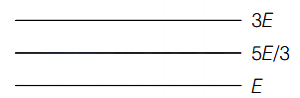
The figure shows the energy levels of a certain atom. When the electron de-excites from $3E$ to $E$,an electromagnetic wave of wavelength $\lambda$ is emitted. What is the wavelength of the electromagnetic wave emitted when the electron de-excites from $\frac{5E}{3}$ to $E$?
A
$3\lambda$
B
$2\lambda$
C
$5\lambda$
D
$\frac{3\lambda}{5}$
Solution
(A) When the electron de-excites from $3E$ to $E$,the energy difference is $\Delta E_1 = 3E - E = 2E$.
The energy of the emitted photon is given by $\frac{hc}{\lambda} = 2E$ ... $(i)$
When the electron de-excites from $\frac{5E}{3}$ to $E$,the energy difference is $\Delta E_2 = \frac{5E}{3} - E = \frac{2E}{3}$.
The energy of the emitted photon is $\frac{hc}{\lambda'} = \frac{2E}{3}$ ... (ii)
Dividing equation $(i)$ by equation (ii):
$\frac{hc/\lambda}{hc/\lambda'} = \frac{2E}{2E/3}$
$\frac{\lambda'}{\lambda} = \frac{2E \times 3}{2E} = 3$
$\lambda' = 3\lambda$
The energy of the emitted photon is given by $\frac{hc}{\lambda} = 2E$ ... $(i)$
When the electron de-excites from $\frac{5E}{3}$ to $E$,the energy difference is $\Delta E_2 = \frac{5E}{3} - E = \frac{2E}{3}$.
The energy of the emitted photon is $\frac{hc}{\lambda'} = \frac{2E}{3}$ ... (ii)
Dividing equation $(i)$ by equation (ii):
$\frac{hc/\lambda}{hc/\lambda'} = \frac{2E}{2E/3}$
$\frac{\lambda'}{\lambda} = \frac{2E \times 3}{2E} = 3$
$\lambda' = 3\lambda$
0 likesView Solution
21
PhysicsEasyMCQKCET · 2013
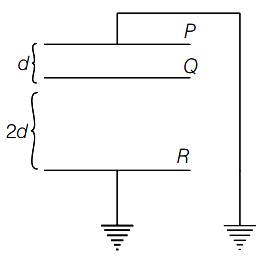
See the diagram. The area of each plate is $2.0 \,m^{2}$ and $d=2 \times 10^{-3} \,m$. $A$ charge of $8.85 \times 10^{-8} \,C$ is given to plate $Q$. Then the potential of $Q$ becomes (in $\,V$)
A
$13$
B
$10$
C
$6.67$
D
$8.825$
Solution
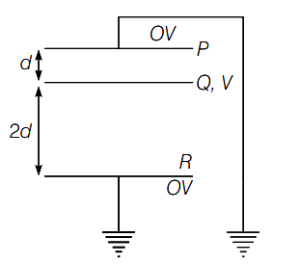
(C) In the given arrangement,plate $Q$ is common to two capacitors connected in parallel,as both plates $P$ and $R$ are grounded (at $0 \,V$).
Let $V$ be the potential of plate $Q$.
The capacitance of the first capacitor (between $P$ and $Q$) is $C_1 = \frac{\varepsilon_0 A}{d}$.
The capacitance of the second capacitor (between $Q$ and $R$) is $C_2 = \frac{\varepsilon_0 A}{2d}$.
Since they are in parallel,the effective capacitance is $C_{\text{eff}} = C_1 + C_2 = \frac{\varepsilon_0 A}{d} + \frac{\varepsilon_0 A}{2d} = \frac{3 \varepsilon_0 A}{2d}$.
Given $q = 8.85 \times 10^{-8} \,C$,$A = 2.0 \,m^2$,$d = 2 \times 10^{-3} \,m$,and $\varepsilon_0 = 8.85 \times 10^{-12} \,F/m$.
Using $q = C_{\text{eff}} V$,we have $V = \frac{q}{C_{\text{eff}}} = \frac{q \cdot 2d}{3 \varepsilon_0 A}$.
Substituting the values: $V = \frac{8.85 \times 10^{-8} \times 2 \times (2 \times 10^{-3})}{3 \times (8.85 \times 10^{-12}) \times 2.0} = \frac{8.85 \times 4 \times 10^{-11}}{3 \times 8.85 \times 2 \times 10^{-12}} = \frac{4 \times 10}{3 \times 2} = \frac{20}{3} \approx 6.67 \,V$.
Let $V$ be the potential of plate $Q$.
The capacitance of the first capacitor (between $P$ and $Q$) is $C_1 = \frac{\varepsilon_0 A}{d}$.
The capacitance of the second capacitor (between $Q$ and $R$) is $C_2 = \frac{\varepsilon_0 A}{2d}$.
Since they are in parallel,the effective capacitance is $C_{\text{eff}} = C_1 + C_2 = \frac{\varepsilon_0 A}{d} + \frac{\varepsilon_0 A}{2d} = \frac{3 \varepsilon_0 A}{2d}$.
Given $q = 8.85 \times 10^{-8} \,C$,$A = 2.0 \,m^2$,$d = 2 \times 10^{-3} \,m$,and $\varepsilon_0 = 8.85 \times 10^{-12} \,F/m$.
Using $q = C_{\text{eff}} V$,we have $V = \frac{q}{C_{\text{eff}}} = \frac{q \cdot 2d}{3 \varepsilon_0 A}$.
Substituting the values: $V = \frac{8.85 \times 10^{-8} \times 2 \times (2 \times 10^{-3})}{3 \times (8.85 \times 10^{-12}) \times 2.0} = \frac{8.85 \times 4 \times 10^{-11}}{3 \times 8.85 \times 2 \times 10^{-12}} = \frac{4 \times 10}{3 \times 2} = \frac{20}{3} \approx 6.67 \,V$.
0 likesView Solution
22
PhysicsEasyMCQKCET · 2013
When an additional charge of $2 \text{ C}$ is given to a capacitor,the energy stored in it increases by $21 \%$. The original charge of the capacitor is: (in $\text{ C}$)
A
$30$
B
$40$
C
$10$
D
$20$
Solution
(D) The energy stored in a capacitor is given by $U = \frac{q^2}{2C}$.
Let the initial charge be $q_1 = q$ and the final charge be $q_2 = q + 2 \text{ C}$.
The initial energy is $U_1 = \frac{q^2}{2C}$ and the final energy is $U_2 = \frac{(q+2)^2}{2C}$.
Given that the energy increases by $21 \%$,we have $U_2 = U_1 + 0.21 U_1 = 1.21 U_1$.
Substituting the expressions for $U_1$ and $U_2$:
$\frac{(q+2)^2}{2C} = 1.21 \times \frac{q^2}{2C}$.
Canceling $\frac{1}{2C}$ from both sides,we get $(q+2)^2 = 1.21 q^2$.
Taking the square root of both sides: $q + 2 = 1.1 q$.
Rearranging the terms: $1.1 q - q = 2$,which gives $0.1 q = 2$.
Therefore,$q = \frac{2}{0.1} = 20 \text{ C}$.
Let the initial charge be $q_1 = q$ and the final charge be $q_2 = q + 2 \text{ C}$.
The initial energy is $U_1 = \frac{q^2}{2C}$ and the final energy is $U_2 = \frac{(q+2)^2}{2C}$.
Given that the energy increases by $21 \%$,we have $U_2 = U_1 + 0.21 U_1 = 1.21 U_1$.
Substituting the expressions for $U_1$ and $U_2$:
$\frac{(q+2)^2}{2C} = 1.21 \times \frac{q^2}{2C}$.
Canceling $\frac{1}{2C}$ from both sides,we get $(q+2)^2 = 1.21 q^2$.
Taking the square root of both sides: $q + 2 = 1.1 q$.
Rearranging the terms: $1.1 q - q = 2$,which gives $0.1 q = 2$.
Therefore,$q = \frac{2}{0.1} = 20 \text{ C}$.
0 likesView Solution
23
PhysicsMediumMCQKCET · 2013
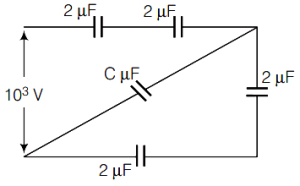
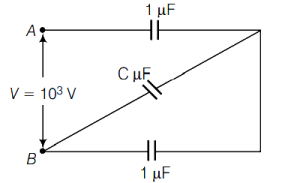
When a potential difference of $10^{3} \, V$ is applied between $A$ and $B$, a charge of $0.75 \, mC$ is stored in the circuit. The value of $C$ is (in $\mu F$):
A
$\frac{1}{2}$
B
$2$
C
$2.5$
D
$3$
Solution
(B) From the given circuit diagram, the two $2 \, \mu F$ capacitors in the top branch are in series. Their equivalent capacitance is $C_{1} = \frac{2 \times 2}{2+2} = 1 \, \mu F$.
Similarly, the two $2 \, \mu F$ capacitors in the right and bottom branches are in series. Their equivalent capacitance is $C_{2} = \frac{2 \times 2}{2+2} = 1 \, \mu F$.
Now, the circuit simplifies to a parallel combination of $C \, \mu F$ and $C_{2} = 1 \, \mu F$, which is in series with $C_{1} = 1 \, \mu F$.
The effective capacitance $C_{\text{eff}}$ is given by:
$C_{\text{eff}} = \frac{(C + 1) \times 1}{(C + 1) + 1} = \frac{C + 1}{C + 2} \, \mu F$.
Given, charge $q = 0.75 \, mC = 0.75 \times 10^{-3} \, C$ and potential $V = 10^{3} \, V$.
The effective capacitance is $C_{\text{eff}} = \frac{q}{V} = \frac{0.75 \times 10^{-3}}{10^{3}} = 0.75 \times 10^{-6} \, F = 0.75 \, \mu F$.
Equating the two expressions for $C_{\text{eff}}$:
$0.75 = \frac{C + 1}{C + 2}$
$\frac{3}{4} = \frac{C + 1}{C + 2}$
$3(C + 2) = 4(C + 1)$
$3C + 6 = 4C + 4$
$C = 2 \, \mu F$.
Similarly, the two $2 \, \mu F$ capacitors in the right and bottom branches are in series. Their equivalent capacitance is $C_{2} = \frac{2 \times 2}{2+2} = 1 \, \mu F$.
Now, the circuit simplifies to a parallel combination of $C \, \mu F$ and $C_{2} = 1 \, \mu F$, which is in series with $C_{1} = 1 \, \mu F$.
The effective capacitance $C_{\text{eff}}$ is given by:
$C_{\text{eff}} = \frac{(C + 1) \times 1}{(C + 1) + 1} = \frac{C + 1}{C + 2} \, \mu F$.
Given, charge $q = 0.75 \, mC = 0.75 \times 10^{-3} \, C$ and potential $V = 10^{3} \, V$.
The effective capacitance is $C_{\text{eff}} = \frac{q}{V} = \frac{0.75 \times 10^{-3}}{10^{3}} = 0.75 \times 10^{-6} \, F = 0.75 \, \mu F$.
Equating the two expressions for $C_{\text{eff}}$:
$0.75 = \frac{C + 1}{C + 2}$
$\frac{3}{4} = \frac{C + 1}{C + 2}$
$3(C + 2) = 4(C + 1)$
$3C + 6 = 4C + 4$
$C = 2 \, \mu F$.
0 likesView Solution
24
PhysicsMediumMCQKCET · 2013
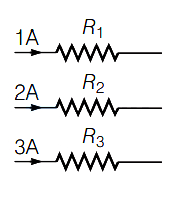
Three conductors draw currents of $1 \,A, 2 \,A$ and $3 \,A$ respectively, when connected in turn across a battery. If they are connected in series and the combination is connected across the same battery, the current drawn will be
A
$\frac{6}{11} \,A$
B
$\frac{3}{7} \,A$
C
$\frac{4}{7} \,A$
D
$\frac{5}{7} \,A$
Solution
(A) Let the resistances of the three conductors be $R_1, R_2$ and $R_3$. When connected individually across a battery of voltage $V$, the currents are $I_1 = 1 \,A, I_2 = 2 \,A$ and $I_3 = 3 \,A$.
Using Ohm's law, $V = I R$, we have:
$R_1 = \frac{V}{1} = V$
$R_2 = \frac{V}{2}$
$R_3 = \frac{V}{3}$
When connected in series, the equivalent resistance $R_{eq}$ is:
$R_{eq} = R_1 + R_2 + R_3 = V + \frac{V}{2} + \frac{V}{3} = V \left( 1 + \frac{1}{2} + \frac{1}{3} \right) = V \left( \frac{6 + 3 + 2}{6} \right) = \frac{11V}{6}$
The current $I$ drawn from the same battery in series is:
$I = \frac{V}{R_{eq}} = \frac{V}{11V/6} = \frac{6}{11} \,A$.
Using Ohm's law, $V = I R$, we have:
$R_1 = \frac{V}{1} = V$
$R_2 = \frac{V}{2}$
$R_3 = \frac{V}{3}$
When connected in series, the equivalent resistance $R_{eq}$ is:
$R_{eq} = R_1 + R_2 + R_3 = V + \frac{V}{2} + \frac{V}{3} = V \left( 1 + \frac{1}{2} + \frac{1}{3} \right) = V \left( \frac{6 + 3 + 2}{6} \right) = \frac{11V}{6}$
The current $I$ drawn from the same battery in series is:
$I = \frac{V}{R_{eq}} = \frac{V}{11V/6} = \frac{6}{11} \,A$.
0 likesView Solution
25
PhysicsEasyMCQKCET · 2013
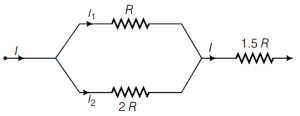
In the circuit diagram,the heat produced in resistors $R$,$2R$,and $1.5R$ are in the ratio of:
A
$4: 2: 3$
B
$8: 4: 27$
C
$2: 4: 3$
D
$27: 8: 4$
Solution
(B) The current $I$ splits into $I_1$ and $I_2$ through the parallel resistors $R$ and $2R$. Using the current divider rule:
$I_1 = I \times \frac{2R}{R + 2R} = \frac{2I}{3}$
$I_2 = I \times \frac{R}{R + 2R} = \frac{I}{3}$
The heat produced in a resistor is given by $H = I^2 R t$. Assuming time $t$ is the same for all:
$H_1 = I_1^2 R = \left(\frac{2I}{3}\right)^2 R = \frac{4I^2 R}{9}$
$H_2 = I_2^2 (2R) = \left(\frac{I}{3}\right)^2 (2R) = \frac{2I^2 R}{9}$
For the resistor $1.5R$,the total current $I$ flows through it:
$H_3 = I^2 (1.5R) = 1.5 I^2 R = \frac{13.5 I^2 R}{9}$
The ratio $H_1 : H_2 : H_3 = \frac{4}{9} : \frac{2}{9} : \frac{13.5}{9} = 4 : 2 : 13.5 = 8 : 4 : 27$.
$I_1 = I \times \frac{2R}{R + 2R} = \frac{2I}{3}$
$I_2 = I \times \frac{R}{R + 2R} = \frac{I}{3}$
The heat produced in a resistor is given by $H = I^2 R t$. Assuming time $t$ is the same for all:
$H_1 = I_1^2 R = \left(\frac{2I}{3}\right)^2 R = \frac{4I^2 R}{9}$
$H_2 = I_2^2 (2R) = \left(\frac{I}{3}\right)^2 (2R) = \frac{2I^2 R}{9}$
For the resistor $1.5R$,the total current $I$ flows through it:
$H_3 = I^2 (1.5R) = 1.5 I^2 R = \frac{13.5 I^2 R}{9}$
The ratio $H_1 : H_2 : H_3 = \frac{4}{9} : \frac{2}{9} : \frac{13.5}{9} = 4 : 2 : 13.5 = 8 : 4 : 27$.
0 likesView Solution
26
PhysicsDifficultMCQKCET · 2013
Two tangent galvanometers,which are identical except in their number of turns,are connected in parallel. The ratio of their resistances of the coils is $1 : 3$. If the deflections in the two tangent galvanometers are $30^{\circ}$ and $60^{\circ}$ respectively,then the ratio of their number of turns is
A
$1: 1$
B
$3: 1$
C
$1: 2$
D
$1: 6$
Solution
(D) For a tangent galvanometer,the current $I$ is given by $I = K \tan \theta$,where $K = \frac{2r B_{H}}{n \mu_{0}}$.
Since the galvanometers are connected in parallel,the voltage $V$ across them is the same. Thus,$I_1 R_1 = I_2 R_2$,which implies $\frac{I_1}{I_2} = \frac{R_2}{R_1} = \frac{3}{1}$.
Using the formula $I = K \tan \theta$,we have $\frac{I_1}{I_2} = \frac{n_2}{n_1} \cdot \frac{\tan \theta_1}{\tan \theta_2}$.
Substituting the given values: $\frac{3}{1} = \frac{n_2}{n_1} \cdot \frac{\tan 30^{\circ}}{\tan 60^{\circ}}$.
$\frac{3}{1} = \frac{n_2}{n_1} \cdot \frac{1/\sqrt{3}}{\sqrt{3}} = \frac{n_2}{n_1} \cdot \frac{1}{3}$.
Therefore,$\frac{n_1}{n_2} = \frac{1}{3 \times 3} = \frac{1}{9}$.
Wait,re-evaluating: $\frac{3}{1} = \frac{n_2}{n_1} \cdot \frac{1}{3} \implies \frac{n_2}{n_1} = 9 \implies \frac{n_1}{n_2} = \frac{1}{9}$.
Given the options,let's re-check the ratio: $\frac{R_2}{R_1} = 3$. $\frac{I_1}{I_2} = 3$. $\frac{n_2}{n_1} = \frac{I_1 \tan \theta_2}{I_2 \tan \theta_1} = 3 \cdot \frac{\sqrt{3}}{1/\sqrt{3}} = 3 \cdot 3 = 9$. The ratio $n_1:n_2$ is $1:9$. Since $1:9$ is not an option,let's re-verify the resistance ratio logic. If $R_1:R_2 = 1:3$,then $I_1:I_2 = 3:1$. The correct ratio is $1:9$.
Since the galvanometers are connected in parallel,the voltage $V$ across them is the same. Thus,$I_1 R_1 = I_2 R_2$,which implies $\frac{I_1}{I_2} = \frac{R_2}{R_1} = \frac{3}{1}$.
Using the formula $I = K \tan \theta$,we have $\frac{I_1}{I_2} = \frac{n_2}{n_1} \cdot \frac{\tan \theta_1}{\tan \theta_2}$.
Substituting the given values: $\frac{3}{1} = \frac{n_2}{n_1} \cdot \frac{\tan 30^{\circ}}{\tan 60^{\circ}}$.
$\frac{3}{1} = \frac{n_2}{n_1} \cdot \frac{1/\sqrt{3}}{\sqrt{3}} = \frac{n_2}{n_1} \cdot \frac{1}{3}$.
Therefore,$\frac{n_1}{n_2} = \frac{1}{3 \times 3} = \frac{1}{9}$.
Wait,re-evaluating: $\frac{3}{1} = \frac{n_2}{n_1} \cdot \frac{1}{3} \implies \frac{n_2}{n_1} = 9 \implies \frac{n_1}{n_2} = \frac{1}{9}$.
Given the options,let's re-check the ratio: $\frac{R_2}{R_1} = 3$. $\frac{I_1}{I_2} = 3$. $\frac{n_2}{n_1} = \frac{I_1 \tan \theta_2}{I_2 \tan \theta_1} = 3 \cdot \frac{\sqrt{3}}{1/\sqrt{3}} = 3 \cdot 3 = 9$. The ratio $n_1:n_2$ is $1:9$. Since $1:9$ is not an option,let's re-verify the resistance ratio logic. If $R_1:R_2 = 1:3$,then $I_1:I_2 = 3:1$. The correct ratio is $1:9$.
0 likesView Solution
27
PhysicsMediumMCQKCET · 2013
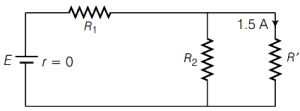
In the circuit,$R_{1} = R_{2} = R$. The value of $E$ and $R_{1}$ are $\ldots \ldots \ldots$ ($E$ = $EMF$,$R_{1}$ = resistance).
A
$180 \ V, 60 \ \Omega$
B
$120 \ V, 60 \ \Omega$
C
$180 \ V, 10 \ \Omega$
D
$120 \ V, 10 \ \Omega$
Solution
(A) Let $R_{1} = R_{2} = R$. The current through $R_{2}$ is $(I - 1.5) \ A$.
Applying Kirchhoff's voltage law $(KVL)$ in the loop containing $E, R_{1}$,and $R_{2}$:
$E - I R_{1} - (I - 1.5) R_{2} = 0$
Since $R_{1} = R_{2} = R$,we have $E = I R + (I - 1.5) R = R(2I - 1.5) \quad ... (i)$
Applying $KVL$ in the outer loop containing $E, R_{1}$,and $R'$:
$E - I R_{1} - 1.5 R' = 0$
$E = I R + 1.5 R' \quad ... (ii)$
From the provided circuit diagram,the voltage across $R_{2}$ is the same as the voltage across $R'$,so $V_{R_{2}} = V_{R'}$.
$(I - 1.5) R = 1.5 R'$
$R' = \frac{(I - 1.5) R}{1.5}$
Substituting $R'$ into equation $(ii)$:
$E = I R + 1.5 \left[ \frac{(I - 1.5) R}{1.5} \right] = I R + (I - 1.5) R = R(2I - 1.5)$
This confirms the consistency. Given the options,let's test $R = 60 \ \Omega$ and $E = 180 \ V$:
$180 = 60(2I - 1.5) \Rightarrow 3 = 2I - 1.5 \Rightarrow 2I = 4.5 \Rightarrow I = 2.25 \ A$.
Then $I - 1.5 = 2.25 - 1.5 = 0.75 \ A$.
Voltage across $R_{2} = 0.75 \times 60 = 45 \ V$.
Voltage across $R' = 1.5 \times R' = 45 \ V \Rightarrow R' = 30 \ \Omega$.
This is a valid physical circuit. Thus,$E = 180 \ V$ and $R_{1} = 60 \ \Omega$ is the correct pair.
Applying Kirchhoff's voltage law $(KVL)$ in the loop containing $E, R_{1}$,and $R_{2}$:
$E - I R_{1} - (I - 1.5) R_{2} = 0$
Since $R_{1} = R_{2} = R$,we have $E = I R + (I - 1.5) R = R(2I - 1.5) \quad ... (i)$
Applying $KVL$ in the outer loop containing $E, R_{1}$,and $R'$:
$E - I R_{1} - 1.5 R' = 0$
$E = I R + 1.5 R' \quad ... (ii)$
From the provided circuit diagram,the voltage across $R_{2}$ is the same as the voltage across $R'$,so $V_{R_{2}} = V_{R'}$.
$(I - 1.5) R = 1.5 R'$
$R' = \frac{(I - 1.5) R}{1.5}$
Substituting $R'$ into equation $(ii)$:
$E = I R + 1.5 \left[ \frac{(I - 1.5) R}{1.5} \right] = I R + (I - 1.5) R = R(2I - 1.5)$
This confirms the consistency. Given the options,let's test $R = 60 \ \Omega$ and $E = 180 \ V$:
$180 = 60(2I - 1.5) \Rightarrow 3 = 2I - 1.5 \Rightarrow 2I = 4.5 \Rightarrow I = 2.25 \ A$.
Then $I - 1.5 = 2.25 - 1.5 = 0.75 \ A$.
Voltage across $R_{2} = 0.75 \times 60 = 45 \ V$.
Voltage across $R' = 1.5 \times R' = 45 \ V \Rightarrow R' = 30 \ \Omega$.
This is a valid physical circuit. Thus,$E = 180 \ V$ and $R_{1} = 60 \ \Omega$ is the correct pair.
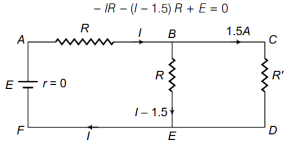
0 likesView Solution
28
PhysicsEasyMCQKCET · 2013
Masses of three wires of copper are in the ratio of $1: 3: 5$ and their lengths are in the ratio of $5: 3: 1$. The ratio of their electrical resistances is
A
$1: 3: 5$
B
$5: 3: 1$
C
$1: 15: 125$
D
$125: 15: 1$
Solution
(D) Given,the ratio of masses is $m_{1}: m_{2}: m_{3} = 1: 3: 5$ and the ratio of lengths is $l_{1}: l_{2}: l_{3} = 5: 3: 1$.
We know that the electrical resistance $R$ is given by $R = \rho \frac{l}{A}$.
Since density $d = \frac{m}{V} = \frac{m}{Al}$,we have $A = \frac{m}{dl}$.
Substituting $A$ in the resistance formula,we get $R = \rho \frac{l}{(m/dl)} = \rho d \frac{l^{2}}{m}$.
Since $\rho$ and $d$ are constant for copper wires,$R \propto \frac{l^{2}}{m}$.
Therefore,the ratio of resistances is $R_{1}: R_{2}: R_{3} = \frac{l_{1}^{2}}{m_{1}}: \frac{l_{2}^{2}}{m_{2}}: \frac{l_{3}^{2}}{m_{3}}$.
Substituting the given values: $R_{1}: R_{2}: R_{3} = \frac{5^{2}}{1}: \frac{3^{2}}{3}: \frac{1^{2}}{5} = \frac{25}{1}: \frac{9}{3}: \frac{1}{5} = 25: 3: 0.2$.
To simplify the ratio,multiply by $5$: $125: 15: 1$.
We know that the electrical resistance $R$ is given by $R = \rho \frac{l}{A}$.
Since density $d = \frac{m}{V} = \frac{m}{Al}$,we have $A = \frac{m}{dl}$.
Substituting $A$ in the resistance formula,we get $R = \rho \frac{l}{(m/dl)} = \rho d \frac{l^{2}}{m}$.
Since $\rho$ and $d$ are constant for copper wires,$R \propto \frac{l^{2}}{m}$.
Therefore,the ratio of resistances is $R_{1}: R_{2}: R_{3} = \frac{l_{1}^{2}}{m_{1}}: \frac{l_{2}^{2}}{m_{2}}: \frac{l_{3}^{2}}{m_{3}}$.
Substituting the given values: $R_{1}: R_{2}: R_{3} = \frac{5^{2}}{1}: \frac{3^{2}}{3}: \frac{1^{2}}{5} = \frac{25}{1}: \frac{9}{3}: \frac{1}{5} = 25: 3: 0.2$.
To simplify the ratio,multiply by $5$: $125: 15: 1$.
0 likesView Solution
29
PhysicsEasyMCQKCET · 2013
The additional energy that should be given to an electron to reduce its de-Broglie wavelength from $1 \ nm$ to $0.5 \ nm$ is
A
$2$ times the initial kinetic energy
B
$3$ times the initial kinetic energy
C
$0.5$ times the initial kinetic energy
D
$4$ times the initial kinetic energy
Solution
(B) The de-Broglie wavelength is given by $\lambda = \frac{h}{\sqrt{2 m E_{k}}}$.
Since $h$ and $m$ are constants,we have $\lambda \propto \frac{1}{\sqrt{E_{k}}}$.
Let the initial kinetic energy be $E_{k1} = E$ and the final kinetic energy be $E_{k2}$.
Given $\lambda_1 = 1 \ nm$ and $\lambda_2 = 0.5 \ nm$,we have $\frac{\lambda_1}{\lambda_2} = \frac{1}{0.5} = 2$.
Using the relation $\frac{\lambda_1}{\lambda_2} = \sqrt{\frac{E_{k2}}{E_{k1}}}$,we get $2 = \sqrt{\frac{E_{k2}}{E}}$,which implies $\frac{E_{k2}}{E} = 4$,so $E_{k2} = 4E$.
The additional energy required is $\Delta E = E_{k2} - E_{k1} = 4E - E = 3E$.
Thus,the additional energy is $3$ times the initial kinetic energy.
Since $h$ and $m$ are constants,we have $\lambda \propto \frac{1}{\sqrt{E_{k}}}$.
Let the initial kinetic energy be $E_{k1} = E$ and the final kinetic energy be $E_{k2}$.
Given $\lambda_1 = 1 \ nm$ and $\lambda_2 = 0.5 \ nm$,we have $\frac{\lambda_1}{\lambda_2} = \frac{1}{0.5} = 2$.
Using the relation $\frac{\lambda_1}{\lambda_2} = \sqrt{\frac{E_{k2}}{E_{k1}}}$,we get $2 = \sqrt{\frac{E_{k2}}{E}}$,which implies $\frac{E_{k2}}{E} = 4$,so $E_{k2} = 4E$.
The additional energy required is $\Delta E = E_{k2} - E_{k1} = 4E - E = 3E$.
Thus,the additional energy is $3$ times the initial kinetic energy.
0 likesView Solution
30
PhysicsEasyMCQKCET · 2013
Light emitted during the de-excitation of an electron from $n=3$ to $n=2$ is incident on a metal, and photoelectrons are just emitted from that metal. In which of the following de-excitations is the photoelectric effect $NOT$ possible?
A
From $n=2$ to $n=1$
B
From $n=3$ to $n=1$
C
From $n=5$ to $n=2$
D
From $n=4$ to $n=3$
Solution
(D) The energy of a photon emitted during a transition from $n_i$ to $n_f$ is given by $E = 13.6 \left( \frac{1}{n_f^2} - \frac{1}{n_i^2} \right) \text{ eV}$.
For the transition $n=3$ to $n=2$, the energy is $E_{3-2} = 13.6 \left( \frac{1}{4} - \frac{1}{9} \right) = 13.6 \left( \frac{5}{36} \right) \approx 1.89 \text{ eV}$.
Since photoelectrons are just emitted, the work function of the metal is $\Phi = 1.89 \text{ eV}$.
For the photoelectric effect to occur, the energy of the incident photon must be greater than or equal to the work function $(E \ge \Phi)$.
Let's calculate the energy for the given options:
$A$: $n=2$ to $n=1$: $E = 13.6 (1 - 1/4) = 10.2 \text{ eV} > 1.89 \text{ eV}$ (Possible).
$B$: $n=3$ to $n=1$: $E = 13.6 (1 - 1/9) = 12.09 \text{ eV} > 1.89 \text{ eV}$ (Possible).
$C$: $n=5$ to $n=2$: $E = 13.6 (1/4 - 1/25) = 13.6 (21/100) = 2.856 \text{ eV} > 1.89 \text{ eV}$ (Possible).
$D$: $n=4$ to $n=3$: $E = 13.6 (1/9 - 1/16) = 13.6 (7/144) \approx 0.66 \text{ eV} < 1.89 \text{ eV}$ (Not possible).
Therefore, the photoelectric effect is not possible for the transition from $n=4$ to $n=3$.
For the transition $n=3$ to $n=2$, the energy is $E_{3-2} = 13.6 \left( \frac{1}{4} - \frac{1}{9} \right) = 13.6 \left( \frac{5}{36} \right) \approx 1.89 \text{ eV}$.
Since photoelectrons are just emitted, the work function of the metal is $\Phi = 1.89 \text{ eV}$.
For the photoelectric effect to occur, the energy of the incident photon must be greater than or equal to the work function $(E \ge \Phi)$.
Let's calculate the energy for the given options:
$A$: $n=2$ to $n=1$: $E = 13.6 (1 - 1/4) = 10.2 \text{ eV} > 1.89 \text{ eV}$ (Possible).
$B$: $n=3$ to $n=1$: $E = 13.6 (1 - 1/9) = 12.09 \text{ eV} > 1.89 \text{ eV}$ (Possible).
$C$: $n=5$ to $n=2$: $E = 13.6 (1/4 - 1/25) = 13.6 (21/100) = 2.856 \text{ eV} > 1.89 \text{ eV}$ (Possible).
$D$: $n=4$ to $n=3$: $E = 13.6 (1/9 - 1/16) = 13.6 (7/144) \approx 0.66 \text{ eV} < 1.89 \text{ eV}$ (Not possible).
Therefore, the photoelectric effect is not possible for the transition from $n=4$ to $n=3$.
0 likesView Solution
31
PhysicsEasyMCQKCET · 2013
Maximum velocity of the photoelectron emitted by a metal is $1.8 \times 10^{6} \ m/s$. Take the value of specific charge of the electron as $1.8 \times 10^{11} \ C/kg$. Then the stopping potential in volt is
A
$1$
B
$3$
C
$9$
D
$6$
Solution
(C) Given: Maximum velocity $v = 1.8 \times 10^{6} \ m/s$ and specific charge $\frac{e}{m} = 1.8 \times 10^{11} \ C/kg$.
The kinetic energy of the fastest photoelectron is equal to the work done by the stopping potential $V_{0}$,given by the equation: $e V_{0} = \frac{1}{2} m v^{2}$.
Dividing both sides by $m$,we get: $V_{0} \left(\frac{e}{m}\right) = \frac{v^{2}}{2}$.
Substituting the given values:
$V_{0} \times (1.8 \times 10^{11}) = \frac{(1.8 \times 10^{6})^{2}}{2}$.
$V_{0} \times 1.8 \times 10^{11} = \frac{3.24 \times 10^{12}}{2}$.
$V_{0} \times 1.8 \times 10^{11} = 1.62 \times 10^{12}$.
$V_{0} = \frac{1.62 \times 10^{12}}{1.8 \times 10^{11}} = 0.9 \times 10 = 9 \ V$.
The kinetic energy of the fastest photoelectron is equal to the work done by the stopping potential $V_{0}$,given by the equation: $e V_{0} = \frac{1}{2} m v^{2}$.
Dividing both sides by $m$,we get: $V_{0} \left(\frac{e}{m}\right) = \frac{v^{2}}{2}$.
Substituting the given values:
$V_{0} \times (1.8 \times 10^{11}) = \frac{(1.8 \times 10^{6})^{2}}{2}$.
$V_{0} \times 1.8 \times 10^{11} = \frac{3.24 \times 10^{12}}{2}$.
$V_{0} \times 1.8 \times 10^{11} = 1.62 \times 10^{12}$.
$V_{0} = \frac{1.62 \times 10^{12}}{1.8 \times 10^{11}} = 0.9 \times 10 = 9 \ V$.
0 likesView Solution
32
PhysicsMediumMCQKCET · 2013
$A$ rectangular coil of $100$ turns and size $0.1 \,m \times 0.05 \,m$ is placed perpendicular to a magnetic field of $0.1 \,T$. If the field drops to $0.05 \,T$ in $0.05 \,s$, the magnitude of the e.m.f. induced in the coil is (in $\,V$)
A
$0.5$
B
$0.25$
C
$1.0$
D
$0.1$
Solution
$(A)$ Given: Number of turns $n = 100$, Area $A = 0.1 \,m \times 0.05 \,m = 0.005 \,m^{2}$.
Initial magnetic field $B_{1} = 0.1 \,T$, final magnetic field $B_{2} = 0.05 \,T$, and time interval $dt = 0.05 \,s$.
The magnetic flux $\phi$ is given by $\phi = nBA \cos \theta$. Since the coil is perpendicular to the field, the angle $\theta = 0^{\circ}$, so $\cos 0^{\circ} = 1$.
The induced e.m.f. $e$ is given by Faraday's Law: $e = \left| -\frac{d\phi}{dt} \right| = nA \frac{|dB|}{dt}$.
Substituting the values: $e = 100 \times 0.005 \times \frac{(0.1 - 0.05)}{0.05}$.
$e = 0.5 \times \frac{0.05}{0.05} = 0.5 \,V$.
Initial magnetic field $B_{1} = 0.1 \,T$, final magnetic field $B_{2} = 0.05 \,T$, and time interval $dt = 0.05 \,s$.
The magnetic flux $\phi$ is given by $\phi = nBA \cos \theta$. Since the coil is perpendicular to the field, the angle $\theta = 0^{\circ}$, so $\cos 0^{\circ} = 1$.
The induced e.m.f. $e$ is given by Faraday's Law: $e = \left| -\frac{d\phi}{dt} \right| = nA \frac{|dB|}{dt}$.
Substituting the values: $e = 100 \times 0.005 \times \frac{(0.1 - 0.05)}{0.05}$.
$e = 0.5 \times \frac{0.05}{0.05} = 0.5 \,V$.
0 likesView Solution
33
PhysicsMediumMCQKCET · 2013
Two identical circular coils $A$ and $B$ are kept on a horizontal tube side by side without touching each other. If the current in the coil $A$ increases with time,in response,the coil $B$
A
is attracted by $A$
B
remains stationary
C
is repelled
D
rotates
Solution
(C) According to Lenz's law,the induced current in coil $B$ will oppose the cause that produces it.
As the current in coil $A$ increases,the magnetic flux linked with coil $B$ increases.
To oppose this increase in magnetic flux,an induced current flows in coil $B$ in a direction opposite to the current in coil $A$.
Since the currents in the adjacent sides of the two coils flow in opposite directions,they exert a repulsive force on each other.
Therefore,coil $B$ is repelled.
As the current in coil $A$ increases,the magnetic flux linked with coil $B$ increases.
To oppose this increase in magnetic flux,an induced current flows in coil $B$ in a direction opposite to the current in coil $A$.
Since the currents in the adjacent sides of the two coils flow in opposite directions,they exert a repulsive force on each other.
Therefore,coil $B$ is repelled.
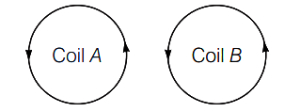
0 likesView Solution
34
PhysicsDifficultMCQKCET · 2013
$A$ small oil drop of mass $10^{-6} \,kg$ is hanging at rest between two plates separated by $1 \,mm$ having a potential difference of $500 \,V$. The charge on the drop is $(g = 10 \,ms^{-2})$
A
$2 \times 10^{-9} \,C$
B
$2 \times 10^{-11} \,C$
C
$2 \times 10^{-6} \,C$
D
$2 \times 10^{-8} \,C$
Solution
(B) Given that the oil drop is at rest,the gravitational force acting downwards must be balanced by the electric force acting upwards.
$qE = mg$
Since the electric field $E$ between two plates is given by $E = \frac{V}{d}$,where $V$ is the potential difference and $d$ is the distance between the plates:
$q \left(\frac{V}{d}\right) = mg$
Rearranging to solve for the charge $q$:
$q = \frac{mgd}{V}$
Given values:
$m = 10^{-6} \,kg$
$g = 10 \,ms^{-2}$
$d = 1 \,mm = 10^{-3} \,m$
$V = 500 \,V$
Substituting these values into the equation:
$q = \frac{10^{-6} \times 10 \times 10^{-3}}{500}$
$q = \frac{10^{-8}}{500} = \frac{10^{-8}}{5 \times 10^2} = 0.2 \times 10^{-10} \,C = 2 \times 10^{-11} \,C$
$qE = mg$
Since the electric field $E$ between two plates is given by $E = \frac{V}{d}$,where $V$ is the potential difference and $d$ is the distance between the plates:
$q \left(\frac{V}{d}\right) = mg$
Rearranging to solve for the charge $q$:
$q = \frac{mgd}{V}$
Given values:
$m = 10^{-6} \,kg$
$g = 10 \,ms^{-2}$
$d = 1 \,mm = 10^{-3} \,m$
$V = 500 \,V$
Substituting these values into the equation:
$q = \frac{10^{-6} \times 10 \times 10^{-3}}{500}$
$q = \frac{10^{-8}}{500} = \frac{10^{-8}}{5 \times 10^2} = 0.2 \times 10^{-10} \,C = 2 \times 10^{-11} \,C$
0 likesView Solution
35
PhysicsEasyMCQKCET · 2013
$A$ uniform electric field exists in the plane of the paper as shown. Here $A, B, C$, and $D$ are points on the circle. $V_{A}, V_{B}, V_{C}$, and $V_{D}$ are the potentials at those points respectively. Then:
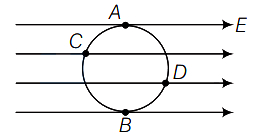
A
$V_{A}=V_{C}, V_{B}=V_{D}$
B
$V_{A}=V_{C}, V_{B} > V_{D}$
C
$V_{A} > V_{C}, V_{B} > V_{D}$
D
$V_{A}=V_{B}, V_{C} > V_{D}$
Solution
(D) In a uniform electric field, the electric potential $V$ decreases in the direction of the electric field lines. The potential at any point $(x, y)$ in a uniform electric field $\vec{E} = E\hat{i}$ is given by $V = -Ex + \text{constant}$.
Points on the same vertical line (perpendicular to the field lines) have the same potential because they have the same $x$-coordinate.
Looking at the diagram:
$1$. Points $A$ and $B$ are at the same vertical position relative to the field lines, but they are not on the same vertical line. However, the question asks for the relationship between potentials. Let's analyze the $x$-coordinates.
$2$. Point $C$ is at the leftmost position, so it has the smallest $x$-coordinate, meaning $V_{C}$ is the highest.
$3$. Point $D$ is at the rightmost position, so it has the largest $x$-coordinate, meaning $V_{D}$ is the lowest.
$4$. Points $A$ and $B$ have the same $x$-coordinate, so $V_{A} = V_{B}$.
$5$. Since $C$ is to the left of $D$, $V_{C} > V_{D}$.
Thus, the correct relationship is $V_{A} = V_{B}$ and $V_{C} > V_{D}$.
Points on the same vertical line (perpendicular to the field lines) have the same potential because they have the same $x$-coordinate.
Looking at the diagram:
$1$. Points $A$ and $B$ are at the same vertical position relative to the field lines, but they are not on the same vertical line. However, the question asks for the relationship between potentials. Let's analyze the $x$-coordinates.
$2$. Point $C$ is at the leftmost position, so it has the smallest $x$-coordinate, meaning $V_{C}$ is the highest.
$3$. Point $D$ is at the rightmost position, so it has the largest $x$-coordinate, meaning $V_{D}$ is the lowest.
$4$. Points $A$ and $B$ have the same $x$-coordinate, so $V_{A} = V_{B}$.
$5$. Since $C$ is to the left of $D$, $V_{C} > V_{D}$.
Thus, the correct relationship is $V_{A} = V_{B}$ and $V_{C} > V_{D}$.
0 likesView Solution
36
PhysicsMediumMCQKCET · 2013
Two metal spheres of radii $0.01 \ m$ and $0.02 \ m$ are given a charge of $15 \ mC$ and $45 \ mC$ respectively. They are then connected by a wire. The final charge on the first sphere is $\ldots \ldots \ldots \times 10^{-3} \ C$.
A
$40$
B
$30$
C
$20$
D
$10$
Solution
(C) When two metal spheres are joined by a wire,charge flows from the sphere at higher potential to the sphere at lower potential until they reach the same potential.
Let the final charges be $q_1'$ and $q_2'$. Since the potential $V$ is equal,$V_1 = V_2$.
$\frac{k q_1'}{r_1} = \frac{k q_2'}{r_2} \implies \frac{q_1'}{q_2'} = \frac{r_1}{r_2} = \frac{0.01}{0.02} = \frac{1}{2}$.
The total charge is conserved: $q_1' + q_2' = 15 \ mC + 45 \ mC = 60 \ mC$.
Using the ratio,$q_1' = \left( \frac{1}{1+2} \right) \times 60 \ mC = \frac{1}{3} \times 60 \ mC = 20 \ mC$.
Since $20 \ mC = 20 \times 10^{-3} \ C$,the final charge on the first sphere is $20 \times 10^{-3} \ C$.
Let the final charges be $q_1'$ and $q_2'$. Since the potential $V$ is equal,$V_1 = V_2$.
$\frac{k q_1'}{r_1} = \frac{k q_2'}{r_2} \implies \frac{q_1'}{q_2'} = \frac{r_1}{r_2} = \frac{0.01}{0.02} = \frac{1}{2}$.
The total charge is conserved: $q_1' + q_2' = 15 \ mC + 45 \ mC = 60 \ mC$.
Using the ratio,$q_1' = \left( \frac{1}{1+2} \right) \times 60 \ mC = \frac{1}{3} \times 60 \ mC = 20 \ mC$.
Since $20 \ mC = 20 \times 10^{-3} \ C$,the final charge on the first sphere is $20 \times 10^{-3} \ C$.
0 likesView Solution
37
PhysicsDifficultMCQKCET · 2013
The concentric spheres of radii $R$ and $r$ have positive charges $q_{1}$ and $q_{2}$ with equal surface charge densities. What is the electric potential at their common centre?
A
$\frac{\sigma}{\varepsilon_{0}}(R+r)$
B
$\frac{\sigma}{\varepsilon_{0}}(R-r)$
C
$\frac{\sigma}{\varepsilon_{0}}\left(\frac{1}{R}+\frac{1}{r}\right)$
D
$\frac{\sigma}{\varepsilon_{0}}\left(\frac{1}{R}\right)$
Solution
(A) The electric potential at the centre of a charged spherical shell of radius $R$ with charge $q$ is $V = \frac{q}{4 \pi \varepsilon_{0} R}$.
For the two concentric spheres,the total potential $V$ at the common centre is the sum of potentials due to each sphere:
$V = V_{1} + V_{2} = \frac{q_{1}}{4 \pi \varepsilon_{0} R} + \frac{q_{2}}{4 \pi \varepsilon_{0} r}$.
Given that the surface charge densities are equal,$\sigma = \frac{q_{1}}{4 \pi R^{2}} = \frac{q_{2}}{4 \pi r^{2}}$.
This implies $q_{1} = 4 \pi R^{2} \sigma$ and $q_{2} = 4 \pi r^{2} \sigma$.
Substituting these values into the potential equation:
$V = \frac{4 \pi R^{2} \sigma}{4 \pi \varepsilon_{0} R} + \frac{4 \pi r^{2} \sigma}{4 \pi \varepsilon_{0} r}$.
$V = \frac{R \sigma}{\varepsilon_{0}} + \frac{r \sigma}{\varepsilon_{0}} = \frac{\sigma}{\varepsilon_{0}}(R + r)$.
For the two concentric spheres,the total potential $V$ at the common centre is the sum of potentials due to each sphere:
$V = V_{1} + V_{2} = \frac{q_{1}}{4 \pi \varepsilon_{0} R} + \frac{q_{2}}{4 \pi \varepsilon_{0} r}$.
Given that the surface charge densities are equal,$\sigma = \frac{q_{1}}{4 \pi R^{2}} = \frac{q_{2}}{4 \pi r^{2}}$.
This implies $q_{1} = 4 \pi R^{2} \sigma$ and $q_{2} = 4 \pi r^{2} \sigma$.
Substituting these values into the potential equation:
$V = \frac{4 \pi R^{2} \sigma}{4 \pi \varepsilon_{0} R} + \frac{4 \pi r^{2} \sigma}{4 \pi \varepsilon_{0} r}$.
$V = \frac{R \sigma}{\varepsilon_{0}} + \frac{r \sigma}{\varepsilon_{0}} = \frac{\sigma}{\varepsilon_{0}}(R + r)$.
0 likesView Solution
38
PhysicsDifficultMCQKCET · 2013
In the diagram,$I_{1}$ and $I_{2}$ are the strengths of the currents in the loop and straight conductor,respectively. Given $OA = AB = R$. The net magnetic field at the centre $O$ is zero. Then the ratio of the currents in the loop and the straight conductor is:
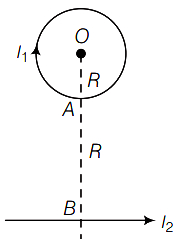
A
$\pi$
B
$2 \pi$
C
$\frac{1}{\pi}$
D
$\frac{1}{2 \pi}$
Solution
(D) The magnetic field at the centre $O$ due to a circular loop of radius $R$ carrying current $I_{1}$ is given by: $B_{1} = \frac{\mu_{0} I_{1}}{2 R}$.
The magnetic field at the centre $O$ due to a long straight conductor carrying current $I_{2}$ at a perpendicular distance $d = OA + AB = R + R = 2R$ is given by: $B_{2} = \frac{\mu_{0} I_{2}}{2 \pi d} = \frac{\mu_{0} I_{2}}{2 \pi (2R)} = \frac{\mu_{0} I_{2}}{4 \pi R}$.
Given that the net magnetic field at $O$ is zero,the magnitudes of the magnetic fields produced by the loop and the straight conductor must be equal: $B_{1} = B_{2}$.
Substituting the expressions: $\frac{\mu_{0} I_{1}}{2 R} = \frac{\mu_{0} I_{2}}{4 \pi R}$.
Simplifying the equation: $\frac{I_{1}}{2} = \frac{I_{2}}{4 \pi}$.
Therefore,the ratio of the currents is: $\frac{I_{1}}{I_{2}} = \frac{2}{4 \pi} = \frac{1}{2 \pi}$.
The magnetic field at the centre $O$ due to a long straight conductor carrying current $I_{2}$ at a perpendicular distance $d = OA + AB = R + R = 2R$ is given by: $B_{2} = \frac{\mu_{0} I_{2}}{2 \pi d} = \frac{\mu_{0} I_{2}}{2 \pi (2R)} = \frac{\mu_{0} I_{2}}{4 \pi R}$.
Given that the net magnetic field at $O$ is zero,the magnitudes of the magnetic fields produced by the loop and the straight conductor must be equal: $B_{1} = B_{2}$.
Substituting the expressions: $\frac{\mu_{0} I_{1}}{2 R} = \frac{\mu_{0} I_{2}}{4 \pi R}$.
Simplifying the equation: $\frac{I_{1}}{2} = \frac{I_{2}}{4 \pi}$.
Therefore,the ratio of the currents is: $\frac{I_{1}}{I_{2}} = \frac{2}{4 \pi} = \frac{1}{2 \pi}$.
0 likesView Solution
39
PhysicsEasyMCQKCET · 2013
$A$ proton and a helium nucleus are shot into a magnetic field at right angles to the field with the same kinetic energy. The ratio of their radii is:
A
$1: 1$
B
$1: 2$
C
$2: 1$
D
$1: 4$
Solution
(A) The radius $r$ of the circular path of a charged particle in a magnetic field $B$ is given by $r = \frac{mv}{qB} = \frac{\sqrt{2mE}}{qB}$.
Given that the kinetic energy $E$ and the magnetic field $B$ are the same for both particles,we have $r \propto \frac{\sqrt{m}}{q}$.
For a proton,mass $m_P = m$ and charge $q_P = q$.
For a helium nucleus (alpha particle),mass $m_{He} = 4m$ and charge $q_{He} = 2q$.
Therefore,the ratio of their radii is $\frac{r_P}{r_{He}} = \frac{\sqrt{m_P}/q_P}{\sqrt{m_{He}}/q_{He}} = \sqrt{\frac{m}{4m}} \times \frac{2q}{q} = \frac{1}{2} \times 2 = 1$.
Thus,the ratio is $1: 1$.
Given that the kinetic energy $E$ and the magnetic field $B$ are the same for both particles,we have $r \propto \frac{\sqrt{m}}{q}$.
For a proton,mass $m_P = m$ and charge $q_P = q$.
For a helium nucleus (alpha particle),mass $m_{He} = 4m$ and charge $q_{He} = 2q$.
Therefore,the ratio of their radii is $\frac{r_P}{r_{He}} = \frac{\sqrt{m_P}/q_P}{\sqrt{m_{He}}/q_{He}} = \sqrt{\frac{m}{4m}} \times \frac{2q}{q} = \frac{1}{2} \times 2 = 1$.
Thus,the ratio is $1: 1$.
0 likesView Solution
40
PhysicsMediumMCQKCET · 2013
$A$ charged particle with a velocity $2 \times 10^{3} \ ms^{-1}$ passes undeflected through electric and magnetic fields in mutually perpendicular directions. The magnetic field is $1.5 \ T$. The magnitude of the electric field will be:
A
$1.5 \times 10^{3} \ NC^{-1}$
B
$2 \times 10^{3} \ NC^{-1}$
C
$3 \times 10^{3} \ NC^{-1}$
D
$1.33 \times 10^{3} \ NC^{-1}$
Solution
(C) When a charged particle passes undeflected through mutually perpendicular electric and magnetic fields,the electric force $(F_e)$ must balance the magnetic force $(F_m)$.
$F_e = F_m$
$qE = qvB \sin \theta$
Since the fields are mutually perpendicular,$\theta = 90^{\circ}$,so $\sin 90^{\circ} = 1$.
Thus,$E = vB$.
Given:
Velocity $v = 2 \times 10^{3} \ ms^{-1}$
Magnetic field $B = 1.5 \ T$
$E = (2 \times 10^{3}) \times 1.5 = 3 \times 10^{3} \ V/m$ (or $NC^{-1}$).
Therefore,the magnitude of the electric field is $3 \times 10^{3} \ NC^{-1}$.
$F_e = F_m$
$qE = qvB \sin \theta$
Since the fields are mutually perpendicular,$\theta = 90^{\circ}$,so $\sin 90^{\circ} = 1$.
Thus,$E = vB$.
Given:
Velocity $v = 2 \times 10^{3} \ ms^{-1}$
Magnetic field $B = 1.5 \ T$
$E = (2 \times 10^{3}) \times 1.5 = 3 \times 10^{3} \ V/m$ (or $NC^{-1}$).
Therefore,the magnitude of the electric field is $3 \times 10^{3} \ NC^{-1}$.
0 likesView Solution
41
PhysicsEasyMCQKCET · 2013
The ionisation energy of an electron in the ground state of a helium atom is $24.6 eV$. The energy required to remove both electrons is: (in $eV$)
A
$51.8$
B
$79$
C
$38.2$
D
$49.2$
Solution
(B) The energy required to remove the first electron from a neutral helium atom $(He)$ is given as $24.6 eV$.
After the first electron is removed,the remaining ion is $He^+$,which is a hydrogen-like species with atomic number $Z = 2$.
The energy required to remove the second electron from the ground state of $He^+$ is given by the formula $E = Z^2 \times 13.6 eV$.
Substituting $Z = 2$,we get $E = (2)^2 \times 13.6 eV = 4 \times 13.6 eV = 54.4 eV$.
The total energy required to remove both electrons is the sum of the energy to remove the first and the second electron.
Total Energy $= 24.6 eV + 54.4 eV = 79 eV$.
After the first electron is removed,the remaining ion is $He^+$,which is a hydrogen-like species with atomic number $Z = 2$.
The energy required to remove the second electron from the ground state of $He^+$ is given by the formula $E = Z^2 \times 13.6 eV$.
Substituting $Z = 2$,we get $E = (2)^2 \times 13.6 eV = 4 \times 13.6 eV = 54.4 eV$.
The total energy required to remove both electrons is the sum of the energy to remove the first and the second electron.
Total Energy $= 24.6 eV + 54.4 eV = 79 eV$.
0 likesView Solution
42
PhysicsMediumMCQKCET · 2013
The binding energy per nucleon of deuteron $({ }_{1} H^{2})$ and the helium atom $({ }_{2} He^{4})$ are $1.1 \ MeV$ and $7 \ MeV$ respectively. If two deuteron nuclei fuse to form a single helium nucleus,then the energy released is: (in $MeV$)
A
$26.9$
B
$25.8$
C
$23.6$
D
$12.9$
Solution
(C) Given:
Binding energy per nucleon for ${ }_{1} H^{2} = 1.1 \ MeV$.
Binding energy per nucleon for ${ }_{2} He^{4} = 7 \ MeV$.
The nuclear fusion reaction is: ${ }_{1} H^{2} + { }_{1} H^{2} \longrightarrow { }_{2} He^{4} + Q$.
Total binding energy of reactants (two deuterons) = $2 \times (2 \times 1.1 \ MeV) = 4.4 \ MeV$.
Total binding energy of the product (one helium nucleus) = $4 \times 7 \ MeV = 28 \ MeV$.
The energy released $Q$ is the difference between the total binding energy of the product and the reactants:
$Q = BE_{\text{product}} - BE_{\text{reactants}}$
$Q = 28 \ MeV - 4.4 \ MeV = 23.6 \ MeV$.
Binding energy per nucleon for ${ }_{1} H^{2} = 1.1 \ MeV$.
Binding energy per nucleon for ${ }_{2} He^{4} = 7 \ MeV$.
The nuclear fusion reaction is: ${ }_{1} H^{2} + { }_{1} H^{2} \longrightarrow { }_{2} He^{4} + Q$.
Total binding energy of reactants (two deuterons) = $2 \times (2 \times 1.1 \ MeV) = 4.4 \ MeV$.
Total binding energy of the product (one helium nucleus) = $4 \times 7 \ MeV = 28 \ MeV$.
The energy released $Q$ is the difference between the total binding energy of the product and the reactants:
$Q = BE_{\text{product}} - BE_{\text{reactants}}$
$Q = 28 \ MeV - 4.4 \ MeV = 23.6 \ MeV$.
0 likesView Solution
43
PhysicsEasyMCQKCET · 2013
Pick out the correct statements from the following:
$I$. Electron emission during $\beta$-decay is always accompanied by neutrino.
$II$. Nuclear force is charge independent.
$III$. Fusion is the chief source of stellar energy.
$I$. Electron emission during $\beta$-decay is always accompanied by neutrino.
$II$. Nuclear force is charge independent.
$III$. Fusion is the chief source of stellar energy.
A
$I, II$ are correct
B
$I, III$ are correct
C
Only $I$ is correct
D
$I, II, III$ are correct
Solution
(D) Statement $I$: During $\beta^-$-decay,a neutron transforms into a proton,an electron,and an antineutrino. Thus,it is accompanied by an antineutrino (or neutrino in $\beta^+$-decay). This statement is correct.
Statement $II$: Nuclear forces act between nucleons (protons and neutrons) regardless of their charge. Thus,nuclear force is charge independent. This statement is correct.
Statement $III$: Nuclear fusion of hydrogen into helium is the primary source of energy in stars. This statement is correct.
Therefore,all three statements are correct.
Statement $II$: Nuclear forces act between nucleons (protons and neutrons) regardless of their charge. Thus,nuclear force is charge independent. This statement is correct.
Statement $III$: Nuclear fusion of hydrogen into helium is the primary source of energy in stars. This statement is correct.
Therefore,all three statements are correct.
0 likesView Solution
44
PhysicsMediumMCQKCET · 2013
$A$ nucleus ${ }_{Z} X^{A}$ emits an $\alpha$-particle with velocity $v$. The recoil speed of the daughter nucleus is
A
$\frac{A-4}{4 v}$
B
$\frac{4 v}{A-4}$
C
$v$
D
$\frac{v}{4}$
Solution
(B) Let the recoil speed of the daughter nucleus be $v^{\prime}$.
According to the law of conservation of linear momentum,the initial momentum of the nucleus is zero.
Therefore,the final momentum of the system must also be zero.
Let the mass of the $\alpha$-particle be $4$ units and the mass of the daughter nucleus be $(A-4)$ units.
$0 = (A-4) v^{\prime} + 4 v$
$(A-4) v^{\prime} = -4 v$
$v^{\prime} = -\frac{4 v}{A-4}$
The magnitude of the recoil speed is $\frac{4 v}{A-4}$.
According to the law of conservation of linear momentum,the initial momentum of the nucleus is zero.
Therefore,the final momentum of the system must also be zero.
Let the mass of the $\alpha$-particle be $4$ units and the mass of the daughter nucleus be $(A-4)$ units.
$0 = (A-4) v^{\prime} + 4 v$
$(A-4) v^{\prime} = -4 v$
$v^{\prime} = -\frac{4 v}{A-4}$
The magnitude of the recoil speed is $\frac{4 v}{A-4}$.
0 likesView Solution
45
PhysicsMediumMCQKCET · 2013
$A$ radioactive substance emits $100$ beta particles in the first $2 \,s$ and $50$ beta particles in the next $2 \,s$. The mean life of the sample is
A
$4 \,s$
B
$2 \,s$
C
$\frac{2}{0.693} \,s$
D
$2 \times 0.693 \,s$
Solution
(C) The number of radioactive nuclei decaying in a given time interval is proportional to the number of nuclei present.
Let $N_0$ be the initial number of nuclei.
In the first $2 \,s$, $100$ particles are emitted, so the remaining nuclei are $N_0 - 100$.
In the next $2 \,s$, $50$ particles are emitted.
Since the number of decays is halved in equal time intervals, the half-life $T_{1/2}$ is $2 \,s$.
The mean life $T_m$ is related to the half-life by the formula $T_m = \frac{T_{1/2}}{\ln(2)} = \frac{T_{1/2}}{0.693}$.
Substituting $T_{1/2} = 2 \,s$, we get $T_m = \frac{2}{0.693} \,s$.
Let $N_0$ be the initial number of nuclei.
In the first $2 \,s$, $100$ particles are emitted, so the remaining nuclei are $N_0 - 100$.
In the next $2 \,s$, $50$ particles are emitted.
Since the number of decays is halved in equal time intervals, the half-life $T_{1/2}$ is $2 \,s$.
The mean life $T_m$ is related to the half-life by the formula $T_m = \frac{T_{1/2}}{\ln(2)} = \frac{T_{1/2}}{0.693}$.
Substituting $T_{1/2} = 2 \,s$, we get $T_m = \frac{2}{0.693} \,s$.
0 likesView Solution
46
PhysicsMediumMCQKCET · 2013
Which one of the following is not correct?
A
In forward biased condition,a diode conducts.
B
If the packing fraction is negative,the element is stable.
C
Binding energy is the energy equivalent to mass defect.
D
Radioactive elements can undergo spontaneous fission.
Solution
(D) Let us analyze each statement:
$(i)$ In forward biased condition,the depletion layer width decreases,allowing current to flow; thus,a diode conducts. This is correct.
(ii) The packing fraction is defined as $f = (M - A) / A$. $A$ smaller or negative packing fraction indicates higher stability of the nucleus. This is correct.
(iii) Binding energy is the energy required to disassemble a nucleus into its constituent protons and neutrons,which is equivalent to the mass defect $\Delta m$ via Einstein's equation $E = \Delta m c^2$. This is correct.
(iv) Spontaneous fission is a rare radioactive decay process that occurs only in very heavy nuclei (e.g.,$U-238$,$Cf-252$). It is not a general property of all radioactive elements. Therefore,the statement that radioactive elements (implying all) can undergo spontaneous fission is incorrect.
$(i)$ In forward biased condition,the depletion layer width decreases,allowing current to flow; thus,a diode conducts. This is correct.
(ii) The packing fraction is defined as $f = (M - A) / A$. $A$ smaller or negative packing fraction indicates higher stability of the nucleus. This is correct.
(iii) Binding energy is the energy required to disassemble a nucleus into its constituent protons and neutrons,which is equivalent to the mass defect $\Delta m$ via Einstein's equation $E = \Delta m c^2$. This is correct.
(iv) Spontaneous fission is a rare radioactive decay process that occurs only in very heavy nuclei (e.g.,$U-238$,$Cf-252$). It is not a general property of all radioactive elements. Therefore,the statement that radioactive elements (implying all) can undergo spontaneous fission is incorrect.
0 likesView Solution
47
PhysicsMediumMCQKCET · 2013
$A$ and $B$ are two radioactive elements. The mixture of these elements shows a total activity of $1200 \text{ disintegrations/minute}$. The half-life of $A$ is $1 \text{ day}$ and that of $B$ is $2 \text{ days}$. What will be the total activity after $4 \text{ days}$? Given,the initial number of atoms in $A$ and $B$ are equal.
A
$200 \text{ dis/min}$
B
$250 \text{ dis/min}$
C
$500 \text{ dis/min}$
D
$150 \text{ dis/min}$
Solution
(D) The activity $A$ is given by $A = \lambda N = \frac{0.693}{T_{1/2}} N$.
Since the initial number of atoms $N_0$ for $A$ and $B$ are equal,the initial activity $A_0$ is inversely proportional to the half-life $T_{1/2}$.
Therefore,$\frac{A_0(A)}{A_0(B)} = \frac{T_{1/2}(B)}{T_{1/2}(A)} = \frac{2 \text{ days}}{1 \text{ day}} = 2$.
Given $A_0(A) + A_0(B) = 1200 \text{ dis/min}$.
Substituting $A_0(A) = 2 A_0(B)$,we get $2 A_0(B) + A_0(B) = 1200$,which implies $3 A_0(B) = 1200$,so $A_0(B) = 400 \text{ dis/min}$ and $A_0(A) = 800 \text{ dis/min}$.
After $t = 4 \text{ days}$,the activity of $A$ is $A(A) = \frac{A_0(A)}{2^{t/T_{1/2}(A)}} = \frac{800}{2^{4/1}} = \frac{800}{16} = 50 \text{ dis/min}$.
The activity of $B$ is $A(B) = \frac{A_0(B)}{2^{t/T_{1/2}(B)}} = \frac{400}{2^{4/2}} = \frac{400}{4} = 100 \text{ dis/min}$.
The total activity after $4 \text{ days}$ is $50 + 100 = 150 \text{ dis/min}$.
Since the initial number of atoms $N_0$ for $A$ and $B$ are equal,the initial activity $A_0$ is inversely proportional to the half-life $T_{1/2}$.
Therefore,$\frac{A_0(A)}{A_0(B)} = \frac{T_{1/2}(B)}{T_{1/2}(A)} = \frac{2 \text{ days}}{1 \text{ day}} = 2$.
Given $A_0(A) + A_0(B) = 1200 \text{ dis/min}$.
Substituting $A_0(A) = 2 A_0(B)$,we get $2 A_0(B) + A_0(B) = 1200$,which implies $3 A_0(B) = 1200$,so $A_0(B) = 400 \text{ dis/min}$ and $A_0(A) = 800 \text{ dis/min}$.
After $t = 4 \text{ days}$,the activity of $A$ is $A(A) = \frac{A_0(A)}{2^{t/T_{1/2}(A)}} = \frac{800}{2^{4/1}} = \frac{800}{16} = 50 \text{ dis/min}$.
The activity of $B$ is $A(B) = \frac{A_0(B)}{2^{t/T_{1/2}(B)}} = \frac{400}{2^{4/2}} = \frac{400}{4} = 100 \text{ dis/min}$.
The total activity after $4 \text{ days}$ is $50 + 100 = 150 \text{ dis/min}$.
0 likesView Solution
48
PhysicsMediumMCQKCET · 2013
The speed of light in media $M_{1}$ and $M_{2}$ are $1.5 \times 10^{8} \text{ m/s}$ and $2 \times 10^{8} \text{ m/s}$ respectively. $A$ ray travels from medium $M_{1}$ to the medium $M_{2}$ with an angle of incidence $\theta$. The ray suffers total internal reflection. Then the value of the angle of incidence $\theta$ is
A
$ > \sin^{-1}\left(\frac{3}{4}\right)$
B
$ < \sin^{-1}\left(\frac{3}{4}\right)$
C
$ = \sin^{-1}\left(\frac{3}{4}\right)$
D
$ \leq \sin^{-1}\left(\frac{3}{4}\right)$
Solution
(A) For total internal reflection to occur, the light must travel from a denser medium to a rarer medium, and the angle of incidence $\theta$ must be greater than the critical angle $C$.
Given speeds of light in media $M_{1}$ and $M_{2}$ are $v_{1} = 1.5 \times 10^{8} \text{ m/s}$ and $v_{2} = 2 \times 10^{8} \text{ m/s}$.
Since $v_{1} < v_{2}$, medium $M_{1}$ is denser than $M_{2}$.
The critical angle $C$ is given by $\sin C = \frac{v_{1}}{v_{2}}$.
Substituting the values: $\sin C = \frac{1.5 \times 10^{8}}{2 \times 10^{8}} = \frac{1.5}{2} = \frac{3}{4}$.
Therefore, $C = \sin^{-1}\left(\frac{3}{4}\right)$.
For total internal reflection, the angle of incidence $\theta$ must satisfy $\theta > C$.
Hence, $\theta > \sin^{-1}\left(\frac{3}{4}\right)$.
Given speeds of light in media $M_{1}$ and $M_{2}$ are $v_{1} = 1.5 \times 10^{8} \text{ m/s}$ and $v_{2} = 2 \times 10^{8} \text{ m/s}$.
Since $v_{1} < v_{2}$, medium $M_{1}$ is denser than $M_{2}$.
The critical angle $C$ is given by $\sin C = \frac{v_{1}}{v_{2}}$.
Substituting the values: $\sin C = \frac{1.5 \times 10^{8}}{2 \times 10^{8}} = \frac{1.5}{2} = \frac{3}{4}$.
Therefore, $C = \sin^{-1}\left(\frac{3}{4}\right)$.
For total internal reflection, the angle of incidence $\theta$ must satisfy $\theta > C$.
Hence, $\theta > \sin^{-1}\left(\frac{3}{4}\right)$.
0 likesView Solution
49
PhysicsEasyMCQKCET · 2013
Radii of curvature of a converging lens are in the ratio $1 : 2$. Its focal length is $6 \,cm$ and refractive index is $1.5$. Then its radii of curvature are ......... respectively.
A
$9 \,cm$ and $18 \,cm$
B
$6 \,cm$ and $12 \,cm$
C
$3 \,cm$ and $6 \,cm$
D
$4.5 \,cm$ and $9 \,cm$
Solution
(D) Given: Ratio of radii of curvature $\frac{R_{1}}{R_{2}} = \frac{1}{2}$, focal length $f = 6 \,cm$, and refractive index $\mu = 1.5$.
Let $R_{1} = R$ and $R_{2} = 2R$.
For a converging lens, the lens maker's formula is given by $\frac{1}{f} = (\mu - 1) \left( \frac{1}{R_{1}} + \frac{1}{R_{2}} \right)$.
Substituting the values: $\frac{1}{6} = (1.5 - 1) \left( \frac{1}{R} + \frac{1}{2R} \right)$.
$\frac{1}{6} = 0.5 \left( \frac{2 + 1}{2R} \right) = 0.5 \left( \frac{3}{2R} \right) = \frac{1.5}{2R} = \frac{3}{4R}$.
Solving for $R$: $4R = 18$, so $R = 4.5 \,cm$.
Therefore, $R_{1} = 4.5 \,cm$ and $R_{2} = 2 \times 4.5 = 9 \,cm$.
Let $R_{1} = R$ and $R_{2} = 2R$.
For a converging lens, the lens maker's formula is given by $\frac{1}{f} = (\mu - 1) \left( \frac{1}{R_{1}} + \frac{1}{R_{2}} \right)$.
Substituting the values: $\frac{1}{6} = (1.5 - 1) \left( \frac{1}{R} + \frac{1}{2R} \right)$.
$\frac{1}{6} = 0.5 \left( \frac{2 + 1}{2R} \right) = 0.5 \left( \frac{3}{2R} \right) = \frac{1.5}{2R} = \frac{3}{4R}$.
Solving for $R$: $4R = 18$, so $R = 4.5 \,cm$.
Therefore, $R_{1} = 4.5 \,cm$ and $R_{2} = 2 \times 4.5 = 9 \,cm$.
0 likesView Solution
50
PhysicsDifficultMCQKCET · 2013
The distance between an object and its image produced by a converging lens is $0.72 \ m$. The magnification is $2$. What will be the magnification when the object is moved by $0.04 \ m$ towards the lens?
A
$2$
B
$4$
C
$3$
D
$6$
Solution
(B) Given,magnification $m = 2$ and the image is real. For a real image,the distance between the object and the image is $D = |u| + |v| = 0.72 \ m$.
Since $m = \frac{|v|}{|u|} = 2$,we have $|v| = 2|u|$.
Substituting this into the distance equation: $|u| + 2|u| = 0.72 \ m \Rightarrow 3|u| = 0.72 \ m \Rightarrow |u| = 0.24 \ m$ and $|v| = 0.48 \ m$.
Using the lens formula $\frac{1}{f} = \frac{1}{v} - \frac{1}{u}$,where $v = 0.48 \ m$ and $u = -0.24 \ m$:
$\frac{1}{f} = \frac{1}{0.48} - \frac{1}{-0.24} = \frac{1 + 2}{0.48} = \frac{3}{0.48} \Rightarrow f = 0.16 \ m$.
When the object is moved $0.04 \ m$ towards the lens,the new object distance is $u' = -(0.24 - 0.04) = -0.20 \ m$.
Using the lens formula again: $\frac{1}{v'} - \frac{1}{-0.20} = \frac{1}{0.16} \Rightarrow \frac{1}{v'} = \frac{1}{0.16} - \frac{1}{0.20} = \frac{5 - 4}{0.80} = \frac{1}{0.80} \Rightarrow v' = 0.80 \ m$.
The new magnification is $m' = \frac{v'}{u'} = \frac{0.80}{-(-0.20)} = 4$.
Since $m = \frac{|v|}{|u|} = 2$,we have $|v| = 2|u|$.
Substituting this into the distance equation: $|u| + 2|u| = 0.72 \ m \Rightarrow 3|u| = 0.72 \ m \Rightarrow |u| = 0.24 \ m$ and $|v| = 0.48 \ m$.
Using the lens formula $\frac{1}{f} = \frac{1}{v} - \frac{1}{u}$,where $v = 0.48 \ m$ and $u = -0.24 \ m$:
$\frac{1}{f} = \frac{1}{0.48} - \frac{1}{-0.24} = \frac{1 + 2}{0.48} = \frac{3}{0.48} \Rightarrow f = 0.16 \ m$.
When the object is moved $0.04 \ m$ towards the lens,the new object distance is $u' = -(0.24 - 0.04) = -0.20 \ m$.
Using the lens formula again: $\frac{1}{v'} - \frac{1}{-0.20} = \frac{1}{0.16} \Rightarrow \frac{1}{v'} = \frac{1}{0.16} - \frac{1}{0.20} = \frac{5 - 4}{0.80} = \frac{1}{0.80} \Rightarrow v' = 0.80 \ m$.
The new magnification is $m' = \frac{v'}{u'} = \frac{0.80}{-(-0.20)} = 4$.
0 likesView Solution
51
PhysicsEasyMCQKCET · 2013
The refraction through the prisms is as shown. Pick out the wrong statement from the following. Path of the light ray in
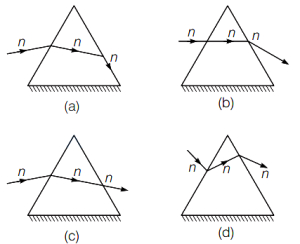
A
$a$ is correct if $n_{2} > n_{1}$ and $n_{2} > n_{3}$
B
$b$ is correct if $n_{1} = n_{2}$ and $n_{2} > n_{3}$
C
$c$ is correct if $n_{2} < n_{1}$ and $n_{2} = n_{3}$
D
$d$ is correct if $n_{1} > n_{2}$ and $n_{2} < n_{3}$
Solution
(C) Let $n_1$ be the refractive index of the medium outside the first surface, $n_2$ be the refractive index of the prism, and $n_3$ be the refractive index of the medium outside the second surface.
For a ray to bend towards the normal, it must travel from a rarer to a denser medium $(n_{incident} < n_{refracted})$.
For a ray to bend away from the normal, it must travel from a denser to a rarer medium $(n_{incident} > n_{refracted})$.
In case $(a)$, the ray bends towards the normal at the first surface $(n_1 < n_2)$ and grazes the second surface, implying total internal reflection or critical angle condition $(n_2 > n_3)$. Thus, $n_2 > n_1$ and $n_2 > n_3$ is correct.
In case $(b)$, the ray enters undeviated at the first surface $(n_1 = n_2)$ and bends away from the normal at the second surface $(n_2 > n_3)$. This is correct.
In case $(c)$, the ray bends towards the normal at the first surface $(n_1 < n_2)$ and bends away from the normal at the second surface $(n_2 > n_3)$. The statement says $n_2 < n_1$ and $n_2 = n_3$, which contradicts the observed bending. Thus, $(c)$ is the wrong statement.
For a ray to bend towards the normal, it must travel from a rarer to a denser medium $(n_{incident} < n_{refracted})$.
For a ray to bend away from the normal, it must travel from a denser to a rarer medium $(n_{incident} > n_{refracted})$.
In case $(a)$, the ray bends towards the normal at the first surface $(n_1 < n_2)$ and grazes the second surface, implying total internal reflection or critical angle condition $(n_2 > n_3)$. Thus, $n_2 > n_1$ and $n_2 > n_3$ is correct.
In case $(b)$, the ray enters undeviated at the first surface $(n_1 = n_2)$ and bends away from the normal at the second surface $(n_2 > n_3)$. This is correct.
In case $(c)$, the ray bends towards the normal at the first surface $(n_1 < n_2)$ and bends away from the normal at the second surface $(n_2 > n_3)$. The statement says $n_2 < n_1$ and $n_2 = n_3$, which contradicts the observed bending. Thus, $(c)$ is the wrong statement.
0 likesView Solution
52
PhysicsMediumMCQKCET · 2013
Pick out the wrong statement from the following:
A
Lateral shift increases as the angle of incidence increases.
B
Lateral shift increases as the value of refractive index increases.
C
Normal shift decreases as the value of refractive index increases.
D
Both normal shift and lateral shift are directly proportional to the thickness of the medium.
Solution
(C) The lateral shift is given by $L_{s} = t \frac{\sin(i-r)}{\cos r}$. As the angle of incidence $i$ increases,the lateral shift $L_{s}$ increases. Thus,statement $A$ is correct.
As the refractive index $\mu$ increases,the angle of refraction $r$ decreases,which leads to an increase in the lateral shift $L_{s}$. Thus,statement $B$ is correct.
The normal shift is given by $L_{N} = t(1 - \frac{1}{\mu})$. As the refractive index $\mu$ increases,the term $\frac{1}{\mu}$ decreases,which means $(1 - \frac{1}{\mu})$ increases. Therefore,the normal shift $L_{N}$ increases as the refractive index increases. Thus,statement $C$ is incorrect.
Both $L_{s}$ and $L_{N}$ are directly proportional to the thickness $t$ of the medium. Thus,statement $D$ is correct.
Therefore,the wrong statement is $C$.
As the refractive index $\mu$ increases,the angle of refraction $r$ decreases,which leads to an increase in the lateral shift $L_{s}$. Thus,statement $B$ is correct.
The normal shift is given by $L_{N} = t(1 - \frac{1}{\mu})$. As the refractive index $\mu$ increases,the term $\frac{1}{\mu}$ decreases,which means $(1 - \frac{1}{\mu})$ increases. Therefore,the normal shift $L_{N}$ increases as the refractive index increases. Thus,statement $C$ is incorrect.
Both $L_{s}$ and $L_{N}$ are directly proportional to the thickness $t$ of the medium. Thus,statement $D$ is correct.
Therefore,the wrong statement is $C$.
0 likesView Solution
53
PhysicsEasyMCQKCET · 2013
The width of the depletion region in a $p-n$ junction diode is
A
increased by reverse bias
B
increased by forward bias
C
decreased by reverse bias
D
independent of the bias voltage
Solution
(A) In a $p-n$ junction diode,when a reverse bias is applied,the external electric field is in the same direction as the internal electric field of the depletion region. This causes the majority charge carriers to move away from the junction,thereby increasing the width of the depletion region. Conversely,in forward bias,the external field opposes the internal field,which reduces the width of the depletion region.
0 likesView Solution
54
PhysicsEasyMCQKCET · 2013
When the transistor is used as an amplifier,
A
Emitter-base junction must be reverse biased,Collector-base junction must be forward biased
B
Emitter-base junction must be forward biased,Collector-base junction must be forward biased
C
Emitter-base junction must be reverse biased,Collector-base junction must be reverse biased
D
Emitter-base junction must be forward biased,Collector-base junction must be reverse biased
Solution
(D) To use a transistor as an amplifier,the input circuit (emitter-base junction) must be forward biased to allow current flow,and the output circuit (collector-base junction) must be reverse biased to provide high resistance and voltage gain.
Therefore,the emitter-base junction is forward biased,and the collector-base junction is reverse biased.
Therefore,the emitter-base junction is forward biased,and the collector-base junction is reverse biased.
0 likesView Solution
55
PhysicsEasyMCQKCET · 2013
The output of an $OR$ gate is connected to both the inputs of a $NAND$ gate. The combination will serve as
A
$AND$ gate
B
$NOT$ gate
C
$NAND$ gate
D
$NOR$ gate
Solution
(D) Let the inputs of the $OR$ gate be $A$ and $B$. The output of the $OR$ gate is $Y = A + B$.
This output $Y$ is connected to both inputs of a $NAND$ gate. Let the inputs of the $NAND$ gate be $X_1$ and $X_2$,where $X_1 = X_2 = Y = A + B$.
The output of a $NAND$ gate with inputs $X_1$ and $X_2$ is given by $\overline{X_1 \cdot X_2}$.
Substituting $X_1 = X_2 = A + B$,the final output $Y^{\prime}$ is $\overline{(A + B) \cdot (A + B)}$.
Using the Boolean identity $X \cdot X = X$,we get $Y^{\prime} = \overline{A + B}$.
The expression $\overline{A + B}$ represents the Boolean operation of a $NOR$ gate.
Therefore,the combination acts as a $NOR$ gate.
This output $Y$ is connected to both inputs of a $NAND$ gate. Let the inputs of the $NAND$ gate be $X_1$ and $X_2$,where $X_1 = X_2 = Y = A + B$.
The output of a $NAND$ gate with inputs $X_1$ and $X_2$ is given by $\overline{X_1 \cdot X_2}$.
Substituting $X_1 = X_2 = A + B$,the final output $Y^{\prime}$ is $\overline{(A + B) \cdot (A + B)}$.
Using the Boolean identity $X \cdot X = X$,we get $Y^{\prime} = \overline{A + B}$.
The expression $\overline{A + B}$ represents the Boolean operation of a $NOR$ gate.
Therefore,the combination acts as a $NOR$ gate.

0 likesView Solution
56
PhysicsEasyMCQKCET · 2013
In which of the following statements is the obtained impure semiconductor of $p$-type?
A
Germanium is doped with bismuth
B
Silicon is doped with antimony
C
Germanium is doped with gallium
D
Silicon is doped with phosphorus
Solution
(C) $p$-type semiconductor is formed by doping an intrinsic semiconductor with a trivalent impurity atom (Group $13$ element).
Gallium $(Ga)$ is a trivalent element.
Therefore,when Germanium $(Ge)$ is doped with Gallium,it creates a $p$-type semiconductor.
Bismuth $(Bi)$,Antimony $(Sb)$,and Phosphorus $(P)$ are pentavalent elements (Group $15$),which produce $n$-type semiconductors.
Gallium $(Ga)$ is a trivalent element.
Therefore,when Germanium $(Ge)$ is doped with Gallium,it creates a $p$-type semiconductor.
Bismuth $(Bi)$,Antimony $(Sb)$,and Phosphorus $(P)$ are pentavalent elements (Group $15$),which produce $n$-type semiconductors.
0 likesView Solution
57
PhysicsMediumMCQKCET · 2013
$A$ cylindrical tube of length $0.2 \,m$ and radius $R$ with sugar solution of concentration $C$ produces a rotation of $\theta$ in the plane of vibration of a plane-polarized light. The same sugar solution is transferred to another tube of length $0.3 \,m$ of the same radius. The remaining gap is filled by distilled water. Now, the optical rotation produced is:
A
$\theta$
B
$2 \frac{\theta}{3}$
C
$3 \frac{\theta}{2}$
D
$9 \frac{\theta}{4}$
Solution
(A) The optical rotation $\theta$ produced by a sugar solution is given by the formula: $\theta = S \cdot l \cdot C$, where $S$ is the specific rotation, $l$ is the length of the tube, and $C$ is the concentration of the solution.
In the first case, $\theta = S \cdot l \cdot C$, where $l = 0.2 \,m$ and $C = \frac{m}{V}$, where $m$ is the mass of sugar and $V$ is the volume of the tube $(V = \pi R^2 l)$.
Thus, $\theta = S \cdot l \cdot \frac{m}{\pi R^2 l} = \frac{S \cdot m}{\pi R^2}$.
In the second case, the same amount of sugar $m$ is placed in a tube of length $l_1 = 0.3 \,m$ with the same radius $R$. The volume of the new tube is $V_1 = \pi R^2 l_1 = \pi R^2 (0.3)$.
The concentration of the solution in the second case is $C_1 = \frac{m}{V_1} = \frac{m}{\pi R^2 (0.3)}$.
The new rotation $\theta_1$ is given by $\theta_1 = S \cdot l_1 \cdot C_1 = S \cdot (0.3) \cdot \frac{m}{\pi R^2 (0.3)} = \frac{S \cdot m}{\pi R^2}$.
Comparing the two expressions, we find $\theta_1 = \theta$.
In the first case, $\theta = S \cdot l \cdot C$, where $l = 0.2 \,m$ and $C = \frac{m}{V}$, where $m$ is the mass of sugar and $V$ is the volume of the tube $(V = \pi R^2 l)$.
Thus, $\theta = S \cdot l \cdot \frac{m}{\pi R^2 l} = \frac{S \cdot m}{\pi R^2}$.
In the second case, the same amount of sugar $m$ is placed in a tube of length $l_1 = 0.3 \,m$ with the same radius $R$. The volume of the new tube is $V_1 = \pi R^2 l_1 = \pi R^2 (0.3)$.
The concentration of the solution in the second case is $C_1 = \frac{m}{V_1} = \frac{m}{\pi R^2 (0.3)}$.
The new rotation $\theta_1$ is given by $\theta_1 = S \cdot l_1 \cdot C_1 = S \cdot (0.3) \cdot \frac{m}{\pi R^2 (0.3)} = \frac{S \cdot m}{\pi R^2}$.
Comparing the two expressions, we find $\theta_1 = \theta$.
0 likesView Solution
58
PhysicsEasyMCQKCET · 2013
Which of the following phenomena support the wave theory of light?
$(1)$ Scattering
$(2)$ Interference
$(3)$ Diffraction
$(4)$ Velocity of light in a denser medium is less than the velocity of light in a rarer medium
$(1)$ Scattering
$(2)$ Interference
$(3)$ Diffraction
$(4)$ Velocity of light in a denser medium is less than the velocity of light in a rarer medium
A
$1, 2$ and $3$
B
$1, 2$ and $4$
C
$2, 3$ and $4$
D
$1, 3$ and $4$
Solution
(C) The wave theory of light,proposed by Huygens,successfully explains the phenomena of interference,diffraction,and the fact that the velocity of light in a denser medium is less than in a rarer medium.
However,the wave theory does not explain the scattering of light,which is better described by the particle nature of light or quantum theory.
Therefore,phenomena $(2)$,$(3)$,and $(4)$ support the wave theory of light.
However,the wave theory does not explain the scattering of light,which is better described by the particle nature of light or quantum theory.
Therefore,phenomena $(2)$,$(3)$,and $(4)$ support the wave theory of light.
0 likesView Solution
59
PhysicsMediumMCQKCET · 2013
White light reflected from a soap film (Refractive Index $\mu = 1.5$) has a maxima at $600 \ nm$ and a minima at $450 \ nm$ with no minimum in between. Then the thickness of the film in units of $10^{-7} \ m$ is:
A
$1$
B
$2$
C
$3$
D
$4$
Solution
(C) For a thin film,the condition for constructive interference (maxima) in reflected light is $2 \mu t \cos r = (n + 1/2) \lambda_1$,where $n$ is an integer.
For destructive interference (minima),the condition is $2 \mu t \cos r = m \lambda_2$,where $m$ is an integer.
Given $\lambda_1 = 600 \ nm$ and $\lambda_2 = 450 \ nm$. Assuming normal incidence $(\cos r = 1)$:
$2 \mu t = (n + 1/2) \lambda_1 = (2n + 1) \frac{\lambda_1}{2} = (2n + 1) \times 300 \ nm$
$2 \mu t = m \lambda_2 = m \times 450 \ nm$
Equating the two: $(2n + 1) \times 300 = m \times 450 \implies (2n + 1) \times 2 = 3m \implies 4n + 2 = 3m$.
For the smallest thickness with no minimum in between,we test $n=1$: $4(1) + 2 = 6 = 3m \implies m = 2$.
Substituting $n=1$ into the maxima condition:
$2 \times 1.5 \times t = (1 + 0.5) \times 600 \ nm$
$3t = 1.5 \times 600 \ nm = 900 \ nm$
$t = 300 \ nm = 3 \times 10^{-7} \ m$.
Thus,the thickness is $3$ units.
For destructive interference (minima),the condition is $2 \mu t \cos r = m \lambda_2$,where $m$ is an integer.
Given $\lambda_1 = 600 \ nm$ and $\lambda_2 = 450 \ nm$. Assuming normal incidence $(\cos r = 1)$:
$2 \mu t = (n + 1/2) \lambda_1 = (2n + 1) \frac{\lambda_1}{2} = (2n + 1) \times 300 \ nm$
$2 \mu t = m \lambda_2 = m \times 450 \ nm$
Equating the two: $(2n + 1) \times 300 = m \times 450 \implies (2n + 1) \times 2 = 3m \implies 4n + 2 = 3m$.
For the smallest thickness with no minimum in between,we test $n=1$: $4(1) + 2 = 6 = 3m \implies m = 2$.
Substituting $n=1$ into the maxima condition:
$2 \times 1.5 \times t = (1 + 0.5) \times 600 \ nm$
$3t = 1.5 \times 600 \ nm = 900 \ nm$
$t = 300 \ nm = 3 \times 10^{-7} \ m$.
Thus,the thickness is $3$ units.
0 likesView Solution
60
PhysicsEasyMCQKCET · 2013
$\lambda_{1}$ and $\lambda_{2}$ are used to illuminate the slits. $\beta_{1}$ and $\beta_{2}$ are the corresponding fringe widths. The wavelength $\lambda_{1}$ can produce photoelectric effect when incident on a metal. But the wavelength $\lambda_{2}$ cannot produce photoelectric effect. The correct relation between $\beta_{1}$ and $\beta_{2}$ is
A
$\beta_{1} < \beta_{2}$
B
$\beta_{1} = \beta_{2}$
C
$\beta_{1} > \beta_{2}$
D
$\beta_{1} \geq \beta_{2}$
Solution
(A) The fringe width $\beta$ in a Young's double-slit experiment is given by the formula $\beta = \frac{\lambda D}{d}$,where $\lambda$ is the wavelength,$D$ is the distance to the screen,and $d$ is the slit separation.
This implies that $\beta \propto \lambda$.
According to the photoelectric effect,the energy of a photon is $E = \frac{hc}{\lambda}$. For the photoelectric effect to occur,the energy of the incident photon must be greater than or equal to the work function of the metal $(\Phi)$,i.e.,$\frac{hc}{\lambda} \geq \Phi$.
This means that a smaller wavelength corresponds to higher energy.
Since $\lambda_{1}$ can produce the photoelectric effect and $\lambda_{2}$ cannot,it implies that $\lambda_{1}$ has higher energy than $\lambda_{2}$,which means $\lambda_{1} < \lambda_{2}$.
Since $\beta \propto \lambda$,it follows that $\beta_{1} < \beta_{2}$.
This implies that $\beta \propto \lambda$.
According to the photoelectric effect,the energy of a photon is $E = \frac{hc}{\lambda}$. For the photoelectric effect to occur,the energy of the incident photon must be greater than or equal to the work function of the metal $(\Phi)$,i.e.,$\frac{hc}{\lambda} \geq \Phi$.
This means that a smaller wavelength corresponds to higher energy.
Since $\lambda_{1}$ can produce the photoelectric effect and $\lambda_{2}$ cannot,it implies that $\lambda_{1}$ has higher energy than $\lambda_{2}$,which means $\lambda_{1} < \lambda_{2}$.
Since $\beta \propto \lambda$,it follows that $\beta_{1} < \beta_{2}$.
0 likesView Solution
Vedclass Products
For Students
Vedclass Test Series
Mock tests in real KCET style covering Physics with performance analysis. 5-day free trial.
Start Free TrialFor Teachers
Exam Paper Generator
Generate Set A/B/C/D Physics papers from 7.5L+ questions in 2 minutes. 3 chapters free.
Try FreeFor Institutes
Online Exam Module
Run live KCET mock exams with unlimited students, 360° analytics & white-label branding.
See DemoFrequently Asked Questions
How many Physics questions are in KCET 2013?
There are 60 Physics questions from the KCET 2013 paper on Vedclass, each with a detailed step-by-step solution in English.
Are KCET 2013 Physics solutions available in English?
Yes. All solutions on this page are in English. You can also switch to English or Hindi using the language buttons above the questions.
Can I practice KCET 2013 Physics as a timed test?
Yes. Use the Vedclass Test Series to attempt a full KCET mock test covering Physics with time limits and instant score analysis.
Can teachers create Physics papers from KCET previous year questions?
Yes. The Vedclass Exam Paper Generator lets teachers mix KCET Physics questions and generate Set A/B/C/D papers in minutes.
For Teachers & Institutes
Build a Custom Physics Paper
Pick KCET 2013 Physics questions, set difficulty, and generate Set A/B/C/D in 2 minutes.