
ChemistryQ1–75 of 75 questions
Page 1 of 1 · English
1
ChemistryMCQKCET · 2009
The correct order of ionisation energy of $C, N, O, F$ is :-
A
$F < N < C < O$
B
$C < N < O < F$
C
$C < O < N < F$
D
$F < O < N < C$
Solution
(C) The general trend of ionization energy in a period increases from left to right due to an increase in effective nuclear charge.
The expected order is $C < N < O < F$.
However,$N$ $(1s^2 2s^2 2p^3)$ has a stable half-filled $2p$ sub-shell,which makes it harder to remove an electron compared to $O$ $(1s^2 2s^2 2p^4)$.
Therefore,the ionization energy of $N$ is higher than that of $O$.
The correct order is $C < O < N < F$.
The expected order is $C < N < O < F$.
However,$N$ $(1s^2 2s^2 2p^3)$ has a stable half-filled $2p$ sub-shell,which makes it harder to remove an electron compared to $O$ $(1s^2 2s^2 2p^4)$.
Therefore,the ionization energy of $N$ is higher than that of $O$.
The correct order is $C < O < N < F$.
0 likesView Solution
2
ChemistryMCQKCET · 2009
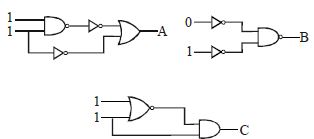
In the following combinations of logic gates,the outputs $A, B$ and $C$ are respectively
A
$0, 1, 1$
B
$0, 1, 0$
C
$1, 1, 0$
D
$1, 0, 1$
Solution
(C) For output $A$: The inputs to the $NAND$ gate are $1$ and $1$,so its output is $0$. This $0$ passes through a $NOT$ gate,becoming $1$. The other input to the $OR$ gate comes from a $1$ passing through a $NOT$ gate,becoming $0$. Thus,the $OR$ gate receives inputs $1$ and $0$,resulting in output $A = 1$.
For output $B$: The input $0$ passes through a $NOT$ gate to become $1$. The input $1$ passes through a $NOT$ gate to become $0$. These are inputs to a $NAND$ gate. Since $1$ and $0$ are inputs to $NAND$,the output is $1$. Thus,$B = 1$.
For output $C$: The inputs to the $NOR$ gate are $1$ and $1$,so its output is $0$. The $AND$ gate receives this $0$ and the original input $1$. Since $0$ and $1$ are inputs to $AND$,the output is $0$. Thus,$C = 0$.
Therefore,the outputs are $A = 1, B = 1, C = 0$.
For output $B$: The input $0$ passes through a $NOT$ gate to become $1$. The input $1$ passes through a $NOT$ gate to become $0$. These are inputs to a $NAND$ gate. Since $1$ and $0$ are inputs to $NAND$,the output is $1$. Thus,$B = 1$.
For output $C$: The inputs to the $NOR$ gate are $1$ and $1$,so its output is $0$. The $AND$ gate receives this $0$ and the original input $1$. Since $0$ and $1$ are inputs to $AND$,the output is $0$. Thus,$C = 0$.
Therefore,the outputs are $A = 1, B = 1, C = 0$.
0 likesView Solution
3
ChemistryMCQKCET · 2009
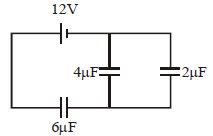
The charge deposited on the $4\,\mu F$ capacitor in the circuit is
A
$6\times10^{-6}\,C$
B
$12\times10^{-6}\,C$
C
$24\times10^{-6}\,C$
D
$36\times10^{-6}\,C$
Solution
(C) First,find the equivalent capacitance of the parallel combination of the $4\,\mu F$ and $2\,\mu F$ capacitors:
$C_p = 4\,\mu F + 2\,\mu F = 6\,\mu F$.
Now,the circuit consists of this equivalent capacitor $C_p$ in series with the $6\,\mu F$ capacitor and the $12\,V$ battery.
The total equivalent capacitance $C_{eq}$ of the circuit is given by:
$\frac{1}{C_{eq}} = \frac{1}{C_p} + \frac{1}{6\,\mu F} = \frac{1}{6\,\mu F} + \frac{1}{6\,\mu F} = \frac{2}{6\,\mu F} = \frac{1}{3\,\mu F}$.
Thus,$C_{eq} = 3\,\mu F$.
The total charge $Q_{total}$ supplied by the battery is:
$Q_{total} = C_{eq} \times V = 3\,\mu F \times 12\,V = 36\,\mu C$.
Since the $6\,\mu F$ capacitor and the parallel combination $(C_p)$ are in series,they both carry the same charge $Q_{total} = 36\,\mu C$.
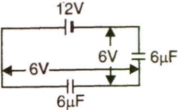
The voltage across the parallel combination $C_p$ is:
$V_p = \frac{Q_{total}}{C_p} = \frac{36\,\mu C}{6\,\mu F} = 6\,V$.
Since the $4\,\mu F$ and $2\,\mu F$ capacitors are in parallel,the voltage across the $4\,\mu F$ capacitor is also $6\,V$.
The charge $Q$ on the $4\,\mu F$ capacitor is:
$Q = C \times V = 4\,\mu F \times 6\,V = 24\,\mu C = 24 \times 10^{-6}\,C$.
$C_p = 4\,\mu F + 2\,\mu F = 6\,\mu F$.
Now,the circuit consists of this equivalent capacitor $C_p$ in series with the $6\,\mu F$ capacitor and the $12\,V$ battery.
The total equivalent capacitance $C_{eq}$ of the circuit is given by:
$\frac{1}{C_{eq}} = \frac{1}{C_p} + \frac{1}{6\,\mu F} = \frac{1}{6\,\mu F} + \frac{1}{6\,\mu F} = \frac{2}{6\,\mu F} = \frac{1}{3\,\mu F}$.
Thus,$C_{eq} = 3\,\mu F$.
The total charge $Q_{total}$ supplied by the battery is:
$Q_{total} = C_{eq} \times V = 3\,\mu F \times 12\,V = 36\,\mu C$.
Since the $6\,\mu F$ capacitor and the parallel combination $(C_p)$ are in series,they both carry the same charge $Q_{total} = 36\,\mu C$.
The voltage across the parallel combination $C_p$ is:
$V_p = \frac{Q_{total}}{C_p} = \frac{36\,\mu C}{6\,\mu F} = 6\,V$.
Since the $4\,\mu F$ and $2\,\mu F$ capacitors are in parallel,the voltage across the $4\,\mu F$ capacitor is also $6\,V$.
The charge $Q$ on the $4\,\mu F$ capacitor is:
$Q = C \times V = 4\,\mu F \times 6\,V = 24\,\mu C = 24 \times 10^{-6}\,C$.
0 likesView Solution
4
ChemistryMCQKCET · 2009
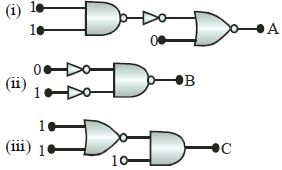
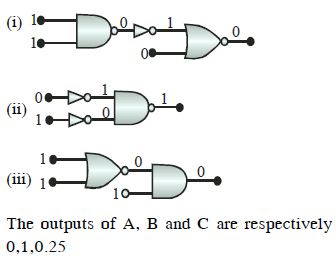
In the following combinations of logic gates,the outputs of $A, B$ and $C$ are respectively:
A
$0, 1, 1$
B
$0, 1, 0$
C
$1, 1, 0$
D
$1, 0, 1$
Solution
(B) For combination $(i)$:
The inputs to the $NAND$ gate are $1$ and $1$,so its output is $\overline{1 \cdot 1} = 0$. This $0$ passes through a $NOT$ gate,becoming $1$. The inputs to the $NOR$ gate are $1$ and $0$. The output of a $NOR$ gate is $1$ only if both inputs are $0$. Since one input is $1$,the output $A = 0$.
For combination $(ii)$:
The inputs $0$ and $1$ pass through $NOT$ gates,becoming $1$ and $0$ respectively. These are the inputs to a $NAND$ gate. The output is $\overline{1 \cdot 0} = \overline{0} = 1$. Thus,$B = 1$.
For combination $(iii)$:
The inputs $1$ and $1$ pass through a $NOR$ gate,giving an output of $\overline{1 + 1} = 0$. This $0$ and the input $1$ are fed into an $AND$ gate. The output is $0 \cdot 1 = 0$. Thus,$C = 0$.
Therefore,the outputs are $A = 0, B = 1, C = 0$.
The inputs to the $NAND$ gate are $1$ and $1$,so its output is $\overline{1 \cdot 1} = 0$. This $0$ passes through a $NOT$ gate,becoming $1$. The inputs to the $NOR$ gate are $1$ and $0$. The output of a $NOR$ gate is $1$ only if both inputs are $0$. Since one input is $1$,the output $A = 0$.
For combination $(ii)$:
The inputs $0$ and $1$ pass through $NOT$ gates,becoming $1$ and $0$ respectively. These are the inputs to a $NAND$ gate. The output is $\overline{1 \cdot 0} = \overline{0} = 1$. Thus,$B = 1$.
For combination $(iii)$:
The inputs $1$ and $1$ pass through a $NOR$ gate,giving an output of $\overline{1 + 1} = 0$. This $0$ and the input $1$ are fed into an $AND$ gate. The output is $0 \cdot 1 = 0$. Thus,$C = 0$.
Therefore,the outputs are $A = 0, B = 1, C = 0$.
0 likesView Solution
5
ChemistryMCQKCET · 2009
In a radioactive disintegration,the ratio of the initial number of atoms to the number of atoms present at an instant of time equal to its mean life is
A
$1/e^2$
B
$1/e$
C
$e$
D
$e^2$
Solution
(C) Let the initial number of atoms at time $t=0$ be $N_{0}$.
Let the number of atoms at any instant of time $t$ be $N$.
According to the radioactive decay law,$N = N_{0} e^{-\lambda t}$.
Mean life is defined as $\tau = 1/\lambda$,where $\lambda$ is the decay constant.
Given that the time $t = \tau$,we substitute this into the decay equation:
$N = N_{0} e^{-\lambda \tau} = N_{0} e^{-\lambda (1/\lambda)} = N_{0} e^{-1}$.
Therefore,$N = N_{0}/e$.
The ratio of the initial number of atoms to the number of atoms present at time $t = \tau$ is:
$N_{0}/N = N_{0} / (N_{0}/e) = e$.
Let the number of atoms at any instant of time $t$ be $N$.
According to the radioactive decay law,$N = N_{0} e^{-\lambda t}$.
Mean life is defined as $\tau = 1/\lambda$,where $\lambda$ is the decay constant.
Given that the time $t = \tau$,we substitute this into the decay equation:
$N = N_{0} e^{-\lambda \tau} = N_{0} e^{-\lambda (1/\lambda)} = N_{0} e^{-1}$.
Therefore,$N = N_{0}/e$.
The ratio of the initial number of atoms to the number of atoms present at time $t = \tau$ is:
$N_{0}/N = N_{0} / (N_{0}/e) = e$.
0 likesView Solution
6
ChemistryMCQKCET · 2009
Which of the following hormones does not naturally occur in plants?
A
$2,4-D$
B
$IAA$
C
$GA$
D
$ABA$
Solution
(A) Synthetic auxins are artificial compounds that induce physiological responses similar to those of $IAA$ (Indole$-3-$acetic acid).
$2,4-D$ ($2,4$-dichlorophenoxyacetic acid) is a synthetic auxin that does not occur naturally in plants and is widely used as a herbicide or weedicide.
In contrast,$IAA$,$GA$ (Gibberellic acid),and $ABA$ (Abscisic acid) are naturally occurring plant hormones.
$2,4-D$ ($2,4$-dichlorophenoxyacetic acid) is a synthetic auxin that does not occur naturally in plants and is widely used as a herbicide or weedicide.
In contrast,$IAA$,$GA$ (Gibberellic acid),and $ABA$ (Abscisic acid) are naturally occurring plant hormones.
0 likesView Solution
7
ChemistryMCQKCET · 2009
Which substance is in higher concentration in blood than in glomerular filtrate?
A
Water
B
Glucose
C
Urea
D
Plasma proteins
Solution
(D) The plasma fluid that filters out from glomerular capillaries into Bowman's capsule of nephrons is called glomerular filtrate.
It is a non-colloidal part and contains urea,water,glucose,amino acids,vitamins,fatty acids,uric acid,creatinine,and salts.
$RBCs$,$WBCs$,platelets,and plasma proteins are the colloidal components of the blood and do not filter out from the glomerulus due to their large molecular size.
Thus,plasma proteins are present in higher concentration in the blood compared to the glomerular filtrate,where they are essentially absent.
It is a non-colloidal part and contains urea,water,glucose,amino acids,vitamins,fatty acids,uric acid,creatinine,and salts.
$RBCs$,$WBCs$,platelets,and plasma proteins are the colloidal components of the blood and do not filter out from the glomerulus due to their large molecular size.
Thus,plasma proteins are present in higher concentration in the blood compared to the glomerular filtrate,where they are essentially absent.
0 likesView Solution
8
ChemistryMCQKCET · 2009
$A$ man is admitted to a hospital. He is suffering from an abnormally low body temperature,loss of appetite,and extreme thirst. His brain scan would probably show a tumour in
A
Medulla oblongata
B
Pons Varolii
C
Cerebellum
D
Hypothalamus
Solution
(D) The $Hypothalamus$ acts as the primary control centre for various homeostatic functions in the human body.
It regulates body temperature,hunger,thirst,sleep,fatigue,and emotional responses such as anger,pleasure,love,and hate.
Since the patient is experiencing an abnormally low body temperature,loss of appetite,and extreme thirst,these symptoms indicate a dysfunction in the $Hypothalamus$.
Therefore,a brain scan would likely reveal a tumour in the $Hypothalamus$.
It regulates body temperature,hunger,thirst,sleep,fatigue,and emotional responses such as anger,pleasure,love,and hate.
Since the patient is experiencing an abnormally low body temperature,loss of appetite,and extreme thirst,these symptoms indicate a dysfunction in the $Hypothalamus$.
Therefore,a brain scan would likely reveal a tumour in the $Hypothalamus$.
0 likesView Solution
9
ChemistryMCQKCET · 2009
Vitellogenesis occurs during the formation of
A
Primary oocyte in the Graafian follicle
B
Oogonial cell in the Graafian follicle
C
Ootid in the fallopian tube
D
Secondary oocyte in the fallopian tube
Solution
(A) During the growth phase of oogenesis,an egg nest forms an ovarian follicle (Graafian follicle).
One central oogonium grows and functions as a primary oocyte.
The surrounding follicular cells provide nourishment to the primary oocyte.
Yolk is deposited in the oocyte during this state.
This phenomenon of yolk deposition is called vitellogenesis.
One central oogonium grows and functions as a primary oocyte.
The surrounding follicular cells provide nourishment to the primary oocyte.
Yolk is deposited in the oocyte during this state.
This phenomenon of yolk deposition is called vitellogenesis.
0 likesView Solution
10
ChemistryMCQKCET · 2009
Blood stains are found at the site of a murder: If $DNA$ profiling technique is to be used for identifying the criminal,which of the following is ideal for use?
A
Serum
B
Erythrocytes
C
Leucocytes
D
Platelets
Solution
(C) $DNA$ fingerprinting is a technique used to identify an individual based on the specificity of their $DNA$.
This technique relies on the fact that an individual's $DNA$ contains specific nucleotide sequences that are unique to them.
For $DNA$ profiling,cells must contain a nucleus to provide the necessary genetic material.
Among the given options,leucocytes (white blood cells) are nucleated and thus contain $DNA$,whereas erythrocytes (red blood cells) in humans are enucleated (lack a nucleus) and platelets are cell fragments lacking a nucleus.
Therefore,leucocytes are the ideal choice for identifying the criminal.
This technique relies on the fact that an individual's $DNA$ contains specific nucleotide sequences that are unique to them.
For $DNA$ profiling,cells must contain a nucleus to provide the necessary genetic material.
Among the given options,leucocytes (white blood cells) are nucleated and thus contain $DNA$,whereas erythrocytes (red blood cells) in humans are enucleated (lack a nucleus) and platelets are cell fragments lacking a nucleus.
Therefore,leucocytes are the ideal choice for identifying the criminal.
0 likesView Solution
11
ChemistryMCQKCET · 2009
Pollen grains of a plant,whose $2n = 28$,are cultured to get callus by tissue culture method. What would be the number of chromosomes in the cells of the callus?
A
$28$
B
$21$
C
$14$
D
$56$
Solution
(C) Pollen grains are haploid $(n)$ structures formed after meiosis.
Given that the diploid number of the plant is $2n = 28$,the haploid number $(n)$ is $28 / 2 = 14$.
When pollen grains are cultured using the tissue culture method,the resulting callus consists of cells derived from the haploid pollen grains.
Therefore,the number of chromosomes in the cells of the callus will be $n = 14$.
Given that the diploid number of the plant is $2n = 28$,the haploid number $(n)$ is $28 / 2 = 14$.
When pollen grains are cultured using the tissue culture method,the resulting callus consists of cells derived from the haploid pollen grains.
Therefore,the number of chromosomes in the cells of the callus will be $n = 14$.
0 likesView Solution
12
ChemistryMCQKCET · 2009
The greatest threat to genetic diversity in agricultural crops is
A
Extensive use of insecticides and pesticides
B
Extensive mixed cropping
C
Introduction of high yielding varieties
D
Extensive use of fertilizers
Solution
(C) Genetic diversity refers to the variety in the number and types of genes and chromosomes present in different species,as well as variations in genes and their alleles within the same species. The introduction of high-yielding varieties (HYVs) is considered the greatest threat to genetic diversity in agricultural crops because it leads to the replacement of traditional,locally adapted landraces with a few genetically uniform,high-productivity strains.
0 likesView Solution
13
ChemistryEasyMCQKCET · 2009
Among the following,the compound that contains ionic,covalent,and coordinate linkage is:
A
$NH_3$
B
$NH_4Cl$
C
$NaCl$
D
$CaO$
Solution
(B) The compound $NH_4Cl$ (ammonium chloride) consists of an ammonium ion $(NH_4^+)$ and a chloride ion $(Cl^-)$.
$1$. The bond between $NH_4^+$ and $Cl^-$ is an ionic bond.
$2$. Within the $NH_4^+$ ion,there are three $N-H$ covalent bonds.
$3$. The fourth $N-H$ bond is formed by the donation of a lone pair of electrons from the nitrogen atom to the $H^+$ ion,which is a coordinate (dative) covalent bond.
Therefore,$NH_4Cl$ contains all three types of linkages.
$1$. The bond between $NH_4^+$ and $Cl^-$ is an ionic bond.
$2$. Within the $NH_4^+$ ion,there are three $N-H$ covalent bonds.
$3$. The fourth $N-H$ bond is formed by the donation of a lone pair of electrons from the nitrogen atom to the $H^+$ ion,which is a coordinate (dative) covalent bond.
Therefore,$NH_4Cl$ contains all three types of linkages.
0 likesView Solution
14
ChemistryEasyMCQKCET · 2009
$A$ covalent molecule $AB_{3}$ has a pyramidal structure. The number of lone pairs and bond pairs of electrons in the molecule are respectively:
A
$2$ and $2$
B
$0$ and $4$
C
$3$ and $1$
D
$1$ and $3$
Solution
(D) The pyramidal structure of the covalent molecule $AB_{3}$ is shown below:
In this structure,the central atom $A$ is bonded to three $B$ atoms,forming $3$ bond pairs.
There is $1$ lone pair of electrons present on the central atom $A$.
Therefore,the number of lone pairs is $1$ and the number of bond pairs is $3$.
In this structure,the central atom $A$ is bonded to three $B$ atoms,forming $3$ bond pairs.
There is $1$ lone pair of electrons present on the central atom $A$.
Therefore,the number of lone pairs is $1$ and the number of bond pairs is $3$.
0 likesView Solution
15
ChemistryEasyMCQKCET · 2009
The correct statement with regard to $H_{2}^{+}$ and $H_{2}^{-}$ is
A
both $H_{2}^{+}$ and $H_{2}^{-}$ are equally stable
B
both $H_{2}^{+}$ and $H_{2}^{-}$ do not exist
C
$H_{2}^{-}$ is more stable than $H_{2}^{+}$
D
$H_{2}^{+}$ is more stable than $H_{2}^{-}$
Solution
(D) $H_{2}^{+}$: Electronic configuration is $\sigma 1s^{1}$,$\sigma^{*} 1s^{0}$.
Bond order $= \frac{1-0}{2} = 0.5$.
$H_{2}^{-}$: Electronic configuration is $\sigma 1s^{2}$,$\sigma^{*} 1s^{1}$.
Bond order $= \frac{2-1}{2} = 0.5$.
Although the bond orders of $H_{2}^{+}$ and $H_{2}^{-}$ are the same,$H_{2}^{+}$ is more stable than $H_{2}^{-}$.
This is because $H_{2}^{-}$ contains one electron in the antibonding molecular orbital $(\sigma^{*} 1s)$,which decreases its stability compared to $H_{2}^{+}$.
Bond order $= \frac{1-0}{2} = 0.5$.
$H_{2}^{-}$: Electronic configuration is $\sigma 1s^{2}$,$\sigma^{*} 1s^{1}$.
Bond order $= \frac{2-1}{2} = 0.5$.
Although the bond orders of $H_{2}^{+}$ and $H_{2}^{-}$ are the same,$H_{2}^{+}$ is more stable than $H_{2}^{-}$.
This is because $H_{2}^{-}$ contains one electron in the antibonding molecular orbital $(\sigma^{*} 1s)$,which decreases its stability compared to $H_{2}^{+}$.
0 likesView Solution
16
ChemistryEasyMCQKCET · 2009
Arrange the following in the increasing order of their bond order: $O_{2}, O_{2}^{+}, O_{2}^{-}, O_{2}^{2-}$
A
$O_{2}^{2-} < O_{2}^{-} < O_{2} < O_{2}^{+}$
B
$O_{2}^{2-} < O_{2}^{-} < O_{2}^{+} < O_{2}$
C
$O_{2}^{+} < O_{2} < O_{2}^{-} < O_{2}^{2-}$
D
$O_{2} < O_{2}^{+} < O_{2}^{-} < O_{2}^{2-}$
Solution
(A) According to Molecular Orbital Theory $(MOT)$,the bond order is calculated as: $\text{Bond Order} = \frac{1}{2} (N_b - N_a)$.
For $O_{2}^{+}$ ($15$ electrons): $\sigma 1s^2, \sigma^* 1s^2, \sigma 2s^2, \sigma^* 2s^2, \sigma 2p_z^2, \pi 2p_x^2 = \pi 2p_y^2, \pi^* 2p_x^1$. Bond order = $\frac{1}{2}(10 - 5) = 2.5$.
For $O_{2}$ ($16$ electrons): $\sigma 1s^2, \sigma^* 1s^2, \sigma 2s^2, \sigma^* 2s^2, \sigma 2p_z^2, \pi 2p_x^2 = \pi 2p_y^2, \pi^* 2p_x^1 = \pi^* 2p_y^1$. Bond order = $\frac{1}{2}(10 - 6) = 2.0$.
For $O_{2}^{-}$ ($17$ electrons): $\sigma 1s^2, \sigma^* 1s^2, \sigma 2s^2, \sigma^* 2s^2, \sigma 2p_z^2, \pi 2p_x^2 = \pi 2p_y^2, \pi^* 2p_x^2 = \pi^* 2p_y^1$. Bond order = $\frac{1}{2}(10 - 7) = 1.5$.
For $O_{2}^{2-}$ ($18$ electrons): $\sigma 1s^2, \sigma^* 1s^2, \sigma 2s^2, \sigma^* 2s^2, \sigma 2p_z^2, \pi 2p_x^2 = \pi 2p_y^2, \pi^* 2p_x^2 = \pi^* 2p_y^2$. Bond order = $\frac{1}{2}(10 - 8) = 1.0$.
Thus,the increasing order of bond order is: $O_{2}^{2-} < O_{2}^{-} < O_{2} < O_{2}^{+}$.
For $O_{2}^{+}$ ($15$ electrons): $\sigma 1s^2, \sigma^* 1s^2, \sigma 2s^2, \sigma^* 2s^2, \sigma 2p_z^2, \pi 2p_x^2 = \pi 2p_y^2, \pi^* 2p_x^1$. Bond order = $\frac{1}{2}(10 - 5) = 2.5$.
For $O_{2}$ ($16$ electrons): $\sigma 1s^2, \sigma^* 1s^2, \sigma 2s^2, \sigma^* 2s^2, \sigma 2p_z^2, \pi 2p_x^2 = \pi 2p_y^2, \pi^* 2p_x^1 = \pi^* 2p_y^1$. Bond order = $\frac{1}{2}(10 - 6) = 2.0$.
For $O_{2}^{-}$ ($17$ electrons): $\sigma 1s^2, \sigma^* 1s^2, \sigma 2s^2, \sigma^* 2s^2, \sigma 2p_z^2, \pi 2p_x^2 = \pi 2p_y^2, \pi^* 2p_x^2 = \pi^* 2p_y^1$. Bond order = $\frac{1}{2}(10 - 7) = 1.5$.
For $O_{2}^{2-}$ ($18$ electrons): $\sigma 1s^2, \sigma^* 1s^2, \sigma 2s^2, \sigma^* 2s^2, \sigma 2p_z^2, \pi 2p_x^2 = \pi 2p_y^2, \pi^* 2p_x^2 = \pi^* 2p_y^2$. Bond order = $\frac{1}{2}(10 - 8) = 1.0$.
Thus,the increasing order of bond order is: $O_{2}^{2-} < O_{2}^{-} < O_{2} < O_{2}^{+}$.
0 likesView Solution
17
ChemistryEasyMCQKCET · 2009
The carbon-carbon bond length in benzene is
A
in between $C_{2}H_{6}$ and $C_{2}H_{4}$
B
same as in $C_{2}H_{4}$
C
in between $C_{2}H_{6}$ and $C_{2}H_{2}$
D
in between $C_{2}H_{4}$ and $C_{2}H_{2}$
Solution
(A) The carbon-carbon bond length in benzene is $1.39 \ \mathring{A}$.
In ethane $(C_{2}H_{6})$,the $C-C$ single bond length is $1.54 \ \mathring{A}$.
In ethene $(C_{2}H_{4})$,the $C=C$ double bond length is $1.34 \ \mathring{A}$.
Since $1.34 \ \mathring{A} < 1.39 \ \mathring{A} < 1.54 \ \mathring{A}$,the bond length in benzene lies between that of $C_{2}H_{6}$ and $C_{2}H_{4}$.
In ethane $(C_{2}H_{6})$,the $C-C$ single bond length is $1.54 \ \mathring{A}$.
In ethene $(C_{2}H_{4})$,the $C=C$ double bond length is $1.34 \ \mathring{A}$.
Since $1.34 \ \mathring{A} < 1.39 \ \mathring{A} < 1.54 \ \mathring{A}$,the bond length in benzene lies between that of $C_{2}H_{6}$ and $C_{2}H_{4}$.
0 likesView Solution
18
ChemistryMediumMCQKCET · 2009
$2 \ HI_{(g)} \rightleftharpoons H_{2(g)} + I_{2(g)}$
The equilibrium constant of the above reaction is $6.4$ at $300 \ K$. If $0.25 \ mol$ each of $H_{2}$ and $I_{2}$ are added to the system,the equilibrium constant will be
The equilibrium constant of the above reaction is $6.4$ at $300 \ K$. If $0.25 \ mol$ each of $H_{2}$ and $I_{2}$ are added to the system,the equilibrium constant will be
A
$6.4$
B
$0.8$
C
$3.2$
D
$1.6$
Solution
(A) The equilibrium constant $(K_c)$ of a chemical reaction depends only on the temperature of the system. It remains unchanged by the addition or removal of reactants or products,provided the temperature remains constant at $300 \ K$. Therefore,the value of the equilibrium constant remains $6.4$.
0 likesView Solution
19
ChemistryEasyMCQKCET · 2009
Cooking is fast in a pressure cooker,because
A
food particles are effectively smashed
B
water boils at higher temperature inside the pressure cooker
C
food is cooked at constant volume
D
loss of heat due to radiation is minimum
Solution
(B) In a pressure cooker,the pressure inside is significantly higher than the atmospheric pressure. According to the relationship between vapor pressure and boiling point,as the pressure increases,the boiling point of water also increases. Consequently,water boils at a higher temperature (above $100 \ ^{\circ}C$),which provides more thermal energy to the food,leading to faster cooking.
0 likesView Solution
20
ChemistryEasyMCQKCET · 2009
The correct order of ionisation energy of $C$,$N$,$O$,and $F$ is
A
$C < N < O < F$
B
$C < O < N < F$
C
$F < O < N < C$
D
$F < N < C < O$
Solution
(B) On moving from left to right in a period,ionisation energy generally increases due to an increase in effective nuclear charge.
Thus,the expected order of ionisation energy for $C$,$N$,$O$,and $F$ is $C < N < O < F$.
However,the ionisation energy of $N$ $(1s^2 2s^2 2p^3)$ is greater than that of $O$ $(1s^2 2s^2 2p^4)$.
This is because $N$ has a stable half-filled $p$-orbital configuration,which requires more energy to remove an electron.
Therefore,the correct order is $C < O < N < F$.
Thus,the expected order of ionisation energy for $C$,$N$,$O$,and $F$ is $C < N < O < F$.
However,the ionisation energy of $N$ $(1s^2 2s^2 2p^3)$ is greater than that of $O$ $(1s^2 2s^2 2p^4)$.
This is because $N$ has a stable half-filled $p$-orbital configuration,which requires more energy to remove an electron.
Therefore,the correct order is $C < O < N < F$.
0 likesView Solution
21
ChemistryMCQKCET · 2009
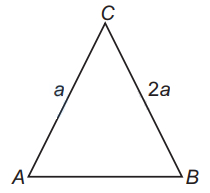
If one side of a triangle is double the other and the angles opposite to these sides differ by $60^{\circ}$,then the triangle is
A
obtuse angled
B
acute angled
C
isosceles
D
right angled
Solution
(D) Let the sides be $b = 2a$ and $a$. The angles opposite to these sides are $B$ and $A$ respectively. Given $B - A = 60^{\circ}$.
By the sine rule,$\frac{b}{\sin B} = \frac{a}{\sin A}$ $\Rightarrow \frac{2a}{\sin B} = \frac{a}{\sin A}$ $\Rightarrow \sin B = 2 \sin A$.
Substitute $B = A + 60^{\circ}$:
$\sin(A + 60^{\circ}) = 2 \sin A$
$\sin A \cos 60^{\circ} + \cos A \sin 60^{\circ} = 2 \sin A$
$\frac{1}{2} \sin A + \frac{\sqrt{3}}{2} \cos A = 2 \sin A$
$\frac{\sqrt{3}}{2} \cos A = \frac{3}{2} \sin A$
$\tan A = \frac{\sqrt{3}}{3} = \frac{1}{\sqrt{3}}$
$A = 30^{\circ}$.
Then $B = 30^{\circ} + 60^{\circ} = 90^{\circ}$.
Since one angle is $90^{\circ}$,the triangle is a right-angled triangle.
By the sine rule,$\frac{b}{\sin B} = \frac{a}{\sin A}$ $\Rightarrow \frac{2a}{\sin B} = \frac{a}{\sin A}$ $\Rightarrow \sin B = 2 \sin A$.
Substitute $B = A + 60^{\circ}$:
$\sin(A + 60^{\circ}) = 2 \sin A$
$\sin A \cos 60^{\circ} + \cos A \sin 60^{\circ} = 2 \sin A$
$\frac{1}{2} \sin A + \frac{\sqrt{3}}{2} \cos A = 2 \sin A$
$\frac{\sqrt{3}}{2} \cos A = \frac{3}{2} \sin A$
$\tan A = \frac{\sqrt{3}}{3} = \frac{1}{\sqrt{3}}$
$A = 30^{\circ}$.
Then $B = 30^{\circ} + 60^{\circ} = 90^{\circ}$.
Since one angle is $90^{\circ}$,the triangle is a right-angled triangle.
0 likesView Solution
22
ChemistryMCQKCET · 2009
In ruby laser,the stimulated emission is due to transition from
A
metastable state to any lower state
B
any higher state to lower state
C
metastable state to ground state
D
any higher state to ground state
Solution
(C) In a ruby laser,the active medium is a ruby crystal ($Al_2O_3$ doped with $Cr^{3+}$ ions).
When the ruby crystal is pumped with high-intensity light,the $Cr^{3+}$ ions are excited to higher energy levels.
These ions quickly decay to a metastable state,which has a relatively long lifetime.
Stimulated emission occurs when these ions transition from the metastable state to the ground state,releasing photons of a specific wavelength $(694.3 \ nm)$.
Therefore,the stimulated emission in a ruby laser is due to the transition from the metastable state to the ground state.
When the ruby crystal is pumped with high-intensity light,the $Cr^{3+}$ ions are excited to higher energy levels.
These ions quickly decay to a metastable state,which has a relatively long lifetime.
Stimulated emission occurs when these ions transition from the metastable state to the ground state,releasing photons of a specific wavelength $(694.3 \ nm)$.
Therefore,the stimulated emission in a ruby laser is due to the transition from the metastable state to the ground state.
0 likesView Solution
23
ChemistryEasyMCQKCET · 2009
The $IUPAC$ name of $(CH_3)_3 CCl$ is
A
$n$-butyl chloride
B
$3$-chloro butane
C
$2$-chloro-$2$-methyl propane
D
$t$-butyl chloride
Solution
(C) The given compound is $(CH_3)_3 CCl$.
To find the $IUPAC$ name,we first identify the longest carbon chain containing the functional group.
The longest chain has $3$ carbon atoms,so the parent alkane is propane.
Numbering the chain from the end that gives the lowest number to the substituent,we get the chlorine atom and the methyl group at the $2^{nd}$ position.
Thus,the $IUPAC$ name is $2$-chloro-$2$-methylpropane.
To find the $IUPAC$ name,we first identify the longest carbon chain containing the functional group.
The longest chain has $3$ carbon atoms,so the parent alkane is propane.
Numbering the chain from the end that gives the lowest number to the substituent,we get the chlorine atom and the methyl group at the $2^{nd}$ position.
Thus,the $IUPAC$ name is $2$-chloro-$2$-methylpropane.
0 likesView Solution
24
ChemistryEasyMCQKCET · 2009
In electrophilic aromatic substitution reaction,the nitro group is meta-directing because it
A
decreases electron density at ortho and para positions
B
decreases electron density at meta position
C
increases electron density at meta position
D
increases electron density at ortho and para positions
Solution
(A) The nitro group $(-NO_2)$ is a strong electron-withdrawing group due to its $-I$ and $-M$ effects.
It withdraws electron density from the benzene ring,specifically from the ortho $(o)$ and para $(p)$ positions through resonance.
As a result,the electron density at the $o$ and $p$ positions decreases significantly compared to the meta $(m)$ positions.
Since the electrophile is electron-deficient,it prefers to attack the position with relatively higher electron density,which is the meta position.
Therefore,the nitro group is meta-directing.
It withdraws electron density from the benzene ring,specifically from the ortho $(o)$ and para $(p)$ positions through resonance.
As a result,the electron density at the $o$ and $p$ positions decreases significantly compared to the meta $(m)$ positions.
Since the electrophile is electron-deficient,it prefers to attack the position with relatively higher electron density,which is the meta position.
Therefore,the nitro group is meta-directing.
0 likesView Solution
25
ChemistryEasyMCQKCET · 2009
The electrophile involved in the sulphonation of benzene is
A
$SO_{3}^{+}$
B
$SO_{3}^{2-}$
C
$H_{3}^{+}O$
D
$SO_{3}$
Solution
(D) The electrophile involved in the sulphonation of benzene is $SO_{3}$.
During the reaction,concentrated sulfuric acid acts as both a reagent and a catalyst to generate the electrophile.
The reaction is: $2 H_{2}SO_{4} \longrightarrow SO_{3} + H_{3}O^{+} + HSO_{4}^{-}$
During the reaction,concentrated sulfuric acid acts as both a reagent and a catalyst to generate the electrophile.
The reaction is: $2 H_{2}SO_{4} \longrightarrow SO_{3} + H_{3}O^{+} + HSO_{4}^{-}$
0 likesView Solution
26
ChemistryEasyMCQKCET · 2009
$30 \ cc$ of $\frac{M}{3} \ HCl$,$20 \ cc$ of $\frac{M}{2} \ HNO_{3}$ and $40 \ cc$ of $\frac{M}{4} \ NaOH$ solutions are mixed and the volume was made up to $1 \ dm^{3}$. The $pH$ of the resulting solution is
A
$8$
B
$2$
C
$1$
D
$3$
Solution
(B) Total milliequivalents of $H^{+}$ ions from $HCl$ and $HNO_{3}$:
$= (30 \times \frac{1}{3}) + (20 \times \frac{1}{2}) = 10 + 10 = 20 \ mEq$.
Total milliequivalents of $OH^{-}$ ions from $NaOH$:
$= 40 \times \frac{1}{4} = 10 \ mEq$.
Since $H^{+}$ reacts with $OH^{-}$ to form water,the remaining milliequivalents of $H^{+}$:
$= 20 - 10 = 10 \ mEq$.
The final volume of the solution is $1 \ dm^{3} = 1000 \ mL$.
Concentration of $H^{+}$ ions $[H^{+}] = \frac{10 \ mEq}{1000 \ mL} = 10^{-2} \ M$.
$pH = -\log[H^{+}] = -\log(10^{-2}) = 2$.
$= (30 \times \frac{1}{3}) + (20 \times \frac{1}{2}) = 10 + 10 = 20 \ mEq$.
Total milliequivalents of $OH^{-}$ ions from $NaOH$:
$= 40 \times \frac{1}{4} = 10 \ mEq$.
Since $H^{+}$ reacts with $OH^{-}$ to form water,the remaining milliequivalents of $H^{+}$:
$= 20 - 10 = 10 \ mEq$.
The final volume of the solution is $1 \ dm^{3} = 1000 \ mL$.
Concentration of $H^{+}$ ions $[H^{+}] = \frac{10 \ mEq}{1000 \ mL} = 10^{-2} \ M$.
$pH = -\log[H^{+}] = -\log(10^{-2}) = 2$.
0 likesView Solution
27
ChemistryEasyMCQKCET · 2009
$10^{-6} \ M \ NaOH$ is diluted $100$ times. The $pH$ of the diluted base is
A
between $7$ and $8$
B
between $5$ and $6$
C
between $6$ and $7$
D
between $10$ and $11$
Solution
(A) Initial concentration of $[OH^-] = 10^{-6} \ M$.
Upon dilution by $100$ times,the concentration becomes $[OH^-] = \frac{10^{-6}}{100} = 10^{-8} \ M$.
Since this concentration is very low,we must consider the contribution of $[OH^-]$ from the auto-ionization of water,which is $10^{-7} \ M$.
Total $[OH^-] = 10^{-8} + 10^{-7} = 10^{-8} (1 + 10) = 11 \times 10^{-8} \ M$.
$pOH = -\log(11 \times 10^{-8}) = 8 - \log(11) \approx 8 - 1.0414 = 6.9586$.
$pH = 14 - pOH = 14 - 6.9586 = 7.0414$.
Thus,the $pH$ lies between $7$ and $8$.
Upon dilution by $100$ times,the concentration becomes $[OH^-] = \frac{10^{-6}}{100} = 10^{-8} \ M$.
Since this concentration is very low,we must consider the contribution of $[OH^-]$ from the auto-ionization of water,which is $10^{-7} \ M$.
Total $[OH^-] = 10^{-8} + 10^{-7} = 10^{-8} (1 + 10) = 11 \times 10^{-8} \ M$.
$pOH = -\log(11 \times 10^{-8}) = 8 - \log(11) \approx 8 - 1.0414 = 6.9586$.
$pH = 14 - pOH = 14 - 6.9586 = 7.0414$.
Thus,the $pH$ lies between $7$ and $8$.
0 likesView Solution
28
ChemistryEasyMCQKCET · 2009
An organic compound on heating with $CuO$ produces $CO_{2}$ but no water. The organic compound may be
A
carbon tetrachloride
B
chloroform
C
methane
D
ethyl iodide
Solution
(A) When an organic compound is heated with $CuO$,carbon is oxidized to $CO_{2}$ and hydrogen is oxidized to $H_{2}O$.
Since the compound produces $CO_{2}$,it must contain carbon.
Since it does not produce water,it does not contain hydrogen.
Among the given options,$CCl_{4}$ (carbon tetrachloride) is the only compound that contains carbon but no hydrogen.
Therefore,the correct option is $A$.
Since the compound produces $CO_{2}$,it must contain carbon.
Since it does not produce water,it does not contain hydrogen.
Among the given options,$CCl_{4}$ (carbon tetrachloride) is the only compound that contains carbon but no hydrogen.
Therefore,the correct option is $A$.
0 likesView Solution
29
ChemistryMediumMCQKCET · 2009
$A$ bivalent metal has an equivalent mass of $32$. The molecular mass of the metal nitrate is
A
$182$
B
$168$
C
$192$
D
$188$
Solution
(D) The atomic mass of a metal is given by the formula: $\text{Atomic mass} = \text{Equivalent mass} \times \text{Valency}$.
Given,$\text{Equivalent mass} = 32$ and the metal is bivalent (valency $= 2$).
Therefore,$\text{Atomic mass} = 32 \times 2 = 64$.
The formula of the metal nitrate for a bivalent metal $M$ is $M(NO_3)_2$.
The molecular mass of $M(NO_3)_2 = \text{Atomic mass of } M + 2 \times (\text{Atomic mass of } N + 3 \times \text{Atomic mass of } O)$.
Substituting the values: $64 + 2 \times (14 + 3 \times 16) = 64 + 2 \times (14 + 48) = 64 + 2 \times 62 = 64 + 124 = 188$.
Given,$\text{Equivalent mass} = 32$ and the metal is bivalent (valency $= 2$).
Therefore,$\text{Atomic mass} = 32 \times 2 = 64$.
The formula of the metal nitrate for a bivalent metal $M$ is $M(NO_3)_2$.
The molecular mass of $M(NO_3)_2 = \text{Atomic mass of } M + 2 \times (\text{Atomic mass of } N + 3 \times \text{Atomic mass of } O)$.
Substituting the values: $64 + 2 \times (14 + 3 \times 16) = 64 + 2 \times (14 + 48) = 64 + 2 \times 62 = 64 + 124 = 188$.
0 likesView Solution
30
ChemistryEasyMCQKCET · 2009
The oxide of an element whose electronic configuration is $1s^{2} 2s^{2} 2p^{6} 3s^{1}$ is
A
neutral
B
amphoteric
C
basic
D
acidic
Solution
(C) The electronic configuration $1s^{2} 2s^{2} 2p^{6} 3s^{1}$ corresponds to the element Sodium ($Na$,atomic number $11$).
Sodium is an alkali metal belonging to Group $1$ of the periodic table.
Alkali metals react with oxygen to form oxides of the general formula $M_{2}O$ (e.g.,$Na_{2}O$).
These oxides are strongly basic in nature as they react with water to form hydroxides.
Sodium is an alkali metal belonging to Group $1$ of the periodic table.
Alkali metals react with oxygen to form oxides of the general formula $M_{2}O$ (e.g.,$Na_{2}O$).
These oxides are strongly basic in nature as they react with water to form hydroxides.
0 likesView Solution
31
ChemistryMediumMCQKCET · 2009
The characteristic not related to alkali metal is
A
high ionisation energy
B
their ions are isoelectronic with noble gases
C
low melting point
D
low electronegativity
Solution
(A) Alkali metals have low ionisation energy due to their large atomic size.
They possess the minimum value of ionisation energy in their respective periods.
Therefore,the statement that they have high ionisation energy is incorrect.
They possess the minimum value of ionisation energy in their respective periods.
Therefore,the statement that they have high ionisation energy is incorrect.
0 likesView Solution
32
ChemistryDifficultMCQKCET · 2009
Excess of carbon dioxide is passed through $50 \ mL$ of $0.5 \ M$ calcium hydroxide solution. After the completion of the reaction,the solution was evaporated to dryness. The solid calcium carbonate was completely neutralized with $0.1 \ N$ hydrochloric acid. The volume of hydrochloric acid required is (Atomic mass of calcium $= 40$ ) (in $cm^{3}$)
A
$300$
B
$200$
C
$500$
D
$400$
Solution
(C) The reaction of $CO_{2}$ with $Ca(OH)_{2}$ in excess leads to the formation of $CaCO_{3}$ and water: $Ca(OH)_{2} + CO_{2} \rightarrow CaCO_{3} + H_{2}O$.
Millimoles of $Ca(OH)_{2} = 50 \ mL \times 0.5 \ M = 25 \ mmol$.
Since the stoichiometry is $1:1$,millimoles of $CaCO_{3}$ formed $= 25 \ mmol$.
The reaction of $CaCO_{3}$ with $HCl$ is: $CaCO_{3} + 2HCl \rightarrow CaCl_{2} + H_{2}O + CO_{2}$.
The milliequivalents of $CaCO_{3}$ $= \text{millimoles} \times n\text{-factor} = 25 \times 2 = 50 \ meq$.
At neutralization,milliequivalents of $HCl = \text{milliequivalents of } CaCO_{3} = 50 \ meq$.
Volume of $0.1 \ N \ HCl = \frac{50 \ meq}{0.1 \ N} = 500 \ cm^{3}$.
Millimoles of $Ca(OH)_{2} = 50 \ mL \times 0.5 \ M = 25 \ mmol$.
Since the stoichiometry is $1:1$,millimoles of $CaCO_{3}$ formed $= 25 \ mmol$.
The reaction of $CaCO_{3}$ with $HCl$ is: $CaCO_{3} + 2HCl \rightarrow CaCl_{2} + H_{2}O + CO_{2}$.
The milliequivalents of $CaCO_{3}$ $= \text{millimoles} \times n\text{-factor} = 25 \times 2 = 50 \ meq$.
At neutralization,milliequivalents of $HCl = \text{milliequivalents of } CaCO_{3} = 50 \ meq$.
Volume of $0.1 \ N \ HCl = \frac{50 \ meq}{0.1 \ N} = 500 \ cm^{3}$.
0 likesView Solution
33
ChemistryMediumMCQKCET · 2009
$0.5 \text{ mole}$ of each of $H_{2}$,$SO_{2}$,and $CH_{4}$ are kept in a container. $A$ hole was made in the container. After $3 \text{ h}$,the order of partial pressures in the container will be
A
$pSO_{2} > pH_{2} > pCH_{4}$
B
$pSO_{2} > pCH_{4} > pH_{2}$
C
$pH_{2} > pSO_{2} > pCH_{4}$
D
$pH_{2} > pCH_{4} > pSO_{2}$
Solution
(B) According to Graham's Law of diffusion,the rate of diffusion $r \propto \frac{1}{\sqrt{M}}$,where $M$ is the molar mass.
The molar masses are: $H_{2} = 2 \text{ g/mol}$,$CH_{4} = 16 \text{ g/mol}$,$SO_{2} = 64 \text{ g/mol}$.
Since $M(H_{2}) < M(CH_{4}) < M(SO_{2})$,the rate of diffusion is $r(H_{2}) > r(CH_{4}) > r(SO_{2})$.
Therefore,the amount of gas remaining in the container after time $t$ will be in the reverse order of their diffusion rates.
The amount left is in the order: $SO_{2} > CH_{4} > H_{2}$.
Since partial pressure $p$ is directly proportional to the number of moles $n$ $(p = \frac{nRT}{V})$,the order of partial pressures is $pSO_{2} > pCH_{4} > pH_{2}$.
The molar masses are: $H_{2} = 2 \text{ g/mol}$,$CH_{4} = 16 \text{ g/mol}$,$SO_{2} = 64 \text{ g/mol}$.
Since $M(H_{2}) < M(CH_{4}) < M(SO_{2})$,the rate of diffusion is $r(H_{2}) > r(CH_{4}) > r(SO_{2})$.
Therefore,the amount of gas remaining in the container after time $t$ will be in the reverse order of their diffusion rates.
The amount left is in the order: $SO_{2} > CH_{4} > H_{2}$.
Since partial pressure $p$ is directly proportional to the number of moles $n$ $(p = \frac{nRT}{V})$,the order of partial pressures is $pSO_{2} > pCH_{4} > pH_{2}$.
0 likesView Solution
34
ChemistryEasyMCQKCET · 2009
$5 \ moles$ of $SO_2$ and $5 \ moles$ of $O_2$ are allowed to react. At equilibrium,it was found that $60\%$ of $SO_2$ is used up. If the partial pressure of the equilibrium mixture is $1 \ atm$,the partial pressure of $O_2$ is (in $atm$)
A
$0.82$
B
$0.52$
C
$0.21$
D
$0.41$
Solution
(D) The reaction is: $2SO_2(g) + O_2(g) \rightleftharpoons 2SO_3(g)$
Initial moles: $SO_2 = 5, O_2 = 5, SO_3 = 0$
$60\%$ of $SO_2$ used up $= 5 \times 0.6 = 3 \ moles$.
At equilibrium:
$SO_2 = 5 - 3 = 2 \ moles$
$O_2 = 5 - (3/2) = 5 - 1.5 = 3.5 \ moles$
$SO_3 = 3 \ moles$
Total moles at equilibrium $= 2 + 3.5 + 3 = 8.5 \ moles$.
Partial pressure of $O_2 = (\text{moles of } O_2 / \text{total moles}) \times \text{Total Pressure}$
$pO_2 = (3.5 / 8.5) \times 1 \ atm = 0.41 \ atm$.
Initial moles: $SO_2 = 5, O_2 = 5, SO_3 = 0$
$60\%$ of $SO_2$ used up $= 5 \times 0.6 = 3 \ moles$.
At equilibrium:
$SO_2 = 5 - 3 = 2 \ moles$
$O_2 = 5 - (3/2) = 5 - 1.5 = 3.5 \ moles$
$SO_3 = 3 \ moles$
Total moles at equilibrium $= 2 + 3.5 + 3 = 8.5 \ moles$.
Partial pressure of $O_2 = (\text{moles of } O_2 / \text{total moles}) \times \text{Total Pressure}$
$pO_2 = (3.5 / 8.5) \times 1 \ atm = 0.41 \ atm$.
0 likesView Solution
35
ChemistryEasyMCQKCET · 2009
The $rms$ velocity of molecules of a gas of density $4 \ kg \ m^{-3}$ and pressure $1.2 \times 10^{5} \ Nm^{-2}$ is (in $ms^{-1}$)
A
$300$
B
$900$
C
$120$
D
$600$
Solution
(A) The formula for the $rms$ velocity of gas molecules is given by $v_{rms} = \sqrt{\frac{3P}{d}}$.
Given,pressure $P = 1.2 \times 10^{5} \ Nm^{-2}$ and density $d = 4 \ kg \ m^{-3}$.
Substituting the values in the formula:
$v_{rms} = \sqrt{\frac{3 \times 1.2 \times 10^{5}}{4}}$
$v_{rms} = \sqrt{\frac{3.6 \times 10^{5}}{4}}$
$v_{rms} = \sqrt{0.9 \times 10^{5}} = \sqrt{90000} = 300 \ ms^{-1}$.
Given,pressure $P = 1.2 \times 10^{5} \ Nm^{-2}$ and density $d = 4 \ kg \ m^{-3}$.
Substituting the values in the formula:
$v_{rms} = \sqrt{\frac{3 \times 1.2 \times 10^{5}}{4}}$
$v_{rms} = \sqrt{\frac{3.6 \times 10^{5}}{4}}$
$v_{rms} = \sqrt{0.9 \times 10^{5}} = \sqrt{90000} = 300 \ ms^{-1}$.
0 likesView Solution
36
ChemistryMediumMCQKCET · 2009
$A$ body of mass $x$ $kg$ is moving with a velocity of $100$ $ms^{-1}$. Its de-Broglie wavelength is $6.62 \times 10^{-35}$ $m$. Hence,$x$ is ($h = 6.62 \times 10^{-34}$ $Js$). (in $kg$)
A
$0.1$
B
$0.25$
C
$0.15$
D
$0.2$
Solution
(A) The de-Broglie wavelength formula is given by $\lambda = \frac{h}{mv}$.
Rearranging the formula to solve for mass $m$,we get $m = \frac{h}{\lambda v}$.
Given values are $h = 6.62 \times 10^{-34} \text{ } Js$,$\lambda = 6.62 \times 10^{-35} \text{ } m$,and $v = 100 \text{ } ms^{-1}$.
Substituting these values into the equation:
$m = \frac{6.62 \times 10^{-34}}{6.62 \times 10^{-35} \times 100}$.
$m = \frac{10^{-34}}{10^{-35} \times 10^2} = \frac{10^{-34}}{10^{-33}} = 10^{-1} = 0.1 \text{ } kg$.
Therefore,$x = 0.1 \text{ } kg$.
Rearranging the formula to solve for mass $m$,we get $m = \frac{h}{\lambda v}$.
Given values are $h = 6.62 \times 10^{-34} \text{ } Js$,$\lambda = 6.62 \times 10^{-35} \text{ } m$,and $v = 100 \text{ } ms^{-1}$.
Substituting these values into the equation:
$m = \frac{6.62 \times 10^{-34}}{6.62 \times 10^{-35} \times 100}$.
$m = \frac{10^{-34}}{10^{-35} \times 10^2} = \frac{10^{-34}}{10^{-33}} = 10^{-1} = 0.1 \text{ } kg$.
Therefore,$x = 0.1 \text{ } kg$.
0 likesView Solution
37
ChemistryEasyMCQKCET · 2009
The correct set of four quantum numbers for the outermost electron of potassium $(Z=19)$ is
A
$4, 1, 0, \frac{1}{2}$
B
$3, 1, 0, \frac{1}{2}$
C
$4, 0, 0, \frac{1}{2}$
D
$3, 0, 0, \frac{1}{2}$
Solution
(C) The electronic configuration of potassium $(Z=19)$ is $1s^{2} 2s^{2} 2p^{6} 3s^{2} 3p^{6} 4s^{1}$.
The outermost electron is in the $4s$ orbital.
For the $4s$ orbital,the principal quantum number $(n) = 4$.
The azimuthal quantum number $(l)$ for an $s$-orbital is $0$.
The magnetic quantum number $(m_l)$ is $0$.
The spin quantum number $(m_s)$ is $+\frac{1}{2}$ (or $-\frac{1}{2}$).
Thus,the correct set of quantum numbers is $4, 0, 0, \frac{1}{2}$.
The outermost electron is in the $4s$ orbital.
For the $4s$ orbital,the principal quantum number $(n) = 4$.
The azimuthal quantum number $(l)$ for an $s$-orbital is $0$.
The magnetic quantum number $(m_l)$ is $0$.
The spin quantum number $(m_s)$ is $+\frac{1}{2}$ (or $-\frac{1}{2}$).
Thus,the correct set of quantum numbers is $4, 0, 0, \frac{1}{2}$.
0 likesView Solution
38
ChemistryMCQKCET · 2009
The correct order of ionisation energy of $C, N, O, F$ is
A
$F < O < N < C$
B
$F < N < C < O$
C
$C < N < O < F$
D
$C < O < N < F$
Solution
(D) Ionisation energy generally increases from left to right in a period due to an increase in effective nuclear charge.
However,nitrogen $(N)$ has a stable half-filled $2p^3$ electronic configuration,which makes it more difficult to remove an electron compared to oxygen $(O)$.
Therefore,the ionisation energy of $N$ is greater than that of $O$.
The correct order is $C < O < N < F$.
However,nitrogen $(N)$ has a stable half-filled $2p^3$ electronic configuration,which makes it more difficult to remove an electron compared to oxygen $(O)$.
Therefore,the ionisation energy of $N$ is greater than that of $O$.
The correct order is $C < O < N < F$.
0 likesView Solution
39
ChemistryEasyMCQKCET · 2009
The enthalpy of formation of $NH_3$ is $-46 \ kJ \ mol^{-1}$. The enthalpy change for the reaction $2 NH_{3(g)} \longrightarrow N_{2(g)} + 3 H_{2(g)}$ is
A
$+184 \ kJ$
B
$+23 \ kJ$
C
$+92 \ kJ$
D
$+46 \ kJ$
Solution
(C) The reaction is $2 NH_{3(g)} \longrightarrow N_{2(g)} + 3 H_{2(g)}$.
For any reaction,$\Delta H_r = \sum \Delta H_f^{\circ}(\text{products}) - \sum \Delta H_f^{\circ}(\text{reactants})$.
Since the elements $N_2$ and $H_2$ are in their standard states,their enthalpy of formation is $0$.
$\Delta H_r = [1 \times \Delta H_f^{\circ}(N_2) + 3 \times \Delta H_f^{\circ}(H_2)] - [2 \times \Delta H_f^{\circ}(NH_3)]$.
$\Delta H_r = [0 + 0] - [2 \times (-46 \ kJ \ mol^{-1})]$.
$\Delta H_r = +92 \ kJ$.
For any reaction,$\Delta H_r = \sum \Delta H_f^{\circ}(\text{products}) - \sum \Delta H_f^{\circ}(\text{reactants})$.
Since the elements $N_2$ and $H_2$ are in their standard states,their enthalpy of formation is $0$.
$\Delta H_r = [1 \times \Delta H_f^{\circ}(N_2) + 3 \times \Delta H_f^{\circ}(H_2)] - [2 \times \Delta H_f^{\circ}(NH_3)]$.
$\Delta H_r = [0 + 0] - [2 \times (-46 \ kJ \ mol^{-1})]$.
$\Delta H_r = +92 \ kJ$.
0 likesView Solution
40
ChemistryMediumMCQKCET · 2009
For the reaction $H_{2}O_{(l)} \rightleftharpoons H_{2}O_{(g)}$ at $373 \ K$ and $1 \ atm$ pressure:
A
$\Delta H = 0$
B
$\Delta E = 0$
C
$\Delta H = T \Delta S$
D
$\Delta H = \Delta E$
Solution
(C) The given reaction $H_{2}O_{(l)} \rightleftharpoons H_{2}O_{(g)}$ represents the phase transition of water at its boiling point ($373 \ K$ and $1 \ atm$).
At equilibrium,the Gibbs free energy change is zero,i.e.,$\Delta G = 0$.
Using the thermodynamic relation $\Delta G = \Delta H - T \Delta S$,we substitute $\Delta G = 0$:
$0 = \Delta H - T \Delta S$
Therefore,$\Delta H = T \Delta S$.
At equilibrium,the Gibbs free energy change is zero,i.e.,$\Delta G = 0$.
Using the thermodynamic relation $\Delta G = \Delta H - T \Delta S$,we substitute $\Delta G = 0$:
$0 = \Delta H - T \Delta S$
Therefore,$\Delta H = T \Delta S$.
0 likesView Solution
41
ChemistryMediumMCQKCET · 2009
Lucas test is associated with
A
aldehydes
B
phenols
C
carboxylic acids
D
alcohols
Solution
(D) The Lucas test is a chemical test used to distinguish between primary,secondary,and tertiary alcohols. It involves the reaction of an alcohol with Lucas reagent ($conc. \ HCl$ and $ZnCl_2$). Tertiary alcohols react immediately to form a cloudy precipitate,secondary alcohols react within $5-10 \ minutes$,and primary alcohols do not react at room temperature.
0 likesView Solution
42
ChemistryMediumMCQKCET · 2009
The compound which is not formed during the dry distillation of a mixture of calcium formate and calcium acetate is
A
methanal
B
propanal
C
propanone
D
ethanal
Solution
(B) Dry distillation of a mixture of calcium salts of carboxylic acids produces carbonyl compounds.
$1. (HCOO)_{2}Ca \xrightarrow{\Delta} HCHO + CaCO_{3}$ (Methanal)
$2. (CH_{3}COO)_{2}Ca \xrightarrow{\Delta} CH_{3}COCH_{3} + CaCO_{3}$ (Propanone)
$3. (HCOO)_{2}Ca + (CH_{3}COO)_{2}Ca \xrightarrow{\Delta} 2CH_{3}CHO + 2CaCO_{3}$ (Ethanal)
Propanal $(CH_{3}CH_{2}CHO)$ is not formed in this reaction.
$1. (HCOO)_{2}Ca \xrightarrow{\Delta} HCHO + CaCO_{3}$ (Methanal)
$2. (CH_{3}COO)_{2}Ca \xrightarrow{\Delta} CH_{3}COCH_{3} + CaCO_{3}$ (Propanone)
$3. (HCOO)_{2}Ca + (CH_{3}COO)_{2}Ca \xrightarrow{\Delta} 2CH_{3}CHO + 2CaCO_{3}$ (Ethanal)
Propanal $(CH_{3}CH_{2}CHO)$ is not formed in this reaction.
0 likesView Solution
43
ChemistryMediumMCQKCET · 2009
The compound which forms acetaldehyde when heated with dilute $NaOH$ is
A
$1, 1-$dichloroethane
B
$1, 1, 1-$trichloroethane
C
$1-$chloroethane
D
$1, 2-$dichloroethane
Solution
(A) When $1, 1-$dichloroethane $(CH_3CHCl_2)$ is heated with dilute $NaOH$,it undergoes hydrolysis to form an unstable gem-diol intermediate,$1, 1-$ethanediol $(CH_3CH(OH)_2)$.
This unstable intermediate loses a water molecule to form acetaldehyde $(CH_3CHO)$.
The reaction is as follows:
$CH_3CHCl_2 + 2NaOH \rightarrow CH_3CH(OH)_2 + 2NaCl$
$CH_3CH(OH)_2 \rightarrow CH_3CHO + H_2O$
This unstable intermediate loses a water molecule to form acetaldehyde $(CH_3CHO)$.
The reaction is as follows:
$CH_3CHCl_2 + 2NaOH \rightarrow CH_3CH(OH)_2 + 2NaCl$
$CH_3CH(OH)_2 \rightarrow CH_3CHO + H_2O$
0 likesView Solution
44
ChemistryEasyMCQKCET · 2009
$CH_3COOH$ $\xrightarrow{LiAlH_4} X$ $\xrightarrow{Cu, 300^{\circ}C} Y$ $\xrightarrow{\text{Dilute } NaOH} Z$. In the above reaction,$Z$ is:
A
butanol
B
aldol
C
ketol
D
acetal
Solution
(B) $Step \ 1$: Reduction of acetic acid $(CH_3COOH)$ with $LiAlH_4$ gives ethanol $(CH_3CH_2OH)$ as $X$.
$Step \ 2$: Dehydrogenation of ethanol $(X)$ over $Cu$ at $300^{\circ}C$ gives acetaldehyde $(CH_3CHO)$ as $Y$.
$Step \ 3$: Acetaldehyde $(Y)$ undergoes aldol condensation in the presence of dilute $NaOH$ to form $3-hydroxybutanal$ $(CH_3CH(OH)CH_2CHO)$,which is commonly known as aldol,as $Z$.
Therefore,the correct option is $B$.
$Step \ 2$: Dehydrogenation of ethanol $(X)$ over $Cu$ at $300^{\circ}C$ gives acetaldehyde $(CH_3CHO)$ as $Y$.
$Step \ 3$: Acetaldehyde $(Y)$ undergoes aldol condensation in the presence of dilute $NaOH$ to form $3-hydroxybutanal$ $(CH_3CH(OH)CH_2CHO)$,which is commonly known as aldol,as $Z$.
Therefore,the correct option is $B$.
0 likesView Solution
45
ChemistryEasyMCQKCET · 2009
Arrange the following in the increasing order of their basic strengths: $CH_{3}NH_{2}$,$(CH_{3})_{2}NH$,$(CH_{3})_{3}N$,$NH_{3}$.
A
$NH_{3} < (CH_{3})_{3}N < (CH_{3})_{2}NH < CH_{3}NH_{2}$
B
$NH_{3} < (CH_{3})_{3}N < CH_{3}NH_{2} < (CH_{3})_{2}NH$
C
$(CH_{3})_{3}N < NH_{3} < CH_{3}NH_{2} < (CH_{3})_{2}NH$
D
$CH_{3}NH_{2} < (CH_{3})_{2}NH < (CH_{3})_{3}N < NH_{3}$
Solution
(B) Aliphatic amines are more basic than $NH_{3}$ due to the $+I$ effect of alkyl groups.
In an aqueous medium,the basicity is determined by a combination of the $+I$ effect,solvation effect,and steric hindrance.
For methyl-substituted amines in an aqueous solution,the order of basic strength is $(CH_{3})_{2}NH > CH_{3}NH_{2} > (CH_{3})_{3}N > NH_{3}$.
However,looking at the provided options and the standard trend,the correct increasing order is $NH_{3} < (CH_{3})_{3}N < CH_{3}NH_{2} < (CH_{3})_{2}NH$.
In an aqueous medium,the basicity is determined by a combination of the $+I$ effect,solvation effect,and steric hindrance.
For methyl-substituted amines in an aqueous solution,the order of basic strength is $(CH_{3})_{2}NH > CH_{3}NH_{2} > (CH_{3})_{3}N > NH_{3}$.
However,looking at the provided options and the standard trend,the correct increasing order is $NH_{3} < (CH_{3})_{3}N < CH_{3}NH_{2} < (CH_{3})_{2}NH$.
0 likesView Solution
46
ChemistryDifficultMCQKCET · 2009
$A$ diabetic person carries a packet of glucose with him always,because
A
glucose reduces the blood sugar level slowly
B
glucose increases the blood sugar level slowly
C
glucose reduces the blood sugar level
D
glucose increases the blood sugar level almost instantaneously
Solution
(D) Sometimes the blood sugar level of diabetic patients decreases suddenly.
Glucose is a simple sugar that is absorbed directly into the bloodstream.
Therefore,diabetic patients generally carry a packet of glucose,which can increase the blood sugar level almost instantaneously to prevent hypoglycemia.
Glucose is a simple sugar that is absorbed directly into the bloodstream.
Therefore,diabetic patients generally carry a packet of glucose,which can increase the blood sugar level almost instantaneously to prevent hypoglycemia.
0 likesView Solution
47
ChemistryMediumMCQKCET · 2009
There are $20$ naturally occurring amino acids. The maximum number of tripeptides that can be obtained is
A
$8000$
B
$6470$
C
$7465$
D
$5360$
Solution
(A) tripeptide is formed by the combination of $3$ amino acids.
Since there are $20$ different types of naturally occurring amino acids and each position in the tripeptide can be occupied by any of these $20$ amino acids,the total number of possible tripeptides is calculated as $20 \times 20 \times 20 = 20^{3}$.
Therefore,the total number of tripeptides is $8000$.
Since there are $20$ different types of naturally occurring amino acids and each position in the tripeptide can be occupied by any of these $20$ amino acids,the total number of possible tripeptides is calculated as $20 \times 20 \times 20 = 20^{3}$.
Therefore,the total number of tripeptides is $8000$.
0 likesView Solution
48
ChemistryMediumMCQKCET · 2009
The reaction involved in the oil of wintergreen test is salicylic acid + reagent $\xrightarrow[Conc. H_{2}SO_{4}]{\Delta}$ product. The product is treated with $Na_{2}CO_{3}$ solution. The missing reagent in the above reaction is
A
phenol
B
$NaOH$
C
ethanol
D
methanol
Solution
(D) The oil of wintergreen test is an esterification reaction used to identify salicylic acid.
Salicylic acid reacts with methanol $(CH_{3}OH)$ in the presence of a few drops of concentrated $H_{2}SO_{4}$ (acid catalyst) upon heating to form methyl salicylate.
Methyl salicylate is an ester that has the characteristic smell of oil of wintergreen.
The reaction is: $C_{6}H_{4}(OH)COOH + CH_{3}OH \xrightarrow[Conc. H_{2}SO_{4}]{\Delta} C_{6}H_{4}(OH)COOCH_{3} + H_{2}O$.
Salicylic acid reacts with methanol $(CH_{3}OH)$ in the presence of a few drops of concentrated $H_{2}SO_{4}$ (acid catalyst) upon heating to form methyl salicylate.
Methyl salicylate is an ester that has the characteristic smell of oil of wintergreen.
The reaction is: $C_{6}H_{4}(OH)COOH + CH_{3}OH \xrightarrow[Conc. H_{2}SO_{4}]{\Delta} C_{6}H_{4}(OH)COOCH_{3} + H_{2}O$.
0 likesView Solution
49
ChemistryEasyMCQKCET · 2009
The order of stability of metal oxides is:
A
$Fe_{2}O_{3} < Cr_{2}O_{3} < Al_{2}O_{3} < MgO$
B
$Cr_{2}O_{3} < MgO < Al_{2}O_{3} < Fe_{2}O_{3}$
C
$MgO < Al_{2}O_{3} < Cr_{2}O_{3} < Fe_{2}O_{3}$
D
$Fe_{2}O_{3} < Al_{2}O_{3} < Cr_{2}O_{3} < MgO$
Solution
(A) The stability of metal oxides is determined by their standard Gibbs free energy of formation $(\Delta G_f^\circ)$.
More negative values of $\Delta G_f^\circ$ indicate higher stability.
Based on the Ellingham diagram,the order of stability is:
$Fe_{2}O_{3} < Cr_{2}O_{3} < Al_{2}O_{3} < MgO$.
More negative values of $\Delta G_f^\circ$ indicate higher stability.
Based on the Ellingham diagram,the order of stability is:
$Fe_{2}O_{3} < Cr_{2}O_{3} < Al_{2}O_{3} < MgO$.
0 likesView Solution
50
ChemistryEasyMCQKCET · 2009
For a chemical reaction $A \rightarrow B$,the rate of the reaction is $2 \times 10^{-3} \ mol \ dm^{-3} \ s^{-1}$,when the initial concentration is $0.05 \ mol \ dm^{-3}$. The rate of the same reaction is $1.6 \times 10^{-2} \ mol \ dm^{-3} \ s^{-1}$ when the initial concentration is $0.1 \ mol \ dm^{-3}$. The order of the reaction is
A
$2$
B
$0$
C
$3$
D
$1$
Solution
(C) The rate law for the reaction $A \rightarrow B$ is given by: $\text{Rate} = k[A]^{n}$,where $n$ is the order of the reaction.
For the first condition: $2 \times 10^{-3} = k(0.05)^{n} \quad \dots(i)$
For the second condition: $1.6 \times 10^{-2} = k(0.1)^{n} \quad \dots(ii)$
Dividing equation $(ii)$ by equation $(i)$:
$\frac{1.6 \times 10^{-2}}{2 \times 10^{-3}} = \frac{k(0.1)^{n}}{k(0.05)^{n}}$
$8 = (\frac{0.1}{0.05})^{n}$
$8 = (2)^{n}$
Since $8 = 2^{3}$,we have $2^{3} = 2^{n}$.
Therefore,$n = 3$.
For the first condition: $2 \times 10^{-3} = k(0.05)^{n} \quad \dots(i)$
For the second condition: $1.6 \times 10^{-2} = k(0.1)^{n} \quad \dots(ii)$
Dividing equation $(ii)$ by equation $(i)$:
$\frac{1.6 \times 10^{-2}}{2 \times 10^{-3}} = \frac{k(0.1)^{n}}{k(0.05)^{n}}$
$8 = (\frac{0.1}{0.05})^{n}$
$8 = (2)^{n}$
Since $8 = 2^{3}$,we have $2^{3} = 2^{n}$.
Therefore,$n = 3$.
0 likesView Solution
51
ChemistryEasyMCQKCET · 2009
$2 \text{ g}$ of a radioactive sample having a half-life of $15$ days was synthesized on $1^{st}$ Jan $2009$. The amount of the sample left behind on $1^{st}$ March $2009$ (including both the days) is: (in $\text{ g}$)
A
$0$
B
$0.125$
C
$1$
D
$0.5$
Solution
(B) Total time from $1^{st}$ Jan to $1^{st}$ March $2009$ (including both days) $= 31 \text{ (Jan)} + 28 \text{ (Feb)} + 1 \text{ (March)} = 60 \text{ days}$.
Number of half-lives $(n)$ $= \frac{\text{Total time}}{\text{Half-life}} = \frac{60}{15} = 4$.
Amount left $(N)$ $= N_0 \times (\frac{1}{2})^n = 2 \times (\frac{1}{2})^4 = \frac{2}{16} = 0.125 \text{ g}$.
Number of half-lives $(n)$ $= \frac{\text{Total time}}{\text{Half-life}} = \frac{60}{15} = 4$.
Amount left $(N)$ $= N_0 \times (\frac{1}{2})^n = 2 \times (\frac{1}{2})^4 = \frac{2}{16} = 0.125 \text{ g}$.
0 likesView Solution
52
ChemistryEasyMCQKCET · 2009
The rate equation for a reaction $A \rightarrow B$ is $r=k[A]^{0}$. If the initial concentration of the reactant is $a \ mol \ dm^{-3}$,the half-life period of the reaction is
A
$\frac{a}{2k}$
B
$\frac{k}{a}$
C
$\frac{a}{k}$
D
$\frac{2a}{k}$
Solution
(A) For a zero order reaction,the rate law is given by $r = k[A]^0 = k$.
Integrating the rate equation,we get $[A]_t = [A]_0 - kt$.
At half-life $(t = t_{1/2})$,the concentration of reactant $[A]_t = \frac{[A]_0}{2} = \frac{a}{2}$.
Substituting these values: $\frac{a}{2} = a - kt_{1/2}$.
$kt_{1/2} = a - \frac{a}{2} = \frac{a}{2}$.
Therefore,$t_{1/2} = \frac{a}{2k}$.
Integrating the rate equation,we get $[A]_t = [A]_0 - kt$.
At half-life $(t = t_{1/2})$,the concentration of reactant $[A]_t = \frac{[A]_0}{2} = \frac{a}{2}$.
Substituting these values: $\frac{a}{2} = a - kt_{1/2}$.
$kt_{1/2} = a - \frac{a}{2} = \frac{a}{2}$.
Therefore,$t_{1/2} = \frac{a}{2k}$.
0 likesView Solution
53
ChemistryDifficultMCQKCET · 2009
For the decomposition of a compound $AB$ at $600 \ K$,the following data were obtained:
The order for the decomposition of $AB$ is:
| $[AB] \ (mol \ dm^{-3})$ | Rate of decomposition of $AB \ (mol \ dm^{-3} \ s^{-1})$ |
| $0.20$ | $2.75 \times 10^{-8}$ |
| $0.40$ | $11.0 \times 10^{-8}$ |
| $0.60$ | $24.75 \times 10^{-8}$ |
The order for the decomposition of $AB$ is:
A
$1.5$
B
$0$
C
$1$
D
$2$
Solution
(D) The rate law for the reaction is given by: $Rate = k[AB]^n$.
Using the data from the table:
$2.75 \times 10^{-8} = k(0.20)^n$ --- $(i)$
$11.0 \times 10^{-8} = k(0.40)^n$ --- $(ii)$
Dividing equation $(ii)$ by equation $(i)$:
$\frac{11.0 \times 10^{-8}}{2.75 \times 10^{-8}} = (\frac{0.40}{0.20})^n$
$4 = 2^n$
Since $4 = 2^2$,we have $2^2 = 2^n$.
Therefore,$n = 2$. The reaction is of second order.
Using the data from the table:
$2.75 \times 10^{-8} = k(0.20)^n$ --- $(i)$
$11.0 \times 10^{-8} = k(0.40)^n$ --- $(ii)$
Dividing equation $(ii)$ by equation $(i)$:
$\frac{11.0 \times 10^{-8}}{2.75 \times 10^{-8}} = (\frac{0.40}{0.20})^n$
$4 = 2^n$
Since $4 = 2^2$,we have $2^2 = 2^n$.
Therefore,$n = 2$. The reaction is of second order.
0 likesView Solution
54
ChemistryEasyMCQKCET · 2009
The oxidation state of $Fe$ in the brown ring complex $[Fe(H_2O)_5NO]SO_4$ is
A
$+3$
B
$0$
C
$+2$
D
$+1$
Solution
(D) In the brown ring complex $[Fe(H_2O)_5NO]SO_4$,the nitrosyl ligand is present as $NO^+$.
The complex ion is $[Fe(H_2O)_5NO]^{2+}$.
Let the oxidation state of $Fe$ be $x$.
$x + 5(0) + 1 = +2$
$x = +1$
Therefore,the oxidation state of $Fe$ is $+1$.
The complex ion is $[Fe(H_2O)_5NO]^{2+}$.
Let the oxidation state of $Fe$ be $x$.
$x + 5(0) + 1 = +2$
$x = +1$
Therefore,the oxidation state of $Fe$ is $+1$.
0 likesView Solution
55
ChemistryEasyMCQKCET · 2009
The $IUPAC$ name of $[Co(NH_3)_5 ONO]^{2+}$ ion is
A
pentaamminenitritocobalt$(III)$ ion
B
pentaamminenitrito-$O$-cobalt$(III)$ ion
C
pentaamminenitrocobalt$(III)$ ion
D
pentaamminenitrocobalt$(IV)$ ion
Solution
(B) The complex ion is $[Co(NH_3)_5 ONO]^{2+}$.
$1$. The ligand $NH_3$ is named as 'ammine' and there are $5$ of them,so it is 'pentaammine'.
$2$. The ligand $ONO^-$ is an ambidentate ligand attached through oxygen,named as 'nitrito-$O$'.
$3$. The central metal atom is Cobalt $(Co)$.
$4$. Let the oxidation state of $Co$ be $x$. The charge on $NH_3$ is $0$ and on $ONO$ is $-1$. The total charge is $+2$.
$x + 5(0) + (-1) = +2 \implies x = +3$.
$5$. Combining these,the $IUPAC$ name is pentaamminenitrito-$O$-cobalt$(III)$ ion.
$1$. The ligand $NH_3$ is named as 'ammine' and there are $5$ of them,so it is 'pentaammine'.
$2$. The ligand $ONO^-$ is an ambidentate ligand attached through oxygen,named as 'nitrito-$O$'.
$3$. The central metal atom is Cobalt $(Co)$.
$4$. Let the oxidation state of $Co$ be $x$. The charge on $NH_3$ is $0$ and on $ONO$ is $-1$. The total charge is $+2$.
$x + 5(0) + (-1) = +2 \implies x = +3$.
$5$. Combining these,the $IUPAC$ name is pentaamminenitrito-$O$-cobalt$(III)$ ion.
0 likesView Solution
56
ChemistryEasyMCQKCET · 2009
The function of $Fe(OH)_{3}$ in the contact process is
A
to remove arsenic impurity
B
to detect colloidal impurity
C
to remove moisture
D
to remove dust particles
Solution
(A) The function of $Fe(OH)_{3}$ in the contact process is to remove arsenic impurity.
$Fe(OH)_{3}$ is a positive sol,hence it removes arsenic impurity which is a negative sol.
$Fe(OH)_{3}$ is a positive sol,hence it removes arsenic impurity which is a negative sol.
0 likesView Solution
57
ChemistryMediumMCQKCET · 2009
An organic compound $X$ is oxidised by using acidified $K_{2}Cr_{2}O_{7}$. The product obtained reacts with phenyl hydrazine but does not answer the silver mirror test. The possible structure of $X$ is
A
$CH_{3}CH_{2}OH$
B
$CH_{3}OH$
C
$(CH_{3})_{2}CHOH$
D
$CH_{3}CHO$
Solution
(C) The oxidation of a secondary alcohol using acidified $K_{2}Cr_{2}O_{7}$ yields a ketone.
Ketones react with phenyl hydrazine to form phenylhydrazones but do not give the silver mirror test (Tollens' test),which is specific to aldehydes.
Among the given options,$(CH_{3})_{2}CHOH$ is a secondary alcohol (propan$-2-$ol),which on oxidation gives acetone $(CH_{3}COCH_{3})$,a ketone.
Therefore,the correct structure of $X$ is $(CH_{3})_{2}CHOH$.
Ketones react with phenyl hydrazine to form phenylhydrazones but do not give the silver mirror test (Tollens' test),which is specific to aldehydes.
Among the given options,$(CH_{3})_{2}CHOH$ is a secondary alcohol (propan$-2-$ol),which on oxidation gives acetone $(CH_{3}COCH_{3})$,a ketone.
Therefore,the correct structure of $X$ is $(CH_{3})_{2}CHOH$.
0 likesView Solution
58
ChemistryEasyMCQKCET · 2009
The incorrect statement in respect of the chromyl chloride test is:
A
formation of red vapours
B
formation of lead chromate
C
formation of chromyl chloride
D
liberation of chlorine
Solution
(D) The chromyl chloride test is used for the detection of $Cl^-$ ions.
In this test,$4NaCl + K_2Cr_2O_7 + 3H_2SO_4 \longrightarrow K_2SO_4 + 2Na_2SO_4 + 2CrO_2Cl_2 \uparrow + 3H_2O$.
The $CrO_2Cl_2$ (chromyl chloride) formed appears as reddish-brown vapours.
When these vapours are passed into $NaOH$ solution,it forms sodium chromate: $CrO_2Cl_2 + 4NaOH \longrightarrow 2NaCl + Na_2CrO_4 + 2H_2O$.
This solution,when treated with lead acetate,gives a yellow precipitate of lead chromate: $Na_2CrO_4 + (CH_3COO)_2Pb \longrightarrow 2CH_3COONa + PbCrO_4 \downarrow$.
Chlorine gas is not liberated in this test. Therefore,the statement 'liberation of chlorine' is incorrect.
In this test,$4NaCl + K_2Cr_2O_7 + 3H_2SO_4 \longrightarrow K_2SO_4 + 2Na_2SO_4 + 2CrO_2Cl_2 \uparrow + 3H_2O$.
The $CrO_2Cl_2$ (chromyl chloride) formed appears as reddish-brown vapours.
When these vapours are passed into $NaOH$ solution,it forms sodium chromate: $CrO_2Cl_2 + 4NaOH \longrightarrow 2NaCl + Na_2CrO_4 + 2H_2O$.
This solution,when treated with lead acetate,gives a yellow precipitate of lead chromate: $Na_2CrO_4 + (CH_3COO)_2Pb \longrightarrow 2CH_3COONa + PbCrO_4 \downarrow$.
Chlorine gas is not liberated in this test. Therefore,the statement 'liberation of chlorine' is incorrect.
0 likesView Solution
59
ChemistryMediumMCQKCET · 2009
An aqueous solution containing $6.5 \ g$ of $NaCl$ of $90 \%$ purity was subjected to electrolysis. After the complete electrolysis,the solution was evaporated to get solid $NaOH$. The volume of $1 \ M$ acetic acid required to neutralize $NaOH$ obtained above is (in $cm^{3}$)
A
$1000$
B
$2000$
C
$100$
D
$200$
Solution
(C) The reaction for the electrolysis of aqueous $NaCl$ is: $2NaCl + 2H_2O \rightarrow 2NaOH + Cl_2 + H_2$.
Weight of pure $NaCl = 6.5 \ g \times 0.9 = 5.85 \ g$.
Moles of $NaCl = \frac{5.85 \ g}{58.5 \ g/mol} = 0.1 \ mol$.
According to the stoichiometry,$2 \ mol$ of $NaCl$ produces $2 \ mol$ of $NaOH$,so $0.1 \ mol$ of $NaCl$ produces $0.1 \ mol$ of $NaOH$.
For neutralization: $NaOH + CH_3COOH \rightarrow CH_3COONa + H_2O$.
Moles of $CH_3COOH$ required = Moles of $NaOH = 0.1 \ mol$.
Volume of $1 \ M$ acetic acid = $\frac{\text{moles}}{\text{molarity}} = \frac{0.1 \ mol}{1 \ M} = 0.1 \ L = 100 \ cm^{3}$.
Weight of pure $NaCl = 6.5 \ g \times 0.9 = 5.85 \ g$.
Moles of $NaCl = \frac{5.85 \ g}{58.5 \ g/mol} = 0.1 \ mol$.
According to the stoichiometry,$2 \ mol$ of $NaCl$ produces $2 \ mol$ of $NaOH$,so $0.1 \ mol$ of $NaCl$ produces $0.1 \ mol$ of $NaOH$.
For neutralization: $NaOH + CH_3COOH \rightarrow CH_3COONa + H_2O$.
Moles of $CH_3COOH$ required = Moles of $NaOH = 0.1 \ mol$.
Volume of $1 \ M$ acetic acid = $\frac{\text{moles}}{\text{molarity}} = \frac{0.1 \ mol}{1 \ M} = 0.1 \ L = 100 \ cm^{3}$.
0 likesView Solution
60
ChemistryEasyMCQKCET · 2009
The standard electrode potential for the half-cell reactions are
$Zn^{2+} + 2e^{-} \longrightarrow Zn ; E^{\circ} = -0.76 \ V$
$Fe^{2+} + 2e^{-} \longrightarrow Fe ; E^{\circ} = -0.44 \ V$
The $emf$ of the cell reaction,
$Fe^{2+} + Zn \longrightarrow Zn^{2+} + Fe$ is
$Zn^{2+} + 2e^{-} \longrightarrow Zn ; E^{\circ} = -0.76 \ V$
$Fe^{2+} + 2e^{-} \longrightarrow Fe ; E^{\circ} = -0.44 \ V$
The $emf$ of the cell reaction,
$Fe^{2+} + Zn \longrightarrow Zn^{2+} + Fe$ is
A
$-0.32 \ V$
B
$-1.20 \ V$
C
$+1.20 \ V$
D
$+0.32 \ V$
Solution
(D) The cell reaction is $Fe^{2+} + Zn \longrightarrow Zn^{2+} + Fe$.
Here,$Zn$ is oxidized to $Zn^{2+}$ (anode) and $Fe^{2+}$ is reduced to $Fe$ (cathode).
The formula for the $emf$ of the cell is $E^{\circ}_{cell} = E^{\circ}_{cathode} - E^{\circ}_{anode}$.
Substituting the given values: $E^{\circ}_{cell} = E^{\circ}_{Fe^{2+}/Fe} - E^{\circ}_{Zn^{2+}/Zn}$.
$E^{\circ}_{cell} = -0.44 \ V - (-0.76 \ V)$.
$E^{\circ}_{cell} = -0.44 \ V + 0.76 \ V = +0.32 \ V$.
Here,$Zn$ is oxidized to $Zn^{2+}$ (anode) and $Fe^{2+}$ is reduced to $Fe$ (cathode).
The formula for the $emf$ of the cell is $E^{\circ}_{cell} = E^{\circ}_{cathode} - E^{\circ}_{anode}$.
Substituting the given values: $E^{\circ}_{cell} = E^{\circ}_{Fe^{2+}/Fe} - E^{\circ}_{Zn^{2+}/Zn}$.
$E^{\circ}_{cell} = -0.44 \ V - (-0.76 \ V)$.
$E^{\circ}_{cell} = -0.44 \ V + 0.76 \ V = +0.32 \ V$.
0 likesView Solution
61
ChemistryEasyMCQKCET · 2009
In the electrolysis of acidulated water,it is desired to obtain $1.12 \ cc$ of hydrogen gas per second at $STP$ conditions. The current to be passed is: (in $A$)
A
$1.93$
B
$9.65$
C
$19.3$
D
$0.965$
Solution
(B) The reaction for the evolution of hydrogen at the cathode is: $2H^+ + 2e^- \rightarrow H_2(g)$.
From the stoichiometry,$1 \ mole$ of $H_2$ requires $2 \ moles$ of electrons $(2 \ F)$.
Volume of $H_2$ produced per second $= 1.12 \ cc = 1.12 \ mL$.
At $STP$,$22400 \ mL$ of $H_2$ corresponds to $1 \ mole$.
Therefore,moles of $H_2$ produced per second $= \frac{1.12}{22400} = 5 \times 10^{-5} \ mol$.
Number of moles of electrons required per second $= 2 \times (5 \times 10^{-5}) = 10^{-4} \ mol$.
Since $1 \ mole$ of electrons $= 96500 \ C$,the charge required per second is $Q = 10^{-4} \times 96500 = 9.65 \ C$.
Since $Current (I) = \frac{Q}{t}$ and $t = 1 \ s$,the current is $9.65 \ A$.
From the stoichiometry,$1 \ mole$ of $H_2$ requires $2 \ moles$ of electrons $(2 \ F)$.
Volume of $H_2$ produced per second $= 1.12 \ cc = 1.12 \ mL$.
At $STP$,$22400 \ mL$ of $H_2$ corresponds to $1 \ mole$.
Therefore,moles of $H_2$ produced per second $= \frac{1.12}{22400} = 5 \times 10^{-5} \ mol$.
Number of moles of electrons required per second $= 2 \times (5 \times 10^{-5}) = 10^{-4} \ mol$.
Since $1 \ mole$ of electrons $= 96500 \ C$,the charge required per second is $Q = 10^{-4} \times 96500 = 9.65 \ C$.
Since $Current (I) = \frac{Q}{t}$ and $t = 1 \ s$,the current is $9.65 \ A$.
0 likesView Solution
62
ChemistryMediumMCQKCET · 2009
The property which decreases with dilution is:
A
Molar conductance
B
Conductance
C
Specific conductance (conductivity)
D
Equivalent conductance
Solution
(C) Specific conductance (or conductivity,$\kappa$) is defined as the conductance of $1 \ cm^3$ of the solution.
As the solution is diluted,the number of ions present per unit volume $(1 \ cm^3)$ decreases.
Since the number of charge carriers per unit volume decreases,the specific conductance decreases with dilution.
As the solution is diluted,the number of ions present per unit volume $(1 \ cm^3)$ decreases.
Since the number of charge carriers per unit volume decreases,the specific conductance decreases with dilution.
0 likesView Solution
63
ChemistryMediumMCQKCET · 2009
The ore that is concentrated by froth floatation process is
A
zincite
B
cinnabar
C
bauxite
D
malachite
Solution
(B) Cinnabar $(HgS)$ is a sulphide ore.
Froth floatation process is specifically used for the concentration of sulphide ores.
Therefore,cinnabar is concentrated by this process.
Froth floatation process is specifically used for the concentration of sulphide ores.
Therefore,cinnabar is concentrated by this process.
0 likesView Solution
64
ChemistryMediumMCQKCET · 2009
The temperature of the slag zone in the metallurgy of iron using a blast furnace is:
A
$1200-1500^{\circ} C$
B
$1500-1600^{\circ} C$
C
$400-700^{\circ} C$
D
$800-1000^{\circ} C$
Solution
(D) In the blast furnace used for the extraction of iron,different zones have different temperature ranges.
The slag formation zone,where limestone $(CaCO_3)$ decomposes to $CaO$ and reacts with silica $(SiO_2)$ to form slag $(CaSiO_3)$,occurs at a temperature range of approximately $800-1000^{\circ} C$.
Therefore,the correct option is $D$.
The slag formation zone,where limestone $(CaCO_3)$ decomposes to $CaO$ and reacts with silica $(SiO_2)$ to form slag $(CaSiO_3)$,occurs at a temperature range of approximately $800-1000^{\circ} C$.
Therefore,the correct option is $D$.
0 likesView Solution
65
ChemistryMediumMCQKCET · 2009
The best method for the conversion of an alcohol into an alkyl chloride is by treating the alcohol with
A
$PCl_{3}$
B
$PCl_{5}$
C
$SOCl_{2}$ in presence of pyridine
D
dry $HCl$ in the presence of anhydrous $ZnCl_{2}$
Solution
(C) The best method for the conversion of an alcohol into an alkyl chloride is by treating the alcohol with $SOCl_{2}$ in the presence of pyridine.
$ROH + SOCl_{2} \longrightarrow RCl + SO_{2} \uparrow + HCl \uparrow$
In this reaction,the by-products $SO_{2}$ and $HCl$ are gases,which escape from the reaction mixture,leaving behind pure alkyl chloride. This is known as the Darzens process.
$ROH + SOCl_{2} \longrightarrow RCl + SO_{2} \uparrow + HCl \uparrow$
In this reaction,the by-products $SO_{2}$ and $HCl$ are gases,which escape from the reaction mixture,leaving behind pure alkyl chloride. This is known as the Darzens process.
0 likesView Solution
66
ChemistryMediumMCQKCET · 2009
The one which has the least iodine value is
A
sunflower oil
B
ginger oil
C
ghee
D
groundnut oil
Solution
(C) The iodine value is a measure of the degree of unsaturation in fats and oils. Higher unsaturation leads to a higher iodine value. $Ghee$ is primarily composed of saturated fatty acids,making it the least unsaturated among the given options. Therefore,it has the least iodine value.
0 likesView Solution
67
ChemistryEasyMCQKCET · 2009
Argon is used:
A
in filling airships
B
to obtain low temperature
C
in high temperature welding
D
in radiotherapy for treatment of cancer
Solution
(C) Argon is an inert gas. It is primarily used in high temperature welding and other metallurgical operations that require a non-oxidising atmosphere and the absence of nitrogen to prevent unwanted chemical reactions.
0 likesView Solution
68
ChemistryMediumMCQKCET · 2009
The condensation polymer among the following is
A
$rubber$
B
$protein$
C
$PVC$
D
$polyethene$
Solution
(B) $Proteins$ are the condensation polymers of $\alpha$-amino acids.
$Proteins$ contain peptide bonds,which are represented by the linkage:
$(-CO-NH-)$.
$Proteins$ contain peptide bonds,which are represented by the linkage:
$(-CO-NH-)$.
0 likesView Solution
69
ChemistryMediumMCQKCET · 2009
In which of the following is $NH_{3}$ not used?
A
Tollen's reagent
B
Nessler's reagent
C
Group reagent for the analysis of $IV$ group basic radicals
D
Group reagent for the analysis of $III$ group basic radicals
Solution
(C) $NH_{3}$ is used in the preparation of Tollen's reagent $([Ag(NH_{3})_{2}]^{+})$.
$NH_{3}$ is also used as a group reagent for the analysis of $III$ group basic radicals (as $NH_{4}OH$).
$NH_{3}$ is not used as a group reagent for the analysis of $IV$ group basic radicals,where $H_{2}S$ in the presence of $NH_{4}OH$ is used.
Nessler's reagent is $K_{2}[HgI_{4}]$ in $KOH$,which is used to test $NH_{4}^{+}$ ions,but $NH_{3}$ is not a component of the reagent itself.
$NH_{3}$ is also used as a group reagent for the analysis of $III$ group basic radicals (as $NH_{4}OH$).
$NH_{3}$ is not used as a group reagent for the analysis of $IV$ group basic radicals,where $H_{2}S$ in the presence of $NH_{4}OH$ is used.
Nessler's reagent is $K_{2}[HgI_{4}]$ in $KOH$,which is used to test $NH_{4}^{+}$ ions,but $NH_{3}$ is not a component of the reagent itself.
0 likesView Solution
70
ChemistryMediumMCQKCET · 2009
$A$ compound of $A$ and $B$ crystallises in a cubic lattice in which $A$ atoms occupy the lattice points at the corners of the cube. The $B$ atoms occupy the centre of each face of the cube. The probable empirical formula of the compound is
A
$AB_{2}$
B
$A_{3}B$
C
$AB$
D
$AB_{3}$
Solution
(D) occupies corners,thus number of $A$ atoms per unit cell $= 8 \times \frac{1}{8} = 1$.
$B$ occupies face centres,thus number of $B$ atoms per unit cell $= 6 \times \frac{1}{2} = 3$.
Therefore,the empirical formula of the compound is $AB_{3}$.
$B$ occupies face centres,thus number of $B$ atoms per unit cell $= 6 \times \frac{1}{2} = 3$.
Therefore,the empirical formula of the compound is $AB_{3}$.
0 likesView Solution
71
ChemistryEasyMCQKCET · 2009
Vapour pressure of pure '$A$' is $70 \ mm$ of $Hg$ at $25^{\circ} C$. It forms an ideal solution with '$B$' in which mole fraction of $A$ is $0.8$. If the vapour pressure of the solution is $84 \ mm$ of $Hg$ at $25^{\circ} C$,the vapour pressure of pure '$B$' at $25^{\circ} C$ is (in $mm$)
A
$28$
B
$56$
C
$70$
D
$140$
Solution
(D) According to Raoult's law for an ideal solution,the total vapour pressure $P_{total}$ is given by:
$P_{total} = P_{A}^{\circ} x_{A} + P_{B}^{\circ} x_{B}$
Given: $P_{A}^{\circ} = 70 \ mm \ Hg$,$x_{A} = 0.8$,$P_{total} = 84 \ mm \ Hg$.
Since $x_{A} + x_{B} = 1$,we have $x_{B} = 1 - 0.8 = 0.2$.
Substituting the values:
$84 = (70 \times 0.8) + (P_{B}^{\circ} \times 0.2)$
$84 = 56 + 0.2 P_{B}^{\circ}$
$84 - 56 = 0.2 P_{B}^{\circ}$
$28 = 0.2 P_{B}^{\circ}$
$P_{B}^{\circ} = \frac{28}{0.2} = 140 \ mm \ Hg$.
$P_{total} = P_{A}^{\circ} x_{A} + P_{B}^{\circ} x_{B}$
Given: $P_{A}^{\circ} = 70 \ mm \ Hg$,$x_{A} = 0.8$,$P_{total} = 84 \ mm \ Hg$.
Since $x_{A} + x_{B} = 1$,we have $x_{B} = 1 - 0.8 = 0.2$.
Substituting the values:
$84 = (70 \times 0.8) + (P_{B}^{\circ} \times 0.2)$
$84 = 56 + 0.2 P_{B}^{\circ}$
$84 - 56 = 0.2 P_{B}^{\circ}$
$28 = 0.2 P_{B}^{\circ}$
$P_{B}^{\circ} = \frac{28}{0.2} = 140 \ mm \ Hg$.
0 likesView Solution
72
ChemistryMediumMCQKCET · 2009
In countries nearer to the polar region,the roads are sprinkled with $CaCl_{2}$. This is
A
to minimise the wear and tear of the roads
B
to minimise the snow fall
C
to minimise pollution
D
to minimise the accumulation of dust on the road
Solution
(A) In countries nearer to the polar region,the roads are sprinkled with $CaCl_{2}$ because $CaCl_{2}$ acts as a freezing point depressant.
It lowers the freezing point of water,which helps in melting the ice on the roads,thereby preventing ice formation and minimizing the wear and tear of the roads.
It lowers the freezing point of water,which helps in melting the ice on the roads,thereby preventing ice formation and minimizing the wear and tear of the roads.
0 likesView Solution
73
ChemistryMediumMCQKCET · 2009
$A$ $6 \%$ solution of urea is isotonic with
A
$1 \ M$ solution of glucose
B
$0.05 \ M$ solution of glucose
C
$6 \%$ solution of glucose
D
$25 \%$ solution of glucose
Solution
(A) The molar mass of urea $(NH_2CONH_2)$ is $60 \ g/mol$.
Assuming the density of the solution is $1 \ g/mL$,a $6 \%$ solution means $6 \ g$ of urea in $100 \ mL$ of solution.
Molarity of urea $= \frac{\text{mass of solute}}{\text{molar mass} \times \text{volume of solution in L}} = \frac{6 \ g}{60 \ g/mol \times 0.1 \ L} = 1 \ M$.
Two solutions are isotonic if they have the same molar concentration.
Therefore,a $6 \%$ urea solution is isotonic with a $1 \ M$ solution of glucose.
Assuming the density of the solution is $1 \ g/mL$,a $6 \%$ solution means $6 \ g$ of urea in $100 \ mL$ of solution.
Molarity of urea $= \frac{\text{mass of solute}}{\text{molar mass} \times \text{volume of solution in L}} = \frac{6 \ g}{60 \ g/mol \times 0.1 \ L} = 1 \ M$.
Two solutions are isotonic if they have the same molar concentration.
Therefore,a $6 \%$ urea solution is isotonic with a $1 \ M$ solution of glucose.
0 likesView Solution
74
ChemistryEasyMCQKCET · 2009
The magnetic moment of a transition metal ion is $\sqrt{15} \ \text{BM}$. Therefore,the number of unpaired electrons present in it,is:
A
$3$
B
$4$
C
$1$
D
$2$
Solution
(A) The magnetic moment $(\mu)$ is calculated using the spin-only formula: $\mu = \sqrt{n(n+2)} \ \text{BM}$,where $n$ is the number of unpaired electrons.
Given $\mu = \sqrt{15} \ \text{BM}$.
$\sqrt{n(n+2)} = \sqrt{15}$
$n(n+2) = 15$
$n^2 + 2n - 15 = 0$
$(n+5)(n-3) = 0$
Since $n$ cannot be negative,$n = 3$.
Given $\mu = \sqrt{15} \ \text{BM}$.
$\sqrt{n(n+2)} = \sqrt{15}$
$n(n+2) = 15$
$n^2 + 2n - 15 = 0$
$(n+5)(n-3) = 0$
Since $n$ cannot be negative,$n = 3$.
0 likesView Solution
75
ChemistryMediumMCQKCET · 2009
Rate of physical adsorption increases with
A
decrease in surface area
B
decrease in temperature
C
decrease in pressure
D
increase in temperature
Solution
(B) Physical adsorption is an exothermic process.
According to Le Chatelier's principle,for an exothermic process,the extent of adsorption decreases with an increase in temperature.
Therefore,the rate of physical adsorption increases with a decrease in temperature.
According to Le Chatelier's principle,for an exothermic process,the extent of adsorption decreases with an increase in temperature.
Therefore,the rate of physical adsorption increases with a decrease in temperature.
0 likesView Solution
Vedclass Products
For Students
Vedclass Test Series
Mock tests in real KCET style covering Chemistry with performance analysis. 5-day free trial.
Start Free TrialFor Teachers
Exam Paper Generator
Generate Set A/B/C/D Chemistry papers from 7.5L+ questions in 2 minutes. 3 chapters free.
Try FreeFor Institutes
Online Exam Module
Run live KCET mock exams with unlimited students, 360° analytics & white-label branding.
See DemoFrequently Asked Questions
How many Chemistry questions are in KCET 2009?
There are 75 Chemistry questions from the KCET 2009 paper on Vedclass, each with a detailed step-by-step solution in English.
Are KCET 2009 Chemistry solutions available in English?
Yes. All solutions on this page are in English. You can also switch to English or Hindi using the language buttons above the questions.
Can I practice KCET 2009 Chemistry as a timed test?
Yes. Use the Vedclass Test Series to attempt a full KCET mock test covering Chemistry with time limits and instant score analysis.
Can teachers create Chemistry papers from KCET previous year questions?
Yes. The Vedclass Exam Paper Generator lets teachers mix KCET Chemistry questions and generate Set A/B/C/D papers in minutes.
For Teachers & Institutes
Build a Custom Chemistry Paper
Pick KCET 2009 Chemistry questions, set difficulty, and generate Set A/B/C/D in 2 minutes.