
BiologyQ1–40 of 40 questions
Page 1 of 1 · English
1
BiologyEasyMCQKCET · 2009
Identify the incorrect statement with respect to Calvin cycle.
A
$18$ molecules of $ATP$ are synthesised during carbon fixation.
B
$NADPH + H^+$ produced in light reaction is used to reduce diphosphoglycerate.
C
The carboxylation of $RuBP$ is catalysed by $RuBisCO$.
D
The first stable intermediate compound formed is phosphoglycerate.
Solution
(A) The incorrect statement is $A$.
In the Calvin cycle,$18$ molecules of $ATP$ are not synthesized during carbon fixation; rather,$ATP$ is consumed.
To produce one molecule of glucose ($6$ carbons),the Calvin cycle must turn $6$ times.
Each turn requires $3$ $ATP$ and $2$ $NADPH$ molecules.
Therefore,a total of $18$ $ATP$ and $12$ $NADPH$ are consumed,not synthesized,during the process.
Option $B$ is correct as $NADPH$ is used for the reduction of $1,3$-bisphosphoglycerate to glyceraldehyde-$3$-phosphate.
Option $C$ is correct as $RuBisCO$ is the enzyme responsible for the carboxylation of $RuBP$.
Option $D$ is correct as $3$-phosphoglycerate ($3$-$PGA$) is the first stable product of the Calvin cycle.
In the Calvin cycle,$18$ molecules of $ATP$ are not synthesized during carbon fixation; rather,$ATP$ is consumed.
To produce one molecule of glucose ($6$ carbons),the Calvin cycle must turn $6$ times.
Each turn requires $3$ $ATP$ and $2$ $NADPH$ molecules.
Therefore,a total of $18$ $ATP$ and $12$ $NADPH$ are consumed,not synthesized,during the process.
Option $B$ is correct as $NADPH$ is used for the reduction of $1,3$-bisphosphoglycerate to glyceraldehyde-$3$-phosphate.
Option $C$ is correct as $RuBisCO$ is the enzyme responsible for the carboxylation of $RuBP$.
Option $D$ is correct as $3$-phosphoglycerate ($3$-$PGA$) is the first stable product of the Calvin cycle.
0 likesView Solution
2
BiologyEasyMCQKCET · 2009
In an experiment demonstrating the evolution of oxygen in $Hydrilla$,sodium bicarbonate is added to water in the experimental set-up. What would happen if all other conditions are favourable?
A
Amount of oxygen evolved decreases as the availability of carbon dioxide increases.
B
Amount of oxygen evolved increases as carbon dioxide in water is absorbed by sodium bicarbonate.
C
Amount of oxygen evolved decreases as carbon dioxide in water is absorbed by sodium bicarbonate.
D
Amount of oxygen evolved increases as the availability of carbon dioxide increases.
Solution
(D) is the correct answer.
In the experiment with $Hydrilla$,adding sodium bicarbonate $(NaHCO_3)$ increases the availability of carbon dioxide $(CO_2)$ in the water.
$CO_2$ is a key substrate for photosynthesis.
This enhanced availability of carbon dioxide improves the rate of photosynthesis,which,in turn,increases the amount of oxygen $(O_2)$ evolved as a byproduct.
In the experiment with $Hydrilla$,adding sodium bicarbonate $(NaHCO_3)$ increases the availability of carbon dioxide $(CO_2)$ in the water.
$CO_2$ is a key substrate for photosynthesis.
This enhanced availability of carbon dioxide improves the rate of photosynthesis,which,in turn,increases the amount of oxygen $(O_2)$ evolved as a byproduct.
0 likesView Solution
3
BiologyEasyMCQKCET · 2009
Which statement about photosynthesis is false?
A
The enzymes required for carbon fixation are located only in the grana of chloroplasts.
B
In green plants,both $PS I$ and $PS II$ are required for the formation of $NADPH + H^+$.
C
The electron carriers involved in photophosphorylation are located on the thylakoid membranes.
D
Photosynthesis is a redox process in which water is oxidised and carbon dioxide is reduced.
Solution
(A) The correct answer is $A$.
Statement $A$ is false because the enzymes required for carbon fixation (the $Calvin$ cycle),such as $RuBisCO$,are located in the stroma of the chloroplasts,not in the grana.
The grana are primarily the sites for light-dependent reactions,where the thylakoid membranes contain the photosystems and electron transport chain components.
Statement $B$ is true: Non-cyclic photophosphorylation involves both $PS I$ and $PS II$ to produce $NADPH + H^+$.
Statement $C$ is true: The electron transport chain components are embedded within the thylakoid membranes.
Statement $D$ is true: Photosynthesis is a redox reaction where $H_2O$ is oxidized to $O_2$ and $CO_2$ is reduced to carbohydrates.
Statement $A$ is false because the enzymes required for carbon fixation (the $Calvin$ cycle),such as $RuBisCO$,are located in the stroma of the chloroplasts,not in the grana.
The grana are primarily the sites for light-dependent reactions,where the thylakoid membranes contain the photosystems and electron transport chain components.
Statement $B$ is true: Non-cyclic photophosphorylation involves both $PS I$ and $PS II$ to produce $NADPH + H^+$.
Statement $C$ is true: The electron transport chain components are embedded within the thylakoid membranes.
Statement $D$ is true: Photosynthesis is a redox reaction where $H_2O$ is oxidized to $O_2$ and $CO_2$ is reduced to carbohydrates.
0 likesView Solution
4
BiologyEasyMCQKCET · 2009
Match the compounds given in column-$I$ with the number of carbon atoms present in them which are listed under column-$II$. Choose the answer which shows the correct combination of alphabets of the two columns.
| Column-$I$ | Column-$II$ |
| $A$. Oxaloacetate | $p$. $6-C$ compound |
| $B$. Phosphoglyceraldehyde | $q$. $5-C$ compound |
| $C$. Isocitrate | $r$. $4-C$ compound |
| $D$. $\alpha$-Ketoglutarate | $s$. $3-C$ compound |
| $t$. $2-C$ compound |
A
$A = r, B = t, C = p, D = q$
B
$A = q, B = s, C = p, D = t$
C
$A = s, B = t, C = q, D = r$
D
$A = r, B = s, C = p, D = q$
Solution
(D) The correct match is $A-r, B-s, C-p, D-q$.
$1$. Oxaloacetate $(A)$ is a $4-C$ dicarboxylic acid involved in the Krebs cycle.
$2$. Phosphoglyceraldehyde $(B)$ is a $3-C$ triose phosphate intermediate in glycolysis.
$3$. Isocitrate $(C)$ is a $6-C$ tricarboxylic acid formed during the Krebs cycle.
$4$. $\alpha$-Ketoglutarate $(D)$ is a $5-C$ dicarboxylic acid formed after the decarboxylation of isocitrate in the Krebs cycle.
$1$. Oxaloacetate $(A)$ is a $4-C$ dicarboxylic acid involved in the Krebs cycle.
$2$. Phosphoglyceraldehyde $(B)$ is a $3-C$ triose phosphate intermediate in glycolysis.
$3$. Isocitrate $(C)$ is a $6-C$ tricarboxylic acid formed during the Krebs cycle.
$4$. $\alpha$-Ketoglutarate $(D)$ is a $5-C$ dicarboxylic acid formed after the decarboxylation of isocitrate in the Krebs cycle.
0 likesView Solution
5
BiologyEasyMCQKCET · 2009
The respiratory quotient during cellular respiration would depend on
A
the amount of carbon dioxide released
B
the amount of oxygen utilised
C
the nature of enzymes involved
D
the nature of the substrate
Solution
(D) The correct answer is $D$.
Respiratory Quotient $(RQ)$ is defined as the ratio of the volume of $CO_2$ evolved to the volume of $O_2$ consumed during respiration.
$RQ = \frac{\text{Volume of } CO_2 \text{ evolved}}{\text{Volume of } O_2 \text{ consumed}}$.
The value of $RQ$ depends entirely on the nature of the respiratory substrate being oxidized.
For carbohydrates, the $RQ$ is $1.0$.
For fats, the $RQ$ is less than $1.0$ (approximately $0.7$).
For proteins, the $RQ$ is approximately $0.9$.
Respiratory Quotient $(RQ)$ is defined as the ratio of the volume of $CO_2$ evolved to the volume of $O_2$ consumed during respiration.
$RQ = \frac{\text{Volume of } CO_2 \text{ evolved}}{\text{Volume of } O_2 \text{ consumed}}$.
The value of $RQ$ depends entirely on the nature of the respiratory substrate being oxidized.
For carbohydrates, the $RQ$ is $1.0$.
For fats, the $RQ$ is less than $1.0$ (approximately $0.7$).
For proteins, the $RQ$ is approximately $0.9$.
0 likesView Solution
6
BiologyEasyMCQKCET · 2009
Which of the following hormones does not naturally occur in plants?
A
$GA$
B
$ABA$
C
$2,4-D$
D
$IAA$
Solution
(C) $2, 4-D$ is a synthetic auxin and does not occur naturally in plants.
$GA$ (Gibberellins), $ABA$ (Abscisic acid), and $IAA$ (Indole-3-acetic acid) are all naturally occurring plant hormones.
Therefore, the correct option is $C$.
$GA$ (Gibberellins), $ABA$ (Abscisic acid), and $IAA$ (Indole-3-acetic acid) are all naturally occurring plant hormones.
Therefore, the correct option is $C$.
0 likesView Solution
7
BiologyEasyMCQKCET · 2009
Which of the following prevents the conversion of prothrombin to thrombin in an undamaged blood vessel?
A
Thromboplastin
B
Fibrinogen
C
Heparin
D
Calcium ions
Solution
(C) Heparin.
$Heparin$ is a natural anticoagulant present in the blood that prevents the conversion of $prothrombin$ to $thrombin$ in an undamaged blood vessel.
This action prevents unnecessary blood clot formation by blocking the $thrombin$-mediated conversion of $fibrinogen$ to $fibrin$,thereby maintaining smooth blood flow in healthy,undamaged vessels.
$Heparin$ is a natural anticoagulant present in the blood that prevents the conversion of $prothrombin$ to $thrombin$ in an undamaged blood vessel.
This action prevents unnecessary blood clot formation by blocking the $thrombin$-mediated conversion of $fibrinogen$ to $fibrin$,thereby maintaining smooth blood flow in healthy,undamaged vessels.
0 likesView Solution
8
BiologyEasyMCQKCET · 2009
The characteristic that is shared by urea,uric acid and ammonia is/are:
$(A)$ They are nitrogenous wastes.
$(B)$ They all need very large amount of water for excretion.
$(C)$ They all are equally toxic.
$(D)$ They are produced in the kidneys.
$(A)$ They are nitrogenous wastes.
$(B)$ They all need very large amount of water for excretion.
$(C)$ They all are equally toxic.
$(D)$ They are produced in the kidneys.
A
$A$,$C$ and $D$
B
$A$ only
C
$A$ and $C$
D
$A$ and $D$
Solution
(B) The correct answer is $A$ only.
$1$. Urea,uric acid,and ammonia are all nitrogenous waste products resulting from the metabolism of proteins and nucleic acids.
$2$. They differ significantly in their toxicity: ammonia is the most toxic,followed by urea,while uric acid is the least toxic.
$3$. Due to these differences in toxicity,they require varying amounts of water for excretion. Ammonia requires the most water,while uric acid requires the least.
$4$. Urea is primarily synthesized in the liver via the ornithine cycle,not in the kidneys.
$1$. Urea,uric acid,and ammonia are all nitrogenous waste products resulting from the metabolism of proteins and nucleic acids.
$2$. They differ significantly in their toxicity: ammonia is the most toxic,followed by urea,while uric acid is the least toxic.
$3$. Due to these differences in toxicity,they require varying amounts of water for excretion. Ammonia requires the most water,while uric acid requires the least.
$4$. Urea is primarily synthesized in the liver via the ornithine cycle,not in the kidneys.
0 likesView Solution
9
BiologyEasyMCQKCET · 2009
Which substance is in higher concentration in blood than in glomerular filtrate?
A
Urea
B
Plasma proteins
C
Water
D
Glucose
Solution
(B) The correct answer is $B$.
Plasma proteins are large molecules that cannot pass through the glomerular filtration membrane during the process of ultrafiltration.
As a result,they are retained in the blood capillaries of the glomerulus.
In contrast,substances like urea,water,and glucose are small enough to pass through the filtration slits of the podocytes and the basement membrane,meaning their concentrations in the glomerular filtrate are initially similar to their concentrations in the blood plasma.
Plasma proteins are large molecules that cannot pass through the glomerular filtration membrane during the process of ultrafiltration.
As a result,they are retained in the blood capillaries of the glomerulus.
In contrast,substances like urea,water,and glucose are small enough to pass through the filtration slits of the podocytes and the basement membrane,meaning their concentrations in the glomerular filtrate are initially similar to their concentrations in the blood plasma.
0 likesView Solution
10
BiologyEasyMCQKCET · 2009
$A$ man is admitted to a hospital. He is suffering from an abnormally low body temperature,loss of appetite,and extreme thirst. His brain scan would probably show a tumor in
A
cerebellum
B
hypothalamus
C
medulla oblongata
D
pons
Solution
(B) hypothalamus.
The hypothalamus is the part of the brain that acts as the body's thermostat and regulates essential homeostatic functions,including body temperature,hunger (appetite),and thirst.
$A$ tumor in the hypothalamus disrupts these regulatory centers,leading to the clinical presentation of abnormally low body temperature (hypothermia),loss of appetite,and extreme thirst (polydipsia).
The hypothalamus is the part of the brain that acts as the body's thermostat and regulates essential homeostatic functions,including body temperature,hunger (appetite),and thirst.
$A$ tumor in the hypothalamus disrupts these regulatory centers,leading to the clinical presentation of abnormally low body temperature (hypothermia),loss of appetite,and extreme thirst (polydipsia).
0 likesView Solution
11
BiologyEasyMCQKCET · 2009
Compare the statements $A$ and $B$.
$Statement A$: Blood sugar level falls rapidly after hepatectomy.
$Statement B$: The glycogen of the liver is the principle source of blood sugar.
Select the correct description:
$Statement A$: Blood sugar level falls rapidly after hepatectomy.
$Statement B$: The glycogen of the liver is the principle source of blood sugar.
Select the correct description:
A
$Statement A$ is wrong and $B$ is correct.
B
Both the statement $A$ and $B$ are correct and $B$ is not the reason for $A$.
C
Both the statements $A$ and $B$ are correct and $B$ is the reason for $A$.
D
$Statement A$ is correct and $B$ is wrong.
Solution
(C) Both the statements $A$ and $B$ are correct and $B$ is the reason for $A$.
After hepatectomy,which involves the removal of a part or the whole liver,there is a rapid drop in blood sugar levels $(Statement A)$ because the liver's glycogen,which is the primary source of blood sugar $(Statement B)$,is no longer available to maintain blood glucose homeostasis.
After hepatectomy,which involves the removal of a part or the whole liver,there is a rapid drop in blood sugar levels $(Statement A)$ because the liver's glycogen,which is the primary source of blood sugar $(Statement B)$,is no longer available to maintain blood glucose homeostasis.
0 likesView Solution
12
BiologyEasyMCQKCET · 2009
Which of the following hormones does not contain a polypeptide?
A
Insulin
B
Antidiuretic hormone
C
Prostaglandin
D
Oxytocin
Solution
(C) Prostaglandin.
Prostaglandins are not polypeptides; they are lipid compounds derived from fatty acids.
Insulin,antidiuretic hormone $(ADH)$,and oxytocin are all peptide hormones,which are composed of amino acids.
Prostaglandins are not polypeptides; they are lipid compounds derived from fatty acids.
Insulin,antidiuretic hormone $(ADH)$,and oxytocin are all peptide hormones,which are composed of amino acids.
0 likesView Solution
13
BiologyEasyMCQKCET · 2009
$A$ bacterium is capable of withstanding extreme heat,dryness,and toxic chemicals. This indicates that it is probably able to form
A
endotoxins
B
endogenous buds
C
a thick peptidoglycan wall
D
endospores
Solution
(D) endospores.
Endospores are highly resistant,dormant structures formed by certain bacteria under unfavorable environmental conditions.
These structures are capable of withstanding extreme heat,radiation,desiccation (dryness),and toxic chemicals.
They protect the bacterial $DNA$ and essential cellular components until favorable conditions return,allowing the bacterium to germinate and resume normal activity.
Endospores are highly resistant,dormant structures formed by certain bacteria under unfavorable environmental conditions.
These structures are capable of withstanding extreme heat,radiation,desiccation (dryness),and toxic chemicals.
They protect the bacterial $DNA$ and essential cellular components until favorable conditions return,allowing the bacterium to germinate and resume normal activity.
0 likesView Solution
14
BiologyEasyMCQKCET · 2009
Bryophytes resemble algae in the following aspects:
A
thallus-like plant body,presence of roots and autotrophic nutrition
B
thallus-like plant body,lack of vascular tissues and autotrophic nutrition
C
filamentous body,presence of vascular tissue and autotrophic nutrition
D
differentiation of plant body into root,stem and leaves and autotrophic nutrition
Solution
(B) thallus-like plant body,lack of vascular tissues and autotrophic nutrition.
Bryophytes resemble algae in their thallus-like plant body,lack of vascular tissues,and autotrophic nutrition.
Both groups have simple,non-differentiated structures and rely on photosynthesis for nutrition.
Neither group possesses the specialized vascular tissues ($xylem$ and $phloem$) found in higher plants for transporting water and nutrients.
Bryophytes resemble algae in their thallus-like plant body,lack of vascular tissues,and autotrophic nutrition.
Both groups have simple,non-differentiated structures and rely on photosynthesis for nutrition.
Neither group possesses the specialized vascular tissues ($xylem$ and $phloem$) found in higher plants for transporting water and nutrients.
0 likesView Solution
15
BiologyEasyMCQKCET · 2009
Which of the following is properly matched?
A
Arthropoda - Insecta - Spider
B
Mollusca - Cephalopoda - Unio
C
Platyhelminthes - Trematoda - Planaria
D
Echinodermata - Asteroidea - Starfish
Solution
(D) Echinodermata - Asteroidea - Starfish.
Starfish belongs to the phylum Echinodermata and the class Asteroidea,making this a correct match.
Spiders belong to the class Arachnida,not Insecta,within the phylum Arthropoda.
Unio is a bivalve mollusk belonging to the class Bivalvia,not Cephalopoda.
Planaria belongs to the class Turbellaria,not Trematoda,within the phylum Platyhelminthes.
Starfish belongs to the phylum Echinodermata and the class Asteroidea,making this a correct match.
Spiders belong to the class Arachnida,not Insecta,within the phylum Arthropoda.
Unio is a bivalve mollusk belonging to the class Bivalvia,not Cephalopoda.
Planaria belongs to the class Turbellaria,not Trematoda,within the phylum Platyhelminthes.
0 likesView Solution
16
BiologyEasyMCQKCET · 2009
Identify the group which includes animals all of which give birth to young ones directly.
A
Shrew,bat,kiwi,cat
B
Lion,whale,ostrich,bat
C
Dolphin,kangaroo,bat,cat
D
Platypus,penguin,bat,hippopotamus
Solution
(C) The correct answer is $C$.
Animals that give birth to young ones directly are known as viviparous animals.
$1$. Dolphin,kangaroo,bat,and cat are all mammals that exhibit viviparity.
$2$. Kiwi,ostrich,and penguin are birds,which are oviparous (egg-laying).
$3$. Platypus is a monotreme,which is an egg-laying mammal.
Therefore,the group containing only viviparous animals is Dolphin,kangaroo,bat,and cat.
Animals that give birth to young ones directly are known as viviparous animals.
$1$. Dolphin,kangaroo,bat,and cat are all mammals that exhibit viviparity.
$2$. Kiwi,ostrich,and penguin are birds,which are oviparous (egg-laying).
$3$. Platypus is a monotreme,which is an egg-laying mammal.
Therefore,the group containing only viviparous animals is Dolphin,kangaroo,bat,and cat.
0 likesView Solution
17
BiologyEasyMCQKCET · 2009
An animal which has both exoskeletal and endoskeletal structures is
A
frog
B
jelly fish
C
fresh water mussel
D
tortoise
Solution
(D) tortoise.
$Tortoises$ possess an exoskeletal shell made of bony plates covered by keratin and an endoskeleton comprising a backbone and internal bones.
This dual skeletal system provides protection and structural support.
This distinguishes $tortoises$ from $frogs$ (which have an endoskeleton only),$jellyfish$ (which lack both a true exoskeleton and endoskeleton),and $freshwater$ $mussels$ (which have an exoskeleton only).
$Tortoises$ possess an exoskeletal shell made of bony plates covered by keratin and an endoskeleton comprising a backbone and internal bones.
This dual skeletal system provides protection and structural support.
This distinguishes $tortoises$ from $frogs$ (which have an endoskeleton only),$jellyfish$ (which lack both a true exoskeleton and endoskeleton),and $freshwater$ $mussels$ (which have an exoskeleton only).
0 likesView Solution
18
BiologyEasyMCQKCET · 2009
Match Column-$I$ with Column-$II$.
| Column-$I$ | Column-$II$ |
|---|---|
| $A$. Sunflower | $p$. Acanthaceae |
| $B$. Tulsi | $q$. Compositae |
| $C$. Coffee | $r$. Labiatae |
| $D$. Vasaka | $s$. Rubiaceae |
A
$A-q, B-s, C-p, D-t$
B
$A-s, B-r, C-p, D-t$
C
$A-r, B-t, C-s, D-q$
D
$A-q, B-r, C-s, D-p$
Solution
(D) The correct matches are as follows:
$1$. Sunflower $(A)$ belongs to the family Compositae $(q)$.
$2$. Tulsi $(B)$ belongs to the family Labiatae $(r)$.
$3$. Coffee $(C)$ belongs to the family Rubiaceae $(s)$.
$4$. Vasaka $(D)$ belongs to the family Acanthaceae $(p)$.
Therefore,the correct matching is $A-q, B-r, C-s, D-p$.
$1$. Sunflower $(A)$ belongs to the family Compositae $(q)$.
$2$. Tulsi $(B)$ belongs to the family Labiatae $(r)$.
$3$. Coffee $(C)$ belongs to the family Rubiaceae $(s)$.
$4$. Vasaka $(D)$ belongs to the family Acanthaceae $(p)$.
Therefore,the correct matching is $A-q, B-r, C-s, D-p$.
0 likesView Solution
19
BiologyEasyMCQKCET · 2009
Fleshy fruits with a stony endocarp are called
A
pomes
B
drupes
C
capsules
D
berries
Solution
(B) The correct answer is $B$.
Fleshy fruits with a stony endocarp are known as $drupes$.
In these fruits, the endocarp is hard and stony, which protects the seed inside.
This stony endocarp is surrounded by a fleshy mesocarp and a thin exocarp.
Common examples of $drupes$ include mango $(Mangifera \text{ } indica)$ and coconut $(Cocos \text{ } nucifera)$.
Fleshy fruits with a stony endocarp are known as $drupes$.
In these fruits, the endocarp is hard and stony, which protects the seed inside.
This stony endocarp is surrounded by a fleshy mesocarp and a thin exocarp.
Common examples of $drupes$ include mango $(Mangifera \text{ } indica)$ and coconut $(Cocos \text{ } nucifera)$.
0 likesView Solution
20
BiologyEasyMCQKCET · 2009
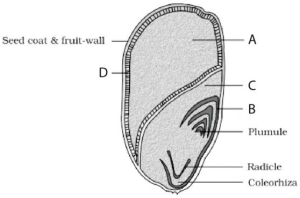
The diagram of the section of a maize grain is given below. Identify the parts labelled $A$,$B$,$C$ and $D$.
A
$A$-endosperm,$B$-coleoptile,$C$-scutellum,$D$-aleurone layer
B
$A$-endosperm,$B$-coleorhiza,$C$-scutellum,$D$-aleurone layer
C
$A$-endosperm,$B$-cotyledon,$C$-scutellum,$D$-aleurone layer
D
$A$-cotyledon,$B$-coleoptile,$C$-scutellum,$D$-aleurone layer
Solution
(A) The correct answer is $A$.
In the diagram of the maize grain:
$A$ represents the endosperm,which is the food-storing tissue.
$B$ represents the coleoptile,which is a protective sheath covering the plumule.
$C$ represents the scutellum,which is a large,shield-shaped cotyledon in monocots that absorbs nutrients from the endosperm.
$D$ represents the aleurone layer,which is the protein-rich outer layer of the endosperm.
In the diagram of the maize grain:
$A$ represents the endosperm,which is the food-storing tissue.
$B$ represents the coleoptile,which is a protective sheath covering the plumule.
$C$ represents the scutellum,which is a large,shield-shaped cotyledon in monocots that absorbs nutrients from the endosperm.
$D$ represents the aleurone layer,which is the protein-rich outer layer of the endosperm.
0 likesView Solution
21
BiologyEasyMCQKCET · 2009
Identify the correctly matched pair/pairs of the germ layers and their derivatives.
$A$. Ectoderm-Epidermis
$B$. Endoderm-Dermis
$C$. Mesoderm-Muscles
$D$. Mesoderm-Notochord
$E$. Endoderm-Enamel of teeth
$A$. Ectoderm-Epidermis
$B$. Endoderm-Dermis
$C$. Mesoderm-Muscles
$D$. Mesoderm-Notochord
$E$. Endoderm-Enamel of teeth
A
$A$ and $D$ only
B
$A$ and $B$ only
C
$A, C$ and $D$ only
D
$A, B, C$ and $E$ only
Solution
(C) The correct answer is $A, C$ and $D$ only.
$1$. Ectoderm gives rise to the epidermis of the skin.
$2$. Mesoderm gives rise to muscles and the notochord.
$3$. Dermis is derived from the mesoderm,not the endoderm.
$4$. Enamel of teeth is derived from the ectoderm,not the endoderm.
$1$. Ectoderm gives rise to the epidermis of the skin.
$2$. Mesoderm gives rise to muscles and the notochord.
$3$. Dermis is derived from the mesoderm,not the endoderm.
$4$. Enamel of teeth is derived from the ectoderm,not the endoderm.
0 likesView Solution
22
BiologyEasyMCQKCET · 2009
Damage to the thymus in a child may lead to
A
a reduction in the amount of plasma proteins
B
loss of antibody mediated immunity
C
loss of cell mediated immunity
D
a reduction in the haemoglobin content in blood.
Solution
(C) . Loss of cell-mediated immunity.
Damage to the thymus in a child may lead to the loss of cell-mediated immunity. The thymus is the primary lymphoid organ responsible for the development and maturation of $T$-lymphocytes ($T$-cells). Since $T$-cells are essential for orchestrating cell-mediated immune responses,their absence or dysfunction due to thymic damage significantly impairs this branch of the immune system.
Damage to the thymus in a child may lead to the loss of cell-mediated immunity. The thymus is the primary lymphoid organ responsible for the development and maturation of $T$-lymphocytes ($T$-cells). Since $T$-cells are essential for orchestrating cell-mediated immune responses,their absence or dysfunction due to thymic damage significantly impairs this branch of the immune system.
0 likesView Solution
23
BiologyEasyMCQKCET · 2009
Pollen grains of a plant whose $2n = 28$ are cultured to get callus by tissue culture method. What would be the number of chromosomes in the cells of the callus?
A
$14$
B
$56$
C
$28$
D
$21$
Solution
(A) $A-14$.
Pollen grains are haploid reproductive cells produced by meiosis,containing $n$ chromosomes.
Given that the diploid number of the plant is $2n = 28$,the haploid number is $n = 28 / 2 = 14$.
In tissue culture,when pollen grains are cultured to form callus,the cells of the callus retain the same genetic constitution as the pollen grains.
Therefore,the cells of the callus will be haploid and contain $14$ chromosomes.
Pollen grains are haploid reproductive cells produced by meiosis,containing $n$ chromosomes.
Given that the diploid number of the plant is $2n = 28$,the haploid number is $n = 28 / 2 = 14$.
In tissue culture,when pollen grains are cultured to form callus,the cells of the callus retain the same genetic constitution as the pollen grains.
Therefore,the cells of the callus will be haploid and contain $14$ chromosomes.
0 likesView Solution
24
BiologyEasyMCQKCET · 2009
In crop improvement programmes,virus-free clones can be obtained through
A
embryo culture
B
shoot apex culture
C
grafting
D
hybridisation
Solution
(B) The correct answer is $B$ (shoot apex culture).
In plant tissue culture,the shoot apical meristem is generally free from viral infections even if the rest of the plant is infected.
This is because the virus multiplication rate is slower than the rate of cell division in the meristematic region.
By excising and culturing the shoot apex,scientists can regenerate healthy,virus-free clones of the parent plant.
This technique is widely used in agriculture to produce disease-free planting material for various crops.
In plant tissue culture,the shoot apical meristem is generally free from viral infections even if the rest of the plant is infected.
This is because the virus multiplication rate is slower than the rate of cell division in the meristematic region.
By excising and culturing the shoot apex,scientists can regenerate healthy,virus-free clones of the parent plant.
This technique is widely used in agriculture to produce disease-free planting material for various crops.
0 likesView Solution
25
BiologyEasyMCQKCET · 2009
The greatest threat to genetic diversity in agricultural crops is
A
introduction of high yielding varieties
B
extensive use of fertilisers
C
extensive use of insecticides and pesticides
D
extensive mixed cropping
Solution
(A) The correct answer is $A$.
The introduction of high-yielding varieties (HYVs) is considered the greatest threat to genetic diversity in agricultural crops.
This is because the widespread adoption of a few genetically uniform high-yielding varieties often leads to the replacement and loss of traditional,locally adapted,and diverse crop varieties (landraces).
This process,known as genetic erosion,significantly reduces the overall genetic diversity within the agricultural ecosystem.
While the extensive use of fertilizers,insecticides,and pesticides can negatively impact soil health and local ecosystems,the replacement of diverse germplasm with uniform HYVs has a more direct and irreversible impact on genetic diversity.
The introduction of high-yielding varieties (HYVs) is considered the greatest threat to genetic diversity in agricultural crops.
This is because the widespread adoption of a few genetically uniform high-yielding varieties often leads to the replacement and loss of traditional,locally adapted,and diverse crop varieties (landraces).
This process,known as genetic erosion,significantly reduces the overall genetic diversity within the agricultural ecosystem.
While the extensive use of fertilizers,insecticides,and pesticides can negatively impact soil health and local ecosystems,the replacement of diverse germplasm with uniform HYVs has a more direct and irreversible impact on genetic diversity.
0 likesView Solution
26
BiologyEasyMCQKCET · 2009
All of the following are included under in situ conservation except:
A
National park
B
Sanctuary
C
Botanical garden
D
Biosphere reserve
Solution
(C) Botanical garden.
In situ conservation refers to the conservation of species within their natural habitats.
National parks,sanctuaries,and biosphere reserves are examples of in situ conservation areas.
Botanical gardens are examples of ex situ conservation,where plants are conserved outside their natural habitats.
In situ conservation refers to the conservation of species within their natural habitats.
National parks,sanctuaries,and biosphere reserves are examples of in situ conservation areas.
Botanical gardens are examples of ex situ conservation,where plants are conserved outside their natural habitats.
0 likesView Solution
27
BiologyEasyMCQKCET · 2009
If $2n = 16$ in a primary spermatocyte which is in the metaphase of the first meiotic division,what shall be the total number of chromatids in each of the secondary spermatocytes?
A
$16$
B
$24$
C
$32$
D
$8$
Solution
(A) In a primary spermatocyte,the diploid number of chromosomes is $2n = 16$.
During the first meiotic division $(Meiosis-I)$,the homologous chromosomes separate,resulting in the formation of two secondary spermatocytes.
Each secondary spermatocyte receives $n = 8$ chromosomes.
Since each chromosome consists of $2$ sister chromatids,the total number of chromatids in each secondary spermatocyte is $8 \times 2 = 16$.
During the first meiotic division $(Meiosis-I)$,the homologous chromosomes separate,resulting in the formation of two secondary spermatocytes.
Each secondary spermatocyte receives $n = 8$ chromosomes.
Since each chromosome consists of $2$ sister chromatids,the total number of chromatids in each secondary spermatocyte is $8 \times 2 = 16$.
0 likesView Solution
28
BiologyEasyMCQKCET · 2009
Vitellogenesis occurs during the formation of
A
ootid in the Fallopian tube
B
secondary oocyte in the Fallopian tube
C
primary oocyte in the Graafian follicle
D
oogonial cell in the Graafian follicle
Solution
(C) primary oocyte in the Graafian follicle.
Vitellogenesis is the process of yolk formation and deposition.
It occurs in the primary oocyte within the Graafian follicle during oogenesis in the ovary.
This stage involves the accumulation of yolk,which includes proteins,fats,phospholipids,carbohydrates,and glycogen,all of which are essential for the development of the embryo.
Vitellogenesis is the process of yolk formation and deposition.
It occurs in the primary oocyte within the Graafian follicle during oogenesis in the ovary.
This stage involves the accumulation of yolk,which includes proteins,fats,phospholipids,carbohydrates,and glycogen,all of which are essential for the development of the embryo.
0 likesView Solution
29
BiologyEasyMCQKCET · 2009
Some important events in the human female reproductive cycle are given below. Arrange the events in a proper sequence. $A \rightarrow$ secretion of $FSH$,$B \rightarrow$ growth of corpus luteum,$C \rightarrow$ growth of the follicle and oogenesis,$D \rightarrow$ ovulation,$E \rightarrow$ sudden increase in the level of $LH$.
A
$A \rightarrow D \rightarrow C \rightarrow E \rightarrow B$
B
$C \rightarrow A \rightarrow D \rightarrow B \rightarrow E$
C
$B \rightarrow A \rightarrow C \rightarrow D \rightarrow E$
D
$A \rightarrow C \rightarrow E \rightarrow D \rightarrow B$
Solution
(D) The correct sequence of events in the human female reproductive cycle is: $A \rightarrow C \rightarrow E \rightarrow D \rightarrow B$.
$1$. $A$ (secretion of $FSH$): The cycle begins with the secretion of Follicle Stimulating Hormone $(FSH)$ from the anterior pituitary.
$2$. $C$ (growth of the follicle and oogenesis): $FSH$ stimulates the growth of ovarian follicles and the process of oogenesis.
$3$. $E$ (sudden increase in the level of $LH$): As the follicle matures,estrogen levels rise,leading to a surge in Luteinizing Hormone $(LH)$.
$4$. $D$ (ovulation): The $LH$ surge triggers the rupture of the Graafian follicle and the release of the ovum.
$5$. $B$ (growth of corpus luteum): After ovulation,the remnants of the Graafian follicle transform into the corpus luteum.
$1$. $A$ (secretion of $FSH$): The cycle begins with the secretion of Follicle Stimulating Hormone $(FSH)$ from the anterior pituitary.
$2$. $C$ (growth of the follicle and oogenesis): $FSH$ stimulates the growth of ovarian follicles and the process of oogenesis.
$3$. $E$ (sudden increase in the level of $LH$): As the follicle matures,estrogen levels rise,leading to a surge in Luteinizing Hormone $(LH)$.
$4$. $D$ (ovulation): The $LH$ surge triggers the rupture of the Graafian follicle and the release of the ovum.
$5$. $B$ (growth of corpus luteum): After ovulation,the remnants of the Graafian follicle transform into the corpus luteum.
0 likesView Solution
30
BiologyEasyMCQKCET · 2009
Both husband and wife have normal vision,though their fathers were colour blind and their mothers did not have any gene for colour blindness. The probability of their daughters becoming colour blind is (in $\%$)
A
$0$
B
$25$
C
$50$
D
$75$
Solution
(A) The correct answer is $A$ $(0\%)$.
Given:
$1$. Both husband and wife have normal vision.
$2$. Both fathers were colour blind $(X^CY)$.
$3$. Both mothers were normal and did not carry the gene for colour blindness $(XX)$.
Analysis:
- The wife's father was colour blind $(X^CY)$,so she must have inherited the $X^C$ chromosome from him. Since she has normal vision,she must be a carrier $(X^CX)$.
- The husband's father was colour blind $(X^CY)$,but the husband inherited his $X$ chromosome from his mother (who was $XX$). Therefore,the husband is normal $(XY)$.
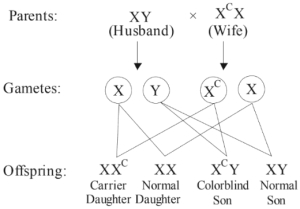
Cross:
Parents: $XY$ (Husband) $\times$ $X^CX$ (Wife)
Gametes: $X, Y$ and $X^C, X$
Offspring:
- $X^CX$ (Carrier Daughter)
- $XX$ (Normal Daughter)
- $X^CY$ (Colour blind Son)
- $XY$ (Normal Son)
Conclusion:
From the cross,the daughters are either carrier $(X^CX)$ or normal $(XX)$. None of the daughters are colour blind. Therefore,the probability of their daughters becoming colour blind is $0\%$.
Given:
$1$. Both husband and wife have normal vision.
$2$. Both fathers were colour blind $(X^CY)$.
$3$. Both mothers were normal and did not carry the gene for colour blindness $(XX)$.
Analysis:
- The wife's father was colour blind $(X^CY)$,so she must have inherited the $X^C$ chromosome from him. Since she has normal vision,she must be a carrier $(X^CX)$.
- The husband's father was colour blind $(X^CY)$,but the husband inherited his $X$ chromosome from his mother (who was $XX$). Therefore,the husband is normal $(XY)$.
Cross:
Parents: $XY$ (Husband) $\times$ $X^CX$ (Wife)
Gametes: $X, Y$ and $X^C, X$
Offspring:
- $X^CX$ (Carrier Daughter)
- $XX$ (Normal Daughter)
- $X^CY$ (Colour blind Son)
- $XY$ (Normal Son)
Conclusion:
From the cross,the daughters are either carrier $(X^CX)$ or normal $(XX)$. None of the daughters are colour blind. Therefore,the probability of their daughters becoming colour blind is $0\%$.
0 likesView Solution
31
BiologyEasyMCQKCET · 2009
The offspring produced from a marriage have only $O$ or $A$ blood groups. Of the genotypes given below,the possible genotypes of the parents would be
A
$I^{A}I^{A}$ and $I^{O}I^{O}$
B
$I^{A}I^{O}$ and $I^{O}I^{O}$
C
$I^{A}I^{A}$ and $I^{A}I^{O}$
D
$I^{O}I^{O}$ and $I^{O}I^{O}$
Solution
(B) The correct option is $(B) I^{A}I^{O}$ and $I^{O}I^{O}$.
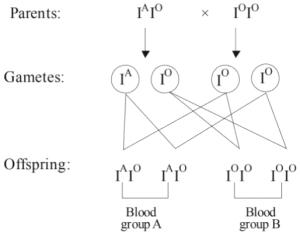
For the offspring to have only $A$ or $O$ blood groups,one parent must have the genotype $I^{A}I^{O}$ (blood group $A$) and the other must have $I^{O}I^{O}$ (blood group $O$).
When these parents are crossed,the possible genotypes of the offspring are $I^{A}I^{O}$ (blood group $A$) and $I^{O}I^{O}$ (blood group $O$).
This confirms that the offspring will only possess blood groups $A$ or $O$.
For the offspring to have only $A$ or $O$ blood groups,one parent must have the genotype $I^{A}I^{O}$ (blood group $A$) and the other must have $I^{O}I^{O}$ (blood group $O$).
When these parents are crossed,the possible genotypes of the offspring are $I^{A}I^{O}$ (blood group $A$) and $I^{O}I^{O}$ (blood group $O$).
This confirms that the offspring will only possess blood groups $A$ or $O$.
0 likesView Solution
32
BiologyEasyMCQKCET · 2009
$A$ true-breeding plant producing red flowers is crossed with a pure plant producing white flowers. The allele for the red color of the flower is dominant. After selfing the plants of the first filial $(F_1)$ generation,what would be the proportion of plants producing white flowers in the progeny?
A
$1$/$3$
B
$1$/$2$
C
$3$/$4$
D
$1$/$4$
Solution
(D) Let the allele for red flowers be $R$ and the allele for white flowers be $r$. Since red is dominant,the genotype of the red-flowered parent is $RR$ and the white-flowered parent is $rr$.
When these are crossed,the $F_1$ generation plants have the genotype $Rr$ (all red flowers).
When $F_1$ plants are selfed $(Rr \times Rr)$,the resulting $F_2$ generation genotypes are $RR$,$Rr$,$Rr$,and $rr$ in a $1:2:1$ ratio.
The phenotypic ratio is $3$ red-flowered plants to $1$ white-flowered plant.
Therefore,the proportion of plants producing white flowers is $1/4$.
When these are crossed,the $F_1$ generation plants have the genotype $Rr$ (all red flowers).
When $F_1$ plants are selfed $(Rr \times Rr)$,the resulting $F_2$ generation genotypes are $RR$,$Rr$,$Rr$,and $rr$ in a $1:2:1$ ratio.
The phenotypic ratio is $3$ red-flowered plants to $1$ white-flowered plant.
Therefore,the proportion of plants producing white flowers is $1/4$.
0 likesView Solution
33
BiologyEasyMCQKCET · 2009
Blood stains are found at the site of a murder. If $DNA$ profiling technique is to be used for identifying the criminal,which of the following is ideal for use?
A
Leucocytes
B
Platelets
C
Serum
D
Erythrocytes
Solution
(A) The correct answer is $A$.
$DNA$ profiling or $DNA$ fingerprinting requires nucleated cells to extract genomic $DNA$.
$Leucocytes$ (white blood cells) are nucleated cells found in blood,making them the ideal source for $DNA$ extraction.
$Platelets$ are cell fragments lacking a nucleus.
$Erythrocytes$ (mature red blood cells) in humans lack a nucleus and organelles.
$Serum$ is the liquid component of blood remaining after clotting,which does not contain cells or $DNA$.
$DNA$ profiling or $DNA$ fingerprinting requires nucleated cells to extract genomic $DNA$.
$Leucocytes$ (white blood cells) are nucleated cells found in blood,making them the ideal source for $DNA$ extraction.
$Platelets$ are cell fragments lacking a nucleus.
$Erythrocytes$ (mature red blood cells) in humans lack a nucleus and organelles.
$Serum$ is the liquid component of blood remaining after clotting,which does not contain cells or $DNA$.
0 likesView Solution
34
BiologyEasyMCQKCET · 2009
When $DNA$ replication starts,
A
the phosphodiester bonds between the adjacent nucleotides break
B
the bonds between the nitrogen base and deoxyribose sugar break
C
the leading strand produces Okazaki fragments
D
the hydrogen bonds between the nucleotides of two strands break.
Solution
(D) The correct answer is $D$.
During $DNA$ replication,the process begins with the breaking of hydrogen bonds between the nitrogenous bases of the two $DNA$ strands.
This unwinds the double helix and allows each strand to serve as a template for the synthesis of a new complementary strand.
During $DNA$ replication,the process begins with the breaking of hydrogen bonds between the nitrogenous bases of the two $DNA$ strands.
This unwinds the double helix and allows each strand to serve as a template for the synthesis of a new complementary strand.
0 likesView Solution
35
BiologyEasyMCQKCET · 2009
Ribose sugar is present in
A
$RNA$ polymerase and $ATP$
B
$RNA$ and $ATP$
C
$RNA$ polymerase,$RNA$ and $ATP$
D
$RNA$ only
Solution
(B) $RNA$ contains ribose sugar in its nucleotide structure.
$ATP$ (adenosine triphosphate) also contains ribose sugar,as it is a nucleoside triphosphate.
$RNA$ polymerase is an enzyme (protein) and does not itself contain ribose sugar,although it interacts with $RNA$ which does.
Thus,ribose sugar is present in both $RNA$ and $ATP$.
$ATP$ (adenosine triphosphate) also contains ribose sugar,as it is a nucleoside triphosphate.
$RNA$ polymerase is an enzyme (protein) and does not itself contain ribose sugar,although it interacts with $RNA$ which does.
Thus,ribose sugar is present in both $RNA$ and $ATP$.
0 likesView Solution
36
BiologyEasyMCQKCET · 2009
Compare the statements $A$ and $B$.
$\text{Statement } A$: A monocistronic mRNA can produce several types of polypeptide chains.
$\text{Statement } B$: The terminator codon is present on the mRNA.
Select the correct description.
$\text{Statement } A$: A monocistronic mRNA can produce several types of polypeptide chains.
$\text{Statement } B$: The terminator codon is present on the mRNA.
Select the correct description.
A
Statement $A$ is wrong and $B$ is correct.
B
Both the statements $A$ and $B$ are correct.
C
Both the statements $A$ and $B$ are wrong.
D
Statement $A$ is correct and $B$ is wrong.
Solution
$(A)$ Statement $A$ is wrong because a monocistronic mRNA, typically found in eukaryotes, contains the genetic information for only a single polypeptide chain.
Polycistronic mRNA, which is common in prokaryotes, is the type that can produce multiple polypeptide chains from a single mRNA strand.
Statement $B$ is correct because the process of translation is terminated by the presence of specific stop codons (terminator codons like $UAA$, $UAG$, or $UGA$) on the mRNA molecule, which signal the release of the polypeptide chain from the ribosome.
Polycistronic mRNA, which is common in prokaryotes, is the type that can produce multiple polypeptide chains from a single mRNA strand.
Statement $B$ is correct because the process of translation is terminated by the presence of specific stop codons (terminator codons like $UAA$, $UAG$, or $UGA$) on the mRNA molecule, which signal the release of the polypeptide chain from the ribosome.
0 likesView Solution
37
BiologyEasyMCQKCET · 2009
Darwinism explains all of the following except
A
offspring with better traits that overcome competition are best suited for the environment
B
variations are inherited from parents to offspring through genes
C
within each species,there are variations
D
organisms tend to produce more number of offspring than can survive
Solution
(B) . Variations are inherited from parents to offspring through genes.
Option $(B)$ is incorrect because Darwinism does not address the mechanism of genetic inheritance. Charles Darwin was unaware of the principles of genetics; it was Gregor Mendel's later work that explained how traits are passed through genes. Darwinism focuses on the principles of natural selection,which include:
$(A)$ Organisms with advantageous traits are better suited to their environment and reproduce more successfully.
$(C)$ There is natural variation within each species.
$(D)$ Organisms tend to produce more offspring than the environment can support,leading to competition for limited resources.
These principles collectively drive evolutionary change through the survival of the fittest.
Option $(B)$ is incorrect because Darwinism does not address the mechanism of genetic inheritance. Charles Darwin was unaware of the principles of genetics; it was Gregor Mendel's later work that explained how traits are passed through genes. Darwinism focuses on the principles of natural selection,which include:
$(A)$ Organisms with advantageous traits are better suited to their environment and reproduce more successfully.
$(C)$ There is natural variation within each species.
$(D)$ Organisms tend to produce more offspring than the environment can support,leading to competition for limited resources.
These principles collectively drive evolutionary change through the survival of the fittest.
0 likesView Solution
38
BiologyEasyMCQKCET · 2009
$A$ person is suffering from frequent episodes of nasal discharge,nasal congestion,reddening of eyes,and watery eyes. These are the symptoms of
A
rhinitis
B
bronchial carcinoma
C
cyanosis
D
bronchitis
Solution
(A) rhinitis.
The symptoms of frequent nasal discharge,nasal congestion,reddening of eyes,and watery eyes are indicative of rhinitis.
Rhinitis is the inflammation of the mucous membrane of the nose,which can be triggered by viral infections or allergic reactions to allergens like pollen,dust,or dander.
The symptoms of frequent nasal discharge,nasal congestion,reddening of eyes,and watery eyes are indicative of rhinitis.
Rhinitis is the inflammation of the mucous membrane of the nose,which can be triggered by viral infections or allergic reactions to allergens like pollen,dust,or dander.
0 likesView Solution
39
BiologyEasyMCQKCET · 2009
If a person shows the production of $interferons$ in their body,the chances are that they are suffering from:
A
measles
B
tetanus
C
anthrax
D
malaria
Solution
(A) $Interferons$ are antiviral proteins produced by virus-infected cells to protect non-infected cells from further viral infection.
Among the given options,measles is a viral disease caused by the $Measles$ $virus$.
Tetanus and anthrax are bacterial diseases,and malaria is a protozoan disease.
Therefore,the production of $interferons$ is a characteristic response to a viral infection like measles.
Among the given options,measles is a viral disease caused by the $Measles$ $virus$.
Tetanus and anthrax are bacterial diseases,and malaria is a protozoan disease.
Therefore,the production of $interferons$ is a characteristic response to a viral infection like measles.
0 likesView Solution
40
BiologyEasyMCQKCET · 2009
Palaeontologists unearthed a human skull during excavation. $A$ small fragment of the scalp tissue was still attached to it. Only a little $DNA$ could be extracted from it. If the genes of the ancient man need to be analysed,the best way of getting a sufficient amount of $DNA$ from this extract is:
A
subjecting the $DNA$ to gel electrophoresis
B
treating the $DNA$ with restriction endonucleases
C
hybridising the $DNA$ with a $DNA$ probe
D
subjecting the $DNA$ to polymerase chain reaction
Solution
(D) subjecting the $DNA$ to polymerase chain reaction.
To obtain a sufficient amount of $DNA$ from a small fragment,the polymerase chain reaction $(PCR)$ is the best method.
$PCR$ amplifies the extracted $DNA$,allowing for a larger quantity to be analyzed.
Gel electrophoresis is used to separate $DNA$ fragments based on their size.
Restriction endonucleases are enzymes that cut $DNA$ at specific recognition sequences.
Hybridizing with a $DNA$ probe is used to detect specific $DNA$ sequences.
None of these other techniques are used for the amplification of $DNA$.
To obtain a sufficient amount of $DNA$ from a small fragment,the polymerase chain reaction $(PCR)$ is the best method.
$PCR$ amplifies the extracted $DNA$,allowing for a larger quantity to be analyzed.
Gel electrophoresis is used to separate $DNA$ fragments based on their size.
Restriction endonucleases are enzymes that cut $DNA$ at specific recognition sequences.
Hybridizing with a $DNA$ probe is used to detect specific $DNA$ sequences.
None of these other techniques are used for the amplification of $DNA$.
0 likesView Solution
Vedclass Products
For Students
Vedclass Test Series
Mock tests in real KCET style covering Biology with performance analysis. 5-day free trial.
Start Free TrialFor Teachers
Exam Paper Generator
Generate Set A/B/C/D Biology papers from 7.5L+ questions in 2 minutes. 3 chapters free.
Try FreeFor Institutes
Online Exam Module
Run live KCET mock exams with unlimited students, 360° analytics & white-label branding.
See DemoFrequently Asked Questions
How many Biology questions are in KCET 2009?
There are 40 Biology questions from the KCET 2009 paper on Vedclass, each with a detailed step-by-step solution in English.
Are KCET 2009 Biology solutions available in English?
Yes. All solutions on this page are in English. You can also switch to English or Hindi using the language buttons above the questions.
Can I practice KCET 2009 Biology as a timed test?
Yes. Use the Vedclass Test Series to attempt a full KCET mock test covering Biology with time limits and instant score analysis.
Can teachers create Biology papers from KCET previous year questions?
Yes. The Vedclass Exam Paper Generator lets teachers mix KCET Biology questions and generate Set A/B/C/D papers in minutes.
For Teachers & Institutes
Build a Custom Biology Paper
Pick KCET 2009 Biology questions, set difficulty, and generate Set A/B/C/D in 2 minutes.