
MathematicsQ1–60 of 60 questions
Page 1 of 1 · English
1
MathematicsMediumMCQKCET · 2009
If one side of a triangle is double the other and the angles opposite to these sides differ by $60^{\circ}$,then the triangle is
A
obtuse angled
B
right angled
C
acute angled
D
isosceles
Solution
(B) In $\triangle ABC$,by the sine rule,$\frac{\sin A}{a} = \frac{\sin B}{b} = \frac{\sin C}{c}$.
Given $a = 2b$ and $A - B = 60^{\circ}$,so $A = 60^{\circ} + B$.
Substituting these into the sine rule:
$\frac{\sin(60^{\circ} + B)}{2b} = \frac{\sin B}{b}$
$\sin(60^{\circ} + B) = 2 \sin B$
$\sin 60^{\circ} \cos B + \cos 60^{\circ} \sin B = 2 \sin B$
$\frac{\sqrt{3}}{2} \cos B + \frac{1}{2} \sin B = 2 \sin B$
$\frac{\sqrt{3}}{2} \cos B = \frac{3}{2} \sin B$
$\tan B = \frac{\sqrt{3}}{3} = \frac{1}{\sqrt{3}}$.
Thus,$B = 30^{\circ}$.
Then $A = 60^{\circ} + 30^{\circ} = 90^{\circ}$.
Since one angle is $90^{\circ}$,the triangle is right angled.
Given $a = 2b$ and $A - B = 60^{\circ}$,so $A = 60^{\circ} + B$.
Substituting these into the sine rule:
$\frac{\sin(60^{\circ} + B)}{2b} = \frac{\sin B}{b}$
$\sin(60^{\circ} + B) = 2 \sin B$
$\sin 60^{\circ} \cos B + \cos 60^{\circ} \sin B = 2 \sin B$
$\frac{\sqrt{3}}{2} \cos B + \frac{1}{2} \sin B = 2 \sin B$
$\frac{\sqrt{3}}{2} \cos B = \frac{3}{2} \sin B$
$\tan B = \frac{\sqrt{3}}{3} = \frac{1}{\sqrt{3}}$.
Thus,$B = 30^{\circ}$.
Then $A = 60^{\circ} + 30^{\circ} = 90^{\circ}$.
Since one angle is $90^{\circ}$,the triangle is right angled.
0 likesView Solution
2
MathematicsEasyMCQKCET · 2009
If $ax + by = 1$,where $a, b, x$ and $y$ are integers,then which one of the following is not true?
A
$(a, y) = 1$
B
$(x, y) = 1$
C
$(b, y) = 1$
D
$(a, b) = 1$
Solution
(C) The equation $ax + by = 1$ is a linear Diophantine equation.
According to Bezout's identity,the equation $ax + by = c$ has integer solutions for $x$ and $y$ if and only if $\gcd(a, b)$ divides $c$.
Here,$c = 1$,so $\gcd(a, b)$ must divide $1$,which implies $\gcd(a, b) = 1$. Thus,option $(d)$ is true.
Similarly,for $ax + by = 1$,we can rewrite it as $ax = 1 - by$,which implies $\gcd(a, b) = 1$ and $\gcd(a, y) = 1$ is not necessarily true,but $\gcd(a, b) = 1$ is a necessary condition.
Specifically,$\gcd(a, b) = 1$,$\gcd(a, x)$ is not necessarily $1$,$\gcd(b, x)$ is not necessarily $1$,and $\gcd(x, y)$ is not necessarily $1$.
However,looking at the options,$\gcd(b, y) = 1$ is not a required condition for the existence of solutions to $ax + by = 1$. For example,if $a=1, b=2, x=1, y=0$,then $1(1) + 2(0) = 1$. Here $\gcd(b, y) = \gcd(2, 0) = 2 \neq 1$. Thus,option $(c)$ is not necessarily true.
According to Bezout's identity,the equation $ax + by = c$ has integer solutions for $x$ and $y$ if and only if $\gcd(a, b)$ divides $c$.
Here,$c = 1$,so $\gcd(a, b)$ must divide $1$,which implies $\gcd(a, b) = 1$. Thus,option $(d)$ is true.
Similarly,for $ax + by = 1$,we can rewrite it as $ax = 1 - by$,which implies $\gcd(a, b) = 1$ and $\gcd(a, y) = 1$ is not necessarily true,but $\gcd(a, b) = 1$ is a necessary condition.
Specifically,$\gcd(a, b) = 1$,$\gcd(a, x)$ is not necessarily $1$,$\gcd(b, x)$ is not necessarily $1$,and $\gcd(x, y)$ is not necessarily $1$.
However,looking at the options,$\gcd(b, y) = 1$ is not a required condition for the existence of solutions to $ax + by = 1$. For example,if $a=1, b=2, x=1, y=0$,then $1(1) + 2(0) = 1$. Here $\gcd(b, y) = \gcd(2, 0) = 2 \neq 1$. Thus,option $(c)$ is not necessarily true.
0 likesView Solution
3
MathematicsEasyMCQKCET · 2009
If $\alpha$ and $\beta$ are the roots of $x^{2}+x+1=0$,then $\alpha^{16}+\beta^{16}$ is equal to
A
$1$
B
$-1$
C
$2$
D
$0$
Solution
(B) Given equation is $x^{2}+x+1=0$.
The roots of this equation are the complex cube roots of unity,$\omega$ and $\omega^{2}$.
Let $\alpha = \omega$ and $\beta = \omega^{2}$.
We need to find $\alpha^{16} + \beta^{16} = \omega^{16} + (\omega^{2})^{16}$.
Since $\omega^{3} = 1$,we have $\omega^{16} = (\omega^{3})^{5} \cdot \omega = 1^{5} \cdot \omega = \omega$.
Similarly,$\omega^{32} = (\omega^{3})^{10} \cdot \omega^{2} = 1^{10} \cdot \omega^{2} = \omega^{2}$.
Thus,$\alpha^{16} + \beta^{16} = \omega + \omega^{2}$.
Since $1 + \omega + \omega^{2} = 0$,it follows that $\omega + \omega^{2} = -1$.
The roots of this equation are the complex cube roots of unity,$\omega$ and $\omega^{2}$.
Let $\alpha = \omega$ and $\beta = \omega^{2}$.
We need to find $\alpha^{16} + \beta^{16} = \omega^{16} + (\omega^{2})^{16}$.
Since $\omega^{3} = 1$,we have $\omega^{16} = (\omega^{3})^{5} \cdot \omega = 1^{5} \cdot \omega = \omega$.
Similarly,$\omega^{32} = (\omega^{3})^{10} \cdot \omega^{2} = 1^{10} \cdot \omega^{2} = \omega^{2}$.
Thus,$\alpha^{16} + \beta^{16} = \omega + \omega^{2}$.
Since $1 + \omega + \omega^{2} = 0$,it follows that $\omega + \omega^{2} = -1$.
0 likesView Solution
4
MathematicsEasyMCQKCET · 2009
The complex number $\frac{1+2i}{1-i}$ lies in
A
second quadrant
B
third quadrant
C
fourth quadrant
D
first quadrant
Solution
(A) To simplify the complex number,we multiply the numerator and denominator by the conjugate of the denominator $(1+i)$:
$\frac{1+2i}{1-i} \times \frac{1+i}{1+i} = \frac{1+i+2i+2i^2}{1^2-i^2}$
Since $i^2 = -1$,we have:
$\frac{1+3i-2}{1-(-1)} = \frac{-1+3i}{2} = -\frac{1}{2} + \frac{3}{2}i$
The real part is $-\frac{1}{2}$ (negative) and the imaginary part is $\frac{3}{2}$ (positive).
$A$ complex number with a negative real part and a positive imaginary part lies in the second quadrant.
$\frac{1+2i}{1-i} \times \frac{1+i}{1+i} = \frac{1+i+2i+2i^2}{1^2-i^2}$
Since $i^2 = -1$,we have:
$\frac{1+3i-2}{1-(-1)} = \frac{-1+3i}{2} = -\frac{1}{2} + \frac{3}{2}i$
The real part is $-\frac{1}{2}$ (negative) and the imaginary part is $\frac{3}{2}$ (positive).
$A$ complex number with a negative real part and a positive imaginary part lies in the second quadrant.
0 likesView Solution
5
MathematicsMediumMCQKCET · 2009
The smallest positive integral value of $n$ such that $\left[\frac{1+\sin \frac{\pi}{8}+i \cos \frac{\pi}{8}}{1+\sin \frac{\pi}{8}-i \cos \frac{\pi}{8}}\right]^{n} = 1$ is:
A
$4$
B
$3$
C
$2$
D
$8$
Solution
(D) Let $z = \frac{1+\sin \frac{\pi}{8}+i \cos \frac{\pi}{8}}{1+\sin \frac{\pi}{8}-i \cos \frac{\pi}{8}}$.
Using $\sin \theta = \cos(\frac{\pi}{2}-\theta)$ and $\cos \theta = \sin(\frac{\pi}{2}-\theta)$,let $\alpha = \frac{\pi}{2}-\frac{\pi}{8} = \frac{3\pi}{8}$.
Then $z = \frac{1+\cos \alpha + i \sin \alpha}{1+\cos \alpha - i \sin \alpha} = \frac{2 \cos^2 \frac{\alpha}{2} + 2i \sin \frac{\alpha}{2} \cos \frac{\alpha}{2}}{2 \cos^2 \frac{\alpha}{2} - 2i \sin \frac{\alpha}{2} \cos \frac{\alpha}{2}} = \frac{\cos \frac{\alpha}{2} + i \sin \frac{\alpha}{2}}{\cos \frac{\alpha}{2} - i \sin \frac{\alpha}{2}} = \frac{e^{i \alpha/2}}{e^{-i \alpha/2}} = e^{i \alpha}$.
So,$z^n = e^{i n \alpha} = e^{i n (3\pi/8)} = \cos(\frac{3n\pi}{8}) + i \sin(\frac{3n\pi}{8})$.
For $z^n = 1$,we require $\sin(\frac{3n\pi}{8}) = 0$ and $\cos(\frac{3n\pi}{8}) = 1$.
This implies $\frac{3n\pi}{8} = 2k\pi$ for some integer $k$.
$3n = 16k \implies n = \frac{16k}{3}$.
For the smallest positive integer $n$,set $k=3$,which gives $n = 16$.
Using $\sin \theta = \cos(\frac{\pi}{2}-\theta)$ and $\cos \theta = \sin(\frac{\pi}{2}-\theta)$,let $\alpha = \frac{\pi}{2}-\frac{\pi}{8} = \frac{3\pi}{8}$.
Then $z = \frac{1+\cos \alpha + i \sin \alpha}{1+\cos \alpha - i \sin \alpha} = \frac{2 \cos^2 \frac{\alpha}{2} + 2i \sin \frac{\alpha}{2} \cos \frac{\alpha}{2}}{2 \cos^2 \frac{\alpha}{2} - 2i \sin \frac{\alpha}{2} \cos \frac{\alpha}{2}} = \frac{\cos \frac{\alpha}{2} + i \sin \frac{\alpha}{2}}{\cos \frac{\alpha}{2} - i \sin \frac{\alpha}{2}} = \frac{e^{i \alpha/2}}{e^{-i \alpha/2}} = e^{i \alpha}$.
So,$z^n = e^{i n \alpha} = e^{i n (3\pi/8)} = \cos(\frac{3n\pi}{8}) + i \sin(\frac{3n\pi}{8})$.
For $z^n = 1$,we require $\sin(\frac{3n\pi}{8}) = 0$ and $\cos(\frac{3n\pi}{8}) = 1$.
This implies $\frac{3n\pi}{8} = 2k\pi$ for some integer $k$.
$3n = 16k \implies n = \frac{16k}{3}$.
For the smallest positive integer $n$,set $k=3$,which gives $n = 16$.
0 likesView Solution
6
MathematicsDifficultMCQKCET · 2009
If $P$ is the point in the Argand diagram corresponding to the complex number $\sqrt{3}+i$ and if $OPQ$ is an isosceles right-angled triangle,right-angled at $O$,then $Q$ represents the complex number
A
$-1+i\sqrt{3}$ or $1-i\sqrt{3}$
B
$1 \pm i\sqrt{3}$
C
$\sqrt{3}-i$ or $1-i\sqrt{3}$
D
$-1 \pm i\sqrt{3}$
Solution
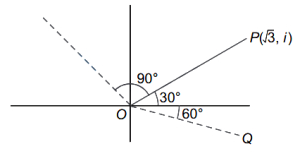
(A) Let $z = \sqrt{3}+i$. The modulus is $|z| = \sqrt{(\sqrt{3})^2 + 1^2} = 2$ and the argument is $\arg(z) = \tan^{-1}(\frac{1}{\sqrt{3}}) = 30^{\circ}$.
Since $OPQ$ is an isosceles right-angled triangle with $\angle POQ = 90^{\circ}$ and $OP = OQ$,the point $Q$ can be obtained by rotating $P$ by $90^{\circ}$ in either the clockwise or counter-clockwise direction.
If we rotate by $+90^{\circ}$,the argument of $Q$ is $30^{\circ} + 90^{\circ} = 120^{\circ}$. The complex number is $2(\cos 120^{\circ} + i\sin 120^{\circ}) = 2(-\frac{1}{2} + i\frac{\sqrt{3}}{2}) = -1 + i\sqrt{3}$.
If we rotate by $-90^{\circ}$,the argument of $Q$ is $30^{\circ} - 90^{\circ} = -60^{\circ}$. The complex number is $2(\cos(-60^{\circ}) + i\sin(-60^{\circ})) = 2(\frac{1}{2} - i\frac{\sqrt{3}}{2}) = 1 - i\sqrt{3}$.
Thus,$Q$ represents $-1+i\sqrt{3}$ or $1-i\sqrt{3}$.
Since $OPQ$ is an isosceles right-angled triangle with $\angle POQ = 90^{\circ}$ and $OP = OQ$,the point $Q$ can be obtained by rotating $P$ by $90^{\circ}$ in either the clockwise or counter-clockwise direction.
If we rotate by $+90^{\circ}$,the argument of $Q$ is $30^{\circ} + 90^{\circ} = 120^{\circ}$. The complex number is $2(\cos 120^{\circ} + i\sin 120^{\circ}) = 2(-\frac{1}{2} + i\frac{\sqrt{3}}{2}) = -1 + i\sqrt{3}$.
If we rotate by $-90^{\circ}$,the argument of $Q$ is $30^{\circ} - 90^{\circ} = -60^{\circ}$. The complex number is $2(\cos(-60^{\circ}) + i\sin(-60^{\circ})) = 2(\frac{1}{2} - i\frac{\sqrt{3}}{2}) = 1 - i\sqrt{3}$.
Thus,$Q$ represents $-1+i\sqrt{3}$ or $1-i\sqrt{3}$.
0 likesView Solution
7
MathematicsEasyMCQKCET · 2009
If $1+\sin x+\sin ^{2} x+\ldots$ up to $\infty = 4+2 \sqrt{3}$,where $0 < x < \pi$ and $x \neq \frac{\pi}{2}$,then $x$ is equal to
A
$\frac{\pi}{3}, \frac{5 \pi}{6}$
B
$\frac{2 \pi}{3}, \frac{\pi}{6}$
C
$\frac{\pi}{3}, \frac{2 \pi}{3}$
D
$\frac{\pi}{6}, \frac{\pi}{3}$
Solution
(C) The given expression is an infinite geometric series with first term $a = 1$ and common ratio $r = \sin x$.
Since the sum is $4+2 \sqrt{3}$,we use the formula $S = \frac{a}{1-r}$:
$\frac{1}{1-\sin x} = 4+2 \sqrt{3}$
$1-\sin x = \frac{1}{4+2 \sqrt{3}}$
Rationalizing the denominator:
$1-\sin x = \frac{4-2 \sqrt{3}}{(4+2 \sqrt{3})(4-2 \sqrt{3})} = \frac{4-2 \sqrt{3}}{16-12} = \frac{4-2 \sqrt{3}}{4} = 1 - \frac{\sqrt{3}}{2}$
Thus,$\sin x = \frac{\sqrt{3}}{2}$.
For $0 < x < \pi$,the values of $x$ satisfying $\sin x = \frac{\sqrt{3}}{2}$ are $x = \frac{\pi}{3}$ and $x = \pi - \frac{\pi}{3} = \frac{2 \pi}{3}$.
Since the sum is $4+2 \sqrt{3}$,we use the formula $S = \frac{a}{1-r}$:
$\frac{1}{1-\sin x} = 4+2 \sqrt{3}$
$1-\sin x = \frac{1}{4+2 \sqrt{3}}$
Rationalizing the denominator:
$1-\sin x = \frac{4-2 \sqrt{3}}{(4+2 \sqrt{3})(4-2 \sqrt{3})} = \frac{4-2 \sqrt{3}}{16-12} = \frac{4-2 \sqrt{3}}{4} = 1 - \frac{\sqrt{3}}{2}$
Thus,$\sin x = \frac{\sqrt{3}}{2}$.
For $0 < x < \pi$,the values of $x$ satisfying $\sin x = \frac{\sqrt{3}}{2}$ are $x = \frac{\pi}{3}$ and $x = \pi - \frac{\pi}{3} = \frac{2 \pi}{3}$.
0 likesView Solution
8
MathematicsMediumMCQKCET · 2009
If $n = (2020)!$,then the value of $\frac{1}{\log _{2} n} + \frac{1}{\log _{3} n} + \frac{1}{\log _{4} n} + \ldots + \frac{1}{\log _{2020} n}$ is equal to:
A
$2020$
B
$1$
C
$(2020)!$
D
$0$
Solution
(B) Using the property $\frac{1}{\log _{a} b} = \log _{b} a$,we can rewrite the expression as:
$\log _{n} 2 + \log _{n} 3 + \log _{n} 4 + \ldots + \log _{n} 2020$
Using the property $\log _{b} x + \log _{b} y = \log _{b} (xy)$,we get:
$\log _{n} (2 \times 3 \times 4 \times \ldots \times 2020)$
Since $n = (2020)!$,the expression becomes:
$\log _{n} (n) = 1$
$\log _{n} 2 + \log _{n} 3 + \log _{n} 4 + \ldots + \log _{n} 2020$
Using the property $\log _{b} x + \log _{b} y = \log _{b} (xy)$,we get:
$\log _{n} (2 \times 3 \times 4 \times \ldots \times 2020)$
Since $n = (2020)!$,the expression becomes:
$\log _{n} (n) = 1$
0 likesView Solution
9
MathematicsEasyMCQKCET · 2009
If $n$ is a positive integer,then $n^{3}+2n$ is divisible by
A
$2$
B
$6$
C
$15$
D
$3$
Solution
(D) Let $P(n) = n^{3} + 2n$.
For $n = 1$,$P(1) = 1^{3} + 2(1) = 1 + 2 = 3$.
For $n = 2$,$P(2) = 2^{3} + 2(2) = 8 + 4 = 12$.
For $n = 3$,$P(3) = 3^{3} + 2(3) = 27 + 6 = 33$.
We observe that $3, 12, 33$ are all divisible by $3$.
Alternatively,$n^{3} + 2n = n^{3} - n + 3n = n(n^{2} - 1) + 3n = (n-1)n(n+1) + 3n$.
Since $(n-1)n(n+1)$ is the product of three consecutive integers,it is always divisible by $3! = 6$.
However,the expression $n^{3} + 2n$ is always divisible by $3$ for any positive integer $n$.
For $n = 1$,$P(1) = 1^{3} + 2(1) = 1 + 2 = 3$.
For $n = 2$,$P(2) = 2^{3} + 2(2) = 8 + 4 = 12$.
For $n = 3$,$P(3) = 3^{3} + 2(3) = 27 + 6 = 33$.
We observe that $3, 12, 33$ are all divisible by $3$.
Alternatively,$n^{3} + 2n = n^{3} - n + 3n = n(n^{2} - 1) + 3n = (n-1)n(n+1) + 3n$.
Since $(n-1)n(n+1)$ is the product of three consecutive integers,it is always divisible by $3! = 6$.
However,the expression $n^{3} + 2n$ is always divisible by $3$ for any positive integer $n$.
0 likesView Solution
10
MathematicsEasyMCQKCET · 2009
The total number of terms in the expansion of $(x+y)^{100} + (x-y)^{100}$ after simplification is
A
$51$
B
$202$
C
$100$
D
$50$
Solution
(A) Let $f(x) = (x+y)^{100} + (x-y)^{100}$.
Using the binomial expansion,$(x+y)^{n} = \sum_{k=0}^{n} \binom{n}{k} x^{n-k} y^k$ and $(x-y)^{n} = \sum_{k=0}^{n} \binom{n}{k} x^{n-k} (-y)^k$.
Adding these,the odd terms cancel out,leaving only the even terms: $2 \sum_{k=0, 2, 4, \dots, n} \binom{n}{k} x^{n-k} y^k$.
For $n = 100$,the number of terms is $\frac{n}{2} + 1 = \frac{100}{2} + 1 = 51$.
Using the binomial expansion,$(x+y)^{n} = \sum_{k=0}^{n} \binom{n}{k} x^{n-k} y^k$ and $(x-y)^{n} = \sum_{k=0}^{n} \binom{n}{k} x^{n-k} (-y)^k$.
Adding these,the odd terms cancel out,leaving only the even terms: $2 \sum_{k=0, 2, 4, \dots, n} \binom{n}{k} x^{n-k} y^k$.
For $n = 100$,the number of terms is $\frac{n}{2} + 1 = \frac{100}{2} + 1 = 51$.
0 likesView Solution
11
MathematicsMediumMCQKCET · 2009
The digit in the unit place of the number $2009! + 3^{7886}$ is
A
$7$
B
$3$
C
$1$
D
$9$
Solution
(D) The digit in the unit place of $2009!$ is $0$ because $2009!$ contains factors $2$ and $5$,making it a multiple of $10$.
Now,consider the powers of $3$:
$3^1 = 3$
$3^2 = 9$
$3^3 = 27$
$3^4 = 81$
The unit digits follow a cycle of $4$: $(3, 9, 7, 1)$.
We divide the exponent $7886$ by $4$:
$7886 = 4 \times 1971 + 2$.
Thus,the unit digit of $3^{7886}$ is the same as the unit digit of $3^2$,which is $9$.
Therefore,the unit digit of $2009! + 3^{7886}$ is $0 + 9 = 9$.
Now,consider the powers of $3$:
$3^1 = 3$
$3^2 = 9$
$3^3 = 27$
$3^4 = 81$
The unit digits follow a cycle of $4$: $(3, 9, 7, 1)$.
We divide the exponent $7886$ by $4$:
$7886 = 4 \times 1971 + 2$.
Thus,the unit digit of $3^{7886}$ is the same as the unit digit of $3^2$,which is $9$.
Therefore,the unit digit of $2009! + 3^{7886}$ is $0 + 9 = 9$.
0 likesView Solution
12
MathematicsEasyMCQKCET · 2009
If $f(x) = 1 + nx + \frac{n(n-1)}{2} x^{2} + \frac{n(n-1)(n-2)}{6} x^{3} + \ldots + x^{n}$,then $f^{\prime \prime}(1)$ is equal to
A
$n(n-1) 2^{n-1}$
B
$(n-1) 2^{n-1}$
C
$n(n-1) 2^{n-2}$
D
$n(n-1) 2^{n}$
Solution
(C) Given the expression for $f(x)$ is the binomial expansion of $(1+x)^{n}$.
$f(x) = (1+x)^{n}$
Taking the first derivative with respect to $x$:
$f^{\prime}(x) = n(1+x)^{n-1}$
Taking the second derivative with respect to $x$:
$f^{\prime \prime}(x) = n(n-1)(1+x)^{n-2}$
Substituting $x = 1$:
$f^{\prime \prime}(1) = n(n-1)(1+1)^{n-2}$
$f^{\prime \prime}(1) = n(n-1) 2^{n-2}$
$f(x) = (1+x)^{n}$
Taking the first derivative with respect to $x$:
$f^{\prime}(x) = n(1+x)^{n-1}$
Taking the second derivative with respect to $x$:
$f^{\prime \prime}(x) = n(n-1)(1+x)^{n-2}$
Substituting $x = 1$:
$f^{\prime \prime}(1) = n(n-1)(1+1)^{n-2}$
$f^{\prime \prime}(1) = n(n-1) 2^{n-2}$
0 likesView Solution
13
MathematicsEasyMCQKCET · 2009
Which one of the following is possible?
A
$\sin \theta = \frac{a^{2}+b^{2}}{a^{2}-b^{2}}, (a \neq b)$
B
$\sec \theta = \frac{4}{5}$
C
$\tan \theta = 45$
D
$\cos \theta = \frac{7}{3}$
Solution
(C) The range of $\sin \theta$ and $\cos \theta$ is $[-1, 1]$. The range of $\sec \theta$ is $(-\infty, -1] \cup [1, \infty)$. The range of $\tan \theta$ is $(-\infty, \infty)$.
$(a)$ For $\sin \theta = \frac{a^{2}+b^{2}}{a^{2}-b^{2}}$,if we take $a=2, b=1$,then $\sin \theta = \frac{5}{3} > 1$,which is impossible.
$(b)$ For $\sec \theta = \frac{4}{5} = 0.8$,which is impossible since $|sec \theta| \geq 1$.
$(c)$ For $\tan \theta = 45$,this is possible as the range of $\tan \theta$ is all real numbers.
$(d)$ For $\cos \theta = \frac{7}{3} > 1$,which is impossible.
Therefore,option $(c)$ is correct.
$(a)$ For $\sin \theta = \frac{a^{2}+b^{2}}{a^{2}-b^{2}}$,if we take $a=2, b=1$,then $\sin \theta = \frac{5}{3} > 1$,which is impossible.
$(b)$ For $\sec \theta = \frac{4}{5} = 0.8$,which is impossible since $|sec \theta| \geq 1$.
$(c)$ For $\tan \theta = 45$,this is possible as the range of $\tan \theta$ is all real numbers.
$(d)$ For $\cos \theta = \frac{7}{3} > 1$,which is impossible.
Therefore,option $(c)$ is correct.
0 likesView Solution
14
MathematicsMediumMCQKCET · 2009
$3(\sin x-\cos x)^{4}+6(\sin x+\cos x)^{2}+4(\sin ^{6} x+\cos ^{6} x)$ is equal to
A
$12$
B
$13$
C
$14$
D
$11$
Solution
(B) Let $f(x) = 3(\sin x-\cos x)^{4}+6(\sin x+\cos x)^{2}+4(\sin ^{6} x+\cos ^{6} x)$.
First,simplify each term:
$3(\sin x-\cos x)^{4} = 3(1-2\sin x\cos x)^{2} = 3(1+4\sin^{2}x\cos^{2}x-4\sin x\cos x) = 3+12\sin^{2}x\cos^{2}x-12\sin x\cos x$.
$6(\sin x+\cos x)^{2} = 6(1+2\sin x\cos x) = 6+12\sin x\cos x$.
$4(\sin^{6}x+\cos^{6}x) = 4(\sin^{2}x+\cos^{2}x)(\sin^{4}x+\cos^{4}x-\sin^{2}x\cos^{2}x) = 4(1)((\sin^{2}x+\cos^{2}x)^{2}-3\sin^{2}x\cos^{2}x) = 4(1-3\sin^{2}x\cos^{2}x) = 4-12\sin^{2}x\cos^{2}x$.
Summing these up:
$f(x) = (3+12\sin^{2}x\cos^{2}x-12\sin x\cos x) + (6+12\sin x\cos x) + (4-12\sin^{2}x\cos^{2}x)$.
$f(x) = 3+6+4 + (12\sin^{2}x\cos^{2}x-12\sin^{2}x\cos^{2}x) + (-12\sin x\cos x+12\sin x\cos x) = 13$.
First,simplify each term:
$3(\sin x-\cos x)^{4} = 3(1-2\sin x\cos x)^{2} = 3(1+4\sin^{2}x\cos^{2}x-4\sin x\cos x) = 3+12\sin^{2}x\cos^{2}x-12\sin x\cos x$.
$6(\sin x+\cos x)^{2} = 6(1+2\sin x\cos x) = 6+12\sin x\cos x$.
$4(\sin^{6}x+\cos^{6}x) = 4(\sin^{2}x+\cos^{2}x)(\sin^{4}x+\cos^{4}x-\sin^{2}x\cos^{2}x) = 4(1)((\sin^{2}x+\cos^{2}x)^{2}-3\sin^{2}x\cos^{2}x) = 4(1-3\sin^{2}x\cos^{2}x) = 4-12\sin^{2}x\cos^{2}x$.
Summing these up:
$f(x) = (3+12\sin^{2}x\cos^{2}x-12\sin x\cos x) + (6+12\sin x\cos x) + (4-12\sin^{2}x\cos^{2}x)$.
$f(x) = 3+6+4 + (12\sin^{2}x\cos^{2}x-12\sin^{2}x\cos^{2}x) + (-12\sin x\cos x+12\sin x\cos x) = 13$.
0 likesView Solution
15
MathematicsEasyMCQKCET · 2009
The angle between the pair of lines $x^{2}+2xy-y^{2}=0$ is
A
$\frac{\pi}{6}$
B
$\frac{\pi}{2}$
C
$0$
D
$\frac{\pi}{3}$
Solution
(B) The given equation of the pair of lines is $x^{2}+2xy-y^{2}=0$.
Comparing this with the general form $ax^{2}+2hxy+by^{2}=0$,we get $a=1$,$h=1$,and $b=-1$.
We know that the lines represented by $ax^{2}+2hxy+by^{2}=0$ are perpendicular if $a+b=0$.
Here,$a+b = 1 + (-1) = 0$.
Since the sum of the coefficients of $x^{2}$ and $y^{2}$ is zero,the lines are perpendicular to each other.
Therefore,the angle between the lines is $\frac{\pi}{2}$.
Comparing this with the general form $ax^{2}+2hxy+by^{2}=0$,we get $a=1$,$h=1$,and $b=-1$.
We know that the lines represented by $ax^{2}+2hxy+by^{2}=0$ are perpendicular if $a+b=0$.
Here,$a+b = 1 + (-1) = 0$.
Since the sum of the coefficients of $x^{2}$ and $y^{2}$ is zero,the lines are perpendicular to each other.
Therefore,the angle between the lines is $\frac{\pi}{2}$.
0 likesView Solution
16
MathematicsMediumMCQKCET · 2009
The vertices of a triangle are $(6,0), (0,6)$ and $(6,6)$. The distance between its circumcentre and centroid is
A
$2$
B
$\sqrt{2}$
C
$1$
D
$2\sqrt{2}$
Solution
(B) Let the vertices of the triangle be $A(6,0), B(0,6)$ and $C(6,6)$.
First,we calculate the lengths of the sides:
$AB = \sqrt{(0-6)^2 + (6-0)^2} = \sqrt{36+36} = 6\sqrt{2}$
$BC = \sqrt{(6-0)^2 + (6-6)^2} = \sqrt{36+0} = 6$
$CA = \sqrt{(6-6)^2 + (0-6)^2} = \sqrt{0+36} = 6$
Since $AB^2 = BC^2 + CA^2$ $(72 = 36 + 36)$,the triangle is a right-angled triangle at vertex $C(6,6)$.
For a right-angled triangle,the circumcentre is the midpoint of the hypotenuse $AB$.
Circumcentre $O = \left(\frac{6+0}{2}, \frac{0+6}{2}\right) = (3,3)$.
The centroid $G$ is given by $\left(\frac{x_1+x_2+x_3}{3}, \frac{y_1+y_2+y_3}{3}\right) = \left(\frac{6+0+6}{3}, \frac{0+6+6}{3}\right) = (4,4)$.
The distance between the circumcentre $(3,3)$ and the centroid $(4,4)$ is $\sqrt{(4-3)^2 + (4-3)^2} = \sqrt{1^2 + 1^2} = \sqrt{2}$.
First,we calculate the lengths of the sides:
$AB = \sqrt{(0-6)^2 + (6-0)^2} = \sqrt{36+36} = 6\sqrt{2}$
$BC = \sqrt{(6-0)^2 + (6-6)^2} = \sqrt{36+0} = 6$
$CA = \sqrt{(6-6)^2 + (0-6)^2} = \sqrt{0+36} = 6$
Since $AB^2 = BC^2 + CA^2$ $(72 = 36 + 36)$,the triangle is a right-angled triangle at vertex $C(6,6)$.
For a right-angled triangle,the circumcentre is the midpoint of the hypotenuse $AB$.
Circumcentre $O = \left(\frac{6+0}{2}, \frac{0+6}{2}\right) = (3,3)$.
The centroid $G$ is given by $\left(\frac{x_1+x_2+x_3}{3}, \frac{y_1+y_2+y_3}{3}\right) = \left(\frac{6+0+6}{3}, \frac{0+6+6}{3}\right) = (4,4)$.
The distance between the circumcentre $(3,3)$ and the centroid $(4,4)$ is $\sqrt{(4-3)^2 + (4-3)^2} = \sqrt{1^2 + 1^2} = \sqrt{2}$.
0 likesView Solution
17
MathematicsEasyMCQKCET · 2009
The foot of the perpendicular from the point $(2,4)$ upon the line $x+y=4$ is:
A
$(2,2)$
B
$(4,0)$
C
$(1,3)$
D
$(3,-1)$
Solution
(C) Let the given line be $L_1: x+y=4$. The slope of $L_1$ is $m_1 = -1$.
The slope of the line $L_2$ perpendicular to $L_1$ is $m_2 = -\frac{1}{m_1} = 1$.
The equation of the line $L_2$ passing through $(2,4)$ is $y-4 = 1(x-2)$,which simplifies to $y-x=2$.
To find the foot of the perpendicular,we solve the system of equations:
$x+y=4$
$y-x=2$
Adding the two equations: $2y = 6 \Rightarrow y=3$.
Substituting $y=3$ into $x+y=4$,we get $x+3=4 \Rightarrow x=1$.
Thus,the foot of the perpendicular is $(1,3)$.
The slope of the line $L_2$ perpendicular to $L_1$ is $m_2 = -\frac{1}{m_1} = 1$.
The equation of the line $L_2$ passing through $(2,4)$ is $y-4 = 1(x-2)$,which simplifies to $y-x=2$.
To find the foot of the perpendicular,we solve the system of equations:
$x+y=4$
$y-x=2$
Adding the two equations: $2y = 6 \Rightarrow y=3$.
Substituting $y=3$ into $x+y=4$,we get $x+3=4 \Rightarrow x=1$.
Thus,the foot of the perpendicular is $(1,3)$.
0 likesView Solution
18
MathematicsMediumMCQKCET · 2009
The coordinates of the centre of the smallest circle passing through the origin and having $y=x+1$ as a diameter are
A
$\left(\frac{1}{2}, -\frac{1}{2}\right)$
B
$\left(\frac{1}{2}, \frac{1}{3}\right)$
C
$(-1, 0)$
D
$\left(-\frac{1}{2}, \frac{1}{2}\right)$
Solution
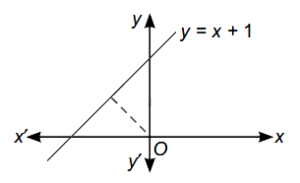
(D) For the smallest circle passing through the origin $(0, 0)$ with a diameter lying on the line $y = x + 1$,the centre of the circle must be the projection of the origin onto the line $y = x + 1$.
The line $y = x + 1$ can be written as $x - y + 1 = 0$.
The line perpendicular to $x - y + 1 = 0$ passing through the origin $(0, 0)$ has the form $x + y = k$.
Since it passes through $(0, 0)$,we have $0 + 0 = k$,so $k = 0$.
The perpendicular line is $x + y = 0$,or $y = -x$.
To find the centre,we find the intersection of $y = x + 1$ and $y = -x$.
Substituting $y = -x$ into $y = x + 1$,we get $-x = x + 1$,which implies $2x = -1$,so $x = -\frac{1}{2}$.
Then $y = -(-\frac{1}{2}) = \frac{1}{2}$.
Thus,the centre of the circle is $\left(-\frac{1}{2}, \frac{1}{2}\right)$.
The line $y = x + 1$ can be written as $x - y + 1 = 0$.
The line perpendicular to $x - y + 1 = 0$ passing through the origin $(0, 0)$ has the form $x + y = k$.
Since it passes through $(0, 0)$,we have $0 + 0 = k$,so $k = 0$.
The perpendicular line is $x + y = 0$,or $y = -x$.
To find the centre,we find the intersection of $y = x + 1$ and $y = -x$.
Substituting $y = -x$ into $y = x + 1$,we get $-x = x + 1$,which implies $2x = -1$,so $x = -\frac{1}{2}$.
Then $y = -(-\frac{1}{2}) = \frac{1}{2}$.
Thus,the centre of the circle is $\left(-\frac{1}{2}, \frac{1}{2}\right)$.
0 likesView Solution
19
MathematicsEasyMCQKCET · 2009
$A$ cow is tied to a post by a rope. The cow moves along a circular path,always keeping the rope tight. If it describes an arc of $44 \ m$ when it has traced out $72^{\circ}$ at the centre,the length of the rope is: (in $m$)
A
$22$
B
$56$
C
$45$
D
$35$
Solution
(D) The length of the arc $s$ is given by the formula: $s = 2 \pi r \times \frac{\theta}{360^{\circ}}$
Given $s = 44 \ m$ and $\theta = 72^{\circ}$.
Substituting the values: $44 = 2 \times \frac{22}{7} \times r \times \frac{72}{360^{\circ}}$
Simplifying the fraction: $\frac{72}{360} = \frac{1}{5}$
So,$44 = 2 \times \frac{22}{7} \times r \times \frac{1}{5}$
$44 = \frac{44}{35} \times r$
$r = \frac{44 \times 35}{44} = 35 \ m$
Thus,the length of the rope is $35 \ m$.
Given $s = 44 \ m$ and $\theta = 72^{\circ}$.
Substituting the values: $44 = 2 \times \frac{22}{7} \times r \times \frac{72}{360^{\circ}}$
Simplifying the fraction: $\frac{72}{360} = \frac{1}{5}$
So,$44 = 2 \times \frac{22}{7} \times r \times \frac{1}{5}$
$44 = \frac{44}{35} \times r$
$r = \frac{44 \times 35}{44} = 35 \ m$
Thus,the length of the rope is $35 \ m$.
0 likesView Solution
20
MathematicsDifficultMCQKCET · 2009
The locus of the midpoints of the chords of the circle $x^{2}+y^{2}=4$ which subtend a right angle at the origin is
A
$x^{2}+y^{2}=1$
B
$x^{2}+y^{2}=2$
C
$x+y=1$
D
$x+y=2$
Solution
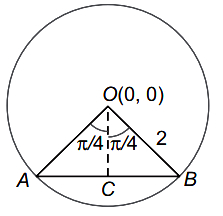
(B) Let the midpoint of the chord $AB$ be $C(x_{1}, y_{1})$. The origin is $O(0, 0)$.
Since the chord $AB$ subtends a right angle at the origin,$\angle AOB = 90^{\circ}$.
In $\Delta OAB$,$OA = OB = r = 2$ (radius of the circle).
Since $C$ is the midpoint of $AB$,$OC \perp AB$.
In $\Delta OCB$,$\angle COB = \frac{1}{2} \angle AOB = 45^{\circ}$.
Using trigonometry in $\Delta OCB$:
$\cos(45^{\circ}) = \frac{OC}{OB}$
$\frac{1}{\sqrt{2}} = \frac{\sqrt{x_{1}^{2} + y_{1}^{2}}}{2}$
Squaring both sides:
$\frac{1}{2} = \frac{x_{1}^{2} + y_{1}^{2}}{4}$
$x_{1}^{2} + y_{1}^{2} = 2$
Replacing $(x_{1}, y_{1})$ with $(x, y)$,the locus is $x^{2} + y^{2} = 2$.
Since the chord $AB$ subtends a right angle at the origin,$\angle AOB = 90^{\circ}$.
In $\Delta OAB$,$OA = OB = r = 2$ (radius of the circle).
Since $C$ is the midpoint of $AB$,$OC \perp AB$.
In $\Delta OCB$,$\angle COB = \frac{1}{2} \angle AOB = 45^{\circ}$.
Using trigonometry in $\Delta OCB$:
$\cos(45^{\circ}) = \frac{OC}{OB}$
$\frac{1}{\sqrt{2}} = \frac{\sqrt{x_{1}^{2} + y_{1}^{2}}}{2}$
Squaring both sides:
$\frac{1}{2} = \frac{x_{1}^{2} + y_{1}^{2}}{4}$
$x_{1}^{2} + y_{1}^{2} = 2$
Replacing $(x_{1}, y_{1})$ with $(x, y)$,the locus is $x^{2} + y^{2} = 2$.
0 likesView Solution
21
MathematicsMediumMCQKCET · 2009
The length of the chord joining the points $(4 \cos \theta, 4 \sin \theta)$ and $(4 \cos (\theta+60^{\circ}), 4 \sin (\theta+60^{\circ}))$ of the circle $x^{2}+y^{2}=16$ is
A
$4$
B
$8$
C
$16$
D
$2$
Solution
(A) The points are $P = (4 \cos \theta, 4 \sin \theta)$ and $Q = (4 \cos (\theta+60^{\circ}), 4 \sin (\theta+60^{\circ}))$.
Using the distance formula,the length of the chord $PQ$ is given by:
$PQ = \sqrt{(4 \cos (\theta+60^{\circ}) - 4 \cos \theta)^2 + (4 \sin (\theta+60^{\circ}) - 4 \sin \theta)^2}$
$PQ = 4 \sqrt{(\cos (\theta+60^{\circ}) - \cos \theta)^2 + (\sin (\theta+60^{\circ}) - \sin \theta)^2}$
$PQ = 4 \sqrt{\cos^2 (\theta+60^{\circ}) + \cos^2 \theta - 2 \cos (\theta+60^{\circ}) \cos \theta + \sin^2 (\theta+60^{\circ}) + \sin^2 \theta - 2 \sin (\theta+60^{\circ}) \sin \theta}$
Using $\sin^2 A + \cos^2 A = 1$:
$PQ = 4 \sqrt{1 + 1 - 2 (\cos (\theta+60^{\circ}) \cos \theta + \sin (\theta+60^{\circ}) \sin \theta)}$
Using $\cos (A-B) = \cos A \cos B + \sin A \sin B$:
$PQ = 4 \sqrt{2 - 2 \cos ((\theta+60^{\circ}) - \theta)}$
$PQ = 4 \sqrt{2 - 2 \cos 60^{\circ}}$
Since $\cos 60^{\circ} = \frac{1}{2}$:
$PQ = 4 \sqrt{2 - 2 \times \frac{1}{2}} = 4 \sqrt{2 - 1} = 4 \times 1 = 4$.
Using the distance formula,the length of the chord $PQ$ is given by:
$PQ = \sqrt{(4 \cos (\theta+60^{\circ}) - 4 \cos \theta)^2 + (4 \sin (\theta+60^{\circ}) - 4 \sin \theta)^2}$
$PQ = 4 \sqrt{(\cos (\theta+60^{\circ}) - \cos \theta)^2 + (\sin (\theta+60^{\circ}) - \sin \theta)^2}$
$PQ = 4 \sqrt{\cos^2 (\theta+60^{\circ}) + \cos^2 \theta - 2 \cos (\theta+60^{\circ}) \cos \theta + \sin^2 (\theta+60^{\circ}) + \sin^2 \theta - 2 \sin (\theta+60^{\circ}) \sin \theta}$
Using $\sin^2 A + \cos^2 A = 1$:
$PQ = 4 \sqrt{1 + 1 - 2 (\cos (\theta+60^{\circ}) \cos \theta + \sin (\theta+60^{\circ}) \sin \theta)}$
Using $\cos (A-B) = \cos A \cos B + \sin A \sin B$:
$PQ = 4 \sqrt{2 - 2 \cos ((\theta+60^{\circ}) - \theta)}$
$PQ = 4 \sqrt{2 - 2 \cos 60^{\circ}}$
Since $\cos 60^{\circ} = \frac{1}{2}$:
$PQ = 4 \sqrt{2 - 2 \times \frac{1}{2}} = 4 \sqrt{2 - 1} = 4 \times 1 = 4$.
0 likesView Solution
22
MathematicsDifficultMCQKCET · 2009
The length of the diameter of the circle which cuts the following three circles orthogonally is:
$x^{2}+y^{2}-x-y-14=0$
$x^{2}+y^{2}+3x-5y-10=0$
$x^{2}+y^{2}-2x+3y-27=0$
$x^{2}+y^{2}-x-y-14=0$
$x^{2}+y^{2}+3x-5y-10=0$
$x^{2}+y^{2}-2x+3y-27=0$
A
$8$
B
$6$
C
$4$
D
$2$
Solution
(C) Let the equation of the required circle be $x^{2}+y^{2}+2gx+2fy+c=0$.
Two circles $x^{2}+y^{2}+2g_{1}x+2f_{1}y+c_{1}=0$ and $x^{2}+y^{2}+2g_{2}x+2f_{2}y+c_{2}=0$ cut orthogonally if $2g_{1}g_{2}+2f_{1}f_{2}=c_{1}+c_{2}$.
For the given circles,the conditions are:
$1) -g-f = c-14 \implies -g-f-c = -14$
$2) 3g-5f = c-10 \implies 3g-5f-c = -10$
$3) -2g+3f = c-27 \implies -2g+3f-c = -27$
Subtracting $(1)$ from $(2)$: $4g-4f = 4 \implies g-f = 1 \implies g = f+1$.
Subtracting $(1)$ from $(3)$: $-g+4f = -13$.
Substituting $g = f+1$: $-(f+1)+4f = -13 \implies 3f = -12 \implies f = -4$.
Then $g = -4+1 = -3$.
From $(1)$: $-(-3)-(-4) = c-14 \implies 3+4 = c-14 \implies c = 21$.
The circle is $x^{2}+y^{2}-6x-8y+21=0$.
The radius $r = \sqrt{g^{2}+f^{2}-c} = \sqrt{(-3)^{2}+(-4)^{2}-21} = \sqrt{9+16-21} = \sqrt{4} = 2$.
The diameter is $2r = 2 \times 2 = 4$.
Two circles $x^{2}+y^{2}+2g_{1}x+2f_{1}y+c_{1}=0$ and $x^{2}+y^{2}+2g_{2}x+2f_{2}y+c_{2}=0$ cut orthogonally if $2g_{1}g_{2}+2f_{1}f_{2}=c_{1}+c_{2}$.
For the given circles,the conditions are:
$1) -g-f = c-14 \implies -g-f-c = -14$
$2) 3g-5f = c-10 \implies 3g-5f-c = -10$
$3) -2g+3f = c-27 \implies -2g+3f-c = -27$
Subtracting $(1)$ from $(2)$: $4g-4f = 4 \implies g-f = 1 \implies g = f+1$.
Subtracting $(1)$ from $(3)$: $-g+4f = -13$.
Substituting $g = f+1$: $-(f+1)+4f = -13 \implies 3f = -12 \implies f = -4$.
Then $g = -4+1 = -3$.
From $(1)$: $-(-3)-(-4) = c-14 \implies 3+4 = c-14 \implies c = 21$.
The circle is $x^{2}+y^{2}-6x-8y+21=0$.
The radius $r = \sqrt{g^{2}+f^{2}-c} = \sqrt{(-3)^{2}+(-4)^{2}-21} = \sqrt{9+16-21} = \sqrt{4} = 2$.
The diameter is $2r = 2 \times 2 = 4$.
0 likesView Solution
23
MathematicsMediumMCQKCET · 2009
The number of common tangents to the circles $x^{2}+y^{2}-y=0$ and $x^{2}+y^{2}+y=0$ is
A
$2$
B
$3$
C
$0$
D
$1$
Solution
(B) The given circles are $x^{2}+y^{2}-y=0$ and $x^{2}+y^{2}+y=0$.
For the first circle $x^{2}+y^{2}-y=0$,the center is $C_{1}(0, 1/2)$ and radius $r_{1} = \sqrt{0^{2} + (1/2)^{2} - 0} = 1/2$.
For the second circle $x^{2}+y^{2}+y=0$,the center is $C_{2}(0, -1/2)$ and radius $r_{2} = \sqrt{0^{2} + (-1/2)^{2} - 0} = 1/2$.
The distance between the centers is $C_{1}C_{2} = \sqrt{(0-0)^{2} + (1/2 - (-1/2))^{2}} = \sqrt{1^{2}} = 1$.
Since $r_{1} + r_{2} = 1/2 + 1/2 = 1$,we have $C_{1}C_{2} = r_{1} + r_{2}$.
This condition implies that the two circles touch each other externally at a single point.
When two circles touch each other externally,they have exactly $3$ common tangents (two external and one internal).
For the first circle $x^{2}+y^{2}-y=0$,the center is $C_{1}(0, 1/2)$ and radius $r_{1} = \sqrt{0^{2} + (1/2)^{2} - 0} = 1/2$.
For the second circle $x^{2}+y^{2}+y=0$,the center is $C_{2}(0, -1/2)$ and radius $r_{2} = \sqrt{0^{2} + (-1/2)^{2} - 0} = 1/2$.
The distance between the centers is $C_{1}C_{2} = \sqrt{(0-0)^{2} + (1/2 - (-1/2))^{2}} = \sqrt{1^{2}} = 1$.
Since $r_{1} + r_{2} = 1/2 + 1/2 = 1$,we have $C_{1}C_{2} = r_{1} + r_{2}$.
This condition implies that the two circles touch each other externally at a single point.
When two circles touch each other externally,they have exactly $3$ common tangents (two external and one internal).
0 likesView Solution
24
MathematicsMediumMCQKCET · 2009
If the circle $x^{2}+y^{2}=a^{2}$ intersects the hyperbola $xy=c^{2}$ in four points $P(x_{1}, y_{1}), Q(x_{2}, y_{2}), R(x_{3}, y_{3})$ and $S(x_{4}, y_{4})$,then
A
$y_{1}+y_{2}+y_{3}+y_{4}=2$
B
$x_{1} x_{2} x_{3} x_{4}=2 c^{4}$
C
$y_{1} y_{2} y_{3} y_{4}=2 c^{4}$
D
$x_{1}+x_{2}+x_{3}+x_{4}=0$
Solution
(D) Given equations are $x^{2}+y^{2}=a^{2}$ and $xy=c^{2}$.
Substituting $y = \frac{c^{2}}{x}$ into the circle equation:
$x^{2} + (\frac{c^{2}}{x})^{2} = a^{2}$
$x^{2} + \frac{c^{4}}{x^{2}} = a^{2}$
$x^{4} - a^{2}x^{2} + c^{4} = 0$
This is a biquadratic equation in $x$. The roots are $x_{1}, x_{2}, x_{3}, x_{4}$.
Comparing this with the standard form $Ax^{4} + Bx^{3} + Cx^{2} + Dx + E = 0$,we have $B=0$.
By Vieta's formulas,the sum of the roots $x_{1}+x_{2}+x_{3}+x_{4} = -\frac{B}{A} = 0$.
Substituting $y = \frac{c^{2}}{x}$ into the circle equation:
$x^{2} + (\frac{c^{2}}{x})^{2} = a^{2}$
$x^{2} + \frac{c^{4}}{x^{2}} = a^{2}$
$x^{4} - a^{2}x^{2} + c^{4} = 0$
This is a biquadratic equation in $x$. The roots are $x_{1}, x_{2}, x_{3}, x_{4}$.
Comparing this with the standard form $Ax^{4} + Bx^{3} + Cx^{2} + Dx + E = 0$,we have $B=0$.
By Vieta's formulas,the sum of the roots $x_{1}+x_{2}+x_{3}+x_{4} = -\frac{B}{A} = 0$.
0 likesView Solution
25
MathematicsMediumMCQKCET · 2009
For the parabola $y^{2} = 4x$,the point $P$ whose focal distance is $17$ is
A
$(8, 8)$ or $(8, -8)$
B
$(4, 8)$ or $(4, -8)$
C
$(2, 8)$ or $(2, -8)$
D
$(16, 8)$ or $(16, -8)$
Solution
(D) The equation of the parabola is $y^{2} = 4x$. Comparing this with $y^{2} = 4ax$,we get $a = 1$.
For any point $P(x, y)$ on the parabola,the focal distance is given by $x + a$.
Given that the focal distance is $17$,we have $x + 1 = 17$,which implies $x = 16$.
Substituting $x = 16$ into the parabola equation: $y^{2} = 4(16) = 64$.
Thus,$y = \pm 8$.
Therefore,the required points are $(16, 8)$ or $(16, -8)$.
For any point $P(x, y)$ on the parabola,the focal distance is given by $x + a$.
Given that the focal distance is $17$,we have $x + 1 = 17$,which implies $x = 16$.
Substituting $x = 16$ into the parabola equation: $y^{2} = 4(16) = 64$.
Thus,$y = \pm 8$.
Therefore,the required points are $(16, 8)$ or $(16, -8)$.
0 likesView Solution
26
MathematicsEasyMCQKCET · 2009
The number of values of $c$ such that the line $y=4x+c$ touches the curve $\frac{x^{2}}{4}+y^{2}=1$ is
A
$1$
B
$2$
C
$\infty$
D
$0$
Solution
(B) The equation of the ellipse is $\frac{x^{2}}{4}+y^{2}=1$,where $a^{2}=4$ and $b^{2}=1$.
The equation of the line is $y=mx+c$,where $m=4$.
The condition for the line $y=mx+c$ to be tangent to the ellipse $\frac{x^{2}}{a^{2}}+\frac{y^{2}}{b^{2}}=1$ is $c^{2}=a^{2}m^{2}+b^{2}$.
Substituting the values,we get $c^{2}=4(4)^{2}+1$.
$c^{2}=4(16)+1=64+1=65$.
Therefore,$c=\pm \sqrt{65}$.
Since there are two possible values for $c$,the line touches the curve for $2$ values of $c$.
The equation of the line is $y=mx+c$,where $m=4$.
The condition for the line $y=mx+c$ to be tangent to the ellipse $\frac{x^{2}}{a^{2}}+\frac{y^{2}}{b^{2}}=1$ is $c^{2}=a^{2}m^{2}+b^{2}$.
Substituting the values,we get $c^{2}=4(4)^{2}+1$.
$c^{2}=4(16)+1=64+1=65$.
Therefore,$c=\pm \sqrt{65}$.
Since there are two possible values for $c$,the line touches the curve for $2$ values of $c$.
0 likesView Solution
27
MathematicsDifficultMCQKCET · 2009
The angle between the tangents drawn to the parabola $y^{2}=12x$ from the point $(-3, 2)$ is (in $^{\circ}$)
A
$90$
B
$60$
C
$30$
D
$45$
Solution
(A) The equation of the parabola is $y^{2} = 12x$,which is of the form $y^{2} = 4ax$,where $a = 3$.
For any point $(x_{1}, y_{1})$,the pair of tangents is given by $SS_{1} = T^{2}$.
Here,$S = y^{2} - 12x$,$S_{1} = (2)^{2} - 12(-3) = 4 + 36 = 40$,and $T = y(2) - 6(x - 3) = 2y - 6x + 18$.
Substituting these into the formula:
$(y^{2} - 12x)(40) = (2y - 6x + 18)^{2}$
$40y^{2} - 480x = 4(y - 3x + 9)^{2}$
$10y^{2} - 120x = y^{2} + 9x^{2} + 81 - 6xy - 54x + 18y$
$9x^{2} - 9y^{2} - 6xy + 66x + 18y + 81 = 0$.
For a general second-degree equation $Ax^{2} + 2Hxy + By^{2} + 2Gx + 2Fy + C = 0$,the angle $\theta$ between the lines is given by $\tan \theta = \left| \frac{2\sqrt{H^{2} - AB}}{A + B} \right|$.
Here,$A = 9$,$B = -9$,and $H = -3$.
Since $A + B = 9 + (-9) = 0$,the lines are perpendicular.
Therefore,the angle between the tangents is $90^{\circ}$.
For any point $(x_{1}, y_{1})$,the pair of tangents is given by $SS_{1} = T^{2}$.
Here,$S = y^{2} - 12x$,$S_{1} = (2)^{2} - 12(-3) = 4 + 36 = 40$,and $T = y(2) - 6(x - 3) = 2y - 6x + 18$.
Substituting these into the formula:
$(y^{2} - 12x)(40) = (2y - 6x + 18)^{2}$
$40y^{2} - 480x = 4(y - 3x + 9)^{2}$
$10y^{2} - 120x = y^{2} + 9x^{2} + 81 - 6xy - 54x + 18y$
$9x^{2} - 9y^{2} - 6xy + 66x + 18y + 81 = 0$.
For a general second-degree equation $Ax^{2} + 2Hxy + By^{2} + 2Gx + 2Fy + C = 0$,the angle $\theta$ between the lines is given by $\tan \theta = \left| \frac{2\sqrt{H^{2} - AB}}{A + B} \right|$.
Here,$A = 9$,$B = -9$,and $H = -3$.
Since $A + B = 9 + (-9) = 0$,the lines are perpendicular.
Therefore,the angle between the tangents is $90^{\circ}$.
0 likesView Solution
28
MathematicsEasyMCQKCET · 2009
$\lim _{n \rightarrow \infty} \frac{3 \cdot 2^{n+1}-4 \cdot 5^{n+1}}{5 \cdot 2^{n}+7 \cdot 5^{n}}$ is equal to
A
$\frac{3}{5}$
B
$-\frac{4}{7}$
C
$-\frac{20}{7}$
D
$0$
Solution
(C) To evaluate the limit $\lim _{n \rightarrow \infty} \frac{3 \cdot 2^{n+1}-4 \cdot 5^{n+1}}{5 \cdot 2^{n}+7 \cdot 5^{n}}$,we divide the numerator and the denominator by $5^n$:
$\lim _{n \rightarrow \infty} \frac{3 \cdot 2 \cdot 2^{n} - 4 \cdot 5 \cdot 5^{n}}{5 \cdot 2^{n} + 7 \cdot 5^{n}}$
$= \lim _{n \rightarrow \infty} \frac{6 \cdot 2^{n} - 20 \cdot 5^{n}}{5 \cdot 2^{n} + 7 \cdot 5^{n}}$
Dividing by $5^n$:
$= \lim _{n \rightarrow \infty} \frac{6 \cdot (\frac{2}{5})^{n} - 20}{5 \cdot (\frac{2}{5})^{n} + 7}$
Since $\lim _{n \rightarrow \infty} (\frac{2}{5})^{n} = 0$,we get:
$= \frac{6 \cdot 0 - 20}{5 \cdot 0 + 7} = -\frac{20}{7}$
$\lim _{n \rightarrow \infty} \frac{3 \cdot 2 \cdot 2^{n} - 4 \cdot 5 \cdot 5^{n}}{5 \cdot 2^{n} + 7 \cdot 5^{n}}$
$= \lim _{n \rightarrow \infty} \frac{6 \cdot 2^{n} - 20 \cdot 5^{n}}{5 \cdot 2^{n} + 7 \cdot 5^{n}}$
Dividing by $5^n$:
$= \lim _{n \rightarrow \infty} \frac{6 \cdot (\frac{2}{5})^{n} - 20}{5 \cdot (\frac{2}{5})^{n} + 7}$
Since $\lim _{n \rightarrow \infty} (\frac{2}{5})^{n} = 0$,we get:
$= \frac{6 \cdot 0 - 20}{5 \cdot 0 + 7} = -\frac{20}{7}$
0 likesView Solution
29
MathematicsMediumMCQKCET · 2009
The number of subgroups of the group $(Z_{5}, +_{5})$ is
A
$1$
B
$3$
C
$4$
D
$2$
Solution
(D) The group $(Z_{5}, +_{5})$ is a cyclic group of prime order $p = 5$.
By Lagrange's Theorem,the order of any subgroup must divide the order of the group.
Since $5$ is a prime number,its only divisors are $1$ and $5$.
Therefore,the only subgroups are the trivial subgroup ${0}$ of order $1$ and the group itself $Z_{5}$ of order $5$.
Thus,the total number of subgroups is $2$.
By Lagrange's Theorem,the order of any subgroup must divide the order of the group.
Since $5$ is a prime number,its only divisors are $1$ and $5$.
Therefore,the only subgroups are the trivial subgroup ${0}$ of order $1$ and the group itself $Z_{5}$ of order $5$.
Thus,the total number of subgroups is $2$.
0 likesView Solution
30
MathematicsEasyMCQKCET · 2009
The negation of $p \wedge (q \rightarrow \sim r)$ is
A
$\sim p \wedge (q \wedge r)$
B
$p \vee (q \vee r)$
C
$p \vee (q \wedge r)$
D
$\sim p \vee (q \wedge r)$
Solution
(D) We need to find the negation of the statement $p \wedge (q \rightarrow \sim r)$.
Using De Morgan's Law,$\sim(A \wedge B) = \sim A \vee \sim B$:
$\sim(p \wedge (q$ $\rightarrow \sim r)) = \sim p \vee \sim(q$ $\rightarrow \sim r)$
Using the implication rule $\sim(A \rightarrow B) = A \wedge \sim B$:
$\sim p \vee (q \wedge \sim(\sim r))$
Using the double negation law $\sim(\sim r) = r$:
$\sim p \vee (q \wedge r)$
Thus,the correct option is $D$.
Using De Morgan's Law,$\sim(A \wedge B) = \sim A \vee \sim B$:
$\sim(p \wedge (q$ $\rightarrow \sim r)) = \sim p \vee \sim(q$ $\rightarrow \sim r)$
Using the implication rule $\sim(A \rightarrow B) = A \wedge \sim B$:
$\sim p \vee (q \wedge \sim(\sim r))$
Using the double negation law $\sim(\sim r) = r$:
$\sim p \vee (q \wedge r)$
Thus,the correct option is $D$.
0 likesView Solution
31
MathematicsMediumMCQKCET · 2009
The minimum value of $27^{\cos 2x} 81^{\sin 2x}$ is
A
$-5$
B
$\frac{1}{5}$
C
$\frac{1}{243}$
D
$\frac{1}{27}$
Solution
(C) Let $f(x) = 27^{\cos 2x} 81^{\sin 2x} = (3^3)^{\cos 2x} (3^4)^{\sin 2x} = 3^{3 \cos 2x + 4 \sin 2x}$.
To find the minimum value,we analyze the exponent $g(x) = 3 \cos 2x + 4 \sin 2x$.
The expression $a \cos \theta + b \sin \theta$ lies in the interval $[-\sqrt{a^2 + b^2}, \sqrt{a^2 + b^2}]$.
Here,$a = 3$ and $b = 4$,so the range of $3 \cos 2x + 4 \sin 2x$ is $[-\sqrt{3^2 + 4^2}, \sqrt{3^2 + 4^2}] = [-5, 5]$.
The minimum value of the exponent is $-5$.
Therefore,the minimum value of $f(x) = 3^{-5} = \frac{1}{3^5} = \frac{1}{243}$.
To find the minimum value,we analyze the exponent $g(x) = 3 \cos 2x + 4 \sin 2x$.
The expression $a \cos \theta + b \sin \theta$ lies in the interval $[-\sqrt{a^2 + b^2}, \sqrt{a^2 + b^2}]$.
Here,$a = 3$ and $b = 4$,so the range of $3 \cos 2x + 4 \sin 2x$ is $[-\sqrt{3^2 + 4^2}, \sqrt{3^2 + 4^2}] = [-5, 5]$.
The minimum value of the exponent is $-5$.
Therefore,the minimum value of $f(x) = 3^{-5} = \frac{1}{3^5} = \frac{1}{243}$.
0 likesView Solution
32
MathematicsMediumMCQKCET · 2009
$A$ population grows at the rate of $10 \%$ of the population per year. How long does it take for the population to double?
A
$20 \log 2 \text{ yr}$
B
$10 \log 2 \text{ yr}$
C
$5 \log 2 \text{ yr}$
D
None of the Above
Solution
(D) Let the initial population be $P$ and the rate of growth be $r = 10 \% = 0.1$.
Assuming continuous growth,the population $P(t)$ at time $t$ is given by $P(t) = P_0 e^{rt}$.
For the population to double,$P(t) = 2P_0$.
$2P_0 = P_0 e^{0.1t} \Rightarrow 2 = e^{0.1t}$.
Taking the natural logarithm on both sides: $\ln 2 = 0.1t$.
$t = \frac{\ln 2}{0.1} = 10 \ln 2 \text{ years}$.
If the growth is compounded annually,$2P = P(1 + 0.1)^n \Rightarrow 2 = (1.1)^n$.
Taking $\log_{10}$ on both sides: $\log 2 = n \log 1.1$.
$n = \frac{\log 2}{\log 1.1} \approx \frac{0.3010}{0.0414} \approx 7.27 \text{ years}$.
Since the result $10 \ln 2$ or $7.27$ does not match the options provided,the correct choice is $D$.
Assuming continuous growth,the population $P(t)$ at time $t$ is given by $P(t) = P_0 e^{rt}$.
For the population to double,$P(t) = 2P_0$.
$2P_0 = P_0 e^{0.1t} \Rightarrow 2 = e^{0.1t}$.
Taking the natural logarithm on both sides: $\ln 2 = 0.1t$.
$t = \frac{\ln 2}{0.1} = 10 \ln 2 \text{ years}$.
If the growth is compounded annually,$2P = P(1 + 0.1)^n \Rightarrow 2 = (1.1)^n$.
Taking $\log_{10}$ on both sides: $\log 2 = n \log 1.1$.
$n = \frac{\log 2}{\log 1.1} \approx \frac{0.3010}{0.0414} \approx 7.27 \text{ years}$.
Since the result $10 \ln 2$ or $7.27$ does not match the options provided,the correct choice is $D$.
0 likesView Solution
33
MathematicsEasyMCQKCET · 2009
$A$ stone is thrown vertically upwards from the top of a tower $64 \ m$ high according to the law $s=48t-16t^{2}$. The greatest height attained by the stone above the ground is (in $m$)
A
$36$
B
$32$
C
$100$
D
$64$
Solution
(C) Given the displacement from the top of the tower is $s=48t-16t^{2}$.
The velocity is given by $v = \frac{ds}{dt} = 48-32t$.
At the greatest height,the velocity $v=0$.
$48-32t=0 \Rightarrow t = \frac{48}{32} = 1.5 \ s$.
The maximum displacement from the top of the tower is $s = 48(1.5) - 16(1.5)^{2} = 72 - 36 = 36 \ m$.
The total height above the ground is the height of the tower plus the maximum displacement: $H = 64 + 36 = 100 \ m$.
The velocity is given by $v = \frac{ds}{dt} = 48-32t$.
At the greatest height,the velocity $v=0$.
$48-32t=0 \Rightarrow t = \frac{48}{32} = 1.5 \ s$.
The maximum displacement from the top of the tower is $s = 48(1.5) - 16(1.5)^{2} = 72 - 36 = 36 \ m$.
The total height above the ground is the height of the tower plus the maximum displacement: $H = 64 + 36 = 100 \ m$.
0 likesView Solution
34
MathematicsEasyMCQKCET · 2009
The function $f(x) = \frac{\log(1+ax) - \log(1-bx)}{x}$ is not defined at $x=0$. The value which should be assigned to $f$ at $x=0$ so that it is continuous at $x=0$ is
A
$a-b$
B
$a+b$
C
$\log a + \log b$
D
$0$
Solution
(B) For the function to be continuous at $x=0$,we must have $f(0) = \lim_{x \to 0} f(x)$.
Using the standard limit $\lim_{x \to 0} \frac{\log(1+kx)}{x} = k$,we have:
$\lim_{x \to 0} \frac{\log(1+ax) - \log(1-bx)}{x} = \lim_{x \to 0} \left( \frac{\log(1+ax)}{x} - \frac{\log(1-bx)}{x} \right)$
$= \lim_{x \to 0} \frac{\log(1+ax)}{x} - \lim_{x \to 0} \frac{\log(1-bx)}{x}$
$= a - (-b) = a + b$.
Thus,the value to be assigned is $a+b$.
Using the standard limit $\lim_{x \to 0} \frac{\log(1+kx)}{x} = k$,we have:
$\lim_{x \to 0} \frac{\log(1+ax) - \log(1-bx)}{x} = \lim_{x \to 0} \left( \frac{\log(1+ax)}{x} - \frac{\log(1-bx)}{x} \right)$
$= \lim_{x \to 0} \frac{\log(1+ax)}{x} - \lim_{x \to 0} \frac{\log(1-bx)}{x}$
$= a - (-b) = a + b$.
Thus,the value to be assigned is $a+b$.
0 likesView Solution
35
MathematicsEasyMCQKCET · 2009
On the set of all natural numbers $N$,which one of the following $*$ is a binary operation?
A
$a * b = \sqrt{ab}$
B
$a * b = \frac{a-b}{a+b}$
C
$a * b = a + 3b$
D
$a * b = 3a - 4b$
Solution
(C) binary operation $*$ on a set $N$ is a function $*: N \times N \to N$. This means for any $a, b \in N$,the result $a * b$ must also be in $N$.
$(A)$ $a * b = \sqrt{ab}$: If $a=1, b=2$,then $a * b = \sqrt{2} \notin N$.
$(B)$ $a * b = \frac{a-b}{a+b}$: If $a=1, b=2$,then $a * b = \frac{-1}{3} \notin N$.
$(C)$ $a * b = a + 3b$: Since $a, b \in N$,$a + 3b$ is always a natural number. Thus,this is a binary operation.
$(D)$ $a * b = 3a - 4b$: If $a=1, b=2$,then $a * b = 3(1) - 4(2) = -5 \notin N$.
Hence,option $C$ is correct.
$(A)$ $a * b = \sqrt{ab}$: If $a=1, b=2$,then $a * b = \sqrt{2} \notin N$.
$(B)$ $a * b = \frac{a-b}{a+b}$: If $a=1, b=2$,then $a * b = \frac{-1}{3} \notin N$.
$(C)$ $a * b = a + 3b$: Since $a, b \in N$,$a + 3b$ is always a natural number. Thus,this is a binary operation.
$(D)$ $a * b = 3a - 4b$: If $a=1, b=2$,then $a * b = 3(1) - 4(2) = -5 \notin N$.
Hence,option $C$ is correct.
0 likesView Solution
36
MathematicsMediumMCQKCET · 2009
In the group $G=\{0, 1, 2, 3, 4, 5\}$ under addition modulo $6$,$(2 +_{6} 3^{-1} +_{6} 4)^{-1}$ is equal to
A
$2$
B
$3$
C
$5$
D
$0$
Solution
(B) In the group $G = \{0, 1, 2, 3, 4, 5\}$ under addition modulo $6$,the identity element is $0$.
First,we find the inverse of $3$ under addition modulo $6$. Since $3 +_{6} 3 = 6 \equiv 0 \pmod{6}$,the inverse $3^{-1} = 3$.
Now,calculate the expression inside the parentheses: $2 +_{6} 3^{-1} +_{6} 4 = 2 +_{6} 3 +_{6} 4 = 9 \pmod{6} = 3$.
Finally,we find the inverse of the result $3$ under addition modulo $6$. Since $3 +_{6} 3 = 0$,the inverse of $3$ is $3$.
Thus,$(2 +_{6} 3^{-1} +_{6} 4)^{-1} = 3^{-1} = 3$.
First,we find the inverse of $3$ under addition modulo $6$. Since $3 +_{6} 3 = 6 \equiv 0 \pmod{6}$,the inverse $3^{-1} = 3$.
Now,calculate the expression inside the parentheses: $2 +_{6} 3^{-1} +_{6} 4 = 2 +_{6} 3 +_{6} 4 = 9 \pmod{6} = 3$.
Finally,we find the inverse of the result $3$ under addition modulo $6$. Since $3 +_{6} 3 = 0$,the inverse of $3$ is $3$.
Thus,$(2 +_{6} 3^{-1} +_{6} 4)^{-1} = 3^{-1} = 3$.
0 likesView Solution
37
MathematicsMediumMCQKCET · 2009
Which one of the following is not true?
A
Inverse of an element in a group is unique.
B
Fourth roots of unity form an additive abelian group.
C
Cancellation laws hold in a group.
D
Identity element in a group is unique.
Solution
(B) The set of fourth roots of unity is given by $S = \{1, -1, i, -i\}$.
For a set to form an additive group,it must satisfy the closure property under addition.
Consider $1 + (-1) = 0$. Since $0 \notin S$,the set is not closed under addition.
Therefore,the statement that the fourth roots of unity form an additive abelian group is false.
For a set to form an additive group,it must satisfy the closure property under addition.
Consider $1 + (-1) = 0$. Since $0 \notin S$,the set is not closed under addition.
Therefore,the statement that the fourth roots of unity form an additive abelian group is false.
0 likesView Solution
38
MathematicsEasyMCQKCET · 2009
If $A$ and $B$ are square matrices of the same order such that $(A+B)(A-B)=A^{2}-B^{2}$,then $(A B A^{-1})^{2}$ is equal to
A
$B^{2}$
B
$I$
C
$A^{2} B^{2}$
D
$A^{2}$
Solution
(A) Given,$(A+B)(A-B)=A^{2}-B^{2}$
Expanding the left side: $A^{2}-AB+BA-B^{2}=A^{2}-B^{2}$
Subtracting $A^{2}-B^{2}$ from both sides: $-AB+BA=0$
Therefore,$AB=BA$
Now,we evaluate $(ABA^{-1})^{2}$:
$(ABA^{-1})^{2} = (ABA^{-1})(ABA^{-1})$
Since $AB=BA$,we can write $AB = BA$,so $ABA^{-1} = BAA^{-1} = BI = B$
Thus,$(ABA^{-1})^{2} = B^{2}$
Expanding the left side: $A^{2}-AB+BA-B^{2}=A^{2}-B^{2}$
Subtracting $A^{2}-B^{2}$ from both sides: $-AB+BA=0$
Therefore,$AB=BA$
Now,we evaluate $(ABA^{-1})^{2}$:
$(ABA^{-1})^{2} = (ABA^{-1})(ABA^{-1})$
Since $AB=BA$,we can write $AB = BA$,so $ABA^{-1} = BAA^{-1} = BI = B$
Thus,$(ABA^{-1})^{2} = B^{2}$
0 likesView Solution
39
MathematicsMediumMCQKCET · 2009
If $A = \begin{bmatrix} 2 & 1 & 0 \\ 0 & 2 & 1 \\ 1 & 0 & 2 \end{bmatrix}$,then $|\operatorname{adj} A|$ is equal to
A
$0$
B
$9$
C
$1/9$
D
$81$
Solution
(D) Given,$A = \begin{bmatrix} 2 & 1 & 0 \\ 0 & 2 & 1 \\ 1 & 0 & 2 \end{bmatrix}$.
First,we calculate the determinant of $A$:
$|A| = 2(4 - 0) - 1(0 - 1) + 0(0 - 2) = 2(4) - 1(-1) + 0 = 8 + 1 = 9$.
We know the property of the adjoint of a matrix: $|\operatorname{adj} A| = |A|^{n-1}$,where $n$ is the order of the square matrix $A$.
Here,$n = 3$.
Therefore,$|\operatorname{adj} A| = |A|^{3-1} = |A|^2$.
Substituting the value of $|A| = 9$,we get:
$|\operatorname{adj} A| = 9^2 = 81$.
First,we calculate the determinant of $A$:
$|A| = 2(4 - 0) - 1(0 - 1) + 0(0 - 2) = 2(4) - 1(-1) + 0 = 8 + 1 = 9$.
We know the property of the adjoint of a matrix: $|\operatorname{adj} A| = |A|^{n-1}$,where $n$ is the order of the square matrix $A$.
Here,$n = 3$.
Therefore,$|\operatorname{adj} A| = |A|^{3-1} = |A|^2$.
Substituting the value of $|A| = 9$,we get:
$|\operatorname{adj} A| = 9^2 = 81$.
0 likesView Solution
40
MathematicsDifficultMCQKCET · 2009
If $\left|\begin{array}{ccc}1+\sin ^{2} \theta & \cos ^{2} \theta & 4 \sin 2 \theta \\ \sin ^{2} \theta & 1+\cos ^{2} \theta & 4 \sin 2 \theta \\ \sin ^{2} \theta & \cos ^{2} \theta & 4 \sin 2 \theta-1\end{array}\right|=0$ and $0 < \theta < \frac{\pi}{2}$,then $\cos 4 \theta$ is equal to
A
$\frac{\sqrt{3}}{2}$
B
$0$
C
$\frac{-1}{2}$
D
$\frac{1}{2}$
Solution
(D) Given the determinant equation:
$\left|\begin{array}{ccc}1+\sin ^{2} \theta & \cos ^{2} \theta & 4 \sin 2 \theta \\ \sin ^{2} \theta & 1+\cos ^{2} \theta & 4 \sin 2 \theta \\ \sin ^{2} \theta & \cos ^{2} \theta & 4 \sin 2 \theta-1\end{array}\right|=0$
Applying the column operation $C_{1} \rightarrow C_{1}+C_{2}$:
$\left|\begin{array}{ccc}1+\sin ^{2} \theta+\cos ^{2} \theta & \cos ^{2} \theta & 4 \sin 2 \theta \\ \sin ^{2} \theta+1+\cos ^{2} \theta & 1+\cos ^{2} \theta & 4 \sin 2 \theta \\ \sin ^{2} \theta+\cos ^{2} \theta & \cos ^{2} \theta & 4 \sin 2 \theta-1\end{array}\right|=0$
Since $\sin ^{2} \theta+\cos ^{2} \theta=1$,this simplifies to:
$\left|\begin{array}{ccc}2 & \cos ^{2} \theta & 4 \sin 2 \theta \\ 2 & 1+\cos ^{2} \theta & 4 \sin 2 \theta \\ 1 & \cos ^{2} \theta & 4 \sin 2 \theta-1\end{array}\right|=0$
Applying row operations $R_{2} \rightarrow R_{2}-R_{1}$ and $R_{3} \rightarrow 2 R_{3}-R_{1}$:
$\left|\begin{array}{ccc}2 & \cos ^{2} \theta & 4 \sin 2 \theta \\ 0 & 1 & 0 \\ 0 & \cos ^{2} \theta & 4 \sin 2 \theta-2\end{array}\right|=0$
Expanding along the first column:
$2 \times [1 \times (4 \sin 2 \theta-2) - 0] = 0$
$8 \sin 2 \theta-4=0 \Rightarrow \sin 2 \theta=\frac{1}{2}$
Now,using the identity $\cos 4 \theta=1-2 \sin ^{2} 2 \theta$:
$\cos 4 \theta=1-2\left(\frac{1}{2}\right)^{2}=1-2\left(\frac{1}{4}\right)=1-\frac{1}{2}=\frac{1}{2}$
$\left|\begin{array}{ccc}1+\sin ^{2} \theta & \cos ^{2} \theta & 4 \sin 2 \theta \\ \sin ^{2} \theta & 1+\cos ^{2} \theta & 4 \sin 2 \theta \\ \sin ^{2} \theta & \cos ^{2} \theta & 4 \sin 2 \theta-1\end{array}\right|=0$
Applying the column operation $C_{1} \rightarrow C_{1}+C_{2}$:
$\left|\begin{array}{ccc}1+\sin ^{2} \theta+\cos ^{2} \theta & \cos ^{2} \theta & 4 \sin 2 \theta \\ \sin ^{2} \theta+1+\cos ^{2} \theta & 1+\cos ^{2} \theta & 4 \sin 2 \theta \\ \sin ^{2} \theta+\cos ^{2} \theta & \cos ^{2} \theta & 4 \sin 2 \theta-1\end{array}\right|=0$
Since $\sin ^{2} \theta+\cos ^{2} \theta=1$,this simplifies to:
$\left|\begin{array}{ccc}2 & \cos ^{2} \theta & 4 \sin 2 \theta \\ 2 & 1+\cos ^{2} \theta & 4 \sin 2 \theta \\ 1 & \cos ^{2} \theta & 4 \sin 2 \theta-1\end{array}\right|=0$
Applying row operations $R_{2} \rightarrow R_{2}-R_{1}$ and $R_{3} \rightarrow 2 R_{3}-R_{1}$:
$\left|\begin{array}{ccc}2 & \cos ^{2} \theta & 4 \sin 2 \theta \\ 0 & 1 & 0 \\ 0 & \cos ^{2} \theta & 4 \sin 2 \theta-2\end{array}\right|=0$
Expanding along the first column:
$2 \times [1 \times (4 \sin 2 \theta-2) - 0] = 0$
$8 \sin 2 \theta-4=0 \Rightarrow \sin 2 \theta=\frac{1}{2}$
Now,using the identity $\cos 4 \theta=1-2 \sin ^{2} 2 \theta$:
$\cos 4 \theta=1-2\left(\frac{1}{2}\right)^{2}=1-2\left(\frac{1}{4}\right)=1-\frac{1}{2}=\frac{1}{2}$
0 likesView Solution
41
MathematicsMediumMCQKCET · 2009
If $\left|\begin{array}{lll}x+1 & x+2 & x+a \\ x+2 & x+3 & x+b \\ x+3 & x+4 & x+c\end{array}\right|=0$,then $a, b, c$ are
A
in $GP$
B
in $HP$
C
equal
D
in $AP$
Solution
(D) Given the determinant equation: $\left|\begin{array}{lll}x+1 & x+2 & x+a \\ x+2 & x+3 & x+b \\ x+3 & x+4 & x+c\end{array}\right|=0$
Applying the row operation $R_{1} \rightarrow R_{1} + R_{3} - 2R_{2}$:
The first row becomes: $(x+1+x+3-2(x+2), x+2+x+4-2(x+3), x+a+x+c-2(x+b))$
Simplifying the elements of the first row:
$R_{1,1} = 2x + 4 - 2x - 4 = 0$
$R_{1,2} = 2x + 6 - 2x - 6 = 0$
$R_{1,3} = 2x + a + c - 2x - 2b = a + c - 2b$
The determinant becomes: $\left|\begin{array}{ccc} 0 & 0 & a+c-2b \\ x+2 & x+3 & x+b \\ x+3 & x+4 & x+c \end{array}\right| = 0$
Expanding along the first row:
$(a+c-2b) \cdot [(x+2)(x+4) - (x+3)(x+3)] = 0$
$(a+c-2b) \cdot [x^2 + 6x + 8 - (x^2 + 6x + 9)] = 0$
$(a+c-2b) \cdot (-1) = 0$
Since $-1 \neq 0$,we must have $a+c-2b = 0$,which implies $2b = a+c$.
This is the condition for $a, b, c$ to be in Arithmetic Progression $(AP)$.
Applying the row operation $R_{1} \rightarrow R_{1} + R_{3} - 2R_{2}$:
The first row becomes: $(x+1+x+3-2(x+2), x+2+x+4-2(x+3), x+a+x+c-2(x+b))$
Simplifying the elements of the first row:
$R_{1,1} = 2x + 4 - 2x - 4 = 0$
$R_{1,2} = 2x + 6 - 2x - 6 = 0$
$R_{1,3} = 2x + a + c - 2x - 2b = a + c - 2b$
The determinant becomes: $\left|\begin{array}{ccc} 0 & 0 & a+c-2b \\ x+2 & x+3 & x+b \\ x+3 & x+4 & x+c \end{array}\right| = 0$
Expanding along the first row:
$(a+c-2b) \cdot [(x+2)(x+4) - (x+3)(x+3)] = 0$
$(a+c-2b) \cdot [x^2 + 6x + 8 - (x^2 + 6x + 9)] = 0$
$(a+c-2b) \cdot (-1) = 0$
Since $-1 \neq 0$,we must have $a+c-2b = 0$,which implies $2b = a+c$.
This is the condition for $a, b, c$ to be in Arithmetic Progression $(AP)$.
0 likesView Solution
42
MathematicsMediumMCQKCET · 2009
The value of $\left|\begin{array}{ccc}1 & \log _{x} y & \log _{x} z \\ \log _{y} x & 1 & \log _{y} z \\ \log _{z} x & \log _{z} y & 1\end{array}\right|$ is equal to
A
$0$
B
$1$
C
$xyz$
D
$\log xyz$
Solution
(A) Let the determinant be $\Delta = \left|\begin{array}{ccc}1 & \log _{x} y & \log _{x} z \\ \log _{y} x & 1 & \log _{y} z \\ \log _{z} x & \log _{z} y & 1\end{array}\right|$.
Using the property $\log _{a} b = \frac{\ln b}{\ln a}$,we can write the elements as:
$\Delta = \left|\begin{array}{ccc}1 & \frac{\ln y}{\ln x} & \frac{\ln z}{\ln x} \\ \frac{\ln x}{\ln y} & 1 & \frac{\ln z}{\ln y} \\ \frac{\ln x}{\ln z} & \frac{\ln y}{\ln z} & 1\end{array}\right|$.
Multiply $R_1$ by $\ln x$,$R_2$ by $\ln y$,and $R_3$ by $\ln z$:
$\Delta = \frac{1}{\ln x \ln y \ln z} \left|\begin{array}{ccc}\ln x & \ln y & \ln z \\ \ln x & \ln y & \ln z \\ \ln x & \ln y & \ln z\end{array}\right|$.
Since all three rows are identical,the value of the determinant is $0$.
Using the property $\log _{a} b = \frac{\ln b}{\ln a}$,we can write the elements as:
$\Delta = \left|\begin{array}{ccc}1 & \frac{\ln y}{\ln x} & \frac{\ln z}{\ln x} \\ \frac{\ln x}{\ln y} & 1 & \frac{\ln z}{\ln y} \\ \frac{\ln x}{\ln z} & \frac{\ln y}{\ln z} & 1\end{array}\right|$.
Multiply $R_1$ by $\ln x$,$R_2$ by $\ln y$,and $R_3$ by $\ln z$:
$\Delta = \frac{1}{\ln x \ln y \ln z} \left|\begin{array}{ccc}\ln x & \ln y & \ln z \\ \ln x & \ln y & \ln z \\ \ln x & \ln y & \ln z\end{array}\right|$.
Since all three rows are identical,the value of the determinant is $0$.
0 likesView Solution
43
MathematicsDifficultMCQKCET · 2009
If $x$ takes a negative permissible value,then $\sin^{-1} x$ is equal to
A
$-\cos^{-1} \sqrt{1-x^{2}}$
B
$\cos^{-1} \sqrt{x^{2}-1}$
C
$\pi - \cos^{-1} \sqrt{1-x^{2}}$
D
$\cos^{-1} \sqrt{1-x^{2}}$
Solution
(A) Let $\sin^{-1} x = y$. Then,$x = \sin y$.
Since $-1 \leq x < 0$,we have $-\frac{\pi}{2} \leq \sin^{-1} x < 0$,which implies $-\frac{\pi}{2} \leq y < 0$.
We know that $\cos y = \sqrt{1 - \sin^2 y} = \sqrt{1 - x^2}$.
Since $y$ is in the interval $[-\frac{\pi}{2}, 0)$,$-y$ is in the interval $(0, \frac{\pi}{2}]$.
Using the property $\cos(-y) = \cos y = \sqrt{1 - x^2}$,we get $-y = \cos^{-1}(\sqrt{1 - x^2})$.
Therefore,$y = -\cos^{-1}(\sqrt{1 - x^2})$.
Thus,$\sin^{-1} x = -\cos^{-1} \sqrt{1 - x^2}$.
Since $-1 \leq x < 0$,we have $-\frac{\pi}{2} \leq \sin^{-1} x < 0$,which implies $-\frac{\pi}{2} \leq y < 0$.
We know that $\cos y = \sqrt{1 - \sin^2 y} = \sqrt{1 - x^2}$.
Since $y$ is in the interval $[-\frac{\pi}{2}, 0)$,$-y$ is in the interval $(0, \frac{\pi}{2}]$.
Using the property $\cos(-y) = \cos y = \sqrt{1 - x^2}$,we get $-y = \cos^{-1}(\sqrt{1 - x^2})$.
Therefore,$y = -\cos^{-1}(\sqrt{1 - x^2})$.
Thus,$\sin^{-1} x = -\cos^{-1} \sqrt{1 - x^2}$.
0 likesView Solution
44
MathematicsDifficultMCQKCET · 2009
$\cot ^{-1}\left(2 \cdot 1^{2}\right)+\cot ^{-1}\left(2 \cdot 2^{2}\right)+\cot ^{-1}\left(2 \cdot 3^{2}\right)+\ldots$ up to $\infty$ is equal to
A
$\frac{\pi}{4}$
B
$\frac{\pi}{3}$
C
$\frac{\pi}{2}$
D
$\frac{\pi}{5}$
Solution
(A) The given series is $S = \sum_{r=1}^{\infty} \cot ^{-1}(2r^2) = \sum_{r=1}^{\infty} \tan ^{-1}\left(\frac{1}{2r^2}\right)$.
We can rewrite the argument of $\tan^{-1}$ as:
$\frac{1}{2r^2} = \frac{2}{4r^2} = \frac{(2r+1)-(2r-1)}{1+(2r+1)(2r-1)}$.
Using the formula $\tan^{-1} x - \tan^{-1} y = \tan^{-1}\left(\frac{x-y}{1+xy}\right)$,we get:
$S = \sum_{r=1}^{\infty} [\tan^{-1}(2r+1) - \tan^{-1}(2r-1)]$.
Expanding the summation:
$S = (\tan^{-1} 3 - \tan^{-1} 1) + (\tan^{-1} 5 - \tan^{-1} 3) + (\tan^{-1} 7 - \tan^{-1} 5) + \dots$
This is a telescoping series where all intermediate terms cancel out.
$S = \lim_{n \to \infty} [\tan^{-1}(2n+1) - \tan^{-1}(1)]$.
Since $\lim_{n \to \infty} \tan^{-1}(2n+1) = \frac{\pi}{2}$ and $\tan^{-1}(1) = \frac{\pi}{4}$,
$S = \frac{\pi}{2} - \frac{\pi}{4} = \frac{\pi}{4}$.
We can rewrite the argument of $\tan^{-1}$ as:
$\frac{1}{2r^2} = \frac{2}{4r^2} = \frac{(2r+1)-(2r-1)}{1+(2r+1)(2r-1)}$.
Using the formula $\tan^{-1} x - \tan^{-1} y = \tan^{-1}\left(\frac{x-y}{1+xy}\right)$,we get:
$S = \sum_{r=1}^{\infty} [\tan^{-1}(2r+1) - \tan^{-1}(2r-1)]$.
Expanding the summation:
$S = (\tan^{-1} 3 - \tan^{-1} 1) + (\tan^{-1} 5 - \tan^{-1} 3) + (\tan^{-1} 7 - \tan^{-1} 5) + \dots$
This is a telescoping series where all intermediate terms cancel out.
$S = \lim_{n \to \infty} [\tan^{-1}(2n+1) - \tan^{-1}(1)]$.
Since $\lim_{n \to \infty} \tan^{-1}(2n+1) = \frac{\pi}{2}$ and $\tan^{-1}(1) = \frac{\pi}{4}$,
$S = \frac{\pi}{2} - \frac{\pi}{4} = \frac{\pi}{4}$.
0 likesView Solution
45
MathematicsEasyMCQKCET · 2009
On the set of integers $Z$,define $f: Z \rightarrow Z$ as $f(n) = \begin{cases} \frac{n}{2}, & n \text{ is even} \\ 0, & n \text{ is odd} \end{cases}$. Then $f$ is:
A
injective but not surjective
B
neither injective nor surjective
C
surjective but not injective
D
bijective
Solution
(C) Given the function $f: Z \rightarrow Z$ defined by $f(n) = \begin{cases} \frac{n}{2}, & n \text{ is even} \\ 0, & n \text{ is odd} \end{cases}$.
$1$. Check for Injectivity (One-to-One): $A$ function is injective if $f(n_1) = f(n_2) \implies n_1 = n_2$. Consider odd integers $n_1 = 1$ and $n_2 = 3$. Then $f(1) = 0$ and $f(3) = 0$. Since $f(1) = f(3)$ but $1 \neq 3$,the function is not injective (it is many-to-one).
$2$. Check for Surjectivity (Onto): $A$ function is surjective if for every $y \in Z$,there exists an $n \in Z$ such that $f(n) = y$. If we choose $y = 5$,there is no integer $n$ such that $f(n) = 5$ because even numbers map to $n/2$ (which would require $n=10$) and odd numbers map to $0$. However,the range of $f$ is the set of all integers $Z$ because for any $y \in Z$,we can choose $n = 2y$ (which is even),then $f(2y) = \frac{2y}{2} = y$. Thus,for every $y \in Z$,there exists $n = 2y$ such that $f(n) = y$. Therefore,the function is surjective.
Conclusion: The function is surjective but not injective.
$1$. Check for Injectivity (One-to-One): $A$ function is injective if $f(n_1) = f(n_2) \implies n_1 = n_2$. Consider odd integers $n_1 = 1$ and $n_2 = 3$. Then $f(1) = 0$ and $f(3) = 0$. Since $f(1) = f(3)$ but $1 \neq 3$,the function is not injective (it is many-to-one).
$2$. Check for Surjectivity (Onto): $A$ function is surjective if for every $y \in Z$,there exists an $n \in Z$ such that $f(n) = y$. If we choose $y = 5$,there is no integer $n$ such that $f(n) = 5$ because even numbers map to $n/2$ (which would require $n=10$) and odd numbers map to $0$. However,the range of $f$ is the set of all integers $Z$ because for any $y \in Z$,we can choose $n = 2y$ (which is even),then $f(2y) = \frac{2y}{2} = y$. Thus,for every $y \in Z$,there exists $n = 2y$ such that $f(n) = y$. Therefore,the function is surjective.
Conclusion: The function is surjective but not injective.
0 likesView Solution
46
MathematicsDifficultMCQKCET · 2009
If $f(x)=\log _{x^{2}}\left(\log _{e} x\right)$,then $f^{\prime}(x)$ at $x=e$ is
A
$1$
B
$\frac{1}{e}$
C
$\frac{1}{2e}$
D
$0$
Solution
(C) Given,$f(x) = \log _{x^{2}}(\log _{e} x) = \frac{1}{2} \log _{x}(\log _{e} x)$.
Using the change of base formula,$f(x) = \frac{1}{2} \frac{\log _{e}(\log _{e} x)}{\log _{e} x}$.
Applying the quotient rule,$f^{\prime}(x) = \frac{1}{2} \left[ \frac{\log _{e} x \cdot \frac{d}{dx}(\log _{e}(\log _{e} x)) - \log _{e}(\log _{e} x) \cdot \frac{d}{dx}(\log _{e} x)}{(\log _{e} x)^{2}} \right]$.
$f^{\prime}(x) = \frac{1}{2} \left[ \frac{\log _{e} x \cdot (\frac{1}{\log _{e} x} \cdot \frac{1}{x}) - \log _{e}(\log _{e} x) \cdot \frac{1}{x}}{(\log _{e} x)^{2}} \right]$.
$f^{\prime}(x) = \frac{1}{2} \left[ \frac{\frac{1}{x} - \frac{1}{x} \log _{e}(\log _{e} x)}{(\log _{e} x)^{2}} \right]$.
At $x = e$,$\log _{e} e = 1$ and $\log _{e}(\log _{e} e) = \log _{e} 1 = 0$.
Substituting these values,$f^{\prime}(e) = \frac{1}{2} \left[ \frac{\frac{1}{e} - \frac{1}{e} \cdot 0}{(1)^{2}} \right] = \frac{1}{2e}$.
Using the change of base formula,$f(x) = \frac{1}{2} \frac{\log _{e}(\log _{e} x)}{\log _{e} x}$.
Applying the quotient rule,$f^{\prime}(x) = \frac{1}{2} \left[ \frac{\log _{e} x \cdot \frac{d}{dx}(\log _{e}(\log _{e} x)) - \log _{e}(\log _{e} x) \cdot \frac{d}{dx}(\log _{e} x)}{(\log _{e} x)^{2}} \right]$.
$f^{\prime}(x) = \frac{1}{2} \left[ \frac{\log _{e} x \cdot (\frac{1}{\log _{e} x} \cdot \frac{1}{x}) - \log _{e}(\log _{e} x) \cdot \frac{1}{x}}{(\log _{e} x)^{2}} \right]$.
$f^{\prime}(x) = \frac{1}{2} \left[ \frac{\frac{1}{x} - \frac{1}{x} \log _{e}(\log _{e} x)}{(\log _{e} x)^{2}} \right]$.
At $x = e$,$\log _{e} e = 1$ and $\log _{e}(\log _{e} e) = \log _{e} 1 = 0$.
Substituting these values,$f^{\prime}(e) = \frac{1}{2} \left[ \frac{\frac{1}{e} - \frac{1}{e} \cdot 0}{(1)^{2}} \right] = \frac{1}{2e}$.
0 likesView Solution
47
MathematicsEasyMCQKCET · 2009
If $y = \sin^{n} x \cos nx$,then $\frac{dy}{dx}$ is
A
$n \sin^{n-1} x \sin (n+1) x$
B
$n \sin^{n-1} x \cos (n-1) x$
C
$n \sin^{n-1} x \cos nx$
D
$n \sin^{n-1} x \cos (n+1) x$
Solution
(D) Given,$y = \sin^{n} x \cos nx$.
Applying the product rule $\frac{d}{dx}(uv) = u \frac{dv}{dx} + v \frac{du}{dx}$:
$\frac{dy}{dx} = \sin^{n} x \frac{d}{dx}(\cos nx) + \cos nx \frac{d}{dx}(\sin^{n} x)$
$\frac{dy}{dx} = \sin^{n} x (-n \sin nx) + \cos nx (n \sin^{n-1} x \cos x)$
$\frac{dy}{dx} = n \sin^{n-1} x (\cos x \cos nx - \sin x \sin nx)$
Using the trigonometric identity $\cos(A+B) = \cos A \cos B - \sin A \sin B$:
$\frac{dy}{dx} = n \sin^{n-1} x \cos (nx + x)$
$\frac{dy}{dx} = n \sin^{n-1} x \cos (n+1) x$
Applying the product rule $\frac{d}{dx}(uv) = u \frac{dv}{dx} + v \frac{du}{dx}$:
$\frac{dy}{dx} = \sin^{n} x \frac{d}{dx}(\cos nx) + \cos nx \frac{d}{dx}(\sin^{n} x)$
$\frac{dy}{dx} = \sin^{n} x (-n \sin nx) + \cos nx (n \sin^{n-1} x \cos x)$
$\frac{dy}{dx} = n \sin^{n-1} x (\cos x \cos nx - \sin x \sin nx)$
Using the trigonometric identity $\cos(A+B) = \cos A \cos B - \sin A \sin B$:
$\frac{dy}{dx} = n \sin^{n-1} x \cos (nx + x)$
$\frac{dy}{dx} = n \sin^{n-1} x \cos (n+1) x$
0 likesView Solution
48
MathematicsMediumMCQKCET · 2009
If $f(x) = \frac{g(x) + g(-x)}{2} + \frac{2}{[h(x) + h(-x)]^{-1}}$,where $g$ and $h$ are differentiable functions,then find $f^{\prime}(0)$.
A
$1$
B
$\frac{1}{2}$
C
$\frac{3}{2}$
D
$0$
Solution
(D) Given the function: $f(x) = \frac{g(x) + g(-x)}{2} + \frac{2}{[h(x) + h(-x)]^{-1}}$.
Simplifying the expression,we get: $f(x) = \frac{g(x) + g(-x)}{2} + 2[h(x) + h(-x)]$.
Differentiating both sides with respect to $x$ using the chain rule:
$f^{\prime}(x) = \frac{g^{\prime}(x) - g^{\prime}(-x)}{2} + 2[h^{\prime}(x) - h^{\prime}(-x)]$.
Now,substitute $x = 0$ into the derivative:
$f^{\prime}(0) = \frac{g^{\prime}(0) - g^{\prime}(0)}{2} + 2[h^{\prime}(0) - h^{\prime}(0)]$.
$f^{\prime}(0) = 0 + 2[0] = 0$.
Simplifying the expression,we get: $f(x) = \frac{g(x) + g(-x)}{2} + 2[h(x) + h(-x)]$.
Differentiating both sides with respect to $x$ using the chain rule:
$f^{\prime}(x) = \frac{g^{\prime}(x) - g^{\prime}(-x)}{2} + 2[h^{\prime}(x) - h^{\prime}(-x)]$.
Now,substitute $x = 0$ into the derivative:
$f^{\prime}(0) = \frac{g^{\prime}(0) - g^{\prime}(0)}{2} + 2[h^{\prime}(0) - h^{\prime}(0)]$.
$f^{\prime}(0) = 0 + 2[0] = 0$.
0 likesView Solution
49
MathematicsEasyMCQKCET · 2009
The tangent to a given curve $y=f(x)$ is perpendicular to the $x$-axis,if
A
$\frac{dy}{dx}=1$
B
$\frac{dx}{dy}=0$
C
$\frac{dx}{dy}=1$
D
$\frac{dy}{dx}=0$
Solution
(B) The slope of the tangent to the curve $y=f(x)$ is given by $\frac{dy}{dx}$.
If the tangent is perpendicular to the $x$-axis,it is a vertical line.
For a vertical line,the slope is undefined,which means $\frac{dy}{dx} \to \infty$.
This is equivalent to saying that the slope of the tangent with respect to $y$,which is $\frac{dx}{dy}$,must be $0$.
If the tangent is perpendicular to the $x$-axis,it is a vertical line.
For a vertical line,the slope is undefined,which means $\frac{dy}{dx} \to \infty$.
This is equivalent to saying that the slope of the tangent with respect to $y$,which is $\frac{dx}{dy}$,must be $0$.
0 likesView Solution
50
MathematicsDifficultMCQKCET · 2009
The length of the subtangent at $t$ on the curve $x=a(t+\sin t), y=a(1-\cos t)$ is
A
$a \sin t$
B
$2 a \sin \left(\frac{t}{2}\right) \tan \left(\frac{t}{2}\right)$
C
$2 a \sin \frac{t}{2}$
D
$2 a \sin ^{3}\left(\frac{t}{2}\right) \sec \left(\frac{t}{2}\right)$
Solution
(A) Given,$x=a(t+\sin t)$ and $y=a(1-\cos t)$.
First,we find the derivatives with respect to $t$:
$\frac{dx}{dt} = a(1+\cos t) = 2a \cos^2 \frac{t}{2}$
$\frac{dy}{dt} = a \sin t = 2a \sin \frac{t}{2} \cos \frac{t}{2}$
Now,the slope of the tangent is given by $\frac{dy}{dx} = \frac{dy/dt}{dx/dt} = \frac{2a \sin \frac{t}{2} \cos \frac{t}{2}}{2a \cos^2 \frac{t}{2}} = \tan \frac{t}{2}$.
The length of the subtangent is defined as $\left| \frac{y}{dy/dx} \right|$.
Substituting the values,we get:
Length of subtangent $= \frac{a(1-\cos t)}{\tan \frac{t}{2}} = \frac{2a \sin^2 \frac{t}{2}}{\tan \frac{t}{2}} = \frac{2a \sin^2 \frac{t}{2}}{\sin \frac{t}{2} / \cos \frac{t}{2}} = 2a \sin \frac{t}{2} \cos \frac{t}{2} = a \sin t$.
First,we find the derivatives with respect to $t$:
$\frac{dx}{dt} = a(1+\cos t) = 2a \cos^2 \frac{t}{2}$
$\frac{dy}{dt} = a \sin t = 2a \sin \frac{t}{2} \cos \frac{t}{2}$
Now,the slope of the tangent is given by $\frac{dy}{dx} = \frac{dy/dt}{dx/dt} = \frac{2a \sin \frac{t}{2} \cos \frac{t}{2}}{2a \cos^2 \frac{t}{2}} = \tan \frac{t}{2}$.
The length of the subtangent is defined as $\left| \frac{y}{dy/dx} \right|$.
Substituting the values,we get:
Length of subtangent $= \frac{a(1-\cos t)}{\tan \frac{t}{2}} = \frac{2a \sin^2 \frac{t}{2}}{\tan \frac{t}{2}} = \frac{2a \sin^2 \frac{t}{2}}{\sin \frac{t}{2} / \cos \frac{t}{2}} = 2a \sin \frac{t}{2} \cos \frac{t}{2} = a \sin t$.
0 likesView Solution
51
MathematicsEasyMCQKCET · 2009
$\int e^{\tan ^{-1} x}\left(1+\frac{x}{1+x^{2}}\right) dx$ is equal to
A
$x e^{\tan ^{-1} x}+c$
B
$e^{\tan ^{-1} x}+c$
C
$\frac{1}{2} e^{\tan ^{-1} x}+c$
D
$\frac{1}{2} xe^{\tan ^{-1} x}+c$
Solution
(A) Let $I = \int e^{\tan ^{-1} x} \left(1 + \frac{x}{1+x^2}\right) dx$.
We can split the integral as $I = \int e^{\tan ^{-1} x} dx + \int \frac{x e^{\tan ^{-1} x}}{1+x^2} dx$.
Now,apply integration by parts to the first integral $\int e^{\tan ^{-1} x} dx$ by taking $u = e^{\tan ^{-1} x}$ and $dv = dx$.
Then $du = e^{\tan ^{-1} x} \cdot \frac{1}{1+x^2} dx$ and $v = x$.
Using the formula $\int u dv = uv - \int v du$,we get:
$\int e^{\tan ^{-1} x} dx = x e^{\tan ^{-1} x} - \int \frac{x e^{\tan ^{-1} x}}{1+x^2} dx$.
Substituting this back into the expression for $I$:
$I = \left(x e^{\tan ^{-1} x} - \int \frac{x e^{\tan ^{-1} x}}{1+x^2} dx\right) + \int \frac{x e^{\tan ^{-1} x}}{1+x^2} dx + c$.
The integral terms cancel out,leaving $I = x e^{\tan ^{-1} x} + c$.
We can split the integral as $I = \int e^{\tan ^{-1} x} dx + \int \frac{x e^{\tan ^{-1} x}}{1+x^2} dx$.
Now,apply integration by parts to the first integral $\int e^{\tan ^{-1} x} dx$ by taking $u = e^{\tan ^{-1} x}$ and $dv = dx$.
Then $du = e^{\tan ^{-1} x} \cdot \frac{1}{1+x^2} dx$ and $v = x$.
Using the formula $\int u dv = uv - \int v du$,we get:
$\int e^{\tan ^{-1} x} dx = x e^{\tan ^{-1} x} - \int \frac{x e^{\tan ^{-1} x}}{1+x^2} dx$.
Substituting this back into the expression for $I$:
$I = \left(x e^{\tan ^{-1} x} - \int \frac{x e^{\tan ^{-1} x}}{1+x^2} dx\right) + \int \frac{x e^{\tan ^{-1} x}}{1+x^2} dx + c$.
The integral terms cancel out,leaving $I = x e^{\tan ^{-1} x} + c$.
0 likesView Solution
52
MathematicsDifficultMCQKCET · 2009
$\int \operatorname{cosec}(x-a) \operatorname{cosec} x \, dx$ is equal to
A
$\frac{-1}{\sin a} \log |\sin x \operatorname{cosec}(x-a)|+c$
B
$\frac{-1}{\sin a} \log |\sin (x-a) \sin x|+c$
C
$\frac{1}{\sin a} \log |\sin (x-a) \operatorname{cosec} x|+c$
D
$\frac{1}{\sin a} \log |\sin (x-a) \sin x|+c$
Solution
(C) Let $I = \int \operatorname{cosec}(x-a) \operatorname{cosec} x \, dx$.
Multiply and divide by $\sin a$:
$I = \int \frac{\sin a}{\sin a \sin(x-a) \sin x} \, dx$.
Since $\sin a = \sin(x - (x-a))$,we have:
$I = \frac{1}{\sin a} \int \frac{\sin(x - (x-a))}{\sin(x-a) \sin x} \, dx$.
Using the identity $\sin(A-B) = \sin A \cos B - \cos A \sin B$:
$I = \frac{1}{\sin a} \int \frac{\sin x \cos(x-a) - \cos x \sin(x-a)}{\sin(x-a) \sin x} \, dx$.
$I = \frac{1}{\sin a} \int \left( \frac{\cos(x-a)}{\sin(x-a)} - \frac{\cos x}{\sin x} \right) \, dx$.
$I = \frac{1}{\sin a} \int (\cot(x-a) - \cot x) \, dx$.
Integrating,we get:
$I = \frac{1}{\sin a} [\log |\sin(x-a)| - \log |\sin x|] + c$.
$I = \frac{1}{\sin a} \log \left| \frac{\sin(x-a)}{\sin x} \right| + c$.
This can be written as $\frac{1}{\sin a} \log |\sin(x-a) \operatorname{cosec} x| + c$.
Multiply and divide by $\sin a$:
$I = \int \frac{\sin a}{\sin a \sin(x-a) \sin x} \, dx$.
Since $\sin a = \sin(x - (x-a))$,we have:
$I = \frac{1}{\sin a} \int \frac{\sin(x - (x-a))}{\sin(x-a) \sin x} \, dx$.
Using the identity $\sin(A-B) = \sin A \cos B - \cos A \sin B$:
$I = \frac{1}{\sin a} \int \frac{\sin x \cos(x-a) - \cos x \sin(x-a)}{\sin(x-a) \sin x} \, dx$.
$I = \frac{1}{\sin a} \int \left( \frac{\cos(x-a)}{\sin(x-a)} - \frac{\cos x}{\sin x} \right) \, dx$.
$I = \frac{1}{\sin a} \int (\cot(x-a) - \cot x) \, dx$.
Integrating,we get:
$I = \frac{1}{\sin a} [\log |\sin(x-a)| - \log |\sin x|] + c$.
$I = \frac{1}{\sin a} \log \left| \frac{\sin(x-a)}{\sin x} \right| + c$.
This can be written as $\frac{1}{\sin a} \log |\sin(x-a) \operatorname{cosec} x| + c$.
0 likesView Solution
53
MathematicsMediumMCQKCET · 2009
$\int_{1}^{3} \frac{\sqrt{4-x}}{\sqrt{x}+\sqrt{4-x}} dx$ is equal to
A
$1$
B
$3$
C
$2$
D
$0$
Solution
(A) Let $I = \int_{1}^{3} \frac{\sqrt{4-x}}{\sqrt{x}+\sqrt{4-x}} dx \quad \dots(i)$
Using the property $\int_{a}^{b} f(x) dx = \int_{a}^{b} f(a+b-x) dx$,we have $a+b = 1+3 = 4$.
Substituting $x$ with $(4-x)$:
$I = \int_{1}^{3} \frac{\sqrt{4-(4-x)}}{\sqrt{4-x}+\sqrt{4-(4-x)}} dx$
$I = \int_{1}^{3} \frac{\sqrt{x}}{\sqrt{4-x}+\sqrt{x}} dx \quad \dots(ii)$
Adding equations $(i)$ and $(ii)$:
$2I = \int_{1}^{3} \left( \frac{\sqrt{4-x}}{\sqrt{x}+\sqrt{4-x}} + \frac{\sqrt{x}}{\sqrt{4-x}+\sqrt{x}} \right) dx$
$2I = \int_{1}^{3} \frac{\sqrt{4-x}+\sqrt{x}}{\sqrt{x}+\sqrt{4-x}} dx$
$2I = \int_{1}^{3} 1 dx$
$2I = [x]_{1}^{3} = 3 - 1 = 2$
$I = \frac{2}{2} = 1$
Using the property $\int_{a}^{b} f(x) dx = \int_{a}^{b} f(a+b-x) dx$,we have $a+b = 1+3 = 4$.
Substituting $x$ with $(4-x)$:
$I = \int_{1}^{3} \frac{\sqrt{4-(4-x)}}{\sqrt{4-x}+\sqrt{4-(4-x)}} dx$
$I = \int_{1}^{3} \frac{\sqrt{x}}{\sqrt{4-x}+\sqrt{x}} dx \quad \dots(ii)$
Adding equations $(i)$ and $(ii)$:
$2I = \int_{1}^{3} \left( \frac{\sqrt{4-x}}{\sqrt{x}+\sqrt{4-x}} + \frac{\sqrt{x}}{\sqrt{4-x}+\sqrt{x}} \right) dx$
$2I = \int_{1}^{3} \frac{\sqrt{4-x}+\sqrt{x}}{\sqrt{x}+\sqrt{4-x}} dx$
$2I = \int_{1}^{3} 1 dx$
$2I = [x]_{1}^{3} = 3 - 1 = 2$
$I = \frac{2}{2} = 1$
0 likesView Solution
54
MathematicsMediumMCQKCET · 2009
If $\int_{0}^{1} f(x) dx = 5$,then the value of $\int_{0}^{1} f(x) dx + 100 \int_{0}^{1} x^{9} f(x^{10}) dx$ is equal to
A
$125$
B
$625$
C
$275$
D
$55$
Solution
(D) Given,$\int_{0}^{1} f(x) dx = 5$.
Let $I = 100 \int_{0}^{1} x^{9} f(x^{10}) dx$.
Substitute $x^{10} = t$,then $10x^{9} dx = dt$,which implies $x^{9} dx = \frac{dt}{10}$.
When $x = 0, t = 0$ and when $x = 1, t = 1$.
Therefore,$I = 100 \int_{0}^{1} f(t) \frac{dt}{10} = 10 \int_{0}^{1} f(t) dt$.
Since $\int_{0}^{1} f(t) dt = \int_{0}^{1} f(x) dx = 5$,we have $I = 10 \times 5 = 50$.
Thus,the required value is $\int_{0}^{1} f(x) dx + I = 5 + 50 = 55$.
Let $I = 100 \int_{0}^{1} x^{9} f(x^{10}) dx$.
Substitute $x^{10} = t$,then $10x^{9} dx = dt$,which implies $x^{9} dx = \frac{dt}{10}$.
When $x = 0, t = 0$ and when $x = 1, t = 1$.
Therefore,$I = 100 \int_{0}^{1} f(t) \frac{dt}{10} = 10 \int_{0}^{1} f(t) dt$.
Since $\int_{0}^{1} f(t) dt = \int_{0}^{1} f(x) dx = 5$,we have $I = 10 \times 5 = 50$.
Thus,the required value is $\int_{0}^{1} f(x) dx + I = 5 + 50 = 55$.
0 likesView Solution
55
MathematicsMediumMCQKCET · 2009
If $f(x) = \int_{-1}^{x} |t| dt$,then for any $x \geq 0$,$f(x)$ is equal to
A
$1 - x^{2}$
B
$\frac{1}{2}(1 + x^{2})$
C
$1 + x^{2}$
D
$\frac{1}{2}(1 - x^{2})$
Solution
(B) Given,$f(x) = \int_{-1}^{x} |t| dt$.
Since $x \geq 0$,we can split the integral at $t = 0$:
$f(x) = \int_{-1}^{0} |t| dt + \int_{0}^{x} |t| dt$.
For $t \in [-1, 0]$,$|t| = -t$,and for $t \in [0, x]$,$|t| = t$.
So,$f(x) = \int_{-1}^{0} (-t) dt + \int_{0}^{x} t dt$.
Evaluating the integrals:
$f(x) = -\left[ \frac{t^{2}}{2} \right]_{-1}^{0} + \left[ \frac{t^{2}}{2} \right]_{0}^{x}$.
$f(x) = -\left( 0 - \frac{(-1)^{2}}{2} \right) + \left( \frac{x^{2}}{2} - 0 \right)$.
$f(x) = -\left( -\frac{1}{2} \right) + \frac{x^{2}}{2} = \frac{1}{2} + \frac{x^{2}}{2} = \frac{1}{2}(1 + x^{2})$.
Since $x \geq 0$,we can split the integral at $t = 0$:
$f(x) = \int_{-1}^{0} |t| dt + \int_{0}^{x} |t| dt$.
For $t \in [-1, 0]$,$|t| = -t$,and for $t \in [0, x]$,$|t| = t$.
So,$f(x) = \int_{-1}^{0} (-t) dt + \int_{0}^{x} t dt$.
Evaluating the integrals:
$f(x) = -\left[ \frac{t^{2}}{2} \right]_{-1}^{0} + \left[ \frac{t^{2}}{2} \right]_{0}^{x}$.
$f(x) = -\left( 0 - \frac{(-1)^{2}}{2} \right) + \left( \frac{x^{2}}{2} - 0 \right)$.
$f(x) = -\left( -\frac{1}{2} \right) + \frac{x^{2}}{2} = \frac{1}{2} + \frac{x^{2}}{2} = \frac{1}{2}(1 + x^{2})$.
0 likesView Solution
56
MathematicsDifficultMCQKCET · 2009
The area bounded between the parabola $y^{2}=4x$ and the line $y=2x-4$ is equal to
A
$\frac{17}{3}$ sq unit
B
$\frac{19}{3}$ sq unit
C
$9$ sq unit
D
$15$ sq unit
Solution
(C) To find the area bounded between the parabola $y^{2}=4x$ and the line $y=2x-4$,we first find their points of intersection by substituting $x = \frac{y+4}{2}$ into the parabola equation:
$y^{2} = 4\left(\frac{y+4}{2}\right)$
$y^{2} = 2(y+4)$
$y^{2} - 2y - 8 = 0$
$(y-4)(y+2) = 0$
Thus,the intersection points occur at $y = 4$ and $y = -2$.
The required area is given by the integral of the difference between the line and the parabola with respect to $y$:
$\text{Area} = \int_{-2}^{4} \left( \frac{y+4}{2} - \frac{y^{2}}{4} \right) dy$
$= \left[ \frac{y^{2}}{4} + 2y - \frac{y^{3}}{12} \right]_{-2}^{4}$
$= \left( \frac{16}{4} + 8 - \frac{64}{12} \right) - \left( \frac{4}{4} - 4 - \frac{-8}{12} \right)$
$= \left( 4 + 8 - \frac{16}{3} \right) - \left( 1 - 4 + \frac{2}{3} \right)$
$= \left( 12 - \frac{16}{3} \right) - \left( -3 + \frac{2}{3} \right)$
$= \frac{20}{3} - \left( -\frac{7}{3} \right) = \frac{27}{3} = 9 \text{ sq unit}$.
$y^{2} = 4\left(\frac{y+4}{2}\right)$
$y^{2} = 2(y+4)$
$y^{2} - 2y - 8 = 0$
$(y-4)(y+2) = 0$
Thus,the intersection points occur at $y = 4$ and $y = -2$.
The required area is given by the integral of the difference between the line and the parabola with respect to $y$:
$\text{Area} = \int_{-2}^{4} \left( \frac{y+4}{2} - \frac{y^{2}}{4} \right) dy$
$= \left[ \frac{y^{2}}{4} + 2y - \frac{y^{3}}{12} \right]_{-2}^{4}$
$= \left( \frac{16}{4} + 8 - \frac{64}{12} \right) - \left( \frac{4}{4} - 4 - \frac{-8}{12} \right)$
$= \left( 4 + 8 - \frac{16}{3} \right) - \left( 1 - 4 + \frac{2}{3} \right)$
$= \left( 12 - \frac{16}{3} \right) - \left( -3 + \frac{2}{3} \right)$
$= \frac{20}{3} - \left( -\frac{7}{3} \right) = \frac{27}{3} = 9 \text{ sq unit}$.
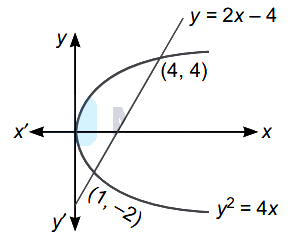
0 likesView Solution
57
MathematicsMediumMCQKCET · 2009
The differential equation of the family of circles passing through the origin and having their centres on the $x$-axis is
A
$y^{2}=x^{2}+2xy \frac{dy}{dx}$
B
$y^{2}=x^{2}-2xy \frac{dy}{dx}$
C
$x^{2}=y^{2}+xy \frac{dy}{dx}$
D
$x^{2}=y^{2}+3xy \frac{dy}{dx}$
Solution
(A) The general equation of a circle passing through the origin with its center on the $x$-axis is given by $x^{2} + y^{2} - 2hx = 0$,where $h$ is a parameter.
From this equation,we have $2h = \frac{x^{2} + y^{2}}{x}$.
Differentiating the equation $x^{2} + y^{2} - 2hx = 0$ with respect to $x$,we get:
$2x + 2y \frac{dy}{dx} - 2h = 0$.
Substituting the value of $2h$ from the first equation:
$2x + 2y \frac{dy}{dx} - \left( \frac{x^{2} + y^{2}}{x} \right) = 0$.
Multiplying the entire equation by $x$:
$2x^{2} + 2xy \frac{dy}{dx} - x^{2} - y^{2} = 0$.
Simplifying the expression:
$x^{2} - y^{2} + 2xy \frac{dy}{dx} = 0$,which can be rewritten as $y^{2} = x^{2} + 2xy \frac{dy}{dx}$.
From this equation,we have $2h = \frac{x^{2} + y^{2}}{x}$.
Differentiating the equation $x^{2} + y^{2} - 2hx = 0$ with respect to $x$,we get:
$2x + 2y \frac{dy}{dx} - 2h = 0$.
Substituting the value of $2h$ from the first equation:
$2x + 2y \frac{dy}{dx} - \left( \frac{x^{2} + y^{2}}{x} \right) = 0$.
Multiplying the entire equation by $x$:
$2x^{2} + 2xy \frac{dy}{dx} - x^{2} - y^{2} = 0$.
Simplifying the expression:
$x^{2} - y^{2} + 2xy \frac{dy}{dx} = 0$,which can be rewritten as $y^{2} = x^{2} + 2xy \frac{dy}{dx}$.
0 likesView Solution
58
MathematicsEasyMCQKCET · 2009
If $\overrightarrow{a} \cdot \overrightarrow{b} = -|\overrightarrow{a}||\overrightarrow{b}|$,then the angle between $\overrightarrow{a}$ and $\overrightarrow{b}$ is (in $^{\circ}$)
A
$45$
B
$180$
C
$90$
D
$60$
Solution
(B) We know that the dot product of two vectors $\overrightarrow{a}$ and $\overrightarrow{b}$ is given by $\overrightarrow{a} \cdot \overrightarrow{b} = |\overrightarrow{a}||\overrightarrow{b}| \cos \theta$,where $\theta$ is the angle between them.
Given that $\overrightarrow{a} \cdot \overrightarrow{b} = -|\overrightarrow{a}||\overrightarrow{b}|$.
Substituting the formula,we get $|\overrightarrow{a}||\overrightarrow{b}| \cos \theta = -|\overrightarrow{a}||\overrightarrow{b}|$.
Assuming $\overrightarrow{a}$ and $\overrightarrow{b}$ are non-zero vectors,we can divide both sides by $|\overrightarrow{a}||\overrightarrow{b}|$.
This gives $\cos \theta = -1$.
The value of $\theta$ for which $\cos \theta = -1$ is $\theta = 180^{\circ}$.
Given that $\overrightarrow{a} \cdot \overrightarrow{b} = -|\overrightarrow{a}||\overrightarrow{b}|$.
Substituting the formula,we get $|\overrightarrow{a}||\overrightarrow{b}| \cos \theta = -|\overrightarrow{a}||\overrightarrow{b}|$.
Assuming $\overrightarrow{a}$ and $\overrightarrow{b}$ are non-zero vectors,we can divide both sides by $|\overrightarrow{a}||\overrightarrow{b}|$.
This gives $\cos \theta = -1$.
The value of $\theta$ for which $\cos \theta = -1$ is $\theta = 180^{\circ}$.
0 likesView Solution
59
MathematicsDifficultMCQKCET · 2009
If $\overrightarrow{a}+2 \overrightarrow{b}+3 \overrightarrow{c}=\overrightarrow{0}$,then $\overrightarrow{a} \times \overrightarrow{b}+\overrightarrow{b} \times \overrightarrow{c}+\overrightarrow{c} \times \overrightarrow{a}$ is equal to
A
$2(\overrightarrow{b} \times \overrightarrow{c})$
B
$3(\overrightarrow{c} \times \overrightarrow{a})$
C
$\overrightarrow{0}$
D
$6(\overrightarrow{b} \times \overrightarrow{c})$
Solution
(D) Given,$\overrightarrow{a}+2 \overrightarrow{b}+3 \overrightarrow{c}=\overrightarrow{0} \quad \dots(i)$
Taking the cross product of equation $(i)$ with $\overrightarrow{b}$:
$\overrightarrow{a} \times \overrightarrow{b} + 2(\overrightarrow{b} \times \overrightarrow{b}) + 3(\overrightarrow{c} \times \overrightarrow{b}) = \overrightarrow{0} \times \overrightarrow{b}$
Since $\overrightarrow{b} \times \overrightarrow{b} = \overrightarrow{0}$ and $\overrightarrow{c} \times \overrightarrow{b} = -(\overrightarrow{b} \times \overrightarrow{c})$:
$\overrightarrow{a} \times \overrightarrow{b} - 3(\overrightarrow{b} \times \overrightarrow{c}) = \overrightarrow{0} \implies \overrightarrow{a} \times \overrightarrow{b} = 3(\overrightarrow{b} \times \overrightarrow{c})$
Taking the cross product of equation $(i)$ with $\overrightarrow{c}$:
$\overrightarrow{a} \times \overrightarrow{c} + 2(\overrightarrow{b} \times \overrightarrow{c}) + 3(\overrightarrow{c} \times \overrightarrow{c}) = \overrightarrow{0} \times \overrightarrow{c}$
Since $\overrightarrow{c} \times \overrightarrow{c} = \overrightarrow{0}$ and $\overrightarrow{a} \times \overrightarrow{c} = -(\overrightarrow{c} \times \overrightarrow{a})$:
$-(\overrightarrow{c} \times \overrightarrow{a}) + 2(\overrightarrow{b} \times \overrightarrow{c}) = \overrightarrow{0} \implies \overrightarrow{c} \times \overrightarrow{a} = 2(\overrightarrow{b} \times \overrightarrow{c})$
Now,substituting these into the expression $\overrightarrow{a} \times \overrightarrow{b} + \overrightarrow{b} \times \overrightarrow{c} + \overrightarrow{c} \times \overrightarrow{a}$:
$= 3(\overrightarrow{b} \times \overrightarrow{c}) + (\overrightarrow{b} \times \overrightarrow{c}) + 2(\overrightarrow{b} \times \overrightarrow{c})$
$= 6(\overrightarrow{b} \times \overrightarrow{c})$
Taking the cross product of equation $(i)$ with $\overrightarrow{b}$:
$\overrightarrow{a} \times \overrightarrow{b} + 2(\overrightarrow{b} \times \overrightarrow{b}) + 3(\overrightarrow{c} \times \overrightarrow{b}) = \overrightarrow{0} \times \overrightarrow{b}$
Since $\overrightarrow{b} \times \overrightarrow{b} = \overrightarrow{0}$ and $\overrightarrow{c} \times \overrightarrow{b} = -(\overrightarrow{b} \times \overrightarrow{c})$:
$\overrightarrow{a} \times \overrightarrow{b} - 3(\overrightarrow{b} \times \overrightarrow{c}) = \overrightarrow{0} \implies \overrightarrow{a} \times \overrightarrow{b} = 3(\overrightarrow{b} \times \overrightarrow{c})$
Taking the cross product of equation $(i)$ with $\overrightarrow{c}$:
$\overrightarrow{a} \times \overrightarrow{c} + 2(\overrightarrow{b} \times \overrightarrow{c}) + 3(\overrightarrow{c} \times \overrightarrow{c}) = \overrightarrow{0} \times \overrightarrow{c}$
Since $\overrightarrow{c} \times \overrightarrow{c} = \overrightarrow{0}$ and $\overrightarrow{a} \times \overrightarrow{c} = -(\overrightarrow{c} \times \overrightarrow{a})$:
$-(\overrightarrow{c} \times \overrightarrow{a}) + 2(\overrightarrow{b} \times \overrightarrow{c}) = \overrightarrow{0} \implies \overrightarrow{c} \times \overrightarrow{a} = 2(\overrightarrow{b} \times \overrightarrow{c})$
Now,substituting these into the expression $\overrightarrow{a} \times \overrightarrow{b} + \overrightarrow{b} \times \overrightarrow{c} + \overrightarrow{c} \times \overrightarrow{a}$:
$= 3(\overrightarrow{b} \times \overrightarrow{c}) + (\overrightarrow{b} \times \overrightarrow{c}) + 2(\overrightarrow{b} \times \overrightarrow{c})$
$= 6(\overrightarrow{b} \times \overrightarrow{c})$
0 likesView Solution
60
MathematicsEasyMCQKCET · 2009
If the volume of the parallelepiped with $\overrightarrow{a}, \overrightarrow{b}$ and $\overrightarrow{c}$ as coterminous edges is $40 \text{ cubic units}$,then the volume of the parallelepiped having $\overrightarrow{b}+\overrightarrow{c}, \overrightarrow{c}+\overrightarrow{a}$ and $\overrightarrow{a}+\overrightarrow{b}$ as coterminous edges in cubic units is
A
$80$
B
$120$
C
$160$
D
$40$
Solution
(A) Given,the volume of the parallelepiped with coterminous edges $\overrightarrow{a}, \overrightarrow{b}, \overrightarrow{c}$ is given by the scalar triple product $[\overrightarrow{a} \overrightarrow{b} \overrightarrow{c}] = 40 \text{ cubic units}$.
The volume of the parallelepiped with coterminous edges $\overrightarrow{b}+\overrightarrow{c}, \overrightarrow{c}+\overrightarrow{a}, \overrightarrow{a}+\overrightarrow{b}$ is given by the scalar triple product $[\overrightarrow{b}+\overrightarrow{c}, \overrightarrow{c}+\overrightarrow{a}, \overrightarrow{a}+\overrightarrow{b}]$.
Using the property of the scalar triple product:
$[\overrightarrow{b}+\overrightarrow{c}, \overrightarrow{c}+\overrightarrow{a}, \overrightarrow{a}+\overrightarrow{b}] = (\overrightarrow{b}+\overrightarrow{c}) \cdot ((\overrightarrow{c}+\overrightarrow{a}) \times (\overrightarrow{a}+\overrightarrow{b}))$
$= (\overrightarrow{b}+\overrightarrow{c}) \cdot (\overrightarrow{c} \times \overrightarrow{a} + \overrightarrow{c} \times \overrightarrow{b} + \overrightarrow{a} \times \overrightarrow{a} + \overrightarrow{a} \times \overrightarrow{b})$
Since $\overrightarrow{a} \times \overrightarrow{a} = 0$,this simplifies to:
$= (\overrightarrow{b}+\overrightarrow{c}) \cdot (\overrightarrow{c} \times \overrightarrow{a} + \overrightarrow{c} \times \overrightarrow{b} + \overrightarrow{a} \times \overrightarrow{b})$
$= \overrightarrow{b} \cdot (\overrightarrow{c} \times \overrightarrow{a}) + \overrightarrow{b} \cdot (\overrightarrow{c} \times \overrightarrow{b}) + \overrightarrow{b} \cdot (\overrightarrow{a} \times \overrightarrow{b}) + \overrightarrow{c} \cdot (\overrightarrow{c} \times \overrightarrow{a}) + \overrightarrow{c} \cdot (\overrightarrow{c} \times \overrightarrow{b}) + \overrightarrow{c} \cdot (\overrightarrow{a} \times \overrightarrow{b})$
$= [\overrightarrow{b} \overrightarrow{c} \overrightarrow{a}] + 0 + 0 + 0 + 0 + [\overrightarrow{c} \overrightarrow{a} \overrightarrow{b}]$
$= [\overrightarrow{a} \overrightarrow{b} \overrightarrow{c}] + [\overrightarrow{a} \overrightarrow{b} \overrightarrow{c}] = 2[\overrightarrow{a} \overrightarrow{b} \overrightarrow{c}]$
$= 2 \times 40 = 80 \text{ cubic units}$.
The volume of the parallelepiped with coterminous edges $\overrightarrow{b}+\overrightarrow{c}, \overrightarrow{c}+\overrightarrow{a}, \overrightarrow{a}+\overrightarrow{b}$ is given by the scalar triple product $[\overrightarrow{b}+\overrightarrow{c}, \overrightarrow{c}+\overrightarrow{a}, \overrightarrow{a}+\overrightarrow{b}]$.
Using the property of the scalar triple product:
$[\overrightarrow{b}+\overrightarrow{c}, \overrightarrow{c}+\overrightarrow{a}, \overrightarrow{a}+\overrightarrow{b}] = (\overrightarrow{b}+\overrightarrow{c}) \cdot ((\overrightarrow{c}+\overrightarrow{a}) \times (\overrightarrow{a}+\overrightarrow{b}))$
$= (\overrightarrow{b}+\overrightarrow{c}) \cdot (\overrightarrow{c} \times \overrightarrow{a} + \overrightarrow{c} \times \overrightarrow{b} + \overrightarrow{a} \times \overrightarrow{a} + \overrightarrow{a} \times \overrightarrow{b})$
Since $\overrightarrow{a} \times \overrightarrow{a} = 0$,this simplifies to:
$= (\overrightarrow{b}+\overrightarrow{c}) \cdot (\overrightarrow{c} \times \overrightarrow{a} + \overrightarrow{c} \times \overrightarrow{b} + \overrightarrow{a} \times \overrightarrow{b})$
$= \overrightarrow{b} \cdot (\overrightarrow{c} \times \overrightarrow{a}) + \overrightarrow{b} \cdot (\overrightarrow{c} \times \overrightarrow{b}) + \overrightarrow{b} \cdot (\overrightarrow{a} \times \overrightarrow{b}) + \overrightarrow{c} \cdot (\overrightarrow{c} \times \overrightarrow{a}) + \overrightarrow{c} \cdot (\overrightarrow{c} \times \overrightarrow{b}) + \overrightarrow{c} \cdot (\overrightarrow{a} \times \overrightarrow{b})$
$= [\overrightarrow{b} \overrightarrow{c} \overrightarrow{a}] + 0 + 0 + 0 + 0 + [\overrightarrow{c} \overrightarrow{a} \overrightarrow{b}]$
$= [\overrightarrow{a} \overrightarrow{b} \overrightarrow{c}] + [\overrightarrow{a} \overrightarrow{b} \overrightarrow{c}] = 2[\overrightarrow{a} \overrightarrow{b} \overrightarrow{c}]$
$= 2 \times 40 = 80 \text{ cubic units}$.
0 likesView Solution
Vedclass Products
For Students
Vedclass Test Series
Mock tests in real KCET style covering Mathematics with performance analysis. 5-day free trial.
Start Free TrialFor Teachers
Exam Paper Generator
Generate Set A/B/C/D Mathematics papers from 7.5L+ questions in 2 minutes. 3 chapters free.
Try FreeFor Institutes
Online Exam Module
Run live KCET mock exams with unlimited students, 360° analytics & white-label branding.
See DemoFrequently Asked Questions
How many Mathematics questions are in KCET 2009?
There are 60 Mathematics questions from the KCET 2009 paper on Vedclass, each with a detailed step-by-step solution in English.
Are KCET 2009 Mathematics solutions available in English?
Yes. All solutions on this page are in English. You can also switch to English or Hindi using the language buttons above the questions.
Can I practice KCET 2009 Mathematics as a timed test?
Yes. Use the Vedclass Test Series to attempt a full KCET mock test covering Mathematics with time limits and instant score analysis.
Can teachers create Mathematics papers from KCET previous year questions?
Yes. The Vedclass Exam Paper Generator lets teachers mix KCET Mathematics questions and generate Set A/B/C/D papers in minutes.
For Teachers & Institutes
Build a Custom Mathematics Paper
Pick KCET 2009 Mathematics questions, set difficulty, and generate Set A/B/C/D in 2 minutes.