
ChemistryQ101–200 of 478 questions
Page 3 of 6 · English
101
ChemistryMediumMCQJEE Main · 2025
Given below are two statements :
Statement $(I) :$ $CH_3CH=CHCH_3$ and $cyclobutane$ are isomeric compounds.
Statement $(II) :$ $CH_3CH_2CH_2CH_2NH_2$ and $(CH_3CH_2)_2NH$ are functional group isomers.
In the light of the above statements,choose the correct answer from the options given below :
Statement $(I) :$ $CH_3CH=CHCH_3$ and $cyclobutane$ are isomeric compounds.
Statement $(II) :$ $CH_3CH_2CH_2CH_2NH_2$ and $(CH_3CH_2)_2NH$ are functional group isomers.
In the light of the above statements,choose the correct answer from the options given below :
A
Both Statement $I$ and Statement $II$ are false
B
Both Statement $I$ and Statement $II$ are true
C
Statement $I$ is true but Statement $II$ is false
D
Statement $I$ is false but Statement $II$ is true
Solution
(B) Statement $-I \rightarrow$ True
$CH_3CH=CHCH_3$ and $cyclobutane$ both have the molecular formula $C_4H_8$. They are ring-chain isomers,which is a type of structural isomerism.
Statement $-II \rightarrow$ True
$CH_3CH_2CH_2CH_2NH_2$ ($1^{\circ}$ amine) and $(CH_3CH_2)_2NH$ ($2^{\circ}$ amine) have different functional groups (primary amine vs secondary amine). Therefore,they are functional group isomers.
$CH_3CH=CHCH_3$ and $cyclobutane$ both have the molecular formula $C_4H_8$. They are ring-chain isomers,which is a type of structural isomerism.
Statement $-II \rightarrow$ True
$CH_3CH_2CH_2CH_2NH_2$ ($1^{\circ}$ amine) and $(CH_3CH_2)_2NH$ ($2^{\circ}$ amine) have different functional groups (primary amine vs secondary amine). Therefore,they are functional group isomers.
0 likesView Solution
102
ChemistryMediumMCQJEE Main · 2025
Consider the following data :
Heat of formation of $CO_{2(g)} = -393.5 \ kJ \ mol^{-1}$
Heat of formation of $H_2O_{(l)} = -286.0 \ kJ \ mol^{-1}$
Heat of combustion of benzene $= -3267.0 \ kJ \ mol^{-1}$
The heat of formation of benzene is $........... \ kJ \ mol^{-1}$. $(Nearest \ integer)$
Heat of formation of $CO_{2(g)} = -393.5 \ kJ \ mol^{-1}$
Heat of formation of $H_2O_{(l)} = -286.0 \ kJ \ mol^{-1}$
Heat of combustion of benzene $= -3267.0 \ kJ \ mol^{-1}$
The heat of formation of benzene is $........... \ kJ \ mol^{-1}$. $(Nearest \ integer)$
A
$47$
B
$48$
C
$49$
D
$50$
Solution
(B) The combustion reaction of benzene is: $C_6H_6(l) + \frac{15}{2} O_2(g) \longrightarrow 6 CO_2(g) + 3 H_2O(l)$
Given: $\Delta H_f[CO_2(g)] = -393.5 \ kJ \ mol^{-1}$,$\Delta H_f[H_2O(l)] = -286.0 \ kJ \ mol^{-1}$,and $\Delta H_c[C_6H_6] = -3267.0 \ kJ \ mol^{-1}$
Using the formula: $\Delta H_c = \Sigma \Delta H_f(\text{products}) - \Sigma \Delta H_f(\text{reactants})$
$-3267.0 = [6 \times (-393.5) + 3 \times (-286.0)] - [\Delta H_f(C_6H_6) + 0]$
$-3267.0 = [-2361.0 - 858.0] - \Delta H_f(C_6H_6)$
$-3267.0 = -3219.0 - \Delta H_f(C_6H_6)$
$\Delta H_f(C_6H_6) = -3219.0 + 3267.0 = 48 \ kJ \ mol^{-1}$
Given: $\Delta H_f[CO_2(g)] = -393.5 \ kJ \ mol^{-1}$,$\Delta H_f[H_2O(l)] = -286.0 \ kJ \ mol^{-1}$,and $\Delta H_c[C_6H_6] = -3267.0 \ kJ \ mol^{-1}$
Using the formula: $\Delta H_c = \Sigma \Delta H_f(\text{products}) - \Sigma \Delta H_f(\text{reactants})$
$-3267.0 = [6 \times (-393.5) + 3 \times (-286.0)] - [\Delta H_f(C_6H_6) + 0]$
$-3267.0 = [-2361.0 - 858.0] - \Delta H_f(C_6H_6)$
$-3267.0 = -3219.0 - \Delta H_f(C_6H_6)$
$\Delta H_f(C_6H_6) = -3219.0 + 3267.0 = 48 \ kJ \ mol^{-1}$
0 likesView Solution
103
ChemistryMediumMCQJEE Main · 2025
At temperature $T$,compound $AB_{2(g)}$ dissociates as $AB_{2(g)} \rightleftharpoons AB_{(g)} + \frac{1}{2} B_{2(g)}$ having degree of dissociation $x$ (small compared to unity). The correct expression for $x$ in terms of $K_p$ and $p$ is
A
$\sqrt[3]{\frac{2 K_p}{p}}$
B
$\sqrt[4]{\frac{2 K_p}{p}}$
C
$\sqrt[3]{\frac{2 K_p^2}{p}}$
D
$\sqrt{K_p}$
Solution
(C) The dissociation reaction is: $AB_{2(g)} \rightleftharpoons AB_{(g)} + \frac{1}{2} B_{2(g)}$
Initial moles: $1, 0, 0$
Moles at equilibrium: $(1-x), x, \frac{x}{2}$
Total moles at equilibrium: $1-x+x+\frac{x}{2} = 1+\frac{x}{2}$
Partial pressures: $P_{AB_2} = \frac{1-x}{1+x/2}P$,$P_{AB} = \frac{x}{1+x/2}P$,$P_{B_2} = \frac{x/2}{1+x/2}P$
Since $x \ll 1$,we approximate $1+x/2 \approx 1$ and $1-x \approx 1$.
Thus,$P_{AB_2} \approx P$,$P_{AB} \approx xP$,$P_{B_2} \approx \frac{x}{2}P$.
$K_p = \frac{P_{AB} \cdot (P_{B_2})^{1/2}}{P_{AB_2}} = \frac{(xP) \cdot (xP/2)^{1/2}}{P} = x \cdot (xP/2)^{1/2} = x^{3/2} \cdot (P/2)^{1/2}$.
Squaring both sides: $K_p^2 = x^3 \cdot \frac{P}{2}$.
Solving for $x$: $x^3 = \frac{2 K_p^2}{P} \Rightarrow x = \left( \frac{2 K_p^2}{P} \right)^{1/3}$.
Initial moles: $1, 0, 0$
Moles at equilibrium: $(1-x), x, \frac{x}{2}$
Total moles at equilibrium: $1-x+x+\frac{x}{2} = 1+\frac{x}{2}$
Partial pressures: $P_{AB_2} = \frac{1-x}{1+x/2}P$,$P_{AB} = \frac{x}{1+x/2}P$,$P_{B_2} = \frac{x/2}{1+x/2}P$
Since $x \ll 1$,we approximate $1+x/2 \approx 1$ and $1-x \approx 1$.
Thus,$P_{AB_2} \approx P$,$P_{AB} \approx xP$,$P_{B_2} \approx \frac{x}{2}P$.
$K_p = \frac{P_{AB} \cdot (P_{B_2})^{1/2}}{P_{AB_2}} = \frac{(xP) \cdot (xP/2)^{1/2}}{P} = x \cdot (xP/2)^{1/2} = x^{3/2} \cdot (P/2)^{1/2}$.
Squaring both sides: $K_p^2 = x^3 \cdot \frac{P}{2}$.
Solving for $x$: $x^3 = \frac{2 K_p^2}{P} \Rightarrow x = \left( \frac{2 K_p^2}{P} \right)^{1/3}$.
0 likesView Solution
104
ChemistryMediumMCQJEE Main · 2025
Match List-$I$ with List-$II$.
Choose the correct answer from the options given below:
| List-$I$ (structure) | List-$II$ ($IUPAC$ Name) |
|---|---|
| $A$. $CH_3CH_2CH(CH_2CH_3)CH_2CH(CH_3)CH_2CH_3$ | $I$. $4-$Methylpent$-1-$ene |
| $B$. $(CH_3)_2C(C_3H_7)_2$ | $II$. $3-$Ethyl$-5-$methylheptane |
| $C$. $CH_2=C(CH_3)CH=CHCH_3$ | $III$. $4,4-$Dimethylheptane |
| $D$. $CH_2=CHCH_2CH(CH_3)CH_3$ | $IV$. $2-$Methyl$-1,3-$pentadiene |
Choose the correct answer from the options given below:
A
$A-III, B-II, C-IV, D-I$
B
$A-III, B-II, C-I, D-IV$
C
$A-II, B-III, C-IV, D-I$
D
$A-II, B-III, C-I, D-IV$
Solution
(C) The correct matches are as follows:
$A$. The structure $CH_3CH_2CH(CH_2CH_3)CH_2CH(CH_3)CH_2CH_3$ is $3-$Ethyl$-5-$methylheptane $(II)$.
$B$. The structure $(CH_3)_2C(C_3H_7)_2$ can be expanded to $CH_3-C(CH_3)(CH_2CH_2CH_3)_2-CH_3$,which is $4,4-$Dimethylheptane $(III)$.
$C$. The structure $CH_2=C(CH_3)CH=CHCH_3$ is $2-$Methyl$-1,3-$pentadiene $(IV)$.
$D$. The structure $CH_2=CHCH_2CH(CH_3)CH_3$ is $4-$Methylpent$-1-$ene $(I)$.
Thus,the correct sequence is $A-II, B-III, C-IV, D-I$.
$A$. The structure $CH_3CH_2CH(CH_2CH_3)CH_2CH(CH_3)CH_2CH_3$ is $3-$Ethyl$-5-$methylheptane $(II)$.
$B$. The structure $(CH_3)_2C(C_3H_7)_2$ can be expanded to $CH_3-C(CH_3)(CH_2CH_2CH_3)_2-CH_3$,which is $4,4-$Dimethylheptane $(III)$.
$C$. The structure $CH_2=C(CH_3)CH=CHCH_3$ is $2-$Methyl$-1,3-$pentadiene $(IV)$.
$D$. The structure $CH_2=CHCH_2CH(CH_3)CH_3$ is $4-$Methylpent$-1-$ene $(I)$.
Thus,the correct sequence is $A-II, B-III, C-IV, D-I$.
0 likesView Solution
105
ChemistryDifficultMCQJEE Main · 2025
Choose the correct statements.
$A$. Weight of a substance is the amount of matter present in it.
$B$. Mass is the force exerted by gravity on an object.
$C$. Volume is the amount of space occupied by a substance.
$D$. Temperatures below $0^{\circ} C$ are possible in Celsius scale,but in Kelvin scale negative temperature is not possible.
$E$. Precision refers to the closeness of various measurements for the same quantity.
$A$. Weight of a substance is the amount of matter present in it.
$B$. Mass is the force exerted by gravity on an object.
$C$. Volume is the amount of space occupied by a substance.
$D$. Temperatures below $0^{\circ} C$ are possible in Celsius scale,but in Kelvin scale negative temperature is not possible.
$E$. Precision refers to the closeness of various measurements for the same quantity.
A
$B, C$ and $D$ Only
B
$A, B$ and $C$ Only
C
$A, D$ and $E$ Only
D
$C, D$ and $E$ Only
Solution
(D) is incorrect: Mass is the amount of matter present in a substance,while weight is the force exerted by gravity on an object.
$B$ is incorrect: Mass is the amount of matter,while weight is the force exerted by gravity.
$C$ is correct: Volume is the amount of space occupied by a substance.
$D$ is correct: Celsius scale can have negative values,but the Kelvin scale starts at $0 \ K$ (absolute zero),so negative values are not possible.
$E$ is correct: Precision refers to the closeness of various measurements for the same quantity.
$B$ is incorrect: Mass is the amount of matter,while weight is the force exerted by gravity.
$C$ is correct: Volume is the amount of space occupied by a substance.
$D$ is correct: Celsius scale can have negative values,but the Kelvin scale starts at $0 \ K$ (absolute zero),so negative values are not possible.
$E$ is correct: Precision refers to the closeness of various measurements for the same quantity.
0 likesView Solution
106
ChemistryMediumMCQJEE Main · 2025
$500 \ J$ of energy is transferred as heat to $0.5 \ mol$ of Argon gas at $298 \ K$ and $1.00 \ atm$. The final temperature and the change in internal energy respectively are $:$ Given $: R = 8.3 \ J \ K^{-1} \ mol^{-1}$
A
$348 \ K$ and $300 \ J$
B
$378 \ K$ and $300 \ J$
C
$368 \ K$ and $500 \ J$
D
$378 \ K$ and $500 \ J$
Solution
(A) Argon is a monoatomic gas,so $C_v = \frac{3}{2}R$ and $C_p = \frac{5}{2}R$.
Since the process occurs at constant pressure $(1.00 \ atm)$,the heat transferred is $q_p = n \times C_p \times \Delta T$.
$500 = 0.5 \times (\frac{5}{2} \times 8.3) \times (T_f - 298)$.
$500 = 10.375 \times (T_f - 298)$.
$T_f - 298 = 48.19 \ K \Rightarrow T_f \approx 346.2 \ K$.
However,checking the options,let us re-evaluate using $C_p = \frac{5}{2}R \approx 20.75 \ J \ K^{-1} \ mol^{-1}$.
$500 = 0.5 \times 20.75 \times \Delta T \Rightarrow \Delta T = 48.19 \ K$.
$T_f = 298 + 48.19 = 346.19 \ K$.
For internal energy change: $\Delta U = n \times C_v \times \Delta T = 0.5 \times (\frac{3}{2} \times 8.3) \times 48.19 \approx 300 \ J$.
Given the options provided,$348 \ K$ is the closest value to $346.2 \ K$ and $\Delta U = 300 \ J$ is correct.
Since the process occurs at constant pressure $(1.00 \ atm)$,the heat transferred is $q_p = n \times C_p \times \Delta T$.
$500 = 0.5 \times (\frac{5}{2} \times 8.3) \times (T_f - 298)$.
$500 = 10.375 \times (T_f - 298)$.
$T_f - 298 = 48.19 \ K \Rightarrow T_f \approx 346.2 \ K$.
However,checking the options,let us re-evaluate using $C_p = \frac{5}{2}R \approx 20.75 \ J \ K^{-1} \ mol^{-1}$.
$500 = 0.5 \times 20.75 \times \Delta T \Rightarrow \Delta T = 48.19 \ K$.
$T_f = 298 + 48.19 = 346.19 \ K$.
For internal energy change: $\Delta U = n \times C_v \times \Delta T = 0.5 \times (\frac{3}{2} \times 8.3) \times 48.19 \approx 300 \ J$.
Given the options provided,$348 \ K$ is the closest value to $346.2 \ K$ and $\Delta U = 300 \ J$ is correct.
0 likesView Solution
107
ChemistryMediumMCQJEE Main · 2025
If $a_0$ is denoted as the Bohr radius of the hydrogen atom,then what is the de-Broglie wavelength $(\lambda)$ of the electron present in the $n^{th}$ orbit of the hydrogen atom?
A
$\frac{2 a_0}{n \pi}$
B
$\frac{8 \pi a_0}{n}$
C
$\frac{4 \pi a_0}{n}$
D
$\frac{4 n}{\pi a_0}$
Solution
(C) According to the Bohr quantization condition,the circumference of the orbit is an integral multiple of the de-Broglie wavelength:
$2 \pi r_n = n \lambda$
The radius of the $n^{th}$ orbit is given by $r_n = n^2 a_0$.
Substituting $r_n$ into the equation:
$2 \pi (n^2 a_0) = n \lambda$
Solving for $\lambda$:
$\lambda = \frac{2 \pi n^2 a_0}{n} = 2 \pi n a_0$
Note: The original question asked for the second orbit $(n=2)$,which would yield $\lambda = 4 \pi a_0$. Given the options provided,the expression for the $n^{th}$ orbit is derived as $2 \pi n a_0$.
$2 \pi r_n = n \lambda$
The radius of the $n^{th}$ orbit is given by $r_n = n^2 a_0$.
Substituting $r_n$ into the equation:
$2 \pi (n^2 a_0) = n \lambda$
Solving for $\lambda$:
$\lambda = \frac{2 \pi n^2 a_0}{n} = 2 \pi n a_0$
Note: The original question asked for the second orbit $(n=2)$,which would yield $\lambda = 4 \pi a_0$. Given the options provided,the expression for the $n^{th}$ orbit is derived as $2 \pi n a_0$.
0 likesView Solution
108
ChemistryMediumMCQJEE Main · 2025
An element $E$ has an ionisation enthalpy value of $374 \ kJ \ mol^{-1}$. $E$ reacts with elements $A, B, C$ and $D$ with electron gain enthalpy values of $-328, -349, -325$ and $-295 \ kJ \ mol^{-1}$,respectively. The correct order of the products $EA, EB, EC$ and $ED$ in terms of ionic character is $:$
A
$EB > EA > EC > ED$
B
$ED > EC > EA > EB$
C
$EA > EB > EC > ED$
D
$ED > EC > EB > EA$
Solution
(A) The ionic character of a bond is related to the electronegativity difference between the bonded atoms.
In the formation of an ionic bond between $E$ and a non-metal,the ionic character increases as the electron gain enthalpy of the non-metal becomes more negative (i.e.,the non-metal becomes more electronegative).
Given electron gain enthalpy values:
$B (-349 \ kJ \ mol^{-1}) < A (-328 \ kJ \ mol^{-1}) < C (-325 \ kJ \ mol^{-1}) < D (-295 \ kJ \ mol^{-1})$.
Since $B$ has the most negative electron gain enthalpy,it is the most electronegative,resulting in the highest ionic character for $EB$.
Thus,the order of ionic character is $EB > EA > EC > ED$.
In the formation of an ionic bond between $E$ and a non-metal,the ionic character increases as the electron gain enthalpy of the non-metal becomes more negative (i.e.,the non-metal becomes more electronegative).
Given electron gain enthalpy values:
$B (-349 \ kJ \ mol^{-1}) < A (-328 \ kJ \ mol^{-1}) < C (-325 \ kJ \ mol^{-1}) < D (-295 \ kJ \ mol^{-1})$.
Since $B$ has the most negative electron gain enthalpy,it is the most electronegative,resulting in the highest ionic character for $EB$.
Thus,the order of ionic character is $EB > EA > EC > ED$.
0 likesView Solution
109
ChemistryMediumMCQJEE Main · 2025
The steam volatile compounds among the following are $:$
$(A)$ $o$-nitrophenol
$(B)$ $o$-nitroaniline
$(C)$ $p$-aminophenol
$(D)$ $p$-hydroquinone
Choose the correct answer from the options given below $:$
$(A)$ $o$-nitrophenol
$(B)$ $o$-nitroaniline
$(C)$ $p$-aminophenol
$(D)$ $p$-hydroquinone
Choose the correct answer from the options given below $:$
A
$B$ and $D$ only
B
$A$ and $C$ only
C
$A$ and $B$ only
D
$A, B$ and $C$ only
Solution
(C) Steam volatility is observed in compounds that exhibit intramolecular hydrogen bonding,which reduces intermolecular forces of attraction and increases volatility.
$(A)$ $o$-Nitrophenol exhibits intramolecular hydrogen bonding between the $-OH$ group and the $-NO_2$ group.
$(B)$ $o$-Nitroaniline exhibits intramolecular hydrogen bonding between the $-NH_2$ group and the $-NO_2$ group.
$(C)$ $p$-Aminophenol and $(D)$ $p$-hydroquinone exhibit strong intermolecular hydrogen bonding,which leads to higher boiling points and lower volatility.
Therefore,compounds $(A)$ and $(B)$ are steam volatile.
$(A)$ $o$-Nitrophenol exhibits intramolecular hydrogen bonding between the $-OH$ group and the $-NO_2$ group.
$(B)$ $o$-Nitroaniline exhibits intramolecular hydrogen bonding between the $-NH_2$ group and the $-NO_2$ group.
$(C)$ $p$-Aminophenol and $(D)$ $p$-hydroquinone exhibit strong intermolecular hydrogen bonding,which leads to higher boiling points and lower volatility.
Therefore,compounds $(A)$ and $(B)$ are steam volatile.
0 likesView Solution
110
ChemistryMediumMCQJEE Main · 2025
Given below are two statements $:$
Statement $(I) :$ The radii of isoelectronic species increase in the order $Mg^{2+} < Na^{+} < F^{-} < O^{2-}$.
Statement $(II) :$ The magnitude of electron gain enthalpy of halogens decreases in the order $Cl > F > Br > I$.
In the light of the above statements,choose the most appropriate answer from the options given below $:$
Statement $(I) :$ The radii of isoelectronic species increase in the order $Mg^{2+} < Na^{+} < F^{-} < O^{2-}$.
Statement $(II) :$ The magnitude of electron gain enthalpy of halogens decreases in the order $Cl > F > Br > I$.
In the light of the above statements,choose the most appropriate answer from the options given below $:$
A
Statement $I$ is incorrect but Statement $II$ is correct
B
Both Statement $I$ and Statement $II$ are incorrect
C
Statement $I$ is correct but Statement $II$ is incorrect
D
Both Statement $I$ and Statement $II$ are correct
Solution
(D) $(i)$ For isoelectronic species,as the negative charge increases,the ionic radius increases due to a decrease in effective nuclear charge. Thus,the order $Mg^{2+} < Na^{+} < F^{-} < O^{2-}$ is correct.
$(ii)$ The magnitude of electron gain enthalpy for halogens is $Cl > F > Br > I$. Due to the small size of $F$,there is high inter-electronic repulsion,making its electron gain enthalpy less negative than that of $Cl$. Thus,the order is correct.
$(ii)$ The magnitude of electron gain enthalpy for halogens is $Cl > F > Br > I$. Due to the small size of $F$,there is high inter-electronic repulsion,making its electron gain enthalpy less negative than that of $Cl$. Thus,the order is correct.
0 likesView Solution
111
ChemistryMediumMCQJEE Main · 2025
The sum of sigma $(\sigma)$ and pi $(\pi)$ bonds in $Hexa-1,3-dien-5-yne$ is $...........$.
A
$10$
B
$20$
C
$15$
D
$30$
Solution
(C) The structure of $Hexa-1,3-dien-5-yne$ is $CH_2=CH-CH=CH-C\equiv CH$.
To find the number of $\sigma$ bonds,count all single bonds and one bond from each multiple bond: $2$ $(C-H)$ + $1$ $(C=C)$ + $1$ $(C-H)$ + $1$ $(C-C)$ + $1$ $(C-H)$ + $1$ $(C=C)$ + $1$ $(C-H)$ + $1$ $(C-C)$ + $1$ $(C-C)$ + $1$ $(C\equiv C)$ + $1$ $(C-H)$ = $11$ $\sigma$ bonds.
To find the number of $\pi$ bonds,count the second bond in double bonds and the second and third bonds in triple bonds: $1$ $(C=C)$ + $1$ $(C=C)$ + $2$ $(C\equiv C)$ = $4$ $\pi$ bonds.
Total sum = $11 + 4 = 15$.
To find the number of $\sigma$ bonds,count all single bonds and one bond from each multiple bond: $2$ $(C-H)$ + $1$ $(C=C)$ + $1$ $(C-H)$ + $1$ $(C-C)$ + $1$ $(C-H)$ + $1$ $(C=C)$ + $1$ $(C-H)$ + $1$ $(C-C)$ + $1$ $(C-C)$ + $1$ $(C\equiv C)$ + $1$ $(C-H)$ = $11$ $\sigma$ bonds.
To find the number of $\pi$ bonds,count the second bond in double bonds and the second and third bonds in triple bonds: $1$ $(C=C)$ + $1$ $(C=C)$ + $2$ $(C\equiv C)$ = $4$ $\pi$ bonds.
Total sum = $11 + 4 = 15$.
0 likesView Solution
112
ChemistryDifficultMCQJEE Main · 2025
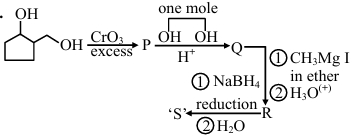
$0.1$ mole of compound $'S'$ will weigh $.......... \ g$.
(Given molar mass in $g \ mol^{-1} \ C: 12, H: 1, O: 16$)
(Given molar mass in $g \ mol^{-1} \ C: 12, H: 1, O: 16$)
A
$13$
B
$23$
C
$33$
D
$43$
Solution
(A) $1$. The starting material is $2$-(hydroxymethyl)cyclopentanol. Oxidation with excess $CrO_3$ gives $2$-oxocyclopentanecarboxylic acid $(P)$.
$2$. Protection of the ketone with ethylene glycol gives $(Q)$.
$3$. Reaction with $CH_3MgBr$ followed by acid workup removes the protecting group and gives $2$-oxocyclopentanecarboxylic acid $(R)$ (as the Grignard reagent reacts with the acid group,but the overall sequence regenerates the keto-acid).
$4$. Reduction of $(R)$ with $NaBH_4$ reduces the ketone to an alcohol,yielding $2$-hydroxycyclopentanecarboxylic acid $(S)$.
$5$. The molecular formula of $(S)$ is $C_6H_{10}O_3$.
$6$. Molar mass of $(S) = (6 \times 12) + (10 \times 1) + (3 \times 16) = 72 + 10 + 48 = 130 \ g \ mol^{-1}$.
$7$. Weight of $0.1$ mole of $(S) = 0.1 \ mol \times 130 \ g \ mol^{-1} = 13 \ g$.
$2$. Protection of the ketone with ethylene glycol gives $(Q)$.
$3$. Reaction with $CH_3MgBr$ followed by acid workup removes the protecting group and gives $2$-oxocyclopentanecarboxylic acid $(R)$ (as the Grignard reagent reacts with the acid group,but the overall sequence regenerates the keto-acid).
$4$. Reduction of $(R)$ with $NaBH_4$ reduces the ketone to an alcohol,yielding $2$-hydroxycyclopentanecarboxylic acid $(S)$.
$5$. The molecular formula of $(S)$ is $C_6H_{10}O_3$.
$6$. Molar mass of $(S) = (6 \times 12) + (10 \times 1) + (3 \times 16) = 72 + 10 + 48 = 130 \ g \ mol^{-1}$.
$7$. Weight of $0.1$ mole of $(S) = 0.1 \ mol \times 130 \ g \ mol^{-1} = 13 \ g$.
0 likesView Solution
113
ChemistryDifficultMCQJEE Main · 2025
For hydrogen-like species,which of the following graphs provides the most appropriate representation of $E$ vs $Z$ plot for a constant $n$?
[$E$: Energy of the stationary state,$Z$: atomic number,$n$: principal quantum number]
[$E$: Energy of the stationary state,$Z$: atomic number,$n$: principal quantum number]
A
B
C
D
Solution
(B) The energy of a stationary state for a hydrogen-like species is given by the formula:
$E_n = -13.6 \times \frac{Z^2}{n^2} \text{ eV}$
For a constant principal quantum number $n$,the energy $E$ is directly proportional to the square of the atomic number $Z$ with a negative sign:
$E \propto -Z^2$
This means that as $Z$ increases,$E$ becomes more negative (i.e.,it decreases).
The relationship $E = -kZ^2$ (where $k = \frac{13.6}{n^2}$ is a positive constant) represents a downward-opening parabola starting from the origin in the negative $E$ region.
Therefore,the graph showing a parabolic decrease of $E$ with increasing $Z$ is the correct representation.
$E_n = -13.6 \times \frac{Z^2}{n^2} \text{ eV}$
For a constant principal quantum number $n$,the energy $E$ is directly proportional to the square of the atomic number $Z$ with a negative sign:
$E \propto -Z^2$
This means that as $Z$ increases,$E$ becomes more negative (i.e.,it decreases).
The relationship $E = -kZ^2$ (where $k = \frac{13.6}{n^2}$ is a positive constant) represents a downward-opening parabola starting from the origin in the negative $E$ region.
Therefore,the graph showing a parabolic decrease of $E$ with increasing $Z$ is the correct representation.
0 likesView Solution
114
ChemistryMediumMCQJEE Main · 2025
Given below are two statements $:$
Statement $(I) :$ In partition chromatography,stationary phase is a thin film of liquid present on an inert support.
Statement $(II) :$ In paper chromatography,the material of the paper acts as a stationary phase.
In the light of the above statements,choose the correct answer from the options given below $:$
Statement $(I) :$ In partition chromatography,stationary phase is a thin film of liquid present on an inert support.
Statement $(II) :$ In paper chromatography,the material of the paper acts as a stationary phase.
In the light of the above statements,choose the correct answer from the options given below $:$
A
Both Statement $I$ and Statement $II$ are false
B
Statement $I$ is true but Statement $II$ is false
C
Both Statement $I$ and Statement $II$ are true
D
Statement $I$ is false but Statement $II$ is true
Solution
(B) Statement $I$ is true. In partition chromatography,the stationary phase is a thin film of liquid held on an inert solid support.
Statement $II$ is false. In paper chromatography,the stationary phase is actually water trapped in the cellulose fibers of the paper,not the paper material itself.
Statement $II$ is false. In paper chromatography,the stationary phase is actually water trapped in the cellulose fibers of the paper,not the paper material itself.
0 likesView Solution
115
ChemistryMediumMCQJEE Main · 2025
Consider the equilibrium $CO_{(g)} + 3H_{2(g)} \rightleftharpoons CH_{4(g)} + H_2O_{(g)}$. If the pressure applied over the system increases by two-fold at constant temperature,then which of the following statements are correct?
$(A)$ Concentration of reactants and products increases.
$(B)$ Equilibrium will shift in the forward direction.
$(C)$ Equilibrium constant increases since the concentration of products increases.
$(D)$ Equilibrium constant remains unchanged as the concentration of reactants and products remain the same.
Choose the correct answer from the options given below:
$(A)$ Concentration of reactants and products increases.
$(B)$ Equilibrium will shift in the forward direction.
$(C)$ Equilibrium constant increases since the concentration of products increases.
$(D)$ Equilibrium constant remains unchanged as the concentration of reactants and products remain the same.
Choose the correct answer from the options given below:
A
$(A)$ and $(B)$ only
B
$(A)$,$(B)$ and $(D)$ only
C
$(B)$ and $(C)$ only
D
$(A)$,$(B)$ and $(C)$ only
Solution
(A) $1$. According to Le Chatelier's Principle,when pressure is increased,the equilibrium shifts towards the side with fewer moles of gaseous species.
$2$. In the given reaction,the number of moles of gaseous reactants is $1 + 3 = 4$,and the number of moles of gaseous products is $1 + 1 = 2$.
$3$. Since the product side has fewer moles $(2 < 4)$,increasing the pressure shifts the equilibrium in the forward direction ($B$ is correct).
$4$. Increasing the pressure increases the concentration of all gaseous species present in the system ($A$ is correct).
$5$. The equilibrium constant ($K_c$ or $K_p$) depends only on temperature. Since the temperature is constant,the equilibrium constant remains unchanged ($C$ is incorrect,$D$ is incorrect because the concentrations do not remain the same).
$6$. Therefore,statements $(A)$ and $(B)$ are correct.
$2$. In the given reaction,the number of moles of gaseous reactants is $1 + 3 = 4$,and the number of moles of gaseous products is $1 + 1 = 2$.
$3$. Since the product side has fewer moles $(2 < 4)$,increasing the pressure shifts the equilibrium in the forward direction ($B$ is correct).
$4$. Increasing the pressure increases the concentration of all gaseous species present in the system ($A$ is correct).
$5$. The equilibrium constant ($K_c$ or $K_p$) depends only on temperature. Since the temperature is constant,the equilibrium constant remains unchanged ($C$ is incorrect,$D$ is incorrect because the concentrations do not remain the same).
$6$. Therefore,statements $(A)$ and $(B)$ are correct.
0 likesView Solution
116
ChemistryMediumMCQJEE Main · 2025
Given below are two statements $:$
Statement $(I) :$ On nitration of $m-$xylene with $HNO_3, H_2SO_4$ followed by oxidation,$4-$nitrobenzene$-1, 3-$dicarboxylic acid is obtained as the major product.
Statement $(II) :$ $-CH_3$ group is $o/p-$directing while $-NO_2$ group is $m-$directing group.
In the light of the above statements,choose the correct answer from the options given below $:$
Statement $(I) :$ On nitration of $m-$xylene with $HNO_3, H_2SO_4$ followed by oxidation,$4-$nitrobenzene$-1, 3-$dicarboxylic acid is obtained as the major product.
Statement $(II) :$ $-CH_3$ group is $o/p-$directing while $-NO_2$ group is $m-$directing group.
In the light of the above statements,choose the correct answer from the options given below $:$
A
Both Statement $I$ and Statement $II$ are false
B
Statement $I$ is false but Statement $II$ is true
C
Both Statement $I$ and Statement $II$ are true
D
Statement $I$ is true but Statement $II$ is false
Solution
(C) Statement $(I)$ is true: Nitration of $m-$xylene ($1, 3-$dimethylbenzene) occurs at the $4-$position because the two methyl groups activate the ring and direct the incoming electrophile $(NO_2^+)$ to the $o/p$ positions. The $4-$position is ortho to one methyl group and para to the other. Subsequent oxidation of the two methyl groups with $KMnO_4$ converts them into carboxylic acid groups $(-COOH)$,yielding $4-$nitrobenzene$-1, 3-$dicarboxylic acid.
Statement $(II)$ is true: The $-CH_3$ group is an electron-donating group by inductive and hyperconjugation effects,making it $o/p-$directing. The $-NO_2$ group is an electron-withdrawing group by resonance and inductive effects,making it $m-$directing.
Statement $(II)$ is true: The $-CH_3$ group is an electron-donating group by inductive and hyperconjugation effects,making it $o/p-$directing. The $-NO_2$ group is an electron-withdrawing group by resonance and inductive effects,making it $m-$directing.
0 likesView Solution
117
ChemistryDifficultMCQJEE Main · 2025
$0.1 \ M$ solution of $KI$ reacts with excess of $H_2SO_4$ and $KIO_3$ solution. According to the equation $5I^{-} + IO_3^{-} + 6H^{+} \rightarrow 3I_2 + 3H_2O$. Identify the correct statements $:$
$(A)$ $200 \ mL$ of $KI$ solution reacts with $0.004 \ mol$ of $KIO_3$.
$(B)$ $200 \ mL$ of $KI$ solution reacts with $0.006 \ mol$ of $H_2SO_4$.
$(C)$ $0.5 \ L$ of $KI$ solution produced $0.005 \ mol$ of $I_2$.
$(D)$ Equivalent weight of $KIO_3$ is equal to $\frac{\text{Molecular weight}}{5}$.
Choose the correct answer from the options given below $:$
$(A)$ $200 \ mL$ of $KI$ solution reacts with $0.004 \ mol$ of $KIO_3$.
$(B)$ $200 \ mL$ of $KI$ solution reacts with $0.006 \ mol$ of $H_2SO_4$.
$(C)$ $0.5 \ L$ of $KI$ solution produced $0.005 \ mol$ of $I_2$.
$(D)$ Equivalent weight of $KIO_3$ is equal to $\frac{\text{Molecular weight}}{5}$.
Choose the correct answer from the options given below $:$
A
$A$ and $D$ only
B
$B$ and $C$ only
C
$A$ and $B$ only
D
$C$ and $D$ only
Solution
(A) The balanced chemical equation is $5I^{-} + IO_3^{-} + 6H^{+} \rightarrow 3I_2 + 3H_2O$.
Moles of $KI$ in $200 \ mL$ of $0.1 \ M$ solution $= 0.1 \times 0.2 = 0.02 \ mol$.
From the stoichiometry,$5 \ mol$ of $I^{-}$ reacts with $1 \ mol$ of $IO_3^{-}$.
So,$0.02 \ mol$ of $I^{-}$ reacts with $0.02 / 5 = 0.004 \ mol$ of $KIO_3$. Statement $(A)$ is correct.
$5 \ mol$ of $I^{-}$ reacts with $6 \ mol$ of $H^{+}$. So,$0.02 \ mol$ of $I^{-}$ reacts with $(6/5) \times 0.02 = 0.024 \ mol$ of $H^{+}$. Statement $(B)$ is incorrect.
$5 \ mol$ of $I^{-}$ produces $3 \ mol$ of $I_2$. So,$0.05 \ mol$ of $I^{-}$ (in $0.5 \ L$) produces $(3/5) \times 0.05 = 0.03 \ mol$ of $I_2$. Statement $(C)$ is incorrect.
In the reaction $IO_3^{-} + 6H^{+} + 5e^{-} \rightarrow \frac{1}{2}I_2 + 3H_2O$,the change in oxidation state of $I$ in $IO_3^{-}$ $(+5)$ to $I_2$ $(0)$ is $5$. Thus,the n-factor is $5$. Equivalent weight $= \frac{\text{Molecular weight}}{5}$. Statement $(D)$ is correct.
Moles of $KI$ in $200 \ mL$ of $0.1 \ M$ solution $= 0.1 \times 0.2 = 0.02 \ mol$.
From the stoichiometry,$5 \ mol$ of $I^{-}$ reacts with $1 \ mol$ of $IO_3^{-}$.
So,$0.02 \ mol$ of $I^{-}$ reacts with $0.02 / 5 = 0.004 \ mol$ of $KIO_3$. Statement $(A)$ is correct.
$5 \ mol$ of $I^{-}$ reacts with $6 \ mol$ of $H^{+}$. So,$0.02 \ mol$ of $I^{-}$ reacts with $(6/5) \times 0.02 = 0.024 \ mol$ of $H^{+}$. Statement $(B)$ is incorrect.
$5 \ mol$ of $I^{-}$ produces $3 \ mol$ of $I_2$. So,$0.05 \ mol$ of $I^{-}$ (in $0.5 \ L$) produces $(3/5) \times 0.05 = 0.03 \ mol$ of $I_2$. Statement $(C)$ is incorrect.
In the reaction $IO_3^{-} + 6H^{+} + 5e^{-} \rightarrow \frac{1}{2}I_2 + 3H_2O$,the change in oxidation state of $I$ in $IO_3^{-}$ $(+5)$ to $I_2$ $(0)$ is $5$. Thus,the n-factor is $5$. Equivalent weight $= \frac{\text{Molecular weight}}{5}$. Statement $(D)$ is correct.
0 likesView Solution
118
ChemistryMediumMCQJEE Main · 2025
The total number of sigma $(\sigma)$ and pi $(\pi)$ bonds present in $\text{hex}-1-\text{en}-4-\text{yne}$ are respectively:
A
$13$ and $3$
B
$11$ and $3$
C
$3$ and $13$
D
$14$ and $3$
Solution
(A) The structure of $\text{hex}-1-\text{en}-4-\text{yne}$ is $CH_2=CH-CH_2-C\equiv C-CH_3$.
Counting the bonds:
$1$. $\sigma$ bonds: There are $5$ $C-C$ bonds,$8$ $C-H$ bonds. Total $\sigma$ bonds $= 5 + 8 = 13$.
$2$. $\pi$ bonds: There is $1$ $\pi$ bond in the double bond and $2$ $\pi$ bonds in the triple bond. Total $\pi$ bonds $= 1 + 2 = 3$.
Thus,the number of $\sigma$ and $\pi$ bonds are $13$ and $3$ respectively.
Counting the bonds:
$1$. $\sigma$ bonds: There are $5$ $C-C$ bonds,$8$ $C-H$ bonds. Total $\sigma$ bonds $= 5 + 8 = 13$.
$2$. $\pi$ bonds: There is $1$ $\pi$ bond in the double bond and $2$ $\pi$ bonds in the triple bond. Total $\pi$ bonds $= 1 + 2 = 3$.
Thus,the number of $\sigma$ and $\pi$ bonds are $13$ and $3$ respectively.
0 likesView Solution
119
ChemistryMediumMCQJEE Main · 2025
If $C$ (diamond) $\rightarrow C$ (graphite) $+ X \ kJ \ mol^{-1}$,$C$ (diamond) $+ O_{2(g)} \rightarrow CO_{2(g)} + Y \ kJ \ mol^{-1}$,and $C$ (graphite) $+ O_{2(g)} \rightarrow CO_{2(g)} + Z \ kJ \ mol^{-1}$,at constant temperature,then which of the following relations is correct?
A
$X = Y + Z$
B
$X = Y - Z$
C
$X = Z - Y$
D
$X = Y + Z$
Solution
(B) Given reactions are:
$(1) \ C \text{ (diamond)} \rightarrow C \text{ (graphite)} + X \ kJ \ mol^{-1}$
$(2) \ C \text{ (diamond)} + O_{2(g)} \rightarrow CO_{2(g)} + Y \ kJ \ mol^{-1}$
$(3) \ C \text{ (graphite)} + O_{2(g)} \rightarrow CO_{2(g)} + Z \ kJ \ mol^{-1}$
Applying Hess's Law,we can express reaction $(1)$ as $(2) - (3)$:
$(C \text{ (diamond)} + O_{2(g)}) - (C \text{ (graphite)} + O_{2(g)}) = (CO_{2(g)} + Y) - (CO_{2(g)} + Z)$
$C \text{ (diamond)} - C \text{ (graphite)} = Y - Z$
$C \text{ (diamond)} \rightarrow C \text{ (graphite)} + (Y - Z) \ kJ \ mol^{-1}$
Comparing this with reaction $(1)$,we get $X = Y - Z$.
$(1) \ C \text{ (diamond)} \rightarrow C \text{ (graphite)} + X \ kJ \ mol^{-1}$
$(2) \ C \text{ (diamond)} + O_{2(g)} \rightarrow CO_{2(g)} + Y \ kJ \ mol^{-1}$
$(3) \ C \text{ (graphite)} + O_{2(g)} \rightarrow CO_{2(g)} + Z \ kJ \ mol^{-1}$
Applying Hess's Law,we can express reaction $(1)$ as $(2) - (3)$:
$(C \text{ (diamond)} + O_{2(g)}) - (C \text{ (graphite)} + O_{2(g)}) = (CO_{2(g)} + Y) - (CO_{2(g)} + Z)$
$C \text{ (diamond)} - C \text{ (graphite)} = Y - Z$
$C \text{ (diamond)} \rightarrow C \text{ (graphite)} + (Y - Z) \ kJ \ mol^{-1}$
Comparing this with reaction $(1)$,we get $X = Y - Z$.
0 likesView Solution
120
ChemistryMediumMCQJEE Main · 2025
Given below are two statements $:$
Statement $(I):$ It is impossible to specify simultaneously with arbitrary precision,both the linear momentum and the position of a particle.
Statement $(II) :$ If the uncertainty in the measurement of position and uncertainty in measurement of momentum are equal for an electron,then the uncertainty in the measurement of velocity is $\geq \sqrt{\frac{h}{4\pi}} \times \frac{1}{m}$ which simplifies to $\geq \frac{1}{2m} \sqrt{\frac{h}{\pi}}$. In the light of the above statements,choose the correct answer from the options given below $:$
Statement $(I):$ It is impossible to specify simultaneously with arbitrary precision,both the linear momentum and the position of a particle.
Statement $(II) :$ If the uncertainty in the measurement of position and uncertainty in measurement of momentum are equal for an electron,then the uncertainty in the measurement of velocity is $\geq \sqrt{\frac{h}{4\pi}} \times \frac{1}{m}$ which simplifies to $\geq \frac{1}{2m} \sqrt{\frac{h}{\pi}}$. In the light of the above statements,choose the correct answer from the options given below $:$
A
Statement $I$ is true but Statement $II$ is false.
B
Both Statement $I$ and Statement $II$ are true.
C
Statement $I$ is false but Statement $II$ is true.
D
Both Statement $I$ and Statement $II$ are false.
Solution
(B) Statement $(I)$ is the definition of Heisenberg's Uncertainty Principle,which is true.
For Statement $(II)$,according to Heisenberg's Uncertainty Principle: $\Delta x \cdot \Delta p \geq \frac{h}{4\pi}$.
Given $\Delta x = \Delta p$,we have $(\Delta p)^2 \geq \frac{h}{4\pi}$,so $\Delta p \geq \sqrt{\frac{h}{4\pi}}$.
Since $\Delta p = m \cdot \Delta v$,then $m \cdot \Delta v \geq \sqrt{\frac{h}{4\pi}}$.
Thus,$\Delta v \geq \frac{1}{m} \sqrt{\frac{h}{4\pi}} = \frac{1}{m} \cdot \frac{1}{2} \sqrt{\frac{h}{\pi}} = \frac{1}{2m} \sqrt{\frac{h}{\pi}}$.
Therefore,Statement $(II)$ is also true.
For Statement $(II)$,according to Heisenberg's Uncertainty Principle: $\Delta x \cdot \Delta p \geq \frac{h}{4\pi}$.
Given $\Delta x = \Delta p$,we have $(\Delta p)^2 \geq \frac{h}{4\pi}$,so $\Delta p \geq \sqrt{\frac{h}{4\pi}}$.
Since $\Delta p = m \cdot \Delta v$,then $m \cdot \Delta v \geq \sqrt{\frac{h}{4\pi}}$.
Thus,$\Delta v \geq \frac{1}{m} \sqrt{\frac{h}{4\pi}} = \frac{1}{m} \cdot \frac{1}{2} \sqrt{\frac{h}{\pi}} = \frac{1}{2m} \sqrt{\frac{h}{\pi}}$.
Therefore,Statement $(II)$ is also true.
0 likesView Solution
121
ChemistryMediumMCQJEE Main · 2025
The type of oxide formed by the element among $Li$,$Na$,$Be$,$Mg$,$B$,and $Al$ that has the least atomic radius is $:$
A
$A_2O_3$
B
$AO_2$
C
$AO$
D
$A_2O$
Solution
(A) The atomic radii of the given elements decrease across a period and increase down a group.
Comparing the elements $Li$,$Na$,$Be$,$Mg$,$B$,and $Al$:
$B$ (Boron) is in the $2^{nd}$ period and group $13$.
$Be$ (Beryllium) is in the $2^{nd}$ period and group $2$.
$Li$ (Lithium) is in the $2^{nd}$ period and group $1$.
Across the $2^{nd}$ period,the atomic radius decreases from $Li$ to $Be$ to $B$.
Thus,$B$ has the smallest atomic radius among the given elements.
Boron $(B)$ belongs to group $13$,which has a valence of $+3$.
Therefore,it forms an oxide of the type $B_2O_3$,which corresponds to the general formula $A_2O_3$.
Comparing the elements $Li$,$Na$,$Be$,$Mg$,$B$,and $Al$:
$B$ (Boron) is in the $2^{nd}$ period and group $13$.
$Be$ (Beryllium) is in the $2^{nd}$ period and group $2$.
$Li$ (Lithium) is in the $2^{nd}$ period and group $1$.
Across the $2^{nd}$ period,the atomic radius decreases from $Li$ to $Be$ to $B$.
Thus,$B$ has the smallest atomic radius among the given elements.
Boron $(B)$ belongs to group $13$,which has a valence of $+3$.
Therefore,it forms an oxide of the type $B_2O_3$,which corresponds to the general formula $A_2O_3$.
0 likesView Solution
122
ChemistryMediumMCQJEE Main · 2025
For isomeric hydrocarbons with molecular formula $C_9H_{12}$ that give a negative Baeyer's test,determine the total number of isomers that possess four different non-aliphatic substitution sites.
A
$1$
B
$2$
C
$3$
D
$4$
Solution
(B) The molecular formula $C_9H_{12}$ corresponds to a degree of unsaturation of $4$,which is consistent with an aromatic ring (benzene ring) plus three carbons in the side chain$(s)$. $A$ negative Baeyer's test indicates the absence of aliphatic unsaturation (no double or triple bonds in the side chains).
For an aromatic ring to have four different non-aliphatic (aromatic) substitution sites,the ring must have two substituents such that the remaining four positions on the ring are chemically distinct.
Considering the isomers of $C_9H_{12}$ (propylbenzenes,ethylmethylbenzenes,and trimethylbenzenes),the two isomers that satisfy this condition are $1$-ethyl-$2$-methylbenzene ($o$-ethyltoluene) and $1$-ethyl-$3$-methylbenzene ($m$-ethyltoluene).
In these structures,the four remaining hydrogen-bearing carbons on the benzene ring are non-equivalent,providing four distinct sites for electrophilic aromatic substitution.
Thus,the total number of such isomers is $2$.
For an aromatic ring to have four different non-aliphatic (aromatic) substitution sites,the ring must have two substituents such that the remaining four positions on the ring are chemically distinct.
Considering the isomers of $C_9H_{12}$ (propylbenzenes,ethylmethylbenzenes,and trimethylbenzenes),the two isomers that satisfy this condition are $1$-ethyl-$2$-methylbenzene ($o$-ethyltoluene) and $1$-ethyl-$3$-methylbenzene ($m$-ethyltoluene).
In these structures,the four remaining hydrogen-bearing carbons on the benzene ring are non-equivalent,providing four distinct sites for electrophilic aromatic substitution.
Thus,the total number of such isomers is $2$.
0 likesView Solution
123
ChemistryMediumMCQJEE Main · 2025
In the sulphur estimation,$0.20 \ g$ of a pure organic compound gave $0.40 \ g$ of barium sulphate. The percentage of sulphur in the compound is $.......... \times 10^{-1} \%$. $(Molar \ mass : O=16, S=32, Ba=137 \ g \ mol^{-1})$
A
$375$
B
$175$
C
$178$
D
$275$
Solution
(D) The molar mass of $BaSO_4 = 137 + 32 + (4 \times 16) = 233 \ g \ mol^{-1}$.
Number of moles of $BaSO_4 = \frac{0.40 \ g}{233 \ g \ mol^{-1}} \approx 0.001717 \ mol$.
Since $1 \ mol$ of $BaSO_4$ contains $1 \ mol$ of $S$,the mass of sulphur $= \frac{0.40}{233} \times 32 \ g \approx 0.05494 \ g$.
Percentage of sulphur $= \frac{\text{mass of sulphur}}{\text{mass of organic compound}} \times 100 = \frac{0.05494}{0.20} \times 100 = 27.47 \% \approx 27.5 \%$.
Expressing $27.5 \%$ as $275 \times 10^{-1} \%$,the value is $275$.
Number of moles of $BaSO_4 = \frac{0.40 \ g}{233 \ g \ mol^{-1}} \approx 0.001717 \ mol$.
Since $1 \ mol$ of $BaSO_4$ contains $1 \ mol$ of $S$,the mass of sulphur $= \frac{0.40}{233} \times 32 \ g \approx 0.05494 \ g$.
Percentage of sulphur $= \frac{\text{mass of sulphur}}{\text{mass of organic compound}} \times 100 = \frac{0.05494}{0.20} \times 100 = 27.47 \% \approx 27.5 \%$.
Expressing $27.5 \%$ as $275 \times 10^{-1} \%$,the value is $275$.
0 likesView Solution
124
ChemistryMediumMCQJEE Main · 2025
Total number of non-bonded electrons present in $NO_2^{-}$ ion based on Lewis theory is $........$
A
$12$
B
$22$
C
$42$
D
$32$
Solution
(A) The total number of valence electrons in $NO_2^{-}$ is calculated as follows:
Valence electrons of $N = 5$
Valence electrons of $O = 6 \times 2 = 12$
Negative charge = $1$
Total valence electrons = $5 + 12 + 1 = 18$.
In the $NO_2^{-}$ structure,the nitrogen atom is bonded to two oxygen atoms with one single bond and one double bond $(O=N-O^{-})$.
Each double bond involves $4$ electrons (bonding) and each single bond involves $2$ electrons (bonding).
Total bonding electrons = $4 + 2 = 6$.
Total non-bonded (lone pair) electrons = Total valence electrons - Total bonding electrons = $18 - 6 = 18 - 6 = 12$.
Thus,the total number of non-bonded electrons is $12$.
Valence electrons of $N = 5$
Valence electrons of $O = 6 \times 2 = 12$
Negative charge = $1$
Total valence electrons = $5 + 12 + 1 = 18$.
In the $NO_2^{-}$ structure,the nitrogen atom is bonded to two oxygen atoms with one single bond and one double bond $(O=N-O^{-})$.
Each double bond involves $4$ electrons (bonding) and each single bond involves $2$ electrons (bonding).
Total bonding electrons = $4 + 2 = 6$.
Total non-bonded (lone pair) electrons = Total valence electrons - Total bonding electrons = $18 - 6 = 18 - 6 = 12$.
Thus,the total number of non-bonded electrons is $12$.
0 likesView Solution
125
ChemistryDifficultMCQJEE Main · 2025
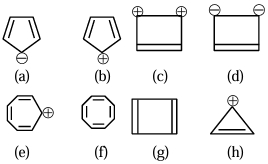
Designate whether each of the following compounds is aromatic or not aromatic.
A
$a, c, d, e, h$ are aromatic and $b, f, g$ are not aromatic
B
$b, e, f, g$ are aromatic and $a, c, d, h$ are not aromatic
C
$a, b, c, d$ are aromatic and $e, f, g, h$ are not aromatic
D
$a, c, d, e, h$ are aromatic and $b, f, g$ are not aromatic
Solution
(A) To determine aromaticity,a compound must be cyclic,planar,fully conjugated,and follow Huckel's rule ($4n+2$ $\pi$ electrons,where $n=0, 1, 2, ...$).
$(a)$ Cyclopentadienyl anion: $6$ $\pi$ electrons $(n=1)$,aromatic.
$(b)$ Cyclopentadienyl cation: $4$ $\pi$ electrons ($n=1$ anti-aromatic),not aromatic.
$(c)$ Cyclobutadiene dication: $2$ $\pi$ electrons $(n=0)$,aromatic.
$(d)$ Cyclobutadiene dianion: $6$ $\pi$ electrons $(n=1)$,aromatic.
$(e)$ Tropylium cation: $6$ $\pi$ electrons $(n=1)$,aromatic.
$(f)$ Cyclooctatetraene: $8$ $\pi$ electrons (non-planar),not aromatic.
$(g)$ Cyclobutadiene: $4$ $\pi$ electrons (anti-aromatic),not aromatic.
$(h)$ Cyclopropenyl cation: $2$ $\pi$ electrons $(n=0)$,aromatic.
Thus,$a, c, d, e, h$ are aromatic and $b, f, g$ are not aromatic.
$(a)$ Cyclopentadienyl anion: $6$ $\pi$ electrons $(n=1)$,aromatic.
$(b)$ Cyclopentadienyl cation: $4$ $\pi$ electrons ($n=1$ anti-aromatic),not aromatic.
$(c)$ Cyclobutadiene dication: $2$ $\pi$ electrons $(n=0)$,aromatic.
$(d)$ Cyclobutadiene dianion: $6$ $\pi$ electrons $(n=1)$,aromatic.
$(e)$ Tropylium cation: $6$ $\pi$ electrons $(n=1)$,aromatic.
$(f)$ Cyclooctatetraene: $8$ $\pi$ electrons (non-planar),not aromatic.
$(g)$ Cyclobutadiene: $4$ $\pi$ electrons (anti-aromatic),not aromatic.
$(h)$ Cyclopropenyl cation: $2$ $\pi$ electrons $(n=0)$,aromatic.
Thus,$a, c, d, e, h$ are aromatic and $b, f, g$ are not aromatic.
0 likesView Solution
126
ChemistryMediumMCQJEE Main · 2025
According to Bohr's model of hydrogen atom,which of the following statements is incorrect?
A
Radius of $3^{rd}$ orbit is nine times larger than that of $1^{st}$ orbit.
B
Radius of $8^{th}$ orbit is four times larger than that of $4^{th}$ orbit.
C
Radius of $6^{th}$ orbit is three times larger than that of $4^{th}$ orbit.
D
Radius of $4^{th}$ orbit is four times larger than that of $2^{nd}$ orbit.
Solution
(C) According to Bohr's model,the radius of the $n^{th}$ orbit is given by $r_n \propto n^2$.
For any two orbits $n_1$ and $n_2$,the ratio of their radii is $\frac{r_{n_2}}{r_{n_1}} = (\frac{n_2}{n_1})^2$.
$(A)$ $\frac{r_3}{r_1} = (\frac{3}{1})^2 = 9$. (Correct)
$(B)$ $\frac{r_8}{r_4} = (\frac{8}{4})^2 = 2^2 = 4$. (Correct)
$(C)$ $\frac{r_6}{r_4} = (\frac{6}{4})^2 = (1.5)^2 = 2.25$. The statement says it is $3$ times larger,which is incorrect.
$(D)$ $\frac{r_4}{r_2} = (\frac{4}{2})^2 = 2^2 = 4$. (Correct)
For any two orbits $n_1$ and $n_2$,the ratio of their radii is $\frac{r_{n_2}}{r_{n_1}} = (\frac{n_2}{n_1})^2$.
$(A)$ $\frac{r_3}{r_1} = (\frac{3}{1})^2 = 9$. (Correct)
$(B)$ $\frac{r_8}{r_4} = (\frac{8}{4})^2 = 2^2 = 4$. (Correct)
$(C)$ $\frac{r_6}{r_4} = (\frac{6}{4})^2 = (1.5)^2 = 2.25$. The statement says it is $3$ times larger,which is incorrect.
$(D)$ $\frac{r_4}{r_2} = (\frac{4}{2})^2 = 2^2 = 4$. (Correct)
0 likesView Solution
127
ChemistryMediumMCQJEE Main · 2025
Two vessels $A$ and $B$ are connected via a stopcock. Vessel $A$ is filled with a gas at a certain pressure. The entire assembly is immersed in water and allowed to reach thermal equilibrium. After opening the stopcock,the gas from vessel $A$ expands into vessel $B$,and no change in temperature is observed. Which of the following statements is true?
A
$dw \neq 0$
B
$dq \neq 0$
C
$dU \neq 0$
D
The pressure in vessel $B$ before opening the stopcock is zero.
Solution
(D) The process described is the free expansion of a gas into a vacuum.
In free expansion,the external pressure $P_{\text{ext}} = 0$.
Since work done $w = -P_{\text{ext}} \Delta V$,it follows that $w = 0$.
Because the system is in thermal equilibrium and the temperature remains constant,the internal energy change $\Delta U = 0$.
According to the first law of thermodynamics,$\Delta U = q + w$,which implies $q = 0$.
Therefore,the statement that the pressure in vessel $B$ before opening the stopcock is zero is the correct condition for free expansion.
In free expansion,the external pressure $P_{\text{ext}} = 0$.
Since work done $w = -P_{\text{ext}} \Delta V$,it follows that $w = 0$.
Because the system is in thermal equilibrium and the temperature remains constant,the internal energy change $\Delta U = 0$.
According to the first law of thermodynamics,$\Delta U = q + w$,which implies $q = 0$.
Therefore,the statement that the pressure in vessel $B$ before opening the stopcock is zero is the correct condition for free expansion.
0 likesView Solution
128
ChemistryDifficultMCQJEE Main · 2025
$CaCO_{3(s)} + 2 HCl_{(aq)} \rightarrow CaCl_{2(aq)} + CO_{2(g)} + H_2O_{(l)}$
Consider the above reaction,what mass of $CaCl_2$ will be formed if $250 \ mL$ of $0.76 \ M \ HCl$ reacts with $1000 \ g$ of $CaCO_3$ (in $g$)?
(Given: Molar mass of $Ca, C, O, H$ and $Cl$ are $40, 12, 16, 1$ and $35.5 \ g \ mol^{-1}$,respectively)
Consider the above reaction,what mass of $CaCl_2$ will be formed if $250 \ mL$ of $0.76 \ M \ HCl$ reacts with $1000 \ g$ of $CaCO_3$ (in $g$)?
(Given: Molar mass of $Ca, C, O, H$ and $Cl$ are $40, 12, 16, 1$ and $35.5 \ g \ mol^{-1}$,respectively)
A
$3.908$
B
$2.636$
C
$10.545$
D
$5.272$
Solution
(C) The balanced chemical equation is: $CaCO_{3(s)} + 2 HCl_{(aq)} \rightarrow CaCl_{2(aq)} + CO_{2(g)} + H_2O_{(l)}$
Molar mass of $CaCO_3 = 40 + 12 + (3 \times 16) = 100 \ g \ mol^{-1}$.
Moles of $CaCO_3 = \frac{1000 \ g}{100 \ g \ mol^{-1}} = 10 \ mol$.
Moles of $HCl = Molarity \times Volume (L) = 0.76 \ mol \ L^{-1} \times 0.250 \ L = 0.19 \ mol$.
According to the stoichiometry,$2 \ mol$ of $HCl$ reacts with $1 \ mol$ of $CaCO_3$.
Since $0.19 \ mol$ of $HCl$ is present,it will react with $0.095 \ mol$ of $CaCO_3$.
Thus,$HCl$ is the Limiting Reagent $(L.R.)$.
Moles of $CaCl_2$ formed $= \frac{1}{2} \times \text{moles of } HCl = \frac{0.19}{2} = 0.095 \ mol$.
Molar mass of $CaCl_2 = 40 + (2 \times 35.5) = 111 \ g \ mol^{-1}$.
Mass of $CaCl_2 = 0.095 \ mol \times 111 \ g \ mol^{-1} = 10.545 \ g$.
Molar mass of $CaCO_3 = 40 + 12 + (3 \times 16) = 100 \ g \ mol^{-1}$.
Moles of $CaCO_3 = \frac{1000 \ g}{100 \ g \ mol^{-1}} = 10 \ mol$.
Moles of $HCl = Molarity \times Volume (L) = 0.76 \ mol \ L^{-1} \times 0.250 \ L = 0.19 \ mol$.
According to the stoichiometry,$2 \ mol$ of $HCl$ reacts with $1 \ mol$ of $CaCO_3$.
Since $0.19 \ mol$ of $HCl$ is present,it will react with $0.095 \ mol$ of $CaCO_3$.
Thus,$HCl$ is the Limiting Reagent $(L.R.)$.
Moles of $CaCl_2$ formed $= \frac{1}{2} \times \text{moles of } HCl = \frac{0.19}{2} = 0.095 \ mol$.
Molar mass of $CaCl_2 = 40 + (2 \times 35.5) = 111 \ g \ mol^{-1}$.
Mass of $CaCl_2 = 0.095 \ mol \times 111 \ g \ mol^{-1} = 10.545 \ g$.
0 likesView Solution
129
ChemistryMediumMCQJEE Main · 2025
If equal volumes of $AB_2$ and $XY$ (both are salts) aqueous solutions are mixed,which of the following combinations will give a precipitate of $AY_2$ at $300 \ K$? (Given $K_{sp}$ (at $300 \ K$) for $AY_2 = 5.2 \times 10^{-7}$)
A
$3.6 \times 10^{-3} \ M \ AB_2, 5.0 \times 10^{-4} \ M \ XY$
B
$2.0 \times 10^{-4} \ M \ AB_2, 0.8 \times 10^{-3} \ M \ XY$
C
$2.0 \times 10^{-2} \ M \ AB_2, 2.0 \times 10^{-2} \ M \ XY$
D
$1.5 \times 10^{-4} \ M \ AB_2, 1.5 \times 10^{-3} \ M \ XY$
Solution
(C) When equal volumes are mixed,the concentration of each species is halved.
The reaction is $AB_2 + 2XY \rightarrow AY_2 + 2XB$.
For precipitation to occur,the ionic product $Q_{sp}$ must be greater than $K_{sp}$.
$Q_{sp} = [A^{2+}][Y^-]^2$.
For option $C$: $[A^{2+}] = (2.0 \times 10^{-2} / 2) = 1.0 \times 10^{-2} \ M$ and $[Y^-] = (2.0 \times 10^{-2} / 2) = 1.0 \times 10^{-2} \ M$.
$Q_{sp} = (1.0 \times 10^{-2}) \times (1.0 \times 10^{-2})^2 = 1.0 \times 10^{-6}$.
Since $1.0 \times 10^{-6} > 5.2 \times 10^{-7}$,a precipitate will form.
The reaction is $AB_2 + 2XY \rightarrow AY_2 + 2XB$.
For precipitation to occur,the ionic product $Q_{sp}$ must be greater than $K_{sp}$.
$Q_{sp} = [A^{2+}][Y^-]^2$.
For option $C$: $[A^{2+}] = (2.0 \times 10^{-2} / 2) = 1.0 \times 10^{-2} \ M$ and $[Y^-] = (2.0 \times 10^{-2} / 2) = 1.0 \times 10^{-2} \ M$.
$Q_{sp} = (1.0 \times 10^{-2}) \times (1.0 \times 10^{-2})^2 = 1.0 \times 10^{-6}$.
Since $1.0 \times 10^{-6} > 5.2 \times 10^{-7}$,a precipitate will form.
0 likesView Solution
130
ChemistryMediumMCQJEE Main · 2025
Among $SO_2, NF_3, NH_3, XeF_2, ClF_3$ and $SF_4$,the hybridization of the molecule with non$-zero$ dipole moment and highest number of lone$-pairs$ of electrons on the central atom is
A
$sp^3$
B
$dsp^2$
C
$sp^3d^2$
D
$sp^3d$
Solution
(D) To determine the correct answer,we analyze each molecule for its dipole moment and the number of lone pairs on the central atom:
Comparing the molecules with a non$-zero$ dipole moment,$ClF_3$ has the highest number of lone pairs on the central atom,which is $2$. The hybridization of $ClF_3$ is $sp^3d$.
| Molecule | Hybridisation,Dipole Moment,Lone Pairs |
| $SO_2$ | $sp^2$,Non$-zero$,$1$ |
| $NF_3$ | $sp^3$,Non$-zero$,$1$ |
| $NH_3$ | $sp^3$,Non$-zero$,$1$ |
| $XeF_2$ | $sp^3d$,Zero,$3$ |
| $ClF_3$ | $sp^3d$,Non$-zero$,$2$ |
| $SF_4$ | $sp^3d$,Non$-zero$,$1$ |
Comparing the molecules with a non$-zero$ dipole moment,$ClF_3$ has the highest number of lone pairs on the central atom,which is $2$. The hybridization of $ClF_3$ is $sp^3d$.
0 likesView Solution
131
ChemistryMediumMCQJEE Main · 2025
Given below are two statements $ : $
Statement $(I) :$ The metallic radius of $Al$ is less than that of $Ga$.
Statement $(II) :$ The ionic radius of $Al^{3+}$ is less than that of $Ga^{3+}$.
In the light of the above statements, choose the most appropriate answer from the options given below $ : $
Statement $(I) :$ The metallic radius of $Al$ is less than that of $Ga$.
Statement $(II) :$ The ionic radius of $Al^{3+}$ is less than that of $Ga^{3+}$.
In the light of the above statements, choose the most appropriate answer from the options given below $ : $
A
Both Statement $I$ and Statement $II$ are incorrect
B
Statement $I$ is incorrect but Statement $II$ is correct
C
Statement $I$ is correct but Statement $II$ is incorrect
D
Both Statement $I$ and Statement $II$ are correct
Solution
(B) Statement $(I)$ is incorrect because the metallic radius of $Ga$ $(126 \ pm)$ is slightly smaller than that of $Al$ $(143 \ pm)$ due to the poor shielding effect of $d$-electrons in $Ga$, which increases the effective nuclear charge.
Statement $(II)$ is correct because the ionic radius of $Al^{3+}$ $(53.5 \ pm)$ is smaller than that of $Ga^{3+}$ $(62 \ pm)$ as $Ga^{3+}$ has an additional shell of electrons compared to $Al^{3+}$.
Statement $(II)$ is correct because the ionic radius of $Al^{3+}$ $(53.5 \ pm)$ is smaller than that of $Ga^{3+}$ $(62 \ pm)$ as $Ga^{3+}$ has an additional shell of electrons compared to $Al^{3+}$.
0 likesView Solution
132
ChemistryDifficultMCQJEE Main · 2025
On complete combustion,$1.0 \ g$ of an organic compound $(X)$ gave $1.46 \ g$ of $CO_2$ and $0.567 \ g$ of $H_2O$. The empirical formula mass of compound $(X)$ is $.......... \ g \ mol^{-1}$. (Given molar mass in $g \ mol^{-1}: C: 12, H: 1, O: 16$)
A
$30$
B
$45$
C
$60$
D
$15$
Solution
(A) Moles of $C = n_{CO_2} = \frac{1.46}{44} \approx 0.03318 \ mol$.
Mass of $C = 0.03318 \times 12 = 0.398 \ g$.
Moles of $H = 2 \times n_{H_2O} = 2 \times \frac{0.567}{18} = 0.063 \ mol$.
Mass of $H = 0.063 \times 1 = 0.063 \ g$.
Mass of $O = 1.0 - (0.398 + 0.063) = 0.539 \ g$.
Moles of $O = \frac{0.539}{16} \approx 0.0337 \ mol$.
Ratio of $C:H:O = 0.03318 : 0.063 : 0.0337 \approx 1:2:1$.
Empirical formula $= CH_2O$.
Empirical formula mass $= 12 + (2 \times 1) + 16 = 30 \ g \ mol^{-1}$.
Mass of $C = 0.03318 \times 12 = 0.398 \ g$.
Moles of $H = 2 \times n_{H_2O} = 2 \times \frac{0.567}{18} = 0.063 \ mol$.
Mass of $H = 0.063 \times 1 = 0.063 \ g$.
Mass of $O = 1.0 - (0.398 + 0.063) = 0.539 \ g$.
Moles of $O = \frac{0.539}{16} \approx 0.0337 \ mol$.
Ratio of $C:H:O = 0.03318 : 0.063 : 0.0337 \approx 1:2:1$.
Empirical formula $= CH_2O$.
Empirical formula mass $= 12 + (2 \times 1) + 16 = 30 \ g \ mol^{-1}$.
0 likesView Solution
133
ChemistryDifficultMCQJEE Main · 2025
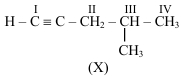
Consider the following compound $(X)$:
$H-C \equiv C-CH_2-CH(CH_3)-CH_3$
The most stable and least stable carbon radicals,respectively,produced by homolytic cleavage of the corresponding $C-H$ bond are:
$H-C \equiv C-CH_2-CH(CH_3)-CH_3$
The most stable and least stable carbon radicals,respectively,produced by homolytic cleavage of the corresponding $C-H$ bond are:
A
$II, IV$
B
$III, II$
C
$I, IV$
D
$II, I$
Solution
(D) The stability of carbon radicals depends on resonance and hyperconjugation.
$1.$ Position $II$ forms a propargyl radical $(HC \equiv C-CH^{\bullet}-CH(CH_3)_2)$,which is resonance-stabilized by the adjacent triple bond.
$2.$ Position $III$ forms a tertiary radical,which is stabilized by hyperconjugation.
$3.$ Position $IV$ forms a primary radical,which is less stable than the tertiary radical.
$4.$ Position $I$ forms an $sp$-hybridized radical $(C^{\bullet} \equiv C-CH_2-CH(CH_3)_2)$,which is highly unstable due to the high $s$-character of the $sp$ orbital.
Comparing the stability: The resonance-stabilized radical at $II$ is the most stable,and the $sp$-hybridized radical at $I$ is the least stable.
Therefore,the correct order is $II$ (most stable) and $I$ (least stable).
$1.$ Position $II$ forms a propargyl radical $(HC \equiv C-CH^{\bullet}-CH(CH_3)_2)$,which is resonance-stabilized by the adjacent triple bond.
$2.$ Position $III$ forms a tertiary radical,which is stabilized by hyperconjugation.
$3.$ Position $IV$ forms a primary radical,which is less stable than the tertiary radical.
$4.$ Position $I$ forms an $sp$-hybridized radical $(C^{\bullet} \equiv C-CH_2-CH(CH_3)_2)$,which is highly unstable due to the high $s$-character of the $sp$ orbital.
Comparing the stability: The resonance-stabilized radical at $II$ is the most stable,and the $sp$-hybridized radical at $I$ is the least stable.
Therefore,the correct order is $II$ (most stable) and $I$ (least stable).
0 likesView Solution
134
ChemistryMediumMCQJEE Main · 2025
$A$ molecule with the formula $AX_4Y$ has all its elements from the $p-$block. Element $A$ is the rarest,monoatomic,non$-$radioactive element from its group and has the lowest ionization enthalpy value among $A, X,$ and $Y$. Elements $X$ and $Y$ have the first and second highest electronegativity values,respectively,among all known elements. The shape of the molecule is:
A
Square pyramidal
B
Octahedral
C
Pentagonal planar
D
Trigonal bipyramidal
Solution
(A) Given that $A$ is the rarest,monoatomic,non$-$radioactive $p-$block element that forms an $AX_4Y$ type of molecule,it is concluded that $A$ is $Xe$.
Given that the electronegativity of $A$ is less than $X$ and $Y$,and that $X$ and $Y$ have the highest and second highest electronegativity values among all elements,$X$ and $Y$ are $F$ and $O$ respectively.
Thus,the compound is $XeOF_4$.
In $XeOF_4$,the central atom $Xe$ has $8$ valence electrons. It forms $4$ single bonds with $F$ atoms and $1$ double bond with the $O$ atom,leaving $1$ lone pair.
The steric number is $5 + 1 = 6$,which corresponds to $sp^3d^2$ hybridization with an octahedral electron geometry.
Due to the presence of one lone pair,the molecular shape is square pyramidal.
Given that the electronegativity of $A$ is less than $X$ and $Y$,and that $X$ and $Y$ have the highest and second highest electronegativity values among all elements,$X$ and $Y$ are $F$ and $O$ respectively.
Thus,the compound is $XeOF_4$.
In $XeOF_4$,the central atom $Xe$ has $8$ valence electrons. It forms $4$ single bonds with $F$ atoms and $1$ double bond with the $O$ atom,leaving $1$ lone pair.
The steric number is $5 + 1 = 6$,which corresponds to $sp^3d^2$ hybridization with an octahedral electron geometry.
Due to the presence of one lone pair,the molecular shape is square pyramidal.
0 likesView Solution
135
ChemistryDifficultMCQJEE Main · 2025
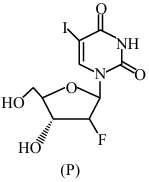
$0.1$ mol of the following given antiviral compound $(P)$ will weigh $......... \times 10^{-1} \ g$
$Given :$ molar mass in $g \ mol^{-1} H: 1, C: 12, N: 14, O: 16, F: 19, I: 127$
$Given :$ molar mass in $g \ mol^{-1} H: 1, C: 12, N: 14, O: 16, F: 19, I: 127$
A
$145$
B
$721$
C
$372$
D
$472$
Solution
(C) The molecular formula of the compound $(P)$ is $C_9H_{11}FIN_2O_5$.
Calculating the molar mass:
$M = (9 \times 12) + (11 \times 1) + 127 + 19 + (2 \times 14) + (5 \times 16)$
$M = 108 + 11 + 127 + 19 + 28 + 80 = 373 \ g \ mol^{-1}$.
Weight of $0.1$ mol $= 0.1 \times 373 = 37.3 \ g = 373 \times 10^{-1} \ g$.
Thus,the value is $373$.
Calculating the molar mass:
$M = (9 \times 12) + (11 \times 1) + 127 + 19 + (2 \times 14) + (5 \times 16)$
$M = 108 + 11 + 127 + 19 + 28 + 80 = 373 \ g \ mol^{-1}$.
Weight of $0.1$ mol $= 0.1 \times 373 = 37.3 \ g = 373 \times 10^{-1} \ g$.
Thus,the value is $373$.
0 likesView Solution
136
ChemistryDifficultMCQJEE Main · 2025
Consider the following equilibrium,$CO_{(g)} + 2H_{2(g)} \rightleftharpoons CH_3OH_{(g)}$. $0.1 \ mol$ of $CO$ along with a catalyst is present in a $2 \ dm^3$ flask maintained at $500 \ K$. Hydrogen is introduced into the flask until the pressure is $5 \ bar$ and $0.04 \ mol$ of $CH_3OH$ is formed. The $K_{p}^0$ is $......... \times 10^{-3}$ (nearest integer). Given: $R = 0.08 \ dm^3 \ bar \ K^{-1} \ mol^{-1}$. Assume only methanol is formed as the product and the system follows ideal gas behaviour.
A
$45$
B
$94$
C
$84$
D
$74$
Solution
(D) The equilibrium reaction is $CO_{(g)} + 2H_{2(g)} \rightleftharpoons CH_3OH_{(g)}$.
At $t=0$,$n_{CO} = 0.1 \ mol$,$n_{H_2} = a \ mol$,$n_{CH_3OH} = 0$.
At equilibrium,$n_{CO} = 0.1 - 0.04 = 0.06 \ mol$,$n_{H_2} = a - 2(0.04) = a - 0.08 \ mol$,$n_{CH_3OH} = 0.04 \ mol$.
Total moles at equilibrium $n_{total} = 0.06 + a - 0.08 + 0.04 = a + 0.02 \ mol$.
Using the ideal gas law $PV = nRT$ at equilibrium:
$5 \ bar \times 2 \ dm^3 = (a + 0.02) \ mol \times 0.08 \ dm^3 \ bar \ K^{-1} \ mol^{-1} \times 500 \ K$.
$10 = (a + 0.02) \times 40$ $\Rightarrow a + 0.02 = 0.25$ $\Rightarrow a = 0.23 \ mol$.
Total moles $n_{total} = 0.25 \ mol$.
Mole fractions: $X_{CO} = 0.06/0.25$,$X_{H_2} = (0.23-0.08)/0.25 = 0.15/0.25$,$X_{CH_3OH} = 0.04/0.25$.
$K_p = \frac{X_{CH_3OH}}{X_{CO} \times X_{H_2}^2} \times (P_{total})^{-2} = \frac{0.04/0.25}{(0.06/0.25) \times (0.15/0.25)^2} \times (5)^{-2}$.
$K_p = \frac{0.04 \times 0.25}{0.06 \times 0.0225 \times 25} = \frac{0.01}{0.03375} \approx 0.296$ (Wait,re-calculating: $K_p = \frac{0.04 \times 0.25^2}{0.06 \times 0.15^2 \times 25} = \frac{0.04 \times 0.0625}{0.06 \times 0.0225 \times 25} = \frac{0.0025}{0.03375} \approx 0.07407$).
$K_p \approx 74 \times 10^{-3}$.
At $t=0$,$n_{CO} = 0.1 \ mol$,$n_{H_2} = a \ mol$,$n_{CH_3OH} = 0$.
At equilibrium,$n_{CO} = 0.1 - 0.04 = 0.06 \ mol$,$n_{H_2} = a - 2(0.04) = a - 0.08 \ mol$,$n_{CH_3OH} = 0.04 \ mol$.
Total moles at equilibrium $n_{total} = 0.06 + a - 0.08 + 0.04 = a + 0.02 \ mol$.
Using the ideal gas law $PV = nRT$ at equilibrium:
$5 \ bar \times 2 \ dm^3 = (a + 0.02) \ mol \times 0.08 \ dm^3 \ bar \ K^{-1} \ mol^{-1} \times 500 \ K$.
$10 = (a + 0.02) \times 40$ $\Rightarrow a + 0.02 = 0.25$ $\Rightarrow a = 0.23 \ mol$.
Total moles $n_{total} = 0.25 \ mol$.
Mole fractions: $X_{CO} = 0.06/0.25$,$X_{H_2} = (0.23-0.08)/0.25 = 0.15/0.25$,$X_{CH_3OH} = 0.04/0.25$.
$K_p = \frac{X_{CH_3OH}}{X_{CO} \times X_{H_2}^2} \times (P_{total})^{-2} = \frac{0.04/0.25}{(0.06/0.25) \times (0.15/0.25)^2} \times (5)^{-2}$.
$K_p = \frac{0.04 \times 0.25}{0.06 \times 0.0225 \times 25} = \frac{0.01}{0.03375} \approx 0.296$ (Wait,re-calculating: $K_p = \frac{0.04 \times 0.25^2}{0.06 \times 0.15^2 \times 25} = \frac{0.04 \times 0.0625}{0.06 \times 0.0225 \times 25} = \frac{0.0025}{0.03375} \approx 0.07407$).
$K_p \approx 74 \times 10^{-3}$.
0 likesView Solution
137
ChemistryMediumMCQJEE Main · 2025
Given below are two statements $:$
Statement $(I) :$ Neopentane forms only one monosubstituted derivative.
Statement $(II) :$ Melting point of neopentane is higher than $n-$pentane.
In the light of the above statements,choose the most appropriate answer from the options given below $:$
Statement $(I) :$ Neopentane forms only one monosubstituted derivative.
Statement $(II) :$ Melting point of neopentane is higher than $n-$pentane.
In the light of the above statements,choose the most appropriate answer from the options given below $:$
A
Statement $I$ is correct but Statement $II$ is incorrect
B
Both Statement $I$ and Statement $II$ are correct
C
Both Statement $I$ and Statement $II$ are incorrect
D
Statement $I$ is incorrect but Statement $II$ is correct
Solution
(B) Statement $(I)$ is correct: Neopentane ($2,2-$dimethylpropane) has $12$ equivalent hydrogen atoms. Therefore,substitution of any of these hydrogen atoms by a halogen atom leads to the formation of only one monosubstituted derivative,$1-$halo$-2,2-$dimethylpropane.
Statement $(II)$ is correct: The melting point of an alkane depends on its packing in the crystal lattice. Neopentane has a highly symmetrical,spherical structure,which allows it to pack more efficiently in the crystal lattice compared to the linear $n-$pentane. This leads to stronger intermolecular forces in the solid state,resulting in a higher melting point for neopentane compared to $n-$pentane.
Statement $(II)$ is correct: The melting point of an alkane depends on its packing in the crystal lattice. Neopentane has a highly symmetrical,spherical structure,which allows it to pack more efficiently in the crystal lattice compared to the linear $n-$pentane. This leads to stronger intermolecular forces in the solid state,resulting in a higher melting point for neopentane compared to $n-$pentane.
0 likesView Solution
138
ChemistryMediumMCQJEE Main · 2025
Which among the following molecules is $(a)$ involved in $sp^3d$ hybridization,$(b)$ has different bond lengths and $(c)$ has a lone pair of electrons on the central atom?
A
$PF_5$
B
$XeF_4$
C
$SF_4$
D
$XeF_2$
Solution
(C) Let us analyze each molecule:
$1$. $PF_5$: Hybridization is $sp^3d$. It has $5$ identical $P-F$ bonds (trigonal bipyramidal geometry) and no lone pair on the central atom.
$2$. $XeF_4$: Hybridization is $sp^3d^2$. It has a square planar geometry with $2$ lone pairs on the central atom.
$3$. $SF_4$: Hybridization is $sp^3d$. It has a see-saw geometry with $1$ lone pair on the central atom. Due to the presence of the lone pair,the axial and equatorial bond lengths are different.
$4$. $XeF_2$: Hybridization is $sp^3d$. It has a linear geometry with $3$ lone pairs on the central atom. The $Xe-F$ bonds are identical.
Therefore,$SF_4$ satisfies all three conditions: $(a)$ $sp^3d$ hybridization,$(b)$ different bond lengths,and $(c)$ one lone pair on the central atom.
$1$. $PF_5$: Hybridization is $sp^3d$. It has $5$ identical $P-F$ bonds (trigonal bipyramidal geometry) and no lone pair on the central atom.
$2$. $XeF_4$: Hybridization is $sp^3d^2$. It has a square planar geometry with $2$ lone pairs on the central atom.
$3$. $SF_4$: Hybridization is $sp^3d$. It has a see-saw geometry with $1$ lone pair on the central atom. Due to the presence of the lone pair,the axial and equatorial bond lengths are different.
$4$. $XeF_2$: Hybridization is $sp^3d$. It has a linear geometry with $3$ lone pairs on the central atom. The $Xe-F$ bonds are identical.
Therefore,$SF_4$ satisfies all three conditions: $(a)$ $sp^3d$ hybridization,$(b)$ different bond lengths,and $(c)$ one lone pair on the central atom.
0 likesView Solution
139
ChemistryMediumMCQJEE Main · 2025
In $3, 3-$dimethylhex$-1-$ene$-4-$yne,there are $......... sp^3, ......... sp^2$ and $........ sp$ hybridised carbon atoms respectively $:$
A
$4, 2, 2$
B
$3, 3, 2$
C
$2, 4, 2$
D
$2, 2, 4$
Solution
(A) The structure of $3, 3-$dimethylhex$-1-$ene$-4-$yne is $CH_3-C \equiv C-C(CH_3)_2-CH=CH_2$.
Counting the hybridization of each carbon atom:
$1.$ $CH_3$ (terminal) is $sp^3$.
$2.$ $C \equiv C$ carbons are both $sp$.
$3.$ $C$ at position $3$ is $sp^3$.
$4.$ Two $CH_3$ groups at position $3$ are $sp^3$.
$5.$ $CH$ at position $2$ is $sp^2$.
$6.$ $CH_2$ at position $1$ is $sp^2$.
Total counts:
$sp^3$ carbons: $4$ (terminal $CH_3$,two $CH_3$ at position $3$,and the quaternary $C$ at position $3$).
$sp^2$ carbons: $2$ (at positions $1$ and $2$).
$sp$ carbons: $2$ (at positions $4$ and $5$).
Thus,the number of $sp^3, sp^2, sp$ hybridized carbon atoms are $4, 2, 2$ respectively.
Counting the hybridization of each carbon atom:
$1.$ $CH_3$ (terminal) is $sp^3$.
$2.$ $C \equiv C$ carbons are both $sp$.
$3.$ $C$ at position $3$ is $sp^3$.
$4.$ Two $CH_3$ groups at position $3$ are $sp^3$.
$5.$ $CH$ at position $2$ is $sp^2$.
$6.$ $CH_2$ at position $1$ is $sp^2$.
Total counts:
$sp^3$ carbons: $4$ (terminal $CH_3$,two $CH_3$ at position $3$,and the quaternary $C$ at position $3$).
$sp^2$ carbons: $2$ (at positions $1$ and $2$).
$sp$ carbons: $2$ (at positions $4$ and $5$).
Thus,the number of $sp^3, sp^2, sp$ hybridized carbon atoms are $4, 2, 2$ respectively.
0 likesView Solution
140
ChemistryDifficultMCQJEE Main · 2025
Which of the following statements are true?
$(A)$ The subsidiary quantum number $\ell$ describes the shape of the orbital occupied by the electron.
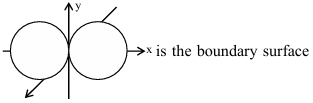
$(B)$ The image shows the boundary surface diagram of the $2p_x$ orbital.
$(C)$ The $+$ and $-$ signs in the wave function of the $2p_x$ orbital refer to charge.
$(D)$ The wave function of the $2p_x$ orbital is zero everywhere in the $yz$ plane.
$(A)$ The subsidiary quantum number $\ell$ describes the shape of the orbital occupied by the electron.
$(B)$ The image shows the boundary surface diagram of the $2p_x$ orbital.
$(C)$ The $+$ and $-$ signs in the wave function of the $2p_x$ orbital refer to charge.
$(D)$ The wave function of the $2p_x$ orbital is zero everywhere in the $yz$ plane.
A
$(B)$ and $(D)$ only
B
$(A)$,$(B)$ and $(C)$ only
C
$(C)$ and $(D)$ only
D
$(A)$ and $(B)$ only
Solution
(D) The azimuthal (subsidiary) quantum number $\ell$ determines the shape of the orbital.
$(B)$ The provided image represents the boundary surface diagram of the $2p_x$ orbital.
$(C)$ The $+$ and $-$ signs in the wave function of the $2p_x$ orbital represent the phase of the wave function,not the electrical charge.
$(D)$ The wave function of the $2p_x$ orbital is zero in the $yz$ plane,which acts as the nodal plane for this orbital.
Therefore,statements $(A)$ and $(B)$ are correct.
$(B)$ The provided image represents the boundary surface diagram of the $2p_x$ orbital.
$(C)$ The $+$ and $-$ signs in the wave function of the $2p_x$ orbital represent the phase of the wave function,not the electrical charge.
$(D)$ The wave function of the $2p_x$ orbital is zero in the $yz$ plane,which acts as the nodal plane for this orbital.
Therefore,statements $(A)$ and $(B)$ are correct.
0 likesView Solution
141
ChemistryMediumMCQJEE Main · 2025
Electronic configuration of four elements $A, B, C$ and $D$ are given below $:$
$(A) 1s^2 2s^2 2p^3$
$(B) 1s^2 2s^2 2p^4$
$(C) 1s^2 2s^2 2p^5$
$(D) 1s^2 2s^2 2p^2$
Which of the following is the correct order of increasing electronegativity $(Pauling's scale)$?
$(A) 1s^2 2s^2 2p^3$
$(B) 1s^2 2s^2 2p^4$
$(C) 1s^2 2s^2 2p^5$
$(D) 1s^2 2s^2 2p^2$
Which of the following is the correct order of increasing electronegativity $(Pauling's scale)$?
A
$A < D < B < C$
B
$A < C < B < D$
C
$A < B < C < D$
D
$D < A < B < C$
Solution
(D) Identify the elements based on their electronic configurations:
$A: 1s^2 2s^2 2p^3$ is Nitrogen $(N)$,Electronegativity $\approx 3.04$.
$B: 1s^2 2s^2 2p^4$ is Oxygen $(O)$,Electronegativity $\approx 3.44$.
$C: 1s^2 2s^2 2p^5$ is Fluorine $(F)$,Electronegativity $\approx 3.98$.
$D: 1s^2 2s^2 2p^2$ is Carbon $(C)$,Electronegativity $\approx 2.55$.
Electronegativity increases across a period from left to right in the periodic table.
The order of increasing electronegativity is $C < N < O < F$,which corresponds to $D < A < B < C$.
$A: 1s^2 2s^2 2p^3$ is Nitrogen $(N)$,Electronegativity $\approx 3.04$.
$B: 1s^2 2s^2 2p^4$ is Oxygen $(O)$,Electronegativity $\approx 3.44$.
$C: 1s^2 2s^2 2p^5$ is Fluorine $(F)$,Electronegativity $\approx 3.98$.
$D: 1s^2 2s^2 2p^2$ is Carbon $(C)$,Electronegativity $\approx 2.55$.
Electronegativity increases across a period from left to right in the periodic table.
The order of increasing electronegativity is $C < N < O < F$,which corresponds to $D < A < B < C$.
0 likesView Solution
142
ChemistryMediumMCQJEE Main · 2025
Match List-$I$ with List-$II$.
Choose the correct answer from the options given below $:$
| List-$I$ (Purification technique) | List-$II$ (Mixture of organic compounds) |
| $(A)$ Distillation (simple) | $(I)$ Diesel + Petrol |
| $(B)$ Fractional distillation | $(II)$ Aniline + Water |
| $(C)$ Distillation under reduced pressure | $(III)$ Chloroform + Aniline |
| $(D)$ Steam distillation | $(IV)$ Glycerol + Spent-lye |
Choose the correct answer from the options given below $:$
A
$A-III, B-I, C-IV, D-II$
B
$A-II, B-IV, C-I, D-III$
C
$A-III, B-IV, C-II, D-I$
D
$A-II, B-I, C-IV, D-III$
Solution
(A) The correct matches are as follows:
$1$. Simple distillation is used for liquids with a large difference in boiling points,such as $Chloroform$ ($bp$ $334 \ K$) and $Aniline$ ($bp$ $457 \ K$). Thus,$(A)-(III)$.
$2$. Fractional distillation is used for liquids with boiling points close to each other,such as $Diesel$ and $Petrol$. Thus,$(B)-(I)$.
$3$. Distillation under reduced pressure is used for liquids that decompose at their boiling points,such as $Glycerol$ from spent-lye. Thus,$(C)-(IV)$.
$4$. Steam distillation is used for substances that are steam volatile and insoluble in water,such as $Aniline$ and $Water$. Thus,$(D)-(II)$.
Therefore,the correct sequence is $A-III, B-I, C-IV, D-II$.
$1$. Simple distillation is used for liquids with a large difference in boiling points,such as $Chloroform$ ($bp$ $334 \ K$) and $Aniline$ ($bp$ $457 \ K$). Thus,$(A)-(III)$.
$2$. Fractional distillation is used for liquids with boiling points close to each other,such as $Diesel$ and $Petrol$. Thus,$(B)-(I)$.
$3$. Distillation under reduced pressure is used for liquids that decompose at their boiling points,such as $Glycerol$ from spent-lye. Thus,$(C)-(IV)$.
$4$. Steam distillation is used for substances that are steam volatile and insoluble in water,such as $Aniline$ and $Water$. Thus,$(D)-(II)$.
Therefore,the correct sequence is $A-III, B-I, C-IV, D-II$.
0 likesView Solution
143
ChemistryMediumMCQJEE Main · 2025
Arrange the following in order of magnitude of work done by the system / on the system at constant temperature:
$(a)$ $|w_{reversible}|$ for expansion in infinite stage.
$(b)$ $|w_{irreversible}|$ for expansion in single stage.
$(c)$ $|w_{reversible}|$ for compression in infinite stage.
$(d)$ $|w_{irreversible}|$ for compression in single stage.
Choose the correct answer from the options given below:
$(a)$ $|w_{reversible}|$ for expansion in infinite stage.
$(b)$ $|w_{irreversible}|$ for expansion in single stage.
$(c)$ $|w_{reversible}|$ for compression in infinite stage.
$(d)$ $|w_{irreversible}|$ for compression in single stage.
Choose the correct answer from the options given below:
A
$a > b > c > d$
B
$d > c = a > b$
C
$c = a > d > b$
D
$a > c > b > d$
Solution
(B) For an isothermal process,the magnitude of work done is given by the area under the $PV$ curve.
$1$. For reversible processes,$|w_{reversible}| = |nRT \ln(V_f/V_i)|$. Since the initial and final states are the same for expansion and compression,$|w_{reversible}|_{expansion} = |w_{reversible}|_{compression} = a = c$.
$2$. For irreversible expansion in a single stage,$|w_{irreversible}|_{exp} = P_{ext}(V_f - V_i)$,which is represented by the area of the rectangle under the final pressure $P_2$. This area is smaller than the area under the reversible curve.
$3$. For irreversible compression in a single stage,$|w_{irreversible}|_{comp} = P_{ext}(V_i - V_f)$,which is represented by the area of the rectangle under the final pressure $P_2$. This area is larger than the area under the reversible curve.
$4$. Comparing the magnitudes: $|w_{irreversible}|_{comp} > |w_{reversible}|_{comp} = |w_{reversible}|_{exp} > |w_{irreversible}|_{exp}$.
Thus,the order is $d > c = a > b$.
$1$. For reversible processes,$|w_{reversible}| = |nRT \ln(V_f/V_i)|$. Since the initial and final states are the same for expansion and compression,$|w_{reversible}|_{expansion} = |w_{reversible}|_{compression} = a = c$.
$2$. For irreversible expansion in a single stage,$|w_{irreversible}|_{exp} = P_{ext}(V_f - V_i)$,which is represented by the area of the rectangle under the final pressure $P_2$. This area is smaller than the area under the reversible curve.
$3$. For irreversible compression in a single stage,$|w_{irreversible}|_{comp} = P_{ext}(V_i - V_f)$,which is represented by the area of the rectangle under the final pressure $P_2$. This area is larger than the area under the reversible curve.
$4$. Comparing the magnitudes: $|w_{irreversible}|_{comp} > |w_{reversible}|_{comp} = |w_{reversible}|_{exp} > |w_{irreversible}|_{exp}$.
Thus,the order is $d > c = a > b$.
0 likesView Solution
144
ChemistryMediumMCQJEE Main · 2025
Consider the following chemical equilibrium of the gas phase reaction at a constant temperature: $A_{(g)} \rightleftharpoons B_{(g)} + C_{(g)}$. If $p$ is the total pressure,$K_p$ is the equilibrium constant,and $\alpha$ is the degree of dissociation,then which of the following is true at equilibrium?
A
If $p$ value is extremely high compared to $K_p, \alpha \approx 1$
B
When $p$ increases,$\alpha$ decreases
C
If $K_p$ value is extremely high compared to $p, \alpha$ becomes much less than unity
D
When $p$ increases,$\alpha$ increases
Solution
(B) For the reaction $A_{(g)} \rightleftharpoons B_{(g)} + C_{(g)}$:
Initial moles: $A=1, B=0, C=0$
At equilibrium: $A=1-\alpha, B=\alpha, C=\alpha$
Total moles $= (1-\alpha) + \alpha + \alpha = 1+\alpha$
Partial pressures: $P_A = \frac{1-\alpha}{1+\alpha} p, P_B = \frac{\alpha}{1+\alpha} p, P_C = \frac{\alpha}{1+\alpha} p$
$K_p = \frac{P_B \cdot P_C}{P_A} = \frac{(\frac{\alpha}{1+\alpha} p) (\frac{\alpha}{1+\alpha} p)}{\frac{1-\alpha}{1+\alpha} p} = \frac{\alpha^2 p}{1-\alpha^2}$
Rearranging for $\alpha$: $\alpha^2 p = K_p - K_p \alpha^2$ $\Rightarrow \alpha^2(p+K_p) = K_p$ $\Rightarrow \alpha = \sqrt{\frac{K_p}{p+K_p}}$
This expression shows that as the total pressure $p$ increases,the degree of dissociation $\alpha$ decreases.
Initial moles: $A=1, B=0, C=0$
At equilibrium: $A=1-\alpha, B=\alpha, C=\alpha$
Total moles $= (1-\alpha) + \alpha + \alpha = 1+\alpha$
Partial pressures: $P_A = \frac{1-\alpha}{1+\alpha} p, P_B = \frac{\alpha}{1+\alpha} p, P_C = \frac{\alpha}{1+\alpha} p$
$K_p = \frac{P_B \cdot P_C}{P_A} = \frac{(\frac{\alpha}{1+\alpha} p) (\frac{\alpha}{1+\alpha} p)}{\frac{1-\alpha}{1+\alpha} p} = \frac{\alpha^2 p}{1-\alpha^2}$
Rearranging for $\alpha$: $\alpha^2 p = K_p - K_p \alpha^2$ $\Rightarrow \alpha^2(p+K_p) = K_p$ $\Rightarrow \alpha = \sqrt{\frac{K_p}{p+K_p}}$
This expression shows that as the total pressure $p$ increases,the degree of dissociation $\alpha$ decreases.
0 likesView Solution
145
ChemistryDifficultMCQJEE Main · 2025
Which of the following graphs correctly represents the variation of thermodynamic properties of Haber's process?
A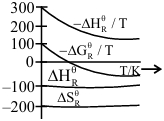
B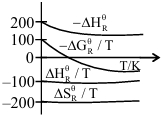
C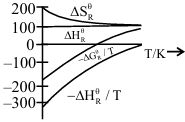
D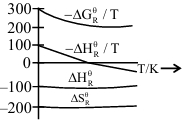
Solution
(B) The Haber process is represented by the reaction: $N_{2(g)} + 3H_{2(g)} \rightleftharpoons 2NH_{3(g)}$.
For this reaction,the enthalpy change $\Delta H^{\circ}$ is negative (exothermic) and the entropy change $\Delta S^{\circ}$ is negative (as the number of gaseous moles decreases).
Using the Gibbs-Helmholtz equation: $\Delta G^{\circ} = \Delta H^{\circ} - T\Delta S^{\circ}$.
Dividing by $-T$,we get: $-\frac{\Delta G^{\circ}}{T} = -\frac{\Delta H^{\circ}}{T} + \Delta S^{\circ}$.
Since $\Delta H^{\circ}$ and $\Delta S^{\circ}$ are approximately constant with temperature:
$1$. $\Delta H^{\circ}$ and $\Delta S^{\circ}$ are constant (horizontal lines).
$2$. $-\frac{\Delta H^{\circ}}{T}$ increases as $T$ increases (since $\Delta H^{\circ} < 0$,$-\Delta H^{\circ} > 0$,so $-\frac{\Delta H^{\circ}}{T}$ is positive and decreases towards zero as $T$ increases).
$3$. $-\frac{\Delta G^{\circ}}{T}$ is equal to $R \ln K_{eq}$. As temperature increases for an exothermic reaction,$K_{eq}$ decreases,so $-\frac{\Delta G^{\circ}}{T}$ decreases.
Graph $B$ correctly shows $\Delta H^{\circ}/T$ and $\Delta S^{\circ}/T$ as nearly constant,and $-\Delta H^{\circ}/T$ decreasing with temperature.
For this reaction,the enthalpy change $\Delta H^{\circ}$ is negative (exothermic) and the entropy change $\Delta S^{\circ}$ is negative (as the number of gaseous moles decreases).
Using the Gibbs-Helmholtz equation: $\Delta G^{\circ} = \Delta H^{\circ} - T\Delta S^{\circ}$.
Dividing by $-T$,we get: $-\frac{\Delta G^{\circ}}{T} = -\frac{\Delta H^{\circ}}{T} + \Delta S^{\circ}$.
Since $\Delta H^{\circ}$ and $\Delta S^{\circ}$ are approximately constant with temperature:
$1$. $\Delta H^{\circ}$ and $\Delta S^{\circ}$ are constant (horizontal lines).
$2$. $-\frac{\Delta H^{\circ}}{T}$ increases as $T$ increases (since $\Delta H^{\circ} < 0$,$-\Delta H^{\circ} > 0$,so $-\frac{\Delta H^{\circ}}{T}$ is positive and decreases towards zero as $T$ increases).
$3$. $-\frac{\Delta G^{\circ}}{T}$ is equal to $R \ln K_{eq}$. As temperature increases for an exothermic reaction,$K_{eq}$ decreases,so $-\frac{\Delta G^{\circ}}{T}$ decreases.
Graph $B$ correctly shows $\Delta H^{\circ}/T$ and $\Delta S^{\circ}/T$ as nearly constant,and $-\Delta H^{\circ}/T$ decreasing with temperature.
0 likesView Solution
146
ChemistryMediumMCQJEE Main · 2025
In Dumas' method for estimation of nitrogen,$0.5 \ g$ of an organic compound gave $60 \ mL$ of nitrogen collected at $300 \ K$ temperature and $715 \ mm \ Hg$ pressure. The percentage composition of nitrogen in the compound (Aqueous tension at $300 \ K = 15 \ mm \ Hg$) is
A
$1.257$
B
$20.87$
C
$18.67$
D
$12.57$
Solution
(D) Pressure of dry $N_2$ gas $= (715 - 15) \ mm \ Hg = 700 \ mm \ Hg$.
Using the ideal gas equation $PV = nRT$,where $P = \frac{700}{760} \ atm$,$V = 60 \times 10^{-3} \ L$,$R = 0.0821 \ L \ atm \ K^{-1} \ mol^{-1}$,and $T = 300 \ K$.
$n_{N_2} = \frac{700 \times 60 \times 10^{-3}}{760 \times 0.0821 \times 300} \approx 2.24 \times 10^{-3} \ mol$.
Mass of $N_2 = 2.24 \times 10^{-3} \times 28 \ g \approx 0.06272 \ g$.
$\% \ N = \frac{\text{Mass of } N_2}{\text{Mass of compound}} \times 100 = \frac{0.06272}{0.5} \times 100 \approx 12.544 \% \approx 12.57 \%$.
Using the ideal gas equation $PV = nRT$,where $P = \frac{700}{760} \ atm$,$V = 60 \times 10^{-3} \ L$,$R = 0.0821 \ L \ atm \ K^{-1} \ mol^{-1}$,and $T = 300 \ K$.
$n_{N_2} = \frac{700 \times 60 \times 10^{-3}}{760 \times 0.0821 \times 300} \approx 2.24 \times 10^{-3} \ mol$.
Mass of $N_2 = 2.24 \times 10^{-3} \times 28 \ g \approx 0.06272 \ g$.
$\% \ N = \frac{\text{Mass of } N_2}{\text{Mass of compound}} \times 100 = \frac{0.06272}{0.5} \times 100 \approx 12.544 \% \approx 12.57 \%$.
0 likesView Solution
147
ChemistryDifficultMCQJEE Main · 2025
Which of the following postulates of Bohr's model of the hydrogen atom is not in agreement with the quantum mechanical model of an atom?
A
An atom in a stationary state does not emit electromagnetic radiation as long as it stays in the same state.
B
An atom can take only certain distinct energies $E_1, E_2, E_3$,etc. These allowed states of constant energy are called the stationary states of the atom.
C
When an electron makes a transition from a higher energy stationary state to a lower energy stationary state,it emits a photon of light.
D
The electron in a $H$ atom's stationary state moves in a circle around the nucleus.
Solution
(D) According to the quantum mechanical model of the atom,the electron does not move in a well-defined circular orbit as proposed by Bohr.
Instead,the electron exists in an orbital,which is a three-dimensional region of space where the probability of finding the electron is maximum.
Therefore,the postulate that the electron moves in a circle around the nucleus is not in agreement with the quantum mechanical model.
Instead,the electron exists in an orbital,which is a three-dimensional region of space where the probability of finding the electron is maximum.
Therefore,the postulate that the electron moves in a circle around the nucleus is not in agreement with the quantum mechanical model.
0 likesView Solution
148
ChemistryMediumMCQJEE Main · 2025
Given below are two statements:
Statement $I$: $A$ catalyst cannot alter the equilibrium constant $(K_{C})$ of the reaction,temperature remaining constant.
Statement $II$: $A$ homogenous catalyst can change the equilibrium composition of a system,temperature remaining constant.
In the light of the above statements,choose the correct answer from the options given below:
Statement $I$: $A$ catalyst cannot alter the equilibrium constant $(K_{C})$ of the reaction,temperature remaining constant.
Statement $II$: $A$ homogenous catalyst can change the equilibrium composition of a system,temperature remaining constant.
In the light of the above statements,choose the correct answer from the options given below:
A
Statement $I$ is false but Statement $II$ is true
B
Both Statement $I$ and Statement $II$ are true
C
Both Statement $I$ and Statement $II$ are false
D
Statement $I$ is true but Statement $II$ is false
Solution
(D) catalyst provides an alternative pathway with lower activation energy for both the forward and backward reactions.
It increases the rate of both reactions equally,allowing the system to reach equilibrium faster.
However,it does not affect the equilibrium constant $(K_{C})$,which is a function of temperature only.
Therefore,Statement $I$ is true.
Statement $II$ is false because a catalyst does not change the equilibrium composition of a system at a constant temperature and pressure.
Thus,Statement $I$ is true but Statement $II$ is false.
It increases the rate of both reactions equally,allowing the system to reach equilibrium faster.
However,it does not affect the equilibrium constant $(K_{C})$,which is a function of temperature only.
Therefore,Statement $I$ is true.
Statement $II$ is false because a catalyst does not change the equilibrium composition of a system at a constant temperature and pressure.
Thus,Statement $I$ is true but Statement $II$ is false.
0 likesView Solution
149
ChemistryMediumMCQJEE Main · 2025
Identify the correct statements from the following. Choose the correct answer from the options given below.
$A$. Pentan$-3-$one and Pentan$-2-$one are metamers.
$B$. Butanenitrile and Butaneisonitrile are functional isomers.
$C$. Butan$-1-$ol and Butan$-2-$ol are position isomers.
$D$. Butan$-1-$amine and $N$-methylpropan$-1-$amine are homologous.
$A$. Pentan$-3-$one and Pentan$-2-$one are metamers.
$B$. Butanenitrile and Butaneisonitrile are functional isomers.
$C$. Butan$-1-$ol and Butan$-2-$ol are position isomers.
$D$. Butan$-1-$amine and $N$-methylpropan$-1-$amine are homologous.
A
$C \ \& \ D$ only
B
$B \ \& \ C$ only
C
$A \ \& \ B$ only
D
$A, B \ \& \ C$ only
Solution
(D) . Pentan$-3-$one $(CH_3CH_2COCH_2CH_3)$ and Pentan$-2-$one $(CH_3COCH_2CH_2CH_3)$ have different alkyl groups attached to the carbonyl group,so they are metamers. (Correct)
$B$. Butanenitrile $(CH_3CH_2CH_2CN)$ and Butaneisonitrile $(CH_3CH_2CH_2NC)$ have different functional groups (nitrile vs isonitrile),so they are functional isomers. (Correct)
$C$. Butan$-1-$ol $(CH_3CH_2CH_2CH_2OH)$ and Butan$-2-$ol $(CH_3CH_2CH(OH)CH_3)$ differ only in the position of the $-OH$ group,so they are position isomers. (Correct)
$D$. Butan$-1-$amine $(CH_3CH_2CH_2CH_2NH_2)$ is a primary amine,while $N$-methylpropan$-1-$amine $(CH_3CH_2CH_2NHCH_3)$ is a secondary amine. They are functional isomers,not homologs. (Incorrect)
Therefore,statements $A, B,$ and $C$ are correct.
$B$. Butanenitrile $(CH_3CH_2CH_2CN)$ and Butaneisonitrile $(CH_3CH_2CH_2NC)$ have different functional groups (nitrile vs isonitrile),so they are functional isomers. (Correct)
$C$. Butan$-1-$ol $(CH_3CH_2CH_2CH_2OH)$ and Butan$-2-$ol $(CH_3CH_2CH(OH)CH_3)$ differ only in the position of the $-OH$ group,so they are position isomers. (Correct)
$D$. Butan$-1-$amine $(CH_3CH_2CH_2CH_2NH_2)$ is a primary amine,while $N$-methylpropan$-1-$amine $(CH_3CH_2CH_2NHCH_3)$ is a secondary amine. They are functional isomers,not homologs. (Incorrect)
Therefore,statements $A, B,$ and $C$ are correct.
0 likesView Solution
150
ChemistryMediumMCQJEE Main · 2025
Among $10^{-9} \ g$ (each) of the following elements,which one will have the highest number of atoms?
Element: $Pb, Po, Pr$ and $Pt$
Element: $Pb, Po, Pr$ and $Pt$
A
$Po$
B
$Pr$
C
$Pb$
D
$Pt$
Solution
(B) The number of atoms is calculated using the formula: $\text{Number of atoms} = \frac{\text{Mass}}{\text{Molar Mass}} \times N_A$.
Since the mass is constant $(10^{-9} \ g)$ for all elements,the number of atoms is inversely proportional to the molar mass.
Therefore,the element with the lowest molar mass will have the highest number of atoms.
The molar masses are:
$\bullet M_{Po} = 209 \ g/mol$
$\bullet M_{Pr} = 141 \ g/mol$
$\bullet M_{Pb} = 207 \ g/mol$
$\bullet M_{Pt} = 195 \ g/mol$
Comparing these values,$Pr$ has the lowest molar mass $(141 \ g/mol)$.
Thus,$Pr$ will have the highest number of atoms.
Since the mass is constant $(10^{-9} \ g)$ for all elements,the number of atoms is inversely proportional to the molar mass.
Therefore,the element with the lowest molar mass will have the highest number of atoms.
The molar masses are:
$\bullet M_{Po} = 209 \ g/mol$
$\bullet M_{Pr} = 141 \ g/mol$
$\bullet M_{Pb} = 207 \ g/mol$
$\bullet M_{Pt} = 195 \ g/mol$
Comparing these values,$Pr$ has the lowest molar mass $(141 \ g/mol)$.
Thus,$Pr$ will have the highest number of atoms.
0 likesView Solution
151
ChemistryDifficultMCQJEE Main · 2025
Total number of nucleophiles from the following is $:-$ $NH_3, PhSH, (H_3C)_2S, H_2C=CH_2, \stackrel{\ominus}{O}H, H_3O^{\oplus}, (CH_3)_2CO, CH_3CH=NCH_3$
A
$5$
B
$4$
C
$7$
D
$6$
Solution
(A) nucleophile is a species that donates an electron pair to form a chemical bond. They are either negatively charged or neutral species with at least one lone pair of electrons or a $\pi$-bond.
$1$. $NH_3$: Has a lone pair on $N$.
$2$. $PhSH$: Has lone pairs on $S$.
$3$. $(H_3C)_2S$: Has lone pairs on $S$.
$4$. $H_2C=CH_2$: Contains a $\pi$-bond.
$5$. $\stackrel{\ominus}{O}H$: Negatively charged with lone pairs.
$H_3O^{\oplus}$ is an electrophile (or acid),$(CH_3)_2CO$ is an electrophile (carbonyl carbon),and $CH_3CH=NCH_3$ has a lone pair on $N$ but is generally considered an electrophile at the $C=N$ bond,though it can act as a weak nucleophile. However,in standard classification,the first $5$ are clearly identified as nucleophiles.
Thus,the total number of nucleophiles is $5$.
$1$. $NH_3$: Has a lone pair on $N$.
$2$. $PhSH$: Has lone pairs on $S$.
$3$. $(H_3C)_2S$: Has lone pairs on $S$.
$4$. $H_2C=CH_2$: Contains a $\pi$-bond.
$5$. $\stackrel{\ominus}{O}H$: Negatively charged with lone pairs.
$H_3O^{\oplus}$ is an electrophile (or acid),$(CH_3)_2CO$ is an electrophile (carbonyl carbon),and $CH_3CH=NCH_3$ has a lone pair on $N$ but is generally considered an electrophile at the $C=N$ bond,though it can act as a weak nucleophile. However,in standard classification,the first $5$ are clearly identified as nucleophiles.
Thus,the total number of nucleophiles is $5$.
0 likesView Solution
152
ChemistryEasyMCQJEE Main · 2025
The standard reduction potential values of some of the $p-$block ions are given below. Predict the one with the strongest oxidising capacity.
A
$E^{\ominus}_{Sn^{4+}/Sn^{2+}} = +1.15 \ V$
B
$E^{\ominus}_{Tl^{+}/Tl} = +1.26 \ V$
C
$E^{\ominus}_{Al^{3+}/Al} = -1.66 \ V$
D
$E^{\ominus}_{Pb^{4+}/Pb^{2+}} = +1.67 \ V$
Solution
(D) The oxidising capacity of a species is directly proportional to its standard reduction potential $(E^{\ominus})$.
Higher the positive value of standard reduction potential,stronger is the oxidising agent.
Comparing the given values:
$Sn^{4+}/Sn^{2+} = +1.15 \ V$
$Tl^{+}/Tl = +1.26 \ V$
$Al^{3+}/Al = -1.66 \ V$
$Pb^{4+}/Pb^{2+} = +1.67 \ V$
Since $Pb^{4+}/Pb^{2+}$ has the highest positive reduction potential $(+1.67 \ V)$,it has the strongest oxidising capacity.
Higher the positive value of standard reduction potential,stronger is the oxidising agent.
Comparing the given values:
$Sn^{4+}/Sn^{2+} = +1.15 \ V$
$Tl^{+}/Tl = +1.26 \ V$
$Al^{3+}/Al = -1.66 \ V$
$Pb^{4+}/Pb^{2+} = +1.67 \ V$
Since $Pb^{4+}/Pb^{2+}$ has the highest positive reduction potential $(+1.67 \ V)$,it has the strongest oxidising capacity.
0 likesView Solution
153
ChemistryMediumMCQJEE Main · 2025
When the molar conductivity of a weak electrolyte is plotted against the square root of its concentration $(\sqrt{C})$,which of the following is observed?
A
$A$. $A$ small decrease in molar conductivity is observed at infinite dilution.
B
$B$. $A$ small increase in molar conductivity is observed at infinite dilution.
C
$C$. Molar conductivity increases sharply with increase in concentration.
D
$D$. Molar conductivity decreases sharply with increase in concentration.
Solution
(D) For a weak electrolyte,the degree of dissociation increases as the concentration decreases (dilution increases).
At very low concentrations (near infinite dilution,where $\sqrt{C} \to 0$),the degree of dissociation increases rapidly,leading to a sharp increase in molar conductivity.
Conversely,as the concentration increases (moving away from the y-axis),the degree of dissociation decreases,causing a sharp decrease in molar conductivity.
Therefore,the graph shows that molar conductivity decreases sharply with an increase in concentration.
At very low concentrations (near infinite dilution,where $\sqrt{C} \to 0$),the degree of dissociation increases rapidly,leading to a sharp increase in molar conductivity.
Conversely,as the concentration increases (moving away from the y-axis),the degree of dissociation decreases,causing a sharp decrease in molar conductivity.
Therefore,the graph shows that molar conductivity decreases sharply with an increase in concentration.
0 likesView Solution
154
ChemistryDifficultMCQJEE Main · 2025
The correct increasing order of stability of the complexes based on $\Delta_o$ value is $:$
$I. \ [Mn(CN)_6]^{3-}$
$II. \ [Co(CN)_6]^{4-}$
$III. \ [Fe(CN)_6]^{4-}$
$IV. \ [Fe(CN)_6]^{3-}$
$I. \ [Mn(CN)_6]^{3-}$
$II. \ [Co(CN)_6]^{4-}$
$III. \ [Fe(CN)_6]^{4-}$
$IV. \ [Fe(CN)_6]^{3-}$
A
$II < III < I < IV$
B
$IV < III < II < I$
C
$I < II < IV < III$
D
$III < II < IV < I$
Solution
(C) The stability of coordination complexes is directly related to the Crystal Field Stabilization Energy $(CFSE)$ represented by $\Delta_o$.
The $CFSE$ values for the given complexes are as follows:
$I. \ [Mn(CN)_6]^{3-}$ ($Mn^{3+}$,$d^4$): $CFSE$ = $-1.6 \Delta_o$
$II. \ [Co(CN)_6]^{4-}$ ($Co^{2+}$,$d^7$): $CFSE$ = $-1.8 \Delta_o$
$IV. \ [Fe(CN)_6]^{3-}$ ($Fe^{3+}$,$d^5$): $CFSE$ = $-2.0 \Delta_o$
$III. \ [Fe(CN)_6]^{4-}$ ($Fe^{2+}$,$d^6$): $CFSE$ = $-2.4 \Delta_o$
Comparing the magnitudes of $CFSE$,the increasing order of stability is $I < II < IV < III$.
The $CFSE$ values for the given complexes are as follows:
$I. \ [Mn(CN)_6]^{3-}$ ($Mn^{3+}$,$d^4$): $CFSE$ = $-1.6 \Delta_o$
$II. \ [Co(CN)_6]^{4-}$ ($Co^{2+}$,$d^7$): $CFSE$ = $-1.8 \Delta_o$
$IV. \ [Fe(CN)_6]^{3-}$ ($Fe^{3+}$,$d^5$): $CFSE$ = $-2.0 \Delta_o$
$III. \ [Fe(CN)_6]^{4-}$ ($Fe^{2+}$,$d^6$): $CFSE$ = $-2.4 \Delta_o$
Comparing the magnitudes of $CFSE$,the increasing order of stability is $I < II < IV < III$.
0 likesView Solution
155
ChemistryMediumMCQJEE Main · 2025
Match List-$I$ with List-$II$.
Choose the correct answer from the options given below:
| List-$I$ | List-$II$ |
|---|---|
| $A$. $[MnBr_4]^{2-}$ | $I$. $d^2sp^3$ and diamagnetic |
| $B$. $[FeF_6]^{3-}$ | $II$. $sp^3d^2$ and paramagnetic |
| $C$. $[Co(C_2O_4)_3]^{3-}$ | $III$. $sp^3$ and diamagnetic |
| $D$. $[Ni(CO)_4]$ | $IV$. $sp^3$ and paramagnetic |
Choose the correct answer from the options given below:
A
$A-III, B-II, C-I, D-IV$
B
$A-III, B-I, C-II, D-IV$
C
$A-IV, B-I, C-II, D-III$
D
$A-IV, B-II, C-I, D-III$
Solution
(D) $(A) [MnBr_4]^{2-}$: $Mn^{2+}$ is $[Ar] 3d^5$. $Br^-$ is a weak field ligand,so it undergoes $sp^3$ hybridization and is paramagnetic.
$(B) [FeF_6]^{3-}$: $Fe^{3+}$ is $[Ar] 3d^5$. $F^-$ is a weak field ligand,so it undergoes $sp^3d^2$ hybridization and is paramagnetic.
$(C) [Co(C_2O_4)_3]^{3-}$: $Co^{3+}$ is $[Ar] 3d^6$. $C_2O_4^{2-}$ is a strong field ligand,so it undergoes $d^2sp^3$ hybridization and is diamagnetic.
$(D) [Ni(CO)_4]$: $Ni^0$ is $[Ar] 3d^8 4s^2$. $CO$ is a strong field ligand,so it undergoes $sp^3$ hybridization and is diamagnetic.
Therefore,the correct matching is $A-IV, B-II, C-I, D-III$.
$(B) [FeF_6]^{3-}$: $Fe^{3+}$ is $[Ar] 3d^5$. $F^-$ is a weak field ligand,so it undergoes $sp^3d^2$ hybridization and is paramagnetic.
$(C) [Co(C_2O_4)_3]^{3-}$: $Co^{3+}$ is $[Ar] 3d^6$. $C_2O_4^{2-}$ is a strong field ligand,so it undergoes $d^2sp^3$ hybridization and is diamagnetic.
$(D) [Ni(CO)_4]$: $Ni^0$ is $[Ar] 3d^8 4s^2$. $CO$ is a strong field ligand,so it undergoes $sp^3$ hybridization and is diamagnetic.
Therefore,the correct matching is $A-IV, B-II, C-I, D-III$.
0 likesView Solution
156
ChemistryMediumMCQJEE Main · 2025
In the following substitution reaction $:$
Product $P$ formed is $:$
Product $P$ formed is $:$
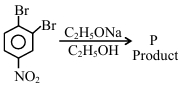
A
$1-$bromo$-2-$ethoxy$-4-$nitrobenzene
B
$1,2-$diethoxy$-4-$nitrobenzene
C
$2-$bromo$-1-$ethoxy$-4-$nitrobenzene
D
$1-$bromo$-2-$bromo$-4-$ethoxybenzene
Solution
(A) This is an example of a nucleophilic aromatic substitution reaction. The electron-withdrawing $-NO_2$ group at the para position activates the ring towards nucleophilic attack. The nucleophile $C_2H_5O^-$ attacks the carbon atom bearing the bromine atom at the para position relative to the $-NO_2$ group,as it is more sterically accessible and electronically activated. Thus,the bromine atom at the para position is replaced by the $-OC_2H_5$ group,resulting in $1-bromo-2-ethoxy-4-nitrobenzene$.
0 likesView Solution
157
ChemistryMediumMCQJEE Main · 2025
For a $Mg|Mg^{2+}_{(aq)}||Ag^{+}_{(aq)}|Ag$ cell,the correct Nernst Equation is $:$
A
$E_{\text{cell}} = E_{\text{cell}}^{o} - \frac{RT}{2F} \ln \frac{[Mg^{2+}]}{[Ag^{+}]^2}$
B
$E_{\text{cell}} = E_{\text{cell}}^{o} + \frac{RT}{2F} \ln \frac{[Ag^{+}]^2}{[Mg^{2+}]}$
C
$E_{\text{cell}} = E_{\text{cell}}^{o} - \frac{RT}{2F} \ln \frac{[Mg^{2+}]}{[Ag^{+}]}$
D
$E_{\text{cell}} = E_{\text{cell}}^{o} - \frac{RT}{2F} \ln \frac{[Ag^{+}]^2}{[Mg^{2+}]}$
Solution
(A) The cell reaction for $Mg|Mg^{2+}_{(aq)}||Ag^{+}_{(aq)}|Ag$ is $:$
$Mg_{(s)} + 2Ag^{+}_{(aq)} \rightarrow Mg^{2+}_{(aq)} + 2Ag_{(s)}$
Here,the number of electrons transferred $n = 2$.
The reaction quotient $Q$ is given by $Q = \frac{[Mg^{2+}]}{[Ag^{+}]^2}$.
According to the Nernst equation $:$
$E_{\text{cell}} = E_{\text{cell}}^{o} - \frac{RT}{nF} \ln Q$
Substituting the values $:$
$E_{\text{cell}} = E_{\text{cell}}^{o} - \frac{RT}{2F} \ln \frac{[Mg^{2+}]}{[Ag^{+}]^2}$
Thus,the correct option is $A$.
$Mg_{(s)} + 2Ag^{+}_{(aq)} \rightarrow Mg^{2+}_{(aq)} + 2Ag_{(s)}$
Here,the number of electrons transferred $n = 2$.
The reaction quotient $Q$ is given by $Q = \frac{[Mg^{2+}]}{[Ag^{+}]^2}$.
According to the Nernst equation $:$
$E_{\text{cell}} = E_{\text{cell}}^{o} - \frac{RT}{nF} \ln Q$
Substituting the values $:$
$E_{\text{cell}} = E_{\text{cell}}^{o} - \frac{RT}{2F} \ln \frac{[Mg^{2+}]}{[Ag^{+}]^2}$
Thus,the correct option is $A$.
0 likesView Solution
158
ChemistryDifficultMCQJEE Main · 2025
The correct option with the order of melting points of the pairs $(Mn, Fe)$, $(Tc, Ru)$ and $(Re, Os)$ is $:$
A
$Fe < Mn$, $Ru < Tc$ and $Re < Os$
B
$Mn < Fe$, $Tc < Ru$ and $Re < Os$
C
$Mn < Fe$, $Tc < Ru$ and $Os < Re$
D
$Fe < Mn$, $Ru < Tc$ and $Os < Re$
Solution
(C) The melting points of transition metals depend on the number of unpaired electrons and the strength of metallic bonding.
For the $3d$ series, $Mn$ has a lower melting point than $Fe$ because $Mn$ has a stable $d^5$ configuration, which results in weaker metallic bonding compared to $Fe$.
For the $4d$ and $5d$ series, the trend is $Tc < Ru$ and $Os < Re$ because the number of unpaired electrons available for metallic bonding increases as we move from $Tc$ to $Ru$ and decreases from $Re$ to $Os$.
Thus, the correct order is $Mn < Fe$, $Tc < Ru$, and $Os < Re$.
For the $3d$ series, $Mn$ has a lower melting point than $Fe$ because $Mn$ has a stable $d^5$ configuration, which results in weaker metallic bonding compared to $Fe$.
For the $4d$ and $5d$ series, the trend is $Tc < Ru$ and $Os < Re$ because the number of unpaired electrons available for metallic bonding increases as we move from $Tc$ to $Ru$ and decreases from $Re$ to $Os$.
Thus, the correct order is $Mn < Fe$, $Tc < Ru$, and $Os < Re$.
0 likesView Solution
159
ChemistryDifficultMCQJEE Main · 2025
$1.24 \ g$ of $AX_2$ (molar mass $124 \ g \ mol^{-1}$) is dissolved in $1 \ kg$ of water to form a solution with a boiling point of $100.0156^{\circ} C$,while $25.4 \ g$ of $AY_2$ (molar mass $250 \ g \ mol^{-1}$) in $2 \ kg$ of water constitutes a solution with a boiling point of $100.0260^{\circ} C$. $K_{b}(H_2O) = 0.52 \ K \ kg \ mol^{-1}$. Which of the following is correct?
A
$AX_2$ and $AY_2$ (both) are completely unionised.
B
$AX_2$ and $AY_2$ (both) are fully ionised.
C
$AX_2$ is completely unionised while $AY_2$ is fully ionised.
D
$AX_2$ is fully ionised while $AY_2$ is completely unionised.
Solution
(D) For $AX_2$: $\Delta T_{b} = K_{b} \times m \times i$
$0.0156 = 0.52 \times (1.24/124) \times i_{AX_2} = 0.52 \times 0.01 \times i_{AX_2}$
$i_{AX_2} = 0.0156 / 0.0052 = 3$. Since $AX_2 \rightarrow A^{2+} + 2X^-$,$i=3$ implies complete ionisation.
For $AY_2$: $\Delta T_{b} = K_{b} \times m \times i$
$0.026 = 0.52 \times (25.4/250) / 2 \times i_{AY_2} = 0.52 \times 0.0508 \times i_{AY_2}$
$i_{AY_2} = 0.026 / 0.026416 \approx 1$. This implies complete unionisation.
$0.0156 = 0.52 \times (1.24/124) \times i_{AX_2} = 0.52 \times 0.01 \times i_{AX_2}$
$i_{AX_2} = 0.0156 / 0.0052 = 3$. Since $AX_2 \rightarrow A^{2+} + 2X^-$,$i=3$ implies complete ionisation.
For $AY_2$: $\Delta T_{b} = K_{b} \times m \times i$
$0.026 = 0.52 \times (25.4/250) / 2 \times i_{AY_2} = 0.52 \times 0.0508 \times i_{AY_2}$
$i_{AY_2} = 0.026 / 0.026416 \approx 1$. This implies complete unionisation.
0 likesView Solution
160
ChemistryMediumMCQJEE Main · 2025
The reaction $A_2 + B_2 \rightarrow 2AB$ follows the mechanism $A_2 \underset{k_{-1}}{\stackrel{k_1}{\rightleftharpoons}} 2A$ (fast),$A + B_2 \xrightarrow{k_2} AB + B$ (slow),$A + B \rightarrow AB$ (fast). The overall order of the reaction is:
A
$1.5$
B
$3$
C
$2.5$
D
$2$
Solution
(A) The rate of the reaction is determined by the slow step: $\text{Rate} = k_2[A][B_2] \dots (1)$
From the fast equilibrium step,$A_2 \rightleftharpoons 2A$,the equilibrium constant is $K_{eq} = \frac{[A]^2}{[A_2]} = \frac{k_1}{k_{-1}}$.
Thus,$[A] = \sqrt{\frac{k_1}{k_{-1}}} [A_2]^{1/2}$.
Substituting this into equation $(1)$,we get $\text{Rate} = k_2 \sqrt{\frac{k_1}{k_{-1}}} [A_2]^{1/2} [B_2]^1$.
The overall order of the reaction is the sum of the exponents of the concentration terms: $0.5 + 1 = 1.5$.
From the fast equilibrium step,$A_2 \rightleftharpoons 2A$,the equilibrium constant is $K_{eq} = \frac{[A]^2}{[A_2]} = \frac{k_1}{k_{-1}}$.
Thus,$[A] = \sqrt{\frac{k_1}{k_{-1}}} [A_2]^{1/2}$.
Substituting this into equation $(1)$,we get $\text{Rate} = k_2 \sqrt{\frac{k_1}{k_{-1}}} [A_2]^{1/2} [B_2]^1$.
The overall order of the reaction is the sum of the exponents of the concentration terms: $0.5 + 1 = 1.5$.
0 likesView Solution
161
ChemistryMediumMCQJEE Main · 2025
The product $(P)$ formed in the following reaction is $:$
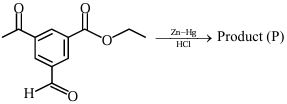
A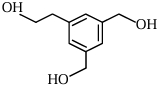
B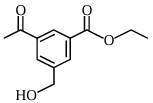
C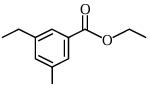
D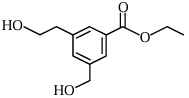
Solution
(D) The given reaction uses $Zn-Hg/HCl$,which is the reagent for Clemmensen reduction.
Clemmensen reduction specifically reduces carbonyl groups (aldehydes and ketones) to methylene groups $(-CH_2-)$.
It does not affect ester groups $(-COOC_2H_5)$.
In the given reactant,there is an acetyl group $(-COCH_3)$ and an aldehyde group $(-CHO)$ attached to the benzene ring.
Both the acetyl group and the aldehyde group will be reduced to ethyl $(-CH_2CH_3)$ and methyl $(-CH_3)$ groups respectively.
The ester group remains unchanged.
Therefore,the product $(P)$ is ethyl $3-$ethyl$-5-$methylbenzoate.
Clemmensen reduction specifically reduces carbonyl groups (aldehydes and ketones) to methylene groups $(-CH_2-)$.
It does not affect ester groups $(-COOC_2H_5)$.
In the given reactant,there is an acetyl group $(-COCH_3)$ and an aldehyde group $(-CHO)$ attached to the benzene ring.
Both the acetyl group and the aldehyde group will be reduced to ethyl $(-CH_2CH_3)$ and methyl $(-CH_3)$ groups respectively.
The ester group remains unchanged.
Therefore,the product $(P)$ is ethyl $3-$ethyl$-5-$methylbenzoate.
0 likesView Solution
162
ChemistryMediumMCQJEE Main · 2025
Match List-$I$ with List-$II$.
Choose the correct answer from the options given below $:$
| List-$I$ (Carbohydrate) | List-$II$ (Linkage Source) |
|---|---|
| $A$. Amylose | $I$. $\beta-C_1-C_4$,plant |
| $B$. Cellulose | $II$. $\alpha-C_1-C_4$,animal |
| $C$. Glycogen | $III$. $\alpha-C_1-C_4, \alpha-C_1-C_6$,plant |
| $D$. Amylopectin | $IV$. $\alpha-C_1-C_4$,plant |
Choose the correct answer from the options given below $:$
A
$A-III, B-I, C-II, D-IV$
B
$A-IV, B-I, C-II, D-III$
C
$A-II, B-III, C-I, D-IV$
D
$A-IV, B-I, C-III, D-II$
Solution
(B) The correct matches are as follows:
$A$. Amylose: It is a linear polymer of $\alpha-D$-glucose units linked by $\alpha-C_1-C_4$ glycosidic linkage,found in plants $(IV)$.
$B$. Cellulose: It is a linear polymer of $\beta-D$-glucose units linked by $\beta-C_1-C_4$ glycosidic linkage,found in plants $(I)$.
$C$. Glycogen: It is a branched polymer of $\alpha-D$-glucose units with $\alpha-C_1-C_4$ and $\alpha-C_1-C_6$ linkages,found in animals $(II)$.
$D$. Amylopectin: It is a branched polymer of $\alpha-D$-glucose units with $\alpha-C_1-C_4$ and $\alpha-C_1-C_6$ linkages,found in plants $(III)$.
Therefore,the correct matching is $A-IV, B-I, C-II, D-III$.
$A$. Amylose: It is a linear polymer of $\alpha-D$-glucose units linked by $\alpha-C_1-C_4$ glycosidic linkage,found in plants $(IV)$.
$B$. Cellulose: It is a linear polymer of $\beta-D$-glucose units linked by $\beta-C_1-C_4$ glycosidic linkage,found in plants $(I)$.
$C$. Glycogen: It is a branched polymer of $\alpha-D$-glucose units with $\alpha-C_1-C_4$ and $\alpha-C_1-C_6$ linkages,found in animals $(II)$.
$D$. Amylopectin: It is a branched polymer of $\alpha-D$-glucose units with $\alpha-C_1-C_4$ and $\alpha-C_1-C_6$ linkages,found in plants $(III)$.
Therefore,the correct matching is $A-IV, B-I, C-II, D-III$.
0 likesView Solution
163
ChemistryDifficultMCQJEE Main · 2025
Given below are some nitrogen-containing compounds. Each of them is treated with $HCl$ separately. $1.0 \ g$ of the most basic compound will consume $........$ $mg$ of $HCl$. ($Given$ molar mass in $g \ mol^{-1}$: $C:12, H:1, O:16, Cl:35.5$)
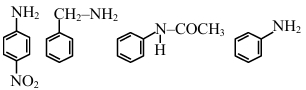
A
$341$
B
$241$
C
$141$
D
$541$
Solution
(A) The given compounds are $p$-nitroaniline,benzylamine,acetanilide,and aniline. Benzylamine is an aliphatic amine,while the others are aromatic amines or amides where the lone pair on nitrogen is involved in resonance or electron-withdrawing effects,making them less basic. Benzylamine is the most basic compound.
The molar mass of benzylamine $(C_6H_5CH_2NH_2)$ is $(7 \times 12) + (9 \times 1) + 14 = 107 \ g \ mol^{-1}$.
Moles of benzylamine in $1.0 \ g = \frac{1.0 \ g}{107 \ g \ mol^{-1}} \approx 0.009346 \ mol$.
Benzylamine reacts with $HCl$ in a $1:1$ molar ratio: $C_6H_5CH_2NH_2 + HCl \rightarrow C_6H_5CH_2NH_3^+Cl^-$.
Moles of $HCl$ consumed $= 0.009346 \ mol$.
Mass of $HCl$ consumed $= 0.009346 \ mol \times 36.5 \ g \ mol^{-1} \approx 0.3411 \ g$.
Converting to $mg$: $0.3411 \ g \times 1000 \ mg \ g^{-1} \approx 341 \ mg$.
The molar mass of benzylamine $(C_6H_5CH_2NH_2)$ is $(7 \times 12) + (9 \times 1) + 14 = 107 \ g \ mol^{-1}$.
Moles of benzylamine in $1.0 \ g = \frac{1.0 \ g}{107 \ g \ mol^{-1}} \approx 0.009346 \ mol$.
Benzylamine reacts with $HCl$ in a $1:1$ molar ratio: $C_6H_5CH_2NH_2 + HCl \rightarrow C_6H_5CH_2NH_3^+Cl^-$.
Moles of $HCl$ consumed $= 0.009346 \ mol$.
Mass of $HCl$ consumed $= 0.009346 \ mol \times 36.5 \ g \ mol^{-1} \approx 0.3411 \ g$.
Converting to $mg$: $0.3411 \ g \times 1000 \ mg \ g^{-1} \approx 341 \ mg$.
0 likesView Solution
164
ChemistryDifficultMCQJEE Main · 2025
The molar mass of the water-insoluble product formed from the fusion of chromite ore $(FeCr_2O_4)$ with $Na_2CO_3$ in the presence of $O_2$ is $..........$ $g \ mol^{-1}$.
A
$260$
B
$160$
C
$360$
D
$460$
Solution
(B) The chemical reaction for the fusion of chromite ore with sodium carbonate in the presence of oxygen is:
$4FeCr_2O_4 + 8Na_2CO_3 + 7O_2 \rightarrow 8Na_2CrO_4 + 2Fe_2O_3 + 8CO_2$
In this reaction,$Na_2CrO_4$ (sodium chromate) is water-soluble,while $Fe_2O_3$ (ferric oxide) is water-insoluble.
The molar mass of $Fe_2O_3$ is calculated as:
$M = (2 \times 56) + (3 \times 16) = 112 + 48 = 160 \ g \ mol^{-1}$.
$4FeCr_2O_4 + 8Na_2CO_3 + 7O_2 \rightarrow 8Na_2CrO_4 + 2Fe_2O_3 + 8CO_2$
In this reaction,$Na_2CrO_4$ (sodium chromate) is water-soluble,while $Fe_2O_3$ (ferric oxide) is water-insoluble.
The molar mass of $Fe_2O_3$ is calculated as:
$M = (2 \times 56) + (3 \times 16) = 112 + 48 = 160 \ g \ mol^{-1}$.
0 likesView Solution
165
ChemistryMediumMCQJEE Main · 2025
If $A_2 B$ is $30 \%$ ionised in an aqueous solution,then the value of van't Hoff factor $(i)$ is $............ \times 10^{-1}$.
A
$46$
B
$36$
C
$26$
D
$16$
Solution
(D) For the dissociation of $A_2 B$: $A_2 B \rightarrow 2 A^{+} + B^{2-}$.
Here,the number of ions produced per formula unit is $y = 3$.
The degree of ionisation is $\alpha = 30 \% = 0.3$.
The van't Hoff factor $(i)$ is calculated using the formula: $i = 1 + (y - 1)\alpha$.
Substituting the values: $i = 1 + (3 - 1)(0.3) = 1 + (2)(0.3) = 1 + 0.6 = 1.6$.
Expressing $1.6$ in the form $............ \times 10^{-1}$,we get $16 \times 10^{-1}$.
Thus,the correct option is $D$.
Here,the number of ions produced per formula unit is $y = 3$.
The degree of ionisation is $\alpha = 30 \% = 0.3$.
The van't Hoff factor $(i)$ is calculated using the formula: $i = 1 + (y - 1)\alpha$.
Substituting the values: $i = 1 + (3 - 1)(0.3) = 1 + (2)(0.3) = 1 + 0.6 = 1.6$.
Expressing $1.6$ in the form $............ \times 10^{-1}$,we get $16 \times 10^{-1}$.
Thus,the correct option is $D$.
0 likesView Solution
166
ChemistryMediumMCQJEE Main · 2025
The calculated spin-only magnetic moments of $K_3[Fe(OH)_6]$ and $K_4[Fe(OH)_6]$ respectively are $:$
A
$4.90$ and $4.90 \ B.M.$
B
$5.92$ and $4.90 \ B.M.$
C
$3.87$ and $4.90 \ B.M.$
D
$4.90$ and $5.92 \ B.M.$
Solution
(B) In $K_3[Fe(OH)_6]$,the oxidation state of $Fe$ is $+3$. The electronic configuration of $Fe^{3+}$ is $[Ar] 3d^5$. Since $OH^-$ is a weak field ligand,the electrons remain unpaired. Thus,$n = 5$. The magnetic moment $\mu = \sqrt{n(n+2)} = \sqrt{5(5+2)} = \sqrt{35} \approx 5.92 \ B.M.$
In $K_4[Fe(OH)_6]$,the oxidation state of $Fe$ is $+2$. The electronic configuration of $Fe^{2+}$ is $[Ar] 3d^6$. Since $OH^-$ is a weak field ligand,the electrons remain unpaired. Thus,$n = 4$. The magnetic moment $\mu = \sqrt{4(4+2)} = \sqrt{24} \approx 4.90 \ B.M.$
Therefore,the values are $5.92 \ B.M.$ and $4.90 \ B.M.$ respectively.
In $K_4[Fe(OH)_6]$,the oxidation state of $Fe$ is $+2$. The electronic configuration of $Fe^{2+}$ is $[Ar] 3d^6$. Since $OH^-$ is a weak field ligand,the electrons remain unpaired. Thus,$n = 4$. The magnetic moment $\mu = \sqrt{4(4+2)} = \sqrt{24} \approx 4.90 \ B.M.$
Therefore,the values are $5.92 \ B.M.$ and $4.90 \ B.M.$ respectively.
0 likesView Solution
167
ChemistryMediumMCQJEE Main · 2025
Identify the essential amino acids from below $:$
$(A)$ Valine
$(B)$ Proline
$(C)$ Lysine
$(D)$ Threonine
$(E)$ Tyrosine
Choose the correct answer from the options given below $:$
$(A)$ Valine
$(B)$ Proline
$(C)$ Lysine
$(D)$ Threonine
$(E)$ Tyrosine
Choose the correct answer from the options given below $:$
A
$(A), (C)$ and $(D)$ only
B
$(A), (C)$ and $(E)$ only
C
$(B), (C)$ and $(E)$ only
D
$(C), (D)$ and $(E)$ only
Solution
(A) Essential amino acids are those that cannot be synthesized by the human body and must be obtained through the diet.
Among the given options,$(A)$ Valine,$(C)$ Lysine,and $(D)$ Threonine are essential amino acids.
Proline and Tyrosine are non-essential amino acids.
Among the given options,$(A)$ Valine,$(C)$ Lysine,and $(D)$ Threonine are essential amino acids.
Proline and Tyrosine are non-essential amino acids.
0 likesView Solution
168
ChemistryEasyMCQJEE Main · 2025
Which among the following halides will generate the most stable carbocation in a nucleophilic substitution reaction?
A
$CH_2=CH-CH_2-Br$
B
$C_6H_5-CH_2-Br$
C
$C_6H_9-Br$ (cyclohex$-2-$en$-1-$yl bromide)
D
$(C_6H_5)_3C-Br$
Solution
(D) The stability of a carbocation is determined by resonance,hyperconjugation,and the inductive effect.
In the given options,the carbocations formed are:
$A$: Allyl carbocation $(CH_2=CH-CH_2^+)$
$B$: Benzyl carbocation $(C_6H_5-CH_2^+)$
$C$: Cyclohexenyl carbocation
$D$: Triphenylmethyl carbocation $((C_6H_5)_3C^+)$
Among these,the triphenylmethyl carbocation is the most stable because the positive charge is delocalized over three phenyl rings through extensive resonance.
Therefore,$(C_6H_5)_3C-Br$ generates the most stable carbocation.
In the given options,the carbocations formed are:
$A$: Allyl carbocation $(CH_2=CH-CH_2^+)$
$B$: Benzyl carbocation $(C_6H_5-CH_2^+)$
$C$: Cyclohexenyl carbocation
$D$: Triphenylmethyl carbocation $((C_6H_5)_3C^+)$
Among these,the triphenylmethyl carbocation is the most stable because the positive charge is delocalized over three phenyl rings through extensive resonance.
Therefore,$(C_6H_5)_3C-Br$ generates the most stable carbocation.
0 likesView Solution
169
ChemistryMediumMCQJEE Main · 2025
Given below are two statements $:$
Statement $(I) : NaCl$ is added to the ice at $0^{\circ} C$,present in the ice cream box to lower the freezing point of the mixture,which helps in keeping the ice cream frozen.
Statement $(II) :$ On addition of $NaCl$ to ice at $0^{\circ} C$,there is a depression in freezing point.
In the light of the above statements,choose the correct answer from the options given below $:$
Statement $(I) : NaCl$ is added to the ice at $0^{\circ} C$,present in the ice cream box to lower the freezing point of the mixture,which helps in keeping the ice cream frozen.
Statement $(II) :$ On addition of $NaCl$ to ice at $0^{\circ} C$,there is a depression in freezing point.
In the light of the above statements,choose the correct answer from the options given below $:$
A
Statement $I$ is false but Statement $II$ is true
B
Both Statement $I$ and Statement $II$ are true
C
Both Statement $I$ and Statement $II$ are false
D
Statement $I$ is true but Statement $II$ is false
Solution
(B) Statement $(I)$ is true because adding $NaCl$ to ice creates a freezing mixture,which lowers the temperature below $0^{\circ} C$,thereby keeping the ice cream frozen.
Statement $(II)$ is true because the addition of a non-volatile solute like $NaCl$ to a solvent like water causes a depression in the freezing point,a colligative property.
Statement $(II)$ is true because the addition of a non-volatile solute like $NaCl$ to a solvent like water causes a depression in the freezing point,a colligative property.
0 likesView Solution
170
ChemistryMediumMCQJEE Main · 2025
Match List-$I$ with List-$II$:
Choose the correct answer from the options given below:
| List-$I$ (Applications) | List-$II$ (Batteries/Cell) |
|---|---|
| $A$. Transistors | $I$. Anode $- Zn/Hg$; Cathode $- HgO + C$ |
| $B$. Hearing aids | $II$. Hydrogen fuel cell |
| $C$. Inverters | $III$. Anode $- Zn$; Cathode $- Carbon$ |
| $D$. Apollo space ship | $IV$. Anode $- Pb$; Cathode $- PbO_2$ |
Choose the correct answer from the options given below:
A
$A-III, B-I, C-IV, D-II$
B
$A-III, B-II, C-IV, D-I$
C
$A-IV, B-III, C-II, D-I$
D
$A-II, B-III, C-IV, D-I$
Solution
(A) The correct matches are as follows:
$A$. Transistors use Dry cells (Leclanché cell),where Anode is $Zn$ and Cathode is $Carbon$ $(A-III)$.
$B$. Hearing aids use Mercury cells,where Anode is $Zn/Hg$ and Cathode is $HgO + C$ $(B-I)$.
$C$. Inverters use Lead storage batteries,where Anode is $Pb$ and Cathode is $PbO_2$ $(C-IV)$.
$D$. Apollo space ships used Hydrogen fuel cells $(D-II)$.
Therefore,the correct sequence is $A-III, B-I, C-IV, D-II$.
$A$. Transistors use Dry cells (Leclanché cell),where Anode is $Zn$ and Cathode is $Carbon$ $(A-III)$.
$B$. Hearing aids use Mercury cells,where Anode is $Zn/Hg$ and Cathode is $HgO + C$ $(B-I)$.
$C$. Inverters use Lead storage batteries,where Anode is $Pb$ and Cathode is $PbO_2$ $(C-IV)$.
$D$. Apollo space ships used Hydrogen fuel cells $(D-II)$.
Therefore,the correct sequence is $A-III, B-I, C-IV, D-II$.
0 likesView Solution
171
ChemistryDifficultMCQJEE Main · 2025
$O_2$ gas will be evolved as a product of electrolysis of $:$
$(A)$ an aqueous solution of $AgNO_3$ using silver electrodes.
$(B)$ an aqueous solution of $AgNO_3$ using platinum electrodes.
$(C)$ a dilute solution of $H_2 SO_4$ using platinum electrodes.
$(D)$ a high concentration solution of $H_2 SO_4$ using platinum electrodes.
Choose the correct answer from the options given below $:$
$(A)$ an aqueous solution of $AgNO_3$ using silver electrodes.
$(B)$ an aqueous solution of $AgNO_3$ using platinum electrodes.
$(C)$ a dilute solution of $H_2 SO_4$ using platinum electrodes.
$(D)$ a high concentration solution of $H_2 SO_4$ using platinum electrodes.
Choose the correct answer from the options given below $:$
A
$B$ and $C$ only
B
$A$ and $D$ only
C
$B$ and $D$ only
D
$A$ and $C$ only
Solution
(A) In the electrolysis of an aqueous solution of $AgNO_3$ using silver electrodes $(A)$,the anode dissolves $(Ag \rightarrow Ag^+ + e^-)$,so no $O_2$ is evolved.
In the electrolysis of an aqueous solution of $AgNO_3$ using platinum electrodes $(B)$,the oxidation of water occurs at the anode $(2H_2O \rightarrow O_2 + 4H^+ + 4e^-)$,evolving $O_2$ gas.
In the electrolysis of a dilute solution of $H_2SO_4$ using platinum electrodes $(C)$,the oxidation of water occurs at the anode $(2H_2O \rightarrow O_2 + 4H^+ + 4e^-)$,evolving $O_2$ gas.
In the electrolysis of a high concentration solution of $H_2SO_4$ using platinum electrodes $(D)$,the oxidation of $SO_4^{2-}$ ions occurs at the anode $(2SO_4^{2-} \rightarrow S_2O_8^{2-} + 2e^-)$,forming peroxodisulphuric acid instead of $O_2$ gas.
Therefore,$O_2$ is evolved in cases $(B)$ and $(C)$.
In the electrolysis of an aqueous solution of $AgNO_3$ using platinum electrodes $(B)$,the oxidation of water occurs at the anode $(2H_2O \rightarrow O_2 + 4H^+ + 4e^-)$,evolving $O_2$ gas.
In the electrolysis of a dilute solution of $H_2SO_4$ using platinum electrodes $(C)$,the oxidation of water occurs at the anode $(2H_2O \rightarrow O_2 + 4H^+ + 4e^-)$,evolving $O_2$ gas.
In the electrolysis of a high concentration solution of $H_2SO_4$ using platinum electrodes $(D)$,the oxidation of $SO_4^{2-}$ ions occurs at the anode $(2SO_4^{2-} \rightarrow S_2O_8^{2-} + 2e^-)$,forming peroxodisulphuric acid instead of $O_2$ gas.
Therefore,$O_2$ is evolved in cases $(B)$ and $(C)$.
0 likesView Solution
172
ChemistryDifficultMCQJEE Main · 2025
Identify the homoleptic complexes with an odd number of $d$ electrons in the central metal ion.
$(A) \ [FeO_4]^{2-}$
$(B) \ [Fe(CN)_6]^{3-}$
$(C) \ [Fe(CN)_5 NO]^{2-}$
$(D) \ [CoCl_4]^{2-}$
$(E) \ [Co(H_2O)_3 F_3]$
Choose the correct answer from the options given below $:$
$(A) \ [FeO_4]^{2-}$
$(B) \ [Fe(CN)_6]^{3-}$
$(C) \ [Fe(CN)_5 NO]^{2-}$
$(D) \ [CoCl_4]^{2-}$
$(E) \ [Co(H_2O)_3 F_3]$
Choose the correct answer from the options given below $:$
A
$(B)$ and $(D)$ only
B
$(C)$ and $(E)$ only
C
$(A), (B)$ and $(D)$ only
D
$(A), (C)$ and $(E)$ only
Solution
(A) homoleptic complex is one in which the central metal atom or ion is bonded to only one type of donor atom.
$(A) \ [FeO_4]^{2-}$: Homoleptic. $Fe$ is in $+6$ oxidation state $(d^2)$. Even number of $d$ electrons.
$(B) \ [Fe(CN)_6]^{3-}$: Homoleptic. $Fe$ is in $+3$ oxidation state $(d^5)$. Odd number of $d$ electrons.
$(C) \ [Fe(CN)_5 NO]^{2-}$: Heteroleptic (contains $CN^-$ and $NO$ ligands).
$(D) \ [CoCl_4]^{2-}$: Homoleptic. $Co$ is in $+2$ oxidation state $(d^7)$. Odd number of $d$ electrons.
$(E) \ [Co(H_2O)_3 F_3]$: Heteroleptic (contains $H_2O$ and $F^-$ ligands).
Thus,the homoleptic complexes with an odd number of $d$ electrons are $(B)$ and $(D)$.
$(A) \ [FeO_4]^{2-}$: Homoleptic. $Fe$ is in $+6$ oxidation state $(d^2)$. Even number of $d$ electrons.
$(B) \ [Fe(CN)_6]^{3-}$: Homoleptic. $Fe$ is in $+3$ oxidation state $(d^5)$. Odd number of $d$ electrons.
$(C) \ [Fe(CN)_5 NO]^{2-}$: Heteroleptic (contains $CN^-$ and $NO$ ligands).
$(D) \ [CoCl_4]^{2-}$: Homoleptic. $Co$ is in $+2$ oxidation state $(d^7)$. Odd number of $d$ electrons.
$(E) \ [Co(H_2O)_3 F_3]$: Heteroleptic (contains $H_2O$ and $F^-$ ligands).
Thus,the homoleptic complexes with an odd number of $d$ electrons are $(B)$ and $(D)$.
0 likesView Solution
173
ChemistryMediumMCQJEE Main · 2025
Which one of the following reaction sequences will give an azo dye?
A
Nitrobenzene $\xrightarrow[(ii) NaNO_2/HCl]{(i) Sn/HCl}$ $\xrightarrow[(iii) \beta-\text{naphthol}, NaOH]{}$
B
Benzenesulfonic acid $\xrightarrow[(ii) NH_3]{(i) SOCl_2}$ $\xrightarrow[(iii) \text{Benzyl chloride}]{}$
C
Benzonitrile $\xrightarrow[(ii) PCl_5]{(i) 70\% H_2SO_4}$ $\xrightarrow[(iii) \text{Aniline}]{}$
D
Aniline $\xrightarrow[(i) HCl/NaNO_2]{(ii) \text{Toluene}}$
Solution
(A) The formation of an azo dye involves the coupling reaction of a diazonium salt with an electron-rich aromatic compound like $\beta$-naphthol in an alkaline medium.
$1$. Nitrobenzene $(C_6H_5NO_2)$ is reduced to aniline $(C_6H_5NH_2)$ using $Sn/HCl$.
$2$. Aniline reacts with $NaNO_2/HCl$ at $0-5^{\circ}C$ to form benzenediazonium chloride $(C_6H_5N_2^+Cl^-)$.
$3$. Benzenediazonium chloride undergoes a coupling reaction with $\beta$-naphthol in the presence of $NaOH$ to form an orange-red azo dye.
Therefore,the correct sequence is given in option $A$.
$1$. Nitrobenzene $(C_6H_5NO_2)$ is reduced to aniline $(C_6H_5NH_2)$ using $Sn/HCl$.
$2$. Aniline reacts with $NaNO_2/HCl$ at $0-5^{\circ}C$ to form benzenediazonium chloride $(C_6H_5N_2^+Cl^-)$.
$3$. Benzenediazonium chloride undergoes a coupling reaction with $\beta$-naphthol in the presence of $NaOH$ to form an orange-red azo dye.
Therefore,the correct sequence is given in option $A$.
0 likesView Solution
174
ChemistryMediumMCQJEE Main · 2025
Drug $X$ becomes ineffective after $50 \%$ decomposition. The original concentration of drug in a bottle was $16 \ mg/mL$ which becomes $4 \ mg/mL$ in $12 \ months$. The expiry time of the drug in months is $..........$ Assume that the decomposition of the drug follows first order kinetics.
A
$12$
B
$2$
C
$3$
D
$6$
Solution
(D) For a first-order reaction,the rate constant $k$ is given by $k = \frac{2.303}{t} \log \frac{[A]_0}{[A]_t}$.
Given $[A]_0 = 16 \ mg/mL$,$[A]_t = 4 \ mg/mL$,and $t = 12 \ months$.
$k = \frac{2.303}{12} \log \frac{16}{4} = \frac{2.303}{12} \log 4 = \frac{2.303 \times 0.602}{12} \approx 0.1155 \ month^{-1}$.
The drug becomes ineffective after $50 \%$ decomposition,meaning $50 \%$ remains. Thus,$[A]_t = 0.5 \times [A]_0$.
The time taken for $50 \%$ decomposition is the half-life $t_{1/2} = \frac{0.693}{k}$.
$t_{1/2} = \frac{0.693}{0.1155} = 6 \ months$.
Given $[A]_0 = 16 \ mg/mL$,$[A]_t = 4 \ mg/mL$,and $t = 12 \ months$.
$k = \frac{2.303}{12} \log \frac{16}{4} = \frac{2.303}{12} \log 4 = \frac{2.303 \times 0.602}{12} \approx 0.1155 \ month^{-1}$.
The drug becomes ineffective after $50 \%$ decomposition,meaning $50 \%$ remains. Thus,$[A]_t = 0.5 \times [A]_0$.
The time taken for $50 \%$ decomposition is the half-life $t_{1/2} = \frac{0.693}{k}$.
$t_{1/2} = \frac{0.693}{0.1155} = 6 \ months$.
0 likesView Solution
175
ChemistryMediumMCQJEE Main · 2025
First ionisation enthalpy values of first four group $15$ elements are given below. Choose the correct value for the element that is a main component of apatite family $:$
A
$1012 \ kJ \ mol^{-1}$
B
$1402 \ kJ \ mol^{-1}$
C
$834 \ kJ \ mol^{-1}$
D
$947 \ kJ \ mol^{-1}$
Solution
(A) The apatite family of minerals,such as fluorapatite,has the general formula $Ca_5(PO_4)_3(F, Cl, OH)$.
Phosphorus $(P)$ is a main component of the apatite family.
The first four group $15$ elements are Nitrogen $(N)$,Phosphorus $(P)$,Arsenic $(As)$,and Antimony $(Sb)$.
The first ionisation enthalpy values for these elements are:
$N: 1402 \ kJ \ mol^{-1}$
$P: 1012 \ kJ \ mol^{-1}$
$As: 947 \ kJ \ mol^{-1}$
$Sb: 834 \ kJ \ mol^{-1}$
Since Phosphorus is the element in question,its first ionisation enthalpy is $1012 \ kJ \ mol^{-1}$.
Phosphorus $(P)$ is a main component of the apatite family.
The first four group $15$ elements are Nitrogen $(N)$,Phosphorus $(P)$,Arsenic $(As)$,and Antimony $(Sb)$.
The first ionisation enthalpy values for these elements are:
$N: 1402 \ kJ \ mol^{-1}$
$P: 1012 \ kJ \ mol^{-1}$
$As: 947 \ kJ \ mol^{-1}$
$Sb: 834 \ kJ \ mol^{-1}$
Since Phosphorus is the element in question,its first ionisation enthalpy is $1012 \ kJ \ mol^{-1}$.
0 likesView Solution
176
ChemistryMediumMCQJEE Main · 2025
Which one of the following,with $HBr$ will give a phenol?
A
Benzylidene dimethyl ether
B
Anisole (Methoxybenzene)
C
Benzyl methyl ether
D
Benzyl tert-butyl ether
Solution
(B) The reaction of ethers with $HBr$ involves the protonation of the oxygen atom followed by nucleophilic attack by the bromide ion $(Br^-)$.
In the case of anisole $(C_6H_5OCH_3)$,the oxygen is attached to a phenyl group and a methyl group.
Protonation gives $[C_6H_5-O^+(H)-CH_3]$.
The $Br^-$ ion attacks the less sterically hindered methyl group via an $S_N2$ mechanism,resulting in the cleavage of the $O-CH_3$ bond.
This produces phenol $(C_6H_5OH)$ and methyl bromide $(CH_3Br)$.
Other ethers like benzyl methyl ether or benzyl tert-butyl ether would cleave to form benzyl bromide because the benzyl carbocation or transition state is stabilized by resonance,leading to the formation of methanol or tert-butyl alcohol instead of phenol.
In the case of anisole $(C_6H_5OCH_3)$,the oxygen is attached to a phenyl group and a methyl group.
Protonation gives $[C_6H_5-O^+(H)-CH_3]$.
The $Br^-$ ion attacks the less sterically hindered methyl group via an $S_N2$ mechanism,resulting in the cleavage of the $O-CH_3$ bond.
This produces phenol $(C_6H_5OH)$ and methyl bromide $(CH_3Br)$.
Other ethers like benzyl methyl ether or benzyl tert-butyl ether would cleave to form benzyl bromide because the benzyl carbocation or transition state is stabilized by resonance,leading to the formation of methanol or tert-butyl alcohol instead of phenol.
0 likesView Solution
177
ChemistryMediumMCQJEE Main · 2025
Consider the following low-spin complexes: $K_3[Co(NO_2)_6]$,$K_4[Fe(CN)_6]$,$K_3[Fe(CN)_6]$,$Cu_2[Fe(CN)_6]$,and $Zn_2[Fe(CN)_6]$. The sum of the spin-only magnetic moment values of complexes having yellow colour is $.......... B.M.$ (answer is nearest integer).
A
$0$
B
$1$
C
$2$
D
$3$
Solution
(A) The complexes are:
$1$. $K_3[Co(NO_2)_6]$: Contains $[Co(NO_2)_6]^{3-}$,where $Co^{3+}$ is $d^6$ low-spin. It is yellow in color. Magnetic moment $\mu = \sqrt{n(n+2)} = 0 \ B.M.$ (since $n=0$).
$2$. $K_4[Fe(CN)_6]$: Contains $[Fe(CN)_6]^{4-}$,where $Fe^{2+}$ is $d^6$ low-spin. It is pale yellow in color. Magnetic moment $\mu = 0 \ B.M.$ (since $n=0$).
$3$. $K_3[Fe(CN)_6]$: Contains $[Fe(CN)_6]^{3-}$,which is red.
$4$. $Cu_2[Fe(CN)_6]$: This is a brown/chocolate colored precipitate.
$5$. $Zn_2[Fe(CN)_6]$: This is a white precipitate.
The yellow complexes are $K_3[Co(NO_2)_6]$ and $K_4[Fe(CN)_6]$.
The sum of their spin-only magnetic moments is $0 + 0 = 0 \ B.M.$
$1$. $K_3[Co(NO_2)_6]$: Contains $[Co(NO_2)_6]^{3-}$,where $Co^{3+}$ is $d^6$ low-spin. It is yellow in color. Magnetic moment $\mu = \sqrt{n(n+2)} = 0 \ B.M.$ (since $n=0$).
$2$. $K_4[Fe(CN)_6]$: Contains $[Fe(CN)_6]^{4-}$,where $Fe^{2+}$ is $d^6$ low-spin. It is pale yellow in color. Magnetic moment $\mu = 0 \ B.M.$ (since $n=0$).
$3$. $K_3[Fe(CN)_6]$: Contains $[Fe(CN)_6]^{3-}$,which is red.
$4$. $Cu_2[Fe(CN)_6]$: This is a brown/chocolate colored precipitate.
$5$. $Zn_2[Fe(CN)_6]$: This is a white precipitate.
The yellow complexes are $K_3[Co(NO_2)_6]$ and $K_4[Fe(CN)_6]$.
The sum of their spin-only magnetic moments is $0 + 0 = 0 \ B.M.$
0 likesView Solution
178
ChemistryDifficultMCQJEE Main · 2025
In the Claisen$-$Schmidt reaction to prepare dibenzalacetone from $5.3 \ g$ benzaldehyde,a total of $3.51 \ g$ of product was obtained. The percentage yield in this reaction was $......... \%.$
A
$20$
B
$30$
C
$60$
D
$80$
Solution
(C) The chemical reaction is: $2 \ C_6H_5CHO + CH_3COCH_3 \rightarrow C_6H_5CH=CHCOCH=CHC_6H_5 + 2H_2O$.
Moles of benzaldehyde used $= \frac{5.3 \ g}{106 \ g/mol} = 0.05 \ mol$.
According to the stoichiometry,$2 \ mol$ of benzaldehyde produces $1 \ mol$ of dibenzalacetone.
Therefore,theoretical moles of dibenzalacetone $= \frac{0.05}{2} = 0.025 \ mol$.
Molar mass of dibenzalacetone $(C_{17}H_{14}O) = (17 \times 12) + (14 \times 1) + 16 = 234 \ g/mol$.
Theoretical yield in grams $= 0.025 \ mol \times 234 \ g/mol = 5.85 \ g$.
Actual yield $= 3.51 \ g$.
Percentage yield $= \frac{\text{Actual yield}}{\text{Theoretical yield}} \times 100 = \frac{3.51}{5.85} \times 100 = 60 \%$.
Moles of benzaldehyde used $= \frac{5.3 \ g}{106 \ g/mol} = 0.05 \ mol$.
According to the stoichiometry,$2 \ mol$ of benzaldehyde produces $1 \ mol$ of dibenzalacetone.
Therefore,theoretical moles of dibenzalacetone $= \frac{0.05}{2} = 0.025 \ mol$.
Molar mass of dibenzalacetone $(C_{17}H_{14}O) = (17 \times 12) + (14 \times 1) + 16 = 234 \ g/mol$.
Theoretical yield in grams $= 0.025 \ mol \times 234 \ g/mol = 5.85 \ g$.
Actual yield $= 3.51 \ g$.
Percentage yield $= \frac{\text{Actual yield}}{\text{Theoretical yield}} \times 100 = \frac{3.51}{5.85} \times 100 = 60 \%$.
0 likesView Solution
179
ChemistryDifficultMCQJEE Main · 2025
An optically active alkyl halide $C_4H_9Br$ $[A]$ reacts with hot $KOH$ dissolved in ethanol and forms alkene $[B]$ as the major product,which reacts with bromine to give dibromide $[C].$ The compound $[C]$ is converted into a gas $[D]$ upon reacting with alcoholic $NaNH_2.$ During hydration,$18 \ g$ of water is added to $1 \ mole$ of gas $[D]$ on warming with mercuric sulphate and dilute acid at $333 \ K$ to form compound $[E].$ The $IUPAC$ name of compound $[E]$ is $:$
A
But$-2-$yne
B
Butan$-2-$ol
C
Butan$-2-$one
D
Butan$-1-$al
Solution
(C) $1$. The optically active alkyl halide $[A]$ is $sec$-butyl bromide $(CH_3CH_2CH(Br)CH_3)$.
$2$. Reaction with hot alcoholic $KOH$ (dehydrohalogenation) gives but$-2-$ene as the major product $[B]$ $(CH_3CH=CHCH_3)$.
$3$. Reaction of $[B]$ with $Br_2$ gives $2,3-$dibromobutane $[C]$ $(CH_3CH(Br)CH(Br)CH_3)$.
$4$. Reaction of $[C]$ with alcoholic $NaNH_2$ (dehydrohalogenation) gives but$-1-$yne $[D]$ $(CH_3CH_2C \equiv CH)$.
$5$. Hydration of but$-1-$yne $[D]$ with $H_2O$ in the presence of $HgSO_4$ and $H^+$ (Kucherov reaction) follows Markovnikov's rule to form an enol intermediate,which tautomerizes to form butan$-2-$one $[E]$ $(CH_3CH_2COCH_3)$.
$6$. The $IUPAC$ name of $[E]$ is butan$-2-$one.
$2$. Reaction with hot alcoholic $KOH$ (dehydrohalogenation) gives but$-2-$ene as the major product $[B]$ $(CH_3CH=CHCH_3)$.
$3$. Reaction of $[B]$ with $Br_2$ gives $2,3-$dibromobutane $[C]$ $(CH_3CH(Br)CH(Br)CH_3)$.
$4$. Reaction of $[C]$ with alcoholic $NaNH_2$ (dehydrohalogenation) gives but$-1-$yne $[D]$ $(CH_3CH_2C \equiv CH)$.
$5$. Hydration of but$-1-$yne $[D]$ with $H_2O$ in the presence of $HgSO_4$ and $H^+$ (Kucherov reaction) follows Markovnikov's rule to form an enol intermediate,which tautomerizes to form butan$-2-$one $[E]$ $(CH_3CH_2COCH_3)$.
$6$. The $IUPAC$ name of $[E]$ is butan$-2-$one.
0 likesView Solution
180
ChemistryMediumMCQJEE Main · 2025
The property/properties that show irregularity in the first four elements of group-$17$ is/are:
A
$B$ and $D$ only
B
$A$ and $C$ only
C
$B$ only
D
$A, B, C$ and $D$
Solution
(C) The trends for the first four elements of group-$17$ $(F, Cl, Br, I)$ are as follows:
$1$. Covalent radius: $F < Cl < Br < I$ (Regular trend).
$2$. Electron affinity: $Cl > F > Br > I$ (Irregular,as $F$ has lower electron affinity than $Cl$ due to small size and inter-electronic repulsion).
$3$. Ionic radius: $F^- < Cl^- < Br^- < I^-$ (Regular trend).
$4$. First ionization energy: $F > Cl > Br > I$ (Regular trend).
Thus,only electron affinity shows an irregularity in the expected periodic trend.
$1$. Covalent radius: $F < Cl < Br < I$ (Regular trend).
$2$. Electron affinity: $Cl > F > Br > I$ (Irregular,as $F$ has lower electron affinity than $Cl$ due to small size and inter-electronic repulsion).
$3$. Ionic radius: $F^- < Cl^- < Br^- < I^-$ (Regular trend).
$4$. First ionization energy: $F > Cl > Br > I$ (Regular trend).
Thus,only electron affinity shows an irregularity in the expected periodic trend.
0 likesView Solution
181
ChemistryMediumMCQJEE Main · 2025
Which of the following graphs correctly represents the plots of $K_{H}$ for gases in water versus temperature?
A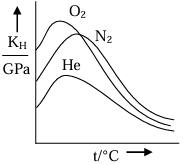
B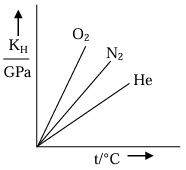
C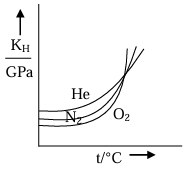
D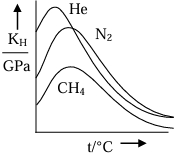
Solution
(D) The Henry's law constant $K_{H}$ is a measure of the solubility of a gas in a liquid.
According to experimental data,the value of $K_{H}$ for gases like $He$,$N_2$,and $CH_4$ in water increases with temperature up to a certain point and then decreases.
Additionally,at a given temperature,the $K_{H}$ values follow the order $He > N_2 > CH_4$.
Graph $D$ correctly depicts this behavior where $K_{H}$ values for $He$,$N_2$,and $CH_4$ show a peak and follow the correct relative order.
According to experimental data,the value of $K_{H}$ for gases like $He$,$N_2$,and $CH_4$ in water increases with temperature up to a certain point and then decreases.
Additionally,at a given temperature,the $K_{H}$ values follow the order $He > N_2 > CH_4$.
Graph $D$ correctly depicts this behavior where $K_{H}$ values for $He$,$N_2$,and $CH_4$ show a peak and follow the correct relative order.
0 likesView Solution
182
ChemistryMediumMCQJEE Main · 2025
$A$ solution is made by mixing $1 \ mole$ of volatile liquid $A$ with $3 \ moles$ of volatile liquid $B$. The vapour pressure of pure $A$ is $200 \ mm \ Hg$ and that of the solution is $500 \ mm \ Hg$. The vapour pressure of pure $B$ and the least volatile component of the solution,respectively,are $:$
A
$1400 \ mm \ Hg, A$
B
$1400 \ mm \ Hg, B$
C
$600 \ mm \ Hg, B$
D
$600 \ mm \ Hg, A$
Solution
(D) According to Raoult's Law,the total vapour pressure of the solution is given by $P_{S} = P_{A}^{o} \cdot X_{A} + P_{B}^{o} \cdot X_{B}$.
Given: $n_{A} = 1 \ mole$,$n_{B} = 3 \ moles$,$P_{A}^{o} = 200 \ mm \ Hg$,$P_{S} = 500 \ mm \ Hg$.
Mole fractions are $X_{A} = \frac{1}{1+3} = 0.25$ and $X_{B} = \frac{3}{1+3} = 0.75$.
Substituting the values: $500 = (200 \times 0.25) + (P_{B}^{o} \times 0.75)$.
$500 = 50 + 0.75 \cdot P_{B}^{o}$.
$450 = 0.75 \cdot P_{B}^{o} \Rightarrow P_{B}^{o} = \frac{450}{0.75} = 600 \ mm \ Hg$.
Since $P_{A}^{o} (200 \ mm \ Hg) < P_{B}^{o} (600 \ mm \ Hg)$,component $A$ is the least volatile.
Given: $n_{A} = 1 \ mole$,$n_{B} = 3 \ moles$,$P_{A}^{o} = 200 \ mm \ Hg$,$P_{S} = 500 \ mm \ Hg$.
Mole fractions are $X_{A} = \frac{1}{1+3} = 0.25$ and $X_{B} = \frac{3}{1+3} = 0.75$.
Substituting the values: $500 = (200 \times 0.25) + (P_{B}^{o} \times 0.75)$.
$500 = 50 + 0.75 \cdot P_{B}^{o}$.
$450 = 0.75 \cdot P_{B}^{o} \Rightarrow P_{B}^{o} = \frac{450}{0.75} = 600 \ mm \ Hg$.
Since $P_{A}^{o} (200 \ mm \ Hg) < P_{B}^{o} (600 \ mm \ Hg)$,component $A$ is the least volatile.
0 likesView Solution
183
ChemistryMediumMCQJEE Main · 2025
Given below are two statements $:$
Statement $(I) :$ Vanillin,with the structure shown below,will react with $NaOH$ and also with Tollen's reagent.
Statement $(II) :$ Vanillin will undergo self-aldol condensation very easily.
In the light of the above statements,choose the most appropriate answer from the options given below $:$
Statement $(I) :$ Vanillin,with the structure shown below,will react with $NaOH$ and also with Tollen's reagent.
Statement $(II) :$ Vanillin will undergo self-aldol condensation very easily.
In the light of the above statements,choose the most appropriate answer from the options given below $:$
A
Statement $I$ is incorrect but Statement $II$ is correct
B
Statement $I$ is correct but Statement $II$ is incorrect
C
Both Statement $I$ and Statement $II$ are incorrect
D
Both Statement $I$ and Statement $II$ are correct
Solution
(B) Vanillin contains a phenolic $-OH$ group,which is acidic and reacts with $NaOH$ to form a salt. It also contains an aldehyde group $(-CHO)$,which reacts with Tollen's reagent to give a silver mirror test.
Therefore,Statement $(I)$ is correct.
Vanillin does not have any $\alpha$-hydrogen atoms relative to the carbonyl group. Aldol condensation requires the presence of at least one $\alpha$-hydrogen atom. Thus,it cannot undergo self-aldol condensation.
Therefore,Statement $(II)$ is incorrect.
Therefore,Statement $(I)$ is correct.
Vanillin does not have any $\alpha$-hydrogen atoms relative to the carbonyl group. Aldol condensation requires the presence of at least one $\alpha$-hydrogen atom. Thus,it cannot undergo self-aldol condensation.
Therefore,Statement $(II)$ is incorrect.
0 likesView Solution
184
ChemistryMediumMCQJEE Main · 2025
Identify the correct statement among the following $:$
A
All naturally occurring amino acids except glycine contain one chiral centre.
B
All naturally occurring amino acids are optically active.
C
Glutamic acid is the only amino acid that contains a $-COOH$ group at the side chain.
D
Amino acid,cysteine easily undergoes dimerization due to the presence of a free $-SH$ group.
Solution
(D) $1$. Isoleucine and threonine have $2$ chiral centers,so option $A$ is incorrect.
$2$. Glycine is achiral and optically inactive,so option $B$ is incorrect.
$3$. Aspartic acid also contains a $-COOH$ group in its side chain,so option $C$ is incorrect.
$4$. Cysteine contains a free $-SH$ group,which can undergo oxidation to form a disulfide bond (cystine),leading to dimerization. Thus,option $D$ is correct.
$2$. Glycine is achiral and optically inactive,so option $B$ is incorrect.
$3$. Aspartic acid also contains a $-COOH$ group in its side chain,so option $C$ is incorrect.
$4$. Cysteine contains a free $-SH$ group,which can undergo oxidation to form a disulfide bond (cystine),leading to dimerization. Thus,option $D$ is correct.
0 likesView Solution
185
ChemistryMediumMCQJEE Main · 2025
The correct order of basic nature in aqueous solution for the bases $NH_3$,$H_2N-NH_2$,$CH_3CH_2NH_2$,$(CH_3CH_2)_2NH$,and $(CH_3CH_2)_3N$ is $:$
A
$NH_3 < H_2N-NH_2 < (CH_3CH_2)_3N < CH_3CH_2NH_2 < (CH_3CH_2)_2NH$
B
$NH_3 < H_2N-NH_2 < CH_3CH_2NH_2 < (CH_3CH_2)_2NH < (CH_3CH_2)_3N$
C
$H_2N-NH_2 < NH_3 < (CH_3CH_2)_3N < CH_3CH_2NH_2 < (CH_3CH_2)_2NH$
D
$H_2N-NH_2 < NH_3 < CH_3CH_2NH_2 < (CH_3CH_2)_3N < (CH_3CH_2)_2NH$
Solution
(C) The basic strength of amines in aqueous solution is determined by a combination of inductive effect,solvation effect (hydrogen bonding),and steric hindrance.
For ethyl-substituted amines,the order is $(CH_3CH_2)_2NH > (CH_3CH_2)_3N > CH_3CH_2NH_2 > NH_3$.
$H_2N-NH_2$ (hydrazine) is a weaker base than $NH_3$ due to the electron-withdrawing effect of the second amino group.
Thus,the overall order is $H_2N-NH_2 < NH_3 < (CH_3CH_2)_3N < CH_3CH_2NH_2 < (CH_3CH_2)_2NH$.
For ethyl-substituted amines,the order is $(CH_3CH_2)_2NH > (CH_3CH_2)_3N > CH_3CH_2NH_2 > NH_3$.
$H_2N-NH_2$ (hydrazine) is a weaker base than $NH_3$ due to the electron-withdrawing effect of the second amino group.
Thus,the overall order is $H_2N-NH_2 < NH_3 < (CH_3CH_2)_3N < CH_3CH_2NH_2 < (CH_3CH_2)_2NH$.
0 likesView Solution
186
ChemistryMediumMCQJEE Main · 2025
Given below are two statements $:$
Statement $(I) :$ In octahedral complexes,when $\Delta_{o} < P$ high spin complexes are formed. When $\Delta_{o} > P$ low spin complexes are formed.
Statement $(II) :$ In tetrahedral complexes because of $\Delta_{t} < P$,low spin complexes are rarely formed.
In the light of the above statements,choose the most appropriate answer from the options given below $:$
Statement $(I) :$ In octahedral complexes,when $\Delta_{o} < P$ high spin complexes are formed. When $\Delta_{o} > P$ low spin complexes are formed.
Statement $(II) :$ In tetrahedral complexes because of $\Delta_{t} < P$,low spin complexes are rarely formed.
In the light of the above statements,choose the most appropriate answer from the options given below $:$
A
Statement $I$ is correct but Statement $II$ is incorrect.
B
Both Statement $I$ and Statement $II$ are incorrect.
C
Statement $I$ is incorrect but Statement $II$ is correct.
D
Both Statement $I$ and Statement $II$ are correct.
Solution
(D) In octahedral complexes $(CN=6)$,the crystal field splitting energy $\Delta_{o}$ is compared with the pairing energy $P$.
If $\Delta_{o} < P$,the electrons prefer to occupy higher energy orbitals rather than pairing,resulting in high spin complexes.
If $\Delta_{o} > P$,the electrons prefer to pair up in lower energy orbitals,resulting in low spin complexes. Thus,Statement $(I)$ is correct.
In tetrahedral complexes $(CN=4)$,the crystal field splitting energy $\Delta_{t}$ is always significantly smaller than the pairing energy $P$ (approximately $\Delta_{t} \approx \frac{4}{9} \Delta_{o}$).
Because $\Delta_{t} < P$ is always true for tetrahedral complexes,electrons do not pair up,and only high spin complexes are formed. Therefore,low spin complexes are rarely formed. Thus,Statement $(II)$ is correct.
If $\Delta_{o} < P$,the electrons prefer to occupy higher energy orbitals rather than pairing,resulting in high spin complexes.
If $\Delta_{o} > P$,the electrons prefer to pair up in lower energy orbitals,resulting in low spin complexes. Thus,Statement $(I)$ is correct.
In tetrahedral complexes $(CN=4)$,the crystal field splitting energy $\Delta_{t}$ is always significantly smaller than the pairing energy $P$ (approximately $\Delta_{t} \approx \frac{4}{9} \Delta_{o}$).
Because $\Delta_{t} < P$ is always true for tetrahedral complexes,electrons do not pair up,and only high spin complexes are formed. Therefore,low spin complexes are rarely formed. Thus,Statement $(II)$ is correct.
0 likesView Solution
187
ChemistryDifficultMCQJEE Main · 2025
Choose the correct tests with respective observations.
$(A)$ $CuSO_4$ (acidified with acetic acid) $+$ $K_4[Fe(CN)_6]$ $\rightarrow$ Chocolate brown precipitate.
$(B)$ $FeCl_3 + K_4[Fe(CN)_6]$ $\rightarrow$ Prussian blue precipitate.
$(C)$ $ZnCl_2 + K_4[Fe(CN)_6]$,neutralised with $NH_4OH$ $\rightarrow$ White or bluish white precipitate.
$(D)$ $MgCl_2 + K_4[Fe(CN)_6]$ $\rightarrow$ Blue precipitate.
$(E)$ $BaCl_2 + K_4[Fe(CN)_6]$,neutralised with $NaOH$ $\rightarrow$ White precipitate.
Choose the correct answer from the options given below:
$(A)$ $CuSO_4$ (acidified with acetic acid) $+$ $K_4[Fe(CN)_6]$ $\rightarrow$ Chocolate brown precipitate.
$(B)$ $FeCl_3 + K_4[Fe(CN)_6]$ $\rightarrow$ Prussian blue precipitate.
$(C)$ $ZnCl_2 + K_4[Fe(CN)_6]$,neutralised with $NH_4OH$ $\rightarrow$ White or bluish white precipitate.
$(D)$ $MgCl_2 + K_4[Fe(CN)_6]$ $\rightarrow$ Blue precipitate.
$(E)$ $BaCl_2 + K_4[Fe(CN)_6]$,neutralised with $NaOH$ $\rightarrow$ White precipitate.
Choose the correct answer from the options given below:
A
$A, D$ and $E$ only
B
$B, D$ and $E$ only
C
$A, B$ and $C$ only
D
$C, D$ and $E$ only
Solution
(C) : $2 CuSO_4 + K_4[Fe(CN)_6] \xrightarrow{CH_3COOH} Cu_2[Fe(CN)_6] + 2 K_2SO_4$ (Chocolate brown precipitate). This is correct.
$B$: $4 FeCl_3 + 3 K_4[Fe(CN)_6] \rightarrow Fe_4[Fe(CN)_6]_3 + 12 KCl$ (Prussian blue precipitate). This is correct.
$C$: $3 ZnCl_2 + 2 K_4[Fe(CN)_6] \xrightarrow{NH_4OH} K_2Zn_3[Fe(CN)_6]_2 + 6 KCl$ (White or bluish white precipitate). This is correct.
$D$: $MgCl_2$ does not form a blue precipitate with $K_4[Fe(CN)_6]$. This is incorrect.
$E$: $BaCl_2$ does not form a white precipitate with $K_4[Fe(CN)_6]$. This is incorrect.
Therefore,the correct tests are $A, B$ and $C$.
$B$: $4 FeCl_3 + 3 K_4[Fe(CN)_6] \rightarrow Fe_4[Fe(CN)_6]_3 + 12 KCl$ (Prussian blue precipitate). This is correct.
$C$: $3 ZnCl_2 + 2 K_4[Fe(CN)_6] \xrightarrow{NH_4OH} K_2Zn_3[Fe(CN)_6]_2 + 6 KCl$ (White or bluish white precipitate). This is correct.
$D$: $MgCl_2$ does not form a blue precipitate with $K_4[Fe(CN)_6]$. This is incorrect.
$E$: $BaCl_2$ does not form a white precipitate with $K_4[Fe(CN)_6]$. This is incorrect.
Therefore,the correct tests are $A, B$ and $C$.
0 likesView Solution
188
ChemistryDifficultMCQJEE Main · 2025
Consider the following molecules $:$
$(p) \ CH_3-CH_2-COCl$
$(q) \ CH_3-CH_2-CO-O-COCH_3$
$(r) \ CH_3-CH_2-CO-OCH_2-CH_3$
$(s) \ CH_3-CH_2-CONH_2$
The correct order of rate of hydrolysis is $:$
$(p) \ CH_3-CH_2-COCl$
$(q) \ CH_3-CH_2-CO-O-COCH_3$
$(r) \ CH_3-CH_2-CO-OCH_2-CH_3$
$(s) \ CH_3-CH_2-CONH_2$
The correct order of rate of hydrolysis is $:$
A
$r > q > p > s$
B
$q > p > r > s$
C
$p > r > q > s$
D
$p > q > r > s$
Solution
(D) The rate of hydrolysis of carboxylic acid derivatives depends on the leaving group ability of the group attached to the carbonyl carbon.
Better leaving groups make the carbonyl carbon more electrophilic and facilitate the nucleophilic attack by water.
The leaving group ability order is $Cl^- > CH_3COO^- > CH_3CH_2O^- > NH_2^-$.
Therefore,the rate of hydrolysis follows the order $:$
$(p) \ (acid \ chloride) > (q) \ (anhydride) > (r) \ (ester) > (s) \ (amide)$.
Thus,the correct order is $p > q > r > s$.
Better leaving groups make the carbonyl carbon more electrophilic and facilitate the nucleophilic attack by water.
The leaving group ability order is $Cl^- > CH_3COO^- > CH_3CH_2O^- > NH_2^-$.
Therefore,the rate of hydrolysis follows the order $:$
$(p) \ (acid \ chloride) > (q) \ (anhydride) > (r) \ (ester) > (s) \ (amide)$.
Thus,the correct order is $p > q > r > s$.
0 likesView Solution
189
ChemistryMediumMCQJEE Main · 2025
$A$ transition metal $(M)$ among $Mn, Cr, Co$ and $Fe$ has the highest standard electrode potential $(M^{3+} / M^{2+})$. It forms a metal complex of the type $[M(CN)_6]^{4-}$. The number of electrons present in the $e_g$ orbital of the complex is $.........$
A
$0$
B
$1$
C
$2$
D
$3$
Solution
(B) The standard electrode potential $(M^{3+}/M^{2+})$ values for the given metals are: $Mn^{3+}/Mn^{2+} = +1.57 \ V$,$Cr^{3+}/Cr^{2+} = -0.41 \ V$,$Co^{3+}/Co^{2+} = +1.97 \ V$,$Fe^{3+}/Fe^{2+} = +0.77 \ V$.
Among these,$Co$ has the highest standard electrode potential.
The complex is $[Co(CN)_6]^{4-}$.
In this complex,the oxidation state of $Co$ is $+2$. The electronic configuration of $Co^{2+}$ is $[Ar] 3d^7$.
$CN^-$ is a strong field ligand,causing pairing of electrons.
According to Crystal Field Theory,for an octahedral complex with $d^7$ configuration and strong field ligand,the distribution is $t_{2g}^6 e_g^1$.
Therefore,the number of electrons in the $e_g$ orbital is $1$.
Among these,$Co$ has the highest standard electrode potential.
The complex is $[Co(CN)_6]^{4-}$.
In this complex,the oxidation state of $Co$ is $+2$. The electronic configuration of $Co^{2+}$ is $[Ar] 3d^7$.
$CN^-$ is a strong field ligand,causing pairing of electrons.
According to Crystal Field Theory,for an octahedral complex with $d^7$ configuration and strong field ligand,the distribution is $t_{2g}^6 e_g^1$.
Therefore,the number of electrons in the $e_g$ orbital is $1$.
0 likesView Solution
190
ChemistryDifficultMCQJEE Main · 2025
Consider the following electrochemical cell at standard condition: $Au_{(s)} | QH_2, Q | NH_4X(0.01 \ M) || Ag^{+}(1 \ M) | Ag_{(s)}$. Given $E_{\text{cell}} = +0.4 \ V$. The couple $QH_2 / Q$ represents the quinhydrone electrode,and the half-cell reaction is given as: $Q + 2e^- + 2H^+ \rightarrow QH_2$ with $E^o_{Q/QH_2} = +0.7 \ V$. Given: $E^o_{Ag^+/Ag} = +0.8 \ V$ and $\frac{2.303 \ RT}{F} = 0.06 \ V$. The $pK_b$ value of the ammonium halide salt $(NH_4X)$ used here is $.........$ (nearest integer).
A
$5$
B
$6$
C
$16$
D
$9$
Solution
(B) The cell reaction is: $QH_2 + 2Ag^+ \rightarrow Q + 2Ag + 2H^+$.
$E^o_{\text{cell}} = E^o_{Ag^+/Ag} - E^o_{Q/QH_2} = 0.8 - 0.7 = 0.1 \ V$.
Using the Nernst equation: $E_{\text{cell}} = E^o_{\text{cell}} - \frac{0.06}{2} \log \frac{[H^+]^2}{[Ag^+]^2}$.
Given $E_{\text{cell}} = 0.4 \ V$,$[Ag^+] = 1 \ M$:
$0.4 = 0.1 - 0.03 \log [H^+]^2 = 0.1 - 0.06 \log [H^+]$.
$0.3 = -0.06 \log [H^+]$ $\Rightarrow \log [H^+] = -5$ $\Rightarrow pH = 5$.
For a salt of a weak base and strong acid $(NH_4X)$,$pH = 7 - \frac{1}{2} pK_b - \frac{1}{2} \log C$.
$5 = 7 - \frac{1}{2} pK_b - \frac{1}{2} \log (0.01)$.
$5 = 7 - \frac{1}{2} pK_b - \frac{1}{2} (-2) = 7 - \frac{1}{2} pK_b + 1 = 8 - \frac{1}{2} pK_b$.
$\frac{1}{2} pK_b = 3 \Rightarrow pK_b = 6$.
$E^o_{\text{cell}} = E^o_{Ag^+/Ag} - E^o_{Q/QH_2} = 0.8 - 0.7 = 0.1 \ V$.
Using the Nernst equation: $E_{\text{cell}} = E^o_{\text{cell}} - \frac{0.06}{2} \log \frac{[H^+]^2}{[Ag^+]^2}$.
Given $E_{\text{cell}} = 0.4 \ V$,$[Ag^+] = 1 \ M$:
$0.4 = 0.1 - 0.03 \log [H^+]^2 = 0.1 - 0.06 \log [H^+]$.
$0.3 = -0.06 \log [H^+]$ $\Rightarrow \log [H^+] = -5$ $\Rightarrow pH = 5$.
For a salt of a weak base and strong acid $(NH_4X)$,$pH = 7 - \frac{1}{2} pK_b - \frac{1}{2} \log C$.
$5 = 7 - \frac{1}{2} pK_b - \frac{1}{2} \log (0.01)$.
$5 = 7 - \frac{1}{2} pK_b - \frac{1}{2} (-2) = 7 - \frac{1}{2} pK_b + 1 = 8 - \frac{1}{2} pK_b$.
$\frac{1}{2} pK_b = 3 \Rightarrow pK_b = 6$.
0 likesView Solution
191
ChemistryMediumMCQJEE Main · 2025
For the reaction $A \rightarrow \text{products}$,the graph of $t_{1/2}$ versus $[A]_0$ is given below. The concentration of $A$ at $10 \ \text{minutes}$ is $.......... \times 10^{-3} \ \text{mol L}^{-1}$ $(nearest \ integer)$. The reaction was started with $2.5 \ \text{mol L}^{-1}$ of $A$.
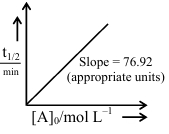
A
$2435$
B
$1452$
C
$7854$
D
$7856$
Solution
(A) From the graph,$t_{1/2} \propto [A]_0$,which indicates a zero-order reaction.
For a zero-order reaction,$t_{1/2} = \frac{[A]_0}{2K}$.
The slope of the graph is $\frac{1}{2K} = 76.92 \ \text{min L mol}^{-1}$.
Therefore,$K = \frac{1}{2 \times 76.92} \ \text{mol L}^{-1} \text{min}^{-1} \approx 6.5 \times 10^{-3} \ \text{mol L}^{-1} \text{min}^{-1}$.
For a zero-order reaction,the concentration at time $t$ is given by $[A]_t = [A]_0 - Kt$.
Given $[A]_0 = 2.5 \ \text{mol L}^{-1}$,$t = 10 \ \text{min}$,and $K = \frac{1}{153.84} \ \text{mol L}^{-1} \text{min}^{-1}$.
$[A]_{10} = 2.5 - (\frac{1}{153.84}) \times 10 = 2.5 - 0.065 = 2.435 \ \text{mol L}^{-1}$.
$[A]_{10} = 2435 \times 10^{-3} \ \text{mol L}^{-1}$.
For a zero-order reaction,$t_{1/2} = \frac{[A]_0}{2K}$.
The slope of the graph is $\frac{1}{2K} = 76.92 \ \text{min L mol}^{-1}$.
Therefore,$K = \frac{1}{2 \times 76.92} \ \text{mol L}^{-1} \text{min}^{-1} \approx 6.5 \times 10^{-3} \ \text{mol L}^{-1} \text{min}^{-1}$.
For a zero-order reaction,the concentration at time $t$ is given by $[A]_t = [A]_0 - Kt$.
Given $[A]_0 = 2.5 \ \text{mol L}^{-1}$,$t = 10 \ \text{min}$,and $K = \frac{1}{153.84} \ \text{mol L}^{-1} \text{min}^{-1}$.
$[A]_{10} = 2.5 - (\frac{1}{153.84}) \times 10 = 2.5 - 0.065 = 2.435 \ \text{mol L}^{-1}$.
$[A]_{10} = 2435 \times 10^{-3} \ \text{mol L}^{-1}$.
0 likesView Solution
192
ChemistryDifficultMCQJEE Main · 2025
When a concentrated solution of sulphanilic acid and $1-$naphthylamine is treated with nitrous acid $(273 \ K)$ and acidified with acetic acid,the mass $(g)$ of $0.1 \ mole$ of product formed is : (Given molar mass in $g \ mol^{-1} H: 1, C: 12, N: 14, O: 16, S: 32$)
A
$343$
B
$330$
C
$33$
D
$66$
Solution
(C) The reaction involves the diazotization of sulphanilic acid followed by coupling with $1-$naphthylamine to form a red-azo dye (Congo Red derivative).
Step $1$: Sulphanilic acid $(C_6H_7NO_3S)$ reacts with $HNO_2$ to form a diazonium salt.
Step $2$: The diazonium salt couples with $1-$naphthylamine $(C_{10}H_9N)$ to form the azo dye $(C_{16}H_{13}N_3O_3S)$.
The molecular formula of the product is $C_{16}H_{13}N_3O_3S$.
Molar mass $= (16 \times 12) + (13 \times 1) + (3 \times 14) + (3 \times 16) + (1 \times 32) = 192 + 13 + 42 + 48 + 32 = 327 \ g \ mol^{-1}$.
Mass of $0.1 \ mole$ of product $= 0.1 \ mol \times 327 \ g \ mol^{-1} = 32.7 \ g$.
Rounding to the nearest integer,the mass is $33 \ g$.
Step $1$: Sulphanilic acid $(C_6H_7NO_3S)$ reacts with $HNO_2$ to form a diazonium salt.
Step $2$: The diazonium salt couples with $1-$naphthylamine $(C_{10}H_9N)$ to form the azo dye $(C_{16}H_{13}N_3O_3S)$.
The molecular formula of the product is $C_{16}H_{13}N_3O_3S$.
Molar mass $= (16 \times 12) + (13 \times 1) + (3 \times 14) + (3 \times 16) + (1 \times 32) = 192 + 13 + 42 + 48 + 32 = 327 \ g \ mol^{-1}$.
Mass of $0.1 \ mole$ of product $= 0.1 \ mol \times 327 \ g \ mol^{-1} = 32.7 \ g$.
Rounding to the nearest integer,the mass is $33 \ g$.
0 likesView Solution
193
ChemistryMediumMCQJEE Main · 2025
The $d-$orbital electronic configuration of the complex among $[Co(en)_3]^{3+}$,$[CoF_6]^{3-}$,$[Mn(H_2O)_6]^{2+}$ and $[Zn(H_2O)_6]^{2+}$ that has the highest $CFSE$ is $:$
A
$t_{2g}^6 e_g^0$
B
$t_{2g}^6 e_g^4$
C
$t_{2g}^3 e_g^2$
D
$t_{2g}^4 e_g^2$
Solution
(A) To determine the complex with the highest $CFSE$ (Crystal Field Stabilization Energy),we evaluate the nature of the ligand and the metal ion configuration:
$1$. $[Co(en)_3]^{3+}$: $Co^{3+}$ is a $d^6$ system. $en$ (ethylenediamine) is a Strong Field Ligand $(SFL)$,causing pairing of electrons. The configuration is $t_{2g}^6 e_g^0$. This complex has a high $CFSE$ due to the strong field splitting.
$2$. $[CoF_6]^{3-}$: $Co^{3+}$ is a $d^6$ system. $F^-$ is a Weak Field Ligand $(WFL)$,resulting in a high-spin configuration $t_{2g}^4 e_g^2$.
$3$. $[Mn(H_2O)_6]^{2+}$: $Mn^{2+}$ is a $d^5$ system. $H_2O$ is a $WFL$,resulting in a high-spin configuration $t_{2g}^3 e_g^2$.
$4$. $[Zn(H_2O)_6]^{2+}$: $Zn^{2+}$ is a $d^{10}$ system with configuration $t_{2g}^6 e_g^4$. It has zero $CFSE$ because the $d-$orbitals are completely filled.
Comparing these,$[Co(en)_3]^{3+}$ has the highest $CFSE$ due to the strong field ligand $en$ and the $d^6$ low-spin configuration $t_{2g}^6 e_g^0$.
$1$. $[Co(en)_3]^{3+}$: $Co^{3+}$ is a $d^6$ system. $en$ (ethylenediamine) is a Strong Field Ligand $(SFL)$,causing pairing of electrons. The configuration is $t_{2g}^6 e_g^0$. This complex has a high $CFSE$ due to the strong field splitting.
$2$. $[CoF_6]^{3-}$: $Co^{3+}$ is a $d^6$ system. $F^-$ is a Weak Field Ligand $(WFL)$,resulting in a high-spin configuration $t_{2g}^4 e_g^2$.
$3$. $[Mn(H_2O)_6]^{2+}$: $Mn^{2+}$ is a $d^5$ system. $H_2O$ is a $WFL$,resulting in a high-spin configuration $t_{2g}^3 e_g^2$.
$4$. $[Zn(H_2O)_6]^{2+}$: $Zn^{2+}$ is a $d^{10}$ system with configuration $t_{2g}^6 e_g^4$. It has zero $CFSE$ because the $d-$orbitals are completely filled.
Comparing these,$[Co(en)_3]^{3+}$ has the highest $CFSE$ due to the strong field ligand $en$ and the $d^6$ low-spin configuration $t_{2g}^6 e_g^0$.
0 likesView Solution
194
ChemistryMediumMCQJEE Main · 2025
Formation of $Na_4[Fe(CN)_5NOS]$,a purple coloured complex formed by addition of sodium nitroprusside in sodium carbonate extract of salt indicates the presence of $:$
A
Sodium ion
B
Sulphate ion
C
Sulphide ion
D
Sulphite ion
Solution
(C) The reaction between sodium nitroprusside and sulphide ions is a standard test for the detection of sulphide ions in a salt sample.
$Na_2S + Na_2[Fe(CN)_5NO] \rightarrow Na_4[Fe(CN)_5NOS]$
This reaction produces a characteristic violet or purple coloured complex,$Na_4[Fe(CN)_5NOS]$,which confirms the presence of the sulphide ion $(S^{2-})$.
$Na_2S + Na_2[Fe(CN)_5NO] \rightarrow Na_4[Fe(CN)_5NOS]$
This reaction produces a characteristic violet or purple coloured complex,$Na_4[Fe(CN)_5NOS]$,which confirms the presence of the sulphide ion $(S^{2-})$.
0 likesView Solution
195
ChemistryMediumMCQJEE Main · 2025
The type of hybridization and the magnetic property of $[MnCl_6]^{3-}$ are $:$
A
$d^2sp^3$,paramagnetic with four unpaired electrons
B
$sp^3d^2$,paramagnetic with four unpaired electrons
C
$d^2sp^3$,paramagnetic with two unpaired electrons
D
$sp^3d^2$,paramagnetic with two unpaired electrons
Solution
(B) In $[MnCl_6]^{3-}$,the oxidation state of $Mn$ is $+3$.
The electronic configuration of $Mn^{3+}$ is $[Ar] 3d^4$.
Since $Cl^-$ is a weak field ligand $(WFL)$,it does not cause pairing of electrons in the $3d$ orbitals.
Therefore,the hybridization involved is $sp^3d^2$ (outer orbital complex).
The $3d^4$ configuration has $4$ unpaired electrons,making it paramagnetic.
The electronic configuration of $Mn^{3+}$ is $[Ar] 3d^4$.
Since $Cl^-$ is a weak field ligand $(WFL)$,it does not cause pairing of electrons in the $3d$ orbitals.
Therefore,the hybridization involved is $sp^3d^2$ (outer orbital complex).
The $3d^4$ configuration has $4$ unpaired electrons,making it paramagnetic.
0 likesView Solution
196
ChemistryMediumMCQJEE Main · 2025
Consider the following reactions. From these reactions,which reaction will give carboxylic acid as a major product?
$(A)$ $R-C \equiv N \xrightarrow[(i) H^{+}/H_2O]{\text{mild condition}} R-CONH_2$
$(B)$ $R-MgX \xrightarrow[(ii) H_3O^{+}]{\text{(i) } CO_2} R-COOH$
$(C)$ $R-C \equiv N \xrightarrow[(ii) H_3O^{+}]{\text{(i) } SnCl_2/HCl} R-CHO$
$(D)$ $R-CH_2-OH \xrightarrow{PCC} R-CHO$
$(E)$ $\text{Benzoyl chloride} \xrightarrow[(ii) Br_2/H_2O]{\text{(i) } H_2/Pd-BaSO_4} \text{Benzoic acid}$
Choose the correct answer from the options given below:
$(A)$ $R-C \equiv N \xrightarrow[(i) H^{+}/H_2O]{\text{mild condition}} R-CONH_2$
$(B)$ $R-MgX \xrightarrow[(ii) H_3O^{+}]{\text{(i) } CO_2} R-COOH$
$(C)$ $R-C \equiv N \xrightarrow[(ii) H_3O^{+}]{\text{(i) } SnCl_2/HCl} R-CHO$
$(D)$ $R-CH_2-OH \xrightarrow{PCC} R-CHO$
$(E)$ $\text{Benzoyl chloride} \xrightarrow[(ii) Br_2/H_2O]{\text{(i) } H_2/Pd-BaSO_4} \text{Benzoic acid}$
Choose the correct answer from the options given below:
A
$A$ and $D$ only
B
$A, B$ and $E$ only
C
$B, C$ and $E$ only
D
$B$ and $E$ only
Solution
(D) Let us analyze each reaction:
$(A)$ Nitriles on partial hydrolysis under mild conditions yield amides $(R-CONH_2)$,not carboxylic acids.
$(B)$ Grignard reagents react with $CO_2$ followed by acidic hydrolysis to form carboxylic acids $(R-COOH)$. This is a standard method for preparing carboxylic acids.
$(C)$ This is the Stephen reduction,which converts nitriles to aldehydes $(R-CHO)$.
$(D)$ $PCC$ (Pyridinium chlorochromate) is a mild oxidizing agent that oxidizes primary alcohols to aldehydes $(R-CHO)$.
$(E)$ Benzoyl chloride undergoes Rosenmund reduction with $H_2/Pd-BaSO_4$ to form benzaldehyde,which is then oxidized to benzoic acid by $Br_2/H_2O$ (acting as a mild oxidizing agent in this context). Thus,it yields a carboxylic acid.
Therefore,reactions $(B)$ and $(E)$ produce carboxylic acids as major products.
$(A)$ Nitriles on partial hydrolysis under mild conditions yield amides $(R-CONH_2)$,not carboxylic acids.
$(B)$ Grignard reagents react with $CO_2$ followed by acidic hydrolysis to form carboxylic acids $(R-COOH)$. This is a standard method for preparing carboxylic acids.
$(C)$ This is the Stephen reduction,which converts nitriles to aldehydes $(R-CHO)$.
$(D)$ $PCC$ (Pyridinium chlorochromate) is a mild oxidizing agent that oxidizes primary alcohols to aldehydes $(R-CHO)$.
$(E)$ Benzoyl chloride undergoes Rosenmund reduction with $H_2/Pd-BaSO_4$ to form benzaldehyde,which is then oxidized to benzoic acid by $Br_2/H_2O$ (acting as a mild oxidizing agent in this context). Thus,it yields a carboxylic acid.
Therefore,reactions $(B)$ and $(E)$ produce carboxylic acids as major products.
0 likesView Solution
197
ChemistryMediumMCQJEE Main · 2025
$x \ g$ of $NaCl$ is added to water in a beaker with a lid. The temperature of the system is raised from $1^{\circ}C$ to $25^{\circ}C$. Which out of the following plots is best suited for the change in the molarity $(M)$ of the solution with respect to temperature? [Consider the solubility of $NaCl$ remains unchanged over the temperature range]
A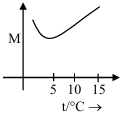
B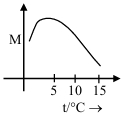
C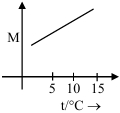
D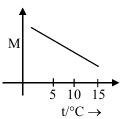
Solution
(A) The density of water is maximum at $4^{\circ}C$,which means the volume of water is minimum at $4^{\circ}C$.
As the temperature increases from $1^{\circ}C$ to $4^{\circ}C$,the volume of water decreases,causing the molarity $(M = n/V)$ to increase.
As the temperature increases from $4^{\circ}C$ to $25^{\circ}C$,the volume of water increases due to thermal expansion,causing the molarity to decrease.
Therefore,the molarity first increases and then decreases,which is represented by plot $A$.
As the temperature increases from $1^{\circ}C$ to $4^{\circ}C$,the volume of water decreases,causing the molarity $(M = n/V)$ to increase.
As the temperature increases from $4^{\circ}C$ to $25^{\circ}C$,the volume of water increases due to thermal expansion,causing the molarity to decrease.
Therefore,the molarity first increases and then decreases,which is represented by plot $A$.
0 likesView Solution
198
ChemistryDifficultMCQJEE Main · 2025
Reactant $A$ converts to product $D$ through the given mechanism (with the net evolution of heat) :
Which of the following represents the above reaction mechanism ?
| $A \rightarrow B$ | $slow ; \Delta H=+ve$ |
| $B \rightarrow C$ | $fast ; \Delta H=-ve$ |
| $C \rightarrow D$ | $fast ; \Delta H=-ve$ |
Which of the following represents the above reaction mechanism ?
A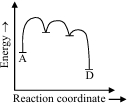
B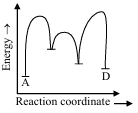
C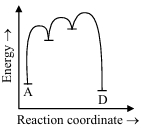
D
Solution
(A) The reaction mechanism involves three steps:
$1$. $A \rightarrow B$ is a slow step with $\Delta H = +ve$ (endothermic),meaning the energy of $B$ is higher than $A$,and it has a high activation energy $(E_{a_1})$.
$2$. $B \rightarrow C$ is a fast step with $\Delta H = -ve$ (exothermic),meaning the energy of $C$ is lower than $B$,and it has a low activation energy $(E_{a_2})$.
$3$. $C \rightarrow D$ is a fast step with $\Delta H = -ve$ (exothermic),meaning the energy of $D$ is lower than $C$,and it has a low activation energy $(E_{a_3})$.
The overall reaction is exothermic $(\Delta H_{net} = -ve)$,so the final product $D$ must be at a lower energy level than the reactant $A$.
The graph that correctly depicts these energy changes is shown in the solution image.
$1$. $A \rightarrow B$ is a slow step with $\Delta H = +ve$ (endothermic),meaning the energy of $B$ is higher than $A$,and it has a high activation energy $(E_{a_1})$.
$2$. $B \rightarrow C$ is a fast step with $\Delta H = -ve$ (exothermic),meaning the energy of $C$ is lower than $B$,and it has a low activation energy $(E_{a_2})$.
$3$. $C \rightarrow D$ is a fast step with $\Delta H = -ve$ (exothermic),meaning the energy of $D$ is lower than $C$,and it has a low activation energy $(E_{a_3})$.
The overall reaction is exothermic $(\Delta H_{net} = -ve)$,so the final product $D$ must be at a lower energy level than the reactant $A$.
The graph that correctly depicts these energy changes is shown in the solution image.
0 likesView Solution
199
ChemistryMediumMCQJEE Main · 2025
The nature of oxide $(TeO_2)$ and hydride $(TeH_2)$ formed by $Te$ respectively are $:$
A
Oxidising and acidic
B
Reducing and basic
C
Reducing and acidic
D
Oxidising and basic
Solution
(A) $TeO_2$ acts as an oxidizing agent because $Te$ in $+4$ oxidation state can be reduced to lower oxidation states.
$TeH_2$ is acidic in nature because the bond dissociation energy of the $Te-H$ bond decreases down the group,making it easy to release $H^+$ ions.
$TeH_2$ is acidic in nature because the bond dissociation energy of the $Te-H$ bond decreases down the group,making it easy to release $H^+$ ions.
0 likesView Solution
200
ChemistryMediumMCQJEE Main · 2025
Match List-$I$ with List-$II$:
Choose the correct answer from the options given below:
| List-$I$ (Reaction) | List-$II$ (Name of reaction) |
|---|---|
| $A$. $2C_6H_5X + 2Na \xrightarrow{\text{Dry Ether}} C_6H_5-C_6H_5 + 2NaX$ | $I$. Lucas reaction |
| $B$. $ArN_2^{+} X^{-} \xrightarrow[HCl]{Cu} ArCl + N_2 \uparrow + CuX$ | $II$. Finkelstein reaction |
| $C$. $C_2H_5Br + NaI \xrightarrow{\text{Acetone}} C_2H_5I + NaBr$ | $III$. Fittig reaction |
| $D$. $(CH_3)_3COH \xrightarrow[ZnCl_2]{HCl} (CH_3)_3CCl + H_2O$ | $IV$. Gatterman reaction |
Choose the correct answer from the options given below:
A
$A-III, B-IV, C-II, D-I$
B
$A-III, B-II, C-IV, D-I$
C
$A-IV, B-III, C-I, D-II$
D
$A-IV, B-I, C-II, D-III$
Solution
(A) The correct matches are:
$A$. The reaction $2C_6H_5X + 2Na \xrightarrow{\text{Dry Ether}} C_6H_5-C_6H_5 + 2NaX$ is the Fittig reaction $(III)$.
$B$. The reaction $ArN_2^{+} X^{-} \xrightarrow[HCl]{Cu} ArCl + N_2 \uparrow + CuX$ is the Gatterman reaction $(IV)$.
$C$. The reaction $C_2H_5Br + NaI \xrightarrow{\text{Acetone}} C_2H_5I + NaBr$ is the Finkelstein reaction $(II)$.
$D$. The reaction $(CH_3)_3COH \xrightarrow[ZnCl_2]{HCl} (CH_3)_3CCl + H_2O$ is the Lucas reaction $(I)$.
Therefore,the correct sequence is $A-III, B-IV, C-II, D-I$.
$A$. The reaction $2C_6H_5X + 2Na \xrightarrow{\text{Dry Ether}} C_6H_5-C_6H_5 + 2NaX$ is the Fittig reaction $(III)$.
$B$. The reaction $ArN_2^{+} X^{-} \xrightarrow[HCl]{Cu} ArCl + N_2 \uparrow + CuX$ is the Gatterman reaction $(IV)$.
$C$. The reaction $C_2H_5Br + NaI \xrightarrow{\text{Acetone}} C_2H_5I + NaBr$ is the Finkelstein reaction $(II)$.
$D$. The reaction $(CH_3)_3COH \xrightarrow[ZnCl_2]{HCl} (CH_3)_3CCl + H_2O$ is the Lucas reaction $(I)$.
Therefore,the correct sequence is $A-III, B-IV, C-II, D-I$.
0 likesView Solution
Vedclass Products
For Students
Vedclass Test Series
Mock tests in real JEE Main style covering Chemistry with performance analysis. 5-day free trial.
Start Free TrialFor Teachers
Exam Paper Generator
Generate Set A/B/C/D Chemistry papers from 7.5L+ questions in 2 minutes. 3 chapters free.
Try FreeFor Institutes
Online Exam Module
Run live JEE Main mock exams with unlimited students, 360° analytics & white-label branding.
See DemoFrequently Asked Questions
How many Chemistry questions are in JEE Main 2025?
There are 478 Chemistry questions from the JEE Main 2025 paper on Vedclass, each with a detailed step-by-step solution in English.
Are JEE Main 2025 Chemistry solutions available in English?
Yes. All solutions on this page are in English. You can also switch to English or Hindi using the language buttons above the questions.
Can I practice JEE Main 2025 Chemistry as a timed test?
Yes. Use the Vedclass Test Series to attempt a full JEE Main mock test covering Chemistry with time limits and instant score analysis.
Can teachers create Chemistry papers from JEE Main previous year questions?
Yes. The Vedclass Exam Paper Generator lets teachers mix JEE Main Chemistry questions and generate Set A/B/C/D papers in minutes.
For Teachers & Institutes
Build a Custom Chemistry Paper
Pick JEE Main 2025 Chemistry questions, set difficulty, and generate Set A/B/C/D in 2 minutes.