
ChemistryQ201–272 of 478 questions
Page 5 of 6 · English
201
ChemistryMediumMCQJEE Main · 2025
The hydration energies of $K^{+}$ and $Cl^{-}$ are $-x$ and $-y$ $kJ / mol$ respectively. If the lattice energy of $KCl$ is $-z$ $kJ / mol$,then the heat of solution of $KCl$ is $:$
A
$+x-y-z$
B
$x+y+z$
C
$z-(x+y)$
D
$-z-(x+y)$
Solution
(C) According to the Born-Haber cycle for the dissolution of an ionic solid,the heat of solution $(\Delta H_{sol})$ is the sum of the lattice energy $(L.E.)$ and the hydration energies $(H.E.)$ of the constituent ions.
$\Delta H_{sol} = L.E. + (H.E.)_{K^{+}} + (H.E.)_{Cl^{-}}$
Given:
$L.E. = -z \ kJ / mol$
$(H.E.)_{K^{+}} = -x \ kJ / mol$
$(H.E.)_{Cl^{-}} = -y \ kJ / mol$
Substituting these values into the equation:
$\Delta H_{sol} = (-z) + (-x) + (-y)$
$\Delta H_{sol} = -z - x - y$
$\Delta H_{sol} = -(z + x + y)$
Wait,let us re-evaluate the standard definition. Usually,$L.E.$ is defined as the energy released when gaseous ions form a solid,so $L.E. = +z$ (energy required to break the lattice). If $L.E.$ is given as $-z$ (energy released),then the energy to break the lattice is $+z$.
Thus,$\Delta H_{sol} = z + (-x) + (-y) = z - (x + y)$.
$\Delta H_{sol} = L.E. + (H.E.)_{K^{+}} + (H.E.)_{Cl^{-}}$
Given:
$L.E. = -z \ kJ / mol$
$(H.E.)_{K^{+}} = -x \ kJ / mol$
$(H.E.)_{Cl^{-}} = -y \ kJ / mol$
Substituting these values into the equation:
$\Delta H_{sol} = (-z) + (-x) + (-y)$
$\Delta H_{sol} = -z - x - y$
$\Delta H_{sol} = -(z + x + y)$
Wait,let us re-evaluate the standard definition. Usually,$L.E.$ is defined as the energy released when gaseous ions form a solid,so $L.E. = +z$ (energy required to break the lattice). If $L.E.$ is given as $-z$ (energy released),then the energy to break the lattice is $+z$.
Thus,$\Delta H_{sol} = z + (-x) + (-y) = z - (x + y)$.
0 likesView Solution
202
ChemistryMediumMCQJEE Main · 2025
Choose the incorrect trend in the atomic radii $(r)$ of the elements $:$
A
$r_{Br} < r_{K}$
B
$r_{Mg} < r_{Al}$
C
$r_{Rb} < r_{Na}$
D
$r_{At} < r_{Cs}$
Solution
(B) In a period,the atomic radius decreases from left to right due to an increase in effective nuclear charge. In a group,the atomic radius increases from top to bottom due to the addition of new shells.
$(A)$ $r_{Br} < r_{K}$ is correct because $K$ is in Group $1$ and $Br$ is in Group $17$ of the same period.
$(B)$ $r_{Mg} < r_{Al}$ is incorrect because $Mg$ (Group $2$) has a larger atomic radius than $Al$ (Group $13$) in the same period.
$(C)$ $r_{Rb} < r_{Na}$ is incorrect because $Rb$ is in the $5th$ period and $Na$ is in the $3rd$ period,so $r_{Rb} > r_{Na}$.
$(D)$ $r_{At} < r_{Cs}$ is correct because $Cs$ is in Group $1$ and $At$ is in Group $17$ of the same period.
Since the question asks for the incorrect trend,both $(B)$ and $(C)$ represent incorrect trends. However,in standard competitive chemistry,$r_{Mg} > r_{Al}$ is the classic example of a periodic trend error.
$(A)$ $r_{Br} < r_{K}$ is correct because $K$ is in Group $1$ and $Br$ is in Group $17$ of the same period.
$(B)$ $r_{Mg} < r_{Al}$ is incorrect because $Mg$ (Group $2$) has a larger atomic radius than $Al$ (Group $13$) in the same period.
$(C)$ $r_{Rb} < r_{Na}$ is incorrect because $Rb$ is in the $5th$ period and $Na$ is in the $3rd$ period,so $r_{Rb} > r_{Na}$.
$(D)$ $r_{At} < r_{Cs}$ is correct because $Cs$ is in Group $1$ and $At$ is in Group $17$ of the same period.
Since the question asks for the incorrect trend,both $(B)$ and $(C)$ represent incorrect trends. However,in standard competitive chemistry,$r_{Mg} > r_{Al}$ is the classic example of a periodic trend error.
0 likesView Solution
203
ChemistryMediumMCQJEE Main · 2025
The correct statement amongst the following is $:$
A
The term 'standard state' implies that the temperature is $0^{\circ} C$
B
The standard state of pure gas is the pure gas at a pressure of $1 \ bar$ and temperature $273 \ K$
C
$\Delta_{f} H_{298}^{\theta}$ is zero for $O_{(g)}$
D
$\Delta_{f} H_{500}^{\theta}$ is zero for $O_{2(g)}$
Solution
(D) The standard state of a substance is defined as its pure form at a pressure of $1 \ bar$ and a specified temperature (usually $298 \ K$).
$\Delta_{f} H^{\theta}$ (standard enthalpy of formation) is defined as zero for elements in their most stable state at the specified temperature.
For $O_{2(g)}$,which is the most stable form of oxygen,$\Delta_{f} H^{\theta} = 0$ at any specified temperature.
Therefore,$\Delta_{f} H_{500}^{\theta}$ is zero for $O_{2(g)}$ is the correct statement.
$\Delta_{f} H^{\theta}$ (standard enthalpy of formation) is defined as zero for elements in their most stable state at the specified temperature.
For $O_{2(g)}$,which is the most stable form of oxygen,$\Delta_{f} H^{\theta} = 0$ at any specified temperature.
Therefore,$\Delta_{f} H_{500}^{\theta}$ is zero for $O_{2(g)}$ is the correct statement.
0 likesView Solution
204
ChemistryEasyMCQJEE Main · 2025
In $SO_2$,$NO_2^-$ and $N_3^-$ the hybridizations at the central atom are respectively $:$
A
$sp^2, sp^2$ and $sp$
B
$sp^2, sp$ and $sp$
C
$sp^2, sp^2$ and $sp^2$
D
$sp, sp^2$ and $sp$
Solution
(A) To determine the hybridization of the central atom,we use the formula: $\text{Steric Number} = (\text{Number of sigma bonds}) + (\text{Number of lone pairs})$.
$1$. For $SO_2$: The central atom $S$ has $2$ sigma bonds and $1$ lone pair. $\text{Steric Number} = 2 + 1 = 3$,which corresponds to $sp^2$ hybridization.
$2$. For $NO_2^-$: The central atom $N$ has $2$ sigma bonds and $1$ lone pair. $\text{Steric Number} = 2 + 1 = 3$,which corresponds to $sp^2$ hybridization.
$3$. For $N_3^-$: The central atom $N$ has $2$ sigma bonds and $0$ lone pairs. $\text{Steric Number} = 2 + 0 = 2$,which corresponds to $sp$ hybridization.
Therefore,the hybridizations are $sp^2, sp^2$ and $sp$ respectively.
$1$. For $SO_2$: The central atom $S$ has $2$ sigma bonds and $1$ lone pair. $\text{Steric Number} = 2 + 1 = 3$,which corresponds to $sp^2$ hybridization.
$2$. For $NO_2^-$: The central atom $N$ has $2$ sigma bonds and $1$ lone pair. $\text{Steric Number} = 2 + 1 = 3$,which corresponds to $sp^2$ hybridization.
$3$. For $N_3^-$: The central atom $N$ has $2$ sigma bonds and $0$ lone pairs. $\text{Steric Number} = 2 + 0 = 2$,which corresponds to $sp$ hybridization.
Therefore,the hybridizations are $sp^2, sp^2$ and $sp$ respectively.
0 likesView Solution
205
ChemistryDifficultMCQJEE Main · 2025
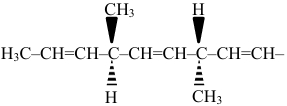
The number of optically active products obtained from the complete ozonolysis of the given compound is $:$
A
$2$
B
$0$
C
$1$
D
$4$
Solution
(B) The given compound is $CH_3-CH=CH-CH(CH_3)-CH=CH-CH(CH_3)-CH=CH-CH_3$. Upon complete ozonolysis $(O_3/Zn, H_2O)$,the double bonds are cleaved to form carbonyl compounds.
Specifically,the structure $CH_3-CH=CH-CH(CH_3)-CH=CH-CH(CH_3)-CH=CH-CH_3$ breaks down into:
$1$. $CH_3CHO$ (Acetaldehyde) - $2$ molecules.
$2$. $OHC-CH(CH_3)-CHO$ (Methylmalonaldehyde) - $2$ molecules.
Acetaldehyde $(CH_3CHO)$ is achiral and thus optically inactive.
Methylmalonaldehyde $(OHC-CH(CH_3)-CHO)$ has a chiral center at the carbon atom attached to the methyl group. However,in this specific molecule,the two aldehyde groups are identical,making the molecule achiral due to the presence of a plane of symmetry or because it is a meso-like structure in its conformation. Thus,it is optically inactive.
Therefore,the number of optically active products is $0$.
Specifically,the structure $CH_3-CH=CH-CH(CH_3)-CH=CH-CH(CH_3)-CH=CH-CH_3$ breaks down into:
$1$. $CH_3CHO$ (Acetaldehyde) - $2$ molecules.
$2$. $OHC-CH(CH_3)-CHO$ (Methylmalonaldehyde) - $2$ molecules.
Acetaldehyde $(CH_3CHO)$ is achiral and thus optically inactive.
Methylmalonaldehyde $(OHC-CH(CH_3)-CHO)$ has a chiral center at the carbon atom attached to the methyl group. However,in this specific molecule,the two aldehyde groups are identical,making the molecule achiral due to the presence of a plane of symmetry or because it is a meso-like structure in its conformation. Thus,it is optically inactive.
Therefore,the number of optically active products is $0$.
0 likesView Solution
206
ChemistryDifficultMCQJEE Main · 2025
The extra stability of half-filled subshells is due to:
$(A)$ Symmetrical distribution of electrons
$(B)$ Smaller coulombic repulsion energy
$(C)$ The presence of electrons with the same spin in non-degenerate orbitals
$(D)$ Larger exchange energy
$(E)$ Relatively smaller shielding of electrons by one another
Identify the correct statements.
$(A)$ Symmetrical distribution of electrons
$(B)$ Smaller coulombic repulsion energy
$(C)$ The presence of electrons with the same spin in non-degenerate orbitals
$(D)$ Larger exchange energy
$(E)$ Relatively smaller shielding of electrons by one another
Identify the correct statements.
A
$(B), (D)$ and $(E)$ only
B
$(A), (B), (D)$ and $(E)$ only
C
$(B), (C)$ and $(D)$ only
D
$(A), (B)$ and $(D)$ only
Solution
(B) The extra stability of half-filled subshells is attributed to the following factors:
$(I)$ Symmetrical distribution of electrons: Electrons are distributed symmetrically in the orbitals,which leads to lower energy.
$(II)$ Larger exchange energy: The number of possible exchanges for electrons with parallel spins is maximum in half-filled and fully-filled configurations,resulting in higher exchange energy and greater stability.
$(III)$ Smaller coulombic repulsion: Due to the symmetrical arrangement,the inter-electronic repulsion is minimized.
$(IV)$ Smaller shielding of electrons by one another: The effective nuclear charge experienced by the electrons is optimized in these configurations.
Therefore,statements $(A), (B), (D),$ and $(E)$ are correct.
$(I)$ Symmetrical distribution of electrons: Electrons are distributed symmetrically in the orbitals,which leads to lower energy.
$(II)$ Larger exchange energy: The number of possible exchanges for electrons with parallel spins is maximum in half-filled and fully-filled configurations,resulting in higher exchange energy and greater stability.
$(III)$ Smaller coulombic repulsion: Due to the symmetrical arrangement,the inter-electronic repulsion is minimized.
$(IV)$ Smaller shielding of electrons by one another: The effective nuclear charge experienced by the electrons is optimized in these configurations.
Therefore,statements $(A), (B), (D),$ and $(E)$ are correct.
0 likesView Solution
207
ChemistryDifficultMCQJEE Main · 2025
The correct statements from the following are $:$
$(A)$ $Tl^{3+}$ is a powerful oxidising agent
$(B)$ $Al^{3+}$ does not get reduced easily
$(C)$ Both $Al^{3+}$ and $Tl^{3+}$ are very stable in solution
$(D)$ $Tl^{+}$ is more stable than $Tl^{3+}$
$(E)$ $Al^{3+}$ and $Tl^{+}$ are highly stable
Choose the correct answer from the options given below $:$
$(A)$ $Tl^{3+}$ is a powerful oxidising agent
$(B)$ $Al^{3+}$ does not get reduced easily
$(C)$ Both $Al^{3+}$ and $Tl^{3+}$ are very stable in solution
$(D)$ $Tl^{+}$ is more stable than $Tl^{3+}$
$(E)$ $Al^{3+}$ and $Tl^{+}$ are highly stable
Choose the correct answer from the options given below $:$
A
$(A), (B), (C), (D) \text{ and } (E)$
B
$(A), (B), (D) \text{ and } (E) \text{ only}$
C
$(B), (D) \text{ and } (E) \text{ only}$
D
$(A), (C) \text{ and } (D) \text{ only}$
Solution
(B) $(i)$ Statement $(A)$ is true: Due to the inert pair effect,$Tl^{+}$ is more stable than $Tl^{3+}$. Therefore,$Tl^{3+}$ acts as a powerful oxidising agent to gain electrons and form the more stable $Tl^{+}$ state.
$(ii)$ Statement $(B)$ is true: The standard reduction potential $E^0_{Al^{3+}/Al} = -1.66 \ V$ is very low,meaning $Al^{3+}$ is not easily reduced.
$(iii)$ Statement $(C)$ is false: $Tl^{3+}$ is unstable in solution due to the inert pair effect.
$(iv)$ Statement $(D)$ is true: $Tl^{+}$ is more stable than $Tl^{3+}$ due to the inert pair effect.
$(v)$ Statement $(E)$ is true: $Al^{3+}$ is the most stable oxidation state for Aluminum,and $Tl^{+}$ is the most stable oxidation state for Thallium.
Thus,statements $(A), (B), (D), \text{ and } (E)$ are correct.
$(ii)$ Statement $(B)$ is true: The standard reduction potential $E^0_{Al^{3+}/Al} = -1.66 \ V$ is very low,meaning $Al^{3+}$ is not easily reduced.
$(iii)$ Statement $(C)$ is false: $Tl^{3+}$ is unstable in solution due to the inert pair effect.
$(iv)$ Statement $(D)$ is true: $Tl^{+}$ is more stable than $Tl^{3+}$ due to the inert pair effect.
$(v)$ Statement $(E)$ is true: $Al^{3+}$ is the most stable oxidation state for Aluminum,and $Tl^{+}$ is the most stable oxidation state for Thallium.
Thus,statements $(A), (B), (D), \text{ and } (E)$ are correct.
0 likesView Solution
208
ChemistryMediumMCQJEE Main · 2025
One litre buffer solution was prepared by adding $0.10 \ mol$ each of $NH_3$ and $NH_4Cl$ in deionised water. The change in $pH$ on addition of $0.05 \ mol$ of $HCl$ to the above solution is $............ \times 10^{-2}$ ($Nearest$ $integer$) ($Given$: $pK_b$ of $NH_3 = 4.745$ and $\log_{10} 3 = 0.477$)
A
$48$
B
$58$
C
$68$
D
$75$
Solution
(A) Initial $pOH = pK_b + \log \frac{[NH_4^+]}{[NH_3]} = 4.745 + \log \frac{0.10}{0.10} = 4.745$.
Since $pH + pOH = 14$,initial $pH = 14 - 4.745 = 9.255$.
On adding $0.05 \ mol$ of $HCl$,the reaction is: $NH_3 + H^+ \rightarrow NH_4^+$.
New moles: $NH_3 = 0.10 - 0.05 = 0.05 \ mol$,$NH_4^+ = 0.10 + 0.05 = 0.15 \ mol$.
New $pOH' = 4.745 + \log \frac{0.15}{0.05} = 4.745 + \log 3 = 4.745 + 0.477 = 5.222$.
New $pH' = 14 - 5.222 = 8.778$.
Change in $pH = |pH' - pH| = |8.778 - 9.255| = 0.477$.
$0.477 = 47.7 \times 10^{-2} \approx 48 \times 10^{-2}$.
Since $pH + pOH = 14$,initial $pH = 14 - 4.745 = 9.255$.
On adding $0.05 \ mol$ of $HCl$,the reaction is: $NH_3 + H^+ \rightarrow NH_4^+$.
New moles: $NH_3 = 0.10 - 0.05 = 0.05 \ mol$,$NH_4^+ = 0.10 + 0.05 = 0.15 \ mol$.
New $pOH' = 4.745 + \log \frac{0.15}{0.05} = 4.745 + \log 3 = 4.745 + 0.477 = 5.222$.
New $pH' = 14 - 5.222 = 8.778$.
Change in $pH = |pH' - pH| = |8.778 - 9.255| = 0.477$.
$0.477 = 47.7 \times 10^{-2} \approx 48 \times 10^{-2}$.
0 likesView Solution
209
ChemistryMediumMCQJEE Main · 2025
In Dumas' method,$292 \ mg$ of an organic compound released $50 \ mL$ of nitrogen gas $(N_2)$ at $300 \ K$ temperature and $715 \ mm \ Hg$ pressure. The percentage composition of $N$ in the organic compound is $............\% $ $(Nearest \ integer)$ $(Aqueous \ tension \ at \ 300 \ K = 15 \ mm \ Hg)$
A
$8$
B
$18$
C
$28$
D
$38$
Solution
(B) $1$. Calculate the pressure of dry $N_2$ gas: $P_{N_2} = P_{total} - P_{aqueous \ tension} = 715 \ mm \ Hg - 15 \ mm \ Hg = 700 \ mm \ Hg = \frac{700}{760} \ atm$.
$2$. Calculate the number of moles of $N_2$ using the ideal gas equation $PV = nRT$: $n_{N_2} = \frac{P_{N_2} V}{RT} = \frac{700}{760} \times \frac{50 \times 10^{-3}}{0.0821 \times 300} \approx 0.001826 \ mol$.
$3$. Calculate the mass of $N$ atoms: $Mass \ of \ N = 2 \times n_{N_2} \times 14 \ g/mol = 2 \times 0.001826 \times 14 \approx 0.05113 \ g = 51.13 \ mg$.
$4$. Calculate the percentage of $N$: $\% \ N = \frac{Mass \ of \ N}{Mass \ of \ compound} \times 100 = \frac{51.13 \ mg}{292 \ mg} \times 100 \approx 17.51 \%$.
$5$. The nearest integer is $18 \%$.
$2$. Calculate the number of moles of $N_2$ using the ideal gas equation $PV = nRT$: $n_{N_2} = \frac{P_{N_2} V}{RT} = \frac{700}{760} \times \frac{50 \times 10^{-3}}{0.0821 \times 300} \approx 0.001826 \ mol$.
$3$. Calculate the mass of $N$ atoms: $Mass \ of \ N = 2 \times n_{N_2} \times 14 \ g/mol = 2 \times 0.001826 \times 14 \approx 0.05113 \ g = 51.13 \ mg$.
$4$. Calculate the percentage of $N$: $\% \ N = \frac{Mass \ of \ N}{Mass \ of \ compound} \times 100 = \frac{51.13 \ mg}{292 \ mg} \times 100 \approx 17.51 \%$.
$5$. The nearest integer is $18 \%$.
0 likesView Solution
210
ChemistryMediumMCQJEE Main · 2025
Butane reacts with oxygen to produce carbon dioxide and water following the equation given below: $C_4H_{10(g)} + \frac{13}{2} O_{2(g)} \rightarrow 4 CO_{2(g)} + 5 H_2O_{(l)}$. If $174.0 \ kg$ of butane is mixed with $320.0 \ kg$ of $O_2$,the volume of water formed in litres is $...........$ (Nearest integer). [$Given$: $(a)$ Molar mass of $C, H, O$ are $12, 1, 16 \ g \ mol^{-1}$ respectively,$(b)$ Density of water $= 1 \ g \ mL^{-1}$]
A
$123$
B
$248$
C
$138$
D
$158$
Solution
(C) The balanced chemical equation is: $C_4H_{10} + \frac{13}{2} O_2 \rightarrow 4 CO_2 + 5 H_2O$.
Molar mass of $C_4H_{10} = 4 \times 12 + 10 \times 1 = 58 \ g \ mol^{-1}$.
Molar mass of $O_2 = 2 \times 16 = 32 \ g \ mol^{-1}$.
Moles of $C_4H_{10} = \frac{174 \times 10^3 \ g}{58 \ g \ mol^{-1}} = 3000 \ mol$.
Moles of $O_2 = \frac{320 \times 10^3 \ g}{32 \ g \ mol^{-1}} = 10000 \ mol$.
According to the stoichiometry,$1 \ mol$ of $C_4H_{10}$ requires $6.5 \ mol$ of $O_2$.
For $3000 \ mol$ of $C_4H_{10}$,$O_2$ required $= 3000 \times 6.5 = 19500 \ mol$.
Since only $10000 \ mol$ of $O_2$ is available,$O_2$ is the limiting reagent.
Moles of $H_2O$ formed $= 5 \times (\frac{10000}{6.5}) = 7692.3 \ mol$.
Mass of $H_2O = 7692.3 \ mol \times 18 \ g \ mol^{-1} = 138461.5 \ g$.
Since density $= 1 \ g \ mL^{-1}$,volume $= 138461.5 \ mL = 138.46 \ L$.
The nearest integer is $138$.
Molar mass of $C_4H_{10} = 4 \times 12 + 10 \times 1 = 58 \ g \ mol^{-1}$.
Molar mass of $O_2 = 2 \times 16 = 32 \ g \ mol^{-1}$.
Moles of $C_4H_{10} = \frac{174 \times 10^3 \ g}{58 \ g \ mol^{-1}} = 3000 \ mol$.
Moles of $O_2 = \frac{320 \times 10^3 \ g}{32 \ g \ mol^{-1}} = 10000 \ mol$.
According to the stoichiometry,$1 \ mol$ of $C_4H_{10}$ requires $6.5 \ mol$ of $O_2$.
For $3000 \ mol$ of $C_4H_{10}$,$O_2$ required $= 3000 \times 6.5 = 19500 \ mol$.
Since only $10000 \ mol$ of $O_2$ is available,$O_2$ is the limiting reagent.
Moles of $H_2O$ formed $= 5 \times (\frac{10000}{6.5}) = 7692.3 \ mol$.
Mass of $H_2O = 7692.3 \ mol \times 18 \ g \ mol^{-1} = 138461.5 \ g$.
Since density $= 1 \ g \ mL^{-1}$,volume $= 138461.5 \ mL = 138.46 \ L$.
The nearest integer is $138$.
0 likesView Solution
211
ChemistryMediumMCQJEE Main · 2025
Identify the structure of the final product $(D)$ in the following sequence of reactions:
$Ph-CO-CH_3$ $\xrightarrow{PCl_5, \Delta} A$ $\xrightarrow{3 \text{ eq. } NaNH_2/NH_3} B$ $\xrightarrow{\text{Acidify}} C$ $\xrightarrow{1. B_2H_6, 2. H_2O_2/OH^-} D$
Total number of $sp^2$ hybridised carbon atoms in product $D$ is:
$Ph-CO-CH_3$ $\xrightarrow{PCl_5, \Delta} A$ $\xrightarrow{3 \text{ eq. } NaNH_2/NH_3} B$ $\xrightarrow{\text{Acidify}} C$ $\xrightarrow{1. B_2H_6, 2. H_2O_2/OH^-} D$
Total number of $sp^2$ hybridised carbon atoms in product $D$ is:
A
$7$
B
$17$
C
$27$
D
$37$
Solution
(A) Step $1$: $Ph-CO-CH_3$ reacts with $PCl_5$ to form $Ph-CCl_2-CH_3$ $(A)$.
Step $2$: $A$ reacts with $3 \text{ eq. } NaNH_2/NH_3$ to undergo dehydrohalogenation to form the acetylide ion $Ph-C \equiv C^- Na^+$ $(B)$.
Step $3$: Acidification of $B$ gives phenylacetylene $Ph-C \equiv CH$ $(C)$.
Step $4$: Hydroboration-oxidation of $C$ $(1. B_2H_6, 2. H_2O_2/OH^-)$ gives an enol $Ph-CH=CH-OH$,which tautomerises to phenylacetaldehyde $Ph-CH_2-CHO$ $(D)$.
Product $D$ is $Ph-CH_2-CHO$.
The phenyl ring contains $6$ $sp^2$ carbon atoms,and the carbonyl carbon in the aldehyde group is also $sp^2$ hybridised.
Total $sp^2$ carbon atoms $= 6 + 1 = 7$.
Step $2$: $A$ reacts with $3 \text{ eq. } NaNH_2/NH_3$ to undergo dehydrohalogenation to form the acetylide ion $Ph-C \equiv C^- Na^+$ $(B)$.
Step $3$: Acidification of $B$ gives phenylacetylene $Ph-C \equiv CH$ $(C)$.
Step $4$: Hydroboration-oxidation of $C$ $(1. B_2H_6, 2. H_2O_2/OH^-)$ gives an enol $Ph-CH=CH-OH$,which tautomerises to phenylacetaldehyde $Ph-CH_2-CHO$ $(D)$.
Product $D$ is $Ph-CH_2-CHO$.
The phenyl ring contains $6$ $sp^2$ carbon atoms,and the carbonyl carbon in the aldehyde group is also $sp^2$ hybridised.
Total $sp^2$ carbon atoms $= 6 + 1 = 7$.
0 likesView Solution
212
ChemistryMediumMCQJEE Main · 2025
Match the List-$I$ with List-$II$:
Choose the correct answer from the options given below:
| $A$. Carbocation | $I$. Species that can supply a pair of electrons. |
| $B$. Carbon free radical | $II$. Species that can receive a pair of electrons. |
| $C$. Nucleophile | $III$. $sp^2$ hybridized carbon with empty $p$-orbital. |
| $D$. Electrophile | $IV$. $sp^2/sp^3$ hybridized carbon with one unpaired electron. |
Choose the correct answer from the options given below:
A
$A-IV, B-II, C-III, D-I$
B
$A-II, B-III, C-I, D-IV$
C
$A-III, B-IV, C-II, D-I$
D
$A-III, B-IV, C-I, D-II$
Solution
(D) . Carbocation $\rightarrow sp^2$ hybridized carbon with empty $p$-orbital.
$B$. Carbon free radical $\rightarrow sp^2/sp^3$ hybridized carbon with one unpaired electron.
$C$. Nucleophile $\rightarrow$ Species that can supply a pair of electrons.
$D$. Electrophile $\rightarrow$ Species that can receive a pair of electrons.
Therefore,the correct matching is $A-III, B-IV, C-I, D-II$.
$B$. Carbon free radical $\rightarrow sp^2/sp^3$ hybridized carbon with one unpaired electron.
$C$. Nucleophile $\rightarrow$ Species that can supply a pair of electrons.
$D$. Electrophile $\rightarrow$ Species that can receive a pair of electrons.
Therefore,the correct matching is $A-III, B-IV, C-I, D-II$.
0 likesView Solution
213
ChemistryDifficultMCQJEE Main · 2025
$1, 2-$dibromocyclooctane $\xrightarrow[\substack{\text{(ii) } NaNH_2 \\ \text{(iii) } Hg^{2+} / H^{+} \\ \text{(iv) } Zn-Hg / H^{+}}]{\text{(i) } KOH \text{ (alc.) }} \underset{\text{(Major product)}}{P}$. $P$ is
A
Cyclooctanol
B
Cyclooctane
C
Cyclooctanone
D
Cyclooctyne
Solution
(B) The reaction sequence is as follows:
$1$. Dehydrohalogenation of $1, 2-$dibromocyclooctane with alc. $KOH$ followed by $NaNH_2$ yields cyclooctyne.
$2$. Hydration of cyclooctyne using $Hg^{2+} / H^{+}$ (Kucherov reaction) gives an enol intermediate,which tautomerizes to form cyclooctanone.
$3$. Clemmensen reduction of cyclooctanone using $Zn-Hg / H^{+}$ reduces the carbonyl group to a methylene group,resulting in cyclooctane as the final major product $P$.
$1$. Dehydrohalogenation of $1, 2-$dibromocyclooctane with alc. $KOH$ followed by $NaNH_2$ yields cyclooctyne.
$2$. Hydration of cyclooctyne using $Hg^{2+} / H^{+}$ (Kucherov reaction) gives an enol intermediate,which tautomerizes to form cyclooctanone.
$3$. Clemmensen reduction of cyclooctanone using $Zn-Hg / H^{+}$ reduces the carbonyl group to a methylene group,resulting in cyclooctane as the final major product $P$.
0 likesView Solution
214
ChemistryMediumMCQJEE Main · 2025
The atomic number of the element from the following with the lowest $1^{st}$ ionisation enthalpy is:
A
$32$
B
$35$
C
$87$
D
$19$
Solution
(C) The given atomic numbers correspond to the following elements:
$32 \Rightarrow Ge$ (Germanium)
$35 \Rightarrow Br$ (Bromine)
$87 \Rightarrow Fr$ (Francium)
$19 \Rightarrow K$ (Potassium)
Ionisation enthalpy generally decreases down a group and increases across a period.
$Fr$ is an alkali metal located in the $7^{th}$ period and $1^{st}$ group.
Due to its large atomic size and the shielding effect of inner shells,$Fr$ has the lowest $1^{st}$ ionisation enthalpy among the given elements.
Therefore,the correct answer is $87$.
$32 \Rightarrow Ge$ (Germanium)
$35 \Rightarrow Br$ (Bromine)
$87 \Rightarrow Fr$ (Francium)
$19 \Rightarrow K$ (Potassium)
Ionisation enthalpy generally decreases down a group and increases across a period.
$Fr$ is an alkali metal located in the $7^{th}$ period and $1^{st}$ group.
Due to its large atomic size and the shielding effect of inner shells,$Fr$ has the lowest $1^{st}$ ionisation enthalpy among the given elements.
Therefore,the correct answer is $87$.
0 likesView Solution
215
ChemistryEasyMCQJEE Main · 2025
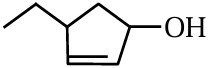
What is the correct $IUPAC$ name of the following structure?
A
$4-$Ethyl$-1-$hydroxycyclopent$-2-$ene
B
$1-$Ethyl$-3-$hydroxycyclopent$-2-$ene
C
$1-$Ethylcyclopent$-2-$en$-3-$ol
D
$4-$Ethylcyclopent$-2-$en$-1-$ol
Solution
(D) $1$. According to $IUPAC$ nomenclature rules,the principal functional group $(-OH)$ is given the lowest possible locant.
$2$. The ring is numbered starting from the carbon attached to the $-OH$ group as $1$.
$3$. The double bond is then given the lowest possible locant,which is $2$.
$4$. The ethyl substituent is at position $4$.
$5$. Thus,the correct name is $4-$ethylcyclopent$-2-$en$-1-$ol.
$2$. The ring is numbered starting from the carbon attached to the $-OH$ group as $1$.
$3$. The double bond is then given the lowest possible locant,which is $2$.
$4$. The ethyl substituent is at position $4$.
$5$. Thus,the correct name is $4-$ethylcyclopent$-2-$en$-1-$ol.
0 likesView Solution
216
ChemistryMediumMCQJEE Main · 2025
On combustion,$0.210 \ g$ of an organic compound containing $C$,$H$,and $O$ gave $0.127 \ g$ $H_2O$ and $0.307 \ g$ $CO_2$. The percentages of hydrogen and oxygen in the given organic compound respectively are $:$
A
$53.41, 39.6$
B
$6.72, 53.41$
C
$7.55, 43.85$
D
$6.72, 39.87$
Solution
(B) In the combustion of an organic compound,all $C$ in $CO_2$ and all $H$ in $H_2O$ comes from the organic compound.
Mass of $C$ in $CO_2 = \frac{12}{44} \times 0.307 \ g = 0.0837 \ g$.
Mass of $H$ in $H_2O = \frac{2}{18} \times 0.127 \ g = 0.0141 \ g$.
Percentage of $H = \frac{0.0141}{0.210} \times 100 = 6.714 \% \approx 6.72 \%$.
Mass of $O$ in the compound = Total mass - (Mass of $C$ + Mass of $H$) = $0.210 - (0.0837 + 0.0141) = 0.1122 \ g$.
Percentage of $O = \frac{0.1122}{0.210} \times 100 = 53.428 \% \approx 53.41 \%$.
Therefore,the percentages of $H$ and $O$ are $6.72 \%$ and $53.41 \%$ respectively.
Mass of $C$ in $CO_2 = \frac{12}{44} \times 0.307 \ g = 0.0837 \ g$.
Mass of $H$ in $H_2O = \frac{2}{18} \times 0.127 \ g = 0.0141 \ g$.
Percentage of $H = \frac{0.0141}{0.210} \times 100 = 6.714 \% \approx 6.72 \%$.
Mass of $O$ in the compound = Total mass - (Mass of $C$ + Mass of $H$) = $0.210 - (0.0837 + 0.0141) = 0.1122 \ g$.
Percentage of $O = \frac{0.1122}{0.210} \times 100 = 53.428 \% \approx 53.41 \%$.
Therefore,the percentages of $H$ and $O$ are $6.72 \%$ and $53.41 \%$ respectively.
0 likesView Solution
217
ChemistryMediumMCQJEE Main · 2025
Correct statements for an element with atomic number $9$ are:
$A.$ There can be $5$ electrons for which $m_{s}=+\frac{1}{2}$ and $4$ electrons for which $m_{s}=-\frac{1}{2}$
$B.$ There is only one electron in $p_z$ orbital
$C.$ The last electron goes to an orbital with $n=2$ and $l=1$
$D.$ The sum of angular nodes of all the atomic orbitals is $1$
Choose the correct answer from the options given below:
$A.$ There can be $5$ electrons for which $m_{s}=+\frac{1}{2}$ and $4$ electrons for which $m_{s}=-\frac{1}{2}$
$B.$ There is only one electron in $p_z$ orbital
$C.$ The last electron goes to an orbital with $n=2$ and $l=1$
$D.$ The sum of angular nodes of all the atomic orbitals is $1$
Choose the correct answer from the options given below:
A
$C$ and $D$ Only
B
$A$ and $C$ Only
C
$A, C$ and $D$ Only
D
$A$ and $B$ Only
Solution
(B) The element with atomic number $9$ is Fluorine $(F)$,with electronic configuration $1s^2 2s^2 2p^5$.
$(A)$ In $1s^2 2s^2 2p^5$,there are $9$ electrons. Filling them: $1s$ $(2)$,$2s$ $(2)$,$2p$ $(5)$. Total up-spins $(m_s = +\frac{1}{2})$ are $1+1+3 = 5$ and down-spins $(m_s = -\frac{1}{2})$ are $1+1+2 = 4$. Statement $A$ is correct.
$(B)$ The $2p^5$ configuration means $p_x^2 p_y^2 p_z^1$ or similar. The unpaired electron can be in any of the three $p$ orbitals,so $B$ is not necessarily true. Statement $B$ is incorrect.
$(C)$ The last electron enters the $2p$ subshell where $n=2$ and $l=1$. Statement $C$ is correct.
$(D)$ Angular nodes = $l$. For $1s$ $(l=0)$,$2s$ $(l=0)$,$2p$ $(l=1)$. Total angular nodes = $0+0+1+1+1 = 3$. Statement $D$ is incorrect.
Therefore,only $A$ and $C$ are correct.
$(A)$ In $1s^2 2s^2 2p^5$,there are $9$ electrons. Filling them: $1s$ $(2)$,$2s$ $(2)$,$2p$ $(5)$. Total up-spins $(m_s = +\frac{1}{2})$ are $1+1+3 = 5$ and down-spins $(m_s = -\frac{1}{2})$ are $1+1+2 = 4$. Statement $A$ is correct.
$(B)$ The $2p^5$ configuration means $p_x^2 p_y^2 p_z^1$ or similar. The unpaired electron can be in any of the three $p$ orbitals,so $B$ is not necessarily true. Statement $B$ is incorrect.
$(C)$ The last electron enters the $2p$ subshell where $n=2$ and $l=1$. Statement $C$ is correct.
$(D)$ Angular nodes = $l$. For $1s$ $(l=0)$,$2s$ $(l=0)$,$2p$ $(l=1)$. Total angular nodes = $0+0+1+1+1 = 3$. Statement $D$ is incorrect.
Therefore,only $A$ and $C$ are correct.
0 likesView Solution
218
ChemistryDifficultMCQJEE Main · 2025
Match the List-$I$ with List-$II$:
Choose the correct answer from the options given below:
| List-$I$ (Reagent) | List-$II$ (Functional Group detected) |
| $A$. Sodium bicarbonate solution | $I$. Double bond/unsaturation |
| $B$. Neutral ferric chloride | $II$. Carboxylic acid |
| $C$. Ceric ammonium nitrate | $III$. Phenolic $-OH$ |
| $D$. Alkaline $KMnO_4$ | $IV$. Alcoholic $-OH$ |
Choose the correct answer from the options given below:
A
$A-II, B-III, C-IV, D-I$
B
$A-II, B-III, C-I, D-IV$
C
$A-III, B-II, C-IV, D-I$
D
$A-II, B-IV, C-III, D-I$
Solution
(A) $(1)$ Carboxylic acid reacts with sodium bicarbonate solution to release $CO_2$ gas,causing effervescence.
$(2)$ Phenolic $-OH$ group reacts with neutral $FeCl_3$ to form a violet-coloured complex.
$(3)$ Alcoholic $-OH$ group reacts with ceric ammonium nitrate to produce a red-coloured complex.
$(4)$ Alkaline $KMnO_4$ (Baeyer's reagent) reacts with unsaturated compounds (alkenes or alkynes) to cause the disappearance of the purple colour,indicating unsaturation.
$(2)$ Phenolic $-OH$ group reacts with neutral $FeCl_3$ to form a violet-coloured complex.
$(3)$ Alcoholic $-OH$ group reacts with ceric ammonium nitrate to produce a red-coloured complex.
$(4)$ Alkaline $KMnO_4$ (Baeyer's reagent) reacts with unsaturated compounds (alkenes or alkynes) to cause the disappearance of the purple colour,indicating unsaturation.
0 likesView Solution
219
ChemistryMediumMCQJEE Main · 2025
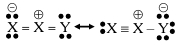
Resonance in $X_2Y$ can be represented as shown in the image. The enthalpy of formation of $X_2Y$ $(X \equiv X(g) + \frac{1}{2} Y = Y(g) \rightarrow X_2Y(g))$ is $80 \ kJ \ mol^{-1}$. The magnitude of resonance energy of $X_2Y$ is $......... \ kJ \ mol^{-1}$ (nearest integer value). Given: Bond energies of $X \equiv X, X=X, Y=Y$ and $X=Y$ are $940, 410, 500$ and $602 \ kJ \ mol^{-1}$ respectively. Valence $X: 3, Y: 2$.
A
$98$
B
$99$
C
$95$
D
$96$
Solution
(A) The resonance energy is calculated as $\Delta H_{R.E.} = \Delta H_{f(exp)} - \Delta H_{f(theo)}$.
Given $\Delta H_{f(exp)} = 80 \ kJ \ mol^{-1}$.
For the theoretical enthalpy of formation,we consider the reaction: $X \equiv X(g) + \frac{1}{2} Y = Y(g) \rightarrow X=X=Y(g)$.
$\Delta H_{f(theo)} = (BE_{X \equiv X} + \frac{1}{2} BE_{Y=Y}) - (BE_{X=X} + BE_{X=Y})$.
Substituting the given values: $\Delta H_{f(theo)} = (940 + \frac{1}{2} \times 500) - (410 + 602)$.
$\Delta H_{f(theo)} = (940 + 250) - (1012) = 1190 - 1012 = 178 \ kJ \ mol^{-1}$.
Now,$\Delta H_{R.E.} = 80 - 178 = -98 \ kJ \ mol^{-1}$.
The magnitude of resonance energy is $|-98| = 98 \ kJ \ mol^{-1}$.
Given $\Delta H_{f(exp)} = 80 \ kJ \ mol^{-1}$.
For the theoretical enthalpy of formation,we consider the reaction: $X \equiv X(g) + \frac{1}{2} Y = Y(g) \rightarrow X=X=Y(g)$.
$\Delta H_{f(theo)} = (BE_{X \equiv X} + \frac{1}{2} BE_{Y=Y}) - (BE_{X=X} + BE_{X=Y})$.
Substituting the given values: $\Delta H_{f(theo)} = (940 + \frac{1}{2} \times 500) - (410 + 602)$.
$\Delta H_{f(theo)} = (940 + 250) - (1012) = 1190 - 1012 = 178 \ kJ \ mol^{-1}$.
Now,$\Delta H_{R.E.} = 80 - 178 = -98 \ kJ \ mol^{-1}$.
The magnitude of resonance energy is $|-98| = 98 \ kJ \ mol^{-1}$.
0 likesView Solution
220
ChemistryMediumMCQJEE Main · 2025
The energy of an electron in the first Bohr orbit of the $H$ atom is $-13.6 \ eV$. The magnitude of the energy value of an electron in the first excited state of $Be^{3+}$ is $.......... \ eV$ $(nearest \ integer \ value)$.
A
$53$
B
$54$
C
$55$
D
$56$
Solution
(B) The energy of an electron in a hydrogen-like species is given by the formula: $E_n = -13.6 \times \frac{Z^2}{n^2} \ eV$.
For the $H$ atom,the first Bohr orbit $(n=1, Z=1)$ has energy $E_1 = -13.6 \ eV$.
For the $Be^{3+}$ ion $(Z=4)$,the first excited state corresponds to $n=2$.
Substituting these values into the formula: $E = -13.6 \times \frac{4^2}{2^2} \ eV$.
$E = -13.6 \times \frac{16}{4} \ eV = -13.6 \times 4 \ eV = -54.4 \ eV$.
The magnitude of the energy is $|E| = 54.4 \ eV$.
The nearest integer value is $54$.
For the $H$ atom,the first Bohr orbit $(n=1, Z=1)$ has energy $E_1 = -13.6 \ eV$.
For the $Be^{3+}$ ion $(Z=4)$,the first excited state corresponds to $n=2$.
Substituting these values into the formula: $E = -13.6 \times \frac{4^2}{2^2} \ eV$.
$E = -13.6 \times \frac{16}{4} \ eV = -13.6 \times 4 \ eV = -54.4 \ eV$.
The magnitude of the energy is $|E| = 54.4 \ eV$.
The nearest integer value is $54$.
0 likesView Solution
221
ChemistryMediumMCQJEE Main · 2025
$20 \ mL$ of sodium iodide solution gave $4.74 \ g$ silver iodide when treated with excess of silver nitrate solution. The molarity of the sodium iodide solution is $........ M$. $(Nearest \ Integer \ value)$
$(Given: Na=23, I=127, Ag=108, N=14, O=16 \ g \ mol^{-1})$
$(Given: Na=23, I=127, Ag=108, N=14, O=16 \ g \ mol^{-1})$
A
$0$
B
$2$
C
$1$
D
$9$
Solution
(C) The chemical reaction is: $NaI_{(aq)} + AgNO_{3(aq)} \rightarrow AgI_{(s)} + NaNO_{3(aq)}$
$1$. Calculate the molar mass of $AgI$: $108 + 127 = 235 \ g \ mol^{-1}$.
$2$. Calculate the moles of $AgI$ formed: $n(AgI) = \frac{4.74 \ g}{235 \ g \ mol^{-1}} \approx 0.02017 \ mol$.
$3$. From the stoichiometry,$1 \ mol$ of $NaI$ produces $1 \ mol$ of $AgI$. Therefore,moles of $NaI = 0.02017 \ mol$.
$4$. Calculate the molarity $(M)$: $M = \frac{n}{V(L)} = \frac{0.02017 \ mol}{0.020 \ L} = 1.0085 \ M$.
$5$. The nearest integer value is $1$.
$1$. Calculate the molar mass of $AgI$: $108 + 127 = 235 \ g \ mol^{-1}$.
$2$. Calculate the moles of $AgI$ formed: $n(AgI) = \frac{4.74 \ g}{235 \ g \ mol^{-1}} \approx 0.02017 \ mol$.
$3$. From the stoichiometry,$1 \ mol$ of $NaI$ produces $1 \ mol$ of $AgI$. Therefore,moles of $NaI = 0.02017 \ mol$.
$4$. Calculate the molarity $(M)$: $M = \frac{n}{V(L)} = \frac{0.02017 \ mol}{0.020 \ L} = 1.0085 \ M$.
$5$. The nearest integer value is $1$.
0 likesView Solution
222
ChemistryEasyMCQJEE Main · 2025
The equilibrium constant for the decomposition of $H_2O_{(g)}$: $H_2O_{(g)} \rightleftharpoons H_{2(g)} + \frac{1}{2} O_{2(g)}$ $(\Delta G^{\circ} = 92.34 \ kJ \ mol^{-1})$ is $8.0 \times 10^{-3}$ at $2300 \ K$ and the total pressure at equilibrium is $1 \ bar$. Under this condition,the degree of dissociation $(\alpha)$ of water is $............ \times 10^{-2}$ (nearest integer value). [Assume $\alpha$ is negligible with respect to $1$]
A
$1$
B
$2$
C
$3$
D
$5$
Solution
(D) The reaction is $H_2O_{(g)} \rightleftharpoons H_{2(g)} + \frac{1}{2} O_{2(g)}$.
At $t = 0$,we have $1 \ mole$ of $H_2O$.
At equilibrium,the moles are: $H_2O = 1-\alpha$,$H_2 = \alpha$,$O_2 = \frac{\alpha}{2}$.
Total moles $n_T = 1 + \frac{\alpha}{2} \approx 1$ (since $\alpha \ll 1$).
The equilibrium constant $K_p$ is given by:
$K_p = \frac{P_{H_2} \cdot P_{O_2}^{1/2}}{P_{H_2O}} = \frac{(\alpha \cdot P) \cdot (\frac{\alpha}{2} \cdot P)^{1/2}}{(1-\alpha) \cdot P}$.
Given $P = 1 \ bar$,$K_p = \frac{\alpha \cdot (\alpha/2)^{1/2}}{1} = \frac{\alpha^{3/2}}{\sqrt{2}}$.
$8.0 \times 10^{-3} = \frac{\alpha^{3/2}}{\sqrt{2}}$.
$\alpha^{3/2} = 8.0 \times 10^{-3} \times \sqrt{2} \approx 11.31 \times 10^{-3}$.
$\alpha = (11.31 \times 10^{-3})^{2/3} \approx 5.04 \times 10^{-2}$.
The nearest integer value is $5$.
At $t = 0$,we have $1 \ mole$ of $H_2O$.
At equilibrium,the moles are: $H_2O = 1-\alpha$,$H_2 = \alpha$,$O_2 = \frac{\alpha}{2}$.
Total moles $n_T = 1 + \frac{\alpha}{2} \approx 1$ (since $\alpha \ll 1$).
The equilibrium constant $K_p$ is given by:
$K_p = \frac{P_{H_2} \cdot P_{O_2}^{1/2}}{P_{H_2O}} = \frac{(\alpha \cdot P) \cdot (\frac{\alpha}{2} \cdot P)^{1/2}}{(1-\alpha) \cdot P}$.
Given $P = 1 \ bar$,$K_p = \frac{\alpha \cdot (\alpha/2)^{1/2}}{1} = \frac{\alpha^{3/2}}{\sqrt{2}}$.
$8.0 \times 10^{-3} = \frac{\alpha^{3/2}}{\sqrt{2}}$.
$\alpha^{3/2} = 8.0 \times 10^{-3} \times \sqrt{2} \approx 11.31 \times 10^{-3}$.
$\alpha = (11.31 \times 10^{-3})^{2/3} \approx 5.04 \times 10^{-2}$.
The nearest integer value is $5$.
0 likesView Solution
223
ChemistryDifficultMCQJEE Main · 2025
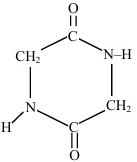
$A$ dipeptide,$X$ on complete hydrolysis gives $Y$ and $Z$. $Y$ on treatment with aqueous $HNO_2$ produces lactic acid. On the other hand,$Z$ on heating gives the following cyclic molecule.
Based on the information given,the dipeptide $X$ is:
Based on the information given,the dipeptide $X$ is:
A
$valine-glycine$
B
$alanine-glycine$
C
$valine-leucine$
D
$alanine-alanine$
Solution
(B) $1$. Hydrolysis of dipeptide $X$ yields two amino acids,$Y$ and $Z$.
$2$. $Y$ reacts with aqueous $HNO_2$ to form lactic acid $(CH_3CH(OH)COOH)$. This indicates that $Y$ is alanine $(CH_3CH(NH_2)COOH)$.
$3$. $Z$ on heating forms a cyclic molecule. The structure provided is $2,5-$diketopiperazine,which is formed by the dimerization of glycine $(NH_2CH_2COOH)$. Thus,$Z$ is glycine.
$4$. Therefore,the dipeptide $X$ is $alanine-glycine$.
$2$. $Y$ reacts with aqueous $HNO_2$ to form lactic acid $(CH_3CH(OH)COOH)$. This indicates that $Y$ is alanine $(CH_3CH(NH_2)COOH)$.
$3$. $Z$ on heating forms a cyclic molecule. The structure provided is $2,5-$diketopiperazine,which is formed by the dimerization of glycine $(NH_2CH_2COOH)$. Thus,$Z$ is glycine.
$4$. Therefore,the dipeptide $X$ is $alanine-glycine$.
0 likesView Solution
224
ChemistryMediumMCQJEE Main · 2025
Given below are two statements $:$
Statement $(I) :$ Alcohols are formed when alkyl chlorides are treated with aqueous potassium hydroxide by elimination reaction.
Statement $(II) :$ In alcoholic potassium hydroxide,alkyl chlorides form alkenes by abstracting the hydrogen from the $\beta-$carbon.
In the light of the above statements,choose the most appropriate answer from the options given below $:$
Statement $(I) :$ Alcohols are formed when alkyl chlorides are treated with aqueous potassium hydroxide by elimination reaction.
Statement $(II) :$ In alcoholic potassium hydroxide,alkyl chlorides form alkenes by abstracting the hydrogen from the $\beta-$carbon.
In the light of the above statements,choose the most appropriate answer from the options given below $:$
A
Both Statement $I$ and Statement $II$ are incorrect
B
Statement $I$ is incorrect but Statement $II$ is correct
C
Statement $I$ is correct but Statement $II$ is incorrect
D
Both Statement $I$ and Statement $II$ are correct
Solution
(B) Statement $(I) :$ When alkyl chlorides $(R-Cl)$ are treated with aqueous $KOH$,they undergo nucleophilic substitution $(S_N)$ reaction to form alcohols $(R-OH)$. This is not an elimination reaction. Thus,Statement $(I)$ is incorrect.
Statement $(II) :$ When alkyl chlorides are treated with alcoholic $KOH$,they undergo dehydrohalogenation (an elimination reaction) where the base abstracts a hydrogen atom from the $\beta-$carbon to form an alkene. Thus,Statement $(II)$ is correct.
Statement $(II) :$ When alkyl chlorides are treated with alcoholic $KOH$,they undergo dehydrohalogenation (an elimination reaction) where the base abstracts a hydrogen atom from the $\beta-$carbon to form an alkene. Thus,Statement $(II)$ is correct.
0 likesView Solution
225
ChemistryMediumMCQJEE Main · 2025
Given below are two statements $:$
Statement $(I) :$ Molal depression constant $K_{f}$ is given by $\frac{M_1 R T_f^2}{1000 \Delta H_{\text {fus }}}$,where symbols have their usual meaning. (Note: The provided formula in the prompt was corrected to the standard thermodynamic expression $K_f = \frac{M_1 R T_f^2}{\Delta H_{\text {fus }}}$).
Statement $(II) :$ $K_{f}$ for benzene is less than the $K_{f}$ for water.
In the light of the above statements,choose the most appropriate answer from the options given below $:$
Statement $(I) :$ Molal depression constant $K_{f}$ is given by $\frac{M_1 R T_f^2}{1000 \Delta H_{\text {fus }}}$,where symbols have their usual meaning. (Note: The provided formula in the prompt was corrected to the standard thermodynamic expression $K_f = \frac{M_1 R T_f^2}{\Delta H_{\text {fus }}}$).
Statement $(II) :$ $K_{f}$ for benzene is less than the $K_{f}$ for water.
In the light of the above statements,choose the most appropriate answer from the options given below $:$
A
Statement $I$ is incorrect but Statement $II$ is correct
B
Both Statement $I$ and Statement $II$ are incorrect
C
Both Statement $I$ and Statement $II$ are correct
D
Statement $I$ is correct but Statement $II$ is incorrect
Solution
(D) Statement $-I$: The molal depression constant $K_f$ is defined as $K_f = \frac{M_1 R T_f^2}{\Delta H_{\text {fus }}}$. Since $\Delta S_{\text {fus }} = \frac{\Delta H_{\text {fus }}}{T_f}$,we can write $K_f = \frac{M_1 R T_f}{\Delta S_{\text {fus }}}$. Thus,Statement $-I$ is correct.
Statement $-II$: The value of $K_f$ for benzene is $5.12 \ \text{K kg mol}^{-1}$ and for water is $1.86 \ \text{K kg mol}^{-1}$. Since $5.12 > 1.86$,the $K_f$ for benzene is greater than that for water. Thus,Statement $-II$ is incorrect.
Statement $-II$: The value of $K_f$ for benzene is $5.12 \ \text{K kg mol}^{-1}$ and for water is $1.86 \ \text{K kg mol}^{-1}$. Since $5.12 > 1.86$,the $K_f$ for benzene is greater than that for water. Thus,Statement $-II$ is incorrect.
0 likesView Solution
226
ChemistryDifficultMCQJEE Main · 2025
$A$ toxic compound $A$ when reacted with $NaCN$ in aqueous acidic medium yields an edible cooking component and food preservative $B$. $B$ is converted to $C$ by diborane and can be used as an additive to petrol to reduce emission. $C$ upon reaction with oleum at $140^{\circ} C$ yields an inhalable anesthetic $D$. Identify $A, B, C$ and $D$,respectively.
A
Methanol; formaldehyde; methyl chloride; chloroform
B
Ethanol; acetonitrile; ethylamine; ethylene
C
Methanol; acetic acid; ethanol; diethyl ether
D
Acetaldehyde; $2-$hydroxypropanoic acid; propanoic acid; dipropyl ether
Solution
(C) The reaction sequence is as follows:
$1$. $A$ is Methanol $(CH_3OH)$. In acidic medium,it forms $CH_3-OH_2^+$,which reacts with $NaCN$ followed by hydrolysis to yield Acetic acid $(CH_3COOH)$ as $B$. Acetic acid is a common food preservative (vinegar).
$2$. $B$ (Acetic acid) is reduced by diborane $(B_2H_6)$ to form Ethanol $(C_2H_5OH)$ as $C$. Ethanol is used as a fuel additive.
$3$. $C$ (Ethanol) reacts with oleum $(H_2SO_4 + SO_3)$ at $140^{\circ} C$ to undergo intermolecular dehydration,yielding Diethyl ether $(C_2H_5-O-C_2H_5)$ as $D$,which is an inhalable anesthetic.
Therefore,the correct sequence is Methanol,Acetic acid,Ethanol,Diethyl ether.
$1$. $A$ is Methanol $(CH_3OH)$. In acidic medium,it forms $CH_3-OH_2^+$,which reacts with $NaCN$ followed by hydrolysis to yield Acetic acid $(CH_3COOH)$ as $B$. Acetic acid is a common food preservative (vinegar).
$2$. $B$ (Acetic acid) is reduced by diborane $(B_2H_6)$ to form Ethanol $(C_2H_5OH)$ as $C$. Ethanol is used as a fuel additive.
$3$. $C$ (Ethanol) reacts with oleum $(H_2SO_4 + SO_3)$ at $140^{\circ} C$ to undergo intermolecular dehydration,yielding Diethyl ether $(C_2H_5-O-C_2H_5)$ as $D$,which is an inhalable anesthetic.
Therefore,the correct sequence is Methanol,Acetic acid,Ethanol,Diethyl ether.
0 likesView Solution
227
ChemistryMediumMCQJEE Main · 2025
The correct order of $[FeF_6]^{3-}, [CoF_6]^{3-}, [Ni(CO)_4]$ and $[Ni(CN)_4]^{2-}$ complex species based on the number of unpaired electrons present is $:$
A
$[FeF_6]^{3-} > [CoF_6]^{3-} > [Ni(CN)_4]^{2-} = [Ni(CO)_4]$
B
$[Ni(CN)_4]^{2-} > [FeF_6]^{3-} > [CoF_6]^{3-} > [Ni(CO)_4]$
C
$[CoF_6]^{3-} > [FeF_6]^{3-} > [Ni(CO)_4] > [Ni(CN)_4]^{2-}$
D
$[FeF_6]^{3-} > [CoF_6]^{3-} > [Ni(CN)_4]^{2-} > [Ni(CO)_4]$
Solution
(A) To determine the number of unpaired electrons,we analyze the electronic configuration of the metal ion in each complex:
$1$. $[FeF_6]^{3-}$: $Fe^{3+}$ is $3d^5$. Since $F^-$ is a weak field ligand,electrons remain unpaired. Number of unpaired electrons = $5$.
$2$. $[CoF_6]^{3-}$: $Co^{3+}$ is $3d^6$. Since $F^-$ is a weak field ligand,it forms a high-spin complex. Number of unpaired electrons = $4$.
$3$. $[Ni(CN)_4]^{2-}$: $Ni^{2+}$ is $3d^8$. $CN^-$ is a strong field ligand,causing pairing of electrons. Number of unpaired electrons = $0$.
$4$. $[Ni(CO)_4]$: $Ni$ is $3d^8 4s^2$. $CO$ is a strong field ligand,causing pairing of all electrons in $3d$ orbital. Number of unpaired electrons = $0$.
Thus,the order is $[FeF_6]^{3-} (5) > [CoF_6]^{3-} (4) > [Ni(CN)_4]^{2-} (0) = [Ni(CO)_4] (0)$.
$1$. $[FeF_6]^{3-}$: $Fe^{3+}$ is $3d^5$. Since $F^-$ is a weak field ligand,electrons remain unpaired. Number of unpaired electrons = $5$.
$2$. $[CoF_6]^{3-}$: $Co^{3+}$ is $3d^6$. Since $F^-$ is a weak field ligand,it forms a high-spin complex. Number of unpaired electrons = $4$.
$3$. $[Ni(CN)_4]^{2-}$: $Ni^{2+}$ is $3d^8$. $CN^-$ is a strong field ligand,causing pairing of electrons. Number of unpaired electrons = $0$.
$4$. $[Ni(CO)_4]$: $Ni$ is $3d^8 4s^2$. $CO$ is a strong field ligand,causing pairing of all electrons in $3d$ orbital. Number of unpaired electrons = $0$.
Thus,the order is $[FeF_6]^{3-} (5) > [CoF_6]^{3-} (4) > [Ni(CN)_4]^{2-} (0) = [Ni(CO)_4] (0)$.
0 likesView Solution
228
ChemistryDifficultMCQJEE Main · 2025
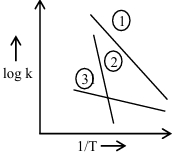
Consider the following plots of log of rate constant $k$ $(\log k)$ vs $\frac{1}{T}$ for three different reactions. The correct order of activation energies of these reactions is
A
$Ea_2 > Ea_1 > Ea_3$
B
$Ea_1 > Ea_3 > Ea_2$
C
$Ea_1 > Ea_2 > Ea_3$
D
$Ea_3 > Ea_2 > Ea_1$
Solution
(A) According to the Arrhenius equation: $k = A e^{-Ea / RT}$
Taking log on both sides: $\log k = \log A - \frac{Ea}{2.303 RT}$
For a plot of $\log k$ versus $\frac{1}{T}$,the slope of the line is given by: $\text{Slope} = -\frac{Ea}{2.303 R}$
Since the slope is negative,the magnitude of the slope is directly proportional to the activation energy $(Ea)$: $|\text{Slope}| = \frac{Ea}{2.303 R}$
From the given graph,the steepness (magnitude of slope) of the lines follows the order: $(2) > (1) > (3)$
Therefore,the correct order of activation energies is: $Ea_2 > Ea_1 > Ea_3$
Taking log on both sides: $\log k = \log A - \frac{Ea}{2.303 RT}$
For a plot of $\log k$ versus $\frac{1}{T}$,the slope of the line is given by: $\text{Slope} = -\frac{Ea}{2.303 R}$
Since the slope is negative,the magnitude of the slope is directly proportional to the activation energy $(Ea)$: $|\text{Slope}| = \frac{Ea}{2.303 R}$
From the given graph,the steepness (magnitude of slope) of the lines follows the order: $(2) > (1) > (3)$
Therefore,the correct order of activation energies is: $Ea_2 > Ea_1 > Ea_3$
0 likesView Solution
229
ChemistryMediumMCQJEE Main · 2025
$X$ is the number of electrons in $t_{2g}$ orbitals of the most stable complex ion among $[Fe(NH_3)_6]^{3+}$,$[Fe(Cl)_6]^{3-}$,$[Fe(C_2O_4)_3]^{3-}$ and $[Fe(H_2O)_6]^{3+}$. The nature of the oxide of vanadium of the type $V_2O_X$ is:
A
Acidic
B
Neutral
C
Basic
D
Amphoteric
Solution
(C) The most stable complex ion among the given options is $[Fe(C_2O_4)_3]^{3-}$ due to the chelation effect of the oxalate ligand.
In $[Fe(C_2O_4)_3]^{3-}$,the oxidation state of $Fe$ is $+3$,which corresponds to a $d^5$ configuration.
Since $C_2O_4^{2-}$ is a weak field ligand,the $d^5$ configuration remains high-spin: $t_{2g}^3 e_g^2$.
The number of electrons in the $t_{2g}$ orbitals is $X = 3$.
Therefore,the oxide is $V_2O_3$.
$V_2O_3$ is a basic oxide.
In $[Fe(C_2O_4)_3]^{3-}$,the oxidation state of $Fe$ is $+3$,which corresponds to a $d^5$ configuration.
Since $C_2O_4^{2-}$ is a weak field ligand,the $d^5$ configuration remains high-spin: $t_{2g}^3 e_g^2$.
The number of electrons in the $t_{2g}$ orbitals is $X = 3$.
Therefore,the oxide is $V_2O_3$.
$V_2O_3$ is a basic oxide.
0 likesView Solution
230
ChemistryMediumMCQJEE Main · 2025
Half life of zero order reaction $A \rightarrow \text{product}$ is $1 \ \text{hour}$,when initial concentration of reactant is $2.0 \ \text{mol L}^{-1}$. The time required to decrease concentration of $A$ from $0.50$ to $0.25 \ \text{mol L}^{-1}$ is:
A
$0.5 \ \text{hour}$
B
$4 \ \text{hour}$
C
$15 \ \text{min}$
D
$60 \ \text{min}$
Solution
(C) For a zero order reaction,the half-life is given by $t_{1/2} = \frac{[A]_0}{2k}$.
Given $t_{1/2} = 1 \ \text{hour} = 60 \ \text{min}$ and $[A]_0 = 2.0 \ \text{mol L}^{-1}$.
$60 \ \text{min} = \frac{2.0}{2k} \implies k = \frac{2.0}{2 \times 60} = \frac{1}{60} \ \text{mol L}^{-1} \ \text{min}^{-1}$.
For a zero order reaction,the integrated rate law is $[A]_t = [A]_0 - kt$.
To find the time $t$ for concentration to decrease from $0.50 \ \text{mol L}^{-1}$ to $0.25 \ \text{mol L}^{-1}$:
$t = \frac{[A]_0 - [A]_t}{k} = \frac{0.50 - 0.25}{1/60} = 0.25 \times 60 = 15 \ \text{min}$.
Given $t_{1/2} = 1 \ \text{hour} = 60 \ \text{min}$ and $[A]_0 = 2.0 \ \text{mol L}^{-1}$.
$60 \ \text{min} = \frac{2.0}{2k} \implies k = \frac{2.0}{2 \times 60} = \frac{1}{60} \ \text{mol L}^{-1} \ \text{min}^{-1}$.
For a zero order reaction,the integrated rate law is $[A]_t = [A]_0 - kt$.
To find the time $t$ for concentration to decrease from $0.50 \ \text{mol L}^{-1}$ to $0.25 \ \text{mol L}^{-1}$:
$t = \frac{[A]_0 - [A]_t}{k} = \frac{0.50 - 0.25}{1/60} = 0.25 \times 60 = 15 \ \text{min}$.
0 likesView Solution
231
ChemistryDifficultMCQJEE Main · 2025
Sea water,which can be considered as a $6 \ M$ solution of $NaCl$,has a density of $2 \ g \ mL^{-1}$. The concentration of dissolved oxygen $(O_2)$ in sea water is $5.8 \ ppm$. Then the concentration of dissolved oxygen $(O_2)$ in sea water is $x \times 10^{-4} \ m$. $x = ............$ $(Nearest \ integer)$
Given: Molar mass of $NaCl$ is $58.5 \ g \ mol^{-1}$. Molar mass of $O_2$ is $32 \ g \ mol^{-1}$.
Given: Molar mass of $NaCl$ is $58.5 \ g \ mol^{-1}$. Molar mass of $O_2$ is $32 \ g \ mol^{-1}$.
A
$2$
B
$4$
C
$6$
D
$8$
Solution
(A) Sea water is $6 \ M$ in $NaCl$,so $1000 \ mL$ of sea water contains $6 \ mol$ of $NaCl$.
$\text{Mass of solution} = \text{Volume} \times \text{density} = 1000 \times 2 = 2000 \ g$.
$\text{ppm} = \frac{\text{mass of } O_2}{\text{mass of solution}} \times 10^6$.
$5.8 = \frac{\text{mass of } O_2}{2000} \times 10^6$ $\Rightarrow \text{mass of } O_2 = 5.8 \times 2 \times 10^{-3} = 1.16 \times 10^{-2} \ g$.
$\text{Molality of } O_2 = \frac{\text{moles of } O_2}{\text{mass of solvent in } kg}$.
$\text{Mass of solvent} = \text{Mass of solution} - \text{Mass of } NaCl = 2000 - (6 \times 58.5) = 2000 - 351 = 1649 \ g = 1.649 \ kg$.
$\text{Moles of } O_2 = \frac{1.16 \times 10^{-2}}{32} = 0.03625 \times 10^{-2} = 3.625 \times 10^{-4} \ mol$.
$\text{Molality} = \frac{3.625 \times 10^{-4}}{1.649} \approx 2.197 \times 10^{-4} \ m$.
Thus,$x \approx 2$.
$\text{Mass of solution} = \text{Volume} \times \text{density} = 1000 \times 2 = 2000 \ g$.
$\text{ppm} = \frac{\text{mass of } O_2}{\text{mass of solution}} \times 10^6$.
$5.8 = \frac{\text{mass of } O_2}{2000} \times 10^6$ $\Rightarrow \text{mass of } O_2 = 5.8 \times 2 \times 10^{-3} = 1.16 \times 10^{-2} \ g$.
$\text{Molality of } O_2 = \frac{\text{moles of } O_2}{\text{mass of solvent in } kg}$.
$\text{Mass of solvent} = \text{Mass of solution} - \text{Mass of } NaCl = 2000 - (6 \times 58.5) = 2000 - 351 = 1649 \ g = 1.649 \ kg$.
$\text{Moles of } O_2 = \frac{1.16 \times 10^{-2}}{32} = 0.03625 \times 10^{-2} = 3.625 \times 10^{-4} \ mol$.
$\text{Molality} = \frac{3.625 \times 10^{-4}}{1.649} \approx 2.197 \times 10^{-4} \ m$.
Thus,$x \approx 2$.
0 likesView Solution
232
ChemistryDifficultMCQJEE Main · 2025
$A$ metal complex with a formula $MCl_4 \cdot 3NH_3$ is involved in $sp^3d^2$ hybridisation. It upon reaction with excess of $AgNO_3$ solution gives '$x$' moles of $AgCl$. Consider '$x$' is equal to the number of lone pairs of electron present in the central atom of $BrF_5$. Then the number of geometrical isomers exhibited by the complex is $............$
A
$0$
B
$1$
C
$2$
D
$3$
Solution
(C) $1$. The central atom $Br$ in $BrF_5$ has $7$ valence electrons. It forms $5$ bonds with $F$ atoms and has $1$ lone pair. Thus,$x = 1$.
$2$. Since $x = 1$,the complex $MCl_4 \cdot 3NH_3$ releases $1$ mole of $AgCl$ per mole of complex,indicating the formula is $[M(NH_3)_3Cl_3]Cl$.
$3$. The coordination sphere is $[M(NH_3)_3Cl_3]$,which is of the type $Ma_3b_3$.
$4$. Complexes of the type $Ma_3b_3$ exhibit $2$ geometrical isomers: facial (fac) and meridional (mer).
$2$. Since $x = 1$,the complex $MCl_4 \cdot 3NH_3$ releases $1$ mole of $AgCl$ per mole of complex,indicating the formula is $[M(NH_3)_3Cl_3]Cl$.
$3$. The coordination sphere is $[M(NH_3)_3Cl_3]$,which is of the type $Ma_3b_3$.
$4$. Complexes of the type $Ma_3b_3$ exhibit $2$ geometrical isomers: facial (fac) and meridional (mer).
0 likesView Solution
233
ChemistryMediumMCQJEE Main · 2025
The molar conductance of an infinitely dilute solution of ammonium chloride was found to be $185 \ S \ cm^2 \ mol^{-1}$ and the ionic conductance of hydroxyl and chloride ions are $170$ and $70 \ S \ cm^2 \ mol^{-1}$,respectively. If molar conductance of $0.02 \ M$ solution of ammonium hydroxide is $85.5 \ S \ cm^2 \ mol^{-1}$,its degree of dissociation is given by $x \times 10^{-1}$. The value of $x$ is $...........$ $(Nearest \ integer)$
A
$0$
B
$1$
C
$2$
D
$3$
Solution
(D) Given: $\lambda_{m}^{\circ}(NH_4Cl) = 185 \ S \ cm^2 \ mol^{-1}$,$\lambda_{m}^{\circ}(OH^-) = 170 \ S \ cm^2 \ mol^{-1}$,$\lambda_{m}^{\circ}(Cl^-) = 70 \ S \ cm^2 \ mol^{-1}$.
Using Kohlrausch's law: $\lambda_{m}^{\circ}(NH_4Cl) = \lambda_{m}^{\circ}(NH_4^+) + \lambda_{m}^{\circ}(Cl^-) = 185$.
Therefore,$\lambda_{m}^{\circ}(NH_4^+) = 185 - 70 = 115 \ S \ cm^2 \ mol^{-1}$.
Now,$\lambda_{m}^{\circ}(NH_4OH) = \lambda_{m}^{\circ}(NH_4^+) + \lambda_{m}^{\circ}(OH^-) = 115 + 170 = 285 \ S \ cm^2 \ mol^{-1}$.
The degree of dissociation $(\alpha)$ is given by $\alpha = \frac{\lambda_{m}}{\lambda_{m}^{\circ}} = \frac{85.5}{285} = 0.3$.
Since $\alpha = x \times 10^{-1}$,we have $0.3 = x \times 10^{-1}$,which gives $x = 3$.
Using Kohlrausch's law: $\lambda_{m}^{\circ}(NH_4Cl) = \lambda_{m}^{\circ}(NH_4^+) + \lambda_{m}^{\circ}(Cl^-) = 185$.
Therefore,$\lambda_{m}^{\circ}(NH_4^+) = 185 - 70 = 115 \ S \ cm^2 \ mol^{-1}$.
Now,$\lambda_{m}^{\circ}(NH_4OH) = \lambda_{m}^{\circ}(NH_4^+) + \lambda_{m}^{\circ}(OH^-) = 115 + 170 = 285 \ S \ cm^2 \ mol^{-1}$.
The degree of dissociation $(\alpha)$ is given by $\alpha = \frac{\lambda_{m}}{\lambda_{m}^{\circ}} = \frac{85.5}{285} = 0.3$.
Since $\alpha = x \times 10^{-1}$,we have $0.3 = x \times 10^{-1}$,which gives $x = 3$.
0 likesView Solution
234
ChemistryMediumMCQJEE Main · 2025
Which of the following amine$(s)$ show$(s)$ positive carbylamine test?
$A. CH_3CH_2NH_2$
$B. (CH_3)_2NH$
$C. CH_3NH_2$
$D. (CH_3)_3N$
$E. C_6H_5NH_2$
Choose the correct answer from the options given below:
$A. CH_3CH_2NH_2$
$B. (CH_3)_2NH$
$C. CH_3NH_2$
$D. (CH_3)_3N$
$E. C_6H_5NH_2$
Choose the correct answer from the options given below:
A
$A$ and $E$ Only
B
$C$ Only
C
$A, C$ and $E$ Only
D
$B, C$ and $D$ Only
Solution
(C) The carbylamine test is a characteristic reaction for primary $(1^{\circ})$ amines.
Aliphatic or aromatic primary amines react with chloroform $(CHCl_3)$ and alcoholic potassium hydroxide $(KOH)$ to form isocyanides (carbylamines),which have a foul,pungent smell.
Secondary $(2^{\circ})$ and tertiary $(3^{\circ})$ amines do not give this test.
In the given options:
$A. CH_3CH_2NH_2$ is a primary amine.
$B. (CH_3)_2NH$ is a secondary amine.
$C. CH_3NH_2$ is a primary amine.
$D. (CH_3)_3N$ is a tertiary amine.
$E. C_6H_5NH_2$ is a primary amine (aniline).
Therefore,$A, C,$ and $E$ are primary amines and will give a positive carbylamine test.
Aliphatic or aromatic primary amines react with chloroform $(CHCl_3)$ and alcoholic potassium hydroxide $(KOH)$ to form isocyanides (carbylamines),which have a foul,pungent smell.
Secondary $(2^{\circ})$ and tertiary $(3^{\circ})$ amines do not give this test.
In the given options:
$A. CH_3CH_2NH_2$ is a primary amine.
$B. (CH_3)_2NH$ is a secondary amine.
$C. CH_3NH_2$ is a primary amine.
$D. (CH_3)_3N$ is a tertiary amine.
$E. C_6H_5NH_2$ is a primary amine (aniline).
Therefore,$A, C,$ and $E$ are primary amines and will give a positive carbylamine test.
0 likesView Solution
235
ChemistryDifficultMCQJEE Main · 2025
Reaction $A_{(g)} \rightarrow 2B_{(g)} + C_{(g)}$ is a first order reaction. It was started with pure $A$.
Which of the following option is incorrect?
| $t/min$ | Pressure of system at time $t/mm \ Hg$ |
| $10$ | $160$ |
| $\infty$ | $240$ |
A
Initial pressure of $A$ is $80 \ mm \ Hg$
B
The reaction never goes to completion
C
Rate constant of the reaction is $1.693 \ min^{-1}$
D
Partial pressure of $A$ after $10$ minutes is $40 \ mm \ Hg$
Solution
(C) For the reaction $A_{(g)} \rightarrow 2B_{(g)} + C_{(g)}$:
At $t=0$,$P_A = P_0$ and $P_{total} = P_0$.
At $t=\infty$,all $A$ is consumed,so $P_{\infty} = 2P_0 + P_0 = 3P_0 = 240 \ mm \ Hg$,which gives $P_0 = 80 \ mm \ Hg$. Thus,option $(a)$ is correct.
At $t=10 \ min$,$P_{total} = (P_0 - x) + 2x + x = P_0 + 2x = 160 \ mm \ Hg$.
Substituting $P_0 = 80$,we get $80 + 2x = 160$,so $x = 40 \ mm \ Hg$.
Partial pressure of $A$ at $10 \ min = P_0 - x = 80 - 40 = 40 \ mm \ Hg$. Thus,option $(d)$ is correct.
Rate constant $k = \frac{2.303}{t} \log \frac{P_0}{P_A} = \frac{2.303}{10} \log \frac{80}{40} = \frac{2.303 \times 0.3010}{10} = 0.0693 \ min^{-1}$. Thus,option $(c)$ is incorrect.
First order reactions theoretically never go to completion,so option $(b)$ is correct.
At $t=0$,$P_A = P_0$ and $P_{total} = P_0$.
At $t=\infty$,all $A$ is consumed,so $P_{\infty} = 2P_0 + P_0 = 3P_0 = 240 \ mm \ Hg$,which gives $P_0 = 80 \ mm \ Hg$. Thus,option $(a)$ is correct.
At $t=10 \ min$,$P_{total} = (P_0 - x) + 2x + x = P_0 + 2x = 160 \ mm \ Hg$.
Substituting $P_0 = 80$,we get $80 + 2x = 160$,so $x = 40 \ mm \ Hg$.
Partial pressure of $A$ at $10 \ min = P_0 - x = 80 - 40 = 40 \ mm \ Hg$. Thus,option $(d)$ is correct.
Rate constant $k = \frac{2.303}{t} \log \frac{P_0}{P_A} = \frac{2.303}{10} \log \frac{80}{40} = \frac{2.303 \times 0.3010}{10} = 0.0693 \ min^{-1}$. Thus,option $(c)$ is incorrect.
First order reactions theoretically never go to completion,so option $(b)$ is correct.
0 likesView Solution
236
ChemistryMediumMCQJEE Main · 2025
Given below are two statements $:$
Statement $I :$ Dimethyl ether is completely soluble in water. However,diethyl ether is soluble in water to a very small extent.
Statement $II :$ Sodium metal can be used to dry diethyl ether and not ethyl alcohol. In the light of given statements,choose the correct answer from the options given below
Statement $I :$ Dimethyl ether is completely soluble in water. However,diethyl ether is soluble in water to a very small extent.
Statement $II :$ Sodium metal can be used to dry diethyl ether and not ethyl alcohol. In the light of given statements,choose the correct answer from the options given below
A
Statement $I$ is false but Statement $II$ is true
B
Both Statement $I$ and Statement $II$ are false
C
Statement $I$ is true but Statement $II$ is false
D
Both Statement $I$ and Statement $II$ are true
Solution
(A) Statement $I$ is false because dimethyl ether is a gas at room temperature and is soluble in water,but diethyl ether is also soluble to a limited extent ($7.5 \ g$ per $100 \ mL$ of water) due to hydrogen bonding. The statement implies a contrast that is not strictly accurate in the context of solubility trends.
Statement $II$ is true because sodium metal reacts with ethyl alcohol $(C_2H_5OH)$ to produce sodium ethoxide and hydrogen gas $(H_2)$,making it unsuitable for drying. Sodium does not react with diethyl ether $(C_2H_5OC_2H_5)$,so it can be used to remove traces of moisture from it.
Statement $II$ is true because sodium metal reacts with ethyl alcohol $(C_2H_5OH)$ to produce sodium ethoxide and hydrogen gas $(H_2)$,making it unsuitable for drying. Sodium does not react with diethyl ether $(C_2H_5OC_2H_5)$,so it can be used to remove traces of moisture from it.
0 likesView Solution
237
ChemistryMediumMCQJEE Main · 2025
Given below are two statements $:$
Statement $I :$ Mohr's salt is composed of only three types of ions$-$ferrous,ammonium and sulphate.
Statement $II :$ If the molar conductance at infinite dilution of ferrous,ammonium and sulphate ions are $x_1, x_2$ and $x_3 \ S \ cm^2 \ mol^{-1}$,respectively then the molar conductance for Mohr's salt solution at infinite dilution would be given by $x_1+x_2+2 x_3$
In the light of the given statements,choose the correct answer from the options given below $:$
Statement $I :$ Mohr's salt is composed of only three types of ions$-$ferrous,ammonium and sulphate.
Statement $II :$ If the molar conductance at infinite dilution of ferrous,ammonium and sulphate ions are $x_1, x_2$ and $x_3 \ S \ cm^2 \ mol^{-1}$,respectively then the molar conductance for Mohr's salt solution at infinite dilution would be given by $x_1+x_2+2 x_3$
In the light of the given statements,choose the correct answer from the options given below $:$
A
Both statements $I$ and Statement $II$ are false
B
Statement $I$ is false but Statement $II$ is true
C
Statement $I$ is true but Statement $II$ is false
D
Both statements $I$ and Statement $II$ are true
Solution
(C) Mohr's salt is $FeSO_4 \cdot (NH_4)_2SO_4 \cdot 6H_2O$.
It dissociates into $Fe^{2+}$,$2NH_4^+$,and $2SO_4^{2-}$ ions. Thus,Statement $I$ is true.
According to Kohlrausch's law of independent migration of ions,the molar conductance at infinite dilution is the sum of the molar conductances of the constituent ions multiplied by their respective stoichiometric coefficients.
$\lambda_{m}^{\infty} (FeSO_4 \cdot (NH_4)_2SO_4 \cdot 6H_2O) = \lambda^{\infty}(Fe^{2+}) + 2\lambda^{\infty}(NH_4^+) + 2\lambda^{\infty}(SO_4^{2-}) = x_1 + 2x_2 + 2x_3$.
Since the given expression in Statement $II$ is $x_1 + x_2 + 2x_3$,Statement $II$ is false.
It dissociates into $Fe^{2+}$,$2NH_4^+$,and $2SO_4^{2-}$ ions. Thus,Statement $I$ is true.
According to Kohlrausch's law of independent migration of ions,the molar conductance at infinite dilution is the sum of the molar conductances of the constituent ions multiplied by their respective stoichiometric coefficients.
$\lambda_{m}^{\infty} (FeSO_4 \cdot (NH_4)_2SO_4 \cdot 6H_2O) = \lambda^{\infty}(Fe^{2+}) + 2\lambda^{\infty}(NH_4^+) + 2\lambda^{\infty}(SO_4^{2-}) = x_1 + 2x_2 + 2x_3$.
Since the given expression in Statement $II$ is $x_1 + x_2 + 2x_3$,Statement $II$ is false.
0 likesView Solution
238
ChemistryMediumMCQJEE Main · 2025
The number of valence electrons present in the metal among $Cr$,$Co$,$Fe$,and $Ni$ which has the lowest enthalpy of atomisation is
A
$8$
B
$9$
C
$6$
D
$10$
Solution
(C) The enthalpy of atomisation depends on the number of unpaired electrons available for metallic bonding. Among the given transition metals ($Cr$,$Co$,$Fe$,$Ni$),$Cr$ has the lowest enthalpy of atomisation because it has a stable $d^5$ configuration,which limits the number of electrons participating in metallic bonding compared to others.
For $Cr$ $(Z=24)$,the electronic configuration is $[Ar] 3d^5 4s^1$.
The total number of valence electrons is the sum of electrons in the outermost $s$ and $d$ orbitals.
Valence electrons = $5 (d) + 1 (s) = 6$.
For $Cr$ $(Z=24)$,the electronic configuration is $[Ar] 3d^5 4s^1$.
The total number of valence electrons is the sum of electrons in the outermost $s$ and $d$ orbitals.
Valence electrons = $5 (d) + 1 (s) = 6$.
0 likesView Solution
239
ChemistryMediumMCQJEE Main · 2025
When a salt is treated with sodium hydroxide solution,it gives gas $X$. On passing gas $X$ through reagent $Y$,a brown-coloured precipitate is formed. $X$ and $Y$ respectively,are
A
$X=NH_3$ and $Y=HgO$
B
$X=NH_3$ and $Y=K_2HgI_4+KOH$
C
$X=NH_4Cl$ and $Y=KOH$
D
$X=HCl$ and $Y=NH_4Cl$
Solution
(B) When an ammonium salt is treated with sodium hydroxide $(NaOH)$,it releases ammonia gas $(NH_3)$:
$NH_4^{+} + OH^{-} \longrightarrow NH_3 \uparrow + H_2O$
Ammonia gas $(NH_3)$ reacts with Nessler's reagent $(K_2[HgI_4] + KOH)$ to form a brown-coloured precipitate known as the iodide of Millon's base:
$2[HgI_4]^{2-} + NH_3 + 3OH^{-} \longrightarrow HgO \cdot Hg(NH_2)I + 7I^{-} + 2H_2O$
Thus,$X = NH_3$ and $Y = K_2HgI_4 + KOH$.
$NH_4^{+} + OH^{-} \longrightarrow NH_3 \uparrow + H_2O$
Ammonia gas $(NH_3)$ reacts with Nessler's reagent $(K_2[HgI_4] + KOH)$ to form a brown-coloured precipitate known as the iodide of Millon's base:
$2[HgI_4]^{2-} + NH_3 + 3OH^{-} \longrightarrow HgO \cdot Hg(NH_2)I + 7I^{-} + 2H_2O$
Thus,$X = NH_3$ and $Y = K_2HgI_4 + KOH$.
0 likesView Solution
240
ChemistryMediumMCQJEE Main · 2025
The first transition series metal $M$ has the highest enthalpy of atomisation in its series. One of its aquated ion $(M^{n+})$ exists in green colour. The nature of the oxide formed by the above $M^{n+}$ ion is $:$
A
neutral
B
acidic
C
basic
D
amphoteric
Solution
(C) In the $3d$ transition series,Vanadium $(V)$ has the highest enthalpy of atomisation.
The aquated ion $V^{3+}$ exists in a green colour.
The oxide formed by $V^{3+}$ is $V_2O_3$.
$V_2O_3$ is a basic oxide.
The aquated ion $V^{3+}$ exists in a green colour.
The oxide formed by $V^{3+}$ is $V_2O_3$.
$V_2O_3$ is a basic oxide.
0 likesView Solution
241
ChemistryDifficultMCQJEE Main · 2025
Which of the following compounds is least likely to give effervescence of $CO_2$ in the presence of aqueous $NaHCO_3$?
A
$2,4,6-$Trinitrophenol
B
$4-$Nitrobenzoic acid
C
$PhNH_3^+ Cl^-$
D
$3-$Nitrophenol
Solution
(D) The reaction with aqueous $NaHCO_3$ to release $CO_2$ gas occurs only if the compound is more acidic than carbonic acid ($H_2CO_3$,$pK_a \approx 6.35$).
$1$. $2,4,6$-Trinitrophenol (Picric acid) is a very strong acid $(pK_a \approx 0.38)$ and readily reacts with $NaHCO_3$.
$2$. $4$-Nitrobenzoic acid is a strong organic acid $(pK_a \approx 3.4)$ and reacts with $NaHCO_3$.
$3$. $PhNH_3^+ Cl^-$ (Anilinium chloride) is the salt of a weak base and a strong acid. In aqueous solution,it exists as $PhNH_3^+$ and $Cl^-$. $PhNH_3^+$ is a weak acid $(pK_a \approx 4.6)$,which is stronger than $H_2CO_3$,so it can react with $NaHCO_3$ to release $CO_2$.
$4$. $3$-Nitrophenol is a weak acid $(pK_a \approx 8.39)$,which is less acidic than $H_2CO_3$ $(pK_a \approx 6.35)$. Therefore,it does not react with $NaHCO_3$ to give effervescence of $CO_2$.
$1$. $2,4,6$-Trinitrophenol (Picric acid) is a very strong acid $(pK_a \approx 0.38)$ and readily reacts with $NaHCO_3$.
$2$. $4$-Nitrobenzoic acid is a strong organic acid $(pK_a \approx 3.4)$ and reacts with $NaHCO_3$.
$3$. $PhNH_3^+ Cl^-$ (Anilinium chloride) is the salt of a weak base and a strong acid. In aqueous solution,it exists as $PhNH_3^+$ and $Cl^-$. $PhNH_3^+$ is a weak acid $(pK_a \approx 4.6)$,which is stronger than $H_2CO_3$,so it can react with $NaHCO_3$ to release $CO_2$.
$4$. $3$-Nitrophenol is a weak acid $(pK_a \approx 8.39)$,which is less acidic than $H_2CO_3$ $(pK_a \approx 6.35)$. Therefore,it does not react with $NaHCO_3$ to give effervescence of $CO_2$.
0 likesView Solution
242
ChemistryDifficultMCQJEE Main · 2025
$A$ person's wound was exposed to some bacteria and then bacteria growth started to happen at the same place. The wound was later treated with some antibacterial medicine and the rate of bacterial decay $(r)$ was found to be proportional to the square of the existing number of bacteria at any instance. Which of the following set of graphs correctly represents the 'before' and 'after' situation of the application of the medicine?
[$Given: N = \text{No. of bacteria}, t = \text{time}$, bacterial growth follows $1^{st}$ order kinetics.]
[$Given: N = \text{No. of bacteria}, t = \text{time}$, bacterial growth follows $1^{st}$ order kinetics.]
A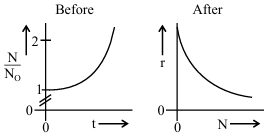
B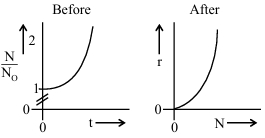
C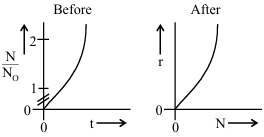
D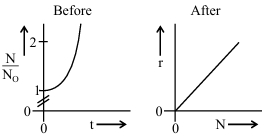
Solution
(B) *Before applying medicine:
$\frac{dN}{dt} = KN$ (First order growth kinetics)
Integrating this gives $\ln(\frac{N}{N_0}) = Kt$, which implies $\frac{N}{N_0} = e^{Kt}$. This is an exponential growth curve starting from $1$ at $t=0$.
*After applying medicine:
The rate of decay $r$ is proportional to the square of the number of bacteria:
$r = -\frac{dN}{dt} = KN^2$
This represents a parabolic relationship where $r$ increases quadratically with $N$ $(r \propto N^2)$.
Comparing the options, option $B$ shows the correct exponential growth for the 'before' case and a parabolic curve $(r \propto N^2)$ for the 'after' case.
$\frac{dN}{dt} = KN$ (First order growth kinetics)
Integrating this gives $\ln(\frac{N}{N_0}) = Kt$, which implies $\frac{N}{N_0} = e^{Kt}$. This is an exponential growth curve starting from $1$ at $t=0$.
*After applying medicine:
The rate of decay $r$ is proportional to the square of the number of bacteria:
$r = -\frac{dN}{dt} = KN^2$
This represents a parabolic relationship where $r$ increases quadratically with $N$ $(r \propto N^2)$.
Comparing the options, option $B$ shows the correct exponential growth for the 'before' case and a parabolic curve $(r \propto N^2)$ for the 'after' case.
0 likesView Solution
243
ChemistryDifficultMCQJEE Main · 2025
Given below are two statements $:$
Statement $I: D-(+)-\text{glucose} + D-(-)-\text{fructose} \xrightarrow{-H_2O} \text{sucrose}$
$\text{sucrose} \xrightarrow{\text{Hydrolysis}} D-(+)-\text{glucose} + D-(-)-\text{fructose}$
Statement $II:$ Invert sugar is formed during sucrose hydrolysis.
In the light of the above statements,choose the correct answer from the options given below $:$
Statement $I: D-(+)-\text{glucose} + D-(-)-\text{fructose} \xrightarrow{-H_2O} \text{sucrose}$
$\text{sucrose} \xrightarrow{\text{Hydrolysis}} D-(+)-\text{glucose} + D-(-)-\text{fructose}$
Statement $II:$ Invert sugar is formed during sucrose hydrolysis.
In the light of the above statements,choose the correct answer from the options given below $:$
A
Both Statement $I$ and Statement $II$ are true.
B
Statement $I$ is false but Statement $II$ is true.
C
Statement $I$ is true but Statement $II$ is false.
D
Both Statement $I$ and Statement $II$ are false.
Solution
(B) Sucrose on hydrolysis yields $D-(+)-\text{glucose}$ and $D-(-)-\text{fructose}$.
Statement $I$ is incorrect because it incorrectly lists $D-(+)-\text{fructose}$ instead of $D-(-)-\text{fructose}$.
Statement $II$ is correct because the equimolar mixture of $D-(+)-\text{glucose}$ and $D-(-)-\text{fructose}$ obtained from sucrose hydrolysis is known as invert sugar.
Statement $I$ is incorrect because it incorrectly lists $D-(+)-\text{fructose}$ instead of $D-(-)-\text{fructose}$.
Statement $II$ is correct because the equimolar mixture of $D-(+)-\text{glucose}$ and $D-(-)-\text{fructose}$ obtained from sucrose hydrolysis is known as invert sugar.
0 likesView Solution
244
ChemistryMediumMCQJEE Main · 2025
An octahedral complex having molecular composition $Co \cdot 5NH_3 \cdot Cl \cdot SO_4$ has two isomers $A$ and $B$. The solution of $A$ gives a white precipitate with $AgNO_3$ solution and the solution of $B$ gives a white precipitate with $BaCl_2$ solution. The type of isomerism exhibited by the complex is,
A
$Co$-ordinate isomerism
B
Linkage isomerism
C
Ionisation isomerism
D
Geometrical isomerism
Solution
(C) The complex $A$ reacts with $AgNO_3$ to give a white precipitate,which indicates the presence of free $Cl^-$ ions outside the coordination sphere. Thus,$A$ is $[Co(NH_3)_5(SO_4)]Cl$.
The complex $B$ reacts with $BaCl_2$ to give a white precipitate,which indicates the presence of free $SO_4^{2-}$ ions outside the coordination sphere. Thus,$B$ is $[Co(NH_3)_5Cl]SO_4$.
Since the isomers differ in the ions they provide in solution,this is an example of Ionisation isomerism.
The complex $B$ reacts with $BaCl_2$ to give a white precipitate,which indicates the presence of free $SO_4^{2-}$ ions outside the coordination sphere. Thus,$B$ is $[Co(NH_3)_5Cl]SO_4$.
Since the isomers differ in the ions they provide in solution,this is an example of Ionisation isomerism.
0 likesView Solution
245
ChemistryMediumMCQJEE Main · 2025
The reactions which cannot be applied to prepare an alkene by elimination are: Choose the correct answer from the options given below $:$
$A.$ $2$-bromomethylcyclohexane + $NaOEt$
$B.$ $2$-bromobutane + $KOH$ (aq.)
$C.$ $2$-bromo-$2$-methylpropane + $NaOMe$
$D.$ Phenol + $Na_2Cr_2O_7 / H_2SO_4$
$E.$ $2$-methylpropan-$2$-ol + $Cu$ at $573 \ K$
$A.$ $2$-bromomethylcyclohexane + $NaOEt$
$B.$ $2$-bromobutane + $KOH$ (aq.)
$C.$ $2$-bromo-$2$-methylpropane + $NaOMe$
$D.$ Phenol + $Na_2Cr_2O_7 / H_2SO_4$
$E.$ $2$-methylpropan-$2$-ol + $Cu$ at $573 \ K$
A
$B \& E$ Only
B
$B, C \& D$ Only
C
$A, C \& D$ Only
D
$B \& D$ Only
Solution
(D) Let us analyze each reaction:
$A.$ $2$-bromomethylcyclohexane with $NaOEt$ undergoes $E2$ elimination to form an alkene.
$B.$ $2$-bromobutane with aqueous $KOH$ undergoes nucleophilic substitution ($SN^2$ or $SN^1$) to form butan-$2$-ol,not an alkene.
$C.$ $2$-bromo-$2$-methylpropane with $NaOMe$ undergoes $E2$ elimination to form $2$-methylpropene (an alkene).
$D.$ Phenol with $Na_2Cr_2O_7 / H_2SO_4$ undergoes oxidation to form $p$-benzoquinone,not an alkene.
$E.$ $2$-methylpropan-$2$-ol with $Cu$ at $573 \ K$ undergoes dehydration to form $2$-methylpropene (an alkene).
Thus,reactions $B$ and $D$ do not produce an alkene.
$A.$ $2$-bromomethylcyclohexane with $NaOEt$ undergoes $E2$ elimination to form an alkene.
$B.$ $2$-bromobutane with aqueous $KOH$ undergoes nucleophilic substitution ($SN^2$ or $SN^1$) to form butan-$2$-ol,not an alkene.
$C.$ $2$-bromo-$2$-methylpropane with $NaOMe$ undergoes $E2$ elimination to form $2$-methylpropene (an alkene).
$D.$ Phenol with $Na_2Cr_2O_7 / H_2SO_4$ undergoes oxidation to form $p$-benzoquinone,not an alkene.
$E.$ $2$-methylpropan-$2$-ol with $Cu$ at $573 \ K$ undergoes dehydration to form $2$-methylpropene (an alkene).
Thus,reactions $B$ and $D$ do not produce an alkene.
0 likesView Solution
246
ChemistryDifficultMCQJEE Main · 2025
The structure of the hormone thyroxine is given below. The percentage of iodine in thyroxine is $..........\%$. ($nearest$ $integer$)
($Given$ $molar$ $mass$ $in$ $g \ mol^{-1}: C: 12, H: 1, O: 16, N: 14, I: 127$)
($Given$ $molar$ $mass$ $in$ $g \ mol^{-1}: C: 12, H: 1, O: 16, N: 14, I: 127$)
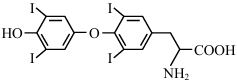
A
$55$
B
$65$
C
$75$
D
$85$
Solution
(B) The molecular formula of thyroxine is $C_{15}H_{11}O_4NI_4$.
Calculate the molecular mass of thyroxine:
$C: 15 \times 12 = 180$
$H: 11 \times 1 = 11$
$O: 16 \times 4 = 64$
$N: 14 \times 1 = 14$
$I: 127 \times 4 = 508$
Total molecular mass $= 180 + 11 + 64 + 14 + 508 = 777 \ g \ mol^{-1}$.
Percentage of iodine $= \frac{\text{Mass of Iodine}}{\text{Total Molecular Mass}} \times 100$
Percentage of iodine $= \frac{508}{777} \times 100 \approx 65.38 \%$.
The nearest integer is $65$.
Calculate the molecular mass of thyroxine:
$C: 15 \times 12 = 180$
$H: 11 \times 1 = 11$
$O: 16 \times 4 = 64$
$N: 14 \times 1 = 14$
$I: 127 \times 4 = 508$
Total molecular mass $= 180 + 11 + 64 + 14 + 508 = 777 \ g \ mol^{-1}$.
Percentage of iodine $= \frac{\text{Mass of Iodine}}{\text{Total Molecular Mass}} \times 100$
Percentage of iodine $= \frac{508}{777} \times 100 \approx 65.38 \%$.
The nearest integer is $65$.
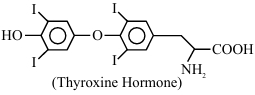
0 likesView Solution
247
ChemistryMediumMCQJEE Main · 2025
$1 \ F$ electricity was passed through $Cu^{2+} (1.5 \ M, 1 \ L) / Cu$ and $0.1 \ F$ was passed through $Ag^{+} (0.2 \ M, 1 \ L) / Ag$ electrolytic cells. After this,the two cells were connected to make an electrochemical cell. The $emf$ of the cell thus formed at $298 \ K$ is:
Given: $E^0_{Cu^{2+} / Cu} = 0.34 \ V$,$E^0_{Ag^{+} / Ag} = 0.8 \ V$,$\frac{2.303 \ RT}{F} = 0.06 \ V$ (in $V$)
Given: $E^0_{Cu^{2+} / Cu} = 0.34 \ V$,$E^0_{Ag^{+} / Ag} = 0.8 \ V$,$\frac{2.303 \ RT}{F} = 0.06 \ V$ (in $V$)
A
$0.40$
B
$0.43$
C
$0.46$
D
$0.37$
Solution
(A) $1$. For $Cu^{2+} + 2e^{-} \longrightarrow Cu$:
Initial moles of $Cu^{2+} = 1.5 \ M \times 1 \ L = 1.5 \ mol$.
$1 \ F$ electricity corresponds to $1 \ mol$ of electrons.
Since $2 \ mol$ of electrons reduce $1 \ mol$ of $Cu^{2+}$,$1 \ mol$ of electrons reduces $0.5 \ mol$ of $Cu^{2+}$.
Remaining moles of $Cu^{2+} = 1.5 - 0.5 = 1.0 \ mol$.
$[Cu^{2+}] = 1.0 \ M$.
$2$. For $Ag^{+} + e^{-} \longrightarrow Ag$:
Initial moles of $Ag^{+} = 0.2 \ M \times 1 \ L = 0.2 \ mol$.
$0.1 \ F$ electricity corresponds to $0.1 \ mol$ of electrons.
$1 \ mol$ of electrons reduces $1 \ mol$ of $Ag^{+}$,so $0.1 \ mol$ of electrons reduces $0.1 \ mol$ of $Ag^{+}$.
Remaining moles of $Ag^{+} = 0.2 - 0.1 = 0.1 \ mol$.
$[Ag^{+}] = 0.1 \ M$.
$3$. Cell reaction: $Cu(s) + 2Ag^{+}(aq) \longrightarrow Cu^{2+}(aq) + 2Ag(s)$.
$E^{\circ}_{cell} = E^{\circ}_{cathode} - E^{\circ}_{anode} = 0.8 - 0.34 = 0.46 \ V$.
Using Nernst equation: $E = E^{\circ}_{cell} - \frac{0.06}{n} \log \frac{[Cu^{2+}]}{[Ag^{+}]^2}$.
$E = 0.46 - \frac{0.06}{2} \log \frac{1}{(0.1)^2} = 0.46 - 0.03 \log(100) = 0.46 - 0.03 \times 2 = 0.46 - 0.06 = 0.40 \ V$.
Initial moles of $Cu^{2+} = 1.5 \ M \times 1 \ L = 1.5 \ mol$.
$1 \ F$ electricity corresponds to $1 \ mol$ of electrons.
Since $2 \ mol$ of electrons reduce $1 \ mol$ of $Cu^{2+}$,$1 \ mol$ of electrons reduces $0.5 \ mol$ of $Cu^{2+}$.
Remaining moles of $Cu^{2+} = 1.5 - 0.5 = 1.0 \ mol$.
$[Cu^{2+}] = 1.0 \ M$.
$2$. For $Ag^{+} + e^{-} \longrightarrow Ag$:
Initial moles of $Ag^{+} = 0.2 \ M \times 1 \ L = 0.2 \ mol$.
$0.1 \ F$ electricity corresponds to $0.1 \ mol$ of electrons.
$1 \ mol$ of electrons reduces $1 \ mol$ of $Ag^{+}$,so $0.1 \ mol$ of electrons reduces $0.1 \ mol$ of $Ag^{+}$.
Remaining moles of $Ag^{+} = 0.2 - 0.1 = 0.1 \ mol$.
$[Ag^{+}] = 0.1 \ M$.
$3$. Cell reaction: $Cu(s) + 2Ag^{+}(aq) \longrightarrow Cu^{2+}(aq) + 2Ag(s)$.
$E^{\circ}_{cell} = E^{\circ}_{cathode} - E^{\circ}_{anode} = 0.8 - 0.34 = 0.46 \ V$.
Using Nernst equation: $E = E^{\circ}_{cell} - \frac{0.06}{n} \log \frac{[Cu^{2+}]}{[Ag^{+}]^2}$.
$E = 0.46 - \frac{0.06}{2} \log \frac{1}{(0.1)^2} = 0.46 - 0.03 \log(100) = 0.46 - 0.03 \times 2 = 0.46 - 0.06 = 0.40 \ V$.
0 likesView Solution
248
ChemistryMediumMCQJEE Main · 2025
The percentage dissociation of a salt $(MX_3)$ solution at a given temperature $($van't Hoff factor $i = 2)$ is $..........\%$ ($Nearest$ $integer$).
A
$13$
B
$43$
C
$23$
D
$33$
Solution
(D) The dissociation reaction for the salt is: $MX_3 \rightarrow M^{3+} + 3X^{-}$.
Here,the number of ions produced per formula unit is $n = 1 + 3 = 4$.
The relationship between the van't Hoff factor $(i)$ and the degree of dissociation $(\alpha)$ is given by: $i = 1 + (n - 1)\alpha$.
Substituting the given values: $2 = 1 + (4 - 1)\alpha$.
$2 = 1 + 3\alpha$.
$3\alpha = 1$.
$\alpha = \frac{1}{3} \approx 0.3333$.
Therefore,the percentage dissociation is $0.3333 \times 100 = 33.33\%$.
The nearest integer is $33\%$.
Here,the number of ions produced per formula unit is $n = 1 + 3 = 4$.
The relationship between the van't Hoff factor $(i)$ and the degree of dissociation $(\alpha)$ is given by: $i = 1 + (n - 1)\alpha$.
Substituting the given values: $2 = 1 + (4 - 1)\alpha$.
$2 = 1 + 3\alpha$.
$3\alpha = 1$.
$\alpha = \frac{1}{3} \approx 0.3333$.
Therefore,the percentage dissociation is $0.3333 \times 100 = 33.33\%$.
The nearest integer is $33\%$.
0 likesView Solution
249
ChemistryMediumMCQJEE Main · 2025
The number of paramagnetic complexes among $[FeF_6]^{3-}, [Fe(CN)_6]^{3-}, [Mn(CN)_6]^{3-}, [Co(C_2O_4)_3]^{3-}, [MnCl_6]^{3-}$,and $[CoF_6]^{3-}$ that involve $d^2sp^3$ hybridization is ....................
A
$2$
B
$4$
C
$6$
D
$8$
Solution
(A) To determine the hybridization and magnetic nature,we analyze the oxidation state of the metal and the nature of the ligand:
From the table,the complexes that involve $d^2sp^3$ hybridization are $[Fe(CN)_6]^{3-}, [Mn(CN)_6]^{3-}$,and $[Co(C_2O_4)_3]^{3-}$.
Among these,$[Fe(CN)_6]^{3-}$ and $[Mn(CN)_6]^{3-}$ are paramagnetic.
Therefore,the number of such complexes is $2$.
| Complex | Hybridization | Magnetic Nature |
| $[FeF_6]^{3-}$ | $sp^3d^2$ | Paramagnetic |
| $[Fe(CN)_6]^{3-}$ | $d^2sp^3$ | Paramagnetic |
| $[Mn(CN)_6]^{3-}$ | $d^2sp^3$ | Paramagnetic |
| $[Co(C_2O_4)_3]^{3-}$ | $d^2sp^3$ | Diamagnetic |
| $[MnCl_6]^{3-}$ | $sp^3d^2$ | Paramagnetic |
| $[CoF_6]^{3-}$ | $sp^3d^2$ | Paramagnetic |
From the table,the complexes that involve $d^2sp^3$ hybridization are $[Fe(CN)_6]^{3-}, [Mn(CN)_6]^{3-}$,and $[Co(C_2O_4)_3]^{3-}$.
Among these,$[Fe(CN)_6]^{3-}$ and $[Mn(CN)_6]^{3-}$ are paramagnetic.
Therefore,the number of such complexes is $2$.
0 likesView Solution
250
ChemistryMediumMCQJEE Main · 2025
Given below are two statements $:$
Statement $(I):$ On hydrolysis,oligopeptides give rise to a fewer number of $\alpha$-amino acids,while proteins give rise to a large number of $\beta$-amino acids.
Statement $(II):$ Natural proteins are denatured by acids,which convert the water-soluble form of fibrous proteins to their water-insoluble form.
In the light of the above statements,choose the most appropriate answer from the options given below $:$
Statement $(I):$ On hydrolysis,oligopeptides give rise to a fewer number of $\alpha$-amino acids,while proteins give rise to a large number of $\beta$-amino acids.
Statement $(II):$ Natural proteins are denatured by acids,which convert the water-soluble form of fibrous proteins to their water-insoluble form.
In the light of the above statements,choose the most appropriate answer from the options given below $:$
A
Both statement $I$ and statement $II$ are correct
B
Statement $I$ is incorrect but Statement $II$ is correct
C
Both statement $I$ and statement $II$ are incorrect
D
Statement $I$ is correct but Statement $II$ is incorrect
Solution
(C) $(i)$ Proteins on hydrolysis yield a large number of $\alpha$-amino acids,not $\beta$-amino acids. Thus,Statement $(I)$ is incorrect.
$(ii)$ Fibrous proteins are generally insoluble in water. Denaturation involves the loss of biological activity and changes in the secondary and tertiary structures,but it does not involve the conversion of water-soluble fibrous proteins to water-insoluble forms in the manner described. Thus,Statement $(II)$ is also incorrect.
$(ii)$ Fibrous proteins are generally insoluble in water. Denaturation involves the loss of biological activity and changes in the secondary and tertiary structures,but it does not involve the conversion of water-soluble fibrous proteins to water-insoluble forms in the manner described. Thus,Statement $(II)$ is also incorrect.
0 likesView Solution
251
ChemistryMediumMCQJEE Main · 2025
$A$ mixture of $1 \ g$ each of chlorobenzene,aniline,and benzoic acid is dissolved in $50 \ mL$ of ethyl acetate and placed in a separating funnel. $5 \ M \ NaOH$ $(30 \ mL)$ was added to the same funnel. The funnel was shaken vigorously and then kept aside. The ethyl acetate layer in the funnel contains:
A
benzoic acid
B
benzoic acid and aniline
C
benzoic acid and chlorobenzene
D
chlorobenzene and aniline
Solution
(D) When $NaOH$ is added to the mixture,benzoic acid reacts with $NaOH$ to form sodium benzoate,which is a salt and is soluble in the aqueous layer.
$C_6H_5COOH + NaOH \rightarrow C_6H_5COONa + H_2O$
Chlorobenzene and aniline do not react with $NaOH$ and remain in the organic ethyl acetate layer.
Therefore,the ethyl acetate layer contains chlorobenzene and aniline.
$C_6H_5COOH + NaOH \rightarrow C_6H_5COONa + H_2O$
Chlorobenzene and aniline do not react with $NaOH$ and remain in the organic ethyl acetate layer.
Therefore,the ethyl acetate layer contains chlorobenzene and aniline.
0 likesView Solution
252
ChemistryMediumMCQJEE Main · 2025
$A_{(g)} \rightarrow B_{(g)} + C_{(g)}$ is a first order reaction.
The reaction was started with reactant $A$ only. Which of the following expressions is correct for the rate constant $k$?
| Time | $t$ | $\infty$ |
| $P_{\text{system}}$ | $P_t$ | $P_{\infty}$ |
The reaction was started with reactant $A$ only. Which of the following expressions is correct for the rate constant $k$?
A
$k = \frac{1}{t} \ln \frac{2(P_{\infty} - P_t)}{P_t}$
B
$k = \frac{1}{t} \ln \frac{P_{\infty}}{P_t}$
C
$k = \frac{1}{t} \ln \frac{P_{\infty}}{2(P_{\infty} - P_t)}$
D
$k = \frac{1}{t} \ln \frac{P_{\infty}}{(P_{\infty} - P_t)}$
Solution
(C) For the first order reaction $A_{(g)} \rightarrow B_{(g)} + C_{(g)}$:
At $t = 0$,$P_A = P_0$,$P_B = 0$,$P_C = 0$
At $t = t$,$P_A = P_0 - x$,$P_B = x$,$P_C = x$
Total pressure $P_t = (P_0 - x) + x + x = P_0 + x \Rightarrow x = P_t - P_0$
At $t = \infty$,$P_A = 0$,$P_B = P_0$,$P_C = P_0$
Total pressure $P_{\infty} = 2P_0 \Rightarrow P_0 = \frac{P_{\infty}}{2}$
Pressure of $A$ at time $t$: $P_A = P_0 - x = P_0 - (P_t - P_0) = 2P_0 - P_t$
Substituting $P_0 = \frac{P_{\infty}}{2}$: $P_A = 2(\frac{P_{\infty}}{2}) - P_t = P_{\infty} - P_t$
Rate constant $k = \frac{1}{t} \ln \frac{P_0}{P_A} = \frac{1}{t} \ln \frac{P_{\infty}/2}{P_{\infty} - P_t} = \frac{1}{t} \ln \frac{P_{\infty}}{2(P_{\infty} - P_t)}$.
At $t = 0$,$P_A = P_0$,$P_B = 0$,$P_C = 0$
At $t = t$,$P_A = P_0 - x$,$P_B = x$,$P_C = x$
Total pressure $P_t = (P_0 - x) + x + x = P_0 + x \Rightarrow x = P_t - P_0$
At $t = \infty$,$P_A = 0$,$P_B = P_0$,$P_C = P_0$
Total pressure $P_{\infty} = 2P_0 \Rightarrow P_0 = \frac{P_{\infty}}{2}$
Pressure of $A$ at time $t$: $P_A = P_0 - x = P_0 - (P_t - P_0) = 2P_0 - P_t$
Substituting $P_0 = \frac{P_{\infty}}{2}$: $P_A = 2(\frac{P_{\infty}}{2}) - P_t = P_{\infty} - P_t$
Rate constant $k = \frac{1}{t} \ln \frac{P_0}{P_A} = \frac{1}{t} \ln \frac{P_{\infty}/2}{P_{\infty} - P_t} = \frac{1}{t} \ln \frac{P_{\infty}}{2(P_{\infty} - P_t)}$.
0 likesView Solution
253
ChemistryMediumMCQJEE Main · 2025
$P$ is an optically active compound with molecular formula $C_6H_{12}O$. When $P$ is treated with $2,4-$dinitrophenylhydrazine,it gives a positive test. However,in the presence of Tollens reagent,$P$ gives a negative test. Predict the structure of $P$.
A
$CH_3-CO-CH_2-CH_2-CH_2-CH_3$
B
$CH_3-CO-CH(CH_3)-CH_2-CH_3$
C
$H-CO-CH_2-CH(CH_3)-CH_2-CH_3$
D
$CH_3-CO-CH_2-CH(CH_3)-CH_3$
Solution
(B) $1$. The molecular formula $C_6H_{12}O$ corresponds to the general formula $C_nH_{2n}O$,which indicates that the compound $P$ is either an aldehyde or a ketone.
$2$. $P$ gives a positive test with $2,4-$dinitrophenylhydrazine $(2,4-DNP)$,which confirms the presence of a carbonyl group $(C=O)$.
$3$. $P$ gives a negative test with Tollens reagent,which indicates that $P$ is a ketone,not an aldehyde.
$4$. $P$ is optically active,meaning it must contain at least one chiral carbon atom.
$5$. Let's examine the options:
- Option $A$: $CH_3-CO-CH_2-CH_2-CH_2-CH_3$ (Hexan-$2$-one) is not optically active.
- Option $B$: $CH_3-CO-CH(CH_3)-CH_2-CH_3$ ($3-$methylpentan-$2$-one) has a chiral carbon at the $C-3$ position. It is a ketone and gives a positive $2,4-DNP$ test and a negative Tollens test.
- Option $C$: This is an aldehyde,which would give a positive Tollens test.
- Option $D$: $CH_3-CO-CH_2-CH(CH_3)_2$ ($4-$methylpentan-$2$-one) is not optically active.
$6$. Therefore,the correct structure is $3-$methylpentan-$2$-one.
$2$. $P$ gives a positive test with $2,4-$dinitrophenylhydrazine $(2,4-DNP)$,which confirms the presence of a carbonyl group $(C=O)$.
$3$. $P$ gives a negative test with Tollens reagent,which indicates that $P$ is a ketone,not an aldehyde.
$4$. $P$ is optically active,meaning it must contain at least one chiral carbon atom.
$5$. Let's examine the options:
- Option $A$: $CH_3-CO-CH_2-CH_2-CH_2-CH_3$ (Hexan-$2$-one) is not optically active.
- Option $B$: $CH_3-CO-CH(CH_3)-CH_2-CH_3$ ($3-$methylpentan-$2$-one) has a chiral carbon at the $C-3$ position. It is a ketone and gives a positive $2,4-DNP$ test and a negative Tollens test.
- Option $C$: This is an aldehyde,which would give a positive Tollens test.
- Option $D$: $CH_3-CO-CH_2-CH(CH_3)_2$ ($4-$methylpentan-$2$-one) is not optically active.
$6$. Therefore,the correct structure is $3-$methylpentan-$2$-one.
0 likesView Solution
254
ChemistryMediumMCQJEE Main · 2025
Match List-$I$ with List-$II$:
Choose the correct answer from the options given below:
| List-$I$ Conversion | List-$II$ Reagents,Conditions used |
|---|---|
| $A$. Chlorobenzene $\rightarrow$ Phenol | $I$. Warm,$H_2O$ |
| $B$. $1$-Chloro-$4$-nitrobenzene $\rightarrow$ $4$-Nitrophenol | $II$. $(a)$ $NaOH, 368 \ K$; $(b)$ $H_3O^+$ |
| $C$. $1$-Chloro-$2,4$-dinitrobenzene $\rightarrow$ $2,4$-Dinitrophenol | $III$. $(a)$ $NaOH, 443 \ K$; $(b)$ $H_3O^+$ |
| $D$. $1$-Chloro-$2,4,6$-trinitrobenzene $\rightarrow$ $2,4,6$-Trinitrophenol | $IV$. $(a)$ $NaOH, 623 \ K, 300 \ atm$; $(b)$ $H_3O^+$ |
Choose the correct answer from the options given below:
A
$A-IV, B-III, C-II, D-I$
B
$A-III, B-IV, C-II, D-I$
C
$A-IV, B-III, C-I, D-II$
D
$A-II, B-III, C-IV, D-I$
Solution
(A) The nucleophilic aromatic substitution reaction of aryl halides with $NaOH$ depends on the presence of electron-withdrawing groups $(-NO_2)$ on the ring.
$A$. Chlorobenzene requires harsh conditions: $(a)$ $NaOH, 623 \ K, 300 \ atm$; $(b)$ $H_3O^+$ $(IV)$.
$B$. $1$-Chloro-$4$-nitrobenzene has one $-NO_2$ group,requiring milder conditions: $(a)$ $NaOH, 443 \ K$; $(b)$ $H_3O^+$ $(III)$.
$C$. $1$-Chloro-$2,4$-dinitrobenzene has two $-NO_2$ groups,requiring even milder conditions: $(a)$ $NaOH, 368 \ K$; $(b)$ $H_3O^+$ $(II)$.
$D$. $1$-Chloro-$2,4,6$-trinitrobenzene has three $-NO_2$ groups,which activate the ring significantly,allowing substitution with just warm $H_2O$ $(I)$.
Thus,the correct match is $A-IV, B-III, C-II, D-I$.
$A$. Chlorobenzene requires harsh conditions: $(a)$ $NaOH, 623 \ K, 300 \ atm$; $(b)$ $H_3O^+$ $(IV)$.
$B$. $1$-Chloro-$4$-nitrobenzene has one $-NO_2$ group,requiring milder conditions: $(a)$ $NaOH, 443 \ K$; $(b)$ $H_3O^+$ $(III)$.
$C$. $1$-Chloro-$2,4$-dinitrobenzene has two $-NO_2$ groups,requiring even milder conditions: $(a)$ $NaOH, 368 \ K$; $(b)$ $H_3O^+$ $(II)$.
$D$. $1$-Chloro-$2,4,6$-trinitrobenzene has three $-NO_2$ groups,which activate the ring significantly,allowing substitution with just warm $H_2O$ $(I)$.
Thus,the correct match is $A-IV, B-III, C-II, D-I$.
0 likesView Solution
255
ChemistryDifficultMCQJEE Main · 2025
Liquid $A$ and $B$ form an ideal solution. The vapour pressure of pure liquids $A$ and $B$ are $350 \ mm \ Hg$ and $750 \ mm \ Hg$ respectively at the same temperature. If $x_A$ and $x_B$ are the mole fractions of $A$ and $B$ in the solution,and $y_A$ and $y_B$ are the mole fractions of $A$ and $B$ in the vapour phase,then:
A
$\frac{x_A}{x_B} < \frac{y_A}{y_B}$
B
$\frac{x_A}{x_B} = \frac{y_A}{y_B}$
C
$\frac{x_A}{x_B} > \frac{y_A}{y_B}$
D
$(x_A - y_A) < (x_B - y_B)$
Solution
(C) According to Raoult's law,the partial pressures are $P_A = x_A P_A^o$ and $P_B = x_B P_B^o$.
In the vapour phase,$P_A = y_A P_{total}$ and $P_B = y_B P_{total}$.
Therefore,$\frac{y_A}{y_B} = \frac{P_A}{P_B} = \frac{x_A P_A^o}{x_B P_B^o} = \left(\frac{P_A^o}{P_B^o}\right) \left(\frac{x_A}{x_B}\right)$.
Given $P_A^o = 350 \ mm \ Hg$ and $P_B^o = 750 \ mm \ Hg$,we have $\frac{P_A^o}{P_B^o} = \frac{350}{750} < 1$.
Since $\frac{P_A^o}{P_B^o} < 1$,it follows that $\frac{y_A}{y_B} < \frac{x_A}{x_B}$,which is equivalent to $\frac{x_A}{x_B} > \frac{y_A}{y_B}$.
In the vapour phase,$P_A = y_A P_{total}$ and $P_B = y_B P_{total}$.
Therefore,$\frac{y_A}{y_B} = \frac{P_A}{P_B} = \frac{x_A P_A^o}{x_B P_B^o} = \left(\frac{P_A^o}{P_B^o}\right) \left(\frac{x_A}{x_B}\right)$.
Given $P_A^o = 350 \ mm \ Hg$ and $P_B^o = 750 \ mm \ Hg$,we have $\frac{P_A^o}{P_B^o} = \frac{350}{750} < 1$.
Since $\frac{P_A^o}{P_B^o} < 1$,it follows that $\frac{y_A}{y_B} < \frac{x_A}{x_B}$,which is equivalent to $\frac{x_A}{x_B} > \frac{y_A}{y_B}$.
0 likesView Solution
256
ChemistryDifficultMCQJEE Main · 2025
$X$ is the number of acidic oxides among $VO_2$,$V_2O_3$,$CrO_3$,$V_2O_5$ and $Mn_2O_7$. The primary valency of cobalt in $[Co(en)_3]_2(SO_4)_3$ is $Y$. The value of $X+Y$ is $:$
A
$5$
B
$4$
C
$2$
D
$3$
Solution
(A) $1$. Identification of acidic oxides:
$CrO_3$ and $Mn_2O_7$ are acidic oxides.
$VO_2$ is amphoteric,$V_2O_3$ is basic,and $V_2O_5$ is amphoteric.
Therefore,$X = 2$.
$2$. Determination of primary valency:
In the complex $[Co(en)_3]_2(SO_4)_3$,the coordination entity is $[Co(en)_3]^{3+}$.
The oxidation state of $Co$ is $+3$,which represents its primary valency.
Therefore,$Y = 3$.
$3$. Calculation:
$X + Y = 2 + 3 = 5$.
$CrO_3$ and $Mn_2O_7$ are acidic oxides.
$VO_2$ is amphoteric,$V_2O_3$ is basic,and $V_2O_5$ is amphoteric.
Therefore,$X = 2$.
$2$. Determination of primary valency:
In the complex $[Co(en)_3]_2(SO_4)_3$,the coordination entity is $[Co(en)_3]^{3+}$.
The oxidation state of $Co$ is $+3$,which represents its primary valency.
Therefore,$Y = 3$.
$3$. Calculation:
$X + Y = 2 + 3 = 5$.
0 likesView Solution
257
ChemistryMediumMCQJEE Main · 2025
The descending order of basicity of the following amines is $:$
$(A)$ Aniline
$(B)$ $p$-Methoxyaniline
$(C)$ $p$-Nitroaniline
$(D)$ Methylamine
$(E)$ Dimethylamine
Choose the correct answer from the options given below $:$
$(A)$ Aniline
$(B)$ $p$-Methoxyaniline
$(C)$ $p$-Nitroaniline
$(D)$ Methylamine
$(E)$ Dimethylamine
Choose the correct answer from the options given below $:$
A
$B > E > D > A > C$
B
$E > D > B > A > C$
C
$E > D > A > B > C$
D
$E > A > D > C > B$
Solution
(B) To determine the basicity,we consider the availability of the lone pair on the nitrogen atom.
$1$. Aliphatic amines are generally more basic than aromatic amines because the lone pair on the nitrogen in aromatic amines is delocalized into the benzene ring.
$2$. Among aliphatic amines,$(CH_3)_2NH$ $(E)$ is more basic than $CH_3NH_2$ $(D)$ due to the greater $+I$ effect of two methyl groups.
$3$. Among aromatic amines,the basicity depends on the substituents on the benzene ring. An electron-donating group (like $-OCH_3$) increases basicity,while an electron-withdrawing group (like $-NO_2$) decreases it.
$4$. Thus,$p$-methoxyaniline $(B)$ > aniline $(A)$ > $p$-nitroaniline $(C)$.
$5$. Combining these,the order is: $(CH_3)_2NH$ $(E)$ > $CH_3NH_2$ $(D)$ > $p$-methoxyaniline $(B)$ > aniline $(A)$ > $p$-nitroaniline $(C)$.
Therefore,the correct order is $E > D > B > A > C$.
$1$. Aliphatic amines are generally more basic than aromatic amines because the lone pair on the nitrogen in aromatic amines is delocalized into the benzene ring.
$2$. Among aliphatic amines,$(CH_3)_2NH$ $(E)$ is more basic than $CH_3NH_2$ $(D)$ due to the greater $+I$ effect of two methyl groups.
$3$. Among aromatic amines,the basicity depends on the substituents on the benzene ring. An electron-donating group (like $-OCH_3$) increases basicity,while an electron-withdrawing group (like $-NO_2$) decreases it.
$4$. Thus,$p$-methoxyaniline $(B)$ > aniline $(A)$ > $p$-nitroaniline $(C)$.
$5$. Combining these,the order is: $(CH_3)_2NH$ $(E)$ > $CH_3NH_2$ $(D)$ > $p$-methoxyaniline $(B)$ > aniline $(A)$ > $p$-nitroaniline $(C)$.
Therefore,the correct order is $E > D > B > A > C$.
0 likesView Solution
258
ChemistryMediumMCQJEE Main · 2025
Match List-$I$ with List-$II$:
Choose the correct answer from the options given below:
| List-$I$ (Complex) | List-$II$ (Primary valency and Secondary valency) |
| $(A)$ $[Co(en)_2 Cl_2] Cl$ | $(I)$ $3, 6$ |
| $(B)$ $[Pt(NH_3)_2 Cl(NO_2)]$ | $(II)$ $2, 4$ |
| $(C)$ $Hg[Co(SCN)_4]$ | $(III)$ $3, 4$ |
| $(D)$ $[Mg(EDTA)]^{2-}$ | $(IV)$ $2, 6$ |
Choose the correct answer from the options given below:
A
$A-I, B-II, C-III, D-IV$
B
$A-I, B-IV, C-II, D-III$
C
$A-I, B-III, C-II, D-IV$
D
$A-II, B-III, C-IV, D-I$
Solution
(A) Primary valency is equal to the oxidation state of the central metal atom.
Secondary valency is equal to the coordination number of the central metal atom.
$1$. $[Co(en)_2 Cl_2] Cl$: $Co$ is in $+3$ state,$CN = 2(2) + 2 = 6$. So,$(A-I)$.
$2$. $[Pt(NH_3)_2 Cl(NO_2)]$: $Pt$ is in $+2$ state,$CN = 2 + 1 + 1 = 4$. So,$(B-II)$.
$3$. $Hg[Co(SCN)_4]$: $Co$ is in $+3$ state (considering $Hg^{2+}$),$CN = 4$. So,$(C-III)$.
$4$. $[Mg(EDTA)]^{2-}$: $Mg$ is in $+2$ state,$EDTA$ is hexadentate,$CN = 6$. So,$(D-IV)$.
Thus,the correct match is $A-I, B-II, C-III, D-IV$.
Secondary valency is equal to the coordination number of the central metal atom.
$1$. $[Co(en)_2 Cl_2] Cl$: $Co$ is in $+3$ state,$CN = 2(2) + 2 = 6$. So,$(A-I)$.
$2$. $[Pt(NH_3)_2 Cl(NO_2)]$: $Pt$ is in $+2$ state,$CN = 2 + 1 + 1 = 4$. So,$(B-II)$.
$3$. $Hg[Co(SCN)_4]$: $Co$ is in $+3$ state (considering $Hg^{2+}$),$CN = 4$. So,$(C-III)$.
$4$. $[Mg(EDTA)]^{2-}$: $Mg$ is in $+2$ state,$EDTA$ is hexadentate,$CN = 6$. So,$(D-IV)$.
Thus,the correct match is $A-I, B-II, C-III, D-IV$.
0 likesView Solution
259
ChemistryMediumMCQJEE Main · 2025
Match List-$I$ with List-$II$
Choose the correct answer from the options given below $:$
| List-$I$ | List-$II$ |
| $A$. Solution of chloroform and acetone | $I$. Minimum boiling azeotrope |
| $B$. Solution of ethanol and water | $II$. Dimerizes |
| $C$. Solution of benzene and toluene | $III$. Maximum boiling azeotrope |
| $D$. Solution of acetic acid in benzene | $IV$. $\Delta V_{mix}=0$ |
Choose the correct answer from the options given below $:$
A
$A-III, B-I, C-IV, D-II$
B
$A-II, B-IV, C-I, D-III$
C
$A-III, B-IV, C-I, D-II$
D
$A-II, B-I, C-IV, D-III$
Solution
(A) . The solution of chloroform and acetone shows negative deviation from Raoult's law,resulting in a maximum boiling azeotrope $(A-III)$.
$B$. The solution of ethanol and water shows positive deviation from Raoult's law,resulting in a minimum boiling azeotrope $(B-I)$.
$C$. The solution of benzene and toluene forms an ideal solution,which follows $\Delta V_{mix} = 0$ $(C-IV)$.
$D$. Acetic acid in benzene undergoes hydrogen bonding to form a dimer $(D-II)$.
Therefore,the correct matching is $A-III, B-I, C-IV, D-II$.
$B$. The solution of ethanol and water shows positive deviation from Raoult's law,resulting in a minimum boiling azeotrope $(B-I)$.
$C$. The solution of benzene and toluene forms an ideal solution,which follows $\Delta V_{mix} = 0$ $(C-IV)$.
$D$. Acetic acid in benzene undergoes hydrogen bonding to form a dimer $(D-II)$.
Therefore,the correct matching is $A-III, B-I, C-IV, D-II$.
0 likesView Solution
260
ChemistryDifficultMCQJEE Main · 2025
The number of unpaired electrons responsible for the paramagnetic nature of the following complex species are respectively $:$
$[Fe(CN)_6]^{3-}, [FeF_6]^{3-}, [CoF_6]^{3-}, [Mn(CN)_6]^{3-}$
$[Fe(CN)_6]^{3-}, [FeF_6]^{3-}, [CoF_6]^{3-}, [Mn(CN)_6]^{3-}$
A
$1, 5, 4, 2$
B
$1, 5, 5, 2$
C
$1, 1, 4, 2$
D
$1, 4, 4, 2$
Solution
(A) $[Fe(CN)_6]^{3-}$: $Fe^{3+}$ is $3d^5$. $CN^-$ is a strong field ligand,so pairing occurs. $t_{2g}^5, e_g^0$. Unpaired electrons = $1$.
$[FeF_6]^{3-}$: $Fe^{3+}$ is $3d^5$. $F^-$ is a weak field ligand,so no pairing. $t_{2g}^3, e_g^2$. Unpaired electrons = $5$.
$[CoF_6]^{3-}$: $Co^{3+}$ is $3d^6$. $F^-$ is a weak field ligand. $t_{2g}^4, e_g^2$. Unpaired electrons = $4$.
$[Mn(CN)_6]^{3-}$: $Mn^{3+}$ is $3d^4$. $CN^-$ is a strong field ligand. $t_{2g}^4, e_g^0$. Unpaired electrons = $2$.
$[FeF_6]^{3-}$: $Fe^{3+}$ is $3d^5$. $F^-$ is a weak field ligand,so no pairing. $t_{2g}^3, e_g^2$. Unpaired electrons = $5$.
$[CoF_6]^{3-}$: $Co^{3+}$ is $3d^6$. $F^-$ is a weak field ligand. $t_{2g}^4, e_g^2$. Unpaired electrons = $4$.
$[Mn(CN)_6]^{3-}$: $Mn^{3+}$ is $3d^4$. $CN^-$ is a strong field ligand. $t_{2g}^4, e_g^0$. Unpaired electrons = $2$.
0 likesView Solution
261
ChemistryMediumMCQJEE Main · 2025
Given below are two statements $:$
Statement $(I) :$ $cis-1,2-dichloroethene$ is more polar than $cis-1,2-dibromoethene$.
Statement $(II) :$ Boiling point of $trans-1,2-dibromoethene$ is lower than $cis-1,2-dibromoethene$ but it is more polar than $cis-1,2-dibromoethene$.
In the light of the above statements,choose the most appropriate answer from the options given below $:$
Statement $(I) :$ $cis-1,2-dichloroethene$ is more polar than $cis-1,2-dibromoethene$.
Statement $(II) :$ Boiling point of $trans-1,2-dibromoethene$ is lower than $cis-1,2-dibromoethene$ but it is more polar than $cis-1,2-dibromoethene$.
In the light of the above statements,choose the most appropriate answer from the options given below $:$
A
Statement $I$ is correct but statement $II$ is incorrect
B
Statement $I$ is incorrect but statement $II$ is correct
C
Both statement $I$ and statement $II$ are incorrect
D
Both statement $I$ and statement $II$ are correct
Solution
(A) Statement $(I)$ is correct. $cis-1,2-dichloroethene$ exhibits greater polarity than $cis-1,2-dibromoethene$ due to the stronger $p\pi-d\pi$ back-bonding in the $C-Cl$ bond compared to the $C-Br$ bond,which enhances the dipole moment.
Statement $(II)$ is incorrect. While the boiling point of $trans-1,2-dibromoethene$ is indeed lower than that of $cis-1,2-dibromoethene$ (because the $cis$ isomer has a net dipole moment $\mu \neq 0$ while the $trans$ isomer has $\mu = 0$),the $trans$ isomer is $NOT$ more polar than the $cis$ isomer. The $trans$ isomer is non-polar $(\mu = 0)$,whereas the $cis$ isomer is polar $(\mu \neq 0)$.
Statement $(II)$ is incorrect. While the boiling point of $trans-1,2-dibromoethene$ is indeed lower than that of $cis-1,2-dibromoethene$ (because the $cis$ isomer has a net dipole moment $\mu \neq 0$ while the $trans$ isomer has $\mu = 0$),the $trans$ isomer is $NOT$ more polar than the $cis$ isomer. The $trans$ isomer is non-polar $(\mu = 0)$,whereas the $cis$ isomer is polar $(\mu \neq 0)$.
0 likesView Solution
262
ChemistryDifficultMCQJEE Main · 2025
Given below are two statements $:$
$1 \ M$ aqueous solution of each of $Cu(NO_3)_2, AgNO_3, Hg_2(NO_3)_2$ and $Mg(NO_3)_2$ are electrolysed using inert electrodes.
Given $: E_{Ag^{+}/Ag}^{\theta} = 0.80 \ V, E_{Hg_2^{2+}/Hg}^{\theta} = 0.79 \ V, E_{Cu^{2+}/Cu}^{\theta} = 0.24 \ V$ and $E_{Mg^{2+}/Mg}^{\theta} = -2.37 \ V$.
Statement $(I) :$ With increasing voltage,the sequence of deposition of metals on the cathode will be $Ag, Hg$ and $Cu$.
Statement $(II) :$ Magnesium will not be deposited at cathode instead oxygen gas will be evolved at the cathode.
In the light of the above statement,choose the most appropriate answer from the options given below.
$1 \ M$ aqueous solution of each of $Cu(NO_3)_2, AgNO_3, Hg_2(NO_3)_2$ and $Mg(NO_3)_2$ are electrolysed using inert electrodes.
Given $: E_{Ag^{+}/Ag}^{\theta} = 0.80 \ V, E_{Hg_2^{2+}/Hg}^{\theta} = 0.79 \ V, E_{Cu^{2+}/Cu}^{\theta} = 0.24 \ V$ and $E_{Mg^{2+}/Mg}^{\theta} = -2.37 \ V$.
Statement $(I) :$ With increasing voltage,the sequence of deposition of metals on the cathode will be $Ag, Hg$ and $Cu$.
Statement $(II) :$ Magnesium will not be deposited at cathode instead oxygen gas will be evolved at the cathode.
In the light of the above statement,choose the most appropriate answer from the options given below.
A
Both statement $I$ and statement $II$ are incorrect
B
Statement $I$ is correct but statement $II$ is incorrect
C
Both statement $I$ and statement $II$ are correct
D
Statement $I$ is incorrect but statement $II$ is correct
Solution
(B) Statement $(I)$ is correct: Metals with higher standard reduction potential $(E^{\theta})$ are deposited first at the cathode. The order of $E^{\theta}$ values is $Ag^{+} (0.80 \ V) > Hg_2^{2+} (0.79 \ V) > Cu^{2+} (0.24 \ V) > Mg^{2+} (-2.37 \ V)$. Thus,the sequence of deposition is $Ag, Hg, Cu$.
Statement $(II)$ is incorrect: At the cathode,the reduction of water $(2H_2O + 2e^- \rightarrow H_2 + 2OH^-)$ occurs instead of $Mg^{2+}$ reduction because $E^{\theta}_{H_2O/H_2} > E^{\theta}_{Mg^{2+}/Mg}$. Therefore,$H_2$ gas is evolved at the cathode,not oxygen gas (oxygen gas is evolved at the anode).
Statement $(II)$ is incorrect: At the cathode,the reduction of water $(2H_2O + 2e^- \rightarrow H_2 + 2OH^-)$ occurs instead of $Mg^{2+}$ reduction because $E^{\theta}_{H_2O/H_2} > E^{\theta}_{Mg^{2+}/Mg}$. Therefore,$H_2$ gas is evolved at the cathode,not oxygen gas (oxygen gas is evolved at the anode).
0 likesView Solution
263
ChemistryMediumMCQJEE Main · 2025
The number of paramagnetic metal complex species among $[Co(NH_3)_6]^{3+}$,$[Co(C_2O_4)_3]^{3-}$,$[MnCl_6]^{3-}$,$[Mn(CN)_6]^{3-}$,$[CoF_6]^{3-}$,$[Fe(CN)_6]^{3-}$ and $[FeF_6]^{3-}$ with the same number of unpaired electrons is $............$
A
$0$
B
$1$
C
$3$
D
$2$
Solution
(D) Let us analyze the number of unpaired electrons $(n)$ for each complex:
$1.$ $[Co(NH_3)_6]^{3+}: Co^{3+} (3d^6)$,$\text{NH}_3$ is a strong field ligand $(SFL)$ $\rightarrow t_{2g}^6 e_g^0, n=0$ (Diamagnetic)
$2.$ $[Co(C_2O_4)_3]^{3-}: Co^{3+} (3d^6)$,$\text{C}_2\text{O}_4^{2-}$ is a $SFL$ with $Co^{3+} \rightarrow t_{2g}^6 e_g^0, n=0$ (Diamagnetic)
$3.$ $[MnCl_6]^{3-}: Mn^{3+} (3d^4)$,$\text{Cl}^{-}$ is a weak field ligand $(WFL)$ $\rightarrow t_{2g}^3 e_g^1, n=4$ (Paramagnetic)
$4.$ $[Mn(CN)_6]^{3-}: Mn^{3+} (3d^4)$,$\text{CN}^{-}$ is a $SFL$ $\rightarrow t_{2g}^4 e_g^0, n=2$ (Paramagnetic)
$5.$ $[CoF_6]^{3-}: Co^{3+} (3d^6)$,$\text{F}^{-}$ is a $WFL$ $\rightarrow t_{2g}^4 e_g^2, n=4$ (Paramagnetic)
$6.$ $[Fe(CN)_6]^{3-}: Fe^{3+} (3d^5)$,$\text{CN}^{-}$ is a $SFL$ $\rightarrow t_{2g}^5 e_g^0, n=1$ (Paramagnetic)
$7.$ $[FeF_6]^{3-}: Fe^{3+} (3d^5)$,$\text{F}^{-}$ is a $WFL$ $\rightarrow t_{2g}^3 e_g^2, n=5$ (Paramagnetic)
The paramagnetic species with the same number of unpaired electrons $(n=4)$ are $[MnCl_6]^{3-}$ and $[CoF_6]^{3-}$.
Therefore,the number of such species is $2$.
$1.$ $[Co(NH_3)_6]^{3+}: Co^{3+} (3d^6)$,$\text{NH}_3$ is a strong field ligand $(SFL)$ $\rightarrow t_{2g}^6 e_g^0, n=0$ (Diamagnetic)
$2.$ $[Co(C_2O_4)_3]^{3-}: Co^{3+} (3d^6)$,$\text{C}_2\text{O}_4^{2-}$ is a $SFL$ with $Co^{3+} \rightarrow t_{2g}^6 e_g^0, n=0$ (Diamagnetic)
$3.$ $[MnCl_6]^{3-}: Mn^{3+} (3d^4)$,$\text{Cl}^{-}$ is a weak field ligand $(WFL)$ $\rightarrow t_{2g}^3 e_g^1, n=4$ (Paramagnetic)
$4.$ $[Mn(CN)_6]^{3-}: Mn^{3+} (3d^4)$,$\text{CN}^{-}$ is a $SFL$ $\rightarrow t_{2g}^4 e_g^0, n=2$ (Paramagnetic)
$5.$ $[CoF_6]^{3-}: Co^{3+} (3d^6)$,$\text{F}^{-}$ is a $WFL$ $\rightarrow t_{2g}^4 e_g^2, n=4$ (Paramagnetic)
$6.$ $[Fe(CN)_6]^{3-}: Fe^{3+} (3d^5)$,$\text{CN}^{-}$ is a $SFL$ $\rightarrow t_{2g}^5 e_g^0, n=1$ (Paramagnetic)
$7.$ $[FeF_6]^{3-}: Fe^{3+} (3d^5)$,$\text{F}^{-}$ is a $WFL$ $\rightarrow t_{2g}^3 e_g^2, n=5$ (Paramagnetic)
The paramagnetic species with the same number of unpaired electrons $(n=4)$ are $[MnCl_6]^{3-}$ and $[CoF_6]^{3-}$.
Therefore,the number of such species is $2$.
0 likesView Solution
264
ChemistryMediumMCQJEE Main · 2025
In a first order decomposition reaction,the time taken for the decomposition of reactant to one fourth and one eighth of its initial concentration are $t_1$ and $t_2 \ s$,respectively. The ratio $t_1 / t_2$ will be:
A
$4/3$
B
$3/2$
C
$3/4$
D
$2/3$
Solution
(D) For a first order reaction,the time taken $t$ to reach a concentration $C_t$ from initial concentration $C_0$ is given by $t = \frac{2.303}{k} \log(\frac{C_0}{C_t})$.
For $C_t = C_0 / 4$,$t_1 = \frac{2.303}{k} \log(\frac{C_0}{C_0/4}) = \frac{2.303}{k} \log(4) = \frac{2.303}{k} \times 2 \log(2)$.
For $C_t = C_0 / 8$,$t_2 = \frac{2.303}{k} \log(\frac{C_0}{C_0/8}) = \frac{2.303}{k} \log(8) = \frac{2.303}{k} \times 3 \log(2)$.
Therefore,the ratio $\frac{t_1}{t_2} = \frac{2 \log(2)}{3 \log(2)} = \frac{2}{3}$.
For $C_t = C_0 / 4$,$t_1 = \frac{2.303}{k} \log(\frac{C_0}{C_0/4}) = \frac{2.303}{k} \log(4) = \frac{2.303}{k} \times 2 \log(2)$.
For $C_t = C_0 / 8$,$t_2 = \frac{2.303}{k} \log(\frac{C_0}{C_0/8}) = \frac{2.303}{k} \log(8) = \frac{2.303}{k} \times 3 \log(2)$.
Therefore,the ratio $\frac{t_1}{t_2} = \frac{2 \log(2)}{3 \log(2)} = \frac{2}{3}$.
0 likesView Solution
265
ChemistryMediumMCQJEE Main · 2025
$A$ $\xrightarrow[\text{(ii) } H_3O^{+}]{\text{(i) } NaOH} B$ $\xrightarrow[\text{(ii) } H_2SO_4, \Delta]{\text{(i) } EtOH} C$
'$A$' shows positive Lassaigne's test for $N$ and its molar mass is $121$.
'$B$' gives effervescence with aq. $NaHCO_3$.
'$C$' gives fruity smell.
Identify $A, B$ and $C$ from the following.
'$A$' shows positive Lassaigne's test for $N$ and its molar mass is $121$.
'$B$' gives effervescence with aq. $NaHCO_3$.
'$C$' gives fruity smell.
Identify $A, B$ and $C$ from the following.
A
$A$ = Benzamide,$B$ = Benzoic acid,$C$ = Ethyl benzoate
B
$A$ = Benzylhydrazine,$B$ = Benzoic acid,$C$ = Ethyl benzoate
C
$A$ = p-Aminobenzaldehyde,$B$ = p-Aminomandelic acid,$C$ = p-Aminomandelic acid ethyl ester
D
$A$ = Anthranilaldehyde,$B$ = Anthranilic acid,$C$ = Ethyl anthranilate
Solution
(A) $1$. Molar mass of $A$ is $121 \ g/mol$. Benzamide $(C_6H_5CONH_2)$ has a molar mass of $121 \ g/mol$ and contains nitrogen,thus giving a positive Lassaigne's test.
$2$. The reaction of benzamide with $NaOH$ followed by $H_3O^+$ is an alkaline hydrolysis,which converts the amide group $(-CONH_2)$ into a carboxylic acid group $(-COOH)$,yielding benzoic acid $(B)$.
$3$. Benzoic acid $(B)$ reacts with $NaHCO_3$ to release $CO_2$ gas,causing effervescence.
$4$. The reaction of benzoic acid $(B)$ with ethanol $(EtOH)$ in the presence of $H_2SO_4$ and heat is an esterification reaction,which produces ethyl benzoate $(C)$,characterized by a fruity smell.
$2$. The reaction of benzamide with $NaOH$ followed by $H_3O^+$ is an alkaline hydrolysis,which converts the amide group $(-CONH_2)$ into a carboxylic acid group $(-COOH)$,yielding benzoic acid $(B)$.
$3$. Benzoic acid $(B)$ reacts with $NaHCO_3$ to release $CO_2$ gas,causing effervescence.
$4$. The reaction of benzoic acid $(B)$ with ethanol $(EtOH)$ in the presence of $H_2SO_4$ and heat is an esterification reaction,which produces ethyl benzoate $(C)$,characterized by a fruity smell.
0 likesView Solution
266
ChemistryMediumMCQJEE Main · 2025
Choose the correct set of reagents for the following conversion.
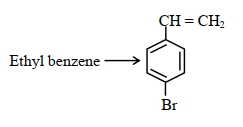
A
$Br_2 / Fe ; Cl_2, \Delta ; \text{alc. } KOH$
B
$Cl_2 / Fe ; Br_2 / \text{anhy. } AlCl_3 ; \text{aq. } KOH$
C
$Br_2 / \text{anhy. } AlCl_3 ; Cl_2, \Delta ; \text{aq. } KOH$
D
$Cl_2 / \text{anhy. } AlCl_3 ; Br_2 / Fe ; \text{alc. } KOH$
Solution
(A) The conversion of ethylbenzene to $p$-bromostyrene involves three steps:
$1$. Electrophilic aromatic substitution: Treatment of ethylbenzene with $Br_2 / Fe$ (or $FeBr_3$) leads to bromination at the para position due to the ortho/para-directing nature of the ethyl group.
$2$. Free radical halogenation: Treatment with $Cl_2, \Delta$ (or $h\nu$) results in the chlorination of the benzylic position of the ethyl group.
$3$. Dehydrohalogenation: Treatment with alcoholic $KOH$ (alc. $KOH$) causes the elimination of $HCl$ from the side chain to form the vinyl group (styrene derivative).
Thus,the correct sequence is $Br_2 / Fe ; Cl_2, \Delta ; \text{alc. } KOH$.
$1$. Electrophilic aromatic substitution: Treatment of ethylbenzene with $Br_2 / Fe$ (or $FeBr_3$) leads to bromination at the para position due to the ortho/para-directing nature of the ethyl group.
$2$. Free radical halogenation: Treatment with $Cl_2, \Delta$ (or $h\nu$) results in the chlorination of the benzylic position of the ethyl group.
$3$. Dehydrohalogenation: Treatment with alcoholic $KOH$ (alc. $KOH$) causes the elimination of $HCl$ from the side chain to form the vinyl group (styrene derivative).
Thus,the correct sequence is $Br_2 / Fe ; Cl_2, \Delta ; \text{alc. } KOH$.
0 likesView Solution
267
ChemistryMediumMCQJEE Main · 2025
Given below are two statements:
Statement $I$: $A$ homoleptic octahedral complex,formed using monodentate ligands,will not show stereoisomerism.
Statement $II$: $cis-$ and $trans-$ platin are heteroleptic complexes of $Pd$.
In the light of the above statements,choose the correct answer from the options given below.
Statement $I$: $A$ homoleptic octahedral complex,formed using monodentate ligands,will not show stereoisomerism.
Statement $II$: $cis-$ and $trans-$ platin are heteroleptic complexes of $Pd$.
In the light of the above statements,choose the correct answer from the options given below.
A
Both statement $I$ and Statement $II$ are false.
B
Statement $I$ is false but Statement $II$ is true.
C
Both statement $I$ and Statement $II$ are true.
D
Statement $I$ is true but Statement $II$ is false.
Solution
(D) Statement $I$ is true: $A$ homoleptic octahedral complex with only one type of monodentate ligand (e.g.,$[Ma_6]$) does not exhibit stereoisomerism.
Statement $II$ is false: $cis-$platin and $trans-$platin have the formula $[Pt(NH_3)_2Cl_2]$. These are heteroleptic complexes of $Pt$ (Platinum),not $Pd$ (Palladium).
Therefore,Statement $I$ is true but Statement $II$ is false.
Statement $II$ is false: $cis-$platin and $trans-$platin have the formula $[Pt(NH_3)_2Cl_2]$. These are heteroleptic complexes of $Pt$ (Platinum),not $Pd$ (Palladium).
Therefore,Statement $I$ is true but Statement $II$ is false.
0 likesView Solution
268
ChemistryMediumMCQJEE Main · 2025
Which of the following binary mixtures does not show the behavior of minimum boiling azeotropes?
A
$H_2O + CH_3COC_2H_5$
B
$C_6H_5OH + C_6H_5NH_2$
C
$CS_2 + CH_3COCH_3$
D
$CH_3OH + CHCl_3$
Solution
(B) binary mixture of $C_6H_5OH$ and $C_6H_5NH_2$ shows a negative deviation from Raoult's law.
This occurs because the intermolecular hydrogen bonding between phenol and aniline is stronger than the interactions in the pure components.
As a result,the vapour pressure of the solution is lower than that of the pure components,which leads to a higher boiling point for the solution compared to the pure components.
Therefore,this mixture forms a maximum boiling azeotrope,not a minimum boiling azeotrope.
This occurs because the intermolecular hydrogen bonding between phenol and aniline is stronger than the interactions in the pure components.
As a result,the vapour pressure of the solution is lower than that of the pure components,which leads to a higher boiling point for the solution compared to the pure components.
Therefore,this mixture forms a maximum boiling azeotrope,not a minimum boiling azeotrope.
0 likesView Solution
269
ChemistryMediumMCQJEE Main · 2025
$HA_{(aq)} \rightleftharpoons H^{+}_{(aq)} + A^{-}_{(aq)}$
The freezing point depression of a $0.1 \ m$ aqueous solution of a monobasic weak acid $HA$ is $0.20^{\circ} C$. The dissociation constant for the acid is. Given: $K_{f}(H_2O) = 1.8 \ K \ kg \ mol^{-1}$,molality $\equiv$ molarity.
The freezing point depression of a $0.1 \ m$ aqueous solution of a monobasic weak acid $HA$ is $0.20^{\circ} C$. The dissociation constant for the acid is. Given: $K_{f}(H_2O) = 1.8 \ K \ kg \ mol^{-1}$,molality $\equiv$ molarity.
A
$1.38 \times 10^{-3}$
B
$1.1 \times 10^{-2}$
C
$1.90 \times 10^{-3}$
D
$1.89 \times 10^{-1}$
Solution
(A) The formula for freezing point depression is $\Delta T_{f} = i K_{f} m$.
Given $\Delta T_{f} = 0.20^{\circ} C$,$K_{f} = 1.8 \ K \ kg \ mol^{-1}$,and $m = 0.1 \ m$.
$0.20 = i \times 1.8 \times 0.1$
$i = \frac{0.20}{0.18} = \frac{10}{9}$.
For the dissociation $HA \rightleftharpoons H^{+} + A^{-}$,the van't Hoff factor $i = 1 + \alpha$,where $\alpha$ is the degree of dissociation.
$1 + \alpha = \frac{10}{9} \implies \alpha = \frac{1}{9}$.
The dissociation constant $K_{a} = \frac{C \alpha^2}{1 - \alpha}$.
Substituting $C = 0.1$ and $\alpha = \frac{1}{9}$:
$K_{a} = \frac{0.1 \times (1/9)^2}{1 - 1/9} = \frac{0.1 \times (1/81)}{8/9} = \frac{0.1}{81} \times \frac{9}{8} = \frac{0.1}{72} = \frac{1}{720} \approx 1.38 \times 10^{-3}$.
Given $\Delta T_{f} = 0.20^{\circ} C$,$K_{f} = 1.8 \ K \ kg \ mol^{-1}$,and $m = 0.1 \ m$.
$0.20 = i \times 1.8 \times 0.1$
$i = \frac{0.20}{0.18} = \frac{10}{9}$.
For the dissociation $HA \rightleftharpoons H^{+} + A^{-}$,the van't Hoff factor $i = 1 + \alpha$,where $\alpha$ is the degree of dissociation.
$1 + \alpha = \frac{10}{9} \implies \alpha = \frac{1}{9}$.
The dissociation constant $K_{a} = \frac{C \alpha^2}{1 - \alpha}$.
Substituting $C = 0.1$ and $\alpha = \frac{1}{9}$:
$K_{a} = \frac{0.1 \times (1/9)^2}{1 - 1/9} = \frac{0.1 \times (1/81)}{8/9} = \frac{0.1}{81} \times \frac{9}{8} = \frac{0.1}{72} = \frac{1}{720} \approx 1.38 \times 10^{-3}$.
0 likesView Solution
270
ChemistryMediumMCQJEE Main · 2025
The correct decreasing order of spin only magnetic moment values $(BM)$ of $Cu^{+}$,$Cu^{2+}$,$Cr^{2+}$ and $Cr^{3+}$ ions is $:$
A
$Cu^{+} > Cu^{2+} > Cr^{3+} > Cr^{2+}$
B
$Cu^{2+} > Cu^{+} > Cr^{2+} > Cr^{3+}$
C
$Cr^{2+} > Cr^{3+} > Cu^{2+} > Cu^{+}$
D
$Cr^{3+} > Cr^{2+} > Cu^{+} > Cu^{2+}$
Solution
(C) The spin only magnetic moment is calculated using the formula $\mu = \sqrt{n(n+2)} \ BM$,where $n$ is the number of unpaired electrons.
$Cu^{+} : [Ar] 3d^{10}$,$n = 0$,$\mu = 0 \ BM$.
$Cu^{2+} : [Ar] 3d^{9}$,$n = 1$,$\mu = \sqrt{1(1+2)} = \sqrt{3} \approx 1.73 \ BM$.
$Cr^{2+} : [Ar] 3d^{4}$,$n = 4$,$\mu = \sqrt{4(4+2)} = \sqrt{24} \approx 4.90 \ BM$.
$Cr^{3+} : [Ar] 3d^{3}$,$n = 3$,$\mu = \sqrt{3(3+2)} = \sqrt{15} \approx 3.87 \ BM$.
Comparing the values: $4.90 > 3.87 > 1.73 > 0$.
Therefore,the decreasing order is $Cr^{2+} > Cr^{3+} > Cu^{2+} > Cu^{+}$.
$Cu^{+} : [Ar] 3d^{10}$,$n = 0$,$\mu = 0 \ BM$.
$Cu^{2+} : [Ar] 3d^{9}$,$n = 1$,$\mu = \sqrt{1(1+2)} = \sqrt{3} \approx 1.73 \ BM$.
$Cr^{2+} : [Ar] 3d^{4}$,$n = 4$,$\mu = \sqrt{4(4+2)} = \sqrt{24} \approx 4.90 \ BM$.
$Cr^{3+} : [Ar] 3d^{3}$,$n = 3$,$\mu = \sqrt{3(3+2)} = \sqrt{15} \approx 3.87 \ BM$.
Comparing the values: $4.90 > 3.87 > 1.73 > 0$.
Therefore,the decreasing order is $Cr^{2+} > Cr^{3+} > Cu^{2+} > Cu^{+}$.
0 likesView Solution
271
ChemistryMediumMCQJEE Main · 2025
Which one of the following reactions will not lead to the desired ether formation in major proportion? (iso-$Bu$ $\Rightarrow$ isobutyl,sec-$Bu$ $\Rightarrow$ sec-butyl,$nPr$ $\Rightarrow$ $n$-propyl,${}^{t}Bu$ $\Rightarrow$ tert-butyl,$Et$ $\Rightarrow$ ethyl)
A
${}^{t}BuO^{\ominus} Na^{\oplus} + EtBr \rightarrow {}^{t}BuOEt$
B
Cyclohexyl-$O^{\ominus} Na^{\oplus} + CH_3Br \rightarrow$ Cyclohexyl-$O-CH_3$
C
$PhO^{\ominus} Na^{\oplus} + n-PrBr \rightarrow n-Pr-O-Ph$
D
$iso-BuO^{\ominus} Na^{\oplus} + sec-BuBr \rightarrow$ Elimination product
Solution
(D) The Williamson ether synthesis involves the reaction of an alkoxide ion with an alkyl halide. For the reaction to proceed via $S_N2$ mechanism to form an ether,the alkyl halide should ideally be primary. If the alkyl halide is secondary or tertiary,the strong base (alkoxide) will prefer to undergo an $E2$ elimination reaction rather than $S_N2$ substitution.
In option $A$,${}^{t}BuO^{\ominus}$ is a bulky base and $EtBr$ is a primary halide,so $S_N2$ is possible,but often elimination competes. However,in option $D$,$iso-BuO^{\ominus}$ is a base reacting with $sec-BuBr$ (a secondary alkyl halide). Due to steric hindrance and the nature of the secondary halide,the $E2$ elimination reaction is highly favored over $S_N2$ substitution,leading to alkene formation as the major product instead of the desired ether.
In option $A$,${}^{t}BuO^{\ominus}$ is a bulky base and $EtBr$ is a primary halide,so $S_N2$ is possible,but often elimination competes. However,in option $D$,$iso-BuO^{\ominus}$ is a base reacting with $sec-BuBr$ (a secondary alkyl halide). Due to steric hindrance and the nature of the secondary halide,the $E2$ elimination reaction is highly favored over $S_N2$ substitution,leading to alkene formation as the major product instead of the desired ether.
0 likesView Solution
272
ChemistryMediumMCQJEE Main · 2025
Choose the correct option for structures of $A$ and $B,$ respectively.
A
$H_3N^+-CH(CH(CH_3)_2)-COOH$ and $H_2N-CH(CH(CH_3)_2)-COO^-$
B
$H_2N-CH(CH(CH_3)_2)-COO^-$ and $H_3N^+-CH(CH(CH_3)_2)-COOH$
C
$H_2N-CH(CH(CH_3)_2)-COO^-$ and $H_3N^+-CH(CH(CH_3)_2)-COO^-$
D
$H_3N^+-CH(CH(CH_3)_2)-COO^-$ and $H_3N^+-CH(CH(CH_3)_2)-COOH$
Solution
(A) Amino acids are amphoteric in nature. In an acidic medium (low $pH$),the amino group $(-NH_2)$ gets protonated to form $-NH_3^+$.
Thus,at $pH = 2$,the structure $A$ is $H_3N^+-CH(CH(CH_3)_2)-COOH$.
In a basic medium (high $pH$),the carboxylic acid group $(-COOH)$ gets deprotonated to form $-COO^-$.
Thus,at $pH = 10$,the structure $B$ is $H_2N-CH(CH(CH_3)_2)-COO^-$.
Therefore,the correct option is $A$.
Thus,at $pH = 2$,the structure $A$ is $H_3N^+-CH(CH(CH_3)_2)-COOH$.
In a basic medium (high $pH$),the carboxylic acid group $(-COOH)$ gets deprotonated to form $-COO^-$.
Thus,at $pH = 10$,the structure $B$ is $H_2N-CH(CH(CH_3)_2)-COO^-$.
Therefore,the correct option is $A$.
0 likesView Solution
Vedclass Products
For Students
Vedclass Test Series
Mock tests in real JEE Main style covering Chemistry with performance analysis. 5-day free trial.
Start Free TrialFor Teachers
Exam Paper Generator
Generate Set A/B/C/D Chemistry papers from 7.5L+ questions in 2 minutes. 3 chapters free.
Try FreeFor Institutes
Online Exam Module
Run live JEE Main mock exams with unlimited students, 360° analytics & white-label branding.
See DemoFrequently Asked Questions
How many Chemistry questions are in JEE Main 2025?
There are 478 Chemistry questions from the JEE Main 2025 paper on Vedclass, each with a detailed step-by-step solution in English.
Are JEE Main 2025 Chemistry solutions available in English?
Yes. All solutions on this page are in English. You can also switch to English or Hindi using the language buttons above the questions.
Can I practice JEE Main 2025 Chemistry as a timed test?
Yes. Use the Vedclass Test Series to attempt a full JEE Main mock test covering Chemistry with time limits and instant score analysis.
Can teachers create Chemistry papers from JEE Main previous year questions?
Yes. The Vedclass Exam Paper Generator lets teachers mix JEE Main Chemistry questions and generate Set A/B/C/D papers in minutes.
For Teachers & Institutes
Build a Custom Chemistry Paper
Pick JEE Main 2025 Chemistry questions, set difficulty, and generate Set A/B/C/D in 2 minutes.