
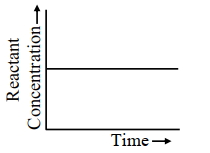
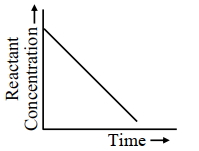
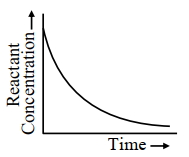
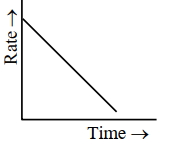
Which of the following graphs most appropriately represents a zero order reaction?
- A
- B
- C
- D
Explore More
Similar Questions
For a zero order reaction $A \rightarrow \text{product}$,a plot of $[A]$ (on $y$-axis) and time (on $x$-axis) gave a straight line with slope equal to $-3 \times 10^{-3} \ M \ min^{-1}$ and intercept equal to $2 \times 10^{-2} \ M$ (on $y$-axis). What is the rate constant (in $M \ min^{-1}$) of this reaction?
Find the percentage of unreacted reactant for a zero order reaction in $90 \ s$ having a rate constant of $1 \ mol \ dm^{-3} \ s^{-1}$. (in $\%$)
DifficultMHT CET 2024
View SolutionIn a reaction,reactant $A$ decomposes $10 \%$ in $1 \ hour$,$20 \%$ in $2 \ hours$ and $30 \%$ in $3 \ hours$. The unit of rate constant of this reaction is
Medium
View SolutionConsider the reaction $aX \to bY$,for which the rate constant at $30^\circ C$ is $1 \times 10^{-3} \text{ mol L}^{-1} \text{ s}^{-1}$. Which of the following statements are true?
$A$. When concentration of $X$ is increased to four times,the rate of reaction becomes $16$ times.
$B$. The reaction is a second order reaction.
$C$. The half-life period is independent of the concentration of $X$.
$D$. Decomposition of $N_2O_5$ is an example of the above reaction.
$E$. $\ln \frac{[R]_0}{[R]}$ vs time is valid for the above reaction.
$A$. When concentration of $X$ is increased to four times,the rate of reaction becomes $16$ times.
$B$. The reaction is a second order reaction.
$C$. The half-life period is independent of the concentration of $X$.
$D$. Decomposition of $N_2O_5$ is an example of the above reaction.
$E$. $\ln \frac{[R]_0}{[R]}$ vs time is valid for the above reaction.
What is a zero order reaction? Determine the integrated rate equation for a zero order reaction $R \to P$.
Difficult
View SolutionVedclass Products
For Students
Vedclass Test Series
Mock tests in real JEE/NEET style with performance analysis. 5-day free trial.
Start Free TrialFor Teachers
Exam Paper Generator
Generate Set A/B/C/D exam papers from 7.5L+ questions in 2 minutes. 3 chapters free.
Try FreeFor Institutes
Online Exam Module
Live online exams with unlimited students, 360° analytics & white-label branding.
See Demo