
PhysicsQ301–400 of 773 questions
Page 7 of 9 · English
301
PhysicsEasyMCQJEE Main · 2021
Which of the following graphs represents the behavior of an ideal gas? Symbols have their usual meaning.
A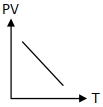
B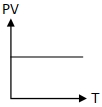
C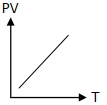
D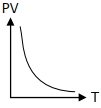
Solution
(C) For an ideal gas,the equation of state is given by the ideal gas law:
$PV = nRT$
where $P$ is pressure,$V$ is volume,$n$ is the number of moles,$R$ is the universal gas constant,and $T$ is the absolute temperature.
Since $n$ and $R$ are constants for a given amount of gas,we have:
$PV \propto T$
This implies that the graph of $PV$ versus $T$ should be a straight line passing through the origin,as $PV$ is directly proportional to $T$.
Therefore,the correct graph is the one showing a linear increase of $PV$ with respect to $T$ passing through the origin.
$PV = nRT$
where $P$ is pressure,$V$ is volume,$n$ is the number of moles,$R$ is the universal gas constant,and $T$ is the absolute temperature.
Since $n$ and $R$ are constants for a given amount of gas,we have:
$PV \propto T$
This implies that the graph of $PV$ versus $T$ should be a straight line passing through the origin,as $PV$ is directly proportional to $T$.
Therefore,the correct graph is the one showing a linear increase of $PV$ with respect to $T$ passing through the origin.
0 likesView Solution
302
PhysicsMediumMCQJEE Main · 2021
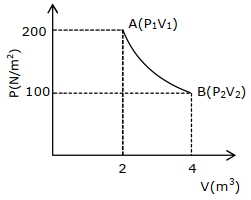
One mole of an ideal gas at $27^{\circ} {C}$ is taken from $A$ to $B$ as shown in the given $PV$ indicator diagram. The work done by the system will be $...... \times 10^{-1} \, {J}$.
[Given: $R = 8.3 \, {J} / \text{mole} \cdot {K}, \ln 2 = 0.6931$] (Round off to the nearest integer)
[Given: $R = 8.3 \, {J} / \text{mole} \cdot {K}, \ln 2 = 0.6931$] (Round off to the nearest integer)
A
$30012$
B
$2147$
C
$834$
D
$17258$
Solution
(D) The process shown in the $PV$ diagram is an isothermal process because the curve follows the relation $PV = \text{constant}$.
The work done in an isothermal process is given by the formula:
$W = nRT \ln \left( \frac{V_2}{V_1} \right)$
Given values:
$n = 1 \, \text{mole}$
$T = 27^{\circ} {C} = 27 + 273 = 300 \, {K}$
$R = 8.3 \, {J} / \text{mole} \cdot {K}$
$V_1 = 2 \, {m}^3, V_2 = 4 \, {m}^3$
$\ln 2 = 0.6931$
Substituting the values:
$W = 1 \times 8.3 \times 300 \times \ln \left( \frac{4}{2} \right)$
$W = 2490 \times \ln 2$
$W = 2490 \times 0.6931$
$W = 1725.819 \, {J}$
To express this in the form $...... \times 10^{-1} \, {J}$:
$W = 17258.19 \times 10^{-1} \, {J}$
Rounding off to the nearest integer,we get $17258 \times 10^{-1} \, {J}$.
The work done in an isothermal process is given by the formula:
$W = nRT \ln \left( \frac{V_2}{V_1} \right)$
Given values:
$n = 1 \, \text{mole}$
$T = 27^{\circ} {C} = 27 + 273 = 300 \, {K}$
$R = 8.3 \, {J} / \text{mole} \cdot {K}$
$V_1 = 2 \, {m}^3, V_2 = 4 \, {m}^3$
$\ln 2 = 0.6931$
Substituting the values:
$W = 1 \times 8.3 \times 300 \times \ln \left( \frac{4}{2} \right)$
$W = 2490 \times \ln 2$
$W = 2490 \times 0.6931$
$W = 1725.819 \, {J}$
To express this in the form $...... \times 10^{-1} \, {J}$:
$W = 17258.19 \times 10^{-1} \, {J}$
Rounding off to the nearest integer,we get $17258 \times 10^{-1} \, {J}$.
0 likesView Solution
303
PhysicsMediumMCQJEE Main · 2021
Two bodies,a ring and a solid cylinder of the same material,are rolling down without slipping an inclined plane. The radii of the bodies are the same. The ratio of the velocity of the centre of mass at the bottom of the inclined plane of the ring to that of the cylinder is $\frac{\sqrt{x}}{2}$. Then,the value of $x$ is .... .
A
$1$
B
$3$
C
$9$
D
$10$
Solution
(B) For a body rolling down an inclined plane of height $h$,the conservation of energy gives $mgh = \frac{1}{2}mv^2 + \frac{1}{2}I\omega^2$. Since $v = R\omega$,we have $mgh = \frac{1}{2}mv^2 + \frac{1}{2}I(\frac{v}{R})^2 = \frac{1}{2}mv^2(1 + \frac{I}{mR^2})$.
For a ring,$I = mR^2$,so $mgh = \frac{1}{2}mv_R^2(1 + 1) = mv_R^2$. Thus,$v_R = \sqrt{gh}$.
For a solid cylinder,$I = \frac{1}{2}mR^2$,so $mgh = \frac{1}{2}mv_c^2(1 + \frac{1}{2}) = \frac{3}{4}mv_c^2$. Thus,$v_c = \sqrt{\frac{4gh}{3}}$.
The ratio of velocities is $\frac{v_R}{v_c} = \frac{\sqrt{gh}}{\sqrt{4gh/3}} = \sqrt{\frac{3}{4}} = \frac{\sqrt{3}}{2}$.
Comparing this to $\frac{\sqrt{x}}{2}$,we get $x = 3$.
For a ring,$I = mR^2$,so $mgh = \frac{1}{2}mv_R^2(1 + 1) = mv_R^2$. Thus,$v_R = \sqrt{gh}$.
For a solid cylinder,$I = \frac{1}{2}mR^2$,so $mgh = \frac{1}{2}mv_c^2(1 + \frac{1}{2}) = \frac{3}{4}mv_c^2$. Thus,$v_c = \sqrt{\frac{4gh}{3}}$.
The ratio of velocities is $\frac{v_R}{v_c} = \frac{\sqrt{gh}}{\sqrt{4gh/3}} = \sqrt{\frac{3}{4}} = \frac{\sqrt{3}}{2}$.
Comparing this to $\frac{\sqrt{x}}{2}$,we get $x = 3$.
0 likesView Solution
304
PhysicsDifficultMCQJEE Main · 2021
$A$ body of mass $m$ is launched up on a rough inclined plane making an angle of $30^{\circ}$ with the horizontal. The coefficient of friction between the body and plane is $\frac{\sqrt{x}}{5}$. If the time of ascent is half of the time of descent,the value of $x$ is ..... .
A
$1$
B
$2$
C
$3$
D
$4$
Solution
(C) Let $t_a$ be the time of ascent and $t_d$ be the time of descent. Given $t_a = \frac{1}{2} t_d$,which implies $t_d = 2 t_a$.
Since the distance $s$ covered is the same,$s = \frac{1}{2} a_a t_a^2 = \frac{1}{2} a_d t_d^2$.
Substituting $t_d = 2 t_a$,we get $a_a t_a^2 = a_d (2 t_a)^2$,so $a_a = 4 a_d$.
The acceleration during ascent is $a_a = g \sin \theta + \mu g \cos \theta = g \sin 30^{\circ} + \mu g \cos 30^{\circ} = \frac{g}{2} + \frac{\sqrt{3}}{2} \mu g$.
The acceleration during descent is $a_d = g \sin \theta - \mu g \cos \theta = g \sin 30^{\circ} - \mu g \cos 30^{\circ} = \frac{g}{2} - \frac{\sqrt{3}}{2} \mu g$.
Substituting these into $a_a = 4 a_d$: $\frac{g}{2} + \frac{\sqrt{3}}{2} \mu g = 4 (\frac{g}{2} - \frac{\sqrt{3}}{2} \mu g)$.
Dividing by $g$: $\frac{1}{2} + \frac{\sqrt{3}}{2} \mu = 2 - 2\sqrt{3} \mu$.
$\frac{5\sqrt{3}}{2} \mu = \frac{3}{2} \implies \mu = \frac{3}{5\sqrt{3}} = \frac{\sqrt{3}}{5}$.
Comparing $\mu = \frac{\sqrt{3}}{5}$ with $\frac{\sqrt{x}}{5}$,we get $x = 3$.
Since the distance $s$ covered is the same,$s = \frac{1}{2} a_a t_a^2 = \frac{1}{2} a_d t_d^2$.
Substituting $t_d = 2 t_a$,we get $a_a t_a^2 = a_d (2 t_a)^2$,so $a_a = 4 a_d$.
The acceleration during ascent is $a_a = g \sin \theta + \mu g \cos \theta = g \sin 30^{\circ} + \mu g \cos 30^{\circ} = \frac{g}{2} + \frac{\sqrt{3}}{2} \mu g$.
The acceleration during descent is $a_d = g \sin \theta - \mu g \cos \theta = g \sin 30^{\circ} - \mu g \cos 30^{\circ} = \frac{g}{2} - \frac{\sqrt{3}}{2} \mu g$.
Substituting these into $a_a = 4 a_d$: $\frac{g}{2} + \frac{\sqrt{3}}{2} \mu g = 4 (\frac{g}{2} - \frac{\sqrt{3}}{2} \mu g)$.
Dividing by $g$: $\frac{1}{2} + \frac{\sqrt{3}}{2} \mu = 2 - 2\sqrt{3} \mu$.
$\frac{5\sqrt{3}}{2} \mu = \frac{3}{2} \implies \mu = \frac{3}{5\sqrt{3}} = \frac{\sqrt{3}}{5}$.
Comparing $\mu = \frac{\sqrt{3}}{5}$ with $\frac{\sqrt{x}}{5}$,we get $x = 3$.
0 likesView Solution
305
PhysicsMediumMCQJEE Main · 2021
$A$ body rotating with an angular speed of $600 \, rpm$ is uniformly accelerated to $1800 \, rpm$ in $10 \, s$. The number of rotations made in the process is ..... .
A
$100$
B
$500$
C
$300$
D
$200$
Solution
(D) Initial angular speed,$\omega_0 = 600 \, rpm = 10 \, rev/s$.
Final angular speed,$\omega_f = 1800 \, rpm = 30 \, rev/s$.
Time taken,$t = 10 \, s$.
Since the acceleration is uniform,the average angular speed is $\omega_{avg} = \frac{\omega_0 + \omega_f}{2} = \frac{10 + 30}{2} = 20 \, rev/s$.
The total number of rotations (revolutions) made is $\theta = \omega_{avg} \times t$.
$\theta = 20 \, rev/s \times 10 \, s = 200 \, rev$.
Final angular speed,$\omega_f = 1800 \, rpm = 30 \, rev/s$.
Time taken,$t = 10 \, s$.
Since the acceleration is uniform,the average angular speed is $\omega_{avg} = \frac{\omega_0 + \omega_f}{2} = \frac{10 + 30}{2} = 20 \, rev/s$.
The total number of rotations (revolutions) made is $\theta = \omega_{avg} \times t$.
$\theta = 20 \, rev/s \times 10 \, s = 200 \, rev$.
0 likesView Solution
306
PhysicsMediumMCQJEE Main · 2021
$A$ porter lifts a heavy suitcase of mass $80\, \text{kg}$ and at the destination lowers it down by a distance of $80\, \text{cm}$ with a constant velocity. Calculate the work done by the porter in lowering the suitcase. (Take $g = 9.8\, \text{m/s}^2$) (In $\text{J}$)
A
$+627.2\, \text{J}$
B
$-62720.0\, \text{J}$
C
$784.0\, \text{J}$
D
$-627.2\, \text{J}$
Solution
(D) According to the Work-Energy Theorem,the net work done on an object is equal to the change in its kinetic energy.
Since the suitcase is moved with a constant velocity,the change in kinetic energy $\Delta K.E. = 0$.
Therefore,the total work done by all forces is $W_{\text{Porter}} + W_{\text{gravity}} = 0$.
This implies $W_{\text{Porter}} = -W_{\text{gravity}}$.
The work done by gravity is $W_{\text{gravity}} = mgh$,where $h$ is the displacement.
Here,$m = 80\, \text{kg}$,$g = 9.8\, \text{m/s}^2$,and $h = 80\, \text{cm} = 0.8\, \text{m}$.
Since the porter is lowering the suitcase,the force applied by the porter is upwards while the displacement is downwards.
$W_{\text{Porter}} = -mgh = -(80) \times (9.8) \times (0.8) = -627.2\, \text{J}$.
Since the suitcase is moved with a constant velocity,the change in kinetic energy $\Delta K.E. = 0$.
Therefore,the total work done by all forces is $W_{\text{Porter}} + W_{\text{gravity}} = 0$.
This implies $W_{\text{Porter}} = -W_{\text{gravity}}$.
The work done by gravity is $W_{\text{gravity}} = mgh$,where $h$ is the displacement.
Here,$m = 80\, \text{kg}$,$g = 9.8\, \text{m/s}^2$,and $h = 80\, \text{cm} = 0.8\, \text{m}$.
Since the porter is lowering the suitcase,the force applied by the porter is upwards while the displacement is downwards.
$W_{\text{Porter}} = -mgh = -(80) \times (9.8) \times (0.8) = -627.2\, \text{J}$.
0 likesView Solution
307
PhysicsMediumMCQJEE Main · 2021
What will be the projection of vector $\vec{A} = \hat{i} + \hat{j} + \hat{k}$ on vector $\vec{B} = \hat{i} + \hat{j}$?
A
$\sqrt{2}(\hat{i} + \hat{j})$
B
$(\hat{i} + \hat{j})$
C
$\sqrt{2}(\hat{i} + \hat{j} + \hat{k})$
D
$2(\hat{i} + \hat{j} + \hat{k})$
Solution
(B) The projection of vector $\vec{A}$ on vector $\vec{B}$ is given by the formula: $\text{Proj}_{\vec{B}} \vec{A} = \left( \frac{\vec{A} \cdot \vec{B}}{|\vec{B}|} \right) \hat{B}$,where $\hat{B}$ is the unit vector along $\vec{B}$.
First,calculate the dot product: $\vec{A} \cdot \vec{B} = (1)(1) + (1)(1) + (1)(0) = 1 + 1 = 2$.
Next,calculate the magnitude of $\vec{B}$: $|\vec{B}| = \sqrt{1^2 + 1^2} = \sqrt{2}$.
Then,the unit vector $\hat{B} = \frac{\vec{B}}{|\vec{B}|} = \frac{\hat{i} + \hat{j}}{\sqrt{2}}$.
Finally,substitute these values into the projection formula:
$\text{Proj}_{\vec{B}} \vec{A} = \left( \frac{2}{\sqrt{2}} \right) \left( \frac{\hat{i} + \hat{j}}{\sqrt{2}} \right) = \sqrt{2} \cdot \frac{\hat{i} + \hat{j}}{\sqrt{2}} = \hat{i} + \hat{j}$.
First,calculate the dot product: $\vec{A} \cdot \vec{B} = (1)(1) + (1)(1) + (1)(0) = 1 + 1 = 2$.
Next,calculate the magnitude of $\vec{B}$: $|\vec{B}| = \sqrt{1^2 + 1^2} = \sqrt{2}$.
Then,the unit vector $\hat{B} = \frac{\vec{B}}{|\vec{B}|} = \frac{\hat{i} + \hat{j}}{\sqrt{2}}$.
Finally,substitute these values into the projection formula:
$\text{Proj}_{\vec{B}} \vec{A} = \left( \frac{2}{\sqrt{2}} \right) \left( \frac{\hat{i} + \hat{j}}{\sqrt{2}} \right) = \sqrt{2} \cdot \frac{\hat{i} + \hat{j}}{\sqrt{2}} = \hat{i} + \hat{j}$.
0 likesView Solution
308
PhysicsMediumMCQJEE Main · 2021
Consider a situation in which a ring,a solid cylinder,and a solid sphere roll down on the same inclined plane without slipping. Assume that they start rolling from rest and have identical diameters. The correct statement for this situation is:
A
The sphere has the greatest and the ring has the least velocity of the centre of mass at the bottom of the inclined plane.
B
The ring has the greatest and the cylinder has the least velocity of the centre of mass at the bottom of the inclined plane.
C
All of them will have the same velocity.
D
The cylinder has the greatest and the sphere has the least velocity of the centre of mass at the bottom of the inclined plane.
Solution
(A) The acceleration of a body rolling down an inclined plane is given by $a = \frac{g \sin \theta}{1 + \frac{I}{mR^2}}$.
The moment of inertia $I$ for the objects are: $I_{\text{ring}} = mR^2$,$I_{\text{cylinder}} = \frac{1}{2}mR^2$,and $I_{\text{sphere}} = \frac{2}{5}mR^2$.
Comparing the moments of inertia: $I_{\text{ring}} > I_{\text{cylinder}} > I_{\text{sphere}}$.
Since $a$ is inversely proportional to the factor $(1 + \frac{I}{mR^2})$,the acceleration follows the order: $a_{\text{ring}} < a_{\text{cylinder}} < a_{\text{sphere}}$.
Using the kinematic equation $v^2 = u^2 + 2as$ with $u = 0$,the final velocity $v = \sqrt{2as}$ is directly proportional to the square root of acceleration.
Therefore,the final velocities at the bottom of the plane follow the order: $v_{\text{ring}} < v_{\text{cylinder}} < v_{\text{sphere}}$.
Thus,the sphere has the greatest velocity and the ring has the least velocity.
The moment of inertia $I$ for the objects are: $I_{\text{ring}} = mR^2$,$I_{\text{cylinder}} = \frac{1}{2}mR^2$,and $I_{\text{sphere}} = \frac{2}{5}mR^2$.
Comparing the moments of inertia: $I_{\text{ring}} > I_{\text{cylinder}} > I_{\text{sphere}}$.
Since $a$ is inversely proportional to the factor $(1 + \frac{I}{mR^2})$,the acceleration follows the order: $a_{\text{ring}} < a_{\text{cylinder}} < a_{\text{sphere}}$.
Using the kinematic equation $v^2 = u^2 + 2as$ with $u = 0$,the final velocity $v = \sqrt{2as}$ is directly proportional to the square root of acceleration.
Therefore,the final velocities at the bottom of the plane follow the order: $v_{\text{ring}} < v_{\text{cylinder}} < v_{\text{sphere}}$.
Thus,the sphere has the greatest velocity and the ring has the least velocity.
0 likesView Solution
309
PhysicsDifficultMCQJEE Main · 2021
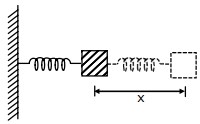
The motion of a mass on a spring,with spring constant $K$ is as shown in the figure. The equation of motion is given by $x(t) = A \sin \omega t + B \cos \omega t$ with $\omega = \sqrt{\frac{K}{m}}$. Suppose that at time $t = 0$,the position of the mass is $x(0)$ and velocity is $v(0)$,then its displacement can also be represented as $x(t) = C \cos (\omega t - \phi)$,where $C$ and $\phi$ are:
A
$C = \sqrt{\frac{2 v(0)^2}{\omega^2} + x(0)^2}, \phi = \tan^{-1} \left( \frac{x(0) \omega}{2 v(0)} \right)$
B
$C = \sqrt{\frac{v(0)^2}{\omega^2} + x(0)^2}, \phi = \tan^{-1} \left( \frac{x(0) \omega}{v(0)} \right)$
C
$C = \sqrt{\frac{2 v(0)^2}{\omega^2} + x(0)^2}, \phi = \tan^{-1} \left( \frac{v(0)}{x(0) \omega} \right)$
D
$C = \sqrt{\frac{v(0)^2}{\omega^2} + x(0)^2}, \phi = \tan^{-1} \left( \frac{v(0)}{x(0) \omega} \right)$
Solution
(D) Given the equation of motion: $x(t) = A \sin \omega t + B \cos \omega t$.
At $t = 0$,$x(0) = A \sin(0) + B \cos(0) = B$. So,$B = x(0)$.
The velocity is $v(t) = \frac{dx}{dt} = A \omega \cos \omega t - B \omega \sin \omega t$.
At $t = 0$,$v(0) = A \omega \cos(0) - B \omega \sin(0) = A \omega$. So,$A = \frac{v(0)}{\omega}$.
We want to express $x(t) = A \sin \omega t + B \cos \omega t$ in the form $x(t) = C \cos(\omega t - \phi) = C \cos \omega t \cos \phi + C \sin \omega t \sin \phi$.
Comparing the coefficients of $\sin \omega t$ and $\cos \omega t$:
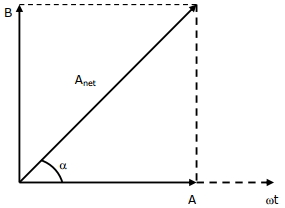
$A = C \sin \phi$ and $B = C \cos \phi$.
Squaring and adding: $A^2 + B^2 = C^2 (\sin^2 \phi + \cos^2 \phi) = C^2$.
Thus,$C = \sqrt{A^2 + B^2} = \sqrt{\left( \frac{v(0)}{\omega} \right)^2 + x(0)^2} = \sqrt{\frac{v(0)^2}{\omega^2} + x(0)^2}$.
Dividing the coefficients: $\frac{A}{B} = \frac{C \sin \phi}{C \cos \phi} = \tan \phi$.
Therefore,$\tan \phi = \frac{A}{B} = \frac{v(0) / \omega}{x(0)} = \frac{v(0)}{x(0) \omega}$,which implies $\phi = \tan^{-1} \left( \frac{v(0)}{x(0) \omega} \right)$.
At $t = 0$,$x(0) = A \sin(0) + B \cos(0) = B$. So,$B = x(0)$.
The velocity is $v(t) = \frac{dx}{dt} = A \omega \cos \omega t - B \omega \sin \omega t$.
At $t = 0$,$v(0) = A \omega \cos(0) - B \omega \sin(0) = A \omega$. So,$A = \frac{v(0)}{\omega}$.
We want to express $x(t) = A \sin \omega t + B \cos \omega t$ in the form $x(t) = C \cos(\omega t - \phi) = C \cos \omega t \cos \phi + C \sin \omega t \sin \phi$.
Comparing the coefficients of $\sin \omega t$ and $\cos \omega t$:
$A = C \sin \phi$ and $B = C \cos \phi$.
Squaring and adding: $A^2 + B^2 = C^2 (\sin^2 \phi + \cos^2 \phi) = C^2$.
Thus,$C = \sqrt{A^2 + B^2} = \sqrt{\left( \frac{v(0)}{\omega} \right)^2 + x(0)^2} = \sqrt{\frac{v(0)^2}{\omega^2} + x(0)^2}$.
Dividing the coefficients: $\frac{A}{B} = \frac{C \sin \phi}{C \cos \phi} = \tan \phi$.
Therefore,$\tan \phi = \frac{A}{B} = \frac{v(0) / \omega}{x(0)} = \frac{v(0)}{x(0) \omega}$,which implies $\phi = \tan^{-1} \left( \frac{v(0)}{x(0) \omega} \right)$.
0 likesView Solution
310
PhysicsEasyMCQJEE Main · 2021
$T_{0}$ is the time period of a simple pendulum at a place. If the length of the pendulum is reduced to $\frac{1}{16}$ times its initial value,the modified time period will be:
A
$8 \pi T_{0}$
B
$4 T_{0}$
C
$T_{0}$
D
$\frac{1}{4} T_{0}$
Solution
(D) The time period of a simple pendulum is given by the formula $T = 2 \pi \sqrt{\frac{\ell}{g}}$.
Initially,the time period is $T_{0} = 2 \pi \sqrt{\frac{\ell}{g}}$.
When the length is reduced to $\ell' = \frac{\ell}{16}$,the new time period $T'$ becomes:
$T' = 2 \pi \sqrt{\frac{\ell'}{g}} = 2 \pi \sqrt{\frac{\ell / 16}{g}}$.
$T' = \frac{1}{\sqrt{16}} \times (2 \pi \sqrt{\frac{\ell}{g}})$.
$T' = \frac{1}{4} T_{0}$.
Initially,the time period is $T_{0} = 2 \pi \sqrt{\frac{\ell}{g}}$.
When the length is reduced to $\ell' = \frac{\ell}{16}$,the new time period $T'$ becomes:
$T' = 2 \pi \sqrt{\frac{\ell'}{g}} = 2 \pi \sqrt{\frac{\ell / 16}{g}}$.
$T' = \frac{1}{\sqrt{16}} \times (2 \pi \sqrt{\frac{\ell}{g}})$.
$T' = \frac{1}{4} T_{0}$.
0 likesView Solution
311
PhysicsDifficultMCQJEE Main · 2021
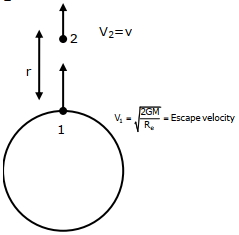
$A$ body is projected vertically upwards from the surface of the Earth with a velocity sufficient enough to carry it to infinity. The time taken by it to reach height $h$ is $....\,S.$
A
$\frac{1}{3} \sqrt{\frac{2 R_{e}}{g}}\left[\left(1+\frac{h}{R_{e}}\right)^{3 / 2}-1\right]$
B
$\sqrt{\frac{2 R_{e}}{g}}\left[\left(1+\frac{h}{R_{e}}\right)^{3 / 2}-1\right]$
C
$\frac{1}{3} \sqrt{\frac{R_{e}}{g}}\left[\left(1+\frac{h}{R_{e}}\right)^{3 / 2}-1\right]$
D
$\sqrt{\frac{R_{e}}{g}}\left[\left(1+\frac{h}{R_{e}}\right)^{3 / 2}-1\right]$
Solution
(A) The body is projected with escape velocity $v_e = \sqrt{\frac{2GM}{R_e}}$.
By conservation of energy at the surface and at a distance $r$ from the center of the Earth:
$\frac{1}{2}mv^2 - \frac{GMm}{r} = 0$ (since total energy is zero for escape velocity).
$\frac{1}{2}mv^2 = \frac{GMm}{r} \Rightarrow v = \sqrt{\frac{2GM}{r}} = \frac{dr}{dt}$.
Separating variables: $dt = \frac{dr}{\sqrt{2GM}} \cdot \sqrt{r}$.
Integrating from $t=0$ at $r=R_e$ to time $t$ at $r=R_e+h$:
$t = \frac{1}{\sqrt{2GM}} \int_{R_e}^{R_e+h} r^{1/2} dr = \frac{1}{\sqrt{2GM}} \cdot \frac{2}{3} [r^{3/2}]_{R_e}^{R_e+h}$.
$t = \frac{2}{3\sqrt{2GM}} [ (R_e+h)^{3/2} - R_e^{3/2} ] = \frac{2}{3\sqrt{2GM}} R_e^{3/2} [ (1 + \frac{h}{R_e})^{3/2} - 1 ]$.
Since $GM = gR_e^2$,we have $\sqrt{GM} = \sqrt{g}R_e$.
Substituting this: $t = \frac{2 R_e^{3/2}}{3 \sqrt{2} \sqrt{g} R_e} [ (1 + \frac{h}{R_e})^{3/2} - 1 ] = \frac{1}{3} \sqrt{\frac{2R_e}{g}} [ (1 + \frac{h}{R_e})^{3/2} - 1 ]$.
By conservation of energy at the surface and at a distance $r$ from the center of the Earth:
$\frac{1}{2}mv^2 - \frac{GMm}{r} = 0$ (since total energy is zero for escape velocity).
$\frac{1}{2}mv^2 = \frac{GMm}{r} \Rightarrow v = \sqrt{\frac{2GM}{r}} = \frac{dr}{dt}$.
Separating variables: $dt = \frac{dr}{\sqrt{2GM}} \cdot \sqrt{r}$.
Integrating from $t=0$ at $r=R_e$ to time $t$ at $r=R_e+h$:
$t = \frac{1}{\sqrt{2GM}} \int_{R_e}^{R_e+h} r^{1/2} dr = \frac{1}{\sqrt{2GM}} \cdot \frac{2}{3} [r^{3/2}]_{R_e}^{R_e+h}$.
$t = \frac{2}{3\sqrt{2GM}} [ (R_e+h)^{3/2} - R_e^{3/2} ] = \frac{2}{3\sqrt{2GM}} R_e^{3/2} [ (1 + \frac{h}{R_e})^{3/2} - 1 ]$.
Since $GM = gR_e^2$,we have $\sqrt{GM} = \sqrt{g}R_e$.
Substituting this: $t = \frac{2 R_e^{3/2}}{3 \sqrt{2} \sqrt{g} R_e} [ (1 + \frac{h}{R_e})^{3/2} - 1 ] = \frac{1}{3} \sqrt{\frac{2R_e}{g}} [ (1 + \frac{h}{R_e})^{3/2} - 1 ]$.
0 likesView Solution
312
PhysicsMediumMCQJEE Main · 2021
$A$ bullet of $4 \, g$ mass is fired from a gun of mass $4 \, kg$. If the bullet moves with the muzzle speed of $50 \, ms^{-1}$,the impulse imparted to the gun and the velocity of recoil of the gun are:
A
$0.4 \, kg \, ms^{-1}, 0.1 \, ms^{-1}$
B
$0.2 \, kg \, ms^{-1}, 0.1 \, ms^{-1}$
C
$0.2 \, kg \, ms^{-1}, 0.05 \, ms^{-1}$
D
$0.4 \, kg \, ms^{-1}, 0.05 \, ms^{-1}$
Solution
(C) Given:
Mass of bullet,$m = 4 \, g = 4 \times 10^{-3} \, kg$
Mass of gun,$M = 4 \, kg$
Velocity of bullet relative to ground,$v_b = 50 \, ms^{-1}$
Let $V$ be the recoil velocity of the gun.
According to the law of conservation of linear momentum,the initial momentum of the system is zero.
$M V + m v_b = 0$
$4 \times V + (4 \times 10^{-3}) \times 50 = 0$
$4 V = -0.2$
$V = -0.05 \, ms^{-1}$
The magnitude of the recoil velocity is $0.05 \, ms^{-1}$.
Impulse imparted to the gun is equal to the change in momentum of the gun:
$J = |M \Delta V| = |4 \times (-0.05) - 0| = 0.2 \, kg \, ms^{-1}$.
Mass of bullet,$m = 4 \, g = 4 \times 10^{-3} \, kg$
Mass of gun,$M = 4 \, kg$
Velocity of bullet relative to ground,$v_b = 50 \, ms^{-1}$
Let $V$ be the recoil velocity of the gun.
According to the law of conservation of linear momentum,the initial momentum of the system is zero.
$M V + m v_b = 0$
$4 \times V + (4 \times 10^{-3}) \times 50 = 0$
$4 V = -0.2$
$V = -0.05 \, ms^{-1}$
The magnitude of the recoil velocity is $0.05 \, ms^{-1}$.
Impulse imparted to the gun is equal to the change in momentum of the gun:
$J = |M \Delta V| = |4 \times (-0.05) - 0| = 0.2 \, kg \, ms^{-1}$.
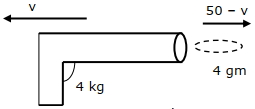
0 likesView Solution
313
PhysicsMediumMCQJEE Main · 2021
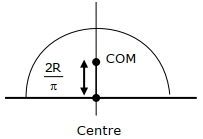
The position of the centre of mass of a uniform semi-circular wire of radius $R$ placed in the $x-y$ plane with its centre at the origin and the line joining its ends as the $x$-axis is given by $\left(0, \frac{x R}{\pi}\right)$.
Then,the value of $|x|$ is ...... .
Then,the value of $|x|$ is ...... .
A
$2$
B
$4$
C
$36$
D
$8$
Solution
(A) The centre of mass $(COM)$ of a uniform semi-circular wire of radius $R$ lies on the axis of symmetry at a distance of $\frac{2R}{\pi}$ from the centre.
Given that the position of the $COM$ is $\left(0, \frac{x R}{\pi}\right)$.
Comparing the $y$-coordinate,we get $\frac{x R}{\pi} = \frac{2 R}{\pi}$.
Therefore,$x = 2$.
The value of $|x|$ is $2$.
Given that the position of the $COM$ is $\left(0, \frac{x R}{\pi}\right)$.
Comparing the $y$-coordinate,we get $\frac{x R}{\pi} = \frac{2 R}{\pi}$.
Therefore,$x = 2$.
The value of $|x|$ is $2$.
0 likesView Solution
314
PhysicsMediumMCQJEE Main · 2021
The area of cross-section of a railway track is $0.01\, m^2$. The temperature variation is $10^{\circ}C$. The coefficient of linear expansion of the material of the track is $10^{-5} /^{\circ}C$. The energy stored per meter in the track is ...... $J/m$. (Young's modulus of the material of the track is $10^{11}\, Nm^{-2}$)
A
$4$
B
$5$
C
$6$
D
$7$
Solution
(B) The elastic potential energy stored per unit volume is given by $u = \frac{1}{2} \times \text{Young's Modulus} \times (\text{strain})^2$.
Since the track is constrained,the thermal strain is $\text{strain} = \alpha \Delta T$.
Given $\alpha = 10^{-5} /^{\circ}C$ and $\Delta T = 10^{\circ}C$,the strain is $\text{strain} = 10^{-5} \times 10 = 10^{-4}$.
The energy stored per unit length is $U = u \times \text{Area} = \frac{1}{2} Y (\text{strain})^2 \times A$.
Substituting the values: $U = \frac{1}{2} \times 10^{11} \times (10^{-4})^2 \times 0.01$.
$U = 0.5 \times 10^{11} \times 10^{-8} \times 10^{-2} = 0.5 \times 10^1 = 5\, J/m$.
Since the track is constrained,the thermal strain is $\text{strain} = \alpha \Delta T$.
Given $\alpha = 10^{-5} /^{\circ}C$ and $\Delta T = 10^{\circ}C$,the strain is $\text{strain} = 10^{-5} \times 10 = 10^{-4}$.
The energy stored per unit length is $U = u \times \text{Area} = \frac{1}{2} Y (\text{strain})^2 \times A$.
Substituting the values: $U = \frac{1}{2} \times 10^{11} \times (10^{-4})^2 \times 0.01$.
$U = 0.5 \times 10^{11} \times 10^{-8} \times 10^{-2} = 0.5 \times 10^1 = 5\, J/m$.
0 likesView Solution
315
PhysicsDifficultMCQJEE Main · 2021
Three students $S_{1}, S_{2}$ and $S_{3}$ perform an experiment for determining the acceleration due to gravity $(g)$ using a simple pendulum. They use different lengths of pendulum and record time for different number of oscillations. The observations are as shown in the table.
(Least count of length $= 0.1 \, cm$,least count for time $= 0.1 \, s$)
If $E_{1}, E_{2}$ and $E_{3}$ are the percentage errors in $g$ for students $1, 2$ and $3$ respectively,then the minimum percentage error is obtained by student no. ....... .
| Student No. | Length of pendulum $(cm)$ | No. of oscillations $(n)$ | Total time for oscillations $(s)$ | Time period $(s)$ |
| $1.$ | $64.0$ | $8$ | $128.0$ | $16.0$ |
| $2.$ | $64.0$ | $4$ | $64.0$ | $16.0$ |
| $3.$ | $20.0$ | $4$ | $36.0$ | $9.0$ |
(Least count of length $= 0.1 \, cm$,least count for time $= 0.1 \, s$)
If $E_{1}, E_{2}$ and $E_{3}$ are the percentage errors in $g$ for students $1, 2$ and $3$ respectively,then the minimum percentage error is obtained by student no. ....... .
A
$4$
B
$3$
C
$1$
D
same in all
Solution
(C) The formula for the time period of a simple pendulum is $T = 2\pi \sqrt{\frac{\ell}{g}}$.
Squaring and rearranging,we get $g = \frac{4\pi^2 \ell}{T^2}$.
The relative error in $g$ is given by $\frac{\Delta g}{g} = \frac{\Delta \ell}{\ell} + 2 \frac{\Delta T}{T}$.
Here,the time period $T$ is calculated as $T = \frac{t}{n}$,where $t$ is the total time and $n$ is the number of oscillations.
The error in the time period is $\Delta T = \frac{\Delta t}{n}$,where $\Delta t$ is the least count of the stopwatch.
Substituting this,the relative error becomes $\frac{\Delta g}{g} = \frac{\Delta \ell}{\ell} + 2 \frac{\Delta t}{n \cdot T} = \frac{\Delta \ell}{\ell} + 2 \frac{\Delta t}{t}$.
Given $\Delta \ell = 0.1 \, cm$ and $\Delta t = 0.1 \, s$ for all students:
For student $1$: $\frac{\Delta g}{g} = \frac{0.1}{64.0} + 2 \frac{0.1}{128.0} = 0.00156 + 0.00156 = 0.00312$.
For student $2$: $\frac{\Delta g}{g} = \frac{0.1}{64.0} + 2 \frac{0.1}{64.0} = 0.00156 + 0.00312 = 0.00468$.
For student $3$: $\frac{\Delta g}{g} = \frac{0.1}{20.0} + 2 \frac{0.1}{36.0} = 0.005 + 0.0055 = 0.0105$.
Comparing the values,the minimum error is obtained by student $1$.
Squaring and rearranging,we get $g = \frac{4\pi^2 \ell}{T^2}$.
The relative error in $g$ is given by $\frac{\Delta g}{g} = \frac{\Delta \ell}{\ell} + 2 \frac{\Delta T}{T}$.
Here,the time period $T$ is calculated as $T = \frac{t}{n}$,where $t$ is the total time and $n$ is the number of oscillations.
The error in the time period is $\Delta T = \frac{\Delta t}{n}$,where $\Delta t$ is the least count of the stopwatch.
Substituting this,the relative error becomes $\frac{\Delta g}{g} = \frac{\Delta \ell}{\ell} + 2 \frac{\Delta t}{n \cdot T} = \frac{\Delta \ell}{\ell} + 2 \frac{\Delta t}{t}$.
Given $\Delta \ell = 0.1 \, cm$ and $\Delta t = 0.1 \, s$ for all students:
For student $1$: $\frac{\Delta g}{g} = \frac{0.1}{64.0} + 2 \frac{0.1}{128.0} = 0.00156 + 0.00156 = 0.00312$.
For student $2$: $\frac{\Delta g}{g} = \frac{0.1}{64.0} + 2 \frac{0.1}{64.0} = 0.00156 + 0.00312 = 0.00468$.
For student $3$: $\frac{\Delta g}{g} = \frac{0.1}{20.0} + 2 \frac{0.1}{36.0} = 0.005 + 0.0055 = 0.0105$.
Comparing the values,the minimum error is obtained by student $1$.
0 likesView Solution
316
PhysicsDifficultMCQJEE Main · 2021
Three particles $P, Q$ and $R$ are moving along the vectors $\vec{A}=\hat{i}+\hat{j}, \vec{B}=\hat{j}+\hat{k}$ and $\vec{C}=-\hat{i}+\hat{j}$ respectively. They strike a point and start to move in different directions. Now,particle $P$ is moving normal to the plane containing vectors $\vec{A}$ and $\vec{B}$. Similarly,particle $Q$ is moving normal to the plane containing vectors $\vec{A}$ and $\vec{C}$. The angle between the directions of motion of $P$ and $Q$ is $\cos^{-1}\left(\frac{1}{\sqrt{x}}\right)$. Then the value of $x$ is ...... .
A
$11$
B
$47$
C
$5$
D
$3$
Solution
(D) The direction of motion of particle $P$ is normal to the plane containing $\vec{A}$ and $\vec{B}$. Thus,the unit vector $\hat{v}_1$ is given by $\hat{v}_1 = \pm \frac{\vec{A} \times \vec{B}}{|\vec{A} \times \vec{B}|}$.
Calculating the cross product: $\vec{A} \times \vec{B} = (\hat{i} + \hat{j}) \times (\hat{j} + \hat{k}) = \hat{i} \times \hat{j} + \hat{i} \times \hat{k} + \hat{j} \times \hat{j} + \hat{j} \times \hat{k} = \hat{k} - \hat{j} + 0 + \hat{i} = \hat{i} - \hat{j} + \hat{k}$.
The magnitude is $|\vec{A} \times \vec{B}| = \sqrt{1^2 + (-1)^2 + 1^2} = \sqrt{3}$.
So,$\hat{v}_1 = \pm \frac{\hat{i} - \hat{j} + \hat{k}}{\sqrt{3}}$.
The direction of motion of particle $Q$ is normal to the plane containing $\vec{A}$ and $\vec{C}$. Thus,$\hat{v}_2 = \pm \frac{\vec{A} \times \vec{C}}{|\vec{A} \times \vec{C}|}$.
Calculating the cross product: $\vec{A} \times \vec{C} = (\hat{i} + \hat{j}) \times (-\hat{i} + \hat{j}) = \hat{i} \times (-\hat{i}) + \hat{i} \times \hat{j} + \hat{j} \times (-\hat{i}) + \hat{j} \times \hat{j} = 0 + \hat{k} + \hat{k} + 0 = 2\hat{k}$.
The magnitude is $|\vec{A} \times \vec{C}| = 2$.
So,$\hat{v}_2 = \pm \frac{2\hat{k}}{2} = \pm \hat{k}$.
The angle $\theta$ between $\hat{v}_1$ and $\hat{v}_2$ is given by $\cos \theta = |\hat{v}_1 \cdot \hat{v}_2| = |\pm \frac{1}{\sqrt{3}} \hat{k} \cdot \hat{k}| = \frac{1}{\sqrt{3}}$.
Comparing this with $\cos \theta = \frac{1}{\sqrt{x}}$,we get $x = 3$.
Calculating the cross product: $\vec{A} \times \vec{B} = (\hat{i} + \hat{j}) \times (\hat{j} + \hat{k}) = \hat{i} \times \hat{j} + \hat{i} \times \hat{k} + \hat{j} \times \hat{j} + \hat{j} \times \hat{k} = \hat{k} - \hat{j} + 0 + \hat{i} = \hat{i} - \hat{j} + \hat{k}$.
The magnitude is $|\vec{A} \times \vec{B}| = \sqrt{1^2 + (-1)^2 + 1^2} = \sqrt{3}$.
So,$\hat{v}_1 = \pm \frac{\hat{i} - \hat{j} + \hat{k}}{\sqrt{3}}$.
The direction of motion of particle $Q$ is normal to the plane containing $\vec{A}$ and $\vec{C}$. Thus,$\hat{v}_2 = \pm \frac{\vec{A} \times \vec{C}}{|\vec{A} \times \vec{C}|}$.
Calculating the cross product: $\vec{A} \times \vec{C} = (\hat{i} + \hat{j}) \times (-\hat{i} + \hat{j}) = \hat{i} \times (-\hat{i}) + \hat{i} \times \hat{j} + \hat{j} \times (-\hat{i}) + \hat{j} \times \hat{j} = 0 + \hat{k} + \hat{k} + 0 = 2\hat{k}$.
The magnitude is $|\vec{A} \times \vec{C}| = 2$.
So,$\hat{v}_2 = \pm \frac{2\hat{k}}{2} = \pm \hat{k}$.
The angle $\theta$ between $\hat{v}_1$ and $\hat{v}_2$ is given by $\cos \theta = |\hat{v}_1 \cdot \hat{v}_2| = |\pm \frac{1}{\sqrt{3}} \hat{k} \cdot \hat{k}| = \frac{1}{\sqrt{3}}$.
Comparing this with $\cos \theta = \frac{1}{\sqrt{x}}$,we get $x = 3$.
0 likesView Solution
317
PhysicsMediumMCQJEE Main · 2021
In $5\, \text{minutes}$,a body cools from $75^{\circ} \text{C}$ to $65^{\circ} \text{C}$ at a room temperature of $25^{\circ} \text{C}$. The temperature of the body at the end of the next $5\, \text{minutes}$ is $......\,^{\circ} \text{C}$.
A
$57$
B
$60$
C
$61$
D
$570$
Solution
(A) According to Newton's law of cooling,the rate of cooling is given by $\frac{dT}{dt} = -k(T_{avg} - T_s)$.
For the first $5\, \text{minutes}$:
$\frac{75 - 65}{5} = k \left( \frac{75 + 65}{2} - 25 \right)$
$\frac{10}{5} = k (70 - 25)$
$2 = k(45) \implies k = \frac{2}{45} \, \text{min}^{-1}$.
For the next $5\, \text{minutes}$,let the final temperature be $T$:
$\frac{65 - T}{5} = k \left( \frac{65 + T}{2} - 25 \right)$
$\frac{65 - T}{5} = \frac{2}{45} \left( \frac{65 + T - 50}{2} \right)$
$\frac{65 - T}{5} = \frac{1}{45} (T + 15)$
$9(65 - T) = T + 15$
$585 - 9T = T + 15$
$10T = 570$
$T = 57^{\circ} \text{C}$.
For the first $5\, \text{minutes}$:
$\frac{75 - 65}{5} = k \left( \frac{75 + 65}{2} - 25 \right)$
$\frac{10}{5} = k (70 - 25)$
$2 = k(45) \implies k = \frac{2}{45} \, \text{min}^{-1}$.
For the next $5\, \text{minutes}$,let the final temperature be $T$:
$\frac{65 - T}{5} = k \left( \frac{65 + T}{2} - 25 \right)$
$\frac{65 - T}{5} = \frac{2}{45} \left( \frac{65 + T - 50}{2} \right)$
$\frac{65 - T}{5} = \frac{1}{45} (T + 15)$
$9(65 - T) = T + 15$
$585 - 9T = T + 15$
$10T = 570$
$T = 57^{\circ} \text{C}$.
0 likesView Solution
318
PhysicsMediumMCQJEE Main · 2021
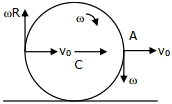
The centre of a wheel rolling on a plane surface moves with a speed $v_{0}$. $A$ particle on the rim of the wheel at the same level as the centre will be moving at a speed $\sqrt{x} \, v_{0}$. Then the value of $x$ is ...... .
A
$9$
B
$2$
C
$4$
D
$81$
Solution
(B) For a wheel rolling without slipping,the velocity of the centre of mass is $v_{0} = \omega R$,where $\omega$ is the angular velocity and $R$ is the radius of the wheel.
For a particle on the rim at the same level as the centre,the velocity has two components:
$1$. The translational velocity $v_{0}$ directed horizontally.
$2$. The tangential velocity $v_{t} = \omega R$ directed vertically (downwards or upwards depending on the side).
Since $v_{0} = \omega R$,the magnitude of the resultant velocity $v$ is given by:
$v = \sqrt{v_{0}^{2} + v_{t}^{2}} = \sqrt{v_{0}^{2} + (\omega R)^{2}}$
$v = \sqrt{v_{0}^{2} + v_{0}^{2}} = \sqrt{2 v_{0}^{2}} = \sqrt{2} \, v_{0}$
Comparing this with the given expression $\sqrt{x} \, v_{0}$,we get $\sqrt{x} = \sqrt{2}$,which implies $x = 2$.
For a particle on the rim at the same level as the centre,the velocity has two components:
$1$. The translational velocity $v_{0}$ directed horizontally.
$2$. The tangential velocity $v_{t} = \omega R$ directed vertically (downwards or upwards depending on the side).
Since $v_{0} = \omega R$,the magnitude of the resultant velocity $v$ is given by:
$v = \sqrt{v_{0}^{2} + v_{t}^{2}} = \sqrt{v_{0}^{2} + (\omega R)^{2}}$
$v = \sqrt{v_{0}^{2} + v_{0}^{2}} = \sqrt{2 v_{0}^{2}} = \sqrt{2} \, v_{0}$
Comparing this with the given expression $\sqrt{x} \, v_{0}$,we get $\sqrt{x} = \sqrt{2}$,which implies $x = 2$.
0 likesView Solution
319
PhysicsMediumMCQJEE Main · 2021
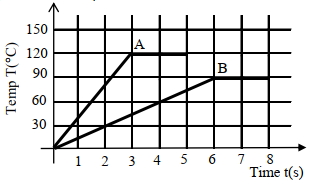
Two different metal bodies $A$ and $B$ of equal mass are heated at a uniform rate under similar conditions. The variation of temperature of the bodies is graphically represented as shown in the figure. The ratio of specific heat capacities is :
A
$\frac{8}{3}$
B
$\frac{3}{8}$
C
$\frac{3}{4}$
D
$\frac{4}{3}$
Solution
(B) Given that the bodies are heated at a uniform rate,the rate of heat supply is constant,i.e.,$\left(\frac{\Delta Q}{\Delta t}\right)_{A} = \left(\frac{\Delta Q}{\Delta t}\right)_{B}$.
We know that $\Delta Q = mc\Delta T$,so $\frac{\Delta Q}{\Delta t} = mc\left(\frac{\Delta T}{\Delta t}\right)$.
Since the masses $m$ are equal,we have $c_{A}\left(\frac{\Delta T}{\Delta t}\right)_{A} = c_{B}\left(\frac{\Delta T}{\Delta t}\right)_{B}$.
Therefore,the ratio of specific heat capacities is $\frac{c_{A}}{c_{B}} = \frac{(\Delta T / \Delta t)_{B}}{(\Delta T / \Delta t)_{A}}$.
From the graph,the slope $(\Delta T / \Delta t)$ for body $A$ is $\frac{120 - 0}{3 - 0} = 40 \ ^{\circ}\text{C/s}$.
The slope $(\Delta T / \Delta t)$ for body $B$ is $\frac{90 - 0}{6 - 0} = 15 \ ^{\circ}\text{C/s}$.
Thus,$\frac{c_{A}}{c_{B}} = \frac{15}{40} = \frac{3}{8}$.
We know that $\Delta Q = mc\Delta T$,so $\frac{\Delta Q}{\Delta t} = mc\left(\frac{\Delta T}{\Delta t}\right)$.
Since the masses $m$ are equal,we have $c_{A}\left(\frac{\Delta T}{\Delta t}\right)_{A} = c_{B}\left(\frac{\Delta T}{\Delta t}\right)_{B}$.
Therefore,the ratio of specific heat capacities is $\frac{c_{A}}{c_{B}} = \frac{(\Delta T / \Delta t)_{B}}{(\Delta T / \Delta t)_{A}}$.
From the graph,the slope $(\Delta T / \Delta t)$ for body $A$ is $\frac{120 - 0}{3 - 0} = 40 \ ^{\circ}\text{C/s}$.
The slope $(\Delta T / \Delta t)$ for body $B$ is $\frac{90 - 0}{6 - 0} = 15 \ ^{\circ}\text{C/s}$.
Thus,$\frac{c_{A}}{c_{B}} = \frac{15}{40} = \frac{3}{8}$.
0 likesView Solution
320
PhysicsDifficultMCQJEE Main · 2021
Water droplets are coming from an open tap at a particular rate. The spacing between a droplet observed at $4^{th} \, s$ after its fall and the next droplet is $34.3 \, m$. At what rate are the droplets coming from the tap? (Take $g = 9.8 \, m/s^2$)
A
$1 \, \text{drop/second}$
B
$2 \, \text{drops/second}$
C
$1 \, \text{drop/7 seconds}$
D
$3 \, \text{drops/2 seconds}$
Solution
(A) Let the time interval between two consecutive drops be $T$.
At $t = 4 \, s$, the first drop has fallen for $4 \, s$. The distance covered by the first drop is $h_1 = \frac{1}{2} g (4)^2 = \frac{1}{2} \times 9.8 \times 16 = 78.4 \, m$.
The second drop was released $T$ seconds after the first, so its time of fall is $(4 - T) \, s$.
The distance covered by the second drop is $h_2 = \frac{1}{2} g (4 - T)^2$.
The spacing between the two drops is given as $h_1 - h_2 = 34.3 \, m$.
Substituting the values: $78.4 - \frac{1}{2} \times 9.8 \times (4 - T)^2 = 34.3$.
$78.4 - 4.9(4 - T)^2 = 34.3$.
$4.9(4 - T)^2 = 44.1$.
$(4 - T)^2 = 9$.
$4 - T = 3 \Rightarrow T = 1 \, s$.
Since the time interval between drops is $1 \, s$, the rate is $1 \, \text{drop/second}$.
At $t = 4 \, s$, the first drop has fallen for $4 \, s$. The distance covered by the first drop is $h_1 = \frac{1}{2} g (4)^2 = \frac{1}{2} \times 9.8 \times 16 = 78.4 \, m$.
The second drop was released $T$ seconds after the first, so its time of fall is $(4 - T) \, s$.
The distance covered by the second drop is $h_2 = \frac{1}{2} g (4 - T)^2$.
The spacing between the two drops is given as $h_1 - h_2 = 34.3 \, m$.
Substituting the values: $78.4 - \frac{1}{2} \times 9.8 \times (4 - T)^2 = 34.3$.
$78.4 - 4.9(4 - T)^2 = 34.3$.
$4.9(4 - T)^2 = 44.1$.
$(4 - T)^2 = 9$.
$4 - T = 3 \Rightarrow T = 1 \, s$.
Since the time interval between drops is $1 \, s$, the rate is $1 \, \text{drop/second}$.
0 likesView Solution
321
PhysicsMediumMCQJEE Main · 2021
Given below are two statements: one is labelled as Assertion $A$ and the other is labelled as Reason $R$.
Assertion $A$: Moment of inertia of a circular disc of mass $M$ and radius $R$ about $X, Y$ axes (passing through its plane) and $Z$-axis which is perpendicular to its plane were found to be $I_{x}, I_{y}$ and $I_{z}$ respectively. The respective radii of gyration about all the three axes will be the same.
Reason $R$: $A$ rigid body making rotational motion has fixed mass and shape.
In the light of the above statements,choose the most appropriate answer from the options given below:
Assertion $A$: Moment of inertia of a circular disc of mass $M$ and radius $R$ about $X, Y$ axes (passing through its plane) and $Z$-axis which is perpendicular to its plane were found to be $I_{x}, I_{y}$ and $I_{z}$ respectively. The respective radii of gyration about all the three axes will be the same.
Reason $R$: $A$ rigid body making rotational motion has fixed mass and shape.
In the light of the above statements,choose the most appropriate answer from the options given below:
A
Both $A$ and $R$ are correct but $R$ is $NOT$ the correct explanation of $A$.
B
$A$ is not correct but $R$ is correct.
C
$A$ is correct but $R$ is not correct.
D
Both $A$ and $R$ are correct and $R$ is the correct explanation of $A$.
Solution
(B) According to the perpendicular axes theorem,for a planar body like a circular disc,$I_{z} = I_{x} + I_{y}$.
The radius of gyration $K$ is defined by the relation $I = MK^{2}$,where $M$ is the mass of the body.
Substituting this into the theorem: $MK_{z}^{2} = MK_{x}^{2} + MK_{y}^{2}$,which simplifies to $K_{z}^{2} = K_{x}^{2} + K_{y}^{2}$.
Since $K_{z}^{2} = K_{x}^{2} + K_{y}^{2}$,the radii of gyration about the three axes cannot be the same. Thus,Assertion $A$ is incorrect.
Reason $R$ states that a rigid body has a fixed mass and shape,which is a correct definition of a rigid body in rotational mechanics. Therefore,$A$ is incorrect but $R$ is correct.
The radius of gyration $K$ is defined by the relation $I = MK^{2}$,where $M$ is the mass of the body.
Substituting this into the theorem: $MK_{z}^{2} = MK_{x}^{2} + MK_{y}^{2}$,which simplifies to $K_{z}^{2} = K_{x}^{2} + K_{y}^{2}$.
Since $K_{z}^{2} = K_{x}^{2} + K_{y}^{2}$,the radii of gyration about the three axes cannot be the same. Thus,Assertion $A$ is incorrect.
Reason $R$ states that a rigid body has a fixed mass and shape,which is a correct definition of a rigid body in rotational mechanics. Therefore,$A$ is incorrect but $R$ is correct.
0 likesView Solution
322
PhysicsMediumMCQJEE Main · 2021
Match List-$I$ with List-$II$.
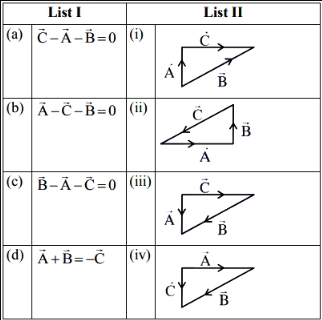
A
$(a) \rightarrow (iv), (b) \rightarrow (i), (c) \rightarrow (iii), (d) \rightarrow (ii)$
B
$(a) \rightarrow (iv), (b) \rightarrow (iii), (c) \rightarrow (i), (d) \rightarrow (ii)$
C
$(a) \rightarrow (iii), (b) \rightarrow (ii), (c) \rightarrow (iv), (d) \rightarrow (i)$
D
$(a) \rightarrow (i), (b) \rightarrow (iv), (c) \rightarrow (ii), (d) \rightarrow (iii)$
Solution
(A) According to the triangle law of vector addition,if two vectors are represented by two sides of a triangle in sequence,their sum is represented by the third side in the reverse order.
$(a)$ $\vec{C} - \vec{A} - \vec{B} = 0 \implies \vec{C} = \vec{A} + \vec{B}$. This corresponds to diagram (iv) where $\vec{A}$ and $\vec{B}$ are in sequence and $\vec{C}$ is the resultant in reverse order.
$(b)$ $\vec{A} - \vec{C} - \vec{B} = 0 \implies \vec{A} = \vec{B} + \vec{C}$. This corresponds to diagram $(i)$ where $\vec{B}$ and $\vec{C}$ are in sequence and $\vec{A}$ is the resultant.
$(c)$ $\vec{B} - \vec{A} - \vec{C} = 0 \implies \vec{B} = \vec{A} + \vec{C}$. This corresponds to diagram (ii) where $\vec{A}$ and $\vec{C}$ are in sequence and $\vec{B}$ is the resultant.
$(d)$ $\vec{A} + \vec{B} = -\vec{C} \implies \vec{A} + \vec{B} + \vec{C} = 0$. This corresponds to diagram (iii) where all vectors are in a cyclic order.
Thus,the correct matching is $(a) \rightarrow (iv), (b) \rightarrow (i), (c) \rightarrow (iii), (d) \rightarrow (ii)$.
$(a)$ $\vec{C} - \vec{A} - \vec{B} = 0 \implies \vec{C} = \vec{A} + \vec{B}$. This corresponds to diagram (iv) where $\vec{A}$ and $\vec{B}$ are in sequence and $\vec{C}$ is the resultant in reverse order.
$(b)$ $\vec{A} - \vec{C} - \vec{B} = 0 \implies \vec{A} = \vec{B} + \vec{C}$. This corresponds to diagram $(i)$ where $\vec{B}$ and $\vec{C}$ are in sequence and $\vec{A}$ is the resultant.
$(c)$ $\vec{B} - \vec{A} - \vec{C} = 0 \implies \vec{B} = \vec{A} + \vec{C}$. This corresponds to diagram (ii) where $\vec{A}$ and $\vec{C}$ are in sequence and $\vec{B}$ is the resultant.
$(d)$ $\vec{A} + \vec{B} = -\vec{C} \implies \vec{A} + \vec{B} + \vec{C} = 0$. This corresponds to diagram (iii) where all vectors are in a cyclic order.
Thus,the correct matching is $(a) \rightarrow (iv), (b) \rightarrow (i), (c) \rightarrow (iii), (d) \rightarrow (ii)$.
0 likesView Solution
323
PhysicsMediumMCQJEE Main · 2021
Two billiard balls of equal mass $30 \, g$ strike a rigid wall with the same speed of $108 \, km/h$ (as shown) but at different angles. If the balls get reflected with the same speed, then the ratio of the magnitude of impulses imparted to ball $'a'$ and ball $'b'$ by the wall along the $'X'$ direction is:
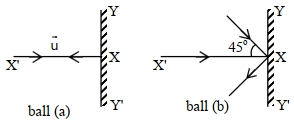
A
$1: 1$
B
$\sqrt{2}: 1$
C
$1: \sqrt{2}$
D
$2: 1$
Solution
(B) Impulse $J$ is equal to the change in momentum $\Delta p$. The impulse imparted by the wall is along the normal to the wall (the $X$-direction).
For ball $(a)$, the velocity is perpendicular to the wall. Initial momentum $p_i = mu$ (towards the wall), final momentum $p_f = -mu$ (away from the wall). The change in momentum is $\Delta p_a = |p_f - p_i| = |-mu - mu| = 2mu = J_1$.
For ball $(b)$, the velocity makes an angle of $45^{\circ}$ with the normal. The component of velocity perpendicular to the wall is $u \cos 45^{\circ}$. The change in momentum along the normal direction is $\Delta p_b = |(-mu \cos 45^{\circ}) - (mu \cos 45^{\circ})| = 2mu \cos 45^{\circ} = J_2$.
The ratio of the magnitudes of impulses is $\frac{J_1}{J_2} = \frac{2mu}{2mu \cos 45^{\circ}} = \frac{1}{\cos 45^{\circ}} = \frac{1}{1/\sqrt{2}} = \sqrt{2} : 1$.
For ball $(a)$, the velocity is perpendicular to the wall. Initial momentum $p_i = mu$ (towards the wall), final momentum $p_f = -mu$ (away from the wall). The change in momentum is $\Delta p_a = |p_f - p_i| = |-mu - mu| = 2mu = J_1$.
For ball $(b)$, the velocity makes an angle of $45^{\circ}$ with the normal. The component of velocity perpendicular to the wall is $u \cos 45^{\circ}$. The change in momentum along the normal direction is $\Delta p_b = |(-mu \cos 45^{\circ}) - (mu \cos 45^{\circ})| = 2mu \cos 45^{\circ} = J_2$.
The ratio of the magnitudes of impulses is $\frac{J_1}{J_2} = \frac{2mu}{2mu \cos 45^{\circ}} = \frac{1}{\cos 45^{\circ}} = \frac{1}{1/\sqrt{2}} = \sqrt{2} : 1$.
1 likesView Solution
324
PhysicsMediumMCQJEE Main · 2021
Two wires of the same length and radius are joined end-to-end and loaded. The Young's moduli of the materials of the two wires are $Y_{1}$ and $Y_{2}$. If the combination behaves as a single wire,then its equivalent Young's modulus is:
A
$Y = \frac{Y_{1} Y_{2}}{Y_{1} + Y_{2}}$
B
$Y = \frac{2 Y_{1} Y_{2}}{3(Y_{1} + Y_{2})}$
C
$Y = \frac{2 Y_{1} Y_{2}}{Y_{1} + Y_{2}}$
D
$Y = \frac{Y_{1} Y_{2}}{2(Y_{1} + Y_{2})}$
Solution
(C) For wires joined in series,the total extension $\Delta l$ is the sum of individual extensions: $\Delta l = \Delta l_{1} + \Delta l_{2}$.
From the definition of Young's modulus,$Y = \frac{F/A}{\Delta l/l}$,we have $\Delta l = \frac{Fl}{AY}$.
Since the wires are joined in series,the force $F$ and cross-sectional area $A$ are the same for both wires.
For the equivalent wire of length $2l$ and Young's modulus $Y$,the total extension is $\Delta l = \frac{F(2l)}{AY}$.
Substituting the expressions for $\Delta l$,$\Delta l_{1}$,and $\Delta l_{2}$ into the sum equation:
$\frac{F(2l)}{AY} = \frac{Fl}{AY_{1}} + \frac{Fl}{AY_{2}}$.
Dividing both sides by $Fl/A$,we get:
$\frac{2}{Y} = \frac{1}{Y_{1}} + \frac{1}{Y_{2}}$.
$\frac{2}{Y} = \frac{Y_{1} + Y_{2}}{Y_{1} Y_{2}}$.
Therefore,$Y = \frac{2 Y_{1} Y_{2}}{Y_{1} + Y_{2}}$.
From the definition of Young's modulus,$Y = \frac{F/A}{\Delta l/l}$,we have $\Delta l = \frac{Fl}{AY}$.
Since the wires are joined in series,the force $F$ and cross-sectional area $A$ are the same for both wires.
For the equivalent wire of length $2l$ and Young's modulus $Y$,the total extension is $\Delta l = \frac{F(2l)}{AY}$.
Substituting the expressions for $\Delta l$,$\Delta l_{1}$,and $\Delta l_{2}$ into the sum equation:
$\frac{F(2l)}{AY} = \frac{Fl}{AY_{1}} + \frac{Fl}{AY_{2}}$.
Dividing both sides by $Fl/A$,we get:
$\frac{2}{Y} = \frac{1}{Y_{1}} + \frac{1}{Y_{2}}$.
$\frac{2}{Y} = \frac{Y_{1} + Y_{2}}{Y_{1} Y_{2}}$.
Therefore,$Y = \frac{2 Y_{1} Y_{2}}{Y_{1} + Y_{2}}$.
0 likesView Solution
325
PhysicsEasyMCQJEE Main · 2021
The minimum and maximum distances of a planet revolving around the Sun are $x_{1}$ and $x_{2}$. If the minimum speed of the planet on its trajectory is $v_{0}$,then its maximum speed will be:
A
$\frac{v_{0} x_{2}^{2}}{x_{1}^{2}}$
B
$\frac{v_{0} x_{1}^{2}}{x_{2}^{2}}$
C
$\frac{v_{0} x_{2}}{x_{1}}$
D
$\frac{v_{0} x_{1}}{x_{2}}$
Solution
(C) According to the law of conservation of angular momentum,the angular momentum of a planet revolving around the Sun remains constant at all points in its orbit.
$L = mvr \sin(\theta)$
At the perihelion (minimum distance $x_{1}$) and aphelion (maximum distance $x_{2}$),the velocity vector is perpendicular to the radius vector,so $\sin(\theta) = 1$.
Thus,$m v_{max} x_{1} = m v_{min} x_{2}$.
Given that the minimum speed is $v_{0}$ (which occurs at the maximum distance $x_{2}$),we have $v_{min} = v_{0}$.
Substituting these values into the conservation equation:
$v_{max} x_{1} = v_{0} x_{2}$
$v_{max} = \frac{v_{0} x_{2}}{x_{1}}$.
$L = mvr \sin(\theta)$
At the perihelion (minimum distance $x_{1}$) and aphelion (maximum distance $x_{2}$),the velocity vector is perpendicular to the radius vector,so $\sin(\theta) = 1$.
Thus,$m v_{max} x_{1} = m v_{min} x_{2}$.
Given that the minimum speed is $v_{0}$ (which occurs at the maximum distance $x_{2}$),we have $v_{min} = v_{0}$.
Substituting these values into the conservation equation:
$v_{max} x_{1} = v_{0} x_{2}$
$v_{max} = \frac{v_{0} x_{2}}{x_{1}}$.
0 likesView Solution
326
PhysicsMediumMCQJEE Main · 2021
For a gas,$C_{p} - C_{V} = R$ in state $P$ and $C_{p} - C_{V} = 1.10 R$ in state $Q$. If $T_{P}$ and $T_{Q}$ are the temperatures in states $P$ and $Q$ respectively,then which of the following is true?
A
$T_{P} = T_{Q}$
B
$T_{P} < T_{Q}$
C
$T_{P} = 0.9 T_{Q}$
D
$T_{P} > T_{Q}$
Solution
(D) For an ideal gas,the relation $C_{p} - C_{V} = R$ holds true.
Real gases behave as ideal gases at high temperatures and low pressures.
In state $P$,$C_{p} - C_{V} = R$,which indicates that the gas is behaving as an ideal gas.
In state $Q$,$C_{p} - C_{V} = 1.10 R$,which is greater than $R$. This indicates that the gas is deviating from ideal behavior,which typically happens at lower temperatures.
Since state $P$ represents ideal behavior and state $Q$ represents non-ideal behavior,it implies that the temperature in state $P$ must be higher than in state $Q$.
Therefore,$T_{P} > T_{Q}$.
Real gases behave as ideal gases at high temperatures and low pressures.
In state $P$,$C_{p} - C_{V} = R$,which indicates that the gas is behaving as an ideal gas.
In state $Q$,$C_{p} - C_{V} = 1.10 R$,which is greater than $R$. This indicates that the gas is deviating from ideal behavior,which typically happens at lower temperatures.
Since state $P$ represents ideal behavior and state $Q$ represents non-ideal behavior,it implies that the temperature in state $P$ must be higher than in state $Q$.
Therefore,$T_{P} > T_{Q}$.
0 likesView Solution
327
PhysicsDifficultMCQJEE Main · 2021
$A$ body of mass $2 \, \text{kg}$ moving with a speed of $4 \, \text{m/s}$ makes an elastic collision with another body at rest and continues to move in the original direction but with one-fourth of its initial speed. The speed of the two-body centre of mass is $\frac{x}{10} \, \text{m/s}$. Then the value of $x$ is ..... .
A
$5$
B
$75$
C
$25$
D
$50$
Solution
(C) Let the mass of the first body be $m_1 = 2 \, \text{kg}$ and its initial velocity be $u_1 = 4 \, \text{m/s}$.
Let the mass of the second body be $m_2$ and its initial velocity be $u_2 = 0 \, \text{m/s}$.
After the collision,the first body moves with $v_1 = \frac{1}{4} \times 4 = 1 \, \text{m/s}$.
Using the conservation of linear momentum: $m_1 u_1 + m_2 u_2 = m_1 v_1 + m_2 v_2$.
$2 \times 4 + m_2 \times 0 = 2 \times 1 + m_2 v_2 \implies 8 = 2 + m_2 v_2 \implies m_2 v_2 = 6$.
For an elastic collision,the coefficient of restitution $e = 1 = \frac{v_2 - v_1}{u_1 - u_2}$.
$1 = \frac{v_2 - 1}{4 - 0} \implies v_2 - 1 = 4 \implies v_2 = 5 \, \text{m/s}$.
Substituting $v_2$ into the momentum equation: $m_2 \times 5 = 6 \implies m_2 = 1.2 \, \text{kg}$.
The velocity of the centre of mass is $v_{cm} = \frac{m_1 v_1 + m_2 v_2}{m_1 + m_2}$.
$v_{cm} = \frac{2 \times 1 + 1.2 \times 5}{2 + 1.2} = \frac{2 + 6}{3.2} = \frac{8}{3.2} = \frac{80}{32} = 2.5 \, \text{m/s}$.
Given $v_{cm} = \frac{x}{10} \, \text{m/s}$,we have $\frac{x}{10} = 2.5 \implies x = 25$.
Let the mass of the second body be $m_2$ and its initial velocity be $u_2 = 0 \, \text{m/s}$.
After the collision,the first body moves with $v_1 = \frac{1}{4} \times 4 = 1 \, \text{m/s}$.
Using the conservation of linear momentum: $m_1 u_1 + m_2 u_2 = m_1 v_1 + m_2 v_2$.
$2 \times 4 + m_2 \times 0 = 2 \times 1 + m_2 v_2 \implies 8 = 2 + m_2 v_2 \implies m_2 v_2 = 6$.
For an elastic collision,the coefficient of restitution $e = 1 = \frac{v_2 - v_1}{u_1 - u_2}$.
$1 = \frac{v_2 - 1}{4 - 0} \implies v_2 - 1 = 4 \implies v_2 = 5 \, \text{m/s}$.
Substituting $v_2$ into the momentum equation: $m_2 \times 5 = 6 \implies m_2 = 1.2 \, \text{kg}$.
The velocity of the centre of mass is $v_{cm} = \frac{m_1 v_1 + m_2 v_2}{m_1 + m_2}$.
$v_{cm} = \frac{2 \times 1 + 1.2 \times 5}{2 + 1.2} = \frac{2 + 6}{3.2} = \frac{8}{3.2} = \frac{80}{32} = 2.5 \, \text{m/s}$.
Given $v_{cm} = \frac{x}{10} \, \text{m/s}$,we have $\frac{x}{10} = 2.5 \implies x = 25$.
0 likesView Solution
328
PhysicsDifficultMCQJEE Main · 2021
Student $A$ and Student $B$ used two screw gauges of equal pitch and $100$ equal circular divisions to measure the radius of a given wire. The actual value of the radius of the wire is $0.322 \, \text{cm}$. The absolute value of the difference between the final circular scale readings observed by the students $A$ and $B$ is .... .
Given pitch $= 0.1 \, \text{cm}$.
Given pitch $= 0.1 \, \text{cm}$.
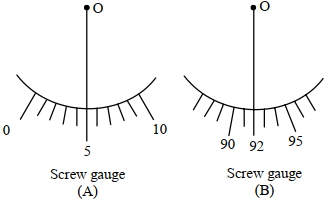
A
$13$
B
$26$
C
$39$
D
$130$
Solution
(A) The least count $(LC)$ of the screw gauge is given by:
$LC = \frac{\text{Pitch}}{\text{Total circular divisions}} = \frac{0.1 \, \text{cm}}{100} = 0.001 \, \text{cm}$.
For Student $A$:
Zero error $= +5 \times LC = +0.005 \, \text{cm}$.
Observed reading $= \text{MSR} + (\text{CSR} \times LC) = 0.322 \, \text{cm}$.
Assuming the main scale reading $(MSR)$ is $0.300 \, \text{cm}$,then:
$0.300 + (\text{CSR}_A \times 0.001) - 0.005 = 0.322 \implies \text{CSR}_A \times 0.001 = 0.027 \implies \text{CSR}_A = 27$.
For Student $B$:
Zero error $= -8 \times LC = -0.008 \, \text{cm}$ (since $92$ is aligned,error is $92-100 = -8$).
Assuming the main scale reading $(MSR)$ is $0.300 \, \text{cm}$,then:
$0.300 + (\text{CSR}_B \times 0.001) - (-0.008) = 0.322 \implies \text{CSR}_B \times 0.001 = 0.014 \implies \text{CSR}_B = 14$.
Difference in circular scale readings $= |27 - 14| = 13$.
$LC = \frac{\text{Pitch}}{\text{Total circular divisions}} = \frac{0.1 \, \text{cm}}{100} = 0.001 \, \text{cm}$.
For Student $A$:
Zero error $= +5 \times LC = +0.005 \, \text{cm}$.
Observed reading $= \text{MSR} + (\text{CSR} \times LC) = 0.322 \, \text{cm}$.
Assuming the main scale reading $(MSR)$ is $0.300 \, \text{cm}$,then:
$0.300 + (\text{CSR}_A \times 0.001) - 0.005 = 0.322 \implies \text{CSR}_A \times 0.001 = 0.027 \implies \text{CSR}_A = 27$.
For Student $B$:
Zero error $= -8 \times LC = -0.008 \, \text{cm}$ (since $92$ is aligned,error is $92-100 = -8$).
Assuming the main scale reading $(MSR)$ is $0.300 \, \text{cm}$,then:
$0.300 + (\text{CSR}_B \times 0.001) - (-0.008) = 0.322 \implies \text{CSR}_B \times 0.001 = 0.014 \implies \text{CSR}_B = 14$.
Difference in circular scale readings $= |27 - 14| = 13$.
0 likesView Solution
329
PhysicsDifficultMCQJEE Main · 2021
$A$ particle of mass $m$ is moving in time $t$ on a trajectory given by $\overrightarrow{r} = 10 \alpha t^2 \hat{i} + 5 \beta (t - 5) \hat{j}$. Where $\alpha$ and $\beta$ are dimensional constants. The angular momentum of the particle becomes the same as it was for $t = 0$ at time $t = \dots$ seconds.
A
$15$
B
$10$
C
$20$
D
$25$
Solution
(B) The position vector is $\overrightarrow{r} = 10 \alpha t^2 \hat{i} + 5 \beta (t - 5) \hat{j}$.
The velocity vector is $\overrightarrow{v} = \frac{d\overrightarrow{r}}{dt} = 20 \alpha t \hat{i} + 5 \beta \hat{j}$.
The angular momentum is given by $\overrightarrow{L} = m (\overrightarrow{r} \times \overrightarrow{v})$.
$\overrightarrow{L} = m [10 \alpha t^2 \hat{i} + 5 \beta (t - 5) \hat{j}] \times [20 \alpha t \hat{i} + 5 \beta \hat{j}]$.
Calculating the cross product: $\overrightarrow{L} = m [ (10 \alpha t^2)(5 \beta) \hat{k} - (5 \beta (t - 5))(20 \alpha t) \hat{k} ]$.
$\overrightarrow{L} = m [ 50 \alpha \beta t^2 - 100 \alpha \beta t (t - 5) ] \hat{k}$.
At $t = 0$,$\overrightarrow{L} = m [ 0 - 0 ] \hat{k} = 0$.
We want $\overrightarrow{L} = 0$ at time $t > 0$:
$50 \alpha \beta t^2 - 100 \alpha \beta t (t - 5) = 0$.
Dividing by $50 \alpha \beta t$ (since $t \neq 0$):
$t - 2(t - 5) = 0$.
$t - 2t + 10 = 0 \implies -t = -10 \implies t = 10 \text{ seconds}$.
The velocity vector is $\overrightarrow{v} = \frac{d\overrightarrow{r}}{dt} = 20 \alpha t \hat{i} + 5 \beta \hat{j}$.
The angular momentum is given by $\overrightarrow{L} = m (\overrightarrow{r} \times \overrightarrow{v})$.
$\overrightarrow{L} = m [10 \alpha t^2 \hat{i} + 5 \beta (t - 5) \hat{j}] \times [20 \alpha t \hat{i} + 5 \beta \hat{j}]$.
Calculating the cross product: $\overrightarrow{L} = m [ (10 \alpha t^2)(5 \beta) \hat{k} - (5 \beta (t - 5))(20 \alpha t) \hat{k} ]$.
$\overrightarrow{L} = m [ 50 \alpha \beta t^2 - 100 \alpha \beta t (t - 5) ] \hat{k}$.
At $t = 0$,$\overrightarrow{L} = m [ 0 - 0 ] \hat{k} = 0$.
We want $\overrightarrow{L} = 0$ at time $t > 0$:
$50 \alpha \beta t^2 - 100 \alpha \beta t (t - 5) = 0$.
Dividing by $50 \alpha \beta t$ (since $t \neq 0$):
$t - 2(t - 5) = 0$.
$t - 2t + 10 = 0 \implies -t = -10 \implies t = 10 \text{ seconds}$.
0 likesView Solution
330
PhysicsMediumMCQJEE Main · 2021
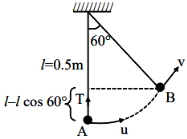
$A$ pendulum bob has a speed of $3 \, m/s$ at its lowest position. The pendulum is $50 \, cm$ long. The speed of the bob, when the string makes an angle of $60^{\circ}$ to the vertical, will be $....... \, m/s$ $(g = 10 \, m/s^2)$.
A
$1$
B
$20$
C
$40$
D
$2$
Solution
(D) Let the mass of the bob be $m$, length of the pendulum be $l = 0.5 \, m$, and initial speed at the lowest point be $u = 3 \, m/s$.
Using the law of conservation of mechanical energy between the lowest point $(A)$ and the point where the string makes an angle $\theta = 60^{\circ}$ with the vertical $(B)$:
Total energy at $A$ = Total energy at $B$
$\frac{1}{2} mu^2 = \frac{1}{2} mv^2 + mgh$
Where $h$ is the vertical height gained by the bob, given by $h = l(1 - \cos \theta)$.
Substituting the values:
$\frac{1}{2} m(3)^2 = \frac{1}{2} mv^2 + mg(0.5)(1 - \cos 60^{\circ})$
$9 = v^2 + 2(10)(0.5)(1 - 0.5)$
$9 = v^2 + 10(0.5)$
$9 = v^2 + 5$
$v^2 = 4$
$v = 2 \, m/s$.
Using the law of conservation of mechanical energy between the lowest point $(A)$ and the point where the string makes an angle $\theta = 60^{\circ}$ with the vertical $(B)$:
Total energy at $A$ = Total energy at $B$
$\frac{1}{2} mu^2 = \frac{1}{2} mv^2 + mgh$
Where $h$ is the vertical height gained by the bob, given by $h = l(1 - \cos \theta)$.
Substituting the values:
$\frac{1}{2} m(3)^2 = \frac{1}{2} mv^2 + mg(0.5)(1 - \cos 60^{\circ})$
$9 = v^2 + 2(10)(0.5)(1 - 0.5)$
$9 = v^2 + 10(0.5)$
$9 = v^2 + 5$
$v^2 = 4$
$v = 2 \, m/s$.
0 likesView Solution
331
PhysicsDifficultMCQJEE Main · 2021
In the provided figure,two bodies $A$ and $B$ of masses $200 \, g$ and $800 \, g$ are attached to a system of springs. The springs are kept in a stretched position when the system is released. The horizontal surface is assumed to be frictionless. The angular frequency will be $..... \, rad/s$ when $k = 20 \, N/m$.

A
$100$
B
$20$
C
$10$
D
$30$
Solution
(C) The angular frequency $\omega$ of a two-body spring-mass system is given by $\omega = \sqrt{\frac{k_{\text{eq}}}{\mu}}$,where $k_{\text{eq}}$ is the equivalent spring constant and $\mu$ is the reduced mass.
$1$. Calculate the equivalent spring constant $k_{\text{eq}}$:
The springs are connected in series. Therefore,$k_{\text{eq}} = \frac{k_1 k_2}{k_1 + k_2}$.
Given $k_1 = k$ and $k_2 = 4k$,we have:
$k_{\text{eq}} = \frac{k \times 4k}{k + 4k} = \frac{4k^2}{5k} = \frac{4k}{5}$.
Substituting $k = 20 \, N/m$:
$k_{\text{eq}} = \frac{4 \times 20}{5} = 16 \, N/m$.
$2$. Calculate the reduced mass $\mu$:
$\mu = \frac{m_1 m_2}{m_1 + m_2}$.
Given $m_1 = 200 \, g = 0.2 \, kg$ and $m_2 = 800 \, g = 0.8 \, kg$:
$\mu = \frac{0.2 \times 0.8}{0.2 + 0.8} = \frac{0.16}{1.0} = 0.16 \, kg$.
$3$. Calculate the angular frequency $\omega$:
$\omega = \sqrt{\frac{16}{0.16}} = \sqrt{100} = 10 \, rad/s$.
$1$. Calculate the equivalent spring constant $k_{\text{eq}}$:
The springs are connected in series. Therefore,$k_{\text{eq}} = \frac{k_1 k_2}{k_1 + k_2}$.
Given $k_1 = k$ and $k_2 = 4k$,we have:
$k_{\text{eq}} = \frac{k \times 4k}{k + 4k} = \frac{4k^2}{5k} = \frac{4k}{5}$.
Substituting $k = 20 \, N/m$:
$k_{\text{eq}} = \frac{4 \times 20}{5} = 16 \, N/m$.
$2$. Calculate the reduced mass $\mu$:
$\mu = \frac{m_1 m_2}{m_1 + m_2}$.
Given $m_1 = 200 \, g = 0.2 \, kg$ and $m_2 = 800 \, g = 0.8 \, kg$:
$\mu = \frac{0.2 \times 0.8}{0.2 + 0.8} = \frac{0.16}{1.0} = 0.16 \, kg$.
$3$. Calculate the angular frequency $\omega$:
$\omega = \sqrt{\frac{16}{0.16}} = \sqrt{100} = 10 \, rad/s$.
0 likesView Solution
332
PhysicsDifficultMCQJEE Main · 2021
Two vectors $\overrightarrow{X}$ and $\overrightarrow{Y}$ have equal magnitude. The magnitude of $(\overrightarrow{X}-\overrightarrow{Y})$ is $n$ times the magnitude of $(\overrightarrow{X}+\overrightarrow{Y})$. The angle between $\overrightarrow{X}$ and $\overrightarrow{Y}$ is:
A
$\cos^{-1}\left(\frac{n^{2}+1}{-n^{2}-1}\right)$
B
$\cos^{-1}\left(\frac{n^{2}-1}{-n^{2}-1}\right)$
C
$\cos^{-1}\left(\frac{-n^{2}-1}{n^{2}-1}\right)$
D
$\cos^{-1}\left(\frac{n^{2}+1}{n^{2}-1}\right)$
Solution
(B) Let the magnitude of vectors be $X = Y = A$.
The magnitude of the difference vector is $|\overrightarrow{X} - \overrightarrow{Y}| = \sqrt{A^2 + A^2 - 2A^2 \cos \theta} = \sqrt{2A^2(1 - \cos \theta)}$.
The magnitude of the sum vector is $|\overrightarrow{X} + \overrightarrow{Y}| = \sqrt{A^2 + A^2 + 2A^2 \cos \theta} = \sqrt{2A^2(1 + \cos \theta)}$.
According to the problem,$|\overrightarrow{X} - \overrightarrow{Y}| = n |\overrightarrow{X} + \overrightarrow{Y}|$.
Substituting the expressions: $\sqrt{2A^2(1 - \cos \theta)} = n \sqrt{2A^2(1 + \cos \theta)}$.
Squaring both sides: $2A^2(1 - \cos \theta) = n^2 \cdot 2A^2(1 + \cos \theta)$.
$1 - \cos \theta = n^2(1 + \cos \theta)$.
$1 - \cos \theta = n^2 + n^2 \cos \theta$.
$1 - n^2 = \cos \theta(1 + n^2)$.
$\cos \theta = \frac{1 - n^2}{1 + n^2} = \frac{n^2 - 1}{-n^2 - 1}$.
Therefore,$\theta = \cos^{-1}\left(\frac{n^2 - 1}{-n^2 - 1}\right)$.
The magnitude of the difference vector is $|\overrightarrow{X} - \overrightarrow{Y}| = \sqrt{A^2 + A^2 - 2A^2 \cos \theta} = \sqrt{2A^2(1 - \cos \theta)}$.
The magnitude of the sum vector is $|\overrightarrow{X} + \overrightarrow{Y}| = \sqrt{A^2 + A^2 + 2A^2 \cos \theta} = \sqrt{2A^2(1 + \cos \theta)}$.
According to the problem,$|\overrightarrow{X} - \overrightarrow{Y}| = n |\overrightarrow{X} + \overrightarrow{Y}|$.
Substituting the expressions: $\sqrt{2A^2(1 - \cos \theta)} = n \sqrt{2A^2(1 + \cos \theta)}$.
Squaring both sides: $2A^2(1 - \cos \theta) = n^2 \cdot 2A^2(1 + \cos \theta)$.
$1 - \cos \theta = n^2(1 + \cos \theta)$.
$1 - \cos \theta = n^2 + n^2 \cos \theta$.
$1 - n^2 = \cos \theta(1 + n^2)$.
$\cos \theta = \frac{1 - n^2}{1 + n^2} = \frac{n^2 - 1}{-n^2 - 1}$.
Therefore,$\theta = \cos^{-1}\left(\frac{n^2 - 1}{-n^2 - 1}\right)$.
0 likesView Solution
333
PhysicsDifficultMCQJEE Main · 2021
$A$ balloon was moving upwards with a uniform velocity of $10 \, m/s$. An object of finite mass is dropped from the balloon when it was at a height of $75 \, m$ from the ground level. The height of the balloon from the ground when the object strikes the ground was around (in $m$). (Take the value of $g$ as $10 \, m/s^2$)
A
$125$
B
$250$
C
$300$
D
$200$
Solution
(A) The object is dropped from the balloon,so its initial velocity is the same as the balloon's velocity,$u = 10 \, m/s$ (upwards).
Taking the upward direction as positive,the displacement of the object when it hits the ground is $s = -75 \, m$.
The acceleration due to gravity is $a = -g = -10 \, m/s^2$.
Using the equation of motion $s = ut + \frac{1}{2}at^2$:
$-75 = 10t + \frac{1}{2}(-10)t^2$
$-75 = 10t - 5t^2$
$5t^2 - 10t - 75 = 0$
$t^2 - 2t - 15 = 0$
$(t - 5)(t + 3) = 0$
Since time cannot be negative,$t = 5 \, s$.
In this time,the balloon continues to move upwards with a uniform velocity of $10 \, m/s$.
The distance covered by the balloon in $5 \, s$ is $d = v \times t = 10 \times 5 = 50 \, m$.
The height of the balloon from the ground when the object strikes the ground is $H = 75 + 50 = 125 \, m$.
Taking the upward direction as positive,the displacement of the object when it hits the ground is $s = -75 \, m$.
The acceleration due to gravity is $a = -g = -10 \, m/s^2$.
Using the equation of motion $s = ut + \frac{1}{2}at^2$:
$-75 = 10t + \frac{1}{2}(-10)t^2$
$-75 = 10t - 5t^2$
$5t^2 - 10t - 75 = 0$
$t^2 - 2t - 15 = 0$
$(t - 5)(t + 3) = 0$
Since time cannot be negative,$t = 5 \, s$.
In this time,the balloon continues to move upwards with a uniform velocity of $10 \, m/s$.
The distance covered by the balloon in $5 \, s$ is $d = v \times t = 10 \times 5 = 50 \, m$.
The height of the balloon from the ground when the object strikes the ground is $H = 75 + 50 = 125 \, m$.
0 likesView Solution
334
PhysicsMediumMCQJEE Main · 2021
$A$ force $\vec{F}=(40 \hat{i}+10 \hat{j}) \, N$ acts on a body of mass $5 \, kg$. If the body starts from rest,its position vector $\vec{r}$ at time $t=10 \, s$ will be -
A
$(100 \hat{i}+400 \hat{j}) \, m$
B
$(400 \hat{i}+100 \hat{j}) \, m$
C
$(100 \hat{i}+100 \hat{j}) \, m$
D
$(400 \hat{i}+400 \hat{j}) \, m$
Solution
(B) Given: Force $\vec{F} = (40 \hat{i} + 10 \hat{j}) \, N$,mass $m = 5 \, kg$,initial velocity $\vec{u} = 0$,time $t = 10 \, s$.
Using Newton's second law,acceleration $\vec{a} = \frac{\vec{F}}{m} = \frac{40 \hat{i} + 10 \hat{j}}{5} = (8 \hat{i} + 2 \hat{j}) \, m/s^2$.
Since the body starts from rest,the position vector $\vec{r}$ at time $t$ is given by the kinematic equation $\vec{r} = \vec{u}t + \frac{1}{2} \vec{a} t^2$.
Substituting $\vec{u} = 0$,$\vec{a} = (8 \hat{i} + 2 \hat{j}) \, m/s^2$,and $t = 10 \, s$:
$\vec{r} = 0 + \frac{1}{2} (8 \hat{i} + 2 \hat{j}) (10)^2$
$\vec{r} = \frac{1}{2} (8 \hat{i} + 2 \hat{j}) (100)$
$\vec{r} = (4 \hat{i} + 1 \hat{j}) (100) = (400 \hat{i} + 100 \hat{j}) \, m$.
Using Newton's second law,acceleration $\vec{a} = \frac{\vec{F}}{m} = \frac{40 \hat{i} + 10 \hat{j}}{5} = (8 \hat{i} + 2 \hat{j}) \, m/s^2$.
Since the body starts from rest,the position vector $\vec{r}$ at time $t$ is given by the kinematic equation $\vec{r} = \vec{u}t + \frac{1}{2} \vec{a} t^2$.
Substituting $\vec{u} = 0$,$\vec{a} = (8 \hat{i} + 2 \hat{j}) \, m/s^2$,and $t = 10 \, s$:
$\vec{r} = 0 + \frac{1}{2} (8 \hat{i} + 2 \hat{j}) (10)^2$
$\vec{r} = \frac{1}{2} (8 \hat{i} + 2 \hat{j}) (100)$
$\vec{r} = (4 \hat{i} + 1 \hat{j}) (100) = (400 \hat{i} + 100 \hat{j}) \, m$.
0 likesView Solution
335
PhysicsDifficultMCQJEE Main · 2021
The relation between time $t$ and distance $x$ for a moving body is given as $t = m x^{2} + n x$,where $m$ and $n$ are constants. The retardation of the motion is:
A
$2 n^{2} v^{3}$
B
$2 m v^{3}$
C
$2 n v^{3}$
D
$2 m n v^{3}$
Solution
(B) Given the relation: $t = m x^{2} + n x$.
Differentiating with respect to $x$:
$\frac{dt}{dx} = 2mx + n$.
Since velocity $v = \frac{dx}{dt}$,we have $\frac{1}{v} = \frac{dt}{dx} = 2mx + n$.
Thus,$v = (2mx + n)^{-1}$.
Now,differentiate $v$ with respect to $t$ to find acceleration $a$:
$a = \frac{dv}{dt} = \frac{dv}{dx} \cdot \frac{dx}{dt} = v \cdot \frac{dv}{dx}$.
$\frac{dv}{dx} = -1(2mx + n)^{-2} \cdot (2m) = -2m(2mx + n)^{-2}$.
Since $(2mx + n) = \frac{1}{v}$,then $(2mx + n)^{-2} = v^{2}$.
Therefore,$a = v \cdot (-2m \cdot v^{2}) = -2mv^{3}$.
Retardation is the negative of acceleration,so retardation $= 2mv^{3}$.
Differentiating with respect to $x$:
$\frac{dt}{dx} = 2mx + n$.
Since velocity $v = \frac{dx}{dt}$,we have $\frac{1}{v} = \frac{dt}{dx} = 2mx + n$.
Thus,$v = (2mx + n)^{-1}$.
Now,differentiate $v$ with respect to $t$ to find acceleration $a$:
$a = \frac{dv}{dt} = \frac{dv}{dx} \cdot \frac{dx}{dt} = v \cdot \frac{dv}{dx}$.
$\frac{dv}{dx} = -1(2mx + n)^{-2} \cdot (2m) = -2m(2mx + n)^{-2}$.
Since $(2mx + n) = \frac{1}{v}$,then $(2mx + n)^{-2} = v^{2}$.
Therefore,$a = v \cdot (-2m \cdot v^{2}) = -2mv^{3}$.
Retardation is the negative of acceleration,so retardation $= 2mv^{3}$.
1 likesView Solution
336
PhysicsMediumMCQJEE Main · 2021
The force $F$ is given in terms of time $t$ and displacement $x$ by the equation $F = A \cos(Bx) + C \sin(Dt)$. The dimensional formula of $\frac{AD}{B}$ is -
A
$[ML^{2}T^{-3}]$
B
$[M^{2}L^{2}T^{-3}]$
C
$[MLT^{-2}]$
D
$[M^{0}LT^{-1}]$
Solution
(A) The argument of trigonometric functions like $\cos$ and $\sin$ must be dimensionless.
For $\cos(Bx)$,the term $Bx$ must be dimensionless,so $[B] = [x]^{-1} = [L^{-1}]$.
For $\sin(Dt)$,the term $Dt$ must be dimensionless,so $[D] = [t]^{-1} = [T^{-1}]$.
Since $F = A \cos(Bx) + C \sin(Dt)$,the dimensions of $A$ must be equal to the dimensions of force $F$,so $[A] = [MLT^{-2}]$.
Now,we calculate the dimensions of $\frac{AD}{B}$:
$[\frac{AD}{B}] = \frac{[A][D]}{[B]} = \frac{[MLT^{-2}][T^{-1}]}{[L^{-1}]}$.
$[\frac{AD}{B}] = [MLT^{-3}][L] = [ML^{2}T^{-3}]$.
For $\cos(Bx)$,the term $Bx$ must be dimensionless,so $[B] = [x]^{-1} = [L^{-1}]$.
For $\sin(Dt)$,the term $Dt$ must be dimensionless,so $[D] = [t]^{-1} = [T^{-1}]$.
Since $F = A \cos(Bx) + C \sin(Dt)$,the dimensions of $A$ must be equal to the dimensions of force $F$,so $[A] = [MLT^{-2}]$.
Now,we calculate the dimensions of $\frac{AD}{B}$:
$[\frac{AD}{B}] = \frac{[A][D]}{[B]} = \frac{[MLT^{-2}][T^{-1}]}{[L^{-1}]}$.
$[\frac{AD}{B}] = [MLT^{-3}][L] = [ML^{2}T^{-3}]$.
0 likesView Solution
337
PhysicsMediumMCQJEE Main · 2021
In a simple harmonic oscillation,what fraction of total mechanical energy is in the form of kinetic energy,when the particle is midway between mean and extreme position?
A
$1/4$
B
$1/3$
C
$3/4$
D
$1/2$
Solution
(C) The total mechanical energy $E$ of a particle in simple harmonic motion is given by $E = \frac{1}{2} m \omega^{2} A^{2}$.
At any position $x$,the kinetic energy $K$ is given by $K = \frac{1}{2} m \omega^{2} (A^{2} - x^{2})$.
The particle is midway between the mean position $(x = 0)$ and the extreme position $(x = A)$,so $x = \frac{A}{2}$.
Substituting $x = \frac{A}{2}$ into the kinetic energy formula:
$K = \frac{1}{2} m \omega^{2} (A^{2} - (\frac{A}{2})^{2})$
$K = \frac{1}{2} m \omega^{2} (A^{2} - \frac{A^{2}}{4})$
$K = \frac{1}{2} m \omega^{2} (\frac{3A^{2}}{4})$
$K = \frac{3}{4} (\frac{1}{2} m \omega^{2} A^{2})$
Since $E = \frac{1}{2} m \omega^{2} A^{2}$,we have $K = \frac{3}{4} E$.
Thus,the fraction of total mechanical energy in the form of kinetic energy is $3/4$.
At any position $x$,the kinetic energy $K$ is given by $K = \frac{1}{2} m \omega^{2} (A^{2} - x^{2})$.
The particle is midway between the mean position $(x = 0)$ and the extreme position $(x = A)$,so $x = \frac{A}{2}$.
Substituting $x = \frac{A}{2}$ into the kinetic energy formula:
$K = \frac{1}{2} m \omega^{2} (A^{2} - (\frac{A}{2})^{2})$
$K = \frac{1}{2} m \omega^{2} (A^{2} - \frac{A^{2}}{4})$
$K = \frac{1}{2} m \omega^{2} (\frac{3A^{2}}{4})$
$K = \frac{3}{4} (\frac{1}{2} m \omega^{2} A^{2})$
Since $E = \frac{1}{2} m \omega^{2} A^{2}$,we have $K = \frac{3}{4} E$.
Thus,the fraction of total mechanical energy in the form of kinetic energy is $3/4$.
0 likesView Solution
338
PhysicsMediumMCQJEE Main · 2021
Consider a planet in some solar system which has a mass double the mass of Earth and density equal to the average density of Earth. If the weight of an object on Earth is $W$,then the weight of the same object on that planet will be
A
$\sqrt{2} W$
B
$2 W$
C
$W$
D
$2^{1/3} W$
Solution
(D) Given that the density of the planet is equal to the density of Earth,$\rho_p = \rho_e$.
Since density $\rho = \frac{M}{\frac{4}{3}\pi R^3}$,we have $\frac{M_p}{R_p^3} = \frac{M_e}{R_e^3}$.
This implies $\frac{R_p}{R_e} = \left(\frac{M_p}{M_e}\right)^{1/3}$.
Given $M_p = 2 M_e$,we get $\frac{R_p}{R_e} = 2^{1/3}$.
The weight of an object is $W = mg = m \frac{GM}{R^2}$.
Therefore,$\frac{W_p}{W_e} = \frac{M_p}{M_e} \left(\frac{R_e}{R_p}\right)^2$.
Substituting the values,$\frac{W_p}{W_e} = 2 \times \left(\frac{1}{2^{1/3}}\right)^2 = 2 \times 2^{-2/3} = 2^{1 - 2/3} = 2^{1/3}$.
Thus,$W_p = 2^{1/3} W$.
Since density $\rho = \frac{M}{\frac{4}{3}\pi R^3}$,we have $\frac{M_p}{R_p^3} = \frac{M_e}{R_e^3}$.
This implies $\frac{R_p}{R_e} = \left(\frac{M_p}{M_e}\right)^{1/3}$.
Given $M_p = 2 M_e$,we get $\frac{R_p}{R_e} = 2^{1/3}$.
The weight of an object is $W = mg = m \frac{GM}{R^2}$.
Therefore,$\frac{W_p}{W_e} = \frac{M_p}{M_e} \left(\frac{R_e}{R_p}\right)^2$.
Substituting the values,$\frac{W_p}{W_e} = 2 \times \left(\frac{1}{2^{1/3}}\right)^2 = 2 \times 2^{-2/3} = 2^{1 - 2/3} = 2^{1/3}$.
Thus,$W_p = 2^{1/3} W$.
0 likesView Solution
339
PhysicsMediumMCQJEE Main · 2021
$A$ solid disc of radius $20 \, \text{cm}$ and mass $10 \, \text{kg}$ is rotating with an angular velocity of $600 \, \text{rpm}$ about an axis normal to its circular plane and passing through its centre of mass. The retarding torque required to bring the disc to rest in $10 \, \text{s}$ is $x \pi \times 10^{-1} \, \text{Nm}$. Find the value of $x$.
A
$1$
B
$2$
C
$3$
D
$4$
Solution
(D) Given: Radius $R = 20 \, \text{cm} = 0.2 \, \text{m}$,Mass $M = 10 \, \text{kg}$,Initial angular velocity $\omega_i = 600 \, \text{rpm} = \frac{600 \times 2\pi}{60} \, \text{rad/s} = 20\pi \, \text{rad/s}$.
Final angular velocity $\omega_f = 0 \, \text{rad/s}$,Time $\Delta t = 10 \, \text{s}$.
The moment of inertia of the disc is $I = \frac{1}{2}MR^2 = \frac{1}{2} \times 10 \times (0.2)^2 = 5 \times 0.04 = 0.2 \, \text{kg m}^2$.
The torque required is $\tau = \frac{\Delta L}{\Delta t} = \frac{I(\omega_f - \omega_i)}{\Delta t}$.
Magnitude of torque $|\tau| = \frac{0.2 \times (20\pi - 0)}{10} = \frac{4\pi}{10} = 0.4\pi = 4\pi \times 10^{-1} \, \text{Nm}$.
Comparing with $x\pi \times 10^{-1} \, \text{Nm}$,we get $x = 4$.
Final angular velocity $\omega_f = 0 \, \text{rad/s}$,Time $\Delta t = 10 \, \text{s}$.
The moment of inertia of the disc is $I = \frac{1}{2}MR^2 = \frac{1}{2} \times 10 \times (0.2)^2 = 5 \times 0.04 = 0.2 \, \text{kg m}^2$.
The torque required is $\tau = \frac{\Delta L}{\Delta t} = \frac{I(\omega_f - \omega_i)}{\Delta t}$.
Magnitude of torque $|\tau| = \frac{0.2 \times (20\pi - 0)}{10} = \frac{4\pi}{10} = 0.4\pi = 4\pi \times 10^{-1} \, \text{Nm}$.
Comparing with $x\pi \times 10^{-1} \, \text{Nm}$,we get $x = 4$.
0 likesView Solution
340
PhysicsMediumMCQJEE Main · 2021
$A$ system consists of two types of gas molecules $A$ and $B$ having the same number density $2 \times 10^{25} \, /m^3$. The diameters of $A$ and $B$ are $10 \, \mathring{A}$ and $5 \, \mathring{A}$ respectively. They undergo collisions at room temperature. The ratio of the average distance covered by molecule $A$ to that of $B$ between two successive collisions is $..... \times 10^{-2}$.
A
$20$
B
$25$
C
$75$
D
$80$
Solution
(B) The mean free path $\lambda$ of a gas molecule is given by the formula $\lambda = \frac{1}{\sqrt{2} \pi d^2 n}$,where $d$ is the diameter of the molecule and $n$ is the number density.
Given that the number density $n$ is the same for both molecules $A$ and $B$,the ratio of their mean free paths is $\frac{\lambda_A}{\lambda_B} = \frac{d_B^2}{d_A^2}$.
Substituting the given values,$d_A = 10 \, \mathring{A}$ and $d_B = 5 \, \mathring{A}$,we get:
$\frac{\lambda_A}{\lambda_B} = \left( \frac{5}{10} \right)^2 = \left( \frac{1}{2} \right)^2 = \frac{1}{4} = 0.25$.
Expressing this in the required format,$0.25 = 25 \times 10^{-2}$.
Thus,the ratio is $25 \times 10^{-2}$.
Given that the number density $n$ is the same for both molecules $A$ and $B$,the ratio of their mean free paths is $\frac{\lambda_A}{\lambda_B} = \frac{d_B^2}{d_A^2}$.
Substituting the given values,$d_A = 10 \, \mathring{A}$ and $d_B = 5 \, \mathring{A}$,we get:
$\frac{\lambda_A}{\lambda_B} = \left( \frac{5}{10} \right)^2 = \left( \frac{1}{2} \right)^2 = \frac{1}{4} = 0.25$.
Expressing this in the required format,$0.25 = 25 \times 10^{-2}$.
Thus,the ratio is $25 \times 10^{-2}$.
0 likesView Solution
341
PhysicsMediumMCQJEE Main · 2021
$A$ force of $F=(5 y+20) \hat{j} \, N$ acts on a particle. The work done by this force when the particle is moved from $y=0 \, m$ to $y=10 \, m$ is $... \, J.$
A
$300$
B
$75$
C
$150$
D
$450$
Solution
(D) The work done $W$ by a variable force $F$ acting along the $y$-axis is given by the integral $W = \int_{y_1}^{y_2} F_y \, dy$.
Given $F = (5y + 20) \hat{j} \, N$,the component of force along the displacement is $F_y = (5y + 20) \, N$.
The limits of integration are from $y_1 = 0 \, m$ to $y_2 = 10 \, m$.
$W = \int_{0}^{10} (5y + 20) \, dy$
$W = \left[ \frac{5y^2}{2} + 20y \right]_{0}^{10}$
$W = \left( \frac{5(10)^2}{2} + 20(10) \right) - (0 + 0)$
$W = \left( \frac{5 \times 100}{2} + 200 \right)$
$W = 250 + 200 = 450 \, J$.
Given $F = (5y + 20) \hat{j} \, N$,the component of force along the displacement is $F_y = (5y + 20) \, N$.
The limits of integration are from $y_1 = 0 \, m$ to $y_2 = 10 \, m$.
$W = \int_{0}^{10} (5y + 20) \, dy$
$W = \left[ \frac{5y^2}{2} + 20y \right]_{0}^{10}$
$W = \left( \frac{5(10)^2}{2} + 20(10) \right) - (0 + 0)$
$W = \left( \frac{5 \times 100}{2} + 200 \right)$
$W = 250 + 200 = 450 \, J$.
0 likesView Solution
342
PhysicsMediumMCQJEE Main · 2021
The figure shows two solid discs with radius $R$ and $r$ respectively. If the mass per unit area is the same for both,what is the ratio of the moment of inertia $(MI)$ of the bigger disc about axis $AB$ (which is perpendicular to the plane of the disc and passing through its centre) to the $MI$ of the smaller disc about one of its diameters lying on its plane? Given $M$ is the mass of the larger disc.
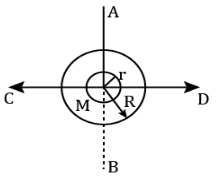
A
$2r^{4}:R^{4}$
B
$2R^{2}:r^{2}$
C
$2R^{4}:r^{4}$
D
$R^{2}:r^{2}$
Solution
(C) Let $\sigma$ be the mass per unit area (surface mass density). Since $\sigma$ is the same for both discs:
Mass of larger disc,$M = \sigma \pi R^{2}$
Mass of smaller disc,$m = \sigma \pi r^{2}$
The moment of inertia of the larger disc about axis $AB$ (perpendicular to the plane through the centre) is $I_{1} = \frac{1}{2} MR^{2} = \frac{1}{2} (\sigma \pi R^{2}) R^{2} = \frac{1}{2} \sigma \pi R^{4}$.
The moment of inertia of the smaller disc about its diameter is $I_{2} = \frac{1}{4} mr^{2} = \frac{1}{4} (\sigma \pi r^{2}) r^{2} = \frac{1}{4} \sigma \pi r^{4}$.
The ratio of the moments of inertia is $\frac{I_{1}}{I_{2}} = \frac{\frac{1}{2} \sigma \pi R^{4}}{\frac{1}{4} \sigma \pi r^{4}} = \frac{1/2}{1/4} \cdot \frac{R^{4}}{r^{4}} = 2 \frac{R^{4}}{r^{4}}$.
Thus,the ratio is $2R^{4}:r^{4}$.
Mass of larger disc,$M = \sigma \pi R^{2}$
Mass of smaller disc,$m = \sigma \pi r^{2}$
The moment of inertia of the larger disc about axis $AB$ (perpendicular to the plane through the centre) is $I_{1} = \frac{1}{2} MR^{2} = \frac{1}{2} (\sigma \pi R^{2}) R^{2} = \frac{1}{2} \sigma \pi R^{4}$.
The moment of inertia of the smaller disc about its diameter is $I_{2} = \frac{1}{4} mr^{2} = \frac{1}{4} (\sigma \pi r^{2}) r^{2} = \frac{1}{4} \sigma \pi r^{4}$.
The ratio of the moments of inertia is $\frac{I_{1}}{I_{2}} = \frac{\frac{1}{2} \sigma \pi R^{4}}{\frac{1}{4} \sigma \pi r^{4}} = \frac{1/2}{1/4} \cdot \frac{R^{4}}{r^{4}} = 2 \frac{R^{4}}{r^{4}}$.
Thus,the ratio is $2R^{4}:r^{4}$.
0 likesView Solution
343
PhysicsMediumMCQJEE Main · 2021
The number of molecules in one litre of an ideal gas at $300 \, K$ and $2$ atmospheric pressure with mean kinetic energy $2 \times 10^{-9} \, J$ per molecule is $.... \times 10^{11}$.
A
$6$
B
$3$
C
$1.5$
D
$0.75$
Solution
(C) Given:
Volume $V = 1 \, L = 10^{-3} \, m^3$
Temperature $T = 300 \, K$
Pressure $P = 2 \, atm = 2 \times 1.013 \times 10^5 \, Pa \approx 2.026 \times 10^5 \, Pa$
Mean kinetic energy per molecule $\bar{E} = 2 \times 10^{-9} \, J$
From the ideal gas law,$PV = NkT$,where $N$ is the number of molecules and $k$ is the Boltzmann constant $(1.38 \times 10^{-23} \, J/K)$.
However,we are given the mean kinetic energy $\bar{E} = \frac{3}{2}kT$. Thus,$kT = \frac{2}{3}\bar{E}$.
Substituting this into the ideal gas equation:
$N = \frac{PV}{kT} = \frac{PV}{\frac{2}{3}\bar{E}} = \frac{3PV}{2\bar{E}}$
$N = \frac{3 \times (2.026 \times 10^5) \times 10^{-3}}{2 \times (2 \times 10^{-9})}$
$N = \frac{6.078 \times 10^2}{4 \times 10^{-9}} \approx 1.5195 \times 10^{11}$
Rounding to the nearest provided option,the value is $1.5 \times 10^{11}$.
Volume $V = 1 \, L = 10^{-3} \, m^3$
Temperature $T = 300 \, K$
Pressure $P = 2 \, atm = 2 \times 1.013 \times 10^5 \, Pa \approx 2.026 \times 10^5 \, Pa$
Mean kinetic energy per molecule $\bar{E} = 2 \times 10^{-9} \, J$
From the ideal gas law,$PV = NkT$,where $N$ is the number of molecules and $k$ is the Boltzmann constant $(1.38 \times 10^{-23} \, J/K)$.
However,we are given the mean kinetic energy $\bar{E} = \frac{3}{2}kT$. Thus,$kT = \frac{2}{3}\bar{E}$.
Substituting this into the ideal gas equation:
$N = \frac{PV}{kT} = \frac{PV}{\frac{2}{3}\bar{E}} = \frac{3PV}{2\bar{E}}$
$N = \frac{3 \times (2.026 \times 10^5) \times 10^{-3}}{2 \times (2 \times 10^{-9})}$
$N = \frac{6.078 \times 10^2}{4 \times 10^{-9}} \approx 1.5195 \times 10^{11}$
Rounding to the nearest provided option,the value is $1.5 \times 10^{11}$.
0 likesView Solution
344
PhysicsDifficultMCQJEE Main · 2021
Three objects $A, B$ and $C$ are kept in a straight line on a frictionless horizontal surface. The masses of $A, B$ and $C$ are $m, 2m$ and $2m$ respectively. $A$ moves towards $B$ with a speed of $9 \ m/s$ and makes an elastic collision with it. Thereafter,$B$ makes a completely inelastic collision with $C$. All motions occur along the same straight line. The final speed of $C$ is $.... \ m/s$.
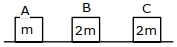
A
$3$
B
$6$
C
$9$
D
$4$
Solution
(A) Let the initial velocity of $A$ be $u_A = 9 \ m/s$ and $B$ be $u_B = 0$. After the elastic collision between $A$ and $B$,let their velocities be $v_A$ and $v_B$.
Using conservation of linear momentum: $m(9) + 2m(0) = m v_A + 2m v_B \Rightarrow 9 = v_A + 2v_B$ (Equation $1$).
Using the coefficient of restitution for elastic collision $(e=1)$: $v_B - v_A = e(u_A - u_B) = 1(9 - 0) = 9 \Rightarrow v_B - v_A = 9$ (Equation $2$).
Adding Equation $1$ and Equation $2$: $3v_B = 18 \Rightarrow v_B = 6 \ m/s$.
Now,$B$ makes a completely inelastic collision with $C$ (initially at rest). Let the final velocity of the combined mass $(B+C)$ be $v_C$.
Using conservation of linear momentum: $2m(v_B) + 2m(0) = (2m + 2m)v_C$.
$2m(6) = 4m v_C \Rightarrow 12m = 4m v_C \Rightarrow v_C = 3 \ m/s$.
Using conservation of linear momentum: $m(9) + 2m(0) = m v_A + 2m v_B \Rightarrow 9 = v_A + 2v_B$ (Equation $1$).
Using the coefficient of restitution for elastic collision $(e=1)$: $v_B - v_A = e(u_A - u_B) = 1(9 - 0) = 9 \Rightarrow v_B - v_A = 9$ (Equation $2$).
Adding Equation $1$ and Equation $2$: $3v_B = 18 \Rightarrow v_B = 6 \ m/s$.
Now,$B$ makes a completely inelastic collision with $C$ (initially at rest). Let the final velocity of the combined mass $(B+C)$ be $v_C$.
Using conservation of linear momentum: $2m(v_B) + 2m(0) = (2m + 2m)v_C$.
$2m(6) = 4m v_C \Rightarrow 12m = 4m v_C \Rightarrow v_C = 3 \ m/s$.
0 likesView Solution
345
PhysicsMediumMCQJEE Main · 2021
$A$ body takes $4\, \text{min}$ to cool from $61^{\circ} \text{C}$ to $59^{\circ} \text{C}$. If the temperature of the surroundings is $30^{\circ} \text{C}$,the time taken by the body to cool from $51^{\circ} \text{C}$ to $49^{\circ} \text{C}$ is $....\, \text{min}$.
A
$8$
B
$4$
C
$6$
D
$5$
Solution
(C) According to Newton's Law of Cooling,the rate of cooling is given by $\frac{\Delta T}{\Delta t} = K(T_{avg} - T_s)$,where $T_{avg}$ is the average temperature of the body and $T_s$ is the temperature of the surroundings.
For the first case:
$\frac{61 - 59}{4} = K \left( \frac{61 + 59}{2} - 30 \right)$
$\frac{2}{4} = K(60 - 30)$
$0.5 = K(30) \implies K = \frac{0.5}{30} = \frac{1}{60}$.
For the second case,let the time taken be $t$:
$\frac{51 - 49}{t} = K \left( \frac{51 + 49}{2} - 30 \right)$
$\frac{2}{t} = K(50 - 30)$
$\frac{2}{t} = K(20)$.
Substituting the value of $K$:
$\frac{2}{t} = \frac{1}{60} \times 20$
$\frac{2}{t} = \frac{1}{3}$
$t = 6\, \text{min}$.
For the first case:
$\frac{61 - 59}{4} = K \left( \frac{61 + 59}{2} - 30 \right)$
$\frac{2}{4} = K(60 - 30)$
$0.5 = K(30) \implies K = \frac{0.5}{30} = \frac{1}{60}$.
For the second case,let the time taken be $t$:
$\frac{51 - 49}{t} = K \left( \frac{51 + 49}{2} - 30 \right)$
$\frac{2}{t} = K(50 - 30)$
$\frac{2}{t} = K(20)$.
Substituting the value of $K$:
$\frac{2}{t} = \frac{1}{60} \times 20$
$\frac{2}{t} = \frac{1}{3}$
$t = 6\, \text{min}$.
0 likesView Solution
346
PhysicsDifficultMCQJEE Main · 2021
Assertion $A$: If $A, B, C, D$ are four points on a semi-circular arc with centre at $O$ such that $|\overrightarrow{AB}|=|\overrightarrow{BC}|=|\overrightarrow{CD}|$,then $\overrightarrow{AB}+\overrightarrow{AC}+\overrightarrow{AD}=4\overrightarrow{AO}+\overrightarrow{OB}+\overrightarrow{OC}$.
Reason $R$: Polygon law of vector addition yields $\overrightarrow{AB}+\overrightarrow{BC}+\overrightarrow{CD}+\overrightarrow{AD}=2\overrightarrow{AO}$.
In the light of the above statements,choose the most appropriate answer from the options given below.
Reason $R$: Polygon law of vector addition yields $\overrightarrow{AB}+\overrightarrow{BC}+\overrightarrow{CD}+\overrightarrow{AD}=2\overrightarrow{AO}$.
In the light of the above statements,choose the most appropriate answer from the options given below.
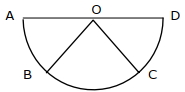
A
Both $A$ and $R$ are correct and $R$ is the correct explanation of $A$.
B
$A$ is not correct but $R$ is correct.
C
Both $A$ and $R$ are correct but $R$ is not the correct explanation of $A$.
D
$A$ is correct but $R$ is not correct.
Solution
(D) Given that $A, B, C, D$ are points on a semi-circular arc with center $O$. Since $O$ is the center,$|\overrightarrow{OA}| = |\overrightarrow{OB}| = |\overrightarrow{OC}| = |\overrightarrow{OD}| = R$ (radius).
Using the triangle law of vector addition:
$\overrightarrow{AB} = \overrightarrow{AO} + \overrightarrow{OB}$
$\overrightarrow{AC} = \overrightarrow{AO} + \overrightarrow{OC}$
$\overrightarrow{AD} = \overrightarrow{AO} + \overrightarrow{OD}$
Adding these three equations:
$\overrightarrow{AB} + \overrightarrow{AC} + \overrightarrow{AD} = 3\overrightarrow{AO} + \overrightarrow{OB} + \overrightarrow{OC} + \overrightarrow{OD}$
Since $A, O, D$ are collinear and $O$ is the midpoint of $AD$ (as $AD$ is the diameter of the semi-circle),$\overrightarrow{OD} = -\overrightarrow{OA} = \overrightarrow{AO}$.
Thus,$\overrightarrow{AB} + \overrightarrow{AC} + \overrightarrow{AD} = 3\overrightarrow{AO} + \overrightarrow{OB} + \overrightarrow{OC} + \overrightarrow{AO} = 4\overrightarrow{AO} + \overrightarrow{OB} + \overrightarrow{OC}$.
So,Assertion $A$ is correct.
Regarding Reason $R$: The polygon law states that the sum of vectors forming a closed polygon is zero. The expression $\overrightarrow{AB}+\overrightarrow{BC}+\overrightarrow{CD}+\overrightarrow{AD}=2\overrightarrow{AO}$ is not a standard result of the polygon law and is mathematically incorrect for the given geometry. Thus,Reason $R$ is incorrect.
Therefore,$A$ is correct but $R$ is not correct.
Using the triangle law of vector addition:
$\overrightarrow{AB} = \overrightarrow{AO} + \overrightarrow{OB}$
$\overrightarrow{AC} = \overrightarrow{AO} + \overrightarrow{OC}$
$\overrightarrow{AD} = \overrightarrow{AO} + \overrightarrow{OD}$
Adding these three equations:
$\overrightarrow{AB} + \overrightarrow{AC} + \overrightarrow{AD} = 3\overrightarrow{AO} + \overrightarrow{OB} + \overrightarrow{OC} + \overrightarrow{OD}$
Since $A, O, D$ are collinear and $O$ is the midpoint of $AD$ (as $AD$ is the diameter of the semi-circle),$\overrightarrow{OD} = -\overrightarrow{OA} = \overrightarrow{AO}$.
Thus,$\overrightarrow{AB} + \overrightarrow{AC} + \overrightarrow{AD} = 3\overrightarrow{AO} + \overrightarrow{OB} + \overrightarrow{OC} + \overrightarrow{AO} = 4\overrightarrow{AO} + \overrightarrow{OB} + \overrightarrow{OC}$.
So,Assertion $A$ is correct.
Regarding Reason $R$: The polygon law states that the sum of vectors forming a closed polygon is zero. The expression $\overrightarrow{AB}+\overrightarrow{BC}+\overrightarrow{CD}+\overrightarrow{AD}=2\overrightarrow{AO}$ is not a standard result of the polygon law and is mathematically incorrect for the given geometry. Thus,Reason $R$ is incorrect.
Therefore,$A$ is correct but $R$ is not correct.
0 likesView Solution
347
PhysicsMediumMCQJEE Main · 2021
In the provided figure,there is a cyclic process $ABCDA$ on a sample of $1 \, mol$ of a diatomic gas. The temperatures of the gas during the processes $A \rightarrow B$ and $C \rightarrow D$ are $T_{1}$ and $T_{2}$ $(T_{1} > T_{2})$ respectively. Choose the correct option for the work done if processes $BC$ and $DA$ are adiabatic.
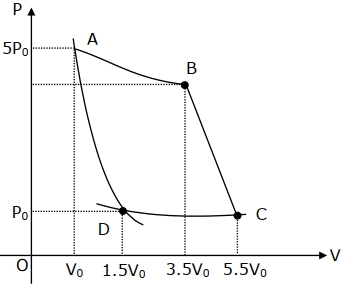
A
$W_{AB} < W_{CD}$
B
$W_{AD} = W_{BC}$
C
$W_{BC} + W_{DA} > 0$
D
$W_{AB} = W_{DC}$
Solution
(B) The work done in an adiabatic process is given by $W = \frac{nR(T_i - T_f)}{\gamma - 1}$.
For the adiabatic process $BC$,the gas goes from temperature $T_1$ (at $B$) to $T_2$ (at $C$). Thus,$W_{BC} = \frac{nR(T_1 - T_2)}{\gamma - 1}$.
For the adiabatic process $DA$,the gas goes from temperature $T_2$ (at $D$) to $T_1$ (at $A$). Thus,$W_{DA} = \frac{nR(T_2 - T_1)}{\gamma - 1} = -\frac{nR(T_1 - T_2)}{\gamma - 1}$.
Note that the question asks for the work done by the gas. In the cycle $ABCDA$,the processes $AB$ and $CD$ are isothermal (as temperature is constant). The work done in an adiabatic process is $W = -\Delta U = -nC_v\Delta T = -\frac{nR}{\gamma - 1}(T_f - T_i)$.
For process $BC$: $W_{BC} = -\frac{nR}{\gamma - 1}(T_2 - T_1) = \frac{nR(T_1 - T_2)}{\gamma - 1}$.
For process $DA$: $W_{DA} = -\frac{nR}{\gamma - 1}(T_1 - T_2) = -\frac{nR(T_1 - T_2)}{\gamma - 1}$.
However,looking at the cycle,the work done in the adiabatic processes $BC$ and $DA$ are equal in magnitude but opposite in sign. The option $W_{AD} = W_{BC}$ is incorrect based on the sign convention. Re-evaluating the provided options,$W_{AD} = -W_{BC}$ would be correct. Given the standard interpretation of such problems,the magnitude of work done in adiabatic processes connecting the same two isotherms is equal. If the question implies magnitude,$B$ is the intended answer.
For the adiabatic process $BC$,the gas goes from temperature $T_1$ (at $B$) to $T_2$ (at $C$). Thus,$W_{BC} = \frac{nR(T_1 - T_2)}{\gamma - 1}$.
For the adiabatic process $DA$,the gas goes from temperature $T_2$ (at $D$) to $T_1$ (at $A$). Thus,$W_{DA} = \frac{nR(T_2 - T_1)}{\gamma - 1} = -\frac{nR(T_1 - T_2)}{\gamma - 1}$.
Note that the question asks for the work done by the gas. In the cycle $ABCDA$,the processes $AB$ and $CD$ are isothermal (as temperature is constant). The work done in an adiabatic process is $W = -\Delta U = -nC_v\Delta T = -\frac{nR}{\gamma - 1}(T_f - T_i)$.
For process $BC$: $W_{BC} = -\frac{nR}{\gamma - 1}(T_2 - T_1) = \frac{nR(T_1 - T_2)}{\gamma - 1}$.
For process $DA$: $W_{DA} = -\frac{nR}{\gamma - 1}(T_1 - T_2) = -\frac{nR(T_1 - T_2)}{\gamma - 1}$.
However,looking at the cycle,the work done in the adiabatic processes $BC$ and $DA$ are equal in magnitude but opposite in sign. The option $W_{AD} = W_{BC}$ is incorrect based on the sign convention. Re-evaluating the provided options,$W_{AD} = -W_{BC}$ would be correct. Given the standard interpretation of such problems,the magnitude of work done in adiabatic processes connecting the same two isotherms is equal. If the question implies magnitude,$B$ is the intended answer.
0 likesView Solution
348
PhysicsMediumMCQJEE Main · 2021
| List-$I$ | List-$II$ |
|---|---|
| $(a)$ $MI$ of the rod (length $L$,mass $M$,about an axis $\perp$ to the rod passing through the midpoint) | $(i) \frac{8ML^2}{3}$ |
| $(b)$ $MI$ of the rod (length $L$,mass $2M$,about an axis $\perp$ to the rod passing through one of its ends) | $(ii) \frac{ML^2}{3}$ |
| $(c)$ $MI$ of the rod (length $2L$,mass $M$,about an axis $\perp$ to the rod passing through its midpoint) | $(iii) \frac{ML^2}{12}$ |
| $(d)$ $MI$ of the rod (length $2L$,mass $2M$,about an axis $\perp$ to the rod passing through one of its ends) | $(iv) \frac{2ML^2}{3}$ |
Choose the correct answer from the options given below:
A
$(a)-(iii), (b)-(iv), (c)-(ii), (d)-(i)$
B
$(a)-(iii), (b)-(iv), (c)-(i), (d)-(ii)$
C
$(a)-(ii), (b)-(i), (c)-(iii), (d)-(iv)$
D
$(a)-(ii), (b)-(iii), (c)-(i), (d)-(iv)$
Solution
(A) The moment of inertia $(MI)$ of a rod of mass $M$ and length $L$ is given by:
$1$. About an axis passing through the center and perpendicular to the rod: $I = \frac{ML^2}{12}$.
$2$. About an axis passing through one end and perpendicular to the rod: $I = \frac{ML^2}{3}$.
Applying these formulas:
$(a)$ For mass $M$,length $L$,axis through midpoint: $I = \frac{ML^2}{12}$ (Matches $iii$).
$(b)$ For mass $2M$,length $L$,axis through end: $I = \frac{(2M)L^2}{3} = \frac{2ML^2}{3}$ (Matches $iv$).
$(c)$ For mass $M$,length $2L$,axis through midpoint: $I = \frac{M(2L)^2}{12} = \frac{4ML^2}{12} = \frac{ML^2}{3}$ (Matches $ii$).
$(d)$ For mass $2M$,length $2L$,axis through end: $I = \frac{(2M)(2L)^2}{3} = \frac{2M(4L^2)}{3} = \frac{8ML^2}{3}$ (Matches $i$).
Thus,the correct matching is $(a)-(iii), (b)-(iv), (c)-(ii), (d)-(i)$.
$1$. About an axis passing through the center and perpendicular to the rod: $I = \frac{ML^2}{12}$.
$2$. About an axis passing through one end and perpendicular to the rod: $I = \frac{ML^2}{3}$.
Applying these formulas:
$(a)$ For mass $M$,length $L$,axis through midpoint: $I = \frac{ML^2}{12}$ (Matches $iii$).
$(b)$ For mass $2M$,length $L$,axis through end: $I = \frac{(2M)L^2}{3} = \frac{2ML^2}{3}$ (Matches $iv$).
$(c)$ For mass $M$,length $2L$,axis through midpoint: $I = \frac{M(2L)^2}{12} = \frac{4ML^2}{12} = \frac{ML^2}{3}$ (Matches $ii$).
$(d)$ For mass $2M$,length $2L$,axis through end: $I = \frac{(2M)(2L)^2}{3} = \frac{2M(4L^2)}{3} = \frac{8ML^2}{3}$ (Matches $i$).
Thus,the correct matching is $(a)-(iii), (b)-(iv), (c)-(ii), (d)-(i)$.
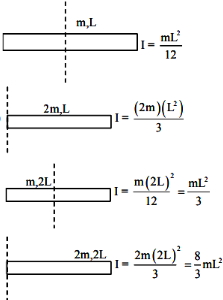
0 likesView Solution
349
PhysicsMediumMCQJEE Main · 2021
Assertion $A$: If in five complete rotations of the circular scale,the distance travelled on the main scale of the screw gauge is $5 \, mm$ and there are $50$ total divisions on the circular scale,then the least count is $0.001 \, cm$.
Reason $R$: $\text{Least Count} = \frac{\text{Pitch}}{\text{Total divisions on circular scale}}$
In the light of the above statements,choose the most appropriate answer from the options given below:
Reason $R$: $\text{Least Count} = \frac{\text{Pitch}}{\text{Total divisions on circular scale}}$
In the light of the above statements,choose the most appropriate answer from the options given below:
A
Both $A$ and $R$ are correct and $R$ is the correct explanation of $A$.
B
$A$ is not correct but $R$ is correct.
C
Both $A$ and $R$ are correct and $R$ is $NOT$ the correct explanation of $A$.
D
$A$ is correct but $R$ is not correct.
Solution
(B) The pitch of a screw gauge is defined as the distance moved by the spindle per complete rotation of the circular scale.
Given that in $5$ complete rotations,the distance moved on the main scale is $5 \, mm$.
Therefore,the pitch $= \frac{5 \, mm}{5} = 1 \, mm$.
The least count is defined as: $\text{Least Count} = \frac{\text{Pitch}}{\text{Total divisions on circular scale}}$.
Given total divisions $= 50$.
So,$\text{Least Count} = \frac{1 \, mm}{50} = 0.02 \, mm$.
Converting to centimeters: $0.02 \, mm = 0.002 \, cm$.
Since the calculated least count is $0.002 \, cm$ and the assertion states $0.001 \, cm$,assertion $A$ is incorrect.
Reason $R$ is the standard definition of the least count of a screw gauge,which is correct.
Given that in $5$ complete rotations,the distance moved on the main scale is $5 \, mm$.
Therefore,the pitch $= \frac{5 \, mm}{5} = 1 \, mm$.
The least count is defined as: $\text{Least Count} = \frac{\text{Pitch}}{\text{Total divisions on circular scale}}$.
Given total divisions $= 50$.
So,$\text{Least Count} = \frac{1 \, mm}{50} = 0.02 \, mm$.
Converting to centimeters: $0.02 \, mm = 0.002 \, cm$.
Since the calculated least count is $0.002 \, cm$ and the assertion states $0.001 \, cm$,assertion $A$ is incorrect.
Reason $R$ is the standard definition of the least count of a screw gauge,which is correct.
0 likesView Solution
350
PhysicsDifficultMCQJEE Main · 2021
$A$ light cylindrical vessel is kept on a horizontal surface. The area of the base is $A$. $A$ hole of cross-sectional area $a$ is made just at its bottom side. The minimum coefficient of friction necessary to prevent the vessel from sliding due to the impact force of the emerging liquid is $(a \ll A)$.
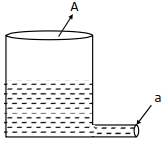
A
$\frac{2a}{A}$
B
None of these
C
$\frac{a}{A}$
D
$\frac{A}{2a}$
Solution
(A) Let the height of the liquid in the vessel be $h$. The velocity of the emerging liquid is given by Torricelli's law as $v = \sqrt{2gh}$.
The force exerted by the emerging liquid on the vessel (thrust force) is $F_{thrust} = \rho a v^2 = \rho a (2gh) = 2 \rho agh$.
For the vessel to not slide,the frictional force $f$ must balance this thrust force. Thus,$f \geq F_{thrust}$.
The maximum frictional force is $f_{max} = \mu N$,where $N$ is the normal reaction from the surface. Since the vessel is light (mass is negligible),the normal reaction $N$ is equal to the weight of the liquid,$N = mg = (\rho A h) g$.
Therefore,$\mu (\rho A h g) \geq 2 \rho a g h$.
Simplifying this,we get $\mu \geq \frac{2a}{A}$.
Thus,the minimum coefficient of friction is $\frac{2a}{A}$.
The force exerted by the emerging liquid on the vessel (thrust force) is $F_{thrust} = \rho a v^2 = \rho a (2gh) = 2 \rho agh$.
For the vessel to not slide,the frictional force $f$ must balance this thrust force. Thus,$f \geq F_{thrust}$.
The maximum frictional force is $f_{max} = \mu N$,where $N$ is the normal reaction from the surface. Since the vessel is light (mass is negligible),the normal reaction $N$ is equal to the weight of the liquid,$N = mg = (\rho A h) g$.
Therefore,$\mu (\rho A h g) \geq 2 \rho a g h$.
Simplifying this,we get $\mu \geq \frac{2a}{A}$.
Thus,the minimum coefficient of friction is $\frac{2a}{A}$.
1 likesView Solution
351
PhysicsMediumMCQJEE Main · 2021
$A$ uniform heating wire of resistance $36 \, \Omega$ is connected across a potential difference of $240 \, V$. The wire is then cut into half and a potential difference of $240 \, V$ is applied across each half separately. The ratio of power dissipation in the first case to the total power dissipation in the second case would be $1:x$,where $x$ is........... .
A
$4$
B
$40$
C
$0.4$
D
$400$
Solution
(A) In the first case,the power dissipation is given by $P_1 = \frac{V^2}{R} = \frac{(240)^2}{36} \, W$.
When the wire is cut into two equal halves,the resistance of each half becomes $R' = \frac{R}{2} = \frac{36}{2} = 18 \, \Omega$.
In the second case,a potential difference of $240 \, V$ is applied across each half separately. The power dissipated in each half is $P_{half} = \frac{V^2}{R'} = \frac{(240)^2}{18} \, W$.
The total power dissipation in the second case is $P_2 = P_{half} + P_{half} = 2 \times \frac{(240)^2}{18} = \frac{(240)^2}{9} \, W$.
The ratio of power dissipation is $\frac{P_1}{P_2} = \frac{(240)^2 / 36}{(240)^2 / 9} = \frac{9}{36} = \frac{1}{4}$.
Comparing this to $1:x$,we find $x = 4$.
When the wire is cut into two equal halves,the resistance of each half becomes $R' = \frac{R}{2} = \frac{36}{2} = 18 \, \Omega$.
In the second case,a potential difference of $240 \, V$ is applied across each half separately. The power dissipated in each half is $P_{half} = \frac{V^2}{R'} = \frac{(240)^2}{18} \, W$.
The total power dissipation in the second case is $P_2 = P_{half} + P_{half} = 2 \times \frac{(240)^2}{18} = \frac{(240)^2}{9} \, W$.
The ratio of power dissipation is $\frac{P_1}{P_2} = \frac{(240)^2 / 36}{(240)^2 / 9} = \frac{9}{36} = \frac{1}{4}$.
Comparing this to $1:x$,we find $x = 4$.
0 likesView Solution
352
PhysicsMediumMCQJEE Main · 2021
$A$ carrier wave with amplitude of $250\, \text{V}$ is amplitude modulated by a sinusoidal baseband signal of amplitude $150\, \text{V}$. The ratio of minimum amplitude to maximum amplitude for the amplitude modulated wave is $50:x$,then the value of $x$ is ....... .
A
$200$
B
$20$
C
$500$
D
$0.2$
Solution
(A) The maximum amplitude of the amplitude modulated wave is given by $A_{\max} = A_c + A_m$,where $A_c$ is the carrier amplitude and $A_m$ is the signal amplitude.
$A_{\max} = 250 + 150 = 400\, \text{V}$.
The minimum amplitude of the amplitude modulated wave is given by $A_{\min} = A_c - A_m$.
$A_{\min} = 250 - 150 = 100\, \text{V}$.
The ratio of minimum amplitude to maximum amplitude is $\frac{A_{\min}}{A_{\max}} = \frac{100}{400} = \frac{1}{4}$.
Given that the ratio is $50:x$,we have $\frac{50}{x} = \frac{1}{4}$.
Solving for $x$,we get $x = 50 \times 4 = 200$.
$A_{\max} = 250 + 150 = 400\, \text{V}$.
The minimum amplitude of the amplitude modulated wave is given by $A_{\min} = A_c - A_m$.
$A_{\min} = 250 - 150 = 100\, \text{V}$.
The ratio of minimum amplitude to maximum amplitude is $\frac{A_{\min}}{A_{\max}} = \frac{100}{400} = \frac{1}{4}$.
Given that the ratio is $50:x$,we have $\frac{50}{x} = \frac{1}{4}$.
Solving for $x$,we get $x = 50 \times 4 = 200$.
0 likesView Solution
353
PhysicsDifficultMCQJEE Main · 2021
The radiation corresponding to the $3 \rightarrow 2$ transition of a hydrogen atom falls on a gold surface to generate photoelectrons. These electrons are passed through a magnetic field of $5 \times 10^{-4} \, T$. Assume that the radius of the largest circular path followed by these electrons is $7 \, mm$. The work function of the metal is $..... \, eV$. (Mass of electron $= 9.1 \times 10^{-31} \, kg$)
A
$0.82$
B
$0.16$
C
$1.88$
D
$1.36$
Solution
(A) The energy of a photon emitted during the $3 \rightarrow 2$ transition in a hydrogen atom is given by $E = 13.6 \left( \frac{1}{2^2} - \frac{1}{3^2} \right) = 13.6 \left( \frac{1}{4} - \frac{1}{9} \right) = 13.6 \times \frac{5}{36} \approx 1.89 \, eV$.
The kinetic energy $(K.E.)$ of the photoelectrons is related to the radius $r$ of their circular path in a magnetic field $B$ by $r = \frac{mv}{qB}$,where $p = mv = qBr$.
Thus,$K.E. = \frac{p^2}{2m} = \frac{(qBr)^2}{2m}$.
Given $q = 1.6 \times 10^{-19} \, C$,$B = 5 \times 10^{-4} \, T$,and $r = 7 \times 10^{-3} \, m$:
$p = (1.6 \times 10^{-19}) \times (7 \times 10^{-3}) \times (5 \times 10^{-4}) = 5.6 \times 10^{-25} \, kg \cdot m/s$.
$K.E. = \frac{(5.6 \times 10^{-25})^2}{2 \times 9.1 \times 10^{-31}} = \frac{31.36 \times 10^{-50}}{18.2 \times 10^{-31}} \approx 1.723 \times 10^{-19} \, J$.
Converting to $eV$: $K.E. = \frac{1.723 \times 10^{-19}}{1.6 \times 10^{-19}} \approx 1.077 \, eV$.
Using Einstein's photoelectric equation: $\Phi = E_{photon} - K.E._{max} = 1.89 \, eV - 1.077 \, eV = 0.813 \, eV \approx 0.82 \, eV$.
The kinetic energy $(K.E.)$ of the photoelectrons is related to the radius $r$ of their circular path in a magnetic field $B$ by $r = \frac{mv}{qB}$,where $p = mv = qBr$.
Thus,$K.E. = \frac{p^2}{2m} = \frac{(qBr)^2}{2m}$.
Given $q = 1.6 \times 10^{-19} \, C$,$B = 5 \times 10^{-4} \, T$,and $r = 7 \times 10^{-3} \, m$:
$p = (1.6 \times 10^{-19}) \times (7 \times 10^{-3}) \times (5 \times 10^{-4}) = 5.6 \times 10^{-25} \, kg \cdot m/s$.
$K.E. = \frac{(5.6 \times 10^{-25})^2}{2 \times 9.1 \times 10^{-31}} = \frac{31.36 \times 10^{-50}}{18.2 \times 10^{-31}} \approx 1.723 \times 10^{-19} \, J$.
Converting to $eV$: $K.E. = \frac{1.723 \times 10^{-19}}{1.6 \times 10^{-19}} \approx 1.077 \, eV$.
Using Einstein's photoelectric equation: $\Phi = E_{photon} - K.E._{max} = 1.89 \, eV - 1.077 \, eV = 0.813 \, eV \approx 0.82 \, eV$.
0 likesView Solution
354
PhysicsDifficultMCQJEE Main · 2021
The value of current in the $6 \,\Omega$ resistance is $....\,A$
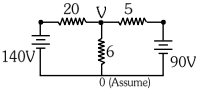
A
$4$
B
$6$
C
$8$
D
$10$
Solution
(D) Let the potential at the junction be $V$. Applying Kirchhoff's Current Law $(KCL)$ at this junction:
$\frac{V-0}{6} + \frac{V-90}{5} + \frac{V-140}{20} = 0$
Multiplying the entire equation by $60$ to clear the denominators:
$10V + 12(V-90) + 3(V-140) = 0$
$10V + 12V - 1080 + 3V - 420 = 0$
$25V - 1500 = 0$
$25V = 1500$
$V = 60 \, V$
Therefore,the current in the $6 \,\Omega$ resistance is $I = \frac{V-0}{6} = \frac{60}{6} = 10 \, A$.
$\frac{V-0}{6} + \frac{V-90}{5} + \frac{V-140}{20} = 0$
Multiplying the entire equation by $60$ to clear the denominators:
$10V + 12(V-90) + 3(V-140) = 0$
$10V + 12V - 1080 + 3V - 420 = 0$
$25V - 1500 = 0$
$25V = 1500$
$V = 60 \, V$
Therefore,the current in the $6 \,\Omega$ resistance is $I = \frac{V-0}{6} = \frac{60}{6} = 10 \, A$.
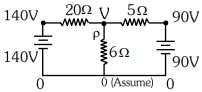
0 likesView Solution
355
PhysicsMediumMCQJEE Main · 2021
$A$ deuteron and an alpha particle having equal kinetic energy enter perpendicular into a magnetic field. Let $r_{d}$ and $r_{\alpha}$ be their respective radii of circular path. The value of $\frac{r_{d}}{r_{\alpha}}$ is equal to
A
$\sqrt{2}$
B
$1$
C
$2$
D
$\frac{1}{\sqrt{2}}$
Solution
(A) The radius of a circular path for a charged particle in a magnetic field is given by $r = \frac{mv}{qB} = \frac{\sqrt{2mK}}{qB}$,where $m$ is the mass,$K$ is the kinetic energy,$q$ is the charge,and $B$ is the magnetic field strength.
Given that both particles have equal kinetic energy $K$ and enter the same magnetic field $B$,the ratio of their radii is $\frac{r_{d}}{r_{\alpha}} = \frac{\sqrt{2m_{d}K} / (q_{d}B)}{\sqrt{2m_{\alpha}K} / (q_{\alpha}B)} = \sqrt{\frac{m_{d}}{m_{\alpha}}} \cdot \frac{q_{\alpha}}{q_{d}}$.
For a deuteron,mass $m_{d} = 2m_{p}$ and charge $q_{d} = e$. For an alpha particle,mass $m_{\alpha} = 4m_{p}$ and charge $q_{\alpha} = 2e$.
Substituting these values: $\frac{r_{d}}{r_{\alpha}} = \sqrt{\frac{2m_{p}}{4m_{p}}} \cdot \frac{2e}{e} = \sqrt{\frac{1}{2}} \cdot 2 = \frac{1}{\sqrt{2}} \cdot 2 = \sqrt{2}$.
Given that both particles have equal kinetic energy $K$ and enter the same magnetic field $B$,the ratio of their radii is $\frac{r_{d}}{r_{\alpha}} = \frac{\sqrt{2m_{d}K} / (q_{d}B)}{\sqrt{2m_{\alpha}K} / (q_{\alpha}B)} = \sqrt{\frac{m_{d}}{m_{\alpha}}} \cdot \frac{q_{\alpha}}{q_{d}}$.
For a deuteron,mass $m_{d} = 2m_{p}$ and charge $q_{d} = e$. For an alpha particle,mass $m_{\alpha} = 4m_{p}$ and charge $q_{\alpha} = 2e$.
Substituting these values: $\frac{r_{d}}{r_{\alpha}} = \sqrt{\frac{2m_{p}}{4m_{p}}} \cdot \frac{2e}{e} = \sqrt{\frac{1}{2}} \cdot 2 = \frac{1}{\sqrt{2}} \cdot 2 = \sqrt{2}$.
0 likesView Solution
356
PhysicsDifficultMCQJEE Main · 2021
$A$ radioactive material decays by simultaneous emissions of two particles with half-lives of $1400 \, years$ and $700 \, years$ respectively. What will be the time after which one-third of the material remains? (Take $\ln 3 = 1.1$) (In $years$)
A
$1110$
B
$340$
C
$740$
D
$700$
Solution
(C) Given the half-lives $T_1 = 1400 \, years$ and $T_2 = 700 \, years$.
The decay constants are $\lambda_1 = \frac{\ln 2}{1400} \, year^{-1}$ and $\lambda_2 = \frac{\ln 2}{700} \, year^{-1}$.
The net decay constant is $\lambda_{net} = \lambda_1 + \lambda_2 = \ln 2 \left( \frac{1}{1400} + \frac{1}{700} \right) = \ln 2 \left( \frac{1+2}{1400} \right) = \frac{3 \ln 2}{1400} \, year^{-1}$.
Let the initial number of nuclei be $N_0$. We want to find the time $t$ when $N(t) = \frac{N_0}{3}$.
Using the radioactive decay law $N(t) = N_0 e^{-\lambda_{net} t}$, we have $\frac{N_0}{3} = N_0 e^{-\lambda_{net} t}$.
$\frac{1}{3} = e^{-\lambda_{net} t} \implies \ln(3) = \lambda_{net} t$.
Substituting the values: $1.1 = \left( \frac{3 \times 0.693}{1400} \right) t$.
$t = \frac{1.1 \times 1400}{3 \times 0.693} \approx \frac{1540}{2.079} \approx 740.7 \, years$.
Thus, the time is approximately $740 \, years$.
The decay constants are $\lambda_1 = \frac{\ln 2}{1400} \, year^{-1}$ and $\lambda_2 = \frac{\ln 2}{700} \, year^{-1}$.
The net decay constant is $\lambda_{net} = \lambda_1 + \lambda_2 = \ln 2 \left( \frac{1}{1400} + \frac{1}{700} \right) = \ln 2 \left( \frac{1+2}{1400} \right) = \frac{3 \ln 2}{1400} \, year^{-1}$.
Let the initial number of nuclei be $N_0$. We want to find the time $t$ when $N(t) = \frac{N_0}{3}$.
Using the radioactive decay law $N(t) = N_0 e^{-\lambda_{net} t}$, we have $\frac{N_0}{3} = N_0 e^{-\lambda_{net} t}$.
$\frac{1}{3} = e^{-\lambda_{net} t} \implies \ln(3) = \lambda_{net} t$.
Substituting the values: $1.1 = \left( \frac{3 \times 0.693}{1400} \right) t$.
$t = \frac{1.1 \times 1400}{3 \times 0.693} \approx \frac{1540}{2.079} \approx 740.7 \, years$.
Thus, the time is approximately $740 \, years$.
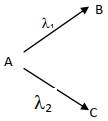
0 likesView Solution
357
PhysicsMediumMCQJEE Main · 2021
$A$ certain charge $Q$ is divided into two parts $q$ and $(Q-q)$. How should the charges $Q$ and $q$ be divided so that $q$ and $(Q-q)$ placed at a certain distance apart experience maximum electrostatic repulsion?
A
$Q = 2q$
B
$Q = 3q$
C
$Q = 4q$
D
$Q = q/2$
Solution
(A) Let the two charges be $q$ and $(Q-q)$ separated by a distance $r$. The electrostatic force $F$ between them is given by Coulomb's law:
$F = \frac{k q(Q-q)}{r^2}$
To find the condition for maximum force,we differentiate $F$ with respect to $q$ and set it to zero:
$\frac{dF}{dq} = \frac{k}{r^2} \frac{d}{dq} (Qq - q^2) = 0$
$\frac{k}{r^2} (Q - 2q) = 0$
Since $k$ and $r$ are constants and non-zero,we have:
$Q - 2q = 0$
$Q = 2q$
Thus,the charge $Q$ must be divided into two equal parts for maximum repulsion.
$F = \frac{k q(Q-q)}{r^2}$
To find the condition for maximum force,we differentiate $F$ with respect to $q$ and set it to zero:
$\frac{dF}{dq} = \frac{k}{r^2} \frac{d}{dq} (Qq - q^2) = 0$
$\frac{k}{r^2} (Q - 2q) = 0$
Since $k$ and $r$ are constants and non-zero,we have:
$Q - 2q = 0$
$Q = 2q$
Thus,the charge $Q$ must be divided into two equal parts for maximum repulsion.
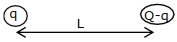
0 likesView Solution
358
PhysicsDifficultMCQJEE Main · 2021
The arm $PQ$ of a rectangular conductor is moving from $x=0$ to $x=2b$ outwards and then inwards from $x=2b$ to $x=0$ as shown in the figure. $A$ uniform magnetic field perpendicular to the plane is acting from $x=0$ to $x=b$. Identify the graph showing the variation of different quantities with distance.
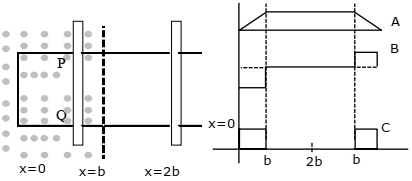
A
$A-$Flux,$B-$EMF,$C-$Power dissipated
B
$A-$Power dissipated,$B-$Flux,$C-$EMF
C
$A-$Flux,$B-$Power dissipated,$C-$EMF
D
$A-$EMF,$B-$Power dissipated,$C-$Flux
Solution
(A) $1$. Magnetic Flux $(\phi)$: As the rod moves from $x=0$ to $x=b$,the area inside the magnetic field increases linearly,so flux increases. From $x=b$ to $x=2b$,the rod is outside the magnetic field,so flux remains constant. On the return journey from $x=2b$ to $x=b$,flux remains constant,and from $x=b$ to $x=0$,it decreases linearly. This corresponds to curve $A$.
$2$. Induced $EMF$ $(e)$: The induced $EMF$ is given by $e = -\frac{d\phi}{dt} = -Blv$. As the rod moves from $x=0$ to $x=b$,$e$ is constant and negative. From $x=b$ to $x=2b$,$e=0$. On the return journey from $x=b$ to $x=0$,the velocity is reversed,so $e$ becomes positive and constant. This corresponds to curve $B$.
$3$. Power Dissipated $(P)$: Power dissipated is given by $P = \frac{e^2}{R}$. Since $P \propto e^2$,it is non-zero only when the rod is in the magnetic field ($0$ to $b$). This corresponds to curve $C$.
$2$. Induced $EMF$ $(e)$: The induced $EMF$ is given by $e = -\frac{d\phi}{dt} = -Blv$. As the rod moves from $x=0$ to $x=b$,$e$ is constant and negative. From $x=b$ to $x=2b$,$e=0$. On the return journey from $x=b$ to $x=0$,the velocity is reversed,so $e$ becomes positive and constant. This corresponds to curve $B$.
$3$. Power Dissipated $(P)$: Power dissipated is given by $P = \frac{e^2}{R}$. Since $P \propto e^2$,it is non-zero only when the rod is in the magnetic field ($0$ to $b$). This corresponds to curve $C$.
0 likesView Solution
359
PhysicsMediumMCQJEE Main · 2021
For the circuit shown below,calculate the value of ${I}_{{z}}$ : (In ${mA}$)
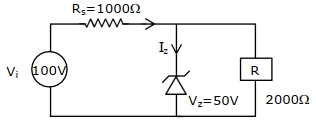
A
$0.15$
B
$0.05$
C
$0.1$
D
$25$
Solution
(D) The total voltage across the series resistor ${R}_{s} = 1000 \, \Omega$ is given by $V_{R} = V_{i} - V_{z} = 100 \, V - 50 \, V = 50 \, V$.
The total current flowing through the series resistor is $I = \frac{V_{R}}{R_{s}} = \frac{50 \, V}{1000 \, \Omega} = 0.05 \, A = 50 \, mA$.
The current flowing through the load resistor $R = 2000 \, \Omega$ is $I_{L} = \frac{V_{z}}{R} = \frac{50 \, V}{2000 \, \Omega} = 0.025 \, A = 25 \, mA$.
Using Kirchhoff's Current Law at the junction,the Zener current $I_{z}$ is $I_{z} = I - I_{L} = 50 \, mA - 25 \, mA = 25 \, mA$.
The total current flowing through the series resistor is $I = \frac{V_{R}}{R_{s}} = \frac{50 \, V}{1000 \, \Omega} = 0.05 \, A = 50 \, mA$.
The current flowing through the load resistor $R = 2000 \, \Omega$ is $I_{L} = \frac{V_{z}}{R} = \frac{50 \, V}{2000 \, \Omega} = 0.025 \, A = 25 \, mA$.
Using Kirchhoff's Current Law at the junction,the Zener current $I_{z}$ is $I_{z} = I - I_{L} = 50 \, mA - 25 \, mA = 25 \, mA$.
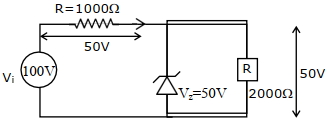
0 likesView Solution
360
PhysicsDifficultMCQJEE Main · 2021
$A$ nucleus of mass $M$ emits a $\gamma$-ray photon of frequency $\nu$. The loss of internal energy by the nucleus is:
A
$0$
B
$h\nu \left[1 + \frac{h\nu}{2Mc^2}\right]$
C
$h\nu$
D
$h\nu \left[1 - \frac{h\nu}{2Mc^2}\right]$
Solution
(B) The energy of the $\gamma$-ray photon is $E_{\gamma} = h\nu$.
The momentum of the $\gamma$-ray photon is $p_{\gamma} = \frac{h\nu}{c}$.
By the law of conservation of momentum,the nucleus must recoil with an equal and opposite momentum $p_N = p_{\gamma} = \frac{h\nu}{c}$.
The kinetic energy of the recoiling nucleus is $K_N = \frac{p_N^2}{2M} = \frac{(h\nu/c)^2}{2M} = \frac{(h\nu)^2}{2Mc^2}$.
The total loss in internal energy of the nucleus is the sum of the energy of the emitted photon and the kinetic energy of the recoiling nucleus:
$\Delta E = E_{\gamma} + K_N = h\nu + \frac{(h\nu)^2}{2Mc^2} = h\nu \left[1 + \frac{h\nu}{2Mc^2}\right]$.
The momentum of the $\gamma$-ray photon is $p_{\gamma} = \frac{h\nu}{c}$.
By the law of conservation of momentum,the nucleus must recoil with an equal and opposite momentum $p_N = p_{\gamma} = \frac{h\nu}{c}$.
The kinetic energy of the recoiling nucleus is $K_N = \frac{p_N^2}{2M} = \frac{(h\nu/c)^2}{2M} = \frac{(h\nu)^2}{2Mc^2}$.
The total loss in internal energy of the nucleus is the sum of the energy of the emitted photon and the kinetic energy of the recoiling nucleus:
$\Delta E = E_{\gamma} + K_N = h\nu + \frac{(h\nu)^2}{2Mc^2} = h\nu \left[1 + \frac{h\nu}{2Mc^2}\right]$.
0 likesView Solution
361
PhysicsMediumMCQJEE Main · 2021
Region $I$ and $II$ are separated by a spherical surface of radius $25\, \text{cm}$. An object is kept in region $I$ at a distance of $40\, \text{cm}$ from the surface. The distance of the image from the surface is $.....\, \text{cm}$.
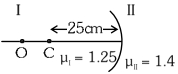
A
$55.44$
B
$9.52$
C
$37.58$
D
$18.23$
Solution
(C) The formula for refraction at a spherical surface is given by: $\frac{\mu_{2}}{v} - \frac{\mu_{1}}{u} = \frac{\mu_{2} - \mu_{1}}{R}$.
Given:
$\mu_{1} = 1.25$ (refractive index of region $I$)
$\mu_{2} = 1.4$ (refractive index of region $II$)
$u = -40\, \text{cm}$ (object distance, following sign convention)
$R = -25\, \text{cm}$ (radius of curvature, as the center of curvature is in region $I$)
Substituting the values into the formula:
$\frac{1.4}{v} - \frac{1.25}{-40} = \frac{1.4 - 1.25}{-25}$
$\frac{1.4}{v} + \frac{1.25}{40} = \frac{0.15}{-25}$
$\frac{1.4}{v} = -\frac{0.15}{25} - \frac{1.25}{40}$
$\frac{1.4}{v} = -0.006 - 0.03125 = -0.03725$
$v = \frac{1.4}{-0.03725} \approx -37.58\, \text{cm}$.
The negative sign indicates that the image is formed in region $I$ at a distance of $37.58\, \text{cm}$ from the surface.
Given:
$\mu_{1} = 1.25$ (refractive index of region $I$)
$\mu_{2} = 1.4$ (refractive index of region $II$)
$u = -40\, \text{cm}$ (object distance, following sign convention)
$R = -25\, \text{cm}$ (radius of curvature, as the center of curvature is in region $I$)
Substituting the values into the formula:
$\frac{1.4}{v} - \frac{1.25}{-40} = \frac{1.4 - 1.25}{-25}$
$\frac{1.4}{v} + \frac{1.25}{40} = \frac{0.15}{-25}$
$\frac{1.4}{v} = -\frac{0.15}{25} - \frac{1.25}{40}$
$\frac{1.4}{v} = -0.006 - 0.03125 = -0.03725$
$v = \frac{1.4}{-0.03725} \approx -37.58\, \text{cm}$.
The negative sign indicates that the image is formed in region $I$ at a distance of $37.58\, \text{cm}$ from the surface.
0 likesView Solution
362
PhysicsDifficultMCQJEE Main · 2021
$AC$ voltage $V(t) = 20 \sin \omega t$ of frequency $50 \, Hz$ is applied to a parallel plate capacitor. The separation between the plates is $2 \, mm$ and the area is $1 \, m^2$. The amplitude of the oscillating displacement current for the applied $AC$ voltage is ...... $\mu A$.
[Take $\varepsilon_0 = 8.85 \times 10^{-12} \, F/m$]
[Take $\varepsilon_0 = 8.85 \times 10^{-12} \, F/m$]
A
$21.14$
B
$83.57$
C
$55.58$
D
$27.79$
Solution
(D) The capacitance of the parallel plate capacitor is given by $C = \frac{\varepsilon_0 A}{d}$.
Substituting the given values: $C = \frac{8.85 \times 10^{-12} \times 1}{2 \times 10^{-3}} = 4.425 \times 10^{-9} \, F$.
The angular frequency is $\omega = 2 \pi f = 2 \times \pi \times 50 = 100 \pi \, rad/s$.
The amplitude of the current $I_0$ is given by $I_0 = V_0 \omega C$.
Substituting the values: $I_0 = 20 \times (100 \pi) \times (4.425 \times 10^{-9})$.
$I_0 = 2000 \times 3.14159 \times 4.425 \times 10^{-9} \approx 27.79 \times 10^{-6} \, A$.
Therefore,the amplitude of the displacement current is $27.79 \, \mu A$.
Substituting the given values: $C = \frac{8.85 \times 10^{-12} \times 1}{2 \times 10^{-3}} = 4.425 \times 10^{-9} \, F$.
The angular frequency is $\omega = 2 \pi f = 2 \times \pi \times 50 = 100 \pi \, rad/s$.
The amplitude of the current $I_0$ is given by $I_0 = V_0 \omega C$.
Substituting the values: $I_0 = 20 \times (100 \pi) \times (4.425 \times 10^{-9})$.
$I_0 = 2000 \times 3.14159 \times 4.425 \times 10^{-9} \approx 27.79 \times 10^{-6} \, A$.
Therefore,the amplitude of the displacement current is $27.79 \, \mu A$.
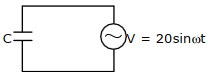
0 likesView Solution
363
PhysicsDifficultMCQJEE Main · 2021
$A$ current of $5\; A$ is passing through a non-linear magnesium wire of cross-section $0.04\; m^2$. At every point,the direction of current density is at an angle of $60^{\circ}$ with the unit vector of the area of cross-section. The magnitude of the electric field at every point of the conductor is .... $V/m$ (Resistivity of magnesium is $\rho = 44 \times 10^{-8}\, \Omega m$).
A
$11 \times 10^{-3}$
B
$11 \times 10^{-5}$
C
$11 \times 10^{-7}$
D
$11 \times 10^{-2}$
Solution
(B) The current $I$ is given by the dot product of current density $\vec{J}$ and area vector $\vec{A}$: $I = \vec{J} \cdot \vec{A} = J A \cos(\theta)$.
Given $I = 5\; A$,$A = 0.04\; m^2$,and $\theta = 60^{\circ}$.
Substituting the values: $5 = J \times 0.04 \times \cos(60^{\circ})$.
Since $\cos(60^{\circ}) = 0.5$,we have $5 = J \times 0.04 \times 0.5 = J \times 0.02$.
Thus,$J = \frac{5}{0.02} = 250\; A/m^2$.
Using Ohm's law in vector form,$\vec{E} = \rho \vec{J}$,the magnitude is $E = \rho J$.
$E = (44 \times 10^{-8}) \times 250 = 11000 \times 10^{-8} = 11 \times 10^{-5}\; V/m$.
Given $I = 5\; A$,$A = 0.04\; m^2$,and $\theta = 60^{\circ}$.
Substituting the values: $5 = J \times 0.04 \times \cos(60^{\circ})$.
Since $\cos(60^{\circ}) = 0.5$,we have $5 = J \times 0.04 \times 0.5 = J \times 0.02$.
Thus,$J = \frac{5}{0.02} = 250\; A/m^2$.
Using Ohm's law in vector form,$\vec{E} = \rho \vec{J}$,the magnitude is $E = \rho J$.
$E = (44 \times 10^{-8}) \times 250 = 11000 \times 10^{-8} = 11 \times 10^{-5}\; V/m$.
1 likesView Solution
364
PhysicsDifficultMCQJEE Main · 2021
$A$ body having a specific charge of $8\,\mu \text{C/g}$ is resting on a frictionless plane at a distance of $10\,\text{cm}$ from a wall. It starts moving towards the wall when a uniform electric field of $100\,\text{V/m}$ is applied horizontally toward the wall. If the collision of the body with the wall is perfectly elastic,then the time period of the motion will be (in seconds):
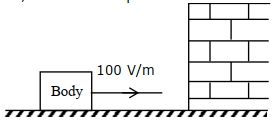
A
$0.5$
B
$1.0$
C
$2.0$
D
$4.0$
Solution
(B) The specific charge is given by $\frac{q}{m} = 8\,\mu \text{C/g} = 8 \times 10^{-6} \text{ C} / 10^{-3} \text{ kg} = 8 \times 10^{-3} \text{ C/kg}$.
The force on the body due to the electric field is $F = qE$.
The acceleration of the body is $a = \frac{F}{m} = \frac{qE}{m} = \left(\frac{q}{m}\right)E$.
Substituting the values: $a = (8 \times 10^{-3} \text{ C/kg}) \times (100 \text{ V/m}) = 0.8 \text{ m/s}^2$.
The time taken to travel the distance $d = 10\,\text{cm} = 0.1\,\text{m}$ is $t = \sqrt{\frac{2d}{a}}$.
$t = \sqrt{\frac{2 \times 0.1}{0.8}} = \sqrt{\frac{0.2}{0.8}} = \sqrt{0.25} = 0.5\,\text{s}$.
Since the collision is perfectly elastic,the body will rebound with the same speed and return to its original position in another $0.5\,\text{s}$.
Therefore,the total time period of the motion is $T = 2t = 2 \times 0.5 = 1.0\,\text{s}$.
The force on the body due to the electric field is $F = qE$.
The acceleration of the body is $a = \frac{F}{m} = \frac{qE}{m} = \left(\frac{q}{m}\right)E$.
Substituting the values: $a = (8 \times 10^{-3} \text{ C/kg}) \times (100 \text{ V/m}) = 0.8 \text{ m/s}^2$.
The time taken to travel the distance $d = 10\,\text{cm} = 0.1\,\text{m}$ is $t = \sqrt{\frac{2d}{a}}$.
$t = \sqrt{\frac{2 \times 0.1}{0.8}} = \sqrt{\frac{0.2}{0.8}} = \sqrt{0.25} = 0.5\,\text{s}$.
Since the collision is perfectly elastic,the body will rebound with the same speed and return to its original position in another $0.5\,\text{s}$.
Therefore,the total time period of the motion is $T = 2t = 2 \times 0.5 = 1.0\,\text{s}$.
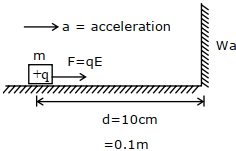
2 likesView Solution
365
PhysicsDifficultMCQJEE Main · 2021
An object viewed from a near point distance of $25 \, cm$,using a microscopic lens with magnification $6$,gives an unresolved image. $A$ resolved image is observed at infinite distance with a total magnification double the earlier,using an eyepiece along with the given lens and a tube of length $0.6 \, m$. The focal length of the eyepiece is equal to $.... \, cm$.
A
$2.5$
B
$12$
C
$60$
D
$25$
Solution
(D) For a simple microscope,the magnification is given by $m = 1 + \frac{D}{f_0}$.
Given $m = 6$ and $D = 25 \, cm$,we have $6 = 1 + \frac{25}{f_0}$,which implies $5 = \frac{25}{f_0}$,so $f_0 = 5 \, cm$.
For a compound microscope,the total magnification $M$ for an image at infinity is given by $M = \frac{L \cdot D}{f_0 \cdot f_e}$,where $L$ is the tube length.
Given $M = 2 \times 6 = 12$,$L = 0.6 \, m = 60 \, cm$,$D = 25 \, cm$,and $f_0 = 5 \, cm$,we substitute these values into the formula:
$12 = \frac{60 \times 25}{5 \times f_e}$.
$12 = \frac{1500}{5 \times f_e} = \frac{300}{f_e}$.
$f_e = \frac{300}{12} = 25 \, cm$.
Given $m = 6$ and $D = 25 \, cm$,we have $6 = 1 + \frac{25}{f_0}$,which implies $5 = \frac{25}{f_0}$,so $f_0 = 5 \, cm$.
For a compound microscope,the total magnification $M$ for an image at infinity is given by $M = \frac{L \cdot D}{f_0 \cdot f_e}$,where $L$ is the tube length.
Given $M = 2 \times 6 = 12$,$L = 0.6 \, m = 60 \, cm$,$D = 25 \, cm$,and $f_0 = 5 \, cm$,we substitute these values into the formula:
$12 = \frac{60 \times 25}{5 \times f_e}$.
$12 = \frac{1500}{5 \times f_e} = \frac{300}{f_e}$.
$f_e = \frac{300}{12} = 25 \, cm$.
0 likesView Solution
366
PhysicsDifficultMCQJEE Main · 2021
In an $LCR$ series circuit,an inductor $30 \, {mH}$ and a resistor $1 \, \Omega$ are connected to an $AC$ source of angular frequency $300 \, {rad/s}$. The value of capacitance for which the current leads the voltage by $45^{\circ}$ is $\frac{1}{x} \times 10^{-3} \, {F}$. Then the value of $x$ is ..... .
A
$3$
B
$5$
C
$7$
D
$9$
Solution
(A) The phase angle $\phi$ in an $LCR$ circuit is given by $\tan \phi = \frac{X_C - X_L}{R}$.
Since the current leads the voltage,the circuit is capacitive,and the phase angle is $\phi = -45^{\circ}$.
Thus,$\tan(-45^{\circ}) = \frac{X_C - X_L}{R} \implies -1 = \frac{X_C - X_L}{R}$.
This gives $X_L - X_C = R$.
Given $L = 30 \, {mH} = 0.03 \, {H}$,$R = 1 \, \Omega$,and $\omega = 300 \, {rad/s}$.
$X_L = \omega L = 300 \times 0.03 = 9 \, \Omega$.
Substituting the values: $9 - X_C = 1 \implies X_C = 8 \, \Omega$.
Since $X_C = \frac{1}{\omega C}$,we have $\frac{1}{300 \times C} = 8$.
$C = \frac{1}{300 \times 8} = \frac{1}{2400} = \frac{1}{2.4} \times 10^{-3} \, {F}$.
Wait,re-evaluating the phase condition: If current leads voltage,$\phi$ is negative,so $\tan \phi = \frac{X_C - X_L}{R} = \tan(-45^{\circ}) = -1$.
$X_L - X_C = R \implies 9 - X_C = 1 \implies X_C = 8$. This leads to $C = \frac{1}{2400} \approx 0.416 \times 10^{-3} \, {F}$.
If the question implies the magnitude of the phase difference is $45^{\circ}$ and current leads,then $X_C > X_L$ is incorrect; it should be $X_L - X_C = R$ if current lags. For current to lead,$X_C - X_L = R$ is not possible if $X_C < X_L$. Let's re-check: $\tan \phi = \frac{X_L - X_C}{R}$. For current to lead,$\phi$ must be negative,so $\frac{X_C - X_L}{R} = \tan(45^{\circ}) = 1$ is wrong. The correct relation is $\tan \phi = \frac{X_L - X_C}{R}$. For current to lead,$\phi = -45^{\circ}$,so $-1 = \frac{X_L - X_C}{R} \implies X_C - X_L = R$.
$X_C - 9 = 1 \implies X_C = 10 \, \Omega$.
$\frac{1}{300 \times C} = 10 \implies C = \frac{1}{3000} = \frac{1}{3} \times 10^{-3} \, {F}$.
Thus,$x = 3$.
Since the current leads the voltage,the circuit is capacitive,and the phase angle is $\phi = -45^{\circ}$.
Thus,$\tan(-45^{\circ}) = \frac{X_C - X_L}{R} \implies -1 = \frac{X_C - X_L}{R}$.
This gives $X_L - X_C = R$.
Given $L = 30 \, {mH} = 0.03 \, {H}$,$R = 1 \, \Omega$,and $\omega = 300 \, {rad/s}$.
$X_L = \omega L = 300 \times 0.03 = 9 \, \Omega$.
Substituting the values: $9 - X_C = 1 \implies X_C = 8 \, \Omega$.
Since $X_C = \frac{1}{\omega C}$,we have $\frac{1}{300 \times C} = 8$.
$C = \frac{1}{300 \times 8} = \frac{1}{2400} = \frac{1}{2.4} \times 10^{-3} \, {F}$.
Wait,re-evaluating the phase condition: If current leads voltage,$\phi$ is negative,so $\tan \phi = \frac{X_C - X_L}{R} = \tan(-45^{\circ}) = -1$.
$X_L - X_C = R \implies 9 - X_C = 1 \implies X_C = 8$. This leads to $C = \frac{1}{2400} \approx 0.416 \times 10^{-3} \, {F}$.
If the question implies the magnitude of the phase difference is $45^{\circ}$ and current leads,then $X_C > X_L$ is incorrect; it should be $X_L - X_C = R$ if current lags. For current to lead,$X_C - X_L = R$ is not possible if $X_C < X_L$. Let's re-check: $\tan \phi = \frac{X_L - X_C}{R}$. For current to lead,$\phi$ must be negative,so $\frac{X_C - X_L}{R} = \tan(45^{\circ}) = 1$ is wrong. The correct relation is $\tan \phi = \frac{X_L - X_C}{R}$. For current to lead,$\phi = -45^{\circ}$,so $-1 = \frac{X_L - X_C}{R} \implies X_C - X_L = R$.
$X_C - 9 = 1 \implies X_C = 10 \, \Omega$.
$\frac{1}{300 \times C} = 10 \implies C = \frac{1}{3000} = \frac{1}{3} \times 10^{-3} \, {F}$.
Thus,$x = 3$.
0 likesView Solution
367
PhysicsMediumMCQJEE Main · 2021
$A$ carrier wave $v_{c}(t) = 160 \sin(2 \pi \times 10^{6} t) \text{ V}$ is made to vary between $V_{\max} = 200 \text{ V}$ and $V_{\min} = 120 \text{ V}$ by a message signal $v_{m}(t) = A_{m} \sin(2 \pi \times 10^{3} t) \text{ V}$. The peak voltage $A_{m}$ of the modulating signal is ..... .
A
$400$
B
$160$
C
$40$
D
$200$
Solution
(C) The maximum voltage of an amplitude-modulated wave is given by $V_{\max} = A_{c} + A_{m}$,where $A_{c}$ is the amplitude of the carrier wave and $A_{m}$ is the peak voltage of the modulating signal.
Given,$A_{c} = 160 \text{ V}$ and $V_{\max} = 200 \text{ V}$.
Substituting these values into the equation:
$200 = 160 + A_{m}$
$A_{m} = 200 - 160$
$A_{m} = 40 \text{ V}$.
Alternatively,using the minimum voltage formula: $V_{\min} = A_{c} - A_{m}$.
$120 = 160 - A_{m}$
$A_{m} = 160 - 120 = 40 \text{ V}$.
Thus,the peak voltage of the modulating signal is $40 \text{ V}$.
Given,$A_{c} = 160 \text{ V}$ and $V_{\max} = 200 \text{ V}$.
Substituting these values into the equation:
$200 = 160 + A_{m}$
$A_{m} = 200 - 160$
$A_{m} = 40 \text{ V}$.
Alternatively,using the minimum voltage formula: $V_{\min} = A_{c} - A_{m}$.
$120 = 160 - A_{m}$
$A_{m} = 160 - 120 = 40 \text{ V}$.
Thus,the peak voltage of the modulating signal is $40 \text{ V}$.
0 likesView Solution
368
PhysicsMediumMCQJEE Main · 2021
For a series $LCR$ circuit with $R=100\,\Omega$,$L=0.5\,mH$ and $C=0.1\,pF$ connected across $220\,V-50\,Hz$ $AC$ supply,the phase angle between current and supplied voltage and the nature of the circuit is:
A
$\approx 90^{\circ}$,predominantly inductive circuit
B
$0^{\circ}$,resistive circuit
C
$0^{\circ}$,resonance circuit
D
$\approx 90^{\circ}$,predominantly capacitive circuit
Solution
(D) Given: $R=100\,\Omega$,$L=0.5\,mH = 0.5 \times 10^{-3}\,H$,$C=0.1\,pF = 0.1 \times 10^{-12}\,F$,$f=50\,Hz$.
Angular frequency $\omega = 2\pi f = 2\pi \times 50 = 100\pi\,rad/s$.
Inductive reactance $X_L = \omega L = 100\pi \times 0.5 \times 10^{-3} = 0.05\pi\,\Omega \approx 0.157\,\Omega$.
Capacitive reactance $X_C = \frac{1}{\omega C} = \frac{1}{100\pi \times 0.1 \times 10^{-12}} = \frac{10^{11}}{10\pi} = \frac{10^{10}}{\pi}\,\Omega \approx 3.18 \times 10^9\,\Omega$.
Since $X_C \gg X_L$ and $X_C \gg R$,the circuit is predominantly capacitive.
The phase angle $\phi$ is given by $\tan \phi = \frac{X_L - X_C}{R}$.
Since $X_C$ is extremely large compared to $R$ and $X_L$,$\tan \phi \approx -\infty$,which implies $\phi \approx -90^{\circ}$.
The negative sign indicates that the current leads the voltage by approximately $90^{\circ}$,confirming the circuit is predominantly capacitive.
Angular frequency $\omega = 2\pi f = 2\pi \times 50 = 100\pi\,rad/s$.
Inductive reactance $X_L = \omega L = 100\pi \times 0.5 \times 10^{-3} = 0.05\pi\,\Omega \approx 0.157\,\Omega$.
Capacitive reactance $X_C = \frac{1}{\omega C} = \frac{1}{100\pi \times 0.1 \times 10^{-12}} = \frac{10^{11}}{10\pi} = \frac{10^{10}}{\pi}\,\Omega \approx 3.18 \times 10^9\,\Omega$.
Since $X_C \gg X_L$ and $X_C \gg R$,the circuit is predominantly capacitive.
The phase angle $\phi$ is given by $\tan \phi = \frac{X_L - X_C}{R}$.
Since $X_C$ is extremely large compared to $R$ and $X_L$,$\tan \phi \approx -\infty$,which implies $\phi \approx -90^{\circ}$.
The negative sign indicates that the current leads the voltage by approximately $90^{\circ}$,confirming the circuit is predominantly capacitive.
0 likesView Solution
369
PhysicsMediumMCQJEE Main · 2021
At an angle of $30^{\circ}$ to the magnetic meridian,the apparent dip is $45^{\circ}$. Find the true dip.
A
$\tan^{-1} \frac{1}{\sqrt{3}}$
B
$\tan^{-1} \frac{\sqrt{3}}{2}$
C
$\tan^{-1} \sqrt{3}$
D
$\tan^{-1} \frac{2}{\sqrt{3}}$
Solution
(B) The relationship between the true dip $(\delta)$ and the apparent dip $(\delta^{\prime})$ at an angle $\theta$ to the magnetic meridian is given by the formula: $\tan \delta^{\prime} = \frac{\tan \delta}{\cos \theta}$.
Rearranging for the true dip: $\tan \delta = \tan \delta^{\prime} \cos \theta$.
Given: $\delta^{\prime} = 45^{\circ}$ and $\theta = 30^{\circ}$.
Substituting the values: $\tan \delta = \tan 45^{\circ} \cos 30^{\circ}$.
Since $\tan 45^{\circ} = 1$ and $\cos 30^{\circ} = \frac{\sqrt{3}}{2}$,we get: $\tan \delta = 1 \times \frac{\sqrt{3}}{2} = \frac{\sqrt{3}}{2}$.
Therefore,the true dip is $\delta = \tan^{-1} \left( \frac{\sqrt{3}}{2} \right)$.
Rearranging for the true dip: $\tan \delta = \tan \delta^{\prime} \cos \theta$.
Given: $\delta^{\prime} = 45^{\circ}$ and $\theta = 30^{\circ}$.
Substituting the values: $\tan \delta = \tan 45^{\circ} \cos 30^{\circ}$.
Since $\tan 45^{\circ} = 1$ and $\cos 30^{\circ} = \frac{\sqrt{3}}{2}$,we get: $\tan \delta = 1 \times \frac{\sqrt{3}}{2} = \frac{\sqrt{3}}{2}$.
Therefore,the true dip is $\delta = \tan^{-1} \left( \frac{\sqrt{3}}{2} \right)$.
0 likesView Solution
370
PhysicsMediumMCQJEE Main · 2021
For a certain radioactive process,the graph between $\ln R$ and $t \, (\text{sec})$ is obtained as shown in the figure. Then the value of the half-life for the unknown radioactive material is approximately $.... \, \text{sec}$.
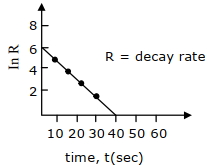
A
$6.93$
B
$4.62$
C
$2.62$
D
$9.15$
Solution
(B) The radioactive decay law is given by $R = R_0 e^{-\lambda t}$.
Taking the natural logarithm on both sides,we get $\ln R = \ln R_0 - \lambda t$.
This is the equation of a straight line $y = mx + c$,where the slope $m = -\lambda$.
From the graph,the line passes through $(0, 6)$ and $(40, 0)$.
The slope is $\text{slope} = \frac{0 - 6}{40 - 0} = -\frac{6}{40} = -0.15$.
Thus,$-\lambda = -0.15$,which gives the decay constant $\lambda = 0.15 \, \text{sec}^{-1}$.
The half-life $t_{1/2}$ is given by $t_{1/2} = \frac{\ln 2}{\lambda} = \frac{0.693}{0.15} = 4.62 \, \text{sec}$.
Taking the natural logarithm on both sides,we get $\ln R = \ln R_0 - \lambda t$.
This is the equation of a straight line $y = mx + c$,where the slope $m = -\lambda$.
From the graph,the line passes through $(0, 6)$ and $(40, 0)$.
The slope is $\text{slope} = \frac{0 - 6}{40 - 0} = -\frac{6}{40} = -0.15$.
Thus,$-\lambda = -0.15$,which gives the decay constant $\lambda = 0.15 \, \text{sec}^{-1}$.
The half-life $t_{1/2}$ is given by $t_{1/2} = \frac{\ln 2}{\lambda} = \frac{0.693}{0.15} = 4.62 \, \text{sec}$.
0 likesView Solution
371
PhysicsMediumMCQJEE Main · 2021
The magnetic susceptibility of a material of a rod is $499$. Permeability in vacuum is $4\pi \times 10^{-7} \text{ H/m}$. Absolute permeability of the material of the rod is $....\pi \times 10^{-4} \text{ H/m}$.
A
$4$
B
$1$
C
$2$
D
$3$
Solution
(C) The absolute permeability $\mu$ is given by the formula: $\mu = \mu_0(1 + \chi_m)$,where $\mu_0$ is the permeability of free space and $\chi_m$ is the magnetic susceptibility.
Given: $\mu_0 = 4\pi \times 10^{-7} \text{ H/m}$ and $\chi_m = 499$.
Substituting the values:
$\mu = 4\pi \times 10^{-7} \times (1 + 499)$
$\mu = 4\pi \times 10^{-7} \times 500$
$\mu = 4\pi \times 10^{-7} \times 5 \times 10^2$
$\mu = 20\pi \times 10^{-5} \text{ H/m}$
$\mu = 2\pi \times 10^{-4} \text{ H/m}$.
Comparing this with the given format $....\pi \times 10^{-4} \text{ H/m}$,the missing value is $2$.
Given: $\mu_0 = 4\pi \times 10^{-7} \text{ H/m}$ and $\chi_m = 499$.
Substituting the values:
$\mu = 4\pi \times 10^{-7} \times (1 + 499)$
$\mu = 4\pi \times 10^{-7} \times 500$
$\mu = 4\pi \times 10^{-7} \times 5 \times 10^2$
$\mu = 20\pi \times 10^{-5} \text{ H/m}$
$\mu = 2\pi \times 10^{-4} \text{ H/m}$.
Comparing this with the given format $....\pi \times 10^{-4} \text{ H/m}$,the missing value is $2$.
0 likesView Solution
372
PhysicsMediumMCQJEE Main · 2021
With what speed should a galaxy move outward with respect to Earth so that the sodium-$D$ line at wavelength $5890 \ \mathring{A}$ is observed at $5896 \ \mathring{A}$? (in $\text{km/s}$)
A
$336$
B
$296$
C
$306$
D
$322$
Solution
(C) The Doppler effect for light is given by the formula $\frac{\Delta \lambda}{\lambda} = \frac{v}{c}$,where $\Delta \lambda$ is the change in wavelength,$\lambda$ is the original wavelength,$v$ is the relative velocity,and $c$ is the speed of light.
Given: $\lambda = 5890 \ \mathring{A}$,observed wavelength $\lambda' = 5896 \ \mathring{A}$.
Change in wavelength $\Delta \lambda = \lambda' - \lambda = 5896 - 5890 = 6 \ \mathring{A}$.
Speed of light $c = 3 \times 10^8 \ \text{m/s} = 3 \times 10^5 \ \text{km/s}$.
Using the formula: $v = c \times \frac{\Delta \lambda}{\lambda}$.
$v = (3 \times 10^5 \ \text{km/s}) \times \frac{6 \ \mathring{A}}{5890 \ \mathring{A}}$.
$v = \frac{18 \times 10^5}{5890} \ \text{km/s} \approx 305.6 \ \text{km/s}$.
Rounding to the nearest integer,the speed is approximately $306 \ \text{km/s}$.
Given: $\lambda = 5890 \ \mathring{A}$,observed wavelength $\lambda' = 5896 \ \mathring{A}$.
Change in wavelength $\Delta \lambda = \lambda' - \lambda = 5896 - 5890 = 6 \ \mathring{A}$.
Speed of light $c = 3 \times 10^8 \ \text{m/s} = 3 \times 10^5 \ \text{km/s}$.
Using the formula: $v = c \times \frac{\Delta \lambda}{\lambda}$.
$v = (3 \times 10^5 \ \text{km/s}) \times \frac{6 \ \mathring{A}}{5890 \ \mathring{A}}$.
$v = \frac{18 \times 10^5}{5890} \ \text{km/s} \approx 305.6 \ \text{km/s}$.
Rounding to the nearest integer,the speed is approximately $306 \ \text{km/s}$.
0 likesView Solution
373
PhysicsMediumMCQJEE Main · 2021
In an electromagnetic wave,the electric field vector and magnetic field vector are given as $\vec{E} = E_{0} \hat{i}$ and $\vec{B} = B_{0} \hat{k}$ respectively. The direction of propagation of the electromagnetic wave is along:
A
$\hat{j}$
B
$\hat{k}$
C
$-\hat{k}$
D
$-\hat{j}$
Solution
(D) The direction of propagation of an electromagnetic wave is given by the direction of the Poynting vector,which is parallel to $\vec{E} \times \vec{B}$.
Given $\vec{E} = E_{0} \hat{i}$ and $\vec{B} = B_{0} \hat{k}$.
The direction of propagation is $\hat{i} \times \hat{k}$.
Using the cross product rules for unit vectors: $\hat{i} \times \hat{j} = \hat{k}$,$\hat{j} \times \hat{k} = \hat{i}$,and $\hat{k} \times \hat{i} = \hat{j}$.
Since the order is reversed,$\hat{i} \times \hat{k} = -\hat{j}$.
Therefore,the direction of propagation is along $-\hat{j}$.
Given $\vec{E} = E_{0} \hat{i}$ and $\vec{B} = B_{0} \hat{k}$.
The direction of propagation is $\hat{i} \times \hat{k}$.
Using the cross product rules for unit vectors: $\hat{i} \times \hat{j} = \hat{k}$,$\hat{j} \times \hat{k} = \hat{i}$,and $\hat{k} \times \hat{i} = \hat{j}$.
Since the order is reversed,$\hat{i} \times \hat{k} = -\hat{j}$.
Therefore,the direction of propagation is along $-\hat{j}$.
0 likesView Solution
374
PhysicsMediumMCQJEE Main · 2021
$A$ radioactive substance decays to $\left(\frac{1}{16}\right)^{th}$ of its initial activity in $80\, days$. The half-life of the radioactive substance expressed in days is ... .
A
$20$
B
$200$
C
$2$
D
$4$
Solution
(A) The activity of a radioactive substance follows the relation $A = A_0 \left(\frac{1}{2}\right)^n$,where $n$ is the number of half-lives.
Given that the activity decays to $\frac{1}{16}$ of its initial value,we have $\frac{1}{16} = \left(\frac{1}{2}\right)^n$.
Since $\frac{1}{16} = \left(\frac{1}{2}\right)^4$,we find that $n = 4$.
The total time taken is $T = n \times t_{1/2}$,where $t_{1/2}$ is the half-life.
Given $T = 80\, days$,we have $80 = 4 \times t_{1/2}$.
Therefore,$t_{1/2} = \frac{80}{4} = 20\, days$.
Given that the activity decays to $\frac{1}{16}$ of its initial value,we have $\frac{1}{16} = \left(\frac{1}{2}\right)^n$.
Since $\frac{1}{16} = \left(\frac{1}{2}\right)^4$,we find that $n = 4$.
The total time taken is $T = n \times t_{1/2}$,where $t_{1/2}$ is the half-life.
Given $T = 80\, days$,we have $80 = 4 \times t_{1/2}$.
Therefore,$t_{1/2} = \frac{80}{4} = 20\, days$.
0 likesView Solution
375
PhysicsMediumMCQJEE Main · 2021
$A$ series $LCR$ circuit of $R=5 \, \Omega, L=20 \, \text{mH}$ and $C=0.5 \, \mu \text{F}$ is connected across an $AC$ supply of $250 \, \text{V}$,having variable frequency. The power dissipated at resonance condition is $..... \times 10^{2} \, \text{W}$.
A
$150$
B
$125$
C
$160$
D
$200$
Solution
(B) At resonance,the inductive reactance $X_L$ is equal to the capacitive reactance $X_C$,so the impedance $Z$ of the circuit is equal to the resistance $R$.
$Z = R = 5 \, \Omega$.
The root mean square current $I_{\text{rms}}$ is given by $I_{\text{rms}} = \frac{V}{Z} = \frac{V}{R}$.
The power dissipated at resonance is $P = I_{\text{rms}}^2 R = \left(\frac{V}{R}\right)^2 R = \frac{V^2}{R}$.
Substituting the given values: $P = \frac{250 \times 250}{5} = \frac{62500}{5} = 12500 \, \text{W}$.
Expressing this in the form $..... \times 10^2 \, \text{W}$,we get $125 \times 10^2 \, \text{W}$.
Thus,the correct option is $B$.
$Z = R = 5 \, \Omega$.
The root mean square current $I_{\text{rms}}$ is given by $I_{\text{rms}} = \frac{V}{Z} = \frac{V}{R}$.
The power dissipated at resonance is $P = I_{\text{rms}}^2 R = \left(\frac{V}{R}\right)^2 R = \frac{V^2}{R}$.
Substituting the given values: $P = \frac{250 \times 250}{5} = \frac{62500}{5} = 12500 \, \text{W}$.
Expressing this in the form $..... \times 10^2 \, \text{W}$,we get $125 \times 10^2 \, \text{W}$.
Thus,the correct option is $B$.
0 likesView Solution
376
PhysicsMediumMCQJEE Main · 2021
$A$ Zener diode having a Zener voltage of $8\, V$ and a power dissipation rating of $0.5\, W$ is connected across a potential divider circuit as shown in the diagram. The value of the protective resistance $R_p$ is $....\, \Omega$.
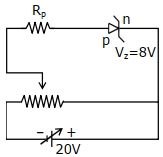
A
$123$
B
$456$
C
$192$
D
$219$
Solution
(C) The power dissipation rating of the Zener diode is given by $P = V_z \cdot I_z$,where $V_z = 8\, V$ and $P = 0.5\, W$.
Calculating the maximum current $I_z$ through the Zener diode:
$I_z = \frac{P}{V_z} = \frac{0.5}{8} = \frac{1}{16}\, A$.
In the circuit,the total voltage $E = 20\, V$ is divided between the protective resistance $R_p$ and the Zener diode.
The voltage drop across the protective resistance $R_p$ is $V_{R_p} = E - V_z = 20\, V - 8\, V = 12\, V$.
Using Ohm's law for the protective resistance $R_p = \frac{V_{R_p}}{I_z}$:
$R_p = \frac{12}{1/16} = 12 \times 16 = 192\, \Omega$.
Calculating the maximum current $I_z$ through the Zener diode:
$I_z = \frac{P}{V_z} = \frac{0.5}{8} = \frac{1}{16}\, A$.
In the circuit,the total voltage $E = 20\, V$ is divided between the protective resistance $R_p$ and the Zener diode.
The voltage drop across the protective resistance $R_p$ is $V_{R_p} = E - V_z = 20\, V - 8\, V = 12\, V$.
Using Ohm's law for the protective resistance $R_p = \frac{V_{R_p}}{I_z}$:
$R_p = \frac{12}{1/16} = 12 \times 16 = 192\, \Omega$.
0 likesView Solution
377
PhysicsMediumMCQJEE Main · 2021
For the forward biased diode characteristics shown in the figure,the dynamic resistance at $I_{D} = 3 \, \text{mA}$ will be $..... \, \Omega$.
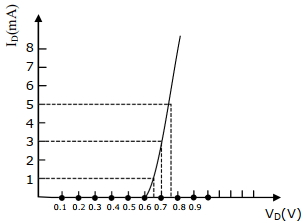
A
$25$
B
$30$
C
$35$
D
$40$
Solution
(A) The dynamic resistance $R_{d}$ is defined as the reciprocal of the slope of the $I-V$ characteristic curve.
$R_{d} = \frac{\Delta V}{\Delta I} = \frac{1}{\text{slope}} = \frac{1}{\frac{\Delta I}{\Delta V}}$
From the given graph,we select two points on the linear portion of the curve around $I_{D} = 3 \, \text{mA}$.
At $I_{D1} = 1 \, \text{mA}$,$V_{D1} = 0.65 \, \text{V}$.
At $I_{D2} = 5 \, \text{mA}$,$V_{D2} = 0.75 \, \text{V}$.
Calculating the change in current and voltage:
$\Delta I = (5 - 1) \, \text{mA} = 4 \times 10^{-3} \, \text{A}$
$\Delta V = 0.75 \, \text{V} - 0.65 \, \text{V} = 0.10 \, \text{V}$
Therefore,$R_{d} = \frac{\Delta V}{\Delta I} = \frac{0.10}{4 \times 10^{-3}} = \frac{100}{4} = 25 \, \Omega$.
$R_{d} = \frac{\Delta V}{\Delta I} = \frac{1}{\text{slope}} = \frac{1}{\frac{\Delta I}{\Delta V}}$
From the given graph,we select two points on the linear portion of the curve around $I_{D} = 3 \, \text{mA}$.
At $I_{D1} = 1 \, \text{mA}$,$V_{D1} = 0.65 \, \text{V}$.
At $I_{D2} = 5 \, \text{mA}$,$V_{D2} = 0.75 \, \text{V}$.
Calculating the change in current and voltage:
$\Delta I = (5 - 1) \, \text{mA} = 4 \times 10^{-3} \, \text{A}$
$\Delta V = 0.75 \, \text{V} - 0.65 \, \text{V} = 0.10 \, \text{V}$
Therefore,$R_{d} = \frac{\Delta V}{\Delta I} = \frac{0.10}{4 \times 10^{-3}} = \frac{100}{4} = 25 \, \Omega$.
0 likesView Solution
378
PhysicsDifficultMCQJEE Main · 2021
In the given figure,switches $S_{1}$ and $S_{2}$ are initially open. What is the equivalent resistance across $a b$ when the switches $S_{1}$ and $S_{2}$ are closed? (in $\Omega$)
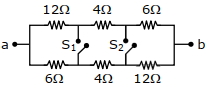
A
$5$
B
$63$
C
$10$
D
$4$
Solution
(C) When switches $S_{1}$ and $S_{2}$ are closed,the circuit simplifies into three parallel combinations connected in series.
$1$. The first part consists of $12 \, \Omega$ and $6 \, \Omega$ resistors in parallel. The equivalent resistance is $R_{1} = \frac{12 \times 6}{12 + 6} = \frac{72}{18} = 4 \, \Omega$.
$2$. The middle part consists of $4 \, \Omega$ and $4 \, \Omega$ resistors in parallel. The equivalent resistance is $R_{2} = \frac{4 \times 4}{4 + 4} = \frac{16}{8} = 2 \, \Omega$.
$3$. The third part consists of $6 \, \Omega$ and $12 \, \Omega$ resistors in parallel. The equivalent resistance is $R_{3} = \frac{6 \times 12}{6 + 12} = \frac{72}{18} = 4 \, \Omega$.
Since these three combinations are in series,the total equivalent resistance is $R_{eq} = R_{1} + R_{2} + R_{3} = 4 + 2 + 4 = 10 \, \Omega$.
$1$. The first part consists of $12 \, \Omega$ and $6 \, \Omega$ resistors in parallel. The equivalent resistance is $R_{1} = \frac{12 \times 6}{12 + 6} = \frac{72}{18} = 4 \, \Omega$.
$2$. The middle part consists of $4 \, \Omega$ and $4 \, \Omega$ resistors in parallel. The equivalent resistance is $R_{2} = \frac{4 \times 4}{4 + 4} = \frac{16}{8} = 2 \, \Omega$.
$3$. The third part consists of $6 \, \Omega$ and $12 \, \Omega$ resistors in parallel. The equivalent resistance is $R_{3} = \frac{6 \times 12}{6 + 12} = \frac{72}{18} = 4 \, \Omega$.
Since these three combinations are in series,the total equivalent resistance is $R_{eq} = R_{1} + R_{2} + R_{3} = 4 + 2 + 4 = 10 \, \Omega$.
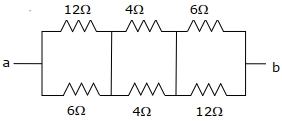
0 likesView Solution
379
PhysicsDifficultMCQJEE Main · 2021
$A$ Copper $(Cu)$ rod of length $25 \, cm$ and cross-sectional area $3 \, mm^2$ is joined with a similar Aluminium $(Al)$ rod as shown in the figure. Find the resistance of the combination between the ends $A$ and $B$ (in $m\Omega$).
(Take Resistivity of Copper $= 1.7 \times 10^{-8} \, \Omega \cdot m$,Resistivity of Aluminium $= 2.6 \times 10^{-8} \, \Omega \cdot m$)
(Take Resistivity of Copper $= 1.7 \times 10^{-8} \, \Omega \cdot m$,Resistivity of Aluminium $= 2.6 \times 10^{-8} \, \Omega \cdot m$)
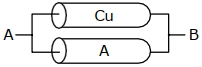
A
$1.420$
B
$0.0858$
C
$2.170$
D
$0.858$
Solution
(D) The two rods are connected in parallel between points $A$ and $B$.
The resistance of a rod is given by $R = \rho \frac{l}{A}$.
For the Copper rod: $R_{Cu} = \frac{1.7 \times 10^{-8} \times 0.25}{3 \times 10^{-6}} = \frac{1.7 \times 0.25}{3} \times 10^{-2} \approx 0.1417 \times 10^{-2} \, \Omega = 1.417 \, m\Omega$.
For the Aluminium rod: $R_{Al} = \frac{2.6 \times 10^{-8} \times 0.25}{3 \times 10^{-6}} = \frac{2.6 \times 0.25}{3} \times 10^{-2} \approx 0.2167 \times 10^{-2} \, \Omega = 2.167 \, m\Omega$.
Since they are in parallel,the equivalent resistance $R_{eq}$ is given by $\frac{1}{R_{eq}} = \frac{1}{R_{Cu}} + \frac{1}{R_{Al}}$.
$R_{eq} = \frac{R_{Cu} \times R_{Al}}{R_{Cu} + R_{Al}} = \frac{1.417 \times 2.167}{1.417 + 2.167} \, m\Omega = \frac{3.0706}{3.584} \, m\Omega \approx 0.8567 \, m\Omega$.
Rounding to the nearest option,the value is $0.858 \, m\Omega$.
The resistance of a rod is given by $R = \rho \frac{l}{A}$.
For the Copper rod: $R_{Cu} = \frac{1.7 \times 10^{-8} \times 0.25}{3 \times 10^{-6}} = \frac{1.7 \times 0.25}{3} \times 10^{-2} \approx 0.1417 \times 10^{-2} \, \Omega = 1.417 \, m\Omega$.
For the Aluminium rod: $R_{Al} = \frac{2.6 \times 10^{-8} \times 0.25}{3 \times 10^{-6}} = \frac{2.6 \times 0.25}{3} \times 10^{-2} \approx 0.2167 \times 10^{-2} \, \Omega = 2.167 \, m\Omega$.
Since they are in parallel,the equivalent resistance $R_{eq}$ is given by $\frac{1}{R_{eq}} = \frac{1}{R_{Cu}} + \frac{1}{R_{Al}}$.
$R_{eq} = \frac{R_{Cu} \times R_{Al}}{R_{Cu} + R_{Al}} = \frac{1.417 \times 2.167}{1.417 + 2.167} \, m\Omega = \frac{3.0706}{3.584} \, m\Omega \approx 0.8567 \, m\Omega$.
Rounding to the nearest option,the value is $0.858 \, m\Omega$.
0 likesView Solution
380
PhysicsMediumMCQJEE Main · 2021
An electron of mass $m_{e}$ and a proton of mass $m_{p}$ are accelerated through the same potential difference. The ratio of the de-Broglie wavelength associated with the electron to that with the proton is
A
$\sqrt{\frac{m_{p}}{m_{e}}}$
B
$\frac{m_{p}}{m_{e}}$
C
$1$
D
$\frac{m_{e}}{m_{p}}$
Solution
(A) The kinetic energy $K$ acquired by a charged particle accelerated through a potential difference $\Delta V$ is given by $K = q \Delta V$.
Since both the electron and the proton have the same magnitude of charge $e$,their kinetic energies are equal: $K_{e} = K_{p} = e \Delta V$.
The de-Broglie wavelength $\lambda$ is given by $\lambda = \frac{h}{\sqrt{2mK}}$.
For the electron,$\lambda_{e} = \frac{h}{\sqrt{2m_{e}(e \Delta V)}}$.
For the proton,$\lambda_{p} = \frac{h}{\sqrt{2m_{p}(e \Delta V)}}$.
Taking the ratio of the two wavelengths:
$\frac{\lambda_{e}}{\lambda_{p}} = \frac{\frac{h}{\sqrt{2m_{e}(e \Delta V)}}}{\frac{h}{\sqrt{2m_{p}(e \Delta V)}}} = \sqrt{\frac{m_{p}}{m_{e}}}$.
Since both the electron and the proton have the same magnitude of charge $e$,their kinetic energies are equal: $K_{e} = K_{p} = e \Delta V$.
The de-Broglie wavelength $\lambda$ is given by $\lambda = \frac{h}{\sqrt{2mK}}$.
For the electron,$\lambda_{e} = \frac{h}{\sqrt{2m_{e}(e \Delta V)}}$.
For the proton,$\lambda_{p} = \frac{h}{\sqrt{2m_{p}(e \Delta V)}}$.
Taking the ratio of the two wavelengths:
$\frac{\lambda_{e}}{\lambda_{p}} = \frac{\frac{h}{\sqrt{2m_{e}(e \Delta V)}}}{\frac{h}{\sqrt{2m_{p}(e \Delta V)}}} = \sqrt{\frac{m_{p}}{m_{e}}}$.
0 likesView Solution
381
PhysicsMediumMCQJEE Main · 2021
What should be the height of the transmitting antenna and the population covered if the television telecast is to cover a radius of $150 \, km$? The average population density around the tower is $2000 \, / km^2$ and the value of $R_e = 6.5 \times 10^6 \, m$.
A
Height $= 1731 \, m$,Population Covered $= 1413 \times 10^5$
B
Height $= 1241 \, m$,Population Covered $= 7 \times 10^5$
C
Height $= 1600 \, m$,Population Covered $= 2 \times 10^5$
D
Height $= 1800 \, m$,Population Covered $= 1413 \times 10^8$
Solution
(A) The radius covered by the antenna is given by $r = \sqrt{2 R_e H_T}$.
Given $r = 150 \, km = 1.5 \times 10^5 \, m$ and $R_e = 6.5 \times 10^6 \, m$.
Squaring both sides: $r^2 = 2 R_e H_T$.
$H_T = \frac{r^2}{2 R_e} = \frac{(1.5 \times 10^5)^2}{2 \times 6.5 \times 10^6} = \frac{2.25 \times 10^{10}}{13 \times 10^6} \approx 1730.76 \, m \approx 1731 \, m$.
The population covered is the area covered multiplied by the population density.
Area $= \pi r^2 = 3.14 \times (150 \, km)^2 = 3.14 \times 22500 \, km^2 = 70650 \, km^2$.
Population $= \text{Area} \times \text{Density} = 70650 \, km^2 \times 2000 \, / km^2 = 141300000 = 1413 \times 10^5$.
Given $r = 150 \, km = 1.5 \times 10^5 \, m$ and $R_e = 6.5 \times 10^6 \, m$.
Squaring both sides: $r^2 = 2 R_e H_T$.
$H_T = \frac{r^2}{2 R_e} = \frac{(1.5 \times 10^5)^2}{2 \times 6.5 \times 10^6} = \frac{2.25 \times 10^{10}}{13 \times 10^6} \approx 1730.76 \, m \approx 1731 \, m$.
The population covered is the area covered multiplied by the population density.
Area $= \pi r^2 = 3.14 \times (150 \, km)^2 = 3.14 \times 22500 \, km^2 = 70650 \, km^2$.
Population $= \text{Area} \times \text{Density} = 70650 \, km^2 \times 2000 \, / km^2 = 141300000 = 1413 \times 10^5$.
0 likesView Solution
382
PhysicsMediumMCQJEE Main · 2021
In a circuit consisting of a capacitance and a generator with alternating emf $E_{g}=E_{g0} \sin \omega t$,$V_{C}$ and $I_{C}$ are the voltage and current. The correct phasor diagram for such a circuit is:
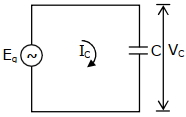
A
B
C
D
Solution
(A) In a purely capacitive circuit,the current $I_{C}$ leads the voltage $V_{C}$ across the capacitor by a phase angle of $\frac{\pi}{2}$ radians $(90^{\circ})$.
Mathematically,if $V_{C} = V_{0} \sin \omega t$,then $I_{C} = I_{0} \sin(\omega t + \frac{\pi}{2})$.
This means that the phasor representing current $I_{C}$ is rotated $90^{\circ}$ counter-clockwise relative to the phasor representing voltage $V_{C}$.
Looking at the provided options,the correct phasor diagram is the one where $I_{C}$ is $90^{\circ}$ ahead of $V_{C}$ in the counter-clockwise direction.
Mathematically,if $V_{C} = V_{0} \sin \omega t$,then $I_{C} = I_{0} \sin(\omega t + \frac{\pi}{2})$.
This means that the phasor representing current $I_{C}$ is rotated $90^{\circ}$ counter-clockwise relative to the phasor representing voltage $V_{C}$.
Looking at the provided options,the correct phasor diagram is the one where $I_{C}$ is $90^{\circ}$ ahead of $V_{C}$ in the counter-clockwise direction.
0 likesView Solution
383
PhysicsMediumMCQJEE Main · 2021
Intensity of sunlight is observed as $0.092 \, W/m^2$ at a point in free space. What will be the peak value of the magnetic field at that point? (Given: $\epsilon_0 = 8.85 \times 10^{-12} \, C^2 N^{-1} m^{-2}$,$c = 3 \times 10^8 \, m/s$)
A
$8.31 \, T$
B
$5.88 \, T$
C
$1.96 \times 10^{-8} \, T$
D
$2.77 \times 10^{-8} \, T$
Solution
(D) The intensity $I$ of an electromagnetic wave is related to the peak magnetic field $B_0$ by the formula: $I = \frac{B_0^2 c}{2 \mu_0}$.
Since $c = \frac{1}{\sqrt{\mu_0 \epsilon_0}}$,we have $\frac{1}{\mu_0} = \epsilon_0 c^2$.
Substituting this into the intensity formula: $I = \frac{B_0^2 c}{2} (\epsilon_0 c^2) = \frac{1}{2} \epsilon_0 c^3 B_0^2$.
Rearranging for $B_0$: $B_0 = \sqrt{\frac{2I}{\epsilon_0 c^3}}$.
Given $I = 0.092 \, W/m^2$,$\epsilon_0 = 8.85 \times 10^{-12} \, F/m$,and $c = 3 \times 10^8 \, m/s$:
$B_0 = \sqrt{\frac{2 \times 0.092}{8.85 \times 10^{-12} \times (3 \times 10^8)^3}}$.
$B_0 = \sqrt{\frac{0.184}{8.85 \times 10^{-12} \times 27 \times 10^{24}}} = \sqrt{\frac{0.184}{238.95 \times 10^{12}}} = \sqrt{0.00077 \times 10^{-12}} = \sqrt{7.7 \times 10^{-16}} \approx 2.77 \times 10^{-8} \, T$.
Since $c = \frac{1}{\sqrt{\mu_0 \epsilon_0}}$,we have $\frac{1}{\mu_0} = \epsilon_0 c^2$.
Substituting this into the intensity formula: $I = \frac{B_0^2 c}{2} (\epsilon_0 c^2) = \frac{1}{2} \epsilon_0 c^3 B_0^2$.
Rearranging for $B_0$: $B_0 = \sqrt{\frac{2I}{\epsilon_0 c^3}}$.
Given $I = 0.092 \, W/m^2$,$\epsilon_0 = 8.85 \times 10^{-12} \, F/m$,and $c = 3 \times 10^8 \, m/s$:
$B_0 = \sqrt{\frac{2 \times 0.092}{8.85 \times 10^{-12} \times (3 \times 10^8)^3}}$.
$B_0 = \sqrt{\frac{0.184}{8.85 \times 10^{-12} \times 27 \times 10^{24}}} = \sqrt{\frac{0.184}{238.95 \times 10^{12}}} = \sqrt{0.00077 \times 10^{-12}} = \sqrt{7.7 \times 10^{-16}} \approx 2.77 \times 10^{-8} \, T$.
0 likesView Solution
384
PhysicsMediumMCQJEE Main · 2021
Statement $I :$ The ferromagnetic property depends on temperature. At high temperature,a ferromagnet becomes a paramagnet.
Statement $II :$ At high temperature,the domain wall area of a ferromagnetic substance increases.
In the light of the above statements,choose the most appropriate answer from the options given below :
Statement $II :$ At high temperature,the domain wall area of a ferromagnetic substance increases.
In the light of the above statements,choose the most appropriate answer from the options given below :
A
Statement $I$ is true but Statement $II$ is false
B
Both Statement $I$ and Statement $II$ are true
C
Both Statement $I$ and Statement $II$ are false
D
Statement $I$ is false but Statement $II$ is true
Solution
(A) Statement $I$ is true: Ferromagnetism is temperature-dependent. As the temperature increases,thermal agitation disrupts the alignment of magnetic moments within the domains. Above the Curie temperature $(T_C)$,the ferromagnetic material loses its spontaneous magnetization and behaves as a paramagnet.
Statement $II$ is false: As the temperature increases,the thermal energy causes the magnetic domains to shrink and eventually disappear. The domain structure becomes unstable,and the domain walls do not increase in area; rather,the domain boundaries vanish as the material transitions to a paramagnetic state.
Statement $II$ is false: As the temperature increases,the thermal energy causes the magnetic domains to shrink and eventually disappear. The domain structure becomes unstable,and the domain walls do not increase in area; rather,the domain boundaries vanish as the material transitions to a paramagnetic state.
0 likesView Solution
385
PhysicsMediumMCQJEE Main · 2021
Choose the correct option regarding the relationship between true dip $(\phi)$ and apparent dip $(\phi^{\prime})$:
A
True dip is not mathematically related to apparent dip.
B
True dip is less than apparent dip.
C
True dip is always greater than the apparent dip.
D
True dip is always equal to apparent dip.
Solution
(B) The true dip $(\phi)$ is defined in the magnetic meridian,where the horizontal component of the Earth's magnetic field is $B_H$. The relation is given by $\tan \phi = \frac{B_V}{B_H}$,where $B_V$ is the vertical component.
When the dip circle is rotated by an angle $\alpha$ from the magnetic meridian,the horizontal component becomes $B_H \cos \alpha$,while the vertical component $B_V$ remains unchanged.
The apparent dip $(\phi^{\prime})$ is then given by $\tan \phi^{\prime} = \frac{B_V}{B_H \cos \alpha} = \frac{\tan \phi}{\cos \alpha}$.
Since $\cos \alpha \leq 1$,it follows that $\tan \phi^{\prime} \geq \tan \phi$. Because the tangent function is increasing in the range $[0, \pi/2]$,we have $\phi^{\prime} \geq \phi$.
Therefore,the true dip $(\phi)$ is always less than or equal to the apparent dip $(\phi^{\prime})$.
When the dip circle is rotated by an angle $\alpha$ from the magnetic meridian,the horizontal component becomes $B_H \cos \alpha$,while the vertical component $B_V$ remains unchanged.
The apparent dip $(\phi^{\prime})$ is then given by $\tan \phi^{\prime} = \frac{B_V}{B_H \cos \alpha} = \frac{\tan \phi}{\cos \alpha}$.
Since $\cos \alpha \leq 1$,it follows that $\tan \phi^{\prime} \geq \tan \phi$. Because the tangent function is increasing in the range $[0, \pi/2]$,we have $\phi^{\prime} \geq \phi$.
Therefore,the true dip $(\phi)$ is always less than or equal to the apparent dip $(\phi^{\prime})$.
0 likesView Solution
386
PhysicsMediumMCQJEE Main · 2021
Consider a situation in which reverse biased current of a particular $P-N$ junction increases when it is exposed to light of wavelength $\lambda \le 621 \, nm$. During this process,enhancement in carrier concentration takes place due to the generation of hole-electron pairs. The value of the band gap is nearly (in $eV$):
A
$1$
B
$4$
C
$2$
D
$0.5$
Solution
(C) The energy of the incident photon must be at least equal to the band gap energy $(E_g)$ to generate hole-electron pairs.
The threshold wavelength $\lambda_0$ is given as $621 \, nm$.
The band gap energy is calculated using the formula:
$E_g = \frac{hc}{\lambda_0}$
Using the approximation $hc \approx 1242 \, eV \cdot nm$:
$E_g = \frac{1242 \, eV \cdot nm}{621 \, nm} = 2 \, eV$.
Therefore,the band gap is $2 \, eV$.
The threshold wavelength $\lambda_0$ is given as $621 \, nm$.
The band gap energy is calculated using the formula:
$E_g = \frac{hc}{\lambda_0}$
Using the approximation $hc \approx 1242 \, eV \cdot nm$:
$E_g = \frac{1242 \, eV \cdot nm}{621 \, nm} = 2 \, eV$.
Therefore,the band gap is $2 \, eV$.
0 likesView Solution
387
PhysicsMediumMCQJEE Main · 2021
Match List-$I$ with List-$II$ :
Choose the correct answer from the options given below :
| List-$I$ | List-$II$ |
| $(a)$ $\omega L > \frac{1}{\omega C}$ | $(i)$ Current is in phase with $emf$ |
| $(b)$ $\omega L = \frac{1}{\omega C}$ | $(ii)$ Current lags behind the applied $emf$ |
| $(c)$ $\omega L < \frac{1}{\omega C}$ | $(iii)$ Maximum current occurs |
| $(d)$ Resonant frequency | $(iv)$ Current leads the $emf$ |
Choose the correct answer from the options given below :
A
$(a) - (iv); (b) - (iii); (c) - (ii); (d) - (i)$
B
$(a) - (iii); (b) - (i); (c) - (iv); (d) - (ii)$
C
$(a) - (ii); (b) - (i); (c) - (iv); (d) - (iii)$
D
$(a) - (ii); (b) - (i); (c) - (iii); (d) - (iv)$
Solution
(C) In an $LCR$ series circuit, the phase difference $\phi$ is given by $\tan \phi = \frac{X_L - X_C}{R}$.
$(a)$ When $\omega L > \frac{1}{\omega C}$, i.e., $X_L > X_C$, the circuit is inductive. The voltage leads the current, which means the current lags behind the applied $emf$. Thus, $(a) - (ii)$.
$(b)$ When $\omega L = \frac{1}{\omega C}$, i.e., $X_L = X_C$, the circuit is at resonance. The impedance is minimum $(Z = R)$, and the current is in phase with the applied $emf$. Thus, $(b) - (i)$.
$(c)$ When $\omega L < \frac{1}{\omega C}$, i.e., $X_L < X_C$, the circuit is capacitive. The current leads the voltage $(emf)$. Thus, $(c) - (iv)$.
$(d)$ At resonant frequency, $X_L = X_C$, the impedance is minimum, resulting in maximum current. Thus, $(d) - (iii)$.
Therefore, the correct matching is $(a) - (ii), (b) - (i), (c) - (iv), (d) - (iii)$.
$(a)$ When $\omega L > \frac{1}{\omega C}$, i.e., $X_L > X_C$, the circuit is inductive. The voltage leads the current, which means the current lags behind the applied $emf$. Thus, $(a) - (ii)$.
$(b)$ When $\omega L = \frac{1}{\omega C}$, i.e., $X_L = X_C$, the circuit is at resonance. The impedance is minimum $(Z = R)$, and the current is in phase with the applied $emf$. Thus, $(b) - (i)$.
$(c)$ When $\omega L < \frac{1}{\omega C}$, i.e., $X_L < X_C$, the circuit is capacitive. The current leads the voltage $(emf)$. Thus, $(c) - (iv)$.
$(d)$ At resonant frequency, $X_L = X_C$, the impedance is minimum, resulting in maximum current. Thus, $(d) - (iii)$.
Therefore, the correct matching is $(a) - (ii), (b) - (i), (c) - (iv), (d) - (iii)$.
0 likesView Solution
388
PhysicsDifficultMCQJEE Main · 2021
An electric dipole is placed on the $x$-axis in proximity to a line charge with a linear charge density of $3.0 \times 10^{-6} \, C/m$. The line charge is placed on the $z$-axis. The positive and negative charges of the dipole are at distances of $10 \, mm$ and $12 \, mm$ from the origin,respectively. If a total force of $4 \, N$ is exerted on the dipole,find the magnitude of the positive or negative charge of the dipole.
A
$815.1 \, nC$
B
$8.8 \, \mu C$
C
$0.485 \, mC$
D
$4.44 \, \mu C$
Solution
(D) The electric field due to an infinite line charge at a distance $r$ is given by $E = \frac{2k\lambda}{r}$.
Here,$r_1 = 10 \, mm = 10^{-2} \, m$ and $r_2 = 12 \, mm = 12 \times 10^{-3} \, m$.
The force on the positive charge is $F_1 = qE_1 = q \left( \frac{2k\lambda}{r_1} \right)$ (directed away from the line charge).
The force on the negative charge is $F_2 = qE_2 = q \left( \frac{2k\lambda}{r_2} \right)$ (directed towards the line charge).
The net force is $F_{net} = F_1 - F_2 = 2k\lambda q \left( \frac{1}{r_1} - \frac{1}{r_2} \right)$.
Substituting the values: $4 = 2 \times (9 \times 10^9) \times (3.0 \times 10^{-6}) \times q \times \left( \frac{1}{10 \times 10^{-3}} - \frac{1}{12 \times 10^{-3}} \right)$.
$4 = 54 \times 10^3 \times q \times \left( 100 - 83.33 \right) = 54 \times 10^3 \times q \times (16.67)$.
$4 = 900180 \times q \Rightarrow q \approx 4.44 \times 10^{-6} \, C = 4.44 \, \mu C$.
Here,$r_1 = 10 \, mm = 10^{-2} \, m$ and $r_2 = 12 \, mm = 12 \times 10^{-3} \, m$.
The force on the positive charge is $F_1 = qE_1 = q \left( \frac{2k\lambda}{r_1} \right)$ (directed away from the line charge).
The force on the negative charge is $F_2 = qE_2 = q \left( \frac{2k\lambda}{r_2} \right)$ (directed towards the line charge).
The net force is $F_{net} = F_1 - F_2 = 2k\lambda q \left( \frac{1}{r_1} - \frac{1}{r_2} \right)$.
Substituting the values: $4 = 2 \times (9 \times 10^9) \times (3.0 \times 10^{-6}) \times q \times \left( \frac{1}{10 \times 10^{-3}} - \frac{1}{12 \times 10^{-3}} \right)$.
$4 = 54 \times 10^3 \times q \times \left( 100 - 83.33 \right) = 54 \times 10^3 \times q \times (16.67)$.
$4 = 900180 \times q \Rightarrow q \approx 4.44 \times 10^{-6} \, C = 4.44 \, \mu C$.
0 likesView Solution
389
PhysicsDifficultMCQJEE Main · 2021
$A$ nucleus with mass number $184$ initially at rest emits an $\alpha$-particle. If the $Q$ value of the reaction is $5.5\, \text{MeV}$,calculate the kinetic energy of the $\alpha$-particle in $\text{MeV}$.
A
$5.0$
B
$5.5$
C
$0.12$
D
$5.38$
Solution
(D) Let $M = 184$ be the mass number of the parent nucleus. The daughter nucleus has mass number $M' = 180$ and the $\alpha$-particle has mass number $m_{\alpha} = 4$.
By conservation of linear momentum,$p_{\alpha} = p_{d}$,where $p_{\alpha}$ is the momentum of the $\alpha$-particle and $p_{d}$ is the momentum of the daughter nucleus.
Since $K = \frac{p^2}{2m}$,the kinetic energy $K_{\alpha}$ of the $\alpha$-particle and $K_{d}$ of the daughter nucleus are related by $K_{d} = K_{\alpha} \cdot \frac{m_{\alpha}}{M'} = K_{\alpha} \cdot \frac{4}{180} = \frac{K_{\alpha}}{45}$.
The total $Q$ value is the sum of the kinetic energies: $Q = K_{\alpha} + K_{d} = K_{\alpha} + \frac{K_{\alpha}}{45} = K_{\alpha} \left(1 + \frac{1}{45}\right) = K_{\alpha} \left(\frac{46}{45}\right)$.
Given $Q = 5.5\, \text{MeV}$,we have $5.5 = K_{\alpha} \cdot \frac{46}{45}$.
Therefore,$K_{\alpha} = 5.5 \cdot \frac{45}{46} \approx 5.38\, \text{MeV}$.
By conservation of linear momentum,$p_{\alpha} = p_{d}$,where $p_{\alpha}$ is the momentum of the $\alpha$-particle and $p_{d}$ is the momentum of the daughter nucleus.
Since $K = \frac{p^2}{2m}$,the kinetic energy $K_{\alpha}$ of the $\alpha$-particle and $K_{d}$ of the daughter nucleus are related by $K_{d} = K_{\alpha} \cdot \frac{m_{\alpha}}{M'} = K_{\alpha} \cdot \frac{4}{180} = \frac{K_{\alpha}}{45}$.
The total $Q$ value is the sum of the kinetic energies: $Q = K_{\alpha} + K_{d} = K_{\alpha} + \frac{K_{\alpha}}{45} = K_{\alpha} \left(1 + \frac{1}{45}\right) = K_{\alpha} \left(\frac{46}{45}\right)$.
Given $Q = 5.5\, \text{MeV}$,we have $5.5 = K_{\alpha} \cdot \frac{46}{45}$.
Therefore,$K_{\alpha} = 5.5 \cdot \frac{45}{46} \approx 5.38\, \text{MeV}$.
0 likesView Solution
390
PhysicsMediumMCQJEE Main · 2021
In an electric circuit,a cell of certain $emf$ provides a potential difference of $1.25\, V$ across a load resistance of $5\, \Omega$. However,it provides a potential difference of $1\, V$ across a load resistance of $2\, \Omega$. The $emf$ of the cell is given by $\frac{x}{10}\, V$. Then the value of $x$ is ..... .
A
$10$
B
$15$
C
$32$
D
$30$
Solution
(B) The terminal voltage $V$ across a load resistance $R$ is given by the formula $V = \frac{E \cdot R}{R + r}$,where $E$ is the $emf$ and $r$ is the internal resistance of the cell.
For the first case: $1.25 = \frac{E \cdot 5}{5 + r} \implies 1.25(5 + r) = 5E \implies 6.25 + 1.25r = 5E \implies 1.25 + 0.25r = E \dots (i)$
For the second case: $1 = \frac{E \cdot 2}{2 + r} \implies 2 + r = 2E \implies 1 + 0.5r = E \dots (ii)$
Equating $(i)$ and $(ii)$:
$1.25 + 0.25r = 1 + 0.5r$
$0.25 = 0.25r \implies r = 1\, \Omega$
Substituting $r = 1$ into equation $(ii)$:
$E = 1 + 0.5(1) = 1.5\, V$
Given $E = \frac{x}{10}\, V$,we have:
$1.5 = \frac{x}{10} \implies x = 15$.
For the first case: $1.25 = \frac{E \cdot 5}{5 + r} \implies 1.25(5 + r) = 5E \implies 6.25 + 1.25r = 5E \implies 1.25 + 0.25r = E \dots (i)$
For the second case: $1 = \frac{E \cdot 2}{2 + r} \implies 2 + r = 2E \implies 1 + 0.5r = E \dots (ii)$
Equating $(i)$ and $(ii)$:
$1.25 + 0.25r = 1 + 0.5r$
$0.25 = 0.25r \implies r = 1\, \Omega$
Substituting $r = 1$ into equation $(ii)$:
$E = 1 + 0.5(1) = 1.5\, V$
Given $E = \frac{x}{10}\, V$,we have:
$1.5 = \frac{x}{10} \implies x = 15$.
0 likesView Solution
391
PhysicsDifficultMCQJEE Main · 2021
In the given circuit diagram,a $5 \,V$ Zener diode along with a series resistance $R$ is connected across a $50 \,V$ power supply. If the maximum Zener current is $90 \,mA$,the minimum value of the resistance $R$ required will be $..... \,\Omega$.
A
$100$
B
$1000$
C
$500$
D
$50$
Solution
(C) The Zener diode is connected in parallel with the load resistance $R_L$. The voltage across the Zener diode is constant at $V_Z = 5 \,V$.
The voltage drop across the series resistor $R$ is $V_R = V_i - V_Z = 50 \,V - 5 \,V = 45 \,V$.
The total current $I$ flowing through the series resistor $R$ is the sum of the Zener current $I_Z$ and the load current $I_L$,so $I = I_Z + I_L$.
To find the minimum value of $R$,we use the relation $R = \frac{V_R}{I}$. Since $V_R$ is constant,$R$ is minimum when the total current $I$ is maximum.
The current $I$ is maximum when the Zener current $I_Z$ is at its maximum value $(90 \,mA)$ and the load current $I_L$ is zero (which occurs when the load is disconnected or $R_L \rightarrow \infty$).
Thus,$I_{max} = I_{Z,max} + 0 = 90 \,mA = 90 \times 10^{-3} \,A$.
Therefore,$R_{min} = \frac{45 \,V}{90 \times 10^{-3} \,A} = \frac{45000}{90} \,\Omega = 500 \,\Omega$.
The voltage drop across the series resistor $R$ is $V_R = V_i - V_Z = 50 \,V - 5 \,V = 45 \,V$.
The total current $I$ flowing through the series resistor $R$ is the sum of the Zener current $I_Z$ and the load current $I_L$,so $I = I_Z + I_L$.
To find the minimum value of $R$,we use the relation $R = \frac{V_R}{I}$. Since $V_R$ is constant,$R$ is minimum when the total current $I$ is maximum.
The current $I$ is maximum when the Zener current $I_Z$ is at its maximum value $(90 \,mA)$ and the load current $I_L$ is zero (which occurs when the load is disconnected or $R_L \rightarrow \infty$).
Thus,$I_{max} = I_{Z,max} + 0 = 90 \,mA = 90 \times 10^{-3} \,A$.
Therefore,$R_{min} = \frac{45 \,V}{90 \times 10^{-3} \,A} = \frac{45000}{90} \,\Omega = 500 \,\Omega$.
0 likesView Solution
392
PhysicsDifficultMCQJEE Main · 2021
$A$ ray of light passing through a prism $(\mu = \sqrt{3})$ suffers minimum deviation. It is found that the angle of incidence is double the angle of refraction within the prism. Then,the angle of prism is ..... (in degrees).
A
$50$
B
$80$
C
$30$
D
$60$
Solution
(D) At minimum deviation,the angle of refraction $r_1 = r_2 = r = \frac{A}{2}$.
Given that the angle of incidence $i$ is double the angle of refraction $r$,so $i = 2r = A$.
According to Snell's Law,$1 \cdot \sin i = \mu \cdot \sin r$.
Substituting the values,$\sin A = \sqrt{3} \sin \frac{A}{2}$.
Using the trigonometric identity $\sin A = 2 \sin \frac{A}{2} \cos \frac{A}{2}$,we get $2 \sin \frac{A}{2} \cos \frac{A}{2} = \sqrt{3} \sin \frac{A}{2}$.
Since $\sin \frac{A}{2} \neq 0$,we have $\cos \frac{A}{2} = \frac{\sqrt{3}}{2}$.
This implies $\frac{A}{2} = 30^{\circ}$,so $A = 60^{\circ}$.
Given that the angle of incidence $i$ is double the angle of refraction $r$,so $i = 2r = A$.
According to Snell's Law,$1 \cdot \sin i = \mu \cdot \sin r$.
Substituting the values,$\sin A = \sqrt{3} \sin \frac{A}{2}$.
Using the trigonometric identity $\sin A = 2 \sin \frac{A}{2} \cos \frac{A}{2}$,we get $2 \sin \frac{A}{2} \cos \frac{A}{2} = \sqrt{3} \sin \frac{A}{2}$.
Since $\sin \frac{A}{2} \neq 0$,we have $\cos \frac{A}{2} = \frac{\sqrt{3}}{2}$.
This implies $\frac{A}{2} = 30^{\circ}$,so $A = 60^{\circ}$.
0 likesView Solution
393
PhysicsDifficultMCQJEE Main · 2021
The total charge enclosed in an incremental volume of $2 \times 10^{-9} \, m^{3}$ located at the origin is ...... $nC$,if the electric flux density of its field is given by $\vec{D} = e^{-x} \sin y \hat{i} - e^{-x} \cos y \hat{j} + 2z \hat{k} \, C/m^{2}$.
A
$4$
B
$6$
C
$8$
D
$10$
Solution
(A) According to Gauss's Law in differential form,the volume charge density $\rho$ is given by the divergence of the electric flux density $\vec{D}$:
$\rho = \nabla \cdot \vec{D}$
Given $\vec{D} = e^{-x} \sin y \hat{i} - e^{-x} \cos y \hat{j} + 2z \hat{k}$.
Calculating the divergence:
$\rho = \frac{\partial}{\partial x}(e^{-x} \sin y) + \frac{\partial}{\partial y}(-e^{-x} \cos y) + \frac{\partial}{\partial z}(2z)$
$\rho = -e^{-x} \sin y + e^{-x} \sin y + 2$
$\rho = 2 \, C/m^{3}$.
Since the volume is incremental and located at the origin $(0, 0, 0)$,the charge density $\rho$ is constant at $2 \, C/m^{3}$.
The total charge $Q$ is given by $Q = \rho \times \Delta V$.
$Q = 2 \, C/m^{3} \times (2 \times 10^{-9} \, m^{3}) = 4 \times 10^{-9} \, C$.
Since $1 \, nC = 10^{-9} \, C$,the total charge is $4 \, nC$.
$\rho = \nabla \cdot \vec{D}$
Given $\vec{D} = e^{-x} \sin y \hat{i} - e^{-x} \cos y \hat{j} + 2z \hat{k}$.
Calculating the divergence:
$\rho = \frac{\partial}{\partial x}(e^{-x} \sin y) + \frac{\partial}{\partial y}(-e^{-x} \cos y) + \frac{\partial}{\partial z}(2z)$
$\rho = -e^{-x} \sin y + e^{-x} \sin y + 2$
$\rho = 2 \, C/m^{3}$.
Since the volume is incremental and located at the origin $(0, 0, 0)$,the charge density $\rho$ is constant at $2 \, C/m^{3}$.
The total charge $Q$ is given by $Q = \rho \times \Delta V$.
$Q = 2 \, C/m^{3} \times (2 \times 10^{-9} \, m^{3}) = 4 \times 10^{-9} \, C$.
Since $1 \, nC = 10^{-9} \, C$,the total charge is $4 \, nC$.
0 likesView Solution
394
PhysicsDifficultMCQJEE Main · 2021
$A$ parallel plate capacitor with plate area $A$ and distance of separation $d$ is filled with a dielectric. What is the capacity of the capacitor when permittivity of the dielectric varies as :
$\varepsilon(x) = \varepsilon_{0} + kx$,for $(0 < x \leq d/2)$
$\varepsilon(x) = \varepsilon_{0} + k(d-x)$,for $(d/2 \leq x \leq d)$
$\varepsilon(x) = \varepsilon_{0} + kx$,for $(0 < x \leq d/2)$
$\varepsilon(x) = \varepsilon_{0} + k(d-x)$,for $(d/2 \leq x \leq d)$
A
$0$
B
$\frac{kA}{2 \ln \left(\frac{2\varepsilon_{0} + kd}{2\varepsilon_{0}}\right)}$
C
$\left(\varepsilon_{0} + \frac{kd}{2}\right)^{2/kA}$
D
$\frac{kA}{2} \ln \left(\frac{2\varepsilon_{0}}{2\varepsilon_{0} - kd}\right)$
Solution
(B) Consider an element of width $dx$ at a distance $x$ $(x < d/2)$ from the left plate. The differential capacitance $dC$ of this element is given by $dC = \frac{\varepsilon(x) A}{dx}$.
For the first half of the capacitor ($0$ to $d/2$),the capacitors are in series. The equivalent capacitance $C_1$ is given by:
$\frac{1}{C_1} = \int_{0}^{d/2} \frac{1}{dC} = \frac{1}{A} \int_{0}^{d/2} \frac{dx}{\varepsilon_{0} + kx}$
Integrating this,we get:
$\frac{1}{C_1} = \frac{1}{kA} [\ln(\varepsilon_{0} + kx)]_{0}^{d/2} = \frac{1}{kA} \ln\left(\frac{\varepsilon_{0} + kd/2}{\varepsilon_{0}}\right) = \frac{1}{kA} \ln\left(\frac{2\varepsilon_{0} + kd}{2\varepsilon_{0}}\right)$
So,$C_1 = \frac{kA}{\ln\left(\frac{2\varepsilon_{0} + kd}{2\varepsilon_{0}}\right)}$.
Due to symmetry,the capacitance of the second half $(C_2)$ is the same as $C_1$. Since the two halves are in series,the total equivalent capacitance $C_{eq}$ is:
$C_{eq} = \frac{C_1 C_2}{C_1 + C_2} = \frac{C_1}{2} = \frac{kA}{2 \ln \left(\frac{2\varepsilon_{0} + kd}{2\varepsilon_{0}}\right)}$.
For the first half of the capacitor ($0$ to $d/2$),the capacitors are in series. The equivalent capacitance $C_1$ is given by:
$\frac{1}{C_1} = \int_{0}^{d/2} \frac{1}{dC} = \frac{1}{A} \int_{0}^{d/2} \frac{dx}{\varepsilon_{0} + kx}$
Integrating this,we get:
$\frac{1}{C_1} = \frac{1}{kA} [\ln(\varepsilon_{0} + kx)]_{0}^{d/2} = \frac{1}{kA} \ln\left(\frac{\varepsilon_{0} + kd/2}{\varepsilon_{0}}\right) = \frac{1}{kA} \ln\left(\frac{2\varepsilon_{0} + kd}{2\varepsilon_{0}}\right)$
So,$C_1 = \frac{kA}{\ln\left(\frac{2\varepsilon_{0} + kd}{2\varepsilon_{0}}\right)}$.
Due to symmetry,the capacitance of the second half $(C_2)$ is the same as $C_1$. Since the two halves are in series,the total equivalent capacitance $C_{eq}$ is:
$C_{eq} = \frac{C_1 C_2}{C_1 + C_2} = \frac{C_1}{2} = \frac{kA}{2 \ln \left(\frac{2\varepsilon_{0} + kd}{2\varepsilon_{0}}\right)}$.
0 likesView Solution
395
PhysicsMediumMCQJEE Main · 2021
$A$ particle of mass $4M$ at rest disintegrates into two particles of mass $M$ and $3M$ respectively,having non-zero velocities. The ratio of the de-Broglie wavelength of the particle of mass $M$ to that of mass $3M$ will be:
A
$1: 3$
B
$3: 1$
C
$1: \sqrt{3}$
D
$1: 1$
Solution
(D) According to the law of conservation of linear momentum,since the initial particle of mass $4M$ is at rest,the total initial momentum is $0$.
When it disintegrates into two particles of masses $M$ and $3M$,their final momenta must be equal in magnitude and opposite in direction to keep the total momentum zero.
Let $p_1$ be the momentum of the particle of mass $M$ and $p_2$ be the momentum of the particle of mass $3M$. Then,$|p_1| = |p_2| = p$.
The de-Broglie wavelength $\lambda$ is given by the relation $\lambda = \frac{h}{p}$,where $h$ is Planck's constant.
Since both particles have the same magnitude of momentum $p$,their de-Broglie wavelengths will be:
$\lambda_1 = \frac{h}{p}$ and $\lambda_2 = \frac{h}{p}$.
Therefore,the ratio of their wavelengths is $\frac{\lambda_1}{\lambda_2} = \frac{h/p}{h/p} = 1:1$.
When it disintegrates into two particles of masses $M$ and $3M$,their final momenta must be equal in magnitude and opposite in direction to keep the total momentum zero.
Let $p_1$ be the momentum of the particle of mass $M$ and $p_2$ be the momentum of the particle of mass $3M$. Then,$|p_1| = |p_2| = p$.
The de-Broglie wavelength $\lambda$ is given by the relation $\lambda = \frac{h}{p}$,where $h$ is Planck's constant.
Since both particles have the same magnitude of momentum $p$,their de-Broglie wavelengths will be:
$\lambda_1 = \frac{h}{p}$ and $\lambda_2 = \frac{h}{p}$.
Therefore,the ratio of their wavelengths is $\frac{\lambda_1}{\lambda_2} = \frac{h/p}{h/p} = 1:1$.
0 likesView Solution
396
PhysicsMediumMCQJEE Main · 2021
In amplitude modulation,the message signal $V_{m}(t) = 10 \sin(2 \pi \times 10^{5} t) \text{ V}$ and the carrier signal $V_{c}(t) = 20 \sin(2 \pi \times 10^{7} t) \text{ V}$. The modulated signal contains the message signal with lower sideband and upper sideband frequencies. Therefore,the bandwidth of the modulated signal is $\alpha \text{ kHz}$. The value of $\alpha$ is:
A
$200$
B
$50$
C
$100$
D
$0$
Solution
(A) The message signal is given by $V_{m}(t) = 10 \sin(2 \pi \times 10^{5} t)$.
Comparing this with the standard form $V_{m}(t) = A_{m} \sin(2 \pi f_{m} t)$,we get the frequency of the message signal $f_{m} = 10^{5} \text{ Hz} = 100 \text{ kHz}$.
In amplitude modulation,the modulated signal consists of the carrier frequency $f_{c}$,the lower sideband frequency $(f_{c} - f_{m})$,and the upper sideband frequency $(f_{c} + f_{m})$.
The bandwidth of an amplitude-modulated signal is defined as the difference between the upper sideband frequency and the lower sideband frequency:
$\text{Bandwidth} = (f_{c} + f_{m}) - (f_{c} - f_{m}) = 2 f_{m}$.
Substituting the value of $f_{m}$:
$\text{Bandwidth} = 2 \times 100 \text{ kHz} = 200 \text{ kHz}$.
Thus,$\alpha = 200$.
Comparing this with the standard form $V_{m}(t) = A_{m} \sin(2 \pi f_{m} t)$,we get the frequency of the message signal $f_{m} = 10^{5} \text{ Hz} = 100 \text{ kHz}$.
In amplitude modulation,the modulated signal consists of the carrier frequency $f_{c}$,the lower sideband frequency $(f_{c} - f_{m})$,and the upper sideband frequency $(f_{c} + f_{m})$.
The bandwidth of an amplitude-modulated signal is defined as the difference between the upper sideband frequency and the lower sideband frequency:
$\text{Bandwidth} = (f_{c} + f_{m}) - (f_{c} - f_{m}) = 2 f_{m}$.
Substituting the value of $f_{m}$:
$\text{Bandwidth} = 2 \times 100 \text{ kHz} = 200 \text{ kHz}$.
Thus,$\alpha = 200$.
0 likesView Solution
397
PhysicsDifficultMCQJEE Main · 2021
In the Young's double slit experiment,the distance between the slits varies in time as $d(t) = d_{0} + a_{0} \sin \omega t$; where $d_{0}$,$\omega$,and $a_{0}$ are constants. The difference between the largest fringe width and the smallest fringe width obtained over time is given as:
A
$\frac{\lambda D}{d_{0}+a_{0}}$
B
$\frac{2 \lambda D a_{0}}{d_{0}^{2}-a_{0}^{2}}$
C
$\frac{2 \lambda D d_{0}}{d_{0}^{2}-a_{0}^{2}}$
D
$\frac{\lambda D}{d_{0}^{2}} a_{0}$
Solution
(B) The fringe width is given by $\beta = \frac{\lambda D}{d}$.
For the fringe width to be maximum,the slit separation $d$ must be minimum,and for the fringe width to be minimum,the slit separation $d$ must be maximum.
The slit separation is $d(t) = d_{0} + a_{0} \sin \omega t$.
The maximum value of $d$ is $d_{\max} = d_{0} + a_{0}$ and the minimum value of $d$ is $d_{\min} = d_{0} - a_{0}$.
Therefore,the minimum fringe width is $\beta_{\min} = \frac{\lambda D}{d_{0} + a_{0}}$ and the maximum fringe width is $\beta_{\max} = \frac{\lambda D}{d_{0} - a_{0}}$.
The difference between the largest and smallest fringe width is $\beta_{\max} - \beta_{\min} = \frac{\lambda D}{d_{0} - a_{0}} - \frac{\lambda D}{d_{0} + a_{0}}$.
Simplifying this expression: $\beta_{\max} - \beta_{\min} = \lambda D \left( \frac{(d_{0} + a_{0}) - (d_{0} - a_{0})}{d_{0}^{2} - a_{0}^{2}} \right) = \frac{2 \lambda D a_{0}}{d_{0}^{2} - a_{0}^{2}}$.
For the fringe width to be maximum,the slit separation $d$ must be minimum,and for the fringe width to be minimum,the slit separation $d$ must be maximum.
The slit separation is $d(t) = d_{0} + a_{0} \sin \omega t$.
The maximum value of $d$ is $d_{\max} = d_{0} + a_{0}$ and the minimum value of $d$ is $d_{\min} = d_{0} - a_{0}$.
Therefore,the minimum fringe width is $\beta_{\min} = \frac{\lambda D}{d_{0} + a_{0}}$ and the maximum fringe width is $\beta_{\max} = \frac{\lambda D}{d_{0} - a_{0}}$.
The difference between the largest and smallest fringe width is $\beta_{\max} - \beta_{\min} = \frac{\lambda D}{d_{0} - a_{0}} - \frac{\lambda D}{d_{0} + a_{0}}$.
Simplifying this expression: $\beta_{\max} - \beta_{\min} = \lambda D \left( \frac{(d_{0} + a_{0}) - (d_{0} - a_{0})}{d_{0}^{2} - a_{0}^{2}} \right) = \frac{2 \lambda D a_{0}}{d_{0}^{2} - a_{0}^{2}}$.
0 likesView Solution
398
PhysicsMediumMCQJEE Main · 2021
$A$ ray of laser of a wavelength $630 \, nm$ is incident at an angle of $30^{\circ}$ at the diamond-air interface. It is going from diamond to air. The refractive index of diamond is $2.42$ and that of air is $1$. Choose the correct option.
A
angle of refraction is $24.41^{\circ}$
B
angle of refraction is $30^{\circ}$
C
refraction is not possible
D
angle of refraction is $53.4^{\circ}$
Solution
(C) The critical angle $\theta_{C}$ for the diamond-air interface is given by $\sin \theta_{C} = \frac{n_{air}}{n_{diamond}} = \frac{1}{2.42} \approx 0.4132$.
Calculating the critical angle: $\theta_{C} = \arcsin(0.4132) \approx 24.41^{\circ}$.
The angle of incidence is $\theta_{i} = 30^{\circ}$.
Since $\theta_{i} > \theta_{C}$ $(30^{\circ} > 24.41^{\circ})$,the condition for total internal reflection is satisfied.
Therefore,the light ray will undergo total internal reflection and will not refract into the air.
Calculating the critical angle: $\theta_{C} = \arcsin(0.4132) \approx 24.41^{\circ}$.
The angle of incidence is $\theta_{i} = 30^{\circ}$.
Since $\theta_{i} > \theta_{C}$ $(30^{\circ} > 24.41^{\circ})$,the condition for total internal reflection is satisfied.
Therefore,the light ray will undergo total internal reflection and will not refract into the air.
0 likesView Solution
399
PhysicsDifficultMCQJEE Main · 2021
The half-life of ${}^{198} {Au}$ is $3 \, \text{days}$. If the atomic weight of ${}^{198} {Au}$ is $198 \, \text{g/mol}$, then the activity of $2 \, \text{mg}$ of ${}^{198} {Au}$ is ..... $\times 10^{12} \, \text{disintegration/second}$.
A
$2.67$
B
$16.18$
C
$6.06$
D
$32.36$
Solution
(B) The activity $A$ is given by $A = \lambda N$.
First, calculate the decay constant $\lambda$:
$\lambda = \frac{\ln 2}{t_{1/2}} = \frac{0.693}{3 \times 24 \times 3600 \, \text{s}} \approx 2.67 \times 10^{-6} \, \text{s}^{-1}$.
Next, calculate the number of atoms $N$ in $2 \, \text{mg}$ of ${}^{198} {Au}$:
$N = \frac{\text{mass}}{\text{molar mass}} \times N_A = \frac{2 \times 10^{-3} \, \text{g}}{198 \, \text{g/mol}} \times 6.022 \times 10^{23} \, \text{atoms/mol} \approx 6.08 \times 10^{18} \, \text{atoms}$.
(Using $N_A \approx 6 \times 10^{23}$ as per standard approximation in such problems):
$N = \frac{2 \times 10^{-3}}{198} \times 6 \times 10^{23} \approx 6.06 \times 10^{18} \, \text{atoms}$.
Now, calculate the activity $A$:
$A = \lambda N = (2.67 \times 10^{-6} \, \text{s}^{-1}) \times (6.06 \times 10^{18}) \approx 16.18 \times 10^{12} \, \text{disintegrations/second}$.
First, calculate the decay constant $\lambda$:
$\lambda = \frac{\ln 2}{t_{1/2}} = \frac{0.693}{3 \times 24 \times 3600 \, \text{s}} \approx 2.67 \times 10^{-6} \, \text{s}^{-1}$.
Next, calculate the number of atoms $N$ in $2 \, \text{mg}$ of ${}^{198} {Au}$:
$N = \frac{\text{mass}}{\text{molar mass}} \times N_A = \frac{2 \times 10^{-3} \, \text{g}}{198 \, \text{g/mol}} \times 6.022 \times 10^{23} \, \text{atoms/mol} \approx 6.08 \times 10^{18} \, \text{atoms}$.
(Using $N_A \approx 6 \times 10^{23}$ as per standard approximation in such problems):
$N = \frac{2 \times 10^{-3}}{198} \times 6 \times 10^{23} \approx 6.06 \times 10^{18} \, \text{atoms}$.
Now, calculate the activity $A$:
$A = \lambda N = (2.67 \times 10^{-6} \, \text{s}^{-1}) \times (6.06 \times 10^{18}) \approx 16.18 \times 10^{12} \, \text{disintegrations/second}$.
0 likesView Solution
400
PhysicsMediumMCQJEE Main · 2021
$A$ linearly polarized electromagnetic wave in vacuum is given by $E = 3.1 \cos \left[(1.8)z - (5.4 \times 10^6)t\right] \hat{i} \text{ N/C}$. It is incident normally on a perfectly reflecting wall at $z = a$. Choose the correct option.
A
The wavelength is $5.4 \text{ m}$.
B
The frequency of the electromagnetic wave is $54 \times 10^4 \text{ Hz}$.
C
The transmitted wave will be $3.1 \cos \left[(1.8)z - (5.4 \times 10^6)t\right] \hat{i} \text{ N/C}$.
D
The reflected wave will be $3.1 \cos \left[(1.8)z + (5.4 \times 10^6)t\right] \hat{i} \text{ N/C}$.
Solution
(D) The incident wave is traveling in the $+z$ direction,given by the form $\cos(kz - \omega t)$.
When an electromagnetic wave is incident normally on a perfectly reflecting wall,the reflected wave travels in the opposite direction ($-z$ direction).
The reflected wave will have the form $\cos(kz + \omega t)$.
Given the incident wave $E_i = 3.1 \cos \left[(1.8)z - (5.4 \times 10^6)t\right] \hat{i}$,the reflected wave $E_r$ must have the same amplitude and frequency but a reversed propagation direction.
Thus,$E_r = 3.1 \cos \left[(1.8)z + (5.4 \times 10^6)t\right] \hat{i} \text{ N/C}$.
Therefore,option $D$ is correct.
When an electromagnetic wave is incident normally on a perfectly reflecting wall,the reflected wave travels in the opposite direction ($-z$ direction).
The reflected wave will have the form $\cos(kz + \omega t)$.
Given the incident wave $E_i = 3.1 \cos \left[(1.8)z - (5.4 \times 10^6)t\right] \hat{i}$,the reflected wave $E_r$ must have the same amplitude and frequency but a reversed propagation direction.
Thus,$E_r = 3.1 \cos \left[(1.8)z + (5.4 \times 10^6)t\right] \hat{i} \text{ N/C}$.
Therefore,option $D$ is correct.
0 likesView Solution
Vedclass Products
For Students
Vedclass Test Series
Mock tests in real JEE Main style covering Physics with performance analysis. 5-day free trial.
Start Free TrialFor Teachers
Exam Paper Generator
Generate Set A/B/C/D Physics papers from 7.5L+ questions in 2 minutes. 3 chapters free.
Try FreeFor Institutes
Online Exam Module
Run live JEE Main mock exams with unlimited students, 360° analytics & white-label branding.
See DemoFrequently Asked Questions
How many Physics questions are in JEE Main 2021?
There are 773 Physics questions from the JEE Main 2021 paper on Vedclass, each with a detailed step-by-step solution in English.
Are JEE Main 2021 Physics solutions available in English?
Yes. All solutions on this page are in English. You can also switch to English or Hindi using the language buttons above the questions.
Can I practice JEE Main 2021 Physics as a timed test?
Yes. Use the Vedclass Test Series to attempt a full JEE Main mock test covering Physics with time limits and instant score analysis.
Can teachers create Physics papers from JEE Main previous year questions?
Yes. The Vedclass Exam Paper Generator lets teachers mix JEE Main Physics questions and generate Set A/B/C/D papers in minutes.
For Teachers & Institutes
Build a Custom Physics Paper
Pick JEE Main 2021 Physics questions, set difficulty, and generate Set A/B/C/D in 2 minutes.