
PhysicsQ151–250 of 773 questions
Page 4 of 9 · English
151
PhysicsDifficultMCQJEE Main · 2021
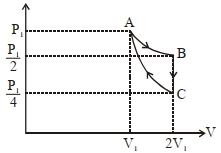
If one mole of an ideal gas at $(P_{1}, V_{1})$ is allowed to expand reversibly and isothermally ($A$ to $B$),its pressure is reduced to one-half of the original pressure (see figure). This is followed by a constant volume cooling till its pressure is reduced to one-fourth of the initial value $(B \rightarrow C)$. Then it is restored to its initial state by a reversible adiabatic compression ($C$ to $A$). The net work done by the gas is equal to ...... .
A
$RT \left(\ln 2 - \frac{1}{2(\gamma-1)}\right)$
B
$-\frac{RT}{2(\gamma-1)}$
C
$0$
D
$RT \ln 2$
Solution
(A) For the isothermal process $A-B$:
$W_{AB} = nRT \ln \left(\frac{V_B}{V_A}\right) = RT \ln \left(\frac{2V_1}{V_1}\right) = RT \ln 2$.
For the isochoric process $B-C$:
Since the volume is constant,$W_{BC} = 0$.
For the adiabatic process $C-A$:
The work done in an adiabatic process is $W = \frac{P_i V_i - P_f V_f}{\gamma - 1}$.
Here,$P_C = \frac{P_1}{4}$,$V_C = 2V_1$,$P_A = P_1$,$V_A = V_1$.
$W_{CA} = \frac{P_C V_C - P_A V_A}{\gamma - 1} = \frac{(\frac{P_1}{4})(2V_1) - P_1 V_1}{\gamma - 1} = \frac{\frac{P_1 V_1}{2} - P_1 V_1}{\gamma - 1} = \frac{-\frac{P_1 V_1}{2}}{\gamma - 1} = -\frac{RT}{2(\gamma - 1)}$.
The net work done is $W_{net} = W_{AB} + W_{BC} + W_{CA} = RT \ln 2 + 0 - \frac{RT}{2(\gamma - 1)} = RT \left(\ln 2 - \frac{1}{2(\gamma - 1)}\right)$.
$W_{AB} = nRT \ln \left(\frac{V_B}{V_A}\right) = RT \ln \left(\frac{2V_1}{V_1}\right) = RT \ln 2$.
For the isochoric process $B-C$:
Since the volume is constant,$W_{BC} = 0$.
For the adiabatic process $C-A$:
The work done in an adiabatic process is $W = \frac{P_i V_i - P_f V_f}{\gamma - 1}$.
Here,$P_C = \frac{P_1}{4}$,$V_C = 2V_1$,$P_A = P_1$,$V_A = V_1$.
$W_{CA} = \frac{P_C V_C - P_A V_A}{\gamma - 1} = \frac{(\frac{P_1}{4})(2V_1) - P_1 V_1}{\gamma - 1} = \frac{\frac{P_1 V_1}{2} - P_1 V_1}{\gamma - 1} = \frac{-\frac{P_1 V_1}{2}}{\gamma - 1} = -\frac{RT}{2(\gamma - 1)}$.
The net work done is $W_{net} = W_{AB} + W_{BC} + W_{CA} = RT \ln 2 + 0 - \frac{RT}{2(\gamma - 1)} = RT \left(\ln 2 - \frac{1}{2(\gamma - 1)}\right)$.
0 likesView Solution
152
PhysicsEasyMCQJEE Main · 2021
Which of the following equations represents a travelling wave?
A
$y = A \sin (15 x - 2 t)$
B
$y = A e^{-x^{2}} (v t + \theta)$
C
$y = A e^{x} \cos (\omega t - \theta)$
D
$y = A \sin x \cos \omega t$
Solution
(A) travelling wave is represented by a function of the form $y = f(x \pm vt)$.
For a wave to be a travelling wave,the variables $x$ and $t$ must appear in the combination $(x \pm vt)$ within the function.
In option $A$,$y = A \sin (15 x - 2 t)$,which can be rewritten as $y = A \sin [15(x - \frac{2}{15}t)]$. This matches the form $f(x - vt)$ where $v = \frac{2}{15}$.
Options $B$,$C$,and $D$ do not represent a travelling wave because they do not satisfy the condition of being a function of $(x \pm vt)$.
For a wave to be a travelling wave,the variables $x$ and $t$ must appear in the combination $(x \pm vt)$ within the function.
In option $A$,$y = A \sin (15 x - 2 t)$,which can be rewritten as $y = A \sin [15(x - \frac{2}{15}t)]$. This matches the form $f(x - vt)$ where $v = \frac{2}{15}$.
Options $B$,$C$,and $D$ do not represent a travelling wave because they do not satisfy the condition of being a function of $(x \pm vt)$.
0 likesView Solution
153
PhysicsDifficultMCQJEE Main · 2021
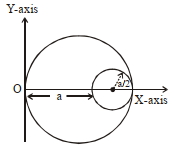
$A$ circular hole of radius $\left(\frac{a}{2}\right)$ is cut out of a circular disc of radius $'a'$ as shown in the figure. The centroid of the remaining circular portion with respect to point $'O'$ will be:
A
$\frac{1}{6} a$
B
$\frac{10}{11} a$
C
$\frac{5}{6} a$
D
$\frac{2}{3} a$
Solution
(C) Let $\sigma$ be the uniform surface mass density of the disc.
Let $M_1$ be the mass of the full disc of radius $a$ and $M_2$ be the mass of the removed circular hole of radius $\frac{a}{2}$.
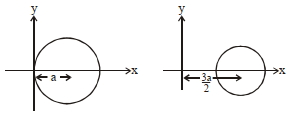
$M_1 = \sigma \pi a^2$,with its center of mass at $x_1 = a$.
$M_2 = \sigma \pi \left(\frac{a}{2}\right)^2 = \frac{\sigma \pi a^2}{4}$,with its center of mass at $x_2 = \frac{3a}{2}$.
The center of mass of the remaining portion is given by:
$x_{COM} = \frac{M_1 x_1 - M_2 x_2}{M_1 - M_2}$
$x_{COM} = \frac{(\sigma \pi a^2)(a) - (\frac{\sigma \pi a^2}{4})(\frac{3a}{2})}{\sigma \pi a^2 - \frac{\sigma \pi a^2}{4}}$
$x_{COM} = \frac{a - \frac{3a}{8}}{1 - \frac{1}{4}} = \frac{\frac{5a}{8}}{\frac{3}{4}} = \frac{5a}{8} \times \frac{4}{3} = \frac{5a}{6}$
Let $M_1$ be the mass of the full disc of radius $a$ and $M_2$ be the mass of the removed circular hole of radius $\frac{a}{2}$.
$M_1 = \sigma \pi a^2$,with its center of mass at $x_1 = a$.
$M_2 = \sigma \pi \left(\frac{a}{2}\right)^2 = \frac{\sigma \pi a^2}{4}$,with its center of mass at $x_2 = \frac{3a}{2}$.
The center of mass of the remaining portion is given by:
$x_{COM} = \frac{M_1 x_1 - M_2 x_2}{M_1 - M_2}$
$x_{COM} = \frac{(\sigma \pi a^2)(a) - (\frac{\sigma \pi a^2}{4})(\frac{3a}{2})}{\sigma \pi a^2 - \frac{\sigma \pi a^2}{4}}$
$x_{COM} = \frac{a - \frac{3a}{8}}{1 - \frac{1}{4}} = \frac{\frac{5a}{8}}{\frac{3}{4}} = \frac{5a}{8} \times \frac{4}{3} = \frac{5a}{6}$
0 likesView Solution
154
PhysicsDifficultMCQJEE Main · 2021
$A$ particle is projected with velocity $v_{0}$ along the $x-$axis. $A$ damping force is acting on the particle which is proportional to the square of the distance from the origin,i.e.,$ma = -\alpha x^{2}$. The distance at which the particle stops is:
A
$\left(\frac{3 m v_{0}^{2}}{2 \alpha}\right)^{\frac{1}{3}}$
B
$\left(\frac{2 m v_{0}}{3 \alpha}\right)^{\frac{1}{3}}$
C
$\left(\frac{2 m v_{0}^{2}}{3 \alpha}\right)^{\frac{1}{2}}$
D
$\left(\frac{3 v_{0}^{2}}{2 \alpha}\right)^{\frac{1}{3}}$
Solution
(A) Given the force $F = -\alpha x^{2}$.
According to Newton's second law,$ma = -\alpha x^{2}$,so $a = -\frac{\alpha}{m} x^{2}$.
We know that $a = v \frac{dv}{dx}$.
Substituting this,we get $v \frac{dv}{dx} = -\frac{\alpha}{m} x^{2}$.
Separating variables,we have $v dv = -\frac{\alpha}{m} x^{2} dx$.
Integrating both sides with limits from $v = v_{0}$ to $v = 0$ and $x = 0$ to $x = x_{f}$:
$\int_{v_{0}}^{0} v dv = -\frac{\alpha}{m} \int_{0}^{x_{f}} x^{2} dx$.
Evaluating the integrals:
$\left[ \frac{v^{2}}{2} \right]_{v_{0}}^{0} = -\frac{\alpha}{m} \left[ \frac{x^{3}}{3} \right]_{0}^{x_{f}}$.
$0 - \frac{v_{0}^{2}}{2} = -\frac{\alpha}{m} \frac{x_{f}^{3}}{3}$.
$\frac{v_{0}^{2}}{2} = \frac{\alpha x_{f}^{3}}{3m}$.
Solving for $x_{f}$:
$x_{f}^{3} = \frac{3 m v_{0}^{2}}{2 \alpha}$.
$x_{f} = \left( \frac{3 m v_{0}^{2}}{2 \alpha} \right)^{\frac{1}{3}}$.
According to Newton's second law,$ma = -\alpha x^{2}$,so $a = -\frac{\alpha}{m} x^{2}$.
We know that $a = v \frac{dv}{dx}$.
Substituting this,we get $v \frac{dv}{dx} = -\frac{\alpha}{m} x^{2}$.
Separating variables,we have $v dv = -\frac{\alpha}{m} x^{2} dx$.
Integrating both sides with limits from $v = v_{0}$ to $v = 0$ and $x = 0$ to $x = x_{f}$:
$\int_{v_{0}}^{0} v dv = -\frac{\alpha}{m} \int_{0}^{x_{f}} x^{2} dx$.
Evaluating the integrals:
$\left[ \frac{v^{2}}{2} \right]_{v_{0}}^{0} = -\frac{\alpha}{m} \left[ \frac{x^{3}}{3} \right]_{0}^{x_{f}}$.
$0 - \frac{v_{0}^{2}}{2} = -\frac{\alpha}{m} \frac{x_{f}^{3}}{3}$.
$\frac{v_{0}^{2}}{2} = \frac{\alpha x_{f}^{3}}{3m}$.
Solving for $x_{f}$:
$x_{f}^{3} = \frac{3 m v_{0}^{2}}{2 \alpha}$.
$x_{f} = \left( \frac{3 m v_{0}^{2}}{2 \alpha} \right)^{\frac{1}{3}}$.
0 likesView Solution
155
PhysicsMediumMCQJEE Main · 2021
$A$ body weighs $49 \, N$ on a spring balance at the North Pole. What will be its weight recorded on the same weighing machine if it is shifted to the equator (in $, N$)? (Use $g = \frac{GM}{R^2} = 9.8 \, m/s^2$ and radius of the Earth,$R = 6400 \, km$.)
A
$49$
B
$48.83$
C
$49.83$
D
$49.17$
Solution
(B) The weight of the body at the poles is given by $W_p = mg = 49 \, N$.
Since $g = 9.8 \, m/s^2$,the mass of the body is $m = \frac{49}{9.8} = 5 \, kg$.
At the equator,the effective acceleration due to gravity is $g_e = g - R\omega^2$,where $\omega$ is the angular velocity of the Earth.
The angular velocity $\omega = \frac{2\pi}{T}$,where $T = 24 \times 3600 \, s$.
$R\omega^2 = R \left(\frac{2\pi}{T}\right)^2 = 6.4 \times 10^6 \times \left(\frac{2 \times 3.14}{86400}\right)^2 \approx 0.0337 \, m/s^2$.
The weight at the equator is $W_e = m(g - R\omega^2) = 5 \times (9.8 - 0.0337) = 5 \times 9.7663 = 48.8315 \, N$.
Rounding to two decimal places,the weight is $48.83 \, N$.
Since $g = 9.8 \, m/s^2$,the mass of the body is $m = \frac{49}{9.8} = 5 \, kg$.
At the equator,the effective acceleration due to gravity is $g_e = g - R\omega^2$,where $\omega$ is the angular velocity of the Earth.
The angular velocity $\omega = \frac{2\pi}{T}$,where $T = 24 \times 3600 \, s$.
$R\omega^2 = R \left(\frac{2\pi}{T}\right)^2 = 6.4 \times 10^6 \times \left(\frac{2 \times 3.14}{86400}\right)^2 \approx 0.0337 \, m/s^2$.
The weight at the equator is $W_e = m(g - R\omega^2) = 5 \times (9.8 - 0.0337) = 5 \times 9.7663 = 48.8315 \, N$.
Rounding to two decimal places,the weight is $48.83 \, N$.
0 likesView Solution
156
PhysicsMediumMCQJEE Main · 2021
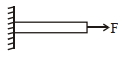
$A$ uniform metallic wire is elongated by $0.04\, m$ when subjected to a linear force $F$. The elongation,if its length and diameter are doubled and subjected to the same force,will be ..... $cm$.
A
$2$
B
$0$
C
$1$
D
$4$
Solution
(A) The formula for Young's modulus $Y$ is given by $Y = \frac{F \cdot \ell}{A \cdot \Delta \ell}$,where $A$ is the cross-sectional area.
Rearranging for elongation $\Delta \ell$,we get $\Delta \ell = \frac{F \cdot \ell}{Y \cdot A}$.
Since $A = \pi r^2$ (where $r$ is the radius,which is half the diameter $D$),we have $\Delta \ell = \frac{F \cdot \ell}{Y \cdot \pi r^2} = \frac{4 F \cdot \ell}{Y \cdot \pi D^2}$.
From this,we see that $\Delta \ell \propto \frac{\ell}{D^2}$.
Let the initial length be $\ell_1$ and initial diameter be $D_1$. Let the final length be $\ell_2 = 2\ell_1$ and final diameter be $D_2 = 2D_1$.
Then,$\frac{\Delta \ell_2}{\Delta \ell_1} = \left( \frac{\ell_2}{\ell_1} \right) \left( \frac{D_1}{D_2} \right)^2$.
Substituting the values: $\frac{\Delta \ell_2}{\Delta \ell_1} = (2) \left( \frac{1}{2} \right)^2 = 2 \cdot \frac{1}{4} = \frac{1}{2}$.
Given $\Delta \ell_1 = 0.04\, m$,we have $\Delta \ell_2 = \frac{0.04}{2} = 0.02\, m$.
Converting to centimeters,$\Delta \ell_2 = 2\, cm$.
Rearranging for elongation $\Delta \ell$,we get $\Delta \ell = \frac{F \cdot \ell}{Y \cdot A}$.
Since $A = \pi r^2$ (where $r$ is the radius,which is half the diameter $D$),we have $\Delta \ell = \frac{F \cdot \ell}{Y \cdot \pi r^2} = \frac{4 F \cdot \ell}{Y \cdot \pi D^2}$.
From this,we see that $\Delta \ell \propto \frac{\ell}{D^2}$.
Let the initial length be $\ell_1$ and initial diameter be $D_1$. Let the final length be $\ell_2 = 2\ell_1$ and final diameter be $D_2 = 2D_1$.
Then,$\frac{\Delta \ell_2}{\Delta \ell_1} = \left( \frac{\ell_2}{\ell_1} \right) \left( \frac{D_1}{D_2} \right)^2$.
Substituting the values: $\frac{\Delta \ell_2}{\Delta \ell_1} = (2) \left( \frac{1}{2} \right)^2 = 2 \cdot \frac{1}{4} = \frac{1}{2}$.
Given $\Delta \ell_1 = 0.04\, m$,we have $\Delta \ell_2 = \frac{0.04}{2} = 0.02\, m$.
Converting to centimeters,$\Delta \ell_2 = 2\, cm$.
0 likesView Solution
157
PhysicsDifficultMCQJEE Main · 2021
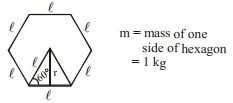
$A$ uniform thin bar of mass $6 \,kg$ and length $2.4 \,m$ is bent to make an equilateral hexagon. The moment of inertia about an axis passing through the centre of mass and perpendicular to the plane of the hexagon is ...... $\times 10^{-1} \,kg \cdot m^2$.
A
$16$
B
$8$
C
$24$
D
$4$
Solution
(B) The total length of the bar is $L = 2.4 \,m$. Since it is bent into a hexagon with $6$ sides,the length of each side is $\ell = \frac{2.4}{6} = 0.4 \,m$.
The mass of the total bar is $M = 6 \,kg$,so the mass of each side is $m = \frac{6}{6} = 1 \,kg$.
For an equilateral hexagon,the distance $r$ from the center to the midpoint of a side is given by $r = \ell \sin 60^{\circ} = \ell \frac{\sqrt{3}}{2}$.
The moment of inertia of one side about an axis passing through its center and perpendicular to its length is $I_{cm} = \frac{m \ell^2}{12}$.
Using the parallel axis theorem,the moment of inertia of one side about the center of the hexagon is $I_1 = I_{cm} + m r^2 = \frac{m \ell^2}{12} + m \left(\frac{\ell \sqrt{3}}{2}\right)^2 = \frac{m \ell^2}{12} + \frac{3 m \ell^2}{4} = \frac{m \ell^2 + 9 m \ell^2}{12} = \frac{10 m \ell^2}{12} = \frac{5}{6} m \ell^2$.
Since there are $6$ such sides,the total moment of inertia is $I = 6 \times I_1 = 6 \times \frac{5}{6} m \ell^2 = 5 m \ell^2$.
Substituting the values $m = 1 \,kg$ and $\ell = 0.4 \,m$:
$I = 5 \times 1 \times (0.4)^2 = 5 \times 0.16 = 0.8 \,kg \cdot m^2$.
Thus,$I = 8 \times 10^{-1} \,kg \cdot m^2$.
The mass of the total bar is $M = 6 \,kg$,so the mass of each side is $m = \frac{6}{6} = 1 \,kg$.
For an equilateral hexagon,the distance $r$ from the center to the midpoint of a side is given by $r = \ell \sin 60^{\circ} = \ell \frac{\sqrt{3}}{2}$.
The moment of inertia of one side about an axis passing through its center and perpendicular to its length is $I_{cm} = \frac{m \ell^2}{12}$.
Using the parallel axis theorem,the moment of inertia of one side about the center of the hexagon is $I_1 = I_{cm} + m r^2 = \frac{m \ell^2}{12} + m \left(\frac{\ell \sqrt{3}}{2}\right)^2 = \frac{m \ell^2}{12} + \frac{3 m \ell^2}{4} = \frac{m \ell^2 + 9 m \ell^2}{12} = \frac{10 m \ell^2}{12} = \frac{5}{6} m \ell^2$.
Since there are $6$ such sides,the total moment of inertia is $I = 6 \times I_1 = 6 \times \frac{5}{6} m \ell^2 = 5 m \ell^2$.
Substituting the values $m = 1 \,kg$ and $\ell = 0.4 \,m$:
$I = 5 \times 1 \times (0.4)^2 = 5 \times 0.16 = 0.8 \,kg \cdot m^2$.
Thus,$I = 8 \times 10^{-1} \,kg \cdot m^2$.
0 likesView Solution
158
PhysicsMediumMCQJEE Main · 2021
Two solids $A$ and $B$ of mass $1\, kg$ and $2\, kg$ respectively are moving with equal linear momentum. The ratio of their kinetic energies $(K.E.)_{A} : (K.E.)_{B}$ will be $\frac{A}{1},$ so the value of $A$ will be ..... .
A
$1$
B
$2$
C
$3$
D
$4$
Solution
(B) The kinetic energy $K$ of a body with mass $m$ and linear momentum $P$ is given by the formula $K = \frac{P^2}{2m}$.
Since both solids $A$ and $B$ have equal linear momentum,we have $P_A = P_B = P$.
Therefore,the kinetic energy is inversely proportional to the mass: $K \propto \frac{1}{m}$.
Taking the ratio of the kinetic energies of $A$ and $B$,we get $\frac{(K.E.)_A}{(K.E.)_B} = \frac{m_B}{m_A}$.
Given $m_A = 1\, kg$ and $m_B = 2\, kg$,we substitute these values: $\frac{(K.E.)_A}{(K.E.)_B} = \frac{2}{1}$.
Comparing this with the given ratio $\frac{A}{1}$,we find that $A = 2$.
Since both solids $A$ and $B$ have equal linear momentum,we have $P_A = P_B = P$.
Therefore,the kinetic energy is inversely proportional to the mass: $K \propto \frac{1}{m}$.
Taking the ratio of the kinetic energies of $A$ and $B$,we get $\frac{(K.E.)_A}{(K.E.)_B} = \frac{m_B}{m_A}$.
Given $m_A = 1\, kg$ and $m_B = 2\, kg$,we substitute these values: $\frac{(K.E.)_A}{(K.E.)_B} = \frac{2}{1}$.
Comparing this with the given ratio $\frac{A}{1}$,we find that $A = 2$.
0 likesView Solution
159
PhysicsDifficultMCQJEE Main · 2021
The root mean square speed of molecules of a given mass of a gas at $27^{\circ} C$ and $1$ atmosphere pressure is $200\, ms^{-1}$. The root mean square speed of molecules of the gas at $127^{\circ} C$ and $2$ atmosphere pressure is $\frac{x}{\sqrt{3}}\, ms^{-1}$. The value of $x$ will be ......$ms^{-1}$.
A
$200$
B
$300$
C
$400$
D
$500$
Solution
(C) The root mean square speed $(v_{rms})$ of gas molecules is given by the formula $v_{rms} = \sqrt{\frac{3RT}{M}}$.
Since $R$ and $M$ are constants for a given gas,$v_{rms} \propto \sqrt{T}$.
Note that $v_{rms}$ is independent of pressure.
Given $T_1 = 27^{\circ} C = 300\, K$ and $(v_{rms})_1 = 200\, ms^{-1}$.
Given $T_2 = 127^{\circ} C = 400\, K$.
Using the ratio: $\frac{(v_{rms})_2}{(v_{rms})_1} = \sqrt{\frac{T_2}{T_1}} = \sqrt{\frac{400}{300}} = \sqrt{\frac{4}{3}} = \frac{2}{\sqrt{3}}$.
Therefore,$(v_{rms})_2 = \frac{2}{\sqrt{3}} \times (v_{rms})_1 = \frac{2}{\sqrt{3}} \times 200 = \frac{400}{\sqrt{3}}\, ms^{-1}$.
Comparing this with $\frac{x}{\sqrt{3}}$,we get $x = 400$.
Since $R$ and $M$ are constants for a given gas,$v_{rms} \propto \sqrt{T}$.
Note that $v_{rms}$ is independent of pressure.
Given $T_1 = 27^{\circ} C = 300\, K$ and $(v_{rms})_1 = 200\, ms^{-1}$.
Given $T_2 = 127^{\circ} C = 400\, K$.
Using the ratio: $\frac{(v_{rms})_2}{(v_{rms})_1} = \sqrt{\frac{T_2}{T_1}} = \sqrt{\frac{400}{300}} = \sqrt{\frac{4}{3}} = \frac{2}{\sqrt{3}}$.
Therefore,$(v_{rms})_2 = \frac{2}{\sqrt{3}} \times (v_{rms})_1 = \frac{2}{\sqrt{3}} \times 200 = \frac{400}{\sqrt{3}}\, ms^{-1}$.
Comparing this with $\frac{x}{\sqrt{3}}$,we get $x = 400$.
0 likesView Solution
160
PhysicsDifficultMCQJEE Main · 2021
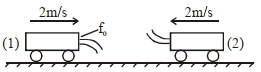
Two cars are approaching each other at an equal speed of $7.2\, km/hr$. When they see each other,both blow horns having a frequency of $676\, Hz$. The beat frequency heard by each driver will be $.....\, Hz$. [Velocity of sound in air is $340\, m/s$.]
A
$8$
B
$16$
C
$32$
D
$24$
Solution
(A) Given: Speed of each car $v_s = v_o = 7.2\, km/hr = 7.2 \times \frac{5}{18} = 2\, m/s$. Frequency of horn $f_0 = 676\, Hz$. Velocity of sound $v = 340\, m/s$.
Each driver hears two sounds: one directly from the other car and one reflected from the other car.
$1$. Frequency of sound heard directly from the other car $(f_d)$:
$f_d = f_0 \left( \frac{v + v_o}{v - v_s} \right) = 676 \left( \frac{340 + 2}{340 - 2} \right) = 676 \left( \frac{342}{338} \right) = 684\, Hz$.
$2$. Frequency of sound reflected from the other car $(f_r)$:
The sound from the other car travels to the driver's car,reflects,and returns. Effectively,the other car acts as a source moving towards the driver,and the driver acts as a source reflecting the sound back. The frequency heard after reflection is:
$f_r = f_0 \left( \frac{v + v_s}{v - v_s} \right) \left( \frac{v + v_o}{v - v_o} \right) = 676 \left( \frac{342}{338} \right) \left( \frac{342}{338} \right) = 676 \left( \frac{342}{338} \right)^2 \approx 692\, Hz$.
Beat frequency = $f_r - f_d = 692 - 684 = 8\, Hz$.
Each driver hears two sounds: one directly from the other car and one reflected from the other car.
$1$. Frequency of sound heard directly from the other car $(f_d)$:
$f_d = f_0 \left( \frac{v + v_o}{v - v_s} \right) = 676 \left( \frac{340 + 2}{340 - 2} \right) = 676 \left( \frac{342}{338} \right) = 684\, Hz$.
$2$. Frequency of sound reflected from the other car $(f_r)$:
The sound from the other car travels to the driver's car,reflects,and returns. Effectively,the other car acts as a source moving towards the driver,and the driver acts as a source reflecting the sound back. The frequency heard after reflection is:
$f_r = f_0 \left( \frac{v + v_s}{v - v_s} \right) \left( \frac{v + v_o}{v - v_o} \right) = 676 \left( \frac{342}{338} \right) \left( \frac{342}{338} \right) = 676 \left( \frac{342}{338} \right)^2 \approx 692\, Hz$.
Beat frequency = $f_r - f_d = 692 - 684 = 8\, Hz$.
0 likesView Solution
161
PhysicsDifficultMCQJEE Main · 2021
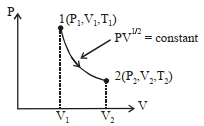
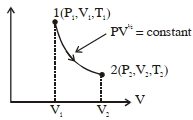
$A$ thermodynamic process for one mole of an ideal gas is shown below on a $P-V$ diagram. If $V_{2} = 2V_{1}$, then the ratio of temperature $T_{2} / T_{1}$ is ...... .
A
$\frac{1}{2}$
B
$2$
C
$\sqrt{2}$
D
$\frac{1}{\sqrt{2}}$
Solution
(D) For a polytropic process, the equation is $PV^{x} = \text{constant}$.
Given the process equation is $PV^{1/2} = \text{constant}$.
Using the ideal gas equation $PV = nRT$, we can write $P = \frac{nRT}{V}$.
Substituting this into the process equation:
$\left(\frac{nRT}{V}\right) V^{1/2} = \text{constant}$
$T V^{-1} V^{1/2} = \text{constant}$
$T V^{-1/2} = \text{constant}$
Thus, $T_{1} V_{1}^{-1/2} = T_{2} V_{2}^{-1/2}$.
Rearranging for the ratio of temperatures:
$\frac{T_{2}}{T_{1}} = \left(\frac{V_{2}}{V_{1}}\right)^{-1/2} = \left(\frac{V_{1}}{V_{2}}\right)^{1/2}$.
Given $V_{2} = 2V_{1}$, we have $\frac{V_{1}}{V_{2}} = \frac{1}{2}$.
Therefore, $\frac{T_{2}}{T_{1}} = \left(\frac{1}{2}\right)^{1/2} = \frac{1}{\sqrt{2}}$.
Hence, the correct option is $D$.
Given the process equation is $PV^{1/2} = \text{constant}$.
Using the ideal gas equation $PV = nRT$, we can write $P = \frac{nRT}{V}$.
Substituting this into the process equation:
$\left(\frac{nRT}{V}\right) V^{1/2} = \text{constant}$
$T V^{-1} V^{1/2} = \text{constant}$
$T V^{-1/2} = \text{constant}$
Thus, $T_{1} V_{1}^{-1/2} = T_{2} V_{2}^{-1/2}$.
Rearranging for the ratio of temperatures:
$\frac{T_{2}}{T_{1}} = \left(\frac{V_{2}}{V_{1}}\right)^{-1/2} = \left(\frac{V_{1}}{V_{2}}\right)^{1/2}$.
Given $V_{2} = 2V_{1}$, we have $\frac{V_{1}}{V_{2}} = \frac{1}{2}$.
Therefore, $\frac{T_{2}}{T_{1}} = \left(\frac{1}{2}\right)^{1/2} = \frac{1}{\sqrt{2}}$.
Hence, the correct option is $D$.
0 likesView Solution
162
PhysicsDifficultMCQJEE Main · 2021
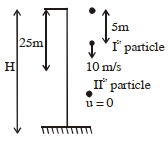
$A$ stone is dropped from the top of a building. When it crosses a point $5 \, m$ below the top,another stone starts to fall from a point $25 \, m$ below the top. Both stones reach the bottom of the building simultaneously. The height of the building is ..... $m$.
A
$35$
B
$45$
C
$50$
D
$25$
Solution
(B) Let the total height of the building be $H$. The first stone is dropped from the top $(u=0)$.
When it has fallen $5 \, m$,its velocity $v$ is given by $v^2 = u^2 + 2gh = 0 + 2 \times 10 \times 5 = 100$,so $v = 10 \, m/s$.
The time taken by the first stone to fall $5 \, m$ is $t_1 = v/g = 10/10 = 1 \, s$.
At this instant,the second stone is dropped from a point $25 \, m$ below the top. Let the total time taken by the first stone to reach the ground be $T$. Then the time taken by the second stone is $(T - 1) \, s$.
The distance covered by the first stone is $H = \frac{1}{2} g T^2$.
The distance covered by the second stone is $H - 25 = \frac{1}{2} g (T - 1)^2$.
Subtracting the two equations: $H - (H - 25) = \frac{1}{2} g [T^2 - (T - 1)^2] \Rightarrow 25 = 5 [T^2 - (T^2 - 2T + 1)] \Rightarrow 25 = 5(2T - 1) \Rightarrow 5 = 2T - 1 \Rightarrow 2T = 6 \Rightarrow T = 3 \, s$.
Substituting $T = 3 \, s$ into the first equation: $H = \frac{1}{2} \times 10 \times (3)^2 = 5 \times 9 = 45 \, m$.
When it has fallen $5 \, m$,its velocity $v$ is given by $v^2 = u^2 + 2gh = 0 + 2 \times 10 \times 5 = 100$,so $v = 10 \, m/s$.
The time taken by the first stone to fall $5 \, m$ is $t_1 = v/g = 10/10 = 1 \, s$.
At this instant,the second stone is dropped from a point $25 \, m$ below the top. Let the total time taken by the first stone to reach the ground be $T$. Then the time taken by the second stone is $(T - 1) \, s$.
The distance covered by the first stone is $H = \frac{1}{2} g T^2$.
The distance covered by the second stone is $H - 25 = \frac{1}{2} g (T - 1)^2$.
Subtracting the two equations: $H - (H - 25) = \frac{1}{2} g [T^2 - (T - 1)^2] \Rightarrow 25 = 5 [T^2 - (T^2 - 2T + 1)] \Rightarrow 25 = 5(2T - 1) \Rightarrow 5 = 2T - 1 \Rightarrow 2T = 6 \Rightarrow T = 3 \, s$.
Substituting $T = 3 \, s$ into the first equation: $H = \frac{1}{2} \times 10 \times (3)^2 = 5 \times 9 = 45 \, m$.
0 likesView Solution
163
PhysicsMediumMCQJEE Main · 2021
Given below are two statements:
Statement $I :$ In a diatomic molecule,the rotational energy at a given temperature obeys Maxwell's distribution.
Statement $II :$ In a diatomic molecule,the rotational energy at a given temperature equals the translational kinetic energy for each molecule.
In the light of the above statements,choose the correct answer from the options given below:
Statement $I :$ In a diatomic molecule,the rotational energy at a given temperature obeys Maxwell's distribution.
Statement $II :$ In a diatomic molecule,the rotational energy at a given temperature equals the translational kinetic energy for each molecule.
In the light of the above statements,choose the correct answer from the options given below:
A
Statement $I$ is false but Statement $II$ is true.
B
Both Statement $I$ and Statement $II$ are false.
C
Both Statement $I$ and Statement $II$ are true.
D
Statement $I$ is true but Statement $II$ is false.
Solution
(B) According to the equipartition theorem,the average energy associated with each degree of freedom is $\frac{1}{2} k_B T$.
For a diatomic molecule,the translational degrees of freedom are $3$,so the average translational kinetic energy is $E_{trans} = 3 \times (\frac{1}{2} k_B T) = \frac{3}{2} k_B T$.
The rotational degrees of freedom for a rigid diatomic molecule are $2$,so the average rotational kinetic energy is $E_{rot} = 2 \times (\frac{1}{2} k_B T) = k_B T$.
Statement $I$ is false because rotational energy levels are quantized and do not follow the continuous Maxwell-Boltzmann distribution in the same way as translational energy.
Statement $II$ is false because $E_{rot} = k_B T$ while $E_{trans} = \frac{3}{2} k_B T$,so they are not equal.
For a diatomic molecule,the translational degrees of freedom are $3$,so the average translational kinetic energy is $E_{trans} = 3 \times (\frac{1}{2} k_B T) = \frac{3}{2} k_B T$.
The rotational degrees of freedom for a rigid diatomic molecule are $2$,so the average rotational kinetic energy is $E_{rot} = 2 \times (\frac{1}{2} k_B T) = k_B T$.
Statement $I$ is false because rotational energy levels are quantized and do not follow the continuous Maxwell-Boltzmann distribution in the same way as translational energy.
Statement $II$ is false because $E_{rot} = k_B T$ while $E_{trans} = \frac{3}{2} k_B T$,so they are not equal.
0 likesView Solution
164
PhysicsMediumMCQJEE Main · 2021
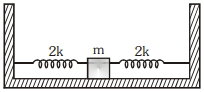
Two identical springs of spring constant $2k$ are attached to a block of mass $m$ and to fixed supports (see figure). When the mass is displaced from the equilibrium position on either side,it executes simple harmonic motion. The time period of oscillations of this system is ...... .
A
$2 \pi \sqrt{\frac{m}{k}}$
B
$\pi \sqrt{\frac{m}{2k}}$
C
$2 \pi \sqrt{\frac{m}{2k}}$
D
$\pi \sqrt{\frac{m}{k}}$
Solution
(D) When a block of mass $m$ is connected to two springs of spring constant $k_1$ and $k_2$ in parallel,the effective spring constant is $k_{eq} = k_1 + k_2$.
In this problem,both springs have a spring constant of $2k$.
Therefore,the equivalent spring constant is $k_{eq} = 2k + 2k = 4k$.
The time period $T$ of a simple harmonic oscillator is given by the formula $T = 2\pi \sqrt{\frac{m}{k_{eq}}}$.
Substituting the value of $k_{eq}$,we get $T = 2\pi \sqrt{\frac{m}{4k}}$.
Simplifying this,$T = 2\pi \frac{1}{2} \sqrt{\frac{m}{k}} = \pi \sqrt{\frac{m}{k}}$.
In this problem,both springs have a spring constant of $2k$.
Therefore,the equivalent spring constant is $k_{eq} = 2k + 2k = 4k$.
The time period $T$ of a simple harmonic oscillator is given by the formula $T = 2\pi \sqrt{\frac{m}{k_{eq}}}$.
Substituting the value of $k_{eq}$,we get $T = 2\pi \sqrt{\frac{m}{4k}}$.
Simplifying this,$T = 2\pi \frac{1}{2} \sqrt{\frac{m}{k}} = \pi \sqrt{\frac{m}{k}}$.
1 likesView Solution
165
PhysicsDifficultMCQJEE Main · 2021
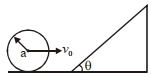
$A$ sphere of radius $a$ and mass $m$ rolls along a horizontal plane with constant speed $v_{0}$. It encounters an inclined plane at angle $\theta$ and climbs upward. Assuming that it rolls without slipping,how far up the sphere will travel?
A
$\frac{7v_0^2}{10g \sin \theta}$
B
$\frac{v_{0}^{2}}{5 g \sin \theta}$
C
$\frac{2}{5} \frac{v_{0}^{2}}{g \sin \theta}$
D
$\frac{v_{0}^{2}}{2 g \sin \theta}$
Solution
(A) The total initial energy of the sphere is $E_i = \frac{1}{2}mv_0^2 + \frac{1}{2}I\omega_0^2$.
Since it rolls without slipping,$\omega_0 = \frac{v_0}{a}$.
For a solid sphere,the moment of inertia is $I = \frac{2}{5}ma^2$.
Substituting these into the energy equation: $E_i = \frac{1}{2}mv_0^2 + \frac{1}{2}(\frac{2}{5}ma^2)(\frac{v_0}{a})^2 = \frac{1}{2}mv_0^2 + \frac{1}{5}mv_0^2 = \frac{7}{10}mv_0^2$.
At the maximum height $h$,the sphere momentarily comes to rest,so its final kinetic energy is zero. By the law of conservation of energy,$E_i = E_f = mgh$.
Therefore,$mgh = \frac{7}{10}mv_0^2$,which gives $h = \frac{7v_0^2}{10g}$.
The distance $d$ traveled along the incline is related to height $h$ by $h = d \sin \theta$.
Thus,$d \sin \theta = \frac{7v_0^2}{10g}$,which implies $d = \frac{7v_0^2}{10g \sin \theta}$.
This matches option $A$.
Since it rolls without slipping,$\omega_0 = \frac{v_0}{a}$.
For a solid sphere,the moment of inertia is $I = \frac{2}{5}ma^2$.
Substituting these into the energy equation: $E_i = \frac{1}{2}mv_0^2 + \frac{1}{2}(\frac{2}{5}ma^2)(\frac{v_0}{a})^2 = \frac{1}{2}mv_0^2 + \frac{1}{5}mv_0^2 = \frac{7}{10}mv_0^2$.
At the maximum height $h$,the sphere momentarily comes to rest,so its final kinetic energy is zero. By the law of conservation of energy,$E_i = E_f = mgh$.
Therefore,$mgh = \frac{7}{10}mv_0^2$,which gives $h = \frac{7v_0^2}{10g}$.
The distance $d$ traveled along the incline is related to height $h$ by $h = d \sin \theta$.
Thus,$d \sin \theta = \frac{7v_0^2}{10g}$,which implies $d = \frac{7v_0^2}{10g \sin \theta}$.
This matches option $A$.
0 likesView Solution
166
PhysicsDifficultMCQJEE Main · 2021
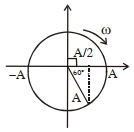
$Y = A \sin (\omega t + \phi_{0})$ is the time-displacement equation of a $SHM$. At $t = 0$,the displacement of the particle is $Y = \frac{A}{2}$ and it is moving in the negative direction. Then the initial phase angle $\phi_{0}$ will be ...... .
A
$\frac{\pi}{6}$
B
$\frac{\pi}{3}$
C
$\frac{5 \pi}{6}$
D
$\frac{2 \pi}{3}$
Solution
(C) The displacement equation is $Y = A \sin (\omega t + \phi_{0})$.
At $t = 0$,$Y = A \sin(\phi_{0}) = \frac{A}{2}$.
This implies $\sin(\phi_{0}) = \frac{1}{2}$.
Thus,$\phi_{0}$ can be $\frac{\pi}{6}$ or $\frac{5 \pi}{6}$.
The velocity of the particle is given by $v = \frac{dY}{dt} = A \omega \cos(\omega t + \phi_{0})$.
At $t = 0$,$v = A \omega \cos(\phi_{0})$.
Since the particle is moving in the negative direction,$v < 0$,which means $\cos(\phi_{0}) < 0$.
For $\phi_{0} = \frac{\pi}{6}$,$\cos(\frac{\pi}{6}) = \frac{\sqrt{3}}{2} > 0$.
For $\phi_{0} = \frac{5 \pi}{6}$,$\cos(\frac{5 \pi}{6}) = -\frac{\sqrt{3}}{2} < 0$.
Therefore,the initial phase angle is $\phi_{0} = \frac{5 \pi}{6}$.
At $t = 0$,$Y = A \sin(\phi_{0}) = \frac{A}{2}$.
This implies $\sin(\phi_{0}) = \frac{1}{2}$.
Thus,$\phi_{0}$ can be $\frac{\pi}{6}$ or $\frac{5 \pi}{6}$.
The velocity of the particle is given by $v = \frac{dY}{dt} = A \omega \cos(\omega t + \phi_{0})$.
At $t = 0$,$v = A \omega \cos(\phi_{0})$.
Since the particle is moving in the negative direction,$v < 0$,which means $\cos(\phi_{0}) < 0$.
For $\phi_{0} = \frac{\pi}{6}$,$\cos(\frac{\pi}{6}) = \frac{\sqrt{3}}{2} > 0$.
For $\phi_{0} = \frac{5 \pi}{6}$,$\cos(\frac{5 \pi}{6}) = -\frac{\sqrt{3}}{2} < 0$.
Therefore,the initial phase angle is $\phi_{0} = \frac{5 \pi}{6}$.
0 likesView Solution
167
PhysicsDifficultMCQJEE Main · 2021
If $e$ is the electronic charge,$c$ is the speed of light in free space,and $h$ is Planck's constant,the quantity $\frac{1}{4 \pi \varepsilon_{0}} \frac{| e |^{2}}{h c}$ has dimensions of .......
A
$[M^{0} L^{0} T^{0}]$
B
$[L C^{-1}]$
C
$[M L T^{-1}]$
D
$[M L T^{0}]$
Solution
(A) The Coulomb force between two charges $e$ separated by distance $r$ is given by $F = \frac{1}{4 \pi \varepsilon_{0}} \frac{e^{2}}{r^{2}}$.
From this,the dimension of $\frac{e^{2}}{4 \pi \varepsilon_{0}}$ is $[F r^{2}] = [M L T^{-2} \cdot L^{2}] = [M L^{3} T^{-2}]$.
The energy of a photon is $E = \frac{hc}{\lambda}$,so the dimension of $hc$ is $[E \lambda] = [M L^{2} T^{-2} \cdot L] = [M L^{3} T^{-2}]$.
Dividing these two quantities,the dimensions are $\frac{[M L^{3} T^{-2}]}{[M L^{3} T^{-2}]} = [M^{0} L^{0} T^{0}]$.
Thus,the quantity is dimensionless.
From this,the dimension of $\frac{e^{2}}{4 \pi \varepsilon_{0}}$ is $[F r^{2}] = [M L T^{-2} \cdot L^{2}] = [M L^{3} T^{-2}]$.
The energy of a photon is $E = \frac{hc}{\lambda}$,so the dimension of $hc$ is $[E \lambda] = [M L^{2} T^{-2} \cdot L] = [M L^{3} T^{-2}]$.
Dividing these two quantities,the dimensions are $\frac{[M L^{3} T^{-2}]}{[M L^{3} T^{-2}]} = [M^{0} L^{0} T^{0}]$.
Thus,the quantity is dimensionless.
0 likesView Solution
168
PhysicsDifficultMCQJEE Main · 2021
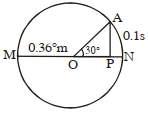
The point $A$ moves with a uniform speed along the circumference of a circle of radius $0.36\, m$ and covers $30^{\circ}$ in $0.1\, s$. The perpendicular projection $P$ from $A$ on the diameter $MN$ represents the simple harmonic motion of $P$. The restoring force per unit mass when $P$ touches $M$ will be ...... $N/kg$.
A
$100$
B
$0.49$
C
$50$
D
$9.87$
Solution
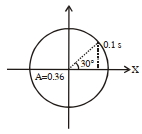
(D) Given,the point $A$ covers an angle $\theta = 30^{\circ} = \frac{\pi}{6} \text{ radians}$ in time $t = 0.1\, s$.
Since the speed is uniform,the angular velocity $\omega$ is given by $\omega = \frac{\theta}{t} = \frac{\pi/6}{0.1} = \frac{\pi}{0.6} = \frac{10\pi}{6} = \frac{5\pi}{3} \text{ rad/s}$.
The radius of the circle $R = 0.36\, m$,which represents the amplitude $A_{amp}$ of the simple harmonic motion.
The restoring force $F$ on a particle of mass $m$ executing simple harmonic motion is given by $F = -m\omega^2 x$,where $x$ is the displacement.
When $P$ touches $M$,the displacement $x$ is equal to the amplitude $R = 0.36\, m$.
The restoring force per unit mass is $\frac{F}{m} = \omega^2 R$.
Substituting the values: $\frac{F}{m} = \left(\frac{5\pi}{3}\right)^2 \times 0.36 = \frac{25\pi^2}{9} \times 0.36$.
Using $\pi^2 \approx 9.87$,we get $\frac{F}{m} = \frac{25 \times 9.87}{9} \times 0.36 = 25 \times 9.87 \times 0.04 = 25 \times 0.3948 = 9.87\, N/kg$.
Since the speed is uniform,the angular velocity $\omega$ is given by $\omega = \frac{\theta}{t} = \frac{\pi/6}{0.1} = \frac{\pi}{0.6} = \frac{10\pi}{6} = \frac{5\pi}{3} \text{ rad/s}$.
The radius of the circle $R = 0.36\, m$,which represents the amplitude $A_{amp}$ of the simple harmonic motion.
The restoring force $F$ on a particle of mass $m$ executing simple harmonic motion is given by $F = -m\omega^2 x$,where $x$ is the displacement.
When $P$ touches $M$,the displacement $x$ is equal to the amplitude $R = 0.36\, m$.
The restoring force per unit mass is $\frac{F}{m} = \omega^2 R$.
Substituting the values: $\frac{F}{m} = \left(\frac{5\pi}{3}\right)^2 \times 0.36 = \frac{25\pi^2}{9} \times 0.36$.
Using $\pi^2 \approx 9.87$,we get $\frac{F}{m} = \frac{25 \times 9.87}{9} \times 0.36 = 25 \times 9.87 \times 0.04 = 25 \times 0.3948 = 9.87\, N/kg$.
0 likesView Solution
169
PhysicsDifficultMCQJEE Main · 2021
The initial velocity $v_{i}$ required to project a body vertically upward from the surface of the earth to reach a height of $10 R$,where $R$ is the radius of the earth,may be described in terms of escape velocity $v_{e}$ such that $v_{i} = \sqrt{\frac{x}{y}} \times v_{e}$. The value of $x$ will be ...... .
A
$20$
B
$40$
C
$10$
D
$25$
Solution
(C) Using the law of conservation of energy between the surface of the earth and the maximum height $h = 10 R$:
Total energy at surface = Total energy at height $h$.
$-\frac{GMm}{R} + \frac{1}{2}mv_{i}^{2} = -\frac{GMm}{R+h} + 0$.
Since $h = 10R$,the total distance from the center is $R + 10R = 11R$.
$-\frac{GMm}{R} + \frac{1}{2}mv_{i}^{2} = -\frac{GMm}{11R}$.
$\frac{1}{2}mv_{i}^{2} = GMm \left( \frac{1}{R} - \frac{1}{11R} \right) = GMm \left( \frac{10}{11R} \right)$.
$v_{i}^{2} = \frac{20GM}{11R}$.
We know the escape velocity $v_{e} = \sqrt{\frac{2GM}{R}}$,so $v_{e}^{2} = \frac{2GM}{R}$.
Substituting this into the equation for $v_{i}^{2}$:
$v_{i}^{2} = \frac{10}{11} \times \left( \frac{2GM}{R} \right) = \frac{10}{11} v_{e}^{2}$.
Comparing this with $v_{i} = \sqrt{\frac{x}{y}} v_{e}$,we get $\frac{x}{y} = \frac{10}{11}$.
Thus,$x = 10$.
Total energy at surface = Total energy at height $h$.
$-\frac{GMm}{R} + \frac{1}{2}mv_{i}^{2} = -\frac{GMm}{R+h} + 0$.
Since $h = 10R$,the total distance from the center is $R + 10R = 11R$.
$-\frac{GMm}{R} + \frac{1}{2}mv_{i}^{2} = -\frac{GMm}{11R}$.
$\frac{1}{2}mv_{i}^{2} = GMm \left( \frac{1}{R} - \frac{1}{11R} \right) = GMm \left( \frac{10}{11R} \right)$.
$v_{i}^{2} = \frac{20GM}{11R}$.
We know the escape velocity $v_{e} = \sqrt{\frac{2GM}{R}}$,so $v_{e}^{2} = \frac{2GM}{R}$.
Substituting this into the equation for $v_{i}^{2}$:
$v_{i}^{2} = \frac{10}{11} \times \left( \frac{2GM}{R} \right) = \frac{10}{11} v_{e}^{2}$.
Comparing this with $v_{i} = \sqrt{\frac{x}{y}} v_{e}$,we get $\frac{x}{y} = \frac{10}{11}$.
Thus,$x = 10$.
0 likesView Solution
170
PhysicsMediumMCQJEE Main · 2021
$A$ reversible heat engine converts one-fourth of the heat input into work. When the temperature of the sink is reduced by $52 \, K$,its efficiency is doubled. The temperature in Kelvin of the source will be ...... .
A
$256$
B
$208$
C
$104$
D
$52$
Solution
(B) The efficiency of a heat engine is given by $\eta = 1 - \frac{T_2}{T_1}$,where $T_1$ is the source temperature and $T_2$ is the sink temperature.
Given $\eta = \frac{1}{4}$,we have $\frac{1}{4} = 1 - \frac{T_2}{T_1}$,which implies $\frac{T_2}{T_1} = \frac{3}{4}$,so $T_2 = 0.75 T_1$.
When the sink temperature is reduced by $52 \, K$,the new efficiency $\eta' = 2 \times \eta = 2 \times \frac{1}{4} = \frac{1}{2}$.
The new sink temperature is $T_2' = T_2 - 52$.
Using the efficiency formula for the new state: $\frac{1}{2} = 1 - \frac{T_2 - 52}{T_1}$.
This simplifies to $\frac{T_2 - 52}{T_1} = \frac{1}{2}$,or $T_2 - 52 = 0.5 T_1$.
Substituting $T_2 = 0.75 T_1$ into the equation: $0.75 T_1 - 52 = 0.5 T_1$.
$0.25 T_1 = 52$,which gives $T_1 = \frac{52}{0.25} = 208 \, K$.
Given $\eta = \frac{1}{4}$,we have $\frac{1}{4} = 1 - \frac{T_2}{T_1}$,which implies $\frac{T_2}{T_1} = \frac{3}{4}$,so $T_2 = 0.75 T_1$.
When the sink temperature is reduced by $52 \, K$,the new efficiency $\eta' = 2 \times \eta = 2 \times \frac{1}{4} = \frac{1}{2}$.
The new sink temperature is $T_2' = T_2 - 52$.
Using the efficiency formula for the new state: $\frac{1}{2} = 1 - \frac{T_2 - 52}{T_1}$.
This simplifies to $\frac{T_2 - 52}{T_1} = \frac{1}{2}$,or $T_2 - 52 = 0.5 T_1$.
Substituting $T_2 = 0.75 T_1$ into the equation: $0.75 T_1 - 52 = 0.5 T_1$.
$0.25 T_1 = 52$,which gives $T_1 = \frac{52}{0.25} = 208 \, K$.
0 likesView Solution
171
PhysicsMediumMCQJEE Main · 2021
The percentage increase in the speed of transverse waves produced in a stretched string if the tension is increased by $4\, \%$,will be ......... $\%$
A
$1$
B
$2$
C
$0$
D
$4$
Solution
(B) The speed of a transverse wave in a stretched string is given by the formula $v = \sqrt{\frac{T}{\mu}}$,where $T$ is the tension and $\mu$ is the linear mass density.
Taking the natural logarithm on both sides,we get $\ln v = \frac{1}{2} \ln T - \frac{1}{2} \ln \mu$.
Differentiating both sides,we obtain the relative error formula: $\frac{\Delta v}{v} = \frac{1}{2} \frac{\Delta T}{T}$.
Given that the percentage increase in tension is $\frac{\Delta T}{T} \times 100 = 4\, \%$.
Substituting this value into the error formula: $\frac{\Delta v}{v} \times 100 = \frac{1}{2} \times (4\, \%) = 2\, \%$.
Therefore,the percentage increase in the speed of the wave is $2\, \%$.
Taking the natural logarithm on both sides,we get $\ln v = \frac{1}{2} \ln T - \frac{1}{2} \ln \mu$.
Differentiating both sides,we obtain the relative error formula: $\frac{\Delta v}{v} = \frac{1}{2} \frac{\Delta T}{T}$.
Given that the percentage increase in tension is $\frac{\Delta T}{T} \times 100 = 4\, \%$.
Substituting this value into the error formula: $\frac{\Delta v}{v} \times 100 = \frac{1}{2} \times (4\, \%) = 2\, \%$.
Therefore,the percentage increase in the speed of the wave is $2\, \%$.
0 likesView Solution
172
PhysicsMediumMCQJEE Main · 2021
If $\overrightarrow{ P } \times \overrightarrow{ Q } = \overrightarrow{ Q } \times \overrightarrow{ P }$,the angle between $\overrightarrow{ P }$ and $\overrightarrow{ Q }$ is $\theta$ $(0^{\circ} < \theta < 360^{\circ})$. The value of $\theta$ will be ........ (in $^{\circ}$)
A
$90$
B
$135$
C
$180$
D
$45$
Solution
(C) The cross product of two vectors is anti-commutative,meaning $\overrightarrow{ P } \times \overrightarrow{ Q } = -(\overrightarrow{ Q } \times \overrightarrow{ P })$.
Given the condition $\overrightarrow{ P } \times \overrightarrow{ Q } = \overrightarrow{ Q } \times \overrightarrow{ P }$,we can substitute the anti-commutative property:
$-(\overrightarrow{ Q } \times \overrightarrow{ P }) = \overrightarrow{ Q } \times \overrightarrow{ P }$.
This implies $2(\overrightarrow{ Q } \times \overrightarrow{ P }) = 0$,so $\overrightarrow{ Q } \times \overrightarrow{ P } = 0$.
The magnitude of the cross product is given by $|\overrightarrow{ Q } \times \overrightarrow{ P }| = PQ \sin \theta = 0$.
Since $P$ and $Q$ are non-zero vectors,$\sin \theta = 0$.
In the range $0^{\circ} < \theta < 360^{\circ}$,$\sin \theta = 0$ at $\theta = 180^{\circ}$ (since $0^{\circ}$ and $360^{\circ}$ are excluded).
Therefore,the value of $\theta$ is $180^{\circ}$.
Given the condition $\overrightarrow{ P } \times \overrightarrow{ Q } = \overrightarrow{ Q } \times \overrightarrow{ P }$,we can substitute the anti-commutative property:
$-(\overrightarrow{ Q } \times \overrightarrow{ P }) = \overrightarrow{ Q } \times \overrightarrow{ P }$.
This implies $2(\overrightarrow{ Q } \times \overrightarrow{ P }) = 0$,so $\overrightarrow{ Q } \times \overrightarrow{ P } = 0$.
The magnitude of the cross product is given by $|\overrightarrow{ Q } \times \overrightarrow{ P }| = PQ \sin \theta = 0$.
Since $P$ and $Q$ are non-zero vectors,$\sin \theta = 0$.
In the range $0^{\circ} < \theta < 360^{\circ}$,$\sin \theta = 0$ at $\theta = 180^{\circ}$ (since $0^{\circ}$ and $360^{\circ}$ are excluded).
Therefore,the value of $\theta$ is $180^{\circ}$.
0 likesView Solution
173
PhysicsMediumMCQJEE Main · 2021
Two particles having masses $4\, g$ and $16\, g$ respectively are moving with equal kinetic energies. The ratio of the magnitudes of their linear momentum is $n : 2$. The value of $n$ will be ...... .
A
$1$
B
$2$
C
$3$
D
$4$
Solution
(A) The kinetic energy $K$ of a particle with mass $m$ and linear momentum $p$ is given by the formula $K = \frac{p^2}{2m}$.
Since the kinetic energies of the two particles are equal,we have $K_1 = K_2$.
Substituting the formula,we get $\frac{p_1^2}{2m_1} = \frac{p_2^2}{2m_2}$.
Given $m_1 = 4\, g$ and $m_2 = 16\, g$,we have $\frac{p_1^2}{2 \times 4} = \frac{p_2^2}{2 \times 16}$.
Simplifying this,$\frac{p_1^2}{4} = \frac{p_2^2}{16}$,which implies $\frac{p_1^2}{p_2^2} = \frac{4}{16} = \frac{1}{4}$.
Taking the square root of both sides,$\frac{p_1}{p_2} = \frac{1}{2}$.
We are given that the ratio of the magnitudes of their linear momentum is $n : 2$,so $\frac{p_1}{p_2} = \frac{n}{2}$.
Comparing $\frac{n}{2} = \frac{1}{2}$,we find $n = 1$.
Since the kinetic energies of the two particles are equal,we have $K_1 = K_2$.
Substituting the formula,we get $\frac{p_1^2}{2m_1} = \frac{p_2^2}{2m_2}$.
Given $m_1 = 4\, g$ and $m_2 = 16\, g$,we have $\frac{p_1^2}{2 \times 4} = \frac{p_2^2}{2 \times 16}$.
Simplifying this,$\frac{p_1^2}{4} = \frac{p_2^2}{16}$,which implies $\frac{p_1^2}{p_2^2} = \frac{4}{16} = \frac{1}{4}$.
Taking the square root of both sides,$\frac{p_1}{p_2} = \frac{1}{2}$.
We are given that the ratio of the magnitudes of their linear momentum is $n : 2$,so $\frac{p_1}{p_2} = \frac{n}{2}$.
Comparing $\frac{n}{2} = \frac{1}{2}$,we find $n = 1$.
0 likesView Solution
174
PhysicsDifficultMCQJEE Main · 2021
The length of a metallic wire is $\ell_{1}$ when the tension in it is $T_{1}$. It is $\ell_{2}$ when the tension is $T_{2}$. The original length of the wire will be ...... .
A
$\frac{\ell_{1}+\ell_{2}}{2}$
B
$\frac{T_{2}\ell_{1}+T_{1}\ell_{2}}{T_{1}+T_{2}}$
C
$\frac{T_{2}\ell_{1}-T_{1}\ell_{2}}{T_{2}-T_{1}}$
D
$\frac{T_{1}\ell_{1}-T_{2}\ell_{2}}{T_{2}-T_{1}}$
Solution
(C) Assuming Hooke's law is valid,the tension $T$ is proportional to the extension $\Delta \ell = \ell - \ell_{0}$,where $\ell_{0}$ is the original length.
$T = k(\ell - \ell_{0})$
For the two given states:
$T_{1} = k(\ell_{1} - \ell_{0})$ --- $(1)$
$T_{2} = k(\ell_{2} - \ell_{0})$ --- $(2)$
Dividing equation $(1)$ by $(2)$:
$\frac{T_{1}}{T_{2}} = \frac{\ell_{1} - \ell_{0}}{\ell_{2} - \ell_{0}}$
Cross-multiplying:
$T_{1}(\ell_{2} - \ell_{0}) = T_{2}(\ell_{1} - \ell_{0})$
$T_{1}\ell_{2} - T_{1}\ell_{0} = T_{2}\ell_{1} - T_{2}\ell_{0}$
Rearranging to solve for $\ell_{0}$:
$T_{2}\ell_{0} - T_{1}\ell_{0} = T_{2}\ell_{1} - T_{1}\ell_{2}$
$\ell_{0}(T_{2} - T_{1}) = T_{2}\ell_{1} - T_{1}\ell_{2}$
$\ell_{0} = \frac{T_{2}\ell_{1} - T_{1}\ell_{2}}{T_{2} - T_{1}}$
$T = k(\ell - \ell_{0})$
For the two given states:
$T_{1} = k(\ell_{1} - \ell_{0})$ --- $(1)$
$T_{2} = k(\ell_{2} - \ell_{0})$ --- $(2)$
Dividing equation $(1)$ by $(2)$:
$\frac{T_{1}}{T_{2}} = \frac{\ell_{1} - \ell_{0}}{\ell_{2} - \ell_{0}}$
Cross-multiplying:
$T_{1}(\ell_{2} - \ell_{0}) = T_{2}(\ell_{1} - \ell_{0})$
$T_{1}\ell_{2} - T_{1}\ell_{0} = T_{2}\ell_{1} - T_{2}\ell_{0}$
Rearranging to solve for $\ell_{0}$:
$T_{2}\ell_{0} - T_{1}\ell_{0} = T_{2}\ell_{1} - T_{1}\ell_{2}$
$\ell_{0}(T_{2} - T_{1}) = T_{2}\ell_{1} - T_{1}\ell_{2}$
$\ell_{0} = \frac{T_{2}\ell_{1} - T_{1}\ell_{2}}{T_{2} - T_{1}}$
0 likesView Solution
175
PhysicsMediumMCQJEE Main · 2021
$A$ tuning fork $A$ of unknown frequency produces $5 \, beats/s$ with a fork of known frequency $340 \, Hz$. When fork $A$ is filed,the beat frequency decreases to $2 \, beats/s$. What is the frequency of fork $A$ in $Hz$?
A
$340$
B
$342$
C
$335$
D
$337$
Solution
(C) Let the frequency of tuning fork $A$ be $f_A$. The frequency of the known fork is $f = 340 \, Hz$.
The initial beat frequency is $|f_A - 340| = 5 \, Hz$,which implies $f_A = 345 \, Hz$ or $f_A = 335 \, Hz$.
When a tuning fork is filed,its frequency increases.
Case $1$: If $f_A = 345 \, Hz$,filing increases the frequency to $f_A' > 345 \, Hz$. The new beat frequency would be $|f_A' - 340| > 5 \, Hz$. This contradicts the given information that the beat frequency decreases to $2 \, Hz$.
Case $2$: If $f_A = 335 \, Hz$,filing increases the frequency to $f_A' = 335 + \Delta f$. The new beat frequency is $|340 - (335 + \Delta f)| = |5 - \Delta f| = 2 \, Hz$.
This gives $5 - \Delta f = 2$,so $\Delta f = 3 \, Hz$,which is possible.
Therefore,the original frequency of fork $A$ is $335 \, Hz$.
The initial beat frequency is $|f_A - 340| = 5 \, Hz$,which implies $f_A = 345 \, Hz$ or $f_A = 335 \, Hz$.
When a tuning fork is filed,its frequency increases.
Case $1$: If $f_A = 345 \, Hz$,filing increases the frequency to $f_A' > 345 \, Hz$. The new beat frequency would be $|f_A' - 340| > 5 \, Hz$. This contradicts the given information that the beat frequency decreases to $2 \, Hz$.
Case $2$: If $f_A = 335 \, Hz$,filing increases the frequency to $f_A' = 335 + \Delta f$. The new beat frequency is $|340 - (335 + \Delta f)| = |5 - \Delta f| = 2 \, Hz$.
This gives $5 - \Delta f = 2$,so $\Delta f = 3 \, Hz$,which is possible.
Therefore,the original frequency of fork $A$ is $335 \, Hz$.
0 likesView Solution
176
PhysicsDifficultMCQJEE Main · 2021
The trajectory of a projectile in a vertical plane is $y = \alpha x - \beta x^2$,where $\alpha$ and $\beta$ are constants and $x$ and $y$ are respectively the horizontal and vertical distances of the projectile from the point of projection. The angle of projection $\theta$ and the maximum height attained $H$ are respectively given by:
A
$\tan^{-1} \alpha, \frac{\alpha^2}{4\beta}$
B
$\tan^{-1} \beta, \frac{\alpha^2}{2\beta}$
C
$\tan^{-1} \alpha, \frac{4\alpha^2}{\beta}$
D
$\tan^{-1}(\frac{\beta}{\alpha}), \frac{\alpha^2}{\beta}$
Solution
(A) The given equation of the trajectory is $y = \alpha x - \beta x^2$.
Comparing this with the standard equation of a projectile trajectory: $y = x \tan \theta - \frac{gx^2}{2u^2 \cos^2 \theta}$.
By comparing the coefficients of $x$,we get $\tan \theta = \alpha$,which implies $\theta = \tan^{-1} \alpha$.
By comparing the coefficients of $x^2$,we get $\beta = \frac{g}{2u^2 \cos^2 \theta}$.
Rearranging for $u^2$,we find $u^2 = \frac{g}{2\beta \cos^2 \theta}$.
The formula for maximum height is $H = \frac{u^2 \sin^2 \theta}{2g}$.
Substituting $u^2$ into the formula: $H = \frac{g}{2\beta \cos^2 \theta} \cdot \frac{\sin^2 \theta}{2g} = \frac{\tan^2 \theta}{4\beta}$.
Since $\tan \theta = \alpha$,we have $H = \frac{\alpha^2}{4\beta}$.
Comparing this with the standard equation of a projectile trajectory: $y = x \tan \theta - \frac{gx^2}{2u^2 \cos^2 \theta}$.
By comparing the coefficients of $x$,we get $\tan \theta = \alpha$,which implies $\theta = \tan^{-1} \alpha$.
By comparing the coefficients of $x^2$,we get $\beta = \frac{g}{2u^2 \cos^2 \theta}$.
Rearranging for $u^2$,we find $u^2 = \frac{g}{2\beta \cos^2 \theta}$.
The formula for maximum height is $H = \frac{u^2 \sin^2 \theta}{2g}$.
Substituting $u^2$ into the formula: $H = \frac{g}{2\beta \cos^2 \theta} \cdot \frac{\sin^2 \theta}{2g} = \frac{\tan^2 \theta}{4\beta}$.
Since $\tan \theta = \alpha$,we have $H = \frac{\alpha^2}{4\beta}$.
0 likesView Solution
177
PhysicsDifficultMCQJEE Main · 2021
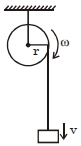
$A$ cord is wound round the circumference of a wheel of radius $r$. The axis of the wheel is horizontal and the moment of inertia about it is $I$. $A$ weight $mg$ is attached to the cord at the end. The weight falls from rest. After falling through a distance $h$,the square of the angular velocity of the wheel will be:
A
$\frac{2 mgh}{I + 2 mr^2}$
B
$\frac{2 mgh}{I + mr^2}$
C
$2 gh$
D
$\frac{2 gh}{I + mr^2}$
Solution
(B) According to the law of conservation of energy,the loss in potential energy of the weight is equal to the gain in the total kinetic energy of the system (rotational kinetic energy of the wheel + translational kinetic energy of the weight).
Loss in potential energy = $mgh$
Gain in kinetic energy = $\frac{1}{2} I \omega^2 + \frac{1}{2} mv^2$
Since the cord does not slip,the linear velocity $v$ of the weight is related to the angular velocity $\omega$ of the wheel by $v = \omega r$.
Substituting $v = \omega r$ into the energy equation:
$mgh = \frac{1}{2} I \omega^2 + \frac{1}{2} m(\omega r)^2$
$mgh = \frac{1}{2} (I + mr^2) \omega^2$
Solving for $\omega^2$:
$\omega^2 = \frac{2 mgh}{I + mr^2}$
Loss in potential energy = $mgh$
Gain in kinetic energy = $\frac{1}{2} I \omega^2 + \frac{1}{2} mv^2$
Since the cord does not slip,the linear velocity $v$ of the weight is related to the angular velocity $\omega$ of the wheel by $v = \omega r$.
Substituting $v = \omega r$ into the energy equation:
$mgh = \frac{1}{2} I \omega^2 + \frac{1}{2} m(\omega r)^2$
$mgh = \frac{1}{2} (I + mr^2) \omega^2$
Solving for $\omega^2$:
$\omega^2 = \frac{2 mgh}{I + mr^2}$
0 likesView Solution
178
PhysicsDifficultMCQJEE Main · 2021
The internal energy $(U)$,pressure $(P)$,and volume $(V)$ of an ideal gas are related as $U = 3PV + 4$. The gas is:
A
Diatomic only
B
Polyatomic only
C
Either monoatomic or diatomic
D
Monoatomic only
Solution
(B) For an ideal gas,the internal energy is given by $U = \frac{f}{2} PV$,where $f$ is the degree of freedom.
Given the relation $U = 3PV + 4$,we equate the two expressions:
$\frac{f}{2} PV = 3PV + 4$
Dividing both sides by $PV$,we get:
$\frac{f}{2} = 3 + \frac{4}{PV}$
$f = 6 + \frac{8}{PV}$
Since the term $\frac{8}{PV}$ is positive for a gas,$f > 6$.
$A$ gas with degrees of freedom $f > 6$ is classified as polyatomic.
Given the relation $U = 3PV + 4$,we equate the two expressions:
$\frac{f}{2} PV = 3PV + 4$
Dividing both sides by $PV$,we get:
$\frac{f}{2} = 3 + \frac{4}{PV}$
$f = 6 + \frac{8}{PV}$
Since the term $\frac{8}{PV}$ is positive for a gas,$f > 6$.
$A$ gas with degrees of freedom $f > 6$ is classified as polyatomic.
0 likesView Solution
179
PhysicsDifficultMCQJEE Main · 2021
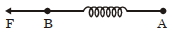
Two masses $A$ and $B$,each of mass $M$,are connected by a massless spring. $A$ force $F$ acts on the mass $B$ as shown in the figure. If the mass $A$ starts moving away from mass $B$ with acceleration $a$,then the acceleration of mass $B$ will be:
A
$\frac{ Ma - F }{ M }$
B
$\frac{ MF }{ F + Ma }$
C
$\frac{ F + Ma }{ M }$
D
$\frac{ F - Ma }{ M }$
Solution
(D) The acceleration of the center of mass of the system is given by $a_{cm} = \frac{ F_{ext} }{ M_{total} }$.
Here,the external force is $F$ and the total mass is $M + M = 2M$.
So,$a_{cm} = \frac{ F }{ 2M }$.
Also,$a_{cm} = \frac{ m_A a_A + m_B a_B }{ m_A + m_B }$,where $a_A = a$ (acceleration of mass $A$) and $a_B$ is the acceleration of mass $B$.
Substituting the values: $\frac{ F }{ 2M } = \frac{ M(a) + M(a_B) }{ 2M }$.
Canceling $2M$ from both sides,we get $F = Ma + Ma_B$.
Rearranging for $a_B$,we get $Ma_B = F - Ma$.
Therefore,$a_B = \frac{ F - Ma }{ M }$.
Here,the external force is $F$ and the total mass is $M + M = 2M$.
So,$a_{cm} = \frac{ F }{ 2M }$.
Also,$a_{cm} = \frac{ m_A a_A + m_B a_B }{ m_A + m_B }$,where $a_A = a$ (acceleration of mass $A$) and $a_B$ is the acceleration of mass $B$.
Substituting the values: $\frac{ F }{ 2M } = \frac{ M(a) + M(a_B) }{ 2M }$.
Canceling $2M$ from both sides,we get $F = Ma + Ma_B$.
Rearranging for $a_B$,we get $Ma_B = F - Ma$.
Therefore,$a_B = \frac{ F - Ma }{ M }$.
0 likesView Solution
180
PhysicsDifficultMCQJEE Main · 2021
$A$ scooter accelerates from rest for time $t_{1}$ at a constant rate $a_{1}$ and then retards at a constant rate $a_{2}$ for time $t_{2}$ and comes to rest. The correct value of $\frac{t_{1}}{t_{2}}$ will be ..... .
A
$\frac{a_{1}+a_{2}}{a_{2}}$
B
$\frac{a_{2}}{a_{1}}$
C
$\frac{a_{1}}{a_{2}}$
D
$\frac{a_{1}+a_{2}}{a_{1}}$
Solution
(B) Let $v_{\max}$ be the maximum velocity attained by the scooter.
During the acceleration phase,the final velocity is $v_{\max} = 0 + a_{1}t_{1}$,so $t_{1} = \frac{v_{\max}}{a_{1}}$.
During the retardation phase,the final velocity is $0 = v_{\max} - a_{2}t_{2}$,so $t_{2} = \frac{v_{\max}}{a_{2}}$.
Taking the ratio of the two times:
$\frac{t_{1}}{t_{2}} = \frac{v_{\max} / a_{1}}{v_{\max} / a_{2}} = \frac{a_{2}}{a_{1}}$.
Alternatively,using the velocity-time graph,the slope of the acceleration part is $a_{1} = \tan \theta_{1} = \frac{v_{\max}}{t_{1}}$ and the magnitude of the slope of the retardation part is $a_{2} = \tan \theta_{2} = \frac{v_{\max}}{t_{2}}$.
Thus,$\frac{t_{1}}{t_{2}} = \frac{a_{2}}{a_{1}}$.
During the acceleration phase,the final velocity is $v_{\max} = 0 + a_{1}t_{1}$,so $t_{1} = \frac{v_{\max}}{a_{1}}$.
During the retardation phase,the final velocity is $0 = v_{\max} - a_{2}t_{2}$,so $t_{2} = \frac{v_{\max}}{a_{2}}$.
Taking the ratio of the two times:
$\frac{t_{1}}{t_{2}} = \frac{v_{\max} / a_{1}}{v_{\max} / a_{2}} = \frac{a_{2}}{a_{1}}$.
Alternatively,using the velocity-time graph,the slope of the acceleration part is $a_{1} = \tan \theta_{1} = \frac{v_{\max}}{t_{1}}$ and the magnitude of the slope of the retardation part is $a_{2} = \tan \theta_{2} = \frac{v_{\max}}{t_{2}}$.
Thus,$\frac{t_{1}}{t_{2}} = \frac{a_{2}}{a_{1}}$.
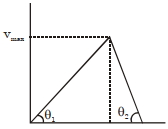
0 likesView Solution
181
PhysicsMediumMCQJEE Main · 2021
Given below are two statements:
Statement $I :$ $A$ second's pendulum has a time period of $1$ second.
Statement $II :$ It takes precisely one second to move between the two extreme positions.
In the light of the above statements,choose the correct answer from the options given below:
Statement $I :$ $A$ second's pendulum has a time period of $1$ second.
Statement $II :$ It takes precisely one second to move between the two extreme positions.
In the light of the above statements,choose the correct answer from the options given below:
A
Both Statement $I$ and Statement $II$ are false.
B
Statement $I$ is false but Statement $II$ is true.
C
Statement $I$ is true but Statement $II$ is false.
D
Both Statement $I$ and Statement $II$ are true.
Solution
(B) second's pendulum is defined as a pendulum whose time period of oscillation is $2 \, s$.
Therefore,Statement $I$ is false.
The time taken to move from one extreme position to the other extreme position is equal to half of the time period $(T/2)$.
Since $T = 2 \, s$,the time taken is $2 \, s / 2 = 1 \, s$.
Therefore,Statement $II$ is true.
Therefore,Statement $I$ is false.
The time taken to move from one extreme position to the other extreme position is equal to half of the time period $(T/2)$.
Since $T = 2 \, s$,the time taken is $2 \, s / 2 = 1 \, s$.
Therefore,Statement $II$ is true.
0 likesView Solution
182
PhysicsDifficultMCQJEE Main · 2021
The volume $V$ of a given mass of monoatomic gas changes with temperature $T$ according to the relation $V = KT^{2/3}$. The work done when temperature changes by $90\,K$ will be $xR$. The value of $x$ is $[R = \text{universal gas constant}]$
A
$50$
B
$60$
C
$48$
D
$72$
Solution
(B) The work done by a gas is given by $W = \int P\,dV$.
From the ideal gas law,$P = \frac{nRT}{V}$.
Substituting this into the work formula: $W = \int \frac{nRT}{V}\,dV$.
Given the relation $V = KT^{2/3}$,we differentiate with respect to $T$: $dV = K \cdot \frac{2}{3} T^{-1/3}\,dT$.
Substituting $V$ and $dV$ into the integral: $W = \int_{T_1}^{T_2} \frac{nRT}{KT^{2/3}} \cdot \left( \frac{2}{3} K T^{-1/3} \right) dT$.
Simplifying the expression: $W = \int_{T_1}^{T_2} \frac{2}{3} nR \cdot \frac{T \cdot T^{-1/3}}{T^{2/3}} \,dT = \int_{T_1}^{T_2} \frac{2}{3} nR \,dT$.
Integrating,we get $W = \frac{2}{3} nR (T_2 - T_1)$.
Given $\Delta T = T_2 - T_1 = 90\,K$ and assuming $n = 1$ mole: $W = \frac{2}{3} \cdot 1 \cdot R \cdot 90 = 60R$.
Thus,$x = 60$.
From the ideal gas law,$P = \frac{nRT}{V}$.
Substituting this into the work formula: $W = \int \frac{nRT}{V}\,dV$.
Given the relation $V = KT^{2/3}$,we differentiate with respect to $T$: $dV = K \cdot \frac{2}{3} T^{-1/3}\,dT$.
Substituting $V$ and $dV$ into the integral: $W = \int_{T_1}^{T_2} \frac{nRT}{KT^{2/3}} \cdot \left( \frac{2}{3} K T^{-1/3} \right) dT$.
Simplifying the expression: $W = \int_{T_1}^{T_2} \frac{2}{3} nR \cdot \frac{T \cdot T^{-1/3}}{T^{2/3}} \,dT = \int_{T_1}^{T_2} \frac{2}{3} nR \,dT$.
Integrating,we get $W = \frac{2}{3} nR (T_2 - T_1)$.
Given $\Delta T = T_2 - T_1 = 90\,K$ and assuming $n = 1$ mole: $W = \frac{2}{3} \cdot 1 \cdot R \cdot 90 = 60R$.
Thus,$x = 60$.
0 likesView Solution
183
PhysicsMediumMCQJEE Main · 2021
$A$ particle executes $S.H.M.$ with amplitude $a$ and time period $T$. The displacement of the particle when its speed is half of its maximum speed is $\frac{\sqrt{x} a}{2}$. The value of $x$ is $\ldots \ldots \ldots$
A
$1$
B
$5$
C
$2$
D
$3$
Solution
(D) The velocity of a particle in $S.H.M.$ at displacement $y$ is given by $v = \omega \sqrt{a^2 - y^2}$,where $a$ is the amplitude and $\omega$ is the angular frequency.
Maximum speed is $v_{\max} = a\omega$.
Given that the speed $v = \frac{v_{\max}}{2}$,we have $\frac{a\omega}{2} = \omega \sqrt{a^2 - y^2}$.
Squaring both sides: $\frac{a^2}{4} = a^2 - y^2$.
Rearranging for displacement $y$: $y^2 = a^2 - \frac{a^2}{4} = \frac{3a^2}{4}$.
Thus,$y = \frac{\sqrt{3} a}{2}$.
Comparing this with the given expression $\frac{\sqrt{x} a}{2}$,we find $x = 3$.
Maximum speed is $v_{\max} = a\omega$.
Given that the speed $v = \frac{v_{\max}}{2}$,we have $\frac{a\omega}{2} = \omega \sqrt{a^2 - y^2}$.
Squaring both sides: $\frac{a^2}{4} = a^2 - y^2$.
Rearranging for displacement $y$: $y^2 = a^2 - \frac{a^2}{4} = \frac{3a^2}{4}$.
Thus,$y = \frac{\sqrt{3} a}{2}$.
Comparing this with the given expression $\frac{\sqrt{x} a}{2}$,we find $x = 3$.
0 likesView Solution
184
PhysicsDifficultMCQJEE Main · 2021
The time period of a simple pendulum is $T$. The time taken to complete $5/8$ oscillations starting from the mean position is $\frac{\alpha}{\beta} T$. The value of $\alpha$ is ..... .
A
$5$
B
$3$
C
$7$
D
$6$
Solution
(A) Starting from the mean position,the particle moves to the extreme position ($1/4$ oscillation),back to the mean position ($1/2$ oscillation),and then to the other side.
$5/8$ of an oscillation is equivalent to $1/2 + 1/8$ of an oscillation.
In terms of phase,$1/2$ oscillation corresponds to a phase change of $\pi$ radians.
The remaining $1/8$ oscillation corresponds to a phase change of $\frac{1}{8} \times 2\pi = \frac{\pi}{4}$ radians.
However,the question asks for the time taken to reach the position corresponding to $5/8$ of the cycle. Using the reference circle method,the displacement $y = A \sin(\omega t)$.
For $5/8$ of the cycle,the phase angle $\phi = \frac{5}{8} \times 2\pi = \frac{5\pi}{4}$.
Since the particle starts from the mean position,we consider the phase relative to the mean position.
The time $t$ is given by $\omega t = \phi$,where $\omega = \frac{2\pi}{T}$.
Thus,$t = \frac{\phi}{\omega} = \frac{5\pi/4}{2\pi/T} = \frac{5}{8} T$.
Wait,checking the provided solution logic: The particle reaches the extreme at $T/4$,returns to mean at $T/2$. To complete $5/8$,it travels an additional $1/8$ of the cycle from the mean position in the negative direction. The displacement is $y = A \sin(\omega t)$. At $t = 5T/8$,$y = A \sin(2\pi/T \times 5T/8) = A \sin(5\pi/4) = -A/\sqrt{2}$.
If the question implies the time to reach the displacement corresponding to $5/8$ of the cycle,then $\alpha = 5$.
$5/8$ of an oscillation is equivalent to $1/2 + 1/8$ of an oscillation.
In terms of phase,$1/2$ oscillation corresponds to a phase change of $\pi$ radians.
The remaining $1/8$ oscillation corresponds to a phase change of $\frac{1}{8} \times 2\pi = \frac{\pi}{4}$ radians.
However,the question asks for the time taken to reach the position corresponding to $5/8$ of the cycle. Using the reference circle method,the displacement $y = A \sin(\omega t)$.
For $5/8$ of the cycle,the phase angle $\phi = \frac{5}{8} \times 2\pi = \frac{5\pi}{4}$.
Since the particle starts from the mean position,we consider the phase relative to the mean position.
The time $t$ is given by $\omega t = \phi$,where $\omega = \frac{2\pi}{T}$.
Thus,$t = \frac{\phi}{\omega} = \frac{5\pi/4}{2\pi/T} = \frac{5}{8} T$.
Wait,checking the provided solution logic: The particle reaches the extreme at $T/4$,returns to mean at $T/2$. To complete $5/8$,it travels an additional $1/8$ of the cycle from the mean position in the negative direction. The displacement is $y = A \sin(\omega t)$. At $t = 5T/8$,$y = A \sin(2\pi/T \times 5T/8) = A \sin(5\pi/4) = -A/\sqrt{2}$.
If the question implies the time to reach the displacement corresponding to $5/8$ of the cycle,then $\alpha = 5$.
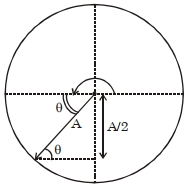
0 likesView Solution
185
PhysicsDifficultMCQJEE Main · 2021
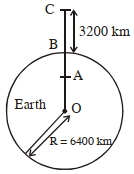
In the provided figure of the Earth,the value of acceleration due to gravity is the same at points $A$ and $C$,but it is smaller than its value at point $B$ (surface of the Earth). The value of $OA : AB$ is $x : y$. The value of $x$ is $\ldots \ldots \ldots$
A
$3$
B
$5$
C
$4$
D
$6$
Solution
(C) Let $R$ be the radius of the Earth. Point $A$ is at a distance $r$ from the center $O$ inside the Earth. Point $C$ is at a height $h = 3200 \text{ km} = R/2$ above the surface $B$.
The acceleration due to gravity at point $A$ (inside the Earth) is given by $g_A = \frac{G M r}{R^3}$.
The acceleration due to gravity at point $C$ (outside the Earth) is given by $g_C = \frac{G M}{(R + h)^2} = \frac{G M}{(R + R/2)^2} = \frac{G M}{(3R/2)^2} = \frac{4 G M}{9 R^2}$.
Given that $g_A = g_C$,we equate the expressions:
$\frac{G M r}{R^3} = \frac{4 G M}{9 R^2}$
Solving for $r$:
$r = \frac{4 R}{9}$.
Thus,$OA = r = \frac{4 R}{9}$.
The distance $AB = R - r = R - \frac{4 R}{9} = \frac{5 R}{9}$.
Therefore,the ratio $OA : AB = \frac{4 R}{9} : \frac{5 R}{9} = 4 : 5$.
Since the ratio is $x : y = 4 : 5$,the value of $x$ is $4$.
The acceleration due to gravity at point $A$ (inside the Earth) is given by $g_A = \frac{G M r}{R^3}$.
The acceleration due to gravity at point $C$ (outside the Earth) is given by $g_C = \frac{G M}{(R + h)^2} = \frac{G M}{(R + R/2)^2} = \frac{G M}{(3R/2)^2} = \frac{4 G M}{9 R^2}$.
Given that $g_A = g_C$,we equate the expressions:
$\frac{G M r}{R^3} = \frac{4 G M}{9 R^2}$
Solving for $r$:
$r = \frac{4 R}{9}$.
Thus,$OA = r = \frac{4 R}{9}$.
The distance $AB = R - r = R - \frac{4 R}{9} = \frac{5 R}{9}$.
Therefore,the ratio $OA : AB = \frac{4 R}{9} : \frac{5 R}{9} = 4 : 5$.
Since the ratio is $x : y = 4 : 5$,the value of $x$ is $4$.
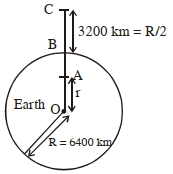
0 likesView Solution
186
PhysicsDifficultMCQJEE Main · 2021
$1$ mole of rigid diatomic gas performs a work of $Q/5$ when heat $Q$ is supplied to it. The molar heat capacity of the gas during this transformation is $\frac{xR}{8}.$ The value of $x$ is $\ldots \ldots \ldots .$ $[R =$ universal gas constant $]$
A
$30$
B
$25$
C
$36$
D
$45$
Solution
(B) From the first law of thermodynamics,$Q = \Delta U + W.$
Given that $W = Q/5,$ we have $Q = \Delta U + Q/5.$
Therefore,$\Delta U = Q - Q/5 = 4Q/5.$
For a rigid diatomic gas,the internal energy change is $\Delta U = n C_v \Delta T,$ where $C_v = \frac{5}{2}R.$
Also,$Q = n C \Delta T,$ where $C$ is the molar heat capacity.
Substituting these into the equation $\Delta U = \frac{4}{5}Q,$ we get $n C_v \Delta T = \frac{4}{5} (n C \Delta T).$
$C_v = \frac{4}{5} C \implies C = \frac{5}{4} C_v.$
Substituting $C_v = \frac{5}{2}R,$ we get $C = \frac{5}{4} \times \frac{5}{2} R = \frac{25}{8} R.$
Comparing this with $\frac{xR}{8},$ we find $x = 25.$
Given that $W = Q/5,$ we have $Q = \Delta U + Q/5.$
Therefore,$\Delta U = Q - Q/5 = 4Q/5.$
For a rigid diatomic gas,the internal energy change is $\Delta U = n C_v \Delta T,$ where $C_v = \frac{5}{2}R.$
Also,$Q = n C \Delta T,$ where $C$ is the molar heat capacity.
Substituting these into the equation $\Delta U = \frac{4}{5}Q,$ we get $n C_v \Delta T = \frac{4}{5} (n C \Delta T).$
$C_v = \frac{4}{5} C \implies C = \frac{5}{4} C_v.$
Substituting $C_v = \frac{5}{2}R,$ we get $C = \frac{5}{4} \times \frac{5}{2} R = \frac{25}{8} R.$
Comparing this with $\frac{xR}{8},$ we find $x = 25.$
0 likesView Solution
187
PhysicsDifficultMCQJEE Main · 2021
The magnitude of vectors $\overrightarrow{ OA }, \overrightarrow{ OB }$ and $\overrightarrow{ OC }$ in the given figure are equal. The direction of $\overrightarrow{ OA }+\overrightarrow{ OB }-\overrightarrow{ OC }$ with the $x$-axis will be
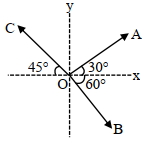
A
$\tan ^{-1} \frac{(1-\sqrt{3}-\sqrt{2})}{(1+\sqrt{3}+\sqrt{2})}$
B
$\tan ^{-1} \frac{(\sqrt{3}-1+\sqrt{2})}{(1+\sqrt{3}-\sqrt{2})}$
C
$\tan ^{-1} \frac{(\sqrt{3}-1+\sqrt{2})}{(1-\sqrt{3}+\sqrt{2})}$
D
$\tan ^{-1} \frac{(1+\sqrt{3}-\sqrt{2})}{(1-\sqrt{3}-\sqrt{2})}$
Solution
(A) Let the magnitude of each vector be $\lambda$.
$\overrightarrow{ OA } = \lambda (\cos 30^{\circ} \hat{i} + \sin 30^{\circ} \hat{j}) = \lambda (\frac{\sqrt{3}}{2} \hat{i} + \frac{1}{2} \hat{j})$
$\overrightarrow{ OB } = \lambda (\cos 60^{\circ} \hat{i} - \sin 60^{\circ} \hat{j}) = \lambda (\frac{1}{2} \hat{i} - \frac{\sqrt{3}}{2} \hat{j})$
$\overrightarrow{ OC } = \lambda (\cos 45^{\circ} (-\hat{i}) + \sin 45^{\circ} \hat{j}) = \lambda (-\frac{1}{\sqrt{2}} \hat{i} + \frac{1}{\sqrt{2}} \hat{j})$
Now,calculate $\overrightarrow{ R } = \overrightarrow{ OA } + \overrightarrow{ OB } - \overrightarrow{ OC }$.
$\overrightarrow{ R } = \lambda [(\frac{\sqrt{3}}{2} + \frac{1}{2} - (-\frac{1}{\sqrt{2}})) \hat{i} + (\frac{1}{2} - \frac{\sqrt{3}}{2} - \frac{1}{\sqrt{2}}) \hat{j}]$
$\overrightarrow{ R } = \lambda [(\frac{\sqrt{3}+1+\sqrt{2}}{2}) \hat{i} + (\frac{1-\sqrt{3}-\sqrt{2}}{2}) \hat{j}]$
The angle $\theta$ with the $x$-axis is given by $\tan \theta = \frac{R_y}{R_x}$.
$\tan \theta = \frac{\frac{1-\sqrt{3}-\sqrt{2}}{2}}{\frac{\sqrt{3}+1+\sqrt{2}}{2}} = \frac{1-\sqrt{3}-\sqrt{2}}{1+\sqrt{3}+\sqrt{2}}$
Therefore,$\theta = \tan ^{-1} \frac{1-\sqrt{3}-\sqrt{2}}{1+\sqrt{3}+\sqrt{2}}$.
$\overrightarrow{ OA } = \lambda (\cos 30^{\circ} \hat{i} + \sin 30^{\circ} \hat{j}) = \lambda (\frac{\sqrt{3}}{2} \hat{i} + \frac{1}{2} \hat{j})$
$\overrightarrow{ OB } = \lambda (\cos 60^{\circ} \hat{i} - \sin 60^{\circ} \hat{j}) = \lambda (\frac{1}{2} \hat{i} - \frac{\sqrt{3}}{2} \hat{j})$
$\overrightarrow{ OC } = \lambda (\cos 45^{\circ} (-\hat{i}) + \sin 45^{\circ} \hat{j}) = \lambda (-\frac{1}{\sqrt{2}} \hat{i} + \frac{1}{\sqrt{2}} \hat{j})$
Now,calculate $\overrightarrow{ R } = \overrightarrow{ OA } + \overrightarrow{ OB } - \overrightarrow{ OC }$.
$\overrightarrow{ R } = \lambda [(\frac{\sqrt{3}}{2} + \frac{1}{2} - (-\frac{1}{\sqrt{2}})) \hat{i} + (\frac{1}{2} - \frac{\sqrt{3}}{2} - \frac{1}{\sqrt{2}}) \hat{j}]$
$\overrightarrow{ R } = \lambda [(\frac{\sqrt{3}+1+\sqrt{2}}{2}) \hat{i} + (\frac{1-\sqrt{3}-\sqrt{2}}{2}) \hat{j}]$
The angle $\theta$ with the $x$-axis is given by $\tan \theta = \frac{R_y}{R_x}$.
$\tan \theta = \frac{\frac{1-\sqrt{3}-\sqrt{2}}{2}}{\frac{\sqrt{3}+1+\sqrt{2}}{2}} = \frac{1-\sqrt{3}-\sqrt{2}}{1+\sqrt{3}+\sqrt{2}}$
Therefore,$\theta = \tan ^{-1} \frac{1-\sqrt{3}-\sqrt{2}}{1+\sqrt{3}+\sqrt{2}}$.
0 likesView Solution
188
PhysicsMediumMCQJEE Main · 2021
Inside a uniform spherical shell:
$(a)$ The gravitational field is zero.
$(b)$ The gravitational potential is zero.
$(c)$ The gravitational field is same everywhere.
$(d)$ The gravitational potential is same everywhere.
$(e)$ All of the above.
Choose the most appropriate answer from the options given below:
$(a)$ The gravitational field is zero.
$(b)$ The gravitational potential is zero.
$(c)$ The gravitational field is same everywhere.
$(d)$ The gravitational potential is same everywhere.
$(e)$ All of the above.
Choose the most appropriate answer from the options given below:
A
$(a), (c)$ and $(d)$ only
B
$(e)$ only
C
$(a), (b)$ and $(c)$ only
D
$(b), (c)$ and $(d)$ only
Solution
(A) For a uniform spherical shell of mass $M$ and radius $R$,the gravitational field $E$ at any point inside $(r < R)$ is given by $E = 0$.
Since the gravitational field $E = -dV/dr$,if $E = 0$,then the potential $V$ must be constant throughout the interior.
The value of this constant potential is $V = -GM/R$,which is not zero.
Therefore,statements $(a)$,$(c)$,and $(d)$ are correct,while $(b)$ is incorrect.
Thus,the correct option is $(a), (c)$ and $(d)$ only.
Since the gravitational field $E = -dV/dr$,if $E = 0$,then the potential $V$ must be constant throughout the interior.
The value of this constant potential is $V = -GM/R$,which is not zero.
Therefore,statements $(a)$,$(c)$,and $(d)$ are correct,while $(b)$ is incorrect.
Thus,the correct option is $(a), (c)$ and $(d)$ only.
0 likesView Solution
189
PhysicsDifficultMCQJEE Main · 2021
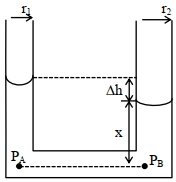
Two narrow bores of diameter $5.0 \, mm$ and $8.0 \, mm$ are joined together to form a $U$-shaped tube open at both ends. If this $U$-tube contains water,what is the difference in the level of two limbs of the tube? [Take surface tension of water $T = 7.3 \times 10^{-2} \, Nm^{-1}$,angle of contact $= 0$,$g = 10 \, ms^{-2}$ and density of water $\rho = 1.0 \times 10^{3} \, kg \, m^{-3}$] (in $mm$)
A
$3.62$
B
$2.19$
C
$5.34$
D
$4.97$
Solution
(B) The pressure at points $A$ and $B$ at the same horizontal level must be equal,so $P_A = P_B$.
The pressure just below the meniscus in the two limbs is given by $P_{atm} - \frac{2T}{r_1}$ and $P_{atm} - \frac{2T}{r_2}$ respectively.
Equating the pressures at the same horizontal level:
$P_{atm} - \frac{2T}{r_1} + \rho g(x + \Delta h) = P_{atm} - \frac{2T}{r_2} + \rho g x$
$\rho g \Delta h = 2T \left( \frac{1}{r_1} - \frac{1}{r_2} \right)$
Given $r_1 = 2.5 \, mm = 2.5 \times 10^{-3} \, m$ and $r_2 = 4.0 \, mm = 4.0 \times 10^{-3} \, m$.
$\Delta h = \frac{2T}{\rho g} \left( \frac{1}{r_1} - \frac{1}{r_2} \right)$
$\Delta h = \frac{2 \times 7.3 \times 10^{-2}}{1.0 \times 10^3 \times 10} \left( \frac{1}{2.5 \times 10^{-3}} - \frac{1}{4.0 \times 10^{-3}} \right)$
$\Delta h = \frac{14.6 \times 10^{-2}}{10^4} \times 10^3 \left( \frac{1}{2.5} - \frac{1}{4.0} \right)$
$\Delta h = 14.6 \times 10^{-3} \times (0.4 - 0.25) = 14.6 \times 10^{-3} \times 0.15 = 2.19 \times 10^{-3} \, m = 2.19 \, mm$.
The pressure just below the meniscus in the two limbs is given by $P_{atm} - \frac{2T}{r_1}$ and $P_{atm} - \frac{2T}{r_2}$ respectively.
Equating the pressures at the same horizontal level:
$P_{atm} - \frac{2T}{r_1} + \rho g(x + \Delta h) = P_{atm} - \frac{2T}{r_2} + \rho g x$
$\rho g \Delta h = 2T \left( \frac{1}{r_1} - \frac{1}{r_2} \right)$
Given $r_1 = 2.5 \, mm = 2.5 \times 10^{-3} \, m$ and $r_2 = 4.0 \, mm = 4.0 \times 10^{-3} \, m$.
$\Delta h = \frac{2T}{\rho g} \left( \frac{1}{r_1} - \frac{1}{r_2} \right)$
$\Delta h = \frac{2 \times 7.3 \times 10^{-2}}{1.0 \times 10^3 \times 10} \left( \frac{1}{2.5 \times 10^{-3}} - \frac{1}{4.0 \times 10^{-3}} \right)$
$\Delta h = \frac{14.6 \times 10^{-2}}{10^4} \times 10^3 \left( \frac{1}{2.5} - \frac{1}{4.0} \right)$
$\Delta h = 14.6 \times 10^{-3} \times (0.4 - 0.25) = 14.6 \times 10^{-3} \times 0.15 = 2.19 \times 10^{-3} \, m = 2.19 \, mm$.
0 likesView Solution
190
PhysicsMediumMCQJEE Main · 2021
An electric appliance supplies $6000 \, J/min$ of heat to the system. If the system delivers a power of $90 \, W$,how long (in $sec$) would it take to increase the internal energy by $2.5 \times 10^{3} \, J$?
A
$250$
B
$410$
C
$300$
D
$150$
Solution
(A) According to the First Law of Thermodynamics,$\Delta Q = \Delta U + \Delta W$.
Given:
Heat supply rate $\frac{\Delta Q}{\Delta t} = \frac{6000 \, J}{60 \, sec} = 100 \, W$.
Power delivered by the system $\frac{\Delta W}{\Delta t} = 90 \, W$.
Change in internal energy $\Delta U = 2.5 \times 10^{3} \, J = 2500 \, J$.
Using the power equation: $\frac{\Delta Q}{\Delta t} = \frac{\Delta U}{\Delta t} + \frac{\Delta W}{\Delta t}$.
$100 = \frac{2500}{\Delta t} + 90$.
$100 - 90 = \frac{2500}{\Delta t}$.
$10 = \frac{2500}{\Delta t}$.
$\Delta t = \frac{2500}{10} = 250 \, sec$.
Given:
Heat supply rate $\frac{\Delta Q}{\Delta t} = \frac{6000 \, J}{60 \, sec} = 100 \, W$.
Power delivered by the system $\frac{\Delta W}{\Delta t} = 90 \, W$.
Change in internal energy $\Delta U = 2.5 \times 10^{3} \, J = 2500 \, J$.
Using the power equation: $\frac{\Delta Q}{\Delta t} = \frac{\Delta U}{\Delta t} + \frac{\Delta W}{\Delta t}$.
$100 = \frac{2500}{\Delta t} + 90$.
$100 - 90 = \frac{2500}{\Delta t}$.
$10 = \frac{2500}{\Delta t}$.
$\Delta t = \frac{2500}{10} = 250 \, sec$.
0 likesView Solution
191
PhysicsMediumMCQJEE Main · 2021
The $rms$ speeds of the molecules of Hydrogen,Oxygen,and Carbon dioxide at the same temperature are $V_{H}$,$V_{O}$,and $V_{C}$ respectively. Then:
A
$V_{H} > V_{O} > V_{C}$
B
$V_{C} > V_{O} > V_{H}$
C
$V_{H} = V_{O} > V_{C}$
D
$V_{H} = V_{O} = V_{C}$
Solution
(A) The formula for the $rms$ speed of gas molecules is $V_{RMS} = \sqrt{\frac{3RT}{M_{W}}}$,where $R$ is the universal gas constant,$T$ is the absolute temperature,and $M_{W}$ is the molar mass of the gas.
Since the temperature $T$ is the same for all gases,we have $V_{RMS} \propto \frac{1}{\sqrt{M_{W}}}$.
The molar masses are: $M_{H} = 2 \ g/mol$,$M_{O} = 32 \ g/mol$,and $M_{C} = 44 \ g/mol$.
Since $M_{H} < M_{O} < M_{C}$,it follows that $\frac{1}{\sqrt{M_{H}}} > \frac{1}{\sqrt{M_{O}}} > \frac{1}{\sqrt{M_{C}}}$.
Therefore,$V_{H} > V_{O} > V_{C}$.
Since the temperature $T$ is the same for all gases,we have $V_{RMS} \propto \frac{1}{\sqrt{M_{W}}}$.
The molar masses are: $M_{H} = 2 \ g/mol$,$M_{O} = 32 \ g/mol$,and $M_{C} = 44 \ g/mol$.
Since $M_{H} < M_{O} < M_{C}$,it follows that $\frac{1}{\sqrt{M_{H}}} > \frac{1}{\sqrt{M_{O}}} > \frac{1}{\sqrt{M_{C}}}$.
Therefore,$V_{H} > V_{O} > V_{C}$.
0 likesView Solution
192
PhysicsDifficultMCQJEE Main · 2021
In a screw gauge,the fifth division of the circular scale coincides with the reference line when the ratchet is closed. There are $50$ divisions on the circular scale,and the main scale moves by $0.5 \, mm$ on a complete rotation. For a particular observation,the reading on the main scale is $5 \, mm$ and the $20^{th}$ division of the circular scale coincides with the reference line. Calculate the true reading in $mm$.
A
$5.00$
B
$5.25$
C
$5.15$
D
$5.20$
Solution
(C) $1$. Calculate the Least Count $(LC)$: The pitch is $0.5 \, mm$ and the number of circular scale divisions is $50$. Thus,$LC = \frac{0.5 \, mm}{50} = 0.01 \, mm$.
$2$. Determine the Zero Error: The $5^{th}$ division coincides with the reference line when the ratchet is closed. Since it is positive (implied by standard convention for this type of problem),Zero Error $= +5 \times LC = 5 \times 0.01 = 0.05 \, mm$.
$3$. Calculate the Observed Reading: Observed Reading = Main Scale Reading + (Circular Scale Division $\times LC$) = $5 \, mm + (20 \times 0.01 \, mm) = 5.20 \, mm$.
$4$. Calculate the True Reading: True Reading = Observed Reading - Zero Error = $5.20 \, mm - 0.05 \, mm = 5.15 \, mm$.
$2$. Determine the Zero Error: The $5^{th}$ division coincides with the reference line when the ratchet is closed. Since it is positive (implied by standard convention for this type of problem),Zero Error $= +5 \times LC = 5 \times 0.01 = 0.05 \, mm$.
$3$. Calculate the Observed Reading: Observed Reading = Main Scale Reading + (Circular Scale Division $\times LC$) = $5 \, mm + (20 \times 0.01 \, mm) = 5.20 \, mm$.
$4$. Calculate the True Reading: True Reading = Observed Reading - Zero Error = $5.20 \, mm - 0.05 \, mm = 5.15 \, mm$.
0 likesView Solution
193
PhysicsMediumMCQJEE Main · 2021
The initial mass of a rocket is $1000 \, \text{kg}$. Calculate at what rate the fuel (in $\text{kg s}^{-1}$) should be burnt so that the rocket is given an acceleration of $20 \, \text{m s}^{-2}$. The gases come out at a relative speed of $500 \, \text{m s}^{-1}$ with respect to the rocket. [Use $g = 10 \, \text{m s}^{-2}$]
A
$600$
B
$500$
C
$10$
D
$60$
Solution
(D) The thrust force exerted on the rocket is given by $F_{\text{thrust}} = \left(\frac{dm}{dt}\right) V_{\text{rel}}$.
The net force acting on the rocket is $F_{\text{net}} = F_{\text{thrust}} - mg = ma$.
Substituting the given values: $m = 1000 \, \text{kg}$,$a = 20 \, \text{m s}^{-2}$,$V_{\text{rel}} = 500 \, \text{m s}^{-1}$,and $g = 10 \, \text{m s}^{-2}$.
$\left(\frac{dm}{dt}\right) \times 500 - (1000 \times 10) = 1000 \times 20$
$\left(\frac{dm}{dt}\right) \times 500 - 10000 = 20000$
$\left(\frac{dm}{dt}\right) \times 500 = 30000$
$\frac{dm}{dt} = \frac{30000}{500} = 60 \, \text{kg s}^{-1}$.
The net force acting on the rocket is $F_{\text{net}} = F_{\text{thrust}} - mg = ma$.
Substituting the given values: $m = 1000 \, \text{kg}$,$a = 20 \, \text{m s}^{-2}$,$V_{\text{rel}} = 500 \, \text{m s}^{-1}$,and $g = 10 \, \text{m s}^{-2}$.
$\left(\frac{dm}{dt}\right) \times 500 - (1000 \times 10) = 1000 \times 20$
$\left(\frac{dm}{dt}\right) \times 500 - 10000 = 20000$
$\left(\frac{dm}{dt}\right) \times 500 = 30000$
$\frac{dm}{dt} = \frac{30000}{500} = 60 \, \text{kg s}^{-1}$.

0 likesView Solution
194
PhysicsMediumMCQJEE Main · 2021
If $E$,$L$,$m$ and $G$ denote the quantities as energy,angular momentum,mass and constant of gravitation respectively,then the dimensions of $P$ in the formula $P = EL^2 m^{-5} G^{-2}$ are
A
$[M^0 L^1 T^0]$
B
$[M^{-1} L^{-1} T^2]$
C
$[M^1 L^1 T^{-2}]$
D
$[M^0 L^0 T^0]$
Solution
(D) The dimensions of the given quantities are:
$E = [ML^2 T^{-2}]$
$L = [ML^2 T^{-1}]$
$m = [M]$
$G = [M^{-1} L^3 T^{-2}]$
Given the formula $P = E L^2 m^{-5} G^{-2}$,we substitute the dimensions:
$[P] = [ML^2 T^{-2}] \cdot [ML^2 T^{-1}]^2 \cdot [M]^{-5} \cdot [M^{-1} L^3 T^{-2}]^{-2}$
$[P] = [ML^2 T^{-2}] \cdot [M^2 L^4 T^{-2}] \cdot [M^{-5}] \cdot [M^2 L^{-6} T^4]$
$[P] = [M^{1+2-5+2} L^{2+4-6} T^{-2-2+4}]$
$[P] = [M^0 L^0 T^0]$
Thus,the dimensions of $P$ are dimensionless.
$E = [ML^2 T^{-2}]$
$L = [ML^2 T^{-1}]$
$m = [M]$
$G = [M^{-1} L^3 T^{-2}]$
Given the formula $P = E L^2 m^{-5} G^{-2}$,we substitute the dimensions:
$[P] = [ML^2 T^{-2}] \cdot [ML^2 T^{-1}]^2 \cdot [M]^{-5} \cdot [M^{-1} L^3 T^{-2}]^{-2}$
$[P] = [ML^2 T^{-2}] \cdot [M^2 L^4 T^{-2}] \cdot [M^{-5}] \cdot [M^2 L^{-6} T^4]$
$[P] = [M^{1+2-5+2} L^{2+4-6} T^{-2-2+4}]$
$[P] = [M^0 L^0 T^0]$
Thus,the dimensions of $P$ are dimensionless.
0 likesView Solution
195
PhysicsDifficultMCQJEE Main · 2021
$A$ uniform chain of length $3\, m$ and mass $3\, kg$ overhangs a smooth table with $2\, m$ laying on the table. If $k$ is the kinetic energy of the chain in joules as it completely slips off the table,then the value of $k$ is (Take $g = 10\, m/s^2$).
A
$40$
B
$60$
C
$400$
D
$10$
Solution
(A) Let the total length of the chain be $L = 3\, m$ and total mass be $M = 3\, kg$. The linear mass density is $\lambda = M/L = 3/3 = 1\, kg/m$.
Initially,$2\, m$ of the chain is on the table and $1\, m$ is hanging. The center of mass of the hanging part is at a distance of $0.5\, m$ below the table level. Taking the table surface as the reference level $(U = 0)$,the initial potential energy is $U_i = -(m_{hanging})g(h_{cm}) = -(1\, kg)(10\, m/s^2)(0.5\, m) = -5\, J$.
The initial kinetic energy is $K_i = 0$.
Finally,when the chain completely slips off,the entire chain of length $3\, m$ hangs vertically. Its center of mass is at $1.5\, m$ below the table level. The final potential energy is $U_f = -(M)g(h_{cm}) = -(3\, kg)(10\, m/s^2)(1.5\, m) = -45\, J$.
By the law of conservation of mechanical energy,$K_i + U_i = K_f + U_f$.
$0 + (-5\, J) = K_f + (-45\, J)$.
$K_f = 45 - 5 = 40\, J$.
Thus,the value of $k$ is $40$.
Initially,$2\, m$ of the chain is on the table and $1\, m$ is hanging. The center of mass of the hanging part is at a distance of $0.5\, m$ below the table level. Taking the table surface as the reference level $(U = 0)$,the initial potential energy is $U_i = -(m_{hanging})g(h_{cm}) = -(1\, kg)(10\, m/s^2)(0.5\, m) = -5\, J$.
The initial kinetic energy is $K_i = 0$.
Finally,when the chain completely slips off,the entire chain of length $3\, m$ hangs vertically. Its center of mass is at $1.5\, m$ below the table level. The final potential energy is $U_f = -(M)g(h_{cm}) = -(3\, kg)(10\, m/s^2)(1.5\, m) = -45\, J$.
By the law of conservation of mechanical energy,$K_i + U_i = K_f + U_f$.
$0 + (-5\, J) = K_f + (-45\, J)$.
$K_f = 45 - 5 = 40\, J$.
Thus,the value of $k$ is $40$.
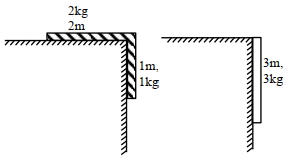
0 likesView Solution
196
PhysicsDifficultMCQJEE Main · 2021
$A$ source and a detector move away from each other in the absence of wind with a speed of $20 \, m/s$ with respect to the ground. If the detector detects a frequency of $1800 \, Hz$ of the sound coming from the source,then the original frequency of the source,considering the speed of sound in air to be $340 \, m/s$,will be (in $Hz$):
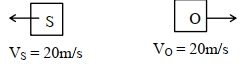
A
$1050$
B
$750$
C
$2025$
D
$2250$
Solution
(C) Given:
Speed of source $V_S = 20 \, m/s$
Speed of observer/detector $V_O = 20 \, m/s$
Speed of sound $V = 340 \, m/s$
Observed frequency $f' = 1800 \, Hz$
According to the Doppler effect,when the source and observer move away from each other,the observed frequency is given by:
$f' = f \left( \frac{V - V_O}{V + V_S} \right)$
Substituting the values:
$1800 = f \left( \frac{340 - 20}{340 + 20} \right)$
$1800 = f \left( \frac{320}{360} \right)$
$1800 = f \left( \frac{8}{9} \right)$
$f = \frac{1800 \times 9}{8}$
$f = 225 \times 9 = 2025 \, Hz$
Therefore,the original frequency of the source is $2025 \, Hz$.
Speed of source $V_S = 20 \, m/s$
Speed of observer/detector $V_O = 20 \, m/s$
Speed of sound $V = 340 \, m/s$
Observed frequency $f' = 1800 \, Hz$
According to the Doppler effect,when the source and observer move away from each other,the observed frequency is given by:
$f' = f \left( \frac{V - V_O}{V + V_S} \right)$
Substituting the values:
$1800 = f \left( \frac{340 - 20}{340 + 20} \right)$
$1800 = f \left( \frac{320}{360} \right)$
$1800 = f \left( \frac{8}{9} \right)$
$f = \frac{1800 \times 9}{8}$
$f = 225 \times 9 = 2025 \, Hz$
Therefore,the original frequency of the source is $2025 \, Hz$.
0 likesView Solution
197
PhysicsDifficultMCQJEE Main · 2021
Two spherical balls having equal masses with a radius of $5 \, \text{cm}$ each are thrown upwards along the same vertical direction at an interval of $3 \, \text{s}$ with the same initial velocity of $35 \, \text{m/s}$. These balls collide at a height of $\ldots \ldots \ldots \, \text{m}$. (Take $g = 10 \, \text{m/s}^2$)
A
$80$
B
$10$
C
$60$
D
$50$
Solution
(D) Let the first ball be thrown at $t = 0$ and the second ball at $t = 3 \, \text{s}$.
Let $t$ be the time elapsed since the first ball was thrown.
The position of the first ball is $y_1 = u t - \frac{1}{2} g t^2 = 35 t - 5 t^2$.
The position of the second ball is $y_2 = u(t - 3) - \frac{1}{2} g(t - 3)^2 = 35(t - 3) - 5(t - 3)^2$.
At the point of collision, $y_1 = y_2$.
$35 t - 5 t^2 = 35(t - 3) - 5(t^2 - 6 t + 9)$
$35 t - 5 t^2 = 35 t - 105 - 5 t^2 + 30 t - 45$
$0 = 30 t - 150$
$30 t = 150 \implies t = 5 \, \text{s}$.
Substituting $t = 5 \, \text{s}$ into the equation for $y_1$:
$h = 35(5) - 5(5)^2 = 175 - 125 = 50 \, \text{m}$.
Thus, the balls collide at a height of $50 \, \text{m}$.
Let $t$ be the time elapsed since the first ball was thrown.
The position of the first ball is $y_1 = u t - \frac{1}{2} g t^2 = 35 t - 5 t^2$.
The position of the second ball is $y_2 = u(t - 3) - \frac{1}{2} g(t - 3)^2 = 35(t - 3) - 5(t - 3)^2$.
At the point of collision, $y_1 = y_2$.
$35 t - 5 t^2 = 35(t - 3) - 5(t^2 - 6 t + 9)$
$35 t - 5 t^2 = 35 t - 105 - 5 t^2 + 30 t - 45$
$0 = 30 t - 150$
$30 t = 150 \implies t = 5 \, \text{s}$.
Substituting $t = 5 \, \text{s}$ into the equation for $y_1$:
$h = 35(5) - 5(5)^2 = 175 - 125 = 50 \, \text{m}$.
Thus, the balls collide at a height of $50 \, \text{m}$.
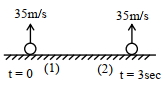
0 likesView Solution
198
PhysicsDifficultMCQJEE Main · 2021
$A$ soap bubble of radius $3 \, cm$ is formed inside another soap bubble of radius $6 \, cm$. The radius of an equivalent soap bubble which has the same excess pressure as inside the smaller bubble with respect to the atmospheric pressure is .......... $cm$.
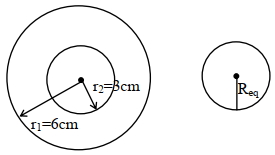
A
$5$
B
$4$
C
$2$
D
$3$
Solution
(C) The excess pressure inside a soap bubble of radius $r$ is given by $\Delta P = \frac{4S}{r}$,where $S$ is the surface tension.
For a soap bubble of radius $r_2 = 3 \, cm$ formed inside a soap bubble of radius $r_1 = 6 \, cm$,the pressure inside the smaller bubble relative to the atmospheric pressure is the sum of the excess pressure due to the smaller bubble and the excess pressure due to the larger bubble.
$\Delta P_{total} = \frac{4S}{r_2} + \frac{4S}{r_1}$
We want to find the radius $R_{eq}$ of an equivalent single soap bubble such that its excess pressure equals $\Delta P_{total}$:
$\frac{4S}{R_{eq}} = \frac{4S}{r_2} + \frac{4S}{r_1}$
Dividing both sides by $4S$:
$\frac{1}{R_{eq}} = \frac{1}{r_2} + \frac{1}{r_1}$
Substituting the given values $r_1 = 6 \, cm$ and $r_2 = 3 \, cm$:
$\frac{1}{R_{eq}} = \frac{1}{3} + \frac{1}{6} = \frac{2+1}{6} = \frac{3}{6} = \frac{1}{2}$
Therefore,$R_{eq} = 2 \, cm$.
For a soap bubble of radius $r_2 = 3 \, cm$ formed inside a soap bubble of radius $r_1 = 6 \, cm$,the pressure inside the smaller bubble relative to the atmospheric pressure is the sum of the excess pressure due to the smaller bubble and the excess pressure due to the larger bubble.
$\Delta P_{total} = \frac{4S}{r_2} + \frac{4S}{r_1}$
We want to find the radius $R_{eq}$ of an equivalent single soap bubble such that its excess pressure equals $\Delta P_{total}$:
$\frac{4S}{R_{eq}} = \frac{4S}{r_2} + \frac{4S}{r_1}$
Dividing both sides by $4S$:
$\frac{1}{R_{eq}} = \frac{1}{r_2} + \frac{1}{r_1}$
Substituting the given values $r_1 = 6 \, cm$ and $r_2 = 3 \, cm$:
$\frac{1}{R_{eq}} = \frac{1}{3} + \frac{1}{6} = \frac{2+1}{6} = \frac{3}{6} = \frac{1}{2}$
Therefore,$R_{eq} = 2 \, cm$.
0 likesView Solution
199
PhysicsMediumMCQJEE Main · 2021
Two travelling waves produce a standing wave represented by the equation,
${y} = 1.0 \, \text{mm} \cos(1.57 \, \text{cm}^{-1} x) \sin(78.5 \, \text{s}^{-1} t)$
The node closest to the origin in the region ${x} > 0$ will be at ${x} = \dots \, \text{cm}$.
${y} = 1.0 \, \text{mm} \cos(1.57 \, \text{cm}^{-1} x) \sin(78.5 \, \text{s}^{-1} t)$
The node closest to the origin in the region ${x} > 0$ will be at ${x} = \dots \, \text{cm}$.
A
$3$
B
$1$
C
$5$
D
$7$
Solution
(B) For a node,the amplitude of the standing wave must be zero.
Given the equation ${y} = 1.0 \, \text{mm} \cos(1.57 \, \text{cm}^{-1} x) \sin(78.5 \, \text{s}^{-1} t)$,the spatial part is $\cos(1.57 \, \text{cm}^{-1} x)$.
Setting the spatial part to zero: $\cos(1.57 \, \text{cm}^{-1} x) = 0$.
This occurs when the argument is an odd multiple of $\frac{\pi}{2}$. For the node closest to the origin $(x > 0)$,we take the first positive value:
$1.57 \, \text{cm}^{-1} x = \frac{\pi}{2}$.
Using $\pi \approx 3.14$,we have $1.57 \approx \frac{\pi}{2}$.
Therefore,$x = \frac{\pi}{2 \times 1.57} \, \text{cm} = \frac{1.57}{1.57} \, \text{cm} = 1 \, \text{cm}$.
Given the equation ${y} = 1.0 \, \text{mm} \cos(1.57 \, \text{cm}^{-1} x) \sin(78.5 \, \text{s}^{-1} t)$,the spatial part is $\cos(1.57 \, \text{cm}^{-1} x)$.
Setting the spatial part to zero: $\cos(1.57 \, \text{cm}^{-1} x) = 0$.
This occurs when the argument is an odd multiple of $\frac{\pi}{2}$. For the node closest to the origin $(x > 0)$,we take the first positive value:
$1.57 \, \text{cm}^{-1} x = \frac{\pi}{2}$.
Using $\pi \approx 3.14$,we have $1.57 \approx \frac{\pi}{2}$.
Therefore,$x = \frac{\pi}{2 \times 1.57} \, \text{cm} = \frac{1.57}{1.57} \, \text{cm} = 1 \, \text{cm}$.
0 likesView Solution
200
PhysicsDifficultMCQJEE Main · 2021
Consider a badminton racket with length scales as shown in the figure. If the mass of the linear and circular portions of the badminton racket are same $(M)$ and the mass of the threads are negligible,the moment of inertia of the racket about an axis perpendicular to the handle and in the plane of the ring at $\frac{r}{2}$ distance from the end $A$ of the handle will be ....... $Mr^2$?
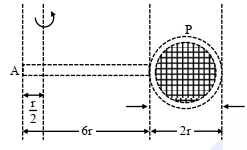
A
$520$
B
$12$
C
$42$
D
$52$
Solution
(D) Let the handle be a rod of length $L = 6r$ and the ring be a circular hoop of radius $R = r$. The mass of both is $M$.
$1$. Moment of inertia of the handle about an axis through its center of mass (perpendicular to it) is $I_{cm, rod} = \frac{M(6r)^2}{12} = 3Mr^2$.
The distance of this axis from the rotation axis is $d_1 = (6r/2) - r/2 = 5r/2$.
Using the parallel axis theorem,$I_{rod} = I_{cm, rod} + M(d_1)^2 = 3Mr^2 + M(5r/2)^2 = 3Mr^2 + 6.25Mr^2 = 9.25Mr^2$.
$2$. Moment of inertia of the ring about its diameter is $I_{cm, ring} = \frac{MR^2}{2} = \frac{Mr^2}{2} = 0.5Mr^2$.
The distance of the center of the ring from the rotation axis is $d_2 = 6r - r/2 + r = 6.5r = 13r/2$.
Using the parallel axis theorem,$I_{ring} = I_{cm, ring} + M(d_2)^2 = 0.5Mr^2 + M(13r/2)^2 = 0.5Mr^2 + 42.25Mr^2 = 42.75Mr^2$.
Total moment of inertia $I = I_{rod} + I_{ring} = 9.25Mr^2 + 42.75Mr^2 = 52Mr^2$.
$1$. Moment of inertia of the handle about an axis through its center of mass (perpendicular to it) is $I_{cm, rod} = \frac{M(6r)^2}{12} = 3Mr^2$.
The distance of this axis from the rotation axis is $d_1 = (6r/2) - r/2 = 5r/2$.
Using the parallel axis theorem,$I_{rod} = I_{cm, rod} + M(d_1)^2 = 3Mr^2 + M(5r/2)^2 = 3Mr^2 + 6.25Mr^2 = 9.25Mr^2$.
$2$. Moment of inertia of the ring about its diameter is $I_{cm, ring} = \frac{MR^2}{2} = \frac{Mr^2}{2} = 0.5Mr^2$.
The distance of the center of the ring from the rotation axis is $d_2 = 6r - r/2 + r = 6.5r = 13r/2$.
Using the parallel axis theorem,$I_{ring} = I_{cm, ring} + M(d_2)^2 = 0.5Mr^2 + M(13r/2)^2 = 0.5Mr^2 + 42.25Mr^2 = 42.75Mr^2$.
Total moment of inertia $I = I_{rod} + I_{ring} = 9.25Mr^2 + 42.75Mr^2 = 52Mr^2$.
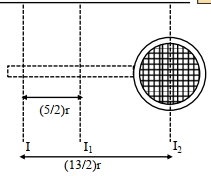
0 likesView Solution
201
PhysicsMediumMCQJEE Main · 2021
Match List-$I$ with List-$II$.
Choose the correct answer from the options given below:
| List-$I$ | List-$II$ |
|---|---|
| $(a)$ Source of microwave frequency | $(i)$ Radioactive decay of nucleus |
| $(b)$ Source of infrared frequency | $(ii)$ Magnetron |
| $(c)$ Source of Gamma Rays | $(iii)$ Inner shell electrons |
| $(d)$ Source of $X$-rays | $(iv)$ Vibration of atoms and molecules |
| $(v)$ $LASER$ | |
| $(vi)$ $RC$ circuit |
Choose the correct answer from the options given below:
A
$(a)-(vi), (b)-(iv), (c)-(i), (d)-(v)$
B
$(a)-(vi), (b)-(v), (c)-(i), (d)-(iv)$
C
$(a)-(ii), (b)-(iv), (c)-(vi), (d)-(iii)$
D
$(a)-(ii), (b)-(iv), (c)-(i), (d)-(iii)$
Solution
(D) The source of microwave frequency is a magnetron.
$(b)$ The source of infrared frequency is the vibration of atoms and molecules.
$(c)$ The source of Gamma rays is the radioactive decay of the nucleus.
$(d)$ The source of $X$-rays is the transition of inner shell electrons.
Therefore,the correct matching is $(a)-(ii), (b)-(iv), (c)-(i), (d)-(iii)$.
$(b)$ The source of infrared frequency is the vibration of atoms and molecules.
$(c)$ The source of Gamma rays is the radioactive decay of the nucleus.
$(d)$ The source of $X$-rays is the transition of inner shell electrons.
Therefore,the correct matching is $(a)-(ii), (b)-(iv), (c)-(i), (d)-(iii)$.
0 likesView Solution
202
PhysicsMediumMCQJEE Main · 2021
$A$ cylindrical wire of radius $0.5 \, mm$ and conductivity $5 \times 10^{7} \, S/m$ is subjected to an electric field of $10 \, mV/m$. The expected value of current in the wire will be $x^{3} \, \pi \, mA$. The value of $x$ is ......
A
$5$
B
$10$
C
$8$
D
$15$
Solution
(A) Given:
Conductivity $\sigma = 5 \times 10^{7} \, S/m$
Radius $r = 0.5 \, mm = 5 \times 10^{-4} \, m$
Electric field $E = 10 \, mV/m = 10 \times 10^{-3} \, V/m = 10^{-2} \, V/m$
Using Ohm's law in microscopic form,current density $J = \sigma E$:
$J = (5 \times 10^{7}) \times (10^{-2}) = 5 \times 10^{5} \, A/m^{2}$
Current $i = J \times A = J \times (\pi r^{2})$:
$i = (5 \times 10^{5}) \times \pi \times (5 \times 10^{-4})^{2}$
$i = 5 \times 10^{5} \times \pi \times 25 \times 10^{-8}$
$i = 125 \times 10^{-3} \, \pi \, A$
$i = 125 \, \pi \, mA$
Given that $i = x^{3} \, \pi \, mA$,we have:
$x^{3} = 125$
$x = \sqrt[3]{125} = 5$
Conductivity $\sigma = 5 \times 10^{7} \, S/m$
Radius $r = 0.5 \, mm = 5 \times 10^{-4} \, m$
Electric field $E = 10 \, mV/m = 10 \times 10^{-3} \, V/m = 10^{-2} \, V/m$
Using Ohm's law in microscopic form,current density $J = \sigma E$:
$J = (5 \times 10^{7}) \times (10^{-2}) = 5 \times 10^{5} \, A/m^{2}$
Current $i = J \times A = J \times (\pi r^{2})$:
$i = (5 \times 10^{5}) \times \pi \times (5 \times 10^{-4})^{2}$
$i = 5 \times 10^{5} \times \pi \times 25 \times 10^{-8}$
$i = 125 \times 10^{-3} \, \pi \, A$
$i = 125 \, \pi \, mA$
Given that $i = x^{3} \, \pi \, mA$,we have:
$x^{3} = 125$
$x = \sqrt[3]{125} = 5$
0 likesView Solution
203
PhysicsMediumMCQJEE Main · 2021
$A$ point charge of $+12 \,\mu C$ is at a distance $6 \,cm$ vertically above the centre of a square of side $12 \,cm$ as shown in the figure. The magnitude of the electric flux through the square will be ....... $\times 10^{3} \,Nm^{2}/C$.
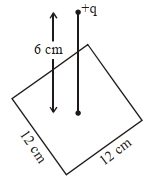
A
$452$
B
$381$
C
$226$
D
$113$
Solution
(C) The charge is placed at a distance $a/2 = 6 \,cm$ from the center of a square of side $a = 12 \,cm$.
By considering the square as one face of a cube of side $a = 12 \,cm$,the charge is at the center of this cube.
According to Gauss's Law,the total electric flux through the entire cube is $\phi_{total} = \frac{q}{\varepsilon_{0}}$.
Since the cube has $6$ identical faces,the flux through one face (the square) is $\phi = \frac{1}{6} \frac{q}{\varepsilon_{0}}$.
Given $q = 12 \times 10^{-6} \,C$ and $\varepsilon_{0} = 8.854 \times 10^{-12} \,C^{2}/Nm^{2}$.
$\phi = \frac{12 \times 10^{-6}}{6 \times 8.854 \times 10^{-12}} = \frac{2 \times 10^{-6}}{8.854 \times 10^{-12}} \approx 0.2259 \times 10^{6} \,Nm^{2}/C$.
$\phi \approx 226 \times 10^{3} \,Nm^{2}/C$.
By considering the square as one face of a cube of side $a = 12 \,cm$,the charge is at the center of this cube.
According to Gauss's Law,the total electric flux through the entire cube is $\phi_{total} = \frac{q}{\varepsilon_{0}}$.
Since the cube has $6$ identical faces,the flux through one face (the square) is $\phi = \frac{1}{6} \frac{q}{\varepsilon_{0}}$.
Given $q = 12 \times 10^{-6} \,C$ and $\varepsilon_{0} = 8.854 \times 10^{-12} \,C^{2}/Nm^{2}$.
$\phi = \frac{12 \times 10^{-6}}{6 \times 8.854 \times 10^{-12}} = \frac{2 \times 10^{-6}}{8.854 \times 10^{-12}} \approx 0.2259 \times 10^{6} \,Nm^{2}/C$.
$\phi \approx 226 \times 10^{3} \,Nm^{2}/C$.
0 likesView Solution
204
PhysicsDifficultMCQJEE Main · 2021
$A$ signal of $0.1 \, kW$ is transmitted in a cable. The attenuation of the cable is $-5 \, dB$ per $km$ and the cable length is $20 \, km$. The power received at the receiver is $10^{-x} \, W$. The value of $x$ is ....... .
$[\text{Gain in } dB = 10 \log_{10}(\frac{P_0}{P_i})]$
$[\text{Gain in } dB = 10 \log_{10}(\frac{P_0}{P_i})]$
A
$4$
B
$12$
C
$16$
D
$8$
Solution
(D) The total attenuation in the cable is given by: $\text{Total Attenuation} = (\text{Attenuation per km}) \times (\text{Length}) = -5 \, dB/km \times 20 \, km = -100 \, dB$.
The formula for gain in $dB$ is: $\text{Gain} = 10 \log_{10}(\frac{P_0}{P_i})$.
Here,$\text{Gain} = -100 \, dB$,$P_i = 0.1 \, kW = 100 \, W = 10^2 \, W$.
Substituting the values: $-100 = 10 \log_{10}(\frac{P_0}{10^2})$.
$-10 = \log_{10}(\frac{P_0}{10^2})$.
$10^{-10} = \frac{P_0}{10^2}$.
$P_0 = 10^{-10} \times 10^2 = 10^{-8} \, W$.
Comparing $P_0 = 10^{-8} \, W$ with $10^{-x} \, W$,we get $x = 8$.
The formula for gain in $dB$ is: $\text{Gain} = 10 \log_{10}(\frac{P_0}{P_i})$.
Here,$\text{Gain} = -100 \, dB$,$P_i = 0.1 \, kW = 100 \, W = 10^2 \, W$.
Substituting the values: $-100 = 10 \log_{10}(\frac{P_0}{10^2})$.
$-10 = \log_{10}(\frac{P_0}{10^2})$.
$10^{-10} = \frac{P_0}{10^2}$.
$P_0 = 10^{-10} \times 10^2 = 10^{-8} \, W$.
Comparing $P_0 = 10^{-8} \, W$ with $10^{-x} \, W$,we get $x = 8$.
0 likesView Solution
205
PhysicsMediumMCQJEE Main · 2021
$A$ series $LCR$ circuit is designed to resonate at an angular frequency $\omega_{0} = 10^{5} \, rad/s$. The circuit draws $16 \, W$ power from a $120 \, V$ source at resonance. The value of resistance $R$ in the circuit is ...... $\Omega$.
A
$1200$
B
$600$
C
$800$
D
$900$
Solution
(D) At resonance,the inductive reactance $X_{L}$ and capacitive reactance $X_{C}$ cancel each other out,meaning the total impedance of the circuit is equal to the resistance $R$,i.e.,$Z = R$.
The power consumed in an $LCR$ circuit at resonance is given by the formula:
$P = \frac{V^{2}}{R}$
Given values are:
$P = 16 \, W$
$V = 120 \, V$
Rearranging the formula to solve for $R$:
$R = \frac{V^{2}}{P}$
Substituting the values:
$R = \frac{(120)^{2}}{16}$
$R = \frac{14400}{16}$
$R = 900 \, \Omega$
Thus,the value of resistance $R$ is $900 \, \Omega$.
The power consumed in an $LCR$ circuit at resonance is given by the formula:
$P = \frac{V^{2}}{R}$
Given values are:
$P = 16 \, W$
$V = 120 \, V$
Rearranging the formula to solve for $R$:
$R = \frac{V^{2}}{P}$
Substituting the values:
$R = \frac{(120)^{2}}{16}$
$R = \frac{14400}{16}$
$R = 900 \, \Omega$
Thus,the value of resistance $R$ is $900 \, \Omega$.
0 likesView Solution
206
PhysicsDifficultMCQJEE Main · 2021
An electromagnetic wave of frequency $3 \, GHz$ enters a dielectric medium of relative electric permittivity $2.25$ from vacuum. The wavelength of this wave in that medium will be $....... \times 10^{-2} \, cm$.
A
$667$
B
$577$
C
$627$
D
$747$
Solution
(A) The frequency of the wave is $f = 3 \, GHz = 3 \times 10^9 \, Hz$.
In vacuum,the wavelength is $\lambda_0 = \frac{c}{f} = \frac{3 \times 10^8 \, m/s}{3 \times 10^9 \, Hz} = 0.1 \, m = 10 \, cm$.
The refractive index of the medium is given by $n = \sqrt{\epsilon_r \mu_r}$. Assuming the medium is non-magnetic,$\mu_r = 1$.
Thus,$n = \sqrt{2.25} = 1.5$.
The wavelength in the medium is $\lambda_m = \frac{\lambda_0}{n} = \frac{10 \, cm}{1.5} = \frac{100}{15} \, cm = 6.666... \, cm \approx 6.67 \, cm$.
Expressing this in the form $x \times 10^{-2} \, cm$,we get $6.67 \, cm = 667 \times 10^{-2} \, cm$.
In vacuum,the wavelength is $\lambda_0 = \frac{c}{f} = \frac{3 \times 10^8 \, m/s}{3 \times 10^9 \, Hz} = 0.1 \, m = 10 \, cm$.
The refractive index of the medium is given by $n = \sqrt{\epsilon_r \mu_r}$. Assuming the medium is non-magnetic,$\mu_r = 1$.
Thus,$n = \sqrt{2.25} = 1.5$.
The wavelength in the medium is $\lambda_m = \frac{\lambda_0}{n} = \frac{10 \, cm}{1.5} = \frac{100}{15} \, cm = 6.666... \, cm \approx 6.67 \, cm$.
Expressing this in the form $x \times 10^{-2} \, cm$,we get $6.67 \, cm = 667 \times 10^{-2} \, cm$.
0 likesView Solution
207
PhysicsMediumMCQJEE Main · 2021
For extrinsic semiconductors,when the doping level is increased:
A
Fermi-level of $p$-type semiconductor will go upward and Fermi-level of $n$-type semiconductor will go downward.
B
Fermi-level of $p$-type semiconductor will go downward and Fermi-level of $n$-type semiconductor will go upward.
C
Fermi-level of both $p$-type and $n$-type semiconductors will go upward for $T > T_F$ $K$ and downward for $T < T_F$ $K$,where $T_F$ is Fermi temperature.
D
Fermi-level of $p$ and $n$-type semiconductors will not be affected.
Solution
(B) In an $n$-type semiconductor,the Fermi level $E_F$ lies below the conduction band $E_C$. As the doping concentration $N_D$ increases,the Fermi level moves closer to the conduction band,which means it shifts upward.
In a $p$-type semiconductor,the Fermi level $E_F$ lies above the valence band $E_V$. As the doping concentration $N_A$ increases,the Fermi level moves closer to the valence band,which means it shifts downward.
Therefore,the Fermi level of $p$-type semiconductors moves downward and the Fermi level of $n$-type semiconductors moves upward.
In a $p$-type semiconductor,the Fermi level $E_F$ lies above the valence band $E_V$. As the doping concentration $N_A$ increases,the Fermi level moves closer to the valence band,which means it shifts downward.
Therefore,the Fermi level of $p$-type semiconductors moves downward and the Fermi level of $n$-type semiconductors moves upward.
0 likesView Solution
208
PhysicsMediumMCQJEE Main · 2021
In a ferromagnetic material,below the Curie temperature,a domain is defined as:
A
a macroscopic region with zero magnetization.
B
a macroscopic region with consecutive magnetic dipoles oriented in opposite direction.
C
a macroscopic region with randomly oriented magnetic dipoles.
D
a macroscopic region with saturation magnetization.
Solution
(D) In a ferromagnetic material,below the Curie temperature,the atoms spontaneously align themselves in a common direction over a macroscopic volume. This region is called a magnetic domain. Within each domain,the magnetic dipoles are aligned in the same direction,resulting in saturation magnetization for that specific region. Therefore,a domain is a macroscopic region with saturation magnetization.
0 likesView Solution
209
PhysicsMediumMCQJEE Main · 2021
If a message signal of frequency $f_{m}$ is amplitude modulated with a carrier signal of frequency $f_{c}$ and radiated through an antenna,the wavelength of the corresponding signal in air is ....... .
A
$\frac{c}{f_{c}-f_{m}}$
B
$\frac{c}{f_{m}}$
C
$\frac{c}{f_{c}+f_{m}}$
D
$\frac{c}{f_{c}}$
Solution
(D) When a message signal is amplitude modulated with a carrier signal,the resulting modulated wave contains the carrier frequency $f_{c}$ and the sideband frequencies $(f_{c} + f_{m})$ and $(f_{c} - f_{m})$.
However,the carrier signal is the primary component that is radiated through the antenna to carry the information.
The wavelength $\lambda$ of the radiated signal is determined by the carrier frequency $f_{c}$ as $\lambda = \frac{c}{f_{c}}$,where $c$ is the speed of light in air.
However,the carrier signal is the primary component that is radiated through the antenna to carry the information.
The wavelength $\lambda$ of the radiated signal is determined by the carrier frequency $f_{c}$ as $\lambda = \frac{c}{f_{c}}$,where $c$ is the speed of light in air.
0 likesView Solution
210
PhysicsDifficultMCQJEE Main · 2021
$A$ charge $q$ is placed at one corner of a cube as shown in the figure. The flux of the electrostatic field $\overrightarrow{E}$ through the shaded area is ...... .
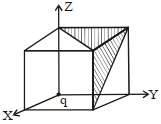
A
$\frac{q}{4\varepsilon_{0}}$
B
$\frac{q}{24\varepsilon_{0}}$
C
$\frac{q}{48\varepsilon_{0}}$
D
$\frac{q}{8\varepsilon_{0}}$
Solution
(B) According to Gauss's Law,the total electric flux through a closed surface is $\frac{q}{\varepsilon_{0}}$.
Since the charge $q$ is placed at one corner of the cube,it is shared by $8$ such identical cubes to enclose the charge completely.
Therefore,the total flux through the cube is $\phi_{\text{cube}} = \frac{q}{8\varepsilon_{0}}$.
The flux through the three faces of the cube that meet at the corner where the charge is placed is zero because the electric field lines are parallel to these surfaces.
The remaining three faces are symmetric with respect to the charge,so the flux through each of these three faces is equal.
Let the shaded area be one of these faces. The flux through the shaded area is $\phi_{\text{shaded}} = \frac{1}{3} \times \phi_{\text{cube}} = \frac{1}{3} \times \frac{q}{8\varepsilon_{0}} = \frac{q}{24\varepsilon_{0}}$.
Since the charge $q$ is placed at one corner of the cube,it is shared by $8$ such identical cubes to enclose the charge completely.
Therefore,the total flux through the cube is $\phi_{\text{cube}} = \frac{q}{8\varepsilon_{0}}$.
The flux through the three faces of the cube that meet at the corner where the charge is placed is zero because the electric field lines are parallel to these surfaces.
The remaining three faces are symmetric with respect to the charge,so the flux through each of these three faces is equal.
Let the shaded area be one of these faces. The flux through the shaded area is $\phi_{\text{shaded}} = \frac{1}{3} \times \phi_{\text{cube}} = \frac{1}{3} \times \frac{q}{8\varepsilon_{0}} = \frac{q}{24\varepsilon_{0}}$.
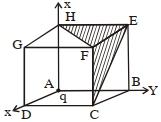
0 likesView Solution
211
PhysicsMediumMCQJEE Main · 2021
The wavelength of the photon emitted by a hydrogen atom when an electron makes a transition from $n = 2$ to $n = 1$ state is ...... $nm.$
A
$194.8$
B
$913.3$
C
$490.7$
D
$121.8$
Solution
(D) The Rydberg formula for the wavelength of emitted radiation is given by $\frac{1}{\lambda} = R \left( \frac{1}{n_f^2} - \frac{1}{n_i^2} \right)$, where $R \approx 1.097 \times 10^7 \, m^{-1}$ is the Rydberg constant.
For a transition from $n_i = 2$ to $n_f = 1$:
$\frac{1}{\lambda} = 1.097 \times 10^7 \left( \frac{1}{1^2} - \frac{1}{2^2} \right)$
$\frac{1}{\lambda} = 1.097 \times 10^7 \left( 1 - 0.25 \right) = 1.097 \times 10^7 \times 0.75$
$\frac{1}{\lambda} = 0.82275 \times 10^7 \, m^{-1}$
$\lambda = \frac{1}{0.82275 \times 10^7} \approx 1.215 \times 10^{-7} \, m = 121.5 \, nm$.
Using the precise value of $R$ and energy levels, the standard value is approximately $121.8 \, nm$.
For a transition from $n_i = 2$ to $n_f = 1$:
$\frac{1}{\lambda} = 1.097 \times 10^7 \left( \frac{1}{1^2} - \frac{1}{2^2} \right)$
$\frac{1}{\lambda} = 1.097 \times 10^7 \left( 1 - 0.25 \right) = 1.097 \times 10^7 \times 0.75$
$\frac{1}{\lambda} = 0.82275 \times 10^7 \, m^{-1}$
$\lambda = \frac{1}{0.82275 \times 10^7} \approx 1.215 \times 10^{-7} \, m = 121.5 \, nm$.
Using the precise value of $R$ and energy levels, the standard value is approximately $121.8 \, nm$.
0 likesView Solution
212
PhysicsDifficultMCQJEE Main · 2021
An $LCR$ circuit contains resistance of $110 \, \Omega$ and a supply of $220 \, V$ at $300 \, rad/s$ angular frequency. If only capacitance is removed from the circuit,current lags behind the voltage by $45^{\circ}$. If on the other hand,only inductor is removed,the current leads by $45^{\circ}$ with the applied voltage. The rms current flowing in the circuit will be ...... $A$.
A
$1$
B
$2.5$
C
$1.5$
D
$2$
Solution
(D) Given: $R = 110 \, \Omega$,$V = 220 \, V$,$\omega = 300 \, rad/s$.
When capacitance is removed,the circuit is an $LR$ circuit. The phase angle is given by $\tan \phi = \frac{X_L}{R}$. Since current lags by $45^{\circ}$,$\tan 45^{\circ} = \frac{X_L}{R} = 1$,so $X_L = R$.
When the inductor is removed,the circuit is an $RC$ circuit. The phase angle is given by $\tan \phi = \frac{X_C}{R}$. Since current leads by $45^{\circ}$,$\tan 45^{\circ} = \frac{X_C}{R} = 1$,so $X_C = R$.
Since $X_L = R$ and $X_C = R$,it implies $X_L = X_C$.
In an $LCR$ circuit,when $X_L = X_C$,the circuit is in resonance.
At resonance,the impedance $Z = R$.
The rms current $I = \frac{V}{Z} = \frac{V}{R} = \frac{220}{110} = 2 \, A$.
When capacitance is removed,the circuit is an $LR$ circuit. The phase angle is given by $\tan \phi = \frac{X_L}{R}$. Since current lags by $45^{\circ}$,$\tan 45^{\circ} = \frac{X_L}{R} = 1$,so $X_L = R$.
When the inductor is removed,the circuit is an $RC$ circuit. The phase angle is given by $\tan \phi = \frac{X_C}{R}$. Since current leads by $45^{\circ}$,$\tan 45^{\circ} = \frac{X_C}{R} = 1$,so $X_C = R$.
Since $X_L = R$ and $X_C = R$,it implies $X_L = X_C$.
In an $LCR$ circuit,when $X_L = X_C$,the circuit is in resonance.
At resonance,the impedance $Z = R$.
The rms current $I = \frac{V}{Z} = \frac{V}{R} = \frac{220}{110} = 2 \, A$.
0 likesView Solution
213
PhysicsMediumMCQJEE Main · 2021
An electron of mass $m_{e}$ and a proton of mass $m_{p} = 1836 m_{e}$ are moving with the same speed. The ratio of their de Broglie wavelength $\frac{\lambda_{\text{electron}}}{\lambda_{\text{proton}}}$ will be ....... .
A
$1836$
B
$1$
C
$918$
D
$\frac{1}{1836}$
Solution
(A) The de Broglie wavelength $\lambda$ is given by the formula $\lambda = \frac{h}{p} = \frac{h}{mv}$,where $h$ is Planck's constant,$m$ is the mass,and $v$ is the speed.
Given that both particles move with the same speed $v$,the ratio of their wavelengths is:
$\frac{\lambda_{e}}{\lambda_{p}} = \frac{\frac{h}{m_{e}v}}{\frac{h}{m_{p}v}} = \frac{m_{p}}{m_{e}}$.
Substituting the given relation $m_{p} = 1836 m_{e}$:
$\frac{\lambda_{e}}{\lambda_{p}} = \frac{1836 m_{e}}{m_{e}} = 1836$.
Given that both particles move with the same speed $v$,the ratio of their wavelengths is:
$\frac{\lambda_{e}}{\lambda_{p}} = \frac{\frac{h}{m_{e}v}}{\frac{h}{m_{p}v}} = \frac{m_{p}}{m_{e}}$.
Substituting the given relation $m_{p} = 1836 m_{e}$:
$\frac{\lambda_{e}}{\lambda_{p}} = \frac{1836 m_{e}}{m_{e}} = 1836$.
0 likesView Solution
214
PhysicsDifficultMCQJEE Main · 2021
An electron with kinetic energy $K_{1}$ enters between parallel plates of a capacitor at an angle $\alpha$ with the plates. It leaves the plates at an angle $\beta$ with the plates. If the kinetic energy of the electron when leaving is $K_{2}$,then the ratio of kinetic energies $K_{1}:K_{2}$ is ....... .
A
$\frac{\sin^{2} \beta}{\cos^{2} \alpha}$
B
$\frac{\cos^{2} \beta}{\cos^{2} \alpha}$
C
$\frac{\cos \beta}{\cos \alpha}$
D
$\frac{\cos \beta}{\sin \alpha}$
Solution
(B) When an electron enters the electric field between parallel plates,the electric force acts only in the direction perpendicular to the plates (vertical direction).
Therefore,there is no force acting in the direction parallel to the plates (horizontal direction).
As a result,the component of velocity parallel to the plates remains constant throughout the motion.
Let $v_{1}$ be the initial velocity and $v_{2}$ be the final velocity.
The horizontal component of velocity at entry is $v_{1} \cos \alpha$.
The horizontal component of velocity at exit is $v_{2} \cos \beta$.
Since the horizontal component is constant,we have: $v_{1} \cos \alpha = v_{2} \cos \beta$.
This implies: $\frac{v_{1}}{v_{2}} = \frac{\cos \beta}{\cos \alpha}$.
The kinetic energy $K$ is given by $K = \frac{1}{2}mv^{2}$.
Therefore,the ratio of kinetic energies is: $\frac{K_{1}}{K_{2}} = \frac{\frac{1}{2}mv_{1}^{2}}{\frac{1}{2}mv_{2}^{2}} = \left(\frac{v_{1}}{v_{2}}\right)^{2}$.
Substituting the velocity ratio: $\frac{K_{1}}{K_{2}} = \left(\frac{\cos \beta}{\cos \alpha}\right)^{2} = \frac{\cos^{2} \beta}{\cos^{2} \alpha}$.
Therefore,there is no force acting in the direction parallel to the plates (horizontal direction).
As a result,the component of velocity parallel to the plates remains constant throughout the motion.
Let $v_{1}$ be the initial velocity and $v_{2}$ be the final velocity.
The horizontal component of velocity at entry is $v_{1} \cos \alpha$.
The horizontal component of velocity at exit is $v_{2} \cos \beta$.
Since the horizontal component is constant,we have: $v_{1} \cos \alpha = v_{2} \cos \beta$.
This implies: $\frac{v_{1}}{v_{2}} = \frac{\cos \beta}{\cos \alpha}$.
The kinetic energy $K$ is given by $K = \frac{1}{2}mv^{2}$.
Therefore,the ratio of kinetic energies is: $\frac{K_{1}}{K_{2}} = \frac{\frac{1}{2}mv_{1}^{2}}{\frac{1}{2}mv_{2}^{2}} = \left(\frac{v_{1}}{v_{2}}\right)^{2}$.
Substituting the velocity ratio: $\frac{K_{1}}{K_{2}} = \left(\frac{\cos \beta}{\cos \alpha}\right)^{2} = \frac{\cos^{2} \beta}{\cos^{2} \alpha}$.
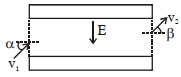
0 likesView Solution
215
PhysicsDifficultMCQJEE Main · 2021
The truth table for the following logic circuit is ...... .
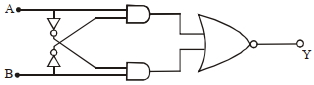
A
| $A, B, Y$ |
| $0, 0, 0$ |
| $0, 1, 1$ |
| $1, 0, 1$ |
| $1, 1, 0$ |
B
| $A, B, Y$ |
| $0, 0, 1$ |
| $0, 1, 0$ |
| $1, 0, 0$ |
| $1, 1, 1$ |
C
| $A, B, Y$ |
| $0, 0, 1$ |
| $0, 1, 0$ |
| $1, 0, 1$ |
| $1, 1, 0$ |
D
| $A, B, Y$ |
| $0, 0, 0$ |
| $0, 1, 1$ |
| $1, 0, 0$ |
| $1, 1, 1$ |
Solution
(B) The given circuit consists of two $AND$ gates,one $OR$ gate,and one $NOT$ gate (forming a $NOR$ gate at the output). The inputs to the first $AND$ gate are $A$ and $\bar{B}$. The inputs to the second $AND$ gate are $\bar{A}$ and $B$.
The output of the $OR$ gate is $(A \cdot \bar{B} + \bar{A} \cdot B)$.
The final output $Y$ is the inversion of this,so $Y = \overline{(A \cdot \bar{B} + \bar{A} \cdot B)}$.
Using De Morgan's theorem,$Y = \overline{(A \cdot \bar{B})} \cdot \overline{(\bar{A} \cdot B)} = (\bar{A} + B) \cdot (A + \bar{B})$.
Expanding this,$Y = \bar{A} \cdot A + \bar{A} \cdot \bar{B} + B \cdot A + B \cdot \bar{B} = 0 + \bar{A} \cdot \bar{B} + A \cdot B + 0 = A \cdot B + \bar{A} \cdot \bar{B}$.
This is the Boolean expression for an $XNOR$ gate.
The output of the $OR$ gate is $(A \cdot \bar{B} + \bar{A} \cdot B)$.
The final output $Y$ is the inversion of this,so $Y = \overline{(A \cdot \bar{B} + \bar{A} \cdot B)}$.
Using De Morgan's theorem,$Y = \overline{(A \cdot \bar{B})} \cdot \overline{(\bar{A} \cdot B)} = (\bar{A} + B) \cdot (A + \bar{B})$.
Expanding this,$Y = \bar{A} \cdot A + \bar{A} \cdot \bar{B} + B \cdot A + B \cdot \bar{B} = 0 + \bar{A} \cdot \bar{B} + A \cdot B + 0 = A \cdot B + \bar{A} \cdot \bar{B}$.
This is the Boolean expression for an $XNOR$ gate.
| $A$ | $B$ | $Y$ |
| $0$ | $0$ | $1$ |
| $0$ | $1$ | $0$ |
| $1$ | $0$ | $0$ |
| $1$ | $1$ | $1$ |
0 likesView Solution
216
PhysicsMediumMCQJEE Main · 2021
The stopping potential for electrons emitted from a photosensitive surface illuminated by light of wavelength $491\, nm$ is $0.710\, V$. When the incident wavelength is changed to a new value,the stopping potential is $1.43\, V$. The new wavelength is ....... $nm.$
A
$329$
B
$309$
C
$382$
D
$400$
Solution
(C) According to Einstein's photoelectric equation: $\frac{hc}{\lambda} = \phi + eV_s$,where $\phi$ is the work function and $V_s$ is the stopping potential.
For the first case: $\frac{1240}{491} = \phi + 0.71 \implies 2.525 = \phi + 0.71 \implies \phi = 1.815\, eV$.
For the second case: $\frac{1240}{\lambda} = \phi + 1.43$.
Substituting $\phi = 1.815\, eV$: $\frac{1240}{\lambda} = 1.815 + 1.43 = 3.245\, eV$.
Therefore,$\lambda = \frac{1240}{3.245} \approx 382\, nm$.
For the first case: $\frac{1240}{491} = \phi + 0.71 \implies 2.525 = \phi + 0.71 \implies \phi = 1.815\, eV$.
For the second case: $\frac{1240}{\lambda} = \phi + 1.43$.
Substituting $\phi = 1.815\, eV$: $\frac{1240}{\lambda} = 1.815 + 1.43 = 3.245\, eV$.
Therefore,$\lambda = \frac{1240}{3.245} \approx 382\, nm$.
0 likesView Solution
217
PhysicsMediumMCQJEE Main · 2021
Match List $I$ with List $II$.
Choose the correct answer from the options given below:
| List $I$ | List $II$ |
| $(a)$ Rectifier | $(i)$ Used either for stepping up or stepping down the $a.c.$ voltage |
| $(b)$ Stabilizer | $(ii)$ Used to convert $a.c.$ voltage into $d.c.$ voltage |
| $(c)$ Transformer | $(iii)$ Used to remove any ripple in the rectified output voltage |
| $(d)$ Filter | $(iv)$ Used for constant output voltage even when the input voltage or load current change |
Choose the correct answer from the options given below:
A
$(a)-(ii), (b)-(iv), (c)-(i), (d)-(iii)$
B
$(a)-(iii), (b)-(iv), (c)-(i), (d)-(ii)$
C
$(a)-(ii), (b)-(i), (c)-(iv), (d)-(iii)$
D
$(a)-(ii), (b)-(i), (c)-(iii), (d)-(iv)$
Solution
(A) Rectifier: $A$ device used to convert alternating current $(a.c.)$ into direct current $(d.c.)$. Thus,$(a)-(ii)$.
$(b)$ Stabilizer: $A$ device used to maintain a constant output voltage even when the input voltage or load current changes. Thus,$(b)-(iv)$.
$(c)$ Transformer: $A$ device used to step up or step down the $a.c.$ voltage. Thus,$(c)-(i)$.
$(d)$ Filter: $A$ circuit used to remove any ripples (fluctuations) in the rectified output voltage to provide a smoother $d.c.$ output. Thus,$(d)-(iii)$.
Therefore,the correct matching is $(a)-(ii), (b)-(iv), (c)-(i), (d)-(iii)$.
$(b)$ Stabilizer: $A$ device used to maintain a constant output voltage even when the input voltage or load current changes. Thus,$(b)-(iv)$.
$(c)$ Transformer: $A$ device used to step up or step down the $a.c.$ voltage. Thus,$(c)-(i)$.
$(d)$ Filter: $A$ circuit used to remove any ripples (fluctuations) in the rectified output voltage to provide a smoother $d.c.$ output. Thus,$(d)-(iii)$.
Therefore,the correct matching is $(a)-(ii), (b)-(iv), (c)-(i), (d)-(iii)$.
0 likesView Solution
218
PhysicsDifficultMCQJEE Main · 2021
Consider the diffraction pattern obtained from the sunlight incident on a pinhole of diameter $0.1 \, \mu m$. If the diameter of the pinhole is slightly increased,it will affect the diffraction pattern such that :
A
its size decreases,and intensity decreases
B
its size increases,and intensity increases
C
its size increases,but intensity decreases
D
its size decreases,but intensity increases
Solution
(D) The angular width of the central diffraction maximum for a circular aperture is given by $\theta \approx \frac{1.22 \lambda}{D}$,where $D$ is the diameter of the pinhole and $\lambda$ is the wavelength of light.
As the diameter $D$ of the pinhole increases,the angular width $\theta$ decreases,which means the size of the diffraction pattern decreases.
Since the total amount of light passing through the pinhole increases as the area of the pinhole increases (area $\propto D^2$),and this light is now concentrated into a smaller area,the intensity of the diffraction pattern increases.
Therefore,the size decreases and the intensity increases.
As the diameter $D$ of the pinhole increases,the angular width $\theta$ decreases,which means the size of the diffraction pattern decreases.
Since the total amount of light passing through the pinhole increases as the area of the pinhole increases (area $\propto D^2$),and this light is now concentrated into a smaller area,the intensity of the diffraction pattern increases.
Therefore,the size decreases and the intensity increases.
0 likesView Solution
219
PhysicsDifficultMCQJEE Main · 2021
The peak electric field produced by the radiation coming from the $80\, W$ bulb at a distance of $10\, m$ is $\frac{x}{10} \sqrt{\frac{\mu_{0} c }{\pi}} \,\frac{ V }{ m }$. The efficiency of the bulb is $10\, \%$ and it is a point source. The value of $x$ is ...... .
A
$1$
B
$3$
C
$4$
D
$2$
Solution
(D) The power of the bulb is $P = 80\, W$. The efficiency is $10\, \%$,so the radiated power is $P_{rad} = 80 \times 0.10 = 8\, W$.
Since it is a point source,the intensity $I$ at a distance $r = 10\, m$ is given by $I = \frac{P_{rad}}{4 \pi r^{2}} = \frac{8}{4 \pi (10)^{2}} = \frac{8}{400 \pi} = \frac{1}{50 \pi} \, W/m^{2}$.
The intensity of an electromagnetic wave is related to the peak electric field $E_{0}$ by $I = \frac{1}{2} c \epsilon_{0} E_{0}^{2}$.
Using $\epsilon_{0} = \frac{1}{\mu_{0} c^{2}}$,we get $I = \frac{1}{2} c \left( \frac{1}{\mu_{0} c^{2}} \right) E_{0}^{2} = \frac{E_{0}^{2}}{2 \mu_{0} c}$.
Equating the two expressions for $I$: $\frac{E_{0}^{2}}{2 \mu_{0} c} = \frac{1}{50 \pi}$.
$E_{0}^{2} = \frac{2 \mu_{0} c}{50 \pi} = \frac{\mu_{0} c}{25 \pi}$.
$E_{0} = \sqrt{\frac{\mu_{0} c}{25 \pi}} = \frac{1}{5} \sqrt{\frac{\mu_{0} c}{\pi}} = \frac{2}{10} \sqrt{\frac{\mu_{0} c}{\pi}}$.
Comparing this with $\frac{x}{10} \sqrt{\frac{\mu_{0} c}{\pi}}$,we find $x = 2$.
Since it is a point source,the intensity $I$ at a distance $r = 10\, m$ is given by $I = \frac{P_{rad}}{4 \pi r^{2}} = \frac{8}{4 \pi (10)^{2}} = \frac{8}{400 \pi} = \frac{1}{50 \pi} \, W/m^{2}$.
The intensity of an electromagnetic wave is related to the peak electric field $E_{0}$ by $I = \frac{1}{2} c \epsilon_{0} E_{0}^{2}$.
Using $\epsilon_{0} = \frac{1}{\mu_{0} c^{2}}$,we get $I = \frac{1}{2} c \left( \frac{1}{\mu_{0} c^{2}} \right) E_{0}^{2} = \frac{E_{0}^{2}}{2 \mu_{0} c}$.
Equating the two expressions for $I$: $\frac{E_{0}^{2}}{2 \mu_{0} c} = \frac{1}{50 \pi}$.
$E_{0}^{2} = \frac{2 \mu_{0} c}{50 \pi} = \frac{\mu_{0} c}{25 \pi}$.
$E_{0} = \sqrt{\frac{\mu_{0} c}{25 \pi}} = \frac{1}{5} \sqrt{\frac{\mu_{0} c}{\pi}} = \frac{2}{10} \sqrt{\frac{\mu_{0} c}{\pi}}$.
Comparing this with $\frac{x}{10} \sqrt{\frac{\mu_{0} c}{\pi}}$,we find $x = 2$.
0 likesView Solution
220
PhysicsDifficultMCQJEE Main · 2021
Two small spheres each of mass $10 \, mg$ are suspended from a point by threads $0.5 \, m$ long. They are equally charged and repel each other to a distance of $0.20 \, m$. The charge on each of the sphere is $\frac{a}{21} \times 10^{-8} \, C$. The value of $a$ will be ...... . [Given $g = 10 \, ms^{-2}$]
A
$10$
B
$16$
C
$24$
D
$20$
Solution
(D) Let $m = 10 \, mg = 10 \times 10^{-6} \, kg$,$L = 0.5 \, m$,$r = 0.2 \, m$,and $g = 10 \, ms^{-2}$.
At equilibrium,the forces acting on each sphere are tension $T$,weight $mg$,and electrostatic force $F_e = \frac{kq^2}{r^2}$.
From the geometry,$\sin \theta = \frac{r/2}{L} = \frac{0.1}{0.5} = 0.2$. Thus,$\cos \theta = \sqrt{1 - \sin^2 \theta} = \sqrt{1 - 0.04} = \sqrt{0.96}$.
Resolving forces: $T \cos \theta = mg$ and $T \sin \theta = F_e$.
Dividing the two equations: $\tan \theta = \frac{F_e}{mg} = \frac{kq^2}{r^2 mg}$.
$\tan \theta = \frac{\sin \theta}{\cos \theta} = \frac{0.2}{\sqrt{0.96}} = \frac{0.2}{0.9798} \approx 0.204$.
$q^2 = \frac{r^2 mg \tan \theta}{k} = \frac{(0.2)^2 \times (10^{-5}) \times (0.204)}{9 \times 10^9} = \frac{0.04 \times 10^{-5} \times 0.204}{9 \times 10^9} \approx 9.06 \times 10^{-17} \, C^2$.
$q \approx 9.52 \times 10^{-9} \, C = 0.952 \times 10^{-8} \, C$.
Given $q = \frac{a}{21} \times 10^{-8} \, C$,so $\frac{a}{21} = 0.952 \implies a = 0.952 \times 21 \approx 20$.
At equilibrium,the forces acting on each sphere are tension $T$,weight $mg$,and electrostatic force $F_e = \frac{kq^2}{r^2}$.
From the geometry,$\sin \theta = \frac{r/2}{L} = \frac{0.1}{0.5} = 0.2$. Thus,$\cos \theta = \sqrt{1 - \sin^2 \theta} = \sqrt{1 - 0.04} = \sqrt{0.96}$.
Resolving forces: $T \cos \theta = mg$ and $T \sin \theta = F_e$.
Dividing the two equations: $\tan \theta = \frac{F_e}{mg} = \frac{kq^2}{r^2 mg}$.
$\tan \theta = \frac{\sin \theta}{\cos \theta} = \frac{0.2}{\sqrt{0.96}} = \frac{0.2}{0.9798} \approx 0.204$.
$q^2 = \frac{r^2 mg \tan \theta}{k} = \frac{(0.2)^2 \times (10^{-5}) \times (0.204)}{9 \times 10^9} = \frac{0.04 \times 10^{-5} \times 0.204}{9 \times 10^9} \approx 9.06 \times 10^{-17} \, C^2$.
$q \approx 9.52 \times 10^{-9} \, C = 0.952 \times 10^{-8} \, C$.
Given $q = \frac{a}{21} \times 10^{-8} \, C$,so $\frac{a}{21} = 0.952 \implies a = 0.952 \times 21 \approx 20$.

0 likesView Solution
221
PhysicsMediumMCQJEE Main · 2021
The wavelength of an $X$-ray beam is $10 \, \mathring{A}$. The mass of a fictitious particle having the same energy as that of the $X$-ray photons is $\frac{x}{3} h \, \text{kg}$. The value of $x$ is ....... . ($h =$ Planck's constant)
A
$25$
B
$16$
C
$10$
D
$6$
Solution
(C) The energy of an $X$-ray photon is given by $E = \frac{hc}{\lambda}$.
According to the problem,the mass $m$ of a fictitious particle having the same energy is given by $E = mc^2$.
Equating the two expressions: $\frac{hc}{\lambda} = mc^2$.
Solving for $m$: $m = \frac{h}{c\lambda}$.
Given $\lambda = 10 \, \mathring{A} = 10 \times 10^{-10} \, \text{m} = 10^{-9} \, \text{m}$.
Substituting the value of $c = 3 \times 10^8 \, \text{m/s}$:
$m = \frac{h}{(3 \times 10^8) \times 10^{-9}} = \frac{h}{3 \times 10^{-1}} = \frac{h}{0.3} = \frac{10h}{3}$.
Comparing this with the given expression $\frac{x}{3} h$,we get $x = 10$.
According to the problem,the mass $m$ of a fictitious particle having the same energy is given by $E = mc^2$.
Equating the two expressions: $\frac{hc}{\lambda} = mc^2$.
Solving for $m$: $m = \frac{h}{c\lambda}$.
Given $\lambda = 10 \, \mathring{A} = 10 \times 10^{-10} \, \text{m} = 10^{-9} \, \text{m}$.
Substituting the value of $c = 3 \times 10^8 \, \text{m/s}$:
$m = \frac{h}{(3 \times 10^8) \times 10^{-9}} = \frac{h}{3 \times 10^{-1}} = \frac{h}{0.3} = \frac{10h}{3}$.
Comparing this with the given expression $\frac{x}{3} h$,we get $x = 10$.
0 likesView Solution
222
PhysicsMediumMCQJEE Main · 2021
Two identical conducting spheres with negligible volume have $2.1 \, nC$ and $-0.1 \, nC$ charges,respectively. They are brought into contact and then separated by a distance of $0.5 \, m$. The electrostatic force acting between the spheres is $.......... \times 10^{-9} \, N$. [Given: $\frac{1}{4 \pi \varepsilon_{0}} = 9 \times 10^{9} \, N \cdot m^{2}/C^{2}$]
A
$72$
B
$90$
C
$36$
D
$135$
Solution
(C) When two identical conducting spheres are brought into contact,the total charge is redistributed equally between them.
Total charge $Q = 2.1 \, nC + (-0.1 \, nC) = 2.0 \, nC$.
Charge on each sphere after contact $q = \frac{Q}{2} = \frac{2.0 \, nC}{2} = 1.0 \, nC = 1.0 \times 10^{-9} \, C$.
The distance between the spheres is $r = 0.5 \, m$.
The electrostatic force is given by Coulomb's Law: $F = k \frac{q_{1}q_{2}}{r^{2}}$.
Substituting the values: $F = (9 \times 10^{9}) \times \frac{(1.0 \times 10^{-9}) \times (1.0 \times 10^{-9})}{(0.5)^{2}}$.
$F = \frac{9 \times 10^{9} \times 10^{-18}}{0.25} = \frac{9 \times 10^{-9}}{0.25} = 36 \times 10^{-9} \, N$.
Thus,the force is $36 \times 10^{-9} \, N$.
Total charge $Q = 2.1 \, nC + (-0.1 \, nC) = 2.0 \, nC$.
Charge on each sphere after contact $q = \frac{Q}{2} = \frac{2.0 \, nC}{2} = 1.0 \, nC = 1.0 \times 10^{-9} \, C$.
The distance between the spheres is $r = 0.5 \, m$.
The electrostatic force is given by Coulomb's Law: $F = k \frac{q_{1}q_{2}}{r^{2}}$.
Substituting the values: $F = (9 \times 10^{9}) \times \frac{(1.0 \times 10^{-9}) \times (1.0 \times 10^{-9})}{(0.5)^{2}}$.
$F = \frac{9 \times 10^{9} \times 10^{-18}}{0.25} = \frac{9 \times 10^{-9}}{0.25} = 36 \times 10^{-9} \, N$.
Thus,the force is $36 \times 10^{-9} \, N$.
0 likesView Solution
223
PhysicsDifficultMCQJEE Main · 2021
$A$ current of $6\, A$ enters at corner $P$ of an equilateral triangle $PQR$ having $3$ wires of resistance $2 \,\Omega$ each and leaves by the corner $R$. The current $i_{1}$ in ampere is ........ .
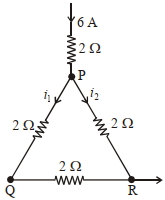
A
$2$
B
$1$
C
$3$
D
$4$
Solution
(A) The circuit consists of two parallel branches connected between points $P$ and $R$.
Branch $1$ consists of the wire $PQ$ and $QR$ in series. The resistance of this branch is $R_1 = 2 \,\Omega + 2 \,\Omega = 4 \,\Omega$.
Branch $2$ consists of the wire $PR$ directly,with resistance $R_2 = 2 \,\Omega$.
The total current $I = 6 \, A$ divides into these two parallel branches.
Using the current divider rule,the current $i_1$ flowing through the branch $PQ$ (and then $QR$) is given by:
$i_1 = I \times \frac{R_2}{R_1 + R_2}$
$i_1 = 6 \times \frac{2}{4 + 2} = 6 \times \frac{2}{6} = 2 \, A$.
Thus,the current $i_1$ is $2 \, A$.
Branch $1$ consists of the wire $PQ$ and $QR$ in series. The resistance of this branch is $R_1 = 2 \,\Omega + 2 \,\Omega = 4 \,\Omega$.
Branch $2$ consists of the wire $PR$ directly,with resistance $R_2 = 2 \,\Omega$.
The total current $I = 6 \, A$ divides into these two parallel branches.
Using the current divider rule,the current $i_1$ flowing through the branch $PQ$ (and then $QR$) is given by:
$i_1 = I \times \frac{R_2}{R_1 + R_2}$
$i_1 = 6 \times \frac{2}{4 + 2} = 6 \times \frac{2}{6} = 2 \, A$.
Thus,the current $i_1$ is $2 \, A$.
0 likesView Solution
224
PhysicsDifficultMCQJEE Main · 2021
If $C$ and $V$ represent capacity and voltage respectively,then what are the dimensions of $\lambda,$ where $\frac{C}{V} = \lambda$?
A
$[M^{-2} L^{-3} I^{2} T^{6}]$
B
$[M^{-3} L^{-4} I^{3} T^{7}]$
C
$[M^{-1} L^{-3} I^{-2} T^{-7}]$
D
$[M^{-2} L^{-4} I^{3} T^{7}]$
Solution
(D) Given $\lambda = \frac{C}{V}$.
Since $C = \frac{Q}{V}$,we have $\lambda = \frac{Q}{V^{2}}$.
We know that $V = \frac{W}{Q}$,where $W$ is work and $Q$ is charge.
Substituting $V$ in the expression for $\lambda$:
$\lambda = \frac{Q}{(W/Q)^{2}} = \frac{Q^{3}}{W^{2}}$.
Using dimensional formulas: $[Q] = [IT]$,$[W] = [ML^{2}T^{-2}]$.
$\lambda = \frac{[IT]^{3}}{[ML^{2}T^{-2}]^{2}} = \frac{[I^{3}T^{3}]}{[M^{2}L^{4}T^{-4}]}$.
$\lambda = [M^{-2} L^{-4} I^{3} T^{3 - (-4)}] = [M^{-2} L^{-4} I^{3} T^{7}]$.
Since $C = \frac{Q}{V}$,we have $\lambda = \frac{Q}{V^{2}}$.
We know that $V = \frac{W}{Q}$,where $W$ is work and $Q$ is charge.
Substituting $V$ in the expression for $\lambda$:
$\lambda = \frac{Q}{(W/Q)^{2}} = \frac{Q^{3}}{W^{2}}$.
Using dimensional formulas: $[Q] = [IT]$,$[W] = [ML^{2}T^{-2}]$.
$\lambda = \frac{[IT]^{3}}{[ML^{2}T^{-2}]^{2}} = \frac{[I^{3}T^{3}]}{[M^{2}L^{4}T^{-4}]}$.
$\lambda = [M^{-2} L^{-4} I^{3} T^{3 - (-4)}] = [M^{-2} L^{-4} I^{3} T^{7}]$.
0 likesView Solution
225
PhysicsMediumMCQJEE Main · 2021
An aeroplane,with its wings spread $10 \, m$,is flying at a speed of $180 \, km/h$ in a horizontal direction. The total intensity of the Earth's magnetic field at that location is $2.5 \times 10^{-4} \, Wb/m^2$ and the angle of dip is $60^{\circ}$. The $EMF$ induced between the tips of the plane's wings will be ...... $mV$.
A
$108.25$
B
$54.125$
C
$88.37$
D
$62.50$
Solution
(A) The motional $EMF$ induced in the wings is given by $\epsilon = B_v \cdot v \cdot l$,where $B_v$ is the vertical component of the Earth's magnetic field.
Given: $l = 10 \, m$,$v = 180 \, km/h = 180 \times \frac{5}{18} = 50 \, m/s$,$B = 2.5 \times 10^{-4} \, T$,and angle of dip $\delta = 60^{\circ}$.
The vertical component $B_v = B \sin \delta = 2.5 \times 10^{-4} \times \sin 60^{\circ}$.
Substituting the values: $\epsilon = (2.5 \times 10^{-4} \times \sin 60^{\circ}) \times 50 \times 10$.
$\epsilon = 2.5 \times 10^{-4} \times \frac{\sqrt{3}}{2} \times 500$.
$\epsilon = 2.5 \times 10^{-4} \times 0.866 \times 500 = 0.10825 \, V$.
Converting to $mV$: $\epsilon = 0.10825 \times 1000 = 108.25 \, mV$.
Given: $l = 10 \, m$,$v = 180 \, km/h = 180 \times \frac{5}{18} = 50 \, m/s$,$B = 2.5 \times 10^{-4} \, T$,and angle of dip $\delta = 60^{\circ}$.
The vertical component $B_v = B \sin \delta = 2.5 \times 10^{-4} \times \sin 60^{\circ}$.
Substituting the values: $\epsilon = (2.5 \times 10^{-4} \times \sin 60^{\circ}) \times 50 \times 10$.
$\epsilon = 2.5 \times 10^{-4} \times \frac{\sqrt{3}}{2} \times 500$.
$\epsilon = 2.5 \times 10^{-4} \times 0.866 \times 500 = 0.10825 \, V$.
Converting to $mV$: $\epsilon = 0.10825 \times 1000 = 108.25 \, mV$.
0 likesView Solution
226
PhysicsDifficultMCQJEE Main · 2021
Given below are two statements: one is labelled as Assertion $A$ and the other is labelled as Reason $R$.
Assertion $A$: For a simple microscope,the angular size of the object equals the angular size of the image.
Reason $R$: Magnification is achieved as the small object can be kept much closer to the eye than $25\, cm$ and hence it subtends a large angle.
In the light of the above statements,choose the most appropriate answer from the options given below:
Assertion $A$: For a simple microscope,the angular size of the object equals the angular size of the image.
Reason $R$: Magnification is achieved as the small object can be kept much closer to the eye than $25\, cm$ and hence it subtends a large angle.
In the light of the above statements,choose the most appropriate answer from the options given below:
A
$A$ is true but $R$ is false.
B
Both $A$ and $R$ are true but $R$ is $NOT$ the correct explanation of $A$.
C
Both $A$ and $R$ are true and $R$ is the correct explanation of $A$.
D
$A$ is false but $R$ is true.
Solution
(C) Assertion $A$ is true. In a simple microscope,the virtual image formed by the convex lens subtends the same angle at the eye as the object itself,because the rays from the object appear to originate from the image position.
Reason $R$ is also true. $A$ simple microscope (convex lens) allows an object to be placed at a distance $u_0$ which is less than the least distance of distinct vision $(D = 25\, cm)$.
Since the angular magnification $m = \frac{\theta^{\prime}}{\theta} = \frac{D}{u_0}$,and $u_0 < D$,we get $m > 1$. The reason explains why we get magnification,which is the purpose of the microscope,and it correctly justifies the assertion regarding the angular size.
Therefore,both $A$ and $R$ are true and $R$ is the correct explanation of $A$.
Reason $R$ is also true. $A$ simple microscope (convex lens) allows an object to be placed at a distance $u_0$ which is less than the least distance of distinct vision $(D = 25\, cm)$.
Since the angular magnification $m = \frac{\theta^{\prime}}{\theta} = \frac{D}{u_0}$,and $u_0 < D$,we get $m > 1$. The reason explains why we get magnification,which is the purpose of the microscope,and it correctly justifies the assertion regarding the angular size.
Therefore,both $A$ and $R$ are true and $R$ is the correct explanation of $A$.
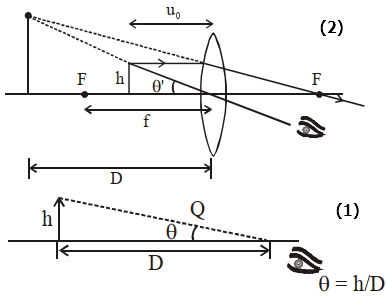
0 likesView Solution
227
PhysicsDifficultMCQJEE Main · 2021
Given below are two statements:
Statement $I$: An electric dipole is placed at the centre of a hollow sphere. The flux of electric field through the sphere is zero,but the electric field is not zero anywhere in the sphere.
Statement $II$: If $R$ is the radius of a solid metallic sphere and $Q$ is the total charge on it,the electric field at any point on a spherical surface of radius $r$ ( < R ) is zero,and the electric flux passing through this closed spherical surface of radius $r$ is also zero.
In the light of the above statements,choose the correct answer from the options given below:
Statement $I$: An electric dipole is placed at the centre of a hollow sphere. The flux of electric field through the sphere is zero,but the electric field is not zero anywhere in the sphere.
Statement $II$: If $R$ is the radius of a solid metallic sphere and $Q$ is the total charge on it,the electric field at any point on a spherical surface of radius $r$ ( < R ) is zero,and the electric flux passing through this closed spherical surface of radius $r$ is also zero.
In the light of the above statements,choose the correct answer from the options given below:
A
Both Statement $I$ and Statement $II$ are true.
B
Statement $I$ is true but Statement $II$ is false.
C
Both Statement $I$ and Statement $II$ are false.
D
Statement $I$ is false but Statement $II$ is true.
Solution
(B) Analysis of Statement $I$: According to Gauss's Law,the total electric flux $\phi$ through a closed surface is given by $\phi = \frac{q_{in}}{\varepsilon_0}$. For an electric dipole,the net charge $q_{in} = +q + (-q) = 0$. Thus,the flux $\phi = 0$. However,the electric field $\vec{E}$ due to the dipole is non-zero at every point inside the sphere. Therefore,Statement $I$ is true.
Analysis of Statement $II$: For a solid metallic sphere of radius $R$ carrying charge $Q$,the charge resides entirely on the outer surface. For any Gaussian surface of radius $r < R$,the enclosed charge $q_{in} = 0$. By Gauss's Law,the electric flux $\phi = \frac{q_{in}}{\varepsilon_0} = 0$. Also,the electric field $\vec{E}$ inside a conductor is zero. The statement claims the flux is not zero,which is incorrect. Therefore,Statement $II$ is false.
Conclusion: Statement $I$ is true and Statement $II$ is false.
Analysis of Statement $II$: For a solid metallic sphere of radius $R$ carrying charge $Q$,the charge resides entirely on the outer surface. For any Gaussian surface of radius $r < R$,the enclosed charge $q_{in} = 0$. By Gauss's Law,the electric flux $\phi = \frac{q_{in}}{\varepsilon_0} = 0$. Also,the electric field $\vec{E}$ inside a conductor is zero. The statement claims the flux is not zero,which is incorrect. Therefore,Statement $II$ is false.
Conclusion: Statement $I$ is true and Statement $II$ is false.
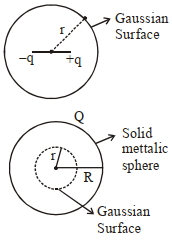
0 likesView Solution
228
PhysicsDifficultMCQJEE Main · 2021
The recoil speed of a hydrogen atom after it emits a photon in going from $n = 5$ state to $n = 1$ state will be ..... $m/s$.
A
$4.17$
B
$2.19$
C
$3.25$
D
$4.34$
Solution
(A) The energy released when an electron transitions from $n = 5$ to $n = 1$ is given by:
$\Delta E = E_5 - E_1 = -0.54 \, eV - (-13.6 \, eV) = 13.06 \, eV$.
By the law of conservation of linear momentum,the initial momentum of the atom is zero,so the final momentum of the atom must be equal and opposite to the momentum of the emitted photon:
$P_{\text{atom}} = P_{\text{photon}} = \frac{h}{\lambda}$.
Since the energy of the photon is $\Delta E = \frac{hc}{\lambda}$,we have $\frac{1}{\lambda} = \frac{\Delta E}{hc}$.
Substituting this into the momentum equation,the recoil momentum of the atom is $Mv = \frac{\Delta E}{c}$,where $M$ is the mass of the hydrogen atom $(M \approx 1.67 \times 10^{-27} \, kg)$ and $c$ is the speed of light $(3 \times 10^8 \, m/s)$.
The recoil speed $v$ is given by:
$v = \frac{\Delta E}{Mc} = \frac{13.06 \times 1.6 \times 10^{-19} \, J}{1.67 \times 10^{-27} \, kg \times 3 \times 10^8 \, m/s} \approx 4.17 \, m/s$.
$\Delta E = E_5 - E_1 = -0.54 \, eV - (-13.6 \, eV) = 13.06 \, eV$.
By the law of conservation of linear momentum,the initial momentum of the atom is zero,so the final momentum of the atom must be equal and opposite to the momentum of the emitted photon:
$P_{\text{atom}} = P_{\text{photon}} = \frac{h}{\lambda}$.
Since the energy of the photon is $\Delta E = \frac{hc}{\lambda}$,we have $\frac{1}{\lambda} = \frac{\Delta E}{hc}$.
Substituting this into the momentum equation,the recoil momentum of the atom is $Mv = \frac{\Delta E}{c}$,where $M$ is the mass of the hydrogen atom $(M \approx 1.67 \times 10^{-27} \, kg)$ and $c$ is the speed of light $(3 \times 10^8 \, m/s)$.
The recoil speed $v$ is given by:
$v = \frac{\Delta E}{Mc} = \frac{13.06 \times 1.6 \times 10^{-19} \, J}{1.67 \times 10^{-27} \, kg \times 3 \times 10^8 \, m/s} \approx 4.17 \, m/s$.
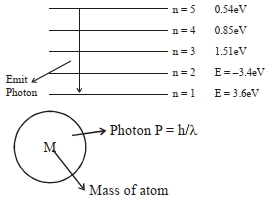
0 likesView Solution
229
PhysicsDifficultMCQJEE Main · 2021
Find the peak current and resonant frequency of the following circuit (as shown in the figure).
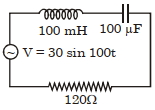
A
$0.2 \, A$ and $50 \, Hz$
B
$0.2 \, A$ and $100 \, Hz$
C
$2 \, A$ and $100 \, Hz$
D
$2 \, A$ and $50 \, Hz$
Solution
(A) Given: $L = 100 \, mH = 0.1 \, H$,$C = 100 \, \mu F = 10^{-4} \, F$,$R = 120 \, \Omega$,$V = 30 \sin(100t) \, V$.
From the voltage equation,peak voltage $V_0 = 30 \, V$ and angular frequency $\omega = 100 \, rad/s$.
Inductive reactance $X_L = \omega L = 100 \times 0.1 = 10 \, \Omega$.
Capacitive reactance $X_C = \frac{1}{\omega C} = \frac{1}{100 \times 10^{-4}} = \frac{1}{0.01} = 100 \, \Omega$.
Impedance $Z = \sqrt{R^2 + (X_L - X_C)^2} = \sqrt{120^2 + (10 - 100)^2} = \sqrt{120^2 + (-90)^2} = \sqrt{14400 + 8100} = \sqrt{22500} = 150 \, \Omega$.
Peak current $I_0 = \frac{V_0}{Z} = \frac{30}{150} = 0.2 \, A$.
Resonant frequency $f_r = \frac{1}{2\pi \sqrt{LC}} = \frac{1}{2\pi \sqrt{0.1 \times 10^{-4}}} = \frac{1}{2\pi \sqrt{10^{-5}}} = \frac{1}{2\pi \times 10^{-2.5}} \approx \frac{1}{2 \times 3.14 \times 0.00316} \approx 50.3 \, Hz \approx 50 \, Hz$.
From the voltage equation,peak voltage $V_0 = 30 \, V$ and angular frequency $\omega = 100 \, rad/s$.
Inductive reactance $X_L = \omega L = 100 \times 0.1 = 10 \, \Omega$.
Capacitive reactance $X_C = \frac{1}{\omega C} = \frac{1}{100 \times 10^{-4}} = \frac{1}{0.01} = 100 \, \Omega$.
Impedance $Z = \sqrt{R^2 + (X_L - X_C)^2} = \sqrt{120^2 + (10 - 100)^2} = \sqrt{120^2 + (-90)^2} = \sqrt{14400 + 8100} = \sqrt{22500} = 150 \, \Omega$.
Peak current $I_0 = \frac{V_0}{Z} = \frac{30}{150} = 0.2 \, A$.
Resonant frequency $f_r = \frac{1}{2\pi \sqrt{LC}} = \frac{1}{2\pi \sqrt{0.1 \times 10^{-4}}} = \frac{1}{2\pi \sqrt{10^{-5}}} = \frac{1}{2\pi \times 10^{-2.5}} \approx \frac{1}{2 \times 3.14 \times 0.00316} \approx 50.3 \, Hz \approx 50 \, Hz$.
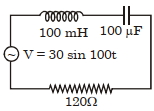
0 likesView Solution
230
PhysicsDifficultMCQJEE Main · 2021
An inclined plane making an angle of $30^{\circ}$ with the horizontal is placed in a uniform horizontal electric field of $200 \, N/C$ as shown in the figure. $A$ body of mass $1 \, kg$ and charge $5 \, mC$ is allowed to slide down from rest at a height of $1 \, m$. If the coefficient of friction is $0.2$,find the time (in $s$) taken by the body to reach the bottom. $\left[ g = 9.8 \, m/s^2, \sin 30^{\circ} = 0.5, \cos 30^{\circ} = \frac{\sqrt{3}}{2} \approx 0.866 \right]$
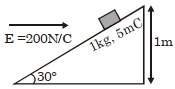
A
$0.92$
B
$0.46$
C
$2.3$
D
$1.3$
Solution
(D) The forces acting on the body are gravity $(mg)$,normal force $(N)$,electric force $(F_e = qE)$,and friction $(f = \mu N)$.
$F_e = (5 \times 10^{-3} \, C) \times (200 \, N/C) = 1 \, N$.
Resolving forces perpendicular to the incline:
$N = mg \cos 30^{\circ} + F_e \sin 30^{\circ} = (1 \times 9.8 \times 0.866) + (1 \times 0.5) = 8.487 + 0.5 = 8.987 \, N \approx 9 \, N$.
Resolving forces parallel to the incline:
$F_{net} = mg \sin 30^{\circ} + F_e \cos 30^{\circ} - \mu N = (1 \times 9.8 \times 0.5) + (1 \times 0.866) - (0.2 \times 9) = 4.9 + 0.866 - 1.8 = 3.966 \, N$.
Acceleration $a = F_{net} / m = 3.966 / 1 = 3.966 \, m/s^2$.
The length of the incline $L = h / \sin 30^{\circ} = 1 / 0.5 = 2 \, m$.
Using $S = ut + \frac{1}{2}at^2$ with $u = 0$:
$2 = 0 + \frac{1}{2} \times 3.966 \times t^2 \implies t^2 = 4 / 3.966 \approx 1.008 \implies t \approx 1 \, s$.
Given the options provided,the closest value is $1.3 \, s$.
$F_e = (5 \times 10^{-3} \, C) \times (200 \, N/C) = 1 \, N$.
Resolving forces perpendicular to the incline:
$N = mg \cos 30^{\circ} + F_e \sin 30^{\circ} = (1 \times 9.8 \times 0.866) + (1 \times 0.5) = 8.487 + 0.5 = 8.987 \, N \approx 9 \, N$.
Resolving forces parallel to the incline:
$F_{net} = mg \sin 30^{\circ} + F_e \cos 30^{\circ} - \mu N = (1 \times 9.8 \times 0.5) + (1 \times 0.866) - (0.2 \times 9) = 4.9 + 0.866 - 1.8 = 3.966 \, N$.
Acceleration $a = F_{net} / m = 3.966 / 1 = 3.966 \, m/s^2$.
The length of the incline $L = h / \sin 30^{\circ} = 1 / 0.5 = 2 \, m$.
Using $S = ut + \frac{1}{2}at^2$ with $u = 0$:
$2 = 0 + \frac{1}{2} \times 3.966 \times t^2 \implies t^2 = 4 / 3.966 \approx 1.008 \implies t \approx 1 \, s$.
Given the options provided,the closest value is $1.3 \, s$.
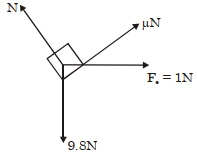
0 likesView Solution
231
PhysicsMediumMCQJEE Main · 2021
Draw the output signal $Y$ for the given combination of logic gates shown in the figure.
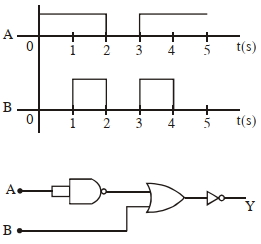
A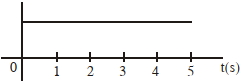
B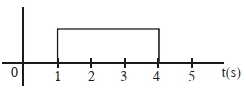
C
D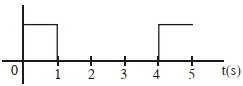
Solution
(D) The given circuit consists of a $NAND$ gate,an $OR$ gate,and a $NOT$ gate. Let the inputs be $A$ and $B$. The output of the $NAND$ gate is $\overline{A \cdot A} = \overline{A}$.
This output $\overline{A}$ and input $B$ are fed into an $OR$ gate,giving an intermediate output $Z = \overline{A} + B$.
Finally,this is passed through a $NOT$ gate to give the final output $Y = \overline{Z} = \overline{\overline{A} + B}$.
Using De Morgan's law,$\overline{\overline{A} + B} = \overline{\overline{A}} \cdot \overline{B} = A \cdot \overline{B}$.
Now,we analyze the truth table for $Y = A \cdot \overline{B}$:
- For $t = 0$ to $1$ s: $A=1, B=0 \implies Y = 1 \cdot \overline{0} = 1 \cdot 1 = 1$.
- For $t = 1$ to $2$ s: $A=1, B=1 \implies Y = 1 \cdot \overline{1} = 1 \cdot 0 = 0$.
- For $t = 2$ to $3$ s: $A=0, B=0 \implies Y = 0 \cdot \overline{0} = 0 \cdot 1 = 0$.
- For $t = 3$ to $4$ s: $A=1, B=1 \implies Y = 1 \cdot \overline{1} = 1 \cdot 0 = 0$.
- For $t = 4$ to $5$ s: $A=1, B=0 \implies Y = 1 \cdot \overline{0} = 1 \cdot 1 = 1$.
Thus,the output $Y$ is high $(1)$ from $t = 0$ to $1$ s and from $t = 4$ to $5$ s,and low $(0)$ otherwise. This matches the signal shown in option $D$.
This output $\overline{A}$ and input $B$ are fed into an $OR$ gate,giving an intermediate output $Z = \overline{A} + B$.
Finally,this is passed through a $NOT$ gate to give the final output $Y = \overline{Z} = \overline{\overline{A} + B}$.
Using De Morgan's law,$\overline{\overline{A} + B} = \overline{\overline{A}} \cdot \overline{B} = A \cdot \overline{B}$.
Now,we analyze the truth table for $Y = A \cdot \overline{B}$:
- For $t = 0$ to $1$ s: $A=1, B=0 \implies Y = 1 \cdot \overline{0} = 1 \cdot 1 = 1$.
- For $t = 1$ to $2$ s: $A=1, B=1 \implies Y = 1 \cdot \overline{1} = 1 \cdot 0 = 0$.
- For $t = 2$ to $3$ s: $A=0, B=0 \implies Y = 0 \cdot \overline{0} = 0 \cdot 1 = 0$.
- For $t = 3$ to $4$ s: $A=1, B=1 \implies Y = 1 \cdot \overline{1} = 1 \cdot 0 = 0$.
- For $t = 4$ to $5$ s: $A=1, B=0 \implies Y = 1 \cdot \overline{0} = 1 \cdot 1 = 1$.
Thus,the output $Y$ is high $(1)$ from $t = 0$ to $1$ s and from $t = 4$ to $5$ s,and low $(0)$ otherwise. This matches the signal shown in option $D$.
0 likesView Solution
232
PhysicsDifficultMCQJEE Main · 2021
$A$ radioactive sample is undergoing $\alpha$ decay. At any time $t_{1}$,its activity is $A$ and at another time $t_{2}$,the activity is $\frac{A}{5}$. What is the average life time for the sample?
A
$\frac{\ln 5}{t_{2}-t_{1}}$
B
$\frac{t_{1}-t_{2}}{\ln 5}$
C
$\frac{t_{2}-t_{1}}{\ln 5}$
D
$\frac{\ln(t_{2}+t_{1})}{2}$
Solution
(C) The activity of a radioactive sample at time $t$ is given by $A(t) = A_{0} e^{-\lambda t}$.
At time $t_{1}$,$A = A_{0} e^{-\lambda t_{1}}$ ... $(i)$
At time $t_{2}$,$\frac{A}{5} = A_{0} e^{-\lambda t_{2}}$ ... $(ii)$
Dividing equation $(i)$ by $(ii)$:
$\frac{A}{A/5} = \frac{A_{0} e^{-\lambda t_{1}}}{A_{0} e^{-\lambda t_{2}}}$
$5 = e^{\lambda(t_{2}-t_{1})}$
Taking the natural logarithm on both sides:
$\ln 5 = \lambda(t_{2}-t_{1})$
$\lambda = \frac{\ln 5}{t_{2}-t_{1}}$
The average life time $\tau$ is the reciprocal of the decay constant $\lambda$:
$\tau = \frac{1}{\lambda} = \frac{t_{2}-t_{1}}{\ln 5}$
At time $t_{1}$,$A = A_{0} e^{-\lambda t_{1}}$ ... $(i)$
At time $t_{2}$,$\frac{A}{5} = A_{0} e^{-\lambda t_{2}}$ ... $(ii)$
Dividing equation $(i)$ by $(ii)$:
$\frac{A}{A/5} = \frac{A_{0} e^{-\lambda t_{1}}}{A_{0} e^{-\lambda t_{2}}}$
$5 = e^{\lambda(t_{2}-t_{1})}$
Taking the natural logarithm on both sides:
$\ln 5 = \lambda(t_{2}-t_{1})$
$\lambda = \frac{\ln 5}{t_{2}-t_{1}}$
The average life time $\tau$ is the reciprocal of the decay constant $\lambda$:
$\tau = \frac{1}{\lambda} = \frac{t_{2}-t_{1}}{\ln 5}$
0 likesView Solution
233
PhysicsDifficultMCQJEE Main · 2021
$A$ wire of $1 \,\Omega$ has a length of $1\, m$. It is stretched until its length increases by $25\, \%$. The percentage change in resistance to the nearest integer is .....$\%$
A
$56$
B
$25$
C
$12.5$
D
$76$
Solution
(A) Initial resistance $R_{0} = 1\, \Omega$ and initial length $\ell_{0} = 1\, m$.
When the wire is stretched,its volume remains constant. Let the new length be $\ell_{1}$.
Given that the length increases by $25\, \%$,so $\ell_{1} = \ell_{0} + 0.25\ell_{0} = 1.25\ell_{0} = 1.25\, m$.
Since volume $V = A \ell$ is constant,$A_{0}\ell_{0} = A_{1}\ell_{1}$,which implies $A_{1} = A_{0}(\ell_{0} / \ell_{1})$.
The resistance $R$ is given by $R = \rho \frac{\ell}{A}$.
Therefore,the new resistance $R_{1} = \rho \frac{\ell_{1}}{A_{1}} = \rho \frac{\ell_{1}}{A_{0}(\ell_{0} / \ell_{1})} = \rho \frac{\ell_{1}^{2}}{A_{0}\ell_{0}} = R_{0} \left( \frac{\ell_{1}}{\ell_{0}} \right)^{2}$.
Substituting the values: $R_{1} = 1 \times (1.25)^{2} = 1.5625\, \Omega$.
The percentage change in resistance is $\frac{R_{1} - R_{0}}{R_{0}} \times 100\, \% = \frac{1.5625 - 1}{1} \times 100\, \% = 56.25\, \%$.
Rounding to the nearest integer,the percentage change is $56\, \%$.
When the wire is stretched,its volume remains constant. Let the new length be $\ell_{1}$.
Given that the length increases by $25\, \%$,so $\ell_{1} = \ell_{0} + 0.25\ell_{0} = 1.25\ell_{0} = 1.25\, m$.
Since volume $V = A \ell$ is constant,$A_{0}\ell_{0} = A_{1}\ell_{1}$,which implies $A_{1} = A_{0}(\ell_{0} / \ell_{1})$.
The resistance $R$ is given by $R = \rho \frac{\ell}{A}$.
Therefore,the new resistance $R_{1} = \rho \frac{\ell_{1}}{A_{1}} = \rho \frac{\ell_{1}}{A_{0}(\ell_{0} / \ell_{1})} = \rho \frac{\ell_{1}^{2}}{A_{0}\ell_{0}} = R_{0} \left( \frac{\ell_{1}}{\ell_{0}} \right)^{2}$.
Substituting the values: $R_{1} = 1 \times (1.25)^{2} = 1.5625\, \Omega$.
The percentage change in resistance is $\frac{R_{1} - R_{0}}{R_{0}} \times 100\, \% = \frac{1.5625 - 1}{1} \times 100\, \% = 56.25\, \%$.
Rounding to the nearest integer,the percentage change is $56\, \%$.
0 likesView Solution
234
PhysicsDifficultMCQJEE Main · 2021
The incident ray,reflected ray,and the outward drawn normal are denoted by the unit vectors $\overrightarrow{ a }, \overrightarrow{ b }$ and $\overrightarrow{ c }$ respectively. Choose the correct relation for these vectors.
A
$\overrightarrow{ b }=\overrightarrow{ a }+2 \overrightarrow{ c }$
B
$\overrightarrow{ b }=2 \overrightarrow{ a }+\overrightarrow{ c }$
C
$\overrightarrow{ b }=\overrightarrow{ a }-2(\overrightarrow{ a } \cdot \overrightarrow{ c }) \overrightarrow{ c }$
D
$\overrightarrow{ b }=\overrightarrow{ a }-\overrightarrow{ c }$
Solution
(C) According to the law of reflection,the angle of incidence equals the angle of reflection,and the incident ray,reflected ray,and normal lie in the same plane.
Let the normal vector be $\overrightarrow{ c }$. The component of the incident ray $\overrightarrow{ a }$ along the normal is $(\overrightarrow{ a } \cdot \overrightarrow{ c }) \overrightarrow{ c }$.
The component of $\overrightarrow{ a }$ perpendicular to the normal is $\overrightarrow{ a } - (\overrightarrow{ a } \cdot \overrightarrow{ c }) \overrightarrow{ c }$.
Since the reflected ray $\overrightarrow{ b }$ has the same component perpendicular to the normal but the opposite component along the normal,we have:
$\overrightarrow{ b } = (\overrightarrow{ a } - (\overrightarrow{ a } \cdot \overrightarrow{ c }) \overrightarrow{ c }) - (\overrightarrow{ a } \cdot \overrightarrow{ c }) \overrightarrow{ c }$
$\overrightarrow{ b } = \overrightarrow{ a } - 2(\overrightarrow{ a } \cdot \overrightarrow{ c }) \overrightarrow{ c }$
Let the normal vector be $\overrightarrow{ c }$. The component of the incident ray $\overrightarrow{ a }$ along the normal is $(\overrightarrow{ a } \cdot \overrightarrow{ c }) \overrightarrow{ c }$.
The component of $\overrightarrow{ a }$ perpendicular to the normal is $\overrightarrow{ a } - (\overrightarrow{ a } \cdot \overrightarrow{ c }) \overrightarrow{ c }$.
Since the reflected ray $\overrightarrow{ b }$ has the same component perpendicular to the normal but the opposite component along the normal,we have:
$\overrightarrow{ b } = (\overrightarrow{ a } - (\overrightarrow{ a } \cdot \overrightarrow{ c }) \overrightarrow{ c }) - (\overrightarrow{ a } \cdot \overrightarrow{ c }) \overrightarrow{ c }$
$\overrightarrow{ b } = \overrightarrow{ a } - 2(\overrightarrow{ a } \cdot \overrightarrow{ c }) \overrightarrow{ c }$
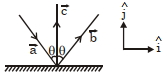
0 likesView Solution
235
PhysicsMediumMCQJEE Main · 2021
If the highest frequency modulating a carrier is $5\, kHz$,then the number of $AM$ broadcast stations accommodated in a $90\, kHz$ bandwidth are ....... .
A
$18$
B
$9$
C
$6$
D
$3$
Solution
(B) The bandwidth required for a single $AM$ broadcast station is given by twice the maximum modulating frequency.
Bandwidth per station $= 2 \times f_m = 2 \times 5\, kHz = 10\, kHz$.
To find the number of stations that can be accommodated in a total bandwidth of $90\, kHz$,we divide the total bandwidth by the bandwidth per station.
Number of stations $= \frac{\text{Total Bandwidth}}{\text{Bandwidth per station}} = \frac{90\, kHz}{10\, kHz} = 9$.
Therefore,$9$ stations can be accommodated.
Bandwidth per station $= 2 \times f_m = 2 \times 5\, kHz = 10\, kHz$.
To find the number of stations that can be accommodated in a total bandwidth of $90\, kHz$,we divide the total bandwidth by the bandwidth per station.
Number of stations $= \frac{\text{Total Bandwidth}}{\text{Bandwidth per station}} = \frac{90\, kHz}{10\, kHz} = 9$.
Therefore,$9$ stations can be accommodated.
0 likesView Solution
236
PhysicsDifficultMCQJEE Main · 2021
Two streams of photons,possessing energies equal to twice and ten times the work function of a metal,are incident on the metal surface successively. The ratio of the maximum velocities of the photoelectrons emitted in the two respective cases is $x:y$. The value of $x$ is ...... .
A
$0$
B
$2$
C
$1$
D
$4$
Solution
(C) According to Einstein's photoelectric equation,the maximum kinetic energy is given by $KE_{\max} = h\nu - \phi$,where $\phi$ is the work function.
Since $KE_{\max} = \frac{1}{2}mv^2$,we have $v = \sqrt{\frac{2(h\nu - \phi)}{m}}$.
For the first case,$h\nu_1 = 2\phi$. Thus,$v_1 = \sqrt{\frac{2(2\phi - \phi)}{m}} = \sqrt{\frac{2\phi}{m}}$.
For the second case,$h\nu_2 = 10\phi$. Thus,$v_2 = \sqrt{\frac{2(10\phi - \phi)}{m}} = \sqrt{\frac{18\phi}{m}}$.
The ratio of the maximum velocities is $\frac{v_1}{v_2} = \sqrt{\frac{2\phi}{18\phi}} = \sqrt{\frac{1}{9}} = \frac{1}{3}$.
Given the ratio is $x:y = 1:3$,the value of $x$ is $1$.
Since $KE_{\max} = \frac{1}{2}mv^2$,we have $v = \sqrt{\frac{2(h\nu - \phi)}{m}}$.
For the first case,$h\nu_1 = 2\phi$. Thus,$v_1 = \sqrt{\frac{2(2\phi - \phi)}{m}} = \sqrt{\frac{2\phi}{m}}$.
For the second case,$h\nu_2 = 10\phi$. Thus,$v_2 = \sqrt{\frac{2(10\phi - \phi)}{m}} = \sqrt{\frac{18\phi}{m}}$.
The ratio of the maximum velocities is $\frac{v_1}{v_2} = \sqrt{\frac{2\phi}{18\phi}} = \sqrt{\frac{1}{9}} = \frac{1}{3}$.
Given the ratio is $x:y = 1:3$,the value of $x$ is $1$.
0 likesView Solution
237
PhysicsDifficultMCQJEE Main · 2021
$A$ point source of light $S$,placed at a distance $60 \,cm$ in front of the centre of a plane mirror of width $50 \,cm$,hangs vertically on a wall. $A$ man walks in front of the mirror along a line parallel to the mirror at a distance $1.2 \,m$ from it (see in the figure). The distance between the extreme points where he can see the image of the light source in the mirror is $\ldots \ldots \ldots \,cm.$
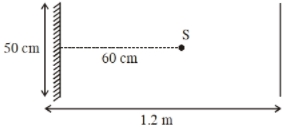
A
$75$
B
$135$
C
$150$
D
$210$
Solution
(C) Let the mirror be placed along the $y$-axis with its centre at the origin $(0,0)$. The mirror extends from $y = -25 \,cm$ to $y = +25 \,cm$.
The light source $S$ is at $(60 \,cm, 0)$.
The image $S'$ of the source $S$ in the plane mirror is formed at $(-60 \,cm, 0)$.
The man walks along the line $x = 120 \,cm - 60 \,cm = 60 \,cm$ relative to the mirror plane,or more simply,the man is at a distance of $1.2 \,m = 120 \,cm$ from the mirror.
The rays from the image $S'$ that define the field of view pass through the edges of the mirror at $y = 25 \,cm$ and $y = -25 \,cm$.
Using similar triangles,the ratio of the height to the distance from the image $S'$ is constant:
$\frac{y_{edge}}{distance_{S'}} = \frac{x}{distance_{S'} + distance_{man}}$
Here,the distance of the image $S'$ from the mirror is $60 \,cm$. The distance of the man from the mirror is $120 \,cm$.
So,the total distance of the man from the image $S'$ is $60 \,cm + 120 \,cm = 180 \,cm$.
Using the property of similar triangles:
$\frac{25 \,cm}{60 \,cm} = \frac{x}{180 \,cm}$
$x = \frac{25 \times 180}{60} = 25 \times 3 = 75 \,cm$.
This $x$ is the distance from the central axis to the extreme point on one side.
The total distance between the two extreme points is $2x = 2 \times 75 \,cm = 150 \,cm$.
The light source $S$ is at $(60 \,cm, 0)$.
The image $S'$ of the source $S$ in the plane mirror is formed at $(-60 \,cm, 0)$.
The man walks along the line $x = 120 \,cm - 60 \,cm = 60 \,cm$ relative to the mirror plane,or more simply,the man is at a distance of $1.2 \,m = 120 \,cm$ from the mirror.
The rays from the image $S'$ that define the field of view pass through the edges of the mirror at $y = 25 \,cm$ and $y = -25 \,cm$.
Using similar triangles,the ratio of the height to the distance from the image $S'$ is constant:
$\frac{y_{edge}}{distance_{S'}} = \frac{x}{distance_{S'} + distance_{man}}$
Here,the distance of the image $S'$ from the mirror is $60 \,cm$. The distance of the man from the mirror is $120 \,cm$.
So,the total distance of the man from the image $S'$ is $60 \,cm + 120 \,cm = 180 \,cm$.
Using the property of similar triangles:
$\frac{25 \,cm}{60 \,cm} = \frac{x}{180 \,cm}$
$x = \frac{25 \times 180}{60} = 25 \times 3 = 75 \,cm$.
This $x$ is the distance from the central axis to the extreme point on one side.
The total distance between the two extreme points is $2x = 2 \times 75 \,cm = 150 \,cm$.
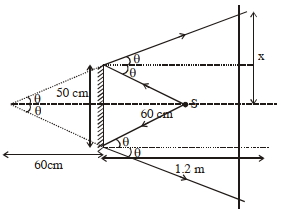
0 likesView Solution
238
PhysicsDifficultMCQJEE Main · 2021
$27$ similar drops of mercury are maintained at $10 \, V$ each. All these spherical drops combine into a single big drop. The potential energy of the bigger drop is ....... times that of a smaller drop.
A
$256$
B
$144$
C
$324$
D
$243$
Solution
(D) Let $r$ be the radius of each small drop and $R$ be the radius of the big drop.
Since the volume is conserved,$27 \times (\frac{4}{3} \pi r^3) = \frac{4}{3} \pi R^3$.
This gives $R^3 = 27r^3$,so $R = 3r$.
Let $q$ be the charge on each small drop. The total charge on the big drop is $Q = 27q$.
The electrostatic potential energy of a charged spherical drop of radius $r$ and charge $q$ is given by $U_1 = \frac{3}{5} \frac{kq^2}{r}$.
The potential energy of the bigger drop is $U = \frac{3}{5} \frac{kQ^2}{R}$.
Substituting $Q = 27q$ and $R = 3r$ into the equation for $U$:
$U = \frac{3}{5} \frac{k(27q)^2}{3r} = \frac{3}{5} \frac{k \cdot 729q^2}{3r} = \frac{729}{3} \left( \frac{3}{5} \frac{kq^2}{r} \right)$.
$U = 243 U_1$.
Therefore,the potential energy of the bigger drop is $243$ times that of a smaller drop.
Since the volume is conserved,$27 \times (\frac{4}{3} \pi r^3) = \frac{4}{3} \pi R^3$.
This gives $R^3 = 27r^3$,so $R = 3r$.
Let $q$ be the charge on each small drop. The total charge on the big drop is $Q = 27q$.
The electrostatic potential energy of a charged spherical drop of radius $r$ and charge $q$ is given by $U_1 = \frac{3}{5} \frac{kq^2}{r}$.
The potential energy of the bigger drop is $U = \frac{3}{5} \frac{kQ^2}{R}$.
Substituting $Q = 27q$ and $R = 3r$ into the equation for $U$:
$U = \frac{3}{5} \frac{k(27q)^2}{3r} = \frac{3}{5} \frac{k \cdot 729q^2}{3r} = \frac{729}{3} \left( \frac{3}{5} \frac{kq^2}{r} \right)$.
$U = 243 U_1$.
Therefore,the potential energy of the bigger drop is $243$ times that of a smaller drop.
0 likesView Solution
239
PhysicsDifficultMCQJEE Main · 2021
The Zener diode has a breakdown voltage $V_{z} = 30\, V$. The current passing through the diode for the following circuit is $\ldots \ldots \ldots \,mA.$
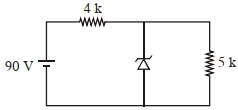
A
$3$
B
$9$
C
$12$
D
$18$
Solution
(B) The total voltage supplied is $V_{in} = 90\, V$ and the series resistance is $R_{s} = 4\, k\Omega = 4000\, \Omega$.
The Zener diode maintains a constant voltage of $V_{z} = 30\, V$ across it.
The voltage drop across the series resistor $R_{s}$ is $V_{R} = V_{in} - V_{z} = 90\, V - 30\, V = 60\, V$.
The total current $i$ flowing from the source through the series resistor is $i = \frac{V_{R}}{R_{s}} = \frac{60\, V}{4000\, \Omega} = 0.015\, A = 15\, mA$.
The load resistor is $R_{L} = 5\, k\Omega = 5000\, \Omega$. The current $i_{1}$ flowing through the load resistor is $i_{1} = \frac{V_{z}}{R_{L}} = \frac{30\, V}{5000\, \Omega} = 0.006\, A = 6\, mA$.
Applying Kirchhoff's Current Law at the junction,the current through the Zener diode $i_{z}$ is given by $i_{z} = i - i_{1} = 15\, mA - 6\, mA = 9\, mA$.
The Zener diode maintains a constant voltage of $V_{z} = 30\, V$ across it.
The voltage drop across the series resistor $R_{s}$ is $V_{R} = V_{in} - V_{z} = 90\, V - 30\, V = 60\, V$.
The total current $i$ flowing from the source through the series resistor is $i = \frac{V_{R}}{R_{s}} = \frac{60\, V}{4000\, \Omega} = 0.015\, A = 15\, mA$.
The load resistor is $R_{L} = 5\, k\Omega = 5000\, \Omega$. The current $i_{1}$ flowing through the load resistor is $i_{1} = \frac{V_{z}}{R_{L}} = \frac{30\, V}{5000\, \Omega} = 0.006\, A = 6\, mA$.
Applying Kirchhoff's Current Law at the junction,the current through the Zener diode $i_{z}$ is given by $i_{z} = i - i_{1} = 15\, mA - 6\, mA = 9\, mA$.
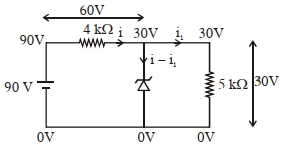
0 likesView Solution
240
PhysicsDifficultMCQJEE Main · 2021
The fractional change in the magnetic field intensity at a distance $r$ from the centre on the axis of a current-carrying coil of radius $a$ to the magnetic field intensity at the centre of the same coil is: (Take $r << a$)
A
$\frac{3}{2} \frac{a^{2}}{r^{2}}$
B
$\frac{2}{3} \frac{a^{2}}{r^{2}}$
C
$\frac{2}{3} \frac{r^{2}}{a^{2}}$
D
$\frac{3}{2} \frac{r^{2}}{a^{2}}$
Solution
(D) The magnetic field on the axis of a current-carrying coil of radius $a$ at a distance $r$ from the centre is given by $B_{\text{axis}} = \frac{\mu_{0} i a^{2}}{2(a^{2} + r^{2})^{3/2}}$.
The magnetic field at the centre of the coil is $B_{\text{centre}} = \frac{\mu_{0} i}{2a}$.
The fractional change in magnetic field is defined as $\frac{B_{\text{centre}} - B_{\text{axis}}}{B_{\text{centre}}} = 1 - \frac{B_{\text{axis}}}{B_{\text{centre}}}$.
Substituting the expressions: $1 - \frac{\frac{\mu_{0} i a^{2}}{2(a^{2} + r^{2})^{3/2}}}{\frac{\mu_{0} i}{2a}} = 1 - \frac{a^{3}}{(a^{2} + r^{2})^{3/2}} = 1 - \left(1 + \frac{r^{2}}{a^{2}}\right)^{-3/2}$.
Using the binomial approximation $(1 + x)^{n} \approx 1 + nx$ for $x << 1$,where $x = \frac{r^{2}}{a^{2}}$ and $n = -3/2$:
$1 - (1 - \frac{3}{2} \frac{r^{2}}{a^{2}}) = \frac{3}{2} \frac{r^{2}}{a^{2}}$.
The magnetic field at the centre of the coil is $B_{\text{centre}} = \frac{\mu_{0} i}{2a}$.
The fractional change in magnetic field is defined as $\frac{B_{\text{centre}} - B_{\text{axis}}}{B_{\text{centre}}} = 1 - \frac{B_{\text{axis}}}{B_{\text{centre}}}$.
Substituting the expressions: $1 - \frac{\frac{\mu_{0} i a^{2}}{2(a^{2} + r^{2})^{3/2}}}{\frac{\mu_{0} i}{2a}} = 1 - \frac{a^{3}}{(a^{2} + r^{2})^{3/2}} = 1 - \left(1 + \frac{r^{2}}{a^{2}}\right)^{-3/2}$.
Using the binomial approximation $(1 + x)^{n} \approx 1 + nx$ for $x << 1$,where $x = \frac{r^{2}}{a^{2}}$ and $n = -3/2$:
$1 - (1 - \frac{3}{2} \frac{r^{2}}{a^{2}}) = \frac{3}{2} \frac{r^{2}}{a^{2}}$.
0 likesView Solution
241
PhysicsDifficultMCQJEE Main · 2021
Car $B$ overtakes another car $A$ at a relative speed of $40 \, ms^{-1}$. How fast will the image of car $B$ appear to move in the mirror of focal length $10 \, cm$ fitted in car $A$,when the car $B$ is $1.9 \, m$ away from the car $A$? (In $ms^{-1}$)
A
$4$
B
$0.2$
C
$40$
D
$0.1$
Solution
(D) The mirror used in a car as a rear-view mirror is a convex mirror.
For a spherical mirror,the velocity of the image $V_I$ with respect to the mirror is given by $V_{I/m} = -m^2 V_{O/m}$,where $m$ is the magnification and $V_{O/m}$ is the velocity of the object with respect to the mirror.
Given:
Relative speed of car $B$ with respect to car $A$ is $V_{O/m} = 40 \, ms^{-1}$.
Focal length of the convex mirror $f = +10 \, cm = +0.1 \, m$.
Object distance $u = -1.9 \, m$.
The magnification $m$ is given by $m = \frac{f}{f - u}$.
Substituting the values: $m = \frac{0.1}{0.1 - (-1.9)} = \frac{0.1}{2.0} = \frac{1}{20}$.
Now,calculate the velocity of the image:
$V_{I/m} = -m^2 V_{O/m} = -(\frac{1}{20})^2 \times 40 = -\frac{1}{400} \times 40 = -0.1 \, ms^{-1}$.
The negative sign indicates that the image moves in the direction opposite to the object's motion relative to the mirror. The speed of the image is $0.1 \, ms^{-1}$.
For a spherical mirror,the velocity of the image $V_I$ with respect to the mirror is given by $V_{I/m} = -m^2 V_{O/m}$,where $m$ is the magnification and $V_{O/m}$ is the velocity of the object with respect to the mirror.
Given:
Relative speed of car $B$ with respect to car $A$ is $V_{O/m} = 40 \, ms^{-1}$.
Focal length of the convex mirror $f = +10 \, cm = +0.1 \, m$.
Object distance $u = -1.9 \, m$.
The magnification $m$ is given by $m = \frac{f}{f - u}$.
Substituting the values: $m = \frac{0.1}{0.1 - (-1.9)} = \frac{0.1}{2.0} = \frac{1}{20}$.
Now,calculate the velocity of the image:
$V_{I/m} = -m^2 V_{O/m} = -(\frac{1}{20})^2 \times 40 = -\frac{1}{400} \times 40 = -0.1 \, ms^{-1}$.
The negative sign indicates that the image moves in the direction opposite to the object's motion relative to the mirror. The speed of the image is $0.1 \, ms^{-1}$.
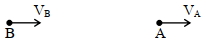
0 likesView Solution
242
PhysicsDifficultMCQJEE Main · 2021
An inductor coil stores $64 \, J$ of magnetic field energy and dissipates energy at the rate of $640 \, W$ when a current of $8 \, A$ is passed through it. If this coil is joined across an ideal battery,find the time constant of the circuit in seconds.
A
$0.4$
B
$0.8$
C
$0.125$
D
$0.2$
Solution
(D) The energy stored in an inductor is given by $U = \frac{1}{2} L i^2$. Given $U = 64 \, J$ and $i = 8 \, A$,we have $64 = \frac{1}{2} \times L \times (8)^2$. This simplifies to $64 = 32L$,so $L = 2 \, H$.
The rate of energy dissipation (power) is given by $P = i^2 R$. Given $P = 640 \, W$ and $i = 8 \, A$,we have $640 = (8)^2 \times R$. This simplifies to $640 = 64R$,so $R = 10 \, \Omega$.
The time constant $\tau$ of an $LR$ circuit is given by $\tau = \frac{L}{R}$. Substituting the values,$\tau = \frac{2}{10} = 0.2 \, s$.
The rate of energy dissipation (power) is given by $P = i^2 R$. Given $P = 640 \, W$ and $i = 8 \, A$,we have $640 = (8)^2 \times R$. This simplifies to $640 = 64R$,so $R = 10 \, \Omega$.
The time constant $\tau$ of an $LR$ circuit is given by $\tau = \frac{L}{R}$. Substituting the values,$\tau = \frac{2}{10} = 0.2 \, s$.
0 likesView Solution
243
PhysicsMediumMCQJEE Main · 2021
$A$ series $LCR$ circuit driven by $300 \, V$ at a frequency of $50 \, Hz$ contains a resistance $R = 3 \, k\Omega$, an inductor of inductive reactance $X_{L} = 250 \pi \, \Omega$ and an unknown capacitor. The value of capacitance to maximize the average power should be: (Take $\pi^{2} = 10$) (in $\mu F$)
A
$4$
B
$25$
C
$400$
D
$40$
Solution
(A) For maximum average power in an $LCR$ circuit, the circuit must be in resonance.
At resonance, the inductive reactance equals the capacitive reactance, i.e., $X_{L} = X_{C}$.
Given $X_{L} = 250 \pi \, \Omega$ and frequency $f = 50 \, Hz$.
The formula for capacitive reactance is $X_{C} = \frac{1}{2 \pi f C}$.
Equating the two: $250 \pi = \frac{1}{2 \pi (50) C}$.
$250 \pi = \frac{1}{100 \pi C}$.
$C = \frac{1}{250 \pi \times 100 \pi} = \frac{1}{25000 \pi^{2}}$.
Given $\pi^{2} = 10$, we have $C = \frac{1}{25000 \times 10} = \frac{1}{250000} \, F$.
$C = 4 \times 10^{-6} \, F = 4 \, \mu F$.
At resonance, the inductive reactance equals the capacitive reactance, i.e., $X_{L} = X_{C}$.
Given $X_{L} = 250 \pi \, \Omega$ and frequency $f = 50 \, Hz$.
The formula for capacitive reactance is $X_{C} = \frac{1}{2 \pi f C}$.
Equating the two: $250 \pi = \frac{1}{2 \pi (50) C}$.
$250 \pi = \frac{1}{100 \pi C}$.
$C = \frac{1}{250 \pi \times 100 \pi} = \frac{1}{25000 \pi^{2}}$.
Given $\pi^{2} = 10$, we have $C = \frac{1}{25000 \times 10} = \frac{1}{250000} \, F$.
$C = 4 \times 10^{-6} \, F = 4 \, \mu F$.
0 likesView Solution
244
PhysicsMediumMCQJEE Main · 2021
Identify the logic operation carried out by the given circuit :-
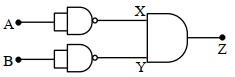
A
$OR$
B
$AND$
C
$NOR$
D
$NAND$
Solution
(C) The given circuit consists of two $NAND$ gates whose inputs are tied together,acting as $NOT$ gates,followed by an $AND$ gate.
Let the inputs be $A$ and $B$.
The outputs of the two $NOT$ gates are $X = \overline{A}$ and $Y = \overline{B}$.
The final output $Z$ is the $AND$ operation of $X$ and $Y$:
$Z = X \cdot Y = \overline{A} \cdot \overline{B}$.
Using De Morgan's theorem,$\overline{A} \cdot \overline{B} = \overline{A + B}$.
This is the Boolean expression for a $NOR$ gate.
Truth Table:
Let the inputs be $A$ and $B$.
The outputs of the two $NOT$ gates are $X = \overline{A}$ and $Y = \overline{B}$.
The final output $Z$ is the $AND$ operation of $X$ and $Y$:
$Z = X \cdot Y = \overline{A} \cdot \overline{B}$.
Using De Morgan's theorem,$\overline{A} \cdot \overline{B} = \overline{A + B}$.
This is the Boolean expression for a $NOR$ gate.
Truth Table:
| $A, B$ | $X, Y$ | $Z$ |
|---|---|---|
| $0, 0$ | $1, 1$ | $1$ |
| $0, 1$ | $1, 0$ | $0$ |
| $1, 0$ | $0, 1$ | $0$ |
| $1, 1$ | $0, 0$ | $0$ |
0 likesView Solution
245
PhysicsMediumMCQJEE Main · 2021
$A$ particular hydrogen-like ion emits radiation of frequency $2.92 \times 10^{15} \text{ Hz}$ when it makes a transition from $n=3$ to $n=1$. The frequency in $\text{Hz}$ of radiation emitted in the transition from $n=2$ to $n=1$ will be: (in $\times 10^{15}$)
A
$0.44$
B
$6.57$
C
$4.38$
D
$2.46$
Solution
(D) The frequency of emitted radiation in a hydrogen-like ion is given by the Rydberg formula: $f = R c Z^2 \left( \frac{1}{n_f^2} - \frac{1}{n_i^2} \right)$,where $k = R c Z^2$ is a constant for a specific ion.
For the transition from $n=3$ to $n=1$: $f_1 = k \left( \frac{1}{1^2} - \frac{1}{3^2} \right) = k \left( 1 - \frac{1}{9} \right) = k \left( \frac{8}{9} \right) = 2.92 \times 10^{15} \text{ Hz}$.
For the transition from $n=2$ to $n=1$: $f_2 = k \left( \frac{1}{1^2} - \frac{1}{2^2} \right) = k \left( 1 - \frac{1}{4} \right) = k \left( \frac{3}{4} \right)$.
Taking the ratio: $\frac{f_1}{f_2} = \frac{k(8/9)}{k(3/4)} = \frac{8}{9} \times \frac{4}{3} = \frac{32}{27}$.
Therefore,$f_2 = f_1 \times \frac{27}{32} = 2.92 \times 10^{15} \times \frac{27}{32} \approx 2.46 \times 10^{15} \text{ Hz}$.
For the transition from $n=3$ to $n=1$: $f_1 = k \left( \frac{1}{1^2} - \frac{1}{3^2} \right) = k \left( 1 - \frac{1}{9} \right) = k \left( \frac{8}{9} \right) = 2.92 \times 10^{15} \text{ Hz}$.
For the transition from $n=2$ to $n=1$: $f_2 = k \left( \frac{1}{1^2} - \frac{1}{2^2} \right) = k \left( 1 - \frac{1}{4} \right) = k \left( \frac{3}{4} \right)$.
Taking the ratio: $\frac{f_1}{f_2} = \frac{k(8/9)}{k(3/4)} = \frac{8}{9} \times \frac{4}{3} = \frac{32}{27}$.
Therefore,$f_2 = f_1 \times \frac{27}{32} = 2.92 \times 10^{15} \times \frac{27}{32} \approx 2.46 \times 10^{15} \text{ Hz}$.
0 likesView Solution
246
PhysicsDifficultMCQJEE Main · 2021
In a photoelectric experiment,ultraviolet light of wavelength $280 \, nm$ is used with a lithium cathode having a work function $\phi = 2.5 \, eV$. If the wavelength of incident light is switched to $400 \, nm$,find out the change in the stopping potential (in $V$).
$(h = 6.63 \times 10^{-34} \, J \cdot s, c = 3 \times 10^8 \, m/s)$
$(h = 6.63 \times 10^{-34} \, J \cdot s, c = 3 \times 10^8 \, m/s)$
A
$1.3$
B
$1.1$
C
$1.9$
D
$0.6$
Solution
(A) The Einstein's photoelectric equation is given by $KE_{\max} = eV_S = \frac{hc}{\lambda} - \phi$.
For $\lambda_1 = 280 \, nm$,the energy of the incident photon is $E_1 = \frac{1240 \, eV \cdot nm}{280 \, nm} \approx 4.43 \, eV$.
The stopping potential $V_{S1}$ is $V_{S1} = \frac{E_1 - \phi}{e} = 4.43 - 2.5 = 1.93 \, V$.
For $\lambda_2 = 400 \, nm$,the energy of the incident photon is $E_2 = \frac{1240 \, eV \cdot nm}{400 \, nm} = 3.10 \, eV$.
The stopping potential $V_{S2}$ is $V_{S2} = \frac{E_2 - \phi}{e} = 3.10 - 2.5 = 0.60 \, V$.
The change in stopping potential is $\Delta V = V_{S1} - V_{S2} = 1.93 - 0.60 = 1.33 \, V \approx 1.3 \, V$.
For $\lambda_1 = 280 \, nm$,the energy of the incident photon is $E_1 = \frac{1240 \, eV \cdot nm}{280 \, nm} \approx 4.43 \, eV$.
The stopping potential $V_{S1}$ is $V_{S1} = \frac{E_1 - \phi}{e} = 4.43 - 2.5 = 1.93 \, V$.
For $\lambda_2 = 400 \, nm$,the energy of the incident photon is $E_2 = \frac{1240 \, eV \cdot nm}{400 \, nm} = 3.10 \, eV$.
The stopping potential $V_{S2}$ is $V_{S2} = \frac{E_2 - \phi}{e} = 3.10 - 2.5 = 0.60 \, V$.
The change in stopping potential is $\Delta V = V_{S1} - V_{S2} = 1.93 - 0.60 = 1.33 \, V \approx 1.3 \, V$.
0 likesView Solution
247
PhysicsDifficultMCQJEE Main · 2021
In the given figure,the $emf$ of the cell is $2.2 \, V$ and the internal resistance is $0.6 \, \Omega$. Calculate the power dissipated in the whole circuit (in $W$).
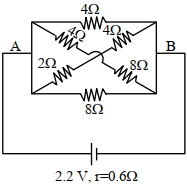
A
$1.32$
B
$0.65$
C
$2.2$
D
$4.4$
Solution
(C) From the circuit diagram,the four resistors are connected in parallel between points $A$ and $B$. The values of the resistors are $4 \, \Omega, 8 \, \Omega, 12 \, \Omega$,and $6 \, \Omega$.
The equivalent resistance $R_{eq}$ of the parallel combination is given by:
$\frac{1}{R_{eq}} = \frac{1}{4} + \frac{1}{8} + \frac{1}{12} + \frac{1}{6}$
$\frac{1}{R_{eq}} = \frac{6 + 3 + 2 + 4}{24} = \frac{15}{24} = \frac{5}{8} \, \Omega^{-1}$
$R_{eq} = \frac{8}{5} = 1.6 \, \Omega$
The total resistance of the circuit $R_T$ including the internal resistance $r = 0.6 \, \Omega$ is:
$R_T = R_{eq} + r = 1.6 + 0.6 = 2.2 \, \Omega$
The power dissipated in the whole circuit is given by $P = \frac{E^2}{R_T}$,where $E = 2.2 \, V$ is the $emf$ of the cell:
$P = \frac{(2.2)^2}{2.2} = 2.2 \, W$
Thus,the power dissipated in the whole circuit is $2.2 \, W$.
The equivalent resistance $R_{eq}$ of the parallel combination is given by:
$\frac{1}{R_{eq}} = \frac{1}{4} + \frac{1}{8} + \frac{1}{12} + \frac{1}{6}$
$\frac{1}{R_{eq}} = \frac{6 + 3 + 2 + 4}{24} = \frac{15}{24} = \frac{5}{8} \, \Omega^{-1}$
$R_{eq} = \frac{8}{5} = 1.6 \, \Omega$
The total resistance of the circuit $R_T$ including the internal resistance $r = 0.6 \, \Omega$ is:
$R_T = R_{eq} + r = 1.6 + 0.6 = 2.2 \, \Omega$
The power dissipated in the whole circuit is given by $P = \frac{E^2}{R_T}$,where $E = 2.2 \, V$ is the $emf$ of the cell:
$P = \frac{(2.2)^2}{2.2} = 2.2 \, W$
Thus,the power dissipated in the whole circuit is $2.2 \, W$.
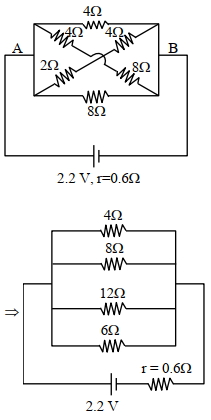
0 likesView Solution
248
PhysicsDifficultMCQJEE Main · 2021
$A$ solid metal sphere of radius $R$ having charge $q$ is enclosed inside a concentric spherical shell of inner radius $a$ and outer radius $b$ as shown in the figure. The approximate variation of the electric field $\overrightarrow{E}$ as a function of distance $r$ from the centre $O$ is given by:
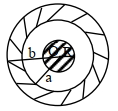
A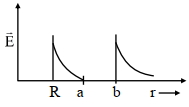
B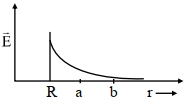
C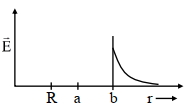
D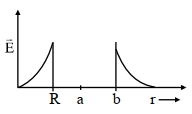
Solution
(A) For a solid metal sphere of radius $R$ with charge $q$ placed inside a conducting spherical shell of inner radius $a$ and outer radius $b$:
$1$. For $r < R$: The electric field inside a conductor is $E = 0$.
$2$. For $R \leq r < a$: The electric field is due to the central sphere,so $E = \frac{k q}{r^2}$.
$3$. For $a \leq r < b$: This region is inside the material of the conducting shell. The induced charge $-q$ on the inner surface $a$ cancels the field of the central charge $q$,so $E = 0$.
$4$. For $r \geq b$: The total charge enclosed is $q + 0 = q$ (assuming the shell is neutral),so $E = \frac{k q}{r^2}$.
Thus,the electric field is zero for $r < R$,follows $1/r^2$ for $R \leq r < a$,is zero for $a \leq r < b$,and follows $1/r^2$ for $r \geq b$.
$1$. For $r < R$: The electric field inside a conductor is $E = 0$.
$2$. For $R \leq r < a$: The electric field is due to the central sphere,so $E = \frac{k q}{r^2}$.
$3$. For $a \leq r < b$: This region is inside the material of the conducting shell. The induced charge $-q$ on the inner surface $a$ cancels the field of the central charge $q$,so $E = 0$.
$4$. For $r \geq b$: The total charge enclosed is $q + 0 = q$ (assuming the shell is neutral),so $E = \frac{k q}{r^2}$.
Thus,the electric field is zero for $r < R$,follows $1/r^2$ for $R \leq r < a$,is zero for $a \leq r < b$,and follows $1/r^2$ for $r \geq b$.
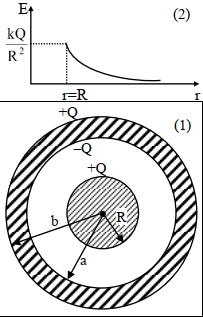
0 likesView Solution
249
PhysicsDifficultMCQJEE Main · 2021
What equal length of an iron wire and a copper-nickel alloy wire, each of $2 \; mm$ diameter, connected in parallel, gives an equivalent resistance of $3 \; \Omega$? (Given: resistivities of iron and copper-nickel alloy wire are $12 \; \mu\Omega \cdot cm$ and $51 \; \mu\Omega \cdot cm$ respectively) (in $m$)
A
$82$
B
$97$
C
$110$
D
$90$
Solution
(B) The resistance $R$ of a wire is given by $R = \rho \frac{L}{A}$, where $\rho$ is resistivity, $L$ is length, and $A$ is the cross-sectional area.
Given diameter $d = 2 \; mm = 2 \times 10^{-3} \; m$, so radius $r = 1 \times 10^{-3} \; m$.
Area $A = \pi r^2 = \pi \times (10^{-3})^2 = \pi \times 10^{-6} \; m^2$.
Resistivity of iron $\rho_1 = 12 \; \mu\Omega \cdot cm = 12 \times 10^{-6} \times 10^{-2} \; \Omega \cdot m = 1.2 \times 10^{-7} \; \Omega \cdot m$.
Resistivity of alloy $\rho_2 = 51 \; \mu\Omega \cdot cm = 51 \times 10^{-6} \times 10^{-2} \; \Omega \cdot m = 5.1 \times 10^{-7} \; \Omega \cdot m$.
For parallel connection, $\frac{1}{R_{eq}} = \frac{1}{R_1} + \frac{1}{R_2} \Rightarrow R_{eq} = \frac{R_1 R_2}{R_1 + R_2} = 3 \; \Omega$.
$R_1 = \frac{\rho_1 L}{A}$ and $R_2 = \frac{\rho_2 L}{A}$.
$R_{eq} = \frac{(\rho_1 L / A) \cdot (\rho_2 L / A)}{(\rho_1 L / A) + (\rho_2 L / A)} = \frac{\rho_1 \rho_2 L}{A(\rho_1 + \rho_2)} = 3$.
$L = \frac{3 A (\rho_1 + \rho_2)}{\rho_1 \rho_2} = \frac{3 \times \pi \times 10^{-6} \times (1.2 + 5.1) \times 10^{-7}}{1.2 \times 10^{-7} \times 5.1 \times 10^{-7}} = \frac{3 \times \pi \times 6.3 \times 10^{-13}}{6.12 \times 10^{-14}} \approx 97 \; m$.
Given diameter $d = 2 \; mm = 2 \times 10^{-3} \; m$, so radius $r = 1 \times 10^{-3} \; m$.
Area $A = \pi r^2 = \pi \times (10^{-3})^2 = \pi \times 10^{-6} \; m^2$.
Resistivity of iron $\rho_1 = 12 \; \mu\Omega \cdot cm = 12 \times 10^{-6} \times 10^{-2} \; \Omega \cdot m = 1.2 \times 10^{-7} \; \Omega \cdot m$.
Resistivity of alloy $\rho_2 = 51 \; \mu\Omega \cdot cm = 51 \times 10^{-6} \times 10^{-2} \; \Omega \cdot m = 5.1 \times 10^{-7} \; \Omega \cdot m$.
For parallel connection, $\frac{1}{R_{eq}} = \frac{1}{R_1} + \frac{1}{R_2} \Rightarrow R_{eq} = \frac{R_1 R_2}{R_1 + R_2} = 3 \; \Omega$.
$R_1 = \frac{\rho_1 L}{A}$ and $R_2 = \frac{\rho_2 L}{A}$.
$R_{eq} = \frac{(\rho_1 L / A) \cdot (\rho_2 L / A)}{(\rho_1 L / A) + (\rho_2 L / A)} = \frac{\rho_1 \rho_2 L}{A(\rho_1 + \rho_2)} = 3$.
$L = \frac{3 A (\rho_1 + \rho_2)}{\rho_1 \rho_2} = \frac{3 \times \pi \times 10^{-6} \times (1.2 + 5.1) \times 10^{-7}}{1.2 \times 10^{-7} \times 5.1 \times 10^{-7}} = \frac{3 \times \pi \times 6.3 \times 10^{-13}}{6.12 \times 10^{-14}} \approx 97 \; m$.
0 likesView Solution
250
PhysicsDifficultMCQJEE Main · 2021
The material filled between the plates of a parallel plate capacitor has resistivity $200 \, \Omega \, m$. The capacitance of the capacitor is $2 \, pF$. If a potential difference of $40 \, V$ is applied across the plates,the leakage current flowing through the capacitor is (given the relative permittivity of the material is $50$):
A
$9.0 \, \mu A$
B
$9.0 \, mA$
C
$0.9 \, mA$
D
$0.9 \, \mu A$
Solution
(C) Given: Resistivity $\rho = 200 \, \Omega \, m$,Capacitance $C = 2 \times 10^{-12} \, F$,Potential difference $V = 40 \, V$,Relative permittivity $K = 50$.
The resistance $R$ of the dielectric material between the plates is given by $R = \frac{\rho d}{A}$,and the capacitance is $C = \frac{K \varepsilon_0 A}{d}$.
Multiplying these,we get the time constant $\tau = RC = \left( \frac{\rho d}{A} \right) \left( \frac{K \varepsilon_0 A}{d} \right) = \rho K \varepsilon_0$.
The leakage current $I$ is given by Ohm's Law: $I = \frac{V}{R}$.
Substituting $R = \frac{\rho d}{A}$ and $C = \frac{K \varepsilon_0 A}{d} \implies \frac{A}{d} = \frac{C}{K \varepsilon_0}$,we get $R = \frac{\rho K \varepsilon_0}{C}$.
Thus,$I = \frac{V}{R} = \frac{VC}{\rho K \varepsilon_0}$.
Substituting the values: $I = \frac{40 \times 2 \times 10^{-12}}{200 \times 50 \times 8.854 \times 10^{-12}}$.
$I = \frac{80 \times 10^{-12}}{10000 \times 8.854 \times 10^{-12}} = \frac{80}{88540} \approx 0.000903 \, A = 0.903 \, mA$.
Rounding to the nearest option,the leakage current is $0.9 \, mA$.
The resistance $R$ of the dielectric material between the plates is given by $R = \frac{\rho d}{A}$,and the capacitance is $C = \frac{K \varepsilon_0 A}{d}$.
Multiplying these,we get the time constant $\tau = RC = \left( \frac{\rho d}{A} \right) \left( \frac{K \varepsilon_0 A}{d} \right) = \rho K \varepsilon_0$.
The leakage current $I$ is given by Ohm's Law: $I = \frac{V}{R}$.
Substituting $R = \frac{\rho d}{A}$ and $C = \frac{K \varepsilon_0 A}{d} \implies \frac{A}{d} = \frac{C}{K \varepsilon_0}$,we get $R = \frac{\rho K \varepsilon_0}{C}$.
Thus,$I = \frac{V}{R} = \frac{VC}{\rho K \varepsilon_0}$.
Substituting the values: $I = \frac{40 \times 2 \times 10^{-12}}{200 \times 50 \times 8.854 \times 10^{-12}}$.
$I = \frac{80 \times 10^{-12}}{10000 \times 8.854 \times 10^{-12}} = \frac{80}{88540} \approx 0.000903 \, A = 0.903 \, mA$.
Rounding to the nearest option,the leakage current is $0.9 \, mA$.
0 likesView Solution
Vedclass Products
For Students
Vedclass Test Series
Mock tests in real JEE Main style covering Physics with performance analysis. 5-day free trial.
Start Free TrialFor Teachers
Exam Paper Generator
Generate Set A/B/C/D Physics papers from 7.5L+ questions in 2 minutes. 3 chapters free.
Try FreeFor Institutes
Online Exam Module
Run live JEE Main mock exams with unlimited students, 360° analytics & white-label branding.
See DemoFrequently Asked Questions
How many Physics questions are in JEE Main 2021?
There are 773 Physics questions from the JEE Main 2021 paper on Vedclass, each with a detailed step-by-step solution in English.
Are JEE Main 2021 Physics solutions available in English?
Yes. All solutions on this page are in English. You can also switch to English or Hindi using the language buttons above the questions.
Can I practice JEE Main 2021 Physics as a timed test?
Yes. Use the Vedclass Test Series to attempt a full JEE Main mock test covering Physics with time limits and instant score analysis.
Can teachers create Physics papers from JEE Main previous year questions?
Yes. The Vedclass Exam Paper Generator lets teachers mix JEE Main Physics questions and generate Set A/B/C/D papers in minutes.
For Teachers & Institutes
Build a Custom Physics Paper
Pick JEE Main 2021 Physics questions, set difficulty, and generate Set A/B/C/D in 2 minutes.