
ChemistryQ101–184 of 284 questions
Page 3 of 3 · English
101
ChemistryMediumMCQAP EAMCET · 2019
$KO_2$ reacts with water to form $A$,$B$ and $C$. $B$ forms $C$ when it reacts with iodine in basic medium. What are $B$ and $C$ respectively?
A
$KOH, H_2O_2$
B
$K_2O_2, H_2O_2$
C
$KOH, O_2$
D
$H_2O_2, O_2$
Solution
(D) $(i)$ When $KO_2$ reacts with water,it gives $(A)$,$(B)$ and $(C)$ as follows:
$2KO_2 + 2H_2O \rightarrow 2KOH + H_2O_2 + O_2$
Here,$A = KOH$,$B = H_2O_2$,and $C = O_2$.
$(ii)$ When $(B)$,i.e.,$H_2O_2$ reacts with iodine in basic medium,it gives $(C)$,i.e.,$O_2$,as shown below:
$I_2 + H_2O_2 + 2OH^{-} \rightarrow 2I^{-} + 2H_2O + O_2$
Thus,$B$ is $H_2O_2$ and $C$ is $O_2$. Therefore,option $(D)$ is the correct answer.
$2KO_2 + 2H_2O \rightarrow 2KOH + H_2O_2 + O_2$
Here,$A = KOH$,$B = H_2O_2$,and $C = O_2$.
$(ii)$ When $(B)$,i.e.,$H_2O_2$ reacts with iodine in basic medium,it gives $(C)$,i.e.,$O_2$,as shown below:
$I_2 + H_2O_2 + 2OH^{-} \rightarrow 2I^{-} + 2H_2O + O_2$
Thus,$B$ is $H_2O_2$ and $C$ is $O_2$. Therefore,option $(D)$ is the correct answer.
0 likesView Solution
102
ChemistryMediumMCQAP EAMCET · 2019
$A$ compound $(MO_2)$ of a group $1$ element $(M)$ is hydrolyzed to form $M^{+}$,$OH^{-}$,$X$,and $Y$. When $X$ reacts with $I_2$ in a basic medium,the products formed are $I^{-}$,water,and $Y$. Then $X$ and $Y$ are respectively:
A
$H_2O_2, O_2$
B
$H_2O_2, O_3$
C
$H_2, O_2$
D
$O_2, H_2$
Solution
(A) The hydrolysis of a superoxide $(MO_2)$ of a group $1$ element $(M)$ is given by the reaction: $2MO_2 + 2H_2O \longrightarrow 2M^{+} + 2OH^{-} + H_2O_2 + O_2$.
Here,$X$ is $H_2O_2$ and $Y$ is $O_2$.
When $X$ $(H_2O_2)$ reacts with $I_2$ in a basic medium,the reaction is: $I_2 + H_2O_2 + 2OH^{-} \longrightarrow 2I^{-} + 2H_2O + O_2$.
In this reaction,$I_2$ is reduced to $I^{-}$ and $H_2O_2$ is oxidized to $O_2$ $(Y)$.
Thus,$X$ is $H_2O_2$ and $Y$ is $O_2$.
Here,$X$ is $H_2O_2$ and $Y$ is $O_2$.
When $X$ $(H_2O_2)$ reacts with $I_2$ in a basic medium,the reaction is: $I_2 + H_2O_2 + 2OH^{-} \longrightarrow 2I^{-} + 2H_2O + O_2$.
In this reaction,$I_2$ is reduced to $I^{-}$ and $H_2O_2$ is oxidized to $O_2$ $(Y)$.
Thus,$X$ is $H_2O_2$ and $Y$ is $O_2$.
0 likesView Solution
103
ChemistryEasyMCQAP EAMCET · 2019
Identify correct statements from the following:
$i$. Beryllium oxide is an amphoteric oxide.
$ii$. Group $II$ elements dissolve in liquid ammonia to form deep blue-black solutions.
$iii$. The hydration enthalpy of group $II$ ions decreases from $Be^{2+}$ to $Ba^{2+}$.
$i$. Beryllium oxide is an amphoteric oxide.
$ii$. Group $II$ elements dissolve in liquid ammonia to form deep blue-black solutions.
$iii$. The hydration enthalpy of group $II$ ions decreases from $Be^{2+}$ to $Ba^{2+}$.
A
$i, ii$ only
B
$ii, iii$ only
C
$i, iii$ only
D
$i, ii, iii$
Solution
(D) All the given statements are correct:
$(i)$ Beryllium oxide $(BeO)$ is amphoteric,meaning it reacts with both acids and bases.
$(ii)$ Group $II$ elements dissolve in liquid ammonia to form deep blue-black solutions due to the presence of ammoniated electrons,which absorb energy in the visible region.
$(iii)$ Hydration enthalpy is inversely proportional to the size of the ion. As the size of the cation increases from $Be^{2+}$ to $Ba^{2+}$,the hydration enthalpy decreases.
$(i)$ Beryllium oxide $(BeO)$ is amphoteric,meaning it reacts with both acids and bases.
$(ii)$ Group $II$ elements dissolve in liquid ammonia to form deep blue-black solutions due to the presence of ammoniated electrons,which absorb energy in the visible region.
$(iii)$ Hydration enthalpy is inversely proportional to the size of the ion. As the size of the cation increases from $Be^{2+}$ to $Ba^{2+}$,the hydration enthalpy decreases.
0 likesView Solution
104
ChemistryEasyMCQAP EAMCET · 2019
Magnesium is burnt in the air to form $A$ and $B$. When $B$ is hydrolyzed,$C$ and $D$ are formed. $D$ is the reactant in the manufacture of nitric acid by Ostwald's process. What is $C$?
A
$NH_3$
B
$Mg(OH)_2$
C
$MgO$
D
$NO$
Solution
(B) When magnesium is burnt in air,it reacts with both oxygen and nitrogen to form magnesium oxide $(A)$ and magnesium nitride $(B)$:
$2Mg_{(s)} + O_{2(g)} \rightarrow 2MgO_{(s)} (A)$
$3Mg_{(s)} + N_{2(g)} \rightarrow Mg_3N_{2(s)} (B)$
When magnesium nitride $(B)$ is hydrolyzed,it produces magnesium hydroxide $(C)$ and ammonia $(D)$:
$Mg_3N_{2(s)} + 6H_2O_{(l)} \rightarrow 3Mg(OH)_{2(aq)} (C) + 2NH_{3(g)} (D)$
Ammonia $(NH_3)$ is the reactant used in the manufacture of nitric acid by the Ostwald process.
Therefore,$C$ is $Mg(OH)_2$.
$2Mg_{(s)} + O_{2(g)} \rightarrow 2MgO_{(s)} (A)$
$3Mg_{(s)} + N_{2(g)} \rightarrow Mg_3N_{2(s)} (B)$
When magnesium nitride $(B)$ is hydrolyzed,it produces magnesium hydroxide $(C)$ and ammonia $(D)$:
$Mg_3N_{2(s)} + 6H_2O_{(l)} \rightarrow 3Mg(OH)_{2(aq)} (C) + 2NH_{3(g)} (D)$
Ammonia $(NH_3)$ is the reactant used in the manufacture of nitric acid by the Ostwald process.
Therefore,$C$ is $Mg(OH)_2$.
0 likesView Solution
105
ChemistryMCQAP EAMCET · 2019
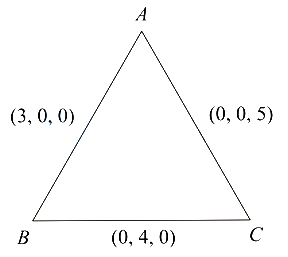
In a triangle $ABC$,if the midpoints of sides $AB, BC, CA$ are $(3,0,0), (0,4,0), (0,0,5)$ respectively,then $AB^2 + BC^2 + CA^2 = $
A
$50$
B
$200$
C
$300$
D
$400$
Solution
(D) Let the vertices of the triangle be $A(x_1, y_1, z_1)$,$B(x_2, y_2, z_2)$,and $C(x_3, y_3, z_3)$.
Given midpoints are $M_{AB} = (3,0,0)$,$M_{BC} = (0,4,0)$,and $M_{CA} = (0,0,5)$.
By the midpoint formula:
$\frac{x_1+x_2}{2} = 3, \frac{y_1+y_2}{2} = 0, \frac{z_1+z_2}{2} = 0 \implies x_1+x_2=6, y_1+y_2=0, z_1+z_2=0$
$\frac{x_2+x_3}{2} = 0, \frac{y_2+y_3}{2} = 4, \frac{z_2+z_3}{2} = 0 \implies x_2+x_3=0, y_2+y_3=8, z_2+z_3=0$
$\frac{x_3+x_1}{2} = 0, \frac{y_3+y_1}{2} = 0, \frac{z_3+z_1}{2} = 5 \implies x_3+x_1=0, y_3+y_1=0, z_3+z_1=10$
Solving these systems,we get $A(3, -4, 5)$,$B(3, 4, -5)$,and $C(-3, 4, 5)$.
Now,calculate the squared lengths of the sides:
$AB^2 = (3-3)^2 + (4 - (-4))^2 + (-5-5)^2 = 0^2 + 8^2 + (-10)^2 = 64 + 100 = 164$
$BC^2 = (-3-3)^2 + (4-4)^2 + (5 - (-5))^2 = (-6)^2 + 0^2 + 10^2 = 36 + 100 = 136$
$CA^2 = (3 - (-3))^2 + (-4-4)^2 + (5-5)^2 = 6^2 + (-8)^2 + 0^2 = 36 + 64 = 100$
Therefore,$AB^2 + BC^2 + CA^2 = 164 + 136 + 100 = 400$.
Given midpoints are $M_{AB} = (3,0,0)$,$M_{BC} = (0,4,0)$,and $M_{CA} = (0,0,5)$.
By the midpoint formula:
$\frac{x_1+x_2}{2} = 3, \frac{y_1+y_2}{2} = 0, \frac{z_1+z_2}{2} = 0 \implies x_1+x_2=6, y_1+y_2=0, z_1+z_2=0$
$\frac{x_2+x_3}{2} = 0, \frac{y_2+y_3}{2} = 4, \frac{z_2+z_3}{2} = 0 \implies x_2+x_3=0, y_2+y_3=8, z_2+z_3=0$
$\frac{x_3+x_1}{2} = 0, \frac{y_3+y_1}{2} = 0, \frac{z_3+z_1}{2} = 5 \implies x_3+x_1=0, y_3+y_1=0, z_3+z_1=10$
Solving these systems,we get $A(3, -4, 5)$,$B(3, 4, -5)$,and $C(-3, 4, 5)$.
Now,calculate the squared lengths of the sides:
$AB^2 = (3-3)^2 + (4 - (-4))^2 + (-5-5)^2 = 0^2 + 8^2 + (-10)^2 = 64 + 100 = 164$
$BC^2 = (-3-3)^2 + (4-4)^2 + (5 - (-5))^2 = (-6)^2 + 0^2 + 10^2 = 36 + 100 = 136$
$CA^2 = (3 - (-3))^2 + (-4-4)^2 + (5-5)^2 = 6^2 + (-8)^2 + 0^2 = 36 + 64 = 100$
Therefore,$AB^2 + BC^2 + CA^2 = 164 + 136 + 100 = 400$.
0 likesView Solution
106
ChemistryEasyMCQAP EAMCET · 2019
In which of the following,the solubility of $AgCl$ will be minimum?
A
$0.1 \ M \ KNO_3$
B
$0.1 \ M \ KCl$
C
$0.2 \ M \ KNO_3$
D
Water
Solution
(B) The solubility of $AgCl$ is governed by the common ion effect.
In the presence of $0.1 \ M \ KCl$,the concentration of $Cl^{-}$ ions increases significantly.
According to Le Chatelier's principle,the equilibrium $AgCl(s) \rightleftharpoons Ag^{+}(aq) + Cl^{-}(aq)$ shifts to the left,decreasing the solubility of $AgCl$.
$KNO_3$ does not provide a common ion,and its effect on solubility is negligible compared to the common ion effect.
Therefore,the solubility of $AgCl$ is minimum in $0.1 \ M \ KCl$.
In the presence of $0.1 \ M \ KCl$,the concentration of $Cl^{-}$ ions increases significantly.
According to Le Chatelier's principle,the equilibrium $AgCl(s) \rightleftharpoons Ag^{+}(aq) + Cl^{-}(aq)$ shifts to the left,decreasing the solubility of $AgCl$.
$KNO_3$ does not provide a common ion,and its effect on solubility is negligible compared to the common ion effect.
Therefore,the solubility of $AgCl$ is minimum in $0.1 \ M \ KCl$.
0 likesView Solution
107
ChemistryEasyMCQAP EAMCET · 2019
The number of moles of solute present in the solutions of $I$,$II$ and $III$ is respectively:
$I$. $500 \ mL$ of $0.2 \ M \ NaOH$
$II$. $200 \ mL$ of $0.1 \ N \ H_2SO_4$
$III$. $6 \ g$ of urea in $1 \ kg$ of water
$I$. $500 \ mL$ of $0.2 \ M \ NaOH$
$II$. $200 \ mL$ of $0.1 \ N \ H_2SO_4$
$III$. $6 \ g$ of urea in $1 \ kg$ of water
A
$0.1, 0.01, 0.1$
B
$0.1, 0.02, 0.1$
C
$0.2, 0.01, 0.1$
D
$0.1, 0.01, 0.2$
Solution
(A) $I$. Moles of $NaOH = \text{Molarity} \times \text{Volume (L)} = 0.2 \times 0.5 = 0.1 \ mol$.
$II$. For $H_2SO_4$,$n$-factor $= 2$. Molarity $= \frac{\text{Normality}}{n-\text{factor}} = \frac{0.1}{2} = 0.05 \ M$.
Moles of $H_2SO_4 = 0.05 \times 0.2 = 0.01 \ mol$.
$III$. Molar mass of urea $(NH_2CONH_2) = 60 \ g/mol$.
Moles of urea $= \frac{\text{Given mass}}{\text{Molar mass}} = \frac{6}{60} = 0.1 \ mol$.
Thus,the number of moles are $0.1, 0.01, 0.1$. Hence,option $(A)$ is correct.
$II$. For $H_2SO_4$,$n$-factor $= 2$. Molarity $= \frac{\text{Normality}}{n-\text{factor}} = \frac{0.1}{2} = 0.05 \ M$.
Moles of $H_2SO_4 = 0.05 \times 0.2 = 0.01 \ mol$.
$III$. Molar mass of urea $(NH_2CONH_2) = 60 \ g/mol$.
Moles of urea $= \frac{\text{Given mass}}{\text{Molar mass}} = \frac{6}{60} = 0.1 \ mol$.
Thus,the number of moles are $0.1, 0.01, 0.1$. Hence,option $(A)$ is correct.
0 likesView Solution
108
ChemistryEasyMCQAP EAMCET · 2019
The ratio of rates of diffusion of gases $A$ and $B$ is $1 : 0.707$. If the molecular weight of $B$ is $32$,the molecular weight of $A$ is
A
$2$
B
$64$
C
$16$
D
$8$
Solution
(C) According to Graham's Law of diffusion,the rate of diffusion $(R)$ is inversely proportional to the square root of the molecular weight $(M)$: $R \propto \frac{1}{\sqrt{M}}$.
Therefore,the ratio of the rates of diffusion for gases $A$ and $B$ is given by: $\frac{R_A}{R_B} = \sqrt{\frac{M_B}{M_A}}$.
Given $\frac{R_A}{R_B} = \frac{1}{0.707}$ and $M_B = 32$,we substitute these values into the equation:
$\frac{1}{0.707} = \sqrt{\frac{32}{M_A}}$.
Squaring both sides,we get: $(\frac{1}{0.707})^2 = \frac{32}{M_A}$.
Since $0.707 \approx \frac{1}{\sqrt{2}}$,then $(\frac{1}{0.707})^2 \approx 2$.
So,$2 = \frac{32}{M_A}$,which gives $M_A = \frac{32}{2} = 16$.
Therefore,the ratio of the rates of diffusion for gases $A$ and $B$ is given by: $\frac{R_A}{R_B} = \sqrt{\frac{M_B}{M_A}}$.
Given $\frac{R_A}{R_B} = \frac{1}{0.707}$ and $M_B = 32$,we substitute these values into the equation:
$\frac{1}{0.707} = \sqrt{\frac{32}{M_A}}$.
Squaring both sides,we get: $(\frac{1}{0.707})^2 = \frac{32}{M_A}$.
Since $0.707 \approx \frac{1}{\sqrt{2}}$,then $(\frac{1}{0.707})^2 \approx 2$.
So,$2 = \frac{32}{M_A}$,which gives $M_A = \frac{32}{2} = 16$.
0 likesView Solution
109
ChemistryEasyMCQAP EAMCET · 2019
If the kinetic energy of $O_2$ gas is $4.0 \ kJ \ mol^{-1}$,its $RMS$ speed in $cm \ s^{-1}$ is
A
$5.0 \times 10^2$
B
$5.0 \times 10^3$
C
$5.0 \times 10^4$
D
$5.0 \times 10^5$
Solution
(C) The kinetic energy $(KE)$ of an ideal gas is given by $KE = \frac{3}{2} RT$.
The root mean square speed $(v_{rms})$ is given by $v_{rms} = \sqrt{\frac{3 RT}{M}}$.
Substituting $\frac{3}{2} RT = KE$,we get $v_{rms} = \sqrt{\frac{2 KE}{M}}$.
Given $KE = 4.0 \ kJ \ mol^{-1} = 4000 \ J \ mol^{-1}$ and molar mass $M$ of $O_2 = 32 \times 10^{-3} \ kg \ mol^{-1}$.
$v_{rms} = \sqrt{\frac{2 \times 4000 \ J \ mol^{-1}}{32 \times 10^{-3} \ kg \ mol^{-1}}} = \sqrt{\frac{8000}{32 \times 10^{-3}}} = \sqrt{250000} = 500 \ m \ s^{-1}$.
Converting to $cm \ s^{-1}$: $500 \ m \ s^{-1} \times 100 \ cm \ m^{-1} = 5.0 \times 10^4 \ cm \ s^{-1}$.
The root mean square speed $(v_{rms})$ is given by $v_{rms} = \sqrt{\frac{3 RT}{M}}$.
Substituting $\frac{3}{2} RT = KE$,we get $v_{rms} = \sqrt{\frac{2 KE}{M}}$.
Given $KE = 4.0 \ kJ \ mol^{-1} = 4000 \ J \ mol^{-1}$ and molar mass $M$ of $O_2 = 32 \times 10^{-3} \ kg \ mol^{-1}$.
$v_{rms} = \sqrt{\frac{2 \times 4000 \ J \ mol^{-1}}{32 \times 10^{-3} \ kg \ mol^{-1}}} = \sqrt{\frac{8000}{32 \times 10^{-3}}} = \sqrt{250000} = 500 \ m \ s^{-1}$.
Converting to $cm \ s^{-1}$: $500 \ m \ s^{-1} \times 100 \ cm \ m^{-1} = 5.0 \times 10^4 \ cm \ s^{-1}$.
0 likesView Solution
110
ChemistryEasyMCQAP EAMCET · 2019
The ratio between $RMS$ velocities of $H_2$ at $50 \ K$ and $O_2$ at $800 \ K$ is
A
$4 : 1$
B
$2 : 1$
C
$1 : 1$
D
$1 : 4$
Solution
(C) Root mean square speed $(v_{rms}) = \sqrt{\frac{3RT}{M}}$
Given:
$M_1 = \text{molar mass of } H_2 = 2 \ g/mol$
$M_2 = \text{molar mass of } O_2 = 32 \ g/mol$
$T_1 = 50 \ K, T_2 = 800 \ K$
Taking the ratio of $v_{rms,1}$ and $v_{rms,2}$:
$\frac{v_{rms,1}}{v_{rms,2}} = \sqrt{\frac{3RT_1}{M_1}} \times \sqrt{\frac{M_2}{3RT_2}} = \sqrt{\frac{M_2 \times T_1}{M_1 \times T_2}}$
$\frac{v_{rms,1}}{v_{rms,2}} = \sqrt{\frac{32}{2} \times \frac{50}{800}} = \sqrt{16 \times \frac{1}{16}} = \sqrt{1} = 1$
Thus,the ratio is $1 : 1$.
Hence,option $(C)$ is correct.
Given:
$M_1 = \text{molar mass of } H_2 = 2 \ g/mol$
$M_2 = \text{molar mass of } O_2 = 32 \ g/mol$
$T_1 = 50 \ K, T_2 = 800 \ K$
Taking the ratio of $v_{rms,1}$ and $v_{rms,2}$:
$\frac{v_{rms,1}}{v_{rms,2}} = \sqrt{\frac{3RT_1}{M_1}} \times \sqrt{\frac{M_2}{3RT_2}} = \sqrt{\frac{M_2 \times T_1}{M_1 \times T_2}}$
$\frac{v_{rms,1}}{v_{rms,2}} = \sqrt{\frac{32}{2} \times \frac{50}{800}} = \sqrt{16 \times \frac{1}{16}} = \sqrt{1} = 1$
Thus,the ratio is $1 : 1$.
Hence,option $(C)$ is correct.
0 likesView Solution
111
ChemistryMediumMCQAP EAMCET · 2019
If the kinetic energy and $RMS$ speed of a gas at a certain temperature are $4.0 \ kJ \ mol^{-1}$ and $5.0 \times 10^4 \ cm \ s^{-1}$,respectively,the molecular weight of the gas is:
A
$16$
B
$32$
C
$64$
D
$44$
Solution
(B) The kinetic energy $(KE)$ of one mole of an ideal gas is given by the formula: $KE = \frac{1}{2} M v_{rms}^2$,where $M$ is the molar mass in $kg \ mol^{-1}$ and $v_{rms}$ is the root mean square speed in $m \ s^{-1}$.
Given: $KE = 4.0 \ kJ \ mol^{-1} = 4000 \ J \ mol^{-1}$ and $v_{rms} = 5.0 \times 10^4 \ cm \ s^{-1} = 500 \ m \ s^{-1}$.
Substituting the values into the equation: $4000 = \frac{1}{2} \times M \times (500)^2$.
$4000 = \frac{1}{2} \times M \times 250000$.
$4000 = M \times 125000$.
$M = \frac{4000}{125000} = 0.032 \ kg \ mol^{-1}$.
Converting to grams: $M = 0.032 \times 1000 \ g \ mol^{-1} = 32 \ g \ mol^{-1}$.
Given: $KE = 4.0 \ kJ \ mol^{-1} = 4000 \ J \ mol^{-1}$ and $v_{rms} = 5.0 \times 10^4 \ cm \ s^{-1} = 500 \ m \ s^{-1}$.
Substituting the values into the equation: $4000 = \frac{1}{2} \times M \times (500)^2$.
$4000 = \frac{1}{2} \times M \times 250000$.
$4000 = M \times 125000$.
$M = \frac{4000}{125000} = 0.032 \ kg \ mol^{-1}$.
Converting to grams: $M = 0.032 \times 1000 \ g \ mol^{-1} = 32 \ g \ mol^{-1}$.
0 likesView Solution
112
ChemistryEasyMCQAP EAMCET · 2019
If the most probable speed of $CO_2$ at $27^{\circ} C$ is $400 \ ms^{-1}$,the root mean square velocity of $CO_2$ at the same temperature in $ms^{-1}$ is approximately:
A
$600$
B
$490$
C
$267$
D
$245$
Solution
(B) Given,\\ Temperature $(T)$ is the same for most probable velocity $(v_{mp})$ and root mean square velocity $(v_{rms})$. \\ The formulas are: \\ $v_{mp} = \sqrt{\frac{2RT}{M}}$ and $v_{rms} = \sqrt{\frac{3RT}{M}}$. \\ Taking the ratio: \\ $\frac{v_{rms}}{v_{mp}} = \sqrt{\frac{3RT/M}{2RT/M}} = \sqrt{\frac{3}{2}} = \sqrt{1.5} \approx 1.2247$. \\ Given $v_{mp} = 400 \ ms^{-1}$,then: \\ $v_{rms} = 1.2247 \times 400 \ ms^{-1} \approx 489.88 \ ms^{-1} \approx 490 \ ms^{-1}$. \\ Thus,option $(B)$ is the correct answer.
0 likesView Solution
113
ChemistryMediumMCQAP EAMCET · 2019
If four elements with atomic numbers $Z-2$,$Z-1$,$Z$ and $Z+1$ are forming isoelectronic ions,the atomic number of the ion having largest size is
A
$Z-2$
B
$Z-1$
C
$Z$
D
$Z+1$
Solution
(A) $\because$ $Z$ represents the number of protons in a nucleus.
For isoelectronic species,the size depends on the effective nuclear charge.
As the number of protons $(Z)$ decreases for the same number of electrons,the attraction between the nucleus and the electrons decreases,leading to an increase in ionic size.
Thus,the species with the smallest atomic number will have the largest size.
Comparing the given atomic numbers: $Z-2 < Z-1 < Z < Z+1$.
Therefore,the ion with atomic number $Z-2$ will have the largest size.
Hence,option $(A)$ is the correct answer.
For isoelectronic species,the size depends on the effective nuclear charge.
As the number of protons $(Z)$ decreases for the same number of electrons,the attraction between the nucleus and the electrons decreases,leading to an increase in ionic size.
Thus,the species with the smallest atomic number will have the largest size.
Comparing the given atomic numbers: $Z-2 < Z-1 < Z < Z+1$.
Therefore,the ion with atomic number $Z-2$ will have the largest size.
Hence,option $(A)$ is the correct answer.
0 likesView Solution
114
ChemistryEasyMCQAP EAMCET · 2019
An element with mass number $181$ contains $32 \%$ more neutrons as compared to protons. What is the symbol of that element?
A
$Pt$
B
$Pd$
C
$Au$
D
$Hg$
Solution
(A) Let $a$ be the number of protons in the element.
The number of neutrons is $a + 0.32a = 1.32a$.
The mass number is the sum of protons and neutrons,which is $181$.
$a + 1.32a = 181$
$2.32a = 181$
$a = \frac{181}{2.32} \approx 78$.
The element with atomic number $78$ is Platinum $(Pt)$.
The number of neutrons is $a + 0.32a = 1.32a$.
The mass number is the sum of protons and neutrons,which is $181$.
$a + 1.32a = 181$
$2.32a = 181$
$a = \frac{181}{2.32} \approx 78$.
The element with atomic number $78$ is Platinum $(Pt)$.
0 likesView Solution
115
ChemistryDifficultMCQAP EAMCET · 2019
The energy of an electron in an orbit of a hydrogen-like ion with an orbit radius of $52.9 \ pm$ in $J$ is (ground state energy of an electron in a hydrogen atom is $-2.18 \times 10^{-18} \ J$).
A
$-4.36 \times 10^{-18}$
B
$-1.09 \times 10^{-17}$
C
$-8.72 \times 10^{-18}$
D
$-6.54 \times 10^{-18}$
Solution
(C) The radius of an orbit in a hydrogen-like ion is given by $r_n = a_0 \times \frac{n^2}{Z}$, where $a_0 = 52.9 \ pm$ is the Bohr radius.
Given $r_n = 52.9 \ pm$, we have $52.9 = 52.9 \times \frac{n^2}{Z}$, which implies $\frac{n^2}{Z} = 1$ or $n^2 = Z$.
The energy of an electron in a hydrogen-like ion is $E_n = E_1 \times \frac{Z^2}{n^2}$, where $E_1 = -2.18 \times 10^{-18} \ J$.
Substituting $Z = n^2$ into the energy equation: $E_n = E_1 \times \frac{(n^2)^2}{n^2} = E_1 \times n^2$.
For the first excited state $(n = 2)$, $E_2 = -2.18 \times 10^{-18} \times 2^2 = -2.18 \times 10^{-18} \times 4 = -8.72 \times 10^{-18} \ J$.
Thus, the correct option is $(C)$.
Given $r_n = 52.9 \ pm$, we have $52.9 = 52.9 \times \frac{n^2}{Z}$, which implies $\frac{n^2}{Z} = 1$ or $n^2 = Z$.
The energy of an electron in a hydrogen-like ion is $E_n = E_1 \times \frac{Z^2}{n^2}$, where $E_1 = -2.18 \times 10^{-18} \ J$.
Substituting $Z = n^2$ into the energy equation: $E_n = E_1 \times \frac{(n^2)^2}{n^2} = E_1 \times n^2$.
For the first excited state $(n = 2)$, $E_2 = -2.18 \times 10^{-18} \times 2^2 = -2.18 \times 10^{-18} \times 4 = -8.72 \times 10^{-18} \ J$.
Thus, the correct option is $(C)$.
0 likesView Solution
116
ChemistryMediumMCQAP EAMCET · 2019
The energy associated with Bohr's orbit in the hydrogen atom is given by the expression,$E_n = -\frac{13.6}{n^2} \ eV$. The energy in $eV$ associated with the orbit having a radius $9 r_1$ is ($r_1$ is the radius of the first orbit).
A
$-13.6$
B
$-6.8$
C
$-1.51$
D
$-1.36$
Solution
(C) Given,the energy associated with Bohr's orbit in the hydrogen atom is $E_n = -\frac{13.6}{n^2} \ eV$.
The radius of Bohr's orbit is given by $r_n = r_1 n^2$,where $r_1$ is the radius of the first orbit.
Given that $r_n = 9 r_1$,we have $r_1 n^2 = 9 r_1$,which implies $n^2 = 9$,so $n = 3$.
Substituting $n = 3$ into the energy expression:
$E_3 = -\frac{13.6}{3^2} \ eV = -\frac{13.6}{9} \ eV = -1.51 \ eV$.
The radius of Bohr's orbit is given by $r_n = r_1 n^2$,where $r_1$ is the radius of the first orbit.
Given that $r_n = 9 r_1$,we have $r_1 n^2 = 9 r_1$,which implies $n^2 = 9$,so $n = 3$.
Substituting $n = 3$ into the energy expression:
$E_3 = -\frac{13.6}{3^2} \ eV = -\frac{13.6}{9} \ eV = -1.51 \ eV$.
0 likesView Solution
117
ChemistryDifficultMCQAP EAMCET · 2019
The energies of an electron in the first orbit of $He^{+}$ and in the third orbit of $Li^{2+}$ in $J$ are respectively:
A
$-8.72 \times 10^{-18}, -2.18 \times 10^{-18}$
B
$-8.72 \times 10^{-18}, -1.96 \times 10^{-17}$
C
$-1.96 \times 10^{-17}, -2.18 \times 10^{-18}$
D
$-8.72 \times 10^{-17}, -1.96 \times 10^{-17}$
Solution
(A) The energy of an electron in the $n$th orbit of a hydrogen-like species is given by the formula:
$E_n = -2.18 \times 10^{-18} \times \frac{Z^2}{n^2} \ J/\text{ion}$
For $He^{+}$ ion:
Atomic number $Z = 2$,orbit number $n = 1$.
$E_1 = -2.18 \times 10^{-18} \times \frac{2^2}{1^2} = -2.18 \times 10^{-18} \times 4 = -8.72 \times 10^{-18} \ J$.
For $Li^{2+}$ ion:
Atomic number $Z = 3$,orbit number $n = 3$.
$E_3 = -2.18 \times 10^{-18} \times \frac{3^2}{3^2} = -2.18 \times 10^{-18} \times 1 = -2.18 \times 10^{-18} \ J$.
Thus,the energies are $-8.72 \times 10^{-18} \ J$ and $-2.18 \times 10^{-18} \ J$ respectively.
Therefore,option $A$ is correct.
$E_n = -2.18 \times 10^{-18} \times \frac{Z^2}{n^2} \ J/\text{ion}$
For $He^{+}$ ion:
Atomic number $Z = 2$,orbit number $n = 1$.
$E_1 = -2.18 \times 10^{-18} \times \frac{2^2}{1^2} = -2.18 \times 10^{-18} \times 4 = -8.72 \times 10^{-18} \ J$.
For $Li^{2+}$ ion:
Atomic number $Z = 3$,orbit number $n = 3$.
$E_3 = -2.18 \times 10^{-18} \times \frac{3^2}{3^2} = -2.18 \times 10^{-18} \times 1 = -2.18 \times 10^{-18} \ J$.
Thus,the energies are $-8.72 \times 10^{-18} \ J$ and $-2.18 \times 10^{-18} \ J$ respectively.
Therefore,option $A$ is correct.
0 likesView Solution
118
ChemistryEasyMCQAP EAMCET · 2019
The wavelength of a microscopic particle of mass $9.1 \times 10^{-31} \ kg$ is $182 \ nm$. Its kinetic energy in $J$ is: $(h = 6.625 \times 10^{-34} \ J \ s)$
A
$728 \times 10^{-23}$
B
$7.28 \times 10^{-24}$
C
$3.64 \times 10^{23}$
D
$3.64 \times 10^{24}$
Solution
(B) Given,mass of particle $(m) = 9.1 \times 10^{-31} \ kg$.
Wavelength $(\lambda) = 182 \ nm = 182 \times 10^{-9} \ m$.
According to the de-Broglie equation,$\lambda = \frac{h}{mv}$,so velocity $v = \frac{h}{m \lambda}$.
Substituting the values: $v = \frac{6.625 \times 10^{-34}}{9.1 \times 10^{-31} \times 182 \times 10^{-9}} \ m/s$.
$v = \frac{6.625 \times 10^{-34}}{1656.2 \times 10^{-40}} \ m/s \approx 4000 \ m/s = 4 \times 10^3 \ m/s$.
Kinetic energy $(KE) = \frac{1}{2} mv^2 = \frac{1}{2} \times (9.1 \times 10^{-31} \ kg) \times (4 \times 10^3 \ m/s)^2$.
$KE = 0.5 \times 9.1 \times 10^{-31} \times 16 \times 10^6 \ J = 72.8 \times 10^{-25} \ J = 7.28 \times 10^{-24} \ J$.
Wavelength $(\lambda) = 182 \ nm = 182 \times 10^{-9} \ m$.
According to the de-Broglie equation,$\lambda = \frac{h}{mv}$,so velocity $v = \frac{h}{m \lambda}$.
Substituting the values: $v = \frac{6.625 \times 10^{-34}}{9.1 \times 10^{-31} \times 182 \times 10^{-9}} \ m/s$.
$v = \frac{6.625 \times 10^{-34}}{1656.2 \times 10^{-40}} \ m/s \approx 4000 \ m/s = 4 \times 10^3 \ m/s$.
Kinetic energy $(KE) = \frac{1}{2} mv^2 = \frac{1}{2} \times (9.1 \times 10^{-31} \ kg) \times (4 \times 10^3 \ m/s)^2$.
$KE = 0.5 \times 9.1 \times 10^{-31} \times 16 \times 10^6 \ J = 72.8 \times 10^{-25} \ J = 7.28 \times 10^{-24} \ J$.
0 likesView Solution
119
ChemistryEasyMCQAP EAMCET · 2019
When a certain metal was irradiated with light of frequency $4.0 \times 10^{16} \ s^{-1}$,the photoelectrons emitted had four times the kinetic energy as the kinetic energy of photoelectrons emitted when the same metal was irradiated with light of frequency $2.0 \times 10^{16} \ s^{-1}$. The threshold frequency $(v_0)$ of the metal in $s^{-1}$ is
A
$2 \times 10^{16}$
B
$4 \times 10^{16}$
C
$2.5 \times 10^{16}$
D
$1.33 \times 10^{16}$
Solution
(D) According to Einstein's photoelectric equation: $KE = h v - h v_0$.
For the first case: $KE_1 = h(4.0 \times 10^{16}) - h v_0$.
For the second case: $KE_2 = h(2.0 \times 10^{16}) - h v_0$.
Given that $KE_1 = 4 KE_2$,we have:
$h(4.0 \times 10^{16}) - h v_0 = 4(h(2.0 \times 10^{16}) - h v_0)$.
Dividing by $h$: $4.0 \times 10^{16} - v_0 = 8.0 \times 10^{16} - 4 v_0$.
Rearranging the terms: $3 v_0 = 4.0 \times 10^{16}$.
$v_0 = \frac{4.0 \times 10^{16}}{3} = 1.33 \times 10^{16} \ s^{-1}$.
For the first case: $KE_1 = h(4.0 \times 10^{16}) - h v_0$.
For the second case: $KE_2 = h(2.0 \times 10^{16}) - h v_0$.
Given that $KE_1 = 4 KE_2$,we have:
$h(4.0 \times 10^{16}) - h v_0 = 4(h(2.0 \times 10^{16}) - h v_0)$.
Dividing by $h$: $4.0 \times 10^{16} - v_0 = 8.0 \times 10^{16} - 4 v_0$.
Rearranging the terms: $3 v_0 = 4.0 \times 10^{16}$.
$v_0 = \frac{4.0 \times 10^{16}}{3} = 1.33 \times 10^{16} \ s^{-1}$.
0 likesView Solution
120
ChemistryMediumMCQAP EAMCET · 2019
Which of the following equations represents the velocity $(v)$ of the ejected electrons when a metal is struck with light of frequency $\nu$ and the threshold frequency of the metal is $\nu_0$? ($m_e =$ mass of electron and $h$ is Planck's constant).
A
$v = \sqrt{\frac{h(\nu-\nu_0)}{m_e}}$
B
$v = \sqrt{\frac{2h(\nu-\nu_0)}{m_e}}$
C
$v = \sqrt{\frac{h(\nu-\nu_0)}{2m_e}}$
D
$v = \sqrt{h(\nu-\nu_0)m_e}$
Solution
(B) According to the photoelectric effect,the energy of the incident photon is equal to the sum of the work function (threshold energy) and the kinetic energy of the ejected electron.
$h\nu = h\nu_0 + \frac{1}{2}m_ev^2$
Rearranging for kinetic energy:
$\frac{1}{2}m_ev^2 = h\nu - h\nu_0 = h(\nu - \nu_0)$
Solving for velocity $(v)$:
$v^2 = \frac{2h(\nu - \nu_0)}{m_e}$
$v = \sqrt{\frac{2h(\nu - \nu_0)}{m_e}}$
$h\nu = h\nu_0 + \frac{1}{2}m_ev^2$
Rearranging for kinetic energy:
$\frac{1}{2}m_ev^2 = h\nu - h\nu_0 = h(\nu - \nu_0)$
Solving for velocity $(v)$:
$v^2 = \frac{2h(\nu - \nu_0)}{m_e}$
$v = \sqrt{\frac{2h(\nu - \nu_0)}{m_e}}$
0 likesView Solution
121
ChemistryDifficultMCQAP EAMCET · 2019
If a suitable photon is employed to locate an electron (mass $= 9.11 \times 10^{-31} \ kg$) in an atom within a distance of $10.98 \ nm$,the uncertainty involved in the measurement of its velocity in $ms^{-1}$ is
A
$\frac{1.6565 \times 10^6}{\pi}$
B
$\frac{1.6565 \times 10^4}{\pi}$
C
$\frac{1.6565 \times 10^{-8}}{\pi}$
D
$\frac{1.6565 \times 10^8}{\pi}$
Solution
(B) According to Heisenberg's uncertainty principle,$\Delta x \cdot \Delta v \geq \frac{h}{4 \pi m}$.
Given: $\Delta x = 10.98 \ nm = 10.98 \times 10^{-9} \ m$,$m = 9.11 \times 10^{-31} \ kg$,$h = 6.63 \times 10^{-34} \ Js$.
Substituting the values:
$\Delta v = \frac{h}{4 \pi m \Delta x} = \frac{6.63 \times 10^{-34}}{4 \times \pi \times 9.11 \times 10^{-31} \times 10.98 \times 10^{-9}}$.
$\Delta v = \frac{6.63 \times 10^{-34}}{4 \times \pi \times 10.00278 \times 10^{-39}}$.
$\Delta v = \frac{6.63 \times 10^5}{4 \times \pi \times 10.00278} = \frac{1.6565 \times 10^4}{\pi} \ ms^{-1}$.
Given: $\Delta x = 10.98 \ nm = 10.98 \times 10^{-9} \ m$,$m = 9.11 \times 10^{-31} \ kg$,$h = 6.63 \times 10^{-34} \ Js$.
Substituting the values:
$\Delta v = \frac{h}{4 \pi m \Delta x} = \frac{6.63 \times 10^{-34}}{4 \times \pi \times 9.11 \times 10^{-31} \times 10.98 \times 10^{-9}}$.
$\Delta v = \frac{6.63 \times 10^{-34}}{4 \times \pi \times 10.00278 \times 10^{-39}}$.
$\Delta v = \frac{6.63 \times 10^5}{4 \times \pi \times 10.00278} = \frac{1.6565 \times 10^4}{\pi} \ ms^{-1}$.
0 likesView Solution
122
ChemistryEasyMCQAP EAMCET · 2019
If the kinetic energy of an electron of mass $9.0 \times 10^{-31} \ kg$ is $2.0 \times 10^{-25} \ J$,the wavelength of the electron in $nm$ is approximately (in $.3$)
A
$1004$
B
$1204$
C
$1104$
D
$994$
Solution
(C) Given,\\ Kinetic energy $(KE) = 2.0 \times 10^{-25} \ J$ \\ Mass of electron $(m) = 9.0 \times 10^{-31} \ kg$ \\ Planck's constant $(h) = 6.63 \times 10^{-34} \ Js$ \\ Using the de Broglie wavelength formula: $\lambda = \frac{h}{\sqrt{2m(KE)}}$ \\ Substituting the values: $\lambda = \frac{6.63 \times 10^{-34}}{\sqrt{2 \times 9.0 \times 10^{-31} \times 2.0 \times 10^{-25}}}$ \\ $\lambda = \frac{6.63 \times 10^{-34}}{\sqrt{36 \times 10^{-56}}} = \frac{6.63 \times 10^{-34}}{6.0 \times 10^{-28}}$ \\ $\lambda = 1.105 \times 10^{-6} \ m$ \\ Converting to $nm$: $\lambda = 1.105 \times 10^{-6} \times 10^9 \ nm = 1105 \ nm$ \\ The closest approximate value is $1104.3 \ nm$.
0 likesView Solution
123
ChemistryDifficultMCQAP EAMCET · 2019
What is the mass of a particle with a wavelength of $3.313 \mathring{A}$ moving with a speed of $2.0 \times 10^8 \ m \ s^{-1}$?
A
$1.0 \times 10^{-28} \ kg$
B
$2.0 \times 10^{-32} \ kg$
C
$1.0 \times 10^{-32} \ kg$
D
$2.0 \times 10^{-28} \ kg$
Solution
(C) According to the de-Broglie relation: $\lambda = \frac{h}{mv}$.
Here,$h$ is Planck's constant $(6.626 \times 10^{-34} \ J \ s)$,$v$ is the speed of the particle,$m$ is the mass,and $\lambda$ is the wavelength.
Rearranging the formula to solve for mass: $m = \frac{h}{\lambda \times v}$.
Given values:
$v = 2.0 \times 10^8 \ m \ s^{-1}$
$\lambda = 3.313 \mathring{A} = 3.313 \times 10^{-10} \ m$
Substituting these values into the equation:
$m = \frac{6.626 \times 10^{-34} \ J \ s}{(3.313 \times 10^{-10} \ m) \times (2.0 \times 10^8 \ m \ s^{-1})}$
$m = \frac{6.626 \times 10^{-34}}{6.626 \times 10^{-2}} \ kg = 1.0 \times 10^{-32} \ kg$.
Therefore,option $(C)$ is correct.
Here,$h$ is Planck's constant $(6.626 \times 10^{-34} \ J \ s)$,$v$ is the speed of the particle,$m$ is the mass,and $\lambda$ is the wavelength.
Rearranging the formula to solve for mass: $m = \frac{h}{\lambda \times v}$.
Given values:
$v = 2.0 \times 10^8 \ m \ s^{-1}$
$\lambda = 3.313 \mathring{A} = 3.313 \times 10^{-10} \ m$
Substituting these values into the equation:
$m = \frac{6.626 \times 10^{-34} \ J \ s}{(3.313 \times 10^{-10} \ m) \times (2.0 \times 10^8 \ m \ s^{-1})}$
$m = \frac{6.626 \times 10^{-34}}{6.626 \times 10^{-2}} \ kg = 1.0 \times 10^{-32} \ kg$.
Therefore,option $(C)$ is correct.
0 likesView Solution
124
ChemistryMediumMCQAP EAMCET · 2019
The work function $(W_0)$ of $Li, K, Mg, Ag$ and $Cu$ are $2.42, 2.25, 3.70, 4.30$ and $4.80 \ eV$ respectively. The number of metals which undergo photoelectric effect if a radiation of wavelength $540 \ nm$ falls on them is $(1 \ eV = 1.602 \times 10^{-19} \ J)$.
A
$4$
B
$2$
C
$1$
D
$3$
Solution
(C) For the photoelectric effect to occur,the energy of the incident photon $(E)$ must be greater than or equal to the work function $(W_0)$ of the metal,i.e.,$E \ge W_0$.
Energy of incident photon $(E) = \frac{hc}{\lambda}$.
Given $\lambda = 540 \ nm = 540 \times 10^{-9} \ m$,$h = 6.626 \times 10^{-34} \ J \cdot s$,and $c = 3 \times 10^8 \ m/s$.
$E = \frac{6.626 \times 10^{-34} \times 3 \times 10^8}{540 \times 10^{-9}} \ J = \frac{19.878 \times 10^{-26}}{540 \times 10^{-9}} \ J = 0.0368 \times 10^{-17} \ J = 3.68 \times 10^{-19} \ J$.
Converting $E$ to $eV$: $E = \frac{3.68 \times 10^{-19}}{1.602 \times 10^{-19}} \ eV \approx 2.297 \ eV$.
Photoelectric effect occurs if $E \ge W_0$.
Comparing $E = 2.297 \ eV$ with the work functions:
$Li (2.42 \ eV) > 2.297 \ eV$ (No)
$K (2.25 \ eV) < 2.297 \ eV$ (Yes)
$Mg (3.70 \ eV) > 2.297 \ eV$ (No)
$Ag (4.30 \ eV) > 2.297 \ eV$ (No)
$Cu (4.80 \ eV) > 2.297 \ eV$ (No)
Only $K$ undergoes the photoelectric effect. Thus,the number of metals is $1$.
Energy of incident photon $(E) = \frac{hc}{\lambda}$.
Given $\lambda = 540 \ nm = 540 \times 10^{-9} \ m$,$h = 6.626 \times 10^{-34} \ J \cdot s$,and $c = 3 \times 10^8 \ m/s$.
$E = \frac{6.626 \times 10^{-34} \times 3 \times 10^8}{540 \times 10^{-9}} \ J = \frac{19.878 \times 10^{-26}}{540 \times 10^{-9}} \ J = 0.0368 \times 10^{-17} \ J = 3.68 \times 10^{-19} \ J$.
Converting $E$ to $eV$: $E = \frac{3.68 \times 10^{-19}}{1.602 \times 10^{-19}} \ eV \approx 2.297 \ eV$.
Photoelectric effect occurs if $E \ge W_0$.
Comparing $E = 2.297 \ eV$ with the work functions:
$Li (2.42 \ eV) > 2.297 \ eV$ (No)
$K (2.25 \ eV) < 2.297 \ eV$ (Yes)
$Mg (3.70 \ eV) > 2.297 \ eV$ (No)
$Ag (4.30 \ eV) > 2.297 \ eV$ (No)
$Cu (4.80 \ eV) > 2.297 \ eV$ (No)
Only $K$ undergoes the photoelectric effect. Thus,the number of metals is $1$.
0 likesView Solution
125
ChemistryMediumMCQAP EAMCET · 2019
The wave functions of $1s$-orbitals of two hydrogen atoms are $\psi_A$ and $\psi_B$. $\psi_A$ and $\psi_B$ are linearly combined to form two molecular orbitals ($\sigma$ and $\sigma^*$). Which of the following statements are correct?
$I$. $\sigma^*$ is equal to $(\psi_A - \psi_B)$.
$II$. In $\sigma$-orbital,one nodal plane is present in between two nuclei.
$III$. The energy of $\sigma$-orbital is lower than the energy of $\sigma^*$-orbital.
$I$. $\sigma^*$ is equal to $(\psi_A - \psi_B)$.
$II$. In $\sigma$-orbital,one nodal plane is present in between two nuclei.
$III$. The energy of $\sigma$-orbital is lower than the energy of $\sigma^*$-orbital.
A
$I, II, III$
B
$I, II$ only
C
$II, III$ only
D
$I, III$ only
Solution
(D) According to molecular orbital theory:
$I$. $\sigma^*$-orbitals are formed by the subtraction of two wave functions,$\psi_A$ and $\psi_B$,therefore $\sigma^* = \psi_A - \psi_B$. This is correct.
$II$. $\sigma$-orbitals are formed by the constructive interference of two orbitals in the same phase,and thus,they do not have a nodal plane between the two nuclei. This statement is incorrect.
$III$. The combination of two $1s$ atomic orbitals gives two molecular orbitals,one of which is of lower energy,called the $\sigma$ bonding orbital,and the other is of higher energy,called the $\sigma^*$ anti-bonding orbital. This is correct.
Hence,$(I)$ and $(III)$ are the correct statements,and option $(D)$ is the correct answer.
$I$. $\sigma^*$-orbitals are formed by the subtraction of two wave functions,$\psi_A$ and $\psi_B$,therefore $\sigma^* = \psi_A - \psi_B$. This is correct.
$II$. $\sigma$-orbitals are formed by the constructive interference of two orbitals in the same phase,and thus,they do not have a nodal plane between the two nuclei. This statement is incorrect.
$III$. The combination of two $1s$ atomic orbitals gives two molecular orbitals,one of which is of lower energy,called the $\sigma$ bonding orbital,and the other is of higher energy,called the $\sigma^*$ anti-bonding orbital. This is correct.
Hence,$(I)$ and $(III)$ are the correct statements,and option $(D)$ is the correct answer.
0 likesView Solution
126
ChemistryEasyMCQAP EAMCET · 2019
How many orbitals is/are possible with $n=3$,$l=1$ and $m_l=-1$ values?
A
$2$
B
$3$
C
$5$
D
$1$
Solution
(D) The symbol $n$ represents the principal quantum number (shell). The symbol $l$ represents the azimuthal quantum number (subshell),and $m_l$ represents the magnetic quantum number (orientation of the orbital).
Given $n=3$,$l=1$,and $m_l=-1$.
For a given set of quantum numbers $(n, l, m_l)$,only one specific orbital is defined.
Here,$n=3$ and $l=1$ corresponds to the $3p$ subshell,and $m_l=-1$ specifies one of the three $p$-orbitals (e.g.,$p_x$ or $p_y$).
Thus,only $1$ orbital is possible for this specific set of quantum numbers.
Therefore,option $(D)$ is the correct answer.
Given $n=3$,$l=1$,and $m_l=-1$.
For a given set of quantum numbers $(n, l, m_l)$,only one specific orbital is defined.
Here,$n=3$ and $l=1$ corresponds to the $3p$ subshell,and $m_l=-1$ specifies one of the three $p$-orbitals (e.g.,$p_x$ or $p_y$).
Thus,only $1$ orbital is possible for this specific set of quantum numbers.
Therefore,option $(D)$ is the correct answer.
0 likesView Solution
127
ChemistryMediumMCQAP EAMCET · 2019
The heat required to raise the temperature of $54 \ g$ of aluminium from $40^{\circ}C$ to $60^{\circ}C$ in $J$ is (molar heat capacity of aluminium in this temperature range is $24 \ J \ mol^{-1} \ K^{-1}$; atomic weight of $Al$ is $27$).
A
$480$
B
$800$
C
$960$
D
$1280$
Solution
(C) Given:
Weight of aluminium $(w) = 54 \ g$
Temperature difference $(\Delta T) = 60^{\circ}C - 40^{\circ}C = 20 \ K$ (or $20^{\circ}C$)
Molar heat capacity of aluminium $(C_m) = 24 \ J \ mol^{-1} \ K^{-1}$
Atomic mass of $Al$ $(M) = 27 \ g \ mol^{-1}$
Number of moles of $Al$ $(n) = \frac{w}{M} = \frac{54}{27} = 2 \ mol$
Heat required $(Q) = n \times C_m \times \Delta T$
$Q = 2 \times 24 \times 20 = 960 \ J$
Hence,option $(C)$ is the correct answer.
Weight of aluminium $(w) = 54 \ g$
Temperature difference $(\Delta T) = 60^{\circ}C - 40^{\circ}C = 20 \ K$ (or $20^{\circ}C$)
Molar heat capacity of aluminium $(C_m) = 24 \ J \ mol^{-1} \ K^{-1}$
Atomic mass of $Al$ $(M) = 27 \ g \ mol^{-1}$
Number of moles of $Al$ $(n) = \frac{w}{M} = \frac{54}{27} = 2 \ mol$
Heat required $(Q) = n \times C_m \times \Delta T$
$Q = 2 \times 24 \times 20 = 960 \ J$
Hence,option $(C)$ is the correct answer.
0 likesView Solution
128
ChemistryEasyMCQAP EAMCET · 2019
Match the following:
The correct answer is
| List-$I$ | List-$II$ |
|---|---|
| $(A) \Delta U = W_{ad}$ | $I.$ Isothermal reversible expansion |
| $(B) \Delta U = q - W$ | $II.$ Wall is adiabatic |
| $(C) \Delta U = -q$ | $III.$ Thermally conducting walls |
| $(D) \Delta U = 0$ | $IV.$ Isolated system |
| $V.$ Closed system |
The correct answer is
A
| $A$ | $B$ | $C$ | $D$ |
|---|---|---|---|
| $V$ | $I$ | $II$ | $III$ |
B
| $A$ | $B$ | $C$ | $D$ |
|---|---|---|---|
| $I$ | $III$ | $II$ | $IV$ |
C
| $A$ | $B$ | $C$ | $D$ |
|---|---|---|---|
| $II$ | $V$ | $III$ | $I$ |
D
| $A$ | $B$ | $C$ | $D$ |
|---|---|---|---|
| $II$ | $V$ | $I$ | $III$ |
Solution
(C) The correct match is $A-II, B-V, C-III, D-I$.
Explanations:
$(A) \rightarrow II$: For an adiabatic wall,$q = 0$. From the first law of thermodynamics,$\Delta U = q + W$,so $\Delta U = W_{ad}$.
$(B) \rightarrow V$: For a closed system,both heat $(q)$ and work $(W)$ can be exchanged,following $\Delta U = q - W$ (where $W$ is work done by the system).
$(C) \rightarrow III$: For thermally conducting walls,heat exchange occurs. The specific case $\Delta U = -q$ implies work done is zero or specific conditions are met.
$(D) \rightarrow I$: In an isothermal reversible expansion,$\Delta T = 0$,therefore $\Delta U = C_V \Delta T = 0$.
Explanations:
$(A) \rightarrow II$: For an adiabatic wall,$q = 0$. From the first law of thermodynamics,$\Delta U = q + W$,so $\Delta U = W_{ad}$.
$(B) \rightarrow V$: For a closed system,both heat $(q)$ and work $(W)$ can be exchanged,following $\Delta U = q - W$ (where $W$ is work done by the system).
$(C) \rightarrow III$: For thermally conducting walls,heat exchange occurs. The specific case $\Delta U = -q$ implies work done is zero or specific conditions are met.
$(D) \rightarrow I$: In an isothermal reversible expansion,$\Delta T = 0$,therefore $\Delta U = C_V \Delta T = 0$.
0 likesView Solution
129
ChemistryMediumMCQAP EAMCET · 2019
$6 \ g$ of graphite is burnt in a bomb calorimeter at $25^{\circ} C$ and $1 \ atm$ pressure. The temperature of water increased from $25^{\circ} C$ to $31^{\circ} C$. If $\Delta H$ of this reaction is $-248 \ kJ \ mol^{-1}$,find out $C_V$ (in $kJ \ K^{-1}$) of the bomb calorimeter.
A
$20.667$
B
$41.33$
C
$1488$
D
$0.145$
Solution
(A) The molar mass of graphite $(C)$ is $12 \ g \ mol^{-1}$.
Number of moles of graphite burnt $= \frac{6 \ g}{12 \ g \ mol^{-1}} = 0.5 \ mol$.
In a bomb calorimeter,the volume is constant,so the heat released is equal to the change in internal energy,$\Delta U$.
Given $\Delta H = -248 \ kJ \ mol^{-1}$. For a solid combustion reaction,$\Delta H \approx \Delta U$.
Total heat released $(q)$ $= n \times \Delta U = 0.5 \ mol \times 248 \ kJ \ mol^{-1} = 124 \ kJ$.
The temperature change $\Delta T = 31^{\circ} C - 25^{\circ} C = 6 \ K$.
Using the relation $q = C_V \times \Delta T$,we get $C_V = \frac{q}{\Delta T}$.
$C_V = \frac{124 \ kJ}{6 \ K} = 20.667 \ kJ \ K^{-1}$.
Number of moles of graphite burnt $= \frac{6 \ g}{12 \ g \ mol^{-1}} = 0.5 \ mol$.
In a bomb calorimeter,the volume is constant,so the heat released is equal to the change in internal energy,$\Delta U$.
Given $\Delta H = -248 \ kJ \ mol^{-1}$. For a solid combustion reaction,$\Delta H \approx \Delta U$.
Total heat released $(q)$ $= n \times \Delta U = 0.5 \ mol \times 248 \ kJ \ mol^{-1} = 124 \ kJ$.
The temperature change $\Delta T = 31^{\circ} C - 25^{\circ} C = 6 \ K$.
Using the relation $q = C_V \times \Delta T$,we get $C_V = \frac{q}{\Delta T}$.
$C_V = \frac{124 \ kJ}{6 \ K} = 20.667 \ kJ \ K^{-1}$.
0 likesView Solution
130
ChemistryEasyMCQAP EAMCET · 2019
What is the nature of the reaction at $298 \ K$,if the entropy change and enthalpy change for a chemical reaction are $7.4 \ cal \ K^{-1}$ and $-2.5 \times 10^3 \ cal$,respectively?
A
Reversible
B
Spontaneous
C
Non-Spontaneous
D
Irreversible
Solution
(B) The spontaneity of a reaction is determined by the Gibbs free energy change $(\Delta G)$,which is calculated using the formula: $\Delta G = \Delta H - T \Delta S$.
Given: $\Delta H = -2.5 \times 10^3 \ cal$,$\Delta S = 7.4 \ cal \ K^{-1}$,and $T = 298 \ K$.
Substituting the values: $\Delta G = (-2.5 \times 10^3) - (298 \times 7.4)$.
$\Delta G = -2500 - 2205.2 = -4705.2 \ cal$.
Since $\Delta G < 0$,the reaction is spontaneous.
Given: $\Delta H = -2.5 \times 10^3 \ cal$,$\Delta S = 7.4 \ cal \ K^{-1}$,and $T = 298 \ K$.
Substituting the values: $\Delta G = (-2.5 \times 10^3) - (298 \times 7.4)$.
$\Delta G = -2500 - 2205.2 = -4705.2 \ cal$.
Since $\Delta G < 0$,the reaction is spontaneous.
0 likesView Solution
131
ChemistryMediumMCQAP EAMCET · 2019
At $300 \ K$,the equilibrium constant for a reaction is $10$. The standard free energy change (in $kJ \ mol^{-1}$) for the reaction is
A
$-5.74$
B
$-115.2$
C
$5.74$
D
$-57.4$
Solution
(A) The relationship between standard Gibbs free energy change and equilibrium constant is given by the equation: $\Delta G^{\circ} = -2.303 \ RT \ \log \ K$.
Given: $K = 10$,$T = 300 \ K$,and $R = 8.314 \ J \ mol^{-1} \ K^{-1}$.
Substituting the values: $\Delta G^{\circ} = -2.303 \times 8.314 \ J \ mol^{-1} \ K^{-1} \times 300 \ K \times \log(10)$.
Since $\log(10) = 1$,we get: $\Delta G^{\circ} = -2.303 \times 8.314 \times 300 \ J \ mol^{-1}$.
$\Delta G^{\circ} = -5744.14 \ J \ mol^{-1}$.
Converting to $kJ \ mol^{-1}$: $\Delta G^{\circ} = -5.744 \ kJ \ mol^{-1}$.
Thus,the correct option is $(A)$.
Given: $K = 10$,$T = 300 \ K$,and $R = 8.314 \ J \ mol^{-1} \ K^{-1}$.
Substituting the values: $\Delta G^{\circ} = -2.303 \times 8.314 \ J \ mol^{-1} \ K^{-1} \times 300 \ K \times \log(10)$.
Since $\log(10) = 1$,we get: $\Delta G^{\circ} = -2.303 \times 8.314 \times 300 \ J \ mol^{-1}$.
$\Delta G^{\circ} = -5744.14 \ J \ mol^{-1}$.
Converting to $kJ \ mol^{-1}$: $\Delta G^{\circ} = -5.744 \ kJ \ mol^{-1}$.
Thus,the correct option is $(A)$.
0 likesView Solution
132
ChemistryMCQAP EAMCET · 2019
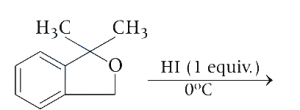
The major product of the following reaction is
A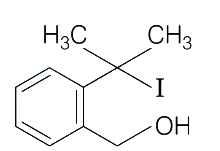
B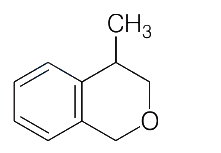
C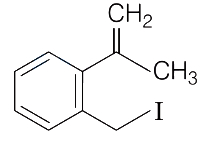
D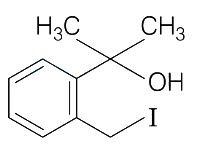
Solution
(A) The reaction is the acidic cleavage of a cyclic ether with $HI$. The ether oxygen gets protonated by $H^+$. The cleavage occurs at the bond that leads to the formation of a more stable carbocation. In this case,the bond between the oxygen and the tertiary carbon atom breaks to form a stable benzylic-tertiary carbocation. The iodide ion $(I^-)$ then attacks this carbocation to form the final product. The structure of the product is $2-(2-iodo-propan-2-yl)phenol$ or a related derivative where the ring is opened,specifically forming an alcohol and an alkyl iodide. The correct product is the one where the $I$ is attached to the tertiary carbon and the $OH$ is attached to the primary carbon of the side chain.
0 likesView Solution
133
ChemistryMCQAP EAMCET · 2019
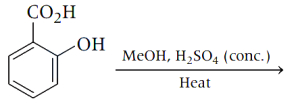
The major product in the following reaction is:
A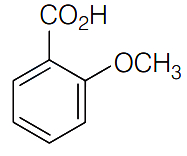
B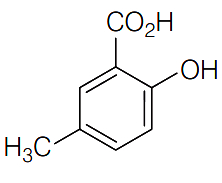
C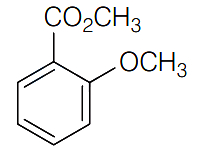
D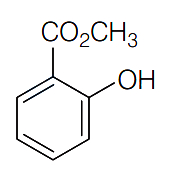
Solution
(D) The reaction is an esterification reaction between salicylic acid $(2-hydroxybenzoic acid)$ and methanol $(MeOH)$ in the presence of a concentrated acid catalyst $(H_2SO_4)$.
In this reaction,the carboxylic acid group $(-COOH)$ reacts with the alcohol $(-OH)$ to form an ester $(-COOCH_3)$.
The phenolic $-OH$ group is less reactive towards esterification under these conditions compared to the carboxylic acid group.
Therefore,the major product is methyl salicylate,where the carboxylic acid group is converted to a methyl ester.
In this reaction,the carboxylic acid group $(-COOH)$ reacts with the alcohol $(-OH)$ to form an ester $(-COOCH_3)$.
The phenolic $-OH$ group is less reactive towards esterification under these conditions compared to the carboxylic acid group.
Therefore,the major product is methyl salicylate,where the carboxylic acid group is converted to a methyl ester.
0 likesView Solution
134
ChemistryMCQAP EAMCET · 2019
Which one of the following equations is correct for the reaction $N_{2(g)} + 3H_{2(g)} \longrightarrow 2NH_{3(g)}$?
A
$3 \frac{d[NH_3]}{dt} = 2 \frac{d[H_2]}{dt}$
B
$3 \frac{d[NH_3]}{dt} = 3 \frac{d[H_2]}{dt}$
C
$2 \frac{d[NH_3]}{dt} = -3 \frac{d[H_2]}{dt}$
D
$3 \frac{d[NH_3]}{dt} = -2 \frac{d[H_2]}{dt}$
Solution
(D) For the reaction $N_{2(g)} + 3H_{2(g)} \longrightarrow 2NH_{3(g)}$,the rate of reaction is expressed as:
$Rate = -\frac{d[N_2]}{dt} = -\frac{1}{3} \frac{d[H_2]}{dt} = \frac{1}{2} \frac{d[NH_3]}{dt}$
Equating the terms for $NH_3$ and $H_2$:
$-\frac{1}{3} \frac{d[H_2]}{dt} = \frac{1}{2} \frac{d[NH_3]}{dt}$
Multiplying both sides by $6$:
$-2 \frac{d[H_2]}{dt} = 3 \frac{d[NH_3]}{dt}$
Rearranging gives $3 \frac{d[NH_3]}{dt} = -2 \frac{d[H_2]}{dt}$.
$Rate = -\frac{d[N_2]}{dt} = -\frac{1}{3} \frac{d[H_2]}{dt} = \frac{1}{2} \frac{d[NH_3]}{dt}$
Equating the terms for $NH_3$ and $H_2$:
$-\frac{1}{3} \frac{d[H_2]}{dt} = \frac{1}{2} \frac{d[NH_3]}{dt}$
Multiplying both sides by $6$:
$-2 \frac{d[H_2]}{dt} = 3 \frac{d[NH_3]}{dt}$
Rearranging gives $3 \frac{d[NH_3]}{dt} = -2 \frac{d[H_2]}{dt}$.
0 likesView Solution
135
ChemistryMCQAP EAMCET · 2019
Consider the following reaction: $N_{2(g)} + 3H_{2(g)} \longrightarrow 2NH_{3(g)}$. The rate of this reaction in terms of $N_2$ at $T \ K$ is $-\frac{d[N_2]}{dt} = 0.02 \ mol \ L^{-1} \ s^{-1}$. What is the value of $-\frac{d[H_2]}{dt}$ (in units of $mol \ L^{-1} \ s^{-1}$) at the same temperature?
A
$0.02$
B
$50$
C
$0.06$
D
$0.04$
Solution
(C) For the reaction $N_{2(g)} + 3H_{2(g)} \longrightarrow 2NH_{3(g)}$,the rate of reaction is expressed as:
Rate $= -\frac{d[N_2]}{dt} = -\frac{1}{3} \frac{d[H_2]}{dt} = \frac{1}{2} \frac{d[NH_3]}{dt}$.
Given that $-\frac{d[N_2]}{dt} = 0.02 \ mol \ L^{-1} \ s^{-1}$.
Equating the terms for $N_2$ and $H_2$:
$-\frac{d[N_2]}{dt} = -\frac{1}{3} \frac{d[H_2]}{dt}$.
Therefore,$-\frac{d[H_2]}{dt} = 3 \times (-\frac{d[N_2]}{dt})$.
$-\frac{d[H_2]}{dt} = 3 \times 0.02 \ mol \ L^{-1} \ s^{-1} = 0.06 \ mol \ L^{-1} \ s^{-1}$.
Rate $= -\frac{d[N_2]}{dt} = -\frac{1}{3} \frac{d[H_2]}{dt} = \frac{1}{2} \frac{d[NH_3]}{dt}$.
Given that $-\frac{d[N_2]}{dt} = 0.02 \ mol \ L^{-1} \ s^{-1}$.
Equating the terms for $N_2$ and $H_2$:
$-\frac{d[N_2]}{dt} = -\frac{1}{3} \frac{d[H_2]}{dt}$.
Therefore,$-\frac{d[H_2]}{dt} = 3 \times (-\frac{d[N_2]}{dt})$.
$-\frac{d[H_2]}{dt} = 3 \times 0.02 \ mol \ L^{-1} \ s^{-1} = 0.06 \ mol \ L^{-1} \ s^{-1}$.
0 likesView Solution
136
ChemistryMCQAP EAMCET · 2019
$A$ line $L$ has intercepts $a$ and $b$ on the coordinate axes. When the coordinate axes are rotated through an angle $\alpha$ keeping the origin fixed,the same line $L$ has intercepts $p$ and $q$ on the new axes. Then
A
$a^2+b^2=p^2+q^2$
B
$a^2+p^2=b^2+q^2$
C
$\frac{1}{a^2}+\frac{1}{p^2}=\frac{1}{b^2}+\frac{1}{q^2}$
D
$\frac{1}{a^2}+\frac{1}{b^2}=\frac{1}{p^2}+\frac{1}{q^2}$
Solution
(D) The equation of the line $L$ with intercepts $a$ and $b$ is $\frac{x}{a} + \frac{y}{b} = 1$.
When the axes are rotated by an angle $\alpha$,the coordinates $(x, y)$ transform to $(x', y')$ where $x = x' \cos \alpha - y' \sin \alpha$ and $y = x' \sin \alpha + y' \cos \alpha$.
Substituting these into the line equation: $\frac{x' \cos \alpha - y' \sin \alpha}{a} + \frac{x' \sin \alpha + y' \cos \alpha}{b} = 1$.
Rearranging gives $x'(\frac{\cos \alpha}{a} + \frac{\sin \alpha}{b}) + y'(\frac{\cos \alpha}{b} - \frac{\sin \alpha}{a}) = 1$.
Since the new intercepts are $p$ and $q$,we have $\frac{1}{p} = \frac{\cos \alpha}{a} + \frac{\sin \alpha}{b}$ and $\frac{1}{q} = \frac{\cos \alpha}{b} - \frac{\sin \alpha}{a}$.
Squaring and adding these equations: $\frac{1}{p^2} + \frac{1}{q^2} = (\frac{\cos \alpha}{a} + \frac{\sin \alpha}{b})^2 + (\frac{\cos \alpha}{b} - \frac{\sin \alpha}{a})^2$.
Expanding the terms: $\frac{1}{p^2} + \frac{1}{q^2} = \frac{\cos^2 \alpha}{a^2} + \frac{\sin^2 \alpha}{b^2} + \frac{2 \sin \alpha \cos \alpha}{ab} + \frac{\cos^2 \alpha}{b^2} + \frac{\sin^2 \alpha}{a^2} - \frac{2 \sin \alpha \cos \alpha}{ab}$.
Simplifying: $\frac{1}{p^2} + \frac{1}{q^2} = \frac{1}{a^2}(\cos^2 \alpha + \sin^2 \alpha) + \frac{1}{b^2}(\sin^2 \alpha + \cos^2 \alpha) = \frac{1}{a^2} + \frac{1}{b^2}$.
When the axes are rotated by an angle $\alpha$,the coordinates $(x, y)$ transform to $(x', y')$ where $x = x' \cos \alpha - y' \sin \alpha$ and $y = x' \sin \alpha + y' \cos \alpha$.
Substituting these into the line equation: $\frac{x' \cos \alpha - y' \sin \alpha}{a} + \frac{x' \sin \alpha + y' \cos \alpha}{b} = 1$.
Rearranging gives $x'(\frac{\cos \alpha}{a} + \frac{\sin \alpha}{b}) + y'(\frac{\cos \alpha}{b} - \frac{\sin \alpha}{a}) = 1$.
Since the new intercepts are $p$ and $q$,we have $\frac{1}{p} = \frac{\cos \alpha}{a} + \frac{\sin \alpha}{b}$ and $\frac{1}{q} = \frac{\cos \alpha}{b} - \frac{\sin \alpha}{a}$.
Squaring and adding these equations: $\frac{1}{p^2} + \frac{1}{q^2} = (\frac{\cos \alpha}{a} + \frac{\sin \alpha}{b})^2 + (\frac{\cos \alpha}{b} - \frac{\sin \alpha}{a})^2$.
Expanding the terms: $\frac{1}{p^2} + \frac{1}{q^2} = \frac{\cos^2 \alpha}{a^2} + \frac{\sin^2 \alpha}{b^2} + \frac{2 \sin \alpha \cos \alpha}{ab} + \frac{\cos^2 \alpha}{b^2} + \frac{\sin^2 \alpha}{a^2} - \frac{2 \sin \alpha \cos \alpha}{ab}$.
Simplifying: $\frac{1}{p^2} + \frac{1}{q^2} = \frac{1}{a^2}(\cos^2 \alpha + \sin^2 \alpha) + \frac{1}{b^2}(\sin^2 \alpha + \cos^2 \alpha) = \frac{1}{a^2} + \frac{1}{b^2}$.
0 likesView Solution
137
ChemistryMediumMCQAP EAMCET · 2019
Identify '$Z$' in the following reaction sequence:
$2CH_3CH_2CH_2Br$ $\xrightarrow{Na/Ether} X$ $\xrightarrow[10-20 \ atm]{Mo_2O_3, 773K} Y$ $\xrightarrow[CH_3Cl]{Anh. AlCl_3} Z$
$2CH_3CH_2CH_2Br$ $\xrightarrow{Na/Ether} X$ $\xrightarrow[10-20 \ atm]{Mo_2O_3, 773K} Y$ $\xrightarrow[CH_3Cl]{Anh. AlCl_3} Z$
A
Chlorobenzene
B
Benzyl chloride
C
Toluene
D
p-Chlorotoluene
Solution
(C) $1$. The reaction of $2CH_3CH_2CH_2Br$ with $Na/Ether$ is a Wurtz reaction,which produces $n$-hexane $(X = CH_3CH_2CH_2CH_2CH_2CH_3)$.
$2$. The aromatization of $n$-hexane in the presence of $Mo_2O_3$ at $773K$ and $10-20 \ atm$ yields benzene $(Y = C_6H_6)$.
$3$. The reaction of benzene $(Y)$ with $CH_3Cl$ in the presence of anhydrous $AlCl_3$ is a Friedel-Crafts alkylation,which produces toluene $(Z = C_6H_5CH_3)$.
$2$. The aromatization of $n$-hexane in the presence of $Mo_2O_3$ at $773K$ and $10-20 \ atm$ yields benzene $(Y = C_6H_6)$.
$3$. The reaction of benzene $(Y)$ with $CH_3Cl$ in the presence of anhydrous $AlCl_3$ is a Friedel-Crafts alkylation,which produces toluene $(Z = C_6H_5CH_3)$.
0 likesView Solution
138
ChemistryEasyMCQAP EAMCET · 2019
Assertion $(A)$: Helium has the lowest boiling point $(4.2 \ K)$.
Reason $(R)$: The forces that exist between helium atoms are weak dispersion forces.
Reason $(R)$: The forces that exist between helium atoms are weak dispersion forces.
A
Both $(A)$ and $(R)$ are correct and $(R)$ is the correct explanation of $(A)$.
B
Both $(A)$ and $(R)$ are correct but $(R)$ is not the correct explanation of $(A)$.
C
$(A)$ is correct but $(R)$ is incorrect.
D
$(A)$ is incorrect but $(R)$ is correct.
Solution
(A) Helium $(He)$ has the lowest boiling point of $4.2 \ K$ among all known substances.
This is because the interatomic forces of attraction between $He$ atoms are extremely weak London dispersion forces due to the small size and stable electronic configuration of $He$ atoms.
Therefore,both assertion $(A)$ and reason $(R)$ are correct,and $(R)$ is the correct explanation of $(A)$.
This is because the interatomic forces of attraction between $He$ atoms are extremely weak London dispersion forces due to the small size and stable electronic configuration of $He$ atoms.
Therefore,both assertion $(A)$ and reason $(R)$ are correct,and $(R)$ is the correct explanation of $(A)$.
0 likesView Solution
139
ChemistryMediumMCQAP EAMCET · 2019
Match the following:
The correct answer is:
| $A$. Teflon | $I$. $SnCl_2$ |
| $B$. Anionic polymerisation | $II$. $C_2F_4$ |
| $C$. Cationic polymerisation | $III$. Bakelite |
| $D$. Thermosetting polymer | $IV$. Polystyrene |
| $V$. $RLi$ |
The correct answer is:
A
$A-II, B-I, C-V, D-III$
B
$A-II, B-V, C-I, D-IV$
C
$A-II, B-V, C-I, D-III$
D
$A-V, B-II, C-I, D-IV$
Solution
(C) . The monomer of Teflon is $C_2F_4$ $(II)$.
$B$. $RLi$ $(V)$ is used in the initiation of anionic polymerisation.
$C$. $SnCl_2$ $(I)$ is used for cationic polymerisation.
$D$. Bakelite $(III)$ is a thermosetting polymer.
Therefore,the correct matching is $A-II, B-V, C-I, D-III$. Hence,option $(C)$ is correct.
$B$. $RLi$ $(V)$ is used in the initiation of anionic polymerisation.
$C$. $SnCl_2$ $(I)$ is used for cationic polymerisation.
$D$. Bakelite $(III)$ is a thermosetting polymer.
Therefore,the correct matching is $A-II, B-V, C-I, D-III$. Hence,option $(C)$ is correct.
0 likesView Solution
140
ChemistryEasyMCQAP EAMCET · 2019
Match the following polymers in List-$I$ with their monomers in List-$II$:
| List-$I$ | List-$II$ |
|---|---|
| $(A)$ $-(NH-(CH_2)_6-NH-CO-(CH_2)_4-CO)_n-$ | $(I)$ Ethylene glycol and terephthalic acid |
| $(B)$ $-(CO-(CH_2)_5-NH)_n-$ | $(II)$ Phenol and formaldehyde |
| $(C)$ $-(CF_2-CF_2)_n-$ | $(III)$ Caprolactam |
| $(D)$ $-(O-CH_2-CH_2-OOC-C_6H_4-CO)_n-$ | $(IV)$ Hexamethylene diamine and adipic acid |
| $(V)$ Tetrafluoroethene |
A
$IV, III, V, I$
B
$III, II, IV, I$
C
$IV, III, II, I$
D
$II, IV, III, V$
Solution
(NONE) The correct matches are:
$(A)$ $-(NH-(CH_2)_6-NH-CO-(CH_2)_4-CO)_n-$ is Nylon-$6,6$,which is formed from Hexamethylene diamine and Adipic acid. So,$A \rightarrow IV$.
$(B)$ $-(CO-(CH_2)_5-NH)_n-$ is Nylon-$6$,which is formed from Caprolactam. So,$B \rightarrow III$.
$(C)$ $-(CF_2-CF_2)_n-$ is Teflon,which is formed from Tetrafluoroethene. So,$C \rightarrow V$.
$(D)$ $-(O-CH_2-CH_2-OOC-C_6H_4-CO)_n-$ is Dacron (Terylene),which is formed from Ethylene glycol and Terephthalic acid. So,$D \rightarrow I$.
Thus,the correct sequence is $A-IV, B-III, C-V, D-I$.
$(A)$ $-(NH-(CH_2)_6-NH-CO-(CH_2)_4-CO)_n-$ is Nylon-$6,6$,which is formed from Hexamethylene diamine and Adipic acid. So,$A \rightarrow IV$.
$(B)$ $-(CO-(CH_2)_5-NH)_n-$ is Nylon-$6$,which is formed from Caprolactam. So,$B \rightarrow III$.
$(C)$ $-(CF_2-CF_2)_n-$ is Teflon,which is formed from Tetrafluoroethene. So,$C \rightarrow V$.
$(D)$ $-(O-CH_2-CH_2-OOC-C_6H_4-CO)_n-$ is Dacron (Terylene),which is formed from Ethylene glycol and Terephthalic acid. So,$D \rightarrow I$.
Thus,the correct sequence is $A-IV, B-III, C-V, D-I$.
0 likesView Solution
141
ChemistryEasyMCQAP EAMCET · 2019
How many of the following polymers come under the category of condensation polymers? Bakelite,Teflon,Nylon-$6$,Dacron,Polyisoprene,Melamine,Neoprene
A
$4$
B
$3$
C
$5$
D
$6$
Solution
(A) Condensation polymers are formed by the repeated condensation reaction between two different bi-functional or tri-functional monomeric units,usually with the elimination of small molecules like water,alcohol,etc.
$1$. Bakelite: Formed by the condensation of phenol and formaldehyde. It is a condensation polymer.
$2$. Teflon: Formed by the addition polymerization of tetrafluoroethylene. It is an addition polymer.
$3$. Nylon-$6$: Formed by the ring-opening polymerization of caprolactam,which involves the elimination of water during the synthesis of the monomer or the process itself. It is classified as a condensation polymer.
$4$. Dacron (Terylene): Formed by the condensation reaction between ethylene glycol and terephthalic acid. It is a condensation polymer.
$5$. Polyisoprene: Formed by the addition polymerization of isoprene. It is an addition polymer.
$6$. Melamine: Formed by the condensation polymerization of melamine and formaldehyde. It is a condensation polymer.
$7$. Neoprene: Formed by the addition polymerization of chloroprene. It is an addition polymer.
The condensation polymers are: Bakelite,Nylon-$6$,Dacron,and Melamine.
Total count = $4$.
$1$. Bakelite: Formed by the condensation of phenol and formaldehyde. It is a condensation polymer.
$2$. Teflon: Formed by the addition polymerization of tetrafluoroethylene. It is an addition polymer.
$3$. Nylon-$6$: Formed by the ring-opening polymerization of caprolactam,which involves the elimination of water during the synthesis of the monomer or the process itself. It is classified as a condensation polymer.
$4$. Dacron (Terylene): Formed by the condensation reaction between ethylene glycol and terephthalic acid. It is a condensation polymer.
$5$. Polyisoprene: Formed by the addition polymerization of isoprene. It is an addition polymer.
$6$. Melamine: Formed by the condensation polymerization of melamine and formaldehyde. It is a condensation polymer.
$7$. Neoprene: Formed by the addition polymerization of chloroprene. It is an addition polymer.
The condensation polymers are: Bakelite,Nylon-$6$,Dacron,and Melamine.
Total count = $4$.
0 likesView Solution
142
ChemistryEasyMCQAP EAMCET · 2019
Match the following.
The correct answer is:
| List-$I$ (Polymer/Type) | List-$II$ (Monomer/Example) |
|---|---|
| $A$. Addition polymer | $I$. Bakelite |
| $B$. Condensation polymer | $II$. $2$-methyl-$1,3$-butadiene |
| $C$. Acrilan | $III$. $2,3$-dimethyl-$1,3$-butadiene |
| $D$. Rubber | $IV$. Vinyl cyanide |
| $V$. Polythene |
The correct answer is:
A
$A-V, B-I, C-IV, D-II$
B
$A-V, B-I, C-II, D-III$
C
$A-I, B-V, C-IV, D-II$
D
$A-I, B-V, C-II, D-III$
Solution
(A) The matching is as follows:
$A$. Addition polymer is $V$. Polythene.
$B$. Condensation polymer is $I$. Bakelite.
$C$. Acrilan is $IV$. Vinyl cyanide (Acrylonitrile).
$D$. Rubber (Natural rubber) is $II$. $2$-methyl-$1,3$-butadiene (Isoprene).
Therefore,the correct sequence is $A-V, B-I, C-IV, D-II$.
$A$. Addition polymer is $V$. Polythene.
$B$. Condensation polymer is $I$. Bakelite.
$C$. Acrilan is $IV$. Vinyl cyanide (Acrylonitrile).
$D$. Rubber (Natural rubber) is $II$. $2$-methyl-$1,3$-butadiene (Isoprene).
Therefore,the correct sequence is $A-V, B-I, C-IV, D-II$.
0 likesView Solution
143
ChemistryMediumMCQAP EAMCET · 2019
The number average molecular mass of a polymer that contains $15$ molecules with each of mass $8,000$ and $15$ molecules with each of mass $80,000$ is: (in $,000$)
A
$22$
B
$33$
C
$11$
D
$44$
Solution
(D) The number average molecular mass $(M_n)$ of a polymer is calculated using the formula:
$M_n = \frac{\Sigma N_i M_i}{\Sigma N_i}$
Given:
$N_1 = 15, M_1 = 8,000$
$N_2 = 15, M_2 = 80,000$
Substituting the values:
$M_n = \frac{15 \times 8,000 + 15 \times 80,000}{15 + 15}$
$M_n = \frac{120,000 + 1,200,000}{30}$
$M_n = \frac{1,320,000}{30} = 44,000$
$M_n = \frac{\Sigma N_i M_i}{\Sigma N_i}$
Given:
$N_1 = 15, M_1 = 8,000$
$N_2 = 15, M_2 = 80,000$
Substituting the values:
$M_n = \frac{15 \times 8,000 + 15 \times 80,000}{15 + 15}$
$M_n = \frac{120,000 + 1,200,000}{30}$
$M_n = \frac{1,320,000}{30} = 44,000$
0 likesView Solution
144
ChemistryEasyMCQAP EAMCET · 2019
The monomers of nylon$-6, 6$ $(X)$ and terylene $(Y)$ are
A
Nylon$-6, 6$ $(X)$: $H_2N-(CH_2)_5-CH_3$,$HOOC-(CH_2)_4-CH_3$; Terylene $(Y)$: $HO-CH_2-CH_3$,$HO-C_6H_4-COOH$
B
Nylon$-6, 6$ $(X)$: $H_2N-(CH_2)_4-NH_2$,$HOOC-(CH_2)_4-COOH$; Terylene $(Y)$: $HO-CH_2-CH_2-OH$,$C_6H_4(COOH)_2$ (ortho)
C
Nylon$-6, 6$ $(X)$: $H_2N-CH_2-COOH$,$H_2N-(CH_2)_5-COOH$; Terylene $(Y)$: $HO-CH_2-CH_2-OH$,$HO-C_6H_4-COOH$
D
Nylon$-6, 6$ $(X)$: $H_2N-(CH_2)_6-NH_2$,$HOOC-(CH_2)_4-COOH$; Terylene $(Y)$: $HO-CH_2-CH_2-OH$,$HOOC-C_6H_4-COOH$ (terephthalic acid)
Solution
(D) Nylon$-6, 6$ is a polyamide formed by the condensation polymerization of hexamethylenediamine $(H_2N-(CH_2)_6-NH_2)$ and adipic acid $(HOOC-(CH_2)_4-COOH)$.
Terylene (also known as Dacron) is a polyester formed by the condensation polymerization of ethylene glycol $(HO-CH_2-CH_2-OH)$ and terephthalic acid $(HOOC-C_6H_4-COOH)$.
Comparing these with the given options,option $D$ correctly identifies the monomers for both polymers.
Terylene (also known as Dacron) is a polyester formed by the condensation polymerization of ethylene glycol $(HO-CH_2-CH_2-OH)$ and terephthalic acid $(HOOC-C_6H_4-COOH)$.
Comparing these with the given options,option $D$ correctly identifies the monomers for both polymers.
0 likesView Solution
145
ChemistryMediumMCQAP EAMCET · 2019
Which one of the following reactions does not occur?
A
$Cl_2 + 2Br^{-} \longrightarrow Br_2 + 2Cl^{-}$
B
$ClF_3 + H_2O \longrightarrow HCl + HOF + F_2$
C
$2NaOH + Cl_2 \longrightarrow NaCl + NaOCl + H_2O$ (Cold and dil.)
D
$Na_2SO_3 + 2HCl \longrightarrow 2NaCl + SO_2 + H_2O$
Solution
(B) The reaction $ClF_3 + H_2O \longrightarrow HCl + HOF + F_2$ is chemically incorrect. The hydrolysis of $ClF_3$ typically yields $HF$,$HCl$,and $HClO_2$ or $HClO_3$ depending on conditions,but it does not produce $HOF$ and $F_2$ in this manner.
Option $(a)$ is a standard displacement reaction where $Cl_2$ oxidizes $Br^-$.
Option $(c)$ is a standard disproportionation reaction of $Cl_2$ in cold dilute $NaOH$.
Option $(d)$ is a standard acid-base reaction where $SO_2$ is evolved.
Option $(a)$ is a standard displacement reaction where $Cl_2$ oxidizes $Br^-$.
Option $(c)$ is a standard disproportionation reaction of $Cl_2$ in cold dilute $NaOH$.
Option $(d)$ is a standard acid-base reaction where $SO_2$ is evolved.
0 likesView Solution
146
ChemistryDifficultMCQAP EAMCET · 2019
Which of the following reactions are correct with respect to the formation of products?
$I$. $2 NaOH + SO_2 \longrightarrow Na_2SO_3 + H_2O$
$II$. $XeF_4 + O_2F_2 \stackrel{143 K}{\longrightarrow} XeF_6 + O_2$
$III$. $PCl_5 + 4 H_2O \longrightarrow H_3PO_4 + 5 HCl$
$IV$. $2 NaNO_2 + 2 HCl \longrightarrow 2 NaCl + NO + NO_2 + H_2O$
$I$. $2 NaOH + SO_2 \longrightarrow Na_2SO_3 + H_2O$
$II$. $XeF_4 + O_2F_2 \stackrel{143 K}{\longrightarrow} XeF_6 + O_2$
$III$. $PCl_5 + 4 H_2O \longrightarrow H_3PO_4 + 5 HCl$
$IV$. $2 NaNO_2 + 2 HCl \longrightarrow 2 NaCl + NO + NO_2 + H_2O$
A
$I, II$
B
$III, IV$
C
$I, III$
D
$II, IV$
Solution
(A) Let us evaluate each reaction:
$(I)$ $2 NaOH + SO_2 \longrightarrow Na_2SO_3 + H_2O$. This is a correct acid-base reaction.
$(II)$ $XeF_4 + O_2F_2 \stackrel{143 K}{\longrightarrow} XeF_6 + O_2$. This is a correct reaction for the fluorination of xenon fluorides.
$(III)$ $PCl_5 + 4 H_2O \longrightarrow H_3PO_4 + 5 HCl$. This is a correct hydrolysis reaction of phosphorus pentachloride.
$(IV)$ $2 NaNO_2 + 2 HCl \longrightarrow 2 NaCl + NO + NO_2 + H_2O$. This is a correct reaction where nitrous acid $(HNO_2)$ formed in situ decomposes into $NO$,$NO_2$,and $H_2O$.
All reactions $(I, II, III, IV)$ are correct. However,based on standard textbook patterns for this specific question format,the most accurate set is $I, II, III, IV$.
$(I)$ $2 NaOH + SO_2 \longrightarrow Na_2SO_3 + H_2O$. This is a correct acid-base reaction.
$(II)$ $XeF_4 + O_2F_2 \stackrel{143 K}{\longrightarrow} XeF_6 + O_2$. This is a correct reaction for the fluorination of xenon fluorides.
$(III)$ $PCl_5 + 4 H_2O \longrightarrow H_3PO_4 + 5 HCl$. This is a correct hydrolysis reaction of phosphorus pentachloride.
$(IV)$ $2 NaNO_2 + 2 HCl \longrightarrow 2 NaCl + NO + NO_2 + H_2O$. This is a correct reaction where nitrous acid $(HNO_2)$ formed in situ decomposes into $NO$,$NO_2$,and $H_2O$.
All reactions $(I, II, III, IV)$ are correct. However,based on standard textbook patterns for this specific question format,the most accurate set is $I, II, III, IV$.
0 likesView Solution
147
ChemistryMediumMCQAP EAMCET · 2019
At $T \ K$,copper (atomic mass $= 63.5 \ u$) has $fcc$ unit cell structure with edge length of $x \ \mathring{A}$. What is the approximate density of $Cu$ in $g \ cm^{-3}$ at that temperature? $(N_A = 6.0 \times 10^{23} \ mol^{-1})$
A
$\frac{42.3}{x^3}$
B
$\frac{423}{x^3}$
C
$\frac{423}{x^3}$
D
$\frac{212}{x^3}$
Solution
(B) For an $fcc$ unit cell,the number of atoms per unit cell,$Z = 4$.
Edge length $a = x \ \mathring{A} = x \times 10^{-8} \ cm$.
Atomic mass of $Cu = 63.5 \ g \ mol^{-1}$.
Avogadro's number $N_A = 6.0 \times 10^{23} \ mol^{-1}$.
The formula for density $d$ is:
$d = \frac{Z \times M}{a^3 \times N_A}$
Substituting the values:
$d = \frac{4 \times 63.5}{(x \times 10^{-8})^3 \times 6.0 \times 10^{23}}$
$d = \frac{254}{x^3 \times 10^{-24} \times 6.0 \times 10^{23}}$
$d = \frac{254}{x^3 \times 0.6} = \frac{423.33}{x^3} \approx \frac{423}{x^3} \ g \ cm^{-3}$.
Thus,the correct option is $(B)$ or $(C)$.
Edge length $a = x \ \mathring{A} = x \times 10^{-8} \ cm$.
Atomic mass of $Cu = 63.5 \ g \ mol^{-1}$.
Avogadro's number $N_A = 6.0 \times 10^{23} \ mol^{-1}$.
The formula for density $d$ is:
$d = \frac{Z \times M}{a^3 \times N_A}$
Substituting the values:
$d = \frac{4 \times 63.5}{(x \times 10^{-8})^3 \times 6.0 \times 10^{23}}$
$d = \frac{254}{x^3 \times 10^{-24} \times 6.0 \times 10^{23}}$
$d = \frac{254}{x^3 \times 0.6} = \frac{423.33}{x^3} \approx \frac{423}{x^3} \ g \ cm^{-3}$.
Thus,the correct option is $(B)$ or $(C)$.
0 likesView Solution
148
ChemistryEasyMCQAP EAMCET · 2019
If the radius of an atom of an element which forms a body centered cubic unit cell is $173.2 \ pm$, the volume of the unit cell in $cm^3$ is:
A
$3.12 \times 10^{-23}$
B
$6.4 \times 10^{-23}$
C
$3.2 \times 10^{-24}$
D
$2.13 \times 10^{-23}$
Solution
(B) Given, radius of an atom in a body-centered cubic $(bcc)$ unit cell, $r = 173.2 \ pm = 173.2 \times 10^{-10} \ cm$.
For a $bcc$ structure, the relationship between edge length $a$ and radius $r$ is $\sqrt{3} \cdot a = 4r$.
Therefore, $a = \frac{4r}{\sqrt{3}} = \frac{4 \times 173.2 \times 10^{-10}}{1.732} \ cm$.
$a = 4 \times 100 \times 10^{-10} \ cm = 400 \times 10^{-10} \ cm = 4 \times 10^{-8} \ cm$.
The volume of the unit cell $V = a^3 = (4 \times 10^{-8} \ cm)^3$.
$V = 64 \times 10^{-24} \ cm^3 = 6.4 \times 10^{-23} \ cm^3$.
For a $bcc$ structure, the relationship between edge length $a$ and radius $r$ is $\sqrt{3} \cdot a = 4r$.
Therefore, $a = \frac{4r}{\sqrt{3}} = \frac{4 \times 173.2 \times 10^{-10}}{1.732} \ cm$.
$a = 4 \times 100 \times 10^{-10} \ cm = 400 \times 10^{-10} \ cm = 4 \times 10^{-8} \ cm$.
The volume of the unit cell $V = a^3 = (4 \times 10^{-8} \ cm)^3$.
$V = 64 \times 10^{-24} \ cm^3 = 6.4 \times 10^{-23} \ cm^3$.
0 likesView Solution
149
ChemistryEasyMCQAP EAMCET · 2019
$A$ compound is formed from elements $X$ and $Y$. The atoms of $Y$ (anions) form a $ccp$ lattice. The atoms of $X$ (cations) occupy half of the octahedral voids and half of tetrahedral voids. What is the formula of the compound?
A
$X_3 Y_2$
B
$X_2 Y_3$
C
$XY$
D
$X_4 Y_3$
Solution
(A) Let the number of atoms of $Y$ in the $ccp$ lattice be $n = 4$.
Number of octahedral voids = $n = 4$.
Number of tetrahedral voids = $2n = 8$.
Atoms of $X$ occupy half of the octahedral voids and half of the tetrahedral voids.
Number of $X$ atoms = $\frac{1}{2} \times 4 + \frac{1}{2} \times 8 = 2 + 4 = 6$.
The ratio of $X : Y$ is $6 : 4$,which simplifies to $3 : 2$.
Therefore,the formula of the compound is $X_3 Y_2$.
Number of octahedral voids = $n = 4$.
Number of tetrahedral voids = $2n = 8$.
Atoms of $X$ occupy half of the octahedral voids and half of the tetrahedral voids.
Number of $X$ atoms = $\frac{1}{2} \times 4 + \frac{1}{2} \times 8 = 2 + 4 = 6$.
The ratio of $X : Y$ is $6 : 4$,which simplifies to $3 : 2$.
Therefore,the formula of the compound is $X_3 Y_2$.
0 likesView Solution
150
ChemistryMediumMCQAP EAMCET · 2019
If $0.5 \ mol$ of a metal forms a hexagonal close-packed structure,the total number of voids and tetrahedral voids respectively in $mol$ are
A
$1.5, 1.0$
B
$1.0, 0.5$
C
$1.0, 1.5$
D
$0.5, 1.0$
Solution
(A) In a close-packed structure,if the number of atoms is $N$,then the number of octahedral voids is $N$ and the number of tetrahedral voids is $2N$.
Given,number of moles of metal atoms $= 0.5 \ mol$.
Number of octahedral voids $= 0.5 \ mol$.
Number of tetrahedral voids $= 2 \times 0.5 \ mol = 1.0 \ mol$.
Total number of voids $= \text{octahedral voids} + \text{tetrahedral voids} = 0.5 \ mol + 1.0 \ mol = 1.5 \ mol$.
Thus,the total number of voids is $1.5 \ mol$ and the number of tetrahedral voids is $1.0 \ mol$.
Therefore,option $(A)$ is the correct answer.
Given,number of moles of metal atoms $= 0.5 \ mol$.
Number of octahedral voids $= 0.5 \ mol$.
Number of tetrahedral voids $= 2 \times 0.5 \ mol = 1.0 \ mol$.
Total number of voids $= \text{octahedral voids} + \text{tetrahedral voids} = 0.5 \ mol + 1.0 \ mol = 1.5 \ mol$.
Thus,the total number of voids is $1.5 \ mol$ and the number of tetrahedral voids is $1.0 \ mol$.
Therefore,option $(A)$ is the correct answer.
0 likesView Solution
151
ChemistryEasyMCQAP EAMCET · 2019
Which one of the following statements is not correct?
A
Schottky defect in ionic solids does not change the density of the crystal
B
Packing efficiency is the percentage of total space filled by the particles
C
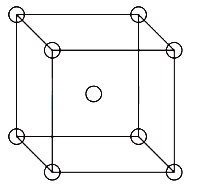
In body centered cubic unit cell,the relationship between atomic radius $(r)$ and the edge length $(a)$ is,$r = \frac{\sqrt{3}}{4} a$
D
Photovoltaic cell is used for conversion of light energy into electrical energy
Solution
(A) . Schottky defect is a type of point defect in a crystal lattice in which ions leave their lattice sites,creating vacancies. Hence,it decreases the density of the crystal.
$B$. Packing efficiency is the percentage value of the total space filled by the particles.
$\text{Packing efficiency} = \frac{\text{Volume of atoms occupied}}{\text{Total volume of unit cell}} \times 100$
$C$. In a $bcc$ crystal lattice,the body diagonal is $\sqrt{3} a = 4r$,so $r = \frac{\sqrt{3}}{4} a$.
$D$. $A$ photovoltaic cell is used for the conversion of light energy into electrical energy.
Therefore,option $A$ is incorrect.
$B$. Packing efficiency is the percentage value of the total space filled by the particles.
$\text{Packing efficiency} = \frac{\text{Volume of atoms occupied}}{\text{Total volume of unit cell}} \times 100$
$C$. In a $bcc$ crystal lattice,the body diagonal is $\sqrt{3} a = 4r$,so $r = \frac{\sqrt{3}}{4} a$.
$D$. $A$ photovoltaic cell is used for the conversion of light energy into electrical energy.
Therefore,option $A$ is incorrect.
0 likesView Solution
152
ChemistryDifficultMCQAP EAMCET · 2019
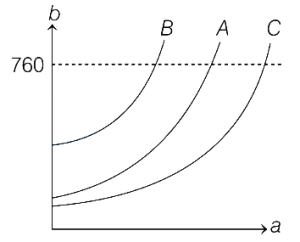
The variation of vapour pressure $(b)$ as a function of temperature $(a)$ is studied for $C_2H_5OC_2H_5$,$CCl_4$,and $H_2O$ at $760 \ mm \ Hg$ and is shown in the figure below. The boiling temperatures of $C_2H_5OC_2H_5$,$CCl_4$,and $H_2O$ are $308 \ K$,$350 \ K$,and $373 \ K$ respectively. Curves $A$,$B$,and $C$ respectively correspond to:
A
$H_2O, C_2H_5OC_2H_5, CCl_4$
B
$C_2H_5OC_2H_5, CCl_4, H_2O$
C
$CCl_4, C_2H_5OC_2H_5, H_2O$
D
$CCl_4, H_2O, C_2H_5OC_2H_5$
Solution
(C) The boiling point of a liquid is the temperature at which its vapour pressure becomes equal to the external atmospheric pressure $(760 \ mm \ Hg)$.
Given boiling points:
$C_2H_5OC_2H_5 = 308 \ K$
$CCl_4 = 350 \ K$
$H_2O = 373 \ K$
From the graph,by drawing perpendiculars from the intersection points of the curves with the $760 \ mm \ Hg$ line to the temperature axis $(a)$,we observe the order of boiling temperatures as $T_B < T_A < T_C$.
Substituting the given values:
$T_B = 308 \ K$ (for $C_2H_5OC_2H_5$)
$T_A = 350 \ K$ (for $CCl_4$)
$T_C = 373 \ K$ (for $H_2O$)
Therefore,curve $A$ corresponds to $CCl_4$,curve $B$ corresponds to $C_2H_5OC_2H_5$,and curve $C$ corresponds to $H_2O$.
The correct sequence for $A, B, C$ is $CCl_4, C_2H_5OC_2H_5, H_2O$.
Given boiling points:
$C_2H_5OC_2H_5 = 308 \ K$
$CCl_4 = 350 \ K$
$H_2O = 373 \ K$
From the graph,by drawing perpendiculars from the intersection points of the curves with the $760 \ mm \ Hg$ line to the temperature axis $(a)$,we observe the order of boiling temperatures as $T_B < T_A < T_C$.
Substituting the given values:
$T_B = 308 \ K$ (for $C_2H_5OC_2H_5$)
$T_A = 350 \ K$ (for $CCl_4$)
$T_C = 373 \ K$ (for $H_2O$)
Therefore,curve $A$ corresponds to $CCl_4$,curve $B$ corresponds to $C_2H_5OC_2H_5$,and curve $C$ corresponds to $H_2O$.
The correct sequence for $A, B, C$ is $CCl_4, C_2H_5OC_2H_5, H_2O$.
0 likesView Solution
153
ChemistryMediumMCQAP EAMCET · 2019
The vapour pressures of chloroform $(CHCl_3)$ and dichloromethane $(CH_2Cl_2)$ at $298 \ K$ are $200 \ mmHg$ and $415 \ mmHg$,respectively. An ideal solution is prepared by mixing $59.75 \ g$ of $CHCl_3$ and $21.25 \ g$ of $CH_2Cl_2$. The mole fractions of chloroform and dichloromethane in the vapour phase,respectively,are:
A
$0.509, 0.491$
B
$0.491, 0.509$
C
$0.201, 0.799$
D
$0.799, 0.201$
Solution
(B) $1$. Calculate moles of each component:
$n_{CHCl_3} = \frac{59.75 \ g}{119.5 \ g \cdot mol^{-1}} = 0.5 \ mol$
$n_{CH_2Cl_2} = \frac{21.25 \ g}{85 \ g \cdot mol^{-1}} = 0.25 \ mol$
$2$. Calculate mole fractions in liquid phase:
$x_{CHCl_3} = \frac{0.5}{0.5 + 0.25} = \frac{0.5}{0.75} = \frac{2}{3}$
$x_{CH_2Cl_2} = \frac{0.25}{0.5 + 0.25} = \frac{0.25}{0.75} = \frac{1}{3}$
$3$. Calculate partial pressures:
$P_{CHCl_3} = x_{CHCl_3} \times P^0_{CHCl_3} = \frac{2}{3} \times 200 \ mmHg = 133.33 \ mmHg$
$P_{CH_2Cl_2} = x_{CH_2Cl_2} \times P^0_{CH_2Cl_2} = \frac{1}{3} \times 415 \ mmHg = 138.33 \ mmHg$
$4$. Calculate total pressure:
$P_{total} = 133.33 + 138.33 = 271.66 \ mmHg$
$5$. Calculate mole fractions in vapour phase $(y_i = \frac{P_i}{P_{total}})$:
$y_{CHCl_3} = \frac{133.33}{271.66} \approx 0.491$
$y_{CH_2Cl_2} = \frac{138.33}{271.66} \approx 0.509$
$n_{CHCl_3} = \frac{59.75 \ g}{119.5 \ g \cdot mol^{-1}} = 0.5 \ mol$
$n_{CH_2Cl_2} = \frac{21.25 \ g}{85 \ g \cdot mol^{-1}} = 0.25 \ mol$
$2$. Calculate mole fractions in liquid phase:
$x_{CHCl_3} = \frac{0.5}{0.5 + 0.25} = \frac{0.5}{0.75} = \frac{2}{3}$
$x_{CH_2Cl_2} = \frac{0.25}{0.5 + 0.25} = \frac{0.25}{0.75} = \frac{1}{3}$
$3$. Calculate partial pressures:
$P_{CHCl_3} = x_{CHCl_3} \times P^0_{CHCl_3} = \frac{2}{3} \times 200 \ mmHg = 133.33 \ mmHg$
$P_{CH_2Cl_2} = x_{CH_2Cl_2} \times P^0_{CH_2Cl_2} = \frac{1}{3} \times 415 \ mmHg = 138.33 \ mmHg$
$4$. Calculate total pressure:
$P_{total} = 133.33 + 138.33 = 271.66 \ mmHg$
$5$. Calculate mole fractions in vapour phase $(y_i = \frac{P_i}{P_{total}})$:
$y_{CHCl_3} = \frac{133.33}{271.66} \approx 0.491$
$y_{CH_2Cl_2} = \frac{138.33}{271.66} \approx 0.509$
0 likesView Solution
154
ChemistryEasyMCQAP EAMCET · 2019
At $300 \ K$,an ideal solution is formed by mixing $460 \ g$ of toluene with $390 \ g$ of benzene. If the vapour pressure of pure toluene and pure benzene at $300 \ K$ are $32 \ mm$ and $40 \ mm$ respectively,the mole fraction of toluene in the vapour phase is:
A
$0.196$
B
$0.588$
C
$0.294$
D
$0.444$
Solution
(D) Given: Mass of toluene $(w_T) = 460 \ g$,Molar mass $(M_T) = 92 \ g/mol$.
Mass of benzene $(w_B) = 390 \ g$,Molar mass $(M_B) = 78 \ g/mol$.
Moles of toluene $(n_T) = \frac{460}{92} = 5 \ mol$.
Moles of benzene $(n_B) = \frac{390}{78} = 5 \ mol$.
Mole fraction of toluene $(\chi_T) = \frac{n_T}{n_T + n_B} = \frac{5}{5 + 5} = 0.5$.
Mole fraction of benzene $(\chi_B) = \frac{5}{5 + 5} = 0.5$.
Vapour pressure of pure toluene $(p^{\circ}_T) = 32 \ mm$,pure benzene $(p^{\circ}_B) = 40 \ mm$.
Total vapour pressure $(P_{total}) = p^{\circ}_T \chi_T + p^{\circ}_B \chi_B = (32 \times 0.5) + (40 \times 0.5) = 16 + 20 = 36 \ mm$.
Mole fraction of toluene in vapour phase $(Y_T) = \frac{p^{\circ}_T \chi_T}{P_{total}} = \frac{32 \times 0.5}{36} = \frac{16}{36} = 0.444$.
Mass of benzene $(w_B) = 390 \ g$,Molar mass $(M_B) = 78 \ g/mol$.
Moles of toluene $(n_T) = \frac{460}{92} = 5 \ mol$.
Moles of benzene $(n_B) = \frac{390}{78} = 5 \ mol$.
Mole fraction of toluene $(\chi_T) = \frac{n_T}{n_T + n_B} = \frac{5}{5 + 5} = 0.5$.
Mole fraction of benzene $(\chi_B) = \frac{5}{5 + 5} = 0.5$.
Vapour pressure of pure toluene $(p^{\circ}_T) = 32 \ mm$,pure benzene $(p^{\circ}_B) = 40 \ mm$.
Total vapour pressure $(P_{total}) = p^{\circ}_T \chi_T + p^{\circ}_B \chi_B = (32 \times 0.5) + (40 \times 0.5) = 16 + 20 = 36 \ mm$.
Mole fraction of toluene in vapour phase $(Y_T) = \frac{p^{\circ}_T \chi_T}{P_{total}} = \frac{32 \times 0.5}{36} = \frac{16}{36} = 0.444$.
0 likesView Solution
155
ChemistryMediumMCQAP EAMCET · 2019
At $T$ $(K)$,the vapour pressures of pure liquids $A$ and $B$ are $100 \ mm$ and $160 \ mm$ respectively. An ideal solution is formed by mixing $2 \ moles$ of $A$ and $3 \ moles$ of $B$ at the same temperature. The mole fractions of $A$ and $B$ in the vapour state respectively are
A
$0.706, 0.294$
B
$0.294, 0.706$
C
$0.40, 0.60$
D
$0.60, 0.40$
Solution
(B) Key Idea: The total vapour pressure of the solution is given by $p_{total} = p_A + p_B = \chi_A p_A^{\circ} + \chi_B p_B^{\circ}$.
Given:
Mole fraction of $A$ in liquid phase,$\chi_A = \frac{2}{2+3} = 0.4$.
Mole fraction of $B$ in liquid phase,$\chi_B = \frac{3}{2+3} = 0.6$.
$p_A^{\circ} = 100 \ mm$,$p_B^{\circ} = 160 \ mm$.
Partial pressure of $A$,$p_A = \chi_A p_A^{\circ} = 0.4 \times 100 = 40 \ mm$.
Partial pressure of $B$,$p_B = \chi_B p_B^{\circ} = 0.6 \times 160 = 96 \ mm$.
Total vapour pressure,$p_{total} = 40 + 96 = 136 \ mm$.
Mole fraction of $A$ in vapour state,$y_A = \frac{p_A}{p_{total}} = \frac{40}{136} \approx 0.294$.
Mole fraction of $B$ in vapour state,$y_B = \frac{p_B}{p_{total}} = \frac{96}{136} \approx 0.706$.
Given:
Mole fraction of $A$ in liquid phase,$\chi_A = \frac{2}{2+3} = 0.4$.
Mole fraction of $B$ in liquid phase,$\chi_B = \frac{3}{2+3} = 0.6$.
$p_A^{\circ} = 100 \ mm$,$p_B^{\circ} = 160 \ mm$.
Partial pressure of $A$,$p_A = \chi_A p_A^{\circ} = 0.4 \times 100 = 40 \ mm$.
Partial pressure of $B$,$p_B = \chi_B p_B^{\circ} = 0.6 \times 160 = 96 \ mm$.
Total vapour pressure,$p_{total} = 40 + 96 = 136 \ mm$.
Mole fraction of $A$ in vapour state,$y_A = \frac{p_A}{p_{total}} = \frac{40}{136} \approx 0.294$.
Mole fraction of $B$ in vapour state,$y_B = \frac{p_B}{p_{total}} = \frac{96}{136} \approx 0.706$.
0 likesView Solution
156
ChemistryDifficultMCQAP EAMCET · 2019
$6 \ g$ of a mixture of naphthalene $(C_{10}H_8)$ and anthracene $(C_{14}H_{10})$ is dissolved in $300 \ g$ of benzene. If the depression in freezing point is $0.70 \ K$,the composition of naphthalene and anthracene in the mixture respectively in $g$ are (molal depression constant of benzene is $5.1 \ K \ kg \ mol^{-1}$)
A
$2.60, 3.40$
B
$3.40, 2.60$
C
$2.90, 3.10$
D
$3.10, 2.90$
Solution
(B) Given,weight of solvent $(W_A) = 300 \ g = 0.3 \ kg$.
Depression in freezing point,$\Delta T_f = 0.70 \ K$.
Molal depression constant,$K_f = 5.1 \ K \ kg \ mol^{-1}$.
Using the formula $\Delta T_f = K_f \times m$,where $m$ is molality:
$0.70 = 5.1 \times \frac{\text{Total moles of solute}}{0.3}$.
Total moles of solute $= \frac{0.70 \times 0.3}{5.1} = 0.04117 \ mol$.
Let $x$ be the mass of naphthalene $(C_{10}H_8, \text{molar mass} = 128 \ g/mol)$ and $(6-x)$ be the mass of anthracene $(C_{14}H_{10}, \text{molar mass} = 178 \ g/mol)$.
$\frac{x}{128} + \frac{6-x}{178} = 0.04117$.
$0.0078125x + 0.033707 - 0.005618x = 0.04117$.
$0.0021945x = 0.007463$.
$x \approx 3.40 \ g$ (naphthalene).
Mass of anthracene $= 6 - 3.40 = 2.60 \ g$.
Thus,the composition is $3.40 \ g$ naphthalene and $2.60 \ g$ anthracene.
Depression in freezing point,$\Delta T_f = 0.70 \ K$.
Molal depression constant,$K_f = 5.1 \ K \ kg \ mol^{-1}$.
Using the formula $\Delta T_f = K_f \times m$,where $m$ is molality:
$0.70 = 5.1 \times \frac{\text{Total moles of solute}}{0.3}$.
Total moles of solute $= \frac{0.70 \times 0.3}{5.1} = 0.04117 \ mol$.
Let $x$ be the mass of naphthalene $(C_{10}H_8, \text{molar mass} = 128 \ g/mol)$ and $(6-x)$ be the mass of anthracene $(C_{14}H_{10}, \text{molar mass} = 178 \ g/mol)$.
$\frac{x}{128} + \frac{6-x}{178} = 0.04117$.
$0.0078125x + 0.033707 - 0.005618x = 0.04117$.
$0.0021945x = 0.007463$.
$x \approx 3.40 \ g$ (naphthalene).
Mass of anthracene $= 6 - 3.40 = 2.60 \ g$.
Thus,the composition is $3.40 \ g$ naphthalene and $2.60 \ g$ anthracene.
0 likesView Solution
157
ChemistryMediumMCQAP EAMCET · 2019
$100 \ mL$ of $1.5\%(w/v)$ solution of urea has an osmotic pressure of $6.0 \ atm$ and $100 \ mL$ of $3.42\%(w/v)$ solution of cane sugar has an osmotic pressure of $2.4 \ atm$. If the two solutions are mixed,the osmotic pressure of the resulting solution in $atm$ is (Assume that there is no reaction between urea and cane sugar).
A
$8.4$
B
$16.8$
C
$4.2$
D
$2.1$
Solution
(C) The osmotic pressure $\pi$ is given by $\pi = CRT = \frac{n}{V}RT$. Since $n = \frac{w}{M}$,we have $\pi = \frac{w \times 1000}{M \times V}RT$.
For the mixture,the total osmotic pressure $\pi_{mix}$ is given by $\pi_{mix} = \frac{\pi_1 V_1 + \pi_2 V_2}{V_1 + V_2}$.
Given:
$\pi_1 = 6.0 \ atm, V_1 = 100 \ mL$
$\pi_2 = 2.4 \ atm, V_2 = 100 \ mL$
$\pi_{mix} = \frac{(6.0 \times 100) + (2.4 \times 100)}{100 + 100} \ atm$
$\pi_{mix} = \frac{600 + 240}{200} \ atm$
$\pi_{mix} = \frac{840}{200} \ atm = 4.2 \ atm$.
Therefore,the correct option is $C$.
For the mixture,the total osmotic pressure $\pi_{mix}$ is given by $\pi_{mix} = \frac{\pi_1 V_1 + \pi_2 V_2}{V_1 + V_2}$.
Given:
$\pi_1 = 6.0 \ atm, V_1 = 100 \ mL$
$\pi_2 = 2.4 \ atm, V_2 = 100 \ mL$
$\pi_{mix} = \frac{(6.0 \times 100) + (2.4 \times 100)}{100 + 100} \ atm$
$\pi_{mix} = \frac{600 + 240}{200} \ atm$
$\pi_{mix} = \frac{840}{200} \ atm = 4.2 \ atm$.
Therefore,the correct option is $C$.
0 likesView Solution
158
ChemistryMediumMCQAP EAMCET · 2019
$1.2 \ mL$ of acetic acid having density $1.06 \ g \ cm^{-3}$ is dissolved in $1 \ L$ of water. The depression in freezing point observed for this concentration of acid was $0.041^{\circ} C$. The van't Hoff factor of the acid is $(K_f \text{ of water } = 1.86 \ K \ kg \ mol^{-1})$
A
$0.41$
B
$1.04$
C
$0.96$
D
$1.54$
Solution
(B) The formula for depression in freezing point is $\Delta T_f = i \times K_f \times m$.
Mass of acetic acid = $density \times volume = 1.06 \ g \ cm^{-3} \times 1.2 \ mL = 1.272 \ g$.
Moles of acetic acid = $\frac{1.272 \ g}{60 \ g \ mol^{-1}} = 0.0212 \ mol$.
Since $1 \ L$ of water is used,the mass of the solvent is $1000 \ g = 1 \ kg$.
Molality $(m) = \frac{0.0212 \ mol}{1 \ kg} = 0.0212 \ mol \ kg^{-1}$.
Substituting the values into the formula: $0.041 = i \times 1.86 \times 0.0212$.
$i = \frac{0.041}{1.86 \times 0.0212} \approx \frac{0.041}{0.039432} \approx 1.04$.
Thus,the van't Hoff factor is $1.04$.
Therefore,option $(B)$ is correct.
Mass of acetic acid = $density \times volume = 1.06 \ g \ cm^{-3} \times 1.2 \ mL = 1.272 \ g$.
Moles of acetic acid = $\frac{1.272 \ g}{60 \ g \ mol^{-1}} = 0.0212 \ mol$.
Since $1 \ L$ of water is used,the mass of the solvent is $1000 \ g = 1 \ kg$.
Molality $(m) = \frac{0.0212 \ mol}{1 \ kg} = 0.0212 \ mol \ kg^{-1}$.
Substituting the values into the formula: $0.041 = i \times 1.86 \times 0.0212$.
$i = \frac{0.041}{1.86 \times 0.0212} \approx \frac{0.041}{0.039432} \approx 1.04$.
Thus,the van't Hoff factor is $1.04$.
Therefore,option $(B)$ is correct.
0 likesView Solution
159
ChemistryEasyMCQAP EAMCET · 2019
$x \ g$ of $MgSO_4$ $(i=1.8)$ in $2.5 \ L$ of solution has an osmotic pressure of $2.463 \ atm$ at $27^{\circ} C$. What is the value of $x$ in $g$?
A
$33.2$
B
$6.6$
C
$3.3$
D
$16.6$
Solution
(D) Given:
Mass of $MgSO_4$ $(w) = x \ g$
van't Hoff factor $(i) = 1.8$
Volume of solution $(V) = 2.5 \ L$
Osmotic pressure $(\pi) = 2.463 \ atm$
Temperature $(T) = 27 + 273 = 300 \ K$
Molar mass of $MgSO_4 = 24 + 32 + 64 = 120 \ g \ mol^{-1}$
Using the formula for osmotic pressure: $\pi = i \times C \times R \times T = i \times \frac{w}{M} \times \frac{1}{V} \times R \times T$
Substituting the values: $2.463 = \frac{1.8 \times x \times 0.0821 \times 300}{120 \times 2.5}$
$\therefore x = \frac{2.463 \times 120 \times 2.5}{1.8 \times 0.0821 \times 300}$
$x = \frac{738.9}{44.334} \approx 16.67 \ g$
Rounding to the nearest option,$x = 16.6 \ g$.
Hence,option $(d)$ is the correct answer.
Mass of $MgSO_4$ $(w) = x \ g$
van't Hoff factor $(i) = 1.8$
Volume of solution $(V) = 2.5 \ L$
Osmotic pressure $(\pi) = 2.463 \ atm$
Temperature $(T) = 27 + 273 = 300 \ K$
Molar mass of $MgSO_4 = 24 + 32 + 64 = 120 \ g \ mol^{-1}$
Using the formula for osmotic pressure: $\pi = i \times C \times R \times T = i \times \frac{w}{M} \times \frac{1}{V} \times R \times T$
Substituting the values: $2.463 = \frac{1.8 \times x \times 0.0821 \times 300}{120 \times 2.5}$
$\therefore x = \frac{2.463 \times 120 \times 2.5}{1.8 \times 0.0821 \times 300}$
$x = \frac{738.9}{44.334} \approx 16.67 \ g$
Rounding to the nearest option,$x = 16.6 \ g$.
Hence,option $(d)$ is the correct answer.
0 likesView Solution
160
ChemistryMediumMCQAP EAMCET · 2019
$A$ solution is prepared by dissolving $10 \ g$ of a non-volatile solute (molar mass,'$M$ $g \ mol^{-1}$') in $360 \ g$ of water. What is the molar mass in $g \ mol^{-1}$ of solute if the relative lowering of vapour pressure of solution is $5 \times 10^{-3}$?
A
$199$
B
$99.5$
C
$299$
D
$149.5$
Solution
(B) Given,
Mass of solute $(w_B) = 10 \ g$
Molar mass of solute $(M_B) = M$
Mass of solvent $(w_A) = 360 \ g$
Relative lowering in vapour pressure of solution $= 5 \times 10^{-3}$
Molar mass of water $(M_A) = 18 \ g \ mol^{-1}$
According to Raoult's law,the relative lowering of vapour pressure is equal to the mole fraction of the solute:
$\frac{\Delta p}{p^{\circ}} = \chi_B = \frac{n_B}{n_A + n_B} = 5 \times 10^{-3}$
Since the solution is dilute,$n_B << n_A$,so $\frac{n_B}{n_A} \approx 5 \times 10^{-3}$
$n_A = \frac{360 \ g}{18 \ g \ mol^{-1}} = 20 \ mol$
$n_B = \frac{10}{M} \ mol$
$\frac{10/M}{20} = 5 \times 10^{-3}$
$\frac{10}{20M} = 5 \times 10^{-3}$
$\frac{0.5}{M} = 5 \times 10^{-3}$
$M = \frac{0.5}{5 \times 10^{-3}} = \frac{0.5}{0.005} = 100 \ g \ mol^{-1}$
Using the exact formula:
$5 \times 10^{-3} = \frac{10/M}{20 + 10/M} = \frac{10}{20M + 10}$
$100M + 50 = 10000$
$100M = 9950$
$M = 99.5 \ g \ mol^{-1}$
Hence,option $(B)$ is the correct answer.
Mass of solute $(w_B) = 10 \ g$
Molar mass of solute $(M_B) = M$
Mass of solvent $(w_A) = 360 \ g$
Relative lowering in vapour pressure of solution $= 5 \times 10^{-3}$
Molar mass of water $(M_A) = 18 \ g \ mol^{-1}$
According to Raoult's law,the relative lowering of vapour pressure is equal to the mole fraction of the solute:
$\frac{\Delta p}{p^{\circ}} = \chi_B = \frac{n_B}{n_A + n_B} = 5 \times 10^{-3}$
Since the solution is dilute,$n_B << n_A$,so $\frac{n_B}{n_A} \approx 5 \times 10^{-3}$
$n_A = \frac{360 \ g}{18 \ g \ mol^{-1}} = 20 \ mol$
$n_B = \frac{10}{M} \ mol$
$\frac{10/M}{20} = 5 \times 10^{-3}$
$\frac{10}{20M} = 5 \times 10^{-3}$
$\frac{0.5}{M} = 5 \times 10^{-3}$
$M = \frac{0.5}{5 \times 10^{-3}} = \frac{0.5}{0.005} = 100 \ g \ mol^{-1}$
Using the exact formula:
$5 \times 10^{-3} = \frac{10/M}{20 + 10/M} = \frac{10}{20M + 10}$
$100M + 50 = 10000$
$100M = 9950$
$M = 99.5 \ g \ mol^{-1}$
Hence,option $(B)$ is the correct answer.
0 likesView Solution
161
ChemistryMediumMCQAP EAMCET · 2019
The elevation in the boiling point of an aqueous solution of $NaCl$ is $0.01^{\circ}C$. If its van't Hoff factor is $1.92$,the molality of the $NaCl$ solution is: $(K_{b} \text{ for water} = 0.52 \ K \ kg \ mol^{-1})$ (in $m$)
A
$0.01$
B
$0.001$
C
$0.010$
D
$0.02$
Solution
(C) The elevation in boiling point is given by the formula: $\Delta T_{b} = i \times K_{b} \times m$.
Given: $\Delta T_{b} = 0.01 \ K$,$i = 1.92$,$K_{b} = 0.52 \ K \ kg \ mol^{-1}$.
Rearranging the formula for molality $(m)$: $m = \frac{\Delta T_{b}}{i \times K_{b}}$.
Substituting the values: $m = \frac{0.01}{1.92 \times 0.52} = \frac{0.01}{0.9984} \approx 0.010 \ m$.
Given: $\Delta T_{b} = 0.01 \ K$,$i = 1.92$,$K_{b} = 0.52 \ K \ kg \ mol^{-1}$.
Rearranging the formula for molality $(m)$: $m = \frac{\Delta T_{b}}{i \times K_{b}}$.
Substituting the values: $m = \frac{0.01}{1.92 \times 0.52} = \frac{0.01}{0.9984} \approx 0.010 \ m$.
0 likesView Solution
162
ChemistryDifficultMCQAP EAMCET · 2019
If an aqueous solution contains $9 \%$ and $1 \%$ $(w/w)$ of two non-volatile non-electrolytes $X$ (molecular weight $180$) and $Y$ (molecular weight $50$) respectively,the boiling point of the solution in ${ }^{\circ} C$ is approximately $(K_b = 0.52 \ K \ kg \ mol^{-1})$
A
$101.4$
B
$100.4$
C
$102.4$
D
$100.8$
Solution
(B) Mass of solute $X = 9 \ g$,Mass of solute $Y = 1 \ g$.
Mass of solvent $= 100 - (9 + 1) = 90 \ g$.
Moles of $X = \frac{9}{180} = 0.05 \ mol$.
Moles of $Y = \frac{1}{50} = 0.02 \ mol$.
Total moles of solute $= 0.05 + 0.02 = 0.07 \ mol$.
Molality $(m) = \frac{\text{Total moles of solute}}{\text{Mass of solvent in kg}} = \frac{0.07}{0.090} \approx 0.777 \ mol \ kg^{-1}$.
Elevation in boiling point $\Delta T_b = K_b \times m = 0.52 \times 0.777 \approx 0.404 \ { }^{\circ} C$.
Boiling point of solution $= 100 + 0.404 = 100.404 \ { }^{\circ} C \approx 100.4 \ { }^{\circ} C$.
Thus,option $(B)$ is the correct answer.
Mass of solvent $= 100 - (9 + 1) = 90 \ g$.
Moles of $X = \frac{9}{180} = 0.05 \ mol$.
Moles of $Y = \frac{1}{50} = 0.02 \ mol$.
Total moles of solute $= 0.05 + 0.02 = 0.07 \ mol$.
Molality $(m) = \frac{\text{Total moles of solute}}{\text{Mass of solvent in kg}} = \frac{0.07}{0.090} \approx 0.777 \ mol \ kg^{-1}$.
Elevation in boiling point $\Delta T_b = K_b \times m = 0.52 \times 0.777 \approx 0.404 \ { }^{\circ} C$.
Boiling point of solution $= 100 + 0.404 = 100.404 \ { }^{\circ} C \approx 100.4 \ { }^{\circ} C$.
Thus,option $(B)$ is the correct answer.
0 likesView Solution
163
ChemistryDifficultMCQAP EAMCET · 2019
At $298 \ K$,the vapour pressure of a solution of $7.5 \ g$ of non-volatile solute in $90 \ g$ of water is $2.8 \ kPa$. If $18 \ g$ of water is added to this solution,the vapour pressure becomes $2.81 \ kPa$ at the same temperature. The molar mass of the solute in $g \ mol^{-1}$ is:
A
$17.5$
B
$68.2$
C
$71.5$
D
$51.8$
Solution
(C) Key Idea: The relative lowering of vapour pressure is given by $\frac{p^{\circ} - p}{p^{\circ}} = \frac{n_2}{n_1 + n_2} \approx \frac{n_2}{n_1} = \frac{w_2 / M_2}{w_1 / M_1}$.
Given:
Weight of non-volatile solute,$w_2 = 7.5 \ g$.
In the first case,weight of water,$w_1 = 90 \ g$,vapour pressure of solution $p_1 = 2.8 \ kPa$.
$\frac{p^{\circ} - 2.8}{p^{\circ}} = \frac{7.5 / M_2}{90 / 18} = \frac{7.5}{M_2 \times 5} = \frac{1.5}{M_2} \quad \dots (i)$
In the second case,weight of water,$w_1' = 90 + 18 = 108 \ g$,vapour pressure of solution $p_2 = 2.81 \ kPa$.
$\frac{p^{\circ} - 2.81}{p^{\circ}} = \frac{7.5 / M_2}{108 / 18} = \frac{7.5}{M_2 \times 6} = \frac{1.25}{M_2} \quad \dots (ii)$
Subtracting $(ii)$ from $(i)$:
$\frac{p^{\circ} - 2.8}{p^{\circ}} - \frac{p^{\circ} - 2.81}{p^{\circ}} = \frac{1.5}{M_2} - \frac{1.25}{M_2}$
$\frac{0.01}{p^{\circ}} = \frac{0.25}{M_2} \implies p^{\circ} = \frac{0.01 M_2}{0.25} = 0.04 M_2$
Substituting $p^{\circ}$ in $(i)$:
$1 - \frac{2.8}{0.04 M_2} = \frac{1.5}{M_2}$
$1 = \frac{1.5}{M_2} + \frac{70}{M_2} = \frac{71.5}{M_2}$
$M_2 = 71.5 \ g \ mol^{-1}$.
Given:
Weight of non-volatile solute,$w_2 = 7.5 \ g$.
In the first case,weight of water,$w_1 = 90 \ g$,vapour pressure of solution $p_1 = 2.8 \ kPa$.
$\frac{p^{\circ} - 2.8}{p^{\circ}} = \frac{7.5 / M_2}{90 / 18} = \frac{7.5}{M_2 \times 5} = \frac{1.5}{M_2} \quad \dots (i)$
In the second case,weight of water,$w_1' = 90 + 18 = 108 \ g$,vapour pressure of solution $p_2 = 2.81 \ kPa$.
$\frac{p^{\circ} - 2.81}{p^{\circ}} = \frac{7.5 / M_2}{108 / 18} = \frac{7.5}{M_2 \times 6} = \frac{1.25}{M_2} \quad \dots (ii)$
Subtracting $(ii)$ from $(i)$:
$\frac{p^{\circ} - 2.8}{p^{\circ}} - \frac{p^{\circ} - 2.81}{p^{\circ}} = \frac{1.5}{M_2} - \frac{1.25}{M_2}$
$\frac{0.01}{p^{\circ}} = \frac{0.25}{M_2} \implies p^{\circ} = \frac{0.01 M_2}{0.25} = 0.04 M_2$
Substituting $p^{\circ}$ in $(i)$:
$1 - \frac{2.8}{0.04 M_2} = \frac{1.5}{M_2}$
$1 = \frac{1.5}{M_2} + \frac{70}{M_2} = \frac{71.5}{M_2}$
$M_2 = 71.5 \ g \ mol^{-1}$.
0 likesView Solution
164
ChemistryEasyMCQAP EAMCET · 2019
If the electronic configuration of $M^{3+}$ is $[Xe] \ 4f^3$,then $M^{3+}$ is
A
$Nd^{3+}$
B
$Pr^{3+}$
C
$Sm^{3+}$
D
$Dy^{3+}$
Solution
(A) The electronic configuration of $M^{3+}$ is given as $[Xe] \ 4f^3$.
We analyze the $M^{3+}$ configurations for the given options:
$(A)$ $Nd^{3+} (Z=60): [Xe] \ 4f^3$
$(B)$ $Pr^{3+} (Z=59): [Xe] \ 4f^2$
$(C)$ $Sm^{3+} (Z=62): [Xe] \ 4f^5$
$(D)$ $Dy^{3+} (Z=66): [Xe] \ 4f^9$
Comparing these with the given configuration,$M^{3+}$ corresponds to $Nd^{3+}$.
We analyze the $M^{3+}$ configurations for the given options:
$(A)$ $Nd^{3+} (Z=60): [Xe] \ 4f^3$
$(B)$ $Pr^{3+} (Z=59): [Xe] \ 4f^2$
$(C)$ $Sm^{3+} (Z=62): [Xe] \ 4f^5$
$(D)$ $Dy^{3+} (Z=66): [Xe] \ 4f^9$
Comparing these with the given configuration,$M^{3+}$ corresponds to $Nd^{3+}$.
0 likesView Solution
165
ChemistryEasyMCQAP EAMCET · 2019
Which of the following statements is not correct?
A
Both physical and chemical adsorptions are exothermic
B
Physical adsorption takes place with decrease of free energy whereas chemical adsorption occurs with increase of free energy
C
Physical adsorption requires low activation energy but chemical adsorption requires high activation energy
D
The magnitude of chemical adsorption increases and that of physical adsorption decreases with rise in temperature
Solution
(B) Both physical and chemical adsorption are spontaneous processes,meaning they occur with a decrease in Gibbs free energy $(\Delta G < 0)$.
Physical adsorption is exothermic and decreases with an increase in temperature.
Chemical adsorption also involves the formation of chemical bonds,which is exothermic,but it often requires an activation energy to initiate the process.
Therefore,the magnitude of chemical adsorption may initially increase with temperature as more molecules overcome the activation energy barrier,while physical adsorption consistently decreases.
Statement $(B)$ is incorrect because both types of adsorption occur with a decrease in free energy.
Physical adsorption is exothermic and decreases with an increase in temperature.
Chemical adsorption also involves the formation of chemical bonds,which is exothermic,but it often requires an activation energy to initiate the process.
Therefore,the magnitude of chemical adsorption may initially increase with temperature as more molecules overcome the activation energy barrier,while physical adsorption consistently decreases.
Statement $(B)$ is incorrect because both types of adsorption occur with a decrease in free energy.
0 likesView Solution
166
ChemistryEasyMCQAP EAMCET · 2019
Which one of the following statements is correct for adsorption of solutes on solids in solutions?
A
The extent of adsorption increases with an increase in temperature
B
The extent of adsorption decreases with an increase of surface area of the adsorbent
C
The extent of adsorption decreases with an increase in temperature
D
The extent of adsorption does not depend on the amount of the solute in solution
Solution
(C) . The extent of adsorption increases with an increase in temperature is an incorrect statement because an increase in temperature reduces the interaction between the solute and adsorbent molecules.
$B$. The extent of adsorption decreases with an increase of surface area of the adsorbent is an incorrect statement as $\text{Adsorption} \propto \text{surface area of adsorbent}$.
$C$. The extent of adsorption decreases with an increase in temperature.
$\because \text{Adsorption} \propto \frac{1}{\text{temperature}}$.
Thus,this is the correct statement.
$D$. The extent of adsorption does not depend on the amount of solute in solution is an incorrect statement because $\frac{x}{m} \propto C^{1/n}$,where $\frac{x}{m}$ is the amount of solute adsorbed per unit mass of adsorbent and $C$ is the concentration of the solute. Thus,the plot of $\log(\frac{x}{m}) \text{ vs } \log C$ gives a straight line with a positive slope.
Hence,option $C$ is the correct answer.
$B$. The extent of adsorption decreases with an increase of surface area of the adsorbent is an incorrect statement as $\text{Adsorption} \propto \text{surface area of adsorbent}$.
$C$. The extent of adsorption decreases with an increase in temperature.
$\because \text{Adsorption} \propto \frac{1}{\text{temperature}}$.
Thus,this is the correct statement.
$D$. The extent of adsorption does not depend on the amount of solute in solution is an incorrect statement because $\frac{x}{m} \propto C^{1/n}$,where $\frac{x}{m}$ is the amount of solute adsorbed per unit mass of adsorbent and $C$ is the concentration of the solute. Thus,the plot of $\log(\frac{x}{m}) \text{ vs } \log C$ gives a straight line with a positive slope.
Hence,option $C$ is the correct answer.
0 likesView Solution
167
ChemistryEasyMCQAP EAMCET · 2019
Which one of the following statements is not correct?
A
The process of settling down of colloidal particles is coagulation.
B
The mass in milligrams of lyophilic sol which protects the coagulation of $10 \ mL$ of a gold sol on adding $1 \ mL$ of $10 \% \ NaCl$ solution is its gold number.
C
The layer of positive or negative charge acquired by selective adsorption of ions on the surface of a colloidal particle is electrokinetic potential.
D
The potential difference between the fixed layer on the colloidal particles and the diffused layer of opposite charge is zeta potential.
Solution
(C) Among the given statements,only statement $(c)$ is incorrect.
The layer of positive or negative charge acquired by selective adsorption of ions on the surface of a colloidal particle is known as the adsorption layer.
The electrokinetic potential or zeta potential is defined as the potential difference between the fixed layer and the diffused layer of opposite charge.
The layer of positive or negative charge acquired by selective adsorption of ions on the surface of a colloidal particle is known as the adsorption layer.
The electrokinetic potential or zeta potential is defined as the potential difference between the fixed layer and the diffused layer of opposite charge.
0 likesView Solution
168
ChemistryEasyMCQAP EAMCET · 2019
Noble metals,like gold and platinum,are soluble in which of the following mixtures?
A
$1:1$ mixture of conc. $HNO_3$ and conc. $H_2SO_4$
B
$1:3$ mixture of conc. $HCl$ and conc. $HNO_3$
C
$1:3$ mixture of conc. $HNO_3$ and conc. $HCl$
D
$1:3$ mixture of conc. $H_2SO_4$ and conc. $HCl$
Solution
(C) Noble metals such as gold and platinum are soluble in aqua-regia,which is a mixture of concentrated hydrochloric acid $(HCl)$ and concentrated nitric acid $(HNO_3)$ in a molar ratio of $3:1$.
This means $3$ parts of $HCl$ and $1$ part of $HNO_3$ are mixed.
Therefore,the correct mixture is $1$ part conc. $HNO_3$ and $3$ parts conc. $HCl$.
Hence,option $C$ is correct.
This means $3$ parts of $HCl$ and $1$ part of $HNO_3$ are mixed.
Therefore,the correct mixture is $1$ part conc. $HNO_3$ and $3$ parts conc. $HCl$.
Hence,option $C$ is correct.
0 likesView Solution
169
ChemistryEasyMCQAP EAMCET · 2019
Identify the correct statements from the following :
$I$. Sulphur sol is an example of a multimolecular colloid.
$II$. Tyndall effect is observed when the diameter of the dispersed particles is not much smaller than the wavelength of the light used.
$III$. The process of removing a dissolved substance from a colloidal solution by means of diffusion through a suitable membrane is called peptisation.
$IV$. Eosin,gelatin are examples of negatively charged sols.
$I$. Sulphur sol is an example of a multimolecular colloid.
$II$. Tyndall effect is observed when the diameter of the dispersed particles is not much smaller than the wavelength of the light used.
$III$. The process of removing a dissolved substance from a colloidal solution by means of diffusion through a suitable membrane is called peptisation.
$IV$. Eosin,gelatin are examples of negatively charged sols.
A
$I, II, III$
B
$I, II, IV$
C
$I, III, IV$
D
$II, III, IV$
Solution
(B) $I$. Sulphur sol is a multimolecular colloid because it contains a large number of $S_8$ molecules aggregated together. This statement is correct.
$II$. For the Tyndall effect to be observed,the diameter of the dispersed particles must not be much smaller than the wavelength of the light used. This statement is correct.
$III$. The process of removing a dissolved substance from a colloidal solution by means of diffusion through a suitable membrane is called dialysis,not peptisation. Peptisation is the process of converting a precipitate into a colloidal sol by adding an electrolyte. This statement is incorrect.
$IV$. Eosin and gelatin are examples of negatively charged sols. This statement is correct.
Therefore,the correct statements are $I, II,$ and $IV$. Hence,option $(B)$ is correct.
$II$. For the Tyndall effect to be observed,the diameter of the dispersed particles must not be much smaller than the wavelength of the light used. This statement is correct.
$III$. The process of removing a dissolved substance from a colloidal solution by means of diffusion through a suitable membrane is called dialysis,not peptisation. Peptisation is the process of converting a precipitate into a colloidal sol by adding an electrolyte. This statement is incorrect.
$IV$. Eosin and gelatin are examples of negatively charged sols. This statement is correct.
Therefore,the correct statements are $I, II,$ and $IV$. Hence,option $(B)$ is correct.
0 likesView Solution
170
ChemistryMediumMCQAP EAMCET · 2019
Sodium nitrite is reacted with $H_2SO_4$ to form $NaHSO_4$,$HNO_3$,water and $X$. Gold is dissolved in aqua regia to form water,$AuCl_4^{-}$ and $Y$. $X$ and $Y$ are respectively
A
$NO, NO_2$
B
$NO_2, NO$
C
$NO, NO$
D
$N_2O, NO$
Solution
(C) The reaction of sodium nitrite with sulphuric acid is: $2NaNO_2 + H_2SO_4 \rightarrow Na_2SO_4 + 2HNO_2$. The $HNO_2$ formed is unstable and decomposes: $3HNO_2 \rightarrow HNO_3 + 2NO + H_2O$. Thus,$X$ is $NO$.
Gold dissolves in aqua regia $(HNO_3 + 3HCl)$ to form chloroauric acid and nitric oxide: $Au + HNO_3 + 4HCl \rightarrow H[AuCl_4] + NO + 2H_2O$. Thus,$Y$ is $NO$.
Therefore,both $X$ and $Y$ are $NO$.
Gold dissolves in aqua regia $(HNO_3 + 3HCl)$ to form chloroauric acid and nitric oxide: $Au + HNO_3 + 4HCl \rightarrow H[AuCl_4] + NO + 2H_2O$. Thus,$Y$ is $NO$.
Therefore,both $X$ and $Y$ are $NO$.
0 likesView Solution
171
ChemistryMediumMCQAP EAMCET · 2019
The major product in the following reaction is:
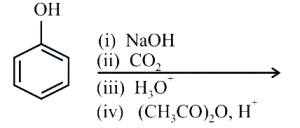
A
$4-$acetoxybenzoic acid
B
$2-$acetoxybenzoic acid
C
$4-$hydroxy$-3-$acetylbenzoic acid
D
$2-$hydroxybenzoic acid methyl ester
Solution
(B) The reaction sequence is as follows:
$1$. Phenol reacts with $NaOH$ to form sodium phenoxide.
$2$. Sodium phenoxide undergoes Kolbe's reaction with $CO_2$ followed by acidification $(H_3O^+)$ to produce salicylic acid ($2$-hydroxybenzoic acid).
$3$. Salicylic acid then reacts with acetic anhydride $((CH_3CO)_2O)$ in the presence of an acid catalyst $(H^+)$ to undergo acetylation of the phenolic $-OH$ group.
$4$. The final product is $2-$acetoxybenzoic acid,commonly known as aspirin.
$1$. Phenol reacts with $NaOH$ to form sodium phenoxide.
$2$. Sodium phenoxide undergoes Kolbe's reaction with $CO_2$ followed by acidification $(H_3O^+)$ to produce salicylic acid ($2$-hydroxybenzoic acid).
$3$. Salicylic acid then reacts with acetic anhydride $((CH_3CO)_2O)$ in the presence of an acid catalyst $(H^+)$ to undergo acetylation of the phenolic $-OH$ group.
$4$. The final product is $2-$acetoxybenzoic acid,commonly known as aspirin.
0 likesView Solution
172
ChemistryMediumMCQAP EAMCET · 2019
The major product formed in the following reaction is:
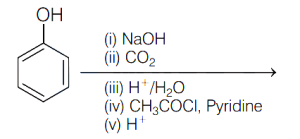
A
Aspirin (o-acetoxybenzoic acid)
B
Methyl salicylate
C
p-acetoxybenzoic acid
D
Methyl p-hydroxybenzoate
Solution
(A) The reaction sequence is as follows:
$1$. The reaction of phenol with $NaOH$ followed by $CO_2$ and then $H^+/H_2O$ is the Kolbe-Schmitt reaction,which yields salicylic acid ($2$-hydroxybenzoic acid).
$2$. The subsequent reaction with $CH_3COCl$ in the presence of pyridine is an acetylation reaction of the phenolic $-OH$ group.
$3$. This converts the $-OH$ group of salicylic acid into an acetoxy group $(-OCOCH_3)$,resulting in the formation of aspirin ($2$-acetoxybenzoic acid).
$1$. The reaction of phenol with $NaOH$ followed by $CO_2$ and then $H^+/H_2O$ is the Kolbe-Schmitt reaction,which yields salicylic acid ($2$-hydroxybenzoic acid).
$2$. The subsequent reaction with $CH_3COCl$ in the presence of pyridine is an acetylation reaction of the phenolic $-OH$ group.
$3$. This converts the $-OH$ group of salicylic acid into an acetoxy group $(-OCOCH_3)$,resulting in the formation of aspirin ($2$-acetoxybenzoic acid).
0 likesView Solution
173
ChemistryMediumMCQAP EAMCET · 2019
The major product formed in the following reaction is:
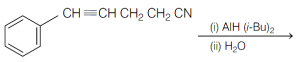
A
$Ph-CH_2-CH_2-CH_2-CH_2-CH_2-NH_2$
B
$Ph-CH_2-CH_2-CH_2-CH_2-CH_2-OH$
C
$Ph-CH=CH-CH_2-CH_2-CH_2-NH_2$
D
$Ph-CH=CH-CH_2-CH_2-CHO$
Solution
(D) The reagent $DIBAL-H$ (diisobutylaluminium hydride,$AlH(i-Bu)_2$) is a selective reducing agent. It reduces nitriles $(-CN)$ to aldehydes $(-CHO)$ after hydrolysis,while leaving other functional groups like carbon-carbon double bonds $(C=C)$ unaffected. Therefore,the reaction of $Ph-CH=CH-CH_2-CH_2-CN$ with $DIBAL-H$ followed by $H_2O$ yields $Ph-CH=CH-CH_2-CH_2-CHO$.
0 likesView Solution
174
ChemistryMediumMCQAP EAMCET · 2019
What are $X$ and $Y$ in the following reaction sequence?
$Toluene$ $\xrightarrow{X} Benzaldehyde$ $\xrightarrow{HNO_3 + H_2SO_4, 273-283 \ K} Y$
$Toluene$ $\xrightarrow{X} Benzaldehyde$ $\xrightarrow{HNO_3 + H_2SO_4, 273-283 \ K} Y$
A
$(i) \ CrO_2Cl_2/CS_2, (ii) \ H_3O^+$; $Y = m-nitrobenzaldehyde$
B
$CrO_3/H_2SO_4$; $Y = m-sulfobenzaldehyde$
C
$CrO_2Cl_2/H_3O^+$; $Y = benzoic \ acid$
D
$CrO_3/H_2SO_4$; $Y = m-nitrobenzoic \ acid$
Solution
(A) The reaction sequence is as follows:
$1$. The conversion of $Toluene$ to $Benzaldehyde$ is an oxidation reaction known as $Etard's$ reaction,which uses $CrO_2Cl_2$ in $CS_2$ followed by hydrolysis $(H_3O^+)$. Thus,$X = (i) \ CrO_2Cl_2/CS_2, (ii) \ H_3O^+$.
$2$. $Benzaldehyde$ contains a $-CHO$ group,which is a deactivating and $meta$-directing group for electrophilic substitution reactions.
$3$. Nitration of $Benzaldehyde$ using a nitrating mixture $(HNO_3 + H_2SO_4)$ at $273-283 \ K$ yields $m-nitrobenzaldehyde$ as the major product. Thus,$Y = m-nitrobenzaldehyde$.
$1$. The conversion of $Toluene$ to $Benzaldehyde$ is an oxidation reaction known as $Etard's$ reaction,which uses $CrO_2Cl_2$ in $CS_2$ followed by hydrolysis $(H_3O^+)$. Thus,$X = (i) \ CrO_2Cl_2/CS_2, (ii) \ H_3O^+$.
$2$. $Benzaldehyde$ contains a $-CHO$ group,which is a deactivating and $meta$-directing group for electrophilic substitution reactions.
$3$. Nitration of $Benzaldehyde$ using a nitrating mixture $(HNO_3 + H_2SO_4)$ at $273-283 \ K$ yields $m-nitrobenzaldehyde$ as the major product. Thus,$Y = m-nitrobenzaldehyde$.
0 likesView Solution
175
ChemistryDifficultMCQAP EAMCET · 2019
The major product in the following reaction is:
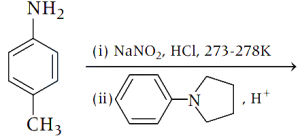
A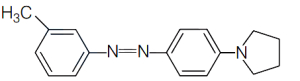
B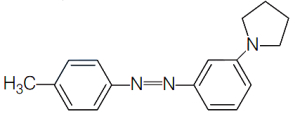
C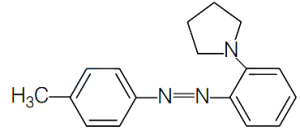
D
Solution
(D) In the given reaction,$p$-toluidine reacts with $NaNO_2$ and $HCl$ at $273-278 \ K$ to form a diazonium salt,which is $p$-methylbenzenediazonium chloride.
This diazonium salt then undergoes an electrophilic aromatic substitution (coupling reaction) with $N$-phenylpyrrolidine in the presence of $H^+$.
The coupling reaction occurs at the para-position of the $N$-phenylpyrrolidine ring because the pyrrolidinyl group is a strong ortho/para-directing group and the para-position is sterically less hindered.
Thus,the major product is the para-coupled azo dye as shown in option $D$.
This diazonium salt then undergoes an electrophilic aromatic substitution (coupling reaction) with $N$-phenylpyrrolidine in the presence of $H^+$.
The coupling reaction occurs at the para-position of the $N$-phenylpyrrolidine ring because the pyrrolidinyl group is a strong ortho/para-directing group and the para-position is sterically less hindered.
Thus,the major product is the para-coupled azo dye as shown in option $D$.
0 likesView Solution
176
ChemistryMediumMCQAP EAMCET · 2019
The major product of the following reaction is:
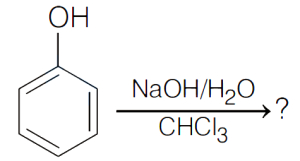
A
Sodium $2-$chlorophenolate
B
Sodium $2-$carboxyphenolate
C
Sodium $2-$formylphenolate
D
Sodium $2-$hydroxyphenolate
Solution
(C) The reaction of phenol with $CHCl_3$ in the presence of aqueous $NaOH$ is known as the $Reimer-Tiemann$ reaction.
In this reaction,$CHCl_3$ reacts with $NaOH$ to generate a dichlorocarbene intermediate $(:CCl_2)$.
This electrophilic carbene attacks the phenoxide ion at the ortho position.
The intermediate formed undergoes hydrolysis to yield salicylaldehyde ($2$-hydroxybenzaldehyde) in its salt form,which is sodium $2-$formylphenolate.
In this reaction,$CHCl_3$ reacts with $NaOH$ to generate a dichlorocarbene intermediate $(:CCl_2)$.
This electrophilic carbene attacks the phenoxide ion at the ortho position.
The intermediate formed undergoes hydrolysis to yield salicylaldehyde ($2$-hydroxybenzaldehyde) in its salt form,which is sodium $2-$formylphenolate.
0 likesView Solution
177
ChemistryMediumMCQAP EAMCET · 2019
The major product formed in the following reaction is
$C_6H_5CH=CH_2$ $\xrightarrow[(ii) H_3O^+]{(i) KMnO_4, KOH, \Delta}$ $\xrightarrow{(iii) Br_2/FeBr_3} \text{Product}$
$C_6H_5CH=CH_2$ $\xrightarrow[(ii) H_3O^+]{(i) KMnO_4, KOH, \Delta}$ $\xrightarrow{(iii) Br_2/FeBr_3} \text{Product}$
A
$p$-bromophenylacetic acid
B
$o$-bromobenzoic acid
C
$m$-bromoacetophenone
D
$m$-bromobenzoic acid
Solution
(D) Step $(i)$ and $(ii)$: The oxidation of styrene $(C_6H_5CH=CH_2)$ with alkaline $KMnO_4$ followed by acidic workup $(H_3O^+)$ results in the formation of benzoic acid $(C_6H_5COOH)$.
Step $(iii)$: Benzoic acid contains a $-COOH$ group,which is a deactivating and meta-directing group. Therefore,electrophilic aromatic substitution with $Br_2/FeBr_3$ will direct the bromine atom to the meta position.
The final product is $m$-bromobenzoic acid.
Step $(iii)$: Benzoic acid contains a $-COOH$ group,which is a deactivating and meta-directing group. Therefore,electrophilic aromatic substitution with $Br_2/FeBr_3$ will direct the bromine atom to the meta position.
The final product is $m$-bromobenzoic acid.
0 likesView Solution
178
ChemistryDifficultMCQAP EAMCET · 2019
The major product in the following reaction is:
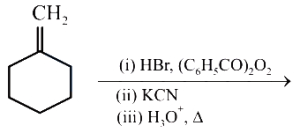
A
Cyclohexanecarboxylic acid with a methyl group at the alpha position.
B
$1-$methylcyclohexanecarboxylic acid.
C
Cyclohexylacetic acid.
D
$3-$cyclohexylpropanoic acid.
Solution
(C) The reaction proceeds as follows:
$1$. The first step is the anti-Markovnikov addition of $HBr$ to methylenecyclohexane in the presence of a peroxide,$(C_6H_5CO)_2O_2$. This yields (cyclohexylmethyl) bromide,$C_6H_{11}CH_2Br$.
$2$. The second step is a nucleophilic substitution reaction with $KCN$,where the bromide ion is replaced by a cyanide group,yielding cyclohexylacetonitrile,$C_6H_{11}CH_2CN$.
$3$. The third step is the acid-catalyzed hydrolysis of the nitrile group followed by heating,which converts the $-CN$ group into a carboxylic acid group,$-COOH$. The final product is cyclohexylacetic acid,$C_6H_{11}CH_2COOH$.
$1$. The first step is the anti-Markovnikov addition of $HBr$ to methylenecyclohexane in the presence of a peroxide,$(C_6H_5CO)_2O_2$. This yields (cyclohexylmethyl) bromide,$C_6H_{11}CH_2Br$.
$2$. The second step is a nucleophilic substitution reaction with $KCN$,where the bromide ion is replaced by a cyanide group,yielding cyclohexylacetonitrile,$C_6H_{11}CH_2CN$.
$3$. The third step is the acid-catalyzed hydrolysis of the nitrile group followed by heating,which converts the $-CN$ group into a carboxylic acid group,$-COOH$. The final product is cyclohexylacetic acid,$C_6H_{11}CH_2COOH$.
0 likesView Solution
179
ChemistryDifficultMCQAP EAMCET · 2019
The major product formed in the following reaction is:
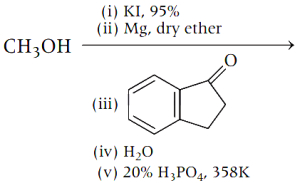
A
$1-$methyl-1H-indene
B
$1-$methylene$-2,3-$dihydro-1H-indene
C
$3-$methyl-1H-indene
D
$1-$methyl$-2,3-$dihydro-1H-inden$-1-$ol
Solution
(A) The reaction proceeds as follows:
$(i)$ $CH_3OH$ reacts with $KI$ to form $CH_3I$.
(ii) $CH_3I$ reacts with $Mg$ in dry ether to form the Grignard reagent $CH_3MgI$.
(iii) $CH_3MgI$ undergoes nucleophilic addition to the carbonyl group of $1-$indanone ($2$,$3$-dihydro-1H-inden$-1-$one).
(iv) Subsequent hydrolysis with $H_2O$ yields $1-$methyl$-2,3-$dihydro-1H-inden$-1-$ol.
$(v)$ Dehydration of the alcohol using $20\% H_3PO_4$ at $358 \ K$ results in the formation of the more stable conjugated alkene,$1$-methyl-1H-indene,as the major product.
$(i)$ $CH_3OH$ reacts with $KI$ to form $CH_3I$.
(ii) $CH_3I$ reacts with $Mg$ in dry ether to form the Grignard reagent $CH_3MgI$.
(iii) $CH_3MgI$ undergoes nucleophilic addition to the carbonyl group of $1-$indanone ($2$,$3$-dihydro-1H-inden$-1-$one).
(iv) Subsequent hydrolysis with $H_2O$ yields $1-$methyl$-2,3-$dihydro-1H-inden$-1-$ol.
$(v)$ Dehydration of the alcohol using $20\% H_3PO_4$ at $358 \ K$ results in the formation of the more stable conjugated alkene,$1$-methyl-1H-indene,as the major product.
0 likesView Solution
180
ChemistryDifficultMCQAP EAMCET · 2019
The major product in the following reaction sequence is:
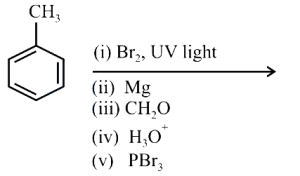
A
$1-$bromo$-1-$phenylethane
B
o-bromomethyltoluene
C
($2$-bromoethyl)benzene
D
p-bromomethyltoluene
Solution
(C) The reaction sequence is as follows:
$1$. Toluene reacts with $Br_2$ in the presence of $UV$ light to undergo free-radical substitution at the benzylic position,forming benzyl bromide $(C_6H_5CH_2Br)$.
$2$. Benzyl bromide reacts with $Mg$ in dry ether to form the Grignard reagent,benzylmagnesium bromide $(C_6H_5CH_2MgBr)$.
$3$. The Grignard reagent reacts with formaldehyde $(CH_2O)$ followed by acidic hydrolysis $(H_3O^+)$ to form $2-$phenylethanol $(C_6H_5CH_2CH_2OH)$.
$4$. Finally,$2$-phenylethanol reacts with $PBr_3$ to replace the hydroxyl group with a bromine atom,yielding ($2$-bromoethyl)benzene $(C_6H_5CH_2CH_2Br)$.
$1$. Toluene reacts with $Br_2$ in the presence of $UV$ light to undergo free-radical substitution at the benzylic position,forming benzyl bromide $(C_6H_5CH_2Br)$.
$2$. Benzyl bromide reacts with $Mg$ in dry ether to form the Grignard reagent,benzylmagnesium bromide $(C_6H_5CH_2MgBr)$.
$3$. The Grignard reagent reacts with formaldehyde $(CH_2O)$ followed by acidic hydrolysis $(H_3O^+)$ to form $2-$phenylethanol $(C_6H_5CH_2CH_2OH)$.
$4$. Finally,$2$-phenylethanol reacts with $PBr_3$ to replace the hydroxyl group with a bromine atom,yielding ($2$-bromoethyl)benzene $(C_6H_5CH_2CH_2Br)$.
0 likesView Solution
181
ChemistryDifficultMCQAP EAMCET · 2019
The major product in the following reaction is
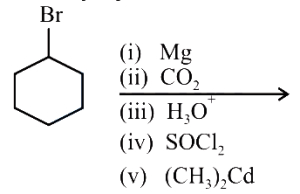
A
Cyclohexyl ethanol
B
Cyclohexyl methyl ketone
C
$1-$Cyclohexyl ethanol
D
$2-$Cyclohexyl propan$-2-$ol
Solution
(B) The reaction proceeds as follows:
$1$. Bromocyclohexane reacts with $Mg$ in dry ether to form cyclohexylmagnesium bromide (a Grignard reagent).
$2$. The Grignard reagent reacts with $CO_2$ followed by acidic workup $(H_3O^+)$ to form cyclohexanecarboxylic acid.
$3$. Cyclohexanecarboxylic acid reacts with $SOCl_2$ to form cyclohexanecarbonyl chloride.
$4$. Finally,the reaction of cyclohexanecarbonyl chloride with dimethylcadmium,$(CH_3)_2Cd$,yields cyclohexyl methyl ketone as the major product. This is a standard method for the preparation of ketones from acid chlorides.
$1$. Bromocyclohexane reacts with $Mg$ in dry ether to form cyclohexylmagnesium bromide (a Grignard reagent).
$2$. The Grignard reagent reacts with $CO_2$ followed by acidic workup $(H_3O^+)$ to form cyclohexanecarboxylic acid.
$3$. Cyclohexanecarboxylic acid reacts with $SOCl_2$ to form cyclohexanecarbonyl chloride.
$4$. Finally,the reaction of cyclohexanecarbonyl chloride with dimethylcadmium,$(CH_3)_2Cd$,yields cyclohexyl methyl ketone as the major product. This is a standard method for the preparation of ketones from acid chlorides.
0 likesView Solution
182
ChemistryDifficultMCQAP EAMCET · 2019
The major product of the following reaction is:
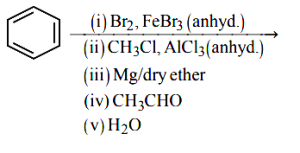
A
$1-$($4$-methylphenyl)propan$-2-$ol
B
$1-$($4$-methylphenyl)ethanol
C
$2-$($2$-methylphenyl)propan$-2-$ol
D
$1-$($2$-methylphenyl)ethanol
Solution
(B) Step $(i)$: Benzene reacts with $Br_2$ in the presence of anhydrous $FeBr_3$ to form bromobenzene via electrophilic aromatic substitution.
Step (ii): Bromobenzene undergoes Friedel-Crafts alkylation with $CH_3Cl$ and anhydrous $AlCl_3$. Since the $-Br$ group is ortho/para directing,the major product is $p$-bromotoluene.
Step (iii): $p$-Bromotoluene reacts with $Mg$ in dry ether to form the Grignard reagent,$p$-tolylmagnesium bromide $(CH_3-C_6H_4-MgBr)$.
Step (iv) and $(v)$: The Grignard reagent reacts with acetaldehyde $(CH_3CHO)$ followed by hydrolysis $(H_2O)$ to form a secondary alcohol. The nucleophilic carbon of the Grignard reagent attacks the carbonyl carbon of acetaldehyde,resulting in $1-(4-methylphenyl)ethanol$.
Step (ii): Bromobenzene undergoes Friedel-Crafts alkylation with $CH_3Cl$ and anhydrous $AlCl_3$. Since the $-Br$ group is ortho/para directing,the major product is $p$-bromotoluene.
Step (iii): $p$-Bromotoluene reacts with $Mg$ in dry ether to form the Grignard reagent,$p$-tolylmagnesium bromide $(CH_3-C_6H_4-MgBr)$.
Step (iv) and $(v)$: The Grignard reagent reacts with acetaldehyde $(CH_3CHO)$ followed by hydrolysis $(H_2O)$ to form a secondary alcohol. The nucleophilic carbon of the Grignard reagent attacks the carbonyl carbon of acetaldehyde,resulting in $1-(4-methylphenyl)ethanol$.
0 likesView Solution
183
ChemistryMediumMCQAP EAMCET · 2019
The major product of the following reaction is:
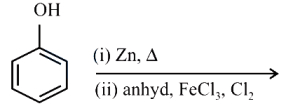
A
$4-$chlorophenol
B
$2-$chlorophenol
C
$2,4-$dichlorophenol
D
chlorobenzene
Solution
(D) Step $1$: Phenol reacts with zinc dust $(Zn)$ under heating $(\Delta)$ to undergo reduction,resulting in the formation of benzene.
$C_6H_5OH Zn \xrightarrow{\Delta} C_6H_6 ZnO$
Step $2$: Benzene then undergoes electrophilic aromatic substitution (chlorination) in the presence of anhydrous ferric chloride $(FeCl_3)$ and chlorine $(Cl_2)$ to form chlorobenzene.
$C_6H_6 Cl_2 \xrightarrow{\text{anhyd. } FeCl_3} C_6H_5Cl HCl$
Therefore,the major product is chlorobenzene.
$C_6H_5OH Zn \xrightarrow{\Delta} C_6H_6 ZnO$
Step $2$: Benzene then undergoes electrophilic aromatic substitution (chlorination) in the presence of anhydrous ferric chloride $(FeCl_3)$ and chlorine $(Cl_2)$ to form chlorobenzene.
$C_6H_6 Cl_2 \xrightarrow{\text{anhyd. } FeCl_3} C_6H_5Cl HCl$
Therefore,the major product is chlorobenzene.
0 likesView Solution
184
ChemistryDifficultMCQAP EAMCET · 2019
The major product formed in the following reaction is:
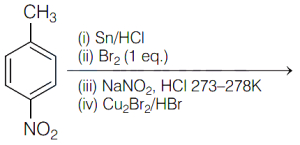
A
$1-$methyl$-3,5-$dibromobenzene
B
$1-$methyl$-2,6-$dibromobenzene
C
$1-$methyl$-3,4-$dibromobenzene
D
$1-$methyl$-2,4-$dibromobenzene
Solution
(C) The reaction proceeds as follows:
$(i)$ $Sn/HCl$ reduces the $-NO_2$ group to an $-NH_2$ group,forming $p$-toluidine.
(ii) $Br_2$ $(1 \ eq.)$ in the presence of the strongly activating $-NH_2$ group leads to ortho-bromination,yielding $2$-bromo-$4$-methylaniline.
(iii) $NaNO_2/HCl$ at $273-278 \ K$ converts the $-NH_2$ group into a diazonium salt,$-N_2^+Cl^-$.
(iv) $Cu_2Br_2/HBr$ (Sandmeyer reaction) replaces the diazonium group with a $-Br$ atom,resulting in $1,2$-dibromo-$4$-methylbenzene (also known as $3,4$-dibromotoluene).
$(i)$ $Sn/HCl$ reduces the $-NO_2$ group to an $-NH_2$ group,forming $p$-toluidine.
(ii) $Br_2$ $(1 \ eq.)$ in the presence of the strongly activating $-NH_2$ group leads to ortho-bromination,yielding $2$-bromo-$4$-methylaniline.
(iii) $NaNO_2/HCl$ at $273-278 \ K$ converts the $-NH_2$ group into a diazonium salt,$-N_2^+Cl^-$.
(iv) $Cu_2Br_2/HBr$ (Sandmeyer reaction) replaces the diazonium group with a $-Br$ atom,resulting in $1,2$-dibromo-$4$-methylbenzene (also known as $3,4$-dibromotoluene).
0 likesView Solution
Vedclass Products
For Students
Vedclass Test Series
Mock tests in real AP EAMCET style covering Chemistry with performance analysis. 5-day free trial.
Start Free TrialFor Teachers
Exam Paper Generator
Generate Set A/B/C/D Chemistry papers from 7.5L+ questions in 2 minutes. 3 chapters free.
Try FreeFor Institutes
Online Exam Module
Run live AP EAMCET mock exams with unlimited students, 360° analytics & white-label branding.
See DemoFrequently Asked Questions
How many Chemistry questions are in AP EAMCET 2019?
There are 284 Chemistry questions from the AP EAMCET 2019 paper on Vedclass, each with a detailed step-by-step solution in English.
Are AP EAMCET 2019 Chemistry solutions available in English?
Yes. All solutions on this page are in English. You can also switch to English or Hindi using the language buttons above the questions.
Can I practice AP EAMCET 2019 Chemistry as a timed test?
Yes. Use the Vedclass Test Series to attempt a full AP EAMCET mock test covering Chemistry with time limits and instant score analysis.
Can teachers create Chemistry papers from AP EAMCET previous year questions?
Yes. The Vedclass Exam Paper Generator lets teachers mix AP EAMCET Chemistry questions and generate Set A/B/C/D papers in minutes.
For Teachers & Institutes
Build a Custom Chemistry Paper
Pick AP EAMCET 2019 Chemistry questions, set difficulty, and generate Set A/B/C/D in 2 minutes.