
ChemistryQ51–150 of 284 questions
Page 2 of 3 · English
51
ChemistryMediumMCQAP EAMCET · 2019
The product formed in the above reaction is
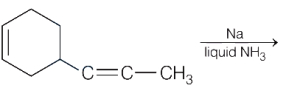
A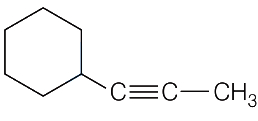
B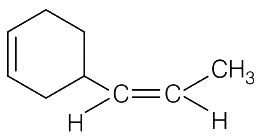
C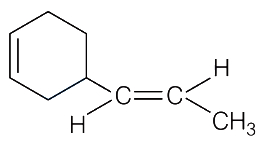
D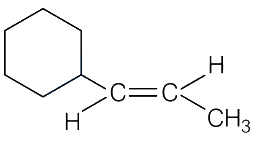
Solution
(D) The reaction of an alkyne with sodium in liquid ammonia $(Na/Liq. NH_3)$ is known as Birch reduction,which results in the stereoselective anti-addition of hydrogen to the triple bond to form a $trans$-alkene. The double bond present in the cyclohexene ring remains unaffected under these conditions. Therefore,the product is a $trans$-alkene. Thus,option $(D)$ is correct.
0 likesView Solution
52
ChemistryEasyMCQAP EAMCET · 2019
Which one of the following functional groups is not meta directing?
A
$-COOH$
B
$-NO_2$
C
$-CHO$
D
$-OCH_3$
Solution
(D) Key Idea: Functional groups that are electron-withdrawing due to resonance (often containing a double bond to a more electronegative atom) are meta-directing. Groups that donate electrons via resonance (due to the presence of lone pairs on the atom directly attached to the benzene ring) are ortho/para-directing.
$(A)$ $-COOH$: The carbon atom attached to the benzene ring is bonded to an oxygen atom via a double bond. It is electron-withdrawing and thus meta-directing.
$(B)$ $-NO_2$: The nitrogen atom attached to the benzene ring is bonded to an oxygen atom via a double bond. It is electron-withdrawing and thus meta-directing.
$(C)$ $-CHO$: The carbon atom attached to the benzene ring is bonded to an oxygen atom via a double bond. It is electron-withdrawing and thus meta-directing.
$(D)$ $-OCH_3$: The oxygen atom attached to the benzene ring has lone pairs of electrons,which it donates to the ring via resonance ($+M$ effect). Therefore,it is ortho/para-directing,not meta-directing.
Thus,option $(D)$ is the correct answer.
$(A)$ $-COOH$: The carbon atom attached to the benzene ring is bonded to an oxygen atom via a double bond. It is electron-withdrawing and thus meta-directing.
$(B)$ $-NO_2$: The nitrogen atom attached to the benzene ring is bonded to an oxygen atom via a double bond. It is electron-withdrawing and thus meta-directing.
$(C)$ $-CHO$: The carbon atom attached to the benzene ring is bonded to an oxygen atom via a double bond. It is electron-withdrawing and thus meta-directing.
$(D)$ $-OCH_3$: The oxygen atom attached to the benzene ring has lone pairs of electrons,which it donates to the ring via resonance ($+M$ effect). Therefore,it is ortho/para-directing,not meta-directing.
Thus,option $(D)$ is the correct answer.
0 likesView Solution
53
ChemistryMediumMCQAP EAMCET · 2019
Identify ortho and para directing groups from the following: $I. -CHO$,$II. -NHCOCH_3$,$III. -OCH_3$,$IV. -SO_3H$.
A
$III, IV$
B
$II, III$
C
$II, IV$
D
$I, IV$
Solution
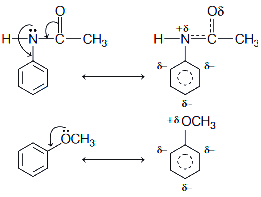
(B) Ortho and para directing groups are electron-donating groups that increase electron density at the ortho and para positions of the benzene ring.
Groups like $-NHCOCH_3$ $(II)$ and $-OCH_3$ $(III)$ have lone pairs on the atom directly attached to the benzene ring,exhibiting a $+M$ effect. Therefore,they are ortho/para directing.
In contrast,$-CHO$ $(I)$ and $-SO_3H$ $(IV)$ are electron-withdrawing groups and are meta-directing.
Thus,the correct option is $(b)$.
Groups like $-NHCOCH_3$ $(II)$ and $-OCH_3$ $(III)$ have lone pairs on the atom directly attached to the benzene ring,exhibiting a $+M$ effect. Therefore,they are ortho/para directing.
In contrast,$-CHO$ $(I)$ and $-SO_3H$ $(IV)$ are electron-withdrawing groups and are meta-directing.
Thus,the correct option is $(b)$.
0 likesView Solution
54
ChemistryDifficultMCQAP EAMCET · 2019
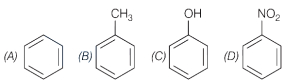
The correct order of reactivity of the following compounds towards electrophilic substitution reactions is:
A
$A > B > C > D$
B
$D > C > B > A$
C
$C > B > A > D$
D
$B > C > A > D$
Solution
(C) The reactivity of benzene derivatives towards electrophilic substitution depends on the nature of the substituent attached to the ring.
Electron-donating groups (activating groups) increase the electron density in the ring,thereby increasing reactivity.
Electron-withdrawing groups (deactivating groups) decrease the electron density in the ring,thereby decreasing reactivity.
- The $-OH$ group exerts a strong $+M$ (mesomeric) effect,which strongly activates the ring.
- The $-CH_3$ group exerts $+I$ (inductive) and $+H$ (hyperconjugation) effects,which moderately activate the ring.
- Benzene $(A)$ has no substituent.
- The $-NO_2$ group exerts a strong $-M$ and $-I$ effect,which strongly deactivates the ring.
Thus,the order of reactivity is: Phenol $(C)$ > Toluene $(B)$ > Benzene $(A)$ > Nitrobenzene $(D)$.
Electron-donating groups (activating groups) increase the electron density in the ring,thereby increasing reactivity.
Electron-withdrawing groups (deactivating groups) decrease the electron density in the ring,thereby decreasing reactivity.
- The $-OH$ group exerts a strong $+M$ (mesomeric) effect,which strongly activates the ring.
- The $-CH_3$ group exerts $+I$ (inductive) and $+H$ (hyperconjugation) effects,which moderately activate the ring.
- Benzene $(A)$ has no substituent.
- The $-NO_2$ group exerts a strong $-M$ and $-I$ effect,which strongly deactivates the ring.
Thus,the order of reactivity is: Phenol $(C)$ > Toluene $(B)$ > Benzene $(A)$ > Nitrobenzene $(D)$.
0 likesView Solution
55
ChemistryMediumMCQAP EAMCET · 2019
Which of the following statements are correct?
$I$. In nitrating mixture,nitric acid participates as an acid.
$II$. $\sigma$-complex is the intermediate substance in electrophilic substitution of benzene.
$III$. Benzene on Friedel-Crafts alkylation with $n$-propyl chloride gives isopropyl benzene.
$I$. In nitrating mixture,nitric acid participates as an acid.
$II$. $\sigma$-complex is the intermediate substance in electrophilic substitution of benzene.
$III$. Benzene on Friedel-Crafts alkylation with $n$-propyl chloride gives isopropyl benzene.
A
$II, III$ only
B
$I, II$ only
C
$I, III$ only
D
$I, II, III$
Solution
(A) $(I)$ In a nitrating mixture $(HNO_3 + H_2SO_4)$,$HNO_3$ acts as a base because it accepts a proton from $H_2SO_4$ to form the nitronium ion $(NO_2^+)$. Thus,statement $I$ is incorrect.
$(II)$ The $\sigma$-complex (arenium ion) is the intermediate formed during the electrophilic aromatic substitution of benzene when an electrophile $(E^+)$ attacks the benzene ring. In this complex,one carbon atom becomes $sp^3$-hybridized. Thus,statement $II$ is correct.
$(III)$ During the Friedel-Crafts alkylation of benzene with $n$-propyl chloride,the primary carbocation $(CH_3CH_2CH_2^+)$ rearranges to a more stable secondary carbocation $(CH_3CH^+CH_3)$. Consequently,the major product formed is isopropyl benzene. Thus,statement $III$ is correct.
Therefore,statements $II$ and $III$ are correct,making option $(A)$ the correct answer.
$(II)$ The $\sigma$-complex (arenium ion) is the intermediate formed during the electrophilic aromatic substitution of benzene when an electrophile $(E^+)$ attacks the benzene ring. In this complex,one carbon atom becomes $sp^3$-hybridized. Thus,statement $II$ is correct.
$(III)$ During the Friedel-Crafts alkylation of benzene with $n$-propyl chloride,the primary carbocation $(CH_3CH_2CH_2^+)$ rearranges to a more stable secondary carbocation $(CH_3CH^+CH_3)$. Consequently,the major product formed is isopropyl benzene. Thus,statement $III$ is correct.
Therefore,statements $II$ and $III$ are correct,making option $(A)$ the correct answer.
0 likesView Solution
56
ChemistryMediumMCQAP EAMCET · 2019
What are $X$ and $Y$ in the following reactions?

A
| $X$ | $Y$ |
| Conc. $HNO_3$ | $H_2SO_4(SO_3)$ |
B
| $X$ | $Y$ |
| Conc. $HNO_3$ + Conc. $H_2SO_4$ / $333 \ K$ | $H_2SO_4(SO_3)$ |
C
| $X$ | $Y$ |
| $NaNO_2$ / $HCl$ | $H_2SO_4$ |
D
| $X$ | $Y$ |
| Dil. $HNO_3$ | $SO_3$ |
Solution
(B) Benzene reacts with a mixture of conc. $HNO_3$ and conc. $H_2SO_4$ at $333 \ K$ $(X)$ to undergo nitration,forming nitrobenzene.
Benzene reacts with fuming sulphuric acid $(H_2SO_4 + SO_3)$ $(Y)$ to undergo sulphonation,forming benzene sulphonic acid.
Benzene reacts with fuming sulphuric acid $(H_2SO_4 + SO_3)$ $(Y)$ to undergo sulphonation,forming benzene sulphonic acid.
0 likesView Solution
57
ChemistryEasyMCQAP EAMCET · 2019
Which one of the following properties has the same value for $H_2$ and $D_2$?
A
Density
B
Enthalpy of bond dissociation
C
Bond length
D
Melting point
Solution
(C) Bond length depends upon the electrostatic force of attraction between the nuclei and the shared pair of electrons.
Since isotopes have the same number of protons and electrons,the electronic environment remains identical.
Therefore,the bond length is the same for both $H_2$ and $D_2$.
Since isotopes have the same number of protons and electrons,the electronic environment remains identical.
Therefore,the bond length is the same for both $H_2$ and $D_2$.
0 likesView Solution
58
ChemistryEasyMCQAP EAMCET · 2019
Which of the following are non-metal displacement reactions?
$(A)$ $Ca_{(s)} + 2 H_2 O_{(l)} \longrightarrow Ca(OH)_{2(aq)} + H_{2(g)}$
$(B)$ $V_2 O_{5(s)} + 5 Ca_{(s)} \stackrel{\Delta}{\longrightarrow} 2 V_{(s)} + 5 CaO_{(s)}$
$(C)$ $2 Fe_{(s)} + 3 H_2 O_{(g)} \stackrel{\Delta}{\longrightarrow} Fe_2 O_{3(s)} + 3 H_{2(g)}$
$(D)$ $Cr_2 O_{3(s)} + 2 Al_{(s)} \stackrel{\Delta}{\longrightarrow} Al_2 O_{3(s)} + 2 Cr_{(s)}$
$(A)$ $Ca_{(s)} + 2 H_2 O_{(l)} \longrightarrow Ca(OH)_{2(aq)} + H_{2(g)}$
$(B)$ $V_2 O_{5(s)} + 5 Ca_{(s)} \stackrel{\Delta}{\longrightarrow} 2 V_{(s)} + 5 CaO_{(s)}$
$(C)$ $2 Fe_{(s)} + 3 H_2 O_{(g)} \stackrel{\Delta}{\longrightarrow} Fe_2 O_{3(s)} + 3 H_{2(g)}$
$(D)$ $Cr_2 O_{3(s)} + 2 Al_{(s)} \stackrel{\Delta}{\longrightarrow} Al_2 O_{3(s)} + 2 Cr_{(s)}$
A
$A, B$
B
$B, C$
C
$C, D$
D
$A, C$
Solution
(D) non-metal displacement reaction involves a metal displacing a non-metal (usually hydrogen or oxygen) from its compound.
In reaction $(A)$,$Ca$ displaces $H$ from $H_2O$. This is a non-metal displacement reaction.
In reaction $(B)$,$Ca$ displaces $V$ from $V_2O_5$. This is a metal displacement reaction.
In reaction $(C)$,$Fe$ displaces $H$ from $H_2O$. This is a non-metal displacement reaction.
In reaction $(D)$,$Al$ displaces $Cr$ from $Cr_2O_3$. This is a metal displacement reaction.
Therefore,$(A)$ and $(C)$ are non-metal displacement reactions.
In reaction $(A)$,$Ca$ displaces $H$ from $H_2O$. This is a non-metal displacement reaction.
In reaction $(B)$,$Ca$ displaces $V$ from $V_2O_5$. This is a metal displacement reaction.
In reaction $(C)$,$Fe$ displaces $H$ from $H_2O$. This is a non-metal displacement reaction.
In reaction $(D)$,$Al$ displaces $Cr$ from $Cr_2O_3$. This is a metal displacement reaction.
Therefore,$(A)$ and $(C)$ are non-metal displacement reactions.
0 likesView Solution
59
ChemistryEasyMCQAP EAMCET · 2019
Identify the correct statements from the following:
$I$. $B_2H_6$ is an electron deficient hydride.
$II$. $NH_3$ is an electron rich hydride.
$III$. $NaH$ is a covalent hydride.
$IV$. $YbH_{2.55}$ is an interstitial hydride.
$I$. $B_2H_6$ is an electron deficient hydride.
$II$. $NH_3$ is an electron rich hydride.
$III$. $NaH$ is a covalent hydride.
$IV$. $YbH_{2.55}$ is an interstitial hydride.
A
$I$,$II$,$III$
B
$II$,$III$,$IV$
C
$I$,$II$,$IV$
D
$I$,$III$,$IV$
Solution
(C) $(I)$ $B_2H_6$ (diborane) is an electron deficient hydride. This is due to the presence of $3C-2e^-$ bridge bonds.
$(II)$ $NH_3$ is an electron rich hydride due to the presence of a lone pair of electrons on the nitrogen atom.
$(III)$ $NaH$ is an ionic (saline) hydride; hydrides of alkali metals are ionic in nature. Thus,statement $III$ is incorrect.
$(IV)$ $YbH_{2.55}$ is an interstitial (non-stoichiometric) hydride. Here,hydrogen atoms occupy the interstitial spaces in the metal lattice. Thus,statement $IV$ is correct.
Therefore,statements $I$,$II$,and $IV$ are correct. The correct option is $(C)$.
$(II)$ $NH_3$ is an electron rich hydride due to the presence of a lone pair of electrons on the nitrogen atom.
$(III)$ $NaH$ is an ionic (saline) hydride; hydrides of alkali metals are ionic in nature. Thus,statement $III$ is incorrect.
$(IV)$ $YbH_{2.55}$ is an interstitial (non-stoichiometric) hydride. Here,hydrogen atoms occupy the interstitial spaces in the metal lattice. Thus,statement $IV$ is correct.
Therefore,statements $I$,$II$,and $IV$ are correct. The correct option is $(C)$.
0 likesView Solution
60
ChemistryMediumMCQAP EAMCET · 2019
Three vessels $(A, B, C)$ contain $H_2O_2$ solution. In vessel $A$,$500 \ mL$ of $10 \ vol \ H_2O_2$ is present. $100 \ mL$ of $30 \ vol \ H_2O_2$ is present in vessel $B$. Vessel $C$ is filled with $250 \ mL$ of $2 \ M \ H_2O_2$. The weight (in $g$) of $H_2O_2$ present in these vessels follows the order:
A
$C > A > B$
B
$C > B > A$
C
$B > A > C$
D
$A > B > C$
Solution
(A) For vessel $A$:
$10 \ vol \ H_2O_2$ means $1 \ mL$ of $H_2O_2$ solution gives $10 \ mL \ O_2$ at $NTP$.
$2 \ H_2O_2 \longrightarrow 2 \ H_2O + O_2$.
$2 \ mol \ (68 \ g)$ of $H_2O_2$ gives $22400 \ mL \ O_2$ at $NTP$.
$O_2$ evolved from $500 \ mL$ of $10 \ vol \ H_2O_2 = 500 \times 10 = 5000 \ mL$.
Weight of $H_2O_2$ in $A = \frac{68 \times 5000}{22400} \approx 15.18 \ g$.
For vessel $B$:
$O_2$ evolved from $100 \ mL$ of $30 \ vol \ H_2O_2 = 100 \times 30 = 3000 \ mL$.
Weight of $H_2O_2$ in $B = \frac{68 \times 3000}{22400} \approx 9.11 \ g$.
For vessel $C$:
$Molarity = 2 \ M$,$Volume = 250 \ mL = 0.25 \ L$.
$Moles \ of \ H_2O_2 = Molarity \times Volume = 2 \times 0.25 = 0.5 \ mol$.
Weight of $H_2O_2$ in $C = 0.5 \ mol \times 34 \ g/mol = 17 \ g$.
Comparing the weights: $C (17 \ g) > A (15.18 \ g) > B (9.11 \ g)$.
Thus,the order is $C > A > B$.
$10 \ vol \ H_2O_2$ means $1 \ mL$ of $H_2O_2$ solution gives $10 \ mL \ O_2$ at $NTP$.
$2 \ H_2O_2 \longrightarrow 2 \ H_2O + O_2$.
$2 \ mol \ (68 \ g)$ of $H_2O_2$ gives $22400 \ mL \ O_2$ at $NTP$.
$O_2$ evolved from $500 \ mL$ of $10 \ vol \ H_2O_2 = 500 \times 10 = 5000 \ mL$.
Weight of $H_2O_2$ in $A = \frac{68 \times 5000}{22400} \approx 15.18 \ g$.
For vessel $B$:
$O_2$ evolved from $100 \ mL$ of $30 \ vol \ H_2O_2 = 100 \times 30 = 3000 \ mL$.
Weight of $H_2O_2$ in $B = \frac{68 \times 3000}{22400} \approx 9.11 \ g$.
For vessel $C$:
$Molarity = 2 \ M$,$Volume = 250 \ mL = 0.25 \ L$.
$Moles \ of \ H_2O_2 = Molarity \times Volume = 2 \times 0.25 = 0.5 \ mol$.
Weight of $H_2O_2$ in $C = 0.5 \ mol \times 34 \ g/mol = 17 \ g$.
Comparing the weights: $C (17 \ g) > A (15.18 \ g) > B (9.11 \ g)$.
Thus,the order is $C > A > B$.
0 likesView Solution
61
ChemistryEasyMCQAP EAMCET · 2019
The number of species among the following that can act both as Bronsted acids and bases is $HCl, ClO_4^{-}, OH^{-}, H^{+}, H_2O, HSO_4^{-}, SO_4^{2-}, H_2SO_4, Cl^{-}$.
A
$4$
B
$3$
C
$1$
D
$2$
Solution
(D) Bronsted acid is a proton $(H^{+})$ donor,and a Bronsted base is a proton $(H^{+})$ acceptor. Amphoteric species can act as both.
$1$. $HCl$: Only acts as an acid $(HCl \rightarrow H^{+} + Cl^{-})$.
$2$. $ClO_4^{-}$: Only acts as a base $(ClO_4^{-} + H^{+} \rightarrow HClO_4)$.
$3$. $OH^{-}$: Only acts as a base $(OH^{-} + H^{+} \rightarrow H_2O)$.
$4$. $H^{+}$: Only acts as an acid.
$5$. $H_2O$: Acts as an acid $(H_2O \rightarrow H^{+} + OH^{-})$ and as a base $(H_2O + H^{+} \rightarrow H_3O^{+})$.
$6$. $HSO_4^{-}$: Acts as an acid $(HSO_4^{-} \rightarrow H^{+} + SO_4^{2-})$ and as a base $(HSO_4^{-} + H^{+} \rightarrow H_2SO_4)$.
$7$. $SO_4^{2-}$: Only acts as a base $(SO_4^{2-} + H^{+} \rightarrow HSO_4^{-})$.
$8$. $H_2SO_4$: Only acts as an acid $(H_2SO_4 \rightarrow H^{+} + HSO_4^{-})$.
$9$. $Cl^{-}$: Only acts as a base $(Cl^{-} + H^{+} \rightarrow HCl)$.
Thus,only $H_2O$ and $HSO_4^{-}$ can act as both Bronsted acids and bases. The total number is $2$.
$1$. $HCl$: Only acts as an acid $(HCl \rightarrow H^{+} + Cl^{-})$.
$2$. $ClO_4^{-}$: Only acts as a base $(ClO_4^{-} + H^{+} \rightarrow HClO_4)$.
$3$. $OH^{-}$: Only acts as a base $(OH^{-} + H^{+} \rightarrow H_2O)$.
$4$. $H^{+}$: Only acts as an acid.
$5$. $H_2O$: Acts as an acid $(H_2O \rightarrow H^{+} + OH^{-})$ and as a base $(H_2O + H^{+} \rightarrow H_3O^{+})$.
$6$. $HSO_4^{-}$: Acts as an acid $(HSO_4^{-} \rightarrow H^{+} + SO_4^{2-})$ and as a base $(HSO_4^{-} + H^{+} \rightarrow H_2SO_4)$.
$7$. $SO_4^{2-}$: Only acts as a base $(SO_4^{2-} + H^{+} \rightarrow HSO_4^{-})$.
$8$. $H_2SO_4$: Only acts as an acid $(H_2SO_4 \rightarrow H^{+} + HSO_4^{-})$.
$9$. $Cl^{-}$: Only acts as a base $(Cl^{-} + H^{+} \rightarrow HCl)$.
Thus,only $H_2O$ and $HSO_4^{-}$ can act as both Bronsted acids and bases. The total number is $2$.
0 likesView Solution
62
ChemistryMediumMCQAP EAMCET · 2019
$50 \ mL$ of $0.02 \ M$ $NaOH$ solution is mixed with $50 \ mL$ of $0.06 \ M$ acetic acid solution. The $pH$ of the resulting solution is $......$ ($pK_a$ of acetic acid is $4.76$,$\log 2 = 0.30$).
A
$5.06$
B
$4.06$
C
$5.46$
D
$4.46$
Solution
(D) The reaction between $NaOH$ and acetic acid $(CH_3COOH)$ is: $CH_3COOH + NaOH \rightarrow CH_3COONa + H_2O$.
Initial moles of $CH_3COOH = 0.06 \ M \times 0.050 \ L = 0.003 \ mol$.
Initial moles of $NaOH = 0.02 \ M \times 0.050 \ L = 0.001 \ mol$.
After the reaction,$0.001 \ mol$ of $CH_3COONa$ is formed and $0.002 \ mol$ of $CH_3COOH$ remains.
Since a buffer solution is formed,we use the Henderson-Hasselbalch equation:
$pH = pK_a + \log \frac{[Salt]}{[Acid]}$.
$pH = 4.76 + \log \frac{0.001}{0.002} = 4.76 + \log (0.5)$.
$pH = 4.76 - 0.30 = 4.46$.
Initial moles of $CH_3COOH = 0.06 \ M \times 0.050 \ L = 0.003 \ mol$.
Initial moles of $NaOH = 0.02 \ M \times 0.050 \ L = 0.001 \ mol$.
After the reaction,$0.001 \ mol$ of $CH_3COONa$ is formed and $0.002 \ mol$ of $CH_3COOH$ remains.
Since a buffer solution is formed,we use the Henderson-Hasselbalch equation:
$pH = pK_a + \log \frac{[Salt]}{[Acid]}$.
$pH = 4.76 + \log \frac{0.001}{0.002} = 4.76 + \log (0.5)$.
$pH = 4.76 - 0.30 = 4.46$.
0 likesView Solution
63
ChemistryDifficultMCQAP EAMCET · 2019
At $T$ $(K)$,if the ionisation constant of ammonia in solution is $2.5 \times 10^{-5}$,the $pH$ of $0.01 \ M$ ammonia solution and the ionisation constant of its conjugate acid respectively at that temperature are $(\log 2 = 0.30)$
A
$10.7, 4.0 \times 10^{-8}$
B
$10.7, 4.0 \times 10^{-10}$
C
$3.3, 4.0 \times 10^{-8}$
D
$3.3, 4.0 \times 10^{-10}$
Solution
(B) For a weak base $NH_3$,the ionisation constant $K_b = 2.5 \times 10^{-5}$.
For the conjugate acid $NH_4^{+}$,the ionisation constant $K_a$ is given by $K_a \times K_b = K_w = 10^{-14}$.
$K_a = \frac{10^{-14}}{2.5 \times 10^{-5}} = 4 \times 10^{-10}$.
For $0.01 \ M$ $NH_3$ solution,$[OH^{-}] = \sqrt{K_b \times C} = \sqrt{2.5 \times 10^{-5} \times 0.01} = \sqrt{2.5 \times 10^{-7}} = \sqrt{25 \times 10^{-8}} = 5 \times 10^{-4} \ M$.
$pOH = -\log[OH^{-}] = -\log(5 \times 10^{-4}) = 4 - \log 5 = 4 - 0.7 = 3.3$.
$pH = 14 - pOH = 14 - 3.3 = 10.7$.
Thus,the $pH$ is $10.7$ and the ionisation constant of the conjugate acid is $4 \times 10^{-10}$.
For the conjugate acid $NH_4^{+}$,the ionisation constant $K_a$ is given by $K_a \times K_b = K_w = 10^{-14}$.
$K_a = \frac{10^{-14}}{2.5 \times 10^{-5}} = 4 \times 10^{-10}$.
For $0.01 \ M$ $NH_3$ solution,$[OH^{-}] = \sqrt{K_b \times C} = \sqrt{2.5 \times 10^{-5} \times 0.01} = \sqrt{2.5 \times 10^{-7}} = \sqrt{25 \times 10^{-8}} = 5 \times 10^{-4} \ M$.
$pOH = -\log[OH^{-}] = -\log(5 \times 10^{-4}) = 4 - \log 5 = 4 - 0.7 = 3.3$.
$pH = 14 - pOH = 14 - 3.3 = 10.7$.
Thus,the $pH$ is $10.7$ and the ionisation constant of the conjugate acid is $4 \times 10^{-10}$.
0 likesView Solution
64
ChemistryMediumMCQAP EAMCET · 2019
$A$ buffer solution is prepared by mixing $10 \ mL$ of $1.0 \ M$ acetic acid and $20 \ mL$ of $0.5 \ M$ sodium acetate and then diluted to $100 \ mL$ with distilled water. The $pH$ of the buffer solution is ($pK_a$ of acetic acid is $4.76$).
A
$4.84$
B
$5.21$
C
$4.34$
D
$4.76$
Solution
(D) The number of millimoles of acetic acid $(CH_3COOH)$ $= 10 \ mL \times 1.0 \ M = 10 \ mmol$.
The number of millimoles of sodium acetate $(CH_3COONa)$ $= 20 \ mL \times 0.5 \ M = 10 \ mmol$.
According to the Henderson-Hasselbalch equation:
$pH = pK_a + \log \left( \frac{[salt]}{[acid]} \right)$.
Since both components are in the same total volume $(100 \ mL)$,the ratio of their concentrations is equal to the ratio of their millimoles:
$pH = 4.76 + \log \left( \frac{10 \ mmol}{10 \ mmol} \right)$.
$pH = 4.76 + \log(1)$.
Since $\log(1) = 0$,we get $pH = 4.76$.
Therefore,option $(D)$ is correct.
The number of millimoles of sodium acetate $(CH_3COONa)$ $= 20 \ mL \times 0.5 \ M = 10 \ mmol$.
According to the Henderson-Hasselbalch equation:
$pH = pK_a + \log \left( \frac{[salt]}{[acid]} \right)$.
Since both components are in the same total volume $(100 \ mL)$,the ratio of their concentrations is equal to the ratio of their millimoles:
$pH = 4.76 + \log \left( \frac{10 \ mmol}{10 \ mmol} \right)$.
$pH = 4.76 + \log(1)$.
Since $\log(1) = 0$,we get $pH = 4.76$.
Therefore,option $(D)$ is correct.
0 likesView Solution
65
ChemistryMediumMCQAP EAMCET · 2019
If the $pH$ of a buffer solution containing $0.1 \ M$ of monoacidic base and $0.01 \ M$ of its salt is $10.5$,the $pK_a$ of the conjugate acid is: (in $.5$)
A
$9$
B
$4$
C
$3$
D
$11$
Solution
(A) For a basic buffer,the Henderson-Hasselbalch equation is given by: $pOH = pK_b + \log \frac{[\text{salt}]}{[\text{base}]}$.
Given $pH = 10.5$,we calculate $pOH$ as: $pOH = 14 - 10.5 = 3.5$.
Substituting the values into the equation: $3.5 = pK_b + \log \frac{0.01}{0.1}$.
$3.5 = pK_b + \log(10^{-1})$.
$3.5 = pK_b - 1$,which gives $pK_b = 4.5$.
Using the relation $pK_a + pK_b = 14$,we find the $pK_a$ of the conjugate acid: $pK_a = 14 - 4.5 = 9.5$.
Given $pH = 10.5$,we calculate $pOH$ as: $pOH = 14 - 10.5 = 3.5$.
Substituting the values into the equation: $3.5 = pK_b + \log \frac{0.01}{0.1}$.
$3.5 = pK_b + \log(10^{-1})$.
$3.5 = pK_b - 1$,which gives $pK_b = 4.5$.
Using the relation $pK_a + pK_b = 14$,we find the $pK_a$ of the conjugate acid: $pK_a = 14 - 4.5 = 9.5$.
0 likesView Solution
66
ChemistryEasyMCQAP EAMCET · 2019
The solubility product of a sparingly soluble salt $A_2B$ is $3.2 \times 10^{-11}$. Its solubility in $mol \cdot L^{-1}$ is
A
$4 \times 10^{-4}$
B
$2 \times 10^{-4}$
C
$6 \times 10^{-4}$
D
$3 \times 10^{-4}$
Solution
(B) For the salt $A_2B$,the dissociation equilibrium is $A_2B \rightleftharpoons 2A^{+} + B^{2-}$.
Let the solubility be $s \ mol \cdot L^{-1}$.
The concentrations of the ions are $[A^{+}] = 2s$ and $[B^{2-}] = s$.
The solubility product expression is $K_{sp} = [A^{+}]^2 [B^{2-}] = (2s)^2(s) = 4s^3$.
Given $K_{sp} = 3.2 \times 10^{-11}$.
Equating the two: $4s^3 = 3.2 \times 10^{-11}$.
$s^3 = \frac{3.2 \times 10^{-11}}{4} = 0.8 \times 10^{-11} = 8 \times 10^{-12}$.
Taking the cube root: $s = \sqrt[3]{8 \times 10^{-12}} = 2 \times 10^{-4} \ mol \cdot L^{-1}$.
Let the solubility be $s \ mol \cdot L^{-1}$.
The concentrations of the ions are $[A^{+}] = 2s$ and $[B^{2-}] = s$.
The solubility product expression is $K_{sp} = [A^{+}]^2 [B^{2-}] = (2s)^2(s) = 4s^3$.
Given $K_{sp} = 3.2 \times 10^{-11}$.
Equating the two: $4s^3 = 3.2 \times 10^{-11}$.
$s^3 = \frac{3.2 \times 10^{-11}}{4} = 0.8 \times 10^{-11} = 8 \times 10^{-12}$.
Taking the cube root: $s = \sqrt[3]{8 \times 10^{-12}} = 2 \times 10^{-4} \ mol \cdot L^{-1}$.
0 likesView Solution
67
ChemistryMCQAP EAMCET · 2019
The force required to move a body up a rough inclined plane is double the force required to prevent the body from sliding down the plane. If the angle of inclination of the plane is $60^{\circ}$,then the coefficient of friction is
A
$\frac{1}{3}$
B
$\frac{1}{\sqrt{2}}$
C
$\frac{1}{\sqrt{3}}$
D
$\frac{1}{2}$
Solution
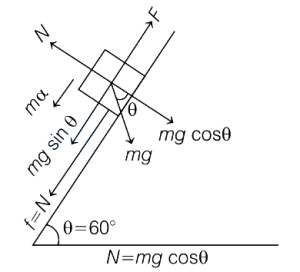
(C) Let $m$ be the mass of the body,$\theta$ be the angle of inclination,and $\mu$ be the coefficient of friction.
The force required to move the body up the inclined plane is $F_{up} = mg \sin \theta + \mu mg \cos \theta$.
The force required to prevent the body from sliding down the inclined plane is $F_{down} = mg \sin \theta - \mu mg \cos \theta$.
According to the problem,$F_{up} = 2 F_{down}$.
Substituting the expressions,we get:
$mg \sin \theta + \mu mg \cos \theta = 2(mg \sin \theta - \mu mg \cos \theta)$
Dividing both sides by $mg$:
$\sin \theta + \mu \cos \theta = 2 \sin \theta - 2 \mu \cos \theta$
Rearranging the terms to solve for $\mu$:
$3 \mu \cos \theta = \sin \theta$
$\mu = \frac{1}{3} \tan \theta$
Given $\theta = 60^{\circ}$,we have:
$\mu = \frac{1}{3} \tan 60^{\circ} = \frac{1}{3} \times \sqrt{3} = \frac{1}{\sqrt{3}}$.
The force required to move the body up the inclined plane is $F_{up} = mg \sin \theta + \mu mg \cos \theta$.
The force required to prevent the body from sliding down the inclined plane is $F_{down} = mg \sin \theta - \mu mg \cos \theta$.
According to the problem,$F_{up} = 2 F_{down}$.
Substituting the expressions,we get:
$mg \sin \theta + \mu mg \cos \theta = 2(mg \sin \theta - \mu mg \cos \theta)$
Dividing both sides by $mg$:
$\sin \theta + \mu \cos \theta = 2 \sin \theta - 2 \mu \cos \theta$
Rearranging the terms to solve for $\mu$:
$3 \mu \cos \theta = \sin \theta$
$\mu = \frac{1}{3} \tan \theta$
Given $\theta = 60^{\circ}$,we have:
$\mu = \frac{1}{3} \tan 60^{\circ} = \frac{1}{3} \times \sqrt{3} = \frac{1}{\sqrt{3}}$.
0 likesView Solution
68
ChemistryMCQAP EAMCET · 2019
The force required to move a body up a rough inclined plane is double the force required to prevent the body from sliding down the plane. The coefficient of friction,when the angle of inclination of the plane is $60^{\circ}$,is
A
$\frac{1}{3}$
B
$\frac{1}{\sqrt{2}}$
C
$\frac{1}{\sqrt{3}}$
D
$\frac{1}{2}$
Solution
(C) For upward motion,the force required is $F_{up} = mg(\sin \theta + \mu \cos \theta)$.
For downward motion,the force required to prevent sliding is $F_{down} = mg(\sin \theta - \mu \cos \theta)$.
According to the problem,$F_{up} = 2 F_{down}$.
Substituting the expressions,we get:
$mg(\sin \theta + \mu \cos \theta) = 2 mg(\sin \theta - \mu \cos \theta)$
$\sin \theta + \mu \cos \theta = 2 \sin \theta - 2 \mu \cos \theta$
$3 \mu \cos \theta = \sin \theta$
$\mu = \frac{1}{3} \tan \theta$
Given $\theta = 60^{\circ}$,we have $\tan 60^{\circ} = \sqrt{3}$.
Therefore,$\mu = \frac{1}{3} \times \sqrt{3} = \frac{1}{\sqrt{3}}$.
For downward motion,the force required to prevent sliding is $F_{down} = mg(\sin \theta - \mu \cos \theta)$.
According to the problem,$F_{up} = 2 F_{down}$.
Substituting the expressions,we get:
$mg(\sin \theta + \mu \cos \theta) = 2 mg(\sin \theta - \mu \cos \theta)$
$\sin \theta + \mu \cos \theta = 2 \sin \theta - 2 \mu \cos \theta$
$3 \mu \cos \theta = \sin \theta$
$\mu = \frac{1}{3} \tan \theta$
Given $\theta = 60^{\circ}$,we have $\tan 60^{\circ} = \sqrt{3}$.
Therefore,$\mu = \frac{1}{3} \times \sqrt{3} = \frac{1}{\sqrt{3}}$.
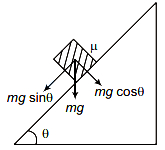
0 likesView Solution
69
ChemistryMCQAP EAMCET · 2019
An electron accelerated through a potential difference $V$ passes through a uniform transverse magnetic field and experiences a force $F$. If the accelerating potential is increased to $2V$,the electron in the same magnetic field will experience a force:
A
$F$
B
$\frac{F}{2}$
C
$\sqrt{2}F$
D
$2F$
Solution
(C) The magnetic force on a moving charge is given by $F = qvB \sin \theta$.
For a transverse magnetic field,$\theta = 90^{\circ}$,so $F = qvB$.
The velocity $v$ of an electron accelerated through a potential difference $V$ is given by $\frac{1}{2}m_e v^2 = eV$,which implies $v = \sqrt{\frac{2eV}{m_e}}$.
Substituting this into the force equation: $F = e \left( \sqrt{\frac{2eV}{m_e}} \right) B$.
This shows that $F \propto \sqrt{V}$.
When the potential is increased to $2V$,the new force $F'$ is:
$F' = e \left( \sqrt{\frac{2e(2V)}{m_e}} \right) B = \sqrt{2} \cdot e \left( \sqrt{\frac{2eV}{m_e}} \right) B = \sqrt{2}F$.
For a transverse magnetic field,$\theta = 90^{\circ}$,so $F = qvB$.
The velocity $v$ of an electron accelerated through a potential difference $V$ is given by $\frac{1}{2}m_e v^2 = eV$,which implies $v = \sqrt{\frac{2eV}{m_e}}$.
Substituting this into the force equation: $F = e \left( \sqrt{\frac{2eV}{m_e}} \right) B$.
This shows that $F \propto \sqrt{V}$.
When the potential is increased to $2V$,the new force $F'$ is:
$F' = e \left( \sqrt{\frac{2e(2V)}{m_e}} \right) B = \sqrt{2} \cdot e \left( \sqrt{\frac{2eV}{m_e}} \right) B = \sqrt{2}F$.
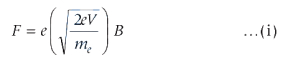
0 likesView Solution
70
ChemistryMediumMCQAP EAMCET · 2019
In the following reactions:
$3B_2H_6 + 6NH_3 \text{ (excess)} \xrightarrow{\Delta} 2B_3N_3H_6 + 12H_2$
$6NaH + 2BF_3 \xrightarrow{450 \ K} B_2H_6 + 6NaF$
$B_2H_6 + 6H_2O \longrightarrow 2H_3BO_3 + 6H_2$
$X, Y$ and $Z$ are respectively:
$3B_2H_6 + 6NH_3 \text{ (excess)} \xrightarrow{\Delta} 2B_3N_3H_6 + 12H_2$
$6NaH + 2BF_3 \xrightarrow{450 \ K} B_2H_6 + 6NaF$
$B_2H_6 + 6H_2O \longrightarrow 2H_3BO_3 + 6H_2$
$X, Y$ and $Z$ are respectively:
A
$B_2H_6, LiBH_4, H_3BO_3$
B
$B_3N_3H_6, B_2H_6, H_3BO_3$
C
$(BN)_n, LiBH_4, HBO_2$
D
$B_2H_6, B_2H_6, HBO_2$
Solution
(B) From the given chemical reactions:
$1$. The reaction of diborane with excess ammonia at high temperature produces inorganic benzene $(B_3N_3H_6)$,so $X = B_3N_3H_6$.
$2$. The reaction of sodium hydride with boron trifluoride produces diborane $(B_2H_6)$,so $Y = B_2H_6$.
$3$. The hydrolysis of diborane produces orthoboric acid $(H_3BO_3)$,so $Z = H_3BO_3$.
Therefore,the correct sequence is $X = B_3N_3H_6, Y = B_2H_6, Z = H_3BO_3$.
Hence,option $(b)$ is correct.
$1$. The reaction of diborane with excess ammonia at high temperature produces inorganic benzene $(B_3N_3H_6)$,so $X = B_3N_3H_6$.
$2$. The reaction of sodium hydride with boron trifluoride produces diborane $(B_2H_6)$,so $Y = B_2H_6$.
$3$. The hydrolysis of diborane produces orthoboric acid $(H_3BO_3)$,so $Z = H_3BO_3$.
Therefore,the correct sequence is $X = B_3N_3H_6, Y = B_2H_6, Z = H_3BO_3$.
Hence,option $(b)$ is correct.
0 likesView Solution
71
ChemistryDifficultMCQAP EAMCET · 2019
Which of the following reactions can be used to prepare diborane?
$I. BF_3 + LiAlH_4 \xrightarrow{\text{ether}}$
$II. BF_3 + NaH \xrightarrow{450 \ K}$
$III. Na_2B_4O_7 + H_2O \longrightarrow$
$IV. NaBH_4 + I_2 \longrightarrow$
$I. BF_3 + LiAlH_4 \xrightarrow{\text{ether}}$
$II. BF_3 + NaH \xrightarrow{450 \ K}$
$III. Na_2B_4O_7 + H_2O \longrightarrow$
$IV. NaBH_4 + I_2 \longrightarrow$
A
$I, II, IV$
B
$II, III$ only
C
$III, IV$ only
D
$I, II, III$
Solution
(A) Diborane $(B_2H_6)$ can be prepared by the following reactions:
$I. 4BF_3 + 3LiAlH_4 \xrightarrow{\text{ether}} 2B_2H_6 + 3LiF + 3AlF_3$
$II. 2BF_3 + 6NaH \xrightarrow{450 \ K} B_2H_6 + 6NaF$
$IV. 2NaBH_4 + I_2 \longrightarrow B_2H_6 + 2NaI + H_2$
Reaction $III$ $(Na_2B_4O_7 + H_2O)$ is a hydrolysis reaction of borax which does not produce diborane.
Thus,reactions $I, II,$ and $IV$ are used to prepare diborane.
$I. 4BF_3 + 3LiAlH_4 \xrightarrow{\text{ether}} 2B_2H_6 + 3LiF + 3AlF_3$
$II. 2BF_3 + 6NaH \xrightarrow{450 \ K} B_2H_6 + 6NaF$
$IV. 2NaBH_4 + I_2 \longrightarrow B_2H_6 + 2NaI + H_2$
Reaction $III$ $(Na_2B_4O_7 + H_2O)$ is a hydrolysis reaction of borax which does not produce diborane.
Thus,reactions $I, II,$ and $IV$ are used to prepare diborane.
0 likesView Solution
72
ChemistryMediumMCQAP EAMCET · 2019
What is $X$ in the following reaction?
$NaH + B_2H_6 \xrightarrow{\text{Diethyl ether}} X$
$NaH + B_2H_6 \xrightarrow{\text{Diethyl ether}} X$
A
$Na[BH_4]$
B
$NaBO_2$
C
$H_3BO_3$
D
$(C_2H_5OC_2H_4)^+(BH_4)^-$
Solution
(A) Sodium hydride reacts with diborane in the presence of diethyl ether to produce sodium tetrahydroborate$(III)$.
The balanced chemical equation is:
$2NaH + B_2H_6 \xrightarrow{\text{Diethyl ether}} 2Na[BH_4]$
Therefore,$X$ is $Na[BH_4]$.
The balanced chemical equation is:
$2NaH + B_2H_6 \xrightarrow{\text{Diethyl ether}} 2Na[BH_4]$
Therefore,$X$ is $Na[BH_4]$.
0 likesView Solution
73
ChemistryEasyMCQAP EAMCET · 2019
Identify the correct statements from the following:
$i$. $H_3BO_3$ is a monobasic acid.
$ii$. The correct formula of borax is $Na_2[B_4O_5(OH)_4] \cdot 8H_2O$.
$iii$. $NaBH_4$ is a reducing agent.
$i$. $H_3BO_3$ is a monobasic acid.
$ii$. The correct formula of borax is $Na_2[B_4O_5(OH)_4] \cdot 8H_2O$.
$iii$. $NaBH_4$ is a reducing agent.
A
$i, ii, iii$
B
$i, ii$ only
C
$ii, iii$ only
D
$i, iii$ only
Solution
(A) The explanations of the given statements are as follows:
$(i)$ $H_3BO_3$ (orthoboric acid) is a monobasic Lewis acid. In aqueous solution,it accepts an $OH^-$ ion from water to form $[B(OH)_4]^-$ and releases $H^+$,acting as a Lewis acid.
$B(OH)_3 + H_2O \rightleftharpoons [B(OH)_4]^- + H^+$
$(ii)$ The correct formula for borax is $Na_2[B_4O_5(OH)_4] \cdot 8H_2O$. This statement is correct.
$(iii)$ $NaBH_4$ (sodium borohydride) is a well-known reducing agent used in organic chemistry to reduce aldehydes and ketones to alcohols. This statement is correct.
Since all three statements are correct,the correct option is $A$.
$(i)$ $H_3BO_3$ (orthoboric acid) is a monobasic Lewis acid. In aqueous solution,it accepts an $OH^-$ ion from water to form $[B(OH)_4]^-$ and releases $H^+$,acting as a Lewis acid.
$B(OH)_3 + H_2O \rightleftharpoons [B(OH)_4]^- + H^+$
$(ii)$ The correct formula for borax is $Na_2[B_4O_5(OH)_4] \cdot 8H_2O$. This statement is correct.
$(iii)$ $NaBH_4$ (sodium borohydride) is a well-known reducing agent used in organic chemistry to reduce aldehydes and ketones to alcohols. This statement is correct.
Since all three statements are correct,the correct option is $A$.
0 likesView Solution
74
ChemistryEasyMCQAP EAMCET · 2019
Identify the correct statements from the following :
$I$. $Ga_2O_3$ is an amphoteric oxide.
$II$. The dimer of aluminium chloride has three $Al-Cl-Al$ bridge bonds.
$III$. Boron is a very hard refractory solid of high melting temperature.
$I$. $Ga_2O_3$ is an amphoteric oxide.
$II$. The dimer of aluminium chloride has three $Al-Cl-Al$ bridge bonds.
$III$. Boron is a very hard refractory solid of high melting temperature.
A
$I$,$II$ only
B
$I$,$III$ only
C
$II$,$III$ only
D
$I$,$II$,$III$
Solution
(B) $(I)$ $Ga_2O_3$ is an amphoteric oxide. This is a correct statement as it reacts with both acids and bases:
Reaction with an acid: $Ga_2O_3 + 6 HCl \longrightarrow 2 GaCl_3 + 3 H_2O$
Reaction with a base: $Ga_2O_3 + 2 NaOH \longrightarrow 2 NaGaO_2 + H_2O$
$(II)$ The dimer of aluminium chloride $(Al_2Cl_6)$ has only two $Al-Cl-Al$ bridge bonds,not three. The structure consists of two $AlCl_4$ tetrahedra sharing a common edge.
$(III)$ Boron is a very hard refractory solid with a high melting temperature $(2349 \ K)$,which is a correct statement.
Therefore,statements $I$ and $III$ are correct. The correct option is $(b)$.
Reaction with an acid: $Ga_2O_3 + 6 HCl \longrightarrow 2 GaCl_3 + 3 H_2O$
Reaction with a base: $Ga_2O_3 + 2 NaOH \longrightarrow 2 NaGaO_2 + H_2O$
$(II)$ The dimer of aluminium chloride $(Al_2Cl_6)$ has only two $Al-Cl-Al$ bridge bonds,not three. The structure consists of two $AlCl_4$ tetrahedra sharing a common edge.
$(III)$ Boron is a very hard refractory solid with a high melting temperature $(2349 \ K)$,which is a correct statement.
Therefore,statements $I$ and $III$ are correct. The correct option is $(b)$.
0 likesView Solution
75
ChemistryDifficultMCQAP EAMCET · 2019
Consider the following statements:
$I$. In diamond,each carbon atom is $sp^3$-hybridised.
$II$. Graphite has planar hexagonal layers of carbon atoms.
$III$. Silicones being surrounded by non-polar alkyl groups are water repelling in nature.
$IV$. The order of catenation in group $14$ elements is $Si > C > Sn > Ge > Pb$.
The correct statements are:
$I$. In diamond,each carbon atom is $sp^3$-hybridised.
$II$. Graphite has planar hexagonal layers of carbon atoms.
$III$. Silicones being surrounded by non-polar alkyl groups are water repelling in nature.
$IV$. The order of catenation in group $14$ elements is $Si > C > Sn > Ge > Pb$.
The correct statements are:
A
$I, II, III$
B
$II, III, IV$
C
$I, II, IV$
D
$I, III, IV$
Solution
(A) $(I)$ In diamond,each carbon atom is $sp^3$ hybridised. This statement is correct.
$(II)$ Graphite consists of planar hexagonal layers of carbon atoms where each carbon is $sp^2$ hybridised. This statement is correct.
$(III)$ Silicones are organosilicon polymers with the general formula $(R_2SiO)_n$. Due to the presence of non-polar alkyl groups,they are hydrophobic (water-repelling) in nature. This statement is correct.
$(IV)$ The tendency for catenation in group $14$ elements decreases down the group due to the decrease in bond dissociation energy of the element-element bond. The correct order is $C >> Si > Ge \approx Sn$. Thus,statement $(IV)$ is incorrect.
Therefore,the correct statements are $(I)$,$(II)$,and $(III)$.
$(II)$ Graphite consists of planar hexagonal layers of carbon atoms where each carbon is $sp^2$ hybridised. This statement is correct.
$(III)$ Silicones are organosilicon polymers with the general formula $(R_2SiO)_n$. Due to the presence of non-polar alkyl groups,they are hydrophobic (water-repelling) in nature. This statement is correct.
$(IV)$ The tendency for catenation in group $14$ elements decreases down the group due to the decrease in bond dissociation energy of the element-element bond. The correct order is $C >> Si > Ge \approx Sn$. Thus,statement $(IV)$ is incorrect.
Therefore,the correct statements are $(I)$,$(II)$,and $(III)$.
0 likesView Solution
76
ChemistryEasyMCQAP EAMCET · 2019
Which one of the following methods is used to prepare carbon monoxide on a commercial scale?
A
Dehydration of formic acid with conc. $H_2SO_4$
B
Direct oxidation of $C$ in limited supply of oxygen
C
Passing steam over hot coke
D
Heating limestone
Solution
(C) Dehydration of formic acid $(HCOOH)$ with conc. $H_2SO_4$ is a laboratory method,not a commercial one.
$(B)$ Direct oxidation of carbon in limited supply of oxygen is difficult to control on a commercial scale.
$(C)$ Passing steam over hot coke at high temperatures produces water gas $(CO + H_2)$,which is a standard commercial process:
$C(s) + H_2O(g) \xrightarrow{1273 \ K} CO(g) + H_2(g)$
$(D)$ Heating limestone $(CaCO_3)$ produces $CO_2$,not $CO$.
Therefore,option $(C)$ is the correct answer.
$(B)$ Direct oxidation of carbon in limited supply of oxygen is difficult to control on a commercial scale.
$(C)$ Passing steam over hot coke at high temperatures produces water gas $(CO + H_2)$,which is a standard commercial process:
$C(s) + H_2O(g) \xrightarrow{1273 \ K} CO(g) + H_2(g)$
$(D)$ Heating limestone $(CaCO_3)$ produces $CO_2$,not $CO$.
Therefore,option $(C)$ is the correct answer.
0 likesView Solution
77
ChemistryEasyMCQAP EAMCET · 2019
Which of the following is the water-gas shift reaction?
A
$C_{(s)} + H_2O_{(g)} \xrightarrow{1270 \ K} CO_{(g)} + H_{2(g)}$
B
$CH_{4(g)} + H_2O_{(g)} \xrightarrow{1270 \ K} CO_{(g)} + 3H_{2(g)}$
C
$CO_{(g)} + H_2O_{(g)} \xrightarrow[\text{iron chromate}]{673 \ K} CO_{2(g)} + H_{2(g)}$
D
$2H_2O_{(l)} \xrightarrow{\text{electrolysis}} 2H_{2(g)} + O_{2(g)}$
Solution
(C) The mixture of $CO$ and $H_2$ is known as water gas or synthesis gas $(syn \ gas)$.
$C_{(s)} + H_2O_{(g)} \rightarrow CO_{(g)} + H_{2(g)}$ is the coal gasification reaction.
The production of dihydrogen can be increased by reacting carbon monoxide with steam in the presence of iron chromate as a catalyst at $673 \ K$.
$CO_{(g)} + H_2O_{(g)} \xrightarrow[\text{iron chromate}]{673 \ K} CO_{2(g)} + H_{2(g)}$
This specific reaction is known as the water-gas shift reaction.
$C_{(s)} + H_2O_{(g)} \rightarrow CO_{(g)} + H_{2(g)}$ is the coal gasification reaction.
The production of dihydrogen can be increased by reacting carbon monoxide with steam in the presence of iron chromate as a catalyst at $673 \ K$.
$CO_{(g)} + H_2O_{(g)} \xrightarrow[\text{iron chromate}]{673 \ K} CO_{2(g)} + H_{2(g)}$
This specific reaction is known as the water-gas shift reaction.
0 likesView Solution
78
ChemistryDifficultMCQAP EAMCET · 2019
What is $X$ in the following reaction?
$CO + 2 H_2 \xrightarrow{X} CH_3 OH$
$CO + 2 H_2 \xrightarrow{X} CH_3 OH$
A
$623 \ K / 300 \ atm$
B
$KMnO_4 / H^{\oplus}$
C
$Zn / \Delta$
D
$ZnO-Cr_2 O_3, 200-300 \ atm, 573-673 \ K$
Solution
(D) The given reaction represents the industrial preparation of methanol from a mixture of carbon monoxide and hydrogen,also known as synthesis gas or syngas.
In this process,the gaseous mixture is subjected to a pressure of $200-300 \ atm$ and passed over a heated catalyst mixture of $ZnO$ and $Cr_2 O_3$ maintained at $573-673 \ K$.
This reaction results in the formation of methanol vapors,which are subsequently condensed to a liquid state.
$CO + 2 H_2 \xrightarrow[\substack{200-300 \ atm, 573-673 \ K}]{ZnO-Cr_2 O_3(X)} CH_3 OH$
In this process,the gaseous mixture is subjected to a pressure of $200-300 \ atm$ and passed over a heated catalyst mixture of $ZnO$ and $Cr_2 O_3$ maintained at $573-673 \ K$.
This reaction results in the formation of methanol vapors,which are subsequently condensed to a liquid state.
$CO + 2 H_2 \xrightarrow[\substack{200-300 \ atm, 573-673 \ K}]{ZnO-Cr_2 O_3(X)} CH_3 OH$
0 likesView Solution
79
ChemistryEasyMCQAP EAMCET · 2019
Observe the following statements regarding $C_{60}$.
$i$. All carbons are $sp^2$-hybridised.
$ii$. It contains $12$ rings of five carbons each and $20$ rings of six carbons each.
$iii$. It is a non-aromatic compound.
$iv$. It is a pure form of carbon.
$v$. $C-C$ bond lengths in it are $143.5 \ pm$ and $138.3 \ pm$.
$vi$. It is prepared by heating graphite in an electric arc in the presence of oxygen.
The correct statements are
$i$. All carbons are $sp^2$-hybridised.
$ii$. It contains $12$ rings of five carbons each and $20$ rings of six carbons each.
$iii$. It is a non-aromatic compound.
$iv$. It is a pure form of carbon.
$v$. $C-C$ bond lengths in it are $143.5 \ pm$ and $138.3 \ pm$.
$vi$. It is prepared by heating graphite in an electric arc in the presence of oxygen.
The correct statements are
A
$i, ii, iii, iv, v$
B
$i, ii, iv, v$ only
C
$i, ii, iv, vi$ only
D
$i, ii, iii$ only
Solution
(B) In $C_{60}$, all carbon atoms are $sp^2$-hybridised.
It contains $12$ rings of five carbons each and $20$ rings of six carbons each.
It is an aromatic compound due to the delocalization of $\pi$-electrons in a spherical cage structure.
It is a pure form of carbon (allotrope).
The $C-C$ bond lengths are $143.5 \ pm$ and $138.3 \ pm$.
It is prepared by heating graphite in an electric arc under an inert atmosphere (e.g., $He$ gas), not in the presence of oxygen.
Thus, statements $(i)$, $(ii)$, $(iv)$, and $(v)$ are correct.
It contains $12$ rings of five carbons each and $20$ rings of six carbons each.
It is an aromatic compound due to the delocalization of $\pi$-electrons in a spherical cage structure.
It is a pure form of carbon (allotrope).
The $C-C$ bond lengths are $143.5 \ pm$ and $138.3 \ pm$.
It is prepared by heating graphite in an electric arc under an inert atmosphere (e.g., $He$ gas), not in the presence of oxygen.
Thus, statements $(i)$, $(ii)$, $(iv)$, and $(v)$ are correct.
0 likesView Solution
80
ChemistryMediumMCQAP EAMCET · 2019
Identify the correct statements:
$(I)$ Germanium exists only in traces.
$(II)$ The order of electronegativity of $Si, Ge, Sn$ is $Sn > Ge > Si$.
$(III)$ All group $14$ elements are available in solid state.
$(I)$ Germanium exists only in traces.
$(II)$ The order of electronegativity of $Si, Ge, Sn$ is $Sn > Ge > Si$.
$(III)$ All group $14$ elements are available in solid state.
A
$(I), (II)$ only
B
$(II), (III)$ only
C
$(I), (III)$ only
D
$(I), (II), (III)$
Solution
(C) Statement $(I)$ is correct: Germanium exists only in traces $(1.5 \ ppm)$ and is mainly recovered from flue dust arising from the roasting of zinc ores.
Statement $(II)$ is incorrect: The electronegativity of group $14$ elements decreases from carbon to silicon and remains approximately constant from silicon to $Sn$ $(Si \approx Ge \approx Sn)$.
Statement $(III)$ is correct: All the group $14$ elements (Carbon,Silicon,Germanium,Tin,Lead) are available in the solid state at room temperature.
Therefore,statements $(I)$ and $(III)$ are correct.
Statement $(II)$ is incorrect: The electronegativity of group $14$ elements decreases from carbon to silicon and remains approximately constant from silicon to $Sn$ $(Si \approx Ge \approx Sn)$.
Statement $(III)$ is correct: All the group $14$ elements (Carbon,Silicon,Germanium,Tin,Lead) are available in the solid state at room temperature.
Therefore,statements $(I)$ and $(III)$ are correct.
0 likesView Solution
81
ChemistryMCQAP EAMCET · 2019
If $y = \log_e \tan \left(\frac{\pi}{4} + \frac{x}{2}\right)$,then $\tanh \left(\frac{y}{2}\right) = $
A
$\cot \left(\frac{x}{2}\right)$
B
$\tan x$
C
$\coth x$
D
$\tan \left(\frac{x}{2}\right)$
Solution
(D) Given,$y = \log_e \tan \left(\frac{\pi}{4} + \frac{x}{2}\right)$
Using the formula $\tan(A+B) = \frac{\tan A + \tan B}{1 - \tan A \tan B}$,we have:
$ \quad=\log _e\left(\frac{\tan \left(\frac{\pi}{4}\right)+\tan \frac{x}{2}}{1-\tan \left(\frac{\pi}{4}\right) \tan \left(\frac{x}{2}\right)}\right)=\log _e\left(\frac{1+\tan \frac{x}{2}}{1-\tan \frac{x}{2}}\right)$
Taking the exponential on both sides:
$e^y = \frac{1 + \tan(x/2)}{1 - \tan(x/2)}$
Using the componendo and dividendo rule:
$\frac{e^y - 1}{e^y + 1} = \frac{(1 + \tan(x/2)) - (1 - \tan(x/2))}{(1 + \tan(x/2)) + (1 - \tan(x/2))} = \frac{2 \tan(x/2)}{2} = \tan \left(\frac{x}{2}\right)$
Since $\tanh \left(\frac{y}{2}\right) = \frac{e^y - 1}{e^y + 1}$,we get:
$\tanh \left(\frac{y}{2}\right) = \tan \left(\frac{x}{2}\right)$
Using the formula $\tan(A+B) = \frac{\tan A + \tan B}{1 - \tan A \tan B}$,we have:
$ \quad=\log _e\left(\frac{\tan \left(\frac{\pi}{4}\right)+\tan \frac{x}{2}}{1-\tan \left(\frac{\pi}{4}\right) \tan \left(\frac{x}{2}\right)}\right)=\log _e\left(\frac{1+\tan \frac{x}{2}}{1-\tan \frac{x}{2}}\right)$
Taking the exponential on both sides:
$e^y = \frac{1 + \tan(x/2)}{1 - \tan(x/2)}$
Using the componendo and dividendo rule:
$\frac{e^y - 1}{e^y + 1} = \frac{(1 + \tan(x/2)) - (1 - \tan(x/2))}{(1 + \tan(x/2)) + (1 - \tan(x/2))} = \frac{2 \tan(x/2)}{2} = \tan \left(\frac{x}{2}\right)$
Since $\tanh \left(\frac{y}{2}\right) = \frac{e^y - 1}{e^y + 1}$,we get:
$\tanh \left(\frac{y}{2}\right) = \tan \left(\frac{x}{2}\right)$
0 likesView Solution
82
ChemistryMCQAP EAMCET · 2019
The distance between the pair of lines $x^2+2 \sqrt{2} x y+2 y^2+4 x+4 \sqrt{2} y+1=0$ is:
A
$4 \sqrt{2}$
B
$2 \sqrt{2}$
C
$2$
D
$6 \sqrt{2}$
Solution
(C) The given equation of the pair of lines is $x^2+2 \sqrt{2} x y+2 y^2+4 x+4 \sqrt{2} y+1=0$.
This can be written as $(x+\sqrt{2}y)^2 + 4(x+\sqrt{2}y) + 1 = 0$.
Let $X = x+\sqrt{2}y$. Then the equation becomes $X^2 + 4X + 1 = 0$.
Solving for $X$ using the quadratic formula $X = \frac{-b \pm \sqrt{b^2-4ac}}{2a}$,we get $X = \frac{-4 \pm \sqrt{16-4}}{2} = -2 \pm \sqrt{3}$.
So,the two parallel lines are $x+\sqrt{2}y + 2 - \sqrt{3} = 0$ and $x+\sqrt{2}y + 2 + \sqrt{3} = 0$.
The distance $d$ between two parallel lines $Ax+By+C_1=0$ and $Ax+By+C_2=0$ is given by $d = \frac{|C_1-C_2|}{\sqrt{A^2+B^2}}$.
Here,$A=1, B=\sqrt{2}, C_1=2-\sqrt{3}, C_2=2+\sqrt{3}$.
$d = \frac{|(2-\sqrt{3})-(2+\sqrt{3})|}{\sqrt{1^2+(\sqrt{2})^2}} = \frac{|-2\sqrt{3}|}{\sqrt{1+2}} = \frac{2\sqrt{3}}{\sqrt{3}} = 2$.
This can be written as $(x+\sqrt{2}y)^2 + 4(x+\sqrt{2}y) + 1 = 0$.
Let $X = x+\sqrt{2}y$. Then the equation becomes $X^2 + 4X + 1 = 0$.
Solving for $X$ using the quadratic formula $X = \frac{-b \pm \sqrt{b^2-4ac}}{2a}$,we get $X = \frac{-4 \pm \sqrt{16-4}}{2} = -2 \pm \sqrt{3}$.
So,the two parallel lines are $x+\sqrt{2}y + 2 - \sqrt{3} = 0$ and $x+\sqrt{2}y + 2 + \sqrt{3} = 0$.
The distance $d$ between two parallel lines $Ax+By+C_1=0$ and $Ax+By+C_2=0$ is given by $d = \frac{|C_1-C_2|}{\sqrt{A^2+B^2}}$.
Here,$A=1, B=\sqrt{2}, C_1=2-\sqrt{3}, C_2=2+\sqrt{3}$.
$d = \frac{|(2-\sqrt{3})-(2+\sqrt{3})|}{\sqrt{1^2+(\sqrt{2})^2}} = \frac{|-2\sqrt{3}|}{\sqrt{1+2}} = \frac{2\sqrt{3}}{\sqrt{3}} = 2$.
0 likesView Solution
83
ChemistryMCQAP EAMCET · 2019
$A$ pair of lines $S=0$ together with the lines given by the equation $8 x^2-14 x y+3 y^2+10 x+10 y-25=0$ form a parallelogram. If its diagonals intersect at the point $(3,2)$,then the equation $S=0$ is
A
$6 x^2-9 x y+y^2-25 x+30 y+25=0$
B
$8 x^2-14 x y+3 y^2-25 x+30 y+50=0$
C
$8 x^2-14 x y+3 y^2-50 x+50 y+75=0$
D
$6 x^2+14 x y-3 y^2-30 x+40 y-75=0$
Solution
(C) The given pair of lines is $8 x^2-14 x y+3 y^2+10 x+10 y-25=0$.
Factoring the expression,we get $(4 x-y-5)(2 x-3 y+5)=0$.
The lines are $L_1: 4 x-y-5=0$ and $L_2: 2 x-3 y+5=0$.
The intersection point of $L_1$ and $L_2$ is $(2,3)$.
Let the pair of lines $S=0$ be $(4 x-y+c_1)(2 x-3 y+c_2)=0$.
Since these lines form a parallelogram with $L_1$ and $L_2$,the diagonals intersect at $(3,2)$.
The intersection of the new pair of lines is $(x_1, y_1)$. The midpoint of $(2,3)$ and $(x_1, y_1)$ is $(3,2)$.
Thus,$\frac{x_1+2}{2}=3 \Rightarrow x_1=4$ and $\frac{y_1+3}{2}=2 \Rightarrow y_1=1$.
Substituting $(4,1)$ into the lines $4 x-y+c_1=0$ and $2 x-3 y+c_2=0$,we get $c_1=-15$ and $c_2=-5$.
The equation $S=0$ is $(4 x-y-15)(2 x-3 y-5)=0$.
Expanding this,we get $8 x^2-14 x y+3 y^2-50 x+50 y+75=0$.
Factoring the expression,we get $(4 x-y-5)(2 x-3 y+5)=0$.
The lines are $L_1: 4 x-y-5=0$ and $L_2: 2 x-3 y+5=0$.
The intersection point of $L_1$ and $L_2$ is $(2,3)$.
Let the pair of lines $S=0$ be $(4 x-y+c_1)(2 x-3 y+c_2)=0$.
Since these lines form a parallelogram with $L_1$ and $L_2$,the diagonals intersect at $(3,2)$.
The intersection of the new pair of lines is $(x_1, y_1)$. The midpoint of $(2,3)$ and $(x_1, y_1)$ is $(3,2)$.
Thus,$\frac{x_1+2}{2}=3 \Rightarrow x_1=4$ and $\frac{y_1+3}{2}=2 \Rightarrow y_1=1$.
Substituting $(4,1)$ into the lines $4 x-y+c_1=0$ and $2 x-3 y+c_2=0$,we get $c_1=-15$ and $c_2=-5$.
The equation $S=0$ is $(4 x-y-15)(2 x-3 y-5)=0$.
Expanding this,we get $8 x^2-14 x y+3 y^2-50 x+50 y+75=0$.
0 likesView Solution
84
ChemistryMCQAP EAMCET · 2019
If the circle $x^2+y^2+6x-2y+k=0$ bisects the circumference of the circle $x^2+y^2+2x-6y-15=0$,then $k$ is equal to :
A
$21$
B
$-21$
C
$23$
D
$-23$
Solution
(D) Given the circles:
$S_1 \equiv x^2+y^2+6x-2y+k=0$
$S_2 \equiv x^2+y^2+2x-6y-15=0$
Since $S_1$ bisects the circumference of $S_2$,the common chord of $S_1$ and $S_2$ must be the diameter of $S_2$.
The equation of the common chord is given by $S_1 - S_2 = 0$:
$(x^2+y^2+6x-2y+k) - (x^2+y^2+2x-6y-15) = 0$
$4x + 4y + k + 15 = 0$
The center of circle $S_2$ is $(-g, -f) = (-1, 3)$.
Since the common chord is the diameter of $S_2$,it must pass through the center of $S_2$ $(-1, 3)$.
Substituting $(-1, 3)$ into the chord equation:
$4(-1) + 4(3) + k + 15 = 0$
$-4 + 12 + k + 15 = 0$
$8 + k + 15 = 0$
$k + 23 = 0$
$k = -23$
$S_1 \equiv x^2+y^2+6x-2y+k=0$
$S_2 \equiv x^2+y^2+2x-6y-15=0$
Since $S_1$ bisects the circumference of $S_2$,the common chord of $S_1$ and $S_2$ must be the diameter of $S_2$.
The equation of the common chord is given by $S_1 - S_2 = 0$:
$(x^2+y^2+6x-2y+k) - (x^2+y^2+2x-6y-15) = 0$
$4x + 4y + k + 15 = 0$
The center of circle $S_2$ is $(-g, -f) = (-1, 3)$.
Since the common chord is the diameter of $S_2$,it must pass through the center of $S_2$ $(-1, 3)$.
Substituting $(-1, 3)$ into the chord equation:
$4(-1) + 4(3) + k + 15 = 0$
$-4 + 12 + k + 15 = 0$
$8 + k + 15 = 0$
$k + 23 = 0$
$k = -23$
0 likesView Solution
85
ChemistryMCQAP EAMCET · 2019
If the circle $x^2+y^2+6x-2y+k=0$ bisects the circumference of the circle $x^2+y^2+2x-6y-15=0$,then $k$ is equal to
A
$21$
B
$-21$
C
$23$
D
$-23$
Solution
(D) Given,the equations of the circles are:
$S: x^2+y^2+6x-2y+k=0$
$S': x^2+y^2+2x-6y-15=0$
The circle $S$ bisects the circumference of circle $S'$,which means the common chord of the two circles passes through the center of circle $S'$.
The equation of the common chord is given by $S - S' = 0$:
$(x^2+y^2+6x-2y+k) - (x^2+y^2+2x-6y-15) = 0$
$4x + 4y + k + 15 = 0$ $(i)$
The center of circle $S'$ is $(-g, -f)$,where $2g=2$ and $2f=-6$,so the center is $(-1, 3)$.
Since the common chord passes through the center $(-1, 3)$,we substitute these coordinates into equation $(i)$:
$4(-1) + 4(3) + k + 15 = 0$
$-4 + 12 + k + 15 = 0$
$8 + k + 15 = 0$
$k + 23 = 0$
$k = -23$
Thus,option $D$ is correct.
$S: x^2+y^2+6x-2y+k=0$
$S': x^2+y^2+2x-6y-15=0$
The circle $S$ bisects the circumference of circle $S'$,which means the common chord of the two circles passes through the center of circle $S'$.
The equation of the common chord is given by $S - S' = 0$:
$(x^2+y^2+6x-2y+k) - (x^2+y^2+2x-6y-15) = 0$
$4x + 4y + k + 15 = 0$ $(i)$
The center of circle $S'$ is $(-g, -f)$,where $2g=2$ and $2f=-6$,so the center is $(-1, 3)$.
Since the common chord passes through the center $(-1, 3)$,we substitute these coordinates into equation $(i)$:
$4(-1) + 4(3) + k + 15 = 0$
$-4 + 12 + k + 15 = 0$
$8 + k + 15 = 0$
$k + 23 = 0$
$k = -23$
Thus,option $D$ is correct.
0 likesView Solution
86
ChemistryMCQAP EAMCET · 2019
If the circle $x^2+y^2+6x-2y+k=0$ bisects the circumference of the circle $x^2+y^2+2x-6y-15=0$,then $k=$
A
$21$
B
-$21$
C
-$23$
D
$23$
Solution
(C) Given circles are:
$S_1: x^2+y^2+6x-2y+k=0$
$S_2: x^2+y^2+2x-6y-15=0$
If circle $S_1$ bisects the circumference of circle $S_2$,then the common chord of $S_1$ and $S_2$ must pass through the center of circle $S_2$.
The equation of the common chord is given by $S_1 - S_2 = 0$:
$(x^2+y^2+6x-2y+k) - (x^2+y^2+2x-6y-15) = 0$
$4x+4y+k+15 = 0$ ... $(i)$
The center of circle $S_2$ is $(-g, -f) = (-1, 3)$.
Since the common chord $(i)$ passes through $(-1, 3)$,we substitute these coordinates into the equation:
$4(-1) + 4(3) + k + 15 = 0$
$-4 + 12 + k + 15 = 0$
$8 + k + 15 = 0$
$k + 23 = 0$
$k = -23$
Thus,the correct option is $C$.
$S_1: x^2+y^2+6x-2y+k=0$
$S_2: x^2+y^2+2x-6y-15=0$
If circle $S_1$ bisects the circumference of circle $S_2$,then the common chord of $S_1$ and $S_2$ must pass through the center of circle $S_2$.
The equation of the common chord is given by $S_1 - S_2 = 0$:
$(x^2+y^2+6x-2y+k) - (x^2+y^2+2x-6y-15) = 0$
$4x+4y+k+15 = 0$ ... $(i)$
The center of circle $S_2$ is $(-g, -f) = (-1, 3)$.
Since the common chord $(i)$ passes through $(-1, 3)$,we substitute these coordinates into the equation:
$4(-1) + 4(3) + k + 15 = 0$
$-4 + 12 + k + 15 = 0$
$8 + k + 15 = 0$
$k + 23 = 0$
$k = -23$
Thus,the correct option is $C$.
0 likesView Solution
87
ChemistryMCQAP EAMCET · 2019
The normal at a point on the parabola $y^2=4x$ passes through $(5,0)$. If two more normals to this parabola also pass through $(5,0)$,then the centroid of the triangle formed by the feet of these three normals is
A
$\left(\frac{1}{2}, \frac{1}{2}\right)$
B
$(2,0)$
C
$(5,0)$
D
$(0,2)$
Solution
(B) The equation of the parabola is $y^2=4ax$,where $a=1$.
The equation of a normal to the parabola $y^2=4ax$ at point $t$ is $y = -tx + 2at + at^3$.
Since the normal passes through $(5,0)$,we have $0 = -5t + 2(1)t + (1)t^3$.
$t^3 - 3t = 0 \implies t(t^2 - 3) = 0$.
The values of $t$ are $t_1 = 0, t_2 = \sqrt{3}, t_3 = -\sqrt{3}$.
The feet of the normals are $(at^2, 2at)$,which are:
$P_1 = (1(0)^2, 2(1)(0)) = (0,0)$.
$P_2 = (1(\sqrt{3})^2, 2(1)(\sqrt{3})) = (3, 2\sqrt{3})$.
$P_3 = (1(-\sqrt{3})^2, 2(1)(-\sqrt{3})) = (3, -2\sqrt{3})$.
The centroid $C$ of the triangle formed by these points is $\left(\frac{x_1+x_2+x_3}{3}, \frac{y_1+y_2+y_3}{3}\right)$.
$C = \left(\frac{0+3+3}{3}, \frac{0+2\sqrt{3}-2\sqrt{3}}{3}\right) = \left(\frac{6}{3}, 0\right) = (2,0)$.
The equation of a normal to the parabola $y^2=4ax$ at point $t$ is $y = -tx + 2at + at^3$.
Since the normal passes through $(5,0)$,we have $0 = -5t + 2(1)t + (1)t^3$.
$t^3 - 3t = 0 \implies t(t^2 - 3) = 0$.
The values of $t$ are $t_1 = 0, t_2 = \sqrt{3}, t_3 = -\sqrt{3}$.
The feet of the normals are $(at^2, 2at)$,which are:
$P_1 = (1(0)^2, 2(1)(0)) = (0,0)$.
$P_2 = (1(\sqrt{3})^2, 2(1)(\sqrt{3})) = (3, 2\sqrt{3})$.
$P_3 = (1(-\sqrt{3})^2, 2(1)(-\sqrt{3})) = (3, -2\sqrt{3})$.
The centroid $C$ of the triangle formed by these points is $\left(\frac{x_1+x_2+x_3}{3}, \frac{y_1+y_2+y_3}{3}\right)$.
$C = \left(\frac{0+3+3}{3}, \frac{0+2\sqrt{3}-2\sqrt{3}}{3}\right) = \left(\frac{6}{3}, 0\right) = (2,0)$.
0 likesView Solution
88
ChemistryMCQAP EAMCET · 2019
The angle between the tangents drawn to the parabola $y^2=4x$ from the point $(1,4)$ is
A
$\frac{\pi}{4}$
B
$\frac{\pi}{3}$
C
$\frac{2\pi}{5}$
D
$\frac{\pi}{6}$
Solution
(B) The equation of a tangent to the parabola $y^2=4ax$ (where $a=1$) is $y=mx+\frac{a}{m}$,which simplifies to $y=mx+\frac{1}{m}$.
Since the tangent passes through the point $(1,4)$,we substitute these coordinates into the equation:
$4 = m(1) + \frac{1}{m}$
$4 = m + \frac{1}{m}$
$m^2 - 4m + 1 = 0$
Let the slopes of the two tangents be $m_1$ and $m_2$. From the quadratic equation,we have:
$m_1 + m_2 = 4$ and $m_1 m_2 = 1$.
The angle $\theta$ between the two tangents is given by:
$\tan \theta = \left| \frac{m_1 - m_2}{1 + m_1 m_2} \right|$
Using the identity $(m_1 - m_2)^2 = (m_1 + m_2)^2 - 4m_1 m_2$:
$(m_1 - m_2)^2 = (4)^2 - 4(1) = 16 - 4 = 12$
$|m_1 - m_2| = \sqrt{12} = 2\sqrt{3}$
Therefore,$\tan \theta = \left| \frac{2\sqrt{3}}{1 + 1} \right| = \frac{2\sqrt{3}}{2} = \sqrt{3}$.
Since $\tan \theta = \sqrt{3}$,we have $\theta = \frac{\pi}{3}$.
Since the tangent passes through the point $(1,4)$,we substitute these coordinates into the equation:
$4 = m(1) + \frac{1}{m}$
$4 = m + \frac{1}{m}$
$m^2 - 4m + 1 = 0$
Let the slopes of the two tangents be $m_1$ and $m_2$. From the quadratic equation,we have:
$m_1 + m_2 = 4$ and $m_1 m_2 = 1$.
The angle $\theta$ between the two tangents is given by:
$\tan \theta = \left| \frac{m_1 - m_2}{1 + m_1 m_2} \right|$
Using the identity $(m_1 - m_2)^2 = (m_1 + m_2)^2 - 4m_1 m_2$:
$(m_1 - m_2)^2 = (4)^2 - 4(1) = 16 - 4 = 12$
$|m_1 - m_2| = \sqrt{12} = 2\sqrt{3}$
Therefore,$\tan \theta = \left| \frac{2\sqrt{3}}{1 + 1} \right| = \frac{2\sqrt{3}}{2} = \sqrt{3}$.
Since $\tan \theta = \sqrt{3}$,we have $\theta = \frac{\pi}{3}$.
0 likesView Solution
89
ChemistryEasyMCQAP EAMCET · 2019
$KMnO_4$ oxidises $S_2O_3^{2-}$ to $SO_4^{2-}$ in medium $x$ and $NO_2^-$ to $NO_3^-$ in medium $y$. $x$ and $y$ are respectively:
A
acidic,basic
B
acidic,acidic
C
neutral,acidic
D
acidic,neutral
Solution
(C) In neutral or faintly alkaline medium,$KMnO_4$ oxidises thiosulphate $(S_2O_3^{2-})$ to sulphate $(SO_4^{2-})$: $8MnO_4^- + 3S_2O_3^{2-} + H_2O \longrightarrow 8MnO_2 + 6SO_4^{2-} + 2OH^-$. Thus,$x$ is neutral or faintly alkaline.
In acidic medium,$KMnO_4$ oxidises nitrite $(NO_2^-)$ to nitrate $(NO_3^-)$: $2MnO_4^- + 5NO_2^- + 6H^+ \longrightarrow 2Mn^{2+} + 5NO_3^- + 3H_2O$. Thus,$y$ is acidic.
Therefore,$x$ is neutral and $y$ is acidic. The correct option is $C$.
In acidic medium,$KMnO_4$ oxidises nitrite $(NO_2^-)$ to nitrate $(NO_3^-)$: $2MnO_4^- + 5NO_2^- + 6H^+ \longrightarrow 2Mn^{2+} + 5NO_3^- + 3H_2O$. Thus,$y$ is acidic.
Therefore,$x$ is neutral and $y$ is acidic. The correct option is $C$.
0 likesView Solution
90
ChemistryDifficultMCQAP EAMCET · 2019
Formic acid is heated with conc. $H_2SO_4$ at $100^{\circ}C$ to form $A$ and $B$. When $Fe_2O_3$ is heated strongly with $B$,the products formed are $C$ and $D$. $C$ can also be obtained by reacting $CaCO_3$ with dil. $HCl$. What is $D$?
A
$Fe$
B
$CO$
C
$CO_2$
D
$Fe_3O_4$
Solution
(A) $HCOOH \xrightarrow{\text{Conc. } H_2SO_4} \underset{(B)}{CO} + \underset{(A)}{H_2O}$
$3 \underset{(B)}{CO} + Fe_2O_3 \xrightarrow{\Delta} \underset{(D)}{2Fe} + \underset{(C)}{3CO_2}$
$CaCO_3 + 2HCl \text{ (dil.)} \longrightarrow \underset{(C)}{CO_2} + H_2O + CaCl_2$
From the reactions,$B$ is $CO$ and $C$ is $CO_2$.
The reduction of $Fe_2O_3$ by $CO$ yields $Fe$ $(D)$ and $CO_2$ $(C)$.
Therefore,$D$ is $Fe$.
$3 \underset{(B)}{CO} + Fe_2O_3 \xrightarrow{\Delta} \underset{(D)}{2Fe} + \underset{(C)}{3CO_2}$
$CaCO_3 + 2HCl \text{ (dil.)} \longrightarrow \underset{(C)}{CO_2} + H_2O + CaCl_2$
From the reactions,$B$ is $CO$ and $C$ is $CO_2$.
The reduction of $Fe_2O_3$ by $CO$ yields $Fe$ $(D)$ and $CO_2$ $(C)$.
Therefore,$D$ is $Fe$.
0 likesView Solution
91
ChemistryMediumMCQAP EAMCET · 2019
Aqueous sulphite reacts with dilute sulphuric acid to form $X_{(g)}$. The liberated $X_{(g)}$ is passed into acidified $KMnO_4$ solution. What is the oxidation state of $Mn$ in the product formed?
A
$6$
B
$4$
C
$2$
D
$3$
Solution
(C) Aqueous sulphite reacts with dilute sulphuric acid to produce sulphur dioxide gas $(SO_{2(g)})$,which is $X_{(g)}$.
When $SO_{2(g)}$ is passed into an acidified $KMnO_4$ solution,it acts as a reducing agent and reduces $Mn^{7+}$ to $Mn^{2+}$.
The chemical equations are:
$(I)$ $SO_3^{2-} + 2H^+ \longrightarrow SO_2 + H_2O$
$(II)$ $5SO_2 + 2KMnO_4 + 2H_2O \longrightarrow K_2SO_4 + 2MnSO_4 + 2H_2SO_4$
In the product $MnSO_4$,the oxidation state of $Mn$ is $+2$.
Therefore,the correct option is $(c)$.
When $SO_{2(g)}$ is passed into an acidified $KMnO_4$ solution,it acts as a reducing agent and reduces $Mn^{7+}$ to $Mn^{2+}$.
The chemical equations are:
$(I)$ $SO_3^{2-} + 2H^+ \longrightarrow SO_2 + H_2O$
$(II)$ $5SO_2 + 2KMnO_4 + 2H_2O \longrightarrow K_2SO_4 + 2MnSO_4 + 2H_2SO_4$
In the product $MnSO_4$,the oxidation state of $Mn$ is $+2$.
Therefore,the correct option is $(c)$.
0 likesView Solution
92
ChemistryEasyMCQAP EAMCET · 2019
Disproportionation products of one mole of $MnO_4^{2-}$ in aqueous acidic medium are
A
$\frac{1}{3} \ mol$ of $MnO_4^{-}, \frac{2}{3} \ mol$ of $MnO_2$
B
$\frac{2}{3} \ mol$ of $MnO_4^{-}, \frac{1}{3} \ mol$ of $MnO_2$
C
$\frac{1}{3} \ mol$ of $Mn_2O_7, \frac{1}{3} \ mol$ of $MnO_2$
D
$\frac{2}{3} \ mol$ of $Mn_2O_7, \frac{1}{3} \ mol$ of $MnO_2$
Solution
(B) The disproportionation reaction of $MnO_4^{2-}$ in acidic medium is given by the following half-reactions:
$2e^{-} + 4H^{+} + MnO_4^{2-} \longrightarrow MnO_2 + 2H_2O$
$(MnO_4^{2-} \longrightarrow MnO_4^{-} + e^{-}) \times 2$
Adding these,the overall balanced equation is:
$3MnO_4^{2-} + 4H^{+} \longrightarrow MnO_2 + 2MnO_4^{-} + 2H_2O$
From the stoichiometry,$3 \ mol$ of $MnO_4^{2-}$ produces $1 \ mol$ of $MnO_2$ and $2 \ mol$ of $MnO_4^{-}$.
Therefore,for $1 \ mol$ of $MnO_4^{2-}$,the products are $\frac{1}{3} \ mol$ of $MnO_2$ and $\frac{2}{3} \ mol$ of $MnO_4^{-}$.
Thus,option $(B)$ is correct.
$2e^{-} + 4H^{+} + MnO_4^{2-} \longrightarrow MnO_2 + 2H_2O$
$(MnO_4^{2-} \longrightarrow MnO_4^{-} + e^{-}) \times 2$
Adding these,the overall balanced equation is:
$3MnO_4^{2-} + 4H^{+} \longrightarrow MnO_2 + 2MnO_4^{-} + 2H_2O$
From the stoichiometry,$3 \ mol$ of $MnO_4^{2-}$ produces $1 \ mol$ of $MnO_2$ and $2 \ mol$ of $MnO_4^{-}$.
Therefore,for $1 \ mol$ of $MnO_4^{2-}$,the products are $\frac{1}{3} \ mol$ of $MnO_2$ and $\frac{2}{3} \ mol$ of $MnO_4^{-}$.
Thus,option $(B)$ is correct.
0 likesView Solution
93
ChemistryMediumMCQAP EAMCET · 2019
Chlorine oxidises sulphur dioxide in the presence of water to give an oxyacid $A$. Chlorine also oxidises iodine in the presence of water to give an oxyacid $B$. The oxidation states of $S$ and $I$ in $A$ and $B$ are respectively
A
$+4, +5$
B
$+6, +3$
C
$+6, +5$
D
$+4, +7$
Solution
(C) $(i)$ When chlorine oxidises sulphur dioxide in the presence of water,it gives $H_2SO_4$ as oxyacid $A$. The reaction is:
$Cl_2 + SO_2 + 2H_2O \longrightarrow H_2SO_4 + 2HCl$
In $H_2SO_4$,the oxidation state of $S$ is calculated as:
$2(+1) + x + 4(-2) = 0$ $\Rightarrow x - 6 = 0$ $\Rightarrow x = +6$.
$(ii)$ When chlorine oxidises iodine in the presence of water,it gives $HIO_3$ as oxyacid $B$. The reaction is:
$5Cl_2 + I_2 + 6H_2O \longrightarrow 2HIO_3 + 10HCl$
In $HIO_3$,the oxidation state of $I$ is calculated as:
$1 + x + 3(-2) = 0$ $\Rightarrow x - 5 = 0$ $\Rightarrow x = +5$.
Thus,the oxidation states of $S$ and $I$ are $+6$ and $+5$ respectively. Therefore,option $C$ is correct.
$Cl_2 + SO_2 + 2H_2O \longrightarrow H_2SO_4 + 2HCl$
In $H_2SO_4$,the oxidation state of $S$ is calculated as:
$2(+1) + x + 4(-2) = 0$ $\Rightarrow x - 6 = 0$ $\Rightarrow x = +6$.
$(ii)$ When chlorine oxidises iodine in the presence of water,it gives $HIO_3$ as oxyacid $B$. The reaction is:
$5Cl_2 + I_2 + 6H_2O \longrightarrow 2HIO_3 + 10HCl$
In $HIO_3$,the oxidation state of $I$ is calculated as:
$1 + x + 3(-2) = 0$ $\Rightarrow x - 5 = 0$ $\Rightarrow x = +5$.
Thus,the oxidation states of $S$ and $I$ are $+6$ and $+5$ respectively. Therefore,option $C$ is correct.
0 likesView Solution
94
ChemistryMediumMCQAP EAMCET · 2019
In how many of the following compounds of sulphur,the oxidation state of sulphur atom is $+6$?
$H_2S_2O_8, H_2SO_5, H_2SO_3, H_2SO_4, H_2S_2O_7, SO_2Cl_2, SOCl_2$
$H_2S_2O_8, H_2SO_5, H_2SO_3, H_2SO_4, H_2S_2O_7, SO_2Cl_2, SOCl_2$
A
$3$
B
$5$
C
$4$
D
$6$
Solution
(B) To find the oxidation state of $S$ in the given compounds:
$1$. $H_2S_2O_8$ (Peroxodisulphuric acid): $2(+1) + 2(x) + 8(-2) = 0$ $\Rightarrow 2x = 14$ $\Rightarrow x = +6$.
$2$. $H_2SO_5$ (Peroxomonosulphuric acid): $2(+1) + x + 5(-2) = 0 \Rightarrow x = +8$ (Incorrect,structure shows $S$ is $+6$ due to peroxide linkage).
$3$. $H_2SO_3$ (Sulphurous acid): $2(+1) + x + 3(-2) = 0 \Rightarrow x = +4$.
$4$. $H_2SO_4$ (Sulphuric acid): $2(+1) + x + 4(-2) = 0 \Rightarrow x = +6$.
$5$. $H_2S_2O_7$ (Pyrosulphuric acid): $2(+1) + 2(x) + 7(-2) = 0$ $\Rightarrow 2x = 12$ $\Rightarrow x = +6$.
$6$. $SO_2Cl_2$ (Sulphuryl chloride): $x + 2(-2) + 2(-1) = 0 \Rightarrow x = +6$.
$7$. $SOCl_2$ (Thionyl chloride): $x + (-2) + 2(-1) = 0 \Rightarrow x = +4$.
Thus,the compounds with $S$ in $+6$ oxidation state are $H_2S_2O_8, H_2SO_5, H_2SO_4, H_2S_2O_7, SO_2Cl_2$. The total count is $5$.
$1$. $H_2S_2O_8$ (Peroxodisulphuric acid): $2(+1) + 2(x) + 8(-2) = 0$ $\Rightarrow 2x = 14$ $\Rightarrow x = +6$.
$2$. $H_2SO_5$ (Peroxomonosulphuric acid): $2(+1) + x + 5(-2) = 0 \Rightarrow x = +8$ (Incorrect,structure shows $S$ is $+6$ due to peroxide linkage).
$3$. $H_2SO_3$ (Sulphurous acid): $2(+1) + x + 3(-2) = 0 \Rightarrow x = +4$.
$4$. $H_2SO_4$ (Sulphuric acid): $2(+1) + x + 4(-2) = 0 \Rightarrow x = +6$.
$5$. $H_2S_2O_7$ (Pyrosulphuric acid): $2(+1) + 2(x) + 7(-2) = 0$ $\Rightarrow 2x = 12$ $\Rightarrow x = +6$.
$6$. $SO_2Cl_2$ (Sulphuryl chloride): $x + 2(-2) + 2(-1) = 0 \Rightarrow x = +6$.
$7$. $SOCl_2$ (Thionyl chloride): $x + (-2) + 2(-1) = 0 \Rightarrow x = +4$.
Thus,the compounds with $S$ in $+6$ oxidation state are $H_2S_2O_8, H_2SO_5, H_2SO_4, H_2S_2O_7, SO_2Cl_2$. The total count is $5$.
0 likesView Solution
95
ChemistryMediumMCQAP EAMCET · 2019
The volume of $0.02 \ M$ acidified acidified permanganate solution required for complete reaction of $60 \ mL$ of $0.01 \ M \ I^{-}$ ion solution to form $I_2$ in $mL$ is
A
$60$
B
$20$
C
$40$
D
$6$
Solution
(D) The balanced chemical equation for the reaction of $MnO_4^{-}$ with $I^{-}$ in acidic medium is:
$2 \ MnO_4^{-} + 10 \ I^{-} + 16 \ H^{+} \longrightarrow 2 \ Mn^{2+} + 5 \ I_2 + 8 \ H_2O$
The $n$-factor for $MnO_4^{-}$ (reduction from $+7$ to $+2$) is $5$.
The $n$-factor for $I^{-}$ (oxidation from $-1$ to $0$ in $I_2$) is $1$ per $I^{-}$ ion.
Using the law of equivalence:
$n_1 \times M_1 \times V_1 = n_2 \times M_2 \times V_2$
$5 \times 0.02 \times V = 1 \times 0.01 \times 60$
$0.1 \times V = 0.6$
$V = \frac{0.6}{0.1} = 6 \ mL$
$2 \ MnO_4^{-} + 10 \ I^{-} + 16 \ H^{+} \longrightarrow 2 \ Mn^{2+} + 5 \ I_2 + 8 \ H_2O$
The $n$-factor for $MnO_4^{-}$ (reduction from $+7$ to $+2$) is $5$.
The $n$-factor for $I^{-}$ (oxidation from $-1$ to $0$ in $I_2$) is $1$ per $I^{-}$ ion.
Using the law of equivalence:
$n_1 \times M_1 \times V_1 = n_2 \times M_2 \times V_2$
$5 \times 0.02 \times V = 1 \times 0.01 \times 60$
$0.1 \times V = 0.6$
$V = \frac{0.6}{0.1} = 6 \ mL$
0 likesView Solution
96
ChemistryDifficultMCQAP EAMCET · 2019
On reduction with hydrogen,$3.6 \ g$ of an oxide of metal $(M)$ left $3.2 \ g$ of the metal. If the atomic weight of the metal is $64$,the formula of the oxide is:
A
$M_2O_3$
B
$M_2O$
C
$MO$
D
$MO_2$
Solution
(B) Moles of metal $(M) = \frac{3.2 \ g}{64 \ g/mol} = 0.05 \ mol$.
Weight of oxygen $= 3.6 \ g - 3.2 \ g = 0.4 \ g$.
Moles of oxygen $= \frac{0.4 \ g}{16 \ g/mol} = 0.025 \ mol$.
Ratio of moles of $M : O = 0.05 : 0.025 = 2 : 1$.
Therefore,the formula of the oxide is $M_2O$.
Hence,the correct option is $(B)$.
Weight of oxygen $= 3.6 \ g - 3.2 \ g = 0.4 \ g$.
Moles of oxygen $= \frac{0.4 \ g}{16 \ g/mol} = 0.025 \ mol$.
Ratio of moles of $M : O = 0.05 : 0.025 = 2 : 1$.
Therefore,the formula of the oxide is $M_2O$.
Hence,the correct option is $(B)$.
0 likesView Solution
97
ChemistryMediumMCQAP EAMCET · 2019
What is the volume (in $mL$) of $20$ vol $H_2O_2$ required to completely react with $500 \ mL$ of $0.02 \ M$ acidified $KMnO_4$ solution?
A
$14$
B
$7$
C
$28$
D
$42$
Solution
(A) The balanced chemical equation for the reaction between $H_2O_2$ and acidified $KMnO_4$ is:
$2KMnO_4 + 3H_2SO_4 + 5H_2O_2 \longrightarrow K_2SO_4 + 2MnSO_4 + 8H_2O + 5O_2$
From the stoichiometry,$2 \text{ moles of } KMnO_4$ react with $5 \text{ moles of } H_2O_2$.
Moles of $KMnO_4 = \text{Molarity} \times \text{Volume (in L)} = 0.02 \times 0.5 = 0.01 \text{ mol}$.
Moles of $H_2O_2$ required $= \frac{5}{2} \times 0.01 = 0.025 \text{ mol}$.
Normality of $20 \text{ vol } H_2O_2 = \frac{20}{5.6} \approx 3.57 \text{ N}$.
Since the $n$-factor for $H_2O_2$ in this reaction is $2$,Molarity of $H_2O_2 = \frac{3.57}{2} = 1.785 \text{ M}$.
Volume of $H_2O_2 = \frac{\text{Moles}}{\text{Molarity}} = \frac{0.025}{1.785} \approx 0.014 \text{ L} = 14 \text{ mL}$.
Alternatively,using the law of equivalence: $N_1V_1 = N_2V_2$.
Normality of $KMnO_4 = 0.02 \times 5 = 0.1 \text{ N}$.
$3.57 \times V_1 = 0.1 \times 500 \implies V_1 = \frac{50}{3.57} \approx 14 \text{ mL}$.
Thus,option $(A)$ is the correct answer.
$2KMnO_4 + 3H_2SO_4 + 5H_2O_2 \longrightarrow K_2SO_4 + 2MnSO_4 + 8H_2O + 5O_2$
From the stoichiometry,$2 \text{ moles of } KMnO_4$ react with $5 \text{ moles of } H_2O_2$.
Moles of $KMnO_4 = \text{Molarity} \times \text{Volume (in L)} = 0.02 \times 0.5 = 0.01 \text{ mol}$.
Moles of $H_2O_2$ required $= \frac{5}{2} \times 0.01 = 0.025 \text{ mol}$.
Normality of $20 \text{ vol } H_2O_2 = \frac{20}{5.6} \approx 3.57 \text{ N}$.
Since the $n$-factor for $H_2O_2$ in this reaction is $2$,Molarity of $H_2O_2 = \frac{3.57}{2} = 1.785 \text{ M}$.
Volume of $H_2O_2 = \frac{\text{Moles}}{\text{Molarity}} = \frac{0.025}{1.785} \approx 0.014 \text{ L} = 14 \text{ mL}$.
Alternatively,using the law of equivalence: $N_1V_1 = N_2V_2$.
Normality of $KMnO_4 = 0.02 \times 5 = 0.1 \text{ N}$.
$3.57 \times V_1 = 0.1 \times 500 \implies V_1 = \frac{50}{3.57} \approx 14 \text{ mL}$.
Thus,option $(A)$ is the correct answer.
0 likesView Solution
98
ChemistryEasyMCQAP EAMCET · 2019
$30.0 \ mL$ of the given $HCl$ solution requires $20.0 \ mL$ of $0.1 \ M$ sodium carbonate solution for complete neutralisation. What is the volume of this $HCl$ solution required to neutralise $30.0 \ mL$ of $0.2 \ M$ $NaOH$ solution (in $mL$)?
A
$25$
B
$50$
C
$90$
D
$45$
Solution
(C) Given:
Volume of $HCl$ solution $(V_1) = 30 \ mL$
Volume of sodium carbonate solution $(Na_2CO_3)$ $(V_2) = 20 \ mL$
Concentration of $Na_2CO_3$ solution $(M_2) = 0.1 \ M$
Volume of $NaOH$ solution $(V_3) = 30.0 \ mL$
Concentration of $NaOH$ solution $(M_3) = 0.2 \ M$
For the reaction between $HCl$ and $Na_2CO_3$ $(Na_2CO_3 + 2HCl \rightarrow 2NaCl + H_2O + CO_2)$:
$n_{HCl} = 2 \times n_{Na_2CO_3}$
$M_1V_1 = 2 \times M_2V_2$
$M_1 = \frac{2 \times M_2 \times V_2}{V_1} = \frac{2 \times 0.1 \times 20}{30} = \frac{4}{30} \ M$
Also,for the reaction between $HCl$ and $NaOH$ $(NaOH + HCl \rightarrow NaCl + H_2O)$:
$M_1 V_f = M_3 V_3$ (where $V_f$ is the volume of $HCl$ solution required)
$V_f = \frac{M_3 \times V_3}{M_1} = \frac{0.2 \times 30}{4 / 30} = \frac{6}{4 / 30} = \frac{180}{4} = 90 \ mL$
Hence,option $C$ is the correct answer.
Volume of $HCl$ solution $(V_1) = 30 \ mL$
Volume of sodium carbonate solution $(Na_2CO_3)$ $(V_2) = 20 \ mL$
Concentration of $Na_2CO_3$ solution $(M_2) = 0.1 \ M$
Volume of $NaOH$ solution $(V_3) = 30.0 \ mL$
Concentration of $NaOH$ solution $(M_3) = 0.2 \ M$
For the reaction between $HCl$ and $Na_2CO_3$ $(Na_2CO_3 + 2HCl \rightarrow 2NaCl + H_2O + CO_2)$:
$n_{HCl} = 2 \times n_{Na_2CO_3}$
$M_1V_1 = 2 \times M_2V_2$
$M_1 = \frac{2 \times M_2 \times V_2}{V_1} = \frac{2 \times 0.1 \times 20}{30} = \frac{4}{30} \ M$
Also,for the reaction between $HCl$ and $NaOH$ $(NaOH + HCl \rightarrow NaCl + H_2O)$:
$M_1 V_f = M_3 V_3$ (where $V_f$ is the volume of $HCl$ solution required)
$V_f = \frac{M_3 \times V_3}{M_1} = \frac{0.2 \times 30}{4 / 30} = \frac{6}{4 / 30} = \frac{180}{4} = 90 \ mL$
Hence,option $C$ is the correct answer.
0 likesView Solution
99
ChemistryDifficultMCQAP EAMCET · 2019
$20 \ mL$ of $Fe^{2+}$ solution of certain concentration has completely reacted with $20 \ mL$ of $0.01 \ M \ K_2Cr_2O_7$ in acidic medium. If $20 \ mL$ of same $Fe^{2+}$ solution has reacted completely with $20 \ mL$ of $KMnO_4$ solution in acidic medium,the molarity of $KMnO_4$ solution is: (in $M$)
A
$0.01$
B
$0.12$
C
$0.10$
D
$0.012$
Solution
(D) The reaction between $Fe^{2+}$ and $Cr_2O_7^{2-}$ in acidic medium is: $Cr_2O_7^{2-} + 14H^{+} + 6Fe^{2+} \longrightarrow 2Cr^{3+} + 7H_2O + 6Fe^{3+}$.
Here,the $n$-factor for $K_2Cr_2O_7$ is $6$.
The reaction between $Fe^{2+}$ and $MnO_4^-$ in acidic medium is: $MnO_4^- + 8H^{+} + 5Fe^{2+} \longrightarrow Mn^{2+} + 4H_2O + 5Fe^{3+}$.
Here,the $n$-factor for $KMnO_4$ is $5$.
Since the same amount of $Fe^{2+}$ reacts in both cases,the number of equivalents of $K_2Cr_2O_7$ must equal the number of equivalents of $KMnO_4$:
$M_1 \times V_1 \times n_1 = M_2 \times V_2 \times n_2$
Given: $M_1 = 0.01 \ M$,$V_1 = 20 \ mL$,$n_1 = 6$,$V_2 = 20 \ mL$,$n_2 = 5$.
$0.01 \times 20 \times 6 = M_2 \times 20 \times 5$
$M_2 = \frac{0.01 \times 6}{5} = 0.012 \ M$.
Thus,the molarity of $KMnO_4$ is $0.012 \ M$.
Here,the $n$-factor for $K_2Cr_2O_7$ is $6$.
The reaction between $Fe^{2+}$ and $MnO_4^-$ in acidic medium is: $MnO_4^- + 8H^{+} + 5Fe^{2+} \longrightarrow Mn^{2+} + 4H_2O + 5Fe^{3+}$.
Here,the $n$-factor for $KMnO_4$ is $5$.
Since the same amount of $Fe^{2+}$ reacts in both cases,the number of equivalents of $K_2Cr_2O_7$ must equal the number of equivalents of $KMnO_4$:
$M_1 \times V_1 \times n_1 = M_2 \times V_2 \times n_2$
Given: $M_1 = 0.01 \ M$,$V_1 = 20 \ mL$,$n_1 = 6$,$V_2 = 20 \ mL$,$n_2 = 5$.
$0.01 \times 20 \times 6 = M_2 \times 20 \times 5$
$M_2 = \frac{0.01 \times 6}{5} = 0.012 \ M$.
Thus,the molarity of $KMnO_4$ is $0.012 \ M$.
0 likesView Solution
100
ChemistryEasyMCQAP EAMCET · 2019
Compound $A$ is prepared by the electrolysis of an aqueous solution of $B$ using a Castner-Kellner cell with mercury as the cathode and carbon as the anode. $A$ and $B$ respectively are:
A
$NaOH$,$NaCl$
B
$NaCl$,$NaOH$
C
$NaHCO_3$,$NaOH$
D
$Na_2CO_3$,$NH_3$
Solution
(A) In the Castner-Kellner cell,the electrolysis of brine ($NaCl$ solution) is performed.
At the anode (carbon),chloride ions are oxidized: $Cl^{-} \longrightarrow \frac{1}{2} Cl_2 + e^{-}$.
At the cathode (mercury),sodium ions are reduced to form a sodium amalgam: $Na^{+} + e^{-} + Hg \longrightarrow Na-Hg$.
The sodium amalgam then reacts with water to produce $NaOH$: $2Na-Hg + 2H_2O \longrightarrow 2NaOH + 2Hg + H_2 \uparrow$.
Thus,$A$ is $NaOH$ and $B$ is $NaCl$.
Therefore,option $(A)$ is correct.
At the anode (carbon),chloride ions are oxidized: $Cl^{-} \longrightarrow \frac{1}{2} Cl_2 + e^{-}$.
At the cathode (mercury),sodium ions are reduced to form a sodium amalgam: $Na^{+} + e^{-} + Hg \longrightarrow Na-Hg$.
The sodium amalgam then reacts with water to produce $NaOH$: $2Na-Hg + 2H_2O \longrightarrow 2NaOH + 2Hg + H_2 \uparrow$.
Thus,$A$ is $NaOH$ and $B$ is $NaCl$.
Therefore,option $(A)$ is correct.
0 likesView Solution
101
ChemistryEasyMCQAP EAMCET · 2019
Which of the following metals exists in a liquid state during the summer season?
A
$Ga$
B
$Al$
C
$Pb$
D
$Sn$
Solution
(A) Gallium $(Ga)$ has a very low melting point of approximately $29.76 \ ^\circ C$ $(302.91 \ K)$.
Since the summer temperature in many regions often exceeds this value,$Ga$ exists in a liquid state during the summer season.
Since the summer temperature in many regions often exceeds this value,$Ga$ exists in a liquid state during the summer season.
0 likesView Solution
102
ChemistryDifficultMCQAP EAMCET · 2019
Identify the metal which is not common to German silver and brass.
A
$Cu$
B
$Zn$
C
$Fe$
D
$Ni$
Solution
(D) German silver is an alloy composed of Copper $(Cu)$,Zinc $(Zn)$,and Nickel $(Ni)$.
Brass is an alloy composed primarily of Copper $(Cu)$ and Zinc $(Zn)$.
Comparing the two,Copper $(Cu)$ and Zinc $(Zn)$ are common to both alloys.
Iron $(Fe)$ is not a primary component of either,but Nickel $(Ni)$ is present in German silver and is not a standard component of brass.
Therefore,the metal that is not common to both is Nickel $(Ni)$.
Hence,option $(D)$ is the correct answer.
Brass is an alloy composed primarily of Copper $(Cu)$ and Zinc $(Zn)$.
Comparing the two,Copper $(Cu)$ and Zinc $(Zn)$ are common to both alloys.
Iron $(Fe)$ is not a primary component of either,but Nickel $(Ni)$ is present in German silver and is not a standard component of brass.
Therefore,the metal that is not common to both is Nickel $(Ni)$.
Hence,option $(D)$ is the correct answer.
0 likesView Solution
103
ChemistryDifficultMCQAP EAMCET · 2019
The copper $(II)$ halide which does not exist is:
A
$CuF_2$
B
$CuBr_2$
C
$CuI_2$
D
$CuCl_2$
Solution
(C) Iodide ions $(I^-)$ are strong reducing agents. When $Cu^{2+}$ reacts with $I^-$,the $Cu^{2+}$ ions oxidize the iodide ions to molecular iodine $(I_2)$ and are themselves reduced to $Cu^+$ ions. Consequently,$CuI_2$ is unstable and does not exist in nature. The reaction is: $2Cu^{2+} + 4I^- \rightarrow 2CuI + I_2$.
0 likesView Solution
104
ChemistryEasyMCQAP EAMCET · 2019
Which of the following sets of elements does not possess $f$-electrons?
A
$La$,$U$,$Lr$
B
$La$,$Th$,$Lr$
C
$La$,$Ac$,$Th$
D
$Ce$,$Ac$,$Th$
Solution
(C) The electronic configurations are as follows:
$(I)$ Lanthanum ($La$,$Z=57$): $[Xe]_{54} \cdot 5d^1 \cdot 6s^2$ (No $f$-electrons)
$(II)$ Uranium ($U$,$Z=92$): $[Rn]_{86} \cdot 5f^3 \cdot 6d^1 \cdot 7s^2$ (Has $f$-electrons)
$(III)$ Lawrencium ($Lr$,$Z=103$): $[Rn]_{86} \cdot 5f^{14} \cdot 6d^1 \cdot 7s^2$ (Has $f$-electrons)
$(IV)$ Thorium ($Th$,$Z=90$): $[Rn]_{86} \cdot 6d^2 \cdot 7s^2$ (No $f$-electrons)
$(V)$ Actinium ($Ac$,$Z=89$): $[Rn]_{86} \cdot 6d^1 \cdot 7s^2$ (No $f$-electrons)
$(VI)$ Cerium ($Ce$,$Z=58$): $[Xe]_{54} \cdot 4f^1 \cdot 5d^1 \cdot 6s^2$ (Has $f$-electrons)
Based on the electronic configurations,the elements $La$,$Ac$,and $Th$ do not possess $f$-electrons.
Therefore,option $(c)$ is the correct answer.
$(I)$ Lanthanum ($La$,$Z=57$): $[Xe]_{54} \cdot 5d^1 \cdot 6s^2$ (No $f$-electrons)
$(II)$ Uranium ($U$,$Z=92$): $[Rn]_{86} \cdot 5f^3 \cdot 6d^1 \cdot 7s^2$ (Has $f$-electrons)
$(III)$ Lawrencium ($Lr$,$Z=103$): $[Rn]_{86} \cdot 5f^{14} \cdot 6d^1 \cdot 7s^2$ (Has $f$-electrons)
$(IV)$ Thorium ($Th$,$Z=90$): $[Rn]_{86} \cdot 6d^2 \cdot 7s^2$ (No $f$-electrons)
$(V)$ Actinium ($Ac$,$Z=89$): $[Rn]_{86} \cdot 6d^1 \cdot 7s^2$ (No $f$-electrons)
$(VI)$ Cerium ($Ce$,$Z=58$): $[Xe]_{54} \cdot 4f^1 \cdot 5d^1 \cdot 6s^2$ (Has $f$-electrons)
Based on the electronic configurations,the elements $La$,$Ac$,and $Th$ do not possess $f$-electrons.
Therefore,option $(c)$ is the correct answer.
0 likesView Solution
105
ChemistryMediumMCQAP EAMCET · 2019
Identify the correct statements from the following :
$I$. The ionic radius of $Pr^{3+}, Dy^{3+}$ and $Sm^{3+}$ follow the order,$Sm^{3+} > Pr^{3+} > Dy^{3+}$.
$II$. $Eu^{2+}$ acts as a strong reducing agent.
$III$. $Pu$ exhibits $+7$ oxidation state.
$I$. The ionic radius of $Pr^{3+}, Dy^{3+}$ and $Sm^{3+}$ follow the order,$Sm^{3+} > Pr^{3+} > Dy^{3+}$.
$II$. $Eu^{2+}$ acts as a strong reducing agent.
$III$. $Pu$ exhibits $+7$ oxidation state.
A
$I, II$ only
B
$I, III$ only
C
$I, II, III$
D
$II, III$ only
Solution
(D) $(I)$ The ionic radius of lanthanoids decreases with an increase in atomic number due to lanthanoid contraction. The order is $Pr^{3+} (1.013 \ \mathring{A}) > Sm^{3+} (0.964 \ \mathring{A}) > Dy^{3+} (0.908 \ \mathring{A})$. Thus,statement $(I)$ is incorrect.
$(II)$ $Eu^{2+}$ $(Z = 63)$ has a stable $4f^7$ configuration but easily oxidizes to $Eu^{3+}$ $(4f^6)$,making it a strong reducing agent. Thus,statement $(II)$ is correct.
$(III)$ $Pu$ $(Z = 94)$ has the electronic configuration $[Rn] 5f^6 6d^0 7s^2$. It can exhibit oxidation states up to $+7$ by utilizing its $5f, 6d,$ and $7s$ electrons. Thus,statement $(III)$ is correct.
Therefore,the correct option is $(D)$.
$(II)$ $Eu^{2+}$ $(Z = 63)$ has a stable $4f^7$ configuration but easily oxidizes to $Eu^{3+}$ $(4f^6)$,making it a strong reducing agent. Thus,statement $(II)$ is correct.
$(III)$ $Pu$ $(Z = 94)$ has the electronic configuration $[Rn] 5f^6 6d^0 7s^2$. It can exhibit oxidation states up to $+7$ by utilizing its $5f, 6d,$ and $7s$ electrons. Thus,statement $(III)$ is correct.
Therefore,the correct option is $(D)$.
0 likesView Solution
106
ChemistryMediumMCQAP EAMCET · 2019
Under which of the following conditions is the $E$ value of the cell for the given reaction maximum?
$Zn_{(s)} + Cu^{2+}_{(aq)} \rightleftharpoons Cu_{(s)} + Zn^{2+}_{(aq)}$
$\left( \frac{2.303 RT}{F} \text{ at } 298 \ K = 0.059 \ V, E^{\circ}_{Zn^{2+}/Zn} = -0.76 \ V, E^{\circ}_{Cu^{2+}/Cu} = +0.34 \ V \right)$
Let $[Zn^{2+}] = C_2$ and $[Cu^{2+}] = C_1$.
$Zn_{(s)} + Cu^{2+}_{(aq)} \rightleftharpoons Cu_{(s)} + Zn^{2+}_{(aq)}$
$\left( \frac{2.303 RT}{F} \text{ at } 298 \ K = 0.059 \ V, E^{\circ}_{Zn^{2+}/Zn} = -0.76 \ V, E^{\circ}_{Cu^{2+}/Cu} = +0.34 \ V \right)$
Let $[Zn^{2+}] = C_2$ and $[Cu^{2+}] = C_1$.
A
$C_1 = 0.1 \ M, C_2 = 0.01 \ M$
B
$C_1 = 0.01 \ M, C_2 = 0.1 \ M$
C
$C_1 = 0.1 \ M, C_2 = 0.2 \ M$
D
$C_1 = 0.2 \ M, C_2 = 0.1 \ M$
Solution
(A) From the Nernst equation:
$E = E^{\circ} - \frac{0.059}{n} \log \left( \frac{[Zn^{2+}]}{[Cu^{2+}]} \right)$
Here,$n = 2$ and $E^{\circ}_{cell} = E^{\circ}_{cathode} - E^{\circ}_{anode} = 0.34 \ V - (-0.76 \ V) = 1.1 \ V$.
Substituting the values:
$E = 1.1 - \frac{0.059}{2} \log \left( \frac{C_2}{C_1} \right)$
To make $E$ maximum,the term $\frac{0.059}{2} \log \left( \frac{C_2}{C_1} \right)$ must be as small as possible (most negative).
This occurs when $\log \left( \frac{C_2}{C_1} \right)$ is the most negative value.
For option $A$: $\log \left( \frac{0.01}{0.1} \right) = \log(0.1) = -1$.
For option $B$: $\log \left( \frac{0.1}{0.01} \right) = \log(10) = 1$.
For option $C$: $\log \left( \frac{0.2}{0.1} \right) = \log(2) \approx 0.301$.
For option $D$: $\log \left( \frac{0.1}{0.2} \right) = \log(0.5) \approx -0.301$.
The value is minimum for option $A$,hence $E$ is maximum.
$E = E^{\circ} - \frac{0.059}{n} \log \left( \frac{[Zn^{2+}]}{[Cu^{2+}]} \right)$
Here,$n = 2$ and $E^{\circ}_{cell} = E^{\circ}_{cathode} - E^{\circ}_{anode} = 0.34 \ V - (-0.76 \ V) = 1.1 \ V$.
Substituting the values:
$E = 1.1 - \frac{0.059}{2} \log \left( \frac{C_2}{C_1} \right)$
To make $E$ maximum,the term $\frac{0.059}{2} \log \left( \frac{C_2}{C_1} \right)$ must be as small as possible (most negative).
This occurs when $\log \left( \frac{C_2}{C_1} \right)$ is the most negative value.
For option $A$: $\log \left( \frac{0.01}{0.1} \right) = \log(0.1) = -1$.
For option $B$: $\log \left( \frac{0.1}{0.01} \right) = \log(10) = 1$.
For option $C$: $\log \left( \frac{0.2}{0.1} \right) = \log(2) \approx 0.301$.
For option $D$: $\log \left( \frac{0.1}{0.2} \right) = \log(0.5) \approx -0.301$.
The value is minimum for option $A$,hence $E$ is maximum.
0 likesView Solution
107
ChemistryEasyMCQAP EAMCET · 2019
The $emf$ of the following cell $Mg|Mg^{2+}(0.01 \ M)||Sn^{2+}(0.1 \ M)|Sn$ at $298 \ K$ in $V$ is: (Given: $E^{\circ}_{Mg^{2+}|Mg} = -2.34 \ V, E^{\circ}_{Sn^{2+}|Sn} = -0.14 \ V$)
A
$2.17$
B
$2.23$
C
$2.51$
D
$2.45$
Solution
(B) At anode: $Mg \longrightarrow Mg^{2+} + 2e^{-}$
At cathode: $Sn^{2+} + 2e^{-} \longrightarrow Sn$
The overall cell reaction is: $Mg + Sn^{2+} \longrightarrow Mg^{2+} + Sn$
$n = 2$
$E^{\circ}_{\text{cell}} = E^{\circ}_{\text{cathode}} - E^{\circ}_{\text{anode}} = -0.14 \ V - (-2.34 \ V) = 2.20 \ V$
Using the Nernst equation:
$E_{\text{cell}} = E^{\circ}_{\text{cell}} - \frac{0.0591}{n} \log \frac{[Mg^{2+}]}{[Sn^{2+}]}$
$E_{\text{cell}} = 2.20 - \frac{0.0591}{2} \log \frac{0.01}{0.1}$
$E_{\text{cell}} = 2.20 - 0.02955 \times \log(10^{-1})$
$E_{\text{cell}} = 2.20 - 0.02955 \times (-1) = 2.20 + 0.02955 \approx 2.23 \ V$
At cathode: $Sn^{2+} + 2e^{-} \longrightarrow Sn$
The overall cell reaction is: $Mg + Sn^{2+} \longrightarrow Mg^{2+} + Sn$
$n = 2$
$E^{\circ}_{\text{cell}} = E^{\circ}_{\text{cathode}} - E^{\circ}_{\text{anode}} = -0.14 \ V - (-2.34 \ V) = 2.20 \ V$
Using the Nernst equation:
$E_{\text{cell}} = E^{\circ}_{\text{cell}} - \frac{0.0591}{n} \log \frac{[Mg^{2+}]}{[Sn^{2+}]}$
$E_{\text{cell}} = 2.20 - \frac{0.0591}{2} \log \frac{0.01}{0.1}$
$E_{\text{cell}} = 2.20 - 0.02955 \times \log(10^{-1})$
$E_{\text{cell}} = 2.20 - 0.02955 \times (-1) = 2.20 + 0.02955 \approx 2.23 \ V$
0 likesView Solution
108
ChemistryEasyMCQAP EAMCET · 2019
The electrode potential for $M^{2+}_{(aq)} + e^- \rightarrow M^{+}_{(aq)}$ and $M^{+}_{(aq)} + e^- \rightarrow M_{(s)}$ are $+0.15 \text{ V}$ and $+0.50 \text{ V}$ respectively. The value of $E^\circ_{M^{2+}/M}$ will be: (in $\text{ V}$)
A
$0.150$
B
$0.300$
C
$0.325$
D
$0.650$
Solution
(C) Given reactions are:
$(i) M^{2+}_{(aq)} + e^- \rightarrow M^{+}_{(aq)}, E_1^\circ = +0.15 \text{ V}$
$(ii) M^{+}_{(aq)} + e^- \rightarrow M_{(s)}, E_2^\circ = +0.50 \text{ V}$
The target reaction is:
$(iii) M^{2+}_{(aq)} + 2e^- \rightarrow M_{(s)}, E_3^\circ = ?$
Using the relation $\Delta G_3^\circ = \Delta G_1^\circ + \Delta G_2^\circ$:
$-n_3FE_3^\circ = -n_1FE_1^\circ - n_2FE_2^\circ$
$n_3E_3^\circ = n_1E_1^\circ + n_2E_2^\circ$
$2 \cdot E_3^\circ = (1 \cdot 0.15) + (1 \cdot 0.50)$
$2 \cdot E_3^\circ = 0.65$
$E_3^\circ = \frac{0.65}{2} = 0.325 \text{ V}$.
$(i) M^{2+}_{(aq)} + e^- \rightarrow M^{+}_{(aq)}, E_1^\circ = +0.15 \text{ V}$
$(ii) M^{+}_{(aq)} + e^- \rightarrow M_{(s)}, E_2^\circ = +0.50 \text{ V}$
The target reaction is:
$(iii) M^{2+}_{(aq)} + 2e^- \rightarrow M_{(s)}, E_3^\circ = ?$
Using the relation $\Delta G_3^\circ = \Delta G_1^\circ + \Delta G_2^\circ$:
$-n_3FE_3^\circ = -n_1FE_1^\circ - n_2FE_2^\circ$
$n_3E_3^\circ = n_1E_1^\circ + n_2E_2^\circ$
$2 \cdot E_3^\circ = (1 \cdot 0.15) + (1 \cdot 0.50)$
$2 \cdot E_3^\circ = 0.65$
$E_3^\circ = \frac{0.65}{2} = 0.325 \text{ V}$.
0 likesView Solution
109
ChemistryEasyMCQAP EAMCET · 2019
If the $E^{\circ}_{cell}$ of an equilibrium reaction $A_{(s)} + 2B^{2+}_{(aq)} \rightleftharpoons A^{2+}_{(aq)} + 2B_{(s)}$ at $298 \ K$ is $0.59 \ V$,the equilibrium constant $K_c$ is
A
$1.0 \times 10^{10}$
B
$1.0 \times 10^2$
C
$1.0 \times 10^{-20}$
D
$1.0 \times 10^{20}$
Solution
(D) For the reaction,$A_{(s)} + 2B^{2+}_{(aq)} \rightleftharpoons A^{2+}_{(aq)} + 2B_{(s)}$
Using the relation $\Delta G^{\circ} = -RT \ln K_c = -nFE^{\circ}_{cell}$
Here,$n = 2$ (number of electrons transferred).
At $298 \ K$,the relation simplifies to $\log K_c = \frac{n E^{\circ}_{cell}}{0.0591}$.
Substituting the values: $\log K_c = \frac{2 \times 0.59}{0.059} = 20$.
Therefore,$K_c = 10^{20} = 1.0 \times 10^{20}$.
Hence,option $(D)$ is the correct answer.
Using the relation $\Delta G^{\circ} = -RT \ln K_c = -nFE^{\circ}_{cell}$
Here,$n = 2$ (number of electrons transferred).
At $298 \ K$,the relation simplifies to $\log K_c = \frac{n E^{\circ}_{cell}}{0.0591}$.
Substituting the values: $\log K_c = \frac{2 \times 0.59}{0.059} = 20$.
Therefore,$K_c = 10^{20} = 1.0 \times 10^{20}$.
Hence,option $(D)$ is the correct answer.
0 likesView Solution
110
ChemistryEasyMCQAP EAMCET · 2019
In which of the following cells,the space between cathode and anode is filled by a moist mixture of ammonium chloride and zinc chloride?
A
Mercury cell
B
Leclanche cell
C
Nickel-cadmium cell
D
Fuel cell
Solution
(B) The $Leclanche$ cell consists of a zinc container which acts as the anode.
The cathode is a carbon (graphite) rod surrounded by a mixture of powdered manganese dioxide $(MnO_2)$ and carbon.
The space between the cathode and anode is filled by a moist paste of ammonium chloride $(NH_4Cl)$ and zinc chloride $(ZnCl_2)$.
The cathode is a carbon (graphite) rod surrounded by a mixture of powdered manganese dioxide $(MnO_2)$ and carbon.
The space between the cathode and anode is filled by a moist paste of ammonium chloride $(NH_4Cl)$ and zinc chloride $(ZnCl_2)$.
0 likesView Solution
111
ChemistryEasyMCQAP EAMCET · 2019
$CuSO_4$ solution is electrolysed for $15 \ minutes$ to deposit $0.4725 \ g$ of copper at the cathode. The current in amperes required is (Faraday $= 96,500 \ C \ mol^{-1}$,atomic weight of copper $= 63$)
A
$0.804$
B
$1.608$
C
$1.206$
D
$0.402$
Solution
(B) The reaction at the cathode is: $Cu^{2+} + 2e^{-} \rightarrow Cu_{(s)}$
For $63 \ g$ of $Cu$,the electricity required is $2 \ F$ $(2 \times 96500 \ C)$.
So,for $0.4725 \ g$ of $Cu$,the electricity required $(Q)$ is: $Q = \frac{2 \times 96500 \times 0.4725}{63} = 1447.5 \ C$.
Using Faraday's law: $Q = I \times t$,where $t = 15 \times 60 \ s = 900 \ s$.
$I = \frac{Q}{t} = \frac{1447.5}{900} = 1.608 \ A$.
For $63 \ g$ of $Cu$,the electricity required is $2 \ F$ $(2 \times 96500 \ C)$.
So,for $0.4725 \ g$ of $Cu$,the electricity required $(Q)$ is: $Q = \frac{2 \times 96500 \times 0.4725}{63} = 1447.5 \ C$.
Using Faraday's law: $Q = I \times t$,where $t = 15 \times 60 \ s = 900 \ s$.
$I = \frac{Q}{t} = \frac{1447.5}{900} = 1.608 \ A$.
0 likesView Solution
112
ChemistryEasyMCQAP EAMCET · 2019
If the general formula of oxime and semicarbazone is $C=N-Z$,what is '$Z$' in oxime $(I)$ and semicarbazone $(II)$?
A
$NHCONH_2, \quad OH$
B
$OH, \quad NH_2$
C
$OH, \quad NHCONH_2$
D
$NH_2, \quad OH$
Solution
(C) The general structure for these derivatives is $C=N-Z$.
For oximes,the derivative is formed by the reaction of a carbonyl compound with hydroxylamine $(NH_2OH)$. Thus,the group $Z$ attached to the nitrogen is $-OH$.
For semicarbazones,the derivative is formed by the reaction of a carbonyl compound with semicarbazide $(NH_2NHCONH_2)$. Thus,the group $Z$ attached to the nitrogen is $-NHCONH_2$.
Therefore,for oxime $(I)$,$Z = -OH$ and for semicarbazone $(II)$,$Z = -NHCONH_2$.
For oximes,the derivative is formed by the reaction of a carbonyl compound with hydroxylamine $(NH_2OH)$. Thus,the group $Z$ attached to the nitrogen is $-OH$.
For semicarbazones,the derivative is formed by the reaction of a carbonyl compound with semicarbazide $(NH_2NHCONH_2)$. Thus,the group $Z$ attached to the nitrogen is $-NHCONH_2$.
Therefore,for oxime $(I)$,$Z = -OH$ and for semicarbazone $(II)$,$Z = -NHCONH_2$.
0 likesView Solution
113
ChemistryEasyMCQAP EAMCET · 2019
The structures of cinnamaldehyde $(I)$,salicylaldehyde $(II)$,and vanillin $(III)$ are:
A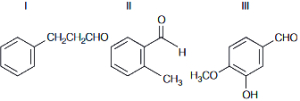
B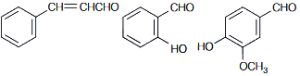
C
D
Solution
(B) The structures of the given compounds are as follows:
$I$. Cinnamaldehyde ($3$-phenylprop-$2$-enal): $C_6H_5-CH=CH-CHO$
$II$. Salicylaldehyde ($2$-hydroxybenzaldehyde): $A$ benzene ring with a $-CHO$ group at position $1$ and a $-OH$ group at position $2$.
$III$. Vanillin ($4$-hydroxy-$3$-methoxybenzaldehyde): $A$ benzene ring with a $-CHO$ group at position $1$,a $-OH$ group at position $4$,and a $-OCH_3$ group at position $3$.
Comparing these with the given options,option $B$ correctly represents the structures of cinnamaldehyde,salicylaldehyde,and vanillin in that order.
$I$. Cinnamaldehyde ($3$-phenylprop-$2$-enal): $C_6H_5-CH=CH-CHO$
$II$. Salicylaldehyde ($2$-hydroxybenzaldehyde): $A$ benzene ring with a $-CHO$ group at position $1$ and a $-OH$ group at position $2$.
$III$. Vanillin ($4$-hydroxy-$3$-methoxybenzaldehyde): $A$ benzene ring with a $-CHO$ group at position $1$,a $-OH$ group at position $4$,and a $-OCH_3$ group at position $3$.
Comparing these with the given options,option $B$ correctly represents the structures of cinnamaldehyde,salicylaldehyde,and vanillin in that order.
0 likesView Solution
114
ChemistryMediumMCQAP EAMCET · 2019
Which of the following sets is in the correct order regarding the property mentioned against them?
| Sets | Property |
|---|---|
| $I$. $NCCH_2COOH > FCH_2COOH > H_3CCH_2COOH$ | Acidity |
| $II$. $CH_3CH_2CHO > PhCOCH_3 > PhCHO$ | Reactivity |
| $III$. $H_3COCH_2CH_3 < H_3CCH_2CHO < H_3CCH_2CH_2OH$ | Boiling points |
A
$I, II$ only
B
$I, III$ only
C
$II, III$ only
D
$I, II, III$
Solution
(B) $I$. Acidity: The presence of electron-withdrawing groups ($-I$ effect) increases the acidity of carboxylic acids,while electron-donating groups ($+I$ effect or hyperconjugation) decrease it. The order $NCCH_2COOH > FCH_2COOH > H_3CCH_2COOH$ is correct because $-CN$ has a stronger $-I$ effect than $-F$,and $-CH_3$ is electron-donating.
$II$. Reactivity (towards nucleophilic addition): Aldehydes are generally more reactive than ketones due to less steric hindrance and electronic factors. Among aldehydes,$CH_3CH_2CHO$ is more reactive than $PhCHO$ (due to resonance stabilization of the carbonyl group by the phenyl ring). Thus,the correct order is $CH_3CH_2CHO > PhCHO > PhCOCH_3$. The given order is incorrect.
$III$. Boiling points: Alcohols have the highest boiling points due to intermolecular hydrogen bonding. Among carbonyl compounds of similar molecular weight,aldehydes generally have higher boiling points than ketones due to greater dipole-dipole interactions and less steric hindrance. The order $H_3COCH_2CH_3$ (ketone) $< H_3CCH_2CHO$ (aldehyde) $< H_3CCH_2CH_2OH$ (alcohol) is correct.
Therefore,sets $I$ and $III$ are correct.
$II$. Reactivity (towards nucleophilic addition): Aldehydes are generally more reactive than ketones due to less steric hindrance and electronic factors. Among aldehydes,$CH_3CH_2CHO$ is more reactive than $PhCHO$ (due to resonance stabilization of the carbonyl group by the phenyl ring). Thus,the correct order is $CH_3CH_2CHO > PhCHO > PhCOCH_3$. The given order is incorrect.
$III$. Boiling points: Alcohols have the highest boiling points due to intermolecular hydrogen bonding. Among carbonyl compounds of similar molecular weight,aldehydes generally have higher boiling points than ketones due to greater dipole-dipole interactions and less steric hindrance. The order $H_3COCH_2CH_3$ (ketone) $< H_3CCH_2CHO$ (aldehyde) $< H_3CCH_2CH_2OH$ (alcohol) is correct.
Therefore,sets $I$ and $III$ are correct.
0 likesView Solution
115
ChemistryDifficultMCQAP EAMCET · 2019
Alkenes $(X)$ and carbonyl compounds $(Y)$ participate in which of the following addition reactions?
A
$A$. $(X) -$ Electrophilic,$(Y) -$ Electrophilic
B
$B$. $(X) -$ Nucleophilic,$(Y) -$ Electrophilic
C
$C$. $(X) -$ Electrophilic,$(Y) -$ Nucleophilic
D
$D$. $(X) -$ Nucleophilic,$(Y) -$ Nucleophilic
Solution
(C) Alkenes $(X)$ are electron-rich due to the presence of a $\pi$-electron cloud,making them susceptible to attack by electrophiles. Therefore,they undergo electrophilic addition reactions.
Carbonyl compounds $(Y)$ contain a polar $C=O$ bond where the carbon atom is electron-deficient (electrophilic). Consequently,they undergo nucleophilic addition reactions.
Carbonyl compounds $(Y)$ contain a polar $C=O$ bond where the carbon atom is electron-deficient (electrophilic). Consequently,they undergo nucleophilic addition reactions.
0 likesView Solution
116
ChemistryEasyMCQAP EAMCET · 2019
Which one of the following is used for the purification of aldehydes?
A
$NaOCl$
B
$NaHSO_3$
C
$C_6H_5SO_2Cl$
D
$Na_2SO_4$
Solution
(B) Carbonyl compounds (aldehydes and ketones) form solid crystalline addition products with sodium bisulphite $(NaHSO_3)$.
These solid bisulphite addition products can be separated from the reaction mixture by filtration,leaving impurities behind.
The pure carbonyl compound is then regenerated from the solid addition product by treatment with dilute acid or base.
The reaction is as follows:
$CH_3CHO + NaHSO_3 \rightarrow CH_3CH(OH)SO_3Na$ (Solid addition product)
$CH_3CH(OH)SO_3Na + H_2O \rightarrow CH_3CHO + NaHSO_3$ (Pure aldehyde)
These solid bisulphite addition products can be separated from the reaction mixture by filtration,leaving impurities behind.
The pure carbonyl compound is then regenerated from the solid addition product by treatment with dilute acid or base.
The reaction is as follows:
$CH_3CHO + NaHSO_3 \rightarrow CH_3CH(OH)SO_3Na$ (Solid addition product)
$CH_3CH(OH)SO_3Na + H_2O \rightarrow CH_3CHO + NaHSO_3$ (Pure aldehyde)
0 likesView Solution
117
ChemistryEasyMCQAP EAMCET · 2019
Which of the following are carbonate ores?
$I$. Magnetite
$II$. Kaolinite
$III$. Siderite
$IV$. Calamine
$I$. Magnetite
$II$. Kaolinite
$III$. Siderite
$IV$. Calamine
A
$I, II, III$
B
$II, III, IV$
C
$I, II$ only
D
$III, IV$ only
Solution
(D) The chemical formulas for the given ores are:
$(I)$ Magnetite: $Fe_3O_4$ (Oxide ore)
$(II)$ Kaolinite: $Al_2Si_2O_5(OH)_4$ (Silicate ore)
$(III)$ Siderite: $FeCO_3$ (Carbonate ore)
$(IV)$ Calamine: $ZnCO_3$ (Carbonate ore)
Since both Siderite and Calamine contain the carbonate group $(CO_3^{2-})$,they are classified as carbonate ores.
Therefore,the correct option is $(D)$.
$(I)$ Magnetite: $Fe_3O_4$ (Oxide ore)
$(II)$ Kaolinite: $Al_2Si_2O_5(OH)_4$ (Silicate ore)
$(III)$ Siderite: $FeCO_3$ (Carbonate ore)
$(IV)$ Calamine: $ZnCO_3$ (Carbonate ore)
Since both Siderite and Calamine contain the carbonate group $(CO_3^{2-})$,they are classified as carbonate ores.
Therefore,the correct option is $(D)$.
0 likesView Solution
118
ChemistryEasyMCQAP EAMCET · 2019
Which one of the following statements is not correct?
A
van-Arkel method is used for refining of zirconium
B
Mond process is used for refining of nickel
C
Zone refining is based on the principle that the impurities are more soluble in the melt than in the solid state of the metal
D
High melting metal are refined by liquation
Solution
(D) The liquation method is used for refining metals that have low melting points,such as $Pb$,$Sn$,$Bi$,and $Hg$,compared to their impurities.
High melting point metals are not refined by this method.
Therefore,the statement that high melting metals are refined by liquation is incorrect.
Thus,option $(D)$ is the correct answer.
High melting point metals are not refined by this method.
Therefore,the statement that high melting metals are refined by liquation is incorrect.
Thus,option $(D)$ is the correct answer.
0 likesView Solution
119
ChemistryEasyMCQAP EAMCET · 2019
The pair of metals refined by "vapour phase refining" is
A
$Ni, Cu$
B
$Sn, Ni$
C
$Zr, Ni$
D
$Cu, Zr$
Solution
(C) Vapour phase refining involves the conversion of a metal into a volatile compound,which is subsequently decomposed to obtain the pure metal.
$1$. Nickel is purified by the Mond process: Impure nickel is heated in a stream of carbon monoxide to form a volatile complex,$Ni(CO)_4$,which is then decomposed to obtain pure nickel.
$Ni + 4 CO$ $\xrightarrow{350 \ K} Ni(CO)_4$ $\xrightarrow{470 \ K} Ni \text{ (pure)} + 4 CO$
$2$. Zirconium is purified by the Van Arkel method: Zirconium is heated in iodine vapours to form a volatile complex,$ZrI_4$,at $870 \ K$,which is further decomposed to obtain pure metal.
$Zr + 2 I_2$ $\xrightarrow{870 \ K} ZrI_4$ $\xrightarrow{1800 \ K} Zr \text{ (pure)} + 2 I_2$
Thus,the pair of metals refined by this method is $Zr$ and $Ni$.
$1$. Nickel is purified by the Mond process: Impure nickel is heated in a stream of carbon monoxide to form a volatile complex,$Ni(CO)_4$,which is then decomposed to obtain pure nickel.
$Ni + 4 CO$ $\xrightarrow{350 \ K} Ni(CO)_4$ $\xrightarrow{470 \ K} Ni \text{ (pure)} + 4 CO$
$2$. Zirconium is purified by the Van Arkel method: Zirconium is heated in iodine vapours to form a volatile complex,$ZrI_4$,at $870 \ K$,which is further decomposed to obtain pure metal.
$Zr + 2 I_2$ $\xrightarrow{870 \ K} ZrI_4$ $\xrightarrow{1800 \ K} Zr \text{ (pure)} + 2 I_2$
Thus,the pair of metals refined by this method is $Zr$ and $Ni$.
0 likesView Solution
120
ChemistryEasyMCQAP EAMCET · 2019
$X_2$ is used in the refining of $Ti$ metal by the van Arkel method. $Y_2$ does not liberate $O_2$ from water and does not form $HY$ and $HOY$ with water. $X_2$ and $Y_2$ are respectively:
A
$I_2, Cl_2$
B
$Cl_2, I_2$
C
$I_2, I_2$
D
$Cl_2, Cl_2$
Solution
(C) The van Arkel method for the refining of $Ti$ metal involves the formation of a volatile iodide,$TiI_4$,which is subsequently decomposed to yield pure metal. Thus,$X_2$ is $I_2$.
$Y_2$ does not liberate $O_2$ from water and does not form $HY$ and $HOY$ with water. $I_2$ is the only halogen that does not react with water to produce $O_2$ or form $HX$ and $HOX$ species under standard conditions. Therefore,$Y_2$ is also $I_2$.
The reactions are:
$(i)$ $\text{Impure } Ti + 2I_2$ $\rightarrow TiI_4$ $\xrightarrow{\Delta} Ti + 2I_2$
(ii) $I_2 + H_2O \rightarrow \text{No reaction to form } O_2, HI, \text{ or } HOI$.
Thus,both $X_2$ and $Y_2$ are $I_2$. The correct option is $(C)$.
$Y_2$ does not liberate $O_2$ from water and does not form $HY$ and $HOY$ with water. $I_2$ is the only halogen that does not react with water to produce $O_2$ or form $HX$ and $HOX$ species under standard conditions. Therefore,$Y_2$ is also $I_2$.
The reactions are:
$(i)$ $\text{Impure } Ti + 2I_2$ $\rightarrow TiI_4$ $\xrightarrow{\Delta} Ti + 2I_2$
(ii) $I_2 + H_2O \rightarrow \text{No reaction to form } O_2, HI, \text{ or } HOI$.
Thus,both $X_2$ and $Y_2$ are $I_2$. The correct option is $(C)$.
0 likesView Solution
121
ChemistryEasyMCQAP EAMCET · 2019
Identify the correct statements from the following:
$(i)$ In the extraction of $Ag$ and $Au$,zinc is used as a reducing agent.
$(ii)$ Impure zinc can be refined by distillation method.
$(iii)$ Malachite is an ore of nickel.
$(i)$ In the extraction of $Ag$ and $Au$,zinc is used as a reducing agent.
$(ii)$ Impure zinc can be refined by distillation method.
$(iii)$ Malachite is an ore of nickel.
A
$(i), (ii), (iii)$
B
$(i), (iii)$ only
C
$(ii), (iii)$ only
D
$(i), (ii)$ only
Solution
(D) $(i)$ In the Mac-Arthur Forrest cyanide process,$Zn$ acts as a reducing agent to displace $Ag$ and $Au$ from their cyanide complexes: $2[M(CN)_2]^- + Zn \rightarrow [Zn(CN)_4]^{2-} + 2M$ (where $M = Ag$ or $Au$).
$(ii)$ Zinc is a low boiling point metal,so it is refined by distillation.
$(iii)$ Malachite is an ore of copper $(CuCO_3 \cdot Cu(OH)_2)$,not nickel.
Therefore,statements $(i)$ and $(ii)$ are correct.
$(ii)$ Zinc is a low boiling point metal,so it is refined by distillation.
$(iii)$ Malachite is an ore of copper $(CuCO_3 \cdot Cu(OH)_2)$,not nickel.
Therefore,statements $(i)$ and $(ii)$ are correct.
0 likesView Solution
122
ChemistryMediumMCQAP EAMCET · 2019
The major product of the following reaction is:
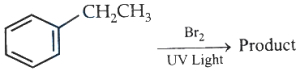
A
$1-$bromo$-1-$phenylethane
B
$2-$bromo$-1-$phenylethane
C
p-bromoethylbenzene
D
o,p-dibromoethylbenzene
Solution
(A) The reaction of ethylbenzene with $Br_2$ in the presence of $UV$ light is a free radical substitution reaction. The bromine radical abstracts a hydrogen atom from the benzylic carbon because the resulting benzylic radical is resonance-stabilized by the phenyl ring. The radical formed at the $\alpha$-carbon (benzylic position) is more stable than the radical at the $\beta$-carbon. Therefore,the major product is $1$-bromo-$1$-phenylethane $(C_6H_5CH(Br)CH_3)$.
0 likesView Solution
123
ChemistryEasyMCQAP EAMCET · 2019
Arrange the following organic halides in the correct order of reactivity towards $S_{N}2$ displacement:
$(P) \ (CH_3)_2C(Br)CH_2CH_3$
$(Q) \ BrCH_2(CH_2)_3CH_3$
$(R) \ CH_3CH(Br)(CH_2)_2CH_3$
$(P) \ (CH_3)_2C(Br)CH_2CH_3$
$(Q) \ BrCH_2(CH_2)_3CH_3$
$(R) \ CH_3CH(Br)(CH_2)_2CH_3$
A
$P > Q > R$
B
$R > P > Q$
C
$P > R > Q$
D
$Q > R > P$
Solution
(D) The reactivity of alkyl halides towards $S_{N}2$ reactions depends on the steric hindrance around the electrophilic carbon atom.
$S_{N}2$ reactivity order is: $1^{\circ} > 2^{\circ} > 3^{\circ}$ alkyl halide.
$(P) \ (CH_3)_2C(Br)CH_2CH_3$ is a $3^{\circ}$ alkyl halide (highly sterically hindered).
$(Q) \ BrCH_2(CH_2)_3CH_3$ is a $1^{\circ}$ alkyl halide (least sterically hindered).
$(R) \ CH_3CH(Br)(CH_2)_2CH_3$ is a $2^{\circ}$ alkyl halide.
Therefore,the correct order of reactivity is $Q > R > P$.
$S_{N}2$ reactivity order is: $1^{\circ} > 2^{\circ} > 3^{\circ}$ alkyl halide.
$(P) \ (CH_3)_2C(Br)CH_2CH_3$ is a $3^{\circ}$ alkyl halide (highly sterically hindered).
$(Q) \ BrCH_2(CH_2)_3CH_3$ is a $1^{\circ}$ alkyl halide (least sterically hindered).
$(R) \ CH_3CH(Br)(CH_2)_2CH_3$ is a $2^{\circ}$ alkyl halide.
Therefore,the correct order of reactivity is $Q > R > P$.
0 likesView Solution
124
ChemistryMediumMCQAP EAMCET · 2019
What are $X$ and $Y$ in the following reaction sequence?
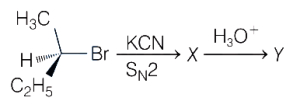
A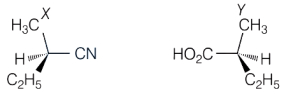
B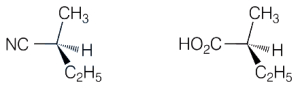
C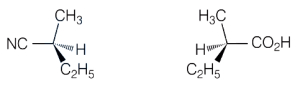
D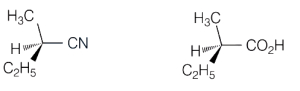
Solution
(C) The given reaction proceeds as follows:
$1$. The starting material is a chiral $2^{\circ}$ haloalkane,specifically $(S)-2-$bromobutane.
$2$. The reaction with $KCN$ proceeds via an $S_{N}2$ mechanism. The nucleophile $CN^-$ attacks from the side opposite to the leaving group $(Br^-)$,resulting in a Walden inversion of the configuration at the chiral center.
$3$. This produces $(R)-2-$methylbutanenitrile as product $X$.
$4$. Subsequent acid-catalyzed hydrolysis of the nitrile group $(-CN)$ converts it into a carboxylic acid group $(-COOH)$ without affecting the chiral center. Thus,the configuration remains inverted relative to the starting material,yielding $(R)-2-$methylbutanoic acid as product $Y$.
$5$. Comparing this with the given options,option $C$ correctly represents the structures of $X$ and $Y$.
$1$. The starting material is a chiral $2^{\circ}$ haloalkane,specifically $(S)-2-$bromobutane.
$2$. The reaction with $KCN$ proceeds via an $S_{N}2$ mechanism. The nucleophile $CN^-$ attacks from the side opposite to the leaving group $(Br^-)$,resulting in a Walden inversion of the configuration at the chiral center.
$3$. This produces $(R)-2-$methylbutanenitrile as product $X$.
$4$. Subsequent acid-catalyzed hydrolysis of the nitrile group $(-CN)$ converts it into a carboxylic acid group $(-COOH)$ without affecting the chiral center. Thus,the configuration remains inverted relative to the starting material,yielding $(R)-2-$methylbutanoic acid as product $Y$.
$5$. Comparing this with the given options,option $C$ correctly represents the structures of $X$ and $Y$.
0 likesView Solution
125
ChemistryMediumMCQAP EAMCET · 2019
Assertion $(A)$: $S_N1$ hydrolysis of optically active $2-$bromooctane results in the formation of $(\pm)-$octan$-2-$ol.
Reason $(R)$: The reaction proceeds through a planar carbocation which can be attacked by the nucleophile from either side.
The correct answer is
Reason $(R)$: The reaction proceeds through a planar carbocation which can be attacked by the nucleophile from either side.
The correct answer is
A
$(A)$ and $(R)$ are correct,$(R)$ is the correct explanation of $(A)$
B
$(A)$ and $(R)$ are correct but $(R)$ is not the correct explanation of $(A)$
C
$(A)$ is correct but $(R)$ is not correct
D
$(A)$ is not correct but $(R)$ is correct
Solution
(A) The $S_N1$ mechanism involves the formation of a planar carbocation intermediate.
In the case of $2-$bromooctane,the loss of the bromide ion leads to a planar carbocation intermediate.
Because the carbocation is planar,the nucleophile (e.g.,$OH^-$) can attack from either the front or the back side with equal probability.
This leads to the formation of a racemic mixture,which is represented as $(\pm)-$octan$-2-$ol.
Therefore,both the Assertion $(A)$ and the Reason $(R)$ are correct,and the Reason $(R)$ is the correct explanation for the Assertion $(A)$.
In the case of $2-$bromooctane,the loss of the bromide ion leads to a planar carbocation intermediate.
Because the carbocation is planar,the nucleophile (e.g.,$OH^-$) can attack from either the front or the back side with equal probability.
This leads to the formation of a racemic mixture,which is represented as $(\pm)-$octan$-2-$ol.
Therefore,both the Assertion $(A)$ and the Reason $(R)$ are correct,and the Reason $(R)$ is the correct explanation for the Assertion $(A)$.
0 likesView Solution
126
ChemistryMediumMCQAP EAMCET · 2019
Identify $Z$ in the following sequence of reactions.
$C_2H_4Br_2$ $\xrightarrow[\text{(ii) } NaNH_2]{\text{(i) alc- } KOH} X$ $\xrightarrow[\text{Red hot}]{\text{Fe tube, } 873 \ K} Y$ $\xrightarrow[\Delta]{\left(CH_3CO\right)_2O / \text{Anhyd-} AlCl_3} Z$
$C_2H_4Br_2$ $\xrightarrow[\text{(ii) } NaNH_2]{\text{(i) alc- } KOH} X$ $\xrightarrow[\text{Red hot}]{\text{Fe tube, } 873 \ K} Y$ $\xrightarrow[\Delta]{\left(CH_3CO\right)_2O / \text{Anhyd-} AlCl_3} Z$
A
Acetophenone
B
Anisole
C
Toluene
D
Chlorobenzene
Solution
(A) $C_2H_4Br_2$ undergoes dehydrohalogenation with alc. $KOH$ followed by $NaNH_2$ to form ethyne $(X)$: $C_2H_4Br_2 \xrightarrow{\text{alc. } KOH, NaNH_2} HC \equiv CH (X)$.
Ethyne undergoes cyclic polymerization in the presence of red hot $Fe$ tube at $873 \ K$ to form benzene $(Y)$: $3C_2H_2 \xrightarrow{\text{Red hot Fe tube}} C_6H_6 (Y)$.
Benzene reacts with acetic anhydride in the presence of anhydrous $AlCl_3$ (Friedel-Crafts acylation) to form acetophenone $(Z)$: $C_6H_6 + (CH_3CO)_2O \xrightarrow{AlCl_3} C_6H_5COCH_3 (Z)$.
Ethyne undergoes cyclic polymerization in the presence of red hot $Fe$ tube at $873 \ K$ to form benzene $(Y)$: $3C_2H_2 \xrightarrow{\text{Red hot Fe tube}} C_6H_6 (Y)$.
Benzene reacts with acetic anhydride in the presence of anhydrous $AlCl_3$ (Friedel-Crafts acylation) to form acetophenone $(Z)$: $C_6H_6 + (CH_3CO)_2O \xrightarrow{AlCl_3} C_6H_5COCH_3 (Z)$.
0 likesView Solution
127
ChemistryMediumMCQAP EAMCET · 2019
Which of the following statements are correct?
$A$. The $C-Cl$ bond in chlorobenzene is shorter than in chloromethane.
$B$. It is more difficult to replace chlorine from chlorobenzene than from benzyl chloride.
$C$. The $C-Cl$ bond in chlorobenzene has some double bond character.
$D$. Chlorobenzene on chlorination gives $m$-dichlorobenzene.
$A$. The $C-Cl$ bond in chlorobenzene is shorter than in chloromethane.
$B$. It is more difficult to replace chlorine from chlorobenzene than from benzyl chloride.
$C$. The $C-Cl$ bond in chlorobenzene has some double bond character.
$D$. Chlorobenzene on chlorination gives $m$-dichlorobenzene.
A
$A, B, C$
B
$A, D$ only
C
$B, C, D$
D
$C, D$ only
Solution
$A$. Correct: Due to resonance, the $C-Cl$ bond in chlorobenzene acquires partial double bond character, making it shorter $(169 \ pm)$ than the $C-Cl$ bond in chloromethane $(178 \ pm)$.
$B$. Correct: The partial double bond character in chlorobenzene makes the $C-Cl$ bond stronger and harder to break compared to the single $C-Cl$ bond in benzyl chloride.
$C$. Correct: Resonance in chlorobenzene involves the lone pair of $Cl$ delocalizing into the ring, creating partial double bond character.
$D$. Incorrect: The $Cl$ atom is $o/p$-directing, so chlorination of chlorobenzene yields $o$-dichlorobenzene and $p$-dichlorobenzene, not $m$-dichlorobenzene.
Therefore, statements $A, B,$ and $C$ are correct.
$B$. Correct: The partial double bond character in chlorobenzene makes the $C-Cl$ bond stronger and harder to break compared to the single $C-Cl$ bond in benzyl chloride.
$C$. Correct: Resonance in chlorobenzene involves the lone pair of $Cl$ delocalizing into the ring, creating partial double bond character.
$D$. Incorrect: The $Cl$ atom is $o/p$-directing, so chlorination of chlorobenzene yields $o$-dichlorobenzene and $p$-dichlorobenzene, not $m$-dichlorobenzene.
Therefore, statements $A, B,$ and $C$ are correct.
0 likesView Solution
128
ChemistryMediumMCQAP EAMCET · 2019
An organic compound $X$ $(C_7H_7Cl)$ when reacted with $KCN$ in $C_2H_5OH$ gives a major product $Y$. $Z$ is formed when $Y$ is reduced with $LiAlH_4$. What are $Y$ and $Z$?
A
$Y$ = Benzyl isocyanide,$Z$ = $N$-methylbenzylamine
B
$Y$ = Benzyl cyanide,$Z$ = Phenylethylamine
C
$Y$ = p-Methylbenzonitrile,$Z$ = p-Methylbenzylamine
D
$Y$ = p-Methylphenyl isocyanide,$Z$ = $N$-methyl-p-toluidine
Solution
(B) The organic compound $X$ is benzyl chloride $(C_6H_5CH_2Cl)$.
When benzyl chloride reacts with $KCN$ in $C_2H_5OH$,it undergoes a nucleophilic substitution reaction to form benzyl cyanide $(C_6H_5CH_2CN)$ as the major product $Y$.
When benzyl cyanide $(Y)$ is reduced with $LiAlH_4$,it forms $2-$phenylethan$-1-$amine $(C_6H_5CH_2CH_2NH_2)$ as product $Z$.
When benzyl chloride reacts with $KCN$ in $C_2H_5OH$,it undergoes a nucleophilic substitution reaction to form benzyl cyanide $(C_6H_5CH_2CN)$ as the major product $Y$.
When benzyl cyanide $(Y)$ is reduced with $LiAlH_4$,it forms $2-$phenylethan$-1-$amine $(C_6H_5CH_2CH_2NH_2)$ as product $Z$.
0 likesView Solution
129
ChemistryMediumMCQAP EAMCET · 2019
Identify $Z$ in the reaction :
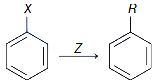
A
$RCOX$ / Anhydrous $AlCl_3$
B
$RX$ / $Na$ / dry $(C_2H_5)_2O$
C
$Na$ / dry $(C_2H_5)_2O$
D
$RCOX$ / $FeCl_3$
Solution
(B) The given reaction involves the conversion of an aryl halide to an alkylbenzene by reacting it with an alkyl halide $(RX)$ and sodium metal in the presence of dry ether. This specific reaction is known as the Wurtz-Fittig reaction. The general equation is: $Ar-X + R-X + 2Na \xrightarrow{\text{dry ether}} Ar-R + 2NaX$. Therefore,the reagent $Z$ is $RX / Na / \text{dry } (C_2H_5)_2O$.
0 likesView Solution
130
ChemistryEasyMCQAP EAMCET · 2019
Identify $X$ and $Y$ in the following reactions:
$X \xrightarrow{H_2/Ni} CH_3CH_2CH_2NH_2 \xleftarrow{Br_2/NaOH} Y$
$X \xrightarrow{H_2/Ni} CH_3CH_2CH_2NH_2 \xleftarrow{Br_2/NaOH} Y$
A
$CH_3CH_2CH_2CN \quad CH_3CH_2CH_2CONH_2$
B
$CH_3CH_2CN \quad CH_3CH_2CH_2CONH_2$
C
$CH_3CH_2CH_2NC \quad CH_3CH_2CONHCH_3$
D
$CH_3CH_2CN \quad CH_3CH_2CONH_2$
Solution
(B) $1$. For the reaction $X \xrightarrow{H_2/Ni} CH_3CH_2CH_2NH_2$,the reduction of a nitrile $(R-CN)$ with $H_2/Ni$ adds four hydrogen atoms to produce a primary amine $(R-CH_2NH_2)$. To obtain $CH_3CH_2CH_2NH_2$ (propan$-1-$amine),$X$ must be $CH_3CH_2CN$ (propanenitrile).
$2$. For the reaction $Y \xrightarrow{Br_2/NaOH} CH_3CH_2CH_2NH_2$,this is the Hofmann bromamide degradation reaction,which converts an amide $(R-CONH_2)$ into a primary amine $(R-NH_2)$ with one less carbon atom. To obtain $CH_3CH_2CH_2NH_2$ (propan$-1-$amine),$Y$ must be $CH_3CH_2CH_2CONH_2$ (butanamide).
$3$. Therefore,$X = CH_3CH_2CN$ and $Y = CH_3CH_2CH_2CONH_2$.
$2$. For the reaction $Y \xrightarrow{Br_2/NaOH} CH_3CH_2CH_2NH_2$,this is the Hofmann bromamide degradation reaction,which converts an amide $(R-CONH_2)$ into a primary amine $(R-NH_2)$ with one less carbon atom. To obtain $CH_3CH_2CH_2NH_2$ (propan$-1-$amine),$Y$ must be $CH_3CH_2CH_2CONH_2$ (butanamide).
$3$. Therefore,$X = CH_3CH_2CN$ and $Y = CH_3CH_2CH_2CONH_2$.
0 likesView Solution
131
ChemistryEasyMCQAP EAMCET · 2019
Which one of the following is not present in the nitration mixture?
A
$NO_2^{+}$
B
$HSO_4^{-}$
C
$SO_4^{2-}$
D
$H_2O$
Solution
(C) The nitration mixture consists of concentrated $HNO_3$ and concentrated $H_2SO_4$. The reaction between them is as follows:
$HNO_3 + 2H_2SO_4 \rightarrow NO_2^{+} + H_3O^{+} + 2HSO_4^{-}$.
From the reaction,it is evident that $NO_2^{+}$,$H_3O^{+}$,and $HSO_4^{-}$ are present in the mixture.
$SO_4^{2-}$ ions are not formed in this reaction.
$HNO_3 + 2H_2SO_4 \rightarrow NO_2^{+} + H_3O^{+} + 2HSO_4^{-}$.
From the reaction,it is evident that $NO_2^{+}$,$H_3O^{+}$,and $HSO_4^{-}$ are present in the mixture.
$SO_4^{2-}$ ions are not formed in this reaction.
0 likesView Solution
132
ChemistryDifficultMCQAP EAMCET · 2019
$2-$methyl$-2-$butene on hydration gives an alcohol $X$. An isomer of $X$ could be prepared from which of the following?
A
Acetone + Ethylmagnesium bromide followed by hydrolysis
B
Acetaldehyde + Isopropylmagnesium bromide followed by hydrolysis
C
Acetone + Propylmagnesium bromide followed by hydrolysis
D
None of the above
Solution
(B) The hydration of $2-$methyl$-2-$butene $(CH_3-C(CH_3)=CH-CH_3)$ follows Markovnikov's rule to form $2-$methyl$-2-$butanol $(X)$,which is a tertiary alcohol $(CH_3-C(OH)(CH_3)-CH_2-CH_3)$.
An isomer of $X$ is $3-$methyl$-2-$butanol $(CH_3-CH(OH)-CH(CH_3)_2)$,which is a secondary alcohol.
This isomer can be prepared by the reaction of acetaldehyde $(CH_3CHO)$ with isopropylmagnesium bromide $((CH_3)_2CHMgBr)$ followed by hydrolysis,as this is a Grignard reaction forming a secondary alcohol.
Thus,option $(B)$ is correct.
An isomer of $X$ is $3-$methyl$-2-$butanol $(CH_3-CH(OH)-CH(CH_3)_2)$,which is a secondary alcohol.
This isomer can be prepared by the reaction of acetaldehyde $(CH_3CHO)$ with isopropylmagnesium bromide $((CH_3)_2CHMgBr)$ followed by hydrolysis,as this is a Grignard reaction forming a secondary alcohol.
Thus,option $(B)$ is correct.
0 likesView Solution
133
ChemistryMediumMCQAP EAMCET · 2019
$H_2C=CH_2 + O_2 \xrightarrow{\text{aqueous medium}} CH_3CHO$. What is the catalyst used in the above green reaction?
A
$Pd(II)$
B
$Pt$
C
$ZnO$
D
$Rh$
Solution
(A) Ethene reacts with oxygen in the presence of palladium$(II)$ chloride as a catalyst to form acetaldehyde.
This process is known as the Wacker process.
The chemical reaction is: $CH_2=CH_2 + \frac{1}{2}O_2 \xrightarrow{Pd(II), Cu(II)} CH_3CHO$.
This process is known as the Wacker process.
The chemical reaction is: $CH_2=CH_2 + \frac{1}{2}O_2 \xrightarrow{Pd(II), Cu(II)} CH_3CHO$.
0 likesView Solution
134
ChemistryDifficultMCQAP EAMCET · 2019
What are $X$ and $Y$ in the following reaction?
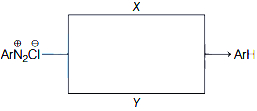
A
| $X$ | $Y$ |
| $CH_3CH_2OH$ | $H_3PO_2, H_2O$ |
B
| $X$ | $Y$ |
| $CH_3MgX$ | $H_3PO_3$ |
C
| $X$ | $Y$ |
| $CH_3CHO$ | $H_2O$ |
D
| $X$ | $Y$ |
| $CH_2=CH_2$ | $NaNO_2/HCl$ |
Solution
(A) The conversion of an arenediazonium salt $(ArN_2^+Cl^-)$ to an arene $(ArH)$ is a reduction reaction. This can be achieved using ethanol $(CH_3CH_2OH)$ or hypophosphorous acid $(H_3PO_2)$ in the presence of water.
In the given reaction scheme,$X$ represents the reagent $CH_3CH_2OH$ and $Y$ represents the reagent $H_3PO_2/H_2O$,which are both standard reagents for the deamination of diazonium salts to arenes.
Therefore,the correct option is $A$.
In the given reaction scheme,$X$ represents the reagent $CH_3CH_2OH$ and $Y$ represents the reagent $H_3PO_2/H_2O$,which are both standard reagents for the deamination of diazonium salts to arenes.
Therefore,the correct option is $A$.
0 likesView Solution
135
ChemistryDifficultMCQAP EAMCET · 2019
Identify $Z$ in the following sequence of reactions.
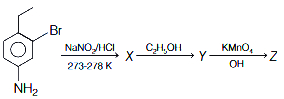
A
$2-$bromo$-4-$aminoethylbenzene
B
$2-$bromo$-4-$carboxymethylbenzene
C
$2-$bromo$-1,4-$dicarboxybenzene
D
$2-$bromobenzoic acid
Solution
(D) The reaction sequence is as follows:
$1$. The starting material is $4$-amino-$3$-bromoethylbenzene. Treatment with $NaNO_2/HCl$ at $273-278 \ K$ performs diazotization of the $-NH_2$ group to form the diazonium salt,$X$ ($4$-ethyl-$2$-bromobenzenediazonium chloride).
$2$. Reaction of $X$ with ethanol $(C_2H_5OH)$ reduces the diazonium group to a hydrogen atom,yielding $Y$ ($1$-bromo-$2$-ethylbenzene).
$3$. Finally,oxidation of the ethyl group with alkaline $KMnO_4$ converts the benzylic carbon into a carboxylic acid group,resulting in $Z$ ($2$-bromobenzoic acid).
Thus,the correct structure for $Z$ is $2$-bromobenzoic acid,which corresponds to option $(D)$.
$1$. The starting material is $4$-amino-$3$-bromoethylbenzene. Treatment with $NaNO_2/HCl$ at $273-278 \ K$ performs diazotization of the $-NH_2$ group to form the diazonium salt,$X$ ($4$-ethyl-$2$-bromobenzenediazonium chloride).
$2$. Reaction of $X$ with ethanol $(C_2H_5OH)$ reduces the diazonium group to a hydrogen atom,yielding $Y$ ($1$-bromo-$2$-ethylbenzene).
$3$. Finally,oxidation of the ethyl group with alkaline $KMnO_4$ converts the benzylic carbon into a carboxylic acid group,resulting in $Z$ ($2$-bromobenzoic acid).
Thus,the correct structure for $Z$ is $2$-bromobenzoic acid,which corresponds to option $(D)$.
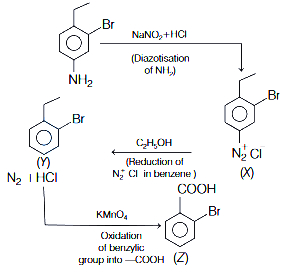
0 likesView Solution
136
ChemistryMediumMCQAP EAMCET · 2019
Identify the reagents $(X, Y, Z)$ used in the conversion of $3$-methylaniline to $3$-nitrotoluene.
A
$NaNO_2, HCl$; $HBF_4$; $NaNO_2, Cu, \Delta$
B
$NaNO_3, HCl, 273 \ K$; $HF$; $NaNO_3, Cu, \Delta$
C
$NaNO_2, HCl$; $C_2H_5OH$; $NaNO_3, \Delta$
D
$NaNO_3, HCl$; $NaOH$; $C_6H_5NO_2$
Solution
(A) The conversion of $3$-methylaniline to $3$-nitrotoluene involves the following steps:
$1.$ Diazotization: $3-CH_3-C_6H_4-NH_2 + NaNO_2 + HCl \xrightarrow{273-278 \ K} 3-CH_3-C_6H_4-N_2^+Cl^-$ (Reagent $X = NaNO_2, HCl$).
$2.$ Reaction with $HBF_4$: $3-CH_3-C_6H_4-N_2^+Cl^- + HBF_4 \rightarrow 3-CH_3-C_6H_4-N_2^+BF_4^-$ (Reagent $Y = HBF_4$).
$3.$ Replacement by nitro group: $3-CH_3-C_6H_4-N_2^+BF_4^- + NaNO_2 \xrightarrow{Cu, \Delta} 3-CH_3-C_6H_4-NO_2$ (Reagent $Z = NaNO_2, Cu, \Delta$).
$1.$ Diazotization: $3-CH_3-C_6H_4-NH_2 + NaNO_2 + HCl \xrightarrow{273-278 \ K} 3-CH_3-C_6H_4-N_2^+Cl^-$ (Reagent $X = NaNO_2, HCl$).
$2.$ Reaction with $HBF_4$: $3-CH_3-C_6H_4-N_2^+Cl^- + HBF_4 \rightarrow 3-CH_3-C_6H_4-N_2^+BF_4^-$ (Reagent $Y = HBF_4$).
$3.$ Replacement by nitro group: $3-CH_3-C_6H_4-N_2^+BF_4^- + NaNO_2 \xrightarrow{Cu, \Delta} 3-CH_3-C_6H_4-NO_2$ (Reagent $Z = NaNO_2, Cu, \Delta$).
0 likesView Solution
137
ChemistryMediumMCQAP EAMCET · 2019
What is $Z$ in the above sequence of reactions?

A
Salicylaldehyde
B
Phenyl acetate
C
p-Hydroxybenzoic acid
D
Aspirin
Solution
(D) The reaction sequence is as follows:
$1$. Cumene is oxidized and then hydrolyzed to form phenol $(X)$.
$2$. Phenol reacts with $NaOH$ followed by $CO_2$ and acidification (Kolbe-Schmitt reaction) to form salicylic acid $(Y)$,which is $2$-hydroxybenzoic acid.
$3$. Salicylic acid reacts with acetic anhydride $(CH_3CO)_2O$ to form acetylsalicylic acid,commonly known as aspirin $(Z)$.
$1$. Cumene is oxidized and then hydrolyzed to form phenol $(X)$.
$2$. Phenol reacts with $NaOH$ followed by $CO_2$ and acidification (Kolbe-Schmitt reaction) to form salicylic acid $(Y)$,which is $2$-hydroxybenzoic acid.
$3$. Salicylic acid reacts with acetic anhydride $(CH_3CO)_2O$ to form acetylsalicylic acid,commonly known as aspirin $(Z)$.
0 likesView Solution
138
ChemistryEasyMCQAP EAMCET · 2019
Match the following.
The correct answer is:
| List-$I$ (Reaction) | List-$II$ (Catalyst) |
|---|---|
| $A$. $N_{2(g)} + 3H_{2(g)} \longrightarrow 2NH_{3(g)}$ | $I$. $Ni$ |
| $B$. $2H_{2(g)} + O_{2(g)} \longrightarrow 2H_2O_{(l)}$ | $II$. $Pt$ |
| $C$. $CO_{(g)} + 3H_{2(g)} \longrightarrow CH_{4(g)} + H_2O_{(g)}$ | $III$. $ZnO-Cr_2O_3$ |
| $D$. $CO_{(g)} + 2H_{2(g)} \longrightarrow CH_3OH_{(g)}$ | $IV$. $Fe$ |
The correct answer is:
A
$A-III, B-II, C-I, D-IV$
B
$A-IV, B-III, C-II, D-I$
C
$A-IV, B-II, C-I, D-III$
D
$A-IV, B-I, C-III, D-II$
Solution
(C) The correct matches are:
$A$. $N_{2(g)} + 3H_{2(g)} \longrightarrow 2NH_{3(g)}$ uses $Fe$ as a catalyst (Haber process) $(IV)$.
$B$. $2H_{2(g)} + O_{2(g)} \longrightarrow 2H_2O_{(l)}$ uses $Pt$ as a catalyst $(II)$.
$C$. $CO_{(g)} + 3H_{2(g)} \longrightarrow CH_{4(g)} + H_2O_{(g)}$ uses $Ni$ as a catalyst $(I)$.
$D$. $CO_{(g)} + 2H_{2(g)} \longrightarrow CH_3OH_{(g)}$ uses $ZnO-Cr_2O_3$ as a catalyst $(III)$.
Thus,the correct sequence is $A-IV, B-II, C-I, D-III$.
$A$. $N_{2(g)} + 3H_{2(g)} \longrightarrow 2NH_{3(g)}$ uses $Fe$ as a catalyst (Haber process) $(IV)$.
$B$. $2H_{2(g)} + O_{2(g)} \longrightarrow 2H_2O_{(l)}$ uses $Pt$ as a catalyst $(II)$.
$C$. $CO_{(g)} + 3H_{2(g)} \longrightarrow CH_{4(g)} + H_2O_{(g)}$ uses $Ni$ as a catalyst $(I)$.
$D$. $CO_{(g)} + 2H_{2(g)} \longrightarrow CH_3OH_{(g)}$ uses $ZnO-Cr_2O_3$ as a catalyst $(III)$.
Thus,the correct sequence is $A-IV, B-II, C-I, D-III$.
0 likesView Solution
139
ChemistryEasyMCQAP EAMCET · 2019
Which of the following statements are not correct?
$(A)$ Diode is a combination of $n$-type and $p$-type semiconductors.
$(B)$ Silicon or germanium is electron rich impurity.
$(C)$ Phosphorus and arsenic are electron deficient impurities.
$(D)$ Schottky defect decreases the density of the crystal.
$(A)$ Diode is a combination of $n$-type and $p$-type semiconductors.
$(B)$ Silicon or germanium is electron rich impurity.
$(C)$ Phosphorus and arsenic are electron deficient impurities.
$(D)$ Schottky defect decreases the density of the crystal.
A
$B$,$C$
B
$A$,$D$
C
$C$,$D$
D
$A$,$C$
Solution
(A) Among the given statements,$(B)$ and $(C)$ are incorrect.
$(B)$ Silicon $(Si)$ and germanium $(Ge)$ are group $14$ elements and are intrinsic semiconductors,not impurities.
$(C)$ Phosphorus $(P)$ and arsenic $(As)$ are group $15$ elements. They have $5$ valence electrons. When doped into group $14$ elements,$4$ electrons form covalent bonds,and the $5$th electron remains free. Thus,they are electron-rich impurities,not electron-deficient.
$(B)$ Silicon $(Si)$ and germanium $(Ge)$ are group $14$ elements and are intrinsic semiconductors,not impurities.
$(C)$ Phosphorus $(P)$ and arsenic $(As)$ are group $15$ elements. They have $5$ valence electrons. When doped into group $14$ elements,$4$ electrons form covalent bonds,and the $5$th electron remains free. Thus,they are electron-rich impurities,not electron-deficient.
0 likesView Solution
140
ChemistryMediumMCQAP EAMCET · 2019
Assertion $(A)$: $P_4O_{10}$ cannot be used to remove moisture from ammonia gas. Reason $(R)$: $P_4O_{10}$ reacts with $NH_3$ gas. The correct answer is:
A
Both $(A)$ and $(R)$ are correct and $(R)$ is the correct explanation of $(A)$
B
Both $(A)$ and $(R)$ are correct and $(R)$ is not the correct explanation of $(A)$
C
$(A)$ is correct but $(R)$ is not correct
D
$(A)$ is not correct but $(R)$ is correct
Solution
(A) $P_4O_{10}$ is an acidic dehydrating agent. It cannot be used to dry ammonia $(NH_3)$ because ammonia is basic in nature and reacts with $P_4O_{10}$.
The chemical reaction is: $12NH_3 + P_4O_{10} + 6H_2O \rightarrow 4(NH_4)_3PO_4$.
Since $P_4O_{10}$ reacts with $NH_3$,it cannot be used as a drying agent for it.
Therefore,both $(A)$ and $(R)$ are correct and $(R)$ is the correct explanation of $(A)$.
The chemical reaction is: $12NH_3 + P_4O_{10} + 6H_2O \rightarrow 4(NH_4)_3PO_4$.
Since $P_4O_{10}$ reacts with $NH_3$,it cannot be used as a drying agent for it.
Therefore,both $(A)$ and $(R)$ are correct and $(R)$ is the correct explanation of $(A)$.
0 likesView Solution
141
ChemistryEasyMCQAP EAMCET · 2019
White phosphorus is heated with concentrated $NaOH$ in $CO_2$ atmosphere to form a gas $A$ and compound $B$. When $A$ is bubbled into aqueous $CuSO_4$ solution,copper phosphide and $C$ are formed. $B$ and $C$ are respectively:
A
$PH_3, H_2SO_4$
B
$NaH_2PO_2, H_2SO_4$
C
$NaHPO_2, CuS$
D
$NaH_2PO_2, Cu_2S$
Solution
(B) When white phosphorus $(P_4)$ is heated with concentrated $NaOH$ in an inert atmosphere of $CO_2$,it undergoes disproportionation to form phosphine $(PH_3)$ and sodium hypophosphite $(NaH_2PO_2)$.
$P_4 + 3NaOH + 3H_2O \rightarrow PH_3(A) + 3NaH_2PO_2(B)$
When phosphine $(A)$ is bubbled into aqueous $CuSO_4$ solution,it forms copper phosphide $(Cu_3P_2)$ and sulfuric acid $(H_2SO_4)$.
$3CuSO_4 + 2PH_3 \rightarrow Cu_3P_2 + 3H_2SO_4(C)$
Therefore,$B$ is $NaH_2PO_2$ and $C$ is $H_2SO_4$.
$P_4 + 3NaOH + 3H_2O \rightarrow PH_3(A) + 3NaH_2PO_2(B)$
When phosphine $(A)$ is bubbled into aqueous $CuSO_4$ solution,it forms copper phosphide $(Cu_3P_2)$ and sulfuric acid $(H_2SO_4)$.
$3CuSO_4 + 2PH_3 \rightarrow Cu_3P_2 + 3H_2SO_4(C)$
Therefore,$B$ is $NaH_2PO_2$ and $C$ is $H_2SO_4$.
0 likesView Solution
142
ChemistryMediumMCQAP EAMCET · 2019
The number of $P-OH$ bonds present in pyrophosphoric acid and hypophosphoric acid is respectively
A
$4, 3$
B
$2, 4$
C
$3, 4$
D
$4, 4$
Solution
(D) Pyrophosphoric acid $(H_4P_2O_7)$ has the structure $(HO)_2P(O)-O-P(O)(OH)_2$. It contains $4$ $P-OH$ bonds.
Hypophosphoric acid $(H_4P_2O_6)$ has the structure $(HO)_2P(O)-P(O)(OH)_2$. It contains $4$ $P-OH$ bonds.
Therefore,the number of $P-OH$ bonds in both acids is $4$ and $4$ respectively.
Hypophosphoric acid $(H_4P_2O_6)$ has the structure $(HO)_2P(O)-P(O)(OH)_2$. It contains $4$ $P-OH$ bonds.
Therefore,the number of $P-OH$ bonds in both acids is $4$ and $4$ respectively.
0 likesView Solution
143
ChemistryDifficultMCQAP EAMCET · 2019
White phosphorus,when heated with conc. $NaOH$ solution in an inert atmosphere of $CO_2$,forms phosphine and a sodium salt of oxoacid of phosphorus,$'X'$. The oxidation state of phosphorus in $'X'$ is
A
$+3$
B
$+4$
C
$+1$
D
$+5$
Solution
(C) White phosphorus $(P_4)$ undergoes disproportionation reaction when heated with concentrated $NaOH$ solution to form phosphine $(PH_3)$ and sodium hypophosphite $(NaH_2PO_2)$.
The chemical equation is: $P_4 + 3NaOH + 3H_2O \rightarrow PH_3 + 3NaH_2PO_2$.
In the salt $NaH_2PO_2$ (sodium hypophosphite),let the oxidation state of $P$ be $x$.
The sum of oxidation states is: $(+1) + 2(+1) + x + 2(-2) = 0$.
$1 + 2 + x - 4 = 0$.
$x - 1 = 0$.
$x = +1$.
The chemical equation is: $P_4 + 3NaOH + 3H_2O \rightarrow PH_3 + 3NaH_2PO_2$.
In the salt $NaH_2PO_2$ (sodium hypophosphite),let the oxidation state of $P$ be $x$.
The sum of oxidation states is: $(+1) + 2(+1) + x + 2(-2) = 0$.
$1 + 2 + x - 4 = 0$.
$x - 1 = 0$.
$x = +1$.
0 likesView Solution
144
ChemistryEasyMCQAP EAMCET · 2019
Phosphorus reacts with $SO_2Cl_2$ to form $PCl_5$ and $X$. At $723 \ K$,$HCl$ gas reacts with $O_2$ in the presence of $CuCl_2$ to form water and $Y$. $Y$ reacts with $X$ in water to form two acids $A$ and $B$. What are $A$ and $B$ respectively?
A
$H_2SO_4, HCl$
B
$H_2SO_4, HNO_3$
C
$HCl, HNO_3$
D
$H_2SO_4, H_3PO_4$
Solution
(A) The reaction of phosphorus with sulfuryl chloride $(SO_2Cl_2)$ is: $P_4 + 10 SO_2Cl_2 \longrightarrow 4 PCl_5 + 10 SO_2$ $(X = SO_2)$.
At $723 \ K$,the Deacon process for the manufacture of chlorine is: $4 HCl + O_2 \xrightarrow[CuCl_2]{723 \ K} 2 Cl_2 + 2 H_2O$ $(Y = Cl_2)$.
$Cl_2$ $(Y)$ reacts with $SO_2$ $(X)$ in the presence of water to form hydrochloric acid $(A)$ and sulfuric acid $(B)$: $SO_2 + 2 H_2O + Cl_2 \longrightarrow 2 HCl + H_2SO_4$.
At $723 \ K$,the Deacon process for the manufacture of chlorine is: $4 HCl + O_2 \xrightarrow[CuCl_2]{723 \ K} 2 Cl_2 + 2 H_2O$ $(Y = Cl_2)$.
$Cl_2$ $(Y)$ reacts with $SO_2$ $(X)$ in the presence of water to form hydrochloric acid $(A)$ and sulfuric acid $(B)$: $SO_2 + 2 H_2O + Cl_2 \longrightarrow 2 HCl + H_2SO_4$.
0 likesView Solution
145
ChemistryEasyMCQAP EAMCET · 2019
Which one of the following statements is not correct regarding phosphine?
A
It is a weak base
B
It reacts with $CuSO_4$ solution to form $CuHPO_4$
C
It is formed by the reaction of $Ca_3P_2$ with $HCl$
D
It is used in smoke screens
Solution
(B) Phosphine $(PH_3)$ reacts with $CuSO_4$ solution to form a black precipitate of cupric phosphide $(Cu_3P_2)$,not $CuHPO_4$.
$3 CuSO_4 + 2 PH_3 \longrightarrow Cu_3P_2 + 3 H_2SO_4$
$PH_3$ is a very weak base.
It is prepared by the reaction of calcium phosphide with $HCl$:
$Ca_3P_2 + 6 HCl \longrightarrow 2 PH_3 + 3 CaCl_2$
$PH_3$ is used in smoke screens (Holm's signals).
Therefore,statement $(B)$ is incorrect.
$3 CuSO_4 + 2 PH_3 \longrightarrow Cu_3P_2 + 3 H_2SO_4$
$PH_3$ is a very weak base.
It is prepared by the reaction of calcium phosphide with $HCl$:
$Ca_3P_2 + 6 HCl \longrightarrow 2 PH_3 + 3 CaCl_2$
$PH_3$ is used in smoke screens (Holm's signals).
Therefore,statement $(B)$ is incorrect.
0 likesView Solution
146
ChemistryMediumMCQAP EAMCET · 2019
White phosphorus reacts with sulphuryl chloride to form $PCl_5$ and $X$. Chlorine reacts with $X$ in the presence of wood charcoal to form $Y$. $X$ and $Y$ are respectively
A
$SO_2, SO_2Cl_2$
B
$SO_2, SCl_4$
C
$SO_3, SO_2Cl_2$
D
$SO_3, SCl_4$
Solution
(A) White phosphorus $(P_4)$ reacts with sulphuryl chloride $(SO_2Cl_2)$ to form phosphorus pentachloride $(PCl_5)$ and sulphur dioxide ($SO_2$,which is $X$).
$P_4 + 10 SO_2Cl_2 \longrightarrow 4 PCl_5 + 10 SO_2$ $(X)$
Chlorine $(Cl_2)$ reacts with sulphur dioxide ($SO_2$,$X$) in the presence of wood charcoal to form sulphuryl chloride ($SO_2Cl_2$,which is $Y$).
$SO_2$ $(X)$ $+ Cl_2 \xrightarrow{\text{Wood charcoal}} SO_2Cl_2$ $(Y)$
Therefore,$X$ is $SO_2$ and $Y$ is $SO_2Cl_2$.
$P_4 + 10 SO_2Cl_2 \longrightarrow 4 PCl_5 + 10 SO_2$ $(X)$
Chlorine $(Cl_2)$ reacts with sulphur dioxide ($SO_2$,$X$) in the presence of wood charcoal to form sulphuryl chloride ($SO_2Cl_2$,which is $Y$).
$SO_2$ $(X)$ $+ Cl_2 \xrightarrow{\text{Wood charcoal}} SO_2Cl_2$ $(Y)$
Therefore,$X$ is $SO_2$ and $Y$ is $SO_2Cl_2$.
0 likesView Solution
147
ChemistryMediumMCQAP EAMCET · 2019
Which of the following statements is not correct?
A
From $SO_2$ to $TeO_2$ reducing power decreases.
B
The order of boiling points of hydrides of $16^{\text{th}}$ group elements is $H_2S < H_2Se < H_2Te < H_2O$.
C
Rhombic sulphur has $S_8$ molecules while monoclinic sulphur has $S_6$ molecules.
D
The bond angle in ozone molecule is $117^{\circ}$.
Solution
(C) Reducing power decreases from $SO_2$ to $TeO_2$ on moving down the group.
$(B)$ The order of boiling points of hydrides of $16^{\text{th}}$ group elements is $H_2S < H_2Se < H_2Te < H_2O$. Due to $H$-bonding,$H_2O$ has a higher boiling point.
$(C)$ Both rhombic and monoclinic sulphur contain $S_8$ molecules. Therefore,statement $(C)$ is incorrect.
$(D)$ The bond angle of ozone is $117^{\circ}$.
Thus,option $(C)$ is the incorrect statement.
$(B)$ The order of boiling points of hydrides of $16^{\text{th}}$ group elements is $H_2S < H_2Se < H_2Te < H_2O$. Due to $H$-bonding,$H_2O$ has a higher boiling point.
$(C)$ Both rhombic and monoclinic sulphur contain $S_8$ molecules. Therefore,statement $(C)$ is incorrect.
$(D)$ The bond angle of ozone is $117^{\circ}$.
Thus,option $(C)$ is the incorrect statement.
0 likesView Solution
148
ChemistryEasyMCQAP EAMCET · 2019
Identify the correct statements from the following:
$i$. Sulphuric acid is manufactured by contact process.
$ii$. $SO_3$ dissolves in $H_2SO_4$ to form pyrosulphuric acid $(H_2S_2O_7)$.
$iii$. $H_2SO_4$ is used in the manufacture of fertilisers such as ammonium sulphate and super phosphate.
$iv$. In the reaction,$S + 2H_2SO_4 (\text{conc.}) \longrightarrow 3SO_2 + 2H_2O$,$H_2SO_4$ is oxidised to $SO_2$.
$i$. Sulphuric acid is manufactured by contact process.
$ii$. $SO_3$ dissolves in $H_2SO_4$ to form pyrosulphuric acid $(H_2S_2O_7)$.
$iii$. $H_2SO_4$ is used in the manufacture of fertilisers such as ammonium sulphate and super phosphate.
$iv$. In the reaction,$S + 2H_2SO_4 (\text{conc.}) \longrightarrow 3SO_2 + 2H_2O$,$H_2SO_4$ is oxidised to $SO_2$.
A
$i, ii, iii, iv$
B
$i, ii, iv$ only
C
$i, iii, iv$ only
D
$i, ii, iii$ only
Solution
(D) Statement $(i)$ is correct: Sulphuric acid is manufactured by the contact process.
Statement $(ii)$ is correct: $SO_3$ dissolves in $H_2SO_4$ to form oleum or pyrosulphuric acid $(H_2S_2O_7)$.
Statement $(iii)$ is correct: $H_2SO_4$ is widely used in the manufacture of fertilisers like ammonium sulphate and super phosphate.
Statement $(iv)$ is incorrect: In the reaction $S + 2H_2SO_4 (\text{conc.}) \longrightarrow 3SO_2 + 2H_2O$,sulphur $(S)$ is oxidised from $0$ to $+4$ oxidation state in $SO_2$,while $H_2SO_4$ acts as an oxidising agent and is reduced to $SO_2$. Thus,$S$ is oxidised,not $H_2SO_4$.
Statement $(ii)$ is correct: $SO_3$ dissolves in $H_2SO_4$ to form oleum or pyrosulphuric acid $(H_2S_2O_7)$.
Statement $(iii)$ is correct: $H_2SO_4$ is widely used in the manufacture of fertilisers like ammonium sulphate and super phosphate.
Statement $(iv)$ is incorrect: In the reaction $S + 2H_2SO_4 (\text{conc.}) \longrightarrow 3SO_2 + 2H_2O$,sulphur $(S)$ is oxidised from $0$ to $+4$ oxidation state in $SO_2$,while $H_2SO_4$ acts as an oxidising agent and is reduced to $SO_2$. Thus,$S$ is oxidised,not $H_2SO_4$.
0 likesView Solution
149
ChemistryMediumMCQAP EAMCET · 2019
Which one of the following statements regarding helium is not correct?
A
It is used to fill gas balloons instead of hydrogen because it is lighter and not flammable
B
It is used in gas cooled nuclear reactors
C
It is used to produce and sustain powerful super conducting magnets
D
It is not used as a cryogenic agent
Solution
(D) Liquid helium is used as a cryogenic agent for carrying out various experiments at low temperatures.
Therefore,statement $(d)$ is incorrect.
Helium is lighter than air but heavier than hydrogen,and it is non-flammable,making it safer for balloons.
It is used in gas-cooled nuclear reactors and for cooling superconducting magnets.
Therefore,statement $(d)$ is incorrect.
Helium is lighter than air but heavier than hydrogen,and it is non-flammable,making it safer for balloons.
It is used in gas-cooled nuclear reactors and for cooling superconducting magnets.
0 likesView Solution
150
ChemistryEasyMCQAP EAMCET · 2019
The reaction $ArN_2^+ Cl^- + Cu + HCl \longrightarrow ArCl + N_2 + CuCl$ is known as:
A
Swarts reaction
B
Gatterman reaction
C
Sandmeyer reaction
D
Stephen reaction
Solution
(B) The reaction $ArN_2^+ Cl^- + Cu + HCl \longrightarrow ArCl + N_2 + CuCl$ is known as the Gattermann reaction.
In this reaction,the diazonium salt reacts with copper metal in the presence of $HCl$ to produce chlorobenzene.
This reaction is a modification of the Sandmeyer reaction,where copper powder is used instead of copper$(I)$ chloride $(CuCl)$ or copper$(I)$ bromide $(CuBr)$.
In this reaction,the diazonium salt reacts with copper metal in the presence of $HCl$ to produce chlorobenzene.
This reaction is a modification of the Sandmeyer reaction,where copper powder is used instead of copper$(I)$ chloride $(CuCl)$ or copper$(I)$ bromide $(CuBr)$.
0 likesView Solution
Vedclass Products
For Students
Vedclass Test Series
Mock tests in real AP EAMCET style covering Chemistry with performance analysis. 5-day free trial.
Start Free TrialFor Teachers
Exam Paper Generator
Generate Set A/B/C/D Chemistry papers from 7.5L+ questions in 2 minutes. 3 chapters free.
Try FreeFor Institutes
Online Exam Module
Run live AP EAMCET mock exams with unlimited students, 360° analytics & white-label branding.
See DemoFrequently Asked Questions
How many Chemistry questions are in AP EAMCET 2019?
There are 284 Chemistry questions from the AP EAMCET 2019 paper on Vedclass, each with a detailed step-by-step solution in English.
Are AP EAMCET 2019 Chemistry solutions available in English?
Yes. All solutions on this page are in English. You can also switch to English or Hindi using the language buttons above the questions.
Can I practice AP EAMCET 2019 Chemistry as a timed test?
Yes. Use the Vedclass Test Series to attempt a full AP EAMCET mock test covering Chemistry with time limits and instant score analysis.
Can teachers create Chemistry papers from AP EAMCET previous year questions?
Yes. The Vedclass Exam Paper Generator lets teachers mix AP EAMCET Chemistry questions and generate Set A/B/C/D papers in minutes.
For Teachers & Institutes
Build a Custom Chemistry Paper
Pick AP EAMCET 2019 Chemistry questions, set difficulty, and generate Set A/B/C/D in 2 minutes.