
ChemistryQ1–80 of 80 questions
Page 1 of 1 · English
1
ChemistryMediumMCQAIIMS · 2015
Sulphur forms the chlorides $S_2Cl_2$ and $SCl_2$. The equivalent mass of sulphur in $SCl_2$ is $...$ $g/mol$.
A
$8$
B
$16$
C
$64.8$
D
$32$
Solution
(B) The atomic mass of sulphur is $32 \ g/mol$.
In $SCl_2$,the oxidation state of sulphur is $+2$ (since chlorine is $-1$).
The equivalent mass is calculated as: $\text{Equivalent mass} = \frac{\text{Atomic mass}}{\text{Valency factor}}$.
Here,the valency factor of sulphur is $2$.
Therefore,$\text{Equivalent mass} = \frac{32}{2} = 16 \ g/mol$.
In $SCl_2$,the oxidation state of sulphur is $+2$ (since chlorine is $-1$).
The equivalent mass is calculated as: $\text{Equivalent mass} = \frac{\text{Atomic mass}}{\text{Valency factor}}$.
Here,the valency factor of sulphur is $2$.
Therefore,$\text{Equivalent mass} = \frac{32}{2} = 16 \ g/mol$.
0 likesView Solution
2
ChemistryMCQAIIMS · 2015
Which of the following is an antidiabetic drug?
A
Insulin
B
Penicillin
C
Chloroquine
D
Aspirin
Solution
(A) . Insulin is an antidiabetic drug used to control blood sugar levels in patients with diabetes.
0 likesView Solution
3
ChemistryMCQAIIMS · 2015
Which of the following representations correctly explains the function of a mitochondrion?
A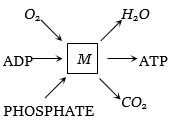
B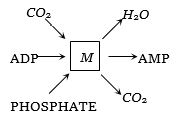
C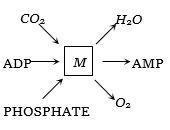
D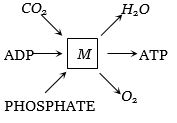
Solution
(A) Mitochondria are the sites of aerobic respiration,where the cell performs oxidative phosphorylation to generate energy.
In this process,oxygen $(O_2)$ is consumed as the final electron acceptor,and organic substrates are oxidized to produce carbon dioxide $(CO_2)$ and water $(H_2O)$.
Simultaneously,the energy released from these reactions is used to phosphorylate adenosine diphosphate $(ADP)$ and inorganic phosphate $(Pi)$ to synthesize adenosine triphosphate $(ATP)$.
Therefore,the correct representation shows $O_2$,$ADP$,and $Phosphate$ entering the mitochondrion $(M)$,while $H_2O$,$ATP$,and $CO_2$ are released as products.
In this process,oxygen $(O_2)$ is consumed as the final electron acceptor,and organic substrates are oxidized to produce carbon dioxide $(CO_2)$ and water $(H_2O)$.
Simultaneously,the energy released from these reactions is used to phosphorylate adenosine diphosphate $(ADP)$ and inorganic phosphate $(Pi)$ to synthesize adenosine triphosphate $(ATP)$.
Therefore,the correct representation shows $O_2$,$ADP$,and $Phosphate$ entering the mitochondrion $(M)$,while $H_2O$,$ATP$,and $CO_2$ are released as products.
0 likesView Solution
4
ChemistryMCQAIIMS · 2015
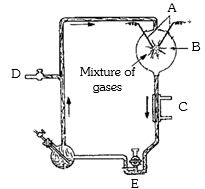
The diagram represents Miller's experiment. Choose the correct combination of labelling.
A
$A$-electrodes,$B$-$NH_3 + H_2 + H_2O + CH_4$,$C$-cold water,$D$-vacuum,$E-U$ trap
B
$A$-electrodes,$B$-$NH_4 + H_2 + CO_2 + CH_3$,$C$-hot water,$D$-vacuum,$E-U$ trap
C
$A$-electrodes,$B$-$NH_3 + H_2O$,$C$-hot water,$D$-tap,$E-U$ trap
D
$A$-electrodes,$B$-$NH_3 + H_2 + H_2O + CH_4$,$C$-steam,$D$-vacuum,$E-U$ trap
Solution
(A) In Miller's experiment,the labels represent the following components:
$A$: Electrodes used to create electric discharge to simulate lightning.
$B$: $A$ mixture of gases including $NH_3$,$H_2$,$H_2O$ (water vapor),and $CH_4$ (methane) in the ratio $2:2:1:2$.
$C$: $A$ condenser through which cold water is circulated to cool the gases and condense the products.
$D$: $A$ vacuum pump used to evacuate the system.
$E$: $A$ $U$-shaped trap used to collect the condensed liquid containing organic compounds.
Therefore,option $A$ is the correct combination.
$A$: Electrodes used to create electric discharge to simulate lightning.
$B$: $A$ mixture of gases including $NH_3$,$H_2$,$H_2O$ (water vapor),and $CH_4$ (methane) in the ratio $2:2:1:2$.
$C$: $A$ condenser through which cold water is circulated to cool the gases and condense the products.
$D$: $A$ vacuum pump used to evacuate the system.
$E$: $A$ $U$-shaped trap used to collect the condensed liquid containing organic compounds.
Therefore,option $A$ is the correct combination.
0 likesView Solution
5
ChemistryMCQAIIMS · 2015
Chemically,borax is:
A
Sodium metaborate
B
Sodium orthoborate
C
Sodium tetraborate
D
Sodium tetraborate decahydrate
Solution
(D) Borax is a chemical compound with the formula $Na_2B_4O_7 \cdot 10H_2O$.
Its chemical name is sodium tetraborate decahydrate.
It is commonly found as a white crystalline solid.
Its chemical name is sodium tetraborate decahydrate.
It is commonly found as a white crystalline solid.
0 likesView Solution
6
ChemistryMCQAIIMS · 2015
Which of the following oxides is strongly basic?
A
$B_{2}O_{3}$
B
$Al_{2}O_{3}$
C
$Ga_{2}O_{3}$
D
$Tl_{2}O_{3}$
Solution
(D) In the boron family (Group $13$),the metallic character increases down the group.
$B_{2}O_{3}$ is acidic in nature.
$Al_{2}O_{3}$ and $Ga_{2}O_{3}$ are amphoteric.
$In_{2}O_{3}$ is weakly basic.
$Tl_{2}O_{3}$ is strongly basic because $Tl$ is the most metallic element in this group.
$B_{2}O_{3}$ is acidic in nature.
$Al_{2}O_{3}$ and $Ga_{2}O_{3}$ are amphoteric.
$In_{2}O_{3}$ is weakly basic.
$Tl_{2}O_{3}$ is strongly basic because $Tl$ is the most metallic element in this group.
0 likesView Solution
7
ChemistryMCQAIIMS · 2015
Bulk of carbon dioxide $(CO_2)$ released from body tissues into the blood is present as
A
bicarbonate in blood plasma and RBCs
B
free $CO_2$ in blood plasma
C
$70\%$ carbamino-haemoglobin and $30\%$ as bicarbonate
D
carbamino-haemoglobin in $RBCs$
Solution
(A) The correct answer is $A$.
At the tissue site,the partial pressure of $CO_2$ is high due to catabolic processes.
$CO_2$ diffuses into the blood ($RBCs$ and plasma) and reacts with water to form carbonic acid $(H_2CO_3)$,which then dissociates into bicarbonate ions $(HCO_3^-)$ and hydrogen ions $(H^+)$.
Approximately $70\%$ of $CO_2$ is transported in the form of bicarbonates.
At the alveolar site,where the partial pressure of $CO_2$ is low,the reaction proceeds in the opposite direction,leading to the formation of $CO_2$ and $H_2O$,which is then exhaled.
At the tissue site,the partial pressure of $CO_2$ is high due to catabolic processes.
$CO_2$ diffuses into the blood ($RBCs$ and plasma) and reacts with water to form carbonic acid $(H_2CO_3)$,which then dissociates into bicarbonate ions $(HCO_3^-)$ and hydrogen ions $(H^+)$.
Approximately $70\%$ of $CO_2$ is transported in the form of bicarbonates.
At the alveolar site,where the partial pressure of $CO_2$ is low,the reaction proceeds in the opposite direction,leading to the formation of $CO_2$ and $H_2O$,which is then exhaled.
0 likesView Solution
8
ChemistryDifficultMCQAIIMS · 2015
The reaction,$2A_{(g)} + B_{(g)} \rightleftharpoons 3C_{(g)} + D_{(g)}$ is begun with the concentrations of $A$ and $B$ both at an initial value of $1.00 \ M$. When equilibrium is reached,the concentration of $D$ is measured and found to be $0.25 \ M$. The value for the equilibrium constant for this reaction is given by the expression:
A
$[(0.75)^3(0.25)] \div [(1.00)^2(1.00)]$
B
$[(0.75)^3(0.25)] \div [(0.50)^2(0.75)]$
C
$[(0.75)^3(0.25)] \div [(0.50)^2(0.25)]$
D
$[(0.75)^3(0.25)] \div [(0.75)^2(0.25)]$
Solution
(B) The reaction is $2A_{(g)} + B_{(g)} \rightleftharpoons 3C_{(g)} + D_{(g)}$.
Initial concentrations: $[A] = 1.00 \ M$,$[B] = 1.00 \ M$,$[C] = 0 \ M$,$[D] = 0 \ M$.
At equilibrium,$[D] = 0.25 \ M$. Since the stoichiometry of $D$ is $1$,the change in concentration for $D$ is $+0.25 \ M$.
Using stoichiometry:
$[A]_{eq} = 1.00 - 2(0.25) = 0.50 \ M$
$[B]_{eq} = 1.00 - 0.25 = 0.75 \ M$
$[C]_{eq} = 3(0.25) = 0.75 \ M$
$[D]_{eq} = 0.25 \ M$
The equilibrium constant expression is $K_c = \frac{[C]^3[D]}{[A]^2[B]}$.
Substituting the values: $K_c = \frac{(0.75)^3(0.25)}{(0.50)^2(0.75)}$.
Initial concentrations: $[A] = 1.00 \ M$,$[B] = 1.00 \ M$,$[C] = 0 \ M$,$[D] = 0 \ M$.
At equilibrium,$[D] = 0.25 \ M$. Since the stoichiometry of $D$ is $1$,the change in concentration for $D$ is $+0.25 \ M$.
Using stoichiometry:
$[A]_{eq} = 1.00 - 2(0.25) = 0.50 \ M$
$[B]_{eq} = 1.00 - 0.25 = 0.75 \ M$
$[C]_{eq} = 3(0.25) = 0.75 \ M$
$[D]_{eq} = 0.25 \ M$
The equilibrium constant expression is $K_c = \frac{[C]^3[D]}{[A]^2[B]}$.
Substituting the values: $K_c = \frac{(0.75)^3(0.25)}{(0.50)^2(0.75)}$.
0 likesView Solution
9
ChemistryDifficultMCQAIIMS · 2015
The alkali metals form salt-like hydrides by direct synthesis at elevated temperatures. The thermal stability of these hydrides decreases in which of the following orders?
A
$NaH > LiH > KH > RbH > CsH$
B
$LiH > NaH > KH > RbH > CsH$
C
$CsH > RbH > KH > NaH > LiH$
D
$KH > NaH > LiH > CsH > RbH$
Solution
(B) The thermal stability of ionic hydrides depends on the lattice energy and the strength of the metal-hydrogen bond.
As the size of the alkali metal cation increases down the group $(Li^+ < Na^+ < K^+ < Rb^+ < Cs^+)$,the metal-hydrogen bond length increases,which leads to a decrease in the bond dissociation energy.
Consequently,the thermal stability of these hydrides decreases as the size of the cation increases.
Therefore,the correct order of thermal stability is $LiH > NaH > KH > RbH > CsH$.
As the size of the alkali metal cation increases down the group $(Li^+ < Na^+ < K^+ < Rb^+ < Cs^+)$,the metal-hydrogen bond length increases,which leads to a decrease in the bond dissociation energy.
Consequently,the thermal stability of these hydrides decreases as the size of the cation increases.
Therefore,the correct order of thermal stability is $LiH > NaH > KH > RbH > CsH$.
0 likesView Solution
10
ChemistryMCQAIIMS · 2015
Match List-$I$ with List-$II$ for the composition of substances and select the correct answer using the code given below the lists.
| List-$I$ (Substances) | List-$II$ (Composition) |
|---|---|
| $A$. Plaster of Paris | $i$. $CaSO_4 \cdot 1/2H_2O$ |
| $B$. Epsomite | $ii$. $MgSO_4 \cdot 7H_2O$ |
| $C$. Kieserite | $iii$. $MgSO_4 \cdot H_2O$ |
| $D$. Gypsum | $iv$. $CaSO_4 \cdot 2H_2O$ |
| $v$. $CaSO_4$ |
A
$A-iv, B-iii, C-ii, D-i$
B
$A-iii, B-iv, C-i, D-ii$
C
$A-ii, B-iii, C-iv, D-i$
D
$A-i, B-ii, C-iii, D-iv$
Solution
(D) The chemical compositions are as follows:
$A$. Plaster of Paris is $CaSO_4 \cdot 1/2H_2O$ $(i)$.
$B$. Epsomite is $MgSO_4 \cdot 7H_2O$ $(ii)$.
$C$. Kieserite is $MgSO_4 \cdot H_2O$ $(iii)$.
$D$. Gypsum is $CaSO_4 \cdot 2H_2O$ $(iv)$.
Therefore,the correct matching is $A-i, B-ii, C-iii, D-iv$.
$A$. Plaster of Paris is $CaSO_4 \cdot 1/2H_2O$ $(i)$.
$B$. Epsomite is $MgSO_4 \cdot 7H_2O$ $(ii)$.
$C$. Kieserite is $MgSO_4 \cdot H_2O$ $(iii)$.
$D$. Gypsum is $CaSO_4 \cdot 2H_2O$ $(iv)$.
Therefore,the correct matching is $A-i, B-ii, C-iii, D-iv$.
0 likesView Solution
11
ChemistryMCQAIIMS · 2015
In which of the following arrangements is the order $NOT$ according to the property indicated against it?
A
$Al^{3+} < Mg^{2+} < Na^{+} < F^{-}$ (Increasing ionic size)
B
$B < C < N < O$ (Increasing first ionisation energy)
C
$I < Br < F < Cl$ (Increasing electron gain enthalpy)
D
$Li < Na < K < Rb$ (Increasing metallic character)
Solution
(B) The correct order for first ionisation energy is $B < C < O < N$. Nitrogen $(N)$ has a stable half-filled $2p^3$ configuration,which makes its ionisation energy higher than that of Oxygen $(O)$. Therefore,the arrangement in option $B$ is incorrect.
0 likesView Solution
12
ChemistryMCQAIIMS · 2015
Chemically,borax is ...
A
Sodium metaborate
B
Sodium orthoborate
C
Sodium tetraborate
D
Sodium tetraborate decahydrate
Solution
(D) Borax is a white crystalline solid with the chemical formula $Na_2B_4O_7 \cdot 10H_2O$.
Its chemical name is sodium tetraborate decahydrate.
It is commonly found as a decahydrate salt.
Its chemical name is sodium tetraborate decahydrate.
It is commonly found as a decahydrate salt.
0 likesView Solution
13
ChemistryMCQAIIMS · 2015
Which of the following oxides is strongly basic?
A
$B_2O_3$
B
$Al_2O_3$
C
$Ga_2O_3$
D
$Tl_2O_3$
Solution
(D) In group $13$ elements,the metallic character increases down the group.
$B_2O_3$ is acidic,$Al_2O_3$ and $Ga_2O_3$ are amphoteric,while $In_2O_3$ and $Tl_2O_3$ are basic.
Among the given options,$Tl_2O_3$ is the most metallic and therefore the most strongly basic oxide.
$B_2O_3$ is acidic,$Al_2O_3$ and $Ga_2O_3$ are amphoteric,while $In_2O_3$ and $Tl_2O_3$ are basic.
Among the given options,$Tl_2O_3$ is the most metallic and therefore the most strongly basic oxide.
0 likesView Solution
14
ChemistryMCQAIIMS · 2015
Assertion : Energy is released when heavy nuclei undergo fission or light nuclei undergo fusion.
Reason : For heavy nuclei,binding energy per nucleon increases with increasing $Z$ while for light nuclei it decreases with increasing $Z$.
Reason : For heavy nuclei,binding energy per nucleon increases with increasing $Z$ while for light nuclei it decreases with increasing $Z$.
A
If both Assertion and Reason are correct and the Reason is a correct explanation of the Assertion.
B
If both Assertion and Reason are correct but Reason is not a correct explanation of the Assertion.
C
If the Assertion is correct but Reason is incorrect.
D
If both the Assertion and Reason are incorrect.
Solution
(C) The Assertion is correct: Energy is released in nuclear fission of heavy nuclei and nuclear fusion of light nuclei because the product nuclei are more stable (have higher binding energy per nucleon) than the parent nuclei.
The Reason is incorrect: According to the binding energy curve,for heavy nuclei (mass number $A > 170$),the binding energy per nucleon decreases as $Z$ (or $A$) increases. For light nuclei $(A < 30)$,the binding energy per nucleon increases as $Z$ (or $A$) increases.
Since the Assertion is correct but the Reason is incorrect,the correct option is $C$.
The Reason is incorrect: According to the binding energy curve,for heavy nuclei (mass number $A > 170$),the binding energy per nucleon decreases as $Z$ (or $A$) increases. For light nuclei $(A < 30)$,the binding energy per nucleon increases as $Z$ (or $A$) increases.
Since the Assertion is correct but the Reason is incorrect,the correct option is $C$.
0 likesView Solution
15
ChemistryMCQAIIMS · 2015
Assertion : Between any two given energy levels,the number of absorption transitions is always less than the number of emission transitions.
Reason : Absorption transitions start from the lowest energy level only and may end at any higher energy level. But emission transitions may start from any higher energy level and end at any energy level below it.
Reason : Absorption transitions start from the lowest energy level only and may end at any higher energy level. But emission transitions may start from any higher energy level and end at any energy level below it.
A
If both Assertion and Reason are correct and the Reason is a correct explanation of the Assertion.
B
If both Assertion and Reason are correct but Reason is not a correct explanation of the Assertion.
C
If the Assertion is correct but Reason is incorrect.
D
If both the Assertion and Reason are incorrect.
Solution
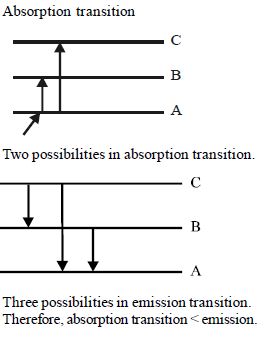
(A) For a system with energy levels $A, B, C$ (where $E_A < E_B < E_C$):
$1$. Absorption transitions: An atom in the ground state $(A)$ can absorb a photon to jump to level $B$ or level $C$. Thus,there are $2$ possible absorption transitions ($A \rightarrow B$ and $A \rightarrow C$).
$2$. Emission transitions: An atom in an excited state can drop to a lower state. From $C$,it can go to $B$ or $A$. From $B$,it can go to $A$. Thus,there are $3$ possible emission transitions $(C \rightarrow B, C \rightarrow A, B \rightarrow A)$.
Since $2 < 3$,the number of absorption transitions is less than the number of emission transitions. The reason correctly explains that absorption is restricted to transitions from the ground state upwards,whereas emission can occur between any two levels where the initial state is higher than the final state.
$1$. Absorption transitions: An atom in the ground state $(A)$ can absorb a photon to jump to level $B$ or level $C$. Thus,there are $2$ possible absorption transitions ($A \rightarrow B$ and $A \rightarrow C$).
$2$. Emission transitions: An atom in an excited state can drop to a lower state. From $C$,it can go to $B$ or $A$. From $B$,it can go to $A$. Thus,there are $3$ possible emission transitions $(C \rightarrow B, C \rightarrow A, B \rightarrow A)$.
Since $2 < 3$,the number of absorption transitions is less than the number of emission transitions. The reason correctly explains that absorption is restricted to transitions from the ground state upwards,whereas emission can occur between any two levels where the initial state is higher than the final state.
0 likesView Solution
16
ChemistryDifficultMCQAIIMS · 2015
Sulphur forms the chlorides $S_2Cl_2$ and $SCl_2$. The equivalent mass of sulphur in $SCl_2$ is $....... \ g/eq$.
A
$8$
B
$16$
C
$64.8$
D
$32$
Solution
(B) The atomic mass of sulphur is $32 \ g/mol$.
In $SCl_2$,the oxidation state of sulphur is $+2$,which corresponds to its valency.
Equivalent mass is calculated as $\frac{\text{Atomic mass}}{\text{Valency}}$.
Equivalent mass of sulphur $= \frac{32}{2} = 16 \ g/eq$.
In $SCl_2$,the oxidation state of sulphur is $+2$,which corresponds to its valency.
Equivalent mass is calculated as $\frac{\text{Atomic mass}}{\text{Valency}}$.
Equivalent mass of sulphur $= \frac{32}{2} = 16 \ g/eq$.
0 likesView Solution
17
ChemistryMediumMCQAIIMS · 2015
Based on the equation $E = -2.178 \times 10^{-18} \ J \left( \frac{Z^2}{n^2} \right)$,certain conclusions are written. Which of them is not correct?
A
Larger the value of $n$,the larger is the orbit radius.
B
Equation can be used to calculate the change in energy when the electron changes orbit.
C
For $n = 1$,the electron has a more negative energy than it does for $n = 6$,which means that the electron is more loosely bound in the smallest allowed orbit.
D
The negative sign in the equation simply means that the energy of the electron bound to the nucleus is lower than it would be if the electron were at an infinite distance from the nucleus.
Solution
(C) The energy of an electron at an infinite distance from the nucleus is defined as zero.
As an electron approaches the nucleus,the electrostatic attraction increases,causing the energy of the electron to decrease and become negative.
Therefore,as the value of $n$ decreases (i.e.,the orbit is closer to the nucleus),the energy of the electron becomes more negative,meaning it is more tightly bound,not loosely bound.
Thus,the statement in option $C$ is incorrect because it claims the electron is more loosely bound in the smallest orbit.
As an electron approaches the nucleus,the electrostatic attraction increases,causing the energy of the electron to decrease and become negative.
Therefore,as the value of $n$ decreases (i.e.,the orbit is closer to the nucleus),the energy of the electron becomes more negative,meaning it is more tightly bound,not loosely bound.
Thus,the statement in option $C$ is incorrect because it claims the electron is more loosely bound in the smallest orbit.
0 likesView Solution
18
ChemistryDifficultMCQAIIMS · 2015
In which of the following arrangements,the order is $NOT$ according to the property indicated against it?
A
$Li < Na < K < Rb$ : Increasing metallic radius
B
$I < Br < F < Cl$ : Increasing electron gain enthalpy (with negative sign)
C
$B < C < N < O$ : Increasing first ionization enthalpy
D
$Al^{3+} < Mg^{2+} < Na^{+} < F^{-}$ : Increasing ionic size
Solution
(C) In a period,the first ionization enthalpy generally increases from left to right. However,$N$ $(2s^2 2p^3)$ has a stable half-filled $p$-orbital configuration compared to $O$ $(2s^2 2p^4)$.
Due to this stability,the ionization enthalpy of $N$ is higher than that of $O$.
Therefore,the correct order for the first ionization enthalpy is $B < C < O < N$.
Thus,the arrangement $B < C < N < O$ is incorrect.
Due to this stability,the ionization enthalpy of $N$ is higher than that of $O$.
Therefore,the correct order for the first ionization enthalpy is $B < C < O < N$.
Thus,the arrangement $B < C < N < O$ is incorrect.
0 likesView Solution
19
ChemistryDifficultMCQAIIMS · 2015
Assertion : Both $Be$ and $Al$ can form complexes such as $BeF_4^{2-}$ and $AlF_6^{3-}$ respectively,$BeF_6^{3-}$ is not formed.
Reason : In case of $Be$,no vacant $d-$ orbitals are present in its outermost shell.
Reason : In case of $Be$,no vacant $d-$ orbitals are present in its outermost shell.
A
If both Assertion and Reason are correct and the Reason is a correct explanation of the Assertion.
B
If both Assertion and Reason are correct but Reason is not a correct explanation of the Assertion.
C
If the Assertion is correct but Reason is incorrect.
D
If both the Assertion and Reason are incorrect.
Solution
(A) The assertion is correct because $Be$ can expand its coordination number up to $4$ due to the presence of only $s$ and $p$ orbitals in its valence shell $(n=2)$.
$Al$ can expand its coordination number to $6$ because it has vacant $3d$ orbitals in its valence shell $(n=3)$.
Since $Be$ lacks vacant $d-$ orbitals,it cannot form $BeF_6^{3-}$,which would require a coordination number of $6$.
Thus,the reason correctly explains the assertion.
$Al$ can expand its coordination number to $6$ because it has vacant $3d$ orbitals in its valence shell $(n=3)$.
Since $Be$ lacks vacant $d-$ orbitals,it cannot form $BeF_6^{3-}$,which would require a coordination number of $6$.
Thus,the reason correctly explains the assertion.
0 likesView Solution
20
ChemistryDifficultMCQAIIMS · 2015
Match List-$I$ and List-$II$ and pick out the correct matching codes from the given choices:
| List-$I$ (Compound) | List-$II$ (Structure) |
| $A$. $ClF_3$ | $1$. Square planar |
| $B$. $PCl_5$ | $2$. Tetrahedral |
| $C$. $IF_5$ | $3$. Trigonal bipyramidal |
| $D$. $CCl_4$ | $4$. Square pyramidal |
| $E$. $XeF_4$ | $5$. $T$-shaped |
A
$A-5, B-3, C-4, D-2, E-1$
B
$A-5, B-3, C-4, D-1, E-2$
C
$A-4, B-3, C-5, D-2, E-1$
D
$A-5, B-4, C-3, D-2, E-1$
Solution
(A) The structures of the given compounds are determined by $VSEPR$ theory:
$A$. $ClF_3$: $sp^3d$ hybridization with $2$ lone pairs,resulting in a $T$-shaped geometry $(5)$.
$B$. $PCl_5$: $sp^3d$ hybridization with $0$ lone pairs,resulting in a trigonal bipyramidal geometry $(3)$.
$C$. $IF_5$: $sp^3d^2$ hybridization with $1$ lone pair,resulting in a square pyramidal geometry $(4)$.
$D$. $CCl_4$: $sp^3$ hybridization with $0$ lone pairs,resulting in a tetrahedral geometry $(2)$.
$E$. $XeF_4$: $sp^3d^2$ hybridization with $2$ lone pairs,resulting in a square planar geometry $(1)$.
Therefore,the correct matching is $A-5, B-3, C-4, D-2, E-1$.
$A$. $ClF_3$: $sp^3d$ hybridization with $2$ lone pairs,resulting in a $T$-shaped geometry $(5)$.
$B$. $PCl_5$: $sp^3d$ hybridization with $0$ lone pairs,resulting in a trigonal bipyramidal geometry $(3)$.
$C$. $IF_5$: $sp^3d^2$ hybridization with $1$ lone pair,resulting in a square pyramidal geometry $(4)$.
$D$. $CCl_4$: $sp^3$ hybridization with $0$ lone pairs,resulting in a tetrahedral geometry $(2)$.
$E$. $XeF_4$: $sp^3d^2$ hybridization with $2$ lone pairs,resulting in a square planar geometry $(1)$.
Therefore,the correct matching is $A-5, B-3, C-4, D-2, E-1$.
0 likesView Solution
21
ChemistryDifficultMCQAIIMS · 2015
Cyclopropane and oxygen at partial pressures $170 \ torr$ and $570 \ torr$ respectively are mixed in a gas cylinder. What is the ratio of the number of moles of cyclopropane to the number of moles of oxygen $(n_{C_3H_6}/n_{O_2})$ ?
A
$\frac{170 \times 42}{570 \times 32} = 0.39$
B
$\frac{170}{42} / (\frac{170}{42} + \frac{570}{32}) \approx 0.19$
C
$\frac{170}{740} = 0.23$
D
$\frac{170}{570} = 0.30$
Solution
(D) According to the ideal gas equation,$PV = nRT$.
Since the gases are in the same cylinder at the same temperature and volume,$n = \frac{PV}{RT}$.
Therefore,$n \propto P$.
Thus,the ratio of the number of moles is equal to the ratio of their partial pressures:
$\frac{n_{C_3H_6}}{n_{O_2}} = \frac{P_{C_3H_6}}{P_{O_2}} = \frac{170 \ torr}{570 \ torr} = 0.30$.
Since the gases are in the same cylinder at the same temperature and volume,$n = \frac{PV}{RT}$.
Therefore,$n \propto P$.
Thus,the ratio of the number of moles is equal to the ratio of their partial pressures:
$\frac{n_{C_3H_6}}{n_{O_2}} = \frac{P_{C_3H_6}}{P_{O_2}} = \frac{170 \ torr}{570 \ torr} = 0.30$.
0 likesView Solution
22
ChemistryMediumMCQAIIMS · 2015
Assertion : Compressibility factor $(Z)$ for non-ideal gases can be greater than $1$.
Reason : Non-ideal gases always exert higher pressure than expected.
Reason : Non-ideal gases always exert higher pressure than expected.
A
If both Assertion and Reason are correct and the Reason is a correct explanation of the Assertion.
B
If both Assertion and Reason are correct but Reason is not a correct explanation of the Assertion.
C
If the Assertion is correct but Reason is incorrect.
D
If both the Assertion and Reason are incorrect.
Solution
(C) The compressibility factor $(Z)$ is defined as $Z = \frac{PV}{nRT}$. For non-ideal gases,$Z$ can be greater than $1$ (when repulsive forces dominate) or less than $1$ (when attractive forces dominate). Therefore,the Assertion is correct.
Non-ideal gases do not always exert higher pressure than expected. Due to intermolecular attractive forces,the pressure exerted by a real gas is generally lower than the pressure predicted by the ideal gas law $(P_{real} < P_{ideal})$. Thus,the Reason is incorrect.
Non-ideal gases do not always exert higher pressure than expected. Due to intermolecular attractive forces,the pressure exerted by a real gas is generally lower than the pressure predicted by the ideal gas law $(P_{real} < P_{ideal})$. Thus,the Reason is incorrect.
0 likesView Solution
23
ChemistryMediumMCQAIIMS · 2015
The following reaction occurs in an automobile: $2C_8H_{18(g)} + 25O_{2(g)} \to 16CO_{2(g)} + 18H_2O_{(g)}$. The signs of $\Delta H$,$\Delta S$,and $\Delta G$ would be:
A
$+, -, +$
B
$-, +, -$
C
$-, +, +$
D
$+, +, -$
Solution
(B) For a combustion reaction,the enthalpy change $\Delta H$ is negative (exothermic).
The change in the number of moles of gas is $\Delta n_g = (16 + 18) - (2 + 25) = 34 - 27 = +7$.
Since $\Delta n_g > 0$,the entropy change $\Delta S$ is positive $(+ve)$.
As the reaction is spontaneous in an automobile engine,the Gibbs free energy change $\Delta G$ is negative $(-ve)$.
The change in the number of moles of gas is $\Delta n_g = (16 + 18) - (2 + 25) = 34 - 27 = +7$.
Since $\Delta n_g > 0$,the entropy change $\Delta S$ is positive $(+ve)$.
As the reaction is spontaneous in an automobile engine,the Gibbs free energy change $\Delta G$ is negative $(-ve)$.
0 likesView Solution
24
ChemistryMediumMCQAIIMS · 2015
The enthalpy changes for the following processes are listed below:
$Cl_{2(g)} \to 2Cl_{(g)}$,$\Delta H = 242.3 \ kJ \ mol^{-1}$
$I_{2(g)} \to 2I_{(g)}$,$\Delta H = 151.0 \ kJ \ mol^{-1}$
$ICl_{(g)} \to I_{(g)} + Cl_{(g)}$,$\Delta H = 211.3 \ kJ \ mol^{-1}$
$I_{2(s)} \to I_{2(g)}$,$\Delta H = 62.76 \ kJ \ mol^{-1}$
Given that the standard states for iodine and chlorine are $I_{2(s)}$ and $Cl_{2(g)}$,the standard enthalpy of formation for $ICl_{(g)}$ is .............. $kJ \ mol^{-1}$
$Cl_{2(g)} \to 2Cl_{(g)}$,$\Delta H = 242.3 \ kJ \ mol^{-1}$
$I_{2(g)} \to 2I_{(g)}$,$\Delta H = 151.0 \ kJ \ mol^{-1}$
$ICl_{(g)} \to I_{(g)} + Cl_{(g)}$,$\Delta H = 211.3 \ kJ \ mol^{-1}$
$I_{2(s)} \to I_{2(g)}$,$\Delta H = 62.76 \ kJ \ mol^{-1}$
Given that the standard states for iodine and chlorine are $I_{2(s)}$ and $Cl_{2(g)}$,the standard enthalpy of formation for $ICl_{(g)}$ is .............. $kJ \ mol^{-1}$
A
$+16.8$
B
$+244.8$
C
$-14.6$
D
$-16.8$
Solution
(A) The formation reaction for $ICl_{(g)}$ is: $\frac{1}{2} I_{2(s)} + \frac{1}{2} Cl_{2(g)} \to ICl_{(g)}$.
We can calculate the enthalpy of reaction $(\Delta_r H)$ using the given bond dissociation and sublimation energies:
$\Delta_r H = [\frac{1}{2} \Delta H_{sub}(I_2) + \frac{1}{2} BE(I-I) + \frac{1}{2} BE(Cl-Cl)] - [BE(I-Cl)]$
Substituting the given values:
$\Delta_r H = [\frac{1}{2}(62.76) + \frac{1}{2}(151.0) + \frac{1}{2}(242.3)] - [211.3]$
$\Delta_r H = [31.38 + 75.5 + 121.15] - 211.3$
$\Delta_r H = 228.03 - 211.3 = 16.73 \ kJ \ mol^{-1}$
Thus,the standard enthalpy of formation $\Delta_f H^o(ICl) \approx +16.8 \ kJ \ mol^{-1}$.
We can calculate the enthalpy of reaction $(\Delta_r H)$ using the given bond dissociation and sublimation energies:
$\Delta_r H = [\frac{1}{2} \Delta H_{sub}(I_2) + \frac{1}{2} BE(I-I) + \frac{1}{2} BE(Cl-Cl)] - [BE(I-Cl)]$
Substituting the given values:
$\Delta_r H = [\frac{1}{2}(62.76) + \frac{1}{2}(151.0) + \frac{1}{2}(242.3)] - [211.3]$
$\Delta_r H = [31.38 + 75.5 + 121.15] - 211.3$
$\Delta_r H = 228.03 - 211.3 = 16.73 \ kJ \ mol^{-1}$
Thus,the standard enthalpy of formation $\Delta_f H^o(ICl) \approx +16.8 \ kJ \ mol^{-1}$.
0 likesView Solution
25
ChemistryMCQAIIMS · 2015
The reaction $2A_{(g)} + B_{(g)} \rightleftharpoons 3C_{(g)} + D_{(g)}$ is begun with the concentrations of $A$ and $B$ both at an initial value of $1.00 \ M$. When equilibrium is reached,the concentration of $D$ is measured and found to be $0.25 \ M$. The value for the equilibrium constant for this reaction is given by the expression
A
$[(0.75)^3 (0.25)] \div [(0.75)^2 (0.25)]$
B
$[(0.75)^3 (0.25)] \div [(1.00)^2 (1.00)]$
C
$[(0.75)^3 (0.25)] \div [(0.50)^2 (0.75)]$
D
$[(0.75)^3 (0.25)] \div [(0.50)^2 (0.25)]$
Solution
(C) For the reaction $2A_{(g)} + B_{(g)} \rightleftharpoons 3C_{(g)} + D_{(g)}$:
Initial concentrations: $[A] = 1.00 \ M$,$[B] = 1.00 \ M$,$[C] = 0 \ M$,$[D] = 0 \ M$.
At equilibrium,$[D] = 0.25 \ M$. Since the stoichiometry of $D$ is $1$,the change in concentration for $D$ is $+0.25 \ M$.
Using stoichiometry,the changes are: $\Delta[A] = -2(0.25) = -0.50 \ M$,$\Delta[B] = -1(0.25) = -0.25 \ M$,$\Delta[C] = +3(0.25) = +0.75 \ M$.
Equilibrium concentrations: $[A] = 1.00 - 0.50 = 0.50 \ M$,$[B] = 1.00 - 0.25 = 0.75 \ M$,$[C] = 0.75 \ M$,$[D] = 0.25 \ M$.
The equilibrium constant expression is $K_c = \frac{[C]^3 [D]}{[A]^2 [B]}$.
Substituting the values: $K_c = \frac{(0.75)^3 (0.25)}{(0.50)^2 (0.75)}$.
Initial concentrations: $[A] = 1.00 \ M$,$[B] = 1.00 \ M$,$[C] = 0 \ M$,$[D] = 0 \ M$.
At equilibrium,$[D] = 0.25 \ M$. Since the stoichiometry of $D$ is $1$,the change in concentration for $D$ is $+0.25 \ M$.
Using stoichiometry,the changes are: $\Delta[A] = -2(0.25) = -0.50 \ M$,$\Delta[B] = -1(0.25) = -0.25 \ M$,$\Delta[C] = +3(0.25) = +0.75 \ M$.
Equilibrium concentrations: $[A] = 1.00 - 0.50 = 0.50 \ M$,$[B] = 1.00 - 0.25 = 0.75 \ M$,$[C] = 0.75 \ M$,$[D] = 0.25 \ M$.
The equilibrium constant expression is $K_c = \frac{[C]^3 [D]}{[A]^2 [B]}$.
Substituting the values: $K_c = \frac{(0.75)^3 (0.25)}{(0.50)^2 (0.75)}$.
0 likesView Solution
26
ChemistryMediumMCQAIIMS · 2015
Assertion : Buffer system of carbonic acid and sodium bicarbonate is used for the precipitation of hydroxides of third group elements.
Reason : It maintains the $pH$ to a constant value,about $7.4.$
Reason : It maintains the $pH$ to a constant value,about $7.4.$
A
If both Assertion and Reason are correct and the Reason is a correct explanation of the Assertion.
B
If both Assertion and Reason are correct but Reason is not a correct explanation of the Assertion.
C
If the Assertion is correct but Reason is incorrect.
D
If both the Assertion and Reason are incorrect.
Solution
(D) The Assertion is incorrect because the buffer system of carbonic acid $(H_2CO_3)$ and sodium bicarbonate $(NaHCO_3)$ is a biological buffer found in blood,not a reagent used for the precipitation of group $III$ hydroxides (which typically uses $NH_4Cl$ and $NH_4OH$).
The Reason is correct as this specific buffer system does maintain the $pH$ of human blood at approximately $7.4$.
The Reason is correct as this specific buffer system does maintain the $pH$ of human blood at approximately $7.4$.
0 likesView Solution
27
ChemistryMediumMCQAIIMS · 2015
Oxidation numbers of $P$ in $PO_4^{3-}$,of $S$ in $SO_4^{2-}$ and that of $Cr$ in $Cr_2O_7^{2-}$ are respectively
A
$+3, +6$ and $+5$
B
$+5, +3$ and $+6$
C
$-3, +6$ and $+6$
D
$+5, +6$ and $+6$
Solution
(D) For $PO_4^{3-}$: Let the oxidation number of $P$ be $x$. Then $x + 4(-2) = -3$,which gives $x - 8 = -3$,so $x = +5$.
For $SO_4^{2-}$: Let the oxidation number of $S$ be $x$. Then $x + 4(-2) = -2$,which gives $x - 8 = -2$,so $x = +6$.
For $Cr_2O_7^{2-}$: Let the oxidation number of $Cr$ be $x$. Then $2x + 7(-2) = -2$,which gives $2x - 14 = -2$,so $2x = 12$,and $x = +6$.
Thus,the oxidation numbers are $+5, +6, +6$.
For $SO_4^{2-}$: Let the oxidation number of $S$ be $x$. Then $x + 4(-2) = -2$,which gives $x - 8 = -2$,so $x = +6$.
For $Cr_2O_7^{2-}$: Let the oxidation number of $Cr$ be $x$. Then $2x + 7(-2) = -2$,which gives $2x - 14 = -2$,so $2x = 12$,and $x = +6$.
Thus,the oxidation numbers are $+5, +6, +6$.
0 likesView Solution
28
ChemistryMCQAIIMS · 2015
The alkali metals form salt-like hydrides by direct synthesis at elevated temperatures. The thermal stability of these hydrides decreases in which of the following orders?
A
$CsH > RbH > KH > NaH > LiH$
B
$KH > NaH > LiH > CsH > RbH$
C
$NaH > LiH > KH > RbH > CsH$
D
$LiH > NaH > KH > RbH > CsH$
Solution
(D) The thermal stability of alkali metal hydrides depends on the strength of the $M-H$ bond.
As we move down the group from $Li$ to $Cs$,the size of the alkali metal cation increases.
This increase in size leads to a decrease in the overlap between the metal orbital and the hydrogen $1s$ orbital,making the $M-H$ bond weaker.
Therefore,the thermal stability decreases as the size of the metal increases.
The correct order of stability is $LiH > NaH > KH > RbH > CsH$.
Thus,option $(D)$ is the correct answer.
As we move down the group from $Li$ to $Cs$,the size of the alkali metal cation increases.
This increase in size leads to a decrease in the overlap between the metal orbital and the hydrogen $1s$ orbital,making the $M-H$ bond weaker.
Therefore,the thermal stability decreases as the size of the metal increases.
The correct order of stability is $LiH > NaH > KH > RbH > CsH$.
Thus,option $(D)$ is the correct answer.
0 likesView Solution
29
ChemistryMediumMCQAIIMS · 2015
Assertion : Hydrogen combines with other elements by losing,gaining or sharing of electrons.
Reason : Hydrogen forms electrovalent and covalent bonds with other elements.
Reason : Hydrogen forms electrovalent and covalent bonds with other elements.
A
$A$. If both Assertion and Reason are correct and the Reason is a correct explanation of the Assertion.
B
$B$. If both Assertion and Reason are correct but Reason is not a correct explanation of the Assertion.
C
$C$. If the Assertion is correct but Reason is incorrect.
D
$D$. If both the Assertion and Reason are incorrect.
Solution
(A) Hydrogen has $1s^1$ electronic configuration. It can lose one electron to form $H^+$,gain one electron to form $H^-$,or share one electron to form covalent bonds (e.g.,$H_2$,$CH_4$).
Thus,the Assertion is correct.
Hydrogen forms electrovalent bonds (ionic hydrides like $NaH$,$CaH_2$) and covalent bonds (like $H_2O$,$NH_3$).
Since the ability to form these bonds is a direct consequence of its ability to lose,gain,or share electrons,the Reason is the correct explanation of the Assertion.
Thus,the Assertion is correct.
Hydrogen forms electrovalent bonds (ionic hydrides like $NaH$,$CaH_2$) and covalent bonds (like $H_2O$,$NH_3$).
Since the ability to form these bonds is a direct consequence of its ability to lose,gain,or share electrons,the Reason is the correct explanation of the Assertion.
0 likesView Solution
30
ChemistryMediumMCQAIIMS · 2015
Which of the following oxides is strongly basic?
A
$B_2O_3$
B
$Al_2O_3$
C
$Ga_2O_3$
D
$Tl_2O_3$
Solution
(D) In Group $13$ elements,the metallic character increases down the group as the ionization energy decreases.
$B_2O_3$ is acidic,$Al_2O_3$ and $Ga_2O_3$ are amphoteric,while $In_2O_3$ and $Tl_2O_3$ are basic.
Among the given options,$Tl_2O_3$ is the most metallic and thus exhibits the strongest basic character.
The correct sequence of increasing basic strength is $B_2O_3 < Al_2O_3 < Ga_2O_3 < In_2O_3 < Tl_2O_3$.
$B_2O_3$ is acidic,$Al_2O_3$ and $Ga_2O_3$ are amphoteric,while $In_2O_3$ and $Tl_2O_3$ are basic.
Among the given options,$Tl_2O_3$ is the most metallic and thus exhibits the strongest basic character.
The correct sequence of increasing basic strength is $B_2O_3 < Al_2O_3 < Ga_2O_3 < In_2O_3 < Tl_2O_3$.
0 likesView Solution
31
ChemistryEasyMCQAIIMS · 2015
Chemically,borax is:
A
Sodium metaborate
B
Sodium orthoborate
C
Sodium tetraborate
D
Sodium tetraborate decahydrate
Solution
(D) Chemically,borax is known as sodium tetraborate decahydrate.
Its chemical formula is $Na_2B_4O_7 \cdot 10H_2O$.
Its chemical formula is $Na_2B_4O_7 \cdot 10H_2O$.
0 likesView Solution
32
ChemistryMediumMCQAIIMS · 2015
Match List-$I$ with List-$II$ for the compositions of substances and select the correct answer using the code given below the lists.
| List-$I$ Substances | List-$II$ Composition |
|---|---|
| $A$. Plaster of paris | $i$. $CaSO_4.2H_2O$ |
| $B$. Epsomite | $ii$. $CaSO_4.\frac{1}{2}H_2O$ |
| $C$. Kieserite | $iii$. $MgSO_4.7H_2O$ |
| $D$. Gypsum | $iv$. $MgSO_4.H_2O$ |
| $v$. $CaSO_4$ |
A
$A-iii, B-iv, C-i, D-ii$
B
$A-ii, B-iii, C-iv, D-i$
C
$A-i, B-ii, C-iii, D-v$
D
$A-iv, B-iii, C-ii, D-i$
Solution
(B) . Plaster of paris $= CaSO_4.\frac{1}{2}H_2O$
$B$. Epsomite $= MgSO_4.7H_2O$
$C$. Kieserite $= MgSO_4.H_2O$
$D$. Gypsum $= CaSO_4.2H_2O$
Therefore,the correct matching is $A-ii, B-iii, C-iv, D-i$.
$B$. Epsomite $= MgSO_4.7H_2O$
$C$. Kieserite $= MgSO_4.H_2O$
$D$. Gypsum $= CaSO_4.2H_2O$
Therefore,the correct matching is $A-ii, B-iii, C-iv, D-i$.
0 likesView Solution
33
ChemistryDifficultMCQAIIMS · 2015
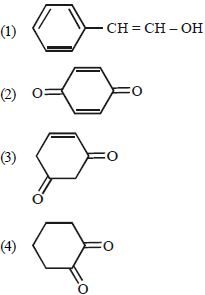
Tautomerism is exhibited by:
A
$1, 3$ and $4$
B
$2, 3$ and $4$
C
All of these
D
None of these
Solution
(A) Tautomerism requires the presence of an $\alpha$-hydrogen atom adjacent to a carbonyl group or a similar system that allows for proton transfer.
$(1)$ The enol form shown can tautomerize to a keto form (phenylacetaldehyde).
$(2)$ $p$-Benzoquinone has no $\alpha$-hydrogen atoms available for tautomerization,so it does not exhibit tautomerism.
$(3)$ This is a cyclic diketone with $\alpha$-hydrogen atoms,which can tautomerize to form an enol.
$(4)$ This is a cyclic diketone (cyclohexane$-1,2-$dione) with $\alpha$-hydrogen atoms,which can tautomerize to form an enol.
Therefore,compounds $1, 3,$ and $4$ exhibit tautomerism.
$(1)$ The enol form shown can tautomerize to a keto form (phenylacetaldehyde).
$(2)$ $p$-Benzoquinone has no $\alpha$-hydrogen atoms available for tautomerization,so it does not exhibit tautomerism.
$(3)$ This is a cyclic diketone with $\alpha$-hydrogen atoms,which can tautomerize to form an enol.
$(4)$ This is a cyclic diketone (cyclohexane$-1,2-$dione) with $\alpha$-hydrogen atoms,which can tautomerize to form an enol.
Therefore,compounds $1, 3,$ and $4$ exhibit tautomerism.
0 likesView Solution
34
ChemistryEasyMCQAIIMS · 2015
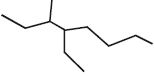
The $IUPAC$ name of the compound given below is:
A
$3-$methyl$-4-$ethyloctane
B
$2, 3-$diethylheptane
C
$5-$ethyl$-6-$methyloctane
D
$4-$ethyl$-3-$methyloctane
Solution
(D) $1$. Identify the longest carbon chain. The longest chain in the given structure contains $8$ carbon atoms,so the parent alkane is octane.
$2$. Number the chain from the end that gives the lowest locants to the substituents.
$3$. Numbering from left to right gives substituents at positions $3$ and $4$. Numbering from right to left gives substituents at positions $5$ and $6$.
$4$. Following the lowest locant rule,we number from left to right.
$5$. At position $3$,there is a methyl group $(-CH_3)$,and at position $4$,there is an ethyl group $(-CH_2CH_3)$.
$6$. According to $IUPAC$ rules,substituents are listed in alphabetical order. Therefore,ethyl comes before methyl.
$7$. The correct name is $4-$ethyl$-3-$methyloctane.
$2$. Number the chain from the end that gives the lowest locants to the substituents.
$3$. Numbering from left to right gives substituents at positions $3$ and $4$. Numbering from right to left gives substituents at positions $5$ and $6$.
$4$. Following the lowest locant rule,we number from left to right.
$5$. At position $3$,there is a methyl group $(-CH_3)$,and at position $4$,there is an ethyl group $(-CH_2CH_3)$.
$6$. According to $IUPAC$ rules,substituents are listed in alphabetical order. Therefore,ethyl comes before methyl.
$7$. The correct name is $4-$ethyl$-3-$methyloctane.
0 likesView Solution
35
ChemistryEasyMCQAIIMS · 2015
Which of the following represents the given mode of hybridisation $sp^2-sp^2-sp-sp$ from left to right?
A
$H_2C=CH-C\equiv N$
B
$HC\equiv C-C\equiv CH$
C
$H_2C=C=C=CH_2$
D
$CH_3-CH=CH-CH_3$
Solution
(A) To determine the hybridisation of carbon atoms,we count the number of sigma bonds and lone pairs attached to each carbon atom:
$1$. $sp^3$ hybridisation: $4$ sigma bonds (tetrahedral geometry).
$2$. $sp^2$ hybridisation: $3$ sigma bonds (trigonal planar geometry).
$3$. $sp$ hybridisation: $2$ sigma bonds (linear geometry).
Let's analyze option $A$: $H_2C=CH-C\equiv N$
- The first carbon $(CH_2=)$ has $3$ sigma bonds $\rightarrow sp^2$.
- The second carbon $(-CH-)$ has $3$ sigma bonds $\rightarrow sp^2$.
- The third carbon $(-C\equiv)$ has $2$ sigma bonds $\rightarrow sp$.
- The nitrogen atom is attached to the third carbon with a triple bond,and the carbon itself is $sp$ hybridised. The nitrogen atom in $C\equiv N$ is also $sp$ hybridised due to the triple bond and one lone pair.
Thus,the sequence $sp^2-sp^2-sp-sp$ corresponds to $H_2C=CH-C\equiv N$.
$1$. $sp^3$ hybridisation: $4$ sigma bonds (tetrahedral geometry).
$2$. $sp^2$ hybridisation: $3$ sigma bonds (trigonal planar geometry).
$3$. $sp$ hybridisation: $2$ sigma bonds (linear geometry).
Let's analyze option $A$: $H_2C=CH-C\equiv N$
- The first carbon $(CH_2=)$ has $3$ sigma bonds $\rightarrow sp^2$.
- The second carbon $(-CH-)$ has $3$ sigma bonds $\rightarrow sp^2$.
- The third carbon $(-C\equiv)$ has $2$ sigma bonds $\rightarrow sp$.
- The nitrogen atom is attached to the third carbon with a triple bond,and the carbon itself is $sp$ hybridised. The nitrogen atom in $C\equiv N$ is also $sp$ hybridised due to the triple bond and one lone pair.
Thus,the sequence $sp^2-sp^2-sp-sp$ corresponds to $H_2C=CH-C\equiv N$.
0 likesView Solution
36
ChemistryDifficultMCQAIIMS · 2015
Assertion : Carbanions like ammonia have pyramidal shape.
Reason : The carbon atom carrying negative charge has an octet of electrons.
Reason : The carbon atom carrying negative charge has an octet of electrons.
A
If both Assertion and Reason are correct and the Reason is a correct explanation of the Assertion.
B
If both Assertion and Reason are correct but Reason is not a correct explanation of the Assertion.
C
If the Assertion is correct but Reason is incorrect.
D
If both the Assertion and Reason are incorrect.
Solution
(B) carbanion is a species containing a carbon atom with a negative charge and an unshared pair of electrons.
In a carbanion,the central carbon atom is $sp^3$ hybridized.
Due to the presence of three bond pairs and one lone pair,the geometry of the carbanion is pyramidal,similar to ammonia $(NH_3)$.
Thus,the Assertion is correct.
The carbon atom in a carbanion has $8$ electrons in its valence shell (six from three bonds and two from the lone pair),which completes its octet.
Thus,the Reason is also correct.
However,the pyramidal shape is due to the $sp^3$ hybridization and the presence of a lone pair,not simply because the carbon has an octet of electrons.
Therefore,the Reason is not the correct explanation of the Assertion.
In a carbanion,the central carbon atom is $sp^3$ hybridized.
Due to the presence of three bond pairs and one lone pair,the geometry of the carbanion is pyramidal,similar to ammonia $(NH_3)$.
Thus,the Assertion is correct.
The carbon atom in a carbanion has $8$ electrons in its valence shell (six from three bonds and two from the lone pair),which completes its octet.
Thus,the Reason is also correct.
However,the pyramidal shape is due to the $sp^3$ hybridization and the presence of a lone pair,not simply because the carbon has an octet of electrons.
Therefore,the Reason is not the correct explanation of the Assertion.
0 likesView Solution
37
ChemistryMediumMCQAIIMS · 2015
Which is the most suitable reagent among the following to distinguish compound $(3)$ from the rest of the compounds?
$1. CH_3-C \equiv C-CH_3$
$2. CH_3-CH_2-CH_2-CH_3$
$3. CH_3-CH_2-C \equiv CH$
$4. CH_3-CH=CH_2$
$1. CH_3-C \equiv C-CH_3$
$2. CH_3-CH_2-CH_2-CH_3$
$3. CH_3-CH_2-C \equiv CH$
$4. CH_3-CH=CH_2$
A
Bromine in carbon tetrachloride
B
Bromine in acetic acid
C
Alkaline $KMnO_4$
D
Ammoniacal silver nitrate
Solution
(D) $Br_2$ in $CCl_4$ $(a)$,$Br_2$ in $CH_3COOH$ $(b)$,and alkaline $KMnO_4$ $(c)$ will react with all unsaturated compounds,i.e.,$1, 3,$ and $4$.
Ammoniacal $AgNO_3$ $(d)$ (Tollens' reagent) reacts specifically with terminal alkynes to form a white precipitate.
Compound $(3)$ $(CH_3-CH_2-C \equiv CH)$ is a terminal alkyne,whereas $1$ is an internal alkyne,$2$ is an alkane,and $4$ is an alkene.
Therefore,compound $(3)$ can be distinguished from $1, 2,$ and $4$ using ammoniacal $AgNO_3$.
Ammoniacal $AgNO_3$ $(d)$ (Tollens' reagent) reacts specifically with terminal alkynes to form a white precipitate.
Compound $(3)$ $(CH_3-CH_2-C \equiv CH)$ is a terminal alkyne,whereas $1$ is an internal alkyne,$2$ is an alkane,and $4$ is an alkene.
Therefore,compound $(3)$ can be distinguished from $1, 2,$ and $4$ using ammoniacal $AgNO_3$.
0 likesView Solution
38
ChemistryDifficultMCQAIIMS · 2015
Assertion : $1$-Butene on reaction with $HBr$ in the presence of a peroxide produces $1$-bromobutane.
Reason : It involves the formation of a primary radical.
Reason : It involves the formation of a primary radical.
A
If both Assertion and Reason are correct and the Reason is a correct explanation of the Assertion.
B
If both Assertion and Reason are correct but Reason is not a correct explanation of the Assertion.
C
If the Assertion is correct but Reason is incorrect.
D
If both the Assertion and Reason are incorrect.
Solution
(C) The assertion is correct because the reaction follows anti-Markovnikov addition in the presence of peroxide,yielding $1$-bromobutane.
The reason is incorrect because the reaction involves the formation of a more stable $2^o$ free radical intermediate,not a primary radical,which determines the regioselectivity of the product.
$CH_3CH_2CH=CH_2 + Br^{\centerdot} \rightarrow CH_3CH_2\overset{\centerdot}{C}HCH_2Br$ ($2^o$ free radical,more stable) and $CH_3CH_2CHBr\overset{\centerdot}{C}H_2$ ($1^o$ free radical,less stable).
The reason is incorrect because the reaction involves the formation of a more stable $2^o$ free radical intermediate,not a primary radical,which determines the regioselectivity of the product.
$CH_3CH_2CH=CH_2 + Br^{\centerdot} \rightarrow CH_3CH_2\overset{\centerdot}{C}HCH_2Br$ ($2^o$ free radical,more stable) and $CH_3CH_2CHBr\overset{\centerdot}{C}H_2$ ($1^o$ free radical,less stable).
0 likesView Solution
39
ChemistryMediumMCQAIIMS · 2015
Assertion : Nitrating mixture used for carrying out nitration of benzene consists of conc. $HNO_3 +$ conc. $H_2SO_4$.
Reason : In presence of $H_2SO_4$,$HNO_3$ acts as a base and produces $NO_2^+$ ions.
Reason : In presence of $H_2SO_4$,$HNO_3$ acts as a base and produces $NO_2^+$ ions.
A
If both Assertion and Reason are correct and the Reason is a correct explanation of the Assertion.
B
If both Assertion and Reason are correct but Reason is not a correct explanation of the Assertion.
C
If the Assertion is correct but Reason is incorrect.
D
If both the Assertion and Reason are incorrect.
Solution
(A) The nitrating mixture for benzene is a mixture of concentrated $HNO_3$ and concentrated $H_2SO_4$.
In this mixture,$H_2SO_4$ acts as a strong acid and $HNO_3$ acts as a base.
The reaction is: $HNO_3 + 2H_2SO_4 \rightleftharpoons NO_2^+ + H_3O^+ + 2HSO_4^-$.
The electrophile $NO_2^+$ (nitronium ion) is generated,which then attacks the benzene ring.
Thus,both the Assertion and the Reason are correct,and the Reason is the correct explanation of the Assertion.
In this mixture,$H_2SO_4$ acts as a strong acid and $HNO_3$ acts as a base.
The reaction is: $HNO_3 + 2H_2SO_4 \rightleftharpoons NO_2^+ + H_3O^+ + 2HSO_4^-$.
The electrophile $NO_2^+$ (nitronium ion) is generated,which then attacks the benzene ring.
Thus,both the Assertion and the Reason are correct,and the Reason is the correct explanation of the Assertion.
0 likesView Solution
40
ChemistryMediumMCQAIIMS · 2015
Regarding $F^{-}$ and $Cl^{-}$,which of the following statements is/are correct?
$(i)$ $Cl^{-}$ can give up an electron more easily than $F^{-}$
$(ii)$ $Cl^{-}$ is a better reducing agent than $F^{-}$
$(iii)$ $Cl^{-}$ is smaller in size than $F^{-}$
$(iv)$ $F^{-}$ can be oxidized more readily than $Cl^{-}$
$(i)$ $Cl^{-}$ can give up an electron more easily than $F^{-}$
$(ii)$ $Cl^{-}$ is a better reducing agent than $F^{-}$
$(iii)$ $Cl^{-}$ is smaller in size than $F^{-}$
$(iv)$ $F^{-}$ can be oxidized more readily than $Cl^{-}$
A
$(i)$ and $(ii)$
B
$(i), (ii)$ and $(iv)$
C
$(iii)$ and $(iv)$
D
Only $(i)$
Solution
(A) $1$. The size of $Cl^{-}$ is larger than $F^{-}$ because $Cl$ belongs to the $3^{rd}$ period while $F$ belongs to the $2^{nd}$ period. Thus,statement $(iii)$ is incorrect.
$2$. Since $Cl^{-}$ is larger,the valence electrons are less tightly held by the nucleus compared to $F^{-}$. Therefore,$Cl^{-}$ can lose an electron more easily than $F^{-}$. Statement $(i)$ is correct.
$3$. $A$ species that loses electrons easily acts as a better reducing agent. Since $Cl^{-}$ loses electrons more easily than $F^{-}$,$Cl^{-}$ is a better reducing agent. Statement $(ii)$ is correct.
$4$. Oxidation involves the loss of electrons. Since $Cl^{-}$ loses electrons more easily,it is oxidized more readily than $F^{-}$. Statement $(iv)$ is incorrect.
$5$. Therefore,statements $(i)$ and $(ii)$ are correct.
$2$. Since $Cl^{-}$ is larger,the valence electrons are less tightly held by the nucleus compared to $F^{-}$. Therefore,$Cl^{-}$ can lose an electron more easily than $F^{-}$. Statement $(i)$ is correct.
$3$. $A$ species that loses electrons easily acts as a better reducing agent. Since $Cl^{-}$ loses electrons more easily than $F^{-}$,$Cl^{-}$ is a better reducing agent. Statement $(ii)$ is correct.
$4$. Oxidation involves the loss of electrons. Since $Cl^{-}$ loses electrons more easily,it is oxidized more readily than $F^{-}$. Statement $(iv)$ is incorrect.
$5$. Therefore,statements $(i)$ and $(ii)$ are correct.
0 likesView Solution
41
ChemistryDifficultMCQAIIMS · 2015
Assertion : Silicones are hydrophobic in nature.
Reason : $Si-O-Si$ linkages are moisture sensitive.
Reason : $Si-O-Si$ linkages are moisture sensitive.
A
If both Assertion and Reason are correct and the Reason is a correct explanation of the Assertion.
B
If both Assertion and Reason are correct but Reason is not a correct explanation of the Assertion.
C
If the Assertion is correct but Reason is incorrect.
D
If both the Assertion and Reason are incorrect.
Solution
(C) Silicones are synthetic organosilicon polymers with the general formula $(R_2SiO)_n$.
They have a backbone of alternating silicon and oxygen atoms with organic side groups attached to the silicon atoms.
These organic groups (like alkyl groups) make the surface of silicones water-repellent or hydrophobic.
Therefore,the Assertion is correct.
However,the $Si-O-Si$ linkages in silicones are highly stable and are not moisture sensitive; in fact,they are resistant to water.
Thus,the Reason is incorrect.
They have a backbone of alternating silicon and oxygen atoms with organic side groups attached to the silicon atoms.
These organic groups (like alkyl groups) make the surface of silicones water-repellent or hydrophobic.
Therefore,the Assertion is correct.
However,the $Si-O-Si$ linkages in silicones are highly stable and are not moisture sensitive; in fact,they are resistant to water.
Thus,the Reason is incorrect.
0 likesView Solution
42
ChemistryMCQAIIMS · 2015
Identify the incorrect statement among the following.
A
Lanthanoid contraction is the accumulation of successive shrinkages.
B
As a result of lanthanoid contraction,the properties of $4d$ series of the transition elements have no similarities with the $5d$ series of elements.
C
Shielding power of $4f$ electrons is quite weak.
D
There is a decrease in the radii of the atoms or ions as one proceeds from $La$ to $Lu$.
Solution
(B) Lanthanoid contraction leads to a very small change in the ionic radii when moving from elements of the $4d$ transition series to the $5d$ transition series. Consequently,the chemical properties of the $4d$ and $5d$ series of transition elements are remarkably similar. Therefore,the statement that they have no similarities is incorrect.
0 likesView Solution
43
ChemistryMediumMCQAIIMS · 2015
Which of the following reagents convert propene to $1-$propanol?
A
$B_2H_6, H_2O_2, OH^{-}$
B
Aqueous $KOH$
C
$MgSO_4, NaBH_4/H_2O$
D
$H_2O, H_2SO_4$
Solution
(A) The conversion of propene $(CH_3-CH=CH_2)$ to $1-$propanol $(CH_3-CH_2-CH_2-OH)$ is achieved via hydroboration-oxidation.
This process uses diborane $(B_2H_6)$ followed by alkaline hydrogen peroxide $(H_2O_2/OH^{-})$.
This reaction follows the anti-Markovnikov addition of water across the double bond.
This process uses diborane $(B_2H_6)$ followed by alkaline hydrogen peroxide $(H_2O_2/OH^{-})$.
This reaction follows the anti-Markovnikov addition of water across the double bond.
0 likesView Solution
44
ChemistryMCQAIIMS · 2015
Which of the following represents the correct order of the acidity in the given compounds?
A
$FCH_2COOH > CH_3COOH > BrCH_2COOH > ClCH_2COOH$
B
$BrCH_2COOH > ClCH_2COOH > FCH_2COOH > CH_3COOH$
C
$FCH_2COOH > ClCH_2COOH > BrCH_2COOH > CH_3COOH$
D
$CH_3COOH > BrCH_2COOH > ClCH_2COOH > FCH_2COOH$
Solution
(C) Electron-withdrawing substituents (like halogens,$-NO_2$,$-C_6H_5$,etc.) disperse the negative charge,stabilize the carboxylate ion,and thus increase the acidity of the parent acid.
Conversely,electron-releasing substituents intensify the negative charge,destabilize the carboxylate ion,and decrease the acidity.
The electronegativity of halogens decreases in the order $F > Cl > Br$,which means the $-I$ (inductive) effect also decreases in the same order.
Therefore,the correct order of acidity is $FCH_2COOH > ClCH_2COOH > BrCH_2COOH > CH_3COOH$.
Conversely,electron-releasing substituents intensify the negative charge,destabilize the carboxylate ion,and decrease the acidity.
The electronegativity of halogens decreases in the order $F > Cl > Br$,which means the $-I$ (inductive) effect also decreases in the same order.
Therefore,the correct order of acidity is $FCH_2COOH > ClCH_2COOH > BrCH_2COOH > CH_3COOH$.
0 likesView Solution
45
ChemistryMCQAIIMS · 2015
Assertion : Comparative biochemistry provides a strong evidence in favour of common ancestry of living beings.
Reason : Genetic code is universal.
Reason : Genetic code is universal.
A
If both Assertion and Reason are correct and the Reason is a correct explanation of the Assertion.
B
If both Assertion and Reason are correct but Reason is not a correct explanation of the Assertion.
C
If the Assertion is correct but Reason is incorrect.
D
If both the Assertion and Reason are incorrect.
Solution
(A) Comparative biochemistry provides strong evidence for the common ancestry of living beings by showing similarities in fundamental molecules like proteins,enzymes,hormones,and blood groups across different species.
Similarly,the fact that the genetic code is universal (i.e.,the same codons code for the same amino acids in almost all organisms) strongly suggests that all living organisms share a common evolutionary origin.
Therefore,both the Assertion and the Reason are correct,and the universality of the genetic code serves as a key piece of evidence in comparative biochemistry to support the theory of common ancestry.
Similarly,the fact that the genetic code is universal (i.e.,the same codons code for the same amino acids in almost all organisms) strongly suggests that all living organisms share a common evolutionary origin.
Therefore,both the Assertion and the Reason are correct,and the universality of the genetic code serves as a key piece of evidence in comparative biochemistry to support the theory of common ancestry.
0 likesView Solution
46
ChemistryMCQAIIMS · 2015
Assertion : Replication and transcription occur in the nucleus but translation takes place in the cytoplasm.
Reason : $mRNA$ is transferred from the nucleus into the cytoplasm where ribosomes and amino acids are available for protein synthesis.
Reason : $mRNA$ is transferred from the nucleus into the cytoplasm where ribosomes and amino acids are available for protein synthesis.
A
If both Assertion and Reason are correct and the Reason is a correct explanation of the Assertion.
B
If both Assertion and Reason are correct but Reason is not a correct explanation of the Assertion.
C
If the Assertion is correct but Reason is incorrect.
D
If both the Assertion and Reason are incorrect.
Solution
(A) In eukaryotes,$DNA$ replication and transcription occur within the nucleus because the genetic material is enclosed by a nuclear envelope.
After transcription,the $mRNA$ molecule is transported out of the nucleus into the cytoplasm through nuclear pores.
Translation,the process of protein synthesis,occurs in the cytoplasm because the necessary machinery,including ribosomes,$tRNA$,and amino acids,is located there.
Therefore,the Assertion is correct,and the Reason provides the correct explanation for why translation is spatially separated from transcription in eukaryotes.
After transcription,the $mRNA$ molecule is transported out of the nucleus into the cytoplasm through nuclear pores.
Translation,the process of protein synthesis,occurs in the cytoplasm because the necessary machinery,including ribosomes,$tRNA$,and amino acids,is located there.
Therefore,the Assertion is correct,and the Reason provides the correct explanation for why translation is spatially separated from transcription in eukaryotes.
0 likesView Solution
47
ChemistryMCQAIIMS · 2015
Assertion : Yeasts such as $Saccharomyces \text{ } cerevisiae$ are used in baking industry.
Reason : Carbon dioxide produced during fermentation causes bread dough to rise by thermal expansion.
Reason : Carbon dioxide produced during fermentation causes bread dough to rise by thermal expansion.
A
If both Assertion and Reason are correct and the Reason is a correct explanation of the Assertion.
B
If both Assertion and Reason are correct but Reason is not a correct explanation of the Assertion.
C
If the Assertion is correct but Reason is incorrect.
D
If both the Assertion and Reason are incorrect.
Solution
(C) The Assertion is correct because $Saccharomyces \text{ } cerevisiae$ (brewer's yeast) is widely used in the baking industry to leaven bread dough.
The Reason is incorrect because the rising of bread dough is caused by the trapping of $CO_2$ gas bubbles produced during fermentation within the dough matrix, not by thermal expansion. While heat during baking does expand the gases, the primary mechanism for the 'rising' (leavening) of the dough is the metabolic activity of yeast producing $CO_2$.
The Reason is incorrect because the rising of bread dough is caused by the trapping of $CO_2$ gas bubbles produced during fermentation within the dough matrix, not by thermal expansion. While heat during baking does expand the gases, the primary mechanism for the 'rising' (leavening) of the dough is the metabolic activity of yeast producing $CO_2$.
0 likesView Solution
48
ChemistryMCQAIIMS · 2015
Assertion : Tropical rain forests are disappearing fast from developing countries such as India.
Reason : No value is attached to these forests because these are poor in biodiversity.
Reason : No value is attached to these forests because these are poor in biodiversity.
A
If both Assertion and Reason are correct and the Reason is a correct explanation of the Assertion.
B
If both Assertion and Reason are correct but Reason is not a correct explanation of the Assertion.
C
If the Assertion is correct but Reason is incorrect.
D
If both the Assertion and Reason are incorrect.
Solution
(C) The Assertion is correct because tropical rain forests are indeed disappearing rapidly in developing countries like India due to human activities such as urbanization,agriculture,and industrialization.
The Reason is incorrect because tropical rain forests are actually the most biodiverse ecosystems on Earth,not poor in biodiversity. They are highly valued for their ecological services,climate regulation,and immense species richness.
The Reason is incorrect because tropical rain forests are actually the most biodiverse ecosystems on Earth,not poor in biodiversity. They are highly valued for their ecological services,climate regulation,and immense species richness.
0 likesView Solution
49
ChemistryDifficultMCQAIIMS · 2015
Assertion : Suspended particulate matter $(SPM)$ is an important pollutant released by diesel vehicles.
Reason : Catalytic converters greatly reduce pollution caused by automobiles.
Reason : Catalytic converters greatly reduce pollution caused by automobiles.
A
If both Assertion and Reason are correct and the Reason is a correct explanation of the Assertion.
B
If both Assertion and Reason are correct but Reason is not a correct explanation of the Assertion.
C
If the Assertion is correct but Reason is incorrect.
D
If both the Assertion and Reason are incorrect.
Solution
(B) $SPM$ (Suspended Particulate Matter) consists of fine particles floating in the air with a diameter below $10 \ \mu m$. Diesel vehicles are a major source of $SPM$ emissions due to incomplete combustion of fuel. Thus,the Assertion is correct.
Catalytic converters are devices installed in automobiles to reduce the emission of harmful gases like carbon monoxide $(CO)$,hydrocarbons,and nitrogen oxides $(NO_x)$ by converting them into less harmful substances. While they are effective at reducing gaseous pollutants,they do not specifically target $SPM$ (which is particulate matter). Therefore,the Reason is a correct statement,but it does not explain why $SPM$ is released by diesel vehicles. Thus,the correct option is $B$.
Catalytic converters are devices installed in automobiles to reduce the emission of harmful gases like carbon monoxide $(CO)$,hydrocarbons,and nitrogen oxides $(NO_x)$ by converting them into less harmful substances. While they are effective at reducing gaseous pollutants,they do not specifically target $SPM$ (which is particulate matter). Therefore,the Reason is a correct statement,but it does not explain why $SPM$ is released by diesel vehicles. Thus,the correct option is $B$.
0 likesView Solution
50
ChemistryMCQAIIMS · 2015
Determine the height above the dashed line $XX ^{\prime}$ attained by the water stream coming out through the hole is situated at point $B$ in the diagram given below. $...........\,m$ Given that $h =10\,m , L =2\,m$ and $d =30^{\circ}$.
A
$10$
B
$7.1$
C
$5$
D
$3.2$
Solution
(d)
Let $v_B$ be the velocity of water coming out from the hole at $B$. Vertical height of tube of length $L$ at $B =L \sin \alpha$ From law of conservation of total mechanical energy, we have
$m g(h-L \sin \alpha)=\frac{1}{2} m v_B^2$
$\text { or } v_B^2=2 g(h-L \sin \alpha)$
$=2 g[10-2 \times 1 / 2]=18\,g$
Let $H$ be the maximum height attained by stream of water coming out of hole, then
$H=L \sin \alpha+\frac{v_B^2 \sin ^2 \alpha}{2 g}$
$=2 \times 1 / 2+\frac{18 g \times(1 / 2)^2}{2 g}=1+\frac{9}{4}=3.25\,m$
0 likesView Solution
51
ChemistryMediumMCQAIIMS · 2015
Identify the incorrect statement among the following.
A
Lanthanoid contraction is the accumulation of successive shrinkages.
B
As a result of lanthanoid contraction,the properties of $4d$ series of the transition elements have no similarities with the $5d$ series of elements.
C
Shielding power of $4f$ electrons is quite weak.
D
There is a decrease in the radii of the atoms or ions as one proceeds from $La$ to $Lu$.
Solution
(B) The regular decrease in the radii of lanthanide ions from $La^{3+}$ to $Lu^{3+}$ is known as lanthanide contraction.
It is due to the poor shielding effect of $4f$ electrons,which allows the increased nuclear charge to pull the electrons closer to the nucleus.
As a result of lanthanide contraction,the atomic radii of elements of the $4d$ and $5d$ series become very similar,leading to similarities in their chemical properties.
Therefore,the statement that $4d$ and $5d$ series have no similarities is incorrect.
It is due to the poor shielding effect of $4f$ electrons,which allows the increased nuclear charge to pull the electrons closer to the nucleus.
As a result of lanthanide contraction,the atomic radii of elements of the $4d$ and $5d$ series become very similar,leading to similarities in their chemical properties.
Therefore,the statement that $4d$ and $5d$ series have no similarities is incorrect.
0 likesView Solution
52
ChemistryMediumMCQAIIMS · 2015
Which of the following represents the correct order of the acidity in the given compounds?
A
$FCH_2COOH > CH_3COOH > BrCH_2COOH > ClCH_2COOH$
B
$BrCH_2COOH > ClCH_2COOH > FCH_2COOH > CH_3COOH$
C
$FCH_2COOH > ClCH_2COOH > BrCH_2COOH > CH_3COOH$
D
$CH_3COOH > BrCH_2COOH > ClCH_2COOH > FCH_2COOH$
Solution
(C) The acidity of carboxylic acids is influenced by the inductive effect of the substituent attached to the alpha-carbon.
Electron-withdrawing groups (EWGs) increase the acidity by stabilizing the carboxylate anion through the $-I$ effect.
The strength of the $-I$ effect depends on the electronegativity of the halogen atom: $F > Cl > Br$.
Therefore,the acidity order is $FCH_2COOH > ClCH_2COOH > BrCH_2COOH > CH_3COOH$.
Electron-withdrawing groups (EWGs) increase the acidity by stabilizing the carboxylate anion through the $-I$ effect.
The strength of the $-I$ effect depends on the electronegativity of the halogen atom: $F > Cl > Br$.
Therefore,the acidity order is $FCH_2COOH > ClCH_2COOH > BrCH_2COOH > CH_3COOH$.
0 likesView Solution
53
ChemistryMediumMCQAIIMS · 2015
Let $m_p$ be the mass of a proton,$m_n$ that of a neutron,$M_1$ that of a $_{10}^{20}Ne$ nucleus,and $M_2$ that of a $_{20}^{40}Ca$ nucleus. Then:
A
$M_2 = 2M_1$
B
$M_1 < 10(m_p + m_n)$
C
$M_2 > 2M_1$
D
$M_1 = M_2$
Solution
(A) The mass of a nucleus is given by $M = Z m_p + (A-Z) m_n - \text{binding energy}/c^2$.
For $_{10}^{20}Ne$,$Z=10$ and $A=20$,so $M_1 \approx 10 m_p + 10 m_n - \text{binding energy}_1/c^2$.
For $_{20}^{40}Ca$,$Z=20$ and $A=40$,so $M_2 \approx 20 m_p + 20 m_n - \text{binding energy}_2/c^2$.
Since the binding energy per nucleon is higher for $_{20}^{40}Ca$ than for $_{10}^{20}Ne$,the mass defect per nucleon is higher for Calcium.
Therefore,$M_2 < 2 M_1$.
However,in the context of simplified nuclear models where binding energy is neglected,$M_1 = 10(m_p + m_n)$ and $M_2 = 20(m_p + m_n)$,which leads to $M_2 = 2 M_1$.
For $_{10}^{20}Ne$,$Z=10$ and $A=20$,so $M_1 \approx 10 m_p + 10 m_n - \text{binding energy}_1/c^2$.
For $_{20}^{40}Ca$,$Z=20$ and $A=40$,so $M_2 \approx 20 m_p + 20 m_n - \text{binding energy}_2/c^2$.
Since the binding energy per nucleon is higher for $_{20}^{40}Ca$ than for $_{10}^{20}Ne$,the mass defect per nucleon is higher for Calcium.
Therefore,$M_2 < 2 M_1$.
However,in the context of simplified nuclear models where binding energy is neglected,$M_1 = 10(m_p + m_n)$ and $M_2 = 20(m_p + m_n)$,which leads to $M_2 = 2 M_1$.
0 likesView Solution
54
ChemistryMediumMCQAIIMS · 2015
Which set of following characteristics for $ZnS$ crystal is correct?
A
Coordination number $(4:4)$; $ccp$; $Zn^{2+}$ ion in the alternate tetrahedral voids
B
Coordination number $(6:6)$; $hcp$; $Zn^{2+}$ ion in all tetrahedral voids.
C
Coordination number $(6:4)$; $hcp$; $Zn^{2+}$ ion in all octahedral voids
D
Coordination number $(4:4)$; $ccp$; $Zn^{2+}$ ion in all tetrahedral voids
Solution
(A) $ZnS$ (Zinc blende) has a cubic close packed $(ccp)$ structure where $S^{2-}$ ions form the lattice.
$Zn^{2+}$ ions occupy half of the available tetrahedral voids.
In this structure,each $Zn^{2+}$ ion is tetrahedrally surrounded by four $S^{2-}$ ions,and each $S^{2-}$ ion is tetrahedrally surrounded by four $Zn^{2+}$ ions,resulting in a coordination number of $(4:4)$.
$Zn^{2+}$ ions occupy half of the available tetrahedral voids.
In this structure,each $Zn^{2+}$ ion is tetrahedrally surrounded by four $S^{2-}$ ions,and each $S^{2-}$ ion is tetrahedrally surrounded by four $Zn^{2+}$ ions,resulting in a coordination number of $(4:4)$.
0 likesView Solution
55
ChemistryDifficultMCQAIIMS · 2015
Assertion : In close packing of spheres,a tetrahedral void is surrounded by four spheres whereas an octahedral void is surrounded by six spheres.
Reason : $A$ tetrahedral void has a tetrahedral shape whereas an octahedral void has an octahedral shape.
Reason : $A$ tetrahedral void has a tetrahedral shape whereas an octahedral void has an octahedral shape.
A
If both Assertion and Reason are correct and the Reason is a correct explanation of the Assertion.
B
If both Assertion and Reason are correct but Reason is not a correct explanation of the Assertion.
C
If the Assertion is correct but Reason is incorrect.
D
If both the Assertion and Reason are incorrect.
Solution
(A) The Assertion is correct because a tetrahedral void is formed by the contact of $4$ spheres,and an octahedral void is formed by the contact of $6$ spheres.
The Reason is also correct because the names 'tetrahedral' and 'octahedral' are derived from the geometric arrangement of the spheres surrounding the void.
Since the number of surrounding spheres directly determines the geometry of the void,the Reason correctly explains the Assertion.
The Reason is also correct because the names 'tetrahedral' and 'octahedral' are derived from the geometric arrangement of the spheres surrounding the void.
Since the number of surrounding spheres directly determines the geometry of the void,the Reason correctly explains the Assertion.
0 likesView Solution
56
ChemistryMediumMCQAIIMS · 2015
The vapour pressure of a solvent decreases by $10 \ mm$ of $Hg$ when a non-volatile solute is added to the solvent. The mole fraction of the solute in the solution is $0.2$. What should be the mole fraction of the solvent if the decrease in the vapour pressure is to be $20 \ mm$ of $Hg$?
A
$0.8$
B
$0.6$
C
$0.4$
D
$0.2$
Solution
(B) According to Raoult's law,the relative lowering of vapour pressure is equal to the mole fraction of the solute: $\frac{\Delta p}{p^o} = x_{solute}$.
Given $\Delta p = 10 \ mm \ Hg$ and $x_{solute} = 0.2$,we have $\frac{10}{p^o} = 0.2$,which gives $p^o = \frac{10}{0.2} = 50 \ mm \ Hg$.
For the second case,where $\Delta p = 20 \ mm \ Hg$,the new mole fraction of the solute $(x'_{solute})$ is $\frac{20}{p^o} = \frac{20}{50} = 0.4$.
Since the sum of mole fractions of solute and solvent is $1$,the mole fraction of the solvent is $x_{solvent} = 1 - x'_{solute} = 1 - 0.4 = 0.6$.
Given $\Delta p = 10 \ mm \ Hg$ and $x_{solute} = 0.2$,we have $\frac{10}{p^o} = 0.2$,which gives $p^o = \frac{10}{0.2} = 50 \ mm \ Hg$.
For the second case,where $\Delta p = 20 \ mm \ Hg$,the new mole fraction of the solute $(x'_{solute})$ is $\frac{20}{p^o} = \frac{20}{50} = 0.4$.
Since the sum of mole fractions of solute and solvent is $1$,the mole fraction of the solvent is $x_{solvent} = 1 - x'_{solute} = 1 - 0.4 = 0.6$.
0 likesView Solution
57
ChemistryDifficultMCQAIIMS · 2015
$A$ solution of urea (molar mass $60 \, g \, mol^{-1}$) boils at $100.18 \, ^oC$ at atmospheric pressure. If $K_f$ and $K_b$ for water are $1.86$ and $0.512 \, K \, kg \, mol^{-1}$ respectively,the above solution will freeze at ........... $^oC$.
A
$0.65$
B
$-0.65$
C
$6.54$
D
$-6.54$
Solution
(B) Given: Boiling point of solution = $100.18 \, ^oC$. Boiling point of pure water = $100 \, ^oC$.
Elevation in boiling point,$\Delta T_b = 100.18 - 100 = 0.18 \, ^oC$.
We know that $\Delta T_b = K_b \cdot m$ and $\Delta T_f = K_f \cdot m$.
Therefore,$\frac{\Delta T_f}{\Delta T_b} = \frac{K_f}{K_b}$.
$\Delta T_f = \Delta T_b \times \frac{K_f}{K_b} = 0.18 \times \frac{1.86}{0.512} \approx 0.654 \, ^oC$.
Since $\Delta T_f = T_f^{\circ} - T_f$,where $T_f^{\circ} = 0 \, ^oC$ for water:
$0.654 = 0 - T_f$.
$T_f = -0.654 \, ^oC$.
Rounding to two decimal places,the freezing point is $-0.65 \, ^oC$.
Elevation in boiling point,$\Delta T_b = 100.18 - 100 = 0.18 \, ^oC$.
We know that $\Delta T_b = K_b \cdot m$ and $\Delta T_f = K_f \cdot m$.
Therefore,$\frac{\Delta T_f}{\Delta T_b} = \frac{K_f}{K_b}$.
$\Delta T_f = \Delta T_b \times \frac{K_f}{K_b} = 0.18 \times \frac{1.86}{0.512} \approx 0.654 \, ^oC$.
Since $\Delta T_f = T_f^{\circ} - T_f$,where $T_f^{\circ} = 0 \, ^oC$ for water:
$0.654 = 0 - T_f$.
$T_f = -0.654 \, ^oC$.
Rounding to two decimal places,the freezing point is $-0.65 \, ^oC$.
0 likesView Solution
58
ChemistryEasyMCQAIIMS · 2015
$A$ hydrogen electrode is immersed in a solution with $pH = 0$ $(HCl)$. By how much will the potential (reduction) change if an equivalent amount of $NaOH$ is added to the solution? (Take $pH_2 = 1 \ atm$,$T = 298 \ K$).
A
increase by $0.41 \ V$
B
increase by $59 \ mV$
C
decrease by $0.41 \ V$
D
decrease by $59 \ mV$
Solution
(C) The initial $pH$ is $0$,so $[H^{+}]_{initial} = 10^0 = 1 \ M$.
After adding an equivalent amount of $NaOH$,the solution is neutralized,resulting in a $pH$ of $7$,so $[H^{+}]_{final} = 10^{-7} \ M$.
The reduction potential of a hydrogen electrode is given by $E_{red} = -0.059 \times pH \ V$ at $298 \ K$.
Initial potential $E_1 = -0.059 \times 0 = 0 \ V$.
Final potential $E_2 = -0.059 \times 7 = -0.413 \ V$.
The change in potential $\Delta E = E_2 - E_1 = -0.413 \ V - 0 \ V = -0.413 \ V$.
Thus,the potential decreases by approximately $0.41 \ V$.
After adding an equivalent amount of $NaOH$,the solution is neutralized,resulting in a $pH$ of $7$,so $[H^{+}]_{final} = 10^{-7} \ M$.
The reduction potential of a hydrogen electrode is given by $E_{red} = -0.059 \times pH \ V$ at $298 \ K$.
Initial potential $E_1 = -0.059 \times 0 = 0 \ V$.
Final potential $E_2 = -0.059 \times 7 = -0.413 \ V$.
The change in potential $\Delta E = E_2 - E_1 = -0.413 \ V - 0 \ V = -0.413 \ V$.
Thus,the potential decreases by approximately $0.41 \ V$.
0 likesView Solution
59
ChemistryMediumMCQAIIMS · 2015
Assertion : On increasing dilution,the specific conductance keeps on increasing.
Reason : On increasing dilution,the degree of ionization of a weak electrolyte increases and the mobility of ions also increases.
Reason : On increasing dilution,the degree of ionization of a weak electrolyte increases and the mobility of ions also increases.
A
If both Assertion and Reason are correct and the Reason is a correct explanation of the Assertion.
B
If both Assertion and Reason are correct but Reason is not a correct explanation of the Assertion.
C
If the Assertion is correct but Reason is incorrect.
D
If both the Assertion and Reason are incorrect.
Solution
(D) Specific conductance (conductivity,$\kappa$) is defined as the conductance of $1 \ cm^3$ of the solution.
On increasing dilution,the number of ions per unit volume decreases,which leads to a decrease in specific conductance.
Therefore,the Assertion is incorrect.
Although the degree of ionization and ionic mobility increase with dilution,the Assertion itself is false,making the correct choice $D$.
On increasing dilution,the number of ions per unit volume decreases,which leads to a decrease in specific conductance.
Therefore,the Assertion is incorrect.
Although the degree of ionization and ionic mobility increase with dilution,the Assertion itself is false,making the correct choice $D$.
0 likesView Solution
60
ChemistryDifficultMCQAIIMS · 2015
Select the rate law that corresponds to the data shown for the following reaction $A + B \to C$
| $Expt. \ No.$ | $[A]$ | $[B]$ | $Initial \ Rate$ |
|---|---|---|---|
| $1$ | $0.012$ | $0.035$ | $0.10$ |
| $2$ | $0.024$ | $0.070$ | $0.80$ |
| $3$ | $0.024$ | $0.035$ | $0.10$ |
| $4$ | $0.012$ | $0.070$ | $0.80$ |
A
Rate $= k[B]^3$
B
Rate $= k[B]^4$
C
Rate $= k[A][B]^3$
D
Rate $= k[A]^2[B]^2$
Solution
(A) Let the rate law be $r = k[A]^x[B]^y$.
Comparing experiment $(3)$ and $(1)$:
$\frac{0.10}{0.10} = \frac{k[0.024]^x [0.035]^y}{k[0.012]^x [0.035]^y}$
$1 = (2)^x \implies x = 0$.
Comparing experiment $(2)$ and $(3)$:
$\frac{0.80}{0.10} = \frac{k[0.024]^x [0.070]^y}{k[0.024]^x [0.035]^y}$
$8 = (2)^y \implies y = 3$.
Therefore,the rate law is $Rate = k[A]^0[B]^3 = k[B]^3$.
Comparing experiment $(3)$ and $(1)$:
$\frac{0.10}{0.10} = \frac{k[0.024]^x [0.035]^y}{k[0.012]^x [0.035]^y}$
$1 = (2)^x \implies x = 0$.
Comparing experiment $(2)$ and $(3)$:
$\frac{0.80}{0.10} = \frac{k[0.024]^x [0.070]^y}{k[0.024]^x [0.035]^y}$
$8 = (2)^y \implies y = 3$.
Therefore,the rate law is $Rate = k[A]^0[B]^3 = k[B]^3$.
0 likesView Solution
61
ChemistryMediumMCQAIIMS · 2015
Assertion : If the activation energy of a reaction is zero,temperature will have no effect on the rate constant.
Reason : Lower the activation energy,faster is the reaction.
Reason : Lower the activation energy,faster is the reaction.
A
If both Assertion and Reason are correct and the Reason is a correct explanation of the Assertion.
B
If both Assertion and Reason are correct but Reason is not a correct explanation of the Assertion.
C
If the Assertion is correct but Reason is incorrect.
D
If both the Assertion and Reason are incorrect.
Solution
(B) According to the Arrhenius equation,$k = A e^{-E_a / RT}$.
When the activation energy $E_a = 0$,the equation becomes $k = A e^0 = A$.
Since $A$ (the frequency factor) is a constant,the rate constant $k$ becomes independent of temperature,making the Assertion correct.
The Reason states that lower activation energy leads to a faster reaction,which is a correct general statement in chemical kinetics.
However,the Reason does not explain why the rate constant becomes independent of temperature when $E_a = 0$; it merely describes the effect of $E_a$ on the reaction rate. Thus,the Reason is not the correct explanation for the Assertion.
When the activation energy $E_a = 0$,the equation becomes $k = A e^0 = A$.
Since $A$ (the frequency factor) is a constant,the rate constant $k$ becomes independent of temperature,making the Assertion correct.
The Reason states that lower activation energy leads to a faster reaction,which is a correct general statement in chemical kinetics.
However,the Reason does not explain why the rate constant becomes independent of temperature when $E_a = 0$; it merely describes the effect of $E_a$ on the reaction rate. Thus,the Reason is not the correct explanation for the Assertion.
0 likesView Solution
62
ChemistryEasyMCQAIIMS · 2015
Gold numbers of protective colloids $A, B, C$ and $D$ are $0.50, 0.01, 0.10$ and $0.005$,respectively. The correct order of their protective powers is
A
$A < C < B < D$
B
$C < B < D < A$
C
$A < C < B < D$
D
$D < B < C < A$
Solution
(A) The protective power of a colloid is inversely proportional to its gold number.
Lower gold number indicates higher protective power.
Given gold numbers: $A = 0.50$,$B = 0.01$,$C = 0.10$,$D = 0.005$.
Arranging in increasing order of gold number: $D (0.005) < B (0.01) < C (0.10) < A (0.50)$.
Therefore,the order of protective power is $A < C < B < D$.
Thus,the correct option is $A$ or $C$ (as both represent the same sequence).
Lower gold number indicates higher protective power.
Given gold numbers: $A = 0.50$,$B = 0.01$,$C = 0.10$,$D = 0.005$.
Arranging in increasing order of gold number: $D (0.005) < B (0.01) < C (0.10) < A (0.50)$.
Therefore,the order of protective power is $A < C < B < D$.
Thus,the correct option is $A$ or $C$ (as both represent the same sequence).
0 likesView Solution
63
ChemistryMediumMCQAIIMS · 2015
Sulfide ores are common for the metals
A
$Ag, Cu$ and $Pb$
B
$Ag, Cu$ and $Sn$
C
$Ag, Mg$ and $Pb$
D
$Al, Cu$ and $Pb$
Solution
(A) Silver,copper,and lead are commonly found in the Earth's crust as sulfide ores:
$Ag_2S$ (silver glance),
$CuFeS_2$ (copper pyrites),and
$PbS$ (galena).
$Ag_2S$ (silver glance),
$CuFeS_2$ (copper pyrites),and
$PbS$ (galena).
0 likesView Solution
64
ChemistryMediumMCQAIIMS · 2015
Match List-$I$ with List-$II$ and select the correct answer using the codes given below the list.
| List-$I$ | List-$II$ |
|---|---|
| $1. Ti$ | $A. \text{Bauxite}$ |
| $2. Si$ | $B. \text{Cerussite}$ |
| $3. Al$ | $C. \text{Van-Arkel method}$ |
| $4. Pb$ | $D. \text{Zone refining}$ |
A
$1-B, 2-A, 3-C, 4-D$
B
$1-B, 2-C, 3-A, 4-D$
C
$1-C, 2-A, 3-B, 4-D$
D
$1-C, 2-D, 3-A, 4-B$
Solution
(D) $1. Ti$ is purified by the Van-Arkel method $(C)$.
$2. Si$ is purified by the Zone refining method $(D)$.
$3. Al$ is extracted from its ore Bauxite $(A)$.
$4. Pb$ is extracted from its ore Cerussite $(B)$.
Therefore,the correct matching is $1-C, 2-D, 3-A, 4-B$.
$2. Si$ is purified by the Zone refining method $(D)$.
$3. Al$ is extracted from its ore Bauxite $(A)$.
$4. Pb$ is extracted from its ore Cerussite $(B)$.
Therefore,the correct matching is $1-C, 2-D, 3-A, 4-B$.
0 likesView Solution
65
ChemistryMediumMCQAIIMS · 2015
Which one of the following statements regarding helium is incorrect?
A
It is used to produce and sustain powerful superconducting magnets.
B
It is used as a cryogenic agent for carrying out experiments at low temperatures.
C
It is used to fill gas balloons instead of hydrogen because it is lighter and non-inflammable.
D
It is used in gas-cooled nuclear reactors.
Solution
(C) Helium $(He)$ is twice as heavy as hydrogen $(H_2)$. While it is non-inflammable,it is not lighter than hydrogen. Therefore,the statement that it is lighter than hydrogen is incorrect.
Helium has the lowest melting and boiling point of any element,which makes liquid helium an ideal coolant for many extremely low-temperature applications,such as superconducting magnets and cryogenic research where temperatures close to absolute zero are needed.
$He$ is also used in gas-cooled nuclear reactors as a heat transfer agent.
Helium has the lowest melting and boiling point of any element,which makes liquid helium an ideal coolant for many extremely low-temperature applications,such as superconducting magnets and cryogenic research where temperatures close to absolute zero are needed.
$He$ is also used in gas-cooled nuclear reactors as a heat transfer agent.
0 likesView Solution
66
ChemistryMediumMCQAIIMS · 2015
Assertion : Transition metals are good catalysts.
Reason : $V_2O_5$ or $Pt$ is used in the preparation of $H_2SO_4$ by contact process.
Reason : $V_2O_5$ or $Pt$ is used in the preparation of $H_2SO_4$ by contact process.
A
If both Assertion and Reason are correct and the Reason is a correct explanation of the Assertion.
B
If both Assertion and Reason are correct but Reason is not a correct explanation of the Assertion.
C
If the Assertion is correct but Reason is incorrect.
D
If both the Assertion and Reason are incorrect.
Solution
(A) Transition metals act as good catalysts because they provide a large surface area for reactants to adsorb and possess variable oxidation states,which allow them to form unstable intermediate compounds.
In the contact process for the manufacture of $H_2SO_4$,$V_2O_5$ (vanadium pentoxide) is used as a catalyst for the oxidation of $SO_2$ to $SO_3$.
Since the reason provides a specific example that supports the general statement in the assertion,the reason is the correct explanation of the assertion.
In the contact process for the manufacture of $H_2SO_4$,$V_2O_5$ (vanadium pentoxide) is used as a catalyst for the oxidation of $SO_2$ to $SO_3$.
Since the reason provides a specific example that supports the general statement in the assertion,the reason is the correct explanation of the assertion.
0 likesView Solution
67
ChemistryEasyMCQAIIMS · 2015
Coordination compounds have great importance in biological systems. In this context,which of the following statements is incorrect?
A
Cyanocobalamin is $B_{12}$ and contains cobalt.
B
Haemoglobin is the red pigment of blood and contains iron.
C
Chlorophylls are green pigments in plants and contain calcium.
D
Carboxypeptidase-$A$ is an enzyme and contains zinc.
Solution
(C) Chlorophyll is a green pigment found in plants that plays a crucial role in photosynthesis. It contains a porphyrin ring with a central magnesium $(Mg^{2+})$ ion,not calcium $(Ca^{2+})$. Therefore,the statement that chlorophyll contains calcium is incorrect.
0 likesView Solution
68
ChemistryDifficultMCQAIIMS · 2015
Consider the following complex $[Co(NH_3)_5CO_3]ClO_4$. The coordination number,oxidation number,number of $d-$ electrons,and number of unpaired $d-$ electrons on the metal are respectively:
A
$6, 3, 6, 0$
B
$7, 2, 7, 1$
C
$7, 1, 6, 4$
D
$6, 2, 7, 3$
Solution
(B) The complex is $[Co(NH_3)_5CO_3]ClO_4$.
$NH_3$ is a monodentate ligand ($5$ ligands) and $CO_3^{2-}$ is a bidentate ligand ($1$ ligand).
Coordination number $(C.N.)$ $= 5 \times 1 + 1 \times 2 = 7$.
Let the oxidation state of $Co$ be $x$.
$x + 5(0) + 1(-2) + 1(-1) = 0 \implies x - 3 = 0 \implies x = +3$.
Electronic configuration of $Co$ $(Z=27)$ is $[Ar] 3d^7 4s^2$.
Electronic configuration of $Co^{3+}$ is $[Ar] 3d^6 4s^0$.
Number of $d-$ electrons is $6$.
Since $NH_3$ and $CO_3^{2-}$ are ligands,in the presence of strong field ligands,the $6$ electrons in the $3d$ orbital are paired.
Number of unpaired $d-$ electrons $= 0$.
$NH_3$ is a monodentate ligand ($5$ ligands) and $CO_3^{2-}$ is a bidentate ligand ($1$ ligand).
Coordination number $(C.N.)$ $= 5 \times 1 + 1 \times 2 = 7$.
Let the oxidation state of $Co$ be $x$.
$x + 5(0) + 1(-2) + 1(-1) = 0 \implies x - 3 = 0 \implies x = +3$.
Electronic configuration of $Co$ $(Z=27)$ is $[Ar] 3d^7 4s^2$.
Electronic configuration of $Co^{3+}$ is $[Ar] 3d^6 4s^0$.
Number of $d-$ electrons is $6$.
Since $NH_3$ and $CO_3^{2-}$ are ligands,in the presence of strong field ligands,the $6$ electrons in the $3d$ orbital are paired.
Number of unpaired $d-$ electrons $= 0$.
0 likesView Solution
69
ChemistryDifficultMCQAIIMS · 2015
Which of the following pairs is/are correctly matched?
| Reaction | Product |
|---|---|
| $I$. $RX + AgCN$ | $RNC$ |
| $II$. $RX + KCN$ | $RCN$ |
| $III$. $RX + KNO_2$ | $RONO$ |
| $IV$. $RX + AgNO_2$ | $RNO_2$ |
A
Only $I$
B
$I$ and $II$
C
$III$ and $IV$
D
$I, II, III$ and $IV$
Solution
(D) $AgCN$ is a covalent compound,so the nucleophilic attack occurs through the nitrogen atom,forming isocyanide $(RNC)$.
$KCN$ is an ionic compound,so the nucleophilic attack occurs through the carbon atom,forming cyanide $(RCN)$.
$KNO_2$ is an ionic compound,so the nucleophilic attack occurs through the oxygen atom,forming alkyl nitrite $(RONO)$.
$AgNO_2$ is a covalent compound,so the nucleophilic attack occurs through the nitrogen atom,forming nitroalkane $(RNO_2)$.
Therefore,all the given pairs are correctly matched.
$KCN$ is an ionic compound,so the nucleophilic attack occurs through the carbon atom,forming cyanide $(RCN)$.
$KNO_2$ is an ionic compound,so the nucleophilic attack occurs through the oxygen atom,forming alkyl nitrite $(RONO)$.
$AgNO_2$ is a covalent compound,so the nucleophilic attack occurs through the nitrogen atom,forming nitroalkane $(RNO_2)$.
Therefore,all the given pairs are correctly matched.
0 likesView Solution
70
ChemistryDifficultMCQAIIMS · 2015
The solution of a chemical compound $X$ reacts with $AgNO_3$ solution to form a white precipitate of $Y$,which dissolves in $NH_4OH$ to give a complex $Z$. When $Z$ is treated with dilute $HNO_3$,$Y$ reappears. The chemical compound $X$ can be:
A
$NaCl$
B
$CH_3Cl$
C
$NaBr$
D
$NaI$
Solution
(A) The reaction of $NaCl$ with $AgNO_3$ produces a white precipitate of $AgCl$ $(Y)$: $NaCl + AgNO_3 \to AgCl(s) + NaNO_3$.
$AgCl$ is soluble in $NH_4OH$ due to the formation of a soluble complex $Z$: $AgCl + 2NH_4OH \to [Ag(NH_3)_2]Cl + 2H_2O$.
When this complex $Z$ is treated with dilute $HNO_3$,the $NH_3$ is neutralized,and the white precipitate of $AgCl$ $(Y)$ reappears: $[Ag(NH_3)_2]Cl + 2HNO_3 \to AgCl(s) + 2NH_4NO_3$.
$CH_3Cl$ is a covalent haloalkane and does not react with $AgNO_3$ to form a precipitate. $NaBr$ and $NaI$ form pale yellow and yellow precipitates,respectively.
$AgCl$ is soluble in $NH_4OH$ due to the formation of a soluble complex $Z$: $AgCl + 2NH_4OH \to [Ag(NH_3)_2]Cl + 2H_2O$.
When this complex $Z$ is treated with dilute $HNO_3$,the $NH_3$ is neutralized,and the white precipitate of $AgCl$ $(Y)$ reappears: $[Ag(NH_3)_2]Cl + 2HNO_3 \to AgCl(s) + 2NH_4NO_3$.
$CH_3Cl$ is a covalent haloalkane and does not react with $AgNO_3$ to form a precipitate. $NaBr$ and $NaI$ form pale yellow and yellow precipitates,respectively.
0 likesView Solution
71
ChemistryAdvancedMCQAIIMS · 2015
Assertion : $CHCl_3$ is stored in dark bottles.
Reason : $CHCl_3$ is oxidised in dark.
Reason : $CHCl_3$ is oxidised in dark.
A
If both Assertion and Reason are correct and the Reason is a correct explanation of the Assertion.
B
If both Assertion and Reason are correct but Reason is not a correct explanation of the Assertion.
C
If the Assertion is correct but Reason is incorrect.
D
If both the Assertion and Reason are incorrect.
Solution
(C) $CHCl_3$ (chloroform) is stored in dark-colored bottles to prevent its oxidation by atmospheric oxygen in the presence of sunlight.
The reaction is: $2CHCl_3 + O_2 \xrightarrow{\text{sunlight}} 2COCl_2 + 2HCl$.
The product $COCl_2$ (phosgene) is a highly poisonous gas.
Since the oxidation occurs in the presence of light,the Reason statement claiming it is oxidized in the dark is incorrect.
The reaction is: $2CHCl_3 + O_2 \xrightarrow{\text{sunlight}} 2COCl_2 + 2HCl$.
The product $COCl_2$ (phosgene) is a highly poisonous gas.
Since the oxidation occurs in the presence of light,the Reason statement claiming it is oxidized in the dark is incorrect.
0 likesView Solution
72
ChemistryMediumMCQAIIMS · 2015
Which of the following fact$(s)$ explain$(s)$ why $p-$nitrophenol is more acidic than phenol?
$I$. $-I$ Effect of the nitro group.
$II$. Greater resonance effect of the $p-$nitrophenoxy group.
$III$. Steric effect of the bulky nitro group.
$I$. $-I$ Effect of the nitro group.
$II$. Greater resonance effect of the $p-$nitrophenoxy group.
$III$. Steric effect of the bulky nitro group.
A
$I$ and $II$
B
$I$ and $III$
C
$II$ and $III$
D
$II$ alone
Solution
(A) $p-$nitrophenol is more acidic than phenol primarily due to the electron-withdrawing nature of the $-NO_2$ group.
$1$. The $-NO_2$ group exerts a strong $-I$ (inductive) effect,which stabilizes the phenoxide ion by withdrawing electron density through the sigma bond.
$2$. The $-NO_2$ group also exerts a strong $-M$ (mesomeric/resonance) effect,which further stabilizes the negative charge on the oxygen atom of the phenoxide ion by delocalizing it into the benzene ring and onto the oxygen atoms of the nitro group.
$3$. The steric effect of the nitro group is not responsible for the increased acidity of $p-$nitrophenol compared to phenol.
Therefore,statements $I$ and $II$ are correct.
$1$. The $-NO_2$ group exerts a strong $-I$ (inductive) effect,which stabilizes the phenoxide ion by withdrawing electron density through the sigma bond.
$2$. The $-NO_2$ group also exerts a strong $-M$ (mesomeric/resonance) effect,which further stabilizes the negative charge on the oxygen atom of the phenoxide ion by delocalizing it into the benzene ring and onto the oxygen atoms of the nitro group.
$3$. The steric effect of the nitro group is not responsible for the increased acidity of $p-$nitrophenol compared to phenol.
Therefore,statements $I$ and $II$ are correct.
0 likesView Solution
73
ChemistryDifficultMCQAIIMS · 2015
Assertion: Phenol undergoes Kolbe reaction,ethanol does not.
Reason: Phenoxide ion is more basic than ethoxide ion.
Reason: Phenoxide ion is more basic than ethoxide ion.
A
If both Assertion and Reason are correct and the Reason is a correct explanation of the Assertion.
B
If both Assertion and Reason are correct but Reason is not a correct explanation of the Assertion.
C
If the Assertion is correct but Reason is incorrect.
D
If both the Assertion and Reason are incorrect.
Solution
(C) The Kolbe reaction involves the reaction of sodium phenoxide with $CO_2$ under pressure followed by acidification to form salicylic acid. This reaction is specific to phenols because the phenoxide ion is resonance-stabilized,making the ring electron-rich and susceptible to electrophilic attack by $CO_2$.
Ethanol does not undergo this reaction because it does not form a stable phenoxide-like intermediate. Thus,the Assertion is true.
Regarding the Reason,the phenoxide ion $(C_6H_5O^-)$ is significantly less basic than the ethoxide ion $(C_2H_5O^-)$. This is because the negative charge on the phenoxide ion is delocalized into the benzene ring via resonance,whereas the ethoxide ion has no such stabilization and the alkyl group $(C_2H_5-)$ is electron-donating,which increases the electron density on the oxygen atom.
Therefore,the Reason is incorrect.
Ethanol does not undergo this reaction because it does not form a stable phenoxide-like intermediate. Thus,the Assertion is true.
Regarding the Reason,the phenoxide ion $(C_6H_5O^-)$ is significantly less basic than the ethoxide ion $(C_2H_5O^-)$. This is because the negative charge on the phenoxide ion is delocalized into the benzene ring via resonance,whereas the ethoxide ion has no such stabilization and the alkyl group $(C_2H_5-)$ is electron-donating,which increases the electron density on the oxygen atom.
Therefore,the Reason is incorrect.
0 likesView Solution
74
ChemistryAdvancedMCQAIIMS · 2015
An ester $(A)$ with molecular formula $C_9H_{10}O_2$ was treated with excess of $CH_3MgBr$ and the complex so formed was treated with $H_2SO_4$ to give an olefin $(B)$. Ozonolysis of $(B)$ gave a ketone with molecular formula $C_8H_8O$ which shows positive iodoform test. The structure of $(A)$ is
A
$C_6H_5COOC_2H_5$
B
$C_2H_5COOC_6H_5$
C
$CH_3COOCH_2C_6H_5$
D
$C_6H_5CH_2COOCH_3$
Solution
(A) The ester $(A)$ is $C_6H_5COOC_2H_5$ (ethyl benzoate).
Reaction with excess $CH_3MgBr$ proceeds as follows:
$C_6H_5COOC_2H_5 + 2CH_3MgBr \rightarrow C_6H_5-C(OH)(CH_3)_2 + Mg(OC_2H_5)Br + Mg(OH)Br$.
Dehydration with $H_2SO_4$ gives the olefin $(B)$: $C_6H_5-C(CH_3)=CH_2$ ($2$-phenylpropene).
Ozonolysis of $(B)$ yields $C_6H_5COCH_3$ (acetophenone) and $HCHO$.
Acetophenone $(C_6H_5COCH_3)$ contains a $CH_3CO-$ group and thus gives a positive iodoform test.
Reaction with excess $CH_3MgBr$ proceeds as follows:
$C_6H_5COOC_2H_5 + 2CH_3MgBr \rightarrow C_6H_5-C(OH)(CH_3)_2 + Mg(OC_2H_5)Br + Mg(OH)Br$.
Dehydration with $H_2SO_4$ gives the olefin $(B)$: $C_6H_5-C(CH_3)=CH_2$ ($2$-phenylpropene).
Ozonolysis of $(B)$ yields $C_6H_5COCH_3$ (acetophenone) and $HCHO$.
Acetophenone $(C_6H_5COCH_3)$ contains a $CH_3CO-$ group and thus gives a positive iodoform test.
0 likesView Solution
75
ChemistryDifficultMCQAIIMS · 2015
In a set of reactions,$m$-bromobenzoic acid gives a product $D$. Identify the product $D$.
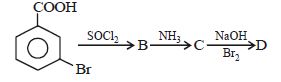
A
$3-$bromobenzenesulfonamide
B
$m$-aminobenzoic acid
C
$m$-bromoaniline
D
$m$-bromobenzamide
Solution
(C) The reaction sequence is as follows:
$1$. $m$-bromobenzoic acid reacts with $SOCl_2$ to form $m$-bromobenzoyl chloride $(B)$.
$2$. $m$-bromobenzoyl chloride reacts with $NH_3$ to form $m$-bromobenzamide $(C)$.
$3$. $m$-bromobenzamide undergoes the Hofmann bromamide degradation reaction with $NaOH$ and $Br_2$ to form $m$-bromoaniline $(D)$.
Therefore,the final product $D$ is $m$-bromoaniline.
$1$. $m$-bromobenzoic acid reacts with $SOCl_2$ to form $m$-bromobenzoyl chloride $(B)$.
$2$. $m$-bromobenzoyl chloride reacts with $NH_3$ to form $m$-bromobenzamide $(C)$.
$3$. $m$-bromobenzamide undergoes the Hofmann bromamide degradation reaction with $NaOH$ and $Br_2$ to form $m$-bromoaniline $(D)$.
Therefore,the final product $D$ is $m$-bromoaniline.
0 likesView Solution
76
ChemistryMediumMCQAIIMS · 2015
Assertion : Benzaldehyde is more reactive than ethanol towards nucleophilic attack.
Reason : The overall effect of $-I$ and $+R$ effect of phenyl group decreases the electron density on the carbon atom of $>C=O$ group in benzaldehyde.
Reason : The overall effect of $-I$ and $+R$ effect of phenyl group decreases the electron density on the carbon atom of $>C=O$ group in benzaldehyde.
A
If both Assertion and Reason are correct and the Reason is a correct explanation of the Assertion.
B
If both Assertion and Reason are correct but Reason is not a correct explanation of the Assertion.
C
If the Assertion is correct but Reason is incorrect.
D
If both the Assertion and Reason are incorrect.
Solution
(D) The Assertion is incorrect because benzaldehyde is less reactive than ethanol towards nucleophilic attack. This is due to the steric hindrance of the bulky phenyl group and the resonance stabilization of the carbonyl carbon by the phenyl ring.
The Reason is also incorrect because the $+R$ effect of the phenyl group is electron-donating,which increases the electron density on the carbonyl carbon,thereby reducing its electrophilicity.
The Reason is also incorrect because the $+R$ effect of the phenyl group is electron-donating,which increases the electron density on the carbonyl carbon,thereby reducing its electrophilicity.
0 likesView Solution
77
ChemistryMediumMCQAIIMS · 2015
Which of the statements about "Denaturation" given below are correct?
$A$. Denaturation of proteins causes loss of secondary and tertiary structures of the protein
$B$. Denaturation leads to the conversion of double strand of $DNA$ into single strand
$C$. Denaturation affects primary structure which gets distorted
$A$. Denaturation of proteins causes loss of secondary and tertiary structures of the protein
$B$. Denaturation leads to the conversion of double strand of $DNA$ into single strand
$C$. Denaturation affects primary structure which gets distorted
A
$B$ and $C$
B
$A$ and $C$
C
$A$ and $B$
D
$A, B$ and $C$
Solution
(C) Denaturation is a process where proteins or nucleic acids lose their quaternary,tertiary,and secondary structures due to external stress such as heat,pH changes,or chemicals.
Statement $A$ is correct: Denaturation disrupts the hydrogen bonds and other interactions,leading to the loss of secondary and tertiary structures.
Statement $B$ is correct: In $DNA$,denaturation refers to the separation of the double-stranded helix into two single strands.
Statement $C$ is incorrect: The primary structure of proteins (the sequence of amino acids) remains intact during denaturation.
Therefore,statements $A$ and $B$ are correct.
Statement $A$ is correct: Denaturation disrupts the hydrogen bonds and other interactions,leading to the loss of secondary and tertiary structures.
Statement $B$ is correct: In $DNA$,denaturation refers to the separation of the double-stranded helix into two single strands.
Statement $C$ is incorrect: The primary structure of proteins (the sequence of amino acids) remains intact during denaturation.
Therefore,statements $A$ and $B$ are correct.
0 likesView Solution
78
ChemistryMediumMCQAIIMS · 2015
Assertion : Bakelite is a thermosetting polymer.
Reason : Bakelite can be melted again and again without any change.
Reason : Bakelite can be melted again and again without any change.
A
If both Assertion and Reason are correct and the Reason is a correct explanation of the Assertion.
B
If both Assertion and Reason are correct but Reason is not a correct explanation of the Assertion.
C
If the Assertion is correct but Reason is incorrect.
D
If both the Assertion and Reason are incorrect.
Solution
(C) Bakelite is a cross-linked polymer formed by the condensation reaction of phenol and formaldehyde.
It is a thermosetting polymer,which means it becomes hard and infusible on heating and cannot be remelted or reshaped.
Therefore,the Assertion is correct,but the Reason is incorrect.
It is a thermosetting polymer,which means it becomes hard and infusible on heating and cannot be remelted or reshaped.
Therefore,the Assertion is correct,but the Reason is incorrect.
0 likesView Solution
79
ChemistryMediumMCQAIIMS · 2015
Which of the following is an antidiabetic drug?
A
Insulin
B
Penicillin
C
Chloroquine
D
Aspirin
Solution
(A) Antidiabetic drugs are medications used to stabilize and control blood glucose levels in people with diabetes.
$A$. Insulin is a hormone used as an antidiabetic drug to manage blood sugar levels.
$B$. Penicillin is an antibiotic.
$C$. Chloroquine is an antimalarial drug.
$D$. Aspirin is an analgesic and antipyretic drug.
Therefore,the correct option is $A$.
$A$. Insulin is a hormone used as an antidiabetic drug to manage blood sugar levels.
$B$. Penicillin is an antibiotic.
$C$. Chloroquine is an antimalarial drug.
$D$. Aspirin is an analgesic and antipyretic drug.
Therefore,the correct option is $A$.
0 likesView Solution
80
ChemistryDifficultMCQAIIMS · 2015
$Statement-1$: Micelles are formed by surfactant molecules above the critical micellar concentration $(CMC)$.
$Statement-2$: The conductivity of a solution having surfactant molecules decreases sharply at the $CMC$.
$Statement-2$: The conductivity of a solution having surfactant molecules decreases sharply at the $CMC$.
A
$Statement-1$ is True,$Statement-2$ is True; $Statement-2$ is a correct explanation for $Statement-1$.
B
$Statement-1$ is True,$Statement-2$ is True; $Statement-2$ is $NOT$ a correct explanation for $Statement-1$.
C
$Statement-1$ is True,$Statement-2$ is False.
D
$Statement-1$ is False,$Statement-2$ is True.
Solution
(B) $Statement-1$ is True: Micelles are indeed formed by surfactant molecules only above the critical micellar concentration $(CMC)$ and the Kraft temperature $(T_k)$.
$Statement-2$ is True: At the $CMC$,individual surfactant ions aggregate to form large,bulky micellar particles. These large particles have lower mobility compared to individual ions,which leads to a sharp decrease in the molar conductivity of the solution.
Conclusion: While both statements are true,the decrease in conductivity is a consequence of micelle formation,not the reason why micelles form. Therefore,$Statement-2$ is not the correct explanation for $Statement-1$.
$Statement-2$ is True: At the $CMC$,individual surfactant ions aggregate to form large,bulky micellar particles. These large particles have lower mobility compared to individual ions,which leads to a sharp decrease in the molar conductivity of the solution.
Conclusion: While both statements are true,the decrease in conductivity is a consequence of micelle formation,not the reason why micelles form. Therefore,$Statement-2$ is not the correct explanation for $Statement-1$.
0 likesView Solution
Vedclass Products
For Students
Vedclass Test Series
Mock tests in real AIIMS style covering Chemistry with performance analysis. 5-day free trial.
Start Free TrialFor Teachers
Exam Paper Generator
Generate Set A/B/C/D Chemistry papers from 7.5L+ questions in 2 minutes. 3 chapters free.
Try FreeFor Institutes
Online Exam Module
Run live AIIMS mock exams with unlimited students, 360° analytics & white-label branding.
See DemoFrequently Asked Questions
How many Chemistry questions are in AIIMS 2015?
There are 80 Chemistry questions from the AIIMS 2015 paper on Vedclass, each with a detailed step-by-step solution in English.
Are AIIMS 2015 Chemistry solutions available in English?
Yes. All solutions on this page are in English. You can also switch to English or Hindi using the language buttons above the questions.
Can I practice AIIMS 2015 Chemistry as a timed test?
Yes. Use the Vedclass Test Series to attempt a full AIIMS mock test covering Chemistry with time limits and instant score analysis.
Can teachers create Chemistry papers from AIIMS previous year questions?
Yes. The Vedclass Exam Paper Generator lets teachers mix AIIMS Chemistry questions and generate Set A/B/C/D papers in minutes.
For Teachers & Institutes
Build a Custom Chemistry Paper
Pick AIIMS 2015 Chemistry questions, set difficulty, and generate Set A/B/C/D in 2 minutes.