
ChemistryQ1–52 of 52 questions
Page 1 of 1 · English
1
ChemistryMCQAIIMS · 2018
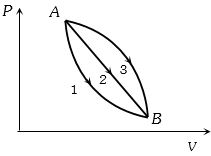
An ideal gas of mass $m$ in a state $A$ goes to another state $B$ via three different processes as shown in the figure. If ${Q_1}, {Q_2}$ and ${Q_3}$ denote the heat absorbed by the gas along the three paths,then
A
${Q_1} < {Q_2} < {Q_3}$
B
${Q_1} < {Q_2} = {Q_3}$
C
${Q_1} = {Q_2} > {Q_3}$
D
${Q_1} > {Q_2} > {Q_3}$
Solution
(A) For all three processes,the initial state $A$ and final state $B$ are the same.
Since internal energy $U$ is a state function,the change in internal energy $\Delta U = U_B - U_A$ is the same for all three paths.
According to the First Law of Thermodynamics,$\Delta Q = \Delta U + \Delta W$,where $\Delta W$ is the work done by the gas.
In a $P-V$ diagram,the work done $\Delta W$ is equal to the area under the curve with the volume axis.
From the figure,the area under the curves is such that $(Area)_1 < (Area)_2 < (Area)_3$.
Since $\Delta U$ is constant,$\Delta Q$ is directly proportional to $\Delta W$.
Therefore,${Q_1} < {Q_2} < {Q_3}$.
Since internal energy $U$ is a state function,the change in internal energy $\Delta U = U_B - U_A$ is the same for all three paths.
According to the First Law of Thermodynamics,$\Delta Q = \Delta U + \Delta W$,where $\Delta W$ is the work done by the gas.
In a $P-V$ diagram,the work done $\Delta W$ is equal to the area under the curve with the volume axis.
From the figure,the area under the curves is such that $(Area)_1 < (Area)_2 < (Area)_3$.
Since $\Delta U$ is constant,$\Delta Q$ is directly proportional to $\Delta W$.
Therefore,${Q_1} < {Q_2} < {Q_3}$.
0 likesView Solution
2
ChemistryMCQAIIMS · 2018
$A$ solid has a structure in which $W$ atoms are located at the corners of a cubic lattice,$O$ atoms at the centre of edges,and $Na$ atoms at the centre of the cube. The formula for the compound is
A
$NaWO_2$
B
$NaWO_3$
C
$Na_2WO_3$
D
$NaWO_4$
Solution
(B) In a unit cell,the number of $W$ atoms at the corners $= \frac{1}{8} \times 8 = 1$.
The number of $O$ atoms at the centre of edges $= \frac{1}{4} \times 12 = 3$.
The number of $Na$ atoms at the centre of the cube $= 1$.
Thus,the ratio of atoms is $Na:W:O = 1:1:3$.
Therefore,the formula for the compound is $NaWO_3$.
The number of $O$ atoms at the centre of edges $= \frac{1}{4} \times 12 = 3$.
The number of $Na$ atoms at the centre of the cube $= 1$.
Thus,the ratio of atoms is $Na:W:O = 1:1:3$.
Therefore,the formula for the compound is $NaWO_3$.
0 likesView Solution
3
ChemistryMCQAIIMS · 2018
An ideal coil of $10 \, H$ is connected in series with a resistance of $5 \, \Omega$ and a battery of $5 \, V$. $2 \, s$ after the connection is made,the current flowing (in ampere) in the circuit is:
A
$(1 - e)$
B
$e$
C
$e^{-1}$
D
$(1 - e^{-1})$
Solution
(D) The circuit is an $LR$ series circuit connected to a $DC$ source.
The time constant of the circuit is $\tau = \frac{L}{R} = \frac{10 \, H}{5 \, \Omega} = 2 \, s$.
The current in an $LR$ circuit at time $t$ is given by $I(t) = I_0(1 - e^{-t/\tau})$,where $I_0 = \frac{V}{R} = \frac{5 \, V}{5 \, \Omega} = 1 \, A$.
Given $t = 2 \, s$,we have $I(2) = 1 \times (1 - e^{-2/2}) = 1 - e^{-1} \, A$.
The time constant of the circuit is $\tau = \frac{L}{R} = \frac{10 \, H}{5 \, \Omega} = 2 \, s$.
The current in an $LR$ circuit at time $t$ is given by $I(t) = I_0(1 - e^{-t/\tau})$,where $I_0 = \frac{V}{R} = \frac{5 \, V}{5 \, \Omega} = 1 \, A$.
Given $t = 2 \, s$,we have $I(2) = 1 \times (1 - e^{-2/2}) = 1 - e^{-1} \, A$.
0 likesView Solution
4
ChemistryMCQAIIMS · 2018
An ideal coil of $10\,H$ is connected in series with a resistance of $5\,\Omega$ and a battery of $5\,V$. After $2\,s$ the connection is made,the current flowing in ampere in the circuit is
A
$(1 - e^{-1})$
B
$(1 - e)$
C
$e$
D
$e^{-1}$
Solution
(A) The current in an $LR$ circuit during growth is given by the formula: $I(t) = I_0(1 - e^{-\frac{R}{L}t})$
Here,$I_0 = \frac{E}{R}$ is the maximum steady-state current.
Given values are: $L = 10\,H$,$R = 5\,\Omega$,$E = 5\,V$,and $t = 2\,s$.
First,calculate $I_0 = \frac{5\,V}{5\,\Omega} = 1\,A$.
Now,substitute the values into the growth equation:
$I(2) = 1 \times (1 - e^{-\frac{5}{10} \times 2})$
$I(2) = 1 - e^{-1} \,A$.
Here,$I_0 = \frac{E}{R}$ is the maximum steady-state current.
Given values are: $L = 10\,H$,$R = 5\,\Omega$,$E = 5\,V$,and $t = 2\,s$.
First,calculate $I_0 = \frac{5\,V}{5\,\Omega} = 1\,A$.
Now,substitute the values into the growth equation:
$I(2) = 1 \times (1 - e^{-\frac{5}{10} \times 2})$
$I(2) = 1 - e^{-1} \,A$.
0 likesView Solution
5
ChemistryMCQAIIMS · 2018
Which of the following biomolecules is common to respiration-mediated breakdown of fats,carbohydrates and proteins?
A
Glucose-$6$-phosphate
B
Pyruvic acid
C
Fructose-$1,6$-bisphosphate
D
Acetyl $CoA$
Solution
(D) Carbohydrates,fats,and proteins can all be used as respiratory substrates in cellular respiration.
During aerobic respiration,these molecules are broken down through various pathways and eventually converge at the formation of Acetyl $CoA$ before entering the Krebs' cycle ($TCA$ cycle).
Therefore,Acetyl $CoA$ acts as a common intermediate for the breakdown of all three major biomolecules.
During aerobic respiration,these molecules are broken down through various pathways and eventually converge at the formation of Acetyl $CoA$ before entering the Krebs' cycle ($TCA$ cycle).
Therefore,Acetyl $CoA$ acts as a common intermediate for the breakdown of all three major biomolecules.
0 likesView Solution
6
ChemistryMCQAIIMS · 2018
Which one of the following conditions correctly describes the manner of determining the sex?
A
Homozygous sex chromosomes $(ZZ)$ determine female sex in birds
B
$XO$ type of sex chromosomes determine male sex in grasshopper
C
$XO$ condition in humans as found in Turner's syndrome determines female sex
D
Homozygous sex chromosomes $(XX)$ produce males in Drosophila
Solution
(B) $XO$ type of sex chromosomes determine male sex in grasshoppers. This type of sex-determination comes under $XX-XO$ type.
It is common in cockroaches,grasshoppers,and bugs.
The female has two homomorphic sex chromosomes $XX$ and is homogametic.
It produces similar eggs,each with one $X$ chromosome.
The male has only one $X$ chromosome and is heterogametic.
It produces two types of sperms: gynosperms with $X$ and androsperms without $X$.
Other statements can be corrected as follows:
In birds,the females are heterogametic and represented as $ZW$.
Female sex in humans is represented as $XX$.
In Drosophila,males are heterogametic,i.e.,$XY$.
It is common in cockroaches,grasshoppers,and bugs.
The female has two homomorphic sex chromosomes $XX$ and is homogametic.
It produces similar eggs,each with one $X$ chromosome.
The male has only one $X$ chromosome and is heterogametic.
It produces two types of sperms: gynosperms with $X$ and androsperms without $X$.
Other statements can be corrected as follows:
In birds,the females are heterogametic and represented as $ZW$.
Female sex in humans is represented as $XX$.
In Drosophila,males are heterogametic,i.e.,$XY$.
0 likesView Solution
7
ChemistryMCQAIIMS · 2018
$A$ scion is grafted to a stock. The quality of fruits produced will be determined by the genotype of
A
Stock
B
Scion
C
Both stock and Scion
D
Neither Stock nor Scion
Solution
(B) In the grafting technique,parts of two plants are joined to form a composite plant.
The plant providing the root system is called the $Stock$,while the plant providing the shoot system (which bears flowers and fruits) is called the $Scion$.
Since the $Scion$ contains the genetic material that dictates the characteristics of the shoot,branches,flowers,and fruits,the quality of the fruits produced is determined by the genotype of the $Scion$.
The plant providing the root system is called the $Stock$,while the plant providing the shoot system (which bears flowers and fruits) is called the $Scion$.
Since the $Scion$ contains the genetic material that dictates the characteristics of the shoot,branches,flowers,and fruits,the quality of the fruits produced is determined by the genotype of the $Scion$.
0 likesView Solution
8
ChemistryMCQAIIMS · 2018
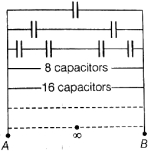
An infinite number of identical capacitors each of capacitance $1 \mu F$ are connected as shown in the figure. Then,the equivalent capacitance between $A$ and $B$ is .......... $\mu F$.
A
$1$
B
$2$
C
$0.5$
D
$\infty$
Solution
(B) The circuit consists of parallel branches.
In the $1^{st}$ branch,there is $1$ capacitor of $1 \mu F$. Its equivalent capacitance is $C_1 = 1 \mu F$.
In the $2^{nd}$ branch,there are $2$ capacitors in series,each of $1 \mu F$. Its equivalent capacitance is $C_2 = \frac{1 \mu F}{2} = 0.5 \mu F$.
In the $3^{rd}$ branch,there are $4$ capacitors in series,each of $1 \mu F$. Its equivalent capacitance is $C_3 = \frac{1 \mu F}{4} = 0.25 \mu F$.
In the $4^{th}$ branch,there are $8$ capacitors in series,each of $1 \mu F$. Its equivalent capacitance is $C_4 = \frac{1 \mu F}{8} = 0.125 \mu F$.
Since all these branches are connected in parallel,the total equivalent capacitance $C_{eq}$ is the sum of the capacitances of each branch:
$C_{eq} = C_1 + C_2 + C_3 + C_4 + \dots$
$C_{eq} = 1 + \frac{1}{2} + \frac{1}{4} + \frac{1}{8} + \dots$
This is an infinite geometric progression with first term $a = 1$ and common ratio $r = \frac{1}{2}$.
The sum of an infinite geometric series is given by $S = \frac{a}{1 - r}$.
$C_{eq} = \frac{1}{1 - 1/2} = \frac{1}{1/2} = 2 \mu F$.
In the $1^{st}$ branch,there is $1$ capacitor of $1 \mu F$. Its equivalent capacitance is $C_1 = 1 \mu F$.
In the $2^{nd}$ branch,there are $2$ capacitors in series,each of $1 \mu F$. Its equivalent capacitance is $C_2 = \frac{1 \mu F}{2} = 0.5 \mu F$.
In the $3^{rd}$ branch,there are $4$ capacitors in series,each of $1 \mu F$. Its equivalent capacitance is $C_3 = \frac{1 \mu F}{4} = 0.25 \mu F$.
In the $4^{th}$ branch,there are $8$ capacitors in series,each of $1 \mu F$. Its equivalent capacitance is $C_4 = \frac{1 \mu F}{8} = 0.125 \mu F$.
Since all these branches are connected in parallel,the total equivalent capacitance $C_{eq}$ is the sum of the capacitances of each branch:
$C_{eq} = C_1 + C_2 + C_3 + C_4 + \dots$
$C_{eq} = 1 + \frac{1}{2} + \frac{1}{4} + \frac{1}{8} + \dots$
This is an infinite geometric progression with first term $a = 1$ and common ratio $r = \frac{1}{2}$.
The sum of an infinite geometric series is given by $S = \frac{a}{1 - r}$.
$C_{eq} = \frac{1}{1 - 1/2} = \frac{1}{1/2} = 2 \mu F$.
0 likesView Solution
9
ChemistryMCQAIIMS · 2018
An ideal coil of $10\, H$ is connected in series with a resistance of $5\, \Omega$ and a battery of $5\, V$. After $2\, s$,after the connection is made,the current flowing (in ampere) in the circuit is.
A
$(1-e)$
B
$e$
C
$e^{-1}$
D
$(1-e^{-1})$
Solution
(D) The growth of current in an $L-R$ circuit is given by the formula:
$I = I_{0}(1 - e^{-t/\tau})$
where $I_{0}$ is the steady-state current and $\tau$ is the time constant.
First,calculate the steady-state current $I_{0}$:
$I_{0} = \frac{E}{R} = \frac{5\, V}{5\, \Omega} = 1\, A$
Next,calculate the time constant $\tau$:
$\tau = \frac{L}{R} = \frac{10\, H}{5\, \Omega} = 2\, s$
Given the time $t = 2\, s$,substitute the values into the growth equation:
$I = 1 \cdot (1 - e^{-2/2})$
$I = (1 - e^{-1})\, A$
$I = I_{0}(1 - e^{-t/\tau})$
where $I_{0}$ is the steady-state current and $\tau$ is the time constant.
First,calculate the steady-state current $I_{0}$:
$I_{0} = \frac{E}{R} = \frac{5\, V}{5\, \Omega} = 1\, A$
Next,calculate the time constant $\tau$:
$\tau = \frac{L}{R} = \frac{10\, H}{5\, \Omega} = 2\, s$
Given the time $t = 2\, s$,substitute the values into the growth equation:
$I = 1 \cdot (1 - e^{-2/2})$
$I = (1 - e^{-1})\, A$
0 likesView Solution
10
ChemistryMediumMCQAIIMS · 2018
In an adiabatic process,no transfer of heat takes place between the system and surroundings. Choose the correct option for the free expansion of an ideal gas under adiabatic conditions from the following:
A
$q=0, \Delta T \neq 0, W=0$
B
$q \neq 0, \Delta T=0, W=0$
C
$q=0, \Delta T=0, W=0$
D
$q=0, \Delta T < 0, W \neq 0$
Solution
(C) For free expansion,the external pressure $P_{ext} = 0$,therefore work done $W = -P_{ext} \Delta V = 0$.
For an adiabatic process,the heat exchange $q = 0$.
According to the first law of thermodynamics,$\Delta U = q + W$.
Since $q = 0$ and $W = 0$,the change in internal energy $\Delta U = 0$.
For an ideal gas,internal energy is a function of temperature only $(U = f(T))$,so $\Delta U = 0$ implies $\Delta T = 0$.
Thus,for free expansion of an ideal gas under adiabatic conditions,$q=0, \Delta T=0, W=0$.
For an adiabatic process,the heat exchange $q = 0$.
According to the first law of thermodynamics,$\Delta U = q + W$.
Since $q = 0$ and $W = 0$,the change in internal energy $\Delta U = 0$.
For an ideal gas,internal energy is a function of temperature only $(U = f(T))$,so $\Delta U = 0$ implies $\Delta T = 0$.
Thus,for free expansion of an ideal gas under adiabatic conditions,$q=0, \Delta T=0, W=0$.
0 likesView Solution
11
ChemistryEasyMCQAIIMS · 2018
The work function of a metal is $4.2 \, eV$. If radiation of $2000 \, \mathring{A}$ falls on the metal,then the kinetic energy of the fastest photoelectron is:
A
$1.6 \times 10^{-19} \, J$
B
$16 \times 10^{-10} \, J$
C
$3.2 \times 10^{-19} \, J$
D
$6.4 \times 10^{-10} \, J$
Solution
(C) The work function $\Phi = 4.2 \, eV = 4.2 \times 1.602 \times 10^{-19} \, J \approx 6.73 \times 10^{-19} \, J$.
The energy of the incident radiation $E = \frac{hc}{\lambda} = \frac{6.626 \times 10^{-34} \times 3 \times 10^8}{2000 \times 10^{-10}} \, J = 9.939 \times 10^{-19} \, J$.
According to Einstein's photoelectric equation,$K_{max} = E - \Phi$.
$K_{max} = (9.939 - 6.73) \times 10^{-19} \, J = 3.209 \times 10^{-19} \, J$.
Thus,the kinetic energy is approximately $3.2 \times 10^{-19} \, J$.
The energy of the incident radiation $E = \frac{hc}{\lambda} = \frac{6.626 \times 10^{-34} \times 3 \times 10^8}{2000 \times 10^{-10}} \, J = 9.939 \times 10^{-19} \, J$.
According to Einstein's photoelectric equation,$K_{max} = E - \Phi$.
$K_{max} = (9.939 - 6.73) \times 10^{-19} \, J = 3.209 \times 10^{-19} \, J$.
Thus,the kinetic energy is approximately $3.2 \times 10^{-19} \, J$.
0 likesView Solution
12
ChemistryDifficultMCQAIIMS · 2018
At equilibrium,the concentrations are $[N_2] = 3.0 \times 10^{-3} \ M$,$[O_2] = 4.2 \times 10^{-3} \ M$,and $[NO] = 2.8 \times 10^{-3} \ M$ in a sealed vessel at $800 \ K$ and $1 \ atm$ pressure. What will be $K_p$ for the given reaction?
$N_{2(g)} + O_{2(g)} \rightleftharpoons 2NO_{(g)}$
$N_{2(g)} + O_{2(g)} \rightleftharpoons 2NO_{(g)}$
A
$0.328$
B
$0.622$
C
$0.483$
D
$0.712$
Solution
(B) Given,$[N_2] = 3.0 \times 10^{-3} \ M$,$[O_2] = 4.2 \times 10^{-3} \ M$,and $[NO] = 2.8 \times 10^{-3} \ M$.
For the reaction $N_{2(g)} + O_{2(g)} \rightleftharpoons 2NO_{(g)}$,the equilibrium constant $K_C$ is given by:
$K_C = \frac{[NO]^2}{[N_2][O_2]}$
Substituting the values:
$K_C = \frac{(2.8 \times 10^{-3})^2}{(3.0 \times 10^{-3})(4.2 \times 10^{-3})} = \frac{7.84 \times 10^{-6}}{12.6 \times 10^{-6}} \approx 0.622$
The relationship between $K_p$ and $K_C$ is $K_p = K_C(RT)^{\Delta n}$.
Here,$\Delta n = (\text{moles of gaseous products}) - (\text{moles of gaseous reactants}) = 2 - (1 + 1) = 0$.
Since $\Delta n = 0$,$K_p = K_C(RT)^0 = K_C$.
Therefore,$K_p = 0.622$.
For the reaction $N_{2(g)} + O_{2(g)} \rightleftharpoons 2NO_{(g)}$,the equilibrium constant $K_C$ is given by:
$K_C = \frac{[NO]^2}{[N_2][O_2]}$
Substituting the values:
$K_C = \frac{(2.8 \times 10^{-3})^2}{(3.0 \times 10^{-3})(4.2 \times 10^{-3})} = \frac{7.84 \times 10^{-6}}{12.6 \times 10^{-6}} \approx 0.622$
The relationship between $K_p$ and $K_C$ is $K_p = K_C(RT)^{\Delta n}$.
Here,$\Delta n = (\text{moles of gaseous products}) - (\text{moles of gaseous reactants}) = 2 - (1 + 1) = 0$.
Since $\Delta n = 0$,$K_p = K_C(RT)^0 = K_C$.
Therefore,$K_p = 0.622$.
0 likesView Solution
13
ChemistryMediumMCQAIIMS · 2018
The ionic radii $(\mathring{A})$ of $C^{4-}$ and $O^{2-}$ respectively are $2.60$ and $1.40$. The ionic radius of the isoelectronic ion $N^{3-}$ would be........$\mathring{A}$
A
$1.31$
B
$2.83$
C
$1.71$
D
$2.63$
Solution
(C) $C^{4-}$,$N^{3-}$,and $O^{2-}$ are isoelectronic species,all having $10$ electrons.
The ionic radius of isoelectronic species decreases as the nuclear charge (atomic number) increases.
The atomic numbers are: $C (6)$,$N (7)$,and $O (8)$.
Therefore,the order of ionic radii is: $C^{4-} > N^{3-} > O^{2-}$.
Given the values $2.60 \ \mathring{A}$ for $C^{4-}$ and $1.40 \ \mathring{A}$ for $O^{2-}$,the value for $N^{3-}$ must lie between $1.40$ and $2.60$.
Among the given options,$1.71 \ \mathring{A}$ is the correct value.
The ionic radius of isoelectronic species decreases as the nuclear charge (atomic number) increases.
The atomic numbers are: $C (6)$,$N (7)$,and $O (8)$.
Therefore,the order of ionic radii is: $C^{4-} > N^{3-} > O^{2-}$.
Given the values $2.60 \ \mathring{A}$ for $C^{4-}$ and $1.40 \ \mathring{A}$ for $O^{2-}$,the value for $N^{3-}$ must lie between $1.40$ and $2.60$.
Among the given options,$1.71 \ \mathring{A}$ is the correct value.
0 likesView Solution
14
ChemistryMediumMCQAIIMS · 2018
The correct order of decreasing stability of the following carbocations is:
$I. CH_3-CH^{+}-CH_3$
$II. CH_3-CH^{+}-OCH_3$
$III. CH_3-CH^{+}-CH_2-OCH_3$
$I. CH_3-CH^{+}-CH_3$
$II. CH_3-CH^{+}-OCH_3$
$III. CH_3-CH^{+}-CH_2-OCH_3$
A
$II > I > III$
B
$II > III > I$
C
$III > I > II$
D
$I > II > III$
Solution
(A) The stability of the given carbocations is determined by electronic effects:
$I.$ $CH_3-CH^{+}-CH_3$: The carbocation is stabilized by the $+I$ effect of two methyl groups.
$II.$ $CH_3-CH^{+}-OCH_3$: The carbocation is strongly stabilized by the $+R$ (resonance) effect of the $-OCH_3$ group,which is more effective than the $+I$ effect.
$III.$ $CH_3-CH^{+}-CH_2-OCH_3$: The $-OCH_3$ group is separated by a methylene group,so its $-I$ effect destabilizes the carbocation.
Comparing these,the resonance effect in $II$ provides maximum stability,followed by the inductive effect in $I$,while the $-I$ effect in $III$ makes it the least stable.
Therefore,the correct order of decreasing stability is $II > I > III$.
$I.$ $CH_3-CH^{+}-CH_3$: The carbocation is stabilized by the $+I$ effect of two methyl groups.
$II.$ $CH_3-CH^{+}-OCH_3$: The carbocation is strongly stabilized by the $+R$ (resonance) effect of the $-OCH_3$ group,which is more effective than the $+I$ effect.
$III.$ $CH_3-CH^{+}-CH_2-OCH_3$: The $-OCH_3$ group is separated by a methylene group,so its $-I$ effect destabilizes the carbocation.
Comparing these,the resonance effect in $II$ provides maximum stability,followed by the inductive effect in $I$,while the $-I$ effect in $III$ makes it the least stable.
Therefore,the correct order of decreasing stability is $II > I > III$.
0 likesView Solution
15
ChemistryMediumMCQAIIMS · 2018
$\Delta H$ and $\Delta E$ for the reaction,$Fe_{2}O_{3(s)} + 3H_{2(g)} \rightarrow 2Fe_{(s)} + 3H_{2}O_{(l)}$ at constant temperature are related as
A
$\Delta H = \Delta E$
B
$\Delta H = \Delta E + RT$
C
$\Delta H = \Delta E + 3RT$
D
$\Delta H = \Delta E - 3RT$
Solution
(D) For any chemical reaction,the relationship between enthalpy change $(\Delta H)$ and internal energy change $(\Delta E)$ is given by:
$\Delta H = \Delta E + \Delta n_{g}RT$
Where $\Delta n_{g}$ is the change in the number of moles of gaseous species.
$\Delta n_{g} = (\text{moles of gaseous products}) - (\text{moles of gaseous reactants})$
For the reaction: $Fe_{2}O_{3(s)} + 3H_{2(g)} \rightarrow 2Fe_{(s)} + 3H_{2}O_{(l)}$
Note that $Fe_{2}O_{3}$ and $Fe$ are solids,and $H_{2}O$ is a liquid. Only $H_{2}$ is in the gaseous state.
$\Delta n_{g} = 0 - 3 = -3$
Substituting this value into the equation:
$\Delta H = \Delta E + (-3)RT$
$\Delta H = \Delta E - 3RT$
$\Delta H = \Delta E + \Delta n_{g}RT$
Where $\Delta n_{g}$ is the change in the number of moles of gaseous species.
$\Delta n_{g} = (\text{moles of gaseous products}) - (\text{moles of gaseous reactants})$
For the reaction: $Fe_{2}O_{3(s)} + 3H_{2(g)} \rightarrow 2Fe_{(s)} + 3H_{2}O_{(l)}$
Note that $Fe_{2}O_{3}$ and $Fe$ are solids,and $H_{2}O$ is a liquid. Only $H_{2}$ is in the gaseous state.
$\Delta n_{g} = 0 - 3 = -3$
Substituting this value into the equation:
$\Delta H = \Delta E + (-3)RT$
$\Delta H = \Delta E - 3RT$
0 likesView Solution
16
ChemistryMediumMCQAIIMS · 2018
The correct $IUPAC$ name of the given compound is

A
$7-$hydroxy cyclohex$-5-$en$-1-$one
B
$3-$hydroxy cyclohex$-5-$en$-1-$one
C
$8-$hydroxy cyclohex$-3-$en$-1-$one
D
$5-$hydroxy cyclohex$-3-$en$-1-$one
Solution
(D) To determine the $IUPAC$ name,we identify the principal functional group,which is the ketone group $(-one)$.
We number the ring starting from the ketone carbon as $C-1$.
We then number the ring to give the lowest possible locants to the double bond and the hydroxyl group.
Starting from the ketone carbon $(C-1)$,we proceed towards the double bond to give it the lowest locant ($C-3$ to $C-4$ double bond).
Thus,the hydroxyl group is at position $5$.
The correct $IUPAC$ name is $5-$hydroxycyclohex$-3-$en$-1-$one.
We number the ring starting from the ketone carbon as $C-1$.
We then number the ring to give the lowest possible locants to the double bond and the hydroxyl group.
Starting from the ketone carbon $(C-1)$,we proceed towards the double bond to give it the lowest locant ($C-3$ to $C-4$ double bond).
Thus,the hydroxyl group is at position $5$.
The correct $IUPAC$ name is $5-$hydroxycyclohex$-3-$en$-1-$one.
0 likesView Solution
17
ChemistryMediumMCQAIIMS · 2018
The solubility product of sparingly soluble salt $AX_{2}$ is $3.2 \times 10^{-11}$. Its solubility (in $mol / L$) is
A
$5.6 \times 10^{-6}$
B
$3.1 \times 10^{-4}$
C
$2 \times 10^{-4}$
D
$4 \times 10^{-4}$
Solution
(C) $AX_{2}$ is ionized as follows:
$AX_{2} \rightleftharpoons A^{2+} + 2X^{-}$
Solubility product of $AX_{2}$ is given by:
$K_{sp} = [A^{2+}][X^{-}]^{2} = (S) \times (2S)^{2} = 4S^{3}$
Given $K_{sp} = 3.2 \times 10^{-11}$
$4S^{3} = 3.2 \times 10^{-11}$
$S^{3} = 0.8 \times 10^{-11} = 8 \times 10^{-12}$
$S = \sqrt[3]{8 \times 10^{-12}} = 2 \times 10^{-4} \, mol / L$
Thus,the solubility is $2 \times 10^{-4} \, mol / L$.
$AX_{2} \rightleftharpoons A^{2+} + 2X^{-}$
Solubility product of $AX_{2}$ is given by:
$K_{sp} = [A^{2+}][X^{-}]^{2} = (S) \times (2S)^{2} = 4S^{3}$
Given $K_{sp} = 3.2 \times 10^{-11}$
$4S^{3} = 3.2 \times 10^{-11}$
$S^{3} = 0.8 \times 10^{-11} = 8 \times 10^{-12}$
$S = \sqrt[3]{8 \times 10^{-12}} = 2 \times 10^{-4} \, mol / L$
Thus,the solubility is $2 \times 10^{-4} \, mol / L$.
0 likesView Solution
18
ChemistryMediumMCQAIIMS · 2018
The structure of $IF_{7}$ is
A
Square pyramidal
B
Trigonal bipyramidal
C
Octahedral
D
Pentagonal bipyramidal
Solution
(D) The central iodine atom $(I)$ in $IF_{7}$ has $7$ valence electrons. It forms $7$ bonds with $7$ fluorine atoms.
The steric number is calculated as:
$\text{Steric Number} = \frac{1}{2} \times (V + M - C + A) = \frac{1}{2} \times (7 + 7) = 7$.
$A$ steric number of $7$ corresponds to $sp^{3}d^{3}$ hybridization,which results in a pentagonal bipyramidal geometry.
In this structure,five fluorine atoms lie in a pentagonal plane with $I-F$ bond angles of $72^{\circ}$,and two fluorine atoms are positioned above and below the plane at $90^{\circ}$ to the equatorial plane.
The steric number is calculated as:
$\text{Steric Number} = \frac{1}{2} \times (V + M - C + A) = \frac{1}{2} \times (7 + 7) = 7$.
$A$ steric number of $7$ corresponds to $sp^{3}d^{3}$ hybridization,which results in a pentagonal bipyramidal geometry.
In this structure,five fluorine atoms lie in a pentagonal plane with $I-F$ bond angles of $72^{\circ}$,and two fluorine atoms are positioned above and below the plane at $90^{\circ}$ to the equatorial plane.
0 likesView Solution
19
ChemistryMCQAIIMS · 2018
Apical dominance is caused by
A
Auxin
B
Cytokinin
C
Ethylene
D
Gibberellin
Solution
(A) Apical dominance is a phenomenon in plants where the main central stem (apical bud) grows more strongly than other side stems.
This process is primarily regulated by the plant hormone $Auxin$.
$Auxin$ is synthesized at the shoot apex and transported downwards,where it inhibits the growth of lateral buds,thereby maintaining the dominance of the apical bud.
This process is primarily regulated by the plant hormone $Auxin$.
$Auxin$ is synthesized at the shoot apex and transported downwards,where it inhibits the growth of lateral buds,thereby maintaining the dominance of the apical bud.
0 likesView Solution
20
ChemistryMCQAIIMS · 2018
Cry $II$ Ab and Cry $I$ Ab produce toxins that control:
A
Cotton bollworms and corn borer respectively
B
Corn borer and cotton bollworms respectively
C
Tobacco budworms and nematodes respectively
D
Nematodes and tobacco budworms respectively
Solution
(A) The $Bt$ toxin is produced by specific genes known as $Cry$ genes.
These proteins are highly specific to certain insect pests.
The gene $Cry$ $I$ Ab controls the corn borer.
The gene $Cry$ $II$ Ab controls the cotton bollworms.
Therefore,$Cry$ $II$ Ab and $Cry$ $I$ Ab control cotton bollworms and corn borer respectively.
These proteins are highly specific to certain insect pests.
The gene $Cry$ $I$ Ab controls the corn borer.
The gene $Cry$ $II$ Ab controls the cotton bollworms.
Therefore,$Cry$ $II$ Ab and $Cry$ $I$ Ab control cotton bollworms and corn borer respectively.
0 likesView Solution
21
ChemistryMCQAIIMS · 2018
Which one of the following conditions correctly describes the manner of determining the sex?
A
Homozygous sex chromosomes $(ZZ)$ determine female sex in birds.
B
$XO$ type of sex chromosomes determine male sex in grasshopper.
C
$XO$ condition in humans as found in Klinefelter's syndrome determines female sex.
D
Homozygous sex chromosomes $(XX)$ produce males in Drosophila.
Solution
(B) In grasshoppers,the sex determination mechanism is of the $XO$ type.
In this system,males possess only one $X$ chromosome along with autosomes $(XO)$,while females possess a pair of $X$ chromosomes $(XX)$.
Therefore,the presence of a single $X$ chromosome determines the male sex in grasshoppers.
Option $A$ is incorrect because $ZZ$ chromosomes in birds determine the male sex (homogametic).
Option $C$ is incorrect because Klinefelter's syndrome is $XXY$,not $XO$,and $XO$ in humans results in Turner's syndrome (female).
Option $D$ is incorrect because in Drosophila,$XX$ chromosomes produce females,while $XY$ produces males.
In this system,males possess only one $X$ chromosome along with autosomes $(XO)$,while females possess a pair of $X$ chromosomes $(XX)$.
Therefore,the presence of a single $X$ chromosome determines the male sex in grasshoppers.
Option $A$ is incorrect because $ZZ$ chromosomes in birds determine the male sex (homogametic).
Option $C$ is incorrect because Klinefelter's syndrome is $XXY$,not $XO$,and $XO$ in humans results in Turner's syndrome (female).
Option $D$ is incorrect because in Drosophila,$XX$ chromosomes produce females,while $XY$ produces males.
0 likesView Solution
22
ChemistryMediumMCQAIIMS · 2018
Which of the following represents the Wurtz-Fittig reaction?
A
$C_{6}H_{5}I + 2Na + CH_{3}I \rightarrow C_{6}H_{5}CH_{3} + 2NaI$
B
$2C_{6}H_{5}I + 2Na \rightarrow C_{6}H_{5}-C_{6}H_{5} + 2NaI$
C
$2CH_{3}CH_{2}I + 2Na \rightarrow CH_{3}CH_{2}CH_{2}CH_{3} + 2NaI$
D
$CH_{3}Br + AgF \rightarrow CH_{3}F + AgBr$
Solution
(A) The Wurtz-Fittig reaction involves the reaction of an aryl halide with an alkyl halide in the presence of sodium metal to form an alkyl-substituted aromatic compound.
Specifically,$C_{6}H_{5}I + CH_{3}I + 2Na \rightarrow C_{6}H_{5}CH_{3} + 2NaI$ represents the Wurtz-Fittig reaction.
Option $A$ is the correct representation.
Specifically,$C_{6}H_{5}I + CH_{3}I + 2Na \rightarrow C_{6}H_{5}CH_{3} + 2NaI$ represents the Wurtz-Fittig reaction.
Option $A$ is the correct representation.
0 likesView Solution
23
ChemistryMediumMCQAIIMS · 2018
The relative reactivities of acyl compounds towards nucleophilic substitution are in the order of
A
acyl chloride $ > $ acid anhydride $ > $ ester $ > $ amide
B
ester $ > $ acyl chloride $ > $ amide $ > $ acid anhydride
C
acid anhydride $ > $ amide $ > $ ester $ > $ acyl chloride
D
acyl chloride $ > $ ester $ > $ acid anhydride $ > $ amide
Solution
(A) The ease of nucleophilic substitution depends upon the nature of the leaving group. When the leaving tendency of a group in a compound is high,the compound is more reactive towards nucleophilic substitution.
The nucleophilic acyl substitution proceeds in two steps as shown in the mechanism:
$1$. Nucleophilic attack on the carbonyl carbon to form a tetrahedral intermediate.
$2$. Elimination of the leaving group $(A^-)$ to regenerate the carbonyl group.
The order of leaving tendency is $Cl^{-} > RCOO^{-} > RO^{-} > NH_{2}^{-}$.
Therefore,the order of reactivity of acyl compounds is:
$RCOCl$ (Acyl chloride) $ > (RCO)_2O$ (Acid anhydride) $ > RCOOR$ (Ester) $ > RCONH_2$ (Amide).
The nucleophilic acyl substitution proceeds in two steps as shown in the mechanism:
$1$. Nucleophilic attack on the carbonyl carbon to form a tetrahedral intermediate.
$2$. Elimination of the leaving group $(A^-)$ to regenerate the carbonyl group.
The order of leaving tendency is $Cl^{-} > RCOO^{-} > RO^{-} > NH_{2}^{-}$.
Therefore,the order of reactivity of acyl compounds is:
$RCOCl$ (Acyl chloride) $ > (RCO)_2O$ (Acid anhydride) $ > RCOOR$ (Ester) $ > RCONH_2$ (Amide).
0 likesView Solution
24
ChemistryEasyMCQAIIMS · 2018
Food preservatives prevent spoilage of food due to microbial growth. The most commonly used preservatives are
A
$C_6H_5COONa$
B
Table salt,sugar
C
Vegetable oils and sodium benzoate
D
All of the above
Solution
(D) The chemicals which are used to protect food from microbial action,i.e.,which arrest the process of fermentation,acidification,and any other decomposition of food,are known as food preservatives.
Table salt,sugar,vegetable oil,vinegar,sodium benzoate $(C_6H_5COONa)$,sodium metabisulphite $(Na_2S_2O_5)$,and vitamin $E$ are common examples of food preservatives.
Table salt,sugar,vegetable oil,vinegar,sodium benzoate $(C_6H_5COONa)$,sodium metabisulphite $(Na_2S_2O_5)$,and vitamin $E$ are common examples of food preservatives.
0 likesView Solution
25
ChemistryMediumMCQAIIMS · 2018
Among the following statements,the correct statement about the half-life period for a first order reaction is
A
Independent of concentration
B
Proportional to concentration
C
Inversely proportional to concentration
D
Inversely proportional to the square of the concentration
Solution
(A) For a first order reaction,the integrated rate law is given by $k = \frac{2.303}{t} \log \frac{[A]_0}{[A]_t}$.
At half-life,$t = t_{1/2}$ and $[A]_t = \frac{[A]_0}{2}$.
Substituting these values into the equation:
$k = \frac{2.303}{t_{1/2}} \log \frac{[A]_0}{[A]_0 / 2} = \frac{2.303}{t_{1/2}} \log 2$.
Since $\log 2 \approx 0.3010$,we get $k = \frac{2.303 \times 0.3010}{t_{1/2}} = \frac{0.693}{t_{1/2}}$.
Therefore,$t_{1/2} = \frac{0.693}{k}$.
This expression shows that the half-life of a first order reaction is independent of the initial concentration of the reactant.
At half-life,$t = t_{1/2}$ and $[A]_t = \frac{[A]_0}{2}$.
Substituting these values into the equation:
$k = \frac{2.303}{t_{1/2}} \log \frac{[A]_0}{[A]_0 / 2} = \frac{2.303}{t_{1/2}} \log 2$.
Since $\log 2 \approx 0.3010$,we get $k = \frac{2.303 \times 0.3010}{t_{1/2}} = \frac{0.693}{t_{1/2}}$.
Therefore,$t_{1/2} = \frac{0.693}{k}$.
This expression shows that the half-life of a first order reaction is independent of the initial concentration of the reactant.
0 likesView Solution
26
ChemistryMediumMCQAIIMS · 2018
The electronic configuration of the central metal atom/ion in $\left[ Co(CN)_6 \right]^{3-}$ is
A
$t_{2g}^5 e_g^0$
B
$t_{2g}^4 e_g^2$
C
$t_{2g}^4 e_g^3$
D
$t_{2g}^6 e_g^0$
Solution
(D) The complex $\left[ Co(CN)_6 \right]^{3-}$ contains $Co^{3+}$ as the central metal ion.
The atomic number of $Co$ is $27$. The electronic configuration of $Co$ is $[Ar] 3d^7 4s^2$.
For $Co^{3+}$,the electronic configuration is $[Ar] 3d^6$.
$CN^-$ is a strong field ligand,which causes the pairing of electrons in the $d$-orbitals.
In an octahedral field,the $d$-orbitals split into $t_{2g}$ and $e_g$ sets.
Since $CN^-$ is a strong field ligand,all $6$ electrons of $Co^{3+}$ $(3d^6)$ will occupy the $t_{2g}$ orbitals,resulting in the configuration $t_{2g}^6 e_g^0$.
Therefore,the correct option is $D$.
The atomic number of $Co$ is $27$. The electronic configuration of $Co$ is $[Ar] 3d^7 4s^2$.
For $Co^{3+}$,the electronic configuration is $[Ar] 3d^6$.
$CN^-$ is a strong field ligand,which causes the pairing of electrons in the $d$-orbitals.
In an octahedral field,the $d$-orbitals split into $t_{2g}$ and $e_g$ sets.
Since $CN^-$ is a strong field ligand,all $6$ electrons of $Co^{3+}$ $(3d^6)$ will occupy the $t_{2g}$ orbitals,resulting in the configuration $t_{2g}^6 e_g^0$.
Therefore,the correct option is $D$.
0 likesView Solution
27
ChemistryMediumMCQAIIMS · 2018
$A$ bromoalkane $X$ reacts with magnesium in dry ether to form compound $Y$. The reaction of $Y$ with methanal followed by hydrolysis yields an alcohol having molecular formula $C_{4}H_{10}O$. The compound $X$ is
A
Bromomethane
B
Bromoethane
C
$1-bromopropane$
D
$2-bromopropane$
Solution
(C) The reaction sequence is as follows:
$R-Br + Mg \xrightarrow{\text{Dry ether}} R-MgBr (Y)$
$R-MgBr + HCHO \xrightarrow{\text{Hydrolysis}} R-CH_{2}OH$
Given the product is $C_{4}H_{10}O$,which is a primary alcohol $(R-CH_{2}OH)$,we have $R+CH_{2} = C_{3}H_{7}$.
Thus,$R$ is a propyl group $(C_{3}H_{7}-)$.
Therefore,$X$ is $1-bromopropane$ $(CH_{3}CH_{2}CH_{2}Br)$:
$CH_{3}CH_{2}CH_{2}Br + Mg \xrightarrow{\text{Dry ether}} CH_{3}CH_{2}CH_{2}MgBr$
$CH_{3}CH_{2}CH_{2}MgBr + HCHO \rightarrow CH_{3}CH_{2}CH_{2}CH_{2}OMgBr$
$CH_{3}CH_{2}CH_{2}CH_{2}OMgBr + H_{2}O \rightarrow CH_{3}CH_{2}CH_{2}CH_{2}OH + Mg(OH)Br$
$R-Br + Mg \xrightarrow{\text{Dry ether}} R-MgBr (Y)$
$R-MgBr + HCHO \xrightarrow{\text{Hydrolysis}} R-CH_{2}OH$
Given the product is $C_{4}H_{10}O$,which is a primary alcohol $(R-CH_{2}OH)$,we have $R+CH_{2} = C_{3}H_{7}$.
Thus,$R$ is a propyl group $(C_{3}H_{7}-)$.
Therefore,$X$ is $1-bromopropane$ $(CH_{3}CH_{2}CH_{2}Br)$:
$CH_{3}CH_{2}CH_{2}Br + Mg \xrightarrow{\text{Dry ether}} CH_{3}CH_{2}CH_{2}MgBr$
$CH_{3}CH_{2}CH_{2}MgBr + HCHO \rightarrow CH_{3}CH_{2}CH_{2}CH_{2}OMgBr$
$CH_{3}CH_{2}CH_{2}CH_{2}OMgBr + H_{2}O \rightarrow CH_{3}CH_{2}CH_{2}CH_{2}OH + Mg(OH)Br$
0 likesView Solution
28
ChemistryMediumMCQAIIMS · 2018
The spin only magnetic moment of $[MnBr_{4}]^{2-}$ is $5.9 \ BM$. The geometry of this complex ion is
A
Tetrahedral
B
Octahedral
C
Trigonal pyramidal
D
Square planar
Solution
(A) The coordination number of the $Mn^{2+}$ ion in the complex ion $[MnBr_{4}]^{2-}$ is $4$.
This implies it can have either tetrahedral ($sp^{3}$ hybridization) or square planar ($dsp^{2}$ hybridization) geometry.
The given spin-only magnetic moment is $5.9 \ BM$.
Using the formula $\mu = \sqrt{n(n+2)}$,where $n$ is the number of unpaired electrons:
$5.9 \approx \sqrt{n(n+2)} \implies n \approx 5$.
Since $Mn^{2+}$ has a $d^{5}$ configuration,having $5$ unpaired electrons indicates a high-spin tetrahedral complex where the $d$-orbitals are not forced to pair up.
Therefore,the geometry is tetrahedral.
This implies it can have either tetrahedral ($sp^{3}$ hybridization) or square planar ($dsp^{2}$ hybridization) geometry.
The given spin-only magnetic moment is $5.9 \ BM$.
Using the formula $\mu = \sqrt{n(n+2)}$,where $n$ is the number of unpaired electrons:
$5.9 \approx \sqrt{n(n+2)} \implies n \approx 5$.
Since $Mn^{2+}$ has a $d^{5}$ configuration,having $5$ unpaired electrons indicates a high-spin tetrahedral complex where the $d$-orbitals are not forced to pair up.
Therefore,the geometry is tetrahedral.
0 likesView Solution
29
ChemistryEasyMCQAIIMS · 2018
Which of the following is an example of a network solid?
A
$SO_{2}$ (solid)
B
$I_{2}$
C
Diamond
D
$H_{2}O$ (ice)
Solution
(C) Diamond is a giant molecule in which constituent atoms are held together by covalent bonds. Hence,it is a network solid.
$SO_{2}$ (solid),$H_{2}O$ (ice),and $I_{2}$ are examples of molecular solids.
$SO_{2}$ (solid),$H_{2}O$ (ice),and $I_{2}$ are examples of molecular solids.
0 likesView Solution
30
ChemistryMediumMCQAIIMS · 2018
Affinity for hydrogen decreases in the group from fluorine to iodine. Which of the halogen acids should have the highest bond dissociation enthalpy?
A
$HF$
B
$HCl$
C
$HBr$
D
$HI$
Solution
(A) As the size of the halogen atom increases from $F$ to $I$,the $H-X$ bond length in halogen acids also increases from $HF$ to $HI$.
Bond length order: $HF < HCl < HBr < HI$.
Due to the increase in bond length,the strength of the $H-X$ bond decreases from $HF$ to $HI$.
Consequently,the bond dissociation enthalpy decreases from $HF$ to $HI$.
The order of $H-X$ bond dissociation enthalpy $(kJ/mol)$ is: $HF (574.0) > HCl (428.1) > HBr (362.5) > HI (294)$.
Therefore,$HF$ has the highest bond dissociation enthalpy.
Bond length order: $HF < HCl < HBr < HI$.
Due to the increase in bond length,the strength of the $H-X$ bond decreases from $HF$ to $HI$.
Consequently,the bond dissociation enthalpy decreases from $HF$ to $HI$.
The order of $H-X$ bond dissociation enthalpy $(kJ/mol)$ is: $HF (574.0) > HCl (428.1) > HBr (362.5) > HI (294)$.
Therefore,$HF$ has the highest bond dissociation enthalpy.
0 likesView Solution
31
ChemistryMediumMCQAIIMS · 2018
Which of the following compounds has the same oxidation state of the central metal atom in both the cationic and anionic parts?
A
$[Pt(NH_{3})_{4}][PtCl_{4}]$
B
$[Pt(NH_{3})_{4}Cl_{2}][PtCl_{4}]$
C
$[Pt(Py)_{4}][PtCl_{4}]$
D
$K_{4}[Ni(CN)_{6}]$
Solution
(C) Let the oxidation state of $Pt$ be $x$ in $[Pt(Py)_{4}][PtCl_{4}]$.
For the cationic part $[Pt(Py)_{4}]^{2+}$,$x + 4(0) = +2$,so $x = +2$.
For the anionic part $[PtCl_{4}]^{2-}$,$x + 4(-1) = -2$,so $x = +2$.
Since the oxidation state of $Pt$ is $+2$ in both parts,option $C$ is correct.
For the cationic part $[Pt(Py)_{4}]^{2+}$,$x + 4(0) = +2$,so $x = +2$.
For the anionic part $[PtCl_{4}]^{2-}$,$x + 4(-1) = -2$,so $x = +2$.
Since the oxidation state of $Pt$ is $+2$ in both parts,option $C$ is correct.
0 likesView Solution
32
ChemistryMediumMCQAIIMS · 2018
The rate constant for the first order decomposition of a certain reaction is described by the equation $\ln k (s^{-1}) = 14.34 - \frac{1.25 \times 10^{4} \ K}{T}$. The energy of activation for this reaction is
A
$1.26 \times 10^{4} \ cal \ mol^{-1}$
B
$4.29 \times 10^{4} \ cal \ mol^{-1}$
C
$3.12 \times 10^{4} \ cal \ mol^{-1}$
D
$2.50 \times 10^{4} \ cal \ mol^{-1}$
Solution
(D) The given Arrhenius equation is $\ln k = \ln A - \frac{E_a}{RT}$.
Comparing this with the given equation $\ln k = 14.34 - \frac{1.25 \times 10^4 \ K}{T}$,we get $\frac{E_a}{R} = 1.25 \times 10^4 \ K$.
Given the gas constant $R \approx 2 \ cal \ K^{-1} \ mol^{-1}$,the activation energy $E_a$ is calculated as:
$E_a = (1.25 \times 10^4 \ K) \times (2 \ cal \ K^{-1} \ mol^{-1}) = 2.50 \times 10^4 \ cal \ mol^{-1}$.
Comparing this with the given equation $\ln k = 14.34 - \frac{1.25 \times 10^4 \ K}{T}$,we get $\frac{E_a}{R} = 1.25 \times 10^4 \ K$.
Given the gas constant $R \approx 2 \ cal \ K^{-1} \ mol^{-1}$,the activation energy $E_a$ is calculated as:
$E_a = (1.25 \times 10^4 \ K) \times (2 \ cal \ K^{-1} \ mol^{-1}) = 2.50 \times 10^4 \ cal \ mol^{-1}$.
0 likesView Solution
33
ChemistryMediumMCQAIIMS · 2018
In which of the following arrangements,the order is not strictly according to the property written against it?
A
$CO_2 < SiO_2 < SnO_2 < PbO_2$ (oxidising power)
B
$HF < HCl < HBr < HI$ (acidic strength)
C
$NH_3 < PH_3 < AsH_3 < SbH_3$ (basic strength)
D
$B < C < O < N$ (first ionisation enthalpy)
Solution
(C) The correct increasing order of basic strength for group $15$ hydrides is: $NH_3 > PH_3 > AsH_3 > SbH_3$.
$NH_3$ is the most basic because of its small size,where the electron density of the lone pair is concentrated over a small region. As the size of the central atom increases,the electron density gets diffused over a larger surface area,decreasing the ability to donate the electron pair.
Thus,the arrangement in option $C$ is incorrect.
Option $A$ is correct as oxidising power increases down the group due to the inert pair effect.
Option $B$ is correct as acidic strength increases with the increase in bond length down the group.
Option $D$ is correct based on the electronic configuration and stability of half-filled $p$-orbitals in $N$.
$NH_3$ is the most basic because of its small size,where the electron density of the lone pair is concentrated over a small region. As the size of the central atom increases,the electron density gets diffused over a larger surface area,decreasing the ability to donate the electron pair.
Thus,the arrangement in option $C$ is incorrect.
Option $A$ is correct as oxidising power increases down the group due to the inert pair effect.
Option $B$ is correct as acidic strength increases with the increase in bond length down the group.
Option $D$ is correct based on the electronic configuration and stability of half-filled $p$-orbitals in $N$.
0 likesView Solution
34
ChemistryMediumMCQAIIMS · 2018
For a $Ag-Zn$ button cell,the net reaction is $Zn_{(s)} + Ag_{2}O_{(s)} \rightarrow ZnO_{(s)} + 2Ag_{(s)}$. Given $\Delta G_{f}^{o}(Ag_{2}O) = -11.21 \ kJ \ mol^{-1}$ and $\Delta G_{f}^{o}(ZnO) = -318.3 \ kJ \ mol^{-1}$,the $E^{o}_{cell}$ of the button cell is ......... $V$.
A
$3.182$
B
$-1.621$
C
$1.591$
D
$-1.591$
Solution
(C) The net cell reaction is $Zn_{(s)} + Ag_{2}O_{(s)} \rightarrow ZnO_{(s)} + 2Ag_{(s)}$.
The standard Gibbs free energy change for the reaction is given by $\Delta G^{o} = \Delta G_{f}^{o}(ZnO) - \Delta G_{f}^{o}(Ag_{2}O)$.
Substituting the values: $\Delta G^{o} = -318.3 - (-11.21) = -307.09 \ kJ \ mol^{-1} = -307.09 \times 10^{3} \ J \ mol^{-1}$.
Using the relation $\Delta G^{o} = -n F E^{o}_{cell}$,where $n = 2$ (number of electrons transferred) and $F = 96500 \ C \ mol^{-1}$.
$-307.09 \times 10^{3} = -2 \times 96500 \times E^{o}_{cell}$.
$E^{o}_{cell} = \frac{307.09 \times 10^{3}}{2 \times 96500} = 1.591 \ V$.
The standard Gibbs free energy change for the reaction is given by $\Delta G^{o} = \Delta G_{f}^{o}(ZnO) - \Delta G_{f}^{o}(Ag_{2}O)$.
Substituting the values: $\Delta G^{o} = -318.3 - (-11.21) = -307.09 \ kJ \ mol^{-1} = -307.09 \times 10^{3} \ J \ mol^{-1}$.
Using the relation $\Delta G^{o} = -n F E^{o}_{cell}$,where $n = 2$ (number of electrons transferred) and $F = 96500 \ C \ mol^{-1}$.
$-307.09 \times 10^{3} = -2 \times 96500 \times E^{o}_{cell}$.
$E^{o}_{cell} = \frac{307.09 \times 10^{3}}{2 \times 96500} = 1.591 \ V$.
0 likesView Solution
35
ChemistryMediumMCQAIIMS · 2018
Which of the following oxyacids does not contain a $P-O-P$ bond?
A
Isohypophosphoric acid
B
Pyrophosphorus acid
C
Diphosphoric acid
D
Hypophosphoric acid
Solution
(D) The structure of hypophosphoric acid $(H_4P_2O_6)$ is $(HO)_2P(=O)-P(=O)(OH)_2$,which contains a direct $P-P$ bond and no $P-O-P$ linkage.
In contrast,pyrophosphorus acid $(H_4P_2O_5)$,diphosphoric acid $(H_4P_2O_7)$,and isohypophosphoric acid ($H_4P_2O_6$ isomer) all contain a $P-O-P$ linkage.
Therefore,the correct option is $(D)$.
In contrast,pyrophosphorus acid $(H_4P_2O_5)$,diphosphoric acid $(H_4P_2O_7)$,and isohypophosphoric acid ($H_4P_2O_6$ isomer) all contain a $P-O-P$ linkage.
Therefore,the correct option is $(D)$.
0 likesView Solution
36
ChemistryDifficultMCQAIIMS · 2018
Niobium crystallises in a body-centred cubic $(bcc)$ structure. If the density is $8.55 \ g \ cm^{-3}$, then the atomic radius of niobium is (atomic mass of niobium $= 93 \ u$) (in $pm$)
A
$163$
B
$143$
C
$182$
D
$152$
Solution
(B) Given:
Density $(\rho) = 8.55 \ g \ cm^{-3}$
Atomic mass $(M) = 93 \ g \ mol^{-1}$
For $bcc$ structure, number of atoms per unit cell $(Z) = 2$.
Avogadro's number $(N_A) = 6.022 \times 10^{23} \ mol^{-1}$.
Using the formula: $\rho = \frac{Z \times M}{a^3 \times N_A}$
$8.55 = \frac{2 \times 93}{a^3 \times 6.022 \times 10^{23}}$
$a^3 = \frac{186}{8.55 \times 6.022 \times 10^{23}} = 3.614 \times 10^{-23} \ cm^3$
$a = (3.614 \times 10^{-23})^{1/3} \ cm = 3.306 \times 10^{-8} \ cm = 330.6 \ pm$
For $bcc$ structure, the relation between radius $(r)$ and edge length $(a)$ is: $r = \frac{\sqrt{3}}{4} a$
$r = \frac{1.732}{4} \times 330.6 \ pm = 0.433 \times 330.6 \ pm \approx 143 \ pm$.
Density $(\rho) = 8.55 \ g \ cm^{-3}$
Atomic mass $(M) = 93 \ g \ mol^{-1}$
For $bcc$ structure, number of atoms per unit cell $(Z) = 2$.
Avogadro's number $(N_A) = 6.022 \times 10^{23} \ mol^{-1}$.
Using the formula: $\rho = \frac{Z \times M}{a^3 \times N_A}$
$8.55 = \frac{2 \times 93}{a^3 \times 6.022 \times 10^{23}}$
$a^3 = \frac{186}{8.55 \times 6.022 \times 10^{23}} = 3.614 \times 10^{-23} \ cm^3$
$a = (3.614 \times 10^{-23})^{1/3} \ cm = 3.306 \times 10^{-8} \ cm = 330.6 \ pm$
For $bcc$ structure, the relation between radius $(r)$ and edge length $(a)$ is: $r = \frac{\sqrt{3}}{4} a$
$r = \frac{1.732}{4} \times 330.6 \ pm = 0.433 \times 330.6 \ pm \approx 143 \ pm$.
0 likesView Solution
37
ChemistryMediumMCQAIIMS · 2018
The $IUPAC$ name of the complex $[Pt(NH_3)_3Br(NO_2)Cl]Cl$ is
A
Triamine chloridobromidonitro platinum $(IV)$ chloride
B
Triamine bromidochloridonitro platinum $(IV)$ chloride
C
Triamine bromidochloridonitro platinum $(II)$ chloride
D
Triamine chloridobromidonitro platinum $(II)$ chloride
Solution
(B) The oxidation state of the central metal atom $Pt$ is calculated as follows:
Let the oxidation state of $Pt$ be $x$.
The sum of oxidation states of all ligands and the central metal equals the charge on the complex ion.
$(x) + 3(0) + (-1) + (-1) + (-1) = +1$
$x - 3 = +1$
$x = +4$
According to $IUPAC$ rules,ligands are named in alphabetical order: $ammine$ $(NH_3)$,$bromido$ $(Br^-)$,$chlorido$ $(Cl^-)$,and $nitro$ $(NO_2^-)$.
Thus,the name is triamminebromidochloridonitroplatinum $(IV)$ chloride.
Let the oxidation state of $Pt$ be $x$.
The sum of oxidation states of all ligands and the central metal equals the charge on the complex ion.
$(x) + 3(0) + (-1) + (-1) + (-1) = +1$
$x - 3 = +1$
$x = +4$
According to $IUPAC$ rules,ligands are named in alphabetical order: $ammine$ $(NH_3)$,$bromido$ $(Br^-)$,$chlorido$ $(Cl^-)$,and $nitro$ $(NO_2^-)$.
Thus,the name is triamminebromidochloridonitroplatinum $(IV)$ chloride.
0 likesView Solution
38
ChemistryMediumMCQAIIMS · 2018
When an excess of a very dilute aqueous solution of $KI$ is added to a very dilute aqueous solution of silver nitrate,the colloidal particles of silver iodide are associated with the Helmholtz double layer in the form of:
A
$AgI/Ag^{+}:I^{-}$
B
$AgI/K^{+}:NO_{3}^{-}$
C
$AgI/NO_{3}^{-}:Ag^{+}$
D
$AgI/I^{-}:K^{+}$
Solution
(D) When $KI$ is added in excess to $AgNO_{3}$,the $AgI$ particles preferentially adsorb $I^{-}$ ions from the dispersion medium to form a negatively charged colloidal sol,represented as $AgI/I^{-}$.
This primary layer of $I^{-}$ ions attracts counter ions $(K^{+})$ from the medium to form the Helmholtz double layer,which is represented as $AgI/I^{-}:K^{+}$.
This primary layer of $I^{-}$ ions attracts counter ions $(K^{+})$ from the medium to form the Helmholtz double layer,which is represented as $AgI/I^{-}:K^{+}$.
0 likesView Solution
39
ChemistryMediumMCQAIIMS · 2018
$8 NH_{3} + 3 Cl_{2} \rightarrow X$ (Excess $NH_{3}$)
$NH_{3} + 3 Cl_{2} \rightarrow Y$ (Excess $Cl_{2}$)
What are $X$ and $Y$ in the above reactions?
$NH_{3} + 3 Cl_{2} \rightarrow Y$ (Excess $Cl_{2}$)
What are $X$ and $Y$ in the above reactions?
A
$X = 6 NH_{4}Cl + N_{2} ; Y = NCl_{3} + 3 HCl$
B
$X = NCl_{3} + 3 HCl ; Y = 6 NH_{4}Cl + N_{2}$
C
$X = NCl_{3} + N_{2} ; Y = 6 NH_{4}Cl + 3 HCl$
D
$X = 6 NH_{4}Cl + 3 HCl ; Y = NCl_{3} + N_{2}$
Solution
(A) The reaction of ammonia with chlorine depends on the relative amounts of the reactants.
When ammonia is in excess,the reaction is: $8 NH_{3} + 3 Cl_{2} \rightarrow 6 NH_{4}Cl + N_{2}$. Thus,$X = 6 NH_{4}Cl + N_{2}$.
When chlorine is in excess,the reaction is: $NH_{3} + 3 Cl_{2} \rightarrow NCl_{3} + 3 HCl$. Thus,$Y = NCl_{3} + 3 HCl$.
When ammonia is in excess,the reaction is: $8 NH_{3} + 3 Cl_{2} \rightarrow 6 NH_{4}Cl + N_{2}$. Thus,$X = 6 NH_{4}Cl + N_{2}$.
When chlorine is in excess,the reaction is: $NH_{3} + 3 Cl_{2} \rightarrow NCl_{3} + 3 HCl$. Thus,$Y = NCl_{3} + 3 HCl$.
0 likesView Solution
40
ChemistryMediumMCQAIIMS · 2018
Which of the following products will be obtained when copper metal is reacted with $HNO_{3}$?
A
$NO$ and $N_{2}O_{5}$
B
$NO$ and $NO_{2}$
C
$NO_{2}$ and $N_{2}O_{5}$
D
$HNO_{2}$ and $N_{2}$
Solution
(B) The products of the reaction of copper with $HNO_{3}$ depend upon the concentration of $HNO_{3}$ used.
Copper metal reacts with dilute $HNO_{3}$ to form nitrogen $(II)$ oxide $(NO)$:
$3Cu + 8HNO_{3} \text{ (dil.)} \rightarrow 3Cu(NO_{3})_{2} + 2NO + 4H_{2}O$
Copper metal reacts with concentrated $HNO_{3}$ to form nitrogen $(IV)$ oxide or nitrogen dioxide $(NO_{2})$:
$Cu + 4HNO_{3} \text{ (conc.)} \rightarrow Cu(NO_{3})_{2} + 2NO_{2} + 2H_{2}O$
Thus,depending on the concentration,both $NO$ and $NO_{2}$ can be obtained.
Copper metal reacts with dilute $HNO_{3}$ to form nitrogen $(II)$ oxide $(NO)$:
$3Cu + 8HNO_{3} \text{ (dil.)} \rightarrow 3Cu(NO_{3})_{2} + 2NO + 4H_{2}O$
Copper metal reacts with concentrated $HNO_{3}$ to form nitrogen $(IV)$ oxide or nitrogen dioxide $(NO_{2})$:
$Cu + 4HNO_{3} \text{ (conc.)} \rightarrow Cu(NO_{3})_{2} + 2NO_{2} + 2H_{2}O$
Thus,depending on the concentration,both $NO$ and $NO_{2}$ can be obtained.
0 likesView Solution
41
ChemistryEasyMCQAIIMS · 2018
$A$ gas $X$ is used in filling balloons for meteorological observations. It is also used in gas-cooled nuclear reactors. Here,the gas $X$ is
A
Neon
B
Argon
C
Krypton
D
Helium
Solution
(D) $Helium$ is used in filling balloons for meteorological observations because it is light and non-inflammable.
It is also used in gas-cooled nuclear reactors as a coolant.
Liquid $Helium$ is used as a cryogenic agent for carrying out various experiments at low temperature.
It is also used in gas-cooled nuclear reactors as a coolant.
Liquid $Helium$ is used as a cryogenic agent for carrying out various experiments at low temperature.
0 likesView Solution
42
ChemistryMediumMCQAIIMS · 2018
$A$ solid has a structure in which $W$ atoms are located at the corners of a cubic lattice,$O$ atoms at the centre of edges,and $Na$ atom at the centre of the cube. The formula for the compound is
A
$NaWO_{2}$
B
$NaWO_{3}$
C
$Na_{2}WO_{3}$
D
$NaWO_{4}$
Solution
(B) In a unit cell:
Number of $W$ atoms at the corners $= 8 \times \frac{1}{8} = 1$
Number of $O$ atoms at the centre of edges $= 12 \times \frac{1}{4} = 3$
Number of $Na$ atoms at the centre of the cube $= 1 \times 1 = 1$
Therefore,the ratio of atoms is $Na:W:O = 1:1:3$.
Hence,the formula of the compound is $NaWO_{3}$.
Number of $W$ atoms at the corners $= 8 \times \frac{1}{8} = 1$
Number of $O$ atoms at the centre of edges $= 12 \times \frac{1}{4} = 3$
Number of $Na$ atoms at the centre of the cube $= 1 \times 1 = 1$
Therefore,the ratio of atoms is $Na:W:O = 1:1:3$.
Hence,the formula of the compound is $NaWO_{3}$.
0 likesView Solution
43
ChemistryMediumMCQAIIMS · 2018
Benzoic acid undergoes dimerisation in benzene solution. The van't Hoff factor $(i)$ is related to the degree of association '$x$' of the acid as
A
$i=(1-x)$
B
$i=(1+x)$
C
$i=(1-x/2)$
D
$i=(1+x/2)$
Solution
(C) The dimerisation reaction is: $2 C_{6}H_{5}COOH \rightleftharpoons (C_{6}H_{5}COOH)_{2}$
Initially,we have $1$ mole of benzoic acid.
After association,the moles are:
Benzoic acid: $(1-x)$
Dimer: $x/2$
Total moles after association $= (1-x) + (x/2) = 1 - x/2$
The van't Hoff factor $(i)$ is defined as the ratio of total moles after association to the initial moles:
$i = \frac{1 - x/2}{1} = 1 - \frac{x}{2}$
Initially,we have $1$ mole of benzoic acid.
After association,the moles are:
Benzoic acid: $(1-x)$
Dimer: $x/2$
Total moles after association $= (1-x) + (x/2) = 1 - x/2$
The van't Hoff factor $(i)$ is defined as the ratio of total moles after association to the initial moles:
$i = \frac{1 - x/2}{1} = 1 - \frac{x}{2}$
0 likesView Solution
44
ChemistryMediumMCQAIIMS · 2018
$X$ and $Y$ respectively are

A
Cyclohexylmethanol ; $1-$methylcyclohexanol
B
$1-$methylcyclohexanol ; Cyclohexylmethanol
C
Cyclohexylmethanol ; Cyclohexylmethanol
D
$1-$methylcyclohexanol ; $1-$methylcyclohexanol
Solution
(A) The reaction of methylenecyclohexane with $H_3O^+$ proceeds via acid-catalyzed hydration,which follows Markownikoff's rule. The carbocation formed at the tertiary carbon is more stable,leading to the formation of $1$-methylcyclohexanol $(Y)$.
The reaction with $(i) B_2H_6/THF$ and $(ii) H_2O_2/OH^-$ is hydroboration-oxidation,which follows anti-Markownikoff's rule. The hydroxyl group adds to the less substituted carbon,resulting in the formation of cyclohexylmethanol $(X)$.
The reaction with $(i) B_2H_6/THF$ and $(ii) H_2O_2/OH^-$ is hydroboration-oxidation,which follows anti-Markownikoff's rule. The hydroxyl group adds to the less substituted carbon,resulting in the formation of cyclohexylmethanol $(X)$.
0 likesView Solution
45
ChemistryMediumMCQAIIMS · 2018
At $25^{\circ} C$,the molar conductance at infinite dilution for the strong electrolytes $NaOH$,$NaCl$ and $BaCl_{2}$ are $248 \times 10^{-4}$,$126 \times 10^{-4}$ and $280 \times 10^{-4} \ S \ m^{2} \ mol^{-1}$ respectively. $\lambda_{m}^{o} Ba(OH)_{2}$ in $S \ m^{2} \ mol^{-1}$ is
A
$362 \times 10^{-4}$
B
$402 \times 10^{-4}$
C
$524 \times 10^{-4}$
D
$568 \times 10^{-4}$
Solution
(C) According to Kohlrausch's law of independent migration of ions,the molar conductivity of an electrolyte at infinite dilution is the sum of the molar conductivities of its constituent ions.
$\lambda_{m}^{o} (Ba(OH)_{2}) = \lambda_{m}^{o} (Ba^{2+}) + 2\lambda_{m}^{o} (OH^{-})$
Given values:
$\lambda_{m}^{o} (NaOH) = \lambda_{m}^{o} (Na^{+}) + \lambda_{m}^{o} (OH^{-}) = 248 \times 10^{-4} \ S \ m^{2} \ mol^{-1}$
$\lambda_{m}^{o} (NaCl) = \lambda_{m}^{o} (Na^{+}) + \lambda_{m}^{o} (Cl^{-}) = 126 \times 10^{-4} \ S \ m^{2} \ mol^{-1}$
$\lambda_{m}^{o} (BaCl_{2}) = \lambda_{m}^{o} (Ba^{2+}) + 2\lambda_{m}^{o} (Cl^{-}) = 280 \times 10^{-4} \ S \ m^{2} \ mol^{-1}$
To obtain $\lambda_{m}^{o} (Ba(OH)_{2})$,we perform the operation:
$\lambda_{m}^{o} (Ba(OH)_{2}) = \lambda_{m}^{o} (BaCl_{2}) + 2\lambda_{m}^{o} (NaOH) - 2\lambda_{m}^{o} (NaCl)$
Substituting the values:
$\lambda_{m}^{o} (Ba(OH)_{2}) = 280 \times 10^{-4} + 2(248 \times 10^{-4}) - 2(126 \times 10^{-4})$
$= (280 + 496 - 252) \times 10^{-4} \ S \ m^{2} \ mol^{-1}$
$= 524 \times 10^{-4} \ S \ m^{2} \ mol^{-1}$
$\lambda_{m}^{o} (Ba(OH)_{2}) = \lambda_{m}^{o} (Ba^{2+}) + 2\lambda_{m}^{o} (OH^{-})$
Given values:
$\lambda_{m}^{o} (NaOH) = \lambda_{m}^{o} (Na^{+}) + \lambda_{m}^{o} (OH^{-}) = 248 \times 10^{-4} \ S \ m^{2} \ mol^{-1}$
$\lambda_{m}^{o} (NaCl) = \lambda_{m}^{o} (Na^{+}) + \lambda_{m}^{o} (Cl^{-}) = 126 \times 10^{-4} \ S \ m^{2} \ mol^{-1}$
$\lambda_{m}^{o} (BaCl_{2}) = \lambda_{m}^{o} (Ba^{2+}) + 2\lambda_{m}^{o} (Cl^{-}) = 280 \times 10^{-4} \ S \ m^{2} \ mol^{-1}$
To obtain $\lambda_{m}^{o} (Ba(OH)_{2})$,we perform the operation:
$\lambda_{m}^{o} (Ba(OH)_{2}) = \lambda_{m}^{o} (BaCl_{2}) + 2\lambda_{m}^{o} (NaOH) - 2\lambda_{m}^{o} (NaCl)$
Substituting the values:
$\lambda_{m}^{o} (Ba(OH)_{2}) = 280 \times 10^{-4} + 2(248 \times 10^{-4}) - 2(126 \times 10^{-4})$
$= (280 + 496 - 252) \times 10^{-4} \ S \ m^{2} \ mol^{-1}$
$= 524 \times 10^{-4} \ S \ m^{2} \ mol^{-1}$
0 likesView Solution
46
ChemistryMediumMCQAIIMS · 2018
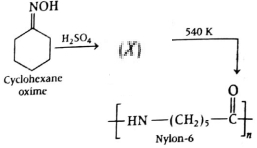
In the above reaction sequence,$X$ is
A
Cyclohexanone
B
Caprolactam
C
Hexamethylene di-isocyanate
D
$HO(CH_2)_6NH_2$
Solution
(B) The given reaction sequence represents the synthesis of $Nylon-6$.
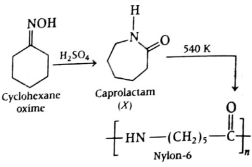
Cyclohexanone oxime undergoes a Beckmann rearrangement in the presence of $H_2SO_4$ to form $Caprolactam$ $(X)$.
$Caprolactam$ is then heated at $540 \ K$ to undergo ring-opening polymerization to form $Nylon-6$.
Thus,$X$ is $Caprolactam$.
Cyclohexanone oxime undergoes a Beckmann rearrangement in the presence of $H_2SO_4$ to form $Caprolactam$ $(X)$.
$Caprolactam$ is then heated at $540 \ K$ to undergo ring-opening polymerization to form $Nylon-6$.
Thus,$X$ is $Caprolactam$.
0 likesView Solution
47
ChemistryMediumMCQAIIMS · 2018
The correct order of spin-only magnetic moment (in $BM$) for $Mn^{2+}$,$Cr^{2+}$,and $Ti^{2+}$ ions is:
A
$Mn^{2+} > Ti^{2+} > Cr^{2+}$
B
$Ti^{2+} > Cr^{2+} > Mn^{2+}$
C
$Mn^{2+} > Cr^{2+} > Ti^{2+}$
D
$Cr^{2+} > Ti^{2+} > Mn^{2+}$
Solution
(C) The spin-only magnetic moment $(\mu)$ depends on the number of unpaired electrons $(n)$ and is given by the formula: $\mu = \sqrt{n(n+2)} \ BM$.
The electronic configurations and number of unpaired electrons for the ions are:
$1$. For $Mn^{2+}$ $(Z=25)$: $[Ar] 3d^5$. Number of unpaired electrons $(n)$ = $5$. $\mu = \sqrt{5(5+2)} = \sqrt{35} \ BM$.
$2$. For $Cr^{2+}$ $(Z=24)$: $[Ar] 3d^4$. Number of unpaired electrons $(n)$ = $4$. $\mu = \sqrt{4(4+2)} = \sqrt{24} \ BM$.
$3$. For $Ti^{2+}$ $(Z=22)$: $[Ar] 3d^2$. Number of unpaired electrons $(n)$ = $2$. $\mu = \sqrt{2(2+2)} = \sqrt{8} \ BM$.
Comparing the values,the correct order of spin-only magnetic moment is $Mn^{2+} > Cr^{2+} > Ti^{2+}$.
The electronic configurations and number of unpaired electrons for the ions are:
$1$. For $Mn^{2+}$ $(Z=25)$: $[Ar] 3d^5$. Number of unpaired electrons $(n)$ = $5$. $\mu = \sqrt{5(5+2)} = \sqrt{35} \ BM$.
$2$. For $Cr^{2+}$ $(Z=24)$: $[Ar] 3d^4$. Number of unpaired electrons $(n)$ = $4$. $\mu = \sqrt{4(4+2)} = \sqrt{24} \ BM$.
$3$. For $Ti^{2+}$ $(Z=22)$: $[Ar] 3d^2$. Number of unpaired electrons $(n)$ = $2$. $\mu = \sqrt{2(2+2)} = \sqrt{8} \ BM$.
Comparing the values,the correct order of spin-only magnetic moment is $Mn^{2+} > Cr^{2+} > Ti^{2+}$.
0 likesView Solution
48
ChemistryMediumMCQAIIMS · 2018
Which of the following compounds does not undergo aldol condensation?
A
$CH_3-C(CH_3)_2-CHO$
B
$CH_3-CHO$
C
$CH_3-CO-CH_3$
D
$CH_3-CH_2-CHO$
Solution
(A) Aldol condensation requires the presence of at least one $\alpha$-hydrogen atom in the aldehyde or ketone.
In $CH_3-C(CH_3)_2-CHO$ ($2,2$-dimethylpropanal),the $\alpha$-carbon atom is bonded to three methyl groups and has no hydrogen atoms attached to it.
Therefore,it does not undergo aldol condensation.
In $CH_3-C(CH_3)_2-CHO$ ($2,2$-dimethylpropanal),the $\alpha$-carbon atom is bonded to three methyl groups and has no hydrogen atoms attached to it.
Therefore,it does not undergo aldol condensation.
0 likesView Solution
49
ChemistryMediumMCQAIIMS · 2018
$A$ greenish-yellow gas reacts with an alkali metal hydroxide to form a halate which can be used in fireworks and safety matches. The gas and halate are,respectively:
A
$Br_{2}, KBrO_{3}$
B
$Cl_{2}, KClO_{3}$
C
$I_{2}, NaIO_{3}$
D
$Cl_{2}, NaClO_{3}$
Solution
(B) The greenish-yellow gas is $Cl_{2}$.
When $Cl_{2}$ reacts with a hot concentrated alkali metal hydroxide like $KOH$,it forms a chlorate (a type of halate),specifically $KClO_{3}$.
$KClO_{3}$ is widely used in the manufacturing of fireworks and safety matches.
The balanced chemical equation is:
$3Cl_{2} + 6KOH \rightarrow KClO_{3} + 5KCl + 3H_{2}O$
When $Cl_{2}$ reacts with a hot concentrated alkali metal hydroxide like $KOH$,it forms a chlorate (a type of halate),specifically $KClO_{3}$.
$KClO_{3}$ is widely used in the manufacturing of fireworks and safety matches.
The balanced chemical equation is:
$3Cl_{2} + 6KOH \rightarrow KClO_{3} + 5KCl + 3H_{2}O$
0 likesView Solution
50
ChemistryMediumMCQAIIMS · 2018
Hydrolysis of sucrose with dilute aqueous sulphuric acid yields
A
$1:1$ $D-(+)$-glucose and $D-(-)$-fructose
B
$1:2$ $D-(+)$-glucose and $D-(-)$-fructose
C
$1:1$ $D-(-)$-glucose and $D-(+)$-fructose
D
$1:2$ $D-(-)$-glucose and $D-(+)$-fructose
Solution
(A) On hydrolysis with dilute aqueous sulphuric acid,sucrose undergoes cleavage of the glycosidic bond to form an equimolar mixture of $D-(+)$-glucose and $D-(-)$-fructose.
The chemical reaction is:
$C_{12}H_{22}O_{11} + H_2O$ $\xrightarrow{H_2SO_4} C_6H_{12}O_6 (D-(+)\text{-glucose}) + C_6H_{12}O_6 (D-(-)\text{-fructose})$
Sucrose is dextrorotatory (specific rotation $= +66.1^{\circ}$),but the resulting mixture is levorotatory (specific rotation $= -20.0^{\circ}$) because the levorotation of fructose is greater than the dextrorotation of glucose. This process is known as the inversion of cane sugar.
The chemical reaction is:
$C_{12}H_{22}O_{11} + H_2O$ $\xrightarrow{H_2SO_4} C_6H_{12}O_6 (D-(+)\text{-glucose}) + C_6H_{12}O_6 (D-(-)\text{-fructose})$
Sucrose is dextrorotatory (specific rotation $= +66.1^{\circ}$),but the resulting mixture is levorotatory (specific rotation $= -20.0^{\circ}$) because the levorotation of fructose is greater than the dextrorotation of glucose. This process is known as the inversion of cane sugar.
0 likesView Solution
51
ChemistryMediumMCQAIIMS · 2018
Among the following complex ions,the one which shows geometrical isomerism will be
A
$[Cr(H_2O)_4Cl_2]^+$
B
$[Pt(NH_3)_3Cl]^+$
C
$[Co(NH_3)_6]^{3+}$
D
$[Co(CN)_5(NC)]^{3-}$
Solution
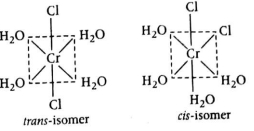
(A) $[Cr(H_2O)_4Cl_2]^+$ shows geometrical isomerism because it is a $MA_4B_2$ type coordination compound which contains two sets of equivalent ligands,four $H_2O$ and two $Cl^-$.
Hence,the possible geometrical isomers are as shown in the figure.
Thus,the correct option is $(A)$.
Hence,the possible geometrical isomers are as shown in the figure.
Thus,the correct option is $(A)$.
0 likesView Solution
52
ChemistryMediumMCQAIIMS · 2018
Among the following rules,the one which is applied in the given reaction is:
$CH_3-CH(Br)-CH_2-CH_3 \xrightarrow{Alc. KOH}$
$I. CH_3-CH=CH-CH_3$ (major product)
$II. CH_2=CH-CH_2-CH_3$ (minor product)
$CH_3-CH(Br)-CH_2-CH_3 \xrightarrow{Alc. KOH}$
$I. CH_3-CH=CH-CH_3$ (major product)
$II. CH_2=CH-CH_2-CH_3$ (minor product)
A
Saytzeff's rule
B
Hofmann's rule
C
Markownikoff's rule
D
Kharasch effect
Solution
(A) In the dehydrohalogenation of $2$-bromobutane with alcoholic $KOH$,the major product is the more substituted alkene $(but-2-ene)$ according to Saytzeff's rule.
Saytzeff's rule states that in dehydrohalogenation reactions,the alkene with the greater number of alkyl groups attached to the doubly bonded carbon atoms is the major product.
Saytzeff's rule states that in dehydrohalogenation reactions,the alkene with the greater number of alkyl groups attached to the doubly bonded carbon atoms is the major product.
0 likesView Solution
Vedclass Products
For Students
Vedclass Test Series
Mock tests in real AIIMS style covering Chemistry with performance analysis. 5-day free trial.
Start Free TrialFor Teachers
Exam Paper Generator
Generate Set A/B/C/D Chemistry papers from 7.5L+ questions in 2 minutes. 3 chapters free.
Try FreeFor Institutes
Online Exam Module
Run live AIIMS mock exams with unlimited students, 360° analytics & white-label branding.
See DemoFrequently Asked Questions
How many Chemistry questions are in AIIMS 2018?
There are 52 Chemistry questions from the AIIMS 2018 paper on Vedclass, each with a detailed step-by-step solution in English.
Are AIIMS 2018 Chemistry solutions available in English?
Yes. All solutions on this page are in English. You can also switch to English or Hindi using the language buttons above the questions.
Can I practice AIIMS 2018 Chemistry as a timed test?
Yes. Use the Vedclass Test Series to attempt a full AIIMS mock test covering Chemistry with time limits and instant score analysis.
Can teachers create Chemistry papers from AIIMS previous year questions?
Yes. The Vedclass Exam Paper Generator lets teachers mix AIIMS Chemistry questions and generate Set A/B/C/D papers in minutes.
For Teachers & Institutes
Build a Custom Chemistry Paper
Pick AIIMS 2018 Chemistry questions, set difficulty, and generate Set A/B/C/D in 2 minutes.