
ChemistryQ1–68 of 68 questions
Page 1 of 1 · English
1
ChemistryMCQAIIMS · 2011
Which of the following organs is known as the 'blood bank' of the human body?
A
Heart
B
Liver
C
Spleen
D
Lungs
Solution
(C) The $Spleen$ is known as the 'blood bank' of the human body.
It acts as a reservoir for blood,storing red blood cells and platelets.
In times of emergency,such as severe hemorrhage,the spleen can release these stored blood cells into the circulation to help maintain blood volume and oxygen-carrying capacity.
It acts as a reservoir for blood,storing red blood cells and platelets.
In times of emergency,such as severe hemorrhage,the spleen can release these stored blood cells into the circulation to help maintain blood volume and oxygen-carrying capacity.
0 likesView Solution
2
ChemistryMCQAIIMS · 2011
The $[Fe(CN)_6]^{3-}$ complex ion
A
exhibits planar geometry
B
is diamagnetic
C
should be very stable
D
has $2$ unpaired electrons
Solution
(C) In the given complex $[Fe(CN)_6]^{3-}$,the oxidation state of iron is $+3$.
The electronic configuration of $Fe^{3+}$ is $[Ar] 3d^5$.
Since $CN^-$ is a strong field ligand,it causes pairing of electrons in the $3d$ orbitals.
According to Crystal Field Theory,the $5$ electrons in $3d$ orbitals are arranged as $t_{2g}^5 e_g^0$,resulting in $1$ unpaired electron.
This complex has an octahedral geometry and is a low-spin complex.
Due to the strong field ligand $CN^-$,the complex is very stable.
The electronic configuration of $Fe^{3+}$ is $[Ar] 3d^5$.
Since $CN^-$ is a strong field ligand,it causes pairing of electrons in the $3d$ orbitals.
According to Crystal Field Theory,the $5$ electrons in $3d$ orbitals are arranged as $t_{2g}^5 e_g^0$,resulting in $1$ unpaired electron.
This complex has an octahedral geometry and is a low-spin complex.
Due to the strong field ligand $CN^-$,the complex is very stable.
0 likesView Solution
3
ChemistryMCQAIIMS · 2011
$A$ charged particle is released from rest in a region of steady and uniform electric and magnetic fields which are parallel to each other. The particle will move in a
A
Straight line
B
Circle
C
Helix
D
Cycloid
Solution
(A) When a charged particle is released from rest in a region where electric field $\vec{E}$ and magnetic field $\vec{B}$ are parallel to each other,the magnetic force $\vec{F}_m = q(\vec{v} \times \vec{B})$ is zero because the initial velocity $\vec{v} = 0$.
As the particle starts moving due to the electric force $\vec{F}_e = q\vec{E}$,its velocity $\vec{v}$ becomes parallel to the electric field $\vec{E}$.
Since $\vec{E}$ is parallel to $\vec{B}$,the velocity $\vec{v}$ remains parallel to the magnetic field $\vec{B}$ at all times.
Because $\vec{v} \parallel \vec{B}$,the magnetic force $\vec{F}_m = q(\vec{v} \times \vec{B})$ remains zero throughout the motion.
The particle is only acted upon by the electric force,which causes it to accelerate in a straight line along the direction of the electric field.
As the particle starts moving due to the electric force $\vec{F}_e = q\vec{E}$,its velocity $\vec{v}$ becomes parallel to the electric field $\vec{E}$.
Since $\vec{E}$ is parallel to $\vec{B}$,the velocity $\vec{v}$ remains parallel to the magnetic field $\vec{B}$ at all times.
Because $\vec{v} \parallel \vec{B}$,the magnetic force $\vec{F}_m = q(\vec{v} \times \vec{B})$ remains zero throughout the motion.
The particle is only acted upon by the electric force,which causes it to accelerate in a straight line along the direction of the electric field.
0 likesView Solution
4
ChemistryMCQAIIMS · 2011
$Assertion$ : If collision occurs between two elastic bodies their kinetic energy decreases during the time of collision.
$Reason$ : During collision intermolecular space decreases and hence elastic potential energy increases.
$Reason$ : During collision intermolecular space decreases and hence elastic potential energy increases.
A
If both $Assertion$ and $Reason$ are correct and the $Reason$ is a correct explanation of the $Assertion$.
B
If both $Assertion$ and $Reason$ are correct but $Reason$ is not a correct explanation of the $Assertion$.
C
If the $Assertion$ is correct but $Reason$ is incorrect.
D
If both the $Assertion$ and $Reason$ are incorrect.
Solution
(A) During the collision of two elastic bodies,the bodies undergo deformation.
At the point of maximum deformation,the relative velocity of the bodies becomes zero.
At this instant,a part of the kinetic energy of the system is converted into elastic potential energy due to the deformation of the bodies.
Therefore,the kinetic energy of the system decreases during the time of collision.
This decrease in kinetic energy is stored as elastic potential energy because the intermolecular distances change (decrease) during deformation.
Thus,both the $Assertion$ and $Reason$ are correct,and the $Reason$ is the correct explanation for the $Assertion$.
At the point of maximum deformation,the relative velocity of the bodies becomes zero.
At this instant,a part of the kinetic energy of the system is converted into elastic potential energy due to the deformation of the bodies.
Therefore,the kinetic energy of the system decreases during the time of collision.
This decrease in kinetic energy is stored as elastic potential energy because the intermolecular distances change (decrease) during deformation.
Thus,both the $Assertion$ and $Reason$ are correct,and the $Reason$ is the correct explanation for the $Assertion$.
0 likesView Solution
5
ChemistryMCQAIIMS · 2011
Assertion : Free electrons always keep on moving in a conductor even then no magnetic force acts on them in a magnetic field unless a current is passed through it.
Reason : The average velocity of free electrons is zero.
Reason : The average velocity of free electrons is zero.
A
If both Assertion and Reason are correct and Reason is the correct explanation of Assertion.
B
If both Assertion and Reason are correct,but Reason is not the correct explanation of Assertion.
C
If Assertion is correct but Reason is incorrect.
D
If both the Assertion and Reason are incorrect.
Solution
(A) In the absence of an electric current,the free electrons in a conductor are in a state of random motion,similar to molecules in a gas. Their average velocity is zero,meaning they do not have any net velocity in a specific direction. As a result,there is no net magnetic force on the free electrons in a magnetic field. When a current is passed,the free electrons acquire a drift velocity in a definite direction,and consequently,a magnetic force acts on them (provided the magnetic field has a component perpendicular to the direction of motion).
0 likesView Solution
6
ChemistryMCQAIIMS · 2011
Assertion: The ferromagnetic substance does not obey Curie's law.
Reason: At Curie point, a ferromagnetic substance starts behaving as a paramagnetic substance.
Reason: At Curie point, a ferromagnetic substance starts behaving as a paramagnetic substance.
A
If both Assertion and Reason are correct and the Reason is a correct explanation of the Assertion.
B
If both Assertion and Reason are correct but Reason is not a correct explanation of the Assertion.
C
If the Assertion is correct but Reason is incorrect.
D
If both the Assertion and Reason are incorrect.
Solution
(A) The magnetic susceptibility of a ferromagnetic substance does not follow Curie's law $( \chi \propto 1/T )$ below the Curie temperature $( T_C )$.
Instead, it follows the Curie-Weiss law: $ \chi = \frac{C}{T - T_C} $ for $ T > T_C $.
At the Curie point $( T_C )$, the ferromagnetic substance undergoes a phase transition and begins to behave as a paramagnetic substance.
Since the assertion states that ferromagnetic substances do not obey Curie's law (which is true for the ferromagnetic state itself), and the reason correctly explains the transition at the Curie point, both are correct and the reason explains the assertion.
Instead, it follows the Curie-Weiss law: $ \chi = \frac{C}{T - T_C} $ for $ T > T_C $.
At the Curie point $( T_C )$, the ferromagnetic substance undergoes a phase transition and begins to behave as a paramagnetic substance.
Since the assertion states that ferromagnetic substances do not obey Curie's law (which is true for the ferromagnetic state itself), and the reason correctly explains the transition at the Curie point, both are correct and the reason explains the assertion.
0 likesView Solution
7
ChemistryDifficultMCQAIIMS · 2011
Assertion : The normality of $0.3 \ M$ aqueous solution of $H_3PO_3$ is equal to $0.6 \ N$.
Reason : Equivalent weight of $H_3PO_3 = \frac{\text{Molecular weight of } H_3PO_3}{3}$
Reason : Equivalent weight of $H_3PO_3 = \frac{\text{Molecular weight of } H_3PO_3}{3}$
A
If both Assertion and Reason are correct and the Reason is a correct explanation of the Assertion.
B
If both Assertion and Reason are correct but Reason is not a correct explanation of the Assertion.
C
If the Assertion is correct but Reason is incorrect.
D
If both the Assertion and Reason are incorrect.
Solution
(C) The normality of a solution is given by the formula: $\text{Normality} = \text{Molarity} \times \text{n-factor}$.
For $H_3PO_3$ (phosphorous acid),the structure contains two $P-OH$ bonds,making it a dibasic acid. Thus,its n-factor is $2$.
Normality $= 0.3 \ M \times 2 = 0.6 \ N$. Therefore,the Assertion is correct.
The equivalent weight of an acid is defined as $\frac{\text{Molecular weight}}{\text{Basicity}}$.
Since the basicity of $H_3PO_3$ is $2$,its equivalent weight is $\frac{\text{Molecular weight}}{2}$.
The Reason states the denominator is $3$,which is incorrect. Therefore,the Reason is incorrect.
For $H_3PO_3$ (phosphorous acid),the structure contains two $P-OH$ bonds,making it a dibasic acid. Thus,its n-factor is $2$.
Normality $= 0.3 \ M \times 2 = 0.6 \ N$. Therefore,the Assertion is correct.
The equivalent weight of an acid is defined as $\frac{\text{Molecular weight}}{\text{Basicity}}$.
Since the basicity of $H_3PO_3$ is $2$,its equivalent weight is $\frac{\text{Molecular weight}}{2}$.
The Reason states the denominator is $3$,which is incorrect. Therefore,the Reason is incorrect.
0 likesView Solution
8
ChemistryMediumMCQAIIMS · 2011
Assertion : An orbital designated by $n = 3, l = 1$ has double dumb-bell shape.
Reason : It belongs to $p-$subshell.
Reason : It belongs to $p-$subshell.
A
If both Assertion and Reason are correct and the Reason is a correct explanation of the Assertion.
B
If both Assertion and Reason are correct but Reason is not a correct explanation of the Assertion.
C
If the Assertion is correct but Reason is incorrect.
D
If both the Assertion and Reason are incorrect.
Solution
(D) For an orbital with $n = 3$ and $l = 1$,the orbital is $3p$.
The $p-$orbitals have a dumb-bell shape,not a double dumb-bell shape.
Double dumb-bell shape is characteristic of $d-$orbitals $(l = 2)$.
Therefore,the Assertion is incorrect.
The Reason states it belongs to the $p-$subshell,which is correct for $l = 1$.
Thus,the Assertion is incorrect but the Reason is correct.
The $p-$orbitals have a dumb-bell shape,not a double dumb-bell shape.
Double dumb-bell shape is characteristic of $d-$orbitals $(l = 2)$.
Therefore,the Assertion is incorrect.
The Reason states it belongs to the $p-$subshell,which is correct for $l = 1$.
Thus,the Assertion is incorrect but the Reason is correct.
0 likesView Solution
9
ChemistryDifficultMCQAIIMS · 2011
Assertion : Element has a tendency to lose the electron$(s)$ to attain the stable configuration.
Reason : Ionization enthalpy is the energy released to remove an electron from an isolated gaseous atom in its ground state.
Reason : Ionization enthalpy is the energy released to remove an electron from an isolated gaseous atom in its ground state.
A
If both Assertion and Reason are correct and the Reason is a correct explanation of the Assertion.
B
If both Assertion and Reason are correct but Reason is not a correct explanation of the Assertion.
C
If the Assertion is correct but Reason is incorrect.
D
If both the Assertion and Reason are incorrect.
Solution
(C) The Assertion is correct because elements tend to lose electrons to achieve a stable noble gas configuration.
The Reason is incorrect because ionization enthalpy is defined as the energy $required$ (absorbed) to remove an electron from an isolated gaseous atom,not the energy $released$.
The Reason is incorrect because ionization enthalpy is defined as the energy $required$ (absorbed) to remove an electron from an isolated gaseous atom,not the energy $released$.
0 likesView Solution
10
ChemistryMediumMCQAIIMS · 2011
Assertion : Bond angle of $H_2S$ is smaller than $H_2O$.
Reason : Electronegativity of the central atom increases,bond angle decreases.
Reason : Electronegativity of the central atom increases,bond angle decreases.
A
If both Assertion and Reason are correct and the Reason is a correct explanation of the Assertion.
B
If both Assertion and Reason are correct but Reason is not a correct explanation of the Assertion.
C
If the Assertion is correct but Reason is incorrect.
D
If both the Assertion and Reason are incorrect.
Solution
(C) The bond angle of $H_2S$ $(92^o)$ is smaller than that of $H_2O$ $(104.5^o)$.
As the electronegativity of the central atom decreases,the bond pairs move further away from the central atom,reducing the repulsion between them and leading to a smaller bond angle.
Since oxygen is more electronegative than sulfur,the bond pairs in $H_2O$ are closer to the central atom,resulting in greater repulsion and a larger bond angle.
Therefore,the Assertion is correct,but the Reason is incorrect because the bond angle actually increases as the electronegativity of the central atom increases.
As the electronegativity of the central atom decreases,the bond pairs move further away from the central atom,reducing the repulsion between them and leading to a smaller bond angle.
Since oxygen is more electronegative than sulfur,the bond pairs in $H_2O$ are closer to the central atom,resulting in greater repulsion and a larger bond angle.
Therefore,the Assertion is correct,but the Reason is incorrect because the bond angle actually increases as the electronegativity of the central atom increases.
0 likesView Solution
11
ChemistryMediumMCQAIIMS · 2011
Amongst the following statements,the correct one is
A
The gas can not be compressed below the critical temperature.
B
Below critical temperature,thermal motion of the molecules is slow enough for the intermolecular forces to come into play leading to condensation of the gas.
C
At critical temperature liquid and gaseous phase can be distinguished.
D
An ideal gas has a characteristic critical temperature.
Solution
(B) Critical temperature $(T_C)$ is the maximum temperature at which a gas can be liquefied by the application of pressure alone.
Below the critical temperature,the thermal motion of the molecules is slow enough for the intermolecular forces to come into play,leading to the condensation of the gas.
At the critical temperature,the liquid and gaseous phases become indistinguishable.
Ideal gases do not have a characteristic critical temperature because they lack intermolecular forces of attraction.
Therefore,the correct statement is that below the critical temperature,thermal motion of the molecules is slow enough for the intermolecular forces to come into play leading to condensation of the gas.
Below the critical temperature,the thermal motion of the molecules is slow enough for the intermolecular forces to come into play,leading to the condensation of the gas.
At the critical temperature,the liquid and gaseous phases become indistinguishable.
Ideal gases do not have a characteristic critical temperature because they lack intermolecular forces of attraction.
Therefore,the correct statement is that below the critical temperature,thermal motion of the molecules is slow enough for the intermolecular forces to come into play leading to condensation of the gas.
0 likesView Solution
12
ChemistryEasyMCQAIIMS · 2011
Which of the following processes takes place with a decrease of entropy?
A
Solid $\to$ gas
B
Sugar $+$ water $\to$ solution
C
$NH_{3(g)} + HCl_{(g)} \to NH_4Cl_{(s)}$
D
$A_{(g)} + B_{(g)} \to$ mixture
Solution
(C) Entropy is a measure of the randomness or disorder of a system. $\Delta S < 0$ implies a decrease in entropy,which occurs when a system becomes more ordered.
In option $A$,solid to gas transition increases disorder.
In option $B$,dissolution increases entropy due to mixing.
In option $D$,mixing of gases increases entropy.
In option $C$,two moles of gaseous reactants form one mole of solid product. Since the solid state is much more ordered than the gaseous state,the entropy of the system decreases.
In option $A$,solid to gas transition increases disorder.
In option $B$,dissolution increases entropy due to mixing.
In option $D$,mixing of gases increases entropy.
In option $C$,two moles of gaseous reactants form one mole of solid product. Since the solid state is much more ordered than the gaseous state,the entropy of the system decreases.
0 likesView Solution
13
ChemistryDifficultMCQAIIMS · 2011
Enthalpy of combustion of $CH_4, C_2H_6$ and $C_3H_8$ are $-210.8, -368.4$ and $-526.2 \ k \ cal \ mol^{-1}$ respectively. Enthalpy of combustion of hexane can be predicted as........$k \ cal \ mol^{-1}$
A
$-840$
B
$-684$
C
$-1000$
D
none of these
Solution
(C) The difference in enthalpy of combustion for each successive $CH_2$ group is calculated as follows:
$\Delta H_c(C_2H_6) - \Delta H_c(CH_4) = -368.4 - (-210.8) = -157.6 \ k \ cal \ mol^{-1}$
$\Delta H_c(C_3H_8) - \Delta H_c(C_2H_6) = -526.2 - (-368.4) = -157.8 \ k \ cal \ mol^{-1}$
Average value for $\Delta H_c(-CH_2-) = \frac{-157.6 + (-157.8)}{2} = -157.7 \ k \ cal \ mol^{-1}$
For hexane $(C_6H_{14})$,we add three $-CH_2-$ groups to propane $(C_3H_8)$:
$\Delta H_c(C_6H_{14}) = \Delta H_c(C_3H_8) + 3 \times \Delta H_c(-CH_2-)$
$\Delta H_c(C_6H_{14}) = -526.2 + 3(-157.7) = -526.2 - 473.1 = -999.3 \ k \ cal \ mol^{-1}$
Rounding to the nearest integer,the value is $-1000 \ k \ cal \ mol^{-1}$.
$\Delta H_c(C_2H_6) - \Delta H_c(CH_4) = -368.4 - (-210.8) = -157.6 \ k \ cal \ mol^{-1}$
$\Delta H_c(C_3H_8) - \Delta H_c(C_2H_6) = -526.2 - (-368.4) = -157.8 \ k \ cal \ mol^{-1}$
Average value for $\Delta H_c(-CH_2-) = \frac{-157.6 + (-157.8)}{2} = -157.7 \ k \ cal \ mol^{-1}$
For hexane $(C_6H_{14})$,we add three $-CH_2-$ groups to propane $(C_3H_8)$:
$\Delta H_c(C_6H_{14}) = \Delta H_c(C_3H_8) + 3 \times \Delta H_c(-CH_2-)$
$\Delta H_c(C_6H_{14}) = -526.2 + 3(-157.7) = -526.2 - 473.1 = -999.3 \ k \ cal \ mol^{-1}$
Rounding to the nearest integer,the value is $-1000 \ k \ cal \ mol^{-1}$.
0 likesView Solution
14
ChemistryMCQAIIMS · 2011
Assertion : For an isothermal reversible process $Q = -W$,i.e.,work done by the system equals the heat absorbed by the system.
Reason : Enthalpy change $(\Delta H)$ is zero for an isothermal process.
Reason : Enthalpy change $(\Delta H)$ is zero for an isothermal process.
A
If both Assertion and Reason are correct and the Reason is a correct explanation of the Assertion.
B
If both Assertion and Reason are correct but Reason is not a correct explanation of the Assertion.
C
If the Assertion is correct but Reason is incorrect.
D
If both the Assertion and Reason are incorrect.
Solution
(B) For an isothermal process,the temperature remains constant. Since internal energy $(\Delta U)$ of an ideal gas depends only on temperature,$\Delta U = 0$.
According to the first law of thermodynamics,$\Delta U = Q + W$.
Substituting $\Delta U = 0$,we get $0 = Q + W$,which implies $Q = -W$.
This means the heat absorbed by the system is equal to the work done by the system.
However,for an isothermal process,enthalpy change $\Delta H = \Delta U + \Delta(PV) = 0 + \Delta(nRT)$. Since $n, R, T$ are constant,$\Delta H = 0$ for an ideal gas.
While $\Delta H = 0$ is true for an ideal gas in an isothermal process,the reason for $Q = -W$ is the first law of thermodynamics $(\Delta U = 0)$,not the fact that $\Delta H = 0$.
According to the first law of thermodynamics,$\Delta U = Q + W$.
Substituting $\Delta U = 0$,we get $0 = Q + W$,which implies $Q = -W$.
This means the heat absorbed by the system is equal to the work done by the system.
However,for an isothermal process,enthalpy change $\Delta H = \Delta U + \Delta(PV) = 0 + \Delta(nRT)$. Since $n, R, T$ are constant,$\Delta H = 0$ for an ideal gas.
While $\Delta H = 0$ is true for an ideal gas in an isothermal process,the reason for $Q = -W$ is the first law of thermodynamics $(\Delta U = 0)$,not the fact that $\Delta H = 0$.
0 likesView Solution
15
ChemistryMediumMCQAIIMS · 2011
Assertion : For an isothermal reversible process $Q = -W$,i.e.,work done by the system equals the heat absorbed by the system.
Reason : Enthalpy change $(\Delta H)$ is zero for an isothermal process.
Reason : Enthalpy change $(\Delta H)$ is zero for an isothermal process.
A
If both Assertion and Reason are correct and the Reason is a correct explanation of the Assertion.
B
If both Assertion and Reason are correct but Reason is not a correct explanation of the Assertion.
C
If the Assertion is correct but Reason is incorrect.
D
If both the Assertion and Reason are incorrect.
Solution
(C) For an isothermal process,the temperature remains constant. Since internal energy $(\Delta U)$ of an ideal gas is a function of temperature only,$\Delta U = 0$.
According to the first law of thermodynamics,$\Delta U = Q + W$.
Substituting $\Delta U = 0$,we get $0 = Q + W$,which implies $Q = -W$.
This means the heat absorbed by the system is equal to the work done by the system.
However,for an isothermal process,enthalpy change $\Delta H = \Delta U + \Delta(PV)$. For an ideal gas,$\Delta H = \Delta U + \Delta(nRT) = 0 + nR\Delta T = 0$. While $\Delta H$ is zero for an ideal gas,the reason provided is not the fundamental explanation for $Q = -W$,which is based on the first law and $\Delta U = 0$. In general,$\Delta H$ is not necessarily zero for all isothermal processes (e.g.,real gases). Thus,the Assertion is correct,but the Reason is incorrect.
According to the first law of thermodynamics,$\Delta U = Q + W$.
Substituting $\Delta U = 0$,we get $0 = Q + W$,which implies $Q = -W$.
This means the heat absorbed by the system is equal to the work done by the system.
However,for an isothermal process,enthalpy change $\Delta H = \Delta U + \Delta(PV)$. For an ideal gas,$\Delta H = \Delta U + \Delta(nRT) = 0 + nR\Delta T = 0$. While $\Delta H$ is zero for an ideal gas,the reason provided is not the fundamental explanation for $Q = -W$,which is based on the first law and $\Delta U = 0$. In general,$\Delta H$ is not necessarily zero for all isothermal processes (e.g.,real gases). Thus,the Assertion is correct,but the Reason is incorrect.
0 likesView Solution
16
ChemistryMediumMCQAIIMS · 2011
In the manufacture of $NH_3$ in Haber's continuous flow process involving the reaction $N_{2(g)} + 3H_{2(g)} \longleftrightarrow 2NH_{3(g)}$,$\Delta H = -22.08 \ kcal$. The favourable conditions are:
A
High pressure and low temperature due to low activation energy $(E_a).$
B
Low pressure and low temperature due to low $E_a$.
C
High pressure and elevated optimum temperature due to high $E_a$.
D
None of these.
Solution
(C) The reaction $N_{2(g)} + 3H_{2(g)} \longleftrightarrow 2NH_{3(g)}$ is exothermic $(\Delta H < 0)$ and involves a decrease in the number of moles of gaseous species (from $4$ moles to $2$ moles).
According to Le Chatelier's principle,high pressure favors the forward reaction.
Although low temperature favors the forward reaction for an exothermic process,the reaction has a high activation energy $(E_a)$.
Therefore,in a continuous flow process,an elevated optimum temperature is required to ensure a sufficient rate of reaction to produce $NH_3$ efficiently.
According to Le Chatelier's principle,high pressure favors the forward reaction.
Although low temperature favors the forward reaction for an exothermic process,the reaction has a high activation energy $(E_a)$.
Therefore,in a continuous flow process,an elevated optimum temperature is required to ensure a sufficient rate of reaction to produce $NH_3$ efficiently.
0 likesView Solution
17
ChemistryMediumMCQAIIMS · 2011
In which of the following cases,$pH$ is greater than $7$?
A
$50 \ mL$ of $0.1 \ M \ HCl + 50 \ mL$ of $0.1 \ M \ NaCl$
B
$50 \ mL$ of $0.1 \ M \ H_2SO_4 + 50 \ mL$ of $0.2 \ M \ NaOH$
C
$50 \ mL$ of $0.1 \ M \ CH_3COOH + 50 \ mL$ of $0.1 \ M \ KOH$
D
$50 \ mL$ of $0.1 \ M \ HNO_3 + 50 \ mL$ of $0.1 \ M \ NH_3$
Solution
(C) The mixture contains a strong acid $(HCl)$ and a neutral salt $(NaCl)$,resulting in an acidic solution with $pH < 7$.
$(B)$ The reaction is $H_2SO_4 + 2NaOH \rightarrow Na_2SO_4 + 2H_2O$. Here,$50 \ mL \times 0.1 \ M \times 2 \ (\text{for } H^+) = 10 \ mmol$ of $H^+$ and $50 \ mL \times 0.2 \ M = 10 \ mmol$ of $OH^-$. This is complete neutralization,resulting in $pH = 7$.
$(C)$ The reaction is $CH_3COOH + KOH \rightarrow CH_3COOK + H_2O$. This results in the formation of $CH_3COOK$,which is a salt of a weak acid and a strong base. It undergoes anionic hydrolysis,resulting in a basic solution with $pH > 7$.
$(D)$ The reaction is $HNO_3 + NH_3 \rightarrow NH_4NO_3$. This results in the formation of $NH_4NO_3$,which is a salt of a strong acid and a weak base. It undergoes cationic hydrolysis,resulting in an acidic solution with $pH < 7$.
$(B)$ The reaction is $H_2SO_4 + 2NaOH \rightarrow Na_2SO_4 + 2H_2O$. Here,$50 \ mL \times 0.1 \ M \times 2 \ (\text{for } H^+) = 10 \ mmol$ of $H^+$ and $50 \ mL \times 0.2 \ M = 10 \ mmol$ of $OH^-$. This is complete neutralization,resulting in $pH = 7$.
$(C)$ The reaction is $CH_3COOH + KOH \rightarrow CH_3COOK + H_2O$. This results in the formation of $CH_3COOK$,which is a salt of a weak acid and a strong base. It undergoes anionic hydrolysis,resulting in a basic solution with $pH > 7$.
$(D)$ The reaction is $HNO_3 + NH_3 \rightarrow NH_4NO_3$. This results in the formation of $NH_4NO_3$,which is a salt of a strong acid and a weak base. It undergoes cationic hydrolysis,resulting in an acidic solution with $pH < 7$.
0 likesView Solution
18
ChemistryMediumMCQAIIMS · 2011
Assertion: Reaction quotient is defined in the same way as equilibrium constant at any stage of the reaction.
Reason: If $Q_c < K_c$,the reaction moves in the direction of reactants.
Reason: If $Q_c < K_c$,the reaction moves in the direction of reactants.
A
If both Assertion and Reason are correct and the Reason is a correct explanation of the Assertion.
B
If both Assertion and Reason are correct but Reason is not a correct explanation of the Assertion.
C
If the Assertion is correct but Reason is incorrect.
D
If both the Assertion and Reason are incorrect.
Solution
(C) The reaction quotient $(Q_c)$ is defined for a general reaction $aA + bB \rightleftharpoons cC + dD$ as $Q_c = \frac{[C]^c [D]^d}{[A]^a [B]^b}$ at any stage of the reaction,which is the same expression as the equilibrium constant $(K_c)$. Thus,the Assertion is correct.
If $Q_c < K_c$,the ratio of products to reactants is less than the equilibrium ratio,so the reaction proceeds in the forward direction (towards products) to reach equilibrium. The Reason states the reaction moves towards reactants,which is incorrect. Therefore,the Assertion is correct but the Reason is incorrect.
If $Q_c < K_c$,the ratio of products to reactants is less than the equilibrium ratio,so the reaction proceeds in the forward direction (towards products) to reach equilibrium. The Reason states the reaction moves towards reactants,which is incorrect. Therefore,the Assertion is correct but the Reason is incorrect.
0 likesView Solution
19
ChemistryMediumMCQAIIMS · 2011
Assertion : $KOH$ is more soluble in water than $NaOH$.
Reason : $NaOH$ is a stronger base than $KOH$.
Reason : $NaOH$ is a stronger base than $KOH$.
A
If both Assertion and Reason are correct and the Reason is a correct explanation of the Assertion.
B
If both Assertion and Reason are correct but Reason is not a correct explanation of the Assertion.
C
If the Assertion is correct but Reason is incorrect.
D
If both the Assertion and Reason are incorrect.
Solution
(C) The Assertion is correct because $KOH$ has a higher solubility in water compared to $NaOH$ due to the smaller hydration energy of $Na^+$ compared to $K^+$ and the lattice energy differences.
However,the Reason is incorrect because $KOH$ is a stronger base than $NaOH$. This is because the $K-OH$ bond is weaker than the $Na-OH$ bond,allowing $KOH$ to dissociate more readily into $K^+$ and $OH^-$ ions in aqueous solution.
However,the Reason is incorrect because $KOH$ is a stronger base than $NaOH$. This is because the $K-OH$ bond is weaker than the $Na-OH$ bond,allowing $KOH$ to dissociate more readily into $K^+$ and $OH^-$ ions in aqueous solution.
0 likesView Solution
20
ChemistryDifficultMCQAIIMS · 2011
The correct sequence of increasing melting points of $BeCl_2$,$MgCl_2$,$CaCl_2$,$SrCl_2$,and $BaCl_2$ is:
A
$BaCl_2 < SrCl_2 < CaCl_2 < MgCl_2 < BeCl_2$
B
$BeCl_2 < MgCl_2 < CaCl_2 < SrCl_2 < BaCl_2$
C
$BeCl_2 < CaCl_2 < MgCl_2 < SrCl_2 < BaCl_2$
D
$MgCl_2 < BeCl_2 < SrCl_2 < CaCl_2 < BaCl_2$
Solution
(B) The melting point of alkaline earth metal chlorides depends on their ionic character.
As the size of the cation increases from $Be^{2+}$ to $Ba^{2+}$,the polarizing power of the cation decreases,leading to an increase in the ionic character of the $M-Cl$ bond.
Greater ionic character results in stronger electrostatic forces of attraction,which increases the melting point.
Therefore,the order of increasing melting points is $BeCl_2 < MgCl_2 < CaCl_2 < SrCl_2 < BaCl_2$.
As the size of the cation increases from $Be^{2+}$ to $Ba^{2+}$,the polarizing power of the cation decreases,leading to an increase in the ionic character of the $M-Cl$ bond.
Greater ionic character results in stronger electrostatic forces of attraction,which increases the melting point.
Therefore,the order of increasing melting points is $BeCl_2 < MgCl_2 < CaCl_2 < SrCl_2 < BaCl_2$.
0 likesView Solution
21
ChemistryMediumMCQAIIMS · 2011
Which one of the alkaline earth metals shows some anomalous behaviour and has the same electronegativity as aluminium?
A
$Sr$
B
$Ca$
C
$Ba$
D
$Be$
Solution
(D) $Be$ (Beryllium) is the first member of the alkaline earth metals and exhibits anomalous properties compared to the rest of the group. Due to its small size and high charge density,it shows a diagonal relationship with $Al$ (Aluminium). Both $Be$ and $Al$ have an electronegativity value of approximately $1.5$ on the Pauling scale.
0 likesView Solution
22
ChemistryMediumMCQAIIMS · 2011
Which property of sodium is being used in street lights?
A
It shows photoelectric effect
B
It has low melting point
C
Sodium atom emits photons in the yellow region of visible spectrum,due to electrically stimulated transitions
D
Sodium vapours show golden colour
Solution
(C) The property of sodium atom to emit photons in the yellow region of the visible spectrum,due to electrically stimulated electron transitions,is used in street lights. This is why sodium vapor lamps emit a characteristic yellow light.
0 likesView Solution
23
ChemistryEasyMCQAIIMS · 2011
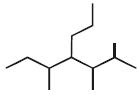
The correct $IUPAC$ name for the given structure is:
A
$5-$methyl$-4-(1',2'-$dimethylpropyl)heptane
B
$3-$methyl$-4-(1',2'-$dimethylpropyl)heptane
C
$2,3,5-$trimethyl$-4-$propylheptane
D
$4-$propyl$-2,3,5-$trimethylheptane
Solution
(C) $1$. Identify the longest carbon chain. The longest chain in the given structure contains $7$ carbon atoms (heptane).
$2$. Number the chain from the end that gives the lowest locants to the substituents. Numbering from right to left gives the substituents at positions $2, 3, 4,$ and $5$.
$3$. The substituents are three methyl groups at positions $2, 3,$ and $5$,and a propyl group at position $4$.
$4$. Combining these,the correct $IUPAC$ name is $2,3,5-$trimethyl$-4-$propylheptane.
$2$. Number the chain from the end that gives the lowest locants to the substituents. Numbering from right to left gives the substituents at positions $2, 3, 4,$ and $5$.
$3$. The substituents are three methyl groups at positions $2, 3,$ and $5$,and a propyl group at position $4$.
$4$. Combining these,the correct $IUPAC$ name is $2,3,5-$trimethyl$-4-$propylheptane.
0 likesView Solution
24
ChemistryMediumMCQAIIMS · 2011
Which of the following cations is more stable?
A
$R'-C^{+}H-OR$
B
$R'-CH=O^{+}R$
C
Both are equally stable
D
Both are unstable
Solution
(B) In the structure $R'-CH=O^{+}R$,all atoms (carbon and oxygen) have a complete octet.
In the structure $R'-C^{+}H-OR$,the carbon atom has an incomplete octet ($6$ electrons).
Resonance structures where all atoms have complete octets are significantly more stable than those with incomplete octets.
In the structure $R'-C^{+}H-OR$,the carbon atom has an incomplete octet ($6$ electrons).
Resonance structures where all atoms have complete octets are significantly more stable than those with incomplete octets.
0 likesView Solution
25
ChemistryDifficultMCQAIIMS · 2011
$1-$Butyne can be distinguished most easily from $2-$butyne by
A
bromine water
B
ozonolysis
C
Tollen's reagent
D
$KMnO_4$ solution
Solution
(C) $1-$Butyne is a terminal alkyne $(CH_3CH_2C\equiv CH)$,which contains an acidic hydrogen atom attached to the $sp$ hybridized carbon.
Tollen's reagent (ammoniacal silver nitrate) reacts with terminal alkynes to form a white precipitate of silver alkynide,whereas $2-$butyne $(CH_3C\equiv CCH_3)$ is an internal alkyne and does not react with Tollen's reagent.
The reaction is:
$CH_3CH_2C\equiv CH + [Ag(NH_3)_2]^+ + OH^- \to CH_3CH_2C\equiv CAg \downarrow (\text{white ppt.}) + 2NH_3 + H_2O$
Tollen's reagent (ammoniacal silver nitrate) reacts with terminal alkynes to form a white precipitate of silver alkynide,whereas $2-$butyne $(CH_3C\equiv CCH_3)$ is an internal alkyne and does not react with Tollen's reagent.
The reaction is:
$CH_3CH_2C\equiv CH + [Ag(NH_3)_2]^+ + OH^- \to CH_3CH_2C\equiv CAg \downarrow (\text{white ppt.}) + 2NH_3 + H_2O$
0 likesView Solution
26
ChemistryDifficultMCQAIIMS · 2011
Compound $X$ of molecular formula $C_4H_6$ takes up one equivalent of hydrogen in the presence of $Pt$ to form another compound $Y$,which on ozonolysis gives only ethanoic acid. The compound $X$ can be:
A
$CH_2=CH-CH=CH_2$
B
$CH_2=C=CHCH_3$
C
$CH_3C \equiv CCH_3$
D
All the three
Solution
(D) The molecular formula $C_4H_6$ corresponds to the degree of unsaturation $2$.
Ozonolysis of compound $Y$ yields only ethanoic acid $(CH_3COOH)$,which implies that $Y$ is $CH_3CH=CHCH_3$ (but$-2-$ene).
All three given compounds,when treated with one equivalent of $H_2$ in the presence of $Pt$,can form $CH_3CH=CHCH_3$:
$1$. $CH_2=CH-CH=CH_2 + H_2 \xrightarrow{Pt} CH_3CH=CHCH_3$
$2$. $CH_3C \equiv CCH_3 + H_2 \xrightarrow{Pt} CH_3CH=CHCH_3$
$3$. $CH_2=C=CHCH_3 + H_2 \xrightarrow{Pt} CH_3CH=CHCH_3$
Finally,$CH_3CH=CHCH_3 + O_3 \rightarrow 2CH_3COOH$.
Therefore,all three compounds satisfy the given conditions.
Ozonolysis of compound $Y$ yields only ethanoic acid $(CH_3COOH)$,which implies that $Y$ is $CH_3CH=CHCH_3$ (but$-2-$ene).
All three given compounds,when treated with one equivalent of $H_2$ in the presence of $Pt$,can form $CH_3CH=CHCH_3$:
$1$. $CH_2=CH-CH=CH_2 + H_2 \xrightarrow{Pt} CH_3CH=CHCH_3$
$2$. $CH_3C \equiv CCH_3 + H_2 \xrightarrow{Pt} CH_3CH=CHCH_3$
$3$. $CH_2=C=CHCH_3 + H_2 \xrightarrow{Pt} CH_3CH=CHCH_3$
Finally,$CH_3CH=CHCH_3 + O_3 \rightarrow 2CH_3COOH$.
Therefore,all three compounds satisfy the given conditions.
0 likesView Solution
27
ChemistryMCQAIIMS · 2011
Cattle fed with spoilt hay of sweet clover which contains dicumarol:
A
are healthier due to a good diet
B
catch infections easily
C
may suffer vitamin $K$ deficiency and prolonged bleeding
D
may suffer from beri-beri due to deficiency of vitamin $B$
Solution
(C) Dicumarol is a natural anticoagulant found in spoilt sweet clover hay. It acts as a vitamin $K$ antagonist. Vitamin $K$ is essential for the synthesis of clotting factors in the liver. When cattle consume this hay,the action of vitamin $K$ is inhibited,leading to a deficiency in clotting factors,which results in prolonged bleeding and hemorrhagic syndrome.
0 likesView Solution
28
ChemistryMediumMCQAIIMS · 2011
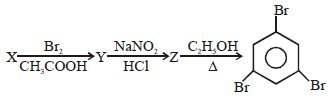
In the given reaction sequence,$[X]$ will be:
A
Benzoic acid
B
Salicylic acid
C
Phenol
D
Aniline
Solution
(D) The reaction sequence is as follows:
$1$. Aniline $(C_6H_5NH_2)$ reacts with $Br_2$ in $CH_3COOH$ to form $2,4,6$-tribromoaniline $(Y)$.
$2$. $2,4,6$-tribromoaniline $(Y)$ reacts with $NaNO_2/HCl$ at $0-5 \ ^\circ C$ to form $2,4,6$-tribromobenzenediazonium chloride $(Z)$.
$3$. $2,4,6$-tribromobenzenediazonium chloride $(Z)$ reacts with ethanol $(C_2H_5OH)$ upon heating to form $1,3,5$-tribromobenzene.
Thus,the starting compound $[X]$ is aniline.
$1$. Aniline $(C_6H_5NH_2)$ reacts with $Br_2$ in $CH_3COOH$ to form $2,4,6$-tribromoaniline $(Y)$.
$2$. $2,4,6$-tribromoaniline $(Y)$ reacts with $NaNO_2/HCl$ at $0-5 \ ^\circ C$ to form $2,4,6$-tribromobenzenediazonium chloride $(Z)$.
$3$. $2,4,6$-tribromobenzenediazonium chloride $(Z)$ reacts with ethanol $(C_2H_5OH)$ upon heating to form $1,3,5$-tribromobenzene.
Thus,the starting compound $[X]$ is aniline.
0 likesView Solution
29
ChemistryEasyMCQAIIMS · 2011
Which of the following pairs of solutions are expected to be isotonic,temperature being the same?
A
$0.1 \ M$ glucose and $0.1 \ M$ $C_6H_5NH_3Cl$
B
$0.1 \ M$ $NaCl$ and $0.05 \ M$ $BaCl_2$
C
$0.1 \ M$ $Na_2SO_4$ and $0.1 \ M$ $KNO_3$
D
$0.1 \ M$ $BaCl_2$ and $0.075 \ M$ $FeCl_3$
Solution
(D) Two solutions are isotonic if their osmotic pressures are equal at the same temperature. Osmotic pressure $\pi = iCRT$,where $i$ is the van't Hoff factor,$C$ is the molarity,$R$ is the gas constant,and $T$ is the temperature. For isotonic solutions,$i_1C_1 = i_2C_2$.
For option $D$:
For $0.1 \ M$ $BaCl_2$,$i = 3$ (as $BaCl_2 \rightarrow Ba^{2+} + 2Cl^-$),so $iC = 3 \times 0.1 = 0.3 \ M$.
For $0.075 \ M$ $FeCl_3$,$i = 4$ (as $FeCl_3 \rightarrow Fe^{3+} + 3Cl^-$),so $iC = 4 \times 0.075 = 0.3 \ M$.
Since $i_1C_1 = i_2C_2$,these solutions are isotonic.
For option $D$:
For $0.1 \ M$ $BaCl_2$,$i = 3$ (as $BaCl_2 \rightarrow Ba^{2+} + 2Cl^-$),so $iC = 3 \times 0.1 = 0.3 \ M$.
For $0.075 \ M$ $FeCl_3$,$i = 4$ (as $FeCl_3 \rightarrow Fe^{3+} + 3Cl^-$),so $iC = 4 \times 0.075 = 0.3 \ M$.
Since $i_1C_1 = i_2C_2$,these solutions are isotonic.
0 likesView Solution
30
ChemistryDifficultMCQAIIMS · 2011
$A$ metal salt solution forms a yellow precipitate with potassium chromate in acetic acid,a white precipitate with dilute $H_2SO_4$,but gives no precipitate with $NaCl$. The metal salt solution will consist of:
A
$Pb(NO_3)_2$
B
$Ba(NO_3)_2$
C
$Mg(NO_3)_2$
D
$Ca(NO_3)_2$
Solution
(B) $1$. The metal salt solution reacts with potassium chromate $(K_2CrO_4)$ in acetic acid to form a yellow precipitate. This indicates the presence of $Ba^{2+}$ or $Pb^{2+}$ ions,as both form yellow chromates ($BaCrO_4$ and $PbCrO_4$).
$2$. It forms a white precipitate with dilute $H_2SO_4$,which indicates the presence of $Ba^{2+}$,$Pb^{2+}$,or $Ca^{2+}$ (as $BaSO_4$,$PbSO_4$,and $CaSO_4$ are white).
$3$. It gives no precipitate with $NaCl$. $Pb^{2+}$ forms a white precipitate of $PbCl_2$ with $NaCl$,whereas $Ba^{2+}$ does not form a precipitate with $NaCl$ because $BaCl_2$ is soluble.
$4$. Therefore,the metal salt solution contains $Ba^{2+}$ ions,such as $Ba(NO_3)_2$.
$2$. It forms a white precipitate with dilute $H_2SO_4$,which indicates the presence of $Ba^{2+}$,$Pb^{2+}$,or $Ca^{2+}$ (as $BaSO_4$,$PbSO_4$,and $CaSO_4$ are white).
$3$. It gives no precipitate with $NaCl$. $Pb^{2+}$ forms a white precipitate of $PbCl_2$ with $NaCl$,whereas $Ba^{2+}$ does not form a precipitate with $NaCl$ because $BaCl_2$ is soluble.
$4$. Therefore,the metal salt solution contains $Ba^{2+}$ ions,such as $Ba(NO_3)_2$.
0 likesView Solution
31
ChemistryDifficultMCQAIIMS · 2011
Gold has a face-centred cubic $(fcc)$ lattice with an edge length of the unit cube of $407 \ pm$. Assuming the closest packing, the diameter of the gold atom is .............. $pm$.
A
$576.6$
B
$287.8$
C
$352.5$
D
$704.9$
Solution
(B) For an $fcc$ lattice, the atoms touch along the face diagonal.
The relation between the edge length $(a)$ and the radius $(r)$ is given by $4r = a \sqrt{2}$.
The diameter $(d)$ of the atom is $2r$.
Therefore, $d = \frac{a \sqrt{2}}{2} = \frac{a}{\sqrt{2}}$.
Given $a = 407 \ pm$, we have $d = \frac{407}{1.414} \approx 287.8 \ pm$.
The relation between the edge length $(a)$ and the radius $(r)$ is given by $4r = a \sqrt{2}$.
The diameter $(d)$ of the atom is $2r$.
Therefore, $d = \frac{a \sqrt{2}}{2} = \frac{a}{\sqrt{2}}$.
Given $a = 407 \ pm$, we have $d = \frac{407}{1.414} \approx 287.8 \ pm$.
0 likesView Solution
32
ChemistryMediumMCQAIIMS · 2011
Which is not correct about the Schottky defects?
A
Both cations and anions are missing from their lattice sites without affecting the stoichiometry of the compound.
B
Because of presence of holes the lattice energy decreases.
C
The presence of holes causes the density of the crystal to decrease.
D
The defect increases the electrical conductivity of the solid due to migration of the ions into the holes.
Solution
(B) In a Schottky defect,an equal number of cations and anions are missing from their lattice sites to maintain electrical neutrality and stoichiometry.
This creates vacancies,which causes the density of the crystal to decrease.
Since the formation of these defects is an endothermic process,the lattice energy of the crystal actually increases,not decreases.
Therefore,the statement that lattice energy decreases is incorrect.
The defect does increase electrical conductivity due to the migration of ions into the vacant holes.
This creates vacancies,which causes the density of the crystal to decrease.
Since the formation of these defects is an endothermic process,the lattice energy of the crystal actually increases,not decreases.
Therefore,the statement that lattice energy decreases is incorrect.
The defect does increase electrical conductivity due to the migration of ions into the vacant holes.
0 likesView Solution
33
ChemistryDifficultMCQAIIMS · 2011
Assertion : Due to Frenkel defect,there is no effect on the density of the crystalline solid.
Reason : In Frenkel defect,no cation or anion leaves the crystal.
Reason : In Frenkel defect,no cation or anion leaves the crystal.
A
If both Assertion and Reason are correct and the Reason is a correct explanation of the Assertion.
B
If both Assertion and Reason are correct but Reason is not a correct explanation of the Assertion.
C
If the Assertion is correct but Reason is incorrect.
D
If both the Assertion and Reason are incorrect.
Solution
(A) In a Frenkel defect,an ion (usually a smaller cation) leaves its lattice site and occupies an interstitial site within the same crystal.
Since no ions leave the crystal lattice entirely,the total mass and volume of the crystal remain unchanged.
Therefore,the density of the crystalline solid remains constant.
Both the Assertion and the Reason are correct,and the Reason correctly explains why the density remains unchanged.
Since no ions leave the crystal lattice entirely,the total mass and volume of the crystal remain unchanged.
Therefore,the density of the crystalline solid remains constant.
Both the Assertion and the Reason are correct,and the Reason correctly explains why the density remains unchanged.
0 likesView Solution
34
ChemistryMediumMCQAIIMS · 2011
An aqueous solution of $NaCl$ shows the depression of freezing point of water equal to $0.372 \, K$. The boiling point of $BaCl_2$ solution of same molality will be .........$^oC$. $[K_f(H_2O) = 1.86 \, K \, kg \, mol^{-1}; K_b(H_2O) = 0.52 \, K \, kg \, mol^{-1}]$
A
$100.52$
B
$100.104$
C
$101.56$
D
$100.156$
Solution
(D) For $NaCl$,the van't Hoff factor $i_1 = 2$. The depression in freezing point is given by $\Delta T_f = i_1 K_f m = 0.372 \, K$.
Thus,$m = \frac{0.372}{2 \times 1.86} = 0.1 \, mol \, kg^{-1}$.
For $BaCl_2$,the van't Hoff factor $i_2 = 3$.
The elevation in boiling point is $\Delta T_b = i_2 K_b m = 3 \times 0.52 \times 0.1 = 0.156 \, K$.
The boiling point of the solution is $T_b = 100 + \Delta T_b = 100 + 0.156 = 100.156 \, ^oC$.
Thus,$m = \frac{0.372}{2 \times 1.86} = 0.1 \, mol \, kg^{-1}$.
For $BaCl_2$,the van't Hoff factor $i_2 = 3$.
The elevation in boiling point is $\Delta T_b = i_2 K_b m = 3 \times 0.52 \times 0.1 = 0.156 \, K$.
The boiling point of the solution is $T_b = 100 + \Delta T_b = 100 + 0.156 = 100.156 \, ^oC$.
0 likesView Solution
35
ChemistryMediumMCQAIIMS · 2011
Assertion : If one component of a solution obeys Raoult's law over a certain range of composition,the other component will not obey Henry's law in that range.
Reason : Raoult's law is a special case of Henry's law.
Reason : Raoult's law is a special case of Henry's law.
A
If both Assertion and Reason are correct and the Reason is a correct explanation of the Assertion.
B
If both Assertion and Reason are correct but Reason is not a correct explanation of the Assertion.
C
If the Assertion is correct but Reason is incorrect.
D
If both the Assertion and Reason are incorrect.
Solution
(D) According to the thermodynamic relationship between Raoult's law and Henry's law,if one component of a binary solution obeys Raoult's law $(P_i = x_i P_i^o)$ over the entire range of composition,the other component must also obey Raoult's law.
However,in dilute solutions,the solvent obeys Raoult's law $(P_1 = x_1 P_1^o)$ while the solute obeys Henry's law $(P_2 = K_H x_2)$.
The Assertion is incorrect because if one component obeys Raoult's law,the other component often obeys Henry's law in the dilute range.
The Reason is correct because Raoult's law is indeed a special case of Henry's law where the Henry's constant $(K_H)$ becomes equal to the pure component vapor pressure $(P_i^o)$.
However,in dilute solutions,the solvent obeys Raoult's law $(P_1 = x_1 P_1^o)$ while the solute obeys Henry's law $(P_2 = K_H x_2)$.
The Assertion is incorrect because if one component obeys Raoult's law,the other component often obeys Henry's law in the dilute range.
The Reason is correct because Raoult's law is indeed a special case of Henry's law where the Henry's constant $(K_H)$ becomes equal to the pure component vapor pressure $(P_i^o)$.
0 likesView Solution
36
ChemistryDifficultMCQAIIMS · 2011
Molar conductances of $BaCl_2, H_2SO_4$ and $HCl$ at infinite dilutions are $x_1, x_2$ and $x_3$ respectively. Equivalent conductance of $BaSO_4$ at infinite dilution will be
A
$(x_1 + x_2 - 2x_3) / 2$
B
$x_1 + x_2 - 2x_3$
C
$(x_1 + x_2 - x_3) / 2$
D
$(x_1 - x_2 - x_3) / 2$
Solution
(A) According to Kohlrausch's law,the molar conductance at infinite dilution is the sum of the ionic conductances of the constituent ions.
$\lambda_m^\infty (BaSO_4) = \lambda_{Ba^{2+}}^\infty + \lambda_{SO_4^{2-}}^\infty$
We can express this using the given values:
$\lambda_m^\infty (BaSO_4) = \lambda_m^\infty (BaCl_2) + \lambda_m^\infty (H_2SO_4) - 2\lambda_m^\infty (HCl)$
$\lambda_m^\infty (BaSO_4) = x_1 + x_2 - 2x_3$
Equivalent conductance $(\lambda_e^\infty)$ is related to molar conductance $(\lambda_m^\infty)$ by the formula $\lambda_e^\infty = \frac{\lambda_m^\infty}{n}$,where $n$ is the valency factor. For $BaSO_4$,$n = 2$.
Therefore,$\lambda_e^\infty (BaSO_4) = \frac{x_1 + x_2 - 2x_3}{2}$.
$\lambda_m^\infty (BaSO_4) = \lambda_{Ba^{2+}}^\infty + \lambda_{SO_4^{2-}}^\infty$
We can express this using the given values:
$\lambda_m^\infty (BaSO_4) = \lambda_m^\infty (BaCl_2) + \lambda_m^\infty (H_2SO_4) - 2\lambda_m^\infty (HCl)$
$\lambda_m^\infty (BaSO_4) = x_1 + x_2 - 2x_3$
Equivalent conductance $(\lambda_e^\infty)$ is related to molar conductance $(\lambda_m^\infty)$ by the formula $\lambda_e^\infty = \frac{\lambda_m^\infty}{n}$,where $n$ is the valency factor. For $BaSO_4$,$n = 2$.
Therefore,$\lambda_e^\infty (BaSO_4) = \frac{x_1 + x_2 - 2x_3}{2}$.
0 likesView Solution
37
ChemistryDifficultMCQAIIMS · 2011
Given that $E^o_{K^{+}/K} = -2.93 \ V$,$E^o_{Fe^{2+}/Fe} = -0.44 \ V$,$E^o_{Zn^{2+}/Zn} = -0.76 \ V$,and $E^o_{Cu^{2+}/Cu} = 0.34 \ V$. Based on this data,which of the following is the strongest reducing agent?
A
$Cu_{(s)}$
B
$K_{(s)}$
C
$Zn_{(s)}$
D
$Fe_{(s)}$
Solution
(B) reducing agent is a substance that undergoes oxidation (loses electrons). The strength of a reducing agent is determined by its standard oxidation potential,which is the negative of its standard reduction potential $(E^o_{ox} = -E^o_{red})$.
Comparing the standard reduction potentials $(E^o_{red})$:
$E^o_{K^{+}/K} = -2.93 \ V$
$E^o_{Zn^{2+}/Zn} = -0.76 \ V$
$E^o_{Fe^{2+}/Fe} = -0.44 \ V$
$E^o_{Cu^{2+}/Cu} = 0.34 \ V$
The species with the most negative standard reduction potential is the strongest reducing agent because it has the highest tendency to lose electrons.
Since $E^o_{K^{+}/K} = -2.93 \ V$ is the most negative value,$K_{(s)}$ is the strongest reducing agent.
Comparing the standard reduction potentials $(E^o_{red})$:
$E^o_{K^{+}/K} = -2.93 \ V$
$E^o_{Zn^{2+}/Zn} = -0.76 \ V$
$E^o_{Fe^{2+}/Fe} = -0.44 \ V$
$E^o_{Cu^{2+}/Cu} = 0.34 \ V$
The species with the most negative standard reduction potential is the strongest reducing agent because it has the highest tendency to lose electrons.
Since $E^o_{K^{+}/K} = -2.93 \ V$ is the most negative value,$K_{(s)}$ is the strongest reducing agent.
0 likesView Solution
38
ChemistryDifficultMCQAIIMS · 2011
Assertion : If $\lambda^o_{Na^{+}}$ and $\lambda^o_{Cl^{-}}$ are molar limiting conductivity of sodium and chloride ions respectively,then the limiting molar conductivity for sodium chloride is given by the equation :
$\Lambda^o_{NaCl} = \lambda^o_{Na^{+}} + \lambda^o_{Cl^{-}}$
Reason : This is according to Kohlrausch law of independent migration of ions.
$\Lambda^o_{NaCl} = \lambda^o_{Na^{+}} + \lambda^o_{Cl^{-}}$
Reason : This is according to Kohlrausch law of independent migration of ions.
A
If both Assertion and Reason are correct and the Reason is a correct explanation of the Assertion.
B
If both Assertion and Reason are correct but Reason is not a correct explanation of the Assertion.
C
If the Assertion is correct but Reason is incorrect.
D
If both the Assertion and Reason are incorrect.
Solution
(A) According to Kohlrausch law of independent migration of ions,the limiting molar conductivity of an electrolyte is the sum of the individual contributions of the anion and cation of the electrolyte.
Thus,for $NaCl$,$\Lambda^o_{NaCl} = \lambda^o_{Na^{+}} + \lambda^o_{Cl^{-}}$.
Both the Assertion and the Reason are correct,and the Reason is the correct explanation of the Assertion.
Thus,for $NaCl$,$\Lambda^o_{NaCl} = \lambda^o_{Na^{+}} + \lambda^o_{Cl^{-}}$.
Both the Assertion and the Reason are correct,and the Reason is the correct explanation of the Assertion.
0 likesView Solution
39
ChemistryMediumMCQAIIMS · 2011
In most cases,for a rise of $10 \ K$ temperature,the rate constant is doubled or tripled. This is due to the reason that
A
collision frequency increases by a factor of $2$ to $3$
B
fraction of molecules possessing threshold energy increases by a factor of $2$ to $3$
C
Activation energy is lowered by a factor of $2$ to $3$
D
none of these
Solution
(B) For a $10 \ K$ rise in temperature,the collision frequency increases only by about $1 \%$ to $2 \%$.
However,the fraction of molecules possessing energy equal to or greater than the threshold energy increases significantly,typically by a factor of $2$ to $3$.
This leads to a doubling or tripling of the rate constant.
However,the fraction of molecules possessing energy equal to or greater than the threshold energy increases significantly,typically by a factor of $2$ to $3$.
This leads to a doubling or tripling of the rate constant.
0 likesView Solution
40
ChemistryMediumMCQAIIMS · 2011
The rate constant for the reaction,$2N_2O_5 \to 4NO_2 + O_2$ is $3.0 \times 10^{-4} \ s^{-1}$. If the reaction starts with $1.0 \ mol \ L^{-1}$ of $N_2O_5$,calculate the rate of formation of $NO_2$ at the moment when the concentration of $O_2$ is $0.1 \ mol \ L^{-1}$.
A
$2.7 \times 10^{-4} \ mol \ L^{-1} \ s^{-1}$
B
$2.4 \times 10^{-4} \ mol \ L^{-1} \ s^{-1}$
C
$4.8 \times 10^{-4} \ mol \ L^{-1} \ s^{-1}$
D
$9.6 \times 10^{-4} \ mol \ L^{-1} \ s^{-1}$
Solution
(D) The stoichiometry of the reaction is $2N_2O_5 \to 4NO_2 + O_2$.
From the stoichiometry,$1 \ mol$ of $O_2$ is formed from $2 \ mol$ of $N_2O_5$.
Therefore,the concentration of $N_2O_5$ reacted when $[O_2] = 0.1 \ mol \ L^{-1}$ is $2 \times 0.1 = 0.2 \ mol \ L^{-1}$.
The concentration of $N_2O_5$ remaining is $[N_2O_5] = 1.0 - 0.2 = 0.8 \ mol \ L^{-1}$.
The rate of reaction is given by $Rate = k[N_2O_5] = 3.0 \times 10^{-4} \ s^{-1} \times 0.8 \ mol \ L^{-1} = 2.4 \times 10^{-4} \ mol \ L^{-1} \ s^{-1}$.
From the rate expression,$Rate = -\frac{1}{2} \frac{d[N_2O_5]}{dt} = \frac{1}{4} \frac{d[NO_2]}{dt} = \frac{d[O_2]}{dt}$.
Thus,the rate of formation of $NO_2$ is $\frac{d[NO_2]}{dt} = 4 \times Rate = 4 \times 2.4 \times 10^{-4} \ mol \ L^{-1} \ s^{-1} = 9.6 \times 10^{-4} \ mol \ L^{-1} \ s^{-1}$.
From the stoichiometry,$1 \ mol$ of $O_2$ is formed from $2 \ mol$ of $N_2O_5$.
Therefore,the concentration of $N_2O_5$ reacted when $[O_2] = 0.1 \ mol \ L^{-1}$ is $2 \times 0.1 = 0.2 \ mol \ L^{-1}$.
The concentration of $N_2O_5$ remaining is $[N_2O_5] = 1.0 - 0.2 = 0.8 \ mol \ L^{-1}$.
The rate of reaction is given by $Rate = k[N_2O_5] = 3.0 \times 10^{-4} \ s^{-1} \times 0.8 \ mol \ L^{-1} = 2.4 \times 10^{-4} \ mol \ L^{-1} \ s^{-1}$.
From the rate expression,$Rate = -\frac{1}{2} \frac{d[N_2O_5]}{dt} = \frac{1}{4} \frac{d[NO_2]}{dt} = \frac{d[O_2]}{dt}$.
Thus,the rate of formation of $NO_2$ is $\frac{d[NO_2]}{dt} = 4 \times Rate = 4 \times 2.4 \times 10^{-4} \ mol \ L^{-1} \ s^{-1} = 9.6 \times 10^{-4} \ mol \ L^{-1} \ s^{-1}$.
0 likesView Solution
41
ChemistryDifficultMCQAIIMS · 2011
Assertion : The kinetics of the reaction $mA + nB + pC \to m'X + n'Y + p'Z$ obey the rate expression as $\frac{dX}{dt} = k[A]^m[B]^n$.
Reason : The rate of the reaction does not depend upon the concentration of $C$.
Reason : The rate of the reaction does not depend upon the concentration of $C$.
A
If both Assertion and Reason are correct and the Reason is a correct explanation of the Assertion.
B
If both Assertion and Reason are correct but Reason is not a correct explanation of the Assertion.
C
If the Assertion is correct but Reason is incorrect.
D
If both the Assertion and Reason are incorrect.
Solution
(A) The rate expression $\frac{dX}{dt} = k[A]^m[B]^n$ indicates that the reaction rate depends only on the concentrations of reactants $A$ and $B$.
The order of the reaction with respect to $C$ is $0$,which means the rate of the reaction is independent of the concentration of $C$.
Since the rate law is experimentally determined and explicitly excludes $C$,the Reason correctly explains why $C$ does not appear in the rate expression.
The order of the reaction with respect to $C$ is $0$,which means the rate of the reaction is independent of the concentration of $C$.
Since the rate law is experimentally determined and explicitly excludes $C$,the Reason correctly explains why $C$ does not appear in the rate expression.
0 likesView Solution
42
ChemistryMediumMCQAIIMS · 2011
Which of the following ions will have the minimum coagulating value for the sol obtained by adding $FeCl_3$ solution to a slight excess of $NaOH$?
A
$SO_4^{2-}$
B
$[Fe(CN)_6]^{3-}$
C
$Ba^{2+}$
D
$Al^{3+}$
Solution
(D) The reaction between $FeCl_3$ and excess $NaOH$ produces a negatively charged ferric hydroxide sol: $FeCl_3 + 3NaOH \to Fe(OH)_3(s) + 3NaCl$.
Due to the adsorption of $OH^-$ ions from the excess $NaOH$,the sol is negatively charged: $[Fe(OH)_3]OH^-$.
According to the Hardy-Schulze rule,the coagulating power of an ion is directly proportional to its valency. For a negatively charged sol,the coagulating power increases with the valency of the cation.
The valencies of the given cations are: $Ba^{2+}$ $(+2)$ and $Al^{3+}$ $(+3)$.
Since $Al^{3+}$ has the highest valency among the cations,it has the maximum coagulating power and,therefore,the minimum coagulating value.
Due to the adsorption of $OH^-$ ions from the excess $NaOH$,the sol is negatively charged: $[Fe(OH)_3]OH^-$.
According to the Hardy-Schulze rule,the coagulating power of an ion is directly proportional to its valency. For a negatively charged sol,the coagulating power increases with the valency of the cation.
The valencies of the given cations are: $Ba^{2+}$ $(+2)$ and $Al^{3+}$ $(+3)$.
Since $Al^{3+}$ has the highest valency among the cations,it has the maximum coagulating power and,therefore,the minimum coagulating value.
0 likesView Solution
43
ChemistryMediumMCQAIIMS · 2011
In the metallurgical process of aluminium,cryolite $(Na_3AlF_6)$ is mixed with alumina $(Al_2O_3)$ in its molten state,because it
A
decreases the amount of alumina
B
oxidises the alumina
C
increases the melting point of alumina
D
decreases the melting point of alumina
Solution
(D) In the Hall-Heroult process,pure alumina $(Al_2O_3)$ has a very high melting point (approx. $2323 \ K$),which makes it difficult to melt and consume a lot of energy.
Cryolite $(Na_3AlF_6)$ is added to the molten alumina to lower its melting point to about $1140 \ K$ and to increase its electrical conductivity.
Therefore,the correct option is $D$.
Cryolite $(Na_3AlF_6)$ is added to the molten alumina to lower its melting point to about $1140 \ K$ and to increase its electrical conductivity.
Therefore,the correct option is $D$.
0 likesView Solution
44
ChemistryEasyMCQAIIMS · 2011
Total number of lone pair of electrons in $XeOF_4$ is
A
$0$
B
$1$
C
$2$
D
$3$
Solution
(B) The central atom in $XeOF_4$ is Xenon $(Xe)$.
$Xe$ has $8$ valence electrons.
In $XeOF_4$,$Xe$ forms $4$ single bonds with $4$ Fluorine atoms and $1$ double bond with $1$ Oxygen atom.
Total electrons used in bonding = $4 + 2 = 6$ electrons.
Remaining electrons on $Xe$ = $8 - 6 = 2$ electrons.
These $2$ electrons form $1$ lone pair.
Therefore,the total number of lone pair of electrons on the central atom $Xe$ is $1$.
$Xe$ has $8$ valence electrons.
In $XeOF_4$,$Xe$ forms $4$ single bonds with $4$ Fluorine atoms and $1$ double bond with $1$ Oxygen atom.
Total electrons used in bonding = $4 + 2 = 6$ electrons.
Remaining electrons on $Xe$ = $8 - 6 = 2$ electrons.
These $2$ electrons form $1$ lone pair.
Therefore,the total number of lone pair of electrons on the central atom $Xe$ is $1$.
0 likesView Solution
45
ChemistryMediumMCQAIIMS · 2011
The reason for not storing $XeF_6$ in a glass or a quartz vessel is that
A
it forms an explosive having the formula $XeO_2F_2$
B
it forms an explosive having the formula $XeOF_4$
C
it forms $XeO_3$ which is an explosive substance
D
it forms $XeO_6^{4-}$ which is explosive in nature
Solution
(C) $XeF_6$ reacts with silica $(SiO_2)$ present in glass or quartz vessels to form explosive xenon oxyfluorides and eventually $XeO_3$.
The reaction is as follows:
$2XeF_6 + SiO_2 \rightarrow 2XeOF_4 + SiF_4$
$2XeOF_4 + SiO_2 \rightarrow 2XeO_2F_2 + SiF_4$
$2XeO_2F_2 + SiO_2 \rightarrow 2XeO_3 + SiF_4$
$XeO_3$ is a highly explosive solid. Therefore,$XeF_6$ cannot be stored in glass or quartz.
The reaction is as follows:
$2XeF_6 + SiO_2 \rightarrow 2XeOF_4 + SiF_4$
$2XeOF_4 + SiO_2 \rightarrow 2XeO_2F_2 + SiF_4$
$2XeO_2F_2 + SiO_2 \rightarrow 2XeO_3 + SiF_4$
$XeO_3$ is a highly explosive solid. Therefore,$XeF_6$ cannot be stored in glass or quartz.
0 likesView Solution
46
ChemistryMediumMCQAIIMS · 2011
White silver surface turns black when $O_3$ is passed over it. This is due to the formation of
A
silver hydroxide
B
freshly reduced silver which is black in colour
C
silver oxide
D
a complex compound of silver and ozone
Solution
(C) When ozone $(O_3)$ is passed over a silver surface,it oxidizes silver to silver oxide $(Ag_2O)$,which is black in color.
The reaction is as follows:
$2Ag + O_3 \to Ag_2O + O_2$
Thus,the blackening of the silver surface is due to the formation of $Ag_2O$.
The reaction is as follows:
$2Ag + O_3 \to Ag_2O + O_2$
Thus,the blackening of the silver surface is due to the formation of $Ag_2O$.
0 likesView Solution
47
ChemistryEasyMCQAIIMS · 2011
In which of the following cases,the stability of two oxidation states is correctly represented?
A
$Ti^{3+} > Ti^{4+}$
B
$Mn^{2+} > Mn^{3+}$
C
$Fe^{2+} > Fe^{3+}$
D
$Cu^{+} > Cu^{2+}$
Solution
(B) The stability of oxidation states in $d$-block elements is often determined by the electronic configuration.
$Mn^{2+}$ has a $3d^5$ configuration,which is a half-filled stable configuration.
$Mn^{3+}$ has a $3d^4$ configuration,which is less stable than the half-filled $3d^5$ state.
Therefore,$Mn^{2+} > Mn^{3+}$ is the correct representation of stability.
$Mn^{2+}$ has a $3d^5$ configuration,which is a half-filled stable configuration.
$Mn^{3+}$ has a $3d^4$ configuration,which is less stable than the half-filled $3d^5$ state.
Therefore,$Mn^{2+} > Mn^{3+}$ is the correct representation of stability.
0 likesView Solution
48
ChemistryDifficultMCQAIIMS · 2011
In $Fe_2(CO)_9$,the two iron atoms are
A
linked only directly
B
linked directly along with $3\,CO$ molecules as bridging ligands
C
linked only through $3\,CO$ molecules as bridging ligands
D
joined through one $CO$ group as bridging ligands
Solution
(B) The structure of $Fe_2(CO)_9$ consists of two $Fe(CO)_3$ units joined by three bridging $CO$ ligands.
Additionally,there is a direct $Fe-Fe$ bond between the two iron atoms.
Therefore,the two iron atoms are linked directly along with $3\,CO$ molecules as bridging ligands.
Additionally,there is a direct $Fe-Fe$ bond between the two iron atoms.
Therefore,the two iron atoms are linked directly along with $3\,CO$ molecules as bridging ligands.
0 likesView Solution
49
ChemistryDifficultMCQAIIMS · 2011
Which method can be used to distinguish $[Co(NH_3)_6][Cr(NO_2)_6]$ and $[Cr(NH_3)_6][Co(NO_2)_6]$?
A
by measurement of their conductivity
B
by titration method
C
by precipitation method with $AgNO_3$
D
by electrolysis of their aqueous solutions
Solution
(D) These two compounds are coordination isomers.
In the first complex,$[Co(NH_3)_6][Cr(NO_2)_6]$,the cation is $[Co(NH_3)_6]^{3+}$ and the anion is $[Cr(NO_2)_6]^{3-}$.
In the second complex,$[Cr(NH_3)_6][Co(NO_2)_6]$,the cation is $[Cr(NH_3)_6]^{3+}$ and the anion is $[Co(NO_2)_6]^{3-}$.
Upon electrolysis of their aqueous solutions,the metal ions present in the cationic complex will migrate to the cathode and be deposited.
For $[Co(NH_3)_6][Cr(NO_2)_6]$,$Co$ metal is deposited at the cathode.
For $[Cr(NH_3)_6][Co(NO_2)_6]$,$Cr$ metal is deposited at the cathode.
Thus,they can be distinguished by the electrolysis of their aqueous solutions.
In the first complex,$[Co(NH_3)_6][Cr(NO_2)_6]$,the cation is $[Co(NH_3)_6]^{3+}$ and the anion is $[Cr(NO_2)_6]^{3-}$.
In the second complex,$[Cr(NH_3)_6][Co(NO_2)_6]$,the cation is $[Cr(NH_3)_6]^{3+}$ and the anion is $[Co(NO_2)_6]^{3-}$.
Upon electrolysis of their aqueous solutions,the metal ions present in the cationic complex will migrate to the cathode and be deposited.
For $[Co(NH_3)_6][Cr(NO_2)_6]$,$Co$ metal is deposited at the cathode.
For $[Cr(NH_3)_6][Co(NO_2)_6]$,$Cr$ metal is deposited at the cathode.
Thus,they can be distinguished by the electrolysis of their aqueous solutions.
0 likesView Solution
50
ChemistryMediumMCQAIIMS · 2011
The $[Fe(CN)_6]^{3-}$ complex ion
A
exhibits planar geometry
B
is diamagnetic
C
should be very stable
D
has $2$ unpaired electrons
Solution
(C) In the $[Fe(CN)_6]^{3-}$ complex,the central metal ion is $Fe^{3+}$,which has a $d^5$ electronic configuration.
$CN^-$ is a strong field ligand,causing pairing of electrons,resulting in one unpaired electron $(t_{2g}^5 e_g^0)$.
Since $CN^-$ is a strong field ligand and $Fe^{3+}$ has a high charge density,the crystal field splitting energy is high,making the complex very stable.
$CN^-$ is a strong field ligand,causing pairing of electrons,resulting in one unpaired electron $(t_{2g}^5 e_g^0)$.
Since $CN^-$ is a strong field ligand and $Fe^{3+}$ has a high charge density,the crystal field splitting energy is high,making the complex very stable.
0 likesView Solution
51
ChemistryMediumMCQAIIMS · 2011
Assertion : Low spin complexes have lesser number of unpaired electrons.
Reason : $[FeF_6]^{3-}$ is a low spin complex.
Reason : $[FeF_6]^{3-}$ is a low spin complex.
A
If both Assertion and Reason are correct and the Reason is a correct explanation of the Assertion.
B
If both Assertion and Reason are correct but Reason is not a correct explanation of the Assertion.
C
If the Assertion is correct but Reason is incorrect.
D
If both the Assertion and Reason are incorrect.
Solution
(C) Low spin complexes are formed when strong field ligands cause pairing of electrons,resulting in a smaller number of unpaired electrons.
In $[FeF_6]^{3-}$,the oxidation state of $Fe$ is $+3$ ($3d^5$ configuration).
$F^{-}$ is a weak field ligand,which does not cause pairing of electrons.
Therefore,$[FeF_6]^{3-}$ is a high spin complex with $5$ unpaired electrons.
Thus,the Assertion is correct,but the Reason is incorrect.
In $[FeF_6]^{3-}$,the oxidation state of $Fe$ is $+3$ ($3d^5$ configuration).
$F^{-}$ is a weak field ligand,which does not cause pairing of electrons.
Therefore,$[FeF_6]^{3-}$ is a high spin complex with $5$ unpaired electrons.
Thus,the Assertion is correct,but the Reason is incorrect.
0 likesView Solution
52
ChemistryDifficultMCQAIIMS · 2011
Assertion : Cyanide $(CN^{-})$ is a strong nucleophile.
Reason : Benzonitrile is prepared by the reaction of chlorobenzene with potassium cyanide.
Reason : Benzonitrile is prepared by the reaction of chlorobenzene with potassium cyanide.
A
If both Assertion and Reason are correct and the Reason is a correct explanation of the Assertion.
B
If both Assertion and Reason are correct but Reason is not a correct explanation of the Assertion.
C
If the Assertion is correct but Reason is incorrect.
D
If both the Assertion and Reason are incorrect.
Solution
(C) The cyanide ion $(CN^{-})$ is indeed a strong nucleophile because the negative charge is present on the carbon atom,which is less electronegative than nitrogen,making it a good electron donor. Thus,the Assertion is correct.
However,chlorobenzene does not undergo nucleophilic substitution with $KCN$ under normal conditions because the $C-Cl$ bond in chlorobenzene acquires partial double bond character due to resonance,making it resistant to nucleophilic attack. Therefore,benzonitrile cannot be prepared by this method. Thus,the Reason is incorrect.
However,chlorobenzene does not undergo nucleophilic substitution with $KCN$ under normal conditions because the $C-Cl$ bond in chlorobenzene acquires partial double bond character due to resonance,making it resistant to nucleophilic attack. Therefore,benzonitrile cannot be prepared by this method. Thus,the Reason is incorrect.
0 likesView Solution
53
ChemistryAdvancedMCQAIIMS · 2011
Assertion : Iodide ion combines with smaller group to avoid steric hindrance.
Reason : With $HI$,anisole gives iodobenzene and methyl alcohol.
Reason : With $HI$,anisole gives iodobenzene and methyl alcohol.
A
If both Assertion and Reason are correct and the Reason is a correct explanation of the Assertion.
B
If both Assertion and Reason are correct but Reason is not a correct explanation of the Assertion.
C
If the Assertion is correct but Reason is incorrect.
D
If both the Assertion and Reason are incorrect.
Solution
(C) The reaction of anisole $(C_6H_5OCH_3)$ with $HI$ involves the protonation of the oxygen atom,followed by the nucleophilic attack of the iodide ion $(I^-)$.
The $I^-$ ion attacks the less sterically hindered methyl group $(CH_3)$ to form methyl iodide $(CH_3I)$ and phenol $(C_6H_5OH)$.
Therefore,the Assertion is correct as the iodide ion attacks the smaller group.
However,the Reason states that it gives iodobenzene and methyl alcohol,which is incorrect; it actually gives phenol and methyl iodide.
Thus,the Assertion is correct but the Reason is incorrect.
The $I^-$ ion attacks the less sterically hindered methyl group $(CH_3)$ to form methyl iodide $(CH_3I)$ and phenol $(C_6H_5OH)$.
Therefore,the Assertion is correct as the iodide ion attacks the smaller group.
However,the Reason states that it gives iodobenzene and methyl alcohol,which is incorrect; it actually gives phenol and methyl iodide.
Thus,the Assertion is correct but the Reason is incorrect.
0 likesView Solution
54
ChemistryAdvancedMCQAIIMS · 2011
Assertion : Alkylbenzene is not prepared by Friedel-Crafts alkylation of benzene.
Reason : Alkyl halides are less reactive than acyl halides.
Reason : Alkyl halides are less reactive than acyl halides.
A
If both Assertion and Reason are correct and the Reason is a correct explanation of the Assertion.
B
If both Assertion and Reason are correct but Reason is not a correct explanation of the Assertion.
C
If the Assertion is correct but Reason is incorrect.
D
If both the Assertion and Reason are incorrect.
Solution
(D) The Assertion is incorrect because alkylbenzene $CAN$ be prepared by Friedel-Crafts alkylation,although it has limitations such as polyalkylation and rearrangement.
The Reason is also incorrect because alkyl halides are generally more reactive or comparable in reactivity to acyl halides in the context of Friedel-Crafts reactions,but the primary issue with alkylation is the formation of polyalkylated products due to the activating nature of the alkyl group added to the benzene ring.
Therefore,both the Assertion and the Reason are incorrect.
The Reason is also incorrect because alkyl halides are generally more reactive or comparable in reactivity to acyl halides in the context of Friedel-Crafts reactions,but the primary issue with alkylation is the formation of polyalkylated products due to the activating nature of the alkyl group added to the benzene ring.
Therefore,both the Assertion and the Reason are incorrect.
0 likesView Solution
55
ChemistryMediumMCQAIIMS · 2011
Ethanol can be prepared more easily by which reaction?
$(i) \ CH_3CH_2Br + H_2O \longrightarrow CH_3CH_2OH + HBr$
$(ii) \ CH_3CH_2Br + Ag_2O \text{ (moist)} \longrightarrow CH_3CH_2OH + AgBr$
$(i) \ CH_3CH_2Br + H_2O \longrightarrow CH_3CH_2OH + HBr$
$(ii) \ CH_3CH_2Br + Ag_2O \text{ (moist)} \longrightarrow CH_3CH_2OH + AgBr$
A
By $(i)$ reaction
B
By $(ii)$ reaction
C
Both reactions proceed at the same rate
D
By none
Solution
(B) Reaction $(i)$ involves the hydrolysis of ethyl bromide with water,which is a slow reversible reaction and produces $HBr$,which can push the equilibrium backward.
Reaction $(ii)$ uses moist silver oxide $(Ag_2O + H_2O \longrightarrow 2AgOH)$. The $AgOH$ reacts with $CH_3CH_2Br$ to form $CH_3CH_2OH$ and $AgBr$. The precipitation of $AgBr$ drives the reaction to completion,making it a much more efficient and easier method for the preparation of ethanol.
Reaction $(ii)$ uses moist silver oxide $(Ag_2O + H_2O \longrightarrow 2AgOH)$. The $AgOH$ reacts with $CH_3CH_2Br$ to form $CH_3CH_2OH$ and $AgBr$. The precipitation of $AgBr$ drives the reaction to completion,making it a much more efficient and easier method for the preparation of ethanol.
0 likesView Solution
56
ChemistryMediumMCQAIIMS · 2011
Which of the following undergoes haloform reaction?
$ (i) \ CH_3CH_2COCH_2Cl $
$ (ii) \ C_6H_5COCH_3 $
$ (iii) \ C_6H_5COCHCl_2 $
$ (iv) \ CH_3CH_2COCCl_3 $
$ (i) \ CH_3CH_2COCH_2Cl $
$ (ii) \ C_6H_5COCH_3 $
$ (iii) \ C_6H_5COCHCl_2 $
$ (iv) \ CH_3CH_2COCCl_3 $
A
only $ (ii) $
B
$ (ii) $ and $ (iv) $
C
$ (i) $,$ (ii) $ and $ (iv) $
D
all the four
Solution
(D) The haloform reaction requires the presence of a methyl ketone group $(-COCH_3)$ or a group that can be converted into one,such as a secondary alcohol $(-CH(OH)CH_3)$.
In the presence of a base and halogen,the $\alpha$-hydrogens are replaced by halogen atoms to form a trihalo derivative $(-COCX_3)$.
This intermediate then undergoes nucleophilic attack by $OH^-$,followed by the cleavage of the $C-C$ bond to release the haloform $(CHX_3)$.
Compound $ (i) \ CH_3CH_2COCH_2Cl $ has $\alpha$-hydrogens on the $CH_2Cl$ group,which can be further halogenated to $COCCl_3$.
Compound $ (ii) \ C_6H_5COCH_3 $ is a methyl ketone.
Compound $ (iii) \ C_6H_5COCHCl_2 $ already has a dihalo group and can be further halogenated to $COCCl_3$.
Compound $ (iv) \ CH_3CH_2COCCl_3 $ already contains the $COCCl_3$ group,which is the necessary intermediate for the haloform cleavage.
Therefore,all four compounds can undergo the haloform reaction.
In the presence of a base and halogen,the $\alpha$-hydrogens are replaced by halogen atoms to form a trihalo derivative $(-COCX_3)$.
This intermediate then undergoes nucleophilic attack by $OH^-$,followed by the cleavage of the $C-C$ bond to release the haloform $(CHX_3)$.
Compound $ (i) \ CH_3CH_2COCH_2Cl $ has $\alpha$-hydrogens on the $CH_2Cl$ group,which can be further halogenated to $COCCl_3$.
Compound $ (ii) \ C_6H_5COCH_3 $ is a methyl ketone.
Compound $ (iii) \ C_6H_5COCHCl_2 $ already has a dihalo group and can be further halogenated to $COCCl_3$.
Compound $ (iv) \ CH_3CH_2COCCl_3 $ already contains the $COCCl_3$ group,which is the necessary intermediate for the haloform cleavage.
Therefore,all four compounds can undergo the haloform reaction.
0 likesView Solution
57
ChemistryMediumMCQAIIMS · 2011
$CH_3-C(CH_3)_2-Cl$ $\xrightarrow{NaCN} A$ $\xrightarrow{dil. H_2SO_4} B$. Compound $B$ is:
A
$CH_3-C(CH_3)_2-COOH$
B
$CH_3-C(CH_3)_2-OH$
C
$CH_3-C(CH_3)_2-O-C(CH_3)_3$
D
All the three
Solution
(B) Tertiary alkyl halides like $CH_3-C(CH_3)_2-Cl$ undergo elimination $(E2)$ when treated with $NaCN$ (which acts as a base) to form isobutylene $(CH_2=C(CH_3)_2)$.
Subsequent hydration with $dil. H_2SO_4$ follows Markovnikov's rule to yield tert-butyl alcohol $(CH_3-C(CH_3)_2-OH)$.
Reaction:
$CH_3-C(CH_3)_2-Cl$ $\xrightarrow{NaCN} CH_2=C(CH_3)_2 (A)$ $\xrightarrow{dil. H_2SO_4} CH_3-C(CH_3)_2-OH (B)$
Subsequent hydration with $dil. H_2SO_4$ follows Markovnikov's rule to yield tert-butyl alcohol $(CH_3-C(CH_3)_2-OH)$.
Reaction:
$CH_3-C(CH_3)_2-Cl$ $\xrightarrow{NaCN} CH_2=C(CH_3)_2 (A)$ $\xrightarrow{dil. H_2SO_4} CH_3-C(CH_3)_2-OH (B)$
0 likesView Solution
58
ChemistryMediumMCQAIIMS · 2011
When ethane-$1, 2$-dioic acid is heated with conc. $H_2SO_4$,it gives
A
$CO + HCOOH$
B
$CO_2 + HCOOH$
C
$CO + CO_2 + HCOOH$
D
$CO + CO_2 + H_2O$
Solution
(D) Ethane-$1, 2$-dioic acid (oxalic acid) undergoes dehydration in the presence of concentrated $H_2SO_4$ upon heating.
The reaction is as follows:
$(COOH)_2 \xrightarrow[\text{conc. } H_2SO_4]{\Delta} CO + CO_2 + H_2O$
Thus,the products formed are carbon monoxide,carbon dioxide,and water.
The reaction is as follows:
$(COOH)_2 \xrightarrow[\text{conc. } H_2SO_4]{\Delta} CO + CO_2 + H_2O$
Thus,the products formed are carbon monoxide,carbon dioxide,and water.
0 likesView Solution
59
ChemistryMediumMCQAIIMS · 2011
Which of the following statements is not true?
A
At room temperature,formyl chloride exists as $CO$ and $HCl$.
B
Acetamide behaves as a weak base as well as a weak acid.
C
$CH_3CONH_2 \xrightarrow{LiAlH_4} CH_3CH_2NH_2$
D
None of the above.
Solution
(D) . Formyl chloride $(HCOCl)$ is unstable at room temperature and decomposes into $CO$ and $HCl$.
$B$. Acetamide $(CH_3CONH_2)$ is amphoteric; it can be protonated by strong acids to form $CH_3CONH_3^+Cl^-$ (base) and deprotonated by strong bases (acid).
$C$. Reduction of acetamide with $LiAlH_4$ yields ethylamine $(CH_3CH_2NH_2)$.
Since all statements $A$,$B$,and $C$ are correct,the correct answer is $D$.
$B$. Acetamide $(CH_3CONH_2)$ is amphoteric; it can be protonated by strong acids to form $CH_3CONH_3^+Cl^-$ (base) and deprotonated by strong bases (acid).
$C$. Reduction of acetamide with $LiAlH_4$ yields ethylamine $(CH_3CH_2NH_2)$.
Since all statements $A$,$B$,and $C$ are correct,the correct answer is $D$.
0 likesView Solution
60
ChemistryMediumMCQAIIMS · 2011
Cannizzaro reaction between formaldehyde molecules involves the formation of
A
$HO-CH_2-O^-$
B
$O^--CH_2-O^-$
C
Both $(a)$ and $(b)$
D
None
Solution
(C) The Cannizzaro reaction of formaldehyde $(HCHO)$ involves the nucleophilic attack of the hydroxide ion $(OH^-)$ on the carbonyl carbon to form the hydroxyalkoxide monoanion $(HO-CH_2-O^-)$.
In the presence of a high concentration of base,a second $OH^-$ can deprotonate the hydroxyl group to form the dianion $(O^--CH_2-O^-)$.
Both of these species can act as intermediates that transfer a hydride ion to another formaldehyde molecule to complete the disproportionation process.
In the presence of a high concentration of base,a second $OH^-$ can deprotonate the hydroxyl group to form the dianion $(O^--CH_2-O^-)$.
Both of these species can act as intermediates that transfer a hydride ion to another formaldehyde molecule to complete the disproportionation process.
0 likesView Solution
61
ChemistryMediumMCQAIIMS · 2011
Assertion : The acetate ion is resonance stabilized.
Reason : Acetate ion is more basic than the methoxide ion.
Reason : Acetate ion is more basic than the methoxide ion.
A
If both Assertion and Reason are correct and the Reason is a correct explanation of the Assertion.
B
If both Assertion and Reason are correct but Reason is not a correct explanation of the Assertion.
C
If the Assertion is correct but Reason is incorrect.
D
If both the Assertion and Reason are incorrect.
Solution
(C) The Assertion is correct because the negative charge on the acetate ion $(CH_3COO^-)$ is delocalized over two oxygen atoms through resonance,which stabilizes the ion.
The Reason is incorrect because the acetate ion is a much weaker base than the methoxide ion $(CH_3O^-)$. This is because $CH_3COOH$ is a much stronger acid $(pK_a \approx 4.75)$ than $CH_3OH$ $(pK_a \approx 15.5)$. Since the conjugate base of a stronger acid is always a weaker base,the acetate ion is less basic than the methoxide ion.
The Reason is incorrect because the acetate ion is a much weaker base than the methoxide ion $(CH_3O^-)$. This is because $CH_3COOH$ is a much stronger acid $(pK_a \approx 4.75)$ than $CH_3OH$ $(pK_a \approx 15.5)$. Since the conjugate base of a stronger acid is always a weaker base,the acetate ion is less basic than the methoxide ion.
0 likesView Solution
62
ChemistryMediumMCQAIIMS · 2011
Assertion: $CH_3COCl$ is converted to $CH_3CONH_2$ on reaction with $NH_3$.
Reason: $Cl^{-}$ is a stronger nucleophile and better leaving group.
Reason: $Cl^{-}$ is a stronger nucleophile and better leaving group.
A
If both Assertion and Reason are correct and the Reason is a correct explanation of the Assertion.
B
If both Assertion and Reason are correct but Reason is not a correct explanation of the Assertion.
C
If the Assertion is correct but Reason is incorrect.
D
If both the Assertion and Reason are incorrect.
Solution
(C) The reaction $CH_3COCl + 2NH_3 \rightarrow CH_3CONH_2 + NH_4Cl$ is an example of nucleophilic acyl substitution. The Assertion is correct because $NH_3$ acts as a nucleophile to replace the $Cl$ atom.
However,the Reason is incorrect. While $Cl^{-}$ is indeed a good leaving group,it is a very weak nucleophile compared to $NH_3$. The strength of a nucleophile is generally inversely related to the strength of its conjugate acid. Since $HCl$ is a strong acid,$Cl^{-}$ is a weak base and a weak nucleophile.
However,the Reason is incorrect. While $Cl^{-}$ is indeed a good leaving group,it is a very weak nucleophile compared to $NH_3$. The strength of a nucleophile is generally inversely related to the strength of its conjugate acid. Since $HCl$ is a strong acid,$Cl^{-}$ is a weak base and a weak nucleophile.
0 likesView Solution
63
ChemistryMediumMCQAIIMS · 2011
Assertion : Aldol condensation can be catalysed both by acids and bases.
Reason : $\beta$-Hydroxyaldehydes or ketones readily undergo acid-catalysed dehydration.
Reason : $\beta$-Hydroxyaldehydes or ketones readily undergo acid-catalysed dehydration.
A
If both Assertion and Reason are correct and the Reason is a correct explanation of the Assertion.
B
If both Assertion and Reason are correct but Reason is not a correct explanation of the Assertion.
C
If the Assertion is correct but Reason is incorrect.
D
If both the Assertion and Reason are incorrect.
Solution
(B) The Assertion is correct because aldol condensation involves the formation of a nucleophile (either an enolate ion in base or an enol in acid) which attacks the carbonyl carbon.
Both acids and bases can catalyze this process.
The Reason is also correct because $\beta$-hydroxyaldehydes or ketones (aldols) are unstable and undergo dehydration to form $\alpha,\beta$-unsaturated carbonyl compounds in the presence of an acid.
However,the Reason does not explain why the condensation itself is catalyzed by both acids and bases; it describes a subsequent step (dehydration).
Therefore,both are correct,but the Reason is not the correct explanation of the Assertion.
Both acids and bases can catalyze this process.
The Reason is also correct because $\beta$-hydroxyaldehydes or ketones (aldols) are unstable and undergo dehydration to form $\alpha,\beta$-unsaturated carbonyl compounds in the presence of an acid.
However,the Reason does not explain why the condensation itself is catalyzed by both acids and bases; it describes a subsequent step (dehydration).
Therefore,both are correct,but the Reason is not the correct explanation of the Assertion.
0 likesView Solution
64
ChemistryMediumMCQAIIMS · 2011
Benzamide and benzylamine can be distinguished by
A
cold dil. $NaOH$
B
cold dil. $HCl$
C
both $a$ and $b$
D
$NaNO_2, HCl, 0 \ ^\circ C$,then $\beta-naphthol$
Solution
(B) Benzamide $(C_6H_5CONH_2)$ is an amide and is neutral in nature,so it does not react with cold dilute $NaOH$ or $HCl$.
Benzylamine $(C_6H_5CH_2NH_2)$ is a primary aliphatic amine and is basic in nature.
It reacts with cold dilute $HCl$ to form a salt,$C_6H_5CH_2NH_3^+Cl^-$,whereas benzamide does not react.
Therefore,cold dilute $HCl$ can be used to distinguish between them.
Benzylamine $(C_6H_5CH_2NH_2)$ is a primary aliphatic amine and is basic in nature.
It reacts with cold dilute $HCl$ to form a salt,$C_6H_5CH_2NH_3^+Cl^-$,whereas benzamide does not react.
Therefore,cold dilute $HCl$ can be used to distinguish between them.
0 likesView Solution
65
ChemistryMediumMCQAIIMS · 2011
The basic character of ethylamine,diethylamine,and triethylamine in chlorobenzene is:
A
$C_2H_5NH_2 < (C_2H_5)_2NH < (C_2H_5)_3N$
B
$C_2H_5NH_2 < (C_2H_5)_3N < (C_2H_5)_2NH$
C
$(C_2H_5)_3N < (C_2H_5)_2NH < C_2H_5NH_2$
D
$(C_2H_5)_3N < C_2H_5NH_2 < (C_2H_5)_2NH$
Solution
(A) In a non-polar solvent like chlorobenzene,the solvation effect (hydrogen bonding) is absent.
Therefore,the basicity is determined solely by the inductive effect ($+I$ effect) of the alkyl groups.
As the number of ethyl groups increases,the electron density on the nitrogen atom increases,making the amine more basic.
Thus,the order of basicity is: $C_2H_5NH_2 < (C_2H_5)_2NH < (C_2H_5)_3N$.
Therefore,the basicity is determined solely by the inductive effect ($+I$ effect) of the alkyl groups.
As the number of ethyl groups increases,the electron density on the nitrogen atom increases,making the amine more basic.
Thus,the order of basicity is: $C_2H_5NH_2 < (C_2H_5)_2NH < (C_2H_5)_3N$.
0 likesView Solution
66
ChemistryMediumMCQAIIMS · 2011
Fructose on reduction gives a mixture of two alcohols which are related as
A
diastereomers
B
epimers
C
both $(a)$ and $(b)$
D
anomers.
Solution
(C) Reduction of the ketonic group in fructose $(C-2)$ creates a new chiral center at $C-2$.
This results in the formation of two isomeric alcohols,specifically sorbitol and mannitol.
These two alcohols differ in configuration only at the $C-2$ position,making them $C-2$ epimers.
Since they are epimers and have the same molecular formula but different spatial arrangements,they are also classified as diastereomers.
Therefore,both $(a)$ and $(b)$ are correct.
This results in the formation of two isomeric alcohols,specifically sorbitol and mannitol.
These two alcohols differ in configuration only at the $C-2$ position,making them $C-2$ epimers.
Since they are epimers and have the same molecular formula but different spatial arrangements,they are also classified as diastereomers.
Therefore,both $(a)$ and $(b)$ are correct.
0 likesView Solution
67
ChemistryDifficultMCQAIIMS · 2011
Assertion : Proteins are made up of $\alpha-$ amino acids.
Reason : During denaturation,secondary and tertiary structures of proteins are destroyed.
Reason : During denaturation,secondary and tertiary structures of proteins are destroyed.
A
If both Assertion and Reason are correct and the Reason is a correct explanation of the Assertion.
B
If both Assertion and Reason are correct but Reason is not a correct explanation of the Assertion.
C
If the Assertion is correct but Reason is incorrect.
D
If both the Assertion and Reason are incorrect.
Solution
(B) The Assertion is correct because proteins are polymers of $\alpha-$ amino acids linked by peptide bonds.
The Reason is also correct because denaturation involves the unfolding of the protein's secondary and tertiary structures due to physical or chemical changes,while the primary structure remains intact.
However,the Reason does not explain why proteins are made of $\alpha-$ amino acids.
Therefore,both statements are correct,but the Reason is not the correct explanation of the Assertion.
The Reason is also correct because denaturation involves the unfolding of the protein's secondary and tertiary structures due to physical or chemical changes,while the primary structure remains intact.
However,the Reason does not explain why proteins are made of $\alpha-$ amino acids.
Therefore,both statements are correct,but the Reason is not the correct explanation of the Assertion.
0 likesView Solution
68
ChemistryMediumMCQAIIMS · 2011
Which of the phosphorus oxoacids can create a silver mirror from $AgNO_3$ solution?
A
$(HPO_3)_n$
B
$H_4P_2O_5$
C
$H_4P_2O_6$
D
$H_4P_2O_7$
Solution
(B) Phosphorus oxoacids containing at least one $P-H$ bond act as strong reducing agents and can reduce $AgNO_3$ solution to metallic silver $(Ag)$,forming a silver mirror.
Among the given options,$H_4P_2O_5$ (pyrophosphorous acid) contains two $P-H$ bonds.
Therefore,it can reduce $AgNO_3$ to $Ag$.
Among the given options,$H_4P_2O_5$ (pyrophosphorous acid) contains two $P-H$ bonds.
Therefore,it can reduce $AgNO_3$ to $Ag$.
0 likesView Solution
Vedclass Products
For Students
Vedclass Test Series
Mock tests in real AIIMS style covering Chemistry with performance analysis. 5-day free trial.
Start Free TrialFor Teachers
Exam Paper Generator
Generate Set A/B/C/D Chemistry papers from 7.5L+ questions in 2 minutes. 3 chapters free.
Try FreeFor Institutes
Online Exam Module
Run live AIIMS mock exams with unlimited students, 360° analytics & white-label branding.
See DemoFrequently Asked Questions
How many Chemistry questions are in AIIMS 2011?
There are 68 Chemistry questions from the AIIMS 2011 paper on Vedclass, each with a detailed step-by-step solution in English.
Are AIIMS 2011 Chemistry solutions available in English?
Yes. All solutions on this page are in English. You can also switch to English or Hindi using the language buttons above the questions.
Can I practice AIIMS 2011 Chemistry as a timed test?
Yes. Use the Vedclass Test Series to attempt a full AIIMS mock test covering Chemistry with time limits and instant score analysis.
Can teachers create Chemistry papers from AIIMS previous year questions?
Yes. The Vedclass Exam Paper Generator lets teachers mix AIIMS Chemistry questions and generate Set A/B/C/D papers in minutes.
For Teachers & Institutes
Build a Custom Chemistry Paper
Pick AIIMS 2011 Chemistry questions, set difficulty, and generate Set A/B/C/D in 2 minutes.