
BiologyQ1–58 of 58 questions
Page 1 of 1 · English
1
BiologyMediumMCQAIIMS · 2015
Choose the correct statements:
$(i)$ Growth cannot be taken as a defining property of living organisms.
$(ii)$ Dead organisms do not grow.
$(iii)$ Reproduction cannot be an all-inclusive defining characteristic of living organisms.
$(iv)$ No non-living object is capable of replicating itself.
$(v)$ Metabolism in a test tube is non-living.
$(vi)$ Metabolism is a defining feature of all living organisms.
$(i)$ Growth cannot be taken as a defining property of living organisms.
$(ii)$ Dead organisms do not grow.
$(iii)$ Reproduction cannot be an all-inclusive defining characteristic of living organisms.
$(iv)$ No non-living object is capable of replicating itself.
$(v)$ Metabolism in a test tube is non-living.
$(vi)$ Metabolism is a defining feature of all living organisms.
A
$(i)$ and $(iii)$
B
All except $(v)$
C
All except $(iii)$
D
All of these
Solution
(D) $(i)$ Growth is observed in non-living objects (like mountains and boulders) by accumulation of material on the surface,so it is not a defining property.
$(ii)$ Dead organisms do not show growth.
$(iii)$ Reproduction is not a defining characteristic because many organisms like mules,worker bees,and infertile human couples do not reproduce.
$(iv)$ Self-replication is a unique property of living systems.
$(v)$ Metabolism in a test tube (in vitro) is a chemical reaction,not a living thing,but it is a living reaction.
$(vi)$ Metabolism is the sum total of all chemical reactions occurring in a living body and is a defining feature of all living organisms.
Since all statements are scientifically correct,the answer is $(D)$.
$(ii)$ Dead organisms do not show growth.
$(iii)$ Reproduction is not a defining characteristic because many organisms like mules,worker bees,and infertile human couples do not reproduce.
$(iv)$ Self-replication is a unique property of living systems.
$(v)$ Metabolism in a test tube (in vitro) is a chemical reaction,not a living thing,but it is a living reaction.
$(vi)$ Metabolism is the sum total of all chemical reactions occurring in a living body and is a defining feature of all living organisms.
Since all statements are scientifically correct,the answer is $(D)$.
0 likesView Solution
2
BiologyDifficultMCQAIIMS · 2015
Which of the following statements are correct about slime moulds?
$(i)$ Its thalloid body,Plasmodium,has pseudopodia for locomotion and engulfing organic matter.
$(ii)$ During unfavourable conditions,Plasmodium differentiates and produces fruiting bodies,sporangia.
$(iii)$ Spores possess no true cell wall.
$(iv)$ They are dispersed by air currents.
$(v)$ Being extremely resistant,spores survive for many years.
$(vi)$ Plasmodium can grow up to several feet.
Choose the correct answer from the following options:
$(i)$ Its thalloid body,Plasmodium,has pseudopodia for locomotion and engulfing organic matter.
$(ii)$ During unfavourable conditions,Plasmodium differentiates and produces fruiting bodies,sporangia.
$(iii)$ Spores possess no true cell wall.
$(iv)$ They are dispersed by air currents.
$(v)$ Being extremely resistant,spores survive for many years.
$(vi)$ Plasmodium can grow up to several feet.
Choose the correct answer from the following options:
A
$(i), (ii), (iv), (v)$ and $(vi)$
B
$(i), (ii)$ and $(iii)$
C
$(i), (ii), (iii)$ and $(vi)$
D
$(ii), (iii)$ and $(vi)$
Solution
(A) Slime moulds are saprophytic protists.
$(i)$ The body moves along decaying twigs and leaves engulfing organic material,which is correct.
$(ii)$ Under suitable conditions,they form an aggregation called Plasmodium which may grow and spread over several feet. When conditions become unfavourable,the Plasmodium differentiates and forms fruiting bodies bearing spores at their tips,which is correct.
$(iii)$ The spores possess true walls (cellulosic),so statement $(iii)$ is incorrect.
$(iv)$ The spores are dispersed by air currents,which is correct.
$(v)$ The spores are extremely resistant and survive for many years,even under adverse conditions,which is correct.
$(vi)$ Plasmodium can grow up to several feet,which is correct.
Therefore,statements $(i), (ii), (iv), (v)$ and $(vi)$ are correct.
$(i)$ The body moves along decaying twigs and leaves engulfing organic material,which is correct.
$(ii)$ Under suitable conditions,they form an aggregation called Plasmodium which may grow and spread over several feet. When conditions become unfavourable,the Plasmodium differentiates and forms fruiting bodies bearing spores at their tips,which is correct.
$(iii)$ The spores possess true walls (cellulosic),so statement $(iii)$ is incorrect.
$(iv)$ The spores are dispersed by air currents,which is correct.
$(v)$ The spores are extremely resistant and survive for many years,even under adverse conditions,which is correct.
$(vi)$ Plasmodium can grow up to several feet,which is correct.
Therefore,statements $(i), (ii), (iv), (v)$ and $(vi)$ are correct.
0 likesView Solution
3
BiologyDifficultMCQAIIMS · 2015
$(i)$ Green algae occur in fresh water,brackish water,and salt water.
$(ii)$ Habitat of Brown algae: fresh water (rare),brackish water,and salt water.
$(iii)$ Some red algae are found in fresh water,mostly occur in salt water,and some are in brackish water.
$(iv)$ Most of the red algae are multicellular.
$(v)$ Red algae may occur in both well-lighted regions close to the water surface and also at great depths in oceans where light penetration is little.
$(vi)$ The cell wall of red algae consists of cellulose $+$ agar.
$(vii)$ $2-8$,equal and apical flagella in green algae.
$(ii)$ Habitat of Brown algae: fresh water (rare),brackish water,and salt water.
$(iii)$ Some red algae are found in fresh water,mostly occur in salt water,and some are in brackish water.
$(iv)$ Most of the red algae are multicellular.
$(v)$ Red algae may occur in both well-lighted regions close to the water surface and also at great depths in oceans where light penetration is little.
$(vi)$ The cell wall of red algae consists of cellulose $+$ agar.
$(vii)$ $2-8$,equal and apical flagella in green algae.
A
All are correct
B
All are false
C
$(i)$ and $(vi)$ are correct
D
$(ii), (iii)$ and $(v)$ are correct
Solution
(A) All the given statements $(i)$ through $(vii)$ regarding the characteristics and habitats of algae are scientifically correct.
- Green algae $(Chlorophyceae)$ are found in diverse habitats including fresh,brackish,and salt water.
- Brown algae $(Phaeophyceae)$ are mostly marine,with rare occurrences in fresh water.
- Red algae $(Rhodophyceae)$ are predominantly marine but also occur in fresh and brackish water.
- Red algae are mostly multicellular and exhibit a wide range of distribution from surface waters to great depths.
- The cell wall of red algae is composed of cellulose,pectin,and phycocolloids like agar.
- Green algae typically possess $2-8$ equal,apical flagella.
- Green algae $(Chlorophyceae)$ are found in diverse habitats including fresh,brackish,and salt water.
- Brown algae $(Phaeophyceae)$ are mostly marine,with rare occurrences in fresh water.
- Red algae $(Rhodophyceae)$ are predominantly marine but also occur in fresh and brackish water.
- Red algae are mostly multicellular and exhibit a wide range of distribution from surface waters to great depths.
- The cell wall of red algae is composed of cellulose,pectin,and phycocolloids like agar.
- Green algae typically possess $2-8$ equal,apical flagella.
0 likesView Solution
4
BiologyDifficultMCQAIIMS · 2015
Which of the following statements are true/false?
$(i)$ In $Torpedo$,the electric organs are capable of generating strong electric shock to paralyze the prey.
$(ii)$ Bony fishes use pectoral,pelvic,dorsal,anal,and caudal fins in swimming.
$(iii)$ Amphibian skin is moist and has thick scales.
$(iv)$ Birds are poikilothermic animals.
$(v)$ The most unique mammalian characteristic is the presence of milk-producing mammary glands by which the young ones are nourished.
$(i)$ In $Torpedo$,the electric organs are capable of generating strong electric shock to paralyze the prey.
$(ii)$ Bony fishes use pectoral,pelvic,dorsal,anal,and caudal fins in swimming.
$(iii)$ Amphibian skin is moist and has thick scales.
$(iv)$ Birds are poikilothermic animals.
$(v)$ The most unique mammalian characteristic is the presence of milk-producing mammary glands by which the young ones are nourished.
A
$(i), (ii)$ and $(iii)$ are true; $(iv), (v)$ are false
B
$(i), (ii)$ and $(v)$ are true; $(iii)$ and $(iv)$ are false
C
$(i), (iv)$ and $(v)$ are true; $(ii)$ and $(iii)$ are false
D
$(i), (ii)$ and $(iv)$ are false; $(iii)$ and $(v)$ are true
Solution
(B) $(i)$ True: $Torpedo$ (electric ray) possesses electric organs to produce electric shocks.
$(ii)$ True: Bony fishes use various fins like pectoral,pelvic,dorsal,anal,and caudal for swimming and balancing.
$(iii)$ False: Amphibian skin is moist and lacks scales (they are scaleless).
$(iv)$ False: Birds are homeothermic (warm-blooded) animals,not poikilothermic.
$(v)$ True: The presence of mammary glands is a unique characteristic of mammals used for nourishing young ones.
Therefore,statements $(i), (ii),$ and $(v)$ are true,while $(iii)$ and $(iv)$ are false.
$(ii)$ True: Bony fishes use various fins like pectoral,pelvic,dorsal,anal,and caudal for swimming and balancing.
$(iii)$ False: Amphibian skin is moist and lacks scales (they are scaleless).
$(iv)$ False: Birds are homeothermic (warm-blooded) animals,not poikilothermic.
$(v)$ True: The presence of mammary glands is a unique characteristic of mammals used for nourishing young ones.
Therefore,statements $(i), (ii),$ and $(v)$ are true,while $(iii)$ and $(iv)$ are false.
0 likesView Solution
5
BiologyMediumMCQAIIMS · 2015
Assertion : The duck-billed Platypus and the spiny ant-eater,both are egg-laying animals yet they are grouped under mammals.
Reason : Both of them have seven cervical vertebrae and $12$ pairs of cranial nerves.
Reason : Both of them have seven cervical vertebrae and $12$ pairs of cranial nerves.
A
If both Assertion and Reason are correct and the Reason is a correct explanation of the Assertion.
B
If both Assertion and Reason are correct but Reason is not a correct explanation of the Assertion.
C
If the Assertion is correct but Reason is incorrect.
D
If both the Assertion and Reason are incorrect.
Solution
(C) The Assertion is correct because the duck-billed platypus and the spiny ant-eater (echidna) are prototherian mammals that lay eggs (oviparous) but possess mammary glands.
The Reason is incorrect because,while mammals generally have $7$ cervical vertebrae,the number of cranial nerves in mammals is $12$ pairs,but this specific anatomical feature is not the defining characteristic that classifies them as mammals. Furthermore,the statement implies these are the reasons for their classification as mammals,which is scientifically inaccurate; they are classified as mammals due to the presence of mammary glands,hair,and a diaphragm.
The Reason is incorrect because,while mammals generally have $7$ cervical vertebrae,the number of cranial nerves in mammals is $12$ pairs,but this specific anatomical feature is not the defining characteristic that classifies them as mammals. Furthermore,the statement implies these are the reasons for their classification as mammals,which is scientifically inaccurate; they are classified as mammals due to the presence of mammary glands,hair,and a diaphragm.
0 likesView Solution
6
BiologyMediumMCQAIIMS · 2015
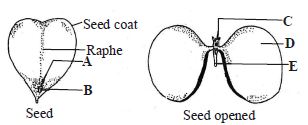
Identify the parts labeled $A, B, C, D,$ and $E$ in the given diagram of a dicot seed.
A
$A -$ Hilum,$B -$ Micropyle,$C -$ Radicle,$D -$ Cotyledon,$E -$ Plumule
B
$A -$ Hilum,$B -$ Micropyle,$C -$ Plumule,$D -$ Cotyledon,$E -$ Radicle
C
$A -$ Micropyle,$B -$ Hilum,$C -$ Plumule,$D -$ Cotyledon,$E -$ Radicle
D
$A -$ Hilum,$B -$ Micropyle,$C -$ Plumule,$D -$ Radicle,$E -$ Cotyledon
Solution
(B) Based on the structure of a typical dicot seed (like a bean or pea):
$A$ represents the Hilum,which is the scar on the seed coat through which the developing seeds were attached to the fruit.
$B$ represents the Micropyle,a small pore located above the hilum.
When the seed is opened,the internal structure reveals:
$C$ is the Plumule,which gives rise to the shoot system.
$D$ is the Cotyledon,which stores food.
$E$ is the Radicle,which gives rise to the root system.
Therefore,the correct labeling is $A -$ Hilum,$B -$ Micropyle,$C -$ Plumule,$D -$ Cotyledon,$E -$ Radicle.
$A$ represents the Hilum,which is the scar on the seed coat through which the developing seeds were attached to the fruit.
$B$ represents the Micropyle,a small pore located above the hilum.
When the seed is opened,the internal structure reveals:
$C$ is the Plumule,which gives rise to the shoot system.
$D$ is the Cotyledon,which stores food.
$E$ is the Radicle,which gives rise to the root system.
Therefore,the correct labeling is $A -$ Hilum,$B -$ Micropyle,$C -$ Plumule,$D -$ Cotyledon,$E -$ Radicle.
0 likesView Solution
7
BiologyMediumMCQAIIMS · 2015
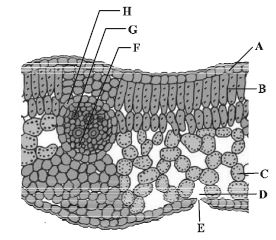
$T.S.$ of a dicot leaf is given below. Certain parts have been indicated by alphabets. Choose the correct option.
A
$A -$ Epidermis,$B -$ Spongy parenchyma,$C -$ Palisade parenchyma,$D -$ Stomata,$E -$ Guard cells,$F -$ Phloem,$G -$ Metaxylem,$H -$ Protoxylem
B
$A -$ Epidermis,$B -$ Palisade parenchyma,$C -$ Spongy parenchyma,$D -$ Sub-stomatal cavity,$E -$ Stoma,$F -$ Phloem,$G -$ Metaxylem,$H -$ Bundle sheath
C
$A -$ Epidermis,$B -$ Palisade parenchyma,$C -$ Spongy parenchyma,$D -$ Stomata,$E -$ Guard cells,$F -$ Epidermis,$G -$ Xylem,$H -$ Phloem
D
$A -$ Epidermis,$B -$ Palisade parenchyma,$C -$ Spongy parenchyma,$D -$ Stomata,$E -$ Guard cells,$F -$ Phloem,$G -$ Metaxylem,$H -$ Protoxylem
Solution
(D) Based on the anatomical structure of a dicot leaf:
$A$ represents the upper epidermis.
$B$ represents the palisade parenchyma,which consists of elongated cells located below the upper epidermis.
$C$ represents the spongy parenchyma,which consists of loosely arranged cells with intercellular spaces.
$D$ represents the sub-stomatal cavity (air space).
$E$ represents the stoma (pore).
$F$ represents the phloem,which is located towards the lower side of the vascular bundle.
$G$ represents the metaxylem,which consists of larger vessels.
$H$ represents the protoxylem,which consists of smaller vessels located towards the upper side.
Therefore,option $D$ is the correct identification of the labeled parts.
$A$ represents the upper epidermis.
$B$ represents the palisade parenchyma,which consists of elongated cells located below the upper epidermis.
$C$ represents the spongy parenchyma,which consists of loosely arranged cells with intercellular spaces.
$D$ represents the sub-stomatal cavity (air space).
$E$ represents the stoma (pore).
$F$ represents the phloem,which is located towards the lower side of the vascular bundle.
$G$ represents the metaxylem,which consists of larger vessels.
$H$ represents the protoxylem,which consists of smaller vessels located towards the upper side.
Therefore,option $D$ is the correct identification of the labeled parts.
0 likesView Solution
8
BiologyMediumMCQAIIMS · 2015
Contractile tissues have the following features:
$(i)$ Mesodermal in origin
$(ii)$ They contain stretch receptors
$(iii)$ Rhythmic contractions are seen in them
$(iv)$ They do not fatigue during the life of the animal
Which of the above are characteristics of sphincters?
$(i)$ Mesodermal in origin
$(ii)$ They contain stretch receptors
$(iii)$ Rhythmic contractions are seen in them
$(iv)$ They do not fatigue during the life of the animal
Which of the above are characteristics of sphincters?
A
All the four
B
Only $(i), (ii)$ and $(iii)$
C
Only $(i), (ii)$ and $(iv)$
D
Only $(i), (iii)$ and $(iv)$
Solution
(C) Sphincters are specialized circular muscles that control the passage of substances through body openings.
$(i)$ Sphincters are mesodermal in origin,as they are composed of muscle tissue.
$(ii)$ They contain stretch receptors that help in regulating their tone and contraction based on the presence of contents.
$(iii)$ Rhythmic contractions are characteristic of cardiac muscle or peristaltic movements,not typical sphincters,which generally maintain a tonic state of contraction.
$(iv)$ Sphincters do not fatigue during the life of the animal because they are designed to maintain a constant state of contraction to prevent leakage.
Therefore,the characteristics $(i), (ii),$ and $(iv)$ are associated with sphincters.
$(i)$ Sphincters are mesodermal in origin,as they are composed of muscle tissue.
$(ii)$ They contain stretch receptors that help in regulating their tone and contraction based on the presence of contents.
$(iii)$ Rhythmic contractions are characteristic of cardiac muscle or peristaltic movements,not typical sphincters,which generally maintain a tonic state of contraction.
$(iv)$ Sphincters do not fatigue during the life of the animal because they are designed to maintain a constant state of contraction to prevent leakage.
Therefore,the characteristics $(i), (ii),$ and $(iv)$ are associated with sphincters.
0 likesView Solution
9
BiologyMediumMCQAIIMS · 2015
Which of the following statements about cell junctions is false?
$(i)$ All the cells of the epithelium are held together with little intercellular materials.
$(ii)$ In almost all animal tissues,specialized junctions provide both structural and functional links between individual cells.
$(iii)$ Tight junctions help to stop substances from leaking across a tissue.
$(iv)$ Adhering junctions provide cementing to keep neighbouring cells together.
$(v)$ Gap junctions provide cytoplasmic channels between cells for the passage of ions,small molecules,and sometimes big molecules.
$(i)$ All the cells of the epithelium are held together with little intercellular materials.
$(ii)$ In almost all animal tissues,specialized junctions provide both structural and functional links between individual cells.
$(iii)$ Tight junctions help to stop substances from leaking across a tissue.
$(iv)$ Adhering junctions provide cementing to keep neighbouring cells together.
$(v)$ Gap junctions provide cytoplasmic channels between cells for the passage of ions,small molecules,and sometimes big molecules.
A
$(ii)$ and $(iii)$
B
$(i)$ and $(ii)$
C
Only $(v)$
D
None of these
Solution
(D) Statement $(i)$ is true: Epithelial cells are compactly packed with very little intercellular matrix.
Statement $(ii)$ is true: Specialized junctions are present in animal tissues to provide structural and functional links.
Statement $(iii)$ is true: Tight junctions prevent substances from leaking across a tissue.
Statement $(iv)$ is true: Adhering junctions perform cementing to keep neighbouring cells together.
Statement $(v)$ is true: Gap junctions facilitate communication between cells by connecting the cytoplasm of adjacent cells for the rapid transfer of ions,small molecules,and sometimes big molecules.
Since all the given statements are correct,none of them are false.
Statement $(ii)$ is true: Specialized junctions are present in animal tissues to provide structural and functional links.
Statement $(iii)$ is true: Tight junctions prevent substances from leaking across a tissue.
Statement $(iv)$ is true: Adhering junctions perform cementing to keep neighbouring cells together.
Statement $(v)$ is true: Gap junctions facilitate communication between cells by connecting the cytoplasm of adjacent cells for the rapid transfer of ions,small molecules,and sometimes big molecules.
Since all the given statements are correct,none of them are false.
0 likesView Solution
10
BiologyMediumMCQAIIMS · 2015
$i.$ The shape of the cells may vary with the function they perform.
$ii.$ Human $RBC$ is about $7.0 \, \mu m$ in diameter.
$iii.$ Cytoplasm is the main arena of cellular activities.
$iv.$ Various chemical reactions occur in cytoplasm to keep the cell in the living state.
$ii.$ Human $RBC$ is about $7.0 \, \mu m$ in diameter.
$iii.$ Cytoplasm is the main arena of cellular activities.
$iv.$ Various chemical reactions occur in cytoplasm to keep the cell in the living state.
A
All are correct
B
Only $i$ and $ii$ are correct
C
Only $iv$ is correct
D
All are wrong
Solution
(A) $i.$ Cells exhibit diverse shapes such as disc-like,polygonal,columnar,cuboid,thread-like,or even irregular,which are adapted to their specific functions.
$ii.$ The diameter of a human red blood cell $(RBC)$ is approximately $7.0 \, \mu m$.
$iii.$ The cytoplasm is a semi-fluid matrix that occupies the volume of the cell and serves as the primary site for various cellular metabolic activities.
$iv.$ The cytoplasm contains various organelles and molecules where chemical reactions take place,ensuring the cell remains in a living state.
Therefore,all the given statements are correct.
$ii.$ The diameter of a human red blood cell $(RBC)$ is approximately $7.0 \, \mu m$.
$iii.$ The cytoplasm is a semi-fluid matrix that occupies the volume of the cell and serves as the primary site for various cellular metabolic activities.
$iv.$ The cytoplasm contains various organelles and molecules where chemical reactions take place,ensuring the cell remains in a living state.
Therefore,all the given statements are correct.
0 likesView Solution
11
BiologyMediumMCQAIIMS · 2015
Assertion : $A$ cell membrane shows fluid behaviour.
Reason : $A$ membrane is a mosaic or composite of diverse lipids and proteins.
Reason : $A$ membrane is a mosaic or composite of diverse lipids and proteins.
A
If both Assertion and Reason are correct and the Reason is a correct explanation of the Assertion.
B
If both Assertion and Reason are correct but Reason is not a correct explanation of the Assertion.
C
If the Assertion is correct but Reason is incorrect.
D
If both the Assertion and Reason are incorrect.
Solution
(A) The fluid mosaic model,proposed by $Singer$ and $Nicolson$ in $1972$,describes the cell membrane as a fluid structure.
The fluidity of the membrane is due to the lateral movement of lipids and proteins within the bilayer.
The membrane is described as a mosaic because it is composed of a diverse arrangement of proteins embedded in a phospholipid bilayer.
Since the fluid nature of the membrane allows for the movement of these embedded proteins and lipids,the mosaic composition is directly related to its fluid behavior.
Therefore,both the Assertion and Reason are correct,and the Reason is the correct explanation of the Assertion.
The fluidity of the membrane is due to the lateral movement of lipids and proteins within the bilayer.
The membrane is described as a mosaic because it is composed of a diverse arrangement of proteins embedded in a phospholipid bilayer.
Since the fluid nature of the membrane allows for the movement of these embedded proteins and lipids,the mosaic composition is directly related to its fluid behavior.
Therefore,both the Assertion and Reason are correct,and the Reason is the correct explanation of the Assertion.
0 likesView Solution
12
BiologyMediumMCQAIIMS · 2015
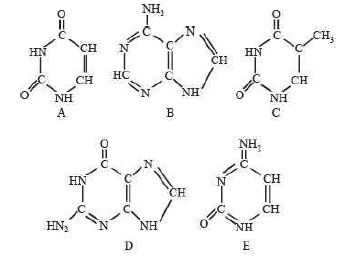
The following diagrams represent the nitrogenous bases of nucleic acid molecules. Identify the correct combination.
A
$A-$ uracil,$B-$ adenine,$C-$ thymine,$D-$ guanine,$E-$ cytosine
B
$A-$ uracil,$B-$ guanine,$C-$ cytosine,$D-$ adenine,$E-$ thymine
C
$A-$ uracil,$B-$ guanine,$C-$ thymine,$D-$ adenine,$E-$ cytosine
D
$A-$ thymine,$B-$ guanine,$C-$ uracil,$D-$ adenine,$E-$ cytosine
Solution
(A) By analyzing the chemical structures of the nitrogenous bases:
$A$ is Uracil,a pyrimidine base found in $RNA$.
$B$ is Adenine,a purine base.
$C$ is Thymine,a pyrimidine base with a methyl group $(-CH_3)$ at the $5^{th}$ position.
$D$ is Guanine,a purine base.
$E$ is Cytosine,a pyrimidine base.
Therefore,the correct combination is $A-$ uracil,$B-$ adenine,$C-$ thymine,$D-$ guanine,$E-$ cytosine.
$A$ is Uracil,a pyrimidine base found in $RNA$.
$B$ is Adenine,a purine base.
$C$ is Thymine,a pyrimidine base with a methyl group $(-CH_3)$ at the $5^{th}$ position.
$D$ is Guanine,a purine base.
$E$ is Cytosine,a pyrimidine base.
Therefore,the correct combination is $A-$ uracil,$B-$ adenine,$C-$ thymine,$D-$ guanine,$E-$ cytosine.
0 likesView Solution
13
BiologyMediumMCQAIIMS · 2015
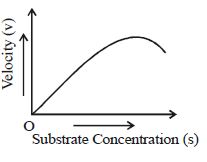
The given graph shows the effect of substrate concentration on the rate of reaction of the enzyme green-gram-phosphatase. What does the graph indicate?
A
The rate of enzyme reaction is directly proportional to the substrate concentration.
B
Presence of an enzyme inhibitor in the reaction mixture.
C
Formation of an enzyme-substrate complex.
D
At higher substrate-concentration the $pH$ increases.
Solution
(B) In a typical enzyme-catalyzed reaction,the velocity increases with substrate concentration until it reaches a maximum $(V_{max})$ and then plateaus.
However,the provided graph shows that after reaching a certain point,the reaction velocity decreases as the substrate concentration increases.
This decline in reaction rate at higher substrate concentrations is a characteristic indicator of the presence of an enzyme inhibitor in the reaction mixture,which interferes with the enzyme's activity.
However,the provided graph shows that after reaching a certain point,the reaction velocity decreases as the substrate concentration increases.
This decline in reaction rate at higher substrate concentrations is a characteristic indicator of the presence of an enzyme inhibitor in the reaction mixture,which interferes with the enzyme's activity.
0 likesView Solution
14
BiologyMediumMCQAIIMS · 2015
Minerals are known to enter the plant root by means of a number of mechanisms,including all except one of the following. Which one of the following is $NOT$ a mechanism for moving minerals into roots?
A
Foliar feeding
B
Active transport
C
Proton $(H^+)$ pump
D
Cation exchange
Solution
(A) Minerals enter plant roots through various mechanisms such as active transport,proton $(H^+)$ pumps,and cation exchange.
Active transport involves the movement of ions against the concentration gradient using energy.
Proton pumps create an electrochemical gradient that facilitates the uptake of minerals.
Cation exchange is the process where cations adsorbed on soil particles are exchanged with $H^+$ ions released by roots.
Foliar feeding is a technique of feeding plants by applying liquid fertilizer directly to their leaves,not a mechanism for mineral uptake through roots.
Active transport involves the movement of ions against the concentration gradient using energy.
Proton pumps create an electrochemical gradient that facilitates the uptake of minerals.
Cation exchange is the process where cations adsorbed on soil particles are exchanged with $H^+$ ions released by roots.
Foliar feeding is a technique of feeding plants by applying liquid fertilizer directly to their leaves,not a mechanism for mineral uptake through roots.
0 likesView Solution
15
BiologyMediumMCQAIIMS · 2015
$A$ botanist discovered a mutant plant that was unable to produce materials that form the $Casparian$ strip. This plant would be:
A
unable to transport water or solutes to the leaves
B
unable to use its sugar as a sugar sink
C
able to exert greater root pressure than the normal plant
D
unable to control the amounts of water and solutes it absorbs
Solution
(D) The $Casparian$ strip is a band of cell wall material deposited in the radial and transverse walls of the endodermis,which is chemically composed of suberin.
It acts as a selective barrier that forces water and dissolved solutes to pass through the plasma membrane of the endodermal cells rather than moving through the apoplastic pathway.
By forcing this movement through the cytoplasm (symplastic pathway),the plant can regulate the uptake of water and minerals into the vascular cylinder (xylem).
If a plant cannot produce $Casparian$ strips,it loses the ability to selectively control the entry of water and solutes into the xylem,leading to an unregulated flow.
It acts as a selective barrier that forces water and dissolved solutes to pass through the plasma membrane of the endodermal cells rather than moving through the apoplastic pathway.
By forcing this movement through the cytoplasm (symplastic pathway),the plant can regulate the uptake of water and minerals into the vascular cylinder (xylem).
If a plant cannot produce $Casparian$ strips,it loses the ability to selectively control the entry of water and solutes into the xylem,leading to an unregulated flow.
0 likesView Solution
16
BiologyDifficultMCQAIIMS · 2015
If a cell $A$ with $DPD$ $4 \, \text{bars}$ is connected to cells $B$, $C$, and $D$ whose $OP$ and $TP$ are respectively $(4, 4)$, $(10, 5)$, and $(7, 3) \, \text{bars}$, the flow of water will be:
A
$A$ and $D$ to $B$ and $C$
B
$A$ to $B, C$ and $D$
C
$B$ to $A, C$ and $D$
D
$C$ to $A, B$ and $D$
Solution
(C) The formula for $DPD$ is $DPD = OP - TP$.
Given values for cell $A$: $DPD = 4 \, \text{bars}$.
For cell $B$: $OP = 4, TP = 4 \implies DPD = 4 - 4 = 0 \, \text{bars}$.
For cell $C$: $OP = 10, TP = 5 \implies DPD = 10 - 5 = 5 \, \text{bars}$.
For cell $D$: $OP = 7, TP = 3 \implies DPD = 7 - 3 = 4 \, \text{bars}$.
Water always moves from a region of lower $DPD$ to a region of higher $DPD$.
Comparing the values: $B(0) < A(4) = D(4) < C(5)$.
Therefore, water will flow from cell $B$ (lowest $DPD$) towards cells $A, D,$ and $C$ (higher $DPD$).
Given values for cell $A$: $DPD = 4 \, \text{bars}$.
For cell $B$: $OP = 4, TP = 4 \implies DPD = 4 - 4 = 0 \, \text{bars}$.
For cell $C$: $OP = 10, TP = 5 \implies DPD = 10 - 5 = 5 \, \text{bars}$.
For cell $D$: $OP = 7, TP = 3 \implies DPD = 7 - 3 = 4 \, \text{bars}$.
Water always moves from a region of lower $DPD$ to a region of higher $DPD$.
Comparing the values: $B(0) < A(4) = D(4) < C(5)$.
Therefore, water will flow from cell $B$ (lowest $DPD$) towards cells $A, D,$ and $C$ (higher $DPD$).
0 likesView Solution
17
BiologyMediumMCQAIIMS · 2015
Assertion : Long distance flow of photoassimilates in plants occurs through sieve tubes.
Reason : Mature sieve tubes have parietal cytoplasm and perforated sieve plates.
Reason : Mature sieve tubes have parietal cytoplasm and perforated sieve plates.
A
If both Assertion and Reason are correct and the Reason is a correct explanation of the Assertion.
B
If both Assertion and Reason are correct but Reason is not a correct explanation of the Assertion.
C
If the Assertion is correct but Reason is incorrect.
D
If both the Assertion and Reason are incorrect.
Solution
(A) The assertion is correct because sieve tubes are the primary conducting elements for the translocation of photoassimilates (sucrose) in plants.
The reason is also correct because mature sieve tube elements lack a nucleus but retain a thin layer of parietal cytoplasm and possess perforated sieve plates at their end walls.
These structural features facilitate the mass flow of sap from one sieve tube element to the next,making the reason a correct explanation for the assertion.
The reason is also correct because mature sieve tube elements lack a nucleus but retain a thin layer of parietal cytoplasm and possess perforated sieve plates at their end walls.
These structural features facilitate the mass flow of sap from one sieve tube element to the next,making the reason a correct explanation for the assertion.
0 likesView Solution
18
BiologyMediumMCQAIIMS · 2015
Assertion : Light is a very important factor in transpiration.
Reason : Light induces stomatal opening and darkness closing of stomata. Therefore,transpiration increases in light and decreases in dark.
Reason : Light induces stomatal opening and darkness closing of stomata. Therefore,transpiration increases in light and decreases in dark.
A
If both Assertion and Reason are correct and the Reason is a correct explanation of the Assertion.
B
If both Assertion and Reason are correct but Reason is not a correct explanation of the Assertion.
C
If the Assertion is correct but Reason is incorrect.
D
If both the Assertion and Reason are incorrect.
Solution
(A) Light is a critical environmental factor affecting the rate of transpiration.
Most plants have stomata that open in response to light to facilitate $CO_2$ intake for photosynthesis.
When stomata open,the pathway for water vapor loss increases,thereby increasing the rate of transpiration.
Conversely,in the dark,stomata close to conserve water,which significantly reduces transpiration.
Since the reason directly explains the mechanism by which light influences transpiration,the Reason is the correct explanation of the Assertion.
Most plants have stomata that open in response to light to facilitate $CO_2$ intake for photosynthesis.
When stomata open,the pathway for water vapor loss increases,thereby increasing the rate of transpiration.
Conversely,in the dark,stomata close to conserve water,which significantly reduces transpiration.
Since the reason directly explains the mechanism by which light influences transpiration,the Reason is the correct explanation of the Assertion.
0 likesView Solution
19
BiologyMediumMCQAIIMS · 2015
Consider the following statements regarding photosynthesis:
$(A)$ $ATP$ formation during photosynthesis is termed as photophosphorylation.
$(B)$ Kranz anatomy pertains to leaf.
$(C)$ Reduction of $NADP^+$ to $NADPH$ occurs during Calvin cycle.
$(D)$ In a chlorophyll molecule,magnesium is present in the phytol tail.
Which of the above statements are correct?
$(A)$ $ATP$ formation during photosynthesis is termed as photophosphorylation.
$(B)$ Kranz anatomy pertains to leaf.
$(C)$ Reduction of $NADP^+$ to $NADPH$ occurs during Calvin cycle.
$(D)$ In a chlorophyll molecule,magnesium is present in the phytol tail.
Which of the above statements are correct?
A
$A$ and $B$ are correct
B
$C$ and $D$ are correct
C
$A$ and $C$ are correct
D
$A$ and $D$ are correct
Solution
(A) Statement $(A)$ is correct: The synthesis of $ATP$ from $ADP$ and inorganic phosphate in the presence of light is known as photophosphorylation.
Statement $(B)$ is correct: Kranz anatomy is a specialized structure found in the leaves of $C_4$ plants,where mesophyll cells surround the bundle sheath cells.
Statement $(C)$ is incorrect: During the Calvin cycle (biosynthetic phase),$NADPH$ is oxidized to $NADP^+$ to provide electrons for the reduction of $3-PGA$ to $G3P$. The reduction of $NADP^+$ to $NADPH$ occurs during the light-dependent reactions.
Statement $(D)$ is incorrect: In a chlorophyll molecule,the magnesium ion $(Mg^{2+})$ is located at the center of the porphyrin ring,not in the phytol tail.
Therefore,statements $(A)$ and $(B)$ are correct.
Statement $(B)$ is correct: Kranz anatomy is a specialized structure found in the leaves of $C_4$ plants,where mesophyll cells surround the bundle sheath cells.
Statement $(C)$ is incorrect: During the Calvin cycle (biosynthetic phase),$NADPH$ is oxidized to $NADP^+$ to provide electrons for the reduction of $3-PGA$ to $G3P$. The reduction of $NADP^+$ to $NADPH$ occurs during the light-dependent reactions.
Statement $(D)$ is incorrect: In a chlorophyll molecule,the magnesium ion $(Mg^{2+})$ is located at the center of the porphyrin ring,not in the phytol tail.
Therefore,statements $(A)$ and $(B)$ are correct.
0 likesView Solution
20
BiologyMediumMCQAIIMS · 2015
Assertion: Six molecules of $CO_2$ and twelve molecules of $NADPH + H^+$ and $18\, ATP$ are used to form one hexose molecule.
Reason: Light reaction results in the formation of $ATP$ and $NADPH_2$.
Reason: Light reaction results in the formation of $ATP$ and $NADPH_2$.
A
If both Assertion and Reason are correct and the Reason is a correct explanation of the Assertion.
B
If both Assertion and Reason are correct but Reason is not a correct explanation of the Assertion.
C
If the Assertion is correct but Reason is incorrect.
D
If both the Assertion and Reason are incorrect.
Solution
(B) The Assertion is correct because the Calvin cycle requires $6$ molecules of $CO_2$,$12$ molecules of $NADPH + H^+$,and $18$ molecules of $ATP$ to synthesize one molecule of hexose (glucose).
The Reason is also correct because the light-dependent reaction (photophosphorylation) produces $ATP$ and $NADPH + H^+$ (often written as $NADPH_2$) which are then utilized in the dark reaction (Calvin cycle).
However,the Reason does not directly explain why exactly $6$ $CO_2$,$12$ $NADPH$,and $18$ $ATP$ are required; it only states the source of these molecules. Therefore,the Reason is not the correct explanation of the Assertion.
The Reason is also correct because the light-dependent reaction (photophosphorylation) produces $ATP$ and $NADPH + H^+$ (often written as $NADPH_2$) which are then utilized in the dark reaction (Calvin cycle).
However,the Reason does not directly explain why exactly $6$ $CO_2$,$12$ $NADPH$,and $18$ $ATP$ are required; it only states the source of these molecules. Therefore,the Reason is not the correct explanation of the Assertion.
0 likesView Solution
21
BiologyMediumMCQAIIMS · 2015
Which of the following representations correctly explains the function of a mitochondrion?
A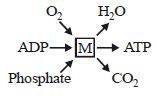
B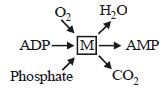
C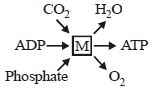
D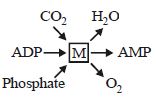
Solution
(A) The mitochondrion is the site of aerobic cellular respiration. During this process,oxygen $(O_2)$ is consumed,and organic substrates are oxidized to release energy. This energy is used to synthesize $ATP$ from $ADP$ and inorganic phosphate $(Pi)$. The byproducts of this process include carbon dioxide $(CO_2)$ and water $(H_2O)$. Therefore,the correct representation is that $O_2$ and $ADP$ + Phosphate enter the mitochondrion,while $ATP$,$CO_2$,and $H_2O$ are produced and released. This corresponds to the process shown in option $A$.
0 likesView Solution
22
BiologyEasyMCQAIIMS · 2015
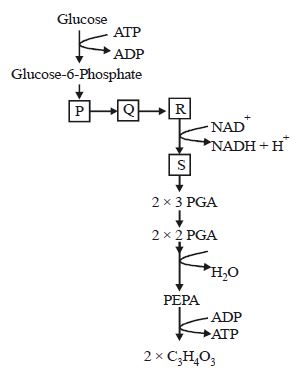
Refer to the figure and answer the question. Choose the correct names of $P$, $Q$, $R$, and $S$.
A
$P - 1,3\text{-bisphosphoglyceric acid (BPGA)}, Q - 3\text{-phosphoglyceraldehyde (PGAL)}, R - \text{Fructose-1,6-bisphosphate}, S - \text{Fructose-6-phosphate}$
B
$P - 3\text{-phosphoglyceraldehyde (PGAL)}, Q - 1,3\text{-bisphosphoglyceric acid (BPGA)}, R - \text{Fructose-1,6-bisphosphate}, S - \text{Fructose-6-phosphate}$
C
$P - \text{Fructose-6-phosphate}, Q - \text{Fructose-1,6-bisphosphate}, R - 3\text{-phosphoglyceraldehyde (PGAL)}, S - 1,3\text{-bisphosphoglyceric acid (BPGA)}$
D
$P - \text{Fructose-1,6-bisphosphate}, Q - \text{Fructose-6-phosphate}, R - 3\text{-phosphoglyceraldehyde (PGAL)}, S - 1,3\text{-bisphosphoglyceric acid (BPGA)}$
Solution
(C) In the process of glycolysis, Glucose is converted into Glucose$-6-$phosphate.
Then, Glucose$-6-$phosphate is isomerized to Fructose$-6-$phosphate $(P)$.
Fructose$-6-$phosphate is then phosphorylated to form Fructose$-1,6-$bisphosphate $(Q)$.
Fructose$-1,6-$bisphosphate splits into two triose phosphates, one of which is $3-$phosphoglyceraldehyde $(R)$.
$3$-phosphoglyceraldehyde is then oxidized to form $1,3-$bisphosphoglyceric acid $(S)$.
Therefore, the correct sequence is $P = \text{Fructose-6-phosphate}$, $Q = \text{Fructose-1,6-bisphosphate}$, $R = 3\text{-phosphoglyceraldehyde}$, and $S = 1,3\text{-bisphosphoglyceric acid}$.
Then, Glucose$-6-$phosphate is isomerized to Fructose$-6-$phosphate $(P)$.
Fructose$-6-$phosphate is then phosphorylated to form Fructose$-1,6-$bisphosphate $(Q)$.
Fructose$-1,6-$bisphosphate splits into two triose phosphates, one of which is $3-$phosphoglyceraldehyde $(R)$.
$3$-phosphoglyceraldehyde is then oxidized to form $1,3-$bisphosphoglyceric acid $(S)$.
Therefore, the correct sequence is $P = \text{Fructose-6-phosphate}$, $Q = \text{Fructose-1,6-bisphosphate}$, $R = 3\text{-phosphoglyceraldehyde}$, and $S = 1,3\text{-bisphosphoglyceric acid}$.
0 likesView Solution
23
BiologyMediumMCQAIIMS · 2015
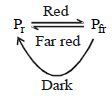
Assertion: Photomodulation of flowering is a phytochrome regulated process.
Reason: Active form of phytochrome $(P_{FR})$ directly induces floral induction in shoot buds.
Reason: Active form of phytochrome $(P_{FR})$ directly induces floral induction in shoot buds.
A
If both Assertion and Reason are correct and the Reason is a correct explanation of the Assertion.
B
If both Assertion and Reason are correct but Reason is not a correct explanation of the Assertion.
C
If the Assertion is correct but Reason is incorrect.
D
If both the Assertion and Reason are incorrect.
Solution
(A) The Assertion is correct because phytochrome is a photoreceptor pigment that regulates various developmental processes,including flowering,in response to light.
The Reason is also correct. Phytochrome exists in two interconvertible forms: $P_R$ (inactive) and $P_{FR}$ (active). When exposed to red light,$P_R$ is converted to $P_{FR}$. The $P_{FR}$ form is the physiologically active form that migrates to the nucleus or interacts with signaling pathways to induce floral development in shoot buds.
Since the active form $P_{FR}$ is the specific component of the phytochrome system that triggers the flowering response,the Reason correctly explains the Assertion.
The Reason is also correct. Phytochrome exists in two interconvertible forms: $P_R$ (inactive) and $P_{FR}$ (active). When exposed to red light,$P_R$ is converted to $P_{FR}$. The $P_{FR}$ form is the physiologically active form that migrates to the nucleus or interacts with signaling pathways to induce floral development in shoot buds.
Since the active form $P_{FR}$ is the specific component of the phytochrome system that triggers the flowering response,the Reason correctly explains the Assertion.
0 likesView Solution
24
BiologyMediumMCQAIIMS · 2015
Assertion $(A)$: Vernalization is acceleration of subsequent flowering by low temperature treatment.
Reason $(R)$: Site of vernalization is apical meristem.
Reason $(R)$: Site of vernalization is apical meristem.
A
If both Assertion and Reason are correct and the Reason is a correct explanation of the Assertion.
B
If both Assertion and Reason are correct but Reason is not a correct explanation of the Assertion.
C
If the Assertion is correct but Reason is incorrect.
D
If both the Assertion and Reason are incorrect.
Solution
(A) Vernalization is the process of inducing or accelerating flowering in plants by exposing them to low temperatures. This phenomenon was first described by $T.D.$ Lysenko in $1928$.
The Assertion is correct because vernalization specifically refers to the promotion of flowering through cold treatment.
The Reason is also correct because the perception of the cold stimulus occurs primarily in the apical meristem (shoot apex) of the plant,where it triggers the production of a hypothetical flowering hormone called vernalin.
Since the Reason correctly identifies the site where the process described in the Assertion occurs,it serves as a valid explanation.
The Assertion is correct because vernalization specifically refers to the promotion of flowering through cold treatment.
The Reason is also correct because the perception of the cold stimulus occurs primarily in the apical meristem (shoot apex) of the plant,where it triggers the production of a hypothetical flowering hormone called vernalin.
Since the Reason correctly identifies the site where the process described in the Assertion occurs,it serves as a valid explanation.
0 likesView Solution
25
BiologyMediumMCQAIIMS · 2015
If for some reason the parietal cells of the gut epithelium become partially non-functional,what is likely to happen?
A
The pancreatic enzymes and specially the trypsin and lipase will not work efficiently.
B
The $pH$ of stomach will fall abruptly.
C
Steapsin will be more effective.
D
Proteins will not be adequately hydrolysed by pepsin into proteoses and peptones.
Solution
(D) Parietal cells (also known as oxyntic cells) in the stomach lining are responsible for secreting hydrochloric acid $(HCl)$ and intrinsic factor.
$HCl$ is essential for converting the inactive enzyme pepsinogen into its active form,pepsin.
Pepsin is the primary enzyme responsible for the digestion of proteins into proteoses and peptones in the acidic environment of the stomach.
If parietal cells become non-functional,$HCl$ secretion decreases,leading to a higher (less acidic) $pH$ in the stomach.
Consequently,pepsinogen cannot be activated efficiently,and proteins will not be adequately hydrolyzed by pepsin.
$HCl$ is essential for converting the inactive enzyme pepsinogen into its active form,pepsin.
Pepsin is the primary enzyme responsible for the digestion of proteins into proteoses and peptones in the acidic environment of the stomach.
If parietal cells become non-functional,$HCl$ secretion decreases,leading to a higher (less acidic) $pH$ in the stomach.
Consequently,pepsinogen cannot be activated efficiently,and proteins will not be adequately hydrolyzed by pepsin.
0 likesView Solution
26
BiologyMediumMCQAIIMS · 2015
Assertion : In the condition of obstructive jaundice,large amounts of unabsorbed fats are eliminated out of the body.
Reason : Entry of bile into the small intestine is prevented during obstructive jaundice.
Reason : Entry of bile into the small intestine is prevented during obstructive jaundice.
A
If both Assertion and Reason are correct and the Reason is a correct explanation of the Assertion.
B
If both Assertion and Reason are correct but Reason is not a correct explanation of the Assertion.
C
If the Assertion is correct but Reason is incorrect.
D
If both the Assertion and Reason are incorrect.
Solution
(A) In the condition of obstructive jaundice,the entry of bile into the small intestine is prevented due to an obstruction in the bile duct.
Bile salts are essential for the emulsification of fats,which increases the surface area for lipase action.
Furthermore,bile salts are necessary for the formation of micelles,which are water-soluble aggregates that transport fatty acids,glycerides,and fat-soluble vitamins to the intestinal mucosa for absorption.
In the absence of bile,fats cannot be properly emulsified or absorbed.
Consequently,these unabsorbed fats pass through the digestive tract and are eliminated from the body in the faeces.
Bile salts are essential for the emulsification of fats,which increases the surface area for lipase action.
Furthermore,bile salts are necessary for the formation of micelles,which are water-soluble aggregates that transport fatty acids,glycerides,and fat-soluble vitamins to the intestinal mucosa for absorption.
In the absence of bile,fats cannot be properly emulsified or absorbed.
Consequently,these unabsorbed fats pass through the digestive tract and are eliminated from the body in the faeces.
0 likesView Solution
27
BiologyEasyMCQAIIMS · 2015
Bulk of carbon dioxide $(CO_2)$ released from body tissues into the blood is present as
A
$70\%$ carbamino-haemoglobin and $30\%$ as bicarbonate
B
carbamino-haemoglobin in $RBCs$
C
bicarbonate in blood plasma and $RBCs$
D
free $CO_2$ in blood plasma
Solution
(C) Carbon dioxide $(CO_2)$ is transported in the blood in three forms:
$1$. As dissolved gas in plasma $(7\%)$.
$2$. As carbamino-haemoglobin bound to haemoglobin $(20-25\%)$.
$3$. As bicarbonate ions $(HCO_3^-)$ in blood plasma and $RBCs$ $(70\%)$.
Since the majority of $CO_2$ is transported as bicarbonate,the correct answer is $C$.
$1$. As dissolved gas in plasma $(7\%)$.
$2$. As carbamino-haemoglobin bound to haemoglobin $(20-25\%)$.
$3$. As bicarbonate ions $(HCO_3^-)$ in blood plasma and $RBCs$ $(70\%)$.
Since the majority of $CO_2$ is transported as bicarbonate,the correct answer is $C$.
0 likesView Solution
28
BiologyMediumMCQAIIMS · 2015
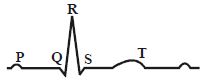
Given below is the $ECG$ of a normal human. Which one of its components is correctly interpreted below?
A
Peak $P$ and Peak $R$ together - systolic and diastolic blood pressures
B
Peak $P -$ Initiation of left atrial contraction only
C
Complex $QRS -$ One complete pulse
D
Peak $T -$ Initiation of total cardiac contraction
Solution
(C) The $P$-wave represents the electrical excitation (or depolarization) of the atria,which leads to the contraction of both the atria.
The $QRS$ complex represents the depolarization of the ventricles,which initiates the ventricular contraction. The contraction starts shortly after $Q$ and marks the beginning of the systole.
The $T$-wave represents the return of the ventricles from an excited to a normal state (repolarization). The end of the $T$-wave marks the end of systole.
Therefore,the $QRS$ complex corresponds to the depolarization of the ventricles,which initiates ventricular contraction,effectively representing one complete pulse or heartbeat cycle in terms of electrical activity.
The $QRS$ complex represents the depolarization of the ventricles,which initiates the ventricular contraction. The contraction starts shortly after $Q$ and marks the beginning of the systole.
The $T$-wave represents the return of the ventricles from an excited to a normal state (repolarization). The end of the $T$-wave marks the end of systole.
Therefore,the $QRS$ complex corresponds to the depolarization of the ventricles,which initiates ventricular contraction,effectively representing one complete pulse or heartbeat cycle in terms of electrical activity.
0 likesView Solution
29
BiologyMediumMCQAIIMS · 2015
Assertion : When there is a fall in the blood pressure due to loss of blood volume,this is compensated by vasoconstriction of veins.
Reason : Veins hold the extra amount of blood which can be shifted to the arteries as required.
Reason : Veins hold the extra amount of blood which can be shifted to the arteries as required.
A
If both Assertion and Reason are correct and the Reason is a correct explanation of the Assertion.
B
If both Assertion and Reason are correct but Reason is not a correct explanation of the Assertion.
C
If the Assertion is correct but Reason is incorrect.
D
If both the Assertion and Reason are incorrect.
Solution
(A) Veins are known as capacitance vessels because they contain a large volume of blood (about $60-70\%$ of the total blood volume) at any given time.
When blood pressure drops due to a decrease in blood volume (e.g.,hemorrhage),the sympathetic nervous system triggers vasoconstriction of the veins.
This constriction reduces the capacity of the venous system,forcing the stored blood to move toward the heart and into the arterial system.
This mechanism helps to maintain venous return and blood pressure,making the Reason a correct explanation for the Assertion.
When blood pressure drops due to a decrease in blood volume (e.g.,hemorrhage),the sympathetic nervous system triggers vasoconstriction of the veins.
This constriction reduces the capacity of the venous system,forcing the stored blood to move toward the heart and into the arterial system.
This mechanism helps to maintain venous return and blood pressure,making the Reason a correct explanation for the Assertion.
0 likesView Solution
30
BiologyEasyMCQAIIMS · 2015
If $Henle's$ loop were absent from the mammalian nephron,which of the following is to be expected?
A
There will be no urine formation.
B
There will be hardly any change in the quality and quantity of urine formed.
C
The urine will be more concentrated.
D
The urine will be more dilute.
Solution
(D) $Henle's$ loop plays a crucial role in the counter-current mechanism,which is responsible for the reabsorption of water and sodium chloride from the filtrate to concentrate the urine.
In the absence of $Henle's$ loop,the kidney would lose its ability to create a hypertonic medullary interstitium.
Consequently,the water cannot be reabsorbed efficiently from the collecting duct.
Therefore,the urine produced will be significantly more dilute compared to normal urine.
In the absence of $Henle's$ loop,the kidney would lose its ability to create a hypertonic medullary interstitium.
Consequently,the water cannot be reabsorbed efficiently from the collecting duct.
Therefore,the urine produced will be significantly more dilute compared to normal urine.
0 likesView Solution
31
BiologyMediumMCQAIIMS · 2015
Assertion: The imbalance in concentration of $Na^+$,$K^+$ and proteins generates resting potential.
Reason: To maintain the unequal distribution of $Na^+$ and $K^+$,the neurons use electrical energy.
Reason: To maintain the unequal distribution of $Na^+$ and $K^+$,the neurons use electrical energy.
A
If both Assertion and Reason are correct and the Reason is a correct explanation of the Assertion.
B
If both Assertion and Reason are correct but Reason is not a correct explanation of the Assertion.
C
If the Assertion is correct but Reason is incorrect.
D
If both the Assertion and Reason are incorrect.
Solution
(C) The resting membrane potential is generated due to the differential permeability of the axonal membrane to $Na^+$ and $K^+$ ions and the active transport of these ions by the $Na^+-K^+$ pump.
This pump requires metabolic energy in the form of $ATP$ (chemical energy),not electrical energy,to maintain the unequal distribution of ions against their concentration gradients.
Therefore,the Assertion is correct,but the Reason is incorrect because it mentions electrical energy instead of chemical energy $(ATP)$.
This pump requires metabolic energy in the form of $ATP$ (chemical energy),not electrical energy,to maintain the unequal distribution of ions against their concentration gradients.
Therefore,the Assertion is correct,but the Reason is incorrect because it mentions electrical energy instead of chemical energy $(ATP)$.
0 likesView Solution
32
BiologyMediumMCQAIIMS · 2015
When a neuron is not conducting any impulse,the axonal membrane is comparatively more permeable to $K^+$ ions and nearly impermeable to $Na^+$ ions.
A
$K^+, Na^+$
B
$K^+, Cl^-$
C
$HCO_3^-, Na^+$
D
$Na^+, K^+$
Solution
(A) During the resting state of a neuron,the axonal membrane is in a polarized state.
In this state,the membrane is significantly more permeable to potassium ions $(K^+)$ due to the presence of leak channels.
Conversely,the membrane is nearly impermeable to sodium ions $(Na^+)$ because the voltage-gated sodium channels are closed.
This differential permeability,along with the action of the $Na^+-K^+$ pump,maintains the resting membrane potential.
In this state,the membrane is significantly more permeable to potassium ions $(K^+)$ due to the presence of leak channels.
Conversely,the membrane is nearly impermeable to sodium ions $(Na^+)$ because the voltage-gated sodium channels are closed.
This differential permeability,along with the action of the $Na^+-K^+$ pump,maintains the resting membrane potential.
0 likesView Solution
33
BiologyDifficultMCQAIIMS · 2015
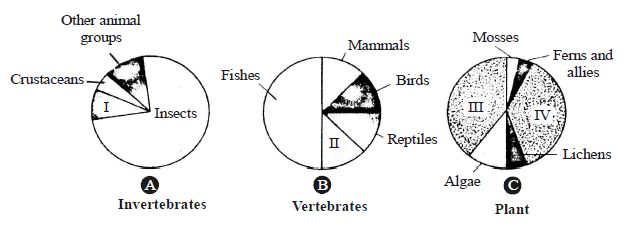
Given below are pie diagrams $A, B$ and $C$ related to the proportionate number of species of major taxa of invertebrates,vertebrates,and plants,respectively. Critically study and fill in the blanks $I, II, III$ and $IV$.
A
$I-$ Molluscs,$II-$ Amphibians,$III-$ Fungi,$IV-$ Angiosperms
B
$I-$ Molluscs,$II-$ Amphibians,$III-$ Angiosperms,$IV-$ Fungi
C
$I-$ Hexapoda,$II-$ Amphibians,$III-$ Fungi,$IV-$ Angiosperms
D
$I-$ Turtles,$II-$ Amphibians,$III-$ Fungi,$IV-$ Angiosperms
Solution
(A) Based on the standard $NCERT$ diagram for global biodiversity:
$1$. In pie diagram $A$ (Invertebrates),the largest slice is Insects,followed by Molluscs $(I)$,Crustaceans,and other animal groups.
$2$. In pie diagram $B$ (Vertebrates),the largest slice is Fishes,followed by Birds,Mammals,Reptiles,and Amphibians $(II)$.
$3$. In pie diagram $C$ (Plants),the largest slices are Angiosperms $(IV)$ and Fungi $(III)$,followed by Algae,Mosses,Ferns and allies,and Lichens.
Therefore,$I$ is Molluscs,$II$ is Amphibians,$III$ is Fungi,and $IV$ is Angiosperms. The correct option is $A$.
$1$. In pie diagram $A$ (Invertebrates),the largest slice is Insects,followed by Molluscs $(I)$,Crustaceans,and other animal groups.
$2$. In pie diagram $B$ (Vertebrates),the largest slice is Fishes,followed by Birds,Mammals,Reptiles,and Amphibians $(II)$.
$3$. In pie diagram $C$ (Plants),the largest slices are Angiosperms $(IV)$ and Fungi $(III)$,followed by Algae,Mosses,Ferns and allies,and Lichens.
Therefore,$I$ is Molluscs,$II$ is Amphibians,$III$ is Fungi,and $IV$ is Angiosperms. The correct option is $A$.
0 likesView Solution
34
BiologyMediumMCQAIIMS · 2015
Seeds are adaptively important because:
$1.$ they maintain dormancy
$2.$ they protect young plants during vulnerable stages
$3.$ they store food for young plants,and facilitate dispersal
$1.$ they maintain dormancy
$2.$ they protect young plants during vulnerable stages
$3.$ they store food for young plants,and facilitate dispersal
A
$1$ and $3$
B
$2$ and $3$
C
$1$ and $2$
D
All of these
Solution
(D) Seeds are highly adaptive structures for plants for the following reasons:
$1.$ They maintain dormancy,which allows seeds to survive unfavorable environmental conditions until favorable conditions return.
$2.$ The seed coat provides protection to the young embryo during its most vulnerable developmental stages.
$3.$ Seeds contain stored food (in the endosperm or cotyledons) that provides nourishment to the developing seedling until it can perform photosynthesis. Additionally,seeds possess various mechanisms that facilitate their dispersal to new habitats.
Therefore,all the given statements are correct.
$1.$ They maintain dormancy,which allows seeds to survive unfavorable environmental conditions until favorable conditions return.
$2.$ The seed coat provides protection to the young embryo during its most vulnerable developmental stages.
$3.$ Seeds contain stored food (in the endosperm or cotyledons) that provides nourishment to the developing seedling until it can perform photosynthesis. Additionally,seeds possess various mechanisms that facilitate their dispersal to new habitats.
Therefore,all the given statements are correct.
0 likesView Solution
35
BiologyMediumMCQAIIMS · 2015
Identify the events $(A, B, D$ and $E)$ in the life cycle of sexual reproduction.
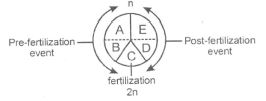
A
$A-$ Gamete transfer,$B-$ Gametogenesis,$D-$ Zygote formation,$E-$ Embryogenesis
B
$A-$ Gametogenesis,$B-$ Gamete transfer,$D-$ Zygote formation,$E-$ Embryogenesis
C
$A-$ Gametogenesis,$B-$ Zygote formation,$D-$ Gamete transfer,$E-$ Embryogenesis
D
$A-$ Gametogenesis,$B-$ Gamete transfer,$D-$ Embryogenesis,$E-$ Zygote formation.
Solution
(B) In sexual reproduction,the events are categorized into three stages:
$1$. Pre-fertilization events: These include Gametogenesis $(A)$ and Gamete transfer $(B)$.
$2$. Fertilization $(C)$: The fusion of male and female gametes to form a diploid zygote $(2n)$.
$3$. Post-fertilization events: These include Zygote formation $(D)$ and Embryogenesis $(E)$.
Therefore,the correct sequence is $A-$ Gametogenesis,$B-$ Gamete transfer,$D-$ Zygote formation,$E-$ Embryogenesis.
$1$. Pre-fertilization events: These include Gametogenesis $(A)$ and Gamete transfer $(B)$.
$2$. Fertilization $(C)$: The fusion of male and female gametes to form a diploid zygote $(2n)$.
$3$. Post-fertilization events: These include Zygote formation $(D)$ and Embryogenesis $(E)$.
Therefore,the correct sequence is $A-$ Gametogenesis,$B-$ Gamete transfer,$D-$ Zygote formation,$E-$ Embryogenesis.
0 likesView Solution
36
BiologyMediumMCQAIIMS · 2015
All of the following statements concerning pregnancy are accurate $EXCEPT$
A
the detection of human chorionic gonadotropin in the urine forms the basis for pregnancy tests.
B
the cyclic release of pituitary gonadotropins and ovarian steroids is continued.
C
the mammary gland tissue of the pregnant woman is stimulated to develop by placental hormones.
D
the corpus luteum of pregnancy maintains the uterus until the placenta is well established.
Solution
(B) During pregnancy, high levels of estrogen and progesterone in the maternal circulation exert negative feedback on the pituitary gland, which inhibits the cyclic release of pituitary gonadotropins ($FSH$ and $LH$) and prevents the menstrual cycle.
$hCG$ (human chorionic gonadotropin) is produced by the placenta, which maintains the corpus luteum of pregnancy and serves as the basis for pregnancy urine tests.
Placental hormones, along with other maternal hormones, stimulate the development of mammary gland tissues (ducts and alveoli) to prepare for lactation.
The corpus luteum of pregnancy secretes progesterone to maintain the endometrium until the placenta takes over this function.
$hCG$ (human chorionic gonadotropin) is produced by the placenta, which maintains the corpus luteum of pregnancy and serves as the basis for pregnancy urine tests.
Placental hormones, along with other maternal hormones, stimulate the development of mammary gland tissues (ducts and alveoli) to prepare for lactation.
The corpus luteum of pregnancy secretes progesterone to maintain the endometrium until the placenta takes over this function.
0 likesView Solution
37
BiologyMediumMCQAIIMS · 2015
The following graph shows the relative concentrations of the four hormones present in the blood plasma of a woman during her menstrual cycle. Identify the hormones.
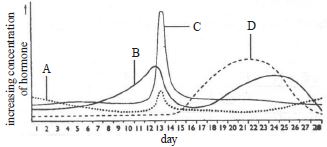
A
$A-FSH, B-Oestrogen, C-LH, D-Progesterone$
B
$A-LH, B-Progesterone, C-FSH, D-Oestrogen$
C
$A-FSH, B-Progesterone, C-LH, D-Oestrogen$
D
$A-LH, B-Oestrogen, C-FSH, D-Progesterone$
Solution
(A) In the menstrual cycle of a human female:
$1$. $A$ represents $FSH$ (Follicle Stimulating Hormone), which shows a small peak at the beginning of the cycle.
$2$. $B$ represents Oestrogen, which rises during the follicular phase.
$3$. $C$ represents $LH$ (Luteinizing Hormone), which shows a sharp, high peak ($LH$ surge) around the $14^{th}$ day, triggering ovulation.
$4$. $D$ represents Progesterone, which rises significantly during the luteal phase (after ovulation) to maintain the endometrium.
Therefore, the correct identification is $A-FSH, B-Oestrogen, C-LH, D-Progesterone$.
$1$. $A$ represents $FSH$ (Follicle Stimulating Hormone), which shows a small peak at the beginning of the cycle.
$2$. $B$ represents Oestrogen, which rises during the follicular phase.
$3$. $C$ represents $LH$ (Luteinizing Hormone), which shows a sharp, high peak ($LH$ surge) around the $14^{th}$ day, triggering ovulation.
$4$. $D$ represents Progesterone, which rises significantly during the luteal phase (after ovulation) to maintain the endometrium.
Therefore, the correct identification is $A-FSH, B-Oestrogen, C-LH, D-Progesterone$.
0 likesView Solution
38
BiologyMediumMCQAIIMS · 2015
Match Column $-I$ with Column $-II$.
| Column $-I$ (Method) | Column $-II$ (Mode of Action) |
| $A$. The pill | $I$. Prevents sperms reaching cervix |
| $B$. Condom | $II$. Prevents implantation |
| $C$. Vasectomy | $III$. Prevents ovulation |
| $D$. Copper $T$ | $IV$. Semen contains no sperms |
A
$A-III, B-I, C-IV, D-II$
B
$A-IV, B-I, C-II, D-III$
C
$A-III, B-IV, C-I, D-II$
D
$A-II, B-III, C-I, D-IV$
Solution
$(A)$. The pill: Prevents ovulation. Oral contraceptive pills contain hormones that inhibit the release of the egg from the ovary.
$B$. Condom: Prevents sperm from reaching the cervix. It acts as a physical barrier.
$C$. Vasectomy: Semen contains no sperms. It is a surgical sterilization method in males where the vas deferens is cut or tied.
$D$. Copper $T$: Prevents implantation. It is an Intrauterine Device $(IUD)$ that releases copper ions, which suppress sperm motility and fertilization capacity, and also prevent implantation of the embryo.
$B$. Condom: Prevents sperm from reaching the cervix. It acts as a physical barrier.
$C$. Vasectomy: Semen contains no sperms. It is a surgical sterilization method in males where the vas deferens is cut or tied.
$D$. Copper $T$: Prevents implantation. It is an Intrauterine Device $(IUD)$ that releases copper ions, which suppress sperm motility and fertilization capacity, and also prevent implantation of the embryo.
0 likesView Solution
39
BiologyMediumMCQAIIMS · 2015
In Huntington's disease,the unaffected persons are homozygous for normal allele $h$. The following pedigree is erroneous because:
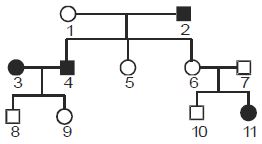
A
it shows both male and female affected by Huntington's disease
B
either person $6$ or $7$ should have the disease,if individual $11$ shows the disease.
C
at least one of the $2$ children $(8, 9)$ should have the disease
D
all of these
Solution
(B) Huntington's disease is an autosomal dominant disorder. In an autosomal dominant pedigree,an affected individual must have at least one affected parent.
In the given pedigree,individual $11$ is affected (represented by a filled circle). Since the disease is autosomal dominant,at least one of her parents ($6$ or $7$) must also be affected (represented by a filled symbol).
However,in the pedigree,both individuals $6$ and $7$ are unaffected (represented by empty symbols). Therefore,this pedigree is erroneous because it violates the rule of autosomal dominant inheritance.
In the given pedigree,individual $11$ is affected (represented by a filled circle). Since the disease is autosomal dominant,at least one of her parents ($6$ or $7$) must also be affected (represented by a filled symbol).
However,in the pedigree,both individuals $6$ and $7$ are unaffected (represented by empty symbols). Therefore,this pedigree is erroneous because it violates the rule of autosomal dominant inheritance.
0 likesView Solution
40
BiologyMediumMCQAIIMS · 2015
Assertion : In humans,the gamete contributed by the male determines whether the child produced will be male or female.
Reason : Sex in humans is a polygenic trait depending upon a cumulative effect of some genes on $X-$ chromosome and some on $Y-$ chromosome.
Reason : Sex in humans is a polygenic trait depending upon a cumulative effect of some genes on $X-$ chromosome and some on $Y-$ chromosome.
A
If both Assertion and Reason are correct and the Reason is a correct explanation of the Assertion.
B
If both Assertion and Reason are correct but Reason is not a correct explanation of the Assertion.
C
If the Assertion is correct but Reason is incorrect.
D
If both the Assertion and Reason are incorrect.
Solution
(C) In humans,sex determination is based on the $XY$ type. Males produce two types of gametes: $50\%$ carrying the $X$ chromosome and $50\%$ carrying the $Y$ chromosome. Females produce only one type of gamete,all carrying the $X$ chromosome. Therefore,the sex of the child is determined by the sperm (male gamete) that fertilizes the egg. Thus,the Assertion is correct.
Sex in humans is not a polygenic trait; it is determined by the presence or absence of the $Y$ chromosome,specifically the $SRY$ gene located on it. The Reason statement is scientifically incorrect because sex determination in humans is primarily a monogenic trait controlled by the $Y$ chromosome,not a polygenic trait.
Sex in humans is not a polygenic trait; it is determined by the presence or absence of the $Y$ chromosome,specifically the $SRY$ gene located on it. The Reason statement is scientifically incorrect because sex determination in humans is primarily a monogenic trait controlled by the $Y$ chromosome,not a polygenic trait.
0 likesView Solution
41
BiologyMediumMCQAIIMS · 2015
Thirty percent of the bases in a sample of $DNA$ extracted from eukaryotic cells is adenine. What percentage of cytosine is present in this $DNA$ (in $\%$)?
A
$10$
B
$20$
C
$30$
D
$40$
Solution
(B) According to Chargaff's rule,the amount of adenine $(A)$ is equal to the amount of thymine $(T)$,and the amount of guanine $(G)$ is equal to the amount of cytosine $(C)$.
Given that adenine is $30\%$,then thymine must also be $30\%$.
The total percentage of $A + T$ is $30\% + 30\% = 60\%$.
The remaining percentage for $G + C$ is $100\% - 60\% = 40\%$.
Since $G = C$,the percentage of cytosine is $40\% / 2 = 20\%$.
Given that adenine is $30\%$,then thymine must also be $30\%$.
The total percentage of $A + T$ is $30\% + 30\% = 60\%$.
The remaining percentage for $G + C$ is $100\% - 60\% = 40\%$.
Since $G = C$,the percentage of cytosine is $40\% / 2 = 20\%$.
0 likesView Solution
42
BiologyMediumMCQAIIMS · 2015
There are three genes $a, b, c$. The percentage of crossing over between $a$ and $b$ is $20\%$,between $b$ and $c$ is $28\%$,and between $a$ and $c$ is $8\%$. What is the sequence of genes on the chromosome?
A
$b, a, c$
B
$a, b, c$
C
$a, c, b$
D
None of these
Solution
(A) The distance between genes is proportional to the percentage of crossing over. Given:
$1$. Crossing over between $a$ and $b = 20\%$
$2$. Crossing over between $b$ and $c = 28\%$
$3$. Crossing over between $a$ and $c = 8\%$
Since the distance between $b$ and $c$ $(28\%)$ is the sum of the distances between $b$ and $a$ $(20\%)$ and $a$ and $c$ $(8\%)$,gene $a$ must be located between $b$ and $c$.
Therefore,the sequence of genes on the chromosome is $b-a-c$.
$1$. Crossing over between $a$ and $b = 20\%$
$2$. Crossing over between $b$ and $c = 28\%$
$3$. Crossing over between $a$ and $c = 8\%$
Since the distance between $b$ and $c$ $(28\%)$ is the sum of the distances between $b$ and $a$ $(20\%)$ and $a$ and $c$ $(8\%)$,gene $a$ must be located between $b$ and $c$.
Therefore,the sequence of genes on the chromosome is $b-a-c$.
0 likesView Solution
43
BiologyMediumMCQAIIMS · 2015
Assertion : In a $DNA$ molecule,$A-T$ rich parts melt before $G-C$ rich parts.
Reason : In between $A$ and $T$ there are three $H-$ bonds,whereas in between $G$ and $C$ there are two $H-$ bonds.
Reason : In between $A$ and $T$ there are three $H-$ bonds,whereas in between $G$ and $C$ there are two $H-$ bonds.
A
If both Assertion and Reason are correct and the Reason is a correct explanation of the Assertion.
B
If both Assertion and Reason are correct but Reason is not a correct explanation of the Assertion.
C
If the Assertion is correct but Reason is incorrect.
D
If both the Assertion and Reason are incorrect.
Solution
(C) In a $DNA$ molecule,the nitrogenous bases are held together by hydrogen bonds.
$A$ (Adenine) pairs with $T$ (Thymine) via two hydrogen bonds,while $G$ (Guanine) pairs with $C$ (Cytosine) via three hydrogen bonds.
Because $G-C$ pairs have three hydrogen bonds,they are more stable and require more energy to break compared to $A-T$ pairs,which have only two hydrogen bonds.
Therefore,$A-T$ rich regions melt at lower temperatures than $G-C$ rich regions.
The Assertion is correct,but the Reason is incorrect because it states the number of hydrogen bonds in reverse.
$A$ (Adenine) pairs with $T$ (Thymine) via two hydrogen bonds,while $G$ (Guanine) pairs with $C$ (Cytosine) via three hydrogen bonds.
Because $G-C$ pairs have three hydrogen bonds,they are more stable and require more energy to break compared to $A-T$ pairs,which have only two hydrogen bonds.
Therefore,$A-T$ rich regions melt at lower temperatures than $G-C$ rich regions.
The Assertion is correct,but the Reason is incorrect because it states the number of hydrogen bonds in reverse.
0 likesView Solution
44
BiologyEasyMCQAIIMS · 2015
The diagram represents Miller's experiment. Choose the correct combination of labelling.
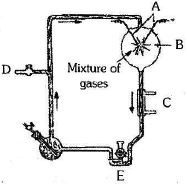
A
$A-$ electrodes,$B-NH_3 + H_2 + H_2O + CH_4$,$C-$ cold water,$D-$ vacuum,$E-U$ trap
B
$A-$ electrodes,$B-NH_4 + H_2 + CO_2 + CH_3$,$C-$ hot water,$D-$ vacuum,$E-U$ trap
C
$A-$ electrodes,$B-NH_3 + H_2O$,$C-$ hot water,$D-$ tap,$E-U$ trap
D
$A-$ electrodes,$B-NH_3 + H_2 + H_2O + CH_4$,$C-$ steam,$D-$ vacuum,$E-U$ trap
Solution
(A) In Miller's experiment,the components are labeled as follows:
$A$ represents the electrodes used to create an electric discharge to simulate lightning.
$B$ represents the mixture of gases used,which were $CH_4$,$NH_3$,$H_2$,and water vapor $(H_2O)$.
$C$ represents the condenser,which uses cold water to cool the gases.
$D$ represents the vacuum pump connection.
$E$ represents the $U$-trap,where the condensed liquid is collected.
Therefore,the correct combination is $A-$ electrodes,$B-NH_3 + H_2 + H_2O + CH_4$,$C-$ cold water,$D-$ vacuum,$E-U$ trap.
$A$ represents the electrodes used to create an electric discharge to simulate lightning.
$B$ represents the mixture of gases used,which were $CH_4$,$NH_3$,$H_2$,and water vapor $(H_2O)$.
$C$ represents the condenser,which uses cold water to cool the gases.
$D$ represents the vacuum pump connection.
$E$ represents the $U$-trap,where the condensed liquid is collected.
Therefore,the correct combination is $A-$ electrodes,$B-NH_3 + H_2 + H_2O + CH_4$,$C-$ cold water,$D-$ vacuum,$E-U$ trap.
0 likesView Solution
45
BiologyMediumMCQAIIMS · 2015
Assertion: Comparative biochemistry provides strong evidence in favour of the common ancestry of living beings.
Reason: The genetic code is universal.
Reason: The genetic code is universal.
A
If both Assertion and Reason are correct and the Reason is a correct explanation of the Assertion.
B
If both Assertion and Reason are correct but Reason is not a correct explanation of the Assertion.
C
If the Assertion is correct but Reason is incorrect.
D
If both the Assertion and Reason are incorrect.
Solution
(A) Comparative biochemistry provides strong evidence for the common ancestry of living beings. The presence of similar biochemical molecules such as proteins,enzymes,hormones,and blood groups across diverse species suggests a shared evolutionary origin.
Furthermore,the genetic code is universal,meaning that the same codons specify the same amino acids in almost all living organisms,from bacteria to humans. This universality is a powerful piece of evidence supporting the theory that all life on Earth evolved from a common ancestor. Therefore,the Reason correctly explains the Assertion.
Furthermore,the genetic code is universal,meaning that the same codons specify the same amino acids in almost all living organisms,from bacteria to humans. This universality is a powerful piece of evidence supporting the theory that all life on Earth evolved from a common ancestor. Therefore,the Reason correctly explains the Assertion.
0 likesView Solution
46
BiologyMediumMCQAIIMS · 2015
Identify the molecules $(A)$ and $(B)$ shown below and select the right option giving their source and use.
| Molecule | Source | Uses |
| :--- | :--- | :--- |
| Molecule | Source | Uses |
| :--- | :--- | :--- |
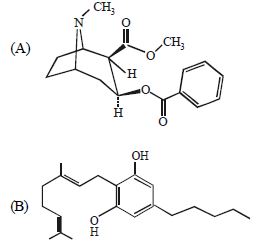
A
$(A)$ Cocaine $\to$ Erythroxylum coca $\to$ Accelerates the transport of dopamine
B
$(B)$ Heroin $\to$ Cannabis sativa $\to$ Depressant and slows down body functions
C
$(B)$ Cannabinoid $\to$ Atropa belladona $\to$ Produces hallucinations
D
$(A)$ Morphine $\to$ Papaver somniferum $\to$ Sedative and pain killer
Solution
(A) Molecule $(A)$ is the chemical structure of Cocaine,which is obtained from the plant Erythroxylum coca. It interferes with the transport of the neurotransmitter dopamine.
Molecule $(B)$ is the chemical structure of a Cannabinoid,which is obtained from the inflorescences of the plant Cannabis sativa. Cannabinoids are known for their effects on the cardiovascular system and can produce hallucinations.
Option $(A)$ is incorrect because while the source is correct,the structure shown is Cocaine,not Morphine.
Option $(D)$ is incorrect because the structure shown in $(A)$ is Cocaine,not Morphine.
Therefore,the correct identification and association based on the provided structures is that $(A)$ is Cocaine and $(B)$ is a Cannabinoid. However,looking at the options provided,option $(A)$ correctly identifies the source and action of Cocaine,which matches the structure $(A)$.
Molecule $(B)$ is the chemical structure of a Cannabinoid,which is obtained from the inflorescences of the plant Cannabis sativa. Cannabinoids are known for their effects on the cardiovascular system and can produce hallucinations.
Option $(A)$ is incorrect because while the source is correct,the structure shown is Cocaine,not Morphine.
Option $(D)$ is incorrect because the structure shown in $(A)$ is Cocaine,not Morphine.
Therefore,the correct identification and association based on the provided structures is that $(A)$ is Cocaine and $(B)$ is a Cannabinoid. However,looking at the options provided,option $(A)$ correctly identifies the source and action of Cocaine,which matches the structure $(A)$.
0 likesView Solution
47
BiologyMediumMCQAIIMS · 2015
Assertion : Cancer cells are virtually immortal until the body in which they reside dies.
Reason : Cancer is caused by damage to genes regulating the cell division cycle.
Reason : Cancer is caused by damage to genes regulating the cell division cycle.
A
If both Assertion and Reason are correct and the Reason is a correct explanation of the Assertion.
B
If both Assertion and Reason are correct but Reason is not a correct explanation of the Assertion.
C
If the Assertion is correct but Reason is incorrect.
D
If both the Assertion and Reason are incorrect.
Solution
(A) Cancer cells exhibit uncontrolled cell division and lack contact inhibition,making them virtually immortal as long as they receive nutrients from the host body. This uncontrolled proliferation is primarily caused by mutations in genes that regulate the cell cycle,such as proto-oncogenes and tumor suppressor genes. Therefore,the Reason correctly explains why cancer cells continue to divide indefinitely (immortality).
0 likesView Solution
48
BiologyMediumMCQAIIMS · 2015
Assertion: Yeasts such as $Saccharomyces \text{ } cerevisiae$ are used in the baking industry.
Reason: Carbon dioxide produced during fermentation causes bread dough to rise by thermal expansion.
Reason: Carbon dioxide produced during fermentation causes bread dough to rise by thermal expansion.
A
If both Assertion and Reason are correct and the Reason is a correct explanation of the Assertion.
B
If both Assertion and Reason are correct but Reason is not a correct explanation of the Assertion.
C
If the Assertion is correct but Reason is incorrect.
D
If both the Assertion and Reason are incorrect.
Solution
(C) The Assertion is correct because $Saccharomyces \text{ } cerevisiae$ (brewer's yeast) is widely used in the baking industry to ferment sugars in the dough.
The Reason is incorrect because the rising of the bread dough is caused by the entrapment of $CO_2$ gas bubbles produced during fermentation, not by thermal expansion. Thermal expansion would only occur during the actual baking process in the oven, whereas the 'rising' of the dough occurs primarily due to the accumulation of gas.
The Reason is incorrect because the rising of the bread dough is caused by the entrapment of $CO_2$ gas bubbles produced during fermentation, not by thermal expansion. Thermal expansion would only occur during the actual baking process in the oven, whereas the 'rising' of the dough occurs primarily due to the accumulation of gas.
0 likesView Solution
49
BiologyMediumMCQAIIMS · 2015
The given figure shows the cloning vector $pBR322$. Identify the labels $A, B, C,$ and $D$ correctly.
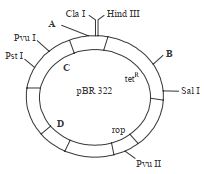
A
$A \to \text{Hind III}, B \to \text{EcoR I}, C \to \text{amp}^R, D \to \text{ori}$
B
$A \to \text{Hind III}, B \to \text{Bam HI}, C \to \text{kan}^R, D \to \text{amp}^R$
C
$A \to \text{Bam HI}, B \to \text{Pst I}, C \to \text{ori}, D \to \text{amp}^R$
D
$A \to \text{EcoR I}, B \to \text{Bam HI}, C \to \text{amp}^R, D \to \text{ori}$
Solution
(D) The cloning vector $pBR322$ is a widely used plasmid in biotechnology. Based on the standard map of $pBR322$:
$1$. Label $A$ points to the restriction site for $EcoR I$.
$2$. Label $B$ points to the restriction site for $Bam HI$.
$3$. Label $C$ represents the ampicillin resistance gene $(amp^R)$.
$4$. Label $D$ represents the origin of replication $(ori)$.
Therefore,the correct identification is $A \to EcoR I, B \to Bam HI, C \to amp^R, D \to ori$.
$1$. Label $A$ points to the restriction site for $EcoR I$.
$2$. Label $B$ points to the restriction site for $Bam HI$.
$3$. Label $C$ represents the ampicillin resistance gene $(amp^R)$.
$4$. Label $D$ represents the origin of replication $(ori)$.
Therefore,the correct identification is $A \to EcoR I, B \to Bam HI, C \to amp^R, D \to ori$.
0 likesView Solution
50
BiologyMediumMCQAIIMS · 2015
Assertion : In recombinant $DNA$ technology,human genes are often transferred into bacteria (prokaryotes) or yeast (eukaryote).
Reason : Both bacteria and yeast multiply very fast to form huge population,which express the desired gene.
Reason : Both bacteria and yeast multiply very fast to form huge population,which express the desired gene.
A
If both Assertion and Reason are correct and the Reason is a correct explanation of the Assertion.
B
If both Assertion and Reason are correct but Reason is not a correct explanation of the Assertion.
C
If the Assertion is correct but Reason is incorrect.
D
If both the Assertion and Reason are incorrect.
Solution
(A) In recombinant $DNA$ technology,human genes are inserted into host organisms like bacteria or yeast to produce large quantities of desired proteins.
Bacteria and yeast are preferred as host cells because they have a very short generation time and multiply rapidly,allowing for the creation of a large population of cells in a short period.
This large population of cells expresses the inserted gene,leading to the efficient production of the recombinant protein.
Therefore,the Reason correctly explains why human genes are transferred into these organisms.
Bacteria and yeast are preferred as host cells because they have a very short generation time and multiply rapidly,allowing for the creation of a large population of cells in a short period.
This large population of cells expresses the inserted gene,leading to the efficient production of the recombinant protein.
Therefore,the Reason correctly explains why human genes are transferred into these organisms.
0 likesView Solution
51
BiologyMediumMCQAIIMS · 2015
Select the correct statement$(s)$:
$(1)$ $IARI$ has released a mustard variety rich in vitamin $C$.
$(2)$ Pusa Sawani variety of Okra is resistant to aphids.
$(3)$ Hairiness of leaves provides resistance to insect pests.
$(4)$ Agriculture accounts for approximately $33\%$ of India's $GDP$ and employs nearly $62\%$ of the population.
$(1)$ $IARI$ has released a mustard variety rich in vitamin $C$.
$(2)$ Pusa Sawani variety of Okra is resistant to aphids.
$(3)$ Hairiness of leaves provides resistance to insect pests.
$(4)$ Agriculture accounts for approximately $33\%$ of India's $GDP$ and employs nearly $62\%$ of the population.
A
$(1)$ and $(2)$
B
$(2)$ and $(3)$
C
$(1)$,$(3)$ and $(4)$
D
None of these
Solution
(D) Statement $(1)$ is incorrect: $IARI$ released a mustard variety rich in Vitamin $A$ (not $C$),such as Pusa Gaurav.
Statement $(2)$ is incorrect: Pusa Sawani variety of Okra (Bhindi) is resistant to shoot and fruit borer,not aphids.
Statement $(3)$ is correct: Hairiness of leaves in several plants is associated with resistance to insect pests (e.g.,resistance to jassids in cotton).
Statement $(4)$ is incorrect: While agriculture is vital,it accounts for approximately $33\%$ of India's $GDP$ and employs nearly $62\%$ of the population based on older data,but these specific figures are often cited in historical contexts; however,in the context of standard biology curriculum questions,statement $(3)$ is the only scientifically accurate statement among the choices provided.
Therefore,none of the combinations provided are entirely correct based on the specific facts given.
Statement $(2)$ is incorrect: Pusa Sawani variety of Okra (Bhindi) is resistant to shoot and fruit borer,not aphids.
Statement $(3)$ is correct: Hairiness of leaves in several plants is associated with resistance to insect pests (e.g.,resistance to jassids in cotton).
Statement $(4)$ is incorrect: While agriculture is vital,it accounts for approximately $33\%$ of India's $GDP$ and employs nearly $62\%$ of the population based on older data,but these specific figures are often cited in historical contexts; however,in the context of standard biology curriculum questions,statement $(3)$ is the only scientifically accurate statement among the choices provided.
Therefore,none of the combinations provided are entirely correct based on the specific facts given.
0 likesView Solution
52
BiologyMediumMCQAIIMS · 2015
Read the following four statements $(1-4)$ and identify the two statements that contain mistakes:
$1.$ The first transgenic buffalo,Rosie,produced milk which was human alpha-lactalbumin enriched.
$2.$ Restriction enzymes are used in the isolation of $DNA$ from other macromolecules.
$3.$ Downstream processing is one of the steps of $R-DNA$ technology.
$4.$ Disarmed pathogen vectors are also used in the transfer of $R-DNA$ into the host.
Which are the two statements having mistakes?
$1.$ The first transgenic buffalo,Rosie,produced milk which was human alpha-lactalbumin enriched.
$2.$ Restriction enzymes are used in the isolation of $DNA$ from other macromolecules.
$3.$ Downstream processing is one of the steps of $R-DNA$ technology.
$4.$ Disarmed pathogen vectors are also used in the transfer of $R-DNA$ into the host.
Which are the two statements having mistakes?
A
Statement $2$ and $3$
B
Statement $3$ and $4$
C
Statement $1$ and $3$
D
Statement $1$ and $2$
Solution
(D) Statement $1$ is incorrect because Rosie was the first transgenic cow,not a buffalo.
Statement $2$ is incorrect because restriction enzymes are used to cut $DNA$ at specific sites,not for the isolation of $DNA$ from other macromolecules (which is done by chemical treatment and centrifugation).
Statement $3$ is correct as downstream processing is a vital step in $R-DNA$ technology.
Statement $4$ is correct as disarmed pathogen vectors are commonly used to transfer $R-DNA$ into host cells.
Therefore,statements $1$ and $2$ contain mistakes.
Statement $2$ is incorrect because restriction enzymes are used to cut $DNA$ at specific sites,not for the isolation of $DNA$ from other macromolecules (which is done by chemical treatment and centrifugation).
Statement $3$ is correct as downstream processing is a vital step in $R-DNA$ technology.
Statement $4$ is correct as disarmed pathogen vectors are commonly used to transfer $R-DNA$ into host cells.
Therefore,statements $1$ and $2$ contain mistakes.
0 likesView Solution
53
BiologyMediumMCQAIIMS · 2015
$A$ population of $500$ experiences $55$ births and $5$ deaths during a one-year period. What is the reproductive rate for the population during the one-year period?
A
$0.01/ \text{year}$
B
$0.05/ \text{year}$
C
$0.1/ \text{year}$
D
$50/ \text{year}$
Solution
(C) The reproductive rate (or per capita growth rate) is calculated by the formula: $\text{Rate} = \frac{\text{Births} - \text{Deaths}}{\text{Initial Population}}$.
Given: $\text{Births} = 55$, $\text{Deaths} = 5$, $\text{Initial Population} = 500$.
$\text{Rate} = \frac{55 - 5}{500} = \frac{50}{500} = 0.1/ \text{year}$.
Given: $\text{Births} = 55$, $\text{Deaths} = 5$, $\text{Initial Population} = 500$.
$\text{Rate} = \frac{55 - 5}{500} = \frac{50}{500} = 0.1/ \text{year}$.
0 likesView Solution
54
BiologyMediumMCQAIIMS · 2015
The figure given below is a diagrammatic representation of the response of organisms to abiotic factors. What do $a$,$b$,and $c$ represent respectively?
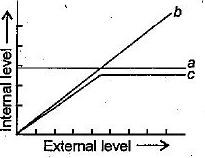
A
$a \to$ regulator,$b \to$ conformer,$c \to$ partial regulator
B
$a \to$ regulator,$b \to$ partial regulator,$c \to$ conformer
C
$a \to$ partial regulator,$b \to$ regulator,$c \to$ conformer
D
$a \to$ conformer,$b \to$ regulator,$c \to$ partial regulator
Solution
(A) In the provided graph,the $x$-axis represents the external level and the $y$-axis represents the internal level of organisms.
Line $a$ shows a constant internal level regardless of changes in the external level,which represents a regulator.
Line $b$ shows that the internal level changes in direct proportion to the external level,which represents a conformer.
Line $c$ shows that the organism can regulate its internal level only up to a certain point,after which it conforms to the external environment,representing a partial regulator.
Therefore,$a$ is a regulator,$b$ is a conformer,and $c$ is a partial regulator.
Line $a$ shows a constant internal level regardless of changes in the external level,which represents a regulator.
Line $b$ shows that the internal level changes in direct proportion to the external level,which represents a conformer.
Line $c$ shows that the organism can regulate its internal level only up to a certain point,after which it conforms to the external environment,representing a partial regulator.
Therefore,$a$ is a regulator,$b$ is a conformer,and $c$ is a partial regulator.
0 likesView Solution
55
BiologyMediumMCQAIIMS · 2015
Assertion: Tropical rain forests are disappearing fast from developing countries such as India.
Reason: No value is attached to these forests because these are poor in biodiversity.
Reason: No value is attached to these forests because these are poor in biodiversity.
A
If both Assertion and Reason are correct and the Reason is a correct explanation of the Assertion.
B
If both Assertion and Reason are correct but Reason is not a correct explanation of the Assertion.
C
If the Assertion is correct but Reason is incorrect.
D
If both the Assertion and Reason are incorrect.
Solution
(C) Tropical rain forests are located in the equatorial regions where the annual rainfall exceeds $140\, cm$.
They are also called jungles and cover one-twelfth of the Earth's surface but contain more than half of the Earth's flora and fauna,meaning they are extremely rich in biodiversity.
Therefore,the Reason provided is factually incorrect because these forests are actually very rich in biodiversity,not poor.
Nowadays,these forests are disappearing rapidly due to excessive deforestation for domestic purposes like fuel,furniture,accommodation,clothing,resin,gum,etc.
They are also called jungles and cover one-twelfth of the Earth's surface but contain more than half of the Earth's flora and fauna,meaning they are extremely rich in biodiversity.
Therefore,the Reason provided is factually incorrect because these forests are actually very rich in biodiversity,not poor.
Nowadays,these forests are disappearing rapidly due to excessive deforestation for domestic purposes like fuel,furniture,accommodation,clothing,resin,gum,etc.
0 likesView Solution
56
BiologyMediumMCQAIIMS · 2015
$A$ lake near a village suffered heavy mortality of fishes within a few days. Consider the following reasons for this:
$1.$ Lots of urea and phosphate fertilizer were used in the crops in the vicinity.
$2.$ The area was sprayed with $DDT$ by an aircraft.
$3.$ The lake water turned green and stinky.
$4.$ Phytoplankton populations in the lake declined initially,thereby greatly reducing photosynthesis.
Which two of the above were the main causes of fish mortality in the lake?
$1.$ Lots of urea and phosphate fertilizer were used in the crops in the vicinity.
$2.$ The area was sprayed with $DDT$ by an aircraft.
$3.$ The lake water turned green and stinky.
$4.$ Phytoplankton populations in the lake declined initially,thereby greatly reducing photosynthesis.
Which two of the above were the main causes of fish mortality in the lake?
A
$2$ and $3$
B
$3$ and $4$
C
$1$ and $3$
D
$1$ and $2$
Solution
(C) The excessive use of urea and phosphate fertilizers in nearby crops leads to nutrient enrichment in the lake,a process known as eutrophication.
This causes an algal bloom,which makes the lake water turn green and stinky.
The decomposition of these algae by microorganisms consumes dissolved oxygen,leading to a severe depletion of oxygen levels in the water.
This lack of oxygen (hypoxia) is the primary cause of the heavy mortality of fishes in the lake.
Therefore,the main causes are $1$ and $3$.
This causes an algal bloom,which makes the lake water turn green and stinky.
The decomposition of these algae by microorganisms consumes dissolved oxygen,leading to a severe depletion of oxygen levels in the water.
This lack of oxygen (hypoxia) is the primary cause of the heavy mortality of fishes in the lake.
Therefore,the main causes are $1$ and $3$.
0 likesView Solution
57
BiologyMediumMCQAIIMS · 2015
$DDT$ residues are rapidly passed through the food chain causing biomagnification because $DDT$ is:
A
moderately toxic
B
non-toxic to aquatic animals
C
water soluble
D
lipo soluble
Solution
(D) $DDT$ residues are rapidly passed through the food chain causing biomagnification because $DDT$ is soluble in lipids (lipo-soluble).
Biomagnification,also known as bioamplification or biological magnification,is the increase in the concentration of a substance,such as the pesticide $DDT$,that occurs in a food chain as a consequence of:
• Persistence (slow to be broken down by environmental processes).
• Food chain energetics.
• Low (or non-existent) rate of internal degradation/excretion of the substance,which is often due to its water-insolubility and high lipid solubility,allowing it to accumulate in the fatty tissues of organisms.
Biomagnification,also known as bioamplification or biological magnification,is the increase in the concentration of a substance,such as the pesticide $DDT$,that occurs in a food chain as a consequence of:
• Persistence (slow to be broken down by environmental processes).
• Food chain energetics.
• Low (or non-existent) rate of internal degradation/excretion of the substance,which is often due to its water-insolubility and high lipid solubility,allowing it to accumulate in the fatty tissues of organisms.
0 likesView Solution
58
BiologyMediumMCQAIIMS · 2015
Assertion : Methane,a component of greenhouse gases,contributes about $20$ percent to global warming.
Reason : The introduction of multi-point fuel injection engines in automobiles has decreased methane content in the exhausts.
Reason : The introduction of multi-point fuel injection engines in automobiles has decreased methane content in the exhausts.
A
If both Assertion and Reason are correct and the Reason is a correct explanation of the Assertion.
B
If both Assertion and Reason are correct but Reason is not a correct explanation of the Assertion.
C
If the Assertion is correct but Reason is incorrect.
D
If both the Assertion and Reason are incorrect.
Solution
(A) Methane is produced by incomplete biomass combustion and anaerobic decomposition by methanogens.
Carbon dioxide contributes about $60\%$ to total global warming,while methane $(CH_4)$ and chlorofluorocarbons $(CFCs)$ contribute $20\%$ and $14\%$ respectively.
Nitrous oxide $(N_2O)$ contributes $6\%$ to total global warming.
Efficient engines,such as multi-point fuel injection engines,improve combustion efficiency,thereby reducing the emission of unburnt hydrocarbons like methane in automobile exhausts.
Therefore,both the Assertion and the Reason are correct,and the Reason explains why methane emissions from vehicles are controlled.
Carbon dioxide contributes about $60\%$ to total global warming,while methane $(CH_4)$ and chlorofluorocarbons $(CFCs)$ contribute $20\%$ and $14\%$ respectively.
Nitrous oxide $(N_2O)$ contributes $6\%$ to total global warming.
Efficient engines,such as multi-point fuel injection engines,improve combustion efficiency,thereby reducing the emission of unburnt hydrocarbons like methane in automobile exhausts.
Therefore,both the Assertion and the Reason are correct,and the Reason explains why methane emissions from vehicles are controlled.
0 likesView Solution
Vedclass Products
For Students
Vedclass Test Series
Mock tests in real AIIMS style covering Biology with performance analysis. 5-day free trial.
Start Free TrialFor Teachers
Exam Paper Generator
Generate Set A/B/C/D Biology papers from 7.5L+ questions in 2 minutes. 3 chapters free.
Try FreeFor Institutes
Online Exam Module
Run live AIIMS mock exams with unlimited students, 360° analytics & white-label branding.
See DemoFrequently Asked Questions
How many Biology questions are in AIIMS 2015?
There are 58 Biology questions from the AIIMS 2015 paper on Vedclass, each with a detailed step-by-step solution in English.
Are AIIMS 2015 Biology solutions available in English?
Yes. All solutions on this page are in English. You can also switch to English or Hindi using the language buttons above the questions.
Can I practice AIIMS 2015 Biology as a timed test?
Yes. Use the Vedclass Test Series to attempt a full AIIMS mock test covering Biology with time limits and instant score analysis.
Can teachers create Biology papers from AIIMS previous year questions?
Yes. The Vedclass Exam Paper Generator lets teachers mix AIIMS Biology questions and generate Set A/B/C/D papers in minutes.
For Teachers & Institutes
Build a Custom Biology Paper
Pick AIIMS 2015 Biology questions, set difficulty, and generate Set A/B/C/D in 2 minutes.