
ChemistryQ1–100 of 179 questions
Page 1 of 2 · English
1
ChemistryMCQAIIMS · 2019
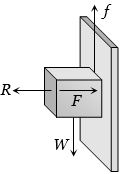
$A$ block of weight $W$ is held against a vertical wall by applying a horizontal force $F$. The minimum value of $F$ needed to hold the block is
A
Less than $W$
B
Equal to $W$
C
Greater than $W$
D
Data is insufficient
Solution
(C) For the block to be held in equilibrium against the wall,the vertical forces must balance,and the horizontal forces must balance.
$1$. Vertical equilibrium: The frictional force $f$ acting upwards must balance the weight $W$ of the block acting downwards.
$f = W$
$2$. Horizontal equilibrium: The applied horizontal force $F$ must be balanced by the normal reaction $R$ from the wall.
$R = F$
$3$. Friction condition: The maximum static frictional force is given by $f_{max} = \mu R$,where $\mu$ is the coefficient of static friction. To hold the block,we need $f \leq \mu R$.
Substituting the values from steps $1$ and $2$:
$W \leq \mu F$
$F \geq \frac{W}{\mu}$
Since the coefficient of static friction $\mu$ for most surfaces is less than $1$ $(\mu < 1)$,it follows that $F > W$.
Therefore,the minimum force required is $F = \frac{W}{\mu}$,which is greater than $W$.
$1$. Vertical equilibrium: The frictional force $f$ acting upwards must balance the weight $W$ of the block acting downwards.
$f = W$
$2$. Horizontal equilibrium: The applied horizontal force $F$ must be balanced by the normal reaction $R$ from the wall.
$R = F$
$3$. Friction condition: The maximum static frictional force is given by $f_{max} = \mu R$,where $\mu$ is the coefficient of static friction. To hold the block,we need $f \leq \mu R$.
Substituting the values from steps $1$ and $2$:
$W \leq \mu F$
$F \geq \frac{W}{\mu}$
Since the coefficient of static friction $\mu$ for most surfaces is less than $1$ $(\mu < 1)$,it follows that $F > W$.
Therefore,the minimum force required is $F = \frac{W}{\mu}$,which is greater than $W$.
0 likesView Solution
2
ChemistryMCQAIIMS · 2019
$A$ body of $5\, kg$ weight kept on a rough inclined plane of angle $30^\circ$ starts sliding with a constant velocity. Then the coefficient of friction is:
A
$1/\sqrt{3}$
B
$2/\sqrt{3}$
C
$\sqrt{3}$
D
$2\sqrt{3}$
Solution
(A) When a body slides down an inclined plane with a constant velocity,the net force acting on the body is zero.
This implies that the component of gravitational force acting down the plane is balanced by the force of kinetic friction.
The component of weight acting down the plane is $mg \sin \theta$.
The force of kinetic friction is $f_k = \mu_k N = \mu_k mg \cos \theta$.
Equating these two forces: $mg \sin \theta = \mu_k mg \cos \theta$.
Therefore,$\mu_k = \frac{\sin \theta}{\cos \theta} = \tan \theta$.
Given $\theta = 30^\circ$,we have $\mu_k = \tan 30^\circ = \frac{1}{\sqrt{3}}$.
This implies that the component of gravitational force acting down the plane is balanced by the force of kinetic friction.
The component of weight acting down the plane is $mg \sin \theta$.
The force of kinetic friction is $f_k = \mu_k N = \mu_k mg \cos \theta$.
Equating these two forces: $mg \sin \theta = \mu_k mg \cos \theta$.
Therefore,$\mu_k = \frac{\sin \theta}{\cos \theta} = \tan \theta$.
Given $\theta = 30^\circ$,we have $\mu_k = \tan 30^\circ = \frac{1}{\sqrt{3}}$.
0 likesView Solution
3
ChemistryMCQAIIMS · 2019
$A$ $2 \ m$ long rod of radius $1 \ cm$ which is fixed from one end is given a twist of $0.8 \ radians$. The shear strain developed will be
A
$0.002$
B
$0.004$
C
$0.008$
D
$0.016$
Solution
(B) The shear strain $\phi$ for a rod of length $L$ and radius $r$ subjected to a twist angle $\theta$ is given by the relation:
$r\theta = L\phi$
Given:
Length $L = 2 \ m$
Radius $r = 1 \ cm = 10^{-2} \ m$
Twist angle $\theta = 0.8 \ radians$
Substituting the values into the formula:
$10^{-2} \times 0.8 = 2 \times \phi$
$0.008 = 2 \times \phi$
$\phi = \frac{0.008}{2} = 0.004$
Thus,the shear strain developed is $0.004$.
$r\theta = L\phi$
Given:
Length $L = 2 \ m$
Radius $r = 1 \ cm = 10^{-2} \ m$
Twist angle $\theta = 0.8 \ radians$
Substituting the values into the formula:
$10^{-2} \times 0.8 = 2 \times \phi$
$0.008 = 2 \times \phi$
$\phi = \frac{0.008}{2} = 0.004$
Thus,the shear strain developed is $0.004$.
0 likesView Solution
4
ChemistryMCQAIIMS · 2019
The principle of controlled chain reaction is used in
A
Atomic energy reactor
B
Atom bomb
C
The core of sun
D
Artificial radioactivity
Solution
(A) In a nuclear reactor,nuclear fission is carried out through a sustained and controlled chain reaction.
In an atom bomb,the chain reaction is uncontrolled.
The core of the sun operates on nuclear fusion,not fission.
Therefore,the correct option is $A$.
In an atom bomb,the chain reaction is uncontrolled.
The core of the sun operates on nuclear fusion,not fission.
Therefore,the correct option is $A$.
0 likesView Solution
5
ChemistryMCQAIIMS · 2019
The method of concentrating the ore which makes use of the difference in density between ore and impurities is called
A
Levigation
B
Leaching
C
Magnetic separation
D
Liquifaction
Solution
(A) Levigation (also known as hydraulic washing or gravity separation) is based on the difference in densities of the metallic ore and gangue particles.
Powdered ore is treated with a stream of running water,where the lighter gangue particles are washed away and the heavier ore particles are left behind.
Powdered ore is treated with a stream of running water,where the lighter gangue particles are washed away and the heavier ore particles are left behind.
0 likesView Solution


7
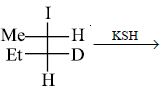
ChemistryMCQAIIMS · 2019
The product is:
A
B
C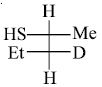
D
Solution
(A) The reaction of a chiral alkyl iodide with $KSH$ proceeds via an $S_N2$ mechanism.
In an $S_N2$ reaction,the nucleophile $(SH^-)$ attacks from the side opposite to the leaving group $(I^-)$,resulting in the inversion of configuration (Walden inversion) at the chiral center.
Starting with the given Fischer projection,the $I$ atom is at the top. The $SH^-$ nucleophile will replace the $I$ atom,and the configuration at the chiral carbon will be inverted.
Comparing the options,option $A$ represents the product where the $SH$ group has replaced the $I$ group with the correct stereochemical inversion.
In an $S_N2$ reaction,the nucleophile $(SH^-)$ attacks from the side opposite to the leaving group $(I^-)$,resulting in the inversion of configuration (Walden inversion) at the chiral center.
Starting with the given Fischer projection,the $I$ atom is at the top. The $SH^-$ nucleophile will replace the $I$ atom,and the configuration at the chiral carbon will be inverted.
Comparing the options,option $A$ represents the product where the $SH$ group has replaced the $I$ group with the correct stereochemical inversion.
0 likesView Solution
8
ChemistryMCQAIIMS · 2019
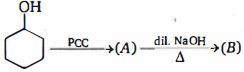
Product $(B)$ is
A
B
C
D
Solution
(B) $1$. The starting material is cyclohexanol. Treatment with $PCC$ (Pyridinium chlorochromate) oxidizes the secondary alcohol to cyclohexanone,which is product $(A)$.
$2$. Cyclohexanone undergoes self-aldol condensation in the presence of dilute $NaOH$ and heat. The enolate of one cyclohexanone molecule attacks the carbonyl carbon of another cyclohexanone molecule.
$3$. This is followed by dehydration (elimination of water) to form the $\alpha,\beta$-unsaturated ketone,which is $2$-cyclohexylidenecyclohexanone,represented as product $(B)$.
$2$. Cyclohexanone undergoes self-aldol condensation in the presence of dilute $NaOH$ and heat. The enolate of one cyclohexanone molecule attacks the carbonyl carbon of another cyclohexanone molecule.
$3$. This is followed by dehydration (elimination of water) to form the $\alpha,\beta$-unsaturated ketone,which is $2$-cyclohexylidenecyclohexanone,represented as product $(B)$.
0 likesView Solution
9
ChemistryAdvancedMCQAIIMS · 2019
In order to oxidize a mixture of one mole of each of $FeC_2O_4$,$Fe_2(C_2O_4)_3$,$FeSO_4$ and $Fe_2(SO_4)_3$ in acidic medium,the number of moles of $KMnO_4$ required is
A
$1$
B
$1.5$
C
$2$
D
$3$
Solution
(C) The oxidation of the components in an acidic medium involves the following $n$-factors:
$FeSO_4 \rightarrow Fe^{3+} + SO_4^{2-} + e^-$,so $n$-factor $= 1$.
$FeC_2O_4 \rightarrow Fe^{3+} + 2CO_2 + 3e^-$,so $n$-factor $= 3$.
$Fe_2(C_2O_4)_3 \rightarrow 2Fe^{3+} + 6CO_2 + 6e^-$,so $n$-factor $= 6$.
$Fe_2(SO_4)_3$ is already in the highest oxidation state $(Fe^{3+})$,so it does not react.
For $KMnO_4$ in acidic medium,the $n$-factor is $5$.
Using the principle of equivalence: $n_{eq}(KMnO_4) = n_{eq}(FeC_2O_4) + n_{eq}(Fe_2(C_2O_4)_3) + n_{eq}(FeSO_4)$.
Let $x$ be the moles of $KMnO_4$: $x \times 5 = (1 \times 3) + (1 \times 6) + (1 \times 1)$.
$5x = 10$,which gives $x = 2$ moles.
$FeSO_4 \rightarrow Fe^{3+} + SO_4^{2-} + e^-$,so $n$-factor $= 1$.
$FeC_2O_4 \rightarrow Fe^{3+} + 2CO_2 + 3e^-$,so $n$-factor $= 3$.
$Fe_2(C_2O_4)_3 \rightarrow 2Fe^{3+} + 6CO_2 + 6e^-$,so $n$-factor $= 6$.
$Fe_2(SO_4)_3$ is already in the highest oxidation state $(Fe^{3+})$,so it does not react.
For $KMnO_4$ in acidic medium,the $n$-factor is $5$.
Using the principle of equivalence: $n_{eq}(KMnO_4) = n_{eq}(FeC_2O_4) + n_{eq}(Fe_2(C_2O_4)_3) + n_{eq}(FeSO_4)$.
Let $x$ be the moles of $KMnO_4$: $x \times 5 = (1 \times 3) + (1 \times 6) + (1 \times 1)$.
$5x = 10$,which gives $x = 2$ moles.
0 likesView Solution
10
ChemistryMCQAIIMS · 2019
The coefficient of apparent expansion of mercury in a glass vessel is $153 \times 10^{-6}/^{\circ}C$ and in a steel vessel is $144 \times 10^{-6}/^{\circ}C$. If $\alpha$ for steel is $12 \times 10^{-6}/^{\circ}C$,then $\alpha$ for glass is:
A
$9 \times 10^{-6}/^{\circ}C$
B
$6 \times 10^{-6}/^{\circ}C$
C
$36 \times 10^{-6}/^{\circ}C$
D
$27 \times 10^{-6}/^{\circ}C$
Solution
(A) The relationship between real expansion,apparent expansion,and vessel expansion is given by: $\gamma_{real} = \gamma_{app} + \gamma_{vessel}$.
Since the real expansion coefficient of mercury $(\gamma_{real})$ is constant,we have: $(\gamma_{app} + \gamma_{vessel})_{glass} = (\gamma_{app} + \gamma_{vessel})_{steel}$.
Given $\gamma_{app, glass} = 153 \times 10^{-6}/^{\circ}C$ and $\gamma_{app, steel} = 144 \times 10^{-6}/^{\circ}C$.
For a solid vessel,the volume expansion coefficient is $\gamma_{vessel} = 3\alpha$.
For steel,$\gamma_{vessel, steel} = 3 \times (12 \times 10^{-6}) = 36 \times 10^{-6}/^{\circ}C$.
Substituting these values into the equation: $153 \times 10^{-6} + \gamma_{vessel, glass} = 144 \times 10^{-6} + 36 \times 10^{-6}$.
$153 \times 10^{-6} + \gamma_{vessel, glass} = 180 \times 10^{-6}$.
$\gamma_{vessel, glass} = (180 - 153) \times 10^{-6} = 27 \times 10^{-6}/^{\circ}C$.
Since $\gamma_{vessel, glass} = 3\alpha_{glass}$,we have $3\alpha_{glass} = 27 \times 10^{-6}/^{\circ}C$.
Therefore,$\alpha_{glass} = 9 \times 10^{-6}/^{\circ}C$.
Since the real expansion coefficient of mercury $(\gamma_{real})$ is constant,we have: $(\gamma_{app} + \gamma_{vessel})_{glass} = (\gamma_{app} + \gamma_{vessel})_{steel}$.
Given $\gamma_{app, glass} = 153 \times 10^{-6}/^{\circ}C$ and $\gamma_{app, steel} = 144 \times 10^{-6}/^{\circ}C$.
For a solid vessel,the volume expansion coefficient is $\gamma_{vessel} = 3\alpha$.
For steel,$\gamma_{vessel, steel} = 3 \times (12 \times 10^{-6}) = 36 \times 10^{-6}/^{\circ}C$.
Substituting these values into the equation: $153 \times 10^{-6} + \gamma_{vessel, glass} = 144 \times 10^{-6} + 36 \times 10^{-6}$.
$153 \times 10^{-6} + \gamma_{vessel, glass} = 180 \times 10^{-6}$.
$\gamma_{vessel, glass} = (180 - 153) \times 10^{-6} = 27 \times 10^{-6}/^{\circ}C$.
Since $\gamma_{vessel, glass} = 3\alpha_{glass}$,we have $3\alpha_{glass} = 27 \times 10^{-6}/^{\circ}C$.
Therefore,$\alpha_{glass} = 9 \times 10^{-6}/^{\circ}C$.
0 likesView Solution
11
ChemistryMCQAIIMS · 2019
The correct order of $S-S$ bond length in the following oxyanions is:
$(I)$ $S_2O_4^{2-}$ $(II)$ $S_2O_5^{2-}$ $(III)$ $S_2O_6^{2-}$
$(I)$ $S_2O_4^{2-}$ $(II)$ $S_2O_5^{2-}$ $(III)$ $S_2O_6^{2-}$
A
$I > II > III$
B
$I > III > II$
C
$III > II > I$
D
$III > I > II$
Solution
(A) To determine the $S-S$ bond length,we analyze the hybridization of the sulfur atoms in each oxyanion.
$(I)$ In $S_2O_4^{2-}$ (dithionite),each sulfur atom is $sp^3$ hybridized with one lone pair. The $S-S$ bond is formed by the overlap of $sp^3$ orbitals.
$(II)$ In $S_2O_5^{2-}$ (disulfite),one sulfur is $sp^3$ hybridized (with a lone pair) and the other is $sp^3$ hybridized (without a lone pair). The $S-S$ bond involves an $sp^3-sp^3$ overlap.
$(III)$ In $S_2O_6^{2-}$ (dithionate),both sulfur atoms are $sp^3$ hybridized without lone pairs.
According to Bent's rule,the $s$-character in a hybrid orbital increases as the electronegativity of the attached atom decreases or as the number of lone pairs on the central atom increases. Higher $s$-character leads to shorter bond lengths. Conversely,higher $p$-character leads to longer bond lengths.
In $S_2O_4^{2-}$,the sulfur atoms have more $p$-character in the $S-S$ bond due to the presence of lone pairs,resulting in the longest $S-S$ bond.
In $S_2O_6^{2-}$,the sulfur atoms have more $s$-character in the $S-S$ bond,resulting in the shortest $S-S$ bond.
Therefore,the order of $S-S$ bond length is $I > II > III$.
$(I)$ In $S_2O_4^{2-}$ (dithionite),each sulfur atom is $sp^3$ hybridized with one lone pair. The $S-S$ bond is formed by the overlap of $sp^3$ orbitals.
$(II)$ In $S_2O_5^{2-}$ (disulfite),one sulfur is $sp^3$ hybridized (with a lone pair) and the other is $sp^3$ hybridized (without a lone pair). The $S-S$ bond involves an $sp^3-sp^3$ overlap.
$(III)$ In $S_2O_6^{2-}$ (dithionate),both sulfur atoms are $sp^3$ hybridized without lone pairs.
According to Bent's rule,the $s$-character in a hybrid orbital increases as the electronegativity of the attached atom decreases or as the number of lone pairs on the central atom increases. Higher $s$-character leads to shorter bond lengths. Conversely,higher $p$-character leads to longer bond lengths.
In $S_2O_4^{2-}$,the sulfur atoms have more $p$-character in the $S-S$ bond due to the presence of lone pairs,resulting in the longest $S-S$ bond.
In $S_2O_6^{2-}$,the sulfur atoms have more $s$-character in the $S-S$ bond,resulting in the shortest $S-S$ bond.
Therefore,the order of $S-S$ bond length is $I > II > III$.
0 likesView Solution
12
ChemistryMCQAIIMS · 2019
The coefficient of apparent expansion of mercury in a glass vessel is $153 \times 10^{-6}/^{\circ}C$ and in a steel vessel is $144 \times 10^{-6}/^{\circ}C$. If $\alpha$ for steel is $12 \times 10^{-6}/^{\circ}C$,then $\alpha$ for glass is:
A
$9 \times 10^{-6}/^{\circ}C$
B
$6 \times 10^{-6}/^{\circ}C$
C
$36 \times 10^{-6}/^{\circ}C$
D
$27 \times 10^{-6}/^{\circ}C$
Solution
(A) The coefficient of real expansion of mercury $(\gamma_{\text{real}})$ is constant for both cases.
We know that $\gamma_{\text{real}} = \gamma_{\text{app}} + \gamma_{\text{vessel}}$,where $\gamma_{\text{vessel}} = 3\alpha$.
For the steel vessel: $\gamma_{\text{real}} = 144 \times 10^{-6} + 3(12 \times 10^{-6}) = 144 \times 10^{-6} + 36 \times 10^{-6} = 180 \times 10^{-6}/^{\circ}C$.
For the glass vessel: $\gamma_{\text{real}} = \gamma_{\text{app, glass}} + 3\alpha_{\text{glass}}$.
Equating the two: $180 \times 10^{-6} = 153 \times 10^{-6} + 3\alpha_{\text{glass}}$.
$3\alpha_{\text{glass}} = (180 - 153) \times 10^{-6} = 27 \times 10^{-6}/^{\circ}C$.
$\alpha_{\text{glass}} = 9 \times 10^{-6}/^{\circ}C$.
We know that $\gamma_{\text{real}} = \gamma_{\text{app}} + \gamma_{\text{vessel}}$,where $\gamma_{\text{vessel}} = 3\alpha$.
For the steel vessel: $\gamma_{\text{real}} = 144 \times 10^{-6} + 3(12 \times 10^{-6}) = 144 \times 10^{-6} + 36 \times 10^{-6} = 180 \times 10^{-6}/^{\circ}C$.
For the glass vessel: $\gamma_{\text{real}} = \gamma_{\text{app, glass}} + 3\alpha_{\text{glass}}$.
Equating the two: $180 \times 10^{-6} = 153 \times 10^{-6} + 3\alpha_{\text{glass}}$.
$3\alpha_{\text{glass}} = (180 - 153) \times 10^{-6} = 27 \times 10^{-6}/^{\circ}C$.
$\alpha_{\text{glass}} = 9 \times 10^{-6}/^{\circ}C$.
0 likesView Solution
13
ChemistryMCQAIIMS · 2019
Which of the following is not an example of a chain-growth polymer?
A
Neoprene
B
Buna-$S$
C
$PMMA$
D
Glyptal
Solution
(D) Chain-growth polymers are formed by the addition of monomers containing double or triple bonds (e.g.,alkenes,dienes).
Neoprene,Buna-$S$,and $PMMA$ (polymethyl methacrylate) are addition polymers formed via chain-growth polymerization.
Glyptal is a polyester formed by the condensation polymerization of ethylene glycol and phthalic acid.
Therefore,Glyptal is a step-growth (condensation) polymer,not a chain-growth polymer.
Neoprene,Buna-$S$,and $PMMA$ (polymethyl methacrylate) are addition polymers formed via chain-growth polymerization.
Glyptal is a polyester formed by the condensation polymerization of ethylene glycol and phthalic acid.
Therefore,Glyptal is a step-growth (condensation) polymer,not a chain-growth polymer.
0 likesView Solution
14
ChemistryMCQAIIMS · 2019
The monomer of $[-C(CH_3)_2 - CH_2-]_n$ is ...
A
$2$-methylpropene
B
Styrene
C
Propylene
D
Ethene
Solution
(A) The given polymer is polyisobutylene,which is formed by the polymerization of isobutylene ($2$-methylpropene).
The structure of the monomer is $CH_2=C(CH_3)_2$.
Therefore,the correct monomer is $2$-methylpropene.
The structure of the monomer is $CH_2=C(CH_3)_2$.
Therefore,the correct monomer is $2$-methylpropene.
0 likesView Solution
15
ChemistryMCQAIIMS · 2019
Select the correct option with respect to the age pyramids shown in the image.

A
$a$ - Expanding,$b$ - Stable,$c$ - Declining
B
$a$ - Stable,$b$ - Expanding,$c$ - Declining
C
$a$ - Stable,$b$ - Declining,$c$ - Expanding
D
$a$ - Declining,$b$ - Stable,$c$ - Expanding
Solution
(A) Age pyramids represent the distribution of various age groups in a population.
$1$. Pyramid $a$ has a broad base of pre-reproductive individuals,indicating an expanding population.
$2$. Pyramid $b$ has pre-reproductive and reproductive individuals in similar proportions,indicating a stable population.
$3$. Pyramid $c$ has a narrow base of pre-reproductive individuals compared to reproductive individuals,indicating a declining population.
$1$. Pyramid $a$ has a broad base of pre-reproductive individuals,indicating an expanding population.
$2$. Pyramid $b$ has pre-reproductive and reproductive individuals in similar proportions,indicating a stable population.
$3$. Pyramid $c$ has a narrow base of pre-reproductive individuals compared to reproductive individuals,indicating a declining population.
0 likesView Solution
16
ChemistryMCQAIIMS · 2019
The quiescent centre in root meristem serves as a:
A
Site for storage of food which is utilized during maturation.
B
Reservoir of growth hormones.
C
Reserve for replenishment of damaged cells of the meristem.
D
Region for absorption of water.
Solution
(C) The concept of the quiescent centre was proposed by $Clowes$ in $1961$.
Based on autoradiographic studies of $DNA$ synthesis in the root tip of $Zea$ $mays$,he identified a region of cells with low $DNA$,$RNA$,and protein concentrations.
He termed this region the quiescent centre.
These cells are characterized by a low rate of division but can become active to replenish damaged cells of the meristem,acting as a reserve pool.
Based on autoradiographic studies of $DNA$ synthesis in the root tip of $Zea$ $mays$,he identified a region of cells with low $DNA$,$RNA$,and protein concentrations.
He termed this region the quiescent centre.
These cells are characterized by a low rate of division but can become active to replenish damaged cells of the meristem,acting as a reserve pool.
0 likesView Solution
17
ChemistryMCQAIIMS · 2019
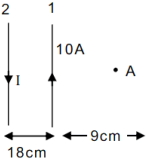
In the figure,two parallel infinitely long current-carrying wires are shown. If the resultant magnetic field at point $A$ is zero,then determine the current $I$ (in $A$).
A
$50$
B
$15$
C
$30$
D
$25$
Solution
(C) The magnetic field due to an infinitely long straight wire at a distance $r$ is given by $B = \frac{\mu_{0} I}{2 \pi r}$.
Let $I_{1} = 10 \text{ A}$ be the current in the right wire and $I_{2} = I$ be the current in the left wire.
The distance of point $A$ from the right wire is $r_{1} = 9 \text{ cm}$.
The distance of point $A$ from the left wire is $r_{2} = 18 \text{ cm} + 9 \text{ cm} = 27 \text{ cm}$.
For the resultant magnetic field at point $A$ to be zero,the magnitudes of the magnetic fields produced by both wires must be equal,i.e.,$B_{1} = B_{2}$.
$\frac{\mu_{0} I_{1}}{2 \pi r_{1}} = \frac{\mu_{0} I_{2}}{2 \pi r_{2}}$
$\frac{10}{9} = \frac{I}{27}$
$I = \frac{10 \times 27}{9} = 30 \text{ A}$.
Let $I_{1} = 10 \text{ A}$ be the current in the right wire and $I_{2} = I$ be the current in the left wire.
The distance of point $A$ from the right wire is $r_{1} = 9 \text{ cm}$.
The distance of point $A$ from the left wire is $r_{2} = 18 \text{ cm} + 9 \text{ cm} = 27 \text{ cm}$.
For the resultant magnetic field at point $A$ to be zero,the magnitudes of the magnetic fields produced by both wires must be equal,i.e.,$B_{1} = B_{2}$.
$\frac{\mu_{0} I_{1}}{2 \pi r_{1}} = \frac{\mu_{0} I_{2}}{2 \pi r_{2}}$
$\frac{10}{9} = \frac{I}{27}$
$I = \frac{10 \times 27}{9} = 30 \text{ A}$.
0 likesView Solution
18
ChemistryMCQAIIMS · 2019
$A$ cricketer can throw a ball to a maximum horizontal distance of $100 \, m$. The speed with which he throws the ball is (to the nearest integer) (in $m/s$).
A
$30$
B
$42$
C
$32$
D
$35$
Solution
(C) The maximum horizontal range $R_{\max}$ of a projectile is given by the formula:
$R_{\max} = \frac{u^2}{g}$
where $u$ is the initial speed and $g$ is the acceleration due to gravity.
Given $R_{\max} = 100 \, m$ and taking $g = 10 \, m/s^2$:
$100 = \frac{u^2}{10}$
$u^2 = 1000$
$u = \sqrt{1000} \approx 31.62 \, m/s$
Rounding to the nearest integer,we get $u = 32 \, m/s$.
$R_{\max} = \frac{u^2}{g}$
where $u$ is the initial speed and $g$ is the acceleration due to gravity.
Given $R_{\max} = 100 \, m$ and taking $g = 10 \, m/s^2$:
$100 = \frac{u^2}{10}$
$u^2 = 1000$
$u = \sqrt{1000} \approx 31.62 \, m/s$
Rounding to the nearest integer,we get $u = 32 \, m/s$.
0 likesView Solution
19
ChemistryMediumMCQAIIMS · 2019
Compare the stability of the following free radicals:
$(1)$ $CH_3 - \dot{CH} - CH_3$
$(2)$ $C_6H_5 - \dot{CH_2}$
$(3)$ $\dot{CH_2} - CH(CH_3)_2$
$(4)$ $\dot{CH_2} - CH_3$
$(1)$ $CH_3 - \dot{CH} - CH_3$
$(2)$ $C_6H_5 - \dot{CH_2}$
$(3)$ $\dot{CH_2} - CH(CH_3)_2$
$(4)$ $\dot{CH_2} - CH_3$
A
$II > I > III > IV$
B
$II > I > IV > III$
C
$I > II > III > IV$
D
$IV > III > I > II$
Solution
(B) The stability of free radicals is determined by factors such as resonance,hyperconjugation,and the inductive effect.
$(II)$ $C_6H_5 - \dot{CH_2}$ (Benzyl radical) is resonance-stabilized by the phenyl ring,making it the most stable.
$(I)$ $CH_3 - \dot{CH} - CH_3$ is a secondary $(2^{\circ})$ radical with $6$ alpha-hydrogen atoms,providing significant hyperconjugation.
$(IV)$ $\dot{CH_2} - CH_3$ is a primary $(1^{\circ})$ radical with $3$ alpha-hydrogen atoms.
$(III)$ $\dot{CH_2} - CH(CH_3)_2$ is a primary $(1^{\circ})$ radical with only $1$ alpha-hydrogen atom.
Comparing the hyperconjugation,the order of stability for the remaining radicals is $I > IV > III$.
Thus,the overall order of stability is $II > I > IV > III$.
$(II)$ $C_6H_5 - \dot{CH_2}$ (Benzyl radical) is resonance-stabilized by the phenyl ring,making it the most stable.
$(I)$ $CH_3 - \dot{CH} - CH_3$ is a secondary $(2^{\circ})$ radical with $6$ alpha-hydrogen atoms,providing significant hyperconjugation.
$(IV)$ $\dot{CH_2} - CH_3$ is a primary $(1^{\circ})$ radical with $3$ alpha-hydrogen atoms.
$(III)$ $\dot{CH_2} - CH(CH_3)_2$ is a primary $(1^{\circ})$ radical with only $1$ alpha-hydrogen atom.
Comparing the hyperconjugation,the order of stability for the remaining radicals is $I > IV > III$.
Thus,the overall order of stability is $II > I > IV > III$.
0 likesView Solution
20
ChemistryMediumMCQAIIMS · 2019
Write the $IUPAC$ name of the following compound:
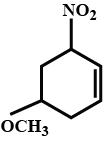
A
$4-$Methoxy$-6-$nitrocyclohexene
B
$5-$Methoxy$-3-$nitrocyclohexene
C
$3-$Nitro$-1-$methoxycyclohex$-4-$ene
D
$3-$Nitro$-5-$methoxycyclohexene
Solution
(B) To determine the $IUPAC$ name,we follow these rules:
$1$. The principal functional group is the double bond,so the ring is numbered starting from the double bond.
$2$. We number the ring to give the lowest possible locants to the substituents ($-OCH_3$ and $-NO_2$).
$3$. Starting from the double bond,if we number clockwise,the substituents are at positions $3$ and $5$. If we number counter-clockwise,they are at positions $4$ and $6$. The set $(3, 5)$ is lower than $(4, 6)$.
$4$. Thus,the double bond is between $C1$ and $C2$,the $-NO_2$ group is at $C3$,and the $-OCH_3$ group is at $C5$.
$5$. Alphabetically,'methoxy' comes before 'nitro'.
$6$. The correct $IUPAC$ name is $5-$Methoxy$-3-$nitrocyclohexene.
$1$. The principal functional group is the double bond,so the ring is numbered starting from the double bond.
$2$. We number the ring to give the lowest possible locants to the substituents ($-OCH_3$ and $-NO_2$).
$3$. Starting from the double bond,if we number clockwise,the substituents are at positions $3$ and $5$. If we number counter-clockwise,they are at positions $4$ and $6$. The set $(3, 5)$ is lower than $(4, 6)$.
$4$. Thus,the double bond is between $C1$ and $C2$,the $-NO_2$ group is at $C3$,and the $-OCH_3$ group is at $C5$.
$5$. Alphabetically,'methoxy' comes before 'nitro'.
$6$. The correct $IUPAC$ name is $5-$Methoxy$-3-$nitrocyclohexene.
0 likesView Solution
21
ChemistryDifficultMCQAIIMS · 2019
Identify the structures of $P$ and $Q$ in the following reaction sequence:

A
$P$ = $CH_3O-C_6H_4-C(OH)=CH-C_6H_4-CH_3$,$Q$ = $CH_3O-C_6H_4-C(=O)-CH(Br)-C_6H_4-CH_3$
B
$P$ = $CH_3O-C_6H_4-C(=O)-CH_2-C_6H_4-CH_3$,$Q$ = $CH_3O-C_6H_4-C(=O)-CH_2-C_6H_4-CH_2Br$
C
$P$ = $CH_3O-C_6H_4-C(=O)-CH_2-C_6H_4-CH_3$,$Q$ = $CH_3O-C_6H_4-C(=O)-CH_2-C_6H_3(Br)-CH_3$
D
$P$ = $CH_3O-C_6H_4-C(=O)-CH_2-C_6H_5$,$Q$ = $CH_3O-C_6H_4-C(=O)-CH(Br)-C_6H_5$
Solution
(C) The reaction of an alkyne with $H_2O/H^+/Hg^{2+}$ follows Markovnikov's addition to form an enol,which undergoes keto-enol tautomerization to form a ketone $(P)$.
$P$ is $CH_3O-C_6H_4-C(=O)-CH_2-C_6H_4-CH_3$.
Next,the reaction with $Br_2/FeBr_3$ is an electrophilic aromatic substitution $(EAS)$. The $-C(=O)CH_2Ar$ group is deactivating and meta-directing,while the $-OCH_3$ group is strongly activating and ortho/para-directing. The $-CH_3$ group is weakly activating and ortho/para-directing. The electrophilic substitution will occur on the ring containing the $-CH_3$ group,specifically at the position ortho to the $-CH_3$ group,as it is more activated than the ring with the deactivating carbonyl group. Thus,$Q$ is $CH_3O-C_6H_4-C(=O)-CH_2-C_6H_3(Br)-CH_3$.
$P$ is $CH_3O-C_6H_4-C(=O)-CH_2-C_6H_4-CH_3$.
Next,the reaction with $Br_2/FeBr_3$ is an electrophilic aromatic substitution $(EAS)$. The $-C(=O)CH_2Ar$ group is deactivating and meta-directing,while the $-OCH_3$ group is strongly activating and ortho/para-directing. The $-CH_3$ group is weakly activating and ortho/para-directing. The electrophilic substitution will occur on the ring containing the $-CH_3$ group,specifically at the position ortho to the $-CH_3$ group,as it is more activated than the ring with the deactivating carbonyl group. Thus,$Q$ is $CH_3O-C_6H_4-C(=O)-CH_2-C_6H_3(Br)-CH_3$.
0 likesView Solution
22
ChemistryMediumMCQAIIMS · 2019
Which of the following statements is incorrect for paper chromatography?
A
It is a type of partition chromatography.
B
It is a stationary phase.
C
$R_{f}$ value decreases when the rate of adsorption increases.
D
None of these.
Solution
(B) Paper chromatography is a technique based on partition chromatography,where the stationary phase is water trapped in the cellulose fibers of the paper and the mobile phase is a solvent.
Option $B$ is incorrect because paper chromatography is a method or technique,not a stationary phase itself.
The stationary phase is the water held by the paper,not the paper itself.
Option $B$ is incorrect because paper chromatography is a method or technique,not a stationary phase itself.
The stationary phase is the water held by the paper,not the paper itself.
0 likesView Solution
23
ChemistryMCQAIIMS · 2019
The product is:
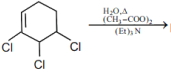
A
B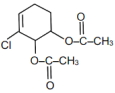
C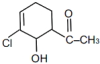
D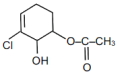
Solution
(A) The reaction proceeds in two steps. First,the starting material,$3,4$-dichlorocyclohexene,undergoes hydrolysis in the presence of $H_2O$ and $\Delta$ to form an allylic alcohol. The loss of a chloride ion creates a stable allylic carbocation,which is then attacked by water to yield $3$-chloro-cyclohex$-2-$en$-1-$ol (or a similar isomer depending on the specific starting material structure).
Second,the resulting alcohol undergoes an acetylation reaction with acetic anhydride $(CH_3COO)_2$ in the presence of a base,triethylamine $(Et)_3N$. This converts the hydroxyl group $(-OH)$ into an acetoxy group $(-O-CO-CH_3)$.
Based on the provided reaction scheme,the final product is the acetylated derivative of the intermediate alcohol,which corresponds to option $A$.
Second,the resulting alcohol undergoes an acetylation reaction with acetic anhydride $(CH_3COO)_2$ in the presence of a base,triethylamine $(Et)_3N$. This converts the hydroxyl group $(-OH)$ into an acetoxy group $(-O-CO-CH_3)$.
Based on the provided reaction scheme,the final product is the acetylated derivative of the intermediate alcohol,which corresponds to option $A$.
0 likesView Solution
24
ChemistryDifficultMCQAIIMS · 2019
The product is:
A
B
C
D
Solution
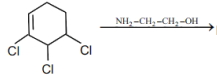
(A) The reactant $NH_{2}-CH_{2}-CH_{2}-OH$ contains two nucleophilic groups,$-OH$ and $-NH_{2}$.
Between these,the $-NH_{2}$ group is a stronger nucleophile.
The reaction proceeds via the formation of a stable carbocation intermediate.
The $-NH_{2}$ group attacks the more stable carbocation site,while the $-OH$ group attacks the other site,leading to the formation of a cyclic product as shown in the reaction mechanism.
Between these,the $-NH_{2}$ group is a stronger nucleophile.
The reaction proceeds via the formation of a stable carbocation intermediate.
The $-NH_{2}$ group attacks the more stable carbocation site,while the $-OH$ group attacks the other site,leading to the formation of a cyclic product as shown in the reaction mechanism.
0 likesView Solution
25
ChemistryMediumMCQAIIMS · 2019
Which of the following compounds have the number of lone pairs on the central $Xe$ atom equal to zero?
$XeO_{3}, XeO_{2}F_{2}, XeO_{4}, XeO_{3}F_{2}, Ba_{2}XeF_{4}$
$XeO_{3}, XeO_{2}F_{2}, XeO_{4}, XeO_{3}F_{2}, Ba_{2}XeF_{4}$
A
$2$
B
$3$
C
$4$
D
$0$
Solution
(A) To determine the number of lone pairs on the central $Xe$ atom,we use the formula: $\text{Lone pairs} = \frac{1}{2} \times (V - M - C + A)$,where $V$ is the number of valence electrons of the central atom,$M$ is the number of monovalent atoms,$C$ is the cationic charge,and $A$ is the anionic charge.
$1$. $XeO_{3}$: $Xe$ has $8$ valence electrons. $O$ is divalent,so $M=0$. Lone pairs = $\frac{1}{2} \times (8 - 0) = 4$ electrons = $1$ lone pair.
$2$. $XeO_{2}F_{2}$: $Xe$ has $8$ valence electrons. $F$ is monovalent,so $M=2$. Lone pairs = $\frac{1}{2} \times (8 - 2) = 3$ electrons = $1$ lone pair.
$3$. $XeO_{4}$: $Xe$ has $8$ valence electrons. $O$ is divalent,so $M=0$. Lone pairs = $\frac{1}{2} \times (8 - 0) = 4$ electrons = $0$ lone pairs.
$4$. $XeO_{3}F_{2}$: $Xe$ has $8$ valence electrons. $F$ is monovalent,so $M=2$. Lone pairs = $\frac{1}{2} \times (8 - 2) = 3$ electrons = $0$ lone pairs.
$5$. $Ba_{2}XeF_{4}$ contains the $[XeF_{6}]^{2-}$ ion (as $Ba^{2+}$ is the cation). For $[XeF_{6}]^{2-}$,$Xe$ has $8$ valence electrons,$F$ is monovalent $(M=6)$,and anionic charge is $2$ $(A=2)$. Lone pairs = $\frac{1}{2} \times (8 - 6 + 2) = 2$ electrons = $1$ lone pair.
Thus,$XeO_{4}$ and $XeO_{3}F_{2}$ have zero lone pairs on the central $Xe$ atom. The count is $2$.
$1$. $XeO_{3}$: $Xe$ has $8$ valence electrons. $O$ is divalent,so $M=0$. Lone pairs = $\frac{1}{2} \times (8 - 0) = 4$ electrons = $1$ lone pair.
$2$. $XeO_{2}F_{2}$: $Xe$ has $8$ valence electrons. $F$ is monovalent,so $M=2$. Lone pairs = $\frac{1}{2} \times (8 - 2) = 3$ electrons = $1$ lone pair.
$3$. $XeO_{4}$: $Xe$ has $8$ valence electrons. $O$ is divalent,so $M=0$. Lone pairs = $\frac{1}{2} \times (8 - 0) = 4$ electrons = $0$ lone pairs.
$4$. $XeO_{3}F_{2}$: $Xe$ has $8$ valence electrons. $F$ is monovalent,so $M=2$. Lone pairs = $\frac{1}{2} \times (8 - 2) = 3$ electrons = $0$ lone pairs.
$5$. $Ba_{2}XeF_{4}$ contains the $[XeF_{6}]^{2-}$ ion (as $Ba^{2+}$ is the cation). For $[XeF_{6}]^{2-}$,$Xe$ has $8$ valence electrons,$F$ is monovalent $(M=6)$,and anionic charge is $2$ $(A=2)$. Lone pairs = $\frac{1}{2} \times (8 - 6 + 2) = 2$ electrons = $1$ lone pair.
Thus,$XeO_{4}$ and $XeO_{3}F_{2}$ have zero lone pairs on the central $Xe$ atom. The count is $2$.
0 likesView Solution
26
ChemistryEasyMCQAIIMS · 2019
If $n=2$ for $He^{+}$ ion,then what is the wavelength in $\mathring{A}$?
A
$3.33$
B
$6.42$
C
$1.47$
D
$2.37$
Solution
(A) For $He^{+}$ ion,the atomic number $Z=2$ and the principal quantum number $n=2$.
The circumference of the orbit is given by $2 \pi r = n \lambda$.
The radius of the $n^{th}$ orbit is given by $r = 0.529 \frac{n^{2}}{Z} \ \mathring{A}$.
Substituting the value of $r$ in the circumference formula:
$2 \pi \times (0.529 \frac{n^{2}}{Z}) = n \lambda$
$\lambda = \frac{2 \pi \times 0.529 \times n}{Z}$
Substituting $n=2$ and $Z=2$:
$\lambda = \frac{2 \times 3.1416 \times 0.529 \times 2}{2} \ \mathring{A}$
$\lambda = 2 \times 3.1416 \times 0.529 \ \mathring{A} \approx 3.33 \ \mathring{A}$.
The circumference of the orbit is given by $2 \pi r = n \lambda$.
The radius of the $n^{th}$ orbit is given by $r = 0.529 \frac{n^{2}}{Z} \ \mathring{A}$.
Substituting the value of $r$ in the circumference formula:
$2 \pi \times (0.529 \frac{n^{2}}{Z}) = n \lambda$
$\lambda = \frac{2 \pi \times 0.529 \times n}{Z}$
Substituting $n=2$ and $Z=2$:
$\lambda = \frac{2 \times 3.1416 \times 0.529 \times 2}{2} \ \mathring{A}$
$\lambda = 2 \times 3.1416 \times 0.529 \ \mathring{A} \approx 3.33 \ \mathring{A}$.
0 likesView Solution
27
ChemistryEasyMCQAIIMS · 2019
The correct relation is:
A
$\Delta G = - RT \ln (Q / K)$
B
$\Delta G = + RT \ln K$
C
$\Delta G = - RT \ln (K / Q)$
D
$\Delta G = + RT \ln Q$
Solution
(C) The equation for Gibbs free energy is given by:
$\Delta G = \Delta G^{\circ} + RT \ln Q \dots(1)$
At equilibrium,$\Delta G = 0$ and $Q = K$,therefore:
$0 = \Delta G^{\circ} + RT \ln K \implies \Delta G^{\circ} = - RT \ln K \dots(2)$
Substituting equation $(2)$ into equation $(1)$:
$\Delta G = - RT \ln K + RT \ln Q$
$\Delta G = RT \ln Q - RT \ln K$
$\Delta G = RT \ln (Q / K)$
Wait,checking the options provided: $\Delta G = - RT \ln (K / Q)$ is equivalent to $\Delta G = RT \ln (Q / K)$. Thus,option $C$ is correct.
$\Delta G = \Delta G^{\circ} + RT \ln Q \dots(1)$
At equilibrium,$\Delta G = 0$ and $Q = K$,therefore:
$0 = \Delta G^{\circ} + RT \ln K \implies \Delta G^{\circ} = - RT \ln K \dots(2)$
Substituting equation $(2)$ into equation $(1)$:
$\Delta G = - RT \ln K + RT \ln Q$
$\Delta G = RT \ln Q - RT \ln K$
$\Delta G = RT \ln (Q / K)$
Wait,checking the options provided: $\Delta G = - RT \ln (K / Q)$ is equivalent to $\Delta G = RT \ln (Q / K)$. Thus,option $C$ is correct.
0 likesView Solution
28
ChemistryEasyMCQAIIMS · 2019
Which of the following has maximum solubility at low $pH$?
A
$NH_4Cl$
B
$NaCl$
C
$Na_3PO_4$
D
$Sr(OH)_2$
Solution
(D) Solubility of a salt containing a basic anion or hydroxide increases as the $pH$ decreases (i.e.,in acidic medium) because $H^+$ ions react with the basic anions to form weak acids or water.
$Sr(OH)_2$ is a base that dissociates as: $Sr(OH)_2 \rightarrow Sr^{2+} + 2OH^-$.
In an acidic solution,the high concentration of $H^+$ ions reacts with $OH^-$ ions to form water: $H^+ + OH^- \rightarrow H_2O$.
This removal of $OH^-$ ions shifts the equilibrium to the right according to Le Chatelier's principle,thereby increasing the solubility of $Sr(OH)_2$.
$Sr(OH)_2$ is a base that dissociates as: $Sr(OH)_2 \rightarrow Sr^{2+} + 2OH^-$.
In an acidic solution,the high concentration of $H^+$ ions reacts with $OH^-$ ions to form water: $H^+ + OH^- \rightarrow H_2O$.
This removal of $OH^-$ ions shifts the equilibrium to the right according to Le Chatelier's principle,thereby increasing the solubility of $Sr(OH)_2$.
0 likesView Solution
29
ChemistryMediumMCQAIIMS · 2019
Find the empirical formula of the compound if $M = 68 \%$ (Atomic mass $= 34$) and the remaining $32 \%$ is oxygen:
A
$MO$
B
$M_2O$
C
$MO_2$
D
$M_2O_3$
Solution
(A) Moles of $M = \frac{68}{34} = 2$
Moles of $O = \frac{32}{16} = 2$
Simple molar ratio $M:O = 2:2 = 1:1$
Empirical formula is $MO$.
Moles of $O = \frac{32}{16} = 2$
Simple molar ratio $M:O = 2:2 = 1:1$
Empirical formula is $MO$.
0 likesView Solution
30
ChemistryMediumMCQAIIMS · 2019
Which of the following are methanides?
A
Only $a, d$
B
Only $a, b$
C
Only $c, d$
D
Only $b, d$
Solution
(A) Methanides are carbides that react with water to produce methane $(CH_{4})$ gas.
$Be_{2}C + 4 H_{2}O \rightarrow 2 Be(OH)_{2} + CH_{4}$
$Al_{4}C_{3} + 12 H_{2}O \rightarrow 4 Al(OH)_{3} + 3 CH_{4}$
$CaC_{2}$ is an acetylide,producing ethyne $(C_{2}H_{2})$.
$Mg_{2}C_{3}$ is an allylide,producing propyne $(C_{3}H_{4})$.
Therefore,$Be_{2}C$ and $Al_{4}C_{3}$ are methanides.
$Be_{2}C + 4 H_{2}O \rightarrow 2 Be(OH)_{2} + CH_{4}$
$Al_{4}C_{3} + 12 H_{2}O \rightarrow 4 Al(OH)_{3} + 3 CH_{4}$
$CaC_{2}$ is an acetylide,producing ethyne $(C_{2}H_{2})$.
$Mg_{2}C_{3}$ is an allylide,producing propyne $(C_{3}H_{4})$.
Therefore,$Be_{2}C$ and $Al_{4}C_{3}$ are methanides.
0 likesView Solution
31
ChemistryEasyMCQAIIMS · 2019
On heating,hydrazoic acid forms:
A
$NH_3$
B
$N_2 + NH_3$
C
$N_2H_4 + NH_3$
D
$H_2 + 3N_2$
Solution
(D) Hydrazoic acid $(HN_3)$ decomposes upon heating to form hydrogen gas and nitrogen gas.
The balanced chemical equation is:
$2HN_3 \xrightarrow{\Delta} H_2 + 3N_2$
The balanced chemical equation is:
$2HN_3 \xrightarrow{\Delta} H_2 + 3N_2$
0 likesView Solution
32
ChemistryMediumMCQAIIMS · 2019
Which metals upon heating in the presence of air followed by hydrolysis give ammonia?
A
$Li, K$
B
$Rb, Mg$
C
$Li, Mg$
D
$Ca, K$
Solution
(C) The elements $Li$ and $Mg$ react with atmospheric nitrogen upon heating to form their respective nitrides,which upon hydrolysis yield ammonia. The reactions are as follows:
$6 Li + N_2 \rightarrow 2 Li_3N$
$Li_3N + 3 H_2O \rightarrow 3 LiOH + NH_3 \uparrow$
$3 Mg + N_2 \rightarrow Mg_3N_2$
$Mg_3N_2 + 6 H_2O \rightarrow 3 Mg(OH)_2 + 2 NH_3 \uparrow$
$6 Li + N_2 \rightarrow 2 Li_3N$
$Li_3N + 3 H_2O \rightarrow 3 LiOH + NH_3 \uparrow$
$3 Mg + N_2 \rightarrow Mg_3N_2$
$Mg_3N_2 + 6 H_2O \rightarrow 3 Mg(OH)_2 + 2 NH_3 \uparrow$
0 likesView Solution
33
ChemistryMediumMCQAIIMS · 2019
At $25^{\circ} \text{C}$,$1 \text{ mole}$ of butane is combusted to form $CO_2$ and liquid $H_2O$. The work done is $...... \text{ L atm}$.
A
$75.6$
B
$85.6$
C
$50.3$
D
None of these
Solution
(B) The combustion reaction of butane is: $C_4H_{10(g)} + \frac{13}{2} O_{2(g)} \rightarrow 4 CO_{2(g)} + 5 H_2O_{(l)}$
The change in the number of moles of gaseous species is calculated as:
$\Delta n_g = n_{g(products)} - n_{g(reactants)} = 4 - (1 + 6.5) = 4 - 7.5 = -3.5$
The work done $(W)$ for a chemical reaction is given by the formula:
$W = -\Delta n_g RT$
Given:
$R = 0.0821 \text{ L atm K}^{-1} \text{ mol}^{-1}$
$T = 25 + 273 = 298 \text{ K}$
Substituting the values:
$W = -(-3.5 \times 0.0821 \times 298)$
$W = 3.5 \times 0.0821 \times 298$
$W = 85.63 \text{ L atm}$
Thus,the work done is approximately $85.6 \text{ L atm}$.
The change in the number of moles of gaseous species is calculated as:
$\Delta n_g = n_{g(products)} - n_{g(reactants)} = 4 - (1 + 6.5) = 4 - 7.5 = -3.5$
The work done $(W)$ for a chemical reaction is given by the formula:
$W = -\Delta n_g RT$
Given:
$R = 0.0821 \text{ L atm K}^{-1} \text{ mol}^{-1}$
$T = 25 + 273 = 298 \text{ K}$
Substituting the values:
$W = -(-3.5 \times 0.0821 \times 298)$
$W = 3.5 \times 0.0821 \times 298$
$W = 85.63 \text{ L atm}$
Thus,the work done is approximately $85.6 \text{ L atm}$.
0 likesView Solution
34
ChemistryEasyMCQAIIMS · 2019
The element having the greatest difference between its first and second ionization energies is:
A
$Ca$
B
$Sc$
C
$Ba$
D
$K$
Solution
(D) The first ionization energy $(IE_1)$ of an element is the energy required to remove the first electron,and the second ionization energy $(IE_2)$ is the energy required to remove the second electron.
For alkali metals like potassium $(K)$,the electronic configuration is $[Ar] 4s^1$.
After the removal of the first electron,it achieves the stable noble gas configuration of argon $([Ar])$.
Removing the second electron requires breaking this stable octet,which demands a very high amount of energy.
Therefore,the difference between $IE_2$ and $IE_1$ is exceptionally large for alkali metals compared to alkaline earth metals or transition metals.
For alkali metals like potassium $(K)$,the electronic configuration is $[Ar] 4s^1$.
After the removal of the first electron,it achieves the stable noble gas configuration of argon $([Ar])$.
Removing the second electron requires breaking this stable octet,which demands a very high amount of energy.
Therefore,the difference between $IE_2$ and $IE_1$ is exceptionally large for alkali metals compared to alkaline earth metals or transition metals.
0 likesView Solution
35
ChemistryMediumMCQAIIMS · 2019
The ion that has $sp^{3}d^{2}$ hybridization for the central atom is :
A
$[ICl_{4}]^{-}$
B
$[ICl_{2}]^{-}$
C
$[IF_{6}]^{-}$
D
$[BrF_{2}]^{-}$
Solution
(A) The hybridization of the central atom can be calculated using the formula: $H = \frac{1}{2}(V + M - C + A)$,where $V$ is the number of valence electrons,$M$ is the number of monovalent atoms,$C$ is the cationic charge,and $A$ is the anionic charge.
For $[ICl_{4}]^{-}$,the central atom $I$ has $7$ valence electrons,$4$ monovalent $Cl$ atoms,and $1$ negative charge. Thus,$H = \frac{1}{2}(7 + 4 + 1) = 6$,which corresponds to $sp^{3}d^{2}$ hybridization.
| Species | Hybridization |
| $[ICl_{2}]^{-}$ | $sp^{3}d$ |
| $[ICl_{4}]^{-}$ | $sp^{3}d^{2}$ |
| $[BrF_{2}]^{-}$ | $sp^{3}d$ |
| $[IF_{6}]^{-}$ | $sp^{3}d^{3}$ |
For $[ICl_{4}]^{-}$,the central atom $I$ has $7$ valence electrons,$4$ monovalent $Cl$ atoms,and $1$ negative charge. Thus,$H = \frac{1}{2}(7 + 4 + 1) = 6$,which corresponds to $sp^{3}d^{2}$ hybridization.
0 likesView Solution
36
ChemistryMediumMCQAIIMS · 2019
Consider the van der Waals constants,$a$ and $b$,for the following gases:
Which gas is expected to have the highest critical temperature?
| Gas | $Ar$ | $Ne$ | $Kr$ | $Xe$ |
|---|---|---|---|---|
| $a / (atm \ dm^6 \ mol^{-2})$ | $1.3$ | $0.2$ | $5.1$ | $4.1$ |
| $b / (10^{-2} \ dm^3 \ mol^{-1})$ | $3.2$ | $1.7$ | $1.0$ | $5.0$ |
Which gas is expected to have the highest critical temperature?
A
$Kr$
B
$Ne$
C
$Xe$
D
$Ar$
Solution
(A) The critical temperature $(T_c)$ of a gas is given by the formula: $T_c = \frac{8a}{27Rb}$.
To find the gas with the highest $T_c$,we need to calculate the ratio $(a / b)$ for each gas:
For $Ar$: $1.3 / 3.2 \approx 0.406$
For $Ne$: $0.2 / 1.7 \approx 0.117$
For $Kr$: $5.1 / 1.0 = 5.1$
For $Xe$: $4.1 / 5.0 = 0.82$
Comparing these values,the ratio $(a / b)$ is highest for $Kr$.
Therefore,$Kr$ is expected to have the highest critical temperature.
To find the gas with the highest $T_c$,we need to calculate the ratio $(a / b)$ for each gas:
For $Ar$: $1.3 / 3.2 \approx 0.406$
For $Ne$: $0.2 / 1.7 \approx 0.117$
For $Kr$: $5.1 / 1.0 = 5.1$
For $Xe$: $4.1 / 5.0 = 0.82$
Comparing these values,the ratio $(a / b)$ is highest for $Kr$.
Therefore,$Kr$ is expected to have the highest critical temperature.
0 likesView Solution
37
ChemistryMCQAIIMS · 2019
In order to oxidize a mixture of one mole of each of $FeC_2O_4$,$Fe_2(C_2O_4)_3$,$FeSO_4$,and $Fe_2(SO_4)_3$ in an acidic medium,the number of moles of $KMnO_4$ required is:
A
$2$
B
$1$
C
$3$
D
$1.5$
Solution
(A) The reduction half-reaction for $KMnO_4$ in an acidic medium is:
$MnO_4^- + 8H^+ + 5e^- \rightarrow Mn^{2+} + 4H_2O$
Thus,$1$ mole of $KMnO_4$ provides $5$ moles of electrons.
Now,calculate the moles of electrons released by each compound:
$1$. For $FeC_2O_4$: $Fe^{2+} \rightarrow Fe^{3+} + e^-$ and $C_2O_4^{2-} \rightarrow 2CO_2 + 2e^-$. Total electrons = $1 + 2 = 3$ moles.
$2$. For $Fe_2(C_2O_4)_3$: $2Fe^{2+} \rightarrow 2Fe^{3+} + 2e^-$ and $3C_2O_4^{2-} \rightarrow 6CO_2 + 6e^-$. Total electrons = $2 + 6 = 8$ moles.
$3$. For $FeSO_4$: $Fe^{2+} \rightarrow Fe^{3+} + e^-$. Total electrons = $1$ mole.
$4$. For $Fe_2(SO_4)_3$: Iron is already in the $+3$ oxidation state,so it cannot be oxidized further. Electrons = $0$ moles.
Total moles of electrons = $3 + 8 + 1 = 12$ moles.
Since $1$ mole of $KMnO_4$ accepts $5$ moles of electrons,the moles of $KMnO_4$ required = $\frac{12}{5} = 2.4$ moles.
Wait,re-evaluating the standard stoichiometry for $Fe_2(C_2O_4)_3$:
$Fe_2(C_2O_4)_3$ contains $Fe^{3+}$ and $C_2O_4^{2-}$. Only the oxalate part is oxidized: $3C_2O_4^{2-} \rightarrow 6CO_2 + 6e^-$.
Total electrons = $3 (FeC_2O_4) + 6 (Fe_2(C_2O_4)_3) + 1 (FeSO_4) = 10$ moles.
Moles of $KMnO_4 = \frac{10}{5} = 2$.
$MnO_4^- + 8H^+ + 5e^- \rightarrow Mn^{2+} + 4H_2O$
Thus,$1$ mole of $KMnO_4$ provides $5$ moles of electrons.
Now,calculate the moles of electrons released by each compound:
$1$. For $FeC_2O_4$: $Fe^{2+} \rightarrow Fe^{3+} + e^-$ and $C_2O_4^{2-} \rightarrow 2CO_2 + 2e^-$. Total electrons = $1 + 2 = 3$ moles.
$2$. For $Fe_2(C_2O_4)_3$: $2Fe^{2+} \rightarrow 2Fe^{3+} + 2e^-$ and $3C_2O_4^{2-} \rightarrow 6CO_2 + 6e^-$. Total electrons = $2 + 6 = 8$ moles.
$3$. For $FeSO_4$: $Fe^{2+} \rightarrow Fe^{3+} + e^-$. Total electrons = $1$ mole.
$4$. For $Fe_2(SO_4)_3$: Iron is already in the $+3$ oxidation state,so it cannot be oxidized further. Electrons = $0$ moles.
Total moles of electrons = $3 + 8 + 1 = 12$ moles.
Since $1$ mole of $KMnO_4$ accepts $5$ moles of electrons,the moles of $KMnO_4$ required = $\frac{12}{5} = 2.4$ moles.
Wait,re-evaluating the standard stoichiometry for $Fe_2(C_2O_4)_3$:
$Fe_2(C_2O_4)_3$ contains $Fe^{3+}$ and $C_2O_4^{2-}$. Only the oxalate part is oxidized: $3C_2O_4^{2-} \rightarrow 6CO_2 + 6e^-$.
Total electrons = $3 (FeC_2O_4) + 6 (Fe_2(C_2O_4)_3) + 1 (FeSO_4) = 10$ moles.
Moles of $KMnO_4 = \frac{10}{5} = 2$.
0 likesView Solution
38
ChemistryMediumMCQAIIMS · 2019
The synonym for water gas when used in the production of methanol is:
A
natural gas
B
fuel gas
C
laughing gas
D
syn gas
Solution
(D) An equimolar mixture of $CO$ and $H_{2}$ is obtained when steam is passed over red hot coke. This mixture is commonly known as synthesis gas or $syn \ gas$.
The reaction is:
$H_{2}O_{(g)} + C_{(s)} \rightarrow CO_{(g)} + H_{2(g)}$
The reaction is:
$H_{2}O_{(g)} + C_{(s)} \rightarrow CO_{(g)} + H_{2(g)}$
0 likesView Solution
39
ChemistryEasyMCQAIIMS · 2019
The correct order of hydration enthalpies of alkali metal ions is
A
$Li ^{+} > Na ^{+} > K ^{+} > Cs ^{+} > Rb ^{+}$
B
$Na ^{+} > Li ^{+} > K ^{+} > Rb ^{+} > Cs ^{+}$
C
$Na ^{+} > Li ^{+} > K ^{+} > Cs ^{+} > Rb ^{+}$
D
$Li ^{+} > Na ^{+} > K ^{+} > Rb ^{+} > Cs ^{+}$
Solution
(D) The size of alkali metal ions increases down the group as follows: $Li ^{+} < Na ^{+} < K ^{+} < Rb ^{+} < Cs ^{+}$.
Hydration enthalpy is inversely proportional to the ionic size $(Hydration \ Enthalpy \ \propto \ \frac{1}{\text{ionic size}})$.
Therefore,the smaller the ion,the higher its hydration enthalpy.
Thus,the correct order of hydration enthalpies is $Li ^{+} > Na ^{+} > K ^{+} > Rb ^{+} > Cs ^{+}$.
Hydration enthalpy is inversely proportional to the ionic size $(Hydration \ Enthalpy \ \propto \ \frac{1}{\text{ionic size}})$.
Therefore,the smaller the ion,the higher its hydration enthalpy.
Thus,the correct order of hydration enthalpies is $Li ^{+} > Na ^{+} > K ^{+} > Rb ^{+} > Cs ^{+}$.
0 likesView Solution
40
ChemistryEasyMCQAIIMS · 2019
Air pollution that occurs in sunlight is:
A
reducing smog
B
acid rain
C
oxidizing smog
D
fog
Solution
(C) Air pollution that occurs in sunlight is known as oxidizing smog (also called photochemical smog).
It is formed by the action of sunlight on nitrogen oxides and hydrocarbons.
It is formed by the action of sunlight on nitrogen oxides and hydrocarbons.
0 likesView Solution
41
ChemistryMCQAIIMS · 2019
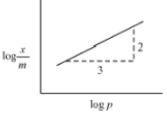
Adsorption of a gas follows the Freundlich adsorption isotherm. $x$ is the mass of the gas adsorbed on mass $m$ of the adsorbent. The plot of $\log(\frac{x}{m})$ versus $\log p$ is shown in the given graph. $\frac{x}{m}$ is proportional to :
A
$p^{2/3}$
B
$p^{3/2}$
C
$p^3$
D
$p^2$
Solution
(A) According to the Freundlich adsorption isotherm,the relationship is given by: $\frac{x}{m} = k p^{1/n}$
Taking the logarithm on both sides: $\log(\frac{x}{m}) = \log k + \frac{1}{n} \log p$
This equation represents a straight line of the form $y = mx + c$,where the slope is $\frac{1}{n}$.
From the given graph,the slope is calculated as: $\text{Slope} = \frac{\text{change in } \log(\frac{x}{m})}{\text{change in } \log p} = \frac{2}{3}$
Therefore,$\frac{1}{n} = \frac{2}{3}$.
Substituting this back into the original expression: $\frac{x}{m} \propto p^{1/n} \implies \frac{x}{m} \propto p^{2/3}$.
Taking the logarithm on both sides: $\log(\frac{x}{m}) = \log k + \frac{1}{n} \log p$
This equation represents a straight line of the form $y = mx + c$,where the slope is $\frac{1}{n}$.
From the given graph,the slope is calculated as: $\text{Slope} = \frac{\text{change in } \log(\frac{x}{m})}{\text{change in } \log p} = \frac{2}{3}$
Therefore,$\frac{1}{n} = \frac{2}{3}$.
Substituting this back into the original expression: $\frac{x}{m} \propto p^{1/n} \implies \frac{x}{m} \propto p^{2/3}$.
0 likesView Solution
42
ChemistryMediumMCQAIIMS · 2019
During the change of $O_{2}$ to $O_{2}^{-}$,the incoming electron goes to the orbital:
A
$\pi 2 p_{y}$
B
$\sigma^{*} 2 p_{z}$
C
$\pi^{*} 2 p_{x}$
D
$\pi 2 p_{x}$
Solution
(C) The electronic configuration of $O_{2}$ ($16$ electrons) is: $\sigma 1s^{2} \sigma^{*} 1s^{2} \sigma 2s^{2} \sigma^{*} 2s^{2} \sigma 2p_{z}^{2} \pi 2p_{x}^{2} = \pi 2p_{y}^{2} \pi^{*} 2p_{x}^{1} = \pi^{*} 2p_{y}^{1}$.
When an electron is added to $O_{2}$ to form $O_{2}^{-}$,the incoming electron enters the lowest energy vacant or half-filled molecular orbital,which is the $\pi^{*}$ antibonding orbital.
Thus,the electron enters the $\pi^{*} 2p_{x}$ or $\pi^{*} 2p_{y}$ orbital.
Therefore,option $(C)$ is correct.
When an electron is added to $O_{2}$ to form $O_{2}^{-}$,the incoming electron enters the lowest energy vacant or half-filled molecular orbital,which is the $\pi^{*}$ antibonding orbital.
Thus,the electron enters the $\pi^{*} 2p_{x}$ or $\pi^{*} 2p_{y}$ orbital.
Therefore,option $(C)$ is correct.
0 likesView Solution
43
ChemistryMediumMCQAIIMS · 2019
What is the $IUPAC$ name of the given compound?

A
$1-$Chloro$-2-$methyl$-4-$nitrobenzene
B
$2-$Chloro$-1-$methyl$-5-$nitrobenzene
C
$1-$Nitro$-1-$methyl$-4-$nitrobenzene
D
$2-$Methyl$-1-$chloro$-4-$nitrobenzene
Solution
(A) To determine the $IUPAC$ name,we follow the alphabetical order for substituents on the benzene ring.
$1$. The substituents are chloro $(-Cl)$,methyl $(-CH_3)$,and nitro $(-NO_2)$.
$2$. Alphabetically,'chloro' comes before 'methyl',which comes before 'nitro'.
$3$. We number the ring to give the lowest possible locants to the substituents: $1-$chloro,$2-$methyl,and $4-$nitro.
$4$. Thus,the correct $IUPAC$ name is $1-$Chloro$-2-$methyl$-4-$nitrobenzene.
$1$. The substituents are chloro $(-Cl)$,methyl $(-CH_3)$,and nitro $(-NO_2)$.
$2$. Alphabetically,'chloro' comes before 'methyl',which comes before 'nitro'.
$3$. We number the ring to give the lowest possible locants to the substituents: $1-$chloro,$2-$methyl,and $4-$nitro.
$4$. Thus,the correct $IUPAC$ name is $1-$Chloro$-2-$methyl$-4-$nitrobenzene.
0 likesView Solution
44
ChemistryMediumMCQAIIMS · 2019
Stability order of the following carbocations is:
$(i)$ $CH_3-C^{+}(CH_3)-CH_2-CH_3$
$(ii)$ $CH_3-CH^{+}-CH_3$
$(iii)$ $CH_3-C^{+}(CH_3)-CH_3$
$(iv)$ $Ph-CH^{+}-CH_3$
$(i)$ $CH_3-C^{+}(CH_3)-CH_2-CH_3$
$(ii)$ $CH_3-CH^{+}-CH_3$
$(iii)$ $CH_3-C^{+}(CH_3)-CH_3$
$(iv)$ $Ph-CH^{+}-CH_3$
A
$i > ii > iii > iv$
B
$iv > iii > i > ii$
C
$iv > iii > ii > i$
D
$iii > iv > ii > i$
Solution
(B) The stability of carbocations is determined by resonance,hyperconjugation,and inductive effects.
$(iv)$ $Ph-CH^{+}-CH_3$ is a secondary benzylic carbocation,which is highly stabilized by resonance with the phenyl ring.
$(iii)$ $CH_3-C^{+}(CH_3)-CH_3$ is a tertiary carbocation with $9$ $\alpha$-hydrogens,providing strong hyperconjugation.
$(i)$ $CH_3-C^{+}(CH_3)-CH_2-CH_3$ is a tertiary carbocation with $8$ $\alpha$-hydrogens.
$(ii)$ $CH_3-CH^{+}-CH_3$ is a secondary carbocation with $6$ $\alpha$-hydrogens.
Comparing these,the stability order is $iv > iii > i > ii$.
$(iv)$ $Ph-CH^{+}-CH_3$ is a secondary benzylic carbocation,which is highly stabilized by resonance with the phenyl ring.
$(iii)$ $CH_3-C^{+}(CH_3)-CH_3$ is a tertiary carbocation with $9$ $\alpha$-hydrogens,providing strong hyperconjugation.
$(i)$ $CH_3-C^{+}(CH_3)-CH_2-CH_3$ is a tertiary carbocation with $8$ $\alpha$-hydrogens.
$(ii)$ $CH_3-CH^{+}-CH_3$ is a secondary carbocation with $6$ $\alpha$-hydrogens.
Comparing these,the stability order is $iv > iii > i > ii$.
0 likesView Solution
45
ChemistryMediumMCQAIIMS · 2019
$Ph-CH_2-CH=CH-CH_3$ $\xrightarrow[(ii) \text{ Alc. KOH}]{(i) \text{ } Br_2}$ ?
A
$Ph-CH=CH-CH=CH_2$
B
$Ph-CH_2-CH(OH)-CH(OH)-CH_3$
C
$Ph-CH_2-C \equiv C-CH_3$
D
$Ph-C \equiv C-CH_2-CH_3$
Solution
(C) Step $1$: The reaction of an alkene with $Br_2$ (bromination) results in the formation of a vicinal dibromide.
$Ph-CH_2-CH=CH-CH_3 + Br_2 \rightarrow Ph-CH_2-CH(Br)-CH(Br)-CH_3$
Step $2$: Treatment of the vicinal dibromide with alcoholic $KOH$ (a strong base) leads to dehydrohalogenation via an $E2$ mechanism,resulting in the formation of an alkyne.
$Ph-CH_2-CH(Br)-CH(Br)-CH_3 \xrightarrow{\text{Alc. KOH}} Ph-CH_2-C \equiv C-CH_3 + 2HBr$
Thus,the final product is $Ph-CH_2-C \equiv C-CH_3$.
$Ph-CH_2-CH=CH-CH_3 + Br_2 \rightarrow Ph-CH_2-CH(Br)-CH(Br)-CH_3$
Step $2$: Treatment of the vicinal dibromide with alcoholic $KOH$ (a strong base) leads to dehydrohalogenation via an $E2$ mechanism,resulting in the formation of an alkyne.
$Ph-CH_2-CH(Br)-CH(Br)-CH_3 \xrightarrow{\text{Alc. KOH}} Ph-CH_2-C \equiv C-CH_3 + 2HBr$
Thus,the final product is $Ph-CH_2-C \equiv C-CH_3$.
0 likesView Solution
46
ChemistryMediumMCQAIIMS · 2019
Identify the major product of the following reaction:
A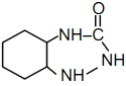
B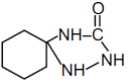
C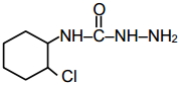
D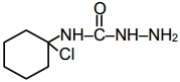
Solution
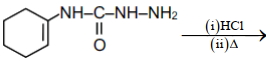
(B) The reaction proceeds via the protonation of the double bond in the cyclohexenyl group to form a stable carbocation intermediate.
Following this,the terminal amino group $(-NH_2)$ of the semicarbazide moiety acts as a nucleophile and attacks the carbocation.
This intramolecular cyclization leads to the formation of a cyclic structure where the nitrogen atom is bonded to the same carbon atom of the cyclohexane ring,resulting in the final major product shown in option $B$.
Following this,the terminal amino group $(-NH_2)$ of the semicarbazide moiety acts as a nucleophile and attacks the carbocation.
This intramolecular cyclization leads to the formation of a cyclic structure where the nitrogen atom is bonded to the same carbon atom of the cyclohexane ring,resulting in the final major product shown in option $B$.
0 likesView Solution
47
ChemistryMediumMCQAIIMS · 2019
How many spectral lines of the Balmer series are present in the visible region?
A
$5$
B
$4$
C
$2$
D
$3$
Solution
(B) For the Balmer series,the transition occurs to the energy level $n_{1} = 2$ from higher energy levels $n_{2} = 3, 4, 5, 6, \ldots$.
In the Balmer series,there are four spectral lines that fall within the visible region of the electromagnetic spectrum.
These lines correspond to the transitions $n_{2} = 3 \rightarrow n_{1} = 2$ $(H_{\alpha})$,$n_{2} = 4 \rightarrow n_{1} = 2$ $(H_{\beta})$,$n_{2} = 5 \rightarrow n_{1} = 2$ $(H_{\gamma})$,and $n_{2} = 6 \rightarrow n_{1} = 2$ $(H_{\delta})$.
These spectral lines have wavelengths between approximately $400 \ nm$ and $700 \ nm$.
In the Balmer series,there are four spectral lines that fall within the visible region of the electromagnetic spectrum.
These lines correspond to the transitions $n_{2} = 3 \rightarrow n_{1} = 2$ $(H_{\alpha})$,$n_{2} = 4 \rightarrow n_{1} = 2$ $(H_{\beta})$,$n_{2} = 5 \rightarrow n_{1} = 2$ $(H_{\gamma})$,and $n_{2} = 6 \rightarrow n_{1} = 2$ $(H_{\delta})$.
These spectral lines have wavelengths between approximately $400 \ nm$ and $700 \ nm$.
0 likesView Solution
48
ChemistryMediumMCQAIIMS · 2019
Out of $BeF_{2}, MgF_{2}, CaF_{2}, SrF_{2}$,which has maximum solubility?
A
$BeF_{2}$
B
$MgF_{2}$
C
$CaF_{2}$
D
$SrF_{2}$
Solution
(A) The solubility of alkaline earth metal fluorides is determined by the balance between lattice energy and hydration energy.
For small cations like $Be^{2+}$,the hydration energy is significantly higher than the lattice energy,making $BeF_{2}$ highly soluble in water.
As the size of the cation increases from $Be^{2+}$ to $Sr^{2+}$,the hydration energy decreases more rapidly than the lattice energy,leading to a decrease in solubility.
Therefore,$BeF_{2}$ has the maximum solubility among the given compounds.
For small cations like $Be^{2+}$,the hydration energy is significantly higher than the lattice energy,making $BeF_{2}$ highly soluble in water.
As the size of the cation increases from $Be^{2+}$ to $Sr^{2+}$,the hydration energy decreases more rapidly than the lattice energy,leading to a decrease in solubility.
Therefore,$BeF_{2}$ has the maximum solubility among the given compounds.
0 likesView Solution
49
ChemistryEasyMCQAIIMS · 2019
$1$ mole of a diatomic gas is heated through an isochoric process from $300\,K$ to $500\,K$. The change in entropy is: (in $,J/K$)
A
$10.61$
B
$38.26$
C
$20.05$
D
$30$
Solution
(A) The entropy change for a system can be calculated as:
$\Delta S = n C_{v} \ln \frac{T_{2}}{T_{1}} + n R \ln \frac{V_{2}}{V_{1}} \dots (I)$
For an isochoric process,$V_{2} = V_{1}$,so $\ln \frac{V_{2}}{V_{1}} = \ln(1) = 0$.
For a diatomic gas,$C_{v} = \frac{5R}{2}$.
Substituting the values into expression $(I)$:
$\Delta S = 1 \times \frac{5 \times 8.314}{2} \times \ln \frac{500}{300}$
$\Delta S = 2.5 \times 8.314 \times 0.5108$
$\Delta S = 10.61\,J/K$
$\Delta S = n C_{v} \ln \frac{T_{2}}{T_{1}} + n R \ln \frac{V_{2}}{V_{1}} \dots (I)$
For an isochoric process,$V_{2} = V_{1}$,so $\ln \frac{V_{2}}{V_{1}} = \ln(1) = 0$.
For a diatomic gas,$C_{v} = \frac{5R}{2}$.
Substituting the values into expression $(I)$:
$\Delta S = 1 \times \frac{5 \times 8.314}{2} \times \ln \frac{500}{300}$
$\Delta S = 2.5 \times 8.314 \times 0.5108$
$\Delta S = 10.61\,J/K$
0 likesView Solution
50
ChemistryMediumMCQAIIMS · 2019
In which of the following pairs do both the species have $sp^{3}$ hybridization?
A
$H_{2}S, BF_{3}$
B
$SiF_{4}, BeH_{2}$
C
$NF_{3}, H_{2}O$
D
$NF_{3}, BF_{3}$
Solution
(C) To determine the hybridization,we calculate the number of electron pairs around the central atom using the formula: $\text{Number of electron pairs} = \text{Number of bond pairs} + \text{Number of lone pairs}$.
For $NF_{3}$: The central atom $N$ has $3$ bond pairs and $1$ lone pair,totaling $4$ electron pairs,which corresponds to $sp^{3}$ hybridization.
For $H_{2}O$: The central atom $O$ has $2$ bond pairs and $2$ lone pairs,totaling $4$ electron pairs,which corresponds to $sp^{3}$ hybridization.
Since both $NF_{3}$ and $H_{2}O$ have $4$ electron pairs,both are $sp^{3}$ hybridized.
For $NF_{3}$: The central atom $N$ has $3$ bond pairs and $1$ lone pair,totaling $4$ electron pairs,which corresponds to $sp^{3}$ hybridization.
For $H_{2}O$: The central atom $O$ has $2$ bond pairs and $2$ lone pairs,totaling $4$ electron pairs,which corresponds to $sp^{3}$ hybridization.
Since both $NF_{3}$ and $H_{2}O$ have $4$ electron pairs,both are $sp^{3}$ hybridized.
0 likesView Solution
51
ChemistryDifficultMCQAIIMS · 2019
Adsorption of a gas follows the Freundlich adsorption isotherm. $x$ is the mass of the gas adsorbed on mass $m$ of the adsorbent. The plot of $\log \frac{x}{m}$ versus $\log p$ is shown in the given graph. $\frac{x}{m}$ is proportional to:
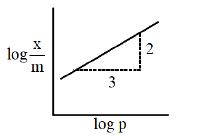
A
$p^{2/3}$
B
$p^2$
C
$p^3$
D
$p^{3/2}$
Solution
(A) The Freundlich adsorption isotherm is given by the equation: $\frac{x}{m} = k P^{1/n}$
Taking the logarithm on both sides,we get: $\log \frac{x}{m} = \log k + \frac{1}{n} \log P$
This equation represents a straight line of the form $y = mx + c$,where the slope is $\frac{1}{n}$.
From the given graph,the slope is calculated as: $\text{Slope} = \frac{\text{rise}}{\text{run}} = \frac{2}{3}$.
Therefore,$\frac{1}{n} = \frac{2}{3}$.
Substituting this back into the original equation,we get: $\frac{x}{m} = k P^{2/3}$.
Thus,$\frac{x}{m}$ is proportional to $p^{2/3}$.
Taking the logarithm on both sides,we get: $\log \frac{x}{m} = \log k + \frac{1}{n} \log P$
This equation represents a straight line of the form $y = mx + c$,where the slope is $\frac{1}{n}$.
From the given graph,the slope is calculated as: $\text{Slope} = \frac{\text{rise}}{\text{run}} = \frac{2}{3}$.
Therefore,$\frac{1}{n} = \frac{2}{3}$.
Substituting this back into the original equation,we get: $\frac{x}{m} = k P^{2/3}$.
Thus,$\frac{x}{m}$ is proportional to $p^{2/3}$.
0 likesView Solution
52
ChemistryMediumMCQAIIMS · 2019
Identify the product of the following reaction:
$Ph-CH=CH-CN$ $\xrightarrow[2. H_3O^+]{1. CH_3MgBr}$ $\xrightarrow{NaBH_4, \Delta} \text{Product}$
$Ph-CH=CH-CN$ $\xrightarrow[2. H_3O^+]{1. CH_3MgBr}$ $\xrightarrow{NaBH_4, \Delta} \text{Product}$
A
$Ph-CH=CH-CH=CH_2$
B
$Ph-CH(CH_3)-CH_2-CH_2-NH_2$
C
$Ph-CH_2-CH=CH-CH_3$
D
$Ph-CH=CH-CH_2-NH_2$
Solution
(B) The reaction proceeds as follows:
$1$. The Grignard reagent $CH_3MgBr$ performs a $1,4$-conjugate addition (Michael addition) to the $\alpha,\beta$-unsaturated nitrile $Ph-CH=CH-CN$. The $CH_3$ group attacks the $\beta$-carbon,and the double bond shifts to the $C=N$ bond,forming an imine intermediate: $Ph-CH(CH_3)-CH_2-C=N$.
$2$. Upon hydrolysis with $H_3O^+$,the imine is typically converted to an aldehyde or ketone,but in the presence of $NaBH_4$,the imine group $(-C=N)$ is reduced to an amine $(-CH_2-NH_2)$.
$3$. The final product is $Ph-CH(CH_3)-CH_2-CH_2-NH_2$.
$1$. The Grignard reagent $CH_3MgBr$ performs a $1,4$-conjugate addition (Michael addition) to the $\alpha,\beta$-unsaturated nitrile $Ph-CH=CH-CN$. The $CH_3$ group attacks the $\beta$-carbon,and the double bond shifts to the $C=N$ bond,forming an imine intermediate: $Ph-CH(CH_3)-CH_2-C=N$.
$2$. Upon hydrolysis with $H_3O^+$,the imine is typically converted to an aldehyde or ketone,but in the presence of $NaBH_4$,the imine group $(-C=N)$ is reduced to an amine $(-CH_2-NH_2)$.
$3$. The final product is $Ph-CH(CH_3)-CH_2-CH_2-NH_2$.
0 likesView Solution
53
ChemistryEasyMCQAIIMS · 2019
Match the following columns:
Correct set of answer:
| Polymer | Monomer |
|---|---|
| $i$. Buna-$S$ | $P$. Styrene |
| $ii$. Terylene | $Q$. Ethylene glycol |
| $iii$. Elastomer (Neoprene) | $R$. Chloroprene |
Correct set of answer:
A
$i-P, ii-Q, iii-R$
B
$i-R, ii-P, iii-Q$
C
$i-Q, ii-R, iii-P$
D
$i-P, ii-R, iii-Q$
Solution
(A) $i$. Buna-$S$ is a copolymer formed from $1,3$-butadiene and styrene $(P)$.
$ii$. Terylene (Dacron) is a polyester formed from ethylene glycol $(Q)$ and terephthalic acid.
$iii$. Neoprene is a type of elastomer formed from the monomer chloroprene $(R)$.
Therefore,the correct matching is $i-P, ii-Q, iii-R$.
$ii$. Terylene (Dacron) is a polyester formed from ethylene glycol $(Q)$ and terephthalic acid.
$iii$. Neoprene is a type of elastomer formed from the monomer chloroprene $(R)$.
Therefore,the correct matching is $i-P, ii-Q, iii-R$.
0 likesView Solution
54
ChemistryMediumMCQAIIMS · 2019
Find the end product of the following reaction:
Product is
Product is
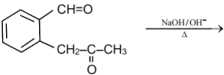
A
B
C
D
Solution
(D) The given reaction is an intramolecular Aldol condensation reaction.
$1$. The base $(OH^-)$ abstracts an $\alpha$-hydrogen from the methyl group of the ketone,forming an enolate ion.
$2$. This enolate ion performs a nucleophilic attack on the carbonyl carbon of the aldehyde group.
$3$. This leads to the formation of a cyclic $\beta$-hydroxy ketone intermediate.
$4$. Upon heating $(\Delta)$,the intermediate undergoes dehydration (loss of $H_2O$) to form an $\alpha, \beta$-unsaturated carbonyl compound.
Comparing the final structure with the given options,the product corresponds to option $D$.
$1$. The base $(OH^-)$ abstracts an $\alpha$-hydrogen from the methyl group of the ketone,forming an enolate ion.
$2$. This enolate ion performs a nucleophilic attack on the carbonyl carbon of the aldehyde group.
$3$. This leads to the formation of a cyclic $\beta$-hydroxy ketone intermediate.
$4$. Upon heating $(\Delta)$,the intermediate undergoes dehydration (loss of $H_2O$) to form an $\alpha, \beta$-unsaturated carbonyl compound.
Comparing the final structure with the given options,the product corresponds to option $D$.
0 likesView Solution
55
ChemistryMediumMCQAIIMS · 2019
Order of acidic nature
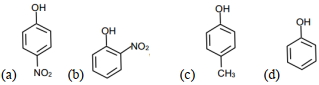
A
$a > c > d > b$
B
$b > a > d > c$
C
$a > b > d > c$
D
$d > c > b > a$
Solution
(C) The acidic strength of phenols depends on the stability of the phenoxide ion formed after the loss of a proton. Electron-withdrawing groups $(-EWG)$ increase acidity,while electron-donating groups $(-EDG)$ decrease it.
$(a)$ $p$-Nitrophenol: The $-NO_2$ group at the para position exerts a strong $-M$ (mesomeric) and $-I$ (inductive) effect,significantly stabilizing the phenoxide ion.
$(b)$ $o$-Nitrophenol: The $-NO_2$ group at the ortho position exerts $-M$ and $-I$ effects,but also forms an intramolecular hydrogen bond with the $-OH$ group,which stabilizes the neutral molecule and makes the release of $H^+$ slightly less favorable compared to $p$-nitrophenol.
$(d)$ Phenol: Has no substituent.
$(c)$ $p$-Cresol: The $-CH_3$ group at the para position exerts a $+I$ and $+H$ (hyperconjugation) effect,which destabilizes the phenoxide ion,making it the least acidic.
Thus,the correct order of acidic strength is $p$-nitrophenol $(a) > o$-nitrophenol $(b) >$ phenol $(d) > p$-cresol $(c)$.
Therefore,the correct option is $C$.
$(a)$ $p$-Nitrophenol: The $-NO_2$ group at the para position exerts a strong $-M$ (mesomeric) and $-I$ (inductive) effect,significantly stabilizing the phenoxide ion.
$(b)$ $o$-Nitrophenol: The $-NO_2$ group at the ortho position exerts $-M$ and $-I$ effects,but also forms an intramolecular hydrogen bond with the $-OH$ group,which stabilizes the neutral molecule and makes the release of $H^+$ slightly less favorable compared to $p$-nitrophenol.
$(d)$ Phenol: Has no substituent.
$(c)$ $p$-Cresol: The $-CH_3$ group at the para position exerts a $+I$ and $+H$ (hyperconjugation) effect,which destabilizes the phenoxide ion,making it the least acidic.
Thus,the correct order of acidic strength is $p$-nitrophenol $(a) > o$-nitrophenol $(b) >$ phenol $(d) > p$-cresol $(c)$.
Therefore,the correct option is $C$.
0 likesView Solution
56
ChemistryMediumMCQAIIMS · 2019
Which of the following does not give a precipitate with $CrO_4^{2-}$?
A
$Ca^{2+}$
B
$Sr^{2+}$
C
$Pb^{2+}$
D
$Ba^{2+}$
Solution
(A) The cation $Ca^{2+}$ does not form a precipitate with $CrO_4^{2-}$ because calcium chromate $(CaCrO_4)$ is relatively soluble in water compared to the chromates of $Sr^{2+}$,$Ba^{2+}$,and $Pb^{2+}$.
The solubility product $(K_{sp})$ values follow the order: $K_{sp}(BaCrO_4) < K_{sp}(SrCrO_4) < K_{sp}(CaCrO_4)$.
Since $CaCrO_4$ has a much higher $K_{sp}$ value,it remains in the solution.
The solubility product $(K_{sp})$ values follow the order: $K_{sp}(BaCrO_4) < K_{sp}(SrCrO_4) < K_{sp}(CaCrO_4)$.
Since $CaCrO_4$ has a much higher $K_{sp}$ value,it remains in the solution.
0 likesView Solution
57
ChemistryMediumMCQAIIMS · 2019
Calculate the $emf$ of the cell at $25^{\circ} C$.
Cell notation: $M | M^{2+} (0.01 \ M) || M^{2+} (0.0001 \ M) | M$
Given: $E_{cell}^{o} = 4 \ V$ and $\frac{RT}{F} \ln 10 = 0.06$. (in $V$)
Cell notation: $M | M^{2+} (0.01 \ M) || M^{2+} (0.0001 \ M) | M$
Given: $E_{cell}^{o} = 4 \ V$ and $\frac{RT}{F} \ln 10 = 0.06$. (in $V$)
A
$3.94$
B
$4.06$
C
$2.03$
D
$8.18$
Solution
(A) The cell reaction is:
$M(s) + M^{2+}(0.0001 \ M) \rightarrow M^{2+}(0.01 \ M) + M(s)$
The Nernst equation is:
$E_{cell} = E_{cell}^{o} - \frac{RT}{nF} \ln Q$
Given $\frac{RT}{F} \ln 10 = 0.06$,we use $\frac{RT}{nF} \ln Q = \frac{0.06}{n} \log Q$.
Here $n = 2$ and $Q = \frac{[M^{2+}]_{product}}{[M^{2+}]_{reactant}} = \frac{0.01}{0.0001} = 100 = 10^2$.
$E_{cell} = 4 - \frac{0.06}{2} \log(10^2)$
$E_{cell} = 4 - 0.03 \times 2$
$E_{cell} = 4 - 0.06 = 3.94 \ V$.
$M(s) + M^{2+}(0.0001 \ M) \rightarrow M^{2+}(0.01 \ M) + M(s)$
The Nernst equation is:
$E_{cell} = E_{cell}^{o} - \frac{RT}{nF} \ln Q$
Given $\frac{RT}{F} \ln 10 = 0.06$,we use $\frac{RT}{nF} \ln Q = \frac{0.06}{n} \log Q$.
Here $n = 2$ and $Q = \frac{[M^{2+}]_{product}}{[M^{2+}]_{reactant}} = \frac{0.01}{0.0001} = 100 = 10^2$.
$E_{cell} = 4 - \frac{0.06}{2} \log(10^2)$
$E_{cell} = 4 - 0.03 \times 2$
$E_{cell} = 4 - 0.06 = 3.94 \ V$.
0 likesView Solution
58
ChemistryEasyMCQAIIMS · 2019
Find the time period of a $1^{st}$ order reaction when the reaction is $\frac{2}{3} ^{rd}$ complete. If the value of the rate constant is $4.3 \times 10^{-4} \, s^{-1}$.
A
$0.0025 \times 10^{3} \, s$
B
$0.25 \times 10^{3} \, s$
C
$0.025 \times 10^{3} \, s$
D
$2.5 \times 10^{3} \, s$
Solution
(D) For a $1^{st}$ order reaction,the rate equation is given by:
$t = \frac{2.303}{k} \log \frac{[A]_0}{[A]_t}$
Given that the reaction is $\frac{2}{3}$ complete,the amount reacted $x = \frac{2}{3} a$,where $a$ is the initial concentration.
Therefore,the remaining concentration $[A]_t = a - \frac{2}{3} a = \frac{a}{3}$.
Substituting the values into the equation:
$t = \frac{2.303}{4.3 \times 10^{-4}} \log \frac{a}{a/3}$
$t = \frac{2.303}{4.3 \times 10^{-4}} \log 3$
Using $\log 3 \approx 0.4771$:
$t = \frac{2.303 \times 0.4771}{4.3 \times 10^{-4}} \approx \frac{1.0988}{4.3 \times 10^{-4}} \approx 2555 \, s$
Rounding to the given options,$t = 2.5 \times 10^{3} \, s$.
$t = \frac{2.303}{k} \log \frac{[A]_0}{[A]_t}$
Given that the reaction is $\frac{2}{3}$ complete,the amount reacted $x = \frac{2}{3} a$,where $a$ is the initial concentration.
Therefore,the remaining concentration $[A]_t = a - \frac{2}{3} a = \frac{a}{3}$.
Substituting the values into the equation:
$t = \frac{2.303}{4.3 \times 10^{-4}} \log \frac{a}{a/3}$
$t = \frac{2.303}{4.3 \times 10^{-4}} \log 3$
Using $\log 3 \approx 0.4771$:
$t = \frac{2.303 \times 0.4771}{4.3 \times 10^{-4}} \approx \frac{1.0988}{4.3 \times 10^{-4}} \approx 2555 \, s$
Rounding to the given options,$t = 2.5 \times 10^{3} \, s$.
0 likesView Solution
59
ChemistryDifficultMCQAIIMS · 2019
The vapour pressure of pure $CHCl_3$ and $CH_2Cl_2$ are $200 \,atm$ and $41.5 \,atm$ respectively. The weights of $CHCl_3$ and $CH_2Cl_2$ are respectively $11.9 \,g$ and $17 \,g$. The vapour pressure of the solution will be (in $,atm$)
A
$80.5$
B
$79.5$
C
$94.3$
D
$105.3$
Solution
(C) The molar mass of $CHCl_3$ is $119.5 \,g/mol$ and the molar mass of $CH_2Cl_2$ is $85 \,g/mol$.
Number of moles of $CHCl_3$ $(n_1)$ = $\frac{11.9 \,g}{119.5 \,g/mol} \approx 0.1 \,mol$.
Number of moles of $CH_2Cl_2$ $(n_2)$ = $\frac{17 \,g}{85 \,g/mol} = 0.2 \,mol$.
Total moles = $0.1 + 0.2 = 0.3 \,mol$.
Mole fraction of $CHCl_3$ $(x_1)$ = $\frac{0.1}{0.3} = \frac{1}{3}$.
Mole fraction of $CH_2Cl_2$ $(x_2)$ = $\frac{0.2}{0.3} = \frac{2}{3}$.
According to Raoult's law,the total vapour pressure $(P_T)$ is:
$P_T = P_1^{\circ} x_1 + P_2^{\circ} x_2$
$P_T = (200 \times \frac{1}{3}) + (41.5 \times \frac{2}{3})$
$P_T = 66.67 + 27.67 = 94.34 \,atm \approx 94.3 \,atm$.
Number of moles of $CHCl_3$ $(n_1)$ = $\frac{11.9 \,g}{119.5 \,g/mol} \approx 0.1 \,mol$.
Number of moles of $CH_2Cl_2$ $(n_2)$ = $\frac{17 \,g}{85 \,g/mol} = 0.2 \,mol$.
Total moles = $0.1 + 0.2 = 0.3 \,mol$.
Mole fraction of $CHCl_3$ $(x_1)$ = $\frac{0.1}{0.3} = \frac{1}{3}$.
Mole fraction of $CH_2Cl_2$ $(x_2)$ = $\frac{0.2}{0.3} = \frac{2}{3}$.
According to Raoult's law,the total vapour pressure $(P_T)$ is:
$P_T = P_1^{\circ} x_1 + P_2^{\circ} x_2$
$P_T = (200 \times \frac{1}{3}) + (41.5 \times \frac{2}{3})$
$P_T = 66.67 + 27.67 = 94.34 \,atm \approx 94.3 \,atm$.
0 likesView Solution
60
ChemistryMediumMCQAIIMS · 2019
What is the correct order of bond dissociation energy for the given halogens?
A
$Br_2 > Cl_2$
B
$F_2 > Cl_2$
C
$I_2 > F_2$
D
$F_2 > I_2$
Solution
(C) The correct order of bond dissociation energy for halogens is $Cl_2 > Br_2 > F_2 > I_2$.
Although fluorine is the smallest halogen,the bond dissociation energy of $F_2$ is lower than that of $Cl_2$ and $Br_2$.
This is due to the very small size of the fluorine atom,which leads to significant inter-electronic repulsion between the non-bonding electrons of the two fluorine atoms,thereby weakening the $F-F$ bond.
Although fluorine is the smallest halogen,the bond dissociation energy of $F_2$ is lower than that of $Cl_2$ and $Br_2$.
This is due to the very small size of the fluorine atom,which leads to significant inter-electronic repulsion between the non-bonding electrons of the two fluorine atoms,thereby weakening the $F-F$ bond.
0 likesView Solution
61
ChemistryMediumMCQAIIMS · 2019
When $Ag^{+}$ reacts with excess of sodium thiosulphate,the obtained species having charge and geometry respectively will be?
A
$-3$,Linear
B
$-2$,tetrahedral
C
$-1$,square planar
D
$-3$,square planar
Solution
(A) The reaction of $Ag^{+}$ with excess of sodium thiosulphate is given below:
$Ag^{+} + 2S_{2}O_{3}^{2-} \rightarrow [Ag(S_{2}O_{3})_{2}]^{3-}$.
This complex possesses a $-3$ charge.
The coordination number for $Ag$ is $2$,which corresponds to $sp$ hybridization and linear geometry.
$Ag^{+} + 2S_{2}O_{3}^{2-} \rightarrow [Ag(S_{2}O_{3})_{2}]^{3-}$.
This complex possesses a $-3$ charge.
The coordination number for $Ag$ is $2$,which corresponds to $sp$ hybridization and linear geometry.
0 likesView Solution
62
ChemistryEasyMCQAIIMS · 2019
Which of the following is the correct order of packing efficiency?
A
$HCP = FCC > BCC > SC$
B
$SC > BCC > HCP = FCC$
C
$BCC > SC > HCP < FCC$
D
$FCC = HCP > SC > BCC$
Solution
(A) The packing efficiency of $SC$ is $52 \%$,$BCC$ is $68 \%$,$HCP$ is $74 \%$,and $FCC$ is $74 \%$.
Therefore,the correct order of packing efficiency is $HCP = FCC > BCC > SC$.
Therefore,the correct order of packing efficiency is $HCP = FCC > BCC > SC$.
0 likesView Solution
63
ChemistryEasyMCQAIIMS · 2019
Which of the following inert gases participates in chemical reactions?
A
$Xe$
B
$He$
C
$Ne$
D
None
Solution
(A) The inert gas that participates in chemical reactions is xenon $(Xe)$.
This is because the atomic size of xenon is relatively large,which results in a lower ionization potential compared to other noble gases,allowing it to form compounds with highly electronegative elements like fluorine and oxygen.
This is because the atomic size of xenon is relatively large,which results in a lower ionization potential compared to other noble gases,allowing it to form compounds with highly electronegative elements like fluorine and oxygen.
0 likesView Solution
64
ChemistryMediumMCQAIIMS · 2019
The hybridisation and magnetic behavior of the complex $[Ni(CO)_4]$ are
A
$dsp^2$,paramagnetic
B
$dsp^2$,diamagnetic
C
$sp^3$,paramagnetic
D
$sp^3$,diamagnetic
Solution
(D) The oxidation state of $Ni$ in the complex $[Ni(CO)_4]$ is calculated as follows:
$x + 4(0) = 0 \implies x = 0$
The ground state electronic configuration of $Ni$ $(Z=28)$ is $[Ar] 3d^8 4s^2$.
In the presence of the strong field ligand $CO$,the two $4s$ electrons pair up with the $3d$ electrons,resulting in a fully filled $3d$ subshell $(3d^{10})$.
The $4s$ and $4p$ orbitals hybridize to form four $sp^3$ hybrid orbitals,which accept electron pairs from four $CO$ ligands.
Since all electrons are paired,the complex is diamagnetic and exhibits $sp^3$ hybridisation.
$x + 4(0) = 0 \implies x = 0$
The ground state electronic configuration of $Ni$ $(Z=28)$ is $[Ar] 3d^8 4s^2$.
In the presence of the strong field ligand $CO$,the two $4s$ electrons pair up with the $3d$ electrons,resulting in a fully filled $3d$ subshell $(3d^{10})$.
The $4s$ and $4p$ orbitals hybridize to form four $sp^3$ hybrid orbitals,which accept electron pairs from four $CO$ ligands.
Since all electrons are paired,the complex is diamagnetic and exhibits $sp^3$ hybridisation.
0 likesView Solution
65
ChemistryEasyMCQAIIMS · 2019
The number of tetrahedral voids present in $0.5 \ mole$ of $hcp$ crystal structure is:
A
$3.6 \times 10^{23}$
B
$9 \times 10^{23}$
C
$3.6 \times 10^{24}$
D
$6.02 \times 10^{23}$
Solution
(D) In a crystal lattice,the number of tetrahedral voids $(TV)$ is twice the number of atoms $(N)$.
For an $hcp$ unit cell,the number of atoms per unit cell is $Z = 6$.
Therefore,the number of $TV$ per unit cell is $2 \times 6 = 12$.
In $1 \ mole$ of atoms,the number of $TV$ is $2 \times N_A$.
For $0.5 \ mole$ of $hcp$ crystal structure,the number of atoms is $0.5 \times N_A$.
Number of $TV = 2 \times (0.5 \times N_A) = 1 \times N_A = 6.022 \times 10^{23}$.
Wait,re-evaluating: The question asks for the total number of tetrahedral voids in $0.5 \ mole$ of the crystal structure. If we consider $0.5 \ mole$ of the $hcp$ lattice,it contains $0.5 \times N_A$ atoms. Since $TV = 2N$,the number of $TV = 2 \times (0.5 \times N_A) = N_A = 6.022 \times 10^{23}$.
For an $hcp$ unit cell,the number of atoms per unit cell is $Z = 6$.
Therefore,the number of $TV$ per unit cell is $2 \times 6 = 12$.
In $1 \ mole$ of atoms,the number of $TV$ is $2 \times N_A$.
For $0.5 \ mole$ of $hcp$ crystal structure,the number of atoms is $0.5 \times N_A$.
Number of $TV = 2 \times (0.5 \times N_A) = 1 \times N_A = 6.022 \times 10^{23}$.
Wait,re-evaluating: The question asks for the total number of tetrahedral voids in $0.5 \ mole$ of the crystal structure. If we consider $0.5 \ mole$ of the $hcp$ lattice,it contains $0.5 \times N_A$ atoms. Since $TV = 2N$,the number of $TV = 2 \times (0.5 \times N_A) = N_A = 6.022 \times 10^{23}$.
0 likesView Solution
66
ChemistryEasyMCQAIIMS · 2019
Which element can have oxidation state from $4$ to $6$?
A
$Fe$
B
$Mg$
C
$Co$
D
$Cr$
Solution
(D) The element that can exhibit oxidation states ranging from $+4$ to $+6$ is chromium $(Cr)$.
Chromium has an electronic configuration of $[Ar] 3d^5 4s^1$.
It can show various oxidation states from $+1$ to $+6$ in its compounds,such as in $CrO_2$ $(+4)$ and $CrO_3$ $(+6)$.
Chromium has an electronic configuration of $[Ar] 3d^5 4s^1$.
It can show various oxidation states from $+1$ to $+6$ in its compounds,such as in $CrO_2$ $(+4)$ and $CrO_3$ $(+6)$.
0 likesView Solution
67
ChemistryEasyMCQAIIMS · 2019
Which of the following statements is incorrect about colloidal solutions?
A
Lyophobic sols are more stable than lyophilic sols.
B
Lyophilic colloids have a unique property of protecting lyophobic colloids.
C
Lyophilic colloids are more soluble than lyophobic colloids.
D
None of these
Solution
(A) Lyophilic sols are more stable than lyophobic sols because of the extensive solvation of the dispersed phase particles.
Therefore,the statement $(A)$ is incorrect because it claims that lyophobic sols are more stable.
Therefore,the statement $(A)$ is incorrect because it claims that lyophobic sols are more stable.
0 likesView Solution
68
ChemistryMediumMCQAIIMS · 2019
Phenol $+$ Aniline $\xrightarrow[{KOH}]{{C_6H_5N_2^+Cl^{-}}}$ Major Product $:$ Product will be $:$
A
Azobenzene
B
$p$-Hydroxyazobenzene
C
$p$-Amino-$p'$-hydroxyazobenzene
D
$p$-Aminoazobenzene
Solution
(B) The reaction of phenol with benzenediazonium chloride $(C_6H_5N_2^+Cl^-)$ in the presence of a base $(KOH)$ is an electrophilic aromatic substitution reaction known as a coupling reaction.
In this reaction,the diazonium cation acts as an electrophile and attacks the electron-rich ring of phenol at the para-position to form $p$-hydroxyazobenzene.
Since the question mentions both phenol and aniline,but the diazonium salt is derived from aniline $(C_6H_5N_2^+Cl^-)$,the coupling occurs between the diazonium salt and the phenol to yield $p$-hydroxyazobenzene.
In this reaction,the diazonium cation acts as an electrophile and attacks the electron-rich ring of phenol at the para-position to form $p$-hydroxyazobenzene.
Since the question mentions both phenol and aniline,but the diazonium salt is derived from aniline $(C_6H_5N_2^+Cl^-)$,the coupling occurs between the diazonium salt and the phenol to yield $p$-hydroxyazobenzene.
0 likesView Solution
69
ChemistryMediumMCQAIIMS · 2019
The major product of the following reaction is:
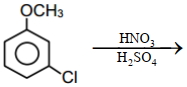
A
$1-$chloro$-4-$methoxy$-2-$nitrobenzene
B
$1-$chloro$-2-$methoxy$-4-$nitrobenzene
C
$1-$chloro$-2-$nitro$-3-$methoxybenzene
D
$1-$chloro$-4-$nitro$-2-$methoxybenzene
Solution
(A) The starting material is $1-$chloro$-3-$methoxybenzene. The $-OCH_3$ group is an ortho/para directing group,and the $-Cl$ group is also an ortho/para directing group. The $-OCH_3$ group is a stronger activating group than the $-Cl$ group,so the electrophilic substitution (nitration) is directed by the $-OCH_3$ group. The para position relative to $-OCH_3$ is occupied by the $-Cl$ group,so the nitration occurs at the ortho position relative to $-OCH_3$. Between the two ortho positions,the position para to the $-Cl$ group is less sterically hindered. Therefore,the major product is $1-$chloro$-4-$methoxy$-2-$nitrobenzene.
0 likesView Solution
70
ChemistryMediumMCQAIIMS · 2019
Which of the following statements is correct for oleum?
A
It is prepared by adsorption of $SO_3$ in conc. $H_2SO_4$
B
It contains $O-O$ groups
C
It has six $OH$ groups
D
None of these
Solution
(A) Oleum $(H_2S_2O_7)$,also known as fuming sulfuric acid,is prepared by the absorption of $SO_3$ in concentrated $H_2SO_4$.
The reaction is: $H_2SO_4 + SO_3 \rightarrow H_2S_2O_7$.
It contains an $S-O-S$ linkage,not an $O-O$ linkage.
It has two $OH$ groups in its structure.
Therefore,the correct statement is that it is prepared by the absorption of $SO_3$ in concentrated $H_2SO_4$.
The reaction is: $H_2SO_4 + SO_3 \rightarrow H_2S_2O_7$.
It contains an $S-O-S$ linkage,not an $O-O$ linkage.
It has two $OH$ groups in its structure.
Therefore,the correct statement is that it is prepared by the absorption of $SO_3$ in concentrated $H_2SO_4$.
0 likesView Solution
71
ChemistryDifficultMCQAIIMS · 2019
For a first order gas phase reaction:
$A_{(g)} \rightarrow 2 B_{(g)} + C_{(g)}$
Let $P_0$ be the initial pressure of $A$ and $P_t$ be the total pressure at time $t$. The integrated rate equation is:
$A_{(g)} \rightarrow 2 B_{(g)} + C_{(g)}$
Let $P_0$ be the initial pressure of $A$ and $P_t$ be the total pressure at time $t$. The integrated rate equation is:
A
$\frac{2.303}{t} \log \left(\frac{P_0}{P_0 - P_t}\right)$
B
$\frac{2.303}{t} \log \left(\frac{2 P_0}{3 P_0 - P_t}\right)$
C
$\frac{2.303}{t} \log \left(\frac{P_0}{2 P_0 - P_t}\right)$
D
$\frac{2.303}{t} \log \left(\frac{2 P_0}{2 P_0 - P_t}\right)$
Solution
(B) The reaction is $A_{(g)} \rightarrow 2 B_{(g)} + C_{(g)}$.
Let $P$ be the decrease in pressure of $A$ at time $t$.
Total pressure $P_t = (P_0 - P) + 2P + P = P_0 + 2P$.
Therefore,$2P = P_t - P_0$,which gives $P = \frac{P_t - P_0}{2}$.
The pressure of $A$ at time $t$ is $P_A = P_0 - P = P_0 - \frac{P_t - P_0}{2} = \frac{2P_0 - P_t + P_0}{2} = \frac{3P_0 - P_t}{2}$.
The integrated rate equation for a first order reaction is $k = \frac{2.303}{t} \log \left( \frac{P_0}{P_A} \right)$.
Substituting $P_A$:
$k = \frac{2.303}{t} \log \left( \frac{P_0}{\frac{3P_0 - P_t}{2}} \right) = \frac{2.303}{t} \log \left( \frac{2P_0}{3P_0 - P_t} \right)$.
Let $P$ be the decrease in pressure of $A$ at time $t$.
| Initial pressure | $P_0$ | $0$ | $0$ |
| Pressure at time $t$ | $P_0 - P$ | $2P$ | $P$ |
Total pressure $P_t = (P_0 - P) + 2P + P = P_0 + 2P$.
Therefore,$2P = P_t - P_0$,which gives $P = \frac{P_t - P_0}{2}$.
The pressure of $A$ at time $t$ is $P_A = P_0 - P = P_0 - \frac{P_t - P_0}{2} = \frac{2P_0 - P_t + P_0}{2} = \frac{3P_0 - P_t}{2}$.
The integrated rate equation for a first order reaction is $k = \frac{2.303}{t} \log \left( \frac{P_0}{P_A} \right)$.
Substituting $P_A$:
$k = \frac{2.303}{t} \log \left( \frac{P_0}{\frac{3P_0 - P_t}{2}} \right) = \frac{2.303}{t} \log \left( \frac{2P_0}{3P_0 - P_t} \right)$.
0 likesView Solution
72
ChemistryMediumMCQAIIMS · 2019
$[Co(C_2O_4)_3]^{3-}$ is a :
A
Low spin complex
B
Paramagnetic
C
High spin
D
$sp^3d^2$ hybridized
Solution
(A) In the coordination complex $[Co(C_2O_4)_3]^{3-}$,the central metal ion is $Co^{3+}$.
The electronic configuration of $Co^{3+}$ is $[Ar] 3d^6$.
$C_2O_4^{2-}$ (oxalate) is a strong field ligand,which causes pairing of electrons in the $3d$ orbitals.
This results in $d^2sp^3$ hybridization,making it an inner orbital complex.
Since all electrons are paired,it is diamagnetic and a low spin complex.
The electronic configuration of $Co^{3+}$ is $[Ar] 3d^6$.
$C_2O_4^{2-}$ (oxalate) is a strong field ligand,which causes pairing of electrons in the $3d$ orbitals.
This results in $d^2sp^3$ hybridization,making it an inner orbital complex.
Since all electrons are paired,it is diamagnetic and a low spin complex.
0 likesView Solution
73
ChemistryMediumMCQAIIMS · 2019
Which of the following has the highest ratio of reducing hydrogen atoms to $OH$ groups?
A
Orthophosphoric acid
B
Hypophosphorous acid
C
Phosphorous acid
D
Pyrophosphoric acid
Solution
(B) The structures of the oxo-acids of phosphorus are as follows:
$1$. Orthophosphoric acid $(H_3PO_4)$: It has $0$ $P-H$ bonds and $3$ $OH$ groups. Ratio = $0/3 = 0$.
$2$. Hypophosphorous acid $(H_3PO_2)$: It has $2$ $P-H$ bonds and $1$ $OH$ group. Ratio = $2/1 = 2$.
$3$. Phosphorous acid $(H_3PO_3)$: It has $1$ $P-H$ bond and $2$ $OH$ groups. Ratio = $1/2 = 0.5$.
$4$. Pyrophosphoric acid $(H_4P_2O_7)$: It has $0$ $P-H$ bonds and $4$ $OH$ groups. Ratio = $0/4 = 0$.
Comparing the ratios,Hypophosphorous acid has the highest ratio of $2$.
$1$. Orthophosphoric acid $(H_3PO_4)$: It has $0$ $P-H$ bonds and $3$ $OH$ groups. Ratio = $0/3 = 0$.
$2$. Hypophosphorous acid $(H_3PO_2)$: It has $2$ $P-H$ bonds and $1$ $OH$ group. Ratio = $2/1 = 2$.
$3$. Phosphorous acid $(H_3PO_3)$: It has $1$ $P-H$ bond and $2$ $OH$ groups. Ratio = $1/2 = 0.5$.
$4$. Pyrophosphoric acid $(H_4P_2O_7)$: It has $0$ $P-H$ bonds and $4$ $OH$ groups. Ratio = $0/4 = 0$.
Comparing the ratios,Hypophosphorous acid has the highest ratio of $2$.
0 likesView Solution
74
ChemistryEasyMCQAIIMS · 2019
The formula of a metal oxide with a metal deficiency defect in its crystal is $A_{0.8}O$. The crystal contains $A^{2+}$ and $A^{3+}$ ions. The fraction of metal existing as $A^{2+}$ ions in the crystal is -
A
$0.96$
B
$0.04$
C
$0.50$
D
$0.31$
Solution
(C) The formula is $A_{0.8}O$. This implies that for every $1$ mole of $O^{2-}$ ions,there are $0.8$ moles of $A$ ions.
Let the number of $A^{2+}$ ions be $x$ and the number of $A^{3+}$ ions be $(0.8 - x)$.
Since the crystal is electrically neutral,the total positive charge must equal the total negative charge:
$2x + 3(0.8 - x) = 2$
$2x + 2.4 - 3x = 2$
$-x = -0.4$
$x = 0.4$
Thus,the number of $A^{2+}$ ions is $0.4$.
The fraction of metal existing as $A^{2+}$ ions is given by:
$\text{Fraction} = \frac{\text{Number of } A^{2+} \text{ ions}}{\text{Total number of } A \text{ ions}} = \frac{0.4}{0.8} = 0.5$.
Let the number of $A^{2+}$ ions be $x$ and the number of $A^{3+}$ ions be $(0.8 - x)$.
Since the crystal is electrically neutral,the total positive charge must equal the total negative charge:
$2x + 3(0.8 - x) = 2$
$2x + 2.4 - 3x = 2$
$-x = -0.4$
$x = 0.4$
Thus,the number of $A^{2+}$ ions is $0.4$.
The fraction of metal existing as $A^{2+}$ ions is given by:
$\text{Fraction} = \frac{\text{Number of } A^{2+} \text{ ions}}{\text{Total number of } A \text{ ions}} = \frac{0.4}{0.8} = 0.5$.
0 likesView Solution
75
ChemistryMediumMCQAIIMS · 2019
At $527 \, ^{\circ}C$ temperature,the activation energy is $54.7 \, kJ/mol$. The value of the Arrhenius factor is $4 \times 10^{10}$. The rate constant will be:
A
$12.28 \times 10^{11}$
B
$10.7 \times 10^{6}$
C
$12.28 \times 10^{17}$
D
$14.58 \times 10^{-13}$
Solution
(B) The rate constant $k$ is calculated using the Arrhenius equation: $k = A e^{-E_a / RT}$.
Given: $A = 4 \times 10^{10}$,$E_a = 54.7 \, kJ/mol = 54700 \, J/mol$,$T = 527 + 273 = 800 \, K$,$R = 8.314 \, J \cdot K^{-1} \cdot mol^{-1}$.
Substituting the values:
$k = 4 \times 10^{10} \times e^{-54700 / (8.314 \times 800)}$
$k = 4 \times 10^{10} \times e^{-8.224}$
$k = 4 \times 10^{10} \times 2.68 \times 10^{-4}$
$k \approx 10.7 \times 10^{6} \, s^{-1}$.
Given: $A = 4 \times 10^{10}$,$E_a = 54.7 \, kJ/mol = 54700 \, J/mol$,$T = 527 + 273 = 800 \, K$,$R = 8.314 \, J \cdot K^{-1} \cdot mol^{-1}$.
Substituting the values:
$k = 4 \times 10^{10} \times e^{-54700 / (8.314 \times 800)}$
$k = 4 \times 10^{10} \times e^{-8.224}$
$k = 4 \times 10^{10} \times 2.68 \times 10^{-4}$
$k \approx 10.7 \times 10^{6} \, s^{-1}$.
0 likesView Solution
76
ChemistryMediumMCQAIIMS · 2019
In $Fe(CO)_5$,the $Fe-C$ bond possesses
A
ionic characters
B
$\sigma$-character only
C
$\pi$-character
D
Both $\sigma$ and $\pi$ characters
Solution
(D) In $Fe(CO)_5$,the $Fe-C$ bond is formed by the donation of a lone pair of electrons from the $C$ atom of $CO$ to the empty $d$-orbital of $Fe$,which creates a $\sigma$-bond.
Additionally,there is back-donation of electrons from the filled $d$-orbitals of $Fe$ into the empty antibonding $\pi^*$-orbitals of $CO$,which creates a $\pi$-bond.
Therefore,the $Fe-C$ bond possesses both $\sigma$ and $\pi$ characters.
Additionally,there is back-donation of electrons from the filled $d$-orbitals of $Fe$ into the empty antibonding $\pi^*$-orbitals of $CO$,which creates a $\pi$-bond.
Therefore,the $Fe-C$ bond possesses both $\sigma$ and $\pi$ characters.
0 likesView Solution
77
ChemistryMediumMCQAIIMS · 2019
Vapour pressure of $CCl_{4}$ at $25\,^{\circ} C$ is $143\, mm\, Hg$. $0.5\, g$ of a non-volatile solute (mol. wt. $65$) is dissolved in $100\, mL$ of $CCl_{4}$. Find the vapour pressure of the solution. (Density of $CCl_{4} = 1.58\, g / cm^{3}$)
A
$141.93\, mm\, Hg$
B
$94.39\, mm\, Hg$
C
$199.34\, mm\, Hg$
D
$143.99\, mm\, Hg$
Solution
(A) The relative lowering of vapour pressure is given by the formula: $\frac{p^{\circ} - p_{s}}{p^{\circ}} = x_{2} = \frac{n_{2}}{n_{1} + n_{2}} \approx \frac{n_{2}}{n_{1}}$.
First,calculate the moles of solute $(n_{2})$: $n_{2} = \frac{0.5}{65} \approx 0.00769 \, mol$.
Next,calculate the mass of $CCl_{4}$: $Mass = Density \times Volume = 1.58 \, g/cm^{3} \times 100 \, cm^{3} = 158 \, g$.
Molar mass of $CCl_{4} = 12 + 4 \times 35.5 = 154 \, g/mol$.
Moles of solvent $(n_{1})$: $n_{1} = \frac{158}{154} \approx 1.026 \, mol$.
Using the formula: $\frac{143 - p_{s}}{143} = \frac{0.00769}{1.026}$.
$143 - p_{s} = 143 \times 0.007495 = 1.0718$.
$p_{s} = 143 - 1.0718 = 141.9282 \, mm\, Hg \approx 141.93 \, mm\, Hg$.
First,calculate the moles of solute $(n_{2})$: $n_{2} = \frac{0.5}{65} \approx 0.00769 \, mol$.
Next,calculate the mass of $CCl_{4}$: $Mass = Density \times Volume = 1.58 \, g/cm^{3} \times 100 \, cm^{3} = 158 \, g$.
Molar mass of $CCl_{4} = 12 + 4 \times 35.5 = 154 \, g/mol$.
Moles of solvent $(n_{1})$: $n_{1} = \frac{158}{154} \approx 1.026 \, mol$.
Using the formula: $\frac{143 - p_{s}}{143} = \frac{0.00769}{1.026}$.
$143 - p_{s} = 143 \times 0.007495 = 1.0718$.
$p_{s} = 143 - 1.0718 = 141.9282 \, mm\, Hg \approx 141.93 \, mm\, Hg$.
0 likesView Solution
78
ChemistryMediumMCQAIIMS · 2019
In the reaction sequence $CH_2=CH_2$ $\xrightarrow{HOCl} X$ $\xrightarrow{Y} CH_2(OH)-CH_2(OH)$,$X$ and $Y$ respectively are:
A
$ClCH_2-CH_2OH$ and $NaHCO_3$
B
$CH_3CH_2Cl$ and $NaOH$
C
$CH_3CH_2OH$ and $H_2SO_4$
D
$CH_2ClCH_2OH$ and $heat$
Solution
(A) The reaction sequence is as follows:
$1$. $CH_2=CH_2$ reacts with $HOCl$ (hypochlorous acid) to form ethylene chlorohydrin $(X)$: $CH_2=CH_2 + HOCl \rightarrow CH_2(OH)-CH_2(Cl)$.
$2$. $CH_2(OH)-CH_2(Cl)$ (ethylene chlorohydrin) reacts with a base like $NaHCO_3$ or $NaOH$ to undergo hydrolysis or epoxide formation followed by ring opening to yield ethylene glycol $(CH_2(OH)-CH_2(OH))$.
$3$. Thus,$X$ is $CH_2(OH)-CH_2(Cl)$ and $Y$ is $NaHCO_3$.
$1$. $CH_2=CH_2$ reacts with $HOCl$ (hypochlorous acid) to form ethylene chlorohydrin $(X)$: $CH_2=CH_2 + HOCl \rightarrow CH_2(OH)-CH_2(Cl)$.
$2$. $CH_2(OH)-CH_2(Cl)$ (ethylene chlorohydrin) reacts with a base like $NaHCO_3$ or $NaOH$ to undergo hydrolysis or epoxide formation followed by ring opening to yield ethylene glycol $(CH_2(OH)-CH_2(OH))$.
$3$. Thus,$X$ is $CH_2(OH)-CH_2(Cl)$ and $Y$ is $NaHCO_3$.
0 likesView Solution
79
ChemistryMediumMCQAIIMS · 2019
For a gas-solid adsorbent system,the adsorption isotherm $\frac{x}{m}=k p^{1/n}$ is applicable,where $n=5$ in the specified case. Point out the correct statement:
A
$\frac{x}{m}$ vs $p$ plot is a linear graph with slope equal to $5$
B
$\log \frac{x}{m}$ vs $\log p$ plot is a straight line with slope equal to $5$
C
$\log \frac{x}{m}$ vs $\log p$ is a straight line with slope equal to $0.2$
D
none of these
Solution
(C) The Freundlich adsorption isotherm is given by $\frac{x}{m} = k p^{1/n}$.
Taking the logarithm on both sides,we get $\log \frac{x}{m} = \log k + \frac{1}{n} \log p$.
This equation represents a straight line of the form $y = mx + c$,where the slope is $\frac{1}{n}$.
Given $n = 5$,the slope is $\frac{1}{5} = 0.2$.
Taking the logarithm on both sides,we get $\log \frac{x}{m} = \log k + \frac{1}{n} \log p$.
This equation represents a straight line of the form $y = mx + c$,where the slope is $\frac{1}{n}$.
Given $n = 5$,the slope is $\frac{1}{5} = 0.2$.
0 likesView Solution
80
ChemistryMediumMCQAIIMS · 2019
The reaction of zinc with dilute and concentrated nitric acid,respectively,produces:
A
$N_{2}O$ and $NO_{2}$
B
$NO_{2}$ and $N_{2}O$
C
$N_{2}O$ and $NO$
D
$NO_{2}$ and $NO$
Solution
(A) The reaction of zinc $(Zn)$ with nitric acid $(HNO_{3})$ depends on the concentration of the acid.
$1$. With dilute $HNO_{3}$,zinc reacts to produce nitrous oxide $(N_{2}O)$:
$4Zn 10HNO_{3} (\text{dilute}) \rightarrow 4Zn(NO_{3})_{2} 5H_{2}O N_{2}O$
$2$. With concentrated $HNO_{3}$,zinc reacts to produce nitrogen dioxide $(NO_{2})$:
$Zn 4HNO_{3} (\text{conc.}) \rightarrow Zn(NO_{3})_{2} 2H_{2}O 2NO_{2}$
Therefore,the products are $N_{2}O$ and $NO_{2}$ respectively.
$1$. With dilute $HNO_{3}$,zinc reacts to produce nitrous oxide $(N_{2}O)$:
$4Zn 10HNO_{3} (\text{dilute}) \rightarrow 4Zn(NO_{3})_{2} 5H_{2}O N_{2}O$
$2$. With concentrated $HNO_{3}$,zinc reacts to produce nitrogen dioxide $(NO_{2})$:
$Zn 4HNO_{3} (\text{conc.}) \rightarrow Zn(NO_{3})_{2} 2H_{2}O 2NO_{2}$
Therefore,the products are $N_{2}O$ and $NO_{2}$ respectively.
0 likesView Solution
81
ChemistryMediumMCQAIIMS · 2019
Product $(B)$ is :
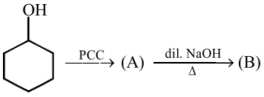
A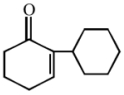
B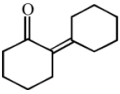
C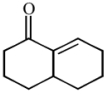
D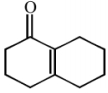
Solution
(B) Step $1$: Cyclohexanol is oxidized by $PCC$ (Pyridinium chlorochromate) to form cyclohexanone,which is product $(A)$.
Step $2$: Cyclohexanone undergoes self-aldol condensation in the presence of dilute $NaOH$ and heat $(\Delta)$ to form the $\alpha,\beta$-unsaturated ketone,which is cyclohexylidenecyclohexanone,product $(B)$.
Step $2$: Cyclohexanone undergoes self-aldol condensation in the presence of dilute $NaOH$ and heat $(\Delta)$ to form the $\alpha,\beta$-unsaturated ketone,which is cyclohexylidenecyclohexanone,product $(B)$.
0 likesView Solution
82
ChemistryMediumMCQAIIMS · 2019
Which of the following is not an example of a chain growth polymer?
A
Neoprene
B
Buna-$S$
C
$PMMA$
D
Glyptal
Solution
(D) Chain growth polymers are formed by the repeated addition of monomer units containing double or triple bonds (e.g.,Neoprene,Buna-$S$,$PMMA$).
Glyptal is a condensation or step-growth polymer formed by the reaction between ethylene glycol $(HOCH_2CH_2OH)$ and phthalic acid $(C_6H_4(COOH)_2)$ with the elimination of water molecules.
Glyptal is a condensation or step-growth polymer formed by the reaction between ethylene glycol $(HOCH_2CH_2OH)$ and phthalic acid $(C_6H_4(COOH)_2)$ with the elimination of water molecules.
0 likesView Solution
83
ChemistryMediumMCQAIIMS · 2019
For a first order reaction,a plot of $\log(a-x)$ against time is a straight line with negative slope equal to
A
$\frac{-k}{2.303}$
B
$-2.303 k$
C
$\frac{2.303}{k}$
D
$-\frac{E_{a}}{2.303 R}$
Solution
(A) For a first order reaction,the integrated rate equation is given by:
$k = \frac{2.303}{t} \log \left(\frac{a}{a-x}\right)$
Rearranging the equation:
$kt = 2.303 \log a - 2.303 \log (a-x)$
$2.303 \log (a-x) = 2.303 \log a - kt$
$\log (a-x) = \log a - \frac{kt}{2.303}$
Comparing this with the equation of a straight line $y = mx + c$,where $y = \log(a-x)$,$x = t$,and $c = \log a$,the slope $m$ is equal to $-\frac{k}{2.303}$.
$k = \frac{2.303}{t} \log \left(\frac{a}{a-x}\right)$
Rearranging the equation:
$kt = 2.303 \log a - 2.303 \log (a-x)$
$2.303 \log (a-x) = 2.303 \log a - kt$
$\log (a-x) = \log a - \frac{kt}{2.303}$
Comparing this with the equation of a straight line $y = mx + c$,where $y = \log(a-x)$,$x = t$,and $c = \log a$,the slope $m$ is equal to $-\frac{k}{2.303}$.
0 likesView Solution
84
ChemistryMediumMCQAIIMS · 2019
Select the incorrect statement:
A
Micelles are associated colloids.
B
The electrical charge on a colloid particle is indicated by electrophoresis.
C
Formation of micelles takes place above Kraft temperature.
D
Formation of micelles takes place below $CMC$.
Solution
(D) Micelles are formed only above a particular concentration called Critical Micelle Concentration $(CMC)$ and above a particular temperature called Kraft temperature $(T_k)$.
Therefore,the statement that the formation of micelles takes place below $CMC$ is incorrect.
Therefore,the statement that the formation of micelles takes place below $CMC$ is incorrect.
0 likesView Solution
85
ChemistryMediumMCQAIIMS · 2019
The above compounds can be differentiated by the following reagent:
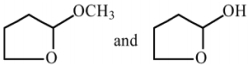
A
$2,4-DNP$ (Brady reagent)
B
Tollen's reagent
C
Lucas reagent
D
$NaHSO_3$
Solution
(B) The first compound is a cyclic acetal ($2$-methoxytetrahydrofuran),which is stable in basic conditions and does not react with Tollen's reagent.
The second compound is a cyclic hemiacetal ($2$-hydroxytetrahydrofuran),which exists in equilibrium with its open-chain hydroxy-aldehyde form in aqueous solution.
The open-chain hydroxy-aldehyde contains a free aldehyde group $(-CHO)$,which gives a positive Tollen's test (formation of silver mirror).
Therefore,Tollen's reagent can be used to differentiate between the two.
The second compound is a cyclic hemiacetal ($2$-hydroxytetrahydrofuran),which exists in equilibrium with its open-chain hydroxy-aldehyde form in aqueous solution.
The open-chain hydroxy-aldehyde contains a free aldehyde group $(-CHO)$,which gives a positive Tollen's test (formation of silver mirror).
Therefore,Tollen's reagent can be used to differentiate between the two.
0 likesView Solution
86
ChemistryMediumMCQAIIMS · 2019
$A$ $\xrightarrow{PhSO_2Cl} B$ $\xrightarrow{KOH} C$ $\xrightarrow{C_2H_5I} D$
$C$ is water soluble.
Correct structures of $A$ and $D$ are:
$C$ is water soluble.
Correct structures of $A$ and $D$ are:
A
$R_2NH, PhSO_2NR_2(C_2H_5)$
B
$RNH_2, PhSO_2N(C_2H_5)R$
C
$RNH_2, PhSO_2N(C_2H_5)_2$
D
$RNH_2, PhSO_2N(C_2H_5)R$
Solution
(B) The reaction sequence is a characteristic test for primary amines using Hinsberg's reagent $(PhSO_2Cl)$.
$1$. $A$ is a primary amine $(RNH_2)$.
$2$. $A$ reacts with $PhSO_2Cl$ to form $N$-alkylbenzenesulfonamide ($B$,$PhSO_2NHR$).
$3$. $B$ has an acidic hydrogen on the nitrogen atom,so it reacts with $KOH$ to form a water-soluble potassium salt ($C$,$PhSO_2N^-R K^+$).
$4$. The salt $C$ undergoes alkylation with ethyl iodide $(C_2H_5I)$ to form $N$-ethyl-$N$-alkylbenzenesulfonamide ($D$,$PhSO_2N(C_2H_5)R$).
Therefore,$A$ is $RNH_2$ and $D$ is $PhSO_2N(C_2H_5)R$.
$1$. $A$ is a primary amine $(RNH_2)$.
$2$. $A$ reacts with $PhSO_2Cl$ to form $N$-alkylbenzenesulfonamide ($B$,$PhSO_2NHR$).
$3$. $B$ has an acidic hydrogen on the nitrogen atom,so it reacts with $KOH$ to form a water-soluble potassium salt ($C$,$PhSO_2N^-R K^+$).
$4$. The salt $C$ undergoes alkylation with ethyl iodide $(C_2H_5I)$ to form $N$-ethyl-$N$-alkylbenzenesulfonamide ($D$,$PhSO_2N(C_2H_5)R$).
Therefore,$A$ is $RNH_2$ and $D$ is $PhSO_2N(C_2H_5)R$.
0 likesView Solution
87
ChemistryDifficultMCQAIIMS · 2019
The reaction of $5-$methylenecyclohex$-2-$enone with $2$ equivalents of $HBr$ yields which of the following products?
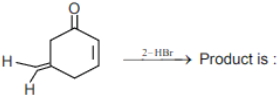
A
$3-$bromo$-5-$(bromomethyl)cyclohexanone
B
$2,5-$dibromocyclohexanone
C
$3-$bromo$-5-$methyl$-5-$hydroxycyclohex$-2-$enone
D
$3-$bromo$-5-$bromo$-5-$methylcyclohexanone
Solution
(D) The reaction involves the electrophilic addition of $HBr$ to the two double bonds present in $5-$methylenecyclohex$-2-$enone.
First,$HBr$ adds to the exocyclic double bond. Protonation occurs to form a stable $3^{\circ}$ carbocation at the $5-$position,which is then attacked by the bromide ion to give a $5-$bromo$-5-$methylcyclohex$-2-$enone intermediate.
Second,$HBr$ adds to the remaining endocyclic double bond. According to Markovnikov's rule,the proton adds to the carbon with more hydrogens,and the bromide adds to the carbon that forms a more stable carbocation (stabilized by the inductive effect of the carbonyl group).
The final product is $3-$bromo$-5-$bromo$-5-$methylcyclohexanone.
First,$HBr$ adds to the exocyclic double bond. Protonation occurs to form a stable $3^{\circ}$ carbocation at the $5-$position,which is then attacked by the bromide ion to give a $5-$bromo$-5-$methylcyclohex$-2-$enone intermediate.
Second,$HBr$ adds to the remaining endocyclic double bond. According to Markovnikov's rule,the proton adds to the carbon with more hydrogens,and the bromide adds to the carbon that forms a more stable carbocation (stabilized by the inductive effect of the carbonyl group).
The final product is $3-$bromo$-5-$bromo$-5-$methylcyclohexanone.
0 likesView Solution
88
ChemistryMediumMCQAIIMS · 2019
Identify the correct order of reactivity for the reaction with alcoholic $KOH$ for the following compounds:
$(a)$ $2$-bromo-$2,3$-dimethylbutane
$(b)$ $2$-chlorobutane
$(c)$ $2$-bromobutane
$(d)$ $1$-bromopropane
$(a)$ $2$-bromo-$2,3$-dimethylbutane
$(b)$ $2$-chlorobutane
$(c)$ $2$-bromobutane
$(d)$ $1$-bromopropane
A
$a > c > b > d$
B
$a > b > c > d$
C
$d > b > c > a$
D
$a > d > b > c$
Solution
(A) The reaction with alcoholic $KOH$ is an $E2$ elimination reaction.
The reactivity in $E2$ reactions depends on two main factors:
$1$. The stability of the alkene formed (more substituted alkenes are more stable).
$2$. The nature of the leaving group $(I^- > Br^- > Cl^-)$.
Analyzing the compounds:
$(a)$ $2$-bromo-$2,3$-dimethylbutane is a $3^{\circ}$ alkyl bromide. It forms a highly substituted,stable alkene.
$(c)$ $2$-bromobutane is a $2^{\circ}$ alkyl bromide.
$(b)$ $2$-chlorobutane is a $2^{\circ}$ alkyl chloride. Since $Br^-$ is a better leaving group than $Cl^-$,$(c) > (b)$.
$(d)$ $1$-bromopropane is a $1^{\circ}$ alkyl bromide,which is the least reactive towards $E2$ elimination.
Thus,the correct order of reactivity is $(a) > (c) > (b) > (d)$.
The reactivity in $E2$ reactions depends on two main factors:
$1$. The stability of the alkene formed (more substituted alkenes are more stable).
$2$. The nature of the leaving group $(I^- > Br^- > Cl^-)$.
Analyzing the compounds:
$(a)$ $2$-bromo-$2,3$-dimethylbutane is a $3^{\circ}$ alkyl bromide. It forms a highly substituted,stable alkene.
$(c)$ $2$-bromobutane is a $2^{\circ}$ alkyl bromide.
$(b)$ $2$-chlorobutane is a $2^{\circ}$ alkyl chloride. Since $Br^-$ is a better leaving group than $Cl^-$,$(c) > (b)$.
$(d)$ $1$-bromopropane is a $1^{\circ}$ alkyl bromide,which is the least reactive towards $E2$ elimination.
Thus,the correct order of reactivity is $(a) > (c) > (b) > (d)$.
0 likesView Solution
89
ChemistryMediumMCQAIIMS · 2019
$HCHO$ (more reactive towards oxidation) + $CH_3CHO \xrightarrow{Conc. NaOH}$ Find out the products of the reaction.
A
$CH_3CH_2OH$ and $HCO_2Na$
B
$CH_3CH_2OH$ and $CH_3OH$
C
$CH_3CO_2Na$ and $CH_3OH$
D
$CH_3CO_2Na$ and $HCO_2Na$
Solution
(A) In a Cross-Cannizzaro reaction between formaldehyde $(HCHO)$ and acetaldehyde $(CH_3CHO)$,formaldehyde is more reactive towards nucleophilic attack by $OH^-$ because it lacks electron-donating alkyl groups.
Consequently,formaldehyde is oxidized to sodium formate $(HCO_2Na)$,and acetaldehyde is reduced to ethanol $(CH_3CH_2OH)$.
Reaction: $HCHO + CH_3CHO \xrightarrow{Conc. NaOH} HCO_2Na + CH_3CH_2OH$
Consequently,formaldehyde is oxidized to sodium formate $(HCO_2Na)$,and acetaldehyde is reduced to ethanol $(CH_3CH_2OH)$.
Reaction: $HCHO + CH_3CHO \xrightarrow{Conc. NaOH} HCO_2Na + CH_3CH_2OH$
0 likesView Solution
90
ChemistryMediumMCQAIIMS · 2019
$(i) \ F_3CCOOH$
$(ii) \ CH_3COOH$
$(iii) \ C_6H_5COOH$
$(iv) \ CH_3CH_2COOH$
Correct order of $pK_a$ value is:
$(ii) \ CH_3COOH$
$(iii) \ C_6H_5COOH$
$(iv) \ CH_3CH_2COOH$
Correct order of $pK_a$ value is:
A
$iv > iii > ii > i$
B
$i > ii > iv > iii$
C
$iv > ii > iii > i$
D
$i > iii > ii > iv$
Solution
(C) The acidic strength of carboxylic acids depends on the electron-withdrawing or electron-donating groups attached to the carboxyl group.
$1$. $F_3CCOOH$: The strong electron-withdrawing effect of three fluorine atoms significantly increases acidity.
$2$. $C_6H_5COOH$: The phenyl group exerts an electron-withdrawing effect through resonance and induction,making it more acidic than aliphatic acids.
$3$. $CH_3COOH$: The methyl group is electron-donating (+$I$ effect),which decreases acidity compared to benzoic acid.
$4$. $CH_3CH_2COOH$: The ethyl group is a stronger electron-donating group (+$I$ effect) than the methyl group,further decreasing acidity.
Thus,the order of acidic strength is: $i > iii > ii > iv$.
Since $pK_a$ is inversely proportional to acidic strength $(pK_a = -\log K_a)$,the order of $pK_a$ values is the reverse of the acidic strength order: $iv > ii > iii > i$.
$1$. $F_3CCOOH$: The strong electron-withdrawing effect of three fluorine atoms significantly increases acidity.
$2$. $C_6H_5COOH$: The phenyl group exerts an electron-withdrawing effect through resonance and induction,making it more acidic than aliphatic acids.
$3$. $CH_3COOH$: The methyl group is electron-donating (+$I$ effect),which decreases acidity compared to benzoic acid.
$4$. $CH_3CH_2COOH$: The ethyl group is a stronger electron-donating group (+$I$ effect) than the methyl group,further decreasing acidity.
Thus,the order of acidic strength is: $i > iii > ii > iv$.
Since $pK_a$ is inversely proportional to acidic strength $(pK_a = -\log K_a)$,the order of $pK_a$ values is the reverse of the acidic strength order: $iv > ii > iii > i$.
0 likesView Solution
91
ChemistryMediumMCQAIIMS · 2019
Identify the suitable reagents for the following conversion:
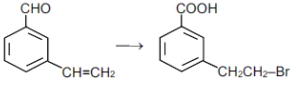
A
$CH_3MgBr, H_3O^{+}, I_2/NaOH, HBr/R_2O_2$
B
$KMnO_4/NaOH, HBr/R_2O_2$
C
$CH_3MgBr, KMnO_4, HBr$
D
$CH_3MgBr, H_3O^{+}, HBr, I_2/NaOH$
Solution
(A) The conversion of $3-$vinylbenzaldehyde to $3-(2-$bromoethyl$)$benzoic acid involves two main transformations:
$1$. Oxidation of the aldehyde group $(-CHO)$ to a carboxylic acid group $(-COOH)$ using the iodoform test reagents $(I_2/NaOH)$ which selectively oxidizes the methyl ketone or aldehyde group while leaving the alkene intact.
$2$. Anti-Markovnikov addition of $HBr$ to the vinyl group $(-CH=CH_2)$ using $HBr/R_2O_2$ (peroxide effect) to yield the $2-$bromoethyl substituent.
Thus,the correct sequence of reagents is $I_2/NaOH$ followed by $HBr/R_2O_2$.
$1$. Oxidation of the aldehyde group $(-CHO)$ to a carboxylic acid group $(-COOH)$ using the iodoform test reagents $(I_2/NaOH)$ which selectively oxidizes the methyl ketone or aldehyde group while leaving the alkene intact.
$2$. Anti-Markovnikov addition of $HBr$ to the vinyl group $(-CH=CH_2)$ using $HBr/R_2O_2$ (peroxide effect) to yield the $2-$bromoethyl substituent.
Thus,the correct sequence of reagents is $I_2/NaOH$ followed by $HBr/R_2O_2$.
0 likesView Solution
92
ChemistryMediumMCQAIIMS · 2019
Correct order for nucleophilic addition reaction :
$(1)$ $C_{6}H_{5}COC_{6}H_{5}$
$(2)$ $C_{6}H_{5}CHO$
$(3)$ $p-CH_{3}C_{6}H_{4}CHO$
$(4)$ $p-CH_{3}OC_{6}H_{4}CHO$
$(1)$ $C_{6}H_{5}COC_{6}H_{5}$
$(2)$ $C_{6}H_{5}CHO$
$(3)$ $p-CH_{3}C_{6}H_{4}CHO$
$(4)$ $p-CH_{3}OC_{6}H_{4}CHO$
A
$2 > 3 > 4 > 1$
B
$4 > 3 > 2 > 1$
C
$2 > 1 > 3 > 4$
D
$4 > 2 > 3 > 1$
Solution
(A) Nucleophilic addition reactivity depends on the electrophilicity of the carbonyl carbon.
$1.$ Aldehydes are more reactive than ketones due to less steric hindrance and lower electronic repulsion.
$2.$ Electron-donating groups $(EDG)$ decrease the electrophilicity of the carbonyl carbon,thereby decreasing reactivity.
$3.$ The order of electron-donating strength is: $CH_{3}O$ (strong $+M$) $> CH_{3}$ (weak $+I$) $> H$ (no effect).
$4.$ Comparing the compounds:
$(1)$ $C_{6}H_{5}COC_{6}H_{5}$ (Ketone,least reactive)
$(2)$ $C_{6}H_{5}CHO$ (Benzaldehyde,most reactive among these)
$(3)$ $p-CH_{3}C_{6}H_{4}CHO$ (Aldehyde with $+I$ group)
$(4)$ $p-CH_{3}OC_{6}H_{4}CHO$ (Aldehyde with $+M$ group)
Thus,the reactivity order is: $2 > 3 > 4 > 1$.
$1.$ Aldehydes are more reactive than ketones due to less steric hindrance and lower electronic repulsion.
$2.$ Electron-donating groups $(EDG)$ decrease the electrophilicity of the carbonyl carbon,thereby decreasing reactivity.
$3.$ The order of electron-donating strength is: $CH_{3}O$ (strong $+M$) $> CH_{3}$ (weak $+I$) $> H$ (no effect).
$4.$ Comparing the compounds:
$(1)$ $C_{6}H_{5}COC_{6}H_{5}$ (Ketone,least reactive)
$(2)$ $C_{6}H_{5}CHO$ (Benzaldehyde,most reactive among these)
$(3)$ $p-CH_{3}C_{6}H_{4}CHO$ (Aldehyde with $+I$ group)
$(4)$ $p-CH_{3}OC_{6}H_{4}CHO$ (Aldehyde with $+M$ group)
Thus,the reactivity order is: $2 > 3 > 4 > 1$.
0 likesView Solution
93
ChemistryMediumMCQAIIMS · 2019
$C_{7}H_{10}O$ reacts with $CH_{3}MgBr$ to give a compound $C_{8}H_{12}O$ which gives a positive iodoform test. Identify the structure of $A$.
A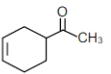
B
C
D
Solution
(C) The reaction of an aldehyde or ketone with $CH_{3}MgBr$ (Grignard reagent) followed by hydrolysis yields an alcohol.
For the resulting alcohol to give a positive iodoform test,it must contain a $CH_{3}CH(OH)-$ group.
Starting with $C_{7}H_{10}O$,if $A$ is cyclohex$-3-$ene$-1-$carbaldehyde,the reaction is:
$C_{6}H_{9}CHO + CH_{3}MgBr \rightarrow C_{6}H_{9}CH(OMgBr)CH_{3}$
Upon hydrolysis,this gives $C_{6}H_{9}CH(OH)CH_{3}$,which is a secondary alcohol with a $CH_{3}CH(OH)-$ group.
This structure gives a positive iodoform test with $I_{2}/NaOH$.
Thus,the structure of $A$ is cyclohex$-3-$ene$-1-$carbaldehyde.
For the resulting alcohol to give a positive iodoform test,it must contain a $CH_{3}CH(OH)-$ group.
Starting with $C_{7}H_{10}O$,if $A$ is cyclohex$-3-$ene$-1-$carbaldehyde,the reaction is:
$C_{6}H_{9}CHO + CH_{3}MgBr \rightarrow C_{6}H_{9}CH(OMgBr)CH_{3}$
Upon hydrolysis,this gives $C_{6}H_{9}CH(OH)CH_{3}$,which is a secondary alcohol with a $CH_{3}CH(OH)-$ group.
This structure gives a positive iodoform test with $I_{2}/NaOH$.
Thus,the structure of $A$ is cyclohex$-3-$ene$-1-$carbaldehyde.
0 likesView Solution
94
ChemistryMediumMCQAIIMS · 2019
| Column-$I$ | Column-$II$ |
| $A$. Tyrosine | $P$. Essential amino acid |
| $B$. Serine | $Q$. Ceric Ammonium Nitrate |
| $C$. Tryptophan | $R$. Neutral $FeCl_{3}$ |
| $D$. Proline | $S$. Carbylamine Test - Negative |
A
$A-S, B-Q, C-P, D-R$
B
$A-Q, B-R, C-S, D-P$
C
$A-R, B-P, C-Q, D-S$
D
$A-R, B-Q, C-P, D-S$
Solution
(D) Tyrosine contains a phenolic group,which gives a violet color with neutral $FeCl_{3}$ solution. Thus,$A-R$.
Serine contains a primary alcoholic group $(-OH)$,which reacts with Ceric Ammonium Nitrate to give a red color. Thus,$B-Q$.
Tryptophan is an essential amino acid that must be obtained from the diet. Thus,$C-P$.
Proline is a secondary amine ($2^{\circ}$ amine). The Carbylamine test is specific for primary amines ($1^{\circ}$ amines) and gives a negative result for secondary amines. Thus,$D-S$.
Therefore,the correct matching is $A-R, B-Q, C-P, D-S$.
Serine contains a primary alcoholic group $(-OH)$,which reacts with Ceric Ammonium Nitrate to give a red color. Thus,$B-Q$.
Tryptophan is an essential amino acid that must be obtained from the diet. Thus,$C-P$.
Proline is a secondary amine ($2^{\circ}$ amine). The Carbylamine test is specific for primary amines ($1^{\circ}$ amines) and gives a negative result for secondary amines. Thus,$D-S$.
Therefore,the correct matching is $A-R, B-Q, C-P, D-S$.
0 likesView Solution
95
ChemistryMediumMCQAIIMS · 2019
Which of the following will release $NH_{3}$ upon reaction with $NaOH$?
A
$NH_{2}OH$
B
Ethylenediaminetetraacetic acid $(EDTA)$
C
Hydrazoic acid $(N_{3}H)$
D
Triethylamine
Solution
(C) Hydrazoic acid $(N_{3}H)$ reacts with $NaOH$ to form sodium azide $(NaN_{3})$ and water. However,in the context of nitrogen-containing compounds,$N_{3}H$ is often associated with the release of ammonia under specific reducing conditions or in specific chemical contexts. Given the options,$N_{3}H$ is the only compound containing nitrogen that can be involved in pathways leading to $NH_{3}$ formation.
0 likesView Solution
96
ChemistryEasyMCQAIIMS · 2019
$MnO$ is $:$
A
Ferromagnetic
B
Diamagnetic
C
Ferrimagnetic
D
Antiferromagnetic
Solution
(D) $MnO$ is antiferromagnetic because the magnetic moments of the domains are aligned in a compensatory manner,resulting in a net magnetic moment of zero. This is illustrated by the alternating spin directions shown below:
(Image shows a grid of arrows pointing up and down in an alternating pattern,labeled as Antiferromagnetic).
(Image shows a grid of arrows pointing up and down in an alternating pattern,labeled as Antiferromagnetic).
0 likesView Solution
97
ChemistryMediumMCQAIIMS · 2019
Which of the following have a melting point below $500\,^{\circ}C$?
A
$Zn, Cd$
B
$Ag, Cu$
C
$Cd, Cu$
D
$Ag, Zn$
Solution
(A) Zinc $(Zn)$ and cadmium $(Cd)$ are relatively soft metals compared to other transition elements.
They form weaker metallic bonds due to the presence of completely filled $d$-orbitals ($d^{10}$ configuration),which do not participate in metallic bonding.
The melting point of $Zn$ is $419.5\,^{\circ}C$ and the melting point of $Cd$ is $321\,^{\circ}C$.
Both of these values are below $500\,^{\circ}C$.
They form weaker metallic bonds due to the presence of completely filled $d$-orbitals ($d^{10}$ configuration),which do not participate in metallic bonding.
The melting point of $Zn$ is $419.5\,^{\circ}C$ and the melting point of $Cd$ is $321\,^{\circ}C$.
Both of these values are below $500\,^{\circ}C$.
0 likesView Solution
98
ChemistryMediumMCQAIIMS · 2019
Which of the following is a strong oxidizing agent used in the purification of water?
A
$OF_2$
B
$NO_3^-$
C
$NO_2^-$
D
$Cl_2O$
Solution
(D) $Cl_2O$ (dichlorine monoxide) acts as a strong oxidizing agent and is used for the purification and disinfection of water.
0 likesView Solution
99
ChemistryMediumMCQAIIMS · 2019
Which of the following ions forms a colored carbonate precipitate?
A
$Hg_{2}^{2+}$
B
$Sr^{2+}$
C
$Li^{+}$
D
$Bi^{3+}$
Solution
(D) The carbonate of the bismuth ion $(Bi^{3+})$ is known to have a pale yellow color.
On the other hand,the carbonates of $Hg_{2}^{2+}$,$Sr^{2+}$,and $Li^{+}$ are white or colorless.
On the other hand,the carbonates of $Hg_{2}^{2+}$,$Sr^{2+}$,and $Li^{+}$ are white or colorless.
0 likesView Solution
100
ChemistryMediumMCQAIIMS · 2019
Yellow color of chlorine water fades because of:
A
$ClO_{2} + H_{2}$
B
Chlorine gas escapes
C
Formation of $HCl$ and $HOCl$
D
$Cl_{2}O$
Solution
(C) The yellow color of chlorine water fades due to the formation of $HCl$ and $HOCl$ (hypochlorous acid).
$HOCl$ is unstable and decomposes to give nascent oxygen,which acts as a bleaching agent.
The reaction is:
$Cl_{2} + H_{2}O \rightarrow HCl + HOCl$
$HOCl \rightarrow HCl + [O]$
$HOCl$ is unstable and decomposes to give nascent oxygen,which acts as a bleaching agent.
The reaction is:
$Cl_{2} + H_{2}O \rightarrow HCl + HOCl$
$HOCl \rightarrow HCl + [O]$
0 likesView Solution
Vedclass Products
For Students
Vedclass Test Series
Mock tests in real AIIMS style covering Chemistry with performance analysis. 5-day free trial.
Start Free TrialFor Teachers
Exam Paper Generator
Generate Set A/B/C/D Chemistry papers from 7.5L+ questions in 2 minutes. 3 chapters free.
Try FreeFor Institutes
Online Exam Module
Run live AIIMS mock exams with unlimited students, 360° analytics & white-label branding.
See DemoFrequently Asked Questions
How many Chemistry questions are in AIIMS 2019?
There are 179 Chemistry questions from the AIIMS 2019 paper on Vedclass, each with a detailed step-by-step solution in English.
Are AIIMS 2019 Chemistry solutions available in English?
Yes. All solutions on this page are in English. You can also switch to English or Hindi using the language buttons above the questions.
Can I practice AIIMS 2019 Chemistry as a timed test?
Yes. Use the Vedclass Test Series to attempt a full AIIMS mock test covering Chemistry with time limits and instant score analysis.
Can teachers create Chemistry papers from AIIMS previous year questions?
Yes. The Vedclass Exam Paper Generator lets teachers mix AIIMS Chemistry questions and generate Set A/B/C/D papers in minutes.
For Teachers & Institutes
Build a Custom Chemistry Paper
Pick AIIMS 2019 Chemistry questions, set difficulty, and generate Set A/B/C/D in 2 minutes.