
ChemistryQ1–77 of 77 questions
Page 1 of 1 · English
1
ChemistryMCQAIIMS · 2012
The vector sum of two forces is perpendicular to their vector difference. In that case,the forces
A
Are equal to each other in magnitude
B
Are not equal to each other in magnitude
C
Cannot be predicted
D
Are equal to each other
Solution
(A) If two vectors are perpendicular,their dot product must be equal to zero.
According to the problem:
$(\overrightarrow{A} + \overrightarrow{B}) \cdot (\overrightarrow{A} - \overrightarrow{B}) = 0$
$\Rightarrow \overrightarrow{A} \cdot \overrightarrow{A} - \overrightarrow{A} \cdot \overrightarrow{B} + \overrightarrow{B} \cdot \overrightarrow{A} - \overrightarrow{B} \cdot \overrightarrow{B} = 0$
Since the dot product is commutative,$\overrightarrow{A} \cdot \overrightarrow{B} = \overrightarrow{B} \cdot \overrightarrow{A}$,so the middle terms cancel out:
$\Rightarrow A^2 - B^2 = 0$
$\Rightarrow A^2 = B^2$
$\therefore A = B$
This means the two forces are equal to each other in magnitude.
According to the problem:
$(\overrightarrow{A} + \overrightarrow{B}) \cdot (\overrightarrow{A} - \overrightarrow{B}) = 0$
$\Rightarrow \overrightarrow{A} \cdot \overrightarrow{A} - \overrightarrow{A} \cdot \overrightarrow{B} + \overrightarrow{B} \cdot \overrightarrow{A} - \overrightarrow{B} \cdot \overrightarrow{B} = 0$
Since the dot product is commutative,$\overrightarrow{A} \cdot \overrightarrow{B} = \overrightarrow{B} \cdot \overrightarrow{A}$,so the middle terms cancel out:
$\Rightarrow A^2 - B^2 = 0$
$\Rightarrow A^2 = B^2$
$\therefore A = B$
This means the two forces are equal to each other in magnitude.
0 likesView Solution
2
ChemistryMCQAIIMS · 2012
$A$ particle moves in a circle of radius $25 \ cm$ at two revolutions per second. The acceleration of the particle in $m/s^2$ is
A
${\pi ^2}$
B
$8{\pi ^2}$
C
$4{\pi ^2}$
D
$2{\pi ^2}$
Solution
(C) Given: Radius $r = 25 \ cm = 0.25 \ m$. Frequency $n = 2 \ rev/s$.
Angular velocity $\omega = 2\pi n = 2\pi \times 2 = 4\pi \ rad/s$.
The centripetal acceleration $a_c$ is given by $a_c = \omega^2 r$.
Substituting the values: $a_c = (4\pi)^2 \times 0.25$.
$a_c = 16\pi^2 \times 0.25 = 4\pi^2 \ m/s^2$.
Angular velocity $\omega = 2\pi n = 2\pi \times 2 = 4\pi \ rad/s$.
The centripetal acceleration $a_c$ is given by $a_c = \omega^2 r$.
Substituting the values: $a_c = (4\pi)^2 \times 0.25$.
$a_c = 16\pi^2 \times 0.25 = 4\pi^2 \ m/s^2$.
1 likesView Solution
3
ChemistryMediumMCQAIIMS · 2012
For preparing a $0.1 \ N$ solution of a compound from its impure sample,where the percentage purity is known,the weight of the substance required will be:
A
More than the theoretical weight
B
Less than the theoretical weight
C
Same as the theoretical weight
D
None of these
Solution
(A) The theoretical weight is calculated based on $100\%$ purity of the substance.
Since the sample is impure,its percentage purity is less than $100\%$.
To obtain the required amount of the pure compound,we must take a larger quantity of the impure sample to compensate for the impurities present.
Therefore,the weight of the impure substance required will be greater than the theoretical weight calculated for a pure substance.
Since the sample is impure,its percentage purity is less than $100\%$.
To obtain the required amount of the pure compound,we must take a larger quantity of the impure sample to compensate for the impurities present.
Therefore,the weight of the impure substance required will be greater than the theoretical weight calculated for a pure substance.
0 likesView Solution
4
ChemistryMCQAIIMS · 2012
For preparing a $0.1 \, N$ solution of a compound from its impure sample,of which the percentage purity is known,the weight of the substance required will be
A
Less than the theoretical weight
B
More than the theoretical weight
C
Same as theoretical weight
D
None of these
Solution
(B) The sample contains impurities. The impurity does not contribute to the normality of the solution.
To obtain the required amount of pure compound,we must account for the percentage purity.
Since the sample is not $100 \%$ pure,we need to take a larger mass of the impure sample compared to the theoretical weight of the pure compound to ensure the actual amount of the active substance matches the requirement.
Therefore,the weight of the substance required will be more than the theoretical weight.
To obtain the required amount of pure compound,we must account for the percentage purity.
Since the sample is not $100 \%$ pure,we need to take a larger mass of the impure sample compared to the theoretical weight of the pure compound to ensure the actual amount of the active substance matches the requirement.
Therefore,the weight of the substance required will be more than the theoretical weight.
0 likesView Solution
5
ChemistryMCQAIIMS · 2012
The existence of a substance in more than one solid modification is known as:
A
Polymorphism
B
Isomorphism
C
Allotropy
D
Enantiomorphism
Solution
(A) The existence of a substance in more than one crystalline form is known as polymorphism.
0 likesView Solution
6
ChemistryMCQAIIMS · 2012
Rectified spirit is a mixture of
A
$95\%$ ethyl alcohol $+ 5\%$ water
B
$94\%$ ethyl alcohol $+ 4.53\%$ water
C
$94.4\%$ ethyl alcohol $+ 5.43\%$ water
D
$95.57\%$ ethyl alcohol $+ 4.43\%$ water
Solution
(D) Rectified spirit is an azeotropic mixture of ethanol and water.
It typically contains approximately $95.57\%$ by volume of ethyl alcohol and $4.43\%$ by volume of water.
This specific composition is known as the constant boiling mixture.
It typically contains approximately $95.57\%$ by volume of ethyl alcohol and $4.43\%$ by volume of water.
This specific composition is known as the constant boiling mixture.
0 likesView Solution
7
ChemistryMCQAIIMS · 2012
Prickles of Rose are
A
Modified leaves
B
Modified stipules
C
Exogenous in origin
D
Endogenous in origin
Solution
(C) Prickles are sharp,pointed outgrowths found on the stems of plants like Rose.
They are superficial outgrowths of the epidermis and cortex,which makes them exogenous in origin.
Unlike thorns,which are modified branches and are endogenous in origin (arising from the stele),prickles can be easily detached from the plant surface without causing deep damage to the vascular tissue.
They are superficial outgrowths of the epidermis and cortex,which makes them exogenous in origin.
Unlike thorns,which are modified branches and are endogenous in origin (arising from the stele),prickles can be easily detached from the plant surface without causing deep damage to the vascular tissue.
0 likesView Solution
8
ChemistryMCQAIIMS · 2012
The family in which many plants are $C_4$ type is:
A
Malvaceae
B
Solanaceae
C
Cruciferae
D
Gramineae
Solution
(D) $C_4$ pathway was first reported in members of the family $Gramineae$ (Poaceae),which includes grasses like sugarcane and maize.
$C_4$ plants are primarily found among monocots,although some dicot families also exhibit this trait.
There are no known $C_4$ gymnosperms,bryophytes,or algae.
$C_4$ plants are primarily found among monocots,although some dicot families also exhibit this trait.
There are no known $C_4$ gymnosperms,bryophytes,or algae.
0 likesView Solution
9
ChemistryMCQAIIMS · 2012
Which gland is concerned with salt equilibrium in the body?
A
Anterior pituitary
B
Pancreas
C
Adrenal
D
Thyroid
Solution
(C) The correct answer is $C$. The adrenal cortex secretes the hormone $Aldosterone$,which is also known as the salt-retaining hormone. It plays a crucial role in maintaining salt equilibrium by acting on the renal tubules to increase the reabsorption of sodium ions $(Na^+)$ and water,while promoting the excretion of potassium ions $(K^+)$. This process helps in regulating the electrolyte balance and blood pressure in the body.
0 likesView Solution
10
ChemistryMCQAIIMS · 2012
In the environment,ozone is known for its
A
Harmful effects
B
Useful effects
C
Both harmful and useful effects
D
Inert nature
Solution
(C) Ozone is both harmful and beneficial to life on Earth.
Ozone present near the surface of the Earth (tropospheric ozone) is a pollutant and is harmful to living organisms.
In the stratosphere,the ozone layer acts as a shield by absorbing harmful ultraviolet $(UV)$ radiations from the sun,thus protecting life on Earth.
Ozone present near the surface of the Earth (tropospheric ozone) is a pollutant and is harmful to living organisms.
In the stratosphere,the ozone layer acts as a shield by absorbing harmful ultraviolet $(UV)$ radiations from the sun,thus protecting life on Earth.
0 likesView Solution
11
ChemistryMCQAIIMS · 2012
Whale is
A
Primary producer
B
Carnivorous secondary consumer
C
$A$ decomposer
D
Herbivorous
Solution
(B) Whales are large marine mammals. Most whales,such as the toothed whales (e.g.,orcas,sperm whales),feed on fish,squid,and other marine animals,classifying them as carnivores. In the marine food chain,they occupy higher trophic levels,typically acting as secondary or tertiary consumers. Therefore,they are carnivorous secondary consumers.
0 likesView Solution
12
ChemistryMCQAIIMS · 2012
Golden rice is a transgenic crop of the future with the following improved trait:
A
High lysine (essential amino acid) content
B
Insect resistance
C
High protein content
D
High vitamin $A$ content
Solution
(D) Golden rice is a genetically modified (transgenic) variety of rice $(Oryza sativa)$ that has been engineered to produce beta-carotene, which is a precursor of vitamin $A$.
This modification was developed to address vitamin $A$ deficiency in populations that rely on rice as a staple food, thereby helping to prevent conditions like night blindness.
Therefore, the correct trait is high vitamin $A$ content.
This modification was developed to address vitamin $A$ deficiency in populations that rely on rice as a staple food, thereby helping to prevent conditions like night blindness.
Therefore, the correct trait is high vitamin $A$ content.
0 likesView Solution
13
ChemistryMCQAIIMS · 2012
The geometry of $ClO_3^-$,according to valence shell electron pair repulsion $(VSEPR)$ theory will be
A
Planar triangle
B
Pyramidal
C
Tetrahedral
D
Square planar
Solution
(B) The central atom $Cl$ has $7$ valence electrons.
In $ClO_3^-$,the $Cl$ atom forms $3$ single bonds with $O$ atoms and has $1$ lone pair of electrons.
Total electron pairs around $Cl = 3 \text{ (bond pairs)} + 1 \text{ (lone pair)} = 4$.
According to $VSEPR$ theory,$4$ electron pairs correspond to a tetrahedral electron geometry.
Due to the presence of one lone pair,the molecular geometry of $ClO_3^-$ is pyramidal.
In $ClO_3^-$,the $Cl$ atom forms $3$ single bonds with $O$ atoms and has $1$ lone pair of electrons.
Total electron pairs around $Cl = 3 \text{ (bond pairs)} + 1 \text{ (lone pair)} = 4$.
According to $VSEPR$ theory,$4$ electron pairs correspond to a tetrahedral electron geometry.
Due to the presence of one lone pair,the molecular geometry of $ClO_3^-$ is pyramidal.
0 likesView Solution
14
ChemistryMCQAIIMS · 2012
The following compounds have been arranged in order of their increasing thermal stabilities. Identify the correct order :
$K_2CO_3(I), MgCO_3(II), CaCO_3(III), BeCO_3(IV)$
$K_2CO_3(I), MgCO_3(II), CaCO_3(III), BeCO_3(IV)$
A
$I < II < III < IV$
B
$IV < II < III < I$
C
$IV < II < I < III$
D
$II < IV < III < I$
Solution
(B) Thermal stability of metal carbonates increases down the group as the ionic radius of the cation increases and its polarising power decreases.
Group $1$ carbonates are more thermally stable than Group $2$ carbonates because Group $1$ cations have a smaller charge $(+1)$ and a larger ionic radius compared to Group $2$ cations $(+2)$.
Among Group $2$ carbonates,the thermal stability increases as: $BeCO_3 < MgCO_3 < CaCO_3$.
Since $K_2CO_3$ belongs to Group $1$,it is more stable than all the given Group $2$ carbonates.
Therefore,the correct order of increasing thermal stability is: $BeCO_3(IV) < MgCO_3(II) < CaCO_3(III) < K_2CO_3(I)$.
Group $1$ carbonates are more thermally stable than Group $2$ carbonates because Group $1$ cations have a smaller charge $(+1)$ and a larger ionic radius compared to Group $2$ cations $(+2)$.
Among Group $2$ carbonates,the thermal stability increases as: $BeCO_3 < MgCO_3 < CaCO_3$.
Since $K_2CO_3$ belongs to Group $1$,it is more stable than all the given Group $2$ carbonates.
Therefore,the correct order of increasing thermal stability is: $BeCO_3(IV) < MgCO_3(II) < CaCO_3(III) < K_2CO_3(I)$.
0 likesView Solution
15
ChemistryMCQAIIMS · 2012
Consider the following statements:
$(I)$ The radius of an anion is larger than that of the parent atom.
$(II)$ The ionization energy generally increases with increasing atomic number in a period.
$(III)$ The electronegativity of an element is the tendency of an isolated atom to attract an electron.
Which of the above statements is/are correct?
$(I)$ The radius of an anion is larger than that of the parent atom.
$(II)$ The ionization energy generally increases with increasing atomic number in a period.
$(III)$ The electronegativity of an element is the tendency of an isolated atom to attract an electron.
Which of the above statements is/are correct?
A
$I$ alone
B
$II$ alone
C
$I$ and $II$
D
$II$ and $III$
Solution
(C) $I.$ An anion is formed by the gain of electrons. Since the number of electrons increases while the number of protons remains constant,the effective nuclear charge per electron decreases,leading to an increase in the ionic radius compared to the parent atom.
$II.$ Across a period,the atomic number increases,which increases the effective nuclear charge. This results in a smaller atomic size and a stronger attraction between the nucleus and the valence electrons,thereby increasing the ionization energy.
$III.$ Electronegativity is defined as the tendency of an atom in a chemical compound to attract a shared pair of electrons,not an isolated atom. Therefore,statement $(III)$ is incorrect.
Thus,statements $(I)$ and $(II)$ are correct.
$II.$ Across a period,the atomic number increases,which increases the effective nuclear charge. This results in a smaller atomic size and a stronger attraction between the nucleus and the valence electrons,thereby increasing the ionization energy.
$III.$ Electronegativity is defined as the tendency of an atom in a chemical compound to attract a shared pair of electrons,not an isolated atom. Therefore,statement $(III)$ is incorrect.
Thus,statements $(I)$ and $(II)$ are correct.
0 likesView Solution
16
ChemistryMCQAIIMS · 2012
$A$ particle moves in a circle of radius $25 \, cm$ at two revolutions per second. The acceleration of the particle in $m/s^2$ is
A
$\pi^2$
B
$8\pi^2$
C
$4\pi^2$
D
$2\pi^2$
Solution
(C) Given radius $r = 25 \, cm = 0.25 \, m = 25 \times 10^{-2} \, m$.
Frequency $f = 2 \, rev/s$.
The angular velocity $\omega$ is given by $\omega = 2\pi f = 2 \times \pi \times 2 = 4\pi \, rad/s$.
The centripetal acceleration $a_c$ is given by $a_c = \omega^2 r$.
Substituting the values: $a_c = (4\pi)^2 \times (25 \times 10^{-2})$.
$a_c = 16\pi^2 \times 0.25$.
$a_c = 4\pi^2 \, m/s^2$.
Frequency $f = 2 \, rev/s$.
The angular velocity $\omega$ is given by $\omega = 2\pi f = 2 \times \pi \times 2 = 4\pi \, rad/s$.
The centripetal acceleration $a_c$ is given by $a_c = \omega^2 r$.
Substituting the values: $a_c = (4\pi)^2 \times (25 \times 10^{-2})$.
$a_c = 16\pi^2 \times 0.25$.
$a_c = 4\pi^2 \, m/s^2$.
0 likesView Solution
17
ChemistryMCQAIIMS · 2012
The following compounds have been arranged in order of their increasing thermal stabilities. Identify the correct order.
$I.$ $K_2CO_3$ $II.$ $MgCO_3$
$III.$ $CaCO_3$ $IV.$ $BeCO_3$
$I.$ $K_2CO_3$ $II.$ $MgCO_3$
$III.$ $CaCO_3$ $IV.$ $BeCO_3$
A
$I < II < III < IV$
B
$IV < II < III < I$
C
$IV < II < I < III$
D
$II < IV < III < I$
Solution
(B) The thermal stability of carbonates increases as the polarizing power of the cation decreases.
$1.$ $BeCO_3$ $(IV)$ is the least stable due to the high polarizing power of $Be^{2+}$.
$2.$ Among alkaline earth metal carbonates ($II$ and $III$),stability increases down the group: $BeCO_3 < MgCO_3 < CaCO_3$.
$3.$ Alkali metal carbonates $(I)$ are much more stable than alkaline earth metal carbonates because alkali metals have lower charge $(+1)$ and lower polarizing power.
Therefore,the correct order of increasing thermal stability is $IV < II < III < I$.
$1.$ $BeCO_3$ $(IV)$ is the least stable due to the high polarizing power of $Be^{2+}$.
$2.$ Among alkaline earth metal carbonates ($II$ and $III$),stability increases down the group: $BeCO_3 < MgCO_3 < CaCO_3$.
$3.$ Alkali metal carbonates $(I)$ are much more stable than alkaline earth metal carbonates because alkali metals have lower charge $(+1)$ and lower polarizing power.
Therefore,the correct order of increasing thermal stability is $IV < II < III < I$.
0 likesView Solution
18
ChemistryMCQAIIMS · 2012
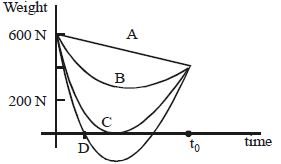
Suppose,the acceleration due to gravity at the Earth's surface is $10\, m\, s^{-2}$ and at the surface of Mars it is $4.0\, m\, s^{-2}$. $A$ $60\, kg$ passenger goes from the Earth to the Mars in a spaceship moving with a constant velocity. Neglect all other objects in the sky. Which part of the figure best represents the weight (net gravitational force) of the passenger as a function of time?
A
$A$
B
$B$
C
$C$
D
$D$
Solution
(C) The weight of the passenger is the net gravitational force acting on them,given by $F = F_E - F_M$,where $F_E$ is the gravitational force due to Earth and $F_M$ is the gravitational force due to Mars.
As the spaceship moves from Earth to Mars,the distance from Earth increases and the distance from Mars decreases.
Initially,at the Earth's surface,the weight is $W = m \times g_E = 60 \times 10 = 600\, N$.
As the spaceship moves away from Earth,the gravitational force from Earth decreases rapidly following the inverse-square law $(F \propto 1/r^2)$.
At some point between Earth and Mars,the gravitational pull from Earth and Mars will be equal and opposite,making the net force zero.
After passing this point,the gravitational pull from Mars becomes dominant,and the net force increases until it reaches the weight on Mars,which is $W = m \times g_M = 60 \times 4 = 240\, N$.
Since the gravitational force follows an inverse-square law,the graph cannot be a straight line (ruling out $A$).
Curve $C$ correctly shows the net force decreasing to zero at a point between the planets and then increasing as the passenger approaches Mars.
As the spaceship moves from Earth to Mars,the distance from Earth increases and the distance from Mars decreases.
Initially,at the Earth's surface,the weight is $W = m \times g_E = 60 \times 10 = 600\, N$.
As the spaceship moves away from Earth,the gravitational force from Earth decreases rapidly following the inverse-square law $(F \propto 1/r^2)$.
At some point between Earth and Mars,the gravitational pull from Earth and Mars will be equal and opposite,making the net force zero.
After passing this point,the gravitational pull from Mars becomes dominant,and the net force increases until it reaches the weight on Mars,which is $W = m \times g_M = 60 \times 4 = 240\, N$.
Since the gravitational force follows an inverse-square law,the graph cannot be a straight line (ruling out $A$).
Curve $C$ correctly shows the net force decreasing to zero at a point between the planets and then increasing as the passenger approaches Mars.
0 likesView Solution
19
ChemistryMCQAIIMS · 2012
For preparing a $0.1 \ N$ solution of a compound from its impure sample of which the percentage purity is known,the weight of the substance required will be
A
less than the theoretical weight
B
more than the theoretical weight
C
same as the theoretical weight
D
none of these
Solution
(B) The theoretical weight is calculated based on the assumption that the substance is $100\%$ pure.
Since the sample is impure,a portion of the weighed mass consists of impurities that do not participate in the reaction.
Therefore,to obtain the required amount of the active compound,one must weigh more than the theoretical weight to compensate for the impurities present in the sample.
Since the sample is impure,a portion of the weighed mass consists of impurities that do not participate in the reaction.
Therefore,to obtain the required amount of the active compound,one must weigh more than the theoretical weight to compensate for the impurities present in the sample.
0 likesView Solution
20
ChemistryDifficultMCQAIIMS · 2012
In a hydrocarbon,the mass ratio of hydrogen and carbon is $1 : 3$. The empirical formula of the hydrocarbon is
A
$CH_4$
B
$CH_2$
C
$C_2H$
D
$CH_3$
Solution
(A) The atomic mass of $H = 1 \ g/mol$ and $C = 12 \ g/mol$.
Given the mass ratio of $H : C = 1 : 3$.
To find the mole ratio,divide the mass by the respective atomic mass:
Moles of $H = 1 / 1 = 1$.
Moles of $C = 3 / 12 = 0.25$.
Now,find the simplest molar ratio:
$H : C = 1 : 0.25 = 4 : 1$.
Therefore,for every $1$ atom of $C$,there are $4$ atoms of $H$.
Hence,the empirical formula is $CH_4$.
Given the mass ratio of $H : C = 1 : 3$.
To find the mole ratio,divide the mass by the respective atomic mass:
Moles of $H = 1 / 1 = 1$.
Moles of $C = 3 / 12 = 0.25$.
Now,find the simplest molar ratio:
$H : C = 1 : 0.25 = 4 : 1$.
Therefore,for every $1$ atom of $C$,there are $4$ atoms of $H$.
Hence,the empirical formula is $CH_4$.
0 likesView Solution
21
ChemistryDifficultMCQAIIMS · 2012
The vapour density of a mixture containing $NO_2$ and $N_2O_4$ is $27.6$. The mole fraction of $NO_2$ in the mixture is:
A
$0.8$
B
$0.6$
C
$0.4$
D
$0.2$
Solution
(A) The vapour density $(V.D.)$ of a mixture is given by the weighted average of the vapour densities of its components:
$V.D._{mix} = X_{NO_2} \times V.D._{NO_2} + X_{N_2O_4} \times V.D._{N_2O_4}$
Given that $V.D._{NO_2} = \frac{M_{NO_2}}{2} = \frac{46}{2} = 23$ and $V.D._{N_2O_4} = \frac{M_{N_2O_4}}{2} = \frac{92}{2} = 46$.
Let the mole fraction of $NO_2$ be $x$,then the mole fraction of $N_2O_4$ is $(1 - x)$.
Substituting the values:
$27.6 = x(23) + (1 - x)(46)$
$27.6 = 23x + 46 - 46x$
$27.6 = 46 - 23x$
$23x = 46 - 27.6$
$23x = 18.4$
$x = \frac{18.4}{23} = 0.8$
Therefore,the mole fraction of $NO_2$ is $0.8$.
$V.D._{mix} = X_{NO_2} \times V.D._{NO_2} + X_{N_2O_4} \times V.D._{N_2O_4}$
Given that $V.D._{NO_2} = \frac{M_{NO_2}}{2} = \frac{46}{2} = 23$ and $V.D._{N_2O_4} = \frac{M_{N_2O_4}}{2} = \frac{92}{2} = 46$.
Let the mole fraction of $NO_2$ be $x$,then the mole fraction of $N_2O_4$ is $(1 - x)$.
Substituting the values:
$27.6 = x(23) + (1 - x)(46)$
$27.6 = 23x + 46 - 46x$
$27.6 = 46 - 23x$
$23x = 46 - 27.6$
$23x = 18.4$
$x = \frac{18.4}{23} = 0.8$
Therefore,the mole fraction of $NO_2$ is $0.8$.
0 likesView Solution
22
ChemistryEasyMCQAIIMS · 2012
The ratio of the energy of a photon with wavelength $3000 \ \mathring{A}$ to that of a photon with wavelength $6000 \ \mathring{A}$ is:
A
$3 : 1$
B
$2 : 1$
C
$1 : 2$
D
$1 : 3$
Solution
(B) The energy of a photon is given by the formula $E = \frac{hc}{\lambda}$.
Since $h$ and $c$ are constants,the energy $E$ is inversely proportional to the wavelength $\lambda$,i.e.,$E \propto \frac{1}{\lambda}$.
Therefore,the ratio of energies is $\frac{E_1}{E_2} = \frac{\lambda_2}{\lambda_1}$.
Given $\lambda_1 = 3000 \ \mathring{A}$ and $\lambda_2 = 6000 \ \mathring{A}$.
Substituting the values,we get $\frac{E_1}{E_2} = \frac{6000}{3000} = \frac{2}{1}$.
Thus,the ratio is $2 : 1$.
Since $h$ and $c$ are constants,the energy $E$ is inversely proportional to the wavelength $\lambda$,i.e.,$E \propto \frac{1}{\lambda}$.
Therefore,the ratio of energies is $\frac{E_1}{E_2} = \frac{\lambda_2}{\lambda_1}$.
Given $\lambda_1 = 3000 \ \mathring{A}$ and $\lambda_2 = 6000 \ \mathring{A}$.
Substituting the values,we get $\frac{E_1}{E_2} = \frac{6000}{3000} = \frac{2}{1}$.
Thus,the ratio is $2 : 1$.
0 likesView Solution
23
ChemistryMediumMCQAIIMS · 2012
Assertion : Angular momentum of an electron in any orbit is given by angular momentum $= \frac{nh}{2\pi}$,where $n$ is the principal quantum number.
Reason : The principal quantum number,$n$,can have any integral value.
Reason : The principal quantum number,$n$,can have any integral value.
A
If both Assertion and Reason are correct and the Reason is a correct explanation of the Assertion.
B
If both Assertion and Reason are correct but Reason is not a correct explanation of the Assertion.
C
If the Assertion is correct but Reason is incorrect.
D
If both the Assertion and Reason are incorrect.
Solution
(B) The assertion states that the angular momentum of an electron in an orbit is given by $mvr = \frac{nh}{2\pi}$,which is a fundamental postulate of the Bohr model of the atom. This statement is correct.
The reason states that the principal quantum number,$n$,can have any integral value $(n = 1, 2, 3, \dots)$. This is also a correct statement regarding the definition of the principal quantum number.
However,the fact that $n$ can take any integral value is not the reason why the angular momentum is quantized as $\frac{nh}{2\pi}$. The quantization of angular momentum is a separate postulate derived from the wave nature of the electron. Therefore,the reason is not the correct explanation of the assertion.
The reason states that the principal quantum number,$n$,can have any integral value $(n = 1, 2, 3, \dots)$. This is also a correct statement regarding the definition of the principal quantum number.
However,the fact that $n$ can take any integral value is not the reason why the angular momentum is quantized as $\frac{nh}{2\pi}$. The quantization of angular momentum is a separate postulate derived from the wave nature of the electron. Therefore,the reason is not the correct explanation of the assertion.
0 likesView Solution
24
ChemistryMediumMCQAIIMS · 2012
Consider the following statements:
$I.$ The radius of an anion is larger than that of the parent atom.
$II.$ The ionization energy generally increases with increasing atomic number in a period.
$III.$ The electronegativity of an element is the tendency of an isolated atom to attract an electron.
Which of the above statements is/are correct?
$I.$ The radius of an anion is larger than that of the parent atom.
$II.$ The ionization energy generally increases with increasing atomic number in a period.
$III.$ The electronegativity of an element is the tendency of an isolated atom to attract an electron.
Which of the above statements is/are correct?
A
$I$ alone
B
$II$ alone
C
$I$ and $II$
D
$II$ and $III$
Solution
(C) $I.$ Correct. An anion is formed by the gain of electrons,which increases electron-electron repulsion and decreases the effective nuclear charge per electron,leading to a larger ionic radius compared to the parent atom.
$II.$ Correct. Across a period,the atomic size decreases due to an increase in effective nuclear charge,making it harder to remove an electron,thus increasing the ionization energy.
$III.$ Incorrect. Electronegativity is defined as the tendency of an atom in a chemical compound to attract a shared pair of electrons,not an isolated atom.
$II.$ Correct. Across a period,the atomic size decreases due to an increase in effective nuclear charge,making it harder to remove an electron,thus increasing the ionization energy.
$III.$ Incorrect. Electronegativity is defined as the tendency of an atom in a chemical compound to attract a shared pair of electrons,not an isolated atom.
0 likesView Solution
25
ChemistryMediumMCQAIIMS · 2012
The geometry of $ClO_3^-$ according to valence shell electron pair repulsion $(VSEPR)$ theory will be
A
Planar triangle
B
Pyramidal
C
Tetrahedral
D
Square planar
Solution
(B) To determine the geometry of $ClO_3^-$,we calculate the number of electron pairs around the central atom,$Cl$.
Number of valence electrons of $Cl = 7$.
Number of monovalent atoms attached = $0$ (Oxygen is divalent).
Charge on the ion = $-1$.
Total number of electron pairs = $\frac{1}{2} \times (7 + 0 + 1) = 4$.
Since there are $4$ electron pairs,the hybridization is $sp^3$.
Out of these $4$ electron pairs,$3$ are bond pairs (with $O$ atoms) and $1$ is a lone pair on the $Cl$ atom.
According to $VSEPR$ theory,the presence of one lone pair causes a distortion in the tetrahedral geometry,resulting in a pyramidal shape.
Number of valence electrons of $Cl = 7$.
Number of monovalent atoms attached = $0$ (Oxygen is divalent).
Charge on the ion = $-1$.
Total number of electron pairs = $\frac{1}{2} \times (7 + 0 + 1) = 4$.
Since there are $4$ electron pairs,the hybridization is $sp^3$.
Out of these $4$ electron pairs,$3$ are bond pairs (with $O$ atoms) and $1$ is a lone pair on the $Cl$ atom.
According to $VSEPR$ theory,the presence of one lone pair causes a distortion in the tetrahedral geometry,resulting in a pyramidal shape.
0 likesView Solution
26
ChemistryMediumMCQAIIMS · 2012
$X \ mL$ of $H_2$ gas effuse through a hole in a container in $5 \ seconds$. The time taken for the effusion of the same volume of the gas specified below under identical conditions is
A
$10 \ seconds : He$
B
$20 \ seconds : O_2$
C
$25 \ seconds : CO$
D
$55 \ seconds : CO_2$
Solution
(B) According to Graham's Law of effusion,the rate of effusion $r \propto \frac{1}{\sqrt{M}}$.
Since $r = \frac{V}{t}$,for the same volume $V$,we have $\frac{V}{t_1} \times \sqrt{M_1} = \frac{V}{t_2} \times \sqrt{M_2}$,which simplifies to $\frac{t_2}{t_1} = \sqrt{\frac{M_2}{M_1}}$.
Given $t_1 = 5 \ s$ for $H_2$ $(M_1 = 2 \ g/mol)$,we calculate $t_2$ for each gas:
For $O_2$ $(M_2 = 32 \ g/mol)$: $t_2 = 5 \times \sqrt{\frac{32}{2}} = 5 \times \sqrt{16} = 5 \times 4 = 20 \ s$.
Thus,the correct option is $20 \ seconds : O_2$.
Since $r = \frac{V}{t}$,for the same volume $V$,we have $\frac{V}{t_1} \times \sqrt{M_1} = \frac{V}{t_2} \times \sqrt{M_2}$,which simplifies to $\frac{t_2}{t_1} = \sqrt{\frac{M_2}{M_1}}$.
Given $t_1 = 5 \ s$ for $H_2$ $(M_1 = 2 \ g/mol)$,we calculate $t_2$ for each gas:
For $O_2$ $(M_2 = 32 \ g/mol)$: $t_2 = 5 \times \sqrt{\frac{32}{2}} = 5 \times \sqrt{16} = 5 \times 4 = 20 \ s$.
Thus,the correct option is $20 \ seconds : O_2$.
0 likesView Solution
27
ChemistryDifficultMCQAIIMS · 2012
$AB$,$A_2$ and $B_2$ are diatomic molecules. If the bond enthalpies of $A_2$,$AB$ and $B_2$ are in the ratio $1:1:0.5$ and enthalpy of formation of $AB$ from $A_2$ and $B_2$ is $-100 \, kJ \, mol^{-1}$,what is the bond energy of $A_2$ in $kJ \, mol^{-1}$?
A
$200$
B
$100$
C
$300$
D
$400$
Solution
(D) Let the bond energy of $A_2$ be $x$. Then,the bond energy of $AB$ is $x$ and the bond energy of $B_2$ is $0.5x$.
The reaction for the formation of $AB$ is:
$\frac{1}{2} A_2 + \frac{1}{2} B_2 \to AB$; $\Delta H_f = -100 \, kJ \, mol^{-1}$.
The enthalpy of reaction is given by the sum of bond energies of reactants minus the sum of bond energies of products:
$\Delta H = [\frac{1}{2} BE(A_2) + \frac{1}{2} BE(B_2)] - [BE(AB)]$
Substituting the values:
$-100 = [\frac{1}{2}(x) + \frac{1}{2}(0.5x)] - x$
$-100 = 0.5x + 0.25x - x$
$-100 = -0.25x$
$x = \frac{100}{0.25} = 400 \, kJ \, mol^{-1}$.
The reaction for the formation of $AB$ is:
$\frac{1}{2} A_2 + \frac{1}{2} B_2 \to AB$; $\Delta H_f = -100 \, kJ \, mol^{-1}$.
The enthalpy of reaction is given by the sum of bond energies of reactants minus the sum of bond energies of products:
$\Delta H = [\frac{1}{2} BE(A_2) + \frac{1}{2} BE(B_2)] - [BE(AB)]$
Substituting the values:
$-100 = [\frac{1}{2}(x) + \frac{1}{2}(0.5x)] - x$
$-100 = 0.5x + 0.25x - x$
$-100 = -0.25x$
$x = \frac{100}{0.25} = 400 \, kJ \, mol^{-1}$.
0 likesView Solution
28
ChemistryMediumMCQAIIMS · 2012
Assertion: Many endothermic reactions that are not spontaneous at room temperature become spontaneous at high temperature.
Reason: Entropy of the system increases with increase in temperature.
Reason: Entropy of the system increases with increase in temperature.
A
If both Assertion and Reason are correct and the Reason is a correct explanation of the Assertion.
B
If both Assertion and Reason are correct but Reason is not a correct explanation of the Assertion.
C
If the Assertion is correct but Reason is incorrect.
D
If both the Assertion and Reason are incorrect.
Solution
(C) For a reaction to be spontaneous,the Gibbs free energy change $\Delta G$ must be negative,where $\Delta G = \Delta H - T\Delta S$.
For endothermic reactions,$\Delta H > 0$. If the reaction involves an increase in entropy $(\Delta S > 0)$,then at high temperatures,the term $T\Delta S$ becomes larger than $\Delta H$.
Consequently,$\Delta G = \Delta H - T\Delta S$ becomes negative,making the reaction spontaneous at high temperatures.
The reason provided is incorrect because the entropy of a system is generally considered a state function that does not necessarily increase with temperature in the context of the spontaneity condition; rather,the term $T\Delta S$ increases with temperature.
For endothermic reactions,$\Delta H > 0$. If the reaction involves an increase in entropy $(\Delta S > 0)$,then at high temperatures,the term $T\Delta S$ becomes larger than $\Delta H$.
Consequently,$\Delta G = \Delta H - T\Delta S$ becomes negative,making the reaction spontaneous at high temperatures.
The reason provided is incorrect because the entropy of a system is generally considered a state function that does not necessarily increase with temperature in the context of the spontaneity condition; rather,the term $T\Delta S$ increases with temperature.
0 likesView Solution
29
ChemistryDifficultMCQAIIMS · 2012
The following equilibria are given:
$N_2 + 3H_2 \rightleftharpoons 2NH_3 ; K_1$
$N_2 + O_2 \rightleftharpoons 2NO ; K_2$
$H_2 + \frac{1}{2}O_2 \rightleftharpoons H_2O ; K_3$
The equilibrium constant of the reaction $2NH_3 + \frac{5}{2}O_2 \rightleftharpoons 2NO + 3H_2O$ in terms of $K_1, K_2$ and $K_3$ is:
$N_2 + 3H_2 \rightleftharpoons 2NH_3 ; K_1$
$N_2 + O_2 \rightleftharpoons 2NO ; K_2$
$H_2 + \frac{1}{2}O_2 \rightleftharpoons H_2O ; K_3$
The equilibrium constant of the reaction $2NH_3 + \frac{5}{2}O_2 \rightleftharpoons 2NO + 3H_2O$ in terms of $K_1, K_2$ and $K_3$ is:
A
$\frac{K_1 K_2}{K_3}$
B
$\frac{K_1 K_3^2}{K_2}$
C
$\frac{K_2 K_3^3}{K_1}$
D
$K_1 K_2 K_3$
Solution
(C) Given equilibria:
$(I)$ $N_2 + 3H_2 \rightleftharpoons 2NH_3 ; K_1$
$(II)$ $N_2 + O_2 \rightleftharpoons 2NO ; K_2$
$(III)$ $H_2 + \frac{1}{2}O_2 \rightleftharpoons H_2O ; K_3$
To obtain the target reaction $2NH_3 + \frac{5}{2}O_2 \rightleftharpoons 2NO + 3H_2O$,we perform the following operations:
Reverse reaction $(I)$: $2NH_3 \rightleftharpoons N_2 + 3H_2$ with constant $K' = \frac{1}{K_1}$
Add reaction $(II)$: $N_2 + O_2 \rightleftharpoons 2NO$ with constant $K_2$
Add $3 \times$ reaction $(III)$: $3H_2 + \frac{3}{2}O_2 \rightleftharpoons 3H_2O$ with constant $K_3^3$
Summing these reactions:
$(2NH_3 + N_2 + O_2 + 3H_2 + \frac{3}{2}O_2) \rightleftharpoons (N_2 + 3H_2 + 2NO + 3H_2O)$
Canceling common terms gives: $2NH_3 + \frac{5}{2}O_2 \rightleftharpoons 2NO + 3H_2O$
The equilibrium constant $K_c = \frac{1}{K_1} \times K_2 \times K_3^3 = \frac{K_2 K_3^3}{K_1}$.
$(I)$ $N_2 + 3H_2 \rightleftharpoons 2NH_3 ; K_1$
$(II)$ $N_2 + O_2 \rightleftharpoons 2NO ; K_2$
$(III)$ $H_2 + \frac{1}{2}O_2 \rightleftharpoons H_2O ; K_3$
To obtain the target reaction $2NH_3 + \frac{5}{2}O_2 \rightleftharpoons 2NO + 3H_2O$,we perform the following operations:
Reverse reaction $(I)$: $2NH_3 \rightleftharpoons N_2 + 3H_2$ with constant $K' = \frac{1}{K_1}$
Add reaction $(II)$: $N_2 + O_2 \rightleftharpoons 2NO$ with constant $K_2$
Add $3 \times$ reaction $(III)$: $3H_2 + \frac{3}{2}O_2 \rightleftharpoons 3H_2O$ with constant $K_3^3$
Summing these reactions:
$(2NH_3 + N_2 + O_2 + 3H_2 + \frac{3}{2}O_2) \rightleftharpoons (N_2 + 3H_2 + 2NO + 3H_2O)$
Canceling common terms gives: $2NH_3 + \frac{5}{2}O_2 \rightleftharpoons 2NO + 3H_2O$
The equilibrium constant $K_c = \frac{1}{K_1} \times K_2 \times K_3^3 = \frac{K_2 K_3^3}{K_1}$.
0 likesView Solution
30
ChemistryMediumMCQAIIMS · 2012
The $pH$ of blood does not appreciably change by a small addition of acid or a base because blood
A
contains serum protein which acts as buffer
B
contains iron as a part of the molecule
C
can be easily coagulated
D
is body fluid
Solution
(A) Blood maintains a constant $pH$ because it contains serum proteins and bicarbonate ions which act as a buffer system.
This buffer system resists changes in $pH$ upon the addition of small amounts of acid or base.
This buffer system resists changes in $pH$ upon the addition of small amounts of acid or base.
0 likesView Solution
31
ChemistryMediumMCQAIIMS · 2012
The oxidation states of sulphur in $S_8$,$S_2F_2$,and $H_2S$ respectively,are:
A
$0, +1$ and $-2$
B
$+2, +1$ and $-2$
C
$0, +1$ and $+2$
D
$-2, +1$ and $-2$
Solution
(A) $1$. For $S_8$: Since it is an elemental form of sulphur,the oxidation state is $0$.
$2$. For $S_2F_2$: Let the oxidation state of $S$ be $x$. The oxidation state of $F$ is $-1$. Thus,$2x + 2(-1) = 0$,which gives $2x = 2$,so $x = +1$.
$3$. For $H_2S$: Let the oxidation state of $S$ be $x$. The oxidation state of $H$ is $+1$. Thus,$2(+1) + x = 0$,which gives $2 + x = 0$,so $x = -2$.
Therefore,the oxidation states are $0, +1, -2$.
$2$. For $S_2F_2$: Let the oxidation state of $S$ be $x$. The oxidation state of $F$ is $-1$. Thus,$2x + 2(-1) = 0$,which gives $2x = 2$,so $x = +1$.
$3$. For $H_2S$: Let the oxidation state of $S$ be $x$. The oxidation state of $H$ is $+1$. Thus,$2(+1) + x = 0$,which gives $2 + x = 0$,so $x = -2$.
Therefore,the oxidation states are $0, +1, -2$.
0 likesView Solution
32
ChemistryMediumMCQAIIMS · 2012
Consider the following statements:
$1.$ Atomic hydrogen is obtained by passing hydrogen through an electric arc.
$2.$ Hydrogen gas will not reduce heated aluminium oxide.
$3.$ Finely divided palladium adsorbs large volume of hydrogen gas.
$4.$ Pure nascent hydrogen is best obtained by reacting $Na$ with $C_2H_5OH$.
Which of the above statements is/are correct?
$1.$ Atomic hydrogen is obtained by passing hydrogen through an electric arc.
$2.$ Hydrogen gas will not reduce heated aluminium oxide.
$3.$ Finely divided palladium adsorbs large volume of hydrogen gas.
$4.$ Pure nascent hydrogen is best obtained by reacting $Na$ with $C_2H_5OH$.
Which of the above statements is/are correct?
A
$1$ alone
B
$2$ alone
C
$1, 2$ and $3$
D
$2, 3$ and $4$
Solution
(C) Statement $1$ is correct: Atomic hydrogen is produced by passing $H_2$ gas through an electric arc at high temperature.
Statement $2$ is correct: Hydrogen gas is not a strong enough reducing agent to reduce $Al_2O_3$ to $Al$.
Statement $3$ is correct: Finely divided palladium (or platinum) can adsorb a large volume of $H_2$ gas,a property known as occlusion.
Statement $4$ is incorrect: The reaction $C_2H_5OH + Na \to C_2H_5ONa + \frac{1}{2} H_2$ produces molecular hydrogen,not nascent hydrogen. Nascent hydrogen is typically generated in situ during chemical reactions (e.g.,$Zn + HCl$).
Therefore,statements $1, 2,$ and $3$ are correct.
Statement $2$ is correct: Hydrogen gas is not a strong enough reducing agent to reduce $Al_2O_3$ to $Al$.
Statement $3$ is correct: Finely divided palladium (or platinum) can adsorb a large volume of $H_2$ gas,a property known as occlusion.
Statement $4$ is incorrect: The reaction $C_2H_5OH + Na \to C_2H_5ONa + \frac{1}{2} H_2$ produces molecular hydrogen,not nascent hydrogen. Nascent hydrogen is typically generated in situ during chemical reactions (e.g.,$Zn + HCl$).
Therefore,statements $1, 2,$ and $3$ are correct.
0 likesView Solution
33
ChemistryDifficultMCQAIIMS · 2012
The order of solubility of lithium halides in non-polar solvents follows the order:
A
$LiI > LiBr > LiCl > LiF$
B
$LiF > LiI > LiBr > LiCl$
C
$LiCl > LiF > LiI > LiBr$
D
$LiBr > LiCl > LiF > LiI$
Solution
(A) According to Fajan's rule,as the size of the anion increases from $F^{-}$ to $I^{-}$,the polarizability of the anion increases,which leads to an increase in the covalent character of the lithium halide bond.
Since non-polar solvents dissolve covalent compounds more readily than ionic compounds,the solubility in non-polar solvents increases as the covalent character increases.
Therefore,the order of solubility is $LiI > LiBr > LiCl > LiF$.
Since non-polar solvents dissolve covalent compounds more readily than ionic compounds,the solubility in non-polar solvents increases as the covalent character increases.
Therefore,the order of solubility is $LiI > LiBr > LiCl > LiF$.
0 likesView Solution
34
ChemistryMediumMCQAIIMS · 2012
The following compounds have been arranged in order of their increasing thermal stabilities. Identify the correct order.
$K_2CO_3$ $(I)$
$MgCO_3$ $(II)$
$CaCO_3$ $(III)$
$BeCO_3$ $(IV)$
$K_2CO_3$ $(I)$
$MgCO_3$ $(II)$
$CaCO_3$ $(III)$
$BeCO_3$ $(IV)$
A
$I < II < III < IV$
B
$IV < II < III < I$
C
$IV < II < I < III$
D
$II < IV < III < I$
Solution
(B) The thermal stability of alkaline earth metal carbonates increases as we move down the group due to the increase in the size of the metal cation,which decreases the polarizing power of the cation.
The order of thermal stability for alkaline earth metal carbonates is: $BeCO_3 < MgCO_3 < CaCO_3$.
$K_2CO_3$ is a carbonate of an alkali metal (Group $1$). Alkali metal carbonates are generally much more thermally stable than alkaline earth metal carbonates (Group $2$).
Therefore,the overall order of increasing thermal stability is: $BeCO_3 (IV) < MgCO_3 (II) < CaCO_3 (III) < K_2CO_3 (I)$.
The order of thermal stability for alkaline earth metal carbonates is: $BeCO_3 < MgCO_3 < CaCO_3$.
$K_2CO_3$ is a carbonate of an alkali metal (Group $1$). Alkali metal carbonates are generally much more thermally stable than alkaline earth metal carbonates (Group $2$).
Therefore,the overall order of increasing thermal stability is: $BeCO_3 (IV) < MgCO_3 (II) < CaCO_3 (III) < K_2CO_3 (I)$.
0 likesView Solution
35
ChemistryDifficultMCQAIIMS · 2012
Assertion : $LiCl$ is predominantly a covalent compound.
Reason : Electronegativity difference between $Li$ and $Cl$ is too small.
Reason : Electronegativity difference between $Li$ and $Cl$ is too small.
A
If both Assertion and Reason are correct and the Reason is a correct explanation of the Assertion.
B
If both Assertion and Reason are correct but Reason is not a correct explanation of the Assertion.
C
If the Assertion is correct but Reason is incorrect.
D
If both the Assertion and Reason are incorrect.
Solution
(C) $LiCl$ is a covalent compound due to the high polarizing power of the small $Li^+$ cation,which causes polarization of the electron cloud of the large $Cl^-$ anion (Fajans' rule).
The electronegativity difference between $Li$ $(1.0)$ and $Cl$ $(3.0)$ is $2.0$,which is significant,not small.
Therefore,the Assertion is correct,but the Reason is incorrect.
The electronegativity difference between $Li$ $(1.0)$ and $Cl$ $(3.0)$ is $2.0$,which is significant,not small.
Therefore,the Assertion is correct,but the Reason is incorrect.
0 likesView Solution
36
ChemistryDifficultMCQAIIMS · 2012
Assertion : Of the various chlorides of alkaline earth metals $BeCl_2$ is covalent in nature,whereas $MgCl_2$ and $CaCl_2$ are ionic compounds.
Reason : $Be$ is the first member of group $2$.
Reason : $Be$ is the first member of group $2$.
A
If both Assertion and Reason are correct and the Reason is a correct explanation of the Assertion.
B
If both Assertion and Reason are correct but Reason is not a correct explanation of the Assertion.
C
If the Assertion is correct but Reason is incorrect.
D
If both the Assertion and Reason are incorrect.
Solution
(B) The assertion is correct because $BeCl_2$ is covalent due to the high polarizing power of the small $Be^{2+}$ ion (Fajans' rule),while $MgCl_2$ and $CaCl_2$ are ionic.
The reason is also correct because $Be$ is indeed the first member of group $2$.
However,the reason is not the correct explanation of the assertion. The covalent nature of $BeCl_2$ is due to the small size and high charge density of the $Be^{2+}$ ion,not simply because it is the first member of the group.
The reason is also correct because $Be$ is indeed the first member of group $2$.
However,the reason is not the correct explanation of the assertion. The covalent nature of $BeCl_2$ is due to the small size and high charge density of the $Be^{2+}$ ion,not simply because it is the first member of the group.
0 likesView Solution
37
ChemistryMediumMCQAIIMS · 2012
$BCl_3$ does not exist as a dimer,but $BH_3$ exists as a dimer $(B_2H_6)$ because:
A
Chlorine is more electronegative than hydrogen.
B
There is $p\pi - p\pi$ back bonding in $BCl_3$,but $BH_3$ does not contain such multiple bonding.
C
Large-sized chlorine atoms do not fit in between the small boron atoms,whereas small-sized hydrogen atoms fit in between boron atoms.
D
None of the above.
Solution
(C) In $BCl_3$,the large size of chlorine atoms causes steric hindrance,preventing the formation of a dimer structure.
Additionally,$BCl_3$ is stabilized by $p\pi - p\pi$ back bonding between the filled $p$-orbitals of chlorine and the empty $p$-orbital of boron.
In contrast,hydrogen atoms are small and do not cause steric hindrance,allowing $BH_3$ to form the bridged dimer $B_2H_6$ to complete the octet of boron atoms.
Therefore,the primary reason $BCl_3$ does not dimerize is the steric factor and the stability provided by back bonding.
Additionally,$BCl_3$ is stabilized by $p\pi - p\pi$ back bonding between the filled $p$-orbitals of chlorine and the empty $p$-orbital of boron.
In contrast,hydrogen atoms are small and do not cause steric hindrance,allowing $BH_3$ to form the bridged dimer $B_2H_6$ to complete the octet of boron atoms.
Therefore,the primary reason $BCl_3$ does not dimerize is the steric factor and the stability provided by back bonding.
0 likesView Solution
38
ChemistryMCQAIIMS · 2012
The Lassaigne’s extract is boiled with dil. $HNO_3$ before testing for halogens because
A
$Silver$ halides are soluble in $HNO_3$
B
$Na_2S$ and $NaCN$ are decomposed by $HNO_3$
C
$Ag_2S$ is soluble in $HNO_3$
D
$AgCN$ is soluble in $HNO_3$
Solution
(B) During the preparation of Lassaigne's extract,if nitrogen and sulfur are present in the organic compound,they form $NaCN$ and $Na_2S$ respectively.
These species interfere with the test for halogens using $AgNO_3$ because they form precipitates ($AgCN$ and $Ag_2S$) that can mask the presence of silver halides $(AgX)$.
Boiling the extract with dil. $HNO_3$ decomposes these interfering ions into volatile gases ($HCN$ and $H_2S$),which are removed from the solution.
$Na_2S + 2HNO_3 \to 2NaNO_3 + H_2S \uparrow$
$NaCN + HNO_3 \to NaNO_3 + HCN \uparrow$
These species interfere with the test for halogens using $AgNO_3$ because they form precipitates ($AgCN$ and $Ag_2S$) that can mask the presence of silver halides $(AgX)$.
Boiling the extract with dil. $HNO_3$ decomposes these interfering ions into volatile gases ($HCN$ and $H_2S$),which are removed from the solution.
$Na_2S + 2HNO_3 \to 2NaNO_3 + H_2S \uparrow$
$NaCN + HNO_3 \to NaNO_3 + HCN \uparrow$
0 likesView Solution
39
ChemistryMediumMCQAIIMS · 2012
The incorrect $IUPAC$ name is
A
$CH_3-C(=O)-CH(CH_3)-CH_3$ $2-$methyl$-3-$butanone
B
$CH_3-CH(CH_3)-CH(CH_2CH_3)-CH_3$ $2,3-$dimethylpentane
C
$CH_3-C \equiv C-CH(CH_3)_2$ $4-$methyl$-2-$pentyne
D
$CH_3-CH(Cl)-CH(Br)-CH_3$ $3-$chloro$-2-$bromobutane
Solution
(A) In the structure $CH_3-C(=O)-CH(CH_3)-CH_3$,the principal functional group (ketone) should get the lowest possible number.
Numbering from the left,the ketone is at $C2$ and the methyl group is at $C3$.
Thus,the correct $IUPAC$ name is $3-$methyl$-2-$butanone.
$(d)$ In $CH_3-CH(Cl)-CH(Br)-CH_3$,the alphabetical order should be followed for substituents.
$B$ (bromo) comes before $C$ (chloro).
Thus,the correct $IUPAC$ name is $2-$bromo$-3-$chlorobutane.
Numbering from the left,the ketone is at $C2$ and the methyl group is at $C3$.
Thus,the correct $IUPAC$ name is $3-$methyl$-2-$butanone.
$(d)$ In $CH_3-CH(Cl)-CH(Br)-CH_3$,the alphabetical order should be followed for substituents.
$B$ (bromo) comes before $C$ (chloro).
Thus,the correct $IUPAC$ name is $2-$bromo$-3-$chlorobutane.
0 likesView Solution
40
ChemistryMediumMCQAIIMS · 2012
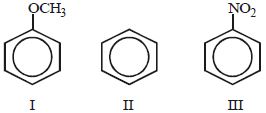
Among the following compounds $(I-III)$,the correct order of reactivity towards electrophilic substitution reaction is:
A
$I > II > III$
B
$II > III > I$
C
$III < I < II$
D
$I = II > III$
Solution
(A) Electrophilic substitution reaction is favored by the presence of electron-donating groups on the benzene ring,which increase the electron density and activate the ring. Conversely,electron-withdrawing groups decrease the electron density and deactivate the ring.
$I$: Anisole $(C_6H_5OCH_3)$ contains a $-OCH_3$ group,which is a strong electron-donating group due to the resonance effect ($+R$ effect),making it highly reactive.
$II$: Benzene $(C_6H_6)$ has no substituent,serving as the reference.
$III$: Nitrobenzene $(C_6H_5NO_2)$ contains a $-NO_2$ group,which is a strong electron-withdrawing group due to the $-R$ and $-I$ effects,making it the least reactive.
Therefore,the order of reactivity is $I > II > III$.
$I$: Anisole $(C_6H_5OCH_3)$ contains a $-OCH_3$ group,which is a strong electron-donating group due to the resonance effect ($+R$ effect),making it highly reactive.
$II$: Benzene $(C_6H_6)$ has no substituent,serving as the reference.
$III$: Nitrobenzene $(C_6H_5NO_2)$ contains a $-NO_2$ group,which is a strong electron-withdrawing group due to the $-R$ and $-I$ effects,making it the least reactive.
Therefore,the order of reactivity is $I > II > III$.
0 likesView Solution
41
ChemistryDifficultMCQAIIMS · 2012
The most stable carbanion among the following is
A
$C_6H_5-CH_2-CH_2^-$
B
$C_6H_5-CH_2^-$
C
$p-CH_3O-C_6H_4-CH_2^-$
D
$p-NO_2-C_6H_4-CH_2^-$
Solution
(D) The stability of a carbanion is increased by electron-withdrawing groups $(EWG)$ and decreased by electron-donating groups $(EDG)$ attached to the carbon bearing the negative charge.
$1.$ Option $A$ is an alkyl carbanion with a phenyl group further away,providing minimal stabilization.
$2.$ Option $B$ is a benzyl carbanion,stabilized by resonance with the phenyl ring.
$3.$ Option $C$ has a $-OCH_3$ group,which is an electron-donating group (via $+M$ effect),thus destabilizing the carbanion.
$4.$ Option $D$ has a $-NO_2$ group,which is a strong electron-withdrawing group (via $-M$ and $-I$ effects). It effectively disperses the negative charge through resonance,making it the most stable carbanion among the given options.
$1.$ Option $A$ is an alkyl carbanion with a phenyl group further away,providing minimal stabilization.
$2.$ Option $B$ is a benzyl carbanion,stabilized by resonance with the phenyl ring.
$3.$ Option $C$ has a $-OCH_3$ group,which is an electron-donating group (via $+M$ effect),thus destabilizing the carbanion.
$4.$ Option $D$ has a $-NO_2$ group,which is a strong electron-withdrawing group (via $-M$ and $-I$ effects). It effectively disperses the negative charge through resonance,making it the most stable carbanion among the given options.
0 likesView Solution
42
ChemistryMediumMCQAIIMS · 2012
The chemical system that is non-aromatic is
A
Benzene
B
Naphthalene
C
Cyclopropenyl cation
D
Azulene
Solution
(D) system is non-aromatic if it is not planar or does not have a continuous cyclic conjugation of $p$-orbitals.
$A$. Benzene is planar and has $6\pi$ electrons,so it is aromatic.
$B$. Naphthalene is planar and has $10\pi$ electrons,so it is aromatic.
$C$. The cyclopropenyl cation is planar and has $2\pi$ electrons ($n=0$ in $4n+2$),so it is aromatic.
$D$. Azulene is a fused bicyclic system. While it has $10\pi$ electrons,the structure is often considered to have non-aromatic character in certain contexts due to the lack of perfect planarity or specific electronic distribution,but in standard textbook problems,cyclooctatetraene (non-planar,tub-shaped) is the classic example of a non-aromatic system. Given the options provided,if we evaluate the planarity,all others are planar. However,if the question implies a specific structure like cyclooctatetraene (not listed),we must re-evaluate. Based on standard chemistry,all listed options $A, B, C$ are aromatic. If $D$ is meant to be a non-planar system,it is the answer.
$A$. Benzene is planar and has $6\pi$ electrons,so it is aromatic.
$B$. Naphthalene is planar and has $10\pi$ electrons,so it is aromatic.
$C$. The cyclopropenyl cation is planar and has $2\pi$ electrons ($n=0$ in $4n+2$),so it is aromatic.
$D$. Azulene is a fused bicyclic system. While it has $10\pi$ electrons,the structure is often considered to have non-aromatic character in certain contexts due to the lack of perfect planarity or specific electronic distribution,but in standard textbook problems,cyclooctatetraene (non-planar,tub-shaped) is the classic example of a non-aromatic system. Given the options provided,if we evaluate the planarity,all others are planar. However,if the question implies a specific structure like cyclooctatetraene (not listed),we must re-evaluate. Based on standard chemistry,all listed options $A, B, C$ are aromatic. If $D$ is meant to be a non-planar system,it is the answer.
0 likesView Solution
43
ChemistryMediumMCQAIIMS · 2012
Consider the following statements: $A$ hydrocarbon of molecular formula $C_5H_{10}$ is a
$I.$ monosubstituted alkene
$II.$ disubstituted alkene
$III.$ trisubstituted alkene
Which of the following statement$(s)$ is(are) correct?
$I.$ monosubstituted alkene
$II.$ disubstituted alkene
$III.$ trisubstituted alkene
Which of the following statement$(s)$ is(are) correct?
A
$I, II$ and $III$
B
$I$ and $II$
C
$II$ and $III$
D
$I$ and $III$
Solution
(A) The molecular formula $C_5H_{10}$ corresponds to an alkene (general formula $C_nH_{2n}$).
$I.$ $CH_3-CH_2-CH_2-CH=CH_2$ is a monosubstituted alkene (one alkyl group attached to the double-bonded carbons).
$II.$ $CH_3-CH=CH-CH_2-CH_3$ is a disubstituted alkene (two alkyl groups attached to the double-bonded carbons).
$III.$ $(CH_3)_2C=CH-CH_3$ is a trisubstituted alkene (three alkyl groups attached to the double-bonded carbons).
Since all three types of substitution are possible for isomers of $C_5H_{10}$,all statements are correct.
$I.$ $CH_3-CH_2-CH_2-CH=CH_2$ is a monosubstituted alkene (one alkyl group attached to the double-bonded carbons).
$II.$ $CH_3-CH=CH-CH_2-CH_3$ is a disubstituted alkene (two alkyl groups attached to the double-bonded carbons).
$III.$ $(CH_3)_2C=CH-CH_3$ is a trisubstituted alkene (three alkyl groups attached to the double-bonded carbons).
Since all three types of substitution are possible for isomers of $C_5H_{10}$,all statements are correct.
0 likesView Solution
44
ChemistryMediumMCQAIIMS · 2012
Which one of the following cannot be prepared by Wurtz reaction?
A
$CH_4$
B
$C_2H_6$
C
$C_3H_8$
D
$C_4H_{10}$
Solution
(A) The Wurtz reaction involves the coupling of two alkyl halide molecules to form a symmetric alkane with an even number of carbon atoms.
$CH_4$ (methane) contains only one carbon atom.
Since the Wurtz reaction requires at least two alkyl groups to combine,it is impossible to form a single-carbon alkane like methane.
Therefore,$CH_4$ cannot be prepared by this method.
$CH_4$ (methane) contains only one carbon atom.
Since the Wurtz reaction requires at least two alkyl groups to combine,it is impossible to form a single-carbon alkane like methane.
Therefore,$CH_4$ cannot be prepared by this method.
0 likesView Solution
45
ChemistryDifficultMCQAIIMS · 2012
Identify the wrong statement in the following:
A
Chlorofluorocarbons are responsible for ozone layer depletion
B
Greenhouse effect is responsible for global warming
C
Acid rain is mostly because of oxides of nitrogen and sulphur
D
Ozone layer does not permit infrared radiation from the sun to reach the earth
Solution
(D) The ozone layer acts as a shield and prevents harmful ultraviolet $(UV)$ radiation from the sun from reaching the earth.
It does not prevent infrared radiation from reaching the earth.
Therefore,the statement in option $(d)$ is incorrect,making it the correct answer.
It does not prevent infrared radiation from reaching the earth.
Therefore,the statement in option $(d)$ is incorrect,making it the correct answer.
0 likesView Solution
46
ChemistryMCQAIIMS · 2012
Gibberellins can promote seed germination because of their influence on
A
Rate of cell division
B
Production of hydrolyzing enzymes
C
Synthesis of abscisic acid
D
Absorption of water through hard seed coat.
Solution
(B) Gibberellins promote seed germination in cereals by inducing the synthesis of hydrolyzing enzymes,such as $\alpha$-amylase and proteases. These enzymes break down stored starch and proteins into simpler,soluble forms that the developing embryo can use for growth.
0 likesView Solution
47
ChemistryDifficultMCQAIIMS · 2012
The Lassaigne's extract is boiled with dilute $HNO_3$ before testing for halogens because,
A
$AgCN$ is soluble in $HNO_3$
B
Silver halides are soluble in $HNO_3$
C
$Ag_2S$ is soluble in $HNO_3$
D
$Na_2S$ and $NaCN$ are decomposed by $HNO_3$
Solution
(D) In the Lassaigne's test,if the organic compound contains nitrogen or sulphur,the sodium fusion extract will contain $NaCN$ or $Na_2S$ respectively.
These ions interfere with the silver nitrate test for halogens by forming precipitates like $AgCN$ or $Ag_2S$.
Boiling the extract with dilute $HNO_3$ decomposes these species into volatile gases ($HCN$ and $H_2S$),thereby removing them from the solution before the addition of $AgNO_3$.
These ions interfere with the silver nitrate test for halogens by forming precipitates like $AgCN$ or $Ag_2S$.
Boiling the extract with dilute $HNO_3$ decomposes these species into volatile gases ($HCN$ and $H_2S$),thereby removing them from the solution before the addition of $AgNO_3$.
0 likesView Solution
48
ChemistryEasyMCQAIIMS · 2012
Which of the following conditions favours the reduction of a metal oxide to metal?
A
$ \Delta H = +ve, T \Delta S = +ve $ at low temperature
B
$ \Delta H = +ve, T \Delta S = -ve $ at any temperature
C
$ \Delta H = -ve, T \Delta S = -ve $ at high temperature
D
$ \Delta H = -ve, T \Delta S = +ve $ at any temperature
Solution
(D) The Gibbs free energy change is given by the equation: $ \Delta G = \Delta H - T \Delta S $.
For a process to be spontaneous,the value of $ \Delta G $ must be negative $( \Delta G < 0 )$.
If $ \Delta H $ is negative $( -ve )$ and $ T \Delta S $ is positive $( +ve )$,then $ \Delta G = (-ve) - (+ve) = -ve $.
This condition ensures that $ \Delta G $ is always negative at any temperature,thereby favouring the reduction of a metal oxide to metal.
For a process to be spontaneous,the value of $ \Delta G $ must be negative $( \Delta G < 0 )$.
If $ \Delta H $ is negative $( -ve )$ and $ T \Delta S $ is positive $( +ve )$,then $ \Delta G = (-ve) - (+ve) = -ve $.
This condition ensures that $ \Delta G $ is always negative at any temperature,thereby favouring the reduction of a metal oxide to metal.
0 likesView Solution
49
ChemistryDifficultMCQAIIMS · 2012
The strength of an aqueous solution of $I_2$ can be determined by titrating the solution with a standard solution of:
A
Oxalic acid
B
Sodium thiosulphate
C
Sodium hydroxide
D
Mohr’s salt
Solution
(B) The strength of an aqueous solution of $I_2$ is determined by iodometric titration.
In this process,$I_2$ reacts with sodium thiosulphate $(Na_2S_2O_3)$ to form sodium tetrathionate $(Na_2S_4O_6)$ and sodium iodide $(NaI)$.
The balanced chemical equation is:
$I_2 + 2Na_2S_2O_3 \to Na_2S_4O_6 + 2NaI$
In this process,$I_2$ reacts with sodium thiosulphate $(Na_2S_2O_3)$ to form sodium tetrathionate $(Na_2S_4O_6)$ and sodium iodide $(NaI)$.
The balanced chemical equation is:
$I_2 + 2Na_2S_2O_3 \to Na_2S_4O_6 + 2NaI$
0 likesView Solution
50
ChemistryMediumMCQAIIMS · 2012
Which of the following statements is not correct about the Ellingham diagram?
A
$\Delta G$ increases with an increase in temperature.
B
It consists of plots of $\Delta_fG^o$ vs $T$ for the formation of oxides.
C
$A$ coupling reaction can be well expressed by this diagram.
D
It expresses the kinetics of the reduction process.
Solution
(D) Ellingham diagrams are based on thermodynamic concepts.
They represent the change in Gibbs free energy $(\Delta G)$ with respect to temperature $(T)$.
They do not provide any information regarding the kinetics of the reduction process,such as the rate of reaction.
They represent the change in Gibbs free energy $(\Delta G)$ with respect to temperature $(T)$.
They do not provide any information regarding the kinetics of the reduction process,such as the rate of reaction.
0 likesView Solution
51
ChemistryDifficultMCQAIIMS · 2012
$Ge(II)$ compounds are powerful reducing agents whereas $Pb(IV)$ compounds are strong oxidants. This can be attributed to:
A
$Pb$ is more electropositive than $Ge$
B
Ionization potential of lead is less than that of $Ge$
C
Ionic radii of $Pb^{2+}$ and $Pb^{4+}$ are larger than those of $Ge^{2+}$ and $Ge^{4+}$
D
More pronounced inert pair effect in lead than in $Ge$
Solution
(D) $Ge(II)$ compounds tend to lose electrons to reach the more stable $Ge(IV)$ oxidation state,making them powerful reducing agents.
$Pb(IV)$ compounds tend to gain electrons to reach the more stable $Pb(II)$ oxidation state due to the inert pair effect,making them strong oxidizing agents.
The inert pair effect becomes more pronounced as we move down the group from $Ge$ to $Pb$,stabilizing the lower oxidation state $(+2)$ over the higher oxidation state $(+4)$.
$Pb(IV)$ compounds tend to gain electrons to reach the more stable $Pb(II)$ oxidation state due to the inert pair effect,making them strong oxidizing agents.
The inert pair effect becomes more pronounced as we move down the group from $Ge$ to $Pb$,stabilizing the lower oxidation state $(+2)$ over the higher oxidation state $(+4)$.
0 likesView Solution
52
ChemistryMediumMCQAIIMS · 2012
The existence of a substance in more than one solid modification is known as
A
isomorphism
B
Polymorphism
C
Amorphism
D
Allotropy
Solution
(B) The existence of a substance in more than one solid modification is known as polymorphism.
For example,sulphur is a polymorphic substance,its two polymorphic forms are rhombic and monoclinic sulphur.
For example,sulphur is a polymorphic substance,its two polymorphic forms are rhombic and monoclinic sulphur.
0 likesView Solution
53
ChemistryMediumMCQAIIMS · 2012
$12 \ g$ of urea is dissolved in $1 \ L$ of water and $68.4 \ g$ of sucrose is dissolved in $1 \ L$ of water. The lowering of vapour pressure of the first case is
A
equal to the second
B
greater than the second
C
less than the second
D
double that of the second
Solution
(A) Moles of urea $= \frac{12 \ g}{60 \ g/mol} = 0.2 \ mol$.
Moles of sucrose $= \frac{68.4 \ g}{342 \ g/mol} = 0.2 \ mol$.
According to Raoult's law,the relative lowering of vapour pressure is equal to the mole fraction of the solute.
Since both solutions contain the same number of moles of solute in the same volume of solvent,their mole fractions are equal.
Therefore,the lowering of vapour pressure for both cases is equal.
Moles of sucrose $= \frac{68.4 \ g}{342 \ g/mol} = 0.2 \ mol$.
According to Raoult's law,the relative lowering of vapour pressure is equal to the mole fraction of the solute.
Since both solutions contain the same number of moles of solute in the same volume of solvent,their mole fractions are equal.
Therefore,the lowering of vapour pressure for both cases is equal.
0 likesView Solution
54
ChemistryAdvancedMCQAIIMS · 2012
Assertion : Lowering of vapour pressure is directly proportional to osmotic pressure of the solution.
Reason : Osmotic pressure is a colligative property.
Reason : Osmotic pressure is a colligative property.
A
If both Assertion and Reason are correct and the Reason is a correct explanation of the Assertion.
B
If both Assertion and Reason are correct but Reason is not a correct explanation of the Assertion.
C
If the Assertion is correct but Reason is incorrect.
D
If both the Assertion and Reason are incorrect.
Solution
(B) Both assertion and reason are correct but reason is not the correct explanation of assertion.
The relationship between lowering of vapour pressure and osmotic pressure can be derived as follows:
Van't Hoff equation for a dilute solution is $\pi = \frac{n}{V}RT$ ..... $(i)$
In the case of a dilute solution,the volume of the solution can be taken as equal to that of the solvent. If $N$ is the number of moles of solvent of molecular weight $M$ and density $\rho$,the volume $V$ is given by $V = \frac{NM}{\rho}$ ...... $(ii)$
Substituting $(ii)$ in $(i)$,we get $\frac{n}{N} = \frac{\pi M}{\rho RT}$ .... $(iii)$
From Raoult's law,the relative lowering of vapour pressure is $\frac{p^o - p}{p^o} = \frac{n}{N}$ ...... $(iv)$
Equating $(iii)$ and $(iv)$,we get $\frac{p^o - p}{p^o} = \frac{\pi M}{\rho RT}$
Rearranging,$(p^o - p) = \frac{\pi M p^o}{\rho RT}$
Since $\frac{M p^o}{\rho RT}$ is constant at a constant temperature,$(p^o - p) \propto \pi$.
Thus,the lowering of vapour pressure is directly proportional to the osmotic pressure. The assertion is correct.
Osmotic pressure is indeed a colligative property,so the reason is also correct. However,the fact that osmotic pressure is a colligative property does not explain why the lowering of vapour pressure is proportional to it.
The relationship between lowering of vapour pressure and osmotic pressure can be derived as follows:
Van't Hoff equation for a dilute solution is $\pi = \frac{n}{V}RT$ ..... $(i)$
In the case of a dilute solution,the volume of the solution can be taken as equal to that of the solvent. If $N$ is the number of moles of solvent of molecular weight $M$ and density $\rho$,the volume $V$ is given by $V = \frac{NM}{\rho}$ ...... $(ii)$
Substituting $(ii)$ in $(i)$,we get $\frac{n}{N} = \frac{\pi M}{\rho RT}$ .... $(iii)$
From Raoult's law,the relative lowering of vapour pressure is $\frac{p^o - p}{p^o} = \frac{n}{N}$ ...... $(iv)$
Equating $(iii)$ and $(iv)$,we get $\frac{p^o - p}{p^o} = \frac{\pi M}{\rho RT}$
Rearranging,$(p^o - p) = \frac{\pi M p^o}{\rho RT}$
Since $\frac{M p^o}{\rho RT}$ is constant at a constant temperature,$(p^o - p) \propto \pi$.
Thus,the lowering of vapour pressure is directly proportional to the osmotic pressure. The assertion is correct.
Osmotic pressure is indeed a colligative property,so the reason is also correct. However,the fact that osmotic pressure is a colligative property does not explain why the lowering of vapour pressure is proportional to it.
0 likesView Solution
55
ChemistryEasyMCQAIIMS · 2012
The cell constant of a given cell is $0.47 \, cm^{-1}$. The resistance of a solution placed in this cell is measured to be $31.6 \, \Omega$. The conductivity of the solution (in $S \, cm^{-1}$ where $S$ has usual meaning) is
A
$0.15$
B
$1.5$
C
$0.015$
D
$150$
Solution
(C) The formula for conductivity $(\kappa)$ is given by: $\kappa = \frac{1}{R} \times \text{Cell constant}$.
Given: $\text{Cell constant} = 0.47 \, cm^{-1}$,$\text{Resistance } (R) = 31.6 \, \Omega$.
Substituting the values: $\kappa = \frac{0.47}{31.6} \, S \, cm^{-1}$.
$\kappa \approx 0.01487 \, S \, cm^{-1} \approx 0.015 \, S \, cm^{-1}$.
Given: $\text{Cell constant} = 0.47 \, cm^{-1}$,$\text{Resistance } (R) = 31.6 \, \Omega$.
Substituting the values: $\kappa = \frac{0.47}{31.6} \, S \, cm^{-1}$.
$\kappa \approx 0.01487 \, S \, cm^{-1} \approx 0.015 \, S \, cm^{-1}$.
0 likesView Solution
56
ChemistryDifficultMCQAIIMS · 2012
Select the rate law that corresponds to the data shown for the following reaction $A + B \to C$
| $Expt. \ No.$ | $[A]$ | $[B]$ | $Initial \ Rate$ |
|---|---|---|---|
| $1$ | $0.012$ | $0.035$ | $0.10$ |
| $2$ | $0.024$ | $0.070$ | $0.80$ |
| $3$ | $0.024$ | $0.035$ | $0.10$ |
| $4$ | $0.012$ | $0.070$ | $0.80$ |
A
Rate $= k[B]^3$
B
Rate $= k[B]^4$
C
Rate $= k[A][B]^3$
D
Rate $= k[A]^2[B]^2$
Solution
(A) Let the rate law be $r = k[A]^x[B]^y$.
Comparing experiment $(3)$ and $(1)$:
$\frac{0.10}{0.10} = \frac{k[0.024]^x [0.035]^y}{k[0.012]^x [0.035]^y}$
$1 = (2)^x \implies x = 0$.
Comparing experiment $(2)$ and $(3)$:
$\frac{0.80}{0.10} = \frac{k[0.024]^x [0.070]^y}{k[0.024]^x [0.035]^y}$
$8 = (2)^y \implies y = 3$.
Therefore,the rate law is $Rate = k[A]^0[B]^3 = k[B]^3$.
Comparing experiment $(3)$ and $(1)$:
$\frac{0.10}{0.10} = \frac{k[0.024]^x [0.035]^y}{k[0.012]^x [0.035]^y}$
$1 = (2)^x \implies x = 0$.
Comparing experiment $(2)$ and $(3)$:
$\frac{0.80}{0.10} = \frac{k[0.024]^x [0.070]^y}{k[0.024]^x [0.035]^y}$
$8 = (2)^y \implies y = 3$.
Therefore,the rate law is $Rate = k[A]^0[B]^3 = k[B]^3$.
0 likesView Solution
57
ChemistryEasyMCQAIIMS · 2012
Preparation of Lyophobic sols by chemical method involves
A
double decomposition
B
oxidation & reduction
C
hydrolysis
D
all of these
Solution
(D) Lyophobic sols are prepared by chemical methods such as double decomposition,oxidation,reduction,and hydrolysis.
For example:
$1$. Double decomposition: $As_2O_3 + 3H_2S \rightarrow As_2S_3 (\text{sol}) + 3H_2O$
$2$. Oxidation: $2H_2S + SO_2 \rightarrow 3S (\text{sol}) + 2H_2O$
$3$. Reduction: $2AuCl_3 + 3HCHO + 3H_2O \rightarrow 2Au (\text{sol}) + 3HCOOH + 6HCl$
$4$. Hydrolysis: $FeCl_3 + 3H_2O \rightarrow Fe(OH)_3 (\text{sol}) + 3HCl$
Since all these methods are used,the correct option is $D$.
For example:
$1$. Double decomposition: $As_2O_3 + 3H_2S \rightarrow As_2S_3 (\text{sol}) + 3H_2O$
$2$. Oxidation: $2H_2S + SO_2 \rightarrow 3S (\text{sol}) + 2H_2O$
$3$. Reduction: $2AuCl_3 + 3HCHO + 3H_2O \rightarrow 2Au (\text{sol}) + 3HCOOH + 6HCl$
$4$. Hydrolysis: $FeCl_3 + 3H_2O \rightarrow Fe(OH)_3 (\text{sol}) + 3HCl$
Since all these methods are used,the correct option is $D$.
0 likesView Solution
58
ChemistryMediumMCQAIIMS · 2012
What are the products formed in the reaction of $XeF_6$ with $SiO_2$?
A
$XeSiO_4 + HF$
B
$XeF_2 + SiF_4$
C
$XeOF_4 + SiF_4$
D
$XeO_3 + SiF_2$
Solution
(C) The reaction of $XeF_6$ with silica $(SiO_2)$ is a partial hydrolysis reaction.
The balanced chemical equation is:
$2XeF_6 + SiO_2 \to 2XeOF_4 + SiF_4$
Thus,the products formed are $XeOF_4$ and $SiF_4$.
The balanced chemical equation is:
$2XeF_6 + SiO_2 \to 2XeOF_4 + SiF_4$
Thus,the products formed are $XeOF_4$ and $SiF_4$.
0 likesView Solution
59
ChemistryMediumMCQAIIMS · 2012
$P_4O_{10}$ is not used to dry $NH_3$ gas because
A
$P_4O_{10}$ is neutral
B
$P_4O_{10}$ is not a drying agent
C
$P_4O_{10}$ is acidic and $NH_3$ is basic
D
$P_4O_{10}$ is basic and $NH_3$ is acidic
Solution
(C) $P_4O_{10}$ is an acidic oxide,while $NH_3$ is a basic gas.
When $P_4O_{10}$ is used to dry $NH_3$,it reacts with $NH_3$ to form ammonium phosphate.
The reaction is: $P_4O_{10} + 6H_2O \to 4H_3PO_4$ followed by $H_3PO_4 + 3NH_3 \to (NH_4)_3PO_4$.
Therefore,it cannot be used as a drying agent for $NH_3$.
When $P_4O_{10}$ is used to dry $NH_3$,it reacts with $NH_3$ to form ammonium phosphate.
The reaction is: $P_4O_{10} + 6H_2O \to 4H_3PO_4$ followed by $H_3PO_4 + 3NH_3 \to (NH_4)_3PO_4$.
Therefore,it cannot be used as a drying agent for $NH_3$.
0 likesView Solution
60
ChemistryMediumMCQAIIMS · 2012
Oxygen is more electronegative than sulphur,yet $H_2S$ is acidic while $H_2O$ is neutral. This is because
A
Water is a highly associated liquid
B
$H-S$ bond is weaker than $H-O$ bond
C
$H_2S$ is a gas while $H_2O$ is a liquid
D
The molecular weight of $H_2S$ is more than that of $H_2O$
Solution
(B) The acidity of hydrides of group $16$ elements increases down the group because the bond dissociation enthalpy decreases as the size of the central atom increases.
Since the size of $S$ is larger than $O$,the $H-S$ bond is weaker than the $H-O$ bond,making it easier for $H_2S$ to release $H^+$ ions compared to $H_2O$.
Since the size of $S$ is larger than $O$,the $H-S$ bond is weaker than the $H-O$ bond,making it easier for $H_2S$ to release $H^+$ ions compared to $H_2O$.
0 likesView Solution
61
ChemistryDifficultMCQAIIMS · 2012
Assertion : White phosphorus is more reactive than red phosphorus.
Reason : Red phosphorus consists of $P_4$ tetrahedral units linked to one another to form linear chains.
Reason : Red phosphorus consists of $P_4$ tetrahedral units linked to one another to form linear chains.
A
If both Assertion and Reason are correct and the Reason is a correct explanation of the Assertion.
B
If both Assertion and Reason are correct but Reason is not a correct explanation of the Assertion.
C
If the Assertion is correct but Reason is incorrect.
D
If both the Assertion and Reason are incorrect.
Solution
(A) White phosphorus exists as discrete $P_4$ tetrahedral molecules where the $P-P-P$ bond angle is $60^o$.
This small bond angle leads to significant angular strain,making the molecule highly reactive.
Red phosphorus,on the other hand,consists of $P_4$ tetrahedral units linked together through covalent bonds to form a polymeric chain structure.
This polymeric structure reduces the angular strain,making red phosphorus significantly less reactive than white phosphorus.
Therefore,both the Assertion and the Reason are correct,and the Reason correctly explains why white phosphorus is more reactive.
This small bond angle leads to significant angular strain,making the molecule highly reactive.
Red phosphorus,on the other hand,consists of $P_4$ tetrahedral units linked together through covalent bonds to form a polymeric chain structure.
This polymeric structure reduces the angular strain,making red phosphorus significantly less reactive than white phosphorus.
Therefore,both the Assertion and the Reason are correct,and the Reason correctly explains why white phosphorus is more reactive.
0 likesView Solution
62
ChemistryEasyMCQAIIMS · 2012
Cuprous ion is colourless while cupric ion is coloured because
A
Both have half filled $p-$ and $d-$ orbitals
B
Cuprous ion has incomplete $d-$ orbital and cupric ion has a complete $d-$ orbital
C
Both have unpaired electrons in the $d-$ orbitals
D
Cuprous ion has complete $d-$ orbital and cupric ion has an incomplete $d-$ orbital.
Solution
(D) The electronic configuration of $Cu^{+}$ is $[Ar] 3d^{10}$. Since all $d-$orbitals are completely filled,there are no unpaired electrons,making it colourless.
The electronic configuration of $Cu^{2+}$ is $[Ar] 3d^9$. It contains one unpaired electron in the $d-$orbital,which allows for $d-d$ transitions,making it coloured.
The electronic configuration of $Cu^{2+}$ is $[Ar] 3d^9$. It contains one unpaired electron in the $d-$orbital,which allows for $d-d$ transitions,making it coloured.
0 likesView Solution
63
ChemistryDifficultMCQAIIMS · 2012
When $AgNO_3$ is added to a solution of $Co(NH_3)_5Cl_3$,the precipitate of $AgCl$ shows two ionizable chloride ions. This means
A
Two chlorine atoms satisfy primary valency and one secondary valency
B
One chlorine atom satisfies primary as well as secondary valency
C
Three chlorine atoms satisfy primary valency
D
Three chlorine atoms satisfy secondary valency
Solution
(A) The formation of two moles of $AgCl$ precipitate indicates that there are two ionizable chloride ions outside the coordination sphere.
Therefore,the complex can be represented as $[Co(NH_3)_5Cl]Cl_2$.
In this structure,the two chloride ions outside the square brackets satisfy the primary valency,while the one chloride ion inside the coordination sphere satisfies both the primary and secondary valency.
The reaction is: $[Co(NH_3)_5Cl]Cl_2 + 2AgNO_3 \to [Co(NH_3)_5Cl](NO_3)_2 + 2AgCl$.
Therefore,the complex can be represented as $[Co(NH_3)_5Cl]Cl_2$.
In this structure,the two chloride ions outside the square brackets satisfy the primary valency,while the one chloride ion inside the coordination sphere satisfies both the primary and secondary valency.
The reaction is: $[Co(NH_3)_5Cl]Cl_2 + 2AgNO_3 \to [Co(NH_3)_5Cl](NO_3)_2 + 2AgCl$.
0 likesView Solution
64
ChemistryDifficultMCQAIIMS · 2012
The pesticide $DDT$ slowly changes to
A
$CCl_3-CHO$ and chlorobenzene
B
$p, p'-$ Dichlorodiphenylethene
C
$p, p'-$ Dichlorodiphenyldichloroethane
D
$p, p'-$ Dichlorodiphenyldichloroethene
Solution
(D) $DDT$ (dichlorodiphenyltrichloroethane) is a persistent organic pollutant. In the environment,it undergoes slow degradation. The primary metabolic pathway involves the dehydrochlorination of $DDT$ to form $DDE$ ($p, p'-$ Dichlorodiphenyldichloroethene). This process is facilitated by microorganisms and environmental factors.
0 likesView Solution
65
ChemistryEasyMCQAIIMS · 2012
Rectified spirit is a mixture of
A
$95.87\%$ ethyl alcohol $+ 4.13\%$ water
B
$94\%$ ethyl alcohol $+ 4.53\%$ water
C
$94.4\%$ ethyl alcohol $+ 5.43\%$ water
D
$95\%$ ethyl alcohol $+ 5\%$ water
Solution
(A) Rectified spirit is a constant boiling mixture (azeotrope) of ethanol and water.
It contains approximately $95.87\%$ by mass of ethyl alcohol $(C_2H_5OH)$ and $4.13\%$ by mass of water.
This specific composition is obtained by the fractional distillation of fermented liquors.
It contains approximately $95.87\%$ by mass of ethyl alcohol $(C_2H_5OH)$ and $4.13\%$ by mass of water.
This specific composition is obtained by the fractional distillation of fermented liquors.
0 likesView Solution
66
ChemistryAdvancedMCQAIIMS · 2012
Assertion : Alkylbenzene is not prepared by Friedel-Crafts alkylation of benzene.
Reason : Alkyl halides are less reactive than acyl halides.
Reason : Alkyl halides are less reactive than acyl halides.
A
If both Assertion and Reason are correct and the Reason is a correct explanation of the Assertion.
B
If both Assertion and Reason are correct but Reason is not a correct explanation of the Assertion.
C
If the Assertion is correct but Reason is incorrect.
D
If both the Assertion and Reason are incorrect.
Solution
(D) The Assertion is incorrect because alkylbenzene $CAN$ be prepared by Friedel-Crafts alkylation,although it has limitations such as polyalkylation and rearrangement.
The Reason is also incorrect because alkyl halides are generally more reactive or comparable in reactivity to acyl halides in the context of Friedel-Crafts reactions,but the primary issue with alkylation is the formation of polyalkylated products due to the activating nature of the alkyl group added to the benzene ring.
Therefore,both the Assertion and the Reason are incorrect.
The Reason is also incorrect because alkyl halides are generally more reactive or comparable in reactivity to acyl halides in the context of Friedel-Crafts reactions,but the primary issue with alkylation is the formation of polyalkylated products due to the activating nature of the alkyl group added to the benzene ring.
Therefore,both the Assertion and the Reason are incorrect.
0 likesView Solution
67
ChemistryAdvancedMCQAIIMS · 2012
An aromatic ether is not cleaved by $HI$ even at $525 \ K$. The compound is
A
$C_6H_5OCH_3$
B
$C_6H_5OC_6H_5$
C
$C_6H_5OC_3H_7$
D
Tetrahydrofuran
Solution
(B) The cleavage of ethers by $HI$ involves the protonation of the ether oxygen followed by a nucleophilic attack by the iodide ion $(I^-)$.
In diaryl ethers like $C_6H_5OC_6H_5$ (diphenyl ether),the lone pair of electrons on the oxygen atom is involved in resonance with both phenyl rings.
This imparts a partial double bond character to the $C-O$ bonds,making them very strong and difficult to break.
Additionally,the $sp^2$ hybridized carbon atoms of the phenyl rings are less susceptible to nucleophilic attack compared to $sp^3$ hybridized carbons.
Therefore,$C_6H_5OC_6H_5$ is resistant to cleavage by $HI$ even at high temperatures.
In diaryl ethers like $C_6H_5OC_6H_5$ (diphenyl ether),the lone pair of electrons on the oxygen atom is involved in resonance with both phenyl rings.
This imparts a partial double bond character to the $C-O$ bonds,making them very strong and difficult to break.
Additionally,the $sp^2$ hybridized carbon atoms of the phenyl rings are less susceptible to nucleophilic attack compared to $sp^3$ hybridized carbons.
Therefore,$C_6H_5OC_6H_5$ is resistant to cleavage by $HI$ even at high temperatures.
0 likesView Solution
68
ChemistryDifficultMCQAIIMS · 2012
Carbonyl compounds undergo nucleophilic addition because of
A
electronegativity difference of carbon and oxygen atoms
B
electromeric effect
C
more stable anion with negative charge on oxygen atom and less stable carbonium ion
D
none of the above
Solution
(A) The carbonyl group $(C=O)$ is polar due to the difference in electronegativity between carbon $(2.5)$ and oxygen $(3.5)$.
Oxygen is more electronegative,which pulls the electron density of the $\pi$-bond towards itself,creating a partial positive charge $(\delta+)$ on the carbon atom and a partial negative charge $(\delta-)$ on the oxygen atom.
This electrophilic carbon center makes the carbonyl compound susceptible to attack by nucleophiles.
Furthermore,the resulting intermediate is an alkoxide ion where the negative charge is stabilized on the highly electronegative oxygen atom,making the addition reaction favorable.
Oxygen is more electronegative,which pulls the electron density of the $\pi$-bond towards itself,creating a partial positive charge $(\delta+)$ on the carbon atom and a partial negative charge $(\delta-)$ on the oxygen atom.
This electrophilic carbon center makes the carbonyl compound susceptible to attack by nucleophiles.
Furthermore,the resulting intermediate is an alkoxide ion where the negative charge is stabilized on the highly electronegative oxygen atom,making the addition reaction favorable.
0 likesView Solution
69
ChemistryMediumMCQAIIMS · 2012
Which of the following is the correct order of acidity?
A
$HCOOH > CH_3COOH > ClCH_2COOH > C_2H_5COOH$
B
$ClCH_2COOH > HCOOH > CH_3COOH > C_2H_5COOH$
C
$CH_3COOH > HCOOH > ClCH_2COOH > C_2H_5COOH$
D
$C_2H_5COOH > CH_3COOH > HCOOH > ClCH_2COOH$
Solution
(B) The acidity of carboxylic acids depends on the stability of the carboxylate ion formed after the loss of a proton.
Electron-withdrawing groups ($-I$ effect) like $-Cl$ increase acidity by stabilizing the negative charge on the carboxylate ion.
Electron-donating groups ($+I$ effect) like alkyl groups decrease acidity by destabilizing the negative charge.
The $+I$ effect strength follows the order: $-C_2H_5 > -CH_3 > -H$.
Comparing the given acids:
$1$. $ClCH_2COOH$ has a $-Cl$ group ($-I$ effect),making it the most acidic.
$2$. $HCOOH$ has no alkyl group.
$3$. $CH_3COOH$ has a $-CH_3$ group ($+I$ effect).
$4$. $C_2H_5COOH$ has a $-C_2H_5$ group (stronger $+I$ effect than $-CH_3$),making it the least acidic.
Thus,the correct order is $ClCH_2COOH > HCOOH > CH_3COOH > C_2H_5COOH$.
Electron-withdrawing groups ($-I$ effect) like $-Cl$ increase acidity by stabilizing the negative charge on the carboxylate ion.
Electron-donating groups ($+I$ effect) like alkyl groups decrease acidity by destabilizing the negative charge.
The $+I$ effect strength follows the order: $-C_2H_5 > -CH_3 > -H$.
Comparing the given acids:
$1$. $ClCH_2COOH$ has a $-Cl$ group ($-I$ effect),making it the most acidic.
$2$. $HCOOH$ has no alkyl group.
$3$. $CH_3COOH$ has a $-CH_3$ group ($+I$ effect).
$4$. $C_2H_5COOH$ has a $-C_2H_5$ group (stronger $+I$ effect than $-CH_3$),making it the least acidic.
Thus,the correct order is $ClCH_2COOH > HCOOH > CH_3COOH > C_2H_5COOH$.
0 likesView Solution
70
ChemistryEasyMCQAIIMS · 2012
Which is not true about acetophenone?
A
It reacts with $2,4-DNP$ to form $2,4-dinitrophenylhydrazone$.
B
It reacts with Tollen's reagent to form silver mirror.
C
It reacts with $I_2/NaOH$ to form iodoform.
D
On oxidation with alkaline $KMnO_4$ followed by hydrolysis,it gives benzoic acid.
Solution
(B) Acetophenone $(C_6H_5COCH_3)$ is a ketone.
Ketones do not reduce Tollen's reagent,so it does not form a silver mirror.
It reacts with $2,4-DNP$ as it contains a carbonyl group.
It gives a positive iodoform test due to the presence of the $CH_3CO-$ group.
Oxidation of acetophenone with alkaline $KMnO_4$ followed by hydrolysis yields benzoic acid.
Ketones do not reduce Tollen's reagent,so it does not form a silver mirror.
It reacts with $2,4-DNP$ as it contains a carbonyl group.
It gives a positive iodoform test due to the presence of the $CH_3CO-$ group.
Oxidation of acetophenone with alkaline $KMnO_4$ followed by hydrolysis yields benzoic acid.
0 likesView Solution
71
ChemistryMediumMCQAIIMS · 2012
Assertion : $2, 2-$ Dimethylpropanal undergoes Cannizzaro reaction with conc. $NaOH$.
Reason : Cannizzaro reaction is a disproportionation reaction.
Reason : Cannizzaro reaction is a disproportionation reaction.
A
If both Assertion and Reason are correct and the Reason is a correct explanation of the Assertion.
B
If both Assertion and Reason are correct but Reason is not a correct explanation of the Assertion.
C
If the Assertion is correct but Reason is incorrect.
D
If both the Assertion and Reason are incorrect.
Solution
(A) The Cannizzaro reaction is a disproportionation reaction (self-oxidation and reduction) that occurs in aldehydes lacking $\alpha-hydrogen$ atoms.
$2, 2-$ Dimethylpropanal (pivalaldehyde) is $(CH_3)_3CCHO$. It has no $\alpha-hydrogen$ atom attached to the carbonyl carbon.
Therefore,it undergoes the Cannizzaro reaction in the presence of concentrated $NaOH$.
Both the Assertion and the Reason are correct,and the Reason correctly explains why the compound undergoes the reaction.
$2, 2-$ Dimethylpropanal (pivalaldehyde) is $(CH_3)_3CCHO$. It has no $\alpha-hydrogen$ atom attached to the carbonyl carbon.
Therefore,it undergoes the Cannizzaro reaction in the presence of concentrated $NaOH$.
Both the Assertion and the Reason are correct,and the Reason correctly explains why the compound undergoes the reaction.
0 likesView Solution
72
ChemistryMediumMCQAIIMS · 2012
Consider the following reaction:
$C_6H_5NO_2$ $\xrightarrow{Sn / HCl} X$ $\xrightarrow{C_6H_5COCl} Y + HCl$
What is $Y$?
$C_6H_5NO_2$ $\xrightarrow{Sn / HCl} X$ $\xrightarrow{C_6H_5COCl} Y + HCl$
What is $Y$?
A
Acetanilide
B
Benzanilide
C
Azobenzene
D
Hydrazobenzene
Solution
(B) Step $1$: Reduction of nitrobenzene $(C_6H_5NO_2)$ with $Sn/HCl$ yields aniline $(C_6H_5NH_2)$ as product $X$.
Step $2$: Aniline $(C_6H_5NH_2)$ reacts with benzoyl chloride $(C_6H_5COCl)$ in the presence of a base to undergo benzoylation (Schotten-Baumann reaction).
Step $3$: The reaction is $C_6H_5NH_2 + C_6H_5COCl \rightarrow C_6H_5NHCOC_6H_5 + HCl$.
The product $Y$ is $C_6H_5NHCOC_6H_5$,which is known as benzanilide.
Step $2$: Aniline $(C_6H_5NH_2)$ reacts with benzoyl chloride $(C_6H_5COCl)$ in the presence of a base to undergo benzoylation (Schotten-Baumann reaction).
Step $3$: The reaction is $C_6H_5NH_2 + C_6H_5COCl \rightarrow C_6H_5NHCOC_6H_5 + HCl$.
The product $Y$ is $C_6H_5NHCOC_6H_5$,which is known as benzanilide.
0 likesView Solution
73
ChemistryMediumMCQAIIMS · 2012
Denaturation of proteins leads to loss of its biological activity by
A
Formation of amino acid
B
Loss of primary structure
C
Loss of both primary and secondary structures
D
Loss of both secondary and tertiary structures
Solution
(D) . Loss of both secondary and tertiary structures
Denaturation of proteins involves the disruption and possible destruction of both the secondary and tertiary structures.
Since denaturation reactions are not strong enough to break the peptide bonds,the primary structure remains intact after a denaturation process.
Denaturation of proteins involves the disruption and possible destruction of both the secondary and tertiary structures.
Since denaturation reactions are not strong enough to break the peptide bonds,the primary structure remains intact after a denaturation process.
0 likesView Solution
74
ChemistryDifficultMCQAIIMS · 2012
Assertion : At isoelectric point,the amino acid does not migrate under the influence of an electric field.
Reason : At isoelectric point,amino acid exists as a zwitterion.
Reason : At isoelectric point,amino acid exists as a zwitterion.
A
If both Assertion and Reason are correct and the Reason is a correct explanation of the Assertion.
B
If both Assertion and Reason are correct but Reason is not a correct explanation of the Assertion.
C
If the Assertion is correct but Reason is incorrect.
D
If both the Assertion and Reason are incorrect.
Solution
(A) At the isoelectric point $(pH = pI)$,an amino acid exists as a zwitterion,which carries both a positive and a negative charge,resulting in a net charge of zero. Because the molecule is electrically neutral,it does not migrate towards either the cathode or the anode when an electric field is applied. Therefore,the Reason correctly explains the Assertion.
0 likesView Solution
75
ChemistryMediumMCQAIIMS · 2012
Teflon,styron (polystyrene),and neoprene are all:
A
Copolymers
B
Condensation polymers
C
Homopolymers
D
Monomers
Solution
(C) Teflon is a polymer of tetrafluoroethene $(CF_2=CF_2)$.
Styron (polystyrene) is a polymer of styrene $(C_6H_5CH=CH_2)$.
Neoprene is a polymer of chloroprene $(CH_2=C(Cl)-CH=CH_2)$.
Since all these polymers are formed by the polymerization of a single type of monomer unit,they are classified as homopolymers.
Styron (polystyrene) is a polymer of styrene $(C_6H_5CH=CH_2)$.
Neoprene is a polymer of chloroprene $(CH_2=C(Cl)-CH=CH_2)$.
Since all these polymers are formed by the polymerization of a single type of monomer unit,they are classified as homopolymers.
0 likesView Solution
76
ChemistryMediumMCQAIIMS · 2012
Which of the following is used for inducing sleep?
A
Paracetamol
B
Chloroquine
C
Bithional
D
Barbituric acid derivatives
Solution
(D) Barbiturates are drugs that act as central nervous system depressants,and can,therefore,produce a wide spectrum of effects from mild sedation to total anesthesia or death.
They are used to induce sleep and are classified as hypnotics.
They are effective as anxiolytics,hypnotics,and anticonvulsants,but have physical and psychological addiction potential.
They have largely been replaced by benzodiazepines in routine medical practice,particularly in the treatment of anxiety and insomnia.
They are used to induce sleep and are classified as hypnotics.
They are effective as anxiolytics,hypnotics,and anticonvulsants,but have physical and psychological addiction potential.
They have largely been replaced by benzodiazepines in routine medical practice,particularly in the treatment of anxiety and insomnia.
0 likesView Solution
77
ChemistryMediumMCQAIIMS · 2012
The reagent that can distinguish between silver and lead salt is
A
$H_2S$ gas
B
Hot dilute $HCl$ solution
C
$NH_4Cl$ (solid) + $NH_4OH$ (solution)
D
$NH_4Cl$ (solid) + $(NH_4)_2CO_3$ solution
Solution
(B) Silver ions $(Ag^+)$ and lead ions $(Pb^{2+})$ are both members of Group $I$ cations,which form insoluble chlorides with dilute $HCl$.
However,$PbCl_2$ is soluble in hot water,whereas $AgCl$ remains insoluble even in hot water.
Therefore,adding hot dilute $HCl$ solution allows for the distinction between silver and lead salts.
However,$PbCl_2$ is soluble in hot water,whereas $AgCl$ remains insoluble even in hot water.
Therefore,adding hot dilute $HCl$ solution allows for the distinction between silver and lead salts.
0 likesView Solution
Vedclass Products
For Students
Vedclass Test Series
Mock tests in real AIIMS style covering Chemistry with performance analysis. 5-day free trial.
Start Free TrialFor Teachers
Exam Paper Generator
Generate Set A/B/C/D Chemistry papers from 7.5L+ questions in 2 minutes. 3 chapters free.
Try FreeFor Institutes
Online Exam Module
Run live AIIMS mock exams with unlimited students, 360° analytics & white-label branding.
See DemoFrequently Asked Questions
How many Chemistry questions are in AIIMS 2012?
There are 77 Chemistry questions from the AIIMS 2012 paper on Vedclass, each with a detailed step-by-step solution in English.
Are AIIMS 2012 Chemistry solutions available in English?
Yes. All solutions on this page are in English. You can also switch to English or Hindi using the language buttons above the questions.
Can I practice AIIMS 2012 Chemistry as a timed test?
Yes. Use the Vedclass Test Series to attempt a full AIIMS mock test covering Chemistry with time limits and instant score analysis.
Can teachers create Chemistry papers from AIIMS previous year questions?
Yes. The Vedclass Exam Paper Generator lets teachers mix AIIMS Chemistry questions and generate Set A/B/C/D papers in minutes.
For Teachers & Institutes
Build a Custom Chemistry Paper
Pick AIIMS 2012 Chemistry questions, set difficulty, and generate Set A/B/C/D in 2 minutes.