
ChemistryQ1–75 of 75 questions
Page 1 of 1 · English
1
ChemistryMCQAIIMS · 2013
There are two wires of the same material and same length. If the diameter of the second wire is $2$ times the diameter of the first wire,then the ratio of the extension produced in the wires by applying the same load will be:
A
$1:1$
B
$2:1$
C
$1:2$
D
$4:1$
Solution
(D) The extension $l$ in a wire is given by the formula $l = \frac{FL}{AY}$,where $F$ is the applied force,$L$ is the length,$A$ is the cross-sectional area,and $Y$ is Young's modulus.
Since the material is the same,$Y$ is constant. Given that $F$ and $L$ are also constant,we have $l \propto \frac{1}{A}$.
Since $A = \pi r^2$ (where $r$ is the radius),$l \propto \frac{1}{r^2}$.
Given that the diameter of the second wire is $2$ times the diameter of the first wire,the radius $r_2 = 2r_1$.
Therefore,the ratio of extensions is $\frac{l_1}{l_2} = \left( \frac{r_2}{r_1} \right)^2 = (2)^2 = 4$.
Thus,the ratio $l_1 : l_2 = 4 : 1$.
Since the material is the same,$Y$ is constant. Given that $F$ and $L$ are also constant,we have $l \propto \frac{1}{A}$.
Since $A = \pi r^2$ (where $r$ is the radius),$l \propto \frac{1}{r^2}$.
Given that the diameter of the second wire is $2$ times the diameter of the first wire,the radius $r_2 = 2r_1$.
Therefore,the ratio of extensions is $\frac{l_1}{l_2} = \left( \frac{r_2}{r_1} \right)^2 = (2)^2 = 4$.
Thus,the ratio $l_1 : l_2 = 4 : 1$.
0 likesView Solution
2
ChemistryMCQAIIMS · 2013
The energy of an electron in the $n^{th}$ orbit of a hydrogen atom is expressed as $E_n = \frac{-13.6}{n^2} \text{ eV}$. The shortest and longest wavelengths of the Lyman series are:
A
$910 \ \mathring{A}, 1213 \ \mathring{A}$
B
$5463 \ \mathring{A}, 7858 \ \mathring{A}$
C
$1315 \ \mathring{A}, 1530 \ \mathring{A}$
D
None of these
Solution
(A) For the Lyman series,the transition occurs to the $n_1 = 1$ orbit from $n_2 = 2, 3, 4, \dots$ levels.
Using the Rydberg formula: $\frac{1}{\lambda} = R \left[ \frac{1}{n_1^2} - \frac{1}{n_2^2} \right]$,where $R \approx 1.097 \times 10^7 \text{ m}^{-1}$.
For the longest wavelength (minimum energy transition),$n_1 = 1$ and $n_2 = 2$:
$\frac{1}{\lambda_{\max}} = R \left[ \frac{1}{1^2} - \frac{1}{2^2} \right] = R \left[ 1 - \frac{1}{4} \right] = \frac{3R}{4}$.
$\lambda_{\max} = \frac{4}{3R} \approx \frac{4}{3 \times 1.097 \times 10^7} \approx 1216 \ \mathring{A}$ (approx $1213 \ \mathring{A}$).
For the shortest wavelength (maximum energy transition),$n_1 = 1$ and $n_2 = \infty$:
$\frac{1}{\lambda_{\min}} = R \left[ \frac{1}{1^2} - \frac{1}{\infty^2} \right] = R$.
$\lambda_{\min} = \frac{1}{R} \approx \frac{1}{1.097 \times 10^7} \approx 912 \ \mathring{A}$ (approx $910 \ \mathring{A}$).
Thus,the shortest wavelength is $910 \ \mathring{A}$ and the longest is $1213 \ \mathring{A}$.
Using the Rydberg formula: $\frac{1}{\lambda} = R \left[ \frac{1}{n_1^2} - \frac{1}{n_2^2} \right]$,where $R \approx 1.097 \times 10^7 \text{ m}^{-1}$.
For the longest wavelength (minimum energy transition),$n_1 = 1$ and $n_2 = 2$:
$\frac{1}{\lambda_{\max}} = R \left[ \frac{1}{1^2} - \frac{1}{2^2} \right] = R \left[ 1 - \frac{1}{4} \right] = \frac{3R}{4}$.
$\lambda_{\max} = \frac{4}{3R} \approx \frac{4}{3 \times 1.097 \times 10^7} \approx 1216 \ \mathring{A}$ (approx $1213 \ \mathring{A}$).
For the shortest wavelength (maximum energy transition),$n_1 = 1$ and $n_2 = \infty$:
$\frac{1}{\lambda_{\min}} = R \left[ \frac{1}{1^2} - \frac{1}{\infty^2} \right] = R$.
$\lambda_{\min} = \frac{1}{R} \approx \frac{1}{1.097 \times 10^7} \approx 912 \ \mathring{A}$ (approx $910 \ \mathring{A}$).
Thus,the shortest wavelength is $910 \ \mathring{A}$ and the longest is $1213 \ \mathring{A}$.
0 likesView Solution
3
ChemistryMCQAIIMS · 2013
An archaeologist analyses the wood in a prehistoric structure and finds that the ratio of ${C^{14}}$ (half-life $= 5700 \, years$) to ${C^{12}}$ is only one-fourth of that found in the cells of living plants. The age of the wood is about ........ $years$.
A
$5700$
B
$2850$
C
$11400$
D
$22800$
Solution
(C) The ratio of radioactive isotope ${C^{14}}$ to stable isotope ${C^{12}}$ decreases over time due to radioactive decay.
Given that the current ratio is $\frac{1}{4}$ of the initial ratio,we use the radioactive decay formula: $N(t) = N_0 \left( \frac{1}{2} \right)^{\frac{t}{T_{1/2}}}$.
Here,$\frac{N(t)}{N_0} = \frac{1}{4}$ and $T_{1/2} = 5700 \, years$.
Substituting the values: $\frac{1}{4} = \left( \frac{1}{2} \right)^{\frac{t}{5700}}$.
Since $\frac{1}{4} = \left( \frac{1}{2} \right)^2$,we equate the exponents: $2 = \frac{t}{5700}$.
Therefore,$t = 2 \times 5700 = 11400 \, years$.
Given that the current ratio is $\frac{1}{4}$ of the initial ratio,we use the radioactive decay formula: $N(t) = N_0 \left( \frac{1}{2} \right)^{\frac{t}{T_{1/2}}}$.
Here,$\frac{N(t)}{N_0} = \frac{1}{4}$ and $T_{1/2} = 5700 \, years$.
Substituting the values: $\frac{1}{4} = \left( \frac{1}{2} \right)^{\frac{t}{5700}}$.
Since $\frac{1}{4} = \left( \frac{1}{2} \right)^2$,we equate the exponents: $2 = \frac{t}{5700}$.
Therefore,$t = 2 \times 5700 = 11400 \, years$.
0 likesView Solution
4
ChemistryMCQAIIMS · 2013
Which of the following are not characteristic features of $Fabaceae$?
A
Tap root system,compound leaves and racemose inflorescence
B
Flowers actinomorphic,twisted aestivation and gamopetalous
C
Stamens $10$,introrse,basifixed,dithecous
D
Monocarpellary,ovary superior and bent stigma
Solution
(B) The family $Fabaceae$ (formerly $Papilionoideae$) is characterized by the following features:
$1$. Root system: Tap root with root nodules.
$2$. Leaves: Alternate,pinnately compound or simple,leaf base pulvinate,stipulate.
$3$. Inflorescence: Racemose.
$4$. Flower: Zygomorphic,bisexual,papilionaceous corolla (vexillary aestivation).
$5$. Androecium: $10$ stamens,diadelphous $(9+1)$,dithecous,introrse,basifixed.
$6$. Gynoecium: Monocarpellary,ovary superior,unilocular with many ovules,style single.
Option $B$ is incorrect because $Fabaceae$ flowers are zygomorphic (not actinomorphic),show vexillary aestivation (not twisted),and are polypetalous (not gamopetalous).
$1$. Root system: Tap root with root nodules.
$2$. Leaves: Alternate,pinnately compound or simple,leaf base pulvinate,stipulate.
$3$. Inflorescence: Racemose.
$4$. Flower: Zygomorphic,bisexual,papilionaceous corolla (vexillary aestivation).
$5$. Androecium: $10$ stamens,diadelphous $(9+1)$,dithecous,introrse,basifixed.
$6$. Gynoecium: Monocarpellary,ovary superior,unilocular with many ovules,style single.
Option $B$ is incorrect because $Fabaceae$ flowers are zygomorphic (not actinomorphic),show vexillary aestivation (not twisted),and are polypetalous (not gamopetalous).
0 likesView Solution
5
ChemistryMCQAIIMS · 2013
The radii of two planets are respectively $R_1$ and $R_2$ and their densities are respectively $\rho_1$ and $\rho_2$. The ratio of the accelerations due to gravity at their surfaces is
A
$g_1:g_2 = \frac{\rho_1}{R_1^2}:\frac{\rho_2}{R_2^2}$
B
$g_1:g_2 = R_1 R_2 : \rho_1 \rho_2$
C
$g_1:g_2 = R_1 \rho_2 : R_2 \rho_1$
D
$g_1:g_2 = R_1 \rho_1 : R_2 \rho_2$
Solution
(D) The acceleration due to gravity $g$ at the surface of a planet is given by $g = \frac{GM}{R^2}$.
Since the mass $M$ of a planet can be expressed in terms of its density $\rho$ and radius $R$ as $M = \rho \times V = \rho \times \frac{4}{3} \pi R^3$,we substitute this into the formula for $g$:
$g = \frac{G (\rho \cdot \frac{4}{3} \pi R^3)}{R^2} = \frac{4}{3} \pi G \rho R$.
This shows that $g \propto \rho R$.
Therefore,the ratio of the accelerations due to gravity for the two planets is $\frac{g_1}{g_2} = \frac{\rho_1 R_1}{\rho_2 R_2}$.
Thus,$g_1 : g_2 = R_1 \rho_1 : R_2 \rho_2$.
Since the mass $M$ of a planet can be expressed in terms of its density $\rho$ and radius $R$ as $M = \rho \times V = \rho \times \frac{4}{3} \pi R^3$,we substitute this into the formula for $g$:
$g = \frac{G (\rho \cdot \frac{4}{3} \pi R^3)}{R^2} = \frac{4}{3} \pi G \rho R$.
This shows that $g \propto \rho R$.
Therefore,the ratio of the accelerations due to gravity for the two planets is $\frac{g_1}{g_2} = \frac{\rho_1 R_1}{\rho_2 R_2}$.
Thus,$g_1 : g_2 = R_1 \rho_1 : R_2 \rho_2$.
0 likesView Solution
6
ChemistryMCQAIIMS · 2013
$Assertion:$ The total translational kinetic energy of all the molecules of a given mass of an ideal gas is $1.5$ times the product of its pressure and its volume.
$Reason:$ The molecules of a gas collide with each other and the velocities of the molecules change due to the collision.
$Reason:$ The molecules of a gas collide with each other and the velocities of the molecules change due to the collision.
A
If both Assertion and Reason are correct and the Reason is a correct explanation of the Assertion.
B
If both Assertion and Reason are correct but Reason is not a correct explanation of the Assertion.
C
If the Assertion is correct but Reason is incorrect.
D
If both the Assertion and Reason are incorrect.
Solution
(B) The total translational kinetic energy $(K)$ of an ideal gas is given by the formula $K = \frac{3}{2} n R T$.
From the ideal gas equation,we know that $PV = n R T$.
Substituting $PV$ for $n R T$ in the kinetic energy formula,we get $K = \frac{3}{2} PV = 1.5 PV$.
Thus,the Assertion is correct.
The Reason states that molecules collide and their velocities change,which is a fundamental postulate of the Kinetic Theory of Gases.
However,the collision of molecules is not the reason why the kinetic energy is equal to $1.5 PV$; that relationship is derived from the definition of temperature and the ideal gas law.
Therefore,both statements are correct,but the Reason is not the correct explanation of the Assertion.
From the ideal gas equation,we know that $PV = n R T$.
Substituting $PV$ for $n R T$ in the kinetic energy formula,we get $K = \frac{3}{2} PV = 1.5 PV$.
Thus,the Assertion is correct.
The Reason states that molecules collide and their velocities change,which is a fundamental postulate of the Kinetic Theory of Gases.
However,the collision of molecules is not the reason why the kinetic energy is equal to $1.5 PV$; that relationship is derived from the definition of temperature and the ideal gas law.
Therefore,both statements are correct,but the Reason is not the correct explanation of the Assertion.
0 likesView Solution
7
ChemistryMCQAIIMS · 2013
$A$ charged particle moves through a magnetic field in a direction perpendicular to it. Then the
A
velocity remains unchanged
B
speed of the particle remains unchanged
C
direction of the particle remains unchanged
D
acceleration remains unchanged
Solution
(B) When a charged particle moves in a magnetic field with velocity $\vec{v}$ perpendicular to the magnetic field $\vec{B}$,the magnetic force acting on it is given by $\vec{F} = q(\vec{v} \times \vec{B})$.
Since the force $\vec{F}$ is always perpendicular to the velocity $\vec{v}$,it does no work on the particle $(W = \vec{F} \cdot \vec{d} = 0)$.
According to the work-energy theorem,the change in kinetic energy is zero,which implies that the speed of the particle remains constant.
However,because the direction of the force changes as the particle moves,both the velocity vector and the acceleration vector change continuously.
Since the force $\vec{F}$ is always perpendicular to the velocity $\vec{v}$,it does no work on the particle $(W = \vec{F} \cdot \vec{d} = 0)$.
According to the work-energy theorem,the change in kinetic energy is zero,which implies that the speed of the particle remains constant.
However,because the direction of the force changes as the particle moves,both the velocity vector and the acceleration vector change continuously.
0 likesView Solution
8
ChemistryMCQAIIMS · 2013
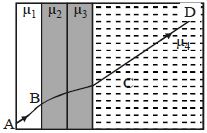
$A$ ray of light passes through four transparent media with refractive indices $\mu_1$,$\mu_2$,$\mu_3$,and $\mu_4$ as shown in the figure. The surfaces of all media are parallel. If the emergent ray $CD$ is parallel to the incident ray $AB$,we must have
A
$\mu_1 = \mu_2$
B
$\mu_2 = \mu_3$
C
$\mu_3 = \mu_4$
D
$\mu_4 = \mu_1$
Solution
(D) According to Snell's law at each interface for parallel surfaces:
$\mu_1 \sin i_1 = \mu_2 \sin i_2 = \mu_3 \sin i_3 = \mu_4 \sin i_4$
Since the emergent ray $CD$ is parallel to the incident ray $AB$,the angle of incidence $i_1$ must be equal to the angle of emergence $i_4$.
Therefore,$\mu_1 \sin i_1 = \mu_4 \sin i_4$.
Since $i_1 = i_4$,we have $\mu_1 = \mu_4$.
$\mu_1 \sin i_1 = \mu_2 \sin i_2 = \mu_3 \sin i_3 = \mu_4 \sin i_4$
Since the emergent ray $CD$ is parallel to the incident ray $AB$,the angle of incidence $i_1$ must be equal to the angle of emergence $i_4$.
Therefore,$\mu_1 \sin i_1 = \mu_4 \sin i_4$.
Since $i_1 = i_4$,we have $\mu_1 = \mu_4$.
0 likesView Solution
9
ChemistryMCQAIIMS · 2013
For $100\%$ modulation $(AM)$,the useful part of the total power radiated is
A
$1/2$ of the total power
B
$1/3$ of the total power
C
$1/4$ of the total power
D
$2/3$ of the total power
Solution
(B) For $100\%$ modulation,the modulation index $m_a = 1$.
The total power radiated in an $AM$ wave is given by $P_t = P_c(1 + \frac{m_a^2}{2})$,where $P_c$ is the carrier power.
The useful power is the power contained in the sidebands,given by $P_{sb} = P_c(\frac{m_a^2}{2})$.
The ratio of useful power to total power is $\frac{P_{sb}}{P_t} = \frac{m_a^2/2}{1 + m_a^2/2} = \frac{m_a^2}{2 + m_a^2}$.
Substituting $m_a = 1$:
$\text{Ratio} = \frac{1^2}{2 + 1^2} = \frac{1}{3}$.
Thus,the useful part of the total power radiated is $1/3$ of the total power.
The total power radiated in an $AM$ wave is given by $P_t = P_c(1 + \frac{m_a^2}{2})$,where $P_c$ is the carrier power.
The useful power is the power contained in the sidebands,given by $P_{sb} = P_c(\frac{m_a^2}{2})$.
The ratio of useful power to total power is $\frac{P_{sb}}{P_t} = \frac{m_a^2/2}{1 + m_a^2/2} = \frac{m_a^2}{2 + m_a^2}$.
Substituting $m_a = 1$:
$\text{Ratio} = \frac{1^2}{2 + 1^2} = \frac{1}{3}$.
Thus,the useful part of the total power radiated is $1/3$ of the total power.
0 likesView Solution
10
ChemistryDifficultMCQAIIMS · 2013
$KMnO_4$ reacts with oxalic acid according to the equation:
$2MnO_4^- + 5C_2O_4^{2-} + 16H^+ \to 2Mn^{2+} + 10CO_2 + 8H_2O$
Here $20 \ mL$ of $0.1 \ M \ KMnO_4$ is equivalent to:
$2MnO_4^- + 5C_2O_4^{2-} + 16H^+ \to 2Mn^{2+} + 10CO_2 + 8H_2O$
Here $20 \ mL$ of $0.1 \ M \ KMnO_4$ is equivalent to:
A
$20 \ mL$ of $0.5 \ M \ H_2C_2O_4$
B
$50 \ mL$ of $0.5 \ M \ H_2C_2O_4$
C
$50 \ mL$ of $0.1 \ M \ H_2C_2O_4$
D
$20 \ mL$ of $0.1 \ M \ H_2C_2O_4$
Solution
(C) From the balanced chemical equation,$2 \ \text{moles}$ of $KMnO_4$ react with $5 \ \text{moles}$ of $H_2C_2O_4$.
Using the concept of milliequivalents (Meq):
$\text{Meq of } KMnO_4 = \text{Molarity} \times n\text{-factor} \times \text{Volume (mL)}$
For $KMnO_4$,the $n$-factor is $5$ $(Mn^{+7} \to Mn^{+2})$.
$\text{Meq of } KMnO_4 = 0.1 \times 5 \times 20 = 10 \ \text{Meq}$.
For $H_2C_2O_4$,the $n$-factor is $2$ $(C_2^{+3} \to 2C^{+4} + 2e^-)$.
We need $10 \ \text{Meq}$ of $H_2C_2O_4$.
$\text{Meq} = \text{Molarity} \times 2 \times \text{Volume (mL)} = 10$.
Checking option $(C)$: $50 \ mL$ of $0.1 \ M \ H_2C_2O_4$:
$\text{Meq} = 0.1 \times 2 \times 50 = 10 \ \text{Meq}$.
Thus,$20 \ mL$ of $0.1 \ M \ KMnO_4$ is equivalent to $50 \ mL$ of $0.1 \ M \ H_2C_2O_4$.
Using the concept of milliequivalents (Meq):
$\text{Meq of } KMnO_4 = \text{Molarity} \times n\text{-factor} \times \text{Volume (mL)}$
For $KMnO_4$,the $n$-factor is $5$ $(Mn^{+7} \to Mn^{+2})$.
$\text{Meq of } KMnO_4 = 0.1 \times 5 \times 20 = 10 \ \text{Meq}$.
For $H_2C_2O_4$,the $n$-factor is $2$ $(C_2^{+3} \to 2C^{+4} + 2e^-)$.
We need $10 \ \text{Meq}$ of $H_2C_2O_4$.
$\text{Meq} = \text{Molarity} \times 2 \times \text{Volume (mL)} = 10$.
Checking option $(C)$: $50 \ mL$ of $0.1 \ M \ H_2C_2O_4$:
$\text{Meq} = 0.1 \times 2 \times 50 = 10 \ \text{Meq}$.
Thus,$20 \ mL$ of $0.1 \ M \ KMnO_4$ is equivalent to $50 \ mL$ of $0.1 \ M \ H_2C_2O_4$.
0 likesView Solution
11
ChemistryMediumMCQAIIMS · 2013
Calculate the normality of $10$ volume $H_2O_2$ solution.
A
$1.78$
B
$0.89$
C
$1.00$
D
$5.60$
Solution
(A) The relationship between volume strength and normality $(N)$ of $H_2O_2$ is given by the formula: $N = \frac{\text{Volume strength}}{5.6}$.
Given,volume strength = $10 \, V$.
Therefore,$N = \frac{10}{5.6} \approx 1.78 \, N$.
Given,volume strength = $10 \, V$.
Therefore,$N = \frac{10}{5.6} \approx 1.78 \, N$.
0 likesView Solution
12
ChemistryDifficultMCQAIIMS · 2013
Assertion : The normality of $0.3 \ M$ aqueous solution of $H_3PO_3$ is equal to $0.6 \ N$.
Reason : Equivalent weight of $H_3PO_3 = \frac{\text{Molecular weight of } H_3PO_3}{3}$
Reason : Equivalent weight of $H_3PO_3 = \frac{\text{Molecular weight of } H_3PO_3}{3}$
A
If both Assertion and Reason are correct and the Reason is a correct explanation of the Assertion.
B
If both Assertion and Reason are correct but Reason is not a correct explanation of the Assertion.
C
If the Assertion is correct but Reason is incorrect.
D
If both the Assertion and Reason are incorrect.
Solution
(C) The normality of a solution is given by the formula: $\text{Normality} = \text{Molarity} \times \text{n-factor}$.
For $H_3PO_3$ (phosphorous acid),the structure contains two $P-OH$ bonds,making it a dibasic acid. Thus,its n-factor is $2$.
Normality $= 0.3 \ M \times 2 = 0.6 \ N$. Therefore,the Assertion is correct.
The equivalent weight of an acid is defined as $\frac{\text{Molecular weight}}{\text{Basicity}}$.
Since the basicity of $H_3PO_3$ is $2$,its equivalent weight is $\frac{\text{Molecular weight}}{2}$.
The Reason states the denominator is $3$,which is incorrect. Therefore,the Reason is incorrect.
For $H_3PO_3$ (phosphorous acid),the structure contains two $P-OH$ bonds,making it a dibasic acid. Thus,its n-factor is $2$.
Normality $= 0.3 \ M \times 2 = 0.6 \ N$. Therefore,the Assertion is correct.
The equivalent weight of an acid is defined as $\frac{\text{Molecular weight}}{\text{Basicity}}$.
Since the basicity of $H_3PO_3$ is $2$,its equivalent weight is $\frac{\text{Molecular weight}}{2}$.
The Reason states the denominator is $3$,which is incorrect. Therefore,the Reason is incorrect.
0 likesView Solution
13
ChemistryEasyMCQAIIMS · 2013
Which of the following combinations of quantum numbers is allowed?
A
$n = 3, l = 2, m = 1, m_s = 0$
B
$n = 2, l = 0, m = 0, m_s = -\frac{1}{2}$
C
$n = 3, l = -3, m = -2, m_s = +\frac{1}{2}$
D
$n = 1, l = 0, m = 1, m_s = +\frac{1}{2}$
Solution
(B) For a set of quantum numbers to be allowed,they must satisfy the following conditions:
$1$. $n$ must be a positive integer $(1, 2, 3, ...)$.
$2$. $l$ must be an integer ranging from $0$ to $n-1$.
$3$. $m$ must be an integer ranging from $-l$ to $+l$.
$4$. $m_s$ must be either $+\frac{1}{2}$ or $-\frac{1}{2}$.
Evaluating the options:
Option $A$: $m_s = 0$ is not allowed,as $m_s$ can only be $\pm\frac{1}{2}$.
Option $B$: $n=2, l=0, m=0, m_s = -\frac{1}{2}$. All values satisfy the conditions ($l < n$ and $|m| \le l$). This is allowed.
Option $C$: $l = -3$ is not allowed,as $l$ must be $\ge 0$.
Option $D$: $m = 1$ is not allowed when $l = 0$,as $|m| \le l$ must hold.
$1$. $n$ must be a positive integer $(1, 2, 3, ...)$.
$2$. $l$ must be an integer ranging from $0$ to $n-1$.
$3$. $m$ must be an integer ranging from $-l$ to $+l$.
$4$. $m_s$ must be either $+\frac{1}{2}$ or $-\frac{1}{2}$.
Evaluating the options:
Option $A$: $m_s = 0$ is not allowed,as $m_s$ can only be $\pm\frac{1}{2}$.
Option $B$: $n=2, l=0, m=0, m_s = -\frac{1}{2}$. All values satisfy the conditions ($l < n$ and $|m| \le l$). This is allowed.
Option $C$: $l = -3$ is not allowed,as $l$ must be $\ge 0$.
Option $D$: $m = 1$ is not allowed when $l = 0$,as $|m| \le l$ must hold.
0 likesView Solution
14
ChemistryEasyMCQAIIMS · 2013
Among the following groupings,which represents the collection of isoelectronic species?
A
$NO^{+}, C_2^{2-}, O_2^{-}, CO$
B
$N_2, C_2^{2-}, CO, NO$
C
$CO, NO^{+}, CN^{-}, C_2^{2-}$
D
$NO, CN^{-}, N_2, O_2^{-}$
Solution
(C) Isoelectronic species are those that have the same number of electrons.
For $CO$: $6 + 8 = 14$ electrons.
For $NO^{+}$: $7 + 8 - 1 = 14$ electrons.
For $CN^{-}$: $6 + 7 + 1 = 14$ electrons.
For $C_2^{2-}$: $(6 \times 2) + 2 = 14$ electrons.
Since all these species contain $14$ electrons,they are isoelectronic.
For $CO$: $6 + 8 = 14$ electrons.
For $NO^{+}$: $7 + 8 - 1 = 14$ electrons.
For $CN^{-}$: $6 + 7 + 1 = 14$ electrons.
For $C_2^{2-}$: $(6 \times 2) + 2 = 14$ electrons.
Since all these species contain $14$ electrons,they are isoelectronic.
0 likesView Solution
15
ChemistryMediumMCQAIIMS · 2013
Assertion : Angular momentum of an electron in any orbit is given by angular momentum $= \frac{nh}{2\pi}$,where $n$ is the principal quantum number.
Reason : The principal quantum number,$n$,can have any integral value.
Reason : The principal quantum number,$n$,can have any integral value.
A
If both Assertion and Reason are correct and the Reason is a correct explanation of the Assertion.
B
If both Assertion and Reason are correct but Reason is not a correct explanation of the Assertion.
C
If the Assertion is correct but Reason is incorrect.
D
If both the Assertion and Reason are incorrect.
Solution
(B) The assertion states that the angular momentum of an electron in an orbit is given by $mvr = \frac{nh}{2\pi}$,which is a fundamental postulate of the Bohr model of the atom. This statement is correct.
The reason states that the principal quantum number,$n$,can have any integral value $(n = 1, 2, 3, \dots)$. This is also a correct statement regarding the definition of the principal quantum number.
However,the fact that $n$ can take any integral value is not the reason why the angular momentum is quantized as $\frac{nh}{2\pi}$. The quantization of angular momentum is a separate postulate derived from the wave nature of the electron. Therefore,the reason is not the correct explanation of the assertion.
The reason states that the principal quantum number,$n$,can have any integral value $(n = 1, 2, 3, \dots)$. This is also a correct statement regarding the definition of the principal quantum number.
However,the fact that $n$ can take any integral value is not the reason why the angular momentum is quantized as $\frac{nh}{2\pi}$. The quantization of angular momentum is a separate postulate derived from the wave nature of the electron. Therefore,the reason is not the correct explanation of the assertion.
0 likesView Solution
16
ChemistryMediumMCQAIIMS · 2013
Which of the following orders for ionization energy is correct?
A
$Be < B < C < N < O$
B
$B < Be < C < O < N$
C
$Be > B > C > N > O$
D
$B < Be < N < C < O$
Solution
(B) The correct order for ionization energy is $B < Be < C < O < N$.
On moving from left to right in a period,with an increase in the atomic number,the ionization enthalpy generally increases.
However,there are two main exceptions due to electronic configuration:
$(1)$ Ionization energy of $B < $ ionization energy of $Be$. This is because $Be$ $(1s^2 2s^2)$ has a fully filled $2s$ subshell,which is more stable than the $2p^1$ electron in $B$ $(1s^2 2s^2 2p^1)$.
$(2)$ Ionization energy of $O < $ ionization energy of $N$. Nitrogen $(1s^2 2s^2 2p^3)$ has a half-filled $2p$ subshell,which is extra stable. Therefore,more energy is required to remove an electron from $N$ compared to $O$ $(1s^2 2s^2 2p^4)$.
On moving from left to right in a period,with an increase in the atomic number,the ionization enthalpy generally increases.
However,there are two main exceptions due to electronic configuration:
$(1)$ Ionization energy of $B < $ ionization energy of $Be$. This is because $Be$ $(1s^2 2s^2)$ has a fully filled $2s$ subshell,which is more stable than the $2p^1$ electron in $B$ $(1s^2 2s^2 2p^1)$.
$(2)$ Ionization energy of $O < $ ionization energy of $N$. Nitrogen $(1s^2 2s^2 2p^3)$ has a half-filled $2p$ subshell,which is extra stable. Therefore,more energy is required to remove an electron from $N$ compared to $O$ $(1s^2 2s^2 2p^4)$.
0 likesView Solution
17
ChemistryDifficultMCQAIIMS · 2013
$N_2$ and $O_2$ are converted into monocations,$N_2^+$ and $O_2^+$ respectively. Which of the following statements is wrong?
A
In $N_2^+$,the $N-N$ bond weakens
B
In $O_2^+$,the $O-O$ bond order increases
C
In $O_2^+$,paramagnetism decreases
D
$N_2^+$ becomes diamagnetic
Solution
(D) The electronic configuration of $N_2$ is $\sigma 1s^2, \sigma^* 1s^2, \sigma 2s^2, \sigma^* 2s^2, \pi 2p_x^2 = \pi 2p_y^2, \sigma 2p_z^2$. Bond order = $(10-4)/2 = 3$.
In $N_2^+$,one electron is removed from the bonding molecular orbital $(\sigma 2p_z)$,so the configuration becomes $\sigma 1s^2, \sigma^* 1s^2, \sigma 2s^2, \sigma^* 2s^2, \pi 2p_x^2 = \pi 2p_y^2, \sigma 2p_z^1$. Bond order = $(9-4)/2 = 2.5$. Since the bond order decreases,the $N-N$ bond weakens and $N_2^+$ is paramagnetic.
For $O_2$,the configuration is $\sigma 1s^2, \sigma^* 1s^2, \sigma 2s^2, \sigma^* 2s^2, \sigma 2p_z^2, \pi 2p_x^2 = \pi 2p_y^2, \pi^* 2p_x^1 = \pi^* 2p_y^1$. Bond order = $(10-6)/2 = 2$.
In $O_2^+$,one electron is removed from the antibonding molecular orbital $(\pi^*)$,so the configuration becomes $\sigma 1s^2, \sigma^* 1s^2, \sigma 2s^2, \sigma^* 2s^2, \sigma 2p_z^2, \pi 2p_x^2 = \pi 2p_y^2, \pi^* 2p_x^1$. Bond order = $(10-5)/2 = 2.5$. The bond order increases,and paramagnetism decreases as the number of unpaired electrons reduces from $2$ to $1$.
Therefore,the statement that $N_2^+$ becomes diamagnetic is wrong.
In $N_2^+$,one electron is removed from the bonding molecular orbital $(\sigma 2p_z)$,so the configuration becomes $\sigma 1s^2, \sigma^* 1s^2, \sigma 2s^2, \sigma^* 2s^2, \pi 2p_x^2 = \pi 2p_y^2, \sigma 2p_z^1$. Bond order = $(9-4)/2 = 2.5$. Since the bond order decreases,the $N-N$ bond weakens and $N_2^+$ is paramagnetic.
For $O_2$,the configuration is $\sigma 1s^2, \sigma^* 1s^2, \sigma 2s^2, \sigma^* 2s^2, \sigma 2p_z^2, \pi 2p_x^2 = \pi 2p_y^2, \pi^* 2p_x^1 = \pi^* 2p_y^1$. Bond order = $(10-6)/2 = 2$.
In $O_2^+$,one electron is removed from the antibonding molecular orbital $(\pi^*)$,so the configuration becomes $\sigma 1s^2, \sigma^* 1s^2, \sigma 2s^2, \sigma^* 2s^2, \sigma 2p_z^2, \pi 2p_x^2 = \pi 2p_y^2, \pi^* 2p_x^1$. Bond order = $(10-5)/2 = 2.5$. The bond order increases,and paramagnetism decreases as the number of unpaired electrons reduces from $2$ to $1$.
Therefore,the statement that $N_2^+$ becomes diamagnetic is wrong.
0 likesView Solution
18
ChemistryMCQAIIMS · 2013
Assertion : Bond angle of $H_2S$ is smaller than $H_2O$.
Reason : Electronegativity of the central atom increases,bond angle decreases.
Reason : Electronegativity of the central atom increases,bond angle decreases.
A
If both Assertion and Reason are correct and the Reason is a correct explanation of the Assertion.
B
If both Assertion and Reason are correct but Reason is not a correct explanation of the Assertion.
C
If the Assertion is correct but Reason is incorrect.
D
If both the Assertion and Reason are incorrect.
Solution
(C) The bond angle of $H_2S$ $(92^\circ)$ is smaller than that of $H_2O$ $(104^\circ 31')$.
According to the $VSEPR$ theory,as the electronegativity of the central atom decreases,the bond pairs move further away from the central atom,reducing the repulsion between them and consequently decreasing the bond angle.
In $H_2O$,the central atom is $O$ (more electronegative),and in $H_2S$,it is $S$ (less electronegative).
Therefore,the Reason statement is incorrect because the bond angle actually increases as the electronegativity of the central atom increases (due to bond pairs being closer to the central atom,increasing repulsion).
Thus,the Assertion is correct,but the Reason is incorrect.
According to the $VSEPR$ theory,as the electronegativity of the central atom decreases,the bond pairs move further away from the central atom,reducing the repulsion between them and consequently decreasing the bond angle.
In $H_2O$,the central atom is $O$ (more electronegative),and in $H_2S$,it is $S$ (less electronegative).
Therefore,the Reason statement is incorrect because the bond angle actually increases as the electronegativity of the central atom increases (due to bond pairs being closer to the central atom,increasing repulsion).
Thus,the Assertion is correct,but the Reason is incorrect.
0 likesView Solution
19
ChemistryMediumMCQAIIMS · 2013
Assertion : Bond angle of $H_2S$ is smaller than $H_2O$.
Reason : Electronegativity of the central atom increases,bond angle decreases.
Reason : Electronegativity of the central atom increases,bond angle decreases.
A
If both Assertion and Reason are correct and the Reason is a correct explanation of the Assertion.
B
If both Assertion and Reason are correct but Reason is not a correct explanation of the Assertion.
C
If the Assertion is correct but Reason is incorrect.
D
If both the Assertion and Reason are incorrect.
Solution
(C) The bond angle of $H_2S$ $(92^o)$ is smaller than that of $H_2O$ $(104.5^o)$.
As the electronegativity of the central atom decreases,the bond pairs move further away from the central atom,reducing the repulsion between them and leading to a smaller bond angle.
Since oxygen is more electronegative than sulfur,the bond pairs in $H_2O$ are closer to the central atom,resulting in greater repulsion and a larger bond angle.
Therefore,the Assertion is correct,but the Reason is incorrect because the bond angle actually increases as the electronegativity of the central atom increases.
As the electronegativity of the central atom decreases,the bond pairs move further away from the central atom,reducing the repulsion between them and leading to a smaller bond angle.
Since oxygen is more electronegative than sulfur,the bond pairs in $H_2O$ are closer to the central atom,resulting in greater repulsion and a larger bond angle.
Therefore,the Assertion is correct,but the Reason is incorrect because the bond angle actually increases as the electronegativity of the central atom increases.
0 likesView Solution
20
ChemistryEasyMCQAIIMS · 2013
The rate of diffusion of $SO_2$,$CO_2$,$PCl_3$ and $SO_3$ are in the following order:
A
$PCl_3 > SO_3 > SO_2 > CO_2$
B
$CO_2 > SO_2 > SO_3 > PCl_3$
C
$SO_2 > SO_3 > PCl_3 > CO_2$
D
$CO_2 > SO_2 > PCl_3 > SO_3$
Solution
(B) According to Graham's law of diffusion,the rate of diffusion $(r)$ is inversely proportional to the square root of the molar mass $(M)$: $r \propto \frac{1}{\sqrt{M}}$.
First,calculate the molar masses $(M)$ of the given gases:
$M(SO_2) = 32 + 2 \times 16 = 64 \ g/mol$
$M(CO_2) = 12 + 2 \times 16 = 44 \ g/mol$
$M(PCl_3) = 31 + 3 \times 35.5 = 137.5 \ g/mol$
$M(SO_3) = 32 + 3 \times 16 = 80 \ g/mol$
Comparing the molar masses: $M(PCl_3) > M(SO_3) > M(SO_2) > M(CO_2)$.
Since the rate of diffusion is inversely proportional to the square root of the molar mass,the order of the rate of diffusion is: $CO_2 > SO_2 > SO_3 > PCl_3$.
First,calculate the molar masses $(M)$ of the given gases:
$M(SO_2) = 32 + 2 \times 16 = 64 \ g/mol$
$M(CO_2) = 12 + 2 \times 16 = 44 \ g/mol$
$M(PCl_3) = 31 + 3 \times 35.5 = 137.5 \ g/mol$
$M(SO_3) = 32 + 3 \times 16 = 80 \ g/mol$
Comparing the molar masses: $M(PCl_3) > M(SO_3) > M(SO_2) > M(CO_2)$.
Since the rate of diffusion is inversely proportional to the square root of the molar mass,the order of the rate of diffusion is: $CO_2 > SO_2 > SO_3 > PCl_3$.
0 likesView Solution
21
ChemistryMediumMCQAIIMS · 2013
The $\Delta H_f^o$ for $CO_{2(g)}$,$CO_{(g)}$ and $H_2O_{(g)}$ are $-393.5$,$-110.5$ and $-241.8 \ kJ \ mol^{-1}$ respectively. The standard enthalpy change (in $kJ$) for the reaction $CO_{2(g)} + H_{2(g)} \to CO_{(g)} + H_2O_{(g)}$ is
A
$524.1$
B
$41.2$
C
$-262.5$
D
$-41.2$
Solution
(B) The standard enthalpy change for the reaction is calculated using the formula: $\Delta H^o = \sum \Delta H_f^o(\text{products}) - \sum \Delta H_f^o(\text{reactants})$.
For the reaction $CO_{2(g)} + H_{2(g)} \to CO_{(g)} + H_2O_{(g)}$,the enthalpy change is:
$\Delta H^o = [\Delta H_f^o(CO_{(g)}) + \Delta H_f^o(H_2O_{(g)})] - [\Delta H_f^o(CO_{2(g)}) + \Delta H_f^o(H_{2(g)})]$.
Given $\Delta H_f^o(H_{2(g)}) = 0 \ kJ \ mol^{-1}$ (standard state of an element).
$\Delta H^o = [-110.5 + (-241.8)] - [-393.5 + 0]$.
$\Delta H^o = -352.3 - (-393.5) = 41.2 \ kJ$.
For the reaction $CO_{2(g)} + H_{2(g)} \to CO_{(g)} + H_2O_{(g)}$,the enthalpy change is:
$\Delta H^o = [\Delta H_f^o(CO_{(g)}) + \Delta H_f^o(H_2O_{(g)})] - [\Delta H_f^o(CO_{2(g)}) + \Delta H_f^o(H_{2(g)})]$.
Given $\Delta H_f^o(H_{2(g)}) = 0 \ kJ \ mol^{-1}$ (standard state of an element).
$\Delta H^o = [-110.5 + (-241.8)] - [-393.5 + 0]$.
$\Delta H^o = -352.3 - (-393.5) = 41.2 \ kJ$.
0 likesView Solution
22
ChemistryMediumMCQAIIMS · 2013
Assertion : For an isothermal reversible process $Q = -W$,i.e.,work done by the system equals the heat absorbed by the system.
Reason : Enthalpy change $(\Delta H)$ is zero for an isothermal process.
Reason : Enthalpy change $(\Delta H)$ is zero for an isothermal process.
A
If both Assertion and Reason are correct and the Reason is a correct explanation of the Assertion.
B
If both Assertion and Reason are correct but Reason is not a correct explanation of the Assertion.
C
If the Assertion is correct but Reason is incorrect.
D
If both the Assertion and Reason are incorrect.
Solution
(C) For an isothermal process,the temperature remains constant. Since internal energy $(\Delta U)$ of an ideal gas is a function of temperature only,$\Delta U = 0$.
According to the first law of thermodynamics,$\Delta U = Q + W$.
Substituting $\Delta U = 0$,we get $0 = Q + W$,which implies $Q = -W$.
This means the heat absorbed by the system is equal to the work done by the system.
However,for an isothermal process,enthalpy change $\Delta H = \Delta U + \Delta(PV)$. For an ideal gas,$\Delta H = \Delta U + \Delta(nRT) = 0 + nR\Delta T = 0$. While $\Delta H$ is zero for an ideal gas,the reason provided is not the fundamental explanation for $Q = -W$,which is based on the first law and $\Delta U = 0$. In general,$\Delta H$ is not necessarily zero for all isothermal processes (e.g.,real gases). Thus,the Assertion is correct,but the Reason is incorrect.
According to the first law of thermodynamics,$\Delta U = Q + W$.
Substituting $\Delta U = 0$,we get $0 = Q + W$,which implies $Q = -W$.
This means the heat absorbed by the system is equal to the work done by the system.
However,for an isothermal process,enthalpy change $\Delta H = \Delta U + \Delta(PV)$. For an ideal gas,$\Delta H = \Delta U + \Delta(nRT) = 0 + nR\Delta T = 0$. While $\Delta H$ is zero for an ideal gas,the reason provided is not the fundamental explanation for $Q = -W$,which is based on the first law and $\Delta U = 0$. In general,$\Delta H$ is not necessarily zero for all isothermal processes (e.g.,real gases). Thus,the Assertion is correct,but the Reason is incorrect.
0 likesView Solution
23
ChemistryMediumMCQAIIMS · 2013
If $K_1$ and $K_2$ are respective equilibrium constants for the two reactions:
$XeF_{6(g)} + H_2O_{(g)} \rightleftharpoons XeOF_{4(g)} + 2HF_{(g)}$
$XeO_{4(g)} + XeF_{6(g)} \rightleftharpoons XeOF_{4(g)} + XeO_3F_{2(g)}$
The equilibrium constant for the reaction $XeO_{4(g)} + 2HF_{(g)} \rightleftharpoons XeO_3F_{2(g)} + H_2O_{(g)}$ will be:
$XeF_{6(g)} + H_2O_{(g)} \rightleftharpoons XeOF_{4(g)} + 2HF_{(g)}$
$XeO_{4(g)} + XeF_{6(g)} \rightleftharpoons XeOF_{4(g)} + XeO_3F_{2(g)}$
The equilibrium constant for the reaction $XeO_{4(g)} + 2HF_{(g)} \rightleftharpoons XeO_3F_{2(g)} + H_2O_{(g)}$ will be:
A
$\frac{K_1}{K_2^2}$
B
$K_1K_2$
C
$\frac{K_1}{K_2}$
D
$\frac{K_2}{K_1}$
Solution
(D) Let the given reactions be:
$(1) XeF_{6(g)} + H_2O_{(g)} \rightleftharpoons XeOF_{4(g)} + 2HF_{(g)} ; K_1$
$(2) XeO_{4(g)} + XeF_{6(g)} \rightleftharpoons XeOF_{4(g)} + XeO_3F_{2(g)} ; K_2$
To obtain the target reaction $XeO_{4(g)} + 2HF_{(g)} \rightleftharpoons XeO_3F_{2(g)} + H_2O_{(g)}$,we perform the operation: $(2) - (1)$.
This is equivalent to adding reaction $(2)$ and the reverse of reaction $(1)$.
The equilibrium constant for the reverse of reaction $(1)$ is $\frac{1}{K_1}$.
Therefore,the equilibrium constant $K$ for the target reaction is $K = K_2 \times \frac{1}{K_1} = \frac{K_2}{K_1}$.
$(1) XeF_{6(g)} + H_2O_{(g)} \rightleftharpoons XeOF_{4(g)} + 2HF_{(g)} ; K_1$
$(2) XeO_{4(g)} + XeF_{6(g)} \rightleftharpoons XeOF_{4(g)} + XeO_3F_{2(g)} ; K_2$
To obtain the target reaction $XeO_{4(g)} + 2HF_{(g)} \rightleftharpoons XeO_3F_{2(g)} + H_2O_{(g)}$,we perform the operation: $(2) - (1)$.
This is equivalent to adding reaction $(2)$ and the reverse of reaction $(1)$.
The equilibrium constant for the reverse of reaction $(1)$ is $\frac{1}{K_1}$.
Therefore,the equilibrium constant $K$ for the target reaction is $K = K_2 \times \frac{1}{K_1} = \frac{K_2}{K_1}$.
0 likesView Solution
24
ChemistryMediumMCQAIIMS · 2013
Steam reacts with iron at high temperature to give hydrogen gas and $Fe_3O_{4(s)}$. The correct expression for the equilibrium constant is
A
$\frac{P_{H_2}^4}{P_{H_2O}^4}$
B
$\frac{(P_{H_2})^4}{(P_{H_2O})^4}$
C
$\frac{(P_{H_2})^4[Fe_3O_4]}{(P_{H_2O})^4[Fe]}$
D
$\frac{[Fe_3O_4]}{[Fe]}$
Solution
(B) The balanced chemical equation for the reaction is: $3Fe_{(s)} + 4H_2O_{(g)} \leftrightarrow Fe_3O_{4(s)} + 4H_{2(g)}$.
In the expression for the equilibrium constant $(K_p)$,only the partial pressures of gaseous species are included.
Solid species like $Fe_{(s)}$ and $Fe_3O_{4(s)}$ are considered to have unit activity and are omitted from the expression.
Therefore,the equilibrium constant expression is $K_p = \frac{(P_{H_2})^4}{(P_{H_2O})^4}$.
In the expression for the equilibrium constant $(K_p)$,only the partial pressures of gaseous species are included.
Solid species like $Fe_{(s)}$ and $Fe_3O_{4(s)}$ are considered to have unit activity and are omitted from the expression.
Therefore,the equilibrium constant expression is $K_p = \frac{(P_{H_2})^4}{(P_{H_2O})^4}$.
0 likesView Solution
25
ChemistryMediumMCQAIIMS · 2013
Why only $As^{3+}$ gets precipitated as $As_2S_3$ and not $Zn^{2+}$ as $ZnS$ when $H_2S$ is passed through an acidic solution containing $As^{3+}$ and $Zn^{2+}$?
A
Solubility product of $As_2S_3$ is less than that of $ZnS$
B
Enough $As^{3+}$ are present in acidic medium
C
Zinc salt does not ionise in acidic medium
D
Solubility product changes in presence of an acid
Solution
(A) The precipitation of metal sulfides depends on the solubility product $(K_{sp})$ and the concentration of sulfide ions $(S^{2-})$.
In an acidic medium,the dissociation of $H_2S$ is suppressed due to the common ion effect of $H^+$ ions,resulting in a very low concentration of $S^{2-}$ ions.
Since the $K_{sp}$ of $As_2S_3$ is extremely low,even this low concentration of $S^{2-}$ is sufficient to exceed the ionic product of $As_2S_3$,causing it to precipitate.
Conversely,the $K_{sp}$ of $ZnS$ is relatively higher,so the low concentration of $S^{2-}$ in the acidic medium is insufficient to exceed the $K_{sp}$ of $ZnS$,preventing its precipitation.
In an acidic medium,the dissociation of $H_2S$ is suppressed due to the common ion effect of $H^+$ ions,resulting in a very low concentration of $S^{2-}$ ions.
Since the $K_{sp}$ of $As_2S_3$ is extremely low,even this low concentration of $S^{2-}$ is sufficient to exceed the ionic product of $As_2S_3$,causing it to precipitate.
Conversely,the $K_{sp}$ of $ZnS$ is relatively higher,so the low concentration of $S^{2-}$ in the acidic medium is insufficient to exceed the $K_{sp}$ of $ZnS$,preventing its precipitation.
0 likesView Solution
26
ChemistryMediumMCQAIIMS · 2013
Which of the following is a redox reaction?
A
$H_2SO_4$ with $NaOH$
B
In atmosphere,$O_3$ from $O_2$ by lightning
C
Nitrogen oxides from nitrogen and oxygen by lightning
D
Evaporation of $H_2O$
Solution
(C) redox reaction involves a change in oxidation number $(O.N.)$ of the reacting species.
In the reaction $N_2 + O_2 \to 2NO$,the $O.N.$ of $N$ changes from $0$ to $+2$ (oxidation) and the $O.N.$ of $O$ changes from $0$ to $-2$ (reduction).
Therefore,this is a redox reaction.
In the reaction $N_2 + O_2 \to 2NO$,the $O.N.$ of $N$ changes from $0$ to $+2$ (oxidation) and the $O.N.$ of $O$ changes from $0$ to $-2$ (reduction).
Therefore,this is a redox reaction.
0 likesView Solution
27
ChemistryDifficultMCQAIIMS · 2013
Chemical $A$ is used for water softening to remove temporary hardness. $A$ reacts with $Na_2CO_3$ to generate caustic soda. When $CO_2$ is bubbled through $A$,it turns cloudy. What is the chemical formula of $A$?
A
$CaCO_3$
B
$CaO$
C
$Ca(OH)_2$
D
$Ca(HCO_3)_2$
Solution
(C) The chemical $A$ is calcium hydroxide,$Ca(OH)_2$,also known as slaked lime.
$1$. It is used for water softening to remove temporary hardness by reacting with calcium bicarbonate: $Ca(HCO_3)_2 + Ca(OH)_2 \to 2CaCO_3 \downarrow + 2H_2O$.
$2$. It reacts with sodium carbonate $(Na_2CO_3)$ to produce caustic soda $(NaOH)$: $Ca(OH)_2 + Na_2CO_3 \to 2NaOH + CaCO_3$.
$3$. When $CO_2$ is passed through lime water $(Ca(OH)_2)$,it turns milky due to the formation of insoluble calcium carbonate: $Ca(OH)_2 + CO_2 \to CaCO_3 \downarrow + H_2O$.
$1$. It is used for water softening to remove temporary hardness by reacting with calcium bicarbonate: $Ca(HCO_3)_2 + Ca(OH)_2 \to 2CaCO_3 \downarrow + 2H_2O$.
$2$. It reacts with sodium carbonate $(Na_2CO_3)$ to produce caustic soda $(NaOH)$: $Ca(OH)_2 + Na_2CO_3 \to 2NaOH + CaCO_3$.
$3$. When $CO_2$ is passed through lime water $(Ca(OH)_2)$,it turns milky due to the formation of insoluble calcium carbonate: $Ca(OH)_2 + CO_2 \to CaCO_3 \downarrow + H_2O$.
0 likesView Solution
28
ChemistryDifficultMCQAIIMS · 2013
Assertion : Best diagonal relationship is shown between $Be$ and $Al$.
Reason : Ionization energy of $Be$ is almost the same as that of $Al$.
Reason : Ionization energy of $Be$ is almost the same as that of $Al$.
A
If both Assertion and Reason are correct and the Reason is a correct explanation of the Assertion.
B
If both Assertion and Reason are correct but Reason is not a correct explanation of the Assertion.
C
If the Assertion is correct but Reason is incorrect.
D
If both the Assertion and Reason are incorrect.
Solution
(A) The diagonal relationship between $Be$ and $Al$ arises due to their similar ionic potential (charge/size ratio) and similar electronegativity values.
The ionization energy of $Be$ $(9.32 \ eV)$ is very close to that of $Al$ ($5.98 \ eV$ for first,but the overall properties are governed by charge density).
Actually,the similarity in their charge-to-size ratio (ionic potential) is the primary reason for their diagonal relationship,which is directly related to their ionization energies and electronegativities.
Therefore,both the assertion and the reason are correct,and the reason explains the assertion.
The ionization energy of $Be$ $(9.32 \ eV)$ is very close to that of $Al$ ($5.98 \ eV$ for first,but the overall properties are governed by charge density).
Actually,the similarity in their charge-to-size ratio (ionic potential) is the primary reason for their diagonal relationship,which is directly related to their ionization energies and electronegativities.
Therefore,both the assertion and the reason are correct,and the reason explains the assertion.
0 likesView Solution
29
ChemistryDifficultMCQAIIMS · 2013
The most stable carbanion among the following is
A
$C_6H_5-CH_2-CH_2^-$
B
$C_6H_5-CH_2^-$
C
$p-CH_3O-C_6H_4-CH_2^-$
D
$p-NO_2-C_6H_4-CH_2^-$
Solution
(D) The stability of a carbanion is increased by electron-withdrawing groups $(EWG)$ and decreased by electron-donating groups $(EDG)$ attached to the carbon bearing the negative charge.
$1.$ Option $A$ is an alkyl carbanion with a phenyl group further away,providing minimal stabilization.
$2.$ Option $B$ is a benzyl carbanion,stabilized by resonance with the phenyl ring.
$3.$ Option $C$ has a $-OCH_3$ group,which is an electron-donating group (via $+M$ effect),thus destabilizing the carbanion.
$4.$ Option $D$ has a $-NO_2$ group,which is a strong electron-withdrawing group (via $-M$ and $-I$ effects). It effectively disperses the negative charge through resonance,making it the most stable carbanion among the given options.
$1.$ Option $A$ is an alkyl carbanion with a phenyl group further away,providing minimal stabilization.
$2.$ Option $B$ is a benzyl carbanion,stabilized by resonance with the phenyl ring.
$3.$ Option $C$ has a $-OCH_3$ group,which is an electron-donating group (via $+M$ effect),thus destabilizing the carbanion.
$4.$ Option $D$ has a $-NO_2$ group,which is a strong electron-withdrawing group (via $-M$ and $-I$ effects). It effectively disperses the negative charge through resonance,making it the most stable carbanion among the given options.
0 likesView Solution
30
ChemistryMediumMCQAIIMS · 2013
Which one of the statements about $HOH_2CCH(OH)CHO$ is not correct?
A
It is an isomer of $1,3-$dihydroxypropanone.
B
It contains a tertiary alcoholic group.
C
It has the same empirical formula as glucose.
D
It can show optical isomerism.
Solution
(B) The structure $HOH_2CCH(OH)CHO$ is glyceraldehyde.
It contains one primary $(1^o)$ alcoholic group $(-CH_2OH)$ and one secondary $(2^o)$ alcoholic group $(-CH(OH)-)$.
It does not contain a tertiary $(3^o)$ alcoholic group.
Therefore,the statement that it contains a tertiary alcoholic group is incorrect.
It contains one primary $(1^o)$ alcoholic group $(-CH_2OH)$ and one secondary $(2^o)$ alcoholic group $(-CH(OH)-)$.
It does not contain a tertiary $(3^o)$ alcoholic group.
Therefore,the statement that it contains a tertiary alcoholic group is incorrect.
0 likesView Solution
31
ChemistryEasyMCQAIIMS · 2013
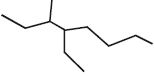
The $IUPAC$ name of the compound given below is:
A
$3-$methyl$-4-$ethyloctane
B
$2, 3-$diethylheptane
C
$5-$ethyl$-6-$methyloctane
D
$4-$ethyl$-3-$methyloctane
Solution
(D) $1$. Identify the longest carbon chain. The longest chain in the given structure contains $8$ carbon atoms,so the parent alkane is octane.
$2$. Number the chain from the end that gives the lowest locants to the substituents.
$3$. Numbering from left to right gives substituents at positions $3$ and $4$. Numbering from right to left gives substituents at positions $5$ and $6$.
$4$. Following the lowest locant rule,we number from left to right.
$5$. At position $3$,there is a methyl group $(-CH_3)$,and at position $4$,there is an ethyl group $(-CH_2CH_3)$.
$6$. According to $IUPAC$ rules,substituents are listed in alphabetical order. Therefore,ethyl comes before methyl.
$7$. The correct name is $4-$ethyl$-3-$methyloctane.
$2$. Number the chain from the end that gives the lowest locants to the substituents.
$3$. Numbering from left to right gives substituents at positions $3$ and $4$. Numbering from right to left gives substituents at positions $5$ and $6$.
$4$. Following the lowest locant rule,we number from left to right.
$5$. At position $3$,there is a methyl group $(-CH_3)$,and at position $4$,there is an ethyl group $(-CH_2CH_3)$.
$6$. According to $IUPAC$ rules,substituents are listed in alphabetical order. Therefore,ethyl comes before methyl.
$7$. The correct name is $4-$ethyl$-3-$methyloctane.
0 likesView Solution
32
ChemistryMediumMCQAIIMS · 2013
Which of the following has the lowest dipole moment?
A
cis-but$-2-$ene
B
$CH_3-C \equiv C-CH_3$
C
$CH_3-CH_2-C \equiv CH$
D
$CH_2=CH-C \equiv CH$
Solution
(B) The dipole moment depends on the molecular symmetry and the polarity of bonds.
$1$. $CH_3-C \equiv C-CH_3$ (but$-2-$yne) is a linear and symmetrical molecule. Due to its high symmetry,the dipole moments of the $C-CH_3$ bonds cancel each other out,resulting in a net dipole moment of zero.
$2$. $CH_3-CH_2-C \equiv CH$ (but$-1-$yne) and $CH_2=CH-C \equiv CH$ (but$-1-$en$-3-$yne) are asymmetric,leading to a non-zero net dipole moment.
$3$. cis-but$-2-$ene has a non-zero dipole moment due to its polar nature and lack of center of symmetry.
Therefore,$CH_3-C \equiv C-CH_3$ has the lowest dipole moment.
$1$. $CH_3-C \equiv C-CH_3$ (but$-2-$yne) is a linear and symmetrical molecule. Due to its high symmetry,the dipole moments of the $C-CH_3$ bonds cancel each other out,resulting in a net dipole moment of zero.
$2$. $CH_3-CH_2-C \equiv CH$ (but$-1-$yne) and $CH_2=CH-C \equiv CH$ (but$-1-$en$-3-$yne) are asymmetric,leading to a non-zero net dipole moment.
$3$. cis-but$-2-$ene has a non-zero dipole moment due to its polar nature and lack of center of symmetry.
Therefore,$CH_3-C \equiv C-CH_3$ has the lowest dipole moment.
0 likesView Solution
33
ChemistryDifficultMCQAIIMS · 2013
Assertion : When a metal is treated with conc. $HNO_3$,it generally yields a nitrate,$NO_2$,and $H_2O$.
Reason : Conc. $HNO_3$ reacts with a metal and first produces a metal nitrate and nascent hydrogen. The nascent hydrogen then further reduces $HNO_3$ to $NO_2$.
Reason : Conc. $HNO_3$ reacts with a metal and first produces a metal nitrate and nascent hydrogen. The nascent hydrogen then further reduces $HNO_3$ to $NO_2$.
A
If both Assertion and Reason are correct and the Reason is a correct explanation of the Assertion.
B
If both Assertion and Reason are correct but Reason is not a correct explanation of the Assertion.
C
If the Assertion is correct but Reason is incorrect.
D
If both the Assertion and Reason are incorrect.
Solution
(A) Both Assertion and Reason are true and the Reason is the correct explanation of the Assertion.
The reaction proceeds as follows:
$M + HNO_3 \to MNO_3 + [H]$ (Nascent hydrogen)
$2HNO_3 + 2[H] \to 2NO_2 + 2H_2O$
Overall,the nascent hydrogen produced by the metal-acid reaction reduces the nitric acid to nitrogen dioxide $(NO_2)$.
The reaction proceeds as follows:
$M + HNO_3 \to MNO_3 + [H]$ (Nascent hydrogen)
$2HNO_3 + 2[H] \to 2NO_2 + 2H_2O$
Overall,the nascent hydrogen produced by the metal-acid reaction reduces the nitric acid to nitrogen dioxide $(NO_2)$.
0 likesView Solution
34
ChemistryMediumMCQAIIMS · 2013
The product of the following reaction is:
$CH_3CH_2CH_2CH=CH_2 \xrightarrow[(ii) H_2O_2, OH^-]{(i) BH_3/THF} \text{Product}$
$CH_3CH_2CH_2CH=CH_2 \xrightarrow[(ii) H_2O_2, OH^-]{(i) BH_3/THF} \text{Product}$
A
$1-$Pentanol
B
$2-$Pentanol
C
Pentane
D
$1,2-$Pentanediol
Solution
(A) The reaction shown is hydroboration-oxidation of $1-$pentene.
$(i)$ The first step involves the addition of $BH_3$ across the double bond,which follows anti-Markovnikov addition.
(ii) The second step involves oxidation with $H_2O_2$ in the presence of $OH^-$,which replaces the boron atom with a hydroxyl group $(-OH)$ with retention of configuration.
Therefore,$CH_3CH_2CH_2CH=CH_2$ reacts to form $CH_3CH_2CH_2CH_2CH_2OH$,which is $1-$pentanol.
$(i)$ The first step involves the addition of $BH_3$ across the double bond,which follows anti-Markovnikov addition.
(ii) The second step involves oxidation with $H_2O_2$ in the presence of $OH^-$,which replaces the boron atom with a hydroxyl group $(-OH)$ with retention of configuration.
Therefore,$CH_3CH_2CH_2CH=CH_2$ reacts to form $CH_3CH_2CH_2CH_2CH_2OH$,which is $1-$pentanol.
0 likesView Solution
35
ChemistryMCQAIIMS · 2013
Ethanol when reacted with $PCl_5$ gives $A$,$POCl_3$ and $HCl$. $A$ reacts with silver nitrite to form $B$ (major product) and $AgCl$. $A$ and $B$ respectively are
A
$C_2H_5Cl$ and $C_2H_5OC_2H_5$
B
$C_2H_5Cl$ and $C_2H_5NO_2$
C
$C_2H_6$ and $C_2H_5OC_2H_5$
D
$C_2H_6$ and $C_2H_5NO_2$
Solution
(B) The reaction of ethanol with $PCl_5$ is: $C_2H_5OH + PCl_5 \rightarrow C_2H_5Cl (A) + POCl_3 + HCl$.
Here,$A$ is ethyl chloride $(C_2H_5Cl)$.
The reaction of $A$ with silver nitrite $(AgNO_2)$ is: $C_2H_5Cl + AgNO_2 \rightarrow C_2H_5NO_2 (B) + AgCl$.
Here,$B$ is nitroethane $(C_2H_5NO_2)$.
Therefore,$A$ and $B$ are $C_2H_5Cl$ and $C_2H_5NO_2$ respectively.
Here,$A$ is ethyl chloride $(C_2H_5Cl)$.
The reaction of $A$ with silver nitrite $(AgNO_2)$ is: $C_2H_5Cl + AgNO_2 \rightarrow C_2H_5NO_2 (B) + AgCl$.
Here,$B$ is nitroethane $(C_2H_5NO_2)$.
Therefore,$A$ and $B$ are $C_2H_5Cl$ and $C_2H_5NO_2$ respectively.
0 likesView Solution
36
ChemistryMCQAIIMS · 2013
Which pair of the following belongs to Basidiomycetes?
A
Puffballs and Claviceps
B
Peziza and Alternaria
C
Morchella and mushrooms
D
Birds nest fungi and puffballs
Solution
(D) Basidiomycetes,commonly known as club fungi,include mushrooms,bracket fungi,puffballs,and bird's nest fungi.
$A$. Puffballs are Basidiomycetes,but $Claviceps$ belongs to Ascomycetes.
$B$. $Peziza$ belongs to Ascomycetes and $Alternaria$ belongs to Deuteromycetes.
$C$. $Morchella$ belongs to Ascomycetes,while mushrooms are Basidiomycetes.
$D$. Both bird's nest fungi and puffballs are members of the class Basidiomycetes.
$A$. Puffballs are Basidiomycetes,but $Claviceps$ belongs to Ascomycetes.
$B$. $Peziza$ belongs to Ascomycetes and $Alternaria$ belongs to Deuteromycetes.
$C$. $Morchella$ belongs to Ascomycetes,while mushrooms are Basidiomycetes.
$D$. Both bird's nest fungi and puffballs are members of the class Basidiomycetes.
0 likesView Solution
37
ChemistryMCQAIIMS · 2013
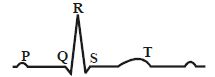
Given below is the $ECG$ of a normal human. Which one of its components is correctly interpreted below?
A
Peak $P$ and Peak $R$ together - systolic and diastolic blood pressures
B
Peak $P -$ Initiation of left atrial contraction only
C
Complex $QRS -$ One complete pulse
D
Peak $T -$ Initiation of total cardiac contraction
Solution
(C) The $P$-wave represents the electrical excitation (or depolarization) of the atria,which leads to the contraction of both the atria.
The $QRS$ complex represents the depolarization of the ventricles,which initiates the ventricular contraction. The contraction starts shortly after $Q$ and marks the beginning of the systole.
The $T$-wave represents the return of the ventricles from an excited to a normal state (repolarization). The end of the $T$-wave marks the end of systole.
Therefore,none of the options $A, B,$ or $D$ are correctly interpreted. However,in many contexts,the $QRS$ complex is used to determine the heart rate by counting the number of $QRS$ complexes that occur in a given time period,which corresponds to one complete pulse.
The $QRS$ complex represents the depolarization of the ventricles,which initiates the ventricular contraction. The contraction starts shortly after $Q$ and marks the beginning of the systole.
The $T$-wave represents the return of the ventricles from an excited to a normal state (repolarization). The end of the $T$-wave marks the end of systole.
Therefore,none of the options $A, B,$ or $D$ are correctly interpreted. However,in many contexts,the $QRS$ complex is used to determine the heart rate by counting the number of $QRS$ complexes that occur in a given time period,which corresponds to one complete pulse.
0 likesView Solution
38
ChemistryMCQAIIMS · 2013
Which one of the following statements in regard to the excretion by the human kidneys is correct?
A
Ascending limb of Loop of Henle is impermeable to electrolytes
B
Descending limb of Loop of Henle is impermeable to water
C
Distal convoluted tubule is incapable of reabsorbing $HCO_3^-$
D
Nearly $99$ percent of the glomerular filtrate is reabsorbed by the renal tubules
Solution
(D) The correct statement is that nearly $99$ percent of the glomerular filtrate is reabsorbed by the renal tubules.
- The ascending limb of the Loop of Henle is permeable to electrolytes but impermeable to water.
- The descending limb of the Loop of Henle is permeable to water but impermeable to electrolytes.
- The distal convoluted tubule $(DCT)$ is capable of reabsorbing $HCO_3^-$ and water,and it also performs conditional reabsorption of $Na^+$ and water.
- The glomerular filtration rate $(GFR)$ is approximately $180$ liters per day,while the volume of urine released is only about $1.5$ liters,which confirms that about $99$ percent of the filtrate is reabsorbed.
- The ascending limb of the Loop of Henle is permeable to electrolytes but impermeable to water.
- The descending limb of the Loop of Henle is permeable to water but impermeable to electrolytes.
- The distal convoluted tubule $(DCT)$ is capable of reabsorbing $HCO_3^-$ and water,and it also performs conditional reabsorption of $Na^+$ and water.
- The glomerular filtration rate $(GFR)$ is approximately $180$ liters per day,while the volume of urine released is only about $1.5$ liters,which confirms that about $99$ percent of the filtrate is reabsorbed.
0 likesView Solution
39
ChemistryEasyMCQAIIMS · 2013
An acidic buffer is obtained on mixing
A
$100 \ mL$ of $0.1 \ M \ CH_3COOH$ and $200 \ mL$ of $0.1 \ M \ NaOH$
B
$100 \ mL$ of $0.1 \ M \ CH_3COOH$ and $100 \ mL$ of $0.1 \ M \ NaOH$
C
$100 \ mL$ of $0.1 \ M \ HCl$ and $200 \ mL$ of $0.1 \ M \ CH_3COONa$
D
$100 \ mL$ of $0.1 \ M \ HCl$ and $200 \ mL$ of $0.1 \ M \ NaCl$
Solution
(C) An acidic buffer is formed by a mixture of a weak acid and its salt with a strong base.
In option $C$,we have $100 \ mL$ of $0.1 \ M \ HCl$ $(10 \ mmol)$ and $200 \ mL$ of $0.1 \ M \ CH_3COONa$ $(20 \ mmol)$.
The reaction is: $HCl + CH_3COONa \rightarrow CH_3COOH + NaCl$
Initial moles: $10 \ mmol \ HCl$ and $20 \ mmol \ CH_3COONa$.
After reaction: $0 \ mmol \ HCl$,$10 \ mmol \ CH_3COONa$ remaining,and $10 \ mmol \ CH_3COOH$ formed.
Since the final mixture contains a weak acid $(CH_3COOH)$ and its conjugate base ($CH_3COO^-$ from $CH_3COONa$),it acts as an acidic buffer.
In option $C$,we have $100 \ mL$ of $0.1 \ M \ HCl$ $(10 \ mmol)$ and $200 \ mL$ of $0.1 \ M \ CH_3COONa$ $(20 \ mmol)$.
The reaction is: $HCl + CH_3COONa \rightarrow CH_3COOH + NaCl$
Initial moles: $10 \ mmol \ HCl$ and $20 \ mmol \ CH_3COONa$.
After reaction: $0 \ mmol \ HCl$,$10 \ mmol \ CH_3COONa$ remaining,and $10 \ mmol \ CH_3COOH$ formed.
Since the final mixture contains a weak acid $(CH_3COOH)$ and its conjugate base ($CH_3COO^-$ from $CH_3COONa$),it acts as an acidic buffer.
0 likesView Solution
40
ChemistryMCQAIIMS · 2013
Which of the following is less general in characters as compared to genus?
A
Species
B
Division
C
Class
D
Family
Solution
(A) The taxonomic hierarchy follows the order: $Species < Genus < Family < Order < Class < Phylum/Division < Kingdom$.
As we move from species to kingdom,the number of common characteristics decreases,meaning the groups become more general.
Conversely,as we move from kingdom to species,the number of common characteristics increases,meaning the groups become less general.
Since $Species$ is the lowest taxonomic category,it possesses the most specific characters and is therefore less general than $Genus$.
As we move from species to kingdom,the number of common characteristics decreases,meaning the groups become more general.
Conversely,as we move from kingdom to species,the number of common characteristics increases,meaning the groups become less general.
Since $Species$ is the lowest taxonomic category,it possesses the most specific characters and is therefore less general than $Genus$.
0 likesView Solution
41
ChemistryMCQAIIMS · 2013
Which of the following is less general in characters as compared to genus?
A
Species
B
Division
C
Class
D
Family
Solution
(A) The taxonomic hierarchy follows the order: $Kingdom > Phylum/Division > Class > Order > Family > Genus > Species$.
As we move down the hierarchy from higher categories to lower categories, the number of common characteristics shared by the organisms decreases in generality and increases in specificity.
Since $Species$ is a lower taxonomic category than $Genus$, it possesses more specific characters and is less general in its definition compared to $Genus$.
As we move down the hierarchy from higher categories to lower categories, the number of common characteristics shared by the organisms decreases in generality and increases in specificity.
Since $Species$ is a lower taxonomic category than $Genus$, it possesses more specific characters and is less general in its definition compared to $Genus$.
0 likesView Solution
42
ChemistryMCQAIIMS · 2013
Which of the following types of cell junctions is not found in animal tissues?
A
Adhering junction
B
Tight junction
C
Gap junction
D
Plasmodesmata
Solution
(D) Plasmodesmata are narrow channels that act as intercellular cytoplasmic bridges to facilitate communication and transport of materials between plant cells.
Adhering,tight,and gap junctions are specialized junctions that provide both structural and functional links between the individual cells of animal tissues.
Therefore,plasmodesmata are exclusively found in plant cells and not in animal tissues.
Adhering,tight,and gap junctions are specialized junctions that provide both structural and functional links between the individual cells of animal tissues.
Therefore,plasmodesmata are exclusively found in plant cells and not in animal tissues.
0 likesView Solution
43
ChemistryMCQAIIMS · 2013
Ethanol,when reacted with $PCl_5$,gives $A$,$POCl_3$,and $HCl$. $A$ reacts with silver nitrite to form $B$ (major product) and $AgCl$. $A$ and $B$ are respectively:
A
$C_2H_5Cl$ and $C_2H_5OC_2H_5$
B
$C_2H_6$ and $C_2H_5OC_2H_5$
C
$C_2H_5Cl$ and $C_2H_5NO_2$
D
$C_2H_6$ and $C_2H_5NO_2$
Solution
(C) Step $1$: Reaction of ethanol with $PCl_5$:
$C_2H_5OH + PCl_5 \rightarrow C_2H_5Cl (A) + POCl_3 + HCl$
Thus,$A$ is $C_2H_5Cl$ (ethyl chloride).
Step $2$: Reaction of $A$ with silver nitrite $(AgNO_2)$:
$C_2H_5Cl + AgNO_2 \rightarrow C_2H_5NO_2 (B) + AgCl$
Thus,$B$ is $C_2H_5NO_2$ (nitroethane).
Therefore,$A$ and $B$ are $C_2H_5Cl$ and $C_2H_5NO_2$ respectively.
$C_2H_5OH + PCl_5 \rightarrow C_2H_5Cl (A) + POCl_3 + HCl$
Thus,$A$ is $C_2H_5Cl$ (ethyl chloride).
Step $2$: Reaction of $A$ with silver nitrite $(AgNO_2)$:
$C_2H_5Cl + AgNO_2 \rightarrow C_2H_5NO_2 (B) + AgCl$
Thus,$B$ is $C_2H_5NO_2$ (nitroethane).
Therefore,$A$ and $B$ are $C_2H_5Cl$ and $C_2H_5NO_2$ respectively.
0 likesView Solution
44
ChemistryMediumMCQAIIMS · 2013
An aqueous solution of $6.3 \ g$ of oxalic acid dihydrate is made up to $250 \ mL$. The volume of $0.1 \ N \ NaOH$ required to completely neutralise $10 \ mL$ of this solution is.......$mL$
A
$20$
B
$40$
C
$10$
D
$4$
Solution
(B) The molar mass of oxalic acid dihydrate $(H_2C_2O_4 \cdot 2H_2O)$ is $126 \ g/mol$.
Since it is a dibasic acid,its equivalent mass is $\frac{126}{2} = 63 \ g/eq$.
Normality of the oxalic acid solution = $\frac{\text{mass}}{\text{equivalent mass} \times \text{volume in L}} = \frac{6.3}{63 \times 0.250} = 0.4 \ N$.
Using the titration formula $N_1 V_1 = N_2 V_2$ for $10 \ mL$ of the solution:
$0.4 \ N \times 10 \ mL = 0.1 \ N \times V_2$.
$V_2 = \frac{4}{0.1} = 40 \ mL$.
Since it is a dibasic acid,its equivalent mass is $\frac{126}{2} = 63 \ g/eq$.
Normality of the oxalic acid solution = $\frac{\text{mass}}{\text{equivalent mass} \times \text{volume in L}} = \frac{6.3}{63 \times 0.250} = 0.4 \ N$.
Using the titration formula $N_1 V_1 = N_2 V_2$ for $10 \ mL$ of the solution:
$0.4 \ N \times 10 \ mL = 0.1 \ N \times V_2$.
$V_2 = \frac{4}{0.1} = 40 \ mL$.
0 likesView Solution
45
ChemistryMediumMCQAIIMS · 2013
Which equilibrium can be described as an acid-base reaction using the Lewis acid-base definition but not using the Bronsted-Lowry definition?
A
$2NH_3 + H_2SO_4 \rightleftharpoons 2NH_4^+ + SO_4^{2-}$
B
$NH_3 + CH_3COOH \rightleftharpoons NH_4^+ + CH_3COO^{-}$
C
$H_2O + CH_3COOH \rightleftharpoons H_3O^{+} + CH_3COO^{-}$
D
$[Cu(H_2O)_4]^{2+} + 4NH_3 \rightleftharpoons [Cu(NH_3)_4]^{2+} + 4H_2O$
Solution
(D) The Bronsted-Lowry definition defines acids as proton $(H^+)$ donors and bases as proton acceptors.
In options $A$,$B$,and $C$,there is a clear transfer of a proton $(H^+)$ from the acid to the base.
In the reaction $[Cu(H_2O)_4]^{2+} + 4NH_3 \rightleftharpoons [Cu(NH_3)_4]^{2+} + 4H_2O$,there is no proton transfer.
Instead,$NH_3$ acts as a Lewis base by donating a lone pair of electrons to the $Cu^{2+}$ ion (Lewis acid) to form a coordinate covalent bond.
Therefore,this reaction is an acid-base reaction according to the Lewis definition but not the Bronsted-Lowry definition.
In options $A$,$B$,and $C$,there is a clear transfer of a proton $(H^+)$ from the acid to the base.
In the reaction $[Cu(H_2O)_4]^{2+} + 4NH_3 \rightleftharpoons [Cu(NH_3)_4]^{2+} + 4H_2O$,there is no proton transfer.
Instead,$NH_3$ acts as a Lewis base by donating a lone pair of electrons to the $Cu^{2+}$ ion (Lewis acid) to form a coordinate covalent bond.
Therefore,this reaction is an acid-base reaction according to the Lewis definition but not the Bronsted-Lowry definition.
0 likesView Solution
46
ChemistryMediumMCQAIIMS · 2013
An element (atomic mass $= 100 \ g/mol$) having $bcc$ structure has a unit cell edge of $400 \ pm$. The density of the element is ................. $g/cm^3$.
A
$10.376$
B
$5.188$
C
$7.289$
D
$2.144$
Solution
(B) For a $bcc$ structure,the number of atoms per unit cell,$z = 2$.
Given: Atomic mass $M = 100 \ g/mol$,edge length $a = 400 \ pm = 400 \times 10^{-10} \ cm$,and Avogadro's number $N_A = 6.023 \times 10^{23} \ mol^{-1}$.
The formula for density is $\rho = \frac{z \times M}{N_A \times a^3}$.
Substituting the values: $\rho = \frac{2 \times 100}{6.023 \times 10^{23} \times (400 \times 10^{-10})^3}$.
$\rho = \frac{200}{6.023 \times 10^{23} \times 64 \times 10^{-24}} = \frac{200}{38.5472} \approx 5.188 \ g/cm^3$.
Given: Atomic mass $M = 100 \ g/mol$,edge length $a = 400 \ pm = 400 \times 10^{-10} \ cm$,and Avogadro's number $N_A = 6.023 \times 10^{23} \ mol^{-1}$.
The formula for density is $\rho = \frac{z \times M}{N_A \times a^3}$.
Substituting the values: $\rho = \frac{2 \times 100}{6.023 \times 10^{23} \times (400 \times 10^{-10})^3}$.
$\rho = \frac{200}{6.023 \times 10^{23} \times 64 \times 10^{-24}} = \frac{200}{38.5472} \approx 5.188 \ g/cm^3$.
0 likesView Solution
47
ChemistryMediumMCQAIIMS · 2013
At a particular temperature,the vapour pressures of two liquids $A$ and $B$ are respectively $120 \, mm$ and $180 \, mm$ of mercury. If $2 \, moles$ of $A$ and $3 \, moles$ of $B$ are mixed to form an ideal solution,the vapour pressure of the solution at the same temperature will be (in $mm$ of mercury):
A
$156$
B
$145$
C
$150$
D
$108$
Solution
(A) According to Raoult's law for an ideal solution,the total vapour pressure $P_{total}$ is given by:
$P_{total} = P_A^o x_A + P_B^o x_B$
Given: $P_A^o = 120 \, mm \, Hg$,$P_B^o = 180 \, mm \, Hg$,$n_A = 2 \, moles$,$n_B = 3 \, moles$.
Total moles $= 2 + 3 = 5 \, moles$.
Mole fraction of $A$ $(x_A)$ $= \frac{2}{5} = 0.4$.
Mole fraction of $B$ $(x_B)$ $= \frac{3}{5} = 0.6$.
$P_{total} = (120 \times 0.4) + (180 \times 0.6) = 48 + 108 = 156 \, mm \, Hg$.
$P_{total} = P_A^o x_A + P_B^o x_B$
Given: $P_A^o = 120 \, mm \, Hg$,$P_B^o = 180 \, mm \, Hg$,$n_A = 2 \, moles$,$n_B = 3 \, moles$.
Total moles $= 2 + 3 = 5 \, moles$.
Mole fraction of $A$ $(x_A)$ $= \frac{2}{5} = 0.4$.
Mole fraction of $B$ $(x_B)$ $= \frac{3}{5} = 0.6$.
$P_{total} = (120 \times 0.4) + (180 \times 0.6) = 48 + 108 = 156 \, mm \, Hg$.
0 likesView Solution
48
ChemistryEasyMCQAIIMS · 2013
The freezing point of an equimolal aqueous solution will be highest for:
A
$C_6H_5NH_3^+Cl^-$
B
$Ca(NO_3)_2$
C
$La(NO_3)_3$
D
$C_6H_{12}O_6$
Solution
(D) The depression in freezing point is given by the formula $\Delta T_f = i \times K_f \times m$.
For equimolal solutions,$\Delta T_f$ is directly proportional to the van't Hoff factor $(i)$.
$C_6H_{12}O_6$ (glucose) is a non-electrolyte,so its $i = 1$.
$C_6H_5NH_3^+Cl^-$ dissociates into $2$ ions $(i = 2)$.
$Ca(NO_3)_2$ dissociates into $3$ ions $(i = 3)$.
$La(NO_3)_3$ dissociates into $4$ ions $(i = 4)$.
Since glucose has the lowest $i$ value,it will have the minimum depression in freezing point $(\Delta T_f)$.
Therefore,the freezing point $(T_f = T_f^0 - \Delta T_f)$ will be the highest for $C_6H_{12}O_6$.
For equimolal solutions,$\Delta T_f$ is directly proportional to the van't Hoff factor $(i)$.
$C_6H_{12}O_6$ (glucose) is a non-electrolyte,so its $i = 1$.
$C_6H_5NH_3^+Cl^-$ dissociates into $2$ ions $(i = 2)$.
$Ca(NO_3)_2$ dissociates into $3$ ions $(i = 3)$.
$La(NO_3)_3$ dissociates into $4$ ions $(i = 4)$.
Since glucose has the lowest $i$ value,it will have the minimum depression in freezing point $(\Delta T_f)$.
Therefore,the freezing point $(T_f = T_f^0 - \Delta T_f)$ will be the highest for $C_6H_{12}O_6$.
0 likesView Solution
49
ChemistryMediumMCQAIIMS · 2013
Assertion : If one component of a solution obeys Raoult's law over a certain range of composition,the other component will not obey Henry's law in that range.
Reason : Raoult's law is a special case of Henry's law.
Reason : Raoult's law is a special case of Henry's law.
A
If both Assertion and Reason are correct and the Reason is a correct explanation of the Assertion.
B
If both Assertion and Reason are correct but Reason is not a correct explanation of the Assertion.
C
If the Assertion is correct but Reason is incorrect.
D
If both the Assertion and Reason are incorrect.
Solution
(D) According to the thermodynamic relationship between Raoult's law and Henry's law,if one component of a binary solution obeys Raoult's law $(P_i = x_i P_i^o)$ over the entire range of composition,the other component must also obey Raoult's law.
However,in dilute solutions,the solvent obeys Raoult's law $(P_1 = x_1 P_1^o)$ while the solute obeys Henry's law $(P_2 = K_H x_2)$.
The Assertion is incorrect because if one component obeys Raoult's law,the other component often obeys Henry's law in the dilute range.
The Reason is correct because Raoult's law is indeed a special case of Henry's law where the Henry's constant $(K_H)$ becomes equal to the pure component vapor pressure $(P_i^o)$.
However,in dilute solutions,the solvent obeys Raoult's law $(P_1 = x_1 P_1^o)$ while the solute obeys Henry's law $(P_2 = K_H x_2)$.
The Assertion is incorrect because if one component obeys Raoult's law,the other component often obeys Henry's law in the dilute range.
The Reason is correct because Raoult's law is indeed a special case of Henry's law where the Henry's constant $(K_H)$ becomes equal to the pure component vapor pressure $(P_i^o)$.
0 likesView Solution
50
ChemistryMediumMCQAIIMS · 2013
The standard reduction potentials at $298 \ K$ for the following half-reactions are given:
$Zn^{2+}_{(aq)} + 2e^- \rightleftharpoons Zn_{(s)}; E^\circ = -0.762 \ V$
$Cr^{3+}_{(aq)} + 3e^- \rightleftharpoons Cr_{(s)}; E^\circ = -0.740 \ V$
$2H^+_{(aq)} + 2e^- \rightleftharpoons H_{2(g)}; E^\circ = 0.00 \ V$
$Fe^{3+}_{(aq)} + e^- \rightleftharpoons Fe^{2+}_{(aq)}; E^\circ = 0.770 \ V$
Which is the strongest reducing agent?
$Zn^{2+}_{(aq)} + 2e^- \rightleftharpoons Zn_{(s)}; E^\circ = -0.762 \ V$
$Cr^{3+}_{(aq)} + 3e^- \rightleftharpoons Cr_{(s)}; E^\circ = -0.740 \ V$
$2H^+_{(aq)} + 2e^- \rightleftharpoons H_{2(g)}; E^\circ = 0.00 \ V$
$Fe^{3+}_{(aq)} + e^- \rightleftharpoons Fe^{2+}_{(aq)}; E^\circ = 0.770 \ V$
Which is the strongest reducing agent?
A
$Zn_{(s)}$
B
$Cr_{(s)}$
C
$H_{2(g)}$
D
$Fe^{3+}_{(aq)}$
Solution
(A) reducing agent is a substance that undergoes oxidation,and its strength is determined by its standard oxidation potential. The standard oxidation potential is the negative of the standard reduction potential $(E^\circ_{ox} = -E^\circ_{red})$.
$1$. For $Zn_{(s)} \rightarrow Zn^{2+} + 2e^-$,$E^\circ_{ox} = -(-0.762 \ V) = +0.762 \ V$
$2$. For $Cr_{(s)} \rightarrow Cr^{3+} + 3e^-$,$E^\circ_{ox} = -(-0.740 \ V) = +0.740 \ V$
$3$. For $H_{2(g)} \rightarrow 2H^+ + 2e^-$,$E^\circ_{ox} = -(0.00 \ V) = 0.00 \ V$
$4$. For $Fe^{2+} \rightarrow Fe^{3+} + e^-$,$E^\circ_{ox} = -(0.770 \ V) = -0.770 \ V$
Since $Zn_{(s)}$ has the highest standard oxidation potential $(+0.762 \ V)$,it is the strongest reducing agent among the given options.
$1$. For $Zn_{(s)} \rightarrow Zn^{2+} + 2e^-$,$E^\circ_{ox} = -(-0.762 \ V) = +0.762 \ V$
$2$. For $Cr_{(s)} \rightarrow Cr^{3+} + 3e^-$,$E^\circ_{ox} = -(-0.740 \ V) = +0.740 \ V$
$3$. For $H_{2(g)} \rightarrow 2H^+ + 2e^-$,$E^\circ_{ox} = -(0.00 \ V) = 0.00 \ V$
$4$. For $Fe^{2+} \rightarrow Fe^{3+} + e^-$,$E^\circ_{ox} = -(0.770 \ V) = -0.770 \ V$
Since $Zn_{(s)}$ has the highest standard oxidation potential $(+0.762 \ V)$,it is the strongest reducing agent among the given options.
0 likesView Solution
51
ChemistryMediumMCQAIIMS · 2013
$A$ reaction which is of first order with respect to reactant $A$,has a rate constant $6 \, min^{-1}$. If we start with $[A] = 0.5 \, mol \, L^{-1}$,when would $[A]$ reach the value of $0.05 \, mol \, L^{-1}$?
A
$0.38$
B
$0.15$
C
$3$
D
$3.84$
Solution
(A) For a first-order reaction,the integrated rate equation is given by:
$t = \frac{2.303}{k} \log \frac{[A]_0}{[A]_t}$
Given:
$k = 6 \, min^{-1}$
$[A]_0 = 0.5 \, mol \, L^{-1}$
$[A]_t = 0.05 \, mol \, L^{-1}$
Substituting the values:
$t = \frac{2.303}{6} \log \frac{0.5}{0.05}$
$t = \frac{2.303}{6} \log(10)$
Since $\log(10) = 1$,
$t = \frac{2.303}{6} \approx 0.384 \, min$.
$t = \frac{2.303}{k} \log \frac{[A]_0}{[A]_t}$
Given:
$k = 6 \, min^{-1}$
$[A]_0 = 0.5 \, mol \, L^{-1}$
$[A]_t = 0.05 \, mol \, L^{-1}$
Substituting the values:
$t = \frac{2.303}{6} \log \frac{0.5}{0.05}$
$t = \frac{2.303}{6} \log(10)$
Since $\log(10) = 1$,
$t = \frac{2.303}{6} \approx 0.384 \, min$.
0 likesView Solution
52
ChemistryEasyMCQAIIMS · 2013
$A$ colloidal solution is subjected to an electrical field. The particles move towards the anode. The coagulation of the same sol is studied using $NaCl$,$BaCl_2$,and $AlCl_3$ solutions. Their coagulating power should be:
A
$NaCl > BaCl_2 > AlCl_3$
B
$BaCl_2 > AlCl_3 > NaCl$
C
$AlCl_3 > BaCl_2 > NaCl$
D
$BaCl_2 > NaCl > AlCl_3$
Solution
(C) The movement of colloidal particles towards the anode indicates that the sol is negatively charged.
According to the Hardy-Schulze rule,the coagulating power of an electrolyte depends on the valency of the ion carrying a charge opposite to that of the colloidal particles.
Since the sol is negative,the coagulating power depends on the charge of the cation ($Na^+$,$Ba^{2+}$,$Al^{3+}$).
Greater the charge on the cation,higher is its coagulating power.
Thus,the order of coagulating power is $Al^{3+} > Ba^{2+} > Na^+$,which corresponds to $AlCl_3 > BaCl_2 > NaCl$.
According to the Hardy-Schulze rule,the coagulating power of an electrolyte depends on the valency of the ion carrying a charge opposite to that of the colloidal particles.
Since the sol is negative,the coagulating power depends on the charge of the cation ($Na^+$,$Ba^{2+}$,$Al^{3+}$).
Greater the charge on the cation,higher is its coagulating power.
Thus,the order of coagulating power is $Al^{3+} > Ba^{2+} > Na^+$,which corresponds to $AlCl_3 > BaCl_2 > NaCl$.
0 likesView Solution
53
ChemistryMediumMCQAIIMS · 2013
Assertion : The relation $\frac{x}{m} = k \cdot p^{1/n}$ is known as Freundlich adsorption isotherm,where $x$ is the mass of gas adsorbed by $m$ grams of adsorbent,$p$ is the equilibrium pressure,$k$ and $n$ are constants for a given system and temperature.
Reason : When several substances have the same value of $\frac{1}{n}$,the lines by which their adsorption isotherms can be represented will meet at a point.
Reason : When several substances have the same value of $\frac{1}{n}$,the lines by which their adsorption isotherms can be represented will meet at a point.
A
If both Assertion and Reason are correct and the Reason is a correct explanation of the Assertion.
B
If both Assertion and Reason are correct but Reason is not a correct explanation of the Assertion.
C
If the Assertion is correct but Reason is incorrect.
D
If both the Assertion and Reason are incorrect.
Solution
(C) The Assertion is correct because the Freundlich adsorption isotherm is indeed given by the equation $\frac{x}{m} = k \cdot p^{1/n}$.
The Reason is incorrect. The Freundlich isotherm is typically represented by plotting $\log(\frac{x}{m})$ versus $\log(p)$,which yields a straight line with a slope of $\frac{1}{n}$ and an intercept of $\log(k)$.
If several substances have the same value of $\frac{1}{n}$,their plots will have the same slope,meaning the lines will be parallel to each other and will not meet at a single point.
The Reason is incorrect. The Freundlich isotherm is typically represented by plotting $\log(\frac{x}{m})$ versus $\log(p)$,which yields a straight line with a slope of $\frac{1}{n}$ and an intercept of $\log(k)$.
If several substances have the same value of $\frac{1}{n}$,their plots will have the same slope,meaning the lines will be parallel to each other and will not meet at a single point.
0 likesView Solution
54
ChemistryMediumMCQAIIMS · 2013
Match List-$I$ with List-$II$ and select the correct answer using the codes given below the lists.
| List-$I$ | List-$II$ |
|---|---|
| $I$. Cyanide process | $A$. Ultrapure $Ge$ |
| $II$. Floatation process | $B$. Pine oil |
| $III$. Electrolytic reduction | $C$. Extraction of $Al$ |
| $IV$. Zone refining | $D$. Extraction of $Au$ |
A
$I-C, II-A, III-D, IV-B$
B
$I-D, II-B, III-C, IV-A$
C
$I-C, II-B, III-D, IV-A$
D
$I-D, II-A, III-C, IV-B$
Solution
(B) The correct matches are as follows:
$I$. Cyanide process is used for the extraction of $Au$ $(I-D)$.
$II$. Froth floatation process uses pine oil as a frother $(II-B)$.
$III$. Electrolytic reduction is used for the extraction of $Al$ $(III-C)$.
$IV$. Zone refining is used for obtaining ultrapure $Ge$ $(IV-A)$.
Thus,the correct sequence is $I-D, II-B, III-C, IV-A$.
$I$. Cyanide process is used for the extraction of $Au$ $(I-D)$.
$II$. Froth floatation process uses pine oil as a frother $(II-B)$.
$III$. Electrolytic reduction is used for the extraction of $Al$ $(III-C)$.
$IV$. Zone refining is used for obtaining ultrapure $Ge$ $(IV-A)$.
Thus,the correct sequence is $I-D, II-B, III-C, IV-A$.
0 likesView Solution
55
ChemistryDifficultMCQAIIMS · 2013
Assertion : Copper obtained after $Bessemerization$ is known as blister copper.
Reason : Blisters are produced on the surface of the metal due to escaping of dissolved $SO_2$.
Reason : Blisters are produced on the surface of the metal due to escaping of dissolved $SO_2$.
A
If both Assertion and Reason are correct and the Reason is a correct explanation of the Assertion.
B
If both Assertion and Reason are correct but Reason is not a correct explanation of the Assertion.
C
If the Assertion is correct but Reason is incorrect.
D
If both the Assertion and Reason are incorrect.
Solution
(A) During the $Bessemerization$ process,the molten copper is poured into moulds and allowed to cool.
As the metal solidifies,the dissolved $SO_2$ gas escapes,creating bubbles or blisters on the surface of the solidified copper.
Hence,the copper obtained is called blister copper.
Both the assertion and the reason are correct,and the reason is the correct explanation of the assertion.
As the metal solidifies,the dissolved $SO_2$ gas escapes,creating bubbles or blisters on the surface of the solidified copper.
Hence,the copper obtained is called blister copper.
Both the assertion and the reason are correct,and the reason is the correct explanation of the assertion.
0 likesView Solution
56
ChemistryDifficultMCQAIIMS · 2013
When chlorine reacts with a cold and dilute solution of sodium hydroxide,the products obtained are:
A
$Cl^{-} + OCl^{-}$
B
$Cl^{-} + ClO_2^{-}$
C
$Cl^{-} + ClO_3^{-}$
D
$Cl^{-} + ClO_4^{-}$
Solution
(A) The reaction of chlorine with cold and dilute sodium hydroxide is a disproportionation reaction.
The balanced chemical equation is:
$2NaOH + Cl_2 \to NaCl + NaOCl + H_2O$
In this reaction,chlorine is both oxidized and reduced.
The ionic products formed are chloride $(Cl^{-})$ and hypochlorite $(OCl^{-})$.
The balanced chemical equation is:
$2NaOH + Cl_2 \to NaCl + NaOCl + H_2O$
In this reaction,chlorine is both oxidized and reduced.
The ionic products formed are chloride $(Cl^{-})$ and hypochlorite $(OCl^{-})$.
0 likesView Solution
57
ChemistryEasyMCQAIIMS · 2013
$A$ compound of a metal ion $M^{x+}$ $(Z = 24)$ has a spin-only magnetic moment of $\sqrt{15} \ BM$. The number of unpaired electrons in the compound is:
A
$2$
B
$4$
C
$5$
D
$3$
Solution
(D) The spin-only magnetic moment is given by the formula $\mu = \sqrt{n(n+2)} \ BM$,where $n$ is the number of unpaired electrons.
Given $\mu = \sqrt{15} \ BM$.
Equating the two expressions: $\sqrt{15} = \sqrt{n(n+2)}$.
Squaring both sides: $15 = n(n+2)$.
$n^2 + 2n - 15 = 0$.
Solving the quadratic equation: $(n+5)(n-3) = 0$.
Since $n$ must be a positive integer,$n = 3$.
Therefore,the number of unpaired electrons is $3$.
Given $\mu = \sqrt{15} \ BM$.
Equating the two expressions: $\sqrt{15} = \sqrt{n(n+2)}$.
Squaring both sides: $15 = n(n+2)$.
$n^2 + 2n - 15 = 0$.
Solving the quadratic equation: $(n+5)(n-3) = 0$.
Since $n$ must be a positive integer,$n = 3$.
Therefore,the number of unpaired electrons is $3$.
0 likesView Solution
58
ChemistryMediumMCQAIIMS · 2013
Assertion : Magnetic moment values of actinides are lesser than the theoretically predicted values.
Reason : Actinide elements are strongly paramagnetic.
Reason : Actinide elements are strongly paramagnetic.
A
If both Assertion and Reason are correct and the Reason is a correct explanation of the Assertion.
B
If both Assertion and Reason are correct but Reason is not a correct explanation of the Assertion.
C
If the Assertion is correct but Reason is incorrect.
D
If both the Assertion and Reason are incorrect.
Solution
(B) The magnetic moment values of actinides are lower than the theoretically predicted values because the $5f$ electrons are less effectively shielded by the outer shells. This leads to the quenching of the orbital contribution to the magnetic moment,making the observed values smaller than those calculated using the spin-only formula. While actinides are paramagnetic,the reason provided does not explain why the magnetic moments are lower than predicted.
0 likesView Solution
59
ChemistryDifficultMCQAIIMS · 2013
The hypothetical complex triamminediaquachlorocobalt $(III)$ chloride can be represented as:
A
$[CoCl(NH_3)_3(H_2O)_2]Cl_2$
B
$[Co(NH_3)_3(H_2O)Cl_3]$
C
$[Co(NH_3)_3(H_2O)_2Cl]$
D
$[Co(NH_3)_3(H_2O)_3]Cl_3$
Solution
(A) The name of the complex is triamminediaquachlorocobalt $(III)$ chloride.
$1$. The central metal ion is $Co^{3+}$.
$2$. The ligands are three ammine $(NH_3)$,two aqua $(H_2O)$,and one chloro $(Cl^-)$ groups.
$3$. The coordination sphere is $[Co(NH_3)_3(H_2O)_2Cl]$.
$4$. To balance the charge of $Co^{3+}$ $(+3)$ and $Cl^-$ $(-1)$,the total charge of the coordination sphere is $+2$. Thus,two chloride ions are required outside the sphere.
$5$. The formula is $[CoCl(NH_3)_3(H_2O)_2]Cl_2$.
$1$. The central metal ion is $Co^{3+}$.
$2$. The ligands are three ammine $(NH_3)$,two aqua $(H_2O)$,and one chloro $(Cl^-)$ groups.
$3$. The coordination sphere is $[Co(NH_3)_3(H_2O)_2Cl]$.
$4$. To balance the charge of $Co^{3+}$ $(+3)$ and $Cl^-$ $(-1)$,the total charge of the coordination sphere is $+2$. Thus,two chloride ions are required outside the sphere.
$5$. The formula is $[CoCl(NH_3)_3(H_2O)_2]Cl_2$.
0 likesView Solution
60
ChemistryMediumMCQAIIMS · 2013
Assertion : $[FeF_6]^{3-}$ is a low spin complex.
Reason : Low spin complexes have a lesser number of unpaired electrons.
Reason : Low spin complexes have a lesser number of unpaired electrons.
A
If both Assertion and Reason are correct and the Reason is a correct explanation of the Assertion.
B
If both Assertion and Reason are correct but Reason is not a correct explanation of the Assertion.
C
If the Assertion is correct but Reason is incorrect.
D
If both the Assertion and Reason are incorrect.
Solution
(D) In $[FeF_6]^{3-}$,the oxidation state of $Fe$ is $+3$ ($3d^5$ configuration).
$F^{-}$ is a weak field ligand,which does not cause pairing of electrons.
Therefore,it forms a high spin complex with $5$ unpaired electrons.
Thus,the Assertion is incorrect,while the Reason is a correct statement regarding the definition of low spin complexes.
$F^{-}$ is a weak field ligand,which does not cause pairing of electrons.
Therefore,it forms a high spin complex with $5$ unpaired electrons.
Thus,the Assertion is incorrect,while the Reason is a correct statement regarding the definition of low spin complexes.
0 likesView Solution
61
ChemistryMediumMCQAIIMS · 2013
Which of the following is an example of $S_N2$ reaction?
A
$CH_3Br + OH^{-} \to CH_3OH + Br^{-}$
B
$CH_3-CH(Br)-CH_3 + OH^{-} \to CH_3-CH(OH)-CH_3 + Br^{-}$
C
$CH_3CH_2OH \xrightarrow{-H_2O} CH_2=CH_2$
D
$CH_3-C(CH_3)(Br)-CH_3 + OH^{-} \to CH_3-C(CH_3)(OH)-CH_3 + Br^{-}$
Solution
(A) $S_N2$ (Substitution Nucleophilic Bimolecular) reactions are highly favored by methyl halides and primary $(1^\circ)$ alkyl halides because they have the least steric hindrance,allowing the nucleophile to attack the carbon atom easily from the backside.
$CH_3Br$ is a methyl halide and undergoes $S_N2$ reaction most readily among the given options.
Option $(b)$ is a secondary halide,option $(c)$ is an elimination reaction,and option $(d)$ is a tertiary halide which typically follows the $S_N1$ mechanism.
$CH_3Br$ is a methyl halide and undergoes $S_N2$ reaction most readily among the given options.
Option $(b)$ is a secondary halide,option $(c)$ is an elimination reaction,and option $(d)$ is a tertiary halide which typically follows the $S_N1$ mechanism.
0 likesView Solution
62
ChemistryAdvancedMCQAIIMS · 2013
Assertion : Alkylbenzene is not prepared by Friedel-Crafts alkylation of benzene.
Reason : Alkyl halides are less reactive than acyl halides.
Reason : Alkyl halides are less reactive than acyl halides.
A
If both Assertion and Reason are correct and the Reason is a correct explanation of the Assertion.
B
If both Assertion and Reason are correct but Reason is not a correct explanation of the Assertion.
C
If the Assertion is correct but Reason is incorrect.
D
If both the Assertion and Reason are incorrect.
Solution
(D) The Assertion is incorrect because alkylbenzene $CAN$ be prepared by Friedel-Crafts alkylation,although it has limitations such as polyalkylation and rearrangement.
The Reason is also incorrect because alkyl halides are generally more reactive or comparable in reactivity to acyl halides in the context of Friedel-Crafts reactions,but the primary issue with alkylation is the formation of polyalkylated products due to the activating nature of the alkyl group added to the benzene ring.
Therefore,both the Assertion and the Reason are incorrect.
The Reason is also incorrect because alkyl halides are generally more reactive or comparable in reactivity to acyl halides in the context of Friedel-Crafts reactions,but the primary issue with alkylation is the formation of polyalkylated products due to the activating nature of the alkyl group added to the benzene ring.
Therefore,both the Assertion and the Reason are incorrect.
0 likesView Solution
63
ChemistryMediumMCQAIIMS · 2013
Assertion : $S_{N}2$ reaction of an optically active aryl halide with an aqueous solution of $KOH$ always gives an alcohol with opposite sign of rotation.
Reason : $S_{N}2$ reactions always proceed with retention of configuration.
Reason : $S_{N}2$ reactions always proceed with retention of configuration.
A
If both Assertion and Reason are correct and the Reason is a correct explanation of the Assertion.
B
If both Assertion and Reason are correct but Reason is not a correct explanation of the Assertion.
C
If the Assertion is correct but Reason is incorrect.
D
If both the Assertion and Reason are incorrect.
Solution
(D) The Assertion is false because aryl halides do not undergo nucleophilic substitution reactions under ordinary conditions. This is due to the resonance effect,which gives the $C-Cl$ bond partial double bond character,making it shorter and stronger,and thus difficult to replace by nucleophiles.
The Reason is also false because $S_{N}2$ reactions proceed with inversion of configuration,not retention.
The Reason is also false because $S_{N}2$ reactions proceed with inversion of configuration,not retention.
0 likesView Solution
64
ChemistryEasyMCQAIIMS · 2013
Polyvinyl alcohol can be prepared by
A
polymerization of vinyl alcohol
B
alkaline hydrolysis of polyvinyl acetate
C
polymerization of acetylene
D
reaction of acetylene with $H_2SO_4$ in presence of $HgSO_4$
Solution
(B) Vinyl alcohol is unstable and tautomerizes to acetaldehyde. Therefore,it cannot be polymerized directly. Polyvinyl alcohol is prepared by the alkaline hydrolysis (or alcoholysis) of polyvinyl acetate. The reaction is: $-(CH_2-CH(OCOCH_3))_n- + nH_2O \xrightarrow{OH^-} -(CH_2-CH(OH))_n- + nCH_3COOH$.
1 likesView Solution
65
ChemistryMediumMCQAIIMS · 2013
Assertion: Ethers behave as bases in the presence of mineral acids.
Reason: Due to the presence of lone pairs of electrons on oxygen.
Reason: Due to the presence of lone pairs of electrons on oxygen.
A
If both Assertion and Reason are correct and the Reason is a correct explanation of the Assertion.
B
If both Assertion and Reason are correct but Reason is not a correct explanation of the Assertion.
C
If the Assertion is correct but Reason is incorrect.
D
If both the Assertion and Reason are incorrect.
Solution
(A) Ethers have two lone pairs of electrons on the oxygen atom,which makes them act as Lewis bases.
In the presence of mineral acids (like $HCl$),the oxygen atom donates a lone pair to the $H^+$ ion,forming an oxonium salt.
The reaction is: $R-O-R + HCl \rightarrow [R_2O^+-H]Cl^-$.
Since the basic behavior is directly caused by the lone pairs on the oxygen atom,the Reason correctly explains the Assertion.
In the presence of mineral acids (like $HCl$),the oxygen atom donates a lone pair to the $H^+$ ion,forming an oxonium salt.
The reaction is: $R-O-R + HCl \rightarrow [R_2O^+-H]Cl^-$.
Since the basic behavior is directly caused by the lone pairs on the oxygen atom,the Reason correctly explains the Assertion.
0 likesView Solution
66
ChemistryMediumMCQAIIMS · 2013
Which of the following products is formed when benzaldehyde is treated with $CH_3MgBr$ and the addition product so obtained is subjected to acid hydrolysis?
A
$A$ secondary alcohol
B
$A$ primary alcohol
C
Phenol
D
tert-Butyl alcohol
Solution
(A) The reaction of benzaldehyde $(C_6H_5CHO)$ with a Grignard reagent $(CH_3MgBr)$ follows a nucleophilic addition mechanism.
First,the nucleophilic $CH_3^-$ group attacks the carbonyl carbon of benzaldehyde to form an intermediate alkoxide: $C_6H_5CHO + CH_3MgBr \rightarrow C_6H_5CH(OMgBr)CH_3$.
Second,acid hydrolysis of this intermediate yields the final product: $C_6H_5CH(OMgBr)CH_3 + H_2O/H^+ \rightarrow C_6H_5CH(OH)CH_3 + Mg(OH)Br$.
The product $C_6H_5CH(OH)CH_3$ is $1$-phenylethanol,which is a secondary $(2^o)$ alcohol.
First,the nucleophilic $CH_3^-$ group attacks the carbonyl carbon of benzaldehyde to form an intermediate alkoxide: $C_6H_5CHO + CH_3MgBr \rightarrow C_6H_5CH(OMgBr)CH_3$.
Second,acid hydrolysis of this intermediate yields the final product: $C_6H_5CH(OMgBr)CH_3 + H_2O/H^+ \rightarrow C_6H_5CH(OH)CH_3 + Mg(OH)Br$.
The product $C_6H_5CH(OH)CH_3$ is $1$-phenylethanol,which is a secondary $(2^o)$ alcohol.
0 likesView Solution
67
ChemistryMediumMCQAIIMS · 2013
The reaction $R-CH_2-CH_2-COOH \xrightarrow[Br_2]{Red \ P} R-CH_2-CH(Br)-COOH$ is called as:
A
Reimer-Tiemann reaction
B
Hell-Volhard-Zelinsky reaction
C
Cannizzaro reaction
D
Sandmeyer reaction
Solution
(B) The reaction of carboxylic acids having an $\alpha$-hydrogen with halogen ($Cl_2$ or $Br_2$) in the presence of a small amount of red phosphorus to give $\alpha$-halo carboxylic acids is known as the Hell-Volhard-Zelinsky $(HVZ)$ reaction.
0 likesView Solution
68
ChemistryDifficultMCQAIIMS · 2013
Assertion: Acetoacetic ester,$CH_3COCH_2COOC_2H_5$,will give iodoform test.
Reason: It does not contain $CH_3CO-$ group.
Reason: It does not contain $CH_3CO-$ group.
A
If both Assertion and Reason are correct and the Reason is a correct explanation of the Assertion.
B
If both Assertion and Reason are correct but Reason is not a correct explanation of the Assertion.
C
If the Assertion is correct but Reason is incorrect.
D
If both the Assertion and Reason are incorrect.
Solution
(D) Both Assertion and Reason are incorrect.
Acetoacetic ester $(CH_3COCH_2COOC_2H_5)$ does not give a positive iodoform test under standard conditions because the active methylene group $(CH_2)$ between the two carbonyl groups is highly acidic and reactive,leading to cleavage rather than the formation of iodoform.
The Reason is also incorrect because the structure of acetoacetic ester clearly contains the $CH_3CO-$ (acetyl) group.
Acetoacetic ester $(CH_3COCH_2COOC_2H_5)$ does not give a positive iodoform test under standard conditions because the active methylene group $(CH_2)$ between the two carbonyl groups is highly acidic and reactive,leading to cleavage rather than the formation of iodoform.
The Reason is also incorrect because the structure of acetoacetic ester clearly contains the $CH_3CO-$ (acetyl) group.
0 likesView Solution
69
ChemistryMediumMCQAIIMS · 2013
Which of the following gives a primary amine on reduction?
A
$CH_3CH_2NO_2$
B
$CH_3CH_2-O-N=O$
C
$C_6H_5N=NC_6H_5$
D
$CH_3CH_2NC$
Solution
(A) The reduction of nitroalkanes $(R-NO_2)$ yields primary amines $(R-NH_2)$.
For example,$CH_3CH_2NO_2 + 6[H] \xrightarrow{Sn/HCl} CH_3CH_2NH_2 + 2H_2O$.
Option $B$ is an alkyl nitrite,which on reduction gives alcohol and ammonia.
Option $C$ is azobenzene,which on reduction gives aniline (a primary amine),but nitroalkanes are the standard textbook example for primary amine preparation via reduction.
Option $D$ is an isocyanide,which on reduction gives a secondary amine $(R-NH-CH_3)$.
For example,$CH_3CH_2NO_2 + 6[H] \xrightarrow{Sn/HCl} CH_3CH_2NH_2 + 2H_2O$.
Option $B$ is an alkyl nitrite,which on reduction gives alcohol and ammonia.
Option $C$ is azobenzene,which on reduction gives aniline (a primary amine),but nitroalkanes are the standard textbook example for primary amine preparation via reduction.
Option $D$ is an isocyanide,which on reduction gives a secondary amine $(R-NH-CH_3)$.
0 likesView Solution
70
ChemistryMediumMCQAIIMS · 2013
Glucose molecule reacts with $X$ number of molecules of phenylhydrazine to yield osazone. The value of $X$ is
A
$3$
B
$2$
C
$1$
D
$4$
Solution
(A) One molecule of glucose reacts with $3$ molecules of phenylhydrazine to form glucosazone.
The reaction proceeds as follows:
$1.$ The first molecule of phenylhydrazine reacts with the aldehyde group at $C-1$ to form phenylhydrazone.
$2.$ The second molecule of phenylhydrazine oxidizes the secondary alcohol group at $C-2$ to a carbonyl group $(C=O)$.
$3.$ The third molecule of phenylhydrazine reacts with the newly formed carbonyl group at $C-2$ to yield the final osazone.
The reaction proceeds as follows:
$1.$ The first molecule of phenylhydrazine reacts with the aldehyde group at $C-1$ to form phenylhydrazone.
$2.$ The second molecule of phenylhydrazine oxidizes the secondary alcohol group at $C-2$ to a carbonyl group $(C=O)$.
$3.$ The third molecule of phenylhydrazine reacts with the newly formed carbonyl group at $C-2$ to yield the final osazone.
0 likesView Solution
71
ChemistryDifficultMCQAIIMS · 2013
Assertion : At isoelectric point,the amino acid does not migrate under the influence of an electric field.
Reason : At isoelectric point,amino acid exists as a zwitterion.
Reason : At isoelectric point,amino acid exists as a zwitterion.
A
If both Assertion and Reason are correct and the Reason is a correct explanation of the Assertion.
B
If both Assertion and Reason are correct but Reason is not a correct explanation of the Assertion.
C
If the Assertion is correct but Reason is incorrect.
D
If both the Assertion and Reason are incorrect.
Solution
(A) At the isoelectric point $(pH = pI)$,an amino acid exists as a zwitterion,which carries both a positive and a negative charge,resulting in a net charge of zero. Because the molecule is electrically neutral,it does not migrate towards either the cathode or the anode when an electric field is applied. Therefore,the Reason correctly explains the Assertion.
0 likesView Solution
72
ChemistryDifficultMCQAIIMS · 2013
Assertion : Treatment of $D$-glucose with dilute alkali affords an equilibrium mixture consisting of $D$-mannose,$D$-fructose and starting substance $D$-glucose.
Reason : The reaction involves an intermediate in which hybridization of $C_2$ changes from $sp^3$ to $sp^2$.
Reason : The reaction involves an intermediate in which hybridization of $C_2$ changes from $sp^3$ to $sp^2$.
A
If both Assertion and Reason are correct and the Reason is a correct explanation of the Assertion.
B
If both Assertion and Reason are correct but Reason is not a correct explanation of the Assertion.
C
If the Assertion is correct but Reason is incorrect.
D
If both the Assertion and Reason are incorrect.
Solution
(A) The reaction of $D$-glucose with dilute alkali is known as the Lobry de Bruyn-van Ekenstein transformation.
This process involves the formation of an enediol intermediate.
During the formation of the enediol,the $C_2$ carbon atom changes its hybridization from $sp^3$ to $sp^2$.
This intermediate allows for the interconversion between glucose,mannose,and fructose.
Therefore,both the Assertion and the Reason are correct,and the Reason is the correct explanation of the Assertion.
This process involves the formation of an enediol intermediate.
During the formation of the enediol,the $C_2$ carbon atom changes its hybridization from $sp^3$ to $sp^2$.
This intermediate allows for the interconversion between glucose,mannose,and fructose.
Therefore,both the Assertion and the Reason are correct,and the Reason is the correct explanation of the Assertion.
0 likesView Solution
73
ChemistryMediumMCQAIIMS · 2013
Arsenic drugs are mainly used in the treatment of
A
jaundice
B
typhoid
C
syphilis
D
cholera
Solution
(C) The first magic bullet was fired at syphilis on this day in $1909$. Although specific diseases responded better to some drugs than to others,before the early $1900s$ development of $Salvarsan$,an arsenic-based drug to treat syphilis,drugs were not developed to target a specific disease.
0 likesView Solution
74
ChemistryMediumMCQAIIMS · 2013
Assertion : $Cu^{2+}$ and $Cd^{2+}$ are separated from each other by first adding $KCN$ solution and then passing $H_2S$ gas.
Reason : $KCN$ reduces $Cu^{2+}$ to $Cu^{+}$ and forms a complex with it.
Reason : $KCN$ reduces $Cu^{2+}$ to $Cu^{+}$ and forms a complex with it.
A
If both Assertion and Reason are correct and the Reason is a correct explanation of the Assertion.
B
If both Assertion and Reason are correct but Reason is not a correct explanation of the Assertion.
C
If the Assertion is correct but Reason is incorrect.
D
If both the Assertion and Reason are incorrect.
Solution
(A) When $KCN$ is added to a mixture of $Cu^{2+}$ and $Cd^{2+}$,$Cu^{2+}$ is reduced to $Cu^{+}$ by $CN^-$ ions,forming the stable complex $K_3[Cu(CN)_4]$.
$Cd^{2+}$ also forms a complex,$K_2[Cd(CN)_4]$,but it is less stable than the copper complex.
When $H_2S$ gas is passed through this solution,the $Cd^{2+}$ complex dissociates to provide enough $Cd^{2+}$ ions to react with $S^{2-}$ and form a yellow precipitate of $CdS$.
However,the $Cu^{+}$ complex is highly stable and does not dissociate to provide sufficient $Cu^{+}$ ions to form $Cu_2S$.
Thus,$Cu^{2+}$ and $Cd^{2+}$ are separated. Both the assertion and the reason are correct,and the reason explains why $Cu^{2+}$ does not precipitate.
$Cd^{2+}$ also forms a complex,$K_2[Cd(CN)_4]$,but it is less stable than the copper complex.
When $H_2S$ gas is passed through this solution,the $Cd^{2+}$ complex dissociates to provide enough $Cd^{2+}$ ions to react with $S^{2-}$ and form a yellow precipitate of $CdS$.
However,the $Cu^{+}$ complex is highly stable and does not dissociate to provide sufficient $Cu^{+}$ ions to form $Cu_2S$.
Thus,$Cu^{2+}$ and $Cd^{2+}$ are separated. Both the assertion and the reason are correct,and the reason explains why $Cu^{2+}$ does not precipitate.
0 likesView Solution
75
ChemistryMediumMCQAIIMS · 2013
Ethanol,when reacted with $PCl_5$,gives $A$,$POCl_3$,and $HCl$. $A$ reacts with silver nitrite $(AgNO_2)$ to form $B$ (major product) and $AgCl$. $A$ and $B$ are respectively:
A
$C_2H_5Cl$ and $C_2H_5OC_2H_5$
B
$C_2H_6$ and $C_2H_5OC_2H_5$
C
$C_2H_5Cl$ and $C_2H_5NO_2$
D
$C_2H_6$ and $C_2H_5NO_2$
Solution
(C) The reaction of ethanol with $PCl_5$ is as follows:
$C_2H_5OH + PCl_5 \rightarrow C_2H_5Cl (A) + POCl_3 + HCl$
Thus,$A$ is $C_2H_5Cl$ (ethyl chloride).
Next,the reaction of ethyl chloride $(A)$ with silver nitrite $(AgNO_2)$ is:
$C_2H_5Cl + AgNO_2 \rightarrow C_2H_5NO_2 (B) + AgCl$
Thus,$B$ is $C_2H_5NO_2$ (nitroethane).
Therefore,$A$ and $B$ are $C_2H_5Cl$ and $C_2H_5NO_2$ respectively.
$C_2H_5OH + PCl_5 \rightarrow C_2H_5Cl (A) + POCl_3 + HCl$
Thus,$A$ is $C_2H_5Cl$ (ethyl chloride).
Next,the reaction of ethyl chloride $(A)$ with silver nitrite $(AgNO_2)$ is:
$C_2H_5Cl + AgNO_2 \rightarrow C_2H_5NO_2 (B) + AgCl$
Thus,$B$ is $C_2H_5NO_2$ (nitroethane).
Therefore,$A$ and $B$ are $C_2H_5Cl$ and $C_2H_5NO_2$ respectively.
0 likesView Solution
Vedclass Products
For Students
Vedclass Test Series
Mock tests in real AIIMS style covering Chemistry with performance analysis. 5-day free trial.
Start Free TrialFor Teachers
Exam Paper Generator
Generate Set A/B/C/D Chemistry papers from 7.5L+ questions in 2 minutes. 3 chapters free.
Try FreeFor Institutes
Online Exam Module
Run live AIIMS mock exams with unlimited students, 360° analytics & white-label branding.
See DemoFrequently Asked Questions
How many Chemistry questions are in AIIMS 2013?
There are 75 Chemistry questions from the AIIMS 2013 paper on Vedclass, each with a detailed step-by-step solution in English.
Are AIIMS 2013 Chemistry solutions available in English?
Yes. All solutions on this page are in English. You can also switch to English or Hindi using the language buttons above the questions.
Can I practice AIIMS 2013 Chemistry as a timed test?
Yes. Use the Vedclass Test Series to attempt a full AIIMS mock test covering Chemistry with time limits and instant score analysis.
Can teachers create Chemistry papers from AIIMS previous year questions?
Yes. The Vedclass Exam Paper Generator lets teachers mix AIIMS Chemistry questions and generate Set A/B/C/D papers in minutes.
For Teachers & Institutes
Build a Custom Chemistry Paper
Pick AIIMS 2013 Chemistry questions, set difficulty, and generate Set A/B/C/D in 2 minutes.