
ChemistryQ1–77 of 77 questions
Page 1 of 1 · English
1
ChemistryMCQAIIMS · 2017
Pure hydrogen sulphide is stored in a tank of $100 \ L$ capacity at $20 \ ^oC$ and $2 \ atm$ pressure. The mass of the gas will be ................. $g$.
A
$34$
B
$340$
C
$282.4$
D
$28.24$
Solution
(C) Using the ideal gas equation: $PV = nRT = \frac{m}{M}RT$
Here,$P = 2 \ atm$,$V = 100 \ L$,$T = 20 + 273 = 293 \ K$,$R = 0.0821 \ L \ atm \ K^{-1} \ mol^{-1}$,and $M$ (molar mass of $H_2S$) $= 34 \ g \ mol^{-1}$.
Rearranging for mass $m$: $m = \frac{MPV}{RT}$
$m = \frac{34 \times 2 \times 100}{0.0821 \times 293} \approx 282.4 \ g$.
Here,$P = 2 \ atm$,$V = 100 \ L$,$T = 20 + 273 = 293 \ K$,$R = 0.0821 \ L \ atm \ K^{-1} \ mol^{-1}$,and $M$ (molar mass of $H_2S$) $= 34 \ g \ mol^{-1}$.
Rearranging for mass $m$: $m = \frac{MPV}{RT}$
$m = \frac{34 \times 2 \times 100}{0.0821 \times 293} \approx 282.4 \ g$.
0 likesView Solution
2
ChemistryEasyMCQAIIMS · 2017
The molar heat capacity of water at constant pressure is $75 \ J \ K^{-1} \ mol^{-1}$. When $1.0 \ kJ$ of heat is supplied to $100 \ g$ of water which is free to expand,the increase in temperature of water is $...... \ K$.
A
$6.6$
B
$1.2$
C
$2.4$
D
$4.8$
Solution
(C) The molar mass of water $(H_2O)$ is $18 \ g \ mol^{-1}$.
Given,molar heat capacity $(C_p)$ = $75 \ J \ K^{-1} \ mol^{-1}$.
Specific heat capacity $(c)$ = $\frac{C_p}{\text{Molar mass}} = \frac{75}{18} \approx 4.17 \ J \ g^{-1} \ K^{-1}$.
Heat supplied $(Q)$ = $1.0 \ kJ = 1000 \ J$.
Mass of water $(m)$ = $100 \ g$.
Using the formula $Q = m \cdot c \cdot \Delta T$:
$1000 = 100 \times 4.17 \times \Delta T$.
$\Delta T = \frac{1000}{417} \approx 2.4 \ K$.
Given,molar heat capacity $(C_p)$ = $75 \ J \ K^{-1} \ mol^{-1}$.
Specific heat capacity $(c)$ = $\frac{C_p}{\text{Molar mass}} = \frac{75}{18} \approx 4.17 \ J \ g^{-1} \ K^{-1}$.
Heat supplied $(Q)$ = $1.0 \ kJ = 1000 \ J$.
Mass of water $(m)$ = $100 \ g$.
Using the formula $Q = m \cdot c \cdot \Delta T$:
$1000 = 100 \times 4.17 \times \Delta T$.
$\Delta T = \frac{1000}{417} \approx 2.4 \ K$.
1 likesView Solution
3
ChemistryMCQAIIMS · 2017
When zeolite (hydrated sodium aluminium silicate) is treated with hard water,the sodium ions are exchanged with:
A
$OH^{-}$ ions
B
$SO_4^{2-}$ ions
C
$Ca^{2+}$ ions
D
$H^{+}$ ions
Solution
(C) Zeolite is represented as $Na_2Al_2Si_2O_8 \cdot xH_2O$.
When hard water containing $Ca^{2+}$ or $Mg^{2+}$ ions is passed through zeolite,the $Na^{+}$ ions are exchanged with $Ca^{2+}$ or $Mg^{2+}$ ions.
The reaction is: $Na_2Al_2Si_2O_8 \cdot xH_2O + Ca^{2+} \to CaAl_2Si_2O_8 \cdot xH_2O + 2Na^{+}$.
When hard water containing $Ca^{2+}$ or $Mg^{2+}$ ions is passed through zeolite,the $Na^{+}$ ions are exchanged with $Ca^{2+}$ or $Mg^{2+}$ ions.
The reaction is: $Na_2Al_2Si_2O_8 \cdot xH_2O + Ca^{2+} \to CaAl_2Si_2O_8 \cdot xH_2O + 2Na^{+}$.
0 likesView Solution
4
ChemistryMCQAIIMS · 2017
The ether that undergoes electrophilic substitution reactions is
A
$CH_3OC_2H_5$
B
$C_6H_5OCH_3$
C
$CH_3OCH_3$
D
$C_2H_5OC_2H_5$
Solution
(B) Only alkyl aryl ethers,such as $C_6H_5OCH_3$ (anisole),undergo electrophilic substitution reactions.
In these compounds,the $-OCH_3$ group is an ortho/para-directing group and activates the benzene ring towards electrophilic substitution.
In these compounds,the $-OCH_3$ group is an ortho/para-directing group and activates the benzene ring towards electrophilic substitution.
0 likesView Solution
5
ChemistryMCQAIIMS · 2017
The molar heat capacity of water at constant pressure is $75 \, J \, K^{-1} \, mol^{-1}$. When $1.0 \, kJ$ of heat is supplied to $100 \, g$ of water,which is free to expand,the increase in temperature of water is $...... \, K$.
A
$1.2$
B
$2.4$
C
$4.8$
D
$6.6$
Solution
(B) The formula for heat supplied at constant pressure is $Q = n \times C_p \times \Delta T$.
Here,$n$ is the number of moles of water,$C_p$ is the molar heat capacity at constant pressure,and $\Delta T$ is the change in temperature.
First,calculate the number of moles of water: $n = \frac{\text{mass}}{\text{molar mass}} = \frac{100 \, g}{18 \, g \, mol^{-1}} = \frac{100}{18} \, mol$.
Given $Q = 1.0 \, kJ = 1000 \, J$ and $C_p = 75 \, J \, K^{-1} \, mol^{-1}$.
Substituting the values into the equation: $1000 = (\frac{100}{18}) \times 75 \times \Delta T$.
Solving for $\Delta T$: $\Delta T = \frac{1000 \times 18}{100 \times 75} = \frac{10 \times 18}{75} = \frac{180}{75} = 2.4 \, K$.
Here,$n$ is the number of moles of water,$C_p$ is the molar heat capacity at constant pressure,and $\Delta T$ is the change in temperature.
First,calculate the number of moles of water: $n = \frac{\text{mass}}{\text{molar mass}} = \frac{100 \, g}{18 \, g \, mol^{-1}} = \frac{100}{18} \, mol$.
Given $Q = 1.0 \, kJ = 1000 \, J$ and $C_p = 75 \, J \, K^{-1} \, mol^{-1}$.
Substituting the values into the equation: $1000 = (\frac{100}{18}) \times 75 \times \Delta T$.
Solving for $\Delta T$: $\Delta T = \frac{1000 \times 18}{100 \times 75} = \frac{10 \times 18}{75} = \frac{180}{75} = 2.4 \, K$.
0 likesView Solution
6
ChemistryMCQAIIMS · 2017
The molar heat capacity of water at constant pressure is $75 \ J \ K^{-1} \ mol^{-1}$. When $1.0 \ kJ$ of heat is supplied to $100 \ g$ of water which is free to expand,the increase in temperature of water is ............. $K$.
A
$6.6$
B
$1.2$
C
$2.4$
D
$4.8$
Solution
(C) The molar mass of water $(H_2O)$ is $18 \ g \ mol^{-1}$.
Number of moles of water $n = \frac{100 \ g}{18 \ g \ mol^{-1}} = 5.55 \ mol$.
Given heat $Q = 1.0 \ kJ = 1000 \ J$.
Using the formula $Q = n \times C_p \times \Delta T$:
$1000 = 5.55 \times 75 \times \Delta T$.
$1000 = 416.25 \times \Delta T$.
$\Delta T = \frac{1000}{416.25} \approx 2.4 \ K$.
Number of moles of water $n = \frac{100 \ g}{18 \ g \ mol^{-1}} = 5.55 \ mol$.
Given heat $Q = 1.0 \ kJ = 1000 \ J$.
Using the formula $Q = n \times C_p \times \Delta T$:
$1000 = 5.55 \times 75 \times \Delta T$.
$1000 = 416.25 \times \Delta T$.
$\Delta T = \frac{1000}{416.25} \approx 2.4 \ K$.
0 likesView Solution
7
ChemistryMCQAIIMS · 2017
In the Bohr series of lines of the hydrogen spectrum,the third line from the red end corresponds to which one of the following inter-orbit transitions in an atom of hydrogen?
A
$4 \rightarrow 1$
B
$2 \rightarrow 5$
C
$3 \rightarrow 2$
D
$5 \rightarrow 2$
Solution
(D) The red end of the hydrogen spectrum corresponds to the visible region,which is the Balmer series.
For the Balmer series,the lower energy level is $n_1 = 2$.
The lines in the Balmer series are transitions from $n_2 = 3, 4, 5, 6, \dots$ to $n_1 = 2$.
The first line (closest to the red end) is $3 \rightarrow 2$.
The second line is $4 \rightarrow 2$.
The third line from the red end is $5 \rightarrow 2$.
Therefore,the transition is $5 \rightarrow 2$.
For the Balmer series,the lower energy level is $n_1 = 2$.
The lines in the Balmer series are transitions from $n_2 = 3, 4, 5, 6, \dots$ to $n_1 = 2$.
The first line (closest to the red end) is $3 \rightarrow 2$.
The second line is $4 \rightarrow 2$.
The third line from the red end is $5 \rightarrow 2$.
Therefore,the transition is $5 \rightarrow 2$.
0 likesView Solution
8
ChemistryMCQAIIMS · 2017
Flux $\phi$ (in weber) in a closed circuit of resistance $10\,\Omega$ varies with time $t$ (in sec) according to the equation $\phi = 6t^2 - 5t + 1$. What is the magnitude of the induced current at $t = 0.25\,s$ (in $,A$)?
A
$1.2$
B
$0.8$
C
$0.6$
D
$0.2$
Solution
(D) According to Faraday's law of electromagnetic induction,the induced electromotive force $(EMF)$ is given by $e = -\frac{d\phi}{dt}$.
Given the flux $\phi = 6t^2 - 5t + 1$,we differentiate with respect to time $t$:
$\frac{d\phi}{dt} = \frac{d}{dt}(6t^2 - 5t + 1) = 12t - 5$.
The induced current $i$ is given by $i = \frac{|e|}{R} = \frac{1}{R} \left| \frac{d\phi}{dt} \right|$.
Given resistance $R = 10\,\Omega$,at $t = 0.25\,s$:
$|e| = |12(0.25) - 5| = |3 - 5| = |-2| = 2\,V$.
Therefore,the magnitude of the induced current is $i = \frac{2\,V}{10\,\Omega} = 0.2\,A$.
Given the flux $\phi = 6t^2 - 5t + 1$,we differentiate with respect to time $t$:
$\frac{d\phi}{dt} = \frac{d}{dt}(6t^2 - 5t + 1) = 12t - 5$.
The induced current $i$ is given by $i = \frac{|e|}{R} = \frac{1}{R} \left| \frac{d\phi}{dt} \right|$.
Given resistance $R = 10\,\Omega$,at $t = 0.25\,s$:
$|e| = |12(0.25) - 5| = |3 - 5| = |-2| = 2\,V$.
Therefore,the magnitude of the induced current is $i = \frac{2\,V}{10\,\Omega} = 0.2\,A$.
0 likesView Solution
9
ChemistryMCQAIIMS · 2017
Which of the following fluorides does not exist?
A
$NF_3$
B
$PF_5$
C
$AsF_5$
D
$SbF_5$
Solution
(A) Nitrogen belongs to the second period and lacks $d$-orbitals in its valence shell. Due to the absence of $d$-orbitals,it cannot expand its octet to form pentahalides like $NF_5$. Therefore,$NF_5$ does not exist,whereas $PF_5$,$AsF_5$,and $SbF_5$ are stable.
0 likesView Solution
10
ChemistryMCQAIIMS · 2017
$A$ bucket tied at the end of a $1.6\, m$ long string is whirled in a vertical circle with constant speed. What should be the minimum speed so that the water from the bucket does not spill,when the bucket is at the highest position? (Take $g = 10\, m/sec^2$)
A
$4$
B
$6.25$
C
$16$
D
None of the above
Solution
(A) For the water not to spill at the highest point of a vertical circle,the gravitational force must provide the necessary centripetal force.
At the highest point,the condition for the minimum speed $V$ is given by:
$\frac{mV^2}{r} = mg$
Where $m$ is the mass of the water,$V$ is the velocity,$r$ is the radius of the circle $(1.6\, m)$,and $g$ is the acceleration due to gravity $(10\, m/sec^2)$.
Canceling $m$ from both sides,we get:
$V^2 = rg$
$V = \sqrt{rg}$
Substituting the given values:
$V = \sqrt{1.6 \times 10} = \sqrt{16} = 4\, m/sec$.
Thus,the minimum speed required is $4\, m/sec$.
At the highest point,the condition for the minimum speed $V$ is given by:
$\frac{mV^2}{r} = mg$
Where $m$ is the mass of the water,$V$ is the velocity,$r$ is the radius of the circle $(1.6\, m)$,and $g$ is the acceleration due to gravity $(10\, m/sec^2)$.
Canceling $m$ from both sides,we get:
$V^2 = rg$
$V = \sqrt{rg}$
Substituting the given values:
$V = \sqrt{1.6 \times 10} = \sqrt{16} = 4\, m/sec$.
Thus,the minimum speed required is $4\, m/sec$.
0 likesView Solution
11
ChemistryMCQAIIMS · 2017
Which of the following fluorides does not exist?
A
$NF_5$
B
$PF_5$
C
$AsF_5$
D
$SbF_5$
Solution
(A) Nitrogen belongs to the second period and has a valence shell configuration of $2s^2 2p^3$.
It lacks $d$-orbitals in its valence shell,which prevents it from expanding its octet to form $5$ bonds.
Therefore,$NF_5$ cannot exist,whereas $P$,$As$,and $Sb$ possess vacant $d$-orbitals and can form pentahalides.
It lacks $d$-orbitals in its valence shell,which prevents it from expanding its octet to form $5$ bonds.
Therefore,$NF_5$ cannot exist,whereas $P$,$As$,and $Sb$ possess vacant $d$-orbitals and can form pentahalides.
0 likesView Solution
12
ChemistryDifficultMCQAIIMS · 2017
Volume of water needed to mix with $10 \ mL$ of $10 \ N \ HNO_3$ to get $0.1 \ N \ HNO_3$ is ............ $mL$.
A
$1000$
B
$990$
C
$1010$
D
$10$
Solution
(B) Using the dilution formula $N_1 V_1 = N_2 V_2$:
Given $N_1 = 10 \ N$,$V_1 = 10 \ mL$,$N_2 = 0.1 \ N$.
Substituting the values: $10 \times 10 = 0.1 \times V_2$.
$V_2 = \frac{100}{0.1} = 1000 \ mL$.
This $V_2$ is the final total volume of the solution.
The volume of water to be added is $V_{added} = V_2 - V_1$.
$V_{added} = 1000 \ mL - 10 \ mL = 990 \ mL$.
Given $N_1 = 10 \ N$,$V_1 = 10 \ mL$,$N_2 = 0.1 \ N$.
Substituting the values: $10 \times 10 = 0.1 \times V_2$.
$V_2 = \frac{100}{0.1} = 1000 \ mL$.
This $V_2$ is the final total volume of the solution.
The volume of water to be added is $V_{added} = V_2 - V_1$.
$V_{added} = 1000 \ mL - 10 \ mL = 990 \ mL$.
0 likesView Solution
13
ChemistryDifficultMCQAIIMS · 2017
Assertion : Equal moles of different substances contain same number of constituent particles.
Reason : Equal weights of different substances contain the same number of constituent particles.
Reason : Equal weights of different substances contain the same number of constituent particles.
A
If both Assertion and Reason are correct and the Reason is a correct explanation of the Assertion.
B
If both Assertion and Reason are correct but Reason is not a correct explanation of the Assertion.
C
If the Assertion is correct but Reason is incorrect.
D
If both the Assertion and Reason are incorrect.
Solution
(C) One mole of any substance contains $6.022 \times 10^{23}$ particles (Avogadro's number). Therefore,equal moles of different substances contain the same number of constituent particles. The Assertion is correct.
The number of particles in a given weight depends on the molar mass of the substance $(n = \frac{mass}{molar \ mass})$. Since different substances have different molar masses,equal weights of different substances will contain different numbers of moles and thus different numbers of constituent particles. The Reason is incorrect.
The number of particles in a given weight depends on the molar mass of the substance $(n = \frac{mass}{molar \ mass})$. Since different substances have different molar masses,equal weights of different substances will contain different numbers of moles and thus different numbers of constituent particles. The Reason is incorrect.
0 likesView Solution
14
ChemistryMediumMCQAIIMS · 2017
In the Bohr series of lines of the hydrogen spectrum,the third line from the red end corresponds to which one of the following inter-orbit jumps of the electron for Bohr orbits in an atom of hydrogen?
A
$5 \to 2$
B
$4 \to 1$
C
$2 \to 5$
D
$3 \to 2$
Solution
(A) The lines falling in the visible region of the hydrogen spectrum constitute the Balmer series,where the electron jumps to the $n_1 = 2$ orbit.
The lines are ordered by wavelength,with the red end representing the longest wavelength (lowest energy transition).
The first line is $3 \to 2$,the second line is $4 \to 2$,and the third line is $5 \to 2$.
Therefore,the third line from the red end corresponds to the transition $5 \to 2$.
The lines are ordered by wavelength,with the red end representing the longest wavelength (lowest energy transition).
The first line is $3 \to 2$,the second line is $4 \to 2$,and the third line is $5 \to 2$.
Therefore,the third line from the red end corresponds to the transition $5 \to 2$.
0 likesView Solution
15
ChemistryDifficultMCQAIIMS · 2017
Assertion : The radius of the first orbit of hydrogen atom is $0.529 \ \mathring{A}$.
Reason : Radius of each circular orbit $(r_n) = 0.529 \ \mathring{A} \ (n^2/Z)$,where $n = 1, 2, 3$ and $Z =$ atomic number.
Reason : Radius of each circular orbit $(r_n) = 0.529 \ \mathring{A} \ (n^2/Z)$,where $n = 1, 2, 3$ and $Z =$ atomic number.
A
If both Assertion and Reason are correct and the Reason is a correct explanation of the Assertion.
B
If both Assertion and Reason are correct but Reason is not a correct explanation of the Assertion.
C
If the Assertion is correct but Reason is incorrect.
D
If both the Assertion and Reason are incorrect.
Solution
(A) The radius of the $n^{th}$ orbit of a hydrogen-like species is given by the formula $r_n = 0.529 \ \mathring{A} \times \frac{n^2}{Z}$.
For the hydrogen atom,$Z = 1$.
For the first orbit,$n = 1$.
Substituting these values,$r_1 = 0.529 \ \mathring{A} \times \frac{1^2}{1} = 0.529 \ \mathring{A}$.
Thus,both the assertion and the reason are correct,and the reason provides the correct formula used to derive the assertion.
For the hydrogen atom,$Z = 1$.
For the first orbit,$n = 1$.
Substituting these values,$r_1 = 0.529 \ \mathring{A} \times \frac{1^2}{1} = 0.529 \ \mathring{A}$.
Thus,both the assertion and the reason are correct,and the reason provides the correct formula used to derive the assertion.
0 likesView Solution
16
ChemistryEasyMCQAIIMS · 2017
The law of triads is applicable to a group of
A
$Cl, Br, I$
B
$C, N, O$
C
$Na, K, Rb$
D
$H, O, N$
Solution
(A) According to the law of triads,the atomic weight of the middle element is approximately the arithmetic mean of the atomic weights of the first and third elements in the triad.
For the triad $Cl, Br, I$:
Atomic weight of $Br = \frac{\text{Atomic weight of } Cl + \text{Atomic weight of } I}{2} = \frac{35.5 + 127}{2} = 81.25 \approx 80$.
For the triad $Cl, Br, I$:
Atomic weight of $Br = \frac{\text{Atomic weight of } Cl + \text{Atomic weight of } I}{2} = \frac{35.5 + 127}{2} = 81.25 \approx 80$.
0 likesView Solution
17
ChemistryDifficultMCQAIIMS · 2017
Which of the following substances has the least covalent character?
A
$Cl_2O$
B
$NCl_3$
C
$PbCl_2$
D
$BaCl_2$
Solution
(D) According to Fajan's rule,the covalent character of an ionic bond is directly proportional to the polarizing power of the cation and the polarizability of the anion.The polarizing power of a cation increases as its size decreases and its charge increases.Comparing the cations in the given compounds: $N^{3+}$ (in $NCl_3$),$O^{2+}$ (in $Cl_2O$),$Pb^{2+}$ (in $PbCl_2$),and $Ba^{2+}$ (in $BaCl_2$).Among these,$Ba^{2+}$ has the largest ionic radius and the lowest charge density.Since $Ba^{2+}$ has the lowest polarizing power,$BaCl_2$ exhibits the least covalent character and the highest ionic character.
0 likesView Solution
18
ChemistryEasyMCQAIIMS · 2017
Pure hydrogen sulphide is stored in a tank of $100 \, L$ capacity at $20 \, ^oC$ and $2 \, atm$ pressure. The mass of the gas will be ............... $g$.
A
$34$
B
$340$
C
$282.68$
D
$28.24$
Solution
(C) Using the ideal gas equation,$PV = nRT$,where $n = \frac{m}{M}$.
Given:
$P = 2 \, atm$
$V = 100 \, L$
$T = 20 + 273 = 293 \, K$
$R = 0.0821 \, L \cdot atm \cdot K^{-1} \cdot mol^{-1}$
$M$ (molar mass of $H_2S$) $= 2(1) + 32 = 34 \, g/mol$.
Substituting the values:
$m = \frac{MPV}{RT} = \frac{34 \times 2 \times 100}{0.0821 \times 293} \approx 282.68 \, g$.
Given:
$P = 2 \, atm$
$V = 100 \, L$
$T = 20 + 273 = 293 \, K$
$R = 0.0821 \, L \cdot atm \cdot K^{-1} \cdot mol^{-1}$
$M$ (molar mass of $H_2S$) $= 2(1) + 32 = 34 \, g/mol$.
Substituting the values:
$m = \frac{MPV}{RT} = \frac{34 \times 2 \times 100}{0.0821 \times 293} \approx 282.68 \, g$.
0 likesView Solution
19
ChemistryMCQAIIMS · 2017
The molar heat capacity of water at constant pressure is $75 \ J \ K^{-1} \ mol^{-1}$. When $1 \ kJ$ of heat is supplied to $100 \ g$ of water,which is free to expand,the increase in temperature of water is ............... $K$.
A
$6.6$
B
$1.2$
C
$2.4$
D
$4.8$
Solution
(C) Given: Molar heat capacity at constant pressure $C_p = 75 \ J \ K^{-1} \ mol^{-1}$.
Heat supplied $Q = 1 \ kJ = 1000 \ J$.
Mass of water $m = 100 \ g$.
Molar mass of water $M = 18 \ g \ mol^{-1}$.
Number of moles $n = \frac{m}{M} = \frac{100}{18} \ mol$.
The formula for heat supplied at constant pressure is $Q = n \times C_p \times \Delta T$.
Substituting the values: $1000 = (\frac{100}{18}) \times 75 \times \Delta T$.
$\Delta T = \frac{1000 \times 18}{100 \times 75} = \frac{180}{75} = 2.4 \ K$.
Heat supplied $Q = 1 \ kJ = 1000 \ J$.
Mass of water $m = 100 \ g$.
Molar mass of water $M = 18 \ g \ mol^{-1}$.
Number of moles $n = \frac{m}{M} = \frac{100}{18} \ mol$.
The formula for heat supplied at constant pressure is $Q = n \times C_p \times \Delta T$.
Substituting the values: $1000 = (\frac{100}{18}) \times 75 \times \Delta T$.
$\Delta T = \frac{1000 \times 18}{100 \times 75} = \frac{180}{75} = 2.4 \ K$.
0 likesView Solution
20
ChemistryMediumMCQAIIMS · 2017
The $\Delta H^o_f$ for $CO_{2(g)}$,$CO_{(g)}$,and $H_2O_{(g)}$ are $-393.5$,$-110.5$,and $-241.8 \ kJ/mol$ respectively. The standard enthalpy change (in $kJ$) for the reaction $CO_{2(g)} + H_{2(g)} \to CO_{(g)} + H_2O_{(g)}$ is:
A
$524.1$
B
$41.2$
C
$-262.5$
D
$-41.2$
Solution
(B) The standard enthalpy change of a reaction is calculated using the formula: $\Delta H^o = \sum \Delta H_f^o(\text{products}) - \sum \Delta H_f^o(\text{reactants})$.
For the reaction $CO_{2(g)} + H_{2(g)} \to CO_{(g)} + H_2O_{(g)}$,the expression is:
$\Delta H^o = [\Delta H_f^o(CO_{(g)}) + \Delta H_f^o(H_2O_{(g)})] - [\Delta H_f^o(CO_{2(g)}) + \Delta H_f^o(H_{2(g)})]$.
Given that $\Delta H_f^o(H_{2(g)}) = 0 \ kJ/mol$ (standard state of an element):
$\Delta H^o = [-110.5 + (-241.8)] - [-393.5 + 0]$.
$\Delta H^o = -352.3 - (-393.5) = 41.2 \ kJ$.
For the reaction $CO_{2(g)} + H_{2(g)} \to CO_{(g)} + H_2O_{(g)}$,the expression is:
$\Delta H^o = [\Delta H_f^o(CO_{(g)}) + \Delta H_f^o(H_2O_{(g)})] - [\Delta H_f^o(CO_{2(g)}) + \Delta H_f^o(H_{2(g)})]$.
Given that $\Delta H_f^o(H_{2(g)}) = 0 \ kJ/mol$ (standard state of an element):
$\Delta H^o = [-110.5 + (-241.8)] - [-393.5 + 0]$.
$\Delta H^o = -352.3 - (-393.5) = 41.2 \ kJ$.
0 likesView Solution
21
ChemistryMediumMCQAIIMS · 2017
For the following reaction in gaseous phase $CO_{(g)} + \frac{1}{2} O_{2(g)} \to CO_{2(g)}$,$K_p/K_c$ is
A
$(RT)^{1/2}$
B
$(RT)^{-1/2}$
C
$(RT)$
D
$(RT)^{-1}$
Solution
(B) The relationship between $K_p$ and $K_c$ is given by $K_p = K_c(RT)^{\Delta n_g}$.
For the reaction $CO_{(g)} + \frac{1}{2} O_{2(g)} \to CO_{2(g)}$,the change in the number of moles of gaseous species is $\Delta n_g = n_{p(g)} - n_{r(g)} = 1 - (1 + 0.5) = -0.5$ or $-\frac{1}{2}$.
Substituting this into the equation,we get $K_p = K_c(RT)^{-\frac{1}{2}}$.
Therefore,the ratio $\frac{K_p}{K_c} = (RT)^{-\frac{1}{2}}$.
For the reaction $CO_{(g)} + \frac{1}{2} O_{2(g)} \to CO_{2(g)}$,the change in the number of moles of gaseous species is $\Delta n_g = n_{p(g)} - n_{r(g)} = 1 - (1 + 0.5) = -0.5$ or $-\frac{1}{2}$.
Substituting this into the equation,we get $K_p = K_c(RT)^{-\frac{1}{2}}$.
Therefore,the ratio $\frac{K_p}{K_c} = (RT)^{-\frac{1}{2}}$.
0 likesView Solution
22
ChemistryDifficultMCQAIIMS · 2017
At $25\,^{\circ}C$,the solubility product of $Mg(OH)_2$ is $1.0 \times 10^{-11}$. At which $pH$ will $Mg^{2+}$ ions start precipitating in the form of $Mg(OH)_2$ from a solution of $0.001\, M\, Mg^{2+}$ ions?
A
$9$
B
$10$
C
$11$
D
$8$
Solution
(B) The dissociation of $Mg(OH)_2$ is given by: $Mg(OH)_2(s) \leftrightarrow Mg^{2+}(aq) + 2OH^{-}(aq)$.
The solubility product expression is $K_{sp} = [Mg^{2+}][OH^{-}]^2$.
Given $K_{sp} = 1.0 \times 10^{-11}$ and $[Mg^{2+}] = 0.001\, M = 10^{-3}\, M$.
Substituting the values: $1.0 \times 10^{-11} = (10^{-3})[OH^{-}]^2$.
$[OH^{-}]^2 = \frac{1.0 \times 10^{-11}}{10^{-3}} = 10^{-8}$.
$[OH^{-}] = \sqrt{10^{-8}} = 10^{-4}\, M$.
Now,$pOH = -\log[OH^{-}] = -\log(10^{-4}) = 4$.
Since $pH + pOH = 14$ at $25\,^{\circ}C$,we have $pH = 14 - 4 = 10$.
The solubility product expression is $K_{sp} = [Mg^{2+}][OH^{-}]^2$.
Given $K_{sp} = 1.0 \times 10^{-11}$ and $[Mg^{2+}] = 0.001\, M = 10^{-3}\, M$.
Substituting the values: $1.0 \times 10^{-11} = (10^{-3})[OH^{-}]^2$.
$[OH^{-}]^2 = \frac{1.0 \times 10^{-11}}{10^{-3}} = 10^{-8}$.
$[OH^{-}] = \sqrt{10^{-8}} = 10^{-4}\, M$.
Now,$pOH = -\log[OH^{-}] = -\log(10^{-4}) = 4$.
Since $pH + pOH = 14$ at $25\,^{\circ}C$,we have $pH = 14 - 4 = 10$.
0 likesView Solution
23
ChemistryMediumMCQAIIMS · 2017
Consider the following reaction occurring in basic medium $2MnO_4^- (aq) + Br^- (aq) \to 2MnO_2 (s) + BrO_3^- (aq)$. How can the above reaction be balanced further?
A
By adding $2 \ OH^-$ ions on the right side
B
By adding one $H_2O$ molecule to the left side
C
By adding $2 \ H^+$ ions on the right side
D
Both $(a)$ and $(b)$
Solution
(D) The given skeletal equation is $2MnO_4^- (aq) + Br^- (aq) \to 2MnO_2 (s) + BrO_3^- (aq)$.
Step $1$: Balance the charge. The total charge on the left is $-3$ and on the right is $-1$. To balance the charge in a basic medium,we add $2 \ OH^-$ ions to the right side.
$2MnO_4^- (aq) + Br^- (aq) \to 2MnO_2 (s) + BrO_3^- (aq) + 2 \ OH^- (aq)$
Step $2$: Balance the hydrogen atoms. There are $2 \ H$ atoms on the right,so we add one $H_2O$ molecule to the left side.
$2MnO_4^- (aq) + Br^- (aq) + H_2O (l) \to 2MnO_2 (s) + BrO_3^- (aq) + 2 \ OH^- (aq)$
Thus,both $(a)$ and $(b)$ are correct steps to balance the reaction.
Step $1$: Balance the charge. The total charge on the left is $-3$ and on the right is $-1$. To balance the charge in a basic medium,we add $2 \ OH^-$ ions to the right side.
$2MnO_4^- (aq) + Br^- (aq) \to 2MnO_2 (s) + BrO_3^- (aq) + 2 \ OH^- (aq)$
Step $2$: Balance the hydrogen atoms. There are $2 \ H$ atoms on the right,so we add one $H_2O$ molecule to the left side.
$2MnO_4^- (aq) + Br^- (aq) + H_2O (l) \to 2MnO_2 (s) + BrO_3^- (aq) + 2 \ OH^- (aq)$
Thus,both $(a)$ and $(b)$ are correct steps to balance the reaction.
0 likesView Solution
24
ChemistryEasyMCQAIIMS · 2017
When zeolite (hydrated sodium aluminium silicate) is treated with hard water,the sodium ions are exchanged with:
A
$H^{+}$ ions
B
$Ca^{2+}$ ions
C
$SO_4^{2-}$ ions
D
$OH^{-}$ ions
Solution
(B) Zeolite,represented as $Na_2Ze$,acts as an ion exchanger. When hard water containing $Ca^{2+}$ or $Mg^{2+}$ ions is passed through it,the sodium ions $(Na^+)$ in the zeolite are replaced by these hardness-causing ions.
The reaction is: $Na_2Ze(s) + Ca^{2+}(aq) \to CaZe(s) + 2Na^+(aq)$.
The reaction is: $Na_2Ze(s) + Ca^{2+}(aq) \to CaZe(s) + 2Na^+(aq)$.
0 likesView Solution
25
ChemistryDifficultMCQAIIMS · 2017
Assertion : Lithium carbonate is not so stable to heat.
Reason : Lithium being very small in size polarizes large $CO_3^{2-}$ ion leading to the formation of more stable $Li_2O$ and $CO_2$.
Reason : Lithium being very small in size polarizes large $CO_3^{2-}$ ion leading to the formation of more stable $Li_2O$ and $CO_2$.
A
If both Assertion and Reason are correct and the Reason is a correct explanation of the Assertion.
B
If both Assertion and Reason are correct but Reason is not a correct explanation of the Assertion.
C
If the Assertion is correct but Reason is incorrect.
D
If both the Assertion and Reason are incorrect.
Solution
(A) Lithium carbonate $(Li_2CO_3)$ is thermally unstable compared to other alkali metal carbonates.
Due to the very small size of the $Li^+$ ion,it has a high polarizing power.
It polarizes the large $CO_3^{2-}$ ion,which weakens the $C-O$ bond and facilitates the decomposition into the more stable oxide $Li_2O$ and carbon dioxide gas $(CO_2)$: $Li_2CO_3 \xrightarrow{\Delta} Li_2O + CO_2$.
Due to the very small size of the $Li^+$ ion,it has a high polarizing power.
It polarizes the large $CO_3^{2-}$ ion,which weakens the $C-O$ bond and facilitates the decomposition into the more stable oxide $Li_2O$ and carbon dioxide gas $(CO_2)$: $Li_2CO_3 \xrightarrow{\Delta} Li_2O + CO_2$.
0 likesView Solution
26
ChemistryDifficultMCQAIIMS · 2017
Assertion : Atomic radius of gallium is higher than that of aluminium.
Reason : The presence of additional $d$-electrons offers poor screening effect for the outer electrons from increased nuclear charge.
Reason : The presence of additional $d$-electrons offers poor screening effect for the outer electrons from increased nuclear charge.
A
If the Assertion is correct but Reason is incorrect.
B
If both Assertion and Reason are correct but Reason is not a correct explanation of the Assertion.
C
If both Assertion and Reason are correct and the Reason is a correct explanation of the Assertion.
D
If both the Assertion and Reason are incorrect.
Solution
$(D)$ The atomic radius of $Al$ is $143 \ pm$ and that of $Ga$ is $135 \ pm$.
Thus, the atomic radius of $Ga$ is actually smaller than that of $Al$.
This occurs because, in $Ga$, the $3d^{10}$ electrons provide poor shielding of the nuclear charge, leading to a higher effective nuclear charge which pulls the valence shell closer to the nucleus.
Since the Assertion is false and the Reason is true, the correct option is $D$.
Thus, the atomic radius of $Ga$ is actually smaller than that of $Al$.
This occurs because, in $Ga$, the $3d^{10}$ electrons provide poor shielding of the nuclear charge, leading to a higher effective nuclear charge which pulls the valence shell closer to the nucleus.
Since the Assertion is false and the Reason is true, the correct option is $D$.
0 likesView Solution
27
ChemistryEasyMCQAIIMS · 2017
Hybridisation states of $C$ in $CH_3^+$ and $CH_4$ are
A
$sp^2$ and $sp^3$
B
$sp^3$ and $sp^2$
C
$sp^2$ and $sp^2$
D
$sp^3$ and $sp^3$
Solution
(A) In $CH_3^+$,the carbon atom is bonded to $3$ hydrogen atoms and has a positive charge,resulting in $3$ sigma bonds and $0$ lone pairs. The steric number is $3$,which corresponds to $sp^2$ hybridisation.
In $CH_4$,the carbon atom is bonded to $4$ hydrogen atoms,resulting in $4$ sigma bonds and $0$ lone pairs. The steric number is $4$,which corresponds to $sp^3$ hybridisation.
In $CH_4$,the carbon atom is bonded to $4$ hydrogen atoms,resulting in $4$ sigma bonds and $0$ lone pairs. The steric number is $4$,which corresponds to $sp^3$ hybridisation.
0 likesView Solution
28
ChemistryDifficultMCQAIIMS · 2017
The increasing order of stability of the following free radicals is:
A
$(C_6H_5)_2\dot{C}H < (C_6H_5)_3\dot{C} < (CH_3)_3\dot{C} < (CH_3)_2\dot{C}H$
B
$(CH_3)_2\dot{C}H < (CH_3)_3\dot{C} < (C_6H_5)_2\dot{C}H < (C_6H_5)_3\dot{C}$
C
$(CH_3)_3\dot{C} < (CH_3)_2\dot{C}H < (C_6H_5)_2\dot{C}H < (C_6H_5)_3\dot{C}$
D
$(C_6H_5)_3\dot{C} < (C_6H_5)_2\dot{C}H < (CH_3)_3\dot{C} < (CH_3)_2\dot{C}H$
Solution
(B) The stability of free radicals is governed by resonance and inductive effects.
$1$. Resonance stabilization: The triphenylmethyl radical $(C_6H_5)_3\dot{C}$ is more stable than the diphenylmethyl radical $(C_6H_5)_2\dot{C}H$ because it has more phenyl groups to delocalize the unpaired electron.
$2$. Inductive effect: Alkyl radicals are stabilized by the $+I$ effect of alkyl groups. The tertiary butyl radical $(CH_3)_3\dot{C}$ is more stable than the isopropyl radical $(CH_3)_2\dot{C}H$.
$3$. Overall order: Resonance-stabilized radicals are significantly more stable than alkyl radicals.
Therefore,the increasing order of stability is: $(CH_3)_2\dot{C}H < (CH_3)_3\dot{C} < (C_6H_5)_2\dot{C}H < (C_6H_5)_3\dot{C}$.
$1$. Resonance stabilization: The triphenylmethyl radical $(C_6H_5)_3\dot{C}$ is more stable than the diphenylmethyl radical $(C_6H_5)_2\dot{C}H$ because it has more phenyl groups to delocalize the unpaired electron.
$2$. Inductive effect: Alkyl radicals are stabilized by the $+I$ effect of alkyl groups. The tertiary butyl radical $(CH_3)_3\dot{C}$ is more stable than the isopropyl radical $(CH_3)_2\dot{C}H$.
$3$. Overall order: Resonance-stabilized radicals are significantly more stable than alkyl radicals.
Therefore,the increasing order of stability is: $(CH_3)_2\dot{C}H < (CH_3)_3\dot{C} < (C_6H_5)_2\dot{C}H < (C_6H_5)_3\dot{C}$.
0 likesView Solution
29
ChemistryDifficultMCQAIIMS · 2017
In the given reaction
$CH_3CH_2CH=CHCH_3$ $\xrightarrow{X}$ $CH_3CH_2COOH + CH_3COOH$
The $X$ is
$CH_3CH_2CH=CHCH_3$ $\xrightarrow{X}$ $CH_3CH_2COOH + CH_3COOH$
The $X$ is
A
$C_2H_5ONa$
B
Conc. $HCl + \text{Anhy. } ZnCl_2$
C
Anh. $AlCl_3$
D
$KMnO_4/OH^{-}$
Solution
(D) The reaction represents the oxidative cleavage of an alkene using a strong oxidizing agent.
$CH_3CH_2CH=CHCH_3$ undergoes oxidative cleavage with alkaline $KMnO_4$ followed by acidic workup.
The double bond breaks to form carboxylic acids from the corresponding fragments.
$CH_3CH_2CH=CHCH_3 \xrightarrow[(i) \ KMnO_4, OH^{-} \text{ (heat)}]{(ii) \ H^{+}} CH_3CH_2COOH + CH_3COOH$.
Therefore,$X$ is $KMnO_4/OH^{-}$.
$CH_3CH_2CH=CHCH_3$ undergoes oxidative cleavage with alkaline $KMnO_4$ followed by acidic workup.
The double bond breaks to form carboxylic acids from the corresponding fragments.
$CH_3CH_2CH=CHCH_3 \xrightarrow[(i) \ KMnO_4, OH^{-} \text{ (heat)}]{(ii) \ H^{+}} CH_3CH_2COOH + CH_3COOH$.
Therefore,$X$ is $KMnO_4/OH^{-}$.
0 likesView Solution
30
ChemistryMediumMCQAIIMS · 2017
Assertion : Benzene exhibits two different bond lengths, due to $C-C$ single and $C=C$ double bonds.
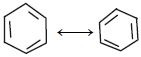
Reason : Actual structure of benzene is a hybrid of the following two structures.
Reason : Actual structure of benzene is a hybrid of the following two structures.
A
If both Assertion and Reason are correct and the Reason is a correct explanation of the Assertion.
B
If both Assertion and Reason are correct but Reason is not a correct explanation of the Assertion.
C
If the Assertion is correct but Reason is incorrect.
D
If both the Assertion and Reason are incorrect.
Solution
(D) The Assertion is incorrect because benzene does not exhibit two different bond lengths; all $C-C$ bonds in benzene are equivalent due to resonance.
The Reason is correct because the actual structure of benzene is a resonance hybrid of the two Kekulé structures shown.
Benzene has a uniform $C-C$ bond distance of $139 \ pm$, which is an intermediate value between the $C-C$ single bond $(154 \ pm)$ and $C=C$ double bond $(134 \ pm)$ lengths.
The Reason is correct because the actual structure of benzene is a resonance hybrid of the two Kekulé structures shown.
Benzene has a uniform $C-C$ bond distance of $139 \ pm$, which is an intermediate value between the $C-C$ single bond $(154 \ pm)$ and $C=C$ double bond $(134 \ pm)$ lengths.
0 likesView Solution
31
ChemistryDifficultMCQAIIMS · 2017
Assertion : $HClO_4$ is a stronger acid than $HClO_3$.
Reason : Oxidation state of $Cl$ in $HClO_4$ is $+VII$ and in $HClO_3$ is $+V$.
Reason : Oxidation state of $Cl$ in $HClO_4$ is $+VII$ and in $HClO_3$ is $+V$.
A
If both Assertion and Reason are correct and the Reason is a correct explanation of the Assertion.
B
If both Assertion and Reason are correct but Reason is not a correct explanation of the Assertion.
C
If the Assertion is correct but Reason is incorrect.
D
If both the Assertion and Reason are incorrect.
Solution
(B) The Assertion is correct: $HClO_4$ is indeed a stronger acid than $HClO_3$.
The Reason is also correct: The oxidation state of $Cl$ in $HClO_4$ is $+VII$ and in $HClO_3$ is $+V$.
However,the Reason is not the correct explanation for the Assertion. The acidity of oxyacids is determined by the number of non-hydroxylated oxygen atoms $(n)$ in the general formula $(HO)_m ZO_n$.
For $HClO_4$ $(HOClO_3)$,$n = 3$. For $HClO_3$ $(HOClO_2)$,$n = 2$.
As the number of non-hydroxylated oxygen atoms $(n)$ increases,the electron-withdrawing effect on the $Cl$ atom increases,which in turn weakens the $O-H$ bond,facilitating the release of the $H^+$ ion. Thus,the acidity depends on the number of non-hydroxylated oxygen atoms,not directly on the oxidation state of the central atom.
The Reason is also correct: The oxidation state of $Cl$ in $HClO_4$ is $+VII$ and in $HClO_3$ is $+V$.
However,the Reason is not the correct explanation for the Assertion. The acidity of oxyacids is determined by the number of non-hydroxylated oxygen atoms $(n)$ in the general formula $(HO)_m ZO_n$.
For $HClO_4$ $(HOClO_3)$,$n = 3$. For $HClO_3$ $(HOClO_2)$,$n = 2$.
As the number of non-hydroxylated oxygen atoms $(n)$ increases,the electron-withdrawing effect on the $Cl$ atom increases,which in turn weakens the $O-H$ bond,facilitating the release of the $H^+$ ion. Thus,the acidity depends on the number of non-hydroxylated oxygen atoms,not directly on the oxidation state of the central atom.
0 likesView Solution
32
ChemistryMCQAIIMS · 2017
Assertion : Replication and transcription occur in the nucleus but translation takes place in the cytoplasm.
Reason : $mRNA$ is transferred from the nucleus into the cytoplasm where ribosomes and amino acids are available for protein synthesis.
Reason : $mRNA$ is transferred from the nucleus into the cytoplasm where ribosomes and amino acids are available for protein synthesis.
A
If both Assertion and Reason are correct and the Reason is a correct explanation of the Assertion.
B
If both Assertion and Reason are correct but Reason is not a correct explanation of the Assertion.
C
If the Assertion is correct but Reason is incorrect.
D
If both the Assertion and Reason are incorrect.
Solution
(A) In eukaryotes,$DNA$ replication and transcription occur within the nucleus because the genetic material is enclosed by a nuclear envelope.
After transcription,the $mRNA$ molecule is transported out of the nucleus into the cytoplasm through nuclear pores.
Translation,the process of protein synthesis,occurs in the cytoplasm because the necessary machinery,including ribosomes,$tRNA$,and amino acids,is located there.
Therefore,the Assertion is correct,and the Reason provides the correct explanation for why translation is spatially separated from transcription in eukaryotes.
After transcription,the $mRNA$ molecule is transported out of the nucleus into the cytoplasm through nuclear pores.
Translation,the process of protein synthesis,occurs in the cytoplasm because the necessary machinery,including ribosomes,$tRNA$,and amino acids,is located there.
Therefore,the Assertion is correct,and the Reason provides the correct explanation for why translation is spatially separated from transcription in eukaryotes.
0 likesView Solution
33
ChemistryMCQAIIMS · 2017
Fungi are filamentous with the exception of $X$ which is unicellular. Identify $X$.
A
Yeast
B
Albugo
C
Mucor
D
Lichen
Solution
(A) Most fungi are filamentous, consisting of long, thread-like structures called hyphae. However, $Yeast$ (Saccharomyces) is a notable exception because it is a unicellular fungus. It is a microscopic organism consisting of a single oval cell that typically reproduces through the process of budding.
0 likesView Solution
34
ChemistryMCQAIIMS · 2017
Which of the following statements is not correct for viruses?
A
Viruses are obligate parasites.
B
Viruses can multiply only when they are inside the living cells.
C
Viruses cannot pass through bacterial filters.
D
Viruses are nucleoprotein particles.
Solution
(C) Viruses are sub-microscopic infectious agents that replicate only inside the living cells of a host organism.
Because of their extremely small size,viruses can easily pass through bacterial-proof filters.
Therefore,the statement that viruses cannot pass through bacterial filters is incorrect.
Viruses are obligate parasites,they multiply only within living cells,and they consist of genetic material ($DNA$ or $RNA$) enclosed in a protein coat (nucleoprotein particles).
Because of their extremely small size,viruses can easily pass through bacterial-proof filters.
Therefore,the statement that viruses cannot pass through bacterial filters is incorrect.
Viruses are obligate parasites,they multiply only within living cells,and they consist of genetic material ($DNA$ or $RNA$) enclosed in a protein coat (nucleoprotein particles).
0 likesView Solution
35
ChemistryMCQAIIMS · 2017
Which of the following statements regarding cyanobacteria is incorrect?
A
It is also called blue-green algae.
B
They are chemosynthetic autotrophs.
C
It forms blooms in polluted water bodies.
D
It is unicellular,colonial or filamentous,marine or terrestrial bacteria.
Solution
(B) Cyanobacteria are photosynthetic autotrophs,not chemosynthetic. They contain chlorophyll $a$ similar to green plants and perform oxygenic photosynthesis. They are prokaryotic organisms that can be unicellular,colonial,or filamentous,and are found in marine or terrestrial habitats. They often form blooms in polluted water bodies. Some species,like $Nostoc$ and $Anabaena$,possess specialized cells called Heterocysts to fix atmospheric nitrogen.
0 likesView Solution
36
ChemistryMCQAIIMS · 2017
Consider the following statements regarding the major pigments and stored food in the different groups of algae and select the correct option.
$I.$ In Chlorophyceae, the stored food material is starch and the major pigments are chlorophyll-$a$ and chlorophyll-$b$.
$II.$ In Phaeophyceae, laminarin is the stored food and major pigments are chlorophyll-$a$ and chlorophyll-$c$.
$III.$ In Rhodophyceae, floridean starch is the stored food and major pigments are chlorophyll-$a$, $d$ and phycoerythrin.
$I.$ In Chlorophyceae, the stored food material is starch and the major pigments are chlorophyll-$a$ and chlorophyll-$b$.
$II.$ In Phaeophyceae, laminarin is the stored food and major pigments are chlorophyll-$a$ and chlorophyll-$c$.
$III.$ In Rhodophyceae, floridean starch is the stored food and major pigments are chlorophyll-$a$, $d$ and phycoerythrin.
A
$I$ is correct, but $II$ and $III$ are incorrect.
B
$I$ and $II$ are correct, but $III$ is incorrect.
C
$I$ and $III$ are correct, but $II$ is incorrect.
D
$III$ is correct, but $I$ and $II$ are incorrect.
Solution
(C) To determine the correct statement, let's analyze the characteristics of each algal group:
\tau\tau
Analysis of statements:
$I.$ Chlorophyceae contains chlorophyll-$a$ and $b$, and stores food as starch. This statement is correct.
$II.$ Phaeophyceae contains chlorophyll-$a$ and $c$ (not $b$), and stores food as laminarin/mannitol. The statement mentions chlorophyll-$b$, so it is incorrect.
$III.$ Rhodophyceae contains chlorophyll-$a$ and $d$, and phycoerythrin, and stores food as floridean starch. This statement is correct.
Therefore, statements $I$ and $III$ are correct, while $II$ is incorrect.
| Group | \tauMajor Pigments | \tauStored Food | \tau
| Chlorophyceae | \tauChlorophyll-$a$, $b$ | \tauStarch | \tau
| Phaeophyceae | \tauChlorophyll-$a$, $c$, Fucoxanthin | \tauMannitol, Laminarin | \tau
| Rhodophyceae | \tauChlorophyll-$a$, $d$, Phycoerythrin | \tauFloridean starch | \tau
Analysis of statements:
$I.$ Chlorophyceae contains chlorophyll-$a$ and $b$, and stores food as starch. This statement is correct.
$II.$ Phaeophyceae contains chlorophyll-$a$ and $c$ (not $b$), and stores food as laminarin/mannitol. The statement mentions chlorophyll-$b$, so it is incorrect.
$III.$ Rhodophyceae contains chlorophyll-$a$ and $d$, and phycoerythrin, and stores food as floridean starch. This statement is correct.
Therefore, statements $I$ and $III$ are correct, while $II$ is incorrect.
0 likesView Solution
37
ChemistryMCQAIIMS · 2017
Male cockroach can be identified from the female by the presence of
A
long antennae
B
wingless body
C
elongated abdomen
D
anal styles
Solution
(D) Both sexes of the cockroach possess $anal \ cerci$,which are paired,jointed,filamentous structures located at the $10^{th}$ abdominal segment.
However,the male cockroach possesses an additional pair of small,thread-like,unjointed structures called $anal \ styles$ on the $9^{th}$ abdominal sternum.
These $anal \ styles$ are absent in females.
Therefore,the presence of $anal \ styles$ is a key morphological feature used to distinguish male cockroaches from females.
However,the male cockroach possesses an additional pair of small,thread-like,unjointed structures called $anal \ styles$ on the $9^{th}$ abdominal sternum.
These $anal \ styles$ are absent in females.
Therefore,the presence of $anal \ styles$ is a key morphological feature used to distinguish male cockroaches from females.
0 likesView Solution
38
ChemistryDifficultMCQAIIMS · 2017
The strongest ortho-para and strongest meta-directing groups respectively are
A
$-NH_2$ and $-NO_2$
B
$-CONH_2$ and $-NH_2$
C
$-NH_2$ and $-CONH_2$
D
$-OH$ and $-NO_2$
Solution
(A) The directing nature of a group depends on its electronic effect on the benzene ring.
$-NH_2$ is a strong electron-donating group due to the $+M$ effect,making it the strongest ortho-para directing group.
$-NO_2$ is a strong electron-withdrawing group due to the $-M$ and $-I$ effects,making it the strongest meta-directing group.
Therefore,the correct pair is $-NH_2$ and $-NO_2$.
$-NH_2$ is a strong electron-donating group due to the $+M$ effect,making it the strongest ortho-para directing group.
$-NO_2$ is a strong electron-withdrawing group due to the $-M$ and $-I$ effects,making it the strongest meta-directing group.
Therefore,the correct pair is $-NH_2$ and $-NO_2$.
0 likesView Solution
39
ChemistryMediumMCQAIIMS · 2017
Assertion : $NF_3$ is a weaker ligand than $N(CH_3)_3$.
Reason : $NF_3$ ionizes to give $F^{-}$ ions in aqueous solution.
Reason : $NF_3$ ionizes to give $F^{-}$ ions in aqueous solution.
A
If both Assertion and Reason are correct and the Reason is a correct explanation of the Assertion.
B
If both Assertion and Reason are correct but Reason is not a correct explanation of the Assertion.
C
If the Assertion is correct but Reason is incorrect.
D
If both the Assertion and Reason are incorrect.
Solution
(C) $NF_3$ is a weaker ligand than $N(CH_3)_3$ because fluorine is highly electronegative,which withdraws electron density from the nitrogen atom,making the lone pair less available for donation.
In contrast,$N(CH_3)_3$ is a stronger ligand because the methyl groups are electron-releasing,increasing the electron density on the nitrogen atom.
$NF_3$ does not ionize to give $F^{-}$ ions in aqueous solution; it is a covalent molecule.
Therefore,the Assertion is correct,but the Reason is incorrect.
In contrast,$N(CH_3)_3$ is a stronger ligand because the methyl groups are electron-releasing,increasing the electron density on the nitrogen atom.
$NF_3$ does not ionize to give $F^{-}$ ions in aqueous solution; it is a covalent molecule.
Therefore,the Assertion is correct,but the Reason is incorrect.
0 likesView Solution
40
ChemistryMediumMCQAIIMS · 2017
The end product $(C)$ in the following sequence of reactions is:
$HC \equiv CH$ $\xrightarrow[20\% \ H_2SO_4]{1\% \ HgSO_4} A$ $\xrightarrow[H_2O]{CH_3MgX} B$ $\xrightarrow{[O]} (C)$
$HC \equiv CH$ $\xrightarrow[20\% \ H_2SO_4]{1\% \ HgSO_4} A$ $\xrightarrow[H_2O]{CH_3MgX} B$ $\xrightarrow{[O]} (C)$
A
acetic acid
B
isopropyl alcohol
C
acetone
D
ethanol
Solution
(C) Step $1$: Hydration of ethyne $(HC \equiv CH)$ in the presence of $1\% \ HgSO_4$ and $20\% \ H_2SO_4$ (Kucherov reaction) yields acetaldehyde $(CH_3CHO)$ as product $A$.
Step $2$: Reaction of acetaldehyde $(CH_3CHO)$ with methylmagnesium halide $(CH_3MgX)$ followed by hydrolysis $(H_2O)$ gives propan$-2-$ol $(CH_3CHOHCH_3)$ as product $B$.
Step $3$: Oxidation $([O])$ of propan$-2-$ol $(CH_3CHOHCH_3)$ yields acetone $(CH_3COCH_3)$ as the final product $C$.
Step $2$: Reaction of acetaldehyde $(CH_3CHO)$ with methylmagnesium halide $(CH_3MgX)$ followed by hydrolysis $(H_2O)$ gives propan$-2-$ol $(CH_3CHOHCH_3)$ as product $B$.
Step $3$: Oxidation $([O])$ of propan$-2-$ol $(CH_3CHOHCH_3)$ yields acetone $(CH_3COCH_3)$ as the final product $C$.
0 likesView Solution
41
ChemistryMediumMCQAIIMS · 2017
Sodium metal crystallizes in a body-centred cubic $(bcc)$ lattice with a unit cell edge of $4.29 \ \mathring{A}$. The radius of the sodium atom is approximately ............. $\mathring{A}$.
A
$5.72$
B
$0.93$
C
$1.86$
D
$3.22$
Solution
(C) In a $bcc$ lattice,the atoms touch along the body diagonal.
The relationship between the edge length $(a)$ and the atomic radius $(r)$ is given by $4r = \sqrt{3}a$.
Given $a = 4.29 \ \mathring{A}$.
$r = \frac{\sqrt{3} \times 4.29}{4}$.
$r = \frac{1.732 \times 4.29}{4} \approx 1.857 \ \mathring{A}$.
Rounding to two decimal places,we get $1.86 \ \mathring{A}$.
The relationship between the edge length $(a)$ and the atomic radius $(r)$ is given by $4r = \sqrt{3}a$.
Given $a = 4.29 \ \mathring{A}$.
$r = \frac{\sqrt{3} \times 4.29}{4}$.
$r = \frac{1.732 \times 4.29}{4} \approx 1.857 \ \mathring{A}$.
Rounding to two decimal places,we get $1.86 \ \mathring{A}$.
0 likesView Solution
42
ChemistryMediumMCQAIIMS · 2017
Which observation$(s)$ reflect$(s)$ colligative properties?
$(i)$ $A$ $0.5 \ m$ $NaBr$ solution has a higher vapour pressure than a $0.5 \ m$ $BaCl_2$ solution at the same temperature
$(ii)$ Pure water freezes at the higher temperature than pure methanol
$(iii)$ $A$ $0.1 \ m$ $NaOH$ solution freezes at a lower temperature than pure water
Choose the correct answer from the codes given below
$(i)$ $A$ $0.5 \ m$ $NaBr$ solution has a higher vapour pressure than a $0.5 \ m$ $BaCl_2$ solution at the same temperature
$(ii)$ Pure water freezes at the higher temperature than pure methanol
$(iii)$ $A$ $0.1 \ m$ $NaOH$ solution freezes at a lower temperature than pure water
Choose the correct answer from the codes given below
A
$(i)$,$(ii)$ and $(iii)$
B
$(i)$ and $(ii)$
C
$(ii)$ and $(iii)$
D
$(i)$ and $(iii)$
Solution
(D) Colligative properties are properties of solutions that depend on the number of solute particles in a given amount of solvent,not on the nature of the solute.
$(i)$ $NaBr$ dissociates into $2$ ions $(Na^+, Br^-)$ and $BaCl_2$ dissociates into $3$ ions $(Ba^{2+}, 2Cl^-)$. Since $BaCl_2$ produces more particles,it lowers the vapour pressure more than $NaBr$. Thus,$NaBr$ has a higher vapour pressure. This is a colligative property.
$(ii)$ The freezing point of a pure substance is a characteristic property of that substance,not a colligative property. Comparing two different pure solvents is not a colligative phenomenon.
$(iii)$ The addition of a non-volatile solute $(NaOH)$ to a solvent (water) causes freezing point depression. This is a classic colligative property.
Therefore,$(i)$ and $(iii)$ are correct.
$(i)$ $NaBr$ dissociates into $2$ ions $(Na^+, Br^-)$ and $BaCl_2$ dissociates into $3$ ions $(Ba^{2+}, 2Cl^-)$. Since $BaCl_2$ produces more particles,it lowers the vapour pressure more than $NaBr$. Thus,$NaBr$ has a higher vapour pressure. This is a colligative property.
$(ii)$ The freezing point of a pure substance is a characteristic property of that substance,not a colligative property. Comparing two different pure solvents is not a colligative phenomenon.
$(iii)$ The addition of a non-volatile solute $(NaOH)$ to a solvent (water) causes freezing point depression. This is a classic colligative property.
Therefore,$(i)$ and $(iii)$ are correct.
0 likesView Solution
43
ChemistryMediumMCQAIIMS · 2017
Assertion : If one component of a solution obeys Raoult's law over a certain range of composition,the other component will not obey Henry's law in that range.
Reason : Raoult's law is a special case of Henry's law.
Reason : Raoult's law is a special case of Henry's law.
A
If both Assertion and Reason are correct and the Reason is a correct explanation of the Assertion.
B
If both Assertion and Reason are correct but Reason is not a correct explanation of the Assertion.
C
If the Assertion is correct but Reason is incorrect.
D
If both the Assertion and Reason are incorrect.
Solution
(D) According to the thermodynamic relationship between Raoult's law and Henry's law,if one component of a binary solution obeys Raoult's law $(P_i = x_i P_i^o)$ over the entire range of composition,the other component must also obey Raoult's law.
However,in dilute solutions,the solvent obeys Raoult's law $(P_1 = x_1 P_1^o)$ while the solute obeys Henry's law $(P_2 = K_H x_2)$.
The Assertion is incorrect because if one component obeys Raoult's law,the other component often obeys Henry's law in the dilute range.
The Reason is correct because Raoult's law is indeed a special case of Henry's law where the Henry's constant $(K_H)$ becomes equal to the pure component vapor pressure $(P_i^o)$.
However,in dilute solutions,the solvent obeys Raoult's law $(P_1 = x_1 P_1^o)$ while the solute obeys Henry's law $(P_2 = K_H x_2)$.
The Assertion is incorrect because if one component obeys Raoult's law,the other component often obeys Henry's law in the dilute range.
The Reason is correct because Raoult's law is indeed a special case of Henry's law where the Henry's constant $(K_H)$ becomes equal to the pure component vapor pressure $(P_i^o)$.
0 likesView Solution
44
ChemistryMediumMCQAIIMS · 2017
On the basis of the following $E^o$ values,the strongest oxidizing agent is:
$[Fe(CN)_6]^{4-} \to [Fe(CN)_6]^{3-} + e^-; E^o = -0.35 \ V$
$Fe^{2+} \to Fe^{3+} + e^-; E^o = -0.77 \ V$
$[Fe(CN)_6]^{4-} \to [Fe(CN)_6]^{3-} + e^-; E^o = -0.35 \ V$
$Fe^{2+} \to Fe^{3+} + e^-; E^o = -0.77 \ V$
A
$[Fe(CN)_6]^{4-}$
B
$Fe^{2+}$
C
$Fe^{3+}$
D
$[Fe(CN)_6]^{3-}$
Solution
(C) The given reactions are oxidation half-reactions. To determine the oxidizing agent,we look at the reduction potentials $(E^o_{red})$.
For the first reaction: $[Fe(CN)_6]^{3-} + e^- \to [Fe(CN)_6]^{4-}$,$E^o_{red} = +0.35 \ V$.
For the second reaction: $Fe^{3+} + e^- \to Fe^{2+}$,$E^o_{red} = +0.77 \ V$.
$A$ higher reduction potential indicates a stronger tendency to get reduced,making the species a stronger oxidizing agent.
Comparing the two,$Fe^{3+}$ has a higher reduction potential $(+0.77 \ V > +0.35 \ V)$.
Therefore,$Fe^{3+}$ is the strongest oxidizing agent. The correct option is $(C)$.
For the first reaction: $[Fe(CN)_6]^{3-} + e^- \to [Fe(CN)_6]^{4-}$,$E^o_{red} = +0.35 \ V$.
For the second reaction: $Fe^{3+} + e^- \to Fe^{2+}$,$E^o_{red} = +0.77 \ V$.
$A$ higher reduction potential indicates a stronger tendency to get reduced,making the species a stronger oxidizing agent.
Comparing the two,$Fe^{3+}$ has a higher reduction potential $(+0.77 \ V > +0.35 \ V)$.
Therefore,$Fe^{3+}$ is the strongest oxidizing agent. The correct option is $(C)$.
0 likesView Solution
45
ChemistryDifficultMCQAIIMS · 2017
Consider the following cell reaction:
$2Fe_{(s)} + O_{2(g)} + 4H^{+}_{(aq)} \to 2Fe^{2+}_{(aq)} + 2H_2O_{(l)}$; $E^o = 1.67 \ V$
At $[Fe^{2+}] = 10^{-3} \ M$,$p(O_2) = 0.1 \ atm$ and $pH = 3$,the cell potential at $25 \ ^oC$ is .............. $V$.
$2Fe_{(s)} + O_{2(g)} + 4H^{+}_{(aq)} \to 2Fe^{2+}_{(aq)} + 2H_2O_{(l)}$; $E^o = 1.67 \ V$
At $[Fe^{2+}] = 10^{-3} \ M$,$p(O_2) = 0.1 \ atm$ and $pH = 3$,the cell potential at $25 \ ^oC$ is .............. $V$.
A
$1.47$
B
$1.77$
C
$1.87$
D
$1.57$
Solution
(D) The given cell reaction is $2Fe_{(s)} + O_{2(g)} + 4H^{+}_{(aq)} \to 2Fe^{2+}_{(aq)} + 2H_2O_{(l)}$.
Here,$n = 4$ electrons are transferred.
Given: $[Fe^{2+}] = 10^{-3} \ M$,$p(O_2) = 0.1 \ atm$,$pH = 3$,so $[H^{+}] = 10^{-3} \ M$.
Using the Nernst equation:
$E_{cell} = E^o_{cell} - \frac{0.0591}{n} \log \frac{[Fe^{2+}]^2}{[H^{+}]^4 \cdot p(O_2)}$
$E_{cell} = 1.67 - \frac{0.0591}{4} \log \frac{(10^{-3})^2}{(10^{-3})^4 \cdot 0.1}$
$E_{cell} = 1.67 - 0.014775 \cdot \log \frac{10^{-6}}{10^{-12} \cdot 10^{-1}}$
$E_{cell} = 1.67 - 0.014775 \cdot \log 10^7$
$E_{cell} = 1.67 - 0.014775 \cdot 7 = 1.67 - 0.1034 = 1.5666 \ V \approx 1.57 \ V$.
Here,$n = 4$ electrons are transferred.
Given: $[Fe^{2+}] = 10^{-3} \ M$,$p(O_2) = 0.1 \ atm$,$pH = 3$,so $[H^{+}] = 10^{-3} \ M$.
Using the Nernst equation:
$E_{cell} = E^o_{cell} - \frac{0.0591}{n} \log \frac{[Fe^{2+}]^2}{[H^{+}]^4 \cdot p(O_2)}$
$E_{cell} = 1.67 - \frac{0.0591}{4} \log \frac{(10^{-3})^2}{(10^{-3})^4 \cdot 0.1}$
$E_{cell} = 1.67 - 0.014775 \cdot \log \frac{10^{-6}}{10^{-12} \cdot 10^{-1}}$
$E_{cell} = 1.67 - 0.014775 \cdot \log 10^7$
$E_{cell} = 1.67 - 0.014775 \cdot 7 = 1.67 - 0.1034 = 1.5666 \ V \approx 1.57 \ V$.
0 likesView Solution
46
ChemistryMediumMCQAIIMS · 2017
Assertion : Zinc can be used while copper cannot be used in the recovery of $Ag$ from the complex $[Ag(CN)_2]^-$.
Reason : Zinc is a more powerful reducing agent than copper.
Reason : Zinc is a more powerful reducing agent than copper.
A
If both Assertion and Reason are correct and the Reason is a correct explanation of the Assertion.
B
If both Assertion and Reason are correct but Reason is not a correct explanation of the Assertion.
C
If the Assertion is correct but Reason is incorrect.
D
If both the Assertion and Reason are incorrect.
Solution
(A) The recovery of $Ag$ from the complex $[Ag(CN)_2]^-$ involves the displacement of $Ag^+$ by a more reactive metal.
The standard reduction potentials are $E^o_{Zn^{2+}/Zn} = -0.76 \ V$ and $E^o_{Cu^{2+}/Cu} = +0.34 \ V$.
Since $Zn$ has a more negative reduction potential than $Cu$,it is a stronger reducing agent.
$Zn$ can displace $Ag$ from $[Ag(CN)_2]^-$ because it can reduce $Ag^+$ to $Ag(s)$,whereas $Cu$ cannot effectively reduce $Ag^+$ in this complex due to its lower reducing power.
Thus,both the Assertion and the Reason are correct,and the Reason correctly explains the Assertion.
The standard reduction potentials are $E^o_{Zn^{2+}/Zn} = -0.76 \ V$ and $E^o_{Cu^{2+}/Cu} = +0.34 \ V$.
Since $Zn$ has a more negative reduction potential than $Cu$,it is a stronger reducing agent.
$Zn$ can displace $Ag$ from $[Ag(CN)_2]^-$ because it can reduce $Ag^+$ to $Ag(s)$,whereas $Cu$ cannot effectively reduce $Ag^+$ in this complex due to its lower reducing power.
Thus,both the Assertion and the Reason are correct,and the Reason correctly explains the Assertion.
0 likesView Solution
47
ChemistryMediumMCQAIIMS · 2017
Which of the following relations represents the correct relation between standard electrode potential and equilibrium constant?
$I$. $\log K = \frac{nF E^o}{2.303 RT}$
$II$. $K = e^{\frac{nF E^o}{RT}}$
$III$. $\log K = -\frac{nF E^o}{2.303 RT}$
$IV$. $\log K = 0.4342 \frac{nF E^o}{RT}$
Choose the correct statement$(s)$.
$I$. $\log K = \frac{nF E^o}{2.303 RT}$
$II$. $K = e^{\frac{nF E^o}{RT}}$
$III$. $\log K = -\frac{nF E^o}{2.303 RT}$
$IV$. $\log K = 0.4342 \frac{nF E^o}{RT}$
Choose the correct statement$(s)$.
A
$I$,$II$ and $III$ are correct
B
$II$ and $III$ are correct
C
$I$,$II$ and $IV$ are correct
D
$I$ and $IV$ are correct
Solution
(C) The relationship between standard Gibbs free energy change and equilibrium constant is $\Delta G^o = -RT \ln K = -2.303 RT \log K$.
Also,$\Delta G^o = -nF E^o$.
Equating the two: $-nF E^o = -2.303 RT \log K$.
Rearranging gives $\log K = \frac{nF E^o}{2.303 RT}$,which is statement $I$.
Since $\frac{1}{2.303} \approx 0.4342$,we can write $\log K = 0.4342 \frac{nF E^o}{RT}$,which is statement $IV$.
From $\ln K = \frac{nF E^o}{RT}$,we get $K = e^{\frac{nF E^o}{RT}}$,which is statement $II$.
Therefore,statements $I$,$II$,and $IV$ are correct.
Also,$\Delta G^o = -nF E^o$.
Equating the two: $-nF E^o = -2.303 RT \log K$.
Rearranging gives $\log K = \frac{nF E^o}{2.303 RT}$,which is statement $I$.
Since $\frac{1}{2.303} \approx 0.4342$,we can write $\log K = 0.4342 \frac{nF E^o}{RT}$,which is statement $IV$.
From $\ln K = \frac{nF E^o}{RT}$,we get $K = e^{\frac{nF E^o}{RT}}$,which is statement $II$.
Therefore,statements $I$,$II$,and $IV$ are correct.
0 likesView Solution
48
ChemistryDifficultMCQAIIMS · 2017
Assertion : The kinetics of the reaction $mA + nB + pC \to m'X + n'Y + p'Z$ obey the rate expression as $\frac{dX}{dt} = k[A]^m[B]^n$.
Reason : The rate of the reaction does not depend upon the concentration of $C$.
Reason : The rate of the reaction does not depend upon the concentration of $C$.
A
If both Assertion and Reason are correct and the Reason is a correct explanation of the Assertion.
B
If both Assertion and Reason are correct but Reason is not a correct explanation of the Assertion.
C
If the Assertion is correct but Reason is incorrect.
D
If both the Assertion and Reason are incorrect.
Solution
(A) The rate expression $\frac{dX}{dt} = k[A]^m[B]^n$ indicates that the reaction rate depends only on the concentrations of reactants $A$ and $B$.
The order of the reaction with respect to $C$ is $0$,which means the rate of the reaction is independent of the concentration of $C$.
Since the rate law is experimentally determined and explicitly excludes $C$,the Reason correctly explains why $C$ does not appear in the rate expression.
The order of the reaction with respect to $C$ is $0$,which means the rate of the reaction is independent of the concentration of $C$.
Since the rate law is experimentally determined and explicitly excludes $C$,the Reason correctly explains why $C$ does not appear in the rate expression.
0 likesView Solution
49
ChemistryMediumMCQAIIMS · 2017
Which one of the following impurities present in a colloidal solution cannot be removed by electrodialysis?
A
Sodium chloride
B
Potassium sulphate
C
Urea
D
Calcium chloride
Solution
(C) Electrodialysis involves the movement of ions towards oppositely charged electrodes under the influence of an electric field.
Urea $(NH_2CONH_2)$ is a covalent compound and does not dissociate into ions in an aqueous solution.
Since it does not form ions,it cannot be moved by an electric field and thus cannot be removed by electrodialysis.
In contrast,$NaCl$,$K_2SO_4$,and $CaCl_2$ are ionic compounds that dissociate into ions ($Na^+$,$Cl^-$,$K^+$,$SO_4^{2-}$,$Ca^{2+}$) and can be easily removed by this process.
Urea $(NH_2CONH_2)$ is a covalent compound and does not dissociate into ions in an aqueous solution.
Since it does not form ions,it cannot be moved by an electric field and thus cannot be removed by electrodialysis.
In contrast,$NaCl$,$K_2SO_4$,and $CaCl_2$ are ionic compounds that dissociate into ions ($Na^+$,$Cl^-$,$K^+$,$SO_4^{2-}$,$Ca^{2+}$) and can be easily removed by this process.
0 likesView Solution
50
ChemistryMediumMCQAIIMS · 2017
Assertion : The enthalpy of physisorption is greater than chemisorption.
Reason : Molecules of adsorbate and adsorbent are held by van der Waal's forces in physisorption and by chemical bonds in chemisorption.
Reason : Molecules of adsorbate and adsorbent are held by van der Waal's forces in physisorption and by chemical bonds in chemisorption.
A
If both Assertion and Reason are correct and the Reason is a correct explanation of the Assertion.
B
If both Assertion and Reason are correct but Reason is not a correct explanation of the Assertion.
C
If the Assertion is correct but Reason is incorrect.
D
If both the Assertion and Reason are incorrect.
Solution
(D) The enthalpy of chemisorption is high,typically in the range of $40-400 \ kJ \ mol^{-1}$,because it involves the formation of chemical bonds.
In contrast,physisorption involves weak van der Waal's forces,resulting in a low enthalpy of adsorption,typically in the range of $20-40 \ kJ \ mol^{-1}$.
Therefore,the enthalpy of physisorption is lower than that of chemisorption.
Thus,the Assertion is false,and the Reason is true.
In contrast,physisorption involves weak van der Waal's forces,resulting in a low enthalpy of adsorption,typically in the range of $20-40 \ kJ \ mol^{-1}$.
Therefore,the enthalpy of physisorption is lower than that of chemisorption.
Thus,the Assertion is false,and the Reason is true.
0 likesView Solution
51
ChemistryMediumMCQAIIMS · 2017
$2CuFeS_2 + O_2 \rightarrow Cu_2S + 2FeS + SO_2$
Which process of metallurgy of copper is represented by the above equation?
Which process of metallurgy of copper is represented by the above equation?
A
Concentration
B
Roasting
C
Reduction
D
Purification
Solution
(B) Roasting is the process in which the ore is strongly heated in the presence of excess air.
In the extraction of copper,after crushing and concentration of the ore,it is heated in a reverberatory furnace.
Copper pyrites $(CuFeS_2)$ is partially oxidized,and a part of the sulfur in the ore is removed as sulfur dioxide $(SO_2)$.
The given equation $2CuFeS_2 + O_2 \rightarrow Cu_2S + 2FeS + SO_2$ represents the partial roasting of copper pyrites.
In the extraction of copper,after crushing and concentration of the ore,it is heated in a reverberatory furnace.
Copper pyrites $(CuFeS_2)$ is partially oxidized,and a part of the sulfur in the ore is removed as sulfur dioxide $(SO_2)$.
The given equation $2CuFeS_2 + O_2 \rightarrow Cu_2S + 2FeS + SO_2$ represents the partial roasting of copper pyrites.
0 likesView Solution
52
ChemistryMediumMCQAIIMS · 2017
Assertion : Coke and flux are used in smelting.
Reason : The phenomenon in which ore is mixed with suitable flux and coke is heated to fusion is known as smelting.
Reason : The phenomenon in which ore is mixed with suitable flux and coke is heated to fusion is known as smelting.
A
If both Assertion and Reason are correct and the Reason is a correct explanation of the Assertion.
B
If both Assertion and Reason are correct but Reason is not a correct explanation of the Assertion.
C
If the Assertion is correct but Reason is incorrect.
D
If both the Assertion and Reason are incorrect.
Solution
(B) Both Assertion and Reason are true. Smelting is a process of reduction of roasted ore with carbon (coke) in the presence of a flux. The flux is added to remove the gangue as slag. While the definition provided in the Reason is accurate,the use of coke and flux in smelting is a specific requirement for the reduction and slag formation process,making the Reason a descriptive definition rather than the direct cause for why they are used.
0 likesView Solution
53
ChemistryMediumMCQAIIMS · 2017
Assertion : Galvanised iron does not rust.
Reason : Zinc has a more negative electrode potential than iron.
Reason : Zinc has a more negative electrode potential than iron.
A
If both Assertion and Reason are correct and the Reason is a correct explanation of the Assertion.
B
If both Assertion and Reason are correct but Reason is not a correct explanation of the Assertion.
C
If the Assertion is correct but Reason is incorrect.
D
If both the Assertion and Reason are incorrect.
Solution
(A) The standard reduction potential of $Zn^{2+}/Zn$ is $-0.76 \ V$,while that of $Fe^{2+}/Fe$ is $-0.44 \ V$.
Since zinc has a more negative electrode potential than iron,it acts as a sacrificial anode.
Zinc gets oxidized in preference to iron,thereby protecting the iron from rusting.
Thus,both the Assertion and the Reason are correct,and the Reason is the correct explanation of the Assertion.
Since zinc has a more negative electrode potential than iron,it acts as a sacrificial anode.
Zinc gets oxidized in preference to iron,thereby protecting the iron from rusting.
Thus,both the Assertion and the Reason are correct,and the Reason is the correct explanation of the Assertion.
0 likesView Solution
54
ChemistryMediumMCQAIIMS · 2017
Which of the following fluorides does not exist?
A
$NF_5$
B
$PF_5$
C
$AsF_5$
D
$SbF_5$
Solution
(A) $NF_5$ does not exist because nitrogen $(N)$ cannot form pentahalides due to the absence of $d$-orbitals in its valence shell.
$P$,$As$,and $Sb$ can form pentahalides of the general formula $MX_5$ (where $M = P, As, Sb$) because they possess vacant $d$-orbitals in their respective valence shells,allowing for the expansion of their octet.
$P$,$As$,and $Sb$ can form pentahalides of the general formula $MX_5$ (where $M = P, As, Sb$) because they possess vacant $d$-orbitals in their respective valence shells,allowing for the expansion of their octet.
0 likesView Solution
55
ChemistryMediumMCQAIIMS · 2017
Which of the following are peroxoacids of sulphur?
A
$H_2SO_5$ and $H_2S_2O_8$
B
$H_2SO_5$ and $H_2S_2O_7$
C
$H_2S_2O_7$ and $H_2S_2O_8$
D
$H_2S_2O_6$ and $H_2S_2O_7$
Solution
(A) Peroxoacids of sulphur are those that contain at least one peroxy linkage $(-O-O-)$.
$H_2SO_5$ (peroxomonosulphuric acid or Caro's acid) contains one peroxy linkage.
$H_2S_2O_8$ (peroxodisulphuric acid or Marshall's acid) also contains one peroxy linkage.
Therefore,both $H_2SO_5$ and $H_2S_2O_8$ are peroxoacids of sulphur.
$H_2SO_5$ (peroxomonosulphuric acid or Caro's acid) contains one peroxy linkage.
$H_2S_2O_8$ (peroxodisulphuric acid or Marshall's acid) also contains one peroxy linkage.
Therefore,both $H_2SO_5$ and $H_2S_2O_8$ are peroxoacids of sulphur.
0 likesView Solution
56
ChemistryDifficultMCQAIIMS · 2017
Assertion : Both rhombic and monoclinic sulphur exist as $S_8$ but oxygen exists as $O_2$.
Reason : Oxygen forms $p\pi-p\pi$ multiple bond due to small size and small bond length but $p\pi-p\pi$ bonding is not possible in sulphur.
Reason : Oxygen forms $p\pi-p\pi$ multiple bond due to small size and small bond length but $p\pi-p\pi$ bonding is not possible in sulphur.
A
If both Assertion and Reason are correct and the Reason is a correct explanation of the Assertion.
B
If both Assertion and Reason are correct but Reason is not a correct explanation of the Assertion.
C
If the Assertion is correct but Reason is incorrect.
D
If both the Assertion and Reason are incorrect.
Solution
(A) Oxygen has a small atomic size and small bond length,which allows it to form stable $p\pi-p\pi$ multiple bonds,resulting in the formation of diatomic $O_2$ molecules.
In contrast,sulphur has a larger atomic size and longer bond length,making effective $p\pi-p\pi$ overlap difficult. Consequently,sulphur prefers to form single bonds with other sulphur atoms,leading to the formation of puckered $S_8$ ring structures.
Thus,both the Assertion and the Reason are correct,and the Reason correctly explains why oxygen exists as $O_2$ while sulphur exists as $S_8$.
In contrast,sulphur has a larger atomic size and longer bond length,making effective $p\pi-p\pi$ overlap difficult. Consequently,sulphur prefers to form single bonds with other sulphur atoms,leading to the formation of puckered $S_8$ ring structures.
Thus,both the Assertion and the Reason are correct,and the Reason correctly explains why oxygen exists as $O_2$ while sulphur exists as $S_8$.
0 likesView Solution
57
ChemistryMediumMCQAIIMS · 2017
For $d-$block elements,the first ionization potential is of the order:
A
$Zn > Fe > Cu > Cr$
B
$Sc = Ti < V = Cr$
C
$Zn < Cu < Ni < Co$
D
$V > Cr > Mn > Fe$
Solution
(A) The first ionization energy $(IE_1)$ generally increases with an increase in atomic number across a period due to the increase in effective nuclear charge.
However,the trend is irregular among $d-$block elements due to shielding effects and stable electronic configurations.
Comparing the given elements:
$Zn (3d^{10} 4s^2)$ has a completely filled $d-$orbital and $s-$orbital,making it very stable.
$Fe (3d^6 4s^2)$ has a relatively high $IE_1$.
$Cu (3d^{10} 4s^1)$ has a filled $d-$subshell but a single $s-$electron.
$Cr (3d^5 4s^1)$ has a half-filled $d-$subshell.
Based on experimental data for the first ionization potential,the order is $Zn > Fe > Cu > Cr$.
However,the trend is irregular among $d-$block elements due to shielding effects and stable electronic configurations.
Comparing the given elements:
$Zn (3d^{10} 4s^2)$ has a completely filled $d-$orbital and $s-$orbital,making it very stable.
$Fe (3d^6 4s^2)$ has a relatively high $IE_1$.
$Cu (3d^{10} 4s^1)$ has a filled $d-$subshell but a single $s-$electron.
$Cr (3d^5 4s^1)$ has a half-filled $d-$subshell.
Based on experimental data for the first ionization potential,the order is $Zn > Fe > Cu > Cr$.
0 likesView Solution
58
ChemistryMediumMCQAIIMS · 2017
Assertion : Transition metals show variable valency.
Reason : Transition metals have a large energy difference between the $ns^2$ and $(n-1)d$ electrons.
Reason : Transition metals have a large energy difference between the $ns^2$ and $(n-1)d$ electrons.
A
If both Assertion and Reason are correct and the Reason is a correct explanation of the Assertion.
B
If both Assertion and Reason are correct but Reason is not a correct explanation of the Assertion.
C
If the Assertion is correct but Reason is incorrect.
D
If both the Assertion and Reason are incorrect.
Solution
(C) The assertion is correct because transition metals have partially filled $d$-orbitals,allowing them to lose electrons from both the $ns$ and $(n-1)d$ subshells.
The reason is incorrect because the energy difference between the $ns$ and $(n-1)d$ electrons is actually very small,which is precisely why both sets of electrons can participate in bond formation,leading to variable valency.
The reason is incorrect because the energy difference between the $ns$ and $(n-1)d$ electrons is actually very small,which is precisely why both sets of electrons can participate in bond formation,leading to variable valency.
0 likesView Solution
59
ChemistryMediumMCQAIIMS · 2017
Which of the following coordination compounds would exhibit optical isomerism?
A
pentamminenitrocobalt$(III)$ iodide
B
diamminedichloroplatinum$(II)$
C
trans-dicyanobis(ethylenediamine)chromium$(III)$ chloride
D
tris-(ethylenediamine)cobalt$(III)$ bromide
Solution
(D) Optical isomerism is exhibited by coordination compounds that lack a plane of symmetry and a center of symmetry.
$A$. $[Co(NH_3)_5(NO_2)]I_2$ has a plane of symmetry and is achiral.
$B$. $[Pt(NH_3)_2Cl_2]$ is a square planar complex,which is inherently achiral.
$C$. The $trans$ isomer of $[Cr(en)_2(CN)_2]^+$ has a plane of symmetry and is achiral.
$D$. $[Co(en)_3]Br_3$ contains three bidentate ethylenediamine $(en)$ ligands. This complex does not have a plane of symmetry or a center of symmetry,making it chiral and optically active. It exists as a pair of non-superimposable mirror images (enantiomers).
$A$. $[Co(NH_3)_5(NO_2)]I_2$ has a plane of symmetry and is achiral.
$B$. $[Pt(NH_3)_2Cl_2]$ is a square planar complex,which is inherently achiral.
$C$. The $trans$ isomer of $[Cr(en)_2(CN)_2]^+$ has a plane of symmetry and is achiral.
$D$. $[Co(en)_3]Br_3$ contains three bidentate ethylenediamine $(en)$ ligands. This complex does not have a plane of symmetry or a center of symmetry,making it chiral and optically active. It exists as a pair of non-superimposable mirror images (enantiomers).
0 likesView Solution
60
ChemistryDifficultMCQAIIMS · 2017
Assertion : $[Fe(CN)_6]^{3-}$ is weakly paramagnetic while $[Fe(CN)_6]^{4-}$ is diamagnetic.
Reason : $[Fe(CN)_6]^{3-}$ has $+3$ oxidation state while $[Fe(CN)_6]^{4-}$ has $+2$ oxidation state.
Reason : $[Fe(CN)_6]^{3-}$ has $+3$ oxidation state while $[Fe(CN)_6]^{4-}$ has $+2$ oxidation state.
A
If both Assertion and Reason are correct and the Reason is a correct explanation of the Assertion.
B
If both Assertion and Reason are correct but Reason is not a correct explanation of the Assertion.
C
If the Assertion is correct but Reason is incorrect.
D
If both the Assertion and Reason are incorrect.
Solution
(B) In $[Fe(CN)_6]^{3-}$,$Fe$ is in $+3$ oxidation state ($3d^5$ configuration). Due to the strong field ligand $CN^-$,the electrons pair up,leaving $1$ unpaired electron,making it paramagnetic.
In $[Fe(CN)_6]^{4-}$,$Fe$ is in $+2$ oxidation state ($3d^6$ configuration). Due to the strong field ligand $CN^-$,all $6$ electrons pair up in the $t_{2g}$ orbitals,leaving $0$ unpaired electrons,making it diamagnetic.
Both statements are true,but the magnetic property depends on the number of unpaired electrons resulting from the crystal field splitting and the nature of the ligand,not just the oxidation state. Thus,the Reason is not the correct explanation of the Assertion.
In $[Fe(CN)_6]^{4-}$,$Fe$ is in $+2$ oxidation state ($3d^6$ configuration). Due to the strong field ligand $CN^-$,all $6$ electrons pair up in the $t_{2g}$ orbitals,leaving $0$ unpaired electrons,making it diamagnetic.
Both statements are true,but the magnetic property depends on the number of unpaired electrons resulting from the crystal field splitting and the nature of the ligand,not just the oxidation state. Thus,the Reason is not the correct explanation of the Assertion.
0 likesView Solution
61
ChemistryMediumMCQAIIMS · 2017
The synthesis of alkyl fluorides is best accomplished by
A
Finkelstein reaction
B
Swarts reaction
C
Free radical fluorination
D
Sandmeyer's reaction
Solution
(B) Alkyl fluorides are most conveniently prepared by heating suitable chloro- or bromo-alkanes with inorganic fluorides such as $AsF_3$,$SbF_3$,$CoF_2$,$AgF$,$Hg_2F_2$,etc. This reaction is known as the $Swarts$ reaction.
$CH_3Br + AgF \rightarrow CH_3F + AgBr$
$2CH_3CH_2Cl + Hg_2F_2 \rightarrow 2CH_3CH_2F + Hg_2Cl_2$
$CH_3Br + AgF \rightarrow CH_3F + AgBr$
$2CH_3CH_2Cl + Hg_2F_2 \rightarrow 2CH_3CH_2F + Hg_2Cl_2$
0 likesView Solution
62
ChemistryMediumMCQAIIMS · 2017
Assertion : $S_{N}2$ reaction of an optically active aryl halide with an aqueous solution of $KOH$ always gives an alcohol with opposite sign of rotation.
Reason : $S_{N}2$ reactions always proceed with retention of configuration.
Reason : $S_{N}2$ reactions always proceed with retention of configuration.
A
If both Assertion and Reason are correct and the Reason is a correct explanation of the Assertion.
B
If both Assertion and Reason are correct but Reason is not a correct explanation of the Assertion.
C
If the Assertion is correct but Reason is incorrect.
D
If both the Assertion and Reason are incorrect.
Solution
(D) The Assertion is false because aryl halides do not undergo nucleophilic substitution reactions under ordinary conditions. This is due to the resonance effect,which gives the $C-Cl$ bond partial double bond character,making it shorter and stronger,and thus difficult to replace by nucleophiles.
The Reason is also false because $S_{N}2$ reactions proceed with inversion of configuration,not retention.
The Reason is also false because $S_{N}2$ reactions proceed with inversion of configuration,not retention.
0 likesView Solution
63
ChemistryMediumMCQAIIMS · 2017
The ether that undergoes electrophilic substitution reactions is
A
$C_6H_5OCH_3$
B
$CH_3OC_2H_5$
C
$CH_3OCH_3$
D
$C_2H_5OC_2H_5$
Solution
(A) Electrophilic substitution reactions (such as halogenation,nitration,or Friedel-Crafts reactions) occur on the benzene ring.
Only aromatic ethers (alkyl aryl ethers) contain a benzene ring that can be activated by the alkoxy group $(-OR)$ towards electrophilic substitution.
Among the given options,$C_6H_5OCH_3$ (Anisole) is an aromatic ether,while the others are aliphatic ethers.
Therefore,$C_6H_5OCH_3$ undergoes electrophilic substitution reactions.
Only aromatic ethers (alkyl aryl ethers) contain a benzene ring that can be activated by the alkoxy group $(-OR)$ towards electrophilic substitution.
Among the given options,$C_6H_5OCH_3$ (Anisole) is an aromatic ether,while the others are aliphatic ethers.
Therefore,$C_6H_5OCH_3$ undergoes electrophilic substitution reactions.
0 likesView Solution
64
ChemistryAdvancedMCQAIIMS · 2017
$A$ triglyceride can have how many different acyl groups?
A
$1$
B
$2$
C
$3$
D
$4$
Solution
(C) triglyceride is an ester derived from glycerol and three fatty acids.
These three fatty acids can be the same or different.
Therefore,a triglyceride can have up to $3$ different acyl groups attached to the glycerol backbone.
These three fatty acids can be the same or different.
Therefore,a triglyceride can have up to $3$ different acyl groups attached to the glycerol backbone.
0 likesView Solution
65
ChemistryMediumMCQAIIMS · 2017
In the reaction
Phenol $\xrightarrow{NaOH} (A)$ $\xrightarrow[140^{\circ}C]{CO_2, HCl} (B)$
here $B$ is
Phenol $\xrightarrow{NaOH} (A)$ $\xrightarrow[140^{\circ}C]{CO_2, HCl} (B)$
here $B$ is
A
chlorobenzene
B
benzaldehyde
C
benzoic acid
D
salicylic acid
Solution
(D) The reaction sequence is the Kolbe-Schmitt reaction.
$1$. Phenol reacts with $NaOH$ to form sodium phenoxide $(A)$.
$2$. Sodium phenoxide reacts with $CO_2$ at $140^{\circ}C$ under pressure,followed by acidification with $HCl$,to yield salicylic acid $(B)$ as the major product.
Therefore,the correct option is $D$.
$1$. Phenol reacts with $NaOH$ to form sodium phenoxide $(A)$.
$2$. Sodium phenoxide reacts with $CO_2$ at $140^{\circ}C$ under pressure,followed by acidification with $HCl$,to yield salicylic acid $(B)$ as the major product.
Therefore,the correct option is $D$.
0 likesView Solution
66
ChemistryMediumMCQAIIMS · 2017
In the Victor-Meyer's test,the colours given by $1^o$,$2^o$,and $3^o$ alcohols are respectively:
A
red,blue,colourless
B
red,colourless,blue
C
blue,red,violet
D
red,blue,violet
Solution
(A) In the Victor-Meyer's test,the alcohols are converted into nitroalkanes,which are then treated with nitrous acid $(HNO_2)$ and finally made alkaline with $NaOH$.
For $1^o$ alcohols,the product is a nitrolic acid,which gives a blood-red colour in alkaline solution.
For $2^o$ alcohols,the product is a pseudonitrol,which gives a blue colour in alkaline solution.
For $3^o$ alcohols,the product does not react with nitrous acid and remains colourless in alkaline solution.
Therefore,the colours are red,blue,and colourless respectively.
For $1^o$ alcohols,the product is a nitrolic acid,which gives a blood-red colour in alkaline solution.
For $2^o$ alcohols,the product is a pseudonitrol,which gives a blue colour in alkaline solution.
For $3^o$ alcohols,the product does not react with nitrous acid and remains colourless in alkaline solution.
Therefore,the colours are red,blue,and colourless respectively.
0 likesView Solution
67
ChemistryMediumMCQAIIMS · 2017
Aldol condensation will not be observed in
A
chloral
B
phenylacetaldehyde
C
hexanal
D
nitromethane
Solution
(A) Aldol condensation is observed only in carbonyl compounds (aldehydes and ketones) that possess at least one $\alpha$-hydrogen atom.
$(a)$ Chloral $(CCl_3CHO)$ has no $\alpha$-hydrogen atom because the $\alpha$-carbon is bonded to three chlorine atoms.
$(b)$ Phenylacetaldehyde $(C_6H_5CH_2CHO)$ has two $\alpha$-hydrogen atoms.
$(c)$ Hexanal $(CH_3(CH_2)_4CHO)$ has two $\alpha$-hydrogen atoms.
$(d)$ Nitromethane $(CH_3NO_2)$ is not an aldehyde or ketone,but it does possess $\alpha$-hydrogen atoms and can undergo a condensation reaction similar to aldol,but strictly speaking,the question refers to carbonyl compounds. Among the options,chloral is the classic example that does not undergo aldol condensation.
$(a)$ Chloral $(CCl_3CHO)$ has no $\alpha$-hydrogen atom because the $\alpha$-carbon is bonded to three chlorine atoms.
$(b)$ Phenylacetaldehyde $(C_6H_5CH_2CHO)$ has two $\alpha$-hydrogen atoms.
$(c)$ Hexanal $(CH_3(CH_2)_4CHO)$ has two $\alpha$-hydrogen atoms.
$(d)$ Nitromethane $(CH_3NO_2)$ is not an aldehyde or ketone,but it does possess $\alpha$-hydrogen atoms and can undergo a condensation reaction similar to aldol,but strictly speaking,the question refers to carbonyl compounds. Among the options,chloral is the classic example that does not undergo aldol condensation.
0 likesView Solution
68
ChemistryMediumMCQAIIMS · 2017
The reaction $R-CH_2-CH_2-COOH \xrightarrow[Br_2]{Red \ P} R-CH_2-CH(Br)-COOH$ is called as:
A
Reimer-Tiemann reaction
B
Hell-Volhard-Zelinsky reaction
C
Cannizzaro reaction
D
Sandmeyer reaction
Solution
(B) The reaction of carboxylic acids having an $\alpha$-hydrogen with halogen ($Cl_2$ or $Br_2$) in the presence of a small amount of red phosphorus to give $\alpha$-halo carboxylic acids is known as the Hell-Volhard-Zelinsky $(HVZ)$ reaction.
0 likesView Solution
69
ChemistryDifficultMCQAIIMS · 2017
Which of the following are intermediates in the Sandmeyer reaction?
$(i)$ $C_6H_5N^{+} \equiv NCl^{-}$
$(ii)$ $C_6H_5N^{+} \equiv N$
$(iii)$ $\overset{\centerdot }{C}_6H_5$
$(iv)$ $C_6H_5Cl$
$(i)$ $C_6H_5N^{+} \equiv NCl^{-}$
$(ii)$ $C_6H_5N^{+} \equiv N$
$(iii)$ $\overset{\centerdot }{C}_6H_5$
$(iv)$ $C_6H_5Cl$
A
$(ii)$ and $(iii)$
B
$(i)$ and $(iv)$
C
$(ii)$ and $(iv)$
D
$(i)$ and $(ii)$
0 likesView Solution
70
ChemistryMediumMCQAIIMS · 2017
Assertion : Aniline does not undergo Friedel-Crafts reaction.
Reason : $-NH_2$ group of aniline reacts with $AlCl_3$ (Lewis acid) to give acid-base reaction.
Reason : $-NH_2$ group of aniline reacts with $AlCl_3$ (Lewis acid) to give acid-base reaction.
A
If both Assertion and Reason are correct and the Reason is a correct explanation of the Assertion.
B
If both Assertion and Reason are correct but Reason is not a correct explanation of the Assertion.
C
If the Assertion is correct but Reason is incorrect.
D
If both the Assertion and Reason are incorrect.
Solution
(A) Aniline is a Lewis base due to the lone pair of electrons on the nitrogen atom of the $-NH_2$ group.
Friedel-Crafts reaction requires $AlCl_3$ as a Lewis acid catalyst.
When aniline reacts with $AlCl_3$,it forms a salt (an acid-base adduct) where the nitrogen atom coordinates with the aluminum atom.
This results in the nitrogen atom acquiring a positive charge,which acts as a strong deactivating group for the benzene ring,thereby inhibiting the electrophilic substitution reaction required for Friedel-Crafts alkylation or acylation.
Therefore,both the Assertion and the Reason are correct,and the Reason is the correct explanation for the Assertion.
Friedel-Crafts reaction requires $AlCl_3$ as a Lewis acid catalyst.
When aniline reacts with $AlCl_3$,it forms a salt (an acid-base adduct) where the nitrogen atom coordinates with the aluminum atom.
This results in the nitrogen atom acquiring a positive charge,which acts as a strong deactivating group for the benzene ring,thereby inhibiting the electrophilic substitution reaction required for Friedel-Crafts alkylation or acylation.
Therefore,both the Assertion and the Reason are correct,and the Reason is the correct explanation for the Assertion.
0 likesView Solution
71
ChemistryMediumMCQAIIMS · 2017
Assertion : Aniline is a better nucleophile than anilinium ion.
Reason : Anilinium ion has a positive charge.
Reason : Anilinium ion has a positive charge.
A
If both Assertion and Reason are correct and the Reason is a correct explanation of the Assertion.
B
If both Assertion and Reason are correct but Reason is not a correct explanation of the Assertion.
C
If the Assertion is correct but Reason is incorrect.
D
If both the Assertion and Reason are incorrect.
Solution
(A) nucleophile is a species that donates a lone pair of electrons.
In aniline $(C_6H_5NH_2)$,the nitrogen atom has a lone pair of electrons available for donation.
In the anilinium ion $(C_6H_5NH_3^+)$,the lone pair of the nitrogen atom is involved in bond formation with a proton $(H^+)$,resulting in a positive charge on the nitrogen.
Because the anilinium ion carries a positive charge and lacks an available lone pair,it cannot act as a nucleophile.
Therefore,aniline is a much better nucleophile than the anilinium ion.
Both the assertion and the reason are correct,and the reason correctly explains why the anilinium ion is not a nucleophile.
In aniline $(C_6H_5NH_2)$,the nitrogen atom has a lone pair of electrons available for donation.
In the anilinium ion $(C_6H_5NH_3^+)$,the lone pair of the nitrogen atom is involved in bond formation with a proton $(H^+)$,resulting in a positive charge on the nitrogen.
Because the anilinium ion carries a positive charge and lacks an available lone pair,it cannot act as a nucleophile.
Therefore,aniline is a much better nucleophile than the anilinium ion.
Both the assertion and the reason are correct,and the reason correctly explains why the anilinium ion is not a nucleophile.
0 likesView Solution
72
ChemistryEasyMCQAIIMS · 2017
$\alpha - D - (+)$ glucose and $\beta - D - (+)$ glucose are
A
conformers
B
epimers
C
anomers
D
enantiomers
Solution
(C) Anomers are a special type of diastereomers that differ in configuration only at the $C-1$ carbon atom (the anomeric carbon).
Since $\alpha - D - (+)$ glucose and $\beta - D - (+)$ glucose differ in configuration specifically at the $C-1$ atom,they are classified as anomers.
Since $\alpha - D - (+)$ glucose and $\beta - D - (+)$ glucose differ in configuration specifically at the $C-1$ atom,they are classified as anomers.
0 likesView Solution
73
ChemistryMediumMCQAIIMS · 2017
Which one of the following is not a condensation polymer?
A
Melamine
B
Glyptal
C
Dacron
D
Neoprene
Solution
(D) Neoprene is an addition polymer formed by the polymerization of chloroprene $(CH_2=C(Cl)-CH=CH_2)$.
Melamine,Glyptal,and Dacron are condensation polymers.
Melamine,Glyptal,and Dacron are condensation polymers.
0 likesView Solution
74
ChemistryMediumMCQAIIMS · 2017
Assertion : In vulcanisation of rubber,sulphur cross links are introduced.
Reason : Vulcanisation is a free radical initiated chain reaction.
Reason : Vulcanisation is a free radical initiated chain reaction.
A
If both Assertion and Reason are correct and the Reason is a correct explanation of the Assertion.
B
If both Assertion and Reason are correct but Reason is not a correct explanation of the Assertion.
C
If the Assertion is correct but Reason is incorrect.
D
If both the Assertion and Reason are incorrect.
Solution
(C) Vulcanisation is a process of treating natural rubber with sulphur or some compounds of sulphur under heat to modify its properties.
In this process,sulphur forms cross-links at the reactive sites of double bonds in the rubber chain,which provides mechanical strength and elasticity to the rubber.
Therefore,the Assertion is correct.
However,vulcanisation is not a free radical initiated chain reaction; it is a chemical cross-linking process.
Thus,the Reason is incorrect.
In this process,sulphur forms cross-links at the reactive sites of double bonds in the rubber chain,which provides mechanical strength and elasticity to the rubber.
Therefore,the Assertion is correct.
However,vulcanisation is not a free radical initiated chain reaction; it is a chemical cross-linking process.
Thus,the Reason is incorrect.
0 likesView Solution
75
ChemistryMediumMCQAIIMS · 2017
Which of the following compounds is not an antacid?
A
Phenelzine
B
Ranitidine
C
Aluminium hydroxide
D
Cimetidine
Solution
(A) $Phenelzine$ is an antidepressant,while $Ranitidine$,$Aluminium \ hydroxide$,and $Cimetidine$ are antacids.
0 likesView Solution
76
ChemistryDifficultMCQAIIMS · 2017
Assertion : Sedatives are given to patients who are mentally agitated and violent.
Reason : Sedatives are used to suppress the activities of the central nervous system.
Reason : Sedatives are used to suppress the activities of the central nervous system.
A
If both Assertion and Reason are correct and the Reason is a correct explanation of the Assertion.
B
If both Assertion and Reason are correct but Reason is not a correct explanation of the Assertion.
C
If the Assertion is correct but Reason is incorrect.
D
If both the Assertion and Reason are incorrect.
Solution
(A) Sedatives are a class of drugs that act on the central nervous system $(CNS)$ to produce a calming effect,reduce anxiety,and induce sleep.
Patients who are mentally agitated or violent require drugs that can suppress the overactive functions of the $CNS$ to bring about relaxation and calmness.
Therefore,both the Assertion and the Reason are correct,and the Reason is the correct explanation for the Assertion.
Patients who are mentally agitated or violent require drugs that can suppress the overactive functions of the $CNS$ to bring about relaxation and calmness.
Therefore,both the Assertion and the Reason are correct,and the Reason is the correct explanation for the Assertion.
0 likesView Solution
77
ChemistryMediumMCQAIIMS · 2017
$A$ laboratory reagent imparts green colour to the flame. On heating with solid $K_2Cr_2O_7$ and conc. $H_2SO_4$,it evolves a red gas. Identify the reagent.
A
$CaCl_2$
B
$BaCl_2$
C
$CuCl_2$
D
None of these
Solution
(B) The reagent is $BaCl_2$,which imparts a green colour to the flame.
$BaCl_2$ reacts with $K_2Cr_2O_7$ and conc. $H_2SO_4$ to form chromyl chloride $(CrO_2Cl_2)$,which is a red gas.
The chemical reaction is:
$2BaCl_2 + K_2Cr_2O_7 + 3H_2SO_4 \to K_2SO_4 + 2BaSO_4 + 2CrO_2Cl_2 \text{ (red gas)} + 3H_2O$
$BaCl_2$ reacts with $K_2Cr_2O_7$ and conc. $H_2SO_4$ to form chromyl chloride $(CrO_2Cl_2)$,which is a red gas.
The chemical reaction is:
$2BaCl_2 + K_2Cr_2O_7 + 3H_2SO_4 \to K_2SO_4 + 2BaSO_4 + 2CrO_2Cl_2 \text{ (red gas)} + 3H_2O$
0 likesView Solution
Vedclass Products
For Students
Vedclass Test Series
Mock tests in real AIIMS style covering Chemistry with performance analysis. 5-day free trial.
Start Free TrialFor Teachers
Exam Paper Generator
Generate Set A/B/C/D Chemistry papers from 7.5L+ questions in 2 minutes. 3 chapters free.
Try FreeFor Institutes
Online Exam Module
Run live AIIMS mock exams with unlimited students, 360° analytics & white-label branding.
See DemoFrequently Asked Questions
How many Chemistry questions are in AIIMS 2017?
There are 77 Chemistry questions from the AIIMS 2017 paper on Vedclass, each with a detailed step-by-step solution in English.
Are AIIMS 2017 Chemistry solutions available in English?
Yes. All solutions on this page are in English. You can also switch to English or Hindi using the language buttons above the questions.
Can I practice AIIMS 2017 Chemistry as a timed test?
Yes. Use the Vedclass Test Series to attempt a full AIIMS mock test covering Chemistry with time limits and instant score analysis.
Can teachers create Chemistry papers from AIIMS previous year questions?
Yes. The Vedclass Exam Paper Generator lets teachers mix AIIMS Chemistry questions and generate Set A/B/C/D papers in minutes.
For Teachers & Institutes
Build a Custom Chemistry Paper
Pick AIIMS 2017 Chemistry questions, set difficulty, and generate Set A/B/C/D in 2 minutes.