
ChemistryQ1–63 of 63 questions
Page 1 of 1 · English
1
ChemistryMCQAIIMS · 2016
Assertion : In the purely resistive element of a series $LCR$ $AC$ circuit,the maximum value of $rms$ current increases with an increase in the angular frequency of the applied $emf$.
Reason : $I_{\max} = \frac{\varepsilon_{\max}}{Z}$,where $Z = \sqrt{R^2 + (\omega L - \frac{1}{\omega C})^2}$ and $I_{\max}$ is the peak current in a cycle.
Reason : $I_{\max} = \frac{\varepsilon_{\max}}{Z}$,where $Z = \sqrt{R^2 + (\omega L - \frac{1}{\omega C})^2}$ and $I_{\max}$ is the peak current in a cycle.
A
If both Assertion and Reason are correct and the Reason is a correct explanation of the Assertion.
B
If both Assertion and Reason are correct but Reason is not a correct explanation of the Assertion.
C
If the Assertion is correct but Reason is incorrect.
D
If both the Assertion and Reason are incorrect.
Solution
(D) In a series $LCR$ circuit,the impedance $Z$ is given by $Z = \sqrt{R^2 + (\omega L - \frac{1}{\omega C})^2}$.
The peak current is $I_{\max} = \frac{\varepsilon_{\max}}{Z}$.
As the angular frequency $\omega$ changes,the impedance $Z$ changes. Specifically,at resonance $(\omega = \frac{1}{\sqrt{LC}})$,$Z$ is minimum $(Z = R)$,and the current is maximum.
If $\omega$ increases away from the resonance frequency,$Z$ increases,causing the current to decrease.
Therefore,the current does not monotonically increase with the increase in angular frequency. The Assertion is incorrect.
The Reason provides the correct formula for peak current,but the Assertion itself is false.
The peak current is $I_{\max} = \frac{\varepsilon_{\max}}{Z}$.
As the angular frequency $\omega$ changes,the impedance $Z$ changes. Specifically,at resonance $(\omega = \frac{1}{\sqrt{LC}})$,$Z$ is minimum $(Z = R)$,and the current is maximum.
If $\omega$ increases away from the resonance frequency,$Z$ increases,causing the current to decrease.
Therefore,the current does not monotonically increase with the increase in angular frequency. The Assertion is incorrect.
The Reason provides the correct formula for peak current,but the Assertion itself is false.
0 likesView Solution
2
ChemistryDifficultMCQAIIMS · 2016
Arrange the following in the order of increasing mass (atomic mass: $O = 16, Cu = 63, N = 14$)
$I.$ one atom of oxygen
$II.$ one atom of nitrogen
$III.$ $1 \times 10^{-10}$ mole of oxygen
$IV.$ $1 \times 10^{-10}$ mole of copper
$I.$ one atom of oxygen
$II.$ one atom of nitrogen
$III.$ $1 \times 10^{-10}$ mole of oxygen
$IV.$ $1 \times 10^{-10}$ mole of copper
A
$II < I < III < IV$
B
$I < II < III < IV$
C
$III < II < IV < I$
D
$IV < II < III < I$
Solution
(A) Mass of $6.022 \times 10^{23}$ atoms of oxygen $= 16 \ g$.
Mass of one atom of oxygen $= \frac{16}{6.022 \times 10^{23}} \approx 2.66 \times 10^{-23} \ g$.
Mass of $6.022 \times 10^{23}$ atoms of nitrogen $= 14 \ g$.
Mass of one atom of nitrogen $= \frac{14}{6.022 \times 10^{23}} \approx 2.32 \times 10^{-23} \ g$.
Mass of $1 \times 10^{-10}$ mole of oxygen $= 16 \times 10^{-10} \ g$.
Mass of $1 \times 10^{-10}$ mole of copper $= 63 \times 10^{-10} \ g$.
Comparing the values:
$2.32 \times 10^{-23} (II) < 2.66 \times 10^{-23} (I) < 16 \times 10^{-10} (III) < 63 \times 10^{-10} (IV)$.
Thus,the order of increasing mass is $II < I < III < IV$.
Mass of one atom of oxygen $= \frac{16}{6.022 \times 10^{23}} \approx 2.66 \times 10^{-23} \ g$.
Mass of $6.022 \times 10^{23}$ atoms of nitrogen $= 14 \ g$.
Mass of one atom of nitrogen $= \frac{14}{6.022 \times 10^{23}} \approx 2.32 \times 10^{-23} \ g$.
Mass of $1 \times 10^{-10}$ mole of oxygen $= 16 \times 10^{-10} \ g$.
Mass of $1 \times 10^{-10}$ mole of copper $= 63 \times 10^{-10} \ g$.
Comparing the values:
$2.32 \times 10^{-23} (II) < 2.66 \times 10^{-23} (I) < 16 \times 10^{-10} (III) < 63 \times 10^{-10} (IV)$.
Thus,the order of increasing mass is $II < I < III < IV$.
0 likesView Solution
3
ChemistryMediumMCQAIIMS · 2016
Which transition in the hydrogen atomic spectrum will have the same wavelength as the transition,$n = 4$ to $n = 2$ of $He^{+}$ spectrum?
A
$n = 4$ to $n = 3$
B
$n = 3$ to $n = 2$
C
$n = 4$ to $n = 2$
D
$n = 2$ to $n = 1$
Solution
(D) The Rydberg formula for a hydrogen-like species is given by $\frac{1}{\lambda} = R Z^2 \left( \frac{1}{n_1^2} - \frac{1}{n_2^2} \right)$.
For $He^{+}$ $(Z = 2)$,the transition from $n_2 = 4$ to $n_1 = 2$ gives $\frac{1}{\lambda} = R (2)^2 \left( \frac{1}{2^2} - \frac{1}{4^2} \right) = 4R \left( \frac{1}{4} - \frac{1}{16} \right) = 4R \left( \frac{3}{16} \right) = \frac{3R}{4}$.
For a hydrogen atom $(Z = 1)$,we need to find $n_1$ and $n_2$ such that $\frac{1}{\lambda} = R \left( \frac{1}{n_1^2} - \frac{1}{n_2^2} \right) = \frac{3R}{4}$.
Comparing the two,we get $\frac{1}{n_1^2} - \frac{1}{n_2^2} = \frac{3}{4}$.
This is satisfied when $n_1 = 1$ and $n_2 = 2$ because $\frac{1}{1^2} - \frac{1}{2^2} = 1 - \frac{1}{4} = \frac{3}{4}$.
For $He^{+}$ $(Z = 2)$,the transition from $n_2 = 4$ to $n_1 = 2$ gives $\frac{1}{\lambda} = R (2)^2 \left( \frac{1}{2^2} - \frac{1}{4^2} \right) = 4R \left( \frac{1}{4} - \frac{1}{16} \right) = 4R \left( \frac{3}{16} \right) = \frac{3R}{4}$.
For a hydrogen atom $(Z = 1)$,we need to find $n_1$ and $n_2$ such that $\frac{1}{\lambda} = R \left( \frac{1}{n_1^2} - \frac{1}{n_2^2} \right) = \frac{3R}{4}$.
Comparing the two,we get $\frac{1}{n_1^2} - \frac{1}{n_2^2} = \frac{3}{4}$.
This is satisfied when $n_1 = 1$ and $n_2 = 2$ because $\frac{1}{1^2} - \frac{1}{2^2} = 1 - \frac{1}{4} = \frac{3}{4}$.
0 likesView Solution
4
ChemistryMediumMCQAIIMS · 2016
Assertion : It is impossible to determine the exact position and exact momentum of an electron simultaneously.
Reason : The path of an electron in an atom is clearly defined.
Reason : The path of an electron in an atom is clearly defined.
A
If both Assertion and Reason are correct and the Reason is a correct explanation of the Assertion.
B
If both Assertion and Reason are correct but Reason is not a correct explanation of the Assertion.
C
If the Assertion is correct but Reason is incorrect.
D
If both the Assertion and Reason are incorrect.
Solution
(C) The Assertion is based on Heisenberg's Uncertainty Principle,which states that it is impossible to determine simultaneously the exact position and exact momentum of a microscopic particle like an electron. This is a fundamental law of quantum mechanics.
The Reason states that the path of an electron in an atom is clearly defined. This is incorrect because,according to quantum mechanics,electrons do not move in well-defined circular orbits (as proposed in the Bohr model). Instead,they exist in orbitals,which are regions of space where the probability of finding an electron is high. Therefore,the path of an electron cannot be defined.
The Reason states that the path of an electron in an atom is clearly defined. This is incorrect because,according to quantum mechanics,electrons do not move in well-defined circular orbits (as proposed in the Bohr model). Instead,they exist in orbitals,which are regions of space where the probability of finding an electron is high. Therefore,the path of an electron cannot be defined.
0 likesView Solution
5
ChemistryMediumMCQAIIMS · 2016
The correct decreasing order of first ionisation enthalpies of five elements of the second period is
A
$Be > B > C > N > F$
B
$N > F > C > B > Be$
C
$F > N > C > O > Be > B$
D
$N > O > F > C > B > Be$
Solution
(C) The general trend for first ionization enthalpy across a period is that it increases from left to right due to an increase in effective nuclear charge and a decrease in atomic size.
However,there are exceptions due to stable electronic configurations.
The electronic configurations of the second-period elements are:
$Li (1s^2 2s^1)$,$Be (1s^2 2s^2)$,$B (1s^2 2s^2 2p^1)$,$C (1s^2 2s^2 2p^2)$,$N (1s^2 2s^2 2p^3)$,$O (1s^2 2s^2 2p^4)$,$F (1s^2 2s^2 2p^5)$,$Ne (1s^2 2s^2 2p^6)$.
$Be$ has a fully filled $2s$ orbital,which is more stable than the $2p^1$ configuration of $B$.
$N$ has a half-filled $2p$ orbital,which is more stable than the $2p^4$ configuration of $O$.
Thus,the correct decreasing order for the elements $Be, B, C, N, F$ is $F > N > C > Be > B$.
However,there are exceptions due to stable electronic configurations.
The electronic configurations of the second-period elements are:
$Li (1s^2 2s^1)$,$Be (1s^2 2s^2)$,$B (1s^2 2s^2 2p^1)$,$C (1s^2 2s^2 2p^2)$,$N (1s^2 2s^2 2p^3)$,$O (1s^2 2s^2 2p^4)$,$F (1s^2 2s^2 2p^5)$,$Ne (1s^2 2s^2 2p^6)$.
$Be$ has a fully filled $2s$ orbital,which is more stable than the $2p^1$ configuration of $B$.
$N$ has a half-filled $2p$ orbital,which is more stable than the $2p^4$ configuration of $O$.
Thus,the correct decreasing order for the elements $Be, B, C, N, F$ is $F > N > C > Be > B$.
0 likesView Solution
6
ChemistryDifficultMCQAIIMS · 2016
Among the following species,identify the pair having the same bond order: $CN^{-}, O_2^-, NO^{+}, CN^{+}$
A
$CN^{-}$ and $O_2^-$
B
$O_2^-$ and $NO^{+}$
C
$CN^{-}$ and $NO^{+}$
D
$CN^{-}$ and $CN^{+}$
Solution
(C) The bond order $(B.O.)$ is calculated using the formula: $B.O. = \frac{1}{2} (N_b - N_a)$,where $N_b$ is the number of bonding electrons and $N_a$ is the number of antibonding electrons.
$1$. For $CN^{-}$ ($14$ electrons): Configuration is $\sigma 1s^2, \sigma^* 1s^2, \sigma 2s^2, \sigma^* 2s^2, \pi 2p_x^2 = \pi 2p_y^2, \sigma 2p_z^2$. $B.O. = \frac{10 - 4}{2} = 3$.
$2$. For $O_2^-$ ($17$ electrons): Configuration is $\sigma 1s^2, \sigma^* 1s^2, \sigma 2s^2, \sigma^* 2s^2, \sigma 2p_z^2, \pi 2p_x^2 = \pi 2p_y^2, \pi^* 2p_x^2 = \pi^* 2p_y^1$. $B.O. = \frac{10 - 7}{2} = 1.5$.
$3$. For $NO^{+}$ ($14$ electrons): Configuration is $\sigma 1s^2, \sigma^* 1s^2, \sigma 2s^2, \sigma^* 2s^2, \sigma 2p_z^2, \pi 2p_x^2 = \pi 2p_y^2$. $B.O. = \frac{10 - 4}{2} = 3$.
$4$. For $CN^{+}$ ($12$ electrons): Configuration is $\sigma 1s^2, \sigma^* 1s^2, \sigma 2s^2, \sigma^* 2s^2, \pi 2p_x^2 = \pi 2p_y^2$. $B.O. = \frac{8 - 4}{2} = 2$.
Thus,$CN^{-}$ and $NO^{+}$ both have a bond order of $3$.
$1$. For $CN^{-}$ ($14$ electrons): Configuration is $\sigma 1s^2, \sigma^* 1s^2, \sigma 2s^2, \sigma^* 2s^2, \pi 2p_x^2 = \pi 2p_y^2, \sigma 2p_z^2$. $B.O. = \frac{10 - 4}{2} = 3$.
$2$. For $O_2^-$ ($17$ electrons): Configuration is $\sigma 1s^2, \sigma^* 1s^2, \sigma 2s^2, \sigma^* 2s^2, \sigma 2p_z^2, \pi 2p_x^2 = \pi 2p_y^2, \pi^* 2p_x^2 = \pi^* 2p_y^1$. $B.O. = \frac{10 - 7}{2} = 1.5$.
$3$. For $NO^{+}$ ($14$ electrons): Configuration is $\sigma 1s^2, \sigma^* 1s^2, \sigma 2s^2, \sigma^* 2s^2, \sigma 2p_z^2, \pi 2p_x^2 = \pi 2p_y^2$. $B.O. = \frac{10 - 4}{2} = 3$.
$4$. For $CN^{+}$ ($12$ electrons): Configuration is $\sigma 1s^2, \sigma^* 1s^2, \sigma 2s^2, \sigma^* 2s^2, \pi 2p_x^2 = \pi 2p_y^2$. $B.O. = \frac{8 - 4}{2} = 2$.
Thus,$CN^{-}$ and $NO^{+}$ both have a bond order of $3$.
0 likesView Solution
7
ChemistryMediumMCQAIIMS · 2016
Assertion : Lone pair-lone pair repulsive interactions are greater than lone pair-bond pair and bond pair-bond pair interactions.
Reason : The space occupied by lone pair electrons is more as compared to bond pair electrons.
Reason : The space occupied by lone pair electrons is more as compared to bond pair electrons.
A
If both Assertion and Reason are correct and the Reason is a correct explanation of the Assertion.
B
If both Assertion and Reason are correct but Reason is not a correct explanation of the Assertion.
C
If the Assertion is correct but Reason is incorrect.
D
If both the Assertion and Reason are incorrect.
Solution
(A) According to the $VSEPR$ theory,lone pairs are localized on the central atom,whereas bond pairs are shared between two atoms.
Because lone pairs are attracted by only one nucleus,they occupy more space around the central atom compared to bond pairs,which are attracted by two nuclei.
This increased spatial requirement leads to greater repulsive interactions between lone pairs than between lone pair-bond pair or bond pair-bond pair interactions.
Thus,the Reason correctly explains the Assertion. Therefore,the correct option is $A$.
Because lone pairs are attracted by only one nucleus,they occupy more space around the central atom compared to bond pairs,which are attracted by two nuclei.
This increased spatial requirement leads to greater repulsive interactions between lone pairs than between lone pair-bond pair or bond pair-bond pair interactions.
Thus,the Reason correctly explains the Assertion. Therefore,the correct option is $A$.
0 likesView Solution
8
ChemistryAdvancedMCQAIIMS · 2016
When a sample of gas is compressed at constant temperature from $15 \, atm$ to $60 \, atm$,its volume changes from $76 \, cm^3$ to $20.5 \, cm^3$. Which of the following statements are possible explanations of this behaviour?
$(1)$ The gas behaves non-ideally
$(2)$ The gas dimerises
$(3)$ The gas is adsorbed into the vessel walls
$(1)$ The gas behaves non-ideally
$(2)$ The gas dimerises
$(3)$ The gas is adsorbed into the vessel walls
A
$1, 2, \text{ and } 3$
B
$1 \text{ and } 2 \text{ only}$
C
$2 \text{ and } 3 \text{ only}$
D
$1 \text{ only}$
Solution
(A) Given,$P_1 = 15 \, atm$,$P_2 = 60 \, atm$.
$V_1 = 76 \, cm^3$,$V_2 = 20.5 \, cm^3$.
If the gas is an ideal gas,then according to Boyle's law,it must follow the equation $P_1V_1 = P_2V_2$.
$P_1 \times V_1 = 15 \times 76 = 1140$.
$P_2 \times V_2 = 60 \times 20.5 = 1230$.
Since $P_1V_1 \neq P_2V_2$,the gas behaves non-ideally.
Additionally,processes like dimerization or adsorption on vessel walls would also lead to a deviation from the expected ideal volume change,making all three statements possible explanations for the observed behavior.
$V_1 = 76 \, cm^3$,$V_2 = 20.5 \, cm^3$.
If the gas is an ideal gas,then according to Boyle's law,it must follow the equation $P_1V_1 = P_2V_2$.
$P_1 \times V_1 = 15 \times 76 = 1140$.
$P_2 \times V_2 = 60 \times 20.5 = 1230$.
Since $P_1V_1 \neq P_2V_2$,the gas behaves non-ideally.
Additionally,processes like dimerization or adsorption on vessel walls would also lead to a deviation from the expected ideal volume change,making all three statements possible explanations for the observed behavior.
0 likesView Solution
9
ChemistryMediumMCQAIIMS · 2016
Assertion : Gases do not liquefy above their critical temperature,even on applying high pressure.
Reason : Above critical temperature,the molecular speed is high and intermolecular attractions cannot hold the molecules together because they escape because of high speed.
Reason : Above critical temperature,the molecular speed is high and intermolecular attractions cannot hold the molecules together because they escape because of high speed.
A
If both Assertion and Reason are correct and the Reason is a correct explanation of the Assertion.
B
If both Assertion and Reason are correct but Reason is not a correct explanation of the Assertion.
C
If the Assertion is correct but Reason is incorrect.
D
If both the Assertion and Reason are incorrect.
Solution
(A) The critical temperature $(T_c)$ of a gas is the temperature above which it cannot be liquefied,no matter how much pressure is applied.
This is because,above $T_c$,the kinetic energy of the gas molecules is so high that the intermolecular forces of attraction are insufficient to hold the molecules together in the liquid state.
Therefore,both the Assertion and the Reason are correct,and the Reason is the correct explanation of the Assertion.
This is because,above $T_c$,the kinetic energy of the gas molecules is so high that the intermolecular forces of attraction are insufficient to hold the molecules together in the liquid state.
Therefore,both the Assertion and the Reason are correct,and the Reason is the correct explanation of the Assertion.
0 likesView Solution
10
ChemistryMediumMCQAIIMS · 2016
Choose the reaction in which $\Delta H$ is not equal to $\Delta U$.
A
$C_{(graphite)} + O_{2(g)} \to CO_{2(g)}$
B
$C_2H_{4(g)} + H_{2(g)} \to C_2H_{6(g)}$
C
$2C_{(graphite)} + H_{2(g)} \to C_2H_{2(g)}$
D
$H_{2(g)} + I_{2(g)} \to 2HI_{(g)}$
Solution
(B) The relationship between enthalpy change $\Delta H$ and internal energy change $\Delta U$ is given by the equation: $\Delta H = \Delta U + \Delta n_g RT$.
If $\Delta n_g = 0$,then $\Delta H = \Delta U$.
If $\Delta n_g \neq 0$,then $\Delta H \neq \Delta U$.
Let us calculate $\Delta n_g$ (change in the number of moles of gaseous species) for each reaction:
$A$: $\Delta n_g = 1 - 1 = 0$
$B$: $\Delta n_g = 1 - (1 + 1) = -1$
$C$: $\Delta n_g = 1 - 1 = 0$
$D$: $\Delta n_g = 2 - (1 + 1) = 0$
Since $\Delta n_g \neq 0$ for option $B$,$\Delta H \neq \Delta U$ in this reaction.
If $\Delta n_g = 0$,then $\Delta H = \Delta U$.
If $\Delta n_g \neq 0$,then $\Delta H \neq \Delta U$.
Let us calculate $\Delta n_g$ (change in the number of moles of gaseous species) for each reaction:
$A$: $\Delta n_g = 1 - 1 = 0$
$B$: $\Delta n_g = 1 - (1 + 1) = -1$
$C$: $\Delta n_g = 1 - 1 = 0$
$D$: $\Delta n_g = 2 - (1 + 1) = 0$
Since $\Delta n_g \neq 0$ for option $B$,$\Delta H \neq \Delta U$ in this reaction.
0 likesView Solution
11
ChemistryAdvancedMCQAIIMS · 2016
The standard enthalpies of combustion of $C_6H_{6(l)}$,$C(graphite)$ and $H_{2(g)}$ are respectively $-3270 \ kJ \ mol^{-1}$,$-394 \ kJ \ mol^{-1}$ and $-286 \ kJ \ mol^{-1}$. What is the standard enthalpy of formation of $C_6H_{6(l)}$ in $kJ \ mol^{-1}$?
A
$-48$
B
$+48$
C
$-480$
D
$+480$
Solution
(B) We are given the following combustion reactions:
$C_6H_{6(l)} + \frac{15}{2}O_{2(g)} \to 6CO_{2(g)} + 3H_2O_{(l)}$; $\Delta H = -3270 \ kJ \ mol^{-1} \dots (i)$
$C(gr) + O_{2(g)} \to CO_{2(g)}$; $\Delta H = -394 \ kJ \ mol^{-1} \dots (ii)$
$H_{2(g)} + \frac{1}{2}O_{2(g)} \to H_2O_{(l)}$; $\Delta H = -286 \ kJ \ mol^{-1} \dots (iii)$
We need to find the enthalpy of formation of $C_6H_{6(l)}$:
$6C(gr) + 3H_{2(g)} \to C_6H_{6(l)}$; $\Delta H_f = ? \dots (iv)$
By performing the operation $6 \times (ii) + 3 \times (iii) - (i)$,we get:
$\Delta H_f = [6 \times (-394) + 3 \times (-286)] - (-3270)$
$\Delta H_f = [-2364 - 858] + 3270$
$\Delta H_f = -3222 + 3270 = +48 \ kJ \ mol^{-1}$
$C_6H_{6(l)} + \frac{15}{2}O_{2(g)} \to 6CO_{2(g)} + 3H_2O_{(l)}$; $\Delta H = -3270 \ kJ \ mol^{-1} \dots (i)$
$C(gr) + O_{2(g)} \to CO_{2(g)}$; $\Delta H = -394 \ kJ \ mol^{-1} \dots (ii)$
$H_{2(g)} + \frac{1}{2}O_{2(g)} \to H_2O_{(l)}$; $\Delta H = -286 \ kJ \ mol^{-1} \dots (iii)$
We need to find the enthalpy of formation of $C_6H_{6(l)}$:
$6C(gr) + 3H_{2(g)} \to C_6H_{6(l)}$; $\Delta H_f = ? \dots (iv)$
By performing the operation $6 \times (ii) + 3 \times (iii) - (i)$,we get:
$\Delta H_f = [6 \times (-394) + 3 \times (-286)] - (-3270)$
$\Delta H_f = [-2364 - 858] + 3270$
$\Delta H_f = -3222 + 3270 = +48 \ kJ \ mol^{-1}$
0 likesView Solution
12
ChemistryMediumMCQAIIMS · 2016
The solubility product $(K_{sp})$ of the following compounds are given at $25\,\text{°C}$:
The most soluble and least soluble compounds are respectively:
| Compound | $K_{sp}$ |
| $AgCl$ | $1.1 \times 10^{-10}$ |
| $AgI$ | $1.0 \times 10^{-16}$ |
| $PbCrO_4$ | $4.0 \times 10^{-14}$ |
| $Ag_2CO_3$ | $8.0 \times 10^{-12}$ |
The most soluble and least soluble compounds are respectively:
A
$AgCl$ and $PbCrO_4$
B
$AgI$ and $Ag_2CO_3$
C
$AgCl$ and $Ag_2CO_3$
D
$Ag_2CO_3$ and $AgI$
Solution
(D) To determine the most and least soluble compounds,we calculate the molar solubility $(S)$ for each:
$1$. For $AgCl$ ($1:1$ type): $K_{sp} = S^2 \Rightarrow S = \sqrt{1.1 \times 10^{-10}} \approx 1.05 \times 10^{-5} \, M$
$2$. For $AgI$ ($1:1$ type): $K_{sp} = S^2 \Rightarrow S = \sqrt{1.0 \times 10^{-16}} = 1.0 \times 10^{-8} \, M$
$3$. For $PbCrO_4$ ($1:1$ type): $K_{sp} = S^2 \Rightarrow S = \sqrt{4.0 \times 10^{-14}} = 2.0 \times 10^{-7} \, M$
$4$. For $Ag_2CO_3$ ($2:1$ type): $K_{sp} = 4S^3$ $\Rightarrow S = \sqrt[3]{K_{sp}/4} = \sqrt[3]{8.0 \times 10^{-12} / 4} = \sqrt[3]{2.0 \times 10^{-12}} \approx 1.26 \times 10^{-4} \, M$
Comparing the solubilities: $1.26 \times 10^{-4} > 1.05 \times 10^{-5} > 2.0 \times 10^{-7} > 1.0 \times 10^{-8}$.
Thus,$Ag_2CO_3$ is the most soluble and $AgI$ is the least soluble.
$1$. For $AgCl$ ($1:1$ type): $K_{sp} = S^2 \Rightarrow S = \sqrt{1.1 \times 10^{-10}} \approx 1.05 \times 10^{-5} \, M$
$2$. For $AgI$ ($1:1$ type): $K_{sp} = S^2 \Rightarrow S = \sqrt{1.0 \times 10^{-16}} = 1.0 \times 10^{-8} \, M$
$3$. For $PbCrO_4$ ($1:1$ type): $K_{sp} = S^2 \Rightarrow S = \sqrt{4.0 \times 10^{-14}} = 2.0 \times 10^{-7} \, M$
$4$. For $Ag_2CO_3$ ($2:1$ type): $K_{sp} = 4S^3$ $\Rightarrow S = \sqrt[3]{K_{sp}/4} = \sqrt[3]{8.0 \times 10^{-12} / 4} = \sqrt[3]{2.0 \times 10^{-12}} \approx 1.26 \times 10^{-4} \, M$
Comparing the solubilities: $1.26 \times 10^{-4} > 1.05 \times 10^{-5} > 2.0 \times 10^{-7} > 1.0 \times 10^{-8}$.
Thus,$Ag_2CO_3$ is the most soluble and $AgI$ is the least soluble.
0 likesView Solution
13
ChemistryMediumMCQAIIMS · 2016
Two equilibria,$AB \rightleftharpoons A^{+} + B^{-}$ and $AB + B^{-} \rightleftharpoons AB_2^-$,are simultaneously maintained in a solution with equilibrium constants $K_1$ and $K_2$ respectively. The ratio of $[A^{+}]$ to $[AB_2^-]$ in the solution is
A
directly proportional to $[B^{-}]$
B
inversely proportional to $[B^{-}]$
C
directly proportional to the square of $[B^{-}]$
D
inversely proportional to the square of $[B^{-}]$
Solution
(D) For the first equilibrium: $AB \rightleftharpoons A^{+} + B^{-}$,$K_1 = \frac{[A^{+}][B^{-}]}{[AB]}$
For the second equilibrium: $AB + B^{-} \rightleftharpoons AB_2^-$,$K_2 = \frac{[AB_2^-]}{[AB][B^{-}]}$
Dividing $K_1$ by $K_2$,we get:
$\frac{K_1}{K_2} = \frac{[A^{+}][B^{-}]}{[AB]} \times \frac{[AB][B^{-}]}{[AB_2^-]} = \frac{[A^{+}][B^{-}]^2}{[AB_2^-]}$
Rearranging the expression to find the ratio $\frac{[A^{+}]}{[AB_2^-]}$:
$\frac{[A^{+}]}{[AB_2^-]} = \frac{K_1}{K_2} \times \frac{1}{[B^{-}]^2}$
Thus,the ratio $\frac{[A^{+}]}{[AB_2^-]}$ is inversely proportional to the square of $[B^{-}]$.
For the second equilibrium: $AB + B^{-} \rightleftharpoons AB_2^-$,$K_2 = \frac{[AB_2^-]}{[AB][B^{-}]}$
Dividing $K_1$ by $K_2$,we get:
$\frac{K_1}{K_2} = \frac{[A^{+}][B^{-}]}{[AB]} \times \frac{[AB][B^{-}]}{[AB_2^-]} = \frac{[A^{+}][B^{-}]^2}{[AB_2^-]}$
Rearranging the expression to find the ratio $\frac{[A^{+}]}{[AB_2^-]}$:
$\frac{[A^{+}]}{[AB_2^-]} = \frac{K_1}{K_2} \times \frac{1}{[B^{-}]^2}$
Thus,the ratio $\frac{[A^{+}]}{[AB_2^-]}$ is inversely proportional to the square of $[B^{-}]$.
0 likesView Solution
14
ChemistryMediumMCQAIIMS · 2016
Assertion : Addition of silver ions to a mixture of aqueous sodium chloride and sodium bromide solution will first precipitate $AgBr$ rather than $AgCl$.
Reason : $K_{sp}$ of $AgCl < K_{sp}$ of $AgBr$.
Reason : $K_{sp}$ of $AgCl < K_{sp}$ of $AgBr$.
A
If both Assertion and Reason are correct and the Reason is a correct explanation of the Assertion.
B
If both Assertion and Reason are correct but Reason is not a correct explanation of the Assertion.
C
If the Assertion is correct but Reason is incorrect.
D
If both the Assertion and Reason are incorrect.
Solution
(C) The solubility product constant $(K_{sp})$ values at $25^{\circ}C$ are approximately $K_{sp}(AgCl) \approx 1.8 \times 10^{-10}$ and $K_{sp}(AgBr) \approx 5.0 \times 10^{-13}$.
Since $K_{sp}(AgBr) < K_{sp}(AgCl)$,$AgBr$ requires a lower concentration of $Ag^+$ ions to exceed its solubility product compared to $AgCl$.
Therefore,$AgBr$ will precipitate first.
The Assertion is correct,but the Reason is incorrect because it states $K_{sp}(AgCl) < K_{sp}(AgBr)$,which is false.
Since $K_{sp}(AgBr) < K_{sp}(AgCl)$,$AgBr$ requires a lower concentration of $Ag^+$ ions to exceed its solubility product compared to $AgCl$.
Therefore,$AgBr$ will precipitate first.
The Assertion is correct,but the Reason is incorrect because it states $K_{sp}(AgCl) < K_{sp}(AgBr)$,which is false.
0 likesView Solution
15
ChemistryMCQAIIMS · 2016
Assertion: Addition of silver ions to a mixture of aqueous sodium chloride and sodium bromide solution will first precipitate $AgBr$ rather than $AgCl$.
Reason: $K_{sp}$ of $AgCl > K_{sp}$ of $AgBr$.
Reason: $K_{sp}$ of $AgCl > K_{sp}$ of $AgBr$.
A
If both Assertion and Reason are correct and the Reason is a correct explanation of the Assertion.
B
If both Assertion and Reason are correct but Reason is not a correct explanation of the Assertion.
C
If the Assertion is correct but Reason is incorrect.
D
If both the Assertion and Reason are incorrect.
Solution
(A) The precipitation of a salt occurs when the ionic product exceeds its solubility product constant $(K_{sp})$.
Since $K_{sp}$ of $AgBr$ $(5.0 \times 10^{-13})$ is significantly lower than the $K_{sp}$ of $AgCl$ $(1.8 \times 10^{-10})$,the ionic product of $AgBr$ reaches its $K_{sp}$ value first upon the addition of $Ag^+$ ions.
Therefore,$AgBr$ precipitates first.
Both the Assertion and the Reason are correct,and the Reason correctly explains the Assertion.
Since $K_{sp}$ of $AgBr$ $(5.0 \times 10^{-13})$ is significantly lower than the $K_{sp}$ of $AgCl$ $(1.8 \times 10^{-10})$,the ionic product of $AgBr$ reaches its $K_{sp}$ value first upon the addition of $Ag^+$ ions.
Therefore,$AgBr$ precipitates first.
Both the Assertion and the Reason are correct,and the Reason correctly explains the Assertion.
0 likesView Solution
16
ChemistryDifficultMCQAIIMS · 2016
Which of the following species can function both as an oxidizing as well as a reducing agent?
A
$Cl^{-}$
B
$ClO_4^{-}$
C
$ClO^{-}$
D
$MnO_4^{-}$
Solution
(C) species can act as both an oxidizing and a reducing agent if the central atom is in an intermediate oxidation state,allowing it to either increase (oxidation) or decrease (reduction) its oxidation number.
In $ClO^{-}$,the chlorine atom is in the $+1$ oxidation state. Since its oxidation state can increase (e.g.,to $+3, +5, +7$) or decrease (e.g.,to $-1$),it can function as both an oxidizing and a reducing agent.
| Species | Oxidation State of Central Atom |
|---|---|
| $Cl^{-}$ | $-1$ (Minimum) |
| $ClO_4^{-}$ | $+7$ (Maximum) |
| $ClO^{-}$ | $+1$ (Intermediate) |
| $MnO_4^{-}$ | $+7$ (Maximum) |
In $ClO^{-}$,the chlorine atom is in the $+1$ oxidation state. Since its oxidation state can increase (e.g.,to $+3, +5, +7$) or decrease (e.g.,to $-1$),it can function as both an oxidizing and a reducing agent.
0 likesView Solution
17
ChemistryMediumMCQAIIMS · 2016
Which of the following statements is incorrect?
A
Ionic hydrides are stoichiometric compounds of dihydrogen formed with most of $s$-block elements.
B
Ionic hydrides are crystalline,non-volatile and non-conducting in solid state.
C
Melts of ionic hydrides conduct electricity and liberate dihydrogen gas at cathode.
D
Both $(A)$ and $(C)$
Solution
(C) Ionic hydrides are stoichiometric compounds of dihydrogen formed with most of the $s$-block elements. They are crystalline,non-volatile,and non-conducting in the solid state. However,when in a molten state,they conduct electricity and liberate dihydrogen gas at the $anode$,not the $cathode$. Therefore,statement $(C)$ is incorrect.
0 likesView Solution
18
ChemistryDifficultMCQAIIMS · 2016
Which of the following reactions is not correct?
A
$2Li_2O \xrightarrow[673 \ K]{\text{heat}} Li_2O_2 + 2Li$
B
$2K_2O \xrightarrow[673 \ K]{\text{heat}} K_2O_2 + 2K$
C
$2Na_2O \xrightarrow[673 \ K]{\text{heat}} Na_2O_2 + 2Na$
D
$2Rb_2O \xrightarrow[673 \ K]{\text{heat}} Rb_2O_2 + 2Rb$
Solution
(A) The reaction $2M_2O \xrightarrow[673 \ K]{\text{heat}} M_2O_2 + 2M$ is generally not a standard method for preparing peroxides of alkali metals.
Specifically,$Li$ is the smallest alkali metal and its oxide $Li_2O$ is very stable.
$Li$ does not form a peroxide $(Li_2O_2)$ under these conditions; it primarily forms the monoxide $Li_2O$ upon combustion in excess air.
Therefore,the reaction shown in option $A$ is chemically incorrect.
Specifically,$Li$ is the smallest alkali metal and its oxide $Li_2O$ is very stable.
$Li$ does not form a peroxide $(Li_2O_2)$ under these conditions; it primarily forms the monoxide $Li_2O$ upon combustion in excess air.
Therefore,the reaction shown in option $A$ is chemically incorrect.
0 likesView Solution
19
ChemistryEasyMCQAIIMS · 2016
$A$ neutral molecule $XF_3$ has a zero dipole moment. The element $X$ is most likely
A
chlorine
B
boron
C
nitrogen
D
carbon
Solution
(B) $BF_3$ has a planar trigonal structure with bond angles of $120^{\circ}$.
Due to its symmetrical geometry,the resultant dipole moment of two $B-F$ bonds is equal and opposite to the third $B-F$ bond.
Therefore,the net dipole moment of the $BF_3$ molecule is zero.
Due to its symmetrical geometry,the resultant dipole moment of two $B-F$ bonds is equal and opposite to the third $B-F$ bond.
Therefore,the net dipole moment of the $BF_3$ molecule is zero.
0 likesView Solution
20
ChemistryEasyMCQAIIMS · 2016
The correct formula of borax is
A
$Na_2[B_4O_4(OH)_3] \cdot 9 H_2O$
B
$Na_2[B_4O_5(OH)_4] \cdot 8 H_2O$
C
$Na_2[B_4O_6(OH)_5] \cdot 7 H_2O$
D
$Na_2[B_4O_7(OH)_6] \cdot 6 H_2O$
Solution
(B) Borax is a compound of boron,which is chemically known as sodium tetraborate decahydrate.
Its structural formula is represented as $Na_2[B_4O_5(OH)_4] \cdot 8 H_2O$.
Its structural formula is represented as $Na_2[B_4O_5(OH)_4] \cdot 8 H_2O$.
0 likesView Solution
21
ChemistryMediumMCQAIIMS · 2016
Assertion : $Pb^{4+}$ compounds are stronger oxidizing agents than $Sn^{4+}$ compounds.
Reason : The higher oxidation states for the group $14$ elements are more stable for the heavier members of the group due to 'inert pair effect'.
Reason : The higher oxidation states for the group $14$ elements are more stable for the heavier members of the group due to 'inert pair effect'.
A
If both Assertion and Reason are correct and the Reason is a correct explanation of the Assertion.
B
If both Assertion and Reason are correct but Reason is not a correct explanation of the Assertion.
C
If the Assertion is correct but Reason is incorrect.
D
If both the Assertion and Reason are incorrect.
Solution
(C) The assertion is correct because,due to the 'inert pair effect',the stability of the $+4$ oxidation state decreases down the group $14$ $(C > Si > Ge > Sn > Pb)$.
Consequently,$Pb^{4+}$ is highly unstable and acts as a strong oxidizing agent to reduce itself to the more stable $+2$ state.
The reason is incorrect because the higher oxidation states (like $+4$) become less stable,not more stable,for the heavier members of the group due to the 'inert pair effect'.
Consequently,$Pb^{4+}$ is highly unstable and acts as a strong oxidizing agent to reduce itself to the more stable $+2$ state.
The reason is incorrect because the higher oxidation states (like $+4$) become less stable,not more stable,for the heavier members of the group due to the 'inert pair effect'.
0 likesView Solution
22
ChemistryDifficultMCQAIIMS · 2016
In Lassaigne's test for the detection of halogens,the sodium fusion extract is first boiled with concentrated nitric acid. This is
A
to remove silver halides
B
to decompose $Na_2S$ and $NaCN$,if present
C
to dissolve $Ag_2S$
D
to dissolve $AgCN$,if formed
Solution
(B) If the organic compound contains nitrogen or sulphur,the Lassaigne's extract is boiled with $HNO_3$ to decompose sodium cyanide $(NaCN)$ or sodium sulphide $(Na_2S)$ formed during fusion.
$NaCN + HNO_3 \rightarrow NaNO_3 + HCN \uparrow $
$Na_2S + 2HNO_3 \rightarrow 2NaNO_3 + H_2S \uparrow $
If cyanide and sulphide ions are not removed,they react with silver nitrate $(AgNO_3)$ and interfere with the halogen test by forming precipitates:
$NaCN + AgNO_3 \rightarrow AgCN \text{ (White ppt.)} + NaNO_3$
$Na_2S + 2AgNO_3 \rightarrow Ag_2S \text{ (Black ppt.)} + 2NaNO_3$
$NaCN + HNO_3 \rightarrow NaNO_3 + HCN \uparrow $
$Na_2S + 2HNO_3 \rightarrow 2NaNO_3 + H_2S \uparrow $
If cyanide and sulphide ions are not removed,they react with silver nitrate $(AgNO_3)$ and interfere with the halogen test by forming precipitates:
$NaCN + AgNO_3 \rightarrow AgCN \text{ (White ppt.)} + NaNO_3$
$Na_2S + 2AgNO_3 \rightarrow Ag_2S \text{ (Black ppt.)} + 2NaNO_3$
0 likesView Solution
23
ChemistryMediumMCQAIIMS · 2016
Which one among the following cannot exhibit enantiomerism?
A
Diphenyl methanol
B
$1-$Bromo$-2-$chlorobutane
C
$2-$Butanol
D
Tartaric acid
Solution
(A) Enantiomerism is exhibited by molecules that are chiral,meaning they possess at least one chiral carbon atom (a carbon atom bonded to four different groups).
$1.$ Diphenyl methanol: The central carbon is bonded to one $H$ atom,one $OH$ group,and two identical phenyl groups. Since it has two identical groups,it is achiral and cannot exhibit enantiomerism.
$2.$ $1-$Bromo$-2-$chlorobutane: The carbon at position $2$ is bonded to $H$,$Cl$,$CH_3$,and $CH_2Br$. All four groups are different,so it is chiral.
$3.$ $2-$Butanol: The carbon at position $2$ is bonded to $H$,$OH$,$CH_3$,and $CH_2CH_3$. All four groups are different,so it is chiral.
$4.$ Tartaric acid: It contains two chiral carbon atoms and can exist as enantiomers (e.g.,$(+)-$ and $(-)-$tartaric acid).
Therefore,Diphenyl methanol cannot exhibit enantiomerism.
$1.$ Diphenyl methanol: The central carbon is bonded to one $H$ atom,one $OH$ group,and two identical phenyl groups. Since it has two identical groups,it is achiral and cannot exhibit enantiomerism.
$2.$ $1-$Bromo$-2-$chlorobutane: The carbon at position $2$ is bonded to $H$,$Cl$,$CH_3$,and $CH_2Br$. All four groups are different,so it is chiral.
$3.$ $2-$Butanol: The carbon at position $2$ is bonded to $H$,$OH$,$CH_3$,and $CH_2CH_3$. All four groups are different,so it is chiral.
$4.$ Tartaric acid: It contains two chiral carbon atoms and can exist as enantiomers (e.g.,$(+)-$ and $(-)-$tartaric acid).
Therefore,Diphenyl methanol cannot exhibit enantiomerism.
0 likesView Solution
24
ChemistryEasyMCQAIIMS · 2016
The $IUPAC$ name of the following compound is $CH_3-CH(CH_3)-CH_2-CH=CH-CH=CH-CH(CH_3)-CH_2-CH_3$:
A
$1,1,7,7-$ tetramethyl $-2,5-$ octadiene
B
$2,8-$ dimethyl $-3,6-$ decadiene
C
$1,5-$ di-iso-propyl $-1,4-$ hexadiene
D
$2,8-$ dimethyl $-4,6-$ decadiene
Solution
(D) $1$. Identify the longest carbon chain containing both double bonds,which consists of $10$ carbon atoms (decadiene).
$2$. Number the chain from the end that gives the lowest locants to the double bonds and substituents.
$3$. Numbering from left to right: $CH_3(1)-CH(CH_3)(2)-CH_2(3)-CH(4)=CH(5)-CH(6)=CH(7)-CH(CH_3)(8)-CH_2(9)-CH_3(10)$.
$4$. The double bonds are at positions $4$ and $6$,and methyl groups are at positions $2$ and $8$.
$5$. Therefore,the $IUPAC$ name is $2,8-$ dimethyl $-4,6-$ decadiene.
$2$. Number the chain from the end that gives the lowest locants to the double bonds and substituents.
$3$. Numbering from left to right: $CH_3(1)-CH(CH_3)(2)-CH_2(3)-CH(4)=CH(5)-CH(6)=CH(7)-CH(CH_3)(8)-CH_2(9)-CH_3(10)$.
$4$. The double bonds are at positions $4$ and $6$,and methyl groups are at positions $2$ and $8$.
$5$. Therefore,the $IUPAC$ name is $2,8-$ dimethyl $-4,6-$ decadiene.
0 likesView Solution
25
ChemistryMediumMCQAIIMS · 2016
The alkene that will give the same product with $HBr$ in the absence as well as in the presence of peroxide is
A
$2-$butene
B
$1-$butene
C
propene
D
$1-$hexene
Solution
(A) The addition of $HBr$ to unsymmetrical alkenes follows anti-Markovnikov's rule in the presence of peroxide (peroxide effect or Kharasch effect).
However,for symmetrical alkenes,the product formed remains the same regardless of the presence or absence of peroxide because the molecule is symmetric.
$2-$butene $(CH_3-CH=CH-CH_3)$ is a symmetrical alkene.
Therefore,the addition of $HBr$ to $2-$butene yields $2-$bromobutane in both cases.
However,for symmetrical alkenes,the product formed remains the same regardless of the presence or absence of peroxide because the molecule is symmetric.
$2-$butene $(CH_3-CH=CH-CH_3)$ is a symmetrical alkene.
Therefore,the addition of $HBr$ to $2-$butene yields $2-$bromobutane in both cases.
0 likesView Solution
26
ChemistryDifficultMCQAIIMS · 2016
Assertion : Energy of resonance hybrid is equal to the average of energies of all canonical forms.
Reason : Resonance hybrid cannot be presented by a single structure.
Reason : Resonance hybrid cannot be presented by a single structure.
A
If both Assertion and Reason are correct and the Reason is a correct explanation of the Assertion.
B
If both Assertion and Reason are correct but Reason is not a correct explanation of the Assertion.
C
If the Assertion is correct but Reason is incorrect.
D
If the Assertion is incorrect but Reason is correct.
Solution
(D) The Assertion is incorrect because the energy of the resonance hybrid is always lower than the energy of any of the individual canonical structures. This difference in energy is known as resonance energy.
The Reason is correct because a resonance hybrid is a theoretical construct representing the weighted average of all contributing canonical structures,and no single Lewis structure can fully describe the actual electron distribution in the molecule.
Therefore,the Assertion is incorrect and the Reason is correct.
The Reason is correct because a resonance hybrid is a theoretical construct representing the weighted average of all contributing canonical structures,and no single Lewis structure can fully describe the actual electron distribution in the molecule.
Therefore,the Assertion is incorrect and the Reason is correct.
0 likesView Solution
27
ChemistryMediumMCQAIIMS · 2016
Assertion : Tropylium cation is aromatic in nature.
Reason : The only property that determines its aromatic behaviour is its planar structure.
Reason : The only property that determines its aromatic behaviour is its planar structure.

A
If both Assertion and Reason are correct and the Reason is a correct explanation of the Assertion.
B
If both Assertion and Reason are correct but Reason is not a correct explanation of the Assertion.
C
If the Assertion is correct but Reason is incorrect.
D
If both the Assertion and Reason are incorrect.
Solution
(C) The Tropylium cation $(C_7H_7^+)$ is a seven-membered ring with $6\pi$ electrons ($n=1$ in $H$ückel's rule $(4n+2)\pi$).
It is planar and fully conjugated,making it aromatic.
Therefore,the Assertion is correct.
However,the Reason is incorrect because aromaticity is determined by multiple factors,including cyclic structure,planarity,complete conjugation,and the presence of $(4n+2)\pi$ electrons,not just planarity alone.
It is planar and fully conjugated,making it aromatic.
Therefore,the Assertion is correct.
However,the Reason is incorrect because aromaticity is determined by multiple factors,including cyclic structure,planarity,complete conjugation,and the presence of $(4n+2)\pi$ electrons,not just planarity alone.
0 likesView Solution
28
ChemistryMCQAIIMS · 2016
How many mitotic divisions are needed for a single cell to make $128$ cells?
A
$7$
B
$14$
C
$28$
D
$64$
Solution
(A) In mitosis,a single cell divides to form two daughter cells.
So,the number of cells produced after $n$ divisions is given by the formula $2^n$.
We are given that the total number of cells required is $128$.
Therefore,$2^n = 128$.
Since $128 = 2^7$,we have $2^n = 2^7$.
By comparing the exponents,we get $n = 7$.
Thus,$7$ mitotic divisions are needed for a single cell to produce $128$ cells.
So,the number of cells produced after $n$ divisions is given by the formula $2^n$.
We are given that the total number of cells required is $128$.
Therefore,$2^n = 128$.
Since $128 = 2^7$,we have $2^n = 2^7$.
By comparing the exponents,we get $n = 7$.
Thus,$7$ mitotic divisions are needed for a single cell to produce $128$ cells.
0 likesView Solution
29
ChemistryMCQAIIMS · 2016
Assertion : Net primary productivity is gross primary productivity minus respiration.
Reason : Secondary productivity is produced by heterotrophs.
Reason : Secondary productivity is produced by heterotrophs.
A
If both Assertion and Reason are correct and the Reason is a correct explanation of the Assertion.
B
If both Assertion and Reason are correct but Reason is not a correct explanation of the Assertion.
C
If the Assertion is correct but Reason is incorrect.
D
If both the Assertion and Reason are incorrect.
Solution
(B) Net primary productivity $(NPP)$ is the rate at which producers store organic matter in their bodies per unit time and area.
It is calculated as Gross primary productivity $(GPP)$ minus the energy lost due to respiration $(R)$,expressed as $NPP = GPP - R$.
Secondary productivity is defined as the rate of formation of new organic matter by heterotrophs (consumers) per unit time and area.
Both statements are scientifically correct,but the Reason does not explain why $NPP$ is defined as $GPP - R$.
It is calculated as Gross primary productivity $(GPP)$ minus the energy lost due to respiration $(R)$,expressed as $NPP = GPP - R$.
Secondary productivity is defined as the rate of formation of new organic matter by heterotrophs (consumers) per unit time and area.
Both statements are scientifically correct,but the Reason does not explain why $NPP$ is defined as $GPP - R$.
0 likesView Solution
30
ChemistryMediumMCQAIIMS · 2016
The irritant red haze in traffic and congested places is due to the presence of which of the following?
$(i)$ Oxides of sulphur
$(ii)$ Oxides of nitrogen
$(iii)$ Carbon dioxide
$(iv)$ Mists,smoke and dust
$(v)$ Smog
$(i)$ Oxides of sulphur
$(ii)$ Oxides of nitrogen
$(iii)$ Carbon dioxide
$(iv)$ Mists,smoke and dust
$(v)$ Smog
A
$(i), (iv)$ and $(v)$
B
$(iii)$ only
C
$(ii)$ only
D
$(ii)$ and $(v)$
Solution
(C) The irritant red haze observed in traffic and congested urban areas is primarily caused by the presence of oxides of nitrogen $(NO_x)$.
These oxides,particularly nitrogen dioxide $(NO_2)$,contribute to the formation of photochemical smog,which appears as a brownish-red haze.
These oxides,particularly nitrogen dioxide $(NO_2)$,contribute to the formation of photochemical smog,which appears as a brownish-red haze.
0 likesView Solution
31
ChemistryMCQAIIMS · 2016
Which of the following statements are correct?
$(i)$ In prokaryotic cells,a special membranous structure formed by the extension of the plasma membrane into the cell is known as polysome.
$(ii)$ The smooth endoplasmic reticulum is the major site for synthesis of glycoproteins.
$(iii)$ $RuBisCO$ is the most abundant protein in the whole biosphere.
$(iv)$ Mitochondria,chloroplasts and peroxisomes are not considered as part of endomembrane system.
Of the above statements:
$(i)$ In prokaryotic cells,a special membranous structure formed by the extension of the plasma membrane into the cell is known as polysome.
$(ii)$ The smooth endoplasmic reticulum is the major site for synthesis of glycoproteins.
$(iii)$ $RuBisCO$ is the most abundant protein in the whole biosphere.
$(iv)$ Mitochondria,chloroplasts and peroxisomes are not considered as part of endomembrane system.
Of the above statements:
A
$(iii)$ and $(iv)$
B
$(i)$ and $(ii)$
C
$(ii)$ and $(iii)$
D
$(i)$ and $(iv)$
Solution
(A) Statement $(i)$ is incorrect because the special membranous structure formed by the extension of the plasma membrane into the cell in prokaryotes is called a mesosome,not a polysome. $A$ polysome is a chain of ribosomes attached to a single $mRNA$ molecule.
Statement $(ii)$ is incorrect because the smooth endoplasmic reticulum $(SER)$ is the major site for lipid synthesis,whereas the rough endoplasmic reticulum $(RER)$ is the site for protein and glycoprotein synthesis.
Statement $(iii)$ is correct as $RuBisCO$ (Ribulose bisphosphate carboxylase-oxygenase) is the most abundant protein in the biosphere.
Statement $(iv)$ is correct because the endomembrane system includes the endoplasmic reticulum,Golgi complex,lysosomes,and vacuoles. Mitochondria,chloroplasts,and peroxisomes are not part of this system because their functions are not coordinated with the endomembrane components.
Therefore,statements $(iii)$ and $(iv)$ are correct.
Statement $(ii)$ is incorrect because the smooth endoplasmic reticulum $(SER)$ is the major site for lipid synthesis,whereas the rough endoplasmic reticulum $(RER)$ is the site for protein and glycoprotein synthesis.
Statement $(iii)$ is correct as $RuBisCO$ (Ribulose bisphosphate carboxylase-oxygenase) is the most abundant protein in the biosphere.
Statement $(iv)$ is correct because the endomembrane system includes the endoplasmic reticulum,Golgi complex,lysosomes,and vacuoles. Mitochondria,chloroplasts,and peroxisomes are not part of this system because their functions are not coordinated with the endomembrane components.
Therefore,statements $(iii)$ and $(iv)$ are correct.
0 likesView Solution
32
ChemistryMCQAIIMS · 2016
Which one of the following palindromic base sequences in $DNA$ can be easily cut at about the middle by some particular restriction enzyme?
A
$5' - CGTTCG - 3'$
$3' - GCAAGC - 5'$
$3' - GCAAGC - 5'$
B
$5' - GATATG - 3'$
$3' - CTATAC - 5'$
$3' - CTATAC - 5'$
C
$5' - GAATTC - 3'$
$3' - CTTAAG - 5'$
$3' - CTTAAG - 5'$
D
$5' - CACGTA - 3'$
$3' - GTGCAT - 5'$
$3' - GTGCAT - 5'$
Solution
(C) palindromic sequence in $DNA$ is a sequence of base pairs that reads the same on the two strands when the orientation of reading is kept the same (e.g.,$5' \rightarrow 3'$).
Among the given options,the sequence $5' - GAATTC - 3'$ / $3' - CTTAAG - 5'$ is a well-known palindromic sequence recognized by the restriction enzyme $EcoRI$.
This enzyme cuts the $DNA$ between the $G$ and $A$ bases,which is near the middle of the recognition site,producing sticky ends.
Among the given options,the sequence $5' - GAATTC - 3'$ / $3' - CTTAAG - 5'$ is a well-known palindromic sequence recognized by the restriction enzyme $EcoRI$.
This enzyme cuts the $DNA$ between the $G$ and $A$ bases,which is near the middle of the recognition site,producing sticky ends.
0 likesView Solution
33
ChemistryDifficultMCQAIIMS · 2016
$XeO_4$ molecule is tetrahedral having
A
Two $p\pi-d\pi$ bonds
B
One $p\pi-d\pi$ bonds
C
Four $p\pi-d\pi$ bonds
D
Three $p\pi-d\pi$ bonds
Solution
(C) In $XeO_4$,the central atom $Xe$ is in its $8^{th}$ oxidation state.
It undergoes $sp^{3}$ hybridization involving one $5s$ and three $5p$ orbitals.
These four $sp^{3}$ hybrid orbitals form four $\sigma$ bonds with four oxygen atoms.
Additionally,the four unpaired electrons in the $5d$ orbitals of $Xe$ form four $p\pi-d\pi$ bonds with the $2p$ orbitals of the oxygen atoms.
Therefore,the molecule contains four $p\pi-d\pi$ bonds.
It undergoes $sp^{3}$ hybridization involving one $5s$ and three $5p$ orbitals.
These four $sp^{3}$ hybrid orbitals form four $\sigma$ bonds with four oxygen atoms.
Additionally,the four unpaired electrons in the $5d$ orbitals of $Xe$ form four $p\pi-d\pi$ bonds with the $2p$ orbitals of the oxygen atoms.
Therefore,the molecule contains four $p\pi-d\pi$ bonds.
0 likesView Solution
34
ChemistryMediumMCQAIIMS · 2016
The liquefied metal which expands on solidification is
A
$Ga$
B
$Al$
C
$Zn$
D
$In$
Solution
(A) Gallium $(Ga)$ is a soft,silvery metal.
Its melting point is $30\,^oC$.
This metal expands by $3.1\%$ when it solidifies and hence,it should not be stored in glass or metal containers.
Its melting point is $30\,^oC$.
This metal expands by $3.1\%$ when it solidifies and hence,it should not be stored in glass or metal containers.
0 likesView Solution
35
ChemistryMediumMCQAIIMS · 2016
Consider the following bromides.
The correct order of $S_N1$ reactivity is
The correct order of $S_N1$ reactivity is
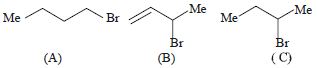
A
$B > C > A$
B
$B > A > C$
C
$C > B > A$
D
$A > B > C$
Solution
(A) $S_N1$ reactions proceed via the formation of a carbocation intermediate. The rate of $S_N1$ reaction depends on the stability of the carbocation formed.
$(A)$ forms a $1^o$ carbocation $(CH_3CH_2CH_2CH_2^+)$,which is the least stable.
$(B)$ forms an allylic carbocation $(CH_2=CH-CH^+(CH_3))$,which is resonance-stabilized and therefore the most stable.
$(C)$ forms a $2^o$ carbocation $(CH_3CH_2CH^+(CH_3))$,which is more stable than a $1^o$ carbocation but less stable than an allylic carbocation.
Thus,the stability order of the carbocations is $B > C > A$. Consequently,the order of $S_N1$ reactivity is $B > C > A$.
$(A)$ forms a $1^o$ carbocation $(CH_3CH_2CH_2CH_2^+)$,which is the least stable.
$(B)$ forms an allylic carbocation $(CH_2=CH-CH^+(CH_3))$,which is resonance-stabilized and therefore the most stable.
$(C)$ forms a $2^o$ carbocation $(CH_3CH_2CH^+(CH_3))$,which is more stable than a $1^o$ carbocation but less stable than an allylic carbocation.
Thus,the stability order of the carbocations is $B > C > A$. Consequently,the order of $S_N1$ reactivity is $B > C > A$.
0 likesView Solution
36
ChemistryDifficultMCQAIIMS · 2016
Molecules/ions and their magnetic properties are given below.
The correctly matched pairs are:
| Molecule/ion | Magnetic property |
| $(i). C_6H_6$ | $(1).$ Antiferromagnetic |
| $(ii). CrO_2$ | $(2).$ Ferrimagnetic |
| $(iii). MnO$ | $(3).$ Ferromagnetic |
| $(iv). Fe_3O_4$ | $(4).$ Paramagnetic |
| $(v). Fe^{3+}$ | $(5).$ Diamagnetic |
The correctly matched pairs are:
A
$i-5, ii-3, iii-2, iv-1, v-4$
B
$i-3, ii-5, iii-1, iv-4, v-2$
C
$i-5, ii-3, iii-1, iv-2, v-4$
D
$i-5, ii-3, iii-1, iv-4, v-2$
Solution
(C) $C_6H_6$ is diamagnetic $(i-5)$.
$CrO_2$ is ferromagnetic $(ii-3)$.
$MnO$ is antiferromagnetic $(iii-1)$.
$Fe_3O_4$ is ferrimagnetic $(iv-2)$.
$Fe^{3+}$ is paramagnetic with $5$ unpaired electrons $(v-4)$.
$CrO_2$ is ferromagnetic $(ii-3)$.
$MnO$ is antiferromagnetic $(iii-1)$.
$Fe_3O_4$ is ferrimagnetic $(iv-2)$.
$Fe^{3+}$ is paramagnetic with $5$ unpaired electrons $(v-4)$.
0 likesView Solution
37
ChemistryMediumMCQAIIMS · 2016
Which one of the following statements about packing in solids is incorrect?
A
Coordination number in $bcc$ mode of packing is $8$.
B
Coordination number in $hcp$ mode of packing is $12$.
C
Void space in $hcp$ mode of packing is $32\%$.
D
Void space in $ccp$ mode of packing is $26\%$.
Solution
(C) In $hcp$ and $ccp$ arrangements,the packing efficiency is $74\%$.
Therefore,the void space (empty space) is $100\% - 74\% = 26\%$.
Statement $C$ claims the void space in $hcp$ is $32\%$,which is incorrect.
Therefore,the void space (empty space) is $100\% - 74\% = 26\%$.
Statement $C$ claims the void space in $hcp$ is $32\%$,which is incorrect.
0 likesView Solution
38
ChemistryMediumMCQAIIMS · 2016
$A$ solution containing $1.8 \ g$ of a compound (empirical formula $CH_2O$) in $40 \ g$ of water is observed to freeze at $-0.465 \ ^oC$. The molecular formula of the compound is ($K_f$ of water $= 1.86 \ K \ kg \ mol^{-1}$)
A
$C_2H_4O_2$
B
$C_3H_6O_3$
C
$C_4H_8O_4$
D
$C_6H_{12}O_6$
Solution
(D) The depression in freezing point is given by $\Delta T_f = T_f^o - T_f = 0 - (-0.465) = 0.465 \ K$.
Using the formula for molar mass $M$ of the solute:
$M = \frac{1000 \times K_f \times w_2}{\Delta T_f \times w_1} = \frac{1000 \times 1.86 \times 1.8}{0.465 \times 40} = 180 \ g \ mol^{-1}$.
The empirical formula mass of $CH_2O$ is $12 + (2 \times 1) + 16 = 30 \ g \ mol^{-1}$.
Calculating the value of $n$:
$n = \frac{\text{Molecular mass}}{\text{Empirical formula mass}} = \frac{180}{30} = 6$.
Therefore,the molecular formula is $(CH_2O)_6 = C_6H_{12}O_6$.
Using the formula for molar mass $M$ of the solute:
$M = \frac{1000 \times K_f \times w_2}{\Delta T_f \times w_1} = \frac{1000 \times 1.86 \times 1.8}{0.465 \times 40} = 180 \ g \ mol^{-1}$.
The empirical formula mass of $CH_2O$ is $12 + (2 \times 1) + 16 = 30 \ g \ mol^{-1}$.
Calculating the value of $n$:
$n = \frac{\text{Molecular mass}}{\text{Empirical formula mass}} = \frac{180}{30} = 6$.
Therefore,the molecular formula is $(CH_2O)_6 = C_6H_{12}O_6$.
0 likesView Solution
39
ChemistryDifficultMCQAIIMS · 2016
Assertion : If a liquid solute more volatile than the solvent is added to the solvent,the vapour pressure of the solution may increase i.e.,$p_s > p^o$.
Reason : In the presence of a more volatile liquid solute,only the solute will form the vapours and solvent will not.
Reason : In the presence of a more volatile liquid solute,only the solute will form the vapours and solvent will not.
A
If both Assertion and Reason are correct and the Reason is a correct explanation of the Assertion.
B
If both Assertion and Reason are correct but Reason is not a correct explanation of the Assertion.
C
If the Assertion is correct but Reason is incorrect.
D
If both the Assertion and Reason are incorrect.
Solution
(C) According to Raoult's Law,the total vapour pressure of a solution containing two volatile components is given by $p_s = p_1 + p_2 = x_1 p_1^o + x_2 p_2^o$.
If the solute (component $2$) is more volatile than the solvent (component $1$),then $p_2^o > p_1^o$.
In this case,the total vapour pressure $p_s$ can be greater than the pure solvent vapour pressure $p_1^o$ depending on the mole fraction.
However,the Reason is incorrect because both components contribute to the total vapour pressure,and both form vapours,with the vapour phase being richer in the more volatile component.
If the solute (component $2$) is more volatile than the solvent (component $1$),then $p_2^o > p_1^o$.
In this case,the total vapour pressure $p_s$ can be greater than the pure solvent vapour pressure $p_1^o$ depending on the mole fraction.
However,the Reason is incorrect because both components contribute to the total vapour pressure,and both form vapours,with the vapour phase being richer in the more volatile component.
0 likesView Solution
40
ChemistryMediumMCQAIIMS · 2016
Given that the standard reduction potentials for $M^{+}/M$ and $N^{+}/N$ electrodes at $298 \ K$ are $0.52 \ V$ and $0.25 \ V$ respectively. Which of the following is correct in respect of the following electrochemical cell?
$M | M^{+} || N^{+} | N$
$M | M^{+} || N^{+} | N$
A
The overall cell reaction is a spontaneous reaction.
B
The standard $EMF$ of the cell is $-0.27 \ V$.
C
The standard $EMF$ of the cell is $0.77 \ V$.
D
The standard $EMF$ of the cell is $-0.77 \ V$.
Solution
(B) The standard cell potential is calculated using the formula:
$E_{cell}^o = E_{cathode}^o - E_{anode}^o$
Here,the cathode is the $N^{+}/N$ electrode and the anode is the $M^{+}/M$ electrode.
$E_{cell}^o = E_{N^{+}/N}^o - E_{M^{+}/M}^o$
$E_{cell}^o = 0.25 \ V - 0.52 \ V = -0.27 \ V$
Since $E_{cell}^o < 0$,the cell reaction is non-spontaneous.
$E_{cell}^o = E_{cathode}^o - E_{anode}^o$
Here,the cathode is the $N^{+}/N$ electrode and the anode is the $M^{+}/M$ electrode.
$E_{cell}^o = E_{N^{+}/N}^o - E_{M^{+}/M}^o$
$E_{cell}^o = 0.25 \ V - 0.52 \ V = -0.27 \ V$
Since $E_{cell}^o < 0$,the cell reaction is non-spontaneous.
0 likesView Solution
41
ChemistryMediumMCQAIIMS · 2016
Assertion : On increasing dilution,the specific conductance keeps on increasing.
Reason : On increasing dilution,the degree of ionization of a weak electrolyte increases and the mobility of ions also increases.
Reason : On increasing dilution,the degree of ionization of a weak electrolyte increases and the mobility of ions also increases.
A
If both Assertion and Reason are correct and the Reason is a correct explanation of the Assertion.
B
If both Assertion and Reason are correct but Reason is not a correct explanation of the Assertion.
C
If the Assertion is correct but Reason is incorrect.
D
If both the Assertion and Reason are incorrect.
Solution
(D) Specific conductance (conductivity,$\kappa$) is defined as the conductance of $1 \ cm^3$ of the solution.
On increasing dilution,the number of ions per unit volume decreases,which leads to a decrease in specific conductance.
Therefore,the Assertion is incorrect.
Although the degree of ionization and ionic mobility increase with dilution,the Assertion itself is false,making the correct choice $D$.
On increasing dilution,the number of ions per unit volume decreases,which leads to a decrease in specific conductance.
Therefore,the Assertion is incorrect.
Although the degree of ionization and ionic mobility increase with dilution,the Assertion itself is false,making the correct choice $D$.
0 likesView Solution
42
ChemistryMediumMCQAIIMS · 2016
Collision theory is used to explain how chemical species undergo a reaction. Using this theory and the kinetic molecular model,which of the following does $NOT$ influence the rate of a chemical reaction?
A
The temperature of the system
B
The geometry or orientation of the collision
C
The velocity of the reactants at the point of collision
D
All of the above influence the rate
Solution
(D) According to collision theory,the rate of a chemical reaction depends on three main factors:
$1$. The frequency of collisions between reactant molecules,which is influenced by temperature and concentration.
$2$. The energy of the collisions,which must exceed the activation energy $(E_a)$.
$3$. The orientation or geometry of the colliding molecules (steric factor).
Since temperature affects the kinetic energy (and thus velocity) and collision frequency,and orientation is a fundamental requirement for effective collisions,all the factors listed in options $A$,$B$,and $C$ influence the reaction rate. Therefore,none of the options provided are independent of the rate.
$1$. The frequency of collisions between reactant molecules,which is influenced by temperature and concentration.
$2$. The energy of the collisions,which must exceed the activation energy $(E_a)$.
$3$. The orientation or geometry of the colliding molecules (steric factor).
Since temperature affects the kinetic energy (and thus velocity) and collision frequency,and orientation is a fundamental requirement for effective collisions,all the factors listed in options $A$,$B$,and $C$ influence the reaction rate. Therefore,none of the options provided are independent of the rate.
0 likesView Solution
43
ChemistryMediumMCQAIIMS · 2016
For the following reaction: $NO_{2(g)} + CO_{(g)} \to NO_{(g)} + CO_{2(g)}$,the rate law is: $\text{Rate} = k [NO_2]^2$. If $0.1 \ mol$ of gaseous carbon monoxide is added at constant temperature to the reaction mixture,which of the following statements is true?
A
Both $k$ and the reaction rate remain the same
B
Both $k$ and the reaction rate increase
C
Both $k$ and the reaction rate decrease
D
Only $k$ increases,the reaction rate remains the same
Solution
(A) The rate law is given as $\text{Rate} = k [NO_2]^2$.
This indicates that the reaction is zero order with respect to $CO_{(g)}$.
The rate constant $k$ depends only on temperature and remains constant as long as the temperature is constant.
Since the reaction is zero order with respect to $CO$,adding $0.1 \ mol$ of $CO_{(g)}$ does not change the rate of the reaction.
Therefore,both $k$ and the reaction rate remain the same.
This indicates that the reaction is zero order with respect to $CO_{(g)}$.
The rate constant $k$ depends only on temperature and remains constant as long as the temperature is constant.
Since the reaction is zero order with respect to $CO$,adding $0.1 \ mol$ of $CO_{(g)}$ does not change the rate of the reaction.
Therefore,both $k$ and the reaction rate remain the same.
0 likesView Solution
44
ChemistryDifficultMCQAIIMS · 2016
The disease kala azar is caused by
A
colloidal antimony
B
milk of magnesia
C
argyrols
D
colloidal gold
Solution
(A) Colloidal antimony is used in the treatment of the disease kala azar.
0 likesView Solution
45
ChemistryMediumMCQAIIMS · 2016
Assertion : The enthalpy of physisorption is greater than chemisorption.
Reason : Molecules of adsorbate and adsorbent are held by van der Waal's forces in physisorption and by chemical bonds in chemisorption.
Reason : Molecules of adsorbate and adsorbent are held by van der Waal's forces in physisorption and by chemical bonds in chemisorption.
A
If both Assertion and Reason are correct and the Reason is a correct explanation of the Assertion.
B
If both Assertion and Reason are correct but Reason is not a correct explanation of the Assertion.
C
If the Assertion is correct but Reason is incorrect.
D
If both the Assertion and Reason are incorrect.
Solution
(D) The enthalpy of chemisorption is high,typically in the range of $40-400 \ kJ \ mol^{-1}$,because it involves the formation of chemical bonds.
In contrast,physisorption involves weak van der Waal's forces,resulting in a low enthalpy of adsorption,typically in the range of $20-40 \ kJ \ mol^{-1}$.
Therefore,the enthalpy of physisorption is lower than that of chemisorption.
Thus,the Assertion is false,and the Reason is true.
In contrast,physisorption involves weak van der Waal's forces,resulting in a low enthalpy of adsorption,typically in the range of $20-40 \ kJ \ mol^{-1}$.
Therefore,the enthalpy of physisorption is lower than that of chemisorption.
Thus,the Assertion is false,and the Reason is true.
0 likesView Solution
46
ChemistryMediumMCQAIIMS · 2016
The main reactions occurring in a blast furnace during the extraction of iron from haematite are $....$.
$(i)$ $Fe_2O_3 + 3CO \to 2Fe + 3CO_2$
$(ii)$ $FeO + SiO_2 \to FeSiO_3$
$(iii)$ $Fe_2O_3 + 3C \to 2Fe + 3CO$
$(iv)$ $CaO + SiO_2 \to CaSiO_3$
$(i)$ $Fe_2O_3 + 3CO \to 2Fe + 3CO_2$
$(ii)$ $FeO + SiO_2 \to FeSiO_3$
$(iii)$ $Fe_2O_3 + 3C \to 2Fe + 3CO$
$(iv)$ $CaO + SiO_2 \to CaSiO_3$
A
$(i)$ and $(iii)$
B
$(ii)$ and $(iv)$
C
$(i)$ and $(iv)$
D
$(i)$,$(ii)$ and $(iii)$
Solution
(C) In the blast furnace,the reduction of iron oxides $(Fe_2O_3)$ occurs primarily by carbon monoxide $(CO)$ to form iron $(Fe)$ and carbon dioxide $(CO_2)$,represented by reaction $(i)$.
Additionally,the removal of silica $(SiO_2)$ impurity as slag $(CaSiO_3)$ occurs via reaction $(iv)$,where calcium oxide $(CaO)$ acts as a flux.
Reaction $(ii)$ is not a primary reaction in the blast furnace for iron extraction,and reaction $(iii)$ is not the main reduction mechanism compared to the $CO$ reduction.
Therefore,the correct reactions are $(i)$ and $(iv)$.
Additionally,the removal of silica $(SiO_2)$ impurity as slag $(CaSiO_3)$ occurs via reaction $(iv)$,where calcium oxide $(CaO)$ acts as a flux.
Reaction $(ii)$ is not a primary reaction in the blast furnace for iron extraction,and reaction $(iii)$ is not the main reduction mechanism compared to the $CO$ reduction.
Therefore,the correct reactions are $(i)$ and $(iv)$.
0 likesView Solution
47
ChemistryDifficultMCQAIIMS · 2016
What are $X$ and $Y$ in the given reactions?
$2X_{2(g)} + 2H_2O_{(l)} \to 4H^{+}_{(aq)} + 4X^{-}_{(aq)} + O_{2(g)}$
$Y_{2(g)} + H_2O_{(l)} \to HY_{(aq)} + HOY_{(aq)}$
$2X_{2(g)} + 2H_2O_{(l)} \to 4H^{+}_{(aq)} + 4X^{-}_{(aq)} + O_{2(g)}$
$Y_{2(g)} + H_2O_{(l)} \to HY_{(aq)} + HOY_{(aq)}$
A
$X = Cl, Y = F$
B
$X = Cl, Y = Br$
C
$X = F, Y = Cl$
D
$X = I, Y = F$
Solution
(C) The first reaction represents the oxidation of water by fluorine,where $F_2$ acts as a strong oxidizing agent: $2F_{2(g)} + 2H_2O_{(l)} \to 4H^{+}_{(aq)} + 4F^{-}_{(aq)} + O_{2(g)}$. Thus,$X = F$.
The second reaction represents the disproportionation of halogens (like chlorine) in water: $Cl_{2(g)} + H_2O_{(l)} \to HCl_{(aq)} + HOCl_{(aq)}$. Thus,$Y = Cl$.
The second reaction represents the disproportionation of halogens (like chlorine) in water: $Cl_{2(g)} + H_2O_{(l)} \to HCl_{(aq)} + HOCl_{(aq)}$. Thus,$Y = Cl$.
0 likesView Solution
48
ChemistryDifficultMCQAIIMS · 2016
Assertion : $SF_6$ cannot be hydrolysed but $SF_4$ can be.
Reason : $Six$ $F$ atoms in $SF_6$ prevent the attack of $H_2O$ on sulphur atom of $SF_6$.
Reason : $Six$ $F$ atoms in $SF_6$ prevent the attack of $H_2O$ on sulphur atom of $SF_6$.
A
If both Assertion and Reason are correct and the Reason is a correct explanation of the Assertion.
B
If both Assertion and Reason are correct but Reason is not a correct explanation of the Assertion.
C
If the Assertion is correct but Reason is incorrect.
D
If both the Assertion and Reason are incorrect.
Solution
(A) In $SF_6$,the sulphur atom is sterically protected by $six$ fluorine atoms,which prevents the attack of $H_2O$ molecules.
Additionally,the sulphur atom in $SF_6$ is coordinatively saturated.
In contrast,$SF_4$ has a lone pair on the sulphur atom and is not sterically hindered to the same extent,allowing $H_2O$ to attack the sulphur atom and undergo hydrolysis.
Thus,both the assertion and the reason are correct,and the reason correctly explains the assertion.
Additionally,the sulphur atom in $SF_6$ is coordinatively saturated.
In contrast,$SF_4$ has a lone pair on the sulphur atom and is not sterically hindered to the same extent,allowing $H_2O$ to attack the sulphur atom and undergo hydrolysis.
Thus,both the assertion and the reason are correct,and the reason correctly explains the assertion.
0 likesView Solution
49
ChemistryMediumMCQAIIMS · 2016
Assertion : Magnetic moment values of actinides are lesser than the theoretically predicted values.
Reason : Actinide elements are strongly paramagnetic.
Reason : Actinide elements are strongly paramagnetic.
A
If both Assertion and Reason are correct and the Reason is a correct explanation of the Assertion.
B
If both Assertion and Reason are correct but Reason is not a correct explanation of the Assertion.
C
If the Assertion is correct but Reason is incorrect.
D
If both the Assertion and Reason are incorrect.
Solution
(B) The magnetic moment values of actinides are lower than the theoretically predicted values because the $5f$ electrons are less effectively shielded by the outer shells. This leads to the quenching of the orbital contribution to the magnetic moment,making the observed values smaller than those calculated using the spin-only formula. While actinides are paramagnetic,the reason provided does not explain why the magnetic moments are lower than predicted.
0 likesView Solution
50
ChemistryDifficultMCQAIIMS · 2016
The deep blue colour produced on adding excess of ammonia to copper sulphate is due to the presence of:
A
$Cu^{2+}$
B
$[Cu(NH_3)_4]^{2+}$
C
$[Cu(NH_3)_6]^{2+}$
D
$[Cu(NH_3)_2]^{2+}$
Solution
(B) When excess ammonia is added to a copper sulphate solution,it forms a deep blue complex.
The reaction is: $CuSO_4(aq) + 4NH_3(aq) \to [Cu(NH_3)_4]SO_4(aq)$.
The deep blue colour is due to the formation of the tetraamminecopper$(II)$ ion,$[Cu(NH_3)_4]^{2+}$.
The reaction is: $CuSO_4(aq) + 4NH_3(aq) \to [Cu(NH_3)_4]SO_4(aq)$.
The deep blue colour is due to the formation of the tetraamminecopper$(II)$ ion,$[Cu(NH_3)_4]^{2+}$.
0 likesView Solution
51
ChemistryMediumMCQAIIMS · 2016
$0.02 \, \text{mole}$ of $[Co(NH_3)_5Br]Cl_2$ and $0.02 \, \text{mole}$ of $[Co(NH_3)_5Cl]SO_4$ are present in $200 \, \text{cc}$ of a solution $X$. The number of moles of the precipitates $Y$ and $Z$ that are formed when the solution $X$ is treated with excess silver nitrate and excess barium chloride are respectively:
A
$0.02, \, 0.02$
B
$0.01, \, 0.02$
C
$0.02, \, 0.04$
D
$0.04, \, 0.02$
Solution
(D) When excess of $AgNO_3$ and $BaCl_2$ are added to solution $X$:
$1.$ Reaction with $AgNO_3$:
$[Co(NH_3)_5Br]Cl_2 + 2AgNO_3 \rightarrow [Co(NH_3)_5Br](NO_3)_2 + 2AgCl(s) (Y)$
Since $1 \, \text{mole}$ of $[Co(NH_3)_5Br]Cl_2$ provides $2 \, \text{moles}$ of $Cl^-$ ions,$0.02 \, \text{mole}$ of the complex yields $0.02 \times 2 = 0.04 \, \text{mole}$ of $AgCl$ precipitate $(Y)$.
$2.$ Reaction with $BaCl_2$:
$[Co(NH_3)_5Cl]SO_4 + BaCl_2 \rightarrow [Co(NH_3)_5Cl]Cl_2 + BaSO_4(s) (Z)$
Since $1 \, \text{mole}$ of $[Co(NH_3)_5Cl]SO_4$ provides $1 \, \text{mole}$ of $SO_4^{2-}$ ions,$0.02 \, \text{mole}$ of the complex yields $0.02 \, \text{mole}$ of $BaSO_4$ precipitate $(Z)$.
Therefore,the number of moles of $Y$ and $Z$ are $0.04$ and $0.02$ respectively.
$1.$ Reaction with $AgNO_3$:
$[Co(NH_3)_5Br]Cl_2 + 2AgNO_3 \rightarrow [Co(NH_3)_5Br](NO_3)_2 + 2AgCl(s) (Y)$
Since $1 \, \text{mole}$ of $[Co(NH_3)_5Br]Cl_2$ provides $2 \, \text{moles}$ of $Cl^-$ ions,$0.02 \, \text{mole}$ of the complex yields $0.02 \times 2 = 0.04 \, \text{mole}$ of $AgCl$ precipitate $(Y)$.
$2.$ Reaction with $BaCl_2$:
$[Co(NH_3)_5Cl]SO_4 + BaCl_2 \rightarrow [Co(NH_3)_5Cl]Cl_2 + BaSO_4(s) (Z)$
Since $1 \, \text{mole}$ of $[Co(NH_3)_5Cl]SO_4$ provides $1 \, \text{mole}$ of $SO_4^{2-}$ ions,$0.02 \, \text{mole}$ of the complex yields $0.02 \, \text{mole}$ of $BaSO_4$ precipitate $(Z)$.
Therefore,the number of moles of $Y$ and $Z$ are $0.04$ and $0.02$ respectively.
0 likesView Solution
52
ChemistryAdvancedMCQAIIMS · 2016
Assertion : Alkylbenzene is not prepared by Friedel-Crafts alkylation of benzene.
Reason : Alkyl halides are less reactive than acyl halides.
Reason : Alkyl halides are less reactive than acyl halides.
A
If both Assertion and Reason are correct and the Reason is a correct explanation of the Assertion.
B
If both Assertion and Reason are correct but Reason is not a correct explanation of the Assertion.
C
If the Assertion is correct but Reason is incorrect.
D
If both the Assertion and Reason are incorrect.
Solution
(D) The Assertion is incorrect because alkylbenzene $CAN$ be prepared by Friedel-Crafts alkylation,although it has limitations such as polyalkylation and rearrangement.
The Reason is also incorrect because alkyl halides are generally more reactive or comparable in reactivity to acyl halides in the context of Friedel-Crafts reactions,but the primary issue with alkylation is the formation of polyalkylated products due to the activating nature of the alkyl group added to the benzene ring.
Therefore,both the Assertion and the Reason are incorrect.
The Reason is also incorrect because alkyl halides are generally more reactive or comparable in reactivity to acyl halides in the context of Friedel-Crafts reactions,but the primary issue with alkylation is the formation of polyalkylated products due to the activating nature of the alkyl group added to the benzene ring.
Therefore,both the Assertion and the Reason are incorrect.
0 likesView Solution
53
ChemistryDifficultMCQAIIMS · 2016
$ClCH_2CH_2OH$ is a stronger acid than $CH_3CH_2OH$ because of:
A
$-I$ effect of $Cl$ increases the negative charge on the $O$ atom of the alcohol
B
$-I$ effect of $Cl$ disperses the negative charge on the $O$ atom to produce a more stable cation
C
None of these
D
$-I$ effect of $Cl$ disperses the negative charge on the $O$ atom to produce a more stable anion
Solution
(D) The acidity of an alcohol depends on the stability of the conjugate base (alkoxide ion) formed after the loss of a proton $(H^+)$.
In $ClCH_2CH_2OH$,the chlorine atom exerts a $-I$ (negative inductive) effect,which is electron-withdrawing.
This $-I$ effect helps in dispersing the negative charge on the oxygen atom of the alkoxide ion $(ClCH_2CH_2O^-)$,thereby increasing its stability compared to the ethoxide ion $(CH_3CH_2O^-)$.
Since the conjugate base of $ClCH_2CH_2OH$ is more stable,it is a stronger acid than $CH_3CH_2OH$.
In $ClCH_2CH_2OH$,the chlorine atom exerts a $-I$ (negative inductive) effect,which is electron-withdrawing.
This $-I$ effect helps in dispersing the negative charge on the oxygen atom of the alkoxide ion $(ClCH_2CH_2O^-)$,thereby increasing its stability compared to the ethoxide ion $(CH_3CH_2O^-)$.
Since the conjugate base of $ClCH_2CH_2OH$ is more stable,it is a stronger acid than $CH_3CH_2OH$.
0 likesView Solution
54
ChemistryMediumMCQAIIMS · 2016
Assertion: Ethyl phenyl ether on reaction with $HBr$ forms phenol and ethyl bromide.
Reason: Cleavage of $C-O$ bond takes place at the ethyl-oxygen bond due to the more stable phenyl-oxygen bond.
Reason: Cleavage of $C-O$ bond takes place at the ethyl-oxygen bond due to the more stable phenyl-oxygen bond.
A
If both Assertion and Reason are correct and the Reason is a correct explanation of the Assertion.
B
If both Assertion and Reason are correct but Reason is not a correct explanation of the Assertion.
C
If the Assertion is correct but Reason is incorrect.
D
If both the Assertion and Reason are incorrect.
Solution
(A) Alkyl aryl ethers are cleaved at the alkyl-oxygen bond because the phenyl-oxygen bond has partial double bond character due to resonance,making it stronger and more stable.
Therefore,the reaction of ethyl phenyl ether $(C_6H_5-O-C_2H_5)$ with $HBr$ proceeds as follows:
$C_6H_5-O-C_2H_5 + HBr \rightarrow C_6H_5OH + C_2H_5Br$
Both the Assertion and the Reason are correct,and the Reason correctly explains why the cleavage occurs at the alkyl-oxygen bond.
Therefore,the reaction of ethyl phenyl ether $(C_6H_5-O-C_2H_5)$ with $HBr$ proceeds as follows:
$C_6H_5-O-C_2H_5 + HBr \rightarrow C_6H_5OH + C_2H_5Br$
Both the Assertion and the Reason are correct,and the Reason correctly explains why the cleavage occurs at the alkyl-oxygen bond.
0 likesView Solution
55
ChemistryMediumMCQAIIMS · 2016
Aldehydes that do not undergo aldol condensation are:
$1$. $CH_3CH_2CHO$ (propanal)
$2$. $Cl_3CCHO$ (trichloroethanal)
$3$. $HCHO$ (methanal)
$4$. $CH_3CHO$ (ethanal)
$5$. $C_6H_5CHO$ (benzaldehyde)
$1$. $CH_3CH_2CHO$ (propanal)
$2$. $Cl_3CCHO$ (trichloroethanal)
$3$. $HCHO$ (methanal)
$4$. $CH_3CHO$ (ethanal)
$5$. $C_6H_5CHO$ (benzaldehyde)
A
$3$ and $4$ only
B
$3$ and $5$ only
C
$1, 2$ and $3$ only
D
$2, 3$ and $5$ only
Solution
(D) Aldol condensation occurs in aldehydes and ketones that possess at least one $\alpha$-hydrogen atom.
$1$. Propanal $(CH_3CH_2CHO)$ has $2$ $\alpha$-hydrogen atoms.
$2$. Trichloroethanal $(Cl_3CCHO)$ has no $\alpha$-hydrogen atoms.
$3$. Methanal $(HCHO)$ has no $\alpha$-hydrogen atoms.
$4$. Ethanal $(CH_3CHO)$ has $3$ $\alpha$-hydrogen atoms.
$5$. Benzaldehyde $(C_6H_5CHO)$ has no $\alpha$-hydrogen atoms.
Therefore,trichloroethanal $(2)$,methanal $(3)$,and benzaldehyde $(5)$ do not undergo aldol condensation.
$1$. Propanal $(CH_3CH_2CHO)$ has $2$ $\alpha$-hydrogen atoms.
$2$. Trichloroethanal $(Cl_3CCHO)$ has no $\alpha$-hydrogen atoms.
$3$. Methanal $(HCHO)$ has no $\alpha$-hydrogen atoms.
$4$. Ethanal $(CH_3CHO)$ has $3$ $\alpha$-hydrogen atoms.
$5$. Benzaldehyde $(C_6H_5CHO)$ has no $\alpha$-hydrogen atoms.
Therefore,trichloroethanal $(2)$,methanal $(3)$,and benzaldehyde $(5)$ do not undergo aldol condensation.
0 likesView Solution
56
ChemistryMediumMCQAIIMS · 2016
Assertion : The boiling points of aldehydes and ketones are higher than hydrocarbons and ethers of comparable molecular masses.
Reason : There is a weak molecular association in aldehydes and ketones arising out of the dipole-dipole interactions.
Reason : There is a weak molecular association in aldehydes and ketones arising out of the dipole-dipole interactions.
A
If both Assertion and Reason are correct and the Reason is a correct explanation of the Assertion.
B
If both Assertion and Reason are correct but Reason is not a correct explanation of the Assertion.
C
If the Assertion is correct but Reason is incorrect.
D
If both the Assertion and Reason are incorrect.
Solution
(A) Aldehydes and ketones possess a polar carbonyl group $(C=O)$,which creates a permanent dipole moment.
Due to this polarity,there exist dipole-dipole interactions between the molecules of aldehydes and ketones.
These intermolecular dipole-dipole interactions are stronger than the weak van der Waals forces present in hydrocarbons and ethers of comparable molecular masses.
Consequently,more energy is required to overcome these forces,leading to higher boiling points for aldehydes and ketones compared to hydrocarbons and ethers.
Thus,both the Assertion and the Reason are correct,and the Reason is the correct explanation of the Assertion.
Due to this polarity,there exist dipole-dipole interactions between the molecules of aldehydes and ketones.
These intermolecular dipole-dipole interactions are stronger than the weak van der Waals forces present in hydrocarbons and ethers of comparable molecular masses.
Consequently,more energy is required to overcome these forces,leading to higher boiling points for aldehydes and ketones compared to hydrocarbons and ethers.
Thus,both the Assertion and the Reason are correct,and the Reason is the correct explanation of the Assertion.
0 likesView Solution
57
ChemistryMediumMCQAIIMS · 2016
Which of the following compounds will not undergo an azo coupling reaction with benzene diazonium chloride?
A
Aniline
B
Phenol
C
Anisole
D
Nitrobenzene
Solution
(D) The benzene diazonium cation acts as a weak electrophile.
It undergoes electrophilic aromatic substitution (azo coupling) only with electron-rich aromatic compounds that contain strong electron-donating groups like $-OH$,$-NH_2$,or $-OCH_3$.
Nitrobenzene contains a strong electron-withdrawing group $(-NO_2)$,which deactivates the benzene ring towards electrophilic attack.
Therefore,nitrobenzene does not undergo the azo coupling reaction.
It undergoes electrophilic aromatic substitution (azo coupling) only with electron-rich aromatic compounds that contain strong electron-donating groups like $-OH$,$-NH_2$,or $-OCH_3$.
Nitrobenzene contains a strong electron-withdrawing group $(-NO_2)$,which deactivates the benzene ring towards electrophilic attack.
Therefore,nitrobenzene does not undergo the azo coupling reaction.
0 likesView Solution
58
ChemistryDifficultMCQAIIMS · 2016
Assertion : Acylation of amines gives a monosubstituted product whereas alkylation of amines gives polysubstituted product.
Reason : Acyl group sterically hinders the approach of further acyl groups.
Reason : Acyl group sterically hinders the approach of further acyl groups.
A
If both Assertion and Reason are correct and the Reason is a correct explanation of the Assertion.
B
If both Assertion and Reason are correct but Reason is not a correct explanation of the Assertion.
C
If the Assertion is correct but Reason is incorrect.
D
If both the Assertion and Reason are incorrect.
Solution
(C) The assertion is correct: Acylation of amines (using acid chlorides or anhydrides) results in a monosubstituted product because the electron-withdrawing nature of the acyl group reduces the nucleophilicity of the nitrogen atom,preventing further acylation. In contrast,alkylation of amines (using alkyl halides) leads to a mixture of primary,secondary,tertiary amines,and quaternary ammonium salts because the alkyl group is electron-donating,which increases the nucleophilicity of the nitrogen atom,making it more reactive toward further alkylation.
The reason is incorrect: The limitation of acylation is due to the electronic effect (electron-withdrawing nature of the acyl group) rather than steric hindrance. Therefore,the assertion is correct,but the reason is incorrect.
The reason is incorrect: The limitation of acylation is due to the electronic effect (electron-withdrawing nature of the acyl group) rather than steric hindrance. Therefore,the assertion is correct,but the reason is incorrect.
1 likesView Solution
59
ChemistryMediumMCQAIIMS · 2016
Which one of the following statements is correct?
A
All amino acids except lysine are optically active
B
All amino acids are optically active
C
All amino acids except glycine are optically active
D
All amino acids except glutamic acid are optically active
Solution
(C) Except for glycine,all other naturally occurring amino acids contain a chiral center at the $\alpha$-carbon atom.
Glycine has the structure $H_2N-CH_2-COOH$,where the $\alpha$-carbon is bonded to two identical hydrogen atoms,making it achiral.
Therefore,all amino acids except glycine are optically active.
Glycine has the structure $H_2N-CH_2-COOH$,where the $\alpha$-carbon is bonded to two identical hydrogen atoms,making it achiral.
Therefore,all amino acids except glycine are optically active.
0 likesView Solution
60
ChemistryDifficultMCQAIIMS · 2016
Assertion : Vitamin $D$ cannot be stored in our body.
Reason : Vitamin $D$ is a fat-soluble vitamin and is excreted from the body in urine.
Reason : Vitamin $D$ is a fat-soluble vitamin and is excreted from the body in urine.
A
If both Assertion and Reason are correct and the Reason is a correct explanation of the Assertion.
B
If both Assertion and Reason are correct but Reason is not a correct explanation of the Assertion.
C
If the Assertion is correct but Reason is incorrect.
D
If both the Assertion and Reason are incorrect.
Solution
(D) Vitamin $D$ is a fat-soluble vitamin.
Fat-soluble vitamins $(A, D, E, K)$ are stored in the liver and adipose tissues of the body.
Therefore,the Assertion is incorrect because Vitamin $D$ can be stored in the body.
The Reason is also incorrect because fat-soluble vitamins are not excreted in urine; only water-soluble vitamins ($B$ complex and $C$) are excreted in urine.
Fat-soluble vitamins $(A, D, E, K)$ are stored in the liver and adipose tissues of the body.
Therefore,the Assertion is incorrect because Vitamin $D$ can be stored in the body.
The Reason is also incorrect because fat-soluble vitamins are not excreted in urine; only water-soluble vitamins ($B$ complex and $C$) are excreted in urine.
0 likesView Solution
61
ChemistryMediumMCQAIIMS · 2016
The repeating unit present in Nylon $6$ is
A
$[NH-(CH_2)_6-NH-CO-(CH_2)_4-CO]_n$
B
$[CO-(CH_2)_5-NH]_n$
C
$[CO-(CH_2)_6-NH]_n$
D
$[CO-(CH_2)_4-NH]_n$
Solution
(B) Nylon $6$ is synthesized from caprolactam.
When caprolactam is heated with water at high temperatures,it undergoes ring-opening polymerization to form Nylon $6$.
The repeating unit is $[CO-(CH_2)_5-NH]$.
When caprolactam is heated with water at high temperatures,it undergoes ring-opening polymerization to form Nylon $6$.
The repeating unit is $[CO-(CH_2)_5-NH]$.
0 likesView Solution
62
ChemistryMediumMCQAIIMS · 2016
Assertion : Bakelite is a thermosetting polymer.
Reason : Bakelite can be melted again and again without any change.
Reason : Bakelite can be melted again and again without any change.
A
If both Assertion and Reason are correct and the Reason is a correct explanation of the Assertion.
B
If both Assertion and Reason are correct but Reason is not a correct explanation of the Assertion.
C
If the Assertion is correct but Reason is incorrect.
D
If both the Assertion and Reason are incorrect.
Solution
(C) Bakelite is a cross-linked polymer formed by the condensation reaction of phenol and formaldehyde.
It is a thermosetting polymer,which means it becomes hard and infusible on heating and cannot be remelted or reshaped.
Therefore,the Assertion is correct,but the Reason is incorrect.
It is a thermosetting polymer,which means it becomes hard and infusible on heating and cannot be remelted or reshaped.
Therefore,the Assertion is correct,but the Reason is incorrect.
0 likesView Solution
63
ChemistryDifficultMCQAIIMS · 2016
Assertion : Tetracycline is a broad spectrum antibiotic.
Reason : Tetracycline is effective against a number of types of bacteria,large viruses and typhus fever.
Reason : Tetracycline is effective against a number of types of bacteria,large viruses and typhus fever.
A
If both Assertion and Reason are correct and the Reason is a correct explanation of the Assertion.
B
If both Assertion and Reason are correct but Reason is not a correct explanation of the Assertion.
C
If the Assertion is correct but Reason is incorrect.
D
If both the Assertion and Reason are incorrect.
Solution
(A) Broad spectrum antibiotics are those medicines which are effective against a wide range of Gram-positive and Gram-negative bacteria.
$Tetracycline$ is a well-known broad spectrum antibiotic.
It is effective against a number of types of bacteria,large viruses,and typhus fever.
Since the reason correctly explains why $Tetracycline$ is classified as a broad spectrum antibiotic,both statements are correct and the reason is the correct explanation of the assertion.
$Tetracycline$ is a well-known broad spectrum antibiotic.
It is effective against a number of types of bacteria,large viruses,and typhus fever.
Since the reason correctly explains why $Tetracycline$ is classified as a broad spectrum antibiotic,both statements are correct and the reason is the correct explanation of the assertion.
0 likesView Solution
Vedclass Products
For Students
Vedclass Test Series
Mock tests in real AIIMS style covering Chemistry with performance analysis. 5-day free trial.
Start Free TrialFor Teachers
Exam Paper Generator
Generate Set A/B/C/D Chemistry papers from 7.5L+ questions in 2 minutes. 3 chapters free.
Try FreeFor Institutes
Online Exam Module
Run live AIIMS mock exams with unlimited students, 360° analytics & white-label branding.
See DemoFrequently Asked Questions
How many Chemistry questions are in AIIMS 2016?
There are 63 Chemistry questions from the AIIMS 2016 paper on Vedclass, each with a detailed step-by-step solution in English.
Are AIIMS 2016 Chemistry solutions available in English?
Yes. All solutions on this page are in English. You can also switch to English or Hindi using the language buttons above the questions.
Can I practice AIIMS 2016 Chemistry as a timed test?
Yes. Use the Vedclass Test Series to attempt a full AIIMS mock test covering Chemistry with time limits and instant score analysis.
Can teachers create Chemistry papers from AIIMS previous year questions?
Yes. The Vedclass Exam Paper Generator lets teachers mix AIIMS Chemistry questions and generate Set A/B/C/D papers in minutes.
For Teachers & Institutes
Build a Custom Chemistry Paper
Pick AIIMS 2016 Chemistry questions, set difficulty, and generate Set A/B/C/D in 2 minutes.