
ChemistryQ1–79 of 79 questions
Page 1 of 1 · English
1
ChemistryMCQAIIMS · 2014
Which of the following relations is true?
A
$3Y = K(1 - \sigma)$
B
$K = \frac{9\eta Y}{Y + \eta}$
C
$\sigma = (6K + \eta)Y$
D
$\sigma = \frac{0.5Y - \eta}{\eta}$
Solution
(D) The relation between Young's modulus $(Y)$,rigidity modulus $(\eta)$,and Poisson's ratio $(\sigma)$ is given by:
$Y = 2\eta(1 + \sigma)$
Dividing both sides by $2\eta$:
$\frac{Y}{2\eta} = 1 + \sigma$
$\frac{Y}{2\eta} - 1 = \sigma$
$\sigma = \frac{Y - 2\eta}{2\eta}$
$\sigma = \frac{0.5Y - \eta}{\eta}$
Thus,option $(d)$ is correct.
$Y = 2\eta(1 + \sigma)$
Dividing both sides by $2\eta$:
$\frac{Y}{2\eta} = 1 + \sigma$
$\frac{Y}{2\eta} - 1 = \sigma$
$\sigma = \frac{Y - 2\eta}{2\eta}$
$\sigma = \frac{0.5Y - \eta}{\eta}$
Thus,option $(d)$ is correct.
0 likesView Solution
2
ChemistryMCQAIIMS · 2014
Resonance is an example of
A
Tuning fork
B
Forced vibration
C
Free vibration
D
Damped vibration
Solution
(B) Resonance occurs when an external periodic force is applied to a system at a frequency equal to its natural frequency.
Since the system is driven by an external periodic force,it is a specific case of forced vibration.
Therefore,resonance is an example of forced vibration.
The correct option is $B$.
Since the system is driven by an external periodic force,it is a specific case of forced vibration.
Therefore,resonance is an example of forced vibration.
The correct option is $B$.
0 likesView Solution
3
ChemistryMCQAIIMS · 2014
Magnetic lines of force due to a bar magnet do not intersect because
A
$A$ point always has a single net magnetic field
B
The lines have similar charges and so repel each other
C
The lines always diverge from a single point
D
The lines need magnetic lenses to be made to intersect
Solution
(A) Magnetic lines of force represent the direction of the magnetic field at any point. If two magnetic lines of force were to intersect at a point,there would be two different directions for the magnetic field at that same point. Since a point in space can only have a single net magnetic field vector at any given time,it is physically impossible for magnetic lines of force to intersect.
0 likesView Solution
4
ChemistryMCQAIIMS · 2014
Which of the following equilibria will shift to the right side on increasing the temperature?
A
$CO_{(g)} + H_2O_{(g)} \rightleftharpoons CO_{2(g)} + H_{2(g)}$
B
$2SO_{2(g)} + O_{2(g)} \rightleftharpoons 2SO_{3(g)}$
C
$H_2O_{(g)} \rightleftharpoons H_{2(g)} + \frac{1}{2}O_{2(g)}$
D
$4HCl_{(g)} + O_{2(g)} \rightleftharpoons 2H_2O_{(g)} + 2Cl_{2(g)}$
Solution
(C) According to Le Chatelier's principle,increasing the temperature favors the endothermic direction of a reaction.
$A$. $CO_{(g)} + H_2O_{(g)} \rightleftharpoons CO_{2(g)} + H_{2(g)}$ is exothermic $(\Delta H < 0)$.
$B$. $2SO_{2(g)} + O_{2(g)} \rightleftharpoons 2SO_{3(g)}$ is exothermic $(\Delta H < 0)$.
$C$. $H_2O_{(g)} \rightleftharpoons H_{2(g)} + \frac{1}{2}O_{2(g)}$ is endothermic $(\Delta H > 0)$.
$D$. $4HCl_{(g)} + O_{2(g)} \rightleftharpoons 2H_2O_{(g)} + 2Cl_{2(g)}$ is exothermic $(\Delta H < 0)$.
Therefore,increasing the temperature will shift the equilibrium to the right for reaction $C$.
$A$. $CO_{(g)} + H_2O_{(g)} \rightleftharpoons CO_{2(g)} + H_{2(g)}$ is exothermic $(\Delta H < 0)$.
$B$. $2SO_{2(g)} + O_{2(g)} \rightleftharpoons 2SO_{3(g)}$ is exothermic $(\Delta H < 0)$.
$C$. $H_2O_{(g)} \rightleftharpoons H_{2(g)} + \frac{1}{2}O_{2(g)}$ is endothermic $(\Delta H > 0)$.
$D$. $4HCl_{(g)} + O_{2(g)} \rightleftharpoons 2H_2O_{(g)} + 2Cl_{2(g)}$ is exothermic $(\Delta H < 0)$.
Therefore,increasing the temperature will shift the equilibrium to the right for reaction $C$.
0 likesView Solution
5
ChemistryMCQAIIMS · 2014
Chloramphenicol and erythromycin (broad spectrum antibiotics) are produced by
A
Streptomyces
B
Nitrobacter
C
Rhizobium
D
Penicillium
Solution
(A) Chloramphenicol is obtained from $Streptomyces \text{ } venezuelae$ $(1947)$.
Erythromycin is obtained from $Streptomyces \text{ } erythraeus$ $(1953)$.
Both these antibiotics are produced by species of the genus $Streptomyces$, which are filamentous bacteria known for producing a wide variety of secondary metabolites, including many clinically important antibiotics.
Erythromycin is obtained from $Streptomyces \text{ } erythraeus$ $(1953)$.
Both these antibiotics are produced by species of the genus $Streptomyces$, which are filamentous bacteria known for producing a wide variety of secondary metabolites, including many clinically important antibiotics.
0 likesView Solution
6
ChemistryMCQAIIMS · 2014
Which of the following are not electromagnetic waves?
A
$\beta -$ rays
B
$\gamma -$ rays
C
$X-$ rays
D
All of the above
Solution
(A) Electromagnetic waves are waves that are created as a result of vibrations between an electric field and a magnetic field.
$\gamma -$ rays and $X-$ rays are part of the electromagnetic spectrum.
$\beta -$ rays consist of high-energy,high-speed electrons or positrons emitted by certain types of radioactive nuclei.
Since $\beta -$ rays are streams of charged particles (matter),they are not electromagnetic waves.
Therefore,the correct option is $A$.
$\gamma -$ rays and $X-$ rays are part of the electromagnetic spectrum.
$\beta -$ rays consist of high-energy,high-speed electrons or positrons emitted by certain types of radioactive nuclei.
Since $\beta -$ rays are streams of charged particles (matter),they are not electromagnetic waves.
Therefore,the correct option is $A$.
0 likesView Solution
7
ChemistryMCQAIIMS · 2014
Which of the following are not electromagnetic waves?
A
Cosmic rays
B
$\gamma$-rays
C
$\beta$-rays
D
$X$-rays
Solution
(C) Electromagnetic waves are waves that are created as a result of vibrations between an electric field and a magnetic field.
Cosmic rays,$\gamma$-rays,and $X$-rays are all part of the electromagnetic spectrum.
$\beta$-rays consist of high-energy,high-speed electrons or positrons emitted by certain types of radioactive nuclei.
Since $\beta$-rays are streams of charged particles (matter),they are not electromagnetic waves.
Therefore,the correct option is $C$.
Cosmic rays,$\gamma$-rays,and $X$-rays are all part of the electromagnetic spectrum.
$\beta$-rays consist of high-energy,high-speed electrons or positrons emitted by certain types of radioactive nuclei.
Since $\beta$-rays are streams of charged particles (matter),they are not electromagnetic waves.
Therefore,the correct option is $C$.
0 likesView Solution
8
ChemistryMCQAIIMS · 2014
Approximately $70\%$ of carbon dioxide absorbed by the blood is transported to the lungs:
A
as bicarbonate ions
B
in the form of dissolved gas molecules
C
by binding to $RBCs$
D
as carbamino-haemoglobin
Solution
(A) Carbon dioxide $(CO_2)$ is transported in the blood in three main forms:
$1$. As bicarbonate ions $(HCO_3^-)$: This is the primary method,accounting for approximately $70\%$ of total $CO_2$ transport.
$2$. As carbamino-haemoglobin: About $20-25\%$ of $CO_2$ binds to haemoglobin to form carbamino-haemoglobin.
$3$. In dissolved state: About $7\%$ of $CO_2$ is carried in a dissolved state through the blood plasma.
Therefore,the correct answer is as bicarbonate ions.
$1$. As bicarbonate ions $(HCO_3^-)$: This is the primary method,accounting for approximately $70\%$ of total $CO_2$ transport.
$2$. As carbamino-haemoglobin: About $20-25\%$ of $CO_2$ binds to haemoglobin to form carbamino-haemoglobin.
$3$. In dissolved state: About $7\%$ of $CO_2$ is carried in a dissolved state through the blood plasma.
Therefore,the correct answer is as bicarbonate ions.
0 likesView Solution
9
ChemistryMCQAIIMS · 2014
During meiosis $I,$ the chromosomes start pairing at
A
Leptotene
B
Zygotene
C
Pachytene
D
Diplotene
Solution
(B) Meiosis $I$ is divided into four stages: Prophase $I,$ Metaphase $I,$ Anaphase $I,$ and Telophase $I.$
Prophase $I$ is further subdivided into five stages: Leptotene,Zygotene,Pachytene,Diplotene,and Diakinesis.
During the Zygotene stage of Prophase $I,$ homologous chromosomes begin to pair together. This process of association is called synapsis.
Therefore,the pairing of chromosomes starts at the Zygotene stage.
Prophase $I$ is further subdivided into five stages: Leptotene,Zygotene,Pachytene,Diplotene,and Diakinesis.
During the Zygotene stage of Prophase $I,$ homologous chromosomes begin to pair together. This process of association is called synapsis.
Therefore,the pairing of chromosomes starts at the Zygotene stage.
0 likesView Solution
10
ChemistryMCQAIIMS · 2014
Which of the following are not electromagnetic waves?
A
Cosmic rays
B
$\gamma$-rays
C
$\beta$-rays
D
$X$-rays
Solution
(C) Electromagnetic waves are waves that are created as a result of vibrations between an electric field and a magnetic field. $\gamma$-rays and $X$-rays are part of the electromagnetic spectrum. Cosmic rays consist of high-energy charged particles (mostly protons and atomic nuclei) and are not electromagnetic waves. $\beta$-rays consist of high-energy electrons or positrons,which are also charged particles and not electromagnetic waves. Among the given options,$\beta$-rays are specifically identified as streams of charged particles,making them not electromagnetic in nature. Note: Cosmic rays are also not electromagnetic waves,but in standard physics curricula,$\beta$-rays are the classic example of particle radiation contrasted with electromagnetic radiation.
0 likesView Solution
11
ChemistryMCQAIIMS · 2014
The final product $(III)$ obtained in the reaction sequence:
$CH_3CH_2COOH$ $\xrightarrow{PCl_3} I$ $\xrightarrow[AlCl_3]{C_6H_6} II$ $\xrightarrow[base, heat]{NH_2NH_2} III$ is
$CH_3CH_2COOH$ $\xrightarrow{PCl_3} I$ $\xrightarrow[AlCl_3]{C_6H_6} II$ $\xrightarrow[base, heat]{NH_2NH_2} III$ is
A
Propylbenzene
B
$1-$Phenylpropan$-1-$ol
C
Ethyl benzoate
D
Propiophenone
Solution
(A) The reaction sequence is as follows:
$1$. $CH_3CH_2COOH \xrightarrow{PCl_3} CH_3CH_2COCl$ (Propionyl chloride,$I$)
$2$. $CH_3CH_2COCl \xrightarrow[AlCl_3]{C_6H_6} C_6H_5COCH_2CH_3$ (Propiophenone,$II$)
$3$. $C_6H_5COCH_2CH_3 \xrightarrow[base, heat]{NH_2NH_2} C_6H_5CH_2CH_2CH_3$ (Propylbenzene,$III$)
This is a Wolff-Kishner reduction where the ketone group is reduced to a methylene group. The final product is propylbenzene.
$1$. $CH_3CH_2COOH \xrightarrow{PCl_3} CH_3CH_2COCl$ (Propionyl chloride,$I$)
$2$. $CH_3CH_2COCl \xrightarrow[AlCl_3]{C_6H_6} C_6H_5COCH_2CH_3$ (Propiophenone,$II$)
$3$. $C_6H_5COCH_2CH_3 \xrightarrow[base, heat]{NH_2NH_2} C_6H_5CH_2CH_2CH_3$ (Propylbenzene,$III$)
This is a Wolff-Kishner reduction where the ketone group is reduced to a methylene group. The final product is propylbenzene.
0 likesView Solution
12
ChemistryMCQAIIMS · 2014
In the isoelectronic series of metal carbonyls,the $CO$ bond strength is expected to increase in the order:
A
$[Mn(CO)_6]^+ < [Cr(CO)_6] < [V(CO)_6]^-$
B
$[V(CO)_6]^- < [Cr(CO)_6] < [Mn(CO)_6]^+$
C
$[V(CO)_6]^- < [Mn(CO)_6]^+ < [Cr(CO)_6]$
D
$[Cr(CO)_6] < [Mn(CO)_6]^+ < [V(CO)_6]^-$
Solution
(B) In metal carbonyls,the $CO$ bond strength is inversely proportional to the extent of $\pi$-back bonding from the metal to the $CO$ ligand.
As the positive charge on the central metal atom increases,its ability to donate electron density into the $\pi^*$ anti-bonding orbitals of the $CO$ ligand decreases.
The oxidation states of the metals are $V$ in $[V(CO)_6]^-$ is $-1$,$Cr$ in $[Cr(CO)_6]$ is $0$,and $Mn$ in $[Mn(CO)_6]^+$ is $+1$.
Therefore,the extent of back-bonding decreases in the order $[V(CO)_6]^- > [Cr(CO)_6] > [Mn(CO)_6]^+$.
Consequently,the $CO$ bond strength increases in the order $[V(CO)_6]^- < [Cr(CO)_6] < [Mn(CO)_6]^+$.
As the positive charge on the central metal atom increases,its ability to donate electron density into the $\pi^*$ anti-bonding orbitals of the $CO$ ligand decreases.
The oxidation states of the metals are $V$ in $[V(CO)_6]^-$ is $-1$,$Cr$ in $[Cr(CO)_6]$ is $0$,and $Mn$ in $[Mn(CO)_6]^+$ is $+1$.
Therefore,the extent of back-bonding decreases in the order $[V(CO)_6]^- > [Cr(CO)_6] > [Mn(CO)_6]^+$.
Consequently,the $CO$ bond strength increases in the order $[V(CO)_6]^- < [Cr(CO)_6] < [Mn(CO)_6]^+$.
0 likesView Solution
13
ChemistryMCQAIIMS · 2014
In the isoelectronic series of metal carbonyls,the $CO$ bond strength is expected to increase in the order:
A
$[Mn(CO)_6]^+ < [Cr(CO)_6] < [V(CO)_6]^-$
B
$[V(CO)_6]^- < [Cr(CO)_6] < [Mn(CO)_6]^+$
C
$[V(CO)_6]^- < [Mn(CO)_6]^+ < [Cr(CO)_6]$
D
$[Cr(CO)_6] < [Mn(CO)_6]^+ < [V(CO)_6]^-$
Solution
(B) The $CO$ bond strength in metal carbonyls is inversely proportional to the extent of $M \rightarrow CO$ $\pi$-back bonding.
Greater negative charge on the metal center increases the electron density on the metal,which enhances the $\pi$-back donation to the $CO$ antibonding $\pi^*$ orbitals,thereby weakening the $CO$ bond.
For the isoelectronic series: $[V(CO)_6]^-$ (charge $-1$),$[Cr(CO)_6]$ (charge $0$),and $[Mn(CO)_6]^+$ (charge $+1$).
The extent of back donation follows the order: $[V(CO)_6]^- > [Cr(CO)_6] > [Mn(CO)_6]^+$.
Therefore,the $CO$ bond strength follows the reverse order: $[V(CO)_6]^- < [Cr(CO)_6] < [Mn(CO)_6]^+$.
Thus,the correct option is $B$.
Greater negative charge on the metal center increases the electron density on the metal,which enhances the $\pi$-back donation to the $CO$ antibonding $\pi^*$ orbitals,thereby weakening the $CO$ bond.
For the isoelectronic series: $[V(CO)_6]^-$ (charge $-1$),$[Cr(CO)_6]$ (charge $0$),and $[Mn(CO)_6]^+$ (charge $+1$).
The extent of back donation follows the order: $[V(CO)_6]^- > [Cr(CO)_6] > [Mn(CO)_6]^+$.
Therefore,the $CO$ bond strength follows the reverse order: $[V(CO)_6]^- < [Cr(CO)_6] < [Mn(CO)_6]^+$.
Thus,the correct option is $B$.
0 likesView Solution
14
ChemistryMCQAIIMS · 2014
Which has the maximum number of molecules among the following?
A
$44 \ g \ CO_2$
B
$48 \ g \ O_3$
C
$8 \ g \ H_2$
D
$64 \ g \ SO_2$
Solution
(C) The number of molecules is calculated as: $\text{Number of molecules} = \text{Moles} \times N_A$.
For $A$: $\text{Moles of } CO_2 = \frac{44 \ g}{44 \ g/mol} = 1 \ mol$. Number of molecules = $1 \times N_A$.
For $B$: $\text{Moles of } O_3 = \frac{48 \ g}{48 \ g/mol} = 1 \ mol$. Number of molecules = $1 \times N_A$.
For $C$: $\text{Moles of } H_2 = \frac{8 \ g}{2 \ g/mol} = 4 \ mol$. Number of molecules = $4 \times N_A$.
For $D$: $\text{Moles of } SO_2 = \frac{64 \ g}{64 \ g/mol} = 1 \ mol$. Number of molecules = $1 \times N_A$.
Comparing the values,$8 \ g \ H_2$ contains the maximum number of molecules $(4 \times N_A)$.
For $A$: $\text{Moles of } CO_2 = \frac{44 \ g}{44 \ g/mol} = 1 \ mol$. Number of molecules = $1 \times N_A$.
For $B$: $\text{Moles of } O_3 = \frac{48 \ g}{48 \ g/mol} = 1 \ mol$. Number of molecules = $1 \times N_A$.
For $C$: $\text{Moles of } H_2 = \frac{8 \ g}{2 \ g/mol} = 4 \ mol$. Number of molecules = $4 \times N_A$.
For $D$: $\text{Moles of } SO_2 = \frac{64 \ g}{64 \ g/mol} = 1 \ mol$. Number of molecules = $1 \times N_A$.
Comparing the values,$8 \ g \ H_2$ contains the maximum number of molecules $(4 \times N_A)$.
0 likesView Solution
15
ChemistryMediumMCQAIIMS · 2014
The electrons,identified by quantum numbers $n$ and $l$ as $(i) n = 4, l = 1$,$(ii) n = 4, l = 0$,$(iii) n = 3, l = 2$,$(iv) n = 3, l = 1$,can be placed in order of increasing energy,from the lowest to highest,as:
A
$(iv) < (ii) < (iii) < (i)$
B
$(ii) < (iv) < (i) < (iii)$
C
$(i) < (iii) < (ii) < (iv)$
D
$(iii) < (i) < (iv) < (ii)$
Solution
(A) According to the $(n+l)$ rule,the higher the value of $(n+l)$,the higher is the energy of the orbital.
If the $(n+l)$ values are the same,the orbital with the lower value of $n$ has lower energy.
Calculating $(n+l)$ values:
$(i) n=4, l=1 \implies n+l = 5$
$(ii) n=4, l=0 \implies n+l = 4$
$(iii) n=3, l=2 \implies n+l = 5$
$(iv) n=3, l=1 \implies n+l = 4$
Comparing the values:
For $(iv)$ and $(ii)$,both have $(n+l) = 4$. Since $n=3 < n=4$,$(iv) < (ii)$.
For $(i)$ and $(iii)$,both have $(n+l) = 5$. Since $n=3 < n=4$,$(iii) < (i)$.
Combining these,the order of increasing energy is $(iv) < (ii) < (iii) < (i)$.
If the $(n+l)$ values are the same,the orbital with the lower value of $n$ has lower energy.
Calculating $(n+l)$ values:
$(i) n=4, l=1 \implies n+l = 5$
$(ii) n=4, l=0 \implies n+l = 4$
$(iii) n=3, l=2 \implies n+l = 5$
$(iv) n=3, l=1 \implies n+l = 4$
Comparing the values:
For $(iv)$ and $(ii)$,both have $(n+l) = 4$. Since $n=3 < n=4$,$(iv) < (ii)$.
For $(i)$ and $(iii)$,both have $(n+l) = 5$. Since $n=3 < n=4$,$(iii) < (i)$.
Combining these,the order of increasing energy is $(iv) < (ii) < (iii) < (i)$.
0 likesView Solution
16
ChemistryDifficultMCQAIIMS · 2014
In the hydrogen atomic spectrum,a series limit is found at $12186.3 \ cm^{-1}$. To which series does it belong?
A
Lyman series
B
Balmer series
C
Paschen series
D
Brackett series
Solution
(C) The series limit corresponds to the transition from $n_2 = \infty$ to $n_1$.
The Rydberg formula for the wavenumber is $\bar{v} = R \left( \frac{1}{n_1^2} - \frac{1}{n_2^2} \right)$.
For the series limit,$n_2 = \infty$,so $\bar{v} = \frac{R}{n_1^2}$.
Given $\bar{v} = 12186.3 \ cm^{-1}$ and $R = 109677.76 \ cm^{-1}$,we have:
$12186.3 = \frac{109677.76}{n_1^2}$
$n_1^2 = \frac{109677.76}{12186.3} \approx 9$
$n_1 = 3$.
Since $n_1 = 3$,the series is the Paschen series.
The Rydberg formula for the wavenumber is $\bar{v} = R \left( \frac{1}{n_1^2} - \frac{1}{n_2^2} \right)$.
For the series limit,$n_2 = \infty$,so $\bar{v} = \frac{R}{n_1^2}$.
Given $\bar{v} = 12186.3 \ cm^{-1}$ and $R = 109677.76 \ cm^{-1}$,we have:
$12186.3 = \frac{109677.76}{n_1^2}$
$n_1^2 = \frac{109677.76}{12186.3} \approx 9$
$n_1 = 3$.
Since $n_1 = 3$,the series is the Paschen series.
0 likesView Solution
17
ChemistryMediumMCQAIIMS · 2014
Assertion : Spin quantum number can have two values,$+\frac{1}{2}$ and $-\frac{1}{2}$.
Reason : $+$ and $-$ signs signify the positive and negative wave functions.
Reason : $+$ and $-$ signs signify the positive and negative wave functions.
A
If both Assertion and Reason are correct and the Reason is a correct explanation of the Assertion.
B
If both Assertion and Reason are correct but Reason is not a correct explanation of the Assertion.
C
If the Assertion is correct but Reason is incorrect.
D
If both the Assertion and Reason are incorrect.
Solution
(C) The Assertion is correct because the spin quantum number $(m_s)$ describes the intrinsic angular momentum of an electron,which can only take two values: $+\frac{1}{2}$ and $-\frac{1}{2}$.
The Reason is incorrect because the $+$ and $-$ signs in spin quantum numbers do not refer to the sign of the wave function; rather,they represent the two opposite orientations of the electron's spin angular momentum.
The Reason is incorrect because the $+$ and $-$ signs in spin quantum numbers do not refer to the sign of the wave function; rather,they represent the two opposite orientations of the electron's spin angular momentum.
0 likesView Solution
18
ChemistryMediumMCQAIIMS · 2014
The element with atomic number $117$ has not been discovered yet. In which family would you place this element if discovered?
A
Alkali metals
B
Alkaline earth metals
C
Halogens
D
Noble gases
Solution
(C) The atomic number of the last noble gas in the $7^{th}$ period is $118$ (Oganesson).
Since the element has an atomic number of $117$,it is located exactly one position before the noble gas in the $7^{th}$ period.
Elements in the group immediately preceding the noble gases are known as the halogens (Group $17$).
Therefore,the element with atomic number $117$ (Tennessine) belongs to the halogen family.
Since the element has an atomic number of $117$,it is located exactly one position before the noble gas in the $7^{th}$ period.
Elements in the group immediately preceding the noble gases are known as the halogens (Group $17$).
Therefore,the element with atomic number $117$ (Tennessine) belongs to the halogen family.
0 likesView Solution
19
ChemistryMCQAIIMS · 2014
Assertion : $LiCl$ is predominantly a covalent compound.
Reason : Electronegativity difference between $Li$ and $Cl$ is too small.
Reason : Electronegativity difference between $Li$ and $Cl$ is too small.
A
If both Assertion and Reason are correct and the Reason is a correct explanation of the Assertion.
B
If both Assertion and Reason are correct but Reason is not a correct explanation of the Assertion.
C
If the Assertion is correct but Reason is incorrect.
D
If both the Assertion and Reason are incorrect.
Solution
(C) $LiCl$ is a covalent compound due to the high polarizing power of the small $Li^{+}$ cation,which causes polarization of the large $Cl^{-}$ anion (Fajans' rule).
The electronegativity difference between $Li$ $(1.0)$ and $Cl$ $(3.0)$ is $2.0$,which is relatively large,not small.
Therefore,the Assertion is correct,but the Reason is incorrect.
The electronegativity difference between $Li$ $(1.0)$ and $Cl$ $(3.0)$ is $2.0$,which is relatively large,not small.
Therefore,the Assertion is correct,but the Reason is incorrect.
0 likesView Solution
20
ChemistryMediumMCQAIIMS · 2014
$A$ bottle of dry ammonia and a bottle of dry hydrogen chloride connected through a long tube are opened simultaneously at both ends. The white ammonium chloride ring first formed will be:
A
at the centre of the tube
B
near the hydrogen chloride bottle
C
near the ammonia bottle
D
throughout the length of the tube
Solution
(B) According to Graham's Law of Diffusion,the rate of diffusion $r \propto \frac{1}{\sqrt{M}}$,where $M$ is the molar mass of the gas.
The molar mass of $NH_3$ is $17 \ g/mol$ and the molar mass of $HCl$ is $36.5 \ g/mol$.
Since $M_{HCl} > M_{NH_3}$,the rate of diffusion of $NH_3$ is faster than that of $HCl$.
Therefore,the $NH_3$ gas travels a greater distance in the same amount of time,and the white ring of $NH_4Cl$ is formed closer to the $HCl$ bottle.
The molar mass of $NH_3$ is $17 \ g/mol$ and the molar mass of $HCl$ is $36.5 \ g/mol$.
Since $M_{HCl} > M_{NH_3}$,the rate of diffusion of $NH_3$ is faster than that of $HCl$.
Therefore,the $NH_3$ gas travels a greater distance in the same amount of time,and the white ring of $NH_4Cl$ is formed closer to the $HCl$ bottle.
0 likesView Solution
21
ChemistryEasyMCQAIIMS · 2014
The gas with the highest critical temperature is
A
$H_2$
B
$He$
C
$N_2$
D
$CO_2$
Solution
(D) The critical temperature $(T_c)$ of a gas depends on the magnitude of intermolecular forces of attraction.
$CO_2$ has the highest critical temperature among the given options,which is $304.2 \ K$,due to stronger van der Waals forces compared to $H_2$,$He$,and $N_2$.
$CO_2$ has the highest critical temperature among the given options,which is $304.2 \ K$,due to stronger van der Waals forces compared to $H_2$,$He$,and $N_2$.
0 likesView Solution
22
ChemistryEasyMCQAIIMS · 2014
Assertion : Greater the value of van der Waal's constant $a$,greater is the liquefaction of gas.
Reason : $a$ indirectly measures the magnitude of attractive forces between the molecules.
Reason : $a$ indirectly measures the magnitude of attractive forces between the molecules.
A
If both Assertion and Reason are correct and the Reason is a correct explanation of the Assertion.
B
If both Assertion and Reason are correct but Reason is not a correct explanation of the Assertion.
C
If the Assertion is correct but Reason is incorrect.
D
If both the Assertion and Reason are incorrect.
Solution
(A) The van der Waal's constant $a$ represents the magnitude of intermolecular attractive forces in a gas.
Higher values of $a$ indicate stronger attractive forces between gas molecules,which makes it easier for the gas to be liquefied.
In the van der Waal's equation,the pressure correction term is $\frac{an^2}{V^2}$,where $a$ accounts for these attractive forces.
Therefore,both the assertion and the reason are correct,and the reason is the correct explanation of the assertion.
Higher values of $a$ indicate stronger attractive forces between gas molecules,which makes it easier for the gas to be liquefied.
In the van der Waal's equation,the pressure correction term is $\frac{an^2}{V^2}$,where $a$ accounts for these attractive forces.
Therefore,both the assertion and the reason are correct,and the reason is the correct explanation of the assertion.
0 likesView Solution
23
ChemistryMediumMCQAIIMS · 2014
What is the enthalpy change for $2H_2O_{2(l)} \to 2H_2O_{(l)} + O_{2(g)}$ if the heats of formation of $H_2O_{2(l)}$ and $H_2O_{(l)}$ are $-188 \ kJ/mol$ and $-286 \ kJ/mol$ respectively?
A
$-196 \ kJ/mol$
B
$+948 \ kJ/mol$
C
$+196 \ kJ/mol$
D
$-948 \ kJ/mol$
Solution
(A) The reaction is: $2H_2O_{2(l)} \to 2H_2O_{(l)} + O_{2(g)}$
$\Delta H = \sum \Delta H_f(\text{products}) - \sum \Delta H_f(\text{reactants})$
$\Delta H = [2 \times \Delta H_f(H_2O_{(l)}) + \Delta H_f(O_{2(g)})] - [2 \times \Delta H_f(H_2O_{2(l)})]$
Given: $\Delta H_f(H_2O_{(l)}) = -286 \ kJ/mol$,$\Delta H_f(H_2O_{2(l)}) = -188 \ kJ/mol$,and $\Delta H_f(O_{2(g)}) = 0 \ kJ/mol$ (standard state).
$\Delta H = [2 \times (-286) + 0] - [2 \times (-188)]$
$\Delta H = [-572] - [-376]$
$\Delta H = -572 + 376 = -196 \ kJ/mol$
$\Delta H = \sum \Delta H_f(\text{products}) - \sum \Delta H_f(\text{reactants})$
$\Delta H = [2 \times \Delta H_f(H_2O_{(l)}) + \Delta H_f(O_{2(g)})] - [2 \times \Delta H_f(H_2O_{2(l)})]$
Given: $\Delta H_f(H_2O_{(l)}) = -286 \ kJ/mol$,$\Delta H_f(H_2O_{2(l)}) = -188 \ kJ/mol$,and $\Delta H_f(O_{2(g)}) = 0 \ kJ/mol$ (standard state).
$\Delta H = [2 \times (-286) + 0] - [2 \times (-188)]$
$\Delta H = [-572] - [-376]$
$\Delta H = -572 + 376 = -196 \ kJ/mol$
0 likesView Solution
24
ChemistryEasyMCQAIIMS · 2014
Assertion : For a reaction $2NH_{3(g)} \to N_{2(g)} + 3H_{2(g)}$ ; $\Delta H > \Delta E$.
Reason : Enthalpy change is always greater than internal energy change.
Reason : Enthalpy change is always greater than internal energy change.
A
If both Assertion and Reason are correct and the Reason is a correct explanation of the Assertion.
B
If both Assertion and Reason are correct but Reason is not a correct explanation of the Assertion.
C
If the Assertion is correct but Reason is incorrect.
D
If both the Assertion and Reason are incorrect.
Solution
(C) The relationship between enthalpy change $(\Delta H)$ and internal energy change $(\Delta E)$ is given by the equation: $\Delta H = \Delta E + \Delta n_g RT$.
For the reaction $2NH_{3(g)} \to N_{2(g)} + 3H_{2(g)}$,the change in the number of gaseous moles is $\Delta n_g = (1 + 3) - 2 = 2$.
Since $\Delta n_g = 2$ (which is positive),$\Delta H = \Delta E + 2RT$,implying $\Delta H > \Delta E$. Thus,the Assertion is correct.
The Reason states that enthalpy change is always greater than internal energy change,which is false because if $\Delta n_g$ is negative or zero,$\Delta H$ can be less than or equal to $\Delta E$.
For the reaction $2NH_{3(g)} \to N_{2(g)} + 3H_{2(g)}$,the change in the number of gaseous moles is $\Delta n_g = (1 + 3) - 2 = 2$.
Since $\Delta n_g = 2$ (which is positive),$\Delta H = \Delta E + 2RT$,implying $\Delta H > \Delta E$. Thus,the Assertion is correct.
The Reason states that enthalpy change is always greater than internal energy change,which is false because if $\Delta n_g$ is negative or zero,$\Delta H$ can be less than or equal to $\Delta E$.
0 likesView Solution
25
ChemistryMediumMCQAIIMS · 2014
The $K_{sp}$ of $M(OH)_2$ is $3.2 \times 10^{-11}$. The $pH$ of its saturated solution in water is:
A
$3.40$
B
$10.30$
C
$10.60$
D
$3.70$
Solution
(C) For a salt of the type $M(OH)_2$,the solubility product is given by $K_{sp} = [M^{2+}][OH^-]^2 = (S)(2S)^2 = 4S^3$.
Given $K_{sp} = 3.2 \times 10^{-11}$,we have $4S^3 = 3.2 \times 10^{-11}$,which implies $S^3 = 0.8 \times 10^{-11} = 8 \times 10^{-12}$.
Thus,$S = 2 \times 10^{-4} \ M$.
The concentration of hydroxide ions is $[OH^-] = 2S = 2 \times (2 \times 10^{-4}) = 4 \times 10^{-4} \ M$.
$pOH = -\log[OH^-] = -\log(4 \times 10^{-4}) = 4 - \log 4 = 4 - 0.60 = 3.40$.
Since $pH + pOH = 14$,we have $pH = 14 - 3.40 = 10.60$.
Given $K_{sp} = 3.2 \times 10^{-11}$,we have $4S^3 = 3.2 \times 10^{-11}$,which implies $S^3 = 0.8 \times 10^{-11} = 8 \times 10^{-12}$.
Thus,$S = 2 \times 10^{-4} \ M$.
The concentration of hydroxide ions is $[OH^-] = 2S = 2 \times (2 \times 10^{-4}) = 4 \times 10^{-4} \ M$.
$pOH = -\log[OH^-] = -\log(4 \times 10^{-4}) = 4 - \log 4 = 4 - 0.60 = 3.40$.
Since $pH + pOH = 14$,we have $pH = 14 - 3.40 = 10.60$.
0 likesView Solution
26
ChemistryMediumMCQAIIMS · 2014
Which of the following equilibria will shift to the right side on increasing the temperature?
A
$CO_{(g)} + H_2O_{(g)} \rightleftharpoons CO_{2_{(g)}} + H_{2_{(g)}}$
B
$2SO_{2_{(g)}} + O_{2_{(g)}} \rightleftharpoons 2SO_{3_{(g)}}$
C
$H_2O_{(g)} \rightleftharpoons H_{2_{(g)}} + \frac{1}{2}O_{2_{(g)}}$
D
$4HCl_{(g)} + O_{2_{(g)}} \rightleftharpoons 2H_2O_{(g)} + 2Cl_{2_{(g)}}$
Solution
(C) According to Le Chatelier's principle,an increase in temperature favors the endothermic direction of a reaction.
Reaction $(a)$ is the water-gas shift reaction,which is exothermic $(\Delta H < 0)$.
Reaction $(b)$ is the contact process step,which is exothermic $(\Delta H < 0)$.
Reaction $(c)$ represents the thermal decomposition of water,which is highly endothermic $(\Delta H > 0)$.
Reaction $(d)$ is the Deacon process,which is exothermic $(\Delta H < 0)$.
Therefore,only reaction $(c)$ will shift to the right side upon increasing the temperature.
Reaction $(a)$ is the water-gas shift reaction,which is exothermic $(\Delta H < 0)$.
Reaction $(b)$ is the contact process step,which is exothermic $(\Delta H < 0)$.
Reaction $(c)$ represents the thermal decomposition of water,which is highly endothermic $(\Delta H > 0)$.
Reaction $(d)$ is the Deacon process,which is exothermic $(\Delta H < 0)$.
Therefore,only reaction $(c)$ will shift to the right side upon increasing the temperature.
0 likesView Solution
27
ChemistryMediumMCQAIIMS · 2014
Which of the following involves the transfer of five electrons?
A
$MnO_4^- \to Mn^{2+}$
B
$CrO_4^{2-} \to Cr^{3+}$
C
$MnO_4^{2-} \to MnO_2$
D
$Cr_2O_7^{2-} \to Cr^{3+}$
Solution
(A) To determine the number of electrons transferred,we calculate the change in the oxidation number $(O.N.)$ of the central metal atom.
For option $A$: In $MnO_4^-$,the $O.N.$ of $Mn$ is $+7$. In $Mn^{2+}$,the $O.N.$ is $+2$. The change is $|7 - 2| = 5$ electrons.
For option $B$: In $CrO_4^{2-}$,the $O.N.$ of $Cr$ is $+6$. In $Cr^{3+}$,the $O.N.$ is $+3$. The change is $3$ electrons.
For option $C$: In $MnO_4^{2-}$,the $O.N.$ of $Mn$ is $+6$. In $MnO_2$,the $O.N.$ of $Mn$ is $+4$. The change is $2$ electrons.
For option $D$: In $Cr_2O_7^{2-}$,the $O.N.$ of $Cr$ is $+6$. In $Cr^{3+}$,the $O.N.$ is $+3$. Since there are two $Cr$ atoms,the total change is $2 \times (6 - 3) = 6$ electrons.
Thus,the reaction involving the transfer of $5$ electrons is $MnO_4^- \to Mn^{2+}$.
For option $A$: In $MnO_4^-$,the $O.N.$ of $Mn$ is $+7$. In $Mn^{2+}$,the $O.N.$ is $+2$. The change is $|7 - 2| = 5$ electrons.
For option $B$: In $CrO_4^{2-}$,the $O.N.$ of $Cr$ is $+6$. In $Cr^{3+}$,the $O.N.$ is $+3$. The change is $3$ electrons.
For option $C$: In $MnO_4^{2-}$,the $O.N.$ of $Mn$ is $+6$. In $MnO_2$,the $O.N.$ of $Mn$ is $+4$. The change is $2$ electrons.
For option $D$: In $Cr_2O_7^{2-}$,the $O.N.$ of $Cr$ is $+6$. In $Cr^{3+}$,the $O.N.$ is $+3$. Since there are two $Cr$ atoms,the total change is $2 \times (6 - 3) = 6$ electrons.
Thus,the reaction involving the transfer of $5$ electrons is $MnO_4^- \to Mn^{2+}$.
0 likesView Solution
28
ChemistryDifficultMCQAIIMS · 2014
Assertion: The $HOF$ bond angle in $HFO$ is higher than the $HOCl$ bond angle in $HClO$.
Reason: Oxygen is more electronegative than halogens.
Reason: Oxygen is more electronegative than halogens.
A
If both Assertion and Reason are correct and the Reason is a correct explanation of the Assertion.
B
If both Assertion and Reason are correct but Reason is not a correct explanation of the Assertion.
C
If the Assertion is correct but Reason is incorrect.
D
If both the Assertion and Reason are incorrect.
Solution
(D) The Assertion is incorrect because the $HOF$ bond angle $(101^\circ)$ is smaller than the $HOCl$ bond angle $(103^\circ)$.
This occurs because fluorine is more electronegative than oxygen,pulling the bonding electron pair away from the oxygen atom,which reduces the repulsion between the bonding pairs.
In $HClO$,oxygen is more electronegative than chlorine,so the bonding electron pair is closer to the oxygen atom,leading to greater repulsion and a larger bond angle.
The Reason is also incorrect because while oxygen is more electronegative than most halogens,it is less electronegative than fluorine $(O = 3.44, F = 3.98)$.
This occurs because fluorine is more electronegative than oxygen,pulling the bonding electron pair away from the oxygen atom,which reduces the repulsion between the bonding pairs.
In $HClO$,oxygen is more electronegative than chlorine,so the bonding electron pair is closer to the oxygen atom,leading to greater repulsion and a larger bond angle.
The Reason is also incorrect because while oxygen is more electronegative than most halogens,it is less electronegative than fluorine $(O = 3.44, F = 3.98)$.
0 likesView Solution
29
ChemistryMediumMCQAIIMS · 2014
Which of the following is commercially known as oxone?
A
$Na_2O_2 + HCl$
B
$Na_2O + HCl$
C
$Na_2O_2 + Na_2$
D
None of these
Solution
(A) The mixture of $Na_2O_2$ and $HCl$ is commercially known as oxone.
It is primarily used for the bleaching of delicate fibres.
It is primarily used for the bleaching of delicate fibres.
0 likesView Solution
30
ChemistryDifficultMCQAIIMS · 2014
Assertion : $LiCl$ is predominantly a covalent compound.
Reason : Electronegativity difference between $Li$ and $Cl$ is too small.
Reason : Electronegativity difference between $Li$ and $Cl$ is too small.
A
If both Assertion and Reason are correct and the Reason is a correct explanation of the Assertion.
B
If both Assertion and Reason are correct but Reason is not a correct explanation of the Assertion.
C
If the Assertion is correct but Reason is incorrect.
D
If both the Assertion and Reason are incorrect.
Solution
(C) $LiCl$ is a covalent compound due to the high polarizing power of the small $Li^+$ cation,which causes polarization of the electron cloud of the large $Cl^-$ anion (Fajans' rule).
The electronegativity difference between $Li$ $(1.0)$ and $Cl$ $(3.0)$ is $2.0$,which is significant,not small.
Therefore,the Assertion is correct,but the Reason is incorrect.
The electronegativity difference between $Li$ $(1.0)$ and $Cl$ $(3.0)$ is $2.0$,which is significant,not small.
Therefore,the Assertion is correct,but the Reason is incorrect.
0 likesView Solution
31
ChemistryDifficultMCQAIIMS · 2014
Assertion : $K$,$Rb$ and $Cs$ (all belonging to group $1$) can also form superoxides.
Reason : The ionic radii of $K$,$Rb$ and $Cs$ show the following trend $Cs^{+} < Rb^{+} < K^{+}$.
Reason : The ionic radii of $K$,$Rb$ and $Cs$ show the following trend $Cs^{+} < Rb^{+} < K^{+}$.
A
If both Assertion and Reason are correct and the Reason is a correct explanation of the Assertion.
B
If both Assertion and Reason are correct but Reason is not a correct explanation of the Assertion.
C
If the Assertion is correct but Reason is incorrect.
D
If both the Assertion and Reason are incorrect.
Solution
(C) The Assertion is correct because $K$,$Rb$,and $Cs$ are large alkali metals that can stabilize the superoxide ion $(O_2^-)$ in their superoxides ($KO_2$,$RbO_2$,$CsO_2$).
The Reason is incorrect because the ionic radii of alkali metals increase down the group as the number of shells increases. Therefore,the correct trend is $K^{+} < Rb^{+} < Cs^{+}$.
The Reason is incorrect because the ionic radii of alkali metals increase down the group as the number of shells increases. Therefore,the correct trend is $K^{+} < Rb^{+} < Cs^{+}$.
0 likesView Solution
32
ChemistryMediumMCQAIIMS · 2014
Carborundum is obtained when silica is heated at high temperature with
A
carbon
B
carbon monoxide
C
carbon dioxide
D
calcium carbonate
Solution
(A) Silica $(SiO_2)$ on heating with carbon $(C)$ at an elevated temperature produces carborundum,which is silicon carbide $(SiC)$.
$SiO_2 + 3C \xrightarrow{\Delta} SiC + 2CO$
Carborundum is an extremely hard substance used as an abrasive.
$SiO_2 + 3C \xrightarrow{\Delta} SiC + 2CO$
Carborundum is an extremely hard substance used as an abrasive.
0 likesView Solution
33
ChemistryDifficultMCQAIIMS · 2014
An inorganic salt $(A)$ is decomposed on heating to give two products $(B)$ and $(C)$. Compound $(C)$ is a liquid at room temperature and is neutral to litmus,while the compound $(B)$ is a colourless neutral gas. Compounds $(A)$,$(B)$ and $(C)$ are:
A
$NH_4NO_3, N_2O, H_2O$
B
$NH_4NO_2, NO, H_2O$
C
$CaO, H_2O, CaCl_2$
D
$Ba(NO_3)_2, H_2O, NO_2$
Solution
(A) The thermal decomposition of ammonium nitrate $(NH_4NO_3)$ is given by the following reaction:
$NH_4NO_3(s) \xrightarrow{\Delta} N_2O(g) + 2H_2O(l)$
Here,$(A)$ is $NH_4NO_3$,$(B)$ is $N_2O$ (a colourless neutral gas),and $(C)$ is $H_2O$ (a liquid at room temperature which is neutral to litmus).
Thus,the correct option is $(A)$.
$NH_4NO_3(s) \xrightarrow{\Delta} N_2O(g) + 2H_2O(l)$
Here,$(A)$ is $NH_4NO_3$,$(B)$ is $N_2O$ (a colourless neutral gas),and $(C)$ is $H_2O$ (a liquid at room temperature which is neutral to litmus).
Thus,the correct option is $(A)$.
0 likesView Solution
34
ChemistryMCQAIIMS · 2014
Assertion : $Pb^{4+}$ compounds are stronger oxidizing agents than $Sn^{4+}$ compounds.
Reason : The higher oxidation states for the group $14$ elements are more stable for the heavier members of the group due to 'inert pair effect'.
Reason : The higher oxidation states for the group $14$ elements are more stable for the heavier members of the group due to 'inert pair effect'.
A
If both Assertion and Reason are correct and the Reason is a correct explanation of the Assertion.
B
If both Assertion and Reason are correct but Reason is not a correct explanation of the Assertion.
C
If the Assertion is correct but Reason is incorrect.
D
If both the Assertion and Reason are incorrect.
Solution
(C) The Assertion is correct because $Pb^{4+}$ is a strong oxidizing agent as it tends to reduce to $Pb^{2+}$,which is more stable due to the inert pair effect.
The Reason is incorrect because the inert pair effect causes the lower oxidation state (e.g.,$+2$) to be more stable for heavier elements in group $14$,not the higher oxidation state $(+4)$.
The Reason is incorrect because the inert pair effect causes the lower oxidation state (e.g.,$+2$) to be more stable for heavier elements in group $14$,not the higher oxidation state $(+4)$.
0 likesView Solution
35
ChemistryMediumMCQAIIMS · 2014
Assertion : $Pb^{4+}$ compounds are stronger oxidizing agents than $Sn^{4+}$ compounds.
Reason : The higher oxidation states for the group $14$ elements are more stable for the heavier members of the group due to 'inert pair effect'.
Reason : The higher oxidation states for the group $14$ elements are more stable for the heavier members of the group due to 'inert pair effect'.
A
If both Assertion and Reason are correct and the Reason is a correct explanation of the Assertion.
B
If both Assertion and Reason are correct but Reason is not a correct explanation of the Assertion.
C
If the Assertion is correct but Reason is incorrect.
D
If both the Assertion and Reason are incorrect.
Solution
(C) The assertion is correct because,due to the 'inert pair effect',the stability of the $+4$ oxidation state decreases down the group $14$ $(C > Si > Ge > Sn > Pb)$.
Consequently,$Pb^{4+}$ is highly unstable and acts as a strong oxidizing agent to reduce itself to the more stable $+2$ state.
The reason is incorrect because the higher oxidation states (like $+4$) become less stable,not more stable,for the heavier members of the group due to the 'inert pair effect'.
Consequently,$Pb^{4+}$ is highly unstable and acts as a strong oxidizing agent to reduce itself to the more stable $+2$ state.
The reason is incorrect because the higher oxidation states (like $+4$) become less stable,not more stable,for the heavier members of the group due to the 'inert pair effect'.
0 likesView Solution
36
ChemistryDifficultMCQAIIMS · 2014
Which is the correct order of stability of the following three carbonium ions?
$(I)$ $CH_2 = CH - CH^+ - CH_3$
$(II)$ $CH_2 = C(CH_3) - CH_2^+$
$(III)$ $CH_3 - CH = CH - CH_2^+$
$(I)$ $CH_2 = CH - CH^+ - CH_3$
$(II)$ $CH_2 = C(CH_3) - CH_2^+$
$(III)$ $CH_3 - CH = CH - CH_2^+$
A
$I > II > III$
B
$II > I > III$
C
$I \approx III > II$
D
All are equally stable
Solution
(C) In $(I)$ and $(III)$,the positive charge is delocalized through resonance,and the carbocation character is stabilized by the presence of an adjacent alkyl group.
Specifically,$(I)$ is a secondary $(2^\circ)$ allylic carbocation,and $(III)$ is a primary $(1^\circ)$ allylic carbocation.
However,in $(I)$,the positive charge is on a secondary carbon,while in $(III)$,it is on a primary carbon.
In $(II)$,the positive charge is on a primary carbon and is allylic.
Comparing the resonance structures and the inductive effects,$(I)$ and $(III)$ show greater stability due to the nature of the allylic system and the electron-donating effects of the methyl group.
Thus,the correct order is $(I) \approx (III) > (II)$.
Specifically,$(I)$ is a secondary $(2^\circ)$ allylic carbocation,and $(III)$ is a primary $(1^\circ)$ allylic carbocation.
However,in $(I)$,the positive charge is on a secondary carbon,while in $(III)$,it is on a primary carbon.
In $(II)$,the positive charge is on a primary carbon and is allylic.
Comparing the resonance structures and the inductive effects,$(I)$ and $(III)$ show greater stability due to the nature of the allylic system and the electron-donating effects of the methyl group.
Thus,the correct order is $(I) \approx (III) > (II)$.
0 likesView Solution
37
ChemistryMCQAIIMS · 2014
The molecular formula of diphenylmethane is $C_{13}H_{12}$. How many structural isomers are possible when one of the hydrogen atoms is replaced by a chlorine atom?

A
$6$
B
$4$
C
$8$
D
$7$
Solution
(B) Diphenylmethane consists of two phenyl rings attached to a central methylene group $(-CH_2-)$.
Due to the symmetry of the molecule,the two phenyl rings are equivalent.
Within each phenyl ring,there are three distinct types of hydrogen atoms: ortho,meta,and para positions relative to the $-CH_2-$ group.
Additionally,there are the hydrogen atoms on the central methylene group.
Thus,there are $4$ distinct positions for substitution:
$1$. Ortho position on the ring.
$2$. Meta position on the ring.
$3$. Para position on the ring.
$4$. The central methylene carbon.
Therefore,there are $4$ possible structural isomers.
Due to the symmetry of the molecule,the two phenyl rings are equivalent.
Within each phenyl ring,there are three distinct types of hydrogen atoms: ortho,meta,and para positions relative to the $-CH_2-$ group.
Additionally,there are the hydrogen atoms on the central methylene group.
Thus,there are $4$ distinct positions for substitution:
$1$. Ortho position on the ring.
$2$. Meta position on the ring.
$3$. Para position on the ring.
$4$. The central methylene carbon.
Therefore,there are $4$ possible structural isomers.
0 likesView Solution
38
ChemistryDifficultMCQAIIMS · 2014
The compound $CHCl=CHCHOHCOOH$ with molecular formula $C_4H_5O_3Cl$ can exhibit:
A
geometric,optical,position,and functional isomerism
B
geometric,optical,and functional isomerism only
C
position and functional isomerism only
D
geometric and optical isomerism only
Solution
(A) The compound $CHCl=CHCHOHCOOH$ exhibits:
$1$. Geometric isomerism: Due to the presence of the $C=C$ double bond,it can exist as $cis$ and $trans$ isomers.
$2$. Optical isomerism: Due to the presence of a chiral carbon atom $(CHOH)$,it can exist as $d$ and $l$ enantiomers.
$3$. Position isomerism: The $Cl$ atom,$OH$ group,or the double bond can occupy different positions in the carbon chain.
$4$. Functional isomerism: Different functional groups (e.g.,carboxylic acid vs. ester) can be formed for the same molecular formula $C_4H_5O_3Cl$.
Therefore,it exhibits geometric,optical,position,and functional isomerism.
$1$. Geometric isomerism: Due to the presence of the $C=C$ double bond,it can exist as $cis$ and $trans$ isomers.
$2$. Optical isomerism: Due to the presence of a chiral carbon atom $(CHOH)$,it can exist as $d$ and $l$ enantiomers.
$3$. Position isomerism: The $Cl$ atom,$OH$ group,or the double bond can occupy different positions in the carbon chain.
$4$. Functional isomerism: Different functional groups (e.g.,carboxylic acid vs. ester) can be formed for the same molecular formula $C_4H_5O_3Cl$.
Therefore,it exhibits geometric,optical,position,and functional isomerism.
0 likesView Solution
39
ChemistryMediumMCQAIIMS · 2014
Assertion : In the third group of qualitative analysis,$NH_4Cl$ is added to $NH_4OH$ medium.
Reason : This is to convert the ions of group into their respective chlorides.
Reason : This is to convert the ions of group into their respective chlorides.
A
If both Assertion and Reason are correct and the Reason is a correct explanation of the Assertion.
B
If both Assertion and Reason are correct but Reason is not a correct explanation of the Assertion.
C
If the Assertion is correct but Reason is incorrect.
D
If both the Assertion and Reason are incorrect.
Solution
(C) The Assertion is true because $NH_4Cl$ is added to $NH_4OH$ to provide a common ion $(NH_4^+)$,which suppresses the dissociation of $NH_4OH$ due to the common ion effect.
This reduction in the concentration of $OH^-$ ions ensures that only the hydroxides of the third group cations (like $Fe^{3+}$,$Al^{3+}$,$Cr^{3+}$) are precipitated,preventing the precipitation of hydroxides of subsequent groups.
The Reason is false because the purpose is not to convert ions into chlorides,but to control the $OH^-$ concentration for selective precipitation.
This reduction in the concentration of $OH^-$ ions ensures that only the hydroxides of the third group cations (like $Fe^{3+}$,$Al^{3+}$,$Cr^{3+}$) are precipitated,preventing the precipitation of hydroxides of subsequent groups.
The Reason is false because the purpose is not to convert ions into chlorides,but to control the $OH^-$ concentration for selective precipitation.
0 likesView Solution
40
ChemistryDifficultMCQAIIMS · 2014
Predict the nature of $P$ in the following reaction:
$CH_3-C\equiv C-CH_3 \xrightarrow[heat]{NaNH_2 / \text{inert solvent}} P$
$CH_3-C\equiv C-CH_3 \xrightarrow[heat]{NaNH_2 / \text{inert solvent}} P$
A
$CH_2=CH-CH=CH_2$
B
$CH_2=C=CH-CH_3$
C
$CH_3-CH_2-C\equiv CH$
D
No reaction
Solution
(C) When non-terminal alkynes are heated with $NaNH_2$ in an inert solvent,the triple bond undergoes isomerization to form the more stable terminal alkyne.
The reaction proceeds as follows:
$CH_3-C\equiv C-CH_3 \xrightarrow[heat]{NaNH_2} CH_3-CH_2-C\equiv CH$
Thus,the product $P$ is $CH_3-CH_2-C\equiv CH$.
The reaction proceeds as follows:
$CH_3-C\equiv C-CH_3 \xrightarrow[heat]{NaNH_2} CH_3-CH_2-C\equiv CH$
Thus,the product $P$ is $CH_3-CH_2-C\equiv CH$.
0 likesView Solution
41
ChemistryMCQAIIMS · 2014
Assertion : $\text{Trans-}2\text{-butene}$ on reaction with $Br_2$ gives $\text{meso-}2,3\text{-dibromobutane}$.
Reason : The reaction involves $\text{syn-addition}$ of bromine.
Reason : The reaction involves $\text{syn-addition}$ of bromine.
A
If both Assertion and Reason are correct and the Reason is a correct explanation of the Assertion.
B
If both Assertion and Reason are correct but Reason is not a correct explanation of the Assertion.
C
If the Assertion is correct but Reason is incorrect.
D
If both the Assertion and Reason are incorrect.
Solution
(C) The addition of $Br_2$ to an alkene is an $\text{anti-addition}$ process,not $\text{syn-addition}$.
When $\text{trans-}2\text{-butene}$ undergoes $\text{anti-addition}$ of $Br_2$,it forms $\text{meso-}2,3\text{-dibromobutane}$.
Since the Assertion is correct but the Reason is incorrect,the correct option is $C$.
When $\text{trans-}2\text{-butene}$ undergoes $\text{anti-addition}$ of $Br_2$,it forms $\text{meso-}2,3\text{-dibromobutane}$.
Since the Assertion is correct but the Reason is incorrect,the correct option is $C$.
0 likesView Solution
42
ChemistryMediumMCQAIIMS · 2014
Assertion : Tropylium cation is aromatic in nature.
Reason : The only property that determines its aromatic behaviour is its planar structure.
Reason : The only property that determines its aromatic behaviour is its planar structure.

A
If both Assertion and Reason are correct and the Reason is a correct explanation of the Assertion.
B
If both Assertion and Reason are correct but Reason is not a correct explanation of the Assertion.
C
If the Assertion is correct but Reason is incorrect.
D
If both the Assertion and Reason are incorrect.
Solution
(C) The Tropylium cation $(C_7H_7^+)$ is a seven-membered ring with $6\pi$ electrons ($n=1$ in $H$ückel's rule $(4n+2)\pi$).
It is planar and fully conjugated,making it aromatic.
Therefore,the Assertion is correct.
However,the Reason is incorrect because aromaticity is determined by multiple factors,including cyclic structure,planarity,complete conjugation,and the presence of $(4n+2)\pi$ electrons,not just planarity alone.
It is planar and fully conjugated,making it aromatic.
Therefore,the Assertion is correct.
However,the Reason is incorrect because aromaticity is determined by multiple factors,including cyclic structure,planarity,complete conjugation,and the presence of $(4n+2)\pi$ electrons,not just planarity alone.
0 likesView Solution
43
ChemistryMCQAIIMS · 2014
During meiosis $I$,the chromosomes start pairing at
A
Leptotene
B
Zygotene
C
Pachytene
D
Diplotene
Solution
(B) During $Zygotene$,a substage of $Prophase-I$ of meiosis $I$,chromosomes start pairing together,a process known as $synapsis$.
Such paired chromosomes are referred to as homologous chromosomes.
$A$ complex structure,known as the $synaptonemal$ $complex$,is formed by a pair of synapsed homologous chromosomes,which is called a $bivalent$ or a $tetrad$.
Such paired chromosomes are referred to as homologous chromosomes.
$A$ complex structure,known as the $synaptonemal$ $complex$,is formed by a pair of synapsed homologous chromosomes,which is called a $bivalent$ or a $tetrad$.
0 likesView Solution
44
ChemistryMCQAIIMS · 2014
Approximately $70\%$ of carbon dioxide absorbed by the blood will be transported to the lungs:
A
as bicarbonate ions
B
in the form of dissolved gas molecules
C
by binding to $RBC$
D
as carbamino-haemoglobin
Solution
(A) $CO_2$ is transported from the respiratory tissues to the lungs by the blood in $3$ ways:
$(i)$ In dissolved state or as a physical solution: $A$ very small amount is physically dissolved in plasma ($7\%$ i.e.,$0.3\, ml$ of $CO_2$ per $100\, ml$ of blood).
$(ii)$ Bicarbonate ions: About $70\%$ (i.e.,$2.5\, ml$ per $100\, ml$ of blood) of $CO_2$ diffuses into plasma and then into $RBCs$,where it combines with $H_2O$ in the presence of the enzyme carbonic anhydrase to form carbonic acid,which then dissociates into hydrogen ions and bicarbonate ions.
$(iii)$ Carbaminohaemoglobin: $23\%$ (i.e.,$1\, ml$ of $CO_2$ per $100\, ml$ of blood) combines with haemoglobin to form an unstable compound called carbaminohaemoglobin.
$(i)$ In dissolved state or as a physical solution: $A$ very small amount is physically dissolved in plasma ($7\%$ i.e.,$0.3\, ml$ of $CO_2$ per $100\, ml$ of blood).
$(ii)$ Bicarbonate ions: About $70\%$ (i.e.,$2.5\, ml$ per $100\, ml$ of blood) of $CO_2$ diffuses into plasma and then into $RBCs$,where it combines with $H_2O$ in the presence of the enzyme carbonic anhydrase to form carbonic acid,which then dissociates into hydrogen ions and bicarbonate ions.
$(iii)$ Carbaminohaemoglobin: $23\%$ (i.e.,$1\, ml$ of $CO_2$ per $100\, ml$ of blood) combines with haemoglobin to form an unstable compound called carbaminohaemoglobin.
0 likesView Solution
45
ChemistryMCQAIIMS · 2014
The rate of formation of new organic matter by a rabbit in a grassland is called:
A
Net productivity
B
Secondary productivity
C
Net primary productivity
D
Gross primary productivity
Solution
(B) The rate at which consumers synthesize new organic matter (biomass) from the food they consume is known as secondary productivity.
Since a rabbit is a primary consumer (herbivore) in a grassland ecosystem,the organic matter it forms is categorized as secondary productivity.
Since a rabbit is a primary consumer (herbivore) in a grassland ecosystem,the organic matter it forms is categorized as secondary productivity.
0 likesView Solution
46
ChemistryMediumMCQAIIMS · 2014
The secondary precursors of photochemical smog are
A
$SO_2$ and $NO_2$
B
$SO_2$ and hydrocarbons
C
$NO_2$ and hydrocarbons
D
$O_3$ and $PAN$
Solution
(D) Photochemical smog is formed in warm and dry climates due to the action of sunlight on nitrogen oxides and hydrocarbons.
$NO_2$ and $O_3$ are strong oxidizing agents.
They react with unburnt hydrocarbons in the atmosphere to produce secondary pollutants such as formaldehyde,acrolein,and $PAN$ (peroxyacetyl nitrate).
Therefore,$O_3$ and $PAN$ are considered the secondary pollutants or secondary precursors formed during the process.
$NO_2$ and $O_3$ are strong oxidizing agents.
They react with unburnt hydrocarbons in the atmosphere to produce secondary pollutants such as formaldehyde,acrolein,and $PAN$ (peroxyacetyl nitrate).
Therefore,$O_3$ and $PAN$ are considered the secondary pollutants or secondary precursors formed during the process.
0 likesView Solution
47
ChemistryMCQAIIMS · 2014
Identify the figure with its correct function.

A
Areolar connective tissue - Serves as a support framework for epithelium.
B
Adipose tissue - Store fats and act as heat insulators.
C
Dense regular tissue - Provide flexibility.
D
Dense irregular tissue - Provide strength and elasticity.
Solution
(B) The figure represents adipose tissue. Adipose tissue is a type of loose connective tissue located mainly beneath the skin. The cells of this tissue are specialized to store fats. The excess of nutrients which are not used immediately are converted into fats and are stored in this tissue. It also acts as a heat insulator.
0 likesView Solution
48
ChemistryMCQAIIMS · 2014
Which of the following is the pair of biofertilizers?
A
Azolla and $BGA$
B
Nostoc and legume
C
Rhizobium and grasses
D
Salmonella and $E. coli$
Solution
(A) Biofertilizers are organisms that enrich the nutrient quality of the soil.
$Azolla$ is a water fern that has a symbiotic association with the nitrogen-fixing cyanobacterium $Anabaena$ $azollae$.
$BGA$ (Blue-Green Algae) such as $Nostoc$ and $Anabaena$ are also well-known biofertilizers that fix atmospheric nitrogen.
Therefore,the pair $Azolla$ and $BGA$ represents biofertilizers.
$Azolla$ is a water fern that has a symbiotic association with the nitrogen-fixing cyanobacterium $Anabaena$ $azollae$.
$BGA$ (Blue-Green Algae) such as $Nostoc$ and $Anabaena$ are also well-known biofertilizers that fix atmospheric nitrogen.
Therefore,the pair $Azolla$ and $BGA$ represents biofertilizers.
0 likesView Solution
49
ChemistryDifficultMCQAIIMS · 2014
Assertion : Cuprous ion $(Cu^+)$ has unpaired electrons while cupric ion $(Cu^{2+})$ does not.
Reason : Cuprous ion $(Cu^+)$ is colourless whereas cupric ion $(Cu^{2+})$ is blue in the aqueous solution.
Reason : Cuprous ion $(Cu^+)$ is colourless whereas cupric ion $(Cu^{2+})$ is blue in the aqueous solution.
A
If both Assertion and Reason are correct and the Reason is a correct explanation of the Assertion.
B
If both Assertion and Reason are correct but Reason is not a correct explanation of the Assertion.
C
If the Assertion is correct but Reason is incorrect.
D
If both the Assertion and Reason are incorrect.
Solution
(D) The electronic configuration of $Cu$ $(Z=29)$ is $[Ar] 3d^{10} 4s^1$.
For $Cu^+$ $(Cu^+)$,the configuration is $[Ar] 3d^{10}$,which has no unpaired electrons.
For $Cu^{2+}$ $(Cu^{2+})$,the configuration is $[Ar] 3d^9$,which has one unpaired electron.
Therefore,the Assertion is incorrect because $Cu^+$ has no unpaired electrons,while $Cu^{2+}$ has one.
Regarding the Reason,$Cu^+$ is indeed colourless due to the absence of unpaired electrons ($d^{10}$ configuration),and $Cu^{2+}$ is blue due to $d-d$ transitions facilitated by the presence of an unpaired electron.
Since the Assertion is incorrect but the Reason is correct,the correct option is $D$.
For $Cu^+$ $(Cu^+)$,the configuration is $[Ar] 3d^{10}$,which has no unpaired electrons.
For $Cu^{2+}$ $(Cu^{2+})$,the configuration is $[Ar] 3d^9$,which has one unpaired electron.
Therefore,the Assertion is incorrect because $Cu^+$ has no unpaired electrons,while $Cu^{2+}$ has one.
Regarding the Reason,$Cu^+$ is indeed colourless due to the absence of unpaired electrons ($d^{10}$ configuration),and $Cu^{2+}$ is blue due to $d-d$ transitions facilitated by the presence of an unpaired electron.
Since the Assertion is incorrect but the Reason is correct,the correct option is $D$.
0 likesView Solution
50
ChemistryMediumMCQAIIMS · 2014
Carbon cannot be used to produce magnesium by chemical reduction of $MgO$ because
A
Carbon is not a powerful reducing agent
B
Magnesium reacts with carbon to form carbides
C
Carbon does not react with magnesium
D
Carbon is a non-metal
Solution
(B) Carbon cannot be used to produce magnesium by chemical reduction of $MgO$ because magnesium reacts with carbon to form carbides at high temperatures.
$2 Mg + 3 C \xrightarrow{2000^{\circ} C} Mg_2 C_3$
$2 Mg + 3 C \xrightarrow{2000^{\circ} C} Mg_2 C_3$
0 likesView Solution
51
ChemistryMediumMCQAIIMS · 2014
Which of the following would not give $2-$phenylbutane as the major product in a Friedel-Crafts alkylation reaction?
A
$but-1-ene + HF$
B
$butan-2-ol + H_2SO_4$
C
$Butanoyl chloride + AlCl_3$ then $Zn, HCl$
D
$Butyl chloride + AlCl_3$
Solution
(C) Friedel-Crafts alkylation of benzene with $n$-butyl chloride $(CH_3CH_2CH_2CH_2Cl)$ in the presence of $AlCl_3$ leads to rearrangement of the carbocation. The primary carbocation rearranges to a more stable secondary carbocation,resulting in $2-$phenylbutane as the major product.
Similarly,$but-1-ene + HF$ and $butan-2-ol + H_2SO_4$ both generate the $sec-butyl$ carbocation,which yields $2-$phenylbutane.
However,the reaction of $Butanoyl chloride + AlCl_3$ is a Friedel-Crafts acylation,which produces $1-$phenylbutan$-1-$one. Subsequent Clemmensen reduction $(Zn(Hg)/HCl)$ of this ketone yields $n$-butylbenzene ($1-$phenylbutane),not $2-$phenylbutane.
Similarly,$but-1-ene + HF$ and $butan-2-ol + H_2SO_4$ both generate the $sec-butyl$ carbocation,which yields $2-$phenylbutane.
However,the reaction of $Butanoyl chloride + AlCl_3$ is a Friedel-Crafts acylation,which produces $1-$phenylbutan$-1-$one. Subsequent Clemmensen reduction $(Zn(Hg)/HCl)$ of this ketone yields $n$-butylbenzene ($1-$phenylbutane),not $2-$phenylbutane.
0 likesView Solution
52
ChemistryMediumMCQAIIMS · 2014
If $AgI$ crystallises in zinc blende structure with $I^{-}$ ions at lattice points,what fraction of tetrahedral voids is occupied by $Ag^{+}$ ions? ............ $\%$
A
$25$
B
$50$
C
$100$
D
$75$
Solution
(B) In a zinc blende $(ZnS)$ structure,the anions $(I^{-})$ form a face-centered cubic $(fcc)$ lattice.
Each unit cell contains $4$ anions $(I^{-})$.
The number of tetrahedral voids in an $fcc$ lattice is $2 \times$ (number of atoms) = $2 \times 4 = 8$.
Since the formula of the compound is $AgI$,the ratio of $Ag^{+}$ to $I^{-}$ is $1:1$.
Therefore,there are $4$ $Ag^{+}$ ions in the unit cell.
The fraction of tetrahedral voids occupied by $Ag^{+}$ ions is $\frac{4}{8} = 0.5$,which is $50\%$.
Each unit cell contains $4$ anions $(I^{-})$.
The number of tetrahedral voids in an $fcc$ lattice is $2 \times$ (number of atoms) = $2 \times 4 = 8$.
Since the formula of the compound is $AgI$,the ratio of $Ag^{+}$ to $I^{-}$ is $1:1$.
Therefore,there are $4$ $Ag^{+}$ ions in the unit cell.
The fraction of tetrahedral voids occupied by $Ag^{+}$ ions is $\frac{4}{8} = 0.5$,which is $50\%$.
0 likesView Solution
53
ChemistryDifficultMCQAIIMS · 2014
Assertion : On heating ferromagnetic or ferrimagnetic substances,they become paramagnetic.
Reason : The electrons change their spin on heating.
Reason : The electrons change their spin on heating.
A
If both Assertion and Reason are correct and the Reason is a correct explanation of the Assertion.
B
If both Assertion and Reason are correct but Reason is not a correct explanation of the Assertion.
C
If the Assertion is correct but Reason is incorrect.
D
If both the Assertion and Reason are incorrect.
Solution
(C) Ferromagnetic and ferrimagnetic substances possess ordered magnetic domains at room temperature.
On heating,the thermal energy increases,which leads to the randomisation of the magnetic moments (spins).
This randomisation results in the loss of the ordered magnetic structure,causing the substance to become paramagnetic.
The reason provided is incorrect because the electrons do not change their intrinsic spin; rather,the alignment of the spins becomes random due to thermal agitation.
On heating,the thermal energy increases,which leads to the randomisation of the magnetic moments (spins).
This randomisation results in the loss of the ordered magnetic structure,causing the substance to become paramagnetic.
The reason provided is incorrect because the electrons do not change their intrinsic spin; rather,the alignment of the spins becomes random due to thermal agitation.
0 likesView Solution
54
ChemistryMediumMCQAIIMS · 2014
Which of the following $0.10 \ m$ aqueous solutions will have the lowest freezing point?
A
$Al_2(SO_4)_3$
B
$C_6H_{12}O_6$
C
$KCl$
D
$C_{12}H_{22}O_{11}$
Solution
(A) The depression in freezing point $\Delta T_f$ is directly proportional to the van't Hoff factor $i$ for solutions of the same molality: $\Delta T_f = i \times K_f \times m$.
Since the molality $m$ is the same for all,the solution with the highest value of $i$ will have the greatest depression in freezing point and thus the lowest freezing point.
$1$. $Al_2(SO_4)_3 \rightarrow 2Al^{3+} + 3SO_4^{2-}$ $(i = 5)$
$2$. $C_6H_{12}O_6$ (glucose) is a non-electrolyte $(i = 1)$
$3$. $KCl \rightarrow K^{+} + Cl^{-}$ $(i = 2)$
$4$. $C_{12}H_{22}O_{11}$ (sucrose) is a non-electrolyte $(i = 1)$
Since $Al_2(SO_4)_3$ has the highest van't Hoff factor $(i = 5)$,it will show the maximum depression in freezing point,resulting in the lowest freezing point.
Since the molality $m$ is the same for all,the solution with the highest value of $i$ will have the greatest depression in freezing point and thus the lowest freezing point.
$1$. $Al_2(SO_4)_3 \rightarrow 2Al^{3+} + 3SO_4^{2-}$ $(i = 5)$
$2$. $C_6H_{12}O_6$ (glucose) is a non-electrolyte $(i = 1)$
$3$. $KCl \rightarrow K^{+} + Cl^{-}$ $(i = 2)$
$4$. $C_{12}H_{22}O_{11}$ (sucrose) is a non-electrolyte $(i = 1)$
Since $Al_2(SO_4)_3$ has the highest van't Hoff factor $(i = 5)$,it will show the maximum depression in freezing point,resulting in the lowest freezing point.
0 likesView Solution
55
ChemistryMediumMCQAIIMS · 2014
$A$ solution containing $10 \ g$ per $dm^3$ of urea (molecular mass $= 60 \ g \ mol^{-1}$) is isotonic with a $5 \%$ solution of a non-volatile solute. The molecular mass of this non-volatile solute is ........ $g \ mol^{-1}$.
A
$300$
B
$350$
C
$200$
D
$250$
Solution
(A) Two solutions are isotonic if they have the same osmotic pressure,which implies they have the same molar concentration at the same temperature.
Molar concentration of urea $= \frac{10 \ g \ L^{-1}}{60 \ g \ mol^{-1}} = \frac{1}{6} \ mol \ L^{-1}$.
$A$ $5 \%$ solution of a non-volatile solute means $5 \ g$ of solute in $100 \ mL$ of solution,which is $50 \ g$ of solute in $1 \ L$ $(dm^3)$ of solution.
Let the molecular mass of the non-volatile solute be $M$.
Molar concentration of the non-volatile solute $= \frac{50 \ g \ L^{-1}}{M \ g \ mol^{-1}} = \frac{50}{M} \ mol \ L^{-1}$.
Since the solutions are isotonic,$\frac{1}{6} = \frac{50}{M}$.
Therefore,$M = 50 \times 6 = 300 \ g \ mol^{-1}$.
Molar concentration of urea $= \frac{10 \ g \ L^{-1}}{60 \ g \ mol^{-1}} = \frac{1}{6} \ mol \ L^{-1}$.
$A$ $5 \%$ solution of a non-volatile solute means $5 \ g$ of solute in $100 \ mL$ of solution,which is $50 \ g$ of solute in $1 \ L$ $(dm^3)$ of solution.
Let the molecular mass of the non-volatile solute be $M$.
Molar concentration of the non-volatile solute $= \frac{50 \ g \ L^{-1}}{M \ g \ mol^{-1}} = \frac{50}{M} \ mol \ L^{-1}$.
Since the solutions are isotonic,$\frac{1}{6} = \frac{50}{M}$.
Therefore,$M = 50 \times 6 = 300 \ g \ mol^{-1}$.
0 likesView Solution
56
ChemistryMediumMCQAIIMS · 2014
$A$ $1.0 \ M$ solution with respect to each of the metal halides $AX_3, BX_2, CX_3$ and $DX_2$ is electrolysed using platinum electrodes. If
$E^o_{A^{3+}/A} = 1.50 \ V, \quad E^o_{B^{2+}/B} = 0.3 \ V,$
$E^o_{C^{3+}/C} = -0.74 \ V, \quad E^o_{D^{2+}/D} = -2.37 \ V.$
The correct sequence in which the various metals are deposited at the cathode is
$E^o_{A^{3+}/A} = 1.50 \ V, \quad E^o_{B^{2+}/B} = 0.3 \ V,$
$E^o_{C^{3+}/C} = -0.74 \ V, \quad E^o_{D^{2+}/D} = -2.37 \ V.$
The correct sequence in which the various metals are deposited at the cathode is
A
$A, B, C, D$
B
$A, B, C$
C
$D, C, B, A$
D
$C, B, A$
0 likesView Solution
57
ChemistryMediumMCQAIIMS · 2014
Assertion : On increasing dilution,the specific conductance keeps on increasing.
Reason : On increasing dilution,the degree of ionisation of a weak electrolyte increases and the number of ions per unit volume decreases.
Reason : On increasing dilution,the degree of ionisation of a weak electrolyte increases and the number of ions per unit volume decreases.
A
If both Assertion and Reason are correct and the Reason is a correct explanation of the Assertion.
B
If both Assertion and Reason are correct but Reason is not a correct explanation of the Assertion.
C
If the Assertion is correct but Reason is incorrect.
D
If both the Assertion and Reason are incorrect.
Solution
(D) Specific conductance (conductivity,$\kappa$) is defined as the conductance of $1 \ cm^3$ of the solution.
On increasing dilution,the number of ions per unit volume decreases,which leads to a decrease in specific conductance.
Therefore,the Assertion is incorrect.
Regarding the Reason,while the degree of ionisation of a weak electrolyte increases with dilution,the number of ions per unit volume decreases,not increases.
Thus,both the Assertion and the Reason are incorrect.
On increasing dilution,the number of ions per unit volume decreases,which leads to a decrease in specific conductance.
Therefore,the Assertion is incorrect.
Regarding the Reason,while the degree of ionisation of a weak electrolyte increases with dilution,the number of ions per unit volume decreases,not increases.
Thus,both the Assertion and the Reason are incorrect.
0 likesView Solution
58
ChemistryMediumMCQAIIMS · 2014
Assertion : During electrolysis of $CuSO_{4(aq)}$ using copper electrodes,copper is dissolved at anode and deposited at cathode.
Reason : Oxidation takes place at anode and reduction at cathode.
Reason : Oxidation takes place at anode and reduction at cathode.
A
If both Assertion and Reason are correct and the Reason is a correct explanation of the Assertion.
B
If both Assertion and Reason are correct but Reason is not a correct explanation of the Assertion.
C
If the Assertion is correct but Reason is incorrect.
D
If both the Assertion and Reason are incorrect.
Solution
(A) During the electrolysis of $CuSO_{4(aq)}$ with copper electrodes,the copper anode undergoes oxidation: $Cu_{(s)} \to Cu^{2+}_{(aq)} + 2e^-$.
At the cathode,the copper ions from the solution undergo reduction: $Cu^{2+}_{(aq)} + 2e^- \to Cu_{(s)}$.
Thus,copper dissolves at the anode and deposits at the cathode.
Since oxidation occurs at the anode and reduction at the cathode,the Reason correctly explains the Assertion.
At the cathode,the copper ions from the solution undergo reduction: $Cu^{2+}_{(aq)} + 2e^- \to Cu_{(s)}$.
Thus,copper dissolves at the anode and deposits at the cathode.
Since oxidation occurs at the anode and reduction at the cathode,the Reason correctly explains the Assertion.
0 likesView Solution
59
ChemistryMediumMCQAIIMS · 2014
Half-lives of a first order and a zero order reaction are same. Then the ratio of the initial rates of first order reaction to that of the zero order reaction is
A
$\frac{1}{0.693}$
B
$2 \times 0.693$
C
$0.693$
D
$\frac{2}{0.693}$
Solution
(B) For a first order reaction,the rate is given by $Rate_1 = k_1 [A]_0$,where $k_1 = \frac{0.693}{t_{1/2}}$. Thus,$Rate_1 = \frac{0.693 [A]_0}{t_{1/2}}$.
For a zero order reaction,the rate is given by $Rate_0 = k_0$,where $k_0 = \frac{[A]_0}{2 t_{1/2}}$.
Given that the half-lives $(t_{1/2})$ are the same for both reactions,the ratio of the initial rates is:
$\frac{Rate_1}{Rate_0} = \frac{\frac{0.693 [A]_0}{t_{1/2}}}{\frac{[A]_0}{2 t_{1/2}}} = 0.693 \times 2 = 1.386$.
For a zero order reaction,the rate is given by $Rate_0 = k_0$,where $k_0 = \frac{[A]_0}{2 t_{1/2}}$.
Given that the half-lives $(t_{1/2})$ are the same for both reactions,the ratio of the initial rates is:
$\frac{Rate_1}{Rate_0} = \frac{\frac{0.693 [A]_0}{t_{1/2}}}{\frac{[A]_0}{2 t_{1/2}}} = 0.693 \times 2 = 1.386$.
0 likesView Solution
60
ChemistryMediumMCQAIIMS · 2014
Under the influence of an electric field,the particles in a sol migrate towards the cathode. The coagulation of the same sol is studied using $NaCl$,$Na_2SO_4$,and $Na_3PO_4$ solutions. Their coagulating values will be in the order:
A
$NaCl > Na_2SO_4 > Na_3PO_4$
B
$Na_2SO_4 > Na_3PO_4 > NaCl$
C
$Na_3PO_4 > Na_2SO_4 > NaCl$
D
$Na_2SO_4 > NaCl > Na_3PO_4$
Solution
(A) Since the sol particles migrate towards the cathode,they are positively charged.
According to the Hardy-Schulze law,the coagulating power of an ion is directly proportional to its valency.
For a positively charged sol,the effective coagulating ions are the anions: $Cl^-$,$SO_4^{2-}$,and $PO_4^{3-}$.
The coagulating power order is $PO_4^{3-} > SO_4^{2-} > Cl^-$.
Since the coagulating value is inversely proportional to the coagulating power,the order of coagulating values is $NaCl > Na_2SO_4 > Na_3PO_4$.
According to the Hardy-Schulze law,the coagulating power of an ion is directly proportional to its valency.
For a positively charged sol,the effective coagulating ions are the anions: $Cl^-$,$SO_4^{2-}$,and $PO_4^{3-}$.
The coagulating power order is $PO_4^{3-} > SO_4^{2-} > Cl^-$.
Since the coagulating value is inversely proportional to the coagulating power,the order of coagulating values is $NaCl > Na_2SO_4 > Na_3PO_4$.
0 likesView Solution
61
ChemistryMediumMCQAIIMS · 2014
When $Br_2$ is treated with aqueous solutions of $NaF$,$NaCl$,and $NaI$ separately,which of the following occurs?
A
$F_2$,$Cl_2$,and $I_2$ are liberated
B
Only $F_2$ and $Cl_2$ are liberated
C
Only $I_2$ is liberated
D
Only $Cl_2$ is liberated
Solution
(C) The ability of halogens to act as oxidizing agents decreases down the group $(F_2 > Cl_2 > Br_2 > I_2)$.
$Br_2$ can only oxidize the iodide ion $(I^-)$ to iodine $(I_2)$ because $I^-$ is a stronger reducing agent than $Br^-$,$Cl^-$,and $F^-$.
$Br_2$ cannot oxidize $Cl^-$ or $F^-$ because $Br_2$ is a weaker oxidizing agent than $Cl_2$ and $F_2$.
Therefore,the reaction is: $2NaI + Br_2 \to 2NaBr + I_2$.
$Br_2$ can only oxidize the iodide ion $(I^-)$ to iodine $(I_2)$ because $I^-$ is a stronger reducing agent than $Br^-$,$Cl^-$,and $F^-$.
$Br_2$ cannot oxidize $Cl^-$ or $F^-$ because $Br_2$ is a weaker oxidizing agent than $Cl_2$ and $F_2$.
Therefore,the reaction is: $2NaI + Br_2 \to 2NaBr + I_2$.
0 likesView Solution
62
ChemistryDifficultMCQAIIMS · 2014
The coordination number and the oxidation state of the element $E$ in the complex $[E(en)_2(C_2O_4)]NO_2$ (where $en$ is ethylene diamine) are,respectively:
A
$6$ and $2$
B
$4$ and $2$
C
$4$ and $3$
D
$6$ and $3$
Solution
(D) In the given complex,there are two $en$ ligands and one $C_2O_4$ ligand. Both are bidentate ligands.
Coordination number = $(2 \times 2) + (1 \times 2) = 4 + 2 = 6$.
Let the oxidation state of $E$ be $x$.
The complex is $[E(en)_2(C_2O_4)]NO_2$. Since $NO_2$ is a counter ion with a charge of $-1$,the complex cation $[E(en)_2(C_2O_4)]^+$ has a charge of $+1$.
$x + 2(0) + 1(-2) = +1$
$x - 2 = +1$
$x = +3$.
Therefore,the coordination number is $6$ and the oxidation state is $+3$. Thus,option $(d)$ is correct.
Coordination number = $(2 \times 2) + (1 \times 2) = 4 + 2 = 6$.
Let the oxidation state of $E$ be $x$.
The complex is $[E(en)_2(C_2O_4)]NO_2$. Since $NO_2$ is a counter ion with a charge of $-1$,the complex cation $[E(en)_2(C_2O_4)]^+$ has a charge of $+1$.
$x + 2(0) + 1(-2) = +1$
$x - 2 = +1$
$x = +3$.
Therefore,the coordination number is $6$ and the oxidation state is $+3$. Thus,option $(d)$ is correct.
0 likesView Solution
63
ChemistryDifficultMCQAIIMS · 2014
In the isoelectronic series of metal carbonyls,the $CO$ bond strength is expected to increase in the order:
A
$[Mn(CO)_6]^+ < [Cr(CO)_6] < [V(CO)_6]^-$
B
$[V(CO)_6]^- < [Cr(CO)_6] < [Mn(CO)_6]^+$
C
$[V(CO)_6]^- < [Mn(CO)_6]^+ < [Cr(CO)_6]$
D
$[Cr(CO)_6] < [Mn(CO)_6]^+ < [V(CO)_6]^-$
Solution
(B) The $CO$ bond strength is inversely proportional to the extent of back-bonding from the metal to the $CO$ ligand.
Greater negative charge on the metal center increases the electron density,which enhances the back-donation into the $\pi^*$ antibonding orbitals of $CO$.
This weakens the $C-O$ bond.
The order of negative charge is $[V(CO)_6]^- > [Cr(CO)_6] > [Mn(CO)_6]^+$.
Therefore,the extent of back-bonding follows the order: $[V(CO)_6]^- > [Cr(CO)_6] > [Mn(CO)_6]^+$.
Consequently,the $CO$ bond strength increases in the order: $[V(CO)_6]^- < [Cr(CO)_6] < [Mn(CO)_6]^+$.
Thus,the correct option is $B$.
Greater negative charge on the metal center increases the electron density,which enhances the back-donation into the $\pi^*$ antibonding orbitals of $CO$.
This weakens the $C-O$ bond.
The order of negative charge is $[V(CO)_6]^- > [Cr(CO)_6] > [Mn(CO)_6]^+$.
Therefore,the extent of back-bonding follows the order: $[V(CO)_6]^- > [Cr(CO)_6] > [Mn(CO)_6]^+$.
Consequently,the $CO$ bond strength increases in the order: $[V(CO)_6]^- < [Cr(CO)_6] < [Mn(CO)_6]^+$.
Thus,the correct option is $B$.
0 likesView Solution
64
ChemistryDifficultMCQAIIMS · 2014
Which of the following is paramagnetic?
A
$[Fe(CN)_6]^{4-}$
B
$[Ni(CO)_4]$
C
$[Ni(CN)_4]^{2-}$
D
$[CoF_6]^{3-}$
Solution
(D) To determine if a complex is paramagnetic,we check for the presence of unpaired electrons in the central metal ion.
$1$. In $[Fe(CN)_6]^{4-}$,$Fe$ is in $+2$ oxidation state $(3d^6)$. $CN^-$ is a strong field ligand,causing pairing of electrons,resulting in $0$ unpaired electrons (diamagnetic).
$2$. In $[Ni(CO)_4]$,$Ni$ is in $0$ oxidation state $(3d^8 4s^2)$. $CO$ is a strong field ligand,causing pairing,resulting in $0$ unpaired electrons (diamagnetic).
$3$. In $[Ni(CN)_4]^{2-}$,$Ni$ is in $+2$ oxidation state $(3d^8)$. $CN^-$ is a strong field ligand,causing pairing,resulting in $0$ unpaired electrons (diamagnetic).
$4$. In $[CoF_6]^{3-}$,$Co$ is in $+3$ oxidation state $(3d^6)$. $F^-$ is a weak field ligand,so no pairing occurs. The configuration is $t_{2g}^4 e_g^2$,which has $4$ unpaired electrons,making it paramagnetic.
$1$. In $[Fe(CN)_6]^{4-}$,$Fe$ is in $+2$ oxidation state $(3d^6)$. $CN^-$ is a strong field ligand,causing pairing of electrons,resulting in $0$ unpaired electrons (diamagnetic).
$2$. In $[Ni(CO)_4]$,$Ni$ is in $0$ oxidation state $(3d^8 4s^2)$. $CO$ is a strong field ligand,causing pairing,resulting in $0$ unpaired electrons (diamagnetic).
$3$. In $[Ni(CN)_4]^{2-}$,$Ni$ is in $+2$ oxidation state $(3d^8)$. $CN^-$ is a strong field ligand,causing pairing,resulting in $0$ unpaired electrons (diamagnetic).
$4$. In $[CoF_6]^{3-}$,$Co$ is in $+3$ oxidation state $(3d^6)$. $F^-$ is a weak field ligand,so no pairing occurs. The configuration is $t_{2g}^4 e_g^2$,which has $4$ unpaired electrons,making it paramagnetic.
0 likesView Solution
65
ChemistryMediumMCQAIIMS · 2014
Assertion : Ethylenediaminetetraacetate ion forms an octahedral complex with the metal ion.
Reason : It has six donor atoms which coordinate simultaneously to the metal ion.
Reason : It has six donor atoms which coordinate simultaneously to the metal ion.
A
If both Assertion and Reason are correct and the Reason is a correct explanation of the Assertion.
B
If both Assertion and Reason are correct but Reason is not a correct explanation of the Assertion.
C
If the Assertion is correct but Reason is incorrect.
D
If both the Assertion and Reason are incorrect.
Solution
(A) The $EDTA^{4-}$ ion is a hexadentate ligand,meaning it has $6$ donor atoms (two nitrogen atoms and four oxygen atoms).
These $6$ donor atoms coordinate simultaneously to the central metal ion,forming a stable octahedral complex.
Therefore,the Reason correctly explains why the Assertion is true.
These $6$ donor atoms coordinate simultaneously to the central metal ion,forming a stable octahedral complex.
Therefore,the Reason correctly explains why the Assertion is true.
0 likesView Solution
66
ChemistryAdvancedMCQAIIMS · 2014
Identify $Z$ in the reaction sequence: $CH_3CH_2CH_2Br$ $\xrightarrow{Aq. NaOH} X$ $\xrightarrow{Al_2O_3, \Delta} Y$ $\xrightarrow{Cl_2/H_2O} Z$
A
Mixture of $CH_3CHClCH_2Cl$ and $CH_3CHOHCH_2Cl$
B
$CH_3CHOHCH_2Cl$
C
$CH_3CHClCH_2OH$
D
$CH_3CHClCH_2Cl$
Solution
(B) $1$. $CH_3CH_2CH_2Br$ reacts with aqueous $NaOH$ (nucleophilic substitution) to form propan-$1$-ol $(X)$: $CH_3CH_2CH_2Br + NaOH(aq) \rightarrow CH_3CH_2CH_2OH + NaBr$.
$2$. Propan-$1$-ol $(X)$ undergoes dehydration with $Al_2O_3$ at high temperature to form propene $(Y)$: $CH_3CH_2CH_2OH \xrightarrow{Al_2O_3, \Delta} CH_3CH=CH_2 + H_2O$.
$3$. Propene $(Y)$ reacts with $Cl_2/H_2O$ (hypochlorous acid,$HOCl$) to form chlorohydrin $(Z)$: $CH_3CH=CH_2 + Cl_2 + H_2O \rightarrow CH_3CH(OH)CH_2Cl + HCl$. The hydroxyl group attaches to the more substituted carbon (Markovnikov addition).
$2$. Propan-$1$-ol $(X)$ undergoes dehydration with $Al_2O_3$ at high temperature to form propene $(Y)$: $CH_3CH_2CH_2OH \xrightarrow{Al_2O_3, \Delta} CH_3CH=CH_2 + H_2O$.
$3$. Propene $(Y)$ reacts with $Cl_2/H_2O$ (hypochlorous acid,$HOCl$) to form chlorohydrin $(Z)$: $CH_3CH=CH_2 + Cl_2 + H_2O \rightarrow CH_3CH(OH)CH_2Cl + HCl$. The hydroxyl group attaches to the more substituted carbon (Markovnikov addition).
0 likesView Solution
67
ChemistryDifficultMCQAIIMS · 2014
Compound $A$ of molecular formula $C_4H_{10}O$ on treatment with Lucas reagent at room temperature gives compound $B$. When compound $B$ is heated with alcoholic $KOH$,it gives isobutene. Compound $A$ and $B$ are respectively:
A
$2-$methylpropan$-2-$ol and $2-$chloro$-2-$methylpropane
B
$2-$methylpropan$-1-$ol and $1-$chloro$-2-$methylpropane
C
$2-$methylpropan$-1-$ol and $2-$chloro$-2-$methylpropane
D
butan$-2-$ol and $2-$chlorobutane
Solution
(A) $1$. The molecular formula $C_4H_{10}O$ corresponds to an alcohol.
$2$. Lucas reagent $(conc. HCl + ZnCl_2)$ reacts with tertiary alcohols instantaneously at room temperature to form alkyl chlorides.
$3$. Compound $B$ on heating with alcoholic $KOH$ (dehydrohalogenation) gives isobutene $(CH_3-C(CH_3)=CH_2)$.
$4$. The structure of isobutene indicates that the precursor alkyl chloride $(B)$ must be $2-$chloro$-2-$methylpropane.
$5$. Therefore,compound $A$ must be $2-$methylpropan$-2-$ol ($tert-$butyl alcohol).
$6$. The reaction is: $(CH_3)_3COH + HCl \rightarrow (CH_3)_3CCl + H_2O$.
$7$. Thus,$A$ is $2-$methylpropan$-2-$ol and $B$ is $2-$chloro$-2-$methylpropane.
$2$. Lucas reagent $(conc. HCl + ZnCl_2)$ reacts with tertiary alcohols instantaneously at room temperature to form alkyl chlorides.
$3$. Compound $B$ on heating with alcoholic $KOH$ (dehydrohalogenation) gives isobutene $(CH_3-C(CH_3)=CH_2)$.
$4$. The structure of isobutene indicates that the precursor alkyl chloride $(B)$ must be $2-$chloro$-2-$methylpropane.
$5$. Therefore,compound $A$ must be $2-$methylpropan$-2-$ol ($tert-$butyl alcohol).
$6$. The reaction is: $(CH_3)_3COH + HCl \rightarrow (CH_3)_3CCl + H_2O$.
$7$. Thus,$A$ is $2-$methylpropan$-2-$ol and $B$ is $2-$chloro$-2-$methylpropane.
0 likesView Solution
68
ChemistryDifficultMCQAIIMS · 2014
Which of the following alcohols gives the best yield of dialkyl ether on being heated with a trace of sulphuric acid?
A
$2-$Pentanol
B
Cyclopentanol
C
$2-$Methyl$-2-$butanol
D
$1-$Pentanol
Solution
(D) The dehydration of alcohols to form ethers using a trace of sulphuric acid follows an $S_N2$ mechanism.
Primary alcohols are the least sterically hindered and therefore undergo $S_N2$ substitution most readily to form ethers.
Secondary and tertiary alcohols are more prone to elimination reactions (forming alkenes) due to steric hindrance and the stability of the carbocation intermediate.
Among the given options,$1-$Pentanol is a primary alcohol,while the others are secondary or tertiary alcohols.
Therefore,$1-$Pentanol gives the best yield of dialkyl ether.
Primary alcohols are the least sterically hindered and therefore undergo $S_N2$ substitution most readily to form ethers.
Secondary and tertiary alcohols are more prone to elimination reactions (forming alkenes) due to steric hindrance and the stability of the carbocation intermediate.
Among the given options,$1-$Pentanol is a primary alcohol,while the others are secondary or tertiary alcohols.
Therefore,$1-$Pentanol gives the best yield of dialkyl ether.
0 likesView Solution
69
ChemistryDifficultMCQAIIMS · 2014
Assertion: Phenol undergoes Kolbe reaction,ethanol does not.
Reason: Phenoxide ion is more basic than ethoxide ion.
Reason: Phenoxide ion is more basic than ethoxide ion.
A
If both Assertion and Reason are correct and the Reason is a correct explanation of the Assertion.
B
If both Assertion and Reason are correct but Reason is not a correct explanation of the Assertion.
C
If the Assertion is correct but Reason is incorrect.
D
If both the Assertion and Reason are incorrect.
Solution
(C) The Kolbe reaction involves the reaction of sodium phenoxide with $CO_2$ under pressure followed by acidification to form salicylic acid. This reaction is specific to phenols because the phenoxide ion is resonance-stabilized,making the ring electron-rich and susceptible to electrophilic attack by $CO_2$.
Ethanol does not undergo this reaction because it does not form a stable phenoxide-like intermediate. Thus,the Assertion is true.
Regarding the Reason,the phenoxide ion $(C_6H_5O^-)$ is significantly less basic than the ethoxide ion $(C_2H_5O^-)$. This is because the negative charge on the phenoxide ion is delocalized into the benzene ring via resonance,whereas the ethoxide ion has no such stabilization and the alkyl group $(C_2H_5-)$ is electron-donating,which increases the electron density on the oxygen atom.
Therefore,the Reason is incorrect.
Ethanol does not undergo this reaction because it does not form a stable phenoxide-like intermediate. Thus,the Assertion is true.
Regarding the Reason,the phenoxide ion $(C_6H_5O^-)$ is significantly less basic than the ethoxide ion $(C_2H_5O^-)$. This is because the negative charge on the phenoxide ion is delocalized into the benzene ring via resonance,whereas the ethoxide ion has no such stabilization and the alkyl group $(C_2H_5-)$ is electron-donating,which increases the electron density on the oxygen atom.
Therefore,the Reason is incorrect.
0 likesView Solution
70
ChemistryDifficultMCQAIIMS · 2014
Ethanoic acid on heating with ammonia forms compound $A$ which on treatment with bromine and sodium hydroxide gives compound $B$. Compound $B$ on treatment with $NaNO_2/dil. HCl$ gives compound $C$. The compounds $A, B$ and $C$ respectively are
A
ethanamide,methanamine,methanol
B
propanamide,ethanamine,ethanol
C
$N$-ethylpropanamide,methaneisonitrile,methanamine
D
ethanamine,bromoethane,ethanediazonium chloride
Solution
(A) $CH_3COOH \xrightarrow[\Delta]{NH_3} CH_3CONH_2 (A)$ (Ethanamide)
$CH_3CONH_2 \xrightarrow{Br_2/NaOH} CH_3NH_2 (B)$ (Methanamine) via Hofmann bromamide degradation.
$CH_3NH_2 \xrightarrow{NaNO_2/dil. HCl} CH_3OH (C)$ (Methanol) via diazotization followed by hydrolysis.
$CH_3CONH_2 \xrightarrow{Br_2/NaOH} CH_3NH_2 (B)$ (Methanamine) via Hofmann bromamide degradation.
$CH_3NH_2 \xrightarrow{NaNO_2/dil. HCl} CH_3OH (C)$ (Methanol) via diazotization followed by hydrolysis.
0 likesView Solution
71
ChemistryDifficultMCQAIIMS · 2014
The final product $(III)$ obtained in the reaction sequence is:
$CH_3-CH_2-COOH$ $\xrightarrow{PCl_3} I$ $\xrightarrow{C_6H_6/AlCl_3} II$ $\xrightarrow{NH_2-NH_2/\text{base/heat}} III$
$CH_3-CH_2-COOH$ $\xrightarrow{PCl_3} I$ $\xrightarrow{C_6H_6/AlCl_3} II$ $\xrightarrow{NH_2-NH_2/\text{base/heat}} III$
A
Propylbenzene
B
$1-$Phenylpropan$-1-$ol
C
Propiophenone
D
Ethyl phenyl ketone
Solution
(A) The reaction sequence is as follows:
$1$. $CH_3-CH_2-COOH + PCl_3 \rightarrow CH_3-CH_2-COCl$ (Compound $I$,Propanoyl chloride).
$2$. $CH_3-CH_2-COCl + C_6H_6 \xrightarrow{AlCl_3} C_6H_5-CO-CH_2-CH_3$ (Compound $II$,Propiophenone,which is also known as ethyl phenyl ketone).
$3$. $C_6H_5-CO-CH_2-CH_3 \xrightarrow{NH_2-NH_2/\text{base/heat}} C_6H_5-CH_2-CH_2-CH_3$ (Compound $III$,Propylbenzene).
This is a Friedel-Crafts acylation followed by a Wolff-Kishner reduction.
$1$. $CH_3-CH_2-COOH + PCl_3 \rightarrow CH_3-CH_2-COCl$ (Compound $I$,Propanoyl chloride).
$2$. $CH_3-CH_2-COCl + C_6H_6 \xrightarrow{AlCl_3} C_6H_5-CO-CH_2-CH_3$ (Compound $II$,Propiophenone,which is also known as ethyl phenyl ketone).
$3$. $C_6H_5-CO-CH_2-CH_3 \xrightarrow{NH_2-NH_2/\text{base/heat}} C_6H_5-CH_2-CH_2-CH_3$ (Compound $III$,Propylbenzene).
This is a Friedel-Crafts acylation followed by a Wolff-Kishner reduction.
0 likesView Solution
72
ChemistryMediumMCQAIIMS · 2014
In the reaction of benzaldehyde with acetaldehyde in the presence of dilute $NaOH$,the product $(A)$ will be:
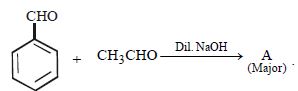
A
$C_6H_5-CH(OH)-CH_2-CHO$
B
$C_6H_5-CH=CH-CHO$
C
$C_6H_5-CH_2-CH_2-CHO$
D
$C_6H_5-CH(OH)-CH_2-CH_2OH$
Solution
(B) The reaction between benzaldehyde $(C_6H_5CHO)$ and acetaldehyde $(CH_3CHO)$ in the presence of dilute alkali is a Claisen-Schmidt condensation.
Acetaldehyde acts as the nucleophile by forming an enolate ion,which attacks the carbonyl carbon of benzaldehyde.
The initial aldol product formed is $C_6H_5-CH(OH)-CH_2-CHO$ ($3$-hydroxy$-3-$phenylpropanal).
This product undergoes spontaneous dehydration in the presence of base and heat to form the more stable conjugated product,cinnamaldehyde $(C_6H_5-CH=CH-CHO)$.
Acetaldehyde acts as the nucleophile by forming an enolate ion,which attacks the carbonyl carbon of benzaldehyde.
The initial aldol product formed is $C_6H_5-CH(OH)-CH_2-CHO$ ($3$-hydroxy$-3-$phenylpropanal).
This product undergoes spontaneous dehydration in the presence of base and heat to form the more stable conjugated product,cinnamaldehyde $(C_6H_5-CH=CH-CHO)$.
0 likesView Solution
73
ChemistryMediumMCQAIIMS · 2014
Assertion : Benzaldehyde is more reactive than ethanol towards nucleophilic attack.
Reason : The overall effect of $-I$ and $+R$ effect of phenyl group decreases the electron density on the carbon atom of $>C=O$ group in benzaldehyde.
Reason : The overall effect of $-I$ and $+R$ effect of phenyl group decreases the electron density on the carbon atom of $>C=O$ group in benzaldehyde.
A
If both Assertion and Reason are correct and the Reason is a correct explanation of the Assertion.
B
If both Assertion and Reason are correct but Reason is not a correct explanation of the Assertion.
C
If the Assertion is correct but Reason is incorrect.
D
If both the Assertion and Reason are incorrect.
Solution
(D) The Assertion is incorrect because benzaldehyde is less reactive than ethanol towards nucleophilic attack. This is due to the steric hindrance of the bulky phenyl group and the resonance stabilization of the carbonyl carbon by the phenyl ring.
The Reason is also incorrect because the $+R$ effect of the phenyl group is electron-donating,which increases the electron density on the carbonyl carbon,thereby reducing its electrophilicity.
The Reason is also incorrect because the $+R$ effect of the phenyl group is electron-donating,which increases the electron density on the carbonyl carbon,thereby reducing its electrophilicity.
0 likesView Solution
74
ChemistryMediumMCQAIIMS · 2014
Assertion : Acetamide reacts with $Br_2$ in presence of methanolic $CH_3ONa$ to form methyl $N$-methylcarbamate.
Reason : Methyl isocyanate is formed as an intermediate which reacts with methanol to form methyl $N$-methylcarbamate.
Reason : Methyl isocyanate is formed as an intermediate which reacts with methanol to form methyl $N$-methylcarbamate.
A
If both Assertion and Reason are correct and the Reason is a correct explanation of the Assertion.
B
If both Assertion and Reason are correct but Reason is not a correct explanation of the Assertion.
C
If the Assertion is correct but Reason is incorrect.
D
If both the Assertion and Reason are incorrect.
Solution
(A) The reaction of acetamide $(CH_3CONH_2)$ with $Br_2$ in the presence of a base like $CH_3ONa$ is a variation of the Hofmann bromamide degradation.
In this specific medium,the intermediate formed is methyl isocyanate $(CH_3-N=C=O)$.
This methyl isocyanate then undergoes nucleophilic attack by the methanol $(CH_3OH)$ present in the medium to form methyl $N$-methylcarbamate $(CH_3NHCOOCH_3)$.
Therefore,both the Assertion and the Reason are correct,and the Reason correctly explains the mechanism of the reaction.
In this specific medium,the intermediate formed is methyl isocyanate $(CH_3-N=C=O)$.
This methyl isocyanate then undergoes nucleophilic attack by the methanol $(CH_3OH)$ present in the medium to form methyl $N$-methylcarbamate $(CH_3NHCOOCH_3)$.
Therefore,both the Assertion and the Reason are correct,and the Reason correctly explains the mechanism of the reaction.
0 likesView Solution
75
ChemistryAdvancedMCQAIIMS · 2014
For osazone formation,the effective structural unit necessary is:
A
$CH_2OCH_3-CO-$
B
$CH_2OH-CHOH-$
C
$CH_2OH-CHOCH_3-$
D
$CHO-CHOCH_3-$
Solution
(B) Osazone formation involves the reaction of phenylhydrazine with the first two carbon atoms of a reducing sugar.
The necessary structural unit is an $\alpha$-hydroxy carbonyl group,which is represented by the structure $-CHOH-CO-$ or $-CHOH-CHOH-$.
Among the given options,the structural unit $-CHOH-CHOH-$ (or similar $\alpha$-hydroxy carbonyl precursors) is essential for the reaction to proceed.
Option $(b)$ represents the $\alpha$-hydroxy carbonyl moiety found in sugars.
The necessary structural unit is an $\alpha$-hydroxy carbonyl group,which is represented by the structure $-CHOH-CO-$ or $-CHOH-CHOH-$.
Among the given options,the structural unit $-CHOH-CHOH-$ (or similar $\alpha$-hydroxy carbonyl precursors) is essential for the reaction to proceed.
Option $(b)$ represents the $\alpha$-hydroxy carbonyl moiety found in sugars.
0 likesView Solution
76
ChemistryDifficultMCQAIIMS · 2014
Assertion: Glucose and fructose give the same osazone.
Reason: During osazone formation,stereochemistry only at $C_1$ and $C_2$ is destroyed.
Reason: During osazone formation,stereochemistry only at $C_1$ and $C_2$ is destroyed.
A
If both Assertion and Reason are correct and the Reason is a correct explanation of the Assertion.
B
If both Assertion and Reason are correct but Reason is not a correct explanation of the Assertion.
C
If the Assertion is correct but Reason is incorrect.
D
If both the Assertion and Reason are incorrect.
Solution
(A) Glucose and fructose differ only in the configuration at $C_1$ and $C_2$ atoms.
During the reaction with excess phenylhydrazine,the $C_1$ and $C_2$ atoms are involved in the formation of the osazone structure.
Since the stereochemistry at $C_3, C_4, C_5,$ and $C_6$ remains identical in both glucose and fructose,they yield the same osazone product.
Therefore,the Reason correctly explains the Assertion.
During the reaction with excess phenylhydrazine,the $C_1$ and $C_2$ atoms are involved in the formation of the osazone structure.
Since the stereochemistry at $C_3, C_4, C_5,$ and $C_6$ remains identical in both glucose and fructose,they yield the same osazone product.
Therefore,the Reason correctly explains the Assertion.
0 likesView Solution
77
ChemistryDifficultMCQAIIMS · 2014
Which compound/set of compounds is used in the manufacture of nylon $-66$ ?
A
$HOOC(CH_2)_4COOH + H_2N(CH_2)_6NH_2$
B
$CH_2 = C(CH_3) - CH = CH_2$
C
$CH_2 = CH_2$
D
Terephthalic acid $+ HOCH_2-CH_2OH$
Solution
(A) Nylon $-66$ is a polyamide formed by the condensation polymerization of adipic acid $(HOOC(CH_2)_4COOH)$ and hexamethylenediamine $(H_2N(CH_2)_6NH_2)$.
Therefore,the correct set of compounds is $HOOC(CH_2)_4COOH + H_2N(CH_2)_6NH_2$.
Therefore,the correct set of compounds is $HOOC(CH_2)_4COOH + H_2N(CH_2)_6NH_2$.
0 likesView Solution
78
ChemistryMediumMCQAIIMS · 2014
$A$ broad spectrum antibiotic is
A
paracetamol
B
penicillin
C
aspirin
D
chloramphenicol
Solution
(D) Chloramphenicol is a broad-spectrum antibiotic that functions by inhibiting bacterial protein synthesis. It is effective against a wide range of Gram-positive bacteria,Gram-negative bacteria,and anaerobes.
0 likesView Solution
79
ChemistryDifficultMCQAIIMS · 2014
Assertion : The addition of $BHA$ to butter increases its storage life from months to years.
Reason : Butylated hydroxy anisole $(BHA)$ is an antioxidant.
Reason : Butylated hydroxy anisole $(BHA)$ is an antioxidant.
A
If both Assertion and Reason are correct and the Reason is a correct explanation of the Assertion.
B
If both Assertion and Reason are correct but Reason is not a correct explanation of the Assertion.
C
If the Assertion is correct but Reason is incorrect.
D
If both the Assertion and Reason are incorrect.
Solution
(A) Antioxidants are chemical substances that retard the action of oxygen on food,thereby preventing oxidation and helping in preservation. $BHA$ (Butylated hydroxy anisole) is a well-known antioxidant added to butter to prevent rancidity caused by oxidation. Therefore,the addition of $BHA$ increases the storage life of butter,and the reason correctly explains the assertion.
0 likesView Solution
Vedclass Products
For Students
Vedclass Test Series
Mock tests in real AIIMS style covering Chemistry with performance analysis. 5-day free trial.
Start Free TrialFor Teachers
Exam Paper Generator
Generate Set A/B/C/D Chemistry papers from 7.5L+ questions in 2 minutes. 3 chapters free.
Try FreeFor Institutes
Online Exam Module
Run live AIIMS mock exams with unlimited students, 360° analytics & white-label branding.
See DemoFrequently Asked Questions
How many Chemistry questions are in AIIMS 2014?
There are 79 Chemistry questions from the AIIMS 2014 paper on Vedclass, each with a detailed step-by-step solution in English.
Are AIIMS 2014 Chemistry solutions available in English?
Yes. All solutions on this page are in English. You can also switch to English or Hindi using the language buttons above the questions.
Can I practice AIIMS 2014 Chemistry as a timed test?
Yes. Use the Vedclass Test Series to attempt a full AIIMS mock test covering Chemistry with time limits and instant score analysis.
Can teachers create Chemistry papers from AIIMS previous year questions?
Yes. The Vedclass Exam Paper Generator lets teachers mix AIIMS Chemistry questions and generate Set A/B/C/D papers in minutes.
For Teachers & Institutes
Build a Custom Chemistry Paper
Pick AIIMS 2014 Chemistry questions, set difficulty, and generate Set A/B/C/D in 2 minutes.