
A English
Electric potential Questions in English
Class 12 Physics · Electric Potential and Capacitance · Electric potential
432+
Questions
English
Language
100%
With Solutions
Showing 50 of 432 questions in English
351
EasyMCQ
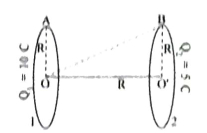
Two identical thin rings each of radius $R \text{ m}$ are kept on the same axis at a distance of $R \text{ m}$ apart. If the charges on them are $10 \text{ C}$ and $5 \text{ C}$ respectively,calculate the work done in moving a charge '$q$' coulomb from the centre of one ring to that of another.
A
$\frac{5 q}{4 \pi \varepsilon_0 R}\left[\frac{\sqrt{2}-1}{2}\right] \text{ J}$
B
$\frac{5 q}{4 \pi \varepsilon_0 R}\left[1-\frac{1}{\sqrt{2}}\right] \text{ J}$
C
$\frac{15 q}{4 \pi \varepsilon_0 R}\left[\frac{\sqrt{2}-1}{\sqrt{2}}\right] \text{ J}$
D
$\frac{10 q}{4 \pi \varepsilon_0 R}\left[\frac{\sqrt{2}-1}{\sqrt{2}}\right] \text{ J}$
Solution
(B) Let the charges on the rings be $Q_1 = 10 \text{ C}$ and $Q_2 = 5 \text{ C}$. The distance between the centres $O$ and $O'$ is $R$.
The potential at the centre $O$ of the first ring is due to its own charge $Q_1$ and the charge $Q_2$ on the second ring:
$V_O = \frac{k Q_1}{R} + \frac{k Q_2}{\sqrt{R^2 + R^2}} = \frac{k Q_1}{R} + \frac{k Q_2}{\sqrt{2}R} = \frac{k}{R} \left( Q_1 + \frac{Q_2}{\sqrt{2}} \right)$
The potential at the centre $O'$ of the second ring is due to its own charge $Q_2$ and the charge $Q_1$ on the first ring:
$V_{O'} = \frac{k Q_2}{R} + \frac{k Q_1}{\sqrt{R^2 + R^2}} = \frac{k Q_2}{R} + \frac{k Q_1}{\sqrt{2}R} = \frac{k}{R} \left( Q_2 + \frac{Q_1}{\sqrt{2}} \right)$
The potential difference is $\Delta V = V_O - V_{O'}$:
$\Delta V = \frac{k}{R} \left( Q_1 + \frac{Q_2}{\sqrt{2}} - Q_2 - \frac{Q_1}{\sqrt{2}} \right) = \frac{k}{R} \left( Q_1(1 - \frac{1}{\sqrt{2}}) - Q_2(1 - \frac{1}{\sqrt{2}}) \right)$
$\Delta V = \frac{k}{R} (Q_1 - Q_2) \left( 1 - \frac{1}{\sqrt{2}} \right)$
Substituting $Q_1 = 10 \text{ C}$,$Q_2 = 5 \text{ C}$,and $k = \frac{1}{4 \pi \varepsilon_0}$:
$W = q \Delta V = \frac{q}{4 \pi \varepsilon_0 R} (10 - 5) \left( 1 - \frac{1}{\sqrt{2}} \right) = \frac{5 q}{4 \pi \varepsilon_0 R} \left( 1 - \frac{1}{\sqrt{2}} \right) \text{ J}$.
The potential at the centre $O$ of the first ring is due to its own charge $Q_1$ and the charge $Q_2$ on the second ring:
$V_O = \frac{k Q_1}{R} + \frac{k Q_2}{\sqrt{R^2 + R^2}} = \frac{k Q_1}{R} + \frac{k Q_2}{\sqrt{2}R} = \frac{k}{R} \left( Q_1 + \frac{Q_2}{\sqrt{2}} \right)$
The potential at the centre $O'$ of the second ring is due to its own charge $Q_2$ and the charge $Q_1$ on the first ring:
$V_{O'} = \frac{k Q_2}{R} + \frac{k Q_1}{\sqrt{R^2 + R^2}} = \frac{k Q_2}{R} + \frac{k Q_1}{\sqrt{2}R} = \frac{k}{R} \left( Q_2 + \frac{Q_1}{\sqrt{2}} \right)$
The potential difference is $\Delta V = V_O - V_{O'}$:
$\Delta V = \frac{k}{R} \left( Q_1 + \frac{Q_2}{\sqrt{2}} - Q_2 - \frac{Q_1}{\sqrt{2}} \right) = \frac{k}{R} \left( Q_1(1 - \frac{1}{\sqrt{2}}) - Q_2(1 - \frac{1}{\sqrt{2}}) \right)$
$\Delta V = \frac{k}{R} (Q_1 - Q_2) \left( 1 - \frac{1}{\sqrt{2}} \right)$
Substituting $Q_1 = 10 \text{ C}$,$Q_2 = 5 \text{ C}$,and $k = \frac{1}{4 \pi \varepsilon_0}$:
$W = q \Delta V = \frac{q}{4 \pi \varepsilon_0 R} (10 - 5) \left( 1 - \frac{1}{\sqrt{2}} \right) = \frac{5 q}{4 \pi \varepsilon_0 R} \left( 1 - \frac{1}{\sqrt{2}} \right) \text{ J}$.
0 likes
View Solution352
EasyMCQ
The unit of the physical quantity obtained by the line integral of the electric field is . . . . . . .
A
$N C^{-1}$
B
$V m^{-1}$
C
$J C^{-1}$
D
$C^2 N^{-1} m^{-1}$
Solution
(C) The line integral of the electric field $\vec{E}$ along a path is defined as the potential difference $V$ between two points.
Mathematically,$V = -\int \vec{E} \cdot d\vec{l}$.
The $SI$ unit of electric potential $V$ is the volt $(V)$,which is defined as the work done per unit charge.
Therefore,$1 \ V = 1 \ J C^{-1}$.
Thus,the unit of the physical quantity obtained by the line integral of the electric field is $J C^{-1}$ (or Volts).
Mathematically,$V = -\int \vec{E} \cdot d\vec{l}$.
The $SI$ unit of electric potential $V$ is the volt $(V)$,which is defined as the work done per unit charge.
Therefore,$1 \ V = 1 \ J C^{-1}$.
Thus,the unit of the physical quantity obtained by the line integral of the electric field is $J C^{-1}$ (or Volts).
0 likes
View Solution353
EasyMCQ
$A$ hollow metal sphere of radius $10 \ cm$ is charged such that the potential on its surface becomes $80 \ V$. The potential at the centre of the sphere is . . . . . . . (in $V$)
A
$80$
B
$800$
C
$8$
D
$0$
Solution
(A) For a charged hollow metal sphere,the electric field inside the sphere is zero $(E = 0)$.
Since the electric field is the negative gradient of the potential $(E = -dV/dr)$,if $E = 0$,then the potential $V$ must be constant throughout the interior of the sphere.
Therefore,the potential at any point inside the sphere,including the centre,is equal to the potential on its surface.
Given that the potential on the surface is $80 \ V$,the potential at the centre of the sphere is $80 \ V$.
Since the electric field is the negative gradient of the potential $(E = -dV/dr)$,if $E = 0$,then the potential $V$ must be constant throughout the interior of the sphere.
Therefore,the potential at any point inside the sphere,including the centre,is equal to the potential on its surface.
Given that the potential on the surface is $80 \ V$,the potential at the centre of the sphere is $80 \ V$.
0 likes
View Solution354
EasyMCQ
Out of two copper spheres of the same size,$x$ is hollow while $y$ is solid. If they are charged at the same potential,what can be said about the charges on them?
A
Sphere $y$ will have more charge.
B
Sphere $x$ will have more charge.
C
Charge on both the spheres is zero.
D
Charge on both the spheres is equal.
Solution
(D) For a conducting sphere,the electric potential $V$ at the surface is given by $V = \frac{kQ}{R}$,where $k$ is Coulomb's constant,$Q$ is the charge on the sphere,and $R$ is the radius of the sphere.
Since both spheres are made of copper (a conductor) and have the same size,they have the same radius $R$.
Given that both spheres are charged to the same potential $V$,we have $V_x = V_y = V$.
Using the formula $V = \frac{kQ}{R}$,we get $V = \frac{kQ_x}{R}$ and $V = \frac{kQ_y}{R}$.
Equating the two,we find $\frac{kQ_x}{R} = \frac{kQ_y}{R}$,which implies $Q_x = Q_y$.
Therefore,the charge on both spheres is equal,regardless of whether the sphere is hollow or solid,because the charge on a conductor resides entirely on its outer surface.
Since both spheres are made of copper (a conductor) and have the same size,they have the same radius $R$.
Given that both spheres are charged to the same potential $V$,we have $V_x = V_y = V$.
Using the formula $V = \frac{kQ}{R}$,we get $V = \frac{kQ_x}{R}$ and $V = \frac{kQ_y}{R}$.
Equating the two,we find $\frac{kQ_x}{R} = \frac{kQ_y}{R}$,which implies $Q_x = Q_y$.
Therefore,the charge on both spheres is equal,regardless of whether the sphere is hollow or solid,because the charge on a conductor resides entirely on its outer surface.
0 likes
View Solution355
EasyMCQ
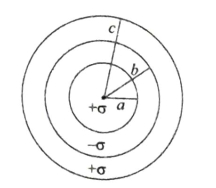
Consider three concentric metal shells $A$,$B$,and $C$ with radii $a$,$b$,and $c$ respectively,as shown in the figure $(a < b < c)$. Their surface charge densities are $\sigma$,$-\sigma$,and $\sigma$ respectively. Calculate the electric potential on the surface of shell $A$.
A
$\frac{\sigma}{\varepsilon_0}(a-b-c)$
B
$\frac{\sigma}{\varepsilon_0}(a+b-c)$
C
$\frac{\sigma}{\varepsilon_0}(a-b+c)$
D
$\frac{\sigma}{\varepsilon_0}(a^2+b^2+c^2)$
Solution
(C) The electric potential at the surface of shell $A$ is the sum of the potentials due to all three shells $A$,$B$,and $C$.
$V_A = V_a + V_b + V_c$
Since the point on the surface of shell $A$ is inside shells $B$ and $C$,the potential due to shells $B$ and $C$ at this point is equal to the potential at their respective surfaces.
$V_A = \frac{1}{4 \pi \varepsilon_0} \left[ \frac{q_a}{a} + \frac{q_b}{b} + \frac{q_c}{c} \right]$
Given surface charge densities: $\sigma_a = \sigma$,$\sigma_b = -\sigma$,$\sigma_c = \sigma$.
The charges are $q_a = 4 \pi a^2 \sigma$,$q_b = 4 \pi b^2(-\sigma)$,and $q_c = 4 \pi c^2 \sigma$.
Substituting these into the potential formula:
$V_A = \frac{1}{4 \pi \varepsilon_0} \left[ \frac{4 \pi a^2 \sigma}{a} + \frac{4 \pi b^2(-\sigma)}{b} + \frac{4 \pi c^2 \sigma}{c} \right]$
$V_A = \frac{1}{4 \pi \varepsilon_0} [4 \pi a \sigma - 4 \pi b \sigma + 4 \pi c \sigma]$
$V_A = \frac{\sigma}{\varepsilon_0} (a - b + c)$
$V_A = V_a + V_b + V_c$
Since the point on the surface of shell $A$ is inside shells $B$ and $C$,the potential due to shells $B$ and $C$ at this point is equal to the potential at their respective surfaces.
$V_A = \frac{1}{4 \pi \varepsilon_0} \left[ \frac{q_a}{a} + \frac{q_b}{b} + \frac{q_c}{c} \right]$
Given surface charge densities: $\sigma_a = \sigma$,$\sigma_b = -\sigma$,$\sigma_c = \sigma$.
The charges are $q_a = 4 \pi a^2 \sigma$,$q_b = 4 \pi b^2(-\sigma)$,and $q_c = 4 \pi c^2 \sigma$.
Substituting these into the potential formula:
$V_A = \frac{1}{4 \pi \varepsilon_0} \left[ \frac{4 \pi a^2 \sigma}{a} + \frac{4 \pi b^2(-\sigma)}{b} + \frac{4 \pi c^2 \sigma}{c} \right]$
$V_A = \frac{1}{4 \pi \varepsilon_0} [4 \pi a \sigma - 4 \pi b \sigma + 4 \pi c \sigma]$
$V_A = \frac{\sigma}{\varepsilon_0} (a - b + c)$
0 likes
View Solution356
EasyMCQ
If $20 \ J$ of work has to be done to move an electric charge of $4 \ C$ from a point where potential is $10 \ V$ to another point,where potential is $V \ V$,find the value of $V$. (in $V$)
A
$5$
B
$15$
C
$2$
D
$70$
Solution
(B) The work done $W$ in moving a charge $q$ between two points with potential difference $\Delta V$ is given by the formula: $W = q \Delta V$.
Here,$W = 20 \ J$,$q = 4 \ C$,initial potential $V_i = 10 \ V$,and final potential $V_f = V$.
The potential difference is $\Delta V = V_f - V_i = V - 10$.
Substituting the values into the formula:
$20 = 4(V - 10)$
Divide both sides by $4$:
$5 = V - 10$
Adding $10$ to both sides:
$V = 15 \ V$.
Here,$W = 20 \ J$,$q = 4 \ C$,initial potential $V_i = 10 \ V$,and final potential $V_f = V$.
The potential difference is $\Delta V = V_f - V_i = V - 10$.
Substituting the values into the formula:
$20 = 4(V - 10)$
Divide both sides by $4$:
$5 = V - 10$
Adding $10$ to both sides:
$V = 15 \ V$.
0 likes
View Solution357
EasyMCQ
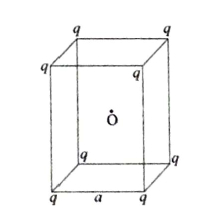
Eight charges,each of magnitude $q$,are placed at the vertices of a cube placed in a vacuum. The electric potential at the centre of the cube due to this system of charges is . . . . . . . ($\varepsilon_0 = $ permittivity of vacuum,$a = $ length of each side of the cube.)
A
zero
B
$\frac{\sqrt{3} q}{\pi \varepsilon_0 a}$
C
$\frac{2 q}{\pi \varepsilon_0 a}$
D
$\frac{4 q}{\sqrt{3} \pi \varepsilon_0 a}$
Solution
(D) The length of the body diagonal of a cube with side $a$ is $\sqrt{3} a$. The distance $r$ of each vertex from the centre $O$ of the cube is half of the body diagonal: $r = \frac{\sqrt{3} a}{2}$.
Since there are $8$ identical charges $q$ at the vertices,the total electric potential $V$ at the centre $O$ is the sum of the potentials due to each individual charge:
$V = 8 \times \frac{1}{4 \pi \varepsilon_0} \times \frac{q}{r}$
Substituting the value of $r$:
$V = 8 \times \frac{1}{4 \pi \varepsilon_0} \times \frac{q}{\frac{\sqrt{3} a}{2}}$
$V = 8 \times \frac{1}{4 \pi \varepsilon_0} \times \frac{2q}{\sqrt{3} a}$
$V = \frac{4 q}{\sqrt{3} \pi \varepsilon_0 a}$
Since there are $8$ identical charges $q$ at the vertices,the total electric potential $V$ at the centre $O$ is the sum of the potentials due to each individual charge:
$V = 8 \times \frac{1}{4 \pi \varepsilon_0} \times \frac{q}{r}$
Substituting the value of $r$:
$V = 8 \times \frac{1}{4 \pi \varepsilon_0} \times \frac{q}{\frac{\sqrt{3} a}{2}}$
$V = 8 \times \frac{1}{4 \pi \varepsilon_0} \times \frac{2q}{\sqrt{3} a}$
$V = \frac{4 q}{\sqrt{3} \pi \varepsilon_0 a}$
0 likes
View Solution358
EasyMCQ
The electric potential at the surface of an atomic nucleus $(Z=50)$ of radius $9 \times 10^{-15} \ m$ is . . . . . . .
A
$9 \ V$
B
$9 \times 10^5 \ V$
C
$80 \ V$
D
$8 \times 10^6 \ V$
Solution
(D) The electric potential $V$ at the surface of a nucleus is given by the formula: $V = \frac{k Q}{r}$.
Here,$k = 9 \times 10^9 \ N \ m^2/C^2$,$Q = Ze = 50 \times 1.6 \times 10^{-19} \ C$,and $r = 9 \times 10^{-15} \ m$.
Substituting these values into the formula:
$V = \frac{(9 \times 10^9) \times (50 \times 1.6 \times 10^{-19})}{9 \times 10^{-15}}$
$V = \frac{9 \times 10^9 \times 80 \times 10^{-19}}{9 \times 10^{-15}}$
$V = 80 \times 10^{-10} \times 10^{15} \ V$
$V = 80 \times 10^5 \ V = 8 \times 10^6 \ V$.
Therefore,the correct option is $D$.
Here,$k = 9 \times 10^9 \ N \ m^2/C^2$,$Q = Ze = 50 \times 1.6 \times 10^{-19} \ C$,and $r = 9 \times 10^{-15} \ m$.
Substituting these values into the formula:
$V = \frac{(9 \times 10^9) \times (50 \times 1.6 \times 10^{-19})}{9 \times 10^{-15}}$
$V = \frac{9 \times 10^9 \times 80 \times 10^{-19}}{9 \times 10^{-15}}$
$V = 80 \times 10^{-10} \times 10^{15} \ V$
$V = 80 \times 10^5 \ V = 8 \times 10^6 \ V$.
Therefore,the correct option is $D$.
0 likes
View Solution359
EasyMCQ
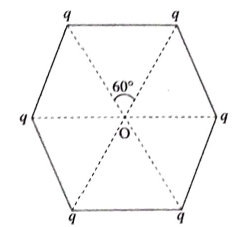
$A$ regular hexagon of side $9 \ cm$ has a charge $5 \mu C$ at each of its vertices. The electric potential at its centre is $..........V$. $(k = 9 \times 10^9 \ Nm^2 C^{-2})$
A
$3 \times 10^7$
B
$3 \times 10^5$
C
$3 \times 10^6$
D
$3 \times 10^8$
Solution
(C) In a regular hexagon,the distance from the centre to each vertex is equal to the side length of the hexagon. Given side length $r = 9 \ cm = 0.09 \ m$.
Each vertex has a charge $q = 5 \mu C = 5 \times 10^{-6} \ C$.
The electric potential $V$ at the centre due to a single charge $q$ at distance $r$ is $V_i = \frac{kq}{r}$.
Since there are $6$ identical charges at the vertices,the total potential $V$ at the centre is the sum of potentials due to each charge:
$V = 6 \times \frac{kq}{r}$
Substituting the values:
$V = 6 \times \frac{9 \times 10^9 \times 5 \times 10^{-6}}{0.09}$
$V = 6 \times \frac{45 \times 10^3}{9 \times 10^{-2}}$
$V = 6 \times 5 \times 10^5$
$V = 30 \times 10^5 = 3 \times 10^6 \ V$.
Each vertex has a charge $q = 5 \mu C = 5 \times 10^{-6} \ C$.
The electric potential $V$ at the centre due to a single charge $q$ at distance $r$ is $V_i = \frac{kq}{r}$.
Since there are $6$ identical charges at the vertices,the total potential $V$ at the centre is the sum of potentials due to each charge:
$V = 6 \times \frac{kq}{r}$
Substituting the values:
$V = 6 \times \frac{9 \times 10^9 \times 5 \times 10^{-6}}{0.09}$
$V = 6 \times \frac{45 \times 10^3}{9 \times 10^{-2}}$
$V = 6 \times 5 \times 10^5$
$V = 30 \times 10^5 = 3 \times 10^6 \ V$.
0 likes
View Solution360
EasyMCQ
The electric potential energy of a $2 \mu C$ charge is $3 \times 10^{-5} \text{ J}$ at a point in a uniform electric field. The electric potential at the point is . . . . . . $V$.
A
$5$
B
$15$
C
$6$
D
zero
Solution
(B) The electric potential $V$ at a point is defined as the electric potential energy $U$ per unit charge $q$.
Formula: $V = \frac{U}{q}$
Given:
Charge $q = 2 \mu C = 2 \times 10^{-6} \text{ C}$
Potential Energy $U = 3 \times 10^{-5} \text{ J}$
Calculation:
$V = \frac{3 \times 10^{-5}}{2 \times 10^{-6}}$
$V = 1.5 \times 10^1$
$V = 15 \text{ V}$
Therefore,the electric potential at the point is $15 \text{ V}$.
Formula: $V = \frac{U}{q}$
Given:
Charge $q = 2 \mu C = 2 \times 10^{-6} \text{ C}$
Potential Energy $U = 3 \times 10^{-5} \text{ J}$
Calculation:
$V = \frac{3 \times 10^{-5}}{2 \times 10^{-6}}$
$V = 1.5 \times 10^1$
$V = 15 \text{ V}$
Therefore,the electric potential at the point is $15 \text{ V}$.
0 likes
View Solution361
EasyMCQ
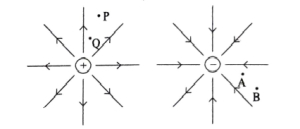
The figure shows the electric field lines of a positive and a negative charge,respectively. Determine the sign of the potential difference $V_Q - V_P$ and $V_B - V_A$.
A
$-Ve, +Ve$
B
$+Ve, -Ve$
C
$+Ve, +Ve$
D
$-Ve, -Ve$
Solution
(C) For a positive charge $+q$,the electric potential at a distance $r$ is given by $V = \frac{kq}{r}$. Since $V \propto \frac{1}{r}$,the potential is higher closer to the charge.
For the positive charge,point $Q$ is closer to the charge than point $P$,so $r_Q < r_P$. This implies $V_Q > V_P$,therefore $V_Q - V_P > 0$ (positive).
For a negative charge $-q$,the electric potential is given by $V = \frac{k(-q)}{r} = -\frac{kq}{r}$. Here,the potential is more negative (lower) closer to the charge.
For the negative charge,point $A$ is closer to the charge than point $B$,so $r_A < r_B$. This implies $V_A < V_B$ (since $V_A$ is more negative than $V_B$). Therefore,$V_B - V_A > 0$ (positive).
Thus,both potential differences are positive.
For the positive charge,point $Q$ is closer to the charge than point $P$,so $r_Q < r_P$. This implies $V_Q > V_P$,therefore $V_Q - V_P > 0$ (positive).
For a negative charge $-q$,the electric potential is given by $V = \frac{k(-q)}{r} = -\frac{kq}{r}$. Here,the potential is more negative (lower) closer to the charge.
For the negative charge,point $A$ is closer to the charge than point $B$,so $r_A < r_B$. This implies $V_A < V_B$ (since $V_A$ is more negative than $V_B$). Therefore,$V_B - V_A > 0$ (positive).
Thus,both potential differences are positive.
0 likes
View Solution362
EasyMCQ
What is the electric potential at a distance of $9 \text{ cm}$ from a charge of $3 \text{ nC}$ (in $\text{ V}$)?
A
$270$
B
$3$
C
$300$
D
$30$
Solution
(C) The electric potential $V$ at a distance $r$ from a point charge $q$ is given by the formula:
$V = \frac{1}{4 \pi \epsilon_{0}} \frac{q}{r}$
Given values:
Charge $q = 3 \text{ nC} = 3 \times 10^{-9} \text{ C}$
Distance $r = 9 \text{ cm} = 9 \times 10^{-2} \text{ m}$
Coulomb's constant $\frac{1}{4 \pi \epsilon_{0}} = 9 \times 10^{9} \text{ N m}^2/\text{C}^2$
Substituting these values into the formula:
$V = (9 \times 10^{9}) \times \frac{3 \times 10^{-9}}{9 \times 10^{-2}}$
$V = \frac{9 \times 3 \times 10^{0}}{9 \times 10^{-2}}$
$V = 3 \times 10^{2} \text{ V} = 300 \text{ V}$
Therefore, the electric potential is $300 \text{ V}$.
$V = \frac{1}{4 \pi \epsilon_{0}} \frac{q}{r}$
Given values:
Charge $q = 3 \text{ nC} = 3 \times 10^{-9} \text{ C}$
Distance $r = 9 \text{ cm} = 9 \times 10^{-2} \text{ m}$
Coulomb's constant $\frac{1}{4 \pi \epsilon_{0}} = 9 \times 10^{9} \text{ N m}^2/\text{C}^2$
Substituting these values into the formula:
$V = (9 \times 10^{9}) \times \frac{3 \times 10^{-9}}{9 \times 10^{-2}}$
$V = \frac{9 \times 3 \times 10^{0}}{9 \times 10^{-2}}$
$V = 3 \times 10^{2} \text{ V} = 300 \text{ V}$
Therefore, the electric potential is $300 \text{ V}$.
0 likes
View Solution363
MediumMCQ
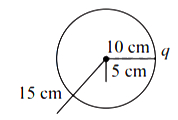
$A$ spherical shell of radius $10 \,cm$ is carrying a charge $q$. If the electric potential at distances $5 \,cm$, $10 \,cm$, and $15 \,cm$ from the centre of the spherical shell is $V_{1}$, $V_{2}$, and $V_{3}$ respectively, then:
A
$V_{1} > V_{2} > V_{3}$
B
$V_{1} < V_{2} < V_{3}$
C
$V_{1} = V_{2} > V_{3}$
D
$V_{1} = V_{2} < V_{3}$
Solution
(C) For a charged spherical shell of radius $R = 10 \,cm$ carrying charge $q$:
$1$. Inside the shell $(r < R)$, the electric potential is constant and equal to the potential at the surface: $V = \frac{1}{4 \pi \varepsilon_{0}} \frac{q}{R}$.
$2$. Outside the shell $(r > R)$, the potential varies inversely with distance: $V = \frac{1}{4 \pi \varepsilon_{0}} \frac{q}{r}$.
Given distances are $r_{1} = 5 \,cm$, $r_{2} = 10 \,cm$, and $r_{3} = 15 \,cm$.
Since $r_{1} < R$ and $r_{2} = R$, we have $V_{1} = V_{2} = \frac{1}{4 \pi \varepsilon_{0}} \frac{q}{10}$.
For $r_{3} = 15 \,cm$, $V_{3} = \frac{1}{4 \pi \varepsilon_{0}} \frac{q}{15}$.
Comparing the values, since $15 > 10$, it follows that $\frac{q}{15} < \frac{q}{10}$, therefore $V_{3} < V_{1} = V_{2}$.
Thus, the correct relation is $V_{1} = V_{2} > V_{3}$.
$1$. Inside the shell $(r < R)$, the electric potential is constant and equal to the potential at the surface: $V = \frac{1}{4 \pi \varepsilon_{0}} \frac{q}{R}$.
$2$. Outside the shell $(r > R)$, the potential varies inversely with distance: $V = \frac{1}{4 \pi \varepsilon_{0}} \frac{q}{r}$.
Given distances are $r_{1} = 5 \,cm$, $r_{2} = 10 \,cm$, and $r_{3} = 15 \,cm$.
Since $r_{1} < R$ and $r_{2} = R$, we have $V_{1} = V_{2} = \frac{1}{4 \pi \varepsilon_{0}} \frac{q}{10}$.
For $r_{3} = 15 \,cm$, $V_{3} = \frac{1}{4 \pi \varepsilon_{0}} \frac{q}{15}$.
Comparing the values, since $15 > 10$, it follows that $\frac{q}{15} < \frac{q}{10}$, therefore $V_{3} < V_{1} = V_{2}$.
Thus, the correct relation is $V_{1} = V_{2} > V_{3}$.
0 likes
View Solution364
EasyMCQ
$A$ potential at a point $A$ is $-3 \ V$ and that at another point $B$ is $5 \ V$. What is the work done in carrying a charge of $5 \ mC$ from $B$ to $A$?
A
-$0.04$ $J$
B
-$0.4$ $J$
C
-$4$ $J$
D
-$40$ $J$
Solution
(A) The work done $W$ in moving a charge $q$ from point $B$ to point $A$ is given by the formula: $W = q(V_A - V_B)$.
Given:
Charge $q = 5 \ mC = 5 \times 10^{-3} \ C$.
Potential at $A$,$V_A = -3 \ V$.
Potential at $B$,$V_B = 5 \ V$.
Substituting the values:
$W = 5 \times 10^{-3} \times (-3 - 5)$
$W = 5 \times 10^{-3} \times (-8)$
$W = -40 \times 10^{-3} \ J$
$W = -0.04 \ J$.
Given:
Charge $q = 5 \ mC = 5 \times 10^{-3} \ C$.
Potential at $A$,$V_A = -3 \ V$.
Potential at $B$,$V_B = 5 \ V$.
Substituting the values:
$W = 5 \times 10^{-3} \times (-3 - 5)$
$W = 5 \times 10^{-3} \times (-8)$
$W = -40 \times 10^{-3} \ J$
$W = -0.04 \ J$.
0 likes
View Solution365
MediumMCQ
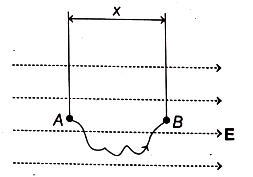
$A$ uniform electric field vector $E$ exists along the horizontal direction as shown. The electric potential at $A$ is $V_A$. $A$ small point charge $q$ is slowly moved from $A$ to $B$ along the curved path as shown. The potential energy of the charge when it is at point $B$ is
A
$q(V_A - Ex)$
B
$q(V_A + Ex)$
C
$q(Ex - V_A)$
D
$qEx$
Solution
(A) The electric potential at point $A$ is $V_A$.
Since the electric field $E$ is uniform and directed towards the right,the potential decreases in the direction of the electric field.
The horizontal distance between $A$ and $B$ is $x$. Therefore,the potential difference between $A$ and $B$ is $\Delta V = V_B - V_A = -E \cdot x$.
Thus,the potential at $B$ is $V_B = V_A - Ex$.
The potential energy $U$ of a charge $q$ at a point with potential $V$ is given by $U = qV$.
Therefore,the potential energy of the charge at point $B$ is $U_B = q V_B = q(V_A - Ex)$.
Since the electric field $E$ is uniform and directed towards the right,the potential decreases in the direction of the electric field.
The horizontal distance between $A$ and $B$ is $x$. Therefore,the potential difference between $A$ and $B$ is $\Delta V = V_B - V_A = -E \cdot x$.
Thus,the potential at $B$ is $V_B = V_A - Ex$.
The potential energy $U$ of a charge $q$ at a point with potential $V$ is given by $U = qV$.
Therefore,the potential energy of the charge at point $B$ is $U_B = q V_B = q(V_A - Ex)$.
0 likes
View Solution366
MediumMCQ
Two tiny spheres carrying charges $1.8 \mu C$ and $2.8 \mu C$ are located $40 \ cm$ apart. The potential at the mid-point of the line joining the two charges is:
A
$2.1 \times 10^5 \ V$
B
$1.3 \times 10^4 \ V$
C
$3.6 \times 10^5 \ V$
D
$3.8 \times 10^4 \ V$
Solution
(A) Charge on the first sphere,$q_1 = 1.8 \mu C = 1.8 \times 10^{-6} \ C$.
Charge on the second sphere,$q_2 = 2.8 \mu C = 2.8 \times 10^{-6} \ C$.
Distance between the two spheres,$r = 40 \ cm = 0.4 \ m$.
Distance from the mid-point to each sphere,$r_1 = r_2 = 20 \ cm = 0.2 \ m$.
The total electric potential $V$ at the mid-point is the algebraic sum of the potentials due to individual charges:
$V = V_1 + V_2 = \frac{1}{4 \pi \varepsilon_0} \left( \frac{q_1}{r_1} + \frac{q_2}{r_2} \right)$
Substituting the values,where $\frac{1}{4 \pi \varepsilon_0} = 9 \times 10^9 \ N \cdot m^2/C^2$:
$V = 9 \times 10^9 \times \left( \frac{1.8 \times 10^{-6}}{0.2} + \frac{2.8 \times 10^{-6}}{0.2} \right)$
$V = 9 \times 10^9 \times \frac{10^{-6}}{0.2} \times (1.8 + 2.8)$
$V = 9 \times 10^3 \times \frac{4.6}{0.2}$
$V = 9 \times 10^3 \times 23 = 207 \times 10^3 \ V = 2.07 \times 10^5 \ V$.
Rounding to two significant figures,$V \approx 2.1 \times 10^5 \ V$.
Charge on the second sphere,$q_2 = 2.8 \mu C = 2.8 \times 10^{-6} \ C$.
Distance between the two spheres,$r = 40 \ cm = 0.4 \ m$.
Distance from the mid-point to each sphere,$r_1 = r_2 = 20 \ cm = 0.2 \ m$.
The total electric potential $V$ at the mid-point is the algebraic sum of the potentials due to individual charges:
$V = V_1 + V_2 = \frac{1}{4 \pi \varepsilon_0} \left( \frac{q_1}{r_1} + \frac{q_2}{r_2} \right)$
Substituting the values,where $\frac{1}{4 \pi \varepsilon_0} = 9 \times 10^9 \ N \cdot m^2/C^2$:
$V = 9 \times 10^9 \times \left( \frac{1.8 \times 10^{-6}}{0.2} + \frac{2.8 \times 10^{-6}}{0.2} \right)$
$V = 9 \times 10^9 \times \frac{10^{-6}}{0.2} \times (1.8 + 2.8)$
$V = 9 \times 10^3 \times \frac{4.6}{0.2}$
$V = 9 \times 10^3 \times 23 = 207 \times 10^3 \ V = 2.07 \times 10^5 \ V$.
Rounding to two significant figures,$V \approx 2.1 \times 10^5 \ V$.
0 likes
View Solution367
DifficultMCQ
The concentric spheres of radii $R$ and $r$ have positive charges $q_{1}$ and $q_{2}$ with equal surface charge densities. What is the electric potential at their common centre?
A
$\frac{\sigma}{\varepsilon_{0}}(R+r)$
B
$\frac{\sigma}{\varepsilon_{0}}(R-r)$
C
$\frac{\sigma}{\varepsilon_{0}}\left(\frac{1}{R}+\frac{1}{r}\right)$
D
$\frac{\sigma}{\varepsilon_{0}}\left(\frac{1}{R}\right)$
Solution
(A) The electric potential at the centre of a charged spherical shell of radius $R$ with charge $q$ is $V = \frac{q}{4 \pi \varepsilon_{0} R}$.
For the two concentric spheres,the total potential $V$ at the common centre is the sum of potentials due to each sphere:
$V = V_{1} + V_{2} = \frac{q_{1}}{4 \pi \varepsilon_{0} R} + \frac{q_{2}}{4 \pi \varepsilon_{0} r}$.
Given that the surface charge densities are equal,$\sigma = \frac{q_{1}}{4 \pi R^{2}} = \frac{q_{2}}{4 \pi r^{2}}$.
This implies $q_{1} = 4 \pi R^{2} \sigma$ and $q_{2} = 4 \pi r^{2} \sigma$.
Substituting these values into the potential equation:
$V = \frac{4 \pi R^{2} \sigma}{4 \pi \varepsilon_{0} R} + \frac{4 \pi r^{2} \sigma}{4 \pi \varepsilon_{0} r}$.
$V = \frac{R \sigma}{\varepsilon_{0}} + \frac{r \sigma}{\varepsilon_{0}} = \frac{\sigma}{\varepsilon_{0}}(R + r)$.
For the two concentric spheres,the total potential $V$ at the common centre is the sum of potentials due to each sphere:
$V = V_{1} + V_{2} = \frac{q_{1}}{4 \pi \varepsilon_{0} R} + \frac{q_{2}}{4 \pi \varepsilon_{0} r}$.
Given that the surface charge densities are equal,$\sigma = \frac{q_{1}}{4 \pi R^{2}} = \frac{q_{2}}{4 \pi r^{2}}$.
This implies $q_{1} = 4 \pi R^{2} \sigma$ and $q_{2} = 4 \pi r^{2} \sigma$.
Substituting these values into the potential equation:
$V = \frac{4 \pi R^{2} \sigma}{4 \pi \varepsilon_{0} R} + \frac{4 \pi r^{2} \sigma}{4 \pi \varepsilon_{0} r}$.
$V = \frac{R \sigma}{\varepsilon_{0}} + \frac{r \sigma}{\varepsilon_{0}} = \frac{\sigma}{\varepsilon_{0}}(R + r)$.
0 likes
View Solution368
DifficultMCQ
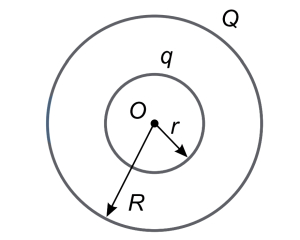
$A$ small conducting sphere of radius $r$ is lying concentrically inside a bigger hollow conducting sphere of radius $R$. The bigger and smaller spheres are charged with $Q$ and $q$ respectively $(Q > q)$ and are insulated from each other. The potential difference between the spheres will be
A
$\frac{1}{4 \pi \varepsilon_{0}}\left(\frac{q}{r}-\frac{q}{R}\right)$
B
$\frac{1}{4 \pi \varepsilon_{0}}\left(\frac{q}{R}-\frac{Q}{r}\right)$
C
$\frac{1}{4 \pi \varepsilon_{0}}\left(\frac{q}{r}-\frac{Q}{R}\right)$
D
$\frac{1}{4 \pi \varepsilon_{0}}\left(\frac{Q}{R}+\frac{q}{r}\right)$
Solution
(A) The potential $V_{1}$ of the smaller sphere (radius $r$,charge $q$) is due to its own charge and the potential due to the outer sphere (radius $R$,charge $Q$).
$V_{1} = \frac{1}{4 \pi \varepsilon_{0}} \cdot \frac{q}{r} + \frac{1}{4 \pi \varepsilon_{0}} \cdot \frac{Q}{R}$
The potential $V_{2}$ of the bigger sphere (radius $R$,charge $Q$) is due to its own charge and the potential due to the inner sphere (which acts as a point charge at the center for points outside it).
$V_{2} = \frac{1}{4 \pi \varepsilon_{0}} \cdot \frac{Q}{R} + \frac{1}{4 \pi \varepsilon_{0}} \cdot \frac{q}{R}$
The potential difference between the spheres is $V = V_{1} - V_{2}$.
$V = \left( \frac{1}{4 \pi \varepsilon_{0}} \cdot \frac{q}{r} + \frac{1}{4 \pi \varepsilon_{0}} \cdot \frac{Q}{R} \right) - \left( \frac{1}{4 \pi \varepsilon_{0}} \cdot \frac{Q}{R} + \frac{1}{4 \pi \varepsilon_{0}} \cdot \frac{q}{R} \right)$
$V = \frac{1}{4 \pi \varepsilon_{0}} \cdot \frac{q}{r} + \frac{1}{4 \pi \varepsilon_{0}} \cdot \frac{Q}{R} - \frac{1}{4 \pi \varepsilon_{0}} \cdot \frac{Q}{R} - \frac{1}{4 \pi \varepsilon_{0}} \cdot \frac{q}{R}$
$V = \frac{1}{4 \pi \varepsilon_{0}} \left( \frac{q}{r} - \frac{q}{R} \right)$
$V_{1} = \frac{1}{4 \pi \varepsilon_{0}} \cdot \frac{q}{r} + \frac{1}{4 \pi \varepsilon_{0}} \cdot \frac{Q}{R}$
The potential $V_{2}$ of the bigger sphere (radius $R$,charge $Q$) is due to its own charge and the potential due to the inner sphere (which acts as a point charge at the center for points outside it).
$V_{2} = \frac{1}{4 \pi \varepsilon_{0}} \cdot \frac{Q}{R} + \frac{1}{4 \pi \varepsilon_{0}} \cdot \frac{q}{R}$
The potential difference between the spheres is $V = V_{1} - V_{2}$.
$V = \left( \frac{1}{4 \pi \varepsilon_{0}} \cdot \frac{q}{r} + \frac{1}{4 \pi \varepsilon_{0}} \cdot \frac{Q}{R} \right) - \left( \frac{1}{4 \pi \varepsilon_{0}} \cdot \frac{Q}{R} + \frac{1}{4 \pi \varepsilon_{0}} \cdot \frac{q}{R} \right)$
$V = \frac{1}{4 \pi \varepsilon_{0}} \cdot \frac{q}{r} + \frac{1}{4 \pi \varepsilon_{0}} \cdot \frac{Q}{R} - \frac{1}{4 \pi \varepsilon_{0}} \cdot \frac{Q}{R} - \frac{1}{4 \pi \varepsilon_{0}} \cdot \frac{q}{R}$
$V = \frac{1}{4 \pi \varepsilon_{0}} \left( \frac{q}{r} - \frac{q}{R} \right)$
0 likes
View Solution369
MediumMCQ
The potential of a large liquid drop formed when eight identical small liquid drops are combined is $20 \,V$. What was the potential of each single small drop (in $\,V$)?
A
$10$
B
$7.5$
C
$5$
D
$2.5$
Solution
(C) Let the radius of each small drop be $r$ and its charge be $q$. The potential of a small drop is $V' = \frac{kq}{r}$.
When $8$ drops combine to form a large drop of radius $R$ and charge $Q$, the volume remains constant: $\frac{4}{3} \pi R^3 = 8 \times \frac{4}{3} \pi r^3$, which gives $R = 2r$.
The total charge of the large drop is $Q = 8q$.
The potential of the large drop is $V = \frac{kQ}{R} = \frac{k(8q)}{2r} = 4 \left( \frac{kq}{r} \right) = 4V'$.
Given $V = 20 \,V$, we have $20 = 4V'$.
Therefore, $V' = \frac{20}{4} = 5 \,V$.
When $8$ drops combine to form a large drop of radius $R$ and charge $Q$, the volume remains constant: $\frac{4}{3} \pi R^3 = 8 \times \frac{4}{3} \pi r^3$, which gives $R = 2r$.
The total charge of the large drop is $Q = 8q$.
The potential of the large drop is $V = \frac{kQ}{R} = \frac{k(8q)}{2r} = 4 \left( \frac{kq}{r} \right) = 4V'$.
Given $V = 20 \,V$, we have $20 = 4V'$.
Therefore, $V' = \frac{20}{4} = 5 \,V$.
0 likes
View Solution370
MediumMCQ
If $27$ charged water droplets, each of radius $10^{-3} \,m$ and charge $10^{-12} \,C$ coalesce to form a single big spherical drop, then the potential of the big drop is (in $\,V$)
A
$9$
B
$27$
C
$39$
D
$81$
Solution
(D) Let $n = 27$ be the number of small droplets.
Let $r = 10^{-3} \,m$ be the radius of each small droplet.
Let $q = 10^{-12} \,C$ be the charge on each small droplet.
The volume of the big drop is equal to the sum of the volumes of the $27$ small droplets: $\frac{4}{3} \pi R^3 = 27 \times \frac{4}{3} \pi r^3$.
Thus, $R^3 = 27 r^3$, which implies $R = 3r = 3 \times 10^{-3} \,m$.
The total charge on the big drop is $Q = n \times q = 27 \times 10^{-12} \,C$.
The potential of the big drop is given by $V = \frac{kQ}{R}$, where $k = 9 \times 10^9 \,N \cdot m^2/C^2$.
Substituting the values: $V = \frac{9 \times 10^9 \times 27 \times 10^{-12}}{3 \times 10^{-3}}$.
$V = \frac{9 \times 27 \times 10^{-3}}{3 \times 10^{-3}} = 3 \times 27 = 81 \,V$.
Let $r = 10^{-3} \,m$ be the radius of each small droplet.
Let $q = 10^{-12} \,C$ be the charge on each small droplet.
The volume of the big drop is equal to the sum of the volumes of the $27$ small droplets: $\frac{4}{3} \pi R^3 = 27 \times \frac{4}{3} \pi r^3$.
Thus, $R^3 = 27 r^3$, which implies $R = 3r = 3 \times 10^{-3} \,m$.
The total charge on the big drop is $Q = n \times q = 27 \times 10^{-12} \,C$.
The potential of the big drop is given by $V = \frac{kQ}{R}$, where $k = 9 \times 10^9 \,N \cdot m^2/C^2$.
Substituting the values: $V = \frac{9 \times 10^9 \times 27 \times 10^{-12}}{3 \times 10^{-3}}$.
$V = \frac{9 \times 27 \times 10^{-3}}{3 \times 10^{-3}} = 3 \times 27 = 81 \,V$.
0 likes
View Solution371
MediumMCQ
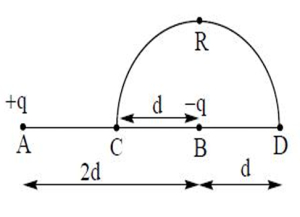
As shown in the figure,the work done to move the charge '$Q$' from point $C$ to point $D$ along the semi-circle $CRD$ is
A
$\frac{qQ}{4 \pi \varepsilon_0 d}$
B
$\frac{qQ}{2 \pi \varepsilon_0 d}$
C
$\frac{-qQ}{6 \pi \varepsilon_0 d}$
D
$\frac{-qQ}{4 \pi \varepsilon_0 d}$
Solution
(C) The work done in moving a charge $Q$ from point $C$ to point $D$ in an electrostatic field is given by $W = Q(V_D - V_C)$,where $V_C$ and $V_D$ are the electric potentials at points $C$ and $D$ respectively.
The potential at any point is due to the charges at $A$ $(+q)$ and $B$ $(-q)$.
Distance $AB = 2d$,$BC = d$,$BD = d$. Thus,$AC = AB - BC = 2d - d = d$.
Potential at $C$ $(V_C)$:
$V_C = \frac{1}{4 \pi \varepsilon_0} \left( \frac{q}{AC} + \frac{-q}{BC} \right) = \frac{1}{4 \pi \varepsilon_0} \left( \frac{q}{d} - \frac{q}{d} \right) = 0$.
Potential at $D$ $(V_D)$:
$V_D = \frac{1}{4 \pi \varepsilon_0} \left( \frac{q}{AD} + \frac{-q}{BD} \right)$.
Since $AD = AB + BD = 2d + d = 3d$ and $BD = d$,
$V_D = \frac{1}{4 \pi \varepsilon_0} \left( \frac{q}{3d} - \frac{q}{d} \right) = \frac{1}{4 \pi \varepsilon_0} \left( \frac{q - 3q}{3d} \right) = \frac{-2q}{12 \pi \varepsilon_0 d} = \frac{-q}{6 \pi \varepsilon_0 d}$.
Work done $W = Q(V_D - V_C) = Q \left( \frac{-q}{6 \pi \varepsilon_0 d} - 0 \right) = \frac{-qQ}{6 \pi \varepsilon_0 d}$.
The potential at any point is due to the charges at $A$ $(+q)$ and $B$ $(-q)$.
Distance $AB = 2d$,$BC = d$,$BD = d$. Thus,$AC = AB - BC = 2d - d = d$.
Potential at $C$ $(V_C)$:
$V_C = \frac{1}{4 \pi \varepsilon_0} \left( \frac{q}{AC} + \frac{-q}{BC} \right) = \frac{1}{4 \pi \varepsilon_0} \left( \frac{q}{d} - \frac{q}{d} \right) = 0$.
Potential at $D$ $(V_D)$:
$V_D = \frac{1}{4 \pi \varepsilon_0} \left( \frac{q}{AD} + \frac{-q}{BD} \right)$.
Since $AD = AB + BD = 2d + d = 3d$ and $BD = d$,
$V_D = \frac{1}{4 \pi \varepsilon_0} \left( \frac{q}{3d} - \frac{q}{d} \right) = \frac{1}{4 \pi \varepsilon_0} \left( \frac{q - 3q}{3d} \right) = \frac{-2q}{12 \pi \varepsilon_0 d} = \frac{-q}{6 \pi \varepsilon_0 d}$.
Work done $W = Q(V_D - V_C) = Q \left( \frac{-q}{6 \pi \varepsilon_0 d} - 0 \right) = \frac{-qQ}{6 \pi \varepsilon_0 d}$.
0 likes
View Solution372
MediumMCQ
An electric charge $10^{-3} \mu C$ is placed at the origin of $x-y$ plane. The potential difference between points $A$ and $B$ located at $(\sqrt{2} m, \sqrt{2} m)$ and $(2 m, 0 m)$ respectively is (in $V$)
A
$4.5$
B
$9$
C
$0$
D
$2$
Solution
(C) The electric potential $V$ at a distance $r$ from a point charge $q$ is given by $V = \frac{kq}{r}$,where $k = 9 \times 10^9 \ N \ m^2/C^2$.
Given charge $q = 10^{-3} \mu C = 10^{-9} \ C$.
For point $A$ at $(\sqrt{2} m, \sqrt{2} m)$,the distance $r_A = \sqrt{(\sqrt{2})^2 + (\sqrt{2})^2} = \sqrt{2 + 2} = 2 \ m$.
The potential at $A$ is $V_A = \frac{kq}{r_A} = \frac{9 \times 10^9 \times 10^{-9}}{2} = 4.5 \ V$.
For point $B$ at $(2 m, 0 m)$,the distance $r_B = \sqrt{2^2 + 0^2} = 2 \ m$.
The potential at $B$ is $V_B = \frac{kq}{r_B} = \frac{9 \times 10^9 \times 10^{-9}}{2} = 4.5 \ V$.
The potential difference between $A$ and $B$ is $V_A - V_B = 4.5 \ V - 4.5 \ V = 0 \ V$.
Given charge $q = 10^{-3} \mu C = 10^{-9} \ C$.
For point $A$ at $(\sqrt{2} m, \sqrt{2} m)$,the distance $r_A = \sqrt{(\sqrt{2})^2 + (\sqrt{2})^2} = \sqrt{2 + 2} = 2 \ m$.
The potential at $A$ is $V_A = \frac{kq}{r_A} = \frac{9 \times 10^9 \times 10^{-9}}{2} = 4.5 \ V$.
For point $B$ at $(2 m, 0 m)$,the distance $r_B = \sqrt{2^2 + 0^2} = 2 \ m$.
The potential at $B$ is $V_B = \frac{kq}{r_B} = \frac{9 \times 10^9 \times 10^{-9}}{2} = 4.5 \ V$.
The potential difference between $A$ and $B$ is $V_A - V_B = 4.5 \ V - 4.5 \ V = 0 \ V$.
0 likes
View Solution373
MediumMCQ
If four charges $+12 \text{ nC}, -20 \text{ nC}, +32 \text{ nC}$ and $-15 \text{ nC}$ are arranged at the four vertices of a square of side $\sqrt{2} \text{ m}$,then the net electric potential at the centre of the square due to these four charges is (in $\text{ V}$)
A
$72$
B
$81$
C
$64$
D
$36$
Solution
(B) The side of the square is $a = \sqrt{2} \text{ m}$. The diagonal of the square is $d = a\sqrt{2} = \sqrt{2} \times \sqrt{2} = 2 \text{ m}$.
The distance from the centre of the square to each vertex is $r = d/2 = 2/2 = 1 \text{ m}$.
The electric potential $V$ at the centre due to a point charge $q$ is given by $V = \frac{kq}{r}$,where $k = 9 \times 10^9 \text{ N m}^2/\text{C}^2$.
The net potential at the centre is the algebraic sum of the potentials due to individual charges: $V_{net} = \frac{k}{r} (q_1 + q_2 + q_3 + q_4)$.
Substituting the given values: $V_{net} = \frac{9 \times 10^9}{1} \times (12 - 20 + 32 - 15) \times 10^{-9} \text{ V}$.
$V_{net} = 9 \times (9) \text{ V} = 81 \text{ V}$.
The distance from the centre of the square to each vertex is $r = d/2 = 2/2 = 1 \text{ m}$.
The electric potential $V$ at the centre due to a point charge $q$ is given by $V = \frac{kq}{r}$,where $k = 9 \times 10^9 \text{ N m}^2/\text{C}^2$.
The net potential at the centre is the algebraic sum of the potentials due to individual charges: $V_{net} = \frac{k}{r} (q_1 + q_2 + q_3 + q_4)$.
Substituting the given values: $V_{net} = \frac{9 \times 10^9}{1} \times (12 - 20 + 32 - 15) \times 10^{-9} \text{ V}$.
$V_{net} = 9 \times (9) \text{ V} = 81 \text{ V}$.
0 likes
View Solution374
MediumMCQ
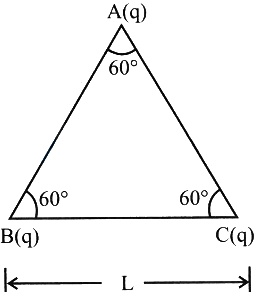
Three equal electric charges,each of magnitude $q$,are placed at the vertices of an equilateral triangle of side length $L$. The electrostatic potential energy of the system is:
A
$\frac{1}{4 \pi \epsilon_0} \cdot \frac{3 q^2}{L}$
B
$\frac{1}{4 \pi \epsilon_0} \cdot \frac{q^2}{3 L}$
C
$\frac{1}{4 \pi \epsilon_0} \cdot \frac{2 q^2}{3 L}$
D
$\frac{1}{4 \pi \epsilon_0} \cdot \frac{q^2}{L}$
Solution
(A) The electrostatic potential energy $U$ of a system of point charges is given by the sum of the potential energies of all unique pairs of charges.
For three charges $q_1, q_2, q_3$ at distances $r_{12}, r_{23}, r_{31}$,the potential energy is $U = \frac{1}{4 \pi \epsilon_0} \left( \frac{q_1 q_2}{r_{12}} + \frac{q_2 q_3}{r_{23}} + \frac{q_3 q_1}{r_{31}} \right)$.
In this case,$q_1 = q_2 = q_3 = q$ and $r_{12} = r_{23} = r_{31} = L$.
Substituting these values,we get:
$U = \frac{1}{4 \pi \epsilon_0} \left( \frac{q^2}{L} + \frac{q^2}{L} + \frac{q^2}{L} \right)$
$U = \frac{1}{4 \pi \epsilon_0} \cdot \frac{3 q^2}{L}$
For three charges $q_1, q_2, q_3$ at distances $r_{12}, r_{23}, r_{31}$,the potential energy is $U = \frac{1}{4 \pi \epsilon_0} \left( \frac{q_1 q_2}{r_{12}} + \frac{q_2 q_3}{r_{23}} + \frac{q_3 q_1}{r_{31}} \right)$.
In this case,$q_1 = q_2 = q_3 = q$ and $r_{12} = r_{23} = r_{31} = L$.
Substituting these values,we get:
$U = \frac{1}{4 \pi \epsilon_0} \left( \frac{q^2}{L} + \frac{q^2}{L} + \frac{q^2}{L} \right)$
$U = \frac{1}{4 \pi \epsilon_0} \cdot \frac{3 q^2}{L}$
0 likes
View Solution375
EasyMCQ
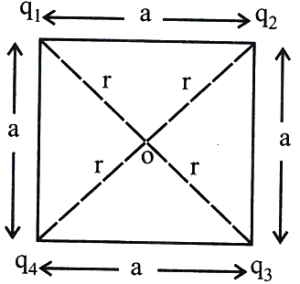
If four charges $q_1 = +1 \times 10^{-8} \text{ C}$, $q_2 = -2 \times 10^{-8} \text{ C}$, $q_3 = +3 \times 10^{-8} \text{ C}$, and $q_4 = +2 \times 10^{-8} \text{ C}$ are kept at the four corners of a square of side $1 \text{ m}$, then the electric potential at the centre of the square is: (in $\text{ V}$)
A
$300$
B
$200$
C
$510$
D
$410$
Solution
(C) Given charges at the corners of a square of side $a = 1 \text{ m}$ are:
$q_1 = +1 \times 10^{-8} \text{ C}$
$q_2 = -2 \times 10^{-8} \text{ C}$
$q_3 = +3 \times 10^{-8} \text{ C}$
$q_4 = +2 \times 10^{-8} \text{ C}$
The distance $r$ from each corner to the centre of the square is half the diagonal length:
$r = \frac{\sqrt{2}a}{2} = \frac{a}{\sqrt{2}} = \frac{1}{\sqrt{2}} \text{ m}$
The electric potential $V$ at the centre is the algebraic sum of the potentials due to each charge:
$V = \frac{k q_1}{r} + \frac{k q_2}{r} + \frac{k q_3}{r} + \frac{k q_4}{r} = \frac{k}{r} (q_1 + q_2 + q_3 + q_4)$
Substituting the values:
$V = \frac{9 \times 10^9}{1/\sqrt{2}} (1 - 2 + 3 + 2) \times 10^{-8}$
$V = 9 \sqrt{2} \times 10^1 \times (4)$
$V = 36 \sqrt{2} \times 10 \approx 36 \times 1.414 \times 10 = 509.04 \text{ V}$
Rounding to the nearest given option, $V \approx 510 \text{ V}$.
$q_1 = +1 \times 10^{-8} \text{ C}$
$q_2 = -2 \times 10^{-8} \text{ C}$
$q_3 = +3 \times 10^{-8} \text{ C}$
$q_4 = +2 \times 10^{-8} \text{ C}$
The distance $r$ from each corner to the centre of the square is half the diagonal length:
$r = \frac{\sqrt{2}a}{2} = \frac{a}{\sqrt{2}} = \frac{1}{\sqrt{2}} \text{ m}$
The electric potential $V$ at the centre is the algebraic sum of the potentials due to each charge:
$V = \frac{k q_1}{r} + \frac{k q_2}{r} + \frac{k q_3}{r} + \frac{k q_4}{r} = \frac{k}{r} (q_1 + q_2 + q_3 + q_4)$
Substituting the values:
$V = \frac{9 \times 10^9}{1/\sqrt{2}} (1 - 2 + 3 + 2) \times 10^{-8}$
$V = 9 \sqrt{2} \times 10^1 \times (4)$
$V = 36 \sqrt{2} \times 10 \approx 36 \times 1.414 \times 10 = 509.04 \text{ V}$
Rounding to the nearest given option, $V \approx 510 \text{ V}$.
0 likes
View Solution376
MediumMCQ
$125$ identical charged small spheres coalesce to form a big charged sphere. If the electric potential on each small sphere is $60 \text{ mV}$, then the electric potential on the bigger sphere formed is: (in $\text{ V}$)
A
$30$
B
$15$
C
$1.5$
D
$3$
Solution
(C) Let the radius of each small sphere be $r$ and the charge on each be $q$. The potential on each small sphere is given by $V_s = \frac{kq}{r} = 60 \text{ mV} = 0.06 \text{ V}$.
When $125$ small spheres coalesce to form a big sphere of radius $R$, the volume remains conserved:
$125 \times (\frac{4}{3} \pi r^3) = \frac{4}{3} \pi R^3 \Rightarrow R^3 = 125 r^3 \Rightarrow R = 5r$.
The total charge on the big sphere is $Q = 125q$.
The potential on the big sphere is $V_B = \frac{kQ}{R} = \frac{k(125q)}{5r} = 25 \times (\frac{kq}{r})$.
Substituting the value of $V_s$: $V_B = 25 \times 0.06 \text{ V} = 1.5 \text{ V}$.
When $125$ small spheres coalesce to form a big sphere of radius $R$, the volume remains conserved:
$125 \times (\frac{4}{3} \pi r^3) = \frac{4}{3} \pi R^3 \Rightarrow R^3 = 125 r^3 \Rightarrow R = 5r$.
The total charge on the big sphere is $Q = 125q$.
The potential on the big sphere is $V_B = \frac{kQ}{R} = \frac{k(125q)}{5r} = 25 \times (\frac{kq}{r})$.
Substituting the value of $V_s$: $V_B = 25 \times 0.06 \text{ V} = 1.5 \text{ V}$.
0 likes
View Solution377
EasyMCQ
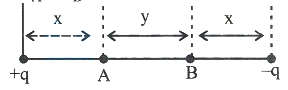
Two charges $+q$ and $-q$,each $1 \mu C$,are arranged as shown in the figure. If $x=2 \text{ cm}$ and $y=3 \text{ cm}$,then the potential difference $(V_A - V_B)$ is:
A
$5.4 \times 10^2 \text{ V}$
B
$5.4 \times 10^5 \text{ V}$
C
$5.2 \times 10^2 \text{ V}$
D
$2.7 \times 10^5 \text{ V}$
Solution
(B) The potential at point $A$ due to $+q$ is $V_{A(+q)} = \frac{1}{4\pi\epsilon_0} \frac{q}{x}$ and due to $-q$ is $V_{A(-q)} = \frac{1}{4\pi\epsilon_0} \frac{-q}{x+y}$.
Thus,$V_A = \frac{q}{4\pi\epsilon_0} \left( \frac{1}{x} - \frac{1}{x+y} \right) = \frac{q}{4\pi\epsilon_0} \left( \frac{y}{x(x+y)} \right)$.
Similarly,the potential at point $B$ is $V_B = \frac{1}{4\pi\epsilon_0} \frac{q}{x+y} + \frac{1}{4\pi\epsilon_0} \frac{-q}{x} = \frac{q}{4\pi\epsilon_0} \left( \frac{1}{x+y} - \frac{1}{x} \right) = -V_A$.
Therefore,$V_A - V_B = V_A - (-V_A) = 2V_A = 2 \times \frac{q}{4\pi\epsilon_0} \left( \frac{y}{x(x+y)} \right)$.
Given $q = 10^{-6} \text{ C}$,$x = 0.02 \text{ m}$,$y = 0.03 \text{ m}$,and $\frac{1}{4\pi\epsilon_0} = 9 \times 10^9 \text{ Nm}^2/\text{C}^2$.
$V_A - V_B = 2 \times 9 \times 10^9 \times 10^{-6} \times \frac{0.03}{0.02(0.02+0.03)} = 18 \times 10^3 \times \frac{0.03}{0.02 \times 0.05} = 18 \times 10^3 \times \frac{0.03}{0.001} = 18 \times 10^3 \times 30 = 5.4 \times 10^5 \text{ V}$.
Thus,$V_A = \frac{q}{4\pi\epsilon_0} \left( \frac{1}{x} - \frac{1}{x+y} \right) = \frac{q}{4\pi\epsilon_0} \left( \frac{y}{x(x+y)} \right)$.
Similarly,the potential at point $B$ is $V_B = \frac{1}{4\pi\epsilon_0} \frac{q}{x+y} + \frac{1}{4\pi\epsilon_0} \frac{-q}{x} = \frac{q}{4\pi\epsilon_0} \left( \frac{1}{x+y} - \frac{1}{x} \right) = -V_A$.
Therefore,$V_A - V_B = V_A - (-V_A) = 2V_A = 2 \times \frac{q}{4\pi\epsilon_0} \left( \frac{y}{x(x+y)} \right)$.
Given $q = 10^{-6} \text{ C}$,$x = 0.02 \text{ m}$,$y = 0.03 \text{ m}$,and $\frac{1}{4\pi\epsilon_0} = 9 \times 10^9 \text{ Nm}^2/\text{C}^2$.
$V_A - V_B = 2 \times 9 \times 10^9 \times 10^{-6} \times \frac{0.03}{0.02(0.02+0.03)} = 18 \times 10^3 \times \frac{0.03}{0.02 \times 0.05} = 18 \times 10^3 \times \frac{0.03}{0.001} = 18 \times 10^3 \times 30 = 5.4 \times 10^5 \text{ V}$.
0 likes
View Solution378
MediumMCQ
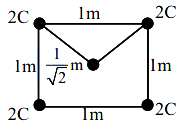
Let $V_1$ be the potential at the center of a square of side $1 \ m$ when the charges at the $4$ corners are $2 \ C$ each. If the same charges are placed at the corners of a square of side $2 \ m$,then the potential at the center of this square is $V_2$. The value of $\frac{V_2}{V_1}$ is
A
$\frac{1}{2}$
B
$\frac{1}{\sqrt{2}}$
C
$\frac{1}{2 \sqrt{2}}$
D
$\frac{1}{4 \sqrt{2}}$
Solution
(A) The electric potential $V$ at the center of a square of side $a$ with charges $q$ at each of the $4$ corners is given by $V = 4 \times \frac{Kq}{r}$,where $r$ is the distance from the center to any corner.
For a square of side $a$,the diagonal is $a\sqrt{2}$,so the distance $r$ from the center to a corner is $r = \frac{a\sqrt{2}}{2} = \frac{a}{\sqrt{2}}$.
For the first square,$a_1 = 1 \ m$,so $r_1 = \frac{1}{\sqrt{2}} \ m$. The potential is $V_1 = 4 \times \frac{K \times 2}{1/\sqrt{2}} = 8\sqrt{2}K$.
For the second square,$a_2 = 2 \ m$,so $r_2 = \frac{2}{\sqrt{2}} = \sqrt{2} \ m$. The potential is $V_2 = 4 \times \frac{K \times 2}{\sqrt{2}} = \frac{8K}{\sqrt{2}} = 4\sqrt{2}K$.
Therefore,the ratio is $\frac{V_2}{V_1} = \frac{4\sqrt{2}K}{8\sqrt{2}K} = \frac{1}{2}$.
For a square of side $a$,the diagonal is $a\sqrt{2}$,so the distance $r$ from the center to a corner is $r = \frac{a\sqrt{2}}{2} = \frac{a}{\sqrt{2}}$.
For the first square,$a_1 = 1 \ m$,so $r_1 = \frac{1}{\sqrt{2}} \ m$. The potential is $V_1 = 4 \times \frac{K \times 2}{1/\sqrt{2}} = 8\sqrt{2}K$.
For the second square,$a_2 = 2 \ m$,so $r_2 = \frac{2}{\sqrt{2}} = \sqrt{2} \ m$. The potential is $V_2 = 4 \times \frac{K \times 2}{\sqrt{2}} = \frac{8K}{\sqrt{2}} = 4\sqrt{2}K$.
Therefore,the ratio is $\frac{V_2}{V_1} = \frac{4\sqrt{2}K}{8\sqrt{2}K} = \frac{1}{2}$.
0 likes
View Solution379
MediumMCQ
Two charges $8 \ \mu C$ each are placed at the corners $A$ and $B$ of an equilateral triangle of side $0.2 \ m$ in air. The electric potential at the third corner $C$ is
A
$7.2 \times 10^5 \ V$
B
$1.8 \times 10^5 \ V$
C
$3.6 \times 10^5 \ V$
D
$3.6 \times 10^4 \ V$
Solution
(A) The electric potential $V$ at a point due to a point charge $q$ at a distance $r$ is given by $V = \frac{kq}{r}$,where $k = 9 \times 10^9 \ N \ m^2 \ C^{-2}$.
Since the triangle is equilateral with side $a = 0.2 \ m$,the distance from both corners $A$ and $B$ to corner $C$ is $r = 0.2 \ m$.
The total potential at corner $C$ is the algebraic sum of the potentials due to charges at $A$ and $B$: $V_C = V_A + V_B$.
$V_C = \frac{k q_A}{r} + \frac{k q_B}{r} = \frac{k}{r} (q_A + q_B)$.
Substituting the values: $V_C = \frac{9 \times 10^9}{0.2} (8 \times 10^{-6} + 8 \times 10^{-6}) \ V$.
$V_C = \frac{9 \times 10^9}{0.2} (16 \times 10^{-6}) \ V$.
$V_C = 9 \times 10^9 \times 80 \times 10^{-6} \ V$.
$V_C = 720 \times 10^3 \ V = 7.2 \times 10^5 \ V$.
Since the triangle is equilateral with side $a = 0.2 \ m$,the distance from both corners $A$ and $B$ to corner $C$ is $r = 0.2 \ m$.
The total potential at corner $C$ is the algebraic sum of the potentials due to charges at $A$ and $B$: $V_C = V_A + V_B$.
$V_C = \frac{k q_A}{r} + \frac{k q_B}{r} = \frac{k}{r} (q_A + q_B)$.
Substituting the values: $V_C = \frac{9 \times 10^9}{0.2} (8 \times 10^{-6} + 8 \times 10^{-6}) \ V$.
$V_C = \frac{9 \times 10^9}{0.2} (16 \times 10^{-6}) \ V$.
$V_C = 9 \times 10^9 \times 80 \times 10^{-6} \ V$.
$V_C = 720 \times 10^3 \ V = 7.2 \times 10^5 \ V$.
0 likes
View Solution380
MediumMCQ
The minimum work needed to be done to bring a charge $q=6 \mu C$ from $\infty$ to a point $0.75 \ m$ from a charge $Q=30 \mu C$ is (in $J$)
A
$4.16$
B
$5.16$
C
$2.16$
D
$1.16$
Solution
(C) The work done $W$ to bring a charge $q$ from infinity to a distance $r$ from a charge $Q$ is given by the change in potential energy: $W = U_f - U_i$.
Since the initial distance $r_i = \infty$,the initial potential energy $U_i = 0$.
The final potential energy is $U_f = \frac{kQq}{r_f}$.
Given:
$q = 6 \times 10^{-6} \ C$
$Q = 30 \times 10^{-6} \ C$
$r_f = 0.75 \ m$
$k = 9 \times 10^9 \ N \ m^2 \ C^{-2}$
Substituting the values:
$W = \frac{(9 \times 10^9) \times (30 \times 10^{-6}) \times (6 \times 10^{-6})}{0.75}$
$W = \frac{9 \times 30 \times 6 \times 10^{-3}}{0.75}$
$W = \frac{1620 \times 10^{-3}}{0.75} = \frac{1.62}{0.75} = 2.16 \ J$.
Since the initial distance $r_i = \infty$,the initial potential energy $U_i = 0$.
The final potential energy is $U_f = \frac{kQq}{r_f}$.
Given:
$q = 6 \times 10^{-6} \ C$
$Q = 30 \times 10^{-6} \ C$
$r_f = 0.75 \ m$
$k = 9 \times 10^9 \ N \ m^2 \ C^{-2}$
Substituting the values:
$W = \frac{(9 \times 10^9) \times (30 \times 10^{-6}) \times (6 \times 10^{-6})}{0.75}$
$W = \frac{9 \times 30 \times 6 \times 10^{-3}}{0.75}$
$W = \frac{1620 \times 10^{-3}}{0.75} = \frac{1.62}{0.75} = 2.16 \ J$.
0 likes
View Solution381
MediumMCQ
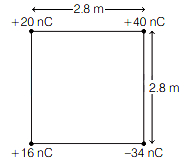
Four point charges are placed at the vertices of a square of side $2.8 \,m$ as shown in the figure. Find the electric potential at the centre of the square. (in $\,V$)
A
$190.89$
B
$495$
C
$405$
D
$378$
Solution
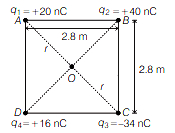
(A) Given that,the point charges are placed on the vertices of a square of side $a = 2.8 \,m$. Let $r$ be the distance of the centre $O$ from each corner.
The diagonal of the square is $d = \sqrt{a^2 + a^2} = a\sqrt{2}$.
The distance $r$ from the centre to each corner is half of the diagonal:
$r = \frac{a\sqrt{2}}{2} = \frac{a}{\sqrt{2}} = \frac{2.8}{\sqrt{2}} \,m$.
The electric potential $V$ at a point due to a point charge $q$ is given by $V = \frac{Kq}{r}$,where $K = 9 \times 10^9 \,N \cdot m^2/C^2$.
The total electric potential $V_0$ at the centre $O$ due to all four charges $q_1, q_2, q_3,$ and $q_4$ is:
$V_0 = V_1 + V_2 + V_3 + V_4 = \frac{K}{r}(q_1 + q_2 + q_3 + q_4)$.
Given charges: $q_1 = +20 \,nC$,$q_2 = +40 \,nC$,$q_3 = -34 \,nC$,$q_4 = +16 \,nC$.
Sum of charges: $\sum q = (20 + 40 - 34 + 16) \,nC = 42 \,nC = 42 \times 10^{-9} \,C$.
Substituting the values:
$V_0 = \frac{9 \times 10^9 \times 42 \times 10^{-9}}{2.8 / \sqrt{2}} = \frac{9 \times 42 \times \sqrt{2}}{2.8} = \frac{378 \times 1.414}{2.8} = 135 \times 1.414 = 190.89 \,V$.
The diagonal of the square is $d = \sqrt{a^2 + a^2} = a\sqrt{2}$.
The distance $r$ from the centre to each corner is half of the diagonal:
$r = \frac{a\sqrt{2}}{2} = \frac{a}{\sqrt{2}} = \frac{2.8}{\sqrt{2}} \,m$.
The electric potential $V$ at a point due to a point charge $q$ is given by $V = \frac{Kq}{r}$,where $K = 9 \times 10^9 \,N \cdot m^2/C^2$.
The total electric potential $V_0$ at the centre $O$ due to all four charges $q_1, q_2, q_3,$ and $q_4$ is:
$V_0 = V_1 + V_2 + V_3 + V_4 = \frac{K}{r}(q_1 + q_2 + q_3 + q_4)$.
Given charges: $q_1 = +20 \,nC$,$q_2 = +40 \,nC$,$q_3 = -34 \,nC$,$q_4 = +16 \,nC$.
Sum of charges: $\sum q = (20 + 40 - 34 + 16) \,nC = 42 \,nC = 42 \times 10^{-9} \,C$.
Substituting the values:
$V_0 = \frac{9 \times 10^9 \times 42 \times 10^{-9}}{2.8 / \sqrt{2}} = \frac{9 \times 42 \times \sqrt{2}}{2.8} = \frac{378 \times 1.414}{2.8} = 135 \times 1.414 = 190.89 \,V$.
0 likes
View Solution382
MediumMCQ
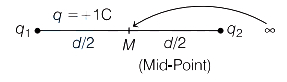
$A$ unit positive charge has to be brought from infinity to a midpoint between two charges $20 \mu C$ and $10 \mu C$ separated by a distance of $50 \ m$. How much work will be required?
A
$10.8 \times 10^4 \ J$
B
$10.8 \times 10^3 \ J$
C
$1.08 \times 10^6 \ J$
D
$0.54 \times 10^5 \ J$
Solution
(B) Given that,two charges $q_1 = 20 \mu C$ and $q_2 = 10 \mu C$ are separated by a distance $d = 50 \ m$.
Work done $W$ in bringing a unit positive charge $q = 1 \ C$ from infinity to the midpoint $M$ is given by $W = qV$,where $V$ is the electric potential at point $M$.
The potential at $M$ due to charges $q_1$ and $q_2$ is $V = \frac{K q_1}{(d/2)} + \frac{K q_2}{(d/2)} = \frac{2K}{d} (q_1 + q_2)$.
Substituting the values:
$W = 1 \times \frac{2 \times (9 \times 10^9)}{50} \times (20 + 10) \times 10^{-6} \ J$
$W = \frac{18 \times 10^9}{50} \times 30 \times 10^{-6} \ J$
$W = \frac{540 \times 10^3}{50} \ J = 10.8 \times 10^3 \ J$.
Work done $W$ in bringing a unit positive charge $q = 1 \ C$ from infinity to the midpoint $M$ is given by $W = qV$,where $V$ is the electric potential at point $M$.
The potential at $M$ due to charges $q_1$ and $q_2$ is $V = \frac{K q_1}{(d/2)} + \frac{K q_2}{(d/2)} = \frac{2K}{d} (q_1 + q_2)$.
Substituting the values:
$W = 1 \times \frac{2 \times (9 \times 10^9)}{50} \times (20 + 10) \times 10^{-6} \ J$
$W = \frac{18 \times 10^9}{50} \times 30 \times 10^{-6} \ J$
$W = \frac{540 \times 10^3}{50} \ J = 10.8 \times 10^3 \ J$.
0 likes
View Solution383
DifficultMCQ
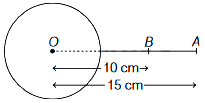
The electric potential on the surface of a charged spherical conductor of radius $5 \,cm$ is $200 \,V$. The work done in moving a charge of $+5 \,C$ from a point $A$ to another point $B$ situated at distances of $15 \,cm$ and $10 \,cm$ respectively from the centre of the sphere is (in $\,J$)
A
$16.7$
B
$22.3$
C
$88.8$
D
$166.7$
Solution
(D) Electric potential on the surface of the sphere is given by $V = k \frac{Q}{R}$,where $k = 9 \times 10^9 \,N \cdot m^2/C^2$.
Given $V = 200 \,V$ and $R = 5 \,cm = 0.05 \,m$.
$200 = 9 \times 10^9 \times \frac{Q}{0.05} \implies Q = \frac{200 \times 0.05}{9 \times 10^9} = \frac{10}{9} \times 10^{-9} \,C$.
The potential at a distance $r$ from the centre of the sphere is $V(r) = k \frac{Q}{r}$.
Potential at point $A$ $(r_A = 15 \,cm = 0.15 \,m)$: $V_A = 9 \times 10^9 \times \frac{Q}{0.15} = \frac{9 \times 10^9}{0.15} \times \frac{10}{9} \times 10^{-9} = \frac{10}{0.15} = 66.67 \,V$.
Potential at point $B$ $(r_B = 10 \,cm = 0.10 \,m)$: $V_B = 9 \times 10^9 \times \frac{Q}{0.10} = \frac{9 \times 10^9}{0.10} \times \frac{10}{9} \times 10^{-9} = \frac{10}{0.10} = 100 \,V$.
Work done in moving a charge $q = 5 \,C$ from $A$ to $B$ is $W = q(V_B - V_A)$.
$W = 5 \times (100 - 66.67) = 5 \times 33.33 = 166.65 \,J \approx 166.7 \,J$.
Given $V = 200 \,V$ and $R = 5 \,cm = 0.05 \,m$.
$200 = 9 \times 10^9 \times \frac{Q}{0.05} \implies Q = \frac{200 \times 0.05}{9 \times 10^9} = \frac{10}{9} \times 10^{-9} \,C$.
The potential at a distance $r$ from the centre of the sphere is $V(r) = k \frac{Q}{r}$.
Potential at point $A$ $(r_A = 15 \,cm = 0.15 \,m)$: $V_A = 9 \times 10^9 \times \frac{Q}{0.15} = \frac{9 \times 10^9}{0.15} \times \frac{10}{9} \times 10^{-9} = \frac{10}{0.15} = 66.67 \,V$.
Potential at point $B$ $(r_B = 10 \,cm = 0.10 \,m)$: $V_B = 9 \times 10^9 \times \frac{Q}{0.10} = \frac{9 \times 10^9}{0.10} \times \frac{10}{9} \times 10^{-9} = \frac{10}{0.10} = 100 \,V$.
Work done in moving a charge $q = 5 \,C$ from $A$ to $B$ is $W = q(V_B - V_A)$.
$W = 5 \times (100 - 66.67) = 5 \times 33.33 = 166.65 \,J \approx 166.7 \,J$.
0 likes
View Solution384
EasyMCQ
Electric potential at a point distant $0.5 \,m$ from a spherical conductor of radius $0.2 \,m$ charged to $+1 \,nC$ is
A
$+9 \,V$
B
$-9 \,V$
C
$+18 \,V$
D
$-18 \,V$
Solution
(C) The charge on the spherical conductor is $q = +1 \,nC = 10^{-9} \,C$.
The distance of the point from the center of the spherical conductor is $r = 0.5 \,m$.
The formula for the electric potential $V$ at a distance $r$ from a point charge (or outside a spherical conductor) is given by $V = \frac{1}{4 \pi \varepsilon_0} \cdot \frac{q}{r}$.
Substituting the given values:
$V = (9 \times 10^9 \,N \cdot m^2/C^2) \times \frac{10^{-9} \,C}{0.5 \,m}$.
$V = 9 \times \frac{1}{0.5} \,V$.
$V = 9 \times 2 \,V = 18 \,V$.
Therefore,the electric potential is $+18 \,V$.
The distance of the point from the center of the spherical conductor is $r = 0.5 \,m$.
The formula for the electric potential $V$ at a distance $r$ from a point charge (or outside a spherical conductor) is given by $V = \frac{1}{4 \pi \varepsilon_0} \cdot \frac{q}{r}$.
Substituting the given values:
$V = (9 \times 10^9 \,N \cdot m^2/C^2) \times \frac{10^{-9} \,C}{0.5 \,m}$.
$V = 9 \times \frac{1}{0.5} \,V$.
$V = 9 \times 2 \,V = 18 \,V$.
Therefore,the electric potential is $+18 \,V$.
0 likes
View Solution385
DifficultMCQ
When a charge of $20 C$ is taken from one point to another separated by a distance of $0.2 m$,work of $2 J$ is required to be done. What is the potential difference between the two points?
A
$2 \times 10^{-2} V$
B
$4 \times 10^{-4} V$
C
$8 V$
D
$0.1 V$
Solution
(D) The potential difference $V$ between two points is defined as the work done $W$ per unit charge $q$ in moving the charge from one point to the other.
Formula: $V = \frac{W}{q}$
Given values:
Charge,$q = 20 C$
Work done,$W = 2 J$
Substituting the values into the formula:
$V = \frac{2 J}{20 C} = 0.1 V$
Therefore,the potential difference between the two points is $0.1 V$.
Formula: $V = \frac{W}{q}$
Given values:
Charge,$q = 20 C$
Work done,$W = 2 J$
Substituting the values into the formula:
$V = \frac{2 J}{20 C} = 0.1 V$
Therefore,the potential difference between the two points is $0.1 V$.
0 likes
View Solution386
DifficultMCQ
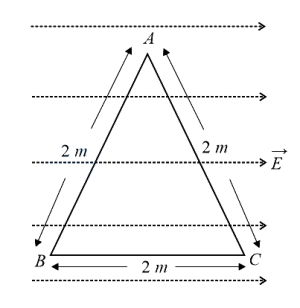
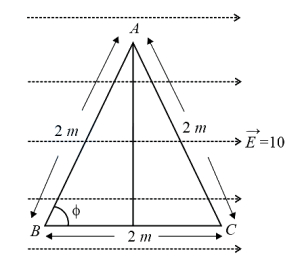
An imaginary equilateral triangle $ABC$ of side length $2 \ m$ is placed in a uniform electric field $\vec{E} = 10 \ N \ C^{-1}$ as shown. Then,$V_A - V_B =$
A
$-5 \ V$
B
$+5 \ V$
C
$-10 \ V$
D
$+10 \ V$
Solution
(C) The potential difference between two points in a uniform electric field is given by the formula $\Delta V = -\vec{E} \cdot \vec{d}$,where $\vec{d}$ is the displacement vector from the initial point to the final point.
For the potential difference $V_A - V_B$,the displacement vector is $\vec{BA}$.
The magnitude of the displacement is $d = |\vec{BA}| = 2 \ m$.
The angle $\theta$ between the electric field $\vec{E}$ and the displacement vector $\vec{BA}$ is $60^\circ$ (as it is an equilateral triangle).
Therefore,$V_A - V_B = -E d \cos(\theta)$.
Substituting the given values: $V_A - V_B = -(10 \ N \ C^{-1}) \times (2 \ m) \times \cos(60^\circ)$.
$V_A - V_B = -20 \times 0.5 = -10 \ V$.
For the potential difference $V_A - V_B$,the displacement vector is $\vec{BA}$.
The magnitude of the displacement is $d = |\vec{BA}| = 2 \ m$.
The angle $\theta$ between the electric field $\vec{E}$ and the displacement vector $\vec{BA}$ is $60^\circ$ (as it is an equilateral triangle).
Therefore,$V_A - V_B = -E d \cos(\theta)$.
Substituting the given values: $V_A - V_B = -(10 \ N \ C^{-1}) \times (2 \ m) \times \cos(60^\circ)$.
$V_A - V_B = -20 \times 0.5 = -10 \ V$.
0 likes
View Solution387
MediumMCQ
If a charged spherical conductor of radius $10 \,cm$ has potential $V$ at a point distant $5 \,cm$ from its centre, then the potential at a point distant $15 \,cm$ from the centre will be
A
$V/3$
B
$2V/3$
C
$3V/2$
D
$3V$
Solution
(B) For a charged spherical conductor of radius $R = 10 \,cm$, the potential inside the conductor (at any distance $r < R$) is constant and equal to the potential at the surface.
Given that the potential at $r = 5 \,cm$ is $V$, the potential at the surface $(r = 10 \,cm)$ is also $V$.
The potential at a distance $r$ from the centre for $r > R$ is given by $V(r) = \frac{kQ}{r}$, where $kQ$ is the potential at the surface times the radius $(V \times R)$.
Thus, $V(r) = \frac{V \times R}{r}$.
Substituting the values $R = 10 \,cm$ and $r = 15 \,cm$:
$V(15) = \frac{V \times 10}{15} = \frac{2}{3} V$.
Given that the potential at $r = 5 \,cm$ is $V$, the potential at the surface $(r = 10 \,cm)$ is also $V$.
The potential at a distance $r$ from the centre for $r > R$ is given by $V(r) = \frac{kQ}{r}$, where $kQ$ is the potential at the surface times the radius $(V \times R)$.
Thus, $V(r) = \frac{V \times R}{r}$.
Substituting the values $R = 10 \,cm$ and $r = 15 \,cm$:
$V(15) = \frac{V \times 10}{15} = \frac{2}{3} V$.
0 likes
View Solution388
EasyMCQ
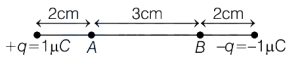
The potential difference $(V_A-V_B)$ in the arrangement shown in the figure is $(q=1 \mu C, x=2 \text{ cm}, y=3 \text{ cm})$.

A
$5.4 \times 10^5 \text{ V}$
B
$2.7 \times 10^5 \text{ V}$
C
$5.4 \times 10^2 \text{ V}$
D
$2.7 \times 10^2 \text{ V}$
Solution
(A) The electric potential $V$ at a distance $r$ from a point charge $q$ is given by $V = \frac{kq}{r}$, where $k = 9 \times 10^9 \text{ N m}^2/\text{C}^2$.
For point $A$, the distance from $+q$ is $x = 2 \text{ cm} = 0.02 \text{ m}$ and the distance from $-q$ is $(x+y) = 2+3 = 5 \text{ cm} = 0.05 \text{ m}$.
$V_A = \frac{kq}{x} + \frac{k(-q)}{x+y} = kq \left( \frac{1}{0.02} - \frac{1}{0.05} \right) = (9 \times 10^9)(10^{-6}) (50 - 20) = 9 \times 10^3 \times 30 = 2.7 \times 10^5 \text{ V}$.
For point $B$, the distance from $+q$ is $(x+y) = 5 \text{ cm} = 0.05 \text{ m}$ and the distance from $-q$ is $x = 2 \text{ cm} = 0.02 \text{ m}$.
$V_B = \frac{kq}{x+y} + \frac{k(-q)}{x} = kq \left( \frac{1}{0.05} - \frac{1}{0.02} \right) = (9 \times 10^9)(10^{-6}) (20 - 50) = 9 \times 10^3 \times (-30) = -2.7 \times 10^5 \text{ V}$.
The potential difference is $V_A - V_B = 2.7 \times 10^5 - (-2.7 \times 10^5) = 5.4 \times 10^5 \text{ V}$.
For point $A$, the distance from $+q$ is $x = 2 \text{ cm} = 0.02 \text{ m}$ and the distance from $-q$ is $(x+y) = 2+3 = 5 \text{ cm} = 0.05 \text{ m}$.
$V_A = \frac{kq}{x} + \frac{k(-q)}{x+y} = kq \left( \frac{1}{0.02} - \frac{1}{0.05} \right) = (9 \times 10^9)(10^{-6}) (50 - 20) = 9 \times 10^3 \times 30 = 2.7 \times 10^5 \text{ V}$.
For point $B$, the distance from $+q$ is $(x+y) = 5 \text{ cm} = 0.05 \text{ m}$ and the distance from $-q$ is $x = 2 \text{ cm} = 0.02 \text{ m}$.
$V_B = \frac{kq}{x+y} + \frac{k(-q)}{x} = kq \left( \frac{1}{0.05} - \frac{1}{0.02} \right) = (9 \times 10^9)(10^{-6}) (20 - 50) = 9 \times 10^3 \times (-30) = -2.7 \times 10^5 \text{ V}$.
The potential difference is $V_A - V_B = 2.7 \times 10^5 - (-2.7 \times 10^5) = 5.4 \times 10^5 \text{ V}$.
0 likes
View Solution389
EasyMCQ
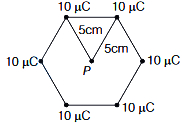
$A$ regular hexagon of side $5 \, cm$ has a charge $10 \, \mu C$ at each of its vertices. The potential at the centre of the hexagon is
A
$0 \, V$
B
$18 \times 10^5 \, V$
C
$1.08 \times 10^7 \, V$
D
$1.08 \times 10^5 \, V$
Solution
(C) Given, the side length of the regular hexagon is $r = 5 \, cm = 5 \times 10^{-2} \, m$.
In a regular hexagon, the distance from each vertex to the centre is equal to the side length of the hexagon. Thus, $r = 5 \times 10^{-2} \, m$.
The charge at each vertex is $q = 10 \, \mu C = 10 \times 10^{-6} \, C = 10^{-5} \, C$.
The electric potential $V$ due to a point charge $q$ at a distance $r$ is given by $V = \frac{kq}{r}$, where $k = 9 \times 10^9 \, N \cdot m^2/C^2$.
The potential due to one charge at the centre is:
$V_1 = \frac{9 \times 10^9 \times 10^{-5}}{5 \times 10^{-2}} = \frac{9}{5} \times 10^6 = 1.8 \times 10^6 \, V$.
Since there are $6$ identical charges at equal distances from the centre, the total potential $V_{\text{total}}$ is:
$V_{\text{total}} = 6 \times V_1 = 6 \times 1.8 \times 10^6 \, V = 10.8 \times 10^6 \, V = 1.08 \times 10^7 \, V$.
In a regular hexagon, the distance from each vertex to the centre is equal to the side length of the hexagon. Thus, $r = 5 \times 10^{-2} \, m$.
The charge at each vertex is $q = 10 \, \mu C = 10 \times 10^{-6} \, C = 10^{-5} \, C$.
The electric potential $V$ due to a point charge $q$ at a distance $r$ is given by $V = \frac{kq}{r}$, where $k = 9 \times 10^9 \, N \cdot m^2/C^2$.
The potential due to one charge at the centre is:
$V_1 = \frac{9 \times 10^9 \times 10^{-5}}{5 \times 10^{-2}} = \frac{9}{5} \times 10^6 = 1.8 \times 10^6 \, V$.
Since there are $6$ identical charges at equal distances from the centre, the total potential $V_{\text{total}}$ is:
$V_{\text{total}} = 6 \times V_1 = 6 \times 1.8 \times 10^6 \, V = 10.8 \times 10^6 \, V = 1.08 \times 10^7 \, V$.
0 likes
View Solution390
EasyMCQ
$A$ Van de Graaff generator has a spherical metal shell as an electrode which is at a potential $15 \times 10^6 \,V$. If the dielectric strength of the surrounding medium is $5 \times 10^7 \,V/m$, then the diameter of the shell is (in $\,cm$)
A
$30$
B
$15$
C
$60$
D
$120$
Solution
(C) The potential of the spherical shell is given as $V = 15 \times 10^6 \,V$.
The dielectric strength of the surrounding medium, which represents the maximum electric field intensity $E$ the medium can withstand before breakdown, is $E = 5 \times 10^7 \,V/m$.
For a spherical shell of radius $r$, the potential is related to the electric field at its surface by $V = E \times r$.
Therefore, the minimum radius $r$ required is $r = \frac{V}{E}$.
Substituting the given values: $r = \frac{15 \times 10^6 \,V}{5 \times 10^7 \,V/m} = 0.3 \,m$.
The diameter $d$ of the shell is $d = 2r = 2 \times 0.3 \,m = 0.6 \,m$.
Converting to centimeters, $d = 0.6 \times 100 \,cm = 60 \,cm$.
The dielectric strength of the surrounding medium, which represents the maximum electric field intensity $E$ the medium can withstand before breakdown, is $E = 5 \times 10^7 \,V/m$.
For a spherical shell of radius $r$, the potential is related to the electric field at its surface by $V = E \times r$.
Therefore, the minimum radius $r$ required is $r = \frac{V}{E}$.
Substituting the given values: $r = \frac{15 \times 10^6 \,V}{5 \times 10^7 \,V/m} = 0.3 \,m$.
The diameter $d$ of the shell is $d = 2r = 2 \times 0.3 \,m = 0.6 \,m$.
Converting to centimeters, $d = 0.6 \times 100 \,cm = 60 \,cm$.
0 likes
View Solution391
DifficultMCQ
Three concentric spherical metallic shells $A$,$B$,and $C$ of radii $a=7 \ cm$,$b=17 \ cm$,and $c$ $(a < b < c)$ have surface charge densities $\sigma, -\sigma$,and $\sigma$ respectively. If $A$ and $C$ are at the same potential,then the value of $c$ is: (in $cm$)
A
$20$
B
$10$
C
$34$
D
$24$
Solution
(D) The charges on the shells are $q_A = \sigma(4\pi a^2)$,$q_B = -\sigma(4\pi b^2)$,and $q_C = \sigma(4\pi c^2)$.
The potential at the surface of shell $A$ is $V_A = \frac{1}{4\pi\epsilon_0} [\frac{q_A}{a} + \frac{q_B}{b} + \frac{q_C}{c}] = \frac{\sigma}{\epsilon_0} [a - b + c]$.
The potential at the surface of shell $C$ is $V_C = \frac{1}{4\pi\epsilon_0} [\frac{q_A}{c} + \frac{q_B}{c} + \frac{q_C}{c}] = \frac{\sigma}{\epsilon_0 c} [a^2 - b^2 + c^2]$.
Given $V_A = V_C$,we equate the expressions: $a - b + c = \frac{a^2 - b^2 + c^2}{c}$.
$c(a - b + c) = a^2 - b^2 + c^2 \implies ac - bc + c^2 = a^2 - b^2 + c^2$.
$ac - bc = a^2 - b^2 \implies c(a - b) = (a - b)(a + b)$.
Since $a \neq b$,we divide by $(a - b)$ to get $c = a + b$.
Given $a = 7 \ cm$ and $b = 17 \ cm$,$c = 7 + 17 = 24 \ cm$.
The potential at the surface of shell $A$ is $V_A = \frac{1}{4\pi\epsilon_0} [\frac{q_A}{a} + \frac{q_B}{b} + \frac{q_C}{c}] = \frac{\sigma}{\epsilon_0} [a - b + c]$.
The potential at the surface of shell $C$ is $V_C = \frac{1}{4\pi\epsilon_0} [\frac{q_A}{c} + \frac{q_B}{c} + \frac{q_C}{c}] = \frac{\sigma}{\epsilon_0 c} [a^2 - b^2 + c^2]$.
Given $V_A = V_C$,we equate the expressions: $a - b + c = \frac{a^2 - b^2 + c^2}{c}$.
$c(a - b + c) = a^2 - b^2 + c^2 \implies ac - bc + c^2 = a^2 - b^2 + c^2$.
$ac - bc = a^2 - b^2 \implies c(a - b) = (a - b)(a + b)$.
Since $a \neq b$,we divide by $(a - b)$ to get $c = a + b$.
Given $a = 7 \ cm$ and $b = 17 \ cm$,$c = 7 + 17 = 24 \ cm$.
0 likes
View Solution392
MediumMCQ
Two conducting spheres of radii $9 \,cm$ and $1 \,cm$ are separated by a distance of $20 \,cm$ in free space. If the spheres are charged to the same potential of $10 \,V$ each, the force of repulsion between them is
A
$\frac{4}{9} \times 10^{-9} \,N$
B
$\frac{10^{-9}}{4} \,N$
C
$\frac{10^{-9}}{3} \,N$
D
$4 \times 10^{-9} \,N$
Solution
(B) The potential $V$ of a conducting sphere of radius $R$ with charge $q$ is given by $V = \frac{1}{4\pi\epsilon_0} \frac{q}{R}$.
Given $V = 10 \,V$, $R_1 = 0.09 \,m$, and $R_2 = 0.01 \,m$.
The charges on the spheres are $q_1 = 4\pi\epsilon_0 R_1 V$ and $q_2 = 4\pi\epsilon_0 R_2 V$.
Substituting the values, $q_1 = \frac{0.09 \times 10}{9 \times 10^9} = 10^{-10} \,C$ and $q_2 = \frac{0.01 \times 10}{9 \times 10^9} = \frac{1}{9} \times 10^{-10} \,C$.
The distance between the centers is $d = 0.2 \,m$.
The force of repulsion is $F = \frac{1}{4\pi\epsilon_0} \frac{q_1 q_2}{d^2} = (9 \times 10^9) \times \frac{10^{-10} \times (1/9) \times 10^{-10}}{(0.2)^2}$.
$F = \frac{10^{-11}}{0.04} = \frac{10^{-11}}{4 \times 10^{-2}} = 0.25 \times 10^{-9} \,N = \frac{10^{-9}}{4} \,N$.
Given $V = 10 \,V$, $R_1 = 0.09 \,m$, and $R_2 = 0.01 \,m$.
The charges on the spheres are $q_1 = 4\pi\epsilon_0 R_1 V$ and $q_2 = 4\pi\epsilon_0 R_2 V$.
Substituting the values, $q_1 = \frac{0.09 \times 10}{9 \times 10^9} = 10^{-10} \,C$ and $q_2 = \frac{0.01 \times 10}{9 \times 10^9} = \frac{1}{9} \times 10^{-10} \,C$.
The distance between the centers is $d = 0.2 \,m$.
The force of repulsion is $F = \frac{1}{4\pi\epsilon_0} \frac{q_1 q_2}{d^2} = (9 \times 10^9) \times \frac{10^{-10} \times (1/9) \times 10^{-10}}{(0.2)^2}$.
$F = \frac{10^{-11}}{0.04} = \frac{10^{-11}}{4 \times 10^{-2}} = 0.25 \times 10^{-9} \,N = \frac{10^{-9}}{4} \,N$.
0 likes
View Solution393
EasyMCQ
An electrostatic paint sprayer has a metal sphere of diameter $18 \, cm$ and at a potential of $25 \, kV$. The charge on the metal sphere is: (in $ \, \mu C$)
A
$0.25$
B
$2.5$
C
$0.5$
D
$25$
Solution
(A) The potential $V$ of a charged metal sphere is given by the formula $V = \frac{k q}{r}$, where $k = 9 \times 10^9 \, N \cdot m^2/C^2$ is Coulomb's constant, $q$ is the charge, and $r$ is the radius of the sphere.
Given: Diameter $d = 18 \, cm$, so radius $r = 9 \, cm = 9 \times 10^{-2} \, m$.
Potential $V = 25 \, kV = 25 \times 10^3 \, V$.
Rearranging the formula for charge $q$: $q = \frac{V \cdot r}{k}$.
Substituting the values: $q = \frac{25 \times 10^3 \times 9 \times 10^{-2}}{9 \times 10^9}$.
$q = \frac{25 \times 10^1}{10^9} = 25 \times 10^{-8} \, C$.
Converting to microcoulombs: $q = 0.25 \times 10^{-6} \, C = 0.25 \, \mu C$.
Given: Diameter $d = 18 \, cm$, so radius $r = 9 \, cm = 9 \times 10^{-2} \, m$.
Potential $V = 25 \, kV = 25 \times 10^3 \, V$.
Rearranging the formula for charge $q$: $q = \frac{V \cdot r}{k}$.
Substituting the values: $q = \frac{25 \times 10^3 \times 9 \times 10^{-2}}{9 \times 10^9}$.
$q = \frac{25 \times 10^1}{10^9} = 25 \times 10^{-8} \, C$.
Converting to microcoulombs: $q = 0.25 \times 10^{-6} \, C = 0.25 \, \mu C$.
0 likes
View Solution394
EasyMCQ
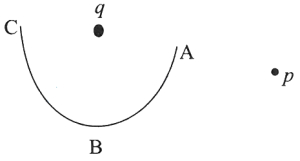
In the following diagram,the work done in moving a point charge from point $P$ to points $A, B$ and $C$ are $W_A, W_B$ and $W_C$ respectively. Then ($A, B, C$ are points on a semicircle and point charge $q$ is at the centre of the semicircle):
A
$W_A = W_B = W_C \neq 0$
B
$W_A = W_B = W_C = 0$
C
$W_A > W_B > W_C$
D
$W_A < W_B < W_C$
Solution
(A) The electric potential $V$ at any point at a distance $r$ from a point charge $q$ is given by $V = \frac{kq}{r}$.
Since points $A, B$ and $C$ lie on a semicircle with the charge $q$ at its centre,all these points are at the same distance $r$ (the radius of the semicircle) from the charge $q$.
Therefore,the electric potential at points $A, B$ and $C$ is the same,i.e.,$V_A = V_B = V_C = V$.
The work done in moving a charge $q_0$ from point $P$ to a point $X$ is given by $W = q_0(V_X - V_P)$.
Thus,the work done to move the charge to points $A, B$ and $C$ are:
$W_A = q_0(V_A - V_P) = q_0(V - V_P)$
$W_B = q_0(V_B - V_P) = q_0(V - V_P)$
$W_C = q_0(V_C - V_P) = q_0(V - V_P)$
Since $V_A = V_B = V_C$,it follows that $W_A = W_B = W_C$.
Since point $P$ is at a different distance from the charge $q$ compared to the points on the semicircle,$V_P \neq V$,therefore $W_A = W_B = W_C \neq 0$.
Since points $A, B$ and $C$ lie on a semicircle with the charge $q$ at its centre,all these points are at the same distance $r$ (the radius of the semicircle) from the charge $q$.
Therefore,the electric potential at points $A, B$ and $C$ is the same,i.e.,$V_A = V_B = V_C = V$.
The work done in moving a charge $q_0$ from point $P$ to a point $X$ is given by $W = q_0(V_X - V_P)$.
Thus,the work done to move the charge to points $A, B$ and $C$ are:
$W_A = q_0(V_A - V_P) = q_0(V - V_P)$
$W_B = q_0(V_B - V_P) = q_0(V - V_P)$
$W_C = q_0(V_C - V_P) = q_0(V - V_P)$
Since $V_A = V_B = V_C$,it follows that $W_A = W_B = W_C$.
Since point $P$ is at a different distance from the charge $q$ compared to the points on the semicircle,$V_P \neq V$,therefore $W_A = W_B = W_C \neq 0$.
0 likes
View Solution395
EasyMCQ
Assertion $(A)$: The work done by the electrostatic force is zero when a point charge moves in a circular path around another charge.
Reason $(R)$: The dot product of force and displacement vectors gives work done.
Reason $(R)$: The dot product of force and displacement vectors gives work done.
A
Both Assertion and Reason are true and Reason is the correct explanation of Assertion.
B
Both Assertion and Reason are true but Reason is $\text{NOT}$ the correct explanation of Assertion.
C
Assertion is true but Reason is false.
D
Assertion is false but Reason is true.
Solution
(A) The work done $W$ by a force $\vec{F}$ over a displacement $d\vec{r}$ is given by the dot product: $W = \int \vec{F} \cdot d\vec{r}$.
When a point charge moves in a circular path around another charge,the electrostatic force is always directed radially (towards or away from the center),while the displacement vector is always tangential to the circular path.
Since the angle between the radial force and the tangential displacement is $90^{\circ}$,the dot product $\vec{F} \cdot d\vec{r} = F dr \cos 90^{\circ} = 0$.
Thus,the work done is zero. Both the assertion and the reason are true,and the reason correctly explains why the work done is zero.
When a point charge moves in a circular path around another charge,the electrostatic force is always directed radially (towards or away from the center),while the displacement vector is always tangential to the circular path.
Since the angle between the radial force and the tangential displacement is $90^{\circ}$,the dot product $\vec{F} \cdot d\vec{r} = F dr \cos 90^{\circ} = 0$.
Thus,the work done is zero. Both the assertion and the reason are true,and the reason correctly explains why the work done is zero.
0 likes
View Solution396
MediumMCQ
The work done to assemble the three charges in a configuration as shown in the figure is
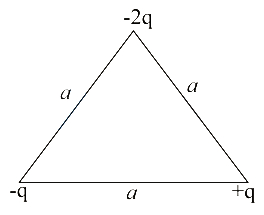
A
$\frac{-3 q^2}{4 \pi \varepsilon_0 a}$
B
$\frac{-2 q^2}{4 \pi \varepsilon_0 a}$
C
$\frac{-q^2}{4 \pi \varepsilon_0 a}$
D
$0$
Solution
(C) The work done to assemble a system of point charges is equal to the electrostatic potential energy of the system.
For a system of three charges $q_1, q_2,$ and $q_3$ placed at distances $r_{12}, r_{23},$ and $r_{13}$ from each other,the potential energy $U$ is given by:
$U = \frac{1}{4 \pi \varepsilon_0} \left( \frac{q_1 q_2}{r_{12}} + \frac{q_2 q_3}{r_{23}} + \frac{q_1 q_3}{r_{13}} \right)$
Given the charges $q_1 = -q$,$q_2 = +q$,and $q_3 = -2q$,and the distance between each pair is $a$:
$U = \frac{1}{4 \pi \varepsilon_0} \left( \frac{(-q)(q)}{a} + \frac{(q)(-2q)}{a} + \frac{(-q)(-2q)}{a} \right)$
$U = \frac{1}{4 \pi \varepsilon_0 a} (-q^2 - 2q^2 + 2q^2)$
$U = \frac{-q^2}{4 \pi \varepsilon_0 a}$
For a system of three charges $q_1, q_2,$ and $q_3$ placed at distances $r_{12}, r_{23},$ and $r_{13}$ from each other,the potential energy $U$ is given by:
$U = \frac{1}{4 \pi \varepsilon_0} \left( \frac{q_1 q_2}{r_{12}} + \frac{q_2 q_3}{r_{23}} + \frac{q_1 q_3}{r_{13}} \right)$
Given the charges $q_1 = -q$,$q_2 = +q$,and $q_3 = -2q$,and the distance between each pair is $a$:
$U = \frac{1}{4 \pi \varepsilon_0} \left( \frac{(-q)(q)}{a} + \frac{(q)(-2q)}{a} + \frac{(-q)(-2q)}{a} \right)$
$U = \frac{1}{4 \pi \varepsilon_0 a} (-q^2 - 2q^2 + 2q^2)$
$U = \frac{-q^2}{4 \pi \varepsilon_0 a}$
0 likes
View Solution397
MediumMCQ
$A$ charge $q$ is placed at the centre $O$ of a circle of radius $R$. Two other charges $q$ and $q$ are placed at the ends of the diameter $AB$ of the circle. The work done to move the charge at point $B$ along the circumference of the circle to a point $C$ as shown in the figure is
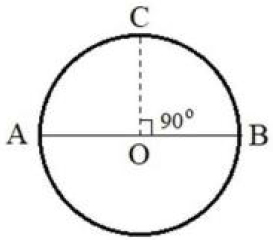
A
$\frac{1}{4 \pi \varepsilon_{0}} \cdot \frac{q^2}{R}(\sqrt{2})$
B
Zero
C
$\frac{1}{4 \pi \varepsilon_{0}} \cdot \frac{q^2}{R}\left(\frac{\sqrt{2}-1}{2}\right)$
D
$\frac{1}{4 \pi \varepsilon_{0}} \cdot \frac{q^2}{R}\left(\frac{1}{\sqrt{2}}\right)$
Solution
(C) The work done $W$ in moving a charge $q$ from point $B$ to point $C$ is given by $W = q(V_C - V_B)$,where $V_C$ and $V_B$ are the electric potentials at points $C$ and $B$ respectively.
The potential at any point is the sum of potentials due to the three charges: one at $O$ (charge $q$),one at $A$ (charge $q$),and one at $B$ (charge $q$).
Potential at $B$ $(V_B)$: The distance from $O$ to $B$ is $R$,from $A$ to $B$ is $2R$,and the charge at $B$ is the one being moved,so we consider the potential due to the other two charges: $V_B = \frac{1}{4 \pi \varepsilon_{0}} \left( \frac{q}{R} + \frac{q}{2R} \right) = \frac{1}{4 \pi \varepsilon_{0}} \cdot \frac{3q}{2R}$.
Potential at $C$ $(V_C)$: The distance from $O$ to $C$ is $R$,from $A$ to $C$ is $\sqrt{R^2 + R^2} = R\sqrt{2}$,and from $B$ to $C$ is $R\sqrt{2}$. The charge at $C$ is the one being moved,so we consider the potential due to the other two charges: $V_C = \frac{1}{4 \pi \varepsilon_{0}} \left( \frac{q}{R} + \frac{q}{R\sqrt{2}} \right) = \frac{1}{4 \pi \varepsilon_{0}} \cdot \frac{q}{R} \left( 1 + \frac{1}{\sqrt{2}} \right)$.
Work done $W = q(V_C - V_B) = q \cdot \frac{1}{4 \pi \varepsilon_{0}} \left[ \frac{q}{R} (1 + \frac{1}{\sqrt{2}}) - \frac{3q}{2R} \right] = \frac{q^2}{4 \pi \varepsilon_{0} R} \left[ 1 + \frac{1}{\sqrt{2}} - 1.5 \right] = \frac{q^2}{4 \pi \varepsilon_{0} R} \left[ \frac{\sqrt{2}}{2} - 0.5 \right] = \frac{q^2}{4 \pi \varepsilon_{0} R} \left( \frac{\sqrt{2}-1}{2} \right)$.
The potential at any point is the sum of potentials due to the three charges: one at $O$ (charge $q$),one at $A$ (charge $q$),and one at $B$ (charge $q$).
Potential at $B$ $(V_B)$: The distance from $O$ to $B$ is $R$,from $A$ to $B$ is $2R$,and the charge at $B$ is the one being moved,so we consider the potential due to the other two charges: $V_B = \frac{1}{4 \pi \varepsilon_{0}} \left( \frac{q}{R} + \frac{q}{2R} \right) = \frac{1}{4 \pi \varepsilon_{0}} \cdot \frac{3q}{2R}$.
Potential at $C$ $(V_C)$: The distance from $O$ to $C$ is $R$,from $A$ to $C$ is $\sqrt{R^2 + R^2} = R\sqrt{2}$,and from $B$ to $C$ is $R\sqrt{2}$. The charge at $C$ is the one being moved,so we consider the potential due to the other two charges: $V_C = \frac{1}{4 \pi \varepsilon_{0}} \left( \frac{q}{R} + \frac{q}{R\sqrt{2}} \right) = \frac{1}{4 \pi \varepsilon_{0}} \cdot \frac{q}{R} \left( 1 + \frac{1}{\sqrt{2}} \right)$.
Work done $W = q(V_C - V_B) = q \cdot \frac{1}{4 \pi \varepsilon_{0}} \left[ \frac{q}{R} (1 + \frac{1}{\sqrt{2}}) - \frac{3q}{2R} \right] = \frac{q^2}{4 \pi \varepsilon_{0} R} \left[ 1 + \frac{1}{\sqrt{2}} - 1.5 \right] = \frac{q^2}{4 \pi \varepsilon_{0} R} \left[ \frac{\sqrt{2}}{2} - 0.5 \right] = \frac{q^2}{4 \pi \varepsilon_{0} R} \left( \frac{\sqrt{2}-1}{2} \right)$.
0 likes
View Solution398
MediumMCQ
$729$ small identical spheres each charged to an electric potential $3 \ V$ combine to form a bigger sphere. The electric potential of the bigger sphere is (in $V$)
A
$9$
B
$729$
C
$81$
D
$243$
Solution
(D) Let $n = 729$ be the number of small spheres,each of radius $r$ and potential $V_s = 3 \ V$.
The potential of a small sphere is given by $V_s = \frac{k q}{r} = 3 \ V$.
When $n$ small spheres combine to form a bigger sphere of radius $R$,the total charge $Q = nq$ and the volume remains conserved.
Volume of big sphere = $n \times$ Volume of small sphere $\implies \frac{4}{3} \pi R^3 = n \times \frac{4}{3} \pi r^3$.
Thus,$R^3 = n r^3$,which means $R = n^{1/3} r$.
For $n = 729$,$R = (729)^{1/3} r = 9r$.
The potential of the bigger sphere is $V_B = \frac{k Q}{R} = \frac{k (nq)}{n^{1/3} r} = n^{2/3} \times \frac{k q}{r} = n^{2/3} V_s$.
Substituting the values: $V_B = (729)^{2/3} \times 3 \ V = (9^3)^{2/3} \times 3 \ V = 9^2 \times 3 \ V = 81 \times 3 \ V = 243 \ V$.
The potential of a small sphere is given by $V_s = \frac{k q}{r} = 3 \ V$.
When $n$ small spheres combine to form a bigger sphere of radius $R$,the total charge $Q = nq$ and the volume remains conserved.
Volume of big sphere = $n \times$ Volume of small sphere $\implies \frac{4}{3} \pi R^3 = n \times \frac{4}{3} \pi r^3$.
Thus,$R^3 = n r^3$,which means $R = n^{1/3} r$.
For $n = 729$,$R = (729)^{1/3} r = 9r$.
The potential of the bigger sphere is $V_B = \frac{k Q}{R} = \frac{k (nq)}{n^{1/3} r} = n^{2/3} \times \frac{k q}{r} = n^{2/3} V_s$.
Substituting the values: $V_B = (729)^{2/3} \times 3 \ V = (9^3)^{2/3} \times 3 \ V = 9^2 \times 3 \ V = 81 \times 3 \ V = 243 \ V$.
0 likes
View Solution399
EasyMCQ
If the electric potential at a point on the surface of a hollow conducting sphere of radius $R$ is $V$,then the electric potential at a point which is at distance $\frac{R}{3}$ from the centre of the sphere is
A
$V$
B
$\frac{V}{3}$
C
$\frac{V}{9}$
D
$3V$
Solution
(A) For a hollow conducting sphere,the electric charge resides entirely on its outer surface.
Inside the sphere,the electric field is zero $(E = 0)$.
Since the electric field is the negative gradient of the potential $(E = -\frac{dV}{dr})$,if $E = 0$,then the potential $V$ must be constant throughout the interior of the sphere.
Therefore,the potential at any point inside the sphere is equal to the potential at its surface.
Given that the potential at the surface is $V$,the potential at a distance $\frac{R}{3}$ from the centre (which is inside the sphere) is also $V$.
Inside the sphere,the electric field is zero $(E = 0)$.
Since the electric field is the negative gradient of the potential $(E = -\frac{dV}{dr})$,if $E = 0$,then the potential $V$ must be constant throughout the interior of the sphere.
Therefore,the potential at any point inside the sphere is equal to the potential at its surface.
Given that the potential at the surface is $V$,the potential at a distance $\frac{R}{3}$ from the centre (which is inside the sphere) is also $V$.
0 likes
View Solution400
DifficultMCQ
There are two thin wire rings,each of radius $R$,whose axes coincide. The charges of the rings are $q$ and $-q$. The magnitude of potential difference between the centres of the rings separated by a distance $\sqrt{3} R$ is
A
$0$
B
$\frac{q}{4 \pi \varepsilon_0 R}$
C
$\frac{q}{4 \pi \varepsilon_0 R} \frac{1}{\sqrt{3} R}$
D
$\frac{q}{2 \pi \varepsilon_0 R}$
Solution
(B) Let the centres of the rings be $A$ and $B$. The distance between them is $d = \sqrt{3} R$.
Potential at centre $A$ due to ring $1$ (charge $q$) is $V_{A1} = \frac{1}{4 \pi \varepsilon_0} \frac{q}{R}$.
Potential at centre $A$ due to ring $2$ (charge $-q$) is $V_{A2} = \frac{1}{4 \pi \varepsilon_0} \frac{-q}{\sqrt{R^2 + d^2}} = \frac{1}{4 \pi \varepsilon_0} \frac{-q}{\sqrt{R^2 + 3R^2}} = \frac{1}{4 \pi \varepsilon_0} \frac{-q}{2R}$.
Total potential at $A$ is $V_A = V_{A1} + V_{A2} = \frac{1}{4 \pi \varepsilon_0} (\frac{q}{R} - \frac{q}{2R}) = \frac{1}{4 \pi \varepsilon_0} \frac{q}{2R}$.
Similarly,potential at centre $B$ due to ring $2$ (charge $-q$) is $V_{B2} = \frac{1}{4 \pi \varepsilon_0} \frac{-q}{R}$.
Potential at centre $B$ due to ring $1$ (charge $q$) is $V_{B1} = \frac{1}{4 \pi \varepsilon_0} \frac{q}{\sqrt{R^2 + d^2}} = \frac{1}{4 \pi \varepsilon_0} \frac{q}{2R}$.
Total potential at $B$ is $V_B = V_{B1} + V_{B2} = \frac{1}{4 \pi \varepsilon_0} (\frac{q}{2R} - \frac{q}{R}) = -\frac{1}{4 \pi \varepsilon_0} \frac{q}{2R}$.
The magnitude of potential difference is $|V_A - V_B| = |\frac{1}{4 \pi \varepsilon_0} \frac{q}{2R} - (-\frac{1}{4 \pi \varepsilon_0} \frac{q}{2R})| = |\frac{1}{4 \pi \varepsilon_0} \frac{2q}{2R}| = \frac{q}{4 \pi \varepsilon_0 R}$.
Potential at centre $A$ due to ring $1$ (charge $q$) is $V_{A1} = \frac{1}{4 \pi \varepsilon_0} \frac{q}{R}$.
Potential at centre $A$ due to ring $2$ (charge $-q$) is $V_{A2} = \frac{1}{4 \pi \varepsilon_0} \frac{-q}{\sqrt{R^2 + d^2}} = \frac{1}{4 \pi \varepsilon_0} \frac{-q}{\sqrt{R^2 + 3R^2}} = \frac{1}{4 \pi \varepsilon_0} \frac{-q}{2R}$.
Total potential at $A$ is $V_A = V_{A1} + V_{A2} = \frac{1}{4 \pi \varepsilon_0} (\frac{q}{R} - \frac{q}{2R}) = \frac{1}{4 \pi \varepsilon_0} \frac{q}{2R}$.
Similarly,potential at centre $B$ due to ring $2$ (charge $-q$) is $V_{B2} = \frac{1}{4 \pi \varepsilon_0} \frac{-q}{R}$.
Potential at centre $B$ due to ring $1$ (charge $q$) is $V_{B1} = \frac{1}{4 \pi \varepsilon_0} \frac{q}{\sqrt{R^2 + d^2}} = \frac{1}{4 \pi \varepsilon_0} \frac{q}{2R}$.
Total potential at $B$ is $V_B = V_{B1} + V_{B2} = \frac{1}{4 \pi \varepsilon_0} (\frac{q}{2R} - \frac{q}{R}) = -\frac{1}{4 \pi \varepsilon_0} \frac{q}{2R}$.
The magnitude of potential difference is $|V_A - V_B| = |\frac{1}{4 \pi \varepsilon_0} \frac{q}{2R} - (-\frac{1}{4 \pi \varepsilon_0} \frac{q}{2R})| = |\frac{1}{4 \pi \varepsilon_0} \frac{2q}{2R}| = \frac{q}{4 \pi \varepsilon_0 R}$.
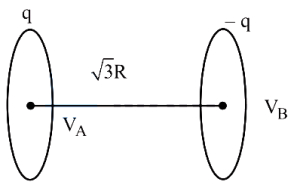
0 likes
View SolutionElectric Potential and Capacitance — Electric potential · Frequently Asked Questions
1Are these Electric Potential and Capacitance questions useful for JEE and NEET?
Yes. All questions in this section are mapped to JEE Main and NEET exam patterns. Previous year questions from JEE Main, NEET, GUJCET and state-level exams are included with full solutions.
2Can I switch to Hindi or Gujarati for these questions?
Yes. Use the language tabs in the hero section or the sidebar to view the same questions and solutions in English, Hindi or Gujarati.
3How do I generate a question paper from this subtopic?
Use the Vedclass Exam Paper Generator — select the chapter and subtopic, set difficulty, and generate Sets A, B, C, D automatically. First 3 chapters of every subject are free.
Vedclass Products
For Students
Vedclass Test Series
Mock tests in real JEE/NEET style with performance analysis. 5-day free trial.
Start Free TrialFor Teachers
Exam Paper Generator
Generate Set A/B/C/D papers from this chapter in 2 minutes. 3 chapters free.
Try FreeFor Institutes
Online Exam Module
Live online exams with unlimited students, 360° analytics & white-label branding.
See DemoFor Teachers & Institutes
Generate a Electric Potential and Capacitance Exam Paper in 2 Minutes
Select subtopic & difficulty — Sets A, B, C, D auto-generated with No Repeat logic.
First 3 chapters of every subject are free — no payment required.