
A English
Pressure due to Liquid Column and Barometer Questions in English
Class 11 Physics · Fluid Mechanics and Surface Tension · Pressure due to Liquid Column and Barometer
84+
Questions
English
Language
100%
With Solutions
Showing 34 of 84 questions in English
51
MediumMCQ
What does it mean when the height of a barometer is falling?
A
The atmospheric pressure is increasing.
B
The atmospheric pressure is decreasing.
C
The atmospheric pressure remains constant.
D
The temperature is decreasing.
Solution
(B) falling height of the mercury column in a barometer indicates a decrease in atmospheric pressure.
This decrease in pressure is often caused by an increase in the amount of water vapour in the atmosphere,which is less dense than dry air.
Consequently,a falling barometer reading is a common indicator of the possibility of rainfall or an approaching storm.
This decrease in pressure is often caused by an increase in the amount of water vapour in the atmosphere,which is less dense than dry air.
Consequently,a falling barometer reading is a common indicator of the possibility of rainfall or an approaching storm.
0 likes
View Solution52
DifficultMCQ
What does it mean when the height of a barometer is rising?
A
Decreasing atmospheric pressure
B
Increasing atmospheric pressure
C
Constant atmospheric pressure
D
No change in weather
Solution
(B) rising height of a barometer indicates an increase in atmospheric pressure.
This change typically suggests that the weather is becoming fair or dry,as high-pressure systems are generally associated with clear skies and lower humidity.
This change typically suggests that the weather is becoming fair or dry,as high-pressure systems are generally associated with clear skies and lower humidity.
0 likes
View Solution53
EasyMCQ
$A$ barometer is kept in an elevator accelerating upwards with an acceleration $a$. Find the most likely pressure inside the elevator.
A
Pressure $= h \rho g$
B
Pressure $= h \rho (g - a)$
C
Pressure $= h \rho (g + a)$
D
Pressure $= 0$
Solution
(C) The effective acceleration due to gravity inside an elevator accelerating upwards with acceleration $a$ is given by $g_{eff} = g + a$.
The pressure exerted by a liquid column of height $h$ and density $\rho$ is given by the formula $P = h \rho g_{eff}$.
Substituting the value of $g_{eff}$,we get the pressure inside the elevator as $P = h \rho (g + a)$.
Since $a > 0$,the pressure measured by the barometer will be greater than the standard atmospheric pressure $h \rho g$.
The pressure exerted by a liquid column of height $h$ and density $\rho$ is given by the formula $P = h \rho g_{eff}$.
Substituting the value of $g_{eff}$,we get the pressure inside the elevator as $P = h \rho (g + a)$.
Since $a > 0$,the pressure measured by the barometer will be greater than the standard atmospheric pressure $h \rho g$.
0 likes
View Solution54
MediumMCQ
$A$ barometer is kept in an elevator accelerating downwards with an acceleration $a$. What is the most likely pressure reading inside the elevator?
A
Greater than atmospheric pressure
B
Less than atmospheric pressure
C
Equal to atmospheric pressure
D
Zero
Solution
(B) The effective acceleration due to gravity inside an elevator accelerating downwards with acceleration $a$ is $g_{eff} = g - a$.
The pressure exerted by a liquid column of height $h$ is given by $P = h \rho g_{eff}$.
Since the barometer is calibrated for standard gravity $g$,the reading $h'$ will adjust such that the pressure balance remains consistent with the local effective gravity.
However,the pressure $P$ at the base of the column in the accelerating frame is $P = h \rho (g - a)$.
Since $(g - a) < g$,the effective weight of the mercury column decreases.
Therefore,the height of the mercury column $h$ in the barometer will decrease compared to the standard atmospheric pressure reading at rest,meaning the measured pressure is less than the atmospheric pressure $76 \text{ cm of Hg}$.
The pressure exerted by a liquid column of height $h$ is given by $P = h \rho g_{eff}$.
Since the barometer is calibrated for standard gravity $g$,the reading $h'$ will adjust such that the pressure balance remains consistent with the local effective gravity.
However,the pressure $P$ at the base of the column in the accelerating frame is $P = h \rho (g - a)$.
Since $(g - a) < g$,the effective weight of the mercury column decreases.
Therefore,the height of the mercury column $h$ in the barometer will decrease compared to the standard atmospheric pressure reading at rest,meaning the measured pressure is less than the atmospheric pressure $76 \text{ cm of Hg}$.
0 likes
View Solution55
Medium
$(a)$ Pressure decreases as one ascends the atmosphere. If the density of air is $\rho$,what is the change in pressure $dp$ over differential height $dh$?
$(b)$ Considering the pressure $P$ to be proportional to the density,find the pressure $P$ at a height $h$ if the pressure on the surface of the earth is $P_{0}$.
$(c)$ If $P_{0} = 1.03 \times 10^5 \text{ N/m}^2$,$\rho_0 = 1.29 \text{ kg/m}^3$,and $g = 9.8 \text{ m/s}^2$,at what height will the pressure drop to $\frac{1}{10}$ of the value at the surface of the earth?
$(d)$ This model of the atmosphere works for relatively small distances. Identify the underlying assumption that limits the model.
$(b)$ Considering the pressure $P$ to be proportional to the density,find the pressure $P$ at a height $h$ if the pressure on the surface of the earth is $P_{0}$.
$(c)$ If $P_{0} = 1.03 \times 10^5 \text{ N/m}^2$,$\rho_0 = 1.29 \text{ kg/m}^3$,and $g = 9.8 \text{ m/s}^2$,at what height will the pressure drop to $\frac{1}{10}$ of the value at the surface of the earth?
$(d)$ This model of the atmosphere works for relatively small distances. Identify the underlying assumption that limits the model.

Solution
(N/A) Since the air is less dense at higher altitudes,the pressure is also lower.
$(a)$ Consider a horizontal portion of air with cross-sectional area $A$ and height $dh$. Let the pressure on the top surface be $P$ and on the bottom surface be $P + dP$. If the portion is in equilibrium,the net upward force must be balanced by the weight.
$(P + dP)A - PA = -mg$ (where mass = volume $\times$ density)
$(dP)A = -\rho(A dh)g$
$dp = -\rho g dh$ ... $(1)$
The negative sign indicates that pressure decreases as height increases.
$(b)$ Let the density of air on the earth's surface be $\rho_0$. Given $P \propto \rho$,we have $\frac{P}{P_0} = \frac{\rho}{\rho_0}$,so $\rho = \left(\frac{P}{P_0}\right)\rho_0$ ... $(2)$
Substituting $(2)$ into $(1)$:
$dP = -\left(\frac{P}{P_0}\right)\rho_0 g dh$
$\frac{dP}{P} = -\frac{\rho_0 g}{P_0} dh$
Integrating both sides from $0$ to $h$:
$\int_{P_0}^{P} \frac{dP}{P} = -\frac{\rho_0 g}{P_0} \int_{0}^{h} dh$
$\ln\left(\frac{P}{P_0}\right) = -\frac{\rho_0 g h}{P_0}$
$P = P_0 e^{-\frac{\rho_0 g h}{P_0}}$
$(c)$ Given $P = \frac{P_0}{10}$,$\ln\left(\frac{1}{10}\right) = -\frac{\rho_0 g h}{P_0}$
$h = \frac{P_0 \ln(10)}{\rho_0 g} = \frac{1.03 \times 10^5 \times 2.303}{1.29 \times 9.8} \approx 18750 \text{ m} \approx 18.75 \text{ km}$.
$(d)$ The assumption is that the density of air is proportional to pressure,which implies an isothermal atmosphere (constant temperature),whereas the actual temperature of the atmosphere varies with height.
$(a)$ Consider a horizontal portion of air with cross-sectional area $A$ and height $dh$. Let the pressure on the top surface be $P$ and on the bottom surface be $P + dP$. If the portion is in equilibrium,the net upward force must be balanced by the weight.
$(P + dP)A - PA = -mg$ (where mass = volume $\times$ density)
$(dP)A = -\rho(A dh)g$
$dp = -\rho g dh$ ... $(1)$
The negative sign indicates that pressure decreases as height increases.
$(b)$ Let the density of air on the earth's surface be $\rho_0$. Given $P \propto \rho$,we have $\frac{P}{P_0} = \frac{\rho}{\rho_0}$,so $\rho = \left(\frac{P}{P_0}\right)\rho_0$ ... $(2)$
Substituting $(2)$ into $(1)$:
$dP = -\left(\frac{P}{P_0}\right)\rho_0 g dh$
$\frac{dP}{P} = -\frac{\rho_0 g}{P_0} dh$
Integrating both sides from $0$ to $h$:
$\int_{P_0}^{P} \frac{dP}{P} = -\frac{\rho_0 g}{P_0} \int_{0}^{h} dh$
$\ln\left(\frac{P}{P_0}\right) = -\frac{\rho_0 g h}{P_0}$
$P = P_0 e^{-\frac{\rho_0 g h}{P_0}}$
$(c)$ Given $P = \frac{P_0}{10}$,$\ln\left(\frac{1}{10}\right) = -\frac{\rho_0 g h}{P_0}$
$h = \frac{P_0 \ln(10)}{\rho_0 g} = \frac{1.03 \times 10^5 \times 2.303}{1.29 \times 9.8} \approx 18750 \text{ m} \approx 18.75 \text{ km}$.
$(d)$ The assumption is that the density of air is proportional to pressure,which implies an isothermal atmosphere (constant temperature),whereas the actual temperature of the atmosphere varies with height.
0 likes
View Solution56
EasyMCQ
$A$ barometer is constructed using a liquid (density $= 760 \; kg/m^3$). What would be the height (in $m$) of the liquid column,when a mercury barometer reads $76 \; cm$? (density of mercury $= 13600 \; kg/m^3$)
A
$0.76$
B
$1.36$
C
$13.6$
D
$136$
Solution
(C) The pressure exerted by a liquid column is given by the formula $P = h \rho g$,where $h$ is the height,$\rho$ is the density,and $g$ is the acceleration due to gravity.
For the mercury barometer,the pressure is $P = h_{Hg} \rho_{Hg} g = 0.76 \; m \times 13600 \; kg/m^3 \times g$.
For the liquid barometer,the pressure is $P = h' \rho' g = h' \times 760 \; kg/m^3 \times g$.
Since the atmospheric pressure is the same in both cases,we equate the two expressions:
$h' \times 760 = 0.76 \times 13600$
Solving for $h'$:
$h' = \frac{0.76 \times 13600}{760}$
$h' = \frac{10336}{760} = 13.6 \; m$.
For the mercury barometer,the pressure is $P = h_{Hg} \rho_{Hg} g = 0.76 \; m \times 13600 \; kg/m^3 \times g$.
For the liquid barometer,the pressure is $P = h' \rho' g = h' \times 760 \; kg/m^3 \times g$.
Since the atmospheric pressure is the same in both cases,we equate the two expressions:
$h' \times 760 = 0.76 \times 13600$
Solving for $h'$:
$h' = \frac{0.76 \times 13600}{760}$
$h' = \frac{10336}{760} = 13.6 \; m$.
0 likes
View Solution57
EasyMCQ
$A$ container of height $10 \, cm$ is filled with water. There is a hole at the bottom. Find the pressure difference between points at the top and the bottom.
A
$1000 \, Pa$
B
zero
C
$1 \, Pa$
D
$100 \, Pa$
Solution
(A) The pressure difference between two points at different depths in a fluid is given by the hydrostatic pressure formula: $\Delta P = \rho g h$.
Here,the density of water $\rho = 1000 \, kg/m^3$,the acceleration due to gravity $g = 10 \, m/s^2$,and the height difference $h = 10 \, cm = 0.1 \, m$.
Substituting these values into the formula:
$\Delta P = 1000 \times 10 \times 0.1$
$\Delta P = 1000 \, Pa$.
Here,the density of water $\rho = 1000 \, kg/m^3$,the acceleration due to gravity $g = 10 \, m/s^2$,and the height difference $h = 10 \, cm = 0.1 \, m$.
Substituting these values into the formula:
$\Delta P = 1000 \times 10 \times 0.1$
$\Delta P = 1000 \, Pa$.
0 likes
View Solution58
MediumMCQ
The pressure acting on a submarine is $3 \times 10^{5} \; Pa$ at a certain depth. If the depth is doubled,the percentage increase in the pressure acting on the submarine would be: (Assume that atmospheric pressure is $1 \times 10^{5} \; Pa$,density of water is $10^{3} \; kg \; m^{-3}$,and $g = 10 \; m \; s^{-2}$)
A
$\frac{200}{3} \%$
B
$\frac{200}{5} \%$
C
$\frac{5}{200} \%$
D
$\frac{3}{200} \%$
Solution
(A) The total pressure $P$ at a depth $d$ is given by $P = P_{0} + \rho gd$,where $P_{0}$ is the atmospheric pressure.
Given $P_{1} = 3 \times 10^{5} \; Pa$ and $P_{0} = 1 \times 10^{5} \; Pa$.
So,$\rho gd = P_{1} - P_{0} = 3 \times 10^{5} - 1 \times 10^{5} = 2 \times 10^{5} \; Pa$.
If the depth is doubled $(d' = 2d)$,the new pressure $P_{2}$ is $P_{2} = P_{0} + \rho g(2d) = P_{0} + 2(\rho gd)$.
Substituting the values: $P_{2} = 1 \times 10^{5} + 2(2 \times 10^{5}) = 1 \times 10^{5} + 4 \times 10^{5} = 5 \times 10^{5} \; Pa$.
The percentage increase in pressure is given by $\frac{P_{2} - P_{1}}{P_{1}} \times 100$.
Percentage increase $= \frac{5 \times 10^{5} - 3 \times 10^{5}}{3 \times 10^{5}} \times 100 = \frac{2 \times 10^{5}}{3 \times 10^{5}} \times 100 = \frac{200}{3} \%$.
Given $P_{1} = 3 \times 10^{5} \; Pa$ and $P_{0} = 1 \times 10^{5} \; Pa$.
So,$\rho gd = P_{1} - P_{0} = 3 \times 10^{5} - 1 \times 10^{5} = 2 \times 10^{5} \; Pa$.
If the depth is doubled $(d' = 2d)$,the new pressure $P_{2}$ is $P_{2} = P_{0} + \rho g(2d) = P_{0} + 2(\rho gd)$.
Substituting the values: $P_{2} = 1 \times 10^{5} + 2(2 \times 10^{5}) = 1 \times 10^{5} + 4 \times 10^{5} = 5 \times 10^{5} \; Pa$.
The percentage increase in pressure is given by $\frac{P_{2} - P_{1}}{P_{1}} \times 100$.
Percentage increase $= \frac{5 \times 10^{5} - 3 \times 10^{5}}{3 \times 10^{5}} \times 100 = \frac{2 \times 10^{5}}{3 \times 10^{5}} \times 100 = \frac{200}{3} \%$.
0 likes
View Solution59
AdvancedMCQ
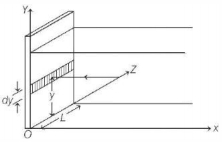
Consider the wall of a dam to be straight with height $H$ and length $L$. It holds a lake of water of height $h$ $(h < H)$ on one side. Let the density of water be $\rho_w$. Denote the torque about the axis along the bottom length of the wall by $\tau_1$. Denote also a similar torque due to the water up to height $h/2$ and wall length $L/2$ by $\tau_2$. Then $\tau_1 / \tau_2$ (ignore atmospheric pressure) is
A
$2$
B
$4$
C
$8$
D
$16$
Solution
(D) Consider a strip of width $dy$ at a height $y$ from the bottom. The depth of this strip below the surface is $(h-y)$.
The pressure at this depth is $P = \rho_w g(h-y)$.
The force on the strip of area $dA = L \cdot dy$ is $dF = P \cdot dA = \rho_w g(h-y) L \cdot dy$.
The torque $d\tau$ about the bottom axis (at $y=0$) is $d\tau = dF \cdot y = \rho_w g L (h-y) y \cdot dy$.
Integrating from $y=0$ to $y=h$ for the total torque $\tau_1$:
$\tau_1 = \int_{0}^{h} \rho_w g L (hy - y^2) dy = \rho_w g L \left[ \frac{hy^2}{2} - \frac{y^3}{3} \right]_{0}^{h} = \rho_w g L \left( \frac{h^3}{2} - \frac{h^3}{3} \right) = \frac{\rho_w g L h^3}{6}$.
For the second case,the height is $h' = h/2$ and length is $L' = L/2$. The torque $\tau_2$ is:
$\tau_2 = \int_{0}^{h/2} \rho_w g L' (h' - y) y \cdot dy = \int_{0}^{h/2} \rho_w g \left(\frac{L}{2}\right) \left(\frac{h}{2} - y\right) y \cdot dy$
$= \frac{\rho_w g L}{2} \left[ \frac{h}{2} \frac{y^2}{2} - \frac{y^3}{3} \right]_{0}^{h/2} = \frac{\rho_w g L}{2} \left[ \frac{h}{4} \left(\frac{h^2}{4}\right) - \frac{1}{3} \left(\frac{h^3}{8}\right) \right]$
$= \frac{\rho_w g L}{2} \left[ \frac{h^3}{16} - \frac{h^3}{24} \right] = \frac{\rho_w g L}{2} \left[ \frac{3h^3 - 2h^3}{48} \right] = \frac{\rho_w g L h^3}{2 \cdot 48} = \frac{\rho_w g L h^3}{96}$.
Therefore,$\frac{\tau_1}{\tau_2} = \frac{\rho_w g L h^3 / 6}{\rho_w g L h^3 / 96} = \frac{96}{6} = 16$.
The pressure at this depth is $P = \rho_w g(h-y)$.
The force on the strip of area $dA = L \cdot dy$ is $dF = P \cdot dA = \rho_w g(h-y) L \cdot dy$.
The torque $d\tau$ about the bottom axis (at $y=0$) is $d\tau = dF \cdot y = \rho_w g L (h-y) y \cdot dy$.
Integrating from $y=0$ to $y=h$ for the total torque $\tau_1$:
$\tau_1 = \int_{0}^{h} \rho_w g L (hy - y^2) dy = \rho_w g L \left[ \frac{hy^2}{2} - \frac{y^3}{3} \right]_{0}^{h} = \rho_w g L \left( \frac{h^3}{2} - \frac{h^3}{3} \right) = \frac{\rho_w g L h^3}{6}$.
For the second case,the height is $h' = h/2$ and length is $L' = L/2$. The torque $\tau_2$ is:
$\tau_2 = \int_{0}^{h/2} \rho_w g L' (h' - y) y \cdot dy = \int_{0}^{h/2} \rho_w g \left(\frac{L}{2}\right) \left(\frac{h}{2} - y\right) y \cdot dy$
$= \frac{\rho_w g L}{2} \left[ \frac{h}{2} \frac{y^2}{2} - \frac{y^3}{3} \right]_{0}^{h/2} = \frac{\rho_w g L}{2} \left[ \frac{h}{4} \left(\frac{h^2}{4}\right) - \frac{1}{3} \left(\frac{h^3}{8}\right) \right]$
$= \frac{\rho_w g L}{2} \left[ \frac{h^3}{16} - \frac{h^3}{24} \right] = \frac{\rho_w g L}{2} \left[ \frac{3h^3 - 2h^3}{48} \right] = \frac{\rho_w g L h^3}{2 \cdot 48} = \frac{\rho_w g L h^3}{96}$.
Therefore,$\frac{\tau_1}{\tau_2} = \frac{\rho_w g L h^3 / 6}{\rho_w g L h^3 / 96} = \frac{96}{6} = 16$.
0 likes
View Solution60
MediumMCQ
$A$ submarine has a window of area $30 \times 30 \,cm^2$ on its ceiling and is at a depth of $100 \,m$ below sea level. If the pressure inside the submarine is maintained at the sea-level atmospheric pressure,then the force acting on the window is ............. $N$ (consider density of sea water $\rho = 1.03 \times 10^3 \,kg/m^3$,acceleration due to gravity $g = 10 \,m/s^2$).
A
$0.93 \times 10^5$
B
$0.93 \times 10^3$
C
$1.86 \times 10^5$
D
$1.86 \times 10^3$
Solution
(A) The pressure difference across the window is due to the hydrostatic pressure of the water column above it.
Given:
Area $A = 30 \times 30 \,cm^2 = 900 \times 10^{-4} \,m^2 = 0.09 \,m^2$.
Depth $h = 100 \,m$.
Density $\rho = 1.03 \times 10^3 \,kg/m^3$.
Acceleration due to gravity $g = 10 \,m/s^2$.
The pressure difference $\Delta P$ is given by $\rho gh$.
The force $F$ acting on the window is $F = \Delta P \times A = \rho ghA$.
Substituting the values:
$F = (1.03 \times 10^3) \times 10 \times 100 \times 0.09$
$F = 1.03 \times 10^3 \times 10^3 \times 0.09$
$F = 1.03 \times 10^6 \times 0.09 = 0.0927 \times 10^6 = 9.27 \times 10^4 \,N$.
Rounding to two significant figures,$F \approx 9.3 \times 10^4 \,N = 0.93 \times 10^5 \,N$.
Given:
Area $A = 30 \times 30 \,cm^2 = 900 \times 10^{-4} \,m^2 = 0.09 \,m^2$.
Depth $h = 100 \,m$.
Density $\rho = 1.03 \times 10^3 \,kg/m^3$.
Acceleration due to gravity $g = 10 \,m/s^2$.
The pressure difference $\Delta P$ is given by $\rho gh$.
The force $F$ acting on the window is $F = \Delta P \times A = \rho ghA$.
Substituting the values:
$F = (1.03 \times 10^3) \times 10 \times 100 \times 0.09$
$F = 1.03 \times 10^3 \times 10^3 \times 0.09$
$F = 1.03 \times 10^6 \times 0.09 = 0.0927 \times 10^6 = 9.27 \times 10^4 \,N$.
Rounding to two significant figures,$F \approx 9.3 \times 10^4 \,N = 0.93 \times 10^5 \,N$.
0 likes
View Solution61
DifficultMCQ
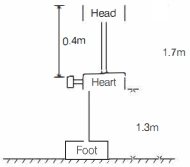
$A$ healthy adult of height $1.7 \,m$ has an average blood pressure $(BP)$ of $100 \,mm$ of $Hg$. The heart is typically at a height of $1.3 \,m$ from the foot. Take the density of blood to be $10^3 \,kg/m^3$ and note that $100 \,mm$ of $Hg$ is equivalent to $13.3 \,kPa$ (kilo pascals). The ratio of $BP$ in the foot region to that in the head region is close to:
A
one
B
two
C
three
D
four
Solution
(C) Given:
Blood pressure at heart level,$P_{\text{heart}} = 13.3 \,kPa = 13300 \,Pa$.
Density of blood,$\rho = 10^3 \,kg/m^3$.
Acceleration due to gravity,$g = 10 \,m/s^2$.
Height of heart from foot,$h_1 = 1.3 \,m$.
Height of head from heart,$h_2 = 1.7 \,m - 1.3 \,m = 0.4 \,m$.
Pressure at the foot level is given by $P_{\text{foot}} = P_{\text{heart}} + \rho g h_1$.
$P_{\text{foot}} = 13300 + (10^3 \times 10 \times 1.3) = 13300 + 13000 = 26300 \,Pa = 26.3 \,kPa$.
Pressure at the head level is given by $P_{\text{head}} = P_{\text{heart}} - \rho g h_2$.
$P_{\text{head}} = 13300 - (10^3 \times 10 \times 0.4) = 13300 - 4000 = 9300 \,Pa = 9.3 \,kPa$.
The ratio of $BP$ in the foot region to that in the head region is:
$\text{Ratio} = \frac{P_{\text{foot}}}{P_{\text{head}}} = \frac{26.3}{9.3} \approx 2.828$.
This value is closest to $3$.
Blood pressure at heart level,$P_{\text{heart}} = 13.3 \,kPa = 13300 \,Pa$.
Density of blood,$\rho = 10^3 \,kg/m^3$.
Acceleration due to gravity,$g = 10 \,m/s^2$.
Height of heart from foot,$h_1 = 1.3 \,m$.
Height of head from heart,$h_2 = 1.7 \,m - 1.3 \,m = 0.4 \,m$.
Pressure at the foot level is given by $P_{\text{foot}} = P_{\text{heart}} + \rho g h_1$.
$P_{\text{foot}} = 13300 + (10^3 \times 10 \times 1.3) = 13300 + 13000 = 26300 \,Pa = 26.3 \,kPa$.
Pressure at the head level is given by $P_{\text{head}} = P_{\text{heart}} - \rho g h_2$.
$P_{\text{head}} = 13300 - (10^3 \times 10 \times 0.4) = 13300 - 4000 = 9300 \,Pa = 9.3 \,kPa$.
The ratio of $BP$ in the foot region to that in the head region is:
$\text{Ratio} = \frac{P_{\text{foot}}}{P_{\text{head}}} = \frac{26.3}{9.3} \approx 2.828$.
This value is closest to $3$.
0 likes
View Solution62
EasyMCQ
What is the pressure on a swimmer $20 \, m$ below the surface of water in $atm$?
A
$1$
B
$2$
C
$4$
D
$3$
Solution
(D) The total pressure $P$ at a depth $h$ below the surface of a liquid is given by the formula: $P = P_0 + \rho gh$,where $P_0$ is the atmospheric pressure,$\rho$ is the density of the liquid,$g$ is the acceleration due to gravity,and $h$ is the depth.
Given:
Atmospheric pressure $P_0 \approx 1.013 \times 10^5 \, Pa$ (or $1 \, atm$).
Density of water $\rho = 1000 \, kg/m^3$.
Acceleration due to gravity $g \approx 9.8 \, m/s^2$.
Depth $h = 20 \, m$.
Calculating the gauge pressure: $P_{gauge} = \rho gh = 1000 \times 9.8 \times 20 = 1.96 \times 10^5 \, Pa$.
Since $1 \, atm \approx 1.013 \times 10^5 \, Pa$,the gauge pressure in $atm$ is approximately $1.96 \, atm \approx 2 \, atm$.
The total pressure $P = P_0 + P_{gauge} = 1 \, atm + 2 \, atm = 3 \, atm$.
Therefore,the correct option is $D$.
Given:
Atmospheric pressure $P_0 \approx 1.013 \times 10^5 \, Pa$ (or $1 \, atm$).
Density of water $\rho = 1000 \, kg/m^3$.
Acceleration due to gravity $g \approx 9.8 \, m/s^2$.
Depth $h = 20 \, m$.
Calculating the gauge pressure: $P_{gauge} = \rho gh = 1000 \times 9.8 \times 20 = 1.96 \times 10^5 \, Pa$.
Since $1 \, atm \approx 1.013 \times 10^5 \, Pa$,the gauge pressure in $atm$ is approximately $1.96 \, atm \approx 2 \, atm$.
The total pressure $P = P_0 + P_{gauge} = 1 \, atm + 2 \, atm = 3 \, atm$.
Therefore,the correct option is $D$.
0 likes
View Solution63
MediumMCQ
$A$ tank is filled with a liquid of density $\rho$ up to a height $H$. The average pressure on the walls of the container is:
A
$\rho g H$
B
$\frac{1}{2} \rho g H$
C
$\frac{1}{4} \rho g H$
D
$\frac{1}{8} \rho g H$
Solution
(B) The pressure at a depth $x$ from the surface of the liquid is given by $P(x) = \rho g x$.
To find the average pressure on the vertical wall of height $H$,we integrate the pressure over the depth and divide by the total height.
The total force per unit width is the integral of pressure with respect to depth: $F = \int_0^H \rho g x \, dx$.
$F = \rho g \left[ \frac{x^2}{2} \right]_0^H = \frac{1}{2} \rho g H^2$.
The average pressure $P_{avg}$ is defined as the total force per unit area. For a wall of height $H$ and unit width,the area is $H$. Thus,$P_{avg} = \frac{F}{H} = \frac{\frac{1}{2} \rho g H^2}{H} = \frac{1}{2} \rho g H$.
To find the average pressure on the vertical wall of height $H$,we integrate the pressure over the depth and divide by the total height.
The total force per unit width is the integral of pressure with respect to depth: $F = \int_0^H \rho g x \, dx$.
$F = \rho g \left[ \frac{x^2}{2} \right]_0^H = \frac{1}{2} \rho g H^2$.
The average pressure $P_{avg}$ is defined as the total force per unit area. For a wall of height $H$ and unit width,the area is $H$. Thus,$P_{avg} = \frac{F}{H} = \frac{\frac{1}{2} \rho g H^2}{H} = \frac{1}{2} \rho g H$.
0 likes
View Solution64
MediumMCQ
$A$ barometer kept in an elevator reads $76 \, cm$ when the elevator is accelerating upwards. The most likely pressure inside the elevator (in $cm$ of $Hg$) is ........
A
$74$
B
$75$
C
$76$
D
$77$
Solution
(D) The pressure measured by a barometer is given by $P = h \rho g_{eff}$,where $g_{eff}$ is the effective acceleration.
When the elevator accelerates upwards with an acceleration $a$,the effective acceleration becomes $g_{eff} = g + a$.
Since the barometer reads $76 \, cm$ of $Hg$ under this condition,the actual atmospheric pressure $P_0$ (which corresponds to the reading when $a = 0$) would be related to the observed reading $h'$ by $P_0 = h' \rho (g + a)$.
However,the question asks for the pressure reading in the accelerating frame. If the barometer reads $76 \, cm$ while accelerating upwards,it implies that the effective weight of the mercury column has increased.
Since $P = h \rho (g + a)$,for a fixed atmospheric pressure $P_0$,the height $h$ would decrease as acceleration increases. If the reading is $76 \, cm$ during upward acceleration,the actual atmospheric pressure must be higher than $76 \, cm$ of $Hg$ equivalent.
Given the options,if the barometer is calibrated to read $76 \, cm$ at rest,and it reads $76 \, cm$ while accelerating,it suggests the pressure is effectively higher than the standard $76 \, cm$ reading at rest. Thus,the most likely value greater than $76 \, cm$ is $77 \, cm$.
When the elevator accelerates upwards with an acceleration $a$,the effective acceleration becomes $g_{eff} = g + a$.
Since the barometer reads $76 \, cm$ of $Hg$ under this condition,the actual atmospheric pressure $P_0$ (which corresponds to the reading when $a = 0$) would be related to the observed reading $h'$ by $P_0 = h' \rho (g + a)$.
However,the question asks for the pressure reading in the accelerating frame. If the barometer reads $76 \, cm$ while accelerating upwards,it implies that the effective weight of the mercury column has increased.
Since $P = h \rho (g + a)$,for a fixed atmospheric pressure $P_0$,the height $h$ would decrease as acceleration increases. If the reading is $76 \, cm$ during upward acceleration,the actual atmospheric pressure must be higher than $76 \, cm$ of $Hg$ equivalent.
Given the options,if the barometer is calibrated to read $76 \, cm$ at rest,and it reads $76 \, cm$ while accelerating,it suggests the pressure is effectively higher than the standard $76 \, cm$ reading at rest. Thus,the most likely value greater than $76 \, cm$ is $77 \, cm$.
0 likes
View Solution65
MediumMCQ
$A$ sudden drop in the mercury level by $10 \,mm$ or more is a sign of ..........
A
Storm
B
Flood
C
Snowfall
D
Rain
Solution
(A) sudden drop in the mercury level of a barometer indicates a rapid decrease in atmospheric pressure.
When atmospheric pressure drops significantly,it creates a pressure gradient that causes air from surrounding high-pressure regions to rush into the low-pressure area at high velocities.
This high-velocity movement of air is characteristic of a storm.
Therefore,a drop of $10 \,mm$ or more is a precursor to a storm.
When atmospheric pressure drops significantly,it creates a pressure gradient that causes air from surrounding high-pressure regions to rush into the low-pressure area at high velocities.
This high-velocity movement of air is characteristic of a storm.
Therefore,a drop of $10 \,mm$ or more is a precursor to a storm.
0 likes
View Solution66
EasyMCQ
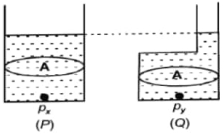
The figure shows two containers $P$ and $Q$ with the same base area $A$,each filled to the same height with the same liquid. Select the correct alternative.
A
$p_x = p_y$
B
$p_x > p_y$
C
$p_y > p_x$
D
Cannot say
Solution
(A) The pressure at any point in a static liquid depends only on the depth of the point below the free surface of the liquid,given by the formula $p = p_0 + \rho gh$,where $p_0$ is the atmospheric pressure,$\rho$ is the density of the liquid,$g$ is the acceleration due to gravity,and $h$ is the depth of the point.
In the given figure,both points $x$ and $y$ are at the same depth $h$ below the free surface of the liquid.
Since the liquid is the same (same $\rho$) and the depth $h$ is the same,the hydrostatic pressure at both points must be equal.
Therefore,$p_x = p_y$.
In the given figure,both points $x$ and $y$ are at the same depth $h$ below the free surface of the liquid.
Since the liquid is the same (same $\rho$) and the depth $h$ is the same,the hydrostatic pressure at both points must be equal.
Therefore,$p_x = p_y$.
0 likes
View Solution67
EasyMCQ
$A$ barometer kept in an elevator reads $76 \, cm$ when it is at rest. If the elevator goes up with some acceleration, the reading will be .......... $cm$.
A
$76$
B
$ > 76$
C
$ < 76$
D
$0$
Solution
(C) The correct option is $C$.
When an elevator accelerates upward with an acceleration $a$, an observer inside the elevator experiences a pseudo force acting downwards.
This effectively increases the acceleration due to gravity from $g$ to $g^{\prime} = g + a$.
The pressure exerted by the mercury column in the barometer is given by $P = \rho g h$.
Since the atmospheric pressure $P$ remains constant, we have $\rho g h = \rho (g + a) h^{\prime}$, where $h^{\prime}$ is the new reading.
Since $(g + a) > g$, it follows that $h^{\prime} < h$.
Therefore, the new reading $h^{\prime}$ will be less than $76 \, cm$.
When an elevator accelerates upward with an acceleration $a$, an observer inside the elevator experiences a pseudo force acting downwards.
This effectively increases the acceleration due to gravity from $g$ to $g^{\prime} = g + a$.
The pressure exerted by the mercury column in the barometer is given by $P = \rho g h$.
Since the atmospheric pressure $P$ remains constant, we have $\rho g h = \rho (g + a) h^{\prime}$, where $h^{\prime}$ is the new reading.
Since $(g + a) > g$, it follows that $h^{\prime} < h$.
Therefore, the new reading $h^{\prime}$ will be less than $76 \, cm$.
0 likes
View Solution68
EasyMCQ
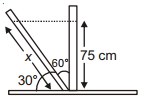
$A$ barometer tube reads $75 \,cm$ of $Hg$. If the tube is gradually inclined at an angle of $30^{\circ}$ with the horizontal,keeping the open end in the mercury container,then find the length of the mercury column in the barometer tube in $cm$.
A
$86.7$
B
$150$
C
$75$
D
$92.5$
Solution
(B) The vertical height of the mercury column in a barometer is determined by the atmospheric pressure and remains constant regardless of the inclination of the tube,provided the open end remains submerged in the mercury reservoir.
Let $h = 75 \,cm$ be the vertical height of the mercury column.
Let $x$ be the length of the mercury column along the tube when it is inclined at an angle $\theta = 30^{\circ}$ with the horizontal.
The relationship between the vertical height $h$ and the length $x$ along the inclined tube is given by $h = x \sin(\theta)$.
Here,$\theta = 30^{\circ}$,so $h = x \sin(30^{\circ})$.
Substituting the values: $75 = x \times (1/2)$.
Therefore,$x = 75 \times 2 = 150 \,cm$.
Let $h = 75 \,cm$ be the vertical height of the mercury column.
Let $x$ be the length of the mercury column along the tube when it is inclined at an angle $\theta = 30^{\circ}$ with the horizontal.
The relationship between the vertical height $h$ and the length $x$ along the inclined tube is given by $h = x \sin(\theta)$.
Here,$\theta = 30^{\circ}$,so $h = x \sin(30^{\circ})$.
Substituting the values: $75 = x \times (1/2)$.
Therefore,$x = 75 \times 2 = 150 \,cm$.
0 likes
View Solution69
EasyMCQ
The atmospheric pressure at a place is $10^5 \,Pa$. If tribromomethane (specific gravity $= 2.9$) is employed as the barometric liquid,the barometric height is .......... $m$. (in $.52$)
A
$3$
B
$1$
C
$4$
D
$2$
Solution
(A) The atmospheric pressure is given by $P = h \rho g$.
Standard atmospheric pressure is $P = 1.013 \times 10^5 \,Pa \approx 10^5 \,Pa$.
This pressure is equivalent to a mercury column of height $h_{Hg} = 0.76 \,m$ with density $\rho_{Hg} = 13600 \,kg/m^3$.
For the barometric liquid (tribromomethane),the density is $\rho_{TBM} = 2.9 \times 1000 \,kg/m^3 = 2900 \,kg/m^3$.
Using the principle $P = h_{Hg} \rho_{Hg} g = h_{TBM} \rho_{TBM} g$,we have:
$h_{TBM} = \frac{h_{Hg} \rho_{Hg}}{\rho_{TBM}}$
$h_{TBM} = \frac{0.76 \times 13600}{2900} \approx 3.56 \,m$.
Given the approximation $10^5 \,Pa$ and standard values,the calculated height is approximately $3.52 \,m$.
Standard atmospheric pressure is $P = 1.013 \times 10^5 \,Pa \approx 10^5 \,Pa$.
This pressure is equivalent to a mercury column of height $h_{Hg} = 0.76 \,m$ with density $\rho_{Hg} = 13600 \,kg/m^3$.
For the barometric liquid (tribromomethane),the density is $\rho_{TBM} = 2.9 \times 1000 \,kg/m^3 = 2900 \,kg/m^3$.
Using the principle $P = h_{Hg} \rho_{Hg} g = h_{TBM} \rho_{TBM} g$,we have:
$h_{TBM} = \frac{h_{Hg} \rho_{Hg}}{\rho_{TBM}}$
$h_{TBM} = \frac{0.76 \times 13600}{2900} \approx 3.56 \,m$.
Given the approximation $10^5 \,Pa$ and standard values,the calculated height is approximately $3.52 \,m$.
0 likes
View Solution70
MediumMCQ
The pressure at the bottom of a water tank is $4 P$,where $P$ is atmospheric pressure. If water is drawn out until the water level decreases by $\frac{3}{5}$ of its initial height,then the pressure at the bottom of the tank is .........
A
$\frac{3 P}{8}$
B
$\frac{7 P}{6}$
C
$\frac{11 P}{5}$
D
$\frac{9 P}{4}$
Solution
(C) Let the initial height of water in the tank be $h$. The pressure at the bottom is the sum of atmospheric pressure and gauge pressure.
$P_{\text{bottom}} = P + \rho_w g h = 4 P$
Therefore,the gauge pressure due to the water column is $\rho_w g h = 3 P$ ... $(1)$
When water is drawn out such that the level decreases by $\frac{3}{5}$ of its initial height,the remaining height of the water is $h' = h - \frac{3}{5} h = \frac{2}{5} h$.
The new pressure at the bottom is $P' = P + \rho_w g h'$.
Substituting $h' = \frac{2}{5} h$ into the equation:
$P' = P + \rho_w g (\frac{2}{5} h) = P + \frac{2}{5} (\rho_w g h)$.
Using equation $(1)$,substitute $\rho_w g h = 3 P$:
$P' = P + \frac{2}{5} (3 P) = P + \frac{6 P}{5} = \frac{5 P + 6 P}{5} = \frac{11 P}{5}$.
$P_{\text{bottom}} = P + \rho_w g h = 4 P$
Therefore,the gauge pressure due to the water column is $\rho_w g h = 3 P$ ... $(1)$
When water is drawn out such that the level decreases by $\frac{3}{5}$ of its initial height,the remaining height of the water is $h' = h - \frac{3}{5} h = \frac{2}{5} h$.
The new pressure at the bottom is $P' = P + \rho_w g h'$.
Substituting $h' = \frac{2}{5} h$ into the equation:
$P' = P + \rho_w g (\frac{2}{5} h) = P + \frac{2}{5} (\rho_w g h)$.
Using equation $(1)$,substitute $\rho_w g h = 3 P$:
$P' = P + \frac{2}{5} (3 P) = P + \frac{6 P}{5} = \frac{5 P + 6 P}{5} = \frac{11 P}{5}$.
0 likes
View Solution71
MediumMCQ
At what speed,the velocity head of water is equal to the pressure head of $40 \, cm$ of mercury? (Given: Density of mercury = $13.6 \times 10^3 \, kg/m^3$,Density of water = $10^3 \, kg/m^3$,$g = 9.8 \, m/s^2$)
A
$2.8$
B
$10.32$
C
$5.6$
D
$8.4$
Solution
(B) The velocity head of water is given by $\frac{V^2}{2g}$.
The pressure head of mercury is given as $h_{Hg} = 40 \, cm = 0.4 \, m$.
The pressure exerted by this mercury column is $P = \rho_{Hg} g h_{Hg}$.
Equating the pressure head of water to the pressure head of mercury:
$\frac{P}{\rho_w g} = \frac{\rho_{Hg} g h_{Hg}}{\rho_w g} = \frac{\rho_{Hg}}{\rho_w} h_{Hg}$.
Given that the velocity head $\frac{V^2}{2g}$ is equal to this pressure head:
$\frac{V^2}{2g} = \frac{\rho_{Hg}}{\rho_w} h_{Hg}$.
$V^2 = 2g \times \frac{\rho_{Hg}}{\rho_w} \times h_{Hg}$.
Substituting the values: $V^2 = 2 \times 9.8 \times 13.6 \times 0.4$.
$V^2 = 106.5984$.
$V = \sqrt{106.5984} \approx 10.32 \, m/s$.
The pressure head of mercury is given as $h_{Hg} = 40 \, cm = 0.4 \, m$.
The pressure exerted by this mercury column is $P = \rho_{Hg} g h_{Hg}$.
Equating the pressure head of water to the pressure head of mercury:
$\frac{P}{\rho_w g} = \frac{\rho_{Hg} g h_{Hg}}{\rho_w g} = \frac{\rho_{Hg}}{\rho_w} h_{Hg}$.
Given that the velocity head $\frac{V^2}{2g}$ is equal to this pressure head:
$\frac{V^2}{2g} = \frac{\rho_{Hg}}{\rho_w} h_{Hg}$.
$V^2 = 2g \times \frac{\rho_{Hg}}{\rho_w} \times h_{Hg}$.
Substituting the values: $V^2 = 2 \times 9.8 \times 13.6 \times 0.4$.
$V^2 = 106.5984$.
$V = \sqrt{106.5984} \approx 10.32 \, m/s$.
0 likes
View Solution72
MediumMCQ
$A$ beaker containing a liquid of density $\rho$ moves up with an acceleration $a$. The pressure due to the liquid at a depth $h$ below the free surface of the liquid is ............
A
$h \rho g$
B
$h \rho(g-a)$
C
$h \rho(g+a)$
D
$2 h \rho g\left(\frac{g+a}{g-a}\right)$
Solution
(C) When a beaker moves upward with an acceleration $a$, a pseudo force acts on the liquid particles in the downward direction.
This pseudo force adds to the gravitational force, effectively increasing the acceleration due to gravity.
The effective acceleration due to gravity is $g' = g + a$.
The pressure $P$ at a depth $h$ is given by the formula $P = \rho g' h$.
Substituting the value of $g'$, we get $P = \rho(g + a)h$.
This pseudo force adds to the gravitational force, effectively increasing the acceleration due to gravity.
The effective acceleration due to gravity is $g' = g + a$.
The pressure $P$ at a depth $h$ is given by the formula $P = \rho g' h$.
Substituting the value of $g'$, we get $P = \rho(g + a)h$.
0 likes
View Solution73
MediumMCQ
Variation of atmospheric pressure with height from the Earth is ................
A
Linear
B
Parabolic
C
Exponential
D
Hyperbolic
Solution
(C) The correct option is $C$.
The variation of atmospheric pressure $P$ with height $h$ above the Earth's surface is described by the barometric formula:
$P_h = P_0 e^{-mgh / RT}$
where $P_0$ is the pressure at sea level,$m$ is the molar mass of air,$g$ is the acceleration due to gravity,$R$ is the universal gas constant,and $T$ is the absolute temperature.
Since the pressure depends on the height $h$ through an exponential function,the decrease in atmospheric pressure with increasing height is exponential.
The variation of atmospheric pressure $P$ with height $h$ above the Earth's surface is described by the barometric formula:
$P_h = P_0 e^{-mgh / RT}$
where $P_0$ is the pressure at sea level,$m$ is the molar mass of air,$g$ is the acceleration due to gravity,$R$ is the universal gas constant,and $T$ is the absolute temperature.
Since the pressure depends on the height $h$ through an exponential function,the decrease in atmospheric pressure with increasing height is exponential.
0 likes
View Solution74
EasyMCQ
Two copper vessels $A$ and $B$ have the same base area but different shapes. Vessel $A$ requires twice the volume of water as vessel $B$ to fill up to a particular common height. Which of the following statements is correct?
A
Pressure on the base area of vessels $A$ and $B$ is the same.
B
Pressure on the base area of vessels $A$ and $B$ is not the same.
C
Both vessels $A$ and $B$ weigh the same.
D
Vessel $B$ weighs twice that of $A$.
Solution
(A) The pressure exerted by a liquid column at the base of a vessel is given by the formula $P = h \rho g$,where $h$ is the height of the liquid column,$\rho$ is the density of the liquid,and $g$ is the acceleration due to gravity.
Since both vessels $A$ and $B$ are filled to the same height $h$ with the same liquid (water),the pressure at the base depends only on the height $h$,the density $\rho$,and the constant $g$.
Because $h$,$\rho$,and $g$ are identical for both vessels,the pressure at the base of vessel $A$ must be equal to the pressure at the base of vessel $B$.
Since both vessels $A$ and $B$ are filled to the same height $h$ with the same liquid (water),the pressure at the base depends only on the height $h$,the density $\rho$,and the constant $g$.
Because $h$,$\rho$,and $g$ are identical for both vessels,the pressure at the base of vessel $A$ must be equal to the pressure at the base of vessel $B$.
0 likes
View Solution75
EasyMCQ
What would be the absolute pressure at a depth of $1 \,km$ below the ocean surface? [Given: density of water $\rho = 10^{3} \,kg/m^{3}$,$g = 10 \,m/s^{2}$,$1 \,atm = 1.01 \times 10^{5} \,N/m^{2}$]
A
$1.011 \times 10^{7} \,N/m^{2}$
B
$1.011 \times 10^{7} \,dyne/cm^{2}$
C
$1.011 \times 10^{6} \,dyne/cm^{2}$
D
$1.011 \times 10^{6} \,N/m^{2}$
Solution
(A) The absolute pressure $P$ at a depth $h$ is given by the formula: $P = P_{atm} + \rho gh$.
Given values are: $h = 1 \,km = 1000 \,m$,$\rho = 10^{3} \,kg/m^{3}$,$g = 10 \,m/s^{2}$,and $P_{atm} = 1.01 \times 10^{5} \,N/m^{2}$.
Calculating the gauge pressure (pressure due to water column): $P_{gauge} = \rho gh = 10^{3} \times 10 \times 1000 = 10^{7} \,N/m^{2}$.
Now,adding the atmospheric pressure: $P = 1.01 \times 10^{5} + 10^{7} = 0.0101 \times 10^{7} + 10^{7} = 1.0101 \times 10^{7} \,N/m^{2}$.
Rounding to the appropriate significant figures,we get $P \approx 1.011 \times 10^{7} \,N/m^{2}$.
Given values are: $h = 1 \,km = 1000 \,m$,$\rho = 10^{3} \,kg/m^{3}$,$g = 10 \,m/s^{2}$,and $P_{atm} = 1.01 \times 10^{5} \,N/m^{2}$.
Calculating the gauge pressure (pressure due to water column): $P_{gauge} = \rho gh = 10^{3} \times 10 \times 1000 = 10^{7} \,N/m^{2}$.
Now,adding the atmospheric pressure: $P = 1.01 \times 10^{5} + 10^{7} = 0.0101 \times 10^{7} + 10^{7} = 1.0101 \times 10^{7} \,N/m^{2}$.
Rounding to the appropriate significant figures,we get $P \approx 1.011 \times 10^{7} \,N/m^{2}$.
0 likes
View Solution76
MediumMCQ
The pressure at the bottom of a liquid tank is not proportional to the
A
Acceleration due to gravity
B
Density of the liquid
C
Height of the liquid
D
Area of the liquid surface
Solution
(D) The pressure $P$ at the bottom of a liquid tank is given by the formula $P = h \rho g$,where $h$ is the height of the liquid column,$\rho$ is the density of the liquid,and $g$ is the acceleration due to gravity.
From this formula,it is clear that the pressure is directly proportional to the height of the liquid $h$,the density of the liquid $\rho$,and the acceleration due to gravity $g$.
The pressure does not depend on the area of the liquid surface or the shape of the container.
Therefore,the pressure is not proportional to the area of the liquid surface.
From this formula,it is clear that the pressure is directly proportional to the height of the liquid $h$,the density of the liquid $\rho$,and the acceleration due to gravity $g$.
The pressure does not depend on the area of the liquid surface or the shape of the container.
Therefore,the pressure is not proportional to the area of the liquid surface.
0 likes
View Solution77
EasyMCQ
The gauge pressure at a depth of $50 \,m$ in a sea is (Density of sea water is $1025 \,kg \,m^{-3}$ and $g=10 \,ms^{-2}$ ). (in $\,Pa$)
A
$1025$
B
$512500$
C
$20000$
D
$15000$
Solution
(B) The gauge pressure $P_g$ at a depth $h$ is given by the formula $P_g = \rho g h$.
Given:
Density of sea water $\rho = 1025 \,kg \,m^{-3}$
Acceleration due to gravity $g = 10 \,ms^{-2}$
Depth $h = 50 \,m$
Substituting the values into the formula:
$P_g = 1025 \times 10 \times 50$
$P_g = 1025 \times 500$
$P_g = 512500 \,Pa$.
Given:
Density of sea water $\rho = 1025 \,kg \,m^{-3}$
Acceleration due to gravity $g = 10 \,ms^{-2}$
Depth $h = 50 \,m$
Substituting the values into the formula:
$P_g = 1025 \times 10 \times 50$
$P_g = 1025 \times 500$
$P_g = 512500 \,Pa$.
0 likes
View Solution78
EasyMCQ
$A$ tank of oil has a height of $4 \,m$ and a density of $850 \,kg \,m^{-3}$. The gauge pressure at the bottom of the tank is (Given: $1 \,atm = 10^5 \,Pa$,Acceleration due to gravity $g = 10 \,m \,s^{-2}$) (in $\,kPa$)
A
$34$
B
$384$
C
$284$
D
$200$
Solution
(A) The gauge pressure $P_g$ at the bottom of a fluid column is given by the formula: $P_g = \rho gh$.
Here,the density of oil $\rho = 850 \,kg \,m^{-3}$,the height of the oil column $h = 4 \,m$,and the acceleration due to gravity $g = 10 \,m \,s^{-2}$.
Substituting these values into the formula:
$P_g = 850 \,kg \,m^{-3} \times 10 \,m \,s^{-2} \times 4 \,m$
$P_g = 34000 \,Pa$
Since $1 \,kPa = 1000 \,Pa$,we have $P_g = 34 \,kPa$.
Here,the density of oil $\rho = 850 \,kg \,m^{-3}$,the height of the oil column $h = 4 \,m$,and the acceleration due to gravity $g = 10 \,m \,s^{-2}$.
Substituting these values into the formula:
$P_g = 850 \,kg \,m^{-3} \times 10 \,m \,s^{-2} \times 4 \,m$
$P_g = 34000 \,Pa$
Since $1 \,kPa = 1000 \,Pa$,we have $P_g = 34 \,kPa$.
0 likes
View Solution79
EasyMCQ
$A$ swimming pool has a depth of $3 \,m$. The pressure at the bottom of the pool due to water alone is: (Density of water is $1000 \,kg \,m^{-3}$, Acceleration due to gravity $= 10 \,m \,s^{-2}$)
A
$10^4 \,Pa$
B
$3 \times 10^3 \,Pa$
C
$29 \times 10^3 \,Pa$
D
$30 \times 10^3 \,Pa$
Solution
(D) Given:
Depth, $h = 3 \,m$
Density of water, $\rho = 1000 \,kg \,m^{-3} = 10^3 \,kg \,m^{-3}$
Acceleration due to gravity, $g = 10 \,m \,s^{-2}$
The pressure $P$ at the bottom of the pool due to the water column is calculated using the hydrostatic pressure formula:
$P = \rho g h$
Substituting the given values:
$P = 10^3 \,kg \,m^{-3} \times 10 \,m \,s^{-2} \times 3 \,m$
$P = 30 \times 10^3 \,Pa$
Thus, the pressure at the bottom is $30 \times 10^3 \,Pa$.
Depth, $h = 3 \,m$
Density of water, $\rho = 1000 \,kg \,m^{-3} = 10^3 \,kg \,m^{-3}$
Acceleration due to gravity, $g = 10 \,m \,s^{-2}$
The pressure $P$ at the bottom of the pool due to the water column is calculated using the hydrostatic pressure formula:
$P = \rho g h$
Substituting the given values:
$P = 10^3 \,kg \,m^{-3} \times 10 \,m \,s^{-2} \times 3 \,m$
$P = 30 \times 10^3 \,Pa$
Thus, the pressure at the bottom is $30 \times 10^3 \,Pa$.
0 likes
View Solution80
EasyMCQ
$A$ pressure of $1 \,mm$ of mercury is equivalent to
A
$1 \,mPa$
B
$13.33 \,Pa$
C
$133.3 \,Pa$
D
$1333 \,Pa$
Solution
(C) The pressure exerted by a liquid column is given by the formula $p = \rho g h$.
Here, the height of the mercury column is $h = 1 \,mm = 10^{-3} \,m$.
The density of mercury is $\rho = 13.6 \times 10^3 \,kg \,m^{-3}$.
The acceleration due to gravity is $g = 9.8 \,m \,s^{-2}$.
Substituting these values into the formula:
$p = (13.6 \times 10^3) \times 9.8 \times 10^{-3}$
$p = 13.6 \times 9.8$
$p = 133.28 \,Pa \approx 133.3 \,Pa$.
Here, the height of the mercury column is $h = 1 \,mm = 10^{-3} \,m$.
The density of mercury is $\rho = 13.6 \times 10^3 \,kg \,m^{-3}$.
The acceleration due to gravity is $g = 9.8 \,m \,s^{-2}$.
Substituting these values into the formula:
$p = (13.6 \times 10^3) \times 9.8 \times 10^{-3}$
$p = 13.6 \times 9.8$
$p = 133.28 \,Pa \approx 133.3 \,Pa$.
0 likes
View Solution81
DifficultMCQ
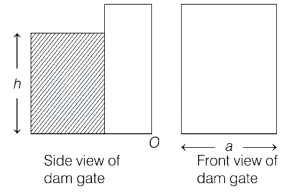
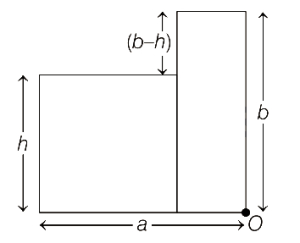
Water stands up to height $h$ behind a dam as shown in the figure. The front view of the dam gate is also shown in the adjoining figure. The density of water is $\rho$ and the acceleration due to gravity is $g$. If the atmospheric pressure force is also considered,the point of application of the total force acting on the dam due to water above $O$ is:
A
$\frac{h}{4}$
B
$\frac{h}{3}$
C
$h$
D
$\frac{h}{2}$
Solution
(B) The pressure at a depth $y$ from the free surface of water is $P = P_{atm} + \rho g y$. The force $dF$ on a small strip of height $dy$ at depth $y$ is $dF = P \cdot dA = (P_{atm} + \rho g y) \cdot (a \cdot dy)$,where $a$ is the width of the dam. The total force $F$ is the integral of $dF$ from $y=0$ to $y=h$. The point of application $y_R$ (center of pressure) is given by $y_R = \frac{\int y dF}{\int dF}$. For a rectangular gate of height $h$ submerged in water,the center of pressure is at a depth of $\frac{2}{3}h$ from the free surface. Since the question asks for the point of application relative to the base $O$ (which is at depth $h$ from the surface),the distance from the base is $h - \frac{2}{3}h = \frac{h}{3}$.
0 likes
View Solution82
EasyMCQ
The pressure at a point $10 \ m$ below the surface of water is (take atmospheric pressure $P_0 = 1.01 \times 10^5 \ Nm^{-2}$ and $g = 10 \ ms^{-2}$):
A
$2 \times 10^4 \ Nm^{-2}$
B
$10^5 \ Nm^{-2}$
C
$10^4 \ Nm^{-2}$
D
$2 \times 10^5 \ Nm^{-2}$
Solution
(D) The total pressure $P$ at a depth $h$ below the surface of a liquid is given by the formula: $P = P_0 + \rho gh$.
Here,$P_0$ is the atmospheric pressure,$\rho$ is the density of water $(1000 \ kg \ m^{-3})$,$g$ is the acceleration due to gravity $(10 \ ms^{-2})$,and $h$ is the depth $(10 \ m)$.
Substituting the values:
$P = 1.01 \times 10^5 + (1000 \times 10 \times 10)$
$P = 1.01 \times 10^5 + 10^5$
$P = 1.01 \times 10^5 + 1.00 \times 10^5 = 2.01 \times 10^5 \ Nm^{-2}$.
Rounding to the nearest significant value provided in the options,we get $2 \times 10^5 \ Nm^{-2}$.
Here,$P_0$ is the atmospheric pressure,$\rho$ is the density of water $(1000 \ kg \ m^{-3})$,$g$ is the acceleration due to gravity $(10 \ ms^{-2})$,and $h$ is the depth $(10 \ m)$.
Substituting the values:
$P = 1.01 \times 10^5 + (1000 \times 10 \times 10)$
$P = 1.01 \times 10^5 + 10^5$
$P = 1.01 \times 10^5 + 1.00 \times 10^5 = 2.01 \times 10^5 \ Nm^{-2}$.
Rounding to the nearest significant value provided in the options,we get $2 \times 10^5 \ Nm^{-2}$.
0 likes
View Solution83
EasyMCQ
$A$ $U$-shaped tube is partially filled with an incompressible liquid of density $1.2 \ g \ cm^{-3}$. Oil,which does not mix with the liquid,is poured into the left side of the $U$-tube until the liquid rises by $15 \ cm$ on the right side. If the density of the oil is $0.9 \ g \ cm^{-3}$,the oil level will stand higher than the liquid level on the right side of the $U$-tube by: (in $cm$)
A
$15$
B
$10$
C
$12$
D
$9$
Solution
(B) Let the density of the liquid be $\rho_l = 1.2 \ g \ cm^{-3}$ and the density of the oil be $\rho_o = 0.9 \ g \ cm^{-3}$.
When the liquid rises by $15 \ cm$ on the right side,it must have fallen by $15 \ cm$ on the left side relative to the initial equilibrium level.
Thus,the total difference in the liquid levels between the two arms is $h_l = 15 \ cm + 15 \ cm = 30 \ cm$.
Let $h_o$ be the height of the oil column on the left side. The pressure at the interface of the oil and liquid on the left side must equal the pressure at the same horizontal level on the right side.
Using the hydrostatic pressure balance: $h_o \rho_o g = h_l \rho_l g$.
Substituting the values: $h_o \times 0.9 = 30 \times 1.2$.
$h_o = \frac{30 \times 1.2}{0.9} = 40 \ cm$.
The oil column stands $40 \ cm$ above the initial liquid level on the left. Since the liquid on the left fell by $15 \ cm$,the top of the oil column is $40 - 15 = 25 \ cm$ above the initial level.
The liquid on the right is $15 \ cm$ above the initial level.
Therefore,the difference in height between the oil level and the right liquid level is $25 \ cm - 15 \ cm = 10 \ cm$.
When the liquid rises by $15 \ cm$ on the right side,it must have fallen by $15 \ cm$ on the left side relative to the initial equilibrium level.
Thus,the total difference in the liquid levels between the two arms is $h_l = 15 \ cm + 15 \ cm = 30 \ cm$.
Let $h_o$ be the height of the oil column on the left side. The pressure at the interface of the oil and liquid on the left side must equal the pressure at the same horizontal level on the right side.
Using the hydrostatic pressure balance: $h_o \rho_o g = h_l \rho_l g$.
Substituting the values: $h_o \times 0.9 = 30 \times 1.2$.
$h_o = \frac{30 \times 1.2}{0.9} = 40 \ cm$.
The oil column stands $40 \ cm$ above the initial liquid level on the left. Since the liquid on the left fell by $15 \ cm$,the top of the oil column is $40 - 15 = 25 \ cm$ above the initial level.
The liquid on the right is $15 \ cm$ above the initial level.
Therefore,the difference in height between the oil level and the right liquid level is $25 \ cm - 15 \ cm = 10 \ cm$.
0 likes
View Solution84
DifficultMCQ
$A$ submarine is designed to withstand an absolute pressure of $100 \text{ atm}$. How deep can it go below the water surface (in $\text{ m}$)? (Consider the density of water = $1000 \text{ kg/m}^3$, $1 \text{ atm} = 1 \times 10^5 \text{ Pa}$, and gravitational acceleration $g = 10 \text{ m/s}^2$)
A
$9900$
B
$990$
C
$9000$
D
$99$
Solution
(B) The formula for absolute pressure is $P = P_{atm} + \rho g h$.
Here, $P = 100 \text{ atm} = 100 \times 10^5 \text{ Pa}$, $P_{atm} = 1 \text{ atm} = 1 \times 10^5 \text{ Pa}$, $\rho = 1000 \text{ kg/m}^3$, and $g = 10 \text{ m/s}^2$.
Substituting the values: $100 \times 10^5 = 1 \times 10^5 + (1000)(10)h$.
$100 \times 10^5 - 1 \times 10^5 = 10^4 h$.
$99 \times 10^5 = 10^4 h$.
$h = \frac{99 \times 10^5}{10^4} = 99 \times 10 = 990 \text{ m}$.
Thus, the submarine can go $990 \text{ m}$ deep.
Here, $P = 100 \text{ atm} = 100 \times 10^5 \text{ Pa}$, $P_{atm} = 1 \text{ atm} = 1 \times 10^5 \text{ Pa}$, $\rho = 1000 \text{ kg/m}^3$, and $g = 10 \text{ m/s}^2$.
Substituting the values: $100 \times 10^5 = 1 \times 10^5 + (1000)(10)h$.
$100 \times 10^5 - 1 \times 10^5 = 10^4 h$.
$99 \times 10^5 = 10^4 h$.
$h = \frac{99 \times 10^5}{10^4} = 99 \times 10 = 990 \text{ m}$.
Thus, the submarine can go $990 \text{ m}$ deep.
0 likes
View SolutionFluid Mechanics and Surface Tension — Pressure due to Liquid Column and Barometer · Frequently Asked Questions
1Are these Fluid Mechanics and Surface Tension questions useful for JEE and NEET?
Yes. All questions in this section are mapped to JEE Main and NEET exam patterns. Previous year questions from JEE Main, NEET, GUJCET and state-level exams are included with full solutions.
2Can I switch to Hindi or Gujarati for these questions?
Yes. Use the language tabs in the hero section or the sidebar to view the same questions and solutions in English, Hindi or Gujarati.
3How do I generate a question paper from this subtopic?
Use the Vedclass Exam Paper Generator — select the chapter and subtopic, set difficulty, and generate Sets A, B, C, D automatically. First 3 chapters of every subject are free.
Vedclass Products
For Students
Vedclass Test Series
Mock tests in real JEE/NEET style with performance analysis. 5-day free trial.
Start Free TrialFor Teachers
Exam Paper Generator
Generate Set A/B/C/D papers from this chapter in 2 minutes. 3 chapters free.
Try FreeFor Institutes
Online Exam Module
Live online exams with unlimited students, 360° analytics & white-label branding.
See DemoFor Teachers & Institutes
Generate a Fluid Mechanics and Surface Tension Exam Paper in 2 Minutes
Select subtopic & difficulty — Sets A, B, C, D auto-generated with No Repeat logic.
First 3 chapters of every subject are free — no payment required.