
A English
Pressure and Density (of Mixure) Questions in English
Class 11 Physics · Fluid Mechanics and Surface Tension · Pressure and Density (of Mixure)
131+
Questions
English
Language
100%
With Solutions
Showing 50 of 131 questions in English
1
EasyMCQ
Which of the following quantities is expressed as force per unit area?
A
Work
B
Pressure
C
Volume
D
Area
Solution
(B) Pressure is defined as the physical quantity representing the force applied perpendicular to the surface of an object per unit area over which that force is distributed.
Mathematically,it is expressed as $P = \frac{F}{A}$,where $P$ is pressure,$F$ is the force,and $A$ is the area.
Mathematically,it is expressed as $P = \frac{F}{A}$,where $P$ is pressure,$F$ is the force,and $A$ is the area.
0 likes
View Solution2
EasyMCQ
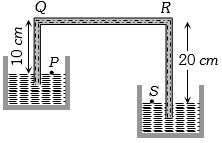
$A$ siphon in use is demonstrated in the following figure. The density of the liquid flowing in the siphon is $1.5 \text{ g/cm}^3$. The pressure difference between the points $P$ and $S$ will be
A
$10^5 \text{ N/m}^2$
B
$2 \times 10^5 \text{ N/m}^2$
C
Zero
D
Infinity
Solution
(C) Both points $P$ and $S$ are located at the free surfaces of the liquid in the two containers.
Since both containers are open to the atmosphere,the pressure at both points $P$ and $S$ is equal to the atmospheric pressure $(P_{atm})$.
Therefore,the pressure difference between point $P$ and point $S$ is given by $\Delta P = P_P - P_S = P_{atm} - P_{atm} = 0$.
Since both containers are open to the atmosphere,the pressure at both points $P$ and $S$ is equal to the atmospheric pressure $(P_{atm})$.
Therefore,the pressure difference between point $P$ and point $S$ is given by $\Delta P = P_P - P_S = P_{atm} - P_{atm} = 0$.
0 likes
View Solution3
MediumMCQ
Density of ice is $\rho$ and that of water is $\sigma$. What will be the decrease in volume when a mass $M$ of ice melts?
A
$\frac{M}{\sigma - \rho}$
B
$\frac{\sigma - \rho}{M}$
C
$M \left( \frac{1}{\rho} - \frac{1}{\sigma} \right)$
D
$\frac{1}{M} \left( \frac{1}{\rho} - \frac{1}{\sigma} \right)$
Solution
(C) The volume of ice of mass $M$ is given by $V_{\text{ice}} = \frac{M}{\rho}$.
When this ice melts into water of the same mass $M$,the volume of the water is $V_{\text{water}} = \frac{M}{\sigma}$.
Since the density of water $\sigma$ is greater than the density of ice $\rho$,the volume of water will be less than the volume of ice.
The decrease in volume is $\Delta V = V_{\text{ice}} - V_{\text{water}}$.
Substituting the expressions,we get $\Delta V = \frac{M}{\rho} - \frac{M}{\sigma} = M \left( \frac{1}{\rho} - \frac{1}{\sigma} \right)$.
When this ice melts into water of the same mass $M$,the volume of the water is $V_{\text{water}} = \frac{M}{\sigma}$.
Since the density of water $\sigma$ is greater than the density of ice $\rho$,the volume of water will be less than the volume of ice.
The decrease in volume is $\Delta V = V_{\text{ice}} - V_{\text{water}}$.
Substituting the expressions,we get $\Delta V = \frac{M}{\rho} - \frac{M}{\sigma} = M \left( \frac{1}{\rho} - \frac{1}{\sigma} \right)$.
0 likes
View Solution4
MediumMCQ
Equal masses of water and a liquid of density $2 \ g/cm^3$ are mixed together. The density of the resulting mixture is ........ $g/cm^3$.
A
$2/3$
B
$4/3$
C
$3/2$
D
$3$
Solution
(B) Let the mass of water be $m$ and the mass of the liquid be $m$. The density of water is $\rho_1 = 1 \ g/cm^3$ and the density of the liquid is $\rho_2 = 2 \ g/cm^3$.
The total mass of the mixture is $M = m + m = 2m$.
The total volume of the mixture is $V = V_1 + V_2 = \frac{m}{\rho_1} + \frac{m}{\rho_2} = m(\frac{1}{1} + \frac{1}{2}) = m(\frac{3}{2})$.
The density of the mixture is $\rho_{mix} = \frac{M}{V} = \frac{2m}{m(3/2)} = \frac{2}{3/2} = \frac{4}{3} \ g/cm^3$.
The total mass of the mixture is $M = m + m = 2m$.
The total volume of the mixture is $V = V_1 + V_2 = \frac{m}{\rho_1} + \frac{m}{\rho_2} = m(\frac{1}{1} + \frac{1}{2}) = m(\frac{3}{2})$.
The density of the mixture is $\rho_{mix} = \frac{M}{V} = \frac{2m}{m(3/2)} = \frac{2}{3/2} = \frac{4}{3} \ g/cm^3$.
0 likes
View Solution5
MediumMCQ
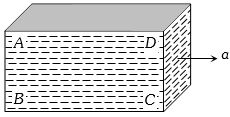
$A$ closed rectangular tank is completely filled with water and is accelerated horizontally with an acceleration $a$ towards the right. Pressure is $(i)$ maximum at,and $(ii)$ minimum at:
A
$(i) B, (ii) D$
B
$(i) C, (ii) D$
C
$(i) B, (ii) C$
D
$(i) B, (ii) A$
Solution
(A) Due to the acceleration $a$ towards the right,a pseudo force acts on the water in the left direction. This causes the pressure to increase towards the rear side (points $A$ and $B$) compared to the front side (points $D$ and $C$).
Additionally,due to the depth of the liquid column,the pressure increases with depth,making the pressure at the bottom (points $B$ and $C$) higher than at the top (points $A$ and $D$).
Combining these two effects,the pressure is maximum at the bottom-rear corner (point $B$) and minimum at the top-front corner (point $D$).
Additionally,due to the depth of the liquid column,the pressure increases with depth,making the pressure at the bottom (points $B$ and $C$) higher than at the top (points $A$ and $D$).
Combining these two effects,the pressure is maximum at the bottom-rear corner (point $B$) and minimum at the top-front corner (point $D$).
0 likes
View Solution6
EasyMCQ
$A$ beaker containing a liquid is kept inside a big closed jar. If the air inside the jar is continuously pumped out,the pressure in the liquid near the bottom of the liquid will
A
Increases
B
Decreases
C
Remain constant
D
First decrease and then increase
Solution
(B) The total pressure $P$ at the bottom of the liquid is given by the formula:
$P = P_0 + h\rho g$
where $P_0$ is the atmospheric pressure (or the pressure of the air above the liquid),$h$ is the depth of the liquid,$\rho$ is the density of the liquid,and $g$ is the acceleration due to gravity.
As the air is continuously pumped out from the jar,the pressure $P_0$ above the liquid surface decreases.
Since $h$,$\rho$,and $g$ remain constant,the total pressure $P$ at the bottom of the liquid decreases.
$P = P_0 + h\rho g$
where $P_0$ is the atmospheric pressure (or the pressure of the air above the liquid),$h$ is the depth of the liquid,$\rho$ is the density of the liquid,and $g$ is the acceleration due to gravity.
As the air is continuously pumped out from the jar,the pressure $P_0$ above the liquid surface decreases.
Since $h$,$\rho$,and $g$ remain constant,the total pressure $P$ at the bottom of the liquid decreases.
0 likes
View Solution7
MediumMCQ
$A$ triangular lamina of area $A$ and height $h$ is immersed in a liquid of density $\rho$ in a vertical plane with its base on the surface of the liquid. The thrust on the lamina is
A
$\frac{1}{2}A\rho gh$
B
$\frac{1}{3}A\rho gh$
C
$\frac{1}{6}A\rho gh$
D
$\frac{2}{3}A\rho gh$
Solution
(B) The thrust on a submerged surface is given by the product of the pressure at the centroid of the surface and the area of the surface.
For a triangular lamina with its base on the surface of the liquid,the depth of the centroid $(h_c)$ from the surface is $\frac{h}{3}$,where $h$ is the height of the triangle.
The pressure at the centroid is $P = \rho g h_c = \rho g (\frac{h}{3}) = \frac{\rho g h}{3}$.
The thrust on the lamina is $F = P \times A = (\frac{\rho g h}{3}) \times A = \frac{1}{3} A \rho g h$.
For a triangular lamina with its base on the surface of the liquid,the depth of the centroid $(h_c)$ from the surface is $\frac{h}{3}$,where $h$ is the height of the triangle.
The pressure at the centroid is $P = \rho g h_c = \rho g (\frac{h}{3}) = \frac{\rho g h}{3}$.
The thrust on the lamina is $F = P \times A = (\frac{\rho g h}{3}) \times A = \frac{1}{3} A \rho g h$.
0 likes
View Solution8
MediumMCQ
If two liquids of same masses but densities $\rho_1$ and $\rho_2$ respectively are mixed,then the density of the mixture is given by:
A
$\rho = \frac{\rho_1 + \rho_2}{2}$
B
$\rho = \frac{\rho_1 + \rho_2}{2\rho_1\rho_2}$
C
$\rho = \frac{2\rho_1\rho_2}{\rho_1 + \rho_2}$
D
$\rho = \frac{\rho_1\rho_2}{\rho_1 + \rho_2}$
Solution
(C) The density of a mixture is defined as the total mass divided by the total volume.
Let the mass of each liquid be $m$.
Total mass = $m + m = 2m$.
Volume of the first liquid $V_1 = \frac{m}{\rho_1}$.
Volume of the second liquid $V_2 = \frac{m}{\rho_2}$.
Total volume = $V_1 + V_2 = \frac{m}{\rho_1} + \frac{m}{\rho_2} = m \left( \frac{\rho_1 + \rho_2}{\rho_1\rho_2} \right)$.
Density of the mixture $\rho = \frac{\text{Total mass}}{\text{Total volume}} = \frac{2m}{m \left( \frac{\rho_1 + \rho_2}{\rho_1\rho_2} \right)}$.
$\rho = \frac{2\rho_1\rho_2}{\rho_1 + \rho_2}$.
Let the mass of each liquid be $m$.
Total mass = $m + m = 2m$.
Volume of the first liquid $V_1 = \frac{m}{\rho_1}$.
Volume of the second liquid $V_2 = \frac{m}{\rho_2}$.
Total volume = $V_1 + V_2 = \frac{m}{\rho_1} + \frac{m}{\rho_2} = m \left( \frac{\rho_1 + \rho_2}{\rho_1\rho_2} \right)$.
Density of the mixture $\rho = \frac{\text{Total mass}}{\text{Total volume}} = \frac{2m}{m \left( \frac{\rho_1 + \rho_2}{\rho_1\rho_2} \right)}$.
$\rho = \frac{2\rho_1\rho_2}{\rho_1 + \rho_2}$.
0 likes
View Solution9
MediumMCQ
If two liquids of same volume but different densities $\rho_1$ and $\rho_2$ are mixed,then the density of the mixture is given by:
A
$\rho = \frac{\rho_1 + \rho_2}{2}$
B
$\rho = \frac{\rho_1 + \rho_2}{2\rho_1\rho_2}$
C
$\rho = \frac{2\rho_1\rho_2}{\rho_1 + \rho_2}$
D
$\rho = \frac{\rho_1\rho_2}{\rho_1 + \rho_2}$
Solution
(A) The density of a mixture is defined as the total mass divided by the total volume.
Let the volume of each liquid be $V$.
Total volume of the mixture = $V + V = 2V$.
Mass of the first liquid = $m_1 = \rho_1 V$.
Mass of the second liquid = $m_2 = \rho_2 V$.
Total mass of the mixture = $m_1 + m_2 = \rho_1 V + \rho_2 V = V(\rho_1 + \rho_2)$.
Therefore,the density of the mixture $\rho$ is:
$\rho = \frac{\text{Total mass}}{\text{Total volume}} = \frac{V(\rho_1 + \rho_2)}{2V} = \frac{\rho_1 + \rho_2}{2}$.
Let the volume of each liquid be $V$.
Total volume of the mixture = $V + V = 2V$.
Mass of the first liquid = $m_1 = \rho_1 V$.
Mass of the second liquid = $m_2 = \rho_2 V$.
Total mass of the mixture = $m_1 + m_2 = \rho_1 V + \rho_2 V = V(\rho_1 + \rho_2)$.
Therefore,the density of the mixture $\rho$ is:
$\rho = \frac{\text{Total mass}}{\text{Total volume}} = \frac{V(\rho_1 + \rho_2)}{2V} = \frac{\rho_1 + \rho_2}{2}$.
0 likes
View Solution10
MediumMCQ
Three liquids of densities $d, 2d$,and $3d$ are mixed in equal volumes. Then the density of the mixture is
A
$d$
B
$2d$
C
$3d$
D
$5d$
Solution
(B) Let the volume of each liquid be $V$.
The mass of the first liquid is $m_1 = d \times V$.
The mass of the second liquid is $m_2 = 2d \times V$.
The mass of the third liquid is $m_3 = 3d \times V$.
The total mass of the mixture is $M = m_1 + m_2 + m_3 = V(d + 2d + 3d) = 6dV$.
The total volume of the mixture is $V_{total} = V + V + V = 3V$.
The density of the mixture is $\rho_{mixture} = \frac{M}{V_{total}} = \frac{6dV}{3V} = 2d$.
The mass of the first liquid is $m_1 = d \times V$.
The mass of the second liquid is $m_2 = 2d \times V$.
The mass of the third liquid is $m_3 = 3d \times V$.
The total mass of the mixture is $M = m_1 + m_2 + m_3 = V(d + 2d + 3d) = 6dV$.
The total volume of the mixture is $V_{total} = V + V + V = 3V$.
The density of the mixture is $\rho_{mixture} = \frac{M}{V_{total}} = \frac{6dV}{3V} = 2d$.
2 likes
View Solution11
MediumMCQ
Three liquids of densities $d$,$2d$,and $3d$ are mixed in equal proportions of weights. The relative density of the mixture is
A
$\frac{11d}{7}$
B
$\frac{18d}{11}$
C
$\frac{13d}{9}$
D
$\frac{23d}{18}$
Solution
(B) Let the weight of each liquid be $m$.
Total weight of the mixture = $m + m + m = 3m$.
The volume of each liquid is given by $V = \frac{m}{\rho}$.
Thus,$V_1 = \frac{m}{d}$,$V_2 = \frac{m}{2d}$,and $V_3 = \frac{m}{3d}$.
The density of the mixture is given by $\rho_{mix} = \frac{\text{Total Mass}}{\text{Total Volume}}$.
$\rho_{mix} = \frac{3m}{\frac{m}{d} + \frac{m}{2d} + \frac{m}{3d}}$.
$\rho_{mix} = \frac{3m}{\frac{6m + 3m + 2m}{6d}} = \frac{3m}{\frac{11m}{6d}}$.
$\rho_{mix} = 3m \times \frac{6d}{11m} = \frac{18d}{11}$.
Total weight of the mixture = $m + m + m = 3m$.
The volume of each liquid is given by $V = \frac{m}{\rho}$.
Thus,$V_1 = \frac{m}{d}$,$V_2 = \frac{m}{2d}$,and $V_3 = \frac{m}{3d}$.
The density of the mixture is given by $\rho_{mix} = \frac{\text{Total Mass}}{\text{Total Volume}}$.
$\rho_{mix} = \frac{3m}{\frac{m}{d} + \frac{m}{2d} + \frac{m}{3d}}$.
$\rho_{mix} = \frac{3m}{\frac{6m + 3m + 2m}{6d}} = \frac{3m}{\frac{11m}{6d}}$.
$\rho_{mix} = 3m \times \frac{6d}{11m} = \frac{18d}{11}$.
1 likes
View Solution12
EasyMCQ
Why is the dam of a water reservoir thick at the bottom?
A
Quantity of water increases with depth
B
Density of water increases with depth
C
Pressure of water increases with depth
D
Temperature of water increases with depth
Solution
(C) The pressure exerted by a liquid at a depth $h$ is given by the formula $P = \rho gh$,where $\rho$ is the density of the liquid,$g$ is the acceleration due to gravity,and $h$ is the depth.
As the depth $h$ increases,the pressure $P$ exerted by the water on the dam walls increases linearly.
To withstand this higher pressure at greater depths,the dam must be constructed with a thicker base to provide structural stability and prevent it from toppling due to the large torque generated by the water pressure.
As the depth $h$ increases,the pressure $P$ exerted by the water on the dam walls increases linearly.
To withstand this higher pressure at greater depths,the dam must be constructed with a thicker base to provide structural stability and prevent it from toppling due to the large torque generated by the water pressure.
0 likes
View Solution13
MediumMCQ
In making an alloy,a substance of specific gravity $s_1$ and mass $m_1$ is mixed with another substance of specific gravity $s_2$ and mass $m_2$; then the specific gravity of the alloy is
A
$\left( \frac{m_1 + m_2}{s_1 + s_2} \right)$
B
$\left( \frac{s_1 s_2}{m_1 + m_2} \right)$
C
$\frac{m_1 + m_2}{\left( \frac{m_1}{s_1} + \frac{m_2}{s_2} \right)}$
D
$\frac{\left( \frac{m_1}{s_1} + \frac{m_2}{s_2} \right)}{m_1 + m_2}$
Solution
(C) The specific gravity of a substance is defined as the ratio of its density to the density of water,i.e.,$s = \frac{\rho}{\rho_w}$.
Therefore,the density of the substance is $\rho = s \times \rho_w$.
The total mass of the alloy is $M = m_1 + m_2$.
The total volume of the alloy is $V = V_1 + V_2 = \frac{m_1}{\rho_1} + \frac{m_2}{\rho_2} = \frac{m_1}{s_1 \rho_w} + \frac{m_2}{s_2 \rho_w} = \frac{1}{\rho_w} \left( \frac{m_1}{s_1} + \frac{m_2}{s_2} \right)$.
The density of the alloy is $\rho_{alloy} = \frac{M}{V} = \frac{m_1 + m_2}{\frac{1}{\rho_w} \left( \frac{m_1}{s_1} + \frac{m_2}{s_2} \right)}$.
The specific gravity of the alloy is $s_{alloy} = \frac{\rho_{alloy}}{\rho_w} = \frac{m_1 + m_2}{\frac{m_1}{s_1} + \frac{m_2}{s_2}}$.
Therefore,the density of the substance is $\rho = s \times \rho_w$.
The total mass of the alloy is $M = m_1 + m_2$.
The total volume of the alloy is $V = V_1 + V_2 = \frac{m_1}{\rho_1} + \frac{m_2}{\rho_2} = \frac{m_1}{s_1 \rho_w} + \frac{m_2}{s_2 \rho_w} = \frac{1}{\rho_w} \left( \frac{m_1}{s_1} + \frac{m_2}{s_2} \right)$.
The density of the alloy is $\rho_{alloy} = \frac{M}{V} = \frac{m_1 + m_2}{\frac{1}{\rho_w} \left( \frac{m_1}{s_1} + \frac{m_2}{s_2} \right)}$.
The specific gravity of the alloy is $s_{alloy} = \frac{\rho_{alloy}}{\rho_w} = \frac{m_1 + m_2}{\frac{m_1}{s_1} + \frac{m_2}{s_2}}$.
0 likes
View Solution14
DifficultMCQ
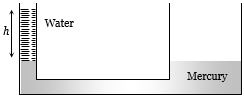
Two communicating vessels contain mercury. The diameter of one vessel is $n$ times larger than the diameter of the other. $A$ column of water of height $h$ is poured into the left vessel. The mercury level will rise in the right-hand vessel ($s =$ relative density of mercury and $\rho =$ density of water) by
A
$\frac{n^2 h}{(n + 1)^2 s}$
B
$\frac{h}{(n^2 + 1)s}$
C
$\frac{h}{(n + 1)^2 s}$
D
$\frac{h}{n^2 s}$
Solution
(B) Let the diameter of the left vessel be $d$ and the right vessel be $nd$. The cross-sectional area of the left vessel is $A_1 = \pi (d/2)^2$ and the right vessel is $A_2 = \pi (nd/2)^2 = n^2 A_1$.
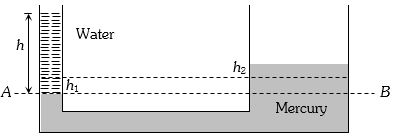
When water of height $h$ is poured into the left vessel,the mercury level in the left vessel drops by $h_1$ and rises in the right vessel by $h_2$.
Due to the conservation of volume of mercury,$A_1 h_1 = A_2 h_2$,which gives $A_1 h_1 = (n^2 A_1) h_2$,so $h_1 = n^2 h_2$.
The pressure at the interface level $A-B$ must be equal in both limbs.
Pressure at $A$ (left side) = $h \rho g$ (due to water column).
Pressure at $B$ (right side) = $(h_1 + h_2) \rho_{Hg} g$,where $\rho_{Hg} = s \rho$.
Equating the pressures: $h \rho g = (h_1 + h_2) s \rho g$.
$h = (h_1 + h_2) s$.
Substituting $h_1 = n^2 h_2$: $h = (n^2 h_2 + h_2) s = h_2 (n^2 + 1) s$.
Therefore,the rise in the right-hand vessel is $h_2 = \frac{h}{(n^2 + 1)s}$.
When water of height $h$ is poured into the left vessel,the mercury level in the left vessel drops by $h_1$ and rises in the right vessel by $h_2$.
Due to the conservation of volume of mercury,$A_1 h_1 = A_2 h_2$,which gives $A_1 h_1 = (n^2 A_1) h_2$,so $h_1 = n^2 h_2$.
The pressure at the interface level $A-B$ must be equal in both limbs.
Pressure at $A$ (left side) = $h \rho g$ (due to water column).
Pressure at $B$ (right side) = $(h_1 + h_2) \rho_{Hg} g$,where $\rho_{Hg} = s \rho$.
Equating the pressures: $h \rho g = (h_1 + h_2) s \rho g$.
$h = (h_1 + h_2) s$.
Substituting $h_1 = n^2 h_2$: $h = (n^2 h_2 + h_2) s = h_2 (n^2 + 1) s$.
Therefore,the rise in the right-hand vessel is $h_2 = \frac{h}{(n^2 + 1)s}$.
0 likes
View Solution15
EasyMCQ
$A$ litre of alcohol weighs
A
Less in winter than in summer
B
Less in summer than in winter
C
Same in both summer and winter
D
None of the above
Solution
(B) The mass of a substance is given by the formula $m = \rho \times V$,where $\rho$ is the density and $V$ is the volume.
Since the volume $V$ is fixed at $1 \text{ litre}$,the mass depends on the density $\rho$.
When the temperature increases (as in summer),alcohol expands,which causes its density $\rho$ to decrease.
Since $\rho_{\text{summer}} < \rho_{\text{winter}}$,the mass of $1 \text{ litre}$ of alcohol in summer will be less than its mass in winter.
Therefore,the correct option is $B$.
Since the volume $V$ is fixed at $1 \text{ litre}$,the mass depends on the density $\rho$.
When the temperature increases (as in summer),alcohol expands,which causes its density $\rho$ to decrease.
Since $\rho_{\text{summer}} < \rho_{\text{winter}}$,the mass of $1 \text{ litre}$ of alcohol in summer will be less than its mass in winter.
Therefore,the correct option is $B$.
0 likes
View Solution16
EasyMCQ
$5 \text{ litres}$ of benzene weighs
A
More in summer than in winter
B
More in winter than in summer
C
Equal in winter and summer
D
None of the above
Solution
(B) The density of a liquid depends on its temperature. As the temperature decreases,the liquid contracts,causing its density to increase.
In winter,the temperature is lower than in summer. Therefore,the density of benzene is higher in winter.
Since the volume is fixed at $5 \text{ litres}$,the mass $(m = \text{density} \times \text{volume})$ will be greater when the density is higher.
Thus,$5 \text{ litres}$ of benzene weighs more in winter than in summer.
In winter,the temperature is lower than in summer. Therefore,the density of benzene is higher in winter.
Since the volume is fixed at $5 \text{ litres}$,the mass $(m = \text{density} \times \text{volume})$ will be greater when the density is higher.
Thus,$5 \text{ litres}$ of benzene weighs more in winter than in summer.
0 likes
View Solution17
MediumMCQ
The densities of ice and water are $\rho$ and $\sigma$ respectively. What is the change in volume when a mass $M$ of ice melts?
A
$\frac{M}{\sigma - \rho}$
B
$\frac{\sigma - \rho}{M}$
C
$M \left[ \frac{1}{\rho} - \frac{1}{\sigma} \right]$
D
$\frac{1}{M} \left[ \frac{1}{\rho} - \frac{1}{\sigma} \right]$
Solution
(C) The volume of ice is $V_{ice} = \frac{M}{\rho}$.
The volume of water formed after melting is $V_{water} = \frac{M}{\sigma}$.
The change in volume is given by $\Delta V = V_{ice} - V_{water}$.
Substituting the values,we get $\Delta V = \frac{M}{\rho} - \frac{M}{\sigma} = M \left( \frac{1}{\rho} - \frac{1}{\sigma} \right)$.
The volume of water formed after melting is $V_{water} = \frac{M}{\sigma}$.
The change in volume is given by $\Delta V = V_{ice} - V_{water}$.
Substituting the values,we get $\Delta V = \frac{M}{\rho} - \frac{M}{\sigma} = M \left( \frac{1}{\rho} - \frac{1}{\sigma} \right)$.
0 likes
View Solution18
MediumMCQ
Two liquids of densities $\rho_1 = 1$ and $\rho_2 = 2$ are mixed in equal masses. What is the density of the resulting mixture?
A
$2/3$
B
$4/3$
C
$3/2$
D
$3$
Solution
(B) Let the mass of each liquid be $m$. The total mass of the mixture is $M = m + m = 2m$.
The volume of the first liquid is $V_1 = m / \rho_1$ and the volume of the second liquid is $V_2 = m / \rho_2$.
The total volume of the mixture is $V = V_1 + V_2 = m / \rho_1 + m / \rho_2 = m(\frac{\rho_1 + \rho_2}{\rho_1 \rho_2})$.
The density of the mixture is $\rho = \frac{M}{V} = \frac{2m}{m(\frac{\rho_1 + \rho_2}{\rho_1 \rho_2})} = \frac{2\rho_1 \rho_2}{\rho_1 + \rho_2}$.
Substituting the given values $\rho_1 = 1$ and $\rho_2 = 2$:
$\rho = \frac{2 \times 1 \times 2}{1 + 2} = \frac{4}{3}$.
The volume of the first liquid is $V_1 = m / \rho_1$ and the volume of the second liquid is $V_2 = m / \rho_2$.
The total volume of the mixture is $V = V_1 + V_2 = m / \rho_1 + m / \rho_2 = m(\frac{\rho_1 + \rho_2}{\rho_1 \rho_2})$.
The density of the mixture is $\rho = \frac{M}{V} = \frac{2m}{m(\frac{\rho_1 + \rho_2}{\rho_1 \rho_2})} = \frac{2\rho_1 \rho_2}{\rho_1 + \rho_2}$.
Substituting the given values $\rho_1 = 1$ and $\rho_2 = 2$:
$\rho = \frac{2 \times 1 \times 2}{1 + 2} = \frac{4}{3}$.
0 likes
View Solution19
DifficultMCQ
When two metals of equal volume are mixed,the relative density of the mixture is $4$. When equal masses of these two metals are mixed,the relative density of the mixture is $3$. What are the relative densities of the two metals?
A
$\rho_1 = 6$ and $\rho_2 = 2$
B
$\rho_1 = 3$ and $\rho_2 = 5$
C
$\rho_1 = 12$ and $\rho_2 = 4$
D
None of these
Solution
(A) Let the relative densities of the two metals be $\rho_1$ and $\rho_2$.
When equal volumes $V$ are mixed,the density of the mixture is $\rho_{mix} = \frac{V\rho_1 + V\rho_2}{2V} = \frac{\rho_1 + \rho_2}{2}$.
Given $\frac{\rho_1 + \rho_2}{2} = 4$,so $\rho_1 + \rho_2 = 8$ (Equation $i$).
When equal masses $M$ are mixed,the density of the mixture is $\rho_{mix} = \frac{2M}{V_1 + V_2} = \frac{2M}{\frac{M}{\rho_1} + \frac{M}{\rho_2}} = \frac{2\rho_1\rho_2}{\rho_1 + \rho_2}$.
Given $\frac{2\rho_1\rho_2}{\rho_1 + \rho_2} = 3$,so $2\rho_1\rho_2 = 3(\rho_1 + \rho_2)$ (Equation $ii$).
Substituting $\rho_1 + \rho_2 = 8$ into Equation $ii$:
$2\rho_1\rho_2 = 3(8) = 24$,so $\rho_1\rho_2 = 12$.
We have $\rho_1 + \rho_2 = 8$ and $\rho_1\rho_2 = 12$. Solving the quadratic equation $x^2 - 8x + 12 = 0$:
$(x - 6)(x - 2) = 0$.
Thus,the relative densities are $6$ and $2$.
When equal volumes $V$ are mixed,the density of the mixture is $\rho_{mix} = \frac{V\rho_1 + V\rho_2}{2V} = \frac{\rho_1 + \rho_2}{2}$.
Given $\frac{\rho_1 + \rho_2}{2} = 4$,so $\rho_1 + \rho_2 = 8$ (Equation $i$).
When equal masses $M$ are mixed,the density of the mixture is $\rho_{mix} = \frac{2M}{V_1 + V_2} = \frac{2M}{\frac{M}{\rho_1} + \frac{M}{\rho_2}} = \frac{2\rho_1\rho_2}{\rho_1 + \rho_2}$.
Given $\frac{2\rho_1\rho_2}{\rho_1 + \rho_2} = 3$,so $2\rho_1\rho_2 = 3(\rho_1 + \rho_2)$ (Equation $ii$).
Substituting $\rho_1 + \rho_2 = 8$ into Equation $ii$:
$2\rho_1\rho_2 = 3(8) = 24$,so $\rho_1\rho_2 = 12$.
We have $\rho_1 + \rho_2 = 8$ and $\rho_1\rho_2 = 12$. Solving the quadratic equation $x^2 - 8x + 12 = 0$:
$(x - 6)(x - 2) = 0$.
Thus,the relative densities are $6$ and $2$.
0 likes
View Solution20
DifficultMCQ
If a substance of mass $m_1$ and specific gravity $s_1$ is mixed with a substance of mass $m_2$ and specific gravity $s_2$,what is the specific gravity of the mixture?
A
$\left( \frac{m_1 + m_2}{s_1 + s_2} \right)$
B
$\left( \frac{s_1 s_2}{m_1 + m_2} \right)$
C
$\frac{m_1 + m_2}{\left( \frac{m_1}{s_1} + \frac{m_2}{s_2} \right)}$
D
$\frac{\left( \frac{m_1}{s_1} + \frac{m_2}{s_2} \right)}{m_1 + m_2}$
Solution
(C) Specific gravity $s = \frac{\text{Density of mixture}}{\text{Density of water}}$.
Density of mixture $\rho_{mix} = \frac{\text{Total mass}}{\text{Total volume}} = \frac{m_1 + m_2}{V_1 + V_2}$.
Since $V = \frac{m}{\rho}$ and $\rho = s \cdot \rho_w$,we have $V_1 = \frac{m_1}{s_1 \rho_w}$ and $V_2 = \frac{m_2}{s_2 \rho_w}$.
Substituting these into the density formula: $\rho_{mix} = \frac{m_1 + m_2}{\frac{m_1}{s_1 \rho_w} + \frac{m_2}{s_2 \rho_w}} = \frac{m_1 + m_2}{\frac{1}{\rho_w} \left( \frac{m_1}{s_1} + \frac{m_2}{s_2} \right)}$.
Therefore,the specific gravity $s_{mix} = \frac{\rho_{mix}}{\rho_w} = \frac{m_1 + m_2}{\frac{m_1}{s_1} + \frac{m_2}{s_2}}$.
Density of mixture $\rho_{mix} = \frac{\text{Total mass}}{\text{Total volume}} = \frac{m_1 + m_2}{V_1 + V_2}$.
Since $V = \frac{m}{\rho}$ and $\rho = s \cdot \rho_w$,we have $V_1 = \frac{m_1}{s_1 \rho_w}$ and $V_2 = \frac{m_2}{s_2 \rho_w}$.
Substituting these into the density formula: $\rho_{mix} = \frac{m_1 + m_2}{\frac{m_1}{s_1 \rho_w} + \frac{m_2}{s_2 \rho_w}} = \frac{m_1 + m_2}{\frac{1}{\rho_w} \left( \frac{m_1}{s_1} + \frac{m_2}{s_2} \right)}$.
Therefore,the specific gravity $s_{mix} = \frac{\rho_{mix}}{\rho_w} = \frac{m_1 + m_2}{\frac{m_1}{s_1} + \frac{m_2}{s_2}}$.
0 likes
View Solution21
DifficultMCQ
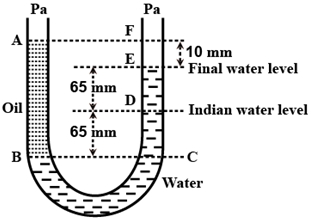
$A$ $U$ tube with both ends open to the atmosphere is partially filled with water. Oil,which is immiscible with water,is poured into one side until it stands at a distance of $10\, mm$ above the water level on the other side. Meanwhile,the water rises by $65\, mm$ from its original level (see diagram). The density of the oil is ......... $kg/m^3$.
A
$800$
B
$425$
C
$928$
D
$650$
Solution
(C) Let the original water level be at line $D$. When oil is poured into the left arm,the water level in the right arm rises by $65\, mm$ to level $E$. Consequently,the water level in the left arm drops by $65\, mm$ from the original level $D$ to level $B$.
The height of the water column above the interface level $BC$ in the right arm is $h_{water} = 65\, mm + 65\, mm = 130\, mm = 0.13\, m$.
The oil column height $h_{oil}$ is the distance from the top of the oil $A$ to the interface $B$. Since the top of the oil is $10\, mm$ above the water level $E$,the total height is $h_{oil} = 65\, mm + 65\, mm + 10\, mm = 140\, mm = 0.14\, m$.
Equating the pressures at the interface level $BC$:
$P_{atm} + \rho_{oil} g h_{oil} = P_{atm} + \rho_{water} g h_{water}$
$\rho_{oil} h_{oil} = \rho_{water} h_{water}$
$\rho_{oil} = \rho_{water} \times \frac{h_{water}}{h_{oil}}$
Given $\rho_{water} = 1000\, kg/m^3$:
$\rho_{oil} = 1000 \times \frac{130}{140} = 1000 \times \frac{13}{14} \approx 928.57\, kg/m^3$.
Rounding to the nearest integer,we get $928\, kg/m^3$.
The height of the water column above the interface level $BC$ in the right arm is $h_{water} = 65\, mm + 65\, mm = 130\, mm = 0.13\, m$.
The oil column height $h_{oil}$ is the distance from the top of the oil $A$ to the interface $B$. Since the top of the oil is $10\, mm$ above the water level $E$,the total height is $h_{oil} = 65\, mm + 65\, mm + 10\, mm = 140\, mm = 0.14\, m$.
Equating the pressures at the interface level $BC$:
$P_{atm} + \rho_{oil} g h_{oil} = P_{atm} + \rho_{water} g h_{water}$
$\rho_{oil} h_{oil} = \rho_{water} h_{water}$
$\rho_{oil} = \rho_{water} \times \frac{h_{water}}{h_{oil}}$
Given $\rho_{water} = 1000\, kg/m^3$:
$\rho_{oil} = 1000 \times \frac{130}{140} = 1000 \times \frac{13}{14} \approx 928.57\, kg/m^3$.
Rounding to the nearest integer,we get $928\, kg/m^3$.
0 likes
View Solution22
MediumMCQ
$A$ tank $5 \,m$ high is half filled with water and then is filled to the top with oil of density $0.85 \,g/cm^3$. The pressure at the bottom of the tank,due to these liquids is ........ $g/cm^2$.
A
$1.85$
B
$89.25$
C
$462.5$
D
$500$
Solution
(C) The total height of the tank is $H = 5 \,m = 500 \,cm$.
Since the tank is half-filled with water,the height of the water column is $h_1 = 250 \,cm$.
The remaining half is filled with oil,so the height of the oil column is $h_2 = 250 \,cm$.
The density of water is $d_1 = 1 \,g/cm^3$ and the density of oil is $d_2 = 0.85 \,g/cm^3$.
The pressure at the bottom due to the liquid column is given by $P = h_1 d_1 + h_2 d_2$.
Substituting the values: $P = (250 \,cm \times 1 \,g/cm^3) + (250 \,cm \times 0.85 \,g/cm^3)$.
$P = 250 + 212.5 = 462.5 \,g/cm^2$.
Since the tank is half-filled with water,the height of the water column is $h_1 = 250 \,cm$.
The remaining half is filled with oil,so the height of the oil column is $h_2 = 250 \,cm$.
The density of water is $d_1 = 1 \,g/cm^3$ and the density of oil is $d_2 = 0.85 \,g/cm^3$.
The pressure at the bottom due to the liquid column is given by $P = h_1 d_1 + h_2 d_2$.
Substituting the values: $P = (250 \,cm \times 1 \,g/cm^3) + (250 \,cm \times 0.85 \,g/cm^3)$.
$P = 250 + 212.5 = 462.5 \,g/cm^2$.
0 likes
View Solution23
MediumMCQ
Two substances of densities ${\rho _1}$ and ${\rho _2}$ are mixed in equal volumes and the relative density of the mixture is $4$. When they are mixed in equal masses,the relative density of the mixture is $3$. The values of ${\rho _1}$ and ${\rho _2}$ are
A
${\rho _1} = 6$ and ${\rho _2} = 2$
B
${\rho _1} = 3$ and ${\rho _2} = 5$
C
${\rho _1} = 12$ and ${\rho _2} = 4$
D
None of these
Solution
(A) When substances are mixed in equal volumes,the density of the mixture is given by $\rho_{mix} = \frac{\rho_1 + \rho_2}{2}$.
Given $\rho_{mix} = 4$,so $\frac{\rho_1 + \rho_2}{2} = 4$,which implies $\rho_1 + \rho_2 = 8$ .......$(i)$
When substances are mixed in equal masses,the density of the mixture is given by $\rho_{mix} = \frac{2\rho_1 \rho_2}{\rho_1 + \rho_2}$.
Given $\rho_{mix} = 3$,so $\frac{2\rho_1 \rho_2}{\rho_1 + \rho_2} = 3$,which implies $2\rho_1 \rho_2 = 3(\rho_1 + \rho_2)$ .......$(ii)$
Substituting equation $(i)$ into equation $(ii)$:
$2\rho_1 \rho_2 = 3(8) = 24$,so $\rho_1 \rho_2 = 12$.
We have $\rho_1 + \rho_2 = 8$ and $\rho_1 \rho_2 = 12$. These are the roots of the quadratic equation $x^2 - 8x + 12 = 0$.
$(x - 6)(x - 2) = 0$,so $x = 6$ or $x = 2$.
Thus,the values are ${\rho _1} = 6$ and ${\rho _2} = 2$ (or vice versa).
Given $\rho_{mix} = 4$,so $\frac{\rho_1 + \rho_2}{2} = 4$,which implies $\rho_1 + \rho_2 = 8$ .......$(i)$
When substances are mixed in equal masses,the density of the mixture is given by $\rho_{mix} = \frac{2\rho_1 \rho_2}{\rho_1 + \rho_2}$.
Given $\rho_{mix} = 3$,so $\frac{2\rho_1 \rho_2}{\rho_1 + \rho_2} = 3$,which implies $2\rho_1 \rho_2 = 3(\rho_1 + \rho_2)$ .......$(ii)$
Substituting equation $(i)$ into equation $(ii)$:
$2\rho_1 \rho_2 = 3(8) = 24$,so $\rho_1 \rho_2 = 12$.
We have $\rho_1 + \rho_2 = 8$ and $\rho_1 \rho_2 = 12$. These are the roots of the quadratic equation $x^2 - 8x + 12 = 0$.
$(x - 6)(x - 2) = 0$,so $x = 6$ or $x = 2$.
Thus,the values are ${\rho _1} = 6$ and ${\rho _2} = 2$ (or vice versa).
0 likes
View Solution24
EasyMCQ
Two stretched membranes of area $2\, cm^2$ and $3\, cm^2$ are placed in a liquid at the same depth. The ratio of pressures on them is
A
$1:1$
B
$2:3$
C
$3:2$
D
$4:9$
Solution
(A) The pressure $P$ at a depth $h$ in a liquid of density $\rho$ is given by the formula $P = P_0 + \rho gh$,where $P_0$ is the atmospheric pressure and $g$ is the acceleration due to gravity.
Since both membranes are placed at the same depth $h$ in the same liquid,the pressure acting on them depends only on the depth,the density of the liquid,and the atmospheric pressure.
Pressure is independent of the surface area of the membrane.
Therefore,the ratio of the pressures on the two membranes is $1:1$.
Since both membranes are placed at the same depth $h$ in the same liquid,the pressure acting on them depends only on the depth,the density of the liquid,and the atmospheric pressure.
Pressure is independent of the surface area of the membrane.
Therefore,the ratio of the pressures on the two membranes is $1:1$.
0 likes
View Solution25
EasyMCQ
Three identical vessels are filled to the same height with three different liquids $A, B$ and $C$ $(\rho_A > \rho_B > \rho_C)$. The pressure at the base will be
A
Equal in all vessels
B
Maximum in vessel $A$
C
Maximum in vessel $B$
D
Maximum in vessel $C$
Solution
(B) The pressure $P$ at the base of a vessel containing a liquid of density $\rho$ at a height $h$ is given by the formula $P = h \rho g$,where $g$ is the acceleration due to gravity.
Since the height $h$ is the same for all three vessels and $g$ is constant,the pressure $P$ is directly proportional to the density $\rho$ of the liquid $(P \propto \rho)$.
Given the densities are in the order $\rho_A > \rho_B > \rho_C$,it follows that the pressure at the base will be maximum for the liquid with the highest density.
Therefore,the pressure is maximum in vessel $A$.
Since the height $h$ is the same for all three vessels and $g$ is constant,the pressure $P$ is directly proportional to the density $\rho$ of the liquid $(P \propto \rho)$.
Given the densities are in the order $\rho_A > \rho_B > \rho_C$,it follows that the pressure at the base will be maximum for the liquid with the highest density.
Therefore,the pressure is maximum in vessel $A$.
0 likes
View Solution26
EasyMCQ
Three identical vessels are filled with equal masses of three different liquids $A, B$ and $C$ $(\rho_A > \rho_B > \rho_C)$. The pressure at the base will be
A
Equal in all vessels
B
Maximum in vessel $A$
C
Maximum in vessel $B$
D
Maximum in vessel $C$
Solution
(A) The pressure at the base of a vessel is given by $P = \frac{F}{A}$,where $F$ is the force exerted by the liquid on the base and $A$ is the area of the base.
Since the vessels are identical,the area $A$ of the base is the same for all three vessels.
The force $F$ exerted by the liquid on the base is equal to the weight of the liquid,$F = mg$.
Since the masses $m$ of the liquids are equal and the acceleration due to gravity $g$ is constant,the force $F$ is the same for all three vessels.
Therefore,the pressure $P = \frac{mg}{A}$ is equal in all three vessels,regardless of the density of the liquids.
Since the vessels are identical,the area $A$ of the base is the same for all three vessels.
The force $F$ exerted by the liquid on the base is equal to the weight of the liquid,$F = mg$.
Since the masses $m$ of the liquids are equal and the acceleration due to gravity $g$ is constant,the force $F$ is the same for all three vessels.
Therefore,the pressure $P = \frac{mg}{A}$ is equal in all three vessels,regardless of the density of the liquids.
0 likes
View Solution27
MediumMCQ
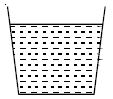
$A$ liquid of mass $1 \ kg$ is filled in a flask as shown in the figure. The force exerted by the flask on the liquid is $(g = 10 \ m/s^2)$ [Neglect atmospheric pressure]:
A
$10 \ N$
B
greater than $10 \ N$
C
less than $10 \ N$
D
zero
Solution
(A) The liquid is in equilibrium inside the flask.
According to Newton's third law of motion,the force exerted by the flask on the liquid must be equal and opposite to the force exerted by the liquid on the flask.
The total downward force exerted by the liquid on the base and walls of the flask is equal to the weight of the liquid,which is $W = mg$.
Given $m = 1 \ kg$ and $g = 10 \ m/s^2$,the weight is $W = 1 \ kg \times 10 \ m/s^2 = 10 \ N$.
Since the system is stationary and we neglect atmospheric pressure,the normal force exerted by the flask on the liquid to support its weight is exactly $10 \ N$.
According to Newton's third law of motion,the force exerted by the flask on the liquid must be equal and opposite to the force exerted by the liquid on the flask.
The total downward force exerted by the liquid on the base and walls of the flask is equal to the weight of the liquid,which is $W = mg$.
Given $m = 1 \ kg$ and $g = 10 \ m/s^2$,the weight is $W = 1 \ kg \times 10 \ m/s^2 = 10 \ N$.
Since the system is stationary and we neglect atmospheric pressure,the normal force exerted by the flask on the liquid to support its weight is exactly $10 \ N$.
0 likes
View Solution28
DifficultMCQ
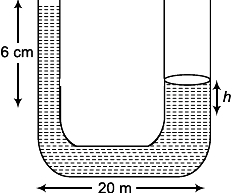
$A$ $U$-tube having a horizontal arm of length $20 \ cm$ has a uniform cross-sectional area of $1 \ cm^2$. It is filled with water of volume $60 \ cc$. What volume of a liquid of density $4 \ g/cc$ should be poured from one side into the $U$-tube so that no water is left in the horizontal arm of the tube? (Answer in $cc$)
A
$60$
B
$45$
C
$50$
D
$35$
Solution
(D) The total length of the water column is $l_w = \frac{V}{A} = \frac{60 \ cm^3}{1 \ cm^2} = 60 \ cm$.
When the liquid of density $\rho_l = 4 \ g/cc$ is poured,it pushes the water out of the horizontal arm.
Let the height of the liquid column be $h$. The pressure at the interface of the liquid and water in the $U$-tube must be equal at the same horizontal level.
The pressure exerted by the liquid column of height $h$ must balance the pressure exerted by the remaining water column of height $H = l_w - l_{horizontal} = 60 \ cm - 20 \ cm = 40 \ cm$.
Using the hydrostatic pressure balance equation: $\rho_l \cdot g \cdot h = \rho_w \cdot g \cdot H$.
Given $\rho_l = 4 \ g/cc$,$\rho_w = 1 \ g/cc$,and $H = 40 \ cm$:
$4 \cdot h = 1 \cdot 40 \Rightarrow h = 10 \ cm$.
The total length of the liquid column in the tube is $l_l = h + l_{horizontal} = 10 \ cm + 20 \ cm = 35 \ cm$.
The volume of the liquid required is $V_L = l_l \cdot A = 35 \ cm \cdot 1 \ cm^2 = 35 \ cc$.
When the liquid of density $\rho_l = 4 \ g/cc$ is poured,it pushes the water out of the horizontal arm.
Let the height of the liquid column be $h$. The pressure at the interface of the liquid and water in the $U$-tube must be equal at the same horizontal level.
The pressure exerted by the liquid column of height $h$ must balance the pressure exerted by the remaining water column of height $H = l_w - l_{horizontal} = 60 \ cm - 20 \ cm = 40 \ cm$.
Using the hydrostatic pressure balance equation: $\rho_l \cdot g \cdot h = \rho_w \cdot g \cdot H$.
Given $\rho_l = 4 \ g/cc$,$\rho_w = 1 \ g/cc$,and $H = 40 \ cm$:
$4 \cdot h = 1 \cdot 40 \Rightarrow h = 10 \ cm$.
The total length of the liquid column in the tube is $l_l = h + l_{horizontal} = 10 \ cm + 20 \ cm = 35 \ cm$.
The volume of the liquid required is $V_L = l_l \cdot A = 35 \ cm \cdot 1 \ cm^2 = 35 \ cc$.
0 likes
View Solution29
DifficultMCQ
The pressure at the bottom of a tank of water is $3P$,where $P$ is the atmospheric pressure. If the water is drawn out until the level of water is lowered by one-fifth,the pressure at the bottom of the tank will now be:
A
$2P$
B
$(13/5)P$
C
$(8/5)P$
D
$(4/5)P$
Solution
(B) The total pressure at the bottom of the tank is given by $P_{total} = P_{atm} + P_{gauge} = P + h\rho g = 3P$.
Therefore,the gauge pressure due to the water column is $h\rho g = 3P - P = 2P$.
When the water level is lowered by one-fifth,the new height of the water column becomes $h' = h - (1/5)h = (4/5)h$.
The new gauge pressure is $P'_{gauge} = h'\rho g = (4/5)h\rho g$.
Substituting the value of $h\rho g$,we get $P'_{gauge} = (4/5) \times 2P = (8/5)P$.
The new total pressure at the bottom is $P'_{total} = P_{atm} + P'_{gauge} = P + (8/5)P = (13/5)P$.
Therefore,the gauge pressure due to the water column is $h\rho g = 3P - P = 2P$.
When the water level is lowered by one-fifth,the new height of the water column becomes $h' = h - (1/5)h = (4/5)h$.
The new gauge pressure is $P'_{gauge} = h'\rho g = (4/5)h\rho g$.
Substituting the value of $h\rho g$,we get $P'_{gauge} = (4/5) \times 2P = (8/5)P$.
The new total pressure at the bottom is $P'_{total} = P_{atm} + P'_{gauge} = P + (8/5)P = (13/5)P$.
0 likes
View Solution30
DifficultMCQ
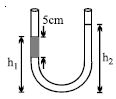
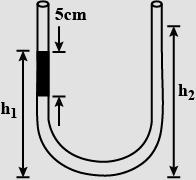
An open-ended $U$-tube of uniform cross-sectional area contains water (density $1.0 \text{ g/cm}^3$) standing initially $20 \text{ cm}$ from the bottom in each arm. An immiscible liquid of density $4.0 \text{ g/cm}^3$ is added to one arm until a layer $5 \text{ cm}$ high forms,as shown in the figure. What is the ratio $h_2/h_1$ of the heights of the liquid in the two arms?
A
$3/1$
B
$5/2$
C
$2/1$
D
$3/2$
Solution
(C) Let the initial height of water in each arm be $H = 20 \text{ cm}$. The total volume of water remains constant. When the immiscible liquid is added,the water level in one arm drops by $x$ and rises in the other arm by $x$.
Thus,$h_1 = H - x + 5 = 20 - x + 5 = 25 - x$ and $h_2 = H + x = 20 + x$.
Equating the pressure at the bottom of the $U$-tube:
$P_{\text{left}} = P_{\text{right}}$
$5 \times 4 \times g + (h_1 - 5) \times 1 \times g = h_2 \times 1 \times g$
$20 + (25 - x - 5) = 20 + x$
$20 + 20 - x = 20 + x$
$2x = 20 \Rightarrow x = 10 \text{ cm}$.
Now,$h_1 = 25 - 10 = 15 \text{ cm}$ and $h_2 = 20 + 10 = 30 \text{ cm}$.
The ratio $h_2/h_1 = 30/15 = 2/1$.
Thus,$h_1 = H - x + 5 = 20 - x + 5 = 25 - x$ and $h_2 = H + x = 20 + x$.
Equating the pressure at the bottom of the $U$-tube:
$P_{\text{left}} = P_{\text{right}}$
$5 \times 4 \times g + (h_1 - 5) \times 1 \times g = h_2 \times 1 \times g$
$20 + (25 - x - 5) = 20 + x$
$20 + 20 - x = 20 + x$
$2x = 20 \Rightarrow x = 10 \text{ cm}$.
Now,$h_1 = 25 - 10 = 15 \text{ cm}$ and $h_2 = 20 + 10 = 30 \text{ cm}$.
The ratio $h_2/h_1 = 30/15 = 2/1$.
0 likes
View Solution31
DifficultMCQ
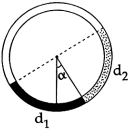
There is a circular tube in a vertical plane. Two liquids which do not mix and of densities $d_1$ and $d_2$ are filled in the tube. Each liquid subtends a $90^o$ angle at the centre. The radius joining their interface makes an angle $\alpha$ with the vertical. The ratio $\frac{d_1}{d_2}$ is
A
$\frac{1 + \cos\alpha}{1 - \cos\alpha}$
B
$\frac{1 + \tan\alpha}{1 - \tan\alpha}$
C
$\frac{1 + \sin\alpha}{1 - \cos\alpha}$
D
$\frac{1 + \sin\alpha}{1 - \sin\alpha}$
Solution
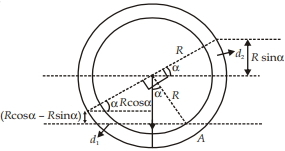
(B) Let $R$ be the radius of the circular tube. The interface between the two liquids is at an angle $\alpha$ with the vertical.
For the liquid of density $d_1$,the vertical height of the column is $h_1 = R \cos \alpha - R \sin \alpha$.
For the liquid of density $d_2$,the vertical height of the column is $h_2 = R \cos \alpha + R \sin \alpha$.
Since the pressure at the same horizontal level in a continuous static fluid is the same,we equate the pressures at the lowest point of the interface:
$P_1 = P_2$
$d_1 g h_1 = d_2 g h_2$
$d_1 (R \cos \alpha - R \sin \alpha) = d_2 (R \cos \alpha + R \sin \alpha)$
$\frac{d_1}{d_2} = \frac{R \cos \alpha + R \sin \alpha}{R \cos \alpha - R \sin \alpha}$
Dividing the numerator and denominator by $R \cos \alpha$:
$\frac{d_1}{d_2} = \frac{1 + \tan \alpha}{1 - \tan \alpha}$
For the liquid of density $d_1$,the vertical height of the column is $h_1 = R \cos \alpha - R \sin \alpha$.
For the liquid of density $d_2$,the vertical height of the column is $h_2 = R \cos \alpha + R \sin \alpha$.
Since the pressure at the same horizontal level in a continuous static fluid is the same,we equate the pressures at the lowest point of the interface:
$P_1 = P_2$
$d_1 g h_1 = d_2 g h_2$
$d_1 (R \cos \alpha - R \sin \alpha) = d_2 (R \cos \alpha + R \sin \alpha)$
$\frac{d_1}{d_2} = \frac{R \cos \alpha + R \sin \alpha}{R \cos \alpha - R \sin \alpha}$
Dividing the numerator and denominator by $R \cos \alpha$:
$\frac{d_1}{d_2} = \frac{1 + \tan \alpha}{1 - \tan \alpha}$
0 likes
View Solution32
MediumMCQ
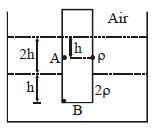
$A$ cylinder stands vertically in two immiscible liquids of densities $\rho$ and $2\rho$. The heights of the two liquids are shown in the figure. Find the difference in pressure at point $A$ and point $B$.
A
$2\rho gh$
B
$3\rho gh$
C
$4\rho gh$
D
None of these
Solution
(B) The pressure at point $A$ is due to the liquid of density $\rho$ at a depth $h$ from the surface of the upper liquid.
$P_A = P_{atm} + \rho gh$
The pressure at point $B$ is due to the liquid of density $\rho$ (height $2h$) and the liquid of density $2\rho$ (height $h$).
$P_B = P_{atm} + \rho g(2h) + (2\rho)gh = P_{atm} + 2\rho gh + 2\rho gh = P_{atm} + 4\rho gh$
The difference in pressure between point $B$ and point $A$ is:
$P_B - P_A = (P_{atm} + 4\rho gh) - (P_{atm} + \rho gh) = 3\rho gh$
$P_A = P_{atm} + \rho gh$
The pressure at point $B$ is due to the liquid of density $\rho$ (height $2h$) and the liquid of density $2\rho$ (height $h$).
$P_B = P_{atm} + \rho g(2h) + (2\rho)gh = P_{atm} + 2\rho gh + 2\rho gh = P_{atm} + 4\rho gh$
The difference in pressure between point $B$ and point $A$ is:
$P_B - P_A = (P_{atm} + 4\rho gh) - (P_{atm} + \rho gh) = 3\rho gh$
0 likes
View Solution33
MediumMCQ
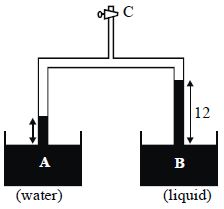
The limbs of a $U$-tube are lowered into vessels $A$ and $B$,where vessel $A$ contains water. Some air is pumped out through the top of the tube at $C$. The liquids in the left limb (in vessel $A$) and the right limb (in vessel $B$) rise to heights of $10\, cm$ and $12\, cm$ respectively above the free surfaces of the liquids in the vessels. The density of liquid $B$ is ........ $g/cm^3$.
A
$0.75$
B
$0.83$
C
$1.2$
D
$0.25$
Solution
(B) When air is pumped out from the top of the $U$-tube,the pressure at the top of both liquid columns becomes equal to the reduced pressure $P_{top}$.
Let $P_{atm}$ be the atmospheric pressure and $h_A = 10\, cm$ and $h_B = 12\, cm$ be the heights of the liquid columns in the limbs.
The pressure at the free surface of the liquid in vessel $A$ is $P_{atm}$. The pressure at the top of the liquid column in limb $A$ is $P_{top} = P_{atm} - \rho_w g h_A$.
Similarly,for vessel $B$,the pressure at the top of the liquid column is $P_{top} = P_{atm} - \rho_B g h_B$.
Equating the two expressions for $P_{top}$:
$P_{atm} - \rho_w g h_A = P_{atm} - \rho_B g h_B$
This simplifies to:
$\rho_w g h_A = \rho_B g h_B$
Given that $\rho_w = 1\, g/cm^3$,$h_A = 10\, cm$,and $h_B = 12\, cm$:
$1 \times 10 = \rho_B \times 12$
$\rho_B = \frac{10}{12} = \frac{5}{6} \approx 0.833\, g/cm^3$.
Thus,the density of liquid $B$ is approximately $0.83\, g/cm^3$.
Let $P_{atm}$ be the atmospheric pressure and $h_A = 10\, cm$ and $h_B = 12\, cm$ be the heights of the liquid columns in the limbs.
The pressure at the free surface of the liquid in vessel $A$ is $P_{atm}$. The pressure at the top of the liquid column in limb $A$ is $P_{top} = P_{atm} - \rho_w g h_A$.
Similarly,for vessel $B$,the pressure at the top of the liquid column is $P_{top} = P_{atm} - \rho_B g h_B$.
Equating the two expressions for $P_{top}$:
$P_{atm} - \rho_w g h_A = P_{atm} - \rho_B g h_B$
This simplifies to:
$\rho_w g h_A = \rho_B g h_B$
Given that $\rho_w = 1\, g/cm^3$,$h_A = 10\, cm$,and $h_B = 12\, cm$:
$1 \times 10 = \rho_B \times 12$
$\rho_B = \frac{10}{12} = \frac{5}{6} \approx 0.833\, g/cm^3$.
Thus,the density of liquid $B$ is approximately $0.83\, g/cm^3$.
0 likes
View Solution34
MediumMCQ
At shallow depth $h$,the pressure in the ocean is simply given by $P = P_0 + \rho gh$,in which $\rho$ is the density of water and $P_0$ is the air pressure. As we go deeper,the high pressure causes the water to compress and become denser. Which of the following sketches illustrates the correct dependence of the pressure on the depth $h$ ?
A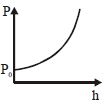
B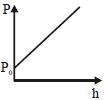
C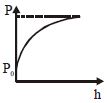
D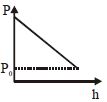
Solution
(A) The pressure at a depth $h$ is given by the differential equation $dP = \rho(P) g dh$.
Since water is compressible,its density $\rho$ increases as the pressure $P$ increases with depth $h$.
This means that as $h$ increases,the rate of change of pressure with respect to depth,$\frac{dP}{dh} = \rho g$,also increases because $\rho$ is an increasing function of $P$.
Mathematically,$\frac{d^2P}{dh^2} = g \frac{d\rho}{dP} \frac{dP}{dh} > 0$.
This indicates that the graph of $P$ versus $h$ must be concave upwards (i.e.,the slope increases as $h$ increases).
Among the given options,graph $A$ shows an upward-curving (concave up) relationship,which correctly represents the increasing rate of pressure change due to the increasing density of water at greater depths.
Since water is compressible,its density $\rho$ increases as the pressure $P$ increases with depth $h$.
This means that as $h$ increases,the rate of change of pressure with respect to depth,$\frac{dP}{dh} = \rho g$,also increases because $\rho$ is an increasing function of $P$.
Mathematically,$\frac{d^2P}{dh^2} = g \frac{d\rho}{dP} \frac{dP}{dh} > 0$.
This indicates that the graph of $P$ versus $h$ must be concave upwards (i.e.,the slope increases as $h$ increases).
Among the given options,graph $A$ shows an upward-curving (concave up) relationship,which correctly represents the increasing rate of pressure change due to the increasing density of water at greater depths.
0 likes
View Solution35
AdvancedMCQ
$A$ hollow sphere of radius $R$ is filled completely with an ideal liquid of density $\rho$. The sphere is moving horizontally with an acceleration $2g,$ where $g$ is the acceleration due to gravity. If the minimum pressure of the liquid is $P_0$,then what is the pressure at the centre of the sphere?
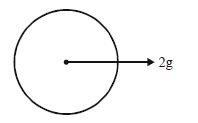
A
$P_0 + \rho gR$
B
$P_0 + \rho gR\sqrt{2}$
C
$P_0 + \rho gR\sqrt{5}$
D
$P_0 + \frac{\rho gR}{\sqrt{5}}$
Solution
(C) In the frame of the sphere,the liquid experiences a pseudo-force in the backward direction with an acceleration $a = 2g$. The effective acceleration vector $\vec{g}_{eff}$ is the vector sum of the acceleration due to gravity $\vec{g}$ (acting downwards) and the pseudo-acceleration $\vec{a}_{pseudo} = -2g\hat{i}$ (acting backwards).
Thus,$\vec{g}_{eff} = -2g\hat{i} - g\hat{j}$.
The magnitude of the effective acceleration is $g_{eff} = \sqrt{(2g)^2 + g^2} = \sqrt{5g^2} = g\sqrt{5}$.
The pressure in the liquid varies as $P = P_{min} + \rho \vec{g}_{eff} \cdot \vec{r}$,where $\vec{r}$ is the displacement vector from the point of minimum pressure to the point of interest.
The minimum pressure occurs at the point furthest in the direction of $\vec{g}_{eff}$. The distance from the centre to this point is $R$.
The pressure at the centre is $P_c = P_{min} + \rho g_{eff} \times R$.
Substituting the values,$P_c = P_0 + \rho (g\sqrt{5}) R = P_0 + \rho gR\sqrt{5}$.
Thus,$\vec{g}_{eff} = -2g\hat{i} - g\hat{j}$.
The magnitude of the effective acceleration is $g_{eff} = \sqrt{(2g)^2 + g^2} = \sqrt{5g^2} = g\sqrt{5}$.
The pressure in the liquid varies as $P = P_{min} + \rho \vec{g}_{eff} \cdot \vec{r}$,where $\vec{r}$ is the displacement vector from the point of minimum pressure to the point of interest.
The minimum pressure occurs at the point furthest in the direction of $\vec{g}_{eff}$. The distance from the centre to this point is $R$.
The pressure at the centre is $P_c = P_{min} + \rho g_{eff} \times R$.
Substituting the values,$P_c = P_0 + \rho (g\sqrt{5}) R = P_0 + \rho gR\sqrt{5}$.
0 likes
View Solution36
MediumMCQ
$A$ liquid $X$ of density $3.36 \ g/cm^3$ is poured into a $U$-tube, which contains $Hg$. Another liquid $Y$ is poured into the left arm with a height of $8 \ cm$. The upper levels of $X$ and $Y$ are at the same height. What is the density of $Y$ in $g/cc$?
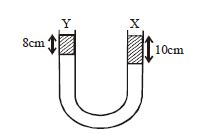
A
$0.8$
B
$1.2$
C
$1.4$
D
$1.6$
Solution
(A) As shown in the figure, in the two arms of a tube, the pressure remains the same at the horizontal surface $PP'$.
The pressure at level $PP'$ in the left arm is due to the liquid $Y$ (height $8 \ cm$) and the mercury column (height $2 \ cm$).
The pressure at level $PP'$ in the right arm is due to the liquid $X$ (height $10 \ cm$).
Equating the pressures:
$P_{left} = P_{right}$
$h_Y \rho_Y g + h_{Hg} \rho_{Hg} g = h_X \rho_X g$
$8 \times \rho_Y + 2 \times 13.6 = 10 \times 3.36$
$8 \rho_Y + 27.2 = 33.6$
$8 \rho_Y = 33.6 - 27.2$
$8 \rho_Y = 6.4$
$\rho_Y = \frac{6.4}{8} = 0.8 \ g/cc$
The pressure at level $PP'$ in the left arm is due to the liquid $Y$ (height $8 \ cm$) and the mercury column (height $2 \ cm$).
The pressure at level $PP'$ in the right arm is due to the liquid $X$ (height $10 \ cm$).
Equating the pressures:
$P_{left} = P_{right}$
$h_Y \rho_Y g + h_{Hg} \rho_{Hg} g = h_X \rho_X g$
$8 \times \rho_Y + 2 \times 13.6 = 10 \times 3.36$
$8 \rho_Y + 27.2 = 33.6$
$8 \rho_Y = 33.6 - 27.2$
$8 \rho_Y = 6.4$
$\rho_Y = \frac{6.4}{8} = 0.8 \ g/cc$
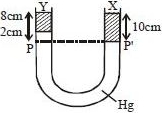
0 likes
View Solution37
MediumMCQ
In the arrangement shown, both the vessels $A$ and $B$ are identical, but the amount of water in $B$ is double that in $A$. The vessels are closed by identical leak-proof pistons at the same height. The pistons are connected to the ends of a lever arm. There is no friction between the pistons and the container walls. The system is in equilibrium in the situation shown. Now, the valve in the horizontal tube connecting both the vessels is opened. In which direction will the water flow through the tube?
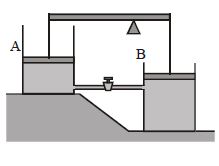
A
From $A$ to $B$
B
From $B$ to $A$
C
Water will not flow
D
Insufficient information
Solution
(B) Let the cross-sectional area of the vessels be $S$. Let the height of the water level in vessel $A$ be $h_A$ and in vessel $B$ be $h_B$. Since the amount of water in $B$ is double that in $A$, we have $S \cdot h_B = 2(S \cdot h_A)$, which implies $h_B = 2h_A$.
Let $P_A$ and $P_B$ be the pressures exerted by the water at the bottom of vessels $A$ and $B$ respectively. The pressure at the bottom is given by $P = P_{ext} + \rho gh$, where $P_{ext}$ is the pressure exerted by the piston.
For the lever to be in equilibrium, the forces exerted by the pistons on the water must be equal (assuming the lever arm is balanced at the center). Let $F$ be the force exerted by each piston. Then $P_{ext} = F/S$ is the same for both vessels.
Thus, $P_A = F/S + \rho gh_A$ and $P_B = F/S + \rho gh_B$.
Since $h_B > h_A$, it follows that $P_B > P_A$.
When the valve is opened, water flows from a region of higher pressure to a region of lower pressure. Therefore, water will flow from $B$ to $A$.
Let $P_A$ and $P_B$ be the pressures exerted by the water at the bottom of vessels $A$ and $B$ respectively. The pressure at the bottom is given by $P = P_{ext} + \rho gh$, where $P_{ext}$ is the pressure exerted by the piston.
For the lever to be in equilibrium, the forces exerted by the pistons on the water must be equal (assuming the lever arm is balanced at the center). Let $F$ be the force exerted by each piston. Then $P_{ext} = F/S$ is the same for both vessels.
Thus, $P_A = F/S + \rho gh_A$ and $P_B = F/S + \rho gh_B$.
Since $h_B > h_A$, it follows that $P_B > P_A$.
When the valve is opened, water flows from a region of higher pressure to a region of lower pressure. Therefore, water will flow from $B$ to $A$.
0 likes
View Solution38
DifficultMCQ
$A$ vertical triangular plate $ABC$ is placed inside water with side $BC$ parallel to the water surface as shown. The force on one surface of the plate by water is (density of water is $\rho$ and atmospheric pressure is $P_0$).
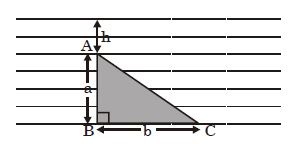
A
$\left( {{P_0} + h\rho g} \right)\frac{1}{2}ab$
B
$\left( {{P_0} + h\rho g} \right)\frac{1}{2}ab + \frac{{{a^2}b}}{3}\rho g$
C
$\left[ {{P_0} + \rho g\left( {h + a} \right)} \right]\frac{1}{2}ab$
D
$0$
Solution
(B) The force exerted by a fluid on a submerged surface is given by the product of the pressure at the centroid of the surface and the area of the surface.
$1$. The area of the triangular plate $ABC$ is $A = \frac{1}{2} \times b \times a$.
$2$. The depth of the centroid of the triangle from the water surface is calculated as follows: The vertices are at depths $h$ (for $A$),$h+a$ (for $B$),and $h+a$ (for $C$). The depth of the centroid $h_c$ is the average of the depths of the vertices: $h_c = \frac{h + (h+a) + (h+a)}{3} = \frac{3h + 2a}{3} = h + \frac{2a}{3}$.
$3$. The pressure at the centroid is $P_c = P_0 + h_c \rho g = P_0 + (h + \frac{2a}{3}) \rho g$.
$4$. The total force $F$ is $P_c \times A = (P_0 + h \rho g + \frac{2a}{3} \rho g) \times \frac{1}{2} ab = (P_0 + h \rho g) \frac{1}{2} ab + \frac{1}{2} ab \times \frac{2a}{3} \rho g = (P_0 + h \rho g) \frac{1}{2} ab + \frac{a^2 b}{3} \rho g$.
$1$. The area of the triangular plate $ABC$ is $A = \frac{1}{2} \times b \times a$.
$2$. The depth of the centroid of the triangle from the water surface is calculated as follows: The vertices are at depths $h$ (for $A$),$h+a$ (for $B$),and $h+a$ (for $C$). The depth of the centroid $h_c$ is the average of the depths of the vertices: $h_c = \frac{h + (h+a) + (h+a)}{3} = \frac{3h + 2a}{3} = h + \frac{2a}{3}$.
$3$. The pressure at the centroid is $P_c = P_0 + h_c \rho g = P_0 + (h + \frac{2a}{3}) \rho g$.
$4$. The total force $F$ is $P_c \times A = (P_0 + h \rho g + \frac{2a}{3} \rho g) \times \frac{1}{2} ab = (P_0 + h \rho g) \frac{1}{2} ab + \frac{1}{2} ab \times \frac{2a}{3} \rho g = (P_0 + h \rho g) \frac{1}{2} ab + \frac{a^2 b}{3} \rho g$.
0 likes
View Solution39
DifficultMCQ
$A$ liquid $X$ of density $3.36 \, g/cm^3$ is poured into a $U$-tube containing $Hg$ up to a height of $10 \, cm$. Another liquid $Y$ is poured into the left arm to a height of $8 \, cm$. The upper levels of $X$ and $Y$ are at the same height. Find the density of liquid $Y$ in $g/cm^3$. (Density of $Hg = 13.6 \times 10^3 \, kg/m^3$)
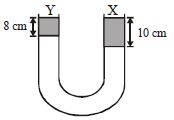
A
$0.8$
B
$1.2$
C
$1.4$
D
$1.6$
Solution
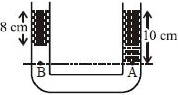
(A) Let the density of liquid $X$ be $\rho_X = 3.36 \, g/cm^3$, the density of liquid $Y$ be $\rho_Y$, and the density of mercury be $\rho_{Hg} = 13.6 \, g/cm^3$.
At the same horizontal level in a continuous static fluid, the pressure is equal.
Let the common interface level be the reference level. In the right arm, the pressure at this level is due to the column of liquid $X$ of height $h_X = 10 \, cm$.
In the left arm, the pressure at this level is due to the column of liquid $Y$ of height $h_Y = 8 \, cm$ plus the pressure due to the mercury column of height $h_{Hg} = (10 - 8) \, cm = 2 \, cm$.
Equating the pressures at this level:
$P_{right} = P_{left}$
$\rho_X g h_X = \rho_Y g h_Y + \rho_{Hg} g h_{Hg}$
$3.36 \times 10 = \rho_Y \times 8 + 13.6 \times 2$
$33.6 = 8 \rho_Y + 27.2$
$8 \rho_Y = 33.6 - 27.2$
$8 \rho_Y = 6.4$
$\rho_Y = 0.8 \, g/cm^3$.
At the same horizontal level in a continuous static fluid, the pressure is equal.
Let the common interface level be the reference level. In the right arm, the pressure at this level is due to the column of liquid $X$ of height $h_X = 10 \, cm$.
In the left arm, the pressure at this level is due to the column of liquid $Y$ of height $h_Y = 8 \, cm$ plus the pressure due to the mercury column of height $h_{Hg} = (10 - 8) \, cm = 2 \, cm$.
Equating the pressures at this level:
$P_{right} = P_{left}$
$\rho_X g h_X = \rho_Y g h_Y + \rho_{Hg} g h_{Hg}$
$3.36 \times 10 = \rho_Y \times 8 + 13.6 \times 2$
$33.6 = 8 \rho_Y + 27.2$
$8 \rho_Y = 33.6 - 27.2$
$8 \rho_Y = 6.4$
$\rho_Y = 0.8 \, g/cm^3$.
0 likes
View Solution40
MediumMCQ
Find the depth of a lake at which the density of water is $1\%$ greater than at the surface. Given the compressibility of water $K = 50 \times 10^{-6} \text{ atm}^{-1}$. (Take $1 \text{ atm} = 10^5 \text{ Pa}$) (in $\text{ km}$)
A
$3$
B
$2$
C
$4$
D
$1$
Solution
(B) The bulk modulus $B$ is defined as $B = -\frac{\Delta P}{\Delta V/V}$.
Given compressibility $K = \frac{1}{B} = 50 \times 10^{-6} \text{ atm}^{-1}$.
Since $\rho V = \text{constant}$, differentiating gives $\rho dV + V d\rho = 0$, so $\frac{dV}{V} = -\frac{d\rho}{\rho}$.
Thus, $K = \frac{\Delta P}{\Delta \rho / \rho}$.
Given $\frac{\Delta \rho}{\rho} = 1\% = 0.01$ and $\Delta P = \rho gh$.
Substituting the values: $50 \times 10^{-6} \text{ atm}^{-1} = \frac{\rho gh}{0.01}$.
Assuming $\rho = 10^3 \text{ kg/m}^3$ and $g = 10 \text{ m/s}^2$, $\Delta P = 10^4 h \text{ Pa}$.
Converting $K$ to $\text{Pa}^{-1}$: $K = \frac{50 \times 10^{-6}}{10^5} = 5 \times 10^{-10} \text{ Pa}^{-1}$.
$0.01 = K \cdot \Delta P = (5 \times 10^{-10}) \cdot (10^4 h)$.
$0.01 = 5 \times 10^{-6} h \implies h = \frac{0.01}{5 \times 10^{-6}} = 2000 \text{ m} = 2 \text{ km}$.
Given compressibility $K = \frac{1}{B} = 50 \times 10^{-6} \text{ atm}^{-1}$.
Since $\rho V = \text{constant}$, differentiating gives $\rho dV + V d\rho = 0$, so $\frac{dV}{V} = -\frac{d\rho}{\rho}$.
Thus, $K = \frac{\Delta P}{\Delta \rho / \rho}$.
Given $\frac{\Delta \rho}{\rho} = 1\% = 0.01$ and $\Delta P = \rho gh$.
Substituting the values: $50 \times 10^{-6} \text{ atm}^{-1} = \frac{\rho gh}{0.01}$.
Assuming $\rho = 10^3 \text{ kg/m}^3$ and $g = 10 \text{ m/s}^2$, $\Delta P = 10^4 h \text{ Pa}$.
Converting $K$ to $\text{Pa}^{-1}$: $K = \frac{50 \times 10^{-6}}{10^5} = 5 \times 10^{-10} \text{ Pa}^{-1}$.
$0.01 = K \cdot \Delta P = (5 \times 10^{-10}) \cdot (10^4 h)$.
$0.01 = 5 \times 10^{-6} h \implies h = \frac{0.01}{5 \times 10^{-6}} = 2000 \text{ m} = 2 \text{ km}$.
0 likes
View Solution41
MediumMCQ
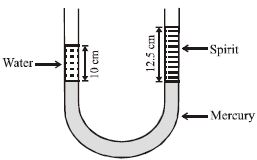
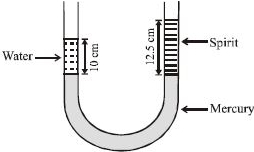
$A$ $U$ tube contains water and methylated spirit separated by mercury. The mercury columns in the two arms are at the same level with $10\,cm$ of water in one arm and $12.5\,cm$ of spirit in the other,as shown in the figure. The relative density of the spirit is
A
$0.6$
B
$0.8$
C
$1.0$
D
$1.25$
Solution
(B) As the mercury columns in the two arms of the $U$ tube are at the same level,the pressure exerted by the liquid columns above the mercury must be equal.
Let $\rho_w$ be the density of water and $\rho_s$ be the density of spirit.
Let $h_w = 10\,cm$ be the height of the water column and $h_s = 12.5\,cm$ be the height of the spirit column.
Equating the pressures at the mercury interface:
$P_{\text{water}} = P_{\text{spirit}}$
$\rho_w h_w g = \rho_s h_s g$
Rearranging for the density of spirit:
$\rho_s = \frac{h_w}{h_s} \rho_w$
The relative density of spirit is defined as the ratio of the density of spirit to the density of water:
$\text{Relative Density} = \frac{\rho_s}{\rho_w} = \frac{h_w}{h_s}$
Substituting the given values:
$\text{Relative Density} = \frac{10\,cm}{12.5\,cm} = \frac{100}{125} = 0.8$
Let $\rho_w$ be the density of water and $\rho_s$ be the density of spirit.
Let $h_w = 10\,cm$ be the height of the water column and $h_s = 12.5\,cm$ be the height of the spirit column.
Equating the pressures at the mercury interface:
$P_{\text{water}} = P_{\text{spirit}}$
$\rho_w h_w g = \rho_s h_s g$
Rearranging for the density of spirit:
$\rho_s = \frac{h_w}{h_s} \rho_w$
The relative density of spirit is defined as the ratio of the density of spirit to the density of water:
$\text{Relative Density} = \frac{\rho_s}{\rho_w} = \frac{h_w}{h_s}$
Substituting the given values:
$\text{Relative Density} = \frac{10\,cm}{12.5\,cm} = \frac{100}{125} = 0.8$
0 likes
View Solution42
MediumMCQ
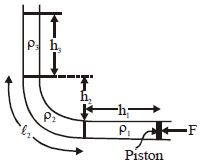
$A$ tube is bent into an $L$ shape and kept in a vertical plane. If these three liquids are kept in equilibrium by the piston of area $A$,the value of $\frac{F}{A}$ is:
A
$(\rho_1 h_1 + \rho_2 h_2 + \rho_3 h_3)g$
B
$(\rho_1 h_1 + \rho_2 l_2 + \rho_3 h_3)g$
C
$(\rho_2 h_2 + \rho_3 h_3)g$
D
$(\rho_2 l_2 + \rho_3 h_3)g$
Solution
(A) The pressure at the level of the horizontal tube (where the piston is located) must be equal to the sum of the pressures exerted by the liquid columns above it.
Let $P_0$ be the atmospheric pressure. The pressure at the piston is $P = P_0 + \frac{F}{A}$.
According to the principle of hydrostatics,the pressure at the same horizontal level in a continuous liquid is the same.
Considering the horizontal level at the piston,the pressure is due to the three liquid columns:
$1$. The pressure due to liquid of density $\rho_1$ over length $h_1$ is $\rho_1 g h_1$.
$2$. The pressure due to liquid of density $\rho_2$ over vertical height $h_2$ is $\rho_2 g h_2$.
$3$. The pressure due to liquid of density $\rho_3$ over vertical height $h_3$ is $\rho_3 g h_3$.
Summing these,the total pressure at the piston level is $P = P_0 + (\rho_1 h_1 + \rho_2 h_2 + \rho_3 h_3)g$.
Equating the two expressions for pressure at the piston,we get $\frac{F}{A} = (\rho_1 h_1 + \rho_2 h_2 + \rho_3 h_3)g$ (assuming $P_0$ is negligible or acting on both sides).
Let $P_0$ be the atmospheric pressure. The pressure at the piston is $P = P_0 + \frac{F}{A}$.
According to the principle of hydrostatics,the pressure at the same horizontal level in a continuous liquid is the same.
Considering the horizontal level at the piston,the pressure is due to the three liquid columns:
$1$. The pressure due to liquid of density $\rho_1$ over length $h_1$ is $\rho_1 g h_1$.
$2$. The pressure due to liquid of density $\rho_2$ over vertical height $h_2$ is $\rho_2 g h_2$.
$3$. The pressure due to liquid of density $\rho_3$ over vertical height $h_3$ is $\rho_3 g h_3$.
Summing these,the total pressure at the piston level is $P = P_0 + (\rho_1 h_1 + \rho_2 h_2 + \rho_3 h_3)g$.
Equating the two expressions for pressure at the piston,we get $\frac{F}{A} = (\rho_1 h_1 + \rho_2 h_2 + \rho_3 h_3)g$ (assuming $P_0$ is negligible or acting on both sides).
0 likes
View Solution43
MediumMCQ
$A$ bubble from the bottom of a lake rises to its surface. Its volume doubles in the process. Assuming isothermal conditions, atmospheric pressure $= 75 \, cm$ of $Hg$, and the ratio of the densities of mercury and water $= 40/3$. The depth of the lake will be ..... $m$.
A
$5$
B
$10$
C
$30$
D
$50$
Solution
(B) Let the depth of the lake be $h$. The pressure at the bottom of the lake is $P_1 = P_{atm} + \rho_w g h$, where $P_{atm} = \rho_{Hg} g (0.75 \, m)$.
At the surface, the pressure is $P_2 = P_{atm} = \rho_{Hg} g (0.75 \, m)$.
Given that the volume doubles, $V_2 = 2V_1$.
Since the process is isothermal, $P_1 V_1 = P_2 V_2$.
Substituting the values: $(P_{atm} + \rho_w g h) V_1 = P_{atm} (2 V_1)$.
$P_{atm} + \rho_w g h = 2 P_{atm} \Rightarrow \rho_w g h = P_{atm}$.
Substituting $P_{atm} = \rho_{Hg} g (0.75 \, m)$: $\rho_w g h = \rho_{Hg} g (0.75 \, m)$.
$h = (0.75 \, m) \times (\rho_{Hg} / \rho_w) = 0.75 \times (40/3) \, m$.
$h = 0.25 \times 40 \, m = 10 \, m$.
At the surface, the pressure is $P_2 = P_{atm} = \rho_{Hg} g (0.75 \, m)$.
Given that the volume doubles, $V_2 = 2V_1$.
Since the process is isothermal, $P_1 V_1 = P_2 V_2$.
Substituting the values: $(P_{atm} + \rho_w g h) V_1 = P_{atm} (2 V_1)$.
$P_{atm} + \rho_w g h = 2 P_{atm} \Rightarrow \rho_w g h = P_{atm}$.
Substituting $P_{atm} = \rho_{Hg} g (0.75 \, m)$: $\rho_w g h = \rho_{Hg} g (0.75 \, m)$.
$h = (0.75 \, m) \times (\rho_{Hg} / \rho_w) = 0.75 \times (40/3) \, m$.
$h = 0.25 \times 40 \, m = 10 \, m$.
0 likes
View Solution44
DifficultMCQ
In making an alloy,a substance of specific gravity $s_1$ and mass $m_1$ is mixed with another substance of specific gravity $s_2$ and mass $m_2$. Then,the specific gravity of the alloy is:
A
$\left( \frac{m_1 + m_2}{s_1 + s_2} \right)$
B
$\left( \frac{s_1 s_2}{m_1 + m_2} \right)$
C
$\left[ \frac{m_1 + m_2}{(m_1/s_1 + m_2/s_2)} \right]$
D
$\left[ \frac{(m_1/s_1 + m_2/s_2)}{m_1 + m_2} \right]$
Solution
(C) The specific gravity of a substance is defined as the ratio of its density to the density of water $(d_w)$.
$s = \frac{\rho}{\rho_w} \implies \rho = s \cdot \rho_w$.
Total mass of the alloy = $m_1 + m_2$.
Total volume of the alloy = $V_1 + V_2 = \frac{m_1}{\rho_1} + \frac{m_2}{\rho_2} = \frac{m_1}{s_1 \rho_w} + \frac{m_2}{s_2 \rho_w} = \frac{1}{\rho_w} \left( \frac{m_1}{s_1} + \frac{m_2}{s_2} \right)$.
The specific gravity of the alloy $(s_{alloy})$ is the ratio of the density of the alloy to the density of water:
$s_{alloy} = \frac{\rho_{alloy}}{\rho_w} = \frac{\text{Total Mass}}{\text{Total Volume} \times \rho_w}$.
Substituting the values:
$s_{alloy} = \frac{m_1 + m_2}{\left[ \frac{1}{\rho_w} \left( \frac{m_1}{s_1} + \frac{m_2}{s_2} \right) \right] \times \rho_w} = \frac{m_1 + m_2}{\frac{m_1}{s_1} + \frac{m_2}{s_2}}$.
$s = \frac{\rho}{\rho_w} \implies \rho = s \cdot \rho_w$.
Total mass of the alloy = $m_1 + m_2$.
Total volume of the alloy = $V_1 + V_2 = \frac{m_1}{\rho_1} + \frac{m_2}{\rho_2} = \frac{m_1}{s_1 \rho_w} + \frac{m_2}{s_2 \rho_w} = \frac{1}{\rho_w} \left( \frac{m_1}{s_1} + \frac{m_2}{s_2} \right)$.
The specific gravity of the alloy $(s_{alloy})$ is the ratio of the density of the alloy to the density of water:
$s_{alloy} = \frac{\rho_{alloy}}{\rho_w} = \frac{\text{Total Mass}}{\text{Total Volume} \times \rho_w}$.
Substituting the values:
$s_{alloy} = \frac{m_1 + m_2}{\left[ \frac{1}{\rho_w} \left( \frac{m_1}{s_1} + \frac{m_2}{s_2} \right) \right] \times \rho_w} = \frac{m_1 + m_2}{\frac{m_1}{s_1} + \frac{m_2}{s_2}}$.
0 likes
View Solution45
DifficultMCQ
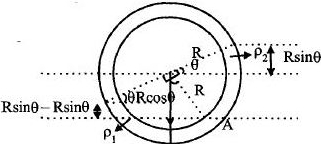
$A$ thin uniform tube is bent into a circle of radius $r$ in the vertical plane. Equal volumes of two immiscible liquids,whose densities are ${\rho _1}$ and ${\rho _2}$ $({\rho _1} > {\rho _2})$,fill half the circle. The angle $\theta$ between the radius vector passing through the common interface and the vertical is
A
$\theta = {\tan ^{ - 1}}\left[ {\frac{\pi }{2}\left( {\frac{{{\rho _1} - {\rho _2}}}{{{\rho _1} + {\rho _2}}}} \right)} \right]$
B
$\theta = {\tan ^{ - 1}}\left[ \frac{\pi }{2}\left( {\frac{{{\rho _1} + {\rho _2}}}{{{\rho _1} - {\rho _2}}}} \right) \right]$
C
$\theta = {\tan ^{ - 1}}\left[ \pi \left( {\frac{{{\rho _1}}}{{{\rho _2}}}} \right) \right]$
D
$\theta = {\tan ^{ - 1}}\left[ \frac{\pi }{2}\left( {\frac{{{\rho _2}}}{{{\rho _1}}}} \right) \right]$
Solution
(A) Let the radius of the tube be $r$. Since equal volumes of the two liquids are used,each liquid occupies a quarter of the circle (an arc of $90^\circ$ or $\pi/2$ radians).
Let the interface be at an angle $\theta$ from the vertical. The vertical depth of the liquid with density $\rho_2$ is $r(1 - \cos\theta)$ and the vertical depth of the liquid with density $\rho_1$ is $r(1 - \sin\theta)$.
However,a more standard approach for this problem involves equating the pressure at the lowest point of the interface. The pressure at the interface level must be equal from both sides.
Considering the vertical heights of the liquid columns above the interface level:
Pressure on the left side = $\rho_1 g h_1$
Pressure on the right side = $\rho_2 g h_2$
From the geometry of the circular tube,the vertical height difference for liquid $\rho_1$ is $r(1 - \cos\theta)$ and for $\rho_2$ is $r(1 - \sin\theta)$.
Equating pressures: $\rho_1 g r(1 - \cos\theta) = \rho_2 g r(1 - \sin\theta)$.
Given the specific geometry where the liquids fill half the circle,the correct derivation leads to $\tan \theta = \frac{\pi}{2} \frac{\rho_1 - \rho_2}{\rho_1 + \rho_2}$.
Thus,$\theta = \tan^{-1} \left[ \frac{\pi}{2} \left( \frac{\rho_1 - \rho_2}{\rho_1 + \rho_2} \right) \right]$.
Let the interface be at an angle $\theta$ from the vertical. The vertical depth of the liquid with density $\rho_2$ is $r(1 - \cos\theta)$ and the vertical depth of the liquid with density $\rho_1$ is $r(1 - \sin\theta)$.
However,a more standard approach for this problem involves equating the pressure at the lowest point of the interface. The pressure at the interface level must be equal from both sides.
Considering the vertical heights of the liquid columns above the interface level:
Pressure on the left side = $\rho_1 g h_1$
Pressure on the right side = $\rho_2 g h_2$
From the geometry of the circular tube,the vertical height difference for liquid $\rho_1$ is $r(1 - \cos\theta)$ and for $\rho_2$ is $r(1 - \sin\theta)$.
Equating pressures: $\rho_1 g r(1 - \cos\theta) = \rho_2 g r(1 - \sin\theta)$.
Given the specific geometry where the liquids fill half the circle,the correct derivation leads to $\tan \theta = \frac{\pi}{2} \frac{\rho_1 - \rho_2}{\rho_1 + \rho_2}$.
Thus,$\theta = \tan^{-1} \left[ \frac{\pi}{2} \left( \frac{\rho_1 - \rho_2}{\rho_1 + \rho_2} \right) \right]$.
0 likes
View Solution46
MediumMCQ
$A$ tank $5 \ m$ high is half-filled with water and then is filled to the top with oil of density $0.85 \ g/cm^3$. The pressure at the bottom of the tank,due to these liquids is ....... $g \ dyne/cm^2$.
A
$1.85$
B
$89.25$
C
$462.5$
D
$500$
Solution
(C) The total height of the tank is $H = 5 \ m = 500 \ cm$.
Since the tank is half-filled with water,the height of the water column is $h_1 = 250 \ cm$ and the density of water is $d_1 = 1 \ g/cm^3$.
The remaining half is filled with oil,so the height of the oil column is $h_2 = 250 \ cm$ and the density of oil is $d_2 = 0.85 \ g/cm^3$.
The pressure at the bottom of the tank due to the liquid column is given by $P = h_1 d_1 g + h_2 d_2 g$.
Substituting the values,we get $P = (250 \times 1 + 250 \times 0.85) \ g \ dyne/cm^2$.
$P = (250 + 212.5) \ g \ dyne/cm^2 = 462.5 \ g \ dyne/cm^2$.
Since the tank is half-filled with water,the height of the water column is $h_1 = 250 \ cm$ and the density of water is $d_1 = 1 \ g/cm^3$.
The remaining half is filled with oil,so the height of the oil column is $h_2 = 250 \ cm$ and the density of oil is $d_2 = 0.85 \ g/cm^3$.
The pressure at the bottom of the tank due to the liquid column is given by $P = h_1 d_1 g + h_2 d_2 g$.
Substituting the values,we get $P = (250 \times 1 + 250 \times 0.85) \ g \ dyne/cm^2$.
$P = (250 + 212.5) \ g \ dyne/cm^2 = 462.5 \ g \ dyne/cm^2$.
0 likes
View Solution47
MediumMCQ
In a $U-$tube experiment,a column $AB$ of water is balanced by a column $CD$ of oil,as shown in the figure. Then the relative density of oil is
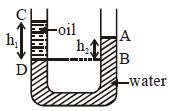
A
$\frac{h_2}{h_1}$
B
$\frac{h_1}{h_2}$
C
$\frac{h_1 - h_2}{h_1}$
D
$\frac{h_2}{h_1 + h_2}$
Solution
(A) At the same horizontal level in a continuous static fluid,the pressure is the same. Let the pressure at point $D$ (in the oil column) be $P_1$ and at point $B$ (in the water column) be $P_2$.
$P_1 = P_2$
$P_0 + \rho_{\text{oil}} \cdot g \cdot h_1 = P_0 + \rho_{\text{water}} \cdot g \cdot h_2$
Where $P_0$ is the atmospheric pressure,$\rho_{\text{oil}}$ is the density of oil,and $\rho_{\text{water}}$ is the density of water.
$\rho_{\text{oil}} \cdot g \cdot h_1 = \rho_{\text{water}} \cdot g \cdot h_2$
$\frac{\rho_{\text{oil}}}{\rho_{\text{water}}} = \frac{h_2}{h_1}$
The relative density of oil is defined as the ratio of the density of oil to the density of water.
Therefore,the relative density of oil is $\frac{h_2}{h_1}$.
$P_1 = P_2$
$P_0 + \rho_{\text{oil}} \cdot g \cdot h_1 = P_0 + \rho_{\text{water}} \cdot g \cdot h_2$
Where $P_0$ is the atmospheric pressure,$\rho_{\text{oil}}$ is the density of oil,and $\rho_{\text{water}}$ is the density of water.
$\rho_{\text{oil}} \cdot g \cdot h_1 = \rho_{\text{water}} \cdot g \cdot h_2$
$\frac{\rho_{\text{oil}}}{\rho_{\text{water}}} = \frac{h_2}{h_1}$
The relative density of oil is defined as the ratio of the density of oil to the density of water.
Therefore,the relative density of oil is $\frac{h_2}{h_1}$.
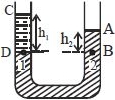
0 likes
View Solution48
MediumMCQ
Pressure at the bottom of a tank of water is $3P$,where $P$ is atmospheric pressure. If water is drawn out till the level of water is lowered by one-fifth,then the pressure at the bottom of the tank is
A
$2P$
B
$13P/5$
C
$8P/5$
D
$4P/5$
Solution
(B) The initial pressure at the bottom of the tank is given by $P_{bottom} = P + h \rho g = 3P$,where $h$ is the initial height of the water column.
From this,we get $h \rho g = 2P$.
When the water level is lowered by one-fifth,the new height of the water column becomes $h' = h - \frac{h}{5} = \frac{4h}{5}$.
The new pressure at the bottom is $P' = P + h' \rho g$.
Substituting the value of $h'$,we get $P' = P + \left(\frac{4h}{5}\right) \rho g = P + \frac{4}{5}(h \rho g)$.
Substituting $h \rho g = 2P$ into the equation,we get $P' = P + \frac{4}{5}(2P) = P + \frac{8P}{5} = \frac{13P}{5}$.
From this,we get $h \rho g = 2P$.
When the water level is lowered by one-fifth,the new height of the water column becomes $h' = h - \frac{h}{5} = \frac{4h}{5}$.
The new pressure at the bottom is $P' = P + h' \rho g$.
Substituting the value of $h'$,we get $P' = P + \left(\frac{4h}{5}\right) \rho g = P + \frac{4}{5}(h \rho g)$.
Substituting $h \rho g = 2P$ into the equation,we get $P' = P + \frac{4}{5}(2P) = P + \frac{8P}{5} = \frac{13P}{5}$.
0 likes
View Solution49
DifficultMCQ
$A$ $U$-tube containing a liquid moves with a horizontal acceleration $a$ along a direction joining the two vertical limbs. The separation between these limbs is $d$. The difference in their liquid levels is
A
$ad/g$
B
$2da/g$
C
$da/2g$
D
$d \tan(a/g)$
Solution
(A) Let $A$ be the area of cross-section of the tube and $\rho$ be the density of the liquid. Consider the horizontal section $AB$ of the tube.
The mass of the liquid in the horizontal section $AB$ is $m = \rho A d$.
The pressure at point $A$ is $P_A = h_2 \rho g$ and the pressure at point $B$ is $P_B = h_1 \rho g$.
The net force acting on the liquid in the horizontal section $AB$ in the direction of acceleration is $F_{net} = (P_A - P_B) A = (h_2 \rho g - h_1 \rho g) A = (h_2 - h_1) \rho g A$.
According to Newton's second law,$F_{net} = ma$.
Substituting the values,we get $(h_2 - h_1) \rho g A = (\rho A d) a$.
Simplifying the equation,we get $(h_2 - h_1) g = da$.
Therefore,the difference in liquid levels is $h_2 - h_1 = \frac{da}{g}$.
The mass of the liquid in the horizontal section $AB$ is $m = \rho A d$.
The pressure at point $A$ is $P_A = h_2 \rho g$ and the pressure at point $B$ is $P_B = h_1 \rho g$.
The net force acting on the liquid in the horizontal section $AB$ in the direction of acceleration is $F_{net} = (P_A - P_B) A = (h_2 \rho g - h_1 \rho g) A = (h_2 - h_1) \rho g A$.
According to Newton's second law,$F_{net} = ma$.
Substituting the values,we get $(h_2 - h_1) \rho g A = (\rho A d) a$.
Simplifying the equation,we get $(h_2 - h_1) g = da$.
Therefore,the difference in liquid levels is $h_2 - h_1 = \frac{da}{g}$.
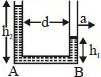
0 likes
View Solution50
EasyMCQ
Two vessels $A$ and $B$ have the same base area and contain water to the same height,but the mass of water in $A$ is four times that in $B$. The ratio of the liquid thrust at the base of $A$ to that at the base of $B$ is (in $:1$)
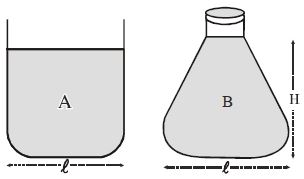
A
$4$
B
$2$
C
$1$
D
$16$
Solution
(C) The pressure $P$ at the base of a vessel containing a liquid of density $\rho$ at a height $h$ is given by $P = \rho gh$.
The thrust $T$ (force) exerted on the base of the vessel is the product of the pressure $P$ and the base area $A_{base}$.
Thus,$T = P \times A_{base} = \rho gh \times A_{base}$.
In the given problem,both vessels $A$ and $B$ have the same base area $(A_{base})$ and contain water to the same height $(h)$. Since the liquid is the same (water),the density $\rho$ is also the same for both.
Therefore,the thrust at the base of vessel $A$ is $T_A = \rho gh A_{base}$ and the thrust at the base of vessel $B$ is $T_B = \rho gh A_{base}$.
The ratio of the thrusts is $\frac{T_A}{T_B} = \frac{\rho gh A_{base}}{\rho gh A_{base}} = 1:1$.
The thrust $T$ (force) exerted on the base of the vessel is the product of the pressure $P$ and the base area $A_{base}$.
Thus,$T = P \times A_{base} = \rho gh \times A_{base}$.
In the given problem,both vessels $A$ and $B$ have the same base area $(A_{base})$ and contain water to the same height $(h)$. Since the liquid is the same (water),the density $\rho$ is also the same for both.
Therefore,the thrust at the base of vessel $A$ is $T_A = \rho gh A_{base}$ and the thrust at the base of vessel $B$ is $T_B = \rho gh A_{base}$.
The ratio of the thrusts is $\frac{T_A}{T_B} = \frac{\rho gh A_{base}}{\rho gh A_{base}} = 1:1$.
0 likes
View SolutionFluid Mechanics and Surface Tension — Pressure and Density (of Mixure) · Frequently Asked Questions
1Are these Fluid Mechanics and Surface Tension questions useful for JEE and NEET?
Yes. All questions in this section are mapped to JEE Main and NEET exam patterns. Previous year questions from JEE Main, NEET, GUJCET and state-level exams are included with full solutions.
2Can I switch to Hindi or Gujarati for these questions?
Yes. Use the language tabs in the hero section or the sidebar to view the same questions and solutions in English, Hindi or Gujarati.
3How do I generate a question paper from this subtopic?
Use the Vedclass Exam Paper Generator — select the chapter and subtopic, set difficulty, and generate Sets A, B, C, D automatically. First 3 chapters of every subject are free.
Vedclass Products
For Students
Vedclass Test Series
Mock tests in real JEE/NEET style with performance analysis. 5-day free trial.
Start Free TrialFor Teachers
Exam Paper Generator
Generate Set A/B/C/D papers from this chapter in 2 minutes. 3 chapters free.
Try FreeFor Institutes
Online Exam Module
Live online exams with unlimited students, 360° analytics & white-label branding.
See DemoFor Teachers & Institutes
Generate a Fluid Mechanics and Surface Tension Exam Paper in 2 Minutes
Select subtopic & difficulty — Sets A, B, C, D auto-generated with No Repeat logic.
First 3 chapters of every subject are free — no payment required.