
A English
Pressure and Density (of Mixure) Questions in English
Class 11 Physics · Fluid Mechanics and Surface Tension · Pressure and Density (of Mixure)
131+
Questions
English
Language
100%
With Solutions
Showing 30 of 131 questions in English
101
DifficultMCQ
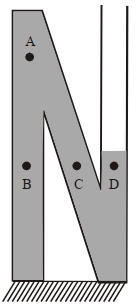
Consider a mercury-filled tube as shown in the figure below. Which of the following options about the pressures at the lettered locations $(A, B, C, D)$ is true?
A
$P_B > P_A > P_C > P_D$
B
$P_B = P_C = P_D > P_A$
C
$P_B = P_C = P_D < P_A$
D
$P_A = P_B = P_C = P_D$
Solution
(B) The pressure at a depth $h$ in a static fluid is given by the formula $P = P_0 + \rho gh$,where $P_0$ is the pressure at the surface,$\rho$ is the density of the fluid,and $g$ is the acceleration due to gravity.
In a continuous static fluid,the pressure is the same at all points at the same horizontal level.
Looking at the figure,points $B$,$C$,and $D$ are located at the same horizontal level within the continuous mercury column. Therefore,the pressures at these points are equal: $P_B = P_C = P_D$.
Point $A$ is located at a higher vertical position than points $B$,$C$,and $D$. Since pressure decreases with height in a fluid column,the pressure at $A$ must be less than the pressure at the level of $B$,$C$,and $D$.
Thus,the correct relationship is $P_B = P_C = P_D > P_A$.
In a continuous static fluid,the pressure is the same at all points at the same horizontal level.
Looking at the figure,points $B$,$C$,and $D$ are located at the same horizontal level within the continuous mercury column. Therefore,the pressures at these points are equal: $P_B = P_C = P_D$.
Point $A$ is located at a higher vertical position than points $B$,$C$,and $D$. Since pressure decreases with height in a fluid column,the pressure at $A$ must be less than the pressure at the level of $B$,$C$,and $D$.
Thus,the correct relationship is $P_B = P_C = P_D > P_A$.
0 likes
View Solution102
MediumMCQ
An open $U$-tube contains mercury. When $13.6 \,cm$ of water is poured into one of the arms of the tube,then the mercury rise in the other arm from its initial level is ....... $cm$
A
$1$
B
$0.5$
C
$10$
D
$5$
Solution
(B) Let the density of water be $\rho_w = 1 \,g/cm^3$ and the density of mercury be $\rho_m = 13.6 \,g/cm^3$.
When water of height $h_w = 13.6 \,cm$ is poured into one arm,the mercury level in that arm drops by $y$,and it rises by $y$ in the other arm.
The difference in the mercury levels between the two arms becomes $2y$.
According to the principle of hydrostatic pressure at the same horizontal level:
$P_{\text{water}} = P_{\text{mercury}}$
$\rho_w \cdot g \cdot h_w = \rho_m \cdot g \cdot (2y)$
Substituting the values:
$1 \cdot g \cdot 13.6 = 13.6 \cdot g \cdot (2y)$
$13.6 = 13.6 \cdot 2y$
$2y = 1$
$y = 0.5 \,cm$
Therefore,the mercury rises by $0.5 \,cm$ in the other arm.
When water of height $h_w = 13.6 \,cm$ is poured into one arm,the mercury level in that arm drops by $y$,and it rises by $y$ in the other arm.
The difference in the mercury levels between the two arms becomes $2y$.
According to the principle of hydrostatic pressure at the same horizontal level:
$P_{\text{water}} = P_{\text{mercury}}$
$\rho_w \cdot g \cdot h_w = \rho_m \cdot g \cdot (2y)$
Substituting the values:
$1 \cdot g \cdot 13.6 = 13.6 \cdot g \cdot (2y)$
$13.6 = 13.6 \cdot 2y$
$2y = 1$
$y = 0.5 \,cm$
Therefore,the mercury rises by $0.5 \,cm$ in the other arm.
0 likes
View Solution103
EasyMCQ
The term 'fluid' is used for ............
A
Liquids only
B
Gases only
C
$A$ mixture of liquid and gas only
D
Both liquids and gases
Solution
(D) The term 'fluid' refers to any substance that has the ability to flow and does not have a fixed shape.
Since both liquids and gases can flow under the influence of an external force,they are collectively classified as fluids.
Therefore,the correct option is $D$.
Since both liquids and gases can flow under the influence of an external force,they are collectively classified as fluids.
Therefore,the correct option is $D$.
0 likes
View Solution104
EasyMCQ
Select the wrong statement about pressure.
A
Pressure is a scalar quantity.
B
Pressure is always compressive in nature.
C
Pressure at a point is same in all directions.
D
None of these.
Solution
(D) The correct answer is $D$.
$1$. Pressure is a scalar quantity because it is defined as force per unit area and does not follow vector addition rules.
$2$. Pressure is always compressive in nature,meaning it acts to compress the fluid or object it is applied to.
$3$. According to Pascal's Law,the pressure at a point in a fluid at rest is the same in all directions.
Since all the statements ($A$,$B$,and $C$) are correct,the wrong statement is none of these.
$1$. Pressure is a scalar quantity because it is defined as force per unit area and does not follow vector addition rules.
$2$. Pressure is always compressive in nature,meaning it acts to compress the fluid or object it is applied to.
$3$. According to Pascal's Law,the pressure at a point in a fluid at rest is the same in all directions.
Since all the statements ($A$,$B$,and $C$) are correct,the wrong statement is none of these.
0 likes
View Solution105
EasyMCQ
Gauge pressure is defined as:
A
May be positive
B
May be negative
C
May be zero
D
All of these
Solution
(D) Gauge pressure is defined as the difference between the absolute pressure $(P)$ and the atmospheric pressure $(P_{atm})$,given by the formula: $P_g = P - P_{atm}$.
Since the absolute pressure $(P)$ can be greater than,less than,or equal to the atmospheric pressure $(P_{atm})$,the gauge pressure $(P_g)$ can be positive,negative,or zero respectively.
Therefore,all the given options are correct.
Since the absolute pressure $(P)$ can be greater than,less than,or equal to the atmospheric pressure $(P_{atm})$,the gauge pressure $(P_g)$ can be positive,negative,or zero respectively.
Therefore,all the given options are correct.
0 likes
View Solution106
MediumMCQ
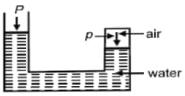
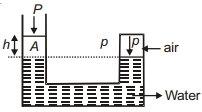
The pressure of confined air is $p$. If the atmospheric pressure is $P$,then
A
$P$ is equal to $p$
B
$P$ is less than $p$
C
$P$ is greater than $p$
D
$P$ may be less or greater than $p$ depending on the mass of the confined air
Solution
(B) Let the height difference between the two liquid levels be $h$.
According to the principle of hydrostatics,the pressure at the same horizontal level in a continuous static fluid is the same.
Considering the horizontal level at the lower liquid surface,the pressure on the left side is $P + \rho g h$,where $\rho$ is the density of the liquid and $g$ is the acceleration due to gravity.
The pressure on the right side is $p$.
Equating the two,we get $P + \rho g h = p$.
Since $\rho, g, h > 0$,it follows that $P + \rho g h > P$.
Therefore,$p > P$,which means $P < p$.
According to the principle of hydrostatics,the pressure at the same horizontal level in a continuous static fluid is the same.
Considering the horizontal level at the lower liquid surface,the pressure on the left side is $P + \rho g h$,where $\rho$ is the density of the liquid and $g$ is the acceleration due to gravity.
The pressure on the right side is $p$.
Equating the two,we get $P + \rho g h = p$.
Since $\rho, g, h > 0$,it follows that $P + \rho g h > P$.
Therefore,$p > P$,which means $P < p$.
0 likes
View Solution107
DifficultMCQ
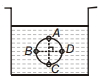
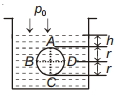
The figure shows a container filled with a liquid of density $\rho$. Four points $A, B, C$ and $D$ lie on the diametrically opposite points of a circle as shown. Points $A$ and $C$ lie on a vertical line,and points $B$ and $D$ lie on a horizontal line. Which of the following statements is incorrect? (Here,$p_A, p_B, p_C, p_D$ are the absolute pressures at the respective points.)
A
$p_D = p_B$
B
$p_A < p_B = p_D < p_C$
C
$p_D = p_B = \frac{p_C - p_A}{2}$
D
$p_D = p_B = \frac{p_C + p_A}{2}$
Solution
(C) Points at the same horizontal level in a continuous static liquid have the same pressure. Points at different depths have a pressure difference given by $\Delta p = \rho g \Delta h$.
Let the radius of the circle be $r$ and the depth of point $A$ from the free surface be $h$. Let $p_0$ be the atmospheric pressure.
The absolute pressures at the points are:
$p_A = p_0 + h \rho g$
$p_B = p_D = p_0 + (h + r) \rho g$
$p_C = p_0 + (h + 2r) \rho g$
Now,let us evaluate the expressions in the options:
$1$. $p_D = p_B$ is correct as they are at the same horizontal level.
$2$. Since $h < h+r < h+2r$,it follows that $p_A < p_B = p_D < p_C$,which is correct.
$3$. Calculating the average of $p_A$ and $p_C$:
$\frac{p_C + p_A}{2} = \frac{(p_0 + h \rho g + 2r \rho g) + (p_0 + h \rho g)}{2} = \frac{2p_0 + 2h \rho g + 2r \rho g}{2} = p_0 + (h + r) \rho g = p_B = p_D$.
Thus,the statement $p_D = p_B = \frac{p_C + p_A}{2}$ is correct,and the statement $p_D = p_B = \frac{p_C - p_A}{2}$ is incorrect.
Therefore,option $(c)$ is the incorrect statement.
Let the radius of the circle be $r$ and the depth of point $A$ from the free surface be $h$. Let $p_0$ be the atmospheric pressure.
The absolute pressures at the points are:
$p_A = p_0 + h \rho g$
$p_B = p_D = p_0 + (h + r) \rho g$
$p_C = p_0 + (h + 2r) \rho g$
Now,let us evaluate the expressions in the options:
$1$. $p_D = p_B$ is correct as they are at the same horizontal level.
$2$. Since $h < h+r < h+2r$,it follows that $p_A < p_B = p_D < p_C$,which is correct.
$3$. Calculating the average of $p_A$ and $p_C$:
$\frac{p_C + p_A}{2} = \frac{(p_0 + h \rho g + 2r \rho g) + (p_0 + h \rho g)}{2} = \frac{2p_0 + 2h \rho g + 2r \rho g}{2} = p_0 + (h + r) \rho g = p_B = p_D$.
Thus,the statement $p_D = p_B = \frac{p_C + p_A}{2}$ is correct,and the statement $p_D = p_B = \frac{p_C - p_A}{2}$ is incorrect.
Therefore,option $(c)$ is the incorrect statement.
0 likes
View Solution108
MediumMCQ
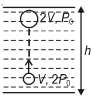
The volume of an air bubble is doubled as it rises from the bottom of a lake to its surface. The atmospheric pressure is $75 \, cm$ of mercury. The ratio of the density of mercury to that of lake water is $\frac{40}{3}$. The depth of the lake in metres is:
A
$10$
B
$15$
C
$20$
D
$25$
Solution
(A) Let $V$ be the initial volume of the air bubble at the bottom of the lake and $2V$ be its volume at the surface.
Let $P_0$ be the atmospheric pressure and $h$ be the depth of the lake.
According to Boyle's Law,since the temperature is assumed to be constant,$P_1 V_1 = P_2 V_2$.
At the surface,the pressure is $P_2 = P_0$.
At the bottom,the pressure is $P_1 = P_0 + \rho_w g h$,where $\rho_w$ is the density of water.
Given $P_1 V = P_2 (2V) \Rightarrow P_1 = 2 P_0$.
Substituting $P_1$,we get $P_0 + \rho_w g h = 2 P_0 \Rightarrow \rho_w g h = P_0$.
We know $P_0 = h_m \rho_m g$,where $h_m = 0.75 \, m$ and $\rho_m$ is the density of mercury.
So,$\rho_w g h = h_m \rho_m g \Rightarrow h = h_m \left( \frac{\rho_m}{\rho_w} \right)$.
Given $\frac{\rho_m}{\rho_w} = \frac{40}{3}$ and $h_m = 0.75 \, m = \frac{3}{4} \, m$.
$h = \frac{3}{4} \times \frac{40}{3} = 10 \, m$.
Let $P_0$ be the atmospheric pressure and $h$ be the depth of the lake.
According to Boyle's Law,since the temperature is assumed to be constant,$P_1 V_1 = P_2 V_2$.
At the surface,the pressure is $P_2 = P_0$.
At the bottom,the pressure is $P_1 = P_0 + \rho_w g h$,where $\rho_w$ is the density of water.
Given $P_1 V = P_2 (2V) \Rightarrow P_1 = 2 P_0$.
Substituting $P_1$,we get $P_0 + \rho_w g h = 2 P_0 \Rightarrow \rho_w g h = P_0$.
We know $P_0 = h_m \rho_m g$,where $h_m = 0.75 \, m$ and $\rho_m$ is the density of mercury.
So,$\rho_w g h = h_m \rho_m g \Rightarrow h = h_m \left( \frac{\rho_m}{\rho_w} \right)$.
Given $\frac{\rho_m}{\rho_w} = \frac{40}{3}$ and $h_m = 0.75 \, m = \frac{3}{4} \, m$.
$h = \frac{3}{4} \times \frac{40}{3} = 10 \, m$.
0 likes
View Solution109
MediumMCQ
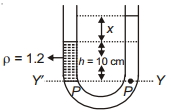
$A$ vertical $U$-tube of uniform cross-section contains water in both the arms. $A$ $10 \, cm$ glycerine column $(R.D. = 1.2)$ is added to one of the limbs. The level difference between the two free surfaces in the two limbs will be ...... $cm$.
A
$4$
B
$2$
C
$6$
D
$8$
Solution
(B) Let the height of the glycerine column be $h = 10 \, cm$ and its relative density be $\rho_g = 1.2 \, g/cm^3$. The density of water is $\rho_w = 1.0 \, g/cm^3$.
Let the difference in the levels of the free surfaces of the two liquids be $x$.
At the interface of the glycerine and water in the $U$-tube,the pressure at the same horizontal level must be equal.
Let the pressure at the level of the bottom of the glycerine column be $P$.
Pressure on the left limb at this level = $P_{atm} + \rho_g \cdot g \cdot h$.
Pressure on the right limb at the same level = $P_{atm} + \rho_w \cdot g \cdot (h - x)$.
Equating the pressures:
$\rho_g \cdot g \cdot h = \rho_w \cdot g \cdot (h - x)$
$1.2 \cdot 10 = 1.0 \cdot (10 - x)$
$12 = 10 - x$
Wait,let's re-evaluate the geometry. The glycerine column of height $h$ pushes the water down by some amount,and the water level rises in the other arm. The difference in height between the top of the glycerine and the top of the water is $x$.
From the hydrostatic balance at the level of the glycerine-water interface:
Pressure due to glycerine column = Pressure due to water column of height $(h - x)$.
$1.2 \times 10 = 1.0 \times (10 - x)$ is incorrect based on the diagram. Looking at the diagram,the water level in the right arm is higher than the interface by $(h - x)$.
Actually,the pressure balance is $\rho_g \cdot g \cdot h = \rho_w \cdot g \cdot h_{water}$.
Here,the water column height balancing the glycerine is $h_{water} = h - x$.
$1.2 \times 10 = 1.0 \times (10 - x) \Rightarrow 12 = 10 - x \Rightarrow x = -2$. This implies the water level is higher on the glycerine side,which is wrong.
Correct approach: The pressure at the level of the glycerine-water interface (left side) is equal to the pressure at the same level in the right side.
Pressure (left) = $\rho_g \cdot g \cdot h$.
Pressure (right) = $\rho_w \cdot g \cdot (h - x)$ where $x$ is the difference in free surface levels.
$1.2 \times 10 = 1.0 \times (10 - x) \Rightarrow 12 = 10 - x$. This suggests the water level in the right arm must be higher than the glycerine surface.
Actually,$h_{water} = h \times (\rho_g / \rho_w) = 10 \times 1.2 = 12 \, cm$.
The difference in levels $x = h_{water} - h = 12 - 10 = 2 \, cm$.
Let the difference in the levels of the free surfaces of the two liquids be $x$.
At the interface of the glycerine and water in the $U$-tube,the pressure at the same horizontal level must be equal.
Let the pressure at the level of the bottom of the glycerine column be $P$.
Pressure on the left limb at this level = $P_{atm} + \rho_g \cdot g \cdot h$.
Pressure on the right limb at the same level = $P_{atm} + \rho_w \cdot g \cdot (h - x)$.
Equating the pressures:
$\rho_g \cdot g \cdot h = \rho_w \cdot g \cdot (h - x)$
$1.2 \cdot 10 = 1.0 \cdot (10 - x)$
$12 = 10 - x$
Wait,let's re-evaluate the geometry. The glycerine column of height $h$ pushes the water down by some amount,and the water level rises in the other arm. The difference in height between the top of the glycerine and the top of the water is $x$.
From the hydrostatic balance at the level of the glycerine-water interface:
Pressure due to glycerine column = Pressure due to water column of height $(h - x)$.
$1.2 \times 10 = 1.0 \times (10 - x)$ is incorrect based on the diagram. Looking at the diagram,the water level in the right arm is higher than the interface by $(h - x)$.
Actually,the pressure balance is $\rho_g \cdot g \cdot h = \rho_w \cdot g \cdot h_{water}$.
Here,the water column height balancing the glycerine is $h_{water} = h - x$.
$1.2 \times 10 = 1.0 \times (10 - x) \Rightarrow 12 = 10 - x \Rightarrow x = -2$. This implies the water level is higher on the glycerine side,which is wrong.
Correct approach: The pressure at the level of the glycerine-water interface (left side) is equal to the pressure at the same level in the right side.
Pressure (left) = $\rho_g \cdot g \cdot h$.
Pressure (right) = $\rho_w \cdot g \cdot (h - x)$ where $x$ is the difference in free surface levels.
$1.2 \times 10 = 1.0 \times (10 - x) \Rightarrow 12 = 10 - x$. This suggests the water level in the right arm must be higher than the glycerine surface.
Actually,$h_{water} = h \times (\rho_g / \rho_w) = 10 \times 1.2 = 12 \, cm$.
The difference in levels $x = h_{water} - h = 12 - 10 = 2 \, cm$.
0 likes
View Solution110
DifficultMCQ
$A$ liquid mixture of volume $V$ has two liquids as its ingredients with densities $\alpha$ and $\beta$. If the density of the mixture is $\sigma$,then the mass of the first liquid in the mixture is ............
A
$\frac{\alpha V[\sigma \beta+1]}{\beta[\alpha+\alpha]}$
B
$\frac{\alpha V[\sigma-\beta]}{[\sigma+\beta]}$
C
$\frac{\alpha V(\beta-\sigma)}{\beta-\alpha}$
D
$\frac{\alpha V[1-\sigma \alpha]}{\beta[\alpha-\sigma]}$
Solution
(C) Let the mass of the liquid with density $\alpha$ be $M_1$ and the mass of the liquid with density $\beta$ be $M_2$.
Total volume $= V$.
Total density of the mixture $= \sigma$.
Total mass $= M_1 + M_2 = V\sigma$.
Therefore,$M_2 = V\sigma - M_1 \dots (1)$.
The density of the mixture is given by $\sigma = \frac{\text{Total Mass}}{\text{Total Volume}} = \frac{M_1 + M_2}{\frac{M_1}{\alpha} + \frac{M_2}{\beta}} \dots (2)$.
Substituting equation $(1)$ into equation $(2)$:
$\sigma = \frac{V\sigma}{\frac{M_1}{\alpha} + \frac{V\sigma - M_1}{\beta}}$.
$\frac{M_1}{\alpha} + \frac{V\sigma - M_1}{\beta} = \frac{V\sigma}{\sigma} = V$.
$\frac{M_1}{\alpha} - \frac{M_1}{\beta} = V - \frac{V\sigma}{\beta}$.
$M_1 \left( \frac{\beta - \alpha}{\alpha\beta} \right) = V \left( \frac{\beta - \sigma}{\beta} \right)$.
$M_1 = \frac{V(\beta - \sigma)}{\beta} \times \frac{\alpha\beta}{\beta - \alpha} = \frac{\alpha V(\beta - \sigma)}{\beta - \alpha}$.
Total volume $= V$.
Total density of the mixture $= \sigma$.
Total mass $= M_1 + M_2 = V\sigma$.
Therefore,$M_2 = V\sigma - M_1 \dots (1)$.
The density of the mixture is given by $\sigma = \frac{\text{Total Mass}}{\text{Total Volume}} = \frac{M_1 + M_2}{\frac{M_1}{\alpha} + \frac{M_2}{\beta}} \dots (2)$.
Substituting equation $(1)$ into equation $(2)$:
$\sigma = \frac{V\sigma}{\frac{M_1}{\alpha} + \frac{V\sigma - M_1}{\beta}}$.
$\frac{M_1}{\alpha} + \frac{V\sigma - M_1}{\beta} = \frac{V\sigma}{\sigma} = V$.
$\frac{M_1}{\alpha} - \frac{M_1}{\beta} = V - \frac{V\sigma}{\beta}$.
$M_1 \left( \frac{\beta - \alpha}{\alpha\beta} \right) = V \left( \frac{\beta - \sigma}{\beta} \right)$.
$M_1 = \frac{V(\beta - \sigma)}{\beta} \times \frac{\alpha\beta}{\beta - \alpha} = \frac{\alpha V(\beta - \sigma)}{\beta - \alpha}$.
0 likes
View Solution111
MediumMCQ
Two liquids having densities $d_1$ and $d_2$ are mixed in such a way that both have the same mass. The density of the mixture is ............
A
$\frac{d_1+d_2}{2}$
B
$\frac{d_1+d_2}{d_1 d_2}$
C
$\frac{d_1 d_2}{d_1+d_2}$
D
$\frac{2 d_1 d_2}{d_1+d_2}$
Solution
(D) Let the mass of each liquid be $M$.
The density of a substance is given by $\text{density} = \frac{\text{mass}}{\text{volume}}$,so the volume of each liquid is $V_1 = \frac{M}{d_1}$ and $V_2 = \frac{M}{d_2}$.
The total mass of the mixture is $M_{\text{mix}} = M + M = 2M$.
The total volume of the mixture is $V_{\text{mix}} = V_1 + V_2 = \frac{M}{d_1} + \frac{M}{d_2} = M \left( \frac{d_1 + d_2}{d_1 d_2} \right)$.
The density of the mixture is $d_{\text{mix}} = \frac{M_{\text{mix}}}{V_{\text{mix}}} = \frac{2M}{M \left( \frac{d_1 + d_2}{d_1 d_2} \right)} = \frac{2 d_1 d_2}{d_1 + d_2}$.
The density of a substance is given by $\text{density} = \frac{\text{mass}}{\text{volume}}$,so the volume of each liquid is $V_1 = \frac{M}{d_1}$ and $V_2 = \frac{M}{d_2}$.
The total mass of the mixture is $M_{\text{mix}} = M + M = 2M$.
The total volume of the mixture is $V_{\text{mix}} = V_1 + V_2 = \frac{M}{d_1} + \frac{M}{d_2} = M \left( \frac{d_1 + d_2}{d_1 d_2} \right)$.
The density of the mixture is $d_{\text{mix}} = \frac{M_{\text{mix}}}{V_{\text{mix}}} = \frac{2M}{M \left( \frac{d_1 + d_2}{d_1 d_2} \right)} = \frac{2 d_1 d_2}{d_1 + d_2}$.
0 likes
View Solution112
MediumMCQ
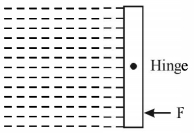
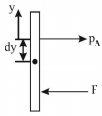
$A$ square gate of size $1\,m \times 1\,m$ is hinged at its mid-point. $A$ fluid of density $\rho$ fills the space to the left of the gate. The force $F$ required to hold the gate stationary is
A
$\frac{\rho g}{3}$
B
$\frac{\rho g}{2}$
C
$\frac{\rho g}{6}$
D
$\frac{\rho g}{8}$
Solution
(C) Let the gate be of height $H = 1\,m$ and width $W = 1\,m$. The hinge is at the mid-point,i.e.,at a depth of $0.5\,m$ from the top edge of the gate. Let $y$ be the depth from the top of the gate.
The pressure at depth $y$ is $P = \rho g y$.
The force on an elemental strip of height $dy$ at depth $y$ is $dF_p = P \times W \times dy = \rho g y \times 1 \times dy = \rho g y dy$.
The torque $d\tau$ due to this force about the hinge (located at $y = 0.5\,m$) is $d\tau = dF_p \times (0.5 - y) = \rho g y (0.5 - y) dy$.
To keep the gate stationary,the total torque about the hinge must be zero. The force $F$ is applied at the bottom edge $(y = 1\,m)$,so its lever arm relative to the hinge is $0.5\,m$.
$\int_0^1 \rho g y (0.5 - y) dy - F \times 0.5 = 0$
$\rho g \int_0^1 (0.5y - y^2) dy = 0.5 F$
$\rho g [0.5 \frac{y^2}{2} - \frac{y^3}{3}]_0^1 = 0.5 F$
$\rho g [0.25 - 0.333] = 0.5 F$
$\rho g [\frac{1}{4} - \frac{1}{3}] = 0.5 F$
$\rho g [-\frac{1}{12}] = 0.5 F$
Taking the magnitude,$F = \frac{\rho g}{12 \times 0.5} = \frac{\rho g}{6}$.
The pressure at depth $y$ is $P = \rho g y$.
The force on an elemental strip of height $dy$ at depth $y$ is $dF_p = P \times W \times dy = \rho g y \times 1 \times dy = \rho g y dy$.
The torque $d\tau$ due to this force about the hinge (located at $y = 0.5\,m$) is $d\tau = dF_p \times (0.5 - y) = \rho g y (0.5 - y) dy$.
To keep the gate stationary,the total torque about the hinge must be zero. The force $F$ is applied at the bottom edge $(y = 1\,m)$,so its lever arm relative to the hinge is $0.5\,m$.
$\int_0^1 \rho g y (0.5 - y) dy - F \times 0.5 = 0$
$\rho g \int_0^1 (0.5y - y^2) dy = 0.5 F$
$\rho g [0.5 \frac{y^2}{2} - \frac{y^3}{3}]_0^1 = 0.5 F$
$\rho g [0.25 - 0.333] = 0.5 F$
$\rho g [\frac{1}{4} - \frac{1}{3}] = 0.5 F$
$\rho g [-\frac{1}{12}] = 0.5 F$
Taking the magnitude,$F = \frac{\rho g}{12 \times 0.5} = \frac{\rho g}{6}$.
0 likes
View Solution113
MediumMCQ
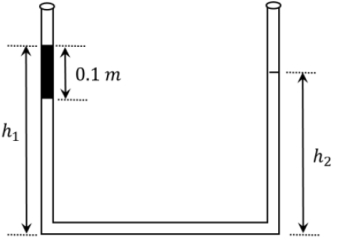
An open-ended $U$-tube of uniform cross-sectional area contains water (density $10^3 \ kg \ m^{-3}$). Initially,the water level stands at $0.29 \ m$ from the bottom in each arm. Kerosene oil (a water-immiscible liquid) of density $800 \ kg \ m^{-3}$ is added to the left arm until its length is $0.1 \ m$,as shown in the schematic figure. The ratio $\left(\frac{h_1}{h_2}\right)$ of the heights of the liquid in the two arms is-
A
$\frac{15}{14}$
B
$\frac{35}{33}$
C
$\frac{7}{6}$
D
$\frac{5}{4}$
Solution
(B) Let the initial height of water in each arm be $H = 0.29 \ m$. The total volume of water is constant. When kerosene of height $h_k = 0.1 \ m$ is added to the left arm,the water level in the left arm drops by $x$ and rises by $x$ in the right arm.
Total height of liquid in left arm: $h_1 = (H - x) + h_k = 0.29 - x + 0.1 = 0.39 - x$.
Height of liquid in right arm: $h_2 = H + x = 0.29 + x$.
Equating the pressure at the bottom of the $U$-tube:
$P_{left} = P_{right}$
$P_0 + \rho_k g h_k + \rho_w g (h_1 - h_k) = P_0 + \rho_w g h_2$
$\rho_k h_k + \rho_w (h_1 - h_k) = \rho_w h_2$
$800 \times 0.1 + 1000 \times (h_1 - 0.1) = 1000 \times h_2$
$80 + 1000 h_1 - 100 = 1000 h_2$
$1000 (h_1 - h_2) = 20 \implies h_1 - h_2 = 0.02 \ m$.
We have the system of equations:
$1$) $h_1 + h_2 = (0.29 - x + 0.1) + (0.29 + x) = 0.68 \ m$.
$2$) $h_1 - h_2 = 0.02 \ m$.
Adding the equations: $2h_1 = 0.70 \implies h_1 = 0.35 \ m$.
Subtracting the equations: $2h_2 = 0.66 \implies h_2 = 0.33 \ m$.
Therefore,the ratio $\frac{h_1}{h_2} = \frac{0.35}{0.33} = \frac{35}{33}$.
Total height of liquid in left arm: $h_1 = (H - x) + h_k = 0.29 - x + 0.1 = 0.39 - x$.
Height of liquid in right arm: $h_2 = H + x = 0.29 + x$.
Equating the pressure at the bottom of the $U$-tube:
$P_{left} = P_{right}$
$P_0 + \rho_k g h_k + \rho_w g (h_1 - h_k) = P_0 + \rho_w g h_2$
$\rho_k h_k + \rho_w (h_1 - h_k) = \rho_w h_2$
$800 \times 0.1 + 1000 \times (h_1 - 0.1) = 1000 \times h_2$
$80 + 1000 h_1 - 100 = 1000 h_2$
$1000 (h_1 - h_2) = 20 \implies h_1 - h_2 = 0.02 \ m$.
We have the system of equations:
$1$) $h_1 + h_2 = (0.29 - x + 0.1) + (0.29 + x) = 0.68 \ m$.
$2$) $h_1 - h_2 = 0.02 \ m$.
Adding the equations: $2h_1 = 0.70 \implies h_1 = 0.35 \ m$.
Subtracting the equations: $2h_2 = 0.66 \implies h_2 = 0.33 \ m$.
Therefore,the ratio $\frac{h_1}{h_2} = \frac{0.35}{0.33} = \frac{35}{33}$.
0 likes
View Solution114
DifficultMCQ
$A$ vessel with a square cross-section and a height of $6 \ m$ is vertically partitioned. $A$ small window of $100 \ cm^2$ with a hinged door is fitted at a depth of $3 \ m$ in the partition wall. One part of the vessel is filled completely with water and the other side is filled with a liquid having a density of $1.5 \times 10^3 \ kg/m^3$. What force needs to be applied on the hinged door so that it does not open (in $N$)? (Acceleration due to gravity $= 10 \ m/s^2$)
A
$150$
B
$130$
C
$160$
D
$200$
Solution
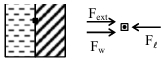
(A) The pressure at depth $h = 3 \ m$ on the water side is $P_w = P_0 + \rho_w gh$,and on the liquid side is $P_{\ell} = P_0 + \rho_{\ell} gh$.
The force exerted by water on the door is $F_w = P_w A = (P_0 + \rho_w gh) A$.
The force exerted by the liquid on the door is $F_{\ell} = P_{\ell} A = (P_0 + \rho_{\ell} gh) A$.
For the door to remain closed,the external force $F_{ext}$ applied on the water side must satisfy $F_{ext} + F_w = F_{\ell}$.
Therefore,$F_{ext} = F_{\ell} - F_w = (P_0 + \rho_{\ell} gh) A - (P_0 + \rho_w gh) A = (\rho_{\ell} - \rho_w) ghA$.
Given: $\rho_{\ell} = 1500 \ kg/m^3$,$\rho_w = 1000 \ kg/m^3$,$g = 10 \ m/s^2$,$h = 3 \ m$,and $A = 100 \ cm^2 = 100 \times 10^{-4} \ m^2 = 0.01 \ m^2$.
Substituting the values: $F_{ext} = (1500 - 1000) \times 10 \times 3 \times 0.01 = 500 \times 30 \times 0.01 = 150 \ N$.
The force exerted by water on the door is $F_w = P_w A = (P_0 + \rho_w gh) A$.
The force exerted by the liquid on the door is $F_{\ell} = P_{\ell} A = (P_0 + \rho_{\ell} gh) A$.
For the door to remain closed,the external force $F_{ext}$ applied on the water side must satisfy $F_{ext} + F_w = F_{\ell}$.
Therefore,$F_{ext} = F_{\ell} - F_w = (P_0 + \rho_{\ell} gh) A - (P_0 + \rho_w gh) A = (\rho_{\ell} - \rho_w) ghA$.
Given: $\rho_{\ell} = 1500 \ kg/m^3$,$\rho_w = 1000 \ kg/m^3$,$g = 10 \ m/s^2$,$h = 3 \ m$,and $A = 100 \ cm^2 = 100 \times 10^{-4} \ m^2 = 0.01 \ m^2$.
Substituting the values: $F_{ext} = (1500 - 1000) \times 10 \times 3 \times 0.01 = 500 \times 30 \times 0.01 = 150 \ N$.
0 likes
View Solution115
EasyMCQ
In which layer of the atmosphere is water vapour present?
A
Troposphere
B
Ionosphere
C
Mesosphere
D
Stratosphere
Solution
(A) Water vapour in the atmosphere is confined only to its lowest layer,i.e.,the troposphere.
This is the reason why all weather phenomena,such as cloud formation,rain,and storms,occur only in this layer.
This is the reason why all weather phenomena,such as cloud formation,rain,and storms,occur only in this layer.
0 likes
View Solution116
EasyMCQ
An open $U$-tube contains mercury. When $11.2 \,cm$ of water is poured into one of the arms of the tube, how high does the mercury rise in the other arm from its initial level (in $\,cm$)?
A
$0.56$
B
$1.35$
C
$0.41$
D
$2.32$
Solution
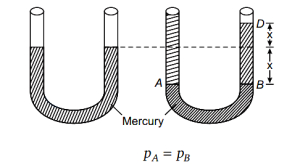
(C) Let the mercury level in the $U$-tube be initially at the same height in both arms. When $11.2 \,cm$ of water is poured into the left arm, the mercury level in the left arm drops by $x \,cm$ and rises by $x \,cm$ in the right arm. The total difference in the mercury levels between the two arms becomes $2x \,cm$.
Equating the pressure at the same horizontal level (the interface of water and mercury in the left arm, point $A$, and the corresponding level in the right arm, point $B$):
$p_A = p_B$
$h_{water} \times \rho_{water} \times g = h_{Hg} \times \rho_{Hg} \times g$
Given $h_{water} = 11.2 \,cm = 0.112 \,m$, $\rho_{water} = 1000 \,kg/m^3$, and $\rho_{Hg} = 13600 \,kg/m^3$.
$0.112 \times 1000 = 2x \times 13600$
$112 = 27200x$
$x = \frac{112}{27200} \,m \approx 0.004117 \,m = 0.41 \,cm$.
Thus, the mercury rises by $0.41 \,cm$ in the other arm.
Equating the pressure at the same horizontal level (the interface of water and mercury in the left arm, point $A$, and the corresponding level in the right arm, point $B$):
$p_A = p_B$
$h_{water} \times \rho_{water} \times g = h_{Hg} \times \rho_{Hg} \times g$
Given $h_{water} = 11.2 \,cm = 0.112 \,m$, $\rho_{water} = 1000 \,kg/m^3$, and $\rho_{Hg} = 13600 \,kg/m^3$.
$0.112 \times 1000 = 2x \times 13600$
$112 = 27200x$
$x = \frac{112}{27200} \,m \approx 0.004117 \,m = 0.41 \,cm$.
Thus, the mercury rises by $0.41 \,cm$ in the other arm.
0 likes
View Solution117
MediumMCQ
Three liquids of equal masses are taken in three identical cubical vessels $A$,$B$,and $C$. Their densities are $\rho_{A}$,$\rho_{B}$,and $\rho_{C}$ respectively,where $\rho_{A} < \rho_{B} < \rho_{C}$. The force exerted by the liquid on the base of the cubical vessel is
A
maximum in vessel $C$
B
minimum in vessel $C$
C
the same in all the vessels
D
maximum in vessel $A$
Solution
(C) The force exerted by a liquid on the base of a vessel is equal to the weight of the liquid contained in it,provided the vessel has vertical walls (like a cubical vessel).
The force $F$ is given by $F = mg$.
Since the masses of the liquids in all three vessels are equal $(m_{A} = m_{B} = m_{C} = m)$,the force exerted on the base of each vessel is $F_{A} = F_{B} = F_{C} = mg$.
Therefore,the force exerted by the liquid on the base is the same in all the vessels.
The force $F$ is given by $F = mg$.
Since the masses of the liquids in all three vessels are equal $(m_{A} = m_{B} = m_{C} = m)$,the force exerted on the base of each vessel is $F_{A} = F_{B} = F_{C} = mg$.
Therefore,the force exerted by the liquid on the base is the same in all the vessels.
0 likes
View Solution118
EasyMCQ
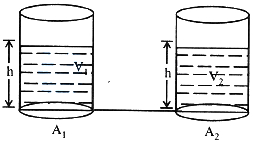
Two cylindrical vessels $A$ and $B$ of different areas of cross-section kept on the same horizontal plane are filled with water to the same height. If the volume of water in vessel $A$ is $3$ times the volume of water in vessel $B$,then the ratio of the pressures at the bottom of the vessels $A$ and $B$ is
A
$1: 1$
B
$1: 3$
C
$1: 9$
D
$1: 6$
Solution
(A) The pressure at the bottom of a vessel containing a liquid of density $\rho$ at a height $h$ is given by the formula $P = P_0 + \rho gh$,where $P_0$ is the atmospheric pressure.
Since both vessels are filled with water (same density $\rho$) to the same height $h$,and are kept on the same horizontal plane (same atmospheric pressure $P_0$),the pressure at the bottom of both vessels depends only on the height $h$ and density $\rho$.
Therefore,the pressure at the bottom of vessel $A$ is $P_A = P_0 + \rho gh$ and the pressure at the bottom of vessel $B$ is $P_B = P_0 + \rho gh$.
Thus,$P_A = P_B$.
The ratio of the pressures at the bottom of the vessels $A$ and $B$ is $P_A : P_B = 1 : 1$.
Since both vessels are filled with water (same density $\rho$) to the same height $h$,and are kept on the same horizontal plane (same atmospheric pressure $P_0$),the pressure at the bottom of both vessels depends only on the height $h$ and density $\rho$.
Therefore,the pressure at the bottom of vessel $A$ is $P_A = P_0 + \rho gh$ and the pressure at the bottom of vessel $B$ is $P_B = P_0 + \rho gh$.
Thus,$P_A = P_B$.
The ratio of the pressures at the bottom of the vessels $A$ and $B$ is $P_A : P_B = 1 : 1$.
0 likes
View Solution119
EasyMCQ
$A$ person of height $1.65 \,m$ is standing upright. The additional external force required by a blood vessel of length $1 \,cm$, diameter $1 \,mm$ at the feet to balance the pressure compared to a similar blood vessel in the head is (Density of blood $= 1.1 \times 10^3 \,kg \,m^{-3}$, $g = 10 \,ms^{-2}$) (in $\,N$)
A
$0.57$
B
$5.7$
C
$1.85$
D
$3.14$
Solution
(A) The pressure difference between the head and the feet is given by $\Delta P = \rho gh$.
Here, $\rho = 1.1 \times 10^3 \,kg \,m^{-3}$, $g = 10 \,ms^{-2}$, and $h = 1.65 \,m$.
$\Delta P = 1.1 \times 10^3 \times 10 \times 1.65 = 1.815 \times 10^4 \,Pa$.
The force $F$ required to balance this pressure on the blood vessel is $F = \Delta P \times A$, where $A$ is the surface area of the blood vessel.
The blood vessel is a cylinder with length $L = 1 \,cm = 10^{-2} \,m$ and diameter $d = 1 \,mm = 10^{-3} \,m$ (radius $r = 0.5 \times 10^{-3} \,m$).
The surface area $A$ (lateral surface area) is $A = 2 \pi r L$.
$A = 2 \times 3.14159 \times 0.5 \times 10^{-3} \times 10^{-2} = 3.14159 \times 10^{-5} \,m^2$.
$F = (1.815 \times 10^4) \times (3.14159 \times 10^{-5}) \approx 0.57 \,N$.
Here, $\rho = 1.1 \times 10^3 \,kg \,m^{-3}$, $g = 10 \,ms^{-2}$, and $h = 1.65 \,m$.
$\Delta P = 1.1 \times 10^3 \times 10 \times 1.65 = 1.815 \times 10^4 \,Pa$.
The force $F$ required to balance this pressure on the blood vessel is $F = \Delta P \times A$, where $A$ is the surface area of the blood vessel.
The blood vessel is a cylinder with length $L = 1 \,cm = 10^{-2} \,m$ and diameter $d = 1 \,mm = 10^{-3} \,m$ (radius $r = 0.5 \times 10^{-3} \,m$).
The surface area $A$ (lateral surface area) is $A = 2 \pi r L$.
$A = 2 \times 3.14159 \times 0.5 \times 10^{-3} \times 10^{-2} = 3.14159 \times 10^{-5} \,m^2$.
$F = (1.815 \times 10^4) \times (3.14159 \times 10^{-5}) \approx 0.57 \,N$.
0 likes
View Solution120
DifficultMCQ
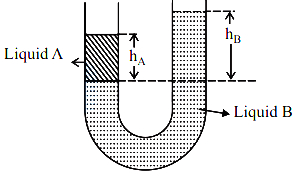
Consider two liquids $A$ and $B$ in a $U$-shaped tube in static equilibrium as shown in the figure. If the density of the liquid $A$ is twice the density of liquid $B$,then the relation between $h_A$ and $h_B$ is
A
$h_{A}=\frac{h_{B}}{\sqrt{2}}$
B
$h_{A}=\frac{h_{B}}{2}$
C
$h_{A}=\frac{h_{B}}{3}$
D
$h_{A}=\frac{h_{B}}{\sqrt{3}}$
Solution
(B) In static equilibrium,the pressure at the same horizontal level in a continuous fluid is the same.
Let the pressure at the interface of liquid $A$ and liquid $B$ in the left arm be $P$.
For the left arm,the pressure at this level is $P_0 + \rho_A g h_A$,where $P_0$ is the atmospheric pressure.
For the right arm,the pressure at the same horizontal level is $P_0 + \rho_B g h_B$.
Equating the pressures:
$P_0 + \rho_A g h_A = P_0 + \rho_B g h_B$
$\rho_A h_A = \rho_B h_B$
Given that the density of liquid $A$ is twice the density of liquid $B$,i.e.,$\rho_A = 2\rho_B$.
Substituting this into the equation:
$(2\rho_B) h_A = \rho_B h_B$
$2 h_A = h_B$
$h_A = \frac{h_B}{2}$
Let the pressure at the interface of liquid $A$ and liquid $B$ in the left arm be $P$.
For the left arm,the pressure at this level is $P_0 + \rho_A g h_A$,where $P_0$ is the atmospheric pressure.
For the right arm,the pressure at the same horizontal level is $P_0 + \rho_B g h_B$.
Equating the pressures:
$P_0 + \rho_A g h_A = P_0 + \rho_B g h_B$
$\rho_A h_A = \rho_B h_B$
Given that the density of liquid $A$ is twice the density of liquid $B$,i.e.,$\rho_A = 2\rho_B$.
Substituting this into the equation:
$(2\rho_B) h_A = \rho_B h_B$
$2 h_A = h_B$
$h_A = \frac{h_B}{2}$
0 likes
View Solution121
DifficultMCQ
If a vessel containing a fluid of density $\rho$ up to height $h$ is accelerated vertically downwards with acceleration $a_0$,then the pressure by the fluid at the bottom of the vessel is given by the equation ........ ($p_0$ denotes the atmospheric pressure and $g$ denotes the acceleration due to gravity).
A
$p=p_0+\rho g h+\rho h a_0$
B
$p=p_0+\rho g h$
C
$p=p_0+\rho h(g-a_0)$
D
$p=p_0-\rho g h$
Solution
(C) When a vessel containing a fluid of density $\rho$ up to height $h$ is accelerated downwards with acceleration $a_0$,the effective gravitational acceleration acting on the fluid is given by:
$g^{\prime} = g - a_0$ ...$(i)$
The pressure $p$ at the bottom of the vessel is the sum of atmospheric pressure $p_0$ and the gauge pressure due to the fluid column under effective gravity:
$p = p_0 + \rho g^{\prime} h$
Substituting the value of $g^{\prime}$ from equation $(i)$:
$p = p_0 + \rho(g - a_0)h$
$g^{\prime} = g - a_0$ ...$(i)$
The pressure $p$ at the bottom of the vessel is the sum of atmospheric pressure $p_0$ and the gauge pressure due to the fluid column under effective gravity:
$p = p_0 + \rho g^{\prime} h$
Substituting the value of $g^{\prime}$ from equation $(i)$:
$p = p_0 + \rho(g - a_0)h$
0 likes
View Solution122
MediumMCQ
When an air bubble of radius $r$ rises from the bottom to the surface of a lake,its radius becomes $\frac{5r}{4}$. If the atmospheric pressure is equal to the pressure exerted by a $10 \ m$ height of water column,the temperature is constant,and surface tension is neglected,what is the depth of the lake (in $m$)?
A
$5.53$
B
$6.53$
C
$9.53$
D
$12.53$
Solution
(C) Let the depth of the lake be $h$. The atmospheric pressure $P_0$ is equivalent to $10 \ m$ of water column,so $P_0 = 10 \rho g$.
At the bottom of the lake,the pressure $P_1$ is the sum of atmospheric pressure and the pressure due to the water column of depth $h$:
$P_1 = P_0 + h \rho g = 10 \rho g + h \rho g = \rho g(10 + h)$.
The volume of the bubble at the bottom is $V_1 = \frac{4}{3} \pi r^3$.
At the surface,the pressure $P_2$ is equal to the atmospheric pressure:
$P_2 = P_0 = 10 \rho g$.
The volume of the bubble at the surface is $V_2 = \frac{4}{3} \pi (\frac{5r}{4})^3$.
Since the temperature is constant,we apply Boyle's Law $(P_1 V_1 = P_2 V_2)$:
$\rho g(10 + h) \cdot \frac{4}{3} \pi r^3 = 10 \rho g \cdot \frac{4}{3} \pi (\frac{5r}{4})^3$.
$(10 + h) = 10 \cdot \frac{125}{64}$.
$10 + h = \frac{1250}{64} = 19.53125$.
$h = 19.53125 - 10 = 9.53125 \ m$.
Thus,the depth of the lake is approximately $9.53 \ m$.
At the bottom of the lake,the pressure $P_1$ is the sum of atmospheric pressure and the pressure due to the water column of depth $h$:
$P_1 = P_0 + h \rho g = 10 \rho g + h \rho g = \rho g(10 + h)$.
The volume of the bubble at the bottom is $V_1 = \frac{4}{3} \pi r^3$.
At the surface,the pressure $P_2$ is equal to the atmospheric pressure:
$P_2 = P_0 = 10 \rho g$.
The volume of the bubble at the surface is $V_2 = \frac{4}{3} \pi (\frac{5r}{4})^3$.
Since the temperature is constant,we apply Boyle's Law $(P_1 V_1 = P_2 V_2)$:
$\rho g(10 + h) \cdot \frac{4}{3} \pi r^3 = 10 \rho g \cdot \frac{4}{3} \pi (\frac{5r}{4})^3$.
$(10 + h) = 10 \cdot \frac{125}{64}$.
$10 + h = \frac{1250}{64} = 19.53125$.
$h = 19.53125 - 10 = 9.53125 \ m$.
Thus,the depth of the lake is approximately $9.53 \ m$.
0 likes
View Solution123
MediumMCQ
Depth of a river is $100 \ m$. Magnitude of compressibility of the water is $0.5 \times 10^{-9} \ N^{-1} \ m^2$. The fractional compression in water at the bottom of the river is (Acceleration due to gravity $= 10 \ m/s^2$)
A
$0.9 \times 10^{-3}$
B
$0.5 \times 10^{-3}$
C
$2 \times 10^{-3}$
D
$1.3 \times 10^{-2}$
Solution
(B) Given: Depth $h = 100 \ m$,Compressibility $k = 0.5 \times 10^{-9} \ N^{-1} \ m^2$,Density of water $\rho = 10^3 \ kg/m^3$,Acceleration due to gravity $g = 10 \ m/s^2$.
Pressure at the bottom of the river is given by $P = \rho gh$.
$P = 10^3 \times 10 \times 100 = 10^6 \ N/m^2$.
Compressibility $k$ is defined as the reciprocal of Bulk Modulus $B$,where $k = \frac{1}{B} = \frac{(\Delta V / V)}{P}$.
Therefore,the fractional compression (fractional change in volume) is $\frac{\Delta V}{V} = k \times P$.
$\frac{\Delta V}{V} = (0.5 \times 10^{-9}) \times 10^6 = 0.5 \times 10^{-3}$.
Pressure at the bottom of the river is given by $P = \rho gh$.
$P = 10^3 \times 10 \times 100 = 10^6 \ N/m^2$.
Compressibility $k$ is defined as the reciprocal of Bulk Modulus $B$,where $k = \frac{1}{B} = \frac{(\Delta V / V)}{P}$.
Therefore,the fractional compression (fractional change in volume) is $\frac{\Delta V}{V} = k \times P$.
$\frac{\Delta V}{V} = (0.5 \times 10^{-9}) \times 10^6 = 0.5 \times 10^{-3}$.
0 likes
View Solution124
DifficultMCQ
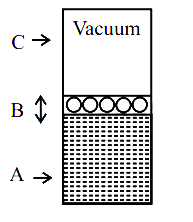
In the figure,chamber $A$ contains a gas,a movable chamber $B$ is placed on top of the gas and it contains $n$ metal balls. The weight of chamber $B$ and the balls is supported by the gas. Chamber $C$ is a vacuum. Let the gas be in equilibrium at pressure $P$. Let $P^{\prime}$ be the pressure if one of the balls is taken away. Find $(P-P^{\prime}) / P$.
A
$1$
B
$n$
C
$2n$
D
$1/n$
Solution
(D) Let $M$ be the mass of chamber $B$ and $m$ be the mass of each ball. The total downward force exerted by the chamber and the balls on the gas is $F = (M + nm)g$.
If $A$ is the cross-sectional area of the chamber,the pressure $P$ of the gas is given by $P = F/A = (M + nm)g / A$.
When one ball is removed,the new force is $F^{\prime} = (M + (n-1)m)g$.
The new pressure $P^{\prime}$ is $P^{\prime} = F^{\prime} / A = (M + (n-1)m)g / A$.
The difference in pressure is $P - P^{\prime} = (M + nm)g/A - (M + nm - m)g/A = mg/A$.
Thus,$(P - P^{\prime}) / P = (mg/A) / ((M + nm)g/A) = m / (M + nm)$.
Assuming the mass of the chamber $M$ is negligible compared to the total mass of the balls (or that the problem implies the weight is primarily due to the balls),we have $M \approx 0$.
Then,$(P - P^{\prime}) / P = m / (nm) = 1/n$.
If $A$ is the cross-sectional area of the chamber,the pressure $P$ of the gas is given by $P = F/A = (M + nm)g / A$.
When one ball is removed,the new force is $F^{\prime} = (M + (n-1)m)g$.
The new pressure $P^{\prime}$ is $P^{\prime} = F^{\prime} / A = (M + (n-1)m)g / A$.
The difference in pressure is $P - P^{\prime} = (M + nm)g/A - (M + nm - m)g/A = mg/A$.
Thus,$(P - P^{\prime}) / P = (mg/A) / ((M + nm)g/A) = m / (M + nm)$.
Assuming the mass of the chamber $M$ is negligible compared to the total mass of the balls (or that the problem implies the weight is primarily due to the balls),we have $M \approx 0$.
Then,$(P - P^{\prime}) / P = m / (nm) = 1/n$.
0 likes
View Solution125
EasyMCQ
Three identical vessels are filled up to the same height with three different liquids $A, B$ and $C$ of densities $\rho_A, \rho_B$ and $\rho_C$ (where $\rho_A > \rho_B > \rho_C$). The pressure at the bottom of the vessels is:
A
equal in all vessels
B
maximum in vessel containing liquid $C$
C
maximum in vessel containing liquid $B$
D
maximum in vessel containing liquid $A$
Solution
(D) The pressure $P$ at the bottom of a vessel filled with a liquid of density $\rho$ to a height $h$ is given by the formula: $P = \rho g h$.
Since the height $h$ is the same for all three vessels and $g$ is constant,the pressure $P$ is directly proportional to the density $\rho$ of the liquid $(P \propto \rho)$.
Given the densities are $\rho_A > \rho_B > \rho_C$,it follows that the pressure at the bottom of the vessels will be $P_A > P_B > P_C$.
Therefore,the pressure is maximum in the vessel containing liquid $A$.
Since the height $h$ is the same for all three vessels and $g$ is constant,the pressure $P$ is directly proportional to the density $\rho$ of the liquid $(P \propto \rho)$.
Given the densities are $\rho_A > \rho_B > \rho_C$,it follows that the pressure at the bottom of the vessels will be $P_A > P_B > P_C$.
Therefore,the pressure is maximum in the vessel containing liquid $A$.
0 likes
View Solution126
EasyMCQ
Three identical vessels are filled with three liquids $A, B$,and $C$ with equal masses but having densities $\rho_A, \rho_B$,and $\rho_C$ respectively. If $\rho_A > \rho_B > \rho_C$,then the pressure at the bottom of the vessels will be:
A
Equal in all vessels
B
Maximum in vessel containing liquid $A$
C
Maximum in vessel containing liquid $B$
D
Maximum in vessel containing liquid $C$
Solution
(A) The pressure at the bottom of a vessel due to a liquid column is given by $P = h \rho g$,where $h$ is the height of the liquid column,$\rho$ is the density,and $g$ is the acceleration due to gravity.
Since the vessels are identical,their cross-sectional area $A$ is the same.
The mass $m$ of the liquid is given by $m = \rho V = \rho A h$.
Given that the masses are equal $(m_A = m_B = m_C = M)$,we have:
$M = \rho_A A h_A = \rho_B A h_B = \rho_C A h_C$.
This implies $\rho_A h_A = \rho_B h_B = \rho_C h_C = \frac{M}{A} = \text{constant}$.
The pressure at the bottom is $P = \rho g h = g (\rho h)$.
Since the product $\rho h$ is constant for all three liquids,the pressure $P$ at the bottom of each vessel is the same.
Since the vessels are identical,their cross-sectional area $A$ is the same.
The mass $m$ of the liquid is given by $m = \rho V = \rho A h$.
Given that the masses are equal $(m_A = m_B = m_C = M)$,we have:
$M = \rho_A A h_A = \rho_B A h_B = \rho_C A h_C$.
This implies $\rho_A h_A = \rho_B h_B = \rho_C h_C = \frac{M}{A} = \text{constant}$.
The pressure at the bottom is $P = \rho g h = g (\rho h)$.
Since the product $\rho h$ is constant for all three liquids,the pressure $P$ at the bottom of each vessel is the same.
0 likes
View Solution127
MediumMCQ
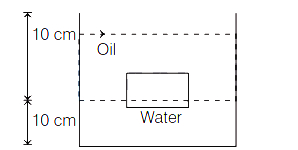
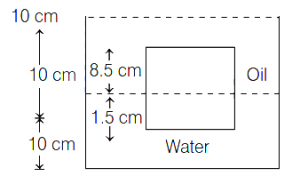
$A$ cubical block of wood, of length $10 \,cm$, floats at the interface between oil of density $800 \,kg/m^3$ and water. The lower surface of the block is $1.5 \,cm$ below the interface. If the depth of water is $10 \,cm$ below the interface and oil is up to $10 \,cm$ above the interface, then the difference in pressure at the lower and the upper face of the wooden block is:
(Assume density of water, $\rho_w = 1000 \,kg/m^3$ and acceleration due to gravity, $g = 10 \,m/s^2$) (in $\,Pa$)
(Assume density of water, $\rho_w = 1000 \,kg/m^3$ and acceleration due to gravity, $g = 10 \,m/s^2$) (in $\,Pa$)
A
$850$
B
$780$
C
$800$
D
$830$
Solution
(D) Let the side length of the cubical block be $L = 10 \,cm = 0.1 \,m$.
The block floats at the interface. Let $h_w = 1.5 \,cm = 0.015 \,m$ be the depth of the block in water and $h_o = 10 \,cm - 1.5 \,cm = 8.5 \,cm = 0.085 \,m$ be the height of the block in oil.
The pressure at the lower face (in water) is $P_{lower} = P_{interface} + \rho_w g h_w$.
The pressure at the upper face (in oil) is $P_{upper} = P_{interface} - \rho_o g h_o$.
The difference in pressure between the lower and upper face is $\Delta P = P_{lower} - P_{upper} = (P_{interface} + \rho_w g h_w) - (P_{interface} - \rho_o g h_o) = \rho_w g h_w + \rho_o g h_o$.
Substituting the given values:
$\Delta P = (1000 \,kg/m^3 \times 10 \,m/s^2 \times 0.015 \,m) + (800 \,kg/m^3 \times 10 \,m/s^2 \times 0.085 \,m)$
$\Delta P = 150 \,Pa + 680 \,Pa = 830 \,Pa$.
The block floats at the interface. Let $h_w = 1.5 \,cm = 0.015 \,m$ be the depth of the block in water and $h_o = 10 \,cm - 1.5 \,cm = 8.5 \,cm = 0.085 \,m$ be the height of the block in oil.
The pressure at the lower face (in water) is $P_{lower} = P_{interface} + \rho_w g h_w$.
The pressure at the upper face (in oil) is $P_{upper} = P_{interface} - \rho_o g h_o$.
The difference in pressure between the lower and upper face is $\Delta P = P_{lower} - P_{upper} = (P_{interface} + \rho_w g h_w) - (P_{interface} - \rho_o g h_o) = \rho_w g h_w + \rho_o g h_o$.
Substituting the given values:
$\Delta P = (1000 \,kg/m^3 \times 10 \,m/s^2 \times 0.015 \,m) + (800 \,kg/m^3 \times 10 \,m/s^2 \times 0.085 \,m)$
$\Delta P = 150 \,Pa + 680 \,Pa = 830 \,Pa$.
0 likes
View Solution128
DifficultMCQ
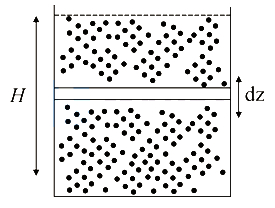
Consider a vessel filled with a liquid up to height $H$. The bottom of the vessel lies in the $X-Y$ plane passing through the origin. The density of the liquid varies with the $Z$-axis as $\rho(z) = \rho_0 \left[ 2 - \left( \frac{z}{H} \right)^2 \right]$. If $P_1$ and $P_2$ are the pressures at the bottom surface and top surface of the liquid respectively,the magnitude of $(P_1 - P_2)$ is:
A
$\rho_0 g H$
B
$\frac{8}{5} \rho_0 g H$
C
$\frac{3}{2} \rho_0 g H$
D
$\frac{5}{3} \rho_0 g H$
Solution
(D) The pressure variation in a fluid with varying density is given by the hydrostatic law: $dP = -\rho(z) g dz$.
Integrating from the bottom ($z=0$,$P=P_1$) to the top ($z=H$,$P=P_2$):
$\int_{P_1}^{P_2} dP = -\int_{0}^{H} \rho(z) g dz$
$P_2 - P_1 = -g \int_{0}^{H} \rho_0 \left[ 2 - \left( \frac{z}{H} \right)^2 \right] dz$
$P_1 - P_2 = g \rho_0 \int_{0}^{H} \left( 2 - \frac{z^2}{H^2} \right) dz$
$P_1 - P_2 = g \rho_0 \left[ 2z - \frac{z^3}{3H^2} \right]_{0}^{H}$
$P_1 - P_2 = g \rho_0 \left( 2H - \frac{H^3}{3H^2} \right)$
$P_1 - P_2 = g \rho_0 \left( 2H - \frac{H}{3} \right)$
$P_1 - P_2 = g \rho_0 \left( \frac{5H}{3} \right) = \frac{5}{3} \rho_0 g H$.
Integrating from the bottom ($z=0$,$P=P_1$) to the top ($z=H$,$P=P_2$):
$\int_{P_1}^{P_2} dP = -\int_{0}^{H} \rho(z) g dz$
$P_2 - P_1 = -g \int_{0}^{H} \rho_0 \left[ 2 - \left( \frac{z}{H} \right)^2 \right] dz$
$P_1 - P_2 = g \rho_0 \int_{0}^{H} \left( 2 - \frac{z^2}{H^2} \right) dz$
$P_1 - P_2 = g \rho_0 \left[ 2z - \frac{z^3}{3H^2} \right]_{0}^{H}$
$P_1 - P_2 = g \rho_0 \left( 2H - \frac{H^3}{3H^2} \right)$
$P_1 - P_2 = g \rho_0 \left( 2H - \frac{H}{3} \right)$
$P_1 - P_2 = g \rho_0 \left( \frac{5H}{3} \right) = \frac{5}{3} \rho_0 g H$.
0 likes
View Solution129
MediumMCQ
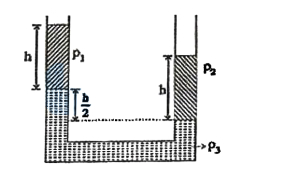
Three different liquids are filled in a $U$-tube as shown in the figure. Their densities are $\rho_1, \rho_2$ and $\rho_3$ respectively. From the figure,we may conclude that:
A
$\rho_3=4(\rho_2-\rho_1)$
B
$\rho_3=4(\rho_1-\rho_2)$
C
$\rho_3=2(\rho_2-\rho_1)$
D
$\rho_3=\frac{\rho_1+\rho_2}{2}$
Solution
(C) Consider the horizontal level at the bottom of the liquid with density $\rho_3$ in the left arm. The pressure at this level in both arms must be equal.
In the left arm,the pressure is due to the liquid of density $\rho_1$ (height $h$) and the liquid of density $\rho_3$ (height $h/2$).
$P_{left} = P_{atm} + \rho_1 gh + \rho_3 g(h/2)$
In the right arm,the pressure at the same horizontal level is due to the liquid of density $\rho_2$ (height $h$).
$P_{right} = P_{atm} + \rho_2 gh$
Equating the pressures: $P_{atm} + \rho_1 gh + \rho_3 g(h/2) = P_{atm} + \rho_2 gh$
Dividing by $gh$: $\rho_1 + \frac{\rho_3}{2} = \rho_2$
Rearranging for $\rho_3$: $\frac{\rho_3}{2} = \rho_2 - \rho_1 \implies \rho_3 = 2(\rho_2 - \rho_1)$
In the left arm,the pressure is due to the liquid of density $\rho_1$ (height $h$) and the liquid of density $\rho_3$ (height $h/2$).
$P_{left} = P_{atm} + \rho_1 gh + \rho_3 g(h/2)$
In the right arm,the pressure at the same horizontal level is due to the liquid of density $\rho_2$ (height $h$).
$P_{right} = P_{atm} + \rho_2 gh$
Equating the pressures: $P_{atm} + \rho_1 gh + \rho_3 g(h/2) = P_{atm} + \rho_2 gh$
Dividing by $gh$: $\rho_1 + \frac{\rho_3}{2} = \rho_2$
Rearranging for $\rho_3$: $\frac{\rho_3}{2} = \rho_2 - \rho_1 \implies \rho_3 = 2(\rho_2 - \rho_1)$
0 likes
View Solution130
DifficultMCQ
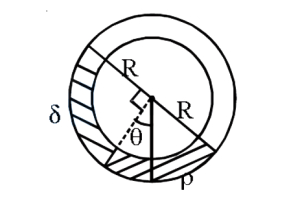
$A$ uniform long tube is bent into a circle of radius $R$ and it lies in a vertical plane. Two liquids of the same volume but densities $\rho$ and $\delta$ fill half the tube. The angle $\theta$ is
A
$\tan ^{-1}\left(\frac{\rho-\delta}{\rho+\delta}\right)$
B
$\tan ^{-1} \frac{\rho}{\delta}$
C
$\tan ^{-1} \frac{\delta}{\rho}$
D
$\tan ^{-1}\left(\frac{\rho+\delta}{\rho-\delta}\right)$
Solution
(A) Let the vertical line passing through the center be the reference. The interface between the two liquids is at an angle $\theta$ from the vertical.
Since the tube is in a vertical plane,the pressure at the lowest point must be the same from both sides.
Let the density of the liquid on the left be $\delta$ and on the right be $\rho$.
The vertical height of the center of mass of the liquid column of density $\delta$ from the lowest point is $h_1 = R(1 - \cos \theta)$.
The vertical height of the center of mass of the liquid column of density $\rho$ from the lowest point is $h_2 = R(1 - \cos \theta)$.
For equilibrium,the pressure at the lowest point of the tube must be equal from both sides.
The pressure exerted by a liquid column in a circular tube is proportional to the vertical depth of its center of mass.
The condition for equilibrium is given by:
$\delta g R(\cos \theta + \sin \theta) = \rho g R(\cos \theta - \sin \theta)$
Dividing both sides by $gR$:
$\delta(\cos \theta + \sin \theta) = \rho(\cos \theta - \sin \theta)$
$\delta \cos \theta + \delta \sin \theta = \rho \cos \theta - \rho \sin \theta$
$\sin \theta(\rho + \delta) = \cos \theta(\rho - \delta)$
$\tan \theta = \frac{\rho - \delta}{\rho + \delta}$
$\theta = \tan ^{-1}\left(\frac{\rho - \delta}{\rho + \delta}\right)$
Since the tube is in a vertical plane,the pressure at the lowest point must be the same from both sides.
Let the density of the liquid on the left be $\delta$ and on the right be $\rho$.
The vertical height of the center of mass of the liquid column of density $\delta$ from the lowest point is $h_1 = R(1 - \cos \theta)$.
The vertical height of the center of mass of the liquid column of density $\rho$ from the lowest point is $h_2 = R(1 - \cos \theta)$.
For equilibrium,the pressure at the lowest point of the tube must be equal from both sides.
The pressure exerted by a liquid column in a circular tube is proportional to the vertical depth of its center of mass.
The condition for equilibrium is given by:
$\delta g R(\cos \theta + \sin \theta) = \rho g R(\cos \theta - \sin \theta)$
Dividing both sides by $gR$:
$\delta(\cos \theta + \sin \theta) = \rho(\cos \theta - \sin \theta)$
$\delta \cos \theta + \delta \sin \theta = \rho \cos \theta - \rho \sin \theta$
$\sin \theta(\rho + \delta) = \cos \theta(\rho - \delta)$
$\tan \theta = \frac{\rho - \delta}{\rho + \delta}$
$\theta = \tan ^{-1}\left(\frac{\rho - \delta}{\rho + \delta}\right)$
0 likes
View SolutionFluid Mechanics and Surface Tension — Pressure and Density (of Mixure) · Frequently Asked Questions
1Are these Fluid Mechanics and Surface Tension questions useful for JEE and NEET?
Yes. All questions in this section are mapped to JEE Main and NEET exam patterns. Previous year questions from JEE Main, NEET, GUJCET and state-level exams are included with full solutions.
2Can I switch to Hindi or Gujarati for these questions?
Yes. Use the language tabs in the hero section or the sidebar to view the same questions and solutions in English, Hindi or Gujarati.
3How do I generate a question paper from this subtopic?
Use the Vedclass Exam Paper Generator — select the chapter and subtopic, set difficulty, and generate Sets A, B, C, D automatically. First 3 chapters of every subject are free.
Vedclass Products
For Students
Vedclass Test Series
Mock tests in real JEE/NEET style with performance analysis. 5-day free trial.
Start Free TrialFor Teachers
Exam Paper Generator
Generate Set A/B/C/D papers from this chapter in 2 minutes. 3 chapters free.
Try FreeFor Institutes
Online Exam Module
Live online exams with unlimited students, 360° analytics & white-label branding.
See DemoFor Teachers & Institutes
Generate a Fluid Mechanics and Surface Tension Exam Paper in 2 Minutes
Select subtopic & difficulty — Sets A, B, C, D auto-generated with No Repeat logic.
First 3 chapters of every subject are free — no payment required.