
A English
Pressure and Density (of Mixure) Questions in English
Class 11 Physics · Fluid Mechanics and Surface Tension · Pressure and Density (of Mixure)
131+
Questions
English
Language
100%
With Solutions
Showing 50 of 131 questions in English
51
EasyMCQ
$Assertion$ : Specific gravity of a fluid is a dimensionless quantity.
$Reason$ : It is the ratio of density of fluid to the density of water at $4^{\circ}C$.
$Reason$ : It is the ratio of density of fluid to the density of water at $4^{\circ}C$.
A
If both $Assertion$ and $Reason$ are correct and the $Reason$ is a correct explanation of the $Assertion$.
B
If both $Assertion$ and $Reason$ are correct but $Reason$ is not a correct explanation of the $Assertion$.
C
If the $Assertion$ is correct but $Reason$ is incorrect.
D
If both the $Assertion$ and $Reason$ are incorrect.
Solution
(A) Specific gravity (also known as relative density) is defined as the ratio of the density of a substance to the density of water at a standard temperature (usually $4^{\circ}C$).
$\text{Specific Gravity} = \frac{\rho_{\text{fluid}}}{\rho_{\text{water}}}$
Since it is a ratio of two identical physical quantities (density/density),the units cancel out,making it a dimensionless quantity.
Therefore,both the $Assertion$ and $Reason$ are correct,and the $Reason$ is the correct explanation for the $Assertion$.
$\text{Specific Gravity} = \frac{\rho_{\text{fluid}}}{\rho_{\text{water}}}$
Since it is a ratio of two identical physical quantities (density/density),the units cancel out,making it a dimensionless quantity.
Therefore,both the $Assertion$ and $Reason$ are correct,and the $Reason$ is the correct explanation for the $Assertion$.
0 likes
View Solution52
MediumMCQ
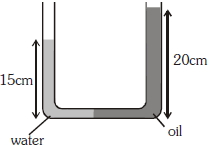
In a $U$-tube as shown in the figure,water and oil are in the left and right sides of the tube,respectively. The heights from the bottom for the water and oil columns are $15 \; cm$ and $20 \; cm$,respectively. The density of the oil is ...... $kg/m^3$. [Take $\rho_{\text{water}} = 1000 \; kg/m^3$]
A
$1200$
B
$750$
C
$1000$
D
$1333$
Solution
(B) At the same horizontal level in a continuous static fluid,the pressure is the same.
Let the pressure at the bottom of the $U$-tube be $P$.
The pressure exerted by the water column on the left side is $P_{\text{left}} = P_0 + \rho_{\text{water}} g h_{\text{water}}$,where $P_0$ is atmospheric pressure.
The pressure exerted by the oil column on the right side is $P_{\text{right}} = P_0 + \rho_{\text{oil}} g h_{\text{oil}}$.
Since the pressures at the bottom are equal,we have:
$\rho_{\text{water}} g h_{\text{water}} = \rho_{\text{oil}} g h_{\text{oil}}$
$\rho_{\text{oil}} = \frac{\rho_{\text{water}} h_{\text{water}}}{h_{\text{oil}}}$
Given $\rho_{\text{water}} = 1000 \; kg/m^3$,$h_{\text{water}} = 15 \; cm$,and $h_{\text{oil}} = 20 \; cm$:
$\rho_{\text{oil}} = \frac{1000 \times 15}{20} = 750 \; kg/m^3$.
Let the pressure at the bottom of the $U$-tube be $P$.
The pressure exerted by the water column on the left side is $P_{\text{left}} = P_0 + \rho_{\text{water}} g h_{\text{water}}$,where $P_0$ is atmospheric pressure.
The pressure exerted by the oil column on the right side is $P_{\text{right}} = P_0 + \rho_{\text{oil}} g h_{\text{oil}}$.
Since the pressures at the bottom are equal,we have:
$\rho_{\text{water}} g h_{\text{water}} = \rho_{\text{oil}} g h_{\text{oil}}$
$\rho_{\text{oil}} = \frac{\rho_{\text{water}} h_{\text{water}}}{h_{\text{oil}}}$
Given $\rho_{\text{water}} = 1000 \; kg/m^3$,$h_{\text{water}} = 15 \; cm$,and $h_{\text{oil}} = 20 \; cm$:
$\rho_{\text{oil}} = \frac{1000 \times 15}{20} = 750 \; kg/m^3$.
0 likes
View Solution53
MediumMCQ
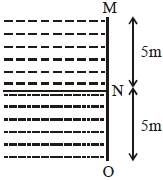
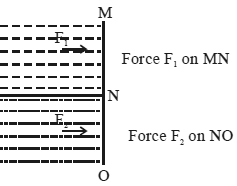
Two liquids of densities $\rho_{1}$ and $\rho_{2}$ (where $\rho_{2} = 2\rho_{1}$) are filled behind a vertical wall of height $10 \; m$ and width $w$,as shown in the figure. Each liquid has a height of $h = 5 \; m$. The ratio of the force exerted by the upper liquid on the part $MN$ to the force exerted by the lower liquid on the part $NO$ is (Assume that the liquids do not mix):
A
$\frac{1}{4}$
B
$\frac{2}{3}$
C
$\frac{1}{3}$
D
$\frac{1}{2}$
Solution
(A) Let the width of the wall be $w$. The area of each section $MN$ and $NO$ is $A = h \times w = 5w$.
For the upper liquid (part $MN$):
The pressure at the top is $0$ and at depth $h$ is $\rho_{1}gh$. The average pressure is $P_{avg1} = \frac{0 + \rho_{1}gh}{2} = \frac{\rho_{1}gh}{2}$.
The force $F_{1} = P_{avg1} \times A = \left(\frac{\rho_{1}gh}{2}\right) (5w) = \frac{5}{2} \rho_{1}ghw$.
For the lower liquid (part $NO$):
The pressure at the top of this section (at depth $h$) is $P_{top} = \rho_{1}gh$. The pressure at the bottom (at depth $2h$) is $P_{bottom} = \rho_{1}gh + \rho_{2}gh = \rho_{1}gh + 2\rho_{1}gh = 3\rho_{1}gh$.
The average pressure is $P_{avg2} = \frac{P_{top} + P_{bottom}}{2} = \frac{\rho_{1}gh + 3\rho_{1}gh}{2} = 2\rho_{1}gh$.
The force $F_{2} = P_{avg2} \times A = (2\rho_{1}gh) (5w) = 10\rho_{1}ghw$.
The ratio is $\frac{F_{1}}{F_{2}} = \frac{\frac{5}{2} \rho_{1}ghw}{10\rho_{1}ghw} = \frac{5}{20} = \frac{1}{4}$.
For the upper liquid (part $MN$):
The pressure at the top is $0$ and at depth $h$ is $\rho_{1}gh$. The average pressure is $P_{avg1} = \frac{0 + \rho_{1}gh}{2} = \frac{\rho_{1}gh}{2}$.
The force $F_{1} = P_{avg1} \times A = \left(\frac{\rho_{1}gh}{2}\right) (5w) = \frac{5}{2} \rho_{1}ghw$.
For the lower liquid (part $NO$):
The pressure at the top of this section (at depth $h$) is $P_{top} = \rho_{1}gh$. The pressure at the bottom (at depth $2h$) is $P_{bottom} = \rho_{1}gh + \rho_{2}gh = \rho_{1}gh + 2\rho_{1}gh = 3\rho_{1}gh$.
The average pressure is $P_{avg2} = \frac{P_{top} + P_{bottom}}{2} = \frac{\rho_{1}gh + 3\rho_{1}gh}{2} = 2\rho_{1}gh$.
The force $F_{2} = P_{avg2} \times A = (2\rho_{1}gh) (5w) = 10\rho_{1}ghw$.
The ratio is $\frac{F_{1}}{F_{2}} = \frac{\frac{5}{2} \rho_{1}ghw}{10\rho_{1}ghw} = \frac{5}{20} = \frac{1}{4}$.
0 likes
View Solution54
Medium
The Sun is a hot plasma (ionized matter) with its inner core at a temperature exceeding $10^{7} \; K$,and its outer surface at a temperature of about $6000 \; K$. At these high temperatures,no substance remains in a solid or liquid phase. In what range do you expect the mass density of the Sun to be,in the range of densities of solids and liquids or gases? Check if your guess is correct from the following data: mass of the Sun $= 2.0 \times 10^{30} \; kg$,radius of the Sun $= 7.0 \times 10^{8} \; m$.
Solution
(A) Mass of the Sun,$M = 2.0 \times 10^{30} \; kg$.
Radius of the Sun,$R = 7.0 \times 10^{8} \; m$.
Volume of the Sun,$V = \frac{4}{3} \pi R^{3}$.
$V = \frac{4}{3} \times \frac{22}{7} \times (7.0 \times 10^{8})^{3} \approx 1.437 \times 10^{27} \; m^{3}$.
Density of the Sun,$\rho = \frac{M}{V} = \frac{2.0 \times 10^{30}}{1.437 \times 10^{27}} \approx 1.4 \times 10^{3} \; kg/m^{3}$.
The density of the Sun is in the range of densities of solids and liquids ($10^{3} \; kg/m^{3}$ order). This high density is attributed to the intense gravitational attraction of the inner layers on the outer layers of the Sun.
Radius of the Sun,$R = 7.0 \times 10^{8} \; m$.
Volume of the Sun,$V = \frac{4}{3} \pi R^{3}$.
$V = \frac{4}{3} \times \frac{22}{7} \times (7.0 \times 10^{8})^{3} \approx 1.437 \times 10^{27} \; m^{3}$.
Density of the Sun,$\rho = \frac{M}{V} = \frac{2.0 \times 10^{30}}{1.437 \times 10^{27}} \approx 1.4 \times 10^{3} \; kg/m^{3}$.
The density of the Sun is in the range of densities of solids and liquids ($10^{3} \; kg/m^{3}$ order). This high density is attributed to the intense gravitational attraction of the inner layers on the outer layers of the Sun.
0 likes
View Solution55
EasyMCQ
The density of the atmosphere at sea level is $1.29 \; kg/m^3$. Assume that it does not change with altitude. Then how high (in $km$) would the atmosphere extend?
A
$6$
B
$10$
C
$8$
D
$4$
Solution
(C) The atmospheric pressure at sea level is $P = 1.01 \times 10^5 \; Pa$.
Given the density of the atmosphere is $\rho = 1.29 \; kg/m^3$ and assuming it is constant with altitude,the pressure at height $h$ is given by the hydrostatic pressure formula $P = \rho g h$.
Here,$g = 9.8 \; m/s^2$.
Substituting the values: $1.01 \times 10^5 = 1.29 \times 9.8 \times h$.
$h = \frac{1.01 \times 10^5}{1.29 \times 9.8} \approx \frac{101000}{12.642} \approx 7989 \; m$.
Converting to kilometers: $h \approx 7.989 \; km \approx 8 \; km$.
Given the density of the atmosphere is $\rho = 1.29 \; kg/m^3$ and assuming it is constant with altitude,the pressure at height $h$ is given by the hydrostatic pressure formula $P = \rho g h$.
Here,$g = 9.8 \; m/s^2$.
Substituting the values: $1.01 \times 10^5 = 1.29 \times 9.8 \times h$.
$h = \frac{1.01 \times 10^5}{1.29 \times 9.8} \approx \frac{101000}{12.642} \approx 7989 \; m$.
Converting to kilometers: $h \approx 7.989 \; km \approx 8 \; km$.
0 likes
View Solution56
Medium
At a depth of $1000 \; m$ in an ocean:
$(a)$ What is the absolute pressure?
$(b)$ What is the gauge pressure?
$(c)$ Find the force acting on the window of area $20 \; cm \times 20 \; cm$ of a submarine at this depth,the interior of which is maintained at sea-level atmospheric pressure. (The density of sea water is $1.03 \times 10^3 \; kg \; m^{-3}$,$g = 10 \; m \; s^{-2}$.)
$(a)$ What is the absolute pressure?
$(b)$ What is the gauge pressure?
$(c)$ Find the force acting on the window of area $20 \; cm \times 20 \; cm$ of a submarine at this depth,the interior of which is maintained at sea-level atmospheric pressure. (The density of sea water is $1.03 \times 10^3 \; kg \; m^{-3}$,$g = 10 \; m \; s^{-2}$.)
Solution
$(a)$ The absolute pressure $P$ is given by $P = P_a + \rho g h$.
Given $P_a = 1.01 \times 10^5 \; Pa$,$\rho = 1.03 \times 10^3 \; kg \; m^{-3}$,$g = 10 \; m \; s^{-2}$,and $h = 1000 \; m$.
$P = 1.01 \times 10^5 + (1.03 \times 10^3 \times 10 \times 1000) = 1.01 \times 10^5 + 103 \times 10^5 = 104.01 \times 10^5 \; Pa \approx 104 \; atm$.
$(b)$ The gauge pressure $P_g$ is the difference between absolute pressure and atmospheric pressure: $P_g = P - P_a = \rho g h$.
$P_g = 1.03 \times 10^3 \times 10 \times 1000 = 103 \times 10^5 \; Pa \approx 103 \; atm$.
$(c)$ The net pressure acting on the window is the gauge pressure $P_g = \rho g h$. The area of the window $A = 20 \; cm \times 20 \; cm = 0.2 \; m \times 0.2 \; m = 0.04 \; m^2$.
The force $F$ acting on the window is $F = P_g \times A$.
$F = 103 \times 10^5 \; Pa \times 0.04 \; m^2 = 4.12 \times 10^5 \; N$.
Given $P_a = 1.01 \times 10^5 \; Pa$,$\rho = 1.03 \times 10^3 \; kg \; m^{-3}$,$g = 10 \; m \; s^{-2}$,and $h = 1000 \; m$.
$P = 1.01 \times 10^5 + (1.03 \times 10^3 \times 10 \times 1000) = 1.01 \times 10^5 + 103 \times 10^5 = 104.01 \times 10^5 \; Pa \approx 104 \; atm$.
$(b)$ The gauge pressure $P_g$ is the difference between absolute pressure and atmospheric pressure: $P_g = P - P_a = \rho g h$.
$P_g = 1.03 \times 10^3 \times 10 \times 1000 = 103 \times 10^5 \; Pa \approx 103 \; atm$.
$(c)$ The net pressure acting on the window is the gauge pressure $P_g = \rho g h$. The area of the window $A = 20 \; cm \times 20 \; cm = 0.2 \; m \times 0.2 \; m = 0.04 \; m^2$.
The force $F$ acting on the window is $F = P_g \times A$.
$F = 103 \times 10^5 \; Pa \times 0.04 \; m^2 = 4.12 \times 10^5 \; N$.
0 likes
View Solution57
Medium
Explain why:
$(a)$ The blood pressure in humans is greater at the feet than at the brain.
$(b)$ Atmospheric pressure at a height of about $6 \; km$ decreases to nearly half of its value at sea level,though the height of the atmosphere is more than $100 \; km$.
$(c)$ Hydrostatic pressure is a scalar quantity even though pressure is force divided by area.
$(a)$ The blood pressure in humans is greater at the feet than at the brain.
$(b)$ Atmospheric pressure at a height of about $6 \; km$ decreases to nearly half of its value at sea level,though the height of the atmosphere is more than $100 \; km$.
$(c)$ Hydrostatic pressure is a scalar quantity even though pressure is force divided by area.
Solution
(N/A) The pressure of a liquid is given by the relation $P = h \rho g$,where $P$ is pressure,$h$ is the height of the liquid column,$\rho$ is the density of the liquid,and $g$ is the acceleration due to gravity.
$(a)$ Pressure is directly proportional to the height of the fluid column $(P \propto h)$. In the human body,the height of the blood column above the feet is greater than the height of the blood column above the brain. Therefore,the blood pressure at the feet is higher than at the brain.
$(b)$ The density of air is maximum near sea level and decreases exponentially with altitude. At a height of about $6 \; km$,the density of air drops to nearly half of its value at sea level. Since atmospheric pressure is directly related to the density of the air column above,it also decreases to nearly half of its sea-level value at this height.
$(c)$ Pressure is defined as the normal force per unit area. When force is applied to a fluid,the pressure is transmitted equally in all directions (Pascal's Law). Since it does not have a specific direction associated with it,hydrostatic pressure is considered a scalar quantity.
$(a)$ Pressure is directly proportional to the height of the fluid column $(P \propto h)$. In the human body,the height of the blood column above the feet is greater than the height of the blood column above the brain. Therefore,the blood pressure at the feet is higher than at the brain.
$(b)$ The density of air is maximum near sea level and decreases exponentially with altitude. At a height of about $6 \; km$,the density of air drops to nearly half of its value at sea level. Since atmospheric pressure is directly related to the density of the air column above,it also decreases to nearly half of its sea-level value at this height.
$(c)$ Pressure is defined as the normal force per unit area. When force is applied to a fluid,the pressure is transmitted equally in all directions (Pascal's Law). Since it does not have a specific direction associated with it,hydrostatic pressure is considered a scalar quantity.
0 likes
View Solution58
MediumMCQ
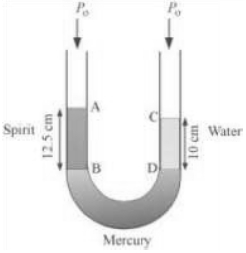
In the previous problem,if $15.0 \; cm$ of water and spirit each are further poured into the respective arms of the tube,what is the difference in the levels of mercury in the two arms (in $; cm$)? (Specific gravity of mercury $= 13.6$)
A
$0.4$
B
$13.6$
C
$1.3$
D
$0.8$
Solution
(A) From the previous problem,we know the specific gravity of spirit is $0.8$ and water is $1.0$.
Let $h_s = 12.5 \; cm$ and $h_w = 10.0 \; cm$ be the initial heights.
When $15.0 \; cm$ of each liquid is added,the new heights are $H_s = 12.5 + 15.0 = 27.5 \; cm$ and $H_w = 10.0 + 15.0 = 25.0 \; cm$.
Let $h$ be the difference in mercury levels. The pressure balance equation at the mercury interface is:
$P_{atm} + H_s \rho_s g = P_{atm} + H_w \rho_w g + h \rho_{Hg} g$
$H_s \rho_s = H_w \rho_w + h \rho_{Hg}$
Using specific gravities (relative to water density $\rho_w$):
$27.5 \times 0.8 = 25.0 \times 1.0 + h \times 13.6$
$22.0 = 25.0 + 13.6h$
Since the pressure on the water side is higher $(25.0 > 22.0)$,the mercury level will be higher on the spirit side.
$13.6h = |22.0 - 25.0| = 3.0$
$h = \frac{3.0}{13.6} \approx 0.22 \; cm$.
Given the options provided,there seems to be a discrepancy in the problem statement or options. Re-evaluating the pressure balance: $h = \frac{H_w \rho_w - H_s \rho_s}{\rho_{Hg}} = \frac{25.0 - 22.0}{13.6} = \frac{3.0}{13.6} \approx 0.22 \; cm$. If the question implies the difference in levels is simply the difference in heights of the liquid columns adjusted by density,the closest provided option is $A$ $(0.4 \; cm)$.
Let $h_s = 12.5 \; cm$ and $h_w = 10.0 \; cm$ be the initial heights.
When $15.0 \; cm$ of each liquid is added,the new heights are $H_s = 12.5 + 15.0 = 27.5 \; cm$ and $H_w = 10.0 + 15.0 = 25.0 \; cm$.
Let $h$ be the difference in mercury levels. The pressure balance equation at the mercury interface is:
$P_{atm} + H_s \rho_s g = P_{atm} + H_w \rho_w g + h \rho_{Hg} g$
$H_s \rho_s = H_w \rho_w + h \rho_{Hg}$
Using specific gravities (relative to water density $\rho_w$):
$27.5 \times 0.8 = 25.0 \times 1.0 + h \times 13.6$
$22.0 = 25.0 + 13.6h$
Since the pressure on the water side is higher $(25.0 > 22.0)$,the mercury level will be higher on the spirit side.
$13.6h = |22.0 - 25.0| = 3.0$
$h = \frac{3.0}{13.6} \approx 0.22 \; cm$.
Given the options provided,there seems to be a discrepancy in the problem statement or options. Re-evaluating the pressure balance: $h = \frac{H_w \rho_w - H_s \rho_s}{\rho_{Hg}} = \frac{25.0 - 22.0}{13.6} = \frac{3.0}{13.6} \approx 0.22 \; cm$. If the question implies the difference in levels is simply the difference in heights of the liquid columns adjusted by density,the closest provided option is $A$ $(0.4 \; cm)$.
0 likes
View Solution59
MediumMCQ
$A$ $U$-tube contains water and methylated spirit separated by mercury. The mercury columns in the two arms are initially in level with $10.0 \; cm$ of water in one arm and $12.5 \; cm$ of spirit in the other. If $15.0 \; cm$ of water and spirit each are further poured into the respective arms of the tube,what is the difference in the levels (in $cm$) of mercury in the two arms? (The specific gravity of spirit is $0.8$.)
A
$0.22$
B
$0.86$
C
$1.22$
D
$2.12$
Solution
(A) Initial state: The mercury levels are equal. Pressure at the mercury-liquid interface must be equal.
$P_{atm} + h_{water} \rho_{water} g = P_{atm} + h_{spirit} \rho_{spirit} g$
$10 \times 1 = 12.5 \times 0.8 = 10$,which is consistent.
Final state: Let $h$ be the difference in mercury levels. Let the mercury level in the water arm go down by $x$ and in the spirit arm go up by $x$,so $h = 2x$.
The new height of the water column is $h_1 = 10 + 15 + x = 25 + x$.
The new height of the spirit column is $h_2 = 12.5 + 15 - x = 27.5 - x$.
Equating pressures at the lower mercury level (in the water arm):
$P_{atm} + h_1 \rho_{water} g = P_{atm} + h_2 \rho_{spirit} g + h \rho_{Hg} g$
$(25 + x) \times 1 = (27.5 - x) \times 0.8 + (2x) \times 13.6$
$25 + x = 22 - 0.8x + 27.2x$
$25 + x = 22 + 26.4x$
$3 = 25.4x$
$x = 3 / 25.4 \approx 0.1181 \; cm$
Difference in mercury levels $h = 2x = 2 \times 0.1181 = 0.2362 \; cm$.
Given the options,the closest value is $0.22 \; cm$.
$P_{atm} + h_{water} \rho_{water} g = P_{atm} + h_{spirit} \rho_{spirit} g$
$10 \times 1 = 12.5 \times 0.8 = 10$,which is consistent.
Final state: Let $h$ be the difference in mercury levels. Let the mercury level in the water arm go down by $x$ and in the spirit arm go up by $x$,so $h = 2x$.
The new height of the water column is $h_1 = 10 + 15 + x = 25 + x$.
The new height of the spirit column is $h_2 = 12.5 + 15 - x = 27.5 - x$.
Equating pressures at the lower mercury level (in the water arm):
$P_{atm} + h_1 \rho_{water} g = P_{atm} + h_2 \rho_{spirit} g + h \rho_{Hg} g$
$(25 + x) \times 1 = (27.5 - x) \times 0.8 + (2x) \times 13.6$
$25 + x = 22 - 0.8x + 27.2x$
$25 + x = 22 + 26.4x$
$3 = 25.4x$
$x = 3 / 25.4 \approx 0.1181 \; cm$
Difference in mercury levels $h = 2x = 2 \times 0.1181 = 0.2362 \; cm$.
Given the options,the closest value is $0.22 \; cm$.
0 likes
View Solution60
Easy
Two vessels have the same base area but different shapes. The first vessel takes twice the volume of water that the second vessel requires to fill up to a particular common height. Is the force exerted by the water on the base of the vessel the same in the two cases? If so,why do the vessels filled with water to that same height give different readings on a weighing scale?
Solution
(A) Yes,the force exerted by the water on the base is the same in both cases.
The pressure at the base of a vessel depends only on the height of the liquid column $(P = h\rho g)$. Since both vessels have the same base area $(A)$ and are filled to the same height $(h)$,the force exerted on the base $(F = P \times A = h\rho gA)$ is identical for both.
The reason they give different readings on a weighing scale is due to the force exerted by the walls of the vessel on the water. Because the shapes are different,the walls exert vertical components of force on the water. In one vessel,the walls may push the water downwards,while in the other,they may push it upwards. These vertical forces are transmitted to the weighing scale,resulting in different total weights being measured.
The pressure at the base of a vessel depends only on the height of the liquid column $(P = h\rho g)$. Since both vessels have the same base area $(A)$ and are filled to the same height $(h)$,the force exerted on the base $(F = P \times A = h\rho gA)$ is identical for both.
The reason they give different readings on a weighing scale is due to the force exerted by the walls of the vessel on the water. Because the shapes are different,the walls exert vertical components of force on the water. In one vessel,the walls may push the water downwards,while in the other,they may push it upwards. These vertical forces are transmitted to the weighing scale,resulting in different total weights being measured.
0 likes
View Solution61
EasyMCQ
What are fluids?
A
Substances that have a fixed shape.
B
Substances that flow easily.
C
Only liquids.
D
Only gases.
Solution
(B) substance that flows easily is known as a fluid. Since both liquids and gases have the ability to flow,they are collectively classified as fluids.
0 likes
View Solution62
EasyMCQ
Liquid is ...... while gas is ...... . (Fill in the blank) [incompressible,compressible]
A
incompressible,compressible
B
compressible,incompressible
C
incompressible,incompressible
D
compressible,compressible
Solution
(A) Liquids are generally considered to be incompressible because their density remains nearly constant under the application of pressure.
Conversely,gases are highly compressible because their density changes significantly with changes in pressure and temperature.
Therefore,liquid is incompressible while gas is compressible.
Conversely,gases are highly compressible because their density changes significantly with changes in pressure and temperature.
Therefore,liquid is incompressible while gas is compressible.
0 likes
View Solution63
Easy
Define thrust and pressure and give their unit and dimensional formula.
Solution
(N/A) $(i)$ The force applied on a surface in a direction perpendicular to the surface is called thrust. Due to thrust,liquid flows out from the hole of a container.
$\rightarrow$ Thrust is a force. Its $SI$ unit is Newton $(N)$. Its dimensional formula is $[M^{1} L^{1} T^{-2}]$.
$(ii)$ Pressure: The force acting on a surface per unit area,in a direction perpendicular to it,is called pressure on the surface.
$\rightarrow$ If $F$ is the force acting perpendicular to the surface of area $A$,then pressure $P = \frac{F}{A}$.
$\rightarrow$ $SI$ unit of pressure is $\frac{N}{m^{2}}$ or Pascal $(Pa)$.
$\rightarrow$ $CGS$ unit of pressure is $\frac{\text{dyne}}{cm^{2}}$.
$\rightarrow$ Dimensional formula of pressure is $[M^{1} L^{-1} T^{-2}]$.
$\rightarrow$ Thrust is a force. Its $SI$ unit is Newton $(N)$. Its dimensional formula is $[M^{1} L^{1} T^{-2}]$.
$(ii)$ Pressure: The force acting on a surface per unit area,in a direction perpendicular to it,is called pressure on the surface.
$\rightarrow$ If $F$ is the force acting perpendicular to the surface of area $A$,then pressure $P = \frac{F}{A}$.
$\rightarrow$ $SI$ unit of pressure is $\frac{N}{m^{2}}$ or Pascal $(Pa)$.
$\rightarrow$ $CGS$ unit of pressure is $\frac{\text{dyne}}{cm^{2}}$.
$\rightarrow$ Dimensional formula of pressure is $[M^{1} L^{-1} T^{-2}]$.
0 likes
View Solution64
Medium
At every point of a liquid at rest,the tangential stress is zero. Explain with reason.
Solution
(N/A) Tangential stress is defined as the force acting parallel to the surface per unit area. If a liquid at rest were to experience a non-zero tangential stress,the layers of the liquid would slide over one another,causing the liquid to flow. Since the liquid is at rest,there is no relative motion between its layers. Therefore,the tangential stress at every point within a liquid at rest must be zero.
0 likes
View Solution65
Medium
Is pressure a scalar or a vector? Give reason.
Solution
(A) Pressure is a scalar quantity.
Reasoning:
$1$. At any point within a fluid at rest,the pressure exerted is equal in all directions. Since it does not have a unique direction associated with it,it cannot be a vector.
$2$. Mathematically,pressure is defined as $P = \frac{F_{\perp}}{A}$,where $F_{\perp}$ is the component of the force acting normal (perpendicular) to the surface area $A$.
$3$. Although force is a vector,the pressure formula uses only the magnitude of the normal component of the force. Since pressure does not follow the laws of vector addition,it is classified as a scalar physical quantity.
Reasoning:
$1$. At any point within a fluid at rest,the pressure exerted is equal in all directions. Since it does not have a unique direction associated with it,it cannot be a vector.
$2$. Mathematically,pressure is defined as $P = \frac{F_{\perp}}{A}$,where $F_{\perp}$ is the component of the force acting normal (perpendicular) to the surface area $A$.
$3$. Although force is a vector,the pressure formula uses only the magnitude of the normal component of the force. Since pressure does not follow the laws of vector addition,it is classified as a scalar physical quantity.
0 likes
View Solution66
Medium
Give the names of physical quantities which are needed to describe a fluid.
Solution
(N/A) To describe the state and behavior of a fluid,the primary physical quantities required are:
$1$. Pressure $(P)$: The force exerted by the fluid per unit area.
$2$. Density $(\rho)$: The mass per unit volume of the fluid.
$3$. Velocity $(v)$: The speed and direction of fluid flow (relevant for fluid dynamics).
$1$. Pressure $(P)$: The force exerted by the fluid per unit area.
$2$. Density $(\rho)$: The mass per unit volume of the fluid.
$3$. Velocity $(v)$: The speed and direction of fluid flow (relevant for fluid dynamics).
0 likes
View Solution67
Easy
Explain the pressure-measuring device at any point in a fluid in short.
Solution
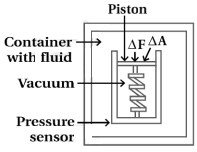
(N/A) An idealized form of a pressure-measuring device is shown in the figure.
It consists of an evacuated chamber with a spring that is calibrated to measure the force acting on the piston.
This device is placed at a point inside the fluid.
The inward force $\Delta F$ exerted by the fluid on the piston is balanced by the outward spring force and is thereby measured.
The pressure $P$ of the fluid acting on the surface of the piston of area $\Delta A$ is given by $P = \frac{\Delta F}{\Delta A}$.
The piston area can be made arbitrarily small. The pressure is then defined in a limiting sense as $P = \lim_{\Delta A \rightarrow 0} \frac{\Delta F}{\Delta A}$.
It consists of an evacuated chamber with a spring that is calibrated to measure the force acting on the piston.
This device is placed at a point inside the fluid.
The inward force $\Delta F$ exerted by the fluid on the piston is balanced by the outward spring force and is thereby measured.
The pressure $P$ of the fluid acting on the surface of the piston of area $\Delta A$ is given by $P = \frac{\Delta F}{\Delta A}$.
The piston area can be made arbitrarily small. The pressure is then defined in a limiting sense as $P = \lim_{\Delta A \rightarrow 0} \frac{\Delta F}{\Delta A}$.
0 likes
View Solution68
Medium
Define density. Write its unit and dimensional formula.
Solution
(N/A) Density is defined as the mass per unit volume of a body.
If the mass of a body is $M$ and its volume is $V$,then the density $\rho$ is given by:
$\rho = \frac{M}{V}$
Density is a scalar quantity and is always positive.
The $SI$ unit of density is $kg/m^3$.
The $CGS$ unit of density is $g/cm^3$.
The dimensional formula of density is $[M^1 L^{-3} T^0]$.
Note: Primarily,liquids are incompressible,and their density does not change significantly with pressure. However,gases are compressible,and their density varies largely with pressure.
If the mass of a body is $M$ and its volume is $V$,then the density $\rho$ is given by:
$\rho = \frac{M}{V}$
Density is a scalar quantity and is always positive.
The $SI$ unit of density is $kg/m^3$.
The $CGS$ unit of density is $g/cm^3$.
The dimensional formula of density is $[M^1 L^{-3} T^0]$.
Note: Primarily,liquids are incompressible,and their density does not change significantly with pressure. However,gases are compressible,and their density varies largely with pressure.
0 likes
View Solution69
Easy
Explain the specific density or relative density of a substance.
Solution
The relative density of a substance is defined as the ratio of its density to the density of water at $4^{\circ} C$.
Relative density $= \frac{\text{Density of substance}}{\text{Density of water at } 4^{\circ} C \text{ temperature}}$
For example: The density of aluminium is $2.7 \times 10^{3} \ kg \ m^{-3}$. The density of water at $4^{\circ} C$ is $10^{3} \ kg \ m^{-3}$. Hence,the relative density of aluminium is $2.7$.
Relative density is a positive,scalar,and dimensionless physical quantity.
(Density of substance = Relative density $\times$ density of water at $4^{\circ} C$ temperature)
The densities of some common fluids are displayed in the table below:
Relative density $= \frac{\text{Density of substance}}{\text{Density of water at } 4^{\circ} C \text{ temperature}}$
For example: The density of aluminium is $2.7 \times 10^{3} \ kg \ m^{-3}$. The density of water at $4^{\circ} C$ is $10^{3} \ kg \ m^{-3}$. Hence,the relative density of aluminium is $2.7$.
Relative density is a positive,scalar,and dimensionless physical quantity.
(Density of substance = Relative density $\times$ density of water at $4^{\circ} C$ temperature)
The densities of some common fluids are displayed in the table below:
| Fluid | $\rho \ (kg \ m^{-3})$ |
| Water | $1.00 \times 10^{3}$ |
| Sea water | $1.03 \times 10^{3}$ |
| Mercury | $13.6 \times 10^{3}$ |
| Ethyl alcohol | $0.806 \times 10^{3}$ |
| Whole blood | $1.06 \times 10^{3}$ |
| Air | $1.29$ |
| Oxygen | $1.43$ |
| Hydrogen | $9.0 \times 10^{-2}$ |
| Interstellar space | $\approx 10^{-20}$ |
0 likes
View Solution70
MediumMCQ
What is thrust?
A
The perpendicular force exerted by a body on a surface.
B
The parallel force exerted by a body on a surface.
C
The total force exerted by a body on a surface.
D
The pressure exerted by a body on a surface.
Solution
(A) Thrust is defined as the force acting perpendicular to a surface.
It is a vector quantity because it has both magnitude and direction.
The $SI$ unit of thrust is the newton $(N)$.
Mathematically,if a force $F$ acts at an angle $\theta$ to the normal of a surface,the thrust is given by $F \cos \theta$.
It is a vector quantity because it has both magnitude and direction.
The $SI$ unit of thrust is the newton $(N)$.
Mathematically,if a force $F$ acts at an angle $\theta$ to the normal of a surface,the thrust is given by $F \cos \theta$.
0 likes
View Solution71
Easy
Define pressure. Give the $SI$ and $CGS$ unit of pressure.
Solution
(N/A) Pressure is defined as the force acting normally per unit area of a surface. Mathematically,it is expressed as $P = \frac{F}{A}$,where $P$ is pressure,$F$ is the normal force,and $A$ is the area.
The $SI$ unit of pressure is the Pascal $(Pa)$,which is equivalent to $1 \ N/m^2$.
The $CGS$ unit of pressure is the Barye $(Ba)$,which is equivalent to $1 \ dyne/cm^2$.
The $SI$ unit of pressure is the Pascal $(Pa)$,which is equivalent to $1 \ N/m^2$.
The $CGS$ unit of pressure is the Barye $(Ba)$,which is equivalent to $1 \ dyne/cm^2$.
0 likes
View Solution72
Easy
Fill in the blanks:
$(i)$ $1 \text{ atm} = \dots \text{ Pascal}$
$(ii)$ $1 \text{ torr} = \dots \text{ Pascal}$
$(iii)$ $1 \text{ bar} = \dots \text{ Pa}$
$(iv)$ $1 \text{ atm} = \dots \text{ cm Hg}$
$(i)$ $1 \text{ atm} = \dots \text{ Pascal}$
$(ii)$ $1 \text{ torr} = \dots \text{ Pascal}$
$(iii)$ $1 \text{ bar} = \dots \text{ Pa}$
$(iv)$ $1 \text{ atm} = \dots \text{ cm Hg}$
Solution
(N/A) $(i)$ $1 \text{ atm} = 1.01325 \times 10^{5} \text{ Pa}$.
$(ii)$ $1 \text{ torr} = 1 \text{ mm Hg} = \frac{1.01325 \times 10^{5}}{760} \text{ Pa} \approx 133.32 \text{ Pa}$.
$(iii)$ $1 \text{ bar} = 10^{5} \text{ Pa}$.
$(iv)$ $1 \text{ atm} = 76 \text{ cm Hg}$ (since $1 \text{ atm} = 760 \text{ mm Hg} = 76 \text{ cm Hg}$).
$(ii)$ $1 \text{ torr} = 1 \text{ mm Hg} = \frac{1.01325 \times 10^{5}}{760} \text{ Pa} \approx 133.32 \text{ Pa}$.
$(iii)$ $1 \text{ bar} = 10^{5} \text{ Pa}$.
$(iv)$ $1 \text{ atm} = 76 \text{ cm Hg}$ (since $1 \text{ atm} = 760 \text{ mm Hg} = 76 \text{ cm Hg}$).
0 likes
View Solution73
Easy
Is pressure a scalar or a vector quantity? Explain.
Solution
(A) Pressure is a scalar quantity.
Although pressure is defined as force divided by area $(P = F/A)$,and force is a vector,pressure does not have a specific direction associated with it in the way vectors do.
When a fluid exerts pressure on a surface,the force acts perpendicular to the surface at every point,regardless of the orientation of the surface.
Since pressure acts equally in all directions at a point within a fluid and does not obey the laws of vector addition (like the parallelogram law),it is classified as a scalar quantity.
Although pressure is defined as force divided by area $(P = F/A)$,and force is a vector,pressure does not have a specific direction associated with it in the way vectors do.
When a fluid exerts pressure on a surface,the force acts perpendicular to the surface at every point,regardless of the orientation of the surface.
Since pressure acts equally in all directions at a point within a fluid and does not obey the laws of vector addition (like the parallelogram law),it is classified as a scalar quantity.
0 likes
View Solution74
Easy
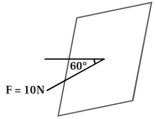
$A$ force of $F = 10 \ N$ is exerted on a surface of area $A = 0.1 \ m^{2}$ at an angle of $60^{\circ}$ with the surface. Find the pressure produced on this surface.
Solution
(N/A) Pressure is defined as the normal force per unit area: $P = \frac{F_{\perp}}{A}$.
Given,the force $F = 10 \ N$ makes an angle of $60^{\circ}$ with the surface.
The component of the force perpendicular to the surface is $F_{\perp} = F \sin(60^{\circ})$.
$F_{\perp} = 10 \times \frac{\sqrt{3}}{2} = 5\sqrt{3} \ N$.
Given area $A = 0.1 \ m^{2}$.
Therefore,pressure $P = \frac{5\sqrt{3}}{0.1} = 50\sqrt{3} \ N/m^{2} \approx 86.6 \ N/m^{2}$.
Given,the force $F = 10 \ N$ makes an angle of $60^{\circ}$ with the surface.
The component of the force perpendicular to the surface is $F_{\perp} = F \sin(60^{\circ})$.
$F_{\perp} = 10 \times \frac{\sqrt{3}}{2} = 5\sqrt{3} \ N$.
Given area $A = 0.1 \ m^{2}$.
Therefore,pressure $P = \frac{5\sqrt{3}}{0.1} = 50\sqrt{3} \ N/m^{2} \approx 86.6 \ N/m^{2}$.
0 likes
View Solution75
Easy
The density changes with pressure for which fluid? Give reason.
Solution
(N/A) Density changes with pressure for $compressible$ fluids,such as $gases$.
Reason: In $gases$,the molecules are far apart and have weak intermolecular forces. When pressure is applied,the volume of the gas decreases significantly because the molecules are pushed closer together. Since density $\rho = \frac{m}{V}$,a decrease in volume $V$ for a constant mass $m$ leads to an increase in density $\rho$. In contrast,$liquids$ are generally considered $incompressible$ because their molecules are already closely packed,resulting in negligible changes in density under normal pressure variations.
Reason: In $gases$,the molecules are far apart and have weak intermolecular forces. When pressure is applied,the volume of the gas decreases significantly because the molecules are pushed closer together. Since density $\rho = \frac{m}{V}$,a decrease in volume $V$ for a constant mass $m$ leads to an increase in density $\rho$. In contrast,$liquids$ are generally considered $incompressible$ because their molecules are already closely packed,resulting in negligible changes in density under normal pressure variations.
0 likes
View Solution76
Medium
Define relative density of a substance.
Solution
(N/A) The relative density of a substance is defined as the ratio of the density of the substance to the density of water at $4^{\circ}C$.
Mathematically,it is expressed as:
$\text{Relative Density} = \frac{\text{Density of substance}}{\text{Density of water at } 4^{\circ}C}$.
Since it is a ratio of two similar physical quantities (densities),it is a dimensionless quantity and has no units.
Mathematically,it is expressed as:
$\text{Relative Density} = \frac{\text{Density of substance}}{\text{Density of water at } 4^{\circ}C}$.
Since it is a ratio of two similar physical quantities (densities),it is a dimensionless quantity and has no units.
0 likes
View Solution77
EasyMCQ
The relative density of Kerosene is $0.8$. Find its density. (in $kg/m^3$)
A
$800$
B
$80$
C
$8000$
D
$0.08$
Solution
(A) The relative density (or specific gravity) of a substance is defined as the ratio of the density of the substance to the density of water at $4^{\circ}C$.
Relative Density = $\frac{\text{Density of substance}}{\text{Density of water}}$
Given,Relative Density of Kerosene = $0.8$.
The density of water at $4^{\circ}C$ is $\rho_{water} = 1000 \ kg/m^3$.
Therefore,Density of Kerosene = $\text{Relative Density} \times \rho_{water}$.
Density of Kerosene = $0.8 \times 1000 \ kg/m^3 = 800 \ kg/m^3$.
Relative Density = $\frac{\text{Density of substance}}{\text{Density of water}}$
Given,Relative Density of Kerosene = $0.8$.
The density of water at $4^{\circ}C$ is $\rho_{water} = 1000 \ kg/m^3$.
Therefore,Density of Kerosene = $\text{Relative Density} \times \rho_{water}$.
Density of Kerosene = $0.8 \times 1000 \ kg/m^3 = 800 \ kg/m^3$.
0 likes
View Solution78
Easy
What is atmospheric pressure?
Solution
(N/A) Pressure produced due to the atmosphere is known as atmospheric pressure.
The pressure of the atmosphere at any point is equal to the weight of a column of air of unit cross-sectional area extending from that point to the top of the atmosphere.
At sea level,it is $1.013 \times 10^{5} \text{ Pa}$ $(1 \text{ atm} = 1 \text{ atmosphere})$.
The pressure of the atmosphere at any point is equal to the weight of a column of air of unit cross-sectional area extending from that point to the top of the atmosphere.
At sea level,it is $1.013 \times 10^{5} \text{ Pa}$ $(1 \text{ atm} = 1 \text{ atmosphere})$.
0 likes
View Solution79
EasyMCQ
Two points $A$ and $B$ are at the same depth in a liquid at rest. Then the pressure on them $P_A$ ........... $P_B$.
A
$P_A < P_B$
B
$P_A > P_B$
C
$P_A = P_B$
D
$P_A \neq P_B$
Solution
(C) According to the hydrostatic law,the pressure at any point in a liquid at rest depends only on the depth $h$ of the point from the free surface.
The formula for pressure at a depth $h$ is given by $P = P_0 + \rho gh$,where $P_0$ is the atmospheric pressure,$\rho$ is the density of the liquid,and $g$ is the acceleration due to gravity.
Since points $A$ and $B$ are at the same depth $h$,the pressure at both points will be identical.
Therefore,$P_A = P_B$.
The formula for pressure at a depth $h$ is given by $P = P_0 + \rho gh$,where $P_0$ is the atmospheric pressure,$\rho$ is the density of the liquid,and $g$ is the acceleration due to gravity.
Since points $A$ and $B$ are at the same depth $h$,the pressure at both points will be identical.
Therefore,$P_A = P_B$.
1 likes
View Solution80
Medium
What is absolute pressure? And what is gauge pressure?
Solution
(N/A) Absolute pressure is the total pressure at a point in a fluid,which includes the atmospheric pressure acting on the surface of the fluid. It is given by the sum of gauge pressure and atmospheric pressure: $P_{abs} = P_g + P_{atm}$.
Gauge pressure is the pressure measured relative to the atmospheric pressure. It is the difference between the absolute pressure and the atmospheric pressure: $P_g = P_{abs} - P_{atm}$.
In many practical applications,gauge pressure is the value read by pressure gauges,as they are calibrated to read zero at atmospheric pressure.
Gauge pressure is the pressure measured relative to the atmospheric pressure. It is the difference between the absolute pressure and the atmospheric pressure: $P_g = P_{abs} - P_{atm}$.
In many practical applications,gauge pressure is the value read by pressure gauges,as they are calibrated to read zero at atmospheric pressure.
0 likes
View Solution81
Medium
Explain the hydrostatic paradox.
Solution
(N/A) The hydrostatic paradox states that the pressure exerted by a liquid at the bottom of a vessel depends only on the height of the liquid column and the density of the liquid,and is independent of the shape or size of the vessel.
Even if vessels have different shapes and volumes,if they are filled to the same vertical height $h$ with the same liquid of density $\rho$,the pressure at the base of each vessel will be identical,given by $P = P_a + \rho gh$,where $P_a$ is the atmospheric pressure.
This is considered a 'paradox' because one might intuitively expect that a vessel containing more liquid would exert more pressure at the bottom,but the normal forces exerted by the slanted walls of the vessel compensate for the difference in weight,ensuring the pressure remains uniform.
Even if vessels have different shapes and volumes,if they are filled to the same vertical height $h$ with the same liquid of density $\rho$,the pressure at the base of each vessel will be identical,given by $P = P_a + \rho gh$,where $P_a$ is the atmospheric pressure.
This is considered a 'paradox' because one might intuitively expect that a vessel containing more liquid would exert more pressure at the bottom,but the normal forces exerted by the slanted walls of the vessel compensate for the difference in weight,ensuring the pressure remains uniform.
0 likes
View Solution82
EasyMCQ
What is atmospheric pressure?
A
The pressure exerted by the weight of the atmosphere.
B
The pressure exerted by the weight of the ocean.
C
The pressure exerted by the weight of the Earth's core.
D
The pressure exerted by the weight of the vacuum.
Solution
(A) Atmospheric pressure is the force per unit area exerted by the weight of the atmosphere above a given point.
At sea level,the standard atmospheric pressure is approximately $1.013 \times 10^5 \ Pa$ or $1 \ atm$.
It is caused by the gravitational attraction of the Earth on the air molecules in the atmosphere.
As altitude increases,the density of air decreases,leading to a decrease in atmospheric pressure.
At sea level,the standard atmospheric pressure is approximately $1.013 \times 10^5 \ Pa$ or $1 \ atm$.
It is caused by the gravitational attraction of the Earth on the air molecules in the atmosphere.
As altitude increases,the density of air decreases,leading to a decrease in atmospheric pressure.
0 likes
View Solution83
EasyMCQ
The pressure at the sea surface is .......... $P_{a}$.
A
equal to
B
greater than
C
less than
D
zero
Solution
(A) The pressure at the sea surface is equal to the atmospheric pressure,which is denoted by $P_{a}$.
At the surface of the sea,the fluid is in contact with the atmosphere,so the pressure exerted by the atmosphere acts on the surface of the water.
Therefore,the pressure at the sea surface is $P_{a}$.
At the surface of the sea,the fluid is in contact with the atmosphere,so the pressure exerted by the atmosphere acts on the surface of the water.
Therefore,the pressure at the sea surface is $P_{a}$.
0 likes
View Solution84
Medium
Why is it difficult to cook on hills?
Solution
(N/A) At high altitudes,the atmospheric pressure is lower than at sea level.
According to the relationship between boiling point and pressure,the boiling point of water decreases as the external pressure decreases.
Consequently,water boils at a temperature lower than $100 \ ^\circ\text{C}$ on hills.
Since the food is cooked at a lower temperature,it does not receive sufficient heat energy to soften or cook properly in the same amount of time,making cooking difficult.
According to the relationship between boiling point and pressure,the boiling point of water decreases as the external pressure decreases.
Consequently,water boils at a temperature lower than $100 \ ^\circ\text{C}$ on hills.
Since the food is cooked at a lower temperature,it does not receive sufficient heat energy to soften or cook properly in the same amount of time,making cooking difficult.
0 likes
View Solution85
MediumMCQ
Why do bags and suitcases have broad (wide) handles?
A
To increase the force applied
B
To decrease the pressure on the palm
C
To increase the pressure on the palm
D
To make it look stylish
Solution
(B) Pressure is defined as force per unit area $(P = F/A)$.
Since the force applied by the weight of the bag is constant,the pressure exerted on the palm is inversely proportional to the area of the handle.
By using a broad (wide) handle,the contact area $(A)$ increases.
As the area increases,the pressure $(P)$ exerted on the palm decreases,making it more comfortable to carry the bag.
Since the force applied by the weight of the bag is constant,the pressure exerted on the palm is inversely proportional to the area of the handle.
By using a broad (wide) handle,the contact area $(A)$ increases.
As the area increases,the pressure $(P)$ exerted on the palm decreases,making it more comfortable to carry the bag.
0 likes
View Solution86
MediumMCQ
Why are railway tracks laid on large-sized wooden sleepers?
A
To increase the pressure on the ground.
B
To decrease the pressure on the ground.
C
To maintain the temperature of the tracks.
D
To provide electrical insulation.
Solution
(B) The pressure $P$ exerted on a surface is defined as the force $F$ applied per unit area $A$,given by the formula $P = F/A$.
By placing railway tracks on large-sized wooden sleepers,the weight of the train (the force $F$) is distributed over a much larger surface area $A$.
Since pressure is inversely proportional to the area $(P \propto 1/A)$,increasing the area $A$ significantly reduces the pressure $P$ exerted on the ground.
This prevents the tracks from sinking into the ground under the heavy load of the train.
By placing railway tracks on large-sized wooden sleepers,the weight of the train (the force $F$) is distributed over a much larger surface area $A$.
Since pressure is inversely proportional to the area $(P \propto 1/A)$,increasing the area $A$ significantly reduces the pressure $P$ exerted on the ground.
This prevents the tracks from sinking into the ground under the heavy load of the train.
0 likes
View Solution87
Medium
Explain why it is easier to cut an apple with a sharp knife than with a blunt knife.
Solution
(N/A) Pressure is defined as force applied per unit area $(P = F/A)$. $A$ sharp knife has a very small surface area at its edge compared to a blunt knife. When we apply the same amount of force,the smaller surface area of the sharp knife results in a much higher pressure being exerted on the apple. This high pressure easily overcomes the structural integrity of the apple's skin and flesh,making it easier to cut.
0 likes
View Solution88
Medium
Why is walking barefooted on a sharp gravel (grit) road difficult?
Solution
(N/A) Pressure is defined as force per unit area $(P = F/A)$.
When walking barefoot on sharp gravel,the contact area $(A)$ between the feet and the sharp edges of the stones is extremely small.
Since the pressure is inversely proportional to the area $(P \propto 1/A)$,a very small area results in a very high surface pressure.
This high pressure exerted on the skin of the feet causes pain,making it difficult to walk.
When walking barefoot on sharp gravel,the contact area $(A)$ between the feet and the sharp edges of the stones is extremely small.
Since the pressure is inversely proportional to the area $(P \propto 1/A)$,a very small area results in a very high surface pressure.
This high pressure exerted on the skin of the feet causes pain,making it difficult to walk.
0 likes
View Solution89
Easy
How much force is exerted on our body at atmospheric pressure? Explain.
Solution
(N/A) The atmospheric pressure at sea level is approximately $1.013 \times 10^{5} \,Pa$ (or $N/m^{2}$).
Given that the average surface area of a human body is approximately $2 \,m^{2}$, the total force exerted by the atmosphere on the body is $F = P \times A = (1.013 \times 10^{5} \,N/m^{2}) \times (2 \,m^{2}) \approx 2.026 \times 10^{5} \,N$.
This force is equivalent to the weight of a large object (about $20,000 \,kg$).
However, we do not feel this force because the internal pressure of our body (blood pressure and pressure of fluids in our cells) is slightly higher than the atmospheric pressure, which balances the external force.
Thus, the net force on our body is zero, allowing us to remain unaffected by this massive atmospheric pressure.
Given that the average surface area of a human body is approximately $2 \,m^{2}$, the total force exerted by the atmosphere on the body is $F = P \times A = (1.013 \times 10^{5} \,N/m^{2}) \times (2 \,m^{2}) \approx 2.026 \times 10^{5} \,N$.
This force is equivalent to the weight of a large object (about $20,000 \,kg$).
However, we do not feel this force because the internal pressure of our body (blood pressure and pressure of fluids in our cells) is slightly higher than the atmospheric pressure, which balances the external force.
Thus, the net force on our body is zero, allowing us to remain unaffected by this massive atmospheric pressure.
0 likes
View Solution90
Medium
What is $1$ Torr pressure? And what is $1$ bar?
Solution
(N/A) $1$ Torr is defined as the pressure exerted by a $1 \,mm$ column of mercury.
Using the formula $P = h \rho g$:
$1$ Torr $= (10^{-3} \,m) \times (13.6 \times 10^{3} \,kg/m^{3}) \times (9.8 \,m/s^{2})$
$1$ Torr $\approx 133.3 \,Pa$ (or $N/m^{2}$).
$1$ bar is defined as a unit of pressure equal to $10^{5} \,Pa$ (or $N/m^{2}$).
Using the formula $P = h \rho g$:
$1$ Torr $= (10^{-3} \,m) \times (13.6 \times 10^{3} \,kg/m^{3}) \times (9.8 \,m/s^{2})$
$1$ Torr $\approx 133.3 \,Pa$ (or $N/m^{2}$).
$1$ bar is defined as a unit of pressure equal to $10^{5} \,Pa$ (or $N/m^{2}$).
0 likes
View Solution91
Medium
Mountaineers suffer from nose bleeding (epistaxis) at higher altitudes. Explain.
Solution
(N/A) As altitude increases,the atmospheric pressure decreases. At high altitudes,the external atmospheric pressure is significantly lower than the pressure exerted by the blood within the body's blood vessels. The walls of the capillaries in the nasal passage are very thin. Because the internal blood pressure exceeds the reduced external atmospheric pressure,these thin-walled capillaries rupture,leading to nose bleeding.
0 likes
View Solution92
Difficult
It is difficult to heal a wound on a mountain. Why? Explain.
Solution
(N/A) At high altitudes,the atmospheric pressure is significantly lower than at sea level. However,the internal blood pressure within the human body remains relatively constant. Due to this pressure difference,the outward pressure exerted by the blood is higher than the inward pressure exerted by the atmosphere. This imbalance makes it difficult for blood to clot effectively and for the wound to heal properly,often leading to increased bleeding.
0 likes
View Solution93
Medium
Straws are used to take soft drinks. Why?
Solution
(N/A) Straws are used because when we suck through the straw,the pressure inside the straw becomes less than the atmospheric pressure. Due to the difference in pressure,the soft drink rises in the straw and we are able to drink it conveniently.
0 likes
View Solution94
MediumMCQ
What is the effect of pressure on the boiling point of water?
A
Boiling point increases with an increase in pressure.
B
Boiling point decreases with an increase in pressure.
C
Boiling point remains constant with an increase in pressure.
D
Boiling point becomes zero with an increase in pressure.
Solution
(A) The boiling point of a liquid is the temperature at which its vapor pressure equals the external atmospheric pressure.
When the external pressure increases,more heat energy is required for the vapor pressure to reach the external pressure level.
Therefore,the boiling point of water increases as the external pressure increases.
Conversely,if the pressure decreases,the boiling point of water decreases.
When the external pressure increases,more heat energy is required for the vapor pressure to reach the external pressure level.
Therefore,the boiling point of water increases as the external pressure increases.
Conversely,if the pressure decreases,the boiling point of water decreases.
0 likes
View Solution95
MediumMCQ
Three liquids of equal masses are taken in three identical cubical vessels $A, B$ and $C$. Their densities are $\rho_{A}, \rho_{B}$ and $\rho_{C}$. The force exerted by the liquid on the base of the cubical vessel is
A
Maximum in vessel $C$
B
Minimum in vessel $C$
C
The same in all vessels
D
Maximum in vessel $A$
Solution
(C) The pressure $P$ exerted by a liquid column of height $h$ and density $\rho$ on the base of a vessel is given by $P = \rho g h$.
The force $F$ exerted on the base of area $A_{base}$ is $F = P \times A_{base}$.
Since the vessel is cubical,the volume $V$ of the liquid is $V = A_{base} \times h$. Thus,$h = \frac{V}{A_{base}}$.
Substituting this into the pressure formula:
$P = \rho g \left(\frac{V}{A_{base}}\right) = \left(\frac{\rho V}{A_{base}}\right) g$.
Since mass $m = \rho V$,we have $P = \frac{mg}{A_{base}}$.
Therefore,the force $F$ is:
$F = P \times A_{base} = \left(\frac{mg}{A_{base}}\right) \times A_{base} = mg$.
Since the masses $m$ of the liquids in all three vessels are equal and $g$ is constant,the force exerted on the base of each vessel is $F = mg$.
Thus,the force is the same in all vessels.
The force $F$ exerted on the base of area $A_{base}$ is $F = P \times A_{base}$.
Since the vessel is cubical,the volume $V$ of the liquid is $V = A_{base} \times h$. Thus,$h = \frac{V}{A_{base}}$.
Substituting this into the pressure formula:
$P = \rho g \left(\frac{V}{A_{base}}\right) = \left(\frac{\rho V}{A_{base}}\right) g$.
Since mass $m = \rho V$,we have $P = \frac{mg}{A_{base}}$.
Therefore,the force $F$ is:
$F = P \times A_{base} = \left(\frac{mg}{A_{base}}\right) \times A_{base} = mg$.
Since the masses $m$ of the liquids in all three vessels are equal and $g$ is constant,the force exerted on the base of each vessel is $F = mg$.
Thus,the force is the same in all vessels.
0 likes
View Solution96
MediumMCQ
$A$ nurse measures the blood pressure of a seated patient to be $190 \,mm$ of $Hg$.
A
The blood pressure at the patient's feet is less than $190 \,mm$ of $Hg$.
B
The actual pressure is about $0.25$ times of atmospheric pressure.
C
The blood pressure at the patient's neck is more than $190 \,mm$ of $Hg$.
D
The actual pressure is about $1.25$ times of atmospheric pressure.
Solution
(D) Blood pressure is measured as gauge pressure.
Actual pressure $=$ Atmospheric pressure $+$ Gauge pressure.
Given,atmospheric pressure $\approx 760 \,mm$ of $Hg$ and gauge pressure $= 190 \,mm$ of $Hg$.
Therefore,Actual pressure $= 760 \,mm$ of $Hg + 190 \,mm$ of $Hg = 950 \,mm$ of $Hg$.
Now,calculating the ratio to atmospheric pressure:
$\frac{950 \,mm \text{ of } Hg}{760 \,mm \text{ of } Hg} = 1.25$.
Thus,the actual pressure is $1.25$ times the atmospheric pressure.
Actual pressure $=$ Atmospheric pressure $+$ Gauge pressure.
Given,atmospheric pressure $\approx 760 \,mm$ of $Hg$ and gauge pressure $= 190 \,mm$ of $Hg$.
Therefore,Actual pressure $= 760 \,mm$ of $Hg + 190 \,mm$ of $Hg = 950 \,mm$ of $Hg$.
Now,calculating the ratio to atmospheric pressure:
$\frac{950 \,mm \text{ of } Hg}{760 \,mm \text{ of } Hg} = 1.25$.
Thus,the actual pressure is $1.25$ times the atmospheric pressure.
0 likes
View Solution97
DifficultMCQ
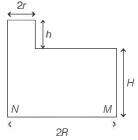
$A$ cylindrical vessel of base radius $R$ and height $H$ has a narrow neck of height $h$ and radius $r$ at one end (see figure). The vessel is filled with water (density $\rho_w$) and its neck is filled with immiscible oil (density $\rho_0$). Then,the pressure at
A
$M$ is $g(h \rho_0 + H \rho_w)$
B
$N$ is $g(h \rho_0 + H \rho_w) \frac{r^2}{R^2}$
C
$M$ is $g H \rho_w$
D
$N$ is $g \frac{\rho_w H R^2 + \rho_0 h r^2}{R^2 + r^2}$
Solution
(A) The pressure at any point at the same horizontal level in a continuous static fluid is the same.
Since $M$ and $N$ are at the same horizontal level at the base of the vessel,the pressure at $M$ is equal to the pressure at $N$.
The total pressure at the base is the sum of the pressure due to the oil column of height $h$ and the pressure due to the water column of height $H$.
Pressure at base $= P_{oil} + P_{water} = \rho_0 g h + \rho_w g H = g(\rho_0 h + \rho_w H)$.
Thus,the pressure at $M$ is $g(h \rho_0 + H \rho_w)$.
Since $M$ and $N$ are at the same horizontal level at the base of the vessel,the pressure at $M$ is equal to the pressure at $N$.
The total pressure at the base is the sum of the pressure due to the oil column of height $h$ and the pressure due to the water column of height $H$.
Pressure at base $= P_{oil} + P_{water} = \rho_0 g h + \rho_w g H = g(\rho_0 h + \rho_w H)$.
Thus,the pressure at $M$ is $g(h \rho_0 + H \rho_w)$.
0 likes
View Solution98
AdvancedMCQ
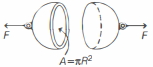
In Guericke's experiment to show the effect of atmospheric pressure,two copper hemispheres were tightly fitted to each other to form a hollow sphere and the air from the sphere was pumped out to create a vacuum inside. If the radius of each hemisphere is $R$ and the atmospheric pressure is $p$,then the minimum force required (when the two hemispheres are pulled apart by the same force) to separate the hemispheres is
A
$2 p \pi R^2$
B
$4 p \pi R^2$
C
$p \pi R^2$
D
$\frac{p}{2} \pi R^2$
Solution
(C) In Guericke's experiment,the atmospheric pressure acts on the projected area of the hemisphere.
The projected area of a hemisphere of radius $R$ is $A = \pi R^2$.
Since the inside of the sphere is a vacuum,the pressure inside is $0$. The net pressure difference across the cross-section is $p - 0 = p$.
The force $F$ required to separate the hemispheres is equal to the force exerted by the atmosphere on the projected area:
$F = P \times A$
$F = p \times \pi R^2$
Therefore,the minimum force required is $p \pi R^2$.
The projected area of a hemisphere of radius $R$ is $A = \pi R^2$.
Since the inside of the sphere is a vacuum,the pressure inside is $0$. The net pressure difference across the cross-section is $p - 0 = p$.
The force $F$ required to separate the hemispheres is equal to the force exerted by the atmosphere on the projected area:
$F = P \times A$
$F = p \times \pi R^2$
Therefore,the minimum force required is $p \pi R^2$.
0 likes
View Solution99
DifficultMCQ
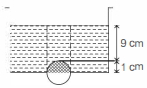
$A$ spherical marble of radius $1 \, cm$ is stuck in a circular hole of radius slightly smaller than its own radius (for calculation purpose,both can be taken same) at the bottom of a bucket filled with water up to a height of $10 \, cm$. If the mass of the marble is $20 \, g$,then the net force on the marble due to water is close to:

A
$0.02 \, N$ upwards
B
$0.02 \, N$ downwards
C
$0.04 \, N$ upwards
D
$0.31 \, N$ downwards
Solution
(D) The force exerted by the water on the marble is due to the hydrostatic pressure at the depth of the marble. The pressure $P$ at the bottom of the bucket is given by $P = \rho g h$,where $\rho = 1000 \, kg/m^3$ is the density of water,$g = 10 \, m/s^2$ is the acceleration due to gravity,and $h = 10 \, cm = 0.1 \, m$ is the height of the water column.
The force $F$ acting downwards on the marble due to the water pressure is $F = P \times A$,where $A$ is the cross-sectional area of the hole (which is equal to the cross-sectional area of the marble at its equator).
The area $A = \pi r^2$,where $r = 1 \, cm = 0.01 \, m$.
Substituting the values:
$F = (1000 \, kg/m^3) \times (10 \, m/s^2) \times (0.1 \, m) \times \pi \times (0.01 \, m)^2$
$F = 1000 \times 10 \times 0.1 \times 3.14159 \times 0.0001$
$F = 1000 \times 0.000314159 \approx 0.314 \, N$.
Since the pressure acts downwards on the top surface of the marble,the net force due to water is $0.31 \, N$ downwards.
The force $F$ acting downwards on the marble due to the water pressure is $F = P \times A$,where $A$ is the cross-sectional area of the hole (which is equal to the cross-sectional area of the marble at its equator).
The area $A = \pi r^2$,where $r = 1 \, cm = 0.01 \, m$.
Substituting the values:
$F = (1000 \, kg/m^3) \times (10 \, m/s^2) \times (0.1 \, m) \times \pi \times (0.01 \, m)^2$
$F = 1000 \times 10 \times 0.1 \times 3.14159 \times 0.0001$
$F = 1000 \times 0.000314159 \approx 0.314 \, N$.
Since the pressure acts downwards on the top surface of the marble,the net force due to water is $0.31 \, N$ downwards.
0 likes
View Solution100
DifficultMCQ
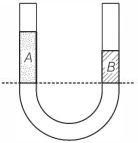
Two immiscible liquids $A$ and $B$ are kept in an $U$-tube. If the density of liquid $A$ is smaller than the density of liquid $B$,then the equilibrium situation is
A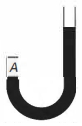
B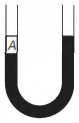
C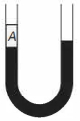
D
None of these
Solution
(C) For two immiscible liquids in an $U$-tube,the pressure at the same horizontal level must be equal at equilibrium.
Let $\rho_A$ and $\rho_B$ be the densities of liquids $A$ and $B$ respectively,and $h_A$ and $h_B$ be the heights of the liquid columns above the common interface level.
Since the pressure at the common interface level must be equal,we have: $P_0 + \rho_A g h_A = P_0 + \rho_B g h_B$,where $P_0$ is the atmospheric pressure.
This simplifies to: $\rho_A h_A = \rho_B h_B$.
Given that the density of liquid $A$ is smaller than the density of liquid $B$ $(\rho_A < \rho_B)$,it follows that $h_A > h_B$ to maintain the same pressure.
Therefore,the column of liquid $A$ must be taller than the column of liquid $B$ above the interface level. This corresponds to the configuration shown in option $C$.
Let $\rho_A$ and $\rho_B$ be the densities of liquids $A$ and $B$ respectively,and $h_A$ and $h_B$ be the heights of the liquid columns above the common interface level.
Since the pressure at the common interface level must be equal,we have: $P_0 + \rho_A g h_A = P_0 + \rho_B g h_B$,where $P_0$ is the atmospheric pressure.
This simplifies to: $\rho_A h_A = \rho_B h_B$.
Given that the density of liquid $A$ is smaller than the density of liquid $B$ $(\rho_A < \rho_B)$,it follows that $h_A > h_B$ to maintain the same pressure.
Therefore,the column of liquid $A$ must be taller than the column of liquid $B$ above the interface level. This corresponds to the configuration shown in option $C$.
0 likes
View SolutionFluid Mechanics and Surface Tension — Pressure and Density (of Mixure) · Frequently Asked Questions
1Are these Fluid Mechanics and Surface Tension questions useful for JEE and NEET?
Yes. All questions in this section are mapped to JEE Main and NEET exam patterns. Previous year questions from JEE Main, NEET, GUJCET and state-level exams are included with full solutions.
2Can I switch to Hindi or Gujarati for these questions?
Yes. Use the language tabs in the hero section or the sidebar to view the same questions and solutions in English, Hindi or Gujarati.
3How do I generate a question paper from this subtopic?
Use the Vedclass Exam Paper Generator — select the chapter and subtopic, set difficulty, and generate Sets A, B, C, D automatically. First 3 chapters of every subject are free.
Vedclass Products
For Students
Vedclass Test Series
Mock tests in real JEE/NEET style with performance analysis. 5-day free trial.
Start Free TrialFor Teachers
Exam Paper Generator
Generate Set A/B/C/D papers from this chapter in 2 minutes. 3 chapters free.
Try FreeFor Institutes
Online Exam Module
Live online exams with unlimited students, 360° analytics & white-label branding.
See DemoFor Teachers & Institutes
Generate a Fluid Mechanics and Surface Tension Exam Paper in 2 Minutes
Select subtopic & difficulty — Sets A, B, C, D auto-generated with No Repeat logic.
First 3 chapters of every subject are free — no payment required.