
A English
Capillary Tube and Capillarity Questions in English
Class 11 Physics · Fluid Mechanics and Surface Tension · Capillary Tube and Capillarity
204+
Questions
English
Language
100%
With Solutions
Showing 49 of 204 questions in English
1
EasyMCQ
If two glass plates are placed very close to each other in water,then there will be a force of:
A
Attraction
B
Repulsion
C
Attraction or repulsion
D
None of the above
Solution
(A) When two glass plates are placed very close to each other in water,the water rises between them due to capillary action. The pressure of the water between the plates becomes less than the atmospheric pressure outside. This pressure difference creates a net force that pulls the two plates together. Therefore,there is a force of attraction between the two glass plates.
0 likes
View Solution2
EasyMCQ
In a capillary,the pressure below the curved surface of water will be:
A
Equal to atmospheric pressure
B
Equal to the pressure on the upper side
C
More than the pressure on the upper side
D
Lesser than the pressure on the upper side
Solution
(D) For a concave meniscus (as formed by water in a glass capillary),the pressure on the concave side is greater than the pressure on the convex side.
Since the water surface is concave,the pressure just below the surface (inside the liquid) is less than the pressure just above the surface (atmospheric pressure).
Therefore,the pressure below the curved surface is lesser than the pressure on the upper side.
Since the water surface is concave,the pressure just below the surface (inside the liquid) is less than the pressure just above the surface (atmospheric pressure).
Therefore,the pressure below the curved surface is lesser than the pressure on the upper side.
0 likes
View Solution3
MediumMCQ
When two capillary tubes of different diameters are dipped vertically,the rise of the liquid is
A
Same in both the tubes
B
More in the tube of larger diameter
C
Less in the tube of smaller diameter
D
More in the tube of smaller diameter
Solution
(D) The height of the liquid rise in a capillary tube is given by the formula $h = \frac{2T \cos \theta}{rdg}$.
Here,$T$ is the surface tension,$\theta$ is the angle of contact,$r$ is the radius of the capillary tube,$d$ is the density of the liquid,and $g$ is the acceleration due to gravity.
Since $T$,$\theta$,$d$,and $g$ are constants for a given liquid and tube material,we have $h \propto \frac{1}{r}$.
This implies that the height of the liquid rise is inversely proportional to the radius (or diameter) of the capillary tube.
Therefore,the liquid will rise more in the tube with a smaller diameter.
Here,$T$ is the surface tension,$\theta$ is the angle of contact,$r$ is the radius of the capillary tube,$d$ is the density of the liquid,and $g$ is the acceleration due to gravity.
Since $T$,$\theta$,$d$,and $g$ are constants for a given liquid and tube material,we have $h \propto \frac{1}{r}$.
This implies that the height of the liquid rise is inversely proportional to the radius (or diameter) of the capillary tube.
Therefore,the liquid will rise more in the tube with a smaller diameter.
0 likes
View Solution4
EasyMCQ
In the state of weightlessness,a capillary tube is dipped in water,then water
A
Will not rise at all
B
Will rise to same height as at atmospheric pressure
C
Will rise to less height than at atmospheric pressure
D
Will rise up to the upper end of the capillary tube of any length
Solution
(D) The height of the liquid column in a capillary tube is given by the formula $h = \frac{2T \cos \theta}{r \rho g}$.
In the state of weightlessness or in a gravity-free space,the effective acceleration due to gravity $g$ becomes $0$.
As $g \to 0$,the height $h$ tends to infinity $(h \to \infty)$.
This means that the water will continue to rise until it reaches the upper end of the capillary tube,regardless of the length of the tube.
In the state of weightlessness or in a gravity-free space,the effective acceleration due to gravity $g$ becomes $0$.
As $g \to 0$,the height $h$ tends to infinity $(h \to \infty)$.
This means that the water will continue to rise until it reaches the upper end of the capillary tube,regardless of the length of the tube.
0 likes
View Solution5
DifficultMCQ
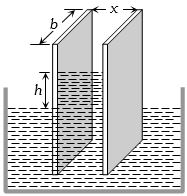
Two parallel glass plates are dipped partly in a liquid of density $d$ while keeping them vertical. If the distance between the plates is $x$, the surface tension of the liquid is $T$, and the angle of contact is $\theta$, then the rise of the liquid between the plates due to capillarity will be:
A
$\frac{T \cos \theta}{xd}$
B
$\frac{2T \cos \theta}{xdg}$
C
$\frac{2T}{xdg \cos \theta}$
D
$\frac{T \cos \theta}{xdg}$
Solution
(B) Let the width of each plate be $b$. Due to surface tension, the liquid will rise to a height $h$.
The upward force due to surface tension acts along the two contact lines of length $b$ each:
$F_{\text{up}} = 2 \times (T \cos \theta \times b) = 2Tb \cos \theta$ ... $(i)$
The weight of the liquid column raised between the plates is given by:
$W = \text{Volume} \times \text{density} \times g = (b \times x \times h) \times d \times g$ ... (ii)
At equilibrium, the upward force balances the weight of the liquid column:
$2Tb \cos \theta = bxhdg$
Dividing both sides by $b$, we get:
$2T \cos \theta = xhdg$
Therefore, the height of the liquid rise is:
$h = \frac{2T \cos \theta}{xdg}$
The upward force due to surface tension acts along the two contact lines of length $b$ each:
$F_{\text{up}} = 2 \times (T \cos \theta \times b) = 2Tb \cos \theta$ ... $(i)$
The weight of the liquid column raised between the plates is given by:
$W = \text{Volume} \times \text{density} \times g = (b \times x \times h) \times d \times g$ ... (ii)
At equilibrium, the upward force balances the weight of the liquid column:
$2Tb \cos \theta = bxhdg$
Dividing both sides by $b$, we get:
$2T \cos \theta = xhdg$
Therefore, the height of the liquid rise is:
$h = \frac{2T \cos \theta}{xdg}$
0 likes
View Solution6
EasyMCQ
Water rises in a capillary tube to a certain height such that the upward force due to surface tension is balanced by $75 \times 10^{-4} \, N$ force due to the weight of the liquid. If the surface tension of water is $6 \times 10^{-2} \, N m^{-1}$,the inner circumference of the capillary must be
A
$1.25 \times 10^{-2} \, m$
B
$0.50 \times 10^{-2} \, m$
C
$6.5 \times 10^{-2} \, m$
D
$12.5 \times 10^{-2} \, m$
Solution
(D) The upward force due to surface tension $(F_s)$ is given by the product of surface tension $(T)$ and the inner circumference $(C)$ of the capillary tube.
$F_s = T \times C$
Given that the upward force is balanced by the weight of the liquid $(W = 75 \times 10^{-4} \, N)$,
$T \times C = 75 \times 10^{-4} \, N$
Given $T = 6 \times 10^{-2} \, N m^{-1}$,we have:
$6 \times 10^{-2} \times C = 75 \times 10^{-4}$
$C = \frac{75 \times 10^{-4}}{6 \times 10^{-2}}$
$C = 12.5 \times 10^{-2} \, m$
Thus,the inner circumference is $12.5 \times 10^{-2} \, m$.
$F_s = T \times C$
Given that the upward force is balanced by the weight of the liquid $(W = 75 \times 10^{-4} \, N)$,
$T \times C = 75 \times 10^{-4} \, N$
Given $T = 6 \times 10^{-2} \, N m^{-1}$,we have:
$6 \times 10^{-2} \times C = 75 \times 10^{-4}$
$C = \frac{75 \times 10^{-4}}{6 \times 10^{-2}}$
$C = 12.5 \times 10^{-2} \, m$
Thus,the inner circumference is $12.5 \times 10^{-2} \, m$.
0 likes
View Solution7
EasyMCQ
It is not possible to write directly on blotting paper or newspaper with an ink pen.
A
Because of viscosity
B
Because of inertia
C
Because of friction
D
Because of capillarity
Solution
(D) The correct answer is $D$. Blotting paper and newspaper have very fine pores that act as capillary tubes. When an ink pen touches the surface,the ink is immediately absorbed into the paper due to the phenomenon of capillarity,causing the ink to spread and blur,making it impossible to write clearly.
0 likes
View Solution8
EasyMCQ
Two capillary tubes $P$ and $Q$ are dipped in water. The height of the water level in capillary $P$ is $2/3$ of the height in capillary $Q$. The ratio of their diameters is:
A
$2:3$
B
$3:2$
C
$3:4$
D
$4:3$
Solution
(B) The height $h$ of a liquid column in a capillary tube is given by the formula $h = \frac{2T \cos \theta}{r \rho g}$,where $T$ is surface tension,$\theta$ is the contact angle,$\rho$ is the density of the liquid,$g$ is the acceleration due to gravity,and $r$ is the radius of the capillary tube.
Since $T, \theta, \rho$,and $g$ are constant for the same liquid and same material of the tube,we have $h \propto \frac{1}{r}$.
Given that the height in capillary $P$ is $h_P = \frac{2}{3} h_Q$,we can write the ratio of the radii as $\frac{r_P}{r_Q} = \frac{h_Q}{h_P}$.
Substituting the given values,we get $\frac{r_P}{r_Q} = \frac{h_Q}{(2/3)h_Q} = \frac{3}{2}$.
Since the diameter $D = 2r$,the ratio of the diameters is $\frac{D_P}{D_Q} = \frac{2r_P}{2r_Q} = \frac{r_P}{r_Q} = \frac{3}{2}$.
Since $T, \theta, \rho$,and $g$ are constant for the same liquid and same material of the tube,we have $h \propto \frac{1}{r}$.
Given that the height in capillary $P$ is $h_P = \frac{2}{3} h_Q$,we can write the ratio of the radii as $\frac{r_P}{r_Q} = \frac{h_Q}{h_P}$.
Substituting the given values,we get $\frac{r_P}{r_Q} = \frac{h_Q}{(2/3)h_Q} = \frac{3}{2}$.
Since the diameter $D = 2r$,the ratio of the diameters is $\frac{D_P}{D_Q} = \frac{2r_P}{2r_Q} = \frac{r_P}{r_Q} = \frac{3}{2}$.
0 likes
View Solution9
EasyMCQ
Two capillaries made of the same material but of different radii are dipped in a liquid. The rise of liquid in one capillary is $2.2 \ cm$ and that in the other is $6.6 \ cm$. The ratio of their radii is
A
$9:1$
B
$1:9$
C
$3:1$
D
$1:3$
Solution
(C) The height of liquid rise in a capillary tube is given by the formula $h = \frac{2T \cos \theta}{r \rho g}$.
Since the liquid,material,and contact angle are the same,we have $h \propto \frac{1}{r}$,which implies $r \propto \frac{1}{h}$.
Given $h_1 = 2.2 \ cm$ and $h_2 = 6.6 \ cm$.
The ratio of the radii is $\frac{r_1}{r_2} = \frac{h_2}{h_1}$.
Substituting the values,$\frac{r_1}{r_2} = \frac{6.6}{2.2} = \frac{3}{1}$.
Therefore,the ratio of their radii is $3:1$.
Since the liquid,material,and contact angle are the same,we have $h \propto \frac{1}{r}$,which implies $r \propto \frac{1}{h}$.
Given $h_1 = 2.2 \ cm$ and $h_2 = 6.6 \ cm$.
The ratio of the radii is $\frac{r_1}{r_2} = \frac{h_2}{h_1}$.
Substituting the values,$\frac{r_1}{r_2} = \frac{6.6}{2.2} = \frac{3}{1}$.
Therefore,the ratio of their radii is $3:1$.
0 likes
View Solution10
EasyMCQ
Two capillaries made of the same material have radii $r_1 = 1 \, mm$ and $r_2 = 2 \, mm$. If the rise of the liquid in the first capillary $(r_1 = 1 \, mm)$ is $30 \, cm$,then the rise in the other capillary will be ........ $cm$.
A
$7.5$
B
$60$
C
$15$
D
$120$
Solution
(C) The height of liquid rise in a capillary tube is given by the formula $h = \frac{2T \cos \theta}{r \rho g}$.
Since the material of the capillary and the liquid are the same,the surface tension $T$,contact angle $\theta$,density $\rho$,and acceleration due to gravity $g$ are constant.
Therefore,$h \propto \frac{1}{r}$,which implies $h_1 r_1 = h_2 r_2$.
Given $r_1 = 1 \, mm$,$r_2 = 2 \, mm$,and $h_1 = 30 \, cm$.
Substituting the values: $30 \times 1 = h_2 \times 2$.
$h_2 = \frac{30}{2} = 15 \, cm$.
Since the material of the capillary and the liquid are the same,the surface tension $T$,contact angle $\theta$,density $\rho$,and acceleration due to gravity $g$ are constant.
Therefore,$h \propto \frac{1}{r}$,which implies $h_1 r_1 = h_2 r_2$.
Given $r_1 = 1 \, mm$,$r_2 = 2 \, mm$,and $h_1 = 30 \, cm$.
Substituting the values: $30 \times 1 = h_2 \times 2$.
$h_2 = \frac{30}{2} = 15 \, cm$.
0 likes
View Solution11
EasyMCQ
When a capillary is dipped in water,water rises to a height $h$. If the length of the capillary is made less than $h$,then
A
The water will come out
B
The water will not come out
C
The water will not rise
D
The water will rise but less than height of capillary
Solution
(B) When a capillary tube of length $l < h$ is dipped in water,the water rises to the top of the tube.
At the top,the radius of curvature of the meniscus adjusts itself such that the pressure balance is maintained.
The water does not overflow because the radius of curvature $R$ of the meniscus increases until the pressure difference $2T/R$ equals the hydrostatic pressure $\rho gh$ corresponding to the length of the tube.
Thus,the water stays at the top of the tube and forms a meniscus with a larger radius of curvature.
At the top,the radius of curvature of the meniscus adjusts itself such that the pressure balance is maintained.
The water does not overflow because the radius of curvature $R$ of the meniscus increases until the pressure difference $2T/R$ equals the hydrostatic pressure $\rho gh$ corresponding to the length of the tube.
Thus,the water stays at the top of the tube and forms a meniscus with a larger radius of curvature.
0 likes
View Solution12
EasyMCQ
Water rises up to $10 \, cm$ height in a long capillary tube. If this tube is immersed in water so that the height above the water surface is only $8 \, cm$,then:
A
Water flows out continuously from the upper end
B
Water rises up to the upper end and forms a spherical surface
C
Water only rises up to $6 \, cm$ height
D
Water does not rise at all
Solution
(B) The height to which water rises in a capillary tube is given by $h = \frac{2T \cos \theta}{\rho r g}$. Given that the capillary rise is $10 \, cm$,the water column will naturally try to reach this height. If the tube is cut or immersed such that the length above the water surface is less than the equilibrium height $(8 \, cm < 10 \, cm)$,the water will rise to the top of the tube. To maintain equilibrium,the radius of curvature of the meniscus will adjust such that $h' = \frac{2T \cos \theta'}{\rho r' g} = 8 \, cm$. Thus,the water will rise to the upper end and form a spherical surface with a different radius of curvature to satisfy the pressure balance.
0 likes
View Solution13
MediumMCQ
Water rises in a capillary tube to a height of $3\, cm$ when one end is dipped vertically in it. If the surface tension of water is $75 \times 10^{-3}\, N/m$,then the diameter of the capillary tube will be....... $mm$. (Assume $g = 10\, m/s^2$)
A
$0.1$
B
$0.5$
C
$1.0$
D
$2.0$
Solution
(C) The formula for capillary rise is given by $h = \frac{2T \cos \theta}{r \rho g}$.
Assuming the contact angle $\theta = 0^\circ$ for water in a glass capillary,$\cos 0^\circ = 1$.
Given: $h = 3\, cm = 3 \times 10^{-2}\, m$,$T = 75 \times 10^{-3}\, N/m$,$\rho = 10^3\, kg/m^3$,and $g = 10\, m/s^2$.
Substituting the values: $3 \times 10^{-2} = \frac{2 \times 75 \times 10^{-3}}{r \times 10^3 \times 10}$.
$3 \times 10^{-2} = \frac{150 \times 10^{-3}}{r \times 10^4} = \frac{15 \times 10^{-3}}{r \times 10^3} = \frac{15 \times 10^{-6}}{r}$.
$r = \frac{15 \times 10^{-6}}{3 \times 10^{-2}} = 5 \times 10^{-4}\, m = 0.5\, mm$.
The diameter $D = 2r = 2 \times 0.5\, mm = 1.0\, mm$.
Assuming the contact angle $\theta = 0^\circ$ for water in a glass capillary,$\cos 0^\circ = 1$.
Given: $h = 3\, cm = 3 \times 10^{-2}\, m$,$T = 75 \times 10^{-3}\, N/m$,$\rho = 10^3\, kg/m^3$,and $g = 10\, m/s^2$.
Substituting the values: $3 \times 10^{-2} = \frac{2 \times 75 \times 10^{-3}}{r \times 10^3 \times 10}$.
$3 \times 10^{-2} = \frac{150 \times 10^{-3}}{r \times 10^4} = \frac{15 \times 10^{-3}}{r \times 10^3} = \frac{15 \times 10^{-6}}{r}$.
$r = \frac{15 \times 10^{-6}}{3 \times 10^{-2}} = 5 \times 10^{-4}\, m = 0.5\, mm$.
The diameter $D = 2r = 2 \times 0.5\, mm = 1.0\, mm$.
1 likes
View Solution14
EasyMCQ
$A$ capillary tube made of glass is dipped into mercury. Then
A
Mercury rises in the capillary tube
B
Mercury rises and flows out of the capillary tube
C
Mercury descends in the capillary tube
D
Mercury neither rises nor descends in the capillary tube
Solution
(C) The angle of contact $(\theta)$ between mercury and glass is obtuse $(\theta > 90^{\circ})$.
Due to this, the cohesive forces between mercury molecules are stronger than the adhesive forces between mercury and glass.
As a result, the meniscus of mercury in the capillary tube is convex upwards.
This leads to a depression of the mercury level inside the capillary tube relative to the level outside.
Due to this, the cohesive forces between mercury molecules are stronger than the adhesive forces between mercury and glass.
As a result, the meniscus of mercury in the capillary tube is convex upwards.
This leads to a depression of the mercury level inside the capillary tube relative to the level outside.
0 likes
View Solution15
EasyMCQ
By inserting a capillary tube up to a depth $l$ in water,the water rises to a height $h$. If the lower end of the capillary is closed inside water,the capillary is taken out,and then the closed end is opened,to what height will the water remain in the tube?
A
$0$
B
$l + h$
C
$2h$
D
$h$
Solution
(D) The height to which water rises in a capillary tube is determined by the surface tension and the radius of the tube,given by the formula $h = \frac{2T \cos \theta}{r \rho g}$.
When the capillary tube is inserted into water to a depth $l$,the water rises to a height $h$ above the free surface of the water.
If the lower end is closed while inside the water and the tube is removed,the column of water trapped inside the tube remains at height $h$ because the capillary action is a property of the tube-liquid interface.
When the closed end is opened,the water level will adjust to the equilibrium height $h$ determined by the capillary forces,provided the tube length is sufficient.
Therefore,the water will remain at height $h$.
When the capillary tube is inserted into water to a depth $l$,the water rises to a height $h$ above the free surface of the water.
If the lower end is closed while inside the water and the tube is removed,the column of water trapped inside the tube remains at height $h$ because the capillary action is a property of the tube-liquid interface.
When the closed end is opened,the water level will adjust to the equilibrium height $h$ determined by the capillary forces,provided the tube length is sufficient.
Therefore,the water will remain at height $h$.
0 likes
View Solution16
EasyMCQ
If the diameter of a capillary tube is doubled,then the height of the liquid that will rise is
A
Twice
B
Half
C
Same as earlier
D
None of these
Solution
(B) The height $h$ to which a liquid rises in a capillary tube of radius $r$ is given by the formula: $h = \frac{2T \cos \theta}{r \rho g}$.
From this relation,we can see that the height of the liquid column is inversely proportional to the radius of the tube,i.e.,$h \propto \frac{1}{r}$.
Since the diameter $d = 2r$,the radius is also directly proportional to the diameter $(r \propto d)$.
Therefore,$h \propto \frac{1}{d}$.
If the diameter is doubled $(d' = 2d)$,the new height $h'$ becomes $h' = \frac{h}{2}$.
Thus,the height of the liquid that will rise is half of the original height.
From this relation,we can see that the height of the liquid column is inversely proportional to the radius of the tube,i.e.,$h \propto \frac{1}{r}$.
Since the diameter $d = 2r$,the radius is also directly proportional to the diameter $(r \propto d)$.
Therefore,$h \propto \frac{1}{d}$.
If the diameter is doubled $(d' = 2d)$,the new height $h'$ becomes $h' = \frac{h}{2}$.
Thus,the height of the liquid that will rise is half of the original height.
0 likes
View Solution17
MediumMCQ
If the surface tension of water is $0.06 \, N/m$,then the capillary rise in a tube of diameter $1 \, mm$ is ....... $cm$ (assume $\theta = 0^\circ$,$g = 10 \, m/s^2$,and density of water $\rho = 1000 \, kg/m^3$).
A
$1.22$
B
$2.44$
C
$3.12$
D
$3.86$
Solution
(B) The formula for capillary rise is given by $h = \frac{2T \cos \theta}{r \rho g}$.
Given:
Surface tension $T = 0.06 \, N/m$.
Diameter $d = 1 \, mm = 10^{-3} \, m$,so radius $r = 0.5 \times 10^{-3} \, m$.
Angle of contact $\theta = 0^\circ$,so $\cos 0^\circ = 1$.
Density $\rho = 1000 \, kg/m^3$.
Acceleration due to gravity $g = 10 \, m/s^2$.
Substituting the values:
$h = \frac{2 \times 0.06 \times 1}{0.5 \times 10^{-3} \times 1000 \times 10} = \frac{0.12}{5} = 0.024 \, m$.
Converting to centimeters: $0.024 \, m = 2.4 \, cm$.
Rounding to the nearest provided option,the correct answer is $2.44 \, cm$.
Given:
Surface tension $T = 0.06 \, N/m$.
Diameter $d = 1 \, mm = 10^{-3} \, m$,so radius $r = 0.5 \times 10^{-3} \, m$.
Angle of contact $\theta = 0^\circ$,so $\cos 0^\circ = 1$.
Density $\rho = 1000 \, kg/m^3$.
Acceleration due to gravity $g = 10 \, m/s^2$.
Substituting the values:
$h = \frac{2 \times 0.06 \times 1}{0.5 \times 10^{-3} \times 1000 \times 10} = \frac{0.12}{5} = 0.024 \, m$.
Converting to centimeters: $0.024 \, m = 2.4 \, cm$.
Rounding to the nearest provided option,the correct answer is $2.44 \, cm$.
0 likes
View Solution18
EasyMCQ
Two capillary tubes of radii $0.2 \ cm$ and $0.4 \ cm$ are dipped in the same liquid. The ratio of the heights to which the liquid will rise in the tubes is:
A
$1:2$
B
$2:1$
C
$1:4$
D
$4:1$
Solution
(B) The height $h$ to which a liquid rises in a capillary tube is given by the formula $h = \frac{2T \cos \theta}{r \rho g}$,where $T$ is surface tension,$\theta$ is the angle of contact,$r$ is the radius of the tube,$\rho$ is the density of the liquid,and $g$ is the acceleration due to gravity.
Since the same liquid is used in both tubes,$T$,$\theta$,$\rho$,and $g$ are constant.
Therefore,$h \propto \frac{1}{r}$,which implies $h_1 r_1 = h_2 r_2$.
The ratio of the heights is $\frac{h_1}{h_2} = \frac{r_2}{r_1}$.
Given $r_1 = 0.2 \ cm$ and $r_2 = 0.4 \ cm$,we have $\frac{h_1}{h_2} = \frac{0.4}{0.2} = \frac{2}{1}$.
Thus,the ratio is $2:1$.
Since the same liquid is used in both tubes,$T$,$\theta$,$\rho$,and $g$ are constant.
Therefore,$h \propto \frac{1}{r}$,which implies $h_1 r_1 = h_2 r_2$.
The ratio of the heights is $\frac{h_1}{h_2} = \frac{r_2}{r_1}$.
Given $r_1 = 0.2 \ cm$ and $r_2 = 0.4 \ cm$,we have $\frac{h_1}{h_2} = \frac{0.4}{0.2} = \frac{2}{1}$.
Thus,the ratio is $2:1$.
0 likes
View Solution19
MediumMCQ
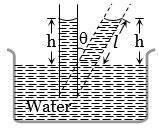
$A$ capillary tube,when immersed vertically in a liquid,records a rise of $3 \, cm$. If the tube is immersed in the liquid at an angle of ${60^\circ}$ with the vertical,what is the length of the liquid column along the tube in $cm$?
A
$9$
B
$6$
C
$3$
D
$2$
Solution
(B) The vertical height $(h)$ of the liquid column in a capillary tube depends on the surface tension,density of the liquid,and the radius of the tube. It is independent of the inclination of the tube.
When the tube is tilted at an angle $\theta$ with the vertical,the vertical height $h$ remains the same.
If $l$ is the length of the liquid column along the tube,then from the geometry of the setup,we have:
$h = l \cos \theta$
Given:
$h = 3 \, cm$
$\theta = {60^\circ}$
Substituting the values:
$3 = l \cos {60^\circ}$
$3 = l \times \frac{1}{2}$
$l = 3 \times 2 = 6 \, cm$
Therefore,the length of the liquid column along the tube is $6 \, cm$.
When the tube is tilted at an angle $\theta$ with the vertical,the vertical height $h$ remains the same.
If $l$ is the length of the liquid column along the tube,then from the geometry of the setup,we have:
$h = l \cos \theta$
Given:
$h = 3 \, cm$
$\theta = {60^\circ}$
Substituting the values:
$3 = l \cos {60^\circ}$
$3 = l \times \frac{1}{2}$
$l = 3 \times 2 = 6 \, cm$
Therefore,the length of the liquid column along the tube is $6 \, cm$.
0 likes
View Solution20
EasyMCQ
The action of a nib split at the top is explained by
A
Gravity flow
B
Diffusion of fluid
C
Capillary action
D
Osmosis of liquid
Solution
(C) The tip of the nib of a writing pen is split to provide the capillary action.
Due to capillarity,the ink rises in the split of the nib,which allows the pen to write continuously by maintaining a steady flow of ink to the paper.
Due to capillarity,the ink rises in the split of the nib,which allows the pen to write continuously by maintaining a steady flow of ink to the paper.
0 likes
View Solution21
MediumMCQ
The correct relation for the capillary rise $h$ in a tube of radius $r$ is:
A
$r = \frac{2T \cos \theta}{hdg}$
B
$r = \frac{hdg}{2T \cos \theta}$
C
$r = \frac{2T dgh}{\cos \theta}$
D
$r = \frac{T \cos \theta}{2hdg}$
Solution
(A) The capillary rise $h$ in a capillary tube of radius $r$ is given by the formula:
$h = \frac{2T \cos \theta}{rdg}$
where $T$ is the surface tension,$\theta$ is the angle of contact,$d$ is the density of the liquid,and $g$ is the acceleration due to gravity.
To find the radius $r$,we rearrange the formula:
$r = \frac{2T \cos \theta}{hdg}$
Therefore,the correct relation is $r = \frac{2T \cos \theta}{hdg}$.
$h = \frac{2T \cos \theta}{rdg}$
where $T$ is the surface tension,$\theta$ is the angle of contact,$d$ is the density of the liquid,and $g$ is the acceleration due to gravity.
To find the radius $r$,we rearrange the formula:
$r = \frac{2T \cos \theta}{hdg}$
Therefore,the correct relation is $r = \frac{2T \cos \theta}{hdg}$.
0 likes
View Solution22
EasyMCQ
Water rises up to a height $h$ in a capillary tube on the surface of the Earth in a stationary condition. The value of $h$ increases if this tube is taken:
A
On the Sun
B
On the poles
C
In a lift going upward with acceleration
D
In a lift going downward with acceleration
Solution
(D) The height $h$ to which a liquid rises in a capillary tube is given by the formula $h = \frac{2T \cos \theta}{rdg}$,where $T$ is surface tension,$\theta$ is the angle of contact,$r$ is the radius of the tube,$d$ is the density of the liquid,and $g$ is the acceleration due to gravity.
From this relation,we can see that $h \propto \frac{1}{g}$.
When a lift moves downward with an acceleration $a$,the effective acceleration due to gravity becomes $g_{eff} = g - a$. Since $g_{eff} < g$,the value of $h$ will increase.
Therefore,the correct option is $D$.
From this relation,we can see that $h \propto \frac{1}{g}$.
When a lift moves downward with an acceleration $a$,the effective acceleration due to gravity becomes $g_{eff} = g - a$. Since $g_{eff} < g$,the value of $h$ will increase.
Therefore,the correct option is $D$.
0 likes
View Solution23
EasyMCQ
During the capillary rise of a liquid in a capillary tube,the surface of contact that remains constant is of
A
Glass and liquid
B
Air and glass
C
Air and liquid
D
All of these
Solution
(C) When a liquid rises in a capillary tube,the meniscus is formed at the interface of the liquid and the air.
As the liquid rises,the contact angle between the liquid and the glass remains constant for a given pair of materials.
However,the surface of contact between the air and the liquid (the meniscus) maintains its shape and curvature to satisfy the pressure difference across the interface (Young-Laplace equation).
In the context of capillary action,the interface that defines the geometry of the rise is the air-liquid interface.
As the liquid rises,the contact angle between the liquid and the glass remains constant for a given pair of materials.
However,the surface of contact between the air and the liquid (the meniscus) maintains its shape and curvature to satisfy the pressure difference across the interface (Young-Laplace equation).
In the context of capillary action,the interface that defines the geometry of the rise is the air-liquid interface.
0 likes
View Solution24
EasyMCQ
In a capillary tube,water rises by $1.2 \ mm$. The height of water that will rise in another capillary tube having half the radius of the first is ........ $mm$.
A
$1.2$
B
$2.4$
C
$0.6$
D
$0.4$
Solution
(B) The height of liquid rise in a capillary tube is given by the formula $h = \frac{2T \cos \theta}{r \rho g}$.
Since $T$,$\theta$,$\rho$,and $g$ are constant for the same liquid,we have $h \propto \frac{1}{r}$.
This implies $h_1 r_1 = h_2 r_2$.
Given $h_1 = 1.2 \ mm$ and $r_2 = \frac{r_1}{2}$.
Substituting these values,we get $1.2 \times r_1 = h_2 \times \frac{r_1}{2}$.
Solving for $h_2$,we get $h_2 = 1.2 \times 2 = 2.4 \ mm$.
Since $T$,$\theta$,$\rho$,and $g$ are constant for the same liquid,we have $h \propto \frac{1}{r}$.
This implies $h_1 r_1 = h_2 r_2$.
Given $h_1 = 1.2 \ mm$ and $r_2 = \frac{r_1}{2}$.
Substituting these values,we get $1.2 \times r_1 = h_2 \times \frac{r_1}{2}$.
Solving for $h_2$,we get $h_2 = 1.2 \times 2 = 2.4 \ mm$.
0 likes
View Solution25
EasyMCQ
If a capillary experiment is performed in a vacuum,what happens to the liquid level in the capillary tube?
A
It will rise
B
It will remain the same
C
It will fall
D
It will rise to the top
Solution
(A) The rise of a liquid in a capillary tube is governed by the formula $h = \frac{2T \cos \theta}{r \rho g}$,where $T$ is the surface tension,$\theta$ is the angle of contact,$r$ is the radius of the tube,$\rho$ is the density of the liquid,and $g$ is the acceleration due to gravity.
Performing the experiment in a vacuum does not affect the surface tension or the contact angle of the liquid.
Since the atmospheric pressure acts equally on the liquid surface in the container and the liquid inside the capillary,its absence in a vacuum does not change the pressure difference across the meniscus.
Therefore,the liquid will still rise in the capillary tube as it would under normal atmospheric conditions.
Performing the experiment in a vacuum does not affect the surface tension or the contact angle of the liquid.
Since the atmospheric pressure acts equally on the liquid surface in the container and the liquid inside the capillary,its absence in a vacuum does not change the pressure difference across the meniscus.
Therefore,the liquid will still rise in the capillary tube as it would under normal atmospheric conditions.
0 likes
View Solution26
EasyMCQ
If the liquid level falls in a capillary tube,then the radius of the capillary will:
A
Increase
B
Decrease
C
Unchanged
D
None of these
Solution
(A) The height of the liquid column $h$ in a capillary tube is given by the formula $h = \frac{2T \cos \theta}{r \rho g}$.
From this relation,we can see that $h \propto \frac{1}{r}$,which implies $rh = \text{constant}$.
If the liquid level $h$ falls (decreases),then for the product $rh$ to remain constant,the radius $r$ of the capillary must increase.
Therefore,the correct option is $A$.
From this relation,we can see that $h \propto \frac{1}{r}$,which implies $rh = \text{constant}$.
If the liquid level $h$ falls (decreases),then for the product $rh$ to remain constant,the radius $r$ of the capillary must increase.
Therefore,the correct option is $A$.
0 likes
View Solution27
MediumMCQ
Two capillary tubes of same diameter are put vertically one each in two liquids whose relative densities are $0.8$ and $0.6$ and surface tensions are $60$ and $50 \text{ dyne/cm}$ respectively. The ratio of the heights of the liquids in the two tubes $\frac{h_1}{h_2}$ is:
A
$\frac{10}{9}$
B
$\frac{3}{10}$
C
$\frac{10}{3}$
D
$\frac{9}{10}$
Solution
(D) The height of a liquid column in a capillary tube is given by the formula: $h = \frac{2T \cos \theta}{rdg}$.
Since the diameter $(r)$,contact angle $(\theta)$,and acceleration due to gravity $(g)$ are constant for both tubes,the height is proportional to the surface tension $(T)$ and inversely proportional to the density $(d)$: $h \propto \frac{T}{d}$.
Therefore,the ratio of the heights is given by: $\frac{h_1}{h_2} = \frac{T_1}{T_2} \times \frac{d_2}{d_1}$.
Given values are $T_1 = 60 \text{ dyne/cm}$,$T_2 = 50 \text{ dyne/cm}$,$d_1 = 0.8$,and $d_2 = 0.6$.
Substituting these values: $\frac{h_1}{h_2} = \frac{60}{50} \times \frac{0.6}{0.8} = \frac{6}{5} \times \frac{6}{8} = \frac{36}{40} = \frac{9}{10}$.
Since the diameter $(r)$,contact angle $(\theta)$,and acceleration due to gravity $(g)$ are constant for both tubes,the height is proportional to the surface tension $(T)$ and inversely proportional to the density $(d)$: $h \propto \frac{T}{d}$.
Therefore,the ratio of the heights is given by: $\frac{h_1}{h_2} = \frac{T_1}{T_2} \times \frac{d_2}{d_1}$.
Given values are $T_1 = 60 \text{ dyne/cm}$,$T_2 = 50 \text{ dyne/cm}$,$d_1 = 0.8$,and $d_2 = 0.6$.
Substituting these values: $\frac{h_1}{h_2} = \frac{60}{50} \times \frac{0.6}{0.8} = \frac{6}{5} \times \frac{6}{8} = \frac{36}{40} = \frac{9}{10}$.
0 likes
View Solution28
MediumMCQ
Water rises in a vertical capillary tube up to a height of $2.0 \, cm$. If the tube is inclined at an angle of $60^{\circ}$ with the vertical,then up to what length will the water rise in the tube?
A
$2.0$
B
$4.0$
C
$\frac{4}{\sqrt{3}}$
D
$2\sqrt{2}$
Solution
(B) The height $h$ to which water rises in a vertical capillary tube is given by $h = \frac{2T \cos \theta}{r \rho g}$.
When the tube is inclined at an angle $\alpha$ with the vertical,the vertical height $h$ remains the same because the pressure difference at the meniscus depends only on the vertical height.
If $l$ is the length of the water column along the inclined tube,then $h = l \cos \alpha$.
Given $h = 2.0 \, cm$ and $\alpha = 60^{\circ}$.
Therefore,$l = \frac{h}{\cos \alpha} = \frac{2.0}{\cos 60^{\circ}} = \frac{2.0}{0.5} = 4.0 \, cm$.
When the tube is inclined at an angle $\alpha$ with the vertical,the vertical height $h$ remains the same because the pressure difference at the meniscus depends only on the vertical height.
If $l$ is the length of the water column along the inclined tube,then $h = l \cos \alpha$.
Given $h = 2.0 \, cm$ and $\alpha = 60^{\circ}$.
Therefore,$l = \frac{h}{\cos \alpha} = \frac{2.0}{\cos 60^{\circ}} = \frac{2.0}{0.5} = 4.0 \, cm$.
0 likes
View Solution29
EasyMCQ
The surface tension for pure water in a capillary tube experiment is
A
$\frac{\rho g}{2hr}$
B
$\frac{2}{hr\rho g}$
C
$\frac{r\rho g}{2h}$
D
$\frac{hr\rho g}{2}$
Solution
(D) The formula for the rise of a liquid in a capillary tube is given by $T = \frac{rh\rho g}{2 \cos \theta}$,where $T$ is the surface tension,$r$ is the radius of the capillary tube,$h$ is the height of the liquid column,$\rho$ is the density of the liquid,$g$ is the acceleration due to gravity,and $\theta$ is the angle of contact.
For pure water in a glass capillary tube,the angle of contact $\theta$ is approximately $0^\circ$.
Since $\cos(0^\circ) = 1$,the formula simplifies to $T = \frac{rh\rho g}{2}$.
For pure water in a glass capillary tube,the angle of contact $\theta$ is approximately $0^\circ$.
Since $\cos(0^\circ) = 1$,the formula simplifies to $T = \frac{rh\rho g}{2}$.
0 likes
View Solution30
MediumMCQ
In a capillary tube experiment,a vertical $20 \,cm$ long capillary tube is dipped in water. The water rises up to a height of $8 \,cm$ due to capillary action. If this experiment is conducted in a freely falling elevator,the length of the water column becomes ....... $cm$.
A
$10$
B
$30$
C
$20$
D
$0$
Solution
(C) The height of the water column in a capillary tube is given by the formula $h = \frac{2T \cos \theta}{r \rho g}$.
In a freely falling elevator,the effective acceleration due to gravity $g_{eff}$ becomes $0$ because the elevator is in a state of weightlessness.
As $g_{eff} \to 0$,the height of the water column $h$ tends to infinity $(h \propto 1/g_{eff})$.
However,the water column cannot exceed the physical length of the capillary tube.
Therefore,the water will rise until it fills the entire length of the capillary tube,which is $20 \,cm$.
In a freely falling elevator,the effective acceleration due to gravity $g_{eff}$ becomes $0$ because the elevator is in a state of weightlessness.
As $g_{eff} \to 0$,the height of the water column $h$ tends to infinity $(h \propto 1/g_{eff})$.
However,the water column cannot exceed the physical length of the capillary tube.
Therefore,the water will rise until it fills the entire length of the capillary tube,which is $20 \,cm$.
0 likes
View Solution31
MediumMCQ
The radius of a capillary tube is $2 \times 10^{-3} \ m$. If a liquid of weight $6.28 \times 10^{-4} \ N$ can be supported in the capillary,what is the surface tension of the liquid?
A
$5 \times 10^{-3} \ N/m$
B
$5 \times 10^{-2} \ N/m$
C
$5 \ N/m$
D
$50 \ N/m$
Solution
(B) The weight of the liquid column supported in the capillary is balanced by the upward force due to surface tension along the circumference of the tube.
The force due to surface tension is given by $F = T \times (2\pi r)$,where $T$ is the surface tension and $r$ is the radius of the capillary.
Given: Weight $W = F = 6.28 \times 10^{-4} \ N$,radius $r = 2 \times 10^{-3} \ m$,and $\pi \approx 3.14$.
Rearranging the formula for surface tension: $T = \frac{F}{2\pi r}$.
Substituting the values: $T = \frac{6.28 \times 10^{-4}}{2 \times 3.14 \times 2 \times 10^{-3}}$.
$T = \frac{6.28 \times 10^{-4}}{12.56 \times 10^{-3}} = \frac{6.28}{12.56} \times 10^{-1} = 0.5 \times 10^{-1} = 5 \times 10^{-2} \ N/m$.
Thus,the correct option is $B$.
The force due to surface tension is given by $F = T \times (2\pi r)$,where $T$ is the surface tension and $r$ is the radius of the capillary.
Given: Weight $W = F = 6.28 \times 10^{-4} \ N$,radius $r = 2 \times 10^{-3} \ m$,and $\pi \approx 3.14$.
Rearranging the formula for surface tension: $T = \frac{F}{2\pi r}$.
Substituting the values: $T = \frac{6.28 \times 10^{-4}}{2 \times 3.14 \times 2 \times 10^{-3}}$.
$T = \frac{6.28 \times 10^{-4}}{12.56 \times 10^{-3}} = \frac{6.28}{12.56} \times 10^{-1} = 0.5 \times 10^{-1} = 5 \times 10^{-2} \ N/m$.
Thus,the correct option is $B$.
0 likes
View Solution32
EasyMCQ
Two long capillary tubes $A$ and $B$ of radius $R_B > R_A$ are dipped in the same liquid. Then:
A
Water rise is more in $A$ than $B$.
B
Water rises more in $B$ than $A$.
C
Same water rise in both.
D
All of these according to the density of water.
Solution
(A) The height of the liquid column in a capillary tube is given by the formula $h = \frac{2T \cos \theta}{r \rho g}$,where $T$ is surface tension,$\theta$ is the contact angle,$r$ is the radius of the tube,$\rho$ is the density of the liquid,and $g$ is the acceleration due to gravity.
Since $T, \theta, \rho,$ and $g$ are constant for the same liquid and the same material of the tube,we have $h \propto \frac{1}{r}$.
Given that $R_B > R_A$,it follows that $\frac{1}{R_A} > \frac{1}{R_B}$.
Therefore,the height of the liquid rise $h_A$ in tube $A$ will be greater than the height $h_B$ in tube $B$ $(h_A > h_B)$.
Since $T, \theta, \rho,$ and $g$ are constant for the same liquid and the same material of the tube,we have $h \propto \frac{1}{r}$.
Given that $R_B > R_A$,it follows that $\frac{1}{R_A} > \frac{1}{R_B}$.
Therefore,the height of the liquid rise $h_A$ in tube $A$ will be greater than the height $h_B$ in tube $B$ $(h_A > h_B)$.
0 likes
View Solution33
MediumMCQ
If water rises in a capillary tube up to $3 \, cm$,what is the diameter of the capillary tube? (Surface tension of water $T = 7.2 \times 10^{-2} \, N/m$,density $\rho = 10^3 \, kg/m^3$,$g = 10 \, m/s^2$)
A
$9.6 \times 10^{-4} \, m$
B
$9.6 \times 10^{-3} \, m$
C
$9.6 \times 10^{-2} \, m$
D
$9.6 \times 10^{-1} \, m$
Solution
(A) The height of liquid rise in a capillary tube is given by the formula: $h = \frac{2T \cos \theta}{r \rho g}$.
For water,the contact angle $\theta = 0^\circ$,so $\cos 0^\circ = 1$.
Given: $h = 3 \, cm = 3 \times 10^{-2} \, m$,$T = 7.2 \times 10^{-2} \, N/m$,$\rho = 10^3 \, kg/m^3$,and $g = 10 \, m/s^2$.
Rearranging the formula for radius $r$: $r = \frac{2T}{h \rho g}$.
Substituting the values: $r = \frac{2 \times 7.2 \times 10^{-2}}{3 \times 10^{-2} \times 10^3 \times 10} = \frac{14.4 \times 10^{-2}}{3 \times 10^2} = 4.8 \times 10^{-4} \, m$.
The diameter $d$ is $2r$: $d = 2 \times 4.8 \times 10^{-4} \, m = 9.6 \times 10^{-4} \, m$.
For water,the contact angle $\theta = 0^\circ$,so $\cos 0^\circ = 1$.
Given: $h = 3 \, cm = 3 \times 10^{-2} \, m$,$T = 7.2 \times 10^{-2} \, N/m$,$\rho = 10^3 \, kg/m^3$,and $g = 10 \, m/s^2$.
Rearranging the formula for radius $r$: $r = \frac{2T}{h \rho g}$.
Substituting the values: $r = \frac{2 \times 7.2 \times 10^{-2}}{3 \times 10^{-2} \times 10^3 \times 10} = \frac{14.4 \times 10^{-2}}{3 \times 10^2} = 4.8 \times 10^{-4} \, m$.
The diameter $d$ is $2r$: $d = 2 \times 4.8 \times 10^{-4} \, m = 9.6 \times 10^{-4} \, m$.
1 likes
View Solution34
MediumMCQ
When a capillary is dipped in water,water rises $0.015 \ m$ in it. If the surface tension of water is $75 \times 10^{-3} \ N/m$,the radius of the capillary is ....... $mm$.
A
$0.1$
B
$0.5$
C
$1$
D
$2$
Solution
(C) The height of the liquid column in a capillary tube is given by the formula: $h = \frac{2T \cos \theta}{rdg}$.
Assuming the angle of contact $\theta = 0^\circ$ for water and glass,$\cos 0^\circ = 1$.
Given: $h = 0.015 \ m$,$T = 75 \times 10^{-3} \ N/m$,$g = 10 \ m/s^2$,and density of water $\rho = 10^3 \ kg/m^3$.
Rearranging the formula for radius $r$: $r = \frac{2T}{h \rho g}$.
Substituting the values: $r = \frac{2 \times 75 \times 10^{-3}}{0.015 \times 10^3 \times 10}$.
$r = \frac{150 \times 10^{-3}}{150} = 10^{-3} \ m$.
Since $10^{-3} \ m = 1 \ mm$,the radius of the capillary is $1 \ mm$.
Assuming the angle of contact $\theta = 0^\circ$ for water and glass,$\cos 0^\circ = 1$.
Given: $h = 0.015 \ m$,$T = 75 \times 10^{-3} \ N/m$,$g = 10 \ m/s^2$,and density of water $\rho = 10^3 \ kg/m^3$.
Rearranging the formula for radius $r$: $r = \frac{2T}{h \rho g}$.
Substituting the values: $r = \frac{2 \times 75 \times 10^{-3}}{0.015 \times 10^3 \times 10}$.
$r = \frac{150 \times 10^{-3}}{150} = 10^{-3} \ m$.
Since $10^{-3} \ m = 1 \ mm$,the radius of the capillary is $1 \ mm$.
0 likes
View Solution35
EasyMCQ
In a capillary tube,water rises to $3\, mm$. The height of water that will rise in another capillary tube having one-third radius of the first is ........ $mm$.
A
$1$
B
$3$
C
$6$
D
$9$
Solution
(D) The height of water rise in a capillary tube is given by the formula $h = \frac{2T \cos \theta}{r \rho g}$.
Since $T$,$\theta$,$\rho$,and $g$ are constant for the given liquid and tube material,we have $h \propto \frac{1}{r}$.
Let $h_1 = 3\, mm$ and $r_1 = r$.
For the second tube,$r_2 = \frac{r}{3}$.
Using the relation $\frac{h_2}{h_1} = \frac{r_1}{r_2}$,we get $\frac{h_2}{3} = \frac{r}{r/3} = 3$.
Therefore,$h_2 = 3 \times 3 = 9\, mm$.
Since $T$,$\theta$,$\rho$,and $g$ are constant for the given liquid and tube material,we have $h \propto \frac{1}{r}$.
Let $h_1 = 3\, mm$ and $r_1 = r$.
For the second tube,$r_2 = \frac{r}{3}$.
Using the relation $\frac{h_2}{h_1} = \frac{r_1}{r_2}$,we get $\frac{h_2}{3} = \frac{r}{r/3} = 3$.
Therefore,$h_2 = 3 \times 3 = 9\, mm$.
0 likes
View Solution36
EasyMCQ
Kerosene oil rises up the wick in a lantern due to:
A
Surface tension of the oil
B
The wick attracts the kerosene oil
C
Diffusion of the oil through the wick
D
None of the above
Solution
(A) The phenomenon of a liquid rising in a narrow tube or porous material is known as capillarity.
In a lantern,the wick acts as a bundle of fine capillary tubes.
Due to the surface tension of the kerosene oil,the adhesive forces between the oil and the wick material are stronger than the cohesive forces within the oil,causing the oil to rise against gravity through the wick.
In a lantern,the wick acts as a bundle of fine capillary tubes.
Due to the surface tension of the kerosene oil,the adhesive forces between the oil and the wick material are stronger than the cohesive forces within the oil,causing the oil to rise against gravity through the wick.
0 likes
View Solution37
EasyMCQ
Water rises against gravity in a capillary tube when its one end is dipped into water because
A
Pressure below the meniscus is less than atmospheric pressure
B
Pressure below the meniscus is more than atmospheric pressure
C
Capillary attracts water
D
Of viscosity
Solution
(A) When a capillary tube is dipped in water,the meniscus formed is concave.
According to the Young-Laplace equation,the pressure on the concave side is greater than the pressure on the convex side.
Since the water surface inside the capillary is concave,the pressure just below the meniscus is less than the atmospheric pressure acting on the free surface of the water outside the tube.
This pressure difference creates an upward force that pushes the water column up into the capillary tube until the hydrostatic pressure of the column balances this pressure difference.
Therefore,the correct option is $A$.
According to the Young-Laplace equation,the pressure on the concave side is greater than the pressure on the convex side.
Since the water surface inside the capillary is concave,the pressure just below the meniscus is less than the atmospheric pressure acting on the free surface of the water outside the tube.
This pressure difference creates an upward force that pushes the water column up into the capillary tube until the hydrostatic pressure of the column balances this pressure difference.
Therefore,the correct option is $A$.
0 likes
View Solution38
MediumMCQ
$A$ capillary tube of radius $R$ is immersed in water and water rises in it to a height $H$. The mass of water in the capillary tube is $M$. If the radius of the tube is halved,the mass of water that will rise in the capillary tube will now be
A
$M$
B
$M/2$
C
$2M$
D
$4M$
Solution
(B) The mass of the liquid in the capillary tube is given by $M = V \times \rho = (\pi R^2 H) \rho$.
From the theory of capillarity,the height of the liquid column $H$ is inversely proportional to the radius $R$,i.e.,$H \propto 1/R$.
Substituting this into the mass equation: $M \propto R^2 \times (1/R) = R$.
Therefore,$M \propto R$.
If the radius is halved $(R' = R/2)$,the new mass $M'$ will be $M' = M \times (R'/R) = M \times (1/2) = M/2$.
From the theory of capillarity,the height of the liquid column $H$ is inversely proportional to the radius $R$,i.e.,$H \propto 1/R$.
Substituting this into the mass equation: $M \propto R^2 \times (1/R) = R$.
Therefore,$M \propto R$.
If the radius is halved $(R' = R/2)$,the new mass $M'$ will be $M' = M \times (R'/R) = M \times (1/2) = M/2$.
0 likes
View Solution39
EasyMCQ
Water rises up to a height $h$ in a capillary tube of a certain diameter. This capillary tube is replaced by a similar tube of half the diameter. Now,the water will rise to a height of:
A
$4h$
B
$3h$
C
$2h$
D
$h$
Solution
(C) The height $h$ to which a liquid rises in a capillary tube is given by the formula: $h = \frac{2T \cos \theta}{r \rho g}$.
Since $T$,$\theta$,$\rho$,and $g$ are constants,we have $h \propto \frac{1}{r}$,where $r$ is the radius of the capillary tube.
Given that the diameter is halved,the radius $r$ is also halved $(r_2 = \frac{r_1}{2})$.
Therefore,the new height $h_2$ is given by: $\frac{h_2}{h_1} = \frac{r_1}{r_2} = \frac{r_1}{r_1/2} = 2$.
Thus,$h_2 = 2h_1 = 2h$.
Since $T$,$\theta$,$\rho$,and $g$ are constants,we have $h \propto \frac{1}{r}$,where $r$ is the radius of the capillary tube.
Given that the diameter is halved,the radius $r$ is also halved $(r_2 = \frac{r_1}{2})$.
Therefore,the new height $h_2$ is given by: $\frac{h_2}{h_1} = \frac{r_1}{r_2} = \frac{r_1}{r_1/2} = 2$.
Thus,$h_2 = 2h_1 = 2h$.
0 likes
View Solution40
EasyMCQ
In a surface tension experiment with a capillary tube,water rises up to $0.1\, m$. If the same experiment is repeated on an artificial satellite,which is revolving around the Earth,water will rise in the capillary tube up to a height of:
A
$0.1\, m$
B
$0.2\, m$
C
$0.98\, m$
D
Full length of the capillary tube
Solution
(D) The height of the liquid column in a capillary tube is given by the formula $h = \frac{2T \cos \theta}{r \rho g}$,where $T$ is the surface tension,$\theta$ is the angle of contact,$r$ is the radius of the tube,$\rho$ is the density of the liquid,and $g$ is the acceleration due to gravity.
In an artificial satellite revolving around the Earth,the effective acceleration due to gravity $g_{eff}$ is zero because the satellite is in a state of weightlessness.
Substituting $g = 0$ into the formula,we get $h = \frac{2T \cos \theta}{r \rho (0)} = \infty$.
Since the height cannot be infinite,the liquid will rise until it reaches the top end of the capillary tube. Therefore,the water will rise to the full length of the capillary tube.
In an artificial satellite revolving around the Earth,the effective acceleration due to gravity $g_{eff}$ is zero because the satellite is in a state of weightlessness.
Substituting $g = 0$ into the formula,we get $h = \frac{2T \cos \theta}{r \rho (0)} = \infty$.
Since the height cannot be infinite,the liquid will rise until it reaches the top end of the capillary tube. Therefore,the water will rise to the full length of the capillary tube.
0 likes
View Solution41
EasyMCQ
The correct curve between the height or depression $h$ of liquid in a capillary tube and its radius $r$ is
A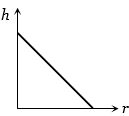
B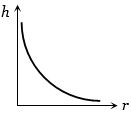
C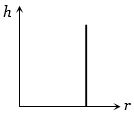
D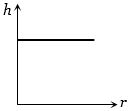
Solution
(B) The height or depression $h$ of a liquid in a capillary tube is given by the formula:
$h = \frac{2T \cos \theta}{rdg}$
where $T$ is the surface tension,$\theta$ is the angle of contact,$d$ is the density of the liquid,$g$ is the acceleration due to gravity,and $r$ is the radius of the capillary tube.
From this formula,we can see that $h \propto \frac{1}{r}$.
This relationship represents a rectangular hyperbola. Therefore,the graph between $h$ and $r$ is a rectangular hyperbola,which corresponds to the curve shown in option $B$.
$h = \frac{2T \cos \theta}{rdg}$
where $T$ is the surface tension,$\theta$ is the angle of contact,$d$ is the density of the liquid,$g$ is the acceleration due to gravity,and $r$ is the radius of the capillary tube.
From this formula,we can see that $h \propto \frac{1}{r}$.
This relationship represents a rectangular hyperbola. Therefore,the graph between $h$ and $r$ is a rectangular hyperbola,which corresponds to the curve shown in option $B$.
0 likes
View Solution42
DifficultMCQ
Two capillary tubes of length $L$ and $2L$ and of radius $R$ and $2R$ are connected in series. The net rate of flow of fluid through them will be (given rate of flow through a single capillary,$X = \frac{\pi P R^4}{8 \eta L}$)
A
$\frac{8}{9}X$
B
$\frac{9}{8}X$
C
$\frac{5}{7}X$
D
$\frac{7}{5}X$
Solution
(A) The fluid resistance $R_f$ of a capillary tube is given by $R_f = \frac{8 \eta l}{\pi r^4}$.
For the first capillary,$R_1 = \frac{8 \eta L}{\pi R^4}$.
For the second capillary,$R_2 = \frac{8 \eta (2L)}{\pi (2R)^4} = \frac{16 \eta L}{\pi (16 R^4)} = \frac{\eta L}{\pi R^4} = \frac{1}{8} R_1$.
When connected in series,the equivalent resistance is $R_{eq} = R_1 + R_2 = R_1 + \frac{1}{8} R_1 = \frac{9}{8} R_1$.
The rate of flow $Q$ is given by $Q = \frac{P}{R_{eq}}$.
Since $X = \frac{P}{R_1}$,the new rate of flow $Q = \frac{P}{\frac{9}{8} R_1} = \frac{8}{9} \left( \frac{P}{R_1} \right) = \frac{8}{9} X$.
For the first capillary,$R_1 = \frac{8 \eta L}{\pi R^4}$.
For the second capillary,$R_2 = \frac{8 \eta (2L)}{\pi (2R)^4} = \frac{16 \eta L}{\pi (16 R^4)} = \frac{\eta L}{\pi R^4} = \frac{1}{8} R_1$.
When connected in series,the equivalent resistance is $R_{eq} = R_1 + R_2 = R_1 + \frac{1}{8} R_1 = \frac{9}{8} R_1$.
The rate of flow $Q$ is given by $Q = \frac{P}{R_{eq}}$.
Since $X = \frac{P}{R_1}$,the new rate of flow $Q = \frac{P}{\frac{9}{8} R_1} = \frac{8}{9} \left( \frac{P}{R_1} \right) = \frac{8}{9} X$.
0 likes
View Solution43
MediumMCQ
When a capillary tube is dipped vertically in water,the water rises to a height of $2.0 \, cm$. If the capillary tube is tilted at an angle of $60^\circ$ with the vertical,what will be the length of the water column in the capillary tube in $cm$?
A
$2$
B
$4$
C
$\frac{4}{\sqrt{3}}$
D
$2\sqrt{2}$
Solution
(B) The height of the water column in a vertical capillary tube is given by $h = \frac{2T \cos \theta}{r \rho g} = 2.0 \, cm$.
When the capillary tube is tilted at an angle $\alpha = 60^\circ$ with the vertical,the vertical height $h$ remains constant because it depends on the pressure balance at the meniscus.
If $l$ is the length of the water column along the tube,then $h = l \cos \alpha$.
Therefore,$l = \frac{h}{\cos \alpha} = \frac{2.0 \, cm}{\cos 60^\circ}$.
Since $\cos 60^\circ = 0.5$,we get $l = \frac{2.0}{0.5} = 4.0 \, cm$.
When the capillary tube is tilted at an angle $\alpha = 60^\circ$ with the vertical,the vertical height $h$ remains constant because it depends on the pressure balance at the meniscus.
If $l$ is the length of the water column along the tube,then $h = l \cos \alpha$.
Therefore,$l = \frac{h}{\cos \alpha} = \frac{2.0 \, cm}{\cos 60^\circ}$.
Since $\cos 60^\circ = 0.5$,we get $l = \frac{2.0}{0.5} = 4.0 \, cm$.
0 likes
View Solution44
DifficultMCQ
When a capillary tube is dipped into two liquids having relative densities $0.8$ and $0.6$ and surface tensions $60 \, dyne/cm$ and $50 \, dyne/cm$ respectively,the ratio of the heights of the liquids in the capillary tube $\frac{h_1}{h_2}$ is:
A
$\frac{10}{9}$
B
$\frac{3}{10}$
C
$\frac{10}{3}$
D
$\frac{9}{10}$
Solution
(D) The height of a liquid in a capillary tube is given by the formula $h = \frac{2T \cos \theta}{rdg}$,where $T$ is surface tension,$r$ is the radius of the tube,$d$ is the density,and $g$ is the acceleration due to gravity.
Assuming the contact angle $\theta$ and the radius $r$ are the same for both liquids,the ratio of heights is given by:
$\frac{h_1}{h_2} = \left( \frac{T_1}{T_2} \right) \times \left( \frac{d_2}{d_1} \right)$
Given $T_1 = 60 \, dyne/cm$,$T_2 = 50 \, dyne/cm$,$d_1 = 0.8 \, g/cm^3$,and $d_2 = 0.6 \, g/cm^3$:
$\frac{h_1}{h_2} = \left( \frac{60}{50} \right) \times \left( \frac{0.6}{0.8} \right)$
$\frac{h_1}{h_2} = \left( \frac{6}{5} \right) \times \left( \frac{6}{8} \right) = \frac{36}{40} = \frac{9}{10}$.
Assuming the contact angle $\theta$ and the radius $r$ are the same for both liquids,the ratio of heights is given by:
$\frac{h_1}{h_2} = \left( \frac{T_1}{T_2} \right) \times \left( \frac{d_2}{d_1} \right)$
Given $T_1 = 60 \, dyne/cm$,$T_2 = 50 \, dyne/cm$,$d_1 = 0.8 \, g/cm^3$,and $d_2 = 0.6 \, g/cm^3$:
$\frac{h_1}{h_2} = \left( \frac{60}{50} \right) \times \left( \frac{0.6}{0.8} \right)$
$\frac{h_1}{h_2} = \left( \frac{6}{5} \right) \times \left( \frac{6}{8} \right) = \frac{36}{40} = \frac{9}{10}$.
0 likes
View Solution45
MediumMCQ
$A$ capillary tube of radius $R$ is dipped in water,and water rises to a height $H$. The mass of water in the capillary tube is $M$. If a capillary tube of half the radius is dipped in water,what will be the mass of the water in the capillary tube?
A
$M$
B
$M/2$
C
$2M$
D
$4M$
Solution
(B) The mass of water in a capillary tube is given by $M = V \rho = (\pi R^2 H) \rho$.
We know that the height of the water column in a capillary tube is inversely proportional to the radius,i.e.,$H \propto \frac{1}{R}$.
Substituting this into the mass equation: $M \propto R^2 \times (\frac{1}{R}) = R$.
Therefore,$M \propto R$.
If the radius is halved $(R' = R/2)$,the new mass $M'$ will be $M' = M \times (R'/R) = M \times (1/2) = M/2$.
We know that the height of the water column in a capillary tube is inversely proportional to the radius,i.e.,$H \propto \frac{1}{R}$.
Substituting this into the mass equation: $M \propto R^2 \times (\frac{1}{R}) = R$.
Therefore,$M \propto R$.
If the radius is halved $(R' = R/2)$,the new mass $M'$ will be $M' = M \times (R'/R) = M \times (1/2) = M/2$.
0 likes
View Solution46
EasyMCQ
Two capillary tubes made of the same material are dipped in the same liquid. If the heights of the liquid in the tubes are $2.2 \ cm$ and $6.6 \ cm$ respectively,what is the ratio of their radii?
A
$9:1$
B
$1:9$
C
$3:1$
D
$1:3$
Solution
(C) The height of a liquid column in a capillary tube is given by the formula $h = \frac{2T \cos \theta}{r \rho g}$.
Since the material of the tubes and the liquid are the same,the surface tension $T$,contact angle $\theta$,density $\rho$,and acceleration due to gravity $g$ are constant.
Therefore,$h \propto \frac{1}{r}$,which implies $h_1 r_1 = h_2 r_2$.
The ratio of the radii is given by $\frac{r_1}{r_2} = \frac{h_2}{h_1}$.
Given $h_1 = 2.2 \ cm$ and $h_2 = 6.6 \ cm$,we have $\frac{r_1}{r_2} = \frac{6.6}{2.2} = \frac{3}{1}$.
Thus,the ratio of the radii is $3:1$.
Since the material of the tubes and the liquid are the same,the surface tension $T$,contact angle $\theta$,density $\rho$,and acceleration due to gravity $g$ are constant.
Therefore,$h \propto \frac{1}{r}$,which implies $h_1 r_1 = h_2 r_2$.
The ratio of the radii is given by $\frac{r_1}{r_2} = \frac{h_2}{h_1}$.
Given $h_1 = 2.2 \ cm$ and $h_2 = 6.6 \ cm$,we have $\frac{r_1}{r_2} = \frac{6.6}{2.2} = \frac{3}{1}$.
Thus,the ratio of the radii is $3:1$.
0 likes
View Solution47
MediumMCQ
$A$ capillary tube is placed at angles of $30^o$ and $60^o$ with the vertical. What is the ratio of the length of the liquid column in the capillary tube?
A
$1:\sqrt{3}$
B
$1:\sqrt{2}$
C
$\sqrt{2}:1$
D
$\sqrt{3}:1$
Solution
(A) The vertical height $h$ of the liquid column in a capillary tube remains constant regardless of the inclination of the tube.
If the tube is inclined at an angle $\alpha$ with the vertical,the length $l$ of the liquid column along the tube is given by $l = \frac{h}{\cos \alpha}$.
For the two given angles $\alpha_1 = 30^o$ and $\alpha_2 = 60^o$,the lengths are $l_1 = \frac{h}{\cos 30^o}$ and $l_2 = \frac{h}{\cos 60^o}$.
The ratio of the lengths is $\frac{l_1}{l_2} = \frac{\cos 60^o}{\cos 30^o}$.
Substituting the values: $\frac{l_1}{l_2} = \frac{1/2}{\sqrt{3}/2} = \frac{1}{\sqrt{3}}$.
Therefore,the ratio is $1:\sqrt{3}$.
If the tube is inclined at an angle $\alpha$ with the vertical,the length $l$ of the liquid column along the tube is given by $l = \frac{h}{\cos \alpha}$.
For the two given angles $\alpha_1 = 30^o$ and $\alpha_2 = 60^o$,the lengths are $l_1 = \frac{h}{\cos 30^o}$ and $l_2 = \frac{h}{\cos 60^o}$.
The ratio of the lengths is $\frac{l_1}{l_2} = \frac{\cos 60^o}{\cos 30^o}$.
Substituting the values: $\frac{l_1}{l_2} = \frac{1/2}{\sqrt{3}/2} = \frac{1}{\sqrt{3}}$.
Therefore,the ratio is $1:\sqrt{3}$.
0 likes
View Solution48
EasyMCQ
Water rises to a height $h$ in a capillary tube. If the length of the capillary tube above the surface of water is made less than $h,$ then
A
water does not rise at all.
B
water rises up to the tip of the capillary tube and then starts overflowing like a fountain.
C
water rises up to the top of the capillary tube and stays there without overflowing.
D
water rises up to a point a little below the top and stays there.
Solution
(C) The height to which water rises in a capillary tube is given by $h = \frac{2T \cos \theta}{r \rho g}$.
If the actual length of the tube $L$ is less than the equilibrium height $h$,the water will rise to the top of the tube.
At the top,the radius of curvature $R$ of the meniscus will adjust such that $h' = \frac{2T \cos \theta'}{R \rho g} = L$,where $h' < h$.
Since the pressure at the top remains balanced by the surface tension,the water will not overflow but will stay at the top of the tube with a modified radius of curvature.
If the actual length of the tube $L$ is less than the equilibrium height $h$,the water will rise to the top of the tube.
At the top,the radius of curvature $R$ of the meniscus will adjust such that $h' = \frac{2T \cos \theta'}{R \rho g} = L$,where $h' < h$.
Since the pressure at the top remains balanced by the surface tension,the water will not overflow but will stay at the top of the tube with a modified radius of curvature.
0 likes
View Solution49
MediumMCQ
Three liquids of densities $\rho_1, \rho_2$ and $\rho_3$ (with $\rho_1 > \rho_2 > \rho_3$),having the same value of surface tension $T$,rise to the same height in three identical capillaries. The angles of contact $\theta_1, \theta_2$ and $\theta_3$ obey:
A
$\frac{\pi}{2} < \theta_1 < \theta_2 < \theta_3 < \pi$
B
$\pi > \theta_1 > \theta_2 > \theta_3 > \frac{\pi}{2}$
C
$\frac{\pi}{2} > \theta_1 > \theta_2 > \theta_3 > 0$
D
$0 \le \theta_1 < \theta_2 < \theta_3 < \frac{\pi}{2}$
Solution
(D) The height of capillary rise is given by $h = \frac{2T \cos \theta}{r \rho g}$.
For a given value of $T$ and $r$,we have $h \propto \frac{\cos \theta}{\rho}$.
Since the liquids rise to the same height $(h_1 = h_2 = h_3)$,we have $\frac{\cos \theta_1}{\rho_1} = \frac{\cos \theta_2}{\rho_2} = \frac{\cos \theta_3}{\rho_3}$.
Given $\rho_1 > \rho_2 > \rho_3$,it follows that $\cos \theta_1 > \cos \theta_2 > \cos \theta_3$.
Since the cosine function is a decreasing function in the interval $[0, \frac{\pi}{2}]$,we have $\theta_1 < \theta_2 < \theta_3$.
Therefore,$0 \le \theta_1 < \theta_2 < \theta_3 < \frac{\pi}{2}$.
For a given value of $T$ and $r$,we have $h \propto \frac{\cos \theta}{\rho}$.
Since the liquids rise to the same height $(h_1 = h_2 = h_3)$,we have $\frac{\cos \theta_1}{\rho_1} = \frac{\cos \theta_2}{\rho_2} = \frac{\cos \theta_3}{\rho_3}$.
Given $\rho_1 > \rho_2 > \rho_3$,it follows that $\cos \theta_1 > \cos \theta_2 > \cos \theta_3$.
Since the cosine function is a decreasing function in the interval $[0, \frac{\pi}{2}]$,we have $\theta_1 < \theta_2 < \theta_3$.
Therefore,$0 \le \theta_1 < \theta_2 < \theta_3 < \frac{\pi}{2}$.
0 likes
View SolutionFluid Mechanics and Surface Tension — Capillary Tube and Capillarity · Frequently Asked Questions
1Are these Fluid Mechanics and Surface Tension questions useful for JEE and NEET?
Yes. All questions in this section are mapped to JEE Main and NEET exam patterns. Previous year questions from JEE Main, NEET, GUJCET and state-level exams are included with full solutions.
2Can I switch to Hindi or Gujarati for these questions?
Yes. Use the language tabs in the hero section or the sidebar to view the same questions and solutions in English, Hindi or Gujarati.
3How do I generate a question paper from this subtopic?
Use the Vedclass Exam Paper Generator — select the chapter and subtopic, set difficulty, and generate Sets A, B, C, D automatically. First 3 chapters of every subject are free.
Vedclass Products
For Students
Vedclass Test Series
Mock tests in real JEE/NEET style with performance analysis. 5-day free trial.
Start Free TrialFor Teachers
Exam Paper Generator
Generate Set A/B/C/D papers from this chapter in 2 minutes. 3 chapters free.
Try FreeFor Institutes
Online Exam Module
Live online exams with unlimited students, 360° analytics & white-label branding.
See DemoFor Teachers & Institutes
Generate a Fluid Mechanics and Surface Tension Exam Paper in 2 Minutes
Select subtopic & difficulty — Sets A, B, C, D auto-generated with No Repeat logic.
First 3 chapters of every subject are free — no payment required.