
अ Hindi
Solution of trigonometrical equations Questions in Hindi
Class 11 Mathematics · Trigonometrical Equations · Solution of trigonometrical equations
379+
Questions
Hindi
Language
100%
With Solutions
Showing 49 of 379 questions in Hindi
251
MediumMCQ
यदि $3 \cos x \neq 2 \sin x$ है,तो $\sin ^{2} x-\cos 2 x=2-\sin 2 x$ का व्यापक हल है
A
$x=n \pi+\frac{\pi}{2}, \quad n \in Z$
B
$x=n\left(\frac{\pi}{2}\right)+\pi, \quad n \in Z$
C
$x=n\left(\frac{\pi}{2}\right)+\frac{\pi}{3}, \quad n \in Z$
D
$x=(2 n+1) \pi, \quad n \in Z$
Solution
(A) दिया गया समीकरण: $\sin ^{2} x - \cos 2 x = 2 - \sin 2 x$
सर्वसमिका $\cos 2 x = 1 - 2 \sin ^{2} x$ का उपयोग करने पर:
$\sin ^{2} x - (1 - 2 \sin ^{2} x) = 2 - \sin 2 x$
$3 \sin ^{2} x - 1 = 2 - \sin 2 x$
$3 \sin ^{2} x + \sin 2 x - 3 = 0$
चूँकि $\sin 2 x = 2 \sin x \cos x$ और $1 = \sin ^{2} x + \cos ^{2} x$,हम $3 = 3(\sin ^{2} x + \cos ^{2} x)$ लिख सकते हैं:
$3 \sin ^{2} x + 2 \sin x \cos x - 3(\sin ^{2} x + \cos ^{2} x) = 0$
$2 \sin x \cos x - 3 \cos ^{2} x = 0$
$\cos x (2 \sin x - 3 \cos x) = 0$
इसका अर्थ है $\cos x = 0$ या $2 \sin x = 3 \cos x$।
शर्त $3 \cos x \neq 2 \sin x$ के अनुसार,$\cos x = 0$ होना चाहिए।
$\cos x = 0$ का व्यापक हल $x = n \pi + \frac{\pi}{2}, n \in Z$ है।
सर्वसमिका $\cos 2 x = 1 - 2 \sin ^{2} x$ का उपयोग करने पर:
$\sin ^{2} x - (1 - 2 \sin ^{2} x) = 2 - \sin 2 x$
$3 \sin ^{2} x - 1 = 2 - \sin 2 x$
$3 \sin ^{2} x + \sin 2 x - 3 = 0$
चूँकि $\sin 2 x = 2 \sin x \cos x$ और $1 = \sin ^{2} x + \cos ^{2} x$,हम $3 = 3(\sin ^{2} x + \cos ^{2} x)$ लिख सकते हैं:
$3 \sin ^{2} x + 2 \sin x \cos x - 3(\sin ^{2} x + \cos ^{2} x) = 0$
$2 \sin x \cos x - 3 \cos ^{2} x = 0$
$\cos x (2 \sin x - 3 \cos x) = 0$
इसका अर्थ है $\cos x = 0$ या $2 \sin x = 3 \cos x$।
शर्त $3 \cos x \neq 2 \sin x$ के अनुसार,$\cos x = 0$ होना चाहिए।
$\cos x = 0$ का व्यापक हल $x = n \pi + \frac{\pi}{2}, n \in Z$ है।
0 likes
View Solution252
MediumMCQ
$\tan \theta + \tan 2\theta = \tan 3\theta$ का व्यापक हल है
A
$\theta = (2n + 1) \frac{\pi}{2}, n \in \mathbb{Z}$
B
$\theta = n\pi, n \in \mathbb{Z}$ या $\theta = \frac{p\pi}{3}, p \in \mathbb{Z}$
C
$\theta = \frac{n\pi}{5}, n \in \mathbb{Z}$
D
$\theta = (2n - 1) \frac{\pi}{3}, n \in \mathbb{Z}$
Solution
(B) दिया गया समीकरण: $\tan \theta + \tan 2\theta = \tan 3\theta$.
सर्वसमिका $\tan 3\theta = \tan(2\theta + \theta) = \frac{\tan 2\theta + \tan \theta}{1 - \tan 2\theta \tan \theta}$ का उपयोग करने पर।
इसे समीकरण में रखने पर: $\tan \theta + \tan 2\theta = \frac{\tan 2\theta + \tan \theta}{1 - \tan 2\theta \tan \theta}$.
इसका अर्थ है $(\tan \theta + \tan 2\theta) \left(1 - \frac{1}{1 - \tan 2\theta \tan \theta}\right) = 0$.
स्थिति $1$: $\tan \theta + \tan 2\theta = 0$ $\Rightarrow \frac{\sin 3\theta}{\cos \theta \cos 2\theta} = 0$ $\Rightarrow 3\theta = n\pi$ $\Rightarrow \theta = \frac{n\pi}{3}$.
स्थिति $2$: $1 - \tan 2\theta \tan \theta = 1 \Rightarrow \tan 2\theta \tan \theta = 0$.
इसका मतलब है $\tan \theta = 0$ या $\tan 2\theta = 0$.
यदि $\tan \theta = 0$,तो $\theta = n\pi$.
यदि $\tan 2\theta = 0$,तो $2\theta = k\pi \Rightarrow \theta = \frac{k\pi}{2}$.
अतः,व्यापक हल $\theta = n\pi$ या $\theta = \frac{p\pi}{3}$ है।
सर्वसमिका $\tan 3\theta = \tan(2\theta + \theta) = \frac{\tan 2\theta + \tan \theta}{1 - \tan 2\theta \tan \theta}$ का उपयोग करने पर।
इसे समीकरण में रखने पर: $\tan \theta + \tan 2\theta = \frac{\tan 2\theta + \tan \theta}{1 - \tan 2\theta \tan \theta}$.
इसका अर्थ है $(\tan \theta + \tan 2\theta) \left(1 - \frac{1}{1 - \tan 2\theta \tan \theta}\right) = 0$.
स्थिति $1$: $\tan \theta + \tan 2\theta = 0$ $\Rightarrow \frac{\sin 3\theta}{\cos \theta \cos 2\theta} = 0$ $\Rightarrow 3\theta = n\pi$ $\Rightarrow \theta = \frac{n\pi}{3}$.
स्थिति $2$: $1 - \tan 2\theta \tan \theta = 1 \Rightarrow \tan 2\theta \tan \theta = 0$.
इसका मतलब है $\tan \theta = 0$ या $\tan 2\theta = 0$.
यदि $\tan \theta = 0$,तो $\theta = n\pi$.
यदि $\tan 2\theta = 0$,तो $2\theta = k\pi \Rightarrow \theta = \frac{k\pi}{2}$.
अतः,व्यापक हल $\theta = n\pi$ या $\theta = \frac{p\pi}{3}$ है।
0 likes
View Solution253
MediumMCQ
$\sin^{2} x \cdot \sec x = \tan x - \sin x + 1$ का व्यापक हल है
A
$x = n \pi + (-1)^{n} \frac{\pi}{4}$ या $x = m \pi + \frac{3 \pi}{4}; m, n \in \mathbb{Z}$
B
$x = n \pi + (-1)^{n} \frac{\pi}{2}$ या $x = m \pi + \frac{3 \pi}{4}; m, n \in \mathbb{Z}$
C
$x = n \pi + (-1)^{n} \frac{\pi}{2}$ या $x = m \pi + \frac{5 \pi}{4}; m, n \in \mathbb{Z}$
D
$x = n \pi + (-1)^{n} \frac{\pi}{4}$ या $x = m \pi + \frac{5 \pi}{4}; m, n \in \mathbb{Z}$
Solution
(B) दिया गया समीकरण: $\sin^{2} x \sec x = \tan x - \sin x + 1$
$\cos x$ से गुणा करने पर $(\cos x \neq 0)$:
$\sin^{2} x = \sin x - \sin x \cos x + \cos x$
$\sin^{2} x - \sin x + \sin x \cos x - \cos x = 0$
$\sin x(\sin x - 1) + \cos x(\sin x - 1) = 0$
$(\sin x + \cos x)(\sin x - 1) = 0$
स्थिति $1$: $\sin x = 1 \implies x = 2n \pi + \frac{\pi}{2} = n \pi + (-1)^{n} \frac{\pi}{2}$ ($n \in \mathbb{Z}$ के लिए).
स्थिति $2$: $\sin x + \cos x = 0 \implies \tan x = -1 \implies x = m \pi - \frac{\pi}{4} = m \pi + \frac{3 \pi}{4}$ ($m \in \mathbb{Z}$ के लिए).
अतः,व्यापक हल $x = n \pi + (-1)^{n} \frac{\pi}{2}$ या $x = m \pi + \frac{3 \pi}{4}$ है।
$\cos x$ से गुणा करने पर $(\cos x \neq 0)$:
$\sin^{2} x = \sin x - \sin x \cos x + \cos x$
$\sin^{2} x - \sin x + \sin x \cos x - \cos x = 0$
$\sin x(\sin x - 1) + \cos x(\sin x - 1) = 0$
$(\sin x + \cos x)(\sin x - 1) = 0$
स्थिति $1$: $\sin x = 1 \implies x = 2n \pi + \frac{\pi}{2} = n \pi + (-1)^{n} \frac{\pi}{2}$ ($n \in \mathbb{Z}$ के लिए).
स्थिति $2$: $\sin x + \cos x = 0 \implies \tan x = -1 \implies x = m \pi - \frac{\pi}{4} = m \pi + \frac{3 \pi}{4}$ ($m \in \mathbb{Z}$ के लिए).
अतः,व्यापक हल $x = n \pi + (-1)^{n} \frac{\pi}{2}$ या $x = m \pi + \frac{3 \pi}{4}$ है।
0 likes
View Solution254
EasyMCQ
यदि $2 \cos^{2} \theta + 3 \cos \theta = 2$ है,तो $\cos \theta$ का अनुमेय (permissible) मान क्या है?
A
$0$
B
$1$
C
$\frac{1}{2}$
D
$-\frac{1}{2}$
Solution
(C) दिया गया समीकरण: $2 \cos^{2} \theta + 3 \cos \theta = 2$
पदों को पुनर्व्यवस्थित करने पर: $2 \cos^{2} \theta + 3 \cos \theta - 2 = 0$
द्विघात समीकरण का गुणनखंड करने पर: $2 \cos^{2} \theta + 4 \cos \theta - \cos \theta - 2 = 0$
$2 \cos \theta(\cos \theta + 2) - 1(\cos \theta + 2) = 0$
$(2 \cos \theta - 1)(\cos \theta + 2) = 0$
इससे दो संभावित मान प्राप्त होते हैं: $\cos \theta = \frac{1}{2}$ या $\cos \theta = -2$
चूंकि कोसाइन फलन का परिसर $[-1, 1]$ होता है,इसलिए $\cos \theta = -2$ संभव नहीं है।
अतः,अनुमेय मान $\cos \theta = \frac{1}{2}$ है।
पदों को पुनर्व्यवस्थित करने पर: $2 \cos^{2} \theta + 3 \cos \theta - 2 = 0$
द्विघात समीकरण का गुणनखंड करने पर: $2 \cos^{2} \theta + 4 \cos \theta - \cos \theta - 2 = 0$
$2 \cos \theta(\cos \theta + 2) - 1(\cos \theta + 2) = 0$
$(2 \cos \theta - 1)(\cos \theta + 2) = 0$
इससे दो संभावित मान प्राप्त होते हैं: $\cos \theta = \frac{1}{2}$ या $\cos \theta = -2$
चूंकि कोसाइन फलन का परिसर $[-1, 1]$ होता है,इसलिए $\cos \theta = -2$ संभव नहीं है।
अतः,अनुमेय मान $\cos \theta = \frac{1}{2}$ है।
0 likes
View Solution255
MediumMCQ
अंतराल $[0, \pi]$ में $\sin^2 \theta = \frac{1}{2}$ के हलों की संख्या . . . . . . है।
A
तीन
B
चार
C
दो
D
एक
Solution
(C) दिया गया समीकरण: $\sin^2 \theta = \frac{1}{2}$ है।
दोनों पक्षों का वर्गमूल लेने पर,हमें $\sin \theta = \pm \frac{1}{\sqrt{2}}$ प्राप्त होता है।
चूंकि $\theta \in [0, \pi]$ है,इस अंतराल में साइन फलन का मान ऋणात्मक नहीं हो सकता है।
इसलिए,$\sin \theta = \frac{1}{\sqrt{2}}$ होगा।
अंतराल $[0, \pi]$ में $\sin \theta = \frac{1}{\sqrt{2}}$ को संतुष्ट करने वाले $\theta$ के मान $\theta = \frac{\pi}{4}$ और $\theta = \frac{3\pi}{4}$ हैं।
अतः,कुल $2$ हल हैं।
दोनों पक्षों का वर्गमूल लेने पर,हमें $\sin \theta = \pm \frac{1}{\sqrt{2}}$ प्राप्त होता है।
चूंकि $\theta \in [0, \pi]$ है,इस अंतराल में साइन फलन का मान ऋणात्मक नहीं हो सकता है।
इसलिए,$\sin \theta = \frac{1}{\sqrt{2}}$ होगा।
अंतराल $[0, \pi]$ में $\sin \theta = \frac{1}{\sqrt{2}}$ को संतुष्ट करने वाले $\theta$ के मान $\theta = \frac{\pi}{4}$ और $\theta = \frac{3\pi}{4}$ हैं।
अतः,कुल $2$ हल हैं।
0 likes
View Solution256
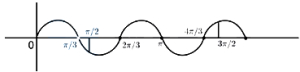
DifficultMCQ
अंतराल $\left[\frac{\pi}{2}, \frac{3\pi}{2}\right]$ में $\sin x + \sin 3x + \sin 5x = 0$ के हलों की संख्या क्या है?
A
$2$
B
$3$
C
$4$
D
$5$
Solution
(B) दिया गया समीकरण: $\sin x + \sin 3x + \sin 5x = 0$
पदों को समूहित करने पर: $(\sin 5x + \sin x) + \sin 3x = 0$
$\sin C + \sin D = 2 \sin \left(\frac{C+D}{2}\right) \cos \left(\frac{C-D}{2}\right)$ का उपयोग करने पर:
$2 \sin 3x \cos 2x + \sin 3x = 0$
$\sin 3x (2 \cos 2x + 1) = 0$
इसका अर्थ है $\sin 3x = 0$ या $\cos 2x = -\frac{1}{2}$।
स्थिति $1$: $\sin 3x = 0 \implies 3x = n\pi \implies x = \frac{n\pi}{3}$।
$x \in \left[\frac{\pi}{2}, \frac{3\pi}{2}\right]$ के लिए,संभावित मान $x = \frac{2\pi}{3}, \pi, \frac{4\pi}{3}$ हैं।
स्थिति $2$: $\cos 2x = -\frac{1}{2} \implies 2x = 2n\pi \pm \frac{2\pi}{3} \implies x = n\pi \pm \frac{\pi}{3}$।
$x \in \left[\frac{\pi}{2}, \frac{3\pi}{2}\right]$ के लिए,संभावित मान $x = \frac{2\pi}{3}, \frac{4\pi}{3}$ हैं।
दोनों स्थितियों को मिलाने पर,अलग-अलग हल $x = \frac{2\pi}{3}, \pi, \frac{4\pi}{3}$ हैं।
अतः,हलों की कुल संख्या $3$ है।
पदों को समूहित करने पर: $(\sin 5x + \sin x) + \sin 3x = 0$
$\sin C + \sin D = 2 \sin \left(\frac{C+D}{2}\right) \cos \left(\frac{C-D}{2}\right)$ का उपयोग करने पर:
$2 \sin 3x \cos 2x + \sin 3x = 0$
$\sin 3x (2 \cos 2x + 1) = 0$
इसका अर्थ है $\sin 3x = 0$ या $\cos 2x = -\frac{1}{2}$।
स्थिति $1$: $\sin 3x = 0 \implies 3x = n\pi \implies x = \frac{n\pi}{3}$।
$x \in \left[\frac{\pi}{2}, \frac{3\pi}{2}\right]$ के लिए,संभावित मान $x = \frac{2\pi}{3}, \pi, \frac{4\pi}{3}$ हैं।
स्थिति $2$: $\cos 2x = -\frac{1}{2} \implies 2x = 2n\pi \pm \frac{2\pi}{3} \implies x = n\pi \pm \frac{\pi}{3}$।
$x \in \left[\frac{\pi}{2}, \frac{3\pi}{2}\right]$ के लिए,संभावित मान $x = \frac{2\pi}{3}, \frac{4\pi}{3}$ हैं।
दोनों स्थितियों को मिलाने पर,अलग-अलग हल $x = \frac{2\pi}{3}, \pi, \frac{4\pi}{3}$ हैं।
अतः,हलों की कुल संख्या $3$ है।
0 likes
View Solution257
EasyMCQ
$\tan 2\theta = 1$ के मुख्य हलों (principal solutions) की संख्या है
A
एक
B
दो
C
तीन
D
चार
Solution
(D) दिया गया समीकरण $\tan 2\theta = 1$ है।
चूंकि $\tan 2\theta$ धनात्मक है,इसलिए $2\theta$ प्रथम या तृतीय चतुर्थांश में स्थित है।
मुख्य हलों के लिए,हम $0 \le \theta < 2\pi$ पर विचार करते हैं,जिसका अर्थ है $0 \le 2\theta < 4\pi$।
अतः,$2\theta = \frac{\pi}{4}, \frac{5\pi}{4}, \frac{9\pi}{4}, \frac{13\pi}{4}$।
$2$ से भाग देने पर,हमें $\theta = \frac{\pi}{8}, \frac{5\pi}{8}, \frac{9\pi}{8}, \frac{13\pi}{8}$ प्राप्त होता है।
अतः,यहाँ $4$ मुख्य हल मौजूद हैं।
चूंकि $\tan 2\theta$ धनात्मक है,इसलिए $2\theta$ प्रथम या तृतीय चतुर्थांश में स्थित है।
मुख्य हलों के लिए,हम $0 \le \theta < 2\pi$ पर विचार करते हैं,जिसका अर्थ है $0 \le 2\theta < 4\pi$।
अतः,$2\theta = \frac{\pi}{4}, \frac{5\pi}{4}, \frac{9\pi}{4}, \frac{13\pi}{4}$।
$2$ से भाग देने पर,हमें $\theta = \frac{\pi}{8}, \frac{5\pi}{8}, \frac{9\pi}{8}, \frac{13\pi}{8}$ प्राप्त होता है।
अतः,यहाँ $4$ मुख्य हल मौजूद हैं।
0 likes
View Solution258
EasyMCQ
समीकरण $\tan^2 x = 1$ का व्यापक हल है
A
$n \pi + \frac{\pi}{4}$
B
$n \pi - \frac{\pi}{4}$
C
$n \pi \pm \frac{\pi}{4}$
D
$2 n \pi \pm \frac{\pi}{4}$
Solution
(C) दिया गया समीकरण $\tan^2 x = 1$ है।
दोनों पक्षों का वर्गमूल लेने पर,$\tan x = \pm 1$ प्राप्त होता है।
हम जानते हैं कि $\tan x = \tan \alpha$ का अर्थ है $x = n \pi + \alpha$।
$\tan x = 1$ के लिए,$x = n \pi + \frac{\pi}{4}$।
$\tan x = -1$ के लिए,$x = n \pi - \frac{\pi}{4}$।
इन दोनों परिणामों को मिलाने पर,व्यापक हल $x = n \pi \pm \frac{\pi}{4}$ है,जहाँ $n \in \mathbb{Z}$।
दोनों पक्षों का वर्गमूल लेने पर,$\tan x = \pm 1$ प्राप्त होता है।
हम जानते हैं कि $\tan x = \tan \alpha$ का अर्थ है $x = n \pi + \alpha$।
$\tan x = 1$ के लिए,$x = n \pi + \frac{\pi}{4}$।
$\tan x = -1$ के लिए,$x = n \pi - \frac{\pi}{4}$।
इन दोनों परिणामों को मिलाने पर,व्यापक हल $x = n \pi \pm \frac{\pi}{4}$ है,जहाँ $n \in \mathbb{Z}$।
0 likes
View Solution259
MediumMCQ
समीकरण $\sin 2x + \cos 2x = 0$ के हल,जहाँ $\pi < x < 2\pi$ है,ज्ञात कीजिए।
A
$\frac{7\pi}{8}, \frac{11\pi}{8}$
B
$\frac{9\pi}{8}, \frac{13\pi}{8}$
C
$\frac{11\pi}{8}, \frac{15\pi}{8}$
D
$\frac{15\pi}{8}, \frac{19\pi}{8}$
Solution
(C) दिया गया समीकरण $\sin 2x + \cos 2x = 0$ है।
$\cos 2x$ से भाग देने पर,$\tan 2x = -1$ प्राप्त होता है।
चूँकि $\tan \theta = -1$ का अर्थ है $\theta = n\pi - \frac{\pi}{4}$,इसलिए $2x = n\pi - \frac{\pi}{4}$।
अतः,$x = \frac{n\pi}{2} - \frac{\pi}{8} = \frac{(4n - 1)\pi}{8}$।
$\pi < x < 2\pi$ के लिए:
यदि $n = 3$ है,तो $x = \frac{11\pi}{8}$।
यदि $n = 4$ है,तो $x = \frac{15\pi}{8}$।
दोनों मान $(\pi, 2\pi)$ अंतराल में स्थित हैं।
$\cos 2x$ से भाग देने पर,$\tan 2x = -1$ प्राप्त होता है।
चूँकि $\tan \theta = -1$ का अर्थ है $\theta = n\pi - \frac{\pi}{4}$,इसलिए $2x = n\pi - \frac{\pi}{4}$।
अतः,$x = \frac{n\pi}{2} - \frac{\pi}{8} = \frac{(4n - 1)\pi}{8}$।
$\pi < x < 2\pi$ के लिए:
यदि $n = 3$ है,तो $x = \frac{11\pi}{8}$।
यदि $n = 4$ है,तो $x = \frac{15\pi}{8}$।
दोनों मान $(\pi, 2\pi)$ अंतराल में स्थित हैं।
0 likes
View Solution260
DifficultMCQ
अंतराल $[0, 2 \pi]$ में समीकरण $\tan x + \sec x = 2 \cos x$ का हल समुच्चय क्या है?
A
$\left\{\frac{\pi}{6}, \frac{7 \pi}{6}, \frac{3 \pi}{2}\right\}$
B
$\left\{\frac{5 \pi}{6}, \frac{7 \pi}{6}, \frac{3 \pi}{2}\right\}$
C
$\left\{\frac{\pi}{6}, \frac{5 \pi}{6}, \frac{3 \pi}{2}\right\}$
D
$\left\{\frac{5 \pi}{6}, \frac{11 \pi}{6}, \frac{3 \pi}{2}\right\}$
Solution
(C) दिया गया समीकरण: $\tan x + \sec x = 2 \cos x$ जहाँ $x \in [0, 2 \pi]$ है।
चरण $1$: $\sec x = \frac{1}{\cos x}$ और $\tan x = \frac{\sin x}{\cos x}$ प्रतिस्थापित करने पर:
$\frac{\sin x + 1}{\cos x} = 2 \cos x$
चरण $2$: $\cos x$ से गुणा करने पर (जहाँ $\cos x \neq 0$):
$\sin x + 1 = 2 \cos^2 x$
चरण $3$: $\cos^2 x = 1 - \sin^2 x$ का उपयोग करने पर:
$\sin x + 1 = 2(1 - \sin^2 x) \implies 2 \sin^2 x + \sin x - 1 = 0$
चरण $4$: गुणनखंड करने पर:
$(2 \sin x - 1)(\sin x + 1) = 0$
$\sin x = \frac{1}{2}$ या $\sin x = -1$
चरण $5$: हल ज्ञात करने पर:
$\sin x = \frac{1}{2} \implies x = \frac{\pi}{6}, \frac{5 \pi}{6}$.
$\sin x = -1 \implies x = \frac{3 \pi}{2}$ (यहाँ $\tan x$ और $\sec x$ अपरिभाषित हैं)।
सही विकल्प $C$ है।
चरण $1$: $\sec x = \frac{1}{\cos x}$ और $\tan x = \frac{\sin x}{\cos x}$ प्रतिस्थापित करने पर:
$\frac{\sin x + 1}{\cos x} = 2 \cos x$
चरण $2$: $\cos x$ से गुणा करने पर (जहाँ $\cos x \neq 0$):
$\sin x + 1 = 2 \cos^2 x$
चरण $3$: $\cos^2 x = 1 - \sin^2 x$ का उपयोग करने पर:
$\sin x + 1 = 2(1 - \sin^2 x) \implies 2 \sin^2 x + \sin x - 1 = 0$
चरण $4$: गुणनखंड करने पर:
$(2 \sin x - 1)(\sin x + 1) = 0$
$\sin x = \frac{1}{2}$ या $\sin x = -1$
चरण $5$: हल ज्ञात करने पर:
$\sin x = \frac{1}{2} \implies x = \frac{\pi}{6}, \frac{5 \pi}{6}$.
$\sin x = -1 \implies x = \frac{3 \pi}{2}$ (यहाँ $\tan x$ और $\sec x$ अपरिभाषित हैं)।
सही विकल्प $C$ है।
0 likes
View Solution261
MediumMCQ
अंतराल $(0, 5 \pi)$ में समीकरण $3 \sin^2 x - 7 \sin x + 2 = 0$ को संतुष्ट करने वाले $x$ के मानों की संख्या ज्ञात कीजिए।
A
$0$
B
$5$
C
$6$
D
$10$
Solution
(C) दिया गया समीकरण: $3 \sin^2 x - 7 \sin x + 2 = 0$.
द्विघात समीकरण का गुणनखंड करने पर: $3 \sin^2 x - 6 \sin x - \sin x + 2 = 0$.
$3 \sin x(\sin x - 2) - 1(\sin x - 2) = 0$.
$(3 \sin x - 1)(\sin x - 2) = 0$.
इससे $\sin x = \frac{1}{3}$ या $\sin x = 2$ प्राप्त होता है।
चूंकि $\sin x$ का परिसर $[-1, 1]$ है,इसलिए $\sin x = 2$ संभव नहीं है।
अतः,हम $\sin x = \frac{1}{3}$ को हल करते हैं।
अंतराल $(0, 2 \pi)$ में $\sin x = \frac{1}{3}$ के लिए $2$ हल मिलते हैं।
अंतराल $(0, 4 \pi)$ में $2 \times 2 = 4$ हल मिलते हैं।
अंतराल $(4 \pi, 5 \pi)$ में $1$ हल मिलता है।
$(0, 5 \pi)$ में कुल हलों की संख्या $2 + 2 + 2 = 6$ है।
द्विघात समीकरण का गुणनखंड करने पर: $3 \sin^2 x - 6 \sin x - \sin x + 2 = 0$.
$3 \sin x(\sin x - 2) - 1(\sin x - 2) = 0$.
$(3 \sin x - 1)(\sin x - 2) = 0$.
इससे $\sin x = \frac{1}{3}$ या $\sin x = 2$ प्राप्त होता है।
चूंकि $\sin x$ का परिसर $[-1, 1]$ है,इसलिए $\sin x = 2$ संभव नहीं है।
अतः,हम $\sin x = \frac{1}{3}$ को हल करते हैं।
अंतराल $(0, 2 \pi)$ में $\sin x = \frac{1}{3}$ के लिए $2$ हल मिलते हैं।
अंतराल $(0, 4 \pi)$ में $2 \times 2 = 4$ हल मिलते हैं।
अंतराल $(4 \pi, 5 \pi)$ में $1$ हल मिलता है।
$(0, 5 \pi)$ में कुल हलों की संख्या $2 + 2 + 2 = 6$ है।
0 likes
View Solution262
EasyMCQ
यदि कोण $\theta$,$[0, 2\pi]$ में,दोनों समीकरणों $\cot \theta = \sqrt{3}$ और $\sqrt{3} \sec \theta + 2 = 0$ को संतुष्ट करता है,तो $\theta$ का मान क्या है?
A
$\frac{\pi}{6}$
B
$\frac{7 \pi}{6}$
C
$\frac{5 \pi}{6}$
D
$\frac{11 \pi}{6}$
Solution
(B) दिए गए समीकरण $\cot \theta = \sqrt{3}$ और $\sqrt{3} \sec \theta + 2 = 0$ हैं।
$\cot \theta = \sqrt{3}$ से,हमें $\tan \theta = \frac{1}{\sqrt{3}}$ प्राप्त होता है। इसका अर्थ है कि $\theta$ प्रथम या तृतीय चतुर्थांश में है।
$\sqrt{3} \sec \theta + 2 = 0$ से,हमें $\sec \theta = -\frac{2}{\sqrt{3}}$ प्राप्त होता है,जिसका अर्थ है $\cos \theta = -\frac{\sqrt{3}}{2}$।
चूंकि $\cos \theta$ ऋणात्मक है,इसलिए $\theta$ द्वितीय या तृतीय चतुर्थांश में होना चाहिए।
दोनों शर्तों को मिलाने पर,$\theta$ तृतीय चतुर्थांश में स्थित है।
तृतीय चतुर्थांश में,$\tan \theta = \frac{1}{\sqrt{3}}$ के लिए $\theta = \pi + \frac{\pi}{6} = \frac{7\pi}{6}$ है।
$\cot \theta = \sqrt{3}$ से,हमें $\tan \theta = \frac{1}{\sqrt{3}}$ प्राप्त होता है। इसका अर्थ है कि $\theta$ प्रथम या तृतीय चतुर्थांश में है।
$\sqrt{3} \sec \theta + 2 = 0$ से,हमें $\sec \theta = -\frac{2}{\sqrt{3}}$ प्राप्त होता है,जिसका अर्थ है $\cos \theta = -\frac{\sqrt{3}}{2}$।
चूंकि $\cos \theta$ ऋणात्मक है,इसलिए $\theta$ द्वितीय या तृतीय चतुर्थांश में होना चाहिए।
दोनों शर्तों को मिलाने पर,$\theta$ तृतीय चतुर्थांश में स्थित है।
तृतीय चतुर्थांश में,$\tan \theta = \frac{1}{\sqrt{3}}$ के लिए $\theta = \pi + \frac{\pi}{6} = \frac{7\pi}{6}$ है।
0 likes
View Solution263
EasyMCQ
अंतराल $(0, 2 \pi)$ में $\cos 2 \theta = \sin \theta$ के हलों की संख्या क्या है?
A
$3$
B
$2$
C
$4$
D
$1$
Solution
(A) दिया गया समीकरण: $\cos 2 \theta = \sin \theta$
सर्वसमिका $\cos 2 \theta = 1 - 2 \sin^2 \theta$ का उपयोग करने पर:
$1 - 2 \sin^2 \theta = \sin \theta$
$2 \sin^2 \theta + \sin \theta - 1 = 0$
द्विघात समीकरण का गुणनखंड करने पर:
$(2 \sin \theta - 1)(\sin \theta + 1) = 0$
इससे $\sin \theta = \frac{1}{2}$ या $\sin \theta = -1$ प्राप्त होता है।
$(0, 2 \pi)$ में $\sin \theta = \frac{1}{2}$ के लिए,$\theta = \frac{\pi}{6}$ और $\theta = \frac{5 \pi}{6}$ प्राप्त होते हैं।
$(0, 2 \pi)$ में $\sin \theta = -1$ के लिए,$\theta = \frac{3 \pi}{2}$ प्राप्त होता है।
अतः,हल $\frac{\pi}{6}, \frac{5 \pi}{6}, \frac{3 \pi}{2}$ हैं।
कुल हलों की संख्या $3$ है।
सर्वसमिका $\cos 2 \theta = 1 - 2 \sin^2 \theta$ का उपयोग करने पर:
$1 - 2 \sin^2 \theta = \sin \theta$
$2 \sin^2 \theta + \sin \theta - 1 = 0$
द्विघात समीकरण का गुणनखंड करने पर:
$(2 \sin \theta - 1)(\sin \theta + 1) = 0$
इससे $\sin \theta = \frac{1}{2}$ या $\sin \theta = -1$ प्राप्त होता है।
$(0, 2 \pi)$ में $\sin \theta = \frac{1}{2}$ के लिए,$\theta = \frac{\pi}{6}$ और $\theta = \frac{5 \pi}{6}$ प्राप्त होते हैं।
$(0, 2 \pi)$ में $\sin \theta = -1$ के लिए,$\theta = \frac{3 \pi}{2}$ प्राप्त होता है।
अतः,हल $\frac{\pi}{6}, \frac{5 \pi}{6}, \frac{3 \pi}{2}$ हैं।
कुल हलों की संख्या $3$ है।
0 likes
View Solution264
EasyMCQ
समीकरण $\sqrt{3} \sec x + 2 = 0$ के मुख्य हल हैं
A
$\frac{2 \pi}{3}, \frac{4 \pi}{3}$
B
$\frac{4 \pi}{3}, \frac{5 \pi}{3}$
C
$\frac{5 \pi}{6}, \frac{7 \pi}{6}$
D
$\frac{7 \pi}{6}, \frac{11 \pi}{6}$
Solution
(C) दिया गया समीकरण $\sqrt{3} \sec x + 2 = 0$ है।
$\sqrt{3} \sec x = -2$
$\sec x = -\frac{2}{\sqrt{3}}$
$\cos x = -\frac{\sqrt{3}}{2}$
चूंकि $\cos x$ दूसरे और तीसरे चतुर्थांश में ऋणात्मक होता है,हम $[0, 2\pi]$ में मान ज्ञात करते हैं।
दूसरे चतुर्थांश में: $x = \pi - \frac{\pi}{6} = \frac{5\pi}{6}$।
तीसरे चतुर्थांश में: $x = \pi + \frac{\pi}{6} = \frac{7\pi}{6}$।
अतः,मुख्य हल $\frac{5\pi}{6}$ और $\frac{7\pi}{6}$ हैं।
$\sqrt{3} \sec x = -2$
$\sec x = -\frac{2}{\sqrt{3}}$
$\cos x = -\frac{\sqrt{3}}{2}$
चूंकि $\cos x$ दूसरे और तीसरे चतुर्थांश में ऋणात्मक होता है,हम $[0, 2\pi]$ में मान ज्ञात करते हैं।
दूसरे चतुर्थांश में: $x = \pi - \frac{\pi}{6} = \frac{5\pi}{6}$।
तीसरे चतुर्थांश में: $x = \pi + \frac{\pi}{6} = \frac{7\pi}{6}$।
अतः,मुख्य हल $\frac{5\pi}{6}$ और $\frac{7\pi}{6}$ हैं।
0 likes
View Solution265
EasyMCQ
$(0, 2\pi)$ में,$\tan \theta + \sec \theta = 2 \cos \theta$ के हलों की संख्या क्या है?
A
$0$
B
$1$
C
$2$
D
$3$
Solution
(C) दिया गया समीकरण: $\tan \theta + \sec \theta = 2 \cos \theta$
$\Rightarrow \frac{\sin \theta}{\cos \theta} + \frac{1}{\cos \theta} = 2 \cos \theta$
$\Rightarrow \sin \theta + 1 = 2 \cos^2 \theta$
$\Rightarrow \sin \theta + 1 = 2(1 - \sin^2 \theta)$
$\Rightarrow 2 \sin^2 \theta + \sin \theta - 1 = 0$
$\Rightarrow (2 \sin \theta - 1)(\sin \theta + 1) = 0$
$\therefore \sin \theta = \frac{1}{2}$ या $\sin \theta = -1$
$\theta \in (0, 2\pi)$ के लिए:
यदि $\sin \theta = \frac{1}{2}$,तो $\theta = \frac{\pi}{6}, \frac{5\pi}{6}$।
यदि $\sin \theta = -1$,तो $\theta = \frac{3\pi}{2}$।
हालाँकि,$\theta = \frac{3\pi}{2}$ पर $\tan \theta$ और $\sec \theta$ अपरिभाषित हैं।
अतः,मान्य हल $\theta = \frac{\pi}{6}$ और $\theta = \frac{5\pi}{6}$ हैं।
इसलिए,हलों की संख्या $2$ है।
$\Rightarrow \frac{\sin \theta}{\cos \theta} + \frac{1}{\cos \theta} = 2 \cos \theta$
$\Rightarrow \sin \theta + 1 = 2 \cos^2 \theta$
$\Rightarrow \sin \theta + 1 = 2(1 - \sin^2 \theta)$
$\Rightarrow 2 \sin^2 \theta + \sin \theta - 1 = 0$
$\Rightarrow (2 \sin \theta - 1)(\sin \theta + 1) = 0$
$\therefore \sin \theta = \frac{1}{2}$ या $\sin \theta = -1$
$\theta \in (0, 2\pi)$ के लिए:
यदि $\sin \theta = \frac{1}{2}$,तो $\theta = \frac{\pi}{6}, \frac{5\pi}{6}$।
यदि $\sin \theta = -1$,तो $\theta = \frac{3\pi}{2}$।
हालाँकि,$\theta = \frac{3\pi}{2}$ पर $\tan \theta$ और $\sec \theta$ अपरिभाषित हैं।
अतः,मान्य हल $\theta = \frac{\pi}{6}$ और $\theta = \frac{5\pi}{6}$ हैं।
इसलिए,हलों की संख्या $2$ है।
0 likes
View Solution266
MediumMCQ
$[0, 2 \pi]$ में $\tan x + \sec x = 2 \cos x$ के हलों की संख्या क्या है?
A
$2$
B
$3$
C
$0$
D
$1$
Solution
(A) दिया गया समीकरण $x \neq \frac{\pi}{2}, \frac{3 \pi}{2}$ के लिए परिभाषित है।
दिया गया समीकरण: $\tan x + \sec x = 2 \cos x$
$\Rightarrow \frac{\sin x}{\cos x} + \frac{1}{\cos x} = 2 \cos x$
$\Rightarrow \frac{\sin x + 1}{\cos x} = 2 \cos x$
$\Rightarrow \sin x + 1 = 2 \cos^2 x$
$\Rightarrow \sin x + 1 = 2(1 - \sin^2 x)$
$\Rightarrow \sin x + 1 = 2(1 - \sin x)(1 + \sin x)$
$\Rightarrow (1 + \sin x)[1 - 2(1 - \sin x)] = 0$
$\Rightarrow (1 + \sin x)(2 \sin x - 1) = 0$
स्थिति $1$: $1 + \sin x = 0 \Rightarrow \sin x = -1$. इसका अर्थ है $x = \frac{3 \pi}{2}$,लेकिन $x = \frac{3 \pi}{2}$ पर $\tan x$ और $\sec x$ अपरिभाषित हैं। इसलिए,यह हल नहीं है।
स्थिति $2$: $2 \sin x - 1 = 0 \Rightarrow \sin x = \frac{1}{2}$.
अंतराल $[0, 2 \pi]$ में,$\sin x = \frac{1}{2}$ का मान $x = \frac{\pi}{6}$ और $x = \frac{5 \pi}{6}$ पर होता है।
अतः,हलों की संख्या $2$ है।
दिया गया समीकरण: $\tan x + \sec x = 2 \cos x$
$\Rightarrow \frac{\sin x}{\cos x} + \frac{1}{\cos x} = 2 \cos x$
$\Rightarrow \frac{\sin x + 1}{\cos x} = 2 \cos x$
$\Rightarrow \sin x + 1 = 2 \cos^2 x$
$\Rightarrow \sin x + 1 = 2(1 - \sin^2 x)$
$\Rightarrow \sin x + 1 = 2(1 - \sin x)(1 + \sin x)$
$\Rightarrow (1 + \sin x)[1 - 2(1 - \sin x)] = 0$
$\Rightarrow (1 + \sin x)(2 \sin x - 1) = 0$
स्थिति $1$: $1 + \sin x = 0 \Rightarrow \sin x = -1$. इसका अर्थ है $x = \frac{3 \pi}{2}$,लेकिन $x = \frac{3 \pi}{2}$ पर $\tan x$ और $\sec x$ अपरिभाषित हैं। इसलिए,यह हल नहीं है।
स्थिति $2$: $2 \sin x - 1 = 0 \Rightarrow \sin x = \frac{1}{2}$.
अंतराल $[0, 2 \pi]$ में,$\sin x = \frac{1}{2}$ का मान $x = \frac{\pi}{6}$ और $x = \frac{5 \pi}{6}$ पर होता है।
अतः,हलों की संख्या $2$ है।
0 likes
View Solution267
MediumMCQ
समीकरण $16^{\sin^2 x} + 16^{\cos^2 x} = 10$ के $[0, 2\pi]$ अंतराल में हलों की संख्या क्या है?
A
$2$
B
$4$
C
$6$
D
$8$
Solution
(D) दिया गया समीकरण: $16^{\sin^2 x} + 16^{\cos^2 x} = 10$
चूँकि $\cos^2 x = 1 - \sin^2 x$,इसलिए:
$16^{\sin^2 x} + 16^{1 - \sin^2 x} = 10$
$16^{\sin^2 x} + \frac{16}{16^{\sin^2 x}} = 10$
मान लीजिए $t = 16^{\sin^2 x}$. तब $t + \frac{16}{t} = 10$,जिसका अर्थ है $t^2 - 10t + 16 = 0$.
$t$ के लिए हल करने पर: $(t - 8)(t - 2) = 0$,अतः $t = 8$ या $t = 2$.
स्थिति $1$: $16^{\sin^2 x} = 2$ $\Rightarrow 2^{4\sin^2 x} = 2^1$ $\Rightarrow 4\sin^2 x = 1$ $\Rightarrow \sin^2 x = \frac{1}{4}$ $\Rightarrow \sin x = \pm \frac{1}{2}$.
$[0, 2\pi]$ में,$\sin x = \pm \frac{1}{2}$ के लिए $x = \frac{\pi}{6}, \frac{5\pi}{6}, \frac{7\pi}{6}, \frac{11\pi}{6}$ ($4$ हल प्राप्त होते हैं)।
स्थिति $2$: $16^{\sin^2 x} = 8$ $\Rightarrow 2^{4\sin^2 x} = 2^3$ $\Rightarrow 4\sin^2 x = 3$ $\Rightarrow \sin^2 x = \frac{3}{4}$ $\Rightarrow \sin x = \pm \frac{\sqrt{3}}{2}$.
$[0, 2\pi]$ में,$\sin x = \pm \frac{\sqrt{3}}{2}$ के लिए $x = \frac{\pi}{3}, \frac{2\pi}{3}, \frac{4\pi}{3}, \frac{5\pi}{3}$ ($4$ हल प्राप्त होते हैं)।
कुल हलों की संख्या = $4 + 4 = 8$.
चूँकि $\cos^2 x = 1 - \sin^2 x$,इसलिए:
$16^{\sin^2 x} + 16^{1 - \sin^2 x} = 10$
$16^{\sin^2 x} + \frac{16}{16^{\sin^2 x}} = 10$
मान लीजिए $t = 16^{\sin^2 x}$. तब $t + \frac{16}{t} = 10$,जिसका अर्थ है $t^2 - 10t + 16 = 0$.
$t$ के लिए हल करने पर: $(t - 8)(t - 2) = 0$,अतः $t = 8$ या $t = 2$.
स्थिति $1$: $16^{\sin^2 x} = 2$ $\Rightarrow 2^{4\sin^2 x} = 2^1$ $\Rightarrow 4\sin^2 x = 1$ $\Rightarrow \sin^2 x = \frac{1}{4}$ $\Rightarrow \sin x = \pm \frac{1}{2}$.
$[0, 2\pi]$ में,$\sin x = \pm \frac{1}{2}$ के लिए $x = \frac{\pi}{6}, \frac{5\pi}{6}, \frac{7\pi}{6}, \frac{11\pi}{6}$ ($4$ हल प्राप्त होते हैं)।
स्थिति $2$: $16^{\sin^2 x} = 8$ $\Rightarrow 2^{4\sin^2 x} = 2^3$ $\Rightarrow 4\sin^2 x = 3$ $\Rightarrow \sin^2 x = \frac{3}{4}$ $\Rightarrow \sin x = \pm \frac{\sqrt{3}}{2}$.
$[0, 2\pi]$ में,$\sin x = \pm \frac{\sqrt{3}}{2}$ के लिए $x = \frac{\pi}{3}, \frac{2\pi}{3}, \frac{4\pi}{3}, \frac{5\pi}{3}$ ($4$ हल प्राप्त होते हैं)।
कुल हलों की संख्या = $4 + 4 = 8$.
0 likes
View Solution268
EasyMCQ
यदि $\cos 2\theta = \sin \alpha$ है,तो $\theta =$
A
$n\pi \pm (\frac{\pi}{2} - \alpha), n \in \mathbb{Z}$
B
$n\pi \pm (\frac{\pi}{4} + \frac{\alpha}{2}), n \in \mathbb{Z}$
C
$\frac{1}{2}[n\pi + (-1)^n \alpha], n \in \mathbb{Z}$
D
$n\pi \pm (\frac{\pi}{4} - \frac{\alpha}{2}), n \in \mathbb{Z}$
Solution
(D) दिया गया है $\cos 2\theta = \sin \alpha$।
हम जानते हैं कि $\sin \alpha = \cos(\frac{\pi}{2} - \alpha)$।
अतः,$\cos 2\theta = \cos(\frac{\pi}{2} - \alpha)$।
$\cos x = \cos y$ का व्यापक हल $x = 2n\pi \pm y$ होता है,जहाँ $n \in \mathbb{Z}$।
इसे लागू करने पर,$2\theta = 2n\pi \pm (\frac{\pi}{2} - \alpha)$।
$2$ से विभाजित करने पर,हमें $\theta = n\pi \pm (\frac{\pi}{4} - \frac{\alpha}{2})$ प्राप्त होता है,जहाँ $n \in \mathbb{Z}$।
हम जानते हैं कि $\sin \alpha = \cos(\frac{\pi}{2} - \alpha)$।
अतः,$\cos 2\theta = \cos(\frac{\pi}{2} - \alpha)$।
$\cos x = \cos y$ का व्यापक हल $x = 2n\pi \pm y$ होता है,जहाँ $n \in \mathbb{Z}$।
इसे लागू करने पर,$2\theta = 2n\pi \pm (\frac{\pi}{2} - \alpha)$।
$2$ से विभाजित करने पर,हमें $\theta = n\pi \pm (\frac{\pi}{4} - \frac{\alpha}{2})$ प्राप्त होता है,जहाँ $n \in \mathbb{Z}$।
0 likes
View Solution269
EasyMCQ
$\tan 3x = 1$ का व्यापक हल है
A
$x = n\pi, n \in Z$
B
$x = n\left(\frac{\pi}{3}\right) + \frac{\pi}{12}, n \in Z$
C
$x = n\pi + \frac{\pi}{4}, n \in Z$
D
$x = n\pi \pm \frac{\pi}{4}, n \in Z$
Solution
(B) हम जानते हैं कि $\tan \theta = \tan \alpha$ का अर्थ $\theta = n\pi + \alpha$ होता है,जहाँ $n \in Z$ है।
दिया गया है $\tan 3x = 1$।
चूँकि $\tan \frac{\pi}{4} = 1$,इसलिए $\tan 3x = \tan \frac{\pi}{4}$।
अतः,$3x = n\pi + \frac{\pi}{4}$।
$3$ से भाग देने पर,हमें $x = \frac{n\pi}{3} + \frac{\pi}{12}$ प्राप्त होता है,जहाँ $n \in Z$ है।
दिया गया है $\tan 3x = 1$।
चूँकि $\tan \frac{\pi}{4} = 1$,इसलिए $\tan 3x = \tan \frac{\pi}{4}$।
अतः,$3x = n\pi + \frac{\pi}{4}$।
$3$ से भाग देने पर,हमें $x = \frac{n\pi}{3} + \frac{\pi}{12}$ प्राप्त होता है,जहाँ $n \in Z$ है।
0 likes
View Solution270
MediumMCQ
यदि $\cos x = |\sin x|$ है,तो इसका व्यापक हल क्या है?
A
$x = 2n\pi \pm \frac{\pi}{4}, n \in \mathbb{Z}$
B
$x = (2n+1)\pi \pm \frac{\pi}{4}, n \in \mathbb{Z}$
C
$x = n\pi \pm \frac{\pi}{4}, n \in \mathbb{Z}$
D
$x = n\pi + (-1)^n \frac{\pi}{4}, n \in \mathbb{Z}$
Solution
(A) दिया गया है $\cos x = |\sin x|$.
चूंकि $|\sin x| \ge 0$,इसलिए $\cos x \ge 0$ होना चाहिए,जिसका अर्थ है कि $x$ प्रथम या चतुर्थ चतुर्थांश में है।
दोनों पक्षों का वर्ग करने पर,$\cos^2 x = \sin^2 x$ प्राप्त होता है।
यह $\tan^2 x = 1$ में सरल हो जाता है,अतः $\tan x = \pm 1$।
$\tan x = 1$ के लिए,$x = n\pi + \frac{\pi}{4}$ और $\tan x = -1$ के लिए,$x = n\pi - \frac{\pi}{4}$।
अतः $x = n\pi \pm \frac{\pi}{4}$।
हालाँकि,$\cos x \ge 0$ की शर्त को पूरा करने के लिए,केवल सम $n$ वाले मान ही मान्य होंगे।
अतः,व्यापक हल $x = 2n\pi \pm \frac{\pi}{4}, n \in \mathbb{Z}$ है।
चूंकि $|\sin x| \ge 0$,इसलिए $\cos x \ge 0$ होना चाहिए,जिसका अर्थ है कि $x$ प्रथम या चतुर्थ चतुर्थांश में है।
दोनों पक्षों का वर्ग करने पर,$\cos^2 x = \sin^2 x$ प्राप्त होता है।
यह $\tan^2 x = 1$ में सरल हो जाता है,अतः $\tan x = \pm 1$।
$\tan x = 1$ के लिए,$x = n\pi + \frac{\pi}{4}$ और $\tan x = -1$ के लिए,$x = n\pi - \frac{\pi}{4}$।
अतः $x = n\pi \pm \frac{\pi}{4}$।
हालाँकि,$\cos x \ge 0$ की शर्त को पूरा करने के लिए,केवल सम $n$ वाले मान ही मान्य होंगे।
अतः,व्यापक हल $x = 2n\pi \pm \frac{\pi}{4}, n \in \mathbb{Z}$ है।
0 likes
View Solution271
MediumMCQ
$\cot \theta + \tan \theta = 2$ का व्यापक हल क्या है?
A
$\theta = \frac{n \pi}{2} + (-1)^n \frac{\pi}{8}$
B
$\theta = \frac{n \pi}{2} + (-1)^n \frac{\pi}{4}$
C
$\theta = \frac{n \pi}{2} + (-1)^n \frac{\pi}{6}$
D
$\theta = n \pi + (-1)^n \frac{\pi}{8}$
Solution
(B) दिया गया है,$\cot \theta + \tan \theta = 2$
$\Rightarrow \frac{\cos \theta}{\sin \theta} + \frac{\sin \theta}{\cos \theta} = 2$
$\Rightarrow \frac{\cos^2 \theta + \sin^2 \theta}{\sin \theta \cos \theta} = 2$
$\Rightarrow \frac{1}{\sin \theta \cos \theta} = 2$
$\Rightarrow 2 \sin \theta \cos \theta = 1$
$\Rightarrow \sin 2 \theta = 1 = \sin \left(\frac{\pi}{2}\right)$
हम जानते हैं कि,यदि $\sin x = \sin \alpha$ है,तो $x = n \pi + (-1)^n \alpha$
अतः,$2 \theta = n \pi + (-1)^n \frac{\pi}{2}$
$\Rightarrow \theta = \frac{n \pi}{2} + (-1)^n \frac{\pi}{4}$
$\Rightarrow \frac{\cos \theta}{\sin \theta} + \frac{\sin \theta}{\cos \theta} = 2$
$\Rightarrow \frac{\cos^2 \theta + \sin^2 \theta}{\sin \theta \cos \theta} = 2$
$\Rightarrow \frac{1}{\sin \theta \cos \theta} = 2$
$\Rightarrow 2 \sin \theta \cos \theta = 1$
$\Rightarrow \sin 2 \theta = 1 = \sin \left(\frac{\pi}{2}\right)$
हम जानते हैं कि,यदि $\sin x = \sin \alpha$ है,तो $x = n \pi + (-1)^n \alpha$
अतः,$2 \theta = n \pi + (-1)^n \frac{\pi}{2}$
$\Rightarrow \theta = \frac{n \pi}{2} + (-1)^n \frac{\pi}{4}$
0 likes
View Solution272
MediumMCQ
किसी भी पूर्णांक $n$ के लिए $\sin x - \cos x = \sqrt{2}$ का व्यापक हल क्या है?
A
$2n\pi + \frac{3\pi}{4}$
B
$n\pi$
C
$(2n+1)\pi$
D
$2n\pi$
Solution
(A) दिया गया है,$\sin x - \cos x = \sqrt{2}$
दोनों पक्षों को $\sqrt{2}$ से विभाजित करने पर:
$\frac{1}{\sqrt{2}} \sin x - \frac{1}{\sqrt{2}} \cos x = 1$
$\cos \frac{\pi}{4} = \frac{1}{\sqrt{2}}$ और $\sin \frac{\pi}{4} = \frac{1}{\sqrt{2}}$ का उपयोग करने पर:
$\sin x \cos \frac{\pi}{4} - \cos x \sin \frac{\pi}{4} = 1$
सर्वसमिका $\sin(A-B) = \sin A \cos B - \cos A \sin B$ का उपयोग करने पर:
$\sin(x - \frac{\pi}{4}) = 1$
चूँकि $\sin \theta = 1$ का अर्थ है $\theta = 2n\pi + \frac{\pi}{2}$:
$x - \frac{\pi}{4} = 2n\pi + \frac{\pi}{2}$
$x = 2n\pi + \frac{\pi}{2} + \frac{\pi}{4}$
$x = 2n\pi + \frac{3\pi}{4}$
दोनों पक्षों को $\sqrt{2}$ से विभाजित करने पर:
$\frac{1}{\sqrt{2}} \sin x - \frac{1}{\sqrt{2}} \cos x = 1$
$\cos \frac{\pi}{4} = \frac{1}{\sqrt{2}}$ और $\sin \frac{\pi}{4} = \frac{1}{\sqrt{2}}$ का उपयोग करने पर:
$\sin x \cos \frac{\pi}{4} - \cos x \sin \frac{\pi}{4} = 1$
सर्वसमिका $\sin(A-B) = \sin A \cos B - \cos A \sin B$ का उपयोग करने पर:
$\sin(x - \frac{\pi}{4}) = 1$
चूँकि $\sin \theta = 1$ का अर्थ है $\theta = 2n\pi + \frac{\pi}{2}$:
$x - \frac{\pi}{4} = 2n\pi + \frac{\pi}{2}$
$x = 2n\pi + \frac{\pi}{2} + \frac{\pi}{4}$
$x = 2n\pi + \frac{3\pi}{4}$
0 likes
View Solution273
EasyMCQ
यदि $\sin 2x = 4 \cos x$ है,तो $x$ का मान क्या होगा?
A
$n \pi \pm \frac{\pi}{4}, n \in Z$
B
कोई मान नहीं
C
$n \pi + (-1)^n \frac{\pi}{4}, n \in Z$
D
$2n \pi \pm \frac{\pi}{2}, n \in Z$
Solution
(D) दिया है,$\sin 2x = 4 \cos x$.
सर्वसमिका $\sin 2x = 2 \sin x \cos x$ का उपयोग करने पर:
$2 \sin x \cos x = 4 \cos x$
$2 \sin x \cos x - 4 \cos x = 0$
$2 \cos x (\sin x - 2) = 0$
इसका अर्थ है कि या तो $\cos x = 0$ या $\sin x = 2$ है।
चूंकि $\sin x$ का परिसर $[-1, 1]$ है,इसलिए $\sin x = 2$ का कोई वास्तविक हल नहीं है।
अतः,$\cos x = 0$।
$\cos x = 0$ के लिए व्यापक हल $x = (2n + 1) \frac{\pi}{2}$ है,जिसे $x = n \pi + \frac{\pi}{2}$ या $x = 2n \pi \pm \frac{\pi}{2}$ के रूप में लिखा जा सकता है,जहाँ $n \in Z$।
सर्वसमिका $\sin 2x = 2 \sin x \cos x$ का उपयोग करने पर:
$2 \sin x \cos x = 4 \cos x$
$2 \sin x \cos x - 4 \cos x = 0$
$2 \cos x (\sin x - 2) = 0$
इसका अर्थ है कि या तो $\cos x = 0$ या $\sin x = 2$ है।
चूंकि $\sin x$ का परिसर $[-1, 1]$ है,इसलिए $\sin x = 2$ का कोई वास्तविक हल नहीं है।
अतः,$\cos x = 0$।
$\cos x = 0$ के लिए व्यापक हल $x = (2n + 1) \frac{\pi}{2}$ है,जिसे $x = n \pi + \frac{\pi}{2}$ या $x = 2n \pi \pm \frac{\pi}{2}$ के रूप में लिखा जा सकता है,जहाँ $n \in Z$।
0 likes
View Solution274
MediumMCQ
$\sin 5\theta - \sin 3\theta + \sin \theta = 0$ को संतुष्ट करने वाला $\theta$ का मान,जहाँ $0 < \theta < \frac{\pi}{2}$ है,ज्ञात कीजिए।
A
$\frac{\pi}{12}$
B
$\frac{\pi}{6}$
C
$\frac{\pi}{4}$
D
$\frac{\pi}{2}$
Solution
(B) दिया गया समीकरण: $\sin 5\theta - \sin 3\theta + \sin \theta = 0$ जहाँ $\theta \in (0, \frac{\pi}{2})$ है।
पदों को पुनर्व्यवस्थित करने पर: $(\sin 5\theta + \sin \theta) = \sin 3\theta$.
योग-से-गुणनफल सूत्र $\sin C + \sin D = 2 \sin(\frac{C+D}{2}) \cos(\frac{C-D}{2})$ का उपयोग करने पर:
$2 \sin 3\theta \cos 2\theta = \sin 3\theta$.
$2 \sin 3\theta \cos 2\theta - \sin 3\theta = 0$.
$\sin 3\theta (2 \cos 2\theta - 1) = 0$.
इससे दो स्थितियाँ प्राप्त होती हैं:
स्थिति $1$: $\sin 3\theta = 0$ $\Rightarrow 3\theta = n\pi$ $\Rightarrow \theta = \frac{n\pi}{3}$. $0 < \theta < \frac{\pi}{2}$ के लिए,$\theta = \frac{\pi}{3}$.
स्थिति $2$: $2 \cos 2\theta - 1 = 0 \Rightarrow \cos 2\theta = \frac{1}{2} = \cos \frac{\pi}{3}$.
$2\theta = 2n\pi \pm \frac{\pi}{3} \Rightarrow \theta = n\pi \pm \frac{\pi}{6}$. $0 < \theta < \frac{\pi}{2}$ के लिए,$\theta = \frac{\pi}{6}$.
अतः,$\theta$ के मान $\frac{\pi}{6}$ और $\frac{\pi}{3}$ हैं। विकल्पों के अनुसार,$\frac{\pi}{6}$ सही उत्तर है।
पदों को पुनर्व्यवस्थित करने पर: $(\sin 5\theta + \sin \theta) = \sin 3\theta$.
योग-से-गुणनफल सूत्र $\sin C + \sin D = 2 \sin(\frac{C+D}{2}) \cos(\frac{C-D}{2})$ का उपयोग करने पर:
$2 \sin 3\theta \cos 2\theta = \sin 3\theta$.
$2 \sin 3\theta \cos 2\theta - \sin 3\theta = 0$.
$\sin 3\theta (2 \cos 2\theta - 1) = 0$.
इससे दो स्थितियाँ प्राप्त होती हैं:
स्थिति $1$: $\sin 3\theta = 0$ $\Rightarrow 3\theta = n\pi$ $\Rightarrow \theta = \frac{n\pi}{3}$. $0 < \theta < \frac{\pi}{2}$ के लिए,$\theta = \frac{\pi}{3}$.
स्थिति $2$: $2 \cos 2\theta - 1 = 0 \Rightarrow \cos 2\theta = \frac{1}{2} = \cos \frac{\pi}{3}$.
$2\theta = 2n\pi \pm \frac{\pi}{3} \Rightarrow \theta = n\pi \pm \frac{\pi}{6}$. $0 < \theta < \frac{\pi}{2}$ के लिए,$\theta = \frac{\pi}{6}$.
अतः,$\theta$ के मान $\frac{\pi}{6}$ और $\frac{\pi}{3}$ हैं। विकल्पों के अनुसार,$\frac{\pi}{6}$ सही उत्तर है।
0 likes
View Solution275
MediumMCQ
$1+\sin ^{2} x=3 \sin x \cdot \cos x$,जहाँ $\tan x \neq \frac{1}{2}$ है,का व्यापक हल ज्ञात कीजिए।
A
$2 n \pi+\frac{\pi}{4}, n \in Z$
B
$2 n \pi-\frac{\pi}{4}, n \in Z$
C
$n \pi-\frac{\pi}{4}, n \in Z$
D
$n \pi+\frac{\pi}{4}, n \in Z$
Solution
(D) दिया गया समीकरण: $1+\sin ^{2} x=3 \sin x \cdot \cos x$,जहाँ $\tan x \neq \frac{1}{2}$ है।
दोनों पक्षों को $\cos ^{2} x$ से विभाजित करने पर:
$\frac{1}{\cos ^{2} x} + \frac{\sin ^{2} x}{\cos ^{2} x} = 3 \frac{\sin x \cdot \cos x}{\cos ^{2} x}$
$\sec ^{2} x + \tan ^{2} x = 3 \tan x$
चूँकि $\sec ^{2} x = 1 + \tan ^{2} x$,इसलिए:
$1 + \tan ^{2} x + \tan ^{2} x = 3 \tan x$
$2 \tan ^{2} x - 3 \tan x + 1 = 0$
द्विघात समीकरण का गुणनखंड करने पर:
$2 \tan ^{2} x - 2 \tan x - \tan x + 1 = 0$
$2 \tan x(\tan x - 1) - 1(\tan x - 1) = 0$
$(\tan x - 1)(2 \tan x - 1) = 0$
अतः,$\tan x = 1$ या $\tan x = \frac{1}{2}$।
शर्त $\tan x \neq \frac{1}{2}$ दी गई है,इसलिए हम $\tan x = 1$ लेंगे।
$\tan x = 1$ के लिए व्यापक हल $x = n \pi + \frac{\pi}{4}$ है,जहाँ $n \in Z$ है।
दोनों पक्षों को $\cos ^{2} x$ से विभाजित करने पर:
$\frac{1}{\cos ^{2} x} + \frac{\sin ^{2} x}{\cos ^{2} x} = 3 \frac{\sin x \cdot \cos x}{\cos ^{2} x}$
$\sec ^{2} x + \tan ^{2} x = 3 \tan x$
चूँकि $\sec ^{2} x = 1 + \tan ^{2} x$,इसलिए:
$1 + \tan ^{2} x + \tan ^{2} x = 3 \tan x$
$2 \tan ^{2} x - 3 \tan x + 1 = 0$
द्विघात समीकरण का गुणनखंड करने पर:
$2 \tan ^{2} x - 2 \tan x - \tan x + 1 = 0$
$2 \tan x(\tan x - 1) - 1(\tan x - 1) = 0$
$(\tan x - 1)(2 \tan x - 1) = 0$
अतः,$\tan x = 1$ या $\tan x = \frac{1}{2}$।
शर्त $\tan x \neq \frac{1}{2}$ दी गई है,इसलिए हम $\tan x = 1$ लेंगे।
$\tan x = 1$ के लिए व्यापक हल $x = n \pi + \frac{\pi}{4}$ है,जहाँ $n \in Z$ है।
0 likes
View Solution276
EasyMCQ
समीकरण $\sin 2x + \cos 4x = 2$ के हलों की संख्या है
A
$0$
B
$1$
C
$2$
D
$\infty$
Solution
(A) दिया गया समीकरण: $\sin 2x + \cos 4x = 2$
सर्वसमिका $\cos 4x = 1 - 2\sin^2 2x$ का उपयोग करने पर:
$\sin 2x + 1 - 2\sin^2 2x = 2$
पदों को व्यवस्थित करने पर:
$2\sin^2 2x - \sin 2x + 1 = 0$
माना $t = \sin 2x$। समीकरण $2t^2 - t + 1 = 0$ बन जाता है।
इस द्विघात समीकरण का विविक्तकर (Discriminant) $D = (-1)^2 - 4(2)(1) = 1 - 8 = -7$ है।
चूंकि $D < 0$,इसलिए $t$ के लिए कोई वास्तविक मान नहीं है जो इस समीकरण को संतुष्ट करे।
अतः,$x$ के लिए कोई वास्तविक हल नहीं है।
सर्वसमिका $\cos 4x = 1 - 2\sin^2 2x$ का उपयोग करने पर:
$\sin 2x + 1 - 2\sin^2 2x = 2$
पदों को व्यवस्थित करने पर:
$2\sin^2 2x - \sin 2x + 1 = 0$
माना $t = \sin 2x$। समीकरण $2t^2 - t + 1 = 0$ बन जाता है।
इस द्विघात समीकरण का विविक्तकर (Discriminant) $D = (-1)^2 - 4(2)(1) = 1 - 8 = -7$ है।
चूंकि $D < 0$,इसलिए $t$ के लिए कोई वास्तविक मान नहीं है जो इस समीकरण को संतुष्ट करे।
अतः,$x$ के लिए कोई वास्तविक हल नहीं है।
0 likes
View Solution277
EasyMCQ
$|\sin x| = \cos x$ का व्यापक हल (जब $n \in I$) क्या है?
A
$n \pi + \frac{\pi}{4}$
B
$2 n \pi \pm \frac{\pi}{4}$
C
$n \pi \pm \frac{\pi}{4}$
D
$n \pi - \frac{\pi}{4}$
Solution
(B) दिया गया है,$|\sin x| = \cos x$.
चूंकि $|\sin x| \ge 0$,इसलिए $\cos x \ge 0$ होना चाहिए।
दोनों पक्षों का वर्ग करने पर,$\sin^2 x = \cos^2 x$ प्राप्त होता है।
$\sin^2 x = 1 - \cos^2 x$ सर्वसमिका का उपयोग करने पर,$1 - \cos^2 x = \cos^2 x$ मिलता है।
यह $2 \cos^2 x = 1$,या $\cos^2 x = \frac{1}{2}$ में सरल हो जाता है।
वर्गमूल लेने पर,$\cos x = \pm \frac{1}{\sqrt{2}}$।
चूंकि $\cos x \ge 0$,हम ऋणात्मक मान को छोड़ देते हैं,इसलिए $\cos x = \frac{1}{\sqrt{2}}$।
$\cos x = \cos \alpha$ के लिए व्यापक हल $x = 2n\pi \pm \alpha$ है।
यहाँ,$\cos x = \cos(\frac{\pi}{4})$,इसलिए $x = 2n\pi \pm \frac{\pi}{4}$।
चूंकि $|\sin x| \ge 0$,इसलिए $\cos x \ge 0$ होना चाहिए।
दोनों पक्षों का वर्ग करने पर,$\sin^2 x = \cos^2 x$ प्राप्त होता है।
$\sin^2 x = 1 - \cos^2 x$ सर्वसमिका का उपयोग करने पर,$1 - \cos^2 x = \cos^2 x$ मिलता है।
यह $2 \cos^2 x = 1$,या $\cos^2 x = \frac{1}{2}$ में सरल हो जाता है।
वर्गमूल लेने पर,$\cos x = \pm \frac{1}{\sqrt{2}}$।
चूंकि $\cos x \ge 0$,हम ऋणात्मक मान को छोड़ देते हैं,इसलिए $\cos x = \frac{1}{\sqrt{2}}$।
$\cos x = \cos \alpha$ के लिए व्यापक हल $x = 2n\pi \pm \alpha$ है।
यहाँ,$\cos x = \cos(\frac{\pi}{4})$,इसलिए $x = 2n\pi \pm \frac{\pi}{4}$।
0 likes
View Solution278
MediumMCQ
यदि $\sin 3 \theta = \sin \theta$ है,तो $-2 \pi < \theta < 2 \pi$ के लिए कितने हल मौजूद हैं?
A
$8$
B
$9$
C
$5$
D
$7$
Solution
(D) दिया गया है $\sin 3 \theta = \sin \theta$.
$\sin 3 \theta - \sin \theta = 0$
सूत्र $\sin C - \sin D = 2 \cos \left(\frac{C+D}{2}\right) \sin \left(\frac{C-D}{2}\right)$ का उपयोग करने पर:
$2 \cos 2 \theta \sin \theta = 0$
इसका अर्थ है $\cos 2 \theta = 0$ या $\sin \theta = 0$.
यदि $\sin \theta = 0$ है,तो $\theta = n \pi$.
$0 \le \theta \le 2 \pi$ के लिए,हल $\theta = 0, \pi, 2 \pi$ हैं।
यदि $\cos 2 \theta = 0$ है,तो $2 \theta = (2n+1) \frac{\pi}{2} \implies \theta = (2n+1) \frac{\pi}{4}$.
$0 \le \theta \le 2 \pi$ के लिए,हल $\theta = \frac{\pi}{4}, \frac{3 \pi}{4}, \frac{5 \pi}{4}, \frac{7 \pi}{4}$ हैं।
कुल हलों की संख्या $3 + 4 = 7$ है।
$\sin 3 \theta - \sin \theta = 0$
सूत्र $\sin C - \sin D = 2 \cos \left(\frac{C+D}{2}\right) \sin \left(\frac{C-D}{2}\right)$ का उपयोग करने पर:
$2 \cos 2 \theta \sin \theta = 0$
इसका अर्थ है $\cos 2 \theta = 0$ या $\sin \theta = 0$.
यदि $\sin \theta = 0$ है,तो $\theta = n \pi$.
$0 \le \theta \le 2 \pi$ के लिए,हल $\theta = 0, \pi, 2 \pi$ हैं।
यदि $\cos 2 \theta = 0$ है,तो $2 \theta = (2n+1) \frac{\pi}{2} \implies \theta = (2n+1) \frac{\pi}{4}$.
$0 \le \theta \le 2 \pi$ के लिए,हल $\theta = \frac{\pi}{4}, \frac{3 \pi}{4}, \frac{5 \pi}{4}, \frac{7 \pi}{4}$ हैं।
कुल हलों की संख्या $3 + 4 = 7$ है।
0 likes
View Solution279
MediumMCQ
यदि $\sin \theta = \sin \alpha$ है,तो निम्नलिखित में से कौन सा सत्य है?
A
$\frac{\theta+\alpha}{2}$,$\frac{\pi}{2}$ का कोई विषम गुणज है या $\frac{\theta-\alpha}{2}$,$\pi$ का कोई गुणज है
B
$\frac{\theta+\alpha}{2}$,$\frac{\pi}{2}$ का कोई सम गुणज है और $\frac{\theta-\alpha}{2}$,$\pi$ का कोई विषम गुणज है
C
$\frac{\theta+\alpha}{2}$,$\frac{\pi}{2}$ का कोई गुणज है और $\frac{\theta-\alpha}{2}$,$\pi$ का कोई विषम गुणज है
D
$\frac{\theta+\alpha}{2}$,$\frac{\pi}{2}$ का कोई गुणज है और $\frac{\theta-\alpha}{2}$,$\pi$ का कोई सम गुणज है
Solution
(A) दिया गया है $\sin \theta = \sin \alpha$.
दोनों पक्षों से $\sin \alpha$ घटाने पर,हमें $\sin \theta - \sin \alpha = 0$ प्राप्त होता है।
त्रिकोणमितीय सर्वसमिका $\sin C - \sin D = 2 \cos \left(\frac{C+D}{2}\right) \sin \left(\frac{C-D}{2}\right)$ का उपयोग करने पर:
$2 \cos \left(\frac{\theta+\alpha}{2}\right) \sin \left(\frac{\theta-\alpha}{2}\right) = 0$.
यह गुणनफल शून्य होगा यदि या तो $\cos \left(\frac{\theta+\alpha}{2}\right) = 0$ या $\sin \left(\frac{\theta-\alpha}{2}\right) = 0$ हो।
यदि $\cos \left(\frac{\theta+\alpha}{2}\right) = 0$ है,तो $\frac{\theta+\alpha}{2} = (2n+1) \frac{\pi}{2}$,जिसका अर्थ है कि $\frac{\theta+\alpha}{2}$,$\frac{\pi}{2}$ का एक विषम गुणज है।
यदि $\sin \left(\frac{\theta-\alpha}{2}\right) = 0$ है,तो $\frac{\theta-\alpha}{2} = n\pi$,जिसका अर्थ है कि $\frac{\theta-\alpha}{2}$,$\pi$ का एक गुणज है।
अतः,शर्त यह है कि $\frac{\theta+\alpha}{2}$,$\frac{\pi}{2}$ का विषम गुणज है या $\frac{\theta-\alpha}{2}$,$\pi$ का गुणज है।
दोनों पक्षों से $\sin \alpha$ घटाने पर,हमें $\sin \theta - \sin \alpha = 0$ प्राप्त होता है।
त्रिकोणमितीय सर्वसमिका $\sin C - \sin D = 2 \cos \left(\frac{C+D}{2}\right) \sin \left(\frac{C-D}{2}\right)$ का उपयोग करने पर:
$2 \cos \left(\frac{\theta+\alpha}{2}\right) \sin \left(\frac{\theta-\alpha}{2}\right) = 0$.
यह गुणनफल शून्य होगा यदि या तो $\cos \left(\frac{\theta+\alpha}{2}\right) = 0$ या $\sin \left(\frac{\theta-\alpha}{2}\right) = 0$ हो।
यदि $\cos \left(\frac{\theta+\alpha}{2}\right) = 0$ है,तो $\frac{\theta+\alpha}{2} = (2n+1) \frac{\pi}{2}$,जिसका अर्थ है कि $\frac{\theta+\alpha}{2}$,$\frac{\pi}{2}$ का एक विषम गुणज है।
यदि $\sin \left(\frac{\theta-\alpha}{2}\right) = 0$ है,तो $\frac{\theta-\alpha}{2} = n\pi$,जिसका अर्थ है कि $\frac{\theta-\alpha}{2}$,$\pi$ का एक गुणज है।
अतः,शर्त यह है कि $\frac{\theta+\alpha}{2}$,$\frac{\pi}{2}$ का विषम गुणज है या $\frac{\theta-\alpha}{2}$,$\pi$ का गुणज है।
0 likes
View Solution280
EasyMCQ
यदि $\sin \left(5 x+\frac{\pi}{4}\right)=0$ है,तो $x$ का मान क्या होगा?
A
$\frac{-\pi}{20}+\frac{\pi}{2} n, n \in \mathbb{Z}$
B
$\frac{\pi}{20}+\frac{\pi}{5} n, n \in \mathbb{Z}$
C
$\frac{-\pi}{5}+\frac{\pi}{5} n, n \in \mathbb{Z}$
D
$\frac{-\pi}{20}+\frac{\pi}{5} n, n \in \mathbb{Z}$
Solution
(D) दिया गया है $\sin \left(5 x+\frac{\pi}{4}\right)=0$.
हम जानते हैं कि $\sin \theta = 0$ का अर्थ है $\theta = n\pi$,जहाँ $n \in \mathbb{Z}$ है।
अतः,$5x + \frac{\pi}{4} = n\pi$.
दोनों पक्षों से $\frac{\pi}{4}$ घटाने पर,$5x = n\pi - \frac{\pi}{4}$.
$5$ से भाग देने पर,$x = \frac{n\pi}{5} - \frac{\pi}{20}$.
इस प्रकार,$x = \frac{-\pi}{20} + \frac{n\pi}{5}$,जहाँ $n \in \mathbb{Z}$ है।
हम जानते हैं कि $\sin \theta = 0$ का अर्थ है $\theta = n\pi$,जहाँ $n \in \mathbb{Z}$ है।
अतः,$5x + \frac{\pi}{4} = n\pi$.
दोनों पक्षों से $\frac{\pi}{4}$ घटाने पर,$5x = n\pi - \frac{\pi}{4}$.
$5$ से भाग देने पर,$x = \frac{n\pi}{5} - \frac{\pi}{20}$.
इस प्रकार,$x = \frac{-\pi}{20} + \frac{n\pi}{5}$,जहाँ $n \in \mathbb{Z}$ है।
0 likes
View Solution281
EasyMCQ
यदि $2 \sin 2 \theta = \sqrt{3}$ है,तो $\theta = $ ($^{\circ}$ में)
A
$15$
B
$27$
C
$30$
D
$40$
Solution
(C) दिया गया है कि $2 \sin 2 \theta = \sqrt{3}$।
दोनों पक्षों को $2$ से विभाजित करने पर,हमें $\sin 2 \theta = \frac{\sqrt{3}}{2}$ प्राप्त होता है।
हम जानते हैं कि $\sin 60^{\circ} = \frac{\sqrt{3}}{2}$,इसलिए $\sin 2 \theta = \sin 60^{\circ}$।
कोणों की तुलना करने पर,$2 \theta = 60^{\circ}$।
अतः,$\theta = \frac{60^{\circ}}{2} = 30^{\circ}$।
दोनों पक्षों को $2$ से विभाजित करने पर,हमें $\sin 2 \theta = \frac{\sqrt{3}}{2}$ प्राप्त होता है।
हम जानते हैं कि $\sin 60^{\circ} = \frac{\sqrt{3}}{2}$,इसलिए $\sin 2 \theta = \sin 60^{\circ}$।
कोणों की तुलना करने पर,$2 \theta = 60^{\circ}$।
अतः,$\theta = \frac{60^{\circ}}{2} = 30^{\circ}$।
0 likes
View Solution282
EasyMCQ
निम्नलिखित समीकरण को हल करें: $\sin x + \sqrt{3} \cos x = \sqrt{2}$.
A
$x = 2n\pi + \frac{\pi}{6} \pm \frac{\pi}{4}$
B
$x = 2n\pi + \frac{\pi}{6} \pm \frac{\pi}{3}$
C
$x = 0$
D
$x = 2n\pi + \frac{\pi}{6} \pm \frac{\pi}{2}$
Solution
(A) दिया गया समीकरण: $\sin x + \sqrt{3} \cos x = \sqrt{2}$.
दोनों पक्षों को $2$ से विभाजित करने पर:
$\frac{1}{2} \sin x + \frac{\sqrt{3}}{2} \cos x = \frac{\sqrt{2}}{2}$.
इसे इस प्रकार लिखा जा सकता है:
$\sin x \cos(\frac{\pi}{3}) + \cos x \sin(\frac{\pi}{3}) = \frac{1}{\sqrt{2}}$.
$\sin(x + \frac{\pi}{3}) = \sin(\frac{\pi}{4})$.
अधिक सरल रूप में:
$2 \cos(x - \frac{\pi}{6}) = \sqrt{2}$.
$\cos(x - \frac{\pi}{6}) = \frac{\sqrt{2}}{2} = \cos(\frac{\pi}{4})$.
अतः,$x - \frac{\pi}{6} = 2n\pi \pm \frac{\pi}{4}$.
$x = 2n\pi + \frac{\pi}{6} \pm \frac{\pi}{4}$.
दोनों पक्षों को $2$ से विभाजित करने पर:
$\frac{1}{2} \sin x + \frac{\sqrt{3}}{2} \cos x = \frac{\sqrt{2}}{2}$.
इसे इस प्रकार लिखा जा सकता है:
$\sin x \cos(\frac{\pi}{3}) + \cos x \sin(\frac{\pi}{3}) = \frac{1}{\sqrt{2}}$.
$\sin(x + \frac{\pi}{3}) = \sin(\frac{\pi}{4})$.
अधिक सरल रूप में:
$2 \cos(x - \frac{\pi}{6}) = \sqrt{2}$.
$\cos(x - \frac{\pi}{6}) = \frac{\sqrt{2}}{2} = \cos(\frac{\pi}{4})$.
अतः,$x - \frac{\pi}{6} = 2n\pi \pm \frac{\pi}{4}$.
$x = 2n\pi + \frac{\pi}{6} \pm \frac{\pi}{4}$.
0 likes
View Solution283
EasyMCQ
यदि $\sin(2x) = \frac{\sqrt{5}-1}{4}$ है,तो $x = \frac{n\pi}{2} + (-1)^n(m)$,जहाँ $n \in \mathbb{Z}$ है। $m$ का मान ज्ञात कीजिए।
A
$\frac{\pi}{10}$
B
$\frac{\pi}{5}$
C
$\frac{\pi}{20}$
D
$\frac{\pi}{40}$
Solution
(C) दिया गया समीकरण: $\sin(2x) = \frac{\sqrt{5}-1}{4}$ है।
हम जानते हैं कि $\sin(18^\circ) = \sin(\frac{\pi}{10}) = \frac{\sqrt{5}-1}{4}$ होता है।
अतः,$\sin(2x) = \sin(\frac{\pi}{10})$ है।
$\sin(\theta) = \sin(\alpha)$ के लिए व्यापक हल $\theta = n\pi + (-1)^n\alpha$ होता है।
इसे $2x = \frac{\pi}{10}$ पर लागू करने पर:
$2x = n\pi + (-1)^n(\frac{\pi}{10})$ प्राप्त होता है।
$2$ से भाग देने पर:
$x = \frac{n\pi}{2} + (-1)^n(\frac{\pi}{20})$ प्राप्त होता है।
दिए गए रूप $x = \frac{n\pi}{2} + (-1)^n(m)$ से तुलना करने पर,हमें $m = \frac{\pi}{20}$ प्राप्त होता है।
अतः,विकल्प $C$ सही है।
हम जानते हैं कि $\sin(18^\circ) = \sin(\frac{\pi}{10}) = \frac{\sqrt{5}-1}{4}$ होता है।
अतः,$\sin(2x) = \sin(\frac{\pi}{10})$ है।
$\sin(\theta) = \sin(\alpha)$ के लिए व्यापक हल $\theta = n\pi + (-1)^n\alpha$ होता है।
इसे $2x = \frac{\pi}{10}$ पर लागू करने पर:
$2x = n\pi + (-1)^n(\frac{\pi}{10})$ प्राप्त होता है।
$2$ से भाग देने पर:
$x = \frac{n\pi}{2} + (-1)^n(\frac{\pi}{20})$ प्राप्त होता है।
दिए गए रूप $x = \frac{n\pi}{2} + (-1)^n(m)$ से तुलना करने पर,हमें $m = \frac{\pi}{20}$ प्राप्त होता है।
अतः,विकल्प $C$ सही है।
0 likes
View Solution284
EasyMCQ
यदि $\tan \theta + \tan 2\theta + \sqrt{3} \tan \theta \tan 2\theta = \sqrt{3}$ है,तो $\theta$ के व्यापक मान ज्ञात कीजिए।
A
$(3n+1) \frac{\pi}{3}, n \in Z$
B
$(3n+1) \frac{\pi}{9}, n \in Z$
C
$(3n+1) \frac{\pi}{6}, n \in Z$
D
$(2n+1) \frac{\pi}{9}, n \in Z$
Solution
(B) दिया गया समीकरण: $\tan \theta + \tan 2\theta + \sqrt{3} \tan \theta \tan 2\theta = \sqrt{3}$
पदों को व्यवस्थित करने पर: $\tan \theta + \tan 2\theta = \sqrt{3}(1 - \tan \theta \tan 2\theta)$
दोनों पक्षों को $(1 - \tan \theta \tan 2\theta)$ से विभाजित करने पर: $\frac{\tan \theta + \tan 2\theta}{1 - \tan \theta \tan 2\theta} = \sqrt{3}$
सर्वसमिका $\tan(A+B) = \frac{\tan A + \tan B}{1 - \tan A \tan B}$ का उपयोग करने पर: $\tan(3\theta) = \sqrt{3}$
चूंकि $\tan(\frac{\pi}{3}) = \sqrt{3}$,इसलिए $\tan(3\theta) = \tan(\frac{\pi}{3})$
व्यापक हल: $3\theta = n\pi + \frac{\pi}{3}, n \in Z$
$3$ से विभाजित करने पर: $\theta = (3n+1) \frac{\pi}{9}, n \in Z$
अतः,विकल्प $(B)$ सही है।
पदों को व्यवस्थित करने पर: $\tan \theta + \tan 2\theta = \sqrt{3}(1 - \tan \theta \tan 2\theta)$
दोनों पक्षों को $(1 - \tan \theta \tan 2\theta)$ से विभाजित करने पर: $\frac{\tan \theta + \tan 2\theta}{1 - \tan \theta \tan 2\theta} = \sqrt{3}$
सर्वसमिका $\tan(A+B) = \frac{\tan A + \tan B}{1 - \tan A \tan B}$ का उपयोग करने पर: $\tan(3\theta) = \sqrt{3}$
चूंकि $\tan(\frac{\pi}{3}) = \sqrt{3}$,इसलिए $\tan(3\theta) = \tan(\frac{\pi}{3})$
व्यापक हल: $3\theta = n\pi + \frac{\pi}{3}, n \in Z$
$3$ से विभाजित करने पर: $\theta = (3n+1) \frac{\pi}{9}, n \in Z$
अतः,विकल्प $(B)$ सही है।
0 likes
View Solution285
MediumMCQ
यदि $\sin x + 3 \sin 3x + \sin 5x = 0$ का सामान्य हल समुच्चय $S$ है,तो $\{\sin \alpha \mid \alpha \in S\} = $
A
$\{1, -1, 0\}$
B
$\{\frac{1}{2}, -\frac{1}{2}, 0, 1, -1\}$
C
$\{\frac{\sqrt{3}}{2}, 0, -\frac{\sqrt{3}}{2}\}$
D
$\{1, -1, \frac{\sqrt{3}}{2}, 0, -\frac{\sqrt{3}}{2}\}$
Solution
(C) दिया गया समीकरण: $\sin x + \sin 5x + 3 \sin 3x = 0$
सूत्र $\sin A + \sin B = 2 \sin(\frac{A+B}{2}) \cos(\frac{A-B}{2})$ का उपयोग करने पर:
$2 \sin 3x \cos 2x + 3 \sin 3x = 0$
$\sin 3x (2 \cos 2x + 3) = 0$
चूँकि $2 \cos 2x + 3 = 0$ का अर्थ है $\cos 2x = -\frac{3}{2}$,जो असंभव है क्योंकि $-1 \le \cos 2x \le 1$,इसलिए $\sin 3x = 0$ होना चाहिए।
अतः,$3x = n\pi$,या $x = \frac{n\pi}{3}$ जहाँ $n \in \mathbb{Z}$ है।
$\sin x$ के मानों का समुच्चय $\{\sin(0), \sin(\frac{\pi}{3}), \sin(\frac{2\pi}{3}), \sin(\pi), \sin(\frac{4\pi}{3}), \sin(\frac{5\pi}{3})\}$ है।
इनकी गणना करने पर: $\{0, \frac{\sqrt{3}}{2}, \frac{\sqrt{3}}{2}, 0, -\frac{\sqrt{3}}{2}, -\frac{\sqrt{3}}{2}\}$ प्राप्त होता है।
भिन्न मानों का समुच्चय $\{0, \frac{\sqrt{3}}{2}, -\frac{\sqrt{3}}{2}\}$ है।
सूत्र $\sin A + \sin B = 2 \sin(\frac{A+B}{2}) \cos(\frac{A-B}{2})$ का उपयोग करने पर:
$2 \sin 3x \cos 2x + 3 \sin 3x = 0$
$\sin 3x (2 \cos 2x + 3) = 0$
चूँकि $2 \cos 2x + 3 = 0$ का अर्थ है $\cos 2x = -\frac{3}{2}$,जो असंभव है क्योंकि $-1 \le \cos 2x \le 1$,इसलिए $\sin 3x = 0$ होना चाहिए।
अतः,$3x = n\pi$,या $x = \frac{n\pi}{3}$ जहाँ $n \in \mathbb{Z}$ है।
$\sin x$ के मानों का समुच्चय $\{\sin(0), \sin(\frac{\pi}{3}), \sin(\frac{2\pi}{3}), \sin(\pi), \sin(\frac{4\pi}{3}), \sin(\frac{5\pi}{3})\}$ है।
इनकी गणना करने पर: $\{0, \frac{\sqrt{3}}{2}, \frac{\sqrt{3}}{2}, 0, -\frac{\sqrt{3}}{2}, -\frac{\sqrt{3}}{2}\}$ प्राप्त होता है।
भिन्न मानों का समुच्चय $\{0, \frac{\sqrt{3}}{2}, -\frac{\sqrt{3}}{2}\}$ है।
0 likes
View Solution286
EasyMCQ
समीकरण $3 \operatorname{cosec} x = 4 \sin x$ को संतुष्ट करने वाले $x$ के मान हैं
A
$\frac{\pi}{6}, \frac{\pi}{3}$
B
$\pm \frac{\pi}{6}$
C
$\pm \frac{\pi}{3}$
D
$\frac{\pi}{3}, \frac{\pi}{4}$
Solution
(C) दिया गया है $3 \operatorname{cosec} x = 4 \sin x$
$\Rightarrow \frac{3}{\sin x} = 4 \sin x$
$\Rightarrow 4 \sin^2 x = 3$
$\Rightarrow \sin^2 x = \frac{3}{4}$
$\Rightarrow \sin x = \pm \frac{\sqrt{3}}{2}$
अतः,$x$ के मान $\pm \frac{\pi}{3}$ हैं।
$\Rightarrow \frac{3}{\sin x} = 4 \sin x$
$\Rightarrow 4 \sin^2 x = 3$
$\Rightarrow \sin^2 x = \frac{3}{4}$
$\Rightarrow \sin x = \pm \frac{\sqrt{3}}{2}$
अतः,$x$ के मान $\pm \frac{\pi}{3}$ हैं।
0 likes
View Solution287
MediumMCQ
यदि $\theta \in [0, 2\pi]$ और $\cos 2\theta = \cos \theta + \sin \theta$ है,तो समीकरण को संतुष्ट करने वाले $\theta$ के सभी मानों का योग क्या है?
A
$\frac{21\pi}{2}$
B
$\frac{11\pi}{4}$
C
$\frac{24\pi}{4}$
D
$\frac{31\pi}{4}$
Solution
(C) दिया है,$\cos 2\theta = \cos \theta + \sin \theta$.
सर्वसमिका $\cos 2\theta = \cos^2 \theta - \sin^2 \theta$ का उपयोग करने पर:
$\cos^2 \theta - \sin^2 \theta = \cos \theta + \sin \theta$
$(\cos \theta + \sin \theta)(\cos \theta - \sin \theta) = \cos \theta + \sin \theta$
$(\cos \theta + \sin \theta)(\cos \theta - \sin \theta - 1) = 0$
इसका अर्थ है $\cos \theta + \sin \theta = 0$ या $\cos \theta - \sin \theta = 1$.
स्थिति $1$: $\cos \theta + \sin \theta = 0 \Rightarrow \tan \theta = -1$.
$\theta \in [0, 2\pi]$ के लिए,$\theta = \frac{3\pi}{4}, \frac{7\pi}{4}$.
स्थिति $2$: $\cos \theta - \sin \theta = 1$.
$\sqrt{2}$ से भाग देने पर,$\cos(\theta + \frac{\pi}{4}) = \cos(\frac{\pi}{4})$.
अतः,$\theta + \frac{\pi}{4} = 2n\pi \pm \frac{\pi}{4}$.
$n=0$ के लिए,$\theta = 0$ या $\theta = \frac{3\pi}{2}$.
$n=1$ के लिए,$\theta = 2\pi$ या $\theta = \pi$ (जो हल नहीं है)।
संभावित मान $\theta \in \{0, \frac{3\pi}{4}, \frac{3\pi}{2}, \frac{7\pi}{4}, 2\pi\}$ हैं।
योग $= 0 + \frac{3\pi}{4} + \frac{6\pi}{4} + \frac{7\pi}{4} + \frac{8\pi}{4} = \frac{24\pi}{4} = 6\pi$.
सर्वसमिका $\cos 2\theta = \cos^2 \theta - \sin^2 \theta$ का उपयोग करने पर:
$\cos^2 \theta - \sin^2 \theta = \cos \theta + \sin \theta$
$(\cos \theta + \sin \theta)(\cos \theta - \sin \theta) = \cos \theta + \sin \theta$
$(\cos \theta + \sin \theta)(\cos \theta - \sin \theta - 1) = 0$
इसका अर्थ है $\cos \theta + \sin \theta = 0$ या $\cos \theta - \sin \theta = 1$.
स्थिति $1$: $\cos \theta + \sin \theta = 0 \Rightarrow \tan \theta = -1$.
$\theta \in [0, 2\pi]$ के लिए,$\theta = \frac{3\pi}{4}, \frac{7\pi}{4}$.
स्थिति $2$: $\cos \theta - \sin \theta = 1$.
$\sqrt{2}$ से भाग देने पर,$\cos(\theta + \frac{\pi}{4}) = \cos(\frac{\pi}{4})$.
अतः,$\theta + \frac{\pi}{4} = 2n\pi \pm \frac{\pi}{4}$.
$n=0$ के लिए,$\theta = 0$ या $\theta = \frac{3\pi}{2}$.
$n=1$ के लिए,$\theta = 2\pi$ या $\theta = \pi$ (जो हल नहीं है)।
संभावित मान $\theta \in \{0, \frac{3\pi}{4}, \frac{3\pi}{2}, \frac{7\pi}{4}, 2\pi\}$ हैं।
योग $= 0 + \frac{3\pi}{4} + \frac{6\pi}{4} + \frac{7\pi}{4} + \frac{8\pi}{4} = \frac{24\pi}{4} = 6\pi$.
0 likes
View Solution288
MediumMCQ
$3 \sin^4(\theta) + \cos^4(\theta) = 1$ का व्यापक हल ज्ञात कीजिए।
A
केवल $n\pi$
B
केवल $n\pi + \frac{\pi}{4}$
C
केवल $n\pi - \frac{\pi}{4}$
D
$n\pi, n\pi + \frac{\pi}{4}, n\pi - \frac{\pi}{4}$
Solution
(D) दिया गया समीकरण: $3 \sin^4 \theta + \cos^4 \theta = 1$
$\cos^4 \theta = (1 - \sin^2 \theta)^2 = 1 - 2\sin^2 \theta + \sin^4 \theta$ का उपयोग करने पर:
$3 \sin^4 \theta + (1 - 2\sin^2 \theta + \sin^4 \theta) = 1$
$4 \sin^4 \theta - 2\sin^2 \theta = 0$
$2 \sin^2 \theta (2 \sin^2 \theta - 1) = 0$
इसका अर्थ है $\sin^2 \theta = 0$ या $\sin^2 \theta = \frac{1}{2}$।
स्थिति $1$: $\sin^2 \theta = 0$ $\Rightarrow \sin \theta = 0$ $\Rightarrow \theta = n\pi$.
स्थिति $2$: $\sin^2 \theta = \frac{1}{2} = \sin^2(\frac{\pi}{4}) \Rightarrow \theta = n\pi \pm \frac{\pi}{4}$.
दोनों स्थितियों को मिलाने पर,व्यापक हल $\theta = n\pi, n\pi \pm \frac{\pi}{4}$ है,जहाँ $n \in \mathbb{Z}$।
$\cos^4 \theta = (1 - \sin^2 \theta)^2 = 1 - 2\sin^2 \theta + \sin^4 \theta$ का उपयोग करने पर:
$3 \sin^4 \theta + (1 - 2\sin^2 \theta + \sin^4 \theta) = 1$
$4 \sin^4 \theta - 2\sin^2 \theta = 0$
$2 \sin^2 \theta (2 \sin^2 \theta - 1) = 0$
इसका अर्थ है $\sin^2 \theta = 0$ या $\sin^2 \theta = \frac{1}{2}$।
स्थिति $1$: $\sin^2 \theta = 0$ $\Rightarrow \sin \theta = 0$ $\Rightarrow \theta = n\pi$.
स्थिति $2$: $\sin^2 \theta = \frac{1}{2} = \sin^2(\frac{\pi}{4}) \Rightarrow \theta = n\pi \pm \frac{\pi}{4}$.
दोनों स्थितियों को मिलाने पर,व्यापक हल $\theta = n\pi, n\pi \pm \frac{\pi}{4}$ है,जहाँ $n \in \mathbb{Z}$।
0 likes
View Solution289
DifficultMCQ
अंतराल $[0, 2\pi]$ में $(5+4 \cos \theta)(2 \cos \theta+1)=0$ का हल समुच्चय है:
A
$\left\{\frac{\pi}{3}, \frac{2 \pi}{3}\right\}$
B
$\left\{\frac{\pi}{3}, \pi\right\}$
C
$\left\{\frac{2 \pi}{3}, \frac{4 \pi}{3}\right\}$
D
$\left\{\frac{2 \pi}{3}, \frac{5 \pi}{3}\right\}$
Solution
(C) दिया गया समीकरण: $(5+4 \cos \theta)(2 \cos \theta+1)=0$
चूंकि $5+4 \cos \theta$ कभी भी $0$ नहीं हो सकता (क्योंकि $-1 \le \cos \theta \le 1$,इसलिए $1 \le 5+4 \cos \theta \le 9$),इसलिए हमारे पास होना चाहिए:
$2 \cos \theta + 1 = 0$
$\cos \theta = -\frac{1}{2}$
अंतराल $[0, 2\pi]$ में,$\theta$ के वे मान जिनके लिए $\cos \theta = -\frac{1}{2}$ है,वे हैं:
$\theta = \pi - \frac{\pi}{3} = \frac{2\pi}{3}$ और $\theta = \pi + \frac{\pi}{3} = \frac{4\pi}{3}$
अतः,हल समुच्चय $\left\{\frac{2\pi}{3}, \frac{4\pi}{3}\right\}$ है।
चूंकि $5+4 \cos \theta$ कभी भी $0$ नहीं हो सकता (क्योंकि $-1 \le \cos \theta \le 1$,इसलिए $1 \le 5+4 \cos \theta \le 9$),इसलिए हमारे पास होना चाहिए:
$2 \cos \theta + 1 = 0$
$\cos \theta = -\frac{1}{2}$
अंतराल $[0, 2\pi]$ में,$\theta$ के वे मान जिनके लिए $\cos \theta = -\frac{1}{2}$ है,वे हैं:
$\theta = \pi - \frac{\pi}{3} = \frac{2\pi}{3}$ और $\theta = \pi + \frac{\pi}{3} = \frac{4\pi}{3}$
अतः,हल समुच्चय $\left\{\frac{2\pi}{3}, \frac{4\pi}{3}\right\}$ है।
0 likes
View Solution290
MediumMCQ
अंतराल $[-\pi, \pi]$ में $\sin 2x + \cos 4x = 2$ के हलों की संख्या क्या है?
A
$3$
B
$2$
C
$0$
D
$1$
Solution
(C) दिया गया समीकरण $\sin 2x + \cos 4x = 2$ है।
हम जानते हैं कि $\sin \theta$ का परिसर $[-1, 1]$ है और $\cos \theta$ का परिसर $[-1, 1]$ है।
दो फलनों का योग $2$ होने के लिए,दोनों फलनों को एक साथ अपने अधिकतम मान $1$ तक पहुँचना चाहिए।
अतः,हमें $\sin 2x = 1$ और $\cos 4x = 1$ की आवश्यकता है।
$\sin 2x = 1$ से,$2x = 2n\pi + \frac{\pi}{2}$,जिसका अर्थ है $x = n\pi + \frac{\pi}{4}$।
$x \in [-\pi, \pi]$ के लिए,संभावित मान $x = -\frac{3\pi}{4}$ और $x = \frac{\pi}{4}$ हैं।
अब,इन मानों को $\cos 4x = 1$ में जाँचें:
यदि $x = -\frac{3\pi}{4}$ है,तो $4x = -3\pi$,और $\cos(-3\pi) = -1 \neq 1$।
यदि $x = \frac{\pi}{4}$ है,तो $4x = \pi$,और $\cos(\pi) = -1 \neq 1$।
चूँकि कोई भी $x$ दोनों समीकरणों को एक साथ संतुष्ट नहीं करता है,इसलिए हलों की संख्या $0$ है।
हम जानते हैं कि $\sin \theta$ का परिसर $[-1, 1]$ है और $\cos \theta$ का परिसर $[-1, 1]$ है।
दो फलनों का योग $2$ होने के लिए,दोनों फलनों को एक साथ अपने अधिकतम मान $1$ तक पहुँचना चाहिए।
अतः,हमें $\sin 2x = 1$ और $\cos 4x = 1$ की आवश्यकता है।
$\sin 2x = 1$ से,$2x = 2n\pi + \frac{\pi}{2}$,जिसका अर्थ है $x = n\pi + \frac{\pi}{4}$।
$x \in [-\pi, \pi]$ के लिए,संभावित मान $x = -\frac{3\pi}{4}$ और $x = \frac{\pi}{4}$ हैं।
अब,इन मानों को $\cos 4x = 1$ में जाँचें:
यदि $x = -\frac{3\pi}{4}$ है,तो $4x = -3\pi$,और $\cos(-3\pi) = -1 \neq 1$।
यदि $x = \frac{\pi}{4}$ है,तो $4x = \pi$,और $\cos(\pi) = -1 \neq 1$।
चूँकि कोई भी $x$ दोनों समीकरणों को एक साथ संतुष्ट नहीं करता है,इसलिए हलों की संख्या $0$ है।
0 likes
View Solution291
MediumMCQ
यदि $x \neq (2n+1) \frac{\pi}{4}$ है,तो $\cos x + \cos 3x = \sin x + \sin 3x$ का व्यापक हल है
A
$n \pi + \frac{\pi}{8}$
B
$n \pi \pm \frac{\pi}{8}$
C
$\frac{n \pi}{2} + \frac{\pi}{8}$
D
$\frac{n \pi}{2} - \frac{\pi}{8}$
Solution
(C) दिया गया समीकरण: $\cos x + \cos 3x = \sin x + \sin 3x$।
योग-से-गुणनफल सूत्रों का उपयोग करने पर:
$2 \cos 2x \cos x = 2 \sin 2x \cos x$
$2 \cos x (\cos 2x - \sin 2x) = 0$
$\tan 2x = 1$
$2x = n \pi + \frac{\pi}{4}$
$x = \frac{n \pi}{2} + \frac{\pi}{8}$।
योग-से-गुणनफल सूत्रों का उपयोग करने पर:
$2 \cos 2x \cos x = 2 \sin 2x \cos x$
$2 \cos x (\cos 2x - \sin 2x) = 0$
$\tan 2x = 1$
$2x = n \pi + \frac{\pi}{4}$
$x = \frac{n \pi}{2} + \frac{\pi}{8}$।
0 likes
View Solution292
MediumMCQ
समीकरणों $\sin x = -\frac{3}{5}$ और $\cos x = -\frac{4}{5}$ दोनों को संतुष्ट करने वाला व्यापक हल है
A
$x = 2n\pi + \pi + \tan^{-1}\left(\frac{3}{4}\right), n \in Z$
B
$x = 2n\pi + \tan^{-1}\left(\frac{3}{4}\right), n \in Z$
C
$x = n\pi + \tan^{-1}\left(\frac{3}{4}\right), n \in Z$
D
$x = n\pi \pm \tan^{-1}\left(\frac{3}{4}\right), n \in Z$
Solution
(C) दिया गया है $\sin x = -\frac{3}{5}$ और $\cos x = -\frac{4}{5}$।
चूंकि $\sin x$ और $\cos x$ दोनों ऋणात्मक हैं,इसलिए $x$ तीसरे चतुर्थांश में स्थित है।
हम जानते हैं कि $\tan x = \frac{\sin x}{\cos x} = \frac{-3/5}{-4/5} = \frac{3}{4}$।
$\tan x = \tan \alpha$ का व्यापक हल $x = n\pi + \alpha$ होता है,जहाँ $n \in Z$।
अतः,$x = n\pi + \tan^{-1}\left(\frac{3}{4}\right)$।
चूंकि $\sin x$ और $\cos x$ दोनों ऋणात्मक हैं,इसलिए $x$ तीसरे चतुर्थांश में स्थित है।
हम जानते हैं कि $\tan x = \frac{\sin x}{\cos x} = \frac{-3/5}{-4/5} = \frac{3}{4}$।
$\tan x = \tan \alpha$ का व्यापक हल $x = n\pi + \alpha$ होता है,जहाँ $n \in Z$।
अतः,$x = n\pi + \tan^{-1}\left(\frac{3}{4}\right)$।
0 likes
View Solution293
MediumMCQ
$4 \cos 2x - 4 \sqrt{3} \sin 2x + \cos 3x - \sqrt{3} \sin 3x + \cos x - \sqrt{3} \sin x = 0$ का व्यापक हल ज्ञात कीजिए।
A
$\frac{n \pi}{2} - \frac{\pi}{3}$
B
$\frac{n \pi}{2} + \frac{\pi}{6}$
C
$\frac{n \pi}{2} + \frac{\pi}{12}$
D
$\frac{n \pi}{2} - \frac{\pi}{12}$
Solution
(C) दिया गया समीकरण: $4 \cos 2x - 4 \sqrt{3} \sin 2x + \cos 3x - \sqrt{3} \sin 3x + \cos x - \sqrt{3} \sin x = 0$
पदों को समूहित करने पर: $4(\cos 2x - \sqrt{3} \sin 2x) + (\cos 3x + \cos x) - \sqrt{3}(\sin 3x + \sin x) = 0$
योग-से-गुणनफल सूत्रों का उपयोग करने पर: $4(\cos 2x - \sqrt{3} \sin 2x) + 2 \cos 2x \cos x - 2 \sqrt{3} \sin 2x \cos x = 0$
उभयनिष्ठ पदों को बाहर निकालने पर: $2(\cos 2x - \sqrt{3} \sin 2x)(2 + \cos x) = 0$
चूंकि सभी वास्तविक $x$ के लिए $2 + \cos x \neq 0$,इसलिए $\cos 2x - \sqrt{3} \sin 2x = 0$
$\Rightarrow \cos 2x = \sqrt{3} \sin 2x$ $\Rightarrow \tan 2x = \frac{1}{\sqrt{3}}$
$\Rightarrow 2x = n \pi + \frac{\pi}{6}$
$\Rightarrow x = \frac{n \pi}{2} + \frac{\pi}{12}$
पदों को समूहित करने पर: $4(\cos 2x - \sqrt{3} \sin 2x) + (\cos 3x + \cos x) - \sqrt{3}(\sin 3x + \sin x) = 0$
योग-से-गुणनफल सूत्रों का उपयोग करने पर: $4(\cos 2x - \sqrt{3} \sin 2x) + 2 \cos 2x \cos x - 2 \sqrt{3} \sin 2x \cos x = 0$
उभयनिष्ठ पदों को बाहर निकालने पर: $2(\cos 2x - \sqrt{3} \sin 2x)(2 + \cos x) = 0$
चूंकि सभी वास्तविक $x$ के लिए $2 + \cos x \neq 0$,इसलिए $\cos 2x - \sqrt{3} \sin 2x = 0$
$\Rightarrow \cos 2x = \sqrt{3} \sin 2x$ $\Rightarrow \tan 2x = \frac{1}{\sqrt{3}}$
$\Rightarrow 2x = n \pi + \frac{\pi}{6}$
$\Rightarrow x = \frac{n \pi}{2} + \frac{\pi}{12}$
0 likes
View Solution294
MediumMCQ
$2 \cos^2 x - 2 \tan x + 1 = 0$ का व्यापक हल है
A
$n \pi + \frac{\pi}{4}, n \in \mathbb{Z}$
B
$2 n \pi \pm \frac{\pi}{4}, n \in \mathbb{Z}$
C
$2 n \pi \pm \frac{\pi}{3}, n \in \mathbb{Z}$
D
$n \pi \pm \frac{\pi}{3}, n \in \mathbb{Z}$
Solution
(A) दिया गया समीकरण: $2 \cos^2 x - 2 \tan x + 1 = 0$.
हम जानते हैं कि $2 \cos^2 x = 1 + \cos 2x$.
इसे प्रतिस्थापित करने पर,$1 + \cos 2x - 2 \tan x + 1 = 0$,जो $\cos 2x - 2 \tan x + 2 = 0$ में सरल होता है।
$\cos 2x = \frac{1 - \tan^2 x}{1 + \tan^2 x}$ का उपयोग करने पर,$\frac{1 - \tan^2 x}{1 + \tan^2 x} - 2(\tan x - 1) = 0$.
$(\tan x - 1)$ को उभयनिष्ठ लेने पर,$(\tan x - 1) [\frac{1 + \tan x}{1 + \tan^2 x} + 2] = 0$.
स्थिति $1$: $\tan x - 1 = 0$ $\Rightarrow \tan x = 1$ $\Rightarrow x = n \pi + \frac{\pi}{4}$.
स्थिति $2$: $2 \tan^2 x + \tan x + 3 = 0$.
यहाँ विविक्तकर $D = 1^2 - 4(2)(3) = -23 < 0$ है,इसलिए इस स्थिति में कोई वास्तविक हल नहीं है।
अतः,व्यापक हल $x = n \pi + \frac{\pi}{4}, n \in \mathbb{Z}$ है।
हम जानते हैं कि $2 \cos^2 x = 1 + \cos 2x$.
इसे प्रतिस्थापित करने पर,$1 + \cos 2x - 2 \tan x + 1 = 0$,जो $\cos 2x - 2 \tan x + 2 = 0$ में सरल होता है।
$\cos 2x = \frac{1 - \tan^2 x}{1 + \tan^2 x}$ का उपयोग करने पर,$\frac{1 - \tan^2 x}{1 + \tan^2 x} - 2(\tan x - 1) = 0$.
$(\tan x - 1)$ को उभयनिष्ठ लेने पर,$(\tan x - 1) [\frac{1 + \tan x}{1 + \tan^2 x} + 2] = 0$.
स्थिति $1$: $\tan x - 1 = 0$ $\Rightarrow \tan x = 1$ $\Rightarrow x = n \pi + \frac{\pi}{4}$.
स्थिति $2$: $2 \tan^2 x + \tan x + 3 = 0$.
यहाँ विविक्तकर $D = 1^2 - 4(2)(3) = -23 < 0$ है,इसलिए इस स्थिति में कोई वास्तविक हल नहीं है।
अतः,व्यापक हल $x = n \pi + \frac{\pi}{4}, n \in \mathbb{Z}$ है।
0 likes
View Solution295
MediumMCQ
$\cot \frac{x}{2} - \cot x = \operatorname{cosec} \frac{x}{2}$ का व्यापक हल है
A
$\{2n\pi \pm \frac{2\pi}{3} \mid n \in Z\}$
B
$\{4n\pi \pm \frac{2\pi}{3} \mid n \in Z\}$
C
$\{2n\pi \mid n \in Z\}$
D
$\{4n\pi \pm \frac{\pi}{3} \mid n \in Z\}$
Solution
(B) दिया गया समीकरण: $\cot \frac{x}{2} - \cot x = \operatorname{cosec} \frac{x}{2}$
$\cot \theta = \frac{\cos \theta}{\sin \theta}$ और $\operatorname{cosec} \theta = \frac{1}{\sin \theta}$ का उपयोग करने पर:
$\frac{\cos(x/2)}{\sin(x/2)} - \frac{\cos x}{\sin x} = \frac{1}{\sin(x/2)}$
$\sin(x/2)$ से गुणा करने पर (मान लीजिए $\sin(x/2) \neq 0$):
$\cos(x/2) - \frac{\cos x \cdot \sin(x/2)}{\sin x} = 1$
$\cos(x/2) - \frac{\cos x \cdot \sin(x/2)}{2 \sin(x/2) \cos(x/2)} = 1$
$\cos(x/2) - \frac{\cos x}{2 \cos(x/2)} = 1$
$2 \cos^2(x/2) - \cos x = 2 \cos(x/2)$
चूंकि $2 \cos^2(x/2) = 1 + \cos x$:
$1 + \cos x - \cos x = 2 \cos(x/2)$
$1 = 2 \cos(x/2) \Rightarrow \cos(x/2) = \frac{1}{2}$
$\cos(x/2) = \cos(\frac{\pi}{3})$
$\frac{x}{2} = 2n\pi \pm \frac{\pi}{3}$
$x = 4n\pi \pm \frac{2\pi}{3}, n \in Z$
$\cot \theta = \frac{\cos \theta}{\sin \theta}$ और $\operatorname{cosec} \theta = \frac{1}{\sin \theta}$ का उपयोग करने पर:
$\frac{\cos(x/2)}{\sin(x/2)} - \frac{\cos x}{\sin x} = \frac{1}{\sin(x/2)}$
$\sin(x/2)$ से गुणा करने पर (मान लीजिए $\sin(x/2) \neq 0$):
$\cos(x/2) - \frac{\cos x \cdot \sin(x/2)}{\sin x} = 1$
$\cos(x/2) - \frac{\cos x \cdot \sin(x/2)}{2 \sin(x/2) \cos(x/2)} = 1$
$\cos(x/2) - \frac{\cos x}{2 \cos(x/2)} = 1$
$2 \cos^2(x/2) - \cos x = 2 \cos(x/2)$
चूंकि $2 \cos^2(x/2) = 1 + \cos x$:
$1 + \cos x - \cos x = 2 \cos(x/2)$
$1 = 2 \cos(x/2) \Rightarrow \cos(x/2) = \frac{1}{2}$
$\cos(x/2) = \cos(\frac{\pi}{3})$
$\frac{x}{2} = 2n\pi \pm \frac{\pi}{3}$
$x = 4n\pi \pm \frac{2\pi}{3}, n \in Z$
0 likes
View Solution296
EasyMCQ
$\cos(x) - \sin(x) = 0$ का व्यापक हल है
A
$n\pi - \frac{\pi}{4}, n \in Z$
B
$2n\pi + \frac{\pi}{4}, n \in Z$
C
$n\pi + \frac{\pi}{4}, n \in Z$
D
$2n\pi - \frac{\pi}{4}, n \in Z$
Solution
(C) दिया गया समीकरण $\cos(x) - \sin(x) = 0$ है।
पदों को व्यवस्थित करने पर,हमें $\cos(x) = \sin(x)$ प्राप्त होता है।
दोनों पक्षों को $\cos(x)$ से विभाजित करने पर,हमें $\tan(x) = 1$ प्राप्त होता है।
हम जानते हैं कि $\tan(x) = 1 = \tan(\frac{\pi}{4})$।
$\tan(x) = \tan(\alpha)$ के लिए व्यापक हल $x = n\pi + \alpha$ होता है,जहाँ $n \in Z$।
अतः,व्यापक हल $x = n\pi + \frac{\pi}{4}$ है,जहाँ $n \in Z$।
पदों को व्यवस्थित करने पर,हमें $\cos(x) = \sin(x)$ प्राप्त होता है।
दोनों पक्षों को $\cos(x)$ से विभाजित करने पर,हमें $\tan(x) = 1$ प्राप्त होता है।
हम जानते हैं कि $\tan(x) = 1 = \tan(\frac{\pi}{4})$।
$\tan(x) = \tan(\alpha)$ के लिए व्यापक हल $x = n\pi + \alpha$ होता है,जहाँ $n \in Z$।
अतः,व्यापक हल $x = n\pi + \frac{\pi}{4}$ है,जहाँ $n \in Z$।
0 likes
View Solution297
MediumMCQ
$\sin x + \sin 2x + \sin 3x = \cos x + \cos 2x + \cos 3x$ का व्यापक हल ज्ञात कीजिए।
A
$2n\pi + \frac{2\pi}{3}, \frac{n\pi}{2} + \frac{\pi}{8}, n \in Z$
B
$2n\pi - \frac{2\pi}{3}, \frac{n\pi}{2} - \frac{\pi}{8}, n \in Z$
C
$2n\pi + \frac{2\pi}{3}, \frac{n\pi}{2} \pm \frac{\pi}{8}, n \in Z$
D
$2n\pi \pm \frac{2\pi}{3}, \frac{n\pi}{2} + \frac{\pi}{8}, n \in Z$
Solution
(D) दिया गया समीकरण: $\sin x + \sin 2x + \sin 3x = \cos x + \cos 2x + \cos 3x$
पदों को समूहित करने पर: $(\sin 3x + \sin x) + \sin 2x = (\cos 3x + \cos x) + \cos 2x$
योग-से-गुणनफल सूत्रों का उपयोग करने पर: $2\sin 2x \cos x + \sin 2x = 2\cos 2x \cos x + \cos 2x$
उभयनिष्ठ पदों को बाहर निकालने पर: $\sin 2x(2\cos x + 1) = \cos 2x(2\cos x + 1)$
पुनर्व्यवस्थित करने पर: $(\sin 2x - \cos 2x)(2\cos x + 1) = 0$
स्थिति $1$: $\sin 2x - \cos 2x = 0 \implies \tan 2x = 1 = \tan \frac{\pi}{4}$
$2x = n\pi + \frac{\pi}{4} \implies x = \frac{n\pi}{2} + \frac{\pi}{8}$
स्थिति $2$: $2\cos x + 1 = 0 \implies \cos x = -\frac{1}{2} = \cos \frac{2\pi}{3}$
$x = 2n\pi \pm \frac{2\pi}{3}$
अतः,व्यापक हल $x = 2n\pi \pm \frac{2\pi}{3}$ और $x = \frac{n\pi}{2} + \frac{\pi}{8}$,जहाँ $n \in Z$ है।
इसलिए,विकल्प $(D)$ सही है।
पदों को समूहित करने पर: $(\sin 3x + \sin x) + \sin 2x = (\cos 3x + \cos x) + \cos 2x$
योग-से-गुणनफल सूत्रों का उपयोग करने पर: $2\sin 2x \cos x + \sin 2x = 2\cos 2x \cos x + \cos 2x$
उभयनिष्ठ पदों को बाहर निकालने पर: $\sin 2x(2\cos x + 1) = \cos 2x(2\cos x + 1)$
पुनर्व्यवस्थित करने पर: $(\sin 2x - \cos 2x)(2\cos x + 1) = 0$
स्थिति $1$: $\sin 2x - \cos 2x = 0 \implies \tan 2x = 1 = \tan \frac{\pi}{4}$
$2x = n\pi + \frac{\pi}{4} \implies x = \frac{n\pi}{2} + \frac{\pi}{8}$
स्थिति $2$: $2\cos x + 1 = 0 \implies \cos x = -\frac{1}{2} = \cos \frac{2\pi}{3}$
$x = 2n\pi \pm \frac{2\pi}{3}$
अतः,व्यापक हल $x = 2n\pi \pm \frac{2\pi}{3}$ और $x = \frac{n\pi}{2} + \frac{\pi}{8}$,जहाँ $n \in Z$ है।
इसलिए,विकल्प $(D)$ सही है।
0 likes
View Solution298
EasyMCQ
यदि $\cos \theta \neq 0$,और $\sec \theta - 1 = (\sqrt{2} - 1) \tan \theta$ है,तो $\theta =$
A
$n \pi + \frac{\pi}{8}, n \in Z$
B
$2 n \pi + \frac{\pi}{4} \text{ या } 2 n \pi, n \in Z$
C
$2 n \pi + \frac{\pi}{8}, n \in Z$
D
$2 n \pi - \frac{\pi}{4} \text{ या } 2 n \pi, n \in Z$
Solution
(B) दिया है $\sec \theta - 1 = (\sqrt{2} - 1) \tan \theta$ जहाँ $\cos \theta \neq 0$.
$\Rightarrow \frac{1 - \cos \theta}{\cos \theta} = (\sqrt{2} - 1) \frac{\sin \theta}{\cos \theta}$
चूँकि $\cos \theta \neq 0$,इसलिए $1 - \cos \theta = (\sqrt{2} - 1) \sin \theta$.
अर्ध-कोण सर्वसमिकाओं का उपयोग करने पर: $1 - \cos \theta = 2 \sin^2 \frac{\theta}{2}$ और $\sin \theta = 2 \sin \frac{\theta}{2} \cos \frac{\theta}{2}$:
$2 \sin^2 \frac{\theta}{2} = (\sqrt{2} - 1) 2 \sin \frac{\theta}{2} \cos \frac{\theta}{2}$
$\Rightarrow 2 \sin \frac{\theta}{2} [\sin \frac{\theta}{2} - (\sqrt{2} - 1) \cos \frac{\theta}{2}] = 0$
इसका अर्थ है या तो $\sin \frac{\theta}{2} = 0$ या $\tan \frac{\theta}{2} = \sqrt{2} - 1$.
स्थिति $1$: $\sin \frac{\theta}{2} = 0$ $\Rightarrow \frac{\theta}{2} = n \pi$ $\Rightarrow \theta = 2 n \pi, n \in Z$.
स्थिति $2$: $\tan \frac{\theta}{2} = \sqrt{2} - 1$. चूँकि $\tan \frac{\pi}{8} = \sqrt{2} - 1$,इसलिए $\frac{\theta}{2} = n \pi + \frac{\pi}{8} \Rightarrow \theta = 2 n \pi + \frac{\pi}{4}, n \in Z$.
अतः,$\theta = 2 n \pi + \frac{\pi}{4} \text{ या } 2 n \pi, n \in Z$.
$\Rightarrow \frac{1 - \cos \theta}{\cos \theta} = (\sqrt{2} - 1) \frac{\sin \theta}{\cos \theta}$
चूँकि $\cos \theta \neq 0$,इसलिए $1 - \cos \theta = (\sqrt{2} - 1) \sin \theta$.
अर्ध-कोण सर्वसमिकाओं का उपयोग करने पर: $1 - \cos \theta = 2 \sin^2 \frac{\theta}{2}$ और $\sin \theta = 2 \sin \frac{\theta}{2} \cos \frac{\theta}{2}$:
$2 \sin^2 \frac{\theta}{2} = (\sqrt{2} - 1) 2 \sin \frac{\theta}{2} \cos \frac{\theta}{2}$
$\Rightarrow 2 \sin \frac{\theta}{2} [\sin \frac{\theta}{2} - (\sqrt{2} - 1) \cos \frac{\theta}{2}] = 0$
इसका अर्थ है या तो $\sin \frac{\theta}{2} = 0$ या $\tan \frac{\theta}{2} = \sqrt{2} - 1$.
स्थिति $1$: $\sin \frac{\theta}{2} = 0$ $\Rightarrow \frac{\theta}{2} = n \pi$ $\Rightarrow \theta = 2 n \pi, n \in Z$.
स्थिति $2$: $\tan \frac{\theta}{2} = \sqrt{2} - 1$. चूँकि $\tan \frac{\pi}{8} = \sqrt{2} - 1$,इसलिए $\frac{\theta}{2} = n \pi + \frac{\pi}{8} \Rightarrow \theta = 2 n \pi + \frac{\pi}{4}, n \in Z$.
अतः,$\theta = 2 n \pi + \frac{\pi}{4} \text{ या } 2 n \pi, n \in Z$.
0 likes
View Solution299
MediumMCQ
यदि $\sin 5x = \cos 2x$ का व्यापक हल $n = 0, \pm 1, \pm 2, \dots$ के लिए $x = a_n \cdot \frac{\pi}{2}$ के रूप में है,तो $a_n =$
A
$\frac{2n}{5+2(-1)^n}$
B
$\frac{2n+(-1)^n}{5+2(-1)^n}$
C
$\frac{2n+1}{5+2(-1)^n}$
D
$\frac{2n-1}{5+2(-1)^n}$
Solution
(B) दिया गया समीकरण: $\sin 5x = \cos 2x$।
हम $\cos 2x$ को $\sin(\frac{\pi}{2} - 2x)$ के रूप में लिख सकते हैं।
अतः,$\sin 5x = \sin(\frac{\pi}{2} - 2x)$।
$\sin \theta = \sin \alpha$ के लिए व्यापक हल $\theta = n\pi + (-1)^n \alpha$ होता है।
इसका उपयोग करने पर,$5x = n\pi + (-1)^n(\frac{\pi}{2} - 2x)$।
$5x = n\pi + (-1)^n \frac{\pi}{2} - (-1)^n 2x$।
$5x + (-1)^n 2x = n\pi + (-1)^n \frac{\pi}{2}$।
$x(5 + 2(-1)^n) = \frac{\pi}{2}(2n + (-1)^n)$।
$x = \frac{\pi}{2} \cdot \frac{2n + (-1)^n}{5 + 2(-1)^n}$।
इसे $x = a_n \cdot \frac{\pi}{2}$ के साथ तुलना करने पर,हमें $a_n = \frac{2n + (-1)^n}{5 + 2(-1)^n}$ प्राप्त होता है।
हम $\cos 2x$ को $\sin(\frac{\pi}{2} - 2x)$ के रूप में लिख सकते हैं।
अतः,$\sin 5x = \sin(\frac{\pi}{2} - 2x)$।
$\sin \theta = \sin \alpha$ के लिए व्यापक हल $\theta = n\pi + (-1)^n \alpha$ होता है।
इसका उपयोग करने पर,$5x = n\pi + (-1)^n(\frac{\pi}{2} - 2x)$।
$5x = n\pi + (-1)^n \frac{\pi}{2} - (-1)^n 2x$।
$5x + (-1)^n 2x = n\pi + (-1)^n \frac{\pi}{2}$।
$x(5 + 2(-1)^n) = \frac{\pi}{2}(2n + (-1)^n)$।
$x = \frac{\pi}{2} \cdot \frac{2n + (-1)^n}{5 + 2(-1)^n}$।
इसे $x = a_n \cdot \frac{\pi}{2}$ के साथ तुलना करने पर,हमें $a_n = \frac{2n + (-1)^n}{5 + 2(-1)^n}$ प्राप्त होता है।
0 likes
View SolutionTrigonometrical Equations — Solution of trigonometrical equations · Frequently Asked Questions
1Are these Trigonometrical Equations questions useful for JEE and NEET?
Yes. All questions in this section are mapped to JEE Main and NEET exam patterns. Previous year questions from JEE Main, NEET, GUJCET and state-level exams are included with full solutions.
2Can I switch to Hindi or Gujarati for these questions?
Yes. Use the language tabs in the hero section or the sidebar to view the same questions and solutions in English, Hindi or Gujarati.
3How do I generate a question paper from this subtopic?
Use the Vedclass Exam Paper Generator — select the chapter and subtopic, set difficulty, and generate Sets A, B, C, D automatically. First 3 chapters of every subject are free.
Vedclass Products
For Students
Vedclass Test Series
Mock tests in real JEE/NEET style with performance analysis. 5-day free trial.
Start Free TrialFor Teachers
Exam Paper Generator
Generate Set A/B/C/D papers from this chapter in 2 minutes. 3 chapters free.
Try FreeFor Institutes
Online Exam Module
Live online exams with unlimited students, 360° analytics & white-label branding.
See DemoFor Teachers & Institutes
Generate a Trigonometrical Equations Exam Paper in 2 Minutes
Select subtopic & difficulty — Sets A, B, C, D auto-generated with No Repeat logic.
First 3 chapters of every subject are free — no payment required.