
PhysicsQ1–36 of 36 questions
Page 1 of 1 · English
1
PhysicsMediumMCQWBJEE · 2016
$m_{1}$ and $m_{2}$ are two bodies of masses separated by a distance $R$. The distance of the centre of mass of the bodies from the mass $m_{1}$ is
A
$\frac{m_{2} R}{m_{1}+m_{2}}$
B
$\frac{m_{1} R}{m_{1}+m_{2}}$
C
$\frac{m_{1} m_{2}}{m_{1}+m_{2}} R$
D
$\frac{m_{1}+m_{2}}{m_{1}} R$
Solution
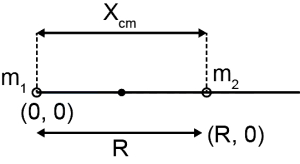
(A) Let the mass $m_{1}$ be placed at the origin $(0, 0)$ and the mass $m_{2}$ be placed at a distance $R$ along the x-axis at $(R, 0)$.
The formula for the x-coordinate of the centre of mass is given by:
$X_{cm} = \frac{m_{1} x_{1} + m_{2} x_{2}}{m_{1} + m_{2}}$
Substituting the values $x_{1} = 0$ and $x_{2} = R$:
$X_{cm} = \frac{m_{1} \times 0 + m_{2} \times R}{m_{1} + m_{2}}$
$X_{cm} = \frac{m_{2} R}{m_{1} + m_{2}}$
Thus,the distance of the centre of mass from $m_{1}$ is $\frac{m_{2} R}{m_{1} + m_{2}}$.
The formula for the x-coordinate of the centre of mass is given by:
$X_{cm} = \frac{m_{1} x_{1} + m_{2} x_{2}}{m_{1} + m_{2}}$
Substituting the values $x_{1} = 0$ and $x_{2} = R$:
$X_{cm} = \frac{m_{1} \times 0 + m_{2} \times R}{m_{1} + m_{2}}$
$X_{cm} = \frac{m_{2} R}{m_{1} + m_{2}}$
Thus,the distance of the centre of mass from $m_{1}$ is $\frac{m_{2} R}{m_{1} + m_{2}}$.
0 likesView Solution
2
PhysicsMediumMCQWBJEE · 2016
If the rms velocity of hydrogen gas at a certain temperature is $c,$ then the rms velocity of oxygen gas at the same temperature is
A
$\frac{c}{8}$
B
$\frac{c}{10}$
C
$\frac{c}{4}$
D
$\frac{c}{2}$
Solution
(C) The root mean square (rms) velocity of a gas is given by the formula: $v_{\text{rms}} = \sqrt{\frac{3RT}{M}}$,where $R$ is the gas constant,$T$ is the absolute temperature,and $M$ is the molar mass of the gas.
Since $R$ and $T$ are constant for both gases,$v_{\text{rms}} \propto \frac{1}{\sqrt{M}}$.
For hydrogen gas $(H_2)$,$M_{H_2} = 2 \text{ g/mol}$. Given $v_{\text{rms}, H_2} = c$.
For oxygen gas $(O_2)$,$M_{O_2} = 32 \text{ g/mol}$.
Taking the ratio: $\frac{v_{\text{rms}, H_2}}{v_{\text{rms}, O_2}} = \sqrt{\frac{M_{O_2}}{M_{H_2}}} = \sqrt{\frac{32}{2}} = \sqrt{16} = 4$.
Therefore,$v_{\text{rms}, O_2} = \frac{v_{\text{rms}, H_2}}{4} = \frac{c}{4}$.
Since $R$ and $T$ are constant for both gases,$v_{\text{rms}} \propto \frac{1}{\sqrt{M}}$.
For hydrogen gas $(H_2)$,$M_{H_2} = 2 \text{ g/mol}$. Given $v_{\text{rms}, H_2} = c$.
For oxygen gas $(O_2)$,$M_{O_2} = 32 \text{ g/mol}$.
Taking the ratio: $\frac{v_{\text{rms}, H_2}}{v_{\text{rms}, O_2}} = \sqrt{\frac{M_{O_2}}{M_{H_2}}} = \sqrt{\frac{32}{2}} = \sqrt{16} = 4$.
Therefore,$v_{\text{rms}, O_2} = \frac{v_{\text{rms}, H_2}}{4} = \frac{c}{4}$.
0 likesView Solution
3
PhysicsMediumMCQWBJEE · 2016
$A$ mass of $1 \ kg$ is suspended by means of a thread. The system is
$(i)$ lifted up with an acceleration of $4.9 \ ms^{-2}$
(ii) lowered with an acceleration of $4.9 \ ms^{-2}$.
The ratio of tension in the first and second case is
$(i)$ lifted up with an acceleration of $4.9 \ ms^{-2}$
(ii) lowered with an acceleration of $4.9 \ ms^{-2}$.
The ratio of tension in the first and second case is
A
$3$: $1$
B
$1$: $2$
C
$1$: $3$
D
$2$: $1$
Solution
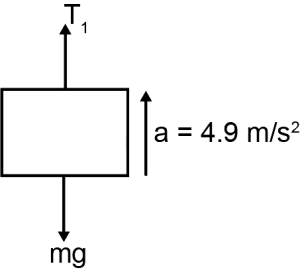
(A) Given: Mass $m = 1 \ kg$,acceleration $a = 4.9 \ ms^{-2}$,acceleration due to gravity $g \approx 9.8 \ ms^{-2}$.
$(i)$ When the body is lifted up with acceleration $a$,the equation of motion is:
$T_1 - mg = ma$
$T_1 = m(g + a) = 1 \times (9.8 + 4.9) = 14.7 \ N$
(ii) When the body is lowered with acceleration $a$,the equation of motion is:
$mg - T_2 = ma$
$T_2 = m(g - a) = 1 \times (9.8 - 4.9) = 4.9 \ N$
The ratio of tension in the first and second case is:
$\frac{T_1}{T_2} = \frac{14.7}{4.9} = \frac{3}{1} = 3:1$
$(i)$ When the body is lifted up with acceleration $a$,the equation of motion is:
$T_1 - mg = ma$
$T_1 = m(g + a) = 1 \times (9.8 + 4.9) = 14.7 \ N$
(ii) When the body is lowered with acceleration $a$,the equation of motion is:
$mg - T_2 = ma$
$T_2 = m(g - a) = 1 \times (9.8 - 4.9) = 4.9 \ N$
The ratio of tension in the first and second case is:
$\frac{T_1}{T_2} = \frac{14.7}{4.9} = \frac{3}{1} = 3:1$
0 likesView Solution
4
PhysicsMediumMCQWBJEE · 2016
Work done on a certain spring when it is stretched to $1 \text{ mm}$ from its mean position is $10 \text{ J}$. The amount of work that must be done on the spring to stretch it further by $1 \text{ mm}$ is: (in $\text{ J}$)
A
$30$
B
$40$
C
$10$
D
$20$
Solution
$(A)$ The work done in stretching a spring by a distance $x$ is given by $W = \frac{1}{2} K x^2$, where $K$ is the spring constant.
For the first stretch, $x_1 = 1 \text{ mm}$, the work done is $W_1 = \frac{1}{2} K (1)^2 = 10 \text{ J}$.
To stretch it further by $1 \text{ mm}$, the total extension becomes $x_2 = 1 \text{ mm} + 1 \text{ mm} = 2 \text{ mm}$.
The total work done for this extension is $W_2 = \frac{1}{2} K (x_2)^2 = \frac{1}{2} K (2)^2 = 4 \times (\frac{1}{2} K (1)^2) = 4 \times W_1$.
Substituting $W_1 = 10 \text{ J}$, we get $W_2 = 4 \times 10 \text{ J} = 40 \text{ J}$.
The additional work required to stretch it further is $W_{\text{extra}} = W_2 - W_1 = 40 \text{ J} - 10 \text{ J} = 30 \text{ J}$.
For the first stretch, $x_1 = 1 \text{ mm}$, the work done is $W_1 = \frac{1}{2} K (1)^2 = 10 \text{ J}$.
To stretch it further by $1 \text{ mm}$, the total extension becomes $x_2 = 1 \text{ mm} + 1 \text{ mm} = 2 \text{ mm}$.
The total work done for this extension is $W_2 = \frac{1}{2} K (x_2)^2 = \frac{1}{2} K (2)^2 = 4 \times (\frac{1}{2} K (1)^2) = 4 \times W_1$.
Substituting $W_1 = 10 \text{ J}$, we get $W_2 = 4 \times 10 \text{ J} = 40 \text{ J}$.
The additional work required to stretch it further is $W_{\text{extra}} = W_2 - W_1 = 40 \text{ J} - 10 \text{ J} = 30 \text{ J}$.
0 likesView Solution
5
PhysicsMediumMCQWBJEE · 2016
$1000$ droplets of water,each having a diameter of $2 \ mm$,coalesce to form a single drop. Given the surface tension of water is $0.072 \ N/m$. The energy loss in the process is
A
$8.146 \times 10^{-4} \ J$
B
$4.4 \times 10^{-4} \ J$
C
$2108 \times 10^{-5} \ J$
D
$4.7 \times 10^{-1} \ J$
Solution
(A) Let the radius of the small drop be $r = 1 \ mm = 1 \times 10^{-3} \ m$.
Let the radius of the large drop be $R$.
The volume of the large drop is equal to the sum of the volumes of $1000$ small drops:
$\frac{4}{3} \pi R^3 = 1000 \times \frac{4}{3} \pi r^3$
$R^3 = 1000 r^3 \implies R = 10r = 10 \times 10^{-3} \ m = 10^{-2} \ m$.
The initial surface area of $1000$ drops is $A_i = 1000 \times 4 \pi r^2$.
The final surface area of the single drop is $A_f = 4 \pi R^2 = 4 \pi (10r)^2 = 400 \pi r^2$.
The change in surface area is $\Delta A = A_f - A_i = 400 \pi r^2 - 1000 \times 4 \pi r^2 = -3600 \pi r^2$.
The energy loss is $\Delta E = S \times |\Delta A| = S \times 3600 \pi r^2$.
Substituting the values: $\Delta E = 0.072 \times 3600 \times \pi \times (10^{-3})^2$.
$\Delta E = 0.072 \times 3600 \times 3.14159 \times 10^{-6} \approx 8.143 \times 10^{-4} \ J$.
Rounding to the given option,the energy loss is $8.146 \times 10^{-4} \ J$.
Let the radius of the large drop be $R$.
The volume of the large drop is equal to the sum of the volumes of $1000$ small drops:
$\frac{4}{3} \pi R^3 = 1000 \times \frac{4}{3} \pi r^3$
$R^3 = 1000 r^3 \implies R = 10r = 10 \times 10^{-3} \ m = 10^{-2} \ m$.
The initial surface area of $1000$ drops is $A_i = 1000 \times 4 \pi r^2$.
The final surface area of the single drop is $A_f = 4 \pi R^2 = 4 \pi (10r)^2 = 400 \pi r^2$.
The change in surface area is $\Delta A = A_f - A_i = 400 \pi r^2 - 1000 \times 4 \pi r^2 = -3600 \pi r^2$.
The energy loss is $\Delta E = S \times |\Delta A| = S \times 3600 \pi r^2$.
Substituting the values: $\Delta E = 0.072 \times 3600 \times \pi \times (10^{-3})^2$.
$\Delta E = 0.072 \times 3600 \times 3.14159 \times 10^{-6} \approx 8.143 \times 10^{-4} \ J$.
Rounding to the given option,the energy loss is $8.146 \times 10^{-4} \ J$.
0 likesView Solution
6
PhysicsMediumMCQWBJEE · 2016
$A$ drop of water detaches itself from the exit of a tap when $(\sigma=$ surface tension of water,$\rho=$ density of water,$R=$ radius of the tap exit,$r=$ radius of the drop $)$
A
$r > \left(\frac{3}{2} \frac{R \sigma}{\rho g}\right)^{1/3}$
B
$r = \frac{2}{3} \frac{\sigma}{\rho g}$
C
$\frac{2 \sigma}{r} > \text{atmospheric pressure}$
D
None of the above
Solution
(D) Let the mass of the drop be $m$.
The weight of the drop is $W = mg$,which acts in the downward direction.
The force due to surface tension acting on the drop at the exit of the tap is $F_s = \sigma \cdot 2\pi R$,where $R$ is the radius of the tap exit. This force acts in the upward direction.
The drop of water will detach when the weight of the drop exceeds the upward force due to surface tension:
$mg > \sigma \cdot 2\pi R$
Since the mass $m$ of the spherical drop is given by $m = V \cdot \rho = \frac{4}{3} \pi r^3 \rho$,where $r$ is the radius of the drop,we substitute this into the inequality:
$\frac{4}{3} \pi r^3 \rho g > \sigma \cdot 2\pi R$
Solving for $r$:
$r^3 > \frac{2\pi R \sigma \cdot 3}{4\pi \rho g}$
$r^3 > \frac{3 R \sigma}{2 \rho g}$
$r > \left( \frac{3 R \sigma}{2 \rho g} \right)^{1/3}$
Comparing this result with the given options,none of the options $A$,$B$,or $C$ match the derived expression. Therefore,the correct option is $D$.
The weight of the drop is $W = mg$,which acts in the downward direction.
The force due to surface tension acting on the drop at the exit of the tap is $F_s = \sigma \cdot 2\pi R$,where $R$ is the radius of the tap exit. This force acts in the upward direction.
The drop of water will detach when the weight of the drop exceeds the upward force due to surface tension:
$mg > \sigma \cdot 2\pi R$
Since the mass $m$ of the spherical drop is given by $m = V \cdot \rho = \frac{4}{3} \pi r^3 \rho$,where $r$ is the radius of the drop,we substitute this into the inequality:
$\frac{4}{3} \pi r^3 \rho g > \sigma \cdot 2\pi R$
Solving for $r$:
$r^3 > \frac{2\pi R \sigma \cdot 3}{4\pi \rho g}$
$r^3 > \frac{3 R \sigma}{2 \rho g}$
$r > \left( \frac{3 R \sigma}{2 \rho g} \right)^{1/3}$
Comparing this result with the given options,none of the options $A$,$B$,or $C$ match the derived expression. Therefore,the correct option is $D$.
0 likesView Solution
7
PhysicsDifficultMCQWBJEE · 2016
$A$ gas bubble of $2 \ cm$ diameter rises through a liquid of density $1.75 \ g \ cm^{-3}$ with a fixed speed of $0.35 \ cm \ s^{-1}$. Neglect the density of the gas. The coefficient of viscosity of the liquid is (in $\text{poise}$)
A
$870$
B
$1120$
C
$982$
D
$1089$
Solution
(D) The gas bubble is rising through the liquid of density $\rho = 1.75 \ g/cm^3$ with a constant terminal velocity $v_T = 0.35 \ cm/s$.
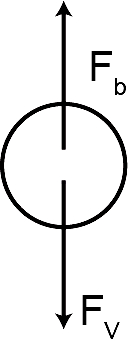
Since the density of the gas is negligible,the forces acting on the bubble are the buoyancy force $F_b$ (upward) and the viscous drag force $F_V$ (downward).
At terminal velocity,the net force is zero,so $F_V = F_b$.
Using Stokes' Law,the viscous force is $F_V = 6 \pi \eta r v_T$,where $\eta$ is the coefficient of viscosity and $r$ is the radius of the bubble.
The buoyancy force is $F_b = V \rho g = \frac{4}{3} \pi r^3 \rho g$.
Equating the two: $6 \pi \eta r v_T = \frac{4}{3} \pi r^3 \rho g$.
Solving for $\eta$: $\eta = \frac{2}{9} \frac{r^2 \rho g}{v_T}$.
Given: $r = 1 \ cm = 10^{-2} \ m$,$\rho = 1.75 \ g/cm^3 = 1750 \ kg/m^3$,$v_T = 0.35 \ cm/s = 3.5 \times 10^{-3} \ m/s$,$g = 9.8 \ m/s^2$.
Using $CGS$ units for convenience: $r = 1 \ cm$,$\rho = 1.75 \ g/cm^3$,$v_T = 0.35 \ cm/s$,$g = 980 \ cm/s^2$.
$\eta = \frac{2}{9} \times \frac{(1)^2 \times 1.75 \times 980}{0.35} = \frac{2}{9} \times \frac{1715}{0.35} = \frac{2}{9} \times 4900 \approx 1088.8 \ \text{poise} \approx 1089 \ \text{poise}$.
Since the density of the gas is negligible,the forces acting on the bubble are the buoyancy force $F_b$ (upward) and the viscous drag force $F_V$ (downward).
At terminal velocity,the net force is zero,so $F_V = F_b$.
Using Stokes' Law,the viscous force is $F_V = 6 \pi \eta r v_T$,where $\eta$ is the coefficient of viscosity and $r$ is the radius of the bubble.
The buoyancy force is $F_b = V \rho g = \frac{4}{3} \pi r^3 \rho g$.
Equating the two: $6 \pi \eta r v_T = \frac{4}{3} \pi r^3 \rho g$.
Solving for $\eta$: $\eta = \frac{2}{9} \frac{r^2 \rho g}{v_T}$.
Given: $r = 1 \ cm = 10^{-2} \ m$,$\rho = 1.75 \ g/cm^3 = 1750 \ kg/m^3$,$v_T = 0.35 \ cm/s = 3.5 \times 10^{-3} \ m/s$,$g = 9.8 \ m/s^2$.
Using $CGS$ units for convenience: $r = 1 \ cm$,$\rho = 1.75 \ g/cm^3$,$v_T = 0.35 \ cm/s$,$g = 980 \ cm/s^2$.
$\eta = \frac{2}{9} \times \frac{(1)^2 \times 1.75 \times 980}{0.35} = \frac{2}{9} \times \frac{1715}{0.35} = \frac{2}{9} \times 4900 \approx 1088.8 \ \text{poise} \approx 1089 \ \text{poise}$.
0 likesView Solution
8
PhysicsMediumMCQWBJEE · 2016
$A$ particle vibrating simple harmonically has an acceleration of $16 \ cm/s^2$ when it is at a distance of $4 \ cm$ from the mean position. Its time period is: (in $s$)
A
$1$
B
$2.572$
C
$3.142$
D
$6.028$
Solution
(C) In Simple Harmonic Motion $(SHM)$,the acceleration $a$ of a vibrating particle is given by the relation $a = \omega^2 x$,where $\omega$ is the angular frequency and $x$ is the displacement from the mean position.
Given: Acceleration $a = 16 \ cm/s^2$ and displacement $x = 4 \ cm$.
Substituting these values into the formula:
$16 = \omega^2 \times 4$
$\omega^2 = \frac{16}{4} = 4$
$\omega = 2 \ rad/s$
The time period $T$ is related to angular frequency by the formula $T = \frac{2\pi}{\omega}$.
$T = \frac{2\pi}{2} = \pi \ s$
Using $\pi \approx 3.142$,we get $T = 3.142 \ s$.
Given: Acceleration $a = 16 \ cm/s^2$ and displacement $x = 4 \ cm$.
Substituting these values into the formula:
$16 = \omega^2 \times 4$
$\omega^2 = \frac{16}{4} = 4$
$\omega = 2 \ rad/s$
The time period $T$ is related to angular frequency by the formula $T = \frac{2\pi}{\omega}$.
$T = \frac{2\pi}{2} = \pi \ s$
Using $\pi \approx 3.142$,we get $T = 3.142 \ s$.
0 likesView Solution
9
PhysicsDifficultMCQWBJEE · 2016
The temperature of the water of a pond is $0^{\circ} C$ while that of the surrounding atmosphere is $-20^{\circ} C$. If the density of ice is $\rho$,the coefficient of thermal conductivity is $k$,and the latent heat of melting is $L$,then the thickness $Z$ of the ice layer formed increases as a function of time $t$ as:
A
$Z^{2}=\frac{60 k}{\rho L} t$
B
$Z=\sqrt{\frac{40 k}{\rho L} t}$
C
$Z^{2}=\frac{40 k}{\rho L} \sqrt{t}$
D
$Z^{2}=\frac{40 k}{\rho L} t$
Solution
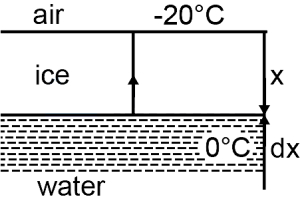
(D) Let $A$ be the surface area of the pond and $x$ be the thickness of the ice layer at any time $t$. The temperature difference across the ice layer is $\Delta T = 0^{\circ} C - (-20^{\circ} C) = 20^{\circ} C$.
The rate of heat flow through the ice layer is given by conduction: $\frac{dQ}{dt} = \frac{kA \Delta T}{x} = \frac{kA(20)}{x}$.
As the ice layer thickens by $dx$ in time $dt$,the heat released is $dQ = L dm = L(\rho A dx)$.
Equating the two expressions for $\frac{dQ}{dt}$:
$\rho A L \frac{dx}{dt} = \frac{20 k A}{x}$
$\int_{0}^{Z} x dx = \int_{0}^{t} \frac{20 k}{\rho L} dt$
$\frac{Z^2}{2} = \frac{20 k}{\rho L} t$
$Z^2 = \frac{40 k}{\rho L} t$.
The rate of heat flow through the ice layer is given by conduction: $\frac{dQ}{dt} = \frac{kA \Delta T}{x} = \frac{kA(20)}{x}$.
As the ice layer thickens by $dx$ in time $dt$,the heat released is $dQ = L dm = L(\rho A dx)$.
Equating the two expressions for $\frac{dQ}{dt}$:
$\rho A L \frac{dx}{dt} = \frac{20 k A}{x}$
$\int_{0}^{Z} x dx = \int_{0}^{t} \frac{20 k}{\rho L} dt$
$\frac{Z^2}{2} = \frac{20 k}{\rho L} t$
$Z^2 = \frac{40 k}{\rho L} t$.
0 likesView Solution
10
PhysicsEasyMCQWBJEE · 2016
If the temperature of the Sun gets doubled,the rate of energy received on the Earth will increase by a factor of
A
$2$
B
$4$
C
$8$
D
$16$
Solution
(D) According to the Stefan-Boltzmann law,the total energy radiated per unit time (power) by a black body is proportional to the fourth power of its absolute temperature $(T)$:
$P \propto T^4$
Let the initial temperature of the Sun be $T_1 = T$ and the initial power received be $P_1$.
When the temperature is doubled,the new temperature is $T_2 = 2T$.
The new power received $P_2$ is given by:
$P_2 \propto (T_2)^4$
$P_2 \propto (2T)^4$
$P_2 \propto 16T^4$
Therefore,the ratio of the new power to the initial power is:
$\frac{P_2}{P_1} = \frac{16T^4}{T^4} = 16$
Thus,the rate of energy received on the Earth will increase by a factor of $16$.
$P \propto T^4$
Let the initial temperature of the Sun be $T_1 = T$ and the initial power received be $P_1$.
When the temperature is doubled,the new temperature is $T_2 = 2T$.
The new power received $P_2$ is given by:
$P_2 \propto (T_2)^4$
$P_2 \propto (2T)^4$
$P_2 \propto 16T^4$
Therefore,the ratio of the new power to the initial power is:
$\frac{P_2}{P_1} = \frac{16T^4}{T^4} = 16$
Thus,the rate of energy received on the Earth will increase by a factor of $16$.
0 likesView Solution
11
PhysicsEasyMCQWBJEE · 2016
The temperature of a blackbody radiation enclosed in a container of volume $V$ is increased from $100^{\circ} C$ to $1000^{\circ} C$. The heat required in the process is
A
$4.79 \times 10^{-4} \text{ cal}$
B
$9.21 \times 10^{-5} \text{ cal}$
C
$2.17 \times 10^{-4} \text{ cal}$
D
Information not sufficient
Solution
(D) The energy density $u$ of blackbody radiation at temperature $T$ is given by $u = aT^4$,where $a$ is the radiation constant.
The total energy $E$ in a container of volume $V$ is $E = uV = aVT^4$.
The heat required to increase the temperature from $T_1$ to $T_2$ is $\Delta E = aV(T_2^4 - T_1^4)$.
Since the volume $V$ of the container is not provided in the problem statement,it is impossible to calculate the exact numerical value of the heat required.
Therefore,the information provided is insufficient.
The total energy $E$ in a container of volume $V$ is $E = uV = aVT^4$.
The heat required to increase the temperature from $T_1$ to $T_2$ is $\Delta E = aV(T_2^4 - T_1^4)$.
Since the volume $V$ of the container is not provided in the problem statement,it is impossible to calculate the exact numerical value of the heat required.
Therefore,the information provided is insufficient.
0 likesView Solution
12
PhysicsEasyMCQWBJEE · 2016
The perfect gas equation for $4 \ g$ of hydrogen gas is
A
$p V = R T$
B
$p V = 2 R T$
C
$p V = \frac{1}{2} R T$
D
$p V = 4 R T$
Solution
(B) The mass of the hydrogen gas is given as $m = 4 \ g$.
The molar mass of hydrogen gas $(H_2)$ is $M = 2 \ g/mol$.
The number of moles $n$ is calculated as $n = \frac{m}{M} = \frac{4 \ g}{2 \ g/mol} = 2 \ mol$.
The ideal gas equation is given by $p V = n R T$.
Substituting the value of $n = 2$,we get $p V = 2 R T$.
The molar mass of hydrogen gas $(H_2)$ is $M = 2 \ g/mol$.
The number of moles $n$ is calculated as $n = \frac{m}{M} = \frac{4 \ g}{2 \ g/mol} = 2 \ mol$.
The ideal gas equation is given by $p V = n R T$.
Substituting the value of $n = 2$,we get $p V = 2 R T$.
0 likesView Solution
13
PhysicsDifficultMCQWBJEE · 2016
For air at room temperature,the atmospheric pressure is $1.0 \times 10^{5} \text{ Nm}^{-2}$ and the density of air is $1.2 \text{ kgm}^{-3}$. For a tube of length $1.0 \text{ m}$,closed at one end,the lowest frequency generated is $84 \text{ Hz}$. The value of $\gamma$ (ratio of two specific heats) for air is:
A
$2.1$
B
$1.5$
C
$1.8$
D
$1.4$
Solution
(D) The tube is closed at one end,so it acts as a closed organ pipe. The lowest frequency (fundamental frequency) produced in the tube corresponds to the condition where the length of the tube $l = \frac{\lambda}{4}$.
Given: $l = 1.0 \text{ m}$,$f = 84 \text{ Hz}$.
Therefore,the wavelength $\lambda = 4l = 4 \times 1.0 = 4 \text{ m}$.
The velocity of sound in air is given by $v = f \lambda = 84 \times 4 = 336 \text{ m/s}$.
The velocity of sound is also given by the formula $v = \sqrt{\frac{\gamma P}{\rho}}$,where $P$ is the atmospheric pressure and $\rho$ is the density of air.
Squaring both sides,we get $v^{2} = \frac{\gamma P}{\rho}$.
Rearranging for $\gamma$,we get $\gamma = \frac{v^{2} \rho}{P}$.
Substituting the values: $\gamma = \frac{(336)^{2} \times 1.2}{1.0 \times 10^{5}} = \frac{112896 \times 1.2}{100000} = \frac{135475.2}{100000} \approx 1.355$.
Rounding to the nearest option,we get $\gamma = 1.4$.
Given: $l = 1.0 \text{ m}$,$f = 84 \text{ Hz}$.
Therefore,the wavelength $\lambda = 4l = 4 \times 1.0 = 4 \text{ m}$.
The velocity of sound in air is given by $v = f \lambda = 84 \times 4 = 336 \text{ m/s}$.
The velocity of sound is also given by the formula $v = \sqrt{\frac{\gamma P}{\rho}}$,where $P$ is the atmospheric pressure and $\rho$ is the density of air.
Squaring both sides,we get $v^{2} = \frac{\gamma P}{\rho}$.
Rearranging for $\gamma$,we get $\gamma = \frac{v^{2} \rho}{P}$.
Substituting the values: $\gamma = \frac{(336)^{2} \times 1.2}{1.0 \times 10^{5}} = \frac{112896 \times 1.2}{100000} = \frac{135475.2}{100000} \approx 1.355$.
Rounding to the nearest option,we get $\gamma = 1.4$.
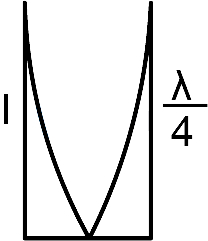
0 likesView Solution
14
PhysicsMediumMCQWBJEE · 2016
The velocity of sound in air at $20^{\circ} C$ and $1 \text{ atm}$ pressure is $344.2 \text{ m/s}$. At $40^{\circ} C$ and $2 \text{ atm}$ pressure,the velocity of sound in air is approximately: (in $\text{ m/s}$)
A
$350$
B
$356$
C
$363$
D
$370$
Solution
(B) The velocity of sound in an ideal gas is given by the formula $v = \sqrt{\frac{\gamma RT}{M}}$,where $\gamma$ is the adiabatic index,$R$ is the universal gas constant,$T$ is the absolute temperature in Kelvin,and $M$ is the molar mass of the gas.
Note that the velocity of sound is independent of pressure for an ideal gas.
Given:
$T_1 = 273 + 20 = 293 \text{ K}$
$T_2 = 273 + 40 = 313 \text{ K}$
$v_1 = 344.2 \text{ m/s}$
Using the ratio:
$\frac{v_2}{v_1} = \sqrt{\frac{T_2}{T_1}}$
$v_2 = v_1 \sqrt{\frac{313}{293}}$
$v_2 = 344.2 \times \sqrt{1.06826}$
$v_2 \approx 344.2 \times 1.03356$
$v_2 \approx 355.75 \text{ m/s} \approx 356 \text{ m/s}$.
Note that the velocity of sound is independent of pressure for an ideal gas.
Given:
$T_1 = 273 + 20 = 293 \text{ K}$
$T_2 = 273 + 40 = 313 \text{ K}$
$v_1 = 344.2 \text{ m/s}$
Using the ratio:
$\frac{v_2}{v_1} = \sqrt{\frac{T_2}{T_1}}$
$v_2 = v_1 \sqrt{\frac{313}{293}}$
$v_2 = 344.2 \times \sqrt{1.06826}$
$v_2 \approx 344.2 \times 1.03356$
$v_2 \approx 355.75 \text{ m/s} \approx 356 \text{ m/s}$.
0 likesView Solution
15
PhysicsEasyMCQWBJEE · 2016
The number of de-Broglie wavelengths contained in the second Bohr orbit of a hydrogen atom is
A
$1$
B
$2$
C
$3$
D
$4$
Solution
(B) According to Bohr's quantization condition,the angular momentum of an electron in an orbit is given by $L = mvr = \frac{nh}{2\pi}$.
From the de-Broglie hypothesis,the wavelength of an electron is $\lambda = \frac{h}{mv}$.
Substituting $mv = \frac{h}{\lambda}$ into the quantization condition,we get $\frac{h}{\lambda} r = \frac{nh}{2\pi}$.
This simplifies to $2\pi r = n\lambda$,where $2\pi r$ is the circumference of the $n^{th}$ orbit.
For the second Bohr orbit,$n = 2$.
Therefore,the circumference of the second orbit is $2\pi r = 2\lambda$.
This implies that the number of de-Broglie wavelengths contained in the second Bohr orbit is $2$.
From the de-Broglie hypothesis,the wavelength of an electron is $\lambda = \frac{h}{mv}$.
Substituting $mv = \frac{h}{\lambda}$ into the quantization condition,we get $\frac{h}{\lambda} r = \frac{nh}{2\pi}$.
This simplifies to $2\pi r = n\lambda$,where $2\pi r$ is the circumference of the $n^{th}$ orbit.
For the second Bohr orbit,$n = 2$.
Therefore,the circumference of the second orbit is $2\pi r = 2\lambda$.
This implies that the number of de-Broglie wavelengths contained in the second Bohr orbit is $2$.
0 likesView Solution
16
PhysicsMediumMCQWBJEE · 2016
The wavelength of the second Balmer line in the hydrogen spectrum is $600 \ nm$. The wavelength for its third line in the Lyman series is:
A
$800 \ nm$
B
$600 \ nm$
C
$400 \ nm$
D
None of the above
Solution
(D) The Rydberg formula is given by $\frac{1}{\lambda} = R \left[ \frac{1}{n_1^2} - \frac{1}{n_2^2} \right]$.
For the Balmer series,$n_1 = 2$. The first line corresponds to $n_2 = 3$,and the second line corresponds to $n_2 = 4$.
$\frac{1}{\lambda_B} = R \left[ \frac{1}{2^2} - \frac{1}{4^2} \right] = R \left[ \frac{1}{4} - \frac{1}{16} \right] = R \left( \frac{3}{16} \right)$.
Given $\lambda_B = 600 \ nm$,so $\frac{1}{600} = R \left( \frac{3}{16} \right) \implies R = \frac{16}{1800} \ nm^{-1}$.
For the Lyman series,$n_1 = 1$. The third line corresponds to $n_2 = 4$ (since $n_2 = 2, 3, 4, \dots$).
$\frac{1}{\lambda_L} = R \left[ \frac{1}{1^2} - \frac{1}{4^2} \right] = R \left[ 1 - \frac{1}{16} \right] = R \left( \frac{15}{16} \right)$.
Substituting the value of $R$:
$\frac{1}{\lambda_L} = \left( \frac{16}{1800} \right) \left( \frac{15}{16} \right) = \frac{15}{1800} = \frac{1}{120}$.
Therefore,$\lambda_L = 120 \ nm$.
Since $120 \ nm$ is not among the options,the correct choice is $D$.
For the Balmer series,$n_1 = 2$. The first line corresponds to $n_2 = 3$,and the second line corresponds to $n_2 = 4$.
$\frac{1}{\lambda_B} = R \left[ \frac{1}{2^2} - \frac{1}{4^2} \right] = R \left[ \frac{1}{4} - \frac{1}{16} \right] = R \left( \frac{3}{16} \right)$.
Given $\lambda_B = 600 \ nm$,so $\frac{1}{600} = R \left( \frac{3}{16} \right) \implies R = \frac{16}{1800} \ nm^{-1}$.
For the Lyman series,$n_1 = 1$. The third line corresponds to $n_2 = 4$ (since $n_2 = 2, 3, 4, \dots$).
$\frac{1}{\lambda_L} = R \left[ \frac{1}{1^2} - \frac{1}{4^2} \right] = R \left[ 1 - \frac{1}{16} \right] = R \left( \frac{15}{16} \right)$.
Substituting the value of $R$:
$\frac{1}{\lambda_L} = \left( \frac{16}{1800} \right) \left( \frac{15}{16} \right) = \frac{15}{1800} = \frac{1}{120}$.
Therefore,$\lambda_L = 120 \ nm$.
Since $120 \ nm$ is not among the options,the correct choice is $D$.
0 likesView Solution
17
PhysicsEasyMCQWBJEE · 2016
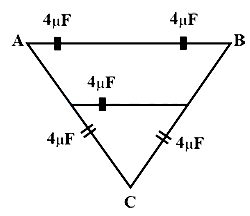
Find the equivalent capacitance between points $A$ and $B$ in the given figure. (in $\mu F$)
A
$20$
B
$8$
C
$12$
D
$16$
Solution
(B) The circuit consists of a bridge-like structure. Let us simplify it.
$1$. The two $4 \mu F$ capacitors in the top branch (between $A$ and $B$) are in series. Their equivalent capacitance $C_1$ is given by $\frac{1}{C_1} = \frac{1}{4} + \frac{1}{4} = \frac{2}{4} = \frac{1}{2}$,so $C_1 = 2 \mu F$.
$2$. The two $4 \mu F$ capacitors in the bottom branches (connected to $C$) are also in series with each other. Their equivalent capacitance $C_2$ is $\frac{1}{C_2} = \frac{1}{4} + \frac{1}{4} = \frac{1}{2}$,so $C_2 = 2 \mu F$.
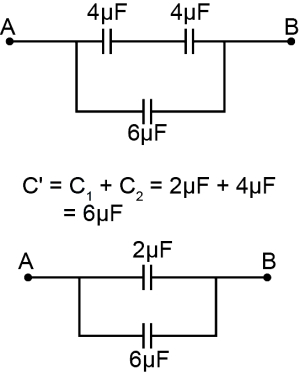
$3$. This $C_2$ is in parallel with the middle $4 \mu F$ capacitor. Thus,the equivalent capacitance of this middle section is $C_3 = C_2 + 4 \mu F = 2 \mu F + 4 \mu F = 6 \mu F$.
$4$. Finally,$C_1$ and $C_3$ are in parallel between points $A$ and $B$. Therefore,the total equivalent capacitance $C_{eq} = C_1 + C_3 = 2 \mu F + 6 \mu F = 8 \mu F$.
$1$. The two $4 \mu F$ capacitors in the top branch (between $A$ and $B$) are in series. Their equivalent capacitance $C_1$ is given by $\frac{1}{C_1} = \frac{1}{4} + \frac{1}{4} = \frac{2}{4} = \frac{1}{2}$,so $C_1 = 2 \mu F$.
$2$. The two $4 \mu F$ capacitors in the bottom branches (connected to $C$) are also in series with each other. Their equivalent capacitance $C_2$ is $\frac{1}{C_2} = \frac{1}{4} + \frac{1}{4} = \frac{1}{2}$,so $C_2 = 2 \mu F$.
$3$. This $C_2$ is in parallel with the middle $4 \mu F$ capacitor. Thus,the equivalent capacitance of this middle section is $C_3 = C_2 + 4 \mu F = 2 \mu F + 4 \mu F = 6 \mu F$.
$4$. Finally,$C_1$ and $C_3$ are in parallel between points $A$ and $B$. Therefore,the total equivalent capacitance $C_{eq} = C_1 + C_3 = 2 \mu F + 6 \mu F = 8 \mu F$.
0 likesView Solution
18
PhysicsMediumMCQWBJEE · 2016
Two equal resistances,$400 \Omega$ each,are connected in series with an $8 V$ battery. If the resistance of the first one increases by $0.5 \%$,what is the change required in the resistance of the second one in order to keep the potential difference across it unaltered?
A
increase it by $1 \Omega$
B
increase it by $2 \Omega$
C
increase it by $4 \Omega$
D
decrease it by $4 \Omega$
Solution
(B) Let the initial resistances be $R_1 = 400 \Omega$ and $R_2 = 400 \Omega$. The total resistance is $R_{eq} = R_1 + R_2 = 800 \Omega$. The current in the circuit is $I = V / R_{eq} = 8 / 800 = 0.01 A$. The potential difference across the second resistor is $V_2 = I R_2 = 0.01 \times 400 = 4 V$.
When $R_1$ increases by $0.5 \%$,the new resistance $R_1' = 400 + (0.5 / 100) \times 400 = 400 + 2 = 402 \Omega$.
To keep the potential difference $V_2$ across $R_2$ constant at $4 V$,the current $I'$ must remain $0.01 A$. Since $I' = V / (R_1' + R_2')$,we have $0.01 = 8 / (402 + R_2')$.
Solving for $R_2'$,we get $402 + R_2' = 8 / 0.01 = 800$,which gives $R_2' = 800 - 402 = 398 \Omega$.
The change in $R_2$ is $\Delta R_2 = R_2' - R_2 = 398 - 400 = -2 \Omega$.
Wait,let's re-evaluate: If $R_1$ increases,the total resistance increases,causing the current to decrease. To keep $V_2$ constant,$R_2$ must be adjusted. If $V_2 = I R_2 = (V / (R_1 + R_2)) R_2$,for $V_2$ to be constant,the ratio $R_2 / (R_1 + R_2)$ must be constant. This implies $R_2 / R_1$ must remain constant. Since $R_1$ increased by $0.5 \%$,$R_2$ must also increase by $0.5 \%$.
Increase in $R_2 = 0.5 \% \text{ of } 400 = 2 \Omega$.
When $R_1$ increases by $0.5 \%$,the new resistance $R_1' = 400 + (0.5 / 100) \times 400 = 400 + 2 = 402 \Omega$.
To keep the potential difference $V_2$ across $R_2$ constant at $4 V$,the current $I'$ must remain $0.01 A$. Since $I' = V / (R_1' + R_2')$,we have $0.01 = 8 / (402 + R_2')$.
Solving for $R_2'$,we get $402 + R_2' = 8 / 0.01 = 800$,which gives $R_2' = 800 - 402 = 398 \Omega$.
The change in $R_2$ is $\Delta R_2 = R_2' - R_2 = 398 - 400 = -2 \Omega$.
Wait,let's re-evaluate: If $R_1$ increases,the total resistance increases,causing the current to decrease. To keep $V_2$ constant,$R_2$ must be adjusted. If $V_2 = I R_2 = (V / (R_1 + R_2)) R_2$,for $V_2$ to be constant,the ratio $R_2 / (R_1 + R_2)$ must be constant. This implies $R_2 / R_1$ must remain constant. Since $R_1$ increased by $0.5 \%$,$R_2$ must also increase by $0.5 \%$.
Increase in $R_2 = 0.5 \% \text{ of } 400 = 2 \Omega$.
0 likesView Solution
19
PhysicsMediumMCQWBJEE · 2016
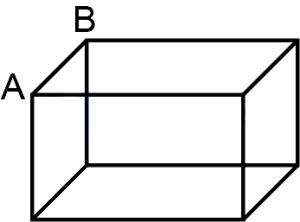
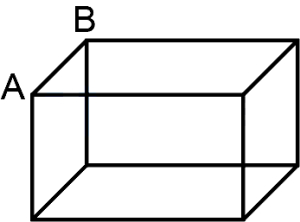
The effective resistance between $A$ and $B$ in the figure is $\frac{7}{12} \Omega$ if each side of the cube has $1 \Omega$ resistance. The effective resistance between the same two points,when the link $A B$ is removed,is
A
$\frac{7}{12} \Omega$
B
$\frac{5}{12} \Omega$
C
$\frac{7}{5} \Omega$
D
$\frac{5}{7} \Omega$
Solution
(C) Let the resistance of the link $AB$ be $R_{AB} = 1 \Omega$. Let $R_{eq}$ be the effective resistance of the remaining part of the cube when the link $AB$ is removed.
When the link $AB$ is present,it is in parallel with the rest of the cube's network. The equivalent resistance is given by:
$\frac{1}{R_{total}} = \frac{1}{R_{AB}} + \frac{1}{R_{eq}}$
Given $R_{total} = \frac{7}{12} \Omega$ and $R_{AB} = 1 \Omega$:
$\frac{12}{7} = \frac{1}{1} + \frac{1}{R_{eq}}$
$\frac{1}{R_{eq}} = \frac{12}{7} - 1 = \frac{5}{7}$
Therefore,$R_{eq} = \frac{7}{5} \Omega$.
When the link $AB$ is present,it is in parallel with the rest of the cube's network. The equivalent resistance is given by:
$\frac{1}{R_{total}} = \frac{1}{R_{AB}} + \frac{1}{R_{eq}}$
Given $R_{total} = \frac{7}{12} \Omega$ and $R_{AB} = 1 \Omega$:
$\frac{12}{7} = \frac{1}{1} + \frac{1}{R_{eq}}$
$\frac{1}{R_{eq}} = \frac{12}{7} - 1 = \frac{5}{7}$
Therefore,$R_{eq} = \frac{7}{5} \Omega$.
0 likesView Solution
20
PhysicsMediumMCQWBJEE · 2016
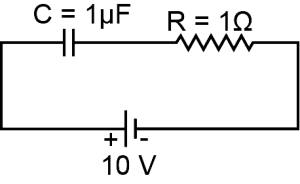
$A$ $1 \mu F$ capacitor $C$ is connected to a battery of $10 V$ through a resistance of $1 \text{ M}\Omega$. The voltage across $C$ after $1 \text{ s}$ is approximately: (in $V$)
A
$5.6$
B
$7.8$
C
$6.3$
D
$10$
Solution
(C) The time constant $\tau$ of an $RC$ circuit is given by $\tau = R \cdot C$.
Given:
$C = 1 \mu F = 1 \times 10^{-6} F$
$R = 1 \text{ M}\Omega = 1 \times 10^{6} \Omega$
Therefore, $\tau = (1 \times 10^{6} \Omega) \times (1 \times 10^{-6} F) = 1 \text{ s}$.
The voltage across a charging capacitor at time $t$ is given by $V(t) = V_0(1 - e^{-t/\tau})$.
Substituting $t = 1 \text{ s}$ and $\tau = 1 \text{ s}$:
$V(1) = 10(1 - e^{-1/1}) = 10(1 - e^{-1})$.
Since $e^{-1} \approx 0.37$, we have:
$V(1) \approx 10(1 - 0.37) = 10(0.63) = 6.3 V$.
Thus, the voltage across the capacitor after $1 \text{ s}$ is approximately $6.3 V$.
Given:
$C = 1 \mu F = 1 \times 10^{-6} F$
$R = 1 \text{ M}\Omega = 1 \times 10^{6} \Omega$
Therefore, $\tau = (1 \times 10^{6} \Omega) \times (1 \times 10^{-6} F) = 1 \text{ s}$.
The voltage across a charging capacitor at time $t$ is given by $V(t) = V_0(1 - e^{-t/\tau})$.
Substituting $t = 1 \text{ s}$ and $\tau = 1 \text{ s}$:
$V(1) = 10(1 - e^{-1/1}) = 10(1 - e^{-1})$.
Since $e^{-1} \approx 0.37$, we have:
$V(1) \approx 10(1 - 0.37) = 10(0.63) = 6.3 V$.
Thus, the voltage across the capacitor after $1 \text{ s}$ is approximately $6.3 V$.
0 likesView Solution
21
PhysicsDifficultMCQWBJEE · 2016
$A$ current $I = I_{0} e^{-\lambda t}$ is flowing in a circuit. The total charge that flows through the circuit over the entire pulse period (from $t = 0$ to $t = \infty$) is:
A
$\frac{I_{0}}{\lambda}$
B
$\frac{2 I_{0}}{\lambda}$
C
$I_{0} \lambda$
D
$e^{I_{0}\lambda}$
Solution
(A) The current is given by $I = I_{0} e^{-\lambda t}$.
We know that current $I$ is the rate of flow of charge,so $I = \frac{dQ}{dt}$.
Therefore,$dQ = I dt = I_{0} e^{-\lambda t} dt$.
To find the total charge $Q$ over the entire pulse period,we integrate from $t = 0$ to $t = \infty$:
$Q = \int_{0}^{\infty} I_{0} e^{-\lambda t} dt$
$Q = I_{0} \left[ \frac{e^{-\lambda t}}{-\lambda} \right]_{0}^{\infty}$
$Q = \frac{I_{0}}{-\lambda} [e^{-\infty} - e^{0}]$
Since $e^{-\infty} = 0$ and $e^{0} = 1$,we get:
$Q = \frac{I_{0}}{-\lambda} [0 - 1] = \frac{I_{0}}{\lambda}$.
We know that current $I$ is the rate of flow of charge,so $I = \frac{dQ}{dt}$.
Therefore,$dQ = I dt = I_{0} e^{-\lambda t} dt$.
To find the total charge $Q$ over the entire pulse period,we integrate from $t = 0$ to $t = \infty$:
$Q = \int_{0}^{\infty} I_{0} e^{-\lambda t} dt$
$Q = I_{0} \left[ \frac{e^{-\lambda t}}{-\lambda} \right]_{0}^{\infty}$
$Q = \frac{I_{0}}{-\lambda} [e^{-\infty} - e^{0}]$
Since $e^{-\infty} = 0$ and $e^{0} = 1$,we get:
$Q = \frac{I_{0}}{-\lambda} [0 - 1] = \frac{I_{0}}{\lambda}$.
0 likesView Solution
22
PhysicsMediumMCQWBJEE · 2016
Two wires of the same radius having lengths $l_{1}$ and $l_{2}$ and resistivities $\rho_{1}$ and $\rho_{2}$ are connected in series. The equivalent resistivity will be
A
$\frac{\rho_{1} l_{2}+\rho_{2} l_{1}}{\rho_{1}+\rho_{2}}$
B
$\frac{\rho_{1} l_{1}+\rho_{2} l_{2}}{l_{1}+l_{2}}$
C
$\frac{\rho_{1} l_{1}-\rho_{2} l_{2}}{l_{1}-l_{2}}$
D
$\frac{\rho_{1} l_{2}+\rho_{2} l_{1}}{l_{1}+l_{2}}$
Solution
(B) The resistance of a wire is given by $R = \frac{\rho l}{A}$,where $\rho$ is resistivity,$l$ is length,and $A$ is the cross-sectional area.
When two wires are connected in series,the total resistance $R_{eq}$ is the sum of individual resistances:
$R_{eq} = R_{1} + R_{2}$
Since the wires have the same radius,their cross-sectional areas are equal $(A_{1} = A_{2} = A)$.
$R_{eq} = \frac{\rho_{1} l_{1}}{A} + \frac{\rho_{2} l_{2}}{A} = \frac{\rho_{1} l_{1} + \rho_{2} l_{2}}{A}$
For the equivalent wire,the total length is $L = l_{1} + l_{2}$ and the area is $A$. The equivalent resistivity $\rho_{eq}$ is defined as:
$R_{eq} = \frac{\rho_{eq} (l_{1} + l_{2})}{A}$
Equating the two expressions for $R_{eq}$:
$\frac{\rho_{eq} (l_{1} + l_{2})}{A} = \frac{\rho_{1} l_{1} + \rho_{2} l_{2}}{A}$
$\rho_{eq} = \frac{\rho_{1} l_{1} + \rho_{2} l_{2}}{l_{1} + l_{2}}$
When two wires are connected in series,the total resistance $R_{eq}$ is the sum of individual resistances:
$R_{eq} = R_{1} + R_{2}$
Since the wires have the same radius,their cross-sectional areas are equal $(A_{1} = A_{2} = A)$.
$R_{eq} = \frac{\rho_{1} l_{1}}{A} + \frac{\rho_{2} l_{2}}{A} = \frac{\rho_{1} l_{1} + \rho_{2} l_{2}}{A}$
For the equivalent wire,the total length is $L = l_{1} + l_{2}$ and the area is $A$. The equivalent resistivity $\rho_{eq}$ is defined as:
$R_{eq} = \frac{\rho_{eq} (l_{1} + l_{2})}{A}$
Equating the two expressions for $R_{eq}$:
$\frac{\rho_{eq} (l_{1} + l_{2})}{A} = \frac{\rho_{1} l_{1} + \rho_{2} l_{2}}{A}$
$\rho_{eq} = \frac{\rho_{1} l_{1} + \rho_{2} l_{2}}{l_{1} + l_{2}}$
0 likesView Solution
23
PhysicsMediumMCQWBJEE · 2016
The potential difference $V$ required for accelerating an electron to have the de-Broglie wavelength of $1 \text{ Å}$ is (in $\text{ V}$)
A
$100$
B
$125$
C
$150$
D
$200$
Solution
(C) The de-Broglie wavelength $\lambda$ of an electron accelerated through a potential difference $V$ is given by the formula:
$\lambda = \frac{h}{\sqrt{2meV}}$
Squaring both sides, we get:
$\lambda^2 = \frac{h^2}{2meV}$
Rearranging for $V$:
$V = \frac{h^2}{2me\lambda^2}$
Using the standard approximation formula for an electron:
$V \approx \frac{150}{\lambda^2} \text{ V}$, where $\lambda$ is in $\text{Å}$.
Given $\lambda = 1 \text{ Å}$:
$V = \frac{150}{(1)^2} = 150 \text{ V}$.
Thus, the required potential difference is $150 \text{ V}$.
$\lambda = \frac{h}{\sqrt{2meV}}$
Squaring both sides, we get:
$\lambda^2 = \frac{h^2}{2meV}$
Rearranging for $V$:
$V = \frac{h^2}{2me\lambda^2}$
Using the standard approximation formula for an electron:
$V \approx \frac{150}{\lambda^2} \text{ V}$, where $\lambda$ is in $\text{Å}$.
Given $\lambda = 1 \text{ Å}$:
$V = \frac{150}{(1)^2} = 150 \text{ V}$.
Thus, the required potential difference is $150 \text{ V}$.
0 likesView Solution
24
PhysicsMediumMCQWBJEE · 2016
The work function of Cesium is $2.27 eV$. The cut-off voltage which stops the emission of electrons from a cesium cathode irradiated with light of $600 nm$ wavelength is
A
$0.5 V$
B
$-0.2 V$
C
$-0.5 V$
D
None of the above
Solution
(D) The work function of Cesium is $\phi = 2.27 eV$.
The wavelength of the incident light is $\lambda = 600 nm = 600 \times 10^{-9} m$.
The energy of the incident photon is given by $E = \frac{hc}{\lambda}$.
Substituting the values ($h = 6.63 \times 10^{-34} Js$,$c = 3 \times 10^8 m/s$):
$E = \frac{6.63 \times 10^{-34} \times 3 \times 10^8}{600 \times 10^{-9}} J = 3.315 \times 10^{-19} J$.
Converting this energy into electron-volts $(eV)$:
$E = \frac{3.315 \times 10^{-19}}{1.6 \times 10^{-19}} eV \approx 2.07 eV$.
Since the energy of the incident photon $(2.07 eV)$ is less than the work function of Cesium $(2.27 eV)$,the photoelectric effect will not occur.
Therefore,no electrons are emitted,and no cut-off voltage is required. Thus,the correct answer is $D$.
The wavelength of the incident light is $\lambda = 600 nm = 600 \times 10^{-9} m$.
The energy of the incident photon is given by $E = \frac{hc}{\lambda}$.
Substituting the values ($h = 6.63 \times 10^{-34} Js$,$c = 3 \times 10^8 m/s$):
$E = \frac{6.63 \times 10^{-34} \times 3 \times 10^8}{600 \times 10^{-9}} J = 3.315 \times 10^{-19} J$.
Converting this energy into electron-volts $(eV)$:
$E = \frac{3.315 \times 10^{-19}}{1.6 \times 10^{-19}} eV \approx 2.07 eV$.
Since the energy of the incident photon $(2.07 eV)$ is less than the work function of Cesium $(2.27 eV)$,the photoelectric effect will not occur.
Therefore,no electrons are emitted,and no cut-off voltage is required. Thus,the correct answer is $D$.
0 likesView Solution
25
PhysicsMediumMCQWBJEE · 2016
The distance between a light source and a photoelectric cell is $d$. If the distance is decreased to $\frac{d}{2}$,then:
A
the emission of electrons per second will be four times
B
maximum kinetic energy of photoelectrons will be four times
C
stopping potential will remain the same
D
the emission of electrons per second will be doubled
Solution
(A) The intensity $I$ of light at a distance $r$ from a point source is given by $I = \frac{P}{4\pi r^2}$,so $I \propto \frac{1}{r^2}$.
When the distance is changed from $d$ to $\frac{d}{2}$,the new intensity $I'$ becomes $I' = \frac{1}{(d/2)^2} = 4 \times \frac{1}{d^2} = 4I$.
Since the number of photoelectrons emitted per second is directly proportional to the intensity of incident light,the emission rate becomes $4$ times the original value.
According to Einstein's photoelectric equation,$KE_{max} = h\nu - \phi$,where $\nu$ is the frequency of incident light and $\phi$ is the work function.
Since the frequency $\nu$ remains unchanged,the maximum kinetic energy $(KE_{max})$ and the stopping potential $(V_s)$ remain unchanged,as $eV_s = KE_{max}$.
When the distance is changed from $d$ to $\frac{d}{2}$,the new intensity $I'$ becomes $I' = \frac{1}{(d/2)^2} = 4 \times \frac{1}{d^2} = 4I$.
Since the number of photoelectrons emitted per second is directly proportional to the intensity of incident light,the emission rate becomes $4$ times the original value.
According to Einstein's photoelectric equation,$KE_{max} = h\nu - \phi$,where $\nu$ is the frequency of incident light and $\phi$ is the work function.
Since the frequency $\nu$ remains unchanged,the maximum kinetic energy $(KE_{max})$ and the stopping potential $(V_s)$ remain unchanged,as $eV_s = KE_{max}$.
0 likesView Solution
26
PhysicsEasyMCQWBJEE · 2016
Two coils of self-inductances $6 mH$ and $8 mH$ are connected in series and are adjusted for the highest coefficient of coupling. The equivalent self-inductance $L$ for the assembly is approximately: (in $mH$)
A
$50$
B
$36$
C
$28$
D
$18$
Solution
(C) Given, $L_{1} = 6 mH = 6 \times 10^{-3} H$ and $L_{2} = 8 mH = 8 \times 10^{-3} H$.
For two coils connected in series with the highest coefficient of coupling $(k = 1)$, the equivalent self-inductance $L$ is given by the formula:
$L = L_{1} + L_{2} + 2M$
where $M$ is the mutual inductance, $M = k \sqrt{L_{1} L_{2}}$.
For the highest coupling, $k = 1$, so $M = \sqrt{L_{1} L_{2}}$.
Substituting the values:
$L = L_{1} + L_{2} + 2 \sqrt{L_{1} L_{2}} \text{ (in } mH)$
$L = 6 + 8 + 2 \sqrt{6 \times 8}$
$L = 14 + 2 \sqrt{48}$
$L = 14 + 2 \times 6.928$
$L = 14 + 13.856 = 27.856 mH$
Rounding to the nearest integer, we get $L \approx 28 mH$.
For two coils connected in series with the highest coefficient of coupling $(k = 1)$, the equivalent self-inductance $L$ is given by the formula:
$L = L_{1} + L_{2} + 2M$
where $M$ is the mutual inductance, $M = k \sqrt{L_{1} L_{2}}$.
For the highest coupling, $k = 1$, so $M = \sqrt{L_{1} L_{2}}$.
Substituting the values:
$L = L_{1} + L_{2} + 2 \sqrt{L_{1} L_{2}} \text{ (in } mH)$
$L = 6 + 8 + 2 \sqrt{6 \times 8}$
$L = 14 + 2 \sqrt{48}$
$L = 14 + 2 \times 6.928$
$L = 14 + 13.856 = 27.856 mH$
Rounding to the nearest integer, we get $L \approx 28 mH$.
0 likesView Solution
27
PhysicsMediumMCQWBJEE · 2016
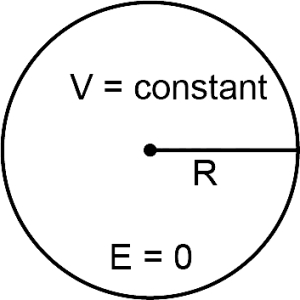
$A$ hollow metal sphere of radius $R$ is charged with a charge $Q$. The electric potential and intensity inside the sphere are respectively
A
$\frac{Q}{4 \pi \varepsilon_{0} R^{2}}$ and $\frac{Q}{4 \pi \varepsilon_{0} R}$
B
$\frac{Q}{4 \pi \varepsilon_{0} R}$ and zero
C
zero and zero
D
$\frac{4 \pi \varepsilon_{0} Q}{R}$ and $\frac{Q}{4 \pi \varepsilon_{0} R^{2}}$
Solution
(B) Inside a hollow charged metal sphere,the electric field intensity is always zero because there is no charge enclosed within the Gaussian surface inside the sphere.
$\therefore E = 0$.
However,the electric potential inside the sphere is constant and equal to the potential at its surface.
The potential on the surface of the hollow sphere is given by:
$V = \frac{1}{4 \pi \varepsilon_{0}} \cdot \frac{Q}{R} = \frac{Q}{4 \pi \varepsilon_{0} R}$.
Thus,inside the sphere,the potential is $\frac{Q}{4 \pi \varepsilon_{0} R}$ and the electric field intensity is zero.
$\therefore E = 0$.
However,the electric potential inside the sphere is constant and equal to the potential at its surface.
The potential on the surface of the hollow sphere is given by:
$V = \frac{1}{4 \pi \varepsilon_{0}} \cdot \frac{Q}{R} = \frac{Q}{4 \pi \varepsilon_{0} R}$.
Thus,inside the sphere,the potential is $\frac{Q}{4 \pi \varepsilon_{0} R}$ and the electric field intensity is zero.
0 likesView Solution
28
PhysicsEasyMCQWBJEE · 2016
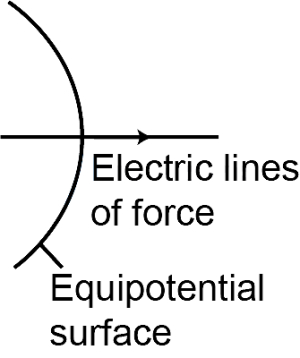
What is the angle between an equipotential surface and electric lines of force (in $^{\circ}$)?
A
$0$
B
$90$
C
$180$
D
$270$
Solution
(B) An equipotential surface is a surface where the electric potential is the same at every point.
By definition,the work done in moving a charge $q$ along an equipotential surface is zero,because $W = q \Delta V$ and $\Delta V = 0$.
Since the work done is $W = \int \vec{F} \cdot d\vec{l} = q \int \vec{E} \cdot d\vec{l} = 0$,the electric field $\vec{E}$ must be perpendicular to the displacement $d\vec{l}$ along the surface.
Therefore,the electric lines of force are always perpendicular to the equipotential surface,meaning the angle between them is $90^{\circ}$.
By definition,the work done in moving a charge $q$ along an equipotential surface is zero,because $W = q \Delta V$ and $\Delta V = 0$.
Since the work done is $W = \int \vec{F} \cdot d\vec{l} = q \int \vec{E} \cdot d\vec{l} = 0$,the electric field $\vec{E}$ must be perpendicular to the displacement $d\vec{l}$ along the surface.
Therefore,the electric lines of force are always perpendicular to the equipotential surface,meaning the angle between them is $90^{\circ}$.
0 likesView Solution
29
PhysicsEasyMCQWBJEE · 2016
$A$ rectangular coil carrying current is placed in a non-uniform magnetic field. On that coil,the total:
A
force is non-zero
B
force is zero
C
torque is zero
D
torque is non-zero
Solution
(A) When a current-carrying rectangular coil is placed in a non-uniform magnetic field,the magnetic field strength varies at different points along the coil.
Since the magnetic field is non-uniform,the magnetic forces acting on different segments of the coil do not cancel each other out,resulting in a non-zero net force.
Additionally,because the forces are distributed such that they do not act through a single point or are not balanced,a non-zero net torque is also produced.
Therefore,both the net force and the net torque acting on the coil are non-zero.
Given the standard nature of such multiple-choice questions where one answer is expected,both $(a)$ and $(d)$ are physically correct statements.
Since the magnetic field is non-uniform,the magnetic forces acting on different segments of the coil do not cancel each other out,resulting in a non-zero net force.
Additionally,because the forces are distributed such that they do not act through a single point or are not balanced,a non-zero net torque is also produced.
Therefore,both the net force and the net torque acting on the coil are non-zero.
Given the standard nature of such multiple-choice questions where one answer is expected,both $(a)$ and $(d)$ are physically correct statements.
0 likesView Solution
30
PhysicsDifficultMCQWBJEE · 2016
An electron enters an electric field with intensity $\vec{E} = 3\hat{i} + 6\hat{j} + 2\hat{k} \text{ V m}^{-1}$ and a magnetic field with induction $\vec{B} = 2\hat{i} + 3\hat{j} \text{ T}$ with a velocity $\vec{v} = 2\hat{i} + 3\hat{j} \text{ m s}^{-1}$. The magnitude of the force acting on the electron is (Given,$e = -1.6 \times 10^{-19} \text{ C}$)
A
$2.02 \times 10^{-18} \text{ N}$
B
$5.16 \times 10^{-16} \text{ N}$
C
$3.72 \times 10^{-17} \text{ N}$
D
None of the above
Solution
(D) The total Lorentz force on the electron is given by $\vec{F} = q(\vec{E} + \vec{v} \times \vec{B})$.
Given: $\vec{E} = 3\hat{i} + 6\hat{j} + 2\hat{k} \text{ V m}^{-1}$,$\vec{B} = 2\hat{i} + 3\hat{j} \text{ T}$,$\vec{v} = 2\hat{i} + 3\hat{j} \text{ m s}^{-1}$,and $q = -1.6 \times 10^{-19} \text{ C}$.
First,calculate the magnetic force $\vec{F}_m = q(\vec{v} \times \vec{B})$.
Since $\vec{v} = 2\hat{i} + 3\hat{j}$ and $\vec{B} = 2\hat{i} + 3\hat{j}$,the vectors are parallel $(\vec{v} \parallel \vec{B})$.
Therefore,$\vec{v} \times \vec{B} = 0$,which implies $\vec{F}_m = 0$.
Now,calculate the electric force $\vec{F}_e = q\vec{E}$.
$\vec{F}_e = (-1.6 \times 10^{-19}) (3\hat{i} + 6\hat{j} + 2\hat{k}) = -4.8 \times 10^{-19}\hat{i} - 9.6 \times 10^{-19}\hat{j} - 3.2 \times 10^{-19}\hat{k} \text{ N}$.
The magnitude of the force is $|\vec{F}| = |\vec{F}_e| = 1.6 \times 10^{-19} \times \sqrt{3^2 + 6^2 + 2^2} = 1.6 \times 10^{-19} \times \sqrt{9 + 36 + 4} = 1.6 \times 10^{-19} \times \sqrt{49} = 1.6 \times 10^{-19} \times 7 = 1.12 \times 10^{-18} \text{ N}$.
Since $1.12 \times 10^{-18} \text{ N}$ is not among the options,the correct choice is $D$.
Given: $\vec{E} = 3\hat{i} + 6\hat{j} + 2\hat{k} \text{ V m}^{-1}$,$\vec{B} = 2\hat{i} + 3\hat{j} \text{ T}$,$\vec{v} = 2\hat{i} + 3\hat{j} \text{ m s}^{-1}$,and $q = -1.6 \times 10^{-19} \text{ C}$.
First,calculate the magnetic force $\vec{F}_m = q(\vec{v} \times \vec{B})$.
Since $\vec{v} = 2\hat{i} + 3\hat{j}$ and $\vec{B} = 2\hat{i} + 3\hat{j}$,the vectors are parallel $(\vec{v} \parallel \vec{B})$.
Therefore,$\vec{v} \times \vec{B} = 0$,which implies $\vec{F}_m = 0$.
Now,calculate the electric force $\vec{F}_e = q\vec{E}$.
$\vec{F}_e = (-1.6 \times 10^{-19}) (3\hat{i} + 6\hat{j} + 2\hat{k}) = -4.8 \times 10^{-19}\hat{i} - 9.6 \times 10^{-19}\hat{j} - 3.2 \times 10^{-19}\hat{k} \text{ N}$.
The magnitude of the force is $|\vec{F}| = |\vec{F}_e| = 1.6 \times 10^{-19} \times \sqrt{3^2 + 6^2 + 2^2} = 1.6 \times 10^{-19} \times \sqrt{9 + 36 + 4} = 1.6 \times 10^{-19} \times \sqrt{49} = 1.6 \times 10^{-19} \times 7 = 1.12 \times 10^{-18} \text{ N}$.
Since $1.12 \times 10^{-18} \text{ N}$ is not among the options,the correct choice is $D$.
0 likesView Solution
31
PhysicsDifficultMCQWBJEE · 2016
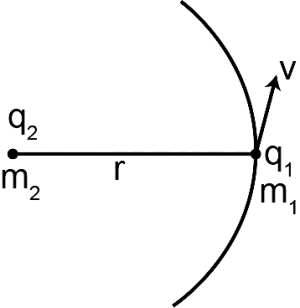
$A$ charged particle of mass $m_{1}$ and charge $q_{1}$ is revolving in a circle of radius $r$. Another charged particle of charge $q_{2}$ and mass $m_{2}$ is situated at the centre of the circle. If the velocity and time period of the revolving particle are $v$ and $T$ respectively,then:
A
$v=\sqrt{\frac{q_{1} q_{2} r}{4 \pi \varepsilon_{0} m_{1}}}$
B
$v=\frac{1}{m_{1}} \sqrt{\frac{q_{1} q_{2}}{4 \pi \varepsilon_{0} r}}$
C
$T=\sqrt{\frac{16 \pi^{3} \varepsilon_{0} m_{1} r^{3}}{q_{1} q_{2}}}$
D
None of the above
Solution
(C) The necessary centripetal force for circular motion is provided by the electrostatic Coulomb force between the two charges.
Equating the centripetal force to the Coulomb force:
$\frac{m_{1} v^{2}}{r} = \frac{1}{4 \pi \varepsilon_{0}} \cdot \frac{|q_{1} q_{2}|}{r^{2}}$
Solving for velocity $v$:
$v^{2} = \frac{|q_{1} q_{2}|}{4 \pi \varepsilon_{0} m_{1} r}$
$v = \sqrt{\frac{|q_{1} q_{2}|}{4 \pi \varepsilon_{0} m_{1} r}}$
Now,the time period $T$ is given by $T = \frac{2 \pi r}{v}$.
Substituting the expression for $v$:
$T = 2 \pi r \sqrt{\frac{4 \pi \varepsilon_{0} m_{1} r}{|q_{1} q_{2}|}}$
$T = \sqrt{4 \pi^{2} r^{2} \cdot \frac{4 \pi \varepsilon_{0} m_{1} r}{|q_{1} q_{2}|}}$
$T = \sqrt{\frac{16 \pi^{3} \varepsilon_{0} m_{1} r^{3}}{|q_{1} q_{2}|}}$
Comparing this with the given options,option $C$ is the correct expression for the time period $T$ (assuming $q_{1}$ and $q_{2}$ have opposite signs for attraction).
Equating the centripetal force to the Coulomb force:
$\frac{m_{1} v^{2}}{r} = \frac{1}{4 \pi \varepsilon_{0}} \cdot \frac{|q_{1} q_{2}|}{r^{2}}$
Solving for velocity $v$:
$v^{2} = \frac{|q_{1} q_{2}|}{4 \pi \varepsilon_{0} m_{1} r}$
$v = \sqrt{\frac{|q_{1} q_{2}|}{4 \pi \varepsilon_{0} m_{1} r}}$
Now,the time period $T$ is given by $T = \frac{2 \pi r}{v}$.
Substituting the expression for $v$:
$T = 2 \pi r \sqrt{\frac{4 \pi \varepsilon_{0} m_{1} r}{|q_{1} q_{2}|}}$
$T = \sqrt{4 \pi^{2} r^{2} \cdot \frac{4 \pi \varepsilon_{0} m_{1} r}{|q_{1} q_{2}|}}$
$T = \sqrt{\frac{16 \pi^{3} \varepsilon_{0} m_{1} r^{3}}{|q_{1} q_{2}|}}$
Comparing this with the given options,option $C$ is the correct expression for the time period $T$ (assuming $q_{1}$ and $q_{2}$ have opposite signs for attraction).
0 likesView Solution
32
PhysicsMediumMCQWBJEE · 2016
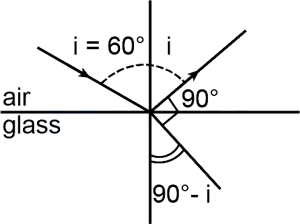
$A$ ray of light strikes a glass plate at an angle of $60^{\circ}$. If the reflected and refracted rays are perpendicular to each other,the refractive index of glass is
A
$\frac{\sqrt{3}}{2}$
B
$\frac{3}{2}$
C
$\frac{1}{2}$
D
$\sqrt{3}$
Solution
(D) Given that the angle of incidence $i = 60^{\circ}$.
According to Brewster's law,when the reflected and refracted rays are perpendicular to each other,the angle of incidence is the polarizing angle $(i_p)$.
From Snell's law,$\mu = \frac{\sin i}{\sin r}$.
Since the reflected and refracted rays are perpendicular,the angle between them is $90^{\circ}$.
From the geometry of the setup,$i + 90^{\circ} + r = 180^{\circ}$,which gives $r = 90^{\circ} - i$.
Substituting this into Snell's law:
$\mu = \frac{\sin i}{\sin(90^{\circ} - i)} = \frac{\sin i}{\cos i} = \tan i$.
Given $i = 60^{\circ}$,we have $\mu = \tan 60^{\circ} = \sqrt{3}$.
According to Brewster's law,when the reflected and refracted rays are perpendicular to each other,the angle of incidence is the polarizing angle $(i_p)$.
From Snell's law,$\mu = \frac{\sin i}{\sin r}$.
Since the reflected and refracted rays are perpendicular,the angle between them is $90^{\circ}$.
From the geometry of the setup,$i + 90^{\circ} + r = 180^{\circ}$,which gives $r = 90^{\circ} - i$.
Substituting this into Snell's law:
$\mu = \frac{\sin i}{\sin(90^{\circ} - i)} = \frac{\sin i}{\cos i} = \tan i$.
Given $i = 60^{\circ}$,we have $\mu = \tan 60^{\circ} = \sqrt{3}$.
0 likesView Solution
33
PhysicsEasyMCQWBJEE · 2016
Light travels through a glass plate of thickness $t$ and having refractive index $\mu$. If $c$ is the velocity of light in vacuum,the time taken by the light to travel through this thickness of glass is:
A
$\frac{t}{\mu c}$
B
$\frac{tc}{\mu}$
C
$\frac{\mu t}{c}$
D
$\mu tc$
Solution
(C) The thickness of the glass plate is given as $t$.
The refractive index of the glass is $\mu$.
The velocity of light in vacuum is $c$.
The velocity of light in a medium $(v)$ is related to the refractive index $(\mu)$ and the velocity of light in vacuum $(c)$ by the formula: $\mu = \frac{c}{v}$.
Therefore,the speed of light in the glass plate is $v = \frac{c}{\mu}$.
The time $(T)$ taken to travel a distance $(t)$ at a constant speed $(v)$ is given by $T = \frac{\text{distance}}{\text{speed}} = \frac{t}{v}$.
Substituting the value of $v$: $T = \frac{t}{c / \mu} = \frac{\mu t}{c}$.
Thus,the time taken is $\frac{\mu t}{c}$.
The refractive index of the glass is $\mu$.
The velocity of light in vacuum is $c$.
The velocity of light in a medium $(v)$ is related to the refractive index $(\mu)$ and the velocity of light in vacuum $(c)$ by the formula: $\mu = \frac{c}{v}$.
Therefore,the speed of light in the glass plate is $v = \frac{c}{\mu}$.
The time $(T)$ taken to travel a distance $(t)$ at a constant speed $(v)$ is given by $T = \frac{\text{distance}}{\text{speed}} = \frac{t}{v}$.
Substituting the value of $v$: $T = \frac{t}{c / \mu} = \frac{\mu t}{c}$.
Thus,the time taken is $\frac{\mu t}{c}$.
0 likesView Solution
34
PhysicsMediumMCQWBJEE · 2016
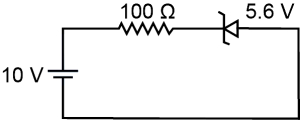
$A$ Zener diode having a breakdown voltage of $5.6 \ V$ is connected in reverse bias with a battery of emf $10 \ V$ and a resistance of $100 \ \Omega$ in series. The current flowing through the Zener diode is (in $mA$)
A
$88$
B
$0.88$
C
$4.4$
D
$44$
Solution
(D) The Zener diode is connected in series with a resistor $R = 100 \ \Omega$ and a battery of emf $V = 10 \ V$.
When the Zener diode is in the breakdown region,it maintains a constant voltage across it equal to its breakdown voltage,$V_Z = 5.6 \ V$.
The potential difference across the resistor $R$ is given by $\Delta V = V - V_Z = 10 \ V - 5.6 \ V = 4.4 \ V$.
Using Ohm's law,the current $I$ flowing through the circuit (and thus through the Zener diode) is:
$I = \frac{\Delta V}{R} = \frac{4.4 \ V}{100 \ \Omega} = 0.044 \ A$.
Converting this to milliamperes:
$I = 0.044 \times 1000 \ mA = 44 \ mA$.
When the Zener diode is in the breakdown region,it maintains a constant voltage across it equal to its breakdown voltage,$V_Z = 5.6 \ V$.
The potential difference across the resistor $R$ is given by $\Delta V = V - V_Z = 10 \ V - 5.6 \ V = 4.4 \ V$.
Using Ohm's law,the current $I$ flowing through the circuit (and thus through the Zener diode) is:
$I = \frac{\Delta V}{R} = \frac{4.4 \ V}{100 \ \Omega} = 0.044 \ A$.
Converting this to milliamperes:
$I = 0.044 \times 1000 \ mA = 44 \ mA$.
0 likesView Solution
35
PhysicsMediumMCQWBJEE · 2016
In case of a bipolar transistor,$\beta = 45$. The potential drop across the collector resistance of $1 \ k\Omega$ is $5 \ V$. The base current is approximately: (in $\mu A$)
A
$222$
B
$55$
C
$111$
D
$45$
Solution
(C) Given: Current gain $\beta = 45$,Collector resistance $R_C = 1 \ k\Omega = 1000 \ \Omega$,Potential drop across collector resistance $V_C = 5 \ V$.
We know that the collector current $I_C$ is given by $I_C = \frac{V_C}{R_C}$.
Substituting the values: $I_C = \frac{5 \ V}{1000 \ \Omega} = 5 \times 10^{-3} \ A = 5 \ mA$.
The relationship between collector current $I_C$ and base current $I_B$ is given by $\beta = \frac{I_C}{I_B}$.
Therefore,$I_B = \frac{I_C}{\beta}$.
Substituting the values: $I_B = \frac{5 \times 10^{-3} \ A}{45} = \frac{1}{9} \times 10^{-3} \ A \approx 0.111 \times 10^{-3} \ A$.
Converting to microamperes: $I_B \approx 111 \ \mu A$.
We know that the collector current $I_C$ is given by $I_C = \frac{V_C}{R_C}$.
Substituting the values: $I_C = \frac{5 \ V}{1000 \ \Omega} = 5 \times 10^{-3} \ A = 5 \ mA$.
The relationship between collector current $I_C$ and base current $I_B$ is given by $\beta = \frac{I_C}{I_B}$.
Therefore,$I_B = \frac{I_C}{\beta}$.
Substituting the values: $I_B = \frac{5 \times 10^{-3} \ A}{45} = \frac{1}{9} \times 10^{-3} \ A \approx 0.111 \times 10^{-3} \ A$.
Converting to microamperes: $I_B \approx 111 \ \mu A$.
0 likesView Solution
36
PhysicsEasyMCQWBJEE · 2016
For Fraunhofer diffraction to occur:
A
Light source should be at infinity
B
Both source and screen should be at infinity
C
Only the source should be at finite distance
D
Both source and screen should be at finite distance
Solution
(B) In Fraunhofer diffraction,the source of light and the screen are effectively at an infinite distance from the diffracting aperture or obstacle.
This ensures that the wavefronts incident on the aperture are plane wavefronts,and the diffracted rays reaching the screen are parallel to each other.
Therefore,both the source and the screen must be at infinity relative to the diffracting element.
This ensures that the wavefronts incident on the aperture are plane wavefronts,and the diffracted rays reaching the screen are parallel to each other.
Therefore,both the source and the screen must be at infinity relative to the diffracting element.
0 likesView Solution
Vedclass Products
For Students
Vedclass Test Series
Mock tests in real WBJEE style covering Physics with performance analysis. 5-day free trial.
Start Free TrialFor Teachers
Exam Paper Generator
Generate Set A/B/C/D Physics papers from 7.5L+ questions in 2 minutes. 3 chapters free.
Try FreeFor Institutes
Online Exam Module
Run live WBJEE mock exams with unlimited students, 360° analytics & white-label branding.
See DemoFrequently Asked Questions
How many Physics questions are in WBJEE 2016?
There are 36 Physics questions from the WBJEE 2016 paper on Vedclass, each with a detailed step-by-step solution in English.
Are WBJEE 2016 Physics solutions available in English?
Yes. All solutions on this page are in English. You can also switch to English or Hindi using the language buttons above the questions.
Can I practice WBJEE 2016 Physics as a timed test?
Yes. Use the Vedclass Test Series to attempt a full WBJEE mock test covering Physics with time limits and instant score analysis.
Can teachers create Physics papers from WBJEE previous year questions?
Yes. The Vedclass Exam Paper Generator lets teachers mix WBJEE Physics questions and generate Set A/B/C/D papers in minutes.
For Teachers & Institutes
Build a Custom Physics Paper
Pick WBJEE 2016 Physics questions, set difficulty, and generate Set A/B/C/D in 2 minutes.