
ChemistryQ1–48 of 48 questions
Page 1 of 1 · English
1
ChemistryMCQWBJEE · 2016
The correct structure of the drug paracetamol is
A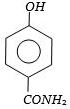
B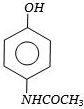
C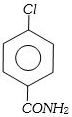
D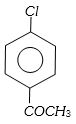
Solution
(B) $Paracetamol$ is $N-(4-hydroxyphenyl)acetamide$. Its structure consists of a benzene ring with a hydroxyl group $(-OH)$ at the $1$-position and an acetamido group $(-NHCOCH_3)$ at the $4$-position. It acts as an analgesic and antipyretic.
0 likesView Solution
2
ChemistryMCQWBJEE · 2016
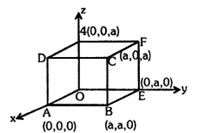
The cosine of the angle between any two diagonals of a cube is:
A
$1/3$
B
$1/2$
C
$2/3$
D
$1/\sqrt{3}$
Solution
(A) Let the vertices of the cube be represented in a $3D$ coordinate system. Consider a cube with side length $a$. The four diagonals of the cube connect opposite vertices. Let us consider two diagonals,for example,the diagonal from $(0,0,0)$ to $(a,a,a)$ and the diagonal from $(a,0,0)$ to $(0,a,a)$.
The direction vector of the first diagonal $\vec{d_1}$ is $(a-0, a-0, a-0) = (a, a, a)$.
The direction vector of the second diagonal $\vec{d_2}$ is $(0-a, a-0, a-0) = (-a, a, a)$.
The cosine of the angle $\theta$ between these two vectors is given by the formula:
$\cos \theta = \frac{|\vec{d_1} \cdot \vec{d_2}|}{|\vec{d_1}| |\vec{d_2}|}$
Calculating the dot product:
$\vec{d_1} \cdot \vec{d_2} = (a)(-a) + (a)(a) + (a)(a) = -a^2 + a^2 + a^2 = a^2$
Calculating the magnitudes:
$|\vec{d_1}| = \sqrt{a^2 + a^2 + a^2} = \sqrt{3a^2} = a\sqrt{3}$
$|\vec{d_2}| = \sqrt{(-a)^2 + a^2 + a^2} = \sqrt{3a^2} = a\sqrt{3}$
Therefore,$\cos \theta = \frac{a^2}{(a\sqrt{3})(a\sqrt{3})} = \frac{a^2}{3a^2} = \frac{1}{3}$.
Thus,the cosine of the angle between any two diagonals of a cube is $1/3$.
The direction vector of the first diagonal $\vec{d_1}$ is $(a-0, a-0, a-0) = (a, a, a)$.
The direction vector of the second diagonal $\vec{d_2}$ is $(0-a, a-0, a-0) = (-a, a, a)$.
The cosine of the angle $\theta$ between these two vectors is given by the formula:
$\cos \theta = \frac{|\vec{d_1} \cdot \vec{d_2}|}{|\vec{d_1}| |\vec{d_2}|}$
Calculating the dot product:
$\vec{d_1} \cdot \vec{d_2} = (a)(-a) + (a)(a) + (a)(a) = -a^2 + a^2 + a^2 = a^2$
Calculating the magnitudes:
$|\vec{d_1}| = \sqrt{a^2 + a^2 + a^2} = \sqrt{3a^2} = a\sqrt{3}$
$|\vec{d_2}| = \sqrt{(-a)^2 + a^2 + a^2} = \sqrt{3a^2} = a\sqrt{3}$
Therefore,$\cos \theta = \frac{a^2}{(a\sqrt{3})(a\sqrt{3})} = \frac{a^2}{3a^2} = \frac{1}{3}$.
Thus,the cosine of the angle between any two diagonals of a cube is $1/3$.
0 likesView Solution
3
ChemistryMCQWBJEE · 2016
The smallest positive root of the equation $\tan x - x = 0$ lies in the interval:
A
$(0, \frac{\pi}{2})$
B
$(\frac{\pi}{2}, \pi)$
C
$(\pi, \frac{3\pi}{2})$
D
$(\frac{3\pi}{2}, 2\pi)$
Solution
(C) Let $f(x) = \tan x - x$.
For $0 < x < \frac{\pi}{2}$,we know that $\tan x > x$,so $f(x) > 0$. Thus,there are no roots in $(0, \frac{\pi}{2})$.
For $\frac{\pi}{2} < x < \pi$,$\tan x$ is negative and $x$ is positive,so $f(x) = \tan x - x < 0$. Thus,there are no roots in $(\frac{\pi}{2}, \pi)$.
For $\pi < x < \frac{3\pi}{2}$,we evaluate the function at the boundaries:
$f(\pi) = \tan(\pi) - \pi = 0 - \pi = -\pi < 0$.
As $x \to \frac{3\pi}{2}^-$,$\tan x \to \infty$,so $f(x) \to \infty$.
Since $f(x)$ is continuous on $(\pi, \frac{3\pi}{2})$ and changes sign from negative to positive,by the Intermediate Value Theorem,there exists at least one root in $(\pi, \frac{3\pi}{2})$.
For $0 < x < \frac{\pi}{2}$,we know that $\tan x > x$,so $f(x) > 0$. Thus,there are no roots in $(0, \frac{\pi}{2})$.
For $\frac{\pi}{2} < x < \pi$,$\tan x$ is negative and $x$ is positive,so $f(x) = \tan x - x < 0$. Thus,there are no roots in $(\frac{\pi}{2}, \pi)$.
For $\pi < x < \frac{3\pi}{2}$,we evaluate the function at the boundaries:
$f(\pi) = \tan(\pi) - \pi = 0 - \pi = -\pi < 0$.
As $x \to \frac{3\pi}{2}^-$,$\tan x \to \infty$,so $f(x) \to \infty$.
Since $f(x)$ is continuous on $(\pi, \frac{3\pi}{2})$ and changes sign from negative to positive,by the Intermediate Value Theorem,there exists at least one root in $(\pi, \frac{3\pi}{2})$.
0 likesView Solution
4
ChemistryMCQWBJEE · 2016
The correct structure of the drug paracetamol is:
A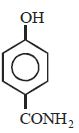
B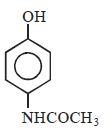
C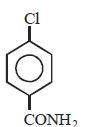
D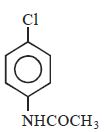
Solution
(B) Paracetamol,also known as acetaminophen,is chemically $N$-($4$-hydroxyphenyl)acetamide.
Its structure consists of a benzene ring substituted with a hydroxyl group $(-OH)$ and an acetamido group $(-NHCOCH_3)$ at the para-positions ($1,4$-positions) relative to each other.
Therefore,the correct structure is represented by option $B$.
Its structure consists of a benzene ring substituted with a hydroxyl group $(-OH)$ and an acetamido group $(-NHCOCH_3)$ at the para-positions ($1,4$-positions) relative to each other.
Therefore,the correct structure is represented by option $B$.
0 likesView Solution
5
ChemistryMCQWBJEE · 2016
Which of the following reactions will not result in the formation of carbon-carbon bonds?
A
Cannizzaro reaction
B
Wurtz reaction
C
Reimer-Tiemann reaction
D
Friedel-Crafts acylation
Solution
(A) The Cannizzaro reaction involves the disproportionation of aldehydes lacking $\alpha$-hydrogen atoms into a carboxylic acid salt and an alcohol. No new $C-C$ bond is formed in this process.
In contrast:
- Wurtz reaction forms a $C-C$ bond between two alkyl groups $(2 \ R-X + 2 \ Na \longrightarrow R-R + 2 \ NaX)$.
- Reimer-Tiemann reaction introduces a formyl group onto a phenol ring,forming a $C-C$ bond.
- Friedel-Crafts acylation introduces an acyl group onto an aromatic ring,forming a $C-C$ bond.
In contrast:
- Wurtz reaction forms a $C-C$ bond between two alkyl groups $(2 \ R-X + 2 \ Na \longrightarrow R-R + 2 \ NaX)$.
- Reimer-Tiemann reaction introduces a formyl group onto a phenol ring,forming a $C-C$ bond.
- Friedel-Crafts acylation introduces an acyl group onto an aromatic ring,forming a $C-C$ bond.
0 likesView Solution
6
ChemistryMediumMCQWBJEE · 2016
Which of the following molecules has a shape similar to $CO_{2}$?
A
$HgCl_{2}$
B
$SnCl_{2}$
C
$C_{2}H_{2}$
D
$NO_{2}$
Solution
(A, C) $CO_{2}$ has a linear shape due to $sp$ hybridization and the absence of lone pairs on the central carbon atom.
$HgCl_{2}$ ($sp$ hybridization,linear) and $C_{2}H_{2}$ ($sp$ hybridization,linear) both have a shape similar to $CO_{2}$.
$SnCl_{2}$ and $NO_{2}$ have bent shapes due to the presence of a lone pair on the central atom.
$HgCl_{2}$ ($sp$ hybridization,linear) and $C_{2}H_{2}$ ($sp$ hybridization,linear) both have a shape similar to $CO_{2}$.
$SnCl_{2}$ and $NO_{2}$ have bent shapes due to the presence of a lone pair on the central atom.
0 likesView Solution
7
ChemistryMediumMCQWBJEE · 2016
The boiling points of $HF$,$HCl$,$HBr$ and $HI$ follow the order:
A
$HF > HCl > HBr > HI$
B
$HF > HI > HBr > HCl$
C
$HI > HBr > HCl > HF$
D
$HCl > HF > HBr > HI$
Solution
(B) Due to strong intermolecular hydrogen bonding,$HF$ exhibits the highest boiling point among the hydrogen halides.
For the remaining hydrogen halides ($HCl$,$HBr$,$HI$),the boiling point is determined by the magnitude of van der Waals' forces.
As the molecular size and mass increase down the group,the van der Waals' forces increase,leading to an increase in boiling point.
Therefore,the order of boiling points is $HI > HBr > HCl$.
Combining these,the overall order is $HF > HI > HBr > HCl$.
For the remaining hydrogen halides ($HCl$,$HBr$,$HI$),the boiling point is determined by the magnitude of van der Waals' forces.
As the molecular size and mass increase down the group,the van der Waals' forces increase,leading to an increase in boiling point.
Therefore,the order of boiling points is $HI > HBr > HCl$.
Combining these,the overall order is $HF > HI > HBr > HCl$.
0 likesView Solution
8
ChemistryMediumMCQWBJEE · 2016
Which of the following plots represent an exothermic reaction?
A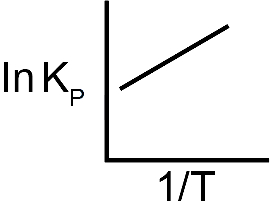
B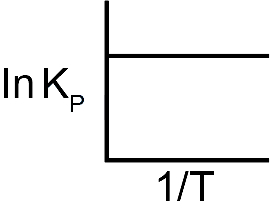
C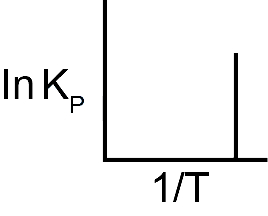
D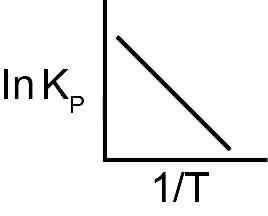
Solution
(A) The relationship between the equilibrium constant $K_p$ and temperature $T$ is given by the van't Hoff equation:
$\ln K_p = -\frac{\Delta H^\circ}{R} \left(\frac{1}{T}\right) + \frac{\Delta S^\circ}{R}$
Comparing this with the equation of a straight line $y = mx + c$,where $y = \ln K_p$ and $x = \frac{1}{T}$,the slope $m$ is equal to $-\frac{\Delta H^\circ}{R}$.
For an exothermic reaction,the enthalpy change $\Delta H^\circ$ is negative $(\Delta H^\circ < 0)$.
Therefore,the slope $m = -\frac{\Delta H^\circ}{R}$ will be positive.
Thus,the plot of $\ln K_p$ versus $\frac{1}{T}$ for an exothermic reaction will have a positive slope.
$\ln K_p = -\frac{\Delta H^\circ}{R} \left(\frac{1}{T}\right) + \frac{\Delta S^\circ}{R}$
Comparing this with the equation of a straight line $y = mx + c$,where $y = \ln K_p$ and $x = \frac{1}{T}$,the slope $m$ is equal to $-\frac{\Delta H^\circ}{R}$.
For an exothermic reaction,the enthalpy change $\Delta H^\circ$ is negative $(\Delta H^\circ < 0)$.
Therefore,the slope $m = -\frac{\Delta H^\circ}{R}$ will be positive.
Thus,the plot of $\ln K_p$ versus $\frac{1}{T}$ for an exothermic reaction will have a positive slope.
0 likesView Solution
9
ChemistryMediumMCQWBJEE · 2016
An element $X$ belongs to the fourth period and fifteenth group of the periodic table. Which of the following statements is true?
A
It has a completely filled $s$-orbital and a partially filled $d$-orbital.
B
It has completely filled $s$- and $p$-orbitals and a partially filled $d$-orbital.
C
It has completely filled $s$- and $p$-orbitals and a half-filled $d$-orbital.
D
It has a half-filled $p$-orbital and completely filled $s$- and $d$-orbitals.
Solution
(D) The element belonging to the $4^{th}$ period and $15^{th}$ group is arsenic $(As)$.
The outer electronic configuration of a $15^{th}$ group element is $ns^{2} np^{3}$.
Since arsenic belongs to the $4^{th}$ period,it has a filled $3d$ subshell as well.
Thus,the electronic configuration of $As$ is $[Ar] 3d^{10} 4s^{2} 4p^{3}$.
This configuration shows that it has completely filled $s$- and $d$-orbitals and a half-filled $p$-orbital.
The outer electronic configuration of a $15^{th}$ group element is $ns^{2} np^{3}$.
Since arsenic belongs to the $4^{th}$ period,it has a filled $3d$ subshell as well.
Thus,the electronic configuration of $As$ is $[Ar] 3d^{10} 4s^{2} 4p^{3}$.
This configuration shows that it has completely filled $s$- and $d$-orbitals and a half-filled $p$-orbital.
0 likesView Solution
10
ChemistryEasyMCQWBJEE · 2016
The metal which can be used to obtain metallic $Cu$ from aqueous $CuSO_{4}$ solution is
A
$Na$
B
$Ag$
C
$Hg$
D
$Fe$
Solution
(D) Iron $(Fe)$ is used to obtain metallic $Cu$ from $CuSO_{4(aq)}$ because $Fe$ is more reactive than $Cu$ (it has a more negative standard reduction potential),thus it displaces copper from $CuSO_{4}$ solution to give metallic copper $(Cu)$.
$CuSO_{4(aq)} + Fe_{(s)} \longrightarrow FeSO_{4(aq)} + Cu_{(s)}$
$CuSO_{4(aq)} + Fe_{(s)} \longrightarrow FeSO_{4(aq)} + Cu_{(s)}$
0 likesView Solution
11
ChemistryDifficultMCQWBJEE · 2016
From the following compounds,choose the one which is not aromatic.
A
Cyclopropenyl cation
B
Cyclooctatetraene
C
Cyclopentadienyl anion
D
$6-$(dimethylamino)fulvene
Solution
(B) For a compound to be aromatic,it must satisfy $H$ückel's rule:
$(I)$ The molecule must be cyclic.
$(II)$ The molecule must be planar.
$(III)$ The molecule must be fully conjugated (all atoms in the ring must have an unhybridized $p$-orbital).
$(IV)$ The molecule must have $(4n+2) \pi$ electrons,where $n = 0, 1, 2, ...$.
Analysis of the given compounds:
$(A)$ Cyclopropenyl cation: Cyclic,planar,conjugated,and has $2 \pi$ electrons $(n=0)$. It is aromatic.
$(B)$ Cyclooctatetraene: It has $8 \pi$ electrons ($4n$ system,$n=2$). Furthermore,it adopts a non-planar 'tub' shape to avoid anti-aromaticity. Thus,it is non-aromatic.
$(C)$ Cyclopentadienyl anion: Cyclic,planar,conjugated,and has $6 \pi$ electrons $(n=1)$. It is aromatic.
$(D)$ $6-$(dimethylamino)fulvene: This is a substituted fulvene derivative that exhibits aromatic character due to the contribution of a dipolar resonance structure where the five-membered ring becomes a cyclopentadienyl anion ($6 \pi$ electrons).
Therefore,cyclooctatetraene is not aromatic.
$(I)$ The molecule must be cyclic.
$(II)$ The molecule must be planar.
$(III)$ The molecule must be fully conjugated (all atoms in the ring must have an unhybridized $p$-orbital).
$(IV)$ The molecule must have $(4n+2) \pi$ electrons,where $n = 0, 1, 2, ...$.
Analysis of the given compounds:
$(A)$ Cyclopropenyl cation: Cyclic,planar,conjugated,and has $2 \pi$ electrons $(n=0)$. It is aromatic.
$(B)$ Cyclooctatetraene: It has $8 \pi$ electrons ($4n$ system,$n=2$). Furthermore,it adopts a non-planar 'tub' shape to avoid anti-aromaticity. Thus,it is non-aromatic.
$(C)$ Cyclopentadienyl anion: Cyclic,planar,conjugated,and has $6 \pi$ electrons $(n=1)$. It is aromatic.
$(D)$ $6-$(dimethylamino)fulvene: This is a substituted fulvene derivative that exhibits aromatic character due to the contribution of a dipolar resonance structure where the five-membered ring becomes a cyclopentadienyl anion ($6 \pi$ electrons).
Therefore,cyclooctatetraene is not aromatic.
0 likesView Solution
12
ChemistryMediumMCQWBJEE · 2016
Choose the correct statement$(s)$ among the following.
A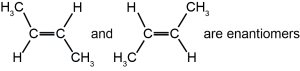
B
$CH_3CHO$ on reaction with $HCN$ gives a racemic mixture.
C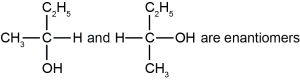
D
$CH_3-CH=NOH$ shows geometrical isomerism.
Solution
(B, D) Option $A$: The given structures are $cis$ and $trans$ isomers of $but-2-ene$,which are diastereomers,not enantiomers. Thus,this is false.
Option $B$: The reaction of $CH_3CHO$ with $HCN$ produces a cyanohydrin. Since the carbonyl carbon is $sp^2$ hybridized (planar),the cyanide ion can attack from either side with equal probability,resulting in a racemic mixture of the cyanohydrin. Thus,this is true.
Option $C$: By assigning $R/S$ configurations to the two Fischer projections of $butan-2-ol$,both are found to have the same configuration (e.g.,$R$). Therefore,they represent the same molecule and are not enantiomers. Thus,this is false.
Option $D$: $CH_3-CH=NOH$ (acetaldoxime) exhibits geometrical isomerism due to the restricted rotation around the $C=N$ bond and the presence of a lone pair on the nitrogen atom,leading to $syn$ and $anti$ (or $cis$ and $trans$) isomers. Thus,this is true.
Option $B$: The reaction of $CH_3CHO$ with $HCN$ produces a cyanohydrin. Since the carbonyl carbon is $sp^2$ hybridized (planar),the cyanide ion can attack from either side with equal probability,resulting in a racemic mixture of the cyanohydrin. Thus,this is true.
Option $C$: By assigning $R/S$ configurations to the two Fischer projections of $butan-2-ol$,both are found to have the same configuration (e.g.,$R$). Therefore,they represent the same molecule and are not enantiomers. Thus,this is false.
Option $D$: $CH_3-CH=NOH$ (acetaldoxime) exhibits geometrical isomerism due to the restricted rotation around the $C=N$ bond and the presence of a lone pair on the nitrogen atom,leading to $syn$ and $anti$ (or $cis$ and $trans$) isomers. Thus,this is true.
0 likesView Solution
13
ChemistryDifficultMCQWBJEE · 2016
Identify $X$ in the following sequence of reactions.
$CH_3-CH(Br)-CH(Br)-CH_2-CH_2-CH_3 \xrightarrow[(ii) Na \text{ in liquid } NH_3]{(i) NaNH_2} X$
$CH_3-CH(Br)-CH(Br)-CH_2-CH_2-CH_3 \xrightarrow[(ii) Na \text{ in liquid } NH_3]{(i) NaNH_2} X$
A
$CH_3-CH(Br)-CH(NH_2)-CH_2-CH_2-CH_3$
B
$CH_3-CH=C(H)-CH_2-CH_2-CH_3$ (trans-isomer)
C
$CH_3-CH=C(H)-CH_2-CH_2-CH_3$ (cis-isomer)
D
$CH_3-CH(NH_2)-CH(NH_2)-CH_2-CH_2-CH_3$
Solution
(B) The reaction sequence involves the dehydrohalogenation of a vicinal dibromide using $NaNH_2$ to form an alkyne. The first step with $NaNH_2$ removes two molecules of $HBr$ to produce $hex-2-yne$ $(CH_3-C \equiv C-CH_2-CH_2-CH_3)$.
The second step involves the reduction of the alkyne using $Na$ in liquid $NH_3$ (Birch reduction),which stereoselectively reduces the internal alkyne to a $trans-alkene$.
Therefore,the final product $X$ is $trans-hex-2-ene$.
The second step involves the reduction of the alkyne using $Na$ in liquid $NH_3$ (Birch reduction),which stereoselectively reduces the internal alkyne to a $trans-alkene$.
Therefore,the final product $X$ is $trans-hex-2-ene$.
0 likesView Solution
14
ChemistryMediumMCQWBJEE · 2016
Ozonolysis of an alkene produces only one dicarbonyl compound. The structure of the alkene is:
A
$CH_3-CH=CH-CH_3$
B
Cyclobutene
C
Methylenecyclobutane
D
$CH_3-CH=CH-CH=CH_2$
Solution
(B) Ozonolysis of a cyclic alkene results in the cleavage of the double bond,leading to the formation of a single dicarbonyl compound. Among the given options,cyclobutene is a cyclic alkene. Upon ozonolysis,the double bond in cyclobutene breaks to form butane$-1,4-$dial (a dicarbonyl compound). The other options are acyclic alkenes,which would produce multiple carbonyl compounds upon ozonolysis.
0 likesView Solution
15
ChemistryMediumMCQWBJEE · 2016
The major products obtained during ozonolysis of $2,3-$dimethyl$-1-$butene and subsequent reduction with $Zn$ and $H_2O$ are
A
methanoic acid and $2-$methyl$-2-$butanone
B
methanal and $3-$methyl$-2-$butanone
C
methanol and $2,2-$dimethyl$-3-$butanone
D
methanoic acid and $2-$methyl$-3-$butanone
Solution
(B) Ozonolysis of an alkene followed by reduction with $Zn/H_2O$ (reductive ozonolysis) involves the cleavage of the $C=C$ double bond to form carbonyl compounds.
For $2,3-$dimethyl$-1-$butene,the structure is $(CH_3)_2CH-C(CH_3)=CH_2$.
Upon ozonolysis,the $C=C$ bond breaks to yield $HCHO$ (methanal) and $(CH_3)_2CH-CO-CH_3$ ($3-$methyl$-2-$butanone).
Thus,the products are methanal and $3-$methyl$-2-$butanone.
For $2,3-$dimethyl$-1-$butene,the structure is $(CH_3)_2CH-C(CH_3)=CH_2$.
Upon ozonolysis,the $C=C$ bond breaks to yield $HCHO$ (methanal) and $(CH_3)_2CH-CO-CH_3$ ($3-$methyl$-2-$butanone).
Thus,the products are methanal and $3-$methyl$-2-$butanone.
0 likesView Solution
16
ChemistryMediumMCQWBJEE · 2016
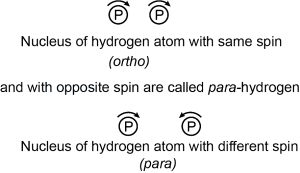
Which statement is not correct for ortho and para hydrogen?
A
They have different boiling points
B
Ortho-form is more stable than para-form
C
They differ in their nuclear spin
D
The ratio of ortho to para hydrogen changes with change in temperature
Solution
(B) $(i)$ Ortho and para hydrogens have different nuclear spin. In $H_2$ molecule,two protons in two $H$ atoms with parallel spin are called ortho-hydrogen.
$(ii)$ Para-hydrogen is more stable than ortho-form at low temperatures,whereas ortho-hydrogen is more stable at and above room temperature. Therefore,the statement that ortho-form is more stable than para-form is not universally correct.
$(iii)$ The percent composition of ortho and para changes with the temperature. Thus,their ratio also changes.
$(iv)$ They have slightly different boiling points.
Hence,$(B)$ is the answer.
$(ii)$ Para-hydrogen is more stable than ortho-form at low temperatures,whereas ortho-hydrogen is more stable at and above room temperature. Therefore,the statement that ortho-form is more stable than para-form is not universally correct.
$(iii)$ The percent composition of ortho and para changes with the temperature. Thus,their ratio also changes.
$(iv)$ They have slightly different boiling points.
Hence,$(B)$ is the answer.
0 likesView Solution
17
ChemistryDifficultMCQWBJEE · 2016
In which of the following mixed aqueous solutions,$pH = pK_{a}$ at equilibrium?
$(1)$ $100 \ mL$ of $0.1 \ M \ CH_{3}COOH + 100 \ mL$ of $0.1 \ M \ CH_{3}COONa$
$(2)$ $100 \ mL$ of $0.1 \ M \ CH_{3}COOH + 50 \ mL$ of $0.1 \ M \ NaOH$
$(3)$ $100 \ mL$ of $0.1 \ M \ CH_{3}COOH + 100 \ mL$ of $0.1 \ M \ NaOH$
$(4)$ $100 \ mL$ of $0.1 \ M \ CH_{3}COOH + 100 \ mL$ of $0.1 \ M \ NH_{3}$
$(1)$ $100 \ mL$ of $0.1 \ M \ CH_{3}COOH + 100 \ mL$ of $0.1 \ M \ CH_{3}COONa$
$(2)$ $100 \ mL$ of $0.1 \ M \ CH_{3}COOH + 50 \ mL$ of $0.1 \ M \ NaOH$
$(3)$ $100 \ mL$ of $0.1 \ M \ CH_{3}COOH + 100 \ mL$ of $0.1 \ M \ NaOH$
$(4)$ $100 \ mL$ of $0.1 \ M \ CH_{3}COOH + 100 \ mL$ of $0.1 \ M \ NH_{3}$
A
$(1)$ is correct
B
$(2)$ is correct
C
$(3)$ is correct
D
Both $(1)$ and $(2)$ are correct
Solution
(D) The $pH$ of an acidic buffer solution is given by the Henderson-Hasselbalch equation:
$pH = pK_{a} + \log \frac{[salt]}{[acid]}$
For $pH = pK_{a}$,we must have $\log \frac{[salt]}{[acid]} = 0$,which implies $[salt] = [acid]$.
$(1)$ $100 \ mL$ of $0.1 \ M \ CH_{3}COOH$ $(10 \ mmol)$ + $100 \ mL$ of $0.1 \ M \ CH_{3}COONa$ $(10 \ mmol)$.
Here,$[salt] = [acid] = 10 \ mmol$. Thus,$pH = pK_{a} + \log(1) = pK_{a}$.
$(2)$ $100 \ mL$ of $0.1 \ M \ CH_{3}COOH$ $(10 \ mmol)$ + $50 \ mL$ of $0.1 \ M \ NaOH$ $(5 \ mmol)$.
The reaction is: $CH_{3}COOH + NaOH \rightarrow CH_{3}COONa + H_{2}O$.
Initial: $10 \ mmol \ CH_{3}COOH, 5 \ mmol \ NaOH$.
Final: $5 \ mmol \ CH_{3}COOH, 5 \ mmol \ CH_{3}COONa$.
Since $[salt] = [acid] = 5 \ mmol$,$pH = pK_{a} + \log(1) = pK_{a}$.
$(3)$ $100 \ mL$ of $0.1 \ M \ CH_{3}COOH$ $(10 \ mmol)$ + $100 \ mL$ of $0.1 \ M \ NaOH$ $(10 \ mmol)$.
This results in complete neutralization to form $CH_{3}COONa$. No buffer is formed.
$(4)$ $CH_{3}COOH + NH_{3} \rightarrow CH_{3}COONH_{4}$.
This forms a salt of a weak acid and a weak base,not a buffer solution.
Therefore,both $(1)$ and $(2)$ satisfy the condition $pH = pK_{a}$.
$pH = pK_{a} + \log \frac{[salt]}{[acid]}$
For $pH = pK_{a}$,we must have $\log \frac{[salt]}{[acid]} = 0$,which implies $[salt] = [acid]$.
$(1)$ $100 \ mL$ of $0.1 \ M \ CH_{3}COOH$ $(10 \ mmol)$ + $100 \ mL$ of $0.1 \ M \ CH_{3}COONa$ $(10 \ mmol)$.
Here,$[salt] = [acid] = 10 \ mmol$. Thus,$pH = pK_{a} + \log(1) = pK_{a}$.
$(2)$ $100 \ mL$ of $0.1 \ M \ CH_{3}COOH$ $(10 \ mmol)$ + $50 \ mL$ of $0.1 \ M \ NaOH$ $(5 \ mmol)$.
The reaction is: $CH_{3}COOH + NaOH \rightarrow CH_{3}COONa + H_{2}O$.
Initial: $10 \ mmol \ CH_{3}COOH, 5 \ mmol \ NaOH$.
Final: $5 \ mmol \ CH_{3}COOH, 5 \ mmol \ CH_{3}COONa$.
Since $[salt] = [acid] = 5 \ mmol$,$pH = pK_{a} + \log(1) = pK_{a}$.
$(3)$ $100 \ mL$ of $0.1 \ M \ CH_{3}COOH$ $(10 \ mmol)$ + $100 \ mL$ of $0.1 \ M \ NaOH$ $(10 \ mmol)$.
This results in complete neutralization to form $CH_{3}COONa$. No buffer is formed.
$(4)$ $CH_{3}COOH + NH_{3} \rightarrow CH_{3}COONH_{4}$.
This forms a salt of a weak acid and a weak base,not a buffer solution.
Therefore,both $(1)$ and $(2)$ satisfy the condition $pH = pK_{a}$.
0 likesView Solution
18
ChemistryDifficultMCQWBJEE · 2016
The molar solubility (in $mol \cdot L^{-1}$) of a sparingly soluble salt $MX_4$ is $S$. The corresponding solubility product is $K_{sp}$. $S$ in terms of $K_{sp}$ is given by the relation:
A
$S = \left(\frac{K_{sp}}{128}\right)^{1/4}$
B
$S = \left(\frac{K_{sp}}{256}\right)^{1/5}$
C
$S = (256 K_{sp})^{1/5}$
D
$S = (128 K_{sp})^{1/4}$
Solution
(B) For the sparingly soluble salt $MX_4$:
$MX_{4(s)} \rightleftharpoons M^{4+}_{(aq)} + 4X^{-}_{(aq)}$
If the molar solubility is $S$,then:
$[M^{4+}] = S$
$[X^{-}] = 4S$
The solubility product $K_{sp}$ is given by:
$K_{sp} = [M^{4+}][X^{-}]^4$
$K_{sp} = (S)(4S)^4$
$K_{sp} = S \cdot 256S^4$
$K_{sp} = 256S^5$
$S^5 = \frac{K_{sp}}{256}$
$S = \left(\frac{K_{sp}}{256}\right)^{1/5}$
$MX_{4(s)} \rightleftharpoons M^{4+}_{(aq)} + 4X^{-}_{(aq)}$
If the molar solubility is $S$,then:
$[M^{4+}] = S$
$[X^{-}] = 4S$
The solubility product $K_{sp}$ is given by:
$K_{sp} = [M^{4+}][X^{-}]^4$
$K_{sp} = (S)(4S)^4$
$K_{sp} = S \cdot 256S^4$
$K_{sp} = 256S^5$
$S^5 = \frac{K_{sp}}{256}$
$S = \left(\frac{K_{sp}}{256}\right)^{1/5}$
0 likesView Solution
19
ChemistryEasyMCQWBJEE · 2016
Nitrogen dioxide is not produced on heating:
A
$KNO_{3}$
B
$Pb(NO_{3})_{2}$
C
$Cu(NO_{3})_{2}$
D
$AgNO_{3}$
Solution
(A) Only $KNO_{3}$ on heating does not produce $NO_{2}$. The thermal decomposition reactions are as follows:
$(a)$ $2 KNO_{3} \xrightarrow{\Delta} 2 KNO_{2} + O_{2}$
$(b)$ $2 Pb(NO_{3})_{2} \xrightarrow{\Delta} 2 PbO + 4 NO_{2} + O_{2}$
$(c)$ $2 Cu(NO_{3})_{2} \xrightarrow{\Delta} 2 CuO + 4 NO_{2} + O_{2}$
$(d)$ $2 AgNO_{3} \xrightarrow{\Delta} 2 Ag + 2 NO_{2} + O_{2}$
Alkali metal nitrates (like $KNO_{3}$) decompose to form nitrites and oxygen,whereas heavy metal nitrates decompose to form metal oxides (or metal),nitrogen dioxide,and oxygen.
$(a)$ $2 KNO_{3} \xrightarrow{\Delta} 2 KNO_{2} + O_{2}$
$(b)$ $2 Pb(NO_{3})_{2} \xrightarrow{\Delta} 2 PbO + 4 NO_{2} + O_{2}$
$(c)$ $2 Cu(NO_{3})_{2} \xrightarrow{\Delta} 2 CuO + 4 NO_{2} + O_{2}$
$(d)$ $2 AgNO_{3} \xrightarrow{\Delta} 2 Ag + 2 NO_{2} + O_{2}$
Alkali metal nitrates (like $KNO_{3}$) decompose to form nitrites and oxygen,whereas heavy metal nitrates decompose to form metal oxides (or metal),nitrogen dioxide,and oxygen.
0 likesView Solution
20
ChemistryEasyMCQWBJEE · 2016
In the solid state,$PCl_{5}$ exists as
A
$[PCl_{4}]^{-}$ and $[PCl_{6}]^{+}$ ions
B
covalent $PCl_{5}$ molecules only
C
$[PCl_{4}]^{+}$ and $[PCl_{6}]^{-}$ ions
D
covalent $P_{2}Cl_{10}$ molecules only
Solution
(C) In the solid state,$PCl_{5}$ undergoes auto-ionization to form an ionic lattice consisting of tetrahedral $[PCl_{4}]^{+}$ cations and octahedral $[PCl_{6}]^{-}$ anions.
The reaction is: $2PCl_{5}(s) \longrightarrow [PCl_{4}]^{+}(s) + [PCl_{6}]^{-}(s)$.
The reaction is: $2PCl_{5}(s) \longrightarrow [PCl_{4}]^{+}(s) + [PCl_{6}]^{-}(s)$.
0 likesView Solution
21
ChemistryEasyMCQWBJEE · 2016
The correct order of $O-O$ bond length in $O_{2}$,$H_{2}O_{2}$ and $O_{3}$ is
A
$O_{2} > O_{3} > H_{2}O_{2}$
B
$H_{2}O_{2} > O_{3} > O_{2}$
C
$O_{3} > O_{2} > H_{2}O_{2}$
D
$O_{3} > H_{2}O_{2} > O_{2}$
Solution
(B) The bond length is inversely proportional to the bond order.
$1$. In $O_{2}$,the bond order is $2$.
$2$. In $O_{3}$,the bond order is $1.5$ due to resonance.
$3$. In $H_{2}O_{2}$,the $O-O$ bond is a single bond with a bond order of $1$.
Comparing the bond orders: $O_{2} (2) > O_{3} (1.5) > H_{2}O_{2} (1)$.
Therefore,the order of bond length is $H_{2}O_{2} > O_{3} > O_{2}$.
$1$. In $O_{2}$,the bond order is $2$.
$2$. In $O_{3}$,the bond order is $1.5$ due to resonance.
$3$. In $H_{2}O_{2}$,the $O-O$ bond is a single bond with a bond order of $1$.
Comparing the bond orders: $O_{2} (2) > O_{3} (1.5) > H_{2}O_{2} (1)$.
Therefore,the order of bond length is $H_{2}O_{2} > O_{3} > O_{2}$.
0 likesView Solution
22
ChemistryMediumMCQWBJEE · 2016
Which of the following arrangements is correct in respect of solubility in water?
A
$CaSO_{4} > BaSO_{4} > BeSO_{4} > MgSO_{4} > SrSO_{4}$
B
$BeSO_{4} > MgSO_{4} > CaSO_{4} > SrSO_{4} > BaSO_{4}$
C
$BaSO_{4} > SrSO_{4} > CaSO_{4} > MgSO_{4} > BeSO_{4}$
D
$BeSO_{4} > CaSO_{4} > MgSO_{4} > SrSO_{4} > BaSO_{4}$
Solution
(B) The solubility of alkaline earth metal sulphates in water decreases down the group.
This is because the hydration energy decreases more rapidly than the lattice energy as the size of the cation increases.
The correct order is: $BeSO_{4} > MgSO_{4} > CaSO_{4} > SrSO_{4} > BaSO_{4}$.
This is because the hydration energy decreases more rapidly than the lattice energy as the size of the cation increases.
The correct order is: $BeSO_{4} > MgSO_{4} > CaSO_{4} > SrSO_{4} > BaSO_{4}$.
0 likesView Solution
23
ChemistryEasyMCQWBJEE · 2016
The number of $\sigma$ and $\pi$ bonds between two carbon atoms in calcium carbide are
A
one $\sigma, 1 \pi$
B
one $\sigma, 2 \pi$
C
two $\sigma, 1 \pi$
D
one $\sigma, 1 \frac{1}{2} \pi$
Solution
(B) Calcium carbide is calcium acetylide,$CaC_2$,with the structure $[Ca]^{2+} [:C \equiv C:]^{2-}$.
In the acetylide ion $[:C \equiv C:]^{2-}$,there is a triple bond between the two carbon atoms.
$A$ triple bond consists of one sigma $(\sigma)$ bond and two pi $(\pi)$ bonds.
Therefore,the correct option is $B$.
In the acetylide ion $[:C \equiv C:]^{2-}$,there is a triple bond between the two carbon atoms.
$A$ triple bond consists of one sigma $(\sigma)$ bond and two pi $(\pi)$ bonds.
Therefore,the correct option is $B$.
0 likesView Solution
24
ChemistryMediumMCQWBJEE · 2016
Amongst the following,which should have the highest $rms$ speed at the same temperature?
A
$SO_{2}$
B
$CO_{2}$
C
$O_{2}$
D
$H_{2}$
Solution
(D) The $rms$ velocity $(v_{rms})$ is given by the formula $v_{rms} = \sqrt{\frac{3RT}{M}}$.
Since $v_{rms} \propto \sqrt{\frac{1}{M}}$,the gas with the smallest molar mass $(M)$ will have the highest $rms$ speed at a constant temperature.
The molar masses are: $SO_{2} = 64 \ g/mol$,$CO_{2} = 44 \ g/mol$,$O_{2} = 32 \ g/mol$,and $H_{2} = 2 \ g/mol$.
Since $H_{2}$ has the minimum molar mass,it has the highest $rms$ speed.
Since $v_{rms} \propto \sqrt{\frac{1}{M}}$,the gas with the smallest molar mass $(M)$ will have the highest $rms$ speed at a constant temperature.
The molar masses are: $SO_{2} = 64 \ g/mol$,$CO_{2} = 44 \ g/mol$,$O_{2} = 32 \ g/mol$,and $H_{2} = 2 \ g/mol$.
Since $H_{2}$ has the minimum molar mass,it has the highest $rms$ speed.
0 likesView Solution
25
ChemistryMCQWBJEE · 2016
The smallest positive root of the equation $\tan x - x = 0$ lies in
A
$\left(0, \frac{\pi}{2}\right)$
B
$\left(\frac{\pi}{2}, \pi\right)$
C
$\left(\pi, \frac{3\pi}{2}\right)$
D
$\left(\frac{3\pi}{2}, 2\pi\right)$
Solution
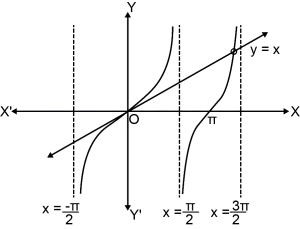
(C) The given equation is $\tan x - x = 0$,which implies $\tan x = x$.
To find the roots,we look for the points of intersection of the curves $y = \tan x$ and $y = x$.
At $x = 0$,both curves intersect at the origin,but we are looking for the smallest positive root.
For $x \in \left(0, \frac{\pi}{2}\right)$,$\tan x > x$,so there is no intersection in this interval.
For $x \in \left(\frac{\pi}{2}, \pi\right)$,$\tan x$ is negative while $x$ is positive,so there is no intersection.
For $x \in \left(\pi, \frac{3\pi}{2}\right)$,the curve $y = \tan x$ starts from $-\infty$ at $x = \pi^+$ and increases to $+\infty$ at $x = \frac{3\pi}{2}^-$. Since the line $y = x$ is positive in this interval,the curve $y = \tan x$ must intersect the line $y = x$ at exactly one point.
Thus,the smallest positive root lies in the interval $\left(\pi, \frac{3\pi}{2}\right)$.
To find the roots,we look for the points of intersection of the curves $y = \tan x$ and $y = x$.
At $x = 0$,both curves intersect at the origin,but we are looking for the smallest positive root.
For $x \in \left(0, \frac{\pi}{2}\right)$,$\tan x > x$,so there is no intersection in this interval.
For $x \in \left(\frac{\pi}{2}, \pi\right)$,$\tan x$ is negative while $x$ is positive,so there is no intersection.
For $x \in \left(\pi, \frac{3\pi}{2}\right)$,the curve $y = \tan x$ starts from $-\infty$ at $x = \pi^+$ and increases to $+\infty$ at $x = \frac{3\pi}{2}^-$. Since the line $y = x$ is positive in this interval,the curve $y = \tan x$ must intersect the line $y = x$ at exactly one point.
Thus,the smallest positive root lies in the interval $\left(\pi, \frac{3\pi}{2}\right)$.
0 likesView Solution
26
ChemistryMCQWBJEE · 2016
The value of $\cos 15^{\circ} \cos 7.5^{\circ} \sin 7.5^{\circ}$ is
A
$\frac{1}{2}$
B
$\frac{1}{8}$
C
$\frac{1}{4}$
D
$\frac{1}{16}$
Solution
(B) We have,$\cos 15^{\circ} \cdot \cos 7.5^{\circ} \cdot \sin 7.5^{\circ}$
$= \frac{1}{2} \cos 15^{\circ} (2 \sin 7.5^{\circ} \cos 7.5^{\circ})$
$= \frac{1}{2} \cos 15^{\circ} \sin(2 \times 7.5^{\circ})$
$= \frac{1}{2} \cos 15^{\circ} \sin 15^{\circ}$
$= \frac{1}{4} (2 \sin 15^{\circ} \cos 15^{\circ})$
$= \frac{1}{4} \sin(2 \times 15^{\circ})$
$= \frac{1}{4} \sin 30^{\circ}$
$= \frac{1}{4} \times \frac{1}{2} = \frac{1}{8}$
$= \frac{1}{2} \cos 15^{\circ} (2 \sin 7.5^{\circ} \cos 7.5^{\circ})$
$= \frac{1}{2} \cos 15^{\circ} \sin(2 \times 7.5^{\circ})$
$= \frac{1}{2} \cos 15^{\circ} \sin 15^{\circ}$
$= \frac{1}{4} (2 \sin 15^{\circ} \cos 15^{\circ})$
$= \frac{1}{4} \sin(2 \times 15^{\circ})$
$= \frac{1}{4} \sin 30^{\circ}$
$= \frac{1}{4} \times \frac{1}{2} = \frac{1}{8}$
0 likesView Solution
27
ChemistryMCQWBJEE · 2016
If the vertex of the conic $y^{2}-4y=4x-4a$ always lies between the straight lines $x+y=3$ and $2x+2y-1=0$,then
A
$2 < a < 4$
B
$-\frac{1}{2} < a < 2$
C
$0 < a < 2$
D
$-\frac{1}{2} < a < \frac{3}{2}$
Solution
(B) The given equation of the conic is $y^{2}-4y=4x-4a$.
Completing the square for $y$,we get $y^{2}-4y+4=4x-4a+4$,which simplifies to $(y-2)^{2}=4(x-a+1)$.
Comparing this with the standard form $(y-k)^{2}=4A(x-h)$,the vertex is $(h, k) = (a-1, 2)$.
Let the vertex be $(x_{0}, y_{0}) = (a-1, 2)$.
The vertex lies between the lines $x+y-3=0$ and $2x+2y-1=0$.
Rewriting the lines in terms of $x+y$:
Line $1$: $x+y=3$.
Line $2$: $2(x+y)=1 \implies x+y=\frac{1}{2}$.
Since the vertex lies between these two parallel lines,the value of $x+y$ for the vertex must lie between the values of $x+y$ for the lines.
Thus,$\frac{1}{2} < x_{0}+y_{0} < 3$.
Substituting $x_{0}+y_{0} = (a-1)+2 = a+1$:
$\frac{1}{2} < a+1 < 3$.
Subtracting $1$ from all parts:
$\frac{1}{2}-1 < a < 3-1$,which gives $-\frac{1}{2} < a < 2$.
Completing the square for $y$,we get $y^{2}-4y+4=4x-4a+4$,which simplifies to $(y-2)^{2}=4(x-a+1)$.
Comparing this with the standard form $(y-k)^{2}=4A(x-h)$,the vertex is $(h, k) = (a-1, 2)$.
Let the vertex be $(x_{0}, y_{0}) = (a-1, 2)$.
The vertex lies between the lines $x+y-3=0$ and $2x+2y-1=0$.
Rewriting the lines in terms of $x+y$:
Line $1$: $x+y=3$.
Line $2$: $2(x+y)=1 \implies x+y=\frac{1}{2}$.
Since the vertex lies between these two parallel lines,the value of $x+y$ for the vertex must lie between the values of $x+y$ for the lines.
Thus,$\frac{1}{2} < x_{0}+y_{0} < 3$.
Substituting $x_{0}+y_{0} = (a-1)+2 = a+1$:
$\frac{1}{2} < a+1 < 3$.
Subtracting $1$ from all parts:
$\frac{1}{2}-1 < a < 3-1$,which gives $-\frac{1}{2} < a < 2$.
0 likesView Solution
28
ChemistryMediumMCQWBJEE · 2016
The time taken for an electron to complete one revolution in Bohr orbit of hydrogen atom is
A
$\frac{4 m^2 \pi r^2}{n^2 h^2}$
B
$\frac{n^2 h^2}{4 m r^2}$
C
$\frac{4 \pi^2 m r^2}{n h}$
D
$\frac{n h}{4 \pi^2 m r^2}$
Solution
(C) The distance travelled in one revolution is the circumference of the orbit,which is $2 \pi r$.
Velocity $(v)$ is given by the ratio of distance to time $(T)$: $v = \frac{2 \pi r}{T}$.
From Bohr's postulate,the angular momentum is $mvr = \frac{nh}{2 \pi}$,which gives $v = \frac{nh}{2 \pi mr}$.
Equating the two expressions for velocity: $\frac{2 \pi r}{T} = \frac{nh}{2 \pi mr}$.
Solving for $T$: $T = \frac{2 \pi r \times 2 \pi mr}{nh} = \frac{4 \pi^2 m r^2}{nh}$.
Velocity $(v)$ is given by the ratio of distance to time $(T)$: $v = \frac{2 \pi r}{T}$.
From Bohr's postulate,the angular momentum is $mvr = \frac{nh}{2 \pi}$,which gives $v = \frac{nh}{2 \pi mr}$.
Equating the two expressions for velocity: $\frac{2 \pi r}{T} = \frac{nh}{2 \pi mr}$.
Solving for $T$: $T = \frac{2 \pi r \times 2 \pi mr}{nh} = \frac{4 \pi^2 m r^2}{nh}$.
0 likesView Solution
29
ChemistryMediumMCQWBJEE · 2016
The energy required to break one mole of hydrogen-hydrogen bonds in $H_2$ is $436 \ kJ$. What is the longest wavelength of light required to break a single hydrogen-hydrogen bond (in $nm$)?
A
$68.5$
B
$137$
C
$274$
D
$548$
Solution
(C) The energy required to break one mole of $H_2$ bonds is $436 \ kJ \ mol^{-1}$.
To break a single bond,the energy required $(E)$ is $\frac{436 \times 10^3 \ J \ mol^{-1}}{6.023 \times 10^{23} \ mol^{-1}} \approx 7.24 \times 10^{-19} \ J$.
The relationship between energy and wavelength is $E = \frac{h \cdot c}{\lambda}$,where $h = 6.626 \times 10^{-34} \ J \cdot s$ and $c = 3 \times 10^8 \ m \cdot s^{-1}$.
Rearranging for wavelength: $\lambda = \frac{h \cdot c}{E}$.
$\lambda = \frac{6.626 \times 10^{-34} \ J \cdot s \times 3 \times 10^8 \ m \cdot s^{-1}}{7.24 \times 10^{-19} \ J} \approx 2.745 \times 10^{-7} \ m$.
Converting to nanometers: $\lambda \approx 274.5 \ nm \approx 274 \ nm$.
To break a single bond,the energy required $(E)$ is $\frac{436 \times 10^3 \ J \ mol^{-1}}{6.023 \times 10^{23} \ mol^{-1}} \approx 7.24 \times 10^{-19} \ J$.
The relationship between energy and wavelength is $E = \frac{h \cdot c}{\lambda}$,where $h = 6.626 \times 10^{-34} \ J \cdot s$ and $c = 3 \times 10^8 \ m \cdot s^{-1}$.
Rearranging for wavelength: $\lambda = \frac{h \cdot c}{E}$.
$\lambda = \frac{6.626 \times 10^{-34} \ J \cdot s \times 3 \times 10^8 \ m \cdot s^{-1}}{7.24 \times 10^{-19} \ J} \approx 2.745 \times 10^{-7} \ m$.
Converting to nanometers: $\lambda \approx 274.5 \ nm \approx 274 \ nm$.
0 likesView Solution
30
ChemistryMediumMCQWBJEE · 2016
The condition for a reaction to occur spontaneously is
A
$\Delta H$ must be negative
B
$\Delta S$ must be negative
C
$(\Delta H - T \Delta S)$ must be negative
D
$(\Delta H + T \Delta S)$ must be negative
Solution
(C) For a reaction to be spontaneous at constant temperature and pressure,the change in Gibbs free energy,$\Delta G$,must be negative.
The relationship is given by the equation: $\Delta G = \Delta H - T \Delta S$.
Therefore,the condition for spontaneity is $\Delta G < 0$,which implies $(\Delta H - T \Delta S) < 0$.
The relationship is given by the equation: $\Delta G = \Delta H - T \Delta S$.
Therefore,the condition for spontaneity is $\Delta G < 0$,which implies $(\Delta H - T \Delta S) < 0$.
0 likesView Solution
31
ChemistryMediumMCQWBJEE · 2016
Which of the following reactions will not result in the formation of carbon-carbon bonds?
A
Reimer-Tiemann reaction
B
Cannizzaro reaction
C
Wurtz reaction
D
Friedel-Crafts acylation
Solution
(B) In the $Reimer-Tiemann$ reaction,a new $C-C$ bond is formed between the aromatic ring and the formyl group.
In the $Cannizzaro$ reaction,an aldehyde without an $\alpha$-hydrogen undergoes disproportionation to form an alcohol and a carboxylic acid salt. No new $C-C$ bond is formed in this reaction.
$2HCHO \xrightarrow{\text{Conc. } NaOH} CH_3OH + HCOONa$
In the $Wurtz$ reaction,two alkyl halides react in the presence of sodium to form a higher alkane,creating a new $C-C$ bond.
In $Friedel-Crafts$ acylation,an acyl group is introduced into an aromatic ring,forming a new $C-C$ bond between the ring and the acyl group.
Therefore,the $Cannizzaro$ reaction is the correct answer.
In the $Cannizzaro$ reaction,an aldehyde without an $\alpha$-hydrogen undergoes disproportionation to form an alcohol and a carboxylic acid salt. No new $C-C$ bond is formed in this reaction.
$2HCHO \xrightarrow{\text{Conc. } NaOH} CH_3OH + HCOONa$
In the $Wurtz$ reaction,two alkyl halides react in the presence of sodium to form a higher alkane,creating a new $C-C$ bond.
In $Friedel-Crafts$ acylation,an acyl group is introduced into an aromatic ring,forming a new $C-C$ bond between the ring and the acyl group.
Therefore,the $Cannizzaro$ reaction is the correct answer.
0 likesView Solution
32
ChemistryEasyMCQWBJEE · 2016
Which of the following compounds would not react with Lucas reagent at room temperature?
A
$H_{2}C=CHCH_{2}OH$
B
$C_{6}H_{5}CH_{2}OH$
C
$CH_{3}CH_{2}CH_{2}OH$
D
$(CH_{3})_{3}COH$
Solution
(C) The Lucas reagent test is used to distinguish between primary,secondary,and tertiary alcohols.
Tertiary alcohols react immediately at room temperature to form turbidity.
Secondary alcohols react within $5-10$ minutes.
Primary alcohols do not react with Lucas reagent at room temperature.
Among the given options,$CH_{3}CH_{2}CH_{2}OH$ is a primary alcohol,so it does not react at room temperature.
Tertiary alcohols react immediately at room temperature to form turbidity.
Secondary alcohols react within $5-10$ minutes.
Primary alcohols do not react with Lucas reagent at room temperature.
Among the given options,$CH_{3}CH_{2}CH_{2}OH$ is a primary alcohol,so it does not react at room temperature.
0 likesView Solution
33
ChemistryMediumMCQWBJEE · 2016
Which of the following will be dehydrated most readily in alkaline medium?
A
$4-$hydroxy$-3-$pentanone
B
$4-$hydroxy$-2-$pentanone
C
$2-$pentanol
D
$4-$hydroxy$-2-$butanone
Solution
(B) In an alkaline medium,the dehydration of $\beta$-hydroxy carbonyl compounds (aldol products) occurs via an $E1cB$ mechanism.
First,the base abstracts the acidic $\alpha$-proton to form an enolate ion.
Then,the hydroxide ion $(-OH)$ at the $\beta$-position is eliminated to form an $\alpha,\beta$-unsaturated carbonyl compound.
For this to occur,the molecule must have both a carbonyl group and a hydroxyl group at the $\beta$-position relative to each other,and an $\alpha$-hydrogen must be available.
Option $(B)$,$4$-hydroxy$-2-$pentanone,is a $\beta$-hydroxy ketone with an $\alpha$-hydrogen,which readily undergoes dehydration to form pent$-3-$en$-2-$one.
First,the base abstracts the acidic $\alpha$-proton to form an enolate ion.
Then,the hydroxide ion $(-OH)$ at the $\beta$-position is eliminated to form an $\alpha,\beta$-unsaturated carbonyl compound.
For this to occur,the molecule must have both a carbonyl group and a hydroxyl group at the $\beta$-position relative to each other,and an $\alpha$-hydrogen must be available.
Option $(B)$,$4$-hydroxy$-2-$pentanone,is a $\beta$-hydroxy ketone with an $\alpha$-hydrogen,which readily undergoes dehydration to form pent$-3-$en$-2-$one.
0 likesView Solution
34
ChemistryMediumMCQWBJEE · 2016
Amongst the following compounds,the one which would not respond to iodoform test is
A
$CH_{3}CH(OH)CH_{2}CH_{3}$
B
$ICH_{2}COCH_{2}CH_{3}$
C
$CH_{3}COOH$
D
$CH_{3}CHO$
Solution
(C) The iodoform test is given by compounds containing the $CH_{3}CO-$ group or the $CH_{3}CH(OH)-$ group.
$CH_{3}CH(OH)CH_{2}CH_{3}$ is a secondary alcohol with a $CH_{3}CH(OH)-$ group,so it responds to the test.
$ICH_{2}COCH_{2}CH_{3}$ contains a ketone group,but it lacks the $CH_{3}CO-$ moiety; however,in the presence of base,it can undergo reactions,but $CH_{3}COOH$ (acetic acid) is a carboxylic acid.
In acetic acid,the most acidic proton is the one attached to the oxygen atom $(COOH)$.
The haloform reaction requires the deprotonation of an $\alpha$-hydrogen atom from a methyl ketone group $(CH_{3}CO-)$.
Since $CH_{3}COOH$ does not contain a methyl ketone group,it does not undergo the iodoform reaction.
$CH_{3}CH(OH)CH_{2}CH_{3}$ is a secondary alcohol with a $CH_{3}CH(OH)-$ group,so it responds to the test.
$ICH_{2}COCH_{2}CH_{3}$ contains a ketone group,but it lacks the $CH_{3}CO-$ moiety; however,in the presence of base,it can undergo reactions,but $CH_{3}COOH$ (acetic acid) is a carboxylic acid.
In acetic acid,the most acidic proton is the one attached to the oxygen atom $(COOH)$.
The haloform reaction requires the deprotonation of an $\alpha$-hydrogen atom from a methyl ketone group $(CH_{3}CO-)$.
Since $CH_{3}COOH$ does not contain a methyl ketone group,it does not undergo the iodoform reaction.
0 likesView Solution
35
ChemistryMediumMCQWBJEE · 2016
Amongst the following compounds,the one that will not respond to Cannizzaro reaction upon treatment with alkali is
A
$Cl_{3}CCHO$
B
$Me_{3}CCHO$
C
$C_{6}H_{5}CHO$
D
$HCHO$
Solution
(A) The Cannizzaro reaction is a disproportionation reaction given by aldehydes that do not possess an $\alpha$-hydrogen atom.
$HCHO$,$Me_{3}CCHO$ (pivalaldehyde),and $C_{6}H_{5}CHO$ (benzaldehyde) all lack $\alpha$-hydrogens and thus undergo the Cannizzaro reaction.
$Cl_{3}CCHO$ (chloral) also lacks an $\alpha$-hydrogen,but it does not undergo the standard Cannizzaro reaction.
Instead,when treated with alkali,it undergoes a haloform-type cleavage because the $CCl_{3}^{-}$ group is an excellent leaving group due to the strong electron-withdrawing effect of the three chlorine atoms,which stabilizes the resulting carbanion.
Therefore,$Cl_{3}CCHO$ reacts with alkali to produce chloroform $(CHCl_{3})$ and formate $(HCOO^-)$ rather than undergoing the typical disproportionation of the Cannizzaro reaction.
$HCHO$,$Me_{3}CCHO$ (pivalaldehyde),and $C_{6}H_{5}CHO$ (benzaldehyde) all lack $\alpha$-hydrogens and thus undergo the Cannizzaro reaction.
$Cl_{3}CCHO$ (chloral) also lacks an $\alpha$-hydrogen,but it does not undergo the standard Cannizzaro reaction.
Instead,when treated with alkali,it undergoes a haloform-type cleavage because the $CCl_{3}^{-}$ group is an excellent leaving group due to the strong electron-withdrawing effect of the three chlorine atoms,which stabilizes the resulting carbanion.
Therefore,$Cl_{3}CCHO$ reacts with alkali to produce chloroform $(CHCl_{3})$ and formate $(HCOO^-)$ rather than undergoing the typical disproportionation of the Cannizzaro reaction.
0 likesView Solution
36
ChemistryMediumMCQWBJEE · 2016
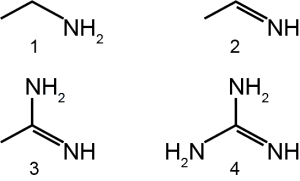
The correct order of basicity of the following compounds is
A
$1 < 2 < 3 < 4$
B
$1 < 2 < 4 < 3$
C
$2 < 1 < 3 < 4$
D
$4 < 3 < 2 < 1$
Solution
(C) The basicity of the given compounds depends on the stability of the conjugate acid formed after protonation and the resonance stabilization of the lone pair on nitrogen atoms.
$(1)$ $CH_3CH_2NH_2$ (Ethylamine): $A$ primary aliphatic amine,basic due to the $+I$ effect of the ethyl group.
$(2)$ $CH_3CH=NH$ (Ethylideneimine): The nitrogen atom is $sp^2$ hybridized,making the lone pair less available for protonation compared to $sp^3$ hybridized nitrogen.
$(3)$ $CH_3C(=NH)NH_2$ (Acetamidine): The lone pair on the imine nitrogen is involved in resonance with the amino group,stabilizing the conjugate acid significantly.
$(4)$ $H_2NC(=NH)NH_2$ (Guanidine): This is the most basic compound because the positive charge on the conjugate acid is delocalized over three nitrogen atoms through resonance,providing maximum stability.
Thus,the order of basicity is $2 < 1 < 3 < 4$.
$(1)$ $CH_3CH_2NH_2$ (Ethylamine): $A$ primary aliphatic amine,basic due to the $+I$ effect of the ethyl group.
$(2)$ $CH_3CH=NH$ (Ethylideneimine): The nitrogen atom is $sp^2$ hybridized,making the lone pair less available for protonation compared to $sp^3$ hybridized nitrogen.
$(3)$ $CH_3C(=NH)NH_2$ (Acetamidine): The lone pair on the imine nitrogen is involved in resonance with the amino group,stabilizing the conjugate acid significantly.
$(4)$ $H_2NC(=NH)NH_2$ (Guanidine): This is the most basic compound because the positive charge on the conjugate acid is delocalized over three nitrogen atoms through resonance,providing maximum stability.
Thus,the order of basicity is $2 < 1 < 3 < 4$.
0 likesView Solution
37
ChemistryMediumMCQWBJEE · 2016
Amongst the following compounds,which one$(s)$ readily react with ethanolic $KCN$?
A
Ethyl chloride
B
Chlorobenzene
C
Benzaldehyde
D
Salicylic acid
Solution
(A, C) Ethyl chloride undergoes nucleophilic substitution with ethanolic $KCN$ to form ethyl cyanide:
$C_2H_5Cl + KCN \xrightarrow{\text{Ethanol}} C_2H_5CN + KCl$
$(B)$ Chlorobenzene does not undergo nucleophilic substitution with $KCN$ under normal conditions due to the partial double bond character of the $C-Cl$ bond.
$(C)$ Benzaldehyde reacts with $HCN$ (generated from $KCN$ in the presence of an acid or in alcoholic medium) to form a cyanohydrin:
$C_6H_5CHO + HCN \rightarrow C_6H_5CH(OH)CN$
$(D)$ Salicylic acid does not react with $KCN$.
$C_2H_5Cl + KCN \xrightarrow{\text{Ethanol}} C_2H_5CN + KCl$
$(B)$ Chlorobenzene does not undergo nucleophilic substitution with $KCN$ under normal conditions due to the partial double bond character of the $C-Cl$ bond.
$(C)$ Benzaldehyde reacts with $HCN$ (generated from $KCN$ in the presence of an acid or in alcoholic medium) to form a cyanohydrin:
$C_6H_5CHO + HCN \rightarrow C_6H_5CH(OH)CN$
$(D)$ Salicylic acid does not react with $KCN$.
0 likesView Solution
38
ChemistryMediumMCQWBJEE · 2016
An element $E$ loses one $\alpha$ and two $\beta$ particles in successive stages. The resulting element will be
A
an isobar of $E$
B
an isotone of $E$
C
an isotope of $E$
D
$E$ itself
Solution
(C) Let the initial element be ${}_{Z}E^{M}$,where $Z$ is the atomic number and $M$ is the atomic mass.
When an $\alpha$-particle $({}_{2}He^{4})$ is emitted,the atomic number decreases by $2$ and the atomic mass decreases by $4$: ${}_{Z}E^{M} \rightarrow {}_{Z-2}E'^{M-4} + {}_{2}He^{4}$.
When two $\beta$-particles $({}_{-1}e^{0})$ are emitted,the atomic number increases by $1$ for each $\beta$-particle (total increase of $2$),while the atomic mass remains unchanged: ${}_{Z-2}E'^{M-4} \rightarrow {}_{Z}E''^{M-4} + 2({}_{-1}e^{0})$.
The final element is ${}_{Z}E''^{M-4}$.
Since the final element has the same atomic number $Z$ as the initial element $E$ but a different atomic mass $M-4$,it is an isotope of $E$.
When an $\alpha$-particle $({}_{2}He^{4})$ is emitted,the atomic number decreases by $2$ and the atomic mass decreases by $4$: ${}_{Z}E^{M} \rightarrow {}_{Z-2}E'^{M-4} + {}_{2}He^{4}$.
When two $\beta$-particles $({}_{-1}e^{0})$ are emitted,the atomic number increases by $1$ for each $\beta$-particle (total increase of $2$),while the atomic mass remains unchanged: ${}_{Z-2}E'^{M-4} \rightarrow {}_{Z}E''^{M-4} + 2({}_{-1}e^{0})$.
The final element is ${}_{Z}E''^{M-4}$.
Since the final element has the same atomic number $Z$ as the initial element $E$ but a different atomic mass $M-4$,it is an isotope of $E$.
0 likesView Solution
39
ChemistryEasyMCQWBJEE · 2016
The correct structure of the drug paracetamol is
A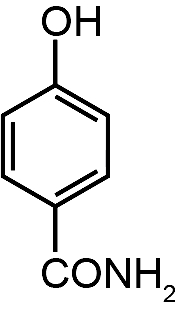
B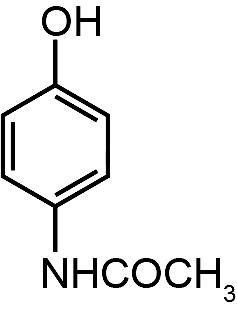
C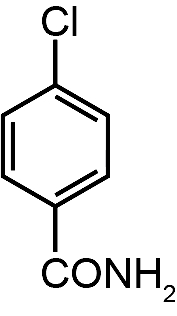
D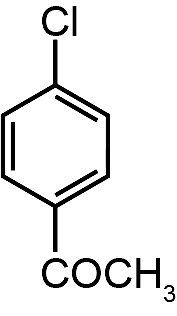
Solution
(B) Paracetamol is chemically known as $4$-acetamidophenol or $N-(4$-hydroxyphenyl$)$ethanamide.
It consists of a benzene ring substituted with a hydroxyl group $(-OH)$ at the $1$-position and an acetamido group $(-NHCOCH_3)$ at the $4$-position.
Therefore,the correct structure is represented by option $B$.
It consists of a benzene ring substituted with a hydroxyl group $(-OH)$ at the $1$-position and an acetamido group $(-NHCOCH_3)$ at the $4$-position.
Therefore,the correct structure is represented by option $B$.
0 likesView Solution
40
ChemistryMediumMCQWBJEE · 2016
Which of the following statement$(s)$ is (are) correct when a mixture of $NaCl$ and $K_{2}Cr_{2}O_{7}$ is gently warmed with conc. $H_{2}SO_{4}?$
A
$A$ deep red vapour is evolved
B
The vapour when passed through $NaOH$ solution,gives a yellow solution
C
Chlorine gas is also evolved
D
Chromyl chloride is formed
Solution
(A, B, D) When $NaCl$ and $K_{2}Cr_{2}O_{7}$ are warmed with conc. $H_{2}SO_{4}$,they produce deep red vapours of chromyl chloride $(CrO_{2}Cl_{2})$. Thus,statement $(A)$ and $(D)$ are correct.
When these vapours are passed through $NaOH$ solution,they form sodium chromate $(Na_{2}CrO_{4})$,which is yellow in color. Thus,statement $(B)$ is correct.
Chlorine gas is not evolved in this reaction. Thus,statement $(C)$ is incorrect.
The reactions are as follows:
$(I)$ $K_{2}Cr_{2}O_{7} + 6 H_{2}SO_{4} \longrightarrow 2 KHSO_{4} + 2 CrO_{3} + 3 H_{2}O$
$(II)$ $NaCl + H_{2}SO_{4} \longrightarrow NaHSO_{4} + HCl$
$(III)$ $CrO_{3} + 2 HCl \longrightarrow CrO_{2}Cl_{2} + H_{2}O$
$(IV)$ $CrO_{2}Cl_{2} + 4 NaOH \longrightarrow Na_{2}CrO_{4} + 2 NaCl + 2 H_{2}O$
When these vapours are passed through $NaOH$ solution,they form sodium chromate $(Na_{2}CrO_{4})$,which is yellow in color. Thus,statement $(B)$ is correct.
Chlorine gas is not evolved in this reaction. Thus,statement $(C)$ is incorrect.
The reactions are as follows:
$(I)$ $K_{2}Cr_{2}O_{7} + 6 H_{2}SO_{4} \longrightarrow 2 KHSO_{4} + 2 CrO_{3} + 3 H_{2}O$
$(II)$ $NaCl + H_{2}SO_{4} \longrightarrow NaHSO_{4} + HCl$
$(III)$ $CrO_{3} + 2 HCl \longrightarrow CrO_{2}Cl_{2} + H_{2}O$
$(IV)$ $CrO_{2}Cl_{2} + 4 NaOH \longrightarrow Na_{2}CrO_{4} + 2 NaCl + 2 H_{2}O$
0 likesView Solution
41
ChemistryEasyMCQWBJEE · 2016
Which of the following statements regarding Lanthanides is false?
A
All lanthanides are solid at room temperature
B
Their usual oxidation state is $+3$
C
They can be separated from one another by ion-exchange method
D
Ionic radii of trivalent lanthanides steadily increases with increase in atomic number
Solution
(D) The option $(D)$ is false.
In the lanthanide series,the ionic radii of trivalent lanthanides $(Ln^{3+})$ steadily decrease with an increase in atomic number.
This phenomenon is known as lanthanoid contraction,which occurs due to the poor shielding effect of $4f$ electrons.
In the lanthanide series,the ionic radii of trivalent lanthanides $(Ln^{3+})$ steadily decrease with an increase in atomic number.
This phenomenon is known as lanthanoid contraction,which occurs due to the poor shielding effect of $4f$ electrons.
0 likesView Solution
42
ChemistryMediumMCQWBJEE · 2016
The order of equivalent conductances at infinite dilution for $LiCl$,$NaCl$,and $KCl$ is:
A
$LiCl > NaCl > KCl$
B
$KCl > NaCl > LiCl$
C
$NaCl > KCl > LiCl$
D
$LiCl > KCl > NaCl$
Solution
(B) At infinite dilution,the equivalent conductance depends on the ionic mobility of the ions in the solution.
In aqueous solution,the $Li^+$ ion has the smallest size and the highest charge density,causing it to be highly hydrated.
Due to this high degree of hydration,the effective size of the hydrated $Li^+$ ion is the largest,which results in the lowest ionic mobility.
Conversely,the $K^+$ ion has the largest size and the lowest charge density,resulting in the least hydration and the smallest effective size.
Therefore,the ionic mobility follows the order $K^+ > Na^+ > Li^+$.
Since equivalent conductance at infinite dilution is directly proportional to ionic mobility,the order is $KCl > NaCl > LiCl$.
In aqueous solution,the $Li^+$ ion has the smallest size and the highest charge density,causing it to be highly hydrated.
Due to this high degree of hydration,the effective size of the hydrated $Li^+$ ion is the largest,which results in the lowest ionic mobility.
Conversely,the $K^+$ ion has the largest size and the lowest charge density,resulting in the least hydration and the smallest effective size.
Therefore,the ionic mobility follows the order $K^+ > Na^+ > Li^+$.
Since equivalent conductance at infinite dilution is directly proportional to ionic mobility,the order is $KCl > NaCl > LiCl$.
0 likesView Solution
43
ChemistryEasyMCQWBJEE · 2016
The acid in which $O-O$ bonding is present is
A
$H_2S_2O_3$
B
$H_2S_2O_6$
C
$H_2S_2O_8$
D
$H_2S_4O_6$
Solution
(C) $H_2S_2O_8$ (Peroxodisulphuric acid or Marshall's acid) contains a peroxide linkage ($-O-O-$ bond). The structure is as follows:
$HO-S(=O)_2-O-O-S(=O)_2-OH$
$HO-S(=O)_2-O-O-S(=O)_2-OH$
0 likesView Solution
44
ChemistryMediumMCQWBJEE · 2016
Compound $X$ is tested and the results are shown in the table.
Which ions are present in compound $X$?
| Test | Result |
| Aqueous $NaOH$ is added,then heated gently. | Gas given off which turns damp red litmus paper blue. |
| Dilute $HCl$ is added. | Effervescence,gas given off which turns lime water milky and acidified $K_2Cr_2O_7$ paper green. |
A
Ammonium ions and sulphite ions
B
Ammonium ions and carbonate ions
C
Sodium ions and carbonate ions
D
Ammonium ions and sulphate ions
Solution
(A) Test $1$: The reaction with aqueous $NaOH$ and gentle heating produces $NH_3$ gas (which turns damp red litmus blue),indicating the presence of ammonium ions $(NH_4^+)$.
Test $2$: The reaction with dilute $HCl$ produces $SO_2$ gas (which turns lime water milky and acidified $K_2Cr_2O_7$ paper green),indicating the presence of sulphite ions $(SO_3^{2-})$.
Carbonate ions would turn lime water milky but would not change the color of acidified $K_2Cr_2O_7$.
Therefore,compound $X$ contains ammonium and sulphite ions.
Test $2$: The reaction with dilute $HCl$ produces $SO_2$ gas (which turns lime water milky and acidified $K_2Cr_2O_7$ paper green),indicating the presence of sulphite ions $(SO_3^{2-})$.
Carbonate ions would turn lime water milky but would not change the color of acidified $K_2Cr_2O_7$.
Therefore,compound $X$ contains ammonium and sulphite ions.
0 likesView Solution
45
ChemistryEasyMCQWBJEE · 2016
If radium and chlorine combine to form radium chloride,the compound would be
A
half as radioactive as radium
B
twice as radioactive
C
as radioactive as radium
D
not radioactive
Solution
(C) Radioactivity is a nuclear phenomenon that depends solely on the composition and stability of the atomic nucleus.
It is independent of the chemical environment,such as the formation of compounds or the presence of orbital electrons.
Therefore,radium in its elemental form and radium in the form of radium chloride $(RaCl_2)$ exhibit the same level of radioactivity.
It is independent of the chemical environment,such as the formation of compounds or the presence of orbital electrons.
Therefore,radium in its elemental form and radium in the form of radium chloride $(RaCl_2)$ exhibit the same level of radioactivity.
0 likesView Solution
46
ChemistryEasyMCQWBJEE · 2016
Ionic solids with Schottky defect may contain in their structure
A
cation vacancies only
B
cation vacancies and interstitial cations
C
equal number of cation and anion vacancies
D
anion vacancies and interstitial anions
Solution
(C) In $Schottky$ defect,an equal number of cations and anions are missing from the crystal lattice,which creates an equal number of cation and anion vacancies to maintain electrical neutrality.
0 likesView Solution
47
ChemistryMediumMCQWBJEE · 2016
If $p^{\circ}$ and $p$ are the vapour pressure of the pure solvent and solution,and $n_{1}$ and $n_{2}$ are the moles of solute and solvent respectively in the solution,then the correct relation between $p$ and $p^{\circ}$ is:
A
$p^{\circ} = p \left[ \frac{n_{1}}{n_{1} + n_{2}} \right]$
B
$p^{\circ} = p \left[ \frac{n_{2}}{n_{1} + n_{2}} \right]$
C
$p = p^{\circ} \left[ \frac{n_{2}}{n_{1} + n_{2}} \right]$
D
$p = p^{\circ} \left[ \frac{n_{1}}{n_{1} + n_{2}} \right]$
Solution
(C) According to Raoult's law for a solution containing a non-volatile solute,the relative lowering of vapour pressure is equal to the mole fraction of the solute:
$\frac{p^{\circ} - p}{p^{\circ}} = x_{1} = \frac{n_{1}}{n_{1} + n_{2}}$
Where $x_{1}$ is the mole fraction of the solute.
Rearranging the equation:
$1 - \frac{p}{p^{\circ}} = \frac{n_{1}}{n_{1} + n_{2}}$
$\frac{p}{p^{\circ}} = 1 - \frac{n_{1}}{n_{1} + n_{2}}$
$\frac{p}{p^{\circ}} = \frac{n_{1} + n_{2} - n_{1}}{n_{1} + n_{2}}$
$\frac{p}{p^{\circ}} = \frac{n_{2}}{n_{1} + n_{2}}$
Therefore,$p = p^{\circ} \left( \frac{n_{2}}{n_{1} + n_{2}} \right)$.
$\frac{p^{\circ} - p}{p^{\circ}} = x_{1} = \frac{n_{1}}{n_{1} + n_{2}}$
Where $x_{1}$ is the mole fraction of the solute.
Rearranging the equation:
$1 - \frac{p}{p^{\circ}} = \frac{n_{1}}{n_{1} + n_{2}}$
$\frac{p}{p^{\circ}} = 1 - \frac{n_{1}}{n_{1} + n_{2}}$
$\frac{p}{p^{\circ}} = \frac{n_{1} + n_{2} - n_{1}}{n_{1} + n_{2}}$
$\frac{p}{p^{\circ}} = \frac{n_{2}}{n_{1} + n_{2}}$
Therefore,$p = p^{\circ} \left( \frac{n_{2}}{n_{1} + n_{2}} \right)$.
0 likesView Solution
48
ChemistryEasyMCQWBJEE · 2016
Point out the false statement.
A
Colloidal sols are homogeneous
B
Colloids carry $+ve$ or $-ve$ charges
C
Colloids show Tyndall effect
D
The size range of colloidal particles is $10-1000 \mathring{A}$
Solution
(A) Option $(a)$ is false because colloidal sols are not homogeneous.
Colloidal sols are heterogeneous mixtures of dispersed phase and dispersion medium.
Colloidal sols are heterogeneous mixtures of dispersed phase and dispersion medium.
0 likesView Solution
Vedclass Products
For Students
Vedclass Test Series
Mock tests in real WBJEE style covering Chemistry with performance analysis. 5-day free trial.
Start Free TrialFor Teachers
Exam Paper Generator
Generate Set A/B/C/D Chemistry papers from 7.5L+ questions in 2 minutes. 3 chapters free.
Try FreeFor Institutes
Online Exam Module
Run live WBJEE mock exams with unlimited students, 360° analytics & white-label branding.
See DemoFrequently Asked Questions
How many Chemistry questions are in WBJEE 2016?
There are 48 Chemistry questions from the WBJEE 2016 paper on Vedclass, each with a detailed step-by-step solution in English.
Are WBJEE 2016 Chemistry solutions available in English?
Yes. All solutions on this page are in English. You can also switch to English or Hindi using the language buttons above the questions.
Can I practice WBJEE 2016 Chemistry as a timed test?
Yes. Use the Vedclass Test Series to attempt a full WBJEE mock test covering Chemistry with time limits and instant score analysis.
Can teachers create Chemistry papers from WBJEE previous year questions?
Yes. The Vedclass Exam Paper Generator lets teachers mix WBJEE Chemistry questions and generate Set A/B/C/D papers in minutes.
For Teachers & Institutes
Build a Custom Chemistry Paper
Pick WBJEE 2016 Chemistry questions, set difficulty, and generate Set A/B/C/D in 2 minutes.