
ChemistryQ1–47 of 47 questions
Page 1 of 1 · English
1
ChemistryMCQWBJEE · 2011
The locus of the centre of a circle which always passes through the fixed points $(a, 0)$ and $(-a, 0)$ is
A
$x = 1$
B
$x + y = 6$
C
$x + y = 2a$
D
$x = 0$
Solution
(D) Let the centre of the circle be $(h, k)$.
Since the circle passes through the points $A(a, 0)$ and $B(-a, 0)$,the distance from the centre to these points must be equal (as they are radii).
So,$\sqrt{(h-a)^2 + (k-0)^2} = \sqrt{(h-(-a))^2 + (k-0)^2}$.
Squaring both sides,we get $(h-a)^2 + k^2 = (h+a)^2 + k^2$.
$h^2 - 2ah + a^2 + k^2 = h^2 + 2ah + a^2 + k^2$.
$-2ah = 2ah$,which implies $4ah = 0$,so $h = 0$.
The locus of the centre $(h, k)$ is $x = 0$,which is the perpendicular bisector of the line segment joining $(a, 0)$ and $(-a, 0)$.
Since the circle passes through the points $A(a, 0)$ and $B(-a, 0)$,the distance from the centre to these points must be equal (as they are radii).
So,$\sqrt{(h-a)^2 + (k-0)^2} = \sqrt{(h-(-a))^2 + (k-0)^2}$.
Squaring both sides,we get $(h-a)^2 + k^2 = (h+a)^2 + k^2$.
$h^2 - 2ah + a^2 + k^2 = h^2 + 2ah + a^2 + k^2$.
$-2ah = 2ah$,which implies $4ah = 0$,so $h = 0$.
The locus of the centre $(h, k)$ is $x = 0$,which is the perpendicular bisector of the line segment joining $(a, 0)$ and $(-a, 0)$.
0 likesView Solution
2
ChemistryMCQWBJEE · 2011
$A$ particle of mass $m$ is located in a one-dimensional potential field where the potential energy is given by: $V(x) = A(1 - \cos px)$,where $A$ and $p$ are constants. The period of small oscillations of the particle is:
A
$2\pi \sqrt{\frac{m}{Ap^2}}$
B
$2\pi \sqrt{\frac{m}{A p}}$
C
$2\pi \sqrt{\frac{m}{A}}$
D
$\frac{1}{2\pi} \sqrt{\frac{Ap}{m}}$
Solution
(A) The potential energy is given by $V(x) = A(1 - \cos px)$.
The force acting on the particle is $F = -\frac{dV}{dx} = -\frac{d}{dx} [A(1 - \cos px)] = -Ap \sin px$.
For small oscillations,the displacement $x$ is very small,so $\sin px \approx px$.
Substituting this into the force equation: $F = -Ap(px) = -(Ap^2)x$.
This is the equation for simple harmonic motion $F = -kx$,where the effective spring constant $k = Ap^2$.
The time period $T$ of small oscillations is given by $T = 2\pi \sqrt{\frac{m}{k}}$.
Substituting $k = Ap^2$,we get $T = 2\pi \sqrt{\frac{m}{Ap^2}}$.
The force acting on the particle is $F = -\frac{dV}{dx} = -\frac{d}{dx} [A(1 - \cos px)] = -Ap \sin px$.
For small oscillations,the displacement $x$ is very small,so $\sin px \approx px$.
Substituting this into the force equation: $F = -Ap(px) = -(Ap^2)x$.
This is the equation for simple harmonic motion $F = -kx$,where the effective spring constant $k = Ap^2$.
The time period $T$ of small oscillations is given by $T = 2\pi \sqrt{\frac{m}{k}}$.
Substituting $k = Ap^2$,we get $T = 2\pi \sqrt{\frac{m}{Ap^2}}$.
0 likesView Solution
3
ChemistryMCQWBJEE · 2011
In Young's double slit experiment,the two slits are $d$ distance apart. An interference pattern is observed on a screen at a distance $D$ from the slits. $A$ dark fringe is observed on the screen directly opposite to one of the slits. The wavelength of light is:
A
$\frac{D^2}{2 d}$
B
$\frac{d^2}{2 D}$
C
$\frac{D^2}{d}$
D
$\frac{d^2}{D}$
Solution
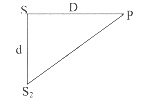
(D) Let the two slits be $S_1$ and $S_2$. The point $P$ on the screen is directly opposite to slit $S_1$.
The distance $S_1 P = D$ and the distance $S_2 P = \sqrt{D^2 + d^2}$.
Using the binomial expansion for $S_2 P$:
$S_2 P = D \left(1 + \frac{d^2}{D^2}\right)^{1/2} \approx D \left(1 + \frac{1}{2} \frac{d^2}{D^2}\right) = D + \frac{d^2}{2D}$.
The path difference $\Delta x$ between the two waves reaching point $P$ is:
$\Delta x = S_2 P - S_1 P = (D + \frac{d^2}{2D}) - D = \frac{d^2}{2D}$.
For a dark fringe,the path difference must be an odd multiple of $\frac{\lambda}{2}$. For the first dark fringe (minimum path difference),we set:
$\Delta x = \frac{\lambda}{2}$.
Equating the two expressions:
$\frac{d^2}{2D} = \frac{\lambda}{2}$.
Therefore,the wavelength of light is $\lambda = \frac{d^2}{D}$.
The distance $S_1 P = D$ and the distance $S_2 P = \sqrt{D^2 + d^2}$.
Using the binomial expansion for $S_2 P$:
$S_2 P = D \left(1 + \frac{d^2}{D^2}\right)^{1/2} \approx D \left(1 + \frac{1}{2} \frac{d^2}{D^2}\right) = D + \frac{d^2}{2D}$.
The path difference $\Delta x$ between the two waves reaching point $P$ is:
$\Delta x = S_2 P - S_1 P = (D + \frac{d^2}{2D}) - D = \frac{d^2}{2D}$.
For a dark fringe,the path difference must be an odd multiple of $\frac{\lambda}{2}$. For the first dark fringe (minimum path difference),we set:
$\Delta x = \frac{\lambda}{2}$.
Equating the two expressions:
$\frac{d^2}{2D} = \frac{\lambda}{2}$.
Therefore,the wavelength of light is $\lambda = \frac{d^2}{D}$.
0 likesView Solution
4
ChemistryMCQWBJEE · 2011
In Young's double slit experiment,the two slits are $d$ distance apart. An interference pattern is observed on a screen at a distance $D$ from the slits. The first dark fringe is observed on the screen directly opposite to one of the slits. The wavelength of light is:
A
$\frac{D^2}{2 d}$
B
$\frac{D^2}{d}$
C
$\frac{d^2}{2 D}$
D
$\frac{d^2}{D}$
Solution
(D) The first dark fringe is produced at a point directly opposite to one of the slits. The distance of this point from the central axis is $y = \frac{d}{2}$.
For a dark fringe,the condition is given by $y = (2n - 1) \frac{\lambda D}{2d}$,where $n = 1, 2, 3, \dots$ represents the order of the fringe.
For the first dark fringe,we set $n = 1$.
Substituting the values into the formula: $\frac{d}{2} = (2(1) - 1) \frac{\lambda D}{2d}$.
$\frac{d}{2} = \frac{\lambda D}{2d}$.
Solving for $\lambda$: $\lambda = \frac{d^2}{D}$.
For a dark fringe,the condition is given by $y = (2n - 1) \frac{\lambda D}{2d}$,where $n = 1, 2, 3, \dots$ represents the order of the fringe.
For the first dark fringe,we set $n = 1$.
Substituting the values into the formula: $\frac{d}{2} = (2(1) - 1) \frac{\lambda D}{2d}$.
$\frac{d}{2} = \frac{\lambda D}{2d}$.
Solving for $\lambda$: $\lambda = \frac{d^2}{D}$.
0 likesView Solution
5
ChemistryMediumMCQWBJEE · 2011
In the following electron-dot structure,calculate the formal charge from left to right for the nitrogen atoms: $: \ddot{N} = N = \ddot{N} :$
A
$-1, +1, -1$
B
$-1, -1, +1$
C
$+1, -1, -1$
D
$+1, -1, +1$
Solution
(A) The formula for formal charge is: $\text{Formal charge} = \text{Valence electrons} - (\frac{1}{2} \times \text{Bonding electrons} + \text{Non-bonding electrons})$.
For the structure $: \ddot{N}_1 = N_2 = \ddot{N}_3 :$
For $N_1$ (left nitrogen): $\text{Valence electrons} = 5$,$\text{Bonding electrons} = 4$,$\text{Non-bonding electrons} = 4$.
$\text{Formal charge} = 5 - (\frac{1}{2} \times 4 + 4) = 5 - (2 + 4) = -1$.
For $N_2$ (middle nitrogen): $\text{Valence electrons} = 5$,$\text{Bonding electrons} = 8$,$\text{Non-bonding electrons} = 0$.
$\text{Formal charge} = 5 - (\frac{1}{2} \times 8 + 0) = 5 - 4 = +1$.
For $N_3$ (right nitrogen): $\text{Valence electrons} = 5$,$\text{Bonding electrons} = 4$,$\text{Non-bonding electrons} = 4$.
$\text{Formal charge} = 5 - (\frac{1}{2} \times 4 + 4) = 5 - (2 + 4) = -1$.
Thus,the formal charges are $-1, +1, -1$.
For the structure $: \ddot{N}_1 = N_2 = \ddot{N}_3 :$
For $N_1$ (left nitrogen): $\text{Valence electrons} = 5$,$\text{Bonding electrons} = 4$,$\text{Non-bonding electrons} = 4$.
$\text{Formal charge} = 5 - (\frac{1}{2} \times 4 + 4) = 5 - (2 + 4) = -1$.
For $N_2$ (middle nitrogen): $\text{Valence electrons} = 5$,$\text{Bonding electrons} = 8$,$\text{Non-bonding electrons} = 0$.
$\text{Formal charge} = 5 - (\frac{1}{2} \times 8 + 0) = 5 - 4 = +1$.
For $N_3$ (right nitrogen): $\text{Valence electrons} = 5$,$\text{Bonding electrons} = 4$,$\text{Non-bonding electrons} = 4$.
$\text{Formal charge} = 5 - (\frac{1}{2} \times 4 + 4) = 5 - (2 + 4) = -1$.
Thus,the formal charges are $-1, +1, -1$.
0 likesView Solution
6
ChemistryEasyMCQWBJEE · 2011
The $sp^3d^2$ hybridization of the central atom of a molecule leads to which geometry?
A
Square planar geometry
B
Tetrahedral geometry
C
Trigonal bipyramidal geometry
D
Octahedral geometry
Solution
(D) The hybridization $sp^3d^2$ involves the mixing of one $s$,three $p$,and two $d$ orbitals to form six equivalent hybrid orbitals.
These six hybrid orbitals are directed towards the corners of an octahedron.
Therefore,a molecule with $sp^3d^2$ hybridization of the central atom exhibits an octahedral geometry.
These six hybrid orbitals are directed towards the corners of an octahedron.
Therefore,a molecule with $sp^3d^2$ hybridization of the central atom exhibits an octahedral geometry.
0 likesView Solution
7
ChemistryEasyMCQWBJEE · 2011
The hybridization of $C_2$ and $C_3$ in $CH_3-CH=C=CH-CH_3$ is
A
$sp, sp^3$
B
$sp^2, sp$
C
$sp^2, sp^2$
D
$sp, sp$
Solution
(B) The structure of the given molecule is $CH_3-CH=C=CH-CH_3$.
To determine the hybridization,we count the number of sigma bonds and lone pairs around the carbon atom.
For $C_2$: It is bonded to one $H$ atom,one $CH_3$ group (single bond),and one $C_3$ atom (double bond). It has $3$ sigma bonds and $0$ lone pairs,so it is $sp^2$ hybridized.
For $C_3$: It is bonded to $C_2$ (double bond) and $C_4$ (double bond). It has $2$ sigma bonds and $0$ lone pairs,so it is $sp$ hybridized.
Therefore,the hybridization of $C_2$ and $C_3$ is $sp^2$ and $sp$ respectively.
To determine the hybridization,we count the number of sigma bonds and lone pairs around the carbon atom.
For $C_2$: It is bonded to one $H$ atom,one $CH_3$ group (single bond),and one $C_3$ atom (double bond). It has $3$ sigma bonds and $0$ lone pairs,so it is $sp^2$ hybridized.
For $C_3$: It is bonded to $C_2$ (double bond) and $C_4$ (double bond). It has $2$ sigma bonds and $0$ lone pairs,so it is $sp$ hybridized.
Therefore,the hybridization of $C_2$ and $C_3$ is $sp^2$ and $sp$ respectively.
0 likesView Solution
8
ChemistryMediumMCQWBJEE · 2011
Which one of the following is paramagnetic?
A
$N_2$
B
$NO$
C
$CO$
D
$O_3$
Solution
(B) Paramagnetic substances contain one or more unpaired electrons.
According to Molecular Orbital Theory $(MOT)$:
$N_2$ (total $14$ electrons): $({\sigma}1s)^2 ({\sigma}^*1s)^2 ({\sigma}2s)^2 ({\sigma}^*2s)^2 ({\pi}2p_x)^2 ({\pi}2p_y)^2 ({\sigma}2p_z)^2$. All electrons are paired,so it is diamagnetic.
$NO$ (total $15$ electrons): $({\sigma}1s)^2 ({\sigma}^*1s)^2 ({\sigma}2s)^2 ({\sigma}^*2s)^2 ({\sigma}2p_z)^2 ({\pi}2p_x)^2 ({\pi}2p_y)^2 ({\pi}^*2p_x)^1$. It has one unpaired electron in the antibonding ${\pi}^*$ orbital,so it is paramagnetic.
$CO$ (total $14$ electrons): Similar to $N_2$,it is diamagnetic.
$O_3$ (total $24$ electrons): It is a diamagnetic molecule.
Therefore,$NO$ is the correct answer.
According to Molecular Orbital Theory $(MOT)$:
$N_2$ (total $14$ electrons): $({\sigma}1s)^2 ({\sigma}^*1s)^2 ({\sigma}2s)^2 ({\sigma}^*2s)^2 ({\pi}2p_x)^2 ({\pi}2p_y)^2 ({\sigma}2p_z)^2$. All electrons are paired,so it is diamagnetic.
$NO$ (total $15$ electrons): $({\sigma}1s)^2 ({\sigma}^*1s)^2 ({\sigma}2s)^2 ({\sigma}^*2s)^2 ({\sigma}2p_z)^2 ({\pi}2p_x)^2 ({\pi}2p_y)^2 ({\pi}^*2p_x)^1$. It has one unpaired electron in the antibonding ${\pi}^*$ orbital,so it is paramagnetic.
$CO$ (total $14$ electrons): Similar to $N_2$,it is diamagnetic.
$O_3$ (total $24$ electrons): It is a diamagnetic molecule.
Therefore,$NO$ is the correct answer.
0 likesView Solution
9
ChemistryEasyMCQWBJEE · 2011
If the equilibrium constants of the following equilibria $SO_2 + \frac{1}{2} O_2 \rightleftharpoons SO_3$ and $2 SO_3 \rightleftharpoons 2 SO_2 + O_2$ are given by $K_1$ and $K_2$ respectively,which of the following relations is correct?
A
$K_2 = (\frac{1}{K_1})^2$
B
$K_1 = (\frac{1}{K_2})^3$
C
$K_2 = \frac{1}{K_1}$
D
$K_2 = (K_1)^2$
Solution
(A) For the first equilibrium: $SO_2 + \frac{1}{2} O_2 \rightleftharpoons SO_3$,the equilibrium constant is $K_1 = \frac{[SO_3]}{[SO_2][O_2]^{1/2}}$.
For the second equilibrium: $2 SO_3 \rightleftharpoons 2 SO_2 + O_2$,the equilibrium constant is $K_2 = \frac{[SO_2]^2[O_2]}{[SO_3]^2}$.
Comparing the two expressions,we can see that $K_2 = \frac{1}{K_1^2} = (\frac{1}{K_1})^2$.
Therefore,the correct relation is $K_2 = (\frac{1}{K_1})^2$.
For the second equilibrium: $2 SO_3 \rightleftharpoons 2 SO_2 + O_2$,the equilibrium constant is $K_2 = \frac{[SO_2]^2[O_2]}{[SO_3]^2}$.
Comparing the two expressions,we can see that $K_2 = \frac{1}{K_1^2} = (\frac{1}{K_1})^2$.
Therefore,the correct relation is $K_2 = (\frac{1}{K_1})^2$.
0 likesView Solution
10
ChemistryEasyMCQWBJEE · 2011
Which one of the following has the lowest ionization energy?
A
$1s^2 2s^2 2p^6$
B
$1s^2 2s^2 2p^6 3s^1$
C
$1s^2 2s^2 2p^5$
D
$1s^2 2s^2 2p^3$
Solution
(B) The ionization energy is the energy required to remove the most loosely bound electron from an isolated gaseous atom.
Among the given electronic configurations,$1s^2 2s^2 2p^6 3s^1$ represents an alkali metal (Sodium,$Na$).
Alkali metals have the largest atomic size in their respective periods and a single electron in their outermost $s$-orbital,making it easiest to remove that electron.
Therefore,the configuration $1s^2 2s^2 2p^6 3s^1$ has the lowest ionization energy.
Among the given electronic configurations,$1s^2 2s^2 2p^6 3s^1$ represents an alkali metal (Sodium,$Na$).
Alkali metals have the largest atomic size in their respective periods and a single electron in their outermost $s$-orbital,making it easiest to remove that electron.
Therefore,the configuration $1s^2 2s^2 2p^6 3s^1$ has the lowest ionization energy.
0 likesView Solution
11
ChemistryEasyMCQWBJEE · 2011
The ozone layer forms naturally by
A
the interaction of $CFC$ with oxygen
B
the interaction of $UV$ radiation with oxygen
C
the interaction of $IR$ radiation with oxygen
D
the interaction of oxygen and water vapour.
Solution
(B) The ozone layer is formed in the stratosphere by the action of $UV$ radiation on dioxygen $(O_2)$ molecules.
$1$. $O_2(g) \xrightarrow{UV} O(g) + O(g)$
$2$. $O(g) + O_2(g) \xrightarrow{UV} O_3(g)$
Thus,the interaction of $UV$ radiation with oxygen leads to the formation of ozone.
$1$. $O_2(g) \xrightarrow{UV} O(g) + O(g)$
$2$. $O(g) + O_2(g) \xrightarrow{UV} O_3(g)$
Thus,the interaction of $UV$ radiation with oxygen leads to the formation of ozone.
0 likesView Solution
12
ChemistryMediumMCQWBJEE · 2011
Which one of the following is $s$-butyl phenylvinyl methane?
A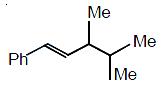
B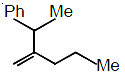
C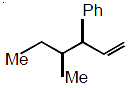
D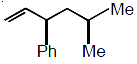
Solution
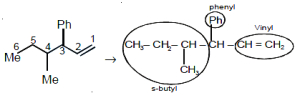
(C) The structure of $s$-butyl phenylvinyl methane can be broken down into its components:
$1$. $A$ methane core $(CH_4)$ where hydrogens are replaced by substituents.
$2$. An $s$-butyl group: $-CH(CH_3)CH_2CH_3$.
$3$. $A$ phenyl group: $-C_6H_5$ (or $Ph$).
$4$. $A$ vinyl group: $-CH=CH_2$.
Combining these,the central carbon is attached to one $H$,one $s$-butyl group,one phenyl group,and one vinyl group.
Looking at the structures provided,the structure in option $C$ represents $3$-phenyl-$4$-methylhex-$1$-ene,which is equivalent to $s$-butyl phenylvinyl methane.
The central carbon (position $3$) is attached to a vinyl group $(-CH=CH_2)$,a phenyl group $(-Ph)$,and an $s$-butyl group $(-CH(CH_3)CH_2CH_3)$.
$1$. $A$ methane core $(CH_4)$ where hydrogens are replaced by substituents.
$2$. An $s$-butyl group: $-CH(CH_3)CH_2CH_3$.
$3$. $A$ phenyl group: $-C_6H_5$ (or $Ph$).
$4$. $A$ vinyl group: $-CH=CH_2$.
Combining these,the central carbon is attached to one $H$,one $s$-butyl group,one phenyl group,and one vinyl group.
Looking at the structures provided,the structure in option $C$ represents $3$-phenyl-$4$-methylhex-$1$-ene,which is equivalent to $s$-butyl phenylvinyl methane.
The central carbon (position $3$) is attached to a vinyl group $(-CH=CH_2)$,a phenyl group $(-Ph)$,and an $s$-butyl group $(-CH(CH_3)CH_2CH_3)$.
0 likesView Solution
13
ChemistryEasyMCQWBJEE · 2011
Which one of the following will show optical isomerism?
A
Glycolic acid: $HO-CH_2-COOH$
B
Lactic acid: $CH_3-CH(OH)-COOH$
C
Isobutyric acid: $(CH_3)_2CH-COOH$
D
$2-$chloro$-2-$methylpropanoic acid: $CH_3-C(Cl)(CH_3)-COOH$
Solution
(B) molecule exhibits optical isomerism if it contains a chiral carbon atom,which is a carbon atom bonded to four different groups.
$A$. Glycolic acid $(HO-CH_2-COOH)$: The central carbon is bonded to two identical hydrogen atoms. It is achiral.
$B$. Lactic acid $(CH_3-CH(OH)-COOH)$: The central carbon is bonded to four different groups: $-H$,$-OH$,$-CH_3$,and $-COOH$. It is chiral and shows optical isomerism.
$C$. Isobutyric acid $((CH_3)_2CH-COOH)$: The central carbon is bonded to two identical methyl groups. It is achiral.
$D$. $2-$chloro$-2-$methylpropanoic acid $(CH_3-C(Cl)(CH_3)-COOH)$: The central carbon is bonded to two identical methyl groups. It is achiral.
Therefore,lactic acid is the correct answer.
$A$. Glycolic acid $(HO-CH_2-COOH)$: The central carbon is bonded to two identical hydrogen atoms. It is achiral.
$B$. Lactic acid $(CH_3-CH(OH)-COOH)$: The central carbon is bonded to four different groups: $-H$,$-OH$,$-CH_3$,and $-COOH$. It is chiral and shows optical isomerism.
$C$. Isobutyric acid $((CH_3)_2CH-COOH)$: The central carbon is bonded to two identical methyl groups. It is achiral.
$D$. $2-$chloro$-2-$methylpropanoic acid $(CH_3-C(Cl)(CH_3)-COOH)$: The central carbon is bonded to two identical methyl groups. It is achiral.
Therefore,lactic acid is the correct answer.
0 likesView Solution
14
ChemistryEasyMCQWBJEE · 2011
Which of the following represents the composition of Carnallite mineral?
A
$K_2O \cdot Al_2O_3 \cdot 6SiO_2$
B
$KNO_3$
C
$K_2SO_4 \cdot MgSO_4 \cdot MgCl_2 \cdot 6H_2O$
D
$KCl \cdot MgCl_2 \cdot 6H_2O$
Solution
(D) Carnallite is a hydrated potassium magnesium chloride mineral with the chemical formula $KCl \cdot MgCl_2 \cdot 6H_2O$.
It is an important source of potassium and magnesium.
It is an important source of potassium and magnesium.
0 likesView Solution
15
ChemistryEasyMCQWBJEE · 2011
Among the alkenes,which one produces tertiary butyl alcohol on acid hydration?
A
$CH_3-CH_2-CH=CH_2$
B
$CH_3-CH=CH-CH_3$
C
$(CH_3)_2C=CH_2$
D
$CH_3-CH=CH_2$
Solution
(C) Acid hydration of alkenes follows Markovnikov's rule,where the electrophile $H^+$ adds to the carbon with more hydrogen atoms to form the most stable carbocation intermediate.
For $(CH_3)_2C=CH_2$ (isobutylene),the addition of $H^+$ leads to the formation of a tertiary carbocation: $(CH_3)_2C^+-CH_3$.
This tertiary carbocation is then attacked by water $(H_2O)$ to form the protonated alcohol,which subsequently loses a proton to yield tertiary butyl alcohol,$(CH_3)_3C-OH$.
The reaction sequence is:
$(CH_3)_2C=CH_2 \xrightarrow{H^+} (CH_3)_3C^+$
$(CH_3)_3C^+ \xrightarrow{H_2O} (CH_3)_3C-OH_2^+$
$(CH_3)_3C-OH_2^+ \xrightarrow{-H^+} (CH_3)_3C-OH$ (tertiary butyl alcohol).
For $(CH_3)_2C=CH_2$ (isobutylene),the addition of $H^+$ leads to the formation of a tertiary carbocation: $(CH_3)_2C^+-CH_3$.
This tertiary carbocation is then attacked by water $(H_2O)$ to form the protonated alcohol,which subsequently loses a proton to yield tertiary butyl alcohol,$(CH_3)_3C-OH$.
The reaction sequence is:
$(CH_3)_2C=CH_2 \xrightarrow{H^+} (CH_3)_3C^+$
$(CH_3)_3C^+ \xrightarrow{H_2O} (CH_3)_3C-OH_2^+$
$(CH_3)_3C-OH_2^+ \xrightarrow{-H^+} (CH_3)_3C-OH$ (tertiary butyl alcohol).
0 likesView Solution
16
ChemistryMediumMCQWBJEE · 2011
The ease of nitration of the following three hydrocarbons follows the order: $(I)$ Toluene,$(II)$ $m$-Xylene,$(III)$ $p$-Xylene.
A
$II = III \approx I$
B
$I = II > III$
C
$III > II > I$
D
$II > III > I$
Solution
(C) Nitration is an electrophilic aromatic substitution reaction. The rate of reaction depends on the electron density of the benzene ring. Higher electron density leads to faster nitration.
$(I)$ Toluene has one methyl group $(-CH_3)$ which is electron-donating by the inductive effect $(+I)$ and hyperconjugation.
$(II)$ $m$-Xylene has two methyl groups. The electron density is increased by two methyl groups.
$(III)$ $p$-Xylene has two methyl groups. Similar to $m$-xylene,it has two electron-donating groups.
Comparing $m$-xylene and $p$-xylene: In $p$-xylene,the two methyl groups are at the para positions,which provides more effective stabilization of the intermediate arenium ion compared to $m$-xylene due to the resonance and hyperconjugation effects being more pronounced at the para position relative to the site of electrophilic attack.
Thus,the order of reactivity is $p$-xylene $(III)$ > $m$-xylene $(II)$ > toluene $(I)$.
$(I)$ Toluene has one methyl group $(-CH_3)$ which is electron-donating by the inductive effect $(+I)$ and hyperconjugation.
$(II)$ $m$-Xylene has two methyl groups. The electron density is increased by two methyl groups.
$(III)$ $p$-Xylene has two methyl groups. Similar to $m$-xylene,it has two electron-donating groups.
Comparing $m$-xylene and $p$-xylene: In $p$-xylene,the two methyl groups are at the para positions,which provides more effective stabilization of the intermediate arenium ion compared to $m$-xylene due to the resonance and hyperconjugation effects being more pronounced at the para position relative to the site of electrophilic attack.
Thus,the order of reactivity is $p$-xylene $(III)$ > $m$-xylene $(II)$ > toluene $(I)$.
0 likesView Solution
17
ChemistryMediumMCQWBJEE · 2011
The $pH$ of an aqueous solution of $CH_3COONa$ of concentration $C \ M$ is given by:
A
$7 - \frac{1}{2} pK_a - \frac{1}{2} \log C$
B
$\frac{1}{2} pK_w + \frac{1}{2} pK_b + \frac{1}{2} \log C$
C
$\frac{1}{2} pK_w - \frac{1}{2} pK_b - \frac{1}{2} \log C$
D
$\frac{1}{2} pK_w + \frac{1}{2} pK_a + \frac{1}{2} \log C$
Solution
(D) $CH_3COONa$ is a salt of a weak acid $(CH_3COOH)$ and a strong base $(NaOH)$.
For the hydrolysis of a salt of a weak acid and a strong base,the $pH$ is calculated using the formula:
$pH = \frac{1}{2} (pK_w + pK_a + \log C)$
Expanding this,we get:
$pH = \frac{1}{2} pK_w + \frac{1}{2} pK_a + \frac{1}{2} \log C$
Therefore,the correct option is $D$.
For the hydrolysis of a salt of a weak acid and a strong base,the $pH$ is calculated using the formula:
$pH = \frac{1}{2} (pK_w + pK_a + \log C)$
Expanding this,we get:
$pH = \frac{1}{2} pK_w + \frac{1}{2} pK_a + \frac{1}{2} \log C$
Therefore,the correct option is $D$.
0 likesView Solution
18
ChemistryMediumMCQWBJEE · 2011
The solubility of $Ca_3(PO_4)_2$ in water is $y \text{ moles/litre}$. Its solubility product is
A
$6 y^4$
B
$36 y^4$
C
$64 y^5$
D
$108 y^5$
Solution
(D) The dissociation of $Ca_3(PO_4)_2$ is given by:
$Ca_3(PO_4)_2{_{\text{(s)}}} \rightleftharpoons 3Ca^{2+}{_{\text{(aq)}}} + 2PO_4^{3-}{_{\text{(aq)}}}$
If the solubility is $y \text{ mol/L}$,then the concentration of ions at equilibrium is:
$[Ca^{2+}] = 3y$
$[PO_4^{3-}] = 2y$
The solubility product expression is:
$K_{sp} = [Ca^{2+}]^3 [PO_4^{3-}]^2$
Substituting the values:
$K_{sp} = (3y)^3 (2y)^2$
$K_{sp} = (27y^3) (4y^2)$
$K_{sp} = 108y^5$
$Ca_3(PO_4)_2{_{\text{(s)}}} \rightleftharpoons 3Ca^{2+}{_{\text{(aq)}}} + 2PO_4^{3-}{_{\text{(aq)}}}$
If the solubility is $y \text{ mol/L}$,then the concentration of ions at equilibrium is:
$[Ca^{2+}] = 3y$
$[PO_4^{3-}] = 2y$
The solubility product expression is:
$K_{sp} = [Ca^{2+}]^3 [PO_4^{3-}]^2$
Substituting the values:
$K_{sp} = (3y)^3 (2y)^2$
$K_{sp} = (27y^3) (4y^2)$
$K_{sp} = 108y^5$
0 likesView Solution
19
ChemistryMCQWBJEE · 2011
The period of oscillation of a simple pendulum of length $l$ suspended from the roof of a vehicle,which moves without friction down an inclined plane of inclination $\alpha$,is given by
A
$2 \pi \sqrt{\frac{l}{g \cos \alpha}}$
B
$2 \pi \sqrt{\frac{l}{g \sin \alpha}}$
C
$2 \pi \sqrt{\frac{l}{g}}$
D
$2 \pi \sqrt{\frac{l}{g \tan \alpha}}$
Solution
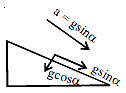
(A) When a vehicle moves down an inclined plane of inclination $\alpha$ without friction,it experiences an acceleration $a = g \sin \alpha$ down the plane.
To find the effective acceleration $g_{\text{eff}}$ experienced by the pendulum inside the vehicle,we consider the frame of reference of the vehicle.
In this non-inertial frame,a pseudo-force $ma$ acts on the pendulum bob in the upward direction along the incline.
The effective acceleration $g_{\text{eff}}$ is the vector sum of the gravitational acceleration $\vec{g}$ and the pseudo-acceleration $-\vec{a}$.
Resolving $\vec{g}$ into components,we have $g \cos \alpha$ perpendicular to the incline and $g \sin \alpha$ parallel to the incline.
The pseudo-acceleration is $a = g \sin \alpha$ directed up the incline.
Thus,the components parallel to the incline cancel out $(g \sin \alpha - g \sin \alpha = 0)$,and the effective acceleration is $g_{\text{eff}} = g \cos \alpha$ directed perpendicular to the incline.
The time period of a simple pendulum is given by $T = 2 \pi \sqrt{\frac{l}{g_{\text{eff}}}}$.
Substituting $g_{\text{eff}} = g \cos \alpha$,we get $T = 2 \pi \sqrt{\frac{l}{g \cos \alpha}}$.
To find the effective acceleration $g_{\text{eff}}$ experienced by the pendulum inside the vehicle,we consider the frame of reference of the vehicle.
In this non-inertial frame,a pseudo-force $ma$ acts on the pendulum bob in the upward direction along the incline.
The effective acceleration $g_{\text{eff}}$ is the vector sum of the gravitational acceleration $\vec{g}$ and the pseudo-acceleration $-\vec{a}$.
Resolving $\vec{g}$ into components,we have $g \cos \alpha$ perpendicular to the incline and $g \sin \alpha$ parallel to the incline.
The pseudo-acceleration is $a = g \sin \alpha$ directed up the incline.
Thus,the components parallel to the incline cancel out $(g \sin \alpha - g \sin \alpha = 0)$,and the effective acceleration is $g_{\text{eff}} = g \cos \alpha$ directed perpendicular to the incline.
The time period of a simple pendulum is given by $T = 2 \pi \sqrt{\frac{l}{g_{\text{eff}}}}$.
Substituting $g_{\text{eff}} = g \cos \alpha$,we get $T = 2 \pi \sqrt{\frac{l}{g \cos \alpha}}$.
0 likesView Solution
20
ChemistryEasyMCQWBJEE · 2011
$NO_2$ is not obtained on heating:
A
$AgNO_3$
B
$KNO_3$
C
$Cu(NO_3)_2$
D
$Pb(NO_3)_2$
Solution
(B) The thermal decomposition of metal nitrates follows specific patterns based on the reactivity of the metal.
$1$. Alkali metal nitrates like $KNO_3$ decompose to form metal nitrites and oxygen gas: $2KNO_3 \xrightarrow{\Delta} 2KNO_2 + O_2$.
$2$. Heavy metal nitrates like $AgNO_3$,$Cu(NO_3)_2$,and $Pb(NO_3)_2$ decompose to form metal oxides,nitrogen dioxide $(NO_2)$,and oxygen gas.
For example: $2Cu(NO_3)_2 \xrightarrow{\Delta} 2CuO + 4NO_2 + O_2$.
Therefore,$KNO_3$ does not produce $NO_2$ upon heating.
$1$. Alkali metal nitrates like $KNO_3$ decompose to form metal nitrites and oxygen gas: $2KNO_3 \xrightarrow{\Delta} 2KNO_2 + O_2$.
$2$. Heavy metal nitrates like $AgNO_3$,$Cu(NO_3)_2$,and $Pb(NO_3)_2$ decompose to form metal oxides,nitrogen dioxide $(NO_2)$,and oxygen gas.
For example: $2Cu(NO_3)_2 \xrightarrow{\Delta} 2CuO + 4NO_2 + O_2$.
Therefore,$KNO_3$ does not produce $NO_2$ upon heating.
0 likesView Solution
21
ChemistryMediumMCQWBJEE · 2011
$2 \ g$ of metal carbonate is neutralized completely by $100 \ mL$ of $0.1 \ N$ $HCl$. The equivalent weight of metal carbonate is:
A
$50$
B
$100$
C
$150$
D
$200$
Solution
(D) The number of gram equivalents of $HCl$ used is calculated as: $\text{Equivalents} = \text{Normality} \times \text{Volume (in L)} = 0.1 \ N \times 0.1 \ L = 0.01 \ \text{eq}$.
According to the law of equivalence,the number of gram equivalents of the metal carbonate must be equal to the number of gram equivalents of $HCl$ used for neutralization.
Therefore,the number of gram equivalents of metal carbonate $= 0.01 \ \text{eq}$.
The equivalent weight is defined as the mass of the substance divided by the number of gram equivalents.
$\text{Equivalent weight} = \frac{\text{Mass}}{\text{Number of gram equivalents}} = \frac{2 \ g}{0.01 \ \text{eq}} = 200 \ g/\text{eq}$.
Thus,the equivalent weight of the metal carbonate is $200$.
According to the law of equivalence,the number of gram equivalents of the metal carbonate must be equal to the number of gram equivalents of $HCl$ used for neutralization.
Therefore,the number of gram equivalents of metal carbonate $= 0.01 \ \text{eq}$.
The equivalent weight is defined as the mass of the substance divided by the number of gram equivalents.
$\text{Equivalent weight} = \frac{\text{Mass}}{\text{Number of gram equivalents}} = \frac{2 \ g}{0.01 \ \text{eq}} = 200 \ g/\text{eq}$.
Thus,the equivalent weight of the metal carbonate is $200$.
0 likesView Solution
22
ChemistryDifficultMCQWBJEE · 2011
If the molecular weights of $Na_2S_2O_3$ and $I_2$ are $M_1$ and $M_2$ respectively,then what will be the equivalent weights of $Na_2S_2O_3$ and $I_2$ in the following reaction?
$2S_2O_3^{2-} + I_2 \longrightarrow S_4O_6^{2-} + 2I^-$
$2S_2O_3^{2-} + I_2 \longrightarrow S_4O_6^{2-} + 2I^-$
A
$M_1, M_2$
B
$M_1, M_2 / 2$
C
$2M_1, M_2$
D
$M_1, 2M_2$
Solution
(B) The given reaction is: $2S_2O_3^{2-} + I_2 \longrightarrow S_4O_6^{2-} + 2I^-$
For $S_2O_3^{2-}$: The oxidation state of $S$ changes from $+2$ to $+2.5$. The change in oxidation number per $S$ atom is $0.5$. Since there are $2$ sulfur atoms in $S_2O_3^{2-}$,the total change per mole is $0.5 \times 2 = 1$. Thus,the $n$-factor is $1$. Equivalent weight = $\frac{M_1}{1} = M_1$.
For $I_2$: The oxidation state of $I$ changes from $0$ to $-1$. The change in oxidation number per $I$ atom is $1$. Since there are $2$ iodine atoms in $I_2$,the total change per mole is $1 \times 2 = 2$. Thus,the $n$-factor is $2$. Equivalent weight = $\frac{M_2}{2}$.
For $S_2O_3^{2-}$: The oxidation state of $S$ changes from $+2$ to $+2.5$. The change in oxidation number per $S$ atom is $0.5$. Since there are $2$ sulfur atoms in $S_2O_3^{2-}$,the total change per mole is $0.5 \times 2 = 1$. Thus,the $n$-factor is $1$. Equivalent weight = $\frac{M_1}{1} = M_1$.
For $I_2$: The oxidation state of $I$ changes from $0$ to $-1$. The change in oxidation number per $I$ atom is $1$. Since there are $2$ iodine atoms in $I_2$,the total change per mole is $1 \times 2 = 2$. Thus,the $n$-factor is $2$. Equivalent weight = $\frac{M_2}{2}$.
0 likesView Solution
23
ChemistryEasyMCQWBJEE · 2011
The normality of $30$ volume $H_2O_2$ is (in $N$)
A
$2.678$
B
$5.336$
C
$8.034$
D
$6.685$
Solution
(B) The relationship between volume strength and normality is given by the formula: $\text{Volume strength} = 5.6 \times \text{Normality}$.
Given,volume strength $= 30$.
Substituting the value: $30 = 5.6 \times N$.
Therefore,$N = \frac{30}{5.6} \approx 5.357 \ N$.
Comparing this with the given options,the closest value is $5.336 \ N$.
Given,volume strength $= 30$.
Substituting the value: $30 = 5.6 \times N$.
Therefore,$N = \frac{30}{5.6} \approx 5.357 \ N$.
Comparing this with the given options,the closest value is $5.336 \ N$.
0 likesView Solution
24
ChemistryMCQWBJEE · 2011
The number $(101)^{100}-1$ is divisible by
A
$10^4$
B
$10^6$
C
$10^8$
D
$10^{12}$
Solution
(A) Using the Binomial Theorem,we can write $(101)^{100} = (1 + 100)^{100}$.
Expanding this using the formula $(1+x)^n = 1 + nC_1 x + nC_2 x^2 + nC_3 x^3 + \ldots + nC_n x^n$:
$(1 + 100)^{100} = 1 + {}^{100}C_1(100) + {}^{100}C_2(100)^2 + {}^{100}C_3(100)^3 + \ldots + {}^{100}C_{100}(100)^{100}$.
Subtracting $1$ from both sides:
$(101)^{100} - 1 = {}^{100}C_1(100) + {}^{100}C_2(100)^2 + {}^{100}C_3(100)^3 + \ldots + {}^{100}C_{100}(100)^{100}$.
Since ${}^{100}C_1 = 100$,the first term is $100 \times 100 = 100^2 = 10^4$.
Thus,$(101)^{100} - 1 = 10^4 + {}^{100}C_2(100)^2 + \ldots = 10^4 [1 + {}^{100}C_2(100) + \ldots]$.
Therefore,the number is divisible by $10^4$.
Expanding this using the formula $(1+x)^n = 1 + nC_1 x + nC_2 x^2 + nC_3 x^3 + \ldots + nC_n x^n$:
$(1 + 100)^{100} = 1 + {}^{100}C_1(100) + {}^{100}C_2(100)^2 + {}^{100}C_3(100)^3 + \ldots + {}^{100}C_{100}(100)^{100}$.
Subtracting $1$ from both sides:
$(101)^{100} - 1 = {}^{100}C_1(100) + {}^{100}C_2(100)^2 + {}^{100}C_3(100)^3 + \ldots + {}^{100}C_{100}(100)^{100}$.
Since ${}^{100}C_1 = 100$,the first term is $100 \times 100 = 100^2 = 10^4$.
Thus,$(101)^{100} - 1 = 10^4 + {}^{100}C_2(100)^2 + \ldots = 10^4 [1 + {}^{100}C_2(100) + \ldots]$.
Therefore,the number is divisible by $10^4$.
0 likesView Solution
25
ChemistryMediumMCQWBJEE · 2011
The energy of an electron in the first Bohr orbit of $H$-atom is $-13.6 \ eV$. The possible energy value of an electron in the first excited state of $Li^{2+}$ is (in $eV$)
A
$-122.4$
B
$-30.6$
C
$-13.6$
D
$13.6$
Solution
(B) The energy of an electron in the $n^{th}$ orbit of a hydrogen-like species is given by the formula: $E_n = -13.6 \times \frac{Z^2}{n^2} \ eV$.
For $Li^{2+}$ ion,the atomic number $Z = 3$.
The first excited state corresponds to $n = 2$.
Substituting these values into the formula: $E_2 = -13.6 \times \frac{3^2}{2^2} \ eV$.
$E_2 = -13.6 \times \frac{9}{4} \ eV$.
$E_2 = -13.6 \times 2.25 \ eV = -30.6 \ eV$.
For $Li^{2+}$ ion,the atomic number $Z = 3$.
The first excited state corresponds to $n = 2$.
Substituting these values into the formula: $E_2 = -13.6 \times \frac{3^2}{2^2} \ eV$.
$E_2 = -13.6 \times \frac{9}{4} \ eV$.
$E_2 = -13.6 \times 2.25 \ eV = -30.6 \ eV$.
0 likesView Solution
26
ChemistryMediumMCQWBJEE · 2011
The electronic transitions from $n=2$ to $n=1$ will produce the shortest wavelength in which of the following species? (where $n$ is the principal quantum state)
A
$Li^{2+}$
B
$He^{+}$
C
$H$
D
$H^{+}$
Solution
(A) The Rydberg formula for the wavelength of emitted radiation is given by: $\frac{1}{\lambda} = Z^2 \cdot R_H \left[ \frac{1}{n_1^2} - \frac{1}{n_2^2} \right]$
For the transition from $n=2$ to $n=1$: $\frac{1}{\lambda} = Z^2 \cdot R_H \left[ \frac{1}{1^2} - \frac{1}{2^2} \right] = Z^2 \cdot R_H \left( \frac{3}{4} \right)$
This implies $\lambda = \frac{4}{3 Z^2 R_H}$,so $\lambda \propto \frac{1}{Z^2}$.
To obtain the shortest wavelength,the atomic number $Z$ must be the maximum.
Comparing the species: $H$ $(Z=1)$,$He^{+}$ $(Z=2)$,and $Li^{2+}$ $(Z=3)$.
Since $Li^{2+}$ has the highest $Z$,it will produce the shortest wavelength.
For the transition from $n=2$ to $n=1$: $\frac{1}{\lambda} = Z^2 \cdot R_H \left[ \frac{1}{1^2} - \frac{1}{2^2} \right] = Z^2 \cdot R_H \left( \frac{3}{4} \right)$
This implies $\lambda = \frac{4}{3 Z^2 R_H}$,so $\lambda \propto \frac{1}{Z^2}$.
To obtain the shortest wavelength,the atomic number $Z$ must be the maximum.
Comparing the species: $H$ $(Z=1)$,$He^{+}$ $(Z=2)$,and $Li^{2+}$ $(Z=3)$.
Since $Li^{2+}$ has the highest $Z$,it will produce the shortest wavelength.
0 likesView Solution
27
ChemistryMediumMCQWBJEE · 2011
The representation of the ground state electronic configuration of $He$ by box-diagram as $\uparrow \uparrow$ is wrong because it violates
A
Hund's Rule
B
Bohr's Quantization Theory of Angular Momenta
C
Pauli Exclusion Principle
D
Heisenberg's Uncertainty Principle
Solution
(C) According to the $Pauli$ $Exclusion$ $Principle$,an orbital can accommodate a maximum of two electrons,and these electrons must have opposite spins.
The representation $\uparrow \uparrow$ shows two electrons with parallel spins in the same orbital,which violates this principle.
The representation $\uparrow \uparrow$ shows two electrons with parallel spins in the same orbital,which violates this principle.
0 likesView Solution
28
ChemistryEasyMCQWBJEE · 2011
An element belongs to Group $15$ and third period of the periodic table. Its electronic configuration will be
A
$1s^2 2s^2 2p^3$
B
$1s^2 2s^2 2p^4$
C
$1s^2 2s^2 2p^6 3s^2 3p^3$
D
$1s^2 2s^2 2p^6 3s^2 3p^2$
Solution
(C) The general valence shell electronic configuration for Group $15$ elements is $ns^2 np^3$,where $n$ represents the period number.
Given that the element is in the third period,$n = 3$.
Substituting $n = 3$ into the general configuration,we get the valence shell configuration as $3s^2 3p^3$.
The complete electronic configuration for an element with $n=3$ is $1s^2 2s^2 2p^6 3s^2 3p^3$.
Given that the element is in the third period,$n = 3$.
Substituting $n = 3$ into the general configuration,we get the valence shell configuration as $3s^2 3p^3$.
The complete electronic configuration for an element with $n=3$ is $1s^2 2s^2 2p^6 3s^2 3p^3$.
0 likesView Solution
29
ChemistryEasyMCQWBJEE · 2011
The amount of heat released when $20 \ mL$ of $0.5 \ M$ $NaOH$ is mixed with $100 \ mL$ of $0.1 \ M$ $HCl$ is $x \ kJ$. The heat of neutralization is:
A
$-100 \ x \ kJ / mol$
B
$-50 \ kJ / mol$
C
$+100 \ x \ kJ / mol$
D
$+50 \ kJ / mol$
Solution
(A) Step $1$: Calculate the millimoles of reactants.
$n(NaOH) = 20 \ mL \times 0.5 \ M = 10 \ mmol$.
$n(HCl) = 100 \ mL \times 0.1 \ M = 10 \ mmol$.
Step $2$: Determine the amount of water formed.
The reaction is $NaOH + HCl \rightarrow NaCl + H_2O$.
Since both reactants are $10 \ mmol$,$10 \ mmol$ of $H_2O$ is produced.
Step $3$: Calculate the heat of neutralization.
Heat released for $10 \ mmol$ $(0.01 \ mol)$ of $H_2O$ is $x \ kJ$.
Heat of neutralization is defined as the heat released per mole of $H_2O$ formed.
$\Delta H_{neut} = - \frac{x \ kJ}{0.01 \ mol} = -100 \ x \ kJ / mol$.
$n(NaOH) = 20 \ mL \times 0.5 \ M = 10 \ mmol$.
$n(HCl) = 100 \ mL \times 0.1 \ M = 10 \ mmol$.
Step $2$: Determine the amount of water formed.
The reaction is $NaOH + HCl \rightarrow NaCl + H_2O$.
Since both reactants are $10 \ mmol$,$10 \ mmol$ of $H_2O$ is produced.
Step $3$: Calculate the heat of neutralization.
Heat released for $10 \ mmol$ $(0.01 \ mol)$ of $H_2O$ is $x \ kJ$.
Heat of neutralization is defined as the heat released per mole of $H_2O$ formed.
$\Delta H_{neut} = - \frac{x \ kJ}{0.01 \ mol} = -100 \ x \ kJ / mol$.
0 likesView Solution
30
ChemistryMediumMCQWBJEE · 2011
$A$ plot of $ln \ K$ against $\frac{1}{T}$ (abscissa) is expected to be a straight line with an intercept on the ordinate axis equal to:
A
$\frac{\Delta S^{\circ}}{2.303 R}$
B
$\frac{\Delta S^{\circ}}{R}$
C
$-\frac{\Delta S^{\circ}}{R}$
D
$R \times \Delta S^{\circ}$
Solution
(B) The relationship between the equilibrium constant $K$ and temperature $T$ is given by the equation: $\Delta G^{\circ} = -RT \ ln \ K$.
Substituting $\Delta G^{\circ} = \Delta H^{\circ} - T \Delta S^{\circ}$,we get: $\Delta H^{\circ} - T \Delta S^{\circ} = -RT \ ln \ K$.
Dividing both sides by $-RT$,we obtain: $ln \ K = -\frac{\Delta H^{\circ}}{RT} + \frac{\Delta S^{\circ}}{R}$.
Comparing this with the linear equation $y = mx + c$,where $y = ln \ K$,$x = \frac{1}{T}$,$m = -\frac{\Delta H^{\circ}}{R}$,and $c = \frac{\Delta S^{\circ}}{R}$.
Thus,the intercept on the ordinate axis is $\frac{\Delta S^{\circ}}{R}$.
Substituting $\Delta G^{\circ} = \Delta H^{\circ} - T \Delta S^{\circ}$,we get: $\Delta H^{\circ} - T \Delta S^{\circ} = -RT \ ln \ K$.
Dividing both sides by $-RT$,we obtain: $ln \ K = -\frac{\Delta H^{\circ}}{RT} + \frac{\Delta S^{\circ}}{R}$.
Comparing this with the linear equation $y = mx + c$,where $y = ln \ K$,$x = \frac{1}{T}$,$m = -\frac{\Delta H^{\circ}}{R}$,and $c = \frac{\Delta S^{\circ}}{R}$.
Thus,the intercept on the ordinate axis is $\frac{\Delta S^{\circ}}{R}$.
0 likesView Solution
31
ChemistryMCQWBJEE · 2011
In Young's double slit experiment,the two slits are $d$ distance apart. An interference pattern is observed on a screen at a distance $D$ from the slits. $A$ dark fringe is observed on the screen directly opposite to one of the slits. The wavelength of light is
A
$\frac{D^2}{2 d}$
B
$\frac{d^2}{2 D}$
C
$\frac{D^2}{d}$
D
$\frac{d^2}{D}$
Solution
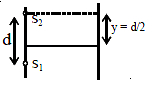
(D) In Young's double slit experiment,the position of the $n^{\text{th}}$ dark fringe from the central maximum is given by $y_n = (2n - 1) \frac{D \lambda}{2d}$,where $n = 1, 2, 3, \dots$.
Given that a dark fringe is observed directly opposite to one of the slits,the distance of this point from the central axis is $y = \frac{d}{2}$.
Equating the two expressions for the position of the dark fringe:
$(2n - 1) \frac{D \lambda}{2d} = \frac{d}{2}$.
For the first dark fringe $(n = 1)$:
$(2(1) - 1) \frac{D \lambda}{2d} = \frac{d}{2}$.
$\frac{D \lambda}{2d} = \frac{d}{2}$.
Solving for the wavelength $\lambda$:
$\lambda = \frac{d^2}{D}$.
Given that a dark fringe is observed directly opposite to one of the slits,the distance of this point from the central axis is $y = \frac{d}{2}$.
Equating the two expressions for the position of the dark fringe:
$(2n - 1) \frac{D \lambda}{2d} = \frac{d}{2}$.
For the first dark fringe $(n = 1)$:
$(2(1) - 1) \frac{D \lambda}{2d} = \frac{d}{2}$.
$\frac{D \lambda}{2d} = \frac{d}{2}$.
Solving for the wavelength $\lambda$:
$\lambda = \frac{d^2}{D}$.
0 likesView Solution
32
ChemistryEasyMCQWBJEE · 2011
Reaction of formaldehyde and ammonia gives
A
Hexamethylene tetramine
B
Bakelite
C
Urea
D
Triethylene Tetramine
Solution
(A) The reaction between formaldehyde $(HCHO)$ and ammonia $(NH_3)$ results in the formation of hexamethylene tetramine,also known as urotropine.
The balanced chemical equation is:
$6 HCHO + 4 NH_3 \rightarrow (CH_2)_6 N_4 + 6 H_2 O$
The balanced chemical equation is:
$6 HCHO + 4 NH_3 \rightarrow (CH_2)_6 N_4 + 6 H_2 O$
0 likesView Solution
33
ChemistryDifficultMCQWBJEE · 2011
Which of the following compounds is not formed in the iodoform reaction of acetone?
A
$CH_3COCH_2I$
B
$ICH_2COCH_2I$
C
$CH_3COCH_3$
D
$CH_3COCI_3$
Solution
(B) The iodoform reaction of acetone involves the sequential replacement of hydrogen atoms on the alpha-carbon by iodine atoms in the presence of a base $(OI^-)$.
Step $1$: $CH_3COCH_3 + OI^- \rightarrow CH_3COCH_2I + OH^-$
Step $2$: $CH_3COCH_2I + OI^- \rightarrow CH_3COCH_2I + OH^-$
Step $3$: $CH_3COCH_2I + OI^- \rightarrow CH_3COCI_3 + OH^-$
Step $4$: $CH_3COCI_3 + OH^- \rightarrow CH_3COO^- + CHI_3$
Comparing these intermediates with the given options,$ICH_2COCH_2I$ is not formed during the reaction as the iodination occurs specifically on the methyl group that is adjacent to the carbonyl group.
Step $1$: $CH_3COCH_3 + OI^- \rightarrow CH_3COCH_2I + OH^-$
Step $2$: $CH_3COCH_2I + OI^- \rightarrow CH_3COCH_2I + OH^-$
Step $3$: $CH_3COCH_2I + OI^- \rightarrow CH_3COCI_3 + OH^-$
Step $4$: $CH_3COCI_3 + OH^- \rightarrow CH_3COO^- + CHI_3$
Comparing these intermediates with the given options,$ICH_2COCH_2I$ is not formed during the reaction as the iodination occurs specifically on the methyl group that is adjacent to the carbonyl group.
0 likesView Solution
34
ChemistryDifficultMCQWBJEE · 2011
In aqueous solution,glucose remains as:
A
Only in open chain form
B
Only in pyranose form
C
Only in furanose forms
D
In all three forms in equilibrium
Solution
(D) In an aqueous solution,glucose exists in a dynamic equilibrium between its open-chain form and two cyclic (pyranose) forms,known as $\alpha-D-(+)-glucopyranose$ and $\beta-D-(+)-glucopyranose$.
The equilibrium mixture consists of approximately $36\%$ of $\alpha$-anomer,$64\%$ of $\beta$-anomer,and a very small amount (about $0.02\%$) of the open-chain form.
Therefore,glucose exists in all three forms in equilibrium.
The equilibrium mixture consists of approximately $36\%$ of $\alpha$-anomer,$64\%$ of $\beta$-anomer,and a very small amount (about $0.02\%$) of the open-chain form.
Therefore,glucose exists in all three forms in equilibrium.
0 likesView Solution
35
ChemistryDifficultMCQWBJEE · 2011
An electric current is passed through an aqueous solution of a mixture of alanine (isoelectric point $6.0$),glutamic acid $(3.2)$,and arginine $(10.7)$ buffered at $pH$ $6.0$. What is the fate of the three amino acids?
A
Glutamic acid migrates to the anode at $pH$ $6.0$. Arginine is present as a cation and migrates to the cathode. Alanine exists as a zwitterion and remains uniformly distributed in the solution.
B
Glutamic acid migrates to the cathode and others remain uniformly distributed in the solution.
C
All three remain uniformly distributed in the solution.
D
All three move to the cathode.
Solution
(A) The behavior of amino acids in an electric field depends on their net charge at a given $pH$ relative to their isoelectric point $(pI)$.
$1$. For glutamic acid $(pI = 3.2)$,at $pH = 6.0$ $(pH > pI)$,it exists as an anion and migrates to the anode.
$2$. For arginine $(pI = 10.7)$,at $pH = 6.0$ $(pH < pI)$,it exists as a cation and migrates to the cathode.
$3$. For alanine $(pI = 6.0)$,at $pH = 6.0$ $(pH = pI)$,it exists as a zwitterion (dipolar ion) with a net charge of zero and does not migrate to either electrode,remaining uniformly distributed.
$1$. For glutamic acid $(pI = 3.2)$,at $pH = 6.0$ $(pH > pI)$,it exists as an anion and migrates to the anode.
$2$. For arginine $(pI = 10.7)$,at $pH = 6.0$ $(pH < pI)$,it exists as a cation and migrates to the cathode.
$3$. For alanine $(pI = 6.0)$,at $pH = 6.0$ $(pH = pI)$,it exists as a zwitterion (dipolar ion) with a net charge of zero and does not migrate to either electrode,remaining uniformly distributed.
0 likesView Solution
36
ChemistryEasyMCQWBJEE · 2011
Which one is not a constituent of nucleic acid?
A
Uracil
B
Guanidine
C
Phosphoric acid
D
Ribose sugar
Solution
(B) Nucleic acids ($DNA$ and $RNA$) are composed of three main components: a pentose sugar (ribose or deoxyribose),a phosphate group (derived from phosphoric acid),and nitrogenous bases (adenine,guanine,cytosine,thymine,or uracil).
$Guanidine$ is a chemical compound with the formula $HNC(NH_2)_2$,which is not a constituent of nucleic acids.
$Guanine$ is a nitrogenous base found in nucleic acids,whereas $Guanidine$ is not.
$Guanidine$ is a chemical compound with the formula $HNC(NH_2)_2$,which is not a constituent of nucleic acids.
$Guanine$ is a nitrogenous base found in nucleic acids,whereas $Guanidine$ is not.
0 likesView Solution
37
ChemistryMediumMCQWBJEE · 2011
Which of the following compounds has maximum volatility?
A
p-Hydroxybenzoic acid
B
m-Hydroxybenzoic acid
C
o-Hydroxybenzoic acid (Salicylic acid)
D
Benzoic acid
Solution
(C) Volatility is inversely proportional to the strength of intermolecular forces.
$o$-Hydroxybenzoic acid (Salicylic acid) exhibits intramolecular hydrogen bonding,which reduces the extent of intermolecular hydrogen bonding compared to its isomers ($p$- and $m$-hydroxybenzoic acid).
This results in weaker intermolecular forces,making $o$-hydroxybenzoic acid more volatile than the others.
$o$-Hydroxybenzoic acid (Salicylic acid) exhibits intramolecular hydrogen bonding,which reduces the extent of intermolecular hydrogen bonding compared to its isomers ($p$- and $m$-hydroxybenzoic acid).
This results in weaker intermolecular forces,making $o$-hydroxybenzoic acid more volatile than the others.
0 likesView Solution
38
ChemistryEasyMCQWBJEE · 2011
Paracetamol is
A
Methyl salicylate
B
Phenyl salicylate
C
$N$-acetyl $p$-aminophenol
D
Acetylsalicylic acid
Solution
(C) Paracetamol is a widely used analgesic and antipyretic drug.
Its chemical structure consists of a benzene ring substituted with a hydroxyl group $(-OH)$ at the $p$-position relative to an acetamido group $(-NHCOCH_3)$.
Therefore,its $IUPAC$ name is $N$-($4$-hydroxyphenyl)acetamide,commonly referred to as $N$-acetyl $p$-aminophenol.
Its chemical structure consists of a benzene ring substituted with a hydroxyl group $(-OH)$ at the $p$-position relative to an acetamido group $(-NHCOCH_3)$.
Therefore,its $IUPAC$ name is $N$-($4$-hydroxyphenyl)acetamide,commonly referred to as $N$-acetyl $p$-aminophenol.
0 likesView Solution
39
ChemistryEasyMCQWBJEE · 2011
Platinum,Palladium and Iridium are called noble metals because
A
Alfred Nobel discovered them
B
They are shining lustrous and pleasing to look at
C
They are found in native state
D
They are inert towards many common reagents.
Solution
(D) Noble metals are defined by their resistance to oxidation and corrosion in moist air.
They are chemically inert towards many common reagents such as acids and bases.
This chemical stability is the primary reason they are classified as noble metals.
They are chemically inert towards many common reagents such as acids and bases.
This chemical stability is the primary reason they are classified as noble metals.
0 likesView Solution
40
ChemistryEasyMCQWBJEE · 2011
Anhydrous ferric chloride is prepared by
A
Dissolving $Fe(OH)_3$ in concentrated $HCl$
B
Dissolving $Fe(OH)_3$ in dilute $HCl$
C
Passing dry $HCl$ over heated iron scrap
D
Passing dry $Cl_2$ gas over heated iron scrap
Solution
(D) Anhydrous $FeCl_3$ is prepared by the reaction of dry $Cl_2$ gas with heated iron metal.
The reaction is: $2 Fe + 3 Cl_2 \xrightarrow{\Delta} 2 FeCl_3$.
If $HCl$ is used,it often results in the formation of hydrated ferric chloride due to the presence of water.
The reaction is: $2 Fe + 3 Cl_2 \xrightarrow{\Delta} 2 FeCl_3$.
If $HCl$ is used,it often results in the formation of hydrated ferric chloride due to the presence of water.
0 likesView Solution
41
ChemistryMediumMCQWBJEE · 2011
The standard reduction potential $E^{\circ}$ for half reactions are
The $EMF$ of the cell reaction $Fe^{2+} + Zn \rightarrow Zn^{2+} + Fe$ is
| $Zn \rightarrow Zn^{2+} + 2e^-$ | $E^{\circ} = +0.76 \ V$ |
| $Fe \rightarrow Fe^{2+} + 2e^-$ | $E^{\circ} = +0.41 \ V$ |
The $EMF$ of the cell reaction $Fe^{2+} + Zn \rightarrow Zn^{2+} + Fe$ is
A
$-0.35 \ V$
B
$0.35 \ V$
C
$+1.17 \ V$
D
$-1.17 \ V$
Solution
(B) The given reactions are oxidation half-reactions,so the given $E^{\circ}$ values are oxidation potentials $(E^{\circ}_{op})$:
$Zn \rightarrow Zn^{2+} + 2e^-, E^{\circ}_{op} = +0.76 \ V$
$Fe \rightarrow Fe^{2+} + 2e^-, E^{\circ}_{op} = +0.41 \ V$
For the cell reaction $Fe^{2+} + Zn \rightarrow Zn^{2+} + Fe$,$Zn$ is oxidized (anode) and $Fe^{2+}$ is reduced (cathode).
The cell potential is given by: $E^{\circ}_{cell} = E^{\circ}_{op}(\text{anode}) + E^{\circ}_{rp}(\text{cathode})$
Since $E^{\circ}_{rp}(\text{cathode}) = -E^{\circ}_{op}(\text{cathode})$,we have:
$E^{\circ}_{cell} = E^{\circ}_{op}(Zn) - E^{\circ}_{op}(Fe)$
$E^{\circ}_{cell} = 0.76 \ V - 0.41 \ V = +0.35 \ V$.
$Zn \rightarrow Zn^{2+} + 2e^-, E^{\circ}_{op} = +0.76 \ V$
$Fe \rightarrow Fe^{2+} + 2e^-, E^{\circ}_{op} = +0.41 \ V$
For the cell reaction $Fe^{2+} + Zn \rightarrow Zn^{2+} + Fe$,$Zn$ is oxidized (anode) and $Fe^{2+}$ is reduced (cathode).
The cell potential is given by: $E^{\circ}_{cell} = E^{\circ}_{op}(\text{anode}) + E^{\circ}_{rp}(\text{cathode})$
Since $E^{\circ}_{rp}(\text{cathode}) = -E^{\circ}_{op}(\text{cathode})$,we have:
$E^{\circ}_{cell} = E^{\circ}_{op}(Zn) - E^{\circ}_{op}(Fe)$
$E^{\circ}_{cell} = 0.76 \ V - 0.41 \ V = +0.35 \ V$.
0 likesView Solution
42
ChemistryEasyMCQWBJEE · 2011
The correct order of decreasing acidity of nitrophenols is:
A
$p$-Nitrophenol $ > $ $o$-Nitrophenol $ > $ $m$-Nitrophenol
B
$o$-Nitrophenol $ > $ $m$-Nitrophenol $ > $ $p$-Nitrophenol
C
$p$-Nitrophenol $ > $ $m$-Nitrophenol $ > $ $o$-Nitrophenol
D
$m$-Nitrophenol $ > $ $p$-Nitrophenol $ > $ $o$-Nitrophenol
Solution
(A) The acidity of nitrophenols is determined by the electron-withdrawing effect ($-I$ and $-R$ effects) of the $-NO_2$ group.
$p$-Nitrophenol is the most acidic because the $-NO_2$ group at the para-position exerts both strong $-I$ and $-R$ effects,stabilizing the phenoxide ion significantly.
In $o$-nitrophenol,the $-NO_2$ group is at the ortho-position,which also exerts strong $-I$ and $-R$ effects,but the formation of intramolecular $H$-bonding between the $-OH$ group and the $-NO_2$ group makes the release of the proton slightly more difficult compared to $p$-nitrophenol.
In $m$-nitrophenol,the $-NO_2$ group only exerts a $-I$ effect (no resonance effect),making it the least acidic among the three.
Thus,the correct order of decreasing acidity is: $p$-Nitrophenol $ > $ $o$-Nitrophenol $ > $ $m$-Nitrophenol.
$p$-Nitrophenol is the most acidic because the $-NO_2$ group at the para-position exerts both strong $-I$ and $-R$ effects,stabilizing the phenoxide ion significantly.
In $o$-nitrophenol,the $-NO_2$ group is at the ortho-position,which also exerts strong $-I$ and $-R$ effects,but the formation of intramolecular $H$-bonding between the $-OH$ group and the $-NO_2$ group makes the release of the proton slightly more difficult compared to $p$-nitrophenol.
In $m$-nitrophenol,the $-NO_2$ group only exerts a $-I$ effect (no resonance effect),making it the least acidic among the three.
Thus,the correct order of decreasing acidity is: $p$-Nitrophenol $ > $ $o$-Nitrophenol $ > $ $m$-Nitrophenol.
0 likesView Solution
43
ChemistryDifficultMCQWBJEE · 2011
The ease of dehydrohalogenation of alkyl halide with alcoholic $KOH$ is:
A
$3^{\circ} < 2^{\circ} < 1^{\circ}$
B
$3^{\circ} > 2^{\circ} > 1^{\circ}$
C
$3^{\circ} < 2^{\circ} > 1^{\circ}$
D
$3^{\circ} > 2^{\circ} < 1^{\circ}$
Solution
(B) Dehydrohalogenation of alkyl halides with alcoholic $KOH$ follows the $E_2$ mechanism.
In this reaction,the rate-determining step involves the formation of an alkene.
The stability of the resulting alkene is the primary driving force for the reaction.
According to Saytzeff's rule,more substituted alkenes are more stable.
Since tertiary $(3^{\circ})$ alkyl halides form the most substituted (and thus most stable) alkenes,they react the fastest.
Therefore,the order of reactivity is $3^{\circ} > 2^{\circ} > 1^{\circ}$.
In this reaction,the rate-determining step involves the formation of an alkene.
The stability of the resulting alkene is the primary driving force for the reaction.
According to Saytzeff's rule,more substituted alkenes are more stable.
Since tertiary $(3^{\circ})$ alkyl halides form the most substituted (and thus most stable) alkenes,they react the fastest.
Therefore,the order of reactivity is $3^{\circ} > 2^{\circ} > 1^{\circ}$.
0 likesView Solution
44
ChemistryMediumMCQWBJEE · 2011
Two aromatic compounds having formula $C_7H_8O$ which are easily identifiable by $FeCl_3$ solution test (violet colouration) are
A
$o-$cresol and benzyl alcohol
B
$m-$cresol and $p-$cresol
C
$o-$cresol and $p-$cresol
D
methyl phenyl ether and benzyl alcohol
Solution
(A) The $FeCl_3$ test is used to detect the presence of a phenolic group ($-OH$ group attached directly to the benzene ring).
Compounds containing a phenolic group react with neutral $FeCl_3$ to form a violet-colored complex.
Among the given options,$o-$cresol ($2-$methylphenol) is a phenol and gives a violet color with $FeCl_3$.
Benzyl alcohol $(C_6H_5CH_2OH)$ does not contain a phenolic group (the $-OH$ is on the side chain),so it does not give a violet color with $FeCl_3$.
Therefore,$o-$cresol and benzyl alcohol can be distinguished using this test.
Compounds containing a phenolic group react with neutral $FeCl_3$ to form a violet-colored complex.
Among the given options,$o-$cresol ($2-$methylphenol) is a phenol and gives a violet color with $FeCl_3$.
Benzyl alcohol $(C_6H_5CH_2OH)$ does not contain a phenolic group (the $-OH$ is on the side chain),so it does not give a violet color with $FeCl_3$.
Therefore,$o-$cresol and benzyl alcohol can be distinguished using this test.
0 likesView Solution
45
ChemistryEasyMCQWBJEE · 2011
Which one of the following is not true at room temperature and pressure?
A
$P_4O_{10}$ is a white solid
B
$SO_2$ is a colourless gas
C
$SO_3$ is a colourless gas
D
$NO_2$ is a brown gas
Solution
(C) At room temperature and pressure,$P_4O_{10}$ exists as a white solid.
$SO_2$ is a colourless gas.
$NO_2$ is a brown gas.
However,$SO_3$ exists as a colourless,crystalline transparent solid at room temperature,not a gas.
Therefore,the statement that $SO_3$ is a colourless gas is not true.
$SO_2$ is a colourless gas.
$NO_2$ is a brown gas.
However,$SO_3$ exists as a colourless,crystalline transparent solid at room temperature,not a gas.
Therefore,the statement that $SO_3$ is a colourless gas is not true.
0 likesView Solution
46
ChemistryEasyMCQWBJEE · 2011
Which of the following is used to prepare $Cl_2$ gas at room temperature from concentrated $HCl$?
A
$MnO_2$
B
$H_2S$
C
$KMnO_4$
D
$Cr_2O_3$
Solution
(C) The preparation of $Cl_2$ gas from concentrated $HCl$ at room temperature is achieved by using strong oxidizing agents like $KMnO_4$.
The chemical reaction is: $2KMnO_4 + 16HCl \rightarrow 2KCl + 2MnCl_2 + 8H_2O + 5Cl_2$.
While $MnO_2$ also oxidizes $HCl$ to $Cl_2$,it typically requires heating,whereas $KMnO_4$ can perform this reaction at room temperature.
The chemical reaction is: $2KMnO_4 + 16HCl \rightarrow 2KCl + 2MnCl_2 + 8H_2O + 5Cl_2$.
While $MnO_2$ also oxidizes $HCl$ to $Cl_2$,it typically requires heating,whereas $KMnO_4$ can perform this reaction at room temperature.
0 likesView Solution
47
ChemistryEasyMCQWBJEE · 2011
$A$ radioactive atom $^X_Y M$ emits two $\alpha$ particles and one $\beta$ particle successively. The number of neutrons in the nucleus of the product will be
A
$X-Y-4$
B
$X-Y-5$
C
$X-Y-3$
D
$X-Y-6$
Solution
(B) The initial atom is $^X_Y M$.
$1$. Emission of first $\alpha$ particle $(^4_2 He)$: The mass number decreases by $4$ and atomic number decreases by $2$. Product: $^{X-4}_{Y-2} N$.
$2$. Emission of second $\alpha$ particle: The mass number decreases by $4$ and atomic number decreases by $2$. Product: $^{X-8}_{Y-4} O$.
$3$. Emission of one $\beta$ particle $(^0_{-1} e)$: The mass number remains unchanged and atomic number increases by $1$. Product: $^{X-8}_{Y-3} P$.
Number of neutrons = Mass number - Atomic number.
Number of neutrons = $(X-8) - (Y-3) = X - 8 - Y + 3 = X - Y - 5$.
$1$. Emission of first $\alpha$ particle $(^4_2 He)$: The mass number decreases by $4$ and atomic number decreases by $2$. Product: $^{X-4}_{Y-2} N$.
$2$. Emission of second $\alpha$ particle: The mass number decreases by $4$ and atomic number decreases by $2$. Product: $^{X-8}_{Y-4} O$.
$3$. Emission of one $\beta$ particle $(^0_{-1} e)$: The mass number remains unchanged and atomic number increases by $1$. Product: $^{X-8}_{Y-3} P$.
Number of neutrons = Mass number - Atomic number.
Number of neutrons = $(X-8) - (Y-3) = X - 8 - Y + 3 = X - Y - 5$.
0 likesView Solution
Vedclass Products
For Students
Vedclass Test Series
Mock tests in real WBJEE style covering Chemistry with performance analysis. 5-day free trial.
Start Free TrialFor Teachers
Exam Paper Generator
Generate Set A/B/C/D Chemistry papers from 7.5L+ questions in 2 minutes. 3 chapters free.
Try FreeFor Institutes
Online Exam Module
Run live WBJEE mock exams with unlimited students, 360° analytics & white-label branding.
See DemoFrequently Asked Questions
How many Chemistry questions are in WBJEE 2011?
There are 47 Chemistry questions from the WBJEE 2011 paper on Vedclass, each with a detailed step-by-step solution in English.
Are WBJEE 2011 Chemistry solutions available in English?
Yes. All solutions on this page are in English. You can also switch to English or Hindi using the language buttons above the questions.
Can I practice WBJEE 2011 Chemistry as a timed test?
Yes. Use the Vedclass Test Series to attempt a full WBJEE mock test covering Chemistry with time limits and instant score analysis.
Can teachers create Chemistry papers from WBJEE previous year questions?
Yes. The Vedclass Exam Paper Generator lets teachers mix WBJEE Chemistry questions and generate Set A/B/C/D papers in minutes.
For Teachers & Institutes
Build a Custom Chemistry Paper
Pick WBJEE 2011 Chemistry questions, set difficulty, and generate Set A/B/C/D in 2 minutes.