
PhysicsQ1–38 of 38 questions
Page 1 of 1 · English
1
PhysicsMediumMCQWBJEE · 2011
The period of oscillation of a simple pendulum of length $L$ suspended from the roof of a vehicle which moves without friction down an inclined plane of inclination $\alpha$,is given by
A
$2\pi \sqrt {\frac{L}{{g\cos \alpha }}} $
B
$2\pi \sqrt {\frac{L}{{g\sin \alpha }}} $
C
$2\pi \sqrt {\frac{L}{g}} $
D
$2\pi \sqrt {\frac{L}{{g\tan \alpha }}} $
Solution
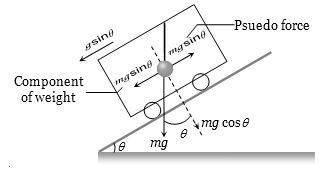
(A) The vehicle moves down a frictionless inclined plane with an acceleration $a = g\sin \alpha$.
In the frame of the vehicle,a pseudo force $F_p = ma = mg\sin \alpha$ acts on the bob of the pendulum in the upward direction along the incline.
The effective acceleration $g_{eff}$ is the vector sum of the acceleration due to gravity $\vec{g}$ and the negative of the vehicle's acceleration $-\vec{a}$.
Resolving the components,the component of $g$ perpendicular to the incline is $g\cos \alpha$ and the component of $g$ parallel to the incline is $g\sin \alpha$. The pseudo force cancels the component $g\sin \alpha$.
Thus,the effective acceleration is $g_{eff} = g\cos \alpha$.
The time period of the simple pendulum is given by $T = 2\pi \sqrt{\frac{L}{g_{eff}}} = 2\pi \sqrt{\frac{L}{g\cos \alpha}}$.
In the frame of the vehicle,a pseudo force $F_p = ma = mg\sin \alpha$ acts on the bob of the pendulum in the upward direction along the incline.
The effective acceleration $g_{eff}$ is the vector sum of the acceleration due to gravity $\vec{g}$ and the negative of the vehicle's acceleration $-\vec{a}$.
Resolving the components,the component of $g$ perpendicular to the incline is $g\cos \alpha$ and the component of $g$ parallel to the incline is $g\sin \alpha$. The pseudo force cancels the component $g\sin \alpha$.
Thus,the effective acceleration is $g_{eff} = g\cos \alpha$.
The time period of the simple pendulum is given by $T = 2\pi \sqrt{\frac{L}{g_{eff}}} = 2\pi \sqrt{\frac{L}{g\cos \alpha}}$.
0 likesView Solution
2
PhysicsMediumMCQWBJEE · 2011
If $g$ is the acceleration due to gravity on the surface of the earth,the gain in potential energy of an object of mass $m$ raised from the earth's surface to a height equal to the radius $R$ of the earth is
A
$\frac{mg R}{4}$
B
$\frac{m g R}{2}$
C
$m g R$
D
$2 mg R$
Solution
(B) The gravitational potential energy of an object of mass $m$ at a distance $r$ from the center of the earth is given by $U = -\frac{GMm}{r}$.
At the surface of the earth,$r = R$,so $U_i = -\frac{GMm}{R}$.
At a height $h = R$ above the surface,the distance from the center is $r = R + h = R + R = 2R$.
Thus,the potential energy at height $h$ is $U_f = -\frac{GMm}{2R}$.
The gain in potential energy is $\Delta U = U_f - U_i = -\frac{GMm}{2R} - (-\frac{GMm}{R}) = \frac{GMm}{R} - \frac{GMm}{2R} = \frac{GMm}{2R}$.
Since the acceleration due to gravity on the surface is $g = \frac{GM}{R^2}$,we have $GM = gR^2$.
Substituting this into the expression for $\Delta U$,we get $\Delta U = \frac{(gR^2)m}{2R} = \frac{mgR}{2}$.
At the surface of the earth,$r = R$,so $U_i = -\frac{GMm}{R}$.
At a height $h = R$ above the surface,the distance from the center is $r = R + h = R + R = 2R$.
Thus,the potential energy at height $h$ is $U_f = -\frac{GMm}{2R}$.
The gain in potential energy is $\Delta U = U_f - U_i = -\frac{GMm}{2R} - (-\frac{GMm}{R}) = \frac{GMm}{R} - \frac{GMm}{2R} = \frac{GMm}{2R}$.
Since the acceleration due to gravity on the surface is $g = \frac{GM}{R^2}$,we have $GM = gR^2$.
Substituting this into the expression for $\Delta U$,we get $\Delta U = \frac{(gR^2)m}{2R} = \frac{mgR}{2}$.
0 likesView Solution
3
PhysicsMediumMCQWBJEE · 2011
Air inside a closed container is saturated with water vapour. The air pressure is $p$ and the saturated vapour pressure of water is $\bar{p}$. If the mixture is compressed to one half of its volume by maintaining temperature constant,the pressure becomes
A
$2(p+\bar{p})$
B
$2p+\bar{p}$
C
$(p+\bar{p}) / 2$
D
$p+2\bar{p}$
Solution
(B) The total pressure inside the container is the sum of the partial pressure of dry air $(p)$ and the saturated vapour pressure of water $(\bar{p})$,so $P_{total} = p + \bar{p}$.
When the volume is compressed to half $(V' = V/2)$ at a constant temperature,the partial pressure of the dry air follows Boyle's Law $(P_1V_1 = P_2V_2)$.
Thus,the new pressure of dry air becomes $p' = p \times (V / (V/2)) = 2p$.
Since the temperature remains constant,the saturated vapour pressure of water $(\bar{p})$ remains unchanged because it depends only on temperature.
Therefore,the new total pressure is $P'_{total} = p' + \bar{p} = 2p + \bar{p}$.
When the volume is compressed to half $(V' = V/2)$ at a constant temperature,the partial pressure of the dry air follows Boyle's Law $(P_1V_1 = P_2V_2)$.
Thus,the new pressure of dry air becomes $p' = p \times (V / (V/2)) = 2p$.
Since the temperature remains constant,the saturated vapour pressure of water $(\bar{p})$ remains unchanged because it depends only on temperature.
Therefore,the new total pressure is $P'_{total} = p' + \bar{p} = 2p + \bar{p}$.
0 likesView Solution
4
PhysicsMediumMCQWBJEE · 2011
$A$ cricket ball of mass $0.25 \,kg$ with speed $10 \,m/s$ collides with a bat and returns with the same speed within $0.01 \,s$. The force exerted on the bat is: (in $\,N$)
A
$25$
B
$50$
C
$250$
D
$500$
Solution
(D) Given: Mass $m = 0.25 \,kg$, initial velocity $u = 10 \,m/s$, final velocity $v = -10 \,m/s$ (since it returns in the opposite direction), and time interval $\Delta t = 0.01 \,s$.
Change in momentum $\Delta P = m(v - u) = 0.25 \times (-10 - 10) = 0.25 \times (-20) = -5 \,kg \cdot m/s$.
The magnitude of change in momentum is $|\Delta P| = 5 \,kg \cdot m/s$.
The force exerted on the ball by the bat is $F = \frac{\Delta P}{\Delta t} = \frac{5}{0.01} = 500 \,N$.
According to Newton's third law, the force exerted on the bat by the ball is equal in magnitude, which is $500 \,N$.
Change in momentum $\Delta P = m(v - u) = 0.25 \times (-10 - 10) = 0.25 \times (-20) = -5 \,kg \cdot m/s$.
The magnitude of change in momentum is $|\Delta P| = 5 \,kg \cdot m/s$.
The force exerted on the ball by the bat is $F = \frac{\Delta P}{\Delta t} = \frac{5}{0.01} = 500 \,N$.
According to Newton's third law, the force exerted on the bat by the ball is equal in magnitude, which is $500 \,N$.
0 likesView Solution
5
PhysicsEasyMCQWBJEE · 2011
$A$ stone of relative density $K$ is released from rest on the surface of a lake. If viscous effects are ignored,the stone sinks in water with an acceleration of
A
$g(1-K)$
B
$g(1+K)$
C
$g\left(1-\frac{1}{K}\right)$
D
$g\left(1+\frac{1}{K}\right)$
Solution
(C) Let $V$ be the volume of the stone,$\sigma$ be the density of the stone,and $\rho$ be the density of water.
The relative density $K$ of the stone is given by $K = \frac{\sigma}{\rho}$,so $\sigma = K\rho$.
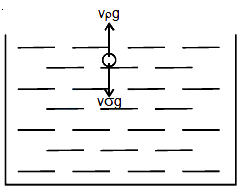
The forces acting on the stone as it sinks are:
$1$. Weight of the stone acting downwards: $W = V\sigma g = V(K\rho)g$.
$2$. Buoyant force acting upwards: $F_B = V\rho g$.
According to Newton's second law,the net force $F_{net} = W - F_B = ma$,where $m = V\sigma$ is the mass of the stone.
$V\sigma g - V\rho g = (V\sigma)a$
Dividing by $V\sigma$:
$a = g - \frac{V\rho g}{V\sigma} = g - \frac{\rho}{\sigma}g$
Since $K = \frac{\sigma}{\rho}$,we have $\frac{\rho}{\sigma} = \frac{1}{K}$.
Therefore,the acceleration $a = g - \frac{g}{K} = g\left(1 - \frac{1}{K}\right)$.
The relative density $K$ of the stone is given by $K = \frac{\sigma}{\rho}$,so $\sigma = K\rho$.
The forces acting on the stone as it sinks are:
$1$. Weight of the stone acting downwards: $W = V\sigma g = V(K\rho)g$.
$2$. Buoyant force acting upwards: $F_B = V\rho g$.
According to Newton's second law,the net force $F_{net} = W - F_B = ma$,where $m = V\sigma$ is the mass of the stone.
$V\sigma g - V\rho g = (V\sigma)a$
Dividing by $V\sigma$:
$a = g - \frac{V\rho g}{V\sigma} = g - \frac{\rho}{\sigma}g$
Since $K = \frac{\sigma}{\rho}$,we have $\frac{\rho}{\sigma} = \frac{1}{K}$.
Therefore,the acceleration $a = g - \frac{g}{K} = g\left(1 - \frac{1}{K}\right)$.
0 likesView Solution
6
PhysicsEasyMCQWBJEE · 2011
An object weighs $m_1$ in a liquid of density $d_1$ and $m_2$ in a liquid of density $d_2$. The density $d$ of the object is
A
$d=\frac{m_2 d_2-m_1 d_1}{m_2-m_1}$
B
$d=\frac{m_1 d_1-m_2 d_2}{m_2-m_1}$
C
$d=\frac{m_2 d_1-m_1 d_2}{m_1-m_2}$
D
$d=\frac{m_1 d_2-m_2 d_1}{m_1-m_2}$
Solution
(D) Let $V$ be the volume of the object and $d$ be its density. The apparent weight of the object in a liquid is given by the actual weight minus the buoyant force.
In the first liquid: $m_1 g = V d g - V d_1 g = V g (d - d_1) \implies m_1 = V(d - d_1) \quad (1)$
In the second liquid: $m_2 g = V d g - V d_2 g = V g (d - d_2) \implies m_2 = V(d - d_2) \quad (2)$
Dividing equation $(1)$ by equation $(2)$:
$\frac{m_1}{m_2} = \frac{d - d_1}{d - d_2}$
$m_1(d - d_2) = m_2(d - d_1)$
$m_1 d - m_1 d_2 = m_2 d - m_2 d_1$
$d(m_1 - m_2) = m_1 d_2 - m_2 d_1$
$d = \frac{m_1 d_2 - m_2 d_1}{m_1 - m_2}$
In the first liquid: $m_1 g = V d g - V d_1 g = V g (d - d_1) \implies m_1 = V(d - d_1) \quad (1)$
In the second liquid: $m_2 g = V d g - V d_2 g = V g (d - d_2) \implies m_2 = V(d - d_2) \quad (2)$
Dividing equation $(1)$ by equation $(2)$:
$\frac{m_1}{m_2} = \frac{d - d_1}{d - d_2}$
$m_1(d - d_2) = m_2(d - d_1)$
$m_1 d - m_1 d_2 = m_2 d - m_2 d_1$
$d(m_1 - m_2) = m_1 d_2 - m_2 d_1$
$d = \frac{m_1 d_2 - m_2 d_1}{m_1 - m_2}$
0 likesView Solution
7
PhysicsDifficultMCQWBJEE · 2011
$A$ body floats in water with $40 \%$ of its volume outside water. When the same body floats in an oil,$60 \%$ of its volume remains outside oil. The relative density of oil is
A
$0.9$
B
$1$
C
$1.2$
D
$1.5$
Solution
(D) Let $V$ be the total volume of the body and $\rho$ be its density.
According to the law of floatation,the weight of the body is equal to the weight of the liquid displaced.
Case $1$: In water (density $\rho_w = 1 \text{ g/cm}^3$):
Volume inside water = $V - 0.4V = 0.6V$.
Weight of body = Weight of water displaced $\implies V \rho g = (0.6V) \rho_w g \implies \rho = 0.6 \rho_w = 0.6 \text{ g/cm}^3$.
Case $2$: In oil (density $\rho_o$):
Volume inside oil = $V - 0.6V = 0.4V$.
Weight of body = Weight of oil displaced $\implies V \rho g = (0.4V) \rho_o g \implies \rho = 0.4 \rho_o$.
Equating the density of the body from both cases: $0.6 \rho_w = 0.4 \rho_o$.
Relative density of oil = $\frac{\rho_o}{\rho_w} = \frac{0.6}{0.4} = 1.5$.
According to the law of floatation,the weight of the body is equal to the weight of the liquid displaced.
Case $1$: In water (density $\rho_w = 1 \text{ g/cm}^3$):
Volume inside water = $V - 0.4V = 0.6V$.
Weight of body = Weight of water displaced $\implies V \rho g = (0.6V) \rho_w g \implies \rho = 0.6 \rho_w = 0.6 \text{ g/cm}^3$.
Case $2$: In oil (density $\rho_o$):
Volume inside oil = $V - 0.6V = 0.4V$.
Weight of body = Weight of oil displaced $\implies V \rho g = (0.4V) \rho_o g \implies \rho = 0.4 \rho_o$.
Equating the density of the body from both cases: $0.6 \rho_w = 0.4 \rho_o$.
Relative density of oil = $\frac{\rho_o}{\rho_w} = \frac{0.6}{0.4} = 1.5$.
0 likesView Solution
8
PhysicsMediumMCQWBJEE · 2011
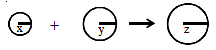
Two soap bubbles of radii $x$ and $y$ coalesce to form a single bubble of radius $z$. Then $z$ is equal to
A
$\sqrt{x^2+y^2}$
B
$\sqrt{x+y}$
C
$x+y$
D
$\frac{x+y}{2}$
Solution
(A) When two soap bubbles coalesce in a vacuum,the total number of moles of air remains constant. Assuming the process is isothermal,we use the ideal gas law $PV = nRT$. Since $n$ is constant and $T$ is constant,$PV$ must be constant.
For a soap bubble,the excess pressure is given by $P_{ex} = \frac{4T}{r}$,where $T$ is the surface tension and $r$ is the radius. In a vacuum,the total pressure inside the bubble is $P = \frac{4T}{r}$.
The volume of a spherical bubble is $V = \frac{4}{3}\pi r^3$.
For the two initial bubbles,$P_1 V_1 = (\frac{4T}{x})(\frac{4}{3}\pi x^3) = \frac{16}{3}\pi T x^2$ and $P_2 V_2 = (\frac{4T}{y})(\frac{4}{3}\pi y^3) = \frac{16}{3}\pi T y^2$.
For the final bubble,$P V = (\frac{4T}{z})(\frac{4}{3}\pi z^3) = \frac{16}{3}\pi T z^2$.
Since the total amount of air is conserved,$P_1 V_1 + P_2 V_2 = PV$.
$\frac{16}{3}\pi T x^2 + \frac{16}{3}\pi T y^2 = \frac{16}{3}\pi T z^2$.
Dividing both sides by $\frac{16}{3}\pi T$,we get $x^2 + y^2 = z^2$,which implies $z = \sqrt{x^2 + y^2}$.
For a soap bubble,the excess pressure is given by $P_{ex} = \frac{4T}{r}$,where $T$ is the surface tension and $r$ is the radius. In a vacuum,the total pressure inside the bubble is $P = \frac{4T}{r}$.
The volume of a spherical bubble is $V = \frac{4}{3}\pi r^3$.
For the two initial bubbles,$P_1 V_1 = (\frac{4T}{x})(\frac{4}{3}\pi x^3) = \frac{16}{3}\pi T x^2$ and $P_2 V_2 = (\frac{4T}{y})(\frac{4}{3}\pi y^3) = \frac{16}{3}\pi T y^2$.
For the final bubble,$P V = (\frac{4T}{z})(\frac{4}{3}\pi z^3) = \frac{16}{3}\pi T z^2$.
Since the total amount of air is conserved,$P_1 V_1 + P_2 V_2 = PV$.
$\frac{16}{3}\pi T x^2 + \frac{16}{3}\pi T y^2 = \frac{16}{3}\pi T z^2$.
Dividing both sides by $\frac{16}{3}\pi T$,we get $x^2 + y^2 = z^2$,which implies $z = \sqrt{x^2 + y^2}$.
0 likesView Solution
9
PhysicsEasyMCQWBJEE · 2011
$A$ material has Poisson's ratio $0.50$. If a uniform rod of it suffers a longitudinal strain of $2 \times 10^{-3}$,then the percentage change in volume is
A
$0.6$
B
$0.4$
C
$0.2$
D
zero
Solution
(D) The longitudinal strain is given by $\epsilon_L = 2 \times 10^{-3}$.
Poisson's ratio $\sigma$ is defined as the ratio of lateral strain $\epsilon_d$ to longitudinal strain $\epsilon_L$,i.e.,$\sigma = -\frac{\epsilon_d}{\epsilon_L}$.
Therefore,the lateral strain is $\epsilon_d = -\sigma \epsilon_L = -0.50 \times (2 \times 10^{-3}) = -1 \times 10^{-3}$.
The volumetric strain $\frac{\Delta V}{V}$ is given by the sum of the longitudinal strain and two lateral strains: $\frac{\Delta V}{V} = \epsilon_L + 2\epsilon_d$.
Substituting the values: $\frac{\Delta V}{V} = (2 \times 10^{-3}) + 2(-1 \times 10^{-3}) = 2 \times 10^{-3} - 2 \times 10^{-3} = 0$.
Since the volumetric strain is $0$,the percentage change in volume is $0$.
Poisson's ratio $\sigma$ is defined as the ratio of lateral strain $\epsilon_d$ to longitudinal strain $\epsilon_L$,i.e.,$\sigma = -\frac{\epsilon_d}{\epsilon_L}$.
Therefore,the lateral strain is $\epsilon_d = -\sigma \epsilon_L = -0.50 \times (2 \times 10^{-3}) = -1 \times 10^{-3}$.
The volumetric strain $\frac{\Delta V}{V}$ is given by the sum of the longitudinal strain and two lateral strains: $\frac{\Delta V}{V} = \epsilon_L + 2\epsilon_d$.
Substituting the values: $\frac{\Delta V}{V} = (2 \times 10^{-3}) + 2(-1 \times 10^{-3}) = 2 \times 10^{-3} - 2 \times 10^{-3} = 0$.
Since the volumetric strain is $0$,the percentage change in volume is $0$.
0 likesView Solution
10
PhysicsMediumMCQWBJEE · 2011
If a person can throw a stone to a maximum height of $h$ meters vertically,then the maximum distance through which it can be thrown horizontally by the same person is
A
$\frac{h}{2}$
B
$h$
C
$2h$
D
$3h$
Solution
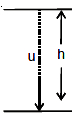
(C) When a stone is thrown vertically upward with initial velocity $u$,the maximum height reached is given by the formula:
$h = \frac{u^2}{2g}$
From this,we can express the square of the initial velocity as:
$u^2 = 2gh$
When the same stone is thrown horizontally (as a projectile) to achieve the maximum horizontal range $R_{\max}$,the angle of projection should be $\theta = 45^{\circ}$. The formula for maximum horizontal range is:
$R_{\max} = \frac{u^2}{g}$
Substituting the value of $u^2$ from the first equation into the second equation:
$R_{\max} = \frac{2gh}{g}$
$R_{\max} = 2h$
Thus,the maximum horizontal distance the person can throw the stone is $2h$.
$h = \frac{u^2}{2g}$
From this,we can express the square of the initial velocity as:
$u^2 = 2gh$
When the same stone is thrown horizontally (as a projectile) to achieve the maximum horizontal range $R_{\max}$,the angle of projection should be $\theta = 45^{\circ}$. The formula for maximum horizontal range is:
$R_{\max} = \frac{u^2}{g}$
Substituting the value of $u^2$ from the first equation into the second equation:
$R_{\max} = \frac{2gh}{g}$
$R_{\max} = 2h$
Thus,the maximum horizontal distance the person can throw the stone is $2h$.
0 likesView Solution
11
PhysicsEasyMCQWBJEE · 2011
The displacement of a particle in $S.H.M.$ varies according to the relation $x=4(\cos \pi t+\sin \pi t)$. The amplitude of the particle is
A
-$4$
B
$4$
C
$4 \sqrt{2}$
D
$8$
Solution
(C) The given equation is $x = 4(\cos \pi t + \sin \pi t)$.
We can rewrite this in the form $x = A \sin(\omega t + \phi)$ or $x = A \cos(\omega t + \phi)$.
Multiply and divide by $\sqrt{4^2 + 4^2} = \sqrt{16 + 16} = \sqrt{32} = 4\sqrt{2}$.
$x = 4\sqrt{2} \left( \frac{4}{4\sqrt{2}} \cos \pi t + \frac{4}{4\sqrt{2}} \sin \pi t \right)$.
$x = 4\sqrt{2} \left( \frac{1}{\sqrt{2}} \cos \pi t + \frac{1}{\sqrt{2}} \sin \pi t \right)$.
Using the trigonometric identity $\sin(A + B) = \sin A \cos B + \cos A \sin B$,we can write:
$x = 4\sqrt{2} \sin(\pi t + \frac{\pi}{4})$.
Comparing this with the standard equation $x = A \sin(\omega t + \phi)$,the amplitude $A$ is $4\sqrt{2}$.
We can rewrite this in the form $x = A \sin(\omega t + \phi)$ or $x = A \cos(\omega t + \phi)$.
Multiply and divide by $\sqrt{4^2 + 4^2} = \sqrt{16 + 16} = \sqrt{32} = 4\sqrt{2}$.
$x = 4\sqrt{2} \left( \frac{4}{4\sqrt{2}} \cos \pi t + \frac{4}{4\sqrt{2}} \sin \pi t \right)$.
$x = 4\sqrt{2} \left( \frac{1}{\sqrt{2}} \cos \pi t + \frac{1}{\sqrt{2}} \sin \pi t \right)$.
Using the trigonometric identity $\sin(A + B) = \sin A \cos B + \cos A \sin B$,we can write:
$x = 4\sqrt{2} \sin(\pi t + \frac{\pi}{4})$.
Comparing this with the standard equation $x = A \sin(\omega t + \phi)$,the amplitude $A$ is $4\sqrt{2}$.
0 likesView Solution
12
PhysicsMediumMCQWBJEE · 2011
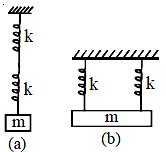
Two identical springs are connected to a mass $m$ as shown in the figure ($k$ = spring constant). If the time period of the configuration in $(a)$ is $2 \,s$, what is the time period of the configuration in $(b)$?
A
$\sqrt{2} \,s$
B
$1 \,s$
C
$\frac{1}{\sqrt{2}} \,s$
D
$2 \sqrt{2} \,s$
Solution
(B) For configuration $(a)$, the springs are in series. The equivalent spring constant $k_1$ is given by $\frac{1}{k_1} = \frac{1}{k} + \frac{1}{k} = \frac{2}{k}$, so $k_1 = \frac{k}{2}$.
The time period is $T_1 = 2\pi \sqrt{\frac{m}{k_1}} = 2\pi \sqrt{\frac{2m}{k}} = 2 \,s$.
For configuration $(b)$, the springs are in parallel. The equivalent spring constant $k_2$ is $k_2 = k + k = 2k$.
The time period is $T_2 = 2\pi \sqrt{\frac{m}{k_2}} = 2\pi \sqrt{\frac{m}{2k}}$.
Dividing the two time periods: $\frac{T_1}{T_2} = \frac{2\pi \sqrt{2m/k}}{2\pi \sqrt{m/2k}} = \sqrt{\frac{2m}{k} \cdot \frac{2k}{m}} = \sqrt{4} = 2$.
Therefore, $T_2 = \frac{T_1}{2} = \frac{2 \,s}{2} = 1 \,s$.
The time period is $T_1 = 2\pi \sqrt{\frac{m}{k_1}} = 2\pi \sqrt{\frac{2m}{k}} = 2 \,s$.
For configuration $(b)$, the springs are in parallel. The equivalent spring constant $k_2$ is $k_2 = k + k = 2k$.
The time period is $T_2 = 2\pi \sqrt{\frac{m}{k_2}} = 2\pi \sqrt{\frac{m}{2k}}$.
Dividing the two time periods: $\frac{T_1}{T_2} = \frac{2\pi \sqrt{2m/k}}{2\pi \sqrt{m/2k}} = \sqrt{\frac{2m}{k} \cdot \frac{2k}{m}} = \sqrt{4} = 2$.
Therefore, $T_2 = \frac{T_1}{2} = \frac{2 \,s}{2} = 1 \,s$.
0 likesView Solution
13
PhysicsDifficultMCQWBJEE · 2011
$A$ particle of mass $m$ is located in a one-dimensional potential field where the potential energy is given by: $V(x) = A(1 - \cos px)$,where $A$ and $p$ are constants. The period of small oscillations of the particle is
A
$2 \pi \sqrt{\frac{m}{Ap}}$
B
$2 \pi \sqrt{\frac{m}{Ap^2}}$
C
$2 \pi \sqrt{\frac{m}{A}}$
D
$\frac{1}{2 \pi} \sqrt{\frac{Ap}{m}}$
Solution
(B) The potential energy is given by $V(x) = A(1 - \cos px)$.
The force acting on the particle is $F = -\frac{dV}{dx}$.
$F = -\frac{d}{dx} [A(1 - \cos px)] = -A(p \sin px) = -Ap \sin px$.
For small oscillations,$x$ is very small,so $\sin px \approx px$.
Thus,$F \approx -Ap(px) = -Ap^2 x$.
Comparing this with the restoring force equation $F = -kx$,we get the effective spring constant $k = Ap^2$.
The angular frequency $\omega$ is given by $\omega = \sqrt{\frac{k}{m}} = \sqrt{\frac{Ap^2}{m}} = p \sqrt{\frac{A}{m}}$.
The time period $T$ is given by $T = \frac{2\pi}{\omega} = 2\pi \sqrt{\frac{m}{Ap^2}}$.
The force acting on the particle is $F = -\frac{dV}{dx}$.
$F = -\frac{d}{dx} [A(1 - \cos px)] = -A(p \sin px) = -Ap \sin px$.
For small oscillations,$x$ is very small,so $\sin px \approx px$.
Thus,$F \approx -Ap(px) = -Ap^2 x$.
Comparing this with the restoring force equation $F = -kx$,we get the effective spring constant $k = Ap^2$.
The angular frequency $\omega$ is given by $\omega = \sqrt{\frac{k}{m}} = \sqrt{\frac{Ap^2}{m}} = p \sqrt{\frac{A}{m}}$.
The time period $T$ is given by $T = \frac{2\pi}{\omega} = 2\pi \sqrt{\frac{m}{Ap^2}}$.
0 likesView Solution
14
PhysicsDifficultMCQWBJEE · 2011
If the Earth were to suddenly contract to $\frac{1}{n}$ th of its present radius without any change in its mass,the duration of the new day will be nearly
A
$24 / n \text{ hr}$.
B
$24 n \text{ hr}$.
C
$24 / n^2 \text{ hr}$.
D
$24 n^2 \text{ hr}$.
Solution
(C) According to the law of conservation of angular momentum,since no external torque acts on the Earth,the angular momentum remains constant: $L_1 = L_2$.
Since $L = I\omega$,we have $I_1 \omega_1 = I_2 \omega_2$.
The moment of inertia of a solid sphere is $I = \frac{2}{5}MR^2$.
Let $R_1 = R$ and $R_2 = \frac{R}{n}$.
Substituting these into the equation: $\frac{2}{5}MR^2 \left(\frac{2\pi}{T_1}\right) = \frac{2}{5}M\left(\frac{R}{n}\right)^2 \left(\frac{2\pi}{T_2}\right)$.
Simplifying the equation: $R^2 \left(\frac{1}{T_1}\right) = \frac{R^2}{n^2} \left(\frac{1}{T_2}\right)$.
Therefore,$T_2 = \frac{T_1}{n^2}$.
Given the initial duration of the day $T_1 = 24 \text{ hr}$,the new duration is $T_2 = \frac{24}{n^2} \text{ hr}$.
Since $L = I\omega$,we have $I_1 \omega_1 = I_2 \omega_2$.
The moment of inertia of a solid sphere is $I = \frac{2}{5}MR^2$.
Let $R_1 = R$ and $R_2 = \frac{R}{n}$.
Substituting these into the equation: $\frac{2}{5}MR^2 \left(\frac{2\pi}{T_1}\right) = \frac{2}{5}M\left(\frac{R}{n}\right)^2 \left(\frac{2\pi}{T_2}\right)$.
Simplifying the equation: $R^2 \left(\frac{1}{T_1}\right) = \frac{R^2}{n^2} \left(\frac{1}{T_2}\right)$.
Therefore,$T_2 = \frac{T_1}{n^2}$.
Given the initial duration of the day $T_1 = 24 \text{ hr}$,the new duration is $T_2 = \frac{24}{n^2} \text{ hr}$.
0 likesView Solution
15
PhysicsDifficultMCQWBJEE · 2011
$1.56 \times 10^5 \ J$ of heat is conducted through a $2 \ m^2$ wall of $12 \ cm$ thickness in one hour. The temperature difference between the two sides of the wall is $20^{\circ} C$. The thermal conductivity of the material of the wall is (in $W \ m^{-1} \ K^{-1}$):
A
$0.11$
B
$0.13$
C
$0.15$
D
$1.2$
Solution
(B) The rate of heat conduction is given by the formula: $\frac{dQ}{dt} = \frac{KA \Delta T}{x}$
Given:
Heat $Q = 1.56 \times 10^5 \ J$
Area $A = 2 \ m^2$
Thickness $x = 12 \ cm = 0.12 \ m$
Time $t = 1 \ hour = 3600 \ s$
Temperature difference $\Delta T = 20^{\circ} C$
Substituting the values:
$\frac{1.56 \times 10^5}{3600} = \frac{K \times 2 \times 20}{0.12}$
$K = \frac{1.56 \times 10^5 \times 0.12}{3600 \times 40}$
$K = \frac{1.56 \times 10^5 \times 12 \times 10^{-2}}{3600 \times 40}$
$K = \frac{1.56 \times 10^3 \times 12}{3600 \times 40} = \frac{1.56 \times 12000}{144000} = \frac{1.56}{12} = 0.13 \ W \ m^{-1} \ K^{-1}$
Given:
Heat $Q = 1.56 \times 10^5 \ J$
Area $A = 2 \ m^2$
Thickness $x = 12 \ cm = 0.12 \ m$
Time $t = 1 \ hour = 3600 \ s$
Temperature difference $\Delta T = 20^{\circ} C$
Substituting the values:
$\frac{1.56 \times 10^5}{3600} = \frac{K \times 2 \times 20}{0.12}$
$K = \frac{1.56 \times 10^5 \times 0.12}{3600 \times 40}$
$K = \frac{1.56 \times 10^5 \times 12 \times 10^{-2}}{3600 \times 40}$
$K = \frac{1.56 \times 10^3 \times 12}{3600 \times 40} = \frac{1.56 \times 12000}{144000} = \frac{1.56}{12} = 0.13 \ W \ m^{-1} \ K^{-1}$
0 likesView Solution
16
PhysicsEasyMCQWBJEE · 2011
Two temperature scales $A$ and $B$ are related by $\frac{A-42}{110}=\frac{B-72}{220}$. At which temperature do the two scales have the same reading?
A
$-42^{\circ}$
B
$-72^{\circ}$
C
$+12^{\circ}$
D
$-40^{\circ}$
Solution
(C) Given the relationship between the two temperature scales is $\frac{A-42}{110} = \frac{B-72}{220}$.
To find the temperature where both scales have the same reading,we set $A = B = T$.
Substituting $T$ into the equation: $\frac{T-42}{110} = \frac{T-72}{220}$.
Simplifying the equation by dividing the denominators by $110$: $\frac{T-42}{1} = \frac{T-72}{2}$.
Cross-multiplying gives: $2(T-42) = T-72$.
Expanding the terms: $2T - 84 = T - 72$.
Rearranging to solve for $T$: $2T - T = 84 - 72$.
Thus,$T = 12$.
Therefore,the two scales have the same reading at $12^{\circ}$.
To find the temperature where both scales have the same reading,we set $A = B = T$.
Substituting $T$ into the equation: $\frac{T-42}{110} = \frac{T-72}{220}$.
Simplifying the equation by dividing the denominators by $110$: $\frac{T-42}{1} = \frac{T-72}{2}$.
Cross-multiplying gives: $2(T-42) = T-72$.
Expanding the terms: $2T - 84 = T - 72$.
Rearranging to solve for $T$: $2T - T = 84 - 72$.
Thus,$T = 12$.
Therefore,the two scales have the same reading at $12^{\circ}$.
0 likesView Solution
17
PhysicsDifficultMCQWBJEE · 2011
An ideal gas is compressed isothermally until its pressure is doubled and then allowed to expand adiabatically to regain its original volume ($\gamma = 1.4$ and $2^{-1.4} = 0.38$). The ratio of the final to initial pressure is (in $: 1$)
A
$0.76$
B
$1$
C
$0.66$
D
$0.86$
Solution
(A) Let the initial state of the gas be $(P_i, V, T)$.
Step $1$: Isothermal compression.
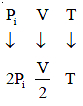
The gas is compressed until the pressure doubles. Since the process is isothermal,$P_i V = P_f V_f$. Given $P_f = 2P_i$,we have $P_i V = (2P_i) V_f$,which gives $V_f = V/2$.
The state after isothermal compression is $(2P_i, V/2, T)$.
Step $2$: Adiabatic expansion.
The gas expands adiabatically to regain its original volume $V$. Let the final pressure be $P_f'$.
Using the adiabatic process equation $P_1 V_1^\gamma = P_2 V_2^\gamma$:
$(2P_i) (V/2)^\gamma = P_f' V^\gamma$
$P_f' = (2P_i) \left(\frac{V/2}{V}\right)^\gamma = (2P_i) \left(\frac{1}{2}\right)^\gamma = 2P_i \times 2^{-\gamma}$
$P_f' = P_i \times 2^{1-\gamma}$
Given $\gamma = 1.4$,we have $P_f' = P_i \times 2^{1-1.4} = P_i \times 2^{-0.4}$.
Wait,the problem states $2^{-1.4} = 0.38$. Let's re-evaluate: $P_f' = 2P_i \times (1/2)^{1.4} = 2P_i \times 2^{-1.4}$.
Substituting the given value: $P_f' = 2P_i \times 0.38 = 0.76 P_i$.
Therefore,the ratio of the final to initial pressure is $P_f'/P_i = 0.76: 1$.
Step $1$: Isothermal compression.
The gas is compressed until the pressure doubles. Since the process is isothermal,$P_i V = P_f V_f$. Given $P_f = 2P_i$,we have $P_i V = (2P_i) V_f$,which gives $V_f = V/2$.
The state after isothermal compression is $(2P_i, V/2, T)$.
Step $2$: Adiabatic expansion.
The gas expands adiabatically to regain its original volume $V$. Let the final pressure be $P_f'$.
Using the adiabatic process equation $P_1 V_1^\gamma = P_2 V_2^\gamma$:
$(2P_i) (V/2)^\gamma = P_f' V^\gamma$
$P_f' = (2P_i) \left(\frac{V/2}{V}\right)^\gamma = (2P_i) \left(\frac{1}{2}\right)^\gamma = 2P_i \times 2^{-\gamma}$
$P_f' = P_i \times 2^{1-\gamma}$
Given $\gamma = 1.4$,we have $P_f' = P_i \times 2^{1-1.4} = P_i \times 2^{-0.4}$.
Wait,the problem states $2^{-1.4} = 0.38$. Let's re-evaluate: $P_f' = 2P_i \times (1/2)^{1.4} = 2P_i \times 2^{-1.4}$.
Substituting the given value: $P_f' = 2P_i \times 0.38 = 0.76 P_i$.
Therefore,the ratio of the final to initial pressure is $P_f'/P_i = 0.76: 1$.
0 likesView Solution
18
PhysicsEasyMCQWBJEE · 2011
$A$ plane progressive wave is given by $y = 2 \cos 6.284(330t - x)$. What is the period of the wave?
A
$\frac{1}{330} \text{ s}$
B
$2\pi \times 330 \text{ s}$
C
$(2\pi \times 330)^{-1} \text{ s}$
D
$\frac{6.284}{330} \text{ s}$
Solution
(A) The standard equation of a plane progressive wave is given by $y = A \cos(2\pi(\nu t - \frac{x}{\lambda}))$,where $\nu$ is the frequency.
Given equation: $y = 2 \cos 6.284(330t - x)$.
Since $6.284 \approx 2\pi$,we can rewrite the equation as $y = 2 \cos 2\pi(330t - x)$.
Comparing this with the standard form,the frequency $\nu = 330 \text{ Hz}$.
The time period $T$ is the reciprocal of the frequency,$T = \frac{1}{\nu}$.
Therefore,$T = \frac{1}{330} \text{ s}$.
Given equation: $y = 2 \cos 6.284(330t - x)$.
Since $6.284 \approx 2\pi$,we can rewrite the equation as $y = 2 \cos 2\pi(330t - x)$.
Comparing this with the standard form,the frequency $\nu = 330 \text{ Hz}$.
The time period $T$ is the reciprocal of the frequency,$T = \frac{1}{\nu}$.
Therefore,$T = \frac{1}{330} \text{ s}$.
0 likesView Solution
19
PhysicsMediumMCQWBJEE · 2011
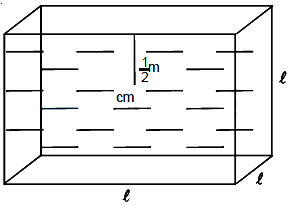
$A$ cubical vessel of height $1 \,m$ is full of water. What is the amount of work done in pumping water out of the vessel (in $\,J$)? (Take $g = 10 \,m \,s^{-2}$)
A
$1250$
B
$5000$
C
$1000$
D
$2500$
Solution
(B) To pump the water out of the vessel, we need to lift the center of mass of the water to the top level of the vessel.
Let the side length of the cube be $L = 1 \,m$.
The volume of the water is $V = L^3 = 1^3 = 1 \,m^3$.
The density of water is $\rho = 1000 \,kg/m^3$.
The mass of the water is $m = \rho V = 1000 \times 1 = 1000 \,kg$.
The center of mass of the water in a full cubical vessel is at a height of $h_{cm} = L/2 = 0.5 \,m$ from the bottom.
To pump the water out, the center of mass must be raised to the top of the vessel, which is at a height $h = L/2 = 0.5 \,m$ from the initial center of mass position.
The work done is $W = mgh = 1000 \times 10 \times 0.5 = 5000 \,J$.
Let the side length of the cube be $L = 1 \,m$.
The volume of the water is $V = L^3 = 1^3 = 1 \,m^3$.
The density of water is $\rho = 1000 \,kg/m^3$.
The mass of the water is $m = \rho V = 1000 \times 1 = 1000 \,kg$.
The center of mass of the water in a full cubical vessel is at a height of $h_{cm} = L/2 = 0.5 \,m$ from the bottom.
To pump the water out, the center of mass must be raised to the top of the vessel, which is at a height $h = L/2 = 0.5 \,m$ from the initial center of mass position.
The work done is $W = mgh = 1000 \times 10 \times 0.5 = 5000 \,J$.
0 likesView Solution
20
PhysicsDifficultMCQWBJEE · 2011
$A$ box is moved along a straight line by a machine delivering constant power. The distance moved by the body in time $t$ is proportional to
A
$t^{\frac{1}{2}}$
B
$t^{\frac{3}{4}}$
C
$t^{\frac{3}{2}}$
D
$t^2$
Solution
(C) Given that power $P$ is constant.
We know that $P = F \cdot v = m \cdot a \cdot v = m \cdot \frac{dv}{dt} \cdot v$.
Rearranging the terms,we get $v \cdot dv = \frac{P}{m} \cdot dt$.
Integrating both sides,$\int v \cdot dv = \int \frac{P}{m} \cdot dt$,which gives $\frac{v^2}{2} = \frac{P}{m} \cdot t$.
Thus,$v = \sqrt{\frac{2P}{m}} \cdot t^{\frac{1}{2}}$.
Since $v = \frac{dx}{dt}$,we have $\frac{dx}{dt} = \sqrt{\frac{2P}{m}} \cdot t^{\frac{1}{2}}$.
Integrating with respect to time $t$,$x = \int \sqrt{\frac{2P}{m}} \cdot t^{\frac{1}{2}} \cdot dt = \sqrt{\frac{2P}{m}} \cdot \frac{t^{\frac{3}{2}}}{\frac{3}{2}}$.
Therefore,$x = \frac{2}{3} \sqrt{\frac{2P}{m}} \cdot t^{\frac{3}{2}}$.
Since $P$ and $m$ are constants,$x \propto t^{\frac{3}{2}}$.
We know that $P = F \cdot v = m \cdot a \cdot v = m \cdot \frac{dv}{dt} \cdot v$.
Rearranging the terms,we get $v \cdot dv = \frac{P}{m} \cdot dt$.
Integrating both sides,$\int v \cdot dv = \int \frac{P}{m} \cdot dt$,which gives $\frac{v^2}{2} = \frac{P}{m} \cdot t$.
Thus,$v = \sqrt{\frac{2P}{m}} \cdot t^{\frac{1}{2}}$.
Since $v = \frac{dx}{dt}$,we have $\frac{dx}{dt} = \sqrt{\frac{2P}{m}} \cdot t^{\frac{1}{2}}$.
Integrating with respect to time $t$,$x = \int \sqrt{\frac{2P}{m}} \cdot t^{\frac{1}{2}} \cdot dt = \sqrt{\frac{2P}{m}} \cdot \frac{t^{\frac{3}{2}}}{\frac{3}{2}}$.
Therefore,$x = \frac{2}{3} \sqrt{\frac{2P}{m}} \cdot t^{\frac{3}{2}}$.
Since $P$ and $m$ are constants,$x \propto t^{\frac{3}{2}}$.
0 likesView Solution
21
PhysicsDifficultMCQWBJEE · 2011
$A$ body of mass $6 \,kg$ is acted upon by a force which causes a displacement in it given by $x = \frac{t^2}{4} \,m$,where $t$ is the time in seconds. The work done by the force in $2 \,seconds$ is: (in $\,J$)
A
$12$
B
$9$
C
$6$
D
$3$
Solution
(D) Given: Mass $m = 6 \,kg$,displacement $x = \frac{t^2}{4} \,m$.
Velocity $v = \frac{dx}{dt} = \frac{d}{dt}(\frac{t^2}{4}) = \frac{2t}{4} = \frac{t}{2} \,m/s$.
At $t = 0 \,s$,velocity $v_i = \frac{0}{2} = 0 \,m/s$.
At $t = 2 \,s$,velocity $v_f = \frac{2}{2} = 1 \,m/s$.
According to the Work-Energy Theorem,the work done $W$ is equal to the change in kinetic energy $\Delta K$.
$W = K_f - K_i = \frac{1}{2} m v_f^2 - \frac{1}{2} m v_i^2$.
$W = \frac{1}{2} \times 6 \times (1)^2 - \frac{1}{2} \times 6 \times (0)^2$.
$W = 3 - 0 = 3 \,J$.
Velocity $v = \frac{dx}{dt} = \frac{d}{dt}(\frac{t^2}{4}) = \frac{2t}{4} = \frac{t}{2} \,m/s$.
At $t = 0 \,s$,velocity $v_i = \frac{0}{2} = 0 \,m/s$.
At $t = 2 \,s$,velocity $v_f = \frac{2}{2} = 1 \,m/s$.
According to the Work-Energy Theorem,the work done $W$ is equal to the change in kinetic energy $\Delta K$.
$W = K_f - K_i = \frac{1}{2} m v_f^2 - \frac{1}{2} m v_i^2$.
$W = \frac{1}{2} \times 6 \times (1)^2 - \frac{1}{2} \times 6 \times (0)^2$.
$W = 3 - 0 = 3 \,J$.
0 likesView Solution
22
PhysicsMediumMCQWBJEE · 2011
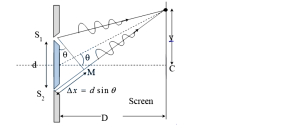
In Young's double slit experiment,the two slits are $d$ distance apart. The interference pattern is observed on the screen at a distance $D$ from the slits. The first dark fringe is observed on the screen directly opposite to one of the slits. The wavelength of the light is:
A
$\frac{D^2}{2 d}$
B
$\frac{d^2}{D}$
C
$\frac{d^2}{2 D}$
D
$\frac{D^2}{d}$
Solution
(B) The path difference $\Delta x$ at a point $P$ on the screen at a distance $y$ from the center is given by $\Delta x = d \sin \theta \approx d \tan \theta = d \left( \frac{y}{D} \right)$.
For a dark fringe,the path difference must be an odd multiple of half the wavelength: $\Delta x = (2n - 1) \frac{\lambda}{2}$,where $n = 1, 2, 3, \dots$.
The first dark fringe corresponds to $n = 1$,so $\Delta x = \frac{\lambda}{2}$.
The problem states that the first dark fringe is observed directly opposite to one of the slits. The distance of the slits from the center is $d/2$. Thus,$y = d/2$.
Substituting these values into the path difference formula:
$\frac{d}{2} \cdot \frac{d}{D} = \frac{\lambda}{2}$
$\frac{d^2}{D} = \lambda$
Therefore,the wavelength of the light is $\lambda = \frac{d^2}{D}$.
For a dark fringe,the path difference must be an odd multiple of half the wavelength: $\Delta x = (2n - 1) \frac{\lambda}{2}$,where $n = 1, 2, 3, \dots$.
The first dark fringe corresponds to $n = 1$,so $\Delta x = \frac{\lambda}{2}$.
The problem states that the first dark fringe is observed directly opposite to one of the slits. The distance of the slits from the center is $d/2$. Thus,$y = d/2$.
Substituting these values into the path difference formula:
$\frac{d}{2} \cdot \frac{d}{D} = \frac{\lambda}{2}$
$\frac{d^2}{D} = \lambda$
Therefore,the wavelength of the light is $\lambda = \frac{d^2}{D}$.
0 likesView Solution
23
PhysicsDifficultMCQWBJEE · 2011
In an inelastic collision,an electron excites a hydrogen atom from its ground state to an $M$-shell state. $A$ second electron collides instantaneously with the excited hydrogen atom in the $M$-state and ionizes it. At least how much energy must the second electron transfer to the atom in the $M$-state?
A
$+3.4 \ eV$
B
$+1.51 \ eV$
C
$-3.4 \ eV$
D
$-1.51 \ eV$
Solution
(B) The energy of an electron in the $n$-th orbit of a hydrogen atom is given by $E_n = -\frac{13.6 \ eV}{n^2}$.
For the ground state $(n=1)$,$E_1 = -13.6 \ eV$.
For the $M$-shell $(n=3)$,the energy is $E_3 = -\frac{13.6 \ eV}{3^2} = -\frac{13.6}{9} \ eV \approx -1.51 \ eV$.
To ionize the hydrogen atom from the $M$-state,the atom must be provided with enough energy to reach the ionization limit $(E_{\infty} = 0 \ eV)$.
The energy required is $\Delta E = E_{\infty} - E_3 = 0 - (-1.51 \ eV) = +1.51 \ eV$.
Therefore,the second electron must transfer at least $+1.51 \ eV$ of energy to the atom.
For the ground state $(n=1)$,$E_1 = -13.6 \ eV$.
For the $M$-shell $(n=3)$,the energy is $E_3 = -\frac{13.6 \ eV}{3^2} = -\frac{13.6}{9} \ eV \approx -1.51 \ eV$.
To ionize the hydrogen atom from the $M$-state,the atom must be provided with enough energy to reach the ionization limit $(E_{\infty} = 0 \ eV)$.
The energy required is $\Delta E = E_{\infty} - E_3 = 0 - (-1.51 \ eV) = +1.51 \ eV$.
Therefore,the second electron must transfer at least $+1.51 \ eV$ of energy to the atom.
0 likesView Solution
24
PhysicsMediumMCQWBJEE · 2011
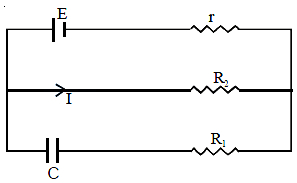
The charge on the capacitor of capacitance $C$ shown in the figure below will be
A
$CE$
B
$\frac{CE R}{R_1+r}$
C
$\frac{C E R_2}{R_2+r}$
D
$\frac{C E R_1}{R_2+r}$
Solution
(C) In the steady state,the capacitor acts as an open circuit,meaning no current flows through the branch containing the capacitor.
Therefore,the current $I$ flows only through the branch containing the resistor $R_2$ and the internal resistance $r$ of the battery.
Using Ohm's law,the current in the circuit is $I = \frac{E}{R_2 + r}$.
The potential difference $V$ across the capacitor is equal to the potential difference across the resistor $R_2$,because they are connected in parallel.
Thus,$V = I R_2 = \frac{E R_2}{R_2 + r}$.
The charge $Q$ on the capacitor is given by $Q = CV$.
Substituting the value of $V$,we get $Q = C \left( \frac{E R_2}{R_2 + r} \right) = \frac{C E R_2}{R_2 + r}$.
Therefore,the current $I$ flows only through the branch containing the resistor $R_2$ and the internal resistance $r$ of the battery.
Using Ohm's law,the current in the circuit is $I = \frac{E}{R_2 + r}$.
The potential difference $V$ across the capacitor is equal to the potential difference across the resistor $R_2$,because they are connected in parallel.
Thus,$V = I R_2 = \frac{E R_2}{R_2 + r}$.
The charge $Q$ on the capacitor is given by $Q = CV$.
Substituting the value of $V$,we get $Q = C \left( \frac{E R_2}{R_2 + r} \right) = \frac{C E R_2}{R_2 + r}$.
0 likesView Solution
25
PhysicsMediumMCQWBJEE · 2011
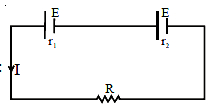
Two cells with the same e.m.f. $E$ and different internal resistances $r_1$ and $r_2$ are connected in series to an external resistance $R$. The value of $R$ so that the potential difference across the first cell is zero is
A
$\sqrt{r_1 r_2}$
B
$r_1+r_2$
C
$r_1-r_2$
D
$\frac{r_1+r_2}{2}$
Solution
(C) The total e.m.f. of the two cells connected in series is $E + E = 2E$.
The total resistance of the circuit is $R + r_1 + r_2$.
The current $I$ flowing through the circuit is given by $I = \frac{2E}{R + r_1 + r_2}$.
The potential difference $V$ across the first cell (with internal resistance $r_1$) is given by $V = E - Ir_1$.
We are given that the potential difference across the first cell is zero,so $E - Ir_1 = 0$,which implies $E = Ir_1$.
Substituting the value of $I$ into this equation:
$E = \left( \frac{2E}{R + r_1 + r_2} \right) r_1$
$1 = \frac{2r_1}{R + r_1 + r_2}$
$R + r_1 + r_2 = 2r_1$
$R = 2r_1 - r_1 - r_2$
$R = r_1 - r_2$
The total resistance of the circuit is $R + r_1 + r_2$.
The current $I$ flowing through the circuit is given by $I = \frac{2E}{R + r_1 + r_2}$.
The potential difference $V$ across the first cell (with internal resistance $r_1$) is given by $V = E - Ir_1$.
We are given that the potential difference across the first cell is zero,so $E - Ir_1 = 0$,which implies $E = Ir_1$.
Substituting the value of $I$ into this equation:
$E = \left( \frac{2E}{R + r_1 + r_2} \right) r_1$
$1 = \frac{2r_1}{R + r_1 + r_2}$
$R + r_1 + r_2 = 2r_1$
$R = 2r_1 - r_1 - r_2$
$R = r_1 - r_2$
0 likesView Solution
26
PhysicsEasyMCQWBJEE · 2011
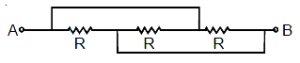
The equivalent resistance across points $A$ and $B$ in the circuit shown below is:
A
$3 R$
B
$R$
C
$\frac{R}{3}$
D
None of these
Solution
(C) Let the nodes be labeled. The first node is $A$. The wire connects the start of the first resistor to the end of the second resistor. The second wire connects the start of the second resistor to the end of the third resistor (point $B$).
By analyzing the circuit,we see that all three resistors of resistance $R$ are connected in parallel between points $A$ and $B$.
For resistors connected in parallel,the equivalent resistance $R_{eq}$ is given by:
$\frac{1}{R_{eq}} = \frac{1}{R} + \frac{1}{R} + \frac{1}{R} = \frac{3}{R}$
Therefore,$R_{eq} = \frac{R}{3}$.
By analyzing the circuit,we see that all three resistors of resistance $R$ are connected in parallel between points $A$ and $B$.
For resistors connected in parallel,the equivalent resistance $R_{eq}$ is given by:
$\frac{1}{R_{eq}} = \frac{1}{R} + \frac{1}{R} + \frac{1}{R} = \frac{3}{R}$
Therefore,$R_{eq} = \frac{R}{3}$.
0 likesView Solution
27
PhysicsMediumMCQWBJEE · 2011
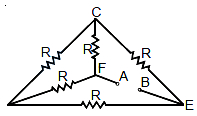
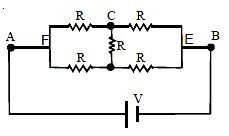
Five equal resistors,each of resistance $R$,are connected as shown in the figure below. $A$ battery of $V$ volt is connected between $A$ and $B$. The current flowing in $FC$ will be
A
$\frac{3V}{R}$
B
$\frac{V}{R}$
C
$\frac{V}{2R}$
D
$\frac{2V}{R}$
Solution
(C) From the circuit diagram,we can see that the resistors are arranged in a bridge-like structure.
By symmetry,the potential at point $F$ and point $E$ can be analyzed.
When a voltage $V$ is applied between $A$ and $B$,the circuit simplifies such that the equivalent resistance between $A$ and $B$ is $R_{eq} = R$.
Thus,the total current drawn from the battery is $I = \frac{V}{R}$.
Due to the symmetric nature of the circuit,this current splits equally into the two parallel branches connected to $F$.
Therefore,the current flowing through the resistor $FC$ is $I_{FC} = \frac{I}{2} = \frac{V}{2R}$.
By symmetry,the potential at point $F$ and point $E$ can be analyzed.
When a voltage $V$ is applied between $A$ and $B$,the circuit simplifies such that the equivalent resistance between $A$ and $B$ is $R_{eq} = R$.
Thus,the total current drawn from the battery is $I = \frac{V}{R}$.
Due to the symmetric nature of the circuit,this current splits equally into the two parallel branches connected to $F$.
Therefore,the current flowing through the resistor $FC$ is $I_{FC} = \frac{I}{2} = \frac{V}{2R}$.
0 likesView Solution
28
PhysicsMediumMCQWBJEE · 2011
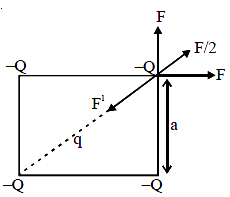
Four charges equal to $-Q$ are placed at the four corners of a square and a charge $q$ is at its centre. If the system is in equilibrium,the value of $q$ is
A
$\frac{-Q}{4}(1+2 \sqrt{2})$
B
$\frac{Q}{4}(1+2 \sqrt{2})$
C
$\frac{-Q}{2}(1+2 \sqrt{2})$
D
$\frac{Q}{2}(1+2 \sqrt{2})$
Solution
(B) Let the side of the square be $a$. The distance of the center from each corner is $r = \frac{a}{\sqrt{2}}$.
For the system to be in equilibrium,the net force on any charge at the corner must be zero.
Consider a charge $-Q$ at one corner. The forces acting on it are:
$1$. Repulsive forces from the other three charges $-Q$ at the corners.
Let $F = \frac{1}{4 \pi \epsilon_0} \frac{Q^2}{a^2}$.
The resultant of the two forces along the sides is $F_{res} = \sqrt{F^2 + F^2} = \sqrt{2} F$.
The force from the diagonal charge is $F_{diag} = \frac{1}{4 \pi \epsilon_0} \frac{Q^2}{(\sqrt{2}a)^2} = \frac{F}{2}$.
Total repulsive force $F_{total} = \sqrt{2} F + \frac{F}{2} = F(\sqrt{2} + \frac{1}{2})$.
$2$. Attractive force from the central charge $q$: $F_q = \frac{1}{4 \pi \epsilon_0} \frac{q Q}{r^2} = \frac{1}{4 \pi \epsilon_0} \frac{q Q}{(a/\sqrt{2})^2} = \frac{2 q Q}{4 \pi \epsilon_0 a^2}$.
For equilibrium,$F_q = F_{total} \implies \frac{2 q Q}{4 \pi \epsilon_0 a^2} = \frac{Q^2}{4 \pi \epsilon_0 a^2} (\sqrt{2} + \frac{1}{2})$.
$2q = Q(\sqrt{2} + 0.5) = Q(\frac{2\sqrt{2}+1}{2})$.
$q = \frac{Q}{4}(1 + 2\sqrt{2})$.
Since the force must be attractive,$q$ must have a sign opposite to $-Q$,so $q$ is positive.
For the system to be in equilibrium,the net force on any charge at the corner must be zero.
Consider a charge $-Q$ at one corner. The forces acting on it are:
$1$. Repulsive forces from the other three charges $-Q$ at the corners.
Let $F = \frac{1}{4 \pi \epsilon_0} \frac{Q^2}{a^2}$.
The resultant of the two forces along the sides is $F_{res} = \sqrt{F^2 + F^2} = \sqrt{2} F$.
The force from the diagonal charge is $F_{diag} = \frac{1}{4 \pi \epsilon_0} \frac{Q^2}{(\sqrt{2}a)^2} = \frac{F}{2}$.
Total repulsive force $F_{total} = \sqrt{2} F + \frac{F}{2} = F(\sqrt{2} + \frac{1}{2})$.
$2$. Attractive force from the central charge $q$: $F_q = \frac{1}{4 \pi \epsilon_0} \frac{q Q}{r^2} = \frac{1}{4 \pi \epsilon_0} \frac{q Q}{(a/\sqrt{2})^2} = \frac{2 q Q}{4 \pi \epsilon_0 a^2}$.
For equilibrium,$F_q = F_{total} \implies \frac{2 q Q}{4 \pi \epsilon_0 a^2} = \frac{Q^2}{4 \pi \epsilon_0 a^2} (\sqrt{2} + \frac{1}{2})$.
$2q = Q(\sqrt{2} + 0.5) = Q(\frac{2\sqrt{2}+1}{2})$.
$q = \frac{Q}{4}(1 + 2\sqrt{2})$.
Since the force must be attractive,$q$ must have a sign opposite to $-Q$,so $q$ is positive.
0 likesView Solution
29
PhysicsMediumMCQWBJEE · 2011
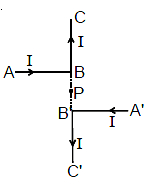
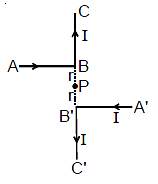
Current through $ABC$ and $A^{\prime} B^{\prime} C^{\prime}$ is $I$. What is the magnetic field at $P$? $BP = PB^{\prime} = r$. (Here $C^{\prime} B^{\prime} PBC$ are collinear).
A
$B = \frac{1}{4 \pi} \frac{2 I}{r}$
B
$B = \frac{\mu_0}{4 \pi} \left( \frac{2 I}{r} \right)$
C
$B = \frac{\mu_0}{4 \pi} \left( \frac{I}{r} \right)$
D
Zero
Solution
(B) The magnetic field at point $P$ is produced by the segments $BC$ and $B^{\prime} C^{\prime}$.
Segments $AB$ and $A^{\prime} B^{\prime}$ are directed towards and away from the axis containing $P$,so the magnetic field due to these segments at point $P$ is zero because $P$ lies on the line of these current elements.
For the semi-infinite wire $BC$,the magnetic field at distance $r$ from the end $B$ is given by $B_1 = \frac{\mu_0 I}{4 \pi r}$.
Similarly,for the semi-infinite wire $B^{\prime} C^{\prime}$,the magnetic field at distance $r$ from the end $B^{\prime}$ is $B_2 = \frac{\mu_0 I}{4 \pi r}$.
Using the right-hand rule,both fields at $P$ point in the same direction (into the page).
Therefore,the total magnetic field is $B = B_1 + B_2 = \frac{\mu_0 I}{4 \pi r} + \frac{\mu_0 I}{4 \pi r} = \frac{\mu_0}{4 \pi} \left( \frac{2 I}{r} \right)$.
Segments $AB$ and $A^{\prime} B^{\prime}$ are directed towards and away from the axis containing $P$,so the magnetic field due to these segments at point $P$ is zero because $P$ lies on the line of these current elements.
For the semi-infinite wire $BC$,the magnetic field at distance $r$ from the end $B$ is given by $B_1 = \frac{\mu_0 I}{4 \pi r}$.
Similarly,for the semi-infinite wire $B^{\prime} C^{\prime}$,the magnetic field at distance $r$ from the end $B^{\prime}$ is $B_2 = \frac{\mu_0 I}{4 \pi r}$.
Using the right-hand rule,both fields at $P$ point in the same direction (into the page).
Therefore,the total magnetic field is $B = B_1 + B_2 = \frac{\mu_0 I}{4 \pi r} + \frac{\mu_0 I}{4 \pi r} = \frac{\mu_0}{4 \pi} \left( \frac{2 I}{r} \right)$.
0 likesView Solution
30
PhysicsDifficultMCQWBJEE · 2011
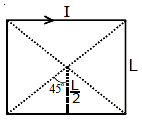
The magnetic field at the point of intersection of diagonals of a square wire loop of side $L$ carrying a current $I$ is
A
$\frac{\mu_0 I}{\pi L}$
B
$\frac{2 \mu_0 I}{\pi L}$
C
$\frac{\sqrt{2} \mu_0 I}{\pi L}$
D
$\frac{2 \sqrt{2} \mu_0 I}{\pi L}$
Solution
(D) The magnetic field due to a straight wire of finite length at a perpendicular distance $r$ is given by $B = \frac{\mu_0 I}{4 \pi r} (\sin \theta_1 + \sin \theta_2)$.
For a square loop of side $L$,the perpendicular distance from the center to any side is $r = L/2$.
The angles subtended by the ends of each side at the center are $\theta_1 = 45^{\circ}$ and $\theta_2 = 45^{\circ}$.
Since there are $4$ identical sides,the total magnetic field $B_{total}$ is $4$ times the field due to one side:
$B_{total} = 4 \times \left[ \frac{\mu_0 I}{4 \pi (L/2)} (\sin 45^{\circ} + \sin 45^{\circ}) \right]$
$B_{total} = 4 \times \left[ \frac{\mu_0 I}{2 \pi L} (\frac{1}{\sqrt{2}} + \frac{1}{\sqrt{2}}) \right]$
$B_{total} = 4 \times \left[ \frac{\mu_0 I}{2 \pi L} (\frac{2}{\sqrt{2}}) \right]$
$B_{total} = 4 \times \left[ \frac{\mu_0 I}{\pi L} \times \frac{1}{\sqrt{2}} \times 2 \right] = \frac{8 \mu_0 I}{2 \sqrt{2} \pi L} = \frac{4 \mu_0 I}{\sqrt{2} \pi L} = \frac{2 \sqrt{2} \mu_0 I}{\pi L}$.
For a square loop of side $L$,the perpendicular distance from the center to any side is $r = L/2$.
The angles subtended by the ends of each side at the center are $\theta_1 = 45^{\circ}$ and $\theta_2 = 45^{\circ}$.
Since there are $4$ identical sides,the total magnetic field $B_{total}$ is $4$ times the field due to one side:
$B_{total} = 4 \times \left[ \frac{\mu_0 I}{4 \pi (L/2)} (\sin 45^{\circ} + \sin 45^{\circ}) \right]$
$B_{total} = 4 \times \left[ \frac{\mu_0 I}{2 \pi L} (\frac{1}{\sqrt{2}} + \frac{1}{\sqrt{2}}) \right]$
$B_{total} = 4 \times \left[ \frac{\mu_0 I}{2 \pi L} (\frac{2}{\sqrt{2}}) \right]$
$B_{total} = 4 \times \left[ \frac{\mu_0 I}{\pi L} \times \frac{1}{\sqrt{2}} \times 2 \right] = \frac{8 \mu_0 I}{2 \sqrt{2} \pi L} = \frac{4 \mu_0 I}{\sqrt{2} \pi L} = \frac{2 \sqrt{2} \mu_0 I}{\pi L}$.
0 likesView Solution
31
PhysicsEasyMCQWBJEE · 2011
In the nuclear reaction ${ }_{7}^{14} N + X \rightarrow { }_{6}^{14} C + { }_{1}^{1} H$,the $X$ will be
A
${ }_{-1}^{0} e$
B
${ }_{1}^{1} H$
C
${ }_{1}^{2} H$
D
${ }_{0}^{1} n$
Solution
(D) In a nuclear reaction,both the total atomic number $(Z)$ and the total mass number $(A)$ must be conserved on both sides of the equation.
Let $X$ be represented as ${ }_{Z'}^{A'} X$.
The reaction is: ${ }_{7}^{14} N + { }_{Z'}^{A'} X \rightarrow { }_{6}^{14} C + { }_{1}^{1} H$.
Conservation of mass number $(A)$: $14 + A' = 14 + 1 \Rightarrow A' = 1$.
Conservation of atomic number $(Z)$: $7 + Z' = 6 + 1 \Rightarrow 7 + Z' = 7 \Rightarrow Z' = 0$.
$A$ particle with mass number $1$ and atomic number $0$ is a neutron,denoted as ${ }_{0}^{1} n$.
Let $X$ be represented as ${ }_{Z'}^{A'} X$.
The reaction is: ${ }_{7}^{14} N + { }_{Z'}^{A'} X \rightarrow { }_{6}^{14} C + { }_{1}^{1} H$.
Conservation of mass number $(A)$: $14 + A' = 14 + 1 \Rightarrow A' = 1$.
Conservation of atomic number $(Z)$: $7 + Z' = 6 + 1 \Rightarrow 7 + Z' = 7 \Rightarrow Z' = 0$.
$A$ particle with mass number $1$ and atomic number $0$ is a neutron,denoted as ${ }_{0}^{1} n$.
0 likesView Solution
32
PhysicsMediumMCQWBJEE · 2011
$A$ radioactive nucleus of mass number $A$,initially at rest,emits an $\alpha$-particle with a speed $v$. The recoil speed of the daughter nucleus will be
A
$\frac{2 v}{A-4}$
B
$\frac{2 v}{A+4}$
C
$\frac{4 v}{A-4}$
D
$\frac{4 v}{A+4}$
Solution
(C) According to the law of conservation of linear momentum,the initial momentum of the system is zero because the nucleus is initially at rest.
Let $M$ be the mass of the parent nucleus,which is proportional to the mass number $A$. Thus,$M = kA$.
The mass of the $\alpha$-particle is $4$ (in atomic mass units),and the mass of the daughter nucleus is $(A-4)$.
Let $V_r$ be the recoil speed of the daughter nucleus.
By conservation of momentum: $P_{\text{initial}} = P_{\text{final}}$
$0 = m_{\alpha} v + m_{\text{daughter}} V_r$
$0 = 4v + (A-4) V_r$
$V_r = -\frac{4v}{A-4}$
The magnitude of the recoil speed is $\frac{4v}{A-4}$.
Let $M$ be the mass of the parent nucleus,which is proportional to the mass number $A$. Thus,$M = kA$.
The mass of the $\alpha$-particle is $4$ (in atomic mass units),and the mass of the daughter nucleus is $(A-4)$.
Let $V_r$ be the recoil speed of the daughter nucleus.
By conservation of momentum: $P_{\text{initial}} = P_{\text{final}}$
$0 = m_{\alpha} v + m_{\text{daughter}} V_r$
$0 = 4v + (A-4) V_r$
$V_r = -\frac{4v}{A-4}$
The magnitude of the recoil speed is $\frac{4v}{A-4}$.
0 likesView Solution
33
PhysicsEasyMCQWBJEE · 2011
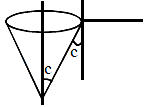
$A$ diver at a depth of $12 \ m$ in water $\left(\mu = \frac{4}{3}\right)$ sees the sky in a cone of semi-vertical angle:
A
$\sin ^{-1}\left(\frac{4}{3}\right)$
B
$\tan ^{-1}\left(\frac{4}{3}\right)$
C
$\sin ^{-1}\left(\frac{3}{4}\right)$
D
$90^{\circ}$
Solution
(C) When a diver is inside the water,they see the outside world through a cone of light due to the phenomenon of total internal reflection.
The semi-vertical angle of this cone is equal to the critical angle $c$ for the water-air interface.
The formula for the critical angle is given by $\sin c = \frac{1}{\mu}$.
Given the refractive index of water $\mu = \frac{4}{3}$,we have:
$\sin c = \frac{1}{4/3} = \frac{3}{4}$.
Therefore,the semi-vertical angle is $c = \sin ^{-1}\left(\frac{3}{4}\right)$.
The semi-vertical angle of this cone is equal to the critical angle $c$ for the water-air interface.
The formula for the critical angle is given by $\sin c = \frac{1}{\mu}$.
Given the refractive index of water $\mu = \frac{4}{3}$,we have:
$\sin c = \frac{1}{4/3} = \frac{3}{4}$.
Therefore,the semi-vertical angle is $c = \sin ^{-1}\left(\frac{3}{4}\right)$.
0 likesView Solution
34
PhysicsEasyMCQWBJEE · 2011
Two thin lenses of focal lengths $20 \ cm$ and $25 \ cm$ are placed in contact. The effective power of the combination is (in $D$)
A
$9$
B
$2$
C
$3$
D
$1$
Solution
(A) The power $P$ of a lens is given by $P = \frac{100}{f}$ where $f$ is the focal length in $cm$.
For the first lens,$P_1 = \frac{100}{20} = 5 \ D$.
For the second lens,$P_2 = \frac{100}{25} = 4 \ D$.
When two thin lenses are placed in contact,the effective power $P_{eff}$ of the combination is the sum of their individual powers: $P_{eff} = P_1 + P_2$.
Therefore,$P_{eff} = 5 \ D + 4 \ D = 9 \ D$.
For the first lens,$P_1 = \frac{100}{20} = 5 \ D$.
For the second lens,$P_2 = \frac{100}{25} = 4 \ D$.
When two thin lenses are placed in contact,the effective power $P_{eff}$ of the combination is the sum of their individual powers: $P_{eff} = P_1 + P_2$.
Therefore,$P_{eff} = 5 \ D + 4 \ D = 9 \ D$.
0 likesView Solution
35
PhysicsEasyMCQWBJEE · 2011
$A$ convex lens of focal length $30 \,cm$ produces $5$ times magnified real image of an object. What is the object distance (in $\,cm$)?
A
$36$
B
$25$
C
$30$
D
$150$
Solution
(A) Given: Focal length $f = +30 \,cm$ (for a convex lens).
Magnification $m = -5$ (since the image is real).
We know that magnification $m = \frac{v}{u}$, so $v = mu = -5u$.
Using the lens formula: $\frac{1}{f} = \frac{1}{v} - \frac{1}{u}$.
Substituting the values: $\frac{1}{30} = \frac{1}{-5u} - \frac{1}{u}$.
$\frac{1}{30} = \frac{-1 - 5}{5u} = \frac{-6}{5u}$.
$5u = -180$.
$u = -36 \,cm$.
The magnitude of the object distance is $36 \,cm$.
Magnification $m = -5$ (since the image is real).
We know that magnification $m = \frac{v}{u}$, so $v = mu = -5u$.
Using the lens formula: $\frac{1}{f} = \frac{1}{v} - \frac{1}{u}$.
Substituting the values: $\frac{1}{30} = \frac{1}{-5u} - \frac{1}{u}$.
$\frac{1}{30} = \frac{-1 - 5}{5u} = \frac{-6}{5u}$.
$5u = -180$.
$u = -36 \,cm$.
The magnitude of the object distance is $36 \,cm$.
0 likesView Solution
36
PhysicsEasyMCQWBJEE · 2011
$A$ plano-concave lens is made of glass of refractive index $1.5$ and the radius of curvature of its curved face is $100 \,cm$. What is the power of the lens?
A
$+0.5 \,D$
B
$-0.5 \,D$
C
$-2 \,D$
D
$+2 \,D$
Solution
(B) The power $P$ of a lens is given by the lens maker's formula: $P = \frac{1}{f} = (\mu - 1) \left( \frac{1}{R_1} - \frac{1}{R_2} \right)$.
For a plano-concave lens, the first surface is plane $(R_1 = \infty)$ and the second surface is concave $(R_2 = -100 \,cm = -1 \,m)$.
Given refractive index $\mu = 1.5$.
Substituting the values: $P = (1.5 - 1) \left( \frac{1}{\infty} - \frac{1}{-1} \right)$.
$P = (0.5) (0 + 1) = 0.5 \,D$.
Wait, for a concave lens, the power must be negative. Let's re-evaluate the sign convention: For a plano-concave lens, light enters the plane surface first $(R_1 = \infty)$ and exits the concave surface $(R_2 = -R = -1 \,m)$.
$P = (1.5 - 1) \left( \frac{1}{\infty} - \frac{1}{-1} \right) = 0.5 \times 1 = +0.5 \,D$ (This is for a plano-convex).
For a plano-concave lens, the curved surface is the first surface $(R_1 = -1 \,m)$ and the second is plane $(R_2 = \infty)$.
$P = (1.5 - 1) \left( \frac{1}{-1} - \frac{1}{\infty} \right) = 0.5 \times (-1) = -0.5 \,D$.
For a plano-concave lens, the first surface is plane $(R_1 = \infty)$ and the second surface is concave $(R_2 = -100 \,cm = -1 \,m)$.
Given refractive index $\mu = 1.5$.
Substituting the values: $P = (1.5 - 1) \left( \frac{1}{\infty} - \frac{1}{-1} \right)$.
$P = (0.5) (0 + 1) = 0.5 \,D$.
Wait, for a concave lens, the power must be negative. Let's re-evaluate the sign convention: For a plano-concave lens, light enters the plane surface first $(R_1 = \infty)$ and exits the concave surface $(R_2 = -R = -1 \,m)$.
$P = (1.5 - 1) \left( \frac{1}{\infty} - \frac{1}{-1} \right) = 0.5 \times 1 = +0.5 \,D$ (This is for a plano-convex).
For a plano-concave lens, the curved surface is the first surface $(R_1 = -1 \,m)$ and the second is plane $(R_2 = \infty)$.
$P = (1.5 - 1) \left( \frac{1}{-1} - \frac{1}{\infty} \right) = 0.5 \times (-1) = -0.5 \,D$.
0 likesView Solution
37
PhysicsEasyMCQWBJEE · 2011
If the focal length of the eyepiece of a telescope is doubled,its magnifying power $(m)$ will be
A
$2m$
B
$3m$
C
$\frac{m}{2}$
D
$4m$
Solution
(C) The magnifying power $(m)$ of an astronomical telescope in normal adjustment is given by the formula: $m = -\frac{f_o}{f_e}$,where $f_o$ is the focal length of the objective lens and $f_e$ is the focal length of the eyepiece.
If the focal length of the eyepiece is doubled,the new focal length becomes $f_e' = 2f_e$.
The new magnifying power $(m')$ will be: $m' = -\frac{f_o}{f_e'} = -\frac{f_o}{2f_e} = \frac{1}{2} \left( -\frac{f_o}{f_e} \right) = \frac{m}{2}$.
Therefore,the magnifying power becomes half of its original value.
If the focal length of the eyepiece is doubled,the new focal length becomes $f_e' = 2f_e$.
The new magnifying power $(m')$ will be: $m' = -\frac{f_o}{f_e'} = -\frac{f_o}{2f_e} = \frac{1}{2} \left( -\frac{f_o}{f_e} \right) = \frac{m}{2}$.
Therefore,the magnifying power becomes half of its original value.
0 likesView Solution
38
PhysicsEasyMCQWBJEE · 2011
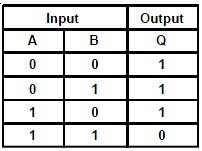
Which type of logic gate does the following truth table represent?
A
$NOT$
B
$AND$
C
$OR$
D
$NAND$
Solution
(D) The truth table provided is as follows:
| Input $A$ | Input $B$ | Output $Q$ |
| :--- | :--- | :--- |
| $0$ | $0$ | $1$ |
| $0$ | $1$ | $1$ |
| $1$ | $0$ | $1$ |
| $1$ | $1$ | $0$ |
Analyzing the truth table:
$1$. When both inputs $A$ and $B$ are $1$, the output $Q$ is $0$.
$2$. For all other input combinations ($0,0$; $0,1$; $1,0$), the output $Q$ is $1$.
This behavior corresponds to the $NAND$ gate, which is equivalent to an $AND$ gate followed by a $NOT$ gate. The Boolean expression for this gate is $Q = \overline{A \cdot B}$.
| Input $A$ | Input $B$ | Output $Q$ |
| :--- | :--- | :--- |
| $0$ | $0$ | $1$ |
| $0$ | $1$ | $1$ |
| $1$ | $0$ | $1$ |
| $1$ | $1$ | $0$ |
Analyzing the truth table:
$1$. When both inputs $A$ and $B$ are $1$, the output $Q$ is $0$.
$2$. For all other input combinations ($0,0$; $0,1$; $1,0$), the output $Q$ is $1$.
This behavior corresponds to the $NAND$ gate, which is equivalent to an $AND$ gate followed by a $NOT$ gate. The Boolean expression for this gate is $Q = \overline{A \cdot B}$.

0 likesView Solution
Vedclass Products
For Students
Vedclass Test Series
Mock tests in real WBJEE style covering Physics with performance analysis. 5-day free trial.
Start Free TrialFor Teachers
Exam Paper Generator
Generate Set A/B/C/D Physics papers from 7.5L+ questions in 2 minutes. 3 chapters free.
Try FreeFor Institutes
Online Exam Module
Run live WBJEE mock exams with unlimited students, 360° analytics & white-label branding.
See DemoFrequently Asked Questions
How many Physics questions are in WBJEE 2011?
There are 38 Physics questions from the WBJEE 2011 paper on Vedclass, each with a detailed step-by-step solution in English.
Are WBJEE 2011 Physics solutions available in English?
Yes. All solutions on this page are in English. You can also switch to English or Hindi using the language buttons above the questions.
Can I practice WBJEE 2011 Physics as a timed test?
Yes. Use the Vedclass Test Series to attempt a full WBJEE mock test covering Physics with time limits and instant score analysis.
Can teachers create Physics papers from WBJEE previous year questions?
Yes. The Vedclass Exam Paper Generator lets teachers mix WBJEE Physics questions and generate Set A/B/C/D papers in minutes.
For Teachers & Institutes
Build a Custom Physics Paper
Pick WBJEE 2011 Physics questions, set difficulty, and generate Set A/B/C/D in 2 minutes.