
ChemistryQ51–150 of 270 questions
Page 2 of 3 · English
51
ChemistryMediumMCQTS EAMCET · 2021
For a molecular formula of $C_6H_{10}$ of an alkyne series,the number of possible branched isomers is
A
$2$
B
$3$
C
$4$
D
$5$
Solution
(C) The molecular formula $C_6H_{10}$ corresponds to an alkyne with $6$ carbon atoms. The branched isomers are those that do not have a straight chain of $6$ carbons. The possible branched isomers are:
$1$. $3-\text{methyl}-1-\text{pentyne}$ $(CH_3-CH_2-CH(CH_3)-C \equiv CH)$
$2$. $4-\text{methyl}-1-\text{pentyne}$ $(CH_3-CH(CH_3)-CH_2-C \equiv CH)$
$3$. $3-\text{methyl}-2-\text{pentyne}$ $(CH_3-CH_2-C(CH_3)-C \equiv C-CH_3)$
$4$. $3,3-\text{dimethyl}-1-\text{butyne}$ $((CH_3)_2C(C \equiv CH)-CH_3)$
Thus,there are $4$ possible branched isomers.
$1$. $3-\text{methyl}-1-\text{pentyne}$ $(CH_3-CH_2-CH(CH_3)-C \equiv CH)$
$2$. $4-\text{methyl}-1-\text{pentyne}$ $(CH_3-CH(CH_3)-CH_2-C \equiv CH)$
$3$. $3-\text{methyl}-2-\text{pentyne}$ $(CH_3-CH_2-C(CH_3)-C \equiv C-CH_3)$
$4$. $3,3-\text{dimethyl}-1-\text{butyne}$ $((CH_3)_2C(C \equiv CH)-CH_3)$
Thus,there are $4$ possible branched isomers.
0 likesView Solution
52
ChemistryMediumMCQTS EAMCET · 2021
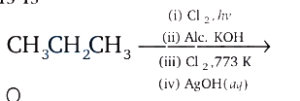
The major product of the following synthetic reactions is
A
$CH_3COCH_3$
B
$CH_3CH_2CHO$
C
$CH_2=CHCH_2OH$
D
$CH_3CH_2CH_2OH$
Solution
(C) The reaction sequence is as follows:
$1$. Chlorination of propane $(CH_3CH_2CH_3)$ with $Cl_2$ in the presence of light $(hv)$ gives $1$-chloropropane as the major product: $CH_3CH_2CH_3 + Cl_2 \xrightarrow{hv} CH_3CH_2CH_2Cl + HCl$.
$2$. Dehydrohalogenation of $1$-chloropropane with alcoholic $KOH$ gives propene: $CH_3CH_2CH_2Cl \xrightarrow{\text{alc. } KOH} CH_3CH=CH_2 + KCl + H_2O$.
$3$. High-temperature chlorination of propene $(773 \ K)$ leads to allylic substitution,forming allyl chloride: $CH_3CH=CH_2 + Cl_2 \xrightarrow{773 \ K} ClCH_2CH=CH_2 + HCl$.
$4$. Nucleophilic substitution of the allylic chloride with aqueous $AgOH$ (or $NaOH$) replaces the $Cl$ atom with an $OH$ group to form allyl alcohol: $ClCH_2CH=CH_2 + AgOH_{(aq)} \longrightarrow HOCH_2CH=CH_2 + AgCl$.
$1$. Chlorination of propane $(CH_3CH_2CH_3)$ with $Cl_2$ in the presence of light $(hv)$ gives $1$-chloropropane as the major product: $CH_3CH_2CH_3 + Cl_2 \xrightarrow{hv} CH_3CH_2CH_2Cl + HCl$.
$2$. Dehydrohalogenation of $1$-chloropropane with alcoholic $KOH$ gives propene: $CH_3CH_2CH_2Cl \xrightarrow{\text{alc. } KOH} CH_3CH=CH_2 + KCl + H_2O$.
$3$. High-temperature chlorination of propene $(773 \ K)$ leads to allylic substitution,forming allyl chloride: $CH_3CH=CH_2 + Cl_2 \xrightarrow{773 \ K} ClCH_2CH=CH_2 + HCl$.
$4$. Nucleophilic substitution of the allylic chloride with aqueous $AgOH$ (or $NaOH$) replaces the $Cl$ atom with an $OH$ group to form allyl alcohol: $ClCH_2CH=CH_2 + AgOH_{(aq)} \longrightarrow HOCH_2CH=CH_2 + AgCl$.
0 likesView Solution
53
ChemistryMediumMCQTS EAMCET · 2021
The energy difference between the staggered and eclipsed conformations of ethane is
A
$6.5 \ kJ / mol$
B
$8.5 \ kJ / mol$
C
$10.5 \ kJ / mol$
D
$12.5 \ kJ / mol$
Solution
(D) The eclipsed conformation of ethane is the least stable due to torsional strain caused by the repulsion between the hydrogen atoms on adjacent carbon atoms.
Conversely,the staggered conformation is the most stable as the hydrogen atoms are as far apart as possible,minimizing repulsion.
The energy barrier for rotation about the $C-C$ single bond in ethane is approximately $12.5 \ kJ / mol$ $(3 \ kcal / mol)$.
Therefore,the energy difference between the staggered and eclipsed conformations is $12.5 \ kJ / mol$.
Conversely,the staggered conformation is the most stable as the hydrogen atoms are as far apart as possible,minimizing repulsion.
The energy barrier for rotation about the $C-C$ single bond in ethane is approximately $12.5 \ kJ / mol$ $(3 \ kcal / mol)$.
Therefore,the energy difference between the staggered and eclipsed conformations is $12.5 \ kJ / mol$.
0 likesView Solution
54
ChemistryDifficultMCQTS EAMCET · 2021
Among the following reactions,the reaction that "does not" give an alkane product is:
A
$CH_3-C \equiv C-CH_3 \xrightarrow{Pt, H_2}$
B
$CH_3-CH_2-CH_2-CH_2-CO_2Na \xrightarrow{\text{Electrolysis}}$
C
$CH_3-CH_2-Br \xrightarrow{Na, \text{dry ether}}$
D
$CH_3-CH_2-CH_2-CH_2-F \xrightarrow{Zn, H^{\oplus}}$
Solution
(D) The reaction in option $(a)$ is the catalytic hydrogenation of an alkyne,which produces an alkane $(CH_3-CH_2-CH_2-CH_3)$.
The reaction in option $(b)$ is Kolbe's electrolytic decarboxylation,which produces an alkane ($CH_3-CH_2-CH_2-CH_2-CH_2-CH_2-CH_2-CH_3$ from the radical coupling of the pentanoate ion).
The reaction in option $(c)$ is the Wurtz reaction,which produces an alkane $(CH_3-CH_2-CH_2-CH_3)$.
The reaction in option $(d)$ involves an alkyl fluoride $(CH_3-CH_2-CH_2-CH_2-F)$ with $Zn/H^{\oplus}$. Alkyl fluorides are generally unreactive towards reduction by $Zn/H^{\oplus}$ due to the high strength of the $C-F$ bond. Therefore,this reaction does not produce an alkane.
The reaction in option $(b)$ is Kolbe's electrolytic decarboxylation,which produces an alkane ($CH_3-CH_2-CH_2-CH_2-CH_2-CH_2-CH_2-CH_3$ from the radical coupling of the pentanoate ion).
The reaction in option $(c)$ is the Wurtz reaction,which produces an alkane $(CH_3-CH_2-CH_2-CH_3)$.
The reaction in option $(d)$ involves an alkyl fluoride $(CH_3-CH_2-CH_2-CH_2-F)$ with $Zn/H^{\oplus}$. Alkyl fluorides are generally unreactive towards reduction by $Zn/H^{\oplus}$ due to the high strength of the $C-F$ bond. Therefore,this reaction does not produce an alkane.
0 likesView Solution
55
ChemistryMediumMCQTS EAMCET · 2021
The reaction $CH_2=CH_2 + H_2 \xrightarrow{Ni, 300^{\circ}C} CH_3-CH_3$ is known as:
A
Wurtz reaction
B
Kolbe reaction
C
Sabatier-Senderens reaction
D
Dow's reaction
Solution
(C) The reaction $CH_2=CH_2 + H_2 \xrightarrow{Ni, 300^{\circ}C} CH_3-CH_3$ is the catalytic hydrogenation of ethene to ethane.
This specific process,where alkenes are reduced to alkanes using a metal catalyst like $Ni$,$Pt$,or $Pd$,is known as the Sabatier-Senderens reaction.
This specific process,where alkenes are reduced to alkanes using a metal catalyst like $Ni$,$Pt$,or $Pd$,is known as the Sabatier-Senderens reaction.
0 likesView Solution
56
ChemistryMediumMCQTS EAMCET · 2021
When propyne is passed through a red hot iron tube at $873 \ K$,the reaction gives a product having the molecular formula of:
A
$C_7H_8$
B
$C_9H_{12}$
C
$C_8H_{10}$
D
$C_6H_6$
Solution
(B) When propyne $(CH_3-C \equiv CH)$ is passed through a red hot iron tube at $873 \ K$,it undergoes cyclic trimerization to form an aromatic compound called mesitylene ($1,3,5$-trimethylbenzene).
The reaction is as follows:
$3CH_3-C \equiv CH \xrightarrow{\text{Red hot Fe, } 873 \ K} C_9H_{12}$ (Mesitylene).
The molecular formula of mesitylene is $C_9H_{12}$.
The reaction is as follows:
$3CH_3-C \equiv CH \xrightarrow{\text{Red hot Fe, } 873 \ K} C_9H_{12}$ (Mesitylene).
The molecular formula of mesitylene is $C_9H_{12}$.
0 likesView Solution
57
ChemistryMediumMCQTS EAMCET · 2021
Hex$-1-$yne on reaction with $Br_2$ (excess)/ $CCl_4$,gives
A
$1,1,3,3-$Tetrabromohexane
B
$2,2,3,3-$Tetrabromohexane
C
$1,1,1,2-$Tetrabromohexane
D
$1,1,2,2-$Tetrabromohexane
Solution
(D) The reaction of an alkyne with excess $Br_2$ in $CCl_4$ is an electrophilic addition reaction.
During this process,both $\pi$-bonds of the triple bond are broken,and four new $\sigma$-bonds are formed with bromine atoms.
For hex$-1-$yne $(CH_3(CH_2)_3C \equiv CH)$,the addition occurs at the $C-1$ and $C-2$ positions.
The final product is $1,1,2,2-$tetrabromohexane.
$CH_3(CH_2)_3C \equiv CH + 2Br_2 \xrightarrow{CCl_4} CH_3(CH_2)_3C(Br)_2-CH(Br)_2$
During this process,both $\pi$-bonds of the triple bond are broken,and four new $\sigma$-bonds are formed with bromine atoms.
For hex$-1-$yne $(CH_3(CH_2)_3C \equiv CH)$,the addition occurs at the $C-1$ and $C-2$ positions.
The final product is $1,1,2,2-$tetrabromohexane.
$CH_3(CH_2)_3C \equiv CH + 2Br_2 \xrightarrow{CCl_4} CH_3(CH_2)_3C(Br)_2-CH(Br)_2$
0 likesView Solution
58
ChemistryMediumMCQTS EAMCET · 2021
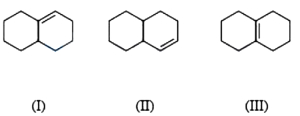
The stability order of the given alkenes is
A
$I > II > III$
B
$I > III > II$
C
$III > II > I$
D
$III > I > II$
Solution
(D) The stability of alkenes in fused ring systems is governed by Bredt's rule and the degree of substitution at the double bond.
Structure $III$ is a tetrasubstituted alkene (specifically,a tetrasubstituted double bond at the bridgehead position),which is highly stable due to hyperconjugation and inductive effects.
Structure $I$ is a trisubstituted alkene.
Structure $II$ is a disubstituted alkene.
Greater substitution leads to higher stability.
Therefore,the correct order of stability is $III > I > II$.
Structure $III$ is a tetrasubstituted alkene (specifically,a tetrasubstituted double bond at the bridgehead position),which is highly stable due to hyperconjugation and inductive effects.
Structure $I$ is a trisubstituted alkene.
Structure $II$ is a disubstituted alkene.
Greater substitution leads to higher stability.
Therefore,the correct order of stability is $III > I > II$.
0 likesView Solution
59
ChemistryDifficultMCQTS EAMCET · 2021
The major product formed in the following reaction sequence is:
$C_6H_5-CHBr-CH_2Br$ $\xrightarrow[(ii) NaNH_2]{(i) alc. KOH}$ $\xrightarrow[(iii) \text{Red hot iron tube}, 873 K]{}$
$C_6H_5-CHBr-CH_2Br$ $\xrightarrow[(ii) NaNH_2]{(i) alc. KOH}$ $\xrightarrow[(iii) \text{Red hot iron tube}, 873 K]{}$
A
$1,2-$diphenylbenzene
B
$1,2,4-$triphenylbenzene
C
$1,3,5-$triphenylbenzene
D
$1,2,3-$triphenylbenzene
Solution
(C) Step $1$: Dehydrohalogenation of $C_6H_5-CHBr-CH_2Br$ with $alc. KOH$ followed by $NaNH_2$ leads to the formation of phenylacetylene $(C_6H_5-C \equiv CH)$.
Step $2$: The cyclic trimerization of phenylacetylene occurs when passed through a red hot iron tube at $873 \ K$.
Step $3$: The trimerization of $C_6H_5-C \equiv CH$ yields $1,3,5-triphenylbenzene$ as the major product due to steric hindrance,which favors the meta-substituted product.
Step $2$: The cyclic trimerization of phenylacetylene occurs when passed through a red hot iron tube at $873 \ K$.
Step $3$: The trimerization of $C_6H_5-C \equiv CH$ yields $1,3,5-triphenylbenzene$ as the major product due to steric hindrance,which favors the meta-substituted product.
0 likesView Solution
60
ChemistryDifficultMCQTS EAMCET · 2021
Benzene reacts with $n-$propyl chloride in the presence of anhydrous $AlCl_3$ to give predominantly
A
$n-$Propyl benzene
B
Isopropyl benzene
C
$3-$Propyl$-1-$chloro benzene
D
$1-$Chloro$-3-n-$propyl benzene
Solution
(B) This reaction is known as Friedel-Crafts alkylation. In the presence of anhydrous $AlCl_3$,$n-$propyl chloride acts as an alkylating agent. It is an electrophilic aromatic substitution reaction.
Step $1$: Generation of electrophile:
$CH_3-CH_2-CH_2-Cl + AlCl_3 \rightarrow CH_3-CH_2-CH_2^+ + AlCl_4^-$
Step $2$: Carbocation rearrangement:
The primary carbocation $(CH_3-CH_2-CH_2^+)$ formed in step $1$ rearranges to form a more stable secondary carbocation $(CH_3-CH^+-CH_3)$ via a $1,2-$hydride shift.
Step $3$: Electrophilic attack:
This secondary carbocation attacks the benzene ring to form the intermediate.
Step $4$: Deprotonation:
The final step is the abstraction of a proton from the intermediate to restore aromaticity,yielding isopropyl benzene (cumene) as the major product.
Step $1$: Generation of electrophile:
$CH_3-CH_2-CH_2-Cl + AlCl_3 \rightarrow CH_3-CH_2-CH_2^+ + AlCl_4^-$
Step $2$: Carbocation rearrangement:
The primary carbocation $(CH_3-CH_2-CH_2^+)$ formed in step $1$ rearranges to form a more stable secondary carbocation $(CH_3-CH^+-CH_3)$ via a $1,2-$hydride shift.
Step $3$: Electrophilic attack:
This secondary carbocation attacks the benzene ring to form the intermediate.
Step $4$: Deprotonation:
The final step is the abstraction of a proton from the intermediate to restore aromaticity,yielding isopropyl benzene (cumene) as the major product.
0 likesView Solution
61
ChemistryDifficultMCQTS EAMCET · 2021
In which of the following reactions,$t$-butyl benzene is formed?
$1.$ Benzene $+ t$-butyl chloride $\xrightarrow{AlCl_3}$
$2.$ Benzene $+ (CH_3)_2C=CH_2 \xrightarrow{BF_3/HF}$
$3.$ Benzene $+ t$-butyl alcohol $\xrightarrow{H_2SO_4}$
$4.$ Benzene $+$ butanoyl chloride $\xrightarrow{AlCl_3}$ $\xrightarrow{Zn/Hg, HCl}$
$1.$ Benzene $+ t$-butyl chloride $\xrightarrow{AlCl_3}$
$2.$ Benzene $+ (CH_3)_2C=CH_2 \xrightarrow{BF_3/HF}$
$3.$ Benzene $+ t$-butyl alcohol $\xrightarrow{H_2SO_4}$
$4.$ Benzene $+$ butanoyl chloride $\xrightarrow{AlCl_3}$ $\xrightarrow{Zn/Hg, HCl}$
A
$1, 2$ and $3$
B
$2, 3$ and $4$
C
$1, 2$ and $4$
D
$1, 3$ and $4$
Solution
(A) The given reactions are analyzed as follows:
$1.$ Friedel-Crafts alkylation of benzene with $t$-butyl chloride in the presence of $AlCl_3$ yields $t$-butyl benzene.
$2.$ Benzene reacts with $2$-methylpropene (isobutylene) in the presence of $BF_3/HF$ to form $t$-butyl benzene via a carbocation intermediate.
$3.$ Benzene reacts with $t$-butyl alcohol in the presence of $H_2SO_4$ to form $t$-butyl benzene through the formation of a $t$-butyl carbocation.
$4.$ Benzene reacts with butanoyl chloride via Friedel-Crafts acylation to form $1$-phenylbutan-$1$-one. Subsequent Clemmensen reduction $(Zn/Hg, HCl)$ yields $n$-butylbenzene,not $t$-butyl benzene.
Thus,reactions $1, 2,$ and $3$ produce $t$-butyl benzene.
$1.$ Friedel-Crafts alkylation of benzene with $t$-butyl chloride in the presence of $AlCl_3$ yields $t$-butyl benzene.
$2.$ Benzene reacts with $2$-methylpropene (isobutylene) in the presence of $BF_3/HF$ to form $t$-butyl benzene via a carbocation intermediate.
$3.$ Benzene reacts with $t$-butyl alcohol in the presence of $H_2SO_4$ to form $t$-butyl benzene through the formation of a $t$-butyl carbocation.
$4.$ Benzene reacts with butanoyl chloride via Friedel-Crafts acylation to form $1$-phenylbutan-$1$-one. Subsequent Clemmensen reduction $(Zn/Hg, HCl)$ yields $n$-butylbenzene,not $t$-butyl benzene.
Thus,reactions $1, 2,$ and $3$ produce $t$-butyl benzene.
0 likesView Solution
62
ChemistryMediumMCQTS EAMCET · 2021
The number of $\pi$-bonds and lone pair$(s)$ present in the major benzenoid product,which is formed when benzene reacts with acetyl chloride in the presence of anhydrous aluminium chloride,are respectively:
A
$5 : 2$
B
$4 : 2$
C
$5 : 4$
D
$6 : 4$
Solution
(B) The reaction of benzene with acetyl chloride in the presence of anhydrous $AlCl_3$ is a Friedel-Crafts acylation reaction,which yields acetophenone $(C_6H_5COCH_3)$ as the major product.
In the structure of acetophenone:
$1$. The benzene ring contains $3$ $\pi$-bonds.
$2$. The carbonyl group $(C=O)$ contains $1$ $\pi$-bond.
Total number of $\pi$-bonds = $3 + 1 = 4$.
$3$. The oxygen atom in the carbonyl group has $2$ lone pairs of electrons.
Total number of lone pairs = $2$.
Thus,the number of $\pi$-bonds and lone pairs are $4$ and $2$ respectively.
In the structure of acetophenone:
$1$. The benzene ring contains $3$ $\pi$-bonds.
$2$. The carbonyl group $(C=O)$ contains $1$ $\pi$-bond.
Total number of $\pi$-bonds = $3 + 1 = 4$.
$3$. The oxygen atom in the carbonyl group has $2$ lone pairs of electrons.
Total number of lone pairs = $2$.
Thus,the number of $\pi$-bonds and lone pairs are $4$ and $2$ respectively.
0 likesView Solution
63
ChemistryDifficultMCQTS EAMCET · 2021
The major products during the removal of temporary hardness of water are
A
$Mg(OH)_2; Ca(OH)_2$
B
$MgCO_3; CaCO_3$
C
$Mg(OH)_2; CaCO_3$
D
$MgCO_3; Ca(OH)_2$
Solution
(C) Temporary hardness of water is removed by Clark's process,where slaked lime,$Ca(OH)_2$,is added to hard water.
The chemical reactions involved are:
$Ca(HCO_3)_{2(aq)} + Ca(OH)_{2(aq)} \rightarrow 2CaCO_{3(s)} + 2H_2O_{(l)}$
$Mg(HCO_3)_{2(aq)} + 2Ca(OH)_{2(aq)} \rightarrow 2CaCO_{3(s)} + Mg(OH)_{2(s)} + 2H_2O_{(l)}$
Note: In the case of magnesium bicarbonate,the product is magnesium hydroxide,$Mg(OH)_2$,due to its lower solubility product compared to $MgCO_3$.
Thus,the insoluble precipitates formed are $Mg(OH)_2$ and $CaCO_3$.
The chemical reactions involved are:
$Ca(HCO_3)_{2(aq)} + Ca(OH)_{2(aq)} \rightarrow 2CaCO_{3(s)} + 2H_2O_{(l)}$
$Mg(HCO_3)_{2(aq)} + 2Ca(OH)_{2(aq)} \rightarrow 2CaCO_{3(s)} + Mg(OH)_{2(s)} + 2H_2O_{(l)}$
Note: In the case of magnesium bicarbonate,the product is magnesium hydroxide,$Mg(OH)_2$,due to its lower solubility product compared to $MgCO_3$.
Thus,the insoluble precipitates formed are $Mg(OH)_2$ and $CaCO_3$.
0 likesView Solution
64
ChemistryDifficultMCQTS EAMCET · 2021
Match the following.
The correct match is:
| Column-$1$ (Reaction) | Column-$2$ (Main product) |
| $A$. $SO_3 \xrightarrow{D_2O}$ | $I$. $C_2D_2$ |
| $B$. $CaC_2 \xrightarrow{D_2O \text{ (excess)}}$ | $II$. $CD_4$ |
| $C$. $Al_4C_3 \xrightarrow{D_2O \text{ (large excess)}}$ | $III$. $D_2SO_3$ |
| $IV$. $C_2D_4$ | |
| $V$. $D_2SO_4$ |
The correct match is:
A
$A-III, B-I, C-IV$
B
$A-III, B-IV, C-II$
C
$A-V, B-I, C-II$
D
$A-V, B-I, C-IV$
Solution
(C) $SO_3 + D_2O \rightarrow D_2SO_4$ (Similar to $SO_3 + H_2O \rightarrow H_2SO_4$)
$CaC_2 + 2D_2O \rightarrow Ca(OD)_2 + C_2D_2$ (Similar to $CaC_2 + 2H_2O \rightarrow Ca(OH)_2 + C_2H_2$)
$Al_4C_3 + 12D_2O \rightarrow 4Al(OD)_3 + 3CD_4$ (Similar to $Al_4C_3 + 12H_2O \rightarrow 4Al(OH)_3 + 3CH_4$)
Thus,the correct match is $A-V, B-I, C-II$.
$CaC_2 + 2D_2O \rightarrow Ca(OD)_2 + C_2D_2$ (Similar to $CaC_2 + 2H_2O \rightarrow Ca(OH)_2 + C_2H_2$)
$Al_4C_3 + 12D_2O \rightarrow 4Al(OD)_3 + 3CD_4$ (Similar to $Al_4C_3 + 12H_2O \rightarrow 4Al(OH)_3 + 3CH_4$)
Thus,the correct match is $A-V, B-I, C-II$.
0 likesView Solution
65
ChemistryEasyMCQTS EAMCET · 2021
The compound used as a moderator in nuclear reactors is
A
$BeD_2$
B
$D_2O_2$
C
$D_2O$
D
$NaD$
Solution
(C) moderator is a material used in a nuclear reactor to slow down the neutrons produced from fission.
Heavy water $(D_2O)$ is used as a moderator in nuclear reactors because it slows down neutrons effectively and also has a low probability of neutron absorption.
Heavy water $(D_2O)$ is used as a moderator in nuclear reactors because it slows down neutrons effectively and also has a low probability of neutron absorption.
0 likesView Solution
66
ChemistryMediumMCQTS EAMCET · 2021
The degree of dissociation of $0.1 \ M$ acid $HA$ is $5 \%$. The value of $K_c$ of $HA$ is
A
$1.3 \times 10^{-4}$
B
$2.6 \times 10^{-3}$
C
$2.5 \times 10^{-4}$
D
$1.3 \times 10^{-2}$
Solution
(C) The degree of dissociation $\alpha$ for a weak acid is related to the dissociation constant $K_a$ and concentration $C$ by the formula: $\alpha = \sqrt{\frac{K_a}{C}}$.
Given: $C = 0.1 \ M$ and $\alpha = 5 \% = 0.05$.
Rearranging the formula for $K_a$ (or $K_c$ for the acid dissociation equilibrium): $K_a = \alpha^2 \times C$.
Substituting the values: $K_a = (0.05)^2 \times 0.1$.
$K_a = 0.0025 \times 0.1 = 0.00025 = 2.5 \times 10^{-4}$.
Thus,the value of $K_c$ is $2.5 \times 10^{-4}$.
Given: $C = 0.1 \ M$ and $\alpha = 5 \% = 0.05$.
Rearranging the formula for $K_a$ (or $K_c$ for the acid dissociation equilibrium): $K_a = \alpha^2 \times C$.
Substituting the values: $K_a = (0.05)^2 \times 0.1$.
$K_a = 0.0025 \times 0.1 = 0.00025 = 2.5 \times 10^{-4}$.
Thus,the value of $K_c$ is $2.5 \times 10^{-4}$.
0 likesView Solution
67
ChemistryMediumMCQTS EAMCET · 2021
If the molar concentrations of a base and its conjugate acid are the same,then the $pOH$ of the buffer solution is:
A
same as $pK_{b}$ of the base
B
same as $pK_{a}$ of the base
C
same as $pK_{a}$ of the acid
D
same as $pK_{b}$ of the acid
Solution
(A) For a basic buffer solution,the $pOH$ is given by the Henderson-Hasselbalch equation:
$pOH = pK_{b} + \log \frac{[Salt]}{[Base]}$
Given that the molar concentrations of the base and its conjugate acid (salt) are the same,we have $[Salt] = [Base]$.
Substituting this into the equation:
$pOH = pK_{b} + \log(1)$
Since $\log(1) = 0$,we get:
$pOH = pK_{b}$
Therefore,the $pOH$ of the buffer solution is the same as the $pK_{b}$ of the base.
$pOH = pK_{b} + \log \frac{[Salt]}{[Base]}$
Given that the molar concentrations of the base and its conjugate acid (salt) are the same,we have $[Salt] = [Base]$.
Substituting this into the equation:
$pOH = pK_{b} + \log(1)$
Since $\log(1) = 0$,we get:
$pOH = pK_{b}$
Therefore,the $pOH$ of the buffer solution is the same as the $pK_{b}$ of the base.
0 likesView Solution
68
ChemistryMediumMCQTS EAMCET · 2021
Match the following:
The correct match is:
| List-$I$ (Acid) | List-$II$ ($K_a$ - Ionization Constant) |
| $A$. $HCN$ | $I$. $6.8 \times 10^{-4}$ |
| $B$. $H_2C_2O_4$ | $II$. $8.9 \times 10^{-8}$ |
| $C$. $H_2S$ | $III$. $4.9 \times 10^{-10}$ |
| $D$. Niacin | $IV$. $5.6 \times 10^{-2}$ |
| $V$. $1.5 \times 10^{-5}$ |
The correct match is:
A
$A-I, B-II, C-IV, D-V$
B
$A-V, B-II, C-III, D-IV$
C
$A-II, B-III, C-IV, D-V$
D
$A-III, B-IV, C-II, D-V$
Solution
(D) The acid dissociation constants $(K_a)$ for the given acids are as follows:
$HCN$: $K_a = 4.9 \times 10^{-10}$ $(III)$
$H_2C_2O_4$ (Oxalic acid): $K_a = 5.6 \times 10^{-2}$ $(IV)$
$H_2S$: $K_a = 8.9 \times 10^{-8}$ $(II)$
Niacin (Vitamin $B_3$): $K_a = 1.5 \times 10^{-5}$ $(V)$
Therefore,the correct matching is $A-III, B-IV, C-II, D-V$.
$HCN$: $K_a = 4.9 \times 10^{-10}$ $(III)$
$H_2C_2O_4$ (Oxalic acid): $K_a = 5.6 \times 10^{-2}$ $(IV)$
$H_2S$: $K_a = 8.9 \times 10^{-8}$ $(II)$
Niacin (Vitamin $B_3$): $K_a = 1.5 \times 10^{-5}$ $(V)$
Therefore,the correct matching is $A-III, B-IV, C-II, D-V$.
0 likesView Solution
69
ChemistryDifficultMCQTS EAMCET · 2021
The successive equilibrium constants for the stepwise dissociation of a tribasic acid are $K_1$,$K_2$ and $K_3$,respectively. The equilibrium constant for the overall dissociation is
A
$(K_1+K_2+K_3)$
B
$\sqrt[3]{(K_1+K_2+K_3)}$
C
$(K_1 \times K_2 \times K_3)^3$
D
$K_1 \times K_2 \times K_3$
Solution
(D) For a tribasic acid like $H_3PO_4$,there are three ionisation constants. The overall ionisation constant $(K)$ is the product of the ionisation constants of the three individual steps.
Step $1$: $H_3PO_4 \rightleftharpoons H^+ + H_2PO_4^-$; $K_1 = \frac{[H^+][H_2PO_4^-]}{[H_3PO_4]}$ $(i)$
Step $2$: $H_2PO_4^- \rightleftharpoons H^+ + HPO_4^{2-}$; $K_2 = \frac{[H^+][HPO_4^{2-}]}{[H_2PO_4^-]}$ $(ii)$
Step $3$: $HPO_4^{2-} \rightleftharpoons H^+ + PO_4^{3-}$; $K_3 = \frac{[H^+][PO_4^{3-}]}{[HPO_4^{2-}]}$ $(iii)$
Adding the three equations gives the overall reaction: $H_3PO_4 \rightleftharpoons 3H^+ + PO_4^{3-}$.
The overall equilibrium constant $K$ is given by $K = \frac{[H^+]^3[PO_4^{3-}]}{[H_3PO_4]}$.
Multiplying the three stepwise equilibrium constants:
$K_1 \times K_2 \times K_3 = \frac{[H^+][H_2PO_4^-]}{[H_3PO_4]} \times \frac{[H^+][HPO_4^{2-}]}{[H_2PO_4^-]} \times \frac{[H^+][PO_4^{3-}]}{[HPO_4^{2-}]}$
$K_1 \times K_2 \times K_3 = \frac{[H^+]^3[PO_4^{3-}]}{[H_3PO_4]} = K$
Therefore,$K = K_1 \times K_2 \times K_3$.
Step $1$: $H_3PO_4 \rightleftharpoons H^+ + H_2PO_4^-$; $K_1 = \frac{[H^+][H_2PO_4^-]}{[H_3PO_4]}$ $(i)$
Step $2$: $H_2PO_4^- \rightleftharpoons H^+ + HPO_4^{2-}$; $K_2 = \frac{[H^+][HPO_4^{2-}]}{[H_2PO_4^-]}$ $(ii)$
Step $3$: $HPO_4^{2-} \rightleftharpoons H^+ + PO_4^{3-}$; $K_3 = \frac{[H^+][PO_4^{3-}]}{[HPO_4^{2-}]}$ $(iii)$
Adding the three equations gives the overall reaction: $H_3PO_4 \rightleftharpoons 3H^+ + PO_4^{3-}$.
The overall equilibrium constant $K$ is given by $K = \frac{[H^+]^3[PO_4^{3-}]}{[H_3PO_4]}$.
Multiplying the three stepwise equilibrium constants:
$K_1 \times K_2 \times K_3 = \frac{[H^+][H_2PO_4^-]}{[H_3PO_4]} \times \frac{[H^+][HPO_4^{2-}]}{[H_2PO_4^-]} \times \frac{[H^+][PO_4^{3-}]}{[HPO_4^{2-}]}$
$K_1 \times K_2 \times K_3 = \frac{[H^+]^3[PO_4^{3-}]}{[H_3PO_4]} = K$
Therefore,$K = K_1 \times K_2 \times K_3$.
0 likesView Solution
70
ChemistryMCQTS EAMCET · 2021
The direction cosines of the line making angles $\frac{\pi}{4}, \frac{\pi}{3}$ and $\theta$ $\left(0 < \theta < \frac{\pi}{2}\right)$ respectively with $x, y$ and $z$ axes,are
A
$\frac{1}{\sqrt{2}}, \frac{1}{2}, \frac{1}{2}$
B
$\frac{1}{\sqrt{2}}, \frac{1}{2}, \frac{\sqrt{3}}{2}$
C
$\frac{1}{\sqrt{2}}, \frac{1}{2}, \frac{1}{\sqrt{2}}$
D
$\frac{1}{\sqrt{2}}, \frac{\sqrt{3}}{2}, \frac{1}{\sqrt{2}}$
Solution
(A) Let the direction cosines be $l, m, n$. Given the angles $\alpha = \frac{\pi}{4}$,$\beta = \frac{\pi}{3}$,and $\gamma = \theta$.
Then $l = \cos \frac{\pi}{4} = \frac{1}{\sqrt{2}}$ and $m = \cos \frac{\pi}{3} = \frac{1}{2}$.
We know that $l^2 + m^2 + n^2 = 1$.
Substituting the values,we get $\left(\frac{1}{\sqrt{2}}\right)^2 + \left(\frac{1}{2}\right)^2 + \cos^2 \theta = 1$.
$\frac{1}{2} + \frac{1}{4} + \cos^2 \theta = 1$.
$\frac{3}{4} + \cos^2 \theta = 1$.
$\cos^2 \theta = 1 - \frac{3}{4} = \frac{1}{4}$.
Since $0 < \theta < \frac{\pi}{2}$,$\cos \theta$ must be positive,so $\cos \theta = \frac{1}{2}$.
Thus,the direction cosines are $\frac{1}{\sqrt{2}}, \frac{1}{2}, \frac{1}{2}$.
Then $l = \cos \frac{\pi}{4} = \frac{1}{\sqrt{2}}$ and $m = \cos \frac{\pi}{3} = \frac{1}{2}$.
We know that $l^2 + m^2 + n^2 = 1$.
Substituting the values,we get $\left(\frac{1}{\sqrt{2}}\right)^2 + \left(\frac{1}{2}\right)^2 + \cos^2 \theta = 1$.
$\frac{1}{2} + \frac{1}{4} + \cos^2 \theta = 1$.
$\frac{3}{4} + \cos^2 \theta = 1$.
$\cos^2 \theta = 1 - \frac{3}{4} = \frac{1}{4}$.
Since $0 < \theta < \frac{\pi}{2}$,$\cos \theta$ must be positive,so $\cos \theta = \frac{1}{2}$.
Thus,the direction cosines are $\frac{1}{\sqrt{2}}, \frac{1}{2}, \frac{1}{2}$.
0 likesView Solution
71
ChemistryEasyMCQTS EAMCET · 2021
Which of the following complex ions does not exist?
A
$[B(H_2O)_6]^{3+}$
B
$[Al(H_2O)_6]^{3+}$
C
$[Ga(H_2O)_6]^{3+}$
D
$[In(H_2O)_6]^{3+}$
Solution
(A) Boron has the atomic number $5$ and electronic configuration $1s^2 2s^2 2p^1$.
Due to the absence of $d$-orbitals in the valence shell,boron cannot expand its coordination number beyond $4$.
Therefore,it cannot form a hexacoordinated complex like $[B(H_2O)_6]^{3+}$.
Thus,the complex $[B(H_2O)_6]^{3+}$ does not exist.
Due to the absence of $d$-orbitals in the valence shell,boron cannot expand its coordination number beyond $4$.
Therefore,it cannot form a hexacoordinated complex like $[B(H_2O)_6]^{3+}$.
Thus,the complex $[B(H_2O)_6]^{3+}$ does not exist.
0 likesView Solution
72
ChemistryMediumMCQTS EAMCET · 2021
The set of amphoteric oxides among the given oxides are $Ga_2O_3, As_4O_{10}, Sb_4O_{10}, B_2O_3, Tl_2O$.
A
$Tl_2O, B_2O_3$
B
$Sb_4O_{10}, B_2O_3, Ga_2O_3$
C
$Ga_2O_3, Tl_2O, As_4O_{10}$
D
$Ga_2O_3, As_4O_{10}, Sb_4O_{10}$
Solution
(D) Amphoteric oxides are those that exhibit both acidic and basic properties.
$Ga_2O_3$ is a well-known amphoteric oxide.
$As_4O_{10}$ and $Sb_4O_{10}$ are also amphoteric in nature as they show acidic character with strong bases and basic character with strong acids.
$B_2O_3$ is acidic,and $Tl_2O$ is basic.
Therefore,the set of amphoteric oxides is $Ga_2O_3, As_4O_{10}, Sb_4O_{10}$.
$Ga_2O_3$ is a well-known amphoteric oxide.
$As_4O_{10}$ and $Sb_4O_{10}$ are also amphoteric in nature as they show acidic character with strong bases and basic character with strong acids.
$B_2O_3$ is acidic,and $Tl_2O$ is basic.
Therefore,the set of amphoteric oxides is $Ga_2O_3, As_4O_{10}, Sb_4O_{10}$.
0 likesView Solution
73
ChemistryDifficultMCQTS EAMCET · 2021
Match the following reactions in Column-$1$ with their main products in Column-$2$.
The correct match is:
| Column-$1$ (Reaction) | Column-$2$ (Main product) |
|---|---|
| $A$. $B_2H_6 + 2CO \longrightarrow$ | $I$. $B_2O_3$ |
| $B$. $B_2H_6 + 3O_2 \longrightarrow$ | $II$. $2BH_3 \cdot CO$ |
| $C$. $B_2H_6 + 6H_2O \longrightarrow$ | $III$. $2H_3BO_3$ |
The correct match is:
A
$A-IV, B-I, C-III$
B
$A-II, B-III, C-V$
C
$A-IV, B-III, C-I$
D
$A-II, B-I, C-III$
Solution
(D) $1$. Diborane $(B_2H_6)$ is an electron-deficient species that acts as a Lewis acid. It reacts with carbon monoxide $(CO)$,a Lewis base,to form a coordinate bond adduct:
$B_2H_6 + 2CO \longrightarrow 2BH_3 \cdot CO$ $(A-II)$
$2$. Diborane burns in oxygen to form boron trioxide $(B_2O_3)$:
$B_2H_6 + 3O_2 \longrightarrow B_2O_3 + 3H_2O$ $(B-I)$
$3$. Diborane undergoes hydrolysis with water to produce boric acid $(H_3BO_3)$:
$B_2H_6 + 6H_2O \longrightarrow 2H_3BO_3 + 6H_2$ $(C-III)$
Thus,the correct match is $A-II, B-I, C-III$.
$B_2H_6 + 2CO \longrightarrow 2BH_3 \cdot CO$ $(A-II)$
$2$. Diborane burns in oxygen to form boron trioxide $(B_2O_3)$:
$B_2H_6 + 3O_2 \longrightarrow B_2O_3 + 3H_2O$ $(B-I)$
$3$. Diborane undergoes hydrolysis with water to produce boric acid $(H_3BO_3)$:
$B_2H_6 + 6H_2O \longrightarrow 2H_3BO_3 + 6H_2$ $(C-III)$
Thus,the correct match is $A-II, B-I, C-III$.
0 likesView Solution
74
ChemistryEasyMCQTS EAMCET · 2021
Which of the following is an amphoteric hydroxide?
A
$Al(OH)_3$
B
$In(OH)_3$
C
$B(OH)_3$
D
$Tl(OH)_3$
Solution
(A) $Al(OH)_3$ acts as a base and reacts with acid $HCl$ to give salt and water:
$Al(OH)_3 + 3HCl \longrightarrow AlCl_3 + 3H_2O$
$Al(OH)_3$ also acts as an acid and reacts with base $NaOH$ to give salt and water:
$Al(OH)_3 + NaOH \longrightarrow Na[Al(OH)_4]$
Since $Al(OH)_3$ reacts with both acids and bases,it is amphoteric in nature.
$Al(OH)_3 + 3HCl \longrightarrow AlCl_3 + 3H_2O$
$Al(OH)_3$ also acts as an acid and reacts with base $NaOH$ to give salt and water:
$Al(OH)_3 + NaOH \longrightarrow Na[Al(OH)_4]$
Since $Al(OH)_3$ reacts with both acids and bases,it is amphoteric in nature.
0 likesView Solution
75
ChemistryMediumMCQTS EAMCET · 2021
Which of the following statements are correct?
$(a)$ The isotope of carbon containing $7$ neutrons has natural abundance of $1.1 \%$.
$(b)$ Among the $IV$ $A$ group elements,$Sn$ has the lowest melting point.
$(c)$ Silicon is the $2^{nd}$ (by mass) most abundant element in the earth's crust.
$(d)$ Elemental carbon shows the highest electrical resistivity among the $14$ group elements.
$(a)$ The isotope of carbon containing $7$ neutrons has natural abundance of $1.1 \%$.
$(b)$ Among the $IV$ $A$ group elements,$Sn$ has the lowest melting point.
$(c)$ Silicon is the $2^{nd}$ (by mass) most abundant element in the earth's crust.
$(d)$ Elemental carbon shows the highest electrical resistivity among the $14$ group elements.
A
$a, c$ and $d$ only
B
$a, b$ and $c$ only
C
$b, c$ and $d$ only
D
$a, b, c$ and $d$
Solution
(D) The isotope of carbon containing $7$ neutrons is $_{6}^{13}C$,which has a natural abundance of $1.1 \%$. This statement is correct.
$(b)$ Among the $IV$ $A$ (Group $14$) elements,the melting point generally decreases down the group. $Sn$ (Tin) has a lower melting point than $Pb$ (Lead) due to its metallic structure and bonding characteristics. This statement is correct.
$(c)$ Silicon is the $2^{nd}$ most abundant element by mass in the earth's crust,accounting for approximately $27.7 \%$. This statement is correct.
$(d)$ Elemental carbon (specifically in the form of diamond) shows the highest electrical resistivity among the Group $14$ elements because diamond is an electrical insulator. This statement is correct.
Therefore,all the statements are correct.
$(b)$ Among the $IV$ $A$ (Group $14$) elements,the melting point generally decreases down the group. $Sn$ (Tin) has a lower melting point than $Pb$ (Lead) due to its metallic structure and bonding characteristics. This statement is correct.
$(c)$ Silicon is the $2^{nd}$ most abundant element by mass in the earth's crust,accounting for approximately $27.7 \%$. This statement is correct.
$(d)$ Elemental carbon (specifically in the form of diamond) shows the highest electrical resistivity among the Group $14$ elements because diamond is an electrical insulator. This statement is correct.
Therefore,all the statements are correct.
0 likesView Solution
76
ChemistryMediumMCQTS EAMCET · 2021
Diamond is extremely hard whereas graphite is soft. This is because
A
$Diamond$ is covalent,whereas $graphite$ is ionic
B
$Diamond$ is ionic whereas $graphite$ is covalent
C
each carbon atom in $diamond$ is chemically bonded to a greater number of neighbouring carbon atoms
D
certain atoms in $diamond$ are smaller in size
Solution
(C) In $diamond$,each carbon atom is $sp^3$ hybridized and bonded to $4$ other carbon atoms in a rigid,three-dimensional tetrahedral network. This structure prevents the movement of atoms,making it extremely hard.
In $graphite$,each carbon atom is $sp^2$ hybridized,forming planar hexagonal layers. These layers are held together by weak $van \ der \ Waals$ forces,which allow the layers to slide over each other,making $graphite$ soft.
In $graphite$,each carbon atom is $sp^2$ hybridized,forming planar hexagonal layers. These layers are held together by weak $van \ der \ Waals$ forces,which allow the layers to slide over each other,making $graphite$ soft.
0 likesView Solution
77
ChemistryMediumMCQTS EAMCET · 2021
Which of the given statements are correct,when carboxyhaemoglobin reaches $3-4 \%$ in blood?
$(I)$ Leads to headache
$(II)$ Results in cardiovascular problems
$(III)$ Increases the body temperature
$(IV)$ Leads to diarrhoea
$(I)$ Leads to headache
$(II)$ Results in cardiovascular problems
$(III)$ Increases the body temperature
$(IV)$ Leads to diarrhoea
A
$(I)$ and $(II)$
B
$(I)$ and $(III)$
C
$(III)$ and $(IV)$
D
$(II)$ and $(III)$
Solution
(A) Carboxyhaemoglobin is a stable complex of carbon monoxide and haemoglobin that forms in red blood cells upon contact with carbon monoxide.
When the concentration of carboxyhaemoglobin in the blood reaches $3-4 \%$,it reduces the oxygen-carrying capacity of the blood.
This condition leads to symptoms such as headache,increased stress on the heart,and cardiovascular problems.
Therefore,statements $(I)$ and $(II)$ are correct.
When the concentration of carboxyhaemoglobin in the blood reaches $3-4 \%$,it reduces the oxygen-carrying capacity of the blood.
This condition leads to symptoms such as headache,increased stress on the heart,and cardiovascular problems.
Therefore,statements $(I)$ and $(II)$ are correct.
0 likesView Solution
78
ChemistryEasyMCQTS EAMCET · 2021
Which of the following statements are correct?
$1.$ Charcoal can be obtained by heating wood in the absence of air.
$2.$ Charcoal is an impure form of graphite.
$3.$ Diamond is thermodynamically the most stable allotrope of carbon.
$4.$ Coke is used as an oxidising agent during the extraction of iron from its ores.
$1.$ Charcoal can be obtained by heating wood in the absence of air.
$2.$ Charcoal is an impure form of graphite.
$3.$ Diamond is thermodynamically the most stable allotrope of carbon.
$4.$ Coke is used as an oxidising agent during the extraction of iron from its ores.
A
$1$ and $3$
B
$2$ and $4$
C
$1$ and $4$
D
$1$ and $2$
Solution
(D) Statement $1$ is correct: Charcoal is produced by the destructive distillation of wood (heating in the absence of air).
Statement $2$ is correct: Charcoal is considered an impure form of graphite.
Statement $3$ is incorrect: Graphite is thermodynamically the most stable allotrope of carbon at room temperature and pressure,not diamond.
Statement $4$ is incorrect: Coke is used as a reducing agent,not an oxidising agent,during the extraction of iron from its ores (e.g.,$Fe_2O_3 + 3C \rightarrow 2Fe + 3CO$).
Therefore,statements $1$ and $2$ are correct.
Statement $2$ is correct: Charcoal is considered an impure form of graphite.
Statement $3$ is incorrect: Graphite is thermodynamically the most stable allotrope of carbon at room temperature and pressure,not diamond.
Statement $4$ is incorrect: Coke is used as a reducing agent,not an oxidising agent,during the extraction of iron from its ores (e.g.,$Fe_2O_3 + 3C \rightarrow 2Fe + 3CO$).
Therefore,statements $1$ and $2$ are correct.
0 likesView Solution
79
ChemistryEasyMCQTS EAMCET · 2021
Among the following options,the element with the highest density and lowest boiling point is
A
$C$
B
$Sn$
C
$Pb$
D
$Ge$
Solution
(C) In the carbon family (Group $14$),the density of elements increases as we move down the group due to the increase in atomic mass being more significant than the increase in atomic volume. Thus,$Pb$ has the highest density among the given options.
Conversely,the boiling point decreases as we move down the group because the metallic character increases and the strength of interatomic forces (covalent bonding) decreases with increasing atomic size. Therefore,$Pb$ has the lowest boiling point among the given options.
Hence,$Pb$ is the correct answer.
Conversely,the boiling point decreases as we move down the group because the metallic character increases and the strength of interatomic forces (covalent bonding) decreases with increasing atomic size. Therefore,$Pb$ has the lowest boiling point among the given options.
Hence,$Pb$ is the correct answer.
0 likesView Solution
80
ChemistryDifficultMCQTS EAMCET · 2021
The first ionisation energies (in $kJ \ mol^{-1}$) of four consecutive elements of the second period are given in the options. The first ionisation energy of nitrogen is
A
$1086$
B
$1402$
C
$1681$
D
$1314$
Solution
(B) The first ionisation energy is the energy required to remove the most loosely bound electron from an isolated gaseous atom.
Nitrogen $(Z = 7)$ has the electronic configuration $1s^2 2s^2 2p^3$.
Due to the exactly half-filled $2p$-subshell,nitrogen exhibits extra stability,resulting in a higher first ionisation energy compared to its immediate neighbors,carbon $(1086 \ kJ \ mol^{-1})$ and oxygen $(1314 \ kJ \ mol^{-1})$.
Among the given values,$1402 \ kJ \ mol^{-1}$ corresponds to nitrogen,while $1681 \ kJ \ mol^{-1}$ corresponds to fluorine,which has a higher effective nuclear charge.
Thus,the correct value for nitrogen is $1402 \ kJ \ mol^{-1}$.
Nitrogen $(Z = 7)$ has the electronic configuration $1s^2 2s^2 2p^3$.
Due to the exactly half-filled $2p$-subshell,nitrogen exhibits extra stability,resulting in a higher first ionisation energy compared to its immediate neighbors,carbon $(1086 \ kJ \ mol^{-1})$ and oxygen $(1314 \ kJ \ mol^{-1})$.
Among the given values,$1402 \ kJ \ mol^{-1}$ corresponds to nitrogen,while $1681 \ kJ \ mol^{-1}$ corresponds to fluorine,which has a higher effective nuclear charge.
Thus,the correct value for nitrogen is $1402 \ kJ \ mol^{-1}$.
0 likesView Solution
81
ChemistryEasyMCQTS EAMCET · 2021
The neutral oxide among the following is
A
$SO_2$
B
$CO$
C
$CO_2$
D
$CaO$
Solution
(B) Neutral oxides are those oxides that exhibit neither acidic nor basic properties when reacting with water.
Examples of neutral oxides include nitrous oxide $(N_2O)$,nitric oxide $(NO)$,and carbon monoxide $(CO)$.
$SO_2$ and $CO_2$ are acidic oxides because they react with water to form sulphurous acid $(H_2SO_3)$ and carbonic acid $(H_2CO_3)$,respectively.
$CaO$ is a metal oxide and is basic in nature,reacting with water to form calcium hydroxide $(Ca(OH)_2)$.
Examples of neutral oxides include nitrous oxide $(N_2O)$,nitric oxide $(NO)$,and carbon monoxide $(CO)$.
$SO_2$ and $CO_2$ are acidic oxides because they react with water to form sulphurous acid $(H_2SO_3)$ and carbonic acid $(H_2CO_3)$,respectively.
$CaO$ is a metal oxide and is basic in nature,reacting with water to form calcium hydroxide $(Ca(OH)_2)$.
0 likesView Solution
82
ChemistryMediumMCQTS EAMCET · 2021
How many of the following oxides are amphoteric?
$BeO, ZnO, Sb_2O_3, CO, CaO, SO_2, SO_3$
$BeO, ZnO, Sb_2O_3, CO, CaO, SO_2, SO_3$
A
$2$
B
$3$
C
$4$
D
$5$
Solution
(B) Amphoteric oxides are those that react with both acids and bases to form salt and water.
$BeO$ (Beryllium oxide),$ZnO$ (Zinc oxide),and $Sb_2O_3$ (Antimony$(III)$ oxide) are amphoteric.
$CO$ is neutral.
$CaO$ is basic.
$SO_2$ and $SO_3$ are acidic.
Therefore,there are $3$ amphoteric oxides.
$BeO$ (Beryllium oxide),$ZnO$ (Zinc oxide),and $Sb_2O_3$ (Antimony$(III)$ oxide) are amphoteric.
$CO$ is neutral.
$CaO$ is basic.
$SO_2$ and $SO_3$ are acidic.
Therefore,there are $3$ amphoteric oxides.
0 likesView Solution
83
ChemistryMediumMCQTS EAMCET · 2021
The products $P$ and $Q$ of the following reaction,respectively,are $a S_{8(s)} + b NaOH_{(aq)} \longrightarrow P_{(aq)} + q Q_{(aq)} + r H_2O$
A
$Na_2S; Na_2S_2O_3$
B
$Na; Na_2S_2O_3$
C
$Na; Na_2S$
D
$SO_2; Na_2SO_4$
Solution
(A) The reaction of sulphur $(S_8)$ with hot aqueous sodium hydroxide $(NaOH)$ is a disproportionation reaction.
In this reaction,sulphur is both oxidized and reduced to form sodium sulfide $(Na_2S)$ and sodium thiosulphate $(Na_2S_2O_3)$.
The balanced chemical equation is:
$S_8 + 12 NaOH \longrightarrow 4 Na_2S + 2 Na_2S_2O_3 + 6 H_2O$.
Thus,the products $P$ and $Q$ are $Na_2S$ and $Na_2S_2O_3$ respectively.
In this reaction,sulphur is both oxidized and reduced to form sodium sulfide $(Na_2S)$ and sodium thiosulphate $(Na_2S_2O_3)$.
The balanced chemical equation is:
$S_8 + 12 NaOH \longrightarrow 4 Na_2S + 2 Na_2S_2O_3 + 6 H_2O$.
Thus,the products $P$ and $Q$ are $Na_2S$ and $Na_2S_2O_3$ respectively.
0 likesView Solution
84
ChemistryEasyMCQTS EAMCET · 2021
Match the following columns and select the correct option.
| List-$I$ (Carbocation) | List-$II$ (Type) |
|---|---|
| $A$. $CH_3-C^{+}(CH_3)-CH_3$ | $I$. Secondary carbocation |
| $B$. $CH_3-C^{+}H-CH_3$ | $II$. Methyl carbocation |
| $C$. $CH_3-CH_2^+$ | $III$. Primary carbocation |
| $D$. $CH_3^+$ | $IV$. Tertiary carbocation |
A
$IV, III, II, I$
B
$IV, I, III, II$
C
$I, II, III, IV$
D
$II, I, IV, III$
Solution
(B) In the given matching:
$A$. $CH_3-C^{+}(CH_3)-CH_3$ is a tertiary $(3^\circ)$ carbocation because the positive charge is on a carbon bonded to three other carbons. So,$A-IV$.
$B$. $CH_3-C^{+}H-CH_3$ is a secondary $(2^\circ)$ carbocation because the positive charge is on a carbon bonded to two other carbons. So,$B-I$.
$C$. $CH_3-CH_2^+$ is a primary $(1^\circ)$ carbocation because the positive charge is on a carbon bonded to one other carbon. So,$C-III$.
$D$. $CH_3^+$ is a methyl carbocation. So,$D-II$.
The correct sequence is $A-IV, B-I, C-III, D-II$.
$A$. $CH_3-C^{+}(CH_3)-CH_3$ is a tertiary $(3^\circ)$ carbocation because the positive charge is on a carbon bonded to three other carbons. So,$A-IV$.
$B$. $CH_3-C^{+}H-CH_3$ is a secondary $(2^\circ)$ carbocation because the positive charge is on a carbon bonded to two other carbons. So,$B-I$.
$C$. $CH_3-CH_2^+$ is a primary $(1^\circ)$ carbocation because the positive charge is on a carbon bonded to one other carbon. So,$C-III$.
$D$. $CH_3^+$ is a methyl carbocation. So,$D-II$.
The correct sequence is $A-IV, B-I, C-III, D-II$.
0 likesView Solution
85
ChemistryEasyMCQTS EAMCET · 2021
Among the options,the element with the highest electron gain enthalpy is
A
$He$
B
$Ne$
C
$Kr$
D
$Xe$
Solution
(B) The electron gain enthalpy of noble gases is positive due to their stable electronic configuration $(ns^2 np^6)$.
Among the given noble gases,$Ne$ has the highest electron gain enthalpy (most positive value).
As we move down the group,the atomic size increases,and the effective nuclear charge experienced by the incoming electron decreases,making it progressively easier to add an electron compared to the smaller atoms,although the values remain positive.
Therefore,$Ne$ has the highest electron gain enthalpy among the options.
Among the given noble gases,$Ne$ has the highest electron gain enthalpy (most positive value).
As we move down the group,the atomic size increases,and the effective nuclear charge experienced by the incoming electron decreases,making it progressively easier to add an electron compared to the smaller atoms,although the values remain positive.
Therefore,$Ne$ has the highest electron gain enthalpy among the options.
0 likesView Solution
86
ChemistryDifficultMCQTS EAMCET · 2021
From the given reactions,identify the disproportionation reaction:
$(i) \ Cl_{2(g)} + 2KI_{(aq)} \longrightarrow 2KCl_{(aq)} + I_{2(s)}$
$(ii) \ Cl_{2(g)} + 2OH^{-}_{(aq)} \longrightarrow ClO^{-}_{(aq)} + Cl^{-}_{(aq)} + H_2O_{(l)}$
$(iii) \ Mg_{(s)} + 2HCl_{(aq)} \longrightarrow MgCl_{2(aq)} + H_{2(g)}$
$(iv) \ 2H_2O_{2(aq)} \longrightarrow 2H_2O_{(l)} + O_{2(g)}$
$(i) \ Cl_{2(g)} + 2KI_{(aq)} \longrightarrow 2KCl_{(aq)} + I_{2(s)}$
$(ii) \ Cl_{2(g)} + 2OH^{-}_{(aq)} \longrightarrow ClO^{-}_{(aq)} + Cl^{-}_{(aq)} + H_2O_{(l)}$
$(iii) \ Mg_{(s)} + 2HCl_{(aq)} \longrightarrow MgCl_{2(aq)} + H_{2(g)}$
$(iv) \ 2H_2O_{2(aq)} \longrightarrow 2H_2O_{(l)} + O_{2(g)}$
A
$(i)$ and $(iv)$
B
$(ii)$ and $(iv)$
C
$(ii)$ and $(iii)$
D
$(i)$ and $(ii)$
Solution
(B) disproportionation reaction is a redox reaction in which the same element in a single reactant is both oxidized and reduced.
$(i) \ \stackrel{0}{Cl}_{2} + 2KI \longrightarrow 2KCl + \stackrel{0}{I}_{2}$: This is a displacement reaction where $Cl$ is reduced and $I$ is oxidized. Not disproportionation.
$(ii) \ \stackrel{0}{Cl}_{2} + 2OH^{-} \longrightarrow \stackrel{+1}{ClO}^{-} + \stackrel{-1}{Cl}^{-} + H_2O$: Here,$Cl$ is oxidized from $0$ to $+1$ and reduced from $0$ to $-1$. This is a disproportionation reaction.
$(iii) \ \stackrel{0}{Mg} + 2\stackrel{+1}{H}Cl \longrightarrow \stackrel{+2}{Mg}Cl_{2} + \stackrel{0}{H}_{2}$: This is a displacement reaction where $Mg$ is oxidized and $H$ is reduced. Not disproportionation.
$(iv) \ 2H_2\stackrel{-1}{O}_{2} \longrightarrow 2H_2\stackrel{-2}{O} + \stackrel{0}{O}_{2}$: Here,$O$ is reduced from $-1$ to $-2$ and oxidized from $-1$ to $0$. This is a disproportionation reaction.
Therefore,reactions $(ii)$ and $(iv)$ are disproportionation reactions.
$(i) \ \stackrel{0}{Cl}_{2} + 2KI \longrightarrow 2KCl + \stackrel{0}{I}_{2}$: This is a displacement reaction where $Cl$ is reduced and $I$ is oxidized. Not disproportionation.
$(ii) \ \stackrel{0}{Cl}_{2} + 2OH^{-} \longrightarrow \stackrel{+1}{ClO}^{-} + \stackrel{-1}{Cl}^{-} + H_2O$: Here,$Cl$ is oxidized from $0$ to $+1$ and reduced from $0$ to $-1$. This is a disproportionation reaction.
$(iii) \ \stackrel{0}{Mg} + 2\stackrel{+1}{H}Cl \longrightarrow \stackrel{+2}{Mg}Cl_{2} + \stackrel{0}{H}_{2}$: This is a displacement reaction where $Mg$ is oxidized and $H$ is reduced. Not disproportionation.
$(iv) \ 2H_2\stackrel{-1}{O}_{2} \longrightarrow 2H_2\stackrel{-2}{O} + \stackrel{0}{O}_{2}$: Here,$O$ is reduced from $-1$ to $-2$ and oxidized from $-1$ to $0$. This is a disproportionation reaction.
Therefore,reactions $(ii)$ and $(iv)$ are disproportionation reactions.
0 likesView Solution
87
ChemistryMediumMCQTS EAMCET · 2021
Which of the following is not a disproportionation reaction?
A
$Cl_{2(g)} + 2 OH^{-}_{(aq)} \longrightarrow ClO^{-}_{(aq)} + Cl^{-}_{(aq)} + H_2O_{(l)}$
B
$F_{2(g)} + 2 OH^{-}_{(aq)} \longrightarrow OF_{2(g)} + 2 F^{-}_{(aq)} + H_2O_{(l)}$
C
$4ClO_3^-{_{\text{(aq)}}} \rightarrow Cl^-{_{\text{(aq)}}} + 3ClO_4^-{_{\text{(aq)}}}$
D
$3ClO^-{_{\text{(aq)}}} \rightarrow 2Cl^-{_{\text{(aq)}}} + ClO_3^-{_{\text{(aq)}}}$
Solution
(B) disproportionation reaction is a redox reaction in which the same element is simultaneously oxidized and reduced,resulting in products with higher and lower oxidation states than the reactant.
In option $A$,$Cl_2$ $(0)$ goes to $ClO^-$ $(+1)$ and $Cl^-$ $(-1)$,which is a disproportionation reaction.
In option $B$,$F_2$ $(0)$ reacts with $OH^-$ to form $OF_2$ and $F^-$. In $OF_2$,the oxidation state of $F$ is $-1$ and in $F^-$,it is also $-1$. The oxidation state of $O$ changes from $-2$ in $OH^-$ to $+2$ in $OF_2$ and remains $-2$ in $H_2O$. Since the oxidation state of fluorine only decreases,this is not a disproportionation reaction.
In option $C$,$ClO_3^-$ $(+5)$ goes to $Cl^-$ $(-1)$ and $ClO_4^-$ $(+7)$,which is a disproportionation reaction.
In option $D$,$ClO^-$ $(+1)$ goes to $Cl^-$ $(-1)$ and $ClO_3^-$ $(+5)$,which is a disproportionation reaction.
In option $A$,$Cl_2$ $(0)$ goes to $ClO^-$ $(+1)$ and $Cl^-$ $(-1)$,which is a disproportionation reaction.
In option $B$,$F_2$ $(0)$ reacts with $OH^-$ to form $OF_2$ and $F^-$. In $OF_2$,the oxidation state of $F$ is $-1$ and in $F^-$,it is also $-1$. The oxidation state of $O$ changes from $-2$ in $OH^-$ to $+2$ in $OF_2$ and remains $-2$ in $H_2O$. Since the oxidation state of fluorine only decreases,this is not a disproportionation reaction.
In option $C$,$ClO_3^-$ $(+5)$ goes to $Cl^-$ $(-1)$ and $ClO_4^-$ $(+7)$,which is a disproportionation reaction.
In option $D$,$ClO^-$ $(+1)$ goes to $Cl^-$ $(-1)$ and $ClO_3^-$ $(+5)$,which is a disproportionation reaction.
0 likesView Solution
88
ChemistryMediumMCQTS EAMCET · 2021
In $Pb_3O_4$,the different oxidation states of $Pb$ are:
A
$2.66$ only
B
$2$ only
C
$2$ and $4$
D
$2, 4$ and $1$
Solution
(C) $Pb_3O_4$ is a mixed oxide,which can be represented as $2PbO \cdot PbO_2$.
In $PbO$,the oxidation state of $Pb$ is $+2$.
In $PbO_2$,the oxidation state of $Pb$ is $+4$.
Calculation for $PbO$: $x + (-2) = 0 \Rightarrow x = +2$.
Calculation for $PbO_2$: $x + 2(-2) = 0$ $\Rightarrow x - 4 = 0$ $\Rightarrow x = +4$.
Thus,the oxidation states of $Pb$ in $Pb_3O_4$ are $+2$ and $+4$.
In $PbO$,the oxidation state of $Pb$ is $+2$.
In $PbO_2$,the oxidation state of $Pb$ is $+4$.
Calculation for $PbO$: $x + (-2) = 0 \Rightarrow x = +2$.
Calculation for $PbO_2$: $x + 2(-2) = 0$ $\Rightarrow x - 4 = 0$ $\Rightarrow x = +4$.
Thus,the oxidation states of $Pb$ in $Pb_3O_4$ are $+2$ and $+4$.
0 likesView Solution
89
ChemistryMediumMCQTS EAMCET · 2021
In the balanced equation of the following reaction,the ratio of $a / b$ is: $aCaCO_3 + bH_3PO_4 \rightarrow pCa_3(PO_4)_2 + qCO_2 + rH_2O$
A
$2/3$
B
$3/2$
C
$1/2$
D
$7/5$
Solution
(B) The given chemical equation is: $aCaCO_3 + bH_3PO_4 \rightarrow pCa_3(PO_4)_2 + qCO_2 + rH_2O$
To balance the equation,first balance the $Ca$ and $PO_4$ groups: $3CaCO_3 + 2H_3PO_4 \rightarrow 1Ca_3(PO_4)_2 + qCO_2 + rH_2O$
Next,balance the carbon atoms: $3CaCO_3 + 2H_3PO_4 \rightarrow 1Ca_3(PO_4)_2 + 3CO_2 + rH_2O$
Finally,balance the hydrogen and oxygen atoms: $3CaCO_3 + 2H_3PO_4 \rightarrow 1Ca_3(PO_4)_2 + 3CO_2 + 3H_2O$
Comparing this with the given equation,we get $a = 3$ and $b = 2$.
Therefore,the ratio $a / b = 3 / 2$.
To balance the equation,first balance the $Ca$ and $PO_4$ groups: $3CaCO_3 + 2H_3PO_4 \rightarrow 1Ca_3(PO_4)_2 + qCO_2 + rH_2O$
Next,balance the carbon atoms: $3CaCO_3 + 2H_3PO_4 \rightarrow 1Ca_3(PO_4)_2 + 3CO_2 + rH_2O$
Finally,balance the hydrogen and oxygen atoms: $3CaCO_3 + 2H_3PO_4 \rightarrow 1Ca_3(PO_4)_2 + 3CO_2 + 3H_2O$
Comparing this with the given equation,we get $a = 3$ and $b = 2$.
Therefore,the ratio $a / b = 3 / 2$.
0 likesView Solution
90
ChemistryDifficultMCQTS EAMCET · 2021
$KMnO_4$ oxidises oxalic acid in acidic medium. The number of $CO_2$ molecules produced per mole of $KMnO_4$ is
A
$5$
B
$4$
C
$3$
D
$1.5$
Solution
(A) $KMnO_4$ oxidises oxalic acid in acidic medium to carbon dioxide. The balanced chemical equation is as follows:
$2 KMnO_4 + 5 H_2 C_2 O_4 + 3 H_2 SO_4 \rightarrow 2 MnSO_4 + 10 CO_2 + 8 H_2 O + K_2 SO_4$
According to the balanced equation,$2 \text{ moles}$ of $KMnO_4$ produce $10 \text{ moles}$ of $CO_2$.
Therefore,the number of $CO_2$ moles produced per mole of $KMnO_4$ is $\frac{10}{2} = 5$.
$2 KMnO_4 + 5 H_2 C_2 O_4 + 3 H_2 SO_4 \rightarrow 2 MnSO_4 + 10 CO_2 + 8 H_2 O + K_2 SO_4$
According to the balanced equation,$2 \text{ moles}$ of $KMnO_4$ produce $10 \text{ moles}$ of $CO_2$.
Therefore,the number of $CO_2$ moles produced per mole of $KMnO_4$ is $\frac{10}{2} = 5$.
0 likesView Solution
91
ChemistryEasyMCQTS EAMCET · 2021
The correct order of electrical conductivity of alkali metal ions in their aqueous solution for $Cs^{+}$,$K^{+}$,$Na^{+}$,and $Li^{+}$ is:
A
$Cs^{+} > K^{+} > Na^{+} > Li^{+}$
B
$K^{+} > Cs^{+} > Li^{+} > Na^{+}$
C
$Cs^{+} > K^{+} > Li^{+} > Na^{+}$
D
$Li^{+} > Na^{+} > K^{+} > Cs^{+}$
Solution
(A) The electrical conductivity of ions in an aqueous solution depends on their ionic mobility.
Ionic mobility is inversely proportional to the size of the hydrated ion.
Smaller ions have a higher charge density,which causes them to be more extensively hydrated.
Therefore,the order of hydrated ionic size is $Li^{+} > Na^{+} > K^{+} > Cs^{+}$.
Consequently,the order of ionic mobility and electrical conductivity is $Cs^{+} > K^{+} > Na^{+} > Li^{+}$.
Ionic mobility is inversely proportional to the size of the hydrated ion.
Smaller ions have a higher charge density,which causes them to be more extensively hydrated.
Therefore,the order of hydrated ionic size is $Li^{+} > Na^{+} > K^{+} > Cs^{+}$.
Consequently,the order of ionic mobility and electrical conductivity is $Cs^{+} > K^{+} > Na^{+} > Li^{+}$.
0 likesView Solution
92
ChemistryMediumMCQTS EAMCET · 2021
Which one of the following options is correct pertaining to the below transformations?
$Na + NH_{3(l)} \longrightarrow$ Coloured solution $\xrightarrow{\text{on standing}} X + Y$
$Na + NH_{3(l)} \longrightarrow$ Coloured solution $\xrightarrow{\text{on standing}} X + Y$
A
| $A$. Colour of the solution: Yellow | $X = NaNH_2, Y = \frac{1}{2} H_2$ |
B
| $B$. Colour of the solution: Orange | $X = NaN_3, Y = \frac{9}{2} H_2$ |
C
| $C$. Colour of the solution: Blue | $X = NaNH_2, Y = \frac{1}{2} H_2$ |
D
| $D$. Colour of the solution: Red | $X = NaN_3, Y = \frac{9}{2} H_2$ |
Solution
(C) When $Na$ dissolves in liquid ammonia $(NH_{3(l)})$,it forms a deep blue coloured solution due to the presence of ammoniated electrons $(e^-(NH_3)_x)$.
The reaction is: $Na + (x+y)NH_3 \longrightarrow [Na(NH_3)_x]^+ + [e(NH_3)_y]^-$.
On standing,this solution reacts to form sodium amide $(NaNH_2)$ and hydrogen gas $(H_2)$:
$Na + NH_3 \longrightarrow NaNH_2 + \frac{1}{2} H_2$.
Thus,the solution is blue,$X$ is $NaNH_2$,and $Y$ is $\frac{1}{2} H_2$.
The reaction is: $Na + (x+y)NH_3 \longrightarrow [Na(NH_3)_x]^+ + [e(NH_3)_y]^-$.
On standing,this solution reacts to form sodium amide $(NaNH_2)$ and hydrogen gas $(H_2)$:
$Na + NH_3 \longrightarrow NaNH_2 + \frac{1}{2} H_2$.
Thus,the solution is blue,$X$ is $NaNH_2$,and $Y$ is $\frac{1}{2} H_2$.
0 likesView Solution
93
ChemistryMediumMCQTS EAMCET · 2021
Powdered Beryllium burns in air to give
A
$BeO$ and $Be_3N_2$
B
$Be_2O_3$ and $Be_3N_2$
C
$BeO$ and $BeN$
D
$BeO$ and $Be_2N$
Solution
(A) Beryllium is a member of Group $2$ (alkaline earth metals). When powdered Beryllium is heated in air,it reacts with both oxygen $(O_2)$ and nitrogen $(N_2)$ present in the air.
The reactions are as follows:
$2Be(s) + O_2(g) \rightarrow 2BeO(s)$
$3Be(s) + N_2(g) \rightarrow Be_3N_2(s)$
Thus,the products formed are Beryllium oxide $(BeO)$ and Beryllium nitride $(Be_3N_2)$.
The reactions are as follows:
$2Be(s) + O_2(g) \rightarrow 2BeO(s)$
$3Be(s) + N_2(g) \rightarrow Be_3N_2(s)$
Thus,the products formed are Beryllium oxide $(BeO)$ and Beryllium nitride $(Be_3N_2)$.
0 likesView Solution
94
ChemistryEasyMCQTS EAMCET · 2021
Assertion $(A)$: $LiCl$ and $MgCl_2$ are soluble in ethanol.
Reason $(R)$: Lithium and magnesium are harder than their respective group elements.
Reason $(R)$: Lithium and magnesium are harder than their respective group elements.
A
$A$ is true,$R$ is true and $R$ is the correct explanation for $A$
B
$A$ is true,$R$ is true but $R$ is not the correct explanation for $A$
C
$A$ is true but $R$ is false
D
$A$ is false but $R$ is true
Solution
(B) Assertion $(A)$ is true because $LiCl$ and $MgCl_2$ exhibit significant covalent character due to the high polarizing power of small $Li^+$ and $Mg^{2+}$ ions (Fajans' rule),making them soluble in organic solvents like ethanol.
Reason $(R)$ is true because lithium and magnesium are indeed harder than other elements in their respective groups due to their small atomic size and strong metallic bonding.
However,the hardness of the metals is not the reason for the solubility of their chlorides in ethanol; the solubility is due to the covalent nature of the compounds.
Therefore,both statements are true,but the reason is not the correct explanation for the assertion.
Reason $(R)$ is true because lithium and magnesium are indeed harder than other elements in their respective groups due to their small atomic size and strong metallic bonding.
However,the hardness of the metals is not the reason for the solubility of their chlorides in ethanol; the solubility is due to the covalent nature of the compounds.
Therefore,both statements are true,but the reason is not the correct explanation for the assertion.
0 likesView Solution
95
ChemistryMediumMCQTS EAMCET · 2021
The correct statements are:
$I$. The low solubility of $LiF$ is due to its high lattice enthalpy.
$II$. $LiBr$ is soluble in acetone.
$III$. $LiCl$ is soluble in pyridine.
$IV$. The order of melting points of alkali metal halides is $MF > MCl > MBr > MI$.
$I$. The low solubility of $LiF$ is due to its high lattice enthalpy.
$II$. $LiBr$ is soluble in acetone.
$III$. $LiCl$ is soluble in pyridine.
$IV$. The order of melting points of alkali metal halides is $MF > MCl > MBr > MI$.
A
$I$,$II$ and $III$
B
$II$,$III$ and $IV$
C
$I$,$II$ and $IV$
D
$I$,$III$ and $IV$
Solution
(D) $I$. $LiF$ has a very high lattice enthalpy due to the small size of both $Li^+$ and $F^-$ ions,which makes it sparingly soluble in water. This is a correct statement.
$II$. $LiBr$ is soluble in acetone due to its covalent character (Fajans' rule),which makes this statement incorrect as it claims it is not soluble.
$III$. $LiCl$ is soluble in pyridine due to its covalent character,which makes this statement correct.
$IV$. The melting point of alkali metal halides follows the order $MF > MCl > MBr > MI$ because the lattice energy decreases as the size of the halide ion increases. This is a correct statement.
Therefore,statements $I$,$III$,and $IV$ are correct.
$II$. $LiBr$ is soluble in acetone due to its covalent character (Fajans' rule),which makes this statement incorrect as it claims it is not soluble.
$III$. $LiCl$ is soluble in pyridine due to its covalent character,which makes this statement correct.
$IV$. The melting point of alkali metal halides follows the order $MF > MCl > MBr > MI$ because the lattice energy decreases as the size of the halide ion increases. This is a correct statement.
Therefore,statements $I$,$III$,and $IV$ are correct.
0 likesView Solution
96
ChemistryDifficultMCQTS EAMCET · 2021
$A$ metal $M$ readily gives $MSO_4$,which is soluble in water. It forms its oxide $MO$ which is amphoteric. It forms an insoluble hydroxide $M(OH)_2$,which is soluble in $NaOH$ solution. The $M$ is
A
$Be$
B
$Ba$
C
$Ca$
D
$Mg$
Solution
(A) The properties described are characteristic of Beryllium $(Be)$.
$1$. $BeSO_4$ is soluble in water.
$2$. $BeO$ is amphoteric in nature (reacts with both acids and bases).
$3$. $Be(OH)_2$ is insoluble in water but dissolves in $NaOH$ solution to form beryllate,$Na_2[Be(OH)_4]$,due to its amphoteric nature.
Therefore,the metal $M$ is $Be$.
$1$. $BeSO_4$ is soluble in water.
$2$. $BeO$ is amphoteric in nature (reacts with both acids and bases).
$3$. $Be(OH)_2$ is insoluble in water but dissolves in $NaOH$ solution to form beryllate,$Na_2[Be(OH)_4]$,due to its amphoteric nature.
Therefore,the metal $M$ is $Be$.
0 likesView Solution
97
ChemistryMediumMCQTS EAMCET · 2021
The alkaline earth metal sulphate,which has its hydration enthalpy greater than its lattice energy is
A
$BeSO_4$
B
$BaSO_4$
C
$CaSO_4$
D
$SrSO_4$
Solution
(A) The solubility of alkaline earth metal sulphates decreases down the group from $Be$ to $Ba$.
This is because the hydration enthalpy decreases more rapidly than the lattice energy as the size of the cation increases.
For $BeSO_4$,the hydration enthalpy is significantly higher than its lattice energy,making it highly soluble in water.
Therefore,the correct option is $BeSO_4$.
This is because the hydration enthalpy decreases more rapidly than the lattice energy as the size of the cation increases.
For $BeSO_4$,the hydration enthalpy is significantly higher than its lattice energy,making it highly soluble in water.
Therefore,the correct option is $BeSO_4$.
0 likesView Solution
98
ChemistryDifficultMCQTS EAMCET · 2021
Which one of the following oxides dissolves in both hydrochloric acid and sodium hydroxide?
A
$MgO$
B
$Na_2O$
C
$Al_2O_3$
D
$BaO$
Solution
(C) An oxide that reacts with both acids and bases is known as an amphoteric oxide.
$Al_2O_3$ is an amphoteric oxide.
It reacts with hydrochloric acid $(HCl)$ to form aluminum chloride:
$Al_2O_3 + 6HCl \rightarrow 2AlCl_3 + 3H_2O$.
It also reacts with sodium hydroxide $(NaOH)$ to form sodium aluminate:
$Al_2O_3 + 2NaOH \rightarrow 2NaAlO_2 + H_2O$.
$Al_2O_3$ is an amphoteric oxide.
It reacts with hydrochloric acid $(HCl)$ to form aluminum chloride:
$Al_2O_3 + 6HCl \rightarrow 2AlCl_3 + 3H_2O$.
It also reacts with sodium hydroxide $(NaOH)$ to form sodium aluminate:
$Al_2O_3 + 2NaOH \rightarrow 2NaAlO_2 + H_2O$.
0 likesView Solution
99
ChemistryEasyMCQTS EAMCET · 2021
Match the following compounds in List-$I$ with their properties/names in List-$II$.
| List-$I$ (Compound) | List-$II$ (Property/Name/Structure) |
|---|---|
| $A$. $H_3BO_3$ | $1$. Dimeric form |
| $B$. $AlCl_3$ | $2$. Back bonding |
| $C$. $B_3N_3H_6$ | $3$. Hydrogen bonding |
| $D$. $BF_3$ | $4$. Inorganic benzene |
A
$A-3, B-1, C-4, D-2$
B
$A-3, B-2, C-4, D-1$
C
$A-1, B-3, C-2, D-4$
D
$A-2, B-1, C-4, D-3$
Solution
(A) The correct matches are as follows:
$A$. $H_3BO_3$ (Boric acid) exhibits intermolecular hydrogen bonding in its solid state. Thus,$A-3$.
$B$. $AlCl_3$ exists as a dimer $(Al_2Cl_6)$ in the vapor phase or non-polar solvents. Thus,$B-1$.
$C$. $B_3N_3H_6$ (Borazine) is known as inorganic benzene due to its structural similarity to benzene. Thus,$C-4$.
$D$. $BF_3$ involves back bonding between the lone pair of fluorine and the vacant p-orbital of boron. Thus,$D-2$.
Therefore,the correct sequence is $A-3, B-1, C-4, D-2$.
$A$. $H_3BO_3$ (Boric acid) exhibits intermolecular hydrogen bonding in its solid state. Thus,$A-3$.
$B$. $AlCl_3$ exists as a dimer $(Al_2Cl_6)$ in the vapor phase or non-polar solvents. Thus,$B-1$.
$C$. $B_3N_3H_6$ (Borazine) is known as inorganic benzene due to its structural similarity to benzene. Thus,$C-4$.
$D$. $BF_3$ involves back bonding between the lone pair of fluorine and the vacant p-orbital of boron. Thus,$D-2$.
Therefore,the correct sequence is $A-3, B-1, C-4, D-2$.
0 likesView Solution
100
ChemistryMediumMCQTS EAMCET · 2021
The number of grams of oxygen in $32.2 \ g$ of $Na_2SO_4 \cdot 10H_2O$ is approximately (in $g$)
A
$32.2$
B
$22.4$
C
$11.2$
D
$64.4$
Solution
(B) The atomic masses of elements are: $Na = 23 \ g/mol$,$S = 32 \ g/mol$,$O = 16 \ g/mol$,$H = 1 \ g/mol$.
The molecular mass of $Na_2SO_4 \cdot 10H_2O = (2 \times 23) + 32 + (4 \times 16) + (10 \times 18) = 46 + 32 + 64 + 180 = 322 \ g/mol$.
Given mass of $Na_2SO_4 \cdot 10H_2O = 32.2 \ g$.
Moles of $Na_2SO_4 \cdot 10H_2O = \frac{32.2 \ g}{322 \ g/mol} = 0.1 \ mol$.
In one mole of $Na_2SO_4 \cdot 10H_2O$,there are $4$ oxygen atoms in $Na_2SO_4$ and $10$ oxygen atoms in $10H_2O$,totaling $14$ oxygen atoms.
Moles of oxygen atoms $= 0.1 \ mol \times 14 = 1.4 \ mol$.
Mass of oxygen $= 1.4 \ mol \times 16 \ g/mol = 22.4 \ g$.
The molecular mass of $Na_2SO_4 \cdot 10H_2O = (2 \times 23) + 32 + (4 \times 16) + (10 \times 18) = 46 + 32 + 64 + 180 = 322 \ g/mol$.
Given mass of $Na_2SO_4 \cdot 10H_2O = 32.2 \ g$.
Moles of $Na_2SO_4 \cdot 10H_2O = \frac{32.2 \ g}{322 \ g/mol} = 0.1 \ mol$.
In one mole of $Na_2SO_4 \cdot 10H_2O$,there are $4$ oxygen atoms in $Na_2SO_4$ and $10$ oxygen atoms in $10H_2O$,totaling $14$ oxygen atoms.
Moles of oxygen atoms $= 0.1 \ mol \times 14 = 1.4 \ mol$.
Mass of oxygen $= 1.4 \ mol \times 16 \ g/mol = 22.4 \ g$.
0 likesView Solution
101
ChemistryEasyMCQTS EAMCET · 2021
In the sequence of reaction $A$ $\xrightarrow{k_1} X$ $\xrightarrow{k_2} Y$ $\xrightarrow{k_3} Z$ with $k_3 > k_2 > k_1$,then the rate determining step is
A
$A \longrightarrow Z$
B
$A \longrightarrow X$
C
$Y \longrightarrow Z$
D
$X \longrightarrow Y$
Solution
(B) The given sequence of reaction is $A$ $\xrightarrow{k_1} X$ $\xrightarrow{k_2} Y$ $\xrightarrow{k_3} Z$.
In a sequence of consecutive reactions,the slowest step is the rate-determining step.
The rate of a step is directly proportional to its rate constant $k$.
Given $k_3 > k_2 > k_1$,the step with the smallest rate constant $k_1$ is the slowest step.
Therefore,the conversion $A \longrightarrow X$ is the rate-determining step.
In a sequence of consecutive reactions,the slowest step is the rate-determining step.
The rate of a step is directly proportional to its rate constant $k$.
Given $k_3 > k_2 > k_1$,the step with the smallest rate constant $k_1$ is the slowest step.
Therefore,the conversion $A \longrightarrow X$ is the rate-determining step.
0 likesView Solution
102
ChemistryDifficultMCQTS EAMCET · 2021
For a reaction $A + B \longrightarrow P$,the following data are provided. The rate constant for this reaction in standard units is:
| Entry | $[A]$ in $M$ | $[B]$ in $M$ | Initial rate $(M/s)$ |
|---|---|---|---|
| $1$ | $0.02$ | $0.02$ | $2 \times 10^{-2}$ |
| $2$ | $0.02$ | $0.04$ | $4 \times 10^{-2}$ |
| $3$ | $0.04$ | $0.04$ | $8 \times 10^{-2}$ |
A
$5$
B
$1.2$
C
$2.4 \times 10^{-4}$
D
$50$
Solution
(D) The rate law expression is given by $\text{Rate} = k[A]^\alpha[B]^\beta$.
From entry $1$ and $2$,$[A]$ is constant. Taking the ratio:
$\frac{4 \times 10^{-2}}{2 \times 10^{-2}} = \frac{k[0.02]^\alpha[0.04]^\beta}{k[0.02]^\alpha[0.02]^\beta}$
$2 = [2]^\beta \Rightarrow \beta = 1$.
From entry $2$ and $3$,$[B]$ is constant. Taking the ratio:
$\frac{8 \times 10^{-2}}{4 \times 10^{-2}} = \frac{k[0.04]^\alpha[0.04]^\beta}{k[0.02]^\alpha[0.04]^\beta}$
$2 = [2]^\alpha \Rightarrow \alpha = 1$.
Substituting $\alpha = 1$ and $\beta = 1$ into entry $1$:
$2 \times 10^{-2} = k[0.02]^1[0.02]^1$
$k = \frac{2 \times 10^{-2}}{4 \times 10^{-4}} = \frac{200}{4} = 50 \text{ } M^{-1}s^{-1}$.
From entry $1$ and $2$,$[A]$ is constant. Taking the ratio:
$\frac{4 \times 10^{-2}}{2 \times 10^{-2}} = \frac{k[0.02]^\alpha[0.04]^\beta}{k[0.02]^\alpha[0.02]^\beta}$
$2 = [2]^\beta \Rightarrow \beta = 1$.
From entry $2$ and $3$,$[B]$ is constant. Taking the ratio:
$\frac{8 \times 10^{-2}}{4 \times 10^{-2}} = \frac{k[0.04]^\alpha[0.04]^\beta}{k[0.02]^\alpha[0.04]^\beta}$
$2 = [2]^\alpha \Rightarrow \alpha = 1$.
Substituting $\alpha = 1$ and $\beta = 1$ into entry $1$:
$2 \times 10^{-2} = k[0.02]^1[0.02]^1$
$k = \frac{2 \times 10^{-2}}{4 \times 10^{-4}} = \frac{200}{4} = 50 \text{ } M^{-1}s^{-1}$.
0 likesView Solution
103
ChemistryMediumMCQTS EAMCET · 2021
For a first order reaction $t_{1/2}$ is $1200 \ s$. The specific rate constant in $s^{-1}$ is
A
$5.8 \times 10^{-4}$
B
$5.8 \times 10^{-5}$
C
$0.58 \times 10^{-6}$
D
$0.58 \times 10^{-5}$
Solution
(A) For a first order reaction,the relationship between the rate constant $k$ and the half-life $t_{1/2}$ is given by the formula:
$k = \frac{0.693}{t_{1/2}}$
Given $t_{1/2} = 1200 \ s$.
Substituting the value:
$k = \frac{0.693}{1200} \ s^{-1}$
$k = 0.0005775 \ s^{-1}$
Rounding to two significant figures,we get:
$k \approx 5.8 \times 10^{-4} \ s^{-1}$
$k = \frac{0.693}{t_{1/2}}$
Given $t_{1/2} = 1200 \ s$.
Substituting the value:
$k = \frac{0.693}{1200} \ s^{-1}$
$k = 0.0005775 \ s^{-1}$
Rounding to two significant figures,we get:
$k \approx 5.8 \times 10^{-4} \ s^{-1}$
0 likesView Solution
104
ChemistryDifficultMCQTS EAMCET · 2021
Calculate the activation energy of a reaction,whose rate constant doubles on raising the temperature from $300 \ K$ to $600 \ K$.
A
$3.45 \ kJ / mol$
B
$6.90 \ kJ / mol$
C
$9.68 \ kJ / mol$
D
$19.6 \ kJ / mol$
Solution
(A) The relation between temperature and activation energy is given by the Arrhenius equation: $\ln \left(\frac{k_2}{k_1}\right) = \frac{E_a}{R} \left(\frac{1}{T_1} - \frac{1}{T_2}\right)$.
Given: $k_2 = 2k_1$,$T_1 = 300 \ K$,$T_2 = 600 \ K$,$R = 8.314 \ J \ K^{-1} \ mol^{-1}$.
Substituting the values: $\log(2) = \frac{E_a}{2.303 \times 8.314} \left(\frac{1}{300} - \frac{1}{600}\right)$.
$0.3010 = \frac{E_a}{19.147} \left(\frac{2-1}{600}\right)$.
$0.3010 = \frac{E_a}{19.147 \times 600}$.
$E_a = 0.3010 \times 19.147 \times 600 \approx 3458 \ J / mol = 3.46 \ kJ / mol$.
Given: $k_2 = 2k_1$,$T_1 = 300 \ K$,$T_2 = 600 \ K$,$R = 8.314 \ J \ K^{-1} \ mol^{-1}$.
Substituting the values: $\log(2) = \frac{E_a}{2.303 \times 8.314} \left(\frac{1}{300} - \frac{1}{600}\right)$.
$0.3010 = \frac{E_a}{19.147} \left(\frac{2-1}{600}\right)$.
$0.3010 = \frac{E_a}{19.147 \times 600}$.
$E_a = 0.3010 \times 19.147 \times 600 \approx 3458 \ J / mol = 3.46 \ kJ / mol$.
0 likesView Solution
105
ChemistryMediumMCQTS EAMCET · 2021
Which of the following chemicals can be used as dry cleaning agents?
a) $Cl_2C=CCl_2$
b) $CO_2$ (liq)
c) $H_2O_2$
d) $CH_3CHO$
a) $Cl_2C=CCl_2$
b) $CO_2$ (liq)
c) $H_2O_2$
d) $CH_3CHO$
A
$a, b, c$ and $d$
B
$a, b$ and $c$ only
C
$b, c$ and $d$ only
D
$a$ and $b$ only
Solution
(B) Tetrachloroethene $(Cl_2C=CCl_2)$ is widely used as a solvent for dry cleaning.
Liquid carbon dioxide $(CO_2)$ is also used as an environmentally friendly solvent for dry cleaning.
Hydrogen peroxide $(H_2O_2)$ is used in the process of laundry for bleaching clothes to achieve better whiteness.
Acetaldehyde $(CH_3CHO)$ is not used as a dry cleaning agent.
Therefore,$a, b$ and $c$ are the chemicals used in the context of dry cleaning and laundry processes.
Liquid carbon dioxide $(CO_2)$ is also used as an environmentally friendly solvent for dry cleaning.
Hydrogen peroxide $(H_2O_2)$ is used in the process of laundry for bleaching clothes to achieve better whiteness.
Acetaldehyde $(CH_3CHO)$ is not used as a dry cleaning agent.
Therefore,$a, b$ and $c$ are the chemicals used in the context of dry cleaning and laundry processes.
0 likesView Solution
106
ChemistryEasyMCQTS EAMCET · 2021
The oxidation number of the central metal in $[Pt(NH_3)_2Cl(NO_2)]$ and $[CoCl_2(en)_2]^{\oplus}$,respectively,are
A
$+2; +1$
B
$+2; +2$
C
$+2; +3$
D
$+3; +2$
Solution
(C) For $[Pt(NH_3)_2Cl(NO_2)]$:
Let the oxidation number of $Pt = x$.
$NH_3$ is a neutral ligand $(0)$,$Cl^-$ is $-1$,and $NO_2^-$ is $-1$.
$x + 2(0) + (-1) + (-1) = 0$
$x - 2 = 0 \implies x = +2$.
For $[CoCl_2(en)_2]^{\oplus}$:
Let the oxidation number of $Co = y$.
$en$ (ethylenediamine) is a neutral ligand $(0)$ and $Cl^-$ is $-1$.
$y + 2(-1) + 2(0) = +1$
$y - 2 = +1 \implies y = +3$.
Thus,the oxidation states are $+2$ and $+3$ respectively.
Let the oxidation number of $Pt = x$.
$NH_3$ is a neutral ligand $(0)$,$Cl^-$ is $-1$,and $NO_2^-$ is $-1$.
$x + 2(0) + (-1) + (-1) = 0$
$x - 2 = 0 \implies x = +2$.
For $[CoCl_2(en)_2]^{\oplus}$:
Let the oxidation number of $Co = y$.
$en$ (ethylenediamine) is a neutral ligand $(0)$ and $Cl^-$ is $-1$.
$y + 2(-1) + 2(0) = +1$
$y - 2 = +1 \implies y = +3$.
Thus,the oxidation states are $+2$ and $+3$ respectively.
0 likesView Solution
107
ChemistryDifficultMCQTS EAMCET · 2021
The number of bridged $CO$ ligands present in $Fe_2(CO)_9$ and $Co_2(CO)_8$,respectively are
A
$2, 1$
B
$2, 2$
C
$2, 3$
D
$3, 2$
Solution
(D) In $Fe_2(CO)_9$,there are $3$ bridging $CO$ ligands and $6$ terminal $CO$ ligands.
In $Co_2(CO)_8$,there are $2$ bridging $CO$ ligands and $6$ terminal $CO$ ligands.
Therefore,the number of bridged $CO$ ligands in $Fe_2(CO)_9$ and $Co_2(CO)_8$ are $3$ and $2$,respectively.
In $Co_2(CO)_8$,there are $2$ bridging $CO$ ligands and $6$ terminal $CO$ ligands.
Therefore,the number of bridged $CO$ ligands in $Fe_2(CO)_9$ and $Co_2(CO)_8$ are $3$ and $2$,respectively.
0 likesView Solution
108
ChemistryMediumMCQTS EAMCET · 2021
The Wilkinson catalyst is
A
$[(PPh_3)_2 RhCl_2]$
B
$[(PPh_3)_3 RhCl]$
C
$[(PPh_3)(RhCl_3)]$
D
$[(PPh_3)_4 RhCl]$
Solution
(B) The Wilkinson's catalyst is a well-known organometallic coordination complex of rhodium.
Its chemical formula is $[RhCl(PPh_3)_3]$,where $PPh_3$ represents triphenylphosphine.
It is widely used as a catalyst for the hydrogenation of alkenes.
Therefore,the correct option is $B$.
Its chemical formula is $[RhCl(PPh_3)_3]$,where $PPh_3$ represents triphenylphosphine.
It is widely used as a catalyst for the hydrogenation of alkenes.
Therefore,the correct option is $B$.
0 likesView Solution
109
ChemistryDifficultMCQTS EAMCET · 2021
Match the following:
The correct match is:
| Column-$I$ Complex | Column-$II$ Structure / Geometry / Property |
|---|---|
| $A$. $[Ni(CN)_4]^{2-}$ | $I$. Tetrahedral / Paramagnetic |
| $B$. $[Ni(CO)_4]$ | $II$. Tetrahedral / Diamagnetic |
| $C$. $[NiCl_4]^{2-}$ | $III$. Square planar / Diamagnetic |
A
| $A$ | $B$ | $C$ |
|---|---|---|
| $II$ | $I$ | $III$ |
B
| $A$ | $B$ | $C$ |
|---|---|---|
| $I$ | $II$ | $III$ |
C
| $A$ | $B$ | $C$ |
|---|---|---|
| $III$ | $II$ | $I$ |
D
| $A$ | $B$ | $C$ |
|---|---|---|
| $III$ | $I$ | $II$ |
Solution
(C) $[Ni(CN)_4]^{2-}$: $Ni^{2+}$ is $3d^8$. $CN^-$ is a strong field ligand,causing pairing of electrons. Hybridization is $dsp^2$,resulting in a square planar,diamagnetic complex. Matches $III$.
$[Ni(CO)_4]$: $Ni$ is $3d^8 4s^2$. $CO$ is a strong field ligand,causing pairing of electrons. Hybridization is $sp^3$,resulting in a tetrahedral,diamagnetic complex. Matches $II$.
$[NiCl_4]^{2-}$: $Ni^{2+}$ is $3d^8$. $Cl^-$ is a weak field ligand,no pairing occurs. Hybridization is $sp^3$,resulting in a tetrahedral,paramagnetic complex. Matches $I$.
Therefore,the correct match is $A-III, B-II, C-I$.
$[Ni(CO)_4]$: $Ni$ is $3d^8 4s^2$. $CO$ is a strong field ligand,causing pairing of electrons. Hybridization is $sp^3$,resulting in a tetrahedral,diamagnetic complex. Matches $II$.
$[NiCl_4]^{2-}$: $Ni^{2+}$ is $3d^8$. $Cl^-$ is a weak field ligand,no pairing occurs. Hybridization is $sp^3$,resulting in a tetrahedral,paramagnetic complex. Matches $I$.
Therefore,the correct match is $A-III, B-II, C-I$.
0 likesView Solution
110
ChemistryDifficultMCQTS EAMCET · 2021
According to Valence Bond Theory,the number of unpaired electrons present in $[MnCl_6]^{3-}$,$[Fe(CN)_6]^{3-}$ and $[Co(C_2O_4)_3]^{3-}$,respectively,are
A
$0; 5; 0$
B
$4; 3; 2$
C
$4; 1; 0$
D
$5; 4; 3$
Solution
(C) In $[MnCl_6]^{3-}$,the oxidation state of $Mn$ is $+3$. The electronic configuration of $Mn^{3+}$ is $[Ar] 3d^4$. Since $Cl^-$ is a weak field ligand,no pairing occurs,resulting in $4$ unpaired electrons.
In $[Fe(CN)_6]^{3-}$,the oxidation state of $Fe$ is $+3$. The electronic configuration of $Fe^{3+}$ is $[Ar] 3d^5$. Since $CN^-$ is a strong field ligand,pairing occurs,leaving $1$ unpaired electron.
In $[Co(C_2O_4)_3]^{3-}$,the oxidation state of $Co$ is $+3$. The electronic configuration of $Co^{3+}$ is $[Ar] 3d^6$. Since $C_2O_4^{2-}$ acts as a strong field ligand with $Co^{3+}$,all electrons are paired,resulting in $0$ unpaired electrons.
In $[Fe(CN)_6]^{3-}$,the oxidation state of $Fe$ is $+3$. The electronic configuration of $Fe^{3+}$ is $[Ar] 3d^5$. Since $CN^-$ is a strong field ligand,pairing occurs,leaving $1$ unpaired electron.
In $[Co(C_2O_4)_3]^{3-}$,the oxidation state of $Co$ is $+3$. The electronic configuration of $Co^{3+}$ is $[Ar] 3d^6$. Since $C_2O_4^{2-}$ acts as a strong field ligand with $Co^{3+}$,all electrons are paired,resulting in $0$ unpaired electrons.
0 likesView Solution
111
ChemistryEasyMCQTS EAMCET · 2021
The correct order of field strength of the following ligands is
A
$N^{3-} > C_2O_4^{2-} > NH_3 > CO$
B
$N^{3-} > NH_3 > C_2O_4^{2-} > CO$
C
$CO > NH_3 > C_2O_4^{2-} > N^{3-}$
D
$CO > N^{3-} > NH_3 > C_2O_4^{2-}$
Solution
(C) According to the spectrochemical series,ligands are arranged in increasing order of their crystal field splitting strength.
The order of field strength for the given ligands is $CO > NH_3 > C_2O_4^{2-} > N^{3-}$.
$CO$ is a strong field ligand (pi-acceptor),while $N^{3-}$ is a weak field ligand (pi-donor).
The order of field strength for the given ligands is $CO > NH_3 > C_2O_4^{2-} > N^{3-}$.
$CO$ is a strong field ligand (pi-acceptor),while $N^{3-}$ is a weak field ligand (pi-donor).
0 likesView Solution
112
ChemistryMediumMCQTS EAMCET · 2021
The magnetic moment of the high spin complex is $5.92 \ BM$. What is the electronic configuration?
A
$t_{2g}^3 e_{g}^1$
B
$t_{2g}^4 e_{g}^2$
C
$t_{2g}^3 e_{g}^2$
D
$t_{2g}^5 e_{g}^0$
Solution
(C) The magnetic moment is given by the formula $\mu = \sqrt{n(n+2)} \ BM$,where $n$ is the number of unpaired electrons.
Given $\mu = 5.92 \ BM$,we have $\sqrt{n(n+2)} = 5.92$.
Solving for $n$,we get $n(n+2) \approx 35$,which implies $n = 5$.
For a high spin octahedral complex with $5$ unpaired electrons,the electrons occupy the $t_{2g}$ and $e_g$ orbitals according to Hund's rule.
The configuration is $t_{2g}^3 e_g^2$.
Given $\mu = 5.92 \ BM$,we have $\sqrt{n(n+2)} = 5.92$.
Solving for $n$,we get $n(n+2) \approx 35$,which implies $n = 5$.
For a high spin octahedral complex with $5$ unpaired electrons,the electrons occupy the $t_{2g}$ and $e_g$ orbitals according to Hund's rule.
The configuration is $t_{2g}^3 e_g^2$.
0 likesView Solution
113
ChemistryDifficultMCQTS EAMCET · 2021
The reaction of aqueous $[Ni(H_2O)_6]^{2+}$ is performed by the addition of a bidentate ligand ethane-$1,2$-diamine $(en)$. Match the following:
The correct match is:
| $[Ni(H_2O)_6]^{2+} : en$ molar ratio | Colour of the product |
|---|---|
| $A. 1:1$ | $I. \text{Pale blue}$ |
| $B. 1:2$ | $II. \text{Blue/Purple}$ |
| $C. 1:3$ | $III. \text{Violet}$ |
The correct match is:
A
| $A-I, B-II, C-III$ |
B
| $A-II, B-III, C-IV$ |
C
| $A-III, B-I, C-II$ |
D
| $A-IV, B-I, C-III$ |
Solution
(A) The reaction of $[Ni(H_2O)_6]^{2+}$ with $en$ proceeds in steps by replacing water ligands:
$1$. For $1:1$ ratio: $[Ni(H_2O)_6]^{2+} + en \rightarrow [Ni(H_2O)_4(en)]^{2+} + 2H_2O$. The product is pale blue $(I)$.
$2$. For $1:2$ ratio: $[Ni(H_2O)_6]^{2+} + 2en \rightarrow [Ni(H_2O)_2(en)_2]^{2+} + 4H_2O$. The product is blue/purple $(II)$.
$3$. For $1:3$ ratio: $[Ni(H_2O)_6]^{2+} + 3en \rightarrow [Ni(en)_3]^{2+} + 6H_2O$. The product is violet $(III)$.
Thus,the correct match is $A-I, B-II, C-III$.
$1$. For $1:1$ ratio: $[Ni(H_2O)_6]^{2+} + en \rightarrow [Ni(H_2O)_4(en)]^{2+} + 2H_2O$. The product is pale blue $(I)$.
$2$. For $1:2$ ratio: $[Ni(H_2O)_6]^{2+} + 2en \rightarrow [Ni(H_2O)_2(en)_2]^{2+} + 4H_2O$. The product is blue/purple $(II)$.
$3$. For $1:3$ ratio: $[Ni(H_2O)_6]^{2+} + 3en \rightarrow [Ni(en)_3]^{2+} + 6H_2O$. The product is violet $(III)$.
Thus,the correct match is $A-I, B-II, C-III$.
0 likesView Solution
114
ChemistryDifficultMCQTS EAMCET · 2021
Match the following:
| Column-$1$ (Reaction) | Column-$2$ (Main product) |
| $A$. $4FeCl_3 + 3K_4[Fe(CN)_6] \rightarrow$ | $I$. $Fe_4[Fe(CN)_6]_3$ |
| $B$. $ZnCl_2 + 4NaOH \rightarrow$ | $V$. $Na_2ZnO_2$ |
| $C$. $2FeCl_3 + H_2S \rightarrow$ | $II$. $FeCl_2$ |
A
| $A$ | $B$ | $C$ |
| $I$ | $III$ | $VI$ |
B
| $A$ | $B$ | $C$ |
| $I$ | $V$ | $II$ |
C
| $A$ | $B$ | $C$ |
| $IV$ | $V$ | $II$ |
D
| $A$ | $B$ | $C$ |
| $IV$ | $III$ | $VI$ |
Solution
(B) The reaction $4FeCl_3 + 3K_4[Fe(CN)_6] \rightarrow Fe_4[Fe(CN)_6]_3 + 12KCl$ produces Prussian blue,which is $Fe_4[Fe(CN)_6]_3$ $(I)$.
Zinc chloride reacts with excess sodium hydroxide to form sodium zincate: $ZnCl_2 + 4NaOH \rightarrow Na_2ZnO_2 + 2NaCl + 2H_2O$ $(V)$.
Ferric chloride is reduced by hydrogen sulfide to ferrous chloride: $2FeCl_3 + H_2S \rightarrow 2FeCl_2 + 2HCl + S$ $(II)$.
Thus,the correct matching is $A-I, B-V, C-II$.
Zinc chloride reacts with excess sodium hydroxide to form sodium zincate: $ZnCl_2 + 4NaOH \rightarrow Na_2ZnO_2 + 2NaCl + 2H_2O$ $(V)$.
Ferric chloride is reduced by hydrogen sulfide to ferrous chloride: $2FeCl_3 + H_2S \rightarrow 2FeCl_2 + 2HCl + S$ $(II)$.
Thus,the correct matching is $A-I, B-V, C-II$.
0 likesView Solution
115
ChemistryEasyMCQTS EAMCET · 2021
The number of unpaired electrons in $Co^{2+}$ is:
A
$2$
B
$3$
C
$4$
D
$5$
Solution
(B) The atomic number of $Co$ is $27$.
Electronic configuration of $Co$ is $[Ar] 3d^7 4s^2$.
When $Co$ forms $Co^{2+}$,it loses two electrons from the $4s$ orbital.
Electronic configuration of $Co^{2+}$ is $[Ar] 3d^7 4s^0$.
The $3d^7$ configuration has $5$ orbitals,where electrons are filled according to Hund's rule: two orbitals are fully filled (paired) and three orbitals are singly occupied (unpaired).
Therefore,the number of unpaired electrons is $3$.
Electronic configuration of $Co$ is $[Ar] 3d^7 4s^2$.
When $Co$ forms $Co^{2+}$,it loses two electrons from the $4s$ orbital.
Electronic configuration of $Co^{2+}$ is $[Ar] 3d^7 4s^0$.
The $3d^7$ configuration has $5$ orbitals,where electrons are filled according to Hund's rule: two orbitals are fully filled (paired) and three orbitals are singly occupied (unpaired).
Therefore,the number of unpaired electrons is $3$.
0 likesView Solution
116
ChemistryEasyMCQTS EAMCET · 2021
The main products formed when copper metal is reacted with concentrated $HNO_3$ are
A
$Cu(NO_3)_2; NO$
B
$Cu(NO_3)_2; H_2$
C
$Cu(NO_3)_2; NO_2$
D
$Cu(NO_3); NO$
Solution
(C) Copper is a transition metal. Concentrated nitric acid $(HNO_3)$ acts as a strong oxidizing agent. When copper reacts with concentrated $HNO_3$,it gets oxidized to copper$(II)$ nitrate,and the nitric acid is reduced to nitrogen dioxide $(NO_2)$ gas.
The balanced chemical equation for the reaction is:
$Cu(s) + 4HNO_3(conc.) \rightarrow Cu(NO_3)_2(aq) + 2NO_2(g) + 2H_2O(l)$
Thus,the main products formed are copper$(II)$ nitrate $(Cu(NO_3)_2)$ and nitrogen dioxide $(NO_2)$.
The balanced chemical equation for the reaction is:
$Cu(s) + 4HNO_3(conc.) \rightarrow Cu(NO_3)_2(aq) + 2NO_2(g) + 2H_2O(l)$
Thus,the main products formed are copper$(II)$ nitrate $(Cu(NO_3)_2)$ and nitrogen dioxide $(NO_2)$.
0 likesView Solution
117
ChemistryEasyMCQTS EAMCET · 2021
The most basic hydroxide among the following is
A
$Ce(OH)_4$
B
$Ce(OH)_3$
C
$Lu(OH)_3$
D
$Gd(OH)_3$
Solution
(B) The basicity of lanthanide hydroxides decreases as the ionic radius decreases with an increase in atomic number (lanthanide contraction).
Therefore,the basicity follows the order: $La(OH)_3 > Ce(OH)_3 > ... > Lu(OH)_3$.
Comparing $Ce(OH)_3$ and $Ce(OH)_4$,the hydroxide with the lower oxidation state of the metal $(Ce^{3+})$ is more basic than the one with the higher oxidation state $(Ce^{4+})$ because the higher charge density of $Ce^{4+}$ increases the covalent character of the $Ce-OH$ bond.
Thus,$Ce(OH)_3$ is the most basic among the given options.
Therefore,the basicity follows the order: $La(OH)_3 > Ce(OH)_3 > ... > Lu(OH)_3$.
Comparing $Ce(OH)_3$ and $Ce(OH)_4$,the hydroxide with the lower oxidation state of the metal $(Ce^{3+})$ is more basic than the one with the higher oxidation state $(Ce^{4+})$ because the higher charge density of $Ce^{4+}$ increases the covalent character of the $Ce-OH$ bond.
Thus,$Ce(OH)_3$ is the most basic among the given options.
0 likesView Solution
118
ChemistryMediumMCQTS EAMCET · 2021
When the same quantity of electricity is passed through the aqueous solutions of the given electrolytes for the same amount of time,which metal will be deposited in maximum amount on the cathode?
A
$ZnSO_4$
B
$FeCl_3$
C
$AgNO_3$
D
$NiCl_2$
Solution
(C) According to Faraday's law of electrolysis,the mass of a substance deposited is given by $m = \frac{M \times Q}{n \times F}$,where $M$ is the molar mass,$n$ is the valency factor,and $Q$ is the charge passed.
Since $Q$ is constant,the mass deposited is proportional to the equivalent mass,which is $\frac{M}{n}$.
For $Zn^{2+}$ $(ZnSO_4)$: Equivalent mass = $\frac{65.4}{2} = 32.7 \ g$.
For $Fe^{3+}$ $(FeCl_3)$: Equivalent mass = $\frac{56}{3} \approx 18.67 \ g$.
For $Ag^+$ $(AgNO_3)$: Equivalent mass = $\frac{108}{1} = 108 \ g$.
For $Ni^{2+}$ $(NiCl_2)$: Equivalent mass = $\frac{58.7}{2} = 29.35 \ g$.
Comparing the equivalent masses,$Ag$ has the highest value $(108 \ g)$.
Therefore,$Ag$ will be deposited in the maximum amount.
Since $Q$ is constant,the mass deposited is proportional to the equivalent mass,which is $\frac{M}{n}$.
For $Zn^{2+}$ $(ZnSO_4)$: Equivalent mass = $\frac{65.4}{2} = 32.7 \ g$.
For $Fe^{3+}$ $(FeCl_3)$: Equivalent mass = $\frac{56}{3} \approx 18.67 \ g$.
For $Ag^+$ $(AgNO_3)$: Equivalent mass = $\frac{108}{1} = 108 \ g$.
For $Ni^{2+}$ $(NiCl_2)$: Equivalent mass = $\frac{58.7}{2} = 29.35 \ g$.
Comparing the equivalent masses,$Ag$ has the highest value $(108 \ g)$.
Therefore,$Ag$ will be deposited in the maximum amount.
0 likesView Solution
119
ChemistryEasyMCQTS EAMCET · 2021
The element with the highest standard reduction potential (in volt) for the process $M^{2+} \rightarrow M$ among the first row of transition elements is:
A
$Ti$
B
$Ni$
C
$Cr$
D
$Cu$
Solution
(D) In the electrochemical series,$Cu$ is placed below hydrogen. Hence,it has a positive value of standard reduction potential $(E^{\circ}_{M^{2+}/M})$.
The standard reduction potentials for the given elements are:
$Ti (Z=21) \Rightarrow -1.63 \ V$
$Cr (Z=24) \Rightarrow -0.90 \ V$
$Ni (Z=28) \Rightarrow -0.257 \ V$
$Cu (Z=29) \Rightarrow +0.337 \ V$
Comparing these values,the highest reduction potential is of $Cu$ because it is the only one with a positive value,while $Ni$,$Cr$,and $Ti$ have negative reduction potential values.
The standard reduction potentials for the given elements are:
$Ti (Z=21) \Rightarrow -1.63 \ V$
$Cr (Z=24) \Rightarrow -0.90 \ V$
$Ni (Z=28) \Rightarrow -0.257 \ V$
$Cu (Z=29) \Rightarrow +0.337 \ V$
Comparing these values,the highest reduction potential is of $Cu$ because it is the only one with a positive value,while $Ni$,$Cr$,and $Ti$ have negative reduction potential values.
0 likesView Solution
120
ChemistryEasyMCQTS EAMCET · 2021
For the cell reaction,$Cu | Cu^{2+}(0.1 \ M) || Cu^{2+}(1.0 \ M) | Cu$,the emf of the cell at $25^{\circ}C$ is given that $E^{\circ}_{Cu^{2+}/Cu} = 0.34 \ V$. (in $V$)
A
$0.059$
B
$0.311$
C
$0.369$
D
$0.029$
Solution
(D) The cell reaction is a concentration cell: $Cu(s) | Cu^{2+}(0.1 \ M) || Cu^{2+}(1.0 \ M) | Cu(s)$.
For a concentration cell,the standard cell potential $E^{\circ}_{cell} = E^{\circ}_{cathode} - E^{\circ}_{anode} = 0.34 \ V - 0.34 \ V = 0 \ V$.
The Nernst equation is $E_{cell} = E^{\circ}_{cell} - \frac{0.0591}{n} \log \frac{[Cu^{2+}]_{anode}}{[Cu^{2+}]_{cathode}}$.
Here,$n = 2$,$[Cu^{2+}]_{anode} = 0.1 \ M$,and $[Cu^{2+}]_{cathode} = 1.0 \ M$.
Substituting the values: $E_{cell} = 0 - \frac{0.0591}{2} \log \left( \frac{0.1}{1.0} \right)$.
$E_{cell} = -0.02955 \times \log(10^{-1}) = -0.02955 \times (-1) = 0.02955 \ V \approx 0.029 \ V$.
For a concentration cell,the standard cell potential $E^{\circ}_{cell} = E^{\circ}_{cathode} - E^{\circ}_{anode} = 0.34 \ V - 0.34 \ V = 0 \ V$.
The Nernst equation is $E_{cell} = E^{\circ}_{cell} - \frac{0.0591}{n} \log \frac{[Cu^{2+}]_{anode}}{[Cu^{2+}]_{cathode}}$.
Here,$n = 2$,$[Cu^{2+}]_{anode} = 0.1 \ M$,and $[Cu^{2+}]_{cathode} = 1.0 \ M$.
Substituting the values: $E_{cell} = 0 - \frac{0.0591}{2} \log \left( \frac{0.1}{1.0} \right)$.
$E_{cell} = -0.02955 \times \log(10^{-1}) = -0.02955 \times (-1) = 0.02955 \ V \approx 0.029 \ V$.
0 likesView Solution
121
ChemistryDifficultMCQTS EAMCET · 2021
Salts of $A$ (atomic weight $8$),$B$ (atomic weight $18$) and $C$ (atomic weight $50$) were electrolysed under identical conditions using the same quantity of electricity. It was found that $2.4 \ g$ of $A$ was deposited,the weight of $B$ and $C$ deposited are $1.8 \ g$ and $7.5 \ g$ respectively. The valences of $A$,$B$ and $C$ are,respectively,
A
$3, 1$ and $2$
B
$1, 2$ and $3$
C
$1, 3$ and $2$
D
$3, 2$ and $1$
Solution
(C) According to Faraday's second law of electrolysis,the mass of different substances deposited by the same quantity of electricity is proportional to their equivalent masses $(E)$.
$W \propto E$
$W = \frac{E \times Q}{F}$
Since $Q$ and $F$ are constant,$W \propto E = \frac{\text{Atomic mass}}{\text{Valency}}$
Let the valencies of $A, B, C$ be $n_A, n_B, n_C$ respectively.
$W_A : W_B : W_C = \frac{8}{n_A} : \frac{18}{n_B} : \frac{50}{n_C}$
$2.4 : 1.8 : 7.5 = \frac{8}{n_A} : \frac{18}{n_B} : \frac{50}{n_C}$
For $A$: $\frac{8}{n_A} = 2.4 \implies n_A = \frac{8}{2.4} = 3.33$ (This approach assumes proportionality constant $k=1$ for simplicity,let's use ratios).
$n_A : n_B : n_C = \frac{8}{2.4} : \frac{18}{1.8} : \frac{50}{7.5}$
$n_A : n_B : n_C = 3.33 : 10 : 6.66$
Dividing by $3.33$:
$n_A : n_B : n_C = 1 : 3 : 2$
Thus,the valencies are $1, 3$ and $2$.
$W \propto E$
$W = \frac{E \times Q}{F}$
Since $Q$ and $F$ are constant,$W \propto E = \frac{\text{Atomic mass}}{\text{Valency}}$
Let the valencies of $A, B, C$ be $n_A, n_B, n_C$ respectively.
$W_A : W_B : W_C = \frac{8}{n_A} : \frac{18}{n_B} : \frac{50}{n_C}$
$2.4 : 1.8 : 7.5 = \frac{8}{n_A} : \frac{18}{n_B} : \frac{50}{n_C}$
For $A$: $\frac{8}{n_A} = 2.4 \implies n_A = \frac{8}{2.4} = 3.33$ (This approach assumes proportionality constant $k=1$ for simplicity,let's use ratios).
$n_A : n_B : n_C = \frac{8}{2.4} : \frac{18}{1.8} : \frac{50}{7.5}$
$n_A : n_B : n_C = 3.33 : 10 : 6.66$
Dividing by $3.33$:
$n_A : n_B : n_C = 1 : 3 : 2$
Thus,the valencies are $1, 3$ and $2$.
0 likesView Solution
122
ChemistryDifficultMCQTS EAMCET · 2021
Given $\lambda^{\circ}_{Mg^{2+}} = 106 \ S \ cm^2 \ mole^{-1}$ and $\lambda^{\circ}_{SO_4^{2-}} = 160 \ S \ cm^2 \ mole^{-1}$. The value of $\lambda^{\circ}_{MgSO_4}$ (in $S \ cm^2 \ mole^{-1}$) is
A
$271.6$
B
$266$
C
$390$
D
$126$
Solution
(B) This question is based on Kohlrausch's law of independent migration of ions.
According to this law,at infinite dilution,the molar conductivity of an electrolyte is the sum of the molar conductivities of its constituent ions.
$\lambda^{\circ}_{MgSO_4} = \lambda^{\circ}_{Mg^{2+}} + \lambda^{\circ}_{SO_4^{2-}}$
Substituting the given values:
$\lambda^{\circ}_{MgSO_4} = 106 \ S \ cm^2 \ mole^{-1} + 160 \ S \ cm^2 \ mole^{-1} = 266 \ S \ cm^2 \ mole^{-1}$
According to this law,at infinite dilution,the molar conductivity of an electrolyte is the sum of the molar conductivities of its constituent ions.
$\lambda^{\circ}_{MgSO_4} = \lambda^{\circ}_{Mg^{2+}} + \lambda^{\circ}_{SO_4^{2-}}$
Substituting the given values:
$\lambda^{\circ}_{MgSO_4} = 106 \ S \ cm^2 \ mole^{-1} + 160 \ S \ cm^2 \ mole^{-1} = 266 \ S \ cm^2 \ mole^{-1}$
0 likesView Solution
123
ChemistryMediumMCQTS EAMCET · 2021
$A$ metal plate of dimension $(1 \times 2 \ cm^2)$ has to be coated on both sides by $Cu$ metal. How long does it take to deposit $Cu$ of $0.01 \ cm$ thickness,if $1.5 \ A$ current is used (in $s$)? [Electrochemical equivalence of $Cu$ is $0.0003 \ g/C$ and the density of $Cu$ is $9 \ g/cm^3$]
A
$400$
B
$800$
C
$120$
D
$160$
Solution
(B) Step $I$: Calculate the total volume of $Cu$ to be deposited.
$V = \text{Area} \times \text{thickness} \times 2 \text{ (for both sides)}$
$V = (1 \times 2 \ cm^2) \times 0.01 \ cm \times 2 = 0.04 \ cm^3$
Step $II$: Calculate the mass of $Cu$ deposited.
$m = \text{Volume} \times \text{Density}$
$m = 0.04 \ cm^3 \times 9 \ g/cm^3 = 0.36 \ g$
Step $III$: Use Faraday's law of electrolysis to find time $t$.
$m = Z \times i \times t$
$0.36 \ g = 0.0003 \ g/C \times 1.5 \ A \times t$
$t = \frac{0.36}{0.0003 \times 1.5} = \frac{0.36}{0.00045} = 800 \ s$
$V = \text{Area} \times \text{thickness} \times 2 \text{ (for both sides)}$
$V = (1 \times 2 \ cm^2) \times 0.01 \ cm \times 2 = 0.04 \ cm^3$
Step $II$: Calculate the mass of $Cu$ deposited.
$m = \text{Volume} \times \text{Density}$
$m = 0.04 \ cm^3 \times 9 \ g/cm^3 = 0.36 \ g$
Step $III$: Use Faraday's law of electrolysis to find time $t$.
$m = Z \times i \times t$
$0.36 \ g = 0.0003 \ g/C \times 1.5 \ A \times t$
$t = \frac{0.36}{0.0003 \times 1.5} = \frac{0.36}{0.00045} = 800 \ s$
0 likesView Solution
124
ChemistryEasyMCQTS EAMCET · 2021
The indicator used during the estimation of $COD$ of a water sample is
A
$EBT$
B
$K_2Cr_2O_7$
C
Ferroin
D
Phenolphthalein
Solution
(C) In the determination of Chemical Oxygen Demand $(COD)$,a known volume of the water sample is refluxed with a known excess of potassium dichromate $(K_2Cr_2O_7)$ in the presence of concentrated sulphuric acid $(H_2SO_4)$.
After the reaction,the unreacted excess dichromate is back-titrated against a standard solution of ferrous ammonium sulphate $(FAS)$.
During this titration,$1,10$-phenanthroline ferrous sulphate,commonly known as $Ferroin$,is used as the redox indicator.
The end point is marked by a sharp colour change from blue-green to reddish-brown.
After the reaction,the unreacted excess dichromate is back-titrated against a standard solution of ferrous ammonium sulphate $(FAS)$.
During this titration,$1,10$-phenanthroline ferrous sulphate,commonly known as $Ferroin$,is used as the redox indicator.
The end point is marked by a sharp colour change from blue-green to reddish-brown.
0 likesView Solution
125
ChemistryEasyMCQTS EAMCET · 2021
The Zwitter ion among the following is
A
$R-CH(NH_2)-COOH$
B
$R-CH(NH^-)-C(OH_2)^+$
C
$R-CH(NH_3^+)-C(O^-)=OH^+$
D
$R-CH(NH_3^+)-COO^-$
Solution
(D) Zwitter ion is a dipolar ion that contains both a positively charged group and a negatively charged group within the same molecule,resulting in a net neutral charge.
In amino acids,the amino group $(-NH_2)$ acts as a base and accepts a proton to become $-NH_3^+$,while the carboxylic acid group $(-COOH)$ acts as an acid and donates a proton to become $-COO^-$.
Thus,the structure $R-CH(NH_3^+)-COO^-$ represents the Zwitter ion form of an amino acid.
In amino acids,the amino group $(-NH_2)$ acts as a base and accepts a proton to become $-NH_3^+$,while the carboxylic acid group $(-COOH)$ acts as an acid and donates a proton to become $-COO^-$.
Thus,the structure $R-CH(NH_3^+)-COO^-$ represents the Zwitter ion form of an amino acid.
0 likesView Solution
126
ChemistryEasyMCQTS EAMCET · 2021
The correct order of basic strength of the following amines is
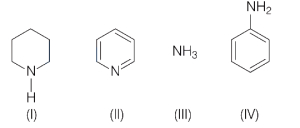
A
$I > III > II > IV$
B
$II > I > IV > III$
C
$I > II > III > IV$
D
$I > III > IV > II$
Solution
(A) $I$. Piperidine is the most basic. The $N$ lone pair is in an $sp^3$ hybrid orbital,there is no resonance,and due to the $+I$ effect of the alkyl group attached,it becomes more basic than $sp^3$ hybridized ammonia.
$II$. In pyridine,the lone pair is in an $sp^2$ hybridized orbital. The $sp^2$ hybrid is smaller than $sp^3$,so there is a stronger attraction to the nucleus,making it less basic.
$III$. $NH_3$ is more basic than aniline because in ammonia,the lone pair is localized and easily available for donation.
$IV$. The basicity of aniline is lower than that of ammonia because in aniline,the lone pair of electrons on $N$ is involved in resonance with the benzene ring.
Therefore,the correct order of basic strength is $I > III > II > IV$.
$II$. In pyridine,the lone pair is in an $sp^2$ hybridized orbital. The $sp^2$ hybrid is smaller than $sp^3$,so there is a stronger attraction to the nucleus,making it less basic.
$III$. $NH_3$ is more basic than aniline because in ammonia,the lone pair is localized and easily available for donation.
$IV$. The basicity of aniline is lower than that of ammonia because in aniline,the lone pair of electrons on $N$ is involved in resonance with the benzene ring.
Therefore,the correct order of basic strength is $I > III > II > IV$.
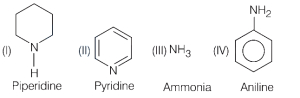
0 likesView Solution
127
ChemistryDifficultMCQTS EAMCET · 2021
The major product in the following reaction is:
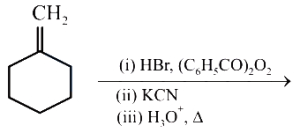
A
Cyclohexanecarboxylic acid with a methyl group at the alpha position.
B
$1-$methylcyclohexanecarboxylic acid.
C
Cyclohexylacetic acid.
D
$3-$cyclohexylpropanoic acid.
Solution
(C) The reaction proceeds as follows:
$1$. The first step is the anti-Markovnikov addition of $HBr$ to methylenecyclohexane in the presence of a peroxide,$(C_6H_5CO)_2O_2$. This yields (cyclohexylmethyl) bromide,$C_6H_{11}CH_2Br$.
$2$. The second step is a nucleophilic substitution reaction with $KCN$,where the bromide ion is replaced by a cyanide group,yielding cyclohexylacetonitrile,$C_6H_{11}CH_2CN$.
$3$. The third step is the acid-catalyzed hydrolysis of the nitrile group followed by heating,which converts the $-CN$ group into a carboxylic acid group,$-COOH$. The final product is cyclohexylacetic acid,$C_6H_{11}CH_2COOH$.
$1$. The first step is the anti-Markovnikov addition of $HBr$ to methylenecyclohexane in the presence of a peroxide,$(C_6H_5CO)_2O_2$. This yields (cyclohexylmethyl) bromide,$C_6H_{11}CH_2Br$.
$2$. The second step is a nucleophilic substitution reaction with $KCN$,where the bromide ion is replaced by a cyanide group,yielding cyclohexylacetonitrile,$C_6H_{11}CH_2CN$.
$3$. The third step is the acid-catalyzed hydrolysis of the nitrile group followed by heating,which converts the $-CN$ group into a carboxylic acid group,$-COOH$. The final product is cyclohexylacetic acid,$C_6H_{11}CH_2COOH$.
0 likesView Solution
128
ChemistryDifficultMCQTS EAMCET · 2021
Identify $Z$ in the following reaction:
$CH_3CH_2OH$ $\xrightarrow{PBr_3} X$ $\xrightarrow{alc. KOH} Y$ $\xrightarrow[{(ii) H_2O, \text{heat}}]{{(i) H_2SO_4, \text{RT}}} Z$
$CH_3CH_2OH$ $\xrightarrow{PBr_3} X$ $\xrightarrow{alc. KOH} Y$ $\xrightarrow[{(ii) H_2O, \text{heat}}]{{(i) H_2SO_4, \text{RT}}} Z$
A
$CH_2=CH_2$
B
$CH_3CH_2OH$
C
$CH_3CH_2-O-CH_2CH_3$
D
$CH_3CH_2-SO_3H$
Solution
(B) $PBr_3$ converts ethanol into ethyl bromide. The compound $X$ is $CH_3CH_2Br$.
Alcoholic $KOH$ causes dehydrohalogenation of ethyl bromide to form ethene. The compound $Y$ is $CH_2=CH_2$.
Ethene reacts with cold concentrated $H_2SO_4$ followed by hydrolysis to form ethanol. The compound $Z$ is $CH_3CH_2OH$.
Reaction sequence:
$CH_3CH_2OH$ $\xrightarrow{PBr_3} (X) CH_3CH_2Br$ $\xrightarrow{alc. KOH} (Y) CH_2=CH_2$ $\xrightarrow[{(ii) H_2O, \text{heat}}]{{(i) H_2SO_4, \text{RT}}} (Z) CH_3CH_2OH$
Therefore,the compound $Z$ is $CH_3CH_2OH$.
Alcoholic $KOH$ causes dehydrohalogenation of ethyl bromide to form ethene. The compound $Y$ is $CH_2=CH_2$.
Ethene reacts with cold concentrated $H_2SO_4$ followed by hydrolysis to form ethanol. The compound $Z$ is $CH_3CH_2OH$.
Reaction sequence:
$CH_3CH_2OH$ $\xrightarrow{PBr_3} (X) CH_3CH_2Br$ $\xrightarrow{alc. KOH} (Y) CH_2=CH_2$ $\xrightarrow[{(ii) H_2O, \text{heat}}]{{(i) H_2SO_4, \text{RT}}} (Z) CH_3CH_2OH$
Therefore,the compound $Z$ is $CH_3CH_2OH$.
0 likesView Solution
129
ChemistryEasyMCQTS EAMCET · 2021
$CH_3-CH_2-Br + Nu^{\Theta} \rightarrow CH_3-CH_2-Nu + Br^{\Theta}$
The decreasing order of the reaction rate with nucleophile $Nu^{\Theta}$ is $Nu^{\Theta} = (I) PhO^{\Theta}; (II) CH_3COO^{\Theta}; (III) OH^{\Theta}; (IV) CH_3O^{\Theta}$
The decreasing order of the reaction rate with nucleophile $Nu^{\Theta}$ is $Nu^{\Theta} = (I) PhO^{\Theta}; (II) CH_3COO^{\Theta}; (III) OH^{\Theta}; (IV) CH_3O^{\Theta}$
A
$IV > III > I > II$
B
$IV > III > II > I$
C
$I > II > III > IV$
D
$III > IV > II > I$
Solution
(A) The rate of nucleophilic substitution reaction depends on the nucleophilicity of the nucleophile $Nu^{\Theta}$.
Stronger nucleophiles react faster.
Comparing the basicity and nucleophilicity:
$CH_3O^{\Theta}$ is a stronger base and nucleophile than $OH^{\Theta}$ due to the $+I$ effect of the $CH_3$ group.
$OH^{\Theta}$ is a stronger nucleophile than $PhO^{\Theta}$ because the negative charge in $PhO^{\Theta}$ is delocalized over the benzene ring.
$PhO^{\Theta}$ is a stronger nucleophile than $CH_3COO^{\Theta}$ because the negative charge in $CH_3COO^{\Theta}$ is delocalized over two oxygen atoms.
Thus,the order of nucleophilicity is $(IV) CH_3O^{\Theta} > (III) OH^{\Theta} > (I) PhO^{\Theta} > (II) CH_3COO^{\Theta}$.
Stronger nucleophiles react faster.
Comparing the basicity and nucleophilicity:
$CH_3O^{\Theta}$ is a stronger base and nucleophile than $OH^{\Theta}$ due to the $+I$ effect of the $CH_3$ group.
$OH^{\Theta}$ is a stronger nucleophile than $PhO^{\Theta}$ because the negative charge in $PhO^{\Theta}$ is delocalized over the benzene ring.
$PhO^{\Theta}$ is a stronger nucleophile than $CH_3COO^{\Theta}$ because the negative charge in $CH_3COO^{\Theta}$ is delocalized over two oxygen atoms.
Thus,the order of nucleophilicity is $(IV) CH_3O^{\Theta} > (III) OH^{\Theta} > (I) PhO^{\Theta} > (II) CH_3COO^{\Theta}$.
0 likesView Solution
130
ChemistryMediumMCQTS EAMCET · 2021
The correct order of the rate of dehydrohalogenation of the following halides in the presence of alcoholic $KOH$ is:
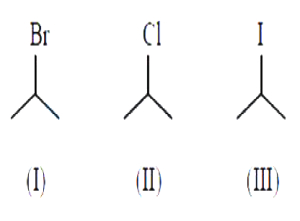
A
$II > I > III$
B
$III > II > I$
C
$III > I > II$
D
$I > II > III$
Solution
(C) Dehydrohalogenation involves the elimination of a hydrogen atom and a halogen atom from adjacent carbon atoms to form an alkene in the presence of a strong base like alcoholic $KOH$.
For a series of alkyl halides with the same alkyl group,the rate of dehydrohalogenation depends primarily on the strength of the $C-X$ bond and the leaving group ability of the halide ion.
The leaving group ability follows the order: $I^- > Br^- > Cl^- > F^-$.
Since the iodide ion $(I^-)$ is the best leaving group among the given halides,the alkyl iodide $(III)$ will undergo dehydrohalogenation the fastest.
The chloride ion $(Cl^-)$ is the poorest leaving group among the three,so the alkyl chloride $(II)$ will react the slowest.
Therefore,the correct order of the rate of dehydrohalogenation is $(III) > (I) > (II)$.
For a series of alkyl halides with the same alkyl group,the rate of dehydrohalogenation depends primarily on the strength of the $C-X$ bond and the leaving group ability of the halide ion.
The leaving group ability follows the order: $I^- > Br^- > Cl^- > F^-$.
Since the iodide ion $(I^-)$ is the best leaving group among the given halides,the alkyl iodide $(III)$ will undergo dehydrohalogenation the fastest.
The chloride ion $(Cl^-)$ is the poorest leaving group among the three,so the alkyl chloride $(II)$ will react the slowest.
Therefore,the correct order of the rate of dehydrohalogenation is $(III) > (I) > (II)$.
0 likesView Solution
131
ChemistryMediumMCQTS EAMCET · 2021
The most reactive molecules towards $SN^1$ reaction are:
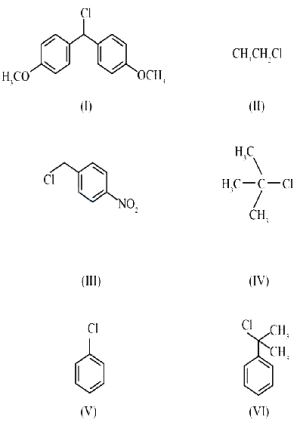
A
$(I), (IV)$ and $(VI)$
B
$(I), (II)$ and $(IV)$
C
$(II), (III)$ and $(V)$
D
$(IV), (V)$ and $(VI)$
Solution
(A) The rate of $SN^1$ reaction depends on the stability of the carbocation intermediate formed after the departure of the leaving group $(Cl^-)$. The more stable the carbocation,the faster the $SN^1$ reaction.
$(I)$ forms a highly stable carbocation due to resonance stabilization by two $p$-methoxyphenyl groups. The $+R$ effect of the methoxy group significantly stabilizes the positive charge.
$(IV)$ is $tert$-butyl chloride,which forms a stable tertiary carbocation.
$(VI)$ is $2$-chloro-$2$-phenylpropane,which forms a tertiary carbocation stabilized by resonance with the phenyl ring and the $+I$ effect of methyl groups.
$(II)$ is a primary alkyl halide (unstable carbocation).
$(III)$ is a primary benzylic halide with a strong electron-withdrawing $-NO_2$ group,which destabilizes the carbocation.
$(V)$ is chlorobenzene,which does not undergo $SN^1$ reaction easily due to partial double bond character of the $C-Cl$ bond and the instability of the phenyl cation.
Therefore,$(I), (IV)$ and $(VI)$ are the most reactive towards $SN^1$ reaction.
$(I)$ forms a highly stable carbocation due to resonance stabilization by two $p$-methoxyphenyl groups. The $+R$ effect of the methoxy group significantly stabilizes the positive charge.
$(IV)$ is $tert$-butyl chloride,which forms a stable tertiary carbocation.
$(VI)$ is $2$-chloro-$2$-phenylpropane,which forms a tertiary carbocation stabilized by resonance with the phenyl ring and the $+I$ effect of methyl groups.
$(II)$ is a primary alkyl halide (unstable carbocation).
$(III)$ is a primary benzylic halide with a strong electron-withdrawing $-NO_2$ group,which destabilizes the carbocation.
$(V)$ is chlorobenzene,which does not undergo $SN^1$ reaction easily due to partial double bond character of the $C-Cl$ bond and the instability of the phenyl cation.
Therefore,$(I), (IV)$ and $(VI)$ are the most reactive towards $SN^1$ reaction.
0 likesView Solution
132
ChemistryEasyMCQTS EAMCET · 2021
The Swarts reaction yields
A
iodohydrocarbons
B
fluorohydrocarbons
C
bromohydrocarbons
D
chlorohydrocarbons
Solution
(B) The Swarts reaction is used to prepare alkyl fluorides from alkyl chlorides or alkyl bromides.
This is achieved by heating the alkyl chloride or bromide in the presence of a metallic fluoride,such as $AgF$,$Hg_2F_2$,$CoF_2$,or $SbF_3$.
For example:
$CH_3-Br + AgF \rightarrow CH_3F + AgBr$
Thus,the Swarts reaction yields fluorohydrocarbons.
This is achieved by heating the alkyl chloride or bromide in the presence of a metallic fluoride,such as $AgF$,$Hg_2F_2$,$CoF_2$,or $SbF_3$.
For example:
$CH_3-Br + AgF \rightarrow CH_3F + AgBr$
Thus,the Swarts reaction yields fluorohydrocarbons.
0 likesView Solution
133
ChemistryDifficultMCQTS EAMCET · 2021
Match the following reactions in List-$I$ with their major products in List-$II$.
The correct match is:
| List-$I$ (Reaction) | List-$II$ (Major product) |
|---|---|
| $A. \ CH_3CH=CH_2 \xrightarrow{HI}$ | $I. \ 1\text{-bromo-}2\text{-phenylethane}$ |
| $B. \ C_6H_5CH_2CH_3 \xrightarrow{Br_2/\Delta}$ | $II. \ 1\text{-iodopropane}$ |
| $C. \ C_6H_5CH=CH_2 \xrightarrow{HBr}$ | $III. \ 2\text{-iodopropane}$ |
| $IV. \ 1\text{-bromo-}1\text{-phenylethane}$ |
The correct match is:
A
$A-III, B-I, C-IV$
B
$A-III, B-IV, C-IV$
C
$A-II, B-I, C-I$
D
$A-II, B-IV, C-IV$
Solution
(B) The addition of $HI$ to propene follows Markownikoff's rule,proceeding via the formation of a $2^{\circ}$ carbocation,which is more stable than a $1^{\circ}$ carbocation. The major product is $2\text{-iodopropane}$ $(III)$.
$(B)$ The reaction of ethylbenzene $(C_6H_5CH_2CH_3)$ with $Br_2$ under heating $(\Delta)$ is a free radical substitution at the benzylic position. The $1\text{-phenylethyl}$ radical is stabilized by resonance,leading to $1\text{-bromo-}1\text{-phenylethane}$ $(IV)$.
$(C)$ The addition of $HBr$ to styrene $(C_6H_5CH=CH_2)$ follows Markownikoff's rule. The electrophilic addition of $H $ forms a stable benzylic carbocation $(C_6H_5CH^ CH_3)$,which then reacts with $Br^-$ to form $1\text{-bromo-}1\text{-phenylethane}$ $(IV)$.
Therefore,the correct match is $A-III, B-IV, C-IV$.
$(B)$ The reaction of ethylbenzene $(C_6H_5CH_2CH_3)$ with $Br_2$ under heating $(\Delta)$ is a free radical substitution at the benzylic position. The $1\text{-phenylethyl}$ radical is stabilized by resonance,leading to $1\text{-bromo-}1\text{-phenylethane}$ $(IV)$.
$(C)$ The addition of $HBr$ to styrene $(C_6H_5CH=CH_2)$ follows Markownikoff's rule. The electrophilic addition of $H $ forms a stable benzylic carbocation $(C_6H_5CH^ CH_3)$,which then reacts with $Br^-$ to form $1\text{-bromo-}1\text{-phenylethane}$ $(IV)$.
Therefore,the correct match is $A-III, B-IV, C-IV$.
0 likesView Solution
134
ChemistryDifficultMCQTS EAMCET · 2021
The major product formed in the following reaction is:
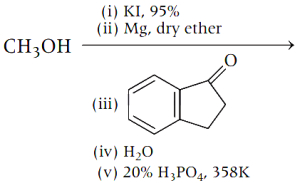
A
$1-$methyl-1H-indene
B
$1-$methylene$-2,3-$dihydro-1H-indene
C
$3-$methyl-1H-indene
D
$1-$methyl$-2,3-$dihydro-1H-inden$-1-$ol
Solution
(A) The reaction proceeds as follows:
$(i)$ $CH_3OH$ reacts with $KI$ to form $CH_3I$.
(ii) $CH_3I$ reacts with $Mg$ in dry ether to form the Grignard reagent $CH_3MgI$.
(iii) $CH_3MgI$ undergoes nucleophilic addition to the carbonyl group of $1-$indanone ($2$,$3$-dihydro-1H-inden$-1-$one).
(iv) Subsequent hydrolysis with $H_2O$ yields $1-$methyl$-2,3-$dihydro-1H-inden$-1-$ol.
$(v)$ Dehydration of the alcohol using $20\% H_3PO_4$ at $358 \ K$ results in the formation of the more stable conjugated alkene,$1$-methyl-1H-indene,as the major product.
$(i)$ $CH_3OH$ reacts with $KI$ to form $CH_3I$.
(ii) $CH_3I$ reacts with $Mg$ in dry ether to form the Grignard reagent $CH_3MgI$.
(iii) $CH_3MgI$ undergoes nucleophilic addition to the carbonyl group of $1-$indanone ($2$,$3$-dihydro-1H-inden$-1-$one).
(iv) Subsequent hydrolysis with $H_2O$ yields $1-$methyl$-2,3-$dihydro-1H-inden$-1-$ol.
$(v)$ Dehydration of the alcohol using $20\% H_3PO_4$ at $358 \ K$ results in the formation of the more stable conjugated alkene,$1$-methyl-1H-indene,as the major product.
0 likesView Solution
135
ChemistryDifficultMCQTS EAMCET · 2021
The major product in the following reaction sequence is:
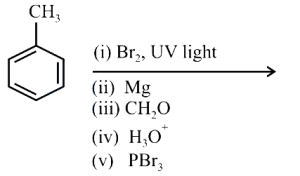
A
$1-$bromo$-1-$phenylethane
B
o-bromomethyltoluene
C
($2$-bromoethyl)benzene
D
p-bromomethyltoluene
Solution
(C) The reaction sequence is as follows:
$1$. Toluene reacts with $Br_2$ in the presence of $UV$ light to undergo free-radical substitution at the benzylic position,forming benzyl bromide $(C_6H_5CH_2Br)$.
$2$. Benzyl bromide reacts with $Mg$ in dry ether to form the Grignard reagent,benzylmagnesium bromide $(C_6H_5CH_2MgBr)$.
$3$. The Grignard reagent reacts with formaldehyde $(CH_2O)$ followed by acidic hydrolysis $(H_3O^+)$ to form $2-$phenylethanol $(C_6H_5CH_2CH_2OH)$.
$4$. Finally,$2$-phenylethanol reacts with $PBr_3$ to replace the hydroxyl group with a bromine atom,yielding ($2$-bromoethyl)benzene $(C_6H_5CH_2CH_2Br)$.
$1$. Toluene reacts with $Br_2$ in the presence of $UV$ light to undergo free-radical substitution at the benzylic position,forming benzyl bromide $(C_6H_5CH_2Br)$.
$2$. Benzyl bromide reacts with $Mg$ in dry ether to form the Grignard reagent,benzylmagnesium bromide $(C_6H_5CH_2MgBr)$.
$3$. The Grignard reagent reacts with formaldehyde $(CH_2O)$ followed by acidic hydrolysis $(H_3O^+)$ to form $2-$phenylethanol $(C_6H_5CH_2CH_2OH)$.
$4$. Finally,$2$-phenylethanol reacts with $PBr_3$ to replace the hydroxyl group with a bromine atom,yielding ($2$-bromoethyl)benzene $(C_6H_5CH_2CH_2Br)$.
0 likesView Solution
136
ChemistryDifficultMCQTS EAMCET · 2021
The major product in the following reaction is
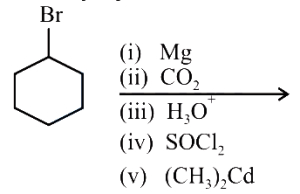
A
Cyclohexyl ethanol
B
Cyclohexyl methyl ketone
C
$1-$Cyclohexyl ethanol
D
$2-$Cyclohexyl propan$-2-$ol
Solution
(B) The reaction proceeds as follows:
$1$. Bromocyclohexane reacts with $Mg$ in dry ether to form cyclohexylmagnesium bromide (a Grignard reagent).
$2$. The Grignard reagent reacts with $CO_2$ followed by acidic workup $(H_3O^+)$ to form cyclohexanecarboxylic acid.
$3$. Cyclohexanecarboxylic acid reacts with $SOCl_2$ to form cyclohexanecarbonyl chloride.
$4$. Finally,the reaction of cyclohexanecarbonyl chloride with dimethylcadmium,$(CH_3)_2Cd$,yields cyclohexyl methyl ketone as the major product. This is a standard method for the preparation of ketones from acid chlorides.
$1$. Bromocyclohexane reacts with $Mg$ in dry ether to form cyclohexylmagnesium bromide (a Grignard reagent).
$2$. The Grignard reagent reacts with $CO_2$ followed by acidic workup $(H_3O^+)$ to form cyclohexanecarboxylic acid.
$3$. Cyclohexanecarboxylic acid reacts with $SOCl_2$ to form cyclohexanecarbonyl chloride.
$4$. Finally,the reaction of cyclohexanecarbonyl chloride with dimethylcadmium,$(CH_3)_2Cd$,yields cyclohexyl methyl ketone as the major product. This is a standard method for the preparation of ketones from acid chlorides.
0 likesView Solution
137
ChemistryDifficultMCQTS EAMCET · 2021
The major product $Q$ of the following reaction scheme is:
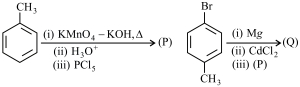
A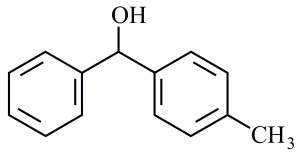
B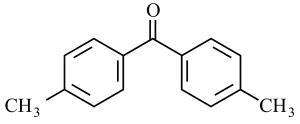
C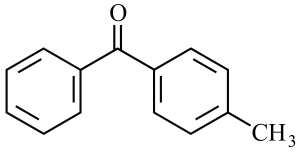
D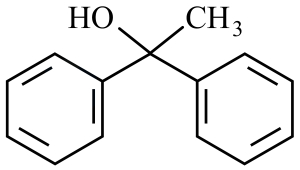
Solution
(D) Step $1$: Conversion of toluene to $(P)$. Toluene reacts with $KMnO_4 / KOH$ followed by $H_3O^+$ to form $p$-methylbenzoic acid. This acid then reacts with $PCl_5$ to form $p$-methylbenzoyl chloride,which is $(P)$.
Step $2$: Conversion of bromobenzene to $(Q)$. Bromobenzene reacts with $Mg$ to form phenylmagnesium bromide,which then reacts with $CdCl_2$ to form diphenylcadmium. This organocadmium compound reacts with $(P)$ ($p$-methylbenzoyl chloride) to form the final product $(Q)$,which is $4$-methylbenzophenone.
Step $2$: Conversion of bromobenzene to $(Q)$. Bromobenzene reacts with $Mg$ to form phenylmagnesium bromide,which then reacts with $CdCl_2$ to form diphenylcadmium. This organocadmium compound reacts with $(P)$ ($p$-methylbenzoyl chloride) to form the final product $(Q)$,which is $4$-methylbenzophenone.
0 likesView Solution
138
ChemistryDifficultMCQTS EAMCET · 2021
The possible final products $R$ and $S$ of the following reaction sequence are:
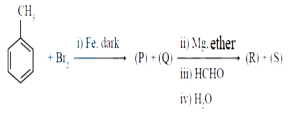
A
| $R$ | $S$ |
| $o$-methylbenzyl alcohol | $p$-methylbenzyl alcohol |
B
| $R$ | $S$ |
| $o$-cresol | $p$-cresol |
C
| $R$ | $S$ |
| $o$-xylene | $p$-xylene |
D
| $R$ | $S$ |
| $o$-bromotoluene | $p$-bromotoluene |
Solution
(A) $1$. Toluene reacts with $Br_2$ in the presence of $Fe$ (dark) via electrophilic aromatic substitution to form a mixture of $o$-bromotoluene $(P)$ and $p$-bromotoluene $(Q)$.
$2$. These isomers react with $Mg$ in dry ether to form the corresponding Grignard reagents: $o$-tolylmagnesium bromide and $p$-tolylmagnesium bromide.
$3$. These Grignard reagents react with formaldehyde $(HCHO)$ followed by acidic hydrolysis $(H_2O)$ to form primary alcohols.
$4$. The final products $R$ and $S$ are $o$-methylbenzyl alcohol and $p$-methylbenzyl alcohol,respectively.
$2$. These isomers react with $Mg$ in dry ether to form the corresponding Grignard reagents: $o$-tolylmagnesium bromide and $p$-tolylmagnesium bromide.
$3$. These Grignard reagents react with formaldehyde $(HCHO)$ followed by acidic hydrolysis $(H_2O)$ to form primary alcohols.
$4$. The final products $R$ and $S$ are $o$-methylbenzyl alcohol and $p$-methylbenzyl alcohol,respectively.
0 likesView Solution
139
ChemistryMediumMCQTS EAMCET · 2021
The product $(R)$ in the following synthetic scheme is
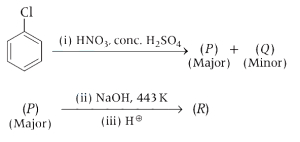
A
$2-$nitrophenol
B
$4-$nitrophenol
C
$3-$chloro$-4-$nitrophenol
D
$2-$chloro$-4-$nitrophenol
Solution
(B) Chlorobenzene undergoes electrophilic aromatic substitution (nitration) with conc. $HNO_3$ and conc. $H_2SO_4$ to form $p$-nitrochlorobenzene as the major product $(P)$ and $o$-nitrochlorobenzene as the minor product $(Q)$.
In the next step,$p$-nitrochlorobenzene $(P)$ reacts with $NaOH$ at $443 \ K$ followed by acidification $(H^+)$. The presence of the electron-withdrawing $-NO_2$ group at the para position activates the ring towards nucleophilic aromatic substitution,replacing the $-Cl$ atom with an $-OH$ group to form $p$-nitrophenol $(R)$.
In the next step,$p$-nitrochlorobenzene $(P)$ reacts with $NaOH$ at $443 \ K$ followed by acidification $(H^+)$. The presence of the electron-withdrawing $-NO_2$ group at the para position activates the ring towards nucleophilic aromatic substitution,replacing the $-Cl$ atom with an $-OH$ group to form $p$-nitrophenol $(R)$.
0 likesView Solution
140
ChemistryDifficultMCQTS EAMCET · 2021
The major product formed in the following reaction scheme is
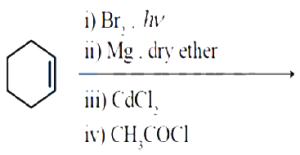
A
$1-$(cyclohex$-2-$en$-1-$yl)ethanol
B
$1-$(cyclohex$-2-$en$-1-$yl)ethanol
C
$2-$(cyclohex$-2-$en$-1-$yl)propan$-2-$ol
D
$1-$(cyclohex$-2-$en$-1-$yl)ethanone
Solution
(D) The reaction sequence is as follows:
$1$. Allylic bromination of cyclohexene with $Br_2$ in the presence of $h\nu$ gives $3$-bromocyclohexene.
$2$. Formation of Grignard reagent: $3$-bromocyclohexene reacts with $Mg$ in dry ether to form $3$-cyclohexenylmagnesium bromide.
$3$. Reaction with $CdCl_2$: The Grignard reagent reacts with $CdCl_2$ to form an organocadmium compound,$(C_6H_9)_2Cd$.
$4$. Reaction with $CH_3COCl$: The organocadmium compound reacts with acetyl chloride $(CH_3COCl)$ to form a ketone,$1$-(cyclohex$-2-$en$-1-$yl)ethanone.
Thus,the final product is $1$-(cyclohex$-2-$en$-1-$yl)ethanone.
$1$. Allylic bromination of cyclohexene with $Br_2$ in the presence of $h\nu$ gives $3$-bromocyclohexene.
$2$. Formation of Grignard reagent: $3$-bromocyclohexene reacts with $Mg$ in dry ether to form $3$-cyclohexenylmagnesium bromide.
$3$. Reaction with $CdCl_2$: The Grignard reagent reacts with $CdCl_2$ to form an organocadmium compound,$(C_6H_9)_2Cd$.
$4$. Reaction with $CH_3COCl$: The organocadmium compound reacts with acetyl chloride $(CH_3COCl)$ to form a ketone,$1$-(cyclohex$-2-$en$-1-$yl)ethanone.
Thus,the final product is $1$-(cyclohex$-2-$en$-1-$yl)ethanone.
0 likesView Solution
141
ChemistryMediumMCQTS EAMCET · 2021
Mustard gas among the following is
A
$CCl_3NO_2$
B
$ClCH_2CH_2SCH_2CH_2Cl$
C
$CH_3SH$
D
$H_2S$
Solution
(B) Mustard gas,also known as sulphur mustard,is a chemical compound belonging to the family of cytotoxic and blister agent chemical warfare agents.
The chemical formula of mustard gas is $C_4H_8Cl_2S$,and its structural formula is $ClCH_2CH_2SCH_2CH_2Cl$.
It can be synthesized by the reaction of ethylene with sulphur dichloride:
$2C_2H_4 + SCl_2 \rightarrow (ClCH_2CH_2)_2S$
The chemical formula of mustard gas is $C_4H_8Cl_2S$,and its structural formula is $ClCH_2CH_2SCH_2CH_2Cl$.
It can be synthesized by the reaction of ethylene with sulphur dichloride:
$2C_2H_4 + SCl_2 \rightarrow (ClCH_2CH_2)_2S$
0 likesView Solution
142
ChemistryDifficultMCQTS EAMCET · 2021
The major product of the following reaction is:
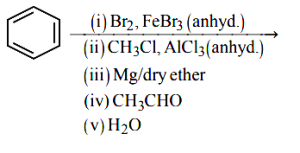
A
$1-$($4$-methylphenyl)propan$-2-$ol
B
$1-$($4$-methylphenyl)ethanol
C
$2-$($2$-methylphenyl)propan$-2-$ol
D
$1-$($2$-methylphenyl)ethanol
Solution
(B) Step $(i)$: Benzene reacts with $Br_2$ in the presence of anhydrous $FeBr_3$ to form bromobenzene via electrophilic aromatic substitution.
Step (ii): Bromobenzene undergoes Friedel-Crafts alkylation with $CH_3Cl$ and anhydrous $AlCl_3$. Since the $-Br$ group is ortho/para directing,the major product is $p$-bromotoluene.
Step (iii): $p$-Bromotoluene reacts with $Mg$ in dry ether to form the Grignard reagent,$p$-tolylmagnesium bromide $(CH_3-C_6H_4-MgBr)$.
Step (iv) and $(v)$: The Grignard reagent reacts with acetaldehyde $(CH_3CHO)$ followed by hydrolysis $(H_2O)$ to form a secondary alcohol. The nucleophilic carbon of the Grignard reagent attacks the carbonyl carbon of acetaldehyde,resulting in $1-(4-methylphenyl)ethanol$.
Step (ii): Bromobenzene undergoes Friedel-Crafts alkylation with $CH_3Cl$ and anhydrous $AlCl_3$. Since the $-Br$ group is ortho/para directing,the major product is $p$-bromotoluene.
Step (iii): $p$-Bromotoluene reacts with $Mg$ in dry ether to form the Grignard reagent,$p$-tolylmagnesium bromide $(CH_3-C_6H_4-MgBr)$.
Step (iv) and $(v)$: The Grignard reagent reacts with acetaldehyde $(CH_3CHO)$ followed by hydrolysis $(H_2O)$ to form a secondary alcohol. The nucleophilic carbon of the Grignard reagent attacks the carbonyl carbon of acetaldehyde,resulting in $1-(4-methylphenyl)ethanol$.
0 likesView Solution
143
ChemistryMediumMCQTS EAMCET · 2021
The major product of the following reaction is:
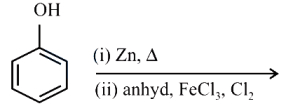
A
$4-$chlorophenol
B
$2-$chlorophenol
C
$2,4-$dichlorophenol
D
chlorobenzene
Solution
(D) Step $1$: Phenol reacts with zinc dust $(Zn)$ under heating $(\Delta)$ to undergo reduction,resulting in the formation of benzene.
$C_6H_5OH Zn \xrightarrow{\Delta} C_6H_6 ZnO$
Step $2$: Benzene then undergoes electrophilic aromatic substitution (chlorination) in the presence of anhydrous ferric chloride $(FeCl_3)$ and chlorine $(Cl_2)$ to form chlorobenzene.
$C_6H_6 Cl_2 \xrightarrow{\text{anhyd. } FeCl_3} C_6H_5Cl HCl$
Therefore,the major product is chlorobenzene.
$C_6H_5OH Zn \xrightarrow{\Delta} C_6H_6 ZnO$
Step $2$: Benzene then undergoes electrophilic aromatic substitution (chlorination) in the presence of anhydrous ferric chloride $(FeCl_3)$ and chlorine $(Cl_2)$ to form chlorobenzene.
$C_6H_6 Cl_2 \xrightarrow{\text{anhyd. } FeCl_3} C_6H_5Cl HCl$
Therefore,the major product is chlorobenzene.
0 likesView Solution
144
ChemistryDifficultMCQTS EAMCET · 2021
The major product of the following reaction is:
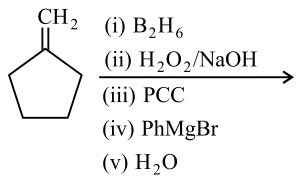
A
Cyclopentylphenylmethanol
B
Cyclopentyl phenyl ketone
C
Cyclopentylmethanol
D
Benzylcyclopentane
Solution
(A) The reaction proceeds as follows:
$1$. Hydroboration-oxidation of methylenecyclopentane with $(i) B_2H_6$ and $(ii) H_2O_2/NaOH$ yields cyclopentylmethanol.
$2$. Oxidation of the primary alcohol with $PCC$ (Pyridinium chlorochromate) yields cyclopentanecarbaldehyde.
$3$. Nucleophilic addition of the Grignard reagent $PhMgBr$ to the aldehyde,followed by hydrolysis with $(v) H_2O$,yields the secondary alcohol,cyclopentylphenylmethanol.
$1$. Hydroboration-oxidation of methylenecyclopentane with $(i) B_2H_6$ and $(ii) H_2O_2/NaOH$ yields cyclopentylmethanol.
$2$. Oxidation of the primary alcohol with $PCC$ (Pyridinium chlorochromate) yields cyclopentanecarbaldehyde.
$3$. Nucleophilic addition of the Grignard reagent $PhMgBr$ to the aldehyde,followed by hydrolysis with $(v) H_2O$,yields the secondary alcohol,cyclopentylphenylmethanol.
0 likesView Solution
145
ChemistryDifficultMCQTS EAMCET · 2021
The major product in the following reaction sequence is:
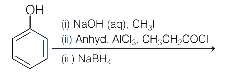
A
$1-$($4$-methoxyphenyl)propan$-1-$ol
B
$1-$($2$-methoxyphenyl)propan$-1-$ol
C
$1-$($4$-methoxyphenyl)propan$-2-$ol
D
$1-$($2$-methoxyphenyl)propan$-2-$ol
Solution
(A) The reaction proceeds as follows:
$(i)$ Phenol reacts with $NaOH$ and $CH_3I$ to form anisole (methoxybenzene) via Williamson ether synthesis.
(ii) Anisole undergoes Friedel-Crafts acylation with propionyl chloride $(CH_3CH_2COCl)$ in the presence of anhydrous $AlCl_3$. Since the $-OCH_3$ group is ortho/para-directing,and the para-position is sterically less hindered,the major product is $p$-methoxypropiophenone.
(iii) Reduction of the ketone group with $NaBH_4$ yields the corresponding secondary alcohol,$1$-($4$-methoxyphenyl)propan$-1-$ol.
Therefore,the correct option is $A$.
$(i)$ Phenol reacts with $NaOH$ and $CH_3I$ to form anisole (methoxybenzene) via Williamson ether synthesis.
(ii) Anisole undergoes Friedel-Crafts acylation with propionyl chloride $(CH_3CH_2COCl)$ in the presence of anhydrous $AlCl_3$. Since the $-OCH_3$ group is ortho/para-directing,and the para-position is sterically less hindered,the major product is $p$-methoxypropiophenone.
(iii) Reduction of the ketone group with $NaBH_4$ yields the corresponding secondary alcohol,$1$-($4$-methoxyphenyl)propan$-1-$ol.
Therefore,the correct option is $A$.
0 likesView Solution
146
ChemistryDifficultMCQTS EAMCET · 2021
The major product formed in the following reaction is:
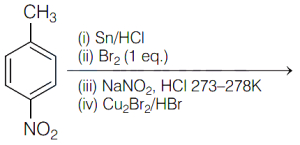
A
$1-$methyl$-3,5-$dibromobenzene
B
$1-$methyl$-2,6-$dibromobenzene
C
$1-$methyl$-3,4-$dibromobenzene
D
$1-$methyl$-2,4-$dibromobenzene
Solution
(C) The reaction proceeds as follows:
$(i)$ $Sn/HCl$ reduces the $-NO_2$ group to an $-NH_2$ group,forming $p$-toluidine.
(ii) $Br_2$ $(1 \ eq.)$ in the presence of the strongly activating $-NH_2$ group leads to ortho-bromination,yielding $2$-bromo-$4$-methylaniline.
(iii) $NaNO_2/HCl$ at $273-278 \ K$ converts the $-NH_2$ group into a diazonium salt,$-N_2^+Cl^-$.
(iv) $Cu_2Br_2/HBr$ (Sandmeyer reaction) replaces the diazonium group with a $-Br$ atom,resulting in $1,2$-dibromo-$4$-methylbenzene (also known as $3,4$-dibromotoluene).
$(i)$ $Sn/HCl$ reduces the $-NO_2$ group to an $-NH_2$ group,forming $p$-toluidine.
(ii) $Br_2$ $(1 \ eq.)$ in the presence of the strongly activating $-NH_2$ group leads to ortho-bromination,yielding $2$-bromo-$4$-methylaniline.
(iii) $NaNO_2/HCl$ at $273-278 \ K$ converts the $-NH_2$ group into a diazonium salt,$-N_2^+Cl^-$.
(iv) $Cu_2Br_2/HBr$ (Sandmeyer reaction) replaces the diazonium group with a $-Br$ atom,resulting in $1,2$-dibromo-$4$-methylbenzene (also known as $3,4$-dibromotoluene).
0 likesView Solution
147
ChemistryMediumMCQTS EAMCET · 2021
The correct decreasing order of the basic strength is
A
$HS^{-} > CH_{3}^{-} > NH_{2}^{-} > CN^{-}$
B
$HS^{-} > CN^{-} > NH_{2}^{-} > CH_{3}^{-}$
C
$CH_{3}^{-} > NH_{2}^{-} > CN^{-} > HS^{-}$
D
$NH_{2}^{-} > CN^{-} > CH_{3}^{-} > HS^{-}$
Solution
(C) The basic strength of an anion is inversely proportional to the acidic strength of its conjugate acid.
First,identify the conjugate acids of the given bases:
$CH_{3}^{-}$'s conjugate acid is $CH_{4}$ $(pKa \approx 50)$.
$NH_{2}^{-}$'s conjugate acid is $NH_{3}$ $(pKa \approx 38)$.
$CN^{-}$'s conjugate acid is $HCN$ $(pKa \approx 9.2)$.
$HS^{-}$'s conjugate acid is $H_{2}S$ $(pKa \approx 7)$.
Since the acidic strength order is $CH_{4} < NH_{3} < HCN < H_{2}S$,the basic strength order of their conjugate bases is the reverse: $CH_{3}^{-} > NH_{2}^{-} > CN^{-} > HS^{-}$.
First,identify the conjugate acids of the given bases:
$CH_{3}^{-}$'s conjugate acid is $CH_{4}$ $(pKa \approx 50)$.
$NH_{2}^{-}$'s conjugate acid is $NH_{3}$ $(pKa \approx 38)$.
$CN^{-}$'s conjugate acid is $HCN$ $(pKa \approx 9.2)$.
$HS^{-}$'s conjugate acid is $H_{2}S$ $(pKa \approx 7)$.
Since the acidic strength order is $CH_{4} < NH_{3} < HCN < H_{2}S$,the basic strength order of their conjugate bases is the reverse: $CH_{3}^{-} > NH_{2}^{-} > CN^{-} > HS^{-}$.
0 likesView Solution
148
ChemistryMediumMCQTS EAMCET · 2021
The correct order of reducing ability of the following hydrides is:
A
$BiH_3 > SbH_3 > PH_3 > NH_3$
B
$NH_3 > PH_3 > SbH_3 > BiH_3$
C
$SbH_3 > BiH_3 > PH_3 > NH_3$
D
$PH_3 > BiH_3 > SbH_3 > NH_3$
Solution
(A) The reducing character of the hydrides of group $15$ elements depends upon the thermal stability of the hydrides.
As we move down the group,the bond dissociation energy decreases due to an increase in the size of the central atom,which leads to a decrease in the stability of the hydrides.
Consequently,the ability to release hydrogen atoms increases,making the reducing character increase down the group.
Therefore,the correct order of reducing ability is: $BiH_3 > SbH_3 > AsH_3 > PH_3 > NH_3$.
Among the given options,the correct order is $BiH_3 > SbH_3 > PH_3 > NH_3$.
As we move down the group,the bond dissociation energy decreases due to an increase in the size of the central atom,which leads to a decrease in the stability of the hydrides.
Consequently,the ability to release hydrogen atoms increases,making the reducing character increase down the group.
Therefore,the correct order of reducing ability is: $BiH_3 > SbH_3 > AsH_3 > PH_3 > NH_3$.
Among the given options,the correct order is $BiH_3 > SbH_3 > PH_3 > NH_3$.
0 likesView Solution
149
ChemistryMediumMCQTS EAMCET · 2021
In the following reaction sequence,the compound $C$ is $Al + N_2$ $\xrightarrow{\Delta} (A)$ $\xrightarrow{H_2O} B (ppt) + C_{(g)}$
A
$NO_2$
B
$NH_3$
C
$NO$
D
$N_2$
Solution
(B) Aluminium reacts with nitrogen at high temperatures $(1073 \ K - 1473 \ K)$ to form aluminium nitride $(AlN)$:
$2 \ Al + N_2 \rightarrow 2 \ AlN$
Aluminium nitride $(AlN)$ reacts with water to produce aluminium hydroxide $(Al(OH)_3)$ as a precipitate and ammonia gas $(NH_3)$:
$AlN + 3 \ H_2O \rightarrow Al(OH)_3 (ppt) + NH_3 (g)$
Therefore,the compound $C$ is ammonia $(NH_3)$.
$2 \ Al + N_2 \rightarrow 2 \ AlN$
Aluminium nitride $(AlN)$ reacts with water to produce aluminium hydroxide $(Al(OH)_3)$ as a precipitate and ammonia gas $(NH_3)$:
$AlN + 3 \ H_2O \rightarrow Al(OH)_3 (ppt) + NH_3 (g)$
Therefore,the compound $C$ is ammonia $(NH_3)$.
0 likesView Solution
150
ChemistryDifficultMCQTS EAMCET · 2021
Give the correct characteristic colours of the products $(P, Q, R, S)$ formed in the following reactions:
$(A)\ NO + NO_2 \xrightarrow{< 250 K} P$
$(B)\ 2 NO_2 \longleftrightarrow Q$
$(C)\ Pb(NO_3)_2 \xrightarrow{673 K} R + PbO$
$(D)\ 4 HNO_3 + P_4O_{10} \longrightarrow S + 4 HPO_3$
$(A)\ NO + NO_2 \xrightarrow{< 250 K} P$
$(B)\ 2 NO_2 \longleftrightarrow Q$
$(C)\ Pb(NO_3)_2 \xrightarrow{673 K} R + PbO$
$(D)\ 4 HNO_3 + P_4O_{10} \longrightarrow S + 4 HPO_3$
A
| $P$: Blue | $Q$: Colourless | $R$: Brown | $S$: Colourless |
B
| $P$: Colourless | $Q$: Blue | $R$: Colourless | $S$: Brown |
C
| $P$: Colourless | $Q$: Colourless | $R$: Blue | $S$: Brown |
D
| $P$: Brown | $Q$: Blue | $R$: Colourless | $S$: Colourless |
Solution
(A) $(A)\ NO + NO_2 \xrightarrow{< 250 K} N_2O_3$. $N_2O_3$ is blue in liquid or solid state $(P = \text{Blue})$.
$(B)\ 2 NO_2 \longleftrightarrow N_2O_4$. $N_2O_4$ is a colourless gas/liquid $(Q = \text{Colourless})$.
$(C)\ 2 Pb(NO_3)_2 \xrightarrow{673 K} 4 NO_2 + 2 PbO + O_2$. $NO_2$ is a reddish-brown gas $(R = \text{Brown})$.
$(D)\ 4 HNO_3 + P_4O_{10} \longrightarrow 2 N_2O_5 + 4 HPO_3$. $N_2O_5$ is a colourless crystalline solid $(S = \text{Colourless})$.
Thus,the correct sequence is $P$: Blue,$Q$: Colourless,$R$: Brown,$S$: Colourless.
$(B)\ 2 NO_2 \longleftrightarrow N_2O_4$. $N_2O_4$ is a colourless gas/liquid $(Q = \text{Colourless})$.
$(C)\ 2 Pb(NO_3)_2 \xrightarrow{673 K} 4 NO_2 + 2 PbO + O_2$. $NO_2$ is a reddish-brown gas $(R = \text{Brown})$.
$(D)\ 4 HNO_3 + P_4O_{10} \longrightarrow 2 N_2O_5 + 4 HPO_3$. $N_2O_5$ is a colourless crystalline solid $(S = \text{Colourless})$.
Thus,the correct sequence is $P$: Blue,$Q$: Colourless,$R$: Brown,$S$: Colourless.
0 likesView Solution
Vedclass Products
For Students
Vedclass Test Series
Mock tests in real TS EAMCET style covering Chemistry with performance analysis. 5-day free trial.
Start Free TrialFor Teachers
Exam Paper Generator
Generate Set A/B/C/D Chemistry papers from 7.5L+ questions in 2 minutes. 3 chapters free.
Try FreeFor Institutes
Online Exam Module
Run live TS EAMCET mock exams with unlimited students, 360° analytics & white-label branding.
See DemoFrequently Asked Questions
How many Chemistry questions are in TS EAMCET 2021?
There are 270 Chemistry questions from the TS EAMCET 2021 paper on Vedclass, each with a detailed step-by-step solution in English.
Are TS EAMCET 2021 Chemistry solutions available in English?
Yes. All solutions on this page are in English. You can also switch to English or Hindi using the language buttons above the questions.
Can I practice TS EAMCET 2021 Chemistry as a timed test?
Yes. Use the Vedclass Test Series to attempt a full TS EAMCET mock test covering Chemistry with time limits and instant score analysis.
Can teachers create Chemistry papers from TS EAMCET previous year questions?
Yes. The Vedclass Exam Paper Generator lets teachers mix TS EAMCET Chemistry questions and generate Set A/B/C/D papers in minutes.
For Teachers & Institutes
Build a Custom Chemistry Paper
Pick TS EAMCET 2021 Chemistry questions, set difficulty, and generate Set A/B/C/D in 2 minutes.