
ChemistryQ101–170 of 270 questions
Page 3 of 3 · English
101
ChemistryMediumMCQTS EAMCET · 2021
The number of sodium ions present in $0.5 \ mol$ of sodium ferrocyanide is?
A
$2 \times 10^{23}$
B
$0.5 \times 10^{23}$
C
$12 \times 10^{23}$
D
$4 \times 10^{23}$
Solution
(C) The chemical formula for sodium ferrocyanide is $Na_4[Fe(CN)_6]$.
Each molecule of $Na_4[Fe(CN)_6]$ contains $4$ sodium ions $(Na^+)$.
Therefore,$1 \ mol$ of $Na_4[Fe(CN)_6]$ contains $4 \ mol$ of $Na^+$ ions.
For $0.5 \ mol$ of $Na_4[Fe(CN)_6]$,the number of moles of $Na^+$ ions is $0.5 \times 4 = 2 \ mol$.
The number of $Na^+$ ions is calculated as $2 \times N_A$,where $N_A \approx 6.022 \times 10^{23} \ mol^{-1}$.
Number of ions $= 2 \times 6.022 \times 10^{23} = 12.044 \times 10^{23} \approx 12 \times 10^{23}$.
Each molecule of $Na_4[Fe(CN)_6]$ contains $4$ sodium ions $(Na^+)$.
Therefore,$1 \ mol$ of $Na_4[Fe(CN)_6]$ contains $4 \ mol$ of $Na^+$ ions.
For $0.5 \ mol$ of $Na_4[Fe(CN)_6]$,the number of moles of $Na^+$ ions is $0.5 \times 4 = 2 \ mol$.
The number of $Na^+$ ions is calculated as $2 \times N_A$,where $N_A \approx 6.022 \times 10^{23} \ mol^{-1}$.
Number of ions $= 2 \times 6.022 \times 10^{23} = 12.044 \times 10^{23} \approx 12 \times 10^{23}$.
0 likesView Solution
102
ChemistryMediumMCQTS EAMCET · 2021
An organic compound contains $60\ \%\ C$,$4.48\ \%\ H$,and $35.5\ \%\ O$. Its empirical formula is:
A
$C_9H_8O_4$
B
$C_5H_4O_2$
C
$C_5H_4O_4$
D
$C_9H_7O_6$
Solution
(A) To find the empirical formula,we calculate the molar ratio of the elements:
$1$. Moles of $C = \frac{60}{12} = 5.0$
$2$. Moles of $H = \frac{4.48}{1} = 4.48$
$3$. Moles of $O = \frac{35.5}{16} \approx 2.22$
Divide each by the smallest value $(2.22)$:
$C: \frac{5.0}{2.22} \approx 2.25$
$H: \frac{4.48}{2.22} \approx 2.0$
$O: \frac{2.22}{2.22} = 1.0$
Multiplying by $4$ to get whole numbers: $C = 9, H = 8, O = 4$.
Thus,the empirical formula is $C_9H_8O_4$.
$1$. Moles of $C = \frac{60}{12} = 5.0$
$2$. Moles of $H = \frac{4.48}{1} = 4.48$
$3$. Moles of $O = \frac{35.5}{16} \approx 2.22$
Divide each by the smallest value $(2.22)$:
$C: \frac{5.0}{2.22} \approx 2.25$
$H: \frac{4.48}{2.22} \approx 2.0$
$O: \frac{2.22}{2.22} = 1.0$
Multiplying by $4$ to get whole numbers: $C = 9, H = 8, O = 4$.
Thus,the empirical formula is $C_9H_8O_4$.
0 likesView Solution
103
ChemistryEasyMCQTS EAMCET · 2021
$100 \ g$ of a mixture of $NaOH$ and $Na_2SO_4$ is neutralized by $100 \ mL$ of $0.5 \ M \ H_2SO_4$. What is the amount of $Na_2SO_4$ present in the mixture (in $g$)?
A
$82$
B
$96$
C
$88$
D
$92$
Solution
(B) The reaction for neutralization is:
$2NaOH + H_2SO_4 \longrightarrow Na_2SO_4 + 2H_2O$
Since $Na_2SO_4$ is neutral,only $NaOH$ reacts with $H_2SO_4$.
Number of millimoles of $H_2SO_4 = 100 \ mL \times 0.5 \ M = 50 \ mmol$.
From the stoichiometry,$1 \ mol$ of $H_2SO_4$ reacts with $2 \ mol$ of $NaOH$.
Therefore,moles of $NaOH = 2 \times 50 \ mmol = 100 \ mmol = 0.1 \ mol$.
Mass of $NaOH = 0.1 \ mol \times 40 \ g/mol = 4 \ g$.
Mass of $Na_2SO_4 = \text{Total mass} - \text{Mass of } NaOH = 100 \ g - 4 \ g = 96 \ g$.
$2NaOH + H_2SO_4 \longrightarrow Na_2SO_4 + 2H_2O$
Since $Na_2SO_4$ is neutral,only $NaOH$ reacts with $H_2SO_4$.
Number of millimoles of $H_2SO_4 = 100 \ mL \times 0.5 \ M = 50 \ mmol$.
From the stoichiometry,$1 \ mol$ of $H_2SO_4$ reacts with $2 \ mol$ of $NaOH$.
Therefore,moles of $NaOH = 2 \times 50 \ mmol = 100 \ mmol = 0.1 \ mol$.
Mass of $NaOH = 0.1 \ mol \times 40 \ g/mol = 4 \ g$.
Mass of $Na_2SO_4 = \text{Total mass} - \text{Mass of } NaOH = 100 \ g - 4 \ g = 96 \ g$.
0 likesView Solution
104
ChemistryMediumMCQTS EAMCET · 2021
$56 \ g$ of $CaO$ has been mixed with $63 \ g$ of $HNO_3$. The amount of $Ca(NO_3)_2$ formed is: (in $g$)
A
$4$
B
$8.28$
C
$164$
D
$82$
Solution
(D) The balanced chemical equation is:
$CaO + 2HNO_3 \longrightarrow Ca(NO_3)_2 + H_2O$
Molar masses:
$CaO = 40 + 16 = 56 \ g/mol$
$HNO_3 = 1 + 14 + 48 = 63 \ g/mol$
$Ca(NO_3)_2 = 40 + 2(14 + 48) = 40 + 124 = 164 \ g/mol$
Given amounts:
$CaO = 56 \ g = 1 \ mol$
$HNO_3 = 63 \ g = 1 \ mol$
According to the stoichiometry,$1 \ mol$ of $CaO$ requires $2 \ mol$ of $HNO_3$. Since we only have $1 \ mol$ of $HNO_3$,$HNO_3$ is the limiting reagent.
From the equation,$2 \ mol$ of $HNO_3$ produces $1 \ mol$ of $Ca(NO_3)_2$ $(164 \ g)$.
Therefore,$1 \ mol$ of $HNO_3$ will produce:
$\frac{164 \ g}{2} = 82 \ g$ of $Ca(NO_3)_2$.
$CaO + 2HNO_3 \longrightarrow Ca(NO_3)_2 + H_2O$
Molar masses:
$CaO = 40 + 16 = 56 \ g/mol$
$HNO_3 = 1 + 14 + 48 = 63 \ g/mol$
$Ca(NO_3)_2 = 40 + 2(14 + 48) = 40 + 124 = 164 \ g/mol$
Given amounts:
$CaO = 56 \ g = 1 \ mol$
$HNO_3 = 63 \ g = 1 \ mol$
According to the stoichiometry,$1 \ mol$ of $CaO$ requires $2 \ mol$ of $HNO_3$. Since we only have $1 \ mol$ of $HNO_3$,$HNO_3$ is the limiting reagent.
From the equation,$2 \ mol$ of $HNO_3$ produces $1 \ mol$ of $Ca(NO_3)_2$ $(164 \ g)$.
Therefore,$1 \ mol$ of $HNO_3$ will produce:
$\frac{164 \ g}{2} = 82 \ g$ of $Ca(NO_3)_2$.
0 likesView Solution
105
ChemistryEasyMCQTS EAMCET · 2021
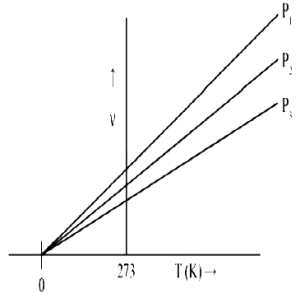
$A$ plot of volume $(V)$ of the gas versus temperature ($T$ in $K$) is shown below. Which of the following options is correct for the plot?
A
$P_1 < P_2 < P_3$
B
$P_3 < P_2 < P_1$
C
$P_1 = P_2 \neq P_3$
D
$P_1 = P_2 = P_3 = 0$ at $273 \ K$
Solution
(A) According to the ideal gas equation,$PV = nRT$,which can be rearranged as $V = (\frac{nR}{P})T$.
This equation represents a straight line passing through the origin $(V = mT)$,where the slope $(m)$ is equal to $\frac{nR}{P}$.
Since the slope is inversely proportional to pressure $(P)$,a line with a steeper slope corresponds to a lower pressure.
In the given plot,the slope of the line for $P_1$ is the highest,followed by $P_2$,and then $P_3$ (which has the lowest slope).
Therefore,the order of pressure is $P_3 > P_2 > P_1$,or $P_1 < P_2 < P_3$.
This equation represents a straight line passing through the origin $(V = mT)$,where the slope $(m)$ is equal to $\frac{nR}{P}$.
Since the slope is inversely proportional to pressure $(P)$,a line with a steeper slope corresponds to a lower pressure.
In the given plot,the slope of the line for $P_1$ is the highest,followed by $P_2$,and then $P_3$ (which has the lowest slope).
Therefore,the order of pressure is $P_3 > P_2 > P_1$,or $P_1 < P_2 < P_3$.
0 likesView Solution
106
ChemistryMediumMCQTS EAMCET · 2021
Which gas has a density of $1.24 \ g/L$ at $0^{\circ} C$ and $1 \ atm$ pressure?
A
$O_2$
B
$CH_4$
C
$CO$
D
$CO_2$
Solution
(C) The ideal gas equation is given by $PM = dRT$.
Here,$P = 1 \ atm$,$d = 1.24 \ g/L$,$R = 0.0821 \ L \ atm \ K^{-1} \ mol^{-1}$,and $T = 273 \ K$.
Rearranging the formula to solve for molar mass $(M)$:
$M = \frac{dRT}{P} = \frac{1.24 \times 0.0821 \times 273}{1} \approx 28 \ g/mol$.
The molar mass of $CO$ is $12 + 16 = 28 \ g/mol$.
Therefore,the gas is $CO$.
Here,$P = 1 \ atm$,$d = 1.24 \ g/L$,$R = 0.0821 \ L \ atm \ K^{-1} \ mol^{-1}$,and $T = 273 \ K$.
Rearranging the formula to solve for molar mass $(M)$:
$M = \frac{dRT}{P} = \frac{1.24 \times 0.0821 \times 273}{1} \approx 28 \ g/mol$.
The molar mass of $CO$ is $12 + 16 = 28 \ g/mol$.
Therefore,the gas is $CO$.
0 likesView Solution
107
ChemistryEasyMCQTS EAMCET · 2021
$A$ balloon filled with an air sample occupies $3 \,L$ volume at $35^{\circ} C$. On lowering the temperature to $T$, the volume decreases to $2.5 \,L$. The temperature $T$ is (in $^{\circ} C$)? [Assume $p$-constant]
A
$16$
B
$-16$
C
$24$
D
$-20$
Solution
(B) According to Charle's law, at constant pressure, $V \propto T$ or $\frac{V_1}{T_1} = \frac{V_2}{T_2}$.
Given: $V_1 = 3 \,L$, $T_1 = 35 + 273 = 308 \,K$.
$V_2 = 2.5 \,L$, $T_2 = T$.
Substituting the values: $\frac{3}{308} = \frac{2.5}{T_2}$.
$T_2 = \frac{2.5 \times 308}{3} = 256.67 \,K$.
Converting to Celsius: $T(^{\circ}C) = 256.67 - 273 = -16.33^{\circ} C$.
Rounding to the nearest option, $T \approx -16^{\circ} C$.
Given: $V_1 = 3 \,L$, $T_1 = 35 + 273 = 308 \,K$.
$V_2 = 2.5 \,L$, $T_2 = T$.
Substituting the values: $\frac{3}{308} = \frac{2.5}{T_2}$.
$T_2 = \frac{2.5 \times 308}{3} = 256.67 \,K$.
Converting to Celsius: $T(^{\circ}C) = 256.67 - 273 = -16.33^{\circ} C$.
Rounding to the nearest option, $T \approx -16^{\circ} C$.
0 likesView Solution
108
ChemistryDifficultMCQTS EAMCET · 2021
Two gases $A$ and $B$ are released from the two ends of a tunnel of length $100 \ m$. $A$ travels $40 \ m$ before meeting the gas $B$ in the tunnel. If the molecular weight of $B$ is $18$,what is the molecular weight of $A$ (in $.5$)?
A
$28$
B
$10$
C
$8$
D
$40$
Solution
(D) According to Graham's Law of Diffusion,the rate of diffusion is proportional to the distance traveled in the same time interval.
$\frac{r_A}{r_B} = \frac{d_A}{d_B} = \sqrt{\frac{M_B}{M_A}}$
Given: $d_A = 40 \ m$,$d_B = 100 - 40 = 60 \ m$,$M_B = 18$.
Substituting the values:
$\frac{40}{60} = \sqrt{\frac{18}{M_A}}$
$\frac{2}{3} = \sqrt{\frac{18}{M_A}}$
Squaring both sides:
$\frac{4}{9} = \frac{18}{M_A}$
$M_A = \frac{18 \times 9}{4} = 40.5 \ g/mol$.
Thus,the molecular weight of $A$ is $40.5 \ g/mol$.
$\frac{r_A}{r_B} = \frac{d_A}{d_B} = \sqrt{\frac{M_B}{M_A}}$
Given: $d_A = 40 \ m$,$d_B = 100 - 40 = 60 \ m$,$M_B = 18$.
Substituting the values:
$\frac{40}{60} = \sqrt{\frac{18}{M_A}}$
$\frac{2}{3} = \sqrt{\frac{18}{M_A}}$
Squaring both sides:
$\frac{4}{9} = \frac{18}{M_A}$
$M_A = \frac{18 \times 9}{4} = 40.5 \ g/mol$.
Thus,the molecular weight of $A$ is $40.5 \ g/mol$.
0 likesView Solution
109
ChemistryDifficultMCQTS EAMCET · 2021
The ratio of rates of diffusion of oxygen and an unknown gas is $1:4$. The unknown gas is
A
$SO_2$
B
$N_2$
C
$H_2$
D
$D_2$
Solution
(C) According to Graham's Law of diffusion,the rate of diffusion $(r)$ is inversely proportional to the square root of the molar mass $(M)$: $\frac{r_1}{r_2} = \sqrt{\frac{M_2}{M_1}}$.
Given: $\frac{r_{O_2}}{r_{gas}} = \frac{1}{4}$ and $M_{O_2} = 32 \ g/mol$.
Substituting the values in the formula:
$\frac{1}{4} = \sqrt{\frac{M_{gas}}{32}}$.
Squaring both sides:
$\frac{1}{16} = \frac{M_{gas}}{32}$.
Solving for $M_{gas}$:
$M_{gas} = \frac{32}{16} = 2 \ g/mol$.
The gas with a molar mass of $2 \ g/mol$ is Hydrogen $(H_2)$.
Given: $\frac{r_{O_2}}{r_{gas}} = \frac{1}{4}$ and $M_{O_2} = 32 \ g/mol$.
Substituting the values in the formula:
$\frac{1}{4} = \sqrt{\frac{M_{gas}}{32}}$.
Squaring both sides:
$\frac{1}{16} = \frac{M_{gas}}{32}$.
Solving for $M_{gas}$:
$M_{gas} = \frac{32}{16} = 2 \ g/mol$.
The gas with a molar mass of $2 \ g/mol$ is Hydrogen $(H_2)$.
0 likesView Solution
110
ChemistryMediumMCQTS EAMCET · 2021
$1 \ L$ each of gases $A$ and $B$ diffused through a membrane in $15$ and $30$ minutes,respectively,under identical conditions. What is the ratio of molecular weight of $A$ and $B$?
A
$1:4$
B
$2:1$
C
$4:1$
D
$1:2$
Solution
(A) According to Graham's Law of diffusion,the rate of diffusion $(r)$ is inversely proportional to the square root of the molar mass $(M)$: $r \propto \frac{1}{\sqrt{M}}$.
Since the volume $(V)$ is the same for both gases,the rate $r = \frac{V}{t}$.
Therefore,$\frac{r_A}{r_B} = \frac{t_B}{t_A} = \sqrt{\frac{M_B}{M_A}}$.
Given $t_A = 15 \ \text{min}$ and $t_B = 30 \ \text{min}$,we have $\frac{30}{15} = \sqrt{\frac{M_B}{M_A}}$.
$2 = \sqrt{\frac{M_B}{M_A}}$.
Squaring both sides,$4 = \frac{M_B}{M_A}$,which implies $\frac{M_A}{M_B} = \frac{1}{4}$.
Thus,the ratio of molecular weight of $A$ and $B$ is $1:4$.
Since the volume $(V)$ is the same for both gases,the rate $r = \frac{V}{t}$.
Therefore,$\frac{r_A}{r_B} = \frac{t_B}{t_A} = \sqrt{\frac{M_B}{M_A}}$.
Given $t_A = 15 \ \text{min}$ and $t_B = 30 \ \text{min}$,we have $\frac{30}{15} = \sqrt{\frac{M_B}{M_A}}$.
$2 = \sqrt{\frac{M_B}{M_A}}$.
Squaring both sides,$4 = \frac{M_B}{M_A}$,which implies $\frac{M_A}{M_B} = \frac{1}{4}$.
Thus,the ratio of molecular weight of $A$ and $B$ is $1:4$.
0 likesView Solution
111
ChemistryEasyMCQTS EAMCET · 2021
The most probable velocity of a gas at $7200 \ K$ is equal to the $RMS$ velocity of $He$ gas at $27^{\circ} C$. The gas is
A
$O_2$
B
$CO$
C
$N_2$
D
$SO_2$
Solution
(D) Temperature of helium $= 27^{\circ} C = 300 \ K$.
The root-mean-square velocity of helium is given by $\mu_{rms} = \sqrt{\frac{3RT}{M_{He}}} = \sqrt{\frac{3R \times 300}{4}}$.
The most probable speed of the unknown gas is $\mu_{mp} = \sqrt{\frac{2RT}{M}} = \sqrt{\frac{2R \times 7200}{M}}$.
Equating $\mu_{rms} = \mu_{mp}$:
$\sqrt{\frac{3R \times 300}{4}} = \sqrt{\frac{2R \times 7200}{M}}$.
Squaring both sides: $\frac{900R}{4} = \frac{14400R}{M}$.
$225 = \frac{14400}{M}$.
$M = \frac{14400}{225} = 64 \ g/mol$.
The molar mass of $SO_2$ is $32 + 2 \times 16 = 64 \ g/mol$.
Therefore,the gas is $SO_2$.
The root-mean-square velocity of helium is given by $\mu_{rms} = \sqrt{\frac{3RT}{M_{He}}} = \sqrt{\frac{3R \times 300}{4}}$.
The most probable speed of the unknown gas is $\mu_{mp} = \sqrt{\frac{2RT}{M}} = \sqrt{\frac{2R \times 7200}{M}}$.
Equating $\mu_{rms} = \mu_{mp}$:
$\sqrt{\frac{3R \times 300}{4}} = \sqrt{\frac{2R \times 7200}{M}}$.
Squaring both sides: $\frac{900R}{4} = \frac{14400R}{M}$.
$225 = \frac{14400}{M}$.
$M = \frac{14400}{225} = 64 \ g/mol$.
The molar mass of $SO_2$ is $32 + 2 \times 16 = 64 \ g/mol$.
Therefore,the gas is $SO_2$.
0 likesView Solution
112
ChemistryDifficultMCQTS EAMCET · 2021
How many times the volume of a diatomic gas should be increased reversibly and adiabatically in order to reduce its $RMS$ velocity to half of its initial value?
A
$4$
B
$8$
C
$16$
D
$32$
Solution
(D) The $RMS$ velocity of a gas is given by $v_{rms} = \sqrt{\frac{3RT}{M}}$.
Since $v_{rms} \propto \sqrt{T}$,reducing the $RMS$ velocity to half means the final temperature $T_f$ must be $\frac{1}{4}$ of the initial temperature $T_i$ $(T_f = \frac{T_i}{4})$.
For a reversible adiabatic process,$T_i V_i^{\gamma-1} = T_f V_f^{\gamma-1}$.
For a diatomic gas,$\gamma = \frac{7}{5}$,so $\gamma - 1 = \frac{2}{5}$.
Substituting the values: $T_i V_i^{2/5} = (\frac{T_i}{4}) V_f^{2/5}$.
This simplifies to $4 = (\frac{V_f}{V_i})^{2/5}$.
Raising both sides to the power of $\frac{5}{2}$: $4^{5/2} = \frac{V_f}{V_i}$.
$V_f / V_i = (2^2)^{5/2} = 2^5 = 32$.
Since $v_{rms} \propto \sqrt{T}$,reducing the $RMS$ velocity to half means the final temperature $T_f$ must be $\frac{1}{4}$ of the initial temperature $T_i$ $(T_f = \frac{T_i}{4})$.
For a reversible adiabatic process,$T_i V_i^{\gamma-1} = T_f V_f^{\gamma-1}$.
For a diatomic gas,$\gamma = \frac{7}{5}$,so $\gamma - 1 = \frac{2}{5}$.
Substituting the values: $T_i V_i^{2/5} = (\frac{T_i}{4}) V_f^{2/5}$.
This simplifies to $4 = (\frac{V_f}{V_i})^{2/5}$.
Raising both sides to the power of $\frac{5}{2}$: $4^{5/2} = \frac{V_f}{V_i}$.
$V_f / V_i = (2^2)^{5/2} = 2^5 = 32$.
0 likesView Solution
113
ChemistryEasyMCQTS EAMCET · 2021
At $300 \ K$ the average velocity of a gas is $3 \times 10^2 \ cm / s$. The average velocity (in $cm / s$) of it at $1200 \ K$ is
A
$6 \times 10^2$
B
$4 \times 10^2$
C
$8 \times 10^2$
D
$1 \times 10^3$
Solution
(A) The formula for average velocity is $\mu_{av} = \sqrt{\frac{8RT}{\pi M}}$.
Since $\mu_{av} \propto \sqrt{T}$,we have the ratio $\frac{\mu_{av_1}}{\mu_{av_2}} = \sqrt{\frac{T_1}{T_2}}$.
Given $T_1 = 300 \ K$,$T_2 = 1200 \ K$,and $\mu_{av_1} = 3 \times 10^2 \ cm / s$.
Substituting the values: $\frac{3 \times 10^2}{\mu_{av_2}} = \sqrt{\frac{300}{1200}} = \sqrt{\frac{1}{4}} = \frac{1}{2}$.
Therefore,$\mu_{av_2} = 2 \times 3 \times 10^2 = 6 \times 10^2 \ cm / s$.
Since $\mu_{av} \propto \sqrt{T}$,we have the ratio $\frac{\mu_{av_1}}{\mu_{av_2}} = \sqrt{\frac{T_1}{T_2}}$.
Given $T_1 = 300 \ K$,$T_2 = 1200 \ K$,and $\mu_{av_1} = 3 \times 10^2 \ cm / s$.
Substituting the values: $\frac{3 \times 10^2}{\mu_{av_2}} = \sqrt{\frac{300}{1200}} = \sqrt{\frac{1}{4}} = \frac{1}{2}$.
Therefore,$\mu_{av_2} = 2 \times 3 \times 10^2 = 6 \times 10^2 \ cm / s$.
0 likesView Solution
114
ChemistryEasyMCQTS EAMCET · 2021
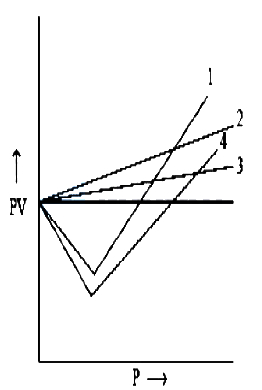
The figure represents $PV$ vs $P$ relation for $CO$,$CH_4$,$H_2$ and $He$ gases under identical conditions. Which curve,shown in the figure,represents $He$ gas?
A
$1$
B
$2$
C
$3$
D
$4$
Solution
(A) For real gases,the deviation from ideal behavior is described by the compressibility factor $Z = PV/nRT$.
For gases with weak intermolecular forces like $H_2$ and $He$,the repulsive forces dominate even at low pressures,causing $PV$ to increase continuously with pressure.
Among $H_2$ and $He$,$He$ has weaker intermolecular forces and a smaller molecular size,leading to a steeper slope in the $PV$ vs $P$ plot.
In the given graph,curves $1$ and $2$ show a continuous increase in $PV$ with $P$. Curve $1$ has a steeper slope than curve $2$.
Therefore,curve $1$ represents $He$ and curve $2$ represents $H_2$.
For gases with weak intermolecular forces like $H_2$ and $He$,the repulsive forces dominate even at low pressures,causing $PV$ to increase continuously with pressure.
Among $H_2$ and $He$,$He$ has weaker intermolecular forces and a smaller molecular size,leading to a steeper slope in the $PV$ vs $P$ plot.
In the given graph,curves $1$ and $2$ show a continuous increase in $PV$ with $P$. Curve $1$ has a steeper slope than curve $2$.
Therefore,curve $1$ represents $He$ and curve $2$ represents $H_2$.
0 likesView Solution
115
ChemistryEasyMCQTS EAMCET · 2021
Which of the following indicates a plot of compressibility factor $(Z)$ $vs$ $p$ at room temperature for helium?
A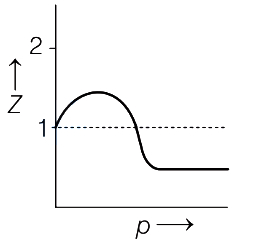
B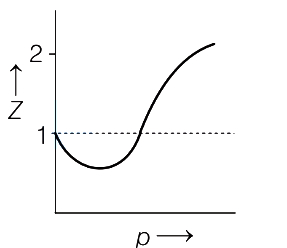
C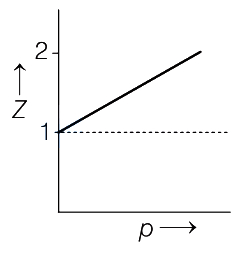
D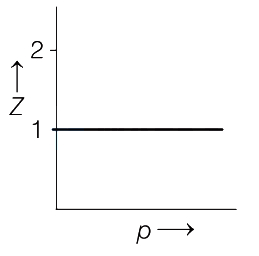
Solution
(C) The compressibility factor $Z$ is defined as $Z = \frac{pV}{nRT}$.
For real gases,$Z$ deviates from $1$.
Helium $(He)$ is a light,noble gas with very weak intermolecular forces of attraction. For such gases,the volume correction term $(nb)$ dominates over the attractive force term $(a/V^2)$ even at moderate pressures.
Therefore,for helium,$Z$ is always greater than $1$ $(Z > 1)$ and increases linearly with an increase in pressure $p$.
This corresponds to a graph that starts at $Z=1$ and shows a positive slope as $p$ increases.
For real gases,$Z$ deviates from $1$.
Helium $(He)$ is a light,noble gas with very weak intermolecular forces of attraction. For such gases,the volume correction term $(nb)$ dominates over the attractive force term $(a/V^2)$ even at moderate pressures.
Therefore,for helium,$Z$ is always greater than $1$ $(Z > 1)$ and increases linearly with an increase in pressure $p$.
This corresponds to a graph that starts at $Z=1$ and shows a positive slope as $p$ increases.
0 likesView Solution
116
ChemistryDifficultMCQTS EAMCET · 2021
The ratio of the viscosity (in centipoise) of $D_2O$ to that of $H_2O$ at $25^{\circ} C$ is
A
$1$
B
$1.1$
C
$1.24$
D
$0.9$
Solution
(C) Viscosity of $H_2O$ at $25^{\circ} C \approx 0.89 \ cP$ (or $0.00089 \ Pa \cdot s$).
Viscosity of $D_2O$ at $25^{\circ} C \approx 1.10 \ cP$.
$\text{Ratio} = \frac{\text{Viscosity of } D_2O}{\text{Viscosity of } H_2O} = \frac{1.10}{0.89} \approx 1.24$.
Thus,the correct option is $C$.
Viscosity of $D_2O$ at $25^{\circ} C \approx 1.10 \ cP$.
$\text{Ratio} = \frac{\text{Viscosity of } D_2O}{\text{Viscosity of } H_2O} = \frac{1.10}{0.89} \approx 1.24$.
Thus,the correct option is $C$.
0 likesView Solution
117
ChemistryEasyMCQTS EAMCET · 2021
Match the following:
| $A$. Chadwick | $1$. Cathode rays |
| $B$. Rutherford | $2$. $X$-ray spectra |
| $C$. Moseley | $3$. Discovery of neutrons |
| $D$. $J$. $J$. Thomson | $4$. Nuclear atom model |
A
$A-4, B-1, C-2, D-3$
B
$A-3, B-2, C-4, D-1$
C
$A-3, B-4, C-2, D-1$
D
$A-3, B-4, C-1, D-2$
Solution
(C) The correct matches are:
$A$. Chadwick discovered the neutron $(A-3)$.
$B$. Rutherford proposed the nuclear model of the atom $(B-4)$.
$C$. Moseley established the relationship between atomic number and $X$-ray spectra $(C-2)$.
$D$. $J$. $J$. Thomson performed the cathode ray experiment $(D-1)$.
Therefore,the correct sequence is $A-3, B-4, C-2, D-1$.
$A$. Chadwick discovered the neutron $(A-3)$.
$B$. Rutherford proposed the nuclear model of the atom $(B-4)$.
$C$. Moseley established the relationship between atomic number and $X$-ray spectra $(C-2)$.
$D$. $J$. $J$. Thomson performed the cathode ray experiment $(D-1)$.
Therefore,the correct sequence is $A-3, B-4, C-2, D-1$.
0 likesView Solution
118
ChemistryMediumMCQTS EAMCET · 2021
The sum of the total number of neutrons present in protium,deuterium,and tritium is:
A
$5$
B
$3$
C
$4$
D
$6$
Solution
(B) Protium,deuterium,and tritium are isotopes of hydrogen with the following notations:
Protium: $^1_1H$ (Number of neutrons $= 1 - 1 = 0$)
Deuterium: $^2_1H$ (Number of neutrons $= 2 - 1 = 1$)
Tritium: $^3_1H$ (Number of neutrons $= 3 - 1 = 2$)
The sum of the total number of neutrons $= 0 + 1 + 2 = 3$.
Protium: $^1_1H$ (Number of neutrons $= 1 - 1 = 0$)
Deuterium: $^2_1H$ (Number of neutrons $= 2 - 1 = 1$)
Tritium: $^3_1H$ (Number of neutrons $= 3 - 1 = 2$)
The sum of the total number of neutrons $= 0 + 1 + 2 = 3$.
0 likesView Solution
119
ChemistryDifficultMCQTS EAMCET · 2021
Based on the Bohr's theory of hydrogen atom,the speed of the electron,energy of the electron and the radius of its orbit varies with the principal quantum number $n$,respectively as:
A
$n : n^2 : n^2$
B
$\frac{1}{n} : \frac{1}{n} : n$
C
$\frac{1}{n} : \frac{1}{n^2} : n^2$
D
$\frac{1}{n} : \frac{1}{n^2} : n$
Solution
(C) According to Bohr's theory of hydrogen atom:
$(i)$ The speed of electron in the $n$th orbit is $v_n \propto \frac{1}{n}$.
$(ii)$ The energy of electron in the $n$th orbit is $E_n \propto -\frac{1}{n^2}$,so the magnitude varies as $\frac{1}{n^2}$.
$(iii)$ The radius of the electron in the $n$th orbit is $r_n \propto n^2$.
Therefore,the variation of speed,energy,and radius with $n$ is $\frac{1}{n} : \frac{1}{n^2} : n^2$.
$(i)$ The speed of electron in the $n$th orbit is $v_n \propto \frac{1}{n}$.
$(ii)$ The energy of electron in the $n$th orbit is $E_n \propto -\frac{1}{n^2}$,so the magnitude varies as $\frac{1}{n^2}$.
$(iii)$ The radius of the electron in the $n$th orbit is $r_n \propto n^2$.
Therefore,the variation of speed,energy,and radius with $n$ is $\frac{1}{n} : \frac{1}{n^2} : n^2$.
0 likesView Solution
120
ChemistryMediumMCQTS EAMCET · 2021
The energy (in $eV$) associated with the electron in the $1^{st}$ orbit of $Li^{2+}$ is
A
$-122.4$
B
$-61.15$
C
$-30.5$
D
$-244.6$
Solution
(A) The energy of an electron in a hydrogen-like species in the $n^{th}$ shell is given by the formula:
$E = -13.6 \times \frac{Z^2}{n^2} \ eV$
Where:
$Z = \text{atomic number of } Li = 3$
$n = \text{orbit number} = 1$
Substituting these values into the formula:
$E_1 = -13.6 \times \frac{3^2}{1^2} \ eV$
$E_1 = -13.6 \times 9 \ eV = -122.4 \ eV$
$E = -13.6 \times \frac{Z^2}{n^2} \ eV$
Where:
$Z = \text{atomic number of } Li = 3$
$n = \text{orbit number} = 1$
Substituting these values into the formula:
$E_1 = -13.6 \times \frac{3^2}{1^2} \ eV$
$E_1 = -13.6 \times 9 \ eV = -122.4 \ eV$
0 likesView Solution
121
ChemistryEasyMCQTS EAMCET · 2021
Which of the following relations is correct,if the wavelength $(\lambda)$ is equal to the distance travelled by the electron in one second? $h$ is the Planck's constant and $m$ is the mass of electron.
A
$\lambda = h / p$
B
$\lambda = h / m$
C
$\lambda = \sqrt{ h / p }$
D
$\lambda = \sqrt{ h / m }$
Solution
(D) According to the de-Broglie equation: $\lambda = \frac{h}{mv}$.
Given that the wavelength $(\lambda)$ is equal to the distance travelled by the electron in one second,we have $\lambda = v \times 1 = v$.
Substituting $\lambda = v$ into the de-Broglie equation: $v = \frac{h}{mv}$.
Rearranging the terms: $v^2 = \frac{h}{m}$,which gives $v = \sqrt{\frac{h}{m}}$.
Since $\lambda = v$,we get $\lambda = \sqrt{\frac{h}{m}}$.
Thus,the correct relation is $\lambda = \sqrt{\frac{h}{m}}$.
Given that the wavelength $(\lambda)$ is equal to the distance travelled by the electron in one second,we have $\lambda = v \times 1 = v$.
Substituting $\lambda = v$ into the de-Broglie equation: $v = \frac{h}{mv}$.
Rearranging the terms: $v^2 = \frac{h}{m}$,which gives $v = \sqrt{\frac{h}{m}}$.
Since $\lambda = v$,we get $\lambda = \sqrt{\frac{h}{m}}$.
Thus,the correct relation is $\lambda = \sqrt{\frac{h}{m}}$.
0 likesView Solution
122
ChemistryEasyMCQTS EAMCET · 2021
Heisenberg's uncertainty principle is in general significant to
A
planets
B
cricket ball of $500 \ g$
C
cars
D
micro particles having a very high speed
Solution
(D) According to the uncertainty principle,$\Delta p \cdot \Delta x \geq \frac{h}{4\pi}$.
It is impossible to measure simultaneously both the position and velocity (or momentum) of a microscopic particle with absolute accuracy or certainty.
This principle is only significant for microscopic objects because the value of $h$ is extremely small $(6.626 \times 10^{-34} \ J \cdot s)$.
For macroscopic objects,the mass is large enough that the uncertainty becomes negligible.
Hence,Heisenberg's uncertainty principle is in general significant to micro particles having a very high speed.
It is impossible to measure simultaneously both the position and velocity (or momentum) of a microscopic particle with absolute accuracy or certainty.
This principle is only significant for microscopic objects because the value of $h$ is extremely small $(6.626 \times 10^{-34} \ J \cdot s)$.
For macroscopic objects,the mass is large enough that the uncertainty becomes negligible.
Hence,Heisenberg's uncertainty principle is in general significant to micro particles having a very high speed.
0 likesView Solution
123
ChemistryMediumMCQTS EAMCET · 2021
$A$ microscope using appropriate photons is engaged to track an electron in an atom within a distance of $0.001 \ nm$. What will be the uncertainty involved in measuring its velocity?
A
$5.79 \times 10^7 \ m/s$
B
$5.79 \times 10^6 \ m/s$
C
$4.79 \times 10^7 \ m/s$
D
$3.7 \times 10^6 \ m/s$
Solution
(A) According to Heisenberg's Uncertainty Principle:
$\Delta x \cdot \Delta p \geq \frac{h}{4 \pi m}$
Given:
$\Delta x = 0.001 \ nm = 10^{-12} \ m$
$m = 9.11 \times 10^{-31} \ kg$
$h = 6.626 \times 10^{-34} \ J \cdot s$
Substituting the values:
$\Delta v \geq \frac{6.626 \times 10^{-34}}{4 \times 3.1416 \times 9.11 \times 10^{-31} \times 10^{-12}}$
$\Delta v \geq \frac{6.626 \times 10^{-34}}{1.144 \times 10^{-41}}$
$\Delta v \geq 5.79 \times 10^7 \ m/s$
$\Delta x \cdot \Delta p \geq \frac{h}{4 \pi m}$
Given:
$\Delta x = 0.001 \ nm = 10^{-12} \ m$
$m = 9.11 \times 10^{-31} \ kg$
$h = 6.626 \times 10^{-34} \ J \cdot s$
Substituting the values:
$\Delta v \geq \frac{6.626 \times 10^{-34}}{4 \times 3.1416 \times 9.11 \times 10^{-31} \times 10^{-12}}$
$\Delta v \geq \frac{6.626 \times 10^{-34}}{1.144 \times 10^{-41}}$
$\Delta v \geq 5.79 \times 10^7 \ m/s$
0 likesView Solution
124
ChemistryMediumMCQTS EAMCET · 2021
The relation between the stopping potential $(V_0)$ and frequency $(v)$ is correctly represented in $[\phi = \text{Work function}]$
A
$V_0 = \frac{\phi}{e} - \frac{hv^2}{e}$
B
$V_0 = \frac{he}{v} + \frac{\phi}{e}$
C
$V_0 = \frac{hv}{e} - \frac{\phi}{e}$
D
$V_0 = \frac{hv}{e^2}$
Solution
(C) According to Einstein's photoelectric equation,the maximum kinetic energy $(K.E._{\max})$ of an emitted photoelectron is given by:
$K.E._{\max} = hv - \phi$
where $h$ is Planck's constant,$v$ is the frequency of incident light,and $\phi$ is the work function of the metal.
Since the stopping potential $(V_0)$ is related to the maximum kinetic energy by the equation $K.E._{\max} = eV_0$,we can substitute this into the photoelectric equation:
$eV_0 = hv - \phi$
Dividing both sides by the charge of an electron $(e)$,we get:
$V_0 = \frac{hv}{e} - \frac{\phi}{e}$
This equation represents a linear relationship between the stopping potential $(V_0)$ and the frequency $(v)$.
$K.E._{\max} = hv - \phi$
where $h$ is Planck's constant,$v$ is the frequency of incident light,and $\phi$ is the work function of the metal.
Since the stopping potential $(V_0)$ is related to the maximum kinetic energy by the equation $K.E._{\max} = eV_0$,we can substitute this into the photoelectric equation:
$eV_0 = hv - \phi$
Dividing both sides by the charge of an electron $(e)$,we get:
$V_0 = \frac{hv}{e} - \frac{\phi}{e}$
This equation represents a linear relationship between the stopping potential $(V_0)$ and the frequency $(v)$.
0 likesView Solution
125
ChemistryMediumMCQTS EAMCET · 2021
The ratio of the highest to the lowest wavelength of Lyman series is
A
$4 : 3$
B
$9 : 8$
C
$27 : 5$
D
$16 : 5$
Solution
(A) For the Lyman series,the transition is from $n_2$ to $n_1 = 1$. The Rydberg formula is given by $\frac{1}{\lambda} = R_H \left( \frac{1}{n_1^2} - \frac{1}{n_2^2} \right)$.
For the longest wavelength (lowest energy),the transition is from $n_2 = 2$ to $n_1 = 1$: $\frac{1}{\lambda_{max}} = R_H \left( \frac{1}{1^2} - \frac{1}{2^2} \right) = R_H \left( 1 - \frac{1}{4} \right) = \frac{3}{4} R_H$,so $\lambda_{max} = \frac{4}{3 R_H}$.
For the shortest wavelength (highest energy),the transition is from $n_2 = \infty$ to $n_1 = 1$: $\frac{1}{\lambda_{min}} = R_H \left( \frac{1}{1^2} - \frac{1}{\infty^2} \right) = R_H (1 - 0) = R_H$,so $\lambda_{min} = \frac{1}{R_H}$.
The ratio of the highest wavelength to the lowest wavelength is $\frac{\lambda_{max}}{\lambda_{min}} = \frac{4 / (3 R_H)}{1 / R_H} = \frac{4}{3}$.
For the longest wavelength (lowest energy),the transition is from $n_2 = 2$ to $n_1 = 1$: $\frac{1}{\lambda_{max}} = R_H \left( \frac{1}{1^2} - \frac{1}{2^2} \right) = R_H \left( 1 - \frac{1}{4} \right) = \frac{3}{4} R_H$,so $\lambda_{max} = \frac{4}{3 R_H}$.
For the shortest wavelength (highest energy),the transition is from $n_2 = \infty$ to $n_1 = 1$: $\frac{1}{\lambda_{min}} = R_H \left( \frac{1}{1^2} - \frac{1}{\infty^2} \right) = R_H (1 - 0) = R_H$,so $\lambda_{min} = \frac{1}{R_H}$.
The ratio of the highest wavelength to the lowest wavelength is $\frac{\lambda_{max}}{\lambda_{min}} = \frac{4 / (3 R_H)}{1 / R_H} = \frac{4}{3}$.
0 likesView Solution
126
ChemistryMediumMCQTS EAMCET · 2021
For an electron in the $d$-orbital,the orbital angular momentum is
A
$\frac{h}{2 \pi}$
B
$\frac{\sqrt{2} h}{2 \pi}$
C
$\frac{\sqrt{6} h}{2 \pi}$
D
$\frac{\sqrt{6} h}{2 \pi}$
Solution
(D) The orbital angular momentum of an electron is given by the formula: $\sqrt{l(l+1)} \frac{h}{2 \pi}$.
For a $d$-orbital,the azimuthal quantum number $(l)$ is $2$.
Substituting the value of $l$ into the formula:
Orbital angular momentum $= \sqrt{2(2+1)} \frac{h}{2 \pi} = \sqrt{2(3)} \frac{h}{2 \pi} = \sqrt{6} \frac{h}{2 \pi}$.
Thus,the correct option is $D$.
For a $d$-orbital,the azimuthal quantum number $(l)$ is $2$.
Substituting the value of $l$ into the formula:
Orbital angular momentum $= \sqrt{2(2+1)} \frac{h}{2 \pi} = \sqrt{2(3)} \frac{h}{2 \pi} = \sqrt{6} \frac{h}{2 \pi}$.
Thus,the correct option is $D$.
0 likesView Solution
127
ChemistryEasyMCQTS EAMCET · 2021
The orbital with $4$ radial and $1$ angular nodes is
A
$5p_{y}$
B
$6p_{z}$
C
$4d_{xy}$
D
$5d_{yz}$
Solution
(B) The number of angular nodes is given by the azimuthal quantum number $l$. Here,angular nodes $= 1$,so $l = 1$,which corresponds to a $p$-subshell.
The number of radial nodes is given by the formula $n - l - 1$,where $n$ is the principal quantum number.
Given radial nodes $= 4$ and $l = 1$,we have $n - 1 - 1 = 4$,which gives $n = 6$.
Therefore,the orbital is $6p$ (e.g.,$6p_{z}$).
The number of radial nodes is given by the formula $n - l - 1$,where $n$ is the principal quantum number.
Given radial nodes $= 4$ and $l = 1$,we have $n - 1 - 1 = 4$,which gives $n = 6$.
Therefore,the orbital is $6p$ (e.g.,$6p_{z}$).
0 likesView Solution
128
ChemistryMediumMCQTS EAMCET · 2021
An orbital with one angular node shows three maxima in its radial probability distribution curve,the orbital is
A
$3s$
B
$4p$
C
$5d$
D
$3p$
Solution
(B) The number of angular nodes is given by the azimuthal quantum number,$l$. Given that the orbital has one angular node,$l = 1$,which corresponds to a $p$-orbital.
The number of maxima in the radial probability distribution curve is given by the formula $n - l$.
Given that the number of maxima is $3$,we have $n - l = 3$.
Substituting $l = 1$ into the equation: $n - 1 = 3$,which gives $n = 4$.
Therefore,the orbital is $4p$.
The number of maxima in the radial probability distribution curve is given by the formula $n - l$.
Given that the number of maxima is $3$,we have $n - l = 3$.
Substituting $l = 1$ into the equation: $n - 1 = 3$,which gives $n = 4$.
Therefore,the orbital is $4p$.
0 likesView Solution
129
ChemistryEasyMCQTS EAMCET · 2021
The number of radial nodes in $3s$ and $2p$-orbitals,respectively are
A
$2 : 2$
B
$2 : 0$
C
$0 : 0$
D
$3 : 2$
Solution
(B) The number of radial nodes is calculated using the formula: $\text{Radial nodes} = n - l - 1$.
For the $3s$ orbital,$n = 3$ and $l = 0$. Thus,$\text{Radial nodes} = 3 - 0 - 1 = 2$.
For the $2p$ orbital,$n = 2$ and $l = 1$. Thus,$\text{Radial nodes} = 2 - 1 - 1 = 0$.
Therefore,the number of radial nodes in $3s$ and $2p$ orbitals are $2$ and $0$ respectively.
For the $3s$ orbital,$n = 3$ and $l = 0$. Thus,$\text{Radial nodes} = 3 - 0 - 1 = 2$.
For the $2p$ orbital,$n = 2$ and $l = 1$. Thus,$\text{Radial nodes} = 2 - 1 - 1 = 0$.
Therefore,the number of radial nodes in $3s$ and $2p$ orbitals are $2$ and $0$ respectively.
0 likesView Solution
130
ChemistryMediumMCQTS EAMCET · 2021
Which of the following options represents the correct ionic radii in $\mathring{A}$ of $N^{3-}, O^{2-}$ and $F^{-}$,respectively?
A
$1.71, 1.36$ and $1.40$
B
$1.36, 1.40$ and $1.71$
C
$1.71, 1.40$ and $1.36$
D
$1.40, 1.36$ and $1.71$
Solution
(C) The species $N^{3-}, O^{2-}$,and $F^{-}$ are isoelectronic,meaning they all contain $10$ electrons.
For isoelectronic species,the ionic radius decreases as the nuclear charge (number of protons) increases.
$N^{3-}$ has $7$ protons,$O^{2-}$ has $8$ protons,and $F^{-}$ has $9$ protons.
Since the nuclear charge increases from $N^{3-}$ to $F^{-}$,the attraction between the nucleus and the electrons increases,leading to a decrease in ionic size.
Therefore,the correct order of ionic radii is $N^{3-} (1.71 \mathring{A}) > O^{2-} (1.40 \mathring{A}) > F^{-} (1.36 \mathring{A})$.
For isoelectronic species,the ionic radius decreases as the nuclear charge (number of protons) increases.
$N^{3-}$ has $7$ protons,$O^{2-}$ has $8$ protons,and $F^{-}$ has $9$ protons.
Since the nuclear charge increases from $N^{3-}$ to $F^{-}$,the attraction between the nucleus and the electrons increases,leading to a decrease in ionic size.
Therefore,the correct order of ionic radii is $N^{3-} (1.71 \mathring{A}) > O^{2-} (1.40 \mathring{A}) > F^{-} (1.36 \mathring{A})$.
0 likesView Solution
131
ChemistryEasyMCQTS EAMCET · 2021
Which of the following is not an intensive property?
A
Entropy
B
Melting point
C
Specific gravity
D
Refractive index
Solution
(A) An intensive property is a physical quantity whose value does not depend on the amount of the substance for which it is measured.
For example,the melting point of water is $0^{\circ} C$,whether you take $100 \ mL$ of water or $1 \ kg$ of water.
Other examples of intensive properties are specific gravity and refractive index.
Entropy is an extensive property,not an intensive property,because its value depends on the amount of substance present.
As the amount of substance increases,the entropy also increases.
For example,the melting point of water is $0^{\circ} C$,whether you take $100 \ mL$ of water or $1 \ kg$ of water.
Other examples of intensive properties are specific gravity and refractive index.
Entropy is an extensive property,not an intensive property,because its value depends on the amount of substance present.
As the amount of substance increases,the entropy also increases.
0 likesView Solution
132
ChemistryDifficultMCQTS EAMCET · 2021
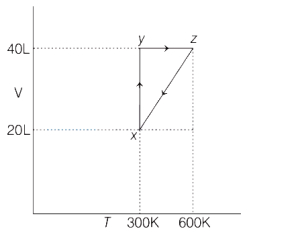
The following graph shows a system containing $1 \ mole$ of gas undergoing various steps. When it moves from $z$ to $x$,the type of process is:
A
cyclic
B
isothermal
C
isochoric
D
isobaric
Solution
(D) From the graph,at point $x$: $T_1 = 300 \ K, V_1 = 20 \ L$.
At point $z$: $T_2 = 600 \ K, V_2 = 40 \ L$.
According to the ideal gas law,$pV = nRT$,which implies $\frac{pV}{T} = nR$.
Since $n$ and $R$ are constants,$\frac{p_1V_1}{T_1} = \frac{p_2V_2}{T_2}$.
Substituting the values: $\frac{p_1 \times 20}{300} = \frac{p_2 \times 40}{600}$.
$\frac{p_1}{15} = \frac{p_2}{15}$,which gives $p_1 = p_2$.
Since the pressure remains constant during the process from $z$ to $x$,it is an isobaric process.
At point $z$: $T_2 = 600 \ K, V_2 = 40 \ L$.
According to the ideal gas law,$pV = nRT$,which implies $\frac{pV}{T} = nR$.
Since $n$ and $R$ are constants,$\frac{p_1V_1}{T_1} = \frac{p_2V_2}{T_2}$.
Substituting the values: $\frac{p_1 \times 20}{300} = \frac{p_2 \times 40}{600}$.
$\frac{p_1}{15} = \frac{p_2}{15}$,which gives $p_1 = p_2$.
Since the pressure remains constant during the process from $z$ to $x$,it is an isobaric process.
0 likesView Solution
133
ChemistryMediumMCQTS EAMCET · 2021
Enthalpy of hydrogenation of one mole of benzene to cyclohexane is
$[$Resonance energy of benzene $= -150.4 \ kJ / mol$.
Enthalpy of hydrogenation of cyclohexene $= -119.5 \ kJ / mol$ $]$
$[$Resonance energy of benzene $= -150.4 \ kJ / mol$.
Enthalpy of hydrogenation of cyclohexene $= -119.5 \ kJ / mol$ $]$
A
$-208.1 \ kJ / mol$
B
$-358.1 \ kJ / mol$
C
$+150.4 \ kJ / mol$
D
$-269.9 \ kJ / mol$
Solution
(A) The hydrogenation of one double bond in cyclohexene releases $-119.5 \ kJ / mol$ of energy.
Benzene contains three double bonds. The theoretical enthalpy of hydrogenation (assuming no resonance) is $3 \times (-119.5 \ kJ / mol) = -358.5 \ kJ / mol$.
The actual enthalpy of hydrogenation of benzene is the sum of the theoretical enthalpy of hydrogenation and the resonance energy of benzene.
Enthalpy of hydrogenation of benzene $= (-358.5 \ kJ / mol) + (-150.4 \ kJ / mol)$ is incorrect; rather,it is the difference between the theoretical value and the resonance energy stabilization.
Specifically,$\Delta H_{\text{hydrogenation}} = \Delta H_{\text{theoretical}} - \text{Resonance Energy}$.
$\Delta H_{\text{hydrogenation}} = -358.5 \ kJ / mol - (-150.4 \ kJ / mol) = -358.5 + 150.4 = -208.1 \ kJ / mol$.
Benzene contains three double bonds. The theoretical enthalpy of hydrogenation (assuming no resonance) is $3 \times (-119.5 \ kJ / mol) = -358.5 \ kJ / mol$.
The actual enthalpy of hydrogenation of benzene is the sum of the theoretical enthalpy of hydrogenation and the resonance energy of benzene.
Enthalpy of hydrogenation of benzene $= (-358.5 \ kJ / mol) + (-150.4 \ kJ / mol)$ is incorrect; rather,it is the difference between the theoretical value and the resonance energy stabilization.
Specifically,$\Delta H_{\text{hydrogenation}} = \Delta H_{\text{theoretical}} - \text{Resonance Energy}$.
$\Delta H_{\text{hydrogenation}} = -358.5 \ kJ / mol - (-150.4 \ kJ / mol) = -358.5 + 150.4 = -208.1 \ kJ / mol$.
0 likesView Solution
134
ChemistryEasyMCQTS EAMCET · 2021
Which of the following compounds has the highest standard molar entropy?
A
$SO_{2(g)}$
B
$SO_{3(g)}$
C
$CO_{2(g)}$
D
$CO_{(g)}$
Solution
(B) Standard molar entropy is a measure of the disorder or randomness of a substance at $1 \ bar$ pressure and a specified temperature.
For substances in the same physical state (gas),entropy generally increases with increasing molecular complexity and molecular mass.
Comparing the molar masses:
$CO_{(g)} = 28 \ g/mol$
$CO_{2(g)} = 44 \ g/mol$
$SO_{2(g)} = 64 \ g/mol$
$SO_{3(g)} = 80 \ g/mol$
Since $SO_{3(g)}$ has the highest molecular mass and the greatest number of atoms among the given options,it possesses the highest degree of vibrational and rotational complexity,leading to the highest standard molar entropy.
Therefore,the correct option is $B$.
For substances in the same physical state (gas),entropy generally increases with increasing molecular complexity and molecular mass.
Comparing the molar masses:
$CO_{(g)} = 28 \ g/mol$
$CO_{2(g)} = 44 \ g/mol$
$SO_{2(g)} = 64 \ g/mol$
$SO_{3(g)} = 80 \ g/mol$
Since $SO_{3(g)}$ has the highest molecular mass and the greatest number of atoms among the given options,it possesses the highest degree of vibrational and rotational complexity,leading to the highest standard molar entropy.
Therefore,the correct option is $B$.
0 likesView Solution
135
ChemistryEasyMCQTS EAMCET · 2021
Which of the following relations is correct?
A
$d G = V d p + S d T$
B
$d G = V d p - S d T$
C
$\Delta G = -R T \ln (K)$
D
$d U = p d V + T d S$
Solution
(B) The Gibbs function $G$ is defined as $G = H - T S$.
Taking the differential of both sides,we get $d G = d H - T d S - S d T$ $(i)$.
From the definition of enthalpy,$H = U + p V$,so $d H = d U + p d V + V d p$.
Substituting the first law of thermodynamics $d U = T d S - p d V$ into the expression for $d H$,we get $d H = (T d S - p d V) + p d V + V d p = T d S + V d p$.
Now,substitute $d H = T d S + V d p$ into equation $(i)$:
$d G = (T d S + V d p) - T d S - S d T$
$d G = V d p - S d T$.
Taking the differential of both sides,we get $d G = d H - T d S - S d T$ $(i)$.
From the definition of enthalpy,$H = U + p V$,so $d H = d U + p d V + V d p$.
Substituting the first law of thermodynamics $d U = T d S - p d V$ into the expression for $d H$,we get $d H = (T d S - p d V) + p d V + V d p = T d S + V d p$.
Now,substitute $d H = T d S + V d p$ into equation $(i)$:
$d G = (T d S + V d p) - T d S - S d T$
$d G = V d p - S d T$.
0 likesView Solution
136
ChemistryMediumMCQTS EAMCET · 2021
Based on the provided table,which of the following options correctly identifies the spontaneous reactions?
| $\Delta_r H^{\circ}$ | $\Delta_r S^{\circ}$ | $\Delta_r G^{\circ}$ | Spontaneity of the reaction | |
|---|---|---|---|---|
| $A$ | $+$ | $+$ | $+$ | Spontaneous at low $T$ |
| $B$ | $+$ | $+$ | $-$ | Spontaneous at high $T$ |
| $C$ | $-$ | $-$ | $-$ | Spontaneous at low $T$ |
| $D$ | $+$ | $-$ | $+$ | Spontaneous at high $T$ |
A
$A, B$ and $C$
B
$B$ only
C
$B$ and $C$
D
$C$ and $D$
Solution
(C) For a reaction to be spontaneous,the Gibbs free energy change must be negative,i.e.,$\Delta_r G^{\circ} < 0$.
The relationship is given by: $\Delta_r G^{\circ} = \Delta_r H^{\circ} - T \Delta_r S^{\circ}$.
Analyzing the table:
$1$. For row $B$: $\Delta_r H^{\circ} = (+)$,$\Delta_r S^{\circ} = (+)$. $\Delta_r G^{\circ}$ is negative when $T \Delta_r S^{\circ} > \Delta_r H^{\circ}$,which occurs at high temperatures. Thus,$B$ is correct.
$2$. For row $C$: $\Delta_r H^{\circ} = (-)$,$\Delta_r S^{\circ} = (-)$. $\Delta_r G^{\circ}$ is negative when $|\Delta_r H^{\circ}| > |T \Delta_r S^{\circ}|$,which occurs at low temperatures. Thus,$C$ is correct.
Rows $A$ and $D$ show positive $\Delta_r G^{\circ}$ values,which correspond to non-spontaneous processes under the conditions listed.
Therefore,options $B$ and $C$ are correct.
The relationship is given by: $\Delta_r G^{\circ} = \Delta_r H^{\circ} - T \Delta_r S^{\circ}$.
Analyzing the table:
$1$. For row $B$: $\Delta_r H^{\circ} = (+)$,$\Delta_r S^{\circ} = (+)$. $\Delta_r G^{\circ}$ is negative when $T \Delta_r S^{\circ} > \Delta_r H^{\circ}$,which occurs at high temperatures. Thus,$B$ is correct.
$2$. For row $C$: $\Delta_r H^{\circ} = (-)$,$\Delta_r S^{\circ} = (-)$. $\Delta_r G^{\circ}$ is negative when $|\Delta_r H^{\circ}| > |T \Delta_r S^{\circ}|$,which occurs at low temperatures. Thus,$C$ is correct.
Rows $A$ and $D$ show positive $\Delta_r G^{\circ}$ values,which correspond to non-spontaneous processes under the conditions listed.
Therefore,options $B$ and $C$ are correct.
0 likesView Solution
137
ChemistryEasyMCQTS EAMCET · 2021
Which of the following statements about white phosphorus is false?
A
It is highly soluble in carbon disulphide.
B
The angle $\angle PPP$ in $P_4$ molecules is $60^{\circ}$.
C
White $P_4$ molecules contain four $P-P$ covalent bonds.
D
White phosphorus is the most reactive allotrope of phosphorus.
Solution
(C) The incorrect statement is that white phosphorus $(P_4)$ molecules contain four $P-P$ covalent bonds. In a white phosphorus molecule,there are four lone pairs of electrons on the phosphorus atoms and six $P-P$ covalent bonds. The structure of white phosphorus $(P_4)$ is a tetrahedron where each phosphorus atom is bonded to three other phosphorus atoms,resulting in a total of six $P-P$ bonds.
0 likesView Solution
138
ChemistryMediumMCQTS EAMCET · 2021
Assertion $A$: $SF_6$ is highly stable.
Reason $R$: $SF_6$ is a gas.
The correct option among the following is:
Reason $R$: $SF_6$ is a gas.
The correct option among the following is:
A
$A$ is true,$R$ is true and $R$ is the correct explanation for $A$
B
$A$ is true,$R$ is true but $R$ is not the correct explanation for $A$
C
$A$ is true but $R$ is false
D
$A$ is false but $R$ is true
Solution
(B) $SF_6$ is an octahedral molecule where the sulfur atom is sterically protected by six fluorine atoms,making it chemically inert and highly stable.
$SF_6$ is indeed a gas at room temperature.
While both statements are factually correct,the fact that it is a gas is not the reason for its chemical stability.
Therefore,$A$ is true,$R$ is true,but $R$ is not the correct explanation for $A$.
$SF_6$ is indeed a gas at room temperature.
While both statements are factually correct,the fact that it is a gas is not the reason for its chemical stability.
Therefore,$A$ is true,$R$ is true,but $R$ is not the correct explanation for $A$.
0 likesView Solution
139
ChemistryMediumMCQTS EAMCET · 2021
Sulphur dioxide reacts with chlorine in the presence of charcoal to give
A
$H_2SO_3$
B
$SOCl_2$
C
$SO_2Cl_2$
D
$H_2SO_4$
Solution
(C) Sulphur dioxide reacts with chlorine in the presence of charcoal to give $SO_2Cl_2$,which is known as sulphuryl chloride.
The chemical reaction is as follows:
$SO_2 + Cl_2 \xrightarrow{\text{charcoal}} SO_2Cl_2$
The chemical reaction is as follows:
$SO_2 + Cl_2 \xrightarrow{\text{charcoal}} SO_2Cl_2$
0 likesView Solution
140
ChemistryEasyMCQTS EAMCET · 2021
The commercial name of peroxydisulphuric acid is:
A
Marshall’s acid
B
Caro’s acid
C
Oleum
D
Fuming sulphuric acid
Solution
(A) Peroxydisulphuric acid $(H_2S_2O_8)$ is an inorganic compound.
It is commonly known as Marshall's acid,named after its inventor,Hugh Marshall.
It contains a peroxide linkage $(-O-O-)$ between two sulphur atoms.
It is commonly known as Marshall's acid,named after its inventor,Hugh Marshall.
It contains a peroxide linkage $(-O-O-)$ between two sulphur atoms.
0 likesView Solution
141
ChemistryEasyMCQTS EAMCET · 2021
Sulphur on boiling with $NaOH$ solution forms
A
$Na_2S_2O_3 + Na_2S$
B
$Na_2SO_3 + SO_2$
C
$Na_2S_2O_3 + NaHSO_3$
D
$Na_2SO_3 + H_2S$
Solution
(A) When sulphur is boiled with $NaOH$ solution,it undergoes a disproportionation reaction to form sodium thiosulphate and sodium sulphide.
$4S + 6NaOH \longrightarrow Na_2S_2O_3 + 2Na_2S + 3H_2O$
$4S + 6NaOH \longrightarrow Na_2S_2O_3 + 2Na_2S + 3H_2O$
0 likesView Solution
142
ChemistryEasyMCQTS EAMCET · 2021
Assertion $(A):$ $VF_5$ is stable while $VCl_5$ is not.
Reason $(R):$ Fluorine stabilizes the higher oxidation state due to its higher bond enthalpy.
The correct option among the following is
Reason $(R):$ Fluorine stabilizes the higher oxidation state due to its higher bond enthalpy.
The correct option among the following is
A
$A$ is true,$R$ is true and $R$ is the correct explanation for $A$
B
$A$ is true,$R$ is true but $R$ is not the correct explanation for $A$
C
$A$ is true but $R$ is false
D
$A$ is false but $R$ is true
Solution
(A) Fluorine is a small and highly electronegative atom,which allows it to stabilize higher oxidation states of transition metals effectively.
$VF_5$ is stable because the small size of fluorine atoms allows five of them to be accommodated around the vanadium atom without significant steric hindrance.
In contrast,$VCl_5$ is unstable because the larger size of chlorine atoms leads to significant steric hindrance,making it difficult for five chlorine atoms to bond with the central vanadium atom.
Additionally,the $V-F$ bond has a higher bond enthalpy compared to the $V-Cl$ bond,contributing to the stability of $VF_5$.
Therefore,both the assertion and the reason are true,and the reason is the correct explanation for the assertion.
$VF_5$ is stable because the small size of fluorine atoms allows five of them to be accommodated around the vanadium atom without significant steric hindrance.
In contrast,$VCl_5$ is unstable because the larger size of chlorine atoms leads to significant steric hindrance,making it difficult for five chlorine atoms to bond with the central vanadium atom.
Additionally,the $V-F$ bond has a higher bond enthalpy compared to the $V-Cl$ bond,contributing to the stability of $VF_5$.
Therefore,both the assertion and the reason are true,and the reason is the correct explanation for the assertion.
0 likesView Solution
143
ChemistryMediumMCQTS EAMCET · 2021
Assertion $(A)$: The bond dissociation energy increases from $F_2$ to $Cl_2$ and then decreases to $I_2$.
Reason $(R)$: The low bond energy of fluorine is due to the repulsion between the lone pairs of electrons in two fluorine atoms.
The correct option among the following is
Reason $(R)$: The low bond energy of fluorine is due to the repulsion between the lone pairs of electrons in two fluorine atoms.
The correct option among the following is
A
$(A)$ is true,$(R)$ is true and $(R)$ is the correct explanation for $(A)$
B
$(A)$ is true,$(R)$ is true but $(R)$ is not the correct explanation for $(A)$
C
$(A)$ is true but $(R)$ is false
D
$(A)$ is false but $(R)$ is true
Solution
(A) The bond dissociation energy of the $F_2$ molecule is unexpectedly lower than that of the $Cl_2$ molecule.
This is because the fluorine atom has a very small size,which causes significant inter-electronic repulsion between the lone pairs of electrons on the two fluorine atoms.
This repulsion weakens the $F-F$ bond,making it easier to break.
In contrast,chlorine has a larger atomic size,providing more space for the lone pairs,which reduces the repulsion and results in a stronger bond.
Therefore,both the assertion and the reason are true,and the reason correctly explains the assertion.
This is because the fluorine atom has a very small size,which causes significant inter-electronic repulsion between the lone pairs of electrons on the two fluorine atoms.
This repulsion weakens the $F-F$ bond,making it easier to break.
In contrast,chlorine has a larger atomic size,providing more space for the lone pairs,which reduces the repulsion and results in a stronger bond.
Therefore,both the assertion and the reason are true,and the reason correctly explains the assertion.
0 likesView Solution
144
ChemistryMediumMCQTS EAMCET · 2021
Complete hydrolysis of $XeF_4$ and $XeF_6$ gives its oxides $P$ and $Q$,respectively. Identify $P$ and $Q$.
A
| $P$ | $Q$ |
| $XeO_2$ | $XeO_3$ |
B
| $P$ | $Q$ |
| $XeO$ | $XeO_2$ |
C
| $P$ | $Q$ |
| $XeO_3$ | $XeO_3$ |
D
| $P$ | $Q$ |
| $XeO_2$ | $XeO_2$ |
Solution
(C) The complete hydrolysis of $XeF_4$ is given by the reaction: $6XeF_4 + 12H_2O \rightarrow 2XeO_3 + 4Xe + 24HF + 3O_2$. Thus,$P$ is $XeO_3$.
The complete hydrolysis of $XeF_6$ is given by the reaction: $XeF_6 + 3H_2O \rightarrow XeO_3 + 6HF$. Thus,$Q$ is $XeO_3$.
Therefore,both $P$ and $Q$ are $XeO_3$.
The complete hydrolysis of $XeF_6$ is given by the reaction: $XeF_6 + 3H_2O \rightarrow XeO_3 + 6HF$. Thus,$Q$ is $XeO_3$.
Therefore,both $P$ and $Q$ are $XeO_3$.
0 likesView Solution
145
ChemistryMediumMCQTS EAMCET · 2021
Which of the following is correct for the crystal lattices mentioned below?
A
Nearest neighbour distance in $NaCl = \frac{a}{\sqrt{2}}$
B
Total volume of a unit cell in $CCP = (r \sqrt{2})^3$
C
Packing fraction of $BCC$ is more than that of a $FCC$ unit cell
D
Nearest neighbour distance in $CsCl = a \frac{\sqrt{3}}{2}$
Solution
(D) $ (a) $ $NaCl$ has an $fcc$ structure where the nearest neighbour distance is $\frac{a}{2}$. Thus,option $(a)$ is incorrect.
$(b)$ In a $ccp$ unit cell,the edge length $a = 2 \sqrt{2} r$. Therefore,the volume $a^3 = (2 \sqrt{2} r)^3$. Thus,option $(b)$ is incorrect.
$(c)$ The packing fraction of a $bcc$ unit cell is $68 \%$,while that of an $fcc$ unit cell is $74 \%$. Thus,$fcc$ is more efficient than $bcc$. Option $(c)$ is incorrect.
$(d)$ $CsCl$ crystallizes in a $bcc$ type structure. In a $bcc$ lattice,the nearest neighbour distance is $\frac{a \sqrt{3}}{2}$. Thus,option $(d)$ is correct.
$(b)$ In a $ccp$ unit cell,the edge length $a = 2 \sqrt{2} r$. Therefore,the volume $a^3 = (2 \sqrt{2} r)^3$. Thus,option $(b)$ is incorrect.
$(c)$ The packing fraction of a $bcc$ unit cell is $68 \%$,while that of an $fcc$ unit cell is $74 \%$. Thus,$fcc$ is more efficient than $bcc$. Option $(c)$ is incorrect.
$(d)$ $CsCl$ crystallizes in a $bcc$ type structure. In a $bcc$ lattice,the nearest neighbour distance is $\frac{a \sqrt{3}}{2}$. Thus,option $(d)$ is correct.
0 likesView Solution
146
ChemistryMediumMCQTS EAMCET · 2021
$A$ compound made up of elements $A$ and $B$ (with a general formula $A_x B_y$),where $B$ forms an $hcp$ lattice and $A$ occupies $2/3$ of the tetrahedral voids. The formula of the compound is
A
$A_2 B_3$
B
$A_3 B_4$
C
$A_4 B_3$
D
$A_3 B_2$
Solution
(C) In an $hcp$ lattice,the number of atoms per unit cell is $6$.
The number of tetrahedral voids is twice the number of atoms,which is $2 \times 6 = 12$.
Given that $A$ occupies $2/3$ of the tetrahedral voids,the number of atoms of $A = \frac{2}{3} \times 12 = 8$.
The ratio of atoms $A : B = 8 : 6 = 4 : 3$.
Therefore,the formula of the compound is $A_4 B_3$.
The number of tetrahedral voids is twice the number of atoms,which is $2 \times 6 = 12$.
Given that $A$ occupies $2/3$ of the tetrahedral voids,the number of atoms of $A = \frac{2}{3} \times 12 = 8$.
The ratio of atoms $A : B = 8 : 6 = 4 : 3$.
Therefore,the formula of the compound is $A_4 B_3$.
0 likesView Solution
147
ChemistryMediumMCQTS EAMCET · 2021
The fraction of the total volume occupied by the atoms in a simple cubic unit cell is
A
$\frac{\pi}{2}$
B
$\frac{\pi}{4}$
C
$\frac{\pi}{6}$
D
$\frac{\pi}{8}$
Solution
(C) In a simple cubic structure,atoms are present only at the corners. The effective number of atoms per unit cell is $Z = 1$.
Volume of one atom $= \frac{4}{3} \pi r^3$,where $r$ is the radius of the atom.
Volume of the unit cell $= a^3$,where $a$ is the edge length.
In a simple cubic unit cell,the atoms touch along the edge,so $a = 2r$.
Packing fraction $= \frac{Z \times \text{Volume of one atom}}{\text{Volume of unit cell}} = \frac{1 \times \frac{4}{3} \pi r^3}{(2r)^3} = \frac{4 \pi r^3}{3 \times 8 r^3} = \frac{\pi}{6}$.
Volume of one atom $= \frac{4}{3} \pi r^3$,where $r$ is the radius of the atom.
Volume of the unit cell $= a^3$,where $a$ is the edge length.
In a simple cubic unit cell,the atoms touch along the edge,so $a = 2r$.
Packing fraction $= \frac{Z \times \text{Volume of one atom}}{\text{Volume of unit cell}} = \frac{1 \times \frac{4}{3} \pi r^3}{(2r)^3} = \frac{4 \pi r^3}{3 \times 8 r^3} = \frac{\pi}{6}$.
0 likesView Solution
148
ChemistryMediumMCQTS EAMCET · 2021
The total number of voids (octahedral + tetrahedral) in $1$ mole of a compound forming a hexagonal close-packed $(HCP)$ structure is:
A
$1.8 \times 10^{24}$
B
$3.6 \times 10^{24}$
C
$6.0 \times 10^{23}$
D
$7.2 \times 10^{24}$
Solution
(A) In a hexagonal close-packed $(HCP)$ structure,the number of atoms per unit cell $(N)$ is $6$.
For $1$ mole of the compound,the number of atoms is $N_A = 6.022 \times 10^{23}$.
In any close-packed structure,the number of octahedral voids is equal to the number of atoms $(N)$,and the number of tetrahedral voids is equal to $2N$.
Total number of voids = (Number of octahedral voids) + (Number of tetrahedral voids) = $N + 2N = 3N$.
For $1$ mole,total voids = $3 \times N_A = 3 \times 6.022 \times 10^{23} = 1.8066 \times 10^{24}$.
Rounding to two significant figures,we get $1.8 \times 10^{24}$.
For $1$ mole of the compound,the number of atoms is $N_A = 6.022 \times 10^{23}$.
In any close-packed structure,the number of octahedral voids is equal to the number of atoms $(N)$,and the number of tetrahedral voids is equal to $2N$.
Total number of voids = (Number of octahedral voids) + (Number of tetrahedral voids) = $N + 2N = 3N$.
For $1$ mole,total voids = $3 \times N_A = 3 \times 6.022 \times 10^{23} = 1.8066 \times 10^{24}$.
Rounding to two significant figures,we get $1.8 \times 10^{24}$.
0 likesView Solution
149
ChemistryMediumMCQTS EAMCET · 2021
An alloy made up of $A$ and $B$ metals crystallises in a cubic lattice,where $B$ atoms occupy the corners and $A$ atoms occupy the face centers. The formula of the alloy formed is
A
$AB_3$
B
$A_3B$
C
$A_2B_3$
D
$A_3B_2$
Solution
(B) In a cubic lattice:
$B$ atoms occupy the corners. The number of corners in a cube is $8$,and the contribution of each atom at the corner is $1/8$.
Number of $B$ atoms $= 8 \times (1/8) = 1$.
$A$ atoms occupy the face centers. The number of faces in a cube is $6$,and the contribution of each atom at the face center is $1/2$.
Number of $A$ atoms $= 6 \times (1/2) = 3$.
Therefore,the ratio of $A:B$ is $3:1$,and the formula of the alloy is $A_3B$.
$B$ atoms occupy the corners. The number of corners in a cube is $8$,and the contribution of each atom at the corner is $1/8$.
Number of $B$ atoms $= 8 \times (1/8) = 1$.
$A$ atoms occupy the face centers. The number of faces in a cube is $6$,and the contribution of each atom at the face center is $1/2$.
Number of $A$ atoms $= 6 \times (1/2) = 3$.
Therefore,the ratio of $A:B$ is $3:1$,and the formula of the alloy is $A_3B$.
0 likesView Solution
150
ChemistryDifficultMCQTS EAMCET · 2021
Potassium crystallizes in an $FCC$ lattice with a unit cell edge length of $0.5 \ nm$. The approximate density (in $g \ cm^{-3}$),if it contains $0.1 \%$ Schottky defects,is:
A
$1.2$
B
$2.1$
C
$1.7$
D
$2.8$
Solution
(B) In a Schottky defect,an equal number of cations and anions are missing from the lattice,which reduces the effective number of atoms per unit cell $(Z_{eff})$.
For an $FCC$ lattice,the number of atoms per unit cell is $Z = 4$.
With $0.1 \%$ Schottky defects,the new effective number of atoms is $Z_{new} = 4 - (4 \times 0.001) = 3.996 \approx 4$.
However,using the provided calculation logic: $Z_{new} = 4 - 0.004 = 3.996$.
Given the atomic mass of Potassium $(K)$ is $39 \ g \ mol^{-1}$.
The edge length $a = 0.5 \ nm = 5 \times 10^{-8} \ cm$.
The density formula is $\rho = \frac{Z \times M}{N_A \times a^3}$.
$\rho = \frac{3.996 \times 39}{6.022 \times 10^{23} \times (5 \times 10^{-8})^3} = \frac{155.844}{6.022 \times 10^{23} \times 125 \times 10^{-24}} = \frac{155.844}{75.275} \approx 2.07 \ g \ cm^{-3}$.
Rounding to the nearest value,we get $2.1 \ g \ cm^{-3}$.
Thus,Option $B$ is correct.
For an $FCC$ lattice,the number of atoms per unit cell is $Z = 4$.
With $0.1 \%$ Schottky defects,the new effective number of atoms is $Z_{new} = 4 - (4 \times 0.001) = 3.996 \approx 4$.
However,using the provided calculation logic: $Z_{new} = 4 - 0.004 = 3.996$.
Given the atomic mass of Potassium $(K)$ is $39 \ g \ mol^{-1}$.
The edge length $a = 0.5 \ nm = 5 \times 10^{-8} \ cm$.
The density formula is $\rho = \frac{Z \times M}{N_A \times a^3}$.
$\rho = \frac{3.996 \times 39}{6.022 \times 10^{23} \times (5 \times 10^{-8})^3} = \frac{155.844}{6.022 \times 10^{23} \times 125 \times 10^{-24}} = \frac{155.844}{75.275} \approx 2.07 \ g \ cm^{-3}$.
Rounding to the nearest value,we get $2.1 \ g \ cm^{-3}$.
Thus,Option $B$ is correct.
0 likesView Solution
151
ChemistryMediumMCQTS EAMCET · 2021
If the density of a $2 \ M$ solution of ethylene glycol in water is $1.11 \ g/mL$, the molality (in $m$) of the solution is approximately
A
$1.92$
B
$1.57$
C
$2.02$
D
$2.15$
Solution
(C) Density of solution $= 1.11 \ g \ mL^{-1}$.
Molarity of solution $= 2 \ M$, which means $2 \ \text{moles}$ of solute are present in $1000 \ mL$ of solution.
Mass of solution $= \text{density} \times \text{volume} = 1.11 \ g/mL \times 1000 \ mL = 1110 \ g$.
Molar mass of ethylene glycol $(C_2H_6O_2) = 62 \ g/mol$.
Mass of solute $= \text{moles} \times \text{molar mass} = 2 \ mol \times 62 \ g/mol = 124 \ g$.
Mass of solvent $= \text{Mass of solution} - \text{Mass of solute} = 1110 \ g - 124 \ g = 986 \ g$.
Molality $(m) = \frac{\text{moles of solute}}{\text{mass of solvent in } kg} = \frac{2 \ mol}{0.986 \ kg} \approx 2.02 \ m$.
Molarity of solution $= 2 \ M$, which means $2 \ \text{moles}$ of solute are present in $1000 \ mL$ of solution.
Mass of solution $= \text{density} \times \text{volume} = 1.11 \ g/mL \times 1000 \ mL = 1110 \ g$.
Molar mass of ethylene glycol $(C_2H_6O_2) = 62 \ g/mol$.
Mass of solute $= \text{moles} \times \text{molar mass} = 2 \ mol \times 62 \ g/mol = 124 \ g$.
Mass of solvent $= \text{Mass of solution} - \text{Mass of solute} = 1110 \ g - 124 \ g = 986 \ g$.
Molality $(m) = \frac{\text{moles of solute}}{\text{mass of solvent in } kg} = \frac{2 \ mol}{0.986 \ kg} \approx 2.02 \ m$.
0 likesView Solution
152
ChemistryMediumMCQTS EAMCET · 2021
Given:
Solution $A$: Phenol and aniline
Solution $B$: Chloroform and acetone
Which of the following is correct as per Raoult's law?
Solution $A$: Phenol and aniline
Solution $B$: Chloroform and acetone
Which of the following is correct as per Raoult's law?
A
Solution $A$ shows $-ve$ and $B$ shows $+ve$ deviation
B
Both solutions $A$ and $B$ show $-ve$ deviation
C
Solution $A$ shows $+ve$ and $B$ shows $-ve$ deviation
D
Both solutions show $+ve$ deviation
Solution
(B) Solution $A$ (Phenol and aniline) shows negative deviation from Raoult's law because the intermolecular hydrogen bonding between phenol and aniline molecules is stronger than the individual $A-A$ and $B-B$ interactions.
Solution $B$ (Chloroform and acetone) also shows negative deviation because the formation of hydrogen bonding between the chloroform $(CHCl_3)$ and acetone $(CH_3COCH_3)$ molecules makes the $A-B$ interaction stronger than the $A-A$ and $B-B$ interactions.
Therefore,both solutions $A$ and $B$ show $-ve$ deviation.
Solution $B$ (Chloroform and acetone) also shows negative deviation because the formation of hydrogen bonding between the chloroform $(CHCl_3)$ and acetone $(CH_3COCH_3)$ molecules makes the $A-B$ interaction stronger than the $A-A$ and $B-B$ interactions.
Therefore,both solutions $A$ and $B$ show $-ve$ deviation.
0 likesView Solution
153
ChemistryEasyMCQTS EAMCET · 2021
Which of the following mixtures forms an ideal solution?
A
$CCl_4 + C_7H_8$
B
$CHCl_3 + C_6H_6$
C
$H_2O + CH_3OH$
D
$n-C_6H_{14} + n-C_7H_{16}$
Solution
(D) An ideal solution obeys Raoult's law at all temperatures and pressures.
In an ideal solution,the solute-solute and solvent-solvent interactions are similar to the solute-solvent interactions.
There is no change in enthalpy $( \Delta H_{mix} = 0 )$ and no change in volume $( \Delta V_{mix} = 0 )$ upon mixing.
$H_2O + CH_3OH$ shows positive deviation from Raoult's law.
$CHCl_3 + C_6H_6$ shows negative deviation from Raoult's law.
$CCl_4 + C_7H_8$ is also non-ideal.
$n-C_6H_{14} + n-C_7H_{16}$ (n-hexane and n-heptane) form an ideal solution because they have similar molecular structures and polarities.
In an ideal solution,the solute-solute and solvent-solvent interactions are similar to the solute-solvent interactions.
There is no change in enthalpy $( \Delta H_{mix} = 0 )$ and no change in volume $( \Delta V_{mix} = 0 )$ upon mixing.
$H_2O + CH_3OH$ shows positive deviation from Raoult's law.
$CHCl_3 + C_6H_6$ shows negative deviation from Raoult's law.
$CCl_4 + C_7H_8$ is also non-ideal.
$n-C_6H_{14} + n-C_7H_{16}$ (n-hexane and n-heptane) form an ideal solution because they have similar molecular structures and polarities.
0 likesView Solution
154
ChemistryDifficultMCQTS EAMCET · 2021
Match the following.
The correct match is
| $A$. Ebullioscopic constant | $I$. Depression of freezing point |
| $B$. Cryoscopic constant | $II$. Total pressure is the sum of partial pressures of the components |
| $C$. Henry's law | $III$. Elevation of boiling point |
| $D$. Dalton's law | $IV$. Solubility of a gas in liquid |
The correct match is
A
$A-III, B-I, C-II, D-IV$
B
$A-I, B-III, C-II, D-IV$
C
$A-III, B-I, C-IV, D-II$
D
$A-I, B-III, C-IV, D-II$
Solution
(C) Ebullioscopic constant $(K_b)$ is associated with the elevation of boiling point: $\Delta T_b = i \times K_b \times m$.
Cryoscopic constant $(K_f)$ is associated with the depression of freezing point: $\Delta T_f = i \times K_f \times m$.
Henry's law is associated with the solubility of a gas in a liquid: $P_{gas} = K_H \cdot X_{gas}$.
Dalton's law states that the total pressure is the sum of the partial pressures of the components: $P_{\text{total}} = P_1 + P_2 + P_3 + \ldots$
Therefore,the correct match is $A-III, B-I, C-IV, D-II$.
Cryoscopic constant $(K_f)$ is associated with the depression of freezing point: $\Delta T_f = i \times K_f \times m$.
Henry's law is associated with the solubility of a gas in a liquid: $P_{gas} = K_H \cdot X_{gas}$.
Dalton's law states that the total pressure is the sum of the partial pressures of the components: $P_{\text{total}} = P_1 + P_2 + P_3 + \ldots$
Therefore,the correct match is $A-III, B-I, C-IV, D-II$.
0 likesView Solution
155
ChemistryDifficultMCQTS EAMCET · 2021
On mixing urea,the boiling point of $H_{2}O$ changed to $100.5^{\circ}C$. Calculate the freezing point of the solution,if $K_{f}$ of water is $1.87 \ K \cdot kg \cdot mol^{-1}$ and $K_{b}$ of water is $0.52 \ K \cdot kg \cdot mol^{-1}$. (in $^{\circ}C$)
A
$-1$
B
$-0.5$
C
$-1.8$
D
$0$
Solution
(C) Elevation in boiling point of the solution:
$\Delta T_{b} = T_{b} - T_{b}^{\circ} = 100.5^{\circ}C - 100^{\circ}C = 0.5^{\circ}C$
Since urea is a non-electrolyte,the van't Hoff factor $i = 1$.
Using the formula $\Delta T_{b} = i \times K_{b} \times m$:
$0.5 = 1 \times 0.52 \times m$
$m = \frac{0.5}{0.52} \ mol \ kg^{-1}$
Depression in freezing point of the solution:
$\Delta T_{f} = i \times K_{f} \times m$
$\Delta T_{f} = 1 \times 1.87 \times \frac{0.5}{0.52} \approx 1.798 \approx 1.8^{\circ}C$
Since $\Delta T_{f} = T_{f}^{\circ} - T_{f}$,where $T_{f}^{\circ} = 0^{\circ}C$:
$1.8 = 0 - T_{f}$
$T_{f} = -1.8^{\circ}C$
$\Delta T_{b} = T_{b} - T_{b}^{\circ} = 100.5^{\circ}C - 100^{\circ}C = 0.5^{\circ}C$
Since urea is a non-electrolyte,the van't Hoff factor $i = 1$.
Using the formula $\Delta T_{b} = i \times K_{b} \times m$:
$0.5 = 1 \times 0.52 \times m$
$m = \frac{0.5}{0.52} \ mol \ kg^{-1}$
Depression in freezing point of the solution:
$\Delta T_{f} = i \times K_{f} \times m$
$\Delta T_{f} = 1 \times 1.87 \times \frac{0.5}{0.52} \approx 1.798 \approx 1.8^{\circ}C$
Since $\Delta T_{f} = T_{f}^{\circ} - T_{f}$,where $T_{f}^{\circ} = 0^{\circ}C$:
$1.8 = 0 - T_{f}$
$T_{f} = -1.8^{\circ}C$
0 likesView Solution
156
ChemistryEasyMCQTS EAMCET · 2021
When salt is added to water,which of the following statements is true?
A
Boiling point decreases
B
Boiling point increases
C
Boiling point remains constant
D
Freezing point increases
Solution
(B) This question is based on the colligative properties of solutions.
Colligative properties are those properties of a solution that depend only on the number of solute particles and not on the nature of the solute.
When a non-volatile solute like salt $(NaCl)$ is added to a solvent like water,the vapor pressure of the solution decreases.
To reach the atmospheric pressure,the solution must be heated to a higher temperature than the pure solvent.
Therefore,the boiling point of the solution is higher than the boiling point of the pure solvent,a phenomenon known as elevation in boiling point.
Colligative properties are those properties of a solution that depend only on the number of solute particles and not on the nature of the solute.
When a non-volatile solute like salt $(NaCl)$ is added to a solvent like water,the vapor pressure of the solution decreases.
To reach the atmospheric pressure,the solution must be heated to a higher temperature than the pure solvent.
Therefore,the boiling point of the solution is higher than the boiling point of the pure solvent,a phenomenon known as elevation in boiling point.
0 likesView Solution
157
ChemistryMediumMCQTS EAMCET · 2021
$3 \ mL$ of solution was made by dissolving $20 \ mg$ of protein at $0^{\circ} C$. The osmotic pressure of the resulting solution is $3.8 \ torr$. The molecular weight of the protein is approximately $(g/mol)$
A
$300$
B
$3 \times 10^5$
C
$3 \times 10^4$
D
$3 \times 10^3$
Solution
(C) The osmotic pressure formula is given by $\pi = \frac{W_B \times R \times T}{V \times M_B}$.
Given values: $W_B = 20 \ mg = 0.02 \ g$, $V = 3 \ mL = 0.003 \ L$, $T = 0^{\circ} C = 273 \ K$, $\pi = 3.8 \ torr = \frac{3.8}{760} \ atm = 0.005 \ atm$.
Using $R = 0.0821 \ L \ atm \ K^{-1} \ mol^{-1}$, we rearrange for $M_B$:
$M_B = \frac{W_B \times R \times T}{V \times \pi} = \frac{0.02 \times 0.0821 \times 273}{0.003 \times 0.005}$.
$M_B = \frac{0.448266}{0.000015} \approx 29884 \ g \ mol^{-1} \approx 3 \times 10^4 \ g \ mol^{-1}$.
Given values: $W_B = 20 \ mg = 0.02 \ g$, $V = 3 \ mL = 0.003 \ L$, $T = 0^{\circ} C = 273 \ K$, $\pi = 3.8 \ torr = \frac{3.8}{760} \ atm = 0.005 \ atm$.
Using $R = 0.0821 \ L \ atm \ K^{-1} \ mol^{-1}$, we rearrange for $M_B$:
$M_B = \frac{W_B \times R \times T}{V \times \pi} = \frac{0.02 \times 0.0821 \times 273}{0.003 \times 0.005}$.
$M_B = \frac{0.448266}{0.000015} \approx 29884 \ g \ mol^{-1} \approx 3 \times 10^4 \ g \ mol^{-1}$.
0 likesView Solution
158
ChemistryEasyMCQTS EAMCET · 2021
The freezing point of an aqueous solution containing $25 \ g$ of ethanol $(C_2H_5OH)$ in $1000 \ g$ of $H_2O$ is $(K_f = 1.86 \ K \ kg \ mol^{-1})$ (in $^{\circ} C$)
A
$0.25$
B
$0.5$
C
$-1.5$
D
$-1$
Solution
(D) The depression in freezing point is given by the formula: $\Delta T_f = K_f \times m$
Here,$m$ is the molality of the solution.
The molar mass of ethanol $(C_2H_5OH)$ is $M_B = (2 \times 12) + (6 \times 1) + 16 = 46 \ g \ mol^{-1}$.
The mass of solute $(w_B)$ is $25 \ g$ and the mass of solvent $(w_A)$ is $1000 \ g$.
$\Delta T_f = K_f \times \frac{w_B \times 1000}{M_B \times w_A} = 1.86 \times \frac{25 \times 1000}{46 \times 1000} = 1.86 \times 0.543 \approx 1.01^{\circ} C$.
The freezing point of the solution is $T_f = T_f^{\circ} - \Delta T_f = 0^{\circ} C - 1.01^{\circ} C = -1.01^{\circ} C$.
Rounding to the nearest integer,the freezing point is $-1^{\circ} C$.
Here,$m$ is the molality of the solution.
The molar mass of ethanol $(C_2H_5OH)$ is $M_B = (2 \times 12) + (6 \times 1) + 16 = 46 \ g \ mol^{-1}$.
The mass of solute $(w_B)$ is $25 \ g$ and the mass of solvent $(w_A)$ is $1000 \ g$.
$\Delta T_f = K_f \times \frac{w_B \times 1000}{M_B \times w_A} = 1.86 \times \frac{25 \times 1000}{46 \times 1000} = 1.86 \times 0.543 \approx 1.01^{\circ} C$.
The freezing point of the solution is $T_f = T_f^{\circ} - \Delta T_f = 0^{\circ} C - 1.01^{\circ} C = -1.01^{\circ} C$.
Rounding to the nearest integer,the freezing point is $-1^{\circ} C$.
0 likesView Solution
159
ChemistryDifficultMCQTS EAMCET · 2021
The $pH$ of a $0.1 \ M$ monobasic acid is $2$. Its osmotic pressure at a given temperature $T \ (K)$ is: (Given that the effective concentration for osmotic pressure is $(1+\alpha) \times$ concentration of acid,where $\alpha$ is the degree of dissociation)
A
$RT$
B
$0.11 \ RT$
C
$0.01 \ RT$
D
$0.001 \ RT$
Solution
(B) Given $pH = 2$ and concentration $C = 0.1 \ M$.
Since $pH = -\log[H^{+}]$,we have $[H^{+}] = 10^{-2} = 0.01 \ M$.
The degree of dissociation $\alpha = [H^{+}] / C = 0.01 / 0.1 = 0.1$.
The effective concentration (van't Hoff factor $i$) is $(1+\alpha) = 1 + 0.1 = 1.1$.
Using the formula for osmotic pressure $\pi = iCRT$:
$\pi = 1.1 \times 0.1 \ RT = 0.11 \ RT$.
Since $pH = -\log[H^{+}]$,we have $[H^{+}] = 10^{-2} = 0.01 \ M$.
The degree of dissociation $\alpha = [H^{+}] / C = 0.01 / 0.1 = 0.1$.
The effective concentration (van't Hoff factor $i$) is $(1+\alpha) = 1 + 0.1 = 1.1$.
Using the formula for osmotic pressure $\pi = iCRT$:
$\pi = 1.1 \times 0.1 \ RT = 0.11 \ RT$.
0 likesView Solution
160
ChemistryDifficultMCQTS EAMCET · 2021
Calculate the molal depression constant of a solvent,which freezes at $15^{\circ}C$. The latent heat of fusion is $180.7 \ Jg^{-1}$.
A
$3.81 \ K \ kg \ mol^{-1}$
B
$0.381 \ K \ kg \ mol^{-1}$
C
$1.90 \ K \ kg \ mol^{-1}$
D
$0.19 \ K \ kg \ mol^{-1}$
Solution
(A) The formula for the molal depression constant $(K_f)$ is given by:
$K_f = \frac{R \times T_f^2}{1000 \times L_f}$
Where:
$R = 8.314 \ J \ K^{-1} \ mol^{-1}$
$T_f = 273 + 15 = 288 \ K$
$L_f = 180.7 \ J \ g^{-1}$
Substituting the values:
$K_f = \frac{8.314 \times (288)^2}{1000 \times 180.7}$
$K_f = \frac{8.314 \times 82944}{180700}$
$K_f = \frac{689624.416}{180700} \approx 3.81 \ K \ kg \ mol^{-1}$
$K_f = \frac{R \times T_f^2}{1000 \times L_f}$
Where:
$R = 8.314 \ J \ K^{-1} \ mol^{-1}$
$T_f = 273 + 15 = 288 \ K$
$L_f = 180.7 \ J \ g^{-1}$
Substituting the values:
$K_f = \frac{8.314 \times (288)^2}{1000 \times 180.7}$
$K_f = \frac{8.314 \times 82944}{180700}$
$K_f = \frac{689624.416}{180700} \approx 3.81 \ K \ kg \ mol^{-1}$
0 likesView Solution
161
ChemistryDifficultMCQTS EAMCET · 2021
$90 \ g$ of ethylamine on reaction with methyl chloride produces a tertiary amine as the exclusive product. The amount of methyl chloride required is:
$[\text{Given atomic masses in amu}: H=1, C=12, N=14, Cl=35.5]$ (in $g$)
$[\text{Given atomic masses in amu}: H=1, C=12, N=14, Cl=35.5]$ (in $g$)
A
$50.5$
B
$101$
C
$202$
D
$303$
Solution
(C) The reaction for the formation of a tertiary amine from ethylamine $(CH_3CH_2NH_2)$ and methyl chloride $(CH_3Cl)$ is:
$CH_3CH_2NH_2 + 2CH_3Cl \rightarrow CH_3CH_2N(CH_3)_2 + 2HCl$
Molar mass of ethylamine $(C_2H_7N)$ $= (2 \times 12) + (7 \times 1) + 14 = 45 \ g/mol$.
Molar mass of methyl chloride $(CH_3Cl)$ $= 12 + (3 \times 1) + 35.5 = 50.5 \ g/mol$.
Moles of ethylamine $= \frac{90 \ g}{45 \ g/mol} = 2 \ mol$.
According to the stoichiometry of the reaction,$1 \ mol$ of ethylamine reacts with $2 \ mol$ of methyl chloride.
Therefore,$2 \ mol$ of ethylamine will react with $2 \times 2 = 4 \ mol$ of methyl chloride.
Mass of methyl chloride required $= 4 \ mol \times 50.5 \ g/mol = 202 \ g$.
$CH_3CH_2NH_2 + 2CH_3Cl \rightarrow CH_3CH_2N(CH_3)_2 + 2HCl$
Molar mass of ethylamine $(C_2H_7N)$ $= (2 \times 12) + (7 \times 1) + 14 = 45 \ g/mol$.
Molar mass of methyl chloride $(CH_3Cl)$ $= 12 + (3 \times 1) + 35.5 = 50.5 \ g/mol$.
Moles of ethylamine $= \frac{90 \ g}{45 \ g/mol} = 2 \ mol$.
According to the stoichiometry of the reaction,$1 \ mol$ of ethylamine reacts with $2 \ mol$ of methyl chloride.
Therefore,$2 \ mol$ of ethylamine will react with $2 \times 2 = 4 \ mol$ of methyl chloride.
Mass of methyl chloride required $= 4 \ mol \times 50.5 \ g/mol = 202 \ g$.
0 likesView Solution
162
ChemistryMediumMCQTS EAMCET · 2021
Which of the following elements has the highest work function value?
A
$Na$
B
$K$
C
$Cu$
D
$Ag$
Solution
(C) The work function is the minimum energy required to eject an electron from the surface of a metal.
It is generally higher for transition metals compared to alkali metals.
Among the given options,$Na$ and $K$ are alkali metals with low work functions.
Between $Cu$ and $Ag$,$Cu$ has a higher work function (approximately $4.7 \ eV$) compared to $Ag$ (approximately $4.26 \ eV$).
Therefore,$Cu$ has the highest work function value among the choices provided.
It is generally higher for transition metals compared to alkali metals.
Among the given options,$Na$ and $K$ are alkali metals with low work functions.
Between $Cu$ and $Ag$,$Cu$ has a higher work function (approximately $4.7 \ eV$) compared to $Ag$ (approximately $4.26 \ eV$).
Therefore,$Cu$ has the highest work function value among the choices provided.
0 likesView Solution
163
ChemistryMediumMCQTS EAMCET · 2021
Which of the following options are correct?
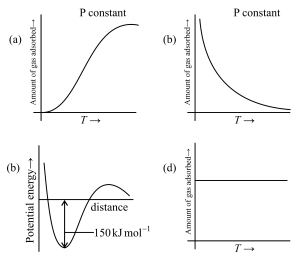
A
$a$ and $c$ represent physisorption
B
$a$ and $d$ represent physisorption
C
$a$ and $c$ represent chemisorption
D
$b$ and $c$ represent chemisorption
Solution
(C) Chemical adsorption (chemisorption) occurs when adsorbate molecules are held to the adsorbent surface by chemical forces.
Effect of temperature:
$1$. Physical adsorption (physisorption) involves weak van der Waals forces and is exothermic. According to Le Chatelier's principle,an increase in temperature favors desorption,so physisorption decreases continuously with increasing temperature. Plot $(b)$ represents physisorption.
$2$. Chemisorption involves the formation of chemical bonds and typically requires an activation energy. Therefore,it increases initially with temperature,shows a maximum,and then decreases. Plot $(a)$ represents this behavior.
$3$. Plot $(c)$ shows the potential energy profile for chemisorption,where the high activation energy (indicated by $150 \ kJ \ mol^{-1}$) is characteristic of chemical bond formation.
Thus,plots $(a)$ and $(c)$ represent chemisorption.
Effect of temperature:
$1$. Physical adsorption (physisorption) involves weak van der Waals forces and is exothermic. According to Le Chatelier's principle,an increase in temperature favors desorption,so physisorption decreases continuously with increasing temperature. Plot $(b)$ represents physisorption.
$2$. Chemisorption involves the formation of chemical bonds and typically requires an activation energy. Therefore,it increases initially with temperature,shows a maximum,and then decreases. Plot $(a)$ represents this behavior.
$3$. Plot $(c)$ shows the potential energy profile for chemisorption,where the high activation energy (indicated by $150 \ kJ \ mol^{-1}$) is characteristic of chemical bond formation.
Thus,plots $(a)$ and $(c)$ represent chemisorption.
0 likesView Solution
164
ChemistryEasyMCQTS EAMCET · 2021
Which of the following statements is false during the adsorption of gas molecules on a metal surface?
A
Enthalpy change is positive
B
Entropy change is negative
C
Both enthalpy and entropy simultaneously decrease
D
Free energy change is negative
Solution
(A) Adsorption is a spontaneous process,which implies that the Gibbs free energy change $(\Delta G)$ must be negative $(\Delta G < 0)$.
Since gas molecules are adsorbed onto a solid surface,their freedom of movement decreases,leading to a decrease in entropy $(\Delta S < 0)$.
From the equation $\Delta G = \Delta H - T\Delta S$,for $\Delta G$ to be negative when $\Delta S$ is negative,the enthalpy change $(\Delta H)$ must be negative $(\Delta H < 0)$.
Therefore,adsorption is an exothermic process,meaning heat is released,and the enthalpy change is negative.
Thus,the statement that 'Enthalpy change is positive' is false.
Since gas molecules are adsorbed onto a solid surface,their freedom of movement decreases,leading to a decrease in entropy $(\Delta S < 0)$.
From the equation $\Delta G = \Delta H - T\Delta S$,for $\Delta G$ to be negative when $\Delta S$ is negative,the enthalpy change $(\Delta H)$ must be negative $(\Delta H < 0)$.
Therefore,adsorption is an exothermic process,meaning heat is released,and the enthalpy change is negative.
Thus,the statement that 'Enthalpy change is positive' is false.
0 likesView Solution
165
ChemistryEasyMCQTS EAMCET · 2021
The shape of the adsorption isobar for physical adsorption and the adsorption isobar for chemisorption,respectively,are:
A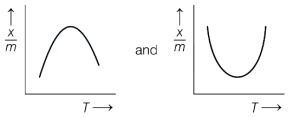
B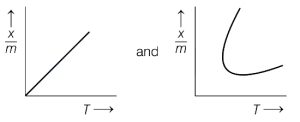
C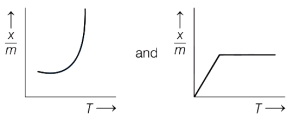
D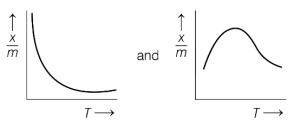
Solution
(D) In the case of physisorption,the process is exothermic and the extent of adsorption $(x/m)$ decreases with an increase in temperature $(T)$. This is represented by a downward sloping curve.
In the case of chemisorption,the process requires activation energy,so the extent of adsorption $(x/m)$ increases initially with an increase in temperature $(T)$ and then decreases as the desorption process dominates at higher temperatures. This is represented by a curve that increases to a maximum and then decreases.
In the case of chemisorption,the process requires activation energy,so the extent of adsorption $(x/m)$ increases initially with an increase in temperature $(T)$ and then decreases as the desorption process dominates at higher temperatures. This is represented by a curve that increases to a maximum and then decreases.
0 likesView Solution
166
ChemistryMediumMCQTS EAMCET · 2021
Which plot is the adsorption isobar for chemisorption?
A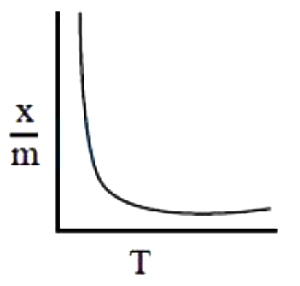
B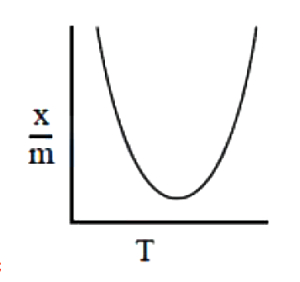
C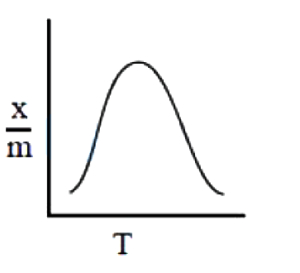
D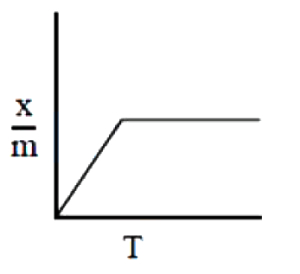
Solution
(C) Chemisorption requires high activation energy,so it is referred to as activated adsorption.
In chemisorption,the extent of adsorption $(x/m)$ first increases and then decreases with an increase in temperature.
When the adsorption isobar is plotted,the graph initially increases because the supplied heat helps molecules overcome the activation energy barrier required for chemisorption.
However,at higher temperatures,the extent of adsorption decreases due to the exothermic nature of the adsorption process at equilibrium.
This behavior is represented by a bell-shaped curve.
Therefore,Option $C$ is correct.
In chemisorption,the extent of adsorption $(x/m)$ first increases and then decreases with an increase in temperature.
When the adsorption isobar is plotted,the graph initially increases because the supplied heat helps molecules overcome the activation energy barrier required for chemisorption.
However,at higher temperatures,the extent of adsorption decreases due to the exothermic nature of the adsorption process at equilibrium.
This behavior is represented by a bell-shaped curve.
Therefore,Option $C$ is correct.
0 likesView Solution
167
ChemistryMediumMCQTS EAMCET · 2021
The trend in the coagulating power for the same concentration of $BaCl_2$,$MgCl_2$,and $NaCl$,respectively,is
A
$NaCl > MgCl_2 > BaCl_2$
B
$NaCl > BaCl_2 > MgCl_2$
C
$MgCl_2 = BaCl_2 < NaCl$
D
$MgCl_2 = BaCl_2 > NaCl$
Solution
(D) According to the $Hardy-Schulze$ law,the coagulating power of an electrolyte depends on the valency of the active ion (the ion with a charge opposite to that of the colloidal particles).
For negatively charged colloids,the coagulating power of cations follows the order of their valency: $Al^{3+} > Ba^{2+} = Mg^{2+} > Na^+$.
Since $BaCl_2$ and $MgCl_2$ both provide divalent cations ($Ba^{2+}$ and $Mg^{2+}$) and $NaCl$ provides a monovalent cation $(Na^+)$,the coagulating power is $MgCl_2 = BaCl_2 > NaCl$.
For negatively charged colloids,the coagulating power of cations follows the order of their valency: $Al^{3+} > Ba^{2+} = Mg^{2+} > Na^+$.
Since $BaCl_2$ and $MgCl_2$ both provide divalent cations ($Ba^{2+}$ and $Mg^{2+}$) and $NaCl$ provides a monovalent cation $(Na^+)$,the coagulating power is $MgCl_2 = BaCl_2 > NaCl$.
0 likesView Solution
168
ChemistryMediumMCQTS EAMCET · 2021
The most effective coagulating agent among the options for $Sb_2S_3$ sol is
A
$Na_2SO_4$
B
$Al_2(SO_4)_3$
C
$CaCl_2$
D
$NH_4Cl$
Solution
(B) $Sb_2S_3$ sol is a negatively charged sol.
According to the Hardy-Schulze rule,the greater the valency of the oppositely charged ion of the electrolyte added,the faster the coagulation.
The principle is based on electrostatic forces of attraction.
Greater the valency of the flocculating ion,greater is the coagulation power.
Comparing the valency of the cations:
$Al^{3+} > Ca^{2+} > Na^{+} = NH_4^{+}$
Therefore,$Al_2(SO_4)_3$ is the most effective coagulating agent because it provides the $Al^{3+}$ ion with the highest valency.
According to the Hardy-Schulze rule,the greater the valency of the oppositely charged ion of the electrolyte added,the faster the coagulation.
The principle is based on electrostatic forces of attraction.
Greater the valency of the flocculating ion,greater is the coagulation power.
Comparing the valency of the cations:
$Al^{3+} > Ca^{2+} > Na^{+} = NH_4^{+}$
Therefore,$Al_2(SO_4)_3$ is the most effective coagulating agent because it provides the $Al^{3+}$ ion with the highest valency.
0 likesView Solution
169
ChemistryEasyMCQTS EAMCET · 2021
$Fe(OH)_3$ is a positively charged sol. For its precipitation,the best precipitating agent is:
A
$Na_2SO_4$
B
$Cr(OH)_3$
C
$Al(OH)_3$
D
$Na_3[Fe(CN)_6]$
Solution
(D) $Fe(OH)_3$ is a positively charged sol. According to the Hardy-Schulze rule,the coagulating power of an electrolyte depends on the valency of the ion carrying a charge opposite to that of the colloidal particles.
Since $Fe(OH)_3$ is positively charged,it requires an anion for coagulation.
The given electrolytes dissociate as follows:
$Na_2SO_4 \rightarrow 2Na^+ + SO_4^{2-}$
$Na_3[Fe(CN)_6] \rightarrow 3Na^+ + [Fe(CN)_6]^{3-}$
$Cr(OH)_3$ and $Al(OH)_3$ are insoluble hydroxides and do not act as effective coagulating agents in this context.
Comparing the valency of the anions,$[Fe(CN)_6]^{3-}$ has a valency of $3$,while $SO_4^{2-}$ has a valency of $2$.
According to the Hardy-Schulze rule,the higher the valency of the coagulating ion,the greater is its coagulating power.
Therefore,$[Fe(CN)_6]^{3-}$ is the most effective coagulating agent among the given options.
Flocculation value = $\frac{1}{\text{Coagulating power}}$. Since $[Fe(CN)_6]^{3-}$ has the highest coagulating power,it has the lowest flocculation value,making it the best precipitating agent.
Since $Fe(OH)_3$ is positively charged,it requires an anion for coagulation.
The given electrolytes dissociate as follows:
$Na_2SO_4 \rightarrow 2Na^+ + SO_4^{2-}$
$Na_3[Fe(CN)_6] \rightarrow 3Na^+ + [Fe(CN)_6]^{3-}$
$Cr(OH)_3$ and $Al(OH)_3$ are insoluble hydroxides and do not act as effective coagulating agents in this context.
Comparing the valency of the anions,$[Fe(CN)_6]^{3-}$ has a valency of $3$,while $SO_4^{2-}$ has a valency of $2$.
According to the Hardy-Schulze rule,the higher the valency of the coagulating ion,the greater is its coagulating power.
Therefore,$[Fe(CN)_6]^{3-}$ is the most effective coagulating agent among the given options.
Flocculation value = $\frac{1}{\text{Coagulating power}}$. Since $[Fe(CN)_6]^{3-}$ has the highest coagulating power,it has the lowest flocculation value,making it the best precipitating agent.
0 likesView Solution
170
ChemistryEasyMCQTS EAMCET · 2021
$A$ and $B$ on mixing form an ideal solution at room temperature. Which of the following options is correct for this process?
A
| $\Delta G$ | $\Delta S_{\text{system}}$ | $\Delta S_{\text{surroundings}}$ | $\Delta H$ |
| $-$ | $+$ | $+$ | $+$ |
B
| $\Delta G$ | $\Delta S_{\text{system}}$ | $\Delta S_{\text{surroundings}}$ | $\Delta H$ |
| $+$ | $+$ | $0$ | $+$ |
C
| $\Delta G$ | $\Delta S_{\text{system}}$ | $\Delta S_{\text{surroundings}}$ | $\Delta H$ |
| $-$ | $+$ | $0$ | $0$ |
D
| $\Delta G$ | $\Delta S_{\text{system}}$ | $\Delta S_{\text{surroundings}}$ | $\Delta H$ |
| $-$ | $-$ | $+$ | $+$ |
Solution
(C) For the formation of an ideal solution,the process is spontaneous,which implies $\Delta G < 0$.
According to the definition of an ideal solution:
$\Delta H_{\text{mix}} = 0$
$\Delta V_{\text{mix}} = 0$
Since $\Delta H_{\text{mix}} = 0$,there is no heat exchange between the system and the surroundings,so $\Delta S_{\text{surroundings}} = 0$.
Mixing increases the randomness of the components,so $\Delta S_{\text{system}} > 0$.
Using the Gibbs free energy equation: $\Delta G = \Delta H - T\Delta S$.
Since $\Delta H = 0$ and $\Delta S > 0$,we get $\Delta G = -T\Delta S$,which is less than $0$ (negative).
According to the definition of an ideal solution:
$\Delta H_{\text{mix}} = 0$
$\Delta V_{\text{mix}} = 0$
Since $\Delta H_{\text{mix}} = 0$,there is no heat exchange between the system and the surroundings,so $\Delta S_{\text{surroundings}} = 0$.
Mixing increases the randomness of the components,so $\Delta S_{\text{system}} > 0$.
Using the Gibbs free energy equation: $\Delta G = \Delta H - T\Delta S$.
Since $\Delta H = 0$ and $\Delta S > 0$,we get $\Delta G = -T\Delta S$,which is less than $0$ (negative).
0 likesView Solution
Vedclass Products
For Students
Vedclass Test Series
Mock tests in real TS EAMCET style covering Chemistry with performance analysis. 5-day free trial.
Start Free TrialFor Teachers
Exam Paper Generator
Generate Set A/B/C/D Chemistry papers from 7.5L+ questions in 2 minutes. 3 chapters free.
Try FreeFor Institutes
Online Exam Module
Run live TS EAMCET mock exams with unlimited students, 360° analytics & white-label branding.
See DemoFrequently Asked Questions
How many Chemistry questions are in TS EAMCET 2021?
There are 270 Chemistry questions from the TS EAMCET 2021 paper on Vedclass, each with a detailed step-by-step solution in English.
Are TS EAMCET 2021 Chemistry solutions available in English?
Yes. All solutions on this page are in English. You can also switch to English or Hindi using the language buttons above the questions.
Can I practice TS EAMCET 2021 Chemistry as a timed test?
Yes. Use the Vedclass Test Series to attempt a full TS EAMCET mock test covering Chemistry with time limits and instant score analysis.
Can teachers create Chemistry papers from TS EAMCET previous year questions?
Yes. The Vedclass Exam Paper Generator lets teachers mix TS EAMCET Chemistry questions and generate Set A/B/C/D papers in minutes.
For Teachers & Institutes
Build a Custom Chemistry Paper
Pick TS EAMCET 2021 Chemistry questions, set difficulty, and generate Set A/B/C/D in 2 minutes.