
BiologyQ1–95 of 100 questions
Page 1 of 2 · English
1
BiologyMediumMCQNEET · 2023
Given below are two statements: One labelled as Assertion $A$ and the other labelled as Reason $R$:
Assertion $A$: The first stage of gametophyte in the life cycle of moss is protonema stage.
Reason $R$: Protonema develops directly from spores produced in capsule.
In the light of the above statements,choose the most appropriate answer from options given below:
Assertion $A$: The first stage of gametophyte in the life cycle of moss is protonema stage.
Reason $R$: Protonema develops directly from spores produced in capsule.
In the light of the above statements,choose the most appropriate answer from options given below:
A
$A$ is not correct but $R$ is correct
B
Both $A$ and $R$ are correct and $R$ is the correct explanation of $A$
C
Both $A$ and $R$ are correct but $R$ is $NOT$ the correct explanation of $A$
D
$A$ is correct but $R$ is not correct
Solution
(B) The life cycle of a moss consists of a dominant gametophyte phase which includes two stages.
The first stage is the protonema stage,which develops directly from a haploid spore.
These spores are produced within the capsule of the sporophyte generation.
Since the protonema is the direct product of spore germination,the Reason $R$ correctly explains the Assertion $A$.
The first stage is the protonema stage,which develops directly from a haploid spore.
These spores are produced within the capsule of the sporophyte generation.
Since the protonema is the direct product of spore germination,the Reason $R$ correctly explains the Assertion $A$.
0 likesView Solution
2
BiologyMediumMCQNEET · 2023
Cellulose does not form a blue color with iodine because:
A
It breaks down when iodine reacts with it
B
It is a disaccharide
C
It is a helical molecule
D
It does not contain complex helices and hence cannot hold iodine molecules
Solution
(D) Option $D$ is the correct answer.
Cellulose is a linear polysaccharide consisting of a long chain of glucose units linked by $\beta-1, 4$-glycosidic bonds.
Unlike starch,which contains amylose (a helical structure that traps iodine molecules to produce a blue color),cellulose does not form complex helical structures.
Because it lacks these complex helices,it cannot hold iodine molecules,and therefore,it does not produce a blue color with iodine.
Cellulose is a linear polysaccharide consisting of a long chain of glucose units linked by $\beta-1, 4$-glycosidic bonds.
Unlike starch,which contains amylose (a helical structure that traps iodine molecules to produce a blue color),cellulose does not form complex helical structures.
Because it lacks these complex helices,it cannot hold iodine molecules,and therefore,it does not produce a blue color with iodine.
0 likesView Solution
3
BiologyEasyMCQNEET · 2023
Which micronutrient is required for the splitting of water molecules during photosynthesis?
A
Copper
B
Manganese
C
Molybdenum
D
Magnesium
Solution
(B) Manganese $(Mn^{2+})$ plays a critical role in the photolysis of water,which is the splitting of water molecules to release oxygen,electrons,and protons during the light-dependent reactions of photosynthesis.
Copper $(Cu)$ is essential for electron transport in the chloroplasts and overall plant metabolism.
Molybdenum $(Mo)$ is primarily involved in nitrogen metabolism,specifically in the enzyme nitrogenase and nitrate reductase.
Magnesium $(Mg)$ is a structural component of the chlorophyll molecule and acts as an activator for several enzymes involved in photosynthesis and respiration.
Copper $(Cu)$ is essential for electron transport in the chloroplasts and overall plant metabolism.
Molybdenum $(Mo)$ is primarily involved in nitrogen metabolism,specifically in the enzyme nitrogenase and nitrate reductase.
Magnesium $(Mg)$ is a structural component of the chlorophyll molecule and acts as an activator for several enzymes involved in photosynthesis and respiration.
0 likesView Solution
4
BiologyMediumMCQNEET · 2023
Given below are two statements: One is labelled as Assertion $A$ and the other is labelled as Reason $R$:
Assertion $A:$ $ATP$ is used at two steps in glycolysis.
Reason $R:$ First $ATP$ is used in converting glucose into glucose-$6$-phosphate and second $ATP$ is used in conversion of fructose-$6$-phosphate into fructose-$1,6$-bisphosphate.
In the light of the above statements,choose the correct answer from the options given below:
Assertion $A:$ $ATP$ is used at two steps in glycolysis.
Reason $R:$ First $ATP$ is used in converting glucose into glucose-$6$-phosphate and second $ATP$ is used in conversion of fructose-$6$-phosphate into fructose-$1,6$-bisphosphate.
In the light of the above statements,choose the correct answer from the options given below:
A
$A$ is false but $R$ is true.
B
Both $A$ and $R$ are true and $R$ is the correct explanation of $A$.
C
Both $A$ and $R$ are true but $R$ is $NOT$ the correct explanation of $A$.
D
$A$ is true but $R$ is false.
Solution
(B) $ATP$ is consumed in glycolysis at two specific phosphorylation steps:
$1$. Conversion of Glucose to Glucose-$6$-phosphate (catalyzed by hexokinase).
$2$. Conversion of Fructose-$6$-phosphate to Fructose-$1,6$-bisphosphate (catalyzed by phosphofructokinase).
Since both statements correctly describe the process of phosphorylation in glycolysis,Assertion $A$ is true,and Reason $R$ provides the correct explanation for why $ATP$ is used.
$1$. Conversion of Glucose to Glucose-$6$-phosphate (catalyzed by hexokinase).
$2$. Conversion of Fructose-$6$-phosphate to Fructose-$1,6$-bisphosphate (catalyzed by phosphofructokinase).
Since both statements correctly describe the process of phosphorylation in glycolysis,Assertion $A$ is true,and Reason $R$ provides the correct explanation for why $ATP$ is used.
0 likesView Solution
5
BiologyEasyMCQNEET · 2023
Which of the following stages of meiosis involves division of the centromere?
A
Telophase
B
Metaphase $I$
C
Metaphase $II$
D
Anaphase $II$
Solution
(D) The splitting of the centromere occurs during the anaphase of mitosis or anaphase $II$ of meiosis.
During Metaphase $I$ and $II$,chromosomes align at the equatorial plate.
During telophase,chromosomes reach their respective poles and decondense.
During Metaphase $I$ and $II$,chromosomes align at the equatorial plate.
During telophase,chromosomes reach their respective poles and decondense.
0 likesView Solution
6
BiologyMediumMCQNEET · 2023
Which hormone promotes internode/petiole elongation in deep water rice?
A
$2, 4-D$
B
$GA_3$
C
Kinetin
D
Ethylene
Solution
(D) Ethylene is a gaseous plant hormone that plays a crucial role in the growth and development of plants.
In deep water rice plants,ethylene promotes rapid internode and petiole elongation.
This adaptation allows the leaves and upper parts of the plant to remain above the water surface,ensuring continued gas exchange and survival during flooding conditions.
In deep water rice plants,ethylene promotes rapid internode and petiole elongation.
This adaptation allows the leaves and upper parts of the plant to remain above the water surface,ensuring continued gas exchange and survival during flooding conditions.
0 likesView Solution
7
BiologyMediumMCQNEET · 2023
How many $ATP$ and $NADPH_2$ are required for the synthesis of one molecule of glucose during the Calvin cycle?
A
$18\,ATP$ and $16\,NADPH_2$
B
$12\,ATP$ and $12\,NADPH_2$
C
$18\,ATP$ and $12\,NADPH_2$
D
$12\,ATP$ and $16\,NADPH_2$
Solution
(C) For every $CO_2$ molecule entering the Calvin cycle,$3$ molecules of $ATP$ and $2$ molecules of $NADPH_2$ are required.
To synthesize one molecule of glucose $(C_6H_{12}O_6)$,$6$ turns of the Calvin cycle are necessary because each turn fixes one carbon atom.
Therefore,the total requirement is calculated as:
$6 \times (3\,ATP + 2\,NADPH_2) = 18\,ATP$ and $12\,NADPH_2$.
To synthesize one molecule of glucose $(C_6H_{12}O_6)$,$6$ turns of the Calvin cycle are necessary because each turn fixes one carbon atom.
Therefore,the total requirement is calculated as:
$6 \times (3\,ATP + 2\,NADPH_2) = 18\,ATP$ and $12\,NADPH_2$.
0 likesView Solution
8
BiologyMediumMCQNEET · 2023
Family $Fabaceae$ differs from $Solanaceae$ and $Liliaceae$. With respect to the stamens,pick out the characteristics specific to family $Fabaceae$ but not found in $Solanaceae$ or $Liliaceae$.
A
Epiphyllous and Dithecous anthers
B
Diadelphous and Dithecous anthers
C
Polyadelphous and epipetalous stamens
D
Monoadelphous and Monothecous anthers
Solution
(B) In family $Fabaceae$,the stamens are $Diadelphous$ (arranged in two bundles) and the anthers are $Dithecous$ (two-lobed).
In family $Solanaceae$,the stamens are $Polyandrous$ (free),$Epipetalous$ (attached to petals),and $Dithecous$.
In family $Liliaceae$,the stamens are $Polyandrous$,$Epiphyllous$ (attached to tepals),and $Dithecous$.
Therefore,the characteristic specific to $Fabaceae$ is $Diadelphous$ condition.
In family $Solanaceae$,the stamens are $Polyandrous$ (free),$Epipetalous$ (attached to petals),and $Dithecous$.
In family $Liliaceae$,the stamens are $Polyandrous$,$Epiphyllous$ (attached to tepals),and $Dithecous$.
Therefore,the characteristic specific to $Fabaceae$ is $Diadelphous$ condition.
0 likesView Solution
9
BiologyEasyMCQNEET · 2023
The process of appearance of recombination nodules occurs at which sub-stage of prophase $I$ in meiosis?
A
Diakinesis
B
Zygotene
C
Pachytene
D
Diplotene
Solution
(C) The process of recombination occurs at the Pachytene stage of prophase $I$.
This stage is characterized by the appearance of recombination nodules,which are sites at which crossing over occurs between non-sister chromatids of homologous chromosomes.
This stage is characterized by the appearance of recombination nodules,which are sites at which crossing over occurs between non-sister chromatids of homologous chromosomes.
0 likesView Solution
10
BiologyMediumMCQNEET · 2023
The reaction centre in $PS$ $II$ has an absorption maxima at $............\,nm$.
A
$780$
B
$680$
C
$700$
D
$660$
Solution
(B) In $PS-I$,the reaction centre chlorophyll $a$ has an absorption peak at $700\,nm$.
In $PS-II$,the reaction centre chlorophyll $a$ has an absorption maxima at $680\,nm$.
In $PS-II$,the reaction centre chlorophyll $a$ has an absorption maxima at $680\,nm$.
0 likesView Solution
11
BiologyMediumMCQNEET · 2023
Spraying of which of the following phytohormone on juvenile conifers helps in hastening the maturity period, which leads to early seed production?
A
Abscisic Acid
B
Indole-3-butyric Acid
C
Gibberellic Acid
D
Zeatin
Solution
(C) Spraying juvenile conifers with $Gibberellic Acid$ $(GA)$ hastens the maturity period of the plants.
This physiological effect leads to early seed production in these conifers.
Therefore, $Gibberellic Acid$ is used in forestry to shorten the breeding cycle.
This physiological effect leads to early seed production in these conifers.
Therefore, $Gibberellic Acid$ is used in forestry to shorten the breeding cycle.
0 likesView Solution
12
BiologyMediumMCQNEET · 2023
In tissue culture experiments, leaf mesophyll cells are put in a culture medium to form callus. This phenomenon may be called as
A
Senescence
B
Differentiation
C
Dedifferentiation
D
Development
Solution
(C) In tissue culture experiments, leaf mesophyll cells are put in a culture medium to form callus. This phenomenon is called $Dedifferentiation$.
$Dedifferentiation$ is a biological phenomenon by which living differentiated plant cells, which have lost the capacity to divide, regain the capacity of division under certain experimental conditions.
$Dedifferentiation$ is a biological phenomenon by which living differentiated plant cells, which have lost the capacity to divide, regain the capacity of division under certain experimental conditions.
0 likesView Solution
13
BiologyMediumMCQNEET · 2023
Given below are two statements:
Statement $I$: The forces generated by transpiration can lift a xylem-sized column of water over $130 \text{ meters}$ in height.
Statement $II$: Transpiration cools leaf surfaces,sometimes by $10$ to $15$ degrees,through evaporative cooling.
In the light of the above statements,choose the most appropriate answer from the options given below:
Statement $I$: The forces generated by transpiration can lift a xylem-sized column of water over $130 \text{ meters}$ in height.
Statement $II$: Transpiration cools leaf surfaces,sometimes by $10$ to $15$ degrees,through evaporative cooling.
In the light of the above statements,choose the most appropriate answer from the options given below:
A
Statement $I$ is incorrect but Statement $II$ is correct.
B
Both Statement $I$ and Statement $II$ are correct.
C
Both Statement $I$ and Statement $II$ are incorrect.
D
Statement $I$ is correct but Statement $II$ is incorrect.
Solution
(B) Statement $I$ is correct. Measurements reveal that the transpiration pull generated in the leaves can create pressures sufficient to lift a xylem-sized column of water up to $130 \text{ meters}$ high.
Statement $II$ is also correct. Transpiration provides a cooling effect on leaf surfaces,often reducing the temperature by $10$ to $15$ degrees Celsius through the process of evaporative cooling.
Statement $II$ is also correct. Transpiration provides a cooling effect on leaf surfaces,often reducing the temperature by $10$ to $15$ degrees Celsius through the process of evaporative cooling.
0 likesView Solution
14
BiologyEasyMCQNEET · 2023
Movement and accumulation of ions across a membrane against their concentration gradient can be explained by
A
Active Transport
B
Osmosis
C
Facilitated Diffusion
D
Passive Transport
Solution
(A) The movement and accumulation of ions across a membrane against their concentration gradient is defined as active transport.
Active transport requires metabolic energy (usually in the form of $ATP$) to move molecules from a region of lower concentration to a region of higher concentration.
Unlike passive transport,which moves substances along the concentration gradient without energy expenditure,active transport is an energy-dependent process.
Active transport requires metabolic energy (usually in the form of $ATP$) to move molecules from a region of lower concentration to a region of higher concentration.
Unlike passive transport,which moves substances along the concentration gradient without energy expenditure,active transport is an energy-dependent process.
0 likesView Solution
15
BiologyMediumMCQNEET · 2023
Axile placentation is observed in
A
China rose,Petunia and Lemon
B
Mustard,Cucumber and Primrose
C
China rose,Beans and Lupin
D
Tomato,Dianthus and Pea
Solution
(A) In axile placentation,the placenta is axial and the ovules are attached to it in a multilocular ovary.
Examples of plants exhibiting axile placentation include China rose,Tomato,Petunia,and Lemon.
Dianthus and Primrose exhibit free central placentation,where ovules are borne on a central axis without septa.
Pea,Lupin,and Beans exhibit marginal placentation,where the placenta forms a ridge along the ventral suture of the ovary.
Cucumber and Mustard exhibit parietal placentation,where the ovules develop on the inner wall of the ovary or on peripheral parts.
Examples of plants exhibiting axile placentation include China rose,Tomato,Petunia,and Lemon.
Dianthus and Primrose exhibit free central placentation,where ovules are borne on a central axis without septa.
Pea,Lupin,and Beans exhibit marginal placentation,where the placenta forms a ridge along the ventral suture of the ovary.
Cucumber and Mustard exhibit parietal placentation,where the ovules develop on the inner wall of the ovary or on peripheral parts.
0 likesView Solution
16
BiologyMediumMCQNEET · 2023
Among eukaryotes,replication of $DNA$ takes place in:
A
$G_2$ phase
B
$M$ phase
C
$S$ phase
D
$G_1$ phase
Solution
(C) In eukaryotes,the replication of $DNA$ occurs during the $S$ phase (Synthesis phase) of the cell cycle.
During this phase,the amount of $DNA$ per cell doubles,although the chromosome number remains the same.
In contrast,the $G_1$ phase involves cell growth and the duplication of most cell organelles,while the $G_2$ phase involves protein synthesis and preparation for mitosis.
During this phase,the amount of $DNA$ per cell doubles,although the chromosome number remains the same.
In contrast,the $G_1$ phase involves cell growth and the duplication of most cell organelles,while the $G_2$ phase involves protein synthesis and preparation for mitosis.
0 likesView Solution
17
BiologyDifficultMCQNEET · 2023
Given below are two statements:
Statement $I:$ Endarch and exarch are the terms often used for describing the position of secondary xylem in the plant body.
Statement $II:$ Exarch condition is the most common feature of the root system.
In the light of the above statements,choose the correct answer from the options given below:
Statement $I:$ Endarch and exarch are the terms often used for describing the position of secondary xylem in the plant body.
Statement $II:$ Exarch condition is the most common feature of the root system.
In the light of the above statements,choose the correct answer from the options given below:
A
Statement $I$ is incorrect but Statement $II$ is true.
B
Both Statement $I$ and Statement $II$ are true.
C
Both Statement $I$ and Statement $II$ are false.
D
Statement $I$ is correct but Statement $II$ is false.
Solution
(A) Endarch and exarch are terms used to describe the arrangement of primary xylem,not secondary xylem.
Primary xylem consists of protoxylem and metaxylem. Based on the relative position of protoxylem and metaxylem within an organ,the arrangement is classified as either endarch or exarch.
In the endarch condition,protoxylem lies towards the center (pith),which is characteristic of stems. In the exarch condition,protoxylem lies towards the periphery,which is a characteristic feature of roots.
Therefore,Statement $I$ is false because it mentions secondary xylem instead of primary xylem,and Statement $II$ is true.
Primary xylem consists of protoxylem and metaxylem. Based on the relative position of protoxylem and metaxylem within an organ,the arrangement is classified as either endarch or exarch.
In the endarch condition,protoxylem lies towards the center (pith),which is characteristic of stems. In the exarch condition,protoxylem lies towards the periphery,which is a characteristic feature of roots.
Therefore,Statement $I$ is false because it mentions secondary xylem instead of primary xylem,and Statement $II$ is true.
0 likesView Solution
18
BiologyEasyMCQNEET · 2023
Identify the pair of heterosporous pteridophytes among the following:
A
Equisetum and Salvinia
B
Lycopodium and Selaginella
C
Selaginella and Salvinia
D
Psilotum and Salvinia
Solution
(C) Pteridophytes that produce two different kinds of spores,known as microspores and megaspores,are called heterosporous.
$Selaginella$ and $Salvinia$ are well-known examples of heterosporous pteridophytes.
In contrast,$Psilotum$,$Lycopodium$,and $Equisetum$ are homosporous,meaning they produce only one type of spore.
$Selaginella$ and $Salvinia$ are well-known examples of heterosporous pteridophytes.
In contrast,$Psilotum$,$Lycopodium$,and $Equisetum$ are homosporous,meaning they produce only one type of spore.
0 likesView Solution
19
BiologyMediumMCQNEET · 2023
Given below are two statements: One is labelled as Assertion $A$ and the other is labelled as Reason $R$:
Assertion $A$: Late wood has fewer xylary elements with narrow vessels.
Reason $R$: Cambium is less active in winters.
In the light of the above statements,choose the correct answer from the options given below:
Assertion $A$: Late wood has fewer xylary elements with narrow vessels.
Reason $R$: Cambium is less active in winters.
In the light of the above statements,choose the correct answer from the options given below:
A
$A$ is false but $R$ is true
B
Both $A$ and $R$ are true and $R$ is the correct explanation of $A$
C
Both $A$ and $R$ are true but $R$ is $NOT$ the correct explanation of $A$
D
$A$ is true but $R$ is false
Solution
(B) During the winter season,the activity of the vascular cambium is reduced due to environmental conditions.
Because the cambium is less active,it produces fewer xylary elements that possess narrow vessels.
This type of wood formed during the winter is known as autumn wood or late wood.
Therefore,both Assertion $A$ and Reason $R$ are true,and Reason $R$ correctly explains Assertion $A$.
Because the cambium is less active,it produces fewer xylary elements that possess narrow vessels.
This type of wood formed during the winter is known as autumn wood or late wood.
Therefore,both Assertion $A$ and Reason $R$ are true,and Reason $R$ correctly explains Assertion $A$.
0 likesView Solution
20
BiologyMediumMCQNEET · 2023
Identify the correct statements:
$A$. Lenticels are the lens-shaped openings permitting the exchange of gases.
$B$. Bark formed early in the season is called hard bark.
$C$. Bark is a technical term that refers to all tissues exterior to vascular cambium.
$D$. Bark refers to periderm and secondary phloem.
$E$. Phellogen is single-layered in thickness.
Choose the correct answer from the options given below:
$A$. Lenticels are the lens-shaped openings permitting the exchange of gases.
$B$. Bark formed early in the season is called hard bark.
$C$. Bark is a technical term that refers to all tissues exterior to vascular cambium.
$D$. Bark refers to periderm and secondary phloem.
$E$. Phellogen is single-layered in thickness.
Choose the correct answer from the options given below:
A
$B$ and $C$ only
B
$B, C$ and $E$ only
C
$A$ and $D$ only
D
$A, B$ and $D$ only
Solution
(C) Statement $A$ is correct: Lenticels are lens-shaped openings that allow the exchange of gases between the external atmosphere and the internal tissues of the stem.
Statement $B$ is incorrect: Bark formed early in the season is called early or soft bark,while bark formed towards the end of the season is called late or hard bark.
Statement $C$ is incorrect: Bark is a non-technical term that refers to all tissues exterior to the vascular cambium.
Statement $D$ is correct: Bark refers to a number of tissue types,including periderm and secondary phloem.
Statement $E$ is incorrect: Phellogen (cork cambium) is generally a couple of layers thick.
Therefore,statements $A$ and $D$ are correct.
Statement $B$ is incorrect: Bark formed early in the season is called early or soft bark,while bark formed towards the end of the season is called late or hard bark.
Statement $C$ is incorrect: Bark is a non-technical term that refers to all tissues exterior to the vascular cambium.
Statement $D$ is correct: Bark refers to a number of tissue types,including periderm and secondary phloem.
Statement $E$ is incorrect: Phellogen (cork cambium) is generally a couple of layers thick.
Therefore,statements $A$ and $D$ are correct.
0 likesView Solution
21
BiologyMediumMCQNEET · 2023
Match List $I$ with List $II$:
Choose the correct answer from the options given below:
| List $I$ | List $II$ |
| $A$. $M$ Phase | $I$. Proteins are synthesized |
| $B$. $G_2$ Phase | $II$. Inactive phase |
| $C$. Quiescent stage $(G_0)$ | $III$. Interval between mitosis and initiation of $DNA$ replication |
| $D$. $G_1$ Phase | $IV$. Equational division |
Choose the correct answer from the options given below:
A
$A-II, B-IV, C-I, D-III$
B
$A-III, B-II, C-IV, D-I$
C
$A-IV, B-I, C-II, D-III$
D
$A-IV, B-I, C-II, D-III$
Solution
(C) $M$ phase (Mitosis) is the phase where actual cell division occurs, often called equational division $(A-IV)$.
During $G_2$ phase, the cell synthesizes proteins and $RNA$ required for mitosis $(B-I)$.
Quiescent stage $(G_0)$ is the inactive phase where cells that do not divide further enter $(C-II)$.
$G_1$ phase is the interval between mitosis and the initiation of $DNA$ replication $(D-III)$.
Therefore, the correct matching is $A-IV, B-I, C-II, D-III$.
During $G_2$ phase, the cell synthesizes proteins and $RNA$ required for mitosis $(B-I)$.
Quiescent stage $(G_0)$ is the inactive phase where cells that do not divide further enter $(C-II)$.
$G_1$ phase is the interval between mitosis and the initiation of $DNA$ replication $(D-III)$.
Therefore, the correct matching is $A-IV, B-I, C-II, D-III$.
0 likesView Solution
22
BiologyMediumMCQNEET · 2023
Given below are two statements: One labelled as Assertion $A$ and the other labelled as Reason $R$:
Assertion $A$: In gymnosperms,the pollen grains are released from the microsporangium and carried by air currents.
Reason $R$: Air currents carry the pollen grains to the mouth of the archegonia where the male gametes are discharged and pollen tube is not formed.
In the light of the above statements,choose the correct answer from the options given below:
Assertion $A$: In gymnosperms,the pollen grains are released from the microsporangium and carried by air currents.
Reason $R$: Air currents carry the pollen grains to the mouth of the archegonia where the male gametes are discharged and pollen tube is not formed.
In the light of the above statements,choose the correct answer from the options given below:
A
$A$ is false but $R$ is true
B
Both $A$ and $R$ are true and $R$ is the correct explanation of $A$
C
Both $A$ and $R$ are true but $R$ is $NOT$ the correct explanation of $A$
D
$A$ is true but $R$ is false
Solution
(D) Assertion $A$ is true because in gymnosperms,pollination is anemophilous (wind-pollinated),and pollen grains are released from the microsporangium to be carried by air currents.
Reason $R$ is false because,in gymnosperms,a pollen tube is indeed formed. The pollen grains reach the opening of the ovules,where they germinate to form a pollen tube that grows towards the archegonia to discharge the male gametes.
Reason $R$ is false because,in gymnosperms,a pollen tube is indeed formed. The pollen grains reach the opening of the ovules,where they germinate to form a pollen tube that grows towards the archegonia to discharge the male gametes.
0 likesView Solution
23
BiologyMediumMCQNEET · 2023
Match List-$I$ with List-$II$:
Choose the correct answer from the options given below:
| List-$I$ | List-$II$ |
| $A$. Iron | $I$. Synthesis of auxin |
| $B$. Zinc | $II$. Component of nitrate reductase |
| $C$. Boron | $III$. Activator of catalase |
| $D$. Molybdenum | $IV$. Cell elongation and differentiation |
Choose the correct answer from the options given below:
A
$A-II, B-IV, C-I, D-III$
B
$A-III, B-II, C-I, D-IV$
C
$A-II, B-III, C-IV, D-I$
D
$A-III, B-I, C-IV, D-II$
Solution
(D) Iron $(Fe)$ acts as an activator for the enzyme catalase.
Zinc $(Zn)$ is essential for the synthesis of the plant hormone auxin.
Boron $(B)$ plays a crucial role in cell elongation and cell differentiation.
Molybdenum $(Mo)$ is a vital component of enzymes like nitrogenase and nitrate reductase.
Matching these: $A-III, B-I, C-IV, D-II$.
Therefore, the correct option is $D$.
Zinc $(Zn)$ is essential for the synthesis of the plant hormone auxin.
Boron $(B)$ plays a crucial role in cell elongation and cell differentiation.
Molybdenum $(Mo)$ is a vital component of enzymes like nitrogenase and nitrate reductase.
Matching these: $A-III, B-I, C-IV, D-II$.
Therefore, the correct option is $D$.
0 likesView Solution
24
BiologyMediumMCQNEET · 2023
Which of the following combinations is required for chemiosmosis?
A
Proton pump,electron gradient,$NADP$ synthase
B
Membrane,proton pump,proton gradient,$ATP$ synthase
C
Membrane,proton pump,proton gradient,$NADP$ synthase
D
Proton pump,electron gradient,$ATP$ synthase
Solution
(B) Chemiosmosis is the movement of ions across a semi-permeable membrane down their electrochemical gradient.
In photosynthesis,it specifically requires:
$1$. $A$ membrane (e.g.,the thylakoid membrane).
$2$. $A$ proton pump (to create a proton gradient).
$3$. $A$ proton gradient (accumulation of $H^+$ ions in the lumen).
$4$. $ATP$ synthase (the enzyme that uses the energy of the proton gradient to synthesize $ATP$ from $ADP$ and inorganic phosphate).
In photosynthesis,it specifically requires:
$1$. $A$ membrane (e.g.,the thylakoid membrane).
$2$. $A$ proton pump (to create a proton gradient).
$3$. $A$ proton gradient (accumulation of $H^+$ ions in the lumen).
$4$. $ATP$ synthase (the enzyme that uses the energy of the proton gradient to synthesize $ATP$ from $ADP$ and inorganic phosphate).
0 likesView Solution
25
BiologyMediumMCQNEET · 2023
How many different proteins does the ribosome consist of?
A
$20$
B
$80$
C
$60$
D
$40$
Solution
(B) The ribosome is a complex cellular structure composed of ribosomal $RNA$ $(rRNA)$ and various proteins. In eukaryotic cells,the ribosome consists of structural RNAs and approximately $80$ different proteins that work together to facilitate the process of protein synthesis (translation).
0 likesView Solution
26
BiologyMediumMCQNEET · 2023
Match List $I$ with List $II$ :
Choose the correct answer from the options given below :
| List $I$ | List $II$ |
| $A$. Cohesion | $I$. More attraction in liquid phase |
| $B$. Adhesion | $II$. Mutual attraction among water molecules |
| $C$. Surface tension | $III$. Water loss in liquid phase |
| $D$. Guttation | $IV$. Attraction towards polar surfaces |
Choose the correct answer from the options given below :
A
$A-II, B-I, C-IV, D-III$
B
$A-II, B-IV, C-I, D-III$
C
$A-IV, B-III, C-II, D-I$
D
$A-III, B-I, C-IV, D-II$
Solution
(B) The correct matches are as follows:
$A$. Cohesion: Mutual attraction among water molecules $(II)$.
$B$. Adhesion: Attraction of water molecules to polar surfaces $(IV)$.
$C$. Surface tension: Water molecules are attracted to each other in the liquid phase more than to water in the gas phase $(I)$.
$D$. Guttation: Loss of water in liquid phase $(III)$.
Therefore, the correct sequence is $A-II, B-IV, C-I, D-III$, which corresponds to option $B$.
$A$. Cohesion: Mutual attraction among water molecules $(II)$.
$B$. Adhesion: Attraction of water molecules to polar surfaces $(IV)$.
$C$. Surface tension: Water molecules are attracted to each other in the liquid phase more than to water in the gas phase $(I)$.
$D$. Guttation: Loss of water in liquid phase $(III)$.
Therefore, the correct sequence is $A-II, B-IV, C-I, D-III$, which corresponds to option $B$.
0 likesView Solution
27
BiologyMediumMCQNEET · 2023
Match List-$I$ with List-$II$ :
Choose the correct answer from the options given below :
| List-$I$ | List-$II$ |
| $A$. Oxidative decarboxylation | $I$. Citrate synthase |
| $B$. Glycolysis | $II$. Pyruvate dehydrogenase |
| $C$. Oxidative phosphorylation | $III$. Electron transport system |
| $D$. Tricarboxylic acid cycle | $IV$. $EMP$ pathway |
Choose the correct answer from the options given below :
A
$A-II, B-IV, C-III, D-I$
B
$A-III, B-IV, C-II, D-I$
C
$A-II, B-IV, C-I, D-III$
D
$A-III, B-I, C-II, D-IV$
Solution
(A) $1$. Oxidative decarboxylation: Pyruvate, formed by glycolysis in the cytosol, enters the mitochondrial matrix and undergoes oxidative decarboxylation catalyzed by the enzyme complex pyruvate dehydrogenase $(A-II)$.
$2$. Glycolysis: The scheme of glycolysis was proposed by Gustav Embden, Otto Meyerhof, and $J$. Parnas, and is commonly known as the $EMP$ pathway $(B-IV)$.
$3$. Oxidative phosphorylation: In the electron transport system, the energy from oxidation-reduction reactions is used to create a proton gradient, which drives the phosphorylation of $ADP$ to $ATP$ $(C-III)$.
$4$. Tricarboxylic acid cycle $(TCA)$: The $TCA$ cycle begins with the condensation of an acetyl group with oxaloacetic acid $(OAA)$ and water to form citric acid, a reaction catalyzed by citrate synthase $(D-I)$.
Therefore, the correct matching is $A-II, B-IV, C-III, D-I$.
$2$. Glycolysis: The scheme of glycolysis was proposed by Gustav Embden, Otto Meyerhof, and $J$. Parnas, and is commonly known as the $EMP$ pathway $(B-IV)$.
$3$. Oxidative phosphorylation: In the electron transport system, the energy from oxidation-reduction reactions is used to create a proton gradient, which drives the phosphorylation of $ADP$ to $ATP$ $(C-III)$.
$4$. Tricarboxylic acid cycle $(TCA)$: The $TCA$ cycle begins with the condensation of an acetyl group with oxaloacetic acid $(OAA)$ and water to form citric acid, a reaction catalyzed by citrate synthase $(D-I)$.
Therefore, the correct matching is $A-II, B-IV, C-III, D-I$.
0 likesView Solution
28
BiologyMediumMCQNEET · 2023
Malonate inhibits the growth of pathogenic bacteria by inhibiting the activity of
A
Dinitrogenase
B
Succinic dehydrogenase
C
Amylase
D
Lipase
Solution
(B) Option $B$ is the correct answer because malonate is a competitive inhibitor of the enzyme succinate dehydrogenase.
Inhibition of succinate dehydrogenase by malonate occurs due to the close structural resemblance between malonate and the substrate succinate.
Competitive inhibitors are often used in the control of bacterial pathogens.
Inhibition of succinate dehydrogenase by malonate occurs due to the close structural resemblance between malonate and the substrate succinate.
Competitive inhibitors are often used in the control of bacterial pathogens.
0 likesView Solution
29
BiologyMediumMCQNEET · 2023
Given below are two statements:
Statement $I$: Ligaments are dense irregular tissue.
Statement $II$: Cartilage is dense regular tissue.
In the light of the above statements,choose the correct answer from the options given below:
Statement $I$: Ligaments are dense irregular tissue.
Statement $II$: Cartilage is dense regular tissue.
In the light of the above statements,choose the correct answer from the options given below:
A
Statement $I$ is false but Statement $II$ is true
B
Both Statement $I$ and Statement $II$ are true
C
Both Statement $I$ and Statement $II$ are false
D
Statement $I$ is true but Statement $II$ is false
Solution
(C) Statement $I$ is incorrect because ligaments are composed of dense regular connective tissue,not dense irregular tissue.
Statement $II$ is incorrect because cartilage is a type of specialised connective tissue,not dense regular tissue.
Therefore,both Statement $I$ and Statement $II$ are false.
Statement $II$ is incorrect because cartilage is a type of specialised connective tissue,not dense regular tissue.
Therefore,both Statement $I$ and Statement $II$ are false.
0 likesView Solution
30
BiologyMediumMCQNEET · 2023
Match List-$I$ with List-$II$.
Choose the correct answer from the options given below:
| List-$I$ | List-$II$ |
|---|---|
| $A$. Cartilaginous Joint | $I$. Between flat skull bones |
| $B$. Ball and Socket Joint | $II$. Between adjacent vertebrae in vertebral column |
| $C$. Fibrous Joint | $III$. Between carpal and metacarpal of thumb |
| $D$. Saddle Joint | $IV$. Between Humerus and Pectoral girdle |
Choose the correct answer from the options given below:
A
$A-II, B-IV, C-III, D-I$
B
$A-III, B-I, C-II, D-IV$
C
$A-II, B-IV, C-I, D-III$
D
$A-I, B-IV, C-III, D-II$
Solution
(C) The correct matching is as follows:
$A$. Cartilaginous Joint: These joints are found between adjacent vertebrae in the vertebral column $(A-II)$.
$B$. Ball and Socket Joint: This joint is found between the humerus and the pectoral girdle,allowing for rotational movement $(B-IV)$.
$C$. Fibrous Joint: These joints do not allow any movement and are found between the flat skull bones,which fuse end-to-end with the help of dense fibrous connective tissues $(C-I)$.
$D$. Saddle Joint: This joint is found between the carpal and metacarpal of the thumb,allowing for greater range of motion $(D-III)$.
Therefore,the correct sequence is $A-II, B-IV, C-I, D-III$.
$A$. Cartilaginous Joint: These joints are found between adjacent vertebrae in the vertebral column $(A-II)$.
$B$. Ball and Socket Joint: This joint is found between the humerus and the pectoral girdle,allowing for rotational movement $(B-IV)$.
$C$. Fibrous Joint: These joints do not allow any movement and are found between the flat skull bones,which fuse end-to-end with the help of dense fibrous connective tissues $(C-I)$.
$D$. Saddle Joint: This joint is found between the carpal and metacarpal of the thumb,allowing for greater range of motion $(D-III)$.
Therefore,the correct sequence is $A-II, B-IV, C-I, D-III$.
0 likesView Solution
31
BiologyMediumMCQNEET · 2023
Match List-$I$ with List-$II$.
Choose the correct answer from the options given below:
| List-$I$ | List-$II$ |
| $A$. $CCK$ | $I$. Kidney |
| $B$. $GIP$ | $II$. Heart |
| $C$. $ANF$ | $III$. Gastric gland |
| $D$. $ADH$ | $IV$. Pancreas |
Choose the correct answer from the options given below:
A
$A-IV, B-III, C-II, D-I$
B
$A-IV, B-III, C-II, D-I$
C
$A-III, B-II, C-IV, D-I$
D
$A-II, B-IV, C-I, D-III$
Solution
(B) The correct matching is as follows:
- $CCK$ (Cholecystokinin) acts on the pancreas to stimulate the secretion of pancreatic enzymes. Thus, $A-IV$.
- $GIP$ (Gastric Inhibitory Peptide) acts on the gastric glands to inhibit gastric secretion and motility. Thus, $B-III$.
- $ANF$ (Atrial Natriuretic Factor) is released from the atrial wall of the heart. Thus, $C-II$.
- $ADH$ (Anti-diuretic hormone) acts mainly on the kidney to stimulate the reabsorption of water and electrolytes. Thus, $D-I$.
Therefore, the correct sequence is $A-IV, B-III, C-II, D-I$, which corresponds to option $B$.
- $CCK$ (Cholecystokinin) acts on the pancreas to stimulate the secretion of pancreatic enzymes. Thus, $A-IV$.
- $GIP$ (Gastric Inhibitory Peptide) acts on the gastric glands to inhibit gastric secretion and motility. Thus, $B-III$.
- $ANF$ (Atrial Natriuretic Factor) is released from the atrial wall of the heart. Thus, $C-II$.
- $ADH$ (Anti-diuretic hormone) acts mainly on the kidney to stimulate the reabsorption of water and electrolytes. Thus, $D-I$.
Therefore, the correct sequence is $A-IV, B-III, C-II, D-I$, which corresponds to option $B$.
0 likesView Solution
32
BiologyMediumMCQNEET · 2023
Which of the following are $NOT$ considered as the part of endomembrane system?
$A$. Mitochondria $B$. Endoplasmic reticulum $C$. Chloroplasts
$D$. Golgi complex $E$. Peroxisomes
Choose the most appropriate answer from the options given below:
$A$. Mitochondria $B$. Endoplasmic reticulum $C$. Chloroplasts
$D$. Golgi complex $E$. Peroxisomes
Choose the most appropriate answer from the options given below:
A
$A$, $C$ and $E$ only
B
$B$ and $D$ only
C
$A$, $D$ and $E$ only
D
$A$ and $D$ only
Solution
(A) The endomembrane system includes the endoplasmic reticulum $(ER)$, Golgi complex, lysosomes, and vacuoles.
Since the functions of the mitochondria, chloroplasts, and peroxisomes are not coordinated with the above-mentioned components, they are not considered part of the endomembrane system.
Therefore, the organelles that are $NOT$ part of the endomembrane system are mitochondria $(A)$, chloroplasts $(C)$, and peroxisomes $(E)$.
Since the functions of the mitochondria, chloroplasts, and peroxisomes are not coordinated with the above-mentioned components, they are not considered part of the endomembrane system.
Therefore, the organelles that are $NOT$ part of the endomembrane system are mitochondria $(A)$, chloroplasts $(C)$, and peroxisomes $(E)$.
0 likesView Solution
33
BiologyMediumMCQNEET · 2023
Match List $I$ with List $II$.
Choose the correct answer from the options given below:
| List $I$ | List $II$ |
| $A$. Taenia | $I$. Nephridia |
| $B$. Paramoecium | $II$. Contractile vacuole |
| $C$. Periplaneta | $III$. Flame cells |
| $D$. Pheretima | $IV$. Urecose gland |
Choose the correct answer from the options given below:
A
$A-II, B-I, C-IV, D-III$
B
$A-I, B-II, C-III, D-IV$
C
$A-I, B-II, C-IV, D-III$
D
$A-III, B-II, C-IV, D-I$
Solution
(D) The correct matching is as follows:
$A$. $Taenia$ (Platyhelminthes) uses flame cells $(III)$ for excretion.
$B$. $Paramoecium$ uses contractile vacuoles $(II)$ for osmoregulation and excretion.
$C$. $Periplaneta$ (Cockroach) uses urecose glands $(IV)$ for excretion.
$D$. $Pheretima$ (Earthworm) uses nephridia $(I)$ for excretion.
Therefore, the correct sequence is $A-III, B-II, C-IV, D-I$.
$A$. $Taenia$ (Platyhelminthes) uses flame cells $(III)$ for excretion.
$B$. $Paramoecium$ uses contractile vacuoles $(II)$ for osmoregulation and excretion.
$C$. $Periplaneta$ (Cockroach) uses urecose glands $(IV)$ for excretion.
$D$. $Pheretima$ (Earthworm) uses nephridia $(I)$ for excretion.
Therefore, the correct sequence is $A-III, B-II, C-IV, D-I$.
0 likesView Solution
34
BiologyEasyMCQNEET · 2023
Once the undigested and unabsorbed substances enter the caecum,their backflow is prevented by
A
Pyloric sphincter
B
Sphincter of Oddi
C
Ileo-caecal valve
D
Gastro-oesophageal sphincter
Solution
(C) Option $C$ is the correct answer because the undigested and unabsorbed substances (faeces) enter the caecum of the large intestine from the ileum through the ileo-caecal valve.
The primary function of the ileo-caecal valve is to prevent the backflow of faecal matter from the caecum into the ileum.
Option $A$ is incorrect because the pyloric sphincter regulates the opening between the stomach and the duodenum.
Option $B$ is incorrect because the sphincter of Oddi guards the opening of the common hepato-pancreatic duct into the duodenum.
Option $D$ is incorrect because the gastro-oesophageal sphincter regulates the opening of the oesophagus into the stomach.
The primary function of the ileo-caecal valve is to prevent the backflow of faecal matter from the caecum into the ileum.
Option $A$ is incorrect because the pyloric sphincter regulates the opening between the stomach and the duodenum.
Option $B$ is incorrect because the sphincter of Oddi guards the opening of the common hepato-pancreatic duct into the duodenum.
Option $D$ is incorrect because the gastro-oesophageal sphincter regulates the opening of the oesophagus into the stomach.
0 likesView Solution
35
BiologyEasyMCQNEET · 2023
Match List-$I$ with List-$II$ with respect to the human eye.
Choose the correct answer from the options given below:
| List-$I$ | List-$II$ |
| $A$. Fovea | $I$. Visible coloured portion of eye that regulates diameter of pupil. |
| $B$. Iris | $II$. External layer of eye formed of dense connective tissue. |
| $C$. Blind spot | $III$. Point of greatest visual acuity or resolution. |
| $D$. Sclera | $IV$. Point where optic nerve leaves the eyeball and photoreceptor cells are absent. |
Choose the correct answer from the options given below:
A
$A-II, B-I, C-III, D-IV$
B
$A-III, B-I, C-IV, D-II$
C
$A-IV, B-III, C-II, D-I$
D
$A-I, B-IV, C-III, D-II$
Solution
(B) The correct answer is $A-III, B-I, C-IV, D-II$.
$1$. Fovea $(A-III)$: It is the central pit in the macula lutea, which is the point of greatest visual acuity or resolution.
$2$. Iris $(B-I)$: It is the visible coloured portion of the eye that regulates the diameter of the pupil.
$3$. Blind spot $(C-IV)$: It is the point on the retina where the optic nerve leaves the eyeball; photoreceptor cells are absent here, resulting in no vision.
$4$. Sclera $(D-II)$: It is the external layer of the eye formed of dense connective tissue, providing structural support.
$1$. Fovea $(A-III)$: It is the central pit in the macula lutea, which is the point of greatest visual acuity or resolution.
$2$. Iris $(B-I)$: It is the visible coloured portion of the eye that regulates the diameter of the pupil.
$3$. Blind spot $(C-IV)$: It is the point on the retina where the optic nerve leaves the eyeball; photoreceptor cells are absent here, resulting in no vision.
$4$. Sclera $(D-II)$: It is the external layer of the eye formed of dense connective tissue, providing structural support.
0 likesView Solution
36
BiologyMediumMCQNEET · 2023
Given below are two statements:
Statement $I$: Low temperature preserves the enzyme in a temporarily inactive state,whereas high temperature destroys enzymatic activity because proteins are denatured by heat.
Statement $II$: When the inhibitor closely resembles the substrate in its molecular structure and inhibits the activity of the enzyme,it is known as a competitive inhibitor.
In the light of the above statements,choose the correct answer from the options given below:
Statement $I$: Low temperature preserves the enzyme in a temporarily inactive state,whereas high temperature destroys enzymatic activity because proteins are denatured by heat.
Statement $II$: When the inhibitor closely resembles the substrate in its molecular structure and inhibits the activity of the enzyme,it is known as a competitive inhibitor.
In the light of the above statements,choose the correct answer from the options given below:
A
Statement $I$ is false but Statement $II$ is true.
B
Both Statement $I$ and Statement $II$ are true.
C
Both Statement $I$ and Statement $II$ are false.
D
Statement $I$ is true but Statement $II$ is false.
Solution
(B) Statement $I$ is true: Enzymes are proteins. At low temperatures,enzymes remain in an inactive state but are not destroyed; they can regain activity when the temperature increases. At high temperatures,the hydrogen bonds and other stabilizing forces in the protein structure break,leading to denaturation and permanent loss of enzymatic activity.
Statement $II$ is true: $A$ competitive inhibitor has a molecular structure similar to the substrate. Because of this structural similarity,it competes with the substrate for the active site of the enzyme,thereby inhibiting the reaction.
Therefore,both statements are correct.
Statement $II$ is true: $A$ competitive inhibitor has a molecular structure similar to the substrate. Because of this structural similarity,it competes with the substrate for the active site of the enzyme,thereby inhibiting the reaction.
Therefore,both statements are correct.
0 likesView Solution
37
BiologyMediumMCQNEET · 2023
Radial symmetry is $NOT$ found in adults of which phylum?
A
Echinodermata
B
Ctenophora
C
Hemichordata
D
Coelenterata
Solution
(C) The correct answer is $C$ (Hemichordata).
$1$. $Hemichordata$ are bilaterally symmetrical animals.
$2$. $Echinodermata$ adults exhibit radial symmetry (specifically pentamerous radial symmetry),although their larvae are bilaterally symmetrical.
$3$. $Ctenophora$ exhibit radial symmetry.
$4$. $Coelenterata$ (Cnidaria) exhibit radial symmetry.
Therefore,radial symmetry is not found in the adults of $Hemichordata$.
$1$. $Hemichordata$ are bilaterally symmetrical animals.
$2$. $Echinodermata$ adults exhibit radial symmetry (specifically pentamerous radial symmetry),although their larvae are bilaterally symmetrical.
$3$. $Ctenophora$ exhibit radial symmetry.
$4$. $Coelenterata$ (Cnidaria) exhibit radial symmetry.
Therefore,radial symmetry is not found in the adults of $Hemichordata$.
0 likesView Solution
38
BiologyMediumMCQNEET · 2023
Match List-$I$ with List-$II$:
Choose the correct answer from the options given below:
| List-$I$ (Cells) | List-$II$ (Secretion) |
|---|---|
| $A$. Peptic cells | $I$. Mucus |
| $B$. Goblet cells | $II$. Bile juice |
| $C$. Oxyntic cells | $III$. Proenzyme pepsinogen |
| $D$. Hepatic cells | $IV$. $HCl$ and intrinsic factor for absorption of vitamin $B_{12}$ |
Choose the correct answer from the options given below:
A
$A-II, B-IV, C-I, D-III$
B
$A-IV, B-III, C-II, D-I$
C
$A-II, B-I, C-III, D-IV$
D
$A-III, B-I, C-IV, D-II$
Solution
(D) The correct matching is as follows:
$A$. Peptic cells (Chief cells) secrete the proenzyme pepsinogen $(III)$.
$B$. Goblet cells secrete mucus $(I)$.
$C$. Oxyntic cells (Parietal cells) secrete $HCl$ and intrinsic factor for the absorption of vitamin $B_{12}$ $(IV)$.
$D$. Hepatic cells (Liver cells) secrete bile juice $(II)$.
Therefore,the correct sequence is $A-III, B-I, C-IV, D-II$.
$A$. Peptic cells (Chief cells) secrete the proenzyme pepsinogen $(III)$.
$B$. Goblet cells secrete mucus $(I)$.
$C$. Oxyntic cells (Parietal cells) secrete $HCl$ and intrinsic factor for the absorption of vitamin $B_{12}$ $(IV)$.
$D$. Hepatic cells (Liver cells) secrete bile juice $(II)$.
Therefore,the correct sequence is $A-III, B-I, C-IV, D-II$.
0 likesView Solution
39
BiologyMediumMCQNEET · 2023
Vital capacity of lung is $...........$
A
$IRV + ERV + TV$
B
$IRV + ERV$
C
$IRV + ERV + TV + RV$
D
$IRV + ERV + TV - RV$
Solution
(A) The correct answer is $A$.
Vital capacity $(VC)$ is defined as the maximum volume of air a person can breathe in after a forced expiration.
It includes the Inspiratory Reserve Volume $(IRV)$,Tidal Volume $(TV)$,and Expiratory Reserve Volume $(ERV)$.
Mathematically,$VC = IRV + TV + ERV$.
Vital capacity $(VC)$ is defined as the maximum volume of air a person can breathe in after a forced expiration.
It includes the Inspiratory Reserve Volume $(IRV)$,Tidal Volume $(TV)$,and Expiratory Reserve Volume $(ERV)$.
Mathematically,$VC = IRV + TV + ERV$.
0 likesView Solution
40
BiologyMediumMCQNEET · 2023
Given below are two statements:
Statement $I$: $A$ protein is imagined as a line,the left end represented by the first amino acid ($N$-terminal) and the right end represented by the last amino acid ($C$-terminal).
Statement $II$: Adult human haemoglobin consists of $4$ subunits (two subunits of $\alpha$ type and two subunits of $\beta$ type).
In the light of the above statements,choose the correct answer from the options given below:
Statement $I$: $A$ protein is imagined as a line,the left end represented by the first amino acid ($N$-terminal) and the right end represented by the last amino acid ($C$-terminal).
Statement $II$: Adult human haemoglobin consists of $4$ subunits (two subunits of $\alpha$ type and two subunits of $\beta$ type).
In the light of the above statements,choose the correct answer from the options given below:
A
Statement $I$ is false but Statement $II$ is true.
B
Both Statement $I$ and Statement $II$ are true.
C
Both Statement $I$ and Statement $II$ are false.
D
Statement $I$ is true but Statement $II$ is false.
Solution
(A) Statement $I$ is false because,by convention,a protein is represented as a line where the left end is the first amino acid ($N$-terminal) and the right end is the last amino acid ($C$-terminal). The statement incorrectly swapped these terminals.
Statement $II$ is true because adult human haemoglobin is a quaternary structure composed of $4$ polypeptide subunits: two $\alpha$-subunits and two $\beta$-subunits.
Therefore,Statement $I$ is false and Statement $II$ is true.
Statement $II$ is true because adult human haemoglobin is a quaternary structure composed of $4$ polypeptide subunits: two $\alpha$-subunits and two $\beta$-subunits.
Therefore,Statement $I$ is false and Statement $II$ is true.
0 likesView Solution
41
BiologyMediumMCQNEET · 2023
Given below are two statements: one is labelled as Assertion $A$ and the other is labelled as Reason $R$.
Assertion $A$: Nephrons are of two types: Cortical and Juxta-medullary,based on their relative position in the cortex and medulla.
Reason $R$: Juxta-medullary nephrons have a short loop of Henle,whereas cortical nephrons have a longer loop of Henle.
In the light of the above statements,choose the correct answer from the options given below:
Assertion $A$: Nephrons are of two types: Cortical and Juxta-medullary,based on their relative position in the cortex and medulla.
Reason $R$: Juxta-medullary nephrons have a short loop of Henle,whereas cortical nephrons have a longer loop of Henle.
In the light of the above statements,choose the correct answer from the options given below:
A
$A$ is false but $R$ is true.
B
Both $A$ and $R$ are true and $R$ is the correct explanation of $A$.
C
Both $A$ and $R$ are true but $R$ is $NOT$ the correct explanation of $A$.
D
$A$ is true but $R$ is false.
Solution
(D) The Assertion $A$ is true because nephrons are classified into two types,cortical and juxtamedullary,based on their relative position in the cortex and medulla.
The Reason $R$ is false because juxtamedullary nephrons have a very long loop of Henle that extends deep into the medulla,which helps in concentrating the urine.
Conversely,cortical nephrons have a very short loop of Henle that extends only slightly into the medulla.
Therefore,the correct answer is that $A$ is true but $R$ is false.
The Reason $R$ is false because juxtamedullary nephrons have a very long loop of Henle that extends deep into the medulla,which helps in concentrating the urine.
Conversely,cortical nephrons have a very short loop of Henle that extends only slightly into the medulla.
Therefore,the correct answer is that $A$ is true but $R$ is false.
0 likesView Solution
42
BiologyMediumMCQNEET · 2023
Which of the following functions is carried out by the cytoskeleton in a cell?
A
Transportation
B
Nuclear division
C
Protein synthesis
D
Motility
Solution
(D) An elaborate network of filamentous proteinaceous structures consisting of microtubules,microfilaments,and intermediate filaments present in the cytoplasm is collectively referred to as the cytoskeleton.
It is involved in many functions such as mechanical support,motility,and maintenance of the shape of the cell.
It is involved in many functions such as mechanical support,motility,and maintenance of the shape of the cell.
0 likesView Solution
43
BiologyMediumMCQNEET · 2023
Match List $I$ with List $II$.
Choose the correct answer from the options given below:
| List $I$ | List $II$ |
|---|---|
| $A$. $P$-wave | $I$. Beginning of systole |
| $B$. $Q$-wave | $II$. Repolarisation of ventricles |
| $C$. $QRS$ complex | $III$. Depolarisation of atria |
| $D$. $T$-wave | $IV$. Depolarisation of ventricles |
Choose the correct answer from the options given below:
A
$A-I, B-II, C-III, D-IV$
B
$A-III, B-I, C-IV, D-II$
C
$A-IV, B-III, C-II, D-I$
D
$A-II, B-IV, C-I, D-III$
Solution
(B) In a standard $ECG$:
- The $P$-wave represents the electrical excitation (or depolarisation) of the atria,which leads to the contraction of both atria $(A-III)$.
- The $Q$-wave marks the beginning of ventricular systole $(B-I)$.
- The $QRS$ complex represents the depolarisation of the ventricles,which initiates ventricular contraction $(C-IV)$.
- The $T$-wave represents the return of the ventricles from an excited to a normal state (repolarisation) $(D-II)$.
Therefore,the correct matching is $A-III, B-I, C-IV, D-II$.
- The $P$-wave represents the electrical excitation (or depolarisation) of the atria,which leads to the contraction of both atria $(A-III)$.
- The $Q$-wave marks the beginning of ventricular systole $(B-I)$.
- The $QRS$ complex represents the depolarisation of the ventricles,which initiates ventricular contraction $(C-IV)$.
- The $T$-wave represents the return of the ventricles from an excited to a normal state (repolarisation) $(D-II)$.
Therefore,the correct matching is $A-III, B-I, C-IV, D-II$.
0 likesView Solution
44
BiologyMediumMCQNEET · 2023
The parts of the human brain that help in the regulation of sexual behaviour,expression of excitement,pleasure,rage,fear,etc.,are:
A
Corpus callosum and thalamus
B
Limbic system and hypothalamus
C
Corpora quadrigemina and hippocampus
D
Brain stem and epithalamus
Solution
(B) Option $B$ is the correct answer because the limbic system,along with the hypothalamus,regulates sexual behaviour,the expression of excitement,pleasure,rage,fear,etc.
Option $A$,$C$,and $D$ are incorrect because:
$1$. Corpora quadrigemina is a part of the midbrain consisting of four round swellings.
$2$. Corpus callosum is a tract of nerve fibres that connects the right and left cerebral hemispheres.
$3$. Thalamus is a major coordinating centre in the forebrain for sensory and motor signalling.
$4$. The midbrain,pons,and medulla oblongata together form the brain stem.
Option $A$,$C$,and $D$ are incorrect because:
$1$. Corpora quadrigemina is a part of the midbrain consisting of four round swellings.
$2$. Corpus callosum is a tract of nerve fibres that connects the right and left cerebral hemispheres.
$3$. Thalamus is a major coordinating centre in the forebrain for sensory and motor signalling.
$4$. The midbrain,pons,and medulla oblongata together form the brain stem.
0 likesView Solution
45
BiologyMediumMCQNEET · 2023
Which of the following statements are correct?
$A$. An excessive loss of body fluid from the body switches off osmoreceptors.
$B$. $ADH$ facilitates water reabsorption to prevent diuresis.
$C$. $ANF$ causes vasodilation.
$D$. $ADH$ causes increase in blood pressure.
$E$. $ADH$ is responsible for decrease in $GFR$.
Choose the correct answer from the options given below:
$A$. An excessive loss of body fluid from the body switches off osmoreceptors.
$B$. $ADH$ facilitates water reabsorption to prevent diuresis.
$C$. $ANF$ causes vasodilation.
$D$. $ADH$ causes increase in blood pressure.
$E$. $ADH$ is responsible for decrease in $GFR$.
Choose the correct answer from the options given below:
A
$C, D$ and $E$ only
B
$A$ and $B$ only
C
$B, C$ and $D$ only
D
$A, B$ and $E$ only
Solution
(C) Statement $A$ is incorrect because an excessive loss of body fluid switches $ON$ the osmoreceptors,not $OFF$.
Statement $B$ is correct because $ADH$ (Antidiuretic Hormone) facilitates water reabsorption from the distal parts of the tubule,thereby preventing diuresis.
Statement $C$ is correct because $ANF$ (Atrial Natriuretic Factor) is released by the atrial wall of the heart in response to increased blood flow and causes vasodilation (dilation of blood vessels) to decrease blood pressure.
Statement $D$ is correct because $ADH$ increases water reabsorption,which increases blood volume and consequently increases blood pressure.
Statement $E$ is incorrect because $ADH$ does not cause a decrease in $GFR$ (Glomerular Filtration Rate); rather,it helps in maintaining water balance.
Therefore,statements $B, C$ and $D$ are correct.
Statement $B$ is correct because $ADH$ (Antidiuretic Hormone) facilitates water reabsorption from the distal parts of the tubule,thereby preventing diuresis.
Statement $C$ is correct because $ANF$ (Atrial Natriuretic Factor) is released by the atrial wall of the heart in response to increased blood flow and causes vasodilation (dilation of blood vessels) to decrease blood pressure.
Statement $D$ is correct because $ADH$ increases water reabsorption,which increases blood volume and consequently increases blood pressure.
Statement $E$ is incorrect because $ADH$ does not cause a decrease in $GFR$ (Glomerular Filtration Rate); rather,it helps in maintaining water balance.
Therefore,statements $B, C$ and $D$ are correct.
0 likesView Solution
46
BiologyMediumMCQNEET · 2023
Select the correct statements with reference to chordates.
$A$. Presence of a mid-dorsal,solid and double nerve cord.
$B$. Presence of closed circulatory system.
$C$. Presence of paired pharyngeal gill slits.
$D$. Presence of dorsal heart.
$E$. Triploblastic pseudocoelomate animals.
Choose the correct answer from the options given below:
$A$. Presence of a mid-dorsal,solid and double nerve cord.
$B$. Presence of closed circulatory system.
$C$. Presence of paired pharyngeal gill slits.
$D$. Presence of dorsal heart.
$E$. Triploblastic pseudocoelomate animals.
Choose the correct answer from the options given below:
A
$C, D$ and $E$ only
B
$A, C$ and $D$ only
C
$B$ and $C$ only
D
$B, D$ and $E$ only
Solution
(C) The fundamental characteristics of chordates include:
$1$. Presence of a notochord.
$2$. Presence of a dorsal,hollow,and single nerve cord.
$3$. Presence of paired pharyngeal gill slits.
$4$. Presence of a post-anal tail.
$5$. Presence of a ventral heart.
$6$. Presence of a closed circulatory system.
Evaluating the given statements:
$A$. Incorrect: Chordates have a dorsal,hollow,and single nerve cord,not solid and double.
$B$. Correct: Chordates possess a closed circulatory system.
$C$. Correct: Chordates possess paired pharyngeal gill slits at some stage of their life cycle.
$D$. Incorrect: Chordates have a ventral heart,not a dorsal heart.
$E$. Incorrect: Chordates are triploblastic and coelomate,not pseudocoelomate.
Therefore,only statements $B$ and $C$ are correct.
$1$. Presence of a notochord.
$2$. Presence of a dorsal,hollow,and single nerve cord.
$3$. Presence of paired pharyngeal gill slits.
$4$. Presence of a post-anal tail.
$5$. Presence of a ventral heart.
$6$. Presence of a closed circulatory system.
Evaluating the given statements:
$A$. Incorrect: Chordates have a dorsal,hollow,and single nerve cord,not solid and double.
$B$. Correct: Chordates possess a closed circulatory system.
$C$. Correct: Chordates possess paired pharyngeal gill slits at some stage of their life cycle.
$D$. Incorrect: Chordates have a ventral heart,not a dorsal heart.
$E$. Incorrect: Chordates are triploblastic and coelomate,not pseudocoelomate.
Therefore,only statements $B$ and $C$ are correct.
1 likesView Solution
47
BiologyMediumMCQNEET · 2023
Which of the following is a characteristic feature of the cockroach regarding sexual dimorphism?
A
Presence of anal cerci
B
Dark brown body colour and anal cerci
C
Presence of anal styles
D
Presence of sclerites
Solution
(C) Option $C$ is the correct answer because anal styles are present only in male cockroaches and are absent in female cockroaches.
Options $A$,$B$,and $D$ are incorrect because anal cerci,dark brown body colour,and sclerites are common features found in both male and female cockroaches.
Options $A$,$B$,and $D$ are incorrect because anal cerci,dark brown body colour,and sclerites are common features found in both male and female cockroaches.
0 likesView Solution
48
BiologyMediumMCQNEET · 2023
Given below are two statements:
Statement $I$: During $G_0$ phase of cell cycle,the cell is metabolically inactive.
Statement $II$: The centrosome undergoes duplication during $S$ phase of interphase.
In the light of the above statements,choose the most appropriate answer from the options given below:
Statement $I$: During $G_0$ phase of cell cycle,the cell is metabolically inactive.
Statement $II$: The centrosome undergoes duplication during $S$ phase of interphase.
In the light of the above statements,choose the most appropriate answer from the options given below:
A
Statement $I$ is incorrect but Statement $II$ is correct.
B
Both Statement $I$ and Statement $II$ are correct.
C
Both Statement $I$ and Statement $II$ are incorrect.
D
Statement $I$ is correct but Statement $II$ is incorrect.
Solution
(A) Statement $I$ is incorrect because cells in the $G_0$ phase (quiescent stage) remain metabolically active,although they do not proliferate unless required by the organism.
Statement $II$ is correct because,in animal cells,$DNA$ replication occurs in the nucleus and centrosome duplication occurs in the cytoplasm during the $S$ phase of interphase.
Therefore,Statement $I$ is incorrect and Statement $II$ is correct.
Statement $II$ is correct because,in animal cells,$DNA$ replication occurs in the nucleus and centrosome duplication occurs in the cytoplasm during the $S$ phase of interphase.
Therefore,Statement $I$ is incorrect and Statement $II$ is correct.
0 likesView Solution
49
BiologyMediumMCQNEET · 2023
Which of the following are $NOT$ under the control of thyroid hormone?
$A$. Maintenance of water and electrolyte balance
$B$. Regulation of basal metabolic rate
$C$. Normal rhythm of sleep-wake cycle
$D$. Development of immune system
$E$. Support the process of RBCs formation
Choose the correct answer from the options given below:
$A$. Maintenance of water and electrolyte balance
$B$. Regulation of basal metabolic rate
$C$. Normal rhythm of sleep-wake cycle
$D$. Development of immune system
$E$. Support the process of RBCs formation
Choose the correct answer from the options given below:
A
$D$ and $E$ only
B
$A$ and $D$ only
C
$B$ and $C$ only
D
$C$ and $D$ only
Solution
(D) Thyroid hormones play a crucial role in the regulation of the basal metabolic rate $(BMR)$.
They are also involved in the maintenance of water and electrolyte balance.
Furthermore,they support the process of red blood cell $(RBC)$ formation (erythropoiesis).
However,the normal rhythm of the sleep-wake cycle is primarily regulated by melatonin (secreted by the pineal gland),and the development of the immune system is not a primary function of thyroid hormones.
Therefore,$C$ and $D$ are not under the control of thyroid hormones.
They are also involved in the maintenance of water and electrolyte balance.
Furthermore,they support the process of red blood cell $(RBC)$ formation (erythropoiesis).
However,the normal rhythm of the sleep-wake cycle is primarily regulated by melatonin (secreted by the pineal gland),and the development of the immune system is not a primary function of thyroid hormones.
Therefore,$C$ and $D$ are not under the control of thyroid hormones.
0 likesView Solution
50
BiologyMediumMCQNEET · 2023
The unique mammalian characteristics are:
A
pinna,monocondylic skull and mammary glands
B
hairs,tympanic membrane and mammary glands
C
hairs,pinna and mammary glands
D
hairs,pinna and indirect development
Solution
(C) The correct answer is $C$ because the presence of hairs,pinna,and mammary glands are unique features of mammals.
$A$ is incorrect because mammals have a dicondylic skull,whereas a monocondylic skull is found in reptiles and aves.
$B$ is incorrect because the tympanic membrane is also present in amphibians,so it is not a unique feature of mammals.
$D$ is incorrect because mammals exhibit direct development,not indirect development.
$A$ is incorrect because mammals have a dicondylic skull,whereas a monocondylic skull is found in reptiles and aves.
$B$ is incorrect because the tympanic membrane is also present in amphibians,so it is not a unique feature of mammals.
$D$ is incorrect because mammals exhibit direct development,not indirect development.
1 likesView Solution
51
BiologyDifficultMCQNEET · 2023
Expressed Sequence Tags $(ESTs)$ refers to:
A
Certain important expressed genes.
B
All genes that are expressed as $RNA$.
C
All genes that are expressed as proteins.
D
All genes whether expressed or unexpressed.
Solution
(B) Expressed Sequence Tags $(ESTs)$ are a strategy used in the Human Genome Project to identify all the genes that are expressed as $RNA$.
These tags represent short sequences of $cDNA$ generated from $mRNA$ transcripts,which serve as markers for identifying expressed genes in a genome.
These tags represent short sequences of $cDNA$ generated from $mRNA$ transcripts,which serve as markers for identifying expressed genes in a genome.
0 likesView Solution
52
BiologyEasyMCQNEET · 2023
The thickness of ozone in a column of air in the atmosphere is measured in terms of:
A
Kilobase
B
Dobson units
C
Decibels
D
Decameter
Solution
(B) The thickness of the ozone layer in a column of air from the ground to the top of the atmosphere is measured in terms of Dobson units $(DU)$.
One Dobson unit is the thickness of $0.01 \ mm$ of ozone at standard temperature and pressure $(STP)$.
Decibels $(dB)$ are used to measure the intensity of sound,not the thickness of ozone.
One Dobson unit is the thickness of $0.01 \ mm$ of ozone at standard temperature and pressure $(STP)$.
Decibels $(dB)$ are used to measure the intensity of sound,not the thickness of ozone.
0 likesView Solution
53
BiologyMediumMCQNEET · 2023
Upon exposure to $UV$ radiation,$DNA$ stained with ethidium bromide will show:
A
Bright orange colour
B
Bright red colour
C
Bright blue colour
D
Bright yellow colour
Solution
(A) Option $A$ is the correct answer. In recombinant $DNA$ technology,the separated $DNA$ fragments can be visualized only after staining the $DNA$ with a substance known as ethidium bromide followed by exposure to $UV$ radiation.
When the gel is exposed to $UV$ light,the ethidium bromide-stained $DNA$ fragments appear as bright orange-coloured bands.
When the gel is exposed to $UV$ light,the ethidium bromide-stained $DNA$ fragments appear as bright orange-coloured bands.
0 likesView Solution
54
BiologyEasyMCQNEET · 2023
Among 'The Evil Quartet',which one is considered the most important cause driving extinction of species?
A
Co-extinctions
B
Habitat loss and fragmentation
C
Over-exploitation for economic gain
D
Alien species invasions
Solution
(B) The 'Evil Quartet' refers to the four major causes of biodiversity loss: habitat loss and fragmentation,over-exploitation,alien species invasions,and co-extinctions.
Among these,habitat loss and fragmentation is considered the most important cause driving animals and plants to extinction,as it directly destroys the living environment required for survival.
Among these,habitat loss and fragmentation is considered the most important cause driving animals and plants to extinction,as it directly destroys the living environment required for survival.
0 likesView Solution
55
BiologyMediumMCQNEET · 2023
Frequency of recombination between gene pairs on the same chromosome as a measure of the distance between genes to map their position on the chromosome was used for the first time by
A
Henking
B
Thomas Hunt Morgan
C
Sutton and Boveri
D
Alfred Sturtevant
Solution
(D) Alfred Sturtevant used the frequency of recombination between gene pairs on the same chromosome as a measure of the distance between genes and 'mapped' their position on the chromosome.
Sutton and Boveri proposed the chromosomal theory of inheritance.
Henking discovered the $X$-chromosome.
Thomas Hunt Morgan proved the chromosomal theory of inheritance and proposed the concept of linkage.
Sutton and Boveri proposed the chromosomal theory of inheritance.
Henking discovered the $X$-chromosome.
Thomas Hunt Morgan proved the chromosomal theory of inheritance and proposed the concept of linkage.
0 likesView Solution
56
BiologyEasyMCQNEET · 2023
What is the role of $RNA$ polymerase $III$ in the process of transcription in Eukaryotes?
A
Transcription of only snRNAs
B
Transcription of rRNAs $(28S, 18S$ and $5.8S)$
C
Transcription of tRNA,$5S$ $rRNA$ and $snRNA$
D
Transcription of precursor of $mRNA$
Solution
(C) In eukaryotes,there are three major types of $RNA$ polymerases involved in transcription:
$RNA$ polymerase $I$ transcribes $rRNAs$ ($5.8S, 18S,$ and $28S$).
$RNA$ polymerase $II$ transcribes $hnRNA$ (precursor of $mRNA$).
$RNA$ polymerase $III$ transcribes $tRNAs$,$5S$ $rRNA$,and $snRNA$ (small nuclear $RNA$).
$RNA$ polymerase $I$ transcribes $rRNAs$ ($5.8S, 18S,$ and $28S$).
$RNA$ polymerase $II$ transcribes $hnRNA$ (precursor of $mRNA$).
$RNA$ polymerase $III$ transcribes $tRNAs$,$5S$ $rRNA$,and $snRNA$ (small nuclear $RNA$).
0 likesView Solution
57
BiologyMediumMCQNEET · 2023
In the equation $GPP - R = NPP$ (where $GPP$ is Gross Primary Productivity and $NPP$ is Net Primary Productivity),$R$ represents:
A
Reproductive allocation
B
Photosynthetically active radiation
C
Respiratory quotient
D
Respiratory loss
Solution
(D) considerable amount of $GPP$ is utilized by plants for respiration. Gross primary productivity minus respiration losses $(R)$ is the net primary productivity $(NPP)$.
Therefore,$R$ represents Respiratory loss.
Therefore,$R$ represents Respiratory loss.
0 likesView Solution
58
BiologyMediumMCQNEET · 2023
Unequivocal proof that $DNA$ is the genetic material was first proposed by
A
Wilkins and Franklin
B
Frederick Griffith
C
Alfred Hershey and Martha Chase
D
Avery,Macleod and McCarty
Solution
(C) The unequivocal proof that $DNA$ is the genetic material came from the experiment conducted by Alfred Hershey and Martha Chase in $1952$ using bacteriophages.
Frederick Griffith conducted the transformation experiments using $Streptococcus \text{ } pneumoniae$ (Pneumococcus).
Avery,Macleod,and McCarty provided the biochemical characterization of the 'Transforming Principle' identified by Griffith.
Wilkins and Franklin produced the $X$-ray diffraction data of $DNA$ structure.
Frederick Griffith conducted the transformation experiments using $Streptococcus \text{ } pneumoniae$ (Pneumococcus).
Avery,Macleod,and McCarty provided the biochemical characterization of the 'Transforming Principle' identified by Griffith.
Wilkins and Franklin produced the $X$-ray diffraction data of $DNA$ structure.
0 likesView Solution
59
BiologyMediumMCQNEET · 2023
What is the function of tassels in the corn cob?
A
To protect seeds
B
To attract insects
C
To trap pollen grains
D
To disperse pollen grains
Solution
(C) In a corn cob,the tassels represent the elongated stigma and style of the female flowers. These thread-like structures hang out of the cob and wave in the wind to trap pollen grains,which are carried by the wind for pollination.
0 likesView Solution
60
BiologyEasyMCQNEET · 2023
During the purification process for recombinant $DNA$ technology,the addition of chilled ethanol precipitates out:
A
Polysaccharides
B
$RNA$
C
$DNA$
D
Histones
Solution
(C) During the isolation of genetic material,the final step involves the addition of chilled ethanol to the purified mixture.
This process causes the $DNA$ to precipitate out as fine threads in the suspension.
Therefore,option $(C)$ is the correct answer.
Proteins are removed using proteases,and $RNA$ is removed using ribonuclease enzymes.
This process causes the $DNA$ to precipitate out as fine threads in the suspension.
Therefore,option $(C)$ is the correct answer.
Proteins are removed using proteases,and $RNA$ is removed using ribonuclease enzymes.
0 likesView Solution
61
BiologyMediumMCQNEET · 2023
In angiosperms,the haploid,diploid,and triploid structures of a fertilized embryo sac sequentially are:
A
Synergids,antipodals and polar nuclei
B
Synergids,primary endosperm nucleus and zygote
C
Antipodals,synergids,and primary endosperm nucleus
D
Synergids,zygote and primary endosperm nucleus
Solution
(D) Synergids are cells of the female gametophyte and are therefore haploid $(n)$.
Zygote is formed by the fusion of a male gamete $(n)$ and an egg cell $(n)$,making it diploid $(2n)$.
Primary endosperm nucleus $(PEN)$ is formed by the fusion of a diploid secondary nucleus $(2n)$ with a male gamete $(n)$,making it triploid $(3n)$.
Thus,the sequence of haploid,diploid,and triploid structures is Synergids,Zygote,and Primary endosperm nucleus.
Zygote is formed by the fusion of a male gamete $(n)$ and an egg cell $(n)$,making it diploid $(2n)$.
Primary endosperm nucleus $(PEN)$ is formed by the fusion of a diploid secondary nucleus $(2n)$ with a male gamete $(n)$,making it triploid $(3n)$.
Thus,the sequence of haploid,diploid,and triploid structures is Synergids,Zygote,and Primary endosperm nucleus.
0 likesView Solution
62
BiologyMediumMCQNEET · 2023
Large,colourful,fragrant flowers with nectar are seen in
A
Wind pollinated plants
B
Insect pollinated plants
C
Bird pollinated plants
D
Bat pollinated plants
Solution
(B) Large,colourful,and fragrant flowers that produce nectar are specific adaptations to attract biotic pollinators,particularly insects. These features ensure that insects visit the flowers to collect nectar,thereby facilitating pollination. Therefore,such flowers are characteristic of insect-pollinated plants.
0 likesView Solution
63
BiologyMediumMCQNEET · 2023
The historic Convention on Biological Diversity,'The Earth Summit' was held in Rio de Janeiro in the year
A
$2002$
B
$1985$
C
$1992$
D
$1986$
Solution
(C) The historic Convention on Biological Diversity,known as 'The Earth Summit',was held in Rio de Janeiro in the year $1992$.
This summit called upon all nations to take appropriate measures for the conservation of biodiversity and the sustainable utilisation of its benefits.
This summit called upon all nations to take appropriate measures for the conservation of biodiversity and the sustainable utilisation of its benefits.
0 likesView Solution
64
BiologyEasyMCQNEET · 2023
In the gene gun method used to introduce alien $DNA$ into host cells,microparticles of which metal are used?
A
Silver
B
Copper
C
Zinc
D
Tungsten or gold
Solution
(D) Option $D$ is the correct answer because in the gene gun method (biolistics),microparticles of tungsten or gold are used to bombard host cells.
These metals are chosen because they are chemically inert,meaning they do not react with the cellular components or alter the chemical composition of the host cells.
These metals are chosen because they are chemically inert,meaning they do not react with the cellular components or alter the chemical composition of the host cells.
1 likesView Solution
65
BiologyMediumMCQNEET · 2023
Identify the correct statements:
$A.$ Detritivores perform fragmentation.
$B.$ The humus is further degraded by some microbes during mineralization.
$C.$ Water-soluble inorganic nutrients go down into the soil and get precipitated by a process called leaching.
$D.$ The detritus food chain begins with living organisms.
$E.$ Earthworms break down detritus into smaller particles by a process called catabolism.
Choose the correct answer from the options given below:
$A.$ Detritivores perform fragmentation.
$B.$ The humus is further degraded by some microbes during mineralization.
$C.$ Water-soluble inorganic nutrients go down into the soil and get precipitated by a process called leaching.
$D.$ The detritus food chain begins with living organisms.
$E.$ Earthworms break down detritus into smaller particles by a process called catabolism.
Choose the correct answer from the options given below:
A
$A, B, C$ only
B
$B, C, D$ only
C
$C, D, E$ only
D
$D, E, A$ only
Solution
(A) Statement $A$ is correct: Detritivores (like earthworms) break down detritus into smaller particles,a process known as fragmentation.
Statement $B$ is correct: During mineralization,some microbes further degrade humus to release inorganic nutrients.
Statement $C$ is correct: Water-soluble inorganic nutrients go down into the soil horizon and get precipitated as unavailable salts by the process of leaching.
Statement $D$ is incorrect: The detritus food chain begins with dead organic matter (detritus),not living organisms.
Statement $E$ is incorrect: Earthworms break down detritus into smaller particles by fragmentation,not catabolism. Catabolism is the process where bacterial and fungal enzymes degrade detritus into simpler inorganic substances.
Therefore,statements $A, B,$ and $C$ are correct.
Statement $B$ is correct: During mineralization,some microbes further degrade humus to release inorganic nutrients.
Statement $C$ is correct: Water-soluble inorganic nutrients go down into the soil horizon and get precipitated as unavailable salts by the process of leaching.
Statement $D$ is incorrect: The detritus food chain begins with dead organic matter (detritus),not living organisms.
Statement $E$ is incorrect: Earthworms break down detritus into smaller particles by fragmentation,not catabolism. Catabolism is the process where bacterial and fungal enzymes degrade detritus into simpler inorganic substances.
Therefore,statements $A, B,$ and $C$ are correct.
0 likesView Solution
66
BiologyMediumMCQNEET · 2023
The phenomenon of pleiotropism refers to
A
More than two genes affecting a single character
B
Presence of several alleles of a single gene controlling a single crossover
C
Presence of two alleles,each of the two genes controlling a single trait
D
$A$ single gene affecting multiple phenotypic expression
Solution
(D) Pleiotropism is a genetic phenomenon where a single gene influences two or more seemingly unrelated phenotypic traits.
When a single gene affects multiple phenotypic expressions,the gene is called a pleiotropic gene and the phenomenon is known as pleiotropism.
An example of this is the gene responsible for phenylketonuria,which affects skin pigmentation,hair color,and mental ability.
When a single gene affects multiple phenotypic expressions,the gene is called a pleiotropic gene and the phenomenon is known as pleiotropism.
An example of this is the gene responsible for phenylketonuria,which affects skin pigmentation,hair color,and mental ability.
0 likesView Solution
67
BiologyMediumMCQNEET · 2023
Main steps in the formation of Recombinant $DNA$ are given below. Arrange these steps in a correct sequence.
$A$. Insertion of recombinant $DNA$ into the host cell
$B$. Cutting of $DNA$ at specific location by restriction enzyme
$C$. Isolation of desired $DNA$ fragment
$D$. Amplification of gene of interest using $PCR$
Choose the correct answer from the options given below:
$A$. Insertion of recombinant $DNA$ into the host cell
$B$. Cutting of $DNA$ at specific location by restriction enzyme
$C$. Isolation of desired $DNA$ fragment
$D$. Amplification of gene of interest using $PCR$
Choose the correct answer from the options given below:
A
$B, D, A, C$
B
$B, C, D, A$
C
$C, A, B, D$
D
$C, B, D, A$
Solution
(B) The process of Recombinant $DNA$ technology follows a specific sequence:
$1$. Isolation of the genetic material $(DNA)$.
$2$. Cutting of $DNA$ at specific locations using restriction enzymes $(B)$.
$3$. Isolation of the desired $DNA$ fragment $(C)$.
$4$. Amplification of the gene of interest using $PCR$ $(D)$.
$5$. Ligation of the $DNA$ fragment into a vector.
$6$. Insertion of recombinant $DNA$ into the host cell $(A)$.
Therefore,the correct sequence is $B, C, D, A$.
$1$. Isolation of the genetic material $(DNA)$.
$2$. Cutting of $DNA$ at specific locations using restriction enzymes $(B)$.
$3$. Isolation of the desired $DNA$ fragment $(C)$.
$4$. Amplification of the gene of interest using $PCR$ $(D)$.
$5$. Ligation of the $DNA$ fragment into a vector.
$6$. Insertion of recombinant $DNA$ into the host cell $(A)$.
Therefore,the correct sequence is $B, C, D, A$.
0 likesView Solution
68
BiologyMediumMCQNEET · 2023
Which one of the following statements is $NOT$ correct?
A
The amount of some toxic substances of industrial waste water increases in the organisms at successive trophic levels.
B
The micro-organisms involved in biodegradation of organic matter in a sewage polluted water body consume a lot of oxygen causing the death of aquatic organisms.
C
Algal blooms caused by excess of organic matter in water improve water quality and promote fisheries.
D
Water hyacinth grows abundantly in eutrophic water bodies and leads to an imbalance in the ecosystem dynamics of the water body.
Solution
(C) Algal blooms are caused by the excessive growth of planktonic algae due to nutrient enrichment (eutrophication).
These blooms impart a distinct colour to the water bodies and cause deterioration of water quality.
They also lead to fish mortality and can be toxic to human beings and animals.
Therefore,the statement that algal blooms improve water quality and promote fisheries is incorrect.
These blooms impart a distinct colour to the water bodies and cause deterioration of water quality.
They also lead to fish mortality and can be toxic to human beings and animals.
Therefore,the statement that algal blooms improve water quality and promote fisheries is incorrect.
0 likesView Solution
69
BiologyMediumMCQNEET · 2023
Which of the following statements are correct about Klinefelter's Syndrome?
$A$. This disorder was first described by Langdon Down $(1866)$.
$B$. Such an individual has overall masculine development. However,the feminine development is also expressed.
$C$. The affected individual is short statured.
$D$. Physical,psychomotor and mental development is retarded.
$E$. Such individuals are sterile.
Choose the correct answer from the options given below:
$A$. This disorder was first described by Langdon Down $(1866)$.
$B$. Such an individual has overall masculine development. However,the feminine development is also expressed.
$C$. The affected individual is short statured.
$D$. Physical,psychomotor and mental development is retarded.
$E$. Such individuals are sterile.
Choose the correct answer from the options given below:
A
$A$ and $E$ only
B
$A$ and $B$ only
C
$C$ and $D$ only
D
$B$ and $E$ only
Solution
(D) Klinefelter's syndrome is a genetic disorder caused by the presence of an additional copy of the $X$-chromosome,resulting in a karyotype of $47, XXY$.
Statement $B$ is correct because individuals with this syndrome exhibit overall masculine development,but they also show some feminine characteristics (such as gynaecomastia).
Statement $E$ is correct because these individuals are sterile.
Statements $A$,$C$,and $D$ are incorrect because they describe features associated with Down's syndrome,not Klinefelter's syndrome. Down's syndrome was first described by Langdon Down in $1866$,and affected individuals are typically short-statured with retarded physical,psychomotor,and mental development.
Therefore,statements $B$ and $E$ are correct.
Statement $B$ is correct because individuals with this syndrome exhibit overall masculine development,but they also show some feminine characteristics (such as gynaecomastia).
Statement $E$ is correct because these individuals are sterile.
Statements $A$,$C$,and $D$ are incorrect because they describe features associated with Down's syndrome,not Klinefelter's syndrome. Down's syndrome was first described by Langdon Down in $1866$,and affected individuals are typically short-statured with retarded physical,psychomotor,and mental development.
Therefore,statements $B$ and $E$ are correct.
0 likesView Solution
70
BiologyMediumMCQNEET · 2023
Match List $I$ with List $II$ :
Choose the correct answer from the options given below:
| List $I$ (Interaction) | List $II$ (Species $A$ and $B$) |
| $A$. Mutualism | $I$. $+(A), 0(B)$ |
| $B$. Commensalism | $II$. $-(A), 0(B)$ |
| $C$. Amensalism | $III$. $+(A), -(B)$ |
| $D$. Parasitism | $IV$. $+(A), +(B)$ |
Choose the correct answer from the options given below:
A
$A-III, B-I, C-IV, D-II$
B
$A-IV, B-II, C-I, D-III$
C
$A-IV, B-I, C-II, D-III$
D
$A-IV, B-III, C-I, D-II$
Solution
$(C)$ $(+,+)$ Mutualism: In this interaction, both the interacting species are benefited.
$(+, 0)$ Commensalism: Only one species is benefited and the other species remains unaffected (neither harmed nor benefited).
$(-, 0)$ Amensalism: One species is harmed while the other remains unaffected.
$(+,-)$ Parasitism: One species is benefited and the other is negatively affected (harmed).
$(+, 0)$ Commensalism: Only one species is benefited and the other species remains unaffected (neither harmed nor benefited).
$(-, 0)$ Amensalism: One species is harmed while the other remains unaffected.
$(+,-)$ Parasitism: One species is benefited and the other is negatively affected (harmed).
0 likesView Solution
71
BiologyMediumMCQNEET · 2023
Given below are two statements: One is labelled as Assertion $A$ and the other is labelled as Reason $R$:
Assertion $A$: $A$ flower is defined as a modified shoot wherein the shoot apical meristem changes to a floral meristem.
Reason $R$: The internode of the shoot gets condensed to produce different floral appendages laterally at successive nodes instead of leaves.
In the light of the above statements,choose the correct answer from the options given below:
Assertion $A$: $A$ flower is defined as a modified shoot wherein the shoot apical meristem changes to a floral meristem.
Reason $R$: The internode of the shoot gets condensed to produce different floral appendages laterally at successive nodes instead of leaves.
In the light of the above statements,choose the correct answer from the options given below:
A
$A$ is false but $R$ is true
B
Both $A$ and $R$ are true and $R$ is the correct explanation of $A$
C
Both $A$ and $R$ are true but $R$ is $NOT$ the correct explanation of $A$
D
$A$ is true but $R$ is false
Solution
(B) flower is considered a modified shoot because the shoot apical meristem undergoes a transformation into a floral meristem.
During this process,the internodes do not elongate,causing the floral axis to become highly condensed.
Instead of producing leaves,the apex produces various floral appendages (sepals,petals,stamens,and carpels) laterally at successive nodes.
Since the condensation of the internodes is the structural reason why the shoot is modified into a flower,both $A$ and $R$ are true,and $R$ is the correct explanation of $A$.
During this process,the internodes do not elongate,causing the floral axis to become highly condensed.
Instead of producing leaves,the apex produces various floral appendages (sepals,petals,stamens,and carpels) laterally at successive nodes.
Since the condensation of the internodes is the structural reason why the shoot is modified into a flower,both $A$ and $R$ are true,and $R$ is the correct explanation of $A$.
0 likesView Solution
72
BiologyMediumMCQNEET · 2023
Given below are two statements:
Statement $I:$ Gause's 'Competitive Exclusion Principle' states that two closely related species competing for the same resources cannot co-exist indefinitely and the competitively inferior one will be eliminated eventually.
Statement $II:$ In general,carnivores are more adversely affected by competition than herbivores.
In the light of the above statements,choose the correct answer from the options given below:
Statement $I:$ Gause's 'Competitive Exclusion Principle' states that two closely related species competing for the same resources cannot co-exist indefinitely and the competitively inferior one will be eliminated eventually.
Statement $II:$ In general,carnivores are more adversely affected by competition than herbivores.
In the light of the above statements,choose the correct answer from the options given below:
A
Statement $I$ is incorrect but Statement $II$ is true.
B
Both Statement $I$ and Statement $II$ are true.
C
Both Statement $I$ and Statement $II$ are false.
D
Statement $I$ is correct and Statement $II$ is false.
Solution
(D) Statement $I$ is correct: Gause's 'Competitive Exclusion Principle' states that two closely related species competing for the same resources cannot co-exist indefinitely and the competitively inferior one will be eliminated eventually.
Statement $II$ is incorrect: In general,herbivores and plants appear to be more adversely affected by competition than carnivores. Therefore,Statement $I$ is correct and Statement $II$ is false.
Statement $II$ is incorrect: In general,herbivores and plants appear to be more adversely affected by competition than carnivores. Therefore,Statement $I$ is correct and Statement $II$ is false.
0 likesView Solution
73
BiologyMediumMCQNEET · 2023
Match List-$I$ with List-$II$.
Choose the correct answer from the options given below:
| List-$I$ | List-$II$ |
|---|---|
| $A$. Gene $a$ | $I$. $\beta$-galactosidase |
| $B$. Gene $y$ | $II$. Transacetylase |
| $C$. Gene $i$ | $III$. Permease |
| $D$. Gene $z$ | $IV$. Repressor protein |
Choose the correct answer from the options given below:
A
$A-II, B-III, C-IV, D-I$
B
$A-II, B-I, C-IV, D-III$
C
$A-III, B-II, C-IV, D-I$
D
$A-I, B-III, C-IV, D-II$
Solution
(A) In the $lac$ operon model,the structural genes and the regulator gene have specific functions:
$1$. Gene $z$: Codes for the enzyme $\beta$-galactosidase,which is responsible for the hydrolysis of lactose into galactose and glucose.
$2$. Gene $y$: Codes for the enzyme permease,which increases the permeability of the cell to $\beta$-galactosides.
$3$. Gene $a$: Codes for the enzyme transacetylase.
$4$. Gene $i$: Codes for the repressor protein,which binds to the operator region to prevent transcription in the absence of an inducer.
Therefore,the correct matching is: $A-II, B-III, C-IV, D-I$.
$1$. Gene $z$: Codes for the enzyme $\beta$-galactosidase,which is responsible for the hydrolysis of lactose into galactose and glucose.
$2$. Gene $y$: Codes for the enzyme permease,which increases the permeability of the cell to $\beta$-galactosides.
$3$. Gene $a$: Codes for the enzyme transacetylase.
$4$. Gene $i$: Codes for the repressor protein,which binds to the operator region to prevent transcription in the absence of an inducer.
Therefore,the correct matching is: $A-II, B-III, C-IV, D-I$.
0 likesView Solution
74
BiologyMediumMCQNEET · 2023
Given below are two statements: one is labelled as Assertion $A$ and other is labelled as Reason $R$.
Assertion $A$: Amniocentesis for sex determination is one of the strategies of Reproductive and Child Health Care Programme.
Reason $R$: Ban on amniocentesis checks increasing menace of female foeticide.
In the light of the above statements,choose the correct answer from the options given below.
Assertion $A$: Amniocentesis for sex determination is one of the strategies of Reproductive and Child Health Care Programme.
Reason $R$: Ban on amniocentesis checks increasing menace of female foeticide.
In the light of the above statements,choose the correct answer from the options given below.
A
$A$ is false but $R$ is true.
B
Both $A$ and $R$ are true and $R$ is the correct explanation of $A$.
C
Both $A$ and $R$ are true and $R$ is $NOT$ the correct explanation of $A$.
D
$A$ is true but $R$ is false.
Solution
(A) Assertion $A$ is false because amniocentesis for sex determination is strictly banned in India and is $NOT$ a strategy of the Reproductive and Child Health Care $(RCH)$ programme.
The $RCH$ programme aims to create awareness about reproduction-related aspects and provide support for a healthy society.
Reason $R$ is true because the legal ban on amniocentesis is specifically intended to curb the illegal practice of female foeticide,which is a major social concern.
Therefore,$A$ is false but $R$ is true.
The $RCH$ programme aims to create awareness about reproduction-related aspects and provide support for a healthy society.
Reason $R$ is true because the legal ban on amniocentesis is specifically intended to curb the illegal practice of female foeticide,which is a major social concern.
Therefore,$A$ is false but $R$ is true.
0 likesView Solution
75
BiologyMediumMCQNEET · 2023
Given below are two statements:
Statement $I:$ Vas deferens receives a duct from seminal vesicle and opens into urethra as the ejaculatory duct.
Statement $II:$ The cavity of the cervix is called cervical canal which along with vagina forms birth canal.
In the light of the above statements,choose the correct answer from the options given below:
Statement $I:$ Vas deferens receives a duct from seminal vesicle and opens into urethra as the ejaculatory duct.
Statement $II:$ The cavity of the cervix is called cervical canal which along with vagina forms birth canal.
In the light of the above statements,choose the correct answer from the options given below:
A
Statement $I$ is incorrect but Statement $II$ is true.
B
Both Statement $I$ and Statement $II$ are true.
C
Both Statement $I$ and Statement $II$ are false.
D
Statement $I$ is correct but Statement $II$ is false.
Solution
(B) Statement $I$ is correct: The vas deferens emerges from the epididymis and enters the abdominal cavity. It loops over the urinary bladder and receives a duct from the seminal vesicle to form the ejaculatory duct,which then opens into the urethra.
Statement $II$ is correct: The cavity of the cervix is known as the cervical canal. The cervical canal along with the vagina forms the birth canal.
Statement $II$ is correct: The cavity of the cervix is known as the cervical canal. The cervical canal along with the vagina forms the birth canal.
0 likesView Solution
76
BiologyMediumMCQNEET · 2023
Which one of the following techniques does not serve the purpose of early diagnosis of a disease for its early treatment?
A
Enzyme Linked Immuno-Sorbent Assay $(ELISA)$ technique
B
Serum and Urine analysis
C
Recombinant $DNA$ Technology
D
Polymerase Chain Reaction $(PCR)$ technique
Solution
(C) The correct answer is option $C$ because conventional methods of diagnosis,such as serum and urine analysis,are not sensitive enough to detect pathogens or diseases at very low concentrations,thus failing to aid in early diagnosis.
In contrast,modern molecular diagnostic techniques like Recombinant $DNA$ Technology,Polymerase Chain Reaction $(PCR)$,and Enzyme Linked Immuno-Sorbent Assay $(ELISA)$ are highly sensitive and specific,allowing for the detection of diseases long before symptoms appear,which is crucial for early treatment.
In contrast,modern molecular diagnostic techniques like Recombinant $DNA$ Technology,Polymerase Chain Reaction $(PCR)$,and Enzyme Linked Immuno-Sorbent Assay $(ELISA)$ are highly sensitive and specific,allowing for the detection of diseases long before symptoms appear,which is crucial for early treatment.
0 likesView Solution
77
BiologyMediumMCQNEET · 2023
Which one of the following common sexually transmitted diseases is completely curable when detected early and treated properly?
A
$HIV$ infection
B
Genital herpes
C
Gonorrhoea
D
Hepatitis-$B$
Solution
(C) The correct answer is option $C$ because,among the options provided,$HIV$ infection,genital herpes,and hepatitis-$B$ are viral infections that are generally considered incurable or chronic.
Gonorrhoea is a bacterial infection caused by the bacterium $Neisseria$ $gonorrhoeae$. It can be completely cured if detected early and treated properly with appropriate antibiotics.
Gonorrhoea is a bacterial infection caused by the bacterium $Neisseria$ $gonorrhoeae$. It can be completely cured if detected early and treated properly with appropriate antibiotics.
0 likesView Solution
78
BiologyMediumMCQNEET · 2023
Which of the following is not a cloning vector?
A
Probe
B
$BAC$
C
$YAC$
D
pBR322
Solution
(A) Option $A$ is the correct answer because a single-stranded $DNA$ or $RNA$ molecule tagged with a radioactive isotope is called a probe,and it is used for the detection of specific sequences or mutated genes.
Options $B$,$C$,and $D$ are incorrect because $BAC$ (Bacterial Artificial Chromosome),$YAC$ (Yeast Artificial Chromosome),and $pBR322$ are all well-known cloning vectors used in recombinant $DNA$ technology.
Options $B$,$C$,and $D$ are incorrect because $BAC$ (Bacterial Artificial Chromosome),$YAC$ (Yeast Artificial Chromosome),and $pBR322$ are all well-known cloning vectors used in recombinant $DNA$ technology.
0 likesView Solution
79
BiologyMediumMCQNEET · 2023
Match List-$I$ with List-$II$.
Choose the correct answer from the options given below.
| List-$I$ (Interacting species) | List-$II$ (Name of interaction) |
| $A$. $A$ Leopard and a Lion in a forest/grassland | $I$. Competition |
| $B$. $A$ Cuckoo laying egg in a Crow's nest | $II$. Brood parasitism |
| $C$. Fungi and root of a higher plant in Mycorrhizae | $III$. Mutualism |
| $D$. $A$ cattle egret and a Cattle in a field | $IV$. Commensalism |
Choose the correct answer from the options given below.
A
$A-II, B-III, C-I, D-IV$
B
$A-I, B-II, C-III, D-IV$
C
$A-I, B-II, C-IV, D-III$
D
$A-III, B-IV, C-I, D-II$
Solution
(B) leopard and a lion in a forest/grassland exemplify competition where both species compete for the same limited resources $(A-I)$.
$A$ cuckoo laying an egg in a crow's nest is a classic example of brood parasitism,where the cuckoo (parasite) lays its eggs in the nest of the crow (host) $(B-II)$.
Fungi and the roots of higher plants in mycorrhizae exemplify mutualism,where both species benefit. The fungi help the plant absorb essential nutrients,while the plant provides the fungi with carbohydrates $(C-III)$.
$A$ cattle egret and cattle in a field exemplify commensalism,where the egret benefits by catching insects flushed out by the grazing cattle,while the cattle remain unaffected $(D-IV)$.
Therefore,the correct matching is $A-I, B-II, C-III, D-IV$.
$A$ cuckoo laying an egg in a crow's nest is a classic example of brood parasitism,where the cuckoo (parasite) lays its eggs in the nest of the crow (host) $(B-II)$.
Fungi and the roots of higher plants in mycorrhizae exemplify mutualism,where both species benefit. The fungi help the plant absorb essential nutrients,while the plant provides the fungi with carbohydrates $(C-III)$.
$A$ cattle egret and cattle in a field exemplify commensalism,where the egret benefits by catching insects flushed out by the grazing cattle,while the cattle remain unaffected $(D-IV)$.
Therefore,the correct matching is $A-I, B-II, C-III, D-IV$.
0 likesView Solution
80
BiologyMediumMCQNEET · 2023
Which of the following statements are correct regarding the female reproductive cycle?
$A$. In non-primate mammals,cyclical changes during reproduction are called the oestrus cycle.
$B$. The first menstrual cycle begins at puberty and is called menopause.
$C$. Lack of menstruation may be indicative of pregnancy.
$D$. Cyclic menstruation extends between menarche and menopause.
Choose the most appropriate answer from the options given below.
$A$. In non-primate mammals,cyclical changes during reproduction are called the oestrus cycle.
$B$. The first menstrual cycle begins at puberty and is called menopause.
$C$. Lack of menstruation may be indicative of pregnancy.
$D$. Cyclic menstruation extends between menarche and menopause.
Choose the most appropriate answer from the options given below.
A
$A, C$ and $D$ only
B
$A$ and $D$ only
C
$A$ and $B$ only
D
$A, B$ and $C$ only
Solution
(A) Statement $A$ is correct: Non-primate mammals like cows,sheep,rats,deer,dogs,and tigers show cyclical changes during reproduction known as the oestrus cycle.
Statement $B$ is incorrect: The first menstrual cycle that begins at puberty is called menarche,not menopause. Menopause refers to the cessation of menstrual cycles at the end of the reproductive phase.
Statement $C$ is correct: Lack of menstruation is one of the most significant indicators of pregnancy,although it can also be caused by stress or poor health.
Statement $D$ is correct: Cyclic menstruation is a characteristic of the reproductive phase in human females,extending from menarche to menopause.
Therefore,statements $A, C,$ and $D$ are correct.
Statement $B$ is incorrect: The first menstrual cycle that begins at puberty is called menarche,not menopause. Menopause refers to the cessation of menstrual cycles at the end of the reproductive phase.
Statement $C$ is correct: Lack of menstruation is one of the most significant indicators of pregnancy,although it can also be caused by stress or poor health.
Statement $D$ is correct: Cyclic menstruation is a characteristic of the reproductive phase in human females,extending from menarche to menopause.
Therefore,statements $A, C,$ and $D$ are correct.
0 likesView Solution
81
BiologyMediumMCQNEET · 2023
Match List-$I$ with List-$II$.
Choose the correct answer from the options given below:
| List-$I$ | List-$II$ |
| $A$. Vasectomy | $I$. Oral method |
| $B$. Coitus interruptus | $II$. Barrier method |
| $C$. Cervical caps | $III$. Surgical method |
| $D$. Saheli | $IV$. Natural method |
Choose the correct answer from the options given below:
A
$A-IV, B-II, C-I, D-III$
B
$A-III, B-I, C-IV, D-II$
C
$A-III, B-IV, C-II, D-I$
D
$A-II, B-III, C-I, D-IV$
Solution
(C) The correct answer is $A-III, B-IV, C-II, D-I$.
$(i)$ Vasectomy is a surgical method of contraception where the vas deferens is cut or tied.
(ii) Coitus interruptus is a natural method of contraception where the male withdraws before ejaculation.
(iii) Cervical cap is a barrier method of contraception that prevents sperm from entering the uterus.
(iv) Saheli is an oral method of contraception,which is a non-steroidal pill taken once a week.
$(i)$ Vasectomy is a surgical method of contraception where the vas deferens is cut or tied.
(ii) Coitus interruptus is a natural method of contraception where the male withdraws before ejaculation.
(iii) Cervical cap is a barrier method of contraception that prevents sperm from entering the uterus.
(iv) Saheli is an oral method of contraception,which is a non-steroidal pill taken once a week.
0 likesView Solution
82
BiologyMediumMCQNEET · 2023
In which blood corpuscles does the $HIV$ undergo replication and produce progeny viruses?
A
Eosinophils
B
$T_H$ cells
C
$B$-lymphocytes
D
Basophils
Solution
(B) The correct answer is option $B$ because $HIV$ enters into helper $T$-lymphocytes ($T_H$ cells) after entering the body of the person.
Inside these cells,the viral $RNA$ genome replicates to form viral $DNA$ with the help of the enzyme reverse transcriptase.
This viral $DNA$ gets incorporated into the host cell's $DNA$ and directs the infected cells to produce virus particles.
The $T_H$ cells act as a factory for the production of progeny viruses,which are then released into the blood to attack other helper $T$-lymphocytes.
Inside these cells,the viral $RNA$ genome replicates to form viral $DNA$ with the help of the enzyme reverse transcriptase.
This viral $DNA$ gets incorporated into the host cell's $DNA$ and directs the infected cells to produce virus particles.
The $T_H$ cells act as a factory for the production of progeny viruses,which are then released into the blood to attack other helper $T$-lymphocytes.
0 likesView Solution
83
BiologyMediumMCQNEET · 2023
Given below are two statements: one is labelled as Assertion $A$ and the other is labelled as Reason $R$.
Assertion $A$: Endometrium is necessary for implantation of blastocyst.
Reason $R$: In the absence of fertilization,the corpus luteum degenerates that causes disintegration of endometrium.
In the light of the above statements,choose the correct answer from the options given below:
Assertion $A$: Endometrium is necessary for implantation of blastocyst.
Reason $R$: In the absence of fertilization,the corpus luteum degenerates that causes disintegration of endometrium.
In the light of the above statements,choose the correct answer from the options given below:
A
$A$ is false but $R$ is true.
B
Both $A$ and $R$ are true and $R$ is the correct explanation of $A$.
C
Both $A$ and $R$ are true but $R$ is $NOT$ the correct explanation of $A$.
D
$A$ is true but $R$ is false.
Solution
(C) Both Assertion $A$ and Reason $R$ are true,but $R$ is not the correct explanation of $A$.
Assertion $A$ is true because the endometrium is the inner lining of the uterus where the blastocyst implants to establish pregnancy.
Reason $R$ is also true because the corpus luteum secretes progesterone,which maintains the endometrium. If fertilization does not occur,the corpus luteum degenerates,leading to a drop in progesterone levels,which causes the endometrium to disintegrate (menstruation).
However,the reason $R$ explains why the endometrium is shed during the menstrual cycle,not why the endometrium is necessary for implantation. Therefore,$R$ is not the correct explanation for $A$.
Assertion $A$ is true because the endometrium is the inner lining of the uterus where the blastocyst implants to establish pregnancy.
Reason $R$ is also true because the corpus luteum secretes progesterone,which maintains the endometrium. If fertilization does not occur,the corpus luteum degenerates,leading to a drop in progesterone levels,which causes the endometrium to disintegrate (menstruation).
However,the reason $R$ explains why the endometrium is shed during the menstrual cycle,not why the endometrium is necessary for implantation. Therefore,$R$ is not the correct explanation for $A$.
0 likesView Solution
84
BiologyMediumMCQNEET · 2023
Select the correct group/set of Australian Marsupials exhibiting adaptive radiation.
A
Lemur,Anteater,Wolf
B
Tasmanian wolf,Bobcat,Marsupial mole
C
Numbat,Spotted cuscus,Flying phalanger
D
Mole,Flying squirrel,Tasmanian tiger cat
Solution
(C) Option $C$ is the correct answer because Numbat,Spotted cuscus,and Flying phalanger are all Australian marsupials that exhibit adaptive radiation.
Adaptive radiation is the process of evolution of different species in a given geographical area starting from a point and literally radiating to other areas of geography (habitats).
Option $A$ is incorrect because Lemur,Anteater,and Wolf are placental mammals.
Option $B$ is incorrect because Bobcat is a placental mammal.
Option $D$ is incorrect because Mole and Flying squirrel are placental mammals.
Adaptive radiation is the process of evolution of different species in a given geographical area starting from a point and literally radiating to other areas of geography (habitats).
Option $A$ is incorrect because Lemur,Anteater,and Wolf are placental mammals.
Option $B$ is incorrect because Bobcat is a placental mammal.
Option $D$ is incorrect because Mole and Flying squirrel are placental mammals.
0 likesView Solution
85
BiologyMediumMCQNEET · 2023
Match List $I$ with List $II$.
Choose the correct answer from the options given below:
| List $I$ | List $II$ |
| $A$. Heroin | $I$. Effect on cardiovascular system |
| $B$. Marijuana | $II$. Slow down body function |
| $C$. Cocaine | $III$. Painkiller |
| $D$. Morphine | $IV$. Interfere with transport of dopamine |
Choose the correct answer from the options given below:
A
$A-III, B-IV, C-I, D-II$
B
$A-II, B-I, C-IV, D-III$
C
$A-I, B-II, C-III, D-IV$
D
$A-IV, B-III, C-II, D-I$
Solution
(B) The correct matching is:
- $A$. Heroin: It is a depressant that slows down body functions $(A-II)$.
- $B$. Marijuana: It is well-known for its significant effect on the cardiovascular system $(B-I)$.
- $C$. Cocaine: It interferes with the transport of the neurotransmitter dopamine $(C-IV)$.
- $D$. Morphine: It is a potent sedative and painkiller $(D-III)$.
Therefore, the correct sequence is $A-II, B-I, C-IV, D-III$, which corresponds to option $B$.
- $A$. Heroin: It is a depressant that slows down body functions $(A-II)$.
- $B$. Marijuana: It is well-known for its significant effect on the cardiovascular system $(B-I)$.
- $C$. Cocaine: It interferes with the transport of the neurotransmitter dopamine $(C-IV)$.
- $D$. Morphine: It is a potent sedative and painkiller $(D-III)$.
Therefore, the correct sequence is $A-II, B-I, C-IV, D-III$, which corresponds to option $B$.
0 likesView Solution
86
BiologyMediumMCQNEET · 2023
Match List $I$ with List $II$.
Choose the correct answer from the options given below:
| List $I$ | List $II$ |
| $A$. Ringworm | $I$. Haemophilus influenzae |
| $B$. Filariasis | $II$. Trichophyton |
| $C$. Malaria | $III$. Wuchereria bancrofti |
| $D$. Pneumonia | $IV$. Plasmodium vivax |
Choose the correct answer from the options given below:
A
$A-III, B-II, C-IV, D-I$
B
$A-II, B-III, C-IV, D-I$
C
$A-II, B-III, C-I, D-IV$
D
$A-III, B-II, C-I, D-IV$
Solution
(B) The correct matching is as follows:
$A$. Ringworm is caused by the fungus $Trichophyton$.
$B$. Filariasis is caused by the filarial worm $Wuchereria \text{ } bancrofti$.
$C$. Malaria is caused by the protozoan $Plasmodium \text{ } vivax$.
$D$. Pneumonia is caused by the bacterium $Haemophilus \text{ } influenzae$.
Therefore, the correct sequence is $A-II, B-III, C-IV, D-I$.
$A$. Ringworm is caused by the fungus $Trichophyton$.
$B$. Filariasis is caused by the filarial worm $Wuchereria \text{ } bancrofti$.
$C$. Malaria is caused by the protozoan $Plasmodium \text{ } vivax$.
$D$. Pneumonia is caused by the bacterium $Haemophilus \text{ } influenzae$.
Therefore, the correct sequence is $A-II, B-III, C-IV, D-I$.
0 likesView Solution
87
BiologyMediumMCQNEET · 2023
Given below are two statements:
Statement $I$: Electrostatic precipitator is most widely used in thermal power plants.
Statement $II$: Electrostatic precipitator in thermal power plants removes ionising radiations.
In the light of the above statements,choose the most appropriate answer from the options given below:
Statement $I$: Electrostatic precipitator is most widely used in thermal power plants.
Statement $II$: Electrostatic precipitator in thermal power plants removes ionising radiations.
In the light of the above statements,choose the most appropriate answer from the options given below:
A
Statement $I$ is incorrect but Statement $II$ is correct.
B
Both Statement $I$ and Statement $II$ are correct.
C
Both Statement $I$ and Statement $II$ are incorrect.
D
Statement $I$ is correct but Statement $II$ is incorrect.
Solution
(D) Statement $I$ is correct because an electrostatic precipitator is the most widely used device to remove particulate matter from the exhaust of thermal power plants.
Statement $II$ is incorrect because electrostatic precipitators are designed to remove particulate matter (dust,smoke,etc.),not ionising radiations. Ionising radiations are typically managed through shielding and containment,not by electrostatic precipitation.
Statement $II$ is incorrect because electrostatic precipitators are designed to remove particulate matter (dust,smoke,etc.),not ionising radiations. Ionising radiations are typically managed through shielding and containment,not by electrostatic precipitation.
0 likesView Solution
88
BiologyMediumMCQNEET · 2023
Broad palm with single palm crease is visible in a person suffering from-
A
Thalassemia
B
Down's syndrome
C
Turner's syndrome
D
Klinefelter's syndrome
Solution
(B) Down's syndrome is a chromosomal disorder caused by the presence of an additional copy of chromosome number $21$ (trisomy of $21$).
Key clinical features of Down's syndrome include:
$a.$ Broad palm with a characteristic single palm crease (simian crease).
$b.$ Short stature with a small,round head.
$c.$ Furrowed tongue and partially open mouth.
$d.$ Physical,psychomotor,and mental development is retarded.
Key clinical features of Down's syndrome include:
$a.$ Broad palm with a characteristic single palm crease (simian crease).
$b.$ Short stature with a small,round head.
$c.$ Furrowed tongue and partially open mouth.
$d.$ Physical,psychomotor,and mental development is retarded.
0 likesView Solution
89
BiologyMediumMCQNEET · 2023
Given below are two statements:
Statement $I$: In prokaryotes,the positively charged $DNA$ is held with some negatively charged proteins in a region called nucleoid.
Statement $II$: In eukaryotes,the negatively charged $DNA$ is wrapped around the positively charged histone octamer to form nucleosome.
In the light of the above statements,choose the correct answer from the options given below:
Statement $I$: In prokaryotes,the positively charged $DNA$ is held with some negatively charged proteins in a region called nucleoid.
Statement $II$: In eukaryotes,the negatively charged $DNA$ is wrapped around the positively charged histone octamer to form nucleosome.
In the light of the above statements,choose the correct answer from the options given below:
A
Statement $I$ is incorrect but Statement $II$ is true.
B
Both Statement $I$ and Statement $II$ are true.
C
Both Statement $I$ and Statement $II$ are false.
D
Statement $I$ is correct but Statement $II$ is false.
Solution
(A) Statement $I$ is incorrect because $DNA$ is negatively charged due to the presence of phosphate groups,and it is held by positively charged proteins in prokaryotes.
Statement $II$ is correct because in eukaryotes,the negatively charged $DNA$ wraps around the positively charged histone octamer to form a nucleosome.
Therefore,Statement $I$ is false and Statement $II$ is true.
Statement $II$ is correct because in eukaryotes,the negatively charged $DNA$ wraps around the positively charged histone octamer to form a nucleosome.
Therefore,Statement $I$ is false and Statement $II$ is true.
0 likesView Solution
90
BiologyMediumMCQNEET · 2023
Which of the following statements is correct?
A
Algal bloom decreases fish mortality.
B
Eutrophication refers to the increase in domestic sewage and wastewater in lakes.
C
Biomagnification refers to the increase in the concentration of the toxicant at successive trophic levels.
D
Presence of a large amount of nutrients in water restricts 'Algal Bloom'.
Solution
(C) Biomagnification is defined as the increase in the concentration of a toxicant at successive trophic levels.
$A$ large amount of nutrients in water promotes the growth of algal blooms,which leads to oxygen depletion and increases fish mortality.
Eutrophication is the natural aging of a lake by nutrient enrichment of its water.
$A$ large amount of nutrients in water promotes the growth of algal blooms,which leads to oxygen depletion and increases fish mortality.
Eutrophication is the natural aging of a lake by nutrient enrichment of its water.
0 likesView Solution
91
BiologyMediumMCQNEET · 2023
Given below are two statements:
Statement $I$: $RNA$ mutates at a faster rate.
Statement $II$: Viruses having $RNA$ genome and shorter life span mutate and evolve faster.
In the light of the above statements,choose the correct answer from the options given below:
Statement $I$: $RNA$ mutates at a faster rate.
Statement $II$: Viruses having $RNA$ genome and shorter life span mutate and evolve faster.
In the light of the above statements,choose the correct answer from the options given below:
A
Statement $I$ is false but Statement $II$ is true.
B
Both Statement $I$ and Statement $II$ are true.
C
Both Statement $I$ and Statement $II$ are false.
D
Statement $I$ is true but Statement $II$ is false.
Solution
(B) $RNA$ is chemically more reactive and structurally less stable than $DNA$ due to the presence of a $2'$-$OH$ group in its ribose sugar.
Because of this instability,$RNA$ mutates at a much faster rate compared to $DNA$.
Viruses that possess an $RNA$ genome and have a short life cycle replicate rapidly,which allows them to accumulate mutations quickly and evolve at a faster rate.
Because of this instability,$RNA$ mutates at a much faster rate compared to $DNA$.
Viruses that possess an $RNA$ genome and have a short life cycle replicate rapidly,which allows them to accumulate mutations quickly and evolve at a faster rate.
0 likesView Solution
92
BiologyMediumMCQNEET · 2023
Which one of the following symbols represents mating between relatives in human pedigree analysis?
A
B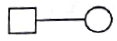
C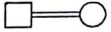
D
Solution
(C) In human pedigree analysis,standard symbols are used to represent different family relationships and traits.
- $A$ single horizontal line between a square (male) and a circle (female) represents mating.
- $A$ double horizontal line between a square and a circle represents mating between relatives,also known as consanguineous mating.
- Therefore,the symbol shown in option $C$ represents mating between relatives.
- $A$ single horizontal line between a square (male) and a circle (female) represents mating.
- $A$ double horizontal line between a square and a circle represents mating between relatives,also known as consanguineous mating.
- Therefore,the symbol shown in option $C$ represents mating between relatives.

0 likesView Solution
93
BiologyMediumMCQNEET · 2023
Match List-$I$ with List-$II$.
Choose the correct answer from the options given below:
| List-$I$ | List-$II$ |
| $A$. Logistic growth | $I$. Unlimited resource availability condition |
| $B$. Exponential growth | $II$. Limited resource availability condition |
| $C$. Expanding age pyramid | $III$. The percent individuals of pre-reproductive age is largest followed by reproductive and post-reproductive age groups |
| $D$. Stable age pyramid | $IV$. The percent individuals of pre-reproductive and reproductive age group are same |
Choose the correct answer from the options given below:
A
$A-II, B-I, C-III, D-IV$
B
$A-II, B-IV, C-III, D-I$
C
$A-II, B-III, C-I, D-IV$
D
$A-II, B-IV, C-I, D-III$
Solution
(B) Logistic growth occurs when there is limited resource availability, leading to a sigmoid curve.
Exponential growth occurs when there is unlimited resource availability, leading to a $J$-shaped curve.
An expanding age pyramid represents a growing population where the percentage of individuals in the pre-reproductive age group is the largest, followed by the reproductive and post-reproductive age groups.
$A$ stable age pyramid represents a stable population where the percentage of individuals in the pre-reproductive and reproductive age groups are approximately the same.
Therefore, the correct matching is $A-II, B-I, C-III, D-IV$.
Exponential growth occurs when there is unlimited resource availability, leading to a $J$-shaped curve.
An expanding age pyramid represents a growing population where the percentage of individuals in the pre-reproductive age group is the largest, followed by the reproductive and post-reproductive age groups.
$A$ stable age pyramid represents a stable population where the percentage of individuals in the pre-reproductive and reproductive age groups are approximately the same.
Therefore, the correct matching is $A-II, B-I, C-III, D-IV$.
0 likesView Solution
94
BiologyMediumMCQNEET · 2023
Which one of the following is the sequence on the corresponding coding strand,if the sequence on the mRNA formed is as follows $5' AUCGAUCGAUCGAUCGAUCGAUCGAUCG 3'$?
A
$3' ATCGATCGATCGATCGATCGATCGATCG 5'$
B
$5' UAGCUAGCUAGCUAGCUAGCUAGCUAGC 3'$
C
$3' UAGCUAGCUAGCUAGCUAGCUAGCUAGC 5'$
D
$5' ATCGATCGATCGATCGATCGATCGATCG 3'$
Solution
(D) In the process of transcription,the coding strand of $DNA$ has the same sequence as the mRNA,except that thymine $(T)$ is present in the $DNA$ instead of uracil $(U)$ in the $RNA$.
Given mRNA sequence: $5' AUCGAUCGAUCGAUCGAUCGAUCGAUCG 3'$
By replacing uracil $(U)$ with thymine $(T)$,we obtain the sequence of the coding strand:
Coding strand sequence: $5' ATCGATCGATCGATCGATCGATCGATCG 3'$
Therefore,the correct option is $D$.
Given mRNA sequence: $5' AUCGAUCGAUCGAUCGAUCGAUCGAUCG 3'$
By replacing uracil $(U)$ with thymine $(T)$,we obtain the sequence of the coding strand:
Coding strand sequence: $5' ATCGATCGATCGATCGATCGATCGATCG 3'$
Therefore,the correct option is $D$.
0 likesView Solution
95
BiologyMediumMCQNEET · 2023
Which one of the following is $NOT$ an advantage of inbreeding?
A
It decreases the productivity of inbred population,after continuous inbreeding.
B
It decreases homozygosity.
C
It exposes harmful recessive genes that are eliminated by selection.
D
Elimination of less desirable genes and accumulation of superior genes takes place due to it.
Solution
(B) Inbreeding refers to the mating of more closely related individuals within the same breed for $4-6$ generations.
$1$. Inbreeding increases homozygosity,which is essential for developing a pure line in any animal.
$2$. It exposes harmful recessive genes that are then eliminated by selection.
$3$. It helps in the accumulation of superior genes and the elimination of less desirable genes.
$4$. However,continued inbreeding,especially close inbreeding,usually reduces fertility and productivity,which is known as inbreeding depression. Therefore,decreasing the productivity of an inbred population is a disadvantage,not an advantage.
Thus,option $B$ is the correct answer as it incorrectly states that inbreeding decreases homozygosity (it actually increases it).
$1$. Inbreeding increases homozygosity,which is essential for developing a pure line in any animal.
$2$. It exposes harmful recessive genes that are then eliminated by selection.
$3$. It helps in the accumulation of superior genes and the elimination of less desirable genes.
$4$. However,continued inbreeding,especially close inbreeding,usually reduces fertility and productivity,which is known as inbreeding depression. Therefore,decreasing the productivity of an inbred population is a disadvantage,not an advantage.
Thus,option $B$ is the correct answer as it incorrectly states that inbreeding decreases homozygosity (it actually increases it).
0 likesView Solution
Vedclass Products
For Students
Vedclass Test Series
Mock tests in real NEET style covering Biology with performance analysis. 5-day free trial.
Start Free TrialFor Teachers
Exam Paper Generator
Generate Set A/B/C/D Biology papers from 7.5L+ questions in 2 minutes. 3 chapters free.
Try FreeFor Institutes
Online Exam Module
Run live NEET mock exams with unlimited students, 360° analytics & white-label branding.
See DemoFrequently Asked Questions
How many Biology questions are in NEET 2023?
There are 100 Biology questions from the NEET 2023 paper on Vedclass, each with a detailed step-by-step solution in English.
Are NEET 2023 Biology solutions available in English?
Yes. All solutions on this page are in English. You can also switch to English or Hindi using the language buttons above the questions.
Can I practice NEET 2023 Biology as a timed test?
Yes. Use the Vedclass Test Series to attempt a full NEET mock test covering Biology with time limits and instant score analysis.
Can teachers create Biology papers from NEET previous year questions?
Yes. The Vedclass Exam Paper Generator lets teachers mix NEET Biology questions and generate Set A/B/C/D papers in minutes.
For Teachers & Institutes
Build a Custom Biology Paper
Pick NEET 2023 Biology questions, set difficulty, and generate Set A/B/C/D in 2 minutes.