
BiologyQ1–90 of 90 questions
Page 1 of 1 · English
1
BiologyMediumMCQNEET · 2025
The complex $II$ of mitochondrial electron transport chain is also known as
A
Cytochrome $bc_1$
B
Succinate dehydrogenase
C
Cytochrome $c$ oxidase
D
$NADH$ dehydrogenase
Solution
(B) Complex $II$ of the mitochondrial electron transport chain is $\text{Succinate dehydrogenase}$.
It is a membrane-bound enzyme that catalyzes the oxidation of succinate to fumarate in the citric acid cycle, while simultaneously reducing $FAD$ to $FADH_2$, which then transfers electrons to the electron transport chain.
It is a membrane-bound enzyme that catalyzes the oxidation of succinate to fumarate in the citric acid cycle, while simultaneously reducing $FAD$ to $FADH_2$, which then transfers electrons to the electron transport chain.
0 likesView Solution
2
BiologyMediumMCQNEET · 2025
What is the name of the blood vessel that carries deoxygenated blood from the body to the heart in a frog?
A
Aorta
B
Pulmonary artery
C
Pulmonary vein
D
Vena cava
Solution
(D) In a frog,the deoxygenated blood from various parts of the body is collected by the venous system and brought to the heart through two large veins known as the vena cavae (precaval and postcaval). These vessels empty into the sinus venosus,which then leads into the right atrium of the heart.
0 likesView Solution
3
BiologyDifficultMCQNEET · 2025
Which one of the following statements refers to Reductionist Biology?
A
Physico-chemical approach to study and understand living organisms.
B
Physiological approach to study and understand living organisms.
C
Chemical approach to study and understand living organisms.
D
Behavioural approach to study and understand living organisms.
Solution
(A) Reductionist Biology is an approach that attempts to understand the complexity of living organisms by breaking them down into their constituent parts and studying their physico-chemical properties. This method focuses on the molecular and cellular levels to explain biological phenomena,essentially viewing life as a result of physico-chemical interactions.
0 likesView Solution
4
BiologyMediumMCQNEET · 2025
From the statements given below,choose the correct option:
$A.$ The eukaryotic ribosomes are $80S$ and prokaryotic ribosomes are $70S$.
$B.$ Each ribosome has two sub-units.
$C.$ The two sub-units of $80S$ ribosome are $60S$ and $40S$,while those of $70S$ are $50S$ and $30S$.
$D.$ The two sub-units of $80S$ ribosome are $60S$ and $20S$,and those of $70S$ are $50S$ and $20S$.
$E.$ The two sub-units of $80S$ ribosome are $60S$ and $30S$,and those of $70S$ are $50S$ and $30S$.
$A.$ The eukaryotic ribosomes are $80S$ and prokaryotic ribosomes are $70S$.
$B.$ Each ribosome has two sub-units.
$C.$ The two sub-units of $80S$ ribosome are $60S$ and $40S$,while those of $70S$ are $50S$ and $30S$.
$D.$ The two sub-units of $80S$ ribosome are $60S$ and $20S$,and those of $70S$ are $50S$ and $20S$.
$E.$ The two sub-units of $80S$ ribosome are $60S$ and $30S$,and those of $70S$ are $50S$ and $30S$.
A
$A, B, C$ are true
B
$A, B, D$ are true
C
$A, B, E$ are true
D
$B, D, E$ are true
Solution
(A) Ribosomes are non-membrane-bound organelles found in both prokaryotic and eukaryotic cells.
Statement $A$ is true: Eukaryotic ribosomes are $80S$ (cytoplasmic) and prokaryotic ribosomes are $70S$.
Statement $B$ is true: Every ribosome consists of two sub-units (a larger and a smaller one).
Statement $C$ is true: The $80S$ ribosome is composed of $60S$ and $40S$ sub-units,while the $70S$ ribosome is composed of $50S$ and $30S$ sub-units.
Statements $D$ and $E$ are incorrect because they provide wrong combinations of sub-units.
Therefore,statements $A, B,$ and $C$ are correct.
Statement $A$ is true: Eukaryotic ribosomes are $80S$ (cytoplasmic) and prokaryotic ribosomes are $70S$.
Statement $B$ is true: Every ribosome consists of two sub-units (a larger and a smaller one).
Statement $C$ is true: The $80S$ ribosome is composed of $60S$ and $40S$ sub-units,while the $70S$ ribosome is composed of $50S$ and $30S$ sub-units.
Statements $D$ and $E$ are incorrect because they provide wrong combinations of sub-units.
Therefore,statements $A, B,$ and $C$ are correct.
0 likesView Solution
5
BiologyDifficultMCQNEET · 2025
Match List-$I$ with List-$II$.
Choose the correct answer from the options given below:
| List-$I$ | List-$II$ |
| $A$. Emphysema | $I$. Rapid spasms in muscle due to low $Ca^{++}$ in body fluid |
| $B$. Angina Pectoris | $II$. Damaged alveolar walls and decreased respiratory surface |
| $C$. Glomerulonephritis | $III$. Acute chest pain when not enough oxygen is reaching to heart muscle |
| $D$. Tetany | $IV$. Inflammation of glomeruli of kidney |
A
$A-III, B-I, C-IV, D-II$
B
$A-III, B-I, C-II, D-IV$
C
$A-II, B-IV, C-III, D-I$
D
$A-II, B-III, C-IV, D-I$
Solution
(D) . Emphysema is a chronic disorder in which alveolar walls are damaged due to which respiratory surface is decreased.
$B$. Angina Pectoris is a condition characterized by acute chest pain when not enough oxygen is reaching the heart muscle.
$C$. Glomerulonephritis is the inflammation of the glomeruli of the kidney.
$D$. Tetany is the rapid spasms (wild contractions) in muscles due to low $Ca^{++}$ in body fluid.
Therefore,the correct matching is $A-II, B-III, C-IV, D-I$.
$B$. Angina Pectoris is a condition characterized by acute chest pain when not enough oxygen is reaching the heart muscle.
$C$. Glomerulonephritis is the inflammation of the glomeruli of the kidney.
$D$. Tetany is the rapid spasms (wild contractions) in muscles due to low $Ca^{++}$ in body fluid.
Therefore,the correct matching is $A-II, B-III, C-IV, D-I$.
0 likesView Solution
6
BiologyMediumMCQNEET · 2025
Given below are two statements:
Statement $I$: In a floral formula,$\oplus$ stands for zygomorphic nature of the flower,and $\underline{G}$ stands for inferior ovary.
Statement $II$: In a floral formula,$\oplus$ stands for actinomorphic nature of the flower,and $\underline{G}$ stands for superior ovary.
In the light of the above statements,choose the correct answer from the options given below:
Statement $I$: In a floral formula,$\oplus$ stands for zygomorphic nature of the flower,and $\underline{G}$ stands for inferior ovary.
Statement $II$: In a floral formula,$\oplus$ stands for actinomorphic nature of the flower,and $\underline{G}$ stands for superior ovary.
In the light of the above statements,choose the correct answer from the options given below:
A
Both Statement $I$ and Statement $II$ are correct.
B
Both Statement $I$ and Statement $II$ are incorrect.
C
Statement $I$ is correct but Statement $II$ is incorrect.
D
Statement $I$ is incorrect but Statement $II$ is correct.
Solution
(D) In floral formulas,the symbol $\oplus$ represents actinomorphic (radially symmetrical) flowers,while $\%$ represents zygomorphic (bilaterally symmetrical) flowers.
The symbol $\underline{G}$ represents a superior ovary (where the ovary is placed above other floral parts),whereas $\overline{G}$ represents an inferior ovary.
Statement $I$ is incorrect because $\oplus$ is actinomorphic,not zygomorphic,and $\underline{G}$ is superior,not inferior.
Statement $II$ is correct because $\oplus$ is actinomorphic and $\underline{G}$ is superior.
Therefore,Statement $I$ is incorrect and Statement $II$ is correct.
The symbol $\underline{G}$ represents a superior ovary (where the ovary is placed above other floral parts),whereas $\overline{G}$ represents an inferior ovary.
Statement $I$ is incorrect because $\oplus$ is actinomorphic,not zygomorphic,and $\underline{G}$ is superior,not inferior.
Statement $II$ is correct because $\oplus$ is actinomorphic and $\underline{G}$ is superior.
Therefore,Statement $I$ is incorrect and Statement $II$ is correct.
0 likesView Solution
7
BiologyEasyMCQNEET · 2025
Which of the following statements is correct about the location of the male frog's copulatory pad?
A
First and second digit of forelimb
B
First digit of hind limb
C
Second digit of forelimb
D
First digit of the forelimb
Solution
(D) In male frogs,the copulatory pad (also known as the nuptial pad) is a specialized structure found on the ventral side of the first digit of the forelimb. This pad helps the male in clasping the female during the process of amplexus (mating). Therefore,the correct location is the first digit of the forelimb.
0 likesView Solution
8
BiologyEasyMCQNEET · 2025
Which one of the following phytohormones promotes nutrient mobilization which helps in the delay of leaf senescence in plants?
A
Ethylene
B
Abscisic acid
C
Gibberellin
D
Cytokinin
Solution
(D) Cytokinins are a class of plant growth substances (phytohormones) that promote cell division or cytokinesis in plant roots and shoots.
One of the most significant physiological effects of cytokinins is their ability to promote nutrient mobilization.
This mobilization of nutrients helps in delaying leaf senescence (the aging process of leaves) by maintaining the synthesis of proteins and chlorophyll,thereby keeping the leaves green for a longer period.
This phenomenon is also known as the Richmond-Lang effect.
One of the most significant physiological effects of cytokinins is their ability to promote nutrient mobilization.
This mobilization of nutrients helps in delaying leaf senescence (the aging process of leaves) by maintaining the synthesis of proteins and chlorophyll,thereby keeping the leaves green for a longer period.
This phenomenon is also known as the Richmond-Lang effect.
0 likesView Solution
9
BiologyMediumMCQNEET · 2025
While trying to find out the characteristics of a newly found animal,a researcher performed histology on the adult animal and observed a cavity with the presence of mesodermal tissue towards the body wall,but no mesodermal tissue was observed towards the alimentary canal. What could be the possible coelom of that animal?
A
Acoelomate
B
Pseudocoelomate
C
Schizocoelomate
D
Spongocoelomate
Solution
(B) In animals,the body cavity which is lined by mesoderm is called the coelom.
$1$. Acoelomates: These animals lack a body cavity (e.g.,Platyhelminthes).
$2$. Pseudocoelomates: In these animals,the body cavity is not lined by mesoderm; instead,the mesoderm is present as scattered pouches in between the ectoderm and endoderm. Specifically,the mesoderm is present towards the body wall but absent towards the alimentary canal (e.g.,Aschelminthes).
$3$. Schizocoelomates: These are true coelomates where the coelom is formed by the splitting of the mesodermal mass.
Since the description states that mesoderm is present only towards the body wall and not towards the gut,it matches the definition of a pseudocoelom.
$1$. Acoelomates: These animals lack a body cavity (e.g.,Platyhelminthes).
$2$. Pseudocoelomates: In these animals,the body cavity is not lined by mesoderm; instead,the mesoderm is present as scattered pouches in between the ectoderm and endoderm. Specifically,the mesoderm is present towards the body wall but absent towards the alimentary canal (e.g.,Aschelminthes).
$3$. Schizocoelomates: These are true coelomates where the coelom is formed by the splitting of the mesodermal mass.
Since the description states that mesoderm is present only towards the body wall and not towards the gut,it matches the definition of a pseudocoelom.
0 likesView Solution
10
BiologyMediumMCQNEET · 2025
Given below are the stages in the life cycle of pteridophytes. Arrange the following stages in the correct sequence.
$A.$ Prothallus stage
$B.$ Meiosis in spore mother cells
$C.$ Fertilisation
$D.$ Formation of archegonia and antheridia in gametophyte.
$E.$ Transfer of antherozoids to the archegonia in presence of water.
Choose the correct answer from the options given below.
$A.$ Prothallus stage
$B.$ Meiosis in spore mother cells
$C.$ Fertilisation
$D.$ Formation of archegonia and antheridia in gametophyte.
$E.$ Transfer of antherozoids to the archegonia in presence of water.
Choose the correct answer from the options given below.
A
$B, A, D, E, C$
B
$B, A, E, C, D$
C
$D, E, C, A, B$
D
$E, D, C, B, A$
Solution
(A) The life cycle of pteridophytes follows these steps:
$1$. $B.$ Meiosis occurs in spore mother cells to produce haploid spores.
$2$. $A.$ These spores germinate to form a multicellular,free-living,photosynthetic thalloid gametophyte called the prothallus.
$3$. $D.$ The prothallus bears sex organs,namely the archegonia (female) and antheridia (male).
$4$. $E.$ Antherozoids are released from antheridia and transferred to the archegonia in the presence of water.
$5$. $C.$ Fertilisation occurs to form a zygote,which develops into a sporophyte.
Therefore,the correct sequence is $B \rightarrow A \rightarrow D \rightarrow E \rightarrow C$.
$1$. $B.$ Meiosis occurs in spore mother cells to produce haploid spores.
$2$. $A.$ These spores germinate to form a multicellular,free-living,photosynthetic thalloid gametophyte called the prothallus.
$3$. $D.$ The prothallus bears sex organs,namely the archegonia (female) and antheridia (male).
$4$. $E.$ Antherozoids are released from antheridia and transferred to the archegonia in the presence of water.
$5$. $C.$ Fertilisation occurs to form a zygote,which develops into a sporophyte.
Therefore,the correct sequence is $B \rightarrow A \rightarrow D \rightarrow E \rightarrow C$.
0 likesView Solution
11
BiologyMediumMCQNEET · 2025
Cardiac activities of the heart are regulated by:
$A.$ Nodal tissue
$B.$ $A$ special neural centre in the medulla oblongata
$C.$ Adrenal medullary hormones
$D.$ Adrenal cortical hormones
Choose the correct answer from the options given below:
$A.$ Nodal tissue
$B.$ $A$ special neural centre in the medulla oblongata
$C.$ Adrenal medullary hormones
$D.$ Adrenal cortical hormones
Choose the correct answer from the options given below:
A
$A, B$ and $C$ Only
B
$A, B, C$ and $D$
C
$A, C$ and $D$ Only
D
$A, B$ and $D$ Only
Solution
(A) The cardiac activities of the heart are regulated by both intrinsic and extrinsic mechanisms:
$1$. Intrinsic regulation: The heart is myogenic,meaning its rhythmic contraction is initiated by specialized nodal tissues ($SA$ node and $AV$ node).
$2$. Neural regulation: $A$ special neural center in the medulla oblongata can moderate cardiac functions through the autonomic nervous system $(ANS)$.
$3$. Hormonal regulation: Hormones secreted by the adrenal medulla,such as adrenaline and noradrenaline,significantly increase cardiac output during stress or exercise.
$4$. Adrenal cortical hormones (like cortisol or aldosterone) are primarily involved in glucose metabolism and electrolyte balance,not in the direct regulation of cardiac activity.
Therefore,$A, B,$ and $C$ are correct,while $D$ is incorrect.
$1$. Intrinsic regulation: The heart is myogenic,meaning its rhythmic contraction is initiated by specialized nodal tissues ($SA$ node and $AV$ node).
$2$. Neural regulation: $A$ special neural center in the medulla oblongata can moderate cardiac functions through the autonomic nervous system $(ANS)$.
$3$. Hormonal regulation: Hormones secreted by the adrenal medulla,such as adrenaline and noradrenaline,significantly increase cardiac output during stress or exercise.
$4$. Adrenal cortical hormones (like cortisol or aldosterone) are primarily involved in glucose metabolism and electrolyte balance,not in the direct regulation of cardiac activity.
Therefore,$A, B,$ and $C$ are correct,while $D$ is incorrect.
0 likesView Solution
12
BiologyMediumMCQNEET · 2025
Which of the following organisms cannot fix nitrogen?
$A.$ Azotobacter
$B.$ Oscillatoria
$C.$ Anabaena
$D.$ Volvox
$E.$ Nostoc
Choose the correct answer from the options given below:
$A.$ Azotobacter
$B.$ Oscillatoria
$C.$ Anabaena
$D.$ Volvox
$E.$ Nostoc
Choose the correct answer from the options given below:
A
$A$ only
B
$D$ only
C
$B$ only
D
$E$ only
Solution
(B) $Azotobacter$ is a free-living nitrogen-fixing bacterium.
$Oscillatoria$,$Anabaena$,and $Nostoc$ are cyanobacteria capable of fixing atmospheric nitrogen due to the presence of specialized cells called heterocysts or through other nitrogen-fixing mechanisms.
$Volvox$ is a green alga (Chlorophyta) that does not possess the nitrogenase enzyme complex required for nitrogen fixation.
Therefore,only $Volvox$ $(D)$ cannot fix nitrogen.
$Oscillatoria$,$Anabaena$,and $Nostoc$ are cyanobacteria capable of fixing atmospheric nitrogen due to the presence of specialized cells called heterocysts or through other nitrogen-fixing mechanisms.
$Volvox$ is a green alga (Chlorophyta) that does not possess the nitrogenase enzyme complex required for nitrogen fixation.
Therefore,only $Volvox$ $(D)$ cannot fix nitrogen.
0 likesView Solution
13
BiologyMediumMCQNEET · 2025
Name the class of enzyme that usually catalyzes the following reaction:
$S-G + S^* \rightarrow S + S^*-G$
Where,
$G \rightarrow$ a group other than hydrogen
$S \rightarrow$ a substrate
$S^* \rightarrow$ another substrate
$S-G + S^* \rightarrow S + S^*-G$
Where,
$G \rightarrow$ a group other than hydrogen
$S \rightarrow$ a substrate
$S^* \rightarrow$ another substrate
A
Hydrolase
B
Lyase
C
Transferase
D
Ligase
Solution
(C) The reaction $S-G + S^* \rightarrow S + S^*-G$ involves the transfer of a functional group $G$ from one substrate $S$ to another substrate $S^*$.
Enzymes that catalyze the transfer of a group other than hydrogen between a pair of substrates are classified as Transferases.
Therefore,the correct class of enzyme is Transferase.
Enzymes that catalyze the transfer of a group other than hydrogen between a pair of substrates are classified as Transferases.
Therefore,the correct class of enzyme is Transferase.
0 likesView Solution
14
BiologyMediumMCQNEET · 2025
Find the statement that is $\text{NOT}$ correct with regard to the structure of monocot stem.
A
Hypodermis is parenchymatous
B
Vascular bundles are scattered.
C
Vascular bundles are conjoint and closed.
D
Phloem parenchyma is absent.
Solution
(A) In a monocot stem,the hypodermis is typically sclerenchymatous,not parenchymatous. This layer provides mechanical support to the stem.
- Vascular bundles are scattered throughout the ground tissue.
- Vascular bundles are conjoint (xylem and phloem together) and closed (no cambium present).
- Phloem parenchyma is generally absent in the vascular bundles of monocot stems.
Therefore,the statement 'Hypodermis is parenchymatous' is incorrect.
- Vascular bundles are scattered throughout the ground tissue.
- Vascular bundles are conjoint (xylem and phloem together) and closed (no cambium present).
- Phloem parenchyma is generally absent in the vascular bundles of monocot stems.
Therefore,the statement 'Hypodermis is parenchymatous' is incorrect.
0 likesView Solution
15
BiologyDifficultMCQNEET · 2025
The correct sequence of events in the life cycle of bryophytes is:
$A.$ Fusion of antherozoid with egg.
$B.$ Attachment of gametophyte to substratum.
$C.$ Reduction division to produce haploid spores.
$D.$ Formation of sporophyte.
$E.$ Release of antherozoids into water.
Choose the correct answer from the options given below.
$A.$ Fusion of antherozoid with egg.
$B.$ Attachment of gametophyte to substratum.
$C.$ Reduction division to produce haploid spores.
$D.$ Formation of sporophyte.
$E.$ Release of antherozoids into water.
Choose the correct answer from the options given below.
A
$D, E, A, C, B$
B
$B, E, A, C, D$
C
$B, E, A, D, C$
D
$D, E, A, B, C$
Solution
(C) The life cycle of bryophytes follows these steps:
$1$. The gametophyte attaches to the substratum $(B)$.
$2$. Antherozoids are released into the water to reach the egg $(E)$.
$3$. Fusion of antherozoid with the egg occurs to form a zygote $(A)$.
$4$. The zygote develops into a sporophyte $(D)$.
$5$. The sporophyte undergoes reduction division (meiosis) to produce haploid spores $(C)$.
Therefore,the correct sequence is $B, E, A, D, C$.
$1$. The gametophyte attaches to the substratum $(B)$.
$2$. Antherozoids are released into the water to reach the egg $(E)$.
$3$. Fusion of antherozoid with the egg occurs to form a zygote $(A)$.
$4$. The zygote develops into a sporophyte $(D)$.
$5$. The sporophyte undergoes reduction division (meiosis) to produce haploid spores $(C)$.
Therefore,the correct sequence is $B, E, A, D, C$.
0 likesView Solution
16
BiologyMediumMCQNEET · 2025
Match List $- I$ with List $- II.$
Choose the correct answer from the options given below:
| List $- I$ | List $- II$ |
|---|---|
| $A$. Centromere | $I$. Mitochondrion |
| $B$. Cilium | $II$. Cell division |
| $C$. Cristae | $III$. Cell movement |
| $D$. Cell membrane | $IV$. Phospholipid Bilayer |
Choose the correct answer from the options given below:
A
$A-I, B-II, C-III, D-IV$
B
$A-II, B-I, C-IV, D-III$
C
$A-IV, B-II, C-III, D-I$
D
$A-II, B-III, C-I, D-IV$
Solution
(D) The correct matches are as follows:
$A$. Centromere is the site of attachment for spindle fibers during $Cell \text{ } division$ $(II)$.
$B$. Cilium is a hair-like outgrowth of the cell membrane involved in $Cell \text{ } movement$ $(III)$.
$C$. Cristae are the infoldings of the inner membrane of the $Mitochondrion$ $(I)$.
$D$. Cell membrane is primarily composed of a $Phospholipid \text{ } Bilayer$ $(IV)$.
Therefore,the correct sequence is $A-II, B-III, C-I, D-IV$.
$A$. Centromere is the site of attachment for spindle fibers during $Cell \text{ } division$ $(II)$.
$B$. Cilium is a hair-like outgrowth of the cell membrane involved in $Cell \text{ } movement$ $(III)$.
$C$. Cristae are the infoldings of the inner membrane of the $Mitochondrion$ $(I)$.
$D$. Cell membrane is primarily composed of a $Phospholipid \text{ } Bilayer$ $(IV)$.
Therefore,the correct sequence is $A-II, B-III, C-I, D-IV$.
0 likesView Solution
17
BiologyMediumMCQNEET · 2025
Match List $I$ with List $II$.
Choose the option with all correct matches.
| List $I$ | List $II$ |
| $A$. Chlorophyll $a$ | $I$. Yellow-green |
| $B$. Chlorophyll $b$ | $II$. Yellow |
| $C$. Xanthophylls | $III$. Blue-green |
| $D$. Carotenoids | $IV$. Yellow to Yellow-orange |
Choose the option with all correct matches.
A
$A-III, B-IV, C-II, D-I$
B
$A-III, B-I, C-II, D-IV$
C
$A-I, B-II, C-IV, D-III$
D
$A-I, B-IV, C-III, D-II$
Solution
(B) The pigments involved in photosynthesis exhibit specific colors in chromatograms:
$1$. Chlorophyll $a$ appears as bright or blue-green in the chromatogram.
$2$. Chlorophyll $b$ appears as yellow-green.
$3$. Xanthophylls appear as yellow.
$4$. Carotenoids appear as yellow to yellow-orange.
Therefore,the correct matching is: $A-III, B-I, C-II, D-IV$.
$1$. Chlorophyll $a$ appears as bright or blue-green in the chromatogram.
$2$. Chlorophyll $b$ appears as yellow-green.
$3$. Xanthophylls appear as yellow.
$4$. Carotenoids appear as yellow to yellow-orange.
Therefore,the correct matching is: $A-III, B-I, C-II, D-IV$.
0 likesView Solution
18
BiologyDifficultMCQNEET · 2025
Which of the following diagrams is correct with regard to the proximal $(P)$ and distal $(D)$ tubule of the Nephron?
A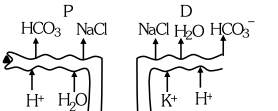
B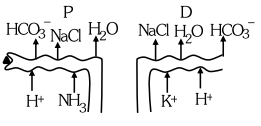
C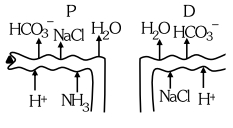
D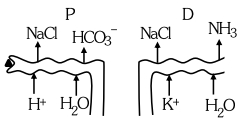
Solution
(B) In the proximal convoluted tubule $(PCT)$,reabsorption of $HCO_3^-$,$NaCl$,and $H_2O$ occurs,while $H^+$ and $NH_3$ are secreted into the filtrate to maintain $pH$ and ionic balance.
In the distal convoluted tubule $(DCT)$,conditional reabsorption of $Na^+$ and $H_2O$ occurs,and there is selective secretion of $H^+$ and $K^+$ ions and $NH_3$ to maintain $pH$ and sodium-potassium balance in the blood.
Comparing the options,Diagram $B$ correctly represents the reabsorption and secretion processes in both the proximal $(P)$ and distal $(D)$ tubules as per standard physiological models.
In the distal convoluted tubule $(DCT)$,conditional reabsorption of $Na^+$ and $H_2O$ occurs,and there is selective secretion of $H^+$ and $K^+$ ions and $NH_3$ to maintain $pH$ and sodium-potassium balance in the blood.
Comparing the options,Diagram $B$ correctly represents the reabsorption and secretion processes in both the proximal $(P)$ and distal $(D)$ tubules as per standard physiological models.
0 likesView Solution
19
BiologyEasyMCQNEET · 2025
$A$ specialised membranous structure in a prokaryotic cell which helps in cell wall formation,$\text{DNA}$ replication and respiration is :
A
Mesosome
B
Chromatophores
C
Cristae
D
Endoplasmic Reticulum
Solution
(A) In prokaryotic cells,the plasma membrane undergoes infoldings to form specialised structures called $Mesosomes$.
These structures are formed by the extensions of the plasma membrane into the cell in the form of vesicles,tubules,and lamellae.
$Mesosomes$ play a crucial role in various cellular processes,including cell wall formation,$\text{DNA}$ replication,and the distribution of daughter cells.
They also help in respiration,secretion processes,and increasing the surface area of the plasma membrane for enzymatic content.
These structures are formed by the extensions of the plasma membrane into the cell in the form of vesicles,tubules,and lamellae.
$Mesosomes$ play a crucial role in various cellular processes,including cell wall formation,$\text{DNA}$ replication,and the distribution of daughter cells.
They also help in respiration,secretion processes,and increasing the surface area of the plasma membrane for enzymatic content.
0 likesView Solution
20
BiologyEasyMCQNEET · 2025
Which one of the following enzymes contains 'Haem' as the prosthetic group?
A
RuBisCo
B
Carbonic anhydrase
C
Succinate dehydrogenase
D
Catalase
Solution
(D) prosthetic group is a non-protein organic molecule that is tightly bound to the apoenzyme to form a functional holoenzyme.
'Haem' is an iron-containing porphyrin ring that acts as a prosthetic group in enzymes like Catalase and Peroxidase.
Catalase catalyzes the decomposition of hydrogen peroxide $(H_2O_2)$ into water and oxygen.
RuBisCo uses $Mg^{2+}$ as a cofactor.
Carbonic anhydrase uses $Zn^{2+}$ as a cofactor.
Succinate dehydrogenase uses $FAD$ as a prosthetic group.
Therefore,the correct option is $D$.
'Haem' is an iron-containing porphyrin ring that acts as a prosthetic group in enzymes like Catalase and Peroxidase.
Catalase catalyzes the decomposition of hydrogen peroxide $(H_2O_2)$ into water and oxygen.
RuBisCo uses $Mg^{2+}$ as a cofactor.
Carbonic anhydrase uses $Zn^{2+}$ as a cofactor.
Succinate dehydrogenase uses $FAD$ as a prosthetic group.
Therefore,the correct option is $D$.
0 likesView Solution
21
BiologyDifficultMCQNEET · 2025
Each of the following characteristics represents a Kingdom proposed by Whittaker. Arrange the following in increasing order of complexity of body organization.
$A.$ Multicellular heterotrophs with cell wall made of chitin.
$B.$ Heterotrophs with tissue/organ/organ system level of body organization.
$C.$ Prokaryotes with cell wall made of polysaccharides and amino acids.
$D.$ Eukaryotic autotrophs with tissue/organ level of body organization.
$E.$ Eukaryotes with cellular body organization.
$A.$ Multicellular heterotrophs with cell wall made of chitin.
$B.$ Heterotrophs with tissue/organ/organ system level of body organization.
$C.$ Prokaryotes with cell wall made of polysaccharides and amino acids.
$D.$ Eukaryotic autotrophs with tissue/organ level of body organization.
$E.$ Eukaryotes with cellular body organization.
A
$A, C, E, B, D$
B
$C, E, A, D, B$
C
$A, C, E, D, B$
D
$C, E, A, B, D$
Solution
(B) According to Whittaker's classification:
$C$ represents Kingdom Monera (Prokaryotes,unicellular,simplest organization).
$E$ represents Kingdom Protista (Eukaryotes,cellular level of organization).
$A$ represents Kingdom Fungi (Multicellular,cell wall of chitin,tissue-like organization).
$D$ represents Kingdom Plantae (Eukaryotic autotrophs,tissue/organ level).
$B$ represents Kingdom Animalia (Heterotrophs,tissue/organ/organ system level,most complex).
Thus,the increasing order of complexity is $C < E < A < D < B$.
$C$ represents Kingdom Monera (Prokaryotes,unicellular,simplest organization).
$E$ represents Kingdom Protista (Eukaryotes,cellular level of organization).
$A$ represents Kingdom Fungi (Multicellular,cell wall of chitin,tissue-like organization).
$D$ represents Kingdom Plantae (Eukaryotic autotrophs,tissue/organ level).
$B$ represents Kingdom Animalia (Heterotrophs,tissue/organ/organ system level,most complex).
Thus,the increasing order of complexity is $C < E < A < D < B$.
0 likesView Solution
22
BiologyMediumMCQNEET · 2025
Match List-$I$ with List-$II$.
Choose the option with all correct matches:
| List-$I$ | List-$II$ |
|---|---|
| $A$. Adenosine | $I$. Nitrogen base |
| $B$. Adenylic acid | $II$. Nucleotide |
| $C$. Adenine | $III$. Nucleoside |
| $D$. Alanine | $IV$. Amino acid |
Choose the option with all correct matches:
A
$A-III, B-IV, C-II, D-I$
B
$A-III, B-II, C-IV, D-I$
C
$A-III, B-II, C-I, D-IV$
D
$A-II, B-III, C-I, D-IV$
Solution
(C) The correct matches are as follows:
$1$. Adenosine is a nucleoside,which consists of a nitrogenous base attached to a sugar molecule $(A-III)$.
$2$. Adenylic acid is a nucleotide,which consists of a nitrogenous base,a sugar molecule,and a phosphate group $(B-II)$.
$3$. Adenine is a nitrogenous base (specifically a purine) $(C-I)$.
$4$. Alanine is an amino acid $(D-IV)$.
Therefore,the correct sequence is $A-III, B-II, C-I, D-IV$.
$1$. Adenosine is a nucleoside,which consists of a nitrogenous base attached to a sugar molecule $(A-III)$.
$2$. Adenylic acid is a nucleotide,which consists of a nitrogenous base,a sugar molecule,and a phosphate group $(B-II)$.
$3$. Adenine is a nitrogenous base (specifically a purine) $(C-I)$.
$4$. Alanine is an amino acid $(D-IV)$.
Therefore,the correct sequence is $A-III, B-II, C-I, D-IV$.
0 likesView Solution
23
BiologyMediumMCQNEET · 2025
All living members of the class Cyclostomata are:
A
Free living
B
Endoparasite
C
Symbiotic
D
Ectoparasite
Solution
(D) The class $Cyclostomata$ consists of jawless vertebrates.
All living members of this class are $Ectoparasites$ on some fishes.
They possess a circular,sucking mouth without jaws,which they use to attach to the body of host fishes to feed on their blood and flesh.
Therefore,the correct option is $D$.
All living members of this class are $Ectoparasites$ on some fishes.
They possess a circular,sucking mouth without jaws,which they use to attach to the body of host fishes to feed on their blood and flesh.
Therefore,the correct option is $D$.
0 likesView Solution
24
BiologyMediumMCQNEET · 2025
Given below are two statements: one is labelled as Assertion $(A)$ and the other is labelled as Reason $(R)$.
Assertion $(A)$: The primary function of the Golgi apparatus is to package the materials made by the endoplasmic reticulum and deliver it to intracellular targets and outside the cell.
Reason $(R)$: Vesicles containing materials made by the endoplasmic reticulum fuse with the cis face of the Golgi apparatus,and they are modified and released from the trans face of the Golgi apparatus.
In the light of the above statements,choose the correct answer from the options given below:
Assertion $(A)$: The primary function of the Golgi apparatus is to package the materials made by the endoplasmic reticulum and deliver it to intracellular targets and outside the cell.
Reason $(R)$: Vesicles containing materials made by the endoplasmic reticulum fuse with the cis face of the Golgi apparatus,and they are modified and released from the trans face of the Golgi apparatus.
In the light of the above statements,choose the correct answer from the options given below:
A
Both $A$ and $R$ are true and $R$ is the correct explanation of $A$
B
Both $A$ and $R$ are true but $R$ is not the correct explanation of $A$
C
$A$ is true but $R$ is false
D
$A$ is false but $R$ is true
Solution
(A) The Golgi apparatus acts as the cell's 'post office'.
Assertion $(A)$ is true because the Golgi apparatus is responsible for packaging materials synthesized in the endoplasmic reticulum $(ER)$ and dispatching them to various intracellular targets or secreting them outside the cell.
Reason $(R)$ is also true and explains the mechanism of $(A)$. Materials from the $ER$ reach the cis face of the Golgi apparatus via transport vesicles,undergo modification within the cisternae,and are then packaged into secretory vesicles that bud off from the trans face.
Therefore,$R$ is the correct explanation of $A$.
Assertion $(A)$ is true because the Golgi apparatus is responsible for packaging materials synthesized in the endoplasmic reticulum $(ER)$ and dispatching them to various intracellular targets or secreting them outside the cell.
Reason $(R)$ is also true and explains the mechanism of $(A)$. Materials from the $ER$ reach the cis face of the Golgi apparatus via transport vesicles,undergo modification within the cisternae,and are then packaged into secretory vesicles that bud off from the trans face.
Therefore,$R$ is the correct explanation of $A$.
0 likesView Solution
25
BiologyMediumMCQNEET · 2025
Given below are two statements: one is labelled as Assertion $(A)$ and the other is labelled as Reason $(R)$.
Assertion $(A):$ All vertebrates are chordates but all chordates are not vertebrates.
Reason $(R):$ The members of subphylum Vertebrata possess a notochord during the embryonic period; the notochord is replaced by a cartilaginous or bony vertebral column in adults.
In the light of the above statements,choose the correct answer from the options given below:
Assertion $(A):$ All vertebrates are chordates but all chordates are not vertebrates.
Reason $(R):$ The members of subphylum Vertebrata possess a notochord during the embryonic period; the notochord is replaced by a cartilaginous or bony vertebral column in adults.
In the light of the above statements,choose the correct answer from the options given below:
A
Both $A$ and $R$ are true and $R$ is the correct explanation of $A$
B
Both $A$ and $R$ are true but $R$ is not the correct explanation of $A$
C
$A$ is true but $R$ is false
D
$A$ is false but $R$ is true
Solution
(A) Assertion $(A)$ is true because all vertebrates belong to the subphylum Vertebrata,which is a part of the phylum Chordata. However,not all chordates are vertebrates because the phylum Chordata also includes subphyla Urochordata and Cephalochordata,which lack a vertebral column.
Reason $(R)$ is also true and correctly explains the Assertion. Vertebrates are defined by the presence of a vertebral column in adults,which replaces the embryonic notochord. This structural transition is the fundamental reason why all vertebrates are classified as chordates (due to the embryonic notochord) but are distinguished from other chordates (which retain the notochord throughout life).
Reason $(R)$ is also true and correctly explains the Assertion. Vertebrates are defined by the presence of a vertebral column in adults,which replaces the embryonic notochord. This structural transition is the fundamental reason why all vertebrates are classified as chordates (due to the embryonic notochord) but are distinguished from other chordates (which retain the notochord throughout life).
0 likesView Solution
26
BiologyMediumMCQNEET · 2025
Match List-$I$ with List-$II$.
Choose the correct answer from the options given below:
| List-$I$ | List-$II$ |
| $A.$ Heart | $I.$ Erythropoietin |
| $B.$ Kidney | $II.$ Aldosterone |
| $C.$ Gastro-intestinal tract | $III.$ Atrial natriuretic factor |
| $D.$ Adrenal Cortex | $IV.$ Secretin |
A
$A-II, B-I, C-III, D-IV$
B
$A-IV, B-III, C-II, D-I$
C
$A-I, B-III, C-IV, D-II$
D
$A-III, B-I, C-IV, D-II$
Solution
(D) The correct matching is as follows:
$1$. Heart: The atrial wall of the heart secretes a peptide hormone called Atrial Natriuretic Factor $(ANF)$,which decreases blood pressure.
$2$. Kidney: The juxtaglomerular cells of the kidney produce a peptide hormone called Erythropoietin,which stimulates erythropoiesis (formation of red blood cells).
$3$. Gastro-intestinal tract: The gastro-intestinal mucosa secretes several peptide hormones such as Gastrin,Secretin,Cholecystokinin $(CCK)$,and Gastric Inhibitory Peptide $(GIP)$.
$4$. Adrenal Cortex: The adrenal cortex secretes steroid hormones,including glucocorticoids and mineralocorticoids like Aldosterone.
Therefore,the correct match is $A-III, B-I, C-IV, D-II$.
$1$. Heart: The atrial wall of the heart secretes a peptide hormone called Atrial Natriuretic Factor $(ANF)$,which decreases blood pressure.
$2$. Kidney: The juxtaglomerular cells of the kidney produce a peptide hormone called Erythropoietin,which stimulates erythropoiesis (formation of red blood cells).
$3$. Gastro-intestinal tract: The gastro-intestinal mucosa secretes several peptide hormones such as Gastrin,Secretin,Cholecystokinin $(CCK)$,and Gastric Inhibitory Peptide $(GIP)$.
$4$. Adrenal Cortex: The adrenal cortex secretes steroid hormones,including glucocorticoids and mineralocorticoids like Aldosterone.
Therefore,the correct match is $A-III, B-I, C-IV, D-II$.
0 likesView Solution
27
BiologyEasyMCQNEET · 2025
The protein portion of an enzyme is called:
A
Cofactor
B
Coenzyme
C
Apoenzyme
D
Prosthetic group
Solution
(C) An enzyme is often composed of a protein part and a non-protein part.
The protein portion of an enzyme is known as the $Apoenzyme$.
The non-protein part is called the $Cofactor$.
When the $Apoenzyme$ and $Cofactor$ combine,they form the active enzyme known as the $Holoenzyme$.
Therefore,the correct answer is $Apoenzyme$.
The protein portion of an enzyme is known as the $Apoenzyme$.
The non-protein part is called the $Cofactor$.
When the $Apoenzyme$ and $Cofactor$ combine,they form the active enzyme known as the $Holoenzyme$.
Therefore,the correct answer is $Apoenzyme$.
0 likesView Solution
28
BiologyEasyMCQNEET · 2025
Which of the following is an example of a zygomorphic flower?
A
Petunia
B
Datura
C
Pea
D
Chilli
Solution
(C) flower is said to be $zygomorphic$ (bilateral symmetry) if it can be divided into two similar halves only in one particular vertical plane.
Examples of $zygomorphic$ flowers include $Pea$,$Bean$,$Cassia$,and $Gulmohur$.
$Petunia$,$Datura$,and $Chilli$ are examples of $actinomorphic$ (radial symmetry) flowers,where the flower can be divided into two equal radial halves in any radial plane passing through the center.
Examples of $zygomorphic$ flowers include $Pea$,$Bean$,$Cassia$,and $Gulmohur$.
$Petunia$,$Datura$,and $Chilli$ are examples of $actinomorphic$ (radial symmetry) flowers,where the flower can be divided into two equal radial halves in any radial plane passing through the center.
0 likesView Solution
29
BiologyMediumMCQNEET · 2025
What is the main function of the spindle fibers during mitosis?
A
To separate the chromosomes
B
To synthesize new $DNA$
C
To repair damaged $DNA$
D
To regulate cell growth
Solution
(A) During mitosis,the spindle fibers are composed of microtubules that attach to the kinetochores of the chromosomes.
Their primary function is to pull the sister chromatids apart toward opposite poles of the cell during anaphase.
This ensures that each daughter cell receives an identical set of chromosomes.
Therefore,the correct function is to separate the chromosomes.
Their primary function is to pull the sister chromatids apart toward opposite poles of the cell during anaphase.
This ensures that each daughter cell receives an identical set of chromosomes.
Therefore,the correct function is to separate the chromosomes.
0 likesView Solution
30
BiologyMediumMCQNEET · 2025
Which one of the following is the characteristic feature of gymnosperms?
A
Seeds are enclosed in fruits.
B
Seeds are naked.
C
Seeds are absent.
D
Gymnosperms have flowers for reproduction.
Solution
(B) The term $Gymnosperms$ is derived from the Greek words $gymnos$ (meaning naked) and $sperma$ (meaning seed).
In $Gymnosperms$,the ovules are not enclosed by any ovary wall and remain exposed,both before and after fertilization.
Consequently,the seeds that develop post-fertilization are not covered,which is why they are referred to as 'naked seeds'.
In contrast,$Angiosperms$ have seeds enclosed within fruits.
In $Gymnosperms$,the ovules are not enclosed by any ovary wall and remain exposed,both before and after fertilization.
Consequently,the seeds that develop post-fertilization are not covered,which is why they are referred to as 'naked seeds'.
In contrast,$Angiosperms$ have seeds enclosed within fruits.
0 likesView Solution
31
BiologyDifficultMCQNEET · 2025
Consider the following statements regarding the function of adrenal medullary hormones:
$A.$ It causes pupillary constriction.
$B.$ It is a hyperglycemic hormone.
$C.$ It causes piloerection.
$D.$ It increases the strength of heart contraction.
Choose the correct answer from the options given below.
$A.$ It causes pupillary constriction.
$B.$ It is a hyperglycemic hormone.
$C.$ It causes piloerection.
$D.$ It increases the strength of heart contraction.
Choose the correct answer from the options given below.
A
$C$ and $D$ Only
B
$B, C$ and $D$ Only
C
$A, C$ and $D$ Only
D
$D$ Only
Solution
(B) Adrenal medullary hormones,specifically epinephrine (adrenaline) and norepinephrine (noradrenaline),are known as emergency hormones or hormones of fight or flight.
$A.$ Incorrect: These hormones cause pupillary dilation (mydriasis),not constriction.
$B.$ Correct: They are hyperglycemic because they stimulate the breakdown of glycogen into glucose in the liver,increasing blood glucose levels.
$C.$ Correct: They cause piloerection (goosebumps) by stimulating the arrector pili muscles.
$D.$ Correct: They increase the strength of heart contraction and the rate of heartbeat to increase cardiac output.
Therefore,statements $B, C,$ and $D$ are correct.
$A.$ Incorrect: These hormones cause pupillary dilation (mydriasis),not constriction.
$B.$ Correct: They are hyperglycemic because they stimulate the breakdown of glycogen into glucose in the liver,increasing blood glucose levels.
$C.$ Correct: They cause piloerection (goosebumps) by stimulating the arrector pili muscles.
$D.$ Correct: They increase the strength of heart contraction and the rate of heartbeat to increase cardiac output.
Therefore,statements $B, C,$ and $D$ are correct.
0 likesView Solution
32
BiologyMediumMCQNEET · 2025
Match List-$I$ with List-$II$:
Choose the option with all correct matches:
| List-$I$ | List-$II$ |
| $A$. Pteridophyte | $I$. Salvia |
| $B$. Bryophyte | $II$. Ginkgo |
| $C$. Angiosperm | $III$. Polytrichum |
| $D$. Gymnosperm | $IV$. Salvinia |
Choose the option with all correct matches:
A
$A-III, B-IV, C-II, D-I$
B
$A-IV, B-III, C-I, D-II$
C
$A-III, B-IV, C-I, D-II$
D
$A-IV, B-III, C-II, D-I$
Solution
(B) The correct matches are as follows:
$1$. $A$. Pteridophyte: $IV$. Salvinia is a well-known aquatic pteridophyte.
$2$. $B$. Bryophyte: $III$. Polytrichum is a genus of moss,which belongs to the bryophytes.
$3$. $C$. Angiosperm: $I$. Salvia is a flowering plant,which belongs to the angiosperms.
$4$. $D$. Gymnosperm: $II$. Ginkgo is a living fossil gymnosperm.
Therefore,the correct matching is $A-IV, B-III, C-I, D-II$.
$1$. $A$. Pteridophyte: $IV$. Salvinia is a well-known aquatic pteridophyte.
$2$. $B$. Bryophyte: $III$. Polytrichum is a genus of moss,which belongs to the bryophytes.
$3$. $C$. Angiosperm: $I$. Salvia is a flowering plant,which belongs to the angiosperms.
$4$. $D$. Gymnosperm: $II$. Ginkgo is a living fossil gymnosperm.
Therefore,the correct matching is $A-IV, B-III, C-I, D-II$.
0 likesView Solution
33
BiologyMediumMCQNEET · 2025
Which of the following hormones released from the pituitary is actually synthesized in the hypothalamus?
A
Luteinizing hormone $(LH)$
B
Anti-diuretic hormone $(ADH)$
C
Follicle-stimulating hormone $(FSH)$
D
Adenocorticotrophic hormone $(ACTH)$
Solution
(B) The posterior pituitary (neurohypophysis) does not synthesize hormones itself.
It stores and releases two hormones: Oxytocin and Anti-diuretic hormone $(ADH)$ (also known as Vasopressin).
These hormones are synthesized in the hypothalamus by the supraoptic and paraventricular nuclei.
They are transported along the axons of the hypothalamic neurons to the posterior pituitary for storage and subsequent release into the bloodstream.
In contrast,hormones like $LH$,$FSH$,and $ACTH$ are synthesized and secreted by the anterior pituitary (adenohypophysis).
It stores and releases two hormones: Oxytocin and Anti-diuretic hormone $(ADH)$ (also known as Vasopressin).
These hormones are synthesized in the hypothalamus by the supraoptic and paraventricular nuclei.
They are transported along the axons of the hypothalamic neurons to the posterior pituitary for storage and subsequent release into the bloodstream.
In contrast,hormones like $LH$,$FSH$,and $ACTH$ are synthesized and secreted by the anterior pituitary (adenohypophysis).
0 likesView Solution
34
BiologyMediumMCQNEET · 2025
Role of the water vascular system in Echinoderms is :
$A.$ Respiration and Locomotion
$B.$ Excretion and Locomotion
$C.$ Capture and transport of food
$D.$ Digestion and Respiration
$E.$ Digestion and Excretion
Choose the correct answer from the options given below :
$A.$ Respiration and Locomotion
$B.$ Excretion and Locomotion
$C.$ Capture and transport of food
$D.$ Digestion and Respiration
$E.$ Digestion and Excretion
Choose the correct answer from the options given below :
A
$A$ and $B$ only
B
$A$ and $C$ only
C
$B$ and $C$ only
D
$B, D$ and $E$ only
Solution
(B) The water vascular system is a unique characteristic of the phylum Echinodermata.
It plays a crucial role in multiple physiological processes.
Specifically,it is involved in locomotion (via tube feet),respiration (gas exchange across the tube feet/dermal branchiae),and the capture and transport of food.
Therefore,the functions listed in $A$ (Respiration and Locomotion) and $C$ (Capture and transport of food) are correct.
Thus,the correct option is $A$ and $C$ only.
It plays a crucial role in multiple physiological processes.
Specifically,it is involved in locomotion (via tube feet),respiration (gas exchange across the tube feet/dermal branchiae),and the capture and transport of food.
Therefore,the functions listed in $A$ (Respiration and Locomotion) and $C$ (Capture and transport of food) are correct.
Thus,the correct option is $A$ and $C$ only.
0 likesView Solution
35
BiologyMediumMCQNEET · 2025
In bryophytes,the gemmae help in which one of the following?
A
Sexual reproduction
B
Asexual reproduction
C
Nutrient absorption
D
Gaseous exchange
Solution
(B) Gemmae are specialized green,multicellular,asexual buds that develop in small receptacles called gemma cups located on the thalli of certain liverworts (e.g.,$Marchantia$).
When these gemmae detach from the parent plant body,they germinate to form new individuals.
Therefore,gemmae are primarily involved in asexual reproduction (vegetative propagation) in bryophytes.
When these gemmae detach from the parent plant body,they germinate to form new individuals.
Therefore,gemmae are primarily involved in asexual reproduction (vegetative propagation) in bryophytes.
0 likesView Solution
36
BiologyMediumMCQNEET · 2025
In frog,the Renal portal system is a special venous connection that acts to link :
A
Liver and intestine
B
Liver and kidney
C
Kidney and intestine
D
Kidney and lower part of body
Solution
(D) The renal portal system in a frog is a specialized venous network that carries blood from the posterior (lower) parts of the body directly to the kidneys before it returns to the heart.
This system is essential for the excretion of nitrogenous wastes from the lower limbs and posterior regions of the body.
Therefore,it acts as a link between the lower part of the body and the kidneys.
This system is essential for the excretion of nitrogenous wastes from the lower limbs and posterior regions of the body.
Therefore,it acts as a link between the lower part of the body and the kidneys.
0 likesView Solution
37
BiologyEasyMCQNEET · 2025
Which of the following statements about $RuBisCO$ is true?
A
It is active only in the dark.
B
It has higher affinity for oxygen than carbon dioxide.
C
It is an enzyme involved in the photolysis of water.
D
It catalyzes the carboxylation of $RuBP$.
Solution
(D) $RuBisCO$ (Ribulose$-1,5-$bisphosphate carboxylase-oxygenase) is the most abundant enzyme on Earth.
It acts as a carboxylase in the Calvin cycle,where it catalyzes the carboxylation of $RuBP$ (Ribulose$-1,5-$bisphosphate) by adding $CO_2$ to it.
Option $A$ is incorrect because $RuBisCO$ is light-dependent and active during the day.
Option $B$ is incorrect because although it can bind to both,it has a much higher affinity for $CO_2$ than for $O_2$ under normal physiological conditions.
Option $C$ is incorrect because the photolysis of water is catalyzed by the oxygen-evolving complex associated with Photosystem $II$,not $RuBisCO$.
Therefore,the correct statement is that it catalyzes the carboxylation of $RuBP$.
It acts as a carboxylase in the Calvin cycle,where it catalyzes the carboxylation of $RuBP$ (Ribulose$-1,5-$bisphosphate) by adding $CO_2$ to it.
Option $A$ is incorrect because $RuBisCO$ is light-dependent and active during the day.
Option $B$ is incorrect because although it can bind to both,it has a much higher affinity for $CO_2$ than for $O_2$ under normal physiological conditions.
Option $C$ is incorrect because the photolysis of water is catalyzed by the oxygen-evolving complex associated with Photosystem $II$,not $RuBisCO$.
Therefore,the correct statement is that it catalyzes the carboxylation of $RuBP$.
0 likesView Solution
38
BiologyDifficultMCQNEET · 2025
Read the following statements on plant growth and development.
$A.$ Parthenocarpy can be induced by auxins.
$B.$ Plant growth regulators can be involved in promotion as well as inhibition of growth.
$C.$ Dedifferentiation is a pre-requisite for redifferentiation.
$D.$ Abscisic acid is a plant growth promoter.
$E.$ Apical dominance promotes the growth of lateral buds.
Choose the option with all correct statements.
$A.$ Parthenocarpy can be induced by auxins.
$B.$ Plant growth regulators can be involved in promotion as well as inhibition of growth.
$C.$ Dedifferentiation is a pre-requisite for redifferentiation.
$D.$ Abscisic acid is a plant growth promoter.
$E.$ Apical dominance promotes the growth of lateral buds.
Choose the option with all correct statements.
A
$A, B, C$ only
B
$A, C, E$ only
C
$A, D, E$ only
D
$B, D, E$ only
Solution
(A) Statement $A$ is correct: Auxins are known to induce parthenocarpy in many plants.
Statement $B$ is correct: Plant growth regulators (PGRs) can act as promoters (e.g.,auxins,gibberellins,cytokinins) or inhibitors (e.g.,abscisic acid) of growth.
Statement $C$ is correct: Dedifferentiation (the process where mature cells regain the capacity to divide) is a necessary step before redifferentiation (where cells mature into specific tissues) can occur.
Statement $D$ is incorrect: Abscisic acid $(ABA)$ is a plant growth inhibitor,not a promoter.
Statement $E$ is incorrect: Apical dominance refers to the phenomenon where the apical bud inhibits the growth of lateral buds,not promotes it.
Therefore,statements $A, B,$ and $C$ are correct.
Statement $B$ is correct: Plant growth regulators (PGRs) can act as promoters (e.g.,auxins,gibberellins,cytokinins) or inhibitors (e.g.,abscisic acid) of growth.
Statement $C$ is correct: Dedifferentiation (the process where mature cells regain the capacity to divide) is a necessary step before redifferentiation (where cells mature into specific tissues) can occur.
Statement $D$ is incorrect: Abscisic acid $(ABA)$ is a plant growth inhibitor,not a promoter.
Statement $E$ is incorrect: Apical dominance refers to the phenomenon where the apical bud inhibits the growth of lateral buds,not promotes it.
Therefore,statements $A, B,$ and $C$ are correct.
0 likesView Solution
39
BiologyMediumMCQNEET · 2025
Frogs respire in water by skin and buccal cavity and on land by skin,buccal cavity and lungs. Choose the correct answer from the following:
A
The statement is true for water but false for land
B
The statement is true for both the environment
C
The statement is false for water but true for land
D
The statement is false for both the environment
Solution
(B) Frogs exhibit cutaneous respiration (through the skin) in both water and on land.
In water,the skin acts as the primary respiratory organ,and the buccal cavity also contributes to gas exchange.
On land,frogs respire through their skin (cutaneous respiration),buccal cavity (buccal respiration),and lungs (pulmonary respiration).
Therefore,the statement provided is scientifically accurate for both environments.
In water,the skin acts as the primary respiratory organ,and the buccal cavity also contributes to gas exchange.
On land,frogs respire through their skin (cutaneous respiration),buccal cavity (buccal respiration),and lungs (pulmonary respiration).
Therefore,the statement provided is scientifically accurate for both environments.
0 likesView Solution
40
BiologyMediumMCQNEET · 2025
Match List-$I$ with List-$II$:
Choose the correct answer from the options given below:
| List-$I$ | List-$II$ |
| $A.$ Progesterone | $I.$ Pars intermedia |
| $B.$ Relaxin | $II.$ Ovary |
| $C.$ Melanocyte stimulating hormone | $III.$ Adrenal Medulla |
| $D.$ Catecholamines | $IV.$ Corpus luteum |
Choose the correct answer from the options given below:
A
$A-IV, B-II, C-I, D-III$
B
$A-IV, B-II, C-III, D-I$
C
$A-II, B-IV, C-I, D-III$
D
$A-III, B-II, C-IV, D-I$
Solution
(A) The correct matching is as follows:
$A.$ Progesterone is secreted by the $IV.$ Corpus luteum.
$B.$ Relaxin is produced by the $II.$ Ovary (specifically during pregnancy).
$C.$ Melanocyte stimulating hormone $(MSH)$ is secreted by the $I.$ Pars intermedia of the pituitary gland.
$D.$ Catecholamines (Adrenaline and Noradrenaline) are secreted by the $III.$ Adrenal Medulla.
Therefore,the correct sequence is $A-IV, B-II, C-I, D-III$.
$A.$ Progesterone is secreted by the $IV.$ Corpus luteum.
$B.$ Relaxin is produced by the $II.$ Ovary (specifically during pregnancy).
$C.$ Melanocyte stimulating hormone $(MSH)$ is secreted by the $I.$ Pars intermedia of the pituitary gland.
$D.$ Catecholamines (Adrenaline and Noradrenaline) are secreted by the $III.$ Adrenal Medulla.
Therefore,the correct sequence is $A-IV, B-II, C-I, D-III$.
0 likesView Solution
41
BiologyMediumMCQNEET · 2025
Polymerase chain reaction $\text{(PCR)}$ amplifies $\text{DNA}$ following the equation:
A
$N^2$
B
$2^n$
C
$2n+1$
D
$2N^2$
Solution
(B) The Polymerase Chain Reaction $\text{(PCR)}$ is a technique used to amplify a specific segment of $\text{DNA}$ in vitro.
In each cycle of $\text{PCR}$,the amount of $\text{DNA}$ doubles.
If we start with a single molecule of $\text{DNA}$,after $n$ cycles,the number of $\text{DNA}$ molecules produced is given by the formula $2^n$.
Therefore,the correct equation for amplification is $2^n$.
In each cycle of $\text{PCR}$,the amount of $\text{DNA}$ doubles.
If we start with a single molecule of $\text{DNA}$,after $n$ cycles,the number of $\text{DNA}$ molecules produced is given by the formula $2^n$.
Therefore,the correct equation for amplification is $2^n$.
0 likesView Solution
42
BiologyDifficultMCQNEET · 2025
What are the potential drawbacks in adoption of the $\text{IVF}$ method?
$A.$ High fatality risk to mother
$B.$ Expensive instruments and reagents
$C.$ Husband/wife necessary for being donors
$D.$ Less adoption of orphans
$E.$ Not available in India
$F.$ Possibility that the early embryo does not survive
Choose the correct answer from the options given below:
$A.$ High fatality risk to mother
$B.$ Expensive instruments and reagents
$C.$ Husband/wife necessary for being donors
$D.$ Less adoption of orphans
$E.$ Not available in India
$F.$ Possibility that the early embryo does not survive
Choose the correct answer from the options given below:
A
$B, D, F$ only
B
$A, C, D, F$ only
C
$A, B, C, D$ only
D
$A, B, C, E, F$ only
Solution
(A) The $\text{IVF}$ (In Vitro Fertilization) method has several limitations and drawbacks:
$1.$ It requires highly specialized,expensive instruments and reagents,making it costly $(B)$.
$2.$ The widespread use of $\text{IVF}$ may lead to a decrease in the adoption of orphans,as couples prioritize biological children $(D)$.
$3.$ There is a significant biological risk that the early embryo may not survive after implantation $(F)$.
Options $A, C,$ and $E$ are incorrect because $\text{IVF}$ is available in India,donors do not strictly have to be the husband/wife (e.g.,donor gametes can be used),and it is not inherently fatal to the mother.
$1.$ It requires highly specialized,expensive instruments and reagents,making it costly $(B)$.
$2.$ The widespread use of $\text{IVF}$ may lead to a decrease in the adoption of orphans,as couples prioritize biological children $(D)$.
$3.$ There is a significant biological risk that the early embryo may not survive after implantation $(F)$.
Options $A, C,$ and $E$ are incorrect because $\text{IVF}$ is available in India,donors do not strictly have to be the husband/wife (e.g.,donor gametes can be used),and it is not inherently fatal to the mother.
0 likesView Solution
43
BiologyDifficultMCQNEET · 2025
Given below are two statements:
Statement $I$: In the $\text{RNA}$ world,$\text{RNA}$ is considered the first genetic material evolved to carry out essential life processes. $\text{RNA}$ acts as a genetic material and also as a catalyst for some important biochemical reactions in living systems. Being reactive,$\text{RNA}$ is unstable.
Statement $II$: $\text{DNA}$ evolved from $\text{RNA}$ and is a more stable genetic material. Its double helical strands being complementary,resist changes by evolving a repairing mechanism.
In the light of the above statements,choose the most appropriate answer from the options given below:
Statement $I$: In the $\text{RNA}$ world,$\text{RNA}$ is considered the first genetic material evolved to carry out essential life processes. $\text{RNA}$ acts as a genetic material and also as a catalyst for some important biochemical reactions in living systems. Being reactive,$\text{RNA}$ is unstable.
Statement $II$: $\text{DNA}$ evolved from $\text{RNA}$ and is a more stable genetic material. Its double helical strands being complementary,resist changes by evolving a repairing mechanism.
In the light of the above statements,choose the most appropriate answer from the options given below:
A
Both statement $I$ and statement $II$ are correct.
B
Both statement $I$ and statement $II$ are incorrect.
C
Statement $I$ is correct but statement $II$ is incorrect.
D
Statement $I$ is incorrect but statement $II$ is correct.
Solution
(A) Statement $I$ is correct because $\text{RNA}$ was the first genetic material. It is reactive due to the presence of a $2'$-$\text{OH}$ group on the ribose sugar,making it unstable and suitable for catalytic activity.
Statement $II$ is correct because $\text{DNA}$ evolved from $\text{RNA}$ through chemical modifications. $\text{DNA}$ is more stable due to the absence of the $2'$-$\text{OH}$ group and the presence of thymine instead of uracil. Its double-stranded nature and complementary base pairing allow for efficient repair mechanisms,ensuring genetic stability.
Statement $II$ is correct because $\text{DNA}$ evolved from $\text{RNA}$ through chemical modifications. $\text{DNA}$ is more stable due to the absence of the $2'$-$\text{OH}$ group and the presence of thymine instead of uracil. Its double-stranded nature and complementary base pairing allow for efficient repair mechanisms,ensuring genetic stability.
0 likesView Solution
44
BiologyEasyMCQNEET · 2025
Epiphytes that are growing on a mango branch is an example of which of the following?
A
Commensalism
B
Mutualism
C
Predation
D
Amensalism
Solution
(A) Commensalism is a type of population interaction where one species benefits and the other is neither harmed nor benefited.
In the case of an orchid (epiphyte) growing on a mango branch,the orchid gets support and access to sunlight and moisture,while the mango tree is neither harmed nor benefited by the presence of the orchid.
Therefore,this interaction is classified as $Commensalism$.
In the case of an orchid (epiphyte) growing on a mango branch,the orchid gets support and access to sunlight and moisture,while the mango tree is neither harmed nor benefited by the presence of the orchid.
Therefore,this interaction is classified as $Commensalism$.
0 likesView Solution
45
BiologyMediumMCQNEET · 2025
Which one of the following is an example of $ex-situ$ conservation?
A
National park
B
Wildlife Sanctuary
C
Zoos and botanical gardens
D
Protected areas
Solution
(C) $Ex-situ$ conservation refers to the conservation of components of biological diversity outside their natural habitats. In this method, threatened animals and plants are taken out from their natural habitat and placed in special settings where they can be protected and given special care. Examples include $Zoos$, $Botanical$ $gardens$, $Wildlife$ $safari$ $parks$, and $Seed$ $banks$. In contrast, $National$ $parks$, $Wildlife$ $sanctuaries$, and $Protected$ $areas$ are examples of $in-situ$ conservation, where organisms are protected within their natural habitats.
0 likesView Solution
46
BiologyDifficultMCQNEET · 2025
Given below are two statements:
Statement $I$: The primary source of energy in an ecosystem is solar energy.
Statement $II$: The rate of production of organic matter during photosynthesis in an ecosystem is called net primary productivity $\text{(NPP)}$.
In the light of the above statements,choose the most appropriate answer from the options given below:
Statement $I$: The primary source of energy in an ecosystem is solar energy.
Statement $II$: The rate of production of organic matter during photosynthesis in an ecosystem is called net primary productivity $\text{(NPP)}$.
In the light of the above statements,choose the most appropriate answer from the options given below:
A
Both statement $I$ and statement $II$ are correct.
B
Both statement $I$ and statement $II$ are incorrect.
C
Statement $I$ is correct but statement $II$ is incorrect.
D
Statement $I$ is incorrect but statement $II$ is correct.
Solution
(C) Statement $I$ is correct because solar energy is the ultimate source of energy for all ecosystems on Earth.
Statement $II$ is incorrect because the rate of production of organic matter during photosynthesis is called Gross Primary Productivity $\text{(GPP)}$,not Net Primary Productivity $\text{(NPP)}$. $\text{NPP}$ is defined as $\text{GPP}$ minus respiration losses $\text{(R)}$,i.e.,$\text{NPP} = \text{GPP} - \text{R}$.
Statement $II$ is incorrect because the rate of production of organic matter during photosynthesis is called Gross Primary Productivity $\text{(GPP)}$,not Net Primary Productivity $\text{(NPP)}$. $\text{NPP}$ is defined as $\text{GPP}$ minus respiration losses $\text{(R)}$,i.e.,$\text{NPP} = \text{GPP} - \text{R}$.
0 likesView Solution
47
BiologyDifficultMCQNEET · 2025
Given below are two statements: One is labelled as Assertion $(A)$ and the other is labelled as Reason $(R)$.
Assertion $(A)$: Both wind and water pollinated flowers are not very colourful and do not produce nectar.
Reason $(R)$: The flowers produce an enormous amount of pollen grains in wind and water pollinated flowers.
In the light of the above statements,choose the correct answer from the options given below:
Assertion $(A)$: Both wind and water pollinated flowers are not very colourful and do not produce nectar.
Reason $(R)$: The flowers produce an enormous amount of pollen grains in wind and water pollinated flowers.
In the light of the above statements,choose the correct answer from the options given below:
A
Both $A$ and $R$ are true and $R$ is the correct explanation of $A$.
B
Both $A$ and $R$ are true and $R$ is $\text{NOT}$ the correct explanation of $A$.
C
$A$ is true but $R$ is false.
D
$A$ is false but $R$ is true.
Solution
(A) Assertion $(A)$ is true because wind and water pollinated flowers do not need to attract pollinators like insects or birds,so they lack bright colours,fragrance,and nectar.
Reason $(R)$ is also true because,in abiotic pollination (wind and water),the chances of pollen reaching the stigma are very low. To compensate for this uncertainty and ensure successful pollination,these plants produce an enormous amount of pollen grains.
Since the lack of colour and nectar is a characteristic adaptation to abiotic pollination,and the production of massive amounts of pollen is a separate adaptation to ensure pollination success in the same abiotic conditions,$R$ explains why these flowers are adapted in this way.
Therefore,both $A$ and $R$ are true,and $R$ is the correct explanation of $A$.
Reason $(R)$ is also true because,in abiotic pollination (wind and water),the chances of pollen reaching the stigma are very low. To compensate for this uncertainty and ensure successful pollination,these plants produce an enormous amount of pollen grains.
Since the lack of colour and nectar is a characteristic adaptation to abiotic pollination,and the production of massive amounts of pollen is a separate adaptation to ensure pollination success in the same abiotic conditions,$R$ explains why these flowers are adapted in this way.
Therefore,both $A$ and $R$ are true,and $R$ is the correct explanation of $A$.
0 likesView Solution
48
BiologyMediumMCQNEET · 2025
Which of the following is an example of a non-distilled alcoholic beverage produced by yeast?
A
Whisky
B
Brandy
C
Beer
D
Rum
Solution
(C) Alcoholic beverages are produced by the fermentation of sugars by yeast, specifically $Saccharomyces \text{ } cerevisiae$ (brewer's yeast).
Non-distilled beverages are produced directly by fermentation and have a lower alcohol content.
Examples include wine and beer.
Distilled beverages like whisky, brandy, and rum are produced by the distillation of fermented broth, which increases their alcohol concentration.
Therefore, beer is the correct example of a non-distilled alcoholic beverage.
Non-distilled beverages are produced directly by fermentation and have a lower alcohol content.
Examples include wine and beer.
Distilled beverages like whisky, brandy, and rum are produced by the distillation of fermented broth, which increases their alcohol concentration.
Therefore, beer is the correct example of a non-distilled alcoholic beverage.
0 likesView Solution
49
BiologyEasyMCQNEET · 2025
Streptokinase produced by the bacterium $Streptococcus$ is used for:
A
Curd production
B
Ethanol production
C
Liver disease treatment
D
Removing clots from blood vessels
Solution
(D) Streptokinase is an enzyme produced by the bacterium $Streptococcus$ and is genetically engineered to be used as a 'clot buster'.
It is used for removing clots from the blood vessels of patients who have undergone myocardial infarction (heart attack).
It works by activating the fibrinolytic system,which dissolves blood clots.
It is used for removing clots from the blood vessels of patients who have undergone myocardial infarction (heart attack).
It works by activating the fibrinolytic system,which dissolves blood clots.
0 likesView Solution
50
BiologyEasyMCQNEET · 2025
Which chromosome in the human genome has the highest number of genes?
A
Chromosome $X$
B
Chromosome $Y$
C
Chromosome $1$
D
Chromosome $10$
Solution
(C) According to the findings of the Human Genome Project $(HGP)$,Chromosome $1$ has the highest number of genes in the human genome.
It contains $2968$ genes,which is the maximum count among all human chromosomes.
In contrast,Chromosome $Y$ has the lowest number of genes,totaling $231$.
It contains $2968$ genes,which is the maximum count among all human chromosomes.
In contrast,Chromosome $Y$ has the lowest number of genes,totaling $231$.
0 likesView Solution
51
BiologyMediumMCQNEET · 2025
Match List-$I$ with List-$II$:
Choose the correct answer from the options given below:
| List-$I$ | List-$II$ |
| $A$. Head | $I$. Enzymes |
| $B$. Middle piece | $II$. Sperm motility |
| $C$. Acrosome | $III$. Energy |
| $D$. Tail | $IV$. Genetic material |
Choose the correct answer from the options given below:
A
$A-IV, B-III, C-I, D-II$
B
$A-IV, B-III, C-II, D-I$
C
$A-III, B-IV, C-II, D-I$
D
$A-III, B-II, C-I, D-IV$
Solution
(A) The structure of a human sperm consists of a head,neck,middle piece,and tail.
$1$. The head contains the haploid nucleus,which carries the genetic material $(A-IV)$.
$2$. The middle piece contains numerous mitochondria,which produce energy for the movement of the tail $(B-III)$.
$3$. The acrosome is a cap-like structure present on the head,which contains enzymes (hyaluronidase) that help in the fertilization of the ovum $(C-I)$.
$4$. The tail facilitates the motility of the sperm $(D-II)$.
Therefore,the correct matching is $A-IV, B-III, C-I, D-II$.
$1$. The head contains the haploid nucleus,which carries the genetic material $(A-IV)$.
$2$. The middle piece contains numerous mitochondria,which produce energy for the movement of the tail $(B-III)$.
$3$. The acrosome is a cap-like structure present on the head,which contains enzymes (hyaluronidase) that help in the fertilization of the ovum $(C-I)$.
$4$. The tail facilitates the motility of the sperm $(D-II)$.
Therefore,the correct matching is $A-IV, B-III, C-I, D-II$.
0 likesView Solution
52
BiologyMediumMCQNEET · 2025
Given below are two statements:
Statement $I$: Transfer $\text{RNAs}$ and ribosomal $\text{RNA}$ do not interact with $\text{mRNA}$.
Statement $II$: $\text{RNA}$ interference $\text{(RNAi)}$ takes place in all eukaryotic organisms as a method of cellular defence.
In the light of the above statements,choose the most appropriate answer from the options given below.
Statement $I$: Transfer $\text{RNAs}$ and ribosomal $\text{RNA}$ do not interact with $\text{mRNA}$.
Statement $II$: $\text{RNA}$ interference $\text{(RNAi)}$ takes place in all eukaryotic organisms as a method of cellular defence.
In the light of the above statements,choose the most appropriate answer from the options given below.
A
Both Statement $I$ and Statement $II$ are correct
B
Both Statement $I$ and Statement $II$ are incorrect
C
Statement $I$ is correct but Statement $II$ is incorrect
D
Statement $I$ is incorrect but Statement $II$ is correct
Solution
(D) Statement $I$ is incorrect because during the process of translation,both $\text{tRNA}$ and $\text{rRNA}$ (as part of the ribosome) interact directly with $\text{mRNA}$. The $\text{tRNA}$ brings amino acids to the $\text{mRNA}$ template,and the ribosome binds to the $\text{mRNA}$ to catalyze protein synthesis.
Statement $II$ is correct because $\text{RNA}$ interference $\text{(RNAi)}$ is a highly conserved biological process in eukaryotes that serves as a mechanism for gene silencing and cellular defense against viral infections and transposons.
Therefore,Statement $I$ is incorrect and Statement $II$ is correct.
Statement $II$ is correct because $\text{RNA}$ interference $\text{(RNAi)}$ is a highly conserved biological process in eukaryotes that serves as a mechanism for gene silencing and cellular defense against viral infections and transposons.
Therefore,Statement $I$ is incorrect and Statement $II$ is correct.
0 likesView Solution
53
BiologyDifficultMCQNEET · 2025
In the above represented plasmid,an alien piece of $\text{DNA}$ is inserted at the $\text{EcoRI}$ site. Which of the following strategies will be chosen to select the recombinant colonies?
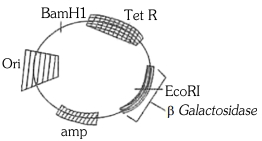
A
Using ampicillin $\&$ tetracycline containing medium plate
B
Blue color colonies will be selected
C
White color colonies will be selected
D
Blue color colonies grown on ampicillin plates can be selected
Solution
(C) The plasmid contains the $\beta$-galactosidase gene,which is responsible for the production of the enzyme $\beta$-galactosidase.
When a foreign $\text{DNA}$ fragment is inserted at the $\text{EcoRI}$ site,which is located within the $\beta$-galactosidase gene,it leads to the insertional inactivation of the gene.
As a result,the enzyme $\beta$-galactosidase is not produced.
In the presence of a chromogenic substrate,non-recombinant colonies (containing the functional gene) produce a blue color,whereas recombinant colonies (where the gene is inactivated) appear white.
Therefore,white color colonies are selected to identify the recombinants.
When a foreign $\text{DNA}$ fragment is inserted at the $\text{EcoRI}$ site,which is located within the $\beta$-galactosidase gene,it leads to the insertional inactivation of the gene.
As a result,the enzyme $\beta$-galactosidase is not produced.
In the presence of a chromogenic substrate,non-recombinant colonies (containing the functional gene) produce a blue color,whereas recombinant colonies (where the gene is inactivated) appear white.
Therefore,white color colonies are selected to identify the recombinants.
0 likesView Solution
54
BiologyMediumMCQNEET · 2025
Which of the following genetically engineered organisms was used by Eli Lilly to prepare human insulin?
A
Bacterium
B
Yeast
C
Virus
D
Phage
Solution
(A) In $1983$, the American company Eli Lilly prepared two $DNA$ sequences corresponding to $A$ and $B$ chains of human insulin and introduced them in plasmids of $Escherichia \text{ } coli$ to produce insulin chains. $E. \text{ } coli$ is a bacterium. These chains were produced separately, extracted, and combined by creating disulfide bonds to form human insulin (Humulin).
0 likesView Solution
55
BiologyDifficultMCQNEET · 2025
Which of the following statements are correct?
$A.$ Computed tomography and magnetic resonance imaging detect cancers of internal organs.
$B.$ Chemotherapeutic drugs are used to kill non-cancerous cells.
$C.$ $\alpha$-interferon activates the cancer patients' immune system and helps in destroying the tumour.
$D.$ Chemotherapeutic drugs are biological response modifiers.
$E.$ In the case of leukaemia,blood cell counts are decreased.
Choose the correct answer from the options given below:
$A.$ Computed tomography and magnetic resonance imaging detect cancers of internal organs.
$B.$ Chemotherapeutic drugs are used to kill non-cancerous cells.
$C.$ $\alpha$-interferon activates the cancer patients' immune system and helps in destroying the tumour.
$D.$ Chemotherapeutic drugs are biological response modifiers.
$E.$ In the case of leukaemia,blood cell counts are decreased.
Choose the correct answer from the options given below:
A
$B$ and $D$ only
B
$D$ and $E$ only
C
$C$ and $D$ only
D
$A$ and $C$ only
Solution
(D) Statement $A$ is correct: Techniques like Computed Tomography $(CT)$ and Magnetic Resonance Imaging $(MRI)$ are used to detect cancers of internal organs.
Statement $B$ is incorrect: Chemotherapeutic drugs are used to kill cancerous cells,although they often have side effects on non-cancerous cells.
Statement $C$ is correct: $\alpha$-interferons are biological response modifiers that activate the immune system of the patient and help in destroying the tumour.
Statement $D$ is incorrect: $\alpha$-interferons are biological response modifiers,not chemotherapeutic drugs.
Statement $E$ is incorrect: In leukaemia (blood cancer),there is a marked increase in the count of white blood cells,not a decrease.
Therefore,only statements $A$ and $C$ are correct.
Statement $B$ is incorrect: Chemotherapeutic drugs are used to kill cancerous cells,although they often have side effects on non-cancerous cells.
Statement $C$ is correct: $\alpha$-interferons are biological response modifiers that activate the immune system of the patient and help in destroying the tumour.
Statement $D$ is incorrect: $\alpha$-interferons are biological response modifiers,not chemotherapeutic drugs.
Statement $E$ is incorrect: In leukaemia (blood cancer),there is a marked increase in the count of white blood cells,not a decrease.
Therefore,only statements $A$ and $C$ are correct.
0 likesView Solution
56
BiologyDifficultMCQNEET · 2025
Find the correct statements :
$A.$ In human pregnancy,the major organ systems are formed at the end of $12$ weeks.
$B.$ In human pregnancy the major organ systems are formed at the end of $8$ weeks.
$C.$ In human pregnancy heart is formed after one month of gestation.
$D.$ In human pregnancy,limbs and digits develop by the end of second month.
$E.$ In human pregnancy the appearance of hair is usually observed in the fifth month.
Choose the correct answer from the options given below.
$A.$ In human pregnancy,the major organ systems are formed at the end of $12$ weeks.
$B.$ In human pregnancy the major organ systems are formed at the end of $8$ weeks.
$C.$ In human pregnancy heart is formed after one month of gestation.
$D.$ In human pregnancy,limbs and digits develop by the end of second month.
$E.$ In human pregnancy the appearance of hair is usually observed in the fifth month.
Choose the correct answer from the options given below.
A
$A$ and $E$ Only
B
$B$ and $C$ Only
C
$B, C, D$ and $E$ Only
D
$A, C, D$ and $E$ Only
Solution
(D) According to the $NCERT$ textbook on human reproduction:
$A.$ Correct: By the end of $12$ weeks (first trimester),most of the major organ systems are formed.
$B.$ Incorrect: Major organ systems are formed by the end of $12$ weeks,not $8$ weeks.
$C.$ Correct: The first sign of a growing fetus is the heart sound,which can be heard after one month of gestation.
$D.$ Correct: Limbs and digits develop by the end of the second month of pregnancy.
$E.$ Correct: The first movements of the fetus and the appearance of hair on the head are usually observed during the fifth month.
Therefore,statements $A, C, D,$ and $E$ are correct.
$A.$ Correct: By the end of $12$ weeks (first trimester),most of the major organ systems are formed.
$B.$ Incorrect: Major organ systems are formed by the end of $12$ weeks,not $8$ weeks.
$C.$ Correct: The first sign of a growing fetus is the heart sound,which can be heard after one month of gestation.
$D.$ Correct: Limbs and digits develop by the end of the second month of pregnancy.
$E.$ Correct: The first movements of the fetus and the appearance of hair on the head are usually observed during the fifth month.
Therefore,statements $A, C, D,$ and $E$ are correct.
0 likesView Solution
57
BiologyMediumMCQNEET · 2025
In the seeds of cereals,the outer covering of endosperm separates the embryo by a protein-rich layer called:
A
Coleoptile
B
Coleorhiza
C
Integument
D
Aleurone Layer
Solution
(D) In the seeds of cereals such as maize,wheat,and rice,the endosperm is bulky and stores food.
The outer covering of the endosperm separates the embryo by a protein-rich layer known as the $Aleurone \text{ Layer}$.
This layer is specialized for the synthesis of enzymes during seed germination.
The outer covering of the endosperm separates the embryo by a protein-rich layer known as the $Aleurone \text{ Layer}$.
This layer is specialized for the synthesis of enzymes during seed germination.
0 likesView Solution
58
BiologyMediumMCQNEET · 2025
Identify the part of a bioreactor which is used as a foam breaker from the given figure.
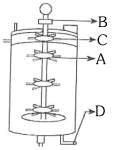
A
$A$
B
$B$
C
$D$
D
$C$
Solution
(D) In a stirred-tank bioreactor,the components are labeled as follows:
$A$: Impeller (Agitator system)
$B$: Motor
$C$: Foam breaker
$D$: Sterile air inlet
The foam breaker $(C)$ is located at the top of the shaft to control the foam produced during the fermentation process.
Therefore,the correct option is $D$.
$A$: Impeller (Agitator system)
$B$: Motor
$C$: Foam breaker
$D$: Sterile air inlet
The foam breaker $(C)$ is located at the top of the shaft to control the foam produced during the fermentation process.
Therefore,the correct option is $D$.
0 likesView Solution
59
BiologyMediumMCQNEET · 2025
Given below are two statements: One is labelled as Assertion $(A)$ and the other is labelled as Reason $(R)$.
Assertion $(A):$ $A$ typical unfertilised,angiosperm embryo sac at maturity is $8$-nucleate and $7$-celled.
Reason $(R):$ The egg apparatus has $2$ polar nuclei.
In the light of the above statements,choose the correct answer from the options given below:
Assertion $(A):$ $A$ typical unfertilised,angiosperm embryo sac at maturity is $8$-nucleate and $7$-celled.
Reason $(R):$ The egg apparatus has $2$ polar nuclei.
In the light of the above statements,choose the correct answer from the options given below:
A
Both $(A)$ and $(R)$ are true and $(R)$ is the correct explanation of $(A)$.
B
Both $(A)$ and $(R)$ are true but $(R)$ is $NOT$ the correct explanation of $(A)$.
C
$(A)$ is true but $(R)$ is false.
D
$(A)$ is false but $(R)$ is true.
Solution
(C) Assertion $(A)$ is true. $A$ mature,typical angiosperm embryo sac (Polygonum type) undergoes three rounds of free nuclear mitotic divisions,resulting in $8$ nuclei. These are organized into $7$ cells: $3$ antipodal cells,$1$ central cell (containing $2$ polar nuclei),and the egg apparatus consisting of $2$ synergids and $1$ egg cell.
Reason $(R)$ is false. The egg apparatus consists of $1$ egg cell and $2$ synergids. The $2$ polar nuclei are located in the large central cell,not in the egg apparatus.
Reason $(R)$ is false. The egg apparatus consists of $1$ egg cell and $2$ synergids. The $2$ polar nuclei are located in the large central cell,not in the egg apparatus.
0 likesView Solution
60
BiologyDifficultMCQNEET · 2025
Which of the following are the post-transcriptional events in an eukaryotic cell?
$A.$ Transport of pre-mRNA to cytoplasm prior to splicing.
$B.$ Removal of introns and joining of exons.
$C.$ Addition of methyl group at $5$' end of hnRNA.
$D.$ Addition of adenine residues at $3$' end of hnRNA.
$E.$ Base pairing of two complementary RNAs.
Choose the correct answer from the options given below:
$A.$ Transport of pre-mRNA to cytoplasm prior to splicing.
$B.$ Removal of introns and joining of exons.
$C.$ Addition of methyl group at $5$' end of hnRNA.
$D.$ Addition of adenine residues at $3$' end of hnRNA.
$E.$ Base pairing of two complementary RNAs.
Choose the correct answer from the options given below:
A
$A, B, C$ only
B
$B, C, D$ only
C
$B, C, E$ only
D
$C, D, E$ only
Solution
(B) In eukaryotic cells,the primary transcript (hnRNA) undergoes several post-transcriptional modifications before it is exported to the cytoplasm as mature mRNA.
$1$. Splicing: The non-coding introns are removed,and the coding exons are joined together $(B)$.
$2$. Capping: $A$ methyl guanosine triphosphate is added to the $5$' end of the hnRNA $(C)$.
$3$. Tailing (Polyadenylation): Adenylate residues are added at the $3$' end of the hnRNA $(D)$.
Transport of pre-mRNA to the cytoplasm occurs only after these processing steps are completed,not prior to splicing ($A$ is incorrect).
Base pairing of complementary RNAs is not a standard post-transcriptional processing event for mRNA maturation ($E$ is incorrect).
Therefore,the correct events are $B, C,$ and $D$.
$1$. Splicing: The non-coding introns are removed,and the coding exons are joined together $(B)$.
$2$. Capping: $A$ methyl guanosine triphosphate is added to the $5$' end of the hnRNA $(C)$.
$3$. Tailing (Polyadenylation): Adenylate residues are added at the $3$' end of the hnRNA $(D)$.
Transport of pre-mRNA to the cytoplasm occurs only after these processing steps are completed,not prior to splicing ($A$ is incorrect).
Base pairing of complementary RNAs is not a standard post-transcriptional processing event for mRNA maturation ($E$ is incorrect).
Therefore,the correct events are $B, C,$ and $D$.
0 likesView Solution
61
BiologyDifficultMCQNEET · 2025
What is the pattern of inheritance for a polygenic trait?
A
Mendelian inheritance pattern
B
Non-Mendelian inheritance pattern
C
Autosomal dominant pattern
D
$X$-linked recessive inheritance pattern
Solution
(B) Polygenic inheritance is a type of inheritance where a single trait is controlled by two or more genes.
These traits do not follow the simple Mendelian ratios because they are influenced by multiple genes and often by environmental factors.
Therefore,polygenic inheritance is classified as a non-Mendelian inheritance pattern,as it involves quantitative inheritance rather than the qualitative inheritance seen in Mendelian genetics.
These traits do not follow the simple Mendelian ratios because they are influenced by multiple genes and often by environmental factors.
Therefore,polygenic inheritance is classified as a non-Mendelian inheritance pattern,as it involves quantitative inheritance rather than the qualitative inheritance seen in Mendelian genetics.
0 likesView Solution
62
BiologyMediumMCQNEET · 2025
Who is known as the father of Ecology in India?
A
$S.R.$ Kashyap
B
Ramdeo Misra
C
Ram Udar
D
Birbal Sahni
Solution
(B) Professor $Ramdeo$ $Misra$ is widely recognized as the father of Ecology in India. He made significant contributions to the field of plant ecology and established the first postgraduate course in ecology in India at the $Banaras$ $Hindu$ $University$ $(BHU)$. His research on tropical forest ecosystems and his efforts in conservation biology laid the foundation for ecological studies in the country.
0 likesView Solution
63
BiologyDifficultMCQNEET · 2025
Match List-$I$ with List-$II$.
Choose the correct answer from the options given below:
| List-$I$ | List-$II$ |
| $A$. Alfred Hershey and Martha Chase | $I$. Streptococcus pneumoniae |
| $B$. Euchromatin | $II$. Densely packed and dark-stained |
| $C$. Frederick Griffith | $III$. Loosely packed and light-stained |
| $D$. Heterochromatin | $IV$. $DNA$ as genetic material confirmation |
A
$A-II, B-IV, C-I, D-III$
B
$A-IV, B-II, C-I, D-III$
C
$A-IV, B-III, C-I, D-II$
D
$A-III, B-II, C-IV, D-I$
Solution
(C) The correct matches are as follows:
$A$. Alfred Hershey and Martha Chase performed experiments on bacteriophages to prove that $DNA$ is the genetic material $(IV)$.
$B$. Euchromatin is the region of chromatin that is loosely packed and stains light $(III)$.
$C$. Frederick Griffith conducted the transformation experiment using $Streptococcus pneumoniae$ $(I)$.
$D$. Heterochromatin is the region of chromatin that is densely packed and stains dark $(II)$.
Therefore, the correct sequence is $A-IV, B-III, C-I, D-II$.
$A$. Alfred Hershey and Martha Chase performed experiments on bacteriophages to prove that $DNA$ is the genetic material $(IV)$.
$B$. Euchromatin is the region of chromatin that is loosely packed and stains light $(III)$.
$C$. Frederick Griffith conducted the transformation experiment using $Streptococcus pneumoniae$ $(I)$.
$D$. Heterochromatin is the region of chromatin that is densely packed and stains dark $(II)$.
Therefore, the correct sequence is $A-IV, B-III, C-I, D-II$.
0 likesView Solution
64
BiologyDifficultMCQNEET · 2025
Neoplastic characteristics of cells refer to:
$A.$ $A$ mass of proliferating cells
$B.$ Rapid growth of cells
$C.$ Invasion and damage to the surrounding tissue
$D.$ Those confined to original location
Choose the correct answer from the options given below:
$A.$ $A$ mass of proliferating cells
$B.$ Rapid growth of cells
$C.$ Invasion and damage to the surrounding tissue
$D.$ Those confined to original location
Choose the correct answer from the options given below:
A
$A, B$ only
B
$A, B, C$ only
C
$A, B, D$ only
D
$B, C, D$ only
Solution
(B) Neoplastic or cancerous cells exhibit several key characteristics that distinguish them from normal cells.
$1.$ They undergo uncontrolled and rapid proliferation,forming a mass of cells known as a tumor ($A$ and $B$).
$2.$ Malignant (neoplastic) cells possess the property of metastasis,where they invade and damage the surrounding normal tissues $(C)$.
$3.$ Cells that are confined to their original location are typically benign and do not exhibit the invasive characteristics of malignant neoplasms $(D)$.
Therefore,the characteristics of neoplastic (malignant) cells include rapid proliferation,mass formation,and invasion of surrounding tissues $(A, B, C)$.
$1.$ They undergo uncontrolled and rapid proliferation,forming a mass of cells known as a tumor ($A$ and $B$).
$2.$ Malignant (neoplastic) cells possess the property of metastasis,where they invade and damage the surrounding normal tissues $(C)$.
$3.$ Cells that are confined to their original location are typically benign and do not exhibit the invasive characteristics of malignant neoplasms $(D)$.
Therefore,the characteristics of neoplastic (malignant) cells include rapid proliferation,mass formation,and invasion of surrounding tissues $(A, B, C)$.
0 likesView Solution
65
BiologyDifficultMCQNEET · 2025
Given below are two statements:
Statement $I:$ The $\text{DNA}$ fragments extracted from gel electrophoresis can be used in the construction of recombinant $\text{DNA}$.
Statement $II:$ Smaller size $\text{DNA}$ fragments are observed near the anode while larger fragments are found near the wells in an agarose gel.
In the light of the above statements,choose the most appropriate answer from the options given below:
Statement $I:$ The $\text{DNA}$ fragments extracted from gel electrophoresis can be used in the construction of recombinant $\text{DNA}$.
Statement $II:$ Smaller size $\text{DNA}$ fragments are observed near the anode while larger fragments are found near the wells in an agarose gel.
In the light of the above statements,choose the most appropriate answer from the options given below:
A
Both statement $I$ and statement $II$ are correct
B
Both statement $I$ and statement $II$ are incorrect
C
Statement $I$ is correct but statement $II$ is incorrect
D
Statement $I$ is incorrect but statement $II$ is correct
Solution
(A) Statement $I$ is correct: After the process of gel electrophoresis,the separated $\text{DNA}$ fragments can be extracted from the agarose gel and purified. This process is known as elution. These purified $\text{DNA}$ fragments can then be used in the construction of recombinant $\text{DNA}$ by joining them with cloning vectors.
Statement $II$ is correct: $\text{DNA}$ molecules are negatively charged due to the phosphate backbone. When an electric field is applied,they move towards the positive electrode (anode). The agarose gel acts as a molecular sieve. Smaller $\text{DNA}$ fragments move faster and travel further through the pores of the gel,reaching closer to the anode,while larger fragments move slower and remain closer to the wells.
Statement $II$ is correct: $\text{DNA}$ molecules are negatively charged due to the phosphate backbone. When an electric field is applied,they move towards the positive electrode (anode). The agarose gel acts as a molecular sieve. Smaller $\text{DNA}$ fragments move faster and travel further through the pores of the gel,reaching closer to the anode,while larger fragments move slower and remain closer to the wells.
0 likesView Solution
66
BiologyDifficultMCQNEET · 2025
Consider the following:
$A.$ The reductive division for the human female gametogenesis starts earlier than that of the male gametogenesis.
$B.$ The gap between the first meiotic division and the second meiotic division is much shorter for males compared to females.
$C.$ The first polar body is associated with the formation of the primary oocyte.
$D.$ Luteinizing Hormone $(LH)$ surge leads to disintegration of the endometrium and onset of menstrual bleeding.
Choose the correct answer from the options given below:
$A.$ The reductive division for the human female gametogenesis starts earlier than that of the male gametogenesis.
$B.$ The gap between the first meiotic division and the second meiotic division is much shorter for males compared to females.
$C.$ The first polar body is associated with the formation of the primary oocyte.
$D.$ Luteinizing Hormone $(LH)$ surge leads to disintegration of the endometrium and onset of menstrual bleeding.
Choose the correct answer from the options given below:
A
$A$ and $B$ are true
B
$A$ and $C$ are true
C
$B$ and $D$ are true
D
$B$ and $C$ are true
Solution
(A) $A.$ True: In females,oogenesis begins during embryonic development,whereas spermatogenesis in males begins at puberty.
$B.$ True: In males,the two meiotic divisions occur sequentially without a long pause. In females,the first meiotic division is arrested at the prophase-$I$ stage until puberty and the second meiotic division is only completed after fertilization.
$C.$ False: The first polar body is formed during the completion of the first meiotic division of the primary oocyte,resulting in a secondary oocyte.
$D.$ False: $LH$ surge triggers ovulation,not the disintegration of the endometrium. The withdrawal of progesterone leads to the disintegration of the endometrium.
Therefore,statements $A$ and $B$ are correct.
$B.$ True: In males,the two meiotic divisions occur sequentially without a long pause. In females,the first meiotic division is arrested at the prophase-$I$ stage until puberty and the second meiotic division is only completed after fertilization.
$C.$ False: The first polar body is formed during the completion of the first meiotic division of the primary oocyte,resulting in a secondary oocyte.
$D.$ False: $LH$ surge triggers ovulation,not the disintegration of the endometrium. The withdrawal of progesterone leads to the disintegration of the endometrium.
Therefore,statements $A$ and $B$ are correct.
0 likesView Solution
67
BiologyMediumMCQNEET · 2025
Match List-$I$ with List-$II$.
Choose the option with all correct matches.
| List-$I$ | List-$II$ |
| $A.$ Scutellum | $I.$ Persistent nucellus |
| $B.$ Non-albuminous seed | $II.$ Cotyledon of Monocot seed |
| $C.$ Epiblast | $III.$ Groundnut |
| $D.$ Perisperm | $IV.$ Rudimentary cotyledon |
A
$A-II, B-III, C-IV, D-I$
B
$A-IV, B-III, C-II, D-I$
C
$A-IV, B-III, C-I, D-II$
D
$A-II, B-IV, C-III, D-I$
Solution
(A) The correct matches are as follows:
$A.$ Scutellum is the single large cotyledon of a monocot seed, which is shield-shaped. Thus, $A-II$.
$B.$ Non-albuminous seeds (ex-albuminous) are those in which the endosperm is completely consumed during embryo development, such as in groundnut or pea. Thus, $B-III$.
$C.$ Epiblast is a small, rudimentary, scale-like structure found in some monocot embryos (like grasses) opposite to the scutellum. Thus, $C-IV$.
$D.$ Perisperm is the persistent, remnant nucellus found in some seeds like black pepper and beet. Thus, $D-I$.
Therefore, the correct sequence is $A-II, B-III, C-IV, D-I$.
$A.$ Scutellum is the single large cotyledon of a monocot seed, which is shield-shaped. Thus, $A-II$.
$B.$ Non-albuminous seeds (ex-albuminous) are those in which the endosperm is completely consumed during embryo development, such as in groundnut or pea. Thus, $B-III$.
$C.$ Epiblast is a small, rudimentary, scale-like structure found in some monocot embryos (like grasses) opposite to the scutellum. Thus, $C-IV$.
$D.$ Perisperm is the persistent, remnant nucellus found in some seeds like black pepper and beet. Thus, $D-I$.
Therefore, the correct sequence is $A-II, B-III, C-IV, D-I$.
0 likesView Solution
68
BiologyDifficultMCQNEET · 2025
Identify the statement that is $\text{NOT}$ correct.
A
Each antibody has two light and two heavy chains.
B
The heavy and light chains are held together by disulfide bonds.
C
Antigen binding site is located at $C-$terminal region of antibody molecules.
D
Constant region of heavy and light chains are located at $C-$terminus of antibody molecules.
Solution
(C) An antibody molecule is represented as $H_2L_2$,meaning it consists of two heavy $(H)$ chains and two light $(L)$ chains.
These chains are held together by disulfide bonds ($S-S$ bonds).
The antibody molecule has a $Y$-shaped structure.
The variable region,which contains the antigen-binding site,is located at the $N$-terminal region of the antibody.
The constant region is located at the $C$-terminal region of the antibody.
Therefore,the statement that the antigen-binding site is located at the $C$-terminal region is incorrect.
These chains are held together by disulfide bonds ($S-S$ bonds).
The antibody molecule has a $Y$-shaped structure.
The variable region,which contains the antigen-binding site,is located at the $N$-terminal region of the antibody.
The constant region is located at the $C$-terminal region of the antibody.
Therefore,the statement that the antigen-binding site is located at the $C$-terminal region is incorrect.
0 likesView Solution
69
BiologyMediumMCQNEET · 2025
Silencing of specific $\text{mRNA}$ is possible via $\text{RNA}$ interference because of $-$
A
Complementary $\text{dsRNA}$
B
Inhibitory $\text{ssRNA}$
C
Complementary $\text{tRNA}$
D
Non-complementary $\text{ssRNA}$
Solution
(A) $RNA$ interference $(\text{RNAi})$ is a biological process in which $\text{RNA}$ molecules inhibit gene expression or translation,by neutralizing targeted $\text{mRNA}$ molecules.
This process is initiated by the presence of double-stranded $\text{RNA}$ $(\text{dsRNA})$.
These $\text{dsRNA}$ molecules are cleaved into small interfering $\text{RNA}$ $(\text{siRNA})$ by an enzyme called Dicer.
These $\text{siRNA}$ molecules then bind to a complementary sequence on the target $\text{mRNA}$,leading to its degradation or preventing its translation,thereby silencing the specific gene.
This process is initiated by the presence of double-stranded $\text{RNA}$ $(\text{dsRNA})$.
These $\text{dsRNA}$ molecules are cleaved into small interfering $\text{RNA}$ $(\text{siRNA})$ by an enzyme called Dicer.
These $\text{siRNA}$ molecules then bind to a complementary sequence on the target $\text{mRNA}$,leading to its degradation or preventing its translation,thereby silencing the specific gene.
0 likesView Solution
70
BiologyEasyMCQNEET · 2025
Genes $R$ and $Y$ follow independent assortment. If $RRYY$ produces round yellow seeds and $rryy$ produces wrinkled green seeds,what will be the phenotypic ratio of the $F2$ generation?
A
Phenotypic ratio $- 1: 2: 1$
B
Phenotypic ratio $- 3: 1$
C
Phenotypic ratio $- 9: 3: 3: 1$
D
Phenotypic ratio $- 9: 7$
Solution
(C) According to Mendel's Law of Independent Assortment,when two pairs of contrasting traits are considered simultaneously (dihybrid cross),the inheritance of one pair of traits is independent of the other.
In this cross,the parent generation $(P)$ consists of $RRYY$ (round yellow) and $rryy$ (wrinkled green).
The $F1$ generation results in $RrYy$ (round yellow) individuals.
When $F1$ individuals $(RrYy)$ are self-crossed,the gametes produced are $RY, Ry, rY,$ and $ry$.
Using a Punnett square to cross these gametes,the resulting $F2$ phenotypic distribution is $9$ round yellow,$3$ round green,$3$ wrinkled yellow,and $1$ wrinkled green.
Therefore,the phenotypic ratio is $9: 3: 3: 1$.
In this cross,the parent generation $(P)$ consists of $RRYY$ (round yellow) and $rryy$ (wrinkled green).
The $F1$ generation results in $RrYy$ (round yellow) individuals.
When $F1$ individuals $(RrYy)$ are self-crossed,the gametes produced are $RY, Ry, rY,$ and $ry$.
Using a Punnett square to cross these gametes,the resulting $F2$ phenotypic distribution is $9$ round yellow,$3$ round green,$3$ wrinkled yellow,and $1$ wrinkled green.
Therefore,the phenotypic ratio is $9: 3: 3: 1$.
0 likesView Solution
71
BiologyEasyMCQNEET · 2025
Histones are enriched with $-$
A
Lysine $\&$ Arginine
B
Leucine $\&$ Lysine
C
Phenylalanine $\&$ Leucine
D
Phenylalanine $\&$ Arginine
Solution
(A) Histones are basic proteins that are associated with $DNA$ to form nucleosomes.
These proteins are rich in positively charged basic amino acids,specifically $Lysine$ and $Arginine$.
The positive charge of these amino acids allows histones to bind tightly to the negatively charged phosphate backbone of the $DNA$ molecule.
These proteins are rich in positively charged basic amino acids,specifically $Lysine$ and $Arginine$.
The positive charge of these amino acids allows histones to bind tightly to the negatively charged phosphate backbone of the $DNA$ molecule.
0 likesView Solution
72
BiologyEasyMCQNEET · 2025
The first menstruation is called:
A
Menopause
B
Menarche
C
Diapause
D
Ovulation
Solution
(B) The first menstruation that occurs at puberty in human females is known as $Menarche$.
$Menopause$ refers to the permanent cessation of the menstrual cycle at the end of the reproductive phase.
$Diapause$ is a state of suspended development in certain animals.
$Ovulation$ is the process of release of an ovum from the Graafian follicle.
$Menopause$ refers to the permanent cessation of the menstrual cycle at the end of the reproductive phase.
$Diapause$ is a state of suspended development in certain animals.
$Ovulation$ is the process of release of an ovum from the Graafian follicle.
0 likesView Solution
73
BiologyDifficultMCQNEET · 2025
Which of the following is the unit of productivity of an ecosystem?
A
$gm^{-2}$
B
$KCal m^{-2}$
C
$KCal m^{-3}$
D
$(KCal m^{-2}) yr^{-1}$
Solution
(D) Productivity is defined as the rate of biomass production or energy accumulation per unit area over a specific period of time.
Since it is a rate,it must include a time component.
Biomass productivity is typically measured in units like $g m^{-2} yr^{-1}$,and energy productivity is measured in units like $KCal m^{-2} yr^{-1}$.
Among the given options,$(KCal m^{-2}) yr^{-1}$ represents the rate of energy accumulation per unit area per unit time,which is the correct unit for ecosystem productivity.
Since it is a rate,it must include a time component.
Biomass productivity is typically measured in units like $g m^{-2} yr^{-1}$,and energy productivity is measured in units like $KCal m^{-2} yr^{-1}$.
Among the given options,$(KCal m^{-2}) yr^{-1}$ represents the rate of energy accumulation per unit area per unit time,which is the correct unit for ecosystem productivity.
0 likesView Solution
74
BiologyMediumMCQNEET · 2025
Sweet potato and potato represent a certain type of evolution. Select the correct combination of terms to explain the evolution.
A
Analogy,convergent
B
Homology,divergent
C
Homology,convergent
D
Analogy,divergent
Solution
(A) Sweet potato is a root modification,while potato is a stem modification.
Both perform the same function of food storage,which indicates they are analogous structures.
Analogous structures are a result of convergent evolution,where different structures evolve to perform similar functions due to similar environmental pressures.
Both perform the same function of food storage,which indicates they are analogous structures.
Analogous structures are a result of convergent evolution,where different structures evolve to perform similar functions due to similar environmental pressures.
0 likesView Solution
75
BiologyDifficultMCQNEET · 2025
With the help of the given pedigree,find out the probability for the birth of a child having no disease and being a carrier (has the disease mutation in one allele of the gene) in the $F_3$ generation.
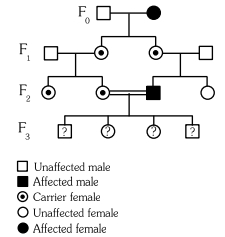
A
$1/4$
B
$1/2$
C
$1/8$
D
Zero
Solution
(B) $1$. The pedigree shows an autosomal recessive trait because an affected female $(F_0)$ produces carrier daughters,and an affected male $(F_2)$ is produced from the mating of a carrier female and an unaffected male (implying the father was also a carrier or the trait is recessive).
$2$. Let the normal allele be $A$ and the disease allele be $a$. The affected individuals are $aa$.
$3$. In the $F_2$ generation,the parents are a carrier female $(Aa)$ and an affected male $(aa)$.
$4$. The cross is $Aa \times aa$. The possible genotypes of the offspring are $Aa$ (carrier) and $aa$ (affected) in a $1:1$ ratio.
$5$. The probability of a child being a carrier $(Aa)$ is $1/2$.
$6$. The probability of a child being affected $(aa)$ is $1/2$.
$7$. The question asks for the probability of a child having no disease and being a carrier. Since a carrier $(Aa)$ is phenotypically normal (has no disease),the probability is $1/2$.
$2$. Let the normal allele be $A$ and the disease allele be $a$. The affected individuals are $aa$.
$3$. In the $F_2$ generation,the parents are a carrier female $(Aa)$ and an affected male $(aa)$.
$4$. The cross is $Aa \times aa$. The possible genotypes of the offspring are $Aa$ (carrier) and $aa$ (affected) in a $1:1$ ratio.
$5$. The probability of a child being a carrier $(Aa)$ is $1/2$.
$6$. The probability of a child being affected $(aa)$ is $1/2$.
$7$. The question asks for the probability of a child having no disease and being a carrier. Since a carrier $(Aa)$ is phenotypically normal (has no disease),the probability is $1/2$.
0 likesView Solution
76
BiologyDifficultMCQNEET · 2025
Given below are two statements: One is labelled as Assertion $(A)$ and the other is labelled as Reason $(R).$
Assertion $(A) :$ Cells of the tapetum possess dense cytoplasm and generally have more than one nucleus.
Reason $(R):$ Presence of more than one nucleus in the tapetum increases the efficiency of nourishing the developing microspore mother cells.
In light of the above statements,choose the most appropriate answer from the options given below:
Assertion $(A) :$ Cells of the tapetum possess dense cytoplasm and generally have more than one nucleus.
Reason $(R):$ Presence of more than one nucleus in the tapetum increases the efficiency of nourishing the developing microspore mother cells.
In light of the above statements,choose the most appropriate answer from the options given below:
A
Both $A$ and $R$ are true and $R$ is the correct explanation of $A$.
B
Both $A$ and $R$ are true and $R$ is $\text{NOT}$ the correct explanation of $A$.
C
$A$ is true but $R$ is false.
D
$A$ is false but $R$ is true.
Solution
(A) The tapetum is the innermost layer of the microsporangium wall.
It provides nourishment to the developing pollen grains (microspores).
Cells of the tapetum are characterized by dense cytoplasm and are often multinucleate due to endomitosis or free nuclear division.
This multinucleate condition allows the tapetum to synthesize large amounts of proteins,enzymes,and nutrients required for the rapid development of microspore mother cells.
Therefore,both the Assertion and the Reason are true,and the Reason correctly explains why the tapetum cells possess multiple nuclei.
It provides nourishment to the developing pollen grains (microspores).
Cells of the tapetum are characterized by dense cytoplasm and are often multinucleate due to endomitosis or free nuclear division.
This multinucleate condition allows the tapetum to synthesize large amounts of proteins,enzymes,and nutrients required for the rapid development of microspore mother cells.
Therefore,both the Assertion and the Reason are true,and the Reason correctly explains why the tapetum cells possess multiple nuclei.
0 likesView Solution
77
BiologyMediumMCQNEET · 2025
How many meiotic and mitotic divisions need to occur for the development of a mature female gametophyte from the megaspore mother cell in an angiosperm plant?
A
$2$ Meiosis and $3$ Mitosis
B
$1$ Meiosis and $2$ Mitosis
C
$1$ Meiosis and $3$ Mitosis
D
No Meiosis and $2$ Mitosis
Solution
(C) $1$. The development of a mature female gametophyte (embryo sac) starts from a diploid megaspore mother cell $(MMC)$.
$2$. The $MMC$ undergoes one meiotic division to produce four haploid megaspores.
$3$. Out of these four megaspores,three degenerate and only one functional megaspore develops into the female gametophyte.
$4$. This functional megaspore undergoes three successive free nuclear mitotic divisions to form an $8$-nucleated embryo sac.
$5$. Therefore,the process requires $1$ meiotic division and $3$ mitotic divisions.
$2$. The $MMC$ undergoes one meiotic division to produce four haploid megaspores.
$3$. Out of these four megaspores,three degenerate and only one functional megaspore develops into the female gametophyte.
$4$. This functional megaspore undergoes three successive free nuclear mitotic divisions to form an $8$-nucleated embryo sac.
$5$. Therefore,the process requires $1$ meiotic division and $3$ mitotic divisions.
0 likesView Solution
78
BiologyMediumMCQNEET · 2025
After maturation,in primary lymphoid organs,the lymphocytes migrate for interaction with antigens to secondary lymphoid organs like:
$A.$ thymus $B.$ bone marrow $C.$ spleen $D.$ lymph nodes $E.$ Peyer's patches
Choose the correct answer from the options given below:
$A.$ thymus $B.$ bone marrow $C.$ spleen $D.$ lymph nodes $E.$ Peyer's patches
Choose the correct answer from the options given below:
A
$C, D, E$ only
B
$A, B, C$ only
C
$E, A, B$ only
D
$B, C, D$ only
Solution
(A) Lymphoid organs are the sites where origin and/or maturation and proliferation of lymphocytes occur.
Primary lymphoid organs include the bone marrow and thymus,where immature lymphocytes differentiate into antigen-sensitive lymphocytes.
After maturation,the lymphocytes migrate to secondary lymphoid organs.
Secondary lymphoid organs provide the sites for interaction of lymphocytes with the antigen,which then proliferate to become effector cells.
Examples of secondary lymphoid organs include the spleen,lymph nodes,tonsils,Peyer's patches of the small intestine,and the appendix.
Therefore,$C$ (spleen),$D$ (lymph nodes),and $E$ (Peyer's patches) are secondary lymphoid organs,while $A$ (thymus) and $B$ (bone marrow) are primary lymphoid organs.
The correct option is $A$ ($C, D, E$ only).
Primary lymphoid organs include the bone marrow and thymus,where immature lymphocytes differentiate into antigen-sensitive lymphocytes.
After maturation,the lymphocytes migrate to secondary lymphoid organs.
Secondary lymphoid organs provide the sites for interaction of lymphocytes with the antigen,which then proliferate to become effector cells.
Examples of secondary lymphoid organs include the spleen,lymph nodes,tonsils,Peyer's patches of the small intestine,and the appendix.
Therefore,$C$ (spleen),$D$ (lymph nodes),and $E$ (Peyer's patches) are secondary lymphoid organs,while $A$ (thymus) and $B$ (bone marrow) are primary lymphoid organs.
The correct option is $A$ ($C, D, E$ only).
0 likesView Solution
79
BiologyDifficultMCQNEET · 2025
Given below are two statements:
Statement $I$: Fig fruit is a non-vegetarian fruit as it has enclosed fig wasps in it.
Statement $II$: Fig wasp and fig tree exhibit mutual relationship as fig wasp completes its life cycle in fig fruit and fig fruit gets pollinated by fig wasp.
In the light of the above statements,choose the most appropriate answer from the options given below:
Statement $I$: Fig fruit is a non-vegetarian fruit as it has enclosed fig wasps in it.
Statement $II$: Fig wasp and fig tree exhibit mutual relationship as fig wasp completes its life cycle in fig fruit and fig fruit gets pollinated by fig wasp.
In the light of the above statements,choose the most appropriate answer from the options given below:
A
Both statement $I$ and statement $II$ are correct
B
Both statement $I$ and statement $II$ are incorrect
C
Statement $I$ is correct but statement $II$ is incorrect
D
Statement $I$ is incorrect but statement $II$ is correct
Solution
(A) Statement $I$ is correct. The fig fruit (syconium) often contains the remains of the female fig wasp that entered to lay eggs,which are then digested by the plant's enzymes,making it technically 'non-vegetarian' in a biological sense.
Statement $II$ is correct. This is a classic example of obligate mutualism. The fig tree provides a protected environment and food for the wasp larvae,while the wasp ensures the pollination of the fig flowers,which is essential for the tree's reproduction.
Statement $II$ is correct. This is a classic example of obligate mutualism. The fig tree provides a protected environment and food for the wasp larvae,while the wasp ensures the pollination of the fig flowers,which is essential for the tree's reproduction.
0 likesView Solution
80
BiologyMediumMCQNEET · 2025
Why can't insulin be given orally to diabetic patients?
A
Human body will elicit strong immune response
B
It will be digested in Gastro-Intestinal $(GI)$ tract
C
Because of structural variation
D
Its bioavailability will be increased
Solution
(B) Insulin is a peptide hormone composed of amino acids.
When insulin is taken orally,it enters the digestive system where it is exposed to various proteolytic enzymes (such as pepsin and trypsin) in the stomach and small intestine.
These enzymes break down the peptide bonds of the insulin molecule,effectively digesting it into its constituent amino acids before it can be absorbed into the bloodstream.
Therefore,oral administration renders insulin ineffective,necessitating its delivery via injection.
When insulin is taken orally,it enters the digestive system where it is exposed to various proteolytic enzymes (such as pepsin and trypsin) in the stomach and small intestine.
These enzymes break down the peptide bonds of the insulin molecule,effectively digesting it into its constituent amino acids before it can be absorbed into the bloodstream.
Therefore,oral administration renders insulin ineffective,necessitating its delivery via injection.
0 likesView Solution
81
BiologyEasyMCQNEET · 2025
Who proposed that the genetic code for amino acids should be made up of three nucleotides?
A
George Gamow
B
Francis Crick
C
Jacque Monod
D
Franklin Stahl
Solution
(A) The concept that the genetic code is a triplet was proposed by the physicist $George \ Gamow$.
He argued that since there are only $4$ bases and $20$ amino acids,the code must be a combination of bases.
He calculated that $4^3 = 64$ codons,which is sufficient to code for the $20$ amino acids.
He argued that since there are only $4$ bases and $20$ amino acids,the code must be a combination of bases.
He calculated that $4^3 = 64$ codons,which is sufficient to code for the $20$ amino acids.
0 likesView Solution
82
BiologyDifficultMCQNEET · 2025
Match List-$I$ with List-$II$:
Choose the option with all correct matches:
| List-$I$ | List-$II$ |
| $A$. The Evil Quartet | $I$. Cryopreservation |
| $B$. Ex situ conservation | $II$. Alien species invasion |
| $C$. Lantana camara | $III$. Causes of biodiversity losses |
| $D$. Dodo | $IV$. Extinction |
Choose the option with all correct matches:
A
$A-III, B-I, C-II, D-IV$
B
$A-III, B-I, C-II, D-IV$
C
$A-III, B-IV, C-II, D-I$
D
$A-III, B-II, C-IV, D-I$
Solution
(B) The correct matches are as follows:
$A$. The Evil Quartet refers to the four major causes of biodiversity loss: $III$.
$B$. Ex situ conservation involves methods like cryopreservation to protect species outside their natural habitat: $I$.
$C$. Lantana camara is a classic example of an invasive alien species that causes biodiversity loss: $II$.
$D$. Dodo is a well-known example of a species that has gone through extinction: $IV$.
Therefore,the correct sequence is $A-III, B-I, C-II, D-IV$.
$A$. The Evil Quartet refers to the four major causes of biodiversity loss: $III$.
$B$. Ex situ conservation involves methods like cryopreservation to protect species outside their natural habitat: $I$.
$C$. Lantana camara is a classic example of an invasive alien species that causes biodiversity loss: $II$.
$D$. Dodo is a well-known example of a species that has gone through extinction: $IV$.
Therefore,the correct sequence is $A-III, B-I, C-II, D-IV$.
0 likesView Solution
83
BiologyEasyMCQNEET · 2025
Which of the following types of immunity is present at the time of birth and is a non-specific type of defense in the human body?
A
Acquired Immunity
B
Innate Immunity
C
Cell-mediated Immunity
D
Humoral Immunity
Solution
(B) Innate immunity is the defense system with which an individual is born.
It is a non-specific type of defense,which means it provides protection against various pathogens regardless of their specific identity.
It is present at the time of birth and is accomplished by providing different types of barriers to the entry of foreign agents into our body.
Acquired immunity,on the other hand,is pathogen-specific and is developed after birth through exposure to pathogens or vaccination.
It is a non-specific type of defense,which means it provides protection against various pathogens regardless of their specific identity.
It is present at the time of birth and is accomplished by providing different types of barriers to the entry of foreign agents into our body.
Acquired immunity,on the other hand,is pathogen-specific and is developed after birth through exposure to pathogens or vaccination.
0 likesView Solution
84
BiologyDifficultMCQNEET · 2025
Given below are two statements:
Statement $I$: In an ecosystem,there is a unidirectional flow of energy from the sun through producers to consumers.
Statement $II$: Ecosystems are exempted from the $2^{nd}$ law of thermodynamics.
In the light of the above statements,choose the most appropriate answer from the options given below:
Statement $I$: In an ecosystem,there is a unidirectional flow of energy from the sun through producers to consumers.
Statement $II$: Ecosystems are exempted from the $2^{nd}$ law of thermodynamics.
In the light of the above statements,choose the most appropriate answer from the options given below:
A
Both statement $I$ and statement $II$ are correct
B
Both statement $I$ and statement $II$ are incorrect
C
Statement $I$ is correct but statement $II$ is incorrect
D
Statement $I$ is incorrect but statement $II$ is correct
Solution
(C) Statement $I$ is correct because energy flow in an ecosystem is always unidirectional,moving from the sun to producers and then to consumers,with energy being lost as heat at each trophic level.
Statement $II$ is incorrect because ecosystems are not exempted from the $2^{nd}$ law of thermodynamics. The $2^{nd}$ law states that energy transformation is never $100\%$ efficient,and some energy is always dissipated as heat,which is a fundamental principle governing energy flow in all ecosystems.
Statement $II$ is incorrect because ecosystems are not exempted from the $2^{nd}$ law of thermodynamics. The $2^{nd}$ law states that energy transformation is never $100\%$ efficient,and some energy is always dissipated as heat,which is a fundamental principle governing energy flow in all ecosystems.
0 likesView Solution
85
BiologyMediumMCQNEET · 2025
Which of the following enzyme$(s)$ are $\text{NOT}$ essential for gene cloning?
$A.$ Restriction enzymes
$B.$ $\text{DNA}$ ligase
$C.$ $\text{DNA}$ mutase
$D.$ $\text{DNA}$ recombinase
$E.$ $\text{DNA}$ polymerase
Choose the correct answer from the options given below:
$A.$ Restriction enzymes
$B.$ $\text{DNA}$ ligase
$C.$ $\text{DNA}$ mutase
$D.$ $\text{DNA}$ recombinase
$E.$ $\text{DNA}$ polymerase
Choose the correct answer from the options given below:
A
$C$ and $D$ only
B
$A$ and $B$ only
C
$D$ and $E$ only
D
$B$ and $C$ only
Solution
(A) Gene cloning,a fundamental process in recombinant $\text{DNA}$ technology,requires specific enzymes to manipulate genetic material.
$1$. $\text{Restriction enzymes}$ are essential for cutting the vector and the source $\text{DNA}$ at specific sites.
$2$. $\text{DNA ligase}$ is essential for joining the cut $\text{DNA}$ fragments (ligation) to form recombinant $\text{DNA}$.
$3$. $\text{DNA polymerase}$ is often used in processes like $\text{PCR}$ or for filling in sticky ends.
$4$. $\text{DNA mutase}$ and $\text{DNA recombinase}$ are not standard enzymes used in the basic workflow of gene cloning.
Therefore,$\text{DNA mutase}$ $(C)$ and $\text{DNA recombinase}$ $(D)$ are not essential for gene cloning.
$1$. $\text{Restriction enzymes}$ are essential for cutting the vector and the source $\text{DNA}$ at specific sites.
$2$. $\text{DNA ligase}$ is essential for joining the cut $\text{DNA}$ fragments (ligation) to form recombinant $\text{DNA}$.
$3$. $\text{DNA polymerase}$ is often used in processes like $\text{PCR}$ or for filling in sticky ends.
$4$. $\text{DNA mutase}$ and $\text{DNA recombinase}$ are not standard enzymes used in the basic workflow of gene cloning.
Therefore,$\text{DNA mutase}$ $(C)$ and $\text{DNA recombinase}$ $(D)$ are not essential for gene cloning.
0 likesView Solution
86
BiologyEasyMCQNEET · 2025
Which factor is important for termination of transcription?
A
$\alpha$ (alpha)
B
$\sigma$ (sigma)
C
$\rho$ (rho)
D
$\gamma$ (gamma)
Solution
(C) In prokaryotic transcription,the process is carried out by $RNA$ polymerase. The $RNA$ polymerase enzyme consists of a core enzyme and a sigma factor $(\sigma)$. The sigma factor is responsible for the initiation of transcription by recognizing the promoter site. Once the elongation phase is complete,the termination of transcription occurs. This termination is facilitated by the rho factor $(\rho)$. Therefore,the $\rho$ factor is essential for the termination of transcription.
0 likesView Solution
87
BiologyMediumMCQNEET · 2025
Twins are born to a family that lives next door to you. The twins are a boy and a girl. Which of the following must be true?
A
They are monozygotic twins.
B
They are fraternal twins.
C
They were conceived through in vitro fertilization.
D
They have $75\%$ identical genetic content.
Solution
(B) Monozygotic (identical) twins are formed from a single zygote that splits into two,meaning they must have the same sex.
Since the twins in this case are a boy and a girl,they cannot be monozygotic.
Fraternal (dizygotic) twins are formed from two separate eggs fertilized by two separate sperm cells.
Because they arise from different fertilization events,they are genetically as similar as any other siblings,sharing approximately $50\%$ of their genes.
Therefore,a boy and a girl twin pair must be fraternal twins.
Since the twins in this case are a boy and a girl,they cannot be monozygotic.
Fraternal (dizygotic) twins are formed from two separate eggs fertilized by two separate sperm cells.
Because they arise from different fertilization events,they are genetically as similar as any other siblings,sharing approximately $50\%$ of their genes.
Therefore,a boy and a girl twin pair must be fraternal twins.
0 likesView Solution
88
BiologyDifficultMCQNEET · 2025
Which of the following microbes is $\text{NOT}$ involved in the preparation of household products?
$A.$ Aspergillus niger
$B.$ Lactobacillus
$C.$ Trichoderma polysporum
$D.$ Saccharomyces cerevisiae
$E.$ Propionibacterium sharmanii
Choose the correct answer from the options given below:
$A.$ Aspergillus niger
$B.$ Lactobacillus
$C.$ Trichoderma polysporum
$D.$ Saccharomyces cerevisiae
$E.$ Propionibacterium sharmanii
Choose the correct answer from the options given below:
A
$A$ and $B$ only
B
$A$ and $C$ only
C
$C$ and $D$ only
D
$C$ and $E$ only
Solution
(B) The microbes involved in household products are:
$1$. $Lactobacillus$ (Lactic Acid Bacteria) is used to convert milk into curd.
$2$. $Saccharomyces$ $cerevisiae$ (Brewer's yeast) is used for making bread and dough.
$3$. $Propionibacterium$ $sharmanii$ is used to produce large holes in Swiss cheese.
The microbes $NOT$ involved in household products are:
$1$. $Aspergillus$ $niger$ is a fungus used for the industrial production of citric acid.
$2$. $Trichoderma$ $polysporum$ is a fungus used for the industrial production of Cyclosporin $A$ (an immunosuppressive agent).
Therefore,$A$ and $C$ are the microbes not involved in household products. The correct option is $B$.
$1$. $Lactobacillus$ (Lactic Acid Bacteria) is used to convert milk into curd.
$2$. $Saccharomyces$ $cerevisiae$ (Brewer's yeast) is used for making bread and dough.
$3$. $Propionibacterium$ $sharmanii$ is used to produce large holes in Swiss cheese.
The microbes $NOT$ involved in household products are:
$1$. $Aspergillus$ $niger$ is a fungus used for the industrial production of citric acid.
$2$. $Trichoderma$ $polysporum$ is a fungus used for the industrial production of Cyclosporin $A$ (an immunosuppressive agent).
Therefore,$A$ and $C$ are the microbes not involved in household products. The correct option is $B$.
0 likesView Solution
89
BiologyMediumMCQNEET · 2025
The blue and white selectable markers have been developed which differentiate recombinant colonies from non-recombinant colonies on the basis of their ability to produce colour in the presence of a chromogenic substrate.
Given below are two statements about this method :
Statement-$I$ : The blue coloured colonies have $\text{DNA}$ insert in the plasmid and they are identified as recombinant colonies.
Statement-$II$ : The colonies without blue colour have $\text{DNA}$ insert in the plasmid and are identified as recombinant colonies.
In the light of the above statements,choose the most appropriate answer from the options given below:
Given below are two statements about this method :
Statement-$I$ : The blue coloured colonies have $\text{DNA}$ insert in the plasmid and they are identified as recombinant colonies.
Statement-$II$ : The colonies without blue colour have $\text{DNA}$ insert in the plasmid and are identified as recombinant colonies.
In the light of the above statements,choose the most appropriate answer from the options given below:
A
Both Statement $I$ and Statement $II$ are correct
B
Both Statement $I$ and Statement $II$ are incorrect
C
Statement $I$ is correct but Statement $II$ is incorrect
D
Statement $I$ is incorrect but Statement $II$ is correct
Solution
(D) In the blue-white screening method,the enzyme $\beta$-galactosidase is used. The gene for this enzyme is interrupted by the insertion of the foreign $\text{DNA}$ sequence (insertional inactivation).
If the plasmid does not contain the $\text{DNA}$ insert,the enzyme $\beta$-galactosidase is produced,which reacts with the chromogenic substrate to produce blue-coloured colonies (non-recombinant).
If the plasmid contains the $\text{DNA}$ insert,the gene for $\beta$-galactosidase is inactivated,and no blue colour is produced,resulting in white colonies (recombinant).
Therefore,Statement-$I$ is incorrect because blue colonies are non-recombinant,and Statement-$II$ is correct because white (non-blue) colonies are recombinant.
If the plasmid does not contain the $\text{DNA}$ insert,the enzyme $\beta$-galactosidase is produced,which reacts with the chromogenic substrate to produce blue-coloured colonies (non-recombinant).
If the plasmid contains the $\text{DNA}$ insert,the gene for $\beta$-galactosidase is inactivated,and no blue colour is produced,resulting in white colonies (recombinant).
Therefore,Statement-$I$ is incorrect because blue colonies are non-recombinant,and Statement-$II$ is correct because white (non-blue) colonies are recombinant.
0 likesView Solution
90
BiologyEasyMCQNEET · 2025
Which one of the following equations represents the Verhulst$-$Pearl Logistic Growth of population?
A
$\frac{dN}{dt} = r \left( \frac{K-N}{K} \right)$
B
$\frac{dN}{dt} = rN \left( \frac{K-N}{K} \right)$
C
$\frac{dN}{dt} = rN \left( \frac{N-K}{N} \right)$
D
$\frac{dN}{dt} = N \left( \frac{r-K}{K} \right)$
Solution
(B) The Verhulst$-$Pearl Logistic Growth model describes population growth in an environment with limited resources.
In this model,the population growth rate $\frac{dN}{dt}$ is given by the equation $\frac{dN}{dt} = rN \left( \frac{K-N}{K} \right)$.
Here,$N$ represents the population density at time $t$,$r$ is the intrinsic rate of natural increase,and $K$ is the carrying capacity of the environment.
This equation shows that as $N$ approaches $K$,the term $\left( \frac{K-N}{K} \right)$ approaches zero,causing the population growth to slow down and eventually stabilize at the carrying capacity.
In this model,the population growth rate $\frac{dN}{dt}$ is given by the equation $\frac{dN}{dt} = rN \left( \frac{K-N}{K} \right)$.
Here,$N$ represents the population density at time $t$,$r$ is the intrinsic rate of natural increase,and $K$ is the carrying capacity of the environment.
This equation shows that as $N$ approaches $K$,the term $\left( \frac{K-N}{K} \right)$ approaches zero,causing the population growth to slow down and eventually stabilize at the carrying capacity.
0 likesView Solution
Vedclass Products
For Students
Vedclass Test Series
Mock tests in real NEET style covering Biology with performance analysis. 5-day free trial.
Start Free TrialFor Teachers
Exam Paper Generator
Generate Set A/B/C/D Biology papers from 7.5L+ questions in 2 minutes. 3 chapters free.
Try FreeFor Institutes
Online Exam Module
Run live NEET mock exams with unlimited students, 360° analytics & white-label branding.
See DemoFrequently Asked Questions
How many Biology questions are in NEET 2025?
There are 90 Biology questions from the NEET 2025 paper on Vedclass, each with a detailed step-by-step solution in English.
Are NEET 2025 Biology solutions available in English?
Yes. All solutions on this page are in English. You can also switch to English or Hindi using the language buttons above the questions.
Can I practice NEET 2025 Biology as a timed test?
Yes. Use the Vedclass Test Series to attempt a full NEET mock test covering Biology with time limits and instant score analysis.
Can teachers create Biology papers from NEET previous year questions?
Yes. The Vedclass Exam Paper Generator lets teachers mix NEET Biology questions and generate Set A/B/C/D papers in minutes.
For Teachers & Institutes
Build a Custom Biology Paper
Pick NEET 2025 Biology questions, set difficulty, and generate Set A/B/C/D in 2 minutes.