
ChemistryQ51–112 of 166 questions
Page 2 of 3 · English
51
ChemistryEasyMCQMHT CET · 2019
For a process,entropy change of a system is expressed as
A
$H - TS$
B
$\frac{q_{rev}}{T}$
C
$\frac{T}{q_{rev}}$
D
$q_{rev} \times T$
Solution
(B) According to the second law of thermodynamics,the change in entropy $(\Delta S)$ for a reversible process is defined as the ratio of the heat exchanged reversibly $(q_{rev})$ to the absolute temperature $(T)$ at which the process occurs.
$\Delta S = \frac{q_{rev}}{T}$
$\Delta S = \frac{q_{rev}}{T}$
0 likesView Solution
52
ChemistryMCQMHT CET · 2019
The slope of the normal to the curve $x = \sqrt{t}$ and $y = t - \frac{1}{\sqrt{t}}$ at $t = 4$ is ...
A
$-\frac{17}{4}$
B
$\frac{4}{17}$
C
$-\frac{4}{17}$
D
$\frac{17}{4}$
Solution
(C) Given the parametric equations of the curve: $x = \sqrt{t}$ and $y = t - \frac{1}{\sqrt{t}}$.
First,we find the derivatives with respect to $t$:
$\frac{dx}{dt} = \frac{1}{2\sqrt{t}}$
$\frac{dy}{dt} = 1 - (-\frac{1}{2})t^{-\frac{3}{2}} = 1 + \frac{1}{2t\sqrt{t}}$
Now,calculate the slope of the tangent $\frac{dy}{dx} = \frac{dy/dt}{dx/dt}$:
$\frac{dy}{dx} = \frac{1 + \frac{1}{2t\sqrt{t}}}{\frac{1}{2\sqrt{t}}} = (1 + \frac{1}{2t\sqrt{t}}) \times 2\sqrt{t} = 2\sqrt{t} + \frac{1}{t}$.
At $t = 4$:
$\frac{dy}{dx} = 2\sqrt{4} + \frac{1}{4} = 2(2) + 0.25 = 4 + 0.25 = 4.25 = \frac{17}{4}$.
The slope of the normal is given by $-\frac{1}{\text{slope of tangent}}$:
Slope of normal $= -\frac{1}{17/4} = -\frac{4}{17}$.
First,we find the derivatives with respect to $t$:
$\frac{dx}{dt} = \frac{1}{2\sqrt{t}}$
$\frac{dy}{dt} = 1 - (-\frac{1}{2})t^{-\frac{3}{2}} = 1 + \frac{1}{2t\sqrt{t}}$
Now,calculate the slope of the tangent $\frac{dy}{dx} = \frac{dy/dt}{dx/dt}$:
$\frac{dy}{dx} = \frac{1 + \frac{1}{2t\sqrt{t}}}{\frac{1}{2\sqrt{t}}} = (1 + \frac{1}{2t\sqrt{t}}) \times 2\sqrt{t} = 2\sqrt{t} + \frac{1}{t}$.
At $t = 4$:
$\frac{dy}{dx} = 2\sqrt{4} + \frac{1}{4} = 2(2) + 0.25 = 4 + 0.25 = 4.25 = \frac{17}{4}$.
The slope of the normal is given by $-\frac{1}{\text{slope of tangent}}$:
Slope of normal $= -\frac{1}{17/4} = -\frac{4}{17}$.
0 likesView Solution
53
ChemistryMCQMHT CET · 2019
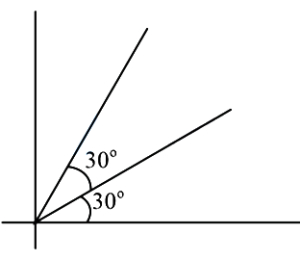
The joint equation of the lines passing through the origin and trisecting the first quadrant is . . . . . .
A
$\sqrt{3} x^2-4 x y+\sqrt{3} y^2=0$
B
$x^2+\sqrt{3} x y-y^2=0$
C
$3 x^2-y^2=0$
D
$x^2-\sqrt{3} x y-y^2=0$
Solution
(A) The first quadrant is divided into three equal parts by two lines passing through the origin. Since the total angle of the first quadrant is $90^{\circ}$,each line makes an angle of $30^{\circ}$ and $60^{\circ}$ with the positive $x$-axis.
The slopes of these lines are $m_1 = \tan(30^{\circ}) = \frac{1}{\sqrt{3}}$ and $m_2 = \tan(60^{\circ}) = \sqrt{3}$.
The equations of the lines are $y = \frac{1}{\sqrt{3}}x$ and $y = \sqrt{3}x$,which can be written as $x - \sqrt{3}y = 0$ and $\sqrt{3}x - y = 0$.
The joint equation is $(x - \sqrt{3}y)(\sqrt{3}x - y) = 0$.
Expanding this,we get $\sqrt{3}x^2 - xy - 3xy + \sqrt{3}y^2 = 0$.
$\sqrt{3}x^2 - 4xy + \sqrt{3}y^2 = 0$.
The slopes of these lines are $m_1 = \tan(30^{\circ}) = \frac{1}{\sqrt{3}}$ and $m_2 = \tan(60^{\circ}) = \sqrt{3}$.
The equations of the lines are $y = \frac{1}{\sqrt{3}}x$ and $y = \sqrt{3}x$,which can be written as $x - \sqrt{3}y = 0$ and $\sqrt{3}x - y = 0$.
The joint equation is $(x - \sqrt{3}y)(\sqrt{3}x - y) = 0$.
Expanding this,we get $\sqrt{3}x^2 - xy - 3xy + \sqrt{3}y^2 = 0$.
$\sqrt{3}x^2 - 4xy + \sqrt{3}y^2 = 0$.
0 likesView Solution
54
ChemistryMCQMHT CET · 2019
$A$ player tosses $2$ fair coins. He wins Rs. $5$ if $2$ heads appear,Rs. $2$ if $1$ head appears,and Rs. $1$ if no head appears. The variance of his winning amount is:
A
$6$
B
$\frac{5}{2}$
C
$\frac{9}{4}$
D
$\frac{17}{2}$
Solution
(C) When a player tosses $2$ fair coins,the sample space is: $S = \{HH, HT, TH, TT\}$.
Let $X$ be a random variable that denotes the amount received. The possible values for $X$ are $5, 2,$ and $1$.
The probability distribution of $X$ is:
$1$. Calculate the Mean (Expected Value) $\mu$:
$\mu = \sum XP(X) = (5 \times \frac{1}{4}) + (2 \times \frac{1}{2}) + (1 \times \frac{1}{4}) = \frac{5}{4} + \frac{4}{4} + \frac{1}{4} = \frac{10}{4} = \frac{5}{2}$.
$2$. Calculate $\sum X^2P(X)$:
$\sum X^2P(X) = (25 \times \frac{1}{4}) + (4 \times \frac{1}{2}) + (1 \times \frac{1}{4}) = \frac{25}{4} + \frac{8}{4} + \frac{1}{4} = \frac{34}{4} = \frac{17}{2}$.
$3$. Calculate the Variance:
$\text{Variance}(X) = \sum X^2P(X) - [\sum XP(X)]^2 = \frac{17}{2} - (\frac{5}{2})^2 = \frac{17}{2} - \frac{25}{4} = \frac{34 - 25}{4} = \frac{9}{4}$.
Let $X$ be a random variable that denotes the amount received. The possible values for $X$ are $5, 2,$ and $1$.
The probability distribution of $X$ is:
| $X$ | $5$ | $2$ | $1$ |
| $P(X)$ | $\frac{1}{4}$ | $\frac{1}{2}$ | $\frac{1}{4}$ |
$1$. Calculate the Mean (Expected Value) $\mu$:
$\mu = \sum XP(X) = (5 \times \frac{1}{4}) + (2 \times \frac{1}{2}) + (1 \times \frac{1}{4}) = \frac{5}{4} + \frac{4}{4} + \frac{1}{4} = \frac{10}{4} = \frac{5}{2}$.
$2$. Calculate $\sum X^2P(X)$:
$\sum X^2P(X) = (25 \times \frac{1}{4}) + (4 \times \frac{1}{2}) + (1 \times \frac{1}{4}) = \frac{25}{4} + \frac{8}{4} + \frac{1}{4} = \frac{34}{4} = \frac{17}{2}$.
$3$. Calculate the Variance:
$\text{Variance}(X) = \sum X^2P(X) - [\sum XP(X)]^2 = \frac{17}{2} - (\frac{5}{2})^2 = \frac{17}{2} - \frac{25}{4} = \frac{34 - 25}{4} = \frac{9}{4}$.
0 likesView Solution
55
ChemistryMCQMHT CET · 2019
The value of $\sin 18^{\circ}$ is
A
$\frac{\sqrt{5}+1}{4}$
B
$\frac{\sqrt{5}-1}{4}$
C
$\frac{4}{\sqrt{5}+1}$
D
$\frac{4}{\sqrt{5}-1}$
Solution
(B) Let $\theta = 18^{\circ}$.
Then $2\theta = 36^{\circ}$ and $3\theta = 54^{\circ}$.
Since $2\theta + 3\theta = 90^{\circ}$,we have $2\theta = 90^{\circ} - 3\theta$.
Taking sine on both sides: $\sin 2\theta = \sin(90^{\circ} - 3\theta) = \cos 3\theta$.
Using the double angle and triple angle formulas: $2\sin\theta\cos\theta = 4\cos^3\theta - 3\cos\theta$.
Since $\cos 18^{\circ} \neq 0$,we can divide by $\cos\theta$: $2\sin\theta = 4\cos^2\theta - 3$.
Substitute $\cos^2\theta = 1 - \sin^2\theta$: $2\sin\theta = 4(1 - \sin^2\theta) - 3$.
$2\sin\theta = 4 - 4\sin^2\theta - 3 \Rightarrow 4\sin^2\theta + 2\sin\theta - 1 = 0$.
Using the quadratic formula for $\sin\theta$: $\sin\theta = \frac{-2 \pm \sqrt{4 - 4(4)(-1)}}{2(4)} = \frac{-2 \pm \sqrt{20}}{8} = \frac{-2 \pm 2\sqrt{5}}{8} = \frac{-1 \pm \sqrt{5}}{4}$.
Since $18^{\circ}$ is in the first quadrant,$\sin 18^{\circ} > 0$,so we take the positive root.
Therefore,$\sin 18^{\circ} = \frac{\sqrt{5}-1}{4}$.
Then $2\theta = 36^{\circ}$ and $3\theta = 54^{\circ}$.
Since $2\theta + 3\theta = 90^{\circ}$,we have $2\theta = 90^{\circ} - 3\theta$.
Taking sine on both sides: $\sin 2\theta = \sin(90^{\circ} - 3\theta) = \cos 3\theta$.
Using the double angle and triple angle formulas: $2\sin\theta\cos\theta = 4\cos^3\theta - 3\cos\theta$.
Since $\cos 18^{\circ} \neq 0$,we can divide by $\cos\theta$: $2\sin\theta = 4\cos^2\theta - 3$.
Substitute $\cos^2\theta = 1 - \sin^2\theta$: $2\sin\theta = 4(1 - \sin^2\theta) - 3$.
$2\sin\theta = 4 - 4\sin^2\theta - 3 \Rightarrow 4\sin^2\theta + 2\sin\theta - 1 = 0$.
Using the quadratic formula for $\sin\theta$: $\sin\theta = \frac{-2 \pm \sqrt{4 - 4(4)(-1)}}{2(4)} = \frac{-2 \pm \sqrt{20}}{8} = \frac{-2 \pm 2\sqrt{5}}{8} = \frac{-1 \pm \sqrt{5}}{4}$.
Since $18^{\circ}$ is in the first quadrant,$\sin 18^{\circ} > 0$,so we take the positive root.
Therefore,$\sin 18^{\circ} = \frac{\sqrt{5}-1}{4}$.
0 likesView Solution
56
ChemistryMCQMHT CET · 2019
The maximum velocity of the photoelectron emitted by the metal surface is $V$. The charge and mass of the photoelectron are denoted by $e$ and $m$,respectively. The stopping potential in volts is:
A
$\frac{V^2}{2(m/e)}$
B
$\frac{m V^2}{2 e}$
C
$\frac{V^2}{(e/m)}$
D
$\frac{V^2}{(m/e)}$
Solution
(B) The kinetic energy of the emitted photoelectron is given by $K_{\max} = \frac{1}{2} m V^2$.
By definition,the stopping potential $V_o$ is the potential required to stop the fastest photoelectron,such that $e V_o = K_{\max}$.
Substituting the expression for $K_{\max}$,we get $e V_o = \frac{1}{2} m V^2$.
Solving for $V_o$,we obtain $V_o = \frac{m V^2}{2 e}$.
By definition,the stopping potential $V_o$ is the potential required to stop the fastest photoelectron,such that $e V_o = K_{\max}$.
Substituting the expression for $K_{\max}$,we get $e V_o = \frac{1}{2} m V^2$.
Solving for $V_o$,we obtain $V_o = \frac{m V^2}{2 e}$.
0 likesView Solution
57
ChemistryMCQMHT CET · 2019
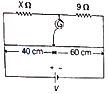
With a resistance of ' X ' in the left gap and a resistance of $9 \Omega$ in the right gap of meter bridge, the balance point is obtained at 40 cm from the left end. In what way and to which resistance $3 \Omega$ resistance be connected to obtained the balance at 50 cm from the left end?
A
In series with $9 \Omega$
B
Parallel to $X \Omega$
C
In series with $X \Omega$
D
Parallel to $9 \Omega$
Solution
The balance condition of bridge is shown below in the first case
Then, $\frac{X}{9}=\frac{40}{60} \Rightarrow X=\frac{2}{3} \times 9=6 \Omega$
To get the balance point at 50 cm from left end, the balanced, condition becomes, $\frac{X^{\prime}}{9}=\frac{50}{50}=1 \Rightarrow X^{\prime}=9 \Omega$
As, in series combinations resistances are added, so to get $9 \Omega$ at left gap the $3 \Omega$ resistance should be added in series with $X \Omega(6+3=9 \Omega)$.
Then, $\frac{X}{9}=\frac{40}{60} \Rightarrow X=\frac{2}{3} \times 9=6 \Omega$
To get the balance point at 50 cm from left end, the balanced, condition becomes, $\frac{X^{\prime}}{9}=\frac{50}{50}=1 \Rightarrow X^{\prime}=9 \Omega$
As, in series combinations resistances are added, so to get $9 \Omega$ at left gap the $3 \Omega$ resistance should be added in series with $X \Omega(6+3=9 \Omega)$.
0 likesView Solution
58
ChemistryMCQMHT CET · 2019
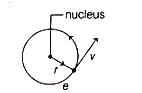
In a hydrogen atom,an electron of charge $e$ revolves in an orbit of radius $r$ with speed $v$. Then,the magnetic moment associated with the electron is
A
$\frac{e v r}{2}$
B
$2 e v r$
C
$e v r$
D
$\frac{e v r}{3}$
Solution
(A) The magnetic moment of a revolving electron is given by $\mu_e = i \times A$,where $i$ is the equivalent current and $A$ is the area of the orbit.
Since the electron revolves with speed $v$ in an orbit of radius $r$,the time period $T$ is given by $T = \frac{2 \pi r}{v}$.
The equivalent current $i$ is $i = \frac{e}{T} = \frac{e v}{2 \pi r}$.
The area of the orbit is $A = \pi r^2$.
Substituting these values into the magnetic moment formula:
$\mu_e = \left( \frac{e v}{2 \pi r} \right) \times (\pi r^2) = \frac{e v r}{2}$.
Thus,the magnetic moment associated with the electron is $\frac{e v r}{2}$.
Since the electron revolves with speed $v$ in an orbit of radius $r$,the time period $T$ is given by $T = \frac{2 \pi r}{v}$.
The equivalent current $i$ is $i = \frac{e}{T} = \frac{e v}{2 \pi r}$.
The area of the orbit is $A = \pi r^2$.
Substituting these values into the magnetic moment formula:
$\mu_e = \left( \frac{e v}{2 \pi r} \right) \times (\pi r^2) = \frac{e v r}{2}$.
Thus,the magnetic moment associated with the electron is $\frac{e v r}{2}$.
0 likesView Solution
59
ChemistryMCQMHT CET · 2019
Two small drops of mercury,each of radius $R$,coalesce to form a single large drop. The ratio of the total surface energies before and after the change is
A
$\sqrt{2}: 1$
B
$2^{2/3}: 1$
C
$2^{1/3}: 1$
D
$2: 1$
Solution
(C) Let $T$ be the surface tension of mercury.
Total surface energy before coalescence $(E_1)$: Since there are two drops of radius $R$,$E_1 = 2 \times (4 \pi R^2 T) = 8 \pi R^2 T$.
Let the radius of the new large drop be $R'$. By conservation of volume: $\frac{4}{3} \pi R'^3 = 2 \times \frac{4}{3} \pi R^3$,which gives $R'^3 = 2R^3$,or $R' = 2^{1/3} R$.
Total surface energy after coalescence $(E_2)$: $E_2 = 4 \pi R'^2 T = 4 \pi (2^{1/3} R)^2 T = 4 \pi (2^{2/3}) R^2 T$.
The ratio of surface energies is $\frac{E_1}{E_2} = \frac{8 \pi R^2 T}{4 \pi (2^{2/3}) R^2 T} = \frac{2}{2^{2/3}} = 2^{1 - 2/3} = 2^{1/3}$.
Thus,the ratio is $2^{1/3} : 1$.
Total surface energy before coalescence $(E_1)$: Since there are two drops of radius $R$,$E_1 = 2 \times (4 \pi R^2 T) = 8 \pi R^2 T$.
Let the radius of the new large drop be $R'$. By conservation of volume: $\frac{4}{3} \pi R'^3 = 2 \times \frac{4}{3} \pi R^3$,which gives $R'^3 = 2R^3$,or $R' = 2^{1/3} R$.
Total surface energy after coalescence $(E_2)$: $E_2 = 4 \pi R'^2 T = 4 \pi (2^{1/3} R)^2 T = 4 \pi (2^{2/3}) R^2 T$.
The ratio of surface energies is $\frac{E_1}{E_2} = \frac{8 \pi R^2 T}{4 \pi (2^{2/3}) R^2 T} = \frac{2}{2^{2/3}} = 2^{1 - 2/3} = 2^{1/3}$.
Thus,the ratio is $2^{1/3} : 1$.
0 likesView Solution
60
ChemistryMCQMHT CET · 2019
Two small drops of mercury,each of radius $R$,coalesce to form a single large drop. The ratio of the total surface energies before and after the change is
A
$2^{2/3} : 1$
B
$\sqrt{2} : 1$
C
$2^{1/3} : 1$
D
$2 : 1$
Solution
(C) Surface energy $E$ is proportional to the surface area $A$,where $E = T \times A$ ($T$ is surface tension).
Initial surface area of two drops: $A_{\text{before}} = 2 \times (4 \pi R^2) = 8 \pi R^2$.
When they coalesce into a single large drop of radius $R_0$,the volume remains conserved:
$2 \times (\frac{4}{3} \pi R^3) = \frac{4}{3} \pi R_0^3 \Rightarrow R_0^3 = 2R^3 \Rightarrow R_0 = R(2)^{1/3}$.
Final surface area: $A_{\text{after}} = 4 \pi R_0^2 = 4 \pi (R \cdot 2^{1/3})^2 = 4 \pi R^2 \cdot 2^{2/3}$.
The ratio of surface energies is the ratio of surface areas:
$\frac{E_{\text{before}}}{E_{\text{after}}} = \frac{8 \pi R^2}{4 \pi R^2 \cdot 2^{2/3}} = \frac{2}{2^{2/3}} = 2^{1 - 2/3} = 2^{1/3} : 1$.
Initial surface area of two drops: $A_{\text{before}} = 2 \times (4 \pi R^2) = 8 \pi R^2$.
When they coalesce into a single large drop of radius $R_0$,the volume remains conserved:
$2 \times (\frac{4}{3} \pi R^3) = \frac{4}{3} \pi R_0^3 \Rightarrow R_0^3 = 2R^3 \Rightarrow R_0 = R(2)^{1/3}$.
Final surface area: $A_{\text{after}} = 4 \pi R_0^2 = 4 \pi (R \cdot 2^{1/3})^2 = 4 \pi R^2 \cdot 2^{2/3}$.
The ratio of surface energies is the ratio of surface areas:
$\frac{E_{\text{before}}}{E_{\text{after}}} = \frac{8 \pi R^2}{4 \pi R^2 \cdot 2^{2/3}} = \frac{2}{2^{2/3}} = 2^{1 - 2/3} = 2^{1/3} : 1$.
0 likesView Solution
61
ChemistryMCQMHT CET · 2019
The critical angle for light going from medium '$x$' to medium '$y$' is '$\theta$'. The speed of light in medium '$x$' is '$v_x$'. The speed of light in medium '$y$' is:
A
$\frac{v_x}{\tan \theta}$
B
$v_x \sin \theta$
C
$v_x \tan \theta$
D
$\frac{v_x}{\sin \theta}$
Solution
(D) The critical angle is the angle of incidence in the denser medium for which the angle of refraction in the rarer medium is $90^{\circ}$.
According to Snell's Law:
$\frac{\sin \theta}{\sin 90^{\circ}} = \frac{\mu_y}{\mu_x}$
$\Rightarrow \sin \theta = \frac{\mu_y}{\mu_x} \quad (i)$
Where $\mu$ is the refractive index of the medium.
Also,the refractive index is given by $\mu = \frac{c}{v}$,where $c$ is the speed of light in vacuum and $v$ is the speed of light in the medium.
Therefore,$\mu_x = \frac{c}{v_x}$ and $\mu_y = \frac{c}{v_y}$.
Substituting these into equation $(i)$:
$\sin \theta = \frac{c/v_y}{c/v_x} = \frac{v_x}{v_y}$
Rearranging for $v_y$:
$v_y = \frac{v_x}{\sin \theta}$
According to Snell's Law:
$\frac{\sin \theta}{\sin 90^{\circ}} = \frac{\mu_y}{\mu_x}$
$\Rightarrow \sin \theta = \frac{\mu_y}{\mu_x} \quad (i)$
Where $\mu$ is the refractive index of the medium.
Also,the refractive index is given by $\mu = \frac{c}{v}$,where $c$ is the speed of light in vacuum and $v$ is the speed of light in the medium.
Therefore,$\mu_x = \frac{c}{v_x}$ and $\mu_y = \frac{c}{v_y}$.
Substituting these into equation $(i)$:
$\sin \theta = \frac{c/v_y}{c/v_x} = \frac{v_x}{v_y}$
Rearranging for $v_y$:
$v_y = \frac{v_x}{\sin \theta}$
0 likesView Solution
62
ChemistryMCQMHT CET · 2019
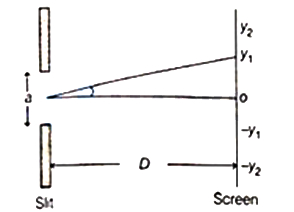
Light of wavelength $\lambda$ is incident on a single slit of width $a$ and the distance between the slit and the screen is $D$. In the diffraction pattern,if the slit width is equal to the width of the central maximum,then $D$ is equal to:
A
$\frac{a}{2 \lambda}$
B
$\frac{a^2}{2 \lambda}$
C
$\frac{a}{\lambda}$
D
$\frac{a^2}{\lambda}$
Solution
(B) The width of the central maximum in a single-slit diffraction pattern is given by:
$W = \frac{2 D \lambda}{a}$
where $\lambda$ is the wavelength of the incident light,$D$ is the distance between the slit and the screen,and $a$ is the slit width.
According to the problem,the slit width $a$ is equal to the width of the central maximum $W$:
$a = W$
Substituting the expression for $W$:
$a = \frac{2 D \lambda}{a}$
Rearranging the equation to solve for $D$:
$a^2 = 2 D \lambda$
$D = \frac{a^2}{2 \lambda}$
$W = \frac{2 D \lambda}{a}$
where $\lambda$ is the wavelength of the incident light,$D$ is the distance between the slit and the screen,and $a$ is the slit width.
According to the problem,the slit width $a$ is equal to the width of the central maximum $W$:
$a = W$
Substituting the expression for $W$:
$a = \frac{2 D \lambda}{a}$
Rearranging the equation to solve for $D$:
$a^2 = 2 D \lambda$
$D = \frac{a^2}{2 \lambda}$
0 likesView Solution
63
ChemistryDifficultMCQMHT CET · 2019
The molar conductivities at infinite dilution for sodium acetate,$HCl$ and $NaCl$ are $91 \ S \ cm^2 \ mol^{-1}$,$425.9 \ S \ cm^2 \ mol^{-1}$ and $126.4 \ S \ cm^2 \ mol^{-1}$ respectively. The molar conductivity of acetic acid at infinite dilution is
A
$39.05 \ S \ cm^2 \ mol^{-1}$
B
$530.9 \ S \ cm^2 \ mol^{-1}$
C
$390.5 \ S \ cm^2 \ mol^{-1}$
D
$930.5 \ S \ cm^2 \ mol^{-1}$
Solution
(C) Key Idea: Kohlrausch law of independent migration of ions can be used to calculate $\Delta_m^o$ for weak electrolytes such as acetic acid.
Given:
$\Delta_{m(NaAc)}^o = 91 \ S \ cm^2 \ mol^{-1}$
$\Delta_{m(HCl)}^o = 425.9 \ S \ cm^2 \ mol^{-1}$
$\Delta_{m(NaCl)}^o = 126.4 \ S \ cm^2 \ mol^{-1}$
Using Kohlrausch law,the molar conductivity of acetic acid is calculated as:
$\Delta_{m(CH_3COOH)}^o = \Delta_{m(CH_3COONa)}^o + \Delta_{m(HCl)}^o - \Delta_{m(NaCl)}^o$
$= (91.0 + 425.9 - 126.4) \ S \ cm^2 \ mol^{-1}$
$= 390.5 \ S \ cm^2 \ mol^{-1}$
Given:
$\Delta_{m(NaAc)}^o = 91 \ S \ cm^2 \ mol^{-1}$
$\Delta_{m(HCl)}^o = 425.9 \ S \ cm^2 \ mol^{-1}$
$\Delta_{m(NaCl)}^o = 126.4 \ S \ cm^2 \ mol^{-1}$
Using Kohlrausch law,the molar conductivity of acetic acid is calculated as:
$\Delta_{m(CH_3COOH)}^o = \Delta_{m(CH_3COONa)}^o + \Delta_{m(HCl)}^o - \Delta_{m(NaCl)}^o$
$= (91.0 + 425.9 - 126.4) \ S \ cm^2 \ mol^{-1}$
$= 390.5 \ S \ cm^2 \ mol^{-1}$
0 likesView Solution
64
ChemistryDifficultMCQMHT CET · 2019
The resistance of $\frac{1}{10} \ M$ solution is $2.5 \times 10^3 \ \Omega$. What is the molar conductivity of the solution? (Cell constant $= 1.25 \ cm^{-1}$)
A
$3.5 \ \Omega^{-1} \ cm^2 \ mol^{-1}$
B
$5.0 \ \Omega^{-1} \ cm^2 \ mol^{-1}$
C
$2.5 \ \Omega^{-1} \ cm^2 \ mol^{-1}$
D
$2.0 \ \Omega^{-1} \ cm^2 \ mol^{-1}$
Solution
(B) Given: Cell constant,$\frac{l}{A} = 1.25 \ cm^{-1}$,Resistance,$R = 2.5 \times 10^3 \ \Omega$,Molarity,$M = 0.1 \ M$.
Conductivity,$\kappa = \frac{\text{Cell constant}}{R} = \frac{1.25}{2.5 \times 10^3} = 0.5 \times 10^{-3} = 5 \times 10^{-4} \ S \ cm^{-1}$.
Molar conductivity,$\Lambda_m = \frac{\kappa \times 1000}{M} = \frac{5 \times 10^{-4} \times 1000}{0.1} = \frac{0.5}{0.1} = 5.0 \ \Omega^{-1} \ cm^2 \ mol^{-1}$.
Conductivity,$\kappa = \frac{\text{Cell constant}}{R} = \frac{1.25}{2.5 \times 10^3} = 0.5 \times 10^{-3} = 5 \times 10^{-4} \ S \ cm^{-1}$.
Molar conductivity,$\Lambda_m = \frac{\kappa \times 1000}{M} = \frac{5 \times 10^{-4} \times 1000}{0.1} = \frac{0.5}{0.1} = 5.0 \ \Omega^{-1} \ cm^2 \ mol^{-1}$.
0 likesView Solution
65
ChemistryEasyMCQMHT CET · 2019
The conductivity of an electrolytic solution decreases on dilution due to
A
decrease in number of ions per unit volume
B
increase in ionic mobility of ions
C
increase in percentage ionisation
D
increase in number of ions per unit volume
Solution
(A) Conductivity $(\kappa)$ is defined as the conductance of a solution contained between two electrodes of unit area of cross-section separated by a unit distance.
On dilution,the total number of ions in the solution remains the same,but the number of ions per unit volume decreases.
Since conductivity is directly proportional to the number of ions per unit volume,it decreases upon dilution.
On dilution,the total number of ions in the solution remains the same,but the number of ions per unit volume decreases.
Since conductivity is directly proportional to the number of ions per unit volume,it decreases upon dilution.
0 likesView Solution
66
ChemistryEasyMCQMHT CET · 2019
Natalite is a mixture of
A
Acetic acid and diethyl ether
B
Ethyl bromide and diethyl ether
C
Ethyl alcohol and dimethyl ether
D
Diethyl ether and ethyl alcohol
Solution
(D) Natalite is a trade name for the mixture of diethyl ether and ethyl alcohol.
It is used as a petrol substitute.
It consists of $54\%$ alcohol,$45\%$ ether,and $1\%$ trimethylamine.
It is used as a petrol substitute.
It consists of $54\%$ alcohol,$45\%$ ether,and $1\%$ trimethylamine.
0 likesView Solution
67
ChemistryEasyMCQMHT CET · 2019
The conversion of $2-$methylpropan$-1-$ol to $2-$methylpropan$-2-$ol is:
A
Addition reaction
B
Rearrangement reaction
C
Substitution reaction
D
Elimination reaction
Solution
(B) The conversion of $2-$methylpropan$-1-$ol to $2-$methylpropan$-2-$ol is a rearrangement reaction.
In these reactions,the structure of the molecule is rearranged to form a structural isomer.
Specifically,this process involves the migration of the hydroxyl group or a hydride shift to form a more stable carbocation intermediate,which then leads to the formation of the tertiary alcohol,$2-$methylpropan$-2-$ol.
In these reactions,the structure of the molecule is rearranged to form a structural isomer.
Specifically,this process involves the migration of the hydroxyl group or a hydride shift to form a more stable carbocation intermediate,which then leads to the formation of the tertiary alcohol,$2-$methylpropan$-2-$ol.
0 likesView Solution
68
ChemistryMediumMCQMHT CET · 2019
How many primary amines are possible for the molecular formula $C_3H_9N$?
A
$4$
B
$1$
C
$2$
D
$3$
Solution
(C) The molecular formula $C_3H_9N$ corresponds to a saturated amine. $A$ primary amine has the general structure $R-NH_2$.
For a three-carbon chain,the possible primary amine isomers are:
$1$. $CH_3CH_2CH_2NH_2$ (Propan-$1$-amine)
$2$. $CH_3CH(CH_3)NH_2$ (Propan-$2$-amine)
Thus,there are $2$ possible primary amines for the given molecular formula.
For a three-carbon chain,the possible primary amine isomers are:
$1$. $CH_3CH_2CH_2NH_2$ (Propan-$1$-amine)
$2$. $CH_3CH(CH_3)NH_2$ (Propan-$2$-amine)
Thus,there are $2$ possible primary amines for the given molecular formula.
0 likesView Solution
69
ChemistryMediumMCQMHT CET · 2019
How many metameric ethers are represented by the molecular formula $C_4H_{10}O$?
A
$4$
B
$3$
C
$2$
D
$5$
Solution
(B) The molecular formula $C_4H_{10}O$ represents the following ethers:
$1.$ Diethyl ether: $CH_3CH_2-O-CH_2CH_3$ (Ethoxyethane)
$2.$ Methyl propyl ether: $CH_3-O-CH_2CH_2CH_3$ ($1$-Methoxypropane)
$3.$ Methyl isopropyl ether: $CH_3-O-CH(CH_3)_2$ ($2$-Methoxypropane)
These three ethers are metamers of each other because they have the same molecular formula but different alkyl groups attached to the same functional group (ether oxygen atom).
Therefore,there are $3$ metameric ethers.
$1.$ Diethyl ether: $CH_3CH_2-O-CH_2CH_3$ (Ethoxyethane)
$2.$ Methyl propyl ether: $CH_3-O-CH_2CH_2CH_3$ ($1$-Methoxypropane)
$3.$ Methyl isopropyl ether: $CH_3-O-CH(CH_3)_2$ ($2$-Methoxypropane)
These three ethers are metamers of each other because they have the same molecular formula but different alkyl groups attached to the same functional group (ether oxygen atom).
Therefore,there are $3$ metameric ethers.
0 likesView Solution
70
ChemistryEasyMCQMHT CET · 2019
Which of the following is not a mineral of iron?
A
Limonite
B
Magnetite
C
Corundum
D
Haematite
Solution
(C) Key Idea: Corundum is not a mineral of iron. It is a crystalline form of aluminium oxide $(Al_2O_3)$ typically containing traces of $Fe$,$Ti$,$V$,and $Cr$. Limonite,magnetite,and haematite are common minerals of iron. The molecular formulas of the given minerals are provided below:
| Name | Formula |
|---|---|
| Limonite | $Fe(OH)_3 \cdot nH_2O$ |
| Magnetite | $Fe_3O_4$ |
| Corundum | $Al_2O_3$ |
| Haematite | $Fe_2O_3$ |
0 likesView Solution
71
ChemistryMediumMCQMHT CET · 2019
In leaching of alumina from bauxite by Bayer's process,the ore is treated with
A
$NaOH_{(aq)}$
B
$NaCl_{(aq)}$
C
$KCN_{(aq)}$
D
$Na_2CO_{3(aq)}$
Solution
(A) In leaching of alumina from bauxite by Bayer's process,the ore is treated with $NaOH_{(aq)}$.
Concentration is carried out by heating the powdered ore with a concentrated solution of $NaOH$ at $473-523 \ K$ and $35-36 \ bar$ pressure.
$Al_2O_3$ is extracted out as sodium aluminate.
$Al_2O_{3(s)} + 2NaOH_{(aq)} + 3H_2O_{(l)} \rightarrow 2Na[Al(OH)_4]_{(aq)}$
The sodium aluminate formed is neutralised by passing $CO_2$ gas and hydrated $Al_2O_3$ is precipitated.
$2Na[Al(OH)_4]_{(aq)} + 2CO_{2(g)} \rightarrow Al_2O_3 \cdot xH_2O_{(s)} + 2NaHCO_{3(aq)}$
Concentration is carried out by heating the powdered ore with a concentrated solution of $NaOH$ at $473-523 \ K$ and $35-36 \ bar$ pressure.
$Al_2O_3$ is extracted out as sodium aluminate.
$Al_2O_{3(s)} + 2NaOH_{(aq)} + 3H_2O_{(l)} \rightarrow 2Na[Al(OH)_4]_{(aq)}$
The sodium aluminate formed is neutralised by passing $CO_2$ gas and hydrated $Al_2O_3$ is precipitated.
$2Na[Al(OH)_4]_{(aq)} + 2CO_{2(g)} \rightarrow Al_2O_3 \cdot xH_2O_{(s)} + 2NaHCO_{3(aq)}$
0 likesView Solution
72
ChemistryMediumMCQMHT CET · 2019
Which of the following methods is used to separate wolframite and stannic oxide present in cassiterite?
A
Hydraulic washing using Wilfley table
B
Froth flotation
C
Hydraulic classifier
D
Magnetic separation
Solution
(D) Cassiterite $(SnO_2)$ is a non-magnetic ore.
Wolframite $(FeWO_4)$ is a magnetic impurity.
These can be separated by the magnetic separation method,where the ore is passed over a magnetic belt that attracts the magnetic wolframite while the non-magnetic $SnO_2$ falls off.
Wolframite $(FeWO_4)$ is a magnetic impurity.
These can be separated by the magnetic separation method,where the ore is passed over a magnetic belt that attracts the magnetic wolframite while the non-magnetic $SnO_2$ falls off.
0 likesView Solution
73
ChemistryEasyMCQMHT CET · 2019
Bessemerization is used in the extraction of
A
Iron
B
Copper
C
Aluminium
D
Zinc
Solution
(B) Bessemerization is a process used in the metallurgy of $Copper$ to remove impurities like $FeS$ and $Cu_2S$ by oxidation. In this process,air is blown through the molten matte,which oxidizes the iron sulfide to iron oxide,which is then removed as slag.
0 likesView Solution
74
ChemistryEasyMCQMHT CET · 2019
Limestone is used as a flux in the extraction of
A
Iron
B
Aluminium
C
Zinc
D
Copper
Solution
(A) Limestone $(CaCO_3)$ is used as a flux in the extraction of iron.
In the blast furnace,it decomposes at high temperatures to form calcium oxide $(CaO)$ and carbon dioxide $(CO_2)$.
$CaCO_3 \rightarrow CaO + CO_2$
The calcium oxide $(CaO)$ acts as a basic flux and reacts with the acidic impurity silica $(SiO_2)$ present in the ore to form fusible calcium silicate slag $(CaSiO_3)$.
$CaO + SiO_2 \rightarrow CaSiO_3$ (slag)
In the blast furnace,it decomposes at high temperatures to form calcium oxide $(CaO)$ and carbon dioxide $(CO_2)$.
$CaCO_3 \rightarrow CaO + CO_2$
The calcium oxide $(CaO)$ acts as a basic flux and reacts with the acidic impurity silica $(SiO_2)$ present in the ore to form fusible calcium silicate slag $(CaSiO_3)$.
$CaO + SiO_2 \rightarrow CaSiO_3$ (slag)
0 likesView Solution
75
ChemistryMediumMCQMHT CET · 2019
The correct order of boiling points of alkyl halides is:
A
$RI > RBr > RCl > RF$
B
$RI > RCl > RBr > RF$
C
$RF > RCl > RBr > RI$
D
$RCl > RBr > RI > RF$
Solution
(A) The boiling point of alkyl halides depends on the magnitude of van der Waals forces.
As the size and mass of the halogen atom increase from $F$ to $I$,the polarizability and the magnitude of van der Waals forces increase.
Therefore,the boiling point increases in the order: $RF < RCl < RBr < RI$ or $RI > RBr > RCl > RF$.
As the size and mass of the halogen atom increase from $F$ to $I$,the polarizability and the magnitude of van der Waals forces increase.
Therefore,the boiling point increases in the order: $RF < RCl < RBr < RI$ or $RI > RBr > RCl > RF$.
0 likesView Solution
76
ChemistryEasyMCQMHT CET · 2019
Which reaction is useful for the exchange of halogen in alkyl chloride by iodide?
A
Wurtz reaction
B
Finkelstein reaction
C
Reimer-Tiemann reaction
D
Williamson synthesis
Solution
(B) The reaction useful for the exchange of halogen in alkyl chloride by iodide is the $Finkelstein$ reaction.
This reaction is used in the preparation of alkyl iodide by the reaction of alkyl chloride or alkyl bromide with $NaI$ in dry acetone.
$CH_3-CH_2-Cl + NaI \xrightarrow{\text{dry acetone}} CH_3-CH_2-I + NaCl$
This reaction is used in the preparation of alkyl iodide by the reaction of alkyl chloride or alkyl bromide with $NaI$ in dry acetone.
$CH_3-CH_2-Cl + NaI \xrightarrow{\text{dry acetone}} CH_3-CH_2-I + NaCl$
0 likesView Solution
77
ChemistryMediumMCQMHT CET · 2019
The reaction in which $2$ molecules of chlorobenzene react with metallic sodium in the presence of dry ether to form diphenyl is an example of:
A
Wurtz–Fittig reaction
B
Wurtz reaction
C
Rosenmund reaction
D
Fittig reaction
Solution
(D) The reaction between two molecules of an aryl halide (like chlorobenzene) with metallic sodium in the presence of dry ether to form a diaryl (like diphenyl) is known as the Fittig reaction.
The reaction is:
$2C_6H_5Cl + 2Na \xrightarrow{\text{dry ether}} C_6H_5-C_6H_5 + 2NaCl$
Note: The Wurtz–Fittig reaction involves one molecule of alkyl halide and one molecule of aryl halide. Since this reaction involves two molecules of aryl halide,it is specifically the Fittig reaction.
The reaction is:
$2C_6H_5Cl + 2Na \xrightarrow{\text{dry ether}} C_6H_5-C_6H_5 + 2NaCl$
Note: The Wurtz–Fittig reaction involves one molecule of alkyl halide and one molecule of aryl halide. Since this reaction involves two molecules of aryl halide,it is specifically the Fittig reaction.
0 likesView Solution
78
ChemistryMediumMCQMHT CET · 2019
The reaction in which $2$ molecules of chlorobenzene react with metallic sodium in the presence of dry ether to form biphenyl is an example of:
A
Wurtz-Fittig reaction
B
Wurtz reaction
C
Fittig reaction
D
Balz-Schiemann reaction
Solution
(C) The reaction of two molecules of an aryl halide (like chlorobenzene) with metallic sodium in the presence of dry ether to form a diaryl (biphenyl) is known as the $Fittig$ reaction.
The general equation is: $2C_6H_5Cl + 2Na \xrightarrow{\text{dry ether}} C_6H_5-C_6H_5 + 2NaCl$.
Therefore,the correct option is $C$.
The general equation is: $2C_6H_5Cl + 2Na \xrightarrow{\text{dry ether}} C_6H_5-C_6H_5 + 2NaCl$.
Therefore,the correct option is $C$.
0 likesView Solution
79
ChemistryMediumMCQMHT CET · 2019
Nitroalkanes are obtained in the laboratory from primary or secondary alkyl halides by the action of:
A
$AgNO_2$
B
$NaNO_3$
C
$AgNO_3$
D
$HNO_3$
Solution
(A) The reaction of alkyl halides $(RX)$ with silver nitrite $(AgNO_2)$ is a standard laboratory method for the preparation of nitroalkanes.
The reaction proceeds as follows:
$RX + AgNO_2 \rightarrow RNO_2 (\text{Nitroalkane}) + AgX$
Here,$AgNO_2$ is a covalent compound,which allows the nitrogen atom to act as the nucleophile,leading to the formation of the $C-N$ bond.
The reaction proceeds as follows:
$RX + AgNO_2 \rightarrow RNO_2 (\text{Nitroalkane}) + AgX$
Here,$AgNO_2$ is a covalent compound,which allows the nitrogen atom to act as the nucleophile,leading to the formation of the $C-N$ bond.
0 likesView Solution
80
ChemistryMediumMCQMHT CET · 2019
What type of hybridisation is present in the carbocation formed during the alkaline hydrolysis of $1-$bromo$-1-$phenylethane?
A
$sp^2$
B
$sp$
C
$d^2sp^3$
D
$sp^3$
Solution
(A) The alkaline hydrolysis of $1-$bromo$-1-$phenylethane proceeds via an $S_N1$ mechanism.
In the first,rate-determining step,the leaving group (bromide ion) departs,resulting in the formation of a carbocation intermediate.
The carbocation intermediate has a positively charged carbon atom bonded to three other groups (a methyl group,a phenyl group,and a hydrogen atom).
Since the positively charged carbon is bonded to three atoms and has no lone pairs,it is $sp^2$ hybridized,resulting in a planar geometry.
The reaction is as follows:
$CH_3-CH(Ph)-Br \rightleftharpoons CH_3-CH^+(Ph) + Br^-$
$CH_3-CH^+(Ph) + OH^- \rightarrow CH_3-CH(OH)-Ph$
In the first,rate-determining step,the leaving group (bromide ion) departs,resulting in the formation of a carbocation intermediate.
The carbocation intermediate has a positively charged carbon atom bonded to three other groups (a methyl group,a phenyl group,and a hydrogen atom).
Since the positively charged carbon is bonded to three atoms and has no lone pairs,it is $sp^2$ hybridized,resulting in a planar geometry.
The reaction is as follows:
$CH_3-CH(Ph)-Br \rightleftharpoons CH_3-CH^+(Ph) + Br^-$
$CH_3-CH^+(Ph) + OH^- \rightarrow CH_3-CH(OH)-Ph$
0 likesView Solution
81
ChemistryMediumMCQMHT CET · 2019
$Cl-CH_2-COONa$ on boiling with aqueous sodium nitrite gives:
A
Nitromethane
B
$\alpha$-chloronitromethane
C
Nitroethane
D
Acetyl chloride
Solution
(A) The reaction of sodium $\alpha$-chloroacetate with aqueous sodium nitrite involves the substitution of the chlorine atom by the nitro group,followed by decarboxylation upon boiling with water.
The reaction proceeds as follows:
$Cl-CH_2-COONa + NaNO_2 \rightarrow O_2N-CH_2-COONa + NaCl$
Then,the intermediate $O_2N-CH_2-COONa$ undergoes decarboxylation in the presence of water:
$O_2N-CH_2-COONa + H_2O \rightarrow CH_3NO_2 + NaHCO_3$
Thus,the final product is nitromethane $(CH_3NO_2)$.
The reaction proceeds as follows:
$Cl-CH_2-COONa + NaNO_2 \rightarrow O_2N-CH_2-COONa + NaCl$
Then,the intermediate $O_2N-CH_2-COONa$ undergoes decarboxylation in the presence of water:
$O_2N-CH_2-COONa + H_2O \rightarrow CH_3NO_2 + NaHCO_3$
Thus,the final product is nitromethane $(CH_3NO_2)$.
0 likesView Solution
82
ChemistryEasyMCQMHT CET · 2019
Which hydride among the following is the strongest reducing agent?
A
$AsH_3$
B
$BiH_3$
C
$PH_3$
D
$SbH_3$
Solution
(B) In the hydrides of $15^{th}$ group elements,the bond dissociation enthalpy decreases down the group due to an increase in the size of the central atom.
As the bond dissociation enthalpy decreases,the ease of releasing hydrogen atoms increases.
Therefore,the reducing character increases down the group: $NH_3 < PH_3 < AsH_3 < SbH_3 < BiH_3$.
Thus,$BiH_3$ is the strongest reducing agent.
As the bond dissociation enthalpy decreases,the ease of releasing hydrogen atoms increases.
Therefore,the reducing character increases down the group: $NH_3 < PH_3 < AsH_3 < SbH_3 < BiH_3$.
Thus,$BiH_3$ is the strongest reducing agent.
0 likesView Solution
83
ChemistryMediumMCQMHT CET · 2019
In the reaction,$H_2O_{2(aq)} \xrightarrow{I^{-}_{(aq)}} H_2O_{(l)} + \frac{1}{2} O_{2(g)}$,the iodide ion acts as:
A
Homogeneous catalyst
B
Acid catalyst
C
Heterogeneous catalyst
D
Enzyme catalyst
Solution
(A) In the reaction $H_2O_{2(aq)} \xrightarrow{I^{-}_{(aq)}} H_2O_{(l)} + \frac{1}{2} O_{2(g)}$,the reactant $H_2O_2$ is in the aqueous phase $(aq)$.
Since the catalyst $I^{-}$ is also in the aqueous phase $(aq)$,it is in the same phase as the reactant.
Therefore,the iodide ion acts as a homogeneous catalyst.
Since the catalyst $I^{-}$ is also in the aqueous phase $(aq)$,it is in the same phase as the reactant.
Therefore,the iodide ion acts as a homogeneous catalyst.
0 likesView Solution
84
ChemistryEasyMCQMHT CET · 2019
Which of the following elements does not react with hot concentrated sulphuric acid?
A
$Sb$
B
$N$
C
$P$
D
$As$
Solution
(B) Nitrogen $(N_2)$ does not react with hot concentrated sulphuric acid $(H_2SO_4)$.
This is because the $N \equiv N$ triple bond has a very high bond dissociation energy due to the small size of the nitrogen atom,making it chemically inert under these conditions.
In contrast,other elements like $P$,$As$,and $Sb$ can be oxidized by hot concentrated $H_2SO_4$ to their respective acids or oxides.
This is because the $N \equiv N$ triple bond has a very high bond dissociation energy due to the small size of the nitrogen atom,making it chemically inert under these conditions.
In contrast,other elements like $P$,$As$,and $Sb$ can be oxidized by hot concentrated $H_2SO_4$ to their respective acids or oxides.
0 likesView Solution
85
ChemistryMediumMCQMHT CET · 2019
Which of the following is also called as nitrogen sesquioxide?
A
$NO_2$
B
$N_2O_3$
C
$N_2O_4$
D
$N_2O_5$
Solution
(B) Nitrogen sesquioxide is an oxide containing three atoms of oxygen with two atoms of nitrogen element.
Its chemical formula is $N_2O_3$.
Its chemical formula is $N_2O_3$.
0 likesView Solution
86
ChemistryMediumMCQMHT CET · 2019
Which among the following oxides of nitrogen is called nitrogen sesquioxide?
A
$NO_2$
B
$N_2O_3$
C
$N_2O_4$
D
$N_2O_5$
Solution
(B) $N_2O_3$ is known as nitrogen sesquioxide because it contains three oxygen atoms for every two nitrogen atoms.
It is obtained as a blue solid when an equimolar mixture of $NO$ and $NO_2$ is cooled below $-20^{\circ}C$.
The oxidation state of nitrogen in $N_2O_3$ is $+3$.
It is obtained as a blue solid when an equimolar mixture of $NO$ and $NO_2$ is cooled below $-20^{\circ}C$.
The oxidation state of nitrogen in $N_2O_3$ is $+3$.
0 likesView Solution
87
ChemistryEasyMCQMHT CET · 2019
Which among the following group $15$ elements does not exhibit allotropy?
A
$N$
B
$As$
C
$Sb$
D
$Bi$
Solution
(D) Among the group $15$ elements,$Bi$ (Bismuth) does not exhibit allotropy.
This is primarily because $Bi$ is a metal and the inert pair effect is very prominent in $Bi$,which prevents it from showing the variable oxidation states required to form different allotropic structures.
This is primarily because $Bi$ is a metal and the inert pair effect is very prominent in $Bi$,which prevents it from showing the variable oxidation states required to form different allotropic structures.
0 likesView Solution
88
ChemistryEasyMCQMHT CET · 2019
Which of the following is $NOT$ a property of red phosphorus?
A
It is insoluble in carbon disulphide
B
It does not show chemiluminescence by the action of air
C
It forms phosphine when treated with hot sodium hydroxide solution
D
It is non-poisonous
Solution
(C) Red phosphorus is a polymeric structure and is chemically much less reactive than white phosphorus.
$1$. Red phosphorus is insoluble in carbon disulphide $(CS_2)$,whereas white phosphorus is soluble.
$2$. Red phosphorus does not show chemiluminescence.
$3$. Red phosphorus is non-poisonous.
$4$. Red phosphorus does not react with $NaOH$ to form phosphine $(PH_3)$ under normal conditions; only white phosphorus reacts with hot $NaOH$ solution to produce phosphine gas.
Therefore,the statement that it forms phosphine when treated with hot sodium hydroxide solution is incorrect for red phosphorus.
$1$. Red phosphorus is insoluble in carbon disulphide $(CS_2)$,whereas white phosphorus is soluble.
$2$. Red phosphorus does not show chemiluminescence.
$3$. Red phosphorus is non-poisonous.
$4$. Red phosphorus does not react with $NaOH$ to form phosphine $(PH_3)$ under normal conditions; only white phosphorus reacts with hot $NaOH$ solution to produce phosphine gas.
Therefore,the statement that it forms phosphine when treated with hot sodium hydroxide solution is incorrect for red phosphorus.
0 likesView Solution
89
ChemistryEasyMCQMHT CET · 2019
For the conversion of ozone to oxygen in the atmosphere,nitric oxide in the gaseous phase acts as:
A
enzyme catalyst
B
inhibitor
C
homogeneous catalyst
D
heterogeneous catalyst
Solution
(C) In the atmosphere,nitric oxide $(NO)$ catalyzes the decomposition of ozone $(O_3)$ into oxygen $(O_2)$.
Since both the reactant $(O_3)$ and the catalyst $(NO)$ are in the gaseous phase,this is an example of homogeneous catalysis.
The reaction is: $2 O_{3(g)} \xrightarrow{NO_{(g)}} 3 O_{2(g)}$.
Since both the reactant $(O_3)$ and the catalyst $(NO)$ are in the gaseous phase,this is an example of homogeneous catalysis.
The reaction is: $2 O_{3(g)} \xrightarrow{NO_{(g)}} 3 O_{2(g)}$.
0 likesView Solution
90
ChemistryEasyMCQMHT CET · 2019
Which among the following does not form polyhalide ion?
A
Chlorine
B
Bromine
C
Iodine
D
Fluorine
Solution
(D) When halide ions combine with halogen molecules or interhalogen compounds,polyhalide ions are formed.
Fluorine $(F)$ does not form polyhalide ions because it lacks $d-$orbitals and cannot expand its octet or show higher oxidation states to accommodate the extra halogen atoms.
Fluorine $(F)$ does not form polyhalide ions because it lacks $d-$orbitals and cannot expand its octet or show higher oxidation states to accommodate the extra halogen atoms.
0 likesView Solution
91
ChemistryEasyMCQMHT CET · 2019
Which mixture is used for respiration by deep sea divers?
A
$Ne + O_2$
B
$Kr + O_2$
C
$Ar + O_2$
D
$He + O_2$
Solution
(D) Scuba divers must cope with high concentrations of dissolved gases while breathing air at high pressure underwater.
Increased pressure increases the solubility of atmospheric gases in the blood.
When divers ascend towards the surface,the pressure gradually decreases,which can cause nitrogen bubbles to form in the blood,a condition known as 'bends' or decompression sickness.
To avoid this,scuba divers use tanks filled with air diluted with helium (typically $11.7 \% \text{ helium}, 56.2 \% \text{ nitrogen, and } 32.1 \% \text{ oxygen}$).
Helium is used because it is less soluble in blood than nitrogen.
Thus,option $(d)$ is correct.
Increased pressure increases the solubility of atmospheric gases in the blood.
When divers ascend towards the surface,the pressure gradually decreases,which can cause nitrogen bubbles to form in the blood,a condition known as 'bends' or decompression sickness.
To avoid this,scuba divers use tanks filled with air diluted with helium (typically $11.7 \% \text{ helium}, 56.2 \% \text{ nitrogen, and } 32.1 \% \text{ oxygen}$).
Helium is used because it is less soluble in blood than nitrogen.
Thus,option $(d)$ is correct.
0 likesView Solution
92
ChemistryMediumMCQMHT CET · 2019
Which among the following polymers does not show cross-linking?
A
Nylon-$6$
B
Bakelite
C
Melamine
D
Vulcanised rubber
Solution
(A) Nylon-$6$ is a linear polymer and does not show cross-linking. It is obtained by heating caprolactam with water at a high temperature. In contrast,Bakelite,Melamine,and Vulcanised rubber are cross-linked polymers. The structure of Nylon-$6$ is given by: $[CO-(CH_2)_5-NH]_n$.
0 likesView Solution
93
ChemistryEasyMCQMHT CET · 2019
$A$ polymer which becomes soft on heating and hard on cooling,belongs to the class of:
A
Fibers
B
Thermosetting Polymer
C
Elastomer
D
Thermoplastic Polymer
Solution
(D) polymer that becomes soft on heating and hard on cooling belongs to the class of $Thermoplastic$ polymers.
When these polymers are heated,they become soft enough to be moulded into various shapes,such as $polyethene$ and $polystyrene$.
When these polymers are heated,they become soft enough to be moulded into various shapes,such as $polyethene$ and $polystyrene$.
0 likesView Solution
94
ChemistryEasyMCQMHT CET · 2019
Which of the following is a natural polymer?
A
Nylon
B
Teflon
C
Linen
D
Orlon
Solution
(C) Natural polymers are those polymers which are found in plants and animals.
Among the given options,$Nylon$,$Teflon$,and $Orlon$ are synthetic polymers.
$Linen$ is a natural polymer obtained from the flax plant,primarily composed of cellulose,which is a natural polymer of glucose molecules.
Among the given options,$Nylon$,$Teflon$,and $Orlon$ are synthetic polymers.
$Linen$ is a natural polymer obtained from the flax plant,primarily composed of cellulose,which is a natural polymer of glucose molecules.
0 likesView Solution
95
ChemistryMediumMCQMHT CET · 2019
$\beta-$pleated sheets of polypeptide chains are present in
A
Secondary structure
B
Primary structure
C
Tertiary structure
D
Quaternary structure
Solution
(A) The secondary structure of proteins refers to the shape in which a long polypeptide chain can exist.
There are two types of secondary structures: the $\alpha-$helix and the $\beta-$pleated sheet.
In the $\beta-$pleated sheet structure,all polypeptide chains are stretched out to nearly maximum extension and then laid side-by-side,which are held together by intermolecular hydrogen bonds.
There are two types of secondary structures: the $\alpha-$helix and the $\beta-$pleated sheet.
In the $\beta-$pleated sheet structure,all polypeptide chains are stretched out to nearly maximum extension and then laid side-by-side,which are held together by intermolecular hydrogen bonds.
0 likesView Solution
96
ChemistryEasyMCQMHT CET · 2019
Which among the following is $NOT$ a semi-synthetic polymer?
A
Terylene
B
Viscose-Rayon
C
Cupra-ammonium silk
D
Acetate Rayon
Solution
(A) Semi-synthetic polymers are derived from naturally occurring polymers by chemical modifications.
$Viscose-Rayon$,$Cupra-ammonium \text{ } silk$,and $Acetate \text{ } Rayon$ are examples of semi-synthetic polymers derived from cellulose.
$Terylene$ (also known as $Dacron$) is a synthetic polymer formed by the condensation polymerization of $terephthalic \text{ } acid$ and $ethylene \text{ } glycol$.
$Viscose-Rayon$,$Cupra-ammonium \text{ } silk$,and $Acetate \text{ } Rayon$ are examples of semi-synthetic polymers derived from cellulose.
$Terylene$ (also known as $Dacron$) is a synthetic polymer formed by the condensation polymerization of $terephthalic \text{ } acid$ and $ethylene \text{ } glycol$.
0 likesView Solution
97
ChemistryEasyMCQMHT CET · 2019
Which of the following polymers is used in paints?
A
Gutta percha
B
Melamine
C
Buna-$S$
D
Novolac
Solution
(D) Novolac is a linear polymer of phenol and formaldehyde. It is used as a constituent in the preparation of paints and as a binder in laminated wooden planks.
0 likesView Solution
98
ChemistryMediumMCQMHT CET · 2019
How many isoprene units are present in abscisic acid?
A
Three
B
Two
C
Four
D
Five
Solution
(A) Abscisic acid $(ABA)$ is a sesquiterpenoid plant hormone,which means it is derived from $3$ isoprene units ($C_5H_8$ units).
Therefore,it contains $3$ isoprene units.
Therefore,it contains $3$ isoprene units.
0 likesView Solution
99
ChemistryEasyMCQMHT CET · 2019
When $CuSO_4$ solution in water is treated with concentrated $HCl$,it turns:
A
Violet
B
Yellow
C
Purple
D
Green
Solution
(B) When $CuSO_4$ solution is treated with concentrated $HCl$,the formation of the tetrachlorocuprate$(II)$ complex occurs:
$Cu^{2+} (aq.) + 4Cl^- (aq.) \rightarrow [CuCl_4]^{2-} (aq.)$
This complex ion $[CuCl_4]^{2-}$ is yellow in color.
Therefore,the solution turns yellow.
$Cu^{2+} (aq.) + 4Cl^- (aq.) \rightarrow [CuCl_4]^{2-} (aq.)$
This complex ion $[CuCl_4]^{2-}$ is yellow in color.
Therefore,the solution turns yellow.
0 likesView Solution
100
ChemistryMediumMCQMHT CET · 2019
Which among the following pairs of compounds is $NOT$ isomorphous?
A
$NaNO_3$ and $CaCO_3$
B
$K_2SO_4$ and $K_2SeO_4$
C
$NaCl$ and $KCl$
D
$NaF$ and $MgO$
Solution
(C) Substances that possess the same crystal structure and similar chemical composition are called isomorphous.
$NaNO_3$ and $CaCO_3$ are isomorphous (both have calcite structure).
$K_2SO_4$ and $K_2SeO_4$ are isomorphous.
$NaF$ and $MgO$ are isomorphous (both have rock salt structure).
$NaCl$ and $KCl$ are not isomorphous because the ionic radii of $Na^+$ and $K^+$ are significantly different,leading to different crystal lattice parameters despite both having a face-centered cubic structure.
$NaNO_3$ and $CaCO_3$ are isomorphous (both have calcite structure).
$K_2SO_4$ and $K_2SeO_4$ are isomorphous.
$NaF$ and $MgO$ are isomorphous (both have rock salt structure).
$NaCl$ and $KCl$ are not isomorphous because the ionic radii of $Na^+$ and $K^+$ are significantly different,leading to different crystal lattice parameters despite both having a face-centered cubic structure.
0 likesView Solution
101
ChemistryDifficultMCQMHT CET · 2019
If a metal crystallises in $bcc$ structure with edge length of unit cell $4.29 \times 10^{-8} \ cm$,the radius of the metal atom is:
A
$3.2 \times 10^{-7} \ cm$
B
$1.86 \times 10^{-8} \ cm$
C
$1.07 \times 10^{-7} \ cm$
D
$1.07 \times 10^{-8} \ cm$
Solution
(B) For a $bcc$ (body-centered cubic) structure,the relationship between the edge length $(a)$ and the atomic radius $(r)$ is given by:
$r = \frac{\sqrt{3}}{4} a$
Given,$a = 4.29 \times 10^{-8} \ cm$.
Substituting the value of $a$:
$r = \frac{\sqrt{3}}{4} \times 4.29 \times 10^{-8} \ cm$
$r = 0.433 \times 4.29 \times 10^{-8} \ cm$
$r \approx 1.857 \times 10^{-8} \ cm$
Rounding to two decimal places,we get $r \approx 1.86 \times 10^{-8} \ cm$.
$r = \frac{\sqrt{3}}{4} a$
Given,$a = 4.29 \times 10^{-8} \ cm$.
Substituting the value of $a$:
$r = \frac{\sqrt{3}}{4} \times 4.29 \times 10^{-8} \ cm$
$r = 0.433 \times 4.29 \times 10^{-8} \ cm$
$r \approx 1.857 \times 10^{-8} \ cm$
Rounding to two decimal places,we get $r \approx 1.86 \times 10^{-8} \ cm$.
0 likesView Solution
102
ChemistryDifficultMCQMHT CET · 2019
The percentage of unoccupied volume in a simple cubic cell is (in $\%$)
A
$52.40$
B
$32.00$
C
$47.60$
D
$68.04$
Solution
(C) Key Idea: Percentage of unoccupied volume $= 100 - \text{Packing efficiency}.$
Packing efficiency $= \frac{\text{Volume of one atom}}{\text{Volume of cubic unit cell}} \times 100\%.$
For a simple cubic cell,the number of atoms per unit cell is $1$ and the relation between edge length $a$ and radius $r$ is $a = 2r.$
Packing efficiency $= \frac{\frac{4}{3} \pi r^3}{(2r)^3} \times 100 = \frac{\frac{4}{3} \pi r^3}{8 r^3} \times 100 = \frac{\pi}{6} \times 100 \approx 52.4\%.$
$\therefore$ Percentage of unoccupied volume in $SCC = 100 - 52.4 = 47.6\%.$
Packing efficiency $= \frac{\text{Volume of one atom}}{\text{Volume of cubic unit cell}} \times 100\%.$
For a simple cubic cell,the number of atoms per unit cell is $1$ and the relation between edge length $a$ and radius $r$ is $a = 2r.$
Packing efficiency $= \frac{\frac{4}{3} \pi r^3}{(2r)^3} \times 100 = \frac{\frac{4}{3} \pi r^3}{8 r^3} \times 100 = \frac{\pi}{6} \times 100 \approx 52.4\%.$
$\therefore$ Percentage of unoccupied volume in $SCC = 100 - 52.4 = 47.6\%.$
0 likesView Solution
103
ChemistryEasyMCQMHT CET · 2019
How many total constituent particles are present in a simple cubic unit cell?
A
$1$
B
$3$
C
$4$
D
$2$
Solution
(A) simple cubic lattice has atoms only at the eight corners of the cube.
Each corner atom is shared by $8$ adjacent unit cells.
Therefore,the contribution of each corner atom to a single unit cell is $\frac{1}{8}$.
Total number of constituent particles (atoms) in a simple cubic unit cell $= 8 \times \frac{1}{8} = 1$.
Each corner atom is shared by $8$ adjacent unit cells.
Therefore,the contribution of each corner atom to a single unit cell is $\frac{1}{8}$.
Total number of constituent particles (atoms) in a simple cubic unit cell $= 8 \times \frac{1}{8} = 1$.
0 likesView Solution
104
ChemistryMediumMCQMHT CET · 2019
Which among the following statements is true about Schottky defect?
A
In this defect,cation and anion are lacking in stoichiometric proportion.
B
Formation of metal alloy is an example of this defect.
C
In this,a cation or anion moves from a regular site to a place between lattice sites.
D
In this,a regular cation is replaced by a different cation.
Solution
(A) In Schottky defect,cations and anions are missing from their lattice sites in stoichiometric proportion.
It is a type of vacancy defect in ionic solids.
To maintain electrical neutrality,the number of missing cations and anions must be equal.
This defect decreases the density of the crystal.
It is a type of vacancy defect in ionic solids.
To maintain electrical neutrality,the number of missing cations and anions must be equal.
This defect decreases the density of the crystal.
0 likesView Solution
105
ChemistryEasyMCQMHT CET · 2019
Which among the following solids shows Frenkel defect?
A
$NaCl$
B
$CsCl$
C
$KCl$
D
$AgCl$
Solution
(D) Frenkel defect is observed in ionic solids where there is a large difference in the size of the ions.
Specifically,it occurs in crystals where the smaller ion (usually the cation) can leave its lattice site and occupy an interstitial site.
$AgCl$ shows Frenkel defect because the $Ag^+$ ion is significantly smaller than the $Cl^-$ ion,allowing it to move into interstitial positions.
In contrast,$NaCl$,$CsCl$,and $KCl$ typically exhibit Schottky defects due to the comparable sizes of their constituent ions.
Specifically,it occurs in crystals where the smaller ion (usually the cation) can leave its lattice site and occupy an interstitial site.
$AgCl$ shows Frenkel defect because the $Ag^+$ ion is significantly smaller than the $Cl^-$ ion,allowing it to move into interstitial positions.
In contrast,$NaCl$,$CsCl$,and $KCl$ typically exhibit Schottky defects due to the comparable sizes of their constituent ions.
0 likesView Solution
106
ChemistryMediumMCQMHT CET · 2019
Which among the following salts,solubility decreases with increase in temperature?
A
$Na_2SO_4$
B
$NaBr$
C
$NaCl$
D
$KCl$
Solution
(A) For $Na_2SO_4$ salt,the solubility decreases with an increase in temperature because the dissolution of $Na_2SO_4$ in water is an exothermic process,i.e.,$\Delta_{sol}H < 0$.
According to Le Chatelier's principle,for an exothermic process,an increase in temperature shifts the equilibrium in the backward direction,thereby decreasing solubility.
In contrast,for $NaCl$,$NaBr$,and $KCl$,the dissolution process is endothermic,so their solubility increases with an increase in temperature.
According to Le Chatelier's principle,for an exothermic process,an increase in temperature shifts the equilibrium in the backward direction,thereby decreasing solubility.
In contrast,for $NaCl$,$NaBr$,and $KCl$,the dissolution process is endothermic,so their solubility increases with an increase in temperature.
0 likesView Solution
107
ChemistryEasyMCQMHT CET · 2019
Which among the following compounds is used to decaffeinate coffee?
A
Iodoform
B
Carbon tetrachloride
C
Methylene dichloride
D
Chloroform
Solution
(C) Methylene chloride $(CH_2Cl_2)$,also known as methylene dichloride,is widely used as a solvent for the extraction of caffeine from coffee beans to produce decaffeinated coffee.
0 likesView Solution
108
ChemistryDifficultMCQMHT CET · 2019
$9 \ g$ anhydrous oxalic acid (mol. $Wt. = 90$) was dissolved in $9.9 \ moles$ of water. If vapour pressure of pure water is $P_1^o$,the vapour pressure of solution is (in $P_1^o$)
A
$0.99$
B
$0.1$
C
$0.91$
D
$1.1$
Solution
(A) The vapour pressure of the solution is determined by Raoult's law for non-volatile solutes.
$n_{\text{solute}} = \frac{9}{90} = 0.1 \ mol$
$n_{\text{solvent}} = 9.9 \ mol$
Mole fraction of water $(x_w) = \frac{n_{\text{solvent}}}{n_{\text{solvent}} + n_{\text{solute}}} = \frac{9.9}{9.9 + 0.1} = \frac{9.9}{10.0} = 0.99$
According to Raoult's law,$P_s = x_w \times P_1^o$
$P_s = 0.99 \times P_1^o$
$n_{\text{solute}} = \frac{9}{90} = 0.1 \ mol$
$n_{\text{solvent}} = 9.9 \ mol$
Mole fraction of water $(x_w) = \frac{n_{\text{solvent}}}{n_{\text{solvent}} + n_{\text{solute}}} = \frac{9.9}{9.9 + 0.1} = \frac{9.9}{10.0} = 0.99$
According to Raoult's law,$P_s = x_w \times P_1^o$
$P_s = 0.99 \times P_1^o$
0 likesView Solution
109
ChemistryEasyMCQMHT CET · 2019
$K_H$ is Henry's constant and has the unit
A
$atm \ mol^{-1} \ dm^3$
B
$mol^{-1} \ dm^3 \ atm^{-1}$
C
$atm \ mol \ dm^{-3}$
D
$mol \ dm^{-3} \ atm^{-1}$
Solution
(D) Henry's law is expressed as $P = K_H \times C$,where $P$ is the partial pressure of the gas and $C$ is the concentration of the gas in the solution.
Rearranging for the constant,we get $K_H = \frac{P}{C}$.
The unit of pressure $P$ is $atm$ and the unit of concentration $C$ is $mol \ dm^{-3}$.
Therefore,the unit of $K_H$ is $\frac{atm}{mol \ dm^{-3}} = atm \ dm^3 \ mol^{-1}$ or $mol^{-1} \ dm^3 \ atm$. However,in many textbooks,$K_H$ is expressed as $P = K_H \times x$ (where $x$ is mole fraction,unitless),making the unit of $K_H$ simply $atm$. If $K_H$ is defined as $C = K_H \times P$,then the unit is $mol \ dm^{-3} \ atm^{-1}$. Given the options,the correct unit for $K_H$ in the context of solubility concentration is $mol \ dm^{-3} \ atm^{-1}$.
Rearranging for the constant,we get $K_H = \frac{P}{C}$.
The unit of pressure $P$ is $atm$ and the unit of concentration $C$ is $mol \ dm^{-3}$.
Therefore,the unit of $K_H$ is $\frac{atm}{mol \ dm^{-3}} = atm \ dm^3 \ mol^{-1}$ or $mol^{-1} \ dm^3 \ atm$. However,in many textbooks,$K_H$ is expressed as $P = K_H \times x$ (where $x$ is mole fraction,unitless),making the unit of $K_H$ simply $atm$. If $K_H$ is defined as $C = K_H \times P$,then the unit is $mol \ dm^{-3} \ atm^{-1}$. Given the options,the correct unit for $K_H$ in the context of solubility concentration is $mol \ dm^{-3} \ atm^{-1}$.
0 likesView Solution
110
ChemistryMediumMCQMHT CET · 2019
$18 \ g$ glucose (Molar mass $= 180 \ g/mol$) is dissolved in $100 \ mL$ of water at $300 \ K$. If $R = 0.0821 \ L \ atm \ K^{-1} \ mol^{-1}$,what is the osmotic pressure of the solution (in $atm$)?
A
$2.463$
B
$24.63$
C
$8.21$
D
$0.821$
Solution
(B) The given values are as follows:
$w_2 = 18 \ g$
$M_2 = 180 \ g/mol$
$T = 300 \ K$
$V = 100 \ mL = 0.1 \ L$
$R = 0.0821 \ L \ atm \ K^{-1} \ mol^{-1}$
Using the osmotic pressure formula $\pi = \frac{n_2 RT}{V} = \frac{w_2 RT}{M_2 V}$:
$\pi = \frac{18 \times 0.0821 \times 300}{180 \times 0.1}$
$\pi = \frac{18 \times 0.0821 \times 300}{18}$
$\pi = 0.0821 \times 300 = 24.63 \ atm$
$w_2 = 18 \ g$
$M_2 = 180 \ g/mol$
$T = 300 \ K$
$V = 100 \ mL = 0.1 \ L$
$R = 0.0821 \ L \ atm \ K^{-1} \ mol^{-1}$
Using the osmotic pressure formula $\pi = \frac{n_2 RT}{V} = \frac{w_2 RT}{M_2 V}$:
$\pi = \frac{18 \times 0.0821 \times 300}{180 \times 0.1}$
$\pi = \frac{18 \times 0.0821 \times 300}{18}$
$\pi = 0.0821 \times 300 = 24.63 \ atm$
0 likesView Solution
111
ChemistryMediumMCQMHT CET · 2019
The elevation in boiling point of a $0.25 \ molal$ aqueous solution of a substance is $(K_b = 0.52 \ K \ kg \ mol^{-1})$. (in $K$)
A
$0.5$
B
$0.50$
C
$0.13$
D
$2.08$
Solution
(C) Key Idea: The elevation in boiling point is directly proportional to the molal concentration of the solute in a solution,given by the formula: $\Delta T_b = K_b \times m$.
Given:
Molality $(m)$ = $0.25 \ mol \ kg^{-1}$
Ebullioscopic constant $(K_b)$ = $0.52 \ K \ kg \ mol^{-1}$
Calculation:
$\Delta T_b = 0.52 \times 0.25 = 0.13 \ K$
Therefore,the elevation in boiling point is $0.13 \ K$.
Given:
Molality $(m)$ = $0.25 \ mol \ kg^{-1}$
Ebullioscopic constant $(K_b)$ = $0.52 \ K \ kg \ mol^{-1}$
Calculation:
$\Delta T_b = 0.52 \times 0.25 = 0.13 \ K$
Therefore,the elevation in boiling point is $0.13 \ K$.
0 likesView Solution
112
ChemistryMediumMCQMHT CET · 2019
Which of the following sets of solutions of urea (mol. mass $60 \ g \ mol^{-1}$) and sucrose (mol. mass $342 \ g \ mol^{-1}$) is isotonic?
A
$9.1 \ g \ L^{-1}$ urea and $6.0 \ g \ L^{-1}$ sucrose
B
$3.0 \ g \ L^{-1}$ urea and $3.0 \ g \ L^{-1}$ sucrose
C
$6.0 \ g \ L^{-1}$ urea and $9.0 \ g \ L^{-1}$ sucrose
D
$3.0 \ g \ L^{-1}$ urea and $17.1 \ g \ L^{-1}$ sucrose
Solution
(D) Key Idea: Isotonic solutions are those solutions which have the same osmotic pressure at a given temperature.
Formula for osmotic pressure: $\pi = C R T$,where $C$ is the molar concentration.
For urea $(3.0 \ g \ L^{-1})$:
Molar concentration $C_1 = \frac{3 \ g \ L^{-1}}{60 \ g \ mol^{-1}} = 0.05 \ mol \ L^{-1} = \frac{1}{20} \ mol \ L^{-1}$.
Osmotic pressure $\pi_1 = \frac{1}{20} R T$.
For sucrose $(17.1 \ g \ L^{-1})$:
Molar concentration $C_2 = \frac{17.1 \ g \ L^{-1}}{342 \ g \ mol^{-1}} = 0.05 \ mol \ L^{-1} = \frac{1}{20} \ mol \ L^{-1}$.
Osmotic pressure $\pi_2 = \frac{1}{20} R T$.
Since $\pi_1 = \pi_2$,the solutions are isotonic.
Formula for osmotic pressure: $\pi = C R T$,where $C$ is the molar concentration.
For urea $(3.0 \ g \ L^{-1})$:
Molar concentration $C_1 = \frac{3 \ g \ L^{-1}}{60 \ g \ mol^{-1}} = 0.05 \ mol \ L^{-1} = \frac{1}{20} \ mol \ L^{-1}$.
Osmotic pressure $\pi_1 = \frac{1}{20} R T$.
For sucrose $(17.1 \ g \ L^{-1})$:
Molar concentration $C_2 = \frac{17.1 \ g \ L^{-1}}{342 \ g \ mol^{-1}} = 0.05 \ mol \ L^{-1} = \frac{1}{20} \ mol \ L^{-1}$.
Osmotic pressure $\pi_2 = \frac{1}{20} R T$.
Since $\pi_1 = \pi_2$,the solutions are isotonic.
0 likesView Solution
Vedclass Products
For Students
Vedclass Test Series
Mock tests in real MHT CET style covering Chemistry with performance analysis. 5-day free trial.
Start Free TrialFor Teachers
Exam Paper Generator
Generate Set A/B/C/D Chemistry papers from 7.5L+ questions in 2 minutes. 3 chapters free.
Try FreeFor Institutes
Online Exam Module
Run live MHT CET mock exams with unlimited students, 360° analytics & white-label branding.
See DemoFrequently Asked Questions
How many Chemistry questions are in MHT CET 2019?
There are 166 Chemistry questions from the MHT CET 2019 paper on Vedclass, each with a detailed step-by-step solution in English.
Are MHT CET 2019 Chemistry solutions available in English?
Yes. All solutions on this page are in English. You can also switch to English or Hindi using the language buttons above the questions.
Can I practice MHT CET 2019 Chemistry as a timed test?
Yes. Use the Vedclass Test Series to attempt a full MHT CET mock test covering Chemistry with time limits and instant score analysis.
Can teachers create Chemistry papers from MHT CET previous year questions?
Yes. The Vedclass Exam Paper Generator lets teachers mix MHT CET Chemistry questions and generate Set A/B/C/D papers in minutes.
For Teachers & Institutes
Build a Custom Chemistry Paper
Pick MHT CET 2019 Chemistry questions, set difficulty, and generate Set A/B/C/D in 2 minutes.