
ChemistryQ1–73 of 73 questions
Page 1 of 1 · English
1
ChemistryMCQMHT CET · 2011
If a body is moving in a circle of radius $r$ with a constant speed $v$,its angular velocity is
A
$v^2/r$
B
$vr$
C
$v/r$
D
$r/v$
Solution
(C) The relationship between linear speed $v$ and angular velocity $\omega$ for a body moving in a circle of radius $r$ is given by the formula $v = r\omega$.
Rearranging this formula to solve for angular velocity,we get $\omega = v/r$.
Since both the speed $v$ and the radius $r$ are constant,the angular velocity $\omega$ is also constant.
Rearranging this formula to solve for angular velocity,we get $\omega = v/r$.
Since both the speed $v$ and the radius $r$ are constant,the angular velocity $\omega$ is also constant.
0 likesView Solution
2
ChemistryMCQMHT CET · 2011
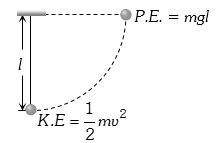
$A$ sphere is suspended by a thread of length $l$. What minimum horizontal velocity has to be imparted to the ball for it to reach the height of the suspension point?
A
$gl$
B
$2gl$
C
$\sqrt{gl}$
D
$\sqrt{2gl}$
Solution
(D) According to the law of conservation of mechanical energy,the kinetic energy given to the sphere at the lowest point must be equal to the potential energy gained at the height of the suspension point.
Let $m$ be the mass of the sphere and $v$ be the initial horizontal velocity.
At the lowest point,the kinetic energy is $K.E. = \frac{1}{2}mv^2$.
At the height of the suspension point,the potential energy is $P.E. = mgl$.
Equating the two:
$\frac{1}{2}mv^2 = mgl$
Solving for $v$:
$v^2 = 2gl$
$v = \sqrt{2gl}$
Let $m$ be the mass of the sphere and $v$ be the initial horizontal velocity.
At the lowest point,the kinetic energy is $K.E. = \frac{1}{2}mv^2$.
At the height of the suspension point,the potential energy is $P.E. = mgl$.
Equating the two:
$\frac{1}{2}mv^2 = mgl$
Solving for $v$:
$v^2 = 2gl$
$v = \sqrt{2gl}$
0 likesView Solution
3
ChemistryMCQMHT CET · 2011
The mass of the earth is $81$ times that of the moon and the radius of the earth is $3.5$ times that of the moon. The ratio of the escape velocity on the surface of the earth to that on the surface of the moon will be:
A
$0.2$
B
$2.57$
C
$4.81$
D
$0.39$
Solution
(C) The formula for escape velocity is $v_e = \sqrt{\frac{2GM}{R}}$.
Let $M_e$ and $R_e$ be the mass and radius of the earth,and $M_m$ and $R_m$ be the mass and radius of the moon.
Given: $M_e = 81 M_m$ and $R_e = 3.5 R_m$.
The ratio of escape velocity on earth $(v_e)$ to that on the moon $(v_m)$ is given by:
$\frac{v_e}{v_m} = \sqrt{\frac{M_e}{R_e} \cdot \frac{R_m}{M_m}} = \sqrt{\frac{M_e}{M_m} \cdot \frac{R_m}{R_e}}$
Substituting the given values:
$\frac{v_e}{v_m} = \sqrt{81 \cdot \frac{1}{3.5}} = \sqrt{\frac{81}{3.5}} = \sqrt{23.14} \approx 4.81$.
Let $M_e$ and $R_e$ be the mass and radius of the earth,and $M_m$ and $R_m$ be the mass and radius of the moon.
Given: $M_e = 81 M_m$ and $R_e = 3.5 R_m$.
The ratio of escape velocity on earth $(v_e)$ to that on the moon $(v_m)$ is given by:
$\frac{v_e}{v_m} = \sqrt{\frac{M_e}{R_e} \cdot \frac{R_m}{M_m}} = \sqrt{\frac{M_e}{M_m} \cdot \frac{R_m}{R_e}}$
Substituting the given values:
$\frac{v_e}{v_m} = \sqrt{81 \cdot \frac{1}{3.5}} = \sqrt{\frac{81}{3.5}} = \sqrt{23.14} \approx 4.81$.
0 likesView Solution
4
ChemistryMCQMHT CET · 2011
Two wires $A$ and $B$ are of the same material. Their lengths are in the ratio $1:2$ and their diameters are in the ratio $2:1$. When stretched by forces $F_A$ and $F_B$ respectively,they experience an equal increase in their lengths. Then the ratio $F_A/F_B$ is:
A
$1:2$
B
$1:1$
C
$2:1$
D
$8:1$
Solution
(D) Young's modulus $Y$ is given by $Y = \frac{F L}{A \Delta l}$,where $A = \pi r^2$.
Thus,the force $F$ is given by $F = \frac{Y A \Delta l}{L} = \frac{Y (\pi r^2) \Delta l}{L}$.
Since the material is the same,$Y$ is constant. Since the increase in length $\Delta l$ is the same for both wires,we have $F \propto \frac{r^2}{L}$.
Therefore,the ratio of the forces is $\frac{F_A}{F_B} = \left( \frac{r_A}{r_B} \right)^2 \times \left( \frac{L_B}{L_A} \right)$.
Given $\frac{L_A}{L_B} = \frac{1}{2}$ and the ratio of diameters is $2:1$,so $\frac{r_A}{r_B} = \frac{2}{1}$.
Substituting these values: $\frac{F_A}{F_B} = (2)^2 \times (2) = 4 \times 2 = 8$.
Thus,the ratio is $8:1$.
Thus,the force $F$ is given by $F = \frac{Y A \Delta l}{L} = \frac{Y (\pi r^2) \Delta l}{L}$.
Since the material is the same,$Y$ is constant. Since the increase in length $\Delta l$ is the same for both wires,we have $F \propto \frac{r^2}{L}$.
Therefore,the ratio of the forces is $\frac{F_A}{F_B} = \left( \frac{r_A}{r_B} \right)^2 \times \left( \frac{L_B}{L_A} \right)$.
Given $\frac{L_A}{L_B} = \frac{1}{2}$ and the ratio of diameters is $2:1$,so $\frac{r_A}{r_B} = \frac{2}{1}$.
Substituting these values: $\frac{F_A}{F_B} = (2)^2 \times (2) = 4 \times 2 = 8$.
Thus,the ratio is $8:1$.
0 likesView Solution
5
ChemistryMCQMHT CET · 2011
$A$ vessel is filled with an ideal gas at a pressure of $10 \ atm$ and temperature $27^\circ C$. Half of the mass of the gas is removed from the vessel and the temperature of the remaining gas is increased to $87^\circ C$. Then the pressure of the gas in the vessel will be ...... $atm$.
A
$5$
B
$6$
C
$7$
D
$8$
Solution
(B) Using the ideal gas equation $PV = nRT = (m/M)RT$,where $m$ is the mass and $M$ is the molar mass. Since $V$ and $M$ are constant,we have $P \propto mT$.
Let the initial state be $(P_1, m_1, T_1)$ and the final state be $(P_2, m_2, T_2)$.
Given: $P_1 = 10 \ atm$,$T_1 = 27 + 273 = 300 \ K$,$m_1 = m$.
After removing half the mass: $m_2 = m/2$.
Final temperature: $T_2 = 87 + 273 = 360 \ K$.
Using the ratio: $\frac{P_2}{P_1} = \frac{m_2}{m_1} \times \frac{T_2}{T_1}$
$\frac{P_2}{10} = \frac{m/2}{m} \times \frac{360}{300}$
$\frac{P_2}{10} = \frac{1}{2} \times \frac{6}{5}$
$\frac{P_2}{10} = \frac{3}{5}$
$P_2 = 10 \times \frac{3}{5} = 6 \ atm$.
Let the initial state be $(P_1, m_1, T_1)$ and the final state be $(P_2, m_2, T_2)$.
Given: $P_1 = 10 \ atm$,$T_1 = 27 + 273 = 300 \ K$,$m_1 = m$.
After removing half the mass: $m_2 = m/2$.
Final temperature: $T_2 = 87 + 273 = 360 \ K$.
Using the ratio: $\frac{P_2}{P_1} = \frac{m_2}{m_1} \times \frac{T_2}{T_1}$
$\frac{P_2}{10} = \frac{m/2}{m} \times \frac{360}{300}$
$\frac{P_2}{10} = \frac{1}{2} \times \frac{6}{5}$
$\frac{P_2}{10} = \frac{3}{5}$
$P_2 = 10 \times \frac{3}{5} = 6 \ atm$.
0 likesView Solution
6
ChemistryMCQMHT CET · 2011
$A$ black body at a temperature of $227^{\circ}C$ radiates heat energy at the rate of $5 \ cal/cm^2-sec$. At a temperature of $727^{\circ}C$,the rate of heat radiated per unit area in $cal/cm^2-sec$ will be:
A
$80$
B
$160$
C
$250$
D
$500$
Solution
(A) According to Stefan-Boltzmann Law,the rate of heat radiation per unit area $E$ is proportional to the fourth power of the absolute temperature $T$,i.e.,$E \propto T^4$.
Given:
$T_1 = 227^{\circ}C = 227 + 273 = 500 \ K$
$E_1 = 5 \ cal/cm^2-sec$
$T_2 = 727^{\circ}C = 727 + 273 = 1000 \ K$
Using the ratio formula:
$\frac{E_2}{E_1} = \left( \frac{T_2}{T_1} \right)^4$
$\frac{E_2}{5} = \left( \frac{1000}{500} \right)^4$
$\frac{E_2}{5} = (2)^4 = 16$
$E_2 = 16 \times 5 = 80 \ cal/cm^2-sec$.
Thus,the correct option is $A$.
Given:
$T_1 = 227^{\circ}C = 227 + 273 = 500 \ K$
$E_1 = 5 \ cal/cm^2-sec$
$T_2 = 727^{\circ}C = 727 + 273 = 1000 \ K$
Using the ratio formula:
$\frac{E_2}{E_1} = \left( \frac{T_2}{T_1} \right)^4$
$\frac{E_2}{5} = \left( \frac{1000}{500} \right)^4$
$\frac{E_2}{5} = (2)^4 = 16$
$E_2 = 16 \times 5 = 80 \ cal/cm^2-sec$.
Thus,the correct option is $A$.
0 likesView Solution
7
ChemistryMCQMHT CET · 2011
$A$ particle executes a simple harmonic motion of time period $T$. Find the time taken by the particle to go directly from its mean position to half the amplitude.
A
$T / 2$
B
$T / 4$
C
$T / 8$
D
$T / 12$
Solution
(D) The displacement of a particle in simple harmonic motion starting from the mean position is given by $y = A \sin(\omega t)$.
Here,$A$ is the amplitude,$\omega = \frac{2\pi}{T}$ is the angular frequency,and $T$ is the time period.
We want to find the time $t$ when the displacement $y = \frac{A}{2}$.
Substituting the values into the equation: $\frac{A}{2} = A \sin\left(\frac{2\pi t}{T}\right)$.
Dividing both sides by $A$: $\frac{1}{2} = \sin\left(\frac{2\pi t}{T}\right)$.
Since $\sin(30^\circ) = \sin\left(\frac{\pi}{6}\right) = \frac{1}{2}$,we have $\frac{2\pi t}{T} = \frac{\pi}{6}$.
Solving for $t$: $t = \frac{T}{12}$.
Here,$A$ is the amplitude,$\omega = \frac{2\pi}{T}$ is the angular frequency,and $T$ is the time period.
We want to find the time $t$ when the displacement $y = \frac{A}{2}$.
Substituting the values into the equation: $\frac{A}{2} = A \sin\left(\frac{2\pi t}{T}\right)$.
Dividing both sides by $A$: $\frac{1}{2} = \sin\left(\frac{2\pi t}{T}\right)$.
Since $\sin(30^\circ) = \sin\left(\frac{\pi}{6}\right) = \frac{1}{2}$,we have $\frac{2\pi t}{T} = \frac{\pi}{6}$.
Solving for $t$: $t = \frac{T}{12}$.
0 likesView Solution
8
ChemistryMCQMHT CET · 2011
Two springs have spring constants $K_A$ and $K_B$ such that $K_A > K_B$. If both springs are stretched by the same extension $x$,the work required will be:
A
More in spring $A$
B
More in spring $B$
C
Equal in both
D
Nothing can be said
Solution
(A) The work done $W$ in stretching a spring by an extension $x$ is given by the formula $W = \frac{1}{2} k x^2$.
Since the extension $x$ is the same for both springs,the work done is directly proportional to the spring constant $k$ $(W \propto k)$.
Given that $K_A > K_B$,it follows that $W_A > W_B$.
Therefore,more work is required to stretch spring $A$.
Since the extension $x$ is the same for both springs,the work done is directly proportional to the spring constant $k$ $(W \propto k)$.
Given that $K_A > K_B$,it follows that $W_A > W_B$.
Therefore,more work is required to stretch spring $A$.
0 likesView Solution
9
ChemistryMCQMHT CET · 2011
For the stationary wave $y = 4 \sin \left( \frac{\pi x}{15} \right) \cos (96 \pi t)$,the distance between a node and the next antinode is
A
$7.5$
B
$15$
C
$22.5$
D
$30$
Solution
(A) The standard equation for a stationary wave is given by $y = 2a \sin \left( \frac{2 \pi x}{\lambda} \right) \cos (\omega t)$.
Comparing the given equation $y = 4 \sin \left( \frac{\pi x}{15} \right) \cos (96 \pi t)$ with the standard form,we get:
$\frac{2 \pi}{\lambda} = \frac{\pi}{15}$.
Solving for $\lambda$:
$\lambda = 30$.
The distance between a node and the next consecutive antinode is given by $\frac{\lambda}{4}$.
Therefore,the distance $= \frac{30}{4} = 7.5$.
Comparing the given equation $y = 4 \sin \left( \frac{\pi x}{15} \right) \cos (96 \pi t)$ with the standard form,we get:
$\frac{2 \pi}{\lambda} = \frac{\pi}{15}$.
Solving for $\lambda$:
$\lambda = 30$.
The distance between a node and the next consecutive antinode is given by $\frac{\lambda}{4}$.
Therefore,the distance $= \frac{30}{4} = 7.5$.
0 likesView Solution
10
ChemistryMCQMHT CET · 2011
If the temperature increases,then what happens to the frequency of the sound produced by the organ pipe?
A
Increases
B
Decreases
C
Unchanged
D
Not definite
Solution
(A) The speed of sound in a gas is given by $v = \sqrt{\frac{\gamma RT}{M}}$. As the temperature $T$ increases,the speed of sound $v$ increases.
For an organ pipe of length $L$,the frequency $n$ is given by $n = \frac{v}{\lambda}$,where $\lambda$ depends on the length of the pipe and the mode of vibration.
Since the length of the pipe $L$ remains effectively constant (ignoring thermal expansion),the wavelength $\lambda$ remains unchanged.
Therefore,as $v$ increases,the frequency $n$ must also increase.
For an organ pipe of length $L$,the frequency $n$ is given by $n = \frac{v}{\lambda}$,where $\lambda$ depends on the length of the pipe and the mode of vibration.
Since the length of the pipe $L$ remains effectively constant (ignoring thermal expansion),the wavelength $\lambda$ remains unchanged.
Therefore,as $v$ increases,the frequency $n$ must also increase.
0 likesView Solution
11
ChemistryMCQMHT CET · 2011
In a resonance tube,the first resonance with a tuning fork occurs at $16 \ cm$ and the second at $49 \ cm$. If the velocity of sound is $330 \ m/s$,the frequency of the tuning fork is: (in $Hz$)
A
$500$
B
$300$
C
$330$
D
$165$
Solution
(A) For a closed resonance tube,the resonance lengths are given by $l_1 = \frac{\lambda}{4}$ and $l_2 = \frac{3\lambda}{4}$.
The difference between the two resonance lengths is $l_2 - l_1 = \frac{\lambda}{2}$.
Given $l_1 = 16 \ cm = 0.16 \ m$ and $l_2 = 49 \ cm = 0.49 \ m$.
Thus,$\frac{\lambda}{2} = 0.49 \ m - 0.16 \ m = 0.33 \ m$,which implies $\lambda = 0.66 \ m$.
Using the wave equation $v = n\lambda$,where $v$ is the velocity of sound and $n$ is the frequency:
$n = \frac{v}{\lambda} = \frac{330 \ m/s}{0.66 \ m} = 500 \ Hz$.
The difference between the two resonance lengths is $l_2 - l_1 = \frac{\lambda}{2}$.
Given $l_1 = 16 \ cm = 0.16 \ m$ and $l_2 = 49 \ cm = 0.49 \ m$.
Thus,$\frac{\lambda}{2} = 0.49 \ m - 0.16 \ m = 0.33 \ m$,which implies $\lambda = 0.66 \ m$.
Using the wave equation $v = n\lambda$,where $v$ is the velocity of sound and $n$ is the frequency:
$n = \frac{v}{\lambda} = \frac{330 \ m/s}{0.66 \ m} = 500 \ Hz$.
0 likesView Solution
12
ChemistryMCQMHT CET · 2011
The ratio of momenta of an electron and an $\alpha$-particle which are accelerated from rest by a potential difference of $100\, V$ is
A
$1$
B
$\sqrt{\frac{2m_e}{m_\alpha}}$
C
$\sqrt{\frac{m_e}{m_\alpha}}$
D
$\sqrt{\frac{m_e}{2m_\alpha}}$
Solution
(D) The momentum $p$ of a charged particle accelerated from rest through a potential difference $V$ is given by $p = \sqrt{2mK}$,where $K = qV$ is the kinetic energy.
Thus,$p = \sqrt{2mqV}$.
Since $V$ is the same for both particles,the ratio of momenta is $\frac{p_e}{p_\alpha} = \sqrt{\frac{m_e q_e}{m_\alpha q_\alpha}}$.
For an electron,$q_e = e$. For an $\alpha$-particle,$q_\alpha = 2e$.
Substituting these values,we get $\frac{p_e}{p_\alpha} = \sqrt{\frac{m_e \cdot e}{m_\alpha \cdot 2e}} = \sqrt{\frac{m_e}{2m_\alpha}}$.
Thus,$p = \sqrt{2mqV}$.
Since $V$ is the same for both particles,the ratio of momenta is $\frac{p_e}{p_\alpha} = \sqrt{\frac{m_e q_e}{m_\alpha q_\alpha}}$.
For an electron,$q_e = e$. For an $\alpha$-particle,$q_\alpha = 2e$.
Substituting these values,we get $\frac{p_e}{p_\alpha} = \sqrt{\frac{m_e \cdot e}{m_\alpha \cdot 2e}} = \sqrt{\frac{m_e}{2m_\alpha}}$.
0 likesView Solution
13
ChemistryMCQMHT CET · 2011
The ratio of momenta of an electron and an $\alpha$-particle which are accelerated from rest by a potential difference of $100 \ V$ is
A
$1$
B
$\sqrt{\frac{2m_e}{m_\alpha}}$
C
$\sqrt{\frac{m_e}{m_\alpha}}$
D
$\sqrt{\frac{m_e}{2m_\alpha}}$
Solution
(D) The momentum $p$ of a charged particle accelerated from rest through a potential difference $V$ is given by $p = \sqrt{2mqV}$,where $m$ is the mass and $q$ is the charge of the particle.
Since $V$ is the same for both particles,$p \propto \sqrt{mq}$.
For an electron,$m = m_e$ and $q = e$.
For an $\alpha$-particle,$m = m_\alpha$ and $q = 2e$.
Therefore,the ratio of the momenta is $\frac{p_e}{p_\alpha} = \sqrt{\frac{m_e \cdot e}{m_\alpha \cdot 2e}} = \sqrt{\frac{m_e}{2m_\alpha}}$.
Since $V$ is the same for both particles,$p \propto \sqrt{mq}$.
For an electron,$m = m_e$ and $q = e$.
For an $\alpha$-particle,$m = m_\alpha$ and $q = 2e$.
Therefore,the ratio of the momenta is $\frac{p_e}{p_\alpha} = \sqrt{\frac{m_e \cdot e}{m_\alpha \cdot 2e}} = \sqrt{\frac{m_e}{2m_\alpha}}$.
0 likesView Solution
14
ChemistryMCQMHT CET · 2011
According to Hess's law,the heat of reaction depends upon:
A
Initial condition of reactants
B
Initial and final conditions of reactants
C
Intermediate path of the reaction
D
End conditions of reactants
Solution
(B) Hess's law of constant heat summation states that the total enthalpy change for a chemical reaction is the same,whether the reaction takes place in one step or in several steps.
Therefore,the heat of reaction depends only on the initial state of the reactants and the final state of the products.
Therefore,the heat of reaction depends only on the initial state of the reactants and the final state of the products.
0 likesView Solution
15
ChemistryMCQMHT CET · 2011
Benzaldehyde reacts with ammonia to form
A
Benzaldehyde ammonia
B
Urotropine
C
Hydrobenzamide
D
Aniline
Solution
(C) When $3$ moles of benzaldehyde $(C_6H_5CHO)$ react with $2$ moles of ammonia $(NH_3)$,they undergo a condensation reaction to form hydrobenzamide $( (C_6H_5CH=N)_2CH-C_6H_5 )$ and release $3$ moles of water $(H_2O)$.
The chemical equation is:
$3C_6H_5CHO + 2NH_3 \rightarrow (C_6H_5CH=N)_2CH-C_6H_5 + 3H_2O$
Thus,the correct option is $(C)$.
The chemical equation is:
$3C_6H_5CHO + 2NH_3 \rightarrow (C_6H_5CH=N)_2CH-C_6H_5 + 3H_2O$
Thus,the correct option is $(C)$.
0 likesView Solution
16
ChemistryMCQMHT CET · 2011
If one of the lines of the pair $ax^2 + 2hxy + by^2 = 0$ bisects the angle between the positive directions of the axes,then $a, b, h$ satisfy the relation:
A
$a + b = 2|h|$
B
$a + b = -2h$
C
$a - b = 2|h|$
D
$(a - b)^2 = 4h^2$
Solution
(B) The bisector of the angle between the positive directions of the axes is the line $y = x$.
Since this line is one of the lines represented by the pair $ax^2 + 2hxy + by^2 = 0$,it must satisfy the equation.
Substituting $y = x$ into the equation,we get:
$ax^2 + 2hx(x) + b(x)^2 = 0$
$ax^2 + 2hx^2 + bx^2 = 0$
$x^2(a + 2h + b) = 0$
Since this holds for all $x$,we must have $a + 2h + b = 0$,which simplifies to $a + b = -2h$.
Since this line is one of the lines represented by the pair $ax^2 + 2hxy + by^2 = 0$,it must satisfy the equation.
Substituting $y = x$ into the equation,we get:
$ax^2 + 2hx(x) + b(x)^2 = 0$
$ax^2 + 2hx^2 + bx^2 = 0$
$x^2(a + 2h + b) = 0$
Since this holds for all $x$,we must have $a + 2h + b = 0$,which simplifies to $a + b = -2h$.
0 likesView Solution
17
ChemistryMCQMHT CET · 2011
The equations of the normals at the ends of the latus rectum of the parabola $y^2 = 4ax$ are given by
A
$x^2 - y^2 - 6ax + 9a^2 = 0$
B
$x^2 - y^2 - 6ax - 6ay + 9a^2 = 0$
C
$x^2 - y^2 - 6ay + 9a^2 = 0$
D
None of these
Solution
(A) The coordinates of the ends of the latus rectum of the parabola $y^2 = 4ax$ are $(a, 2a)$ and $(a, -2a)$.
The equation of the normal at $(x_1, y_1)$ to $y^2 = 4ax$ is given by $y - y_1 = -\frac{y_1}{2a}(x - x_1)$.
For the point $(a, 2a)$,the normal is $y - 2a = -\frac{2a}{2a}(x - a) \implies y - 2a = -(x - a) \implies x + y - 3a = 0$ $(i)$.
For the point $(a, -2a)$,the normal is $y - (-2a) = -\frac{-2a}{2a}(x - a) \implies y + 2a = 1(x - a) \implies x - y - 3a = 0$ $(ii)$.
The combined equation is $(x + y - 3a)(x - y - 3a) = 0$.
This simplifies to $((x - 3a) + y)((x - 3a) - y) = 0 \implies (x - 3a)^2 - y^2 = 0$.
Expanding this,we get $x^2 - 6ax + 9a^2 - y^2 = 0$,which is $x^2 - y^2 - 6ax + 9a^2 = 0$.
The equation of the normal at $(x_1, y_1)$ to $y^2 = 4ax$ is given by $y - y_1 = -\frac{y_1}{2a}(x - x_1)$.
For the point $(a, 2a)$,the normal is $y - 2a = -\frac{2a}{2a}(x - a) \implies y - 2a = -(x - a) \implies x + y - 3a = 0$ $(i)$.
For the point $(a, -2a)$,the normal is $y - (-2a) = -\frac{-2a}{2a}(x - a) \implies y + 2a = 1(x - a) \implies x - y - 3a = 0$ $(ii)$.
The combined equation is $(x + y - 3a)(x - y - 3a) = 0$.
This simplifies to $((x - 3a) + y)((x - 3a) - y) = 0 \implies (x - 3a)^2 - y^2 = 0$.
Expanding this,we get $x^2 - 6ax + 9a^2 - y^2 = 0$,which is $x^2 - y^2 - 6ax + 9a^2 = 0$.
0 likesView Solution
18
ChemistryMCQMHT CET · 2011
The inverse of the proposition $(p \wedge \sim q) \Rightarrow r$ is
A
$\sim r \Rightarrow \sim p \vee q$
B
$\sim p \vee q \Rightarrow \sim r$
C
$r \Rightarrow p \wedge \sim q$
D
None of these
Solution
(B) The inverse of a conditional statement $P \Rightarrow Q$ is defined as $\sim P \Rightarrow \sim Q$.
For the given proposition $(p \wedge \sim q) \Rightarrow r$,we identify $P = (p \wedge \sim q)$ and $Q = r$.
The inverse is $\sim (p \wedge \sim q) \Rightarrow \sim r$.
Using De Morgan's Law,$\sim (p \wedge \sim q)$ is equivalent to $\sim p \vee \sim (\sim q)$,which simplifies to $\sim p \vee q$.
Therefore,the inverse is $(\sim p \vee q) \Rightarrow \sim r$.
For the given proposition $(p \wedge \sim q) \Rightarrow r$,we identify $P = (p \wedge \sim q)$ and $Q = r$.
The inverse is $\sim (p \wedge \sim q) \Rightarrow \sim r$.
Using De Morgan's Law,$\sim (p \wedge \sim q)$ is equivalent to $\sim p \vee \sim (\sim q)$,which simplifies to $\sim p \vee q$.
Therefore,the inverse is $(\sim p \vee q) \Rightarrow \sim r$.
0 likesView Solution
19
ChemistryMCQMHT CET · 2011
The proposition $(p$ $\Rightarrow \;\sim p) \wedge (\sim p$ $\Rightarrow p)$ is a
A
Tautology and contradiction
B
Neither tautology nor contradiction
C
Contradiction
D
Tautology
Solution
(C) To determine the nature of the proposition $(p$ $\Rightarrow \;\sim p) \wedge (\sim p$ $\Rightarrow p)$,we construct a truth table:
Since the truth value of the proposition is $F$ for all possible values of $p$,it is a contradiction.
| $p$ | $\sim p$ | $p \Rightarrow \;\sim p$ | $\sim p \Rightarrow p$ | $(p$ $\Rightarrow \;\sim p) \wedge (\sim p$ $\Rightarrow p)$ |
|---|---|---|---|---|
| $T$ | $F$ | $F$ | $T$ | $F$ |
| $F$ | $T$ | $T$ | $F$ | $F$ |
Since the truth value of the proposition is $F$ for all possible values of $p$,it is a contradiction.
0 likesView Solution
20
ChemistryMCQMHT CET · 2011
Which of the following does not contain any co-ordinate bond?
A
$H_3O^+$
B
$BF_4^-$
C
$HF_2^-$
D
$NH_4^+$
Solution
(C) In option $A$,a coordinate (dative) bond is formed between the lone pair of the Oxygen atom and the empty $1s$ orbital of the $H^+$ ion.
In option $B$,the Boron atom has an empty $2p$ orbital after the formation of $BF_3$,so it accepts a lone pair from a Fluoride ion $(F^-)$ to form $BF_4^-$.
In option $C$,$HF_2^-$ involves a strong Hydrogen bond between $F^-$ and $HF$,not a coordinate bond.
In option $D$,the Nitrogen atom in $NH_3$ has one lone pair,which it shares with an $H^+$ ion to form a coordinate bond in $NH_4^+$.
Therefore,$HF_2^-$ is the correct answer.
In option $B$,the Boron atom has an empty $2p$ orbital after the formation of $BF_3$,so it accepts a lone pair from a Fluoride ion $(F^-)$ to form $BF_4^-$.
In option $C$,$HF_2^-$ involves a strong Hydrogen bond between $F^-$ and $HF$,not a coordinate bond.
In option $D$,the Nitrogen atom in $NH_3$ has one lone pair,which it shares with an $H^+$ ion to form a coordinate bond in $NH_4^+$.
Therefore,$HF_2^-$ is the correct answer.
0 likesView Solution
21
ChemistryMediumMCQMHT CET · 2011
$CH \equiv CH$ $\xrightarrow{HCl \text{ (Excess)}} A$ $\xrightarrow{\text{Hydrolysis}, \Delta} B$ $\xrightarrow{\text{Reduction}, Na-Hg / H_2O} C$
Compound $C$ is
Compound $C$ is
A
ethanal
B
propenal
C
ethanol
D
$2-$methyl butan$-1-$ol
Solution
(C) Step $1$: Reaction of ethyne with excess $HCl$ gives $1,1-$dichloroethane $(A)$.
$CH \equiv CH + 2HCl \rightarrow CH_3-CHCl_2 (A)$
Step $2$: Hydrolysis of $1,1-$dichloroethane $(A)$ followed by heating gives ethanal $(B)$.
$CH_3-CHCl_2 + H_2O \xrightarrow{\Delta} CH_3CHO (B) + 2HCl$
Step $3$: Reduction of ethanal $(B)$ with $Na-Hg / H_2O$ gives ethanol $(C)$.
$CH_3CHO + 2[H] \xrightarrow{Na-Hg / H_2O} CH_3CH_2OH (C)$
Thus,compound $C$ is ethanol.
$CH \equiv CH + 2HCl \rightarrow CH_3-CHCl_2 (A)$
Step $2$: Hydrolysis of $1,1-$dichloroethane $(A)$ followed by heating gives ethanal $(B)$.
$CH_3-CHCl_2 + H_2O \xrightarrow{\Delta} CH_3CHO (B) + 2HCl$
Step $3$: Reduction of ethanal $(B)$ with $Na-Hg / H_2O$ gives ethanol $(C)$.
$CH_3CHO + 2[H] \xrightarrow{Na-Hg / H_2O} CH_3CH_2OH (C)$
Thus,compound $C$ is ethanol.
0 likesView Solution
22
ChemistryEasyMCQMHT CET · 2011
Which of the following transitions involves the maximum amount of energy?
A
$M_{(g)}^{-} \longrightarrow M_{(g)}$
B
$M_{(g)} \longrightarrow M_{(g)}^{+}$
C
$M_{(g)}^{+} \longrightarrow M_{(g)}^{2+}$
D
$M_{(g)}^{2+} \longrightarrow M_{(g)}^{3+}$
Solution
(D) The transition $M_{(g)}^{2+} \longrightarrow M_{(g)}^{3+}$ involves the maximum amount of energy.
As the positive charge on the ion increases,the effective nuclear charge per electron increases.
This results in a stronger electrostatic attraction between the nucleus and the remaining electrons.
Therefore,the energy required to remove the $3^{rd}$ electron (third ionization energy) is significantly higher than the energy required for the removal of the first or second electron.
As the positive charge on the ion increases,the effective nuclear charge per electron increases.
This results in a stronger electrostatic attraction between the nucleus and the remaining electrons.
Therefore,the energy required to remove the $3^{rd}$ electron (third ionization energy) is significantly higher than the energy required for the removal of the first or second electron.
0 likesView Solution
23
ChemistryEasyMCQMHT CET · 2011
Which of the following does not contain any coordinate bond?
A
$H_{3}O^{+}$
B
$BF_{4}^{-}$
C
$HF_{2}^{-}$
D
$NH_{4}^{+}$
Solution
(C) coordinate bond (or dative bond) is formed when one atom donates a lone pair of electrons to another atom that needs them to complete its octet.
$H_{3}O^{+}$ contains a coordinate bond between $O$ and $H^{+}$.
$BF_{4}^{-}$ contains a coordinate bond between $F^{-}$ and $BF_{3}$.
$NH_{4}^{+}$ contains a coordinate bond between $N$ and $H^{+}$.
$HF_{2}^{-}$ is formed by hydrogen bonding between $F^{-}$ and $HF$,represented as $[F-H...F]^{-}$. It does not contain a coordinate bond.
$H_{3}O^{+}$ contains a coordinate bond between $O$ and $H^{+}$.
$BF_{4}^{-}$ contains a coordinate bond between $F^{-}$ and $BF_{3}$.
$NH_{4}^{+}$ contains a coordinate bond between $N$ and $H^{+}$.
$HF_{2}^{-}$ is formed by hydrogen bonding between $F^{-}$ and $HF$,represented as $[F-H...F]^{-}$. It does not contain a coordinate bond.
0 likesView Solution
24
ChemistryEasyMCQMHT CET · 2011
The atomic number of $Sn$ is $50$. The shape of gaseous $SnCl_{2}$ molecule is
A
B
C
D
Solution
(D) In $SnCl_{2}$,the central atom $Sn$ has a valence shell configuration of $5s^{2} 5p^{2}$. It forms two covalent bonds with two $Cl$ atoms,utilizing two $5p$ electrons. This leaves one lone pair in the $5s$ orbital. The total number of electron domains around $Sn$ is $3$ ($2$ bond pairs + $1$ lone pair),which corresponds to $sp^{2}$ hybridization. Due to the presence of one lone pair,the geometry is bent or $V$-shaped.
0 likesView Solution
25
ChemistryMCQMHT CET · 2011
Which of the following is a bactericidal antibiotic?
A
ofloxacin
B
chloramphenicol
C
erythromycin
D
tetracycline
Solution
(A) Antibiotics are classified as bactericidal or bacteriostatic based on their action.
Bactericidal antibiotics kill the microorganisms in the body.
Examples of bactericidal antibiotics include $Penicillin$,$Ofloxacin$,and $Aminoglycosides$.
Bacteriostatic antibiotics inhibit the growth of microorganisms.
Examples of bacteriostatic antibiotics include $Chloramphenicol$,$Erythromycin$,and $Tetracycline$.
Therefore,$Ofloxacin$ is a bactericidal antibiotic.
Bactericidal antibiotics kill the microorganisms in the body.
Examples of bactericidal antibiotics include $Penicillin$,$Ofloxacin$,and $Aminoglycosides$.
Bacteriostatic antibiotics inhibit the growth of microorganisms.
Examples of bacteriostatic antibiotics include $Chloramphenicol$,$Erythromycin$,and $Tetracycline$.
Therefore,$Ofloxacin$ is a bactericidal antibiotic.
0 likesView Solution
26
ChemistryEasyMCQMHT CET · 2011
The $IUPAC$ name of the compound is:

A
$1-$bromo$-1-$chloro$-4, 4 '-$bicyclobutane
B
$4-(4'-$chlorocyclobutyl)$-1-$bromocyclobutane
C
$3-$bromo$-3'-$chloro$-1, 1'-$bicyclobutane
D
$4-(4'-$bromocyclobutyl)$-1-$chlorocyclobutane
Solution
(C) $1$. Identify the parent chain: The compound consists of two cyclobutane rings connected by a single bond,forming a $1, 1'-$bicyclobutane system.
$2$. Numbering: Number the rings such that the substituents get the lowest possible locants. The connection point is $1$ and $1'$.
$3$. Substituents: There is a bromine atom at position $3$ and a chlorine atom at position $3'$.
$4$. Alphabetical order: $B$ (bromo) comes before $C$ (chloro).
$5$. Final Name: $3-$bromo$-3'-$chloro$-1, 1'-$bicyclobutane.
$2$. Numbering: Number the rings such that the substituents get the lowest possible locants. The connection point is $1$ and $1'$.
$3$. Substituents: There is a bromine atom at position $3$ and a chlorine atom at position $3'$.
$4$. Alphabetical order: $B$ (bromo) comes before $C$ (chloro).
$5$. Final Name: $3-$bromo$-3'-$chloro$-1, 1'-$bicyclobutane.
0 likesView Solution
27
ChemistryMediumMCQMHT CET · 2011
Which of the following species is an electrophile?
A
$H_{2}O$
B
$NH_{3}$
C
$C_{2}H_{5}OH$
D
$SO_{3}$
Solution
(D) Electrophiles are electron-loving chemical species. These may be either positively charged or electrically neutral species with an incomplete octet or vacant orbitals.
$H_{2}O$,$NH_{3}$,and $C_{2}H_{5}OH$ are nucleophiles because they possess lone pairs of electrons.
$SO_{3}$ is an electrophile because the sulfur atom is bonded to three highly electronegative oxygen atoms,making it electron-deficient. It can be represented as a resonance hybrid of the following structures:
$O=S(=O)-O^{-} \leftrightarrow -O-S(=O)=O \leftrightarrow -O-S(=O)=O$ (with a positive charge on $S$ in each resonance structure).
Due to the partial positive charge on the $S$ atom,it acts as an electrophile.
$H_{2}O$,$NH_{3}$,and $C_{2}H_{5}OH$ are nucleophiles because they possess lone pairs of electrons.
$SO_{3}$ is an electrophile because the sulfur atom is bonded to three highly electronegative oxygen atoms,making it electron-deficient. It can be represented as a resonance hybrid of the following structures:
$O=S(=O)-O^{-} \leftrightarrow -O-S(=O)=O \leftrightarrow -O-S(=O)=O$ (with a positive charge on $S$ in each resonance structure).
Due to the partial positive charge on the $S$ atom,it acts as an electrophile.
0 likesView Solution
28
ChemistryMediumMCQMHT CET · 2011
The central carbon atom of a free radical contains
A
$6$ electrons
B
$7$ electrons
C
$8$ electrons
D
$10$ electrons
Solution
(B) The central carbon atom of a free radical contains $7$ electrons.
Free radicals are paramagnetic due to the presence of an unpaired electron and are formed by homolysis of covalent bonds either by heat or by light.
Free radicals are paramagnetic due to the presence of an unpaired electron and are formed by homolysis of covalent bonds either by heat or by light.
0 likesView Solution
29
ChemistryMediumMCQMHT CET · 2011
Identify the product $A$ in the following reaction:
$C_6H_6 + CH_2Cl_2 \xrightarrow{\text{Anhy. } AlCl_3} A$
$C_6H_6 + CH_2Cl_2 \xrightarrow{\text{Anhy. } AlCl_3} A$
A
Benzyl chloride
B
Benzal chloride
C
Chlorobenzene
D
Diphenylmethane
Solution
(D) The reaction of benzene with dichloromethane $(CH_2Cl_2)$ in the presence of anhydrous $AlCl_3$ is a Friedel-Crafts alkylation reaction.
Since benzene is present in excess,the reaction proceeds as follows:
$2C_6H_6 + CH_2Cl_2 \xrightarrow{\text{Anhy. } AlCl_3} C_6H_5-CH_2-C_6H_5 + 2HCl$
The product formed is diphenylmethane.
Since benzene is present in excess,the reaction proceeds as follows:
$2C_6H_6 + CH_2Cl_2 \xrightarrow{\text{Anhy. } AlCl_3} C_6H_5-CH_2-C_6H_5 + 2HCl$
The product formed is diphenylmethane.
0 likesView Solution
30
ChemistryDifficultMCQMHT CET · 2011
Which of the following compounds does not give different isomers on monochlorination?
A
$Neo$-pentane
B
$n$-butane
C
$Iso$-butane
D
$Iso$-pentane
Solution
(A) $Neo$-pentane ($2,2$-dimethylpropane) has all $12$ hydrogen atoms equivalent. Therefore,its monochlorination yields only one product,$1$-chloro-$2,2$-dimethylpropane.
$n$-butane gives two isomers ($1$-chlorobutane and $2$-chlorobutane).
$Iso$-butane gives two isomers ($1$-chloro-$2$-methylpropane and $2$-chloro-$2$-methylpropane).
$Iso$-pentane gives four isomers.
Thus,$Neo$-pentane does not give different isomers on monochlorination.
$n$-butane gives two isomers ($1$-chlorobutane and $2$-chlorobutane).
$Iso$-butane gives two isomers ($1$-chloro-$2$-methylpropane and $2$-chloro-$2$-methylpropane).
$Iso$-pentane gives four isomers.
Thus,$Neo$-pentane does not give different isomers on monochlorination.
0 likesView Solution
31
ChemistryDifficultMCQMHT CET · 2011
An acid solution of $pH=6$ is diluted $1000$ times,the $pH$ of the final solution becomes
A
$6.01$
B
$9$
C
$3.5$
D
$6.99$
Solution
(D) Given,$pH = 6$.
Therefore,the initial concentration of $[H^{+}] = 10^{-6} \ M$.
After diluting the solution $1000$ times,the new concentration of $[H^{+}]$ from the acid is $[H^{+}]_{acid} = \frac{10^{-6}}{1000} = 10^{-9} \ M$.
Since this concentration is very low,the contribution of $[H^{+}]$ from the auto-ionization of water $(10^{-7} \ M)$ cannot be neglected.
Total $[H^{+}] = [H^{+}]_{acid} + [H^{+}]_{water} = 10^{-9} + 10^{-7} \ M$.
Total $[H^{+}] = 10^{-7} (0.01 + 1) = 1.01 \times 10^{-7} \ M$.
$pH = -\log(1.01 \times 10^{-7}) = 7 - \log(1.01) \approx 7 - 0.0043 = 6.9957$.
Thus,the $pH$ of the final solution is approximately $6.99$.
Therefore,the initial concentration of $[H^{+}] = 10^{-6} \ M$.
After diluting the solution $1000$ times,the new concentration of $[H^{+}]$ from the acid is $[H^{+}]_{acid} = \frac{10^{-6}}{1000} = 10^{-9} \ M$.
Since this concentration is very low,the contribution of $[H^{+}]$ from the auto-ionization of water $(10^{-7} \ M)$ cannot be neglected.
Total $[H^{+}] = [H^{+}]_{acid} + [H^{+}]_{water} = 10^{-9} + 10^{-7} \ M$.
Total $[H^{+}] = 10^{-7} (0.01 + 1) = 1.01 \times 10^{-7} \ M$.
$pH = -\log(1.01 \times 10^{-7}) = 7 - \log(1.01) \approx 7 - 0.0043 = 6.9957$.
Thus,the $pH$ of the final solution is approximately $6.99$.
0 likesView Solution
32
ChemistryEasyMCQMHT CET · 2011
Which of the following salts will not undergo hydrolysis?
A
$NH_4Cl$
B
$KCN$
C
$KNO_3$
D
$Na_2CO_3$
Solution
(C) $KNO_3$ is a salt formed from a strong acid $(HNO_3)$ and a strong base $(KOH)$.
Salts of strong acids and strong bases do not undergo hydrolysis because their constituent ions do not react with water to change the $pH$ of the solution.
Therefore,$KNO_3$ will not undergo hydrolysis.
Salts of strong acids and strong bases do not undergo hydrolysis because their constituent ions do not react with water to change the $pH$ of the solution.
Therefore,$KNO_3$ will not undergo hydrolysis.
0 likesView Solution
33
ChemistryDifficultMCQMHT CET · 2011
The solubility product of $Ag_{2}CrO_{4}$ is $32 \times 10^{-12}$. What is the concentration of $CrO_{4}^{2-}$ ions in that solution?
A
$2 \times 10^{-4} \ M$
B
$16 \times 10^{-4} \ M$
C
$8 \times 10^{-4} \ M$
D
$12 \times 10^{-4} \ M$
Solution
(A) The dissociation of $Ag_{2}CrO_{4}$ is given by: $Ag_{2}CrO_{4} \rightleftharpoons 2 Ag^{+} + CrO_{4}^{2-}$.
Let the solubility be $s$. Then $[Ag^{+}] = 2s$ and $[CrO_{4}^{2-}] = s$.
The solubility product expression is $K_{sp} = [Ag^{+}]^{2} [CrO_{4}^{2-}]$.
Substituting the values: $K_{sp} = (2s)^{2} (s) = 4s^{3}$.
Given $K_{sp} = 32 \times 10^{-12}$,we have $4s^{3} = 32 \times 10^{-12}$.
$s^{3} = 8 \times 10^{-12}$.
$s = (8 \times 10^{-12})^{1/3} = 2 \times 10^{-4} \ M$.
Since $[CrO_{4}^{2-}] = s$,the concentration is $2 \times 10^{-4} \ M$.
Let the solubility be $s$. Then $[Ag^{+}] = 2s$ and $[CrO_{4}^{2-}] = s$.
The solubility product expression is $K_{sp} = [Ag^{+}]^{2} [CrO_{4}^{2-}]$.
Substituting the values: $K_{sp} = (2s)^{2} (s) = 4s^{3}$.
Given $K_{sp} = 32 \times 10^{-12}$,we have $4s^{3} = 32 \times 10^{-12}$.
$s^{3} = 8 \times 10^{-12}$.
$s = (8 \times 10^{-12})^{1/3} = 2 \times 10^{-4} \ M$.
Since $[CrO_{4}^{2-}] = s$,the concentration is $2 \times 10^{-4} \ M$.
0 likesView Solution
34
ChemistryEasyMCQMHT CET · 2011
The common basic structural unit in silicates and silica is
A
$Si_{2}O_{6}^{4-}$
B
$SiO_{3}^{2-}$
C
$SiO_{4}^{4-}$
D
$Si_{2}O_{7}^{6-}$
Solution
(C) In both silica $(SiO_{2})$ and silicates,the fundamental building block is the orthosilicate unit,which is the tetrahedral ($SiO_{4})^{4-}$ anion.
In this structure,one silicon atom is bonded to four oxygen atoms arranged at the corners of a tetrahedron.
In this structure,one silicon atom is bonded to four oxygen atoms arranged at the corners of a tetrahedron.
0 likesView Solution
35
ChemistryMediumMCQMHT CET · 2011
When $Zn$ is treated with excess of $NaOH$,the product obtained is
A
$Zn(OH)_{2}$
B
$ZnOH$
C
$Na_{2}ZnO_{2}$
D
None of the above
Solution
(C) When $Zn$ reacts with an excess of $NaOH$ solution,it forms sodium zincate and releases hydrogen gas.
The reaction is:
$Zn + 2NaOH + 2H_2O \longrightarrow Na_2[Zn(OH)_4] + H_2$
This can also be represented as:
$Zn + 2NaOH \longrightarrow Na_2ZnO_2 + H_2$
Thus,the product obtained is sodium zincate $(Na_2ZnO_2)$.
The reaction is:
$Zn + 2NaOH + 2H_2O \longrightarrow Na_2[Zn(OH)_4] + H_2$
This can also be represented as:
$Zn + 2NaOH \longrightarrow Na_2ZnO_2 + H_2$
Thus,the product obtained is sodium zincate $(Na_2ZnO_2)$.
0 likesView Solution
36
ChemistryEasyMCQMHT CET · 2011
One atomic mass unit $(amu)$ is equal to:
A
$1.66 \times 10^{-27} \ g$
B
$1.66 \times 10^{-24} \ g$
C
$1.66 \times 10^{-23} \ g$
D
$1.66 \times 10^{-25} \ kg$
Solution
(B) The atomic mass unit $(amu)$,also known as the unified atomic mass unit $(u)$,is defined as $1/12$ of the mass of a carbon-$12$ atom.
$1 \ amu = 1.66057 \times 10^{-27} \ kg$.
Since $1 \ kg = 10^3 \ g$,we convert the value to grams:
$1 \ amu = 1.66057 \times 10^{-27} \ kg \times 10^3 \ g/kg = 1.66057 \times 10^{-24} \ g$.
Therefore,the correct value is $1.66 \times 10^{-24} \ g$.
$1 \ amu = 1.66057 \times 10^{-27} \ kg$.
Since $1 \ kg = 10^3 \ g$,we convert the value to grams:
$1 \ amu = 1.66057 \times 10^{-27} \ kg \times 10^3 \ g/kg = 1.66057 \times 10^{-24} \ g$.
Therefore,the correct value is $1.66 \times 10^{-24} \ g$.
0 likesView Solution
37
ChemistryMediumMCQMHT CET · 2011
What volume of $2 \,M \,H_2SO_4$ is required to prepare $100 \,mL$ of $0.2 \,N \,H_2SO_4$ solution (in $\,mL$)?
A
$5$
B
$20$
C
$10$
D
$50$
Solution
(A) The normality $(N)$ of a solution is related to its molarity $(M)$ by the formula: $N = M \times \text{n-factor}$.
For $H_2SO_4$, the n-factor is $2$ (since it is a dibasic acid).
Therefore, the normality of $2 \,M \,H_2SO_4$ is $2 \times 2 = 4 \,N$.
Using the dilution equation $N_1 V_1 = N_2 V_2$:
$4 \,N \times V_1 = 0.2 \,N \times 100 \,mL$.
$V_1 = \frac{0.2 \times 100}{4} \,mL$.
$V_1 = 5 \,mL$.
For $H_2SO_4$, the n-factor is $2$ (since it is a dibasic acid).
Therefore, the normality of $2 \,M \,H_2SO_4$ is $2 \times 2 = 4 \,N$.
Using the dilution equation $N_1 V_1 = N_2 V_2$:
$4 \,N \times V_1 = 0.2 \,N \times 100 \,mL$.
$V_1 = \frac{0.2 \times 100}{4} \,mL$.
$V_1 = 5 \,mL$.
0 likesView Solution
38
ChemistryDifficultMCQMHT CET · 2011
Uncertainty in the position of an electron (mass $= 9.1 \times 10^{-31} \ kg$) moving with a velocity $300 \ ms^{-1}$ accurate up to $0.001 \ \%$ will be $(h = 6.63 \times 10^{-34} \ J \cdot s)$.
A
$19.2 \times 10^{-2} \ m$
B
$5.76 \times 10^{-2} \ m$
C
$1.92 \times 10^{-2} \ m$
D
$3.84 \times 10^{-2} \ m$
Solution
(C) According to Heisenberg's uncertainty principle: $\Delta x \cdot m \Delta v \geq \frac{h}{4 \pi}$.
Given velocity $v = 300 \ ms^{-1}$ and accuracy is $0.001 \ \%$,so uncertainty in velocity $\Delta v = 300 \times \frac{0.001}{100} = 3 \times 10^{-3} \ ms^{-1}$.
Substituting the values: $\Delta x = \frac{h}{4 \pi m \Delta v} = \frac{6.63 \times 10^{-34}}{4 \times 3.1416 \times 9.1 \times 10^{-31} \times 3 \times 10^{-3}}$.
$\Delta x = \frac{6.63 \times 10^{-34}}{34.21 \times 10^{-33}} \approx 0.1938 \times 10^{-1} \ m = 1.938 \times 10^{-2} \ m$.
The closest value is $1.92 \times 10^{-2} \ m$.
Given velocity $v = 300 \ ms^{-1}$ and accuracy is $0.001 \ \%$,so uncertainty in velocity $\Delta v = 300 \times \frac{0.001}{100} = 3 \times 10^{-3} \ ms^{-1}$.
Substituting the values: $\Delta x = \frac{h}{4 \pi m \Delta v} = \frac{6.63 \times 10^{-34}}{4 \times 3.1416 \times 9.1 \times 10^{-31} \times 3 \times 10^{-3}}$.
$\Delta x = \frac{6.63 \times 10^{-34}}{34.21 \times 10^{-33}} \approx 0.1938 \times 10^{-1} \ m = 1.938 \times 10^{-2} \ m$.
The closest value is $1.92 \times 10^{-2} \ m$.
0 likesView Solution
39
ChemistryDifficultMCQMHT CET · 2011
The heat of combustion of carbon is $-393.5 \ kJ / mol$. The heat released upon the formation of $35.2 \ g$ of $CO_{2}$ from carbon and oxygen gas is
A
$+315 \ kJ$
B
$-31.5 \ kJ$
C
$-315 \ kJ$
D
$+31.5 \ kJ$
Solution
(C) The combustion reaction is: $C(s) + O_{2}(g) \longrightarrow CO_{2}(g)$
The enthalpy change for the formation of $1 \ mol$ $(44 \ g)$ of $CO_{2}$ is $\Delta H = -393.5 \ kJ / mol$.
Heat released for $44 \ g$ of $CO_{2} = 393.5 \ kJ$.
Heat released for $1 \ g$ of $CO_{2} = \frac{393.5}{44} \ kJ$.
Heat released for $35.2 \ g$ of $CO_{2} = \frac{393.5}{44} \times 35.2 \ kJ = 314.8 \ kJ \approx 315 \ kJ$.
Since heat is released,the value is $-315 \ kJ$.
The enthalpy change for the formation of $1 \ mol$ $(44 \ g)$ of $CO_{2}$ is $\Delta H = -393.5 \ kJ / mol$.
Heat released for $44 \ g$ of $CO_{2} = 393.5 \ kJ$.
Heat released for $1 \ g$ of $CO_{2} = \frac{393.5}{44} \ kJ$.
Heat released for $35.2 \ g$ of $CO_{2} = \frac{393.5}{44} \times 35.2 \ kJ = 314.8 \ kJ \approx 315 \ kJ$.
Since heat is released,the value is $-315 \ kJ$.
0 likesView Solution
40
ChemistryEasyMCQMHT CET · 2011
According to Hess's law,the heat of reaction depends upon
A
initial condition of reactants
B
initial and final conditions of reactants
C
intermediate path of the reaction
D
end conditions of reactants
Solution
(B) According to Hess's law,the total enthalpy change of a reaction is the same whether the reaction occurs in one step or in several steps. Therefore,the heat of reaction depends only on the initial and final states of the reactants and products,not on the path taken.
0 likesView Solution
41
ChemistryMediumMCQMHT CET · 2011
The heat of neutralisation of a strong acid and a strong alkali is $57.0 \ kJ \ mol^{-1}$. The heat released when $0.5 \ mol$ of $HNO_3$ solution is mixed with $0.2 \ mol$ of $KOH$ is: (in $kJ$)
A
$57.0$
B
$11.4$
C
$28.5$
D
$34.9$
Solution
(B) The reaction between a strong acid $(HNO_3)$ and a strong base $(KOH)$ is represented as: $H^+ + OH^- \rightarrow H_2O$; $\Delta H = -57.0 \ kJ \ mol^{-1}$.
Since $0.2 \ mol$ of $KOH$ is the limiting reagent,it will react with $0.2 \ mol$ of $HNO_3$ to produce $0.2 \ mol$ of $H_2O$.
The heat evolved is calculated as: $\text{Heat} = \Delta H \times \text{moles of water formed} = 57.0 \ kJ \ mol^{-1} \times 0.2 \ mol = 11.4 \ kJ$.
Since $0.2 \ mol$ of $KOH$ is the limiting reagent,it will react with $0.2 \ mol$ of $HNO_3$ to produce $0.2 \ mol$ of $H_2O$.
The heat evolved is calculated as: $\text{Heat} = \Delta H \times \text{moles of water formed} = 57.0 \ kJ \ mol^{-1} \times 0.2 \ mol = 11.4 \ kJ$.
0 likesView Solution
42
ChemistryMCQMHT CET · 2011
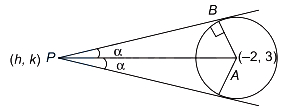
The angle between a pair of tangents drawn from a point $P$ to the circle $x^{2}+y^{2}+4x-6y+9 \sin^{2} \alpha + 13 \cos^{2} \alpha = 0$ is $2 \alpha$. The equation of the locus of the point $P$ is
A
$x^{2}+y^{2}+4x-6y+4=0$
B
$x^{2}+y^{2}+4x-6y-9=0$
C
$x^{2}+y^{2}+4x-6y-4=0$
D
$x^{2}+y^{2}+4x-6y+9=0$
Solution
(D) The equation of the given circle is $x^{2}+y^{2}+4x-6y+9 \sin^{2} \alpha + 13 \cos^{2} \alpha = 0$.
Comparing with $x^{2}+y^{2}+2gx+2fy+c=0$,we get center $A(-2, 3)$ and radius $r = \sqrt{g^{2}+f^{2}-c} = \sqrt{4+9-(9 \sin^{2} \alpha + 13 \cos^{2} \alpha)} = \sqrt{13 - 9 \sin^{2} \alpha - 13 \cos^{2} \alpha} = \sqrt{13(1-\cos^{2} \alpha) - 9 \sin^{2} \alpha} = \sqrt{13 \sin^{2} \alpha - 9 \sin^{2} \alpha} = \sqrt{4 \sin^{2} \alpha} = 2 \sin \alpha$.
Let $P(h, k)$ be the point. In $\Delta ABP$,where $B$ is the point of contact,$\angle APB = \alpha$ and $\angle ABP = 90^{\circ}$.
Thus,$\sin \alpha = \frac{AB}{AP} = \frac{r}{AP} = \frac{2 \sin \alpha}{\sqrt{(h+2)^{2}+(k-3)^{2}}}$.
$\Rightarrow \sqrt{(h+2)^{2}+(k-3)^{2}} = 2$.
Squaring both sides,$(h+2)^{2}+(k-3)^{2} = 4$.
$h^{2}+4h+4+k^{2}-6k+9 = 4$.
$h^{2}+k^{2}+4h-6k+9 = 0$.
Replacing $(h, k)$ with $(x, y)$,the locus is $x^{2}+y^{2}+4x-6y+9=0$.
Comparing with $x^{2}+y^{2}+2gx+2fy+c=0$,we get center $A(-2, 3)$ and radius $r = \sqrt{g^{2}+f^{2}-c} = \sqrt{4+9-(9 \sin^{2} \alpha + 13 \cos^{2} \alpha)} = \sqrt{13 - 9 \sin^{2} \alpha - 13 \cos^{2} \alpha} = \sqrt{13(1-\cos^{2} \alpha) - 9 \sin^{2} \alpha} = \sqrt{13 \sin^{2} \alpha - 9 \sin^{2} \alpha} = \sqrt{4 \sin^{2} \alpha} = 2 \sin \alpha$.
Let $P(h, k)$ be the point. In $\Delta ABP$,where $B$ is the point of contact,$\angle APB = \alpha$ and $\angle ABP = 90^{\circ}$.
Thus,$\sin \alpha = \frac{AB}{AP} = \frac{r}{AP} = \frac{2 \sin \alpha}{\sqrt{(h+2)^{2}+(k-3)^{2}}}$.
$\Rightarrow \sqrt{(h+2)^{2}+(k-3)^{2}} = 2$.
Squaring both sides,$(h+2)^{2}+(k-3)^{2} = 4$.
$h^{2}+4h+4+k^{2}-6k+9 = 4$.
$h^{2}+k^{2}+4h-6k+9 = 0$.
Replacing $(h, k)$ with $(x, y)$,the locus is $x^{2}+y^{2}+4x-6y+9=0$.
0 likesView Solution
43
ChemistryMCQMHT CET · 2011
As per the Bohr model, the minimum energy (in $eV$) required to remove an electron from the ground state of a doubly ionized $Li$ atom $(Z=3)$ is:
A
$1.51$
B
$13.6$
C
$40.8$
D
$122.4$
Solution
(D) The energy of an electron in the $n^{th}$ orbit of a hydrogen-like atom is given by the formula: $E_n = -13.6 \times \frac{Z^2}{n^2} \ eV$.
For a doubly ionized lithium atom $(Li^{2+})$, the atomic number $Z = 3$.
In the ground state, the principal quantum number $n = 1$.
Substituting these values into the formula: $E_1 = -13.6 \times \frac{3^2}{1^2} \ eV = -13.6 \times 9 \ eV = -122.4 \ eV$.
The energy required to remove the electron (ionization energy) is the energy needed to bring the electron from the ground state to infinity $(E_{\infty} = 0)$.
Therefore, Ionization Energy $= E_{\infty} - E_1 = 0 - (-122.4 \ eV) = +122.4 \ eV$.
For a doubly ionized lithium atom $(Li^{2+})$, the atomic number $Z = 3$.
In the ground state, the principal quantum number $n = 1$.
Substituting these values into the formula: $E_1 = -13.6 \times \frac{3^2}{1^2} \ eV = -13.6 \times 9 \ eV = -122.4 \ eV$.
The energy required to remove the electron (ionization energy) is the energy needed to bring the electron from the ground state to infinity $(E_{\infty} = 0)$.
Therefore, Ionization Energy $= E_{\infty} - E_1 = 0 - (-122.4 \ eV) = +122.4 \ eV$.
0 likesView Solution
44
ChemistryMCQMHT CET · 2011
The radius $R$ of the soap bubble is doubled under isothermal conditions. If $T$ is the surface tension of the soap bubble,the work done in doing so is given by: (in $pi R^{2} T$)
A
$32$
B
$24$
C
$8$
D
$4$
Solution
(B) The surface energy $E$ of a soap bubble is given by the product of surface tension $T$ and the total surface area. Since a soap bubble has two surfaces (inner and outer),the total surface area is $2 \times 4 \pi R^{2} = 8 \pi R^{2}$.
Initial surface energy $E_{i} = T \times (2 \times 4 \pi R^{2}) = 8 \pi R^{2} T$.
When the radius is doubled,the new radius becomes $R' = 2R$.
The final surface energy $E_{f} = T \times (2 \times 4 \pi (2R)^{2}) = T \times (2 \times 4 \pi \times 4R^{2}) = 32 \pi R^{2} T$.
The work done $W$ is the change in surface energy:
$W = E_{f} - E_{i} = 32 \pi R^{2} T - 8 \pi R^{2} T = 24 \pi R^{2} T$.
Initial surface energy $E_{i} = T \times (2 \times 4 \pi R^{2}) = 8 \pi R^{2} T$.
When the radius is doubled,the new radius becomes $R' = 2R$.
The final surface energy $E_{f} = T \times (2 \times 4 \pi (2R)^{2}) = T \times (2 \times 4 \pi \times 4R^{2}) = 32 \pi R^{2} T$.
The work done $W$ is the change in surface energy:
$W = E_{f} - E_{i} = 32 \pi R^{2} T - 8 \pi R^{2} T = 24 \pi R^{2} T$.
0 likesView Solution
45
ChemistryMediumMCQMHT CET · 2011
$3-$methylpentan$-3-$ol will be prepared from
A
ethyl formate and methyl magnesium bromide
B
ethyl ethanoate and ethyl magnesium bromide
C
ethyl propanoate and methyl magnesium bromide
D
ethyl formate and ethyl magnesium bromide
Solution
(B) To prepare $3-$methylpentan$-3-$ol,we need a Grignard reagent to attack an ester. The structure of $3-$methylpentan$-3-$ol is $CH_3CH_2-C(OH)(CH_3)-CH_2CH_3$.
This tertiary alcohol can be formed by the reaction of an ester with two equivalents of a Grignard reagent.
Specifically,reacting ethyl propanoate $(CH_3CH_2COOC_2H_5)$ with two equivalents of methyl magnesium bromide $(CH_3MgBr)$ yields $3-$methylpentan$-3-$ol.
The reaction proceeds as follows:
$CH_3CH_2COOC_2H_5 + CH_3MgBr \rightarrow CH_3CH_2COCH_3 + C_2H_5OMgBr$
$CH_3CH_2COCH_3 + CH_3MgBr \rightarrow CH_3CH_2C(OMgBr)(CH_3)_2$
After hydrolysis: $CH_3CH_2C(OH)(CH_3)_2$ (which is $2-$methylbutan$-2-$ol). Wait,let us re-evaluate.
To get $3-$methylpentan$-3-$ol $(CH_3CH_2-C(OH)(CH_3)-CH_2CH_3)$,we need to react ethyl ethanoate $(CH_3COOC_2H_5)$ with two equivalents of ethyl magnesium bromide $(C_2H_5MgBr)$.
$CH_3COOC_2H_5 + 2C_2H_5MgBr \rightarrow CH_3C(OH)(C_2H_5)_2$.
Thus,the correct option is $B$.
This tertiary alcohol can be formed by the reaction of an ester with two equivalents of a Grignard reagent.
Specifically,reacting ethyl propanoate $(CH_3CH_2COOC_2H_5)$ with two equivalents of methyl magnesium bromide $(CH_3MgBr)$ yields $3-$methylpentan$-3-$ol.
The reaction proceeds as follows:
$CH_3CH_2COOC_2H_5 + CH_3MgBr \rightarrow CH_3CH_2COCH_3 + C_2H_5OMgBr$
$CH_3CH_2COCH_3 + CH_3MgBr \rightarrow CH_3CH_2C(OMgBr)(CH_3)_2$
After hydrolysis: $CH_3CH_2C(OH)(CH_3)_2$ (which is $2-$methylbutan$-2-$ol). Wait,let us re-evaluate.
To get $3-$methylpentan$-3-$ol $(CH_3CH_2-C(OH)(CH_3)-CH_2CH_3)$,we need to react ethyl ethanoate $(CH_3COOC_2H_5)$ with two equivalents of ethyl magnesium bromide $(C_2H_5MgBr)$.
$CH_3COOC_2H_5 + 2C_2H_5MgBr \rightarrow CH_3C(OH)(C_2H_5)_2$.
Thus,the correct option is $B$.
0 likesView Solution
46
ChemistryEasyMCQMHT CET · 2011
Which alcohol will give immediate turbidity on shaking with $HCl$ at room temperature?
A
$3-$methylpentan$-2-$ol
B
$2-$methylbutan$-1-$ol
C
Butan$-2-$ol
D
$2-$methylpropan$-2-$ol
Solution
(D) The reaction of alcohols with Lucas reagent (conc. $HCl +$ anhydrous $ZnCl_2$) is used to distinguish between primary,secondary,and tertiary alcohols.
Tertiary alcohols react most rapidly and give immediate turbidity at room temperature due to the formation of stable carbocations.
Among the given options,$2-$methylpropan$-2-$ol is a tertiary alcohol,while the others are primary or secondary alcohols.
Therefore,$2-$methylpropan$-2-$ol gives immediate turbidity.
Tertiary alcohols react most rapidly and give immediate turbidity at room temperature due to the formation of stable carbocations.
Among the given options,$2-$methylpropan$-2-$ol is a tertiary alcohol,while the others are primary or secondary alcohols.
Therefore,$2-$methylpropan$-2-$ol gives immediate turbidity.
0 likesView Solution
47
ChemistryMediumMCQMHT CET · 2011
The rate of $S_{N}2$ reaction is maximum when the solvent is
A
$CH_{3}OH$
B
$H_{2}O$
C
$DMSO$
D
$benzene$
Solution
(C) The rate of $S_{N}2$ reactions is significantly enhanced in polar aprotic solvents.
Polar aprotic solvents like $DMSO$ (Dimethyl sulfoxide) do not form hydrogen bonds with the nucleophile,leaving it 'naked' and more reactive.
In contrast,polar protic solvents like $CH_{3}OH$ and $H_{2}O$ solvate the nucleophile through hydrogen bonding,which decreases its nucleophilicity and slows down the $S_{N}2$ reaction.
Polar aprotic solvents like $DMSO$ (Dimethyl sulfoxide) do not form hydrogen bonds with the nucleophile,leaving it 'naked' and more reactive.
In contrast,polar protic solvents like $CH_{3}OH$ and $H_{2}O$ solvate the nucleophile through hydrogen bonding,which decreases its nucleophilicity and slows down the $S_{N}2$ reaction.
0 likesView Solution
48
ChemistryDifficultMCQMHT CET · 2011
Which of the following ethers is formed from the reaction of an alcohol with diazomethane?
A
$1-$ethoxypropane
B
ethoxyethane
C
$1-$methoxypropane
D
$2-$ethoxypropane
Solution
(C) The reaction of an alcohol $(R-OH)$ with diazomethane $(CH_2N_2)$ in the presence of a catalyst like $HBF_4$ results in the formation of a methyl ether $(R-OCH_3)$ and the release of nitrogen gas $(N_2)$.
For the reaction of propan$-1-$ol $(CH_3CH_2CH_2OH)$ with diazomethane $(CH_2N_2)$:
$CH_3CH_2CH_2OH + CH_2N_2 \xrightarrow{HBF_4} CH_3CH_2CH_2OCH_3 + N_2$
The product formed is $1-$methoxypropane.
For the reaction of propan$-1-$ol $(CH_3CH_2CH_2OH)$ with diazomethane $(CH_2N_2)$:
$CH_3CH_2CH_2OH + CH_2N_2 \xrightarrow{HBF_4} CH_3CH_2CH_2OCH_3 + N_2$
The product formed is $1-$methoxypropane.
0 likesView Solution
49
ChemistryMediumMCQMHT CET · 2011
The aldol condensation product of acetone on dehydration gives:
A
but$-2-$enal
B
$2-$methylpent$-3-$en$-4-$one
C
$4-$hydroxy$-4-$methylpentan$-2-$one
D
$4-$methylpent$-3-$en$-2-$one
Solution
(D) Acetone $(CH_3COCH_3)$ undergoes aldol condensation in the presence of a base like $Ba(OH)_2$ to form $4-$hydroxy$-4-$methylpentan$-2-$one (diacetone alcohol).
$2CH_3COCH_3 \xrightarrow{Ba(OH)_2} (CH_3)_2C(OH)CH_2COCH_3$
Upon dehydration (heating with acid),the $4-$hydroxy$-4-$methylpentan$-2-$one loses a water molecule to form $4-$methylpent$-3-$en$-2-$one (mesityl oxide).
$(CH_3)_2C(OH)CH_2COCH_3 \xrightarrow{\Delta, H^+} (CH_3)_2C=CHCOCH_3 + H_2O$
Thus,the final product is $4-$methylpent$-3-$en$-2-$one.
$2CH_3COCH_3 \xrightarrow{Ba(OH)_2} (CH_3)_2C(OH)CH_2COCH_3$
Upon dehydration (heating with acid),the $4-$hydroxy$-4-$methylpentan$-2-$one loses a water molecule to form $4-$methylpent$-3-$en$-2-$one (mesityl oxide).
$(CH_3)_2C(OH)CH_2COCH_3 \xrightarrow{\Delta, H^+} (CH_3)_2C=CHCOCH_3 + H_2O$
Thus,the final product is $4-$methylpent$-3-$en$-2-$one.
0 likesView Solution
50
ChemistryMediumMCQMHT CET · 2011
Benzaldehyde reacts with ammonia to form
A
benzaldehyde ammonia
B
urotropine
C
hydrobenzamide
D
ammonium chloride
Solution
(C) The reaction of benzaldehyde with ammonia is a condensation reaction. Three molecules of benzaldehyde $(3C_6H_5CHO)$ react with two molecules of ammonia $(2NH_3)$ to produce hydrobenzamide $((C_6H_5CH)_3N_2)$ and three molecules of water $(3H_2O)$.
The balanced chemical equation is:
$3C_6H_5CHO + 2NH_3 \rightarrow (C_6H_5CH)_3N_2 + 3H_2O$
The balanced chemical equation is:
$3C_6H_5CHO + 2NH_3 \rightarrow (C_6H_5CH)_3N_2 + 3H_2O$
0 likesView Solution
51
ChemistryEasyMCQMHT CET · 2011
Which of the following is the strongest base?
A
Aniline $(C_6H_5NH_2)$
B
$N$-methylaniline $(C_6H_5NHCH_3)$
C
o-Toluidine $(2-CH_3C_6H_4NH_2)$
D
Benzylamine $(C_6H_5CH_2NH_2)$
Solution
(D) In aniline,$N$-methylaniline,and o-toluidine,the lone pair of electrons on the nitrogen atom is in conjugation with the benzene ring,which decreases its availability for protonation,making them weaker bases.
In benzylamine $(C_6H_5CH_2NH_2)$,the lone pair on the nitrogen atom is not in conjugation with the benzene ring because of the presence of a $-CH_2-$ group between the benzene ring and the nitrogen atom.
Therefore,the lone pair is more available for protonation,making benzylamine the strongest base among the given compounds.
In benzylamine $(C_6H_5CH_2NH_2)$,the lone pair on the nitrogen atom is not in conjugation with the benzene ring because of the presence of a $-CH_2-$ group between the benzene ring and the nitrogen atom.
Therefore,the lone pair is more available for protonation,making benzylamine the strongest base among the given compounds.
0 likesView Solution
52
ChemistryMediumMCQMHT CET · 2011
In the following sequence of reactions,the compound $C$ formed will be:
$CH_3-CH(NH_2)-CH_3$ $\xrightarrow{HNO_2} A$ $\xrightarrow{\text{Oxidation}} B$ $\xrightarrow[(ii) H^+/H_2O]{(i) CH_3MgI} C$
$CH_3-CH(NH_2)-CH_3$ $\xrightarrow{HNO_2} A$ $\xrightarrow{\text{Oxidation}} B$ $\xrightarrow[(ii) H^+/H_2O]{(i) CH_3MgI} C$
A
butan-$1$-ol
B
butan-$2$-ol
C
$2$-methylpropan-$2$-ol
D
$2$-methylpropan-$1$-ol
Solution
(C) Step $1$: Reaction of isopropylamine with $HNO_2$ gives propan-$2$-ol $(A)$.
$CH_3-CH(NH_2)-CH_3 + HNO_2 \rightarrow CH_3-CH(OH)-CH_3 + N_2 + H_2O$
Step $2$: Oxidation of propan-$2$-ol $(A)$ gives acetone $(B)$.
$CH_3-CH(OH)-CH_3 \xrightarrow{[O]} CH_3-CO-CH_3$
Step $3$: Reaction of acetone $(B)$ with methylmagnesium iodide $(CH_3MgI)$ followed by hydrolysis gives $2$-methylpropan-$2$-ol $(C)$.
$CH_3-CO-CH_3 + CH_3MgI$ $\rightarrow (CH_3)_3C-OMgI$ $\xrightarrow{H_2O/H^+} (CH_3)_3C-OH$
Thus,the final product $C$ is $2$-methylpropan-$2$-ol.
$CH_3-CH(NH_2)-CH_3 + HNO_2 \rightarrow CH_3-CH(OH)-CH_3 + N_2 + H_2O$
Step $2$: Oxidation of propan-$2$-ol $(A)$ gives acetone $(B)$.
$CH_3-CH(OH)-CH_3 \xrightarrow{[O]} CH_3-CO-CH_3$
Step $3$: Reaction of acetone $(B)$ with methylmagnesium iodide $(CH_3MgI)$ followed by hydrolysis gives $2$-methylpropan-$2$-ol $(C)$.
$CH_3-CO-CH_3 + CH_3MgI$ $\rightarrow (CH_3)_3C-OMgI$ $\xrightarrow{H_2O/H^+} (CH_3)_3C-OH$
Thus,the final product $C$ is $2$-methylpropan-$2$-ol.
0 likesView Solution
53
ChemistryEasyMCQMHT CET · 2011
Which of the following gives condensation with hydroxylamine but does not undergo self-condensation?
A
Methanal
B
Propanal
C
Acetone
D
Ethanal
Solution
(A) Aldehydes and ketones react with hydroxylamine $(NH_2OH)$ to form oximes,which is a condensation reaction.
Self-condensation (Aldol condensation) requires the presence of at least one $\alpha$-hydrogen atom.
Methanal $(HCHO)$ does not contain any $\alpha$-hydrogen atom,so it cannot undergo self-aldol condensation.
Propanal $(CH_3CH_2CHO)$,Acetone $(CH_3COCH_3)$,and Ethanal $(CH_3CHO)$ all contain $\alpha$-hydrogen atoms and thus undergo self-condensation.
Therefore,the correct answer is Methanal.
Self-condensation (Aldol condensation) requires the presence of at least one $\alpha$-hydrogen atom.
Methanal $(HCHO)$ does not contain any $\alpha$-hydrogen atom,so it cannot undergo self-aldol condensation.
Propanal $(CH_3CH_2CHO)$,Acetone $(CH_3COCH_3)$,and Ethanal $(CH_3CHO)$ all contain $\alpha$-hydrogen atoms and thus undergo self-condensation.
Therefore,the correct answer is Methanal.
0 likesView Solution
54
ChemistryEasyMCQMHT CET · 2011
Glucose on reaction with $Br_{2}$ water gives
A
glucaric acid
B
gluconic acid
C
saccharic acid
D
citric acid
Solution
(B) $Br_{2}$ water is a mild oxidizing agent.
Glucose $(CHO(CHOH)_{4}CH_{2}OH)$ on oxidation with $Br_{2}$ water selectively oxidizes the aldehyde group $(-CHO)$ to a carboxylic acid group $(-COOH)$,resulting in the formation of gluconic acid $(COOH(CHOH)_{4}CH_{2}OH)$.
The reaction is:
$CHO(CHOH)_{4}CH_{2}OH + [O] \xrightarrow{Br_{2}, H_{2}O} COOH(CHOH)_{4}CH_{2}OH$
Glucose $(CHO(CHOH)_{4}CH_{2}OH)$ on oxidation with $Br_{2}$ water selectively oxidizes the aldehyde group $(-CHO)$ to a carboxylic acid group $(-COOH)$,resulting in the formation of gluconic acid $(COOH(CHOH)_{4}CH_{2}OH)$.
The reaction is:
$CHO(CHOH)_{4}CH_{2}OH + [O] \xrightarrow{Br_{2}, H_{2}O} COOH(CHOH)_{4}CH_{2}OH$
0 likesView Solution
55
ChemistryMediumMCQMHT CET · 2011
The prosthetic group of haemoglobin is
A
porphin
B
globulin
C
haem
D
gelatin
Solution
(C) Haemoglobin is a conjugated protein consisting of a protein part called globin and a non-protein prosthetic group called haem. The haem group contains an $Fe^{2+}$ ion coordinated to a porphyrin ring.
0 likesView Solution
56
ChemistryMediumMCQMHT CET · 2011
Decarboxylation of malonic acid gives:
A
$CH_{4}$
B
$CH_{3}COOH$
C
Both $(a)$ and $(b)$
D
None of the above
Solution
(B) Malonic acid $(CH_{2}(COOH)_{2})$ undergoes decarboxylation upon heating to produce acetic acid $(CH_{3}COOH)$ and carbon dioxide $(CO_{2})$.
The reaction is as follows:
$CH_{2}(COOH)_{2} \xrightarrow{\Delta} CH_{3}COOH + CO_{2}$
The reaction is as follows:
$CH_{2}(COOH)_{2} \xrightarrow{\Delta} CH_{3}COOH + CO_{2}$
0 likesView Solution
57
ChemistryEasyMCQMHT CET · 2011
In a multistep reaction,the overall rate of reaction is equal to the
A
rate of slowest step
B
rate of fastest step
C
average rate of various steps
D
rate of last step
Solution
(A) The rate of a chemical reaction depends upon the slowest step in a multistep mechanism,which is known as the rate-determining step.
Therefore,the overall rate of a multistep reaction is equal to the rate of the slowest step.
Therefore,the overall rate of a multistep reaction is equal to the rate of the slowest step.
0 likesView Solution
58
ChemistryMediumMCQMHT CET · 2011
$A$ first order reaction is given as $A \rightarrow \text{products}$. Its integrated rate equation is:
A
$k = \frac{2.303}{t} \log \frac{a-x}{a}$
B
$k = \frac{1}{t} \log \frac{a}{a-x}$
C
$k = \frac{2.303}{t} \log \frac{a}{a-x}$
D
$-k = \frac{1}{t} \log \frac{a-x}{a}$
Solution
(C) For a first order reaction,the rate law is given by $-\frac{d[A]}{dt} = k[A]$.
Integrating this expression from time $t=0$ (where $[A] = a$) to time $t$ (where $[A] = a-x$),we get:
$k = \frac{2.303}{t} \log \frac{a}{a-x}$
where '$a$' is the initial concentration and '$a-x$' is the concentration at time '$t$'.
Integrating this expression from time $t=0$ (where $[A] = a$) to time $t$ (where $[A] = a-x$),we get:
$k = \frac{2.303}{t} \log \frac{a}{a-x}$
where '$a$' is the initial concentration and '$a-x$' is the concentration at time '$t$'.
0 likesView Solution
59
ChemistryDifficultMCQMHT CET · 2011
$_{90}Th^{228}$ emits four alpha and one beta particles. The number of neutrons in the daughter element is:
A
$129$
B
$190$
C
$232$
D
$138$
Solution
(A) The nuclear reaction is: $_{90}Th^{228}$ $\xrightarrow{-4 \alpha} _{82}Pb^{212}$ $\xrightarrow{-1 \beta} _{83}Bi^{212}$.
The daughter element is $_{83}Bi^{212}$.
The number of neutrons is calculated as: $\text{Mass number} - \text{Atomic number}$.
$\text{Number of neutrons} = 212 - 83 = 129$.
The daughter element is $_{83}Bi^{212}$.
The number of neutrons is calculated as: $\text{Mass number} - \text{Atomic number}$.
$\text{Number of neutrons} = 212 - 83 = 129$.
0 likesView Solution
60
ChemistryMediumMCQMHT CET · 2011
The unit of the decay constant for radioactive disintegration is:
A
time
B
$\min^{-2}$
C
time$^{-1}$
D
time $\text{mol}^{-1}$
Solution
(C) Radioactive disintegration follows first-order kinetics.
The rate law is given by $k = \frac{2.303}{t} \log \frac{N_0}{N}$.
Here,$k$ is the decay constant (or disintegration constant).
Since the unit of time $t$ is in the denominator,the unit of $k$ is $\text{time}^{-1}$ (e.g.,$\text{s}^{-1}$,$\text{min}^{-1}$,or $\text{year}^{-1}$).
The rate law is given by $k = \frac{2.303}{t} \log \frac{N_0}{N}$.
Here,$k$ is the decay constant (or disintegration constant).
Since the unit of time $t$ is in the denominator,the unit of $k$ is $\text{time}^{-1}$ (e.g.,$\text{s}^{-1}$,$\text{min}^{-1}$,or $\text{year}^{-1}$).
0 likesView Solution
61
ChemistryDifficultMCQMHT CET · 2011
Most common oxidation states shown by cerium are
A
$+2, +4$
B
$+3, +4$
C
$+3, +5$
D
$+2, +3$
Solution
(B) The electronic configuration of $Ce$ $(Z=58)$ is $[Xe] 4f^1 5d^1 6s^2$.
Cerium $(Ce)$ exhibits $+3$ and $+4$ oxidation states.
The $+3$ state is the most stable,while the $+4$ state is also common due to the attainment of a stable noble gas configuration $([Xe])$ upon losing four electrons.
Cerium $(Ce)$ exhibits $+3$ and $+4$ oxidation states.
The $+3$ state is the most stable,while the $+4$ state is also common due to the attainment of a stable noble gas configuration $([Xe])$ upon losing four electrons.
0 likesView Solution
62
ChemistryMediumMCQMHT CET · 2011
The standard reduction potential for $Fe^{2+}/Fe$ and $Sn^{2+}/Sn$ electrodes are $-0.44 \ V$ and $-0.14 \ V$ respectively. For the cell reaction,$Fe^{2+} + Sn \longrightarrow Fe + Sn^{2+}$,the standard emf is:
A
$+0.30 \ V$
B
$-0.58 \ V$
C
$+0.58 \ V$
D
$-0.30 \ V$
Solution
(D) The given cell reaction is: $Fe^{2+} + Sn \longrightarrow Fe + Sn^{2+}$
In this reaction,$Fe^{2+}$ is reduced to $Fe$ (cathode) and $Sn$ is oxidized to $Sn^{2+}$ (anode).
The standard reduction potentials are given as: $E^o_{Fe^{2+}/Fe} = -0.44 \ V$ and $E^o_{Sn^{2+}/Sn} = -0.14 \ V$.
The standard emf of the cell $(E^o_{cell})$ is calculated as:
$E^o_{cell} = E^o_{cathode} - E^o_{anode}$
$E^o_{cell} = E^o_{Fe^{2+}/Fe} - E^o_{Sn^{2+}/Sn}$
$E^o_{cell} = -0.44 \ V - (-0.14 \ V)$
$E^o_{cell} = -0.44 + 0.14 = -0.30 \ V$
In this reaction,$Fe^{2+}$ is reduced to $Fe$ (cathode) and $Sn$ is oxidized to $Sn^{2+}$ (anode).
The standard reduction potentials are given as: $E^o_{Fe^{2+}/Fe} = -0.44 \ V$ and $E^o_{Sn^{2+}/Sn} = -0.14 \ V$.
The standard emf of the cell $(E^o_{cell})$ is calculated as:
$E^o_{cell} = E^o_{cathode} - E^o_{anode}$
$E^o_{cell} = E^o_{Fe^{2+}/Fe} - E^o_{Sn^{2+}/Sn}$
$E^o_{cell} = -0.44 \ V - (-0.14 \ V)$
$E^o_{cell} = -0.44 + 0.14 = -0.30 \ V$
0 likesView Solution
63
ChemistryMediumMCQMHT CET · 2011
According to Faraday's first law of electrolysis:
A
$w = \frac{96500 \times E}{I \times t}$
B
$w = \frac{E \times I \times t}{96500}$
C
$E = \frac{I \times t \times 96500}{w}$
D
$E = \frac{I \times w}{t \times 96500}$
Solution
(B) According to Faraday's first law of electrolysis,the mass of the substance deposited $(w)$ is directly proportional to the quantity of electricity $(Q)$ passed through the electrolyte.
$w \propto Q$
$w = Z \cdot Q$
Since $Q = I \times t$ and $Z = \frac{E}{96500}$ (where $E$ is the equivalent weight and $96500$ is Faraday's constant),
$w = \frac{E \times I \times t}{96500}$.
$w \propto Q$
$w = Z \cdot Q$
Since $Q = I \times t$ and $Z = \frac{E}{96500}$ (where $E$ is the equivalent weight and $96500$ is Faraday's constant),
$w = \frac{E \times I \times t}{96500}$.
0 likesView Solution
64
ChemistryMediumMCQMHT CET · 2011
How many metamers are possible for the molecular formula $C_4H_{11}N$?
A
$2$
B
$3$
C
$4$
D
$5$
Solution
(B) Metamers are isomers that have the same molecular formula but differ in the nature of the alkyl groups attached to the same polyvalent functional group (in this case,the secondary amine group,$-NH-$).
For the molecular formula $C_4H_{11}N$,the secondary amines ($2^{\circ}$ amines) are:
$1$) $CH_3CH_2-NH-CH_2CH_3$ (Diethylamine)
$2$) $CH_3-NH-CH_2CH_2CH_3$ (Methylpropylamine)
$3$) $CH_3-NH-CH(CH_3)_2$ (Methylisopropylamine)
Thus,there are $3$ possible metamers.
For the molecular formula $C_4H_{11}N$,the secondary amines ($2^{\circ}$ amines) are:
$1$) $CH_3CH_2-NH-CH_2CH_3$ (Diethylamine)
$2$) $CH_3-NH-CH_2CH_2CH_3$ (Methylpropylamine)
$3$) $CH_3-NH-CH(CH_3)_2$ (Methylisopropylamine)
Thus,there are $3$ possible metamers.
0 likesView Solution
65
ChemistryMediumMCQMHT CET · 2011
$TiI_{4}$ on heating gives
A
$TiI_{2} + I_{2}$
B
$Ti + 2I_{2}$
C
$TiI_{3} + \frac{1}{2}I_{2}$
D
None of these
Solution
(B) The thermal decomposition of $TiI_{4}$ is a key step in the van Arkel-de Boer process used for the refining of titanium metal.
Upon heating,$TiI_{4}$ decomposes into pure titanium metal and iodine vapor according to the reaction:
$TiI_{4} \xrightarrow{\Delta} Ti + 2I_{2}$
Upon heating,$TiI_{4}$ decomposes into pure titanium metal and iodine vapor according to the reaction:
$TiI_{4} \xrightarrow{\Delta} Ti + 2I_{2}$
0 likesView Solution
66
ChemistryDifficultMCQMHT CET · 2011
$2,2-$dichloropropane $\stackrel{Aq. KOH}{\longrightarrow} A$ $\xrightarrow{\text{Clemmensen reduction}} B$. $B$ is
A
propanol
B
propene
C
propane
D
ethane
Solution
(C) Step $1$: Reaction of $2,2-$dichloropropane with aqueous $KOH$ gives a gem-diol intermediate,which loses a water molecule to form acetone $(CH_3COCH_3)$ as product $A$.
Step $2$: Clemmensen reduction of acetone $(CH_3COCH_3)$ using $Zn(Hg)/HCl$ reduces the carbonyl group to a methylene group $(-CH_2-)$,yielding propane $(CH_3CH_2CH_3)$ as product $B$.
Therefore,the correct option is $C$.
Step $2$: Clemmensen reduction of acetone $(CH_3COCH_3)$ using $Zn(Hg)/HCl$ reduces the carbonyl group to a methylene group $(-CH_2-)$,yielding propane $(CH_3CH_2CH_3)$ as product $B$.
Therefore,the correct option is $C$.
0 likesView Solution
67
ChemistryEasyMCQMHT CET · 2011
Which of the following properties does not correspond to the order $HI < HBr < HCl < HF$?
A
Thermal stability
B
Reducing power
C
Ionic character
D
Dipole moment
Solution
(B) The order $HI < HBr < HCl < HF$ represents the increasing trend for thermal stability,ionic character,and dipole moment.
However,the reducing power of hydrogen halides increases as the bond dissociation enthalpy decreases,which follows the order $HF < HCl < HBr < HI$.
Therefore,the property that does not correspond to the given order is reducing power.
However,the reducing power of hydrogen halides increases as the bond dissociation enthalpy decreases,which follows the order $HF < HCl < HBr < HI$.
Therefore,the property that does not correspond to the given order is reducing power.
0 likesView Solution
68
ChemistryMediumMCQMHT CET · 2011
Which of the following can absorb over $90 \%$ of its own mass of water and also does not stick to wounds?
A
Saran
B
Thiokol
C
Rayon
D
Gun cotton
Solution
(C) Rayon is a regenerated cellulose fiber that is highly absorbent,capable of holding over $90 \%$ of its own mass in water. Due to its non-adherent properties,it is commonly used in medical dressings as it does not stick to wounds.
0 likesView Solution
69
ChemistryEasyMCQMHT CET · 2011
Ziegler-Natta catalyst catalyses the preparation of which of the following compounds?
A
Preparation of $Ti$-metal
B
Preparation of low density plastic
C
Preparation of high resistance plastic
D
Preparation of high density plastic
Solution
(D) High density polythene (or plastic) is prepared by heating ethylene at about $330-350 \ K$,under a pressure of $1-2 \ atm$ and in the presence of Ziegler-Natta catalyst.
$n \ CH_2=CH_2 \xrightarrow[\text{Ziegler-Natta catalyst}]{330-350 \ K, 1-2 \ atm} (-CH_2-CH_2-)_n$
High density polythene.
$n \ CH_2=CH_2 \xrightarrow[\text{Ziegler-Natta catalyst}]{330-350 \ K, 1-2 \ atm} (-CH_2-CH_2-)_n$
High density polythene.
0 likesView Solution
70
ChemistryEasyMCQMHT CET · 2011
Phenol gives characteristic colouration with
A
iodine solution
B
bromine water
C
aqueous $FeCl_{3}$ solution
D
ammonium hydroxide
Solution
(C) Phenols react with neutral $FeCl_{3}$ solution to form a complex,which results in a characteristic blue,violet,or green colouration. This is a standard test for the presence of the phenolic group.
0 likesView Solution
71
ChemistryEasyMCQMHT CET · 2011
Which of the following phosphorus oxyacids can act as a reducing agent?
A
$H_{3}PO_{3}$
B
$H_{3}PO_{4}$
C
$H_{2}P_{2}O_{6}$
D
$H_{4}P_{2}O_{7}$
Solution
(A) An oxyacid of phosphorus that contains $P-H$ bonds can act as a reducing agent.
$H_{3}PO_{3}$ (phosphorous acid) contains one $P-H$ bond,which makes it a reducing agent.
In contrast,$H_{3}PO_{4}$,$H_{2}P_{2}O_{6}$,and $H_{4}P_{2}O_{7}$ do not contain any $P-H$ bonds and therefore do not act as reducing agents.
$H_{3}PO_{3}$ (phosphorous acid) contains one $P-H$ bond,which makes it a reducing agent.
In contrast,$H_{3}PO_{4}$,$H_{2}P_{2}O_{6}$,and $H_{4}P_{2}O_{7}$ do not contain any $P-H$ bonds and therefore do not act as reducing agents.
0 likesView Solution
72
ChemistryMediumMCQMHT CET · 2011
An aqueous solution of urea containing $18 \ g$ of urea in $1500 \ cm^{3}$ of the solution has a density of $1.052 \ g/cm^{3}$. If the molecular weight of urea is $60$,the molality of the solution is: (in $m$)
A
$0.200$
B
$0.192$
C
$0.100$
D
$1.200$
Solution
(B) Given: Volume of solution $= 1500 \ cm^{3}$,Density of solution $= 1.052 \ g/cm^{3}$,Mass of urea (solute) $= 18 \ g$,Molar mass of urea $= 60 \ g/mol$.
Mass of solution $= \text{Volume} \times \text{Density} = 1500 \ cm^{3} \times 1.052 \ g/cm^{3} = 1578 \ g$.
Mass of solvent (water) $= \text{Mass of solution} - \text{Mass of solute} = 1578 \ g - 18 \ g = 1560 \ g = 1.560 \ kg$.
Molality $(m) = \frac{\text{moles of solute}}{\text{mass of solvent in } kg} = \frac{18 / 60}{1.560} = \frac{0.3}{1.560} \approx 0.192 \ m$.
Mass of solution $= \text{Volume} \times \text{Density} = 1500 \ cm^{3} \times 1.052 \ g/cm^{3} = 1578 \ g$.
Mass of solvent (water) $= \text{Mass of solution} - \text{Mass of solute} = 1578 \ g - 18 \ g = 1560 \ g = 1.560 \ kg$.
Molality $(m) = \frac{\text{moles of solute}}{\text{mass of solvent in } kg} = \frac{18 / 60}{1.560} = \frac{0.3}{1.560} \approx 0.192 \ m$.
0 likesView Solution
73
ChemistryDifficultMCQMHT CET · 2011
$34.2 \ g$ of cane sugar is dissolved in $180 \ g$ of water. The relative lowering of vapour pressure will be
A
$0.0099$
B
$1.1597$
C
$0.840$
D
$0.9901$
Solution
(A) The relative lowering of vapour pressure is given by the formula: $\frac{p^{\circ}-p_{s}}{p^{\circ}} = \frac{n_{2}}{n_{1}+n_{2}} = \frac{\frac{w_{2}}{M_{2}}}{\frac{w_{1}}{M_{1}}+\frac{w_{2}}{M_{2}}}$
Given: Mass of cane sugar $(w_{2})$ = $34.2 \ g$,Molar mass of cane sugar $(M_{2})$ = $342 \ g/mol$,Mass of water $(w_{1})$ = $180 \ g$,Molar mass of water $(M_{1})$ = $18 \ g/mol$.
Calculating moles:
$n_{2} = \frac{34.2}{342} = 0.1 \ mol$
$n_{1} = \frac{180}{18} = 10 \ mol$
Relative lowering of vapour pressure = $\frac{0.1}{10+0.1} = \frac{0.1}{10.1} \approx 0.0099$.
Given: Mass of cane sugar $(w_{2})$ = $34.2 \ g$,Molar mass of cane sugar $(M_{2})$ = $342 \ g/mol$,Mass of water $(w_{1})$ = $180 \ g$,Molar mass of water $(M_{1})$ = $18 \ g/mol$.
Calculating moles:
$n_{2} = \frac{34.2}{342} = 0.1 \ mol$
$n_{1} = \frac{180}{18} = 10 \ mol$
Relative lowering of vapour pressure = $\frac{0.1}{10+0.1} = \frac{0.1}{10.1} \approx 0.0099$.
0 likesView Solution
Vedclass Products
For Students
Vedclass Test Series
Mock tests in real MHT CET style covering Chemistry with performance analysis. 5-day free trial.
Start Free TrialFor Teachers
Exam Paper Generator
Generate Set A/B/C/D Chemistry papers from 7.5L+ questions in 2 minutes. 3 chapters free.
Try FreeFor Institutes
Online Exam Module
Run live MHT CET mock exams with unlimited students, 360° analytics & white-label branding.
See DemoFrequently Asked Questions
How many Chemistry questions are in MHT CET 2011?
There are 73 Chemistry questions from the MHT CET 2011 paper on Vedclass, each with a detailed step-by-step solution in English.
Are MHT CET 2011 Chemistry solutions available in English?
Yes. All solutions on this page are in English. You can also switch to English or Hindi using the language buttons above the questions.
Can I practice MHT CET 2011 Chemistry as a timed test?
Yes. Use the Vedclass Test Series to attempt a full MHT CET mock test covering Chemistry with time limits and instant score analysis.
Can teachers create Chemistry papers from MHT CET previous year questions?
Yes. The Vedclass Exam Paper Generator lets teachers mix MHT CET Chemistry questions and generate Set A/B/C/D papers in minutes.
For Teachers & Institutes
Build a Custom Chemistry Paper
Pick MHT CET 2011 Chemistry questions, set difficulty, and generate Set A/B/C/D in 2 minutes.