
MathematicsQ1–50 of 50 questions
Page 1 of 1 · English
1
MathematicsDifficultMCQMHT CET · 2011
The angle between a pair of tangents drawn from a point $P$ to the circle ${x^2} + {y^2} + 4x - 6y + 9{\sin ^2}\alpha + 13{\cos ^2}\alpha = 0$ is $2\alpha$. The equation of the locus of the point $P$ is
A
${x^2} + {y^2} + 4x - 6y + 4 = 0$
B
${x^2} + {y^2} + 4x - 6y - 9 = 0$
C
${x^2} + {y^2} + 4x - 6y - 4 = 0$
D
${x^2} + {y^2} + 4x - 6y + 9 = 0$
Solution
(D) The equation of the circle is ${x^2} + {y^2} + 4x - 6y + 9{\sin ^2}\alpha + 13{\cos ^2}\alpha = 0$.
Comparing with ${x^2} + {y^2} + 2gx + 2fy + c = 0$,we have $g = 2, f = -3, c = 9{\sin ^2}\alpha + 13{\cos ^2}\alpha$.
The centre is $C(-g, -f) = (-2, 3)$.
The radius $r = \sqrt{g^2 + f^2 - c} = \sqrt{4 + 9 - (9{\sin ^2}\alpha + 13{\cos ^2}\alpha)} = \sqrt{13 - 9{\sin ^2}\alpha - 13{\cos ^2}\alpha} = \sqrt{13(1 - {\cos ^2}\alpha) - 9{\sin ^2}\alpha} = \sqrt{13{\sin ^2}\alpha - 9{\sin ^2}\alpha} = \sqrt{4{\sin ^2}\alpha} = 2\sin \alpha$.
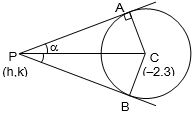
Let $P(h, k)$ be a point on the locus. The angle between the tangents is $2\alpha$,so $\angle APC = \alpha$.
In the right-angled triangle $\triangle PAC$,$\sin \alpha = \frac{AC}{PC} = \frac{r}{PC} = \frac{2\sin \alpha}{\sqrt{(h + 2)^2 + (k - 3)^2}}$.
Thus,$\sqrt{(h + 2)^2 + (k - 3)^2} = 2$.
Squaring both sides,$(h + 2)^2 + (k - 3)^2 = 4$.
Expanding,$h^2 + 4h + 4 + k^2 - 6k + 9 = 4$,which simplifies to $h^2 + k^2 + 4h - 6k + 9 = 0$.
Replacing $(h, k)$ with $(x, y)$,the locus is ${x^2} + {y^2} + 4x - 6y + 9 = 0$.
Comparing with ${x^2} + {y^2} + 2gx + 2fy + c = 0$,we have $g = 2, f = -3, c = 9{\sin ^2}\alpha + 13{\cos ^2}\alpha$.
The centre is $C(-g, -f) = (-2, 3)$.
The radius $r = \sqrt{g^2 + f^2 - c} = \sqrt{4 + 9 - (9{\sin ^2}\alpha + 13{\cos ^2}\alpha)} = \sqrt{13 - 9{\sin ^2}\alpha - 13{\cos ^2}\alpha} = \sqrt{13(1 - {\cos ^2}\alpha) - 9{\sin ^2}\alpha} = \sqrt{13{\sin ^2}\alpha - 9{\sin ^2}\alpha} = \sqrt{4{\sin ^2}\alpha} = 2\sin \alpha$.
Let $P(h, k)$ be a point on the locus. The angle between the tangents is $2\alpha$,so $\angle APC = \alpha$.
In the right-angled triangle $\triangle PAC$,$\sin \alpha = \frac{AC}{PC} = \frac{r}{PC} = \frac{2\sin \alpha}{\sqrt{(h + 2)^2 + (k - 3)^2}}$.
Thus,$\sqrt{(h + 2)^2 + (k - 3)^2} = 2$.
Squaring both sides,$(h + 2)^2 + (k - 3)^2 = 4$.
Expanding,$h^2 + 4h + 4 + k^2 - 6k + 9 = 4$,which simplifies to $h^2 + k^2 + 4h - 6k + 9 = 0$.
Replacing $(h, k)$ with $(x, y)$,the locus is ${x^2} + {y^2} + 4x - 6y + 9 = 0$.
0 likesView Solution
2
MathematicsEasyMCQMHT CET · 2011
If $x+y=k$ is a normal to the parabola $y^{2}=12x$,then the value of $k$ is:
A
$3$
B
$9$
C
$-9$
D
$-3$
Solution
(B) The equation of the parabola is $y^{2}=12x$. Comparing this with $y^{2}=4ax$,we get $4a=12$,so $a=3$.
The equation of a normal to the parabola $y^{2}=4ax$ at point $(at^{2}, 2at)$ is $y = -tx + 2at + at^{3}$.
Given the normal is $x+y=k$,which can be written as $y = -x + k$.
Comparing $y = -tx + 2at + at^{3}$ with $y = -x + k$,we get $t=1$.
Substituting $t=1$ and $a=3$ into the expression for $k$:
$k = 2at + at^{3} = 2(3)(1) + 3(1)^{3} = 6 + 3 = 9$.
Therefore,$k=9$.
The equation of a normal to the parabola $y^{2}=4ax$ at point $(at^{2}, 2at)$ is $y = -tx + 2at + at^{3}$.
Given the normal is $x+y=k$,which can be written as $y = -x + k$.
Comparing $y = -tx + 2at + at^{3}$ with $y = -x + k$,we get $t=1$.
Substituting $t=1$ and $a=3$ into the expression for $k$:
$k = 2at + at^{3} = 2(3)(1) + 3(1)^{3} = 6 + 3 = 9$.
Therefore,$k=9$.
0 likesView Solution
3
MathematicsMediumMCQMHT CET · 2011
The equation of a circle which has a tangent $3x + 4y = 6$ and two normals given by $(x - 1)(y - 2) = 0$ is
A
$(x - 3)^2 + (y - 4)^2 = 5^2$
B
$x^2 + y^2 - 4x - 2y + 4 = 0$
C
$x^2 + y^2 - 2x - 4y + 4 = 0$
D
$x^2 + y^2 - 2x - 4y + 5 = 0$
Solution
(C) The normals to a circle intersect at its center. Given $(x - 1)(y - 2) = 0$,the center of the circle is $(1, 2)$.
Since the line $3x + 4y = 6$ is a tangent to the circle,the radius $r$ is the perpendicular distance from the center $(1, 2)$ to the line $3x + 4y - 6 = 0$.
$r = \frac{|3(1) + 4(2) - 6|}{\sqrt{3^2 + 4^2}} = \frac{|3 + 8 - 6|}{\sqrt{25}} = \frac{5}{5} = 1$.
The equation of the circle with center $(h, k) = (1, 2)$ and radius $r = 1$ is $(x - h)^2 + (y - k)^2 = r^2$.
$(x - 1)^2 + (y - 2)^2 = 1^2$.
$x^2 - 2x + 1 + y^2 - 4y + 4 = 1$.
$x^2 + y^2 - 2x - 4y + 4 = 0$.
Since the line $3x + 4y = 6$ is a tangent to the circle,the radius $r$ is the perpendicular distance from the center $(1, 2)$ to the line $3x + 4y - 6 = 0$.
$r = \frac{|3(1) + 4(2) - 6|}{\sqrt{3^2 + 4^2}} = \frac{|3 + 8 - 6|}{\sqrt{25}} = \frac{5}{5} = 1$.
The equation of the circle with center $(h, k) = (1, 2)$ and radius $r = 1$ is $(x - h)^2 + (y - k)^2 = r^2$.
$(x - 1)^2 + (y - 2)^2 = 1^2$.
$x^2 - 2x + 1 + y^2 - 4y + 4 = 1$.
$x^2 + y^2 - 2x - 4y + 4 = 0$.
0 likesView Solution
4
MathematicsEasyMCQMHT CET · 2011
If the circles $x^{2}+y^{2}+2x+2ky+6=0$ and $x^{2}+y^{2}+2ky+k=0$ intersect orthogonally,then $k$ is
A
$2$ or $-3/2$
B
$-2$ or $-3/2$
C
$2$ or $3/2$
D
$-2$ or $3/2$
Solution
(A) The condition for two circles $x^{2}+y^{2}+2g_{1}x+2f_{1}y+c_{1}=0$ and $x^{2}+y^{2}+2g_{2}x+2f_{2}y+c_{2}=0$ to intersect orthogonally is $2g_{1}g_{2}+2f_{1}f_{2}=c_{1}+c_{2}$.
For the given circles:
Circle $1$: $g_{1}=1, f_{1}=k, c_{1}=6$.
Circle $2$: $g_{2}=0, f_{2}=k, c_{2}=k$.
Substituting these values into the condition:
$2(1)(0) + 2(k)(k) = 6 + k$
$0 + 2k^{2} = 6 + k$
$2k^{2} - k - 6 = 0$
Factoring the quadratic equation:
$(2k+3)(k-2) = 0$
Thus,$k = 2$ or $k = -3/2$.
For the given circles:
Circle $1$: $g_{1}=1, f_{1}=k, c_{1}=6$.
Circle $2$: $g_{2}=0, f_{2}=k, c_{2}=k$.
Substituting these values into the condition:
$2(1)(0) + 2(k)(k) = 6 + k$
$0 + 2k^{2} = 6 + k$
$2k^{2} - k - 6 = 0$
Factoring the quadratic equation:
$(2k+3)(k-2) = 0$
Thus,$k = 2$ or $k = -3/2$.
0 likesView Solution
5
MathematicsDifficultMCQMHT CET · 2011
From point $P(8, 27)$,tangents $PQ$ and $PR$ are drawn to the ellipse $\frac{x^{2}}{4} + \frac{y^{2}}{9} = 1$. The angle subtended by $QR$ at the origin is:
A
$\tan^{-1} \frac{2 \sqrt{6}}{65}$
B
$\tan^{-1} \frac{4 \sqrt{6}}{65}$
C
$\tan^{-1} \frac{8 \sqrt{2}}{65}$
D
None of these
Solution
(D) The equation of the chord of contact $QR$ for the point $P(8, 27)$ with respect to the ellipse $\frac{x^{2}}{4} + \frac{y^{2}}{9} = 1$ is given by $T = 0$:
$\frac{8x}{4} + \frac{27y}{9} = 1 \Rightarrow 2x + 3y = 1$.
The equation of the pair of lines passing through the origin and the points $Q$ and $R$ is obtained by homogenizing the ellipse equation using the chord of contact:
$\frac{x^{2}}{4} + \frac{y^{2}}{9} = (2x + 3y)^{2}$.
$9x^{2} + 4y^{2} = 36(4x^{2} + 12xy + 9y^{2})$.
$9x^{2} + 4y^{2} = 144x^{2} + 432xy + 324y^{2}$.
$135x^{2} + 432xy + 320y^{2} = 0$.
Comparing this with $ax^{2} + 2hxy + by^{2} = 0$,we have $a = 135$,$2h = 432$ $(h = 216)$,and $b = 320$.
The angle $\theta$ between the lines is given by $\tan \theta = \left| \frac{2\sqrt{h^{2} - ab}}{a + b} \right|$.
$\tan \theta = \left| \frac{2\sqrt{216^{2} - 135 \cdot 320}}{135 + 320} \right| = \left| \frac{2\sqrt{46656 - 43200}}{455} \right| = \frac{2\sqrt{3456}}{455} = \frac{2 \cdot 24 \sqrt{6}}{455} = \frac{48 \sqrt{6}}{455}$.
Thus,$\theta = \tan^{-1} \left( \frac{48 \sqrt{6}}{455} \right)$,which is not among the given options.
$\frac{8x}{4} + \frac{27y}{9} = 1 \Rightarrow 2x + 3y = 1$.
The equation of the pair of lines passing through the origin and the points $Q$ and $R$ is obtained by homogenizing the ellipse equation using the chord of contact:
$\frac{x^{2}}{4} + \frac{y^{2}}{9} = (2x + 3y)^{2}$.
$9x^{2} + 4y^{2} = 36(4x^{2} + 12xy + 9y^{2})$.
$9x^{2} + 4y^{2} = 144x^{2} + 432xy + 324y^{2}$.
$135x^{2} + 432xy + 320y^{2} = 0$.
Comparing this with $ax^{2} + 2hxy + by^{2} = 0$,we have $a = 135$,$2h = 432$ $(h = 216)$,and $b = 320$.
The angle $\theta$ between the lines is given by $\tan \theta = \left| \frac{2\sqrt{h^{2} - ab}}{a + b} \right|$.
$\tan \theta = \left| \frac{2\sqrt{216^{2} - 135 \cdot 320}}{135 + 320} \right| = \left| \frac{2\sqrt{46656 - 43200}}{455} \right| = \frac{2\sqrt{3456}}{455} = \frac{2 \cdot 24 \sqrt{6}}{455} = \frac{48 \sqrt{6}}{455}$.
Thus,$\theta = \tan^{-1} \left( \frac{48 \sqrt{6}}{455} \right)$,which is not among the given options.
0 likesView Solution
6
MathematicsDifficultMCQMHT CET · 2011
The normal to the rectangular hyperbola $xy = c^{2}$ at the point $t$ meets the curve again at a point $t'$,such that
A
$t^{2}t' = -1$
B
$t^{3}t' = -1$
C
$tt' = -1$
D
None of these
Solution
(B) The parametric coordinates of a point on the hyperbola $xy = c^{2}$ are $(ct, c/t)$.
The equation of the normal at point $t$ is given by $x t^{3} - yt - ct^{4} + c = 0$.
If this normal meets the curve again at point $t'$,then the coordinates $(ct', c/t')$ must satisfy the normal equation.
Substituting $(ct', c/t')$ into the equation: $(ct')t^{3} - (c/t')t - ct^{4} + c = 0$.
Dividing by $c$ (assuming $c \neq 0$): $t't^{3} - t/t' - t^{4} + 1 = 0$.
Multiplying by $t'$: $t'^{2}t^{3} - t - t't^{4} + t' = 0$.
Rearranging terms: $t^{3}t'(t' - t) + (t' - t) = 0$.
$(t' - t)(t^{3}t' + 1) = 0$.
Since $t \neq t'$,we must have $t^{3}t' + 1 = 0$,which implies $t^{3}t' = -1$.
The equation of the normal at point $t$ is given by $x t^{3} - yt - ct^{4} + c = 0$.
If this normal meets the curve again at point $t'$,then the coordinates $(ct', c/t')$ must satisfy the normal equation.
Substituting $(ct', c/t')$ into the equation: $(ct')t^{3} - (c/t')t - ct^{4} + c = 0$.
Dividing by $c$ (assuming $c \neq 0$): $t't^{3} - t/t' - t^{4} + 1 = 0$.
Multiplying by $t'$: $t'^{2}t^{3} - t - t't^{4} + t' = 0$.
Rearranging terms: $t^{3}t'(t' - t) + (t' - t) = 0$.
$(t' - t)(t^{3}t' + 1) = 0$.
Since $t \neq t'$,we must have $t^{3}t' + 1 = 0$,which implies $t^{3}t' = -1$.
0 likesView Solution
7
MathematicsEasyMCQMHT CET · 2011
If $a, b, c$ and $d$ are positive,then $\lim_{x \to \infty} \left(1 + \frac{1}{a+bx}\right)^{c+dx}$ is equal to:
A
$e^{d/b}$
B
$e^{c/a}$
C
$e^{(c+d)/(a+b)}$
D
$e$
Solution
(A) Let $L = \lim_{x \to \infty} \left(1 + \frac{1}{a+bx}\right)^{c+dx}$. This is in the form of $1^{\infty}$.
Using the formula $\lim_{x \to \infty} (1 + f(x))^{g(x)} = e^{\lim_{x \to \infty} f(x)g(x)}$:
$L = e^{\lim_{x \to \infty} \left(\frac{1}{a+bx}\right) \cdot (c+dx)}$
$L = e^{\lim_{x \to \infty} \frac{c+dx}{a+bx}}$
Divide the numerator and denominator by $x$:
$L = e^{\lim_{x \to \infty} \frac{c/x + d}{a/x + b}}$
As $x \to \infty$,$c/x \to 0$ and $a/x \to 0$:
$L = e^{\frac{0+d}{0+b}} = e^{d/b}$
Using the formula $\lim_{x \to \infty} (1 + f(x))^{g(x)} = e^{\lim_{x \to \infty} f(x)g(x)}$:
$L = e^{\lim_{x \to \infty} \left(\frac{1}{a+bx}\right) \cdot (c+dx)}$
$L = e^{\lim_{x \to \infty} \frac{c+dx}{a+bx}}$
Divide the numerator and denominator by $x$:
$L = e^{\lim_{x \to \infty} \frac{c/x + d}{a/x + b}}$
As $x \to \infty$,$c/x \to 0$ and $a/x \to 0$:
$L = e^{\frac{0+d}{0+b}} = e^{d/b}$
0 likesView Solution
8
MathematicsDifficultMCQMHT CET · 2011
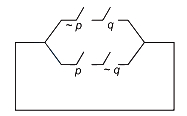
For the circuit shown below,the Boolean polynomial is
A
$(\sim p \vee q) \vee (p \vee \sim q)$
B
$(\sim p \wedge q) \wedge (p \wedge q)$
C
$(\sim p \wedge \sim q) \wedge (q \wedge p)$
D
$(\sim p \wedge q) \vee (p \wedge \sim q)$
Solution
(D) In the given circuit,the top branch consists of switches $\sim p$ and $q$ connected in series. The Boolean expression for this branch is $(\sim p \wedge q)$.
The bottom branch consists of switches $p$ and $\sim q$ connected in series. The Boolean expression for this branch is $(p \wedge \sim q)$.
Since these two branches are connected in parallel,the total Boolean polynomial for the circuit is the disjunction of the two expressions:
$(\sim p \wedge q) \vee (p \wedge \sim q)$.
The bottom branch consists of switches $p$ and $\sim q$ connected in series. The Boolean expression for this branch is $(p \wedge \sim q)$.
Since these two branches are connected in parallel,the total Boolean polynomial for the circuit is the disjunction of the two expressions:
$(\sim p \wedge q) \vee (p \wedge \sim q)$.
0 likesView Solution
9
MathematicsEasyMCQMHT CET · 2011
In a Boolean Algebra $B$,for all $x, y \in B$,$x \wedge (x \vee y)$ is equal to
A
$y$
B
$x$
C
$1$
D
$0$
Solution
(B) Using the distributive law,we have: $x \wedge (x \vee y) = (x \wedge x) \vee (x \wedge y)$.
By the idempotent law,$x \wedge x = x$,so the expression becomes $x \vee (x \wedge y)$.
By the absorption law,$x \vee (x \wedge y) = x$.
By the idempotent law,$x \wedge x = x$,so the expression becomes $x \vee (x \wedge y)$.
By the absorption law,$x \vee (x \wedge y) = x$.
0 likesView Solution
10
MathematicsEasyMCQMHT CET · 2011
The inverse of the proposition $(p \wedge \sim q) \Rightarrow r$ is
A
$\sim r \Rightarrow \sim p \vee q$
B
$\sim p \vee q \Rightarrow \sim r$
C
$r \Rightarrow p \wedge \sim q$
D
None of these
Solution
(B) The inverse of a conditional statement $P \Rightarrow Q$ is defined as $\sim P \Rightarrow \sim Q$.
Given the proposition $(p \wedge \sim q) \Rightarrow r$,we identify $P = (p \wedge \sim q)$ and $Q = r$.
Therefore,the inverse is $\sim(p \wedge \sim q) \Rightarrow \sim r$.
Using De Morgan's Law,$\sim(p \wedge \sim q)$ is equivalent to $(\sim p \vee \sim(\sim q))$,which simplifies to $(\sim p \vee q)$.
Thus,the inverse is $(\sim p \vee q) \Rightarrow \sim r$.
Given the proposition $(p \wedge \sim q) \Rightarrow r$,we identify $P = (p \wedge \sim q)$ and $Q = r$.
Therefore,the inverse is $\sim(p \wedge \sim q) \Rightarrow \sim r$.
Using De Morgan's Law,$\sim(p \wedge \sim q)$ is equivalent to $(\sim p \vee \sim(\sim q))$,which simplifies to $(\sim p \vee q)$.
Thus,the inverse is $(\sim p \vee q) \Rightarrow \sim r$.
0 likesView Solution
11
MathematicsEasyMCQMHT CET · 2011
The proposition $(p$ $\Rightarrow \sim p) \wedge (\sim p$ $\Rightarrow p)$ is a
A
tautology and contradiction
B
neither tautology nor contradiction
C
contradiction
D
tautology
Solution
(C) To determine the nature of the proposition $(p$ $\Rightarrow \sim p) \wedge (\sim p$ $\Rightarrow p)$,we construct a truth table:
Since the final column contains only $F$ (False) for all possible truth values of $p$,the proposition is a contradiction.
| $p$ | $\sim p$ | $p \Rightarrow \sim p$ | $\sim p \Rightarrow p$ | $(p$ $\Rightarrow \sim p) \wedge (\sim p$ $\Rightarrow p)$ |
| $T$ | $F$ | $F$ | $T$ | $F$ |
| $F$ | $T$ | $T$ | $F$ | $F$ |
Since the final column contains only $F$ (False) for all possible truth values of $p$,the proposition is a contradiction.
0 likesView Solution
12
MathematicsMediumMCQMHT CET · 2011
If a pair of lines $x^{2}-2 p x y-y^{2}=0$ and $x^{2}-2 q x y-y^{2}=0$ are such that each pair bisects the angle between the other pair,then
A
$p q=-1$
B
$p q=1$
C
$\frac{1}{p}+\frac{1}{q}=0$
D
$\frac{1}{p}-\frac{1}{q}=0$
Solution
(A) The equation of the pair of angle bisectors of the pair of lines $ax^{2}+2hxy+by^{2}=0$ is given by $\frac{x^{2}-y^{2}}{a-b} = \frac{xy}{h}$.
For the pair $x^{2}-2pxy-y^{2}=0$,we have $a=1, h=-p, b=-1$.
The equation of the angle bisectors is $\frac{x^{2}-y^{2}}{1-(-1)} = \frac{xy}{-p}$,which simplifies to $\frac{x^{2}-y^{2}}{2} = \frac{xy}{-p}$.
This gives $x^{2}-y^{2} = -\frac{2}{p}xy$,or $x^{2} + \frac{2}{p}xy - y^{2} = 0$.
It is given that this pair is the same as $x^{2}-2qxy-y^{2}=0$.
Comparing the coefficients of $xy$,we get $-2q = \frac{2}{p}$.
Therefore,$pq = -1$.
For the pair $x^{2}-2pxy-y^{2}=0$,we have $a=1, h=-p, b=-1$.
The equation of the angle bisectors is $\frac{x^{2}-y^{2}}{1-(-1)} = \frac{xy}{-p}$,which simplifies to $\frac{x^{2}-y^{2}}{2} = \frac{xy}{-p}$.
This gives $x^{2}-y^{2} = -\frac{2}{p}xy$,or $x^{2} + \frac{2}{p}xy - y^{2} = 0$.
It is given that this pair is the same as $x^{2}-2qxy-y^{2}=0$.
Comparing the coefficients of $xy$,we get $-2q = \frac{2}{p}$.
Therefore,$pq = -1$.
0 likesView Solution
13
MathematicsMediumMCQMHT CET · 2011
If one of the lines of the pair $ax^{2}+2hxy+by^{2}=0$ bisects the angle between the positive direction of the axes,then $a, b,$ and $h$ satisfy the relation:
A
$a+b=2|h|$
B
$a+b=-2h$
C
$a-b=2|h|$
D
$(a-b)^{2}=4h^{2}$
Solution
(B) The line that bisects the angle between the positive $x$-axis and positive $y$-axis is $y=x$.
Since this line is a part of the pair $ax^{2}+2hxy+by^{2}=0$,it must satisfy the equation.
Substituting $y=x$ into the equation:
$ax^{2}+2hx(x)+b(x)^{2}=0$
$ax^{2}+2hx^{2}+bx^{2}=0$
$(a+2h+b)x^{2}=0$
For this to hold for all $x$,we must have $a+b+2h=0$,which implies $a+b=-2h$.
Since this line is a part of the pair $ax^{2}+2hxy+by^{2}=0$,it must satisfy the equation.
Substituting $y=x$ into the equation:
$ax^{2}+2hx(x)+b(x)^{2}=0$
$ax^{2}+2hx^{2}+bx^{2}=0$
$(a+2h+b)x^{2}=0$
For this to hold for all $x$,we must have $a+b+2h=0$,which implies $a+b=-2h$.
0 likesView Solution
14
MathematicsMediumMCQMHT CET · 2011
The equation of the common tangent touching the circle $(x-3)^{2}+y^{2}=9$ and the parabola $y^{2}=4x$ above the $x$-axis is
A
$\sqrt{2}y=3x+1$
B
$\sqrt{3}y=-(x+3)$
C
$\sqrt{3}y=x+3$
D
$\sqrt{3}y=-(3x+1)$
Solution
(C) The equation of a tangent to the parabola $y^{2}=4x$ is given by $y=mx+\frac{a}{m}$,where $a=1$. Thus,$y=mx+\frac{1}{m}$.
This line is also tangent to the circle $(x-3)^{2}+y^{2}=9$,which has center $(3,0)$ and radius $r=3$.
The perpendicular distance from the center $(3,0)$ to the line $mx-y+\frac{1}{m}=0$ must equal the radius $3$:
$\frac{|m(3)-0+\frac{1}{m}|}{\sqrt{m^{2}+(-1)^{2}}}=3$
$|3m+\frac{1}{m}|=3\sqrt{m^{2}+1}$
Squaring both sides:
$(3m+\frac{1}{m})^{2}=9(m^{2}+1)$
$9m^{2}+6+\frac{1}{m^{2}}=9m^{2}+9$
$\frac{1}{m^{2}}=3$ $\Rightarrow m^{2}=\frac{1}{3}$ $\Rightarrow m=\pm\frac{1}{\sqrt{3}}$.
Since the tangent touches the parabola above the $x$-axis,we choose $m=\frac{1}{\sqrt{3}}$.
Substituting $m$ into the tangent equation:
$y=\frac{1}{\sqrt{3}}x+\sqrt{3}$
Multiplying by $\sqrt{3}$ gives $\sqrt{3}y=x+3$.
This line is also tangent to the circle $(x-3)^{2}+y^{2}=9$,which has center $(3,0)$ and radius $r=3$.
The perpendicular distance from the center $(3,0)$ to the line $mx-y+\frac{1}{m}=0$ must equal the radius $3$:
$\frac{|m(3)-0+\frac{1}{m}|}{\sqrt{m^{2}+(-1)^{2}}}=3$
$|3m+\frac{1}{m}|=3\sqrt{m^{2}+1}$
Squaring both sides:
$(3m+\frac{1}{m})^{2}=9(m^{2}+1)$
$9m^{2}+6+\frac{1}{m^{2}}=9m^{2}+9$
$\frac{1}{m^{2}}=3$ $\Rightarrow m^{2}=\frac{1}{3}$ $\Rightarrow m=\pm\frac{1}{\sqrt{3}}$.
Since the tangent touches the parabola above the $x$-axis,we choose $m=\frac{1}{\sqrt{3}}$.
Substituting $m$ into the tangent equation:
$y=\frac{1}{\sqrt{3}}x+\sqrt{3}$
Multiplying by $\sqrt{3}$ gives $\sqrt{3}y=x+3$.
0 likesView Solution
15
MathematicsMediumMCQMHT CET · 2011
The equations of the normals at the ends of the latus rectum of the parabola $y^{2}=4ax$ are given by
A
$x^{2}-y^{2}-6ax+9a^{2}=0$
B
$x^{2}-y^{2}-6ax-6ay+9a^{2}=0$
C
$x^{2}-y^{2}-6ay+9a^{2}=0$
D
None of the above
Solution
(A) The coordinates of the ends of the latus rectum of the parabola $y^{2}=4ax$ are $(a, 2a)$ and $(a, -2a)$.
For the parabola $y^{2}=4ax$,the slope of the tangent at $(x_{1}, y_{1})$ is $m = \frac{2a}{y_{1}}$.
At $(a, 2a)$,the slope of the tangent is $m = \frac{2a}{2a} = 1$,so the slope of the normal is $-1$.
The equation of the normal at $(a, 2a)$ is $y - 2a = -1(x - a)$,which simplifies to $x + y - 3a = 0$.
At $(a, -2a)$,the slope of the tangent is $m = \frac{2a}{-2a} = -1$,so the slope of the normal is $1$.
The equation of the normal at $(a, -2a)$ is $y - (-2a) = 1(x - a)$,which simplifies to $x - y - 3a = 0$.
The combined equation is $(x + y - 3a)(x - y - 3a) = 0$.
Expanding this,we get $((x - 3a) + y)((x - 3a) - y) = 0$,which is $(x - 3a)^{2} - y^{2} = 0$.
Thus,$x^{2} - 6ax + 9a^{2} - y^{2} = 0$,or $x^{2} - y^{2} - 6ax + 9a^{2} = 0$.
For the parabola $y^{2}=4ax$,the slope of the tangent at $(x_{1}, y_{1})$ is $m = \frac{2a}{y_{1}}$.
At $(a, 2a)$,the slope of the tangent is $m = \frac{2a}{2a} = 1$,so the slope of the normal is $-1$.
The equation of the normal at $(a, 2a)$ is $y - 2a = -1(x - a)$,which simplifies to $x + y - 3a = 0$.
At $(a, -2a)$,the slope of the tangent is $m = \frac{2a}{-2a} = -1$,so the slope of the normal is $1$.
The equation of the normal at $(a, -2a)$ is $y - (-2a) = 1(x - a)$,which simplifies to $x - y - 3a = 0$.
The combined equation is $(x + y - 3a)(x - y - 3a) = 0$.
Expanding this,we get $((x - 3a) + y)((x - 3a) - y) = 0$,which is $(x - 3a)^{2} - y^{2} = 0$.
Thus,$x^{2} - 6ax + 9a^{2} - y^{2} = 0$,or $x^{2} - y^{2} - 6ax + 9a^{2} = 0$.
0 likesView Solution
16
MathematicsMediumMCQMHT CET · 2011
Three boxes contain respectively $3$ white and $1$ black,$2$ white and $2$ black,$1$ white and $3$ black balls. From each of the boxes,one ball is drawn at random. The probability that $2$ white and $1$ black balls will be drawn is:
A
$13/32$
B
$1/4$
C
$1/32$
D
$3/16$
Solution
(A) Let $W$ denote a white ball and $B$ denote a black ball. The contents of the boxes are:
Box $I$: $3W, 1B$ (Total $4$ balls)
Box $II$: $2W, 2B$ (Total $4$ balls)
Box $III$: $1W, 3B$ (Total $4$ balls)
We need to draw $2$ white and $1$ black ball. This can happen in three mutually exclusive ways:
$1$. Box $I$ gives $B$,Box $II$ gives $W$,Box $III$ gives $W$
$2$. Box $I$ gives $W$,Box $II$ gives $B$,Box $III$ gives $W$
$3$. Box $I$ gives $W$,Box $II$ gives $W$,Box $III$ gives $B$
The required probability is:
$P = P(B_I)P(W_{II})P(W_{III}) + P(W_I)P(B_{II})P(W_{III}) + P(W_I)P(W_{II})P(B_{III})$
$P = (\frac{1}{4} \times \frac{2}{4} \times \frac{1}{4}) + (\frac{3}{4} \times \frac{2}{4} \times \frac{1}{4}) + (\frac{3}{4} \times \frac{2}{4} \times \frac{3}{4})$
$P = \frac{2}{64} + \frac{6}{64} + \frac{18}{64} = \frac{26}{64} = \frac{13}{32}$
Box $I$: $3W, 1B$ (Total $4$ balls)
Box $II$: $2W, 2B$ (Total $4$ balls)
Box $III$: $1W, 3B$ (Total $4$ balls)
We need to draw $2$ white and $1$ black ball. This can happen in three mutually exclusive ways:
$1$. Box $I$ gives $B$,Box $II$ gives $W$,Box $III$ gives $W$
$2$. Box $I$ gives $W$,Box $II$ gives $B$,Box $III$ gives $W$
$3$. Box $I$ gives $W$,Box $II$ gives $W$,Box $III$ gives $B$
The required probability is:
$P = P(B_I)P(W_{II})P(W_{III}) + P(W_I)P(B_{II})P(W_{III}) + P(W_I)P(W_{II})P(B_{III})$
$P = (\frac{1}{4} \times \frac{2}{4} \times \frac{1}{4}) + (\frac{3}{4} \times \frac{2}{4} \times \frac{1}{4}) + (\frac{3}{4} \times \frac{2}{4} \times \frac{3}{4})$
$P = \frac{2}{64} + \frac{6}{64} + \frac{18}{64} = \frac{26}{64} = \frac{13}{32}$
0 likesView Solution
17
MathematicsDifficultMCQMHT CET · 2011
For all real $x$,the minimum value of $\frac{1-x+x^{2}}{1+x+x^{2}}$ is
A
$0$
B
$1/3$
C
$1$
D
$3$
Solution
(B) Let $y = \frac{1-x+x^{2}}{1+x+x^{2}}$.
We can rewrite the expression as $y = \frac{(x^{2}+x+1) - 2x}{x^{2}+x+1} = 1 - \frac{2x}{x^{2}+x+1}$.
To find the minimum value of $y$,we need to maximize the term $\frac{2x}{x^{2}+x+1}$.
Let $f(x) = \frac{x}{x^{2}+x+1}$.
Taking the derivative with respect to $x$ and setting it to $0$:
$f'(x) = \frac{(x^{2}+x+1)(1) - x(2x+1)}{(x^{2}+x+1)^{2}} = \frac{x^{2}+x+1-2x^{2}-x}{(x^{2}+x+1)^{2}} = \frac{1-x^{2}}{(x^{2}+x+1)^{2}}$.
Setting $f'(x) = 0$ gives $1-x^{2} = 0$,so $x = 1$ or $x = -1$.
For $x = 1$,$f(1) = \frac{1}{1+1+1} = \frac{1}{3}$.
For $x = -1$,$f(-1) = \frac{-1}{1-1+1} = -1$.
Since we want to minimize $y = 1 - 2f(x)$,we choose the maximum value of $f(x)$,which is $1/3$.
Thus,the minimum value of $y$ is $1 - 2(1/3) = 1 - 2/3 = 1/3$.
We can rewrite the expression as $y = \frac{(x^{2}+x+1) - 2x}{x^{2}+x+1} = 1 - \frac{2x}{x^{2}+x+1}$.
To find the minimum value of $y$,we need to maximize the term $\frac{2x}{x^{2}+x+1}$.
Let $f(x) = \frac{x}{x^{2}+x+1}$.
Taking the derivative with respect to $x$ and setting it to $0$:
$f'(x) = \frac{(x^{2}+x+1)(1) - x(2x+1)}{(x^{2}+x+1)^{2}} = \frac{x^{2}+x+1-2x^{2}-x}{(x^{2}+x+1)^{2}} = \frac{1-x^{2}}{(x^{2}+x+1)^{2}}$.
Setting $f'(x) = 0$ gives $1-x^{2} = 0$,so $x = 1$ or $x = -1$.
For $x = 1$,$f(1) = \frac{1}{1+1+1} = \frac{1}{3}$.
For $x = -1$,$f(-1) = \frac{-1}{1-1+1} = -1$.
Since we want to minimize $y = 1 - 2f(x)$,we choose the maximum value of $f(x)$,which is $1/3$.
Thus,the minimum value of $y$ is $1 - 2(1/3) = 1 - 2/3 = 1/3$.
0 likesView Solution
18
MathematicsEasyMCQMHT CET · 2011
The area bounded by the parabola $y^{2}=x$,the straight line $y=4$,and the $y$-axis in square units is:
A
$16 / 3$ sq. unit
B
$64 / 3$ sq. unit
C
$7 \sqrt{2}$ sq. unit
D
None of these
Solution
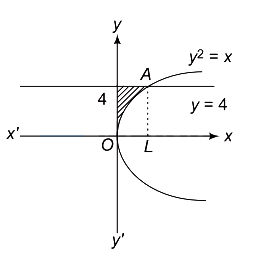
(B) The line $y=4$ meets the parabola $y^{2}=x$ at point $A$. Substituting $y=4$ into the equation of the parabola,we get $4^{2}=x$,so $x=16$. Thus,point $A$ is $(16, 4)$.
The required area is bounded by the parabola $x=y^{2}$,the $y$-axis $(x=0)$,and the line $y=4$ from $y=0$ to $y=4$.
Required Area $= \int_{0}^{4} x \, dy = \int_{0}^{4} y^{2} \, dy$
$= \left[ \frac{y^{3}}{3} \right]_{0}^{4}$
$= \frac{4^{3}}{3} - \frac{0^{3}}{3} = \frac{64}{3} \text{ sq. units}$.
The required area is bounded by the parabola $x=y^{2}$,the $y$-axis $(x=0)$,and the line $y=4$ from $y=0$ to $y=4$.
Required Area $= \int_{0}^{4} x \, dy = \int_{0}^{4} y^{2} \, dy$
$= \left[ \frac{y^{3}}{3} \right]_{0}^{4}$
$= \frac{4^{3}}{3} - \frac{0^{3}}{3} = \frac{64}{3} \text{ sq. units}$.
0 likesView Solution
19
MathematicsDifficultMCQMHT CET · 2011
If $f(x) = \begin{cases} (1+|\sin x|)^{\frac{a}{|\sin x|}}, & -\pi/6 < x < 0 \\ b, & x = 0 \\ e^{\frac{\tan 2x}{\tan 3x}}, & 0 < x < \pi/6 \end{cases}$ is continuous at $x = 0$,find the values of $a$ and $b$.
A
$3/2, e^{3/2}$
B
$-2/3, e^{-3/2}$
C
$2/3, e^{2/3}$
D
None of these
Solution
(C) For $f(x)$ to be continuous at $x = 0$,we must have $\lim_{x \to 0^-} f(x) = \lim_{x \to 0^+} f(x) = f(0)$.
First,calculate the left-hand limit:
$\lim_{x \to 0^-} f(x) = \lim_{x \to 0^-} (1+|\sin x|)^{\frac{a}{|\sin x|}}$.
Let $u = |\sin x|$. As $x \to 0$,$u \to 0^+$. The limit becomes $\lim_{u \to 0^+} (1+u)^{a/u} = e^a$.
Next,calculate the right-hand limit:
$\lim_{x \to 0^+} f(x) = \lim_{x \to 0^+} e^{\frac{\tan 2x}{\tan 3x}}$.
Using the limit $\lim_{\theta \to 0} \frac{\tan k\theta}{\theta} = k$,we get $\lim_{x \to 0^+} \frac{\tan 2x}{\tan 3x} = \lim_{x \to 0^+} \frac{(\tan 2x / 2x) \cdot 2x}{(\tan 3x / 3x) \cdot 3x} = \frac{1 \cdot 2}{1 \cdot 3} = \frac{2}{3}$.
Thus,$\lim_{x \to 0^+} f(x) = e^{2/3}$.
Since $f(0) = b$,for continuity,$e^a = e^{2/3} = b$.
Therefore,$a = 2/3$ and $b = e^{2/3}$.
First,calculate the left-hand limit:
$\lim_{x \to 0^-} f(x) = \lim_{x \to 0^-} (1+|\sin x|)^{\frac{a}{|\sin x|}}$.
Let $u = |\sin x|$. As $x \to 0$,$u \to 0^+$. The limit becomes $\lim_{u \to 0^+} (1+u)^{a/u} = e^a$.
Next,calculate the right-hand limit:
$\lim_{x \to 0^+} f(x) = \lim_{x \to 0^+} e^{\frac{\tan 2x}{\tan 3x}}$.
Using the limit $\lim_{\theta \to 0} \frac{\tan k\theta}{\theta} = k$,we get $\lim_{x \to 0^+} \frac{\tan 2x}{\tan 3x} = \lim_{x \to 0^+} \frac{(\tan 2x / 2x) \cdot 2x}{(\tan 3x / 3x) \cdot 3x} = \frac{1 \cdot 2}{1 \cdot 3} = \frac{2}{3}$.
Thus,$\lim_{x \to 0^+} f(x) = e^{2/3}$.
Since $f(0) = b$,for continuity,$e^a = e^{2/3} = b$.
Therefore,$a = 2/3$ and $b = e^{2/3}$.
0 likesView Solution
20
MathematicsMediumMCQMHT CET · 2011
At the point $x=1$,the function $f(x) = \begin{cases} x^3-1, & 1 < x < \infty \\ x-1, & -\infty < x \leq 1 \end{cases}$ is
A
continuous and differentiable
B
continuous and not differentiable
C
discontinuous and differentiable
D
discontinuous and not differentiable
Solution
(B) $LHL$ $= \lim_{x \rightarrow 1^-} f(x) = \lim_{x \rightarrow 1} (x-1) = 0$
$RHL$ $= \lim_{x \rightarrow 1^+} f(x) = \lim_{x \rightarrow 1} (x^3-1) = 0$
Also,$f(1) = 1-1 = 0$
Since $LHL$ $=$ $RHL$ $= f(1)$,$f$ is continuous at $x=1$.
Now,$Lf'(1) = \lim_{h \rightarrow 0} \frac{f(1-h)-f(1)}{-h} = \lim_{h \rightarrow 0} \frac{(1-h)-1-0}{-h} = \lim_{h \rightarrow 0} \frac{-h}{-h} = 1$
And $Rf'(1) = \lim_{h \rightarrow 0} \frac{f(1+h)-f(1)}{h} = \lim_{h \rightarrow 0} \frac{(1+h)^3-1-0}{h} = \lim_{h \rightarrow 0} \frac{1+h^3+3h+3h^2-1}{h} = \lim_{h \rightarrow 0} (h^2+3h+3) = 3$
Since $Lf'(1) \neq Rf'(1)$,$f(x)$ is not differentiable at $x=1$.
$RHL$ $= \lim_{x \rightarrow 1^+} f(x) = \lim_{x \rightarrow 1} (x^3-1) = 0$
Also,$f(1) = 1-1 = 0$
Since $LHL$ $=$ $RHL$ $= f(1)$,$f$ is continuous at $x=1$.
Now,$Lf'(1) = \lim_{h \rightarrow 0} \frac{f(1-h)-f(1)}{-h} = \lim_{h \rightarrow 0} \frac{(1-h)-1-0}{-h} = \lim_{h \rightarrow 0} \frac{-h}{-h} = 1$
And $Rf'(1) = \lim_{h \rightarrow 0} \frac{f(1+h)-f(1)}{h} = \lim_{h \rightarrow 0} \frac{(1+h)^3-1-0}{h} = \lim_{h \rightarrow 0} \frac{1+h^3+3h+3h^2-1}{h} = \lim_{h \rightarrow 0} (h^2+3h+3) = 3$
Since $Lf'(1) \neq Rf'(1)$,$f(x)$ is not differentiable at $x=1$.
0 likesView Solution
21
MathematicsEasyMCQMHT CET · 2011
$\int_{0}^{\pi / 2} \frac{d x}{1+\tan x}$ is equal to
A
$\pi$
B
$\pi / 2$
C
$\pi / 3$
D
$\pi / 4$
Solution
(D) Let $I = \int_{0}^{\pi / 2} \frac{d x}{1+\tan x}$.
We can write $\tan x = \frac{\sin x}{\cos x}$,so $I = \int_{0}^{\pi / 2} \frac{\cos x}{\sin x + \cos x} d x$ ... $(i)$.
Using the property $\int_{0}^{a} f(x) d x = \int_{0}^{a} f(a-x) d x$,we get:
$I = \int_{0}^{\pi / 2} \frac{\cos(\pi / 2 - x)}{\sin(\pi / 2 - x) + \cos(\pi / 2 - x)} d x = \int_{0}^{\pi / 2} \frac{\sin x}{\cos x + \sin x} d x$ ... $(ii)$.
Adding $(i)$ and $(ii)$:
$2I = \int_{0}^{\pi / 2} \frac{\cos x + \sin x}{\sin x + \cos x} d x = \int_{0}^{\pi / 2} 1 d x$.
$2I = [x]_{0}^{\pi / 2} = \pi / 2$.
Therefore,$I = \pi / 4$.
We can write $\tan x = \frac{\sin x}{\cos x}$,so $I = \int_{0}^{\pi / 2} \frac{\cos x}{\sin x + \cos x} d x$ ... $(i)$.
Using the property $\int_{0}^{a} f(x) d x = \int_{0}^{a} f(a-x) d x$,we get:
$I = \int_{0}^{\pi / 2} \frac{\cos(\pi / 2 - x)}{\sin(\pi / 2 - x) + \cos(\pi / 2 - x)} d x = \int_{0}^{\pi / 2} \frac{\sin x}{\cos x + \sin x} d x$ ... $(ii)$.
Adding $(i)$ and $(ii)$:
$2I = \int_{0}^{\pi / 2} \frac{\cos x + \sin x}{\sin x + \cos x} d x = \int_{0}^{\pi / 2} 1 d x$.
$2I = [x]_{0}^{\pi / 2} = \pi / 2$.
Therefore,$I = \pi / 4$.
0 likesView Solution
22
MathematicsEasyMCQMHT CET · 2011
$\int_{-\pi / 2}^{\pi / 2} \frac{\cos x}{1+e^{x}} d x$ is equal to
A
$1$
B
$0$
C
$-1$
D
\text{None of these}
Solution
(A) Let $I = \int_{-\pi / 2}^{\pi / 2} \frac{\cos x}{1+e^{x}} d x$ $(i)$
Using the property $\int_{a}^{b} f(x) d x = \int_{a}^{b} f(a+b-x) d x$,where $a = -\pi / 2$ and $b = \pi / 2$,we have $a+b = 0$.
So,$I = \int_{-\pi / 2}^{\pi / 2} \frac{\cos(-x)}{1+e^{-x}} d x = \int_{-\pi / 2}^{\pi / 2} \frac{\cos x}{1+e^{-x}} d x$
Multiplying the numerator and denominator by $e^x$,we get:
$I = \int_{-\pi / 2}^{\pi / 2} \frac{e^x \cos x}{e^x + 1} d x$ $(ii)$
Adding $(i)$ and $(ii)$:
$2I = \int_{-\pi / 2}^{\pi / 2} \frac{\cos x + e^x \cos x}{1+e^x} d x = \int_{-\pi / 2}^{\pi / 2} \frac{\cos x(1+e^x)}{1+e^x} d x$
$2I = \int_{-\pi / 2}^{\pi / 2} \cos x d x$
Since $\cos x$ is an even function,$2I = 2 \int_{0}^{\pi / 2} \cos x d x$
$2I = 2[\sin x]_{0}^{\pi / 2} = 2(1 - 0) = 2$
Therefore,$I = 1$.
Using the property $\int_{a}^{b} f(x) d x = \int_{a}^{b} f(a+b-x) d x$,where $a = -\pi / 2$ and $b = \pi / 2$,we have $a+b = 0$.
So,$I = \int_{-\pi / 2}^{\pi / 2} \frac{\cos(-x)}{1+e^{-x}} d x = \int_{-\pi / 2}^{\pi / 2} \frac{\cos x}{1+e^{-x}} d x$
Multiplying the numerator and denominator by $e^x$,we get:
$I = \int_{-\pi / 2}^{\pi / 2} \frac{e^x \cos x}{e^x + 1} d x$ $(ii)$
Adding $(i)$ and $(ii)$:
$2I = \int_{-\pi / 2}^{\pi / 2} \frac{\cos x + e^x \cos x}{1+e^x} d x = \int_{-\pi / 2}^{\pi / 2} \frac{\cos x(1+e^x)}{1+e^x} d x$
$2I = \int_{-\pi / 2}^{\pi / 2} \cos x d x$
Since $\cos x$ is an even function,$2I = 2 \int_{0}^{\pi / 2} \cos x d x$
$2I = 2[\sin x]_{0}^{\pi / 2} = 2(1 - 0) = 2$
Therefore,$I = 1$.
0 likesView Solution
23
MathematicsMediumMCQMHT CET · 2011
By Simpson's rule taking $n=4$,the value of the integral $\int_{0}^{1} \frac{1}{1+x^{2}} dx$ is equal to
A
$0.788$
B
$0.781$
C
$0.785$
D
None of these
Solution
(C) Given $n=4$,the interval $[0, 1]$ is divided into $4$ sub-intervals of width $h = \frac{1-0}{4} = 0.25$.
The values of $y = \frac{1}{1+x^2}$ at $x_i$ are:
Using Simpson's $\frac{1}{3}$ rule:
$\int_{0}^{1} y dx \approx \frac{h}{3} [(y_0 + y_4) + 4(y_1 + y_3) + 2(y_2)]$
$\int_{0}^{1} y dx \approx \frac{0.25}{3} [(1.0 + 0.5) + 4(0.941176 + 0.64) + 2(0.8)]$
$\int_{0}^{1} y dx \approx \frac{0.25}{3} [1.5 + 4(1.581176) + 1.6]$
$\int_{0}^{1} y dx \approx \frac{0.25}{3} [1.5 + 6.324704 + 1.6] = \frac{0.25}{3} [9.424704] \approx 0.785392$
Rounding to three decimal places,we get $0.785$.
The values of $y = \frac{1}{1+x^2}$ at $x_i$ are:
| $x$ | $y$ |
| $0$ | $1.0$ |
| $0.25$ | $0.941176$ |
| $0.5$ | $0.8$ |
| $0.75$ | $0.64$ |
| $1$ | $0.5$ |
Using Simpson's $\frac{1}{3}$ rule:
$\int_{0}^{1} y dx \approx \frac{h}{3} [(y_0 + y_4) + 4(y_1 + y_3) + 2(y_2)]$
$\int_{0}^{1} y dx \approx \frac{0.25}{3} [(1.0 + 0.5) + 4(0.941176 + 0.64) + 2(0.8)]$
$\int_{0}^{1} y dx \approx \frac{0.25}{3} [1.5 + 4(1.581176) + 1.6]$
$\int_{0}^{1} y dx \approx \frac{0.25}{3} [1.5 + 6.324704 + 1.6] = \frac{0.25}{3} [9.424704] \approx 0.785392$
Rounding to three decimal places,we get $0.785$.
0 likesView Solution
24
MathematicsEasyMCQMHT CET · 2011
The value of $a$ for which the system of equations has a non-zero solution is
$a^{3} x+(a+1)^{3} y+(a+2)^{3} z=0$
$a x+(a+1) y+(a+2) z=0$
$x+y+z=0$
$a^{3} x+(a+1)^{3} y+(a+2)^{3} z=0$
$a x+(a+1) y+(a+2) z=0$
$x+y+z=0$
A
$1$
B
$0$
C
$-1$
D
None of these
Solution
(C) For a system of homogeneous linear equations to have a non-zero solution,the determinant of the coefficient matrix must be zero.
$\left|\begin{array}{ccc} a^3 & (a+1)^3 & (a+2)^3 \\ a & (a+1) & (a+2) \\ 1 & 1 & 1 \end{array}\right| = 0$
Interchanging rows to simplify:
$-\left|\begin{array}{ccc} 1 & 1 & 1 \\ a & (a+1) & (a+2) \\ a^3 & (a+1)^3 & (a+2)^3 \end{array}\right| = 0$
Using the property of the Vandermonde-like determinant $\left|\begin{array}{ccc} 1 & 1 & 1 \\ x & y & z \\ x^3 & y^3 & z^3 \end{array}\right| = (x-y)(y-z)(z-x)(x+y+z)$,where $x=a, y=a+1, z=a+2$:
$-(a-(a+1))((a+1)-(a+2))((a+2)-a)(a+(a+1)+(a+2)) = 0$
$-(-1)(-1)(2)(3a+3) = 0$
$-2(3a+3) = 0$
$3a+3 = 0 \Rightarrow a = -1$.
$\left|\begin{array}{ccc} a^3 & (a+1)^3 & (a+2)^3 \\ a & (a+1) & (a+2) \\ 1 & 1 & 1 \end{array}\right| = 0$
Interchanging rows to simplify:
$-\left|\begin{array}{ccc} 1 & 1 & 1 \\ a & (a+1) & (a+2) \\ a^3 & (a+1)^3 & (a+2)^3 \end{array}\right| = 0$
Using the property of the Vandermonde-like determinant $\left|\begin{array}{ccc} 1 & 1 & 1 \\ x & y & z \\ x^3 & y^3 & z^3 \end{array}\right| = (x-y)(y-z)(z-x)(x+y+z)$,where $x=a, y=a+1, z=a+2$:
$-(a-(a+1))((a+1)-(a+2))((a+2)-a)(a+(a+1)+(a+2)) = 0$
$-(-1)(-1)(2)(3a+3) = 0$
$-2(3a+3) = 0$
$3a+3 = 0 \Rightarrow a = -1$.
0 likesView Solution
25
MathematicsEasyMCQMHT CET · 2011
If $m$ and $n$ are the order and degree of the differential equation $\left(\frac{d^{2} y}{d x^{2}}\right)^{5}+4 \cdot \frac{\left(\frac{d^{2} y}{d x^{2}}\right)^{3}}{\left(\frac{d^{3} y}{d x^{3}}\right)}+\left(\frac{d^{3} y}{d x^{3}}\right)=x^{2}-1$,then:
A
$m=3, n=3$
B
$m=3, n=2$
C
$m=3, n=5$
D
$m=3, n=1$
Solution
(B) The given differential equation is $\left(\frac{d^{2} y}{d x^{2}}\right)^{5}+4 \cdot \frac{\left(\frac{d^{2} y}{d x^{2}}\right)^{3}}{\left(\frac{d^{3} y}{d x^{3}}\right)}+\left(\frac{d^{3} y}{d x^{3}}\right)=x^{2}-1$.
To find the order and degree,we first eliminate the fraction by multiplying the entire equation by $\frac{d^{3} y}{d x^{3}}$:
$\left(\frac{d^{2} y}{d x^{2}}\right)^{5} \cdot \left(\frac{d^{3} y}{d x^{3}}\right) + 4 \left(\frac{d^{2} y}{d x^{2}}\right)^{3} + \left(\frac{d^{3} y}{d x^{3}}\right)^{2} = (x^{2}-1) \left(\frac{d^{3} y}{d x^{3}}\right)$.
The highest order derivative present in the equation is $\frac{d^{3} y}{d x^{3}}$,so the order $m = 3$.
The degree is the highest power of the highest order derivative after the equation is made a polynomial in derivatives. Here,the highest power of $\frac{d^{3} y}{d x^{3}}$ is $2$,so the degree $n = 2$.
To find the order and degree,we first eliminate the fraction by multiplying the entire equation by $\frac{d^{3} y}{d x^{3}}$:
$\left(\frac{d^{2} y}{d x^{2}}\right)^{5} \cdot \left(\frac{d^{3} y}{d x^{3}}\right) + 4 \left(\frac{d^{2} y}{d x^{2}}\right)^{3} + \left(\frac{d^{3} y}{d x^{3}}\right)^{2} = (x^{2}-1) \left(\frac{d^{3} y}{d x^{3}}\right)$.
The highest order derivative present in the equation is $\frac{d^{3} y}{d x^{3}}$,so the order $m = 3$.
The degree is the highest power of the highest order derivative after the equation is made a polynomial in derivatives. Here,the highest power of $\frac{d^{3} y}{d x^{3}}$ is $2$,so the degree $n = 2$.
0 likesView Solution
26
MathematicsMediumMCQMHT CET · 2011
The differential equation whose solution is $(x-h)^{2}+(y-k)^{2}=a^{2}$ (where $a$ is a constant) is:
A
$\left[1+\left(\frac{dy}{dx}\right)^{2}\right]^{3}=a^{2} \frac{d^{2}y}{dx^{2}}$
B
$\left[1+\left(\frac{dy}{dx}\right)^{2}\right]^{3}=a^{2}\left(\frac{d^{2}y}{dx^{2}}\right)^{2}$
C
$\left[1+\left(\frac{dy}{dx}\right)\right]^{3}=a^{2}\left(\frac{d^{2}y}{dx^{2}}\right)^{2}$
D
None of the above
Solution
(B) Given equation is $(x-h)^{2}+(y-k)^{2}=a^{2}$ ... $(i)$
Differentiating with respect to $x$:
$2(x-h) + 2(y-k) \frac{dy}{dx} = 0$
$(x-h) + (y-k) \frac{dy}{dx} = 0$ ... (ii)
Differentiating again with respect to $x$:
$1 + \left(\frac{dy}{dx}\right)^{2} + (y-k) \frac{d^{2}y}{dx^{2}} = 0$
$(y-k) = -\frac{1 + (dy/dx)^{2}}{d^{2}y/dx^{2}}$ ... (iii)
From (ii),$(x-h) = -(y-k) \frac{dy}{dx}$. Substituting (iii) into this:
$(x-h) = \frac{[1 + (dy/dx)^{2}]}{d^{2}y/dx^{2}} \cdot \frac{dy}{dx}$ ... (iv)
Substituting (iii) and (iv) into $(i)$:
$\left[ \frac{[1 + (dy/dx)^{2}] \cdot (dy/dx)}{d^{2}y/dx^{2}} \right]^{2} + \left[ -\frac{1 + (dy/dx)^{2}}{d^{2}y/dx^{2}} \right]^{2} = a^{2}$
$\frac{[1 + (dy/dx)^{2}]^{2}}{ (d^{2}y/dx^{2})^{2} } \left[ (dy/dx)^{2} + 1 \right] = a^{2}$
$\left[1 + \left(\frac{dy}{dx}\right)^{2}\right]^{3} = a^{2} \left(\frac{d^{2}y}{dx^{2}}\right)^{2}$
Differentiating with respect to $x$:
$2(x-h) + 2(y-k) \frac{dy}{dx} = 0$
$(x-h) + (y-k) \frac{dy}{dx} = 0$ ... (ii)
Differentiating again with respect to $x$:
$1 + \left(\frac{dy}{dx}\right)^{2} + (y-k) \frac{d^{2}y}{dx^{2}} = 0$
$(y-k) = -\frac{1 + (dy/dx)^{2}}{d^{2}y/dx^{2}}$ ... (iii)
From (ii),$(x-h) = -(y-k) \frac{dy}{dx}$. Substituting (iii) into this:
$(x-h) = \frac{[1 + (dy/dx)^{2}]}{d^{2}y/dx^{2}} \cdot \frac{dy}{dx}$ ... (iv)
Substituting (iii) and (iv) into $(i)$:
$\left[ \frac{[1 + (dy/dx)^{2}] \cdot (dy/dx)}{d^{2}y/dx^{2}} \right]^{2} + \left[ -\frac{1 + (dy/dx)^{2}}{d^{2}y/dx^{2}} \right]^{2} = a^{2}$
$\frac{[1 + (dy/dx)^{2}]^{2}}{ (d^{2}y/dx^{2})^{2} } \left[ (dy/dx)^{2} + 1 \right] = a^{2}$
$\left[1 + \left(\frac{dy}{dx}\right)^{2}\right]^{3} = a^{2} \left(\frac{d^{2}y}{dx^{2}}\right)^{2}$
0 likesView Solution
27
MathematicsEasyMCQMHT CET · 2011
The differential equation of all circles which pass through the origin and whose centres lie on the $y$-axis is:
A
$(x^{2}-y^{2}) \frac{dy}{dx}-2xy=0$
B
$(x^{2}-y^{2}) \frac{dy}{dx}+2xy=0$
C
$(x^{2}-y^{2}) \frac{dy}{dx}-xy=0$
D
$(x^{2}-y^{2}) \frac{dy}{dx}+xy=0$
Solution
(A) The general equation of a circle passing through the origin with its center on the $y$-axis is given by $x^{2} + (y-a)^{2} = a^{2}$,where $a$ is an arbitrary constant.
Expanding this,we get $x^{2} + y^{2} - 2ay + a^{2} = a^{2}$,which simplifies to $x^{2} + y^{2} - 2ay = 0$.
To eliminate the arbitrary constant $a$,we differentiate with respect to $x$:
$2x + 2y \frac{dy}{dx} - 2a \frac{dy}{dx} = 0$.
Dividing by $2$,we get $x + y \frac{dy}{dx} - a \frac{dy}{dx} = 0$,which implies $a = \frac{x + y \frac{dy}{dx}}{\frac{dy}{dx}} = x \frac{dx}{dy} + y$.
Substituting $a$ back into the original equation $x^{2} + y^{2} = 2ay$:
$x^{2} + y^{2} = 2(x \frac{dx}{dy} + y)y = 2xy \frac{dx}{dy} + 2y^{2}$.
Rearranging,$x^{2} - y^{2} = 2xy \frac{dx}{dy}$.
Since $\frac{dx}{dy} = \frac{1}{\frac{dy}{dx}}$,we have $x^{2} - y^{2} = \frac{2xy}{\frac{dy}{dx}}$.
Thus,$(x^{2} - y^{2}) \frac{dy}{dx} = 2xy$,or $(x^{2} - y^{2}) \frac{dy}{dx} - 2xy = 0$.
Expanding this,we get $x^{2} + y^{2} - 2ay + a^{2} = a^{2}$,which simplifies to $x^{2} + y^{2} - 2ay = 0$.
To eliminate the arbitrary constant $a$,we differentiate with respect to $x$:
$2x + 2y \frac{dy}{dx} - 2a \frac{dy}{dx} = 0$.
Dividing by $2$,we get $x + y \frac{dy}{dx} - a \frac{dy}{dx} = 0$,which implies $a = \frac{x + y \frac{dy}{dx}}{\frac{dy}{dx}} = x \frac{dx}{dy} + y$.
Substituting $a$ back into the original equation $x^{2} + y^{2} = 2ay$:
$x^{2} + y^{2} = 2(x \frac{dx}{dy} + y)y = 2xy \frac{dx}{dy} + 2y^{2}$.
Rearranging,$x^{2} - y^{2} = 2xy \frac{dx}{dy}$.
Since $\frac{dx}{dy} = \frac{1}{\frac{dy}{dx}}$,we have $x^{2} - y^{2} = \frac{2xy}{\frac{dy}{dx}}$.
Thus,$(x^{2} - y^{2}) \frac{dy}{dx} = 2xy$,or $(x^{2} - y^{2}) \frac{dy}{dx} - 2xy = 0$.
0 likesView Solution
28
MathematicsEasyMCQMHT CET · 2011
The integrating factor of the differential equation $\frac{dy}{dx}(x \log x) + y = 2 \log x$ is given by
A
$e^{x}$
B
$\log x$
C
$\log(\log x)$
D
$x$
Solution
(B) The given differential equation is $\frac{dy}{dx}(x \log x) + y = 2 \log x$.
Dividing both sides by $(x \log x)$,we get:
$\frac{dy}{dx} + \frac{y}{x \log x} = \frac{2 \log x}{x \log x} = \frac{2}{x}$.
This is a linear differential equation of the form $\frac{dy}{dx} + Py = Q$,where $P = \frac{1}{x \log x}$ and $Q = \frac{2}{x}$.
The integrating factor $(IF)$ is given by $e^{\int P dx}$.
$IF = e^{\int \frac{1}{x \log x} dx}$.
Let $u = \log x$,then $du = \frac{1}{x} dx$.
$IF = e^{\int \frac{1}{u} du} = e^{\log u} = u = \log x$.
Thus,the integrating factor is $\log x$.
Dividing both sides by $(x \log x)$,we get:
$\frac{dy}{dx} + \frac{y}{x \log x} = \frac{2 \log x}{x \log x} = \frac{2}{x}$.
This is a linear differential equation of the form $\frac{dy}{dx} + Py = Q$,where $P = \frac{1}{x \log x}$ and $Q = \frac{2}{x}$.
The integrating factor $(IF)$ is given by $e^{\int P dx}$.
$IF = e^{\int \frac{1}{x \log x} dx}$.
Let $u = \log x$,then $du = \frac{1}{x} dx$.
$IF = e^{\int \frac{1}{u} du} = e^{\log u} = u = \log x$.
Thus,the integrating factor is $\log x$.
0 likesView Solution
29
MathematicsEasyMCQMHT CET · 2011
$A$ particle moves along a straight line according to the law $s=16-2t+3t^{3}$,where $s$ metres is the distance of the particle from a fixed point at the end of $t$ seconds. The acceleration of the particle at the end of $2 \ s$ is
A
$3.6 \ m/s^{2}$
B
$36 \ m/s^{2}$
C
$36 \ km/s^{2}$
D
$360 \ m/s^{2}$
Solution
(B) Given the displacement equation: $s = 16 - 2t + 3t^{3}$
The velocity $v$ is the first derivative of displacement with respect to time: $v = \frac{ds}{dt} = \frac{d}{dt}(16 - 2t + 3t^{3}) = -2 + 9t^{2}$
The acceleration $a$ is the second derivative of displacement with respect to time: $a = \frac{dv}{dt} = \frac{d}{dt}(-2 + 9t^{2}) = 18t$
At $t = 2 \ s$,the acceleration is: $a = 18 \times 2 = 36 \ m/s^{2}$
The velocity $v$ is the first derivative of displacement with respect to time: $v = \frac{ds}{dt} = \frac{d}{dt}(16 - 2t + 3t^{3}) = -2 + 9t^{2}$
The acceleration $a$ is the second derivative of displacement with respect to time: $a = \frac{dv}{dt} = \frac{d}{dt}(-2 + 9t^{2}) = 18t$
At $t = 2 \ s$,the acceleration is: $a = 18 \times 2 = 36 \ m/s^{2}$
0 likesView Solution
30
MathematicsMediumMCQMHT CET · 2011
If $x^{p} y^{q}=(x+y)^{p+q}$,then $\frac{d y}{d x}$ is equal to
A
$y / x$
B
$p y / q x$
C
$x / y$
D
$q y / p x$
Solution
(A) Given,$x^{p} y^{q}=(x+y)^{p+q}$.
Taking the natural logarithm on both sides,we get:
$p \ln x + q \ln y = (p+q) \ln (x+y)$.
Differentiating both sides with respect to $x$:
$\frac{p}{x} + \frac{q}{y} \frac{dy}{dx} = \frac{p+q}{x+y} \left(1 + \frac{dy}{dx}\right)$.
Rearranging the terms to isolate $\frac{dy}{dx}$:
$\frac{q}{y} \frac{dy}{dx} - \frac{p+q}{x+y} \frac{dy}{dx} = \frac{p+q}{x+y} - \frac{p}{x}$.
$\frac{dy}{dx} \left( \frac{q(x+y) - y(p+q)}{y(x+y)} \right) = \frac{x(p+q) - p(x+y)}{x(x+y)}$.
$\frac{dy}{dx} \left( \frac{qx + qy - py - qy}{y(x+y)} \right) = \frac{px + qx - px - py}{x(x+y)}$.
$\frac{dy}{dx} \left( \frac{qx - py}{y(x+y)} \right) = \frac{qx - py}{x(x+y)}$.
Canceling the common term $(qx - py)$ and $(x+y)$ from both sides:
$\frac{dy}{dx} = \frac{y}{x}$.
Taking the natural logarithm on both sides,we get:
$p \ln x + q \ln y = (p+q) \ln (x+y)$.
Differentiating both sides with respect to $x$:
$\frac{p}{x} + \frac{q}{y} \frac{dy}{dx} = \frac{p+q}{x+y} \left(1 + \frac{dy}{dx}\right)$.
Rearranging the terms to isolate $\frac{dy}{dx}$:
$\frac{q}{y} \frac{dy}{dx} - \frac{p+q}{x+y} \frac{dy}{dx} = \frac{p+q}{x+y} - \frac{p}{x}$.
$\frac{dy}{dx} \left( \frac{q(x+y) - y(p+q)}{y(x+y)} \right) = \frac{x(p+q) - p(x+y)}{x(x+y)}$.
$\frac{dy}{dx} \left( \frac{qx + qy - py - qy}{y(x+y)} \right) = \frac{px + qx - px - py}{x(x+y)}$.
$\frac{dy}{dx} \left( \frac{qx - py}{y(x+y)} \right) = \frac{qx - py}{x(x+y)}$.
Canceling the common term $(qx - py)$ and $(x+y)$ from both sides:
$\frac{dy}{dx} = \frac{y}{x}$.
0 likesView Solution
31
MathematicsEasyMCQMHT CET · 2011
If $x=2 \cos t-\cos 2 t$ and $y=2 \sin t-\sin 2 t$,then the value of $\left.\frac{d^{2} y}{d x^{2}}\right|_{t=\pi / 2}$ is (in $/2$)
A
$3$
B
$5$
C
$-5$
D
$-3$
Solution
(D) Given $x = 2 \cos t - \cos 2t$ and $y = 2 \sin t - \sin 2t$.
First,find $\frac{dx}{dt}$ and $\frac{dy}{dt}$:
$\frac{dx}{dt} = -2 \sin t + 2 \sin 2t$
$\frac{dy}{dt} = 2 \cos t - 2 \cos 2t$
Now,find $\frac{dy}{dx} = \frac{dy/dt}{dx/dt} = \frac{2 \cos t - 2 \cos 2t}{-2 \sin t + 2 \sin 2t} = \frac{\cos t - \cos 2t}{\sin 2t - \sin t}$.
Using trigonometric identities $\cos A - \cos B = -2 \sin \frac{A+B}{2} \sin \frac{A-B}{2}$ and $\sin A - \sin B = 2 \cos \frac{A+B}{2} \sin \frac{A-B}{2}$:
$\frac{dy}{dx} = \frac{2 \sin \frac{3t}{2} \sin \frac{t}{2}}{2 \cos \frac{3t}{2} \sin \frac{t}{2}} = \tan \frac{3t}{2}$.
Now,differentiate with respect to $x$:
$\frac{d^2y}{dx^2} = \frac{d}{dt} \left( \tan \frac{3t}{2} \right) \cdot \frac{dt}{dx} = \sec^2 \frac{3t}{2} \cdot \frac{3}{2} \cdot \frac{1}{-2 \sin t + 2 \sin 2t}$.
At $t = \pi/2$:
$\frac{d^2y}{dx^2} = \frac{3}{2} \sec^2 \left( \frac{3\pi}{4} \right) \cdot \frac{1}{-2 \sin(\pi/2) + 2 \sin(\pi)} = \frac{3}{2} (-\sqrt{2})^2 \cdot \frac{1}{-2(1) + 2(0)} = \frac{3}{2} (2) \cdot \frac{1}{-2} = -3/2$.
First,find $\frac{dx}{dt}$ and $\frac{dy}{dt}$:
$\frac{dx}{dt} = -2 \sin t + 2 \sin 2t$
$\frac{dy}{dt} = 2 \cos t - 2 \cos 2t$
Now,find $\frac{dy}{dx} = \frac{dy/dt}{dx/dt} = \frac{2 \cos t - 2 \cos 2t}{-2 \sin t + 2 \sin 2t} = \frac{\cos t - \cos 2t}{\sin 2t - \sin t}$.
Using trigonometric identities $\cos A - \cos B = -2 \sin \frac{A+B}{2} \sin \frac{A-B}{2}$ and $\sin A - \sin B = 2 \cos \frac{A+B}{2} \sin \frac{A-B}{2}$:
$\frac{dy}{dx} = \frac{2 \sin \frac{3t}{2} \sin \frac{t}{2}}{2 \cos \frac{3t}{2} \sin \frac{t}{2}} = \tan \frac{3t}{2}$.
Now,differentiate with respect to $x$:
$\frac{d^2y}{dx^2} = \frac{d}{dt} \left( \tan \frac{3t}{2} \right) \cdot \frac{dt}{dx} = \sec^2 \frac{3t}{2} \cdot \frac{3}{2} \cdot \frac{1}{-2 \sin t + 2 \sin 2t}$.
At $t = \pi/2$:
$\frac{d^2y}{dx^2} = \frac{3}{2} \sec^2 \left( \frac{3\pi}{4} \right) \cdot \frac{1}{-2 \sin(\pi/2) + 2 \sin(\pi)} = \frac{3}{2} (-\sqrt{2})^2 \cdot \frac{1}{-2(1) + 2(0)} = \frac{3}{2} (2) \cdot \frac{1}{-2} = -3/2$.
0 likesView Solution
32
MathematicsEasyMCQMHT CET · 2011
If $y = \log(\tan(x/2)) + \sin^{-1}(\cos x)$,then $dy/dx$ is
A
$\operatorname{cosec} x - 1$
B
$\operatorname{cosec} x$
C
$\operatorname{cosec} x + 1$
D
$x$
Solution
(A) Given $y = \log(\tan(x/2)) + \sin^{-1}(\cos x)$.
First,differentiate $\log(\tan(x/2))$ with respect to $x$:
$\frac{d}{dx}(\log(\tan(x/2))) = \frac{1}{\tan(x/2)} \cdot \sec^2(x/2) \cdot \frac{1}{2} = \frac{\cos(x/2)}{\sin(x/2)} \cdot \frac{1}{\cos^2(x/2)} \cdot \frac{1}{2} = \frac{1}{2 \sin(x/2) \cos(x/2)} = \frac{1}{\sin x} = \operatorname{cosec} x$.
Next,differentiate $\sin^{-1}(\cos x)$ with respect to $x$:
Since $\cos x = \sin(\pi/2 - x)$,we have $\sin^{-1}(\cos x) = \sin^{-1}(\sin(\pi/2 - x)) = \pi/2 - x$.
Therefore,$\frac{d}{dx}(\sin^{-1}(\cos x)) = \frac{d}{dx}(\pi/2 - x) = -1$.
Combining these,$\frac{dy}{dx} = \operatorname{cosec} x - 1$.
First,differentiate $\log(\tan(x/2))$ with respect to $x$:
$\frac{d}{dx}(\log(\tan(x/2))) = \frac{1}{\tan(x/2)} \cdot \sec^2(x/2) \cdot \frac{1}{2} = \frac{\cos(x/2)}{\sin(x/2)} \cdot \frac{1}{\cos^2(x/2)} \cdot \frac{1}{2} = \frac{1}{2 \sin(x/2) \cos(x/2)} = \frac{1}{\sin x} = \operatorname{cosec} x$.
Next,differentiate $\sin^{-1}(\cos x)$ with respect to $x$:
Since $\cos x = \sin(\pi/2 - x)$,we have $\sin^{-1}(\cos x) = \sin^{-1}(\sin(\pi/2 - x)) = \pi/2 - x$.
Therefore,$\frac{d}{dx}(\sin^{-1}(\cos x)) = \frac{d}{dx}(\pi/2 - x) = -1$.
Combining these,$\frac{dy}{dx} = \operatorname{cosec} x - 1$.
0 likesView Solution
33
MathematicsEasyMCQMHT CET · 2011
If $f(x) = e^{x} g(x)$,$g(0) = 2$,and $g^{\prime}(0) = 1$,then $f^{\prime}(0)$ is
A
$1$
B
$3$
C
$2$
D
$0$
Solution
(B) Given $f(x) = e^{x} g(x)$.
Applying the product rule for differentiation,we get:
$f^{\prime}(x) = e^{x} g^{\prime}(x) + e^{x} g(x)$.
Substituting $x = 0$:
$f^{\prime}(0) = e^{0} \cdot g^{\prime}(0) + e^{0} \cdot g(0)$.
Since $e^{0} = 1$,$g^{\prime}(0) = 1$,and $g(0) = 2$:
$f^{\prime}(0) = 1 \cdot 1 + 1 \cdot 2$.
$f^{\prime}(0) = 1 + 2 = 3$.
Applying the product rule for differentiation,we get:
$f^{\prime}(x) = e^{x} g^{\prime}(x) + e^{x} g(x)$.
Substituting $x = 0$:
$f^{\prime}(0) = e^{0} \cdot g^{\prime}(0) + e^{0} \cdot g(0)$.
Since $e^{0} = 1$,$g^{\prime}(0) = 1$,and $g(0) = 2$:
$f^{\prime}(0) = 1 \cdot 1 + 1 \cdot 2$.
$f^{\prime}(0) = 1 + 2 = 3$.
0 likesView Solution
34
MathematicsEasyMCQMHT CET · 2011
Let $f(x+y)=f(x) \cdot f(y)$ for all $x, y \in R$. Suppose that $f(3)=3$ and $f^{\prime}(0)=11$,then $f^{\prime}(3)$ is given by
A
$22$
B
$44$
C
$28$
D
$33$
Solution
(D) We are given the functional equation $f(x+y)=f(x) \cdot f(y)$.
By the definition of the derivative,$f^{\prime}(3)=\lim _{h \rightarrow 0} \frac{f(3+h)-f(3)}{h}$.
Using the given functional equation,$f(3+h)=f(3) \cdot f(h)$.
Substituting this into the limit expression:
$f^{\prime}(3)=\lim _{h \rightarrow 0} \frac{f(3) \cdot f(h)-f(3)}{h} = f(3) \lim _{h \rightarrow 0} \frac{f(h)-1}{h}$.
Since $f(0+0)=f(0) \cdot f(0)$,we have $f(0)=f(0)^2$,which implies $f(0)=1$ (assuming $f(x)$ is not identically zero).
Thus,$f^{\prime}(0)=\lim _{h \rightarrow 0} \frac{f(h)-f(0)}{h} = \lim _{h \rightarrow 0} \frac{f(h)-1}{h} = 11$.
Substituting $f(3)=3$ and $\lim _{h \rightarrow 0} \frac{f(h)-1}{h} = 11$ into the expression for $f^{\prime}(3)$:
$f^{\prime}(3) = 3 \times 11 = 33$.
By the definition of the derivative,$f^{\prime}(3)=\lim _{h \rightarrow 0} \frac{f(3+h)-f(3)}{h}$.
Using the given functional equation,$f(3+h)=f(3) \cdot f(h)$.
Substituting this into the limit expression:
$f^{\prime}(3)=\lim _{h \rightarrow 0} \frac{f(3) \cdot f(h)-f(3)}{h} = f(3) \lim _{h \rightarrow 0} \frac{f(h)-1}{h}$.
Since $f(0+0)=f(0) \cdot f(0)$,we have $f(0)=f(0)^2$,which implies $f(0)=1$ (assuming $f(x)$ is not identically zero).
Thus,$f^{\prime}(0)=\lim _{h \rightarrow 0} \frac{f(h)-f(0)}{h} = \lim _{h \rightarrow 0} \frac{f(h)-1}{h} = 11$.
Substituting $f(3)=3$ and $\lim _{h \rightarrow 0} \frac{f(h)-1}{h} = 11$ into the expression for $f^{\prime}(3)$:
$f^{\prime}(3) = 3 \times 11 = 33$.
0 likesView Solution
35
MathematicsDifficultMCQMHT CET · 2011
Evaluate the integral: $\int (\sqrt{\tan x} + \sqrt{\cot x}) \, dx$
A
$\sqrt{2} \tan^{-1}\left(\frac{\tan x}{\sqrt{2 \tan x}}\right) + C$
B
$\sqrt{2} \tan^{-1}\left(\frac{\tan x - 1}{\sqrt{2 \tan x}}\right) + C$
C
$\frac{\tan x}{\sqrt{2}} \cdot \tan^{-1}\left(\frac{\cot x + 1}{\sqrt{2 \tan x}}\right) + C$
D
$\frac{\tan x}{\sqrt{2}} \cdot \tan^{-1}\left(\frac{\cot x + 1}{\sqrt{2 \tan x}}\right) + C$
Solution
(B) Let $I = \int (\sqrt{\tan x} + \sqrt{\cot x}) \, dx$.
We can write this as $I = \int \left( \sqrt{\frac{\sin x}{\cos x}} + \sqrt{\frac{\cos x}{\sin x}} \right) \, dx = \int \frac{\sin x + \cos x}{\sqrt{\sin x \cos x}} \, dx$.
Multiply numerator and denominator by $\sqrt{2}$:
$I = \int \frac{\sqrt{2}(\sin x + \cos x)}{\sqrt{2 \sin x \cos x}} \, dx = \sqrt{2} \int \frac{\sin x + \cos x}{\sqrt{\sin 2x}} \, dx$.
Since $\sin 2x = 1 - (\sin x - \cos x)^2$,let $t = \sin x - \cos x$.
Then $dt = (\cos x + \sin x) \, dx$.
Substituting these into the integral:
$I = \sqrt{2} \int \frac{dt}{\sqrt{1 - t^2}} = \sqrt{2} \sin^{-1}(t) + C = \sqrt{2} \sin^{-1}(\sin x - \cos x) + C$.
Using the identity $\sin^{-1}(u) = \tan^{-1}\left(\frac{u}{\sqrt{1-u^2}}\right)$,we get:
$I = \sqrt{2} \tan^{-1}\left(\frac{\sin x - \cos x}{\sqrt{1 - (\sin x - \cos x)^2}}\right) + C = \sqrt{2} \tan^{-1}\left(\frac{\sin x - \cos x}{\sqrt{\sin 2x}}\right) + C$.
Dividing numerator and denominator by $\sqrt{\cos x}$,we obtain:
$I = \sqrt{2} \tan^{-1}\left(\frac{\tan x - 1}{\sqrt{2 \tan x}}\right) + C$.
We can write this as $I = \int \left( \sqrt{\frac{\sin x}{\cos x}} + \sqrt{\frac{\cos x}{\sin x}} \right) \, dx = \int \frac{\sin x + \cos x}{\sqrt{\sin x \cos x}} \, dx$.
Multiply numerator and denominator by $\sqrt{2}$:
$I = \int \frac{\sqrt{2}(\sin x + \cos x)}{\sqrt{2 \sin x \cos x}} \, dx = \sqrt{2} \int \frac{\sin x + \cos x}{\sqrt{\sin 2x}} \, dx$.
Since $\sin 2x = 1 - (\sin x - \cos x)^2$,let $t = \sin x - \cos x$.
Then $dt = (\cos x + \sin x) \, dx$.
Substituting these into the integral:
$I = \sqrt{2} \int \frac{dt}{\sqrt{1 - t^2}} = \sqrt{2} \sin^{-1}(t) + C = \sqrt{2} \sin^{-1}(\sin x - \cos x) + C$.
Using the identity $\sin^{-1}(u) = \tan^{-1}\left(\frac{u}{\sqrt{1-u^2}}\right)$,we get:
$I = \sqrt{2} \tan^{-1}\left(\frac{\sin x - \cos x}{\sqrt{1 - (\sin x - \cos x)^2}}\right) + C = \sqrt{2} \tan^{-1}\left(\frac{\sin x - \cos x}{\sqrt{\sin 2x}}\right) + C$.
Dividing numerator and denominator by $\sqrt{\cos x}$,we obtain:
$I = \sqrt{2} \tan^{-1}\left(\frac{\tan x - 1}{\sqrt{2 \tan x}}\right) + C$.
0 likesView Solution
36
MathematicsDifficultMCQMHT CET · 2011
$\int \frac{x^{2}}{(x \sin x+\cos x)^{2}} d x$ is equal to
A
$\frac{\sin x+\cos x}{x \sin x+\cos x}+C$
B
$\frac{x \sin x-\cos x}{x \sin x+\cos x}+C$
C
$\frac{\sin x-x \cos x}{x \sin x+\cos x}+C$
D
None of these
Solution
(C) Let $I = \int \frac{x^{2}}{(x \sin x+\cos x)^{2}} d x$.
We know that $\frac{d}{d x}(x \sin x+\cos x) = \sin x + x \cos x - \sin x = x \cos x$.
We can rewrite the integral as:
$I = \int \left( \frac{x}{\cos x} \right) \left( \frac{x \cos x}{(x \sin x+\cos x)^{2}} \right) d x$.
Using integration by parts,let $u = \frac{x}{\cos x}$ and $dv = \frac{x \cos x}{(x \sin x+\cos x)^{2}} d x$.
Then $du = \frac{\cos x - x(-\sin x)}{\cos^{2} x} d x = \frac{\cos x + x \sin x}{\cos^{2} x} d x$ and $v = \frac{-1}{x \sin x + \cos x}$.
$I = \left( \frac{x}{\cos x} \right) \left( \frac{-1}{x \sin x + \cos x} \right) - \int \left( \frac{\cos x + x \sin x}{\cos^{2} x} \right) \left( \frac{-1}{x \sin x + \cos x} \right) d x$.
$I = \frac{-x}{\cos x(x \sin x + \cos x)} + \int \frac{1}{\cos^{2} x} d x$.
$I = \frac{-x}{\cos x(x \sin x + \cos x)} + \tan x + C$.
$I = \frac{-x + \tan x \cos x (x \sin x + \cos x)}{\cos x(x \sin x + \cos x)} + C$.
$I = \frac{-x + \sin x (x \sin x + \cos x)}{\cos x(x \sin x + \cos x)} + C$.
$I = \frac{-x + x \sin^{2} x + \sin x \cos x}{\cos x(x \sin x + \cos x)} + C$.
$I = \frac{-x(1 - \sin^{2} x) + \sin x \cos x}{\cos x(x \sin x + \cos x)} + C$.
$I = \frac{-x \cos^{2} x + \sin x \cos x}{\cos x(x \sin x + \cos x)} + C$.
$I = \frac{\cos x(\sin x - x \cos x)}{\cos x(x \sin x + \cos x)} + C$.
$I = \frac{\sin x - x \cos x}{x \sin x + \cos x} + C$.
We know that $\frac{d}{d x}(x \sin x+\cos x) = \sin x + x \cos x - \sin x = x \cos x$.
We can rewrite the integral as:
$I = \int \left( \frac{x}{\cos x} \right) \left( \frac{x \cos x}{(x \sin x+\cos x)^{2}} \right) d x$.
Using integration by parts,let $u = \frac{x}{\cos x}$ and $dv = \frac{x \cos x}{(x \sin x+\cos x)^{2}} d x$.
Then $du = \frac{\cos x - x(-\sin x)}{\cos^{2} x} d x = \frac{\cos x + x \sin x}{\cos^{2} x} d x$ and $v = \frac{-1}{x \sin x + \cos x}$.
$I = \left( \frac{x}{\cos x} \right) \left( \frac{-1}{x \sin x + \cos x} \right) - \int \left( \frac{\cos x + x \sin x}{\cos^{2} x} \right) \left( \frac{-1}{x \sin x + \cos x} \right) d x$.
$I = \frac{-x}{\cos x(x \sin x + \cos x)} + \int \frac{1}{\cos^{2} x} d x$.
$I = \frac{-x}{\cos x(x \sin x + \cos x)} + \tan x + C$.
$I = \frac{-x + \tan x \cos x (x \sin x + \cos x)}{\cos x(x \sin x + \cos x)} + C$.
$I = \frac{-x + \sin x (x \sin x + \cos x)}{\cos x(x \sin x + \cos x)} + C$.
$I = \frac{-x + x \sin^{2} x + \sin x \cos x}{\cos x(x \sin x + \cos x)} + C$.
$I = \frac{-x(1 - \sin^{2} x) + \sin x \cos x}{\cos x(x \sin x + \cos x)} + C$.
$I = \frac{-x \cos^{2} x + \sin x \cos x}{\cos x(x \sin x + \cos x)} + C$.
$I = \frac{\cos x(\sin x - x \cos x)}{\cos x(x \sin x + \cos x)} + C$.
$I = \frac{\sin x - x \cos x}{x \sin x + \cos x} + C$.
0 likesView Solution
37
MathematicsDifficultMCQMHT CET · 2011
$\int_{0}^{\pi} \frac{x \, dx}{1+\cos \alpha \sin x}, (0 < \alpha < \pi)$ is equal to
A
$\frac{\pi \alpha}{\sin \alpha}$
B
$\frac{\pi \alpha}{\cos \alpha}$
C
$\frac{\pi \alpha}{1+\sin \alpha}$
D
$\frac{\pi \alpha}{1+\cos \alpha}$
Solution
(A) Let $I = \int_{0}^{\pi} \frac{x \, dx}{1+\cos \alpha \sin x} \quad \dots (i)$
Using the property $\int_{0}^{a} f(x) \, dx = \int_{0}^{a} f(a-x) \, dx$,we get
$I = \int_{0}^{\pi} \frac{(\pi-x) \, dx}{1+\cos \alpha \sin(\pi-x)} = \int_{0}^{\pi} \frac{(\pi-x) \, dx}{1+\cos \alpha \sin x} \quad \dots (ii)$
Adding $(i)$ and $(ii)$:
$2I = \pi \int_{0}^{\pi} \frac{dx}{1+\cos \alpha \sin x}$
Using $\sin x = \frac{2 \tan(x/2)}{1+\tan^2(x/2)}$ and $dx = \frac{2 \sec^2(x/2) \, d(x/2)}{1}$,let $t = \tan(x/2)$,then $dt = \frac{1}{2} \sec^2(x/2) \, dx$:
$2I = \pi \int_{0}^{\infty} \frac{2 \, dt}{1+t^2 + 2t \cos \alpha} = 2\pi \int_{0}^{\infty} \frac{dt}{(t+\cos \alpha)^2 + \sin^2 \alpha}$
$I = \pi \left[ \frac{1}{\sin \alpha} \tan^{-1} \left( \frac{t+\cos \alpha}{\sin \alpha} \right) \right]_{0}^{\infty}$
$I = \frac{\pi}{\sin \alpha} \left( \frac{\pi}{2} - \tan^{-1} \left( \cot \alpha \right) \right) = \frac{\pi}{\sin \alpha} \left( \frac{\pi}{2} - (\frac{\pi}{2} - \alpha) \right) = \frac{\pi \alpha}{\sin \alpha}$
Using the property $\int_{0}^{a} f(x) \, dx = \int_{0}^{a} f(a-x) \, dx$,we get
$I = \int_{0}^{\pi} \frac{(\pi-x) \, dx}{1+\cos \alpha \sin(\pi-x)} = \int_{0}^{\pi} \frac{(\pi-x) \, dx}{1+\cos \alpha \sin x} \quad \dots (ii)$
Adding $(i)$ and $(ii)$:
$2I = \pi \int_{0}^{\pi} \frac{dx}{1+\cos \alpha \sin x}$
Using $\sin x = \frac{2 \tan(x/2)}{1+\tan^2(x/2)}$ and $dx = \frac{2 \sec^2(x/2) \, d(x/2)}{1}$,let $t = \tan(x/2)$,then $dt = \frac{1}{2} \sec^2(x/2) \, dx$:
$2I = \pi \int_{0}^{\infty} \frac{2 \, dt}{1+t^2 + 2t \cos \alpha} = 2\pi \int_{0}^{\infty} \frac{dt}{(t+\cos \alpha)^2 + \sin^2 \alpha}$
$I = \pi \left[ \frac{1}{\sin \alpha} \tan^{-1} \left( \frac{t+\cos \alpha}{\sin \alpha} \right) \right]_{0}^{\infty}$
$I = \frac{\pi}{\sin \alpha} \left( \frac{\pi}{2} - \tan^{-1} \left( \cot \alpha \right) \right) = \frac{\pi}{\sin \alpha} \left( \frac{\pi}{2} - (\frac{\pi}{2} - \alpha) \right) = \frac{\pi \alpha}{\sin \alpha}$
0 likesView Solution
38
MathematicsEasyMCQMHT CET · 2011
If $G(x) = -\sqrt{25-x^{2}}$,then $\lim _{x \rightarrow 1} \frac{G(x)-G(1)}{x-1}$ is
A
$\frac{1}{24}$
B
$\frac{1}{5}$
C
$\frac{1}{\sqrt{24}}$
D
None of these
Solution
(C) The expression $\lim _{x \rightarrow 1} \frac{G(x)-G(1)}{x-1}$ represents the derivative of $G(x)$ at $x=1$,denoted as $G'(1)$.
Given $G(x) = -\sqrt{25-x^{2}}$.
Using the chain rule,$G'(x) = -\frac{1}{2\sqrt{25-x^{2}}} \cdot (-2x) = \frac{x}{\sqrt{25-x^{2}}}$.
Substituting $x=1$:
$G'(1) = \frac{1}{\sqrt{25-(1)^{2}}} = \frac{1}{\sqrt{24}}$.
Given $G(x) = -\sqrt{25-x^{2}}$.
Using the chain rule,$G'(x) = -\frac{1}{2\sqrt{25-x^{2}}} \cdot (-2x) = \frac{x}{\sqrt{25-x^{2}}}$.
Substituting $x=1$:
$G'(1) = \frac{1}{\sqrt{25-(1)^{2}}} = \frac{1}{\sqrt{24}}$.
0 likesView Solution
39
MathematicsEasyMCQMHT CET · 2011
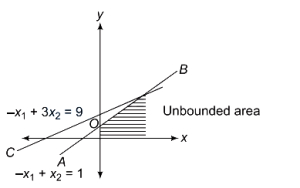
The constraints $-x_{1} + x_{2} \leq 1$,$-x_{1} + 3x_{2} \leq 9$,$x_{1}, x_{2} \geq 0$ define:
A
bounded feasible space
B
unbounded feasible space
C
both bounded and unbounded feasible space
D
None of the above
Solution
(B) To determine the nature of the feasible region,we analyze the given constraints:
$1$) $-x_{1} + x_{2} \leq 1$
$2$) $-x_{1} + 3x_{2} \leq 9$
$3$) $x_{1}, x_{2} \geq 0$
Plotting these lines on the Cartesian plane:
- For $-x_{1} + x_{2} = 1$,the intercepts are $(0, 1)$ and $(-1, 0)$.
- For $-x_{1} + 3x_{2} = 9$,the intercepts are $(0, 3)$ and $(-9, 0)$.
The non-negativity constraints $x_{1}, x_{2} \geq 0$ restrict the region to the first quadrant.
By observing the intersection of the half-planes defined by the inequalities,we find that the region extends infinitely in the direction of increasing $x_{1}$.
Therefore,the feasible region is an unbounded feasible space.
$1$) $-x_{1} + x_{2} \leq 1$
$2$) $-x_{1} + 3x_{2} \leq 9$
$3$) $x_{1}, x_{2} \geq 0$
Plotting these lines on the Cartesian plane:
- For $-x_{1} + x_{2} = 1$,the intercepts are $(0, 1)$ and $(-1, 0)$.
- For $-x_{1} + 3x_{2} = 9$,the intercepts are $(0, 3)$ and $(-9, 0)$.
The non-negativity constraints $x_{1}, x_{2} \geq 0$ restrict the region to the first quadrant.
By observing the intersection of the half-planes defined by the inequalities,we find that the region extends infinitely in the direction of increasing $x_{1}$.
Therefore,the feasible region is an unbounded feasible space.
0 likesView Solution
40
MathematicsMediumMCQMHT CET · 2011
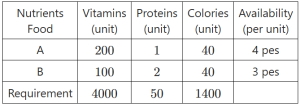
$A$ diet of a sick person must contain at least $4000$ units of vitamins,$50$ units of proteins,and $1400$ calories. Two foods $A$ and $B$ are available at a cost of ₹ $4$ and ₹ $3$ per unit respectively. If one unit of $A$ contains $200$ units of vitamins,$1$ unit of protein,and $40$ calories,while one unit of food $B$ contains $100$ units of vitamins,$2$ units of protein,and $40$ calories,formulate the problem so that the diet is the cheapest.
A
$200x + 100y \geq 4000, x + 2y \geq 50, 40x + 40y \geq 1400, x \geq 0, y \geq 0, \text{Minimize } z = 4x + 3y$
B
$400x + 200y \geq 100, x + 2y \geq 50, 40x + 40y \geq 1400, x \geq 0, y \geq 0, \text{Minimize } z = 4x + 3y$
C
$100x + 200y \geq 4000, x + 2y \geq 50, 40x + 40y \geq 1400, x \geq 0, y \geq 0, \text{Minimize } z = 4x + 3y$
D
None of the above
Solution
(A) Let $x$ and $y$ be the number of units of food $A$ and food $B$ respectively.
The objective is to minimize the cost $z = 4x + 3y$.
Subject to the constraints based on the nutrients:
$1$. Vitamins: $200x + 100y \geq 4000$
$2$. Proteins: $x + 2y \geq 50$
$3$. Calories: $40x + 40y \geq 1400$
$4$. Non-negativity: $x \geq 0, y \geq 0$
Comparing these with the given options,option $A$ matches the formulated constraints and objective function.
The objective is to minimize the cost $z = 4x + 3y$.
Subject to the constraints based on the nutrients:
$1$. Vitamins: $200x + 100y \geq 4000$
$2$. Proteins: $x + 2y \geq 50$
$3$. Calories: $40x + 40y \geq 1400$
$4$. Non-negativity: $x \geq 0, y \geq 0$
Comparing these with the given options,option $A$ matches the formulated constraints and objective function.
0 likesView Solution
41
MathematicsMediumMCQMHT CET · 2011
The value of $(1+\Delta)(1-\nabla)$ is
A
$0$
B
$-1$
C
$1$
D
None of these
Solution
(C) We have,$(1+\Delta)(1-\nabla) f(x)$
$= (1+\Delta) \{ f(x) - \nabla f(x) \}$
$= (1+\Delta) \{ f(x) - (f(x) - f(x-h)) \}$
$= (1+\Delta) f(x-h)$
Since $E = 1 + \Delta$,we have $E f(x-h) = f(x-h+h) = f(x)$.
Thus,$(1+\Delta)(1-\nabla) f(x) = f(x) = 1 \cdot f(x)$.
Therefore,$(1+\Delta)(1-\nabla) = 1$.
$= (1+\Delta) \{ f(x) - \nabla f(x) \}$
$= (1+\Delta) \{ f(x) - (f(x) - f(x-h)) \}$
$= (1+\Delta) f(x-h)$
Since $E = 1 + \Delta$,we have $E f(x-h) = f(x-h+h) = f(x)$.
Thus,$(1+\Delta)(1-\nabla) f(x) = f(x) = 1 \cdot f(x)$.
Therefore,$(1+\Delta)(1-\nabla) = 1$.
0 likesView Solution
42
MathematicsMediumMCQMHT CET · 2011
The multiplicative inverse of $A = \begin{bmatrix} \cos \theta & -\sin \theta \\ \sin \theta & \cos \theta \end{bmatrix}$ is
A
$\begin{bmatrix} -\cos \theta & \sin \theta \\ -\sin \theta & -\cos \theta \end{bmatrix}$
B
$\begin{bmatrix} \cos \theta & \sin \theta \\ -\sin \theta & \cos \theta \end{bmatrix}$
C
$\begin{bmatrix} -\cos \theta & -\sin \theta \\ \sin \theta & -\cos \theta \end{bmatrix}$
D
$\begin{bmatrix} \cos \theta & \sin \theta \\ \sin \theta & -\cos \theta \end{bmatrix}$
Solution
(B) To find the multiplicative inverse $A^{-1}$,we use the formula $A^{-1} = \frac{1}{|A|} \text{adj}(A)$.
First,calculate the determinant $|A|$:
$|A| = (\cos \theta)(\cos \theta) - (-\sin \theta)(\sin \theta) = \cos^2 \theta + \sin^2 \theta = 1$.
Next,find the adjoint of $A$ by swapping the diagonal elements and changing the signs of the off-diagonal elements:
$\text{adj}(A) = \begin{bmatrix} \cos \theta & \sin \theta \\ -\sin \theta & \cos \theta \end{bmatrix}$.
Therefore,$A^{-1} = \frac{1}{1} \begin{bmatrix} \cos \theta & \sin \theta \\ -\sin \theta & \cos \theta \end{bmatrix} = \begin{bmatrix} \cos \theta & \sin \theta \\ -\sin \theta & \cos \theta \end{bmatrix}$.
First,calculate the determinant $|A|$:
$|A| = (\cos \theta)(\cos \theta) - (-\sin \theta)(\sin \theta) = \cos^2 \theta + \sin^2 \theta = 1$.
Next,find the adjoint of $A$ by swapping the diagonal elements and changing the signs of the off-diagonal elements:
$\text{adj}(A) = \begin{bmatrix} \cos \theta & \sin \theta \\ -\sin \theta & \cos \theta \end{bmatrix}$.
Therefore,$A^{-1} = \frac{1}{1} \begin{bmatrix} \cos \theta & \sin \theta \\ -\sin \theta & \cos \theta \end{bmatrix} = \begin{bmatrix} \cos \theta & \sin \theta \\ -\sin \theta & \cos \theta \end{bmatrix}$.
0 likesView Solution
43
MathematicsMediumMCQMHT CET · 2011
If $E_{1}$ denotes the event of getting a sum of $6$ when throwing two dice and $E_{2}$ is the event of getting a $2$ on at least one of the two dice,then $P(E_{2} / E_{1})$ is (in $/ 5$)
A
$1$
B
$4$
C
$3$
D
$2$
Solution
(D) When two dice are thrown,the total number of outcomes is $6 \times 6 = 36$.
The event $E_{1}$ is getting a sum of $6$. The outcomes are $E_{1} = \{(1, 5), (5, 1), (2, 4), (4, 2), (3, 3)\}$.
The number of outcomes in $E_{1}$ is $n(E_{1}) = 5$.
The event $E_{2}$ is getting a $2$ on at least one of the two dice. The outcomes in $E_{1} \cap E_{2}$ are the outcomes in $E_{1}$ that contain at least one $2$.
These are $\{(2, 4), (4, 2)\}$.
So,$n(E_{1} \cap E_{2}) = 2$.
The conditional probability $P(E_{2} / E_{1})$ is given by the formula:
$P(E_{2} / E_{1}) = \frac{n(E_{1} \cap E_{2})}{n(E_{1})} = \frac{2}{5}$.
The event $E_{1}$ is getting a sum of $6$. The outcomes are $E_{1} = \{(1, 5), (5, 1), (2, 4), (4, 2), (3, 3)\}$.
The number of outcomes in $E_{1}$ is $n(E_{1}) = 5$.
The event $E_{2}$ is getting a $2$ on at least one of the two dice. The outcomes in $E_{1} \cap E_{2}$ are the outcomes in $E_{1}$ that contain at least one $2$.
These are $\{(2, 4), (4, 2)\}$.
So,$n(E_{1} \cap E_{2}) = 2$.
The conditional probability $P(E_{2} / E_{1})$ is given by the formula:
$P(E_{2} / E_{1}) = \frac{n(E_{1} \cap E_{2})}{n(E_{1})} = \frac{2}{5}$.
0 likesView Solution
44
MathematicsEasyMCQMHT CET · 2011
If $X$ follows the Binomial distribution with parameters $n=6$ and $p$ and $9 P(X=4) = P(X=2)$,then $p$ is
A
$1/4$
B
$1/3$
C
$1/2$
D
$2/3$
Solution
(A) The probability mass function of a Binomial distribution is given by $P(X=k) = {}^{n}C_{k} p^{k} (1-p)^{n-k}$.
Given $n=6$,we have $P(X=4) = {}^{6}C_{4} p^{4} (1-p)^{2}$ and $P(X=2) = {}^{6}C_{2} p^{2} (1-p)^{4}$.
According to the problem,$9 P(X=4) = P(X=2)$.
Substituting the values,we get $9 \cdot {}^{6}C_{4} p^{4} (1-p)^{2} = {}^{6}C_{2} p^{2} (1-p)^{4}$.
Since ${}^{6}C_{4} = {}^{6}C_{2} = 15$,the equation simplifies to $9 p^{4} (1-p)^{2} = p^{2} (1-p)^{4}$.
Dividing both sides by $p^{2} (1-p)^{2}$ (assuming $p \neq 0, 1$),we get $9 p^{2} = (1-p)^{2}$.
Taking the square root of both sides,$3p = 1-p$ (since $p$ must be positive).
$4p = 1$,which gives $p = 1/4$.
Given $n=6$,we have $P(X=4) = {}^{6}C_{4} p^{4} (1-p)^{2}$ and $P(X=2) = {}^{6}C_{2} p^{2} (1-p)^{4}$.
According to the problem,$9 P(X=4) = P(X=2)$.
Substituting the values,we get $9 \cdot {}^{6}C_{4} p^{4} (1-p)^{2} = {}^{6}C_{2} p^{2} (1-p)^{4}$.
Since ${}^{6}C_{4} = {}^{6}C_{2} = 15$,the equation simplifies to $9 p^{4} (1-p)^{2} = p^{2} (1-p)^{4}$.
Dividing both sides by $p^{2} (1-p)^{2}$ (assuming $p \neq 0, 1$),we get $9 p^{2} = (1-p)^{2}$.
Taking the square root of both sides,$3p = 1-p$ (since $p$ must be positive).
$4p = 1$,which gives $p = 1/4$.
0 likesView Solution
45
MathematicsMediumMCQMHT CET · 2011
The angle between a line with direction ratios $2: 2: 1$ and a line joining the points $(3, 1, 4)$ and $(7, 2, 12)$ is
A
$\cos ^{-1}(2 / 3)$
B
$\cos ^{-1}(3 / 2)$
C
$\tan ^{-1}(-2 / 3)$
D
None of the above
Solution
(A) The direction ratios of the line joining the points $(3, 1, 4)$ and $(7, 2, 12)$ are given by $\langle 7-3, 2-1, 12-4 \rangle = \langle 4, 1, 8 \rangle$. Let these be $\langle a_1, a_2, a_3 \rangle = \langle 4, 1, 8 \rangle$.
The direction ratios of the given line are $\langle b_1, b_2, b_3 \rangle = \langle 2, 2, 1 \rangle$.
Let $\theta$ be the angle between the two lines. The formula for the cosine of the angle is $\cos \theta = \frac{|a_1 b_1 + a_2 b_2 + a_3 b_3|}{\sqrt{a_1^2 + a_2^2 + a_3^2} \sqrt{b_1^2 + b_2^2 + b_3^2}}$.
Substituting the values: $\cos \theta = \frac{|(4)(2) + (1)(2) + (8)(1)|}{\sqrt{4^2 + 1^2 + 8^2} \sqrt{2^2 + 2^2 + 1^2}}$.
$\cos \theta = \frac{|8 + 2 + 8|}{\sqrt{16 + 1 + 64} \sqrt{4 + 4 + 1}} = \frac{18}{\sqrt{81} \sqrt{9}}$.
$\cos \theta = \frac{18}{9 \times 3} = \frac{18}{27} = \frac{2}{3}$.
Therefore,$\theta = \cos ^{-1}\left(\frac{2}{3}\right)$.
The direction ratios of the given line are $\langle b_1, b_2, b_3 \rangle = \langle 2, 2, 1 \rangle$.
Let $\theta$ be the angle between the two lines. The formula for the cosine of the angle is $\cos \theta = \frac{|a_1 b_1 + a_2 b_2 + a_3 b_3|}{\sqrt{a_1^2 + a_2^2 + a_3^2} \sqrt{b_1^2 + b_2^2 + b_3^2}}$.
Substituting the values: $\cos \theta = \frac{|(4)(2) + (1)(2) + (8)(1)|}{\sqrt{4^2 + 1^2 + 8^2} \sqrt{2^2 + 2^2 + 1^2}}$.
$\cos \theta = \frac{|8 + 2 + 8|}{\sqrt{16 + 1 + 64} \sqrt{4 + 4 + 1}} = \frac{18}{\sqrt{81} \sqrt{9}}$.
$\cos \theta = \frac{18}{9 \times 3} = \frac{18}{27} = \frac{2}{3}$.
Therefore,$\theta = \cos ^{-1}\left(\frac{2}{3}\right)$.
0 likesView Solution
46
MathematicsMediumMCQMHT CET · 2011
If $\alpha, \beta$ and $\gamma$ are the angles which a half ray makes with the positive direction of the axes,then $\sin ^{2} \alpha+\sin ^{2} \beta+\sin ^{2} \gamma$ is equal to
A
$1$
B
$2$
C
$0$
D
$-1$
Solution
(B) We know that $\alpha, \beta, \gamma$ are the direction angles of a line,so the direction cosines are $\cos \alpha, \cos \beta, \cos \gamma$.
The sum of the squares of the direction cosines is given by $\cos ^{2} \alpha+\cos ^{2} \beta+\cos ^{2} \gamma = 1$.
We want to evaluate $\sin ^{2} \alpha+\sin ^{2} \beta+\sin ^{2} \gamma$.
Using the identity $\sin ^{2} \theta = 1 - \cos ^{2} \theta$,we have:
$\sin ^{2} \alpha+\sin ^{2} \beta+\sin ^{2} \gamma = (1 - \cos ^{2} \alpha) + (1 - \cos ^{2} \beta) + (1 - \cos ^{2} \gamma)$
$= 3 - (\cos ^{2} \alpha + \cos ^{2} \beta + \cos ^{2} \gamma)$
$= 3 - 1 = 2$.
The sum of the squares of the direction cosines is given by $\cos ^{2} \alpha+\cos ^{2} \beta+\cos ^{2} \gamma = 1$.
We want to evaluate $\sin ^{2} \alpha+\sin ^{2} \beta+\sin ^{2} \gamma$.
Using the identity $\sin ^{2} \theta = 1 - \cos ^{2} \theta$,we have:
$\sin ^{2} \alpha+\sin ^{2} \beta+\sin ^{2} \gamma = (1 - \cos ^{2} \alpha) + (1 - \cos ^{2} \beta) + (1 - \cos ^{2} \gamma)$
$= 3 - (\cos ^{2} \alpha + \cos ^{2} \beta + \cos ^{2} \gamma)$
$= 3 - 1 = 2$.
0 likesView Solution
47
MathematicsDifficultMCQMHT CET · 2011
$A$ plane meets the coordinate axes at points $A, B$,and $C$ such that the centroid of $\Delta ABC$ is $(1, 2, 3)$. The equation of the plane is
A
$x + y/2 + z/3 = 1$
B
$x/3 + y/6 + z/9 = 1$
C
$x + 2y + 3z = 1$
D
None of the above
Solution
(B) Let the plane meet the coordinate axes at $A(a, 0, 0)$,$B(0, b, 0)$,and $C(0, 0, c)$.
The centroid of $\Delta ABC$ is given by the formula $\left(\frac{a+0+0}{3}, \frac{0+b+0}{3}, \frac{0+0+c}{3}\right) = \left(\frac{a}{3}, \frac{b}{3}, \frac{c}{3}\right)$.
Given that the centroid is $(1, 2, 3)$,we have:
$\frac{a}{3} = 1 \Rightarrow a = 3$
$\frac{b}{3} = 2 \Rightarrow b = 6$
$\frac{c}{3} = 3 \Rightarrow c = 9$
The intercept form of the equation of a plane is $\frac{x}{a} + \frac{y}{b} + \frac{z}{c} = 1$.
Substituting the values of $a, b$,and $c$,we get:
$\frac{x}{3} + \frac{y}{6} + \frac{z}{9} = 1$.
The centroid of $\Delta ABC$ is given by the formula $\left(\frac{a+0+0}{3}, \frac{0+b+0}{3}, \frac{0+0+c}{3}\right) = \left(\frac{a}{3}, \frac{b}{3}, \frac{c}{3}\right)$.
Given that the centroid is $(1, 2, 3)$,we have:
$\frac{a}{3} = 1 \Rightarrow a = 3$
$\frac{b}{3} = 2 \Rightarrow b = 6$
$\frac{c}{3} = 3 \Rightarrow c = 9$
The intercept form of the equation of a plane is $\frac{x}{a} + \frac{y}{b} + \frac{z}{c} = 1$.
Substituting the values of $a, b$,and $c$,we get:
$\frac{x}{3} + \frac{y}{6} + \frac{z}{9} = 1$.
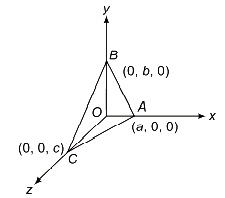
0 likesView Solution
48
MathematicsEasyMCQMHT CET · 2011
$A$ vector $v$ is equally inclined to the $x$-axis,$y$-axis,and $z$-axis respectively. Its direction cosines are:
A
$\langle \frac{1}{\sqrt{3}}, \frac{1}{\sqrt{3}}, \frac{1}{\sqrt{3}} \rangle$
B
$\langle -\frac{1}{\sqrt{3}}, -\frac{1}{\sqrt{3}}, -\frac{1}{\sqrt{3}} \rangle$
C
$\langle \frac{1}{\sqrt{3}}, \frac{1}{\sqrt{3}}, \frac{1}{\sqrt{3}} \rangle$ or $\langle -\frac{1}{\sqrt{3}}, -\frac{1}{\sqrt{3}}, -\frac{1}{\sqrt{3}} \rangle$
D
None of the above
Solution
(C) Let the vector $v$ make an angle $\alpha$ with each of the three axes. Then the direction cosines of $v$ are $\langle \cos \alpha, \cos \alpha, \cos \alpha \rangle$.
We know that for any vector,the sum of the squares of its direction cosines is $1$:
$\cos^2 \alpha + \cos^2 \alpha + \cos^2 \alpha = 1$
$3 \cos^2 \alpha = 1$
$\cos^2 \alpha = \frac{1}{3}$
$\cos \alpha = \pm \frac{1}{\sqrt{3}}$
Therefore,the direction cosines are $\langle \frac{1}{\sqrt{3}}, \frac{1}{\sqrt{3}}, \frac{1}{\sqrt{3}} \rangle$ or $\langle -\frac{1}{\sqrt{3}}, -\frac{1}{\sqrt{3}}, -\frac{1}{\sqrt{3}} \rangle$.
We know that for any vector,the sum of the squares of its direction cosines is $1$:
$\cos^2 \alpha + \cos^2 \alpha + \cos^2 \alpha = 1$
$3 \cos^2 \alpha = 1$
$\cos^2 \alpha = \frac{1}{3}$
$\cos \alpha = \pm \frac{1}{\sqrt{3}}$
Therefore,the direction cosines are $\langle \frac{1}{\sqrt{3}}, \frac{1}{\sqrt{3}}, \frac{1}{\sqrt{3}} \rangle$ or $\langle -\frac{1}{\sqrt{3}}, -\frac{1}{\sqrt{3}}, -\frac{1}{\sqrt{3}} \rangle$.
0 likesView Solution
49
MathematicsEasyMCQMHT CET · 2011
If the vectors $a$,$b$,and $c$ are coplanar,then $\left|\begin{array}{ccc}a & b & c \\ a \cdot a & a \cdot b & a \cdot c \\ b \cdot a & b \cdot b & b \cdot c\end{array}\right|$ is equal to
A
$1$
B
$0$
C
$-1$
D
None of these
Solution
(B) Since the vectors $a$,$b$,and $c$ are coplanar,there must exist scalars $x$,$y$,and $z$ (not all zero) such that $x a + y b + z c = 0$ $(i)$.
Multiplying both sides of equation $(i)$ by $a$ and $b$ respectively,we get:
$x(a \cdot a) + y(a \cdot b) + z(a \cdot c) = 0$ $(ii)$
$x(b \cdot a) + y(b \cdot b) + z(b \cdot c) = 0$ $(iii)$
Considering equations $(i)$,$(ii)$,and $(iii)$ as a system of linear equations in variables $x$,$y$,and $z$,since a non-trivial solution exists,the determinant of the coefficient matrix must be zero.
Therefore,$\left|\begin{array}{ccc} a & b & c \\ a \cdot a & a \cdot b & a \cdot c \\ b \cdot a & b \cdot b & b \cdot c \end{array}\right| = 0$.
Multiplying both sides of equation $(i)$ by $a$ and $b$ respectively,we get:
$x(a \cdot a) + y(a \cdot b) + z(a \cdot c) = 0$ $(ii)$
$x(b \cdot a) + y(b \cdot b) + z(b \cdot c) = 0$ $(iii)$
Considering equations $(i)$,$(ii)$,and $(iii)$ as a system of linear equations in variables $x$,$y$,and $z$,since a non-trivial solution exists,the determinant of the coefficient matrix must be zero.
Therefore,$\left|\begin{array}{ccc} a & b & c \\ a \cdot a & a \cdot b & a \cdot c \\ b \cdot a & b \cdot b & b \cdot c \end{array}\right| = 0$.
0 likesView Solution
50
MathematicsEasyMCQMHT CET · 2011
If $u = a - b$ and $v = a + b$ and $|a| = |b| = 2$,then $|u \times v|$ is equal to
A
$2 \sqrt{16 - (a \cdot b)^{2}}$
B
$\sqrt{16 - (a \cdot b)^{2}}$
C
$2 \sqrt{4 - (a \cdot b)^{2}}$
D
$2 \sqrt{4 + (a \cdot b)^{2}}$
Solution
(A) Given $u = a - b$ and $v = a + b$.
We need to find $|u \times v|$.
$|u \times v| = |(a - b) \times (a + b)|$
$= |a \times a + a \times b - b \times a - b \times b|$
Since $a \times a = 0$ and $b \times b = 0$,and $b \times a = -(a \times b)$,we have:
$|u \times v| = |0 + a \times b + a \times b - 0| = |2(a \times b)| = 2|a \times b|$.
We know that $|a \times b|^{2} + (a \cdot b)^{2} = |a|^{2} |b|^{2}$.
Given $|a| = |b| = 2$,so $|a|^{2} = 4$ and $|b|^{2} = 4$.
$|a \times b|^{2} + (a \cdot b)^{2} = 4 \times 4 = 16$.
$|a \times b| = \sqrt{16 - (a \cdot b)^{2}}$.
Therefore,$|u \times v| = 2 \sqrt{16 - (a \cdot b)^{2}}$.
We need to find $|u \times v|$.
$|u \times v| = |(a - b) \times (a + b)|$
$= |a \times a + a \times b - b \times a - b \times b|$
Since $a \times a = 0$ and $b \times b = 0$,and $b \times a = -(a \times b)$,we have:
$|u \times v| = |0 + a \times b + a \times b - 0| = |2(a \times b)| = 2|a \times b|$.
We know that $|a \times b|^{2} + (a \cdot b)^{2} = |a|^{2} |b|^{2}$.
Given $|a| = |b| = 2$,so $|a|^{2} = 4$ and $|b|^{2} = 4$.
$|a \times b|^{2} + (a \cdot b)^{2} = 4 \times 4 = 16$.
$|a \times b| = \sqrt{16 - (a \cdot b)^{2}}$.
Therefore,$|u \times v| = 2 \sqrt{16 - (a \cdot b)^{2}}$.
0 likesView Solution
Vedclass Products
For Students
Vedclass Test Series
Mock tests in real MHT CET style covering Mathematics with performance analysis. 5-day free trial.
Start Free TrialFor Teachers
Exam Paper Generator
Generate Set A/B/C/D Mathematics papers from 7.5L+ questions in 2 minutes. 3 chapters free.
Try FreeFor Institutes
Online Exam Module
Run live MHT CET mock exams with unlimited students, 360° analytics & white-label branding.
See DemoFrequently Asked Questions
How many Mathematics questions are in MHT CET 2011?
There are 50 Mathematics questions from the MHT CET 2011 paper on Vedclass, each with a detailed step-by-step solution in English.
Are MHT CET 2011 Mathematics solutions available in English?
Yes. All solutions on this page are in English. You can also switch to English or Hindi using the language buttons above the questions.
Can I practice MHT CET 2011 Mathematics as a timed test?
Yes. Use the Vedclass Test Series to attempt a full MHT CET mock test covering Mathematics with time limits and instant score analysis.
Can teachers create Mathematics papers from MHT CET previous year questions?
Yes. The Vedclass Exam Paper Generator lets teachers mix MHT CET Mathematics questions and generate Set A/B/C/D papers in minutes.
For Teachers & Institutes
Build a Custom Mathematics Paper
Pick MHT CET 2011 Mathematics questions, set difficulty, and generate Set A/B/C/D in 2 minutes.