
ChemistryQ1–89 of 89 questions
Page 1 of 1 · English
1
ChemistryMCQMHT CET · 2008
The absorption coefficient of an open window is...
A
Zero
B
$0.5$
C
$1$
D
$0.25$
Solution
(C) An open window acts as a perfectly black body because any radiation entering the window is absorbed by the interior of the room and does not reflect back.
For a perfectly black body,the absorption coefficient $(a)$ is defined as the ratio of the energy absorbed to the total energy incident on the body.
Since a black body absorbs all incident radiation,the absorption coefficient is $a = 1$.
For a perfectly black body,the absorption coefficient $(a)$ is defined as the ratio of the energy absorbed to the total energy incident on the body.
Since a black body absorbs all incident radiation,the absorption coefficient is $a = 1$.
0 likesView Solution
2
ChemistryMCQMHT CET · 2008
Which of the following statements is true/correct?
A
During clear nights,the temperature rises steadily upward near the ground level.
B
Newton's law of cooling,an approximate form of Stefan's law,is valid only for natural convection.
C
The total energy emitted by a black body per unit time per unit area is proportional to the square of its temperature in the Kelvin scale.
D
Two spheres of the same material have radii $1 \ m$ and $4 \ m$ and temperatures $4000 \ K$ and $2000 \ K$ respectively. The energy radiated per second by the first sphere is greater than that radiated per second by the second sphere.
Solution
(B) Option $(a)$ is incorrect because during clear nights,objects on the surface of the Earth radiate heat,causing the temperature near the ground to fall.
Option $(c)$ is incorrect because the total energy radiated by a black body per unit time per unit area is given by Stefan's law,$E \propto T^4$,not $T^2$.
For option $(d)$,the energy radiated per second is given by $P = A \varepsilon \sigma T^4 = 4 \pi r^2 \varepsilon \sigma T^4$.
Calculating the ratio: $\frac{P_1}{P_2} = \left( \frac{r_1}{r_2} \right)^2 \left( \frac{T_1}{T_2} \right)^4 = \left( \frac{1}{4} \right)^2 \left( \frac{4000}{2000} \right)^4 = \frac{1}{16} \times 16 = 1$.
Since $P_1 = P_2$,option $(d)$ is incorrect.
Option $(b)$ is correct because Newton's law of cooling is an approximate form of Stefan's law of radiation and is valid for small temperature differences,typically observed in natural convection.
Option $(c)$ is incorrect because the total energy radiated by a black body per unit time per unit area is given by Stefan's law,$E \propto T^4$,not $T^2$.
For option $(d)$,the energy radiated per second is given by $P = A \varepsilon \sigma T^4 = 4 \pi r^2 \varepsilon \sigma T^4$.
Calculating the ratio: $\frac{P_1}{P_2} = \left( \frac{r_1}{r_2} \right)^2 \left( \frac{T_1}{T_2} \right)^4 = \left( \frac{1}{4} \right)^2 \left( \frac{4000}{2000} \right)^4 = \frac{1}{16} \times 16 = 1$.
Since $P_1 = P_2$,option $(d)$ is incorrect.
Option $(b)$ is correct because Newton's law of cooling is an approximate form of Stefan's law of radiation and is valid for small temperature differences,typically observed in natural convection.
0 likesView Solution
3
ChemistryMCQMHT CET · 2008
$A$ solid reflects incident light and its electrical conductivity decreases with temperature. The binding in this solid is:
A
Ionic
B
Covalent
C
Metallic
D
Molecular
Solution
(C) Metals reflect incident light due to the oscillations of free electrons under the influence of the electric field of the incident light wave.
As the temperature increases,the random motion of free electrons increases,which leads to more frequent collisions with the lattice ions.
This increase in collisions results in an increase in electrical resistance,and consequently,the electrical conductivity of the metal decreases.
Therefore,the bonding in such a solid is metallic.
As the temperature increases,the random motion of free electrons increases,which leads to more frequent collisions with the lattice ions.
This increase in collisions results in an increase in electrical resistance,and consequently,the electrical conductivity of the metal decreases.
Therefore,the bonding in such a solid is metallic.
0 likesView Solution
4
ChemistryDifficultMCQMHT CET · 2008
Which of the following compounds is not chiral?
A
$1-$chloropentane
B
$2-$chloropentane
C
$1-$chloro$-2-$methylpentane
D
$3-$chloro$-2-$methylpentane
Solution
(A) compound is chiral if it contains at least one chiral carbon atom (a carbon atom bonded to four different groups).
$1-$chloropentane: $CH_2(Cl)-CH_2-CH_2-CH_2-CH_3$. The carbon atom bonded to chlorine is attached to two identical hydrogen atoms,so it is achiral.
$2-$chloropentane: $CH_3-CH(Cl)-CH_2-CH_2-CH_3$. The $C-2$ atom is bonded to $-H, -Cl, -CH_3, \text{ and } -CH_2CH_2CH_3$. Since all four groups are different,it is chiral.
$1-$chloro$-2-$methylpentane: $CH_2(Cl)-CH(CH_3)-CH_2-CH_2-CH_3$. The $C-2$ atom is bonded to $-H, -CH_3, -CH_2Cl, \text{ and } -CH_2CH_2CH_3$. Since all four groups are different,it is chiral.
$3-$chloro$-2-$methylpentane: $CH_3-CH(CH_3)-CH(Cl)-CH_2-CH_3$. The $C-3$ atom is bonded to $-H, -Cl, -CH(CH_3)_2, \text{ and } -CH_2CH_3$. Since all four groups are different,it is chiral.
Therefore,$1-$chloropentane is the only achiral compound.
$1-$chloropentane: $CH_2(Cl)-CH_2-CH_2-CH_2-CH_3$. The carbon atom bonded to chlorine is attached to two identical hydrogen atoms,so it is achiral.
$2-$chloropentane: $CH_3-CH(Cl)-CH_2-CH_2-CH_3$. The $C-2$ atom is bonded to $-H, -Cl, -CH_3, \text{ and } -CH_2CH_2CH_3$. Since all four groups are different,it is chiral.
$1-$chloro$-2-$methylpentane: $CH_2(Cl)-CH(CH_3)-CH_2-CH_2-CH_3$. The $C-2$ atom is bonded to $-H, -CH_3, -CH_2Cl, \text{ and } -CH_2CH_2CH_3$. Since all four groups are different,it is chiral.
$3-$chloro$-2-$methylpentane: $CH_3-CH(CH_3)-CH(Cl)-CH_2-CH_3$. The $C-3$ atom is bonded to $-H, -Cl, -CH(CH_3)_2, \text{ and } -CH_2CH_3$. Since all four groups are different,it is chiral.
Therefore,$1-$chloropentane is the only achiral compound.
0 likesView Solution
5
ChemistryMCQMHT CET · 2008
Which of the following concentration factors is affected by a change in temperature?
A
Molarity
B
Molality
C
Mole fraction
D
Weight fraction
Solution
(A) Molarity is defined as the number of moles of solute per liter of solution $(M = \frac{n}{V(L)})$.
Since volume $(V)$ is temperature-dependent,molarity changes with temperature.
Molality,mole fraction,and weight fraction are based on mass,which is independent of temperature.
Since volume $(V)$ is temperature-dependent,molarity changes with temperature.
Molality,mole fraction,and weight fraction are based on mass,which is independent of temperature.
0 likesView Solution
6
ChemistryMCQMHT CET · 2008
Chloramine-$T$ is a
A
Disinfectant
B
Antiseptic
C
Analgesic
D
Antipyretic
Solution
(B) Chloramine-$T$ is an antiseptic.
Antiseptics are chemical substances that either kill or prevent the growth of microorganisms and can be applied to living tissues.
Examples include $0.2$ percent solution of phenol,$KMnO_4$,and Chloramine-$T$.
Antiseptics are chemical substances that either kill or prevent the growth of microorganisms and can be applied to living tissues.
Examples include $0.2$ percent solution of phenol,$KMnO_4$,and Chloramine-$T$.
0 likesView Solution
7
ChemistryMCQMHT CET · 2008
The equation $12x^2 + 7xy + ay^2 + 13x - y + 3 = 0$ represents a pair of perpendicular lines. Then the value of $a$ is
A
$7/2$
B
$-19$
C
$-12$
D
$12$
Solution
(C) The general equation of a pair of straight lines is given by $Ax^2 + 2Hxy + By^2 + 2Gx + 2Fy + C = 0$.
Comparing this with the given equation $12x^2 + 7xy + ay^2 + 13x - y + 3 = 0$,we get $A = 12$ and $B = a$.
For a pair of lines to be perpendicular,the sum of the coefficients of $x^2$ and $y^2$ must be zero,i.e.,$A + B = 0$.
Substituting the values,we get $12 + a = 0$.
Therefore,$a = -12$.
Comparing this with the given equation $12x^2 + 7xy + ay^2 + 13x - y + 3 = 0$,we get $A = 12$ and $B = a$.
For a pair of lines to be perpendicular,the sum of the coefficients of $x^2$ and $y^2$ must be zero,i.e.,$A + B = 0$.
Substituting the values,we get $12 + a = 0$.
Therefore,$a = -12$.
0 likesView Solution
8
ChemistryMCQMHT CET · 2008
If one end of the diameter is $(1, 1)$ and the other end lies on the line $x + y = 3$,then the locus of the centre of the circle is
A
$x + y = 1$
B
$2(x - y) = 5$
C
$2x + 2y = 5$
D
None of these
Solution
(C) Let the one end of the diameter be $A = (1, 1)$.
Since the other end $B$ lies on the line $x + y = 3$,we can represent $B$ as $(t, 3 - t)$.
The centre $(h, k)$ of the circle is the midpoint of the diameter $AB$.
Thus,$h = \frac{1 + t}{2}$ and $k = \frac{1 + (3 - t)}{2} = \frac{4 - t}{2}$.
From these equations,we have $t = 2h - 1$ and $t = 4 - 2k$.
Equating the two expressions for $t$:
$2h - 1 = 4 - 2k$
$2h + 2k = 5$
Replacing $(h, k)$ with $(x, y)$,the locus of the centre is $2x + 2y = 5$.
Since the other end $B$ lies on the line $x + y = 3$,we can represent $B$ as $(t, 3 - t)$.
The centre $(h, k)$ of the circle is the midpoint of the diameter $AB$.
Thus,$h = \frac{1 + t}{2}$ and $k = \frac{1 + (3 - t)}{2} = \frac{4 - t}{2}$.
From these equations,we have $t = 2h - 1$ and $t = 4 - 2k$.
Equating the two expressions for $t$:
$2h - 1 = 4 - 2k$
$2h + 2k = 5$
Replacing $(h, k)$ with $(x, y)$,the locus of the centre is $2x + 2y = 5$.
0 likesView Solution
9
ChemistryMCQMHT CET · 2008
The equations of the tangents to the circle $x^2 + y^2 = 13$ at the points whose abscissa is $2$,are
A
$2x + 3y = 13, 2x - 3y = 13$
B
$3x + 2y = 13, 2x - 3y = 13$
C
$2x + 3y = 13, 3x - 2y = 13$
D
None of these
Solution
(A) Given the circle equation $x^2 + y^2 = 13$.
Let the point on the circle be $(2, y')$.
Substituting $x = 2$ into the circle equation:
$2^2 + (y')^2 = 13$
$4 + (y')^2 = 13$
$(y')^2 = 9$
$y' = \pm 3$.
So,the points are $(2, 3)$ and $(2, -3)$.
The equation of the tangent to the circle $x^2 + y^2 = r^2$ at point $(x_1, y_1)$ is given by $xx_1 + yy_1 = r^2$.
For point $(2, 3)$: $2x + 3y = 13$.
For point $(2, -3)$: $2x - 3y = 13$.
Thus,the equations of the tangents are $2x + 3y = 13$ and $2x - 3y = 13$.
Let the point on the circle be $(2, y')$.
Substituting $x = 2$ into the circle equation:
$2^2 + (y')^2 = 13$
$4 + (y')^2 = 13$
$(y')^2 = 9$
$y' = \pm 3$.
So,the points are $(2, 3)$ and $(2, -3)$.
The equation of the tangent to the circle $x^2 + y^2 = r^2$ at point $(x_1, y_1)$ is given by $xx_1 + yy_1 = r^2$.
For point $(2, 3)$: $2x + 3y = 13$.
For point $(2, -3)$: $2x - 3y = 13$.
Thus,the equations of the tangents are $2x + 3y = 13$ and $2x - 3y = 13$.
0 likesView Solution
10
ChemistryMCQMHT CET · 2008
The focal distance of a point on the parabola $y^2 = 16x$ whose ordinate is twice the abscissa,is
A
$6$
B
$8$
C
$10$
D
$12$
Solution
(B) The equation of the parabola is $y^2 = 16x$. Comparing this with $y^2 = 4ax$,we get $4a = 16$,so $a = 4$.
Let the point on the parabola be $(h, k)$.
Given that the ordinate is twice the abscissa,we have $k = 2h$.
Since the point lies on the parabola,$k^2 = 16h$.
Substituting $k = 2h$ into the equation,we get $(2h)^2 = 16h$,which simplifies to $4h^2 = 16h$.
This gives $4h^2 - 16h = 0$,or $4h(h - 4) = 0$.
Thus,$h = 0$ or $h = 4$.
If $h = 0$,then $k = 0$. The point is $(0, 0)$. The focal distance is $h + a = 0 + 4 = 4$.
If $h = 4$,then $k = 8$. The point is $(4, 8)$. The focal distance is $h + a = 4 + 4 = 8$.
Since $4$ is not among the options,the required focal distance is $8$.
Let the point on the parabola be $(h, k)$.
Given that the ordinate is twice the abscissa,we have $k = 2h$.
Since the point lies on the parabola,$k^2 = 16h$.
Substituting $k = 2h$ into the equation,we get $(2h)^2 = 16h$,which simplifies to $4h^2 = 16h$.
This gives $4h^2 - 16h = 0$,or $4h(h - 4) = 0$.
Thus,$h = 0$ or $h = 4$.
If $h = 0$,then $k = 0$. The point is $(0, 0)$. The focal distance is $h + a = 0 + 4 = 4$.
If $h = 4$,then $k = 8$. The point is $(4, 8)$. The focal distance is $h + a = 4 + 4 = 8$.
Since $4$ is not among the options,the required focal distance is $8$.
0 likesView Solution
11
ChemistryMCQMHT CET · 2008
The equation of the common tangent to the circle $x^2 + y^2 = 2$ and the parabola $y^2 = 8x$ is
A
$y = x + 1$
B
$y = x + 2$
C
$y = x - 2$
D
$y = -x + 2$
Solution
(B) For the parabola $y^2 = 8x$,we have $4a = 8$,so $a = 2$.
Any tangent to the parabola is given by $y = mx + \frac{a}{m}$,which simplifies to $mx - y + \frac{2}{m} = 0$.
If this line is a tangent to the circle $x^2 + y^2 = 2$,the perpendicular distance from the center $(0, 0)$ to the line must equal the radius $r = \sqrt{2}$.
Thus,$\frac{|2/m|}{\sqrt{m^2 + 1}} = \sqrt{2}$.
Squaring both sides,we get $\frac{4}{m^2} = 2(m^2 + 1)$,which leads to $2 = m^2(m^2 + 1)$.
$m^4 + m^2 - 2 = 0$.
Factoring gives $(m^2 + 2)(m^2 - 1) = 0$.
Since $m^2$ must be positive,$m^2 = 1$,so $m = \pm 1$.
Substituting $m = 1$ into the tangent equation,we get $y = x + \frac{2}{1} = x + 2$.
Substituting $m = -1$,we get $y = -x - 2$.
Any tangent to the parabola is given by $y = mx + \frac{a}{m}$,which simplifies to $mx - y + \frac{2}{m} = 0$.
If this line is a tangent to the circle $x^2 + y^2 = 2$,the perpendicular distance from the center $(0, 0)$ to the line must equal the radius $r = \sqrt{2}$.
Thus,$\frac{|2/m|}{\sqrt{m^2 + 1}} = \sqrt{2}$.
Squaring both sides,we get $\frac{4}{m^2} = 2(m^2 + 1)$,which leads to $2 = m^2(m^2 + 1)$.
$m^4 + m^2 - 2 = 0$.
Factoring gives $(m^2 + 2)(m^2 - 1) = 0$.
Since $m^2$ must be positive,$m^2 = 1$,so $m = \pm 1$.
Substituting $m = 1$ into the tangent equation,we get $y = x + \frac{2}{1} = x + 2$.
Substituting $m = -1$,we get $y = -x - 2$.
0 likesView Solution
12
ChemistryMCQMHT CET · 2008
If $|a| = 2$,$|b| = 3$ and $a, b$ are mutually perpendicular,then the area of the triangle whose vertices are $0, a + b, a - b$ is
A
$5$
B
$1$
C
$6$
D
$8$
Solution
(C) Let the vertices of the triangle be $O(0)$,$A(a + b)$,and $B(a - b)$.
The area of the triangle is given by $\frac{1}{2} |\vec{OA} \times \vec{OB}|$.
Substituting the vectors,we get $\text{Area} = \frac{1}{2} |(a + b) \times (a - b)|$.
Expanding the cross product: $(a + b) \times (a - b) = a \times a - a \times b + b \times a - b \times b$.
Since $a \times a = 0$ and $b \times b = 0$,and $b \times a = -(a \times b)$,we have:
$(a + b) \times (a - b) = 0 - (a \times b) - (a \times b) - 0 = -2(a \times b) = 2(b \times a)$.
Thus,$\text{Area} = \frac{1}{2} |2(b \times a)| = |b \times a| = |b| |a| \sin(90^\circ)$.
Given $|a| = 2$ and $|b| = 3$,and the vectors are perpendicular $(\theta = 90^\circ)$:
$\text{Area} = 3 \times 2 \times 1 = 6$.
The area of the triangle is given by $\frac{1}{2} |\vec{OA} \times \vec{OB}|$.
Substituting the vectors,we get $\text{Area} = \frac{1}{2} |(a + b) \times (a - b)|$.
Expanding the cross product: $(a + b) \times (a - b) = a \times a - a \times b + b \times a - b \times b$.
Since $a \times a = 0$ and $b \times b = 0$,and $b \times a = -(a \times b)$,we have:
$(a + b) \times (a - b) = 0 - (a \times b) - (a \times b) - 0 = -2(a \times b) = 2(b \times a)$.
Thus,$\text{Area} = \frac{1}{2} |2(b \times a)| = |b \times a| = |b| |a| \sin(90^\circ)$.
Given $|a| = 2$ and $|b| = 3$,and the vectors are perpendicular $(\theta = 90^\circ)$:
$\text{Area} = 3 \times 2 \times 1 = 6$.
0 likesView Solution
13
ChemistryMCQMHT CET · 2008
The line joining the points $6a - 4b + 4c$ and $-4c$ and the line joining the points $-a - 2b - 3c$ and $a + 2b - 5c$ intersect at:
A
$-4a$
B
$4a - b - c$
C
$4c$
D
None of these
Solution
(D) Let the points be $P_1 = 6a - 4b + 4c$,$P_2 = -4c$,$P_3 = -a - 2b - 3c$,and $P_4 = a + 2b - 5c$.
The equation of the line passing through $P_1$ and $P_2$ is $r = P_1 + m(P_2 - P_1) = 6a - 4b + 4c + m(-6a - 4b - 8c)$ ..... $(i)$.
The equation of the line passing through $P_3$ and $P_4$ is $r = P_3 + n(P_4 - P_3) = -a - 2b - 3c + n(2a + 4b - 2c)$ ..... $(ii)$.
For the point of intersection,the equations $(i)$ and $(ii)$ must yield the same position vector $r$.
Equating the coefficients of $a, b,$ and $c$ from $(i)$ and $(ii)$:
$6 - 6m = -1 + 2n \implies 6m + 2n = 7$
$-4 - 4m = -2 + 4n \implies 4m + 4n = -2 \implies 2m + 2n = -1$
$4 - 8m = -3 - 2c \implies 8m - 2n = 7$
Subtracting the second equation from the first: $(6m + 2n) - (2m + 2n) = 7 - (-1) \implies 4m = 8 \implies m = 2$.
Substituting $m = 2$ into $2m + 2n = -1$: $4 + 2n = -1 \implies 2n = -5 \implies n = -2.5$.
Checking these values in the third equation: $8(2) - 2(-2.5) = 16 + 5 = 21 \neq 7$.
Since the system of equations is inconsistent,the lines do not intersect.
Therefore,the correct option is $(d)$.
The equation of the line passing through $P_1$ and $P_2$ is $r = P_1 + m(P_2 - P_1) = 6a - 4b + 4c + m(-6a - 4b - 8c)$ ..... $(i)$.
The equation of the line passing through $P_3$ and $P_4$ is $r = P_3 + n(P_4 - P_3) = -a - 2b - 3c + n(2a + 4b - 2c)$ ..... $(ii)$.
For the point of intersection,the equations $(i)$ and $(ii)$ must yield the same position vector $r$.
Equating the coefficients of $a, b,$ and $c$ from $(i)$ and $(ii)$:
$6 - 6m = -1 + 2n \implies 6m + 2n = 7$
$-4 - 4m = -2 + 4n \implies 4m + 4n = -2 \implies 2m + 2n = -1$
$4 - 8m = -3 - 2c \implies 8m - 2n = 7$
Subtracting the second equation from the first: $(6m + 2n) - (2m + 2n) = 7 - (-1) \implies 4m = 8 \implies m = 2$.
Substituting $m = 2$ into $2m + 2n = -1$: $4 + 2n = -1 \implies 2n = -5 \implies n = -2.5$.
Checking these values in the third equation: $8(2) - 2(-2.5) = 16 + 5 = 21 \neq 7$.
Since the system of equations is inconsistent,the lines do not intersect.
Therefore,the correct option is $(d)$.
0 likesView Solution
14
ChemistryMCQMHT CET · 2008
The symmetric equation of the line formed by the intersection of the planes $3x + 2y + z - 5 = 0$ and $x + y - 2z - 3 = 0$ is:
A
$\frac{x - 1}{5} = \frac{y - 4}{7} = \frac{z - 0}{1}$
B
$\frac{x + 1}{5} = \frac{y + 4}{7} = \frac{z - 0}{1}$
C
$\frac{x + 1}{-5} = \frac{y - 4}{7} = \frac{z - 0}{1}$
D
$\frac{x - 1}{-5} = \frac{y - 4}{7} = \frac{z - 0}{1}$
Solution
(C) Let $a, b, c$ be the direction ratios of the required line.
Since the line lies in both planes,its direction vector is perpendicular to the normals of both planes,$(3, 2, 1)$ and $(1, 1, -2)$.
Thus,$3a + 2b + c = 0$ and $a + b - 2c = 0$.
Using cross product,$\frac{a}{(-4 - 1)} = \frac{b}{(1 + 6)} = \frac{c}{(3 - 2)}$,which gives $\frac{a}{-5} = \frac{b}{7} = \frac{c}{1}$.
To find a point on the line,set $z = 0$ in the given equations: $3x + 2y = 5$ and $x + y = 3$.
Solving these,we get $x = -1$ and $y = 4$.
Thus,the point is $(-1, 4, 0)$.
The symmetric equation is $\frac{x - (-1)}{-5} = \frac{y - 4}{7} = \frac{z - 0}{1}$,which simplifies to $\frac{x + 1}{-5} = \frac{y - 4}{7} = \frac{z - 0}{1}$.
Since the line lies in both planes,its direction vector is perpendicular to the normals of both planes,$(3, 2, 1)$ and $(1, 1, -2)$.
Thus,$3a + 2b + c = 0$ and $a + b - 2c = 0$.
Using cross product,$\frac{a}{(-4 - 1)} = \frac{b}{(1 + 6)} = \frac{c}{(3 - 2)}$,which gives $\frac{a}{-5} = \frac{b}{7} = \frac{c}{1}$.
To find a point on the line,set $z = 0$ in the given equations: $3x + 2y = 5$ and $x + y = 3$.
Solving these,we get $x = -1$ and $y = 4$.
Thus,the point is $(-1, 4, 0)$.
The symmetric equation is $\frac{x - (-1)}{-5} = \frac{y - 4}{7} = \frac{z - 0}{1}$,which simplifies to $\frac{x + 1}{-5} = \frac{y - 4}{7} = \frac{z - 0}{1}$.
0 likesView Solution
15
ChemistryMCQMHT CET · 2008
The equation of the plane containing the line $\frac{x + 1}{-3} = \frac{y - 3}{2} = \frac{z + 2}{1}$ and the point $(0, 7, -7)$ is
A
$x + y + z = 1$
B
$x + y + z = 2$
C
$x + y + z = 0$
D
None of these
Solution
(C) The equation of a plane passing through the line $\frac{x + 1}{-3} = \frac{y - 3}{2} = \frac{z + 2}{1}$ is given by $a(x + 1) + b(y - 3) + c(z + 2) = 0$,where $-3a + 2b + c = 0$ (since the normal vector is perpendicular to the line direction vector $(-3, 2, 1)$).
Since the plane passes through the point $(0, 7, -7)$,we substitute these coordinates into the plane equation:
$a(0 + 1) + b(7 - 3) + c(-7 + 2) = 0$
$a + 4b - 5c = 0$.
Now we have the system of equations:
$1) -3a + 2b + c = 0$
$2) a + 4b - 5c = 0$
Using cross-multiplication to find the ratios of $a, b, c$:
$\frac{a}{(2)(-5) - (1)(4)} = \frac{b}{(1)(1) - (-3)(-5)} = \frac{c}{(-3)(4) - (2)(1)}$
$\frac{a}{-10 - 4} = \frac{b}{1 - 15} = \frac{c}{-12 - 2}$
$\frac{a}{-14} = \frac{b}{-14} = \frac{c}{-14}$
This simplifies to $a = b = c$. Let $a = b = c = 1$.
The equation of the plane is $1(x + 1) + 1(y - 3) + 1(z + 2) = 0$,which simplifies to $x + y + z = 0$.
Since the plane passes through the point $(0, 7, -7)$,we substitute these coordinates into the plane equation:
$a(0 + 1) + b(7 - 3) + c(-7 + 2) = 0$
$a + 4b - 5c = 0$.
Now we have the system of equations:
$1) -3a + 2b + c = 0$
$2) a + 4b - 5c = 0$
Using cross-multiplication to find the ratios of $a, b, c$:
$\frac{a}{(2)(-5) - (1)(4)} = \frac{b}{(1)(1) - (-3)(-5)} = \frac{c}{(-3)(4) - (2)(1)}$
$\frac{a}{-10 - 4} = \frac{b}{1 - 15} = \frac{c}{-12 - 2}$
$\frac{a}{-14} = \frac{b}{-14} = \frac{c}{-14}$
This simplifies to $a = b = c$. Let $a = b = c = 1$.
The equation of the plane is $1(x + 1) + 1(y - 3) + 1(z + 2) = 0$,which simplifies to $x + y + z = 0$.
0 likesView Solution
16
ChemistryMCQMHT CET · 2008
If $f(x) = \sqrt{\frac{x - \sin x}{x + \cos^2 x}}$,then $\lim_{x \to \infty} f(x)$ is
A
$0$
B
$\infty$
C
$1$
D
None of these
Solution
(C) We are given $f(x) = \sqrt{\frac{x - \sin x}{x + \cos^2 x}}$.
To find $\lim_{x \to \infty} f(x)$,we divide the numerator and denominator inside the square root by $x$:
$\lim_{x \to \infty} \sqrt{\frac{x - \sin x}{x + \cos^2 x}} = \lim_{x \to \infty} \sqrt{\frac{1 - \frac{\sin x}{x}}{1 + \frac{\cos^2 x}{x}}}$
As $x \to \infty$,we know that $\frac{\sin x}{x} \to 0$ and $\frac{\cos^2 x}{x} \to 0$ because $-1 \le \sin x \le 1$ and $0 \le \cos^2 x \le 1$.
Therefore,the limit becomes $\sqrt{\frac{1 - 0}{1 + 0}} = \sqrt{1} = 1$.
To find $\lim_{x \to \infty} f(x)$,we divide the numerator and denominator inside the square root by $x$:
$\lim_{x \to \infty} \sqrt{\frac{x - \sin x}{x + \cos^2 x}} = \lim_{x \to \infty} \sqrt{\frac{1 - \frac{\sin x}{x}}{1 + \frac{\cos^2 x}{x}}}$
As $x \to \infty$,we know that $\frac{\sin x}{x} \to 0$ and $\frac{\cos^2 x}{x} \to 0$ because $-1 \le \sin x \le 1$ and $0 \le \cos^2 x \le 1$.
Therefore,the limit becomes $\sqrt{\frac{1 - 0}{1 + 0}} = \sqrt{1} = 1$.
0 likesView Solution
17
ChemistryMCQMHT CET · 2008
If $f(x) = \begin{cases} x \sin \frac{1}{x}, & x \ne 0 \\ k, & x = 0 \end{cases}$ is continuous at $x = 0$,then the value of $k$ is
A
$1$
B
$-1$
C
$0$
D
$2$
Solution
(C) For the function $f(x)$ to be continuous at $x = 0$,the following condition must be satisfied:
$f(0) = \lim_{x \to 0} f(x)$
Given $f(0) = k$,we need to evaluate the limit:
$\lim_{x \to 0} f(x) = \lim_{x \to 0} \left( x \sin \frac{1}{x} \right)$
We know that for all $x \ne 0$,the sine function is bounded:
$-1 \le \sin \frac{1}{x} \le 1$
Multiplying by $x$ (where $x > 0$):
$-x \le x \sin \frac{1}{x} \le x$
Applying the Squeeze Theorem as $x \to 0$:
$\lim_{x \to 0} (-x) = 0$ and $\lim_{x \to 0} (x) = 0$
Therefore,$\lim_{x \to 0} x \sin \frac{1}{x} = 0$.
Since $f(0) = k$,we have $k = 0$.
$f(0) = \lim_{x \to 0} f(x)$
Given $f(0) = k$,we need to evaluate the limit:
$\lim_{x \to 0} f(x) = \lim_{x \to 0} \left( x \sin \frac{1}{x} \right)$
We know that for all $x \ne 0$,the sine function is bounded:
$-1 \le \sin \frac{1}{x} \le 1$
Multiplying by $x$ (where $x > 0$):
$-x \le x \sin \frac{1}{x} \le x$
Applying the Squeeze Theorem as $x \to 0$:
$\lim_{x \to 0} (-x) = 0$ and $\lim_{x \to 0} (x) = 0$
Therefore,$\lim_{x \to 0} x \sin \frac{1}{x} = 0$.
Since $f(0) = k$,we have $k = 0$.
0 likesView Solution
18
ChemistryMCQMHT CET · 2008
If $x^3 + y^3 - 3axy = 0$,then $\frac{dy}{dx}$ equals
A
$\frac{ay - x^2}{y^2 - ax}$
B
$\frac{ay - x^2}{ay - y^2}$
C
$\frac{x^2 + ay}{y^2 + ax}$
D
$\frac{x^2 + ay}{ax - y^2}$
Solution
(A) Given equation: $x^3 + y^3 - 3axy = 0$
Differentiating both sides with respect to $x$:
$\frac{d}{dx}(x^3) + \frac{d}{dx}(y^3) - 3a \frac{d}{dx}(xy) = 0$
Using the chain rule and product rule:
$3x^2 + 3y^2 \frac{dy}{dx} - 3a \left( x \frac{dy}{dx} + y \right) = 0$
Divide the entire equation by $3$:
$x^2 + y^2 \frac{dy}{dx} - ax \frac{dy}{dx} - ay = 0$
Group the terms containing $\frac{dy}{dx}$:
$\frac{dy}{dx}(y^2 - ax) = ay - x^2$
Therefore,$\frac{dy}{dx} = \frac{ay - x^2}{y^2 - ax}$.
Differentiating both sides with respect to $x$:
$\frac{d}{dx}(x^3) + \frac{d}{dx}(y^3) - 3a \frac{d}{dx}(xy) = 0$
Using the chain rule and product rule:
$3x^2 + 3y^2 \frac{dy}{dx} - 3a \left( x \frac{dy}{dx} + y \right) = 0$
Divide the entire equation by $3$:
$x^2 + y^2 \frac{dy}{dx} - ax \frac{dy}{dx} - ay = 0$
Group the terms containing $\frac{dy}{dx}$:
$\frac{dy}{dx}(y^2 - ax) = ay - x^2$
Therefore,$\frac{dy}{dx} = \frac{ay - x^2}{y^2 - ax}$.
0 likesView Solution
19
ChemistryMCQMHT CET · 2008
The velocity of a particle at time $t$ is given by the relation $v = 6t - \frac{t^2}{6}$. The distance traveled in $3$ seconds is,if $s = 0$ at $t = 0$.
A
$\frac{39}{2}$
B
$\frac{57}{2}$
C
$\frac{51}{2}$
D
$\frac{33}{2}$
Solution
(C) Given the velocity $v = \frac{ds}{dt} = 6t - \frac{t^2}{6}$.
To find the distance $s$,we integrate the velocity with respect to time $t$:
$s = \int (6t - \frac{t^2}{6}) dt = 3t^2 - \frac{t^3}{18} + C$.
Given that $s = 0$ at $t = 0$,we substitute these values to find the constant $C$:
$0 = 3(0)^2 - \frac{0^3}{18} + C \implies C = 0$.
Thus,the expression for distance is $s = 3t^2 - \frac{t^3}{18}$.
To find the distance traveled in $3$ seconds,we substitute $t = 3$:
$s = 3(3)^2 - \frac{3^3}{18} = 3(9) - \frac{27}{18} = 27 - \frac{3}{2} = \frac{54 - 3}{2} = \frac{51}{2}$.
To find the distance $s$,we integrate the velocity with respect to time $t$:
$s = \int (6t - \frac{t^2}{6}) dt = 3t^2 - \frac{t^3}{18} + C$.
Given that $s = 0$ at $t = 0$,we substitute these values to find the constant $C$:
$0 = 3(0)^2 - \frac{0^3}{18} + C \implies C = 0$.
Thus,the expression for distance is $s = 3t^2 - \frac{t^3}{18}$.
To find the distance traveled in $3$ seconds,we substitute $t = 3$:
$s = 3(3)^2 - \frac{3^3}{18} = 3(9) - \frac{27}{18} = 27 - \frac{3}{2} = \frac{54 - 3}{2} = \frac{51}{2}$.
0 likesView Solution
20
ChemistryMCQMHT CET · 2008
The maximum value of the function $f(x) = x^3 - 12x^2 + 36x + 17$ in the interval $[1, 10]$ is:
A
$17$
B
$177$
C
$77$
D
None of these
Solution
(B) Let $f(x) = x^3 - 12x^2 + 36x + 17$.
To find the critical points,we calculate the derivative $f'(x)$:
$f'(x) = 3x^2 - 24x + 36$.
Setting $f'(x) = 0$:
$3(x^2 - 8x + 12) = 0$
$3(x - 2)(x - 6) = 0$
So,the critical points are $x = 2$ and $x = 6$.
Now,we evaluate the function $f(x)$ at the critical points and the endpoints of the interval $[1, 10]$:
$f(1) = (1)^3 - 12(1)^2 + 36(1) + 17 = 1 - 12 + 36 + 17 = 42$.
$f(2) = (2)^3 - 12(2)^2 + 36(2) + 17 = 8 - 48 + 72 + 17 = 49$.
$f(6) = (6)^3 - 12(6)^2 + 36(6) + 17 = 216 - 432 + 216 + 17 = 17$.
$f(10) = (10)^3 - 12(10)^2 + 36(10) + 17 = 1000 - 1200 + 360 + 17 = 177$.
Comparing these values,the maximum value is $177$ at $x = 10$.
To find the critical points,we calculate the derivative $f'(x)$:
$f'(x) = 3x^2 - 24x + 36$.
Setting $f'(x) = 0$:
$3(x^2 - 8x + 12) = 0$
$3(x - 2)(x - 6) = 0$
So,the critical points are $x = 2$ and $x = 6$.
Now,we evaluate the function $f(x)$ at the critical points and the endpoints of the interval $[1, 10]$:
$f(1) = (1)^3 - 12(1)^2 + 36(1) + 17 = 1 - 12 + 36 + 17 = 42$.
$f(2) = (2)^3 - 12(2)^2 + 36(2) + 17 = 8 - 48 + 72 + 17 = 49$.
$f(6) = (6)^3 - 12(6)^2 + 36(6) + 17 = 216 - 432 + 216 + 17 = 17$.
$f(10) = (10)^3 - 12(10)^2 + 36(10) + 17 = 1000 - 1200 + 360 + 17 = 177$.
Comparing these values,the maximum value is $177$ at $x = 10$.
0 likesView Solution
21
ChemistryMCQMHT CET · 2008
The order and degree of the differential equation $\sqrt{\frac{dy}{dx}} - 4\frac{dy}{dx} - 7x = 0$ are
A
$1$ and $1/2$
B
$2$ and $1$
C
$1$ and $1$
D
$1$ and $2$
Solution
(D) Given differential equation is $\sqrt{\frac{dy}{dx}} - 4\frac{dy}{dx} - 7x = 0$.
Rearranging the terms,we get $\sqrt{\frac{dy}{dx}} = 4\frac{dy}{dx} + 7x$.
Squaring both sides to remove the radical,we obtain $\frac{dy}{dx} = (4\frac{dy}{dx} + 7x)^2$.
Expanding the right side,we get $\frac{dy}{dx} = 16(\frac{dy}{dx})^2 + 49x^2 + 56x\frac{dy}{dx}$.
The highest derivative present is $\frac{dy}{dx}$,so the order is $1$.
The highest power of the highest derivative after making the equation a polynomial in derivatives is $2$,so the degree is $2$.
Thus,the order is $1$ and the degree is $2$.
Rearranging the terms,we get $\sqrt{\frac{dy}{dx}} = 4\frac{dy}{dx} + 7x$.
Squaring both sides to remove the radical,we obtain $\frac{dy}{dx} = (4\frac{dy}{dx} + 7x)^2$.
Expanding the right side,we get $\frac{dy}{dx} = 16(\frac{dy}{dx})^2 + 49x^2 + 56x\frac{dy}{dx}$.
The highest derivative present is $\frac{dy}{dx}$,so the order is $1$.
The highest power of the highest derivative after making the equation a polynomial in derivatives is $2$,so the degree is $2$.
Thus,the order is $1$ and the degree is $2$.
0 likesView Solution
22
ChemistryMCQMHT CET · 2008
The solution of the differential equation $\frac{dy}{dx} = \frac{x - y + 3}{2(x - y) + 5}$ is
A
$2(x - y) + \log(x - y) = x + c$
B
$2(x - y) - \log(x - y + 2) = x + c$
C
$2(x - y) + \log(x - y + 2) = x + c$
D
None of these
Solution
(C) Let $x - y = v$. Then,differentiating with respect to $x$,we get $1 - \frac{dy}{dx} = \frac{dv}{dx}$,which implies $\frac{dy}{dx} = 1 - \frac{dv}{dx}$.
Substituting this into the given differential equation: $1 - \frac{dv}{dx} = \frac{v + 3}{2v + 5}$.
Rearranging the terms: $\frac{dv}{dx} = 1 - \frac{v + 3}{2v + 5} = \frac{2v + 5 - v - 3}{2v + 5} = \frac{v + 2}{2v + 5}$.
Separating the variables: $\int \frac{2v + 5}{v + 2} dv = \int dx$.
Simplifying the integrand: $\int \left( 2 + \frac{1}{v + 2} \right) dv = \int dx$.
Integrating both sides: $2v + \log|v + 2| = x + c$.
Substituting $v = x - y$ back into the equation: $2(x - y) + \log|x - y + 2| = x + c$.
Substituting this into the given differential equation: $1 - \frac{dv}{dx} = \frac{v + 3}{2v + 5}$.
Rearranging the terms: $\frac{dv}{dx} = 1 - \frac{v + 3}{2v + 5} = \frac{2v + 5 - v - 3}{2v + 5} = \frac{v + 2}{2v + 5}$.
Separating the variables: $\int \frac{2v + 5}{v + 2} dv = \int dx$.
Simplifying the integrand: $\int \left( 2 + \frac{1}{v + 2} \right) dv = \int dx$.
Integrating both sides: $2v + \log|v + 2| = x + c$.
Substituting $v = x - y$ back into the equation: $2(x - y) + \log|x - y + 2| = x + c$.
0 likesView Solution
23
ChemistryMCQMHT CET · 2008
The solution of the differential equation $(3xy + y^2)dx + (x^2 + xy)dy = 0$ is
A
$x^2(2xy + y^2) = c^2$
B
$x^2(2xy - y^2) = c^2$
C
$x^2(y^2 - 2xy) = c^2$
D
None of these
Solution
(A) The given differential equation is $(3xy + y^2)dx + (x^2 + xy)dy = 0$.
This can be written as $\frac{dy}{dx} = - \frac{3xy + y^2}{x^2 + xy}$.
This is a homogeneous differential equation. Let $y = vx$,then $\frac{dy}{dx} = v + x\frac{dv}{dx}$.
Substituting these into the equation: $v + x\frac{dv}{dx} = - \frac{3x^2v + x^2v^2}{x^2 + x^2v} = - \frac{v^2 + 3v}{v + 1}$.
$x\frac{dv}{dx} = - \frac{v^2 + 3v}{v + 1} - v = - \frac{v^2 + 3v + v^2 + v}{v + 1} = - \frac{2v^2 + 4v}{v + 1} = - \frac{2v(v + 2)}{v + 1}$.
Separating the variables: $\frac{v + 1}{v(v + 2)} dv = - \frac{2}{x} dx$.
Using partial fractions: $\frac{v + 1}{v(v + 2)} = \frac{A}{v} + \frac{B}{v + 2} \implies v + 1 = A(v + 2) + Bv$.
For $v = 0$,$A = 1/2$. For $v = -2$,$B = 1/2$.
So,$\int (\frac{1}{2v} + \frac{1}{2(v + 2)}) dv = - \int \frac{2}{x} dx$.
$\frac{1}{2} \ln|v| + \frac{1}{2} \ln|v + 2| = - 2 \ln|x| + C$.
$\ln|v(v + 2)| = - 4 \ln|x| + C' \implies \ln|v(v + 2)x^4| = C'$.
$v(v + 2)x^4 = c^2$. Substituting $v = y/x$: $\frac{y}{x}(\frac{y}{x} + 2)x^4 = c^2$.
$x^2(y^2 + 2xy) = c^2$.
This can be written as $\frac{dy}{dx} = - \frac{3xy + y^2}{x^2 + xy}$.
This is a homogeneous differential equation. Let $y = vx$,then $\frac{dy}{dx} = v + x\frac{dv}{dx}$.
Substituting these into the equation: $v + x\frac{dv}{dx} = - \frac{3x^2v + x^2v^2}{x^2 + x^2v} = - \frac{v^2 + 3v}{v + 1}$.
$x\frac{dv}{dx} = - \frac{v^2 + 3v}{v + 1} - v = - \frac{v^2 + 3v + v^2 + v}{v + 1} = - \frac{2v^2 + 4v}{v + 1} = - \frac{2v(v + 2)}{v + 1}$.
Separating the variables: $\frac{v + 1}{v(v + 2)} dv = - \frac{2}{x} dx$.
Using partial fractions: $\frac{v + 1}{v(v + 2)} = \frac{A}{v} + \frac{B}{v + 2} \implies v + 1 = A(v + 2) + Bv$.
For $v = 0$,$A = 1/2$. For $v = -2$,$B = 1/2$.
So,$\int (\frac{1}{2v} + \frac{1}{2(v + 2)}) dv = - \int \frac{2}{x} dx$.
$\frac{1}{2} \ln|v| + \frac{1}{2} \ln|v + 2| = - 2 \ln|x| + C$.
$\ln|v(v + 2)| = - 4 \ln|x| + C' \implies \ln|v(v + 2)x^4| = C'$.
$v(v + 2)x^4 = c^2$. Substituting $v = y/x$: $\frac{y}{x}(\frac{y}{x} + 2)x^4 = c^2$.
$x^2(y^2 + 2xy) = c^2$.
0 likesView Solution
24
ChemistryMCQMHT CET · 2008
The negation of the conditional statement: "If it rains,$I$ shall go to school" is
A
It rains and $I$ shall go to school
B
It rains and $I$ shall not go to school
C
It does not rain and $I$ shall go to school
D
None of these
Solution
(B) Let $p$ be the statement: "It rains".
Let $q$ be the statement: "$I$ shall go to school".
The given conditional statement is $p \Rightarrow q$.
The negation of a conditional statement $p \Rightarrow q$ is given by $\sim (p \Rightarrow q) \equiv p \wedge \sim q$.
Here,$p$ is "It rains" and $\sim q$ is "$I$ shall not go to school".
Therefore,the negation is "It rains and $I$ shall not go to school".
Let $q$ be the statement: "$I$ shall go to school".
The given conditional statement is $p \Rightarrow q$.
The negation of a conditional statement $p \Rightarrow q$ is given by $\sim (p \Rightarrow q) \equiv p \wedge \sim q$.
Here,$p$ is "It rains" and $\sim q$ is "$I$ shall not go to school".
Therefore,the negation is "It rains and $I$ shall not go to school".
0 likesView Solution
25
ChemistryMCQMHT CET · 2008
When a ceiling fan is switched off,its angular velocity falls to half while it makes $36$ rotations. How many more rotations will it make before coming to rest? (Assume uniform angular retardation)
A
$36$
B
$24$
C
$18$
D
$12$
Solution
(D) Let the initial angular velocity be $\omega_0$ and the final angular velocity be $\omega = \frac{\omega_0}{2}$. The angular displacement for $36$ rotations is $\theta_1 = 36 \times 2\pi = 72\pi \text{ rad}$.
Using the equation of motion $\omega^2 = \omega_0^2 + 2\alpha\theta$:
$(\frac{\omega_0}{2})^2 = \omega_0^2 + 2\alpha(72\pi)$
$\frac{\omega_0^2}{4} - \omega_0^2 = 144\pi\alpha$
$-\frac{3\omega_0^2}{4} = 144\pi\alpha \implies \alpha = -\frac{3\omega_0^2}{576\pi} = -\frac{\omega_0^2}{192\pi}$.
Now,for the second part,the fan starts with $\omega_i = \frac{\omega_0}{2}$ and comes to rest $(\omega_f = 0)$:
$0^2 = (\frac{\omega_0}{2})^2 + 2\alpha\theta_2$
$0 = \frac{\omega_0^2}{4} + 2(-\frac{\omega_0^2}{192\pi})\theta_2$
$\frac{\omega_0^2}{4} = \frac{\omega_0^2}{96\pi}\theta_2$
$\theta_2 = \frac{96\pi}{4} = 24\pi \text{ rad}$.
Number of rotations = $\frac{\theta_2}{2\pi} = \frac{24\pi}{2\pi} = 12$ rotations.
Using the equation of motion $\omega^2 = \omega_0^2 + 2\alpha\theta$:
$(\frac{\omega_0}{2})^2 = \omega_0^2 + 2\alpha(72\pi)$
$\frac{\omega_0^2}{4} - \omega_0^2 = 144\pi\alpha$
$-\frac{3\omega_0^2}{4} = 144\pi\alpha \implies \alpha = -\frac{3\omega_0^2}{576\pi} = -\frac{\omega_0^2}{192\pi}$.
Now,for the second part,the fan starts with $\omega_i = \frac{\omega_0}{2}$ and comes to rest $(\omega_f = 0)$:
$0^2 = (\frac{\omega_0}{2})^2 + 2\alpha\theta_2$
$0 = \frac{\omega_0^2}{4} + 2(-\frac{\omega_0^2}{192\pi})\theta_2$
$\frac{\omega_0^2}{4} = \frac{\omega_0^2}{96\pi}\theta_2$
$\theta_2 = \frac{96\pi}{4} = 24\pi \text{ rad}$.
Number of rotations = $\frac{\theta_2}{2\pi} = \frac{24\pi}{2\pi} = 12$ rotations.
0 likesView Solution
26
ChemistryMCQMHT CET · 2008
Which of the following compounds is not chiral?
A
$1-$chloro$-2-$methylpentane
B
$2-$chloropentane
C
$1-$chloropentane
D
$3-$chloro$-2-$methylpentane
Solution
(C) chiral compound is one that contains at least one chiral carbon atom (a carbon atom bonded to four different groups).
$1-$chloropentane is $CH_3-CH_2-CH_2-CH_2-CH_2Cl$. Here,the carbon atom attached to the chlorine atom is bonded to two hydrogen atoms,which are identical. Therefore,it is achiral.
$1-$chloro$-2-$methylpentane has a chiral center at $C-2$.
$2-$chloropentane has a chiral center at $C-2$.
$3-$chloro$-2-$methylpentane has a chiral center at $C-3$.
$1-$chloropentane is $CH_3-CH_2-CH_2-CH_2-CH_2Cl$. Here,the carbon atom attached to the chlorine atom is bonded to two hydrogen atoms,which are identical. Therefore,it is achiral.
$1-$chloro$-2-$methylpentane has a chiral center at $C-2$.
$2-$chloropentane has a chiral center at $C-2$.
$3-$chloro$-2-$methylpentane has a chiral center at $C-3$.
0 likesView Solution
27
ChemistryMCQMHT CET · 2008
Which of the following compounds is not chiral?
A
$1$-chloropentane
B
$2$-chloropentane
C
$1$-chloro-$2$-methylpentane
D
$3$-chloro-$2$-methylpentane
Solution
(A) compound is chiral if it contains at least one chiral carbon atom (a carbon atom bonded to four different groups).
$1$. $1$-chloropentane: $CH_3-CH_2-CH_2-CH_2-CH_2Cl$. The $C_1$ atom is bonded to two hydrogen atoms,so it is achiral.
$2$. $2$-chloropentane: $CH_3-CH(Cl)-CH_2-CH_2-CH_3$. The $C_2$ atom is bonded to $-H, -Cl, -CH_3, -CH_2CH_2CH_3$. It is chiral.
$3$. $1$-chloro-$2$-methylpentane: $CH_2(Cl)-CH(CH_3)-CH_2-CH_2-CH_3$. The $C_2$ atom is bonded to $-H, -CH_3, -CH_2Cl, -CH_2CH_2CH_3$. It is chiral.
$4$. $3$-chloro-$2$-methylpentane: $CH_3-CH(CH_3)-CH(Cl)-CH_2-CH_3$. The $C_3$ atom is bonded to $-H, -Cl, -CH_2CH_3, -CH(CH_3)_2$. It is chiral.
Therefore,$1$-chloropentane is the only achiral compound.
$1$. $1$-chloropentane: $CH_3-CH_2-CH_2-CH_2-CH_2Cl$. The $C_1$ atom is bonded to two hydrogen atoms,so it is achiral.
$2$. $2$-chloropentane: $CH_3-CH(Cl)-CH_2-CH_2-CH_3$. The $C_2$ atom is bonded to $-H, -Cl, -CH_3, -CH_2CH_2CH_3$. It is chiral.
$3$. $1$-chloro-$2$-methylpentane: $CH_2(Cl)-CH(CH_3)-CH_2-CH_2-CH_3$. The $C_2$ atom is bonded to $-H, -CH_3, -CH_2Cl, -CH_2CH_2CH_3$. It is chiral.
$4$. $3$-chloro-$2$-methylpentane: $CH_3-CH(CH_3)-CH(Cl)-CH_2-CH_3$. The $C_3$ atom is bonded to $-H, -Cl, -CH_2CH_3, -CH(CH_3)_2$. It is chiral.
Therefore,$1$-chloropentane is the only achiral compound.
0 likesView Solution
28
ChemistryMCQMHT CET · 2008
Which of the following compounds is not chiral?
A
$1-$Chloropentane
B
$2-$Chloropentane
C
$1-$Chloro$-2-$methylpentane
D
$3-$Chloro$-2-$methylpentane
Solution
(A) molecule is chiral if it contains at least one chiral carbon atom (a carbon atom bonded to four different groups).
$1-$Chloropentane $(CH_3-CH_2-CH_2-CH_2-CH_2Cl)$: The carbon atom attached to the chlorine is bonded to two hydrogen atoms. Since it is not bonded to four different groups,it is achiral.
$2-$Chloropentane $(CH_3-CHCl-CH_2-CH_2-CH_3)$: The $C-2$ atom is bonded to $-H, -Cl, -CH_3,$ and $-CH_2CH_2CH_3$. It is chiral.
$1-$Chloro$-2-$methylpentane $(CH_3-CH_2-CH_2-CH(CH_3)-CH_2Cl)$: The $C-2$ atom is bonded to $-H, -CH_3, -CH_2CH_2CH_3,$ and $-CH_2Cl$. It is chiral.
$3-$Chloro$-2-$methylpentane $(CH_3-CH(CH_3)-CHCl-CH_2-CH_3)$: The $C-3$ atom is bonded to $-H, -Cl, -CH_2CH_3,$ and $-CH(CH_3)_2$. It is chiral.
Therefore,$1-$chloropentane is not chiral.
$1-$Chloropentane $(CH_3-CH_2-CH_2-CH_2-CH_2Cl)$: The carbon atom attached to the chlorine is bonded to two hydrogen atoms. Since it is not bonded to four different groups,it is achiral.
$2-$Chloropentane $(CH_3-CHCl-CH_2-CH_2-CH_3)$: The $C-2$ atom is bonded to $-H, -Cl, -CH_3,$ and $-CH_2CH_2CH_3$. It is chiral.
$1-$Chloro$-2-$methylpentane $(CH_3-CH_2-CH_2-CH(CH_3)-CH_2Cl)$: The $C-2$ atom is bonded to $-H, -CH_3, -CH_2CH_2CH_3,$ and $-CH_2Cl$. It is chiral.
$3-$Chloro$-2-$methylpentane $(CH_3-CH(CH_3)-CHCl-CH_2-CH_3)$: The $C-3$ atom is bonded to $-H, -Cl, -CH_2CH_3,$ and $-CH(CH_3)_2$. It is chiral.
Therefore,$1-$chloropentane is not chiral.
0 likesView Solution
29
ChemistryMCQMHT CET · 2008
The potential energy of a molecule on the surface of a liquid compared to one inside the liquid is
A
zero
B
lesser
C
equal
D
greater
Solution
(D) When the surface area of a liquid is increased,molecules from the interior of the liquid rise to the surface.
As these molecules reach the surface,work is done against the cohesive force.
This work is stored in the molecules in the form of potential energy.
Thus,the potential energy of the molecules lying on the surface is greater than that of the molecules in the interior of the liquid.
As these molecules reach the surface,work is done against the cohesive force.
This work is stored in the molecules in the form of potential energy.
Thus,the potential energy of the molecules lying on the surface is greater than that of the molecules in the interior of the liquid.
0 likesView Solution
30
ChemistryMCQMHT CET · 2008
$A$ $p-n$ photodiode is made of a material with a band gap of $2.0\, eV$. The minimum frequency of the radiation that can be absorbed by the material is nearly
A
$1 \times 10^{14}\,Hz$
B
$20 \times 10^{14}\,Hz$
C
$10 \times 10^{14}\,Hz$
D
$5 \times 10^{14}\,Hz$
Solution
(D) The energy of the incident photon must be at least equal to the band gap energy $(E_g)$ for the material to absorb it.
Given $E_g = 2.0\, eV$.
The relationship between energy and frequency is given by $E = h\nu$,where $h$ is Planck's constant $(6.63 \times 10^{-34}\, J\cdot s)$ and $\nu$ is the frequency.
First,convert the energy from $eV$ to Joules:
$E = 2.0 \times 1.6 \times 10^{-19}\, J = 3.2 \times 10^{-19}\, J$.
Now,calculate the minimum frequency $\nu$:
$\nu = \frac{E}{h} = \frac{3.2 \times 10^{-19}}{6.63 \times 10^{-34}} \approx 0.4826 \times 10^{15}\, Hz$.
$\nu \approx 4.83 \times 10^{14}\, Hz$.
Rounding to the nearest given option,we get $\nu \approx 5 \times 10^{14}\, Hz$.
Given $E_g = 2.0\, eV$.
The relationship between energy and frequency is given by $E = h\nu$,where $h$ is Planck's constant $(6.63 \times 10^{-34}\, J\cdot s)$ and $\nu$ is the frequency.
First,convert the energy from $eV$ to Joules:
$E = 2.0 \times 1.6 \times 10^{-19}\, J = 3.2 \times 10^{-19}\, J$.
Now,calculate the minimum frequency $\nu$:
$\nu = \frac{E}{h} = \frac{3.2 \times 10^{-19}}{6.63 \times 10^{-34}} \approx 0.4826 \times 10^{15}\, Hz$.
$\nu \approx 4.83 \times 10^{14}\, Hz$.
Rounding to the nearest given option,we get $\nu \approx 5 \times 10^{14}\, Hz$.
0 likesView Solution
31
ChemistryEasyMCQMHT CET · 2008
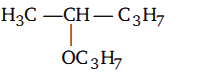
The $IUPAC$ name of the given compound is:
A
$4-$propoxy pentane
B
pentyl-propyl ether
C
$2-$propoxy pentane
D
$2-$pentoxy propane
Solution
(C) $1$. Identify the longest carbon chain containing the ether functional group. The structure is $CH_3-CH(OC_3H_7)-C_3H_7$.
$2$. The longest chain has $5$ carbon atoms,which is a pentane chain.
$3$. The alkoxy group $-OC_3H_7$ (propoxy group) is attached to the second carbon atom of the pentane chain.
$4$. Numbering the chain from the end closer to the substituent gives the position $2$ for the propoxy group.
$5$. Therefore,the $IUPAC$ name is $2-$propoxy pentane.
$2$. The longest chain has $5$ carbon atoms,which is a pentane chain.
$3$. The alkoxy group $-OC_3H_7$ (propoxy group) is attached to the second carbon atom of the pentane chain.
$4$. Numbering the chain from the end closer to the substituent gives the position $2$ for the propoxy group.
$5$. Therefore,the $IUPAC$ name is $2-$propoxy pentane.
0 likesView Solution
32
ChemistryMCQMHT CET · 2008
Which of the following compounds is not chiral?
A
$1-$chloro$-2-$methylpentane
B
$2-$chloropentane
C
$1-$chloropentane
D
$3-$chloro$-2-$methylpentane
Solution
(C) molecule is chiral if it contains at least one chiral center (an asymmetric carbon atom bonded to four different groups).
$1-$chloropentane $(CH_3-CH_2-CH_2-CH_2-CH_2Cl)$ has no chiral carbon atom because the $C_1$ carbon is bonded to two identical hydrogen atoms.
$2-$chloropentane,$1-$chloro$-2-$methylpentane,and $3-$chloro$-2-$methylpentane all contain at least one chiral carbon atom.
Therefore,$1-$chloropentane is not chiral.
$1-$chloropentane $(CH_3-CH_2-CH_2-CH_2-CH_2Cl)$ has no chiral carbon atom because the $C_1$ carbon is bonded to two identical hydrogen atoms.
$2-$chloropentane,$1-$chloro$-2-$methylpentane,and $3-$chloro$-2-$methylpentane all contain at least one chiral carbon atom.
Therefore,$1-$chloropentane is not chiral.
0 likesView Solution
33
ChemistryMediumMCQMHT CET · 2008
Which one of the following compounds will react with methyl magnesium iodide?
A
$CH_3-CH_2-CH_2-CH_2-CH_3$
B
$CH_3-CH=CH-CH=CH_2$
C
$CH_3-C \equiv C-CH_2CH_3$
D
$CH_3CH_2CH_2C \equiv CH$
Solution
(D) Grignard reagents like methyl magnesium iodide $(CH_3MgI)$ act as strong bases and react with compounds containing acidic hydrogen atoms.
Terminal alkynes,which have a hydrogen atom attached to a triply bonded carbon atom $(R-C \equiv C-H)$,possess acidic hydrogen.
Among the given options,$CH_3CH_2CH_2C \equiv CH$ is a terminal alkyne.
The reaction is:
$CH_3CH_2CH_2C \equiv CH + CH_3MgI \rightarrow CH_3CH_2CH_2C \equiv CMgI + CH_4 \uparrow$
Therefore,option $(D)$ is correct.
Terminal alkynes,which have a hydrogen atom attached to a triply bonded carbon atom $(R-C \equiv C-H)$,possess acidic hydrogen.
Among the given options,$CH_3CH_2CH_2C \equiv CH$ is a terminal alkyne.
The reaction is:
$CH_3CH_2CH_2C \equiv CH + CH_3MgI \rightarrow CH_3CH_2CH_2C \equiv CMgI + CH_4 \uparrow$
Therefore,option $(D)$ is correct.
0 likesView Solution
34
ChemistryDifficultMCQMHT CET · 2008
Which one of the following species acts as both Bronsted acid and base?
A
$H_2PO_2^-$
B
$HPO_3^{2-}$
C
$HPO_4^{2-}$
D
All of these
Solution
(C) species that acts as both a Bronsted acid and a base is called an amphoteric species. It must be able to donate a proton $(H^+)$ and accept a proton $(H^+)$.
$HPO_4^{2-}$ can accept a proton to form $H_2PO_4^-$ (acting as a base) and donate a proton to form $PO_4^{3-}$ (acting as an acid).
$HPO_4^{2-} + H_2O \rightleftharpoons H_2PO_4^- + OH^-$
$HPO_4^{2-} + H_2O \rightleftharpoons PO_4^{3-} + H_3O^+$
$H_2PO_2^-$ is the conjugate base of $H_3PO_2$ (a monobasic acid) and cannot donate any more protons.
$HPO_3^{2-}$ is the conjugate base of $H_2PO_3^-$ (derived from the dibasic acid $H_3PO_3$) and cannot donate any more protons.
$HPO_4^{2-}$ can accept a proton to form $H_2PO_4^-$ (acting as a base) and donate a proton to form $PO_4^{3-}$ (acting as an acid).
$HPO_4^{2-} + H_2O \rightleftharpoons H_2PO_4^- + OH^-$
$HPO_4^{2-} + H_2O \rightleftharpoons PO_4^{3-} + H_3O^+$
$H_2PO_2^-$ is the conjugate base of $H_3PO_2$ (a monobasic acid) and cannot donate any more protons.
$HPO_3^{2-}$ is the conjugate base of $H_2PO_3^-$ (derived from the dibasic acid $H_3PO_3$) and cannot donate any more protons.
0 likesView Solution
35
ChemistryEasyMCQMHT CET · 2008
The $pH$ of a $0.1 \ M$ solution of $NH_{4}OH$ (having $K_{b} = 1.0 \times 10^{-5}$) is equal to
A
$10$
B
$6$
C
$11$
D
$12$
Solution
(C) For a weak base,the concentration of hydroxyl ions is given by $[OH^{-}] = \sqrt{K_{b} \times C}$.
$[OH^{-}] = \sqrt{1.0 \times 10^{-5} \times 0.1} = \sqrt{1.0 \times 10^{-6}} = 1.0 \times 10^{-3} \ M$.
Using the ionic product of water,$K_{w} = [H^{+}] [OH^{-}] = 1.0 \times 10^{-14}$.
$[H^{+}] = \frac{K_{w}}{[OH^{-}]} = \frac{1.0 \times 10^{-14}}{1.0 \times 10^{-3}} = 1.0 \times 10^{-11} \ M$.
The $pH$ is calculated as $pH = -\log [H^{+}]$.
$pH = -\log (1.0 \times 10^{-11}) = 11$.
$[OH^{-}] = \sqrt{1.0 \times 10^{-5} \times 0.1} = \sqrt{1.0 \times 10^{-6}} = 1.0 \times 10^{-3} \ M$.
Using the ionic product of water,$K_{w} = [H^{+}] [OH^{-}] = 1.0 \times 10^{-14}$.
$[H^{+}] = \frac{K_{w}}{[OH^{-}]} = \frac{1.0 \times 10^{-14}}{1.0 \times 10^{-3}} = 1.0 \times 10^{-11} \ M$.
The $pH$ is calculated as $pH = -\log [H^{+}]$.
$pH = -\log (1.0 \times 10^{-11}) = 11$.
0 likesView Solution
36
ChemistryMediumMCQMHT CET · 2008
The solubility of $Ca(OH)_{2}$ is $s \ mol \ L^{-1}$. The solubility product $(K_{sp})$ under the same condition is:
A
$4s^{3}$
B
$3s^{4}$
C
$4s^{2}$
D
$s^{3}$
Solution
(A) The dissociation of $Ca(OH)_{2}$ in water is represented as:
$Ca(OH)_{2}(s) \rightleftharpoons Ca^{2+}(aq) + 2OH^{-}(aq)$
Let the solubility be $s \ mol \ L^{-1}$.
At equilibrium,$[Ca^{2+}] = s$ and $[OH^{-}] = 2s$.
The solubility product expression is:
$K_{sp} = [Ca^{2+}][OH^{-}]^{2}$
Substituting the values:
$K_{sp} = (s)(2s)^{2} = s \times 4s^{2} = 4s^{3}$
$Ca(OH)_{2}(s) \rightleftharpoons Ca^{2+}(aq) + 2OH^{-}(aq)$
Let the solubility be $s \ mol \ L^{-1}$.
At equilibrium,$[Ca^{2+}] = s$ and $[OH^{-}] = 2s$.
The solubility product expression is:
$K_{sp} = [Ca^{2+}][OH^{-}]^{2}$
Substituting the values:
$K_{sp} = (s)(2s)^{2} = s \times 4s^{2} = 4s^{3}$
0 likesView Solution
37
ChemistryEasyMCQMHT CET · 2008
An isobar of ${ }_{20} Ca^{40}$ is
A
${ }_{18} Ar^{40}$
B
${ }_{20} Ca^{38}$
C
${ }_{20} Ca^{42}$
D
${ }_{18} Ar^{38}$
Solution
(A) Isobars are atoms of different elements that have the same mass number but different atomic numbers.
For ${ }_{20} Ca^{40}$,the mass number is $40$ and the atomic number is $20$.
Among the options,${ }_{18} Ar^{40}$ has the same mass number $(40)$ but a different atomic number $(18)$.
Therefore,${ }_{18} Ar^{40}$ is an isobar of ${ }_{20} Ca^{40}$.
For ${ }_{20} Ca^{40}$,the mass number is $40$ and the atomic number is $20$.
Among the options,${ }_{18} Ar^{40}$ has the same mass number $(40)$ but a different atomic number $(18)$.
Therefore,${ }_{18} Ar^{40}$ is an isobar of ${ }_{20} Ca^{40}$.
0 likesView Solution
38
ChemistryMediumMCQMHT CET · 2008
If $C_{(s)} + O_{2(g)} \longrightarrow CO_{2(g)}; \Delta H = r$ and $CO_{(g)} + \frac{1}{2} O_{2(g)} \longrightarrow CO_{2(g)}; \Delta H = s$,then the heat of formation of $CO$ is
A
$r+s$
B
$r-s$
C
$s-r$
D
$rs$
Solution
(B) Given equations:
$C_{(s)} + O_{2(g)} \longrightarrow CO_{2(g)}; \Delta H = r$ ...$(I)$
$CO_{(g)} + \frac{1}{2} O_{2(g)} \longrightarrow CO_{2(g)}; \Delta H = s$ ...$(II)$
We need to find the heat of formation of $CO$,which corresponds to the reaction:
$C_{(s)} + \frac{1}{2} O_{2(g)} \longrightarrow CO_{(g)}; \Delta H = ?$
Subtracting equation $(II)$ from equation $(I)$:
$(C_{(s)} + O_{2(g)}) - (CO_{(g)} + \frac{1}{2} O_{2(g)}) \longrightarrow CO_{2(g)} - CO_{2(g)}$
$C_{(s)} + \frac{1}{2} O_{2(g)} - CO_{(g)} \longrightarrow 0$
$C_{(s)} + \frac{1}{2} O_{2(g)} \longrightarrow CO_{(g)}$
The enthalpy change for this reaction is $\Delta H = r - s$.
$C_{(s)} + O_{2(g)} \longrightarrow CO_{2(g)}; \Delta H = r$ ...$(I)$
$CO_{(g)} + \frac{1}{2} O_{2(g)} \longrightarrow CO_{2(g)}; \Delta H = s$ ...$(II)$
We need to find the heat of formation of $CO$,which corresponds to the reaction:
$C_{(s)} + \frac{1}{2} O_{2(g)} \longrightarrow CO_{(g)}; \Delta H = ?$
Subtracting equation $(II)$ from equation $(I)$:
$(C_{(s)} + O_{2(g)}) - (CO_{(g)} + \frac{1}{2} O_{2(g)}) \longrightarrow CO_{2(g)} - CO_{2(g)}$
$C_{(s)} + \frac{1}{2} O_{2(g)} - CO_{(g)} \longrightarrow 0$
$C_{(s)} + \frac{1}{2} O_{2(g)} \longrightarrow CO_{(g)}$
The enthalpy change for this reaction is $\Delta H = r - s$.
0 likesView Solution
39
ChemistryMediumMCQMHT CET · 2008
If $\Delta E$ is the heat of reaction for $C_2H_5OH_{(l)} + 3O_{2(g)} \longrightarrow 2CO_{2(g)} + 3H_2O_{(l)}$ at constant volume,the $\Delta H$ (heat of reaction at constant pressure) at constant temperature is
A
$\Delta H = \Delta E + RT$
B
$\Delta H = \Delta E - RT$
C
$\Delta H = \Delta E - 2RT$
D
$\Delta H = \Delta E + 2RT$
Solution
(B) The relationship between enthalpy change $(\Delta H)$ and internal energy change $(\Delta E)$ is given by the equation: $\Delta H = \Delta E + \Delta n_g RT$.
Here,$\Delta n_g$ is the change in the number of moles of gaseous species,calculated as: $\Delta n_g = \sum n_{g, \text{products}} - \sum n_{g, \text{reactants}}$.
For the reaction $C_2H_5OH_{(l)} + 3O_{2(g)} \longrightarrow 2CO_{2(g)} + 3H_2O_{(l)}$,the gaseous moles are:
Products: $2 \text{ moles of } CO_2$.
Reactants: $3 \text{ moles of } O_2$.
$\Delta n_g = 2 - 3 = -1$.
Substituting this value into the equation,we get: $\Delta H = \Delta E + (-1)RT = \Delta E - RT$.
Here,$\Delta n_g$ is the change in the number of moles of gaseous species,calculated as: $\Delta n_g = \sum n_{g, \text{products}} - \sum n_{g, \text{reactants}}$.
For the reaction $C_2H_5OH_{(l)} + 3O_{2(g)} \longrightarrow 2CO_{2(g)} + 3H_2O_{(l)}$,the gaseous moles are:
Products: $2 \text{ moles of } CO_2$.
Reactants: $3 \text{ moles of } O_2$.
$\Delta n_g = 2 - 3 = -1$.
Substituting this value into the equation,we get: $\Delta H = \Delta E + (-1)RT = \Delta E - RT$.
0 likesView Solution
40
ChemistryMCQMHT CET · 2008
The point on the curve $y^{2}=2(x-3)$ at which the normal is parallel to the line $y-2x+1=0$ is
A
$(5,2)$
B
$\left(-\frac{1}{2},-2\right)$
C
$(5,-2)$
D
$\left(\frac{3}{2}, 2\right)$
Solution
(C) Given the curve equation is $y^{2}=2(x-3)$ ...$(i)$
On differentiating with respect to $x$,we get $2y \frac{dy}{dx} = 2$,which implies $\frac{dy}{dx} = \frac{1}{y}$.
The slope of the tangent at any point $(x, y)$ is $m_{T} = \frac{1}{y}$.
The slope of the normal at $(x, y)$ is $m_{N} = -\frac{1}{m_{T}} = -y$.
The given line is $y - 2x + 1 = 0$,which can be written as $y = 2x - 1$. The slope of this line is $m = 2$.
Since the normal is parallel to the line,their slopes must be equal:
$-y = 2 \Rightarrow y = -2$.
Substituting $y = -2$ into the curve equation $(i)$:
$(-2)^{2} = 2(x - 3)$
$4 = 2(x - 3)$
$2 = x - 3 \Rightarrow x = 5$.
Thus,the required point is $(5, -2)$.
On differentiating with respect to $x$,we get $2y \frac{dy}{dx} = 2$,which implies $\frac{dy}{dx} = \frac{1}{y}$.
The slope of the tangent at any point $(x, y)$ is $m_{T} = \frac{1}{y}$.
The slope of the normal at $(x, y)$ is $m_{N} = -\frac{1}{m_{T}} = -y$.
The given line is $y - 2x + 1 = 0$,which can be written as $y = 2x - 1$. The slope of this line is $m = 2$.
Since the normal is parallel to the line,their slopes must be equal:
$-y = 2 \Rightarrow y = -2$.
Substituting $y = -2$ into the curve equation $(i)$:
$(-2)^{2} = 2(x - 3)$
$4 = 2(x - 3)$
$2 = x - 3 \Rightarrow x = 5$.
Thus,the required point is $(5, -2)$.
0 likesView Solution
41
ChemistryMCQMHT CET · 2008
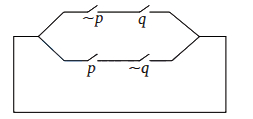
For the circuit shown below,the Boolean polynomial is:
A
$(\sim p \vee q) \vee (p \vee \sim q)$
B
$(\sim p \wedge q) \wedge (p \wedge q)$
C
$(\sim p \wedge \sim q) \wedge (q \wedge p)$
D
$(\sim p \wedge q) \vee (p \wedge \sim q)$
Solution
(D) In the given circuit,there are two parallel branches.
Each branch consists of two switches connected in series.
The upper branch has switches $\sim p$ and $q$ in series,which corresponds to the expression $(\sim p \wedge q)$.
The lower branch has switches $p$ and $\sim q$ in series,which corresponds to the expression $(p \wedge \sim q)$.
Since the two branches are connected in parallel,the total Boolean polynomial is the disjunction of the two expressions: $(\sim p \wedge q) \vee (p \wedge \sim q)$.
Each branch consists of two switches connected in series.
The upper branch has switches $\sim p$ and $q$ in series,which corresponds to the expression $(\sim p \wedge q)$.
The lower branch has switches $p$ and $\sim q$ in series,which corresponds to the expression $(p \wedge \sim q)$.
Since the two branches are connected in parallel,the total Boolean polynomial is the disjunction of the two expressions: $(\sim p \wedge q) \vee (p \wedge \sim q)$.
0 likesView Solution
42
ChemistryMCQMHT CET · 2008
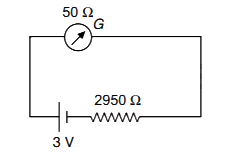
$A$ galvanometer of resistance $50 \Omega$ is connected to a battery of $3 \text{ V}$ along with a resistance of $2950 \Omega$ in series. $A$ full-scale deflection of $30$ divisions is obtained in the galvanometer. In order to reduce this deflection to $20$ divisions,the total resistance in series should be: (in $Omega$)
A
$5050$
B
$5550$
C
$6050$
D
$4450$
Solution
(D) The current $I$ flowing through the galvanometer circuit is given by Ohm's law: $I = \frac{V}{R_{total}}$.
Initially,the total resistance is $R_{total,1} = 50 \Omega + 2950 \Omega = 3000 \Omega$.
The current for $30$ divisions is $I_1 = \frac{3 \text{ V}}{3000 \Omega} = 10^{-3} \text{ A}$.
Since the deflection is proportional to the current,the current per division is $\frac{10^{-3} \text{ A}}{30}$.
To obtain a deflection of $20$ divisions,the required current is $I_2 = 20 \times \left( \frac{10^{-3}}{30} \right) = \frac{2}{3} \times 10^{-3} \text{ A}$.
Let the new total resistance be $R_{total,2}$. Then $I_2 = \frac{3 \text{ V}}{R_{total,2}}$.
$\frac{2}{3} \times 10^{-3} = \frac{3}{R_{total,2}} \implies R_{total,2} = \frac{3 \times 3}{2 \times 10^{-3}} = 4500 \Omega$.
The total resistance in the circuit is $R_{total,2} = R_G + R_{series}$.
$4500 \Omega = 50 \Omega + R_{series} \implies R_{series} = 4450 \Omega$.
Initially,the total resistance is $R_{total,1} = 50 \Omega + 2950 \Omega = 3000 \Omega$.
The current for $30$ divisions is $I_1 = \frac{3 \text{ V}}{3000 \Omega} = 10^{-3} \text{ A}$.
Since the deflection is proportional to the current,the current per division is $\frac{10^{-3} \text{ A}}{30}$.
To obtain a deflection of $20$ divisions,the required current is $I_2 = 20 \times \left( \frac{10^{-3}}{30} \right) = \frac{2}{3} \times 10^{-3} \text{ A}$.
Let the new total resistance be $R_{total,2}$. Then $I_2 = \frac{3 \text{ V}}{R_{total,2}}$.
$\frac{2}{3} \times 10^{-3} = \frac{3}{R_{total,2}} \implies R_{total,2} = \frac{3 \times 3}{2 \times 10^{-3}} = 4500 \Omega$.
The total resistance in the circuit is $R_{total,2} = R_G + R_{series}$.
$4500 \Omega = 50 \Omega + R_{series} \implies R_{series} = 4450 \Omega$.
0 likesView Solution
43
ChemistryMCQMHT CET · 2008
The resistance of an ammeter is $13 \Omega$ and its scale is graduated for a current up to $100 \text{ A}$. After an additional shunt has been connected to this ammeter,it becomes possible to measure currents up to $750 \text{ A}$ by this meter. The value of the shunt resistance is
A
$20 \Omega$
B
$2 \Omega$
C
$0.2 \Omega$
D
$2 \text{ k}\Omega$
Solution
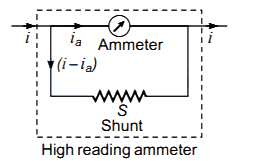
(B) Let $i_{a}$ be the current flowing through the ammeter and $i$ be the total current. So,a current $(i - i_{a})$ will flow through the shunt resistance.
The potential difference across the ammeter and the shunt resistance is the same because they are connected in parallel.
Therefore,$i_{a} \times R = (i - i_{a}) \times S$
Rearranging for $S$,we get:
$S = \frac{i_{a} R}{i - i_{a}}$
Given values are $i_{a} = 100 \text{ A}$,$i = 750 \text{ A}$,and $R = 13 \Omega$.
Substituting these values into the formula:
$S = \frac{100 \times 13}{750 - 100}$
$S = \frac{1300}{650}$
$S = 2 \Omega$
Thus,the value of the shunt resistance is $2 \Omega$.
The potential difference across the ammeter and the shunt resistance is the same because they are connected in parallel.
Therefore,$i_{a} \times R = (i - i_{a}) \times S$
Rearranging for $S$,we get:
$S = \frac{i_{a} R}{i - i_{a}}$
Given values are $i_{a} = 100 \text{ A}$,$i = 750 \text{ A}$,and $R = 13 \Omega$.
Substituting these values into the formula:
$S = \frac{100 \times 13}{750 - 100}$
$S = \frac{1300}{650}$
$S = 2 \Omega$
Thus,the value of the shunt resistance is $2 \Omega$.
0 likesView Solution
44
ChemistryMCQMHT CET · 2008
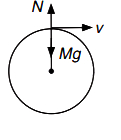
$A$ roller coaster is designed such that riders experience "weightlessness" as they go round the top of a hill whose radius of curvature is $20 \, m$. The speed of the car at the top of the hill is between
A
$14 \, m/s$ and $15 \, m/s$
B
$15 \, m/s$ and $16 \, m/s$
C
$16 \, m/s$ and $17 \, m/s$
D
$13 \, m/s$ and $14 \, m/s$
Solution
(A) At the top of the hill, the forces acting on the rider are the gravitational force $Mg$ (downwards) and the normal reaction $N$ (upwards).
The net centripetal force is provided by the difference between these forces:
$Mg - N = M \frac{v^2}{R}$
For the condition of "weightlessness", the normal reaction $N$ must be zero $(N = 0)$.
Substituting $N = 0$ into the equation:
$Mg = M \frac{v^2}{R}$
$g = \frac{v^2}{R}$
$v = \sqrt{Rg}$
Given $R = 20 \, m$ and taking $g = 10 \, m/s^2$:
$v = \sqrt{20 \times 10} = \sqrt{200} \approx 14.14 \, m/s$
Therefore, the speed of the car at the top of the hill is between $14 \, m/s$ and $15 \, m/s$.
The net centripetal force is provided by the difference between these forces:
$Mg - N = M \frac{v^2}{R}$
For the condition of "weightlessness", the normal reaction $N$ must be zero $(N = 0)$.
Substituting $N = 0$ into the equation:
$Mg = M \frac{v^2}{R}$
$g = \frac{v^2}{R}$
$v = \sqrt{Rg}$
Given $R = 20 \, m$ and taking $g = 10 \, m/s^2$:
$v = \sqrt{20 \times 10} = \sqrt{200} \approx 14.14 \, m/s$
Therefore, the speed of the car at the top of the hill is between $14 \, m/s$ and $15 \, m/s$.
0 likesView Solution
45
ChemistryMCQMHT CET · 2008
The length of a magnet is large compared to its width and breadth. The time period of its oscillation in a vibration magnetometer is $2 ~s$. The magnet is cut along its length into three equal parts and three parts are then placed on each other with their like poles together. The time period of this combination will be
A
$2 ~s$
B
$2 / 3 ~s$
C
$2 \sqrt{3} ~s$
D
$2 / \sqrt{3} ~s$
Solution
(B) The time period of oscillation of a magnet is given by $T = 2 \pi \sqrt{\frac{I}{MH}}$,where $I$ is the moment of inertia,$M$ is the magnetic moment,and $H$ is the horizontal component of the Earth's magnetic field.
For the original magnet of mass $m$ and length $L$,$I = \frac{mL^2}{12}$ and $M = q_m L$ (where $q_m$ is pole strength).
When the magnet is cut into three equal parts along its length,each part has mass $m' = m/3$,length $L' = L/3$,and pole strength $q_m' = q_m$.
When these three parts are stacked together with like poles aligned,the new moment of inertia $I'$ is the sum of the moments of inertia of the three parts: $I' = 3 \times \frac{m'(L')^2}{12} = 3 \times \frac{(m/3)(L/3)^2}{12} = \frac{mL^2}{12 \times 9} = \frac{I}{9}$.
The new magnetic moment $M'$ is the sum of the magnetic moments of the three parts: $M' = 3 \times (q_m \times L/3) = q_m L = M$.
The new time period $T'$ is $T' = 2 \pi \sqrt{\frac{I'}{M'H}} = 2 \pi \sqrt{\frac{I/9}{MH}} = \frac{1}{3} \times 2 \pi \sqrt{\frac{I}{MH}} = \frac{T}{3}$.
Given $T = 2 ~s$,therefore $T' = 2/3 ~s$.
For the original magnet of mass $m$ and length $L$,$I = \frac{mL^2}{12}$ and $M = q_m L$ (where $q_m$ is pole strength).
When the magnet is cut into three equal parts along its length,each part has mass $m' = m/3$,length $L' = L/3$,and pole strength $q_m' = q_m$.
When these three parts are stacked together with like poles aligned,the new moment of inertia $I'$ is the sum of the moments of inertia of the three parts: $I' = 3 \times \frac{m'(L')^2}{12} = 3 \times \frac{(m/3)(L/3)^2}{12} = \frac{mL^2}{12 \times 9} = \frac{I}{9}$.
The new magnetic moment $M'$ is the sum of the magnetic moments of the three parts: $M' = 3 \times (q_m \times L/3) = q_m L = M$.
The new time period $T'$ is $T' = 2 \pi \sqrt{\frac{I'}{M'H}} = 2 \pi \sqrt{\frac{I/9}{MH}} = \frac{1}{3} \times 2 \pi \sqrt{\frac{I}{MH}} = \frac{T}{3}$.
Given $T = 2 ~s$,therefore $T' = 2/3 ~s$.
0 likesView Solution
46
ChemistryMCQMHT CET · 2008
Two simple harmonic motions of angular frequency $100 \ rad \ s^{-1}$ and $1000 \ rad \ s^{-1}$ have the same displacement amplitude. The ratio of their maximum acceleration is
A
$1: 10$
B
$1: 10^{2}$
C
$1: 10^{3}$
D
$1: 10^{4}$
Solution
(B) The maximum acceleration of a particle in simple harmonic motion is given by the formula $a_{\max} = \omega^{2} A$,where $\omega$ is the angular frequency and $A$ is the amplitude.
Given that the amplitudes $A$ are the same for both motions,the ratio of their maximum accelerations is:
$\frac{(a_{\max})_{1}}{(a_{\max})_{2}} = \frac{\omega_{1}^{2} A}{\omega_{2}^{2} A} = \frac{\omega_{1}^{2}}{\omega_{2}^{2}}$
Substituting the given values $\omega_{1} = 100 \ rad \ s^{-1}$ and $\omega_{2} = 1000 \ rad \ s^{-1}$:
$\frac{(a_{\max})_{1}}{(a_{\max})_{2}} = \frac{(100)^{2}}{(1000)^{2}} = \left(\frac{100}{1000}\right)^{2} = \left(\frac{1}{10}\right)^{2} = \frac{1}{100} = 1: 10^{2}$
Given that the amplitudes $A$ are the same for both motions,the ratio of their maximum accelerations is:
$\frac{(a_{\max})_{1}}{(a_{\max})_{2}} = \frac{\omega_{1}^{2} A}{\omega_{2}^{2} A} = \frac{\omega_{1}^{2}}{\omega_{2}^{2}}$
Substituting the given values $\omega_{1} = 100 \ rad \ s^{-1}$ and $\omega_{2} = 1000 \ rad \ s^{-1}$:
$\frac{(a_{\max})_{1}}{(a_{\max})_{2}} = \frac{(100)^{2}}{(1000)^{2}} = \left(\frac{100}{1000}\right)^{2} = \left(\frac{1}{10}\right)^{2} = \frac{1}{100} = 1: 10^{2}$
0 likesView Solution
47
ChemistryMCQMHT CET · 2008
Two spheres of equal masses,one of which is a thin spherical shell and the other a solid sphere,have the same moment of inertia about their respective diameters. The ratio of their radii will be
A
$5: 7$
B
$3: 5$
C
$\sqrt{3}: \sqrt{5}$
D
$\sqrt{3}: \sqrt{7}$
Solution
(C) Let the radii of the thin spherical shell and the solid sphere be $R_{1}$ and $R_{2}$ respectively.
The moment of inertia of the thin spherical shell about its diameter is given by $I_{1} = \frac{2}{3} M R_{1}^{2}$.
The moment of inertia of the solid sphere about its diameter is given by $I_{2} = \frac{2}{5} M R_{2}^{2}$.
Given that the masses $M$ and the moments of inertia $I$ are equal for both bodies,we have $I_{1} = I_{2}$.
Therefore,$\frac{2}{3} M R_{1}^{2} = \frac{2}{5} M R_{2}^{2}$.
Canceling $M$ and the factor $2$ from both sides,we get $\frac{R_{1}^{2}}{3} = \frac{R_{2}^{2}}{5}$.
Rearranging the terms,we get $\frac{R_{1}^{2}}{R_{2}^{2}} = \frac{3}{5}$.
Taking the square root on both sides,we get $\frac{R_{1}}{R_{2}} = \sqrt{\frac{3}{5}} = \frac{\sqrt{3}}{\sqrt{5}}$.
Thus,the ratio of their radii is $\sqrt{3}: \sqrt{5}$.
The moment of inertia of the thin spherical shell about its diameter is given by $I_{1} = \frac{2}{3} M R_{1}^{2}$.
The moment of inertia of the solid sphere about its diameter is given by $I_{2} = \frac{2}{5} M R_{2}^{2}$.
Given that the masses $M$ and the moments of inertia $I$ are equal for both bodies,we have $I_{1} = I_{2}$.
Therefore,$\frac{2}{3} M R_{1}^{2} = \frac{2}{5} M R_{2}^{2}$.
Canceling $M$ and the factor $2$ from both sides,we get $\frac{R_{1}^{2}}{3} = \frac{R_{2}^{2}}{5}$.
Rearranging the terms,we get $\frac{R_{1}^{2}}{R_{2}^{2}} = \frac{3}{5}$.
Taking the square root on both sides,we get $\frac{R_{1}}{R_{2}} = \sqrt{\frac{3}{5}} = \frac{\sqrt{3}}{\sqrt{5}}$.
Thus,the ratio of their radii is $\sqrt{3}: \sqrt{5}$.
0 likesView Solution
48
ChemistryMCQMHT CET · 2008
$A$ $p-n$ photodiode is made of a material with a band gap of $2.0 \text{ eV}$. The minimum frequency of the radiation that can be absorbed by the material is nearly
A
$10 \times 10^{14} \text{ Hz}$
B
$5 \times 10^{14} \text{ Hz}$
C
$1 \times 10^{14} \text{ Hz}$
D
$20 \times 10^{14} \text{ Hz}$
Solution
(B) $p-n$ photodiode is a semiconductor device that generates current when illuminated by light. For a photon to be absorbed by the semiconductor material, its energy $E$ must be at least equal to the band gap energy $E_g$.
Given, $E_g = 2.0 \text{ eV}$.
The relationship between energy and frequency is $E = h\nu$, where $h$ is Planck's constant $(6.63 \times 10^{-34} \text{ J} \cdot \text{s})$ and $\nu$ is the frequency.
Converting the band gap energy into Joules: $E_g = 2.0 \times 1.6 \times 10^{-19} \text{ J} = 3.2 \times 10^{-19} \text{ J}$.
Setting $h\nu = E_g$, we get $\nu = \frac{E_g}{h} = \frac{3.2 \times 10^{-19} \text{ J}}{6.63 \times 10^{-34} \text{ J} \cdot \text{s}}$.
Calculating the value: $\nu \approx 0.482 \times 10^{15} \text{ Hz} = 4.82 \times 10^{14} \text{ Hz}$.
Rounding to the nearest option, we get $\nu \approx 5 \times 10^{14} \text{ Hz}$.
Given, $E_g = 2.0 \text{ eV}$.
The relationship between energy and frequency is $E = h\nu$, where $h$ is Planck's constant $(6.63 \times 10^{-34} \text{ J} \cdot \text{s})$ and $\nu$ is the frequency.
Converting the band gap energy into Joules: $E_g = 2.0 \times 1.6 \times 10^{-19} \text{ J} = 3.2 \times 10^{-19} \text{ J}$.
Setting $h\nu = E_g$, we get $\nu = \frac{E_g}{h} = \frac{3.2 \times 10^{-19} \text{ J}}{6.63 \times 10^{-34} \text{ J} \cdot \text{s}}$.
Calculating the value: $\nu \approx 0.482 \times 10^{15} \text{ Hz} = 4.82 \times 10^{14} \text{ Hz}$.
Rounding to the nearest option, we get $\nu \approx 5 \times 10^{14} \text{ Hz}$.
0 likesView Solution
49
ChemistryEasyMCQMHT CET · 2008
The correct order of boiling point for primary $(1^{\circ})$,secondary $(2^{\circ})$ and tertiary $(3^{\circ})$ alcohols is
A
$1^{\circ} > 2^{\circ} > 3^{\circ}$
B
$3^{\circ} > 2^{\circ} > 1^{\circ}$
C
$2^{\circ} > 1^{\circ} > 3^{\circ}$
D
$2^{\circ} > 3^{\circ} > 1^{\circ}$
Solution
(A) The boiling point of alcohols depends on the extent of intermolecular hydrogen bonding and the surface area of the molecule.
As the branching increases from primary $(1^{\circ})$ to secondary $(2^{\circ})$ to tertiary $(3^{\circ})$ alcohols,the surface area of the molecule decreases.
$A$ smaller surface area leads to weaker van der Waals forces of attraction.
Additionally,steric hindrance in tertiary alcohols reduces the effectiveness of intermolecular hydrogen bonding.
Therefore,the boiling point decreases in the order: $1^{\circ} > 2^{\circ} > 3^{\circ}$.
As the branching increases from primary $(1^{\circ})$ to secondary $(2^{\circ})$ to tertiary $(3^{\circ})$ alcohols,the surface area of the molecule decreases.
$A$ smaller surface area leads to weaker van der Waals forces of attraction.
Additionally,steric hindrance in tertiary alcohols reduces the effectiveness of intermolecular hydrogen bonding.
Therefore,the boiling point decreases in the order: $1^{\circ} > 2^{\circ} > 3^{\circ}$.
0 likesView Solution
50
ChemistryDifficultMCQMHT CET · 2008
The alcohol that produces turbidity immediately with $ZnCl_2 / \text{conc. } HCl$ at room temperature is:
A
$1-\text{hydroxybutane}$
B
$2-\text{hydroxybutane}$
C
$2-\text{hydroxy}-2-\text{methylpropane}$
D
$1-\text{hydroxy}-2-\text{methylpropane}$
Solution
(C) The mixture of anhydrous $ZnCl_2$ and conc. $HCl$ is known as Lucas reagent.
Lucas test is used to distinguish between primary,secondary,and tertiary alcohols.
Tertiary alcohols react immediately with Lucas reagent to produce turbidity due to the formation of alkyl chlorides.
Secondary alcohols give turbidity within $5-10 \ \text{min}$,while primary alcohols do not produce turbidity at room temperature.
Among the given options,$2-\text{hydroxy}-2-\text{methylpropane}$ is a $3^{\circ}$ alcohol,which is the most reactive and produces turbidity immediately.
Lucas test is used to distinguish between primary,secondary,and tertiary alcohols.
Tertiary alcohols react immediately with Lucas reagent to produce turbidity due to the formation of alkyl chlorides.
Secondary alcohols give turbidity within $5-10 \ \text{min}$,while primary alcohols do not produce turbidity at room temperature.
Among the given options,$2-\text{hydroxy}-2-\text{methylpropane}$ is a $3^{\circ}$ alcohol,which is the most reactive and produces turbidity immediately.
0 likesView Solution
51
ChemistryMediumMCQMHT CET · 2008
The following reaction,$(CH_3)_3CBr + H_2O \rightarrow (CH_3)_3COH + HBr$,is an example of:
A
elimination reaction
B
free radical substitution
C
nucleophilic substitution
D
electrophilic substitution
Solution
(C) In the given reaction,the bromine atom $(-Br)$ in tert-butyl bromide is replaced by a hydroxyl group $(-OH)$ from water.
Since the incoming group is a nucleophile $(-OH^-)$,this is a nucleophilic substitution reaction.
Specifically,it follows an $S_N1$ mechanism because the substrate is a tertiary alkyl halide.
Since the incoming group is a nucleophile $(-OH^-)$,this is a nucleophilic substitution reaction.
Specifically,it follows an $S_N1$ mechanism because the substrate is a tertiary alkyl halide.
0 likesView Solution
52
ChemistryMediumMCQMHT CET · 2008
In the reaction,$2 A + \text{dry silver oxide} \xrightarrow{\Delta} \text{ether} + 2 \operatorname{Ag} X$,$A$ is a/an
A
primary alcohol
B
acid
C
alkyl halide
D
alcohol
Solution
(C) The reaction of an alkyl halide $(R-X)$ with dry silver oxide $(Ag_2O)$ upon heating is a method for the preparation of ethers (Williamson ether synthesis variant).
The chemical equation is:
$2 R-X + Ag_2O \xrightarrow{\Delta} R-O-R + 2 AgX$
Comparing this with the given reaction $2 A + \text{dry silver oxide} \xrightarrow{\Delta} \text{ether} + 2 \operatorname{Ag} X$,we can conclude that $A$ represents an alkyl halide $(R-X)$.
The chemical equation is:
$2 R-X + Ag_2O \xrightarrow{\Delta} R-O-R + 2 AgX$
Comparing this with the given reaction $2 A + \text{dry silver oxide} \xrightarrow{\Delta} \text{ether} + 2 \operatorname{Ag} X$,we can conclude that $A$ represents an alkyl halide $(R-X)$.
0 likesView Solution
53
ChemistryMediumMCQMHT CET · 2008
For the sequence of reactions $A$ $\xrightarrow{C_2H_5MgI} B$ $\xrightarrow{H_2O / H^{+}} \text{tert-pentyl alcohol}$. The compound $A$ in the sequence is
A
$2-$butanone
B
acetaldehyde
C
acetone
D
propanal
Solution
(C) The reaction of a Grignard reagent $(RMgX)$ with a carbonyl compound followed by hydrolysis yields an alcohol.
To obtain $\text{tert-pentyl alcohol}$ $(CH_3CH_2C(CH_3)_2OH)$,we need to react a ketone with a Grignard reagent.
Here,the Grignard reagent is $C_2H_5MgI$ (ethylmagnesium iodide).
When $C_2H_5MgI$ reacts with $A$ (acetone,$CH_3COCH_3$),the nucleophilic ethyl group attacks the carbonyl carbon of acetone.
$CH_3COCH_3 + C_2H_5MgI \rightarrow CH_3C(OMgI)(CH_3)(C_2H_5)$.
Upon hydrolysis with $H_2O/H^+$,this forms $CH_3C(OH)(CH_3)(C_2H_5)$,which is $2-$methylbutan$-2-$ol,commonly known as $\text{tert-pentyl alcohol}$.
Therefore,compound $A$ is acetone.
To obtain $\text{tert-pentyl alcohol}$ $(CH_3CH_2C(CH_3)_2OH)$,we need to react a ketone with a Grignard reagent.
Here,the Grignard reagent is $C_2H_5MgI$ (ethylmagnesium iodide).
When $C_2H_5MgI$ reacts with $A$ (acetone,$CH_3COCH_3$),the nucleophilic ethyl group attacks the carbonyl carbon of acetone.
$CH_3COCH_3 + C_2H_5MgI \rightarrow CH_3C(OMgI)(CH_3)(C_2H_5)$.
Upon hydrolysis with $H_2O/H^+$,this forms $CH_3C(OH)(CH_3)(C_2H_5)$,which is $2-$methylbutan$-2-$ol,commonly known as $\text{tert-pentyl alcohol}$.
Therefore,compound $A$ is acetone.
0 likesView Solution
54
ChemistryEasyMCQMHT CET · 2008
The compound,which gives a positive ninhydrin test and a negative Benedict's solution test,is
A
a monosaccharide
B
a disaccharide
C
a lipid
D
a protein
Solution
(D) The ninhydrin test is a chemical test used to detect ammonia or primary and secondary amines. In biochemistry,it is specifically used to detect proteins and amino acids,which produce a characteristic blue or purple color.
Benedict's solution is used to detect reducing sugars (monosaccharides and some disaccharides).
Since proteins are not reducing sugars,they give a negative Benedict's test.
Therefore,a protein is the compound that gives a positive ninhydrin test and a negative Benedict's solution test.
Benedict's solution is used to detect reducing sugars (monosaccharides and some disaccharides).
Since proteins are not reducing sugars,they give a negative Benedict's test.
Therefore,a protein is the compound that gives a positive ninhydrin test and a negative Benedict's solution test.
0 likesView Solution
55
ChemistryEasyMCQMHT CET · 2008
The final product of the following reaction is/are:
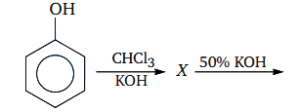
A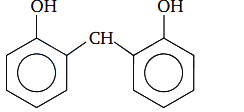
B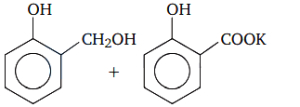
C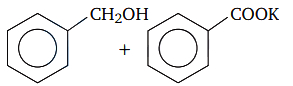
D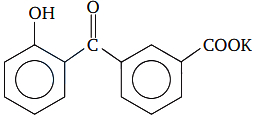
Solution
(A) The reaction of phenol with $CHCl_3$ and $KOH$ is the Reimer-Tiemann reaction,which yields salicylaldehyde ($2$-hydroxybenzaldehyde) as the intermediate $X$.
Salicylaldehyde contains an aldehyde group but no $\alpha$-hydrogen atoms.
When treated with $50 \%$ $KOH$ solution,it undergoes the Cannizzaro reaction,a disproportionation reaction.
One molecule of salicylaldehyde is reduced to the corresponding alcohol ($2$-hydroxybenzyl alcohol),and another molecule is oxidized to the corresponding carboxylic acid salt (potassium $2-$hydroxybenzoate).
Salicylaldehyde contains an aldehyde group but no $\alpha$-hydrogen atoms.
When treated with $50 \%$ $KOH$ solution,it undergoes the Cannizzaro reaction,a disproportionation reaction.
One molecule of salicylaldehyde is reduced to the corresponding alcohol ($2$-hydroxybenzyl alcohol),and another molecule is oxidized to the corresponding carboxylic acid salt (potassium $2-$hydroxybenzoate).
0 likesView Solution
56
ChemistryMediumMCQMHT CET · 2008
Iodoform test is not given by
A
$2-$pentanone
B
ethanol
C
ethanal
D
$3-$pentanone
Solution
(D) The iodoform test is given by compounds that contain either the $CH_{3}CO-$ group or the $CH_{3}CH(OH)-$ group.
$2-$pentanone $(CH_{3}COCH_{2}CH_{2}CH_{3})$ contains the $CH_{3}CO-$ group.
Ethanal $(CH_{3}CHO)$ contains the $CH_{3}CO-$ group.
Ethanol $(CH_{3}CH_{2}OH)$ contains the $CH_{3}CH(OH)-$ group.
However,$3-$pentanone $(CH_{3}CH_{2}COCH_{2}CH_{3})$ does not contain either of these groups,so it does not give the iodoform test.
$2-$pentanone $(CH_{3}COCH_{2}CH_{2}CH_{3})$ contains the $CH_{3}CO-$ group.
Ethanal $(CH_{3}CHO)$ contains the $CH_{3}CO-$ group.
Ethanol $(CH_{3}CH_{2}OH)$ contains the $CH_{3}CH(OH)-$ group.
However,$3-$pentanone $(CH_{3}CH_{2}COCH_{2}CH_{3})$ does not contain either of these groups,so it does not give the iodoform test.
0 likesView Solution
57
ChemistryMediumMCQMHT CET · 2008
An ester $(A)$ with molecular formula $C_9H_{10}O_2$ was treated with excess of $CH_3MgBr$ and the complex so formed was treated with $H_2SO_4$ to give an olefin $(B)$. Ozonolysis of $(B)$ gave a ketone with molecular formula $C_8H_8O$ which shows positive iodoform test. The structure of $(A)$ is
A
$C_6H_5COOC_2H_5$
B
$C_6H_5COOC_6H_5$
C
$C_6H_5COOCH_3$
D
$p-CH_3O-C_6H_4-COCH_3$
Solution
(A) $1$. Ester $(A)$ is $C_6H_5COOC_2H_5$ (Ethyl benzoate).
$2$. Reaction with excess $CH_3MgBr$ followed by acid workup yields a tertiary alcohol: $C_6H_5C(OH)(CH_3)_2$.
$3$. Dehydration of this alcohol with $H_2SO_4$ gives the olefin $(B)$,which is $C_6H_5-C(CH_3)=CH_2$ ($2$-phenylpropene).
$4$. Ozonolysis of $(B)$ $(C_6H_5-C(CH_3)=CH_2)$ yields acetophenone $(C_6H_5COCH_3)$,which has the formula $C_8H_8O$.
$5$. Acetophenone contains a methyl ketone group $(-COCH_3)$,which gives a positive iodoform test.
$6$. Therefore,the ester $(A)$ is $C_6H_5COOC_2H_5$.
$2$. Reaction with excess $CH_3MgBr$ followed by acid workup yields a tertiary alcohol: $C_6H_5C(OH)(CH_3)_2$.
$3$. Dehydration of this alcohol with $H_2SO_4$ gives the olefin $(B)$,which is $C_6H_5-C(CH_3)=CH_2$ ($2$-phenylpropene).
$4$. Ozonolysis of $(B)$ $(C_6H_5-C(CH_3)=CH_2)$ yields acetophenone $(C_6H_5COCH_3)$,which has the formula $C_8H_8O$.
$5$. Acetophenone contains a methyl ketone group $(-COCH_3)$,which gives a positive iodoform test.
$6$. Therefore,the ester $(A)$ is $C_6H_5COOC_2H_5$.
0 likesView Solution
58
ChemistryMediumMCQMHT CET · 2008
Which reaction intermediate is formed during the condensation reaction between acetaldehyde and formaldehyde?
A
$: \overline{C}H_{2}CHO$
B
$C_{2}^{+}CHO$
C
$\stackrel{+}{C}H_{2}OH$
D
$: \overline{C}HCHO$
Solution
(A) In the crossed aldol condensation between acetaldehyde $(CH_{3}CHO)$ and formaldehyde $(HCHO)$,the base $(OH^{-})$ abstracts an $\alpha$-hydrogen atom from the acetaldehyde molecule because the $\alpha$-hydrogens are acidic due to the electron-withdrawing effect of the carbonyl group.
This abstraction results in the formation of an enolate ion (carbanion) intermediate,which is represented as $: \overline{C}H_{2}CHO$.
This abstraction results in the formation of an enolate ion (carbanion) intermediate,which is represented as $: \overline{C}H_{2}CHO$.
0 likesView Solution
59
ChemistryEasyMCQMHT CET · 2008
Which of the following is the weakest base?
A
Ethyl amine
B
Ammonia
C
Dimethyl amine
D
Methyl amine
Solution
(B) The basic strength of amines depends on the availability of the lone pair of electrons on the nitrogen atom.
Alkyl groups are electron-releasing groups that exert a positive inductive effect $(+I)$,which increases the electron density on the nitrogen atom,thereby increasing the basicity.
In $NH_3$ (ammonia),there is no alkyl group attached to the nitrogen atom.
Therefore,$NH_3$ is the weakest base among the given options.
Alkyl groups are electron-releasing groups that exert a positive inductive effect $(+I)$,which increases the electron density on the nitrogen atom,thereby increasing the basicity.
In $NH_3$ (ammonia),there is no alkyl group attached to the nitrogen atom.
Therefore,$NH_3$ is the weakest base among the given options.
0 likesView Solution
60
ChemistryMediumMCQMHT CET · 2008
When acetamide is treated with $Br_{2}$ and caustic soda,the product formed is
A
$N$-bromamide
B
bromoacetic acid
C
methanamine
D
ethanamine
Solution
(C) Amides react with bromine and caustic soda to give their corresponding primary amines. This reaction is known as Hofmann's bromamide degradation reaction.
The chemical equation is:
$CH_{3}CONH_{2} + Br_{2} + 4KOH \xrightarrow{343K} CH_{3}NH_{2} + 2KBr + K_{2}CO_{3} + 2H_{2}O$
Thus,acetamide $(CH_{3}CONH_{2})$ gives methanamine $(CH_{3}NH_{2})$.
The chemical equation is:
$CH_{3}CONH_{2} + Br_{2} + 4KOH \xrightarrow{343K} CH_{3}NH_{2} + 2KBr + K_{2}CO_{3} + 2H_{2}O$
Thus,acetamide $(CH_{3}CONH_{2})$ gives methanamine $(CH_{3}NH_{2})$.
0 likesView Solution
61
ChemistryDifficultMCQMHT CET · 2008
On heating benzyl amine with chloroform and ethanolic $KOH$,the product obtained is:
A
benzyl alcohol
B
benzaldehyde
C
benzonitrile
D
benzyl isocyanide
Solution
(D) Benzyl amine $(C_6H_5CH_2NH_2)$ is a primary $(1^{\circ})$ amine.
Primary amines react with chloroform $(CHCl_3)$ and ethanolic potassium hydroxide $(KOH)$ to form isocyanides (carbylamines),which have a foul smell.
This reaction is known as the carbylamine reaction.
The chemical equation is:
$C_6H_5CH_2NH_2 + CHCl_3 + 3KOH (alc.) \rightarrow C_6H_5CH_2NC + 3KCl + 3H_2O$
Thus,the product obtained is benzyl isocyanide.
Primary amines react with chloroform $(CHCl_3)$ and ethanolic potassium hydroxide $(KOH)$ to form isocyanides (carbylamines),which have a foul smell.
This reaction is known as the carbylamine reaction.
The chemical equation is:
$C_6H_5CH_2NH_2 + CHCl_3 + 3KOH (alc.) \rightarrow C_6H_5CH_2NC + 3KCl + 3H_2O$
Thus,the product obtained is benzyl isocyanide.
0 likesView Solution
62
ChemistryDifficultMCQMHT CET · 2008
$A$ glucose molecule reacts with $X$ number of molecules of phenylhydrazine to yield osazone. The value of $X$ is
A
$4$
B
$1$
C
$2$
D
$3$
Solution
(D) The reaction of glucose with phenylhydrazine proceeds in three steps:
$1$. Glucose reacts with one molecule of phenylhydrazine to form phenylhydrazone.
$2$. The phenylhydrazone then reacts with a second molecule of phenylhydrazine,which acts as an oxidizing agent,to form an intermediate keto-imine.
$3$. Finally,this intermediate reacts with a third molecule of phenylhydrazine to form the stable osazone.
Thus,a total of $3$ molecules of phenylhydrazine are required for the formation of osazone from one molecule of glucose.
$1$. Glucose reacts with one molecule of phenylhydrazine to form phenylhydrazone.
$2$. The phenylhydrazone then reacts with a second molecule of phenylhydrazine,which acts as an oxidizing agent,to form an intermediate keto-imine.
$3$. Finally,this intermediate reacts with a third molecule of phenylhydrazine to form the stable osazone.
Thus,a total of $3$ molecules of phenylhydrazine are required for the formation of osazone from one molecule of glucose.
0 likesView Solution
63
ChemistryMediumMCQMHT CET · 2008
The end product of the following reaction is: $CH_3-CH_2-COOH$ $\xrightarrow[\text{red } P]{Cl_2} X$ $\xrightarrow{\text{Alc. KOH}} Y$
A
$CH_3-CH(OH)-COOH$
B
$CH_2(OH)-CH_2-COOH$
C
$CH_2=CH-COOH$
D
$CH_2(Cl)-CH(OH)-COOH$
Solution
(C) The reaction sequence is as follows:
$1$. The first step is the Hell-Volhard-Zelinsky $(HVZ)$ reaction,where propanoic acid reacts with $Cl_2$ in the presence of red phosphorus to form $\alpha$-chloropropanoic acid $(X)$:
$CH_3-CH_2-COOH \xrightarrow[\text{red } P]{Cl_2} CH_3-CHCl-COOH \text{ (} X \text{)}$
$2$. The second step is a dehydrohalogenation reaction using alcoholic $KOH$,which removes $HCl$ from the $\alpha$-carbon and $\beta$-carbon to form acrylic acid $(Y)$:
$CH_3-CHCl-COOH \xrightarrow{\text{Alc. KOH}} CH_2=CH-COOH \text{ (} Y \text{)}$
Therefore,the end product $Y$ is acrylic acid $(CH_2=CH-COOH)$.
$1$. The first step is the Hell-Volhard-Zelinsky $(HVZ)$ reaction,where propanoic acid reacts with $Cl_2$ in the presence of red phosphorus to form $\alpha$-chloropropanoic acid $(X)$:
$CH_3-CH_2-COOH \xrightarrow[\text{red } P]{Cl_2} CH_3-CHCl-COOH \text{ (} X \text{)}$
$2$. The second step is a dehydrohalogenation reaction using alcoholic $KOH$,which removes $HCl$ from the $\alpha$-carbon and $\beta$-carbon to form acrylic acid $(Y)$:
$CH_3-CHCl-COOH \xrightarrow{\text{Alc. KOH}} CH_2=CH-COOH \text{ (} Y \text{)}$
Therefore,the end product $Y$ is acrylic acid $(CH_2=CH-COOH)$.
0 likesView Solution
64
ChemistryMediumMCQMHT CET · 2008
For the reaction: $H_{2} + I_{2} \longrightarrow 2 HI$,the differential rate law is
A
$-\frac{d[H_{2}]}{dt} = -\frac{d[I_{2}]}{dt} = 2 \frac{d[HI]}{dt}$
B
$-\frac{d[H_{2}]}{dt} = -\frac{d[I_{2}]}{dt} = \frac{1}{2} \frac{d[HI]}{dt}$
C
$-\frac{d[H_{2}]}{dt} = -\frac{d[I_{2}]}{dt} = \frac{d[HI]}{dt}$
D
$-\frac{d[H_{2}]}{dt} = -\frac{d[I_{2}]}{dt} = \frac{1}{4} \frac{d[HI]}{dt}$
Solution
(B) For a general reaction $aA + bB \longrightarrow cC + dD$,the rate of reaction is given by: $\text{Rate} = -\frac{1}{a} \frac{d[A]}{dt} = -\frac{1}{b} \frac{d[B]}{dt} = \frac{1}{c} \frac{d[C]}{dt} = \frac{1}{d} \frac{d[D]}{dt}$.
For the reaction $H_{2} + I_{2} \longrightarrow 2 HI$,the stoichiometric coefficients are $1, 1,$ and $2$ respectively.
Therefore,the differential rate law is: $\text{Rate} = -\frac{d[H_{2}]}{dt} = -\frac{d[I_{2}]}{dt} = \frac{1}{2} \frac{d[HI]}{dt}$.
For the reaction $H_{2} + I_{2} \longrightarrow 2 HI$,the stoichiometric coefficients are $1, 1,$ and $2$ respectively.
Therefore,the differential rate law is: $\text{Rate} = -\frac{d[H_{2}]}{dt} = -\frac{d[I_{2}]}{dt} = \frac{1}{2} \frac{d[HI]}{dt}$.
0 likesView Solution
65
ChemistryEasyMCQMHT CET · 2008
For a reaction,$A + 2B \longrightarrow C$,the rate is given by $+\frac{d[C]}{dt} = k[A][B]$. Hence,the order of the reaction is:
A
$3$
B
$2$
C
$1$
D
$0$
Solution
(B) The rate law expression is given as: $\text{Rate} = \frac{+d[C]}{dt} = k[A]^1[B]^1$.
The order of reaction with respect to $A$ is $1$.
The order of reaction with respect to $B$ is $1$.
The total order of the reaction is the sum of the exponents of the concentration terms in the rate law: $1 + 1 = 2$.
The order of reaction with respect to $A$ is $1$.
The order of reaction with respect to $B$ is $1$.
The total order of the reaction is the sum of the exponents of the concentration terms in the rate law: $1 + 1 = 2$.
0 likesView Solution
66
ChemistryDifficultMCQMHT CET · 2008
After how many seconds will the concentration of the reactant in a first order reaction be halved if the rate constant is $1.155 \times 10^{-3} \ s^{-1}$?
A
$600$
B
$100$
C
$60$
D
$10$
Solution
(A) For a first order reaction,the half-life period $(t_{1/2})$ is given by the formula: $t_{1/2} = \frac{0.693}{k}$.
Given the rate constant $k = 1.155 \times 10^{-3} \ s^{-1}$.
Substituting the value of $k$ in the formula:
$t_{1/2} = \frac{0.693}{1.155 \times 10^{-3}} \ s$.
$t_{1/2} = \frac{0.693}{1.155} \times 10^{3} \ s$.
$t_{1/2} = 0.6 \times 1000 \ s$.
$t_{1/2} = 600 \ s$.
Given the rate constant $k = 1.155 \times 10^{-3} \ s^{-1}$.
Substituting the value of $k$ in the formula:
$t_{1/2} = \frac{0.693}{1.155 \times 10^{-3}} \ s$.
$t_{1/2} = \frac{0.693}{1.155} \times 10^{3} \ s$.
$t_{1/2} = 0.6 \times 1000 \ s$.
$t_{1/2} = 600 \ s$.
0 likesView Solution
67
ChemistryMediumMCQMHT CET · 2008
Which of the following has the maximum penetrating power?
A
$\alpha$-particle
B
Proton
C
$\gamma$-radiation
D
Positron
Solution
(C) $\gamma$-radiations are electromagnetic waves with no mass and no charge.
Due to their high energy and neutral nature,they have the highest penetrating power compared to charged particles like $\alpha$-particles,protons,or positrons.
Due to their high energy and neutral nature,they have the highest penetrating power compared to charged particles like $\alpha$-particles,protons,or positrons.
0 likesView Solution
68
ChemistryDifficultMCQMHT CET · 2008
$A$ radioactive isotope having $t_{1/2} = 3 \ days$ was measured after $12 \ days$. If $3 \ g$ of the isotope remains in the container,what was the initial weight of the isotope (in $g$)?
A
$12$
B
$24$
C
$36$
D
$48$
Solution
(D) The number of half-lives $(n)$ is calculated as: $n = \frac{T}{t_{1/2}} = \frac{12 \ days}{3 \ days} = 4$.
Using the radioactive decay formula: $N = N_0 \times (1/2)^n$.
Given $N = 3 \ g$ and $n = 4$:
$3 = N_0 \times (1/2)^4$.
$3 = N_0 \times (1/16)$.
$N_0 = 3 \times 16 = 48 \ g$.
Using the radioactive decay formula: $N = N_0 \times (1/2)^n$.
Given $N = 3 \ g$ and $n = 4$:
$3 = N_0 \times (1/2)^4$.
$3 = N_0 \times (1/16)$.
$N_0 = 3 \times 16 = 48 \ g$.
0 likesView Solution
69
ChemistryDifficultMCQMHT CET · 2008
For a first order reaction,the half-life period is
A
dependent on the square of the initial concentration
B
dependent on first power of initial concentration
C
dependent on the square root of initial concentration
D
independent of initial concentration
Solution
(D) The half-life period $(t_{1/2})$ for a reaction of order $n$ is given by the relation: $t_{1/2} \propto \frac{1}{[A]_0^{n-1}}$,where $[A]_0$ is the initial concentration.
For a first order reaction,$n = 1$.
Substituting $n = 1$ in the expression: $t_{1/2} \propto \frac{1}{[A]_0^{1-1}} = \frac{1}{[A]_0^0} = \text{constant}$.
Therefore,for a first order reaction,the half-life period is independent of the initial concentration.
For a first order reaction,$n = 1$.
Substituting $n = 1$ in the expression: $t_{1/2} \propto \frac{1}{[A]_0^{1-1}} = \frac{1}{[A]_0^0} = \text{constant}$.
Therefore,for a first order reaction,the half-life period is independent of the initial concentration.
0 likesView Solution
70
ChemistryMediumMCQMHT CET · 2008
In the successive emission of $\alpha$- and $\beta$-particles,the number of $\alpha$- and $\beta$-particles that should be emitted for the conversion of ${}^{238}_{92}U$ to ${}^{206}_{82}Pb$ are:
A
$8 \alpha, 6 \beta$
B
$6 \alpha, 4 \beta$
C
$4 \alpha, 3 \beta$
D
$7 \alpha, 5 \beta$
Solution
(A) The nuclear reaction is: ${}^{238}_{92}U \longrightarrow {}^{206}_{82}Pb + m({}^{4}_{2}He) + n({}^{0}_{-1}e)$.
Comparing the mass numbers on both sides: $238 = 206 + 4m$ $\Rightarrow 4m = 32$ $\Rightarrow m = 8$.
Comparing the atomic numbers on both sides: $92 = 82 + 2m - n$.
Substituting $m = 8$: $92 = 82 + 2(8) - n$ $\Rightarrow 92 = 82 + 16 - n$ $\Rightarrow 92 = 98 - n$ $\Rightarrow n = 6$.
Therefore,$8$ $\alpha$-particles and $6$ $\beta$-particles are emitted.
Comparing the mass numbers on both sides: $238 = 206 + 4m$ $\Rightarrow 4m = 32$ $\Rightarrow m = 8$.
Comparing the atomic numbers on both sides: $92 = 82 + 2m - n$.
Substituting $m = 8$: $92 = 82 + 2(8) - n$ $\Rightarrow 92 = 82 + 16 - n$ $\Rightarrow 92 = 98 - n$ $\Rightarrow n = 6$.
Therefore,$8$ $\alpha$-particles and $6$ $\beta$-particles are emitted.
0 likesView Solution
71
ChemistryEasyMCQMHT CET · 2008
Tranquilisers are also known as
A
psychosomatic drugs
B
psychotherapeutic drugs
C
psychosystolic drugs
D
None of the above
Solution
(B) Tranquilisers are drugs used to relieve mental ailments.
These are also known as psychotherapeutic drugs as they act on the central nervous system.
These are also known as psychotherapeutic drugs as they act on the central nervous system.
0 likesView Solution
72
ChemistryMediumMCQMHT CET · 2008
Aspirin is an acetylation product of
A
$o-$hydroxybenzoic acid
B
$o-$hydroxybenzene
C
$m-$hydroxybenzoic acid
D
$p-$dihydroxybenzene
Solution
(A) Aspirin (acetylsalicylic acid) is prepared by the acetylation of salicylic acid.
Salicylic acid is chemically known as $o-$hydroxybenzoic acid.
The reaction involves the treatment of salicylic acid with acetic anhydride in the presence of an acid catalyst.
Salicylic acid is chemically known as $o-$hydroxybenzoic acid.
The reaction involves the treatment of salicylic acid with acetic anhydride in the presence of an acid catalyst.
0 likesView Solution
73
ChemistryMediumMCQMHT CET · 2008
Chloramine-$T$ is a
A
disinfectant
B
antiseptic
C
analgesic
D
antipyretics
Solution
(B) Antiseptics are chemical substances that either kill or prevent the growth of microorganisms on living tissues. $Chloramine-T$ is a well-known antiseptic used to treat wounds and infections. Other examples include $Dettol$,$Savlon$,$Acriflavin$,$Boric \ acid$,$Phenol$,$Iodoform$,$KMnO_4$,and $Methylene \ blue$.
0 likesView Solution
74
ChemistryMediumMCQMHT CET · 2008
Most common oxidation states of $Ce$ $(cerium)$ are
A
$+3, +4$
B
$+2, +3$
C
$+2, +4$
D
$+3, +5$
Solution
(A) The electronic configuration of $Cerium$ ($Ce$,$Z=58$) is $[Xe] 4f^1 5d^1 6s^2$.
Due to the loss of three electrons,it forms a stable $+3$ oxidation state.
It also exhibits a $+4$ oxidation state because the removal of four electrons results in a stable noble gas configuration $([Xe])$.
Due to the loss of three electrons,it forms a stable $+3$ oxidation state.
It also exhibits a $+4$ oxidation state because the removal of four electrons results in a stable noble gas configuration $([Xe])$.
0 likesView Solution
75
ChemistryMediumMCQMHT CET · 2008
Which of the following ions is colourless in solution?
A
$V^{3+}$
B
$Cr^{3+}$
C
$Co^{2+}$
D
$Sc^{3+}$
Solution
(D) $Sc^{3+}$ has an electronic configuration of $[Ar] 3d^0$.
Since there are no electrons in the $d$-orbital,$d-d$ transitions are not possible,making the ion colourless.
Since there are no electrons in the $d$-orbital,$d-d$ transitions are not possible,making the ion colourless.
0 likesView Solution
76
ChemistryEasyMCQMHT CET · 2008
The general electronic configuration of the transition elements is
A
$(n-1) d^{10}, (n+1) s^{2}$
B
$(n-1) d^{1-10}, (n+1) s^{1-2}$
C
$(n-1) d^{1-10}, n p^{6}, n s^{2}$
D
$(n-1) d^{1-10}, n s^{1-2}$
Solution
(D) Transition elements are defined as elements which have incompletely filled $d$-orbitals in their ground state or in any of their oxidation states.
Generally,the $d$-block elements are referred to as transition elements.
The general electronic configuration of these elements is represented as $(n-1) d^{1-10}, n s^{1-2}$.
Generally,the $d$-block elements are referred to as transition elements.
The general electronic configuration of these elements is represented as $(n-1) d^{1-10}, n s^{1-2}$.
0 likesView Solution
77
ChemistryEasyMCQMHT CET · 2008
The point of dissimilarity between lanthanides and actinides is
A
three outermost shells are partially filled
B
they show oxidation state of $+3$ (common)
C
they are called inner transition elements
D
they are radioactive in nature
Solution
(D) Lanthanides and actinides are both considered inner transition elements and commonly exhibit a $+3$ oxidation state.
However,a key point of dissimilarity is their radioactivity.
All actinides are radioactive in nature,whereas among lanthanides,only promethium $(Pm)$ is radioactive,and the rest are non-radioactive.
However,a key point of dissimilarity is their radioactivity.
All actinides are radioactive in nature,whereas among lanthanides,only promethium $(Pm)$ is radioactive,and the rest are non-radioactive.
0 likesView Solution
78
ChemistryMediumMCQMHT CET · 2008
The standard reduction potentials at $298 \ K$ for the following half-cell reactions are given below:
$Zn^{2+}_{(aq)} + 2e^{-} \rightleftharpoons Zn_{(s)} : -0.762 \ V$
$Cr^{3+}_{(aq)} + 3e^{-} \rightleftharpoons Cr_{(s)} : -0.74 \ V$
$2H^{+}_{(aq)} + 2e^{-} \rightleftharpoons H_{2(g)} : 0.00 \ V$
$Fe^{3+}_{(aq)} + e^{-} \rightleftharpoons Fe^{2+}_{(aq)} : 0.77 \ V$
Which one of the following is the strongest reducing agent?
$Zn^{2+}_{(aq)} + 2e^{-} \rightleftharpoons Zn_{(s)} : -0.762 \ V$
$Cr^{3+}_{(aq)} + 3e^{-} \rightleftharpoons Cr_{(s)} : -0.74 \ V$
$2H^{+}_{(aq)} + 2e^{-} \rightleftharpoons H_{2(g)} : 0.00 \ V$
$Fe^{3+}_{(aq)} + e^{-} \rightleftharpoons Fe^{2+}_{(aq)} : 0.77 \ V$
Which one of the following is the strongest reducing agent?
A
$Zn_{(s)}$
B
$Cr_{(s)}$
C
$H_{2(g)}$
D
$Fe^{2+}_{(aq)}$
Solution
(A) The reducing power of a substance is inversely proportional to its standard reduction potential $(E^{\circ}_{red})$.
$A$ more negative $E^{\circ}_{red}$ value indicates a greater tendency to undergo oxidation (loss of electrons),making the species a stronger reducing agent.
Comparing the given values:
$E^{\circ}_{Zn^{2+}/Zn} = -0.762 \ V$
$E^{\circ}_{Cr^{3+}/Cr} = -0.74 \ V$
$E^{\circ}_{H^{+}/H_2} = 0.00 \ V$
$E^{\circ}_{Fe^{3+}/Fe^{2+}} = 0.77 \ V$
Since $Zn_{(s)}$ has the most negative standard reduction potential $(-0.762 \ V)$,it is the strongest reducing agent among the given options.
$A$ more negative $E^{\circ}_{red}$ value indicates a greater tendency to undergo oxidation (loss of electrons),making the species a stronger reducing agent.
Comparing the given values:
$E^{\circ}_{Zn^{2+}/Zn} = -0.762 \ V$
$E^{\circ}_{Cr^{3+}/Cr} = -0.74 \ V$
$E^{\circ}_{H^{+}/H_2} = 0.00 \ V$
$E^{\circ}_{Fe^{3+}/Fe^{2+}} = 0.77 \ V$
Since $Zn_{(s)}$ has the most negative standard reduction potential $(-0.762 \ V)$,it is the strongest reducing agent among the given options.
0 likesView Solution
79
ChemistryMediumMCQMHT CET · 2008
$Cu^{+}_{(aq)}$ is unstable in solution and undergoes simultaneous oxidation and reduction,according to the reaction $2 Cu^{+}_{(aq)} \rightleftharpoons Cu^{2+}_{(aq)} + Cu_{(s)}$. Choose the correct $E^{\circ}$ for the above reaction if $E^{\circ}_{Cu^{2+}/Cu} = 0.34 \ V$ and $E^{\circ}_{Cu^{2+}/Cu^{+}} = 0.15 \ V$.
A
$+0.38 \ V$
B
$+0.49 \ V$
C
$-0.38 \ V$
D
None of these
Solution
(A) The given reaction is a disproportionation reaction: $2 Cu^{+}_{(aq)} \rightarrow Cu^{2+}_{(aq)} + Cu_{(s)}$.
This can be split into two half-reactions:
$1$. Oxidation: $Cu^{+}_{(aq)} \rightarrow Cu^{2+}_{(aq)} + e^{-}$,where $E^{\circ}_{ox} = -E^{\circ}_{Cu^{2+}/Cu^{+}} = -0.15 \ V$.
$2$. Reduction: $Cu^{+}_{(aq)} + e^{-} \rightarrow Cu_{(s)}$,where $E^{\circ}_{red} = E^{\circ}_{Cu^{+}/Cu}$.
To find $E^{\circ}_{Cu^{+}/Cu}$,we use the relation: $\Delta G^{\circ}_{Cu^{2+}/Cu} = \Delta G^{\circ}_{Cu^{2+}/Cu^{+}} + \Delta G^{\circ}_{Cu^{+}/Cu}$.
$-(2)F(E^{\circ}_{Cu^{2+}/Cu}) = -(1)F(E^{\circ}_{Cu^{2+}/Cu^{+}}) + -(1)F(E^{\circ}_{Cu^{+}/Cu})$.
$2(0.34) = 0.15 + E^{\circ}_{Cu^{+}/Cu} \implies E^{\circ}_{Cu^{+}/Cu} = 0.68 - 0.15 = 0.53 \ V$.
Now,$E^{\circ}_{cell} = E^{\circ}_{ox} + E^{\circ}_{red} = -0.15 \ V + 0.53 \ V = +0.38 \ V$.
This can be split into two half-reactions:
$1$. Oxidation: $Cu^{+}_{(aq)} \rightarrow Cu^{2+}_{(aq)} + e^{-}$,where $E^{\circ}_{ox} = -E^{\circ}_{Cu^{2+}/Cu^{+}} = -0.15 \ V$.
$2$. Reduction: $Cu^{+}_{(aq)} + e^{-} \rightarrow Cu_{(s)}$,where $E^{\circ}_{red} = E^{\circ}_{Cu^{+}/Cu}$.
To find $E^{\circ}_{Cu^{+}/Cu}$,we use the relation: $\Delta G^{\circ}_{Cu^{2+}/Cu} = \Delta G^{\circ}_{Cu^{2+}/Cu^{+}} + \Delta G^{\circ}_{Cu^{+}/Cu}$.
$-(2)F(E^{\circ}_{Cu^{2+}/Cu}) = -(1)F(E^{\circ}_{Cu^{2+}/Cu^{+}}) + -(1)F(E^{\circ}_{Cu^{+}/Cu})$.
$2(0.34) = 0.15 + E^{\circ}_{Cu^{+}/Cu} \implies E^{\circ}_{Cu^{+}/Cu} = 0.68 - 0.15 = 0.53 \ V$.
Now,$E^{\circ}_{cell} = E^{\circ}_{ox} + E^{\circ}_{red} = -0.15 \ V + 0.53 \ V = +0.38 \ V$.
0 likesView Solution
80
ChemistryEasyMCQMHT CET · 2008
$A$ cell reaction is spontaneous when:
A
$E^{\circ}_{cell}$ is positive
B
$E^{\circ}_{cell}$ is negative
C
$\Delta G^{\circ}$ is negative
D
$\Delta G^{\circ}$ is positive
Solution
(C) For a spontaneous cell reaction,the Gibbs free energy change $(\Delta G)$ must be negative.
According to the relation $\Delta G = -nFE^{\circ}_{cell}$,for $\Delta G$ to be negative,$E^{\circ}_{cell}$ must be positive.
Thus,both the condition of $\Delta G^{\circ} < 0$ and $E^{\circ}_{cell} > 0$ indicate spontaneity.
However,in the context of standard thermodynamic criteria for spontaneity,$\Delta G^{\circ}$ being negative is the fundamental condition.
According to the relation $\Delta G = -nFE^{\circ}_{cell}$,for $\Delta G$ to be negative,$E^{\circ}_{cell}$ must be positive.
Thus,both the condition of $\Delta G^{\circ} < 0$ and $E^{\circ}_{cell} > 0$ indicate spontaneity.
However,in the context of standard thermodynamic criteria for spontaneity,$\Delta G^{\circ}$ being negative is the fundamental condition.
0 likesView Solution
81
ChemistryMediumMCQMHT CET · 2008
The number of isomeric ethers with molecular formula $C_4H_{10}O$ is:
A
one
B
two
C
three
D
four
Solution
(C) The isomeric ethers for the molecular formula $C_4H_{10}O$ are:
$1$. Diethyl ether: $CH_3CH_2OCH_2CH_3$
$2$. Methyl propyl ether: $CH_3OCH_2CH_2CH_3$
$3$. Methyl isopropyl ether: $CH_3OCH(CH_3)_2$
Hence,there are $3$ isomeric ethers possible.
$1$. Diethyl ether: $CH_3CH_2OCH_2CH_3$
$2$. Methyl propyl ether: $CH_3OCH_2CH_2CH_3$
$3$. Methyl isopropyl ether: $CH_3OCH(CH_3)_2$
Hence,there are $3$ isomeric ethers possible.
0 likesView Solution
82
ChemistryEasyMCQMHT CET · 2008
The purest zinc is made by
A
electrolytic refining
B
zone refining
C
the van Arkel method
D
the Mond process
Solution
(B) Zone refining is a technique used to produce metals of very high purity. It is based on the principle that the impurities are more soluble in the melt than in the solid state of the metal. This method is particularly effective for obtaining ultra-pure samples of metals like $Zn$,$Ge$,$Si$,$B$,$Ga$,and $In$.
0 likesView Solution
83
ChemistryDifficultMCQMHT CET · 2008
Calamine is
A
$CaCO_{3}$
B
$MgCO_{3}$
C
$ZnCO_{3}$
D
$CaCO_{3} + CaO$
Solution
(C) Calamine is the carbonate ore of zinc,represented by the chemical formula $ZnCO_{3}$.
0 likesView Solution
84
ChemistryMediumMCQMHT CET · 2008
Rayon is:
A
natural silk
B
artificial silk
C
regenerated fibre
D
synthetic fibre
Solution
(C) Rayon is a semi-synthetic polymer obtained from wood pulp,which is why it is classified as a regenerated fibre. It is also commonly known as artificial silk because its texture and appearance resemble natural silk.
0 likesView Solution
85
ChemistryMediumMCQMHT CET · 2008
Terylene is a polymer obtained from
A
ethylene glycol and glycerol
B
ethylene glycol and glyceraldehyde
C
ethylene glycol and terephthalic acid
D
None of the above
Solution
(C) $n HOCH_2-CH_2OH + n HOOC-C_6H_4-COOH \rightarrow HOCH_2CH_2O[OC-C_6H_4-CO-O-CH_2-CH_2-O]_{n-1} OC-C_6H_4-COOH + n H_2O$
Terylene (also known as $Dacron$ or $Terene$) is a condensation polymer formed by the reaction between ethylene glycol and terephthalic acid. It is widely used as a synthetic fibre.
Terylene (also known as $Dacron$ or $Terene$) is a condensation polymer formed by the reaction between ethylene glycol and terephthalic acid. It is widely used as a synthetic fibre.
0 likesView Solution
86
ChemistryEasyMCQMHT CET · 2008
Which of the following concentration factors is affected by a change in temperature?
A
Molarity
B
Molality
C
Mole fraction
D
Weight fraction
Solution
(A) Molarity is defined as the number of moles of solute per unit volume of solution $(M = \frac{n}{V})$.
Since volume $(V)$ of a solution changes with temperature due to thermal expansion or contraction,molarity is temperature-dependent.
In contrast,molality,mole fraction,and weight fraction are based on mass,which remains constant regardless of temperature changes.
Since volume $(V)$ of a solution changes with temperature due to thermal expansion or contraction,molarity is temperature-dependent.
In contrast,molality,mole fraction,and weight fraction are based on mass,which remains constant regardless of temperature changes.
0 likesView Solution
87
ChemistryMediumMCQMHT CET · 2008
Solutions $A$,$B$,$C$ and $D$ are respectively $0.1 \ M$ glucose,$0.05 \ M \ NaCl$,$0.05 \ M \ BaCl_{2}$ and $0.1 \ M \ AlCl_{3}$. Which one of the following pairs is isotonic?
A
$A$ and $B$
B
$B$ and $C$
C
$A$ and $D$
D
$A$ and $C$
Solution
(A) Isotonic solutions have the same molar concentration of solute particles in the solution.
We calculate the molar concentration of particles (van't Hoff factor $i \times M$):
For $A$ (glucose): $1 \times 0.1 \ M = 0.1 \ M$.
For $B$ $(NaCl)$: $2 \times 0.05 \ M = 0.1 \ M$.
For $C$ $(BaCl_{2})$: $3 \times 0.05 \ M = 0.15 \ M$.
For $D$ $(AlCl_{3})$: $4 \times 0.1 \ M = 0.4 \ M$.
Since solutions $A$ and $B$ have the same concentration of particles $(0.1 \ M)$,they are isotonic.
We calculate the molar concentration of particles (van't Hoff factor $i \times M$):
For $A$ (glucose): $1 \times 0.1 \ M = 0.1 \ M$.
For $B$ $(NaCl)$: $2 \times 0.05 \ M = 0.1 \ M$.
For $C$ $(BaCl_{2})$: $3 \times 0.05 \ M = 0.15 \ M$.
For $D$ $(AlCl_{3})$: $4 \times 0.1 \ M = 0.4 \ M$.
Since solutions $A$ and $B$ have the same concentration of particles $(0.1 \ M)$,they are isotonic.
0 likesView Solution
88
ChemistryDifficultMCQMHT CET · 2008
The vapour pressure of benzene at a certain temperature is $640 \ mm$ of $Hg$. $A$ non-volatile and non-electrolyte solid weighing $2.175 \ g$ is added to $39.08 \ g$ of benzene. If the vapour pressure of the solution is $600 \ mm$ of $Hg$,what is the molecular weight of the solid substance?
A
$49.50$
B
$59.60$
C
$69.60$
D
$79.82$
Solution
(C) Given,vapour pressure of pure benzene,$p^{\circ} = 640 \ mm \ Hg$.
Vapour pressure of the solution,$p = 600 \ mm \ Hg$.
Weight of solute,$w = 2.175 \ g$.
Weight of solvent (benzene),$W = 39.08 \ g$.
Molecular weight of benzene,$M = 78 \ g/mol$.
Let the molecular weight of the solute be $m$.
According to Raoult's law for non-volatile solutes:
$\frac{p^{\circ} - p}{p^{\circ}} = \frac{w \times M}{m \times W}$
Substituting the values:
$\frac{640 - 600}{640} = \frac{2.175 \times 78}{m \times 39.08}$
$\frac{40}{640} = \frac{169.65}{m \times 39.08}$
$\frac{1}{16} = \frac{169.65}{m \times 39.08}$
$m = \frac{16 \times 169.65}{39.08} \approx 69.46 \approx 69.60 \ g/mol$.
Vapour pressure of the solution,$p = 600 \ mm \ Hg$.
Weight of solute,$w = 2.175 \ g$.
Weight of solvent (benzene),$W = 39.08 \ g$.
Molecular weight of benzene,$M = 78 \ g/mol$.
Let the molecular weight of the solute be $m$.
According to Raoult's law for non-volatile solutes:
$\frac{p^{\circ} - p}{p^{\circ}} = \frac{w \times M}{m \times W}$
Substituting the values:
$\frac{640 - 600}{640} = \frac{2.175 \times 78}{m \times 39.08}$
$\frac{40}{640} = \frac{169.65}{m \times 39.08}$
$\frac{1}{16} = \frac{169.65}{m \times 39.08}$
$m = \frac{16 \times 169.65}{39.08} \approx 69.46 \approx 69.60 \ g/mol$.
0 likesView Solution
89
ChemistryMediumMCQMHT CET · 2008
Which of the following solutions will have the highest boiling point?
A
$0.1 \ M \ FeCl_3$
B
$0.1 \ M \ BaCl_2$
C
$0.1 \ M \ NaCl$
D
$0.1 \ M \ \text{urea} \ (NH_2CONH_2)$
Solution
(A) The elevation in boiling point is a colligative property,which depends on the van't Hoff factor $(i)$,representing the number of particles produced upon dissociation.
For $0.1 \ M \ FeCl_3$,$i = 4$ $(Fe^{3+} + 3Cl^-)$.
For $0.1 \ M \ BaCl_2$,$i = 3$ $(Ba^{2+} + 2Cl^-)$.
For $0.1 \ M \ NaCl$,$i = 2$ $(Na^+ + Cl^-)$.
For $0.1 \ M \ \text{urea}$,$i = 1$ (non-electrolyte).
Since $0.1 \ M \ FeCl_3$ produces the maximum number of ions,it exhibits the highest elevation in boiling point and thus the highest boiling point.
For $0.1 \ M \ FeCl_3$,$i = 4$ $(Fe^{3+} + 3Cl^-)$.
For $0.1 \ M \ BaCl_2$,$i = 3$ $(Ba^{2+} + 2Cl^-)$.
For $0.1 \ M \ NaCl$,$i = 2$ $(Na^+ + Cl^-)$.
For $0.1 \ M \ \text{urea}$,$i = 1$ (non-electrolyte).
Since $0.1 \ M \ FeCl_3$ produces the maximum number of ions,it exhibits the highest elevation in boiling point and thus the highest boiling point.
0 likesView Solution
Vedclass Products
For Students
Vedclass Test Series
Mock tests in real MHT CET style covering Chemistry with performance analysis. 5-day free trial.
Start Free TrialFor Teachers
Exam Paper Generator
Generate Set A/B/C/D Chemistry papers from 7.5L+ questions in 2 minutes. 3 chapters free.
Try FreeFor Institutes
Online Exam Module
Run live MHT CET mock exams with unlimited students, 360° analytics & white-label branding.
See DemoFrequently Asked Questions
How many Chemistry questions are in MHT CET 2008?
There are 89 Chemistry questions from the MHT CET 2008 paper on Vedclass, each with a detailed step-by-step solution in English.
Are MHT CET 2008 Chemistry solutions available in English?
Yes. All solutions on this page are in English. You can also switch to English or Hindi using the language buttons above the questions.
Can I practice MHT CET 2008 Chemistry as a timed test?
Yes. Use the Vedclass Test Series to attempt a full MHT CET mock test covering Chemistry with time limits and instant score analysis.
Can teachers create Chemistry papers from MHT CET previous year questions?
Yes. The Vedclass Exam Paper Generator lets teachers mix MHT CET Chemistry questions and generate Set A/B/C/D papers in minutes.
For Teachers & Institutes
Build a Custom Chemistry Paper
Pick MHT CET 2008 Chemistry questions, set difficulty, and generate Set A/B/C/D in 2 minutes.