
PhysicsQ1–50 of 50 questions
Page 1 of 1 · English
1
PhysicsMediumMCQMHT CET · 2008
$A$ roller coaster is designed such that riders experience "weightlessness" as they go round the top of a hill whose radius of curvature is $20\, m$. The speed of the car at the top of the hill is between
A
$16\, m/s$ and $17\, m/s$
B
$13\, m/s$ and $14\, m/s$
C
$14\, m/s$ and $15\, m/s$
D
$15\, m/s$ and $16\, m/s$
Solution
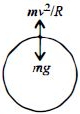
(C) At the top of the hill, the forces acting on the rider are the gravitational force $(mg)$ acting downwards and the normal reaction $(N)$ acting upwards.
The centripetal force required for circular motion is provided by the net force towards the center: $mg - N = \frac{mv^2}{R}$.
For the condition of "weightlessness", the normal reaction $N$ must be zero.
Therefore, $mg = \frac{mv^2}{R}$.
Solving for velocity $v$: $v = \sqrt{Rg}$.
Given $R = 20\, m$ and taking $g = 10\, m/s^2$, we have:
$v = \sqrt{20 \times 10} = \sqrt{200} \approx 14.14\, m/s$.
Thus, the speed is between $14\, m/s$ and $15\, m/s$.
The centripetal force required for circular motion is provided by the net force towards the center: $mg - N = \frac{mv^2}{R}$.
For the condition of "weightlessness", the normal reaction $N$ must be zero.
Therefore, $mg = \frac{mv^2}{R}$.
Solving for velocity $v$: $v = \sqrt{Rg}$.
Given $R = 20\, m$ and taking $g = 10\, m/s^2$, we have:
$v = \sqrt{20 \times 10} = \sqrt{200} \approx 14.14\, m/s$.
Thus, the speed is between $14\, m/s$ and $15\, m/s$.
0 likesView Solution
2
PhysicsEasyMCQMHT CET · 2008
Two simple harmonic motions of angular frequency $100 \, rad \, s^{-1}$ and $1000 \, rad \, s^{-1}$ have the same displacement amplitude. The ratio of their maximum acceleration is
A
$1:10^3$
B
$1:10^4$
C
$1:10$
D
$1:10^2$
Solution
(D) The angular frequencies are given as $\omega_{1} = 100 \, rad \, s^{-1}$ and $\omega_{2} = 1000 \, rad \, s^{-1}$.
Let the common displacement amplitude be $A$.
The maximum acceleration $a_{max}$ for a simple harmonic motion is given by the formula $a_{max} = \omega^2 A$.
For the first motion,$a_{max1} = \omega_{1}^2 A = (100)^2 A$.
For the second motion,$a_{max2} = \omega_{2}^2 A = (1000)^2 A$.
The ratio of their maximum accelerations is $\frac{a_{max1}}{a_{max2}} = \frac{\omega_{1}^2 A}{\omega_{2}^2 A} = \frac{\omega_{1}^2}{\omega_{2}^2}$.
Substituting the values,we get $\frac{a_{max1}}{a_{max2}} = \frac{(100)^2}{(1000)^2} = \frac{10000}{1000000} = \frac{1}{100}$.
Thus,the ratio is $1:10^2$.
Let the common displacement amplitude be $A$.
The maximum acceleration $a_{max}$ for a simple harmonic motion is given by the formula $a_{max} = \omega^2 A$.
For the first motion,$a_{max1} = \omega_{1}^2 A = (100)^2 A$.
For the second motion,$a_{max2} = \omega_{2}^2 A = (1000)^2 A$.
The ratio of their maximum accelerations is $\frac{a_{max1}}{a_{max2}} = \frac{\omega_{1}^2 A}{\omega_{2}^2 A} = \frac{\omega_{1}^2}{\omega_{2}^2}$.
Substituting the values,we get $\frac{a_{max1}}{a_{max2}} = \frac{(100)^2}{(1000)^2} = \frac{10000}{1000000} = \frac{1}{100}$.
Thus,the ratio is $1:10^2$.
0 likesView Solution
3
PhysicsEasyMCQMHT CET · 2008
$A$ particle of mass $m$ is projected with velocity $v$ making an angle of $45^{\circ}$ with the horizontal. When the particle lands on the level ground,the magnitude of the change in its momentum will be
A
$2 m v$
B
$m v / \sqrt{2}$
C
$m v \sqrt{2}$
D
zero
Solution
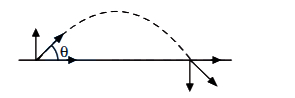
(C) The initial velocity of the particle is $\vec{u} = v \cos \theta \hat{i} + v \sin \theta \hat{j}$.
The final velocity of the particle when it lands on the ground is $\vec{v}_f = v \cos \theta \hat{i} - v \sin \theta \hat{j}$.
The initial momentum is $\vec{p}_i = m \vec{u} = m v \cos \theta \hat{i} + m v \sin \theta \hat{j}$.
The final momentum is $\vec{p}_f = m \vec{v}_f = m v \cos \theta \hat{i} - m v \sin \theta \hat{j}$.
The change in momentum is $\Delta \vec{p} = \vec{p}_f - \vec{p}_i = (m v \cos \theta \hat{i} - m v \sin \theta \hat{j}) - (m v \cos \theta \hat{i} + m v \sin \theta \hat{j}) = -2 m v \sin \theta \hat{j}$.
The magnitude of the change in momentum is $|\Delta \vec{p}| = 2 m v \sin \theta$.
Given $\theta = 45^{\circ}$,we have $\sin 45^{\circ} = 1 / \sqrt{2}$.
Therefore,$|\Delta \vec{p}| = 2 m v (1 / \sqrt{2}) = \sqrt{2} m v$.
The final velocity of the particle when it lands on the ground is $\vec{v}_f = v \cos \theta \hat{i} - v \sin \theta \hat{j}$.
The initial momentum is $\vec{p}_i = m \vec{u} = m v \cos \theta \hat{i} + m v \sin \theta \hat{j}$.
The final momentum is $\vec{p}_f = m \vec{v}_f = m v \cos \theta \hat{i} - m v \sin \theta \hat{j}$.
The change in momentum is $\Delta \vec{p} = \vec{p}_f - \vec{p}_i = (m v \cos \theta \hat{i} - m v \sin \theta \hat{j}) - (m v \cos \theta \hat{i} + m v \sin \theta \hat{j}) = -2 m v \sin \theta \hat{j}$.
The magnitude of the change in momentum is $|\Delta \vec{p}| = 2 m v \sin \theta$.
Given $\theta = 45^{\circ}$,we have $\sin 45^{\circ} = 1 / \sqrt{2}$.
Therefore,$|\Delta \vec{p}| = 2 m v (1 / \sqrt{2}) = \sqrt{2} m v$.
0 likesView Solution
4
PhysicsMediumMCQMHT CET · 2008
If $g$ is the acceleration due to gravity on the earth's surface,the gain in the potential energy of an object of mass $m$ raised from the surface of the earth to a height equal to the radius $R$ of the earth is
A
$2 mgR$
B
$mgR$
C
$\frac{1}{2} mgR$
D
$\frac{1}{4} mgR$
Solution
(C) The gravitational potential energy of an object of mass $m$ at the surface of the earth is given by $U_{1} = -\frac{GMm}{R}$.
At a height $h = R$ from the surface,the distance from the center of the earth is $r = R + h = R + R = 2R$.
The potential energy at this height is $U_{2} = -\frac{GMm}{2R}$.
The gain in potential energy is $\Delta U = U_{2} - U_{1} = -\frac{GMm}{2R} - (-\frac{GMm}{R}) = \frac{GMm}{R} - \frac{GMm}{2R} = \frac{GMm}{2R}$.
Since the acceleration due to gravity at the surface is $g = \frac{GM}{R^{2}}$,we have $GM = gR^{2}$.
Substituting this into the expression for $\Delta U$:
$\Delta U = \frac{1}{2} \frac{(gR^{2})m}{R} = \frac{1}{2} mgR$.
At a height $h = R$ from the surface,the distance from the center of the earth is $r = R + h = R + R = 2R$.
The potential energy at this height is $U_{2} = -\frac{GMm}{2R}$.
The gain in potential energy is $\Delta U = U_{2} - U_{1} = -\frac{GMm}{2R} - (-\frac{GMm}{R}) = \frac{GMm}{R} - \frac{GMm}{2R} = \frac{GMm}{2R}$.
Since the acceleration due to gravity at the surface is $g = \frac{GM}{R^{2}}$,we have $GM = gR^{2}$.
Substituting this into the expression for $\Delta U$:
$\Delta U = \frac{1}{2} \frac{(gR^{2})m}{R} = \frac{1}{2} mgR$.
0 likesView Solution
5
PhysicsEasyMCQMHT CET · 2008
Two satellites of earth,$S_{1}$ and $S_{2}$,are moving in the same orbit. The mass of $S_{1}$ is four times the mass of $S_{2}$. Which one of the following statements is true?
A
The time period of $S_{1}$ is four times that of $S_{2}$
B
The potential energies of earth and satellite in the two cases are equal
C
$S_{1}$ and $S_{2}$ are moving with the same speed
D
The kinetic energies of the two satellites are equal
Solution
(C) The orbital speed of a satellite is given by $v = \sqrt{\frac{GM}{r}}$,where $G$ is the gravitational constant,$M$ is the mass of the earth,and $r$ is the radius of the orbit.
Since both satellites are in the same orbit,$r$ is the same for both.
Therefore,the orbital speed $v$ is independent of the mass of the satellite.
Thus,$S_{1}$ and $S_{2}$ move with the same speed.
The time period is given by $T = \frac{2\pi r}{v}$,which is also independent of the mass of the satellite.
Potential energy $U = -\frac{GMm}{r}$ and kinetic energy $K = \frac{GMm}{2r}$ both depend on the mass $m$ of the satellite,so they are not equal for $S_{1}$ and $S_{2}$.
Since both satellites are in the same orbit,$r$ is the same for both.
Therefore,the orbital speed $v$ is independent of the mass of the satellite.
Thus,$S_{1}$ and $S_{2}$ move with the same speed.
The time period is given by $T = \frac{2\pi r}{v}$,which is also independent of the mass of the satellite.
Potential energy $U = -\frac{GMm}{r}$ and kinetic energy $K = \frac{GMm}{2r}$ both depend on the mass $m$ of the satellite,so they are not equal for $S_{1}$ and $S_{2}$.
0 likesView Solution
6
PhysicsEasyMCQMHT CET · 2008
What is an ideal gas?
A
One that consists of molecules
B
$A$ gas satisfying the assumptions of kinetic theory
C
$A$ gas having Maxwellian distribution of speed
D
$A$ gas consisting of massless particles
Solution
(B) An ideal gas is a theoretical gas composed of many randomly moving point particles that are not subject to inter-particle interactions. It obeys the ideal gas law $PV = nRT$ and satisfies all the fundamental assumptions of the kinetic theory of gases,such as negligible molecular volume and elastic collisions.
0 likesView Solution
7
PhysicsMediumMCQMHT CET · 2008
The driver of a car travelling at velocity $v$ suddenly sees a broad wall in front of him at a distance $d$. He should
A
brake sharply
B
turn sharply
C
Both $(a)$ and $(b)$
D
None of these
Solution
(A) When the driver applies brakes,the car covers a distance $x$ before coming to rest under the effect of the retarding force $F$. By the work-energy theorem: $\frac{1}{2} m v^{2} = F x$,which gives $x = \frac{m v^{2}}{2 F}$.
When the driver takes a turn,the required centripetal force is provided by the friction force $F$. Thus,$\frac{m v^{2}}{r} = F$,which gives the radius of the turn as $r = \frac{m v^{2}}{F}$.
Comparing the two,we see that $x = \frac{r}{2}$.
This implies that by using the same retarding (friction) force,the car can be brought to rest in a shorter distance by applying brakes compared to the radius required to turn the car. Therefore,braking is more effective.
When the driver takes a turn,the required centripetal force is provided by the friction force $F$. Thus,$\frac{m v^{2}}{r} = F$,which gives the radius of the turn as $r = \frac{m v^{2}}{F}$.
Comparing the two,we see that $x = \frac{r}{2}$.
This implies that by using the same retarding (friction) force,the car can be brought to rest in a shorter distance by applying brakes compared to the radius required to turn the car. Therefore,braking is more effective.
0 likesView Solution
8
PhysicsDifficultMCQMHT CET · 2008
When a ceiling fan is switched off,its angular velocity falls to half while it makes $36$ rotations. How many more rotations will it make before coming to rest?
A
$24$
B
$36$
C
$18$
D
$12$
Solution
(D) Using the third equation of rotational motion: $\omega^2 = \omega_0^2 - 2\alpha\theta$.
Initially,the angular velocity becomes $\omega = \frac{\omega_0}{2}$ after $\theta_1 = 36 \times 2\pi$ radians.
Substituting these values: $(\frac{\omega_0}{2})^2 = \omega_0^2 - 2\alpha(36 \times 2\pi)$.
$\frac{\omega_0^2}{4} = \omega_0^2 - 144\pi\alpha$,which gives $144\pi\alpha = \frac{3\omega_0^2}{4}$,so $\alpha = \frac{3\omega_0^2}{576\pi} = \frac{\omega_0^2}{192\pi}$.
Now,for the motion from $\omega = \frac{\omega_0}{2}$ to $\omega = 0$,let the additional rotations be $n$. The angle covered is $\theta_2 = n \times 2\pi$.
Using $0^2 = (\frac{\omega_0}{2})^2 - 2\alpha(n \times 2\pi)$.
$\frac{\omega_0^2}{4} = 2(\frac{\omega_0^2}{192\pi})(n \times 2\pi)$.
$\frac{1}{4} = \frac{4n\pi}{192\pi} = \frac{n}{48}$.
$n = \frac{48}{4} = 12$.
Thus,the fan will make $12$ more rotations before coming to rest.
Initially,the angular velocity becomes $\omega = \frac{\omega_0}{2}$ after $\theta_1 = 36 \times 2\pi$ radians.
Substituting these values: $(\frac{\omega_0}{2})^2 = \omega_0^2 - 2\alpha(36 \times 2\pi)$.
$\frac{\omega_0^2}{4} = \omega_0^2 - 144\pi\alpha$,which gives $144\pi\alpha = \frac{3\omega_0^2}{4}$,so $\alpha = \frac{3\omega_0^2}{576\pi} = \frac{\omega_0^2}{192\pi}$.
Now,for the motion from $\omega = \frac{\omega_0}{2}$ to $\omega = 0$,let the additional rotations be $n$. The angle covered is $\theta_2 = n \times 2\pi$.
Using $0^2 = (\frac{\omega_0}{2})^2 - 2\alpha(n \times 2\pi)$.
$\frac{\omega_0^2}{4} = 2(\frac{\omega_0^2}{192\pi})(n \times 2\pi)$.
$\frac{1}{4} = \frac{4n\pi}{192\pi} = \frac{n}{48}$.
$n = \frac{48}{4} = 12$.
Thus,the fan will make $12$ more rotations before coming to rest.
0 likesView Solution
9
PhysicsEasyMCQMHT CET · 2008
The potential energy of a molecule on the surface of a liquid compared to one inside the liquid is
A
zero
B
lesser
C
equal
D
greater
Solution
(D) When the surface area of a liquid is increased,molecules from the interior of the liquid rise to the surface.
As these molecules reach the surface,work is done against the cohesive force.
This work is stored in the molecules in the form of potential energy.
Thus,the potential energy of the molecules lying on the surface is greater than that of the molecules in the interior of the liquid.
As these molecules reach the surface,work is done against the cohesive force.
This work is stored in the molecules in the form of potential energy.
Thus,the potential energy of the molecules lying on the surface is greater than that of the molecules in the interior of the liquid.
0 likesView Solution
10
PhysicsEasyMCQMHT CET · 2008
$A$ frame made of metallic wire enclosing a surface area $A$ is covered with a soap film. If the area of the frame of metallic wire is reduced by $50 \%$,the energy of the soap film will be changed by (in $\%$)
A
$100$
B
$75$
C
$50$
D
$25$
Solution
(C) The surface energy $(E)$ of a soap film is given by the product of surface tension $(T)$ and the total surface area. Since a soap film has two surfaces,the total area is $2A$.
$E = T \times 2A$
When the area of the frame is reduced by $50 \%$,the new area becomes $A' = A - 0.5A = 0.5A = A/2$.
The new surface energy $(E_1)$ is:
$E_1 = T \times 2(A/2) = T \times A$
The percentage change in surface energy is calculated as:
$\text{Percentage change} = \frac{E - E_1}{E} \times 100$
$\text{Percentage change} = \frac{2TA - TA}{2TA} \times 100 = \frac{TA}{2TA} \times 100 = 50 \%$
Thus,the energy of the soap film changes by $50 \%$.
$E = T \times 2A$
When the area of the frame is reduced by $50 \%$,the new area becomes $A' = A - 0.5A = 0.5A = A/2$.
The new surface energy $(E_1)$ is:
$E_1 = T \times 2(A/2) = T \times A$
The percentage change in surface energy is calculated as:
$\text{Percentage change} = \frac{E - E_1}{E} \times 100$
$\text{Percentage change} = \frac{2TA - TA}{2TA} \times 100 = \frac{TA}{2TA} \times 100 = 50 \%$
Thus,the energy of the soap film changes by $50 \%$.
0 likesView Solution
11
PhysicsEasyMCQMHT CET · 2008
$A$ hollow sphere is filled with water through a small hole in it. It is then hung by a long thread and made to oscillate. As the water slowly flows out of the hole at the bottom,the period of oscillation will
A
continuously decrease
B
continuously increase
C
first decrease then increase
D
first increase then decrease
Solution
(D) The time period of a simple pendulum is given by $T = 2 \pi \sqrt{L/g}$,where $L$ is the distance between the point of suspension and the center of mass $(CM)$ of the system.
Initially,the $CM$ of the water-filled sphere is at the geometric center of the sphere.
As water flows out from the bottom hole,the $CM$ of the remaining water shifts downwards,which increases the effective length $L$ of the pendulum,causing the time period $T$ to increase.
As the sphere becomes nearly empty,the $CM$ of the remaining water shifts back upwards towards the center of the sphere.
This causes the effective length $L$ to decrease,which in turn causes the time period $T$ to decrease.
Therefore,the period of oscillation first increases and then decreases.
Initially,the $CM$ of the water-filled sphere is at the geometric center of the sphere.
As water flows out from the bottom hole,the $CM$ of the remaining water shifts downwards,which increases the effective length $L$ of the pendulum,causing the time period $T$ to increase.
As the sphere becomes nearly empty,the $CM$ of the remaining water shifts back upwards towards the center of the sphere.
This causes the effective length $L$ to decrease,which in turn causes the time period $T$ to decrease.
Therefore,the period of oscillation first increases and then decreases.
0 likesView Solution
12
PhysicsEasyMCQMHT CET · 2008
The graph between the time period $(T)$ and the length $(l)$ of a simple pendulum is
A
straight line
B
curve
C
ellipse
D
parabola
Solution
(D) The time period of a simple pendulum is given by the formula:
$T = 2 \pi \sqrt{\frac{l}{g}}$
Here,$l$ is the length of the pendulum and $g$ is the acceleration due to gravity.
Squaring both sides of the equation,we get:
$T^2 = \frac{4 \pi^2 l}{g}$
This can be written as:
$T^2 = k \cdot l$,where $k = \frac{4 \pi^2}{g}$ is a constant.
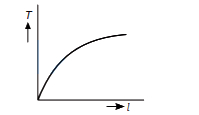
This equation is of the form $y^2 = 4ax$,which represents a parabola.
Therefore,the graph between the time period $T$ and the length $l$ is a part of a parabola.
$T = 2 \pi \sqrt{\frac{l}{g}}$
Here,$l$ is the length of the pendulum and $g$ is the acceleration due to gravity.
Squaring both sides of the equation,we get:
$T^2 = \frac{4 \pi^2 l}{g}$
This can be written as:
$T^2 = k \cdot l$,where $k = \frac{4 \pi^2}{g}$ is a constant.
This equation is of the form $y^2 = 4ax$,which represents a parabola.
Therefore,the graph between the time period $T$ and the length $l$ is a part of a parabola.
0 likesView Solution
13
PhysicsDifficultMCQMHT CET · 2008
Two spheres of equal masses,one of which is a thin spherical shell and the other a solid sphere,have the same moment of inertia about their respective diameters. The ratio of their radii is
A
$3: 5$
B
$\sqrt{3}: \sqrt{5}$
C
$\sqrt{3}: \sqrt{7}$
D
$5: 7$
Solution
(B) Let the radii of the thin spherical shell and the solid sphere be $R_1$ and $R_2$,respectively.
The moment of inertia of a thin spherical shell about its diameter is given by:
$I_{\text{shell}} = \frac{2}{3} MR_1^2$ ... $(i)$
The moment of inertia of a solid sphere about its diameter is given by:
$I_{\text{sphere}} = \frac{2}{5} MR_2^2$ ... (ii)
Given that the masses $(M)$ and the moments of inertia $(I)$ for both bodies are equal,we equate $(i)$ and (ii):
$\frac{2}{3} MR_1^2 = \frac{2}{5} MR_2^2$
Dividing both sides by $M$ and simplifying:
$\frac{R_1^2}{R_2^2} = \frac{3}{5}$
Taking the square root on both sides:
$\frac{R_1}{R_2} = \frac{\sqrt{3}}{\sqrt{5}}$
Thus,the ratio of their radii is $\sqrt{3}: \sqrt{5}$.
The moment of inertia of a thin spherical shell about its diameter is given by:
$I_{\text{shell}} = \frac{2}{3} MR_1^2$ ... $(i)$
The moment of inertia of a solid sphere about its diameter is given by:
$I_{\text{sphere}} = \frac{2}{5} MR_2^2$ ... (ii)
Given that the masses $(M)$ and the moments of inertia $(I)$ for both bodies are equal,we equate $(i)$ and (ii):
$\frac{2}{3} MR_1^2 = \frac{2}{5} MR_2^2$
Dividing both sides by $M$ and simplifying:
$\frac{R_1^2}{R_2^2} = \frac{3}{5}$
Taking the square root on both sides:
$\frac{R_1}{R_2} = \frac{\sqrt{3}}{\sqrt{5}}$
Thus,the ratio of their radii is $\sqrt{3}: \sqrt{5}$.
0 likesView Solution
14
PhysicsEasyMCQMHT CET · 2008
The absorption coefficient of an open window is:
A
zero
B
$0.5$
C
$1$
D
$0.25$
Solution
(C) An open window acts as a perfectly black body because any radiation entering it is absorbed by the interior of the room and does not escape.
For a perfectly black body,the absorption coefficient is defined as $1$.
For a perfectly black body,the absorption coefficient is defined as $1$.
0 likesView Solution
15
PhysicsDifficultMCQMHT CET · 2008
Which of the following statements is true/correct?
A
During clear nights,the temperature rises steadily upward near the ground level
B
Newton's law of cooling,an approximate form of Stefan's law,is valid only for natural convection
C
The total energy emitted by a black body per unit time per unit area is proportional to the square of its temperature in the Kelvin scale
D
Two spheres of the same material have radii $1 \ m$ and $4 \ m$ and temperatures $4000 \ K$ and $2000 \ K$ respectively. The energy radiated per second by the first sphere is greater than that radiated per second by the second sphere
Solution
(B) During clear nights,objects on the surface of the Earth radiate heat,causing the temperature to fall. Hence,option $(A)$ is incorrect.
According to Stefan-Boltzmann law,the total energy radiated by a black body per unit time per unit area is $E \propto T^{4}$. Hence,option $(C)$ is incorrect.
The energy radiated per second (power) is given by $P = A \sigma \varepsilon T^{4} = 4 \pi r^{2} \sigma \varepsilon T^{4}$.
For the two spheres,the ratio of power radiated is:
$\frac{P_{1}}{P_{2}} = \left(\frac{r_{1}}{r_{2}}\right)^{2} \left(\frac{T_{1}}{T_{2}}\right)^{4} = \left(\frac{1}{4}\right)^{2} \left(\frac{4000}{2000}\right)^{4} = \frac{1}{16} \times (2)^{4} = \frac{16}{16} = 1$.
Since $P_{1} = P_{2}$,option $(D)$ is incorrect.
Newton's law of cooling is an approximate form of Stefan's law of radiation and is valid for small temperature differences,typically observed in natural convection. Thus,option $(B)$ is correct.
According to Stefan-Boltzmann law,the total energy radiated by a black body per unit time per unit area is $E \propto T^{4}$. Hence,option $(C)$ is incorrect.
The energy radiated per second (power) is given by $P = A \sigma \varepsilon T^{4} = 4 \pi r^{2} \sigma \varepsilon T^{4}$.
For the two spheres,the ratio of power radiated is:
$\frac{P_{1}}{P_{2}} = \left(\frac{r_{1}}{r_{2}}\right)^{2} \left(\frac{T_{1}}{T_{2}}\right)^{4} = \left(\frac{1}{4}\right)^{2} \left(\frac{4000}{2000}\right)^{4} = \frac{1}{16} \times (2)^{4} = \frac{16}{16} = 1$.
Since $P_{1} = P_{2}$,option $(D)$ is incorrect.
Newton's law of cooling is an approximate form of Stefan's law of radiation and is valid for small temperature differences,typically observed in natural convection. Thus,option $(B)$ is correct.
0 likesView Solution
16
PhysicsMediumMCQMHT CET · 2008
The angle between particle velocity and wave velocity in a transverse wave is
A
zero
B
$\pi / 4$
C
$\pi / 2$
D
$\pi$
Solution
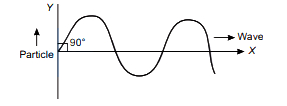
(C) In a transverse wave,the particles of the medium vibrate about their mean positions in a direction perpendicular to the direction of wave propagation.
Since the wave propagates along the $X$-axis and the particles oscillate along the $Y$-axis,the direction of particle velocity is perpendicular to the direction of wave velocity.
Therefore,the angle between the particle velocity and the wave velocity is $90^{\circ}$ or $\frac{\pi}{2}$ radians.
Since the wave propagates along the $X$-axis and the particles oscillate along the $Y$-axis,the direction of particle velocity is perpendicular to the direction of wave velocity.
Therefore,the angle between the particle velocity and the wave velocity is $90^{\circ}$ or $\frac{\pi}{2}$ radians.
0 likesView Solution
17
PhysicsEasyMCQMHT CET · 2008
$A$ wave travelling along a string is described by the equation $y = A \sin (\omega t - k x)$. The maximum particle velocity is:
A
$A \omega$
B
$\omega / k$
C
$d \omega / d k$
D
$x / t$
Solution
(A) Given the displacement of a particle in the wave is $y = A \sin (\omega t - k x)$.
The particle velocity $v_p$ is defined as the rate of change of displacement with respect to time:
$v_p = \frac{dy}{dt}$
Differentiating the displacement equation with respect to $t$:
$v_p = \frac{d}{dt} [A \sin (\omega t - k x)] = A \omega \cos (\omega t - k x)$
For the maximum particle velocity,the cosine term must be at its maximum value,which is $1$:
$v_{p, \text{max}} = A \omega (1) = A \omega$
Thus,the maximum particle velocity is $A \omega$.
The particle velocity $v_p$ is defined as the rate of change of displacement with respect to time:
$v_p = \frac{dy}{dt}$
Differentiating the displacement equation with respect to $t$:
$v_p = \frac{d}{dt} [A \sin (\omega t - k x)] = A \omega \cos (\omega t - k x)$
For the maximum particle velocity,the cosine term must be at its maximum value,which is $1$:
$v_{p, \text{max}} = A \omega (1) = A \omega$
Thus,the maximum particle velocity is $A \omega$.
0 likesView Solution
18
PhysicsMediumMCQMHT CET · 2008
An observer moves towards a stationary source of sound,with a velocity one-fifth of the velocity of sound. What is the percentage increase in the apparent frequency?
A
Zero
B
$0.5 \%$
C
$5 \%$
D
$20 \%$
Solution
(D) The apparent frequency $n'$ heard by an observer moving towards a stationary source is given by the Doppler effect formula: $n' = n \left( \frac{v + v_o}{v} \right)$,where $v$ is the velocity of sound and $v_o$ is the velocity of the observer.
Given that $v_o = \frac{v}{5}$,we substitute this into the formula:
$n' = n \left( \frac{v + v/5}{v} \right) = n \left( \frac{6v/5}{v} \right) = 1.2n$.
The fractional change in frequency is $\frac{n' - n}{n} = \frac{1.2n - n}{n} = 0.2$.
To find the percentage increase,we multiply by $100$: $0.2 \times 100 \% = 20 \%$.
Given that $v_o = \frac{v}{5}$,we substitute this into the formula:
$n' = n \left( \frac{v + v/5}{v} \right) = n \left( \frac{6v/5}{v} \right) = 1.2n$.
The fractional change in frequency is $\frac{n' - n}{n} = \frac{1.2n - n}{n} = 0.2$.
To find the percentage increase,we multiply by $100$: $0.2 \times 100 \% = 20 \%$.
0 likesView Solution
19
PhysicsMediumMCQMHT CET · 2008
$A$ long spring is stretched by $2 \ cm$ and its potential energy is $U$. If the spring is stretched by $10 \ cm$,its potential energy will be
A
$U / 5$
B
$U / 25$
C
$5 U$
D
$25 U$
Solution
(D) The potential energy of a stretched spring is given by the formula $U = \frac{1}{2} k x^2$,where $k$ is the spring constant and $x$ is the elongation.
For the first case,$x_1 = 2 \ cm$,so $U = \frac{1}{2} k (2)^2 = 2k$ ... $(i)$.
For the second case,$x_2 = 10 \ cm$,so the new potential energy $U'$ is $U' = \frac{1}{2} k (10)^2 = 50k$ ... $(ii)$.
Dividing equation $(ii)$ by equation $(i)$,we get $\frac{U'}{U} = \frac{50k}{2k} = 25$.
Therefore,$U' = 25U$.
For the first case,$x_1 = 2 \ cm$,so $U = \frac{1}{2} k (2)^2 = 2k$ ... $(i)$.
For the second case,$x_2 = 10 \ cm$,so the new potential energy $U'$ is $U' = \frac{1}{2} k (10)^2 = 50k$ ... $(ii)$.
Dividing equation $(ii)$ by equation $(i)$,we get $\frac{U'}{U} = \frac{50k}{2k} = 25$.
Therefore,$U' = 25U$.
0 likesView Solution
20
PhysicsDifficultMCQMHT CET · 2008
The length of a magnet is large compared to its width and breadth. The time period of its oscillation in a vibration magnetometer is $2 \, s$. The magnet is cut along its length into three equal parts and these three parts are then placed on each other with their like poles together. The time period of this combination will be
A
$2 \, s$
B
$2/3 \, s$
C
$2\sqrt{3} \, s$
D
$2/\sqrt{3} \, s$
Solution
(B) The time period of a magnet in a vibration magnetometer is given by $T = 2\pi \sqrt{\frac{I}{MB}}$,where $I$ is the moment of inertia and $M$ is the magnetic moment.
Initially,$T = 2 \, s = 2\pi \sqrt{\frac{I}{MB}}$.
When the magnet is cut into three equal parts along its length,for each part,the mass $m' = m/3$ and length $l' = l/3$.
The moment of inertia of each part about the center is $I' = \frac{1}{12} m' (l')^2 = \frac{1}{12} (m/3) (l/3)^2 = \frac{1}{27} I$.
The magnetic moment of each part is $M' = M/3$.
When three such parts are placed on each other,the total moment of inertia $I_s = 3 \times I' = 3 \times (I/27) = I/9$.
The total magnetic moment $M_s = 3 \times M' = 3 \times (M/3) = M$.
The new time period $T_s = 2\pi \sqrt{\frac{I_s}{M_s B}} = 2\pi \sqrt{\frac{I/9}{MB}} = \frac{1}{3} \times 2\pi \sqrt{\frac{I}{MB}} = \frac{T}{3}$.
Substituting $T = 2 \, s$,we get $T_s = 2/3 \, s$.
Initially,$T = 2 \, s = 2\pi \sqrt{\frac{I}{MB}}$.
When the magnet is cut into three equal parts along its length,for each part,the mass $m' = m/3$ and length $l' = l/3$.
The moment of inertia of each part about the center is $I' = \frac{1}{12} m' (l')^2 = \frac{1}{12} (m/3) (l/3)^2 = \frac{1}{27} I$.
The magnetic moment of each part is $M' = M/3$.
When three such parts are placed on each other,the total moment of inertia $I_s = 3 \times I' = 3 \times (I/27) = I/9$.
The total magnetic moment $M_s = 3 \times M' = 3 \times (M/3) = M$.
The new time period $T_s = 2\pi \sqrt{\frac{I_s}{M_s B}} = 2\pi \sqrt{\frac{I/9}{MB}} = \frac{1}{3} \times 2\pi \sqrt{\frac{I}{MB}} = \frac{T}{3}$.
Substituting $T = 2 \, s$,we get $T_s = 2/3 \, s$.
0 likesView Solution
21
PhysicsMediumMCQMHT CET · 2008
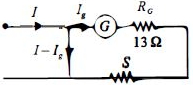
The resistance of an ammeter is $13\, \Omega$ and its scale is graduated for a current up to $100\, A$. After an additional shunt has been connected to this ammeter,it becomes possible to measure currents up to $750\, A$ by this meter. The value of the shunt resistance is:
A
$2\, \Omega$
B
$0.2\, \Omega$
C
$2\, k\Omega$
D
$20\, \Omega$
Solution
(A) Let the shunt resistance be $S$.
Given:
Total current to be measured,$I = 750\, A$
Full-scale deflection current of the ammeter,$I_g = 100\, A$
Resistance of the ammeter,$R_G = 13\, \Omega$
When a shunt $S$ is connected in parallel with the ammeter,the potential difference across the ammeter and the shunt must be equal:
$I_g R_G = (I - I_g) S$
Substituting the given values:
$100 \times 13 = (750 - 100) \times S$
$1300 = 650 \times S$
Solving for $S$:
$S = \frac{1300}{650} = 2\, \Omega$
Thus,the value of the shunt resistance is $2\, \Omega$.
Given:
Total current to be measured,$I = 750\, A$
Full-scale deflection current of the ammeter,$I_g = 100\, A$
Resistance of the ammeter,$R_G = 13\, \Omega$
When a shunt $S$ is connected in parallel with the ammeter,the potential difference across the ammeter and the shunt must be equal:
$I_g R_G = (I - I_g) S$
Substituting the given values:
$100 \times 13 = (750 - 100) \times S$
$1300 = 650 \times S$
Solving for $S$:
$S = \frac{1300}{650} = 2\, \Omega$
Thus,the value of the shunt resistance is $2\, \Omega$.
0 likesView Solution
22
PhysicsMediumMCQMHT CET · 2008
$A$ $p-n$ photodiode is made of a material with a band gap of $2.0\, eV$. The minimum frequency of the radiation that can be absorbed by the material is nearly:
A
$1 \times 10^{14}\, Hz$
B
$20 \times 10^{14}\, Hz$
C
$10 \times 10^{14}\, Hz$
D
$5 \times 10^{14}\, Hz$
Solution
(D) The energy of the photon required to excite an electron across the band gap is given by $E = h\nu$.
For the minimum frequency $\nu$,the energy of the photon must be equal to the band gap energy $E_g$.
Given $E_g = 2.0\, eV$.
We know that $1\, eV = 1.6 \times 10^{-19}\, J$,so $E_g = 2.0 \times 1.6 \times 10^{-19} = 3.2 \times 10^{-19}\, J$.
Using the relation $E = h\nu$,we have $\nu = \frac{E_g}{h}$.
Substituting the values $h = 6.63 \times 10^{-34}\, J\cdot s$:
$\nu = \frac{3.2 \times 10^{-19}}{6.63 \times 10^{-34}} \approx 0.482 \times 10^{15}\, Hz$.
$\nu \approx 4.82 \times 10^{14}\, Hz$.
Rounding this value,we get $\nu \approx 5 \times 10^{14}\, Hz$.
For the minimum frequency $\nu$,the energy of the photon must be equal to the band gap energy $E_g$.
Given $E_g = 2.0\, eV$.
We know that $1\, eV = 1.6 \times 10^{-19}\, J$,so $E_g = 2.0 \times 1.6 \times 10^{-19} = 3.2 \times 10^{-19}\, J$.
Using the relation $E = h\nu$,we have $\nu = \frac{E_g}{h}$.
Substituting the values $h = 6.63 \times 10^{-34}\, J\cdot s$:
$\nu = \frac{3.2 \times 10^{-19}}{6.63 \times 10^{-34}} \approx 0.482 \times 10^{15}\, Hz$.
$\nu \approx 4.82 \times 10^{14}\, Hz$.
Rounding this value,we get $\nu \approx 5 \times 10^{14}\, Hz$.
0 likesView Solution
23
PhysicsDifficultMCQMHT CET · 2008
What is the value of inductance $L$ for which the current is a maximum in a series $LCR$ circuit with $C=10 \mu F$ and $\omega=1000 \ s^{-1}$?
A
$100 \ mH$
B
$1 \ mH$
C
Cannot be calculated unless $R$ is known
D
$10 \ mH$
Solution
(A) The current in an $LCR$ series circuit is given by $i = \frac{V}{\sqrt{R^2 + (X_L - X_C)^2}}$,where $V$ is the $rms$ voltage,$R$ is the resistance,$X_L = \omega L$ is the inductive reactance,and $X_C = \frac{1}{\omega C}$ is the capacitive reactance.
For the current to be maximum,the impedance must be minimum,which occurs when $X_L = X_C$.
This condition is known as resonance,where $\omega L = \frac{1}{\omega C}$.
Rearranging for $L$,we get $L = \frac{1}{\omega^2 C}$.
Given $\omega = 1000 \ s^{-1}$ and $C = 10 \ \mu F = 10 \times 10^{-6} \ F$.
Substituting these values: $L = \frac{1}{(1000)^2 \times 10 \times 10^{-6}} = \frac{1}{10^6 \times 10^{-5}} = \frac{1}{10} = 0.1 \ H$.
Converting to millihenry: $0.1 \ H = 100 \ mH$.
For the current to be maximum,the impedance must be minimum,which occurs when $X_L = X_C$.
This condition is known as resonance,where $\omega L = \frac{1}{\omega C}$.
Rearranging for $L$,we get $L = \frac{1}{\omega^2 C}$.
Given $\omega = 1000 \ s^{-1}$ and $C = 10 \ \mu F = 10 \times 10^{-6} \ F$.
Substituting these values: $L = \frac{1}{(1000)^2 \times 10 \times 10^{-6}} = \frac{1}{10^6 \times 10^{-5}} = \frac{1}{10} = 0.1 \ H$.
Converting to millihenry: $0.1 \ H = 100 \ mH$.
0 likesView Solution
24
PhysicsEasyMCQMHT CET · 2008
In an $AC$ circuit,the $emf$ $(e)$ and the current $(i)$ at any instant are given respectively by:
$e = E_{0} \sin \omega t$
$i = I_{0} \sin (\omega t - \phi)$
The average power in the circuit over one cycle of $AC$ is:
$e = E_{0} \sin \omega t$
$i = I_{0} \sin (\omega t - \phi)$
The average power in the circuit over one cycle of $AC$ is:
A
$\frac{E_{0} I_{0}}{2}$
B
$\frac{E_{0} I_{0}}{2} \sin \phi$
C
$\frac{E_{0} I_{0}}{2} \cos \phi$
D
$E_{0} I_{0}$
Solution
(C) The instantaneous power $p$ in an $AC$ circuit is given by the product of instantaneous $emf$ and current:
$p = e \cdot i = (E_{0} \sin \omega t) \cdot (I_{0} \sin (\omega t - \phi))$
Using the trigonometric identity $\sin A \sin B = \frac{1}{2} [\cos(A-B) - \cos(A+B)]$,we get:
$p = \frac{E_{0} I_{0}}{2} [\cos \phi - \cos(2\omega t - \phi)]$
The average power $P_{av}$ over one complete cycle $T$ is the average of $p$ over time $T$:
$P_{av} = \frac{1}{T} \int_{0}^{T} p \, dt = \frac{E_{0} I_{0}}{2T} \int_{0}^{T} [\cos \phi - \cos(2\omega t - \phi)] \, dt$
Since the average of $\cos(2\omega t - \phi)$ over a full cycle is $0$,the expression simplifies to:
$P_{av} = \frac{E_{0} I_{0}}{2} \cos \phi$
Here,$\cos \phi$ is known as the power factor of the $AC$ circuit.
$p = e \cdot i = (E_{0} \sin \omega t) \cdot (I_{0} \sin (\omega t - \phi))$
Using the trigonometric identity $\sin A \sin B = \frac{1}{2} [\cos(A-B) - \cos(A+B)]$,we get:
$p = \frac{E_{0} I_{0}}{2} [\cos \phi - \cos(2\omega t - \phi)]$
The average power $P_{av}$ over one complete cycle $T$ is the average of $p$ over time $T$:
$P_{av} = \frac{1}{T} \int_{0}^{T} p \, dt = \frac{E_{0} I_{0}}{2T} \int_{0}^{T} [\cos \phi - \cos(2\omega t - \phi)] \, dt$
Since the average of $\cos(2\omega t - \phi)$ over a full cycle is $0$,the expression simplifies to:
$P_{av} = \frac{E_{0} I_{0}}{2} \cos \phi$
Here,$\cos \phi$ is known as the power factor of the $AC$ circuit.
0 likesView Solution
25
PhysicsMediumMCQMHT CET · 2008
$A$ transformer is used to light a $100 \,W$ and $110 \,V$ lamp from a $220 \,V$ mains. If the main current is $0.5 \,A$, the efficiency of the transformer is approximately (in $\%$)
A
$30$
B
$50$
C
$90$
D
$10$
Solution
(C) The efficiency of a transformer is defined as the ratio of output power to input power.
$\eta = \frac{\text{Output Power}}{\text{Input Power}}$
Given:
Output power $(P_{out})$ = $100 \,W$
Input voltage $(V_p)$ = $220 \,V$
Input current $(I_p)$ = $0.5 \,A$
Input power $(P_{in})$ = $V_p \times I_p = 220 \,V \times 0.5 \,A = 110 \,W$
Efficiency $(\eta)$ = $\frac{100 \,W}{110 \,W} \approx 0.909$
$\eta \approx 90.9 \% \approx 90 \%$
Thus, the efficiency is approximately $90 \%$.
$\eta = \frac{\text{Output Power}}{\text{Input Power}}$
Given:
Output power $(P_{out})$ = $100 \,W$
Input voltage $(V_p)$ = $220 \,V$
Input current $(I_p)$ = $0.5 \,A$
Input power $(P_{in})$ = $V_p \times I_p = 220 \,V \times 0.5 \,A = 110 \,W$
Efficiency $(\eta)$ = $\frac{100 \,W}{110 \,W} \approx 0.909$
$\eta \approx 90.9 \% \approx 90 \%$
Thus, the efficiency is approximately $90 \%$.
0 likesView Solution
26
PhysicsEasyMCQMHT CET · 2008
The ground state energy of a hydrogen atom is $-13.6 \text{ eV}$. When its electron is in the first excited state,its excitation energy is:
A
$3.4 \text{ eV}$
B
$6.8 \text{ eV}$
C
$10.2 \text{ eV}$
D
zero
Solution
(C) The energy of an electron in the $n^{th}$ orbit of a hydrogen atom is given by $E_n = -\frac{13.6}{n^2} \text{ eV}$.
For the ground state $(n=1)$,$E_1 = -13.6 \text{ eV}$.
The first excited state corresponds to $n=2$.
Thus,the energy of the electron in the first excited state is $E_2 = -\frac{13.6}{2^2} = -\frac{13.6}{4} = -3.4 \text{ eV}$.
The excitation energy required to move the electron from the ground state to the first excited state is $\Delta E = E_2 - E_1$.
$\Delta E = -3.4 \text{ eV} - (-13.6 \text{ eV}) = 10.2 \text{ eV}$.
For the ground state $(n=1)$,$E_1 = -13.6 \text{ eV}$.
The first excited state corresponds to $n=2$.
Thus,the energy of the electron in the first excited state is $E_2 = -\frac{13.6}{2^2} = -\frac{13.6}{4} = -3.4 \text{ eV}$.
The excitation energy required to move the electron from the ground state to the first excited state is $\Delta E = E_2 - E_1$.
$\Delta E = -3.4 \text{ eV} - (-13.6 \text{ eV}) = 10.2 \text{ eV}$.
0 likesView Solution
27
PhysicsMediumMCQMHT CET · 2008
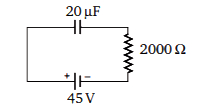
$A$ $20 \mu F$ capacitor is connected to a $45 \text{ V}$ battery through a circuit whose resistance is $2000 \Omega$. What is the final charge on the capacitor?
A
$9 \times 10^{-4} \text{ C}$
B
$9.154 \times 10^{-4} \text{ C}$
C
$9.8 \times 10^{-4} \text{ C}$
D
None of these
Solution
(A) We know that in the steady state,the capacitor behaves like an open circuit,meaning no current flows through it.
Therefore,the potential difference across the capacitor is equal to the battery voltage,which is $45 \text{ V}$.
The final charge $q$ on the capacitor is given by the formula:
$q = C \times V$
Given:
Capacitance $C = 20 \mu F = 20 \times 10^{-6} \text{ F}$
Voltage $V = 45 \text{ V}$
Substituting the values:
$q = 20 \times 10^{-6} \times 45$
$q = 900 \times 10^{-6} \text{ C}$
$q = 9 \times 10^{-4} \text{ C}$
Therefore,the potential difference across the capacitor is equal to the battery voltage,which is $45 \text{ V}$.
The final charge $q$ on the capacitor is given by the formula:
$q = C \times V$
Given:
Capacitance $C = 20 \mu F = 20 \times 10^{-6} \text{ F}$
Voltage $V = 45 \text{ V}$
Substituting the values:
$q = 20 \times 10^{-6} \times 45$
$q = 900 \times 10^{-6} \text{ C}$
$q = 9 \times 10^{-4} \text{ C}$
0 likesView Solution
28
PhysicsMediumMCQMHT CET · 2008
The energy required to charge a parallel plate capacitor with plate separation $d$ and plate area $A$ such that the uniform electric field between the plates is $E$,is
A
$\frac{1}{2} \varepsilon_{0} E^{2} / A d$
B
$\varepsilon_{0} E^{2} / A d$
C
$\varepsilon_{0} E^{2} A d$
D
$\frac{1}{2} \varepsilon_{0} E^{2} A d$
Solution
(D) The energy stored in a parallel plate capacitor is given by the formula $U = \frac{1}{2} C V^{2}$.
Here,the capacitance $C = \frac{\varepsilon_{0} A}{d}$.
The potential difference $V$ between the plates is related to the electric field $E$ and separation $d$ by $V = E d$.
Substituting these values into the energy formula:
$U = \frac{1}{2} \left( \frac{\varepsilon_{0} A}{d} \right) (E d)^{2}$
$U = \frac{1}{2} \left( \frac{\varepsilon_{0} A}{d} \right) (E^{2} d^{2})$
$U = \frac{1}{2} \varepsilon_{0} E^{2} A d$.
Here,the capacitance $C = \frac{\varepsilon_{0} A}{d}$.
The potential difference $V$ between the plates is related to the electric field $E$ and separation $d$ by $V = E d$.
Substituting these values into the energy formula:
$U = \frac{1}{2} \left( \frac{\varepsilon_{0} A}{d} \right) (E d)^{2}$
$U = \frac{1}{2} \left( \frac{\varepsilon_{0} A}{d} \right) (E^{2} d^{2})$
$U = \frac{1}{2} \varepsilon_{0} E^{2} A d$.
0 likesView Solution
29
PhysicsMediumMCQMHT CET · 2008
$A$ cell can be balanced against $110 \ cm$ and $100 \ cm$ of potentiometer wire,respectively with and without being short-circuited through a resistance of $10 \ \Omega$. Its internal resistance is
A
$1.0 \ \Omega$
B
$0.5 \ \Omega$
C
$2.0 \ \Omega$
D
zero
Solution
(A) In a potentiometer experiment to find the internal resistance $r$ of a cell,let $E$ be the emf of the cell and $V$ be the terminal potential difference across the external resistance $R$. The balancing lengths are $l_1 = 110 \ cm$ (open circuit) and $l_2 = 100 \ cm$ (closed circuit with $R = 10 \ \Omega$).
We know that $E \propto l_1$ and $V \propto l_2$.
Therefore,$\frac{E}{V} = \frac{l_1}{l_2} = \frac{110}{100} = 1.1$.
Also,the relationship between emf,terminal voltage,and internal resistance is given by $\frac{E}{V} = \frac{R+r}{R} = 1 + \frac{r}{R}$.
Equating the two expressions: $1 + \frac{r}{R} = 1.1$.
$\frac{r}{R} = 1.1 - 1 = 0.1$.
Given $R = 10 \ \Omega$,we have $r = 0.1 \times 10 \ \Omega = 1.0 \ \Omega$.
We know that $E \propto l_1$ and $V \propto l_2$.
Therefore,$\frac{E}{V} = \frac{l_1}{l_2} = \frac{110}{100} = 1.1$.
Also,the relationship between emf,terminal voltage,and internal resistance is given by $\frac{E}{V} = \frac{R+r}{R} = 1 + \frac{r}{R}$.
Equating the two expressions: $1 + \frac{r}{R} = 1.1$.
$\frac{r}{R} = 1.1 - 1 = 0.1$.
Given $R = 10 \ \Omega$,we have $r = 0.1 \times 10 \ \Omega = 1.0 \ \Omega$.
0 likesView Solution
30
PhysicsEasyMCQMHT CET · 2008
Which of the following,while in motion,cannot be deflected by a magnetic field?
A
Protons
B
Cathode rays
C
Alpha particles
D
Neutrons
Solution
(D) The magnetic force $F$ on a moving charge $q$ in a magnetic field $B$ is given by the Lorentz force formula: $F = q(v \times B)$.
Protons,cathode rays (electrons),and alpha particles are all charged particles. Therefore,they experience a magnetic force when moving through a magnetic field and are deflected.
Neutrons are electrically neutral particles,meaning their charge $q = 0$.
Since the charge is zero,the magnetic force $F = 0 \times (v \times B) = 0$.
Thus,neutrons cannot be deflected by a magnetic field.
Protons,cathode rays (electrons),and alpha particles are all charged particles. Therefore,they experience a magnetic force when moving through a magnetic field and are deflected.
Neutrons are electrically neutral particles,meaning their charge $q = 0$.
Since the charge is zero,the magnetic force $F = 0 \times (v \times B) = 0$.
Thus,neutrons cannot be deflected by a magnetic field.
0 likesView Solution
31
PhysicsEasyMCQMHT CET · 2008
Which of the following is not a property of photons?
A
Momentum
B
Energy
C
Charge
D
Velocity
Solution
(C) photon is a quantum of electromagnetic radiation that carries energy and momentum.
It has zero rest mass and zero electric charge.
The energy of a photon is given by $E = h\nu$,where $h$ is Planck's constant and $\nu$ is the frequency.
The momentum of a photon is given by $p = E/c = h/\lambda$.
Photons travel at the speed of light $c$ in a vacuum.
Since a photon is electrically neutral,it does not possess any electric charge.
Therefore,charge is not a property of photons.
It has zero rest mass and zero electric charge.
The energy of a photon is given by $E = h\nu$,where $h$ is Planck's constant and $\nu$ is the frequency.
The momentum of a photon is given by $p = E/c = h/\lambda$.
Photons travel at the speed of light $c$ in a vacuum.
Since a photon is electrically neutral,it does not possess any electric charge.
Therefore,charge is not a property of photons.
0 likesView Solution
32
PhysicsEasyMCQMHT CET · 2008
The velocity of electromagnetic radiation in a medium of permittivity $\varepsilon_{0}$ and permeability $\mu_{0}$ is given by
A
$\sqrt{\frac{\varepsilon_{0}}{\mu_{0}}}$
B
$\sqrt{\mu_{0} \varepsilon_{0}}$
C
$\frac{1}{\sqrt{\mu_{0} \varepsilon_{0}}}$
D
$\sqrt{\frac{\mu_{0}}{\varepsilon_{0}}}$
Solution
(C) The velocity of electromagnetic radiation in free space is given by the speed of light $(c)$.
According to Maxwell's equations,the speed of electromagnetic waves in a vacuum is related to the permeability of free space $(\mu_{0})$ and the permittivity of free space $(\varepsilon_{0})$ by the formula:
$c = \frac{1}{\sqrt{\mu_{0} \varepsilon_{0}}}$
Thus,the correct expression for the velocity is $\frac{1}{\sqrt{\mu_{0} \varepsilon_{0}}}$.
According to Maxwell's equations,the speed of electromagnetic waves in a vacuum is related to the permeability of free space $(\mu_{0})$ and the permittivity of free space $(\varepsilon_{0})$ by the formula:
$c = \frac{1}{\sqrt{\mu_{0} \varepsilon_{0}}}$
Thus,the correct expression for the velocity is $\frac{1}{\sqrt{\mu_{0} \varepsilon_{0}}}$.
0 likesView Solution
33
PhysicsDifficultMCQMHT CET · 2008
In a mass spectrometer used for measuring the masses of ions,the ions are initially accelerated by an electric potential $V$ and then made to describe semicircular paths of radius $R$ using a magnetic field $B$. If $V$ and $B$ are kept constant,the ratio $\left(\frac{\text{charge on the ion}}{\text{mass of the ion}}\right)$ will be proportional to
A
$\frac{1}{R}$
B
$\frac{1}{R^{2}}$
C
$R^{2}$
D
$R$
Solution
(B) When an ion of charge $q$ and mass $m$ is accelerated through a potential difference $V$,its kinetic energy is given by: $E = qV = \frac{1}{2}mv^2$. From this,the velocity $v$ is $v = \sqrt{\frac{2qV}{m}}$.
When this ion enters a magnetic field $B$ perpendicular to its motion,it follows a circular path of radius $R$ due to the Lorentz force acting as the centripetal force: $qvB = \frac{mv^2}{R}$.
Substituting the expression for $v$ into the force equation: $qvB = \frac{m}{R} \left(\frac{2qV}{m}\right) = \frac{2qV}{R}$.
Simplifying for the charge-to-mass ratio: $qB = \frac{2qV}{vR} \implies B = \frac{mv}{qR} \implies R = \frac{mv}{qB}$.
Substituting $v = \sqrt{\frac{2qV}{m}}$ into the radius equation: $R = \frac{m}{qB} \sqrt{\frac{2qV}{m}} = \frac{1}{B} \sqrt{\frac{2mV}{q}}$.
Squaring both sides: $R^2 = \frac{2mV}{qB^2}$.
Rearranging to find the ratio $\frac{q}{m}$: $\frac{q}{m} = \frac{2V}{R^2 B^2}$.
Since $V$ and $B$ are constant,$\frac{q}{m} \propto \frac{1}{R^2}$.
When this ion enters a magnetic field $B$ perpendicular to its motion,it follows a circular path of radius $R$ due to the Lorentz force acting as the centripetal force: $qvB = \frac{mv^2}{R}$.
Substituting the expression for $v$ into the force equation: $qvB = \frac{m}{R} \left(\frac{2qV}{m}\right) = \frac{2qV}{R}$.
Simplifying for the charge-to-mass ratio: $qB = \frac{2qV}{vR} \implies B = \frac{mv}{qR} \implies R = \frac{mv}{qB}$.
Substituting $v = \sqrt{\frac{2qV}{m}}$ into the radius equation: $R = \frac{m}{qB} \sqrt{\frac{2qV}{m}} = \frac{1}{B} \sqrt{\frac{2mV}{q}}$.
Squaring both sides: $R^2 = \frac{2mV}{qB^2}$.
Rearranging to find the ratio $\frac{q}{m}$: $\frac{q}{m} = \frac{2V}{R^2 B^2}$.
Since $V$ and $B$ are constant,$\frac{q}{m} \propto \frac{1}{R^2}$.
0 likesView Solution
34
PhysicsMediumMCQMHT CET · 2008
Under the influence of a uniform magnetic field,a charged particle is moving in a circle of radius $R$ with constant speed $v$. The time period of the motion
A
depends on $v$ and not on $R$
B
depends on both $R$ and $v$
C
is independent of both $R$ and $v$
D
depends on $R$ and not on $v$
Solution
(C) When a magnetic field is perpendicular to the motion of a charged particle,the magnetic force provides the necessary centripetal force.
$F_{c} = F_{m}$
$\frac{m v^{2}}{R} = B q v$
From this,the radius of the circular path is given by:
$R = \frac{m v}{B q}$
The time period $T$ of the circular motion is the time taken to complete one full circumference:
$T = \frac{2 \pi R}{v}$
Substituting the expression for $R$:
$T = \frac{2 \pi}{v} \left( \frac{m v}{B q} \right)$
$T = \frac{2 \pi m}{B q}$
Since $T$ depends only on the mass $m$,charge $q$,and magnetic field $B$,it is independent of both the radius $R$ and the speed $v$.
$F_{c} = F_{m}$
$\frac{m v^{2}}{R} = B q v$
From this,the radius of the circular path is given by:
$R = \frac{m v}{B q}$
The time period $T$ of the circular motion is the time taken to complete one full circumference:
$T = \frac{2 \pi R}{v}$
Substituting the expression for $R$:
$T = \frac{2 \pi}{v} \left( \frac{m v}{B q} \right)$
$T = \frac{2 \pi m}{B q}$
Since $T$ depends only on the mass $m$,charge $q$,and magnetic field $B$,it is independent of both the radius $R$ and the speed $v$.
0 likesView Solution
35
PhysicsEasyMCQMHT CET · 2008
Nickel shows ferromagnetic property at room temperature. If the temperature is increased beyond Curie temperature,then it will show
A
paramagnetism
B
anti-ferromagnetism
C
no magnetic property
D
diamagnetism
Solution
(A) Nickel exhibits ferromagnetism due to a quantum physical effect known as exchange coupling,where the electron spins of one atom interact with those of neighboring atoms.
This interaction results in the alignment of the magnetic dipole moments of the atoms,overcoming the randomizing tendency of thermal collisions.
This persistent alignment is responsible for the permanent magnetism in ferromagnetic materials.
When the temperature of a ferromagnetic material is raised above a specific critical value,known as the Curie temperature $(T_C)$,the exchange coupling is no longer effective.
Consequently,the material transitions from being ferromagnetic to paramagnetic.
In the paramagnetic state,the dipoles still tend to align with an external magnetic field,but this alignment is much weaker,and thermal agitation can easily disrupt it.
This interaction results in the alignment of the magnetic dipole moments of the atoms,overcoming the randomizing tendency of thermal collisions.
This persistent alignment is responsible for the permanent magnetism in ferromagnetic materials.
When the temperature of a ferromagnetic material is raised above a specific critical value,known as the Curie temperature $(T_C)$,the exchange coupling is no longer effective.
Consequently,the material transitions from being ferromagnetic to paramagnetic.
In the paramagnetic state,the dipoles still tend to align with an external magnetic field,but this alignment is much weaker,and thermal agitation can easily disrupt it.
0 likesView Solution
36
PhysicsEasyMCQMHT CET · 2008
If $M_{O}$ is the mass of an oxygen isotope ${ }_{8}^{17}O$, $M_{p}$ and $M_{n}$ are the masses of a proton and a neutron, respectively, the nuclear binding energy of the isotope is
A
$(M_{O}-8 M_{p}) c^{2}$
B
$(M_{O}-8 M_{p}-9 M_{n}) c^{2}$
C
$M_{O} c^{2}$
D
$(M_{O}-17 M_{n}) c^{2}$
Solution
(B) The nuclear binding energy $(BE)$ is defined as the energy equivalent of the mass defect $(\Delta m)$.
The mass defect is the difference between the sum of the masses of individual nucleons and the actual mass of the nucleus.
For the oxygen isotope ${ }_{8}^{17}O$, the number of protons $(Z)$ is $8$ and the number of neutrons $(N)$ is $A - Z = 17 - 8 = 9$.
The mass of the nucleons is $(8 M_{p} + 9 M_{n})$.
The mass defect $\Delta m = (8 M_{p} + 9 M_{n} - M_{O})$.
However, binding energy is typically expressed as the energy released when nucleons form a nucleus, which is $BE = (8 M_{p} + 9 M_{n} - M_{O}) c^{2}$.
Note: The provided options suggest the magnitude of the mass defect calculation. Given the standard definition $BE = \Delta m c^2$, the correct expression for the binding energy is $(8 M_{p} + 9 M_{n} - M_{O}) c^{2}$. Since the options provided are in the form $(M_{O} - 8 M_{p} - 9 M_{n}) c^{2}$, this represents the negative of the binding energy (or the mass defect with a sign convention often used in specific contexts). Based on the structure of the options, $B$ is the intended answer.
The mass defect is the difference between the sum of the masses of individual nucleons and the actual mass of the nucleus.
For the oxygen isotope ${ }_{8}^{17}O$, the number of protons $(Z)$ is $8$ and the number of neutrons $(N)$ is $A - Z = 17 - 8 = 9$.
The mass of the nucleons is $(8 M_{p} + 9 M_{n})$.
The mass defect $\Delta m = (8 M_{p} + 9 M_{n} - M_{O})$.
However, binding energy is typically expressed as the energy released when nucleons form a nucleus, which is $BE = (8 M_{p} + 9 M_{n} - M_{O}) c^{2}$.
Note: The provided options suggest the magnitude of the mass defect calculation. Given the standard definition $BE = \Delta m c^2$, the correct expression for the binding energy is $(8 M_{p} + 9 M_{n} - M_{O}) c^{2}$. Since the options provided are in the form $(M_{O} - 8 M_{p} - 9 M_{n}) c^{2}$, this represents the negative of the binding energy (or the mass defect with a sign convention often used in specific contexts). Based on the structure of the options, $B$ is the intended answer.
0 likesView Solution
37
PhysicsEasyMCQMHT CET · 2008
$A$ particle having almost zero mass and exactly zero charge is
A
positron
B
electron
C
neutron
D
neutrino
Solution
(D) We know that the neutrino is the particle which has almost zero mass and exactly zero charge.
Positron has the charge $+e$ and mass $m_{e}$ (equal to electron mass).
Electron is a particle which has $-e$ charge and $9.1 \times 10^{-31} \ kg$ mass.
Neutron is a particle which has zero charge and $1838 \ m_{e}$ mass.
Therefore,the required answer is neutrino.
Positron has the charge $+e$ and mass $m_{e}$ (equal to electron mass).
Electron is a particle which has $-e$ charge and $9.1 \times 10^{-31} \ kg$ mass.
Neutron is a particle which has zero charge and $1838 \ m_{e}$ mass.
Therefore,the required answer is neutrino.
0 likesView Solution
38
PhysicsDifficultMCQMHT CET · 2008
Two nuclei have their mass numbers in the ratio of $1: 3$. The ratio of their nuclear densities would be
A
$1: 3$
B
$3: 1$
C
$(3)^{1 / 3}: 1$
D
$1: 1$
Solution
(D) The nuclear density $\rho$ is defined as the ratio of the mass of the nucleus to its volume.
Since the mass of a nucleus is approximately $M = A \cdot m_p$ (where $A$ is the mass number and $m_p$ is the mass of a nucleon) and the volume is $V = \frac{4}{3} \pi R^3$,where $R = R_0 A^{1/3}$.
Substituting the expression for $R$,we get $V = \frac{4}{3} \pi (R_0 A^{1/3})^3 = \frac{4}{3} \pi R_0^3 A$.
Thus,$\rho = \frac{A \cdot m_p}{\frac{4}{3} \pi R_0^3 A} = \frac{m_p}{\frac{4}{3} \pi R_0^3}$.
This expression shows that the nuclear density is independent of the mass number $A$.
Therefore,the ratio of the nuclear densities of any two nuclei is always $1: 1$.
Since the mass of a nucleus is approximately $M = A \cdot m_p$ (where $A$ is the mass number and $m_p$ is the mass of a nucleon) and the volume is $V = \frac{4}{3} \pi R^3$,where $R = R_0 A^{1/3}$.
Substituting the expression for $R$,we get $V = \frac{4}{3} \pi (R_0 A^{1/3})^3 = \frac{4}{3} \pi R_0^3 A$.
Thus,$\rho = \frac{A \cdot m_p}{\frac{4}{3} \pi R_0^3 A} = \frac{m_p}{\frac{4}{3} \pi R_0^3}$.
This expression shows that the nuclear density is independent of the mass number $A$.
Therefore,the ratio of the nuclear densities of any two nuclei is always $1: 1$.
0 likesView Solution
39
PhysicsEasyMCQMHT CET · 2008
In radioactive decay process,the negatively charged emitted $\beta$-particles are
A
the electrons present inside the nucleus
B
the electrons produced as a result of the decay of neutrons inside the nucleus
C
the electrons produced as a result of collisions between atoms
D
the electrons orbiting around the nucleus
Solution
(B) Beta decay can involve the emission of either electrons or positrons.
The electrons or positrons emitted in a $\beta$-decay do not exist inside the nucleus.
They are only created at the time of emission,just as photons are created when an atom makes a transition from a higher to a lower energy state.
In negative $\beta$-decay,a neutron in the nucleus is transformed into a proton,an electron,and an antineutrino.
Hence,in the radioactive decay process,the negatively charged emitted $\beta$-particles are the electrons produced as a result of the decay of neutrons present inside the nucleus.
The electrons or positrons emitted in a $\beta$-decay do not exist inside the nucleus.
They are only created at the time of emission,just as photons are created when an atom makes a transition from a higher to a lower energy state.
In negative $\beta$-decay,a neutron in the nucleus is transformed into a proton,an electron,and an antineutrino.
Hence,in the radioactive decay process,the negatively charged emitted $\beta$-particles are the electrons produced as a result of the decay of neutrons present inside the nucleus.
0 likesView Solution
40
PhysicsEasyMCQMHT CET · 2008
The advantage of an optical fibre is:
A
high bandwidth and $EM$ interference
B
low bandwidth and $EM$ interference
C
high bandwidth,low transmission capacity,and no $EM$ interference
D
high bandwidth,high data transmission capacity,and no $EM$ interference
Solution
(D) The primary advantages of optical fibres include:
$1$. They possess a very high bandwidth,allowing for the transmission of a large amount of data.
$2$. They have a high data transmission capacity,significantly exceeding that of copper wires or radio waves.
$3$. They are practically free from electromagnetic $(EM)$ interference and crosstalk,which are common issues in ordinary cables and microwave links.
$1$. They possess a very high bandwidth,allowing for the transmission of a large amount of data.
$2$. They have a high data transmission capacity,significantly exceeding that of copper wires or radio waves.
$3$. They are practically free from electromagnetic $(EM)$ interference and crosstalk,which are common issues in ordinary cables and microwave links.
0 likesView Solution
41
PhysicsMediumMCQMHT CET · 2008
$A$ solid reflects incident light and its electrical conductivity decreases with temperature. The binding in this solid is
A
ionic
B
covalent
C
metallic
D
molecular
Solution
(C) Metals reflect incident light due to the oscillations of free electrons under the influence of the electric field of the incident light wave.
Electrical conductivity of metals decreases with an increase in temperature because the increased random thermal motion of ions increases the scattering of free electrons,thereby increasing resistance.
Therefore,the bonding in such a solid is metallic.
Electrical conductivity of metals decreases with an increase in temperature because the increased random thermal motion of ions increases the scattering of free electrons,thereby increasing resistance.
Therefore,the bonding in such a solid is metallic.
0 likesView Solution
42
PhysicsEasyMCQMHT CET · 2008
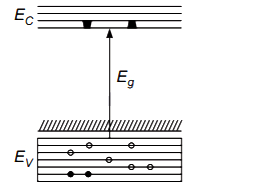
In the energy band diagram of a material shown below,the open circles and filled circles denote holes and electrons respectively. The material is a/an
A
$p$-type semiconductor
B
insulator
C
metal
D
$n$-type semiconductor
Solution
(A) In the given energy band diagram,we observe the presence of an energy gap $E_g$ between the valence band $(E_V)$ and the conduction band $(E_C)$. This indicates that the material is a semiconductor.
Looking closely at the diagram,we see that there are more holes (represented by open circles) in the valence band than electrons (represented by filled circles) in the conduction band. Specifically,the presence of acceptor energy levels just above the valence band is characteristic of a $p$-type semiconductor,where holes are the majority charge carriers.
Therefore,the material is a $p$-type semiconductor.
Looking closely at the diagram,we see that there are more holes (represented by open circles) in the valence band than electrons (represented by filled circles) in the conduction band. Specifically,the presence of acceptor energy levels just above the valence band is characteristic of a $p$-type semiconductor,where holes are the majority charge carriers.
Therefore,the material is a $p$-type semiconductor.
0 likesView Solution
43
PhysicsDifficultMCQMHT CET · 2008
$A$ change of $8.0 \,mA$ in the emitter current brings a change of $7.9 \,mA$ in the collector current. The values of $\alpha$ and $\beta$ are
A
$0.99, 90$
B
$0.96, 79$
C
$0.97, 99$
D
$0.99, 79$
Solution
(D) Given that, the change in emitter current is $\Delta I_{E} = 8.0 \,mA$.
The change in collector current is $\Delta I_{C} = 7.9 \,mA$.
We know that the current gain $\alpha$ is defined as the ratio of change in collector current to the change in emitter current:
$\alpha = \frac{\Delta I_{C}}{\Delta I_{E}} = \frac{7.9}{8.0} = 0.9875 \approx 0.99$.
We also know the relationship between $\alpha$ and $\beta$ is given by $\beta = \frac{\alpha}{1 - \alpha}$.
Alternatively, using the currents directly: $\beta = \frac{\Delta I_{C}}{\Delta I_{B}}$.
Since $\Delta I_{E} = \Delta I_{C} + \Delta I_{B}$, we have $\Delta I_{B} = \Delta I_{E} - \Delta I_{C} = 8.0 \,mA - 7.9 \,mA = 0.1 \,mA$.
Therefore, $\beta = \frac{7.9 \,mA}{0.1 \,mA} = 79$.
Thus, the values are $\alpha = 0.99$ and $\beta = 79$.
The change in collector current is $\Delta I_{C} = 7.9 \,mA$.
We know that the current gain $\alpha$ is defined as the ratio of change in collector current to the change in emitter current:
$\alpha = \frac{\Delta I_{C}}{\Delta I_{E}} = \frac{7.9}{8.0} = 0.9875 \approx 0.99$.
We also know the relationship between $\alpha$ and $\beta$ is given by $\beta = \frac{\alpha}{1 - \alpha}$.
Alternatively, using the currents directly: $\beta = \frac{\Delta I_{C}}{\Delta I_{B}}$.
Since $\Delta I_{E} = \Delta I_{C} + \Delta I_{B}$, we have $\Delta I_{B} = \Delta I_{E} - \Delta I_{C} = 8.0 \,mA - 7.9 \,mA = 0.1 \,mA$.
Therefore, $\beta = \frac{7.9 \,mA}{0.1 \,mA} = 79$.
Thus, the values are $\alpha = 0.99$ and $\beta = 79$.
0 likesView Solution
44
PhysicsMediumMCQMHT CET · 2008
When the two inputs of a $NAND$ gate are shorted,the resulting gate is
A
$NOR$
B
$OR$
C
$NOT$
D
$AND$
Solution
(C) $NAND$ gate is defined as an $AND$ gate followed by a $NOT$ gate. The Boolean expression for a $NAND$ gate with inputs $A$ and $B$ is $Y = \overline{A \cdot B}$.
When the two inputs are shorted,$A = B$. Substituting this into the expression,we get $Y = \overline{A \cdot A} = \overline{A}$.
This is the Boolean expression for a $NOT$ gate.
The truth table for this configuration is:
Since the output is the inverse of the input,the resulting gate is a $NOT$ gate.
When the two inputs are shorted,$A = B$. Substituting this into the expression,we get $Y = \overline{A \cdot A} = \overline{A}$.
This is the Boolean expression for a $NOT$ gate.
The truth table for this configuration is:
| $A$ | $Y = \overline{A \cdot A}$ |
| $0$ | $1$ |
| $1$ | $0$ |
Since the output is the inverse of the input,the resulting gate is a $NOT$ gate.
0 likesView Solution
45
PhysicsEasyMCQMHT CET · 2008
The charge carriers in a $p$-type semiconductor are
A
electrons only
B
holes only
C
holes in larger numbers and electrons in smaller numbers
D
holes and electrons in equal numbers
Solution
(C) In a $p$-type semiconductor,trivalent impurity atoms are added to an intrinsic semiconductor,which creates an abundance of holes.
Therefore,holes act as the majority charge carriers,and thermally generated electrons act as the minority charge carriers.
Thus,in a $p$-type semiconductor,there are holes in larger numbers and electrons in smaller numbers.
Therefore,holes act as the majority charge carriers,and thermally generated electrons act as the minority charge carriers.
Thus,in a $p$-type semiconductor,there are holes in larger numbers and electrons in smaller numbers.
0 likesView Solution
46
PhysicsEasyMCQMHT CET · 2008
If the temperature of the cold junction of a thermocouple is lowered,then the neutral temperature
A
increases
B
approaches inversion temperature
C
decreases
D
remains the same
Solution
(D) The neutral temperature $(T_n)$ of a thermocouple is a characteristic property of the materials used to form the thermocouple. It depends only on the nature of the metals used and is independent of the temperature of the cold junction $(T_c)$ and the inversion temperature $(T_i)$. Therefore,if the temperature of the cold junction is lowered,the neutral temperature remains the same.
0 likesView Solution
47
PhysicsEasyMCQMHT CET · 2008
When an unpolarized light of intensity $I_{0}$ is incident on a polarizing sheet, the intensity of the light which does not get transmitted is
A
$\frac{1}{2} I_{0}$
B
$\frac{1}{4} I_{0}$
C
zero
D
$I_{0}$
Solution
(A) When unpolarized light of intensity $I_{0}$ is incident on a polarizing sheet, the intensity of the transmitted light is given by $I_{t} = \frac{I_{0}}{2}$.
Since the total incident intensity is $I_{0}$ and the transmitted intensity is $\frac{I_{0}}{2}$, the intensity of the light that does not get transmitted is the difference between the incident and transmitted intensities.
Intensity of untransmitted light = $I_{0} - I_{t} = I_{0} - \frac{I_{0}}{2} = \frac{I_{0}}{2}$.
Since the total incident intensity is $I_{0}$ and the transmitted intensity is $\frac{I_{0}}{2}$, the intensity of the light that does not get transmitted is the difference between the incident and transmitted intensities.
Intensity of untransmitted light = $I_{0} - I_{t} = I_{0} - \frac{I_{0}}{2} = \frac{I_{0}}{2}$.
0 likesView Solution
48
PhysicsEasyMCQMHT CET · 2008
In an interference experiment,the spacing between successive maxima or minima is
A
$\lambda d / D$
B
$\lambda D / d$
C
$d D / \lambda$
D
$\lambda d / 4 D$
Solution
(B) In an interference experiment,the distance between two consecutive bright fringes (maxima) or two consecutive dark fringes (minima) is known as the fringe width,denoted by $\beta$.
According to the theory of Young's double-slit experiment,the fringe width is given by the formula:
$\beta = \frac{D \lambda}{d}$
where $D$ is the distance between the screen and the slits,$\lambda$ is the wavelength of the light used,and $d$ is the distance between the two slits.
According to the theory of Young's double-slit experiment,the fringe width is given by the formula:
$\beta = \frac{D \lambda}{d}$
where $D$ is the distance between the screen and the slits,$\lambda$ is the wavelength of the light used,and $d$ is the distance between the two slits.
0 likesView Solution
49
PhysicsMediumMCQMHT CET · 2008
Two periodic waves of intensities $I_{1}$ and $I_{2}$ pass through a region at the same time in the same direction. The sum of the maximum and minimum intensities is
A
$I_{1}+I_{2}$
B
$(\sqrt{I_{1}}+\sqrt{I_{2}})^{2}$
C
$(\sqrt{I_{1}}-\sqrt{I_{2}})^{2}$
D
$2(I_{1}+I_{2})$
Solution
(D) The resultant intensity of two periodic waves is given by the formula:
$I = I_{1} + I_{2} + 2\sqrt{I_{1}I_{2}}\cos\delta$
where $\delta$ is the phase difference between the waves.
For maximum intensity,$\cos\delta = 1$,so:
$I_{\max} = I_{1} + I_{2} + 2\sqrt{I_{1}I_{2}} = (\sqrt{I_{1}} + \sqrt{I_{2}})^{2}$
For minimum intensity,$\cos\delta = -1$,so:
$I_{\min} = I_{1} + I_{2} - 2\sqrt{I_{1}I_{2}} = (\sqrt{I_{1}} - \sqrt{I_{2}})^{2}$
The sum of the maximum and minimum intensities is:
$I_{\max} + I_{\min} = (\sqrt{I_{1}} + \sqrt{I_{2}})^{2} + (\sqrt{I_{1}} - \sqrt{I_{2}})^{2}$
Expanding the squares:
$I_{\max} + I_{\min} = (I_{1} + I_{2} + 2\sqrt{I_{1}I_{2}}) + (I_{1} + I_{2} - 2\sqrt{I_{1}I_{2}})$
$I_{\max} + I_{\min} = 2(I_{1} + I_{2})$
$I = I_{1} + I_{2} + 2\sqrt{I_{1}I_{2}}\cos\delta$
where $\delta$ is the phase difference between the waves.
For maximum intensity,$\cos\delta = 1$,so:
$I_{\max} = I_{1} + I_{2} + 2\sqrt{I_{1}I_{2}} = (\sqrt{I_{1}} + \sqrt{I_{2}})^{2}$
For minimum intensity,$\cos\delta = -1$,so:
$I_{\min} = I_{1} + I_{2} - 2\sqrt{I_{1}I_{2}} = (\sqrt{I_{1}} - \sqrt{I_{2}})^{2}$
The sum of the maximum and minimum intensities is:
$I_{\max} + I_{\min} = (\sqrt{I_{1}} + \sqrt{I_{2}})^{2} + (\sqrt{I_{1}} - \sqrt{I_{2}})^{2}$
Expanding the squares:
$I_{\max} + I_{\min} = (I_{1} + I_{2} + 2\sqrt{I_{1}I_{2}}) + (I_{1} + I_{2} - 2\sqrt{I_{1}I_{2}})$
$I_{\max} + I_{\min} = 2(I_{1} + I_{2})$
0 likesView Solution
50
PhysicsDifficultMCQMHT CET · 2008
$A$ galvanometer of resistance $50 \Omega$ is connected to a battery of $3 \text{ V}$ along with a resistance of $2950 \Omega$ in series. $A$ full-scale deflection of $30$ divisions is obtained in the galvanometer. In order to reduce this deflection to $20$ divisions,the resistance in series should be: (in $Omega$)
A
$5550$
B
$5050$
C
$4450$
D
$6050$
Solution
(C) Resistance of galvanometer,$R_g = 50 \Omega$.
Emf of battery,$V = 3 \text{ V}$.
Resistance connected in series,$R_s = 2950 \Omega$.
Total resistance,$R' = R_g + R_s = 50 + 2950 = 3000 \Omega$.
Therefore,the initial current,$I = \frac{V}{R'} = \frac{3}{3000} = 10^{-3} \text{ A}$.
If the deflection is reduced to $20$ divisions from $30$ divisions,the new current $I'$ will be $I' = I \times \frac{20}{30} = 10^{-3} \times \frac{2}{3} = \frac{2}{3} \times 10^{-3} \text{ A}$.
Let $R_E$ be the new total resistance of the circuit.
Using Ohm's law,$V = I' R_E \Rightarrow R_E = \frac{V}{I'} = \frac{3}{\frac{2}{3} \times 10^{-3}} = \frac{9}{2} \times 10^3 = 4500 \Omega$.
Since $R_E = R_g + R_{new}$,the new series resistance required is $R_{new} = R_E - R_g = 4500 - 50 = 4450 \Omega$.
Emf of battery,$V = 3 \text{ V}$.
Resistance connected in series,$R_s = 2950 \Omega$.
Total resistance,$R' = R_g + R_s = 50 + 2950 = 3000 \Omega$.
Therefore,the initial current,$I = \frac{V}{R'} = \frac{3}{3000} = 10^{-3} \text{ A}$.
If the deflection is reduced to $20$ divisions from $30$ divisions,the new current $I'$ will be $I' = I \times \frac{20}{30} = 10^{-3} \times \frac{2}{3} = \frac{2}{3} \times 10^{-3} \text{ A}$.
Let $R_E$ be the new total resistance of the circuit.
Using Ohm's law,$V = I' R_E \Rightarrow R_E = \frac{V}{I'} = \frac{3}{\frac{2}{3} \times 10^{-3}} = \frac{9}{2} \times 10^3 = 4500 \Omega$.
Since $R_E = R_g + R_{new}$,the new series resistance required is $R_{new} = R_E - R_g = 4500 - 50 = 4450 \Omega$.
0 likesView Solution
Vedclass Products
For Students
Vedclass Test Series
Mock tests in real MHT CET style covering Physics with performance analysis. 5-day free trial.
Start Free TrialFor Teachers
Exam Paper Generator
Generate Set A/B/C/D Physics papers from 7.5L+ questions in 2 minutes. 3 chapters free.
Try FreeFor Institutes
Online Exam Module
Run live MHT CET mock exams with unlimited students, 360° analytics & white-label branding.
See DemoFrequently Asked Questions
How many Physics questions are in MHT CET 2008?
There are 50 Physics questions from the MHT CET 2008 paper on Vedclass, each with a detailed step-by-step solution in English.
Are MHT CET 2008 Physics solutions available in English?
Yes. All solutions on this page are in English. You can also switch to English or Hindi using the language buttons above the questions.
Can I practice MHT CET 2008 Physics as a timed test?
Yes. Use the Vedclass Test Series to attempt a full MHT CET mock test covering Physics with time limits and instant score analysis.
Can teachers create Physics papers from MHT CET previous year questions?
Yes. The Vedclass Exam Paper Generator lets teachers mix MHT CET Physics questions and generate Set A/B/C/D papers in minutes.
For Teachers & Institutes
Build a Custom Physics Paper
Pick MHT CET 2008 Physics questions, set difficulty, and generate Set A/B/C/D in 2 minutes.