
MathematicsQ1–50 of 50 questions
Page 1 of 1 · English
1
MathematicsEasyMCQMHT CET · 2008
The point on the curve $y^2=2(x-3)$ at which the normal is parallel to the line $y-2x+1=0$ is
A
$\left(\frac{-1}{2},-2\right)$
B
$\left(\frac{3}{2}, 2\right)$
C
$(5,2)$
D
$(5,-2)$
Solution
(D) Given curve is $y^2=2(x-3)$.
Differentiating with respect to $x$,we get $2y \frac{dy}{dx} = 2$,which implies $\frac{dy}{dx} = \frac{1}{y}$.
The slope of the tangent at any point $(x, y)$ is $m_t = \frac{1}{y}$.
The slope of the normal is $m_n = -\frac{1}{m_t} = -y$.
The given line is $y - 2x + 1 = 0$,which can be written as $y = 2x - 1$. The slope of this line is $2$.
Since the normal is parallel to the line,their slopes must be equal,so $-y = 2$,which gives $y = -2$.
Substituting $y = -2$ into the curve equation: $(-2)^2 = 2(x - 3) \Rightarrow 4 = 2(x - 3) \Rightarrow 2 = x - 3 \Rightarrow x = 5$.
Thus,the required point is $(5, -2)$.
Differentiating with respect to $x$,we get $2y \frac{dy}{dx} = 2$,which implies $\frac{dy}{dx} = \frac{1}{y}$.
The slope of the tangent at any point $(x, y)$ is $m_t = \frac{1}{y}$.
The slope of the normal is $m_n = -\frac{1}{m_t} = -y$.
The given line is $y - 2x + 1 = 0$,which can be written as $y = 2x - 1$. The slope of this line is $2$.
Since the normal is parallel to the line,their slopes must be equal,so $-y = 2$,which gives $y = -2$.
Substituting $y = -2$ into the curve equation: $(-2)^2 = 2(x - 3) \Rightarrow 4 = 2(x - 3) \Rightarrow 2 = x - 3 \Rightarrow x = 5$.
Thus,the required point is $(5, -2)$.
0 likesView Solution
2
MathematicsEasyMCQMHT CET · 2008
The equation of the tangent parallel to $y-x+5=0$ drawn to $\frac{x^{2}}{3}-\frac{y^{2}}{2}=1$ is
A
$x-y-1=0$
B
$x-y+2=0$
C
$x+y-1=0$
D
$x+y+2=0$
Solution
(A) The given hyperbola is $\frac{x^{2}}{3}-\frac{y^{2}}{2}=1$. Here,$a^{2}=3$ and $b^{2}=2$.
The equation of the tangent parallel to $y-x+5=0$ is of the form $y=x+c$.
Comparing with $y=mx+c$,we have $m=1$.
The condition for the line $y=mx+c$ to be a tangent to the hyperbola $\frac{x^{2}}{a^{2}}-\frac{y^{2}}{b^{2}}=1$ is $c^{2}=a^{2}m^{2}-b^{2}$.
Substituting the values,$c^{2}=3(1)^{2}-2 = 3-2 = 1$.
Thus,$c=\pm 1$.
The equations of the tangents are $y=x+1$ or $y=x-1$,which can be written as $x-y+1=0$ or $x-y-1=0$.
Comparing with the given options,$x-y-1=0$ is the correct choice.
The equation of the tangent parallel to $y-x+5=0$ is of the form $y=x+c$.
Comparing with $y=mx+c$,we have $m=1$.
The condition for the line $y=mx+c$ to be a tangent to the hyperbola $\frac{x^{2}}{a^{2}}-\frac{y^{2}}{b^{2}}=1$ is $c^{2}=a^{2}m^{2}-b^{2}$.
Substituting the values,$c^{2}=3(1)^{2}-2 = 3-2 = 1$.
Thus,$c=\pm 1$.
The equations of the tangents are $y=x+1$ or $y=x-1$,which can be written as $x-y+1=0$ or $x-y-1=0$.
Comparing with the given options,$x-y-1=0$ is the correct choice.
0 likesView Solution
3
MathematicsMediumMCQMHT CET · 2008
If one end of the diameter is $(1, 1)$ and the other end lies on the line $x+y=3$,then the locus of the centre of the circle is
A
$x+y=1$
B
$2(x-y)=5$
C
$2x+2y=5$
D
None of these
Solution
(C) Let the coordinates of the other end of the diameter be $(t, 3-t)$ since it lies on the line $x+y=3$.
Let the centre of the circle be $(h, k)$.
The centre is the midpoint of the diameter with endpoints $(1, 1)$ and $(t, 3-t)$.
So,$h = \frac{1+t}{2}$ and $k = \frac{1+3-t}{2} = \frac{4-t}{2}$.
From these equations,we have $t = 2h-1$ and $t = 4-2k$.
Equating the two expressions for $t$:
$2h-1 = 4-2k$
$2h+2k = 5$.
Replacing $(h, k)$ with $(x, y)$,the locus of the centre is $2x+2y=5$.
Let the centre of the circle be $(h, k)$.
The centre is the midpoint of the diameter with endpoints $(1, 1)$ and $(t, 3-t)$.
So,$h = \frac{1+t}{2}$ and $k = \frac{1+3-t}{2} = \frac{4-t}{2}$.
From these equations,we have $t = 2h-1$ and $t = 4-2k$.
Equating the two expressions for $t$:
$2h-1 = 4-2k$
$2h+2k = 5$.
Replacing $(h, k)$ with $(x, y)$,the locus of the centre is $2x+2y=5$.
0 likesView Solution
4
MathematicsEasyMCQMHT CET · 2008
The equations of the tangents to the circle $x^{2}+y^{2}=13$ at the points whose abscissa is $2$ are:
A
$2x+3y=13, 2x-3y=13$
B
$3x+2y=13, 2x-3y=13$
C
$2x+3y=13, 3x-2y=13$
D
None of the above
Solution
(A) Given the circle equation $x^{2}+y^{2}=13$.
Since the abscissa of the points is $x=2$,we substitute this into the circle equation:
$2^{2}+y^{2}=13$
$4+y^{2}=13$
$y^{2}=9$
$y=\pm 3$.
So,the points of contact are $(2, 3)$ and $(2, -3)$.
The equation of the tangent to the circle $x^{2}+y^{2}=r^{2}$ at point $(x_{1}, y_{1})$ is given by $xx_{1}+yy_{1}=r^{2}$.
For point $(2, 3)$: $2x+3y=13$.
For point $(2, -3)$: $2x-3y=13$.
Thus,the equations are $2x+3y=13$ and $2x-3y=13$.
Since the abscissa of the points is $x=2$,we substitute this into the circle equation:
$2^{2}+y^{2}=13$
$4+y^{2}=13$
$y^{2}=9$
$y=\pm 3$.
So,the points of contact are $(2, 3)$ and $(2, -3)$.
The equation of the tangent to the circle $x^{2}+y^{2}=r^{2}$ at point $(x_{1}, y_{1})$ is given by $xx_{1}+yy_{1}=r^{2}$.
For point $(2, 3)$: $2x+3y=13$.
For point $(2, -3)$: $2x-3y=13$.
Thus,the equations are $2x+3y=13$ and $2x-3y=13$.
0 likesView Solution
5
MathematicsMediumMCQMHT CET · 2008
If the line $x \cos \alpha + y \sin \alpha = p$ is normal to the ellipse $\frac{x^{2}}{a^{2}} + \frac{y^{2}}{b^{2}} = 1$,then
A
$p^{2}(a^{2} \cos^{2} \alpha + b^{2} \sin^{2} \alpha) = a^{2} - b^{2}$
B
$p^{2}(a^{2} \cos^{2} \alpha + b^{2} \sin^{2} \alpha) = (a^{2} - b^{2})^{2}$
C
$p^{2}(a^{2} \sec^{2} \alpha + b^{2} \operatorname{cosec}^{2} \alpha) = a^{2} - b^{2}$
D
$p^{2}(a^{2} \sec^{2} \alpha + b^{2} \operatorname{cosec}^{2} \alpha) = (a^{2} - b^{2})^{2}$
Solution
(D) The equation of any normal to the ellipse $\frac{x^{2}}{a^{2}} + \frac{y^{2}}{b^{2}} = 1$ at point $(a \cos \phi, b \sin \phi)$ is given by $ax \sec \phi - by \operatorname{cosec} \phi = a^{2} - b^{2} \quad \dots (i)$
Comparing this with the given line $x \cos \alpha + y \sin \alpha = p$,we have:
$\frac{a \sec \phi}{\cos \alpha} = \frac{-b \operatorname{cosec} \phi}{\sin \alpha} = \frac{a^{2} - b^{2}}{p}$
From this,we get $\sec \phi = \frac{(a^{2} - b^{2}) \cos \alpha}{ap}$ and $\operatorname{cosec} \phi = \frac{-(a^{2} - b^{2}) \sin \alpha}{bp}$.
Using the identity $\cos^{2} \phi + \sin^{2} \phi = 1$,we have $\frac{1}{\sec^{2} \phi} + \frac{1}{\operatorname{cosec}^{2} \phi} = 1$.
Substituting the values,we get $\frac{a^{2} p^{2}}{(a^{2} - b^{2})^{2} \cos^{2} \alpha} + \frac{b^{2} p^{2}}{(a^{2} - b^{2})^{2} \sin^{2} \alpha} = 1$.
Multiplying by $(a^{2} - b^{2})^{2}$,we get $p^{2} (a^{2} \sec^{2} \alpha + b^{2} \operatorname{cosec}^{2} \alpha) = (a^{2} - b^{2})^{2}$.
Comparing this with the given line $x \cos \alpha + y \sin \alpha = p$,we have:
$\frac{a \sec \phi}{\cos \alpha} = \frac{-b \operatorname{cosec} \phi}{\sin \alpha} = \frac{a^{2} - b^{2}}{p}$
From this,we get $\sec \phi = \frac{(a^{2} - b^{2}) \cos \alpha}{ap}$ and $\operatorname{cosec} \phi = \frac{-(a^{2} - b^{2}) \sin \alpha}{bp}$.
Using the identity $\cos^{2} \phi + \sin^{2} \phi = 1$,we have $\frac{1}{\sec^{2} \phi} + \frac{1}{\operatorname{cosec}^{2} \phi} = 1$.
Substituting the values,we get $\frac{a^{2} p^{2}}{(a^{2} - b^{2})^{2} \cos^{2} \alpha} + \frac{b^{2} p^{2}}{(a^{2} - b^{2})^{2} \sin^{2} \alpha} = 1$.
Multiplying by $(a^{2} - b^{2})^{2}$,we get $p^{2} (a^{2} \sec^{2} \alpha + b^{2} \operatorname{cosec}^{2} \alpha) = (a^{2} - b^{2})^{2}$.
0 likesView Solution
6
MathematicsMediumMCQMHT CET · 2008
If $f(x) = \sqrt{\frac{x - \sin x}{x + \cos^{2} x}}$,then $\lim_{x \rightarrow \infty} f(x)$ is
A
$0$
B
$\infty$
C
$1$
D
$\text{None of these}$
Solution
(C) We need to evaluate $\lim_{x \rightarrow \infty} \sqrt{\frac{x - \sin x}{x + \cos^{2} x}}$.
Divide the numerator and denominator by $x$ inside the square root:
$= \lim_{x \rightarrow \infty} \sqrt{\frac{1 - \frac{\sin x}{x}}{1 + \frac{\cos^{2} x}{x}}}$
Since $\lim_{x \rightarrow \infty} \frac{\sin x}{x} = 0$ and $\lim_{x \rightarrow \infty} \frac{\cos^{2} x}{x} = 0$ (because $\sin x$ and $\cos^{2} x$ are bounded functions):
$= \sqrt{\frac{1 - 0}{1 + 0}}$
$= \sqrt{1} = 1$
Divide the numerator and denominator by $x$ inside the square root:
$= \lim_{x \rightarrow \infty} \sqrt{\frac{1 - \frac{\sin x}{x}}{1 + \frac{\cos^{2} x}{x}}}$
Since $\lim_{x \rightarrow \infty} \frac{\sin x}{x} = 0$ and $\lim_{x \rightarrow \infty} \frac{\cos^{2} x}{x} = 0$ (because $\sin x$ and $\cos^{2} x$ are bounded functions):
$= \sqrt{\frac{1 - 0}{1 + 0}}$
$= \sqrt{1} = 1$
0 likesView Solution
7
MathematicsEasyMCQMHT CET · 2008
$\lim _{x \rightarrow 0} \frac{\cos ax - \cos bx}{x^{2}}$ is equal to
A
$\frac{a^{2} - b^{2}}{2}$
B
$\frac{b^{2} - a^{2}}{2}$
C
$a^{2} - b^{2}$
D
$b^{2} - a^{2}$
Solution
(B) Using the trigonometric identity $\cos C - \cos D = -2 \sin \left( \frac{C+D}{2} \right) \sin \left( \frac{C-D}{2} \right)$,we have:
$\lim _{x \rightarrow 0} \frac{\cos ax - \cos bx}{x^{2}} = \lim _{x \rightarrow 0} \frac{-2 \sin \left( \frac{ax+bx}{2} \right) \sin \left( \frac{ax-bx}{2} \right)}{x^{2}}$
$= -2 \lim _{x \rightarrow 0} \left( \frac{\sin \left( \frac{a+b}{2} x \right)}{x} \right) \left( \frac{\sin \left( \frac{a-b}{2} x \right)}{x} \right)$
Using the standard limit $\lim _{\theta \rightarrow 0} \frac{\sin k\theta}{\theta} = k$,we get:
$= -2 \left( \frac{a+b}{2} \right) \left( \frac{a-b}{2} \right) = -2 \left( \frac{a^{2} - b^{2}}{4} \right) = \frac{b^{2} - a^{2}}{2}$
$\lim _{x \rightarrow 0} \frac{\cos ax - \cos bx}{x^{2}} = \lim _{x \rightarrow 0} \frac{-2 \sin \left( \frac{ax+bx}{2} \right) \sin \left( \frac{ax-bx}{2} \right)}{x^{2}}$
$= -2 \lim _{x \rightarrow 0} \left( \frac{\sin \left( \frac{a+b}{2} x \right)}{x} \right) \left( \frac{\sin \left( \frac{a-b}{2} x \right)}{x} \right)$
Using the standard limit $\lim _{\theta \rightarrow 0} \frac{\sin k\theta}{\theta} = k$,we get:
$= -2 \left( \frac{a+b}{2} \right) \left( \frac{a-b}{2} \right) = -2 \left( \frac{a^{2} - b^{2}}{4} \right) = \frac{b^{2} - a^{2}}{2}$
0 likesView Solution
8
MathematicsEasyMCQMHT CET · 2008
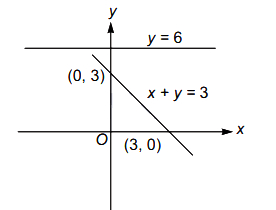
The region represented by the inequation system $x, y \geq 0, y \leq 6, x+y \leq 3$ is
A
unbounded in first quadrant
B
unbounded in first and second quadrants
C
bounded in first quadrant
D
None of the above
Solution
(C) The given system of inequations is $x \geq 0$,$y \geq 0$,$y \leq 6$,and $x+y \leq 3$.
$1$. The conditions $x \geq 0$ and $y \geq 0$ restrict the region to the first quadrant.
$2$. The line $x+y = 3$ passes through $(3, 0)$ and $(0, 3)$. The inequality $x+y \leq 3$ represents the region on or below this line.
$3$. The condition $y \leq 6$ is satisfied by the region defined by $x+y \leq 3$ in the first quadrant,as the maximum value of $y$ in this region is $3$.
$4$. Since the region is enclosed by the axes and the line $x+y=3$,it is a bounded region in the first quadrant.
$1$. The conditions $x \geq 0$ and $y \geq 0$ restrict the region to the first quadrant.
$2$. The line $x+y = 3$ passes through $(3, 0)$ and $(0, 3)$. The inequality $x+y \leq 3$ represents the region on or below this line.
$3$. The condition $y \leq 6$ is satisfied by the region defined by $x+y \leq 3$ in the first quadrant,as the maximum value of $y$ in this region is $3$.
$4$. Since the region is enclosed by the axes and the line $x+y=3$,it is a bounded region in the first quadrant.
0 likesView Solution
9
MathematicsDifficultMCQMHT CET · 2008
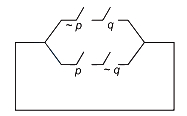
For the circuit shown below,the Boolean polynomial is
A
$(\sim p \vee q) \vee (p \vee \sim q)$
B
$(\sim p \wedge q) \wedge (p \wedge q)$
C
$(\sim p \wedge \sim q) \wedge (q \wedge p)$
D
$(\sim p \wedge q) \vee (p \wedge \sim q)$
Solution
(D) In the given circuit,the top branch consists of switches $\sim p$ and $q$ connected in series. The Boolean expression for this branch is $(\sim p \wedge q)$.
The bottom branch consists of switches $p$ and $\sim q$ connected in series. The Boolean expression for this branch is $(p \wedge \sim q)$.
Since these two branches are connected in parallel,the total Boolean polynomial for the circuit is the disjunction of the two expressions:
$(\sim p \wedge q) \vee (p \wedge \sim q)$.
The bottom branch consists of switches $p$ and $\sim q$ connected in series. The Boolean expression for this branch is $(p \wedge \sim q)$.
Since these two branches are connected in parallel,the total Boolean polynomial for the circuit is the disjunction of the two expressions:
$(\sim p \wedge q) \vee (p \wedge \sim q)$.
0 likesView Solution
10
MathematicsEasyMCQMHT CET · 2008
The negation of the conditional statement,"If it rains,$I$ shall go to school" is:
A
It rains and $I$ shall go to school
B
It rains and $I$ shall not go to school
C
It does not rain and $I$ shall go to school
D
None of the above
Solution
(B) Let $p$ be the statement: "It rains".
Let $q$ be the statement: "$I$ shall go to school".
The given conditional statement is $p \Rightarrow q$.
The negation of a conditional statement $p \Rightarrow q$ is given by $\sim(p \Rightarrow q) \equiv p \wedge \sim q$.
Here,$p \wedge \sim q$ translates to: "It rains and $I$ shall not go to school".
Therefore,the correct option is $B$.
Let $q$ be the statement: "$I$ shall go to school".
The given conditional statement is $p \Rightarrow q$.
The negation of a conditional statement $p \Rightarrow q$ is given by $\sim(p \Rightarrow q) \equiv p \wedge \sim q$.
Here,$p \wedge \sim q$ translates to: "It rains and $I$ shall not go to school".
Therefore,the correct option is $B$.
0 likesView Solution
11
MathematicsMediumMCQMHT CET · 2008
The dual of $\left(x^{\prime} \vee y^{\prime}\right) = x \wedge y$ is
A
$\left(x^{\prime} \wedge y^{\prime}\right) = x \vee y$
B
$\left(x^{\prime} \vee y^{\prime}\right) = x \wedge y$
C
$\left(x^{\prime} \wedge y^{\prime}\right) = x \wedge y$
D
None of the above
Solution
(A) To find the dual of a Boolean expression,we replace $\vee$ with $\wedge$,$\wedge$ with $\vee$,$0$ with $1$,and $1$ with $0$.
Given the expression $\left(x^{\prime} \vee y^{\prime}\right) = x \wedge y$,we replace the operators:
$\vee$ becomes $\wedge$
$\wedge$ becomes $\vee$
Thus,the dual is $\left(x^{\prime} \wedge y^{\prime}\right) = x \vee y$.
Given the expression $\left(x^{\prime} \vee y^{\prime}\right) = x \wedge y$,we replace the operators:
$\vee$ becomes $\wedge$
$\wedge$ becomes $\vee$
Thus,the dual is $\left(x^{\prime} \wedge y^{\prime}\right) = x \vee y$.
0 likesView Solution
12
MathematicsEasyMCQMHT CET · 2008
The equation $12x^{2}+7xy+ay^{2}+13x-y+3=0$ represents a pair of perpendicular lines. Then the value of $a$ is
A
$7/2$
B
$-19$
C
$-12$
D
$12$
Solution
(C) The general equation of a pair of straight lines is given by $Ax^{2}+2Hxy+By^{2}+2Gx+2Fy+C=0$. \\ For the pair of lines to be perpendicular,the sum of the coefficients of $x^{2}$ and $y^{2}$ must be zero. \\ That is,$A+B=0$. \\ Comparing the given equation $12x^{2}+7xy+ay^{2}+13x-y+3=0$ with the general form,we have $A=12$ and $B=a$. \\ Substituting these values into the condition $A+B=0$,we get $12+a=0$. \\ Therefore,$a=-12$.
0 likesView Solution
13
MathematicsEasyMCQMHT CET · 2008
The focal distance of a point on the parabola $y^{2}=16x$ whose ordinate is twice the abscissa,is
A
$6$
B
$8$
C
$10$
D
$12$
Solution
(B) The given parabola is $y^{2}=16x$. Comparing with $y^{2}=4ax$,we get $4a=16$,so $a=4$.
Let the point on the parabola be $(h, k)$.
Given that the ordinate is twice the abscissa,we have $k=2h$.
Substituting $k=2h$ into the parabola equation: $(2h)^{2}=16h$ $\Rightarrow 4h^{2}=16h$ $\Rightarrow 4h(h-4)=0$.
Thus,$h=0$ or $h=4$.
For $h=0$,$k=0$. For $h=4$,$k=8$.
The point $(0,0)$ is the vertex,where the focal distance is $a=4$.
The point $(4,8)$ is on the parabola,where the focal distance is $h+a = 4+4 = 8$.
Since the question asks for the focal distance of a point (implying a non-vertex point),the answer is $8$.
Let the point on the parabola be $(h, k)$.
Given that the ordinate is twice the abscissa,we have $k=2h$.
Substituting $k=2h$ into the parabola equation: $(2h)^{2}=16h$ $\Rightarrow 4h^{2}=16h$ $\Rightarrow 4h(h-4)=0$.
Thus,$h=0$ or $h=4$.
For $h=0$,$k=0$. For $h=4$,$k=8$.
The point $(0,0)$ is the vertex,where the focal distance is $a=4$.
The point $(4,8)$ is on the parabola,where the focal distance is $h+a = 4+4 = 8$.
Since the question asks for the focal distance of a point (implying a non-vertex point),the answer is $8$.
0 likesView Solution
14
MathematicsMediumMCQMHT CET · 2008
The equation of the common tangent to the circle $x^{2}+y^{2}=2$ and the parabola $y^{2}=8x$ is
A
$y=x+2$
B
$y=x+1$
C
$y=x-2$
D
$y=-x+2$
Solution
(A) Given parabola is $y^{2}=8x$,so $4a=8 \Rightarrow a=2$.
Any tangent to the parabola is of the form $y=mx+\frac{a}{m}$,which is $y=mx+\frac{2}{m}$ or $mx-y+\frac{2}{m}=0$.
For this line to be a tangent to the circle $x^{2}+y^{2}=2$ (with center $(0,0)$ and radius $r=\sqrt{2}$),the perpendicular distance from the center to the line must equal the radius.
$\frac{|m(0)-(0)+\frac{2}{m}|}{\sqrt{m^{2}+(-1)^{2}}}=\sqrt{2}$
$\frac{2}{|m|\sqrt{m^{2}+1}}=\sqrt{2}$
Squaring both sides: $\frac{4}{m^{2}(m^{2}+1)}=2 \Rightarrow m^{2}(m^{2}+1)=2$
$m^{4}+m^{2}-2=0$
$(m^{2}+2)(m^{2}-1)=0$
Since $m$ must be real,$m^{2}=1 \Rightarrow m=\pm 1$.
For $m=1$,the tangent is $y=x+\frac{2}{1} \Rightarrow y=x+2$.
For $m=-1$,the tangent is $y=-x+\frac{2}{-1} \Rightarrow y=-x-2$.
Any tangent to the parabola is of the form $y=mx+\frac{a}{m}$,which is $y=mx+\frac{2}{m}$ or $mx-y+\frac{2}{m}=0$.
For this line to be a tangent to the circle $x^{2}+y^{2}=2$ (with center $(0,0)$ and radius $r=\sqrt{2}$),the perpendicular distance from the center to the line must equal the radius.
$\frac{|m(0)-(0)+\frac{2}{m}|}{\sqrt{m^{2}+(-1)^{2}}}=\sqrt{2}$
$\frac{2}{|m|\sqrt{m^{2}+1}}=\sqrt{2}$
Squaring both sides: $\frac{4}{m^{2}(m^{2}+1)}=2 \Rightarrow m^{2}(m^{2}+1)=2$
$m^{4}+m^{2}-2=0$
$(m^{2}+2)(m^{2}-1)=0$
Since $m$ must be real,$m^{2}=1 \Rightarrow m=\pm 1$.
For $m=1$,the tangent is $y=x+\frac{2}{1} \Rightarrow y=x+2$.
For $m=-1$,the tangent is $y=-x+\frac{2}{-1} \Rightarrow y=-x-2$.
0 likesView Solution
15
MathematicsMediumMCQMHT CET · 2008
The chances to fail in Physics are $20 \%$ and the chances to fail in Mathematics are $10 \%$. What are the chances to fail in at least one subject (in $\%$)?
A
$28$
B
$38$
C
$72$
D
$82$
Solution
(A) Let $P(A)$ be the probability of failing in Physics and $P(B)$ be the probability of failing in Mathematics.
Given $P(A) = \frac{20}{100} = 0.2$ and $P(B) = \frac{10}{100} = 0.1$.
Assuming the events are independent,the probability of failing in at least one subject is given by $P(A \cup B) = P(A) + P(B) - P(A \cap B)$.
Since the events are independent,$P(A \cap B) = P(A) \cdot P(B) = 0.2 \times 0.1 = 0.02$.
Therefore,$P(A \cup B) = 0.2 + 0.1 - 0.02 = 0.28$.
Converting to percentage,$0.28 \times 100 = 28 \%$.
Given $P(A) = \frac{20}{100} = 0.2$ and $P(B) = \frac{10}{100} = 0.1$.
Assuming the events are independent,the probability of failing in at least one subject is given by $P(A \cup B) = P(A) + P(B) - P(A \cap B)$.
Since the events are independent,$P(A \cap B) = P(A) \cdot P(B) = 0.2 \times 0.1 = 0.02$.
Therefore,$P(A \cup B) = 0.2 + 0.1 - 0.02 = 0.28$.
Converting to percentage,$0.28 \times 100 = 28 \%$.
0 likesView Solution
16
MathematicsEasyMCQMHT CET · 2008
The abscissae of the points,where the tangent to the curve $y=x^{3}-3x^{2}-9x+5$ is parallel to the $x$-axis,are
A
$x=0$ and $0$
B
$x=1$ and $-1$
C
$x=1$ and $-3$
D
$x=-1$ and $3$
Solution
(D) Given the curve equation: $y=x^{3}-3x^{2}-9x+5$.
To find the slope of the tangent,we differentiate $y$ with respect to $x$:
$\frac{dy}{dx} = 3x^{2}-6x-9$.
Since the tangent is parallel to the $x$-axis,its slope must be zero:
$\frac{dy}{dx} = 0$.
Substituting the derivative:
$3x^{2}-6x-9 = 0$.
Dividing by $3$:
$x^{2}-2x-3 = 0$.
Factoring the quadratic equation:
$(x-3)(x+1) = 0$.
Thus,the values of $x$ (abscissae) are $x=3$ and $x=-1$.
To find the slope of the tangent,we differentiate $y$ with respect to $x$:
$\frac{dy}{dx} = 3x^{2}-6x-9$.
Since the tangent is parallel to the $x$-axis,its slope must be zero:
$\frac{dy}{dx} = 0$.
Substituting the derivative:
$3x^{2}-6x-9 = 0$.
Dividing by $3$:
$x^{2}-2x-3 = 0$.
Factoring the quadratic equation:
$(x-3)(x+1) = 0$.
Thus,the values of $x$ (abscissae) are $x=3$ and $x=-1$.
0 likesView Solution
17
MathematicsEasyMCQMHT CET · 2008
The angle of intersection of the curves $r = \sin \theta + \cos \theta$ and $r = 2 \sin \theta$ is equal to
A
$\frac{\pi}{2}$
B
$\frac{\pi}{3}$
C
$\frac{\pi}{4}$
D
None of these
Solution
(C) Given curves are $r_1 = \sin \theta + \cos \theta$ and $r_2 = 2 \sin \theta$.
To find the intersection,set $r_1 = r_2$:
$\sin \theta + \cos \theta = 2 \sin \theta \Rightarrow \cos \theta = \sin \theta \Rightarrow \tan \theta = 1 \Rightarrow \theta = \frac{\pi}{4}$.
For $r_1 = \sin \theta + \cos \theta$,$\frac{dr_1}{d\theta} = \cos \theta - \sin \theta$. Let $\phi_1$ be the angle between the tangent and the radius vector,then $\tan \phi_1 = \frac{r_1}{dr_1/d\theta} = \frac{\sin \theta + \cos \theta}{\cos \theta - \sin \theta}$.
At $\theta = \frac{\pi}{4}$,$\tan \phi_1 = \frac{1/\sqrt{2} + 1/\sqrt{2}}{1/\sqrt{2} - 1/\sqrt{2}} = \frac{\sqrt{2}}{0} = \infty \Rightarrow \phi_1 = \frac{\pi}{2}$.
For $r_2 = 2 \sin \theta$,$\frac{dr_2}{d\theta} = 2 \cos \theta$. Then $\tan \phi_2 = \frac{r_2}{dr_2/d\theta} = \frac{2 \sin \theta}{2 \cos \theta} = \tan \theta$.
At $\theta = \frac{\pi}{4}$,$\tan \phi_2 = \tan(\frac{\pi}{4}) = 1 \Rightarrow \phi_2 = \frac{\pi}{4}$.
The angle of intersection $\psi = |\phi_1 - \phi_2| = |\frac{\pi}{2} - \frac{\pi}{4}| = \frac{\pi}{4}$.
To find the intersection,set $r_1 = r_2$:
$\sin \theta + \cos \theta = 2 \sin \theta \Rightarrow \cos \theta = \sin \theta \Rightarrow \tan \theta = 1 \Rightarrow \theta = \frac{\pi}{4}$.
For $r_1 = \sin \theta + \cos \theta$,$\frac{dr_1}{d\theta} = \cos \theta - \sin \theta$. Let $\phi_1$ be the angle between the tangent and the radius vector,then $\tan \phi_1 = \frac{r_1}{dr_1/d\theta} = \frac{\sin \theta + \cos \theta}{\cos \theta - \sin \theta}$.
At $\theta = \frac{\pi}{4}$,$\tan \phi_1 = \frac{1/\sqrt{2} + 1/\sqrt{2}}{1/\sqrt{2} - 1/\sqrt{2}} = \frac{\sqrt{2}}{0} = \infty \Rightarrow \phi_1 = \frac{\pi}{2}$.
For $r_2 = 2 \sin \theta$,$\frac{dr_2}{d\theta} = 2 \cos \theta$. Then $\tan \phi_2 = \frac{r_2}{dr_2/d\theta} = \frac{2 \sin \theta}{2 \cos \theta} = \tan \theta$.
At $\theta = \frac{\pi}{4}$,$\tan \phi_2 = \tan(\frac{\pi}{4}) = 1 \Rightarrow \phi_2 = \frac{\pi}{4}$.
The angle of intersection $\psi = |\phi_1 - \phi_2| = |\frac{\pi}{2} - \frac{\pi}{4}| = \frac{\pi}{4}$.
0 likesView Solution
18
MathematicsMediumMCQMHT CET · 2008
The maximum value of the function $f(x) = x^{3} - 12x^{2} + 36x + 17$ in the interval $[1, 10]$ is:
A
$17$
B
$177$
C
$77$
D
None of these
Solution
(B) Let $f(x) = x^{3} - 12x^{2} + 36x + 17$.
Find the derivative: $f'(x) = 3x^{2} - 24x + 36$.
Set $f'(x) = 0$ to find critical points: $3(x^{2} - 8x + 12) = 0 \Rightarrow 3(x - 2)(x - 6) = 0$.
The critical points are $x = 2$ and $x = 6$.
Evaluate the function at the critical points and the interval endpoints $[1, 10]$:
$f(1) = (1)^{3} - 12(1)^{2} + 36(1) + 17 = 1 - 12 + 36 + 17 = 42$.
$f(2) = (2)^{3} - 12(2)^{2} + 36(2) + 17 = 8 - 48 + 72 + 17 = 49$.
$f(6) = (6)^{3} - 12(6)^{2} + 36(6) + 17 = 216 - 432 + 216 + 17 = 17$.
$f(10) = (10)^{3} - 12(10)^{2} + 36(10) + 17 = 1000 - 1200 + 360 + 17 = 177$.
Comparing these values,the maximum value is $177$.
Find the derivative: $f'(x) = 3x^{2} - 24x + 36$.
Set $f'(x) = 0$ to find critical points: $3(x^{2} - 8x + 12) = 0 \Rightarrow 3(x - 2)(x - 6) = 0$.
The critical points are $x = 2$ and $x = 6$.
Evaluate the function at the critical points and the interval endpoints $[1, 10]$:
$f(1) = (1)^{3} - 12(1)^{2} + 36(1) + 17 = 1 - 12 + 36 + 17 = 42$.
$f(2) = (2)^{3} - 12(2)^{2} + 36(2) + 17 = 8 - 48 + 72 + 17 = 49$.
$f(6) = (6)^{3} - 12(6)^{2} + 36(6) + 17 = 216 - 432 + 216 + 17 = 17$.
$f(10) = (10)^{3} - 12(10)^{2} + 36(10) + 17 = 1000 - 1200 + 360 + 17 = 177$.
Comparing these values,the maximum value is $177$.
0 likesView Solution
19
MathematicsEasyMCQMHT CET · 2008
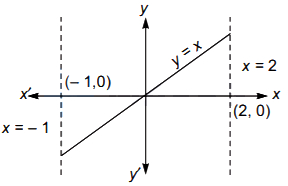
The area bounded by the lines $y=x$,$x=-1$,$x=2$ and the $x$-axis is
A
$5/2$ sq unit
B
$3/2$ sq unit
C
$1/2$ sq unit
D
None of the above
Solution
(A) The required area is given by the integral of $|y|$ with respect to $x$ from $x=-1$ to $x=2$.
Since $y=x$,we have $|y|=|x|$.
Required Area $= \int_{-1}^{2} |x| dx$
$= \int_{-1}^{0} |x| dx + \int_{0}^{2} |x| dx$
$= \int_{-1}^{0} (-x) dx + \int_{0}^{2} x dx$
$= \left[ -\frac{x^2}{2} \right]_{-1}^{0} + \left[ \frac{x^2}{2} \right]_{0}^{2}$
$= (0 - (-1/2)) + (4/2 - 0)$
$= 1/2 + 2 = 5/2$ sq unit.
Since $y=x$,we have $|y|=|x|$.
Required Area $= \int_{-1}^{2} |x| dx$
$= \int_{-1}^{0} |x| dx + \int_{0}^{2} |x| dx$
$= \int_{-1}^{0} (-x) dx + \int_{0}^{2} x dx$
$= \left[ -\frac{x^2}{2} \right]_{-1}^{0} + \left[ \frac{x^2}{2} \right]_{0}^{2}$
$= (0 - (-1/2)) + (4/2 - 0)$
$= 1/2 + 2 = 5/2$ sq unit.
0 likesView Solution
20
MathematicsEasyMCQMHT CET · 2008
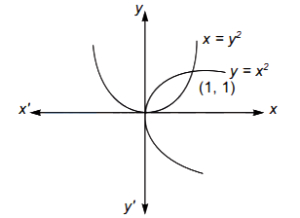
The volume of the solid generated by revolving the region bounded by the parabolas $y=x^{2}$ and $x=y^{2}$ about the $y$-axis is:
A
$\frac{21}{5} \pi$
B
$\frac{24}{5} \pi$
C
$\frac{3}{10} \pi$
D
$\frac{2}{15} \pi$
Solution
(C) The curves are $y=x^{2}$ (or $x=\sqrt{y}$) and $x=y^{2}$.
They intersect at $(0,0)$ and $(1,1)$.
When revolving about the $y$-axis,the volume $V$ is given by the formula $V = \pi \int_{a}^{b} (x_{outer}^{2} - x_{inner}^{2}) dy$.
Here,for $y \in [0,1]$,the outer curve is $x = \sqrt{y}$ and the inner curve is $x = y^{2}$.
Thus,$V = \pi \int_{0}^{1} ((\sqrt{y})^{2} - (y^{2})^{2}) dy$
$V = \pi \int_{0}^{1} (y - y^{4}) dy$
$V = \pi \left[ \frac{y^{2}}{2} - \frac{y^{5}}{5} \right]_{0}^{1}$
$V = \pi \left( \frac{1}{2} - \frac{1}{5} \right) = \pi \left( \frac{5-2}{10} \right) = \frac{3}{10} \pi$.
They intersect at $(0,0)$ and $(1,1)$.
When revolving about the $y$-axis,the volume $V$ is given by the formula $V = \pi \int_{a}^{b} (x_{outer}^{2} - x_{inner}^{2}) dy$.
Here,for $y \in [0,1]$,the outer curve is $x = \sqrt{y}$ and the inner curve is $x = y^{2}$.
Thus,$V = \pi \int_{0}^{1} ((\sqrt{y})^{2} - (y^{2})^{2}) dy$
$V = \pi \int_{0}^{1} (y - y^{4}) dy$
$V = \pi \left[ \frac{y^{2}}{2} - \frac{y^{5}}{5} \right]_{0}^{1}$
$V = \pi \left( \frac{1}{2} - \frac{1}{5} \right) = \pi \left( \frac{5-2}{10} \right) = \frac{3}{10} \pi$.
0 likesView Solution
21
MathematicsMediumMCQMHT CET · 2008
If $f(x) = \begin{cases} x \sin \frac{1}{x}, & x \neq 0 \\ k, & x = 0 \end{cases}$ is continuous at $x = 0$,then the value of $k$ is
A
$1$
B
$-1$
C
$0$
D
$2$
Solution
(C) For a function $f(x)$ to be continuous at $x = 0$,the condition $f(0) = \lim_{x \to 0} f(x)$ must be satisfied.
Given $f(0) = k$.
Now,we calculate the limit: $\lim_{x \to 0} f(x) = \lim_{x \to 0} x \sin \frac{1}{x}$.
We know that for all $x \neq 0$,$-1 \leq \sin \frac{1}{x} \leq 1$.
Multiplying by $x$ (where $x > 0$),we get $-x \leq x \sin \frac{1}{x} \leq x$.
By the Squeeze Theorem,as $x \to 0$,both $-x$ and $x$ approach $0$.
Therefore,$\lim_{x \to 0} x \sin \frac{1}{x} = 0$.
Since $f(0) = \lim_{x \to 0} f(x)$,we have $k = 0$.
Given $f(0) = k$.
Now,we calculate the limit: $\lim_{x \to 0} f(x) = \lim_{x \to 0} x \sin \frac{1}{x}$.
We know that for all $x \neq 0$,$-1 \leq \sin \frac{1}{x} \leq 1$.
Multiplying by $x$ (where $x > 0$),we get $-x \leq x \sin \frac{1}{x} \leq x$.
By the Squeeze Theorem,as $x \to 0$,both $-x$ and $x$ approach $0$.
Therefore,$\lim_{x \to 0} x \sin \frac{1}{x} = 0$.
Since $f(0) = \lim_{x \to 0} f(x)$,we have $k = 0$.
0 likesView Solution
22
MathematicsDifficultMCQMHT CET · 2008
The value of $\int_{\pi / 4}^{\pi / 2} e^{x}(\log \sin x+\cot x) d x$ is
A
$e^{\pi / 4} \log 2$
B
$-e^{\pi / 4} \log 2$
C
$\frac{1}{2} e^{\pi / 4} \log 2$
D
$-\frac{1}{2} e^{\pi / 4} \log 2$
Solution
(C) We use the standard result $\int e^x (f(x) + f'(x)) dx = e^x f(x) + C$.
Let $f(x) = \log \sin x$.
Then $f'(x) = \frac{1}{\sin x} \cdot \cos x = \cot x$.
Thus,the integral becomes $\int_{\pi / 4}^{\pi / 2} e^x (f(x) + f'(x)) dx = [e^x f(x)]_{\pi / 4}^{\pi / 2}$.
Substituting the limits:
$= [e^x \log \sin x]_{\pi / 4}^{\pi / 2} = e^{\pi / 2} \log \sin(\pi / 2) - e^{\pi / 4} \log \sin(\pi / 4)$.
Since $\sin(\pi / 2) = 1$ and $\log(1) = 0$,the first term is $0$.
$= 0 - e^{\pi / 4} \log(1 / \sqrt{2}) = -e^{\pi / 4} \log(2^{-1/2})$.
$= -e^{\pi / 4} \cdot (-1/2) \log 2 = \frac{1}{2} e^{\pi / 4} \log 2$.
Let $f(x) = \log \sin x$.
Then $f'(x) = \frac{1}{\sin x} \cdot \cos x = \cot x$.
Thus,the integral becomes $\int_{\pi / 4}^{\pi / 2} e^x (f(x) + f'(x)) dx = [e^x f(x)]_{\pi / 4}^{\pi / 2}$.
Substituting the limits:
$= [e^x \log \sin x]_{\pi / 4}^{\pi / 2} = e^{\pi / 2} \log \sin(\pi / 2) - e^{\pi / 4} \log \sin(\pi / 4)$.
Since $\sin(\pi / 2) = 1$ and $\log(1) = 0$,the first term is $0$.
$= 0 - e^{\pi / 4} \log(1 / \sqrt{2}) = -e^{\pi / 4} \log(2^{-1/2})$.
$= -e^{\pi / 4} \cdot (-1/2) \log 2 = \frac{1}{2} e^{\pi / 4} \log 2$.
0 likesView Solution
23
MathematicsMediumMCQMHT CET · 2008
The value of $\int_{0}^{\pi} x \sin^{3} x \, dx$ is
A
$\frac{4 \pi}{3}$
B
$\frac{2 \pi}{3}$
C
$0$
D
None of these
Solution
(B) Let $I = \int_{0}^{\pi} x \sin^{3} x \, dx$ ...$(i)$
Using the property $\int_{0}^{a} f(x) \, dx = \int_{0}^{a} f(a-x) \, dx$,we get:
$I = \int_{0}^{\pi} (\pi - x) \sin^{3}(\pi - x) \, dx = \int_{0}^{\pi} (\pi - x) \sin^{3} x \, dx$ ...(ii)
Adding $(i)$ and (ii):
$2I = \int_{0}^{\pi} (x + \pi - x) \sin^{3} x \, dx = \pi \int_{0}^{\pi} \sin^{3} x \, dx$
Using $\sin 3x = 3 \sin x - 4 \sin^{3} x$,we have $\sin^{3} x = \frac{3 \sin x - \sin 3x}{4}$.
$2I = \frac{\pi}{4} \int_{0}^{\pi} (3 \sin x - \sin 3x) \, dx$
$2I = \frac{\pi}{4} \left[ -3 \cos x + \frac{\cos 3x}{3} \right]_{0}^{\pi}$
$2I = \frac{\pi}{4} \left[ (-3(-1) + \frac{-1}{3}) - (-3(1) + \frac{1}{3}) \right]$
$2I = \frac{\pi}{4} \left[ (3 - \frac{1}{3}) - (-3 + \frac{1}{3}) \right] = \frac{\pi}{4} \left[ \frac{8}{3} + \frac{8}{3} \right] = \frac{\pi}{4} \times \frac{16}{3} = \frac{4 \pi}{3}$
$I = \frac{2 \pi}{3}$
Using the property $\int_{0}^{a} f(x) \, dx = \int_{0}^{a} f(a-x) \, dx$,we get:
$I = \int_{0}^{\pi} (\pi - x) \sin^{3}(\pi - x) \, dx = \int_{0}^{\pi} (\pi - x) \sin^{3} x \, dx$ ...(ii)
Adding $(i)$ and (ii):
$2I = \int_{0}^{\pi} (x + \pi - x) \sin^{3} x \, dx = \pi \int_{0}^{\pi} \sin^{3} x \, dx$
Using $\sin 3x = 3 \sin x - 4 \sin^{3} x$,we have $\sin^{3} x = \frac{3 \sin x - \sin 3x}{4}$.
$2I = \frac{\pi}{4} \int_{0}^{\pi} (3 \sin x - \sin 3x) \, dx$
$2I = \frac{\pi}{4} \left[ -3 \cos x + \frac{\cos 3x}{3} \right]_{0}^{\pi}$
$2I = \frac{\pi}{4} \left[ (-3(-1) + \frac{-1}{3}) - (-3(1) + \frac{1}{3}) \right]$
$2I = \frac{\pi}{4} \left[ (3 - \frac{1}{3}) - (-3 + \frac{1}{3}) \right] = \frac{\pi}{4} \left[ \frac{8}{3} + \frac{8}{3} \right] = \frac{\pi}{4} \times \frac{16}{3} = \frac{4 \pi}{3}$
$I = \frac{2 \pi}{3}$
0 likesView Solution
24
MathematicsEasyMCQMHT CET · 2008
By Simpson's rule,the value of $\int_{1}^{2} \frac{dx}{x}$ dividing the interval $(1, 2)$ into four equal parts,is
A
$0.6932$
B
$0.6753$
C
$0.6692$
D
$7.1324$
Solution
(A) Given the integral $\int_{1}^{2} \frac{dx}{x}$ with $n=4$ sub-intervals.
The step size $h = \frac{b-a}{n} = \frac{2-1}{4} = 0.25$.
The values of $x_i$ are $x_0=1, x_1=1.25, x_2=1.5, x_3=1.75, x_4=2$.
The corresponding values of $y_i = \frac{1}{x_i}$ are:
$y_0 = \frac{1}{1} = 1$
$y_1 = \frac{1}{1.25} = 0.8$
$y_2 = \frac{1}{1.5} = 0.6667$
$y_3 = \frac{1}{1.75} = 0.5714$
$y_4 = \frac{1}{2} = 0.5$
Using Simpson's $\frac{1}{3}$ rule: $\int_{a}^{b} y dx \approx \frac{h}{3} [y_0 + y_n + 4(y_1 + y_3 + \dots) + 2(y_2 + y_4 + \dots)]$.
$\int_{1}^{2} \frac{dx}{x} \approx \frac{0.25}{3} [y_0 + y_4 + 4(y_1 + y_3) + 2(y_2)]$.
$\int_{1}^{2} \frac{dx}{x} \approx \frac{0.25}{3} [1 + 0.5 + 4(0.8 + 0.5714) + 2(0.6667)]$.
$\int_{1}^{2} \frac{dx}{x} \approx \frac{0.25}{3} [1.5 + 4(1.3714) + 1.3334]$.
$\int_{1}^{2} \frac{dx}{x} \approx \frac{0.25}{3} [1.5 + 5.4856 + 1.3334] = \frac{0.25}{3} [8.319] = 0.69325 \approx 0.6932$.
The step size $h = \frac{b-a}{n} = \frac{2-1}{4} = 0.25$.
The values of $x_i$ are $x_0=1, x_1=1.25, x_2=1.5, x_3=1.75, x_4=2$.
The corresponding values of $y_i = \frac{1}{x_i}$ are:
$y_0 = \frac{1}{1} = 1$
$y_1 = \frac{1}{1.25} = 0.8$
$y_2 = \frac{1}{1.5} = 0.6667$
$y_3 = \frac{1}{1.75} = 0.5714$
$y_4 = \frac{1}{2} = 0.5$
Using Simpson's $\frac{1}{3}$ rule: $\int_{a}^{b} y dx \approx \frac{h}{3} [y_0 + y_n + 4(y_1 + y_3 + \dots) + 2(y_2 + y_4 + \dots)]$.
$\int_{1}^{2} \frac{dx}{x} \approx \frac{0.25}{3} [y_0 + y_4 + 4(y_1 + y_3) + 2(y_2)]$.
$\int_{1}^{2} \frac{dx}{x} \approx \frac{0.25}{3} [1 + 0.5 + 4(0.8 + 0.5714) + 2(0.6667)]$.
$\int_{1}^{2} \frac{dx}{x} \approx \frac{0.25}{3} [1.5 + 4(1.3714) + 1.3334]$.
$\int_{1}^{2} \frac{dx}{x} \approx \frac{0.25}{3} [1.5 + 5.4856 + 1.3334] = \frac{0.25}{3} [8.319] = 0.69325 \approx 0.6932$.
0 likesView Solution
25
MathematicsEasyMCQMHT CET · 2008
Considering four sub-intervals,the value of $\int_{0}^{1} \frac{1}{1+x} d x$ by Trapezoidal rule,is
A
$0.6870$
B
$0.6677$
C
$0.6977$
D
$0.5970$
Solution
(C) Given $f(x) = \frac{1}{1+x}$,interval $[0, 1]$,and number of sub-intervals $n = 4$.
Width of each sub-interval $h = \frac{b-a}{n} = \frac{1-0}{4} = 0.25$.
Using the Trapezoidal rule formula:
$\int_{0}^{1} f(x) dx \approx \frac{h}{2} [y_0 + 2(y_1 + y_2 + y_3) + y_4]$
$\int_{0}^{1} f(x) dx \approx \frac{0.25}{2} [1 + 2(0.8 + 0.6667 + 0.5714) + 0.5]$
$\int_{0}^{1} f(x) dx \approx 0.125 [1 + 2(2.0381) + 0.5]$
$\int_{0}^{1} f(x) dx \approx 0.125 [1 + 4.0762 + 0.5]$
$\int_{0}^{1} f(x) dx \approx 0.125 [5.5762] = 0.697025 \approx 0.6977$ (rounding to given options).
Width of each sub-interval $h = \frac{b-a}{n} = \frac{1-0}{4} = 0.25$.
| $i$ | $x_i$ | $y_i = \frac{1}{1+x_i}$ |
| $0$ | $0$ | $1$ |
| $1$ | $0.25$ | $0.8$ |
| $2$ | $0.5$ | $0.6667$ |
| $3$ | $0.75$ | $0.5714$ |
| $4$ | $1$ | $0.5$ |
Using the Trapezoidal rule formula:
$\int_{0}^{1} f(x) dx \approx \frac{h}{2} [y_0 + 2(y_1 + y_2 + y_3) + y_4]$
$\int_{0}^{1} f(x) dx \approx \frac{0.25}{2} [1 + 2(0.8 + 0.6667 + 0.5714) + 0.5]$
$\int_{0}^{1} f(x) dx \approx 0.125 [1 + 2(2.0381) + 0.5]$
$\int_{0}^{1} f(x) dx \approx 0.125 [1 + 4.0762 + 0.5]$
$\int_{0}^{1} f(x) dx \approx 0.125 [5.5762] = 0.697025 \approx 0.6977$ (rounding to given options).
0 likesView Solution
26
MathematicsEasyMCQMHT CET · 2008
The order and degree of the differential equation $\sqrt{\frac{dy}{dx}} - 4 \frac{dy}{dx} - 7x = 0$ are
A
$1$ and $1/2$
B
$2$ and $1$
C
$1$ and $1$
D
$1$ and $2$
Solution
(D) Given differential equation is $\sqrt{\frac{dy}{dx}} - 4 \frac{dy}{dx} - 7x = 0$.
To find the degree,we must eliminate the radical sign.
Rewrite the equation as $\sqrt{\frac{dy}{dx}} = 4 \frac{dy}{dx} + 7x$.
Squaring both sides,we get:
$(\frac{dy}{dx}) = (4 \frac{dy}{dx} + 7x)^2$.
$(\frac{dy}{dx}) = 16(\frac{dy}{dx})^2 + 49x^2 + 56x \frac{dy}{dx}$.
Rearranging the terms,we get $16(\frac{dy}{dx})^2 + (56x - 1)\frac{dy}{dx} + 49x^2 = 0$.
The highest order derivative present is $\frac{dy}{dx}$,so the order is $1$.
The highest power of the highest order derivative is $2$,so the degree is $2$.
Thus,the order is $1$ and the degree is $2$.
To find the degree,we must eliminate the radical sign.
Rewrite the equation as $\sqrt{\frac{dy}{dx}} = 4 \frac{dy}{dx} + 7x$.
Squaring both sides,we get:
$(\frac{dy}{dx}) = (4 \frac{dy}{dx} + 7x)^2$.
$(\frac{dy}{dx}) = 16(\frac{dy}{dx})^2 + 49x^2 + 56x \frac{dy}{dx}$.
Rearranging the terms,we get $16(\frac{dy}{dx})^2 + (56x - 1)\frac{dy}{dx} + 49x^2 = 0$.
The highest order derivative present is $\frac{dy}{dx}$,so the order is $1$.
The highest power of the highest order derivative is $2$,so the degree is $2$.
Thus,the order is $1$ and the degree is $2$.
0 likesView Solution
27
MathematicsMediumMCQMHT CET · 2008
The solution of the differential equation $(3xy + y^2)dx + (x^2 + xy)dy = 0$ is
A
$x^2(2xy + y^2) = c^2$
B
$x^2(2xy - y^2) = c^2$
C
$x^2(y^2 - 2xy) = c^2$
D
None of these
Solution
(A) The given differential equation is $(3xy + y^2)dx + (x^2 + xy)dy = 0$.
Rearranging the terms,we get $\frac{dy}{dx} = -\frac{3xy + y^2}{x^2 + xy}$.
This is a homogeneous differential equation. Let $y = vx$,then $\frac{dy}{dx} = v + x\frac{dv}{dx}$.
Substituting these into the equation: $v + x\frac{dv}{dx} = -\frac{3x^2v + x^2v^2}{x^2 + x^2v} = -\frac{3v + v^2}{1 + v}$.
$x\frac{dv}{dx} = -\frac{3v + v^2}{1 + v} - v = -\frac{3v + v^2 + v + v^2}{1 + v} = -\frac{2v^2 + 4v}{1 + v} = -\frac{2v(v + 2)}{v + 1}$.
Separating the variables: $\frac{v + 1}{v(v + 2)} dv = -\frac{2}{x} dx$.
Using partial fractions: $\frac{v + 1}{v(v + 2)} = \frac{A}{v} + \frac{B}{v + 2} \Rightarrow v + 1 = A(v + 2) + Bv$.
For $v = 0$,$1 = 2A \Rightarrow A = 1/2$. For $v = -2$,$-1 = -2B \Rightarrow B = 1/2$.
So,$\int (\frac{1}{2v} + \frac{1}{2(v + 2)}) dv = -\int \frac{2}{x} dx$.
$\frac{1}{2} \ln|v| + \frac{1}{2} \ln|v + 2| = -2 \ln|x| + C'$.
$\ln|v(v + 2)| = -4 \ln|x| + 2C' \Rightarrow \ln|v(v + 2)x^4| = C''$.
$v(v + 2)x^4 = c^2$.
Substituting $v = y/x$: $\frac{y}{x}(\frac{y}{x} + 2)x^4 = c^2 \Rightarrow y(y + 2x)x^2 = c^2 \Rightarrow x^2(y^2 + 2xy) = c^2$.
Rearranging the terms,we get $\frac{dy}{dx} = -\frac{3xy + y^2}{x^2 + xy}$.
This is a homogeneous differential equation. Let $y = vx$,then $\frac{dy}{dx} = v + x\frac{dv}{dx}$.
Substituting these into the equation: $v + x\frac{dv}{dx} = -\frac{3x^2v + x^2v^2}{x^2 + x^2v} = -\frac{3v + v^2}{1 + v}$.
$x\frac{dv}{dx} = -\frac{3v + v^2}{1 + v} - v = -\frac{3v + v^2 + v + v^2}{1 + v} = -\frac{2v^2 + 4v}{1 + v} = -\frac{2v(v + 2)}{v + 1}$.
Separating the variables: $\frac{v + 1}{v(v + 2)} dv = -\frac{2}{x} dx$.
Using partial fractions: $\frac{v + 1}{v(v + 2)} = \frac{A}{v} + \frac{B}{v + 2} \Rightarrow v + 1 = A(v + 2) + Bv$.
For $v = 0$,$1 = 2A \Rightarrow A = 1/2$. For $v = -2$,$-1 = -2B \Rightarrow B = 1/2$.
So,$\int (\frac{1}{2v} + \frac{1}{2(v + 2)}) dv = -\int \frac{2}{x} dx$.
$\frac{1}{2} \ln|v| + \frac{1}{2} \ln|v + 2| = -2 \ln|x| + C'$.
$\ln|v(v + 2)| = -4 \ln|x| + 2C' \Rightarrow \ln|v(v + 2)x^4| = C''$.
$v(v + 2)x^4 = c^2$.
Substituting $v = y/x$: $\frac{y}{x}(\frac{y}{x} + 2)x^4 = c^2 \Rightarrow y(y + 2x)x^2 = c^2 \Rightarrow x^2(y^2 + 2xy) = c^2$.
0 likesView Solution
28
MathematicsEasyMCQMHT CET · 2008
The solution of the differential equation $\frac{dy}{dx} = \frac{x-y+3}{2(x-y)+5}$ is
A
$2(x-y) + \log(x-y) = x + c$
B
$2(x-y) - \log(x-y+2) = x + c$
C
$2(x-y) + \log(x-y+2) = x + c$
D
None of the above
Solution
(C) Given differential equation is $\frac{dy}{dx} = \frac{x-y+3}{2(x-y)+5}$.
Let $v = x-y$. Then $\frac{dv}{dx} = 1 - \frac{dy}{dx}$,which implies $\frac{dy}{dx} = 1 - \frac{dv}{dx}$.
Substituting this into the equation: $1 - \frac{dv}{dx} = \frac{v+3}{2v+5}$.
Rearranging gives $\frac{dv}{dx} = 1 - \frac{v+3}{2v+5} = \frac{2v+5-v-3}{2v+5} = \frac{v+2}{2v+5}$.
Separating variables: $\int \frac{2v+5}{v+2} dv = \int dx$.
Rewriting the integrand: $\int \left( \frac{2(v+2) + 1}{v+2} \right) dv = \int dx$.
This simplifies to $\int (2 + \frac{1}{v+2}) dv = \int dx$.
Integrating both sides: $2v + \log|v+2| = x + c$.
Substituting $v = x-y$ back: $2(x-y) + \log|x-y+2| = x + c$.
Let $v = x-y$. Then $\frac{dv}{dx} = 1 - \frac{dy}{dx}$,which implies $\frac{dy}{dx} = 1 - \frac{dv}{dx}$.
Substituting this into the equation: $1 - \frac{dv}{dx} = \frac{v+3}{2v+5}$.
Rearranging gives $\frac{dv}{dx} = 1 - \frac{v+3}{2v+5} = \frac{2v+5-v-3}{2v+5} = \frac{v+2}{2v+5}$.
Separating variables: $\int \frac{2v+5}{v+2} dv = \int dx$.
Rewriting the integrand: $\int \left( \frac{2(v+2) + 1}{v+2} \right) dv = \int dx$.
This simplifies to $\int (2 + \frac{1}{v+2}) dv = \int dx$.
Integrating both sides: $2v + \log|v+2| = x + c$.
Substituting $v = x-y$ back: $2(x-y) + \log|x-y+2| = x + c$.
0 likesView Solution
29
MathematicsMediumMCQMHT CET · 2008
If $x^{3}+y^{3}-3 a x y=0$,then $\frac{d y}{d x}$ equals
A
$\frac{a y-x^{2}}{y^{2}-a x}$
B
$\frac{a y-x^{2}}{a y-y^{2}}$
C
$\frac{x^{2}+a y}{y^{2}+a x}$
D
$\frac{x^{2}+a y}{a x-y^{2}}$
Solution
(A) Given equation is $x^{3}+y^{3}-3 a x y=0$.
On differentiating both sides with respect to $x$,we get:
$\frac{d}{d x}(x^{3}) + \frac{d}{d x}(y^{3}) - 3 a \frac{d}{d x}(x y) = 0$
$3 x^{2} + 3 y^{2} \frac{d y}{d x} - 3 a \left( x \frac{d y}{d x} + y \right) = 0$
Dividing by $3$,we get:
$x^{2} + y^{2} \frac{d y}{d x} - a x \frac{d y}{d x} - a y = 0$
Grouping the terms containing $\frac{d y}{d x}$:
$\frac{d y}{d x} (y^{2} - a x) = a y - x^{2}$
Therefore,$\frac{d y}{d x} = \frac{a y - x^{2}}{y^{2} - a x}$.
On differentiating both sides with respect to $x$,we get:
$\frac{d}{d x}(x^{3}) + \frac{d}{d x}(y^{3}) - 3 a \frac{d}{d x}(x y) = 0$
$3 x^{2} + 3 y^{2} \frac{d y}{d x} - 3 a \left( x \frac{d y}{d x} + y \right) = 0$
Dividing by $3$,we get:
$x^{2} + y^{2} \frac{d y}{d x} - a x \frac{d y}{d x} - a y = 0$
Grouping the terms containing $\frac{d y}{d x}$:
$\frac{d y}{d x} (y^{2} - a x) = a y - x^{2}$
Therefore,$\frac{d y}{d x} = \frac{a y - x^{2}}{y^{2} - a x}$.
0 likesView Solution
30
MathematicsEasyMCQMHT CET · 2008
The velocity of a particle at time $t$ is given by the relation $v = 6t - \frac{t^2}{6}$. The distance traveled in $3 \ s$ is,if $s = 0$ at $t = 0$.
A
$\frac{39}{2}$
B
$\frac{57}{2}$
C
$\frac{51}{2}$
D
$\frac{33}{2}$
Solution
(C) Given,$v = \frac{ds}{dt} = 6t - \frac{t^2}{6}$.
Integrating both sides with respect to $t$,we get:
$s = \int (6t - \frac{t^2}{6}) dt = 3t^2 - \frac{t^3}{18} + C$.
Given that $s = 0$ at $t = 0$,we substitute these values to find the constant $C$:
$0 = 3(0)^2 - \frac{(0)^3}{18} + C \implies C = 0$.
Thus,the displacement function is $s(t) = 3t^2 - \frac{t^3}{18}$.
To find the distance traveled in $3 \ s$,we calculate $s(3)$:
$s(3) = 3(3)^2 - \frac{(3)^3}{18} = 3(9) - \frac{27}{18} = 27 - \frac{3}{2} = \frac{54 - 3}{2} = \frac{51}{2}$.
Integrating both sides with respect to $t$,we get:
$s = \int (6t - \frac{t^2}{6}) dt = 3t^2 - \frac{t^3}{18} + C$.
Given that $s = 0$ at $t = 0$,we substitute these values to find the constant $C$:
$0 = 3(0)^2 - \frac{(0)^3}{18} + C \implies C = 0$.
Thus,the displacement function is $s(t) = 3t^2 - \frac{t^3}{18}$.
To find the distance traveled in $3 \ s$,we calculate $s(3)$:
$s(3) = 3(3)^2 - \frac{(3)^3}{18} = 3(9) - \frac{27}{18} = 27 - \frac{3}{2} = \frac{54 - 3}{2} = \frac{51}{2}$.
0 likesView Solution
31
MathematicsMediumMCQMHT CET · 2008
If $x=\frac{1-t^{2}}{1+t^{2}}$ and $y=\frac{2 a t}{1+t^{2}}$,then $\frac{d y}{d x}$ is equal to
A
$\frac{a(1-t^{2})}{2 t}$
B
$\frac{a(t^{2}-1)}{2 t}$
C
$\frac{a(t^{2}+1)}{2 t}$
D
$\frac{a(t^{2}-1)}{t}$
Solution
(B) Given,$x=\frac{1-t^{2}}{1+t^{2}}$ and $y=\frac{2 a t}{1+t^{2}}$.
On differentiating $x$ and $y$ with respect to $t$,we get:
$\frac{dx}{dt} = \frac{(1+t^{2})(-2t) - (1-t^{2})(2t)}{(1+t^{2})^{2}} = \frac{-2t - 2t^{3} - 2t + 2t^{3}}{(1+t^{2})^{2}} = \frac{-4t}{(1+t^{2})^{2}}$.
$\frac{dy}{dt} = \frac{(1+t^{2})(2a) - (2at)(2t)}{(1+t^{2})^{2}} = \frac{2a + 2at^{2} - 4at^{2}}{(1+t^{2})^{2}} = \frac{2a(1-t^{2})}{(1+t^{2})^{2}}$.
Now,$\frac{dy}{dx} = \frac{dy/dt}{dx/dt} = \frac{2a(1-t^{2})}{(1+t^{2})^{2}} \times \frac{(1+t^{2})^{2}}{-4t}$.
$\frac{dy}{dx} = \frac{2a(1-t^{2})}{-4t} = \frac{a(1-t^{2})}{-2t} = \frac{a(t^{2}-1)}{2t}$.
On differentiating $x$ and $y$ with respect to $t$,we get:
$\frac{dx}{dt} = \frac{(1+t^{2})(-2t) - (1-t^{2})(2t)}{(1+t^{2})^{2}} = \frac{-2t - 2t^{3} - 2t + 2t^{3}}{(1+t^{2})^{2}} = \frac{-4t}{(1+t^{2})^{2}}$.
$\frac{dy}{dt} = \frac{(1+t^{2})(2a) - (2at)(2t)}{(1+t^{2})^{2}} = \frac{2a + 2at^{2} - 4at^{2}}{(1+t^{2})^{2}} = \frac{2a(1-t^{2})}{(1+t^{2})^{2}}$.
Now,$\frac{dy}{dx} = \frac{dy/dt}{dx/dt} = \frac{2a(1-t^{2})}{(1+t^{2})^{2}} \times \frac{(1+t^{2})^{2}}{-4t}$.
$\frac{dy}{dx} = \frac{2a(1-t^{2})}{-4t} = \frac{a(1-t^{2})}{-2t} = \frac{a(t^{2}-1)}{2t}$.
0 likesView Solution
32
MathematicsMediumMCQMHT CET · 2008
If $y=x^{n} \log x+x(\log x)^{n}$,then $\frac{d y}{d x}$ is equal to
A
$x^{n-1}(1+n \log x)+(\log x)^{n-1}[n+\log x]$
B
$x^{n-2}(1+n \log x)+(\log x)^{n-1}[n+\log x]$
C
$x^{n-1}(1+n \log x)+(\log x)^{n-1}[n-\log x]$
D
None of the above
Solution
(A) Given,$y=x^{n} \log x+x(\log x)^{n}$.
Applying the product rule $\frac{d}{dx}(uv) = u \frac{dv}{dx} + v \frac{du}{dx}$ to both terms:
$\frac{dy}{dx} = \frac{d}{dx}(x^n \log x) + \frac{d}{dx}(x(\log x)^n)$
$= (x^n \cdot \frac{1}{x} + \log x \cdot nx^{n-1}) + (x \cdot n(\log x)^{n-1} \cdot \frac{1}{x} + (\log x)^n \cdot 1)$
$= (x^{n-1} + nx^{n-1} \log x) + (n(\log x)^{n-1} + (\log x)^n)$
$= x^{n-1}(1 + n \log x) + (\log x)^{n-1}(n + \log x)$.
Applying the product rule $\frac{d}{dx}(uv) = u \frac{dv}{dx} + v \frac{du}{dx}$ to both terms:
$\frac{dy}{dx} = \frac{d}{dx}(x^n \log x) + \frac{d}{dx}(x(\log x)^n)$
$= (x^n \cdot \frac{1}{x} + \log x \cdot nx^{n-1}) + (x \cdot n(\log x)^{n-1} \cdot \frac{1}{x} + (\log x)^n \cdot 1)$
$= (x^{n-1} + nx^{n-1} \log x) + (n(\log x)^{n-1} + (\log x)^n)$
$= x^{n-1}(1 + n \log x) + (\log x)^{n-1}(n + \log x)$.
0 likesView Solution
33
MathematicsMediumMCQMHT CET · 2008
If $y = \log_{10} x + \log_{x} 10 + \log_{x} x + \log_{10} 10$,then $\frac{dy}{dx}$ is equal to
A
$\frac{1}{x \log_{e} 10} - \frac{\log_{e} 10}{x(\log_{e} x)^{2}}$
B
$\frac{1}{x \log_{e} 10} - \frac{1}{x \log_{10} e}$
C
$\frac{1}{x \log_{e} 10} + \frac{\log_{e} 10}{x(\log_{e} x)^{2}}$
D
None of the above
Solution
(A) Given,$y = \log_{10} x + \log_{x} 10 + \log_{x} x + \log_{10} 10$.
Using the change of base formula $\log_{a} b = \frac{\log_{e} b}{\log_{e} a}$,we can rewrite the expression as:
$y = \frac{\log_{e} x}{\log_{e} 10} + \frac{\log_{e} 10}{\log_{e} x} + 1 + 1$.
$y = \frac{1}{\log_{e} 10} \cdot \log_{e} x + \log_{e} 10 \cdot (\log_{e} x)^{-1} + 2$.
Now,differentiate with respect to $x$:
$\frac{dy}{dx} = \frac{1}{\log_{e} 10} \cdot \frac{d}{dx}(\log_{e} x) + \log_{e} 10 \cdot \frac{d}{dx}((\log_{e} x)^{-1}) + 0$.
$\frac{dy}{dx} = \frac{1}{\log_{e} 10} \cdot \frac{1}{x} + \log_{e} 10 \cdot (-1)(\log_{e} x)^{-2} \cdot \frac{1}{x}$.
$\frac{dy}{dx} = \frac{1}{x \log_{e} 10} - \frac{\log_{e} 10}{x(\log_{e} x)^{2}}$.
Using the change of base formula $\log_{a} b = \frac{\log_{e} b}{\log_{e} a}$,we can rewrite the expression as:
$y = \frac{\log_{e} x}{\log_{e} 10} + \frac{\log_{e} 10}{\log_{e} x} + 1 + 1$.
$y = \frac{1}{\log_{e} 10} \cdot \log_{e} x + \log_{e} 10 \cdot (\log_{e} x)^{-1} + 2$.
Now,differentiate with respect to $x$:
$\frac{dy}{dx} = \frac{1}{\log_{e} 10} \cdot \frac{d}{dx}(\log_{e} x) + \log_{e} 10 \cdot \frac{d}{dx}((\log_{e} x)^{-1}) + 0$.
$\frac{dy}{dx} = \frac{1}{\log_{e} 10} \cdot \frac{1}{x} + \log_{e} 10 \cdot (-1)(\log_{e} x)^{-2} \cdot \frac{1}{x}$.
$\frac{dy}{dx} = \frac{1}{x \log_{e} 10} - \frac{\log_{e} 10}{x(\log_{e} x)^{2}}$.
0 likesView Solution
34
MathematicsDifficultMCQMHT CET · 2008
The value of $\Delta \log f(x) + \Delta^{2}(3^{x})$ is
A
$\log \left[1 + \frac{\Delta f(x)}{f(x)}\right] + 4 \cdot 3^{x}$
B
$\log \left[1 + \frac{\Delta f(x)}{f(x)}\right] + 3^{x}$
C
$\log \left[\frac{\Delta f(x)}{1 + f(x)}\right] + 4 \cdot 3^{x}$
D
$\log \left[\frac{\Delta f(x)}{1 + f(x)}\right] + 3^{x}$
Solution
(A) We know that $\Delta \log f(x) = \log f(x+h) - \log f(x) = \log \left[\frac{f(x+h)}{f(x)}\right]$.
Since $f(x+h) = (1 + \Delta) f(x)$,we have $\Delta \log f(x) = \log \left[\frac{(1 + \Delta) f(x)}{f(x)}\right] = \log \left[1 + \frac{\Delta f(x)}{f(x)}\right]$.
Next,for the second term,$\Delta^{2}(3^{x}) = (E - 1)^{2} 3^{x} = (E^{2} - 2E + 1) 3^{x}$.
$= E^{2}(3^{x}) - 2E(3^{x}) + 3^{x} = 3^{x+2} - 2 \cdot 3^{x+1} + 3^{x}$.
$= 3^{x}(9 - 6 + 1) = 4 \cdot 3^{x}$.
Combining both terms,the result is $\log \left[1 + \frac{\Delta f(x)}{f(x)}\right] + 4 \cdot 3^{x}$.
Since $f(x+h) = (1 + \Delta) f(x)$,we have $\Delta \log f(x) = \log \left[\frac{(1 + \Delta) f(x)}{f(x)}\right] = \log \left[1 + \frac{\Delta f(x)}{f(x)}\right]$.
Next,for the second term,$\Delta^{2}(3^{x}) = (E - 1)^{2} 3^{x} = (E^{2} - 2E + 1) 3^{x}$.
$= E^{2}(3^{x}) - 2E(3^{x}) + 3^{x} = 3^{x+2} - 2 \cdot 3^{x+1} + 3^{x}$.
$= 3^{x}(9 - 6 + 1) = 4 \cdot 3^{x}$.
Combining both terms,the result is $\log \left[1 + \frac{\Delta f(x)}{f(x)}\right] + 4 \cdot 3^{x}$.
0 likesView Solution
35
MathematicsDifficultMCQMHT CET · 2008
The value of $\int x \sin x \sec ^{3} x \, dx$ is
A
$\frac{1}{2}[\sec ^{2} x-\tan x]+c$
B
$\frac{1}{2}[x \sec ^{2} x-\tan x]+c$
C
$\frac{1}{2}[x \sec ^{2} x+\tan x]+c$
D
$\frac{1}{2}[\sec ^{2} x+\tan x]+c$
Solution
(B) We have $I = \int x \sin x \sec ^{3} x \, dx = \int x \tan x \sec ^{2} x \, dx$.
Let $u = x$ and $dv = \tan x \sec ^{2} x \, dx$.
Then $du = dx$ and $v = \int \tan x \sec ^{2} x \, dx = \frac{\tan ^{2} x}{2}$.
Using integration by parts,$\int u \, dv = uv - \int v \, du$:
$I = x \cdot \frac{\tan ^{2} x}{2} - \int \frac{\tan ^{2} x}{2} \, dx$
$I = \frac{x \tan ^{2} x}{2} - \frac{1}{2} \int (\sec ^{2} x - 1) \, dx$
$I = \frac{x(\sec ^{2} x - 1)}{2} - \frac{1}{2} (\tan x - x) + c$
$I = \frac{x \sec ^{2} x}{2} - \frac{x}{2} - \frac{\tan x}{2} + \frac{x}{2} + c$
$I = \frac{1}{2} [x \sec ^{2} x - \tan x] + c$.
Let $u = x$ and $dv = \tan x \sec ^{2} x \, dx$.
Then $du = dx$ and $v = \int \tan x \sec ^{2} x \, dx = \frac{\tan ^{2} x}{2}$.
Using integration by parts,$\int u \, dv = uv - \int v \, du$:
$I = x \cdot \frac{\tan ^{2} x}{2} - \int \frac{\tan ^{2} x}{2} \, dx$
$I = \frac{x \tan ^{2} x}{2} - \frac{1}{2} \int (\sec ^{2} x - 1) \, dx$
$I = \frac{x(\sec ^{2} x - 1)}{2} - \frac{1}{2} (\tan x - x) + c$
$I = \frac{x \sec ^{2} x}{2} - \frac{x}{2} - \frac{\tan x}{2} + \frac{x}{2} + c$
$I = \frac{1}{2} [x \sec ^{2} x - \tan x] + c$.
0 likesView Solution
36
MathematicsMediumMCQMHT CET · 2008
$\int \frac{x^{e-1}+e^{x-1}}{x^{e}+e^{x}} d x$ is equal to
A
$\log \left(x^{e}+e^{x}\right)+c$
B
$e \log \left(x^{e}+e^{x}\right)+c$
C
$\frac{1}{e} \log \left(x^{e}+e^{x}\right)+c$
D
None of the above
Solution
(C) Let $I = \int \frac{x^{e-1}+e^{x-1}}{x^{e}+e^{x}} d x$.
Substitute $t = x^{e}+e^{x}$.
Differentiating both sides with respect to $x$,we get $dt = (e x^{e-1} + e^{x-1} \cdot \ln(e)) dx$. Since $\ln(e) = 1$,this simplifies to $dt = e(x^{e-1} + e^{x-1}) dx$.
Therefore,$(x^{e-1} + e^{x-1}) dx = \frac{1}{e} dt$.
Substituting these into the integral,we get $I = \int \frac{1}{t} \cdot \frac{1}{e} dt = \frac{1}{e} \int \frac{1}{t} dt$.
Integrating,we get $I = \frac{1}{e} \log|t| + c$.
Substituting back $t = x^{e}+e^{x}$,we get $I = \frac{1}{e} \log(x^{e}+e^{x}) + c$.
Substitute $t = x^{e}+e^{x}$.
Differentiating both sides with respect to $x$,we get $dt = (e x^{e-1} + e^{x-1} \cdot \ln(e)) dx$. Since $\ln(e) = 1$,this simplifies to $dt = e(x^{e-1} + e^{x-1}) dx$.
Therefore,$(x^{e-1} + e^{x-1}) dx = \frac{1}{e} dt$.
Substituting these into the integral,we get $I = \int \frac{1}{t} \cdot \frac{1}{e} dt = \frac{1}{e} \int \frac{1}{t} dt$.
Integrating,we get $I = \frac{1}{e} \log|t| + c$.
Substituting back $t = x^{e}+e^{x}$,we get $I = \frac{1}{e} \log(x^{e}+e^{x}) + c$.
0 likesView Solution
37
MathematicsMediumMCQMHT CET · 2008
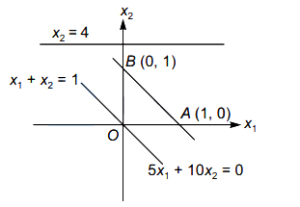
For the $LPP$,minimize $z = x_{1} + x_{2}$ subject to the constraints $5x_{1} + 10x_{2} \geq 0$,$x_{1} + x_{2} \leq 1$,$x_{2} \leq 4$ and $x_{1}, x_{2} \geq 0$.
A
There is a bounded solution
B
There is no solution
C
There are infinite solutions
D
None of the above
Solution
(A) The constraints are $5x_{1} + 10x_{2} \geq 0$,$x_{1} + x_{2} \leq 1$,$x_{2} \leq 4$,and $x_{1}, x_{2} \geq 0$.
Since $x_{1}, x_{2} \geq 0$,the constraint $5x_{1} + 10x_{2} \geq 0$ is always satisfied in the first quadrant.
The feasible region is defined by the intersection of $x_{1} + x_{2} \leq 1$ and $x_{1}, x_{2} \geq 0$.
This region is a triangle with vertices at $(0, 0)$,$(1, 0)$,and $(0, 1)$.
Since the feasible region is a closed and bounded polygon,the $LPP$ has a bounded solution.
Since $x_{1}, x_{2} \geq 0$,the constraint $5x_{1} + 10x_{2} \geq 0$ is always satisfied in the first quadrant.
The feasible region is defined by the intersection of $x_{1} + x_{2} \leq 1$ and $x_{1}, x_{2} \geq 0$.
This region is a triangle with vertices at $(0, 0)$,$(1, 0)$,and $(0, 1)$.
Since the feasible region is a closed and bounded polygon,the $LPP$ has a bounded solution.
0 likesView Solution
38
MathematicsMediumMCQMHT CET · 2008
$A$ wholesale merchant wants to start a cereal business with $Rs \ 24000$. Wheat costs $Rs \ 400$ per quintal and rice costs $Rs \ 600$ per quintal. He has a storage capacity of $200$ quintals of cereal. He earns a profit of $Rs \ 25$ per quintal on wheat and $Rs \ 40$ per quintal on rice. If he stores $x$ quintals of rice and $y$ quintals of wheat,then for maximum profit,the objective function is:
A
$25x + 40y$
B
$40x + 25y$
C
$400x + 600y$
D
$\frac{400}{40}x + \frac{600}{25}y$
Solution
(B) The merchant earns a profit of $Rs \ 40$ per quintal on rice and $Rs \ 25$ per quintal on wheat.
Given that he stores $x$ quintals of rice and $y$ quintals of wheat.
The total profit $Z$ is given by the sum of the profit from rice and wheat.
Therefore,the objective function is $Z = 40x + 25y$.
Given that he stores $x$ quintals of rice and $y$ quintals of wheat.
The total profit $Z$ is given by the sum of the profit from rice and wheat.
Therefore,the objective function is $Z = 40x + 25y$.
0 likesView Solution
39
MathematicsEasyMCQMHT CET · 2008
The solution of the equation $\left[\begin{array}{rrr}1 & 0 & 1 \\ -1 & 1 & 0 \\ 0 & -1 & 1\end{array}\right]\left[\begin{array}{l}x \\ y \\ z\end{array}\right]=\left[\begin{array}{l}1 \\ 1 \\ 2\end{array}\right]$ is $(x, y, z)=$
A
$(1, 1, 1)$
B
$(0, -1, 2)$
C
$(-1, 2, 2)$
D
$(-1, 0, 2)$
Solution
(D) Given the matrix equation: $\left[\begin{array}{rrr}1 & 0 & 1 \\ -1 & 1 & 0 \\ 0 & -1 & 1\end{array}\right]\left[\begin{array}{l}x \\ y \\ z\end{array}\right]=\left[\begin{array}{l}1 \\ 1 \\ 2\end{array}\right]$
Multiplying the matrices,we get the system of linear equations:
$x + z = 1$ $(i)$
$-x + y = 1$ $(ii)$
$-y + z = 2$ $(iii)$
Adding $(ii)$ and $(iii)$,we get:
$(-x + y) + (-y + z) = 1 + 2$
$-x + z = 3$ $(iv)$
Now,adding $(i)$ and $(iv)$:
$(x + z) + (-x + z) = 1 + 3$
$2z = 4 \Rightarrow z = 2$
Substituting $z = 2$ into $(i)$:
$x + 2 = 1 \Rightarrow x = -1$
Substituting $x = -1$ into $(ii)$:
$-(-1) + y = 1 \Rightarrow 1 + y = 1 \Rightarrow y = 0$
Thus,the solution is $(x, y, z) = (-1, 0, 2)$.
Multiplying the matrices,we get the system of linear equations:
$x + z = 1$ $(i)$
$-x + y = 1$ $(ii)$
$-y + z = 2$ $(iii)$
Adding $(ii)$ and $(iii)$,we get:
$(-x + y) + (-y + z) = 1 + 2$
$-x + z = 3$ $(iv)$
Now,adding $(i)$ and $(iv)$:
$(x + z) + (-x + z) = 1 + 3$
$2z = 4 \Rightarrow z = 2$
Substituting $z = 2$ into $(i)$:
$x + 2 = 1 \Rightarrow x = -1$
Substituting $x = -1$ into $(ii)$:
$-(-1) + y = 1 \Rightarrow 1 + y = 1 \Rightarrow y = 0$
Thus,the solution is $(x, y, z) = (-1, 0, 2)$.
0 likesView Solution
40
MathematicsEasyMCQMHT CET · 2008
The inverse matrix of $\left[\begin{array}{lll}0 & 1 & 2 \\ 1 & 2 & 3 \\ 3 & 1 & 1\end{array}\right]$ is
A
$\left[\begin{array}{rrr}\frac{1}{2} & -\frac{1}{2} & \frac{1}{2} \\ -4 & 3 & -1 \\ \frac{5}{2} & -\frac{3}{2} & \frac{1}{2}\end{array}\right]$
B
$\left[\begin{array}{rrr}\frac{1}{2} & -4 & \frac{5}{2} \\ 1 & -6 & 3 \\ 1 & 2 & -1\end{array}\right]$
C
$\frac{1}{2}\left[\begin{array}{lll}1 & 2 & 3 \\ 3 & 2 & 1 \\ 4 & 2 & 3\end{array}\right]$
D
$\frac{1}{2}\left[\begin{array}{rrr}1 & -1 & -1 \\ -8 & 6 & -2 \\ 5 & -3 & 1\end{array}\right]$
Solution
(A) Let $A = \left[\begin{array}{lll}0 & 1 & 2 \\ 1 & 2 & 3 \\ 3 & 1 & 1\end{array}\right]$.
First,we calculate the determinant $|A|$:
$|A| = 0(2-3) - 1(1-9) + 2(1-6) = 0 - 1(-8) + 2(-5) = 8 - 10 = -2$.
Since $|A| \neq 0$,the inverse exists.
Next,we find the matrix of cofactors $C_{ij}$:
$C_{11} = +(2-3) = -1, C_{12} = -(1-9) = 8, C_{13} = +(1-6) = -5$.
$C_{21} = -(1-2) = 1, C_{22} = +(0-6) = -6, C_{23} = -(0-3) = 3$.
$C_{31} = +(3-4) = -1, C_{32} = -(0-2) = 2, C_{33} = +(0-1) = -1$.
Thus,$\operatorname{adj}(A) = \left[\begin{array}{rrr}-1 & 1 & -1 \\ 8 & -6 & 2 \\ -5 & 3 & -1\end{array}\right]^T = \left[\begin{array}{rrr}-1 & 1 & -1 \\ 8 & -6 & 2 \\ -5 & 3 & -1\end{array}\right]$.
Finally,$A^{-1} = \frac{1}{|A|} \operatorname{adj}(A) = \frac{1}{-2} \left[\begin{array}{rrr}-1 & 1 & -1 \\ 8 & -6 & 2 \\ -5 & 3 & -1\end{array}\right] = \left[\begin{array}{rrr}\frac{1}{2} & -\frac{1}{2} & \frac{1}{2} \\ -4 & 3 & -1 \\ \frac{5}{2} & -\frac{3}{2} & \frac{1}{2}\end{array}\right]$.
First,we calculate the determinant $|A|$:
$|A| = 0(2-3) - 1(1-9) + 2(1-6) = 0 - 1(-8) + 2(-5) = 8 - 10 = -2$.
Since $|A| \neq 0$,the inverse exists.
Next,we find the matrix of cofactors $C_{ij}$:
$C_{11} = +(2-3) = -1, C_{12} = -(1-9) = 8, C_{13} = +(1-6) = -5$.
$C_{21} = -(1-2) = 1, C_{22} = +(0-6) = -6, C_{23} = -(0-3) = 3$.
$C_{31} = +(3-4) = -1, C_{32} = -(0-2) = 2, C_{33} = +(0-1) = -1$.
Thus,$\operatorname{adj}(A) = \left[\begin{array}{rrr}-1 & 1 & -1 \\ 8 & -6 & 2 \\ -5 & 3 & -1\end{array}\right]^T = \left[\begin{array}{rrr}-1 & 1 & -1 \\ 8 & -6 & 2 \\ -5 & 3 & -1\end{array}\right]$.
Finally,$A^{-1} = \frac{1}{|A|} \operatorname{adj}(A) = \frac{1}{-2} \left[\begin{array}{rrr}-1 & 1 & -1 \\ 8 & -6 & 2 \\ -5 & 3 & -1\end{array}\right] = \left[\begin{array}{rrr}\frac{1}{2} & -\frac{1}{2} & \frac{1}{2} \\ -4 & 3 & -1 \\ \frac{5}{2} & -\frac{3}{2} & \frac{1}{2}\end{array}\right]$.
0 likesView Solution
41
MathematicsMediumMCQMHT CET · 2008
$A$ parent has two children. If at least one of them is a boy,then the probability that the other is also a boy is:
A
$1/2$
B
$1/4$
C
$1/3$
D
None of these
Solution
(C) Let the sample space for two children be $S = \{BB, BG, GB, GG\}$,where $B$ denotes a boy and $G$ denotes a girl. Each outcome is equally likely with probability $1/4$.
Let $A$ be the event that at least one child is a boy. Then $A = \{BB, BG, GB\}$,so $P(A) = 3/4$.
Let $B$ be the event that both children are boys. Then $B = \{BB\}$.
We want to find the conditional probability $P(B|A)$,which is the probability that both are boys given that at least one is a boy.
$P(B|A) = \frac{P(B \cap A)}{P(A)}$.
Since $B \subset A$,$B \cap A = B = \{BB\}$,so $P(B \cap A) = 1/4$.
Therefore,$P(B|A) = \frac{1/4}{3/4} = 1/3$.
Let $A$ be the event that at least one child is a boy. Then $A = \{BB, BG, GB\}$,so $P(A) = 3/4$.
Let $B$ be the event that both children are boys. Then $B = \{BB\}$.
We want to find the conditional probability $P(B|A)$,which is the probability that both are boys given that at least one is a boy.
$P(B|A) = \frac{P(B \cap A)}{P(A)}$.
Since $B \subset A$,$B \cap A = B = \{BB\}$,so $P(B \cap A) = 1/4$.
Therefore,$P(B|A) = \frac{1/4}{3/4} = 1/3$.
0 likesView Solution
42
MathematicsDifficultMCQMHT CET · 2008
$A$ random variable $X$ has the following probability distribution:
| $x$ | $1$ | $2$ | $3$ | $4$ | $5$ | $6$ | $7$ | $8$ |
|---|---|---|---|---|---|---|---|---|
| $P(x)$ | $0.15$ | $0.23$ | $0.12$ | $0.10$ | $0.20$ | $0.08$ | $0.07$ | $0.05$ |
For the events $E = \{x \text{ is a prime number}\}$ and $F = \{x < 4\}$,the probability $P(E \cup F)$ is:
| $x$ | $1$ | $2$ | $3$ | $4$ | $5$ | $6$ | $7$ | $8$ |
|---|---|---|---|---|---|---|---|---|
| $P(x)$ | $0.15$ | $0.23$ | $0.12$ | $0.10$ | $0.20$ | $0.08$ | $0.07$ | $0.05$ |
For the events $E = \{x \text{ is a prime number}\}$ and $F = \{x < 4\}$,the probability $P(E \cup F)$ is:

A
$0.50$
B
$0.77$
C
$0.35$
D
$0.87$
Solution
(B) Given,$E = \{x \text{ is a prime number}\} = \{2, 3, 5, 7\}$.
$P(E) = P(2) + P(3) + P(5) + P(7) = 0.23 + 0.12 + 0.20 + 0.07 = 0.62$.
Given,$F = \{x < 4\} = \{1, 2, 3\}$.
$P(F) = P(1) + P(2) + P(3) = 0.15 + 0.23 + 0.12 = 0.50$.
The intersection $E \cap F = \{x \text{ is prime and } x < 4\} = \{2, 3\}$.
$P(E \cap F) = P(2) + P(3) = 0.23 + 0.12 = 0.35$.
Using the formula $P(E \cup F) = P(E) + P(F) - P(E \cap F)$:
$P(E \cup F) = 0.62 + 0.50 - 0.35 = 0.77$.
$P(E) = P(2) + P(3) + P(5) + P(7) = 0.23 + 0.12 + 0.20 + 0.07 = 0.62$.
Given,$F = \{x < 4\} = \{1, 2, 3\}$.
$P(F) = P(1) + P(2) + P(3) = 0.15 + 0.23 + 0.12 = 0.50$.
The intersection $E \cap F = \{x \text{ is prime and } x < 4\} = \{2, 3\}$.
$P(E \cap F) = P(2) + P(3) = 0.23 + 0.12 = 0.35$.
Using the formula $P(E \cup F) = P(E) + P(F) - P(E \cap F)$:
$P(E \cup F) = 0.62 + 0.50 - 0.35 = 0.77$.
0 likesView Solution
43
MathematicsEasyMCQMHT CET · 2008
The position vectors of the points $A, B, C$ are $(2\hat{i}+\hat{j}-\hat{k}), (3\hat{i}-2\hat{j}+\hat{k})$ and $(\hat{i}+4\hat{j}-3\hat{k})$ respectively. These points
A
form an isosceles triangle
B
form a right angled triangle
C
are collinear
D
form a scalene triangle
Solution
(C) The position vectors are $\vec{A} = 2\hat{i}+\hat{j}-\hat{k}$,$\vec{B} = 3\hat{i}-2\hat{j}+\hat{k}$,and $\vec{C} = \hat{i}+4\hat{j}-3\hat{k}$.
$\overrightarrow{AB} = \vec{B} - \vec{A} = (3-2)\hat{i} + (-2-1)\hat{j} + (1-(-1))\hat{k} = \hat{i} - 3\hat{j} + 2\hat{k}$.
$|\overrightarrow{AB}| = \sqrt{1^2 + (-3)^2 + 2^2} = \sqrt{1+9+4} = \sqrt{14}$.
$\overrightarrow{BC} = \vec{C} - \vec{B} = (1-3)\hat{i} + (4-(-2))\hat{j} + (-3-1)\hat{k} = -2\hat{i} + 6\hat{j} - 4\hat{k}$.
$|\overrightarrow{BC}| = \sqrt{(-2)^2 + 6^2 + (-4)^2} = \sqrt{4+36+16} = \sqrt{56} = 2\sqrt{14}$.
$\overrightarrow{AC} = \vec{C} - \vec{A} = (1-2)\hat{i} + (4-1)\hat{j} + (-3-(-1))\hat{k} = -\hat{i} + 3\hat{j} - 2\hat{k}$.
$|\overrightarrow{AC}| = \sqrt{(-1)^2 + 3^2 + (-2)^2} = \sqrt{1+9+4} = \sqrt{14}$.
Since $\overrightarrow{AB} + \overrightarrow{AC} = (\hat{i} - 3\hat{j} + 2\hat{k}) + (-\hat{i} + 3\hat{j} - 2\hat{k}) = 0$,we have $\overrightarrow{AB} = -\overrightarrow{AC}$,which implies that the vectors are parallel and the points $A, B, C$ lie on the same line.
Thus,the points are collinear.
$\overrightarrow{AB} = \vec{B} - \vec{A} = (3-2)\hat{i} + (-2-1)\hat{j} + (1-(-1))\hat{k} = \hat{i} - 3\hat{j} + 2\hat{k}$.
$|\overrightarrow{AB}| = \sqrt{1^2 + (-3)^2 + 2^2} = \sqrt{1+9+4} = \sqrt{14}$.
$\overrightarrow{BC} = \vec{C} - \vec{B} = (1-3)\hat{i} + (4-(-2))\hat{j} + (-3-1)\hat{k} = -2\hat{i} + 6\hat{j} - 4\hat{k}$.
$|\overrightarrow{BC}| = \sqrt{(-2)^2 + 6^2 + (-4)^2} = \sqrt{4+36+16} = \sqrt{56} = 2\sqrt{14}$.
$\overrightarrow{AC} = \vec{C} - \vec{A} = (1-2)\hat{i} + (4-1)\hat{j} + (-3-(-1))\hat{k} = -\hat{i} + 3\hat{j} - 2\hat{k}$.
$|\overrightarrow{AC}| = \sqrt{(-1)^2 + 3^2 + (-2)^2} = \sqrt{1+9+4} = \sqrt{14}$.
Since $\overrightarrow{AB} + \overrightarrow{AC} = (\hat{i} - 3\hat{j} + 2\hat{k}) + (-\hat{i} + 3\hat{j} - 2\hat{k}) = 0$,we have $\overrightarrow{AB} = -\overrightarrow{AC}$,which implies that the vectors are parallel and the points $A, B, C$ lie on the same line.
Thus,the points are collinear.
0 likesView Solution
44
MathematicsEasyMCQMHT CET · 2008
The symmetric equation of the line formed by the intersection of the planes $3x + 2y + z - 5 = 0$ and $x + y - 2z - 3 = 0$ is:
A
$\frac{x-1}{5} = \frac{y-4}{7} = \frac{z-0}{1}$
B
$\frac{x+1}{5} = \frac{y+4}{7} = \frac{z-0}{1}$
C
$\frac{x+1}{-5} = \frac{y-4}{7} = \frac{z-0}{1}$
D
$\frac{x-1}{-5} = \frac{y-4}{7} = \frac{z-0}{1}$
Solution
(C) Let the direction ratios of the required line be $a, b, c$. Since the line lies in both planes,it is perpendicular to the normals of both planes. Thus,$3a + 2b + c = 0$ and $a + b - 2c = 0$.
Using the cross product method,we have:
$\frac{a}{(2)(-2) - (1)(1)} = \frac{b}{(1)(1) - (3)(-2)} = \frac{c}{(3)(1) - (2)(1)}$
$\frac{a}{-4-1} = \frac{b}{1+6} = \frac{c}{3-2}$
$\frac{a}{-5} = \frac{b}{7} = \frac{c}{1}$.
To find a point on the line,we set $z = 0$ in the given plane equations:
$3x + 2y = 5$ and $x + y = 3$.
Solving these,we multiply the second by $2$: $2x + 2y = 6$.
Subtracting this from the first: $(3x - 2x) = 5 - 6 \Rightarrow x = -1$.
Substituting $x = -1$ into $x + y = 3$,we get $-1 + y = 3 \Rightarrow y = 4$.
So,the point is $(-1, 4, 0)$.
The symmetric equation is $\frac{x - (-1)}{-5} = \frac{y - 4}{7} = \frac{z - 0}{1}$,which is $\frac{x+1}{-5} = \frac{y-4}{7} = \frac{z-0}{1}$.
Using the cross product method,we have:
$\frac{a}{(2)(-2) - (1)(1)} = \frac{b}{(1)(1) - (3)(-2)} = \frac{c}{(3)(1) - (2)(1)}$
$\frac{a}{-4-1} = \frac{b}{1+6} = \frac{c}{3-2}$
$\frac{a}{-5} = \frac{b}{7} = \frac{c}{1}$.
To find a point on the line,we set $z = 0$ in the given plane equations:
$3x + 2y = 5$ and $x + y = 3$.
Solving these,we multiply the second by $2$: $2x + 2y = 6$.
Subtracting this from the first: $(3x - 2x) = 5 - 6 \Rightarrow x = -1$.
Substituting $x = -1$ into $x + y = 3$,we get $-1 + y = 3 \Rightarrow y = 4$.
So,the point is $(-1, 4, 0)$.
The symmetric equation is $\frac{x - (-1)}{-5} = \frac{y - 4}{7} = \frac{z - 0}{1}$,which is $\frac{x+1}{-5} = \frac{y-4}{7} = \frac{z-0}{1}$.
0 likesView Solution
45
MathematicsEasyMCQMHT CET · 2008
The equation of the plane containing the line $\frac{x+1}{-3}=\frac{y-3}{2}=\frac{z+2}{1}$ and the point $(0,7,-7)$ is
A
$x+y+z=1$
B
$x+y+z=2$
C
$x+y+z=0$
D
None of these
Solution
(C) The equation of a plane passing through the point $(-1, 3, -2)$ is $a(x+1) + b(y-3) + c(z+2) = 0$.
Since the plane contains the line with direction ratios $(-3, 2, 1)$,we have $-3a + 2b + c = 0$.
The plane also passes through the point $(0, 7, -7)$,so substituting these coordinates into the plane equation gives $a(0+1) + b(7-3) + c(-7+2) = 0$,which simplifies to $a + 4b - 5c = 0$.
Solving the system of equations $-3a + 2b + c = 0$ and $a + 4b - 5c = 0$ using cross-multiplication:
$\frac{a}{2(-5) - 1(4)} = \frac{b}{1(1) - (-3)(-5)} = \frac{c}{-3(4) - 2(1)}$
$\frac{a}{-10-4} = \frac{b}{1-15} = \frac{c}{-12-2}$
$\frac{a}{-14} = \frac{b}{-14} = \frac{c}{-14} \implies a=1, b=1, c=1$.
Substituting these values into the plane equation: $1(x+1) + 1(y-3) + 1(z+2) = 0 \implies x+y+z=0$.
Since the plane contains the line with direction ratios $(-3, 2, 1)$,we have $-3a + 2b + c = 0$.
The plane also passes through the point $(0, 7, -7)$,so substituting these coordinates into the plane equation gives $a(0+1) + b(7-3) + c(-7+2) = 0$,which simplifies to $a + 4b - 5c = 0$.
Solving the system of equations $-3a + 2b + c = 0$ and $a + 4b - 5c = 0$ using cross-multiplication:
$\frac{a}{2(-5) - 1(4)} = \frac{b}{1(1) - (-3)(-5)} = \frac{c}{-3(4) - 2(1)}$
$\frac{a}{-10-4} = \frac{b}{1-15} = \frac{c}{-12-2}$
$\frac{a}{-14} = \frac{b}{-14} = \frac{c}{-14} \implies a=1, b=1, c=1$.
Substituting these values into the plane equation: $1(x+1) + 1(y-3) + 1(z+2) = 0 \implies x+y+z=0$.
0 likesView Solution
46
MathematicsEasyMCQMHT CET · 2008
The line joining the points $6 \overrightarrow{a}-4 \overrightarrow{b}+4 \overrightarrow{c}$ and $-4 \overrightarrow{c}$ and the line joining the points $-\overrightarrow{a}-2 \overrightarrow{b}-3 \overrightarrow{c}$ and $\overrightarrow{a}+2 \overrightarrow{b}-5 \overrightarrow{c}$ intersect at:
A
$-4 \overrightarrow{a}$
B
$4 \overrightarrow{a}-\overrightarrow{b}-\overrightarrow{c}$
C
$4 \overrightarrow{c}$
D
None of these
Solution
(D) Let the two lines be $L_1$ and $L_2$. The line $L_1$ passes through $A = 6 \overrightarrow{a}-4 \overrightarrow{b}+4 \overrightarrow{c}$ and $B = -4 \overrightarrow{c}$. The direction vector of $L_1$ is $\overrightarrow{d_1} = B - A = -6 \overrightarrow{a}+4 \overrightarrow{b}-8 \overrightarrow{c}$. The equation of $L_1$ is $\overrightarrow{r} = 6 \overrightarrow{a}-4 \overrightarrow{b}+4 \overrightarrow{c} + m(-6 \overrightarrow{a}+4 \overrightarrow{b}-8 \overrightarrow{c})$ ... $(i)$.
The line $L_2$ passes through $C = -\overrightarrow{a}-2 \overrightarrow{b}-3 \overrightarrow{c}$ and $D = \overrightarrow{a}+2 \overrightarrow{b}-5 \overrightarrow{c}$. The direction vector of $L_2$ is $\overrightarrow{d_2} = D - C = 2 \overrightarrow{a}+4 \overrightarrow{b}-2 \overrightarrow{c}$. The equation of $L_2$ is $\overrightarrow{r} = -\overrightarrow{a}-2 \overrightarrow{b}-3 \overrightarrow{c} + n(2 \overrightarrow{a}+4 \overrightarrow{b}-2 \overrightarrow{c})$ ... $(ii)$.
Equating the two expressions for $\overrightarrow{r}$:
$6 \overrightarrow{a}-4 \overrightarrow{b}+4 \overrightarrow{c} + m(-6 \overrightarrow{a}+4 \overrightarrow{b}-8 \overrightarrow{c}) = -\overrightarrow{a}-2 \overrightarrow{b}-3 \overrightarrow{c} + n(2 \overrightarrow{a}+4 \overrightarrow{b}-2 \overrightarrow{c})$
Comparing coefficients of $\overrightarrow{a}, \overrightarrow{b}, \overrightarrow{c}$:
$6 - 6m = -1 + 2n \implies 6m + 2n = 7$ ... $(iii)$
$-4 + 4m = -2 + 4n \implies 4m - 4n = 2 \implies 2m - 2n = 1$ ... $(iv)$
$4 - 8m = -3 - 2n \implies 8m - 2n = 7$ ... $(v)$
Adding $(iii)$ and $(iv)$: $8m = 8 \implies m = 1$. Substituting $m=1$ in $(iv)$: $2(1) - 2n = 1 \implies 2n = 1 \implies n = 1/2$. Checking in $(v)$: $8(1) - 2(1/2) = 8 - 1 = 7$. The values satisfy the system.
Substituting $m=1$ in $(i)$: $\overrightarrow{r} = 6 \overrightarrow{a}-4 \overrightarrow{b}+4 \overrightarrow{c} - 6 \overrightarrow{a}+4 \overrightarrow{b}-8 \overrightarrow{c} = -4 \overrightarrow{c}$.
The line $L_2$ passes through $C = -\overrightarrow{a}-2 \overrightarrow{b}-3 \overrightarrow{c}$ and $D = \overrightarrow{a}+2 \overrightarrow{b}-5 \overrightarrow{c}$. The direction vector of $L_2$ is $\overrightarrow{d_2} = D - C = 2 \overrightarrow{a}+4 \overrightarrow{b}-2 \overrightarrow{c}$. The equation of $L_2$ is $\overrightarrow{r} = -\overrightarrow{a}-2 \overrightarrow{b}-3 \overrightarrow{c} + n(2 \overrightarrow{a}+4 \overrightarrow{b}-2 \overrightarrow{c})$ ... $(ii)$.
Equating the two expressions for $\overrightarrow{r}$:
$6 \overrightarrow{a}-4 \overrightarrow{b}+4 \overrightarrow{c} + m(-6 \overrightarrow{a}+4 \overrightarrow{b}-8 \overrightarrow{c}) = -\overrightarrow{a}-2 \overrightarrow{b}-3 \overrightarrow{c} + n(2 \overrightarrow{a}+4 \overrightarrow{b}-2 \overrightarrow{c})$
Comparing coefficients of $\overrightarrow{a}, \overrightarrow{b}, \overrightarrow{c}$:
$6 - 6m = -1 + 2n \implies 6m + 2n = 7$ ... $(iii)$
$-4 + 4m = -2 + 4n \implies 4m - 4n = 2 \implies 2m - 2n = 1$ ... $(iv)$
$4 - 8m = -3 - 2n \implies 8m - 2n = 7$ ... $(v)$
Adding $(iii)$ and $(iv)$: $8m = 8 \implies m = 1$. Substituting $m=1$ in $(iv)$: $2(1) - 2n = 1 \implies 2n = 1 \implies n = 1/2$. Checking in $(v)$: $8(1) - 2(1/2) = 8 - 1 = 7$. The values satisfy the system.
Substituting $m=1$ in $(i)$: $\overrightarrow{r} = 6 \overrightarrow{a}-4 \overrightarrow{b}+4 \overrightarrow{c} - 6 \overrightarrow{a}+4 \overrightarrow{b}-8 \overrightarrow{c} = -4 \overrightarrow{c}$.
0 likesView Solution
47
MathematicsEasyMCQMHT CET · 2008
If $|\overrightarrow{a}|=2, |\overrightarrow{b}|=3$ and $\overrightarrow{a}, \overrightarrow{b}$ are mutually perpendicular,then the area of the triangle whose vertices are $\overrightarrow{0}, \overrightarrow{a}+\overrightarrow{b}, \overrightarrow{a}-\overrightarrow{b}$ is
A
$5$
B
$1$
C
$6$
D
$8$
Solution
(C) Let the vertices of the triangle be $O(0), A(\overrightarrow{a}+\overrightarrow{b}),$ and $B(\overrightarrow{a}-\overrightarrow{b})$.
The area of the triangle is given by $\frac{1}{2} |\overrightarrow{OA} \times \overrightarrow{OB}|$.
Substituting the vectors,we get $\text{Area} = \frac{1}{2} |(\overrightarrow{a}+\overrightarrow{b}) \times (\overrightarrow{a}-\overrightarrow{b})|$.
Expanding the cross product: $(\overrightarrow{a}+\overrightarrow{b}) \times (\overrightarrow{a}-\overrightarrow{b}) = \overrightarrow{a} \times \overrightarrow{a} - \overrightarrow{a} \times \overrightarrow{b} + \overrightarrow{b} \times \overrightarrow{a} - \overrightarrow{b} \times \overrightarrow{b}$.
Since $\overrightarrow{a} \times \overrightarrow{a} = 0$ and $\overrightarrow{b} \times \overrightarrow{b} = 0$,and $\overrightarrow{b} \times \overrightarrow{a} = -(\overrightarrow{a} \times \overrightarrow{b})$,we have:
$= 0 - (\overrightarrow{a} \times \overrightarrow{b}) - (\overrightarrow{a} \times \overrightarrow{b}) - 0 = -2(\overrightarrow{a} \times \overrightarrow{b})$.
Thus,$\text{Area} = \frac{1}{2} |-2(\overrightarrow{a} \times \overrightarrow{b})| = |\overrightarrow{a} \times \overrightarrow{b}|$.
Since $\overrightarrow{a} \perp \overrightarrow{b}$,$|\overrightarrow{a} \times \overrightarrow{b}| = |\overrightarrow{a}| |\overrightarrow{b}| \sin(90^{\circ}) = 2 \times 3 \times 1 = 6$.
The area of the triangle is given by $\frac{1}{2} |\overrightarrow{OA} \times \overrightarrow{OB}|$.
Substituting the vectors,we get $\text{Area} = \frac{1}{2} |(\overrightarrow{a}+\overrightarrow{b}) \times (\overrightarrow{a}-\overrightarrow{b})|$.
Expanding the cross product: $(\overrightarrow{a}+\overrightarrow{b}) \times (\overrightarrow{a}-\overrightarrow{b}) = \overrightarrow{a} \times \overrightarrow{a} - \overrightarrow{a} \times \overrightarrow{b} + \overrightarrow{b} \times \overrightarrow{a} - \overrightarrow{b} \times \overrightarrow{b}$.
Since $\overrightarrow{a} \times \overrightarrow{a} = 0$ and $\overrightarrow{b} \times \overrightarrow{b} = 0$,and $\overrightarrow{b} \times \overrightarrow{a} = -(\overrightarrow{a} \times \overrightarrow{b})$,we have:
$= 0 - (\overrightarrow{a} \times \overrightarrow{b}) - (\overrightarrow{a} \times \overrightarrow{b}) - 0 = -2(\overrightarrow{a} \times \overrightarrow{b})$.
Thus,$\text{Area} = \frac{1}{2} |-2(\overrightarrow{a} \times \overrightarrow{b})| = |\overrightarrow{a} \times \overrightarrow{b}|$.
Since $\overrightarrow{a} \perp \overrightarrow{b}$,$|\overrightarrow{a} \times \overrightarrow{b}| = |\overrightarrow{a}| |\overrightarrow{b}| \sin(90^{\circ}) = 2 \times 3 \times 1 = 6$.
0 likesView Solution
48
MathematicsEasyMCQMHT CET · 2008
If the vectors $\hat{i}-3 \hat{j}+2 \hat{k}$ and $-\hat{i}+2 \hat{j}$ represent the diagonals of a parallelogram,then its area will be
A
$\sqrt{21}$
B
$\frac{\sqrt{21}}{2}$
C
$2 \sqrt{21}$
D
$\frac{\sqrt{21}}{4}$
Solution
(B) Let the diagonals of the parallelogram be $\overrightarrow{d_1} = \hat{i} - 3\hat{j} + 2\hat{k}$ and $\overrightarrow{d_2} = -\hat{i} + 2\hat{j}$.
The area of a parallelogram with diagonals $\overrightarrow{d_1}$ and $\overrightarrow{d_2}$ is given by $\text{Area} = \frac{1}{2} |\overrightarrow{d_1} \times \overrightarrow{d_2}|$.
First,calculate the cross product $\overrightarrow{d_1} \times \overrightarrow{d_2}$:
$\overrightarrow{d_1} \times \overrightarrow{d_2} = \begin{vmatrix} \hat{i} & \hat{j} & \hat{k} \\ 1 & -3 & 2 \\ -1 & 2 & 0 \end{vmatrix}$
$= \hat{i}((-3)(0) - (2)(2)) - \hat{j}((1)(0) - (2)(-1)) + \hat{k}((1)(2) - (-3)(-1))$
$= \hat{i}(0 - 4) - \hat{j}(0 + 2) + \hat{k}(2 - 3)$
$= -4\hat{i} - 2\hat{j} - \hat{k}$.
Now,calculate the magnitude of the cross product:
$|\overrightarrow{d_1} \times \overrightarrow{d_2}| = \sqrt{(-4)^2 + (-2)^2 + (-1)^2} = \sqrt{16 + 4 + 1} = \sqrt{21}$.
Therefore,the area of the parallelogram is $\frac{1}{2} \times \sqrt{21} = \frac{\sqrt{21}}{2}$.
The area of a parallelogram with diagonals $\overrightarrow{d_1}$ and $\overrightarrow{d_2}$ is given by $\text{Area} = \frac{1}{2} |\overrightarrow{d_1} \times \overrightarrow{d_2}|$.
First,calculate the cross product $\overrightarrow{d_1} \times \overrightarrow{d_2}$:
$\overrightarrow{d_1} \times \overrightarrow{d_2} = \begin{vmatrix} \hat{i} & \hat{j} & \hat{k} \\ 1 & -3 & 2 \\ -1 & 2 & 0 \end{vmatrix}$
$= \hat{i}((-3)(0) - (2)(2)) - \hat{j}((1)(0) - (2)(-1)) + \hat{k}((1)(2) - (-3)(-1))$
$= \hat{i}(0 - 4) - \hat{j}(0 + 2) + \hat{k}(2 - 3)$
$= -4\hat{i} - 2\hat{j} - \hat{k}$.
Now,calculate the magnitude of the cross product:
$|\overrightarrow{d_1} \times \overrightarrow{d_2}| = \sqrt{(-4)^2 + (-2)^2 + (-1)^2} = \sqrt{16 + 4 + 1} = \sqrt{21}$.
Therefore,the area of the parallelogram is $\frac{1}{2} \times \sqrt{21} = \frac{\sqrt{21}}{2}$.
0 likesView Solution
49
MathematicsEasyMCQMHT CET · 2008
If $\overrightarrow{a} \cdot \hat{i}=4$,then $(\overrightarrow{a} \times \hat{j}) \cdot(2 \hat{j}-3 \hat{k})$ is equal to
A
$12$
B
$2$
C
$0$
D
$-12$
Solution
(D) Using the scalar triple product property $(\overrightarrow{A} \times \overrightarrow{B}) \cdot \overrightarrow{C} = \overrightarrow{A} \cdot (\overrightarrow{B} \times \overrightarrow{C})$:
$(\overrightarrow{a} \times \hat{j}) \cdot (2 \hat{j} - 3 \hat{k}) = \overrightarrow{a} \cdot \{\hat{j} \times (2 \hat{j} - 3 \hat{k})\}$
$= \overrightarrow{a} \cdot \{2(\hat{j} \times \hat{j}) - 3(\hat{j} \times \hat{k})\}$
Since $\hat{j} \times \hat{j} = 0$ and $\hat{j} \times \hat{k} = \hat{i}$:
$= \overrightarrow{a} \cdot \{2(0) - 3(\hat{i})\}$
$= \overrightarrow{a} \cdot (-3 \hat{i})$
$= -3(\overrightarrow{a} \cdot \hat{i})$
Given $\overrightarrow{a} \cdot \hat{i} = 4$,we substitute this value:
$= -3(4) = -12$
$(\overrightarrow{a} \times \hat{j}) \cdot (2 \hat{j} - 3 \hat{k}) = \overrightarrow{a} \cdot \{\hat{j} \times (2 \hat{j} - 3 \hat{k})\}$
$= \overrightarrow{a} \cdot \{2(\hat{j} \times \hat{j}) - 3(\hat{j} \times \hat{k})\}$
Since $\hat{j} \times \hat{j} = 0$ and $\hat{j} \times \hat{k} = \hat{i}$:
$= \overrightarrow{a} \cdot \{2(0) - 3(\hat{i})\}$
$= \overrightarrow{a} \cdot (-3 \hat{i})$
$= -3(\overrightarrow{a} \cdot \hat{i})$
Given $\overrightarrow{a} \cdot \hat{i} = 4$,we substitute this value:
$= -3(4) = -12$
0 likesView Solution
50
MathematicsMediumMCQMHT CET · 2008
$\overrightarrow{a} \times [\overrightarrow{a} \times (\overrightarrow{a} \times \overrightarrow{b})]$ is equal to
A
$(\overrightarrow{a} \times \overrightarrow{a}) \cdot (\overrightarrow{b} \times \overrightarrow{a})$
B
$\overrightarrow{a} \cdot (\overrightarrow{b} \times \overrightarrow{a}) - \overrightarrow{b}(\overrightarrow{a} \times \overrightarrow{b})$
C
$[\overrightarrow{a} \cdot (\overrightarrow{a} \times \overrightarrow{b})] \overrightarrow{a}$
D
$(\overrightarrow{a} \cdot \overrightarrow{a})(\overrightarrow{b} \times \overrightarrow{a})$
Solution
(D) We use the vector triple product formula: $\overrightarrow{u} \times (\overrightarrow{v} \times \overrightarrow{w}) = (\overrightarrow{u} \cdot \overrightarrow{w})\overrightarrow{v} - (\overrightarrow{u} \cdot \overrightarrow{v})\overrightarrow{w}$.
First,evaluate the inner part: $\overrightarrow{a} \times (\overrightarrow{a} \times \overrightarrow{b}) = (\overrightarrow{a} \cdot \overrightarrow{b})\overrightarrow{a} - (\overrightarrow{a} \cdot \overrightarrow{a})\overrightarrow{b}$.
Now,substitute this back into the original expression:
$\overrightarrow{a} \times [\overrightarrow{a} \times (\overrightarrow{a} \times \overrightarrow{b})] = \overrightarrow{a} \times [(\overrightarrow{a} \cdot \overrightarrow{b})\overrightarrow{a} - (\overrightarrow{a} \cdot \overrightarrow{a})\overrightarrow{b}]$
$= (\overrightarrow{a} \cdot \overrightarrow{b})(\overrightarrow{a} \times \overrightarrow{a}) - (\overrightarrow{a} \cdot \overrightarrow{a})(\overrightarrow{a} \times \overrightarrow{b})$
Since $\overrightarrow{a} \times \overrightarrow{a} = 0$,the first term becomes zero:
$= 0 - (\overrightarrow{a} \cdot \overrightarrow{a})(\overrightarrow{a} \times \overrightarrow{b})$
$= (\overrightarrow{a} \cdot \overrightarrow{a})(\overrightarrow{b} \times \overrightarrow{a})$.
First,evaluate the inner part: $\overrightarrow{a} \times (\overrightarrow{a} \times \overrightarrow{b}) = (\overrightarrow{a} \cdot \overrightarrow{b})\overrightarrow{a} - (\overrightarrow{a} \cdot \overrightarrow{a})\overrightarrow{b}$.
Now,substitute this back into the original expression:
$\overrightarrow{a} \times [\overrightarrow{a} \times (\overrightarrow{a} \times \overrightarrow{b})] = \overrightarrow{a} \times [(\overrightarrow{a} \cdot \overrightarrow{b})\overrightarrow{a} - (\overrightarrow{a} \cdot \overrightarrow{a})\overrightarrow{b}]$
$= (\overrightarrow{a} \cdot \overrightarrow{b})(\overrightarrow{a} \times \overrightarrow{a}) - (\overrightarrow{a} \cdot \overrightarrow{a})(\overrightarrow{a} \times \overrightarrow{b})$
Since $\overrightarrow{a} \times \overrightarrow{a} = 0$,the first term becomes zero:
$= 0 - (\overrightarrow{a} \cdot \overrightarrow{a})(\overrightarrow{a} \times \overrightarrow{b})$
$= (\overrightarrow{a} \cdot \overrightarrow{a})(\overrightarrow{b} \times \overrightarrow{a})$.
0 likesView Solution
Vedclass Products
For Students
Vedclass Test Series
Mock tests in real MHT CET style covering Mathematics with performance analysis. 5-day free trial.
Start Free TrialFor Teachers
Exam Paper Generator
Generate Set A/B/C/D Mathematics papers from 7.5L+ questions in 2 minutes. 3 chapters free.
Try FreeFor Institutes
Online Exam Module
Run live MHT CET mock exams with unlimited students, 360° analytics & white-label branding.
See DemoFrequently Asked Questions
How many Mathematics questions are in MHT CET 2008?
There are 50 Mathematics questions from the MHT CET 2008 paper on Vedclass, each with a detailed step-by-step solution in English.
Are MHT CET 2008 Mathematics solutions available in English?
Yes. All solutions on this page are in English. You can also switch to English or Hindi using the language buttons above the questions.
Can I practice MHT CET 2008 Mathematics as a timed test?
Yes. Use the Vedclass Test Series to attempt a full MHT CET mock test covering Mathematics with time limits and instant score analysis.
Can teachers create Mathematics papers from MHT CET previous year questions?
Yes. The Vedclass Exam Paper Generator lets teachers mix MHT CET Mathematics questions and generate Set A/B/C/D papers in minutes.
For Teachers & Institutes
Build a Custom Mathematics Paper
Pick MHT CET 2008 Mathematics questions, set difficulty, and generate Set A/B/C/D in 2 minutes.