
ChemistryQ1–73 of 73 questions
Page 1 of 1 · English
1
ChemistryMCQKCET · 2010
$A$ charge $+Q$ is moving upwards vertically. It enters a magnetic field directed to the north. The force on the charge will be towards
A
North
B
South
C
East
D
West
Solution
(D) The force on a moving charge in a magnetic field is given by the Lorentz force formula: $\vec{F} = q(\vec{v} \times \vec{B})$.
Here,the velocity vector $\vec{v}$ is directed vertically upwards (let this be the $+z$-axis).
The magnetic field $\vec{B}$ is directed towards the north (let this be the $+y$-axis).
Using the right-hand rule for the cross product $\vec{v} \times \vec{B}$:
Point your fingers in the direction of $\vec{v}$ (upwards) and curl them towards $\vec{B}$ (north).
The thumb points towards the west.
Therefore,the force on the charge $+Q$ will be towards the west.
Here,the velocity vector $\vec{v}$ is directed vertically upwards (let this be the $+z$-axis).
The magnetic field $\vec{B}$ is directed towards the north (let this be the $+y$-axis).
Using the right-hand rule for the cross product $\vec{v} \times \vec{B}$:
Point your fingers in the direction of $\vec{v}$ (upwards) and curl them towards $\vec{B}$ (north).
The thumb points towards the west.
Therefore,the force on the charge $+Q$ will be towards the west.
0 likesView Solution
2
ChemistryMCQKCET · 2010
$v_1$ is the frequency of the series limit of the Lyman series,$v_2$ is the frequency of the first line of the Lyman series,and $v_3$ is the frequency of the series limit of the Balmer series. Then:
A
$v_1 - v_2 = v_3$
B
$v_1 = v_2 - v_3$
C
$\frac{1}{v_2} = \frac{1}{v_1} + \frac{1}{v_3}$
D
$\frac{1}{v_1} = \frac{1}{v_2} + \frac{1}{v_3}$
Solution
(A) For the Lyman series,the frequency is given by $v = RC \left[ \frac{1}{1^2} - \frac{1}{n^2} \right]$,where $n = 2, 3, 4, \dots$
For the series limit of the Lyman series,$n = \infty$.
Therefore,$v_1 = RC \left[ \frac{1}{1^2} - \frac{1}{\infty^2} \right] = RC$ ..... $(i)$
For the first line of the Lyman series,$n = 2$.
Therefore,$v_2 = RC \left[ \frac{1}{1^2} - \frac{1}{2^2} \right] = RC \left( 1 - \frac{1}{4} \right) = \frac{3}{4} RC$ ..... $(ii)$
For the Balmer series,the frequency is given by $v = RC \left[ \frac{1}{2^2} - \frac{1}{n^2} \right]$,where $n = 3, 4, 5, \dots$
For the series limit of the Balmer series,$n = \infty$.
Therefore,$v_3 = RC \left[ \frac{1}{2^2} - \frac{1}{\infty^2} \right] = \frac{RC}{4}$ ..... $(iii)$
From equations $(i)$,$(ii)$,and $(iii)$,we observe that $v_2 + v_3 = \frac{3}{4} RC + \frac{1}{4} RC = RC = v_1$.
Thus,$v_1 = v_2 + v_3$,which implies $v_1 - v_2 = v_3$.
For the series limit of the Lyman series,$n = \infty$.
Therefore,$v_1 = RC \left[ \frac{1}{1^2} - \frac{1}{\infty^2} \right] = RC$ ..... $(i)$
For the first line of the Lyman series,$n = 2$.
Therefore,$v_2 = RC \left[ \frac{1}{1^2} - \frac{1}{2^2} \right] = RC \left( 1 - \frac{1}{4} \right) = \frac{3}{4} RC$ ..... $(ii)$
For the Balmer series,the frequency is given by $v = RC \left[ \frac{1}{2^2} - \frac{1}{n^2} \right]$,where $n = 3, 4, 5, \dots$
For the series limit of the Balmer series,$n = \infty$.
Therefore,$v_3 = RC \left[ \frac{1}{2^2} - \frac{1}{\infty^2} \right] = \frac{RC}{4}$ ..... $(iii)$
From equations $(i)$,$(ii)$,and $(iii)$,we observe that $v_2 + v_3 = \frac{3}{4} RC + \frac{1}{4} RC = RC = v_1$.
Thus,$v_1 = v_2 + v_3$,which implies $v_1 - v_2 = v_3$.
0 likesView Solution
3
ChemistryMCQKCET · 2010
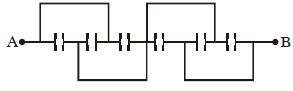
All capacitors used in the diagram are identical and each is of capacitance $C$. Then the effective capacitance between the points $A$ and $B$ is
A
$1.5\,C$
B
$6\,C$
C
$C$
D
$3\,C$
Solution
(A) In the given circuit,the first three capacitors are connected in parallel. Let their equivalent capacitance be $C_1$. Since they are in parallel,$C_1 = C + C + C = 3C$.
Similarly,the last three capacitors are also connected in parallel. Let their equivalent capacitance be $C_2$. Thus,$C_2 = C + C + C = 3C$.
Now,these two groups (each of capacitance $3C$) are connected in series between points $A$ and $B$.
The effective capacitance $C_{eq}$ is given by the series combination formula: $\frac{1}{C_{eq}} = \frac{1}{C_1} + \frac{1}{C_2}$.
Substituting the values: $\frac{1}{C_{eq}} = \frac{1}{3C} + \frac{1}{3C} = \frac{2}{3C}$.
Therefore,$C_{eq} = \frac{3C}{2} = 1.5C$.
Similarly,the last three capacitors are also connected in parallel. Let their equivalent capacitance be $C_2$. Thus,$C_2 = C + C + C = 3C$.
Now,these two groups (each of capacitance $3C$) are connected in series between points $A$ and $B$.
The effective capacitance $C_{eq}$ is given by the series combination formula: $\frac{1}{C_{eq}} = \frac{1}{C_1} + \frac{1}{C_2}$.
Substituting the values: $\frac{1}{C_{eq}} = \frac{1}{3C} + \frac{1}{3C} = \frac{2}{3C}$.
Therefore,$C_{eq} = \frac{3C}{2} = 1.5C$.
0 likesView Solution
4
ChemistryMCQKCET · 2010
The activation energy for a reaction at the temperature $T \ K$ was found to be $2.303 \ RT \ J \ mol^{-1}$. The ratio of the rate constant to Arrhenius factor is
A
$10^{-1}$
B
$10^{-2}$
C
$2 \times 10^{-3}$
D
$2 \times 10^{-2}$
Solution
(A) The Arrhenius equation is given by $k = A e^{-E_a / RT}$.
Here,$k$ is the rate constant,$A$ is the Arrhenius factor (frequency factor),$E_a$ is the activation energy,$R$ is the gas constant,and $T$ is the temperature.
We are given $E_a = 2.303 \ RT \ J \ mol^{-1}$.
Substituting the value of $E_a$ into the Arrhenius equation:
$k = A e^{-(2.303 \ RT) / RT}$
$k = A e^{-2.303}$
Since $e^{-2.303} = 10^{-1}$ (because $\ln(10) = 2.303$,so $e^{2.303} = 10$,which implies $e^{-2.303} = 1/10 = 10^{-1}$),
$k = A \times 10^{-1}$.
Therefore,the ratio of the rate constant to the Arrhenius factor is $k/A = 10^{-1}$.
Here,$k$ is the rate constant,$A$ is the Arrhenius factor (frequency factor),$E_a$ is the activation energy,$R$ is the gas constant,and $T$ is the temperature.
We are given $E_a = 2.303 \ RT \ J \ mol^{-1}$.
Substituting the value of $E_a$ into the Arrhenius equation:
$k = A e^{-(2.303 \ RT) / RT}$
$k = A e^{-2.303}$
Since $e^{-2.303} = 10^{-1}$ (because $\ln(10) = 2.303$,so $e^{2.303} = 10$,which implies $e^{-2.303} = 1/10 = 10^{-1}$),
$k = A \times 10^{-1}$.
Therefore,the ratio of the rate constant to the Arrhenius factor is $k/A = 10^{-1}$.
0 likesView Solution
5
ChemistryMCQKCET · 2010
Which one of the following does not involve coagulation?
A
Formation of delta regions
B
Peptization
C
Treatment of drinking water by potash alum
D
Clotting of blood by the use of ferric chloride
Solution
(B) Coagulation is the process of aggregating together the colloidal particles so as to change them into large sized particles which ultimately settle as a precipitate.
$A$,$C$,and $D$ are examples of coagulation.
$B$ Peptization is the process of converting a freshly prepared precipitate into a colloidal sol by adding a suitable electrolyte,which is the reverse of coagulation.
$A$,$C$,and $D$ are examples of coagulation.
$B$ Peptization is the process of converting a freshly prepared precipitate into a colloidal sol by adding a suitable electrolyte,which is the reverse of coagulation.
0 likesView Solution
6
ChemistryMCQKCET · 2010
The wavelength of the light used in Young's double slit experiment is $\lambda$. The intensity at a point on the screen is $I$,where the path difference is $\lambda/6$. If $I_0$ denotes the maximum intensity,then the ratio of $I$ and $I_0$ is
A
$0.866$
B
$0.5$
C
$0.707$
D
$0.75$
Solution
(D) In Young's double slit experiment,the phase difference $\phi$ is related to the path difference $\Delta x$ by the formula: $\phi = \frac{2\pi}{\lambda} \Delta x$.
Given the path difference $\Delta x = \lambda/6$,the phase difference is $\phi = \frac{2\pi}{\lambda} \times \frac{\lambda}{6} = \frac{\pi}{3} = 60^{\circ}$.
The intensity at any point is given by $I = I_1 + I_2 + 2\sqrt{I_1 I_2} \cos \phi$. Assuming $I_1 = I_2 = I'$,the maximum intensity is $I_0 = I' + I' + 2\sqrt{I' I'} \cos(0^{\circ}) = 4I'$.
Substituting the values for the given point: $I = I' + I' + 2\sqrt{I' I'} \cos(60^{\circ}) = 2I' + 2I'(0.5) = 2I' + I' = 3I'$.
Therefore,the ratio is $\frac{I}{I_0} = \frac{3I'}{4I'} = 0.75$.
Given the path difference $\Delta x = \lambda/6$,the phase difference is $\phi = \frac{2\pi}{\lambda} \times \frac{\lambda}{6} = \frac{\pi}{3} = 60^{\circ}$.
The intensity at any point is given by $I = I_1 + I_2 + 2\sqrt{I_1 I_2} \cos \phi$. Assuming $I_1 = I_2 = I'$,the maximum intensity is $I_0 = I' + I' + 2\sqrt{I' I'} \cos(0^{\circ}) = 4I'$.
Substituting the values for the given point: $I = I' + I' + 2\sqrt{I' I'} \cos(60^{\circ}) = 2I' + 2I'(0.5) = 2I' + I' = 3I'$.
Therefore,the ratio is $\frac{I}{I_0} = \frac{3I'}{4I'} = 0.75$.
0 likesView Solution
7
ChemistryMCQKCET · 2010
Most of the endangered species are the victims of
A
Competition with introduced species
B
Habitat destruction
C
Over-hunting
D
Acid rain
Solution
(B) Habitat loss and fragmentation is the most important cause driving animals and plants to extinction.
Due to various human activities,when large habitats are destroyed,various animals are badly affected,leading to population declines.
Due to various human activities,when large habitats are destroyed,various animals are badly affected,leading to population declines.
0 likesView Solution
8
ChemistryMCQKCET · 2010
The letter '$D$' in $D$-glucose signifies
A
configuration at all chiral carbons
B
dextrorotatory
C
that it is a monosaccharide
D
configuration at a particular chiral carbon
Solution
(D) The letter '$D$' before the name of a monosaccharide indicates the configuration at the highest numbered chiral carbon (the penultimate carbon atom).
In $D$-glucose,the $-OH$ group at the $C-5$ position is on the right side in the Fischer projection.
Therefore,it specifies the configuration at a particular chiral carbon.
In $D$-glucose,the $-OH$ group at the $C-5$ position is on the right side in the Fischer projection.
Therefore,it specifies the configuration at a particular chiral carbon.
0 likesView Solution
9
ChemistryEasyMCQKCET · 2010
Chloroacetic acid is a stronger acid than acetic acid. This can be explained using
A
$-M$ effect
B
$-I$ effect
C
$+M$ effect
D
$+I$ effect
Solution
(B) The $-Cl$ atom is an electron-withdrawing group that exhibits a negative inductive effect ($-I$ effect).
When attached to the $\alpha$-carbon of acetic acid,it withdraws electron density through the sigma bond network.
This withdrawal decreases the electron density on the oxygen atom of the $-OH$ group,which increases the polarity of the $O-H$ bond.
Consequently,the release of the $H^{+}$ ion becomes easier,thereby increasing the acidity of chloroacetic acid compared to acetic acid.
When attached to the $\alpha$-carbon of acetic acid,it withdraws electron density through the sigma bond network.
This withdrawal decreases the electron density on the oxygen atom of the $-OH$ group,which increases the polarity of the $O-H$ bond.
Consequently,the release of the $H^{+}$ ion becomes easier,thereby increasing the acidity of chloroacetic acid compared to acetic acid.
0 likesView Solution
10
ChemistryMediumMCQKCET · 2010
Which of the following statements are correct for the peroxide ion $(O_{2}^{2-})$?
$(i)$ It has a bond order of $1$.
$(ii)$ It is diamagnetic.
$(iii)$ It has four completely filled antibonding molecular orbitals.
$(iv)$ It is isoelectronic with neon.
$(i)$ It has a bond order of $1$.
$(ii)$ It is diamagnetic.
$(iii)$ It has four completely filled antibonding molecular orbitals.
$(iv)$ It is isoelectronic with neon.
A
$(ii)$ and $(iii)$
B
$(i)$,$(ii)$ and $(iv)$
C
$(i)$,$(ii)$ and $(iii)$
D
$(i)$ and $(iv)$
Solution
(C) The peroxide ion is $O_{2}^{2-}$.
Electronic configuration: $O_{2}^{2-} (18 \text{ electrons}) = \sigma 1s^{2}, \sigma^{*} 1s^{2}, \sigma 2s^{2}, \sigma^{*} 2s^{2}, \sigma 2p_{z}^{2}, \pi 2p_{x}^{2} \approx \pi 2p_{y}^{2}, \pi^{*} 2p_{x}^{2} \approx \pi^{*} 2p_{y}^{2}$.
Bond order $= \frac{N_{b} - N_{a}}{2} = \frac{10 - 8}{2} = 1$.
It contains four completely filled antibonding molecular orbitals $(\sigma^{*} 1s, \sigma^{*} 2s, \pi^{*} 2p_{x}, \pi^{*} 2p_{y})$.
Since all electrons are paired,$O_{2}^{2-}$ is diamagnetic.
It has $18$ electrons,so it is isoelectronic with argon $(18)$,not neon $(10)$.
Electronic configuration: $O_{2}^{2-} (18 \text{ electrons}) = \sigma 1s^{2}, \sigma^{*} 1s^{2}, \sigma 2s^{2}, \sigma^{*} 2s^{2}, \sigma 2p_{z}^{2}, \pi 2p_{x}^{2} \approx \pi 2p_{y}^{2}, \pi^{*} 2p_{x}^{2} \approx \pi^{*} 2p_{y}^{2}$.
Bond order $= \frac{N_{b} - N_{a}}{2} = \frac{10 - 8}{2} = 1$.
It contains four completely filled antibonding molecular orbitals $(\sigma^{*} 1s, \sigma^{*} 2s, \pi^{*} 2p_{x}, \pi^{*} 2p_{y})$.
Since all electrons are paired,$O_{2}^{2-}$ is diamagnetic.
It has $18$ electrons,so it is isoelectronic with argon $(18)$,not neon $(10)$.
0 likesView Solution
11
ChemistryEasyMCQKCET · 2010
Consider the following gaseous equilibria with equilibrium constants $K_{1}$ and $K_{2}$ respectively:
$SO_{2(g)} + \frac{1}{2} O_{2(g)} \rightleftharpoons SO_{3(g)}$
$2 SO_{3(g)} \rightleftharpoons 2 SO_{2(g)} + O_{2(g)}$
The equilibrium constants are related as:
$SO_{2(g)} + \frac{1}{2} O_{2(g)} \rightleftharpoons SO_{3(g)}$
$2 SO_{3(g)} \rightleftharpoons 2 SO_{2(g)} + O_{2(g)}$
The equilibrium constants are related as:
A
$2 K_{1} = K_{2}^{2}$
B
$K_{1}^{2} = \frac{1}{K_{2}}$
C
$K_{2}^{2} = \frac{1}{K_{1}}$
D
$K_{2} = \frac{2}{K_{1}^{2}}$
Solution
(B) For the first reaction: $SO_{2(g)} + \frac{1}{2} O_{2(g)} \rightleftharpoons SO_{3(g)}$; $K_{1} = \frac{[SO_{3}]}{[SO_{2}][O_{2}]^{1/2}}$
For the second reaction: $2 SO_{3(g)} \rightleftharpoons 2 SO_{2(g)} + O_{2(g)}$; $K_{2} = \frac{[SO_{2}]^{2}[O_{2}]}{[SO_{3}]^{2}}$
Comparing the two expressions,we can see that $K_{2} = \left( \frac{[SO_{2}][O_{2}]^{1/2}}{[SO_{3}]} \right)^{2} = \left( \frac{1}{K_{1}} \right)^{2} = \frac{1}{K_{1}^{2}}$
Therefore,$K_{1}^{2} = \frac{1}{K_{2}}$.
For the second reaction: $2 SO_{3(g)} \rightleftharpoons 2 SO_{2(g)} + O_{2(g)}$; $K_{2} = \frac{[SO_{2}]^{2}[O_{2}]}{[SO_{3}]^{2}}$
Comparing the two expressions,we can see that $K_{2} = \left( \frac{[SO_{2}][O_{2}]^{1/2}}{[SO_{3}]} \right)^{2} = \left( \frac{1}{K_{1}} \right)^{2} = \frac{1}{K_{1}^{2}}$
Therefore,$K_{1}^{2} = \frac{1}{K_{2}}$.
0 likesView Solution
12
ChemistryMCQKCET · 2010
Consider the following gaseous equilibria with equilibrium constants $K_{1}$ and $K_{2}$ respectively.
$SO_{2(g)} + \frac{1}{2} O_{2(g)} \rightleftharpoons SO_{3(g)}$
$2 SO_{3(g)} \rightleftharpoons 2 SO_{2(g)} + O_{2(g)}$
The equilibrium constants are related as
$SO_{2(g)} + \frac{1}{2} O_{2(g)} \rightleftharpoons SO_{3(g)}$
$2 SO_{3(g)} \rightleftharpoons 2 SO_{2(g)} + O_{2(g)}$
The equilibrium constants are related as
A
$K_{1}^{2} = \frac{1}{K_{2}}$
B
$2 K_{1} = K_{2}^{2}$
C
$K_{2} = \frac{2}{K_{1}^{2}}$
D
$K_{2}^{2} = \frac{1}{K_{1}}$
Solution
(A) For the reaction,
$SO_{2(g)} + \frac{1}{2} O_{2(g)} \rightleftharpoons SO_{3(g)}$
Equilibrium constant,$K_{1} = \frac{[SO_{3}]}{[SO_{2}][O_{2}]^{1/2}}$ ... $(I)$
For the reaction,
$2 SO_{3(g)} \rightleftharpoons 2 SO_{2(g)} + O_{2(g)}$
Equilibrium constant,$K_{2} = \frac{[SO_{2}]^{2}[O_{2}]}{[SO_{3}]^{2}}$ ... $(II)$
On squaring both sides in Eq $(I)$,we get
$K_{1}^{2} = \frac{[SO_{3}]^{2}}{[SO_{2}]^{2}[O_{2}]}$ ... $(III)$
Comparing Eq $(II)$ and Eq $(III)$:
$K_{2} = \frac{1}{K_{1}^{2}}$
Therefore,$K_{1}^{2} = \frac{1}{K_{2}}$.
$SO_{2(g)} + \frac{1}{2} O_{2(g)} \rightleftharpoons SO_{3(g)}$
Equilibrium constant,$K_{1} = \frac{[SO_{3}]}{[SO_{2}][O_{2}]^{1/2}}$ ... $(I)$
For the reaction,
$2 SO_{3(g)} \rightleftharpoons 2 SO_{2(g)} + O_{2(g)}$
Equilibrium constant,$K_{2} = \frac{[SO_{2}]^{2}[O_{2}]}{[SO_{3}]^{2}}$ ... $(II)$
On squaring both sides in Eq $(I)$,we get
$K_{1}^{2} = \frac{[SO_{3}]^{2}}{[SO_{2}]^{2}[O_{2}]}$ ... $(III)$
Comparing Eq $(II)$ and Eq $(III)$:
$K_{2} = \frac{1}{K_{1}^{2}}$
Therefore,$K_{1}^{2} = \frac{1}{K_{2}}$.
0 likesView Solution
13
ChemistryEasyMCQKCET · 2010
Which one of the following conversions involves a change in both hybridisation and shape?
A
$CH_{4} \longrightarrow C_{2}H_{6}$
B
$NH_{3} \longrightarrow NH_{4}^{+}$
C
$BF_{3} \longrightarrow BF_{4}^{-}$
D
$H_{2}O \longrightarrow H_{3}O^{+}$
Solution
(C) Let us analyze each conversion:
$(a)$ $CH_{4}$ ($sp^{3}$,tetrahedral) $\longrightarrow C_{2}H_{6}$ ($sp^{3}$,tetrahedral). No change in hybridisation or shape.
$(b)$ $NH_{3}$ ($sp^{3}$,trigonal pyramidal) $\longrightarrow NH_{4}^{+}$ ($sp^{3}$,tetrahedral). Change in shape,but no change in hybridisation.
$(c)$ $BF_{3}$ ($sp^{2}$,trigonal planar) $\longrightarrow BF_{4}^{-}$ ($sp^{3}$,tetrahedral). Both hybridisation and shape change.
$(d)$ $H_{2}O$ ($sp^{3}$,bent) $\longrightarrow H_{3}O^{+}$ ($sp^{3}$,trigonal pyramidal). Change in shape,but no change in hybridisation.
Thus,the conversion of $BF_{3}$ into $BF_{4}^{-}$ involves a change in both hybridisation and shape.
$(a)$ $CH_{4}$ ($sp^{3}$,tetrahedral) $\longrightarrow C_{2}H_{6}$ ($sp^{3}$,tetrahedral). No change in hybridisation or shape.
$(b)$ $NH_{3}$ ($sp^{3}$,trigonal pyramidal) $\longrightarrow NH_{4}^{+}$ ($sp^{3}$,tetrahedral). Change in shape,but no change in hybridisation.
$(c)$ $BF_{3}$ ($sp^{2}$,trigonal planar) $\longrightarrow BF_{4}^{-}$ ($sp^{3}$,tetrahedral). Both hybridisation and shape change.
$(d)$ $H_{2}O$ ($sp^{3}$,bent) $\longrightarrow H_{3}O^{+}$ ($sp^{3}$,trigonal pyramidal). Change in shape,but no change in hybridisation.
Thus,the conversion of $BF_{3}$ into $BF_{4}^{-}$ involves a change in both hybridisation and shape.
0 likesView Solution
14
ChemistryEasyMCQKCET · 2010
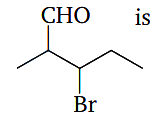
The $IUPAC$ name of the given compound is:
A
$3-$bromo$-2-$methylpentanal
B
$3-$bromo$-2-$methylbutanal
C
$2-$methyl$-3-$bromobutanal
D
$2-$methyl$-3-$bromohexanal
Solution
(A) $1$. Identify the longest carbon chain containing the functional group (aldehyde). The chain has $5$ carbon atoms,so the parent alkane is pentane,and the aldehyde suffix is $-al$,making it pentanal.
$2$. Number the chain starting from the aldehyde carbon as $C-1$. The $C-2$ position has a methyl group,and the $C-3$ position has a bromine atom.
$3$. Arrange the substituents alphabetically: bromo comes before methyl.
$4$. The $IUPAC$ name is $3-$bromo$-2-$methylpentanal.
$2$. Number the chain starting from the aldehyde carbon as $C-1$. The $C-2$ position has a methyl group,and the $C-3$ position has a bromine atom.
$3$. Arrange the substituents alphabetically: bromo comes before methyl.
$4$. The $IUPAC$ name is $3-$bromo$-2-$methylpentanal.
0 likesView Solution
15
ChemistryEasyMCQKCET · 2010
Which one of these is not true for benzene?
A
It forms only one type of monosubstituted product
B
There are three carbon-carbon single bonds and three carbon-carbon double bonds
C
The heat of hydrogenation of benzene is less than the theoretical value
D
The bond angle between the carbon-carbon bonds is $120^{\circ}$
Solution
(B) Benzene exhibits resonance,and all carbon-carbon bonds are equivalent due to the delocalization of $\pi$ electrons.
It does not contain distinct single and double bonds as suggested in option $B$.
Therefore,the statement that there are three carbon-carbon single bonds and three carbon-carbon double bonds is incorrect.
It does not contain distinct single and double bonds as suggested in option $B$.
Therefore,the statement that there are three carbon-carbon single bonds and three carbon-carbon double bonds is incorrect.
0 likesView Solution
16
ChemistryMediumMCQKCET · 2010
Which one of the following conformations of cyclohexane is the least stable?
A
Half-chair
B
Boat
C
Twisted-boat
D
Chair
Solution
(A) The stability order of cyclohexane conformations is $Chair > Twist-boat > Boat > Half-chair$.
The $Half-chair$ conformation is the least stable due to high torsional strain and angle strain.
The $Half-chair$ conformation is the least stable due to high torsional strain and angle strain.
0 likesView Solution
17
ChemistryMediumMCQKCET · 2010
In Kjeldahl's method,ammonia from $5 \ g$ of food neutralizes $30 \ cm^{3}$ of $0.1 \ N$ acid. The percentage of nitrogen in the food is
A
$0.84$
B
$8.4$
C
$16.8$
D
$1.68$
Solution
(A) The formula for the percentage of nitrogen in Kjeldahl's method is given by:
$Percentage \ of \ N = \frac{1.4 \times N \times V}{W}$
Where:
$N = 0.1 \ N$ (Normality of acid)
$V = 30 \ cm^{3}$ (Volume of acid used)
$W = 5 \ g$ (Weight of the food sample)
Substituting the values:
$Percentage \ of \ N = \frac{1.4 \times 0.1 \times 30}{5} = \frac{4.2}{5} = 0.84 \%$
$Percentage \ of \ N = \frac{1.4 \times N \times V}{W}$
Where:
$N = 0.1 \ N$ (Normality of acid)
$V = 30 \ cm^{3}$ (Volume of acid used)
$W = 5 \ g$ (Weight of the food sample)
Substituting the values:
$Percentage \ of \ N = \frac{1.4 \times 0.1 \times 30}{5} = \frac{4.2}{5} = 0.84 \%$
0 likesView Solution
18
ChemistryMediumMCQKCET · 2010
In chromite ore,the oxidation number of iron and chromium are respectively
A
$+3, +2$
B
$+3, +6$
C
$+2, +6$
D
$+2, +3$
Solution
(D) Chromite ore is $FeCr_2O_4$,which can be represented as $FeO \cdot Cr_2O_3$.
In this compound,the oxidation number of $Fe$ is $+2$ and the oxidation number of $Cr$ is $+3$.
In this compound,the oxidation number of $Fe$ is $+2$ and the oxidation number of $Cr$ is $+3$.
0 likesView Solution
19
ChemistryMCQKCET · 2010
In chromite ore,the oxidation number of iron and chromium are respectively
A
$+3, +2$
B
$+3, +6$
C
$+2, +6$
D
$+2, +3$
Solution
(D) Chromite or chrome iron ore is $FeCr_{2}O_{4}$. Its actual composition is $FeO \cdot Cr_{2}O_{3}$.
In $FeO$,the oxidation state of $Fe$ is calculated as:
$x + (-2) = 0 \implies x = +2$
Similarly,in $Cr_{2}O_{3}$,the oxidation state of $Cr$ is calculated as:
$2x + 3(-2) = 0 \implies 2x = +6 \implies x = +3$
Thus,the oxidation states of $Fe$ and $Cr$ are $+2$ and $+3$ respectively.
In $FeO$,the oxidation state of $Fe$ is calculated as:
$x + (-2) = 0 \implies x = +2$
Similarly,in $Cr_{2}O_{3}$,the oxidation state of $Cr$ is calculated as:
$2x + 3(-2) = 0 \implies 2x = +6 \implies x = +3$
Thus,the oxidation states of $Fe$ and $Cr$ are $+2$ and $+3$ respectively.
0 likesView Solution
20
ChemistryMediumMCQKCET · 2010
$A$ dibromo derivative of an alkane reacts with sodium metal to form an alicyclic hydrocarbon. The derivative is
A
$1, 1-$dibromopropane
B
$2, 2-$dibromobutane
C
$1, 2-$dibromoethane
D
$1, 4-$dibromobutane
Solution
(D) When $\omega$-dihalides (terminal dihalides) react with sodium metal in the presence of dry ether,an intramolecular Wurtz reaction occurs,leading to the formation of a cyclic hydrocarbon.
For example,$1, 4-$dibromobutane reacts with $2Na$ to form cyclobutane and $2NaBr$ as a byproduct.
The reaction is: $Br-CH_2-CH_2-CH_2-CH_2-Br + 2Na \rightarrow \text{Cyclobutane} + 2NaBr$.
For example,$1, 4-$dibromobutane reacts with $2Na$ to form cyclobutane and $2NaBr$ as a byproduct.
The reaction is: $Br-CH_2-CH_2-CH_2-CH_2-Br + 2Na \rightarrow \text{Cyclobutane} + 2NaBr$.
0 likesView Solution
21
ChemistryDifficultMCQKCET · 2010
The $pH$ value of which one of the following is not equal to $1$?
A
$0.1 \ M \ CH_3COOH$
B
$0.1 \ M \ HNO_3$
C
$0.05 \ M \ H_2SO_4$
D
$50 \ cm^3 \ 0.4 \ M \ HCl + 50 \ cm^3 \ 0.2 \ M \ NaOH$
Solution
(A) For a solution to have $pH = 1$,the concentration of $[H^+]$ must be $0.1 \ M$.
$(A)$ $0.1 \ M \ CH_3COOH$ is a weak acid and does not dissociate completely,so $[H^+] < 0.1 \ M$,hence $pH > 1$.
$(B)$ $0.1 \ M \ HNO_3$ is a strong acid,$[H^+] = 0.1 \ M$,so $pH = -\log(0.1) = 1$.
$(C)$ $0.05 \ M \ H_2SO_4$ is a strong acid,$[H^+] = 2 \times 0.05 = 0.1 \ M$,so $pH = -\log(0.1) = 1$.
$(D)$ For the mixture: $n(H^+) = 50 \times 0.4 = 20 \ mmol$,$n(OH^-) = 50 \times 0.2 = 10 \ mmol$. Remaining $n(H^+) = 20 - 10 = 10 \ mmol$. Total volume = $100 \ cm^3$. $[H^+] = 10 / 100 = 0.1 \ M$,so $pH = 1$.
$(A)$ $0.1 \ M \ CH_3COOH$ is a weak acid and does not dissociate completely,so $[H^+] < 0.1 \ M$,hence $pH > 1$.
$(B)$ $0.1 \ M \ HNO_3$ is a strong acid,$[H^+] = 0.1 \ M$,so $pH = -\log(0.1) = 1$.
$(C)$ $0.05 \ M \ H_2SO_4$ is a strong acid,$[H^+] = 2 \times 0.05 = 0.1 \ M$,so $pH = -\log(0.1) = 1$.
$(D)$ For the mixture: $n(H^+) = 50 \times 0.4 = 20 \ mmol$,$n(OH^-) = 50 \times 0.2 = 10 \ mmol$. Remaining $n(H^+) = 20 - 10 = 10 \ mmol$. Total volume = $100 \ cm^3$. $[H^+] = 10 / 100 = 0.1 \ M$,so $pH = 1$.
0 likesView Solution
22
ChemistryMediumMCQKCET · 2010
$0.023 \ g$ of sodium metal is reacted with $100 \ cm^{3}$ of water. The $pH$ of the resulting solution is
A
$10$
B
$11$
C
$9$
D
$12$
Solution
(D) The chemical reaction is: $2Na + 2H_2O \rightarrow 2NaOH + H_2$
Number of moles of $Na = \frac{0.023 \ g}{23 \ g/mol} = 1 \times 10^{-3} \ mol$.
According to the stoichiometry,$2 \ mol$ of $Na$ produces $2 \ mol$ of $NaOH$.
Therefore,$1 \times 10^{-3} \ mol$ of $Na$ produces $1 \times 10^{-3} \ mol$ of $NaOH$.
The volume of the solution is $100 \ cm^3 = 0.1 \ L$.
Concentration of $[OH^-] = \frac{1 \times 10^{-3} \ mol}{0.1 \ L} = 1 \times 10^{-2} \ M$.
$pOH = -\log[OH^-] = -\log(1 \times 10^{-2}) = 2$.
Since $pH + pOH = 14$,$pH = 14 - 2 = 12$.
Number of moles of $Na = \frac{0.023 \ g}{23 \ g/mol} = 1 \times 10^{-3} \ mol$.
According to the stoichiometry,$2 \ mol$ of $Na$ produces $2 \ mol$ of $NaOH$.
Therefore,$1 \times 10^{-3} \ mol$ of $Na$ produces $1 \times 10^{-3} \ mol$ of $NaOH$.
The volume of the solution is $100 \ cm^3 = 0.1 \ L$.
Concentration of $[OH^-] = \frac{1 \times 10^{-3} \ mol}{0.1 \ L} = 1 \times 10^{-2} \ M$.
$pOH = -\log[OH^-] = -\log(1 \times 10^{-2}) = 2$.
Since $pH + pOH = 14$,$pH = 14 - 2 = 12$.
0 likesView Solution
23
ChemistryMCQKCET · 2010
The $pH$ value of which one of the following is not equal to $1$?
A
$0.1 \ M \ HNO_3$
B
$0.05 \ M \ H_2SO_4$
C
$0.1 \ M \ CH_3COOH$
D
$50 \ cm^3$ of $0.4 \ M \ HCl + 50 \ cm^3$ of $0.2 \ M \ NaOH$
Solution
(C) For $0.1 \ M \ HNO_3$,$[H^+] = 0.1 \ M$,so $pH = -\log(0.1) = 1$.
For $0.05 \ M \ H_2SO_4$,$[H^+] = 2 \times 0.05 = 0.1 \ M$,so $pH = -\log(0.1) = 1$.
For $0.1 \ M \ CH_3COOH$,it is a weak acid and does not ionize completely,so $[H^+] < 0.1 \ M$ and $pH > 1$.
For the mixture,$n(HCl) = 0.05 \ L \times 0.4 \ M = 0.02 \ mol$ and $n(NaOH) = 0.05 \ L \times 0.2 \ M = 0.01 \ mol$.
Remaining $n(HCl) = 0.02 - 0.01 = 0.01 \ mol$ in $100 \ mL$ $(0.1 \ L)$ solution.
$[H^+] = 0.01 \ mol / 0.1 \ L = 0.1 \ M$,so $pH = -\log(0.1) = 1$.
Thus,$0.1 \ M \ CH_3COOH$ does not have a $pH$ of $1$.
For $0.05 \ M \ H_2SO_4$,$[H^+] = 2 \times 0.05 = 0.1 \ M$,so $pH = -\log(0.1) = 1$.
For $0.1 \ M \ CH_3COOH$,it is a weak acid and does not ionize completely,so $[H^+] < 0.1 \ M$ and $pH > 1$.
For the mixture,$n(HCl) = 0.05 \ L \times 0.4 \ M = 0.02 \ mol$ and $n(NaOH) = 0.05 \ L \times 0.2 \ M = 0.01 \ mol$.
Remaining $n(HCl) = 0.02 - 0.01 = 0.01 \ mol$ in $100 \ mL$ $(0.1 \ L)$ solution.
$[H^+] = 0.01 \ mol / 0.1 \ L = 0.1 \ M$,so $pH = -\log(0.1) = 1$.
Thus,$0.1 \ M \ CH_3COOH$ does not have a $pH$ of $1$.
0 likesView Solution
24
ChemistryDifficultMCQKCET · 2010
$A$ buffer solution contains $0.1 \ mol$ of sodium acetate in $1000 \ cm^{3}$ of $0.1 \ M$ acetic acid. To the above buffer solution,$0.1 \ mol$ of sodium acetate is further added and dissolved. The $pH$ of the resulting buffer is equal to
A
$pK_{a} - \log 2$
B
$pK_{a}$
C
$pK_{a} + 2$
D
$pK_{a} + \log 2$
Solution
(D) Initially,the amount of salt $[CH_{3}COONa] = 0.1 \ mol$ and the amount of acid $[CH_{3}COOH] = 0.1 \ mol$.
When an additional $0.1 \ mol$ of $CH_{3}COONa$ is added,the total amount of salt becomes $0.1 + 0.1 = 0.2 \ mol$.
The $pH$ of an acidic buffer is given by the Henderson-Hasselbalch equation: $pH = pK_{a} + \log \frac{[salt]}{[acid]}$.
Substituting the values: $pH = pK_{a} + \log \frac{0.2}{0.1}$.
Therefore,$pH = pK_{a} + \log 2$.
When an additional $0.1 \ mol$ of $CH_{3}COONa$ is added,the total amount of salt becomes $0.1 + 0.1 = 0.2 \ mol$.
The $pH$ of an acidic buffer is given by the Henderson-Hasselbalch equation: $pH = pK_{a} + \log \frac{[salt]}{[acid]}$.
Substituting the values: $pH = pK_{a} + \log \frac{0.2}{0.1}$.
Therefore,$pH = pK_{a} + \log 2$.
0 likesView Solution
25
ChemistryMediumMCQKCET · 2010
$1 \ dm^{3}$ solution containing $10^{-5} \ mol$ each of $Cl^{-}$ ions and $CrO_{4}^{2-}$ ions is treated with $10^{-4} \ mol$ of silver nitrate. Which one of the following observations is made?
$[K_{sp} \ Ag_{2}CrO_{4} = 4 \times 10^{-12}]$
$[K_{sp} \ AgCl = 1 \times 10^{-10}]$
$[K_{sp} \ Ag_{2}CrO_{4} = 4 \times 10^{-12}]$
$[K_{sp} \ AgCl = 1 \times 10^{-10}]$
A
Precipitation does not occur
B
Silver chromate gets precipitated first
C
Silver chloride gets precipitated first
D
Both silver chromate and silver chloride start precipitating simultaneously
Solution
(C) For precipitation to occur,the ionic product must exceed the solubility product $(K_{sp})$.
For $Ag_{2}CrO_{4}$:
Ionic Product $(IP) = [Ag^{+}]^{2}[CrO_{4}^{2-}] = (10^{-4})^{2}(10^{-5}) = 10^{-13}$.
Given $K_{sp}(Ag_{2}CrO_{4}) = 4 \times 10^{-12}$.
Since $IP < K_{sp}$,$Ag_{2}CrO_{4}$ will not precipitate.
For $AgCl$:
Ionic Product $(IP) = [Ag^{+}][Cl^{-}] = (10^{-4})(10^{-5}) = 10^{-9}$.
Given $K_{sp}(AgCl) = 1 \times 10^{-10}$.
Since $IP > K_{sp}$,$AgCl$ will precipitate.
Therefore,silver chloride gets precipitated first.
For $Ag_{2}CrO_{4}$:
Ionic Product $(IP) = [Ag^{+}]^{2}[CrO_{4}^{2-}] = (10^{-4})^{2}(10^{-5}) = 10^{-13}$.
Given $K_{sp}(Ag_{2}CrO_{4}) = 4 \times 10^{-12}$.
Since $IP < K_{sp}$,$Ag_{2}CrO_{4}$ will not precipitate.
For $AgCl$:
Ionic Product $(IP) = [Ag^{+}][Cl^{-}] = (10^{-4})(10^{-5}) = 10^{-9}$.
Given $K_{sp}(AgCl) = 1 \times 10^{-10}$.
Since $IP > K_{sp}$,$AgCl$ will precipitate.
Therefore,silver chloride gets precipitated first.
0 likesView Solution
26
ChemistryMCQKCET · 2010
Two simple harmonic motions are represented by $y_{1} = 5[\sin 2 \pi t + \sqrt{3} \cos 2 \pi t]$ and $y_{2} = 5 \sin (2 \pi t + \frac{\pi}{4})$. The ratio of their amplitudes is
A
$1: 1$
B
$2: 1$
C
$1: 3$
D
$\sqrt{3}: 1$
Solution
(B) The first equation is $y_{1} = 5[\sin 2 \pi t + \sqrt{3} \cos 2 \pi t]$.
We can rewrite this by multiplying and dividing by $2$: $y_{1} = 10 [\frac{1}{2} \sin 2 \pi t + \frac{\sqrt{3}}{2} \cos 2 \pi t]$.
Using the trigonometric identity $\sin(A+B) = \sin A \cos B + \cos A \sin B$,we set $\cos \frac{\pi}{3} = \frac{1}{2}$ and $\sin \frac{\pi}{3} = \frac{\sqrt{3}}{2}$.
Thus,$y_{1} = 10 [\sin 2 \pi t \cos \frac{\pi}{3} + \cos 2 \pi t \sin \frac{\pi}{3}] = 10 \sin(2 \pi t + \frac{\pi}{3})$.
Therefore,the amplitude $A_{1} = 10$.
For the second equation,$y_{2} = 5 \sin (2 \pi t + \frac{\pi}{4})$,the amplitude $A_{2} = 5$.
The ratio of the amplitudes is $\frac{A_{1}}{A_{2}} = \frac{10}{5} = \frac{2}{1}$.
We can rewrite this by multiplying and dividing by $2$: $y_{1} = 10 [\frac{1}{2} \sin 2 \pi t + \frac{\sqrt{3}}{2} \cos 2 \pi t]$.
Using the trigonometric identity $\sin(A+B) = \sin A \cos B + \cos A \sin B$,we set $\cos \frac{\pi}{3} = \frac{1}{2}$ and $\sin \frac{\pi}{3} = \frac{\sqrt{3}}{2}$.
Thus,$y_{1} = 10 [\sin 2 \pi t \cos \frac{\pi}{3} + \cos 2 \pi t \sin \frac{\pi}{3}] = 10 \sin(2 \pi t + \frac{\pi}{3})$.
Therefore,the amplitude $A_{1} = 10$.
For the second equation,$y_{2} = 5 \sin (2 \pi t + \frac{\pi}{4})$,the amplitude $A_{2} = 5$.
The ratio of the amplitudes is $\frac{A_{1}}{A_{2}} = \frac{10}{5} = \frac{2}{1}$.
0 likesView Solution
27
ChemistryMediumMCQKCET · 2010
For alkali metals, which one of the following trends is incorrect?
A
Hydration energy: $Li > Na > K > Rb$
B
Ionization energy: $Li > Na > K > Rb$
C
Density: $Li < Na < K < Rb$
D
Atomic size: $Li < Na < K < Rb$
Solution
(C) In general, density increases on moving downward in a group, but the density of potassium $(K)$ is lower than that of sodium $(Na)$.
This is due to an abnormal increase in atomic size from $Na$ $(186 \text{ pm})$ to $K$ $(227 \text{ pm})$.
Therefore, the correct order of density is $Li < K < Na < Rb < Cs$.
Thus, the trend given in option $C$ is incorrect.
This is due to an abnormal increase in atomic size from $Na$ $(186 \text{ pm})$ to $K$ $(227 \text{ pm})$.
Therefore, the correct order of density is $Li < K < Na < Rb < Cs$.
Thus, the trend given in option $C$ is incorrect.
0 likesView Solution
28
ChemistryEasyMCQKCET · 2010
In which one of the following,does the given amount of chlorine exert the least pressure in a vessel of capacity $1 \ dm^{3}$ at $273 \ K$?
A
$0.0355 \ g$
B
$0.071 \ g$
C
$6.023 \times 10^{21}$ molecules
D
$0.02 \ mol$
Solution
(A) The ideal gas equation is $pV = nRT$.
Since $V$ and $T$ are constant,$p \propto n$.
Therefore,the substance with the least number of moles $(n)$ will exert the least pressure.
Note: The molar mass of chlorine gas $(Cl_2)$ is $71 \ g/mol$.
$(A)$ $n = \frac{0.0355 \ g}{71 \ g/mol} = 0.0005 \ mol = 5 \times 10^{-4} \ mol$.
$(B)$ $n = \frac{0.071 \ g}{71 \ g/mol} = 0.001 \ mol = 1 \times 10^{-3} \ mol$.
$(C)$ $n = \frac{6.023 \times 10^{21}}{6.023 \times 10^{23}} = 0.01 \ mol$.
$(D)$ $n = 0.02 \ mol$.
Comparing the values,$5 \times 10^{-4} \ mol$ is the smallest.
Thus,$0.0355 \ g$ of chlorine exerts the least pressure.
Since $V$ and $T$ are constant,$p \propto n$.
Therefore,the substance with the least number of moles $(n)$ will exert the least pressure.
Note: The molar mass of chlorine gas $(Cl_2)$ is $71 \ g/mol$.
$(A)$ $n = \frac{0.0355 \ g}{71 \ g/mol} = 0.0005 \ mol = 5 \times 10^{-4} \ mol$.
$(B)$ $n = \frac{0.071 \ g}{71 \ g/mol} = 0.001 \ mol = 1 \times 10^{-3} \ mol$.
$(C)$ $n = \frac{6.023 \times 10^{21}}{6.023 \times 10^{23}} = 0.01 \ mol$.
$(D)$ $n = 0.02 \ mol$.
Comparing the values,$5 \times 10^{-4} \ mol$ is the smallest.
Thus,$0.0355 \ g$ of chlorine exerts the least pressure.
0 likesView Solution
29
ChemistryMediumMCQKCET · 2010
$A$ mixture of $CaCl_{2}$ and $NaCl$ weighing $4.44 \ g$ is treated with sodium carbonate solution to precipitate all the $Ca^{2+}$ ions as calcium carbonate. The calcium carbonate so obtained is heated strongly to get $0.56 \ g$ of $CaO$. The percentage of $NaCl$ in the mixture (atomic mass of $Ca=40$) is
A
$75$
B
$30.6$
C
$25$
D
$69.4$
Solution
(A) The chemical reactions involved are:
$CaCl_{2} + Na_{2}CO_{3} \rightarrow CaCO_{3} + 2NaCl$
$CaCO_{3} \xrightarrow{\Delta} CaO + CO_{2}$
From the stoichiometry,$1 \ mol$ of $CaO$ is obtained from $1 \ mol$ of $CaCO_{3}$,which in turn comes from $1 \ mol$ of $CaCl_{2}$.
Molar mass of $CaO = 40 + 16 = 56 \ g/mol$.
Moles of $CaO = \frac{0.56 \ g}{56 \ g/mol} = 0.01 \ mol$.
Therefore,moles of $CaCl_{2} = 0.01 \ mol$.
Molar mass of $CaCl_{2} = 40 + (2 \times 35.5) = 111 \ g/mol$.
Mass of $CaCl_{2} = 0.01 \ mol \times 111 \ g/mol = 1.11 \ g$.
Mass of $NaCl$ in the mixture $= 4.44 \ g - 1.11 \ g = 3.33 \ g$.
Percentage of $NaCl = \frac{3.33 \ g}{4.44 \ g} \times 100 = 75 \%$.
$CaCl_{2} + Na_{2}CO_{3} \rightarrow CaCO_{3} + 2NaCl$
$CaCO_{3} \xrightarrow{\Delta} CaO + CO_{2}$
From the stoichiometry,$1 \ mol$ of $CaO$ is obtained from $1 \ mol$ of $CaCO_{3}$,which in turn comes from $1 \ mol$ of $CaCl_{2}$.
Molar mass of $CaO = 40 + 16 = 56 \ g/mol$.
Moles of $CaO = \frac{0.56 \ g}{56 \ g/mol} = 0.01 \ mol$.
Therefore,moles of $CaCl_{2} = 0.01 \ mol$.
Molar mass of $CaCl_{2} = 40 + (2 \times 35.5) = 111 \ g/mol$.
Mass of $CaCl_{2} = 0.01 \ mol \times 111 \ g/mol = 1.11 \ g$.
Mass of $NaCl$ in the mixture $= 4.44 \ g - 1.11 \ g = 3.33 \ g$.
Percentage of $NaCl = \frac{3.33 \ g}{4.44 \ g} \times 100 = 75 \%$.
0 likesView Solution
30
ChemistryMediumMCQKCET · 2010
For one mole of an ideal gas,increasing the temperature from $10^{\circ} C$ to $20^{\circ} C$:
A
increases the average kinetic energy by two times
B
increases the rms velocity by $\sqrt{2}$ times
C
increases the rms velocity by two times
D
increases both the average kinetic energy and rms velocity,but not significantly
Solution
(D) Given,$T_{1} = 273 + 10 = 283 \ K$ and $T_{2} = 273 + 20 = 293 \ K$.
Average kinetic energy $(KE)$ is directly proportional to temperature $(T)$: $KE = \frac{3}{2} RT$.
Ratio $\frac{KE_{2}}{KE_{1}} = \frac{293}{283} \approx 1.035$.
Root mean square velocity $(v_{rms})$ is proportional to $\sqrt{T}$: $v_{rms} = \sqrt{\frac{3RT}{M}}$.
Ratio $\frac{v_{rms,2}}{v_{rms,1}} = \sqrt{\frac{293}{283}} \approx 1.017$.
Since the temperature change is small relative to the absolute temperature,both the average kinetic energy and the rms velocity increase,but not significantly.
Average kinetic energy $(KE)$ is directly proportional to temperature $(T)$: $KE = \frac{3}{2} RT$.
Ratio $\frac{KE_{2}}{KE_{1}} = \frac{293}{283} \approx 1.035$.
Root mean square velocity $(v_{rms})$ is proportional to $\sqrt{T}$: $v_{rms} = \sqrt{\frac{3RT}{M}}$.
Ratio $\frac{v_{rms,2}}{v_{rms,1}} = \sqrt{\frac{293}{283}} \approx 1.017$.
Since the temperature change is small relative to the absolute temperature,both the average kinetic energy and the rms velocity increase,but not significantly.
0 likesView Solution
31
ChemistryEasyMCQKCET · 2010
The wave number of the spectral line in the emission spectrum of hydrogen will be equal to $\frac{8}{9}$ times the Rydberg's constant if the electron jumps from
A
$n=3$ to $n=1$
B
$n=10$ to $n=1$
C
$n=9$ to $n=1$
D
$n=2$ to $n=1$
Solution
(A) The wave number $\bar{\nu}$ of a spectral line in the hydrogen emission spectrum is given by the Rydberg formula: $\bar{\nu} = R_H \left( \frac{1}{n_1^2} - \frac{1}{n_2^2} \right)$.
Given that $\bar{\nu} = \frac{8}{9} R_H$,we substitute this into the formula:
$\frac{8}{9} R_H = R_H \left( \frac{1}{n_1^2} - \frac{1}{n_2^2} \right)$.
Dividing both sides by $R_H$,we get $\frac{8}{9} = \frac{1}{n_1^2} - \frac{1}{n_2^2}$.
For the emission spectrum,$n_1 < n_2$. Since the value is $\frac{8}{9}$,we test $n_1 = 1$:
$\frac{8}{9} = 1 - \frac{1}{n_2^2} \implies \frac{1}{n_2^2} = 1 - \frac{8}{9} = \frac{1}{9}$.
Thus,$n_2^2 = 9$,which means $n_2 = 3$.
Therefore,the electron jumps from $n=3$ to $n=1$.
Given that $\bar{\nu} = \frac{8}{9} R_H$,we substitute this into the formula:
$\frac{8}{9} R_H = R_H \left( \frac{1}{n_1^2} - \frac{1}{n_2^2} \right)$.
Dividing both sides by $R_H$,we get $\frac{8}{9} = \frac{1}{n_1^2} - \frac{1}{n_2^2}$.
For the emission spectrum,$n_1 < n_2$. Since the value is $\frac{8}{9}$,we test $n_1 = 1$:
$\frac{8}{9} = 1 - \frac{1}{n_2^2} \implies \frac{1}{n_2^2} = 1 - \frac{8}{9} = \frac{1}{9}$.
Thus,$n_2^2 = 9$,which means $n_2 = 3$.
Therefore,the electron jumps from $n=3$ to $n=1$.
0 likesView Solution
32
ChemistryEasyMCQKCET · 2010
The set of quantum numbers for the outermost electron for copper $(Cu)$ in its ground state is:
A
$4, 1, 1, +\frac{1}{2}$
B
$3, 2, 2, +\frac{1}{2}$
C
$4, 0, 0, +\frac{1}{2}$
D
$4, 2, 2, +\frac{1}{2}$
Solution
(C) The electronic configuration of the $Cu$ $(Z=29)$ atom is $[Ar] 3d^{10} 4s^{1}$.
Since the outermost shell is $4s$,the outermost electron resides in the $4s$ orbital.
For the $4s^{1}$ electron:
Principal quantum number $(n)$ = $4$.
Azimuthal quantum number $(l)$ for $s$-orbital = $0$.
Magnetic quantum number $(m_l)$ = $0$.
Spin quantum number $(m_s)$ = $+\frac{1}{2}$.
Thus,the set of quantum numbers is $(4, 0, 0, +\frac{1}{2})$.
Since the outermost shell is $4s$,the outermost electron resides in the $4s$ orbital.
For the $4s^{1}$ electron:
Principal quantum number $(n)$ = $4$.
Azimuthal quantum number $(l)$ for $s$-orbital = $0$.
Magnetic quantum number $(m_l)$ = $0$.
Spin quantum number $(m_s)$ = $+\frac{1}{2}$.
Thus,the set of quantum numbers is $(4, 0, 0, +\frac{1}{2})$.
0 likesView Solution
33
ChemistryMCQKCET · 2010
Which one of the following does not involve coagulation?
A
Formation of delta regions
B
Peptization
C
Treatment of drinking water by potash alum
D
Clotting of blood by the use of ferric chloride
Solution
(B) Coagulation is the process of converting a colloidal sol into a precipitate.
Peptization is the reverse process,where a fresh precipitate is converted into a colloidal sol by adding an electrolyte.
Therefore,peptization does not involve coagulation.
Peptization is the reverse process,where a fresh precipitate is converted into a colloidal sol by adding an electrolyte.
Therefore,peptization does not involve coagulation.
0 likesView Solution
34
ChemistryEasyMCQKCET · 2010
Based on the first law of thermodynamics,which one of the following is correct?
A
For an isochoric process,$\Delta E = q$
B
For an adiabatic process,$\Delta E = W$
C
For an isothermal process,$q = +w$
D
For a cyclic process,$q = -w$
Solution
(A) The first law of thermodynamics is given by $\Delta E = q + w$.
$(A)$ For an isochoric process,$\Delta V = 0$,so the work done $w = -P_{ext} \Delta V = 0$. Therefore,$\Delta E = q$.
$(B)$ For an adiabatic process,$q = 0$,so $\Delta E = w$.
$(C)$ For an isothermal process,$\Delta T = 0$,which implies $\Delta E = 0$ for an ideal gas,so $q = -w$.
$(D)$ For a cyclic process,the change in state function $\Delta E = 0$,therefore $q = -w$.
$(A)$ For an isochoric process,$\Delta V = 0$,so the work done $w = -P_{ext} \Delta V = 0$. Therefore,$\Delta E = q$.
$(B)$ For an adiabatic process,$q = 0$,so $\Delta E = w$.
$(C)$ For an isothermal process,$\Delta T = 0$,which implies $\Delta E = 0$ for an ideal gas,so $q = -w$.
$(D)$ For a cyclic process,the change in state function $\Delta E = 0$,therefore $q = -w$.
0 likesView Solution
35
ChemistryEasyMCQKCET · 2010
The amount of heat evolved when $500 \text{ cm}^{3}$ of $0.1 \text{ M } HCl$ is mixed with $200 \text{ cm}^{3}$ of $0.2 \text{ M } NaOH$ is (in $\text{ kJ}$)
A
$2.292$
B
$1.292$
C
$0.292$
D
$3.392$
Solution
(A) The neutralization reaction is: $HCl + NaOH \rightarrow NaCl + H_{2}O$
Initial moles of $HCl = \frac{500 \times 0.1}{1000} = 0.05 \text{ mol}$
Initial moles of $NaOH = \frac{200 \times 0.2}{1000} = 0.04 \text{ mol}$
Since $NaOH$ is the limiting reagent,$0.04 \text{ mol}$ of $HCl$ will react with $0.04 \text{ mol}$ of $NaOH$.
The heat of neutralization for $1 \text{ mole}$ of a strong acid and a strong base is $57.3 \text{ kJ/mol}$.
Therefore,the heat evolved for $0.04 \text{ mol}$ is $57.3 \times 0.04 \text{ kJ} = 2.292 \text{ kJ}$.
Initial moles of $HCl = \frac{500 \times 0.1}{1000} = 0.05 \text{ mol}$
Initial moles of $NaOH = \frac{200 \times 0.2}{1000} = 0.04 \text{ mol}$
Since $NaOH$ is the limiting reagent,$0.04 \text{ mol}$ of $HCl$ will react with $0.04 \text{ mol}$ of $NaOH$.
The heat of neutralization for $1 \text{ mole}$ of a strong acid and a strong base is $57.3 \text{ kJ/mol}$.
Therefore,the heat evolved for $0.04 \text{ mol}$ is $57.3 \times 0.04 \text{ kJ} = 2.292 \text{ kJ}$.
0 likesView Solution
36
ChemistryMediumMCQKCET · 2010
Generally,the first ionization energy increases along a period. But there are some exceptions. One which is not an exception is
A
$N$ and $O$
B
$Na$ and $Mg$
C
$Mg$ and $Al$
D
$Be$ and $B$
Solution
(B) The first ionization energy generally increases across a period from left to right due to an increase in effective nuclear charge.
Exceptions occur when a more stable electronic configuration (like fully filled or half-filled orbitals) is present in an element to the left of another.
For $N$ $(2s^2 2p^3)$ and $O$ $(2s^2 2p^4)$,$N$ has a higher $IE$ than $O$ due to its stable half-filled $p$-orbital.
For $Be$ $(2s^2)$ and $B$ $(2s^2 2p^1)$,$Be$ has a higher $IE$ than $B$ due to its stable fully filled $s$-orbital.
For $Mg$ $(3s^2)$ and $Al$ $(3s^2 3p^1)$,$Mg$ has a higher $IE$ than $Al$ due to its stable fully filled $s$-orbital.
For $Na$ $(3s^1)$ and $Mg$ $(3s^2)$,the trend follows the general rule where $IE$ of $Mg > IE$ of $Na$,so this is not an exception.
Exceptions occur when a more stable electronic configuration (like fully filled or half-filled orbitals) is present in an element to the left of another.
For $N$ $(2s^2 2p^3)$ and $O$ $(2s^2 2p^4)$,$N$ has a higher $IE$ than $O$ due to its stable half-filled $p$-orbital.
For $Be$ $(2s^2)$ and $B$ $(2s^2 2p^1)$,$Be$ has a higher $IE$ than $B$ due to its stable fully filled $s$-orbital.
For $Mg$ $(3s^2)$ and $Al$ $(3s^2 3p^1)$,$Mg$ has a higher $IE$ than $Al$ due to its stable fully filled $s$-orbital.
For $Na$ $(3s^1)$ and $Mg$ $(3s^2)$,the trend follows the general rule where $IE$ of $Mg > IE$ of $Na$,so this is not an exception.
0 likesView Solution
37
ChemistryMediumMCQKCET · 2010
Enthalpy of vaporization of benzene is $+35.3 \ kJ \ mol^{-1}$ at its boiling point,$80^{\circ} C$. The entropy change in the transition of the vapour to liquid at its boiling point in $[J \ K^{-1} \ mol^{-1}]$ is
A
$-441$
B
$-100$
C
$+441$
D
$+100$
Solution
(B) The process is the condensation of benzene vapor to liquid,which is the reverse of vaporization.
The enthalpy of condensation is $\Delta H_{\text{cond}} = -\Delta H_{\text{vap}} = -35.3 \ kJ \ mol^{-1} = -35.3 \times 10^{3} \ J \ mol^{-1}$.
The boiling point is $T_b = 80 + 273 = 353 \ K$.
The entropy change for the phase transition is given by $\Delta S = \frac{\Delta H_{\text{cond}}}{T_b}$.
$\Delta S = \frac{-35.3 \times 10^{3} \ J \ mol^{-1}}{353 \ K} = -100 \ J \ K^{-1} \ mol^{-1}$.
The enthalpy of condensation is $\Delta H_{\text{cond}} = -\Delta H_{\text{vap}} = -35.3 \ kJ \ mol^{-1} = -35.3 \times 10^{3} \ J \ mol^{-1}$.
The boiling point is $T_b = 80 + 273 = 353 \ K$.
The entropy change for the phase transition is given by $\Delta S = \frac{\Delta H_{\text{cond}}}{T_b}$.
$\Delta S = \frac{-35.3 \times 10^{3} \ J \ mol^{-1}}{353 \ K} = -100 \ J \ K^{-1} \ mol^{-1}$.
0 likesView Solution
38
ChemistryEasyMCQKCET · 2010
For the reversible reaction:
$A_{(s)} + B_{(g)} \rightleftharpoons C_{(g)} + D_{(g)}$;
$\Delta G^{\circ} = -350 \ kJ$
Which one of the following statements is true?
$A_{(s)} + B_{(g)} \rightleftharpoons C_{(g)} + D_{(g)}$;
$\Delta G^{\circ} = -350 \ kJ$
Which one of the following statements is true?
A
The entropy change is negative
B
Equilibrium constant is greater than one
C
The reaction should be instantaneous
D
The reaction is thermodynamically not feasible
Solution
(B) For the given reversible reaction,$\Delta G^{\circ} = -350 \ kJ$.
Since $\Delta G^{\circ} < 0$,the reaction is thermodynamically feasible.
We know the relationship $\Delta G^{\circ} = -RT \ln K$.
Substituting the value,$-350 \times 10^3 = -RT \ln K$,which implies $\ln K > 0$,so $K > 1$.
Therefore,the equilibrium constant is greater than one.
Regarding entropy,the reaction involves the conversion of $1 \ mol$ of solid and $1 \ mol$ of gas into $2 \ mol$ of gas,leading to an increase in disorder,so $\Delta S$ is positive.
Since $\Delta G^{\circ} < 0$,the reaction is thermodynamically feasible.
We know the relationship $\Delta G^{\circ} = -RT \ln K$.
Substituting the value,$-350 \times 10^3 = -RT \ln K$,which implies $\ln K > 0$,so $K > 1$.
Therefore,the equilibrium constant is greater than one.
Regarding entropy,the reaction involves the conversion of $1 \ mol$ of solid and $1 \ mol$ of gas into $2 \ mol$ of gas,leading to an increase in disorder,so $\Delta S$ is positive.
0 likesView Solution
39
ChemistryEasyMCQKCET · 2010
The letter '$D$' in $D$-glucose signifies
A
configuration at all chiral carbons
B
dextrorotatory
C
that it is a monosaccharide
D
configuration at the penultimate chiral carbon
Solution
(D) The letter '$D$' in $D$-glucose refers to the configuration of the hydroxyl $(-OH)$ group attached to the penultimate chiral carbon (the chiral carbon furthest from the carbonyl group). If the $-OH$ group is on the right side in the Fischer projection,it is designated as '$D$'.
0 likesView Solution
40
ChemistryEasyMCQKCET · 2010
Which one of the following statements is true?
A
Saponification of oil yields a diol
B
Drying of oil involves hydrolysis
C
Addition of antioxidant to oil minimizes rancidity
D
Refining of oil involves hydrogenation
Solution
(C) Saponification of oils yields a triol (glycerol).
Drying (hardening) of oil involves hydrogenation.
Refining of oil is done by distillation or other such processes,not by hydrogenation.
Antioxidants are added to prevent the oxidation of oil,thus they minimize rancidity.
Drying (hardening) of oil involves hydrogenation.
Refining of oil is done by distillation or other such processes,not by hydrogenation.
Antioxidants are added to prevent the oxidation of oil,thus they minimize rancidity.
0 likesView Solution
41
ChemistryEasyMCQKCET · 2010
The correct sequence of steps involved in the mechanism of Cannizzaro's reaction is
A
nucleophilic attack,transfer of $H^{-}$ and transfer of $H^{+}$
B
transfer of $H^{-}$,transfer of $H^{+}$ and nucleophilic attack
C
transfer of $H^{+}$,nucleophilic attack and transfer of $H^{-}$
D
electrophilic attack by $OH^{-}$,transfer of $H^{+}$ and transfer of $H^{-}$
Solution
(A) The Cannizzaro reaction mechanism involves the following steps:
Step $I$: Nucleophilic attack of $OH^{-}$ on the carbonyl carbon of the first aldehyde molecule to form a dihydroxyalkoxide intermediate.
Step $II$: Transfer of a hydride ion $(H^{-})$ from the intermediate to the carbonyl carbon of a second aldehyde molecule,resulting in the formation of a carboxylate ion and an alkoxide ion.
Step $III$: Rapid proton transfer $(H^{+})$ from the carboxylic acid (or solvent) to the alkoxide ion to form the alcohol.
Step $I$: Nucleophilic attack of $OH^{-}$ on the carbonyl carbon of the first aldehyde molecule to form a dihydroxyalkoxide intermediate.
Step $II$: Transfer of a hydride ion $(H^{-})$ from the intermediate to the carbonyl carbon of a second aldehyde molecule,resulting in the formation of a carboxylate ion and an alkoxide ion.
Step $III$: Rapid proton transfer $(H^{+})$ from the carboxylic acid (or solvent) to the alkoxide ion to form the alcohol.
0 likesView Solution
42
ChemistryEasyMCQKCET · 2010
One mole of an organic compound $A$ with the formula $C_{3}H_{8}O$ reacts completely with two moles of $HI$ to form $X$ and $Y$. When $Y$ is boiled with aqueous alkali,it forms $Z$. $Z$ answers the iodoform test. The compound $A$ is
A
propan$-2-$ol
B
propan$-1-$ol
C
ethoxyethane
D
methoxyethane
Solution
(D) The molecular formula $C_{3}H_{8}O$ corresponds to the general formula $C_{n}H_{2n+2}O$,which suggests that the compound $A$ is either an alcohol or an ether.
Since the compound reacts with $HI$ to form two different products ($X$ and $Y$),it must be an unsymmetrical ether. The reaction is: $CH_{3}OC_{2}H_{5} + HI \longrightarrow CH_{3}I + C_{2}H_{5}OH$.
Here,$X$ is $CH_{3}I$ and $Y$ is $C_{2}H_{5}OH$ (ethanol).
When ethanol $(Y)$ is treated with aqueous alkali (like $NaOH$) and $I_{2}$,it undergoes the iodoform test because it can be oxidized to acetaldehyde,which contains the $CH_{3}CO-$ group.
The reaction for the iodoform test is: $C_{2}H_{5}OH + 4I_{2} + 6NaOH \longrightarrow CHI_{3} + HCOONa + 5NaI + 5H_{2}O$.
Thus,the compound $A$ is methoxyethane $(CH_{3}OC_{2}H_{5})$.
Since the compound reacts with $HI$ to form two different products ($X$ and $Y$),it must be an unsymmetrical ether. The reaction is: $CH_{3}OC_{2}H_{5} + HI \longrightarrow CH_{3}I + C_{2}H_{5}OH$.
Here,$X$ is $CH_{3}I$ and $Y$ is $C_{2}H_{5}OH$ (ethanol).
When ethanol $(Y)$ is treated with aqueous alkali (like $NaOH$) and $I_{2}$,it undergoes the iodoform test because it can be oxidized to acetaldehyde,which contains the $CH_{3}CO-$ group.
The reaction for the iodoform test is: $C_{2}H_{5}OH + 4I_{2} + 6NaOH \longrightarrow CHI_{3} + HCOONa + 5NaI + 5H_{2}O$.
Thus,the compound $A$ is methoxyethane $(CH_{3}OC_{2}H_{5})$.
0 likesView Solution
43
ChemistryMediumMCQKCET · 2010
Benzaldehyde and acetone can be best distinguished using
A
Fehling's solution
B
Sodium hydroxide solution
C
$2, 4-DNP$
D
Tollen's reagent
Solution
(D) Benzaldehyde is an aromatic aldehyde,while acetone is a ketone.
$Tollen's$ reagent is used to distinguish between aldehydes and ketones.
Aldehydes like benzaldehyde react with $Tollen's$ reagent to form a silver mirror (precipitate),whereas ketones like acetone do not react with $Tollen's$ reagent.
Fehling's solution is generally used to distinguish between aliphatic aldehydes and ketones,but it does not react with aromatic aldehydes like benzaldehyde.
Therefore,$Tollen's$ reagent is the best choice for distinguishing benzaldehyde and acetone.
$Tollen's$ reagent is used to distinguish between aldehydes and ketones.
Aldehydes like benzaldehyde react with $Tollen's$ reagent to form a silver mirror (precipitate),whereas ketones like acetone do not react with $Tollen's$ reagent.
Fehling's solution is generally used to distinguish between aliphatic aldehydes and ketones,but it does not react with aromatic aldehydes like benzaldehyde.
Therefore,$Tollen's$ reagent is the best choice for distinguishing benzaldehyde and acetone.
0 likesView Solution
44
ChemistryEasyMCQKCET · 2010
In alkaline medium,alanine exists predominantly as
A
anion
B
Zwitter ion
C
cation
D
covalent form
Solution
(A) Alanine is an amino acid with the structure $CH_3-CH(NH_2)-COOH$.
In an alkaline medium $(pH > 7)$,the carboxylic acid group $(-COOH)$ loses a proton $(H^+)$ to form a carboxylate ion $(-COO^-)$.
Thus,the structure becomes $CH_3-CH(NH_2)-COO^-$,which carries a net negative charge.
Therefore,in an alkaline medium,alanine exists predominantly as an anion.
In an alkaline medium $(pH > 7)$,the carboxylic acid group $(-COOH)$ loses a proton $(H^+)$ to form a carboxylate ion $(-COO^-)$.
Thus,the structure becomes $CH_3-CH(NH_2)-COO^-$,which carries a net negative charge.
Therefore,in an alkaline medium,alanine exists predominantly as an anion.
0 likesView Solution
45
ChemistryMediumMCQKCET · 2010
The standard $emf$ of a galvanic cell involving $3$ moles of electrons in its redox reaction is $0.59 \ V$. The equilibrium constant for the reaction of the cell is:
A
$10^{25}$
B
$10^{20}$
C
$10^{15}$
D
$10^{30}$
Solution
(D) The relationship between standard $emf$ $(E_{\text{cell}}^{\circ})$ and equilibrium constant $(K_{c})$ is given by the Nernst equation at $298 \ K$:
$E_{\text{cell}}^{\circ} = \frac{0.0591}{n} \log K_{c}$
Given $E_{\text{cell}}^{\circ} = 0.59 \ V$ and $n = 3$:
$0.59 = \frac{0.0591}{3} \log K_{c}$
Approximating $0.0591 \approx 0.059$:
$0.59 = \frac{0.059}{3} \log K_{c}$
$\log K_{c} = \frac{0.59 \times 3}{0.059} = 10 \times 3 = 30$
$K_{c} = 10^{30}$
$E_{\text{cell}}^{\circ} = \frac{0.0591}{n} \log K_{c}$
Given $E_{\text{cell}}^{\circ} = 0.59 \ V$ and $n = 3$:
$0.59 = \frac{0.0591}{3} \log K_{c}$
Approximating $0.0591 \approx 0.059$:
$0.59 = \frac{0.059}{3} \log K_{c}$
$\log K_{c} = \frac{0.59 \times 3}{0.059} = 10 \times 3 = 30$
$K_{c} = 10^{30}$
0 likesView Solution
46
ChemistryMediumMCQKCET · 2010
Time required for $100\%$ completion of a zero order reaction is
A
$\frac{2k}{a}$
B
$\frac{a}{2k}$
C
$\frac{a}{k}$
D
$ak$
Solution
(C) For a zero order reaction,the integrated rate equation is given by:
$[A] = -kt + [A]_0$
Where $[A]_0$ is the initial concentration $(a)$ and $[A]$ is the concentration at time $t$.
For $100\%$ completion,the remaining concentration $[A] = 0$.
Substituting these values into the equation:
$0 = -kt + a$
$kt = a$
$t = \frac{a}{k}$
$[A] = -kt + [A]_0$
Where $[A]_0$ is the initial concentration $(a)$ and $[A]$ is the concentration at time $t$.
For $100\%$ completion,the remaining concentration $[A] = 0$.
Substituting these values into the equation:
$0 = -kt + a$
$kt = a$
$t = \frac{a}{k}$
0 likesView Solution
47
ChemistryEasyMCQKCET · 2010
The following data is obtained during the first order thermal decomposition of $2A_{(g)} \longrightarrow B_{(g)} + C_{(s)}$ at constant volume and temperature. The rate constant in $min^{-1}$ is:
| $S$.No. | Time | Total pressure in Pascal |
|---|---|---|
| $1$. | At the end of $10 \ min$ | $300$ |
| $2$. | After completion | $200$ |
A
$0.0693$
B
$6.93$
C
$0.00693$
D
$69.3$
Solution
(A) For the reaction $2A_{(g)} \longrightarrow B_{(g)} + C_{(s)}$,let the initial pressure of $A$ be $P_0 = 2p$.
At $t = \infty$ (completion),$2A$ is fully consumed,so $P_{total} = P_B + P_C = p + p = 2p = 200 \ Pa$. Thus,$p = 100 \ Pa$ and $P_0 = 200 \ Pa$.
At $t = 10 \ min$,the pressure of $A$ is $2p - x$,$B$ is $x/2$,and $C$ is solid (negligible pressure).
$P_{total} = (2p - x) + x/2 = 2p - x/2 = 300 \ Pa$.
Substituting $2p = 200$,we get $200 - x/2 = 300$,which implies $x/2 = -100$. This suggests the reaction stoichiometry or data provided is inconsistent with standard gas laws.
Assuming the standard model where $P_{total} = P_0 + (n-1)x$,for $2A \rightarrow B + C$,$P_{total} = P_0 + (2-1)x = P_0 + x$.
At $t = \infty$,$P_{\infty} = P_0/2 = 200 \implies P_0 = 400 \ Pa$.
At $t = 10$,$P_t = P_0 + x/2 = 300 \implies 400 + x/2 = 300 \implies x/2 = -100$.
Given the options,the intended calculation is $k = \frac{2.303}{t} \log \frac{P_0}{P_A}$,where $P_A = 2(P_0 - P_t) = 2(400 - 300) = 200$.
$k = \frac{2.303}{10} \log \frac{400}{200} = 0.2303 \times 0.3010 \approx 0.0693 \ min^{-1}$.
At $t = \infty$ (completion),$2A$ is fully consumed,so $P_{total} = P_B + P_C = p + p = 2p = 200 \ Pa$. Thus,$p = 100 \ Pa$ and $P_0 = 200 \ Pa$.
At $t = 10 \ min$,the pressure of $A$ is $2p - x$,$B$ is $x/2$,and $C$ is solid (negligible pressure).
$P_{total} = (2p - x) + x/2 = 2p - x/2 = 300 \ Pa$.
Substituting $2p = 200$,we get $200 - x/2 = 300$,which implies $x/2 = -100$. This suggests the reaction stoichiometry or data provided is inconsistent with standard gas laws.
Assuming the standard model where $P_{total} = P_0 + (n-1)x$,for $2A \rightarrow B + C$,$P_{total} = P_0 + (2-1)x = P_0 + x$.
At $t = \infty$,$P_{\infty} = P_0/2 = 200 \implies P_0 = 400 \ Pa$.
At $t = 10$,$P_t = P_0 + x/2 = 300 \implies 400 + x/2 = 300 \implies x/2 = -100$.
Given the options,the intended calculation is $k = \frac{2.303}{t} \log \frac{P_0}{P_A}$,where $P_A = 2(P_0 - P_t) = 2(400 - 300) = 200$.
$k = \frac{2.303}{10} \log \frac{400}{200} = 0.2303 \times 0.3010 \approx 0.0693 \ min^{-1}$.
0 likesView Solution
48
ChemistryEasyMCQKCET · 2010
The activation energy for a reaction at the temperature $T \ K$ was found to be $2.303 \ RT \ J \ mol^{-1}$. The ratio of the rate constant to the Arrhenius factor is
A
$10^{-1}$
B
$10^{-2}$
C
$2 \times 10^{-3}$
D
$2 \times 10^{-2}$
Solution
(A) The Arrhenius equation is given by $k = A \ e^{-E_{a} / RT}$.
Given that $E_{a} = 2.303 \ RT \ J \ mol^{-1}$.
Substituting the value of $E_{a}$ in the equation:
$k = A \ e^{-(2.303 \ RT) / RT}$
$k = A \ e^{-2.303}$
Since $e^{-2.303} = 10^{-1}$,we have:
$k = A \times 10^{-1}$
Therefore,the ratio of the rate constant to the Arrhenius factor is $\frac{k}{A} = 10^{-1}$.
Given that $E_{a} = 2.303 \ RT \ J \ mol^{-1}$.
Substituting the value of $E_{a}$ in the equation:
$k = A \ e^{-(2.303 \ RT) / RT}$
$k = A \ e^{-2.303}$
Since $e^{-2.303} = 10^{-1}$,we have:
$k = A \times 10^{-1}$
Therefore,the ratio of the rate constant to the Arrhenius factor is $\frac{k}{A} = 10^{-1}$.
0 likesView Solution
49
ChemistryEasyMCQKCET · 2010
The $IUPAC$ name of $K_{2}[Ni(CN)_{4}]$ is
A
potassium tetracyanonickelate $(II)$
B
potassium tetracyanatonickelate $(III)$
C
potassium tetracyanatonickel $(II)$
D
potassium tetracyanonickel $(III)$
Solution
(A) The complex is $K_{2}[Ni(CN)_{4}]$.
First,determine the oxidation state of $Ni$ in the complex $[Ni(CN)_{4}]^{2-}$.
Let the oxidation state of $Ni$ be $x$.
$x + 4(-1) = -2$
$x - 4 = -2$
$x = +2$.
Since the complex ion $[Ni(CN)_{4}]^{2-}$ is anionic,the metal name ends in '-ate',which is 'nickelate'.
The ligand $CN^-$ is named 'cyano'.
Thus,the $IUPAC$ name is potassium tetracyanonickelate $(II)$.
First,determine the oxidation state of $Ni$ in the complex $[Ni(CN)_{4}]^{2-}$.
Let the oxidation state of $Ni$ be $x$.
$x + 4(-1) = -2$
$x - 4 = -2$
$x = +2$.
Since the complex ion $[Ni(CN)_{4}]^{2-}$ is anionic,the metal name ends in '-ate',which is 'nickelate'.
The ligand $CN^-$ is named 'cyano'.
Thus,the $IUPAC$ name is potassium tetracyanonickelate $(II)$.
0 likesView Solution
50
ChemistryEasyMCQKCET · 2010
Which one of the following is wrongly matched?
A
$[Cu(NH_{3})_{4}]^{2+} - \text{Square planar}$
B
$[Ni(CO)_{4}] - \text{Neutral ligand}$
C
$[Fe(CN)_{6}]^{3-} - sp^{3}d^{2}$
D
$[Co(en)_{3}]^{3+} - \text{Follows EAN rule}$
Solution
(C) $(a): \text{In } [Cu(NH_{3})_{4}]^{2+}, Cu \text{ is present as } Cu^{2+}. \ Cu^{2+} = [Ar] 3d^{9} 4s^{0}. \text{ The } NH_{3} \text{ ligand causes } dsp^{2} \text{ hybridisation, resulting in a square planar geometry.}$
$(b): \text{In } [Ni(CO)_{4}], CO \text{ is a neutral ligand.}$
$(c): \text{In } [Fe(CN)_{6}]^{3-}, Fe \text{ is present as } Fe^{3+}. \ Fe^{3+} = [Ar] 3d^{5} 4s^{0}. \text{ Since } CN^{-} \text{ is a strong field ligand, it causes pairing of electrons. Thus, its hybridisation is } d^{2}sp^{3}, \text{ not } sp^{3}d^{2}. \text{ It is an inner orbital complex.}$
$(d): \text{In } [Co(en)_{3}]^{3+}, \text{ the central metal } Co^{3+} \text{ has } 24 \text{ electrons and } 6 \text{ ligands donate } 12 \text{ electrons, total } = 36 \text{ electrons, which follows the EAN rule.}$
$(b): \text{In } [Ni(CO)_{4}], CO \text{ is a neutral ligand.}$
$(c): \text{In } [Fe(CN)_{6}]^{3-}, Fe \text{ is present as } Fe^{3+}. \ Fe^{3+} = [Ar] 3d^{5} 4s^{0}. \text{ Since } CN^{-} \text{ is a strong field ligand, it causes pairing of electrons. Thus, its hybridisation is } d^{2}sp^{3}, \text{ not } sp^{3}d^{2}. \text{ It is an inner orbital complex.}$
$(d): \text{In } [Co(en)_{3}]^{3+}, \text{ the central metal } Co^{3+} \text{ has } 24 \text{ electrons and } 6 \text{ ligands donate } 12 \text{ electrons, total } = 36 \text{ electrons, which follows the EAN rule.}$
0 likesView Solution
51
ChemistryEasyMCQKCET · 2010
Which one of the following is an example of homogeneous catalysis?
A
Manufacture of sulphuric acid by Contact process
B
Manufacture of ammonia by Haber's process
C
Hydrolysis of sucrose in presence of dilute hydrochloric acid
D
Hydrogenation of oil
Solution
(C) In homogeneous catalysis,the reactants and the catalyst are in the same phase.
$(A)$ $2SO_{2(g)} + O_{2(g)} \xrightarrow{Pt_{(s)}} 2SO_{3(g)}$ (Contact process): This is an example of heterogeneous catalysis as the catalyst $(Pt_{(s)})$ is in the solid phase while reactants are in the gaseous phase.
$(B)$ $N_{2(g)} + 3H_{2(g)} \xrightarrow{Fe_{(s)}} 2NH_{3(g)}$ (Haber's process): This is an example of heterogeneous catalysis as the catalyst $(Fe_{(s)})$ is in the solid phase.
$(C)$ $C_{12}H_{22}O_{11(aq)} + H_2O_{(l)} \xrightarrow{HCl_{(aq)}} C_6H_{12}O_{6(aq)} + C_6H_{12}O_{6(aq)}$: Here,the reactant (sucrose) and the catalyst $(HCl_{(aq)})$ are both in the aqueous phase. Thus,it is an example of homogeneous catalysis.
$(D)$ Hydrogenation of oil involves solid catalysts like $Ni_{(s)}$,thus,it is an example of heterogeneous catalysis.
$(A)$ $2SO_{2(g)} + O_{2(g)} \xrightarrow{Pt_{(s)}} 2SO_{3(g)}$ (Contact process): This is an example of heterogeneous catalysis as the catalyst $(Pt_{(s)})$ is in the solid phase while reactants are in the gaseous phase.
$(B)$ $N_{2(g)} + 3H_{2(g)} \xrightarrow{Fe_{(s)}} 2NH_{3(g)}$ (Haber's process): This is an example of heterogeneous catalysis as the catalyst $(Fe_{(s)})$ is in the solid phase.
$(C)$ $C_{12}H_{22}O_{11(aq)} + H_2O_{(l)} \xrightarrow{HCl_{(aq)}} C_6H_{12}O_{6(aq)} + C_6H_{12}O_{6(aq)}$: Here,the reactant (sucrose) and the catalyst $(HCl_{(aq)})$ are both in the aqueous phase. Thus,it is an example of homogeneous catalysis.
$(D)$ Hydrogenation of oil involves solid catalysts like $Ni_{(s)}$,thus,it is an example of heterogeneous catalysis.
0 likesView Solution
52
ChemistryEasyMCQKCET · 2010
$A$ white crystalline salt $A$ reacts with dilute $HCl$ to liberate a suffocating gas $B$ and also forms a yellow precipitate. The gas $B$ turns potassium dichromate acidified with dilute $H_{2}SO_{4}$ to a green coloured solution $C$. $A$,$B$ and $C$ are respectively
A
$Na_{2}SO_{3}, SO_{2}, Cr_{2}(SO_{4})_{3}$
B
$Na_{2}S_{2}O_{3}, SO_{2}, Cr_{2}(SO_{4})_{3}$
C
$Na_{2}S_{2}, SO_{2}, Cr_{2}(SO_{4})_{3}$
D
$Na_{2}SO_{4}, SO_{2}, Cr_{2}(SO_{4})_{3}$
Solution
(B) Gas $B$ turns the colour of acidified $K_{2}Cr_{2}O_{7}$ green,thus it is $SO_{2}$. $SO_{2}$ is obtained along with a yellow precipitate of sulfur when thiosulfate is treated with dilute acids. Thus,$A$ is $Na_{2}S_{2}O_{3}$,$B$ is $SO_{2}$,and $C$ is $Cr_{2}(SO_{4})_{3}$.
The reactions are as follows:
$Na_{2}S_{2}O_{3} + 2HCl \rightarrow 2NaCl + H_{2}O + SO_{2} + S \text{ (yellow precipitate)}$
$K_{2}Cr_{2}O_{7} + 3SO_{2} + H_{2}SO_{4} \rightarrow K_{2}SO_{4} + Cr_{2}(SO_{4})_{3} \text{ (green solution)} + H_{2}O$
The reactions are as follows:
$Na_{2}S_{2}O_{3} + 2HCl \rightarrow 2NaCl + H_{2}O + SO_{2} + S \text{ (yellow precipitate)}$
$K_{2}Cr_{2}O_{7} + 3SO_{2} + H_{2}SO_{4} \rightarrow K_{2}SO_{4} + Cr_{2}(SO_{4})_{3} \text{ (green solution)} + H_{2}O$
0 likesView Solution
53
ChemistryEasyMCQKCET · 2010
$E_{1}, E_{2}, E_{3}$ are the $EMF$ values of three galvanic cells with the reaction $Zn(s) + Cu^{2+}(aq) \rightarrow Zn^{2+}(aq) + Cu(s)$ at $298 \ K$ with different concentrations: $(I) [Zn^{2+}] = 1 \ M, [Cu^{2+}] = 0.1 \ M$; $(II) [Zn^{2+}] = 1 \ M, [Cu^{2+}] = 1 \ M$; $(III) [Zn^{2+}] = 0.1 \ M, [Cu^{2+}] = 1 \ M$. Compare the $EMF$ values.
A
$E_{2} > E_{3} > E_{1}$
B
$E_{3} > E_{2} > E_{1}$
C
$E_{1} > E_{2} > E_{3}$
D
$E_{1} > E_{3} > E_{2}$
Solution
(B) The Nernst equation for the cell reaction is $E_{\text{cell}} = E_{\text{cell}}^{\circ} - \frac{0.0591}{2} \log \frac{[Zn^{2+}]}{[Cu^{2+}]}$.
$(I) E_{1} = E_{\text{cell}}^{\circ} - \frac{0.0591}{2} \log \frac{1}{0.1} = E_{\text{cell}}^{\circ} - \frac{0.0591}{2} \log(10) = E_{\text{cell}}^{\circ} - 0.02955 \ V$.
$(II) E_{2} = E_{\text{cell}}^{\circ} - \frac{0.0591}{2} \log \frac{1}{1} = E_{\text{cell}}^{\circ} - 0 = E_{\text{cell}}^{\circ}$.
$(III) E_{3} = E_{\text{cell}}^{\circ} - \frac{0.0591}{2} \log \frac{0.1}{1} = E_{\text{cell}}^{\circ} - \frac{0.0591}{2} \log(10^{-1}) = E_{\text{cell}}^{\circ} + 0.02955 \ V$.
Comparing the values,we get $E_{3} > E_{2} > E_{1}$.
$(I) E_{1} = E_{\text{cell}}^{\circ} - \frac{0.0591}{2} \log \frac{1}{0.1} = E_{\text{cell}}^{\circ} - \frac{0.0591}{2} \log(10) = E_{\text{cell}}^{\circ} - 0.02955 \ V$.
$(II) E_{2} = E_{\text{cell}}^{\circ} - \frac{0.0591}{2} \log \frac{1}{1} = E_{\text{cell}}^{\circ} - 0 = E_{\text{cell}}^{\circ}$.
$(III) E_{3} = E_{\text{cell}}^{\circ} - \frac{0.0591}{2} \log \frac{0.1}{1} = E_{\text{cell}}^{\circ} - \frac{0.0591}{2} \log(10^{-1}) = E_{\text{cell}}^{\circ} + 0.02955 \ V$.
Comparing the values,we get $E_{3} > E_{2} > E_{1}$.
0 likesView Solution
54
ChemistryEasyMCQKCET · 2010
An oxygen-containing organic compound upon oxidation forms a carboxylic acid as the only organic product with its molecular mass higher by $14$ units. The organic compound is
A
an aldehyde
B
a primary alcohol
C
a secondary alcohol
D
a ketone
Solution
(B) The oxidation of a primary alcohol $(R-CH_{2}OH)$ to a carboxylic acid $(R-COOH)$ involves the replacement of two hydrogen atoms with one oxygen atom.
The mass difference is calculated as:
Mass of $-COOH$ group = $12 + 16 + 16 + 1 = 45 \ u$.
Mass of $-CH_{2}OH$ group = $12 + 2(1) + 16 + 1 = 31 \ u$.
Difference = $45 - 31 = 14 \ u$.
Thus,the compound is a primary alcohol.
The mass difference is calculated as:
Mass of $-COOH$ group = $12 + 16 + 16 + 1 = 45 \ u$.
Mass of $-CH_{2}OH$ group = $12 + 2(1) + 16 + 1 = 31 \ u$.
Difference = $45 - 31 = 14 \ u$.
Thus,the compound is a primary alcohol.
0 likesView Solution
55
ChemistryMediumMCQKCET · 2010
Which one of the following has the most nucleophilic nitrogen?
A
Pyridine
B
Pyrrole
C
Acetanilide
D
Aniline
Solution
(A) Nucleophiles are species that have an excess of electrons.
In $Pyrrole$,the lone pair of nitrogen is involved in the delocalization of the ring to maintain aromaticity,so it is not available for donation.
In $Aniline$,the lone pair is involved in conjugation with the $\pi$ electrons of the benzene ring,which reduces its availability.
In $Acetanilide$ $(C_6H_5NHCOCH_3)$,the lone pair on nitrogen is involved in resonance with the carbonyl group $(C=O)$,making it even less nucleophilic.
In $Pyridine$,the lone pair on the nitrogen atom is in an $sp^2$ hybridized orbital that is perpendicular to the $\pi$ system of the ring. Therefore,it is not involved in the aromatic sextet and is relatively free for donation.
Thus,the nitrogen of $Pyridine$ is the most nucleophilic.
In $Pyrrole$,the lone pair of nitrogen is involved in the delocalization of the ring to maintain aromaticity,so it is not available for donation.
In $Aniline$,the lone pair is involved in conjugation with the $\pi$ electrons of the benzene ring,which reduces its availability.
In $Acetanilide$ $(C_6H_5NHCOCH_3)$,the lone pair on nitrogen is involved in resonance with the carbonyl group $(C=O)$,making it even less nucleophilic.
In $Pyridine$,the lone pair on the nitrogen atom is in an $sp^2$ hybridized orbital that is perpendicular to the $\pi$ system of the ring. Therefore,it is not involved in the aromatic sextet and is relatively free for donation.
Thus,the nitrogen of $Pyridine$ is the most nucleophilic.
0 likesView Solution
56
ChemistryMediumMCQKCET · 2010
The compound obtained when acetaldehyde reacts with dilute aqueous sodium hydroxide exhibits
A
geometrical isomerism
B
optical isomerism
C
neither optical nor geometrical isomerism
D
both optical and geometrical isomerism
Solution
(D) When acetaldehyde $(CH_3CHO)$ reacts with dilute aqueous sodium hydroxide $(NaOH)$,it undergoes aldol condensation due to the presence of $\alpha-H$ atoms.
The reaction is: $2CH_3CHO \xrightarrow{dil. NaOH} CH_3CH(OH)CH_2CHO$ ($3$-hydroxybutanal).
This aldol product contains one chiral (asymmetric) carbon atom,which makes it optically active,thus exhibiting optical isomerism.
Upon heating,the aldol loses a water molecule to form an $\alpha,\beta$-unsaturated aldehyde: $CH_3CH(OH)CH_2CHO \xrightarrow{\Delta} CH_3CH=CHCHO$ (but$-2-$enal).
This alkene $(CH_3CH=CHCHO)$ exhibits geometrical isomerism due to the restricted rotation around the $C=C$ double bond.
The reaction is: $2CH_3CHO \xrightarrow{dil. NaOH} CH_3CH(OH)CH_2CHO$ ($3$-hydroxybutanal).
This aldol product contains one chiral (asymmetric) carbon atom,which makes it optically active,thus exhibiting optical isomerism.
Upon heating,the aldol loses a water molecule to form an $\alpha,\beta$-unsaturated aldehyde: $CH_3CH(OH)CH_2CHO \xrightarrow{\Delta} CH_3CH=CHCHO$ (but$-2-$enal).
This alkene $(CH_3CH=CHCHO)$ exhibits geometrical isomerism due to the restricted rotation around the $C=C$ double bond.
0 likesView Solution
57
ChemistryEasyMCQKCET · 2010
In the electrolytic refining of zinc,
A
graphite is at the anode
B
the impure metal is at the cathode
C
the metal ion get reduced at the anode
D
acidified zinc sulphate is the electrolyte
Solution
(D) In the electrolytic refining of zinc,the anode is made of impure zinc,while a strip of pure zinc acts as the cathode. An acidified solution of zinc sulphate is used as the electrolyte. When electricity is passed,the following reactions occur:
At the cathode: $Zn^{2+} + 2e^{-} \longrightarrow Zn_{(pure)}$
At the anode: $Zn_{(impure)} \longrightarrow Zn^{2+} + 2e^{-}$
At the cathode: $Zn^{2+} + 2e^{-} \longrightarrow Zn_{(pure)}$
At the anode: $Zn_{(impure)} \longrightarrow Zn^{2+} + 2e^{-}$
0 likesView Solution
58
ChemistryMediumMCQKCET · 2010
Carbon can reduce ferric oxide to iron at a temperature above $983 \ K$ because
A
carbon monoxide formed is thermodynamically less stable than ferric oxide
B
carbon has a higher affinity towards oxidation than iron
C
free energy change for the formation of carbon dioxide is less negative than that for ferric oxide
D
iron has a higher affinity towards oxygen than carbon
Solution
(B) According to the Ellingham diagram,the line for the formation of $CO_2$ from $C$ and $O_2$ intersects the line for the formation of $Fe_2O_3$ from $Fe$ and $O_2$ at approximately $983 \ K$.
Above $983 \ K$,the Gibbs free energy change $(\Delta G)$ for the formation of $CO_2$ becomes more negative than the $\Delta G$ for the formation of $Fe_2O_3$.
This implies that at temperatures above $983 \ K$,carbon has a higher affinity for oxygen than iron does,allowing carbon to effectively reduce ferric oxide to metallic iron.
Above $983 \ K$,the Gibbs free energy change $(\Delta G)$ for the formation of $CO_2$ becomes more negative than the $\Delta G$ for the formation of $Fe_2O_3$.
This implies that at temperatures above $983 \ K$,carbon has a higher affinity for oxygen than iron does,allowing carbon to effectively reduce ferric oxide to metallic iron.
0 likesView Solution
59
ChemistryEasyMCQKCET · 2010
$CH_{3}CH_{2}Br$ $\xrightarrow[\Delta]{aq. KOH} A$ $\xrightarrow[\Delta]{KMnO_{4} / H^{+}} B$ $\xrightarrow[\Delta]{NH_{3}} C$ $\xrightarrow[alkali]{Br_{2}} D$. '$D$' is
A
$CH_{3}Br$
B
$CH_{3}CONH_{2}$
C
$CH_{3}NH_{2}$
D
$CHBr_{3}$
Solution
(C) Step $1$: $CH_{3}CH_{2}Br$ reacts with $aq. KOH$ (nucleophilic substitution) to form ethanol $(A = CH_{3}CH_{2}OH)$.
Step $2$: Ethanol $(CH_{3}CH_{2}OH)$ is oxidized by $KMnO_{4} / H^{+}$ to form acetic acid $(B = CH_{3}COOH)$.
Step $3$: Acetic acid reacts with $NH_{3}$ followed by heating to form acetamide $(C = CH_{3}CONH_{2})$.
Step $4$: Acetamide reacts with $Br_{2}$ in the presence of alkali (Hofmann bromamide degradation reaction) to form methylamine $(D = CH_{3}NH_{2})$.
Thus,the final product '$D$' is $CH_{3}NH_{2}$.
Step $2$: Ethanol $(CH_{3}CH_{2}OH)$ is oxidized by $KMnO_{4} / H^{+}$ to form acetic acid $(B = CH_{3}COOH)$.
Step $3$: Acetic acid reacts with $NH_{3}$ followed by heating to form acetamide $(C = CH_{3}CONH_{2})$.
Step $4$: Acetamide reacts with $Br_{2}$ in the presence of alkali (Hofmann bromamide degradation reaction) to form methylamine $(D = CH_{3}NH_{2})$.
Thus,the final product '$D$' is $CH_{3}NH_{2}$.
0 likesView Solution
60
ChemistryEasyMCQKCET · 2010
The reaction of methyl bromide with aqueous sodium hydroxide involves:
A
racemisation
B
$S_{N}1$ mechanism
C
retention of configuration
D
$S_{N}2$ mechanism
Solution
(D) Methyl bromide $(CH_3Br)$ is a primary alkyl halide.
In the reaction with aqueous sodium hydroxide $(NaOH)$,the nucleophile $(OH^-)$ attacks the electrophilic carbon from the backside.
Since the reaction rate depends on the concentration of both the substrate $(CH_3Br)$ and the nucleophile $(OH^-)$,it follows a second-order kinetics,which is characteristic of an $S_{N}2$ mechanism.
This process involves a single-step transition state and results in the inversion of configuration.
In the reaction with aqueous sodium hydroxide $(NaOH)$,the nucleophile $(OH^-)$ attacks the electrophilic carbon from the backside.
Since the reaction rate depends on the concentration of both the substrate $(CH_3Br)$ and the nucleophile $(OH^-)$,it follows a second-order kinetics,which is characteristic of an $S_{N}2$ mechanism.
This process involves a single-step transition state and results in the inversion of configuration.
0 likesView Solution
61
ChemistryMediumMCQKCET · 2010
Which one of the following forms propane nitrile as the major product?
A
Ethyl bromide + alcoholic $KCN$
B
Propyl bromide + alcoholic $KCN$
C
Propyl bromide + alcoholic $AgCN$
D
Ethyl bromide + alcoholic $AgCN$
Solution
(A) When ethyl bromide $(C_{2}H_{5}Br)$ reacts with alcoholic $KCN$,a nucleophilic substitution reaction occurs where the cyanide ion $(CN^-)$ acts as an ambident nucleophile and attacks through the carbon atom to form an alkyl cyanide (nitrile).
The reaction is: $C_{2}H_{5}Br + KCN (\text{alc.}) \rightarrow C_{2}H_{5}CN + KBr$.
Here,$C_{2}H_{5}CN$ is propane nitrile (also known as propanenitrile).
The reaction is: $C_{2}H_{5}Br + KCN (\text{alc.}) \rightarrow C_{2}H_{5}CN + KBr$.
Here,$C_{2}H_{5}CN$ is propane nitrile (also known as propanenitrile).
0 likesView Solution
62
ChemistryMediumMCQKCET · 2010
Phenol $\stackrel{X}{\longrightarrow}$ forms a tribromo derivative. "$X$" is
A
bromine in benzene
B
bromine in water
C
potassium bromide solution
D
bromine in carbon tetrachloride at $0^{\circ} C$
Solution
(B) When phenol is treated with bromine water $(Br_2/H_2O)$,it undergoes electrophilic substitution at all available ortho and para positions due to the highly activating nature of the $-OH$ group.
This reaction results in the formation of $2,4,6$-tribromophenol as a white precipitate.
Therefore,the reagent "$X$" is bromine in water.
This reaction results in the formation of $2,4,6$-tribromophenol as a white precipitate.
Therefore,the reagent "$X$" is bromine in water.
0 likesView Solution
63
ChemistryMediumMCQKCET · 2010
$9.65 \ C$ of electric current is passed through fused anhydrous magnesium chloride. The magnesium metal thus obtained is completely converted into a Grignard reagent. The number of moles of the Grignard reagent obtained is
A
$5 \times 10^{-4}$
B
$1 \times 10^{-4}$
C
$5 \times 10^{-5}$
D
$1 \times 10^{-5}$
Solution
(C) The electrolysis reaction is: $MgCl_{2} \longrightarrow Mg^{2+} + 2Cl^{-}$
At the cathode: $Mg^{2+} + 2e^{-} \longrightarrow Mg$
Since $2 \ F$ $(2 \times 96500 \ C)$ of charge deposits $1 \ mol$ of $Mg$,
$9.65 \ C$ of charge will deposit $Mg = \frac{1 \times 9.65}{2 \times 96500} \ mol = 5 \times 10^{-5} \ mol$.
To prepare a Grignard reagent $(R-Mg-X)$,$1 \ mol$ of $Mg$ is required per mole of reagent.
Therefore,$5 \times 10^{-5} \ mol$ of $Mg$ will produce $5 \times 10^{-5} \ mol$ of Grignard reagent.
At the cathode: $Mg^{2+} + 2e^{-} \longrightarrow Mg$
Since $2 \ F$ $(2 \times 96500 \ C)$ of charge deposits $1 \ mol$ of $Mg$,
$9.65 \ C$ of charge will deposit $Mg = \frac{1 \times 9.65}{2 \times 96500} \ mol = 5 \times 10^{-5} \ mol$.
To prepare a Grignard reagent $(R-Mg-X)$,$1 \ mol$ of $Mg$ is required per mole of reagent.
Therefore,$5 \times 10^{-5} \ mol$ of $Mg$ will produce $5 \times 10^{-5} \ mol$ of Grignard reagent.
0 likesView Solution
64
ChemistryEasyMCQKCET · 2010
The correct sequence of reactions to convert $p$-nitrophenol into quinol involves
A
reduction,diazotization and hydrolysis
B
hydrolysis,diazotization and reduction
C
hydrolysis,reduction and diazotization
D
diazotization,reduction and hydrolysis
Solution
(A) The conversion of $p$-nitrophenol to quinol proceeds through the following steps:
$1$. Reduction: $p$-nitrophenol is reduced using $Sn/HCl$ to form $p$-aminophenol.
$2$. Diazotization: $p$-aminophenol is treated with $NaNO_2/HCl$ at $0-5 \ ^\circ C$ to form the corresponding diazonium salt.
$3$. Hydrolysis: The diazonium salt is hydrolyzed by warming with water to yield quinol ($p$-dihydroxybenzene).
$1$. Reduction: $p$-nitrophenol is reduced using $Sn/HCl$ to form $p$-aminophenol.
$2$. Diazotization: $p$-aminophenol is treated with $NaNO_2/HCl$ at $0-5 \ ^\circ C$ to form the corresponding diazonium salt.
$3$. Hydrolysis: The diazonium salt is hydrolyzed by warming with water to yield quinol ($p$-dihydroxybenzene).
0 likesView Solution
65
ChemistryEasyMCQKCET · 2010
Molecules of a noble gas do not possess vibrational energy because a noble gas
A
is monoatomic
B
is chemically inert
C
has completely filled shells
D
is diamagnetic
Solution
(A) Noble gases exist as monoatomic molecules.
Since a monoatomic molecule consists of only a single atom,it has only translational degrees of freedom and lacks rotational or vibrational degrees of freedom.
Therefore,noble gases do not possess vibrational energy.
Since a monoatomic molecule consists of only a single atom,it has only translational degrees of freedom and lacks rotational or vibrational degrees of freedom.
Therefore,noble gases do not possess vibrational energy.
0 likesView Solution
66
ChemistryMediumMCQKCET · 2010
$50 \ cm^{3}$ of $0.2 \ N \ HCl$ is titrated against $0.1 \ N \ NaOH$ solution. The titration is discontinued after adding $50 \ cm^{3}$ of $NaOH$. The remaining titration is completed by adding $0.5 \ N \ KOH$. The volume of $KOH$ required for completing the titration is (in $cm^{3}$)
A
$12$
B
$10$
C
$25$
D
$10.5$
Solution
(B) Initial milliequivalents of $HCl = N \times V = 0.2 \ N \times 50 \ cm^{3} = 10 \ meq$.
Milliequivalents of $NaOH$ added $= 0.1 \ N \times 50 \ cm^{3} = 5 \ meq$.
Remaining milliequivalents of $HCl = 10 \ meq - 5 \ meq = 5 \ meq$.
To neutralize the remaining $5 \ meq$ of $HCl$,we use $0.5 \ N \ KOH$.
Let the volume of $KOH$ be $V_{KOH}$.
$N_{KOH} \times V_{KOH} = 5 \ meq$.
$0.5 \ N \times V_{KOH} = 5 \ meq$.
$V_{KOH} = \frac{5}{0.5} = 10 \ cm^{3}$.
Milliequivalents of $NaOH$ added $= 0.1 \ N \times 50 \ cm^{3} = 5 \ meq$.
Remaining milliequivalents of $HCl = 10 \ meq - 5 \ meq = 5 \ meq$.
To neutralize the remaining $5 \ meq$ of $HCl$,we use $0.5 \ N \ KOH$.
Let the volume of $KOH$ be $V_{KOH}$.
$N_{KOH} \times V_{KOH} = 5 \ meq$.
$0.5 \ N \times V_{KOH} = 5 \ meq$.
$V_{KOH} = \frac{5}{0.5} = 10 \ cm^{3}$.
0 likesView Solution
67
ChemistryEasyMCQKCET · 2010
Which one of the following is a molecular crystal?
A
Rock salt
B
Quartz
C
Dry ice
D
Diamond
Solution
(C) In dry ice (solid $CO_2$),the constituent particles are molecules.
These molecules are held together by weak intermolecular forces such as London dispersion forces or dipole-dipole interactions.
Therefore,it is classified as a molecular crystal.
Rock salt $(NaCl)$ is an ionic crystal,while quartz $(SiO_2)$ and diamond $(C)$ are covalent (network) crystals.
These molecules are held together by weak intermolecular forces such as London dispersion forces or dipole-dipole interactions.
Therefore,it is classified as a molecular crystal.
Rock salt $(NaCl)$ is an ionic crystal,while quartz $(SiO_2)$ and diamond $(C)$ are covalent (network) crystals.
0 likesView Solution
68
ChemistryMediumMCQKCET · 2010
Out of the compounds below,the vapour pressure of $(B)$ at a particular temperature is:
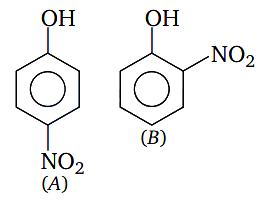
A
higher than that of $(A)$
B
lower than that of $(A)$
C
higher or lower than $(A)$,depending on the size of the vessel
D
same as that of $(A)$
Solution
(A) In $(A)$ (para-nitrophenol),intermolecular $H$-bonding exists,which leads to association of molecules and higher boiling point.
In $(B)$ (ortho-nitrophenol),intramolecular $H$-bonding exists,which restricts association and results in a lower boiling point.
Since $(B)$ has a lower boiling point,it is more volatile than $(A)$.
Therefore,the vapour pressure of $(B)$ is higher than that of $(A)$ at a particular temperature.
In $(B)$ (ortho-nitrophenol),intramolecular $H$-bonding exists,which restricts association and results in a lower boiling point.
Since $(B)$ has a lower boiling point,it is more volatile than $(A)$.
Therefore,the vapour pressure of $(B)$ is higher than that of $(A)$ at a particular temperature.
0 likesView Solution
69
ChemistryDifficultMCQKCET · 2010
$1 \ g$ of silver gets distributed between $10 \ cm^3$ of molten zinc and $100 \ cm^3$ of molten lead at $800^{\circ} C$. The percentage of silver in the zinc layer is approximately
A
$89$
B
$91$
C
$97$
D
$94$
Solution
(C) Let the mass of silver in the zinc layer be $x \ g$. Then the mass of silver in the lead layer is $(1-x) \ g$.
Given the distribution coefficient $K_D = \frac{C_{Zn}}{C_{Pb}} = 300$.
Concentration in zinc $C_{Zn} = \frac{x}{10} \ g/cm^3$.
Concentration in lead $C_{Pb} = \frac{1-x}{100} \ g/cm^3$.
Setting up the equation: $\frac{x/10}{(1-x)/100} = 300$.
$\frac{10x}{1-x} = 300$.
$10x = 300 - 300x$.
$310x = 300$.
$x = \frac{300}{310} \approx 0.9677$.
Thus,the percentage of silver in the zinc layer is approximately $97 \%$.
Given the distribution coefficient $K_D = \frac{C_{Zn}}{C_{Pb}} = 300$.
Concentration in zinc $C_{Zn} = \frac{x}{10} \ g/cm^3$.
Concentration in lead $C_{Pb} = \frac{1-x}{100} \ g/cm^3$.
Setting up the equation: $\frac{x/10}{(1-x)/100} = 300$.
$\frac{10x}{1-x} = 300$.
$10x = 300 - 300x$.
$310x = 300$.
$x = \frac{300}{310} \approx 0.9677$.
Thus,the percentage of silver in the zinc layer is approximately $97 \%$.
0 likesView Solution
70
ChemistryDifficultMCQKCET · 2010
The empirical formula of a non-electrolyte is $CH_{2}O$. $A$ solution containing $6 \ g$ of the compound exerts the same osmotic pressure as that of $0.05 \ M$ glucose solution at the same temperature. The molecular formula of the compound is
A
$C_{2}H_{4}O_{2}$
B
$C_{3}H_{6}O_{3}$
C
$C_{5}H_{10}O_{5}$
D
$C_{4}H_{8}O_{4}$
Solution
(D) Since the solutions have the same osmotic pressure at the same temperature,their molar concentrations must be equal.
Concentration of compound = Concentration of glucose = $0.05 \ M$.
Let $M$ be the molar mass of the compound. The concentration is given by $\frac{\text{mass}}{M \times \text{Volume}}$. Assuming $1 \ L$ of solution,$\frac{6 \ g}{M} = 0.05 \ mol/L$.
$M = \frac{6}{0.05} = 120 \ g/mol$.
The empirical formula mass of $CH_{2}O = 12 + (2 \times 1) + 16 = 30 \ g/mol$.
The value of $n = \frac{\text{Molecular mass}}{\text{Empirical formula mass}} = \frac{120}{30} = 4$.
Therefore,the molecular formula is $(CH_{2}O)_{4} = C_{4}H_{8}O_{4}$.
Concentration of compound = Concentration of glucose = $0.05 \ M$.
Let $M$ be the molar mass of the compound. The concentration is given by $\frac{\text{mass}}{M \times \text{Volume}}$. Assuming $1 \ L$ of solution,$\frac{6 \ g}{M} = 0.05 \ mol/L$.
$M = \frac{6}{0.05} = 120 \ g/mol$.
The empirical formula mass of $CH_{2}O = 12 + (2 \times 1) + 16 = 30 \ g/mol$.
The value of $n = \frac{\text{Molecular mass}}{\text{Empirical formula mass}} = \frac{120}{30} = 4$.
Therefore,the molecular formula is $(CH_{2}O)_{4} = C_{4}H_{8}O_{4}$.
0 likesView Solution
71
ChemistryEasyMCQKCET · 2010
The spin only magnetic moment of $Mn^{4+}$ ion is nearly (in $BM$)
A
$3$
B
$6$
C
$4$
D
$5$
Solution
(C) The electronic configuration of $Mn$ $(Z=25)$ is $[Ar] \ 3d^{5} \ 4s^{2}$.
For $Mn^{4+}$ ion,we remove four electrons,resulting in the configuration $[Ar] \ 3d^{3}$.
This ion contains $n=3$ unpaired electrons.
The spin-only magnetic moment is calculated using the formula $\mu = \sqrt{n(n+2)} \ BM$.
Substituting $n=3$,we get $\mu = \sqrt{3(3+2)} = \sqrt{15} \approx 3.87 \ BM$.
Rounding to the nearest integer,the value is $4 \ BM$.
For $Mn^{4+}$ ion,we remove four electrons,resulting in the configuration $[Ar] \ 3d^{3}$.
This ion contains $n=3$ unpaired electrons.
The spin-only magnetic moment is calculated using the formula $\mu = \sqrt{n(n+2)} \ BM$.
Substituting $n=3$,we get $\mu = \sqrt{3(3+2)} = \sqrt{15} \approx 3.87 \ BM$.
Rounding to the nearest integer,the value is $4 \ BM$.
0 likesView Solution
72
ChemistryEasyMCQKCET · 2010
During the adsorption of krypton on activated charcoal at low temperature,
A
$\Delta H > 0$ and $\Delta S < 0$
B
$\Delta H < 0$ and $\Delta S < 0$
C
$\Delta H > 0$ and $\Delta S > 0$
D
$\Delta H < 0$ and $\Delta S > 0$
Solution
(B) Adsorption is an exothermic process,therefore the enthalpy change is negative $(\Delta H < 0)$.
Furthermore,adsorption leads to a more ordered arrangement of gas molecules on the surface,resulting in a decrease in entropy $(\Delta S < 0)$.
According to the Gibbs free energy equation,$\Delta G = \Delta H - T\Delta S$,the process is spontaneous when $\Delta G < 0$,which is favored at low temperatures.
Furthermore,adsorption leads to a more ordered arrangement of gas molecules on the surface,resulting in a decrease in entropy $(\Delta S < 0)$.
According to the Gibbs free energy equation,$\Delta G = \Delta H - T\Delta S$,the process is spontaneous when $\Delta G < 0$,which is favored at low temperatures.
0 likesView Solution
73
ChemistryMediumMCQKCET · 2010
Which one of the following does not involve coagulation?
A
Clotting of blood by the use of ferric chloride
B
Formation of delta region
C
Treatment of drinking water by potash alum
D
Peptization
Solution
(D) Coagulation is the process of aggregating colloidal particles to form a precipitate.
$A$,$B$,and $C$ involve the aggregation of particles (coagulation).
Peptization is the reverse process,where a freshly prepared precipitate is converted into a colloidal sol by adding a suitable electrolyte (peptizing agent).
Therefore,peptization does not involve coagulation.
$A$,$B$,and $C$ involve the aggregation of particles (coagulation).
Peptization is the reverse process,where a freshly prepared precipitate is converted into a colloidal sol by adding a suitable electrolyte (peptizing agent).
Therefore,peptization does not involve coagulation.
0 likesView Solution
Vedclass Products
For Students
Vedclass Test Series
Mock tests in real KCET style covering Chemistry with performance analysis. 5-day free trial.
Start Free TrialFor Teachers
Exam Paper Generator
Generate Set A/B/C/D Chemistry papers from 7.5L+ questions in 2 minutes. 3 chapters free.
Try FreeFor Institutes
Online Exam Module
Run live KCET mock exams with unlimited students, 360° analytics & white-label branding.
See DemoFrequently Asked Questions
How many Chemistry questions are in KCET 2010?
There are 73 Chemistry questions from the KCET 2010 paper on Vedclass, each with a detailed step-by-step solution in English.
Are KCET 2010 Chemistry solutions available in English?
Yes. All solutions on this page are in English. You can also switch to English or Hindi using the language buttons above the questions.
Can I practice KCET 2010 Chemistry as a timed test?
Yes. Use the Vedclass Test Series to attempt a full KCET mock test covering Chemistry with time limits and instant score analysis.
Can teachers create Chemistry papers from KCET previous year questions?
Yes. The Vedclass Exam Paper Generator lets teachers mix KCET Chemistry questions and generate Set A/B/C/D papers in minutes.
For Teachers & Institutes
Build a Custom Chemistry Paper
Pick KCET 2010 Chemistry questions, set difficulty, and generate Set A/B/C/D in 2 minutes.