
BiologyQ1–29 of 29 questions
Page 1 of 1 · English
1
BiologyEasyMCQKCET · 2010
Compare the statements $A$ and $B$.
$Statement A$: Synthesis of $DNA$ takes place in the $S$-phase of interphase.
$Statement B$: Every chromosome,during metaphase,has two chromatids.
Choose the correct description.
$Statement A$: Synthesis of $DNA$ takes place in the $S$-phase of interphase.
$Statement B$: Every chromosome,during metaphase,has two chromatids.
Choose the correct description.
A
Statement $A$ is wrong and $B$ is correct.
B
Statement $A$ is correct and $B$ is wrong.
C
Both the statements $A$ and $B$ are correct and $A$ is the reason for $B$.
D
Both the statements $A$ and $B$ are correct and $A$ is not the reason for $B$.
Solution
(D) Both the statements $A$ and $B$ are correct and $A$ is not the reason for $B$.
$Statement A$ is correct; $DNA$ synthesis occurs during the $S$-phase of interphase. During this time,the amount of $DNA$ per cell doubles.
$Statement B$ is also correct; each chromosome consists of two sister chromatids joined at the centromere during metaphase.
However,$Statement A$ is not the direct reason for $Statement B$,as the formation of two chromatids involves the replication of the entire chromosome structure,not just $DNA$ synthesis alone.
$Statement A$ is correct; $DNA$ synthesis occurs during the $S$-phase of interphase. During this time,the amount of $DNA$ per cell doubles.
$Statement B$ is also correct; each chromosome consists of two sister chromatids joined at the centromere during metaphase.
However,$Statement A$ is not the direct reason for $Statement B$,as the formation of two chromatids involves the replication of the entire chromosome structure,not just $DNA$ synthesis alone.
0 likesView Solution
2
BiologyEasyMCQKCET · 2010
Which one of the following statements about the events of non-cyclic photophosphorylation is not correct?
A
Only one photosystem participates
B
$ATP$ and $NADPH$ are not produced
C
Photolysis of water takes place
D
$O_2$ is released
Solution
(A) The correct answer is $A$.
In non-cyclic photophosphorylation,both photosystems ($PS \ I$ and $PS \ II$) participate in the electron transport chain.
Option $B$ is incorrect because both $ATP$ and $NADPH$ are produced during this process.
Photolysis of water occurs at $PS \ II$ to provide electrons,and as a byproduct,$O_2$ is released.
In non-cyclic photophosphorylation,both photosystems ($PS \ I$ and $PS \ II$) participate in the electron transport chain.
Option $B$ is incorrect because both $ATP$ and $NADPH$ are produced during this process.
Photolysis of water occurs at $PS \ II$ to provide electrons,and as a byproduct,$O_2$ is released.
0 likesView Solution
3
BiologyEasyMCQKCET · 2010
During lactic acid fermentation, . . . . . .
A
$O_2$ is used,$CO_2$ is liberated
B
neither $O_2$ is used,nor $CO_2$ is liberated
C
$O_2$ is used,$CO_2$ is not liberated
D
$O_2$ is not used,$CO_2$ is liberated
Solution
(B) neither $O_2$ is used,nor $CO_2$ is liberated.
During lactic acid fermentation,oxygen is not consumed,and carbon dioxide is not produced.
This is an anaerobic process where glucose is converted into lactic acid without the involvement of oxygen or the release of carbon dioxide.
The chemical equation is:
$C_6H_{12}O_6 \longrightarrow 2C_3H_6O_3 + 2ATP$
During lactic acid fermentation,oxygen is not consumed,and carbon dioxide is not produced.
This is an anaerobic process where glucose is converted into lactic acid without the involvement of oxygen or the release of carbon dioxide.
The chemical equation is:
$C_6H_{12}O_6 \longrightarrow 2C_3H_6O_3 + 2ATP$
0 likesView Solution
4
BiologyEasyMCQKCET · 2010
Pyruvate dehydrogenase complex,needed for the conversion of pyruvic acid to acetyl CoA,is located in . . . . . .
A
matrix of mitochondria
B
intermembrane space of mitochondria
C
grana of chloroplast
D
cytoplasm
Solution
(A) matrix of mitochondria.
The pyruvate dehydrogenase complex,which is essential for the oxidative decarboxylation of pyruvic acid into acetyl $CoA$,is located in the mitochondrial matrix.
This reaction serves as a crucial link between glycolysis (which occurs in the cytoplasm) and the $Kreb's$ cycle (which occurs in the mitochondrial matrix).
The pyruvate dehydrogenase complex,which is essential for the oxidative decarboxylation of pyruvic acid into acetyl $CoA$,is located in the mitochondrial matrix.
This reaction serves as a crucial link between glycolysis (which occurs in the cytoplasm) and the $Kreb's$ cycle (which occurs in the mitochondrial matrix).
0 likesView Solution
5
BiologyEasyMCQKCET · 2010
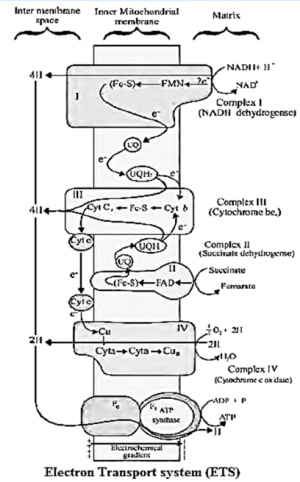
The following is a scheme showing the electron transport system. Identify the electron carrier molecules indicated as $A$ and $B$. Choose the correct option.
A
$A$ = coenzyme $Q$,$B$ = cytochrome c
B
$A$ = cytochrome c,$B$ = coenzyme $Q$
C
$A$ = Fe-$S$ protein,$B$ = $FMN$
D
$A$ = $FMN$,$B$ = Fe-$S$ protein
Solution
(A) The correct option is $A$.
In the electron transport system $(ETS)$ located in the inner mitochondrial membrane:
$1$. Coenzyme $Q$ (ubiquinone),labeled as $A$,acts as a mobile electron carrier that transfers electrons from Complex $I$ ($NADH$ dehydrogenase) and Complex $II$ (succinate dehydrogenase) to Complex $III$ (cytochrome $bc_1$ complex).
$2$. Cytochrome $c$,labeled as $B$,is a small protein attached to the outer surface of the inner membrane and acts as a mobile carrier for electrons between Complex $III$ and Complex $IV$ (cytochrome $c$ oxidase).
In the electron transport system $(ETS)$ located in the inner mitochondrial membrane:
$1$. Coenzyme $Q$ (ubiquinone),labeled as $A$,acts as a mobile electron carrier that transfers electrons from Complex $I$ ($NADH$ dehydrogenase) and Complex $II$ (succinate dehydrogenase) to Complex $III$ (cytochrome $bc_1$ complex).
$2$. Cytochrome $c$,labeled as $B$,is a small protein attached to the outer surface of the inner membrane and acts as a mobile carrier for electrons between Complex $III$ and Complex $IV$ (cytochrome $c$ oxidase).
0 likesView Solution
6
BiologyEasyMCQKCET · 2010
Which one of the following synthetic growth regulators is used to promote synchronized flowering in pineapple?
A
Benzyl aminopurine
B
Phenylmercuric acetate
C
Indolebutyric acid
D
$2-$chloroethylphosphonic acid
Solution
(D) $2$-chloroethylphosphonic acid,commonly known as $Ethrel$,is used to promote synchronized flowering in pineapples.
It acts as an ethylene-releasing compound,which induces flowering.
It acts as an ethylene-releasing compound,which induces flowering.
0 likesView Solution
7
BiologyEasyMCQKCET · 2010
In which of the following situations is there a risk factor for children of incurring erythroblastosis fetalis?
A
Mother is $Rh$ negative and father is $Rh$ negative
B
Mother is $Rh$ negative and father is $Rh$ positive
C
Mother is $Rh$ positive and father is $Rh$ positive
D
Mother is $Rh$ positive and father is $Rh$ negative
Solution
(B) The correct answer is $(B)$.
Erythroblastosis fetalis is a condition that occurs when an $Rh$-negative mother carries an $Rh$-positive fetus.
During the first pregnancy,the mother's blood is exposed to the $Rh$ antigens of the fetus during delivery,causing her to produce anti-$Rh$ antibodies.
In subsequent pregnancies,if the fetus is again $Rh$ positive,these maternal antibodies cross the placenta and destroy the fetal red blood cells (hemolysis).
This risk specifically arises when the mother is $Rh$ negative and the father is $Rh$ positive,as the fetus may inherit the $Rh$ positive trait.
Erythroblastosis fetalis is a condition that occurs when an $Rh$-negative mother carries an $Rh$-positive fetus.
During the first pregnancy,the mother's blood is exposed to the $Rh$ antigens of the fetus during delivery,causing her to produce anti-$Rh$ antibodies.
In subsequent pregnancies,if the fetus is again $Rh$ positive,these maternal antibodies cross the placenta and destroy the fetal red blood cells (hemolysis).
This risk specifically arises when the mother is $Rh$ negative and the father is $Rh$ positive,as the fetus may inherit the $Rh$ positive trait.
0 likesView Solution
8
BiologyEasyMCQKCET · 2010
When red blood corpuscles containing both $A$ and $B$ antigens are mixed with your blood serum,they agglutinate. Hence,your blood group is . . . . . . type.
A
$AB$
B
$O$
C
$A$
D
$B$
Solution
(B) The correct answer is $O$.
Blood group $O$ individuals do not have $A$ or $B$ antigens on the surface of their red blood cells $(RBCs)$.
However,their blood serum contains both anti-$A$ and anti-$B$ antibodies.
When $RBCs$ containing both $A$ and $B$ antigens (such as those from an $AB$ blood group individual) are mixed with serum containing anti-$A$ and anti-$B$ antibodies,the antibodies bind to the antigens,causing the cells to clump together,a process known as agglutination.
Therefore,if agglutination occurs,the serum must contain these antibodies,which is characteristic of blood group $O$.
Blood group $O$ individuals do not have $A$ or $B$ antigens on the surface of their red blood cells $(RBCs)$.
However,their blood serum contains both anti-$A$ and anti-$B$ antibodies.
When $RBCs$ containing both $A$ and $B$ antigens (such as those from an $AB$ blood group individual) are mixed with serum containing anti-$A$ and anti-$B$ antibodies,the antibodies bind to the antigens,causing the cells to clump together,a process known as agglutination.
Therefore,if agglutination occurs,the serum must contain these antibodies,which is characteristic of blood group $O$.
0 likesView Solution
9
BiologyEasyMCQKCET · 2010
Which one of the following is not the function of insulin?
A
Increases the permeability of cell membrane to glucose
B
Increases the oxidation of glucose in the cells
C
Initiates the conversion of glycogen to glucose
D
Initiates the formation of hepatic glycogen from excess of glucose.
Solution
(C) The correct answer is $C$.
Insulin is a hypoglycemic hormone that lowers blood glucose levels.
It increases the permeability of cell membranes to glucose and promotes the oxidation of glucose in cells.
It also stimulates glycogenesis,which is the formation of glycogen from excess glucose in the liver and muscles.
Option $C$ is incorrect because the conversion of glycogen to glucose (glycogenolysis) is stimulated by the hormone glucagon,not insulin.
Insulin is a hypoglycemic hormone that lowers blood glucose levels.
It increases the permeability of cell membranes to glucose and promotes the oxidation of glucose in cells.
It also stimulates glycogenesis,which is the formation of glycogen from excess glucose in the liver and muscles.
Option $C$ is incorrect because the conversion of glycogen to glucose (glycogenolysis) is stimulated by the hormone glucagon,not insulin.
0 likesView Solution
10
BiologyEasyMCQKCET · 2010
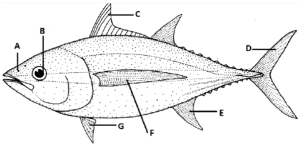
The diagram of a fish is given below. Identify the parts labelled $A, B, C, D, E, F, G$.
A
| $A$. Nostril | $B$. Eye | $C$. Anal fin | $D$. Caudal fin | $E$. Dorsal fin | $F$. Pectoral fin | $G$. Pelvic fin |
B
| $A$. Nostril | $B$. Eye | $C$. Dorsal fin | $D$. Anal fin | $E$. Caudal fin | $F$. Pectoral fin | $G$. Pelvic fin |
C
| $A$. Nostril | $B$. Eye | $C$. Dorsal fin | $D$. Caudal fin | $E$. Pectoral fin | $F$. Anal fin | $G$. Pelvic fin |
D
| $A$. Nostril | $B$. Eye | $C$. Dorsal fin | $D$. Caudal fin | $E$. Anal fin | $F$. Pelvic fin | $G$. Pectoral fin |
Solution
(B) By observing the provided diagram of the fish,we can identify the labeled parts as follows:
$A$ points to the Nostril.
$B$ points to the Eye.
$C$ points to the Dorsal fin (located on the back).
$D$ points to the Caudal fin (the tail fin).
$E$ points to the Anal fin (located on the ventral side near the tail).
$F$ points to the Pectoral fin (located on the side behind the operculum).
$G$ points to the Pelvic fin (located on the ventral side).
Comparing these identifications with the given options,option $C$ correctly labels all parts: $A$-Nostril,$B$-Eye,$C$-Dorsal fin,$D$-Caudal fin,$E$-Pectoral fin,$F$-Anal fin,$G$-Pelvic fin. Note: In the provided diagram,$E$ is the anal fin and $F$ is the pectoral fin. Therefore,the correct sequence is $A$-Nostril,$B$-Eye,$C$-Dorsal fin,$D$-Caudal fin,$E$-Anal fin,$F$-Pectoral fin,$G$-Pelvic fin,which matches option $B$.
$A$ points to the Nostril.
$B$ points to the Eye.
$C$ points to the Dorsal fin (located on the back).
$D$ points to the Caudal fin (the tail fin).
$E$ points to the Anal fin (located on the ventral side near the tail).
$F$ points to the Pectoral fin (located on the side behind the operculum).
$G$ points to the Pelvic fin (located on the ventral side).
Comparing these identifications with the given options,option $C$ correctly labels all parts: $A$-Nostril,$B$-Eye,$C$-Dorsal fin,$D$-Caudal fin,$E$-Pectoral fin,$F$-Anal fin,$G$-Pelvic fin. Note: In the provided diagram,$E$ is the anal fin and $F$ is the pectoral fin. Therefore,the correct sequence is $A$-Nostril,$B$-Eye,$C$-Dorsal fin,$D$-Caudal fin,$E$-Anal fin,$F$-Pectoral fin,$G$-Pelvic fin,which matches option $B$.
0 likesView Solution
11
BiologyEasyMCQKCET · 2010
How do you differentiate a butterfly from a moth?
A
Moth has feathery antennae but butterfly has club-shaped antennae.
B
Moth has one pair of wings but butterfly has two pairs of wings.
C
Moth is diurnal but butterfly is nocturnal.
D
Moth has simple eyes but butterfly has compound eyes.
Solution
(A) is the correct answer.
Butterflies and moths both belong to the order $Lepidoptera$.
Butterflies typically possess long,thin antennae that end in a club-like shape,whereas moths generally have feathery or comb-like antennae.
Both insects possess two pairs of wings.
Generally,moths are nocturnal (active at night),while butterflies are diurnal (active during the day).
Both groups possess compound eyes,though their visual structures can vary in complexity.
Butterflies and moths both belong to the order $Lepidoptera$.
Butterflies typically possess long,thin antennae that end in a club-like shape,whereas moths generally have feathery or comb-like antennae.
Both insects possess two pairs of wings.
Generally,moths are nocturnal (active at night),while butterflies are diurnal (active during the day).
Both groups possess compound eyes,though their visual structures can vary in complexity.
0 likesView Solution
12
BiologyEasyMCQKCET · 2010
The sugar present in milk is
A
fructose
B
sucrose
C
glucose
D
lactose
Solution
(D) The correct answer is $D$.
Lactose is a disaccharide sugar composed of two monosaccharide units: $D$-glucose and $D$-galactose.
It is naturally found in milk and dairy products,acting as a primary source of energy for infants and young mammals.
Lactose is a disaccharide sugar composed of two monosaccharide units: $D$-glucose and $D$-galactose.
It is naturally found in milk and dairy products,acting as a primary source of energy for infants and young mammals.
0 likesView Solution
13
BiologyEasyMCQKCET · 2010
Sporopollenin,a chemical substance,is found in . . . . . .
A
intine of pollen grain
B
exine of pollen grain
C
endothecium of anther
D
tapetum of anther
Solution
(B) exine of pollen grain.
Sporopollenin,found in the exine of pollen grains,is one of the most resistant organic materials known. It is highly resistant to extreme temperatures,strong acids,and alkali,and no enzyme that degrades sporopollenin is known so far. In contrast,the intine of pollen grains is composed of cellulose and pectin. The endothecium of the anther aids in dehiscence,while the tapetum provides nourishment to the developing pollen grains.
Sporopollenin,found in the exine of pollen grains,is one of the most resistant organic materials known. It is highly resistant to extreme temperatures,strong acids,and alkali,and no enzyme that degrades sporopollenin is known so far. In contrast,the intine of pollen grains is composed of cellulose and pectin. The endothecium of the anther aids in dehiscence,while the tapetum provides nourishment to the developing pollen grains.
0 likesView Solution
14
BiologyEasyMCQKCET · 2010
To meet the demands of the society,in vitro production of a large number of plantlets in a short duration is practised in floriculture and horticulture industry today. This is called
A
hybridoma technology
B
somaclonal variation
C
somatic hybridisation
D
micropropagation
Solution
(D) micropropagation.
To meet societal demands for large numbers of plantlets quickly,the technique used in floriculture and horticulture is called micropropagation.
This method allows for the rapid production of multiple plantlets from a small tissue sample in a controlled environment.
$A$ Hybridoma technology is used for producing monoclonal antibodies.
$B$ Somaclonal variation refers to genetic variation in plants regenerated from tissue culture.
$C$ Somatic hybridisation involves the fusion of somatic cells to create hybrids.
To meet societal demands for large numbers of plantlets quickly,the technique used in floriculture and horticulture is called micropropagation.
This method allows for the rapid production of multiple plantlets from a small tissue sample in a controlled environment.
$A$ Hybridoma technology is used for producing monoclonal antibodies.
$B$ Somaclonal variation refers to genetic variation in plants regenerated from tissue culture.
$C$ Somatic hybridisation involves the fusion of somatic cells to create hybrids.
0 likesView Solution
15
BiologyEasyMCQKCET · 2010
Some of the steps involved in the production of humulin are given below. Choose the correct sequence.
$(i)$ Synthesis of gene $(DNA)$ for human insulin artificially.
(ii) Culturing recombinant $E. coli$ in bioreactors.
(iii) Purification of humulin.
(iv) Insertion of human insulin gene into plasmid.
$(v)$ Introduction of recombinant plasmid into $E. coli$.
(vi) Extraction of recombinant gene product from $E. coli$.
$(i)$ Synthesis of gene $(DNA)$ for human insulin artificially.
(ii) Culturing recombinant $E. coli$ in bioreactors.
(iii) Purification of humulin.
(iv) Insertion of human insulin gene into plasmid.
$(v)$ Introduction of recombinant plasmid into $E. coli$.
(vi) Extraction of recombinant gene product from $E. coli$.
A
$(ii), (i), (iv), (iii), (v), (vi)$
B
$(i), (iii), (v), (vi), (ii), (iv)$
C
$(i), (iv), (v), (ii), (vi), (iii)$
D
$(iii), (v), (ii), (i), (vi), (iv)$
Solution
(C) The correct sequence for the production of humulin is $(i), (iv), (v), (ii), (vi), (iii)$.
$1$. First,the gene for human insulin is synthesized artificially $(i)$.
$2$. Then,this gene is inserted into a plasmid $(iv)$.
$3$. The recombinant plasmid is introduced into $E. coli$ $(v)$.
$4$. The $E. coli$ is then cultured in bioreactors to produce the insulin protein $(ii)$.
$5$. The recombinant insulin protein is extracted from $E. coli$ $(vi)$.
$6$. Finally,the product is purified to obtain pure humulin $(iii)$.
$1$. First,the gene for human insulin is synthesized artificially $(i)$.
$2$. Then,this gene is inserted into a plasmid $(iv)$.
$3$. The recombinant plasmid is introduced into $E. coli$ $(v)$.
$4$. The $E. coli$ is then cultured in bioreactors to produce the insulin protein $(ii)$.
$5$. The recombinant insulin protein is extracted from $E. coli$ $(vi)$.
$6$. Finally,the product is purified to obtain pure humulin $(iii)$.
0 likesView Solution
16
BiologyEasyMCQKCET · 2010
The single-horned rhinoceros is protected at . . . . . .
A
Kanha National Park
B
Kaziranga National Park
C
Anshi National Park
D
Rajiv Gandhi National Park
Solution
(B) Kaziranga National Park.
Kaziranga National Park, located in Assam, India, is world-renowned for hosting two-thirds of the world's population of the one-horned rhinoceros, also known as the Indian rhinoceros $(Rhinoceros \text{ } unicornis)$.
Kaziranga National Park, located in Assam, India, is world-renowned for hosting two-thirds of the world's population of the one-horned rhinoceros, also known as the Indian rhinoceros $(Rhinoceros \text{ } unicornis)$.
0 likesView Solution
17
BiologyEasyMCQKCET · 2010
The species,though insignificant in number,determine the existence of many other species in a given ecosystem. Such species is known as
A
endemic species
B
sacred species
C
extinct species
D
keystone species
Solution
(D) keystone species.
In an ecosystem,certain species have a disproportionately large effect on their environment relative to their abundance. Even if they are insignificant in number,they play a critical role in maintaining the structure and diversity of the community. Such species are known as $keystone$ $species$.
In an ecosystem,certain species have a disproportionately large effect on their environment relative to their abundance. Even if they are insignificant in number,they play a critical role in maintaining the structure and diversity of the community. Such species are known as $keystone$ $species$.
0 likesView Solution
18
BiologyEasyMCQKCET · 2010
Most of the endangered species are the victims of
A
over-hunting
B
acid rain
C
competition with introduced species
D
habitat destruction
Solution
(D) habitat destruction.
Habitat destruction is the primary threat to most endangered species,as it leads to the loss of living spaces and essential resources.
While over-hunting,acid rain,and competition with introduced species are significant threats,habitat destruction is recognized as the most widespread and critical issue causing the decline of biodiversity globally.
Habitat destruction is the primary threat to most endangered species,as it leads to the loss of living spaces and essential resources.
While over-hunting,acid rain,and competition with introduced species are significant threats,habitat destruction is recognized as the most widespread and critical issue causing the decline of biodiversity globally.
0 likesView Solution
19
BiologyEasyMCQKCET · 2010
In the absence of an acrosome,the sperm . . . . . .
A
cannot penetrate the egg
B
cannot get energy
C
cannot get food
D
cannot swim
Solution
(A) The correct answer is $A$.
In the absence of an acrosome,the sperm cannot penetrate the egg.
The acrosome is a cap-like structure present at the tip of the sperm head.
It contains hydrolytic enzymes,such as hyaluronidase and acrosin,which are essential for digesting the protective layers of the ovum (zona pellucida and corona radiata).
Without these enzymes,the sperm is unable to penetrate the egg,and fertilization cannot occur.
In the absence of an acrosome,the sperm cannot penetrate the egg.
The acrosome is a cap-like structure present at the tip of the sperm head.
It contains hydrolytic enzymes,such as hyaluronidase and acrosin,which are essential for digesting the protective layers of the ovum (zona pellucida and corona radiata).
Without these enzymes,the sperm is unable to penetrate the egg,and fertilization cannot occur.
0 likesView Solution
20
BiologyEasyMCQKCET · 2010
Gastrula has a pore which is known as . . . . . .
A
Blastopore
B
Zoospore
C
Gonophore
D
Oospore
Solution
(A) The correct answer is $A$.
During the process of gastrulation,the embryo forms a structure called the gastrula.
The gastrula contains an opening or pore known as the $Blastopore$.
$Blastopore$ is the first opening formed in the early embryo,which later develops into either the mouth or the anus depending on the organism (protostomes or deuterostomes).
During the process of gastrulation,the embryo forms a structure called the gastrula.
The gastrula contains an opening or pore known as the $Blastopore$.
$Blastopore$ is the first opening formed in the early embryo,which later develops into either the mouth or the anus depending on the organism (protostomes or deuterostomes).
0 likesView Solution
21
BiologyEasyMCQKCET · 2010
Due to non-disjunction of chromosomes during spermatogenesis,sperms carry both sex chromosomes $(22A + XY)$ and some sperms do not carry any sex chromosome $(22A + O)$. If these sperms fertilize normal eggs $(22A + X)$,what types of genetic disorders appear among the offspring?
A
Turner's syndrome and Klinefelter's syndrome
B
Down's syndrome and Klinefelter's syndrome
C
Down's syndrome and Turner's syndrome
D
Down's syndrome and cri-du-chat syndrome
Solution
(A) The correct answer is $A$.
$1$. When a sperm with $22A + XY$ fertilizes a normal egg with $22A + X$,the resulting zygote has a chromosome composition of $44A + XXY$. This condition is known as Klinefelter's syndrome.
$2$. When a sperm with $22A + O$ fertilizes a normal egg with $22A + X$,the resulting zygote has a chromosome composition of $44A + XO$. This condition is known as Turner's syndrome.
$1$. When a sperm with $22A + XY$ fertilizes a normal egg with $22A + X$,the resulting zygote has a chromosome composition of $44A + XXY$. This condition is known as Klinefelter's syndrome.
$2$. When a sperm with $22A + O$ fertilizes a normal egg with $22A + X$,the resulting zygote has a chromosome composition of $44A + XO$. This condition is known as Turner's syndrome.
0 likesView Solution
22
BiologyEasyMCQKCET · 2010
Mendel found that reciprocal crosses yielded identical results. From that,he concluded that
A
there is independent assortment of traits
B
sex plays a role in deciding the dominance of a trait
C
there is no dominance of any trait
D
sex has no influence on the dominance of traits
Solution
(D) sex has no influence on the dominance of traits.
Mendel's observation that reciprocal crosses produce identical results led him to conclude that the inheritance of traits is not influenced by the sex of the parent.
This means that the dominance of a trait is independent of whether the allele comes from the male or female parent,leading to the conclusion that sex has no influence on the dominance of traits.
Mendel's observation that reciprocal crosses produce identical results led him to conclude that the inheritance of traits is not influenced by the sex of the parent.
This means that the dominance of a trait is independent of whether the allele comes from the male or female parent,leading to the conclusion that sex has no influence on the dominance of traits.
0 likesView Solution
23
BiologyEasyMCQKCET · 2010
In genetic fingerprinting,the 'probe' refers to
A
a radioactively labelled single stranded $DNA$ molecule
B
a radioactively labelled single stranded $RNA$ molecule
C
a radioactively labelled double stranded $RNA$ molecule
D
a radioactively labelled double stranded $DNA$ molecule
Solution
(A) In genetic fingerprinting,a 'probe' is a radioactively labelled single-stranded $DNA$ molecule that is complementary to the specific variable number tandem repeat $(VNTR)$ sequences being analyzed.
These probes hybridize with the target $DNA$ fragments on a membrane,allowing for the visualization of specific $DNA$ patterns through autoradiography.
Therefore,the correct option is $(A)$.
These probes hybridize with the target $DNA$ fragments on a membrane,allowing for the visualization of specific $DNA$ patterns through autoradiography.
Therefore,the correct option is $(A)$.
0 likesView Solution
24
BiologyEasyMCQKCET · 2010
Which one of the following statements is not correct?
A
Cysteine is coded by $UGU$ and $UGC$ codons.
B
Tyrosine is coded by $UAU$ and $UAC$ codons.
C
$UAA$ codon codes for lysine.
D
$UGG$ codon codes for tryptophan.
Solution
(C) The statement "$UAA$ codon codes for lysine" is incorrect.
$UAA$ is a stop codon (also known as the ochre codon), which does not code for any amino acid and signals the termination of protein synthesis.
Lysine is actually coded by the codons $AAA$ and $AAG$.
$UAA$ is a stop codon (also known as the ochre codon), which does not code for any amino acid and signals the termination of protein synthesis.
Lysine is actually coded by the codons $AAA$ and $AAG$.
0 likesView Solution
25
BiologyEasyMCQKCET · 2010
The main aim of the Human Genome Project is
A
to introduce new genes into humans
B
to identify and sequence all the genes present in human $DNA$
C
to develop better techniques for comparing two different human $DNA$ samples
D
to remove disease causing genes from human $DNA$.
Solution
(B) is the correct answer: to identify and sequence all the genes present in human $DNA$.
The main aim of the Human Genome Project $(HGP)$ was to map and sequence the entire human genome.
This involved identifying all the genes present in human $DNA$ and determining the complete nucleotide sequence of the $3 \times 10^9$ base pairs that make up human $DNA$.
The project did not focus on introducing new genes (gene therapy),developing forensic comparison techniques,or removing disease-causing genes as its primary objective.
The main aim of the Human Genome Project $(HGP)$ was to map and sequence the entire human genome.
This involved identifying all the genes present in human $DNA$ and determining the complete nucleotide sequence of the $3 \times 10^9$ base pairs that make up human $DNA$.
The project did not focus on introducing new genes (gene therapy),developing forensic comparison techniques,or removing disease-causing genes as its primary objective.
0 likesView Solution
26
BiologyEasyMCQKCET · 2010
$DNA$ gyrase,the enzyme that participates in the process of $DNA$ replication,is a type of
A
$DNA$ topoisomerase
B
Reverse transcriptase
C
$DNA$ ligase
D
$DNA$ polymerase
Solution
(A) $DNA$ gyrase is a type of $DNA$ topoisomerase that relieves the torsional strain caused by the unwinding of $DNA$ during replication.
It introduces negative supercoils to counteract the positive supercoils that form ahead of the replication fork.
It introduces negative supercoils to counteract the positive supercoils that form ahead of the replication fork.
0 likesView Solution
27
BiologyEasyMCQKCET · 2010
Compare the statements $A$ and $B$.
$Statement A$: $RNA$ produced during transcription in eukaryotic cells cannot be straight away used in translation.
$Statement B$: $RNA$ splicing phenomena helps in the removal of exons.
Choose the correct description.
$Statement A$: $RNA$ produced during transcription in eukaryotic cells cannot be straight away used in translation.
$Statement B$: $RNA$ splicing phenomena helps in the removal of exons.
Choose the correct description.
A
Both the statements $A$ and $B$ are wrong.
B
Both the statements $A$ and $B$ are correct.
C
Statement $A$ is correct and $B$ is wrong.
D
Statement $A$ is wrong and $B$ is correct.
Solution
(C) Statement $A$ is correct and $B$ is wrong.
In eukaryotic cells,the primary transcript (pre-mRNA) produced during transcription must undergo post-transcriptional modifications,such as capping,polyadenylation,and splicing,to become functional mRNA for translation. It is not used directly.
Statement $B$ is incorrect because $RNA$ splicing is the process of removing introns (non-coding sequences) and joining exons (coding sequences) together to form mature mRNA. Exons are not removed; they are retained.
In eukaryotic cells,the primary transcript (pre-mRNA) produced during transcription must undergo post-transcriptional modifications,such as capping,polyadenylation,and splicing,to become functional mRNA for translation. It is not used directly.
Statement $B$ is incorrect because $RNA$ splicing is the process of removing introns (non-coding sequences) and joining exons (coding sequences) together to form mature mRNA. Exons are not removed; they are retained.
0 likesView Solution
28
BiologyEasyMCQKCET · 2010
According to Darwin,evolution is . . . . . .
A
a sudden but discontinuous process
B
a slow,gradual and continuous process
C
a slow,sudden and discontinuous process
D
a slow and discontinuous process
Solution
(B) The correct answer is $B$. According to Darwin,evolution is a slow,gradual,and continuous process. Darwin proposed that evolution occurs gradually over long periods of time,where small,heritable variations accumulate,eventually leading to the emergence of new species.
0 likesView Solution
29
BiologyEasyMCQKCET · 2010
Match the type of immunity listed in Column-$I$ with the examples listed in Column-$II$. Choose the answer that gives the correct combination of alphabets of the two columns:
| Column-$I$ (Types of immunity) | Column-$II$ (Example) |
|---|---|
| $A$. Natural active | $p$. Immunity developed by heredity |
| $B$. Artificial passive | $q$. From mother to foetus through placenta |
| $C$. Artificial active | $r$. Injection of antiserum to travellers |
| $D$. Natural passive | $s$. Fighting infections naturally |
| $t$. Induced by vaccination |
A
$A = s, B = t, C = q, D = r$
B
$A = t, B = s, C = r, D = p$
C
$A = p, B = q, C = r, D = t$
D
$A = s, B = r, C = t, D = q$
Solution
(D) The correct matching is as follows:
$A$. Natural active immunity: This occurs when the body encounters a pathogen and develops an immune response naturally,i.e.,$s$. Fighting infections naturally.
$B$. Artificial passive immunity: This involves the administration of pre-formed antibodies (antiserum) to provide immediate protection,i.e.,$r$. Injection of antiserum to travellers.
$C$. Artificial active immunity: This is induced by introducing antigens into the body through vaccination to stimulate an immune response,i.e.,$t$. Induced by vaccination.
$D$. Natural passive immunity: This occurs when antibodies are transferred from mother to foetus through the placenta or via colostrum,i.e.,$q$. From mother to foetus through placenta.
Therefore,the correct combination is $A-s, B-r, C-t, D-q$.
$A$. Natural active immunity: This occurs when the body encounters a pathogen and develops an immune response naturally,i.e.,$s$. Fighting infections naturally.
$B$. Artificial passive immunity: This involves the administration of pre-formed antibodies (antiserum) to provide immediate protection,i.e.,$r$. Injection of antiserum to travellers.
$C$. Artificial active immunity: This is induced by introducing antigens into the body through vaccination to stimulate an immune response,i.e.,$t$. Induced by vaccination.
$D$. Natural passive immunity: This occurs when antibodies are transferred from mother to foetus through the placenta or via colostrum,i.e.,$q$. From mother to foetus through placenta.
Therefore,the correct combination is $A-s, B-r, C-t, D-q$.
0 likesView Solution
Vedclass Products
For Students
Vedclass Test Series
Mock tests in real KCET style covering Biology with performance analysis. 5-day free trial.
Start Free TrialFor Teachers
Exam Paper Generator
Generate Set A/B/C/D Biology papers from 7.5L+ questions in 2 minutes. 3 chapters free.
Try FreeFor Institutes
Online Exam Module
Run live KCET mock exams with unlimited students, 360° analytics & white-label branding.
See DemoFrequently Asked Questions
How many Biology questions are in KCET 2010?
There are 29 Biology questions from the KCET 2010 paper on Vedclass, each with a detailed step-by-step solution in English.
Are KCET 2010 Biology solutions available in English?
Yes. All solutions on this page are in English. You can also switch to English or Hindi using the language buttons above the questions.
Can I practice KCET 2010 Biology as a timed test?
Yes. Use the Vedclass Test Series to attempt a full KCET mock test covering Biology with time limits and instant score analysis.
Can teachers create Biology papers from KCET previous year questions?
Yes. The Vedclass Exam Paper Generator lets teachers mix KCET Biology questions and generate Set A/B/C/D papers in minutes.
For Teachers & Institutes
Build a Custom Biology Paper
Pick KCET 2010 Biology questions, set difficulty, and generate Set A/B/C/D in 2 minutes.