
PhysicsQ1–60 of 60 questions
Page 1 of 1 · English
1
PhysicsMediumMCQKCET · 2010
If the linear momentum of a body is increased by $50 \%$,then the kinetic energy of that body increases by (in $\%$)
A
$100$
B
$125$
C
$225$
D
$25$
Solution
(B) The kinetic energy $K$ of a body is related to its linear momentum $p$ by the formula $K = \frac{p^2}{2m}$,where $m$ is the mass of the body.
Since the mass $m$ remains constant,we have $K \propto p^2$.
Let the initial momentum be $p_1 = p$ and the final momentum be $p_2 = p + 0.50p = 1.5p$.
The ratio of the final kinetic energy $K_2$ to the initial kinetic energy $K_1$ is given by:
$\frac{K_2}{K_1} = \left(\frac{p_2}{p_1}\right)^2 = \left(\frac{1.5p}{p}\right)^2 = (1.5)^2 = 2.25$.
To find the percentage increase in kinetic energy,we use the formula:
$\text{Percentage increase} = \left(\frac{K_2}{K_1} - 1\right) \times 100 \%$.
Substituting the value: $(2.25 - 1) \times 100 \% = 1.25 \times 100 \% = 125 \%$.
Since the mass $m$ remains constant,we have $K \propto p^2$.
Let the initial momentum be $p_1 = p$ and the final momentum be $p_2 = p + 0.50p = 1.5p$.
The ratio of the final kinetic energy $K_2$ to the initial kinetic energy $K_1$ is given by:
$\frac{K_2}{K_1} = \left(\frac{p_2}{p_1}\right)^2 = \left(\frac{1.5p}{p}\right)^2 = (1.5)^2 = 2.25$.
To find the percentage increase in kinetic energy,we use the formula:
$\text{Percentage increase} = \left(\frac{K_2}{K_1} - 1\right) \times 100 \%$.
Substituting the value: $(2.25 - 1) \times 100 \% = 1.25 \times 100 \% = 125 \%$.
0 likesView Solution
2
PhysicsEasyMCQKCET · 2010
An astronaut on a strange planet finds that the acceleration due to gravity is twice that on the surface of the Earth. Which of the following could explain this?
A
Both the mass and radius of the planet are half that of Earth
B
Radius of the planet is half that of Earth,but the mass is the same as that of Earth
C
Both the mass and radius of the planet are twice that of Earth
D
Mass of the planet is half that of Earth,but radius is the same as that of Earth
Solution
(A) The acceleration due to gravity on the surface of a planet is given by $g = \frac{GM}{R^2}$.
Let $M_e$ and $R_e$ be the mass and radius of the Earth,and $g_e = \frac{GM_e}{R_e^2}$ be the acceleration due to gravity on Earth.
For the strange planet,we are given $g_p = 2g_e$.
Checking option $A$: If $M_p = \frac{M_e}{2}$ and $R_p = \frac{R_e}{2}$,then $g_p = \frac{G(M_e/2)}{(R_e/2)^2} = \frac{GM_e/2}{R_e^2/4} = 2 \frac{GM_e}{R_e^2} = 2g_e$.
Thus,option $A$ is correct.
Let $M_e$ and $R_e$ be the mass and radius of the Earth,and $g_e = \frac{GM_e}{R_e^2}$ be the acceleration due to gravity on Earth.
For the strange planet,we are given $g_p = 2g_e$.
Checking option $A$: If $M_p = \frac{M_e}{2}$ and $R_p = \frac{R_e}{2}$,then $g_p = \frac{G(M_e/2)}{(R_e/2)^2} = \frac{GM_e/2}{R_e^2/4} = 2 \frac{GM_e}{R_e^2} = 2g_e$.
Thus,option $A$ is correct.
0 likesView Solution
3
PhysicsEasyMCQKCET · 2010
The temperature of a gas contained in a closed vessel of constant volume increases by $1^{\circ} C$ when the pressure of the gas is increased by $1 \%$. The initial temperature of the gas is
A
$100 \ K$
B
$273^{\circ} C$
C
$100^{\circ} C$
D
$200 \ K$
Solution
(A) For a gas in a closed vessel of constant volume,Gay-Lussac's Law states that $P \propto T$,where $P$ is the pressure and $T$ is the absolute temperature in Kelvin.
Taking the derivative,we have $\frac{dP}{P} = \frac{dT}{T}$.
Given that the pressure increases by $1 \%$,we have $\frac{dP}{P} = 0.01$.
Given that the temperature increases by $dT = 1 \ K$ (since a change of $1^{\circ} C$ is equivalent to a change of $1 \ K$).
Substituting these values into the equation: $0.01 = \frac{1}{T}$.
Therefore,$T = \frac{1}{0.01} = 100 \ K$.
Taking the derivative,we have $\frac{dP}{P} = \frac{dT}{T}$.
Given that the pressure increases by $1 \%$,we have $\frac{dP}{P} = 0.01$.
Given that the temperature increases by $dT = 1 \ K$ (since a change of $1^{\circ} C$ is equivalent to a change of $1 \ K$).
Substituting these values into the equation: $0.01 = \frac{1}{T}$.
Therefore,$T = \frac{1}{0.01} = 100 \ K$.
0 likesView Solution
4
PhysicsMediumMCQKCET · 2010
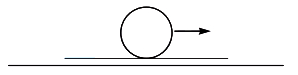
$A$ ball rests upon a flat piece of paper on a table top. The paper is pulled horizontally but quickly towards the right as shown. Relative to its initial position with respect to the table,the ball:
$(1)$ remains stationary if there is no friction between the paper and the ball.
$(2)$ moves to the left and starts rolling backwards,i.e.,to the left,if there is friction between the paper and the ball.
$(3)$ moves forward,i.e.,in the direction in which the paper is pulled.
Here,the correct statement$(s)$ is/are:
$(1)$ remains stationary if there is no friction between the paper and the ball.
$(2)$ moves to the left and starts rolling backwards,i.e.,to the left,if there is friction between the paper and the ball.
$(3)$ moves forward,i.e.,in the direction in which the paper is pulled.
Here,the correct statement$(s)$ is/are:
A
Both $(1)$ and $(2)$
B
only $(3)$
C
only $(1)$
D
only $(2)$
Solution
(A) Case $(1)$: If there is no friction between the paper and the ball,the paper exerts no horizontal force on the ball. Due to the inertia of rest,the ball remains at its initial position on the table.
Case $(2)$: If there is friction between the paper and the ball,the paper exerts a kinetic frictional force on the ball in the direction of the paper's motion (to the right). This force acts at the point of contact. This creates a torque about the center of mass of the ball,causing it to rotate such that its bottom surface moves to the left relative to the table. Consequently,the ball starts rolling backwards (to the left) while the frictional force also provides a net acceleration to the left relative to the table.
Therefore,both statements $(1)$ and $(2)$ are correct.
Case $(2)$: If there is friction between the paper and the ball,the paper exerts a kinetic frictional force on the ball in the direction of the paper's motion (to the right). This force acts at the point of contact. This creates a torque about the center of mass of the ball,causing it to rotate such that its bottom surface moves to the left relative to the table. Consequently,the ball starts rolling backwards (to the left) while the frictional force also provides a net acceleration to the left relative to the table.
Therefore,both statements $(1)$ and $(2)$ are correct.
0 likesView Solution
5
PhysicsEasyMCQKCET · 2010
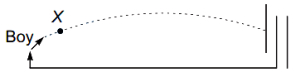
$A$ boy throws a cricket ball from the boundary to the wicket-keeper. If the frictional force due to air cannot be ignored,the forces acting on the ball at the position $X$ are represented by
A
B
C
D
Solution
(D) When a ball is thrown in the air,two main forces act on it:
$1$. The gravitational force (weight),which always acts vertically downwards,given by $mg$.
$2$. The air resistance (frictional force),which always acts in the direction opposite to the instantaneous velocity of the ball.
At position $X$,the ball is moving along a parabolic path. Its velocity vector is tangent to the path at that point,directed upwards and forwards. Therefore,the air resistance acts downwards and backwards (opposite to the velocity vector).
Combining these,the weight acts vertically downwards,and the air resistance acts at an angle downwards and backwards. This corresponds to the vector diagram in option $D$.
$1$. The gravitational force (weight),which always acts vertically downwards,given by $mg$.
$2$. The air resistance (frictional force),which always acts in the direction opposite to the instantaneous velocity of the ball.
At position $X$,the ball is moving along a parabolic path. Its velocity vector is tangent to the path at that point,directed upwards and forwards. Therefore,the air resistance acts downwards and backwards (opposite to the velocity vector).
Combining these,the weight acts vertically downwards,and the air resistance acts at an angle downwards and backwards. This corresponds to the vector diagram in option $D$.
0 likesView Solution
6
PhysicsDifficultMCQKCET · 2010
Water is in streamline flow along a horizontal pipe with non-uniform cross-section. At a point in the pipe where the area of cross-section is $10 \,cm^{2}$, the velocity of water is $1 \,ms^{-1}$ and the pressure is $2000 \,Pa$. The pressure at another point where the cross-sectional area is $5 \,cm^{2}$ is (in $\,Pa$)
A
$4000$
B
$2000$
C
$1000$
D
$500$
Solution
(D) According to the equation of continuity, $A_{1} v_{1} = A_{2} v_{2}$.
Given $A_{1} = 10 \,cm^{2}$, $v_{1} = 1 \,ms^{-1}$, $A_{2} = 5 \,cm^{2}$.
Substituting the values: $10 \times 1 = 5 \times v_{2} \implies v_{2} = 2 \,ms^{-1}$.
Using Bernoulli's equation for a horizontal pipe: $P_{1} + \frac{1}{2} \rho v_{1}^{2} = P_{2} + \frac{1}{2} \rho v_{2}^{2}$.
Here, $\rho = 1000 \,kg/m^{3}$ (density of water).
$2000 + \frac{1}{2} \times 1000 \times (1)^{2} = P_{2} + \frac{1}{2} \times 1000 \times (2)^{2}$.
$2000 + 500 = P_{2} + 2000$.
$2500 = P_{2} + 2000 \implies P_{2} = 500 \,Pa$.
Given $A_{1} = 10 \,cm^{2}$, $v_{1} = 1 \,ms^{-1}$, $A_{2} = 5 \,cm^{2}$.
Substituting the values: $10 \times 1 = 5 \times v_{2} \implies v_{2} = 2 \,ms^{-1}$.
Using Bernoulli's equation for a horizontal pipe: $P_{1} + \frac{1}{2} \rho v_{1}^{2} = P_{2} + \frac{1}{2} \rho v_{2}^{2}$.
Here, $\rho = 1000 \,kg/m^{3}$ (density of water).
$2000 + \frac{1}{2} \times 1000 \times (1)^{2} = P_{2} + \frac{1}{2} \times 1000 \times (2)^{2}$.
$2000 + 500 = P_{2} + 2000$.
$2500 = P_{2} + 2000 \implies P_{2} = 500 \,Pa$.
0 likesView Solution
7
PhysicsMediumMCQKCET · 2010
Three liquids of equal masses are taken in three identical cubical vessels $A$,$B$,and $C$. Their densities are $\rho_{A}$,$\rho_{B}$,and $\rho_{C}$ respectively,where $\rho_{A} < \rho_{B} < \rho_{C}$. The force exerted by the liquid on the base of the cubical vessel is
A
maximum in vessel $C$
B
minimum in vessel $C$
C
the same in all the vessels
D
maximum in vessel $A$
Solution
(C) The force exerted by a liquid on the base of a vessel is equal to the weight of the liquid contained in it,provided the vessel has vertical walls (like a cubical vessel).
The force $F$ is given by $F = mg$.
Since the masses of the liquids in all three vessels are equal $(m_{A} = m_{B} = m_{C} = m)$,the force exerted on the base of each vessel is $F_{A} = F_{B} = F_{C} = mg$.
Therefore,the force exerted by the liquid on the base is the same in all the vessels.
The force $F$ is given by $F = mg$.
Since the masses of the liquids in all three vessels are equal $(m_{A} = m_{B} = m_{C} = m)$,the force exerted on the base of each vessel is $F_{A} = F_{B} = F_{C} = mg$.
Therefore,the force exerted by the liquid on the base is the same in all the vessels.
0 likesView Solution
8
PhysicsEasyMCQKCET · 2010
Which of the following substances has the highest elasticity?
A
Sponge
B
Steel
C
Rubber
D
Copper
Solution
(B) Elasticity is defined by the ability of a material to regain its original shape after the removal of a deforming force.
Quantitatively,it is measured by Young's modulus $(Y)$.
$A$ material with a higher Young's modulus requires more stress to produce a given strain,meaning it is more elastic.
Among the given substances,steel has the highest value of Young's modulus $(Y \approx 200 \ GPa)$.
Therefore,steel is the most elastic material among the options provided.
Quantitatively,it is measured by Young's modulus $(Y)$.
$A$ material with a higher Young's modulus requires more stress to produce a given strain,meaning it is more elastic.
Among the given substances,steel has the highest value of Young's modulus $(Y \approx 200 \ GPa)$.
Therefore,steel is the most elastic material among the options provided.
0 likesView Solution
9
PhysicsDifficultMCQKCET · 2010
$A$ train is moving slowly on a straight track with a constant speed of $2 \,ms^{-1}$. $A$ passenger in that train starts walking at a steady speed of $2 \,ms^{-1}$ to the back of the train in the opposite direction of the motion of the train. To an observer standing on the platform directly in front of that passenger, the velocity of the passenger appears to be:
A
$4 \,ms^{-1}$
B
$2 \,ms^{-1}$
C
$2 \,ms^{-1}$ in the opposite direction of the train
D
zero
Solution
(D) Let the velocity of the train with respect to the ground be $v_T = 2 \,ms^{-1}$ (taking the direction of motion as positive).
The velocity of the passenger with respect to the train is $v_{P/T} = -2 \,ms^{-1}$ (since the passenger is walking towards the back of the train).
The velocity of the passenger with respect to the ground (observer on the platform) is given by the relative velocity formula:
$v_P = v_{P/T} + v_T$
$v_P = -2 \,ms^{-1} + 2 \,ms^{-1} = 0 \,ms^{-1}$.
Therefore, the velocity of the passenger appears to be zero to the observer on the platform.
The velocity of the passenger with respect to the train is $v_{P/T} = -2 \,ms^{-1}$ (since the passenger is walking towards the back of the train).
The velocity of the passenger with respect to the ground (observer on the platform) is given by the relative velocity formula:
$v_P = v_{P/T} + v_T$
$v_P = -2 \,ms^{-1} + 2 \,ms^{-1} = 0 \,ms^{-1}$.
Therefore, the velocity of the passenger appears to be zero to the observer on the platform.
0 likesView Solution
10
PhysicsMediumMCQKCET · 2010
$A$ motorboat covers a given distance in $6 \,h$ moving downstream on a river. It covers the same distance in $10 \,h$ moving upstream. The time it takes to cover the same distance in still water is (in $\,h$)
A
$9$
B
$7.5$
C
$6.5$
D
$8$
Solution
(B) Let $v_{b}$ be the velocity of the motorboat in still water and $v_{w}$ be the velocity of the river water.
When moving downstream,the effective velocity is $(v_{b} + v_{w})$. The distance $x$ covered in $6 \,h$ is:
$x = (v_{b} + v_{w}) \times 6$ ---$(i)$
When moving upstream,the effective velocity is $(v_{b} - v_{w})$. The distance $x$ covered in $10 \,h$ is:
$x = (v_{b} - v_{w}) \times 10$ ---(ii)
Equating the two expressions for distance $x$:
$(v_{b} + v_{w}) \times 6 = (v_{b} - v_{w}) \times 10$
$6v_{b} + 6v_{w} = 10v_{b} - 10v_{w}$
$16v_{w} = 4v_{b}$
$v_{w} = \frac{v_{b}}{4}$
Substituting $v_{w}$ back into equation $(i)$ to find $x$ in terms of $v_{b}$:
$x = (v_{b} + \frac{v_{b}}{4}) \times 6 = (\frac{5v_{b}}{4}) \times 6 = 7.5v_{b}$
The time $t$ taken to cover distance $x$ in still water (where velocity is $v_{b}$) is:
$t = \frac{x}{v_{b}} = \frac{7.5v_{b}}{v_{b}} = 7.5 \,h$
When moving downstream,the effective velocity is $(v_{b} + v_{w})$. The distance $x$ covered in $6 \,h$ is:
$x = (v_{b} + v_{w}) \times 6$ ---$(i)$
When moving upstream,the effective velocity is $(v_{b} - v_{w})$. The distance $x$ covered in $10 \,h$ is:
$x = (v_{b} - v_{w}) \times 10$ ---(ii)
Equating the two expressions for distance $x$:
$(v_{b} + v_{w}) \times 6 = (v_{b} - v_{w}) \times 10$
$6v_{b} + 6v_{w} = 10v_{b} - 10v_{w}$
$16v_{w} = 4v_{b}$
$v_{w} = \frac{v_{b}}{4}$
Substituting $v_{w}$ back into equation $(i)$ to find $x$ in terms of $v_{b}$:
$x = (v_{b} + \frac{v_{b}}{4}) \times 6 = (\frac{5v_{b}}{4}) \times 6 = 7.5v_{b}$
The time $t$ taken to cover distance $x$ in still water (where velocity is $v_{b}$) is:
$t = \frac{x}{v_{b}} = \frac{7.5v_{b}}{v_{b}} = 7.5 \,h$
0 likesView Solution
11
PhysicsMediumMCQKCET · 2010
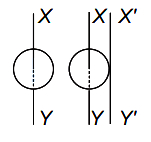
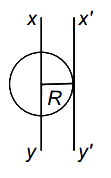
The moment of inertia of a circular disc of radius $2 \,m$ and mass $1 \,kg$ about an axis passing through the centre of mass but perpendicular to the plane of the disc is $2 \,kg \,m^{2}$. Its moment of inertia about an axis parallel to this axis but passing through the edge of the disc is (see the given figure).
A
$8 \,kg \,m^{2}$
B
$4 \,kg \,m^{2}$
C
$10 \,kg \,m^{2}$
D
$6 \,kg \,m^{2}$
Solution
(D) According to the parallel axis theorem,the moment of inertia $I$ about an axis parallel to the axis passing through the center of mass is given by:
$I = I_{cm} + Md^{2}$
Here,$I_{cm} = 2 \,kg \,m^{2}$ is the moment of inertia about the axis passing through the center of mass.
$M = 1 \,kg$ is the mass of the disc.
$d = R = 2 \,m$ is the distance between the two parallel axes (which is equal to the radius of the disc).
Substituting these values into the formula:
$I = 2 + (1)(2)^{2}$
$I = 2 + (1)(4)$
$I = 2 + 4 = 6 \,kg \,m^{2}$
Therefore,the moment of inertia about the axis passing through the edge of the disc is $6 \,kg \,m^{2}$.
$I = I_{cm} + Md^{2}$
Here,$I_{cm} = 2 \,kg \,m^{2}$ is the moment of inertia about the axis passing through the center of mass.
$M = 1 \,kg$ is the mass of the disc.
$d = R = 2 \,m$ is the distance between the two parallel axes (which is equal to the radius of the disc).
Substituting these values into the formula:
$I = 2 + (1)(2)^{2}$
$I = 2 + (1)(4)$
$I = 2 + 4 = 6 \,kg \,m^{2}$
Therefore,the moment of inertia about the axis passing through the edge of the disc is $6 \,kg \,m^{2}$.
0 likesView Solution
12
PhysicsDifficultMCQKCET · 2010
Two slabs have thicknesses $d_{1}$ and $d_{2}$. Their thermal conductivities are $K_{1}$ and $K_{2}$ respectively. They are in series. The free ends of the combination of these two slabs are kept at temperatures $\theta_{1}$ and $\theta_{2}$. Assume $\theta_{1} > \theta_{2}$. The temperature $\theta$ of their common junction is
A
$\frac{K_{1} \theta_{1} + K_{2} \theta_{2}}{\theta_{1} + \theta_{2}}$
B
$\frac{K_{1} \theta_{1} d_{1} + K_{2} \theta_{2} d_{2}}{K_{1} d_{2} + K_{2} d_{1}}$
C
$\frac{K_{1} \theta_{1} d_{2} + K_{2} \theta_{2} d_{1}}{K_{1} d_{2} + K_{2} d_{1}}$
D
$\frac{K_{1} \theta_{1} + K_{2} \theta_{2}}{K_{1} + K_{2}}$
Solution
(C) For the first slab,the heat current is $H_{1} = \frac{K_{1} A (\theta_{1} - \theta)}{d_{1}}$.
For the second slab,the heat current is $H_{2} = \frac{K_{2} A (\theta - \theta_{2})}{d_{2}}$.
Since the slabs are in series,the heat current through both must be equal in steady state,so $H_{1} = H_{2}$.
$\frac{K_{1} A (\theta_{1} - \theta)}{d_{1}} = \frac{K_{2} A (\theta - \theta_{2})}{d_{2}}$
$\frac{K_{1} (\theta_{1} - \theta)}{d_{1}} = \frac{K_{2} (\theta - \theta_{2})}{d_{2}}$
$K_{1} d_{2} (\theta_{1} - \theta) = K_{2} d_{1} (\theta - \theta_{2})$
$K_{1} d_{2} \theta_{1} - K_{1} d_{2} \theta = K_{2} d_{1} \theta - K_{2} d_{1} \theta_{2}$
$K_{1} d_{2} \theta_{1} + K_{2} d_{1} \theta_{2} = \theta (K_{1} d_{2} + K_{2} d_{1})$
$\theta = \frac{K_{1} \theta_{1} d_{2} + K_{2} \theta_{2} d_{1}}{K_{1} d_{2} + K_{2} d_{1}}$
For the second slab,the heat current is $H_{2} = \frac{K_{2} A (\theta - \theta_{2})}{d_{2}}$.
Since the slabs are in series,the heat current through both must be equal in steady state,so $H_{1} = H_{2}$.
$\frac{K_{1} A (\theta_{1} - \theta)}{d_{1}} = \frac{K_{2} A (\theta - \theta_{2})}{d_{2}}$
$\frac{K_{1} (\theta_{1} - \theta)}{d_{1}} = \frac{K_{2} (\theta - \theta_{2})}{d_{2}}$
$K_{1} d_{2} (\theta_{1} - \theta) = K_{2} d_{1} (\theta - \theta_{2})$
$K_{1} d_{2} \theta_{1} - K_{1} d_{2} \theta = K_{2} d_{1} \theta - K_{2} d_{1} \theta_{2}$
$K_{1} d_{2} \theta_{1} + K_{2} d_{1} \theta_{2} = \theta (K_{1} d_{2} + K_{2} d_{1})$
$\theta = \frac{K_{1} \theta_{1} d_{2} + K_{2} \theta_{2} d_{1}}{K_{1} d_{2} + K_{2} d_{1}}$
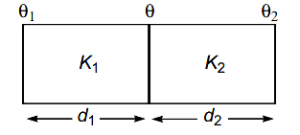
0 likesView Solution
13
PhysicsEasyMCQKCET · 2010
Hot water cools from $60^{\circ} C$ to $50^{\circ} C$ in the first $10 \ min$ and to $42^{\circ} C$ in the next $10 \ min$. Then the temperature of the surroundings is (in $^{\circ} C$)
A
$20$
B
$30$
C
$15$
D
$10$
Solution
(D) According to Newton's law of cooling,the rate of cooling is given by $\frac{\theta_{1}-\theta_{2}}{t} = K \left[ \frac{\theta_{1}+\theta_{2}}{2} - \theta_{s} \right]$,where $\theta_{s}$ is the temperature of the surroundings.
For the first $10 \ min$ interval: $\frac{60-50}{10} = K \left[ \frac{60+50}{2} - \theta_{s} \right] \Rightarrow 1 = K(55 - \theta_{s}) \dots (i)$
For the next $10 \ min$ interval: $\frac{50-42}{10} = K \left[ \frac{50+42}{2} - \theta_{s} \right] \Rightarrow 0.8 = K(46 - \theta_{s}) \dots (ii)$
Dividing equation $(i)$ by equation $(ii)$:
$\frac{1}{0.8} = \frac{55 - \theta_{s}}{46 - \theta_{s}}$
$1.25 = \frac{55 - \theta_{s}}{46 - \theta_{s}}$
$1.25(46 - \theta_{s}) = 55 - \theta_{s}$
$57.5 - 1.25\theta_{s} = 55 - \theta_{s}$
$2.5 = 0.25\theta_{s}$
$\theta_{s} = 10^{\circ} C$.
For the first $10 \ min$ interval: $\frac{60-50}{10} = K \left[ \frac{60+50}{2} - \theta_{s} \right] \Rightarrow 1 = K(55 - \theta_{s}) \dots (i)$
For the next $10 \ min$ interval: $\frac{50-42}{10} = K \left[ \frac{50+42}{2} - \theta_{s} \right] \Rightarrow 0.8 = K(46 - \theta_{s}) \dots (ii)$
Dividing equation $(i)$ by equation $(ii)$:
$\frac{1}{0.8} = \frac{55 - \theta_{s}}{46 - \theta_{s}}$
$1.25 = \frac{55 - \theta_{s}}{46 - \theta_{s}}$
$1.25(46 - \theta_{s}) = 55 - \theta_{s}$
$57.5 - 1.25\theta_{s} = 55 - \theta_{s}$
$2.5 = 0.25\theta_{s}$
$\theta_{s} = 10^{\circ} C$.
0 likesView Solution
14
PhysicsMediumMCQKCET · 2010
The efficiency of a Carnot heat engine is $0.5$ when the temperature of the source is $T_{1}$ and that of the sink is $T_{2}$. The efficiency of another Carnot heat engine is also $0.5$. The temperatures of the source and sink of the second engine are respectively:
A
$2 \,T_{1}, 2 \,T_{2}$
B
$2 \,T_{1}, \frac{T_{2}}{2}$
C
$T_{1}+5, \,T_{2}-5$
D
$T_{1}+10, \,T_{2}-10$
Solution
(A) The efficiency $\eta$ of a Carnot heat engine is given by the formula: $\eta = 1 - \frac{T_{2}}{T_{1}}$.
Given that $\eta = 0.5$, we have $0.5 = 1 - \frac{T_{2}}{T_{1}}$, which implies $\frac{T_{2}}{T_{1}} = 0.5$, or $T_{1} = 2T_{2}$.
For another Carnot engine to have the same efficiency of $0.5$, the ratio of the sink temperature to the source temperature must remain the same, i.e., $\frac{T_{2}'}{T_{1}'} = 0.5$.
If we multiply both the source and sink temperatures by the same factor $k$, the new efficiency is $\eta' = 1 - \frac{k T_{2}}{k T_{1}} = 1 - \frac{T_{2}}{T_{1}} = 0.5$.
Therefore, if the source temperature is $2T_{1}$ and the sink temperature is $2T_{2}$, the efficiency remains $0.5$.
Given that $\eta = 0.5$, we have $0.5 = 1 - \frac{T_{2}}{T_{1}}$, which implies $\frac{T_{2}}{T_{1}} = 0.5$, or $T_{1} = 2T_{2}$.
For another Carnot engine to have the same efficiency of $0.5$, the ratio of the sink temperature to the source temperature must remain the same, i.e., $\frac{T_{2}'}{T_{1}'} = 0.5$.
If we multiply both the source and sink temperatures by the same factor $k$, the new efficiency is $\eta' = 1 - \frac{k T_{2}}{k T_{1}} = 1 - \frac{T_{2}}{T_{1}} = 0.5$.
Therefore, if the source temperature is $2T_{1}$ and the sink temperature is $2T_{2}$, the efficiency remains $0.5$.
0 likesView Solution
15
PhysicsEasyMCQKCET · 2010
The dimensions of resistance are the same as those of $......$ where $h$ is the Planck's constant and $e$ is the charge.
A
$\frac{h^{2}}{e^{2}}$
B
$\frac{h^{2}}{e}$
C
$\frac{h}{e^{2}}$
D
$\frac{h}{e}$
Solution
(C) The dimensional formula for resistance $R$ is derived from $R = \frac{V}{I} = \frac{W}{qI}$.
Substituting the dimensions: $R = \frac{[ML^2 T^{-2}]}{[AT][A]} = [ML^2 T^{-3} A^{-2}]$.
Now,let us check the dimensions of $\frac{h}{e^2}$.
The dimensions of Planck's constant $h$ are $[ML^2 T^{-1}]$.
The dimensions of charge $e$ are $[AT]$.
Therefore,the dimensions of $\frac{h}{e^2} = \frac{[ML^2 T^{-1}]}{[AT]^2} = \frac{[ML^2 T^{-1}]}{[A^2 T^2]} = [ML^2 T^{-3} A^{-2}]$.
Since the dimensions of $R$ and $\frac{h}{e^2}$ are identical,the correct option is $C$.
Substituting the dimensions: $R = \frac{[ML^2 T^{-2}]}{[AT][A]} = [ML^2 T^{-3} A^{-2}]$.
Now,let us check the dimensions of $\frac{h}{e^2}$.
The dimensions of Planck's constant $h$ are $[ML^2 T^{-1}]$.
The dimensions of charge $e$ are $[AT]$.
Therefore,the dimensions of $\frac{h}{e^2} = \frac{[ML^2 T^{-1}]}{[AT]^2} = \frac{[ML^2 T^{-1}]}{[A^2 T^2]} = [ML^2 T^{-3} A^{-2}]$.
Since the dimensions of $R$ and $\frac{h}{e^2}$ are identical,the correct option is $C$.
0 likesView Solution
16
PhysicsDifficultMCQKCET · 2010
$A$ bat flies at a steady speed of $4 \,ms^{-1}$ emitting a sound of $f = 90 \times 10^{3} \,Hz$. It is flying horizontally towards a vertical wall. The frequency of the reflected sound as detected by the bat will be (take velocity of sound in air is $330 \,ms^{-1}$)
A
$88.1 \times 10^{3} \,Hz$
B
$87.1 \times 10^{3} \,Hz$
C
$92.1 \times 10^{3} \,Hz$
D
$89.1 \times 10^{3} \,Hz$
Solution
(C) The bat acts as both the source and the observer moving towards a stationary wall.
First, the frequency $f'$ received by the wall is given by the Doppler effect formula for a moving source and stationary observer:
$f' = f \left( \frac{v}{v - v_b} \right)$
where $v = 330 \,ms^{-1}$ is the speed of sound and $v_b = 4 \,ms^{-1}$ is the speed of the bat.
Next, the wall reflects this sound, and the bat acts as a moving observer receiving the reflected frequency $f''$ from a stationary source (the wall):
$f'' = f' \left( \frac{v + v_b}{v} \right)$
Substituting $f'$ into the equation for $f''$:
$f'' = f \left( \frac{v}{v - v_b} \right) \left( \frac{v + v_b}{v} \right) = f \left( \frac{v + v_b}{v - v_b} \right)$
$f'' = 90 \times 10^{3} \left( \frac{330 + 4}{330 - 4} \right) = 90 \times 10^{3} \left( \frac{334}{326} \right)$
$f'' \approx 90 \times 10^{3} \times 1.0245 = 92.21 \times 10^{3} \,Hz$.
Rounding to the nearest provided option, the frequency is $92.1 \times 10^{3} \,Hz$.
First, the frequency $f'$ received by the wall is given by the Doppler effect formula for a moving source and stationary observer:
$f' = f \left( \frac{v}{v - v_b} \right)$
where $v = 330 \,ms^{-1}$ is the speed of sound and $v_b = 4 \,ms^{-1}$ is the speed of the bat.
Next, the wall reflects this sound, and the bat acts as a moving observer receiving the reflected frequency $f''$ from a stationary source (the wall):
$f'' = f' \left( \frac{v + v_b}{v} \right)$
Substituting $f'$ into the equation for $f''$:
$f'' = f \left( \frac{v}{v - v_b} \right) \left( \frac{v + v_b}{v} \right) = f \left( \frac{v + v_b}{v - v_b} \right)$
$f'' = 90 \times 10^{3} \left( \frac{330 + 4}{330 - 4} \right) = 90 \times 10^{3} \left( \frac{334}{326} \right)$
$f'' \approx 90 \times 10^{3} \times 1.0245 = 92.21 \times 10^{3} \,Hz$.
Rounding to the nearest provided option, the frequency is $92.1 \times 10^{3} \,Hz$.
0 likesView Solution
17
PhysicsDifficultMCQKCET · 2010
$A$ closed organ pipe and an open organ pipe of the same length produce $2 \text{ beats/second}$ while vibrating in their fundamental modes. The length of the open organ pipe is halved and that of the closed pipe is doubled. Then the number of beats produced per second while vibrating in the fundamental mode is
A
$2$
B
$6$
C
$8$
D
$7$
Solution
(D) Let the length of both pipes be $L$. The fundamental frequency of an open organ pipe is $f_{o} = \frac{v}{2L}$ and that of a closed organ pipe is $f_{c} = \frac{v}{4L}$.
Given that $f_{o} - f_{c} = 2 \text{ Hz}$.
Substituting the expressions,$\frac{v}{2L} - \frac{v}{4L} = 2 \Rightarrow \frac{v}{4L} = 2 \text{ Hz}$.
Thus,$f_{c} = 2 \text{ Hz}$ and $f_{o} = 2f_{c} = 4 \text{ Hz}$.
Now,the length of the open pipe is halved $(L_{o}' = L/2)$,so its new frequency is $f_{o}' = \frac{v}{2(L/2)} = \frac{v}{L} = 2f_{o} = 2 \times 4 = 8 \text{ Hz}$.
The length of the closed pipe is doubled $(L_{c}' = 2L)$,so its new frequency is $f_{c}' = \frac{v}{4(2L)} = \frac{1}{2} \left(\frac{v}{4L}\right) = \frac{1}{2} f_{c} = \frac{1}{2} \times 2 = 1 \text{ Hz}$.
The number of beats produced per second is $|f_{o}' - f_{c}'| = |8 - 1| = 7 \text{ Hz}$.
Given that $f_{o} - f_{c} = 2 \text{ Hz}$.
Substituting the expressions,$\frac{v}{2L} - \frac{v}{4L} = 2 \Rightarrow \frac{v}{4L} = 2 \text{ Hz}$.
Thus,$f_{c} = 2 \text{ Hz}$ and $f_{o} = 2f_{c} = 4 \text{ Hz}$.
Now,the length of the open pipe is halved $(L_{o}' = L/2)$,so its new frequency is $f_{o}' = \frac{v}{2(L/2)} = \frac{v}{L} = 2f_{o} = 2 \times 4 = 8 \text{ Hz}$.
The length of the closed pipe is doubled $(L_{c}' = 2L)$,so its new frequency is $f_{c}' = \frac{v}{4(2L)} = \frac{1}{2} \left(\frac{v}{4L}\right) = \frac{1}{2} f_{c} = \frac{1}{2} \times 2 = 1 \text{ Hz}$.
The number of beats produced per second is $|f_{o}' - f_{c}'| = |8 - 1| = 7 \text{ Hz}$.
0 likesView Solution
18
PhysicsEasyMCQKCET · 2010
$A$ uniform wire of length $L$,diameter $D$,and density $\rho$ is stretched under a tension $T$. The correct relation between its fundamental frequency $f$,the length $L$,and the diameter $D$ is:
A
$f \propto \frac{1}{L D}$
B
$f \propto \frac{1}{L \sqrt{D}}$
C
$f \propto \frac{1}{D^{2}}$
D
$f \propto \frac{1}{L D^{2}}$
Solution
(A) The fundamental frequency of a stretched wire is given by $f = \frac{1}{2L} \sqrt{\frac{T}{\mu}}$,where $\mu$ is the linear mass density.
Linear mass density $\mu = \text{mass per unit length} = \text{density} \times \text{cross-sectional area} = \rho \times (\pi \frac{D^2}{4})$.
Substituting $\mu$ into the frequency formula:
$f = \frac{1}{2L} \sqrt{\frac{T}{\rho \pi \frac{D^2}{4}}} = \frac{1}{2L} \sqrt{\frac{4T}{\pi \rho D^2}} = \frac{1}{2L} \cdot \frac{2}{D} \sqrt{\frac{T}{\pi \rho}} = \frac{1}{LD} \sqrt{\frac{T}{\pi \rho}}$.
Since $T$,$\rho$,and $\pi$ are constants,we have $f \propto \frac{1}{LD}$.
Linear mass density $\mu = \text{mass per unit length} = \text{density} \times \text{cross-sectional area} = \rho \times (\pi \frac{D^2}{4})$.
Substituting $\mu$ into the frequency formula:
$f = \frac{1}{2L} \sqrt{\frac{T}{\rho \pi \frac{D^2}{4}}} = \frac{1}{2L} \sqrt{\frac{4T}{\pi \rho D^2}} = \frac{1}{2L} \cdot \frac{2}{D} \sqrt{\frac{T}{\pi \rho}} = \frac{1}{LD} \sqrt{\frac{T}{\pi \rho}}$.
Since $T$,$\rho$,and $\pi$ are constants,we have $f \propto \frac{1}{LD}$.
0 likesView Solution
19
PhysicsEasyMCQKCET · 2010
Two simple harmonic motions are represented by $y_1 = 5[\sin 2 \pi t + \sqrt{3} \cos 2 \pi t]$ and $y_2 = 5 \sin [2 \pi t + \frac{\pi}{4}]$. The ratio of their amplitudes is
A
$1: 1$
B
$2: 1$
C
$1: 3$
D
$\sqrt{3}: 1$
Solution
(B) The first equation is $y_1 = 5[\sin 2 \pi t + \sqrt{3} \cos 2 \pi t]$.
To find the amplitude $A_1$,we rewrite the expression in the form $A_1 \sin(2 \pi t + \phi)$.
Multiply and divide by $2$: $y_1 = 5 \times 2 [\frac{1}{2} \sin 2 \pi t + \frac{\sqrt{3}}{2} \cos 2 \pi t] = 10 [\sin 2 \pi t \cos \frac{\pi}{3} + \cos 2 \pi t \sin \frac{\pi}{3}] = 10 \sin(2 \pi t + \frac{\pi}{3})$.
Thus,the amplitude $A_1 = 10$.
The second equation is $y_2 = 5 \sin [2 \pi t + \frac{\pi}{4}]$.
Comparing this with $y_2 = A_2 \sin(2 \pi t + \phi_2)$,we get the amplitude $A_2 = 5$.
The ratio of their amplitudes is $\frac{A_1}{A_2} = \frac{10}{5} = 2: 1$.
To find the amplitude $A_1$,we rewrite the expression in the form $A_1 \sin(2 \pi t + \phi)$.
Multiply and divide by $2$: $y_1 = 5 \times 2 [\frac{1}{2} \sin 2 \pi t + \frac{\sqrt{3}}{2} \cos 2 \pi t] = 10 [\sin 2 \pi t \cos \frac{\pi}{3} + \cos 2 \pi t \sin \frac{\pi}{3}] = 10 \sin(2 \pi t + \frac{\pi}{3})$.
Thus,the amplitude $A_1 = 10$.
The second equation is $y_2 = 5 \sin [2 \pi t + \frac{\pi}{4}]$.
Comparing this with $y_2 = A_2 \sin(2 \pi t + \phi_2)$,we get the amplitude $A_2 = 5$.
The ratio of their amplitudes is $\frac{A_1}{A_2} = \frac{10}{5} = 2: 1$.
0 likesView Solution
20
PhysicsDifficultMCQKCET · 2010
An ideal choke draws a current of $8 \, A$ when connected to an $AC$ supply of $100 \, V, 50 \, Hz$. $A$ pure resistor draws a current of $10 \, A$ when connected to the same source. The ideal choke and the resistor are connected in series and then connected to the $AC$ source of $150 \, V, 40 \, Hz$. The current in the circuit becomes
A
$\frac{15}{\sqrt{2}} \, A$
B
$8 \, A$
C
$18 \, A$
D
$10 \, A$
Solution
(A) Resistance of the resistor: $R = \frac{V}{I} = \frac{100}{10} = 10 \, \Omega$.
Inductive reactance of the choke at $50 \, Hz$: $X_L = \frac{V}{I} = \frac{100}{8} = 12.5 \, \Omega$.
Since $X_L = 2 \pi f L$, we have $12.5 = 2 \pi \times 50 \times L$, which gives $L = \frac{12.5}{100 \pi} = \frac{1}{8 \pi} \, H$.
Now, for the new source of $40 \, Hz$, the new inductive reactance is $X_L' = 2 \pi f' L = 2 \pi \times 40 \times \frac{1}{8 \pi} = 10 \, \Omega$.
The impedance of the series $RL$ circuit is $Z = \sqrt{R^2 + X_L'^2} = \sqrt{10^2 + 10^2} = 10\sqrt{2} \, \Omega$.
The current in the circuit is $I = \frac{V'}{Z} = \frac{150}{10\sqrt{2}} = \frac{15}{\sqrt{2}} \, A$.
Inductive reactance of the choke at $50 \, Hz$: $X_L = \frac{V}{I} = \frac{100}{8} = 12.5 \, \Omega$.
Since $X_L = 2 \pi f L$, we have $12.5 = 2 \pi \times 50 \times L$, which gives $L = \frac{12.5}{100 \pi} = \frac{1}{8 \pi} \, H$.
Now, for the new source of $40 \, Hz$, the new inductive reactance is $X_L' = 2 \pi f' L = 2 \pi \times 40 \times \frac{1}{8 \pi} = 10 \, \Omega$.
The impedance of the series $RL$ circuit is $Z = \sqrt{R^2 + X_L'^2} = \sqrt{10^2 + 10^2} = 10\sqrt{2} \, \Omega$.
The current in the circuit is $I = \frac{V'}{Z} = \frac{150}{10\sqrt{2}} = \frac{15}{\sqrt{2}} \, A$.
0 likesView Solution
21
PhysicsMediumMCQKCET · 2010
In a series resonant $R-L-C$ circuit, the voltage across $R$ is $100 \, V$ and the value of $R = 1000 \, \Omega$. The capacitance of the capacitor is $2 \times 10^{-6} \, F$; the angular frequency of the $AC$ source is $200 \, rad \, s^{-1}$. Then the potential difference across the inductance coil is: (in $V$)
A
$100$
B
$40$
C
$250$
D
$400$
Solution
(C) The current $i$ in the series $R-L-C$ circuit is given by $i = \frac{V_R}{R}$.
Substituting the given values: $i = \frac{100 \, V}{1000 \, \Omega} = 0.1 \, A$.
At resonance, the inductive reactance $X_L$ is equal to the capacitive reactance $X_C$, and the potential difference across the inductor $V_L$ is equal to the potential difference across the capacitor $V_C$.
The potential difference across the capacitor is $V_C = i X_C = i \left( \frac{1}{\omega C} \right)$.
Substituting the values: $V_C = 0.1 \times \left( \frac{1}{200 \times 2 \times 10^{-6}} \right)$.
$V_C = 0.1 \times \left( \frac{1}{400 \times 10^{-6}} \right) = 0.1 \times \left( \frac{10^6}{400} \right) = 0.1 \times 2500 = 250 \, V$.
Since $V_L = V_C$ at resonance, the potential difference across the inductance coil is $250 \, V$.
Substituting the given values: $i = \frac{100 \, V}{1000 \, \Omega} = 0.1 \, A$.
At resonance, the inductive reactance $X_L$ is equal to the capacitive reactance $X_C$, and the potential difference across the inductor $V_L$ is equal to the potential difference across the capacitor $V_C$.
The potential difference across the capacitor is $V_C = i X_C = i \left( \frac{1}{\omega C} \right)$.
Substituting the values: $V_C = 0.1 \times \left( \frac{1}{200 \times 2 \times 10^{-6}} \right)$.
$V_C = 0.1 \times \left( \frac{1}{400 \times 10^{-6}} \right) = 0.1 \times \left( \frac{10^6}{400} \right) = 0.1 \times 2500 = 250 \, V$.
Since $V_L = V_C$ at resonance, the potential difference across the inductance coil is $250 \, V$.
0 likesView Solution
22
PhysicsEasyMCQKCET · 2010
$A$ capacitor and an inductance coil are connected in separate $AC$ circuits with a bulb glowing in both the circuits. The bulb glows more brightly when
A
an iron rod is introduced into the inductance coil
B
the number of turns in the inductance coil is increased
C
separation between the plates of the capacitor is increased
D
a dielectric is introduced into the gap between the plates of the capacitor
Solution
(D) The current in an $AC$ circuit containing a capacitor is given by $i = \frac{V}{\sqrt{R^2 + X_C^2}}$,where $X_C = \frac{1}{\omega C}$ is the capacitive reactance.
When a dielectric is introduced into the gap between the plates of the capacitor,the capacitance $C$ increases $(C = K C_0)$.
As $C$ increases,the capacitive reactance $X_C = \frac{1}{\omega C}$ decreases.
Since the impedance $Z = \sqrt{R^2 + X_C^2}$ decreases,the current $i$ in the circuit increases.
Consequently,the brightness of the bulb,which depends on the power dissipated $(P = i^2 R)$,increases.
When a dielectric is introduced into the gap between the plates of the capacitor,the capacitance $C$ increases $(C = K C_0)$.
As $C$ increases,the capacitive reactance $X_C = \frac{1}{\omega C}$ decreases.
Since the impedance $Z = \sqrt{R^2 + X_C^2}$ decreases,the current $i$ in the circuit increases.
Consequently,the brightness of the bulb,which depends on the power dissipated $(P = i^2 R)$,increases.
0 likesView Solution
23
PhysicsEasyMCQKCET · 2010
The spectrum of an oil flame is an example of:
A
line emission spectrum
B
continuous emission spectrum
C
line absorption spectrum
D
band emission spectrum
Solution
(B) An oil flame produces light due to the incandescence of solid carbon particles present in the flame. Since the spectrum of an oil flame consists of a continuous range of wavelengths without any gaps,it is an example of a continuous emission spectrum.
0 likesView Solution
24
PhysicsMediumMCQKCET · 2010
$v_{1}$ is the frequency of the series limit of the Lyman series,$v_{2}$ is the frequency of the first line of the Lyman series,and $v_{3}$ is the frequency of the series limit of the Balmer series. Then:
A
$v_{1}-v_{2}=v_{3}$
B
$v_{1}=v_{2}-v_{3}$
C
$\frac{1}{v_{2}}=\frac{1}{v_{1}}+\frac{1}{v_{3}}$
D
$\frac{1}{v_{1}}=\frac{1}{v_{2}}+\frac{1}{v_{3}}$
Solution
(A) The frequency of a spectral line is given by $v = RC \left[ \frac{1}{n_{1}^{2}} - \frac{1}{n_{2}^{2}} \right]$.
For the series limit of the Lyman series $(n_{1}=1, n_{2}=\infty)$: $v_{1} = RC \left[ 1 - \frac{1}{\infty} \right] = RC$.
For the first line of the Lyman series $(n_{1}=1, n_{2}=2)$: $v_{2} = RC \left[ 1 - \frac{1}{4} \right] = \frac{3}{4} RC$.
For the series limit of the Balmer series $(n_{1}=2, n_{2}=\infty)$: $v_{3} = RC \left[ \frac{1}{4} - \frac{1}{\infty} \right] = \frac{RC}{4}$.
Comparing these values,we see that $v_{1} - v_{2} = RC - \frac{3}{4} RC = \frac{1}{4} RC = v_{3}$.
Therefore,$v_{1} - v_{2} = v_{3}$.
For the series limit of the Lyman series $(n_{1}=1, n_{2}=\infty)$: $v_{1} = RC \left[ 1 - \frac{1}{\infty} \right] = RC$.
For the first line of the Lyman series $(n_{1}=1, n_{2}=2)$: $v_{2} = RC \left[ 1 - \frac{1}{4} \right] = \frac{3}{4} RC$.
For the series limit of the Balmer series $(n_{1}=2, n_{2}=\infty)$: $v_{3} = RC \left[ \frac{1}{4} - \frac{1}{\infty} \right] = \frac{RC}{4}$.
Comparing these values,we see that $v_{1} - v_{2} = RC - \frac{3}{4} RC = \frac{1}{4} RC = v_{3}$.
Therefore,$v_{1} - v_{2} = v_{3}$.
0 likesView Solution
25
PhysicsDifficultMCQKCET · 2010
An electron is moving in an orbit of a hydrogen atom from which there can be a maximum of six transitions. An electron is moving in an orbit of another hydrogen atom from which there can be a maximum of three transitions. The ratio of the velocities of the electron in these two orbits is
A
$1/2$
B
$2/1$
C
$5/4$
D
$3/4$
Solution
(D) The number of spectral lines $N$ obtained due to transitions of electrons from the $n$th orbit to lower orbits is given by the formula: $N = \frac{n(n-1)}{2}$.
For the first case,$N = 6$:
$6 = \frac{n_1(n_1-1)}{2} \Rightarrow n_1^2 - n_1 - 12 = 0 \Rightarrow (n_1-4)(n_1+3) = 0$. Since $n > 0$,we have $n_1 = 4$.
For the second case,$N = 3$:
$3 = \frac{n_2(n_2-1)}{2} \Rightarrow n_2^2 - n_2 - 6 = 0 \Rightarrow (n_2-3)(n_2+2) = 0$. Since $n > 0$,we have $n_2 = 3$.
The velocity of an electron in the $n$th orbit of a hydrogen atom is given by $v_n \propto \frac{1}{n}$.
Therefore,the ratio of the velocities is:
$\frac{v_1}{v_2} = \frac{n_2}{n_1} = \frac{3}{4}$.
For the first case,$N = 6$:
$6 = \frac{n_1(n_1-1)}{2} \Rightarrow n_1^2 - n_1 - 12 = 0 \Rightarrow (n_1-4)(n_1+3) = 0$. Since $n > 0$,we have $n_1 = 4$.
For the second case,$N = 3$:
$3 = \frac{n_2(n_2-1)}{2} \Rightarrow n_2^2 - n_2 - 6 = 0 \Rightarrow (n_2-3)(n_2+2) = 0$. Since $n > 0$,we have $n_2 = 3$.
The velocity of an electron in the $n$th orbit of a hydrogen atom is given by $v_n \propto \frac{1}{n}$.
Therefore,the ratio of the velocities is:
$\frac{v_1}{v_2} = \frac{n_2}{n_1} = \frac{3}{4}$.
0 likesView Solution
26
PhysicsMediumMCQKCET · 2010
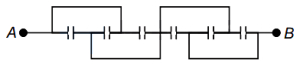
All capacitors used in the diagram are identical and each is of capacitance $C$. Then the effective capacitance between the points $A$ and $B$ is
A
$1.5 C$
B
$6 C$
C
$C$
D
$3 C$
Solution
(A) By analyzing the circuit,we can see that the capacitors are arranged in two groups.
In the first group,three capacitors are connected in parallel between the input and the intermediate node.
Therefore,the equivalent capacitance of this group is $C_{123} = C + C + C = 3 C$.
Similarly,in the second group,three capacitors are connected in parallel between the intermediate node and point $B$.
Therefore,the equivalent capacitance of this group is $C_{456} = C + C + C = 3 C$.
These two groups are connected in series with each other.
Therefore,the total effective capacitance $C_{\text{eq}}$ between points $A$ and $B$ is given by:
$C_{\text{eq}} = \frac{C_{123} \times C_{456}}{C_{123} + C_{456}} = \frac{(3 C)(3 C)}{3 C + 3 C} = \frac{9 C^2}{6 C} = 1.5 C$.
In the first group,three capacitors are connected in parallel between the input and the intermediate node.
Therefore,the equivalent capacitance of this group is $C_{123} = C + C + C = 3 C$.
Similarly,in the second group,three capacitors are connected in parallel between the intermediate node and point $B$.
Therefore,the equivalent capacitance of this group is $C_{456} = C + C + C = 3 C$.
These two groups are connected in series with each other.
Therefore,the total effective capacitance $C_{\text{eq}}$ between points $A$ and $B$ is given by:
$C_{\text{eq}} = \frac{C_{123} \times C_{456}}{C_{123} + C_{456}} = \frac{(3 C)(3 C)}{3 C + 3 C} = \frac{9 C^2}{6 C} = 1.5 C$.
0 likesView Solution
27
PhysicsMediumMCQKCET · 2010
$A$ battery of emf $E$ has an internal resistance $r$. $A$ variable resistance $R$ is connected to the terminals of the battery. $A$ current $i$ is drawn from the battery. $V$ is the terminal potential difference. If $R$ alone is gradually reduced to zero,which of the following best describes $i$ and $V$?
A
$i$ approaches zero,$V$ approaches $E$
B
$i$ approaches $\frac{E}{r}$,$V$ approaches zero
C
$i$ approaches $\frac{E}{r}$,$V$ approaches $E$
D
$i$ approaches infinity,$V$ approaches $E$
Solution
(B) The current $i$ drawn from the battery is given by the formula $i = \frac{E}{R + r}$.
As the variable resistance $R$ is gradually reduced to $0$,the current $i$ approaches the value $i = \frac{E}{0 + r} = \frac{E}{r}$.
The terminal potential difference $V$ is given by $V = E - ir$ or $V = iR$.
Using $V = iR$,as $R$ approaches $0$,the potential difference $V$ approaches $0 \times \frac{E}{r} = 0$.
Therefore,as $R \to 0$,$i \to \frac{E}{r}$ and $V \to 0$.
As the variable resistance $R$ is gradually reduced to $0$,the current $i$ approaches the value $i = \frac{E}{0 + r} = \frac{E}{r}$.
The terminal potential difference $V$ is given by $V = E - ir$ or $V = iR$.
Using $V = iR$,as $R$ approaches $0$,the potential difference $V$ approaches $0 \times \frac{E}{r} = 0$.
Therefore,as $R \to 0$,$i \to \frac{E}{r}$ and $V \to 0$.
0 likesView Solution
28
PhysicsDifficultMCQKCET · 2010
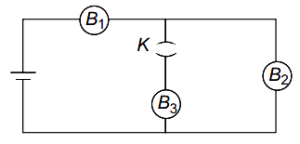
$B_{1}$, $B_{2}$ and $B_{3}$ are three identical bulbs connected to a battery of steady $EMF$ with key $K$ closed. What happens to the brightness of the bulbs $B_{1}$ and $B_{2}$ when the key $K$ is opened?
A
Brightness of the bulb $B_{1}$ increases and that of $B_{2}$ decreases
B
Brightness of the bulbs $B_{1}$ and $B_{2}$ increase
C
Brightness of the bulb $B_{1}$ decreases and $B_{2}$ increases
D
Brightness of the bulbs $B_{1}$ and $B_{2}$ decrease
Solution
(C) Let the resistance of each identical bulb be $R$ and the $EMF$ of the battery be $E$ with internal resistance $r$.
When key $K$ is closed, bulbs $B_{2}$ and $B_{3}$ are in parallel, and this combination is in series with $B_{1}$. The equivalent resistance is $R_{eq} = R + (R/2) = 1.5R$. The total current is $I = E / (1.5R + r)$. The voltage across $B_{1}$ is $V_{1} = I \cdot R = E \cdot R / (1.5R + r)$.
When key $K$ is opened, bulb $B_{3}$ is disconnected. The circuit now consists of $B_{1}$ and $B_{2}$ in series. The new equivalent resistance is $R'_{eq} = 2R$. The new total current is $I' = E / (2R + r)$.
Comparing the currents: Since $2R > 1.5R$, the total current $I'$ is less than $I$. Thus, the current through $B_{1}$ decreases, so its brightness decreases.
The voltage across $B_{2}$ is $V'_{2} = I' \cdot R = E \cdot R / (2R + r)$. Comparing $V'_{2}$ with the previous voltage across $B_{2}$ (which was $V_{2} = I \cdot (R/2) = E \cdot (R/2) / (1.5R + r) = E \cdot R / (3R + 2r)$), we find that $V'_{2} > V_{2}$. Therefore, the brightness of $B_{2}$ increases.
When key $K$ is closed, bulbs $B_{2}$ and $B_{3}$ are in parallel, and this combination is in series with $B_{1}$. The equivalent resistance is $R_{eq} = R + (R/2) = 1.5R$. The total current is $I = E / (1.5R + r)$. The voltage across $B_{1}$ is $V_{1} = I \cdot R = E \cdot R / (1.5R + r)$.
When key $K$ is opened, bulb $B_{3}$ is disconnected. The circuit now consists of $B_{1}$ and $B_{2}$ in series. The new equivalent resistance is $R'_{eq} = 2R$. The new total current is $I' = E / (2R + r)$.
Comparing the currents: Since $2R > 1.5R$, the total current $I'$ is less than $I$. Thus, the current through $B_{1}$ decreases, so its brightness decreases.
The voltage across $B_{2}$ is $V'_{2} = I' \cdot R = E \cdot R / (2R + r)$. Comparing $V'_{2}$ with the previous voltage across $B_{2}$ (which was $V_{2} = I \cdot (R/2) = E \cdot (R/2) / (1.5R + r) = E \cdot R / (3R + 2r)$), we find that $V'_{2} > V_{2}$. Therefore, the brightness of $B_{2}$ increases.
0 likesView Solution
29
PhysicsEasyMCQKCET · 2010
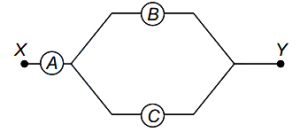
Three voltmeters $A$,$B$ and $C$ having resistances $R$,$1.5 R$ and $3 R$ respectively are used in a circuit as shown. When a potential difference is applied between $X$ and $Y$,the readings of the voltmeters are $V_{1}$,$V_{2}$,and $V_{3}$ respectively. Then
A
$V_{1}=V_{2}=V_{3}$
B
$V_{1} < V_{2}=V_{3}$
C
$V_{1}>V_{2}>V_{3}$
D
$V_{1}>V_{2}=V_{3}$
Solution
(A) Let the total current flowing through the circuit be $I$.
Voltmeter $A$ has resistance $R$,voltmeter $B$ has resistance $1.5 R$,and voltmeter $C$ has resistance $3 R$.
Voltmeters $B$ and $C$ are connected in parallel. Let the potential difference across them be $V_p$.
Since they are in parallel,$V_2 = V_3 = V_p$.
Using the formula for parallel resistance,the equivalent resistance of $B$ and $C$ is $R_p = \frac{(1.5 R)(3 R)}{1.5 R + 3 R} = \frac{4.5 R^2}{4.5 R} = R$.
The total resistance of the circuit is $R_{eq} = R_A + R_p = R + R = 2 R$.
The reading of voltmeter $A$ is $V_1 = I \times R$.
The potential difference across the parallel combination is $V_p = I \times R_p = I \times R$.
Thus,$V_1 = V_2 = V_3 = IR$.
Voltmeter $A$ has resistance $R$,voltmeter $B$ has resistance $1.5 R$,and voltmeter $C$ has resistance $3 R$.
Voltmeters $B$ and $C$ are connected in parallel. Let the potential difference across them be $V_p$.
Since they are in parallel,$V_2 = V_3 = V_p$.
Using the formula for parallel resistance,the equivalent resistance of $B$ and $C$ is $R_p = \frac{(1.5 R)(3 R)}{1.5 R + 3 R} = \frac{4.5 R^2}{4.5 R} = R$.
The total resistance of the circuit is $R_{eq} = R_A + R_p = R + R = 2 R$.
The reading of voltmeter $A$ is $V_1 = I \times R$.
The potential difference across the parallel combination is $V_p = I \times R_p = I \times R$.
Thus,$V_1 = V_2 = V_3 = IR$.
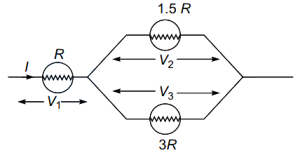
0 likesView Solution
30
PhysicsMediumMCQKCET · 2010
In the circuit given here,the potentials at points $A$,$B$,and $C$ are $70 \,V$,$0 \,V$,and $10 \,V$ respectively. Then:
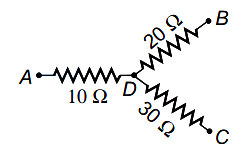
A
the point $D$ will be at a potential of $60 \,V$
B
the point $D$ will be at a potential of $20 \,V$
C
currents in the paths $AD$,$DB$ and $DC$ are in the ratio of $3: 2: 1$
D
currents in the paths $AD$,$DB$ and $DC$ are in the ratio of $1: 2: 3$
Solution
(C) Let the potential at point $D$ be $V_D$. Applying Kirchhoff's Current Law $(KCL)$ at node $D$,the sum of currents leaving the node must be zero:
$I_{AD} + I_{DB} + I_{DC} = 0$
$\frac{V_D - 70}{10} + \frac{V_D - 0}{20} + \frac{V_D - 10}{30} = 0$
Multiplying by $60$ to clear the denominators:
$6(V_D - 70) + 3(V_D) + 2(V_D - 10) = 0$
$6V_D - 420 + 3V_D + 2V_D - 20 = 0$
$11V_D = 440$
$V_D = 40 \,V$
Now,calculate the currents:
$I_{AD} = \frac{70 - 40}{10} = 3 \,A$ (current flows from $A$ to $D$)
$I_{DB} = \frac{40 - 0}{20} = 2 \,A$ (current flows from $D$ to $B$)
$I_{DC} = \frac{40 - 10}{30} = 1 \,A$ (current flows from $D$ to $C$)
Thus,the ratio of currents in paths $AD$,$DB$,and $DC$ is $3: 2: 1$.
$I_{AD} + I_{DB} + I_{DC} = 0$
$\frac{V_D - 70}{10} + \frac{V_D - 0}{20} + \frac{V_D - 10}{30} = 0$
Multiplying by $60$ to clear the denominators:
$6(V_D - 70) + 3(V_D) + 2(V_D - 10) = 0$
$6V_D - 420 + 3V_D + 2V_D - 20 = 0$
$11V_D = 440$
$V_D = 40 \,V$
Now,calculate the currents:
$I_{AD} = \frac{70 - 40}{10} = 3 \,A$ (current flows from $A$ to $D$)
$I_{DB} = \frac{40 - 0}{20} = 2 \,A$ (current flows from $D$ to $B$)
$I_{DC} = \frac{40 - 10}{30} = 1 \,A$ (current flows from $D$ to $C$)
Thus,the ratio of currents in paths $AD$,$DB$,and $DC$ is $3: 2: 1$.
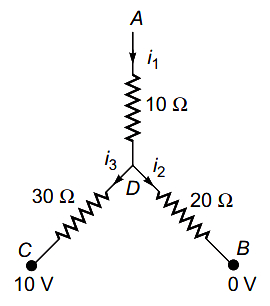
0 likesView Solution
31
PhysicsEasyMCQKCET · 2010
The de-Broglie wavelength of the electron in the ground state of the hydrogen atom is ..... (radius of the first orbit of hydrogen atom $= 0.53 \ \text{Å}$). (in $\text{Å}$)
A
$1.67$
B
$3.33$
C
$1.06$
D
$0.53$
Solution
(B) According to Bohr's quantization of angular momentum,the condition is given by:
$mvr = \frac{nh}{2\pi}$
Rearranging this,we get:
$\frac{h}{mv} = \frac{2\pi r}{n} \quad \dots(i)$
By definition,the de-Broglie wavelength $\lambda$ is given by:
$\lambda = \frac{h}{mv} \quad \dots(ii)$
Comparing equations $(i)$ and $(ii)$,we obtain:
$\lambda = \frac{2\pi r}{n}$
For the ground state of the hydrogen atom,$n = 1$ and the radius $r = 0.53 \ \text{Å}$.
Substituting these values:
$\lambda = \frac{2 \times \pi \times 0.53 \ \text{Å}}{1}$
$\lambda = 2 \times 3.14159 \times 0.53 \ \text{Å} \approx 3.33 \ \text{Å}$.
$mvr = \frac{nh}{2\pi}$
Rearranging this,we get:
$\frac{h}{mv} = \frac{2\pi r}{n} \quad \dots(i)$
By definition,the de-Broglie wavelength $\lambda$ is given by:
$\lambda = \frac{h}{mv} \quad \dots(ii)$
Comparing equations $(i)$ and $(ii)$,we obtain:
$\lambda = \frac{2\pi r}{n}$
For the ground state of the hydrogen atom,$n = 1$ and the radius $r = 0.53 \ \text{Å}$.
Substituting these values:
$\lambda = \frac{2 \times \pi \times 0.53 \ \text{Å}}{1}$
$\lambda = 2 \times 3.14159 \times 0.53 \ \text{Å} \approx 3.33 \ \text{Å}$.
0 likesView Solution
32
PhysicsEasyMCQKCET · 2010
According to Einstein's photoelectric equation,the graph of $KE_{max}$ of the photoelectrons emitted from a metal versus the frequency $\nu$ of the incident radiation gives a straight line. The slope of this graph
A
depends on the intensity of the incident radiation
B
depends on the nature of the metal and also on the intensity of incident radiation
C
is the same for all metals and independent of the intensity of the incident radiation
D
depends on the nature of the metal
Solution
(C) According to Einstein's photoelectric equation:
$KE_{max} = h\nu - \phi_{0}$
Comparing this with the equation of a straight line $y = mx + c$,where $y = KE_{max}$,$x = \nu$,$m$ is the slope,and $c$ is the y-intercept:
$KE_{max} = h\nu + (-\phi_{0})$
Here,the slope $m = h$ (Planck's constant).
Since $h$ is a universal constant,the slope is the same for all metals and is independent of the intensity of the incident radiation.
$KE_{max} = h\nu - \phi_{0}$
Comparing this with the equation of a straight line $y = mx + c$,where $y = KE_{max}$,$x = \nu$,$m$ is the slope,and $c$ is the y-intercept:
$KE_{max} = h\nu + (-\phi_{0})$
Here,the slope $m = h$ (Planck's constant).
Since $h$ is a universal constant,the slope is the same for all metals and is independent of the intensity of the incident radiation.
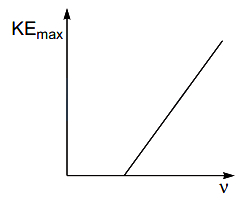
0 likesView Solution
33
PhysicsMediumMCQKCET · 2010
There is a uniform magnetic field directed perpendicular and into the plane of the paper. An irregular shaped conducting loop is slowly changing into a circular loop in the plane of the paper. Then
A
current is induced in the loop in the anticlockwise direction
B
current is induced in the loop in the clockwise direction
C
$AC$ is induced in the loop
D
no current is induced in the loop
Solution
(A) For a given perimeter,the area of a circle is the maximum among all plane shapes. As the irregular loop changes into a circular loop,its area $A$ increases.
Since the magnetic field $B$ is uniform and directed into the plane,the magnetic flux $\phi = B \cdot A$ increases.
According to Lenz's law,the induced current will create a magnetic field to oppose this increase in flux.
Therefore,the induced magnetic field must be directed out of the plane.
Using the right-hand thumb rule,a magnetic field directed out of the plane corresponds to an anticlockwise induced current.
Since the magnetic field $B$ is uniform and directed into the plane,the magnetic flux $\phi = B \cdot A$ increases.
According to Lenz's law,the induced current will create a magnetic field to oppose this increase in flux.
Therefore,the induced magnetic field must be directed out of the plane.
Using the right-hand thumb rule,a magnetic field directed out of the plane corresponds to an anticlockwise induced current.
0 likesView Solution
34
PhysicsEasyMCQKCET · 2010
The speed of an electromagnetic wave in a vacuum depends upon the source of radiation.
A
increases as we move from $\gamma$-rays to radio waves
B
decreases as we move from $\gamma$-rays to radio waves
C
is same for all of them
D
None of the above
Solution
(C) The speed of all electromagnetic waves in a vacuum is given by the formula $c = \frac{1}{\sqrt{\mu_{0} \varepsilon_{0}}}$.
Here,$\mu_{0}$ is the permeability of free space and $\varepsilon_{0}$ is the permittivity of free space.
Since both $\mu_{0}$ and $\varepsilon_{0}$ are universal constants,the speed of electromagnetic waves in a vacuum is a constant value,approximately $3 \times 10^{8} \ m/s$,regardless of the frequency,wavelength,or the source of the radiation.
Therefore,the speed is the same for all electromagnetic waves in a vacuum.
Here,$\mu_{0}$ is the permeability of free space and $\varepsilon_{0}$ is the permittivity of free space.
Since both $\mu_{0}$ and $\varepsilon_{0}$ are universal constants,the speed of electromagnetic waves in a vacuum is a constant value,approximately $3 \times 10^{8} \ m/s$,regardless of the frequency,wavelength,or the source of the radiation.
Therefore,the speed is the same for all electromagnetic waves in a vacuum.
0 likesView Solution
35
PhysicsDifficultMCQKCET · 2010
Two identical conducting balls $A$ and $B$ have positive charges $q_{1}$ and $q_{2}$ respectively,where $q_{1} \neq q_{2}$. The balls are brought together so that they touch each other and then separated to their original positions. The force between them is
A
less than that before the balls touched
B
greater than that before the balls touched
C
same as that before the balls touched
D
zero
Solution
(B) Let the original charges on spheres $A$ and $B$ be $q_{1}$ and $q_{2}$ respectively.
Let the distance between the two spheres be $r$.
The initial force between them is $F = \frac{1}{4 \pi \varepsilon_{0}} \frac{q_{1} q_{2}}{r^{2}}$.
Since both spheres are identical,when they are brought into contact,the total charge is redistributed equally between them.
Thus,the new charge on each sphere is $q^{\prime} = \frac{q_{1} + q_{2}}{2}$.
The new force of repulsion between spheres $A$ and $B$ is $F^{\prime} = \frac{1}{4 \pi \varepsilon_{0}} \frac{q^{\prime} q^{\prime}}{r^{2}} = \frac{1}{4 \pi \varepsilon_{0}} \frac{(\frac{q_{1} + q_{2}}{2})^{2}}{r^{2}}$.
According to the Arithmetic Mean-Geometric Mean inequality,for any two positive numbers $q_{1}$ and $q_{2}$ where $q_{1} \neq q_{2}$,we have $(\frac{q_{1} + q_{2}}{2})^{2} > q_{1} q_{2}$.
Therefore,$F^{\prime} > F$.
Let the distance between the two spheres be $r$.
The initial force between them is $F = \frac{1}{4 \pi \varepsilon_{0}} \frac{q_{1} q_{2}}{r^{2}}$.
Since both spheres are identical,when they are brought into contact,the total charge is redistributed equally between them.
Thus,the new charge on each sphere is $q^{\prime} = \frac{q_{1} + q_{2}}{2}$.
The new force of repulsion between spheres $A$ and $B$ is $F^{\prime} = \frac{1}{4 \pi \varepsilon_{0}} \frac{q^{\prime} q^{\prime}}{r^{2}} = \frac{1}{4 \pi \varepsilon_{0}} \frac{(\frac{q_{1} + q_{2}}{2})^{2}}{r^{2}}$.
According to the Arithmetic Mean-Geometric Mean inequality,for any two positive numbers $q_{1}$ and $q_{2}$ where $q_{1} \neq q_{2}$,we have $(\frac{q_{1} + q_{2}}{2})^{2} > q_{1} q_{2}$.
Therefore,$F^{\prime} > F$.
0 likesView Solution
36
PhysicsDifficultMCQKCET · 2010
Two small spheres of masses $M_{1}$ and $M_{2}$ are suspended by weightless insulating threads of lengths $L_{1}$ and $L_{2}$. The spheres carry charges $Q_{1}$ and $Q_{2}$ respectively. The spheres are suspended such that they are in level with one another and the threads are inclined to the vertical at angles of $\theta_{1}$ and $\theta_{2}$ as shown. Which one of the following conditions is essential,if $\theta_{1}=\theta_{2}$?
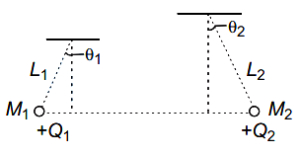
A
$M_{1} \neq M_{2}$,but $Q_{1}=Q_{2}$
B
$M_{1}=M_{2}$
C
$Q_{1}=Q_{2}$
D
$L_{1}=L_{2}$
Solution
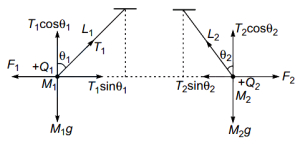
(B) For sphere $1$,in equilibrium:
$T_{1} \cos \theta_{1} = M_{1} g$
$T_{1} \sin \theta_{1} = F$
Dividing the two equations,we get:
$\tan \theta_{1} = \frac{F}{M_{1} g}$
Similarly,for sphere $2$,in equilibrium:
$T_{2} \cos \theta_{2} = M_{2} g$
$T_{2} \sin \theta_{2} = F$
Dividing the two equations,we get:
$\tan \theta_{2} = \frac{F}{M_{2} g}$
Here,$F$ is the electrostatic force of repulsion between the two spheres,which is the same for both spheres according to Newton's third law.
If $\theta_{1} = \theta_{2}$,then $\tan \theta_{1} = \tan \theta_{2}$.
Therefore,$\frac{F}{M_{1} g} = \frac{F}{M_{2} g}$,which implies $M_{1} = M_{2}$.
$T_{1} \cos \theta_{1} = M_{1} g$
$T_{1} \sin \theta_{1} = F$
Dividing the two equations,we get:
$\tan \theta_{1} = \frac{F}{M_{1} g}$
Similarly,for sphere $2$,in equilibrium:
$T_{2} \cos \theta_{2} = M_{2} g$
$T_{2} \sin \theta_{2} = F$
Dividing the two equations,we get:
$\tan \theta_{2} = \frac{F}{M_{2} g}$
Here,$F$ is the electrostatic force of repulsion between the two spheres,which is the same for both spheres according to Newton's third law.
If $\theta_{1} = \theta_{2}$,then $\tan \theta_{1} = \tan \theta_{2}$.
Therefore,$\frac{F}{M_{1} g} = \frac{F}{M_{2} g}$,which implies $M_{1} = M_{2}$.
0 likesView Solution
37
PhysicsEasyMCQKCET · 2010
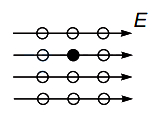
There is a uniform electric field of intensity $E$ as shown in the figure. How many labelled points have the same electric potential as the fully shaded point?
A
$2$
B
$3$
C
$8$
D
$11$
Solution
(A) In a uniform electric field,the electric potential $V$ at a point $(x, y, z)$ is given by $V = -E \cdot r + C$,where $E$ is the electric field vector and $r$ is the position vector.
For a uniform electric field directed along the $x$-axis,the potential depends only on the $x$-coordinate $(V = -Ex + C)$.
Therefore,all points lying on a plane perpendicular to the electric field lines have the same electric potential.
In the given figure,there are $4$ rows of $3$ points each,forming a grid of $12$ points.
The shaded point is in the middle column.
The points that have the same potential as the shaded point are those that lie on the same vertical line (perpendicular to the electric field lines).
There are $3$ points in that vertical column,including the shaded point itself.
Thus,there are $2$ other points that have the same electric potential as the shaded point.
For a uniform electric field directed along the $x$-axis,the potential depends only on the $x$-coordinate $(V = -Ex + C)$.
Therefore,all points lying on a plane perpendicular to the electric field lines have the same electric potential.
In the given figure,there are $4$ rows of $3$ points each,forming a grid of $12$ points.
The shaded point is in the middle column.
The points that have the same potential as the shaded point are those that lie on the same vertical line (perpendicular to the electric field lines).
There are $3$ points in that vertical column,including the shaded point itself.
Thus,there are $2$ other points that have the same electric potential as the shaded point.
0 likesView Solution
38
PhysicsEasyMCQKCET · 2010
The magnetic field at the centre of a circular coil of radius $R$ due to current $i$ flowing through it is $B$. The magnetic field at a point along the axis at a distance $R$ from the centre is
A
$\frac{B}{2}$
B
$\frac{B}{4}$
C
$\frac{B}{\sqrt{8}}$
D
$\sqrt{8} \,B$
Solution
(C) The magnetic field at the centre of a circular coil of radius $R$ carrying current $i$ is given by $B = \frac{\mu_{0} i}{2 R}$.
The magnetic field at a point on the axis of the coil at a distance $x$ from the centre is given by $B_{axis} = \frac{\mu_{0} i R^{2}}{2(R^{2} + x^{2})^{3/2}}$.
Given $x = R$,we substitute this into the formula:
$B_{axis} = \frac{\mu_{0} i R^{2}}{2(R^{2} + R^{2})^{3/2}}$
$B_{axis} = \frac{\mu_{0} i R^{2}}{2(2R^{2})^{3/2}}$
$B_{axis} = \frac{\mu_{0} i R^{2}}{2(2^{3/2} R^{3})}$
$B_{axis} = \frac{\mu_{0} i}{2 R \cdot 2^{3/2}}$
Since $2^{3/2} = \sqrt{8}$,we have:
$B_{axis} = \frac{B}{\sqrt{8}}$.
The magnetic field at a point on the axis of the coil at a distance $x$ from the centre is given by $B_{axis} = \frac{\mu_{0} i R^{2}}{2(R^{2} + x^{2})^{3/2}}$.
Given $x = R$,we substitute this into the formula:
$B_{axis} = \frac{\mu_{0} i R^{2}}{2(R^{2} + R^{2})^{3/2}}$
$B_{axis} = \frac{\mu_{0} i R^{2}}{2(2R^{2})^{3/2}}$
$B_{axis} = \frac{\mu_{0} i R^{2}}{2(2^{3/2} R^{3})}$
$B_{axis} = \frac{\mu_{0} i}{2 R \cdot 2^{3/2}}$
Since $2^{3/2} = \sqrt{8}$,we have:
$B_{axis} = \frac{B}{\sqrt{8}}$.
0 likesView Solution
39
PhysicsMediumMCQKCET · 2010
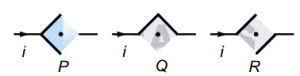
Two thick wires and two thin wires,all of the same material and same length,form a square in three different ways $P, Q,$ and $R$ as shown in the figure. With the correct connections shown,the magnetic field due to the current flow at the centre of the loop will be zero in the case of:
A
$Q$ and $R$
B
$P$ only
C
$P$ and $Q$
D
$P$ and $R$
Solution
(D) The magnetic field at the centre of a loop is zero if the current splits into two paths such that the magnetic fields produced by the two paths at the centre are equal in magnitude and opposite in direction.
In configuration $P$,the two paths consist of one thick and one thin wire each. Since the total resistance of each path is the same,the current divides equally. The magnetic fields produced by these two symmetric paths cancel each other out.
In configuration $R$,the two paths are also symmetric,each consisting of one thick and one thin wire connected in series. Thus,the current divides equally,and the magnetic field at the centre is zero.
In configuration $Q$,the two paths consist of two thick wires and two thin wires respectively. Since the resistances are different,the currents are unequal,and the magnetic fields do not cancel out.
Therefore,the magnetic field at the centre is zero in cases $P$ and $R$.
In configuration $P$,the two paths consist of one thick and one thin wire each. Since the total resistance of each path is the same,the current divides equally. The magnetic fields produced by these two symmetric paths cancel each other out.
In configuration $R$,the two paths are also symmetric,each consisting of one thick and one thin wire connected in series. Thus,the current divides equally,and the magnetic field at the centre is zero.
In configuration $Q$,the two paths consist of two thick wires and two thin wires respectively. Since the resistances are different,the currents are unequal,and the magnetic fields do not cancel out.
Therefore,the magnetic field at the centre is zero in cases $P$ and $R$.
0 likesView Solution
40
PhysicsDifficultMCQKCET · 2010
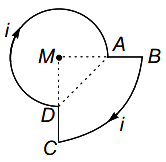
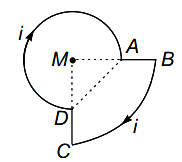
$A$ current $i$ is flowing through the loop. The direction of the current and the shape of the loop are as shown in the figure. The magnetic field at the centre $M$ of the loop is $\frac{\mu_{0} i}{R}$ times
$(MA=R, MB=2 R, \angle DMA=90^{\circ})$
$(MA=R, MB=2 R, \angle DMA=90^{\circ})$
A
$\frac{5}{16}$,but out of the plane of the paper
B
$\frac{5}{16}$,but into the plane of the paper
C
$\frac{7}{16}$,but out of the plane of the paper
D
$\frac{7}{16}$,but into the plane of the paper
Solution
(D) The loop consists of four parts: two radial segments ($AB$ and $CD$) and two circular arcs ($DA$ and $BC$).
$(i)$ For the radial segments $AB$ and $CD$,the magnetic field at the center $M$ is zero because the point $M$ lies on the line of the current elements.
(ii) For the circular arc $DA$ with radius $R$ and angle $\theta_1 = 270^{\circ} = \frac{3\pi}{2}$ radians,the magnetic field at $M$ is $B_1 = \frac{\mu_0 i \theta_1}{4\pi R} = \frac{\mu_0 i (3\pi/2)}{4\pi R} = \frac{3\mu_0 i}{8R}$. By the right-hand rule,the direction is into the plane of the paper.
(iii) For the circular arc $BC$ with radius $2R$ and angle $\theta_2 = 90^{\circ} = \frac{\pi}{2}$ radians,the magnetic field at $M$ is $B_2 = \frac{\mu_0 i \theta_2}{4\pi (2R)} = \frac{\mu_0 i (\pi/2)}{8\pi R} = \frac{\mu_0 i}{16R}$. By the right-hand rule,the direction is into the plane of the paper.
(iv) The total magnetic field at $M$ is $B = B_1 + B_2 = \frac{3\mu_0 i}{8R} + \frac{\mu_0 i}{16R} = \frac{6\mu_0 i + \mu_0 i}{16R} = \frac{7\mu_0 i}{16R}$.
Since both fields are directed into the plane of the paper,the resultant field is $\frac{7}{16} \frac{\mu_0 i}{R}$ into the plane of the paper.
$(i)$ For the radial segments $AB$ and $CD$,the magnetic field at the center $M$ is zero because the point $M$ lies on the line of the current elements.
(ii) For the circular arc $DA$ with radius $R$ and angle $\theta_1 = 270^{\circ} = \frac{3\pi}{2}$ radians,the magnetic field at $M$ is $B_1 = \frac{\mu_0 i \theta_1}{4\pi R} = \frac{\mu_0 i (3\pi/2)}{4\pi R} = \frac{3\mu_0 i}{8R}$. By the right-hand rule,the direction is into the plane of the paper.
(iii) For the circular arc $BC$ with radius $2R$ and angle $\theta_2 = 90^{\circ} = \frac{\pi}{2}$ radians,the magnetic field at $M$ is $B_2 = \frac{\mu_0 i \theta_2}{4\pi (2R)} = \frac{\mu_0 i (\pi/2)}{8\pi R} = \frac{\mu_0 i}{16R}$. By the right-hand rule,the direction is into the plane of the paper.
(iv) The total magnetic field at $M$ is $B = B_1 + B_2 = \frac{3\mu_0 i}{8R} + \frac{\mu_0 i}{16R} = \frac{6\mu_0 i + \mu_0 i}{16R} = \frac{7\mu_0 i}{16R}$.
Since both fields are directed into the plane of the paper,the resultant field is $\frac{7}{16} \frac{\mu_0 i}{R}$ into the plane of the paper.
0 likesView Solution
41
PhysicsMediumMCQKCET · 2010
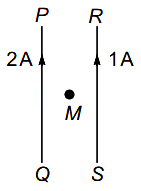
$PQ$ and $RS$ are long parallel conductors separated by a certain distance. $M$ is the midpoint between them (see the figure). The net magnetic field at $M$ is $B$. Now,the current $2 \text{ A}$ is switched off. The field at $M$ now becomes
A
$2 \text{ B}$
B
$B$
C
$\frac{B}{2}$
D
$3 \text{ B}$
Solution
(B) Let the distance of $M$ from each wire be $r$. The magnetic field due to a long straight wire carrying current $I$ at a distance $r$ is given by $B = \frac{\mu_0 I}{2 \pi r}$.
In the first case,the currents are $I_1 = 2 \text{ A}$ and $I_2 = 1 \text{ A}$ in the same direction. Using the right-hand rule,the magnetic fields at $M$ due to these wires are in opposite directions.
$B_{PQ} = \frac{\mu_0 (2)}{2 \pi r} = \frac{\mu_0}{\pi r}$
$B_{RS} = \frac{\mu_0 (1)}{2 \pi r} = \frac{\mu_0}{2 \pi r}$
The net magnetic field at $M$ is $B = B_{PQ} - B_{RS} = \frac{\mu_0}{\pi r} - \frac{\mu_0}{2 \pi r} = \frac{\mu_0}{2 \pi r}$.
When the current $2 \text{ A}$ is switched off,only the current $I_2 = 1 \text{ A}$ remains.
The new magnetic field at $M$ is $B' = B_{RS} = \frac{\mu_0 (1)}{2 \pi r} = \frac{\mu_0}{2 \pi r}$.
Comparing the two,we get $B' = B$.
In the first case,the currents are $I_1 = 2 \text{ A}$ and $I_2 = 1 \text{ A}$ in the same direction. Using the right-hand rule,the magnetic fields at $M$ due to these wires are in opposite directions.
$B_{PQ} = \frac{\mu_0 (2)}{2 \pi r} = \frac{\mu_0}{\pi r}$
$B_{RS} = \frac{\mu_0 (1)}{2 \pi r} = \frac{\mu_0}{2 \pi r}$
The net magnetic field at $M$ is $B = B_{PQ} - B_{RS} = \frac{\mu_0}{\pi r} - \frac{\mu_0}{2 \pi r} = \frac{\mu_0}{2 \pi r}$.
When the current $2 \text{ A}$ is switched off,only the current $I_2 = 1 \text{ A}$ remains.
The new magnetic field at $M$ is $B' = B_{RS} = \frac{\mu_0 (1)}{2 \pi r} = \frac{\mu_0}{2 \pi r}$.
Comparing the two,we get $B' = B$.
0 likesView Solution
42
PhysicsDifficultMCQKCET · 2010
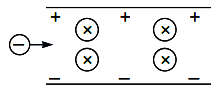
An electron enters the space between the plates of a charged capacitor as shown. The surface charge density on the plates is $\sigma$. The electric field intensity in the space between the plates is $E$. $A$ uniform magnetic field $B$ also exists in the space,perpendicular to the direction of $E$. The electron moves perpendicular to both $\overrightarrow{E}$ and $\overrightarrow{B}$ without any change in direction. The time taken by the electron to travel a distance $l$ in the space is:
A
$\frac{\sigma l}{\varepsilon_{0} B}$
B
$\frac{\sigma B}{\varepsilon_{0} l}$
C
$\frac{\varepsilon_{0} l B}{\sigma}$
D
$\frac{\varepsilon_{0} l}{\sigma B}$
Solution
(C) Since the electron moves without any change in direction,the net force on it must be zero. This means the electrostatic force is balanced by the magnetic force.
$F_e = F_m$
$qE = qvB$
$v = \frac{E}{B}$
For a parallel plate capacitor,the electric field is given by $E = \frac{\sigma}{\varepsilon_{0}}$.
Substituting this into the velocity equation:
$v = \frac{\sigma}{\varepsilon_{0} B}$
The time $t$ taken to travel a distance $l$ is given by:
$t = \frac{l}{v} = \frac{l}{\frac{\sigma}{\varepsilon_{0} B}} = \frac{\varepsilon_{0} l B}{\sigma}$
$F_e = F_m$
$qE = qvB$
$v = \frac{E}{B}$
For a parallel plate capacitor,the electric field is given by $E = \frac{\sigma}{\varepsilon_{0}}$.
Substituting this into the velocity equation:
$v = \frac{\sigma}{\varepsilon_{0} B}$
The time $t$ taken to travel a distance $l$ is given by:
$t = \frac{l}{v} = \frac{l}{\frac{\sigma}{\varepsilon_{0} B}} = \frac{\varepsilon_{0} l B}{\sigma}$
0 likesView Solution
43
PhysicsEasyMCQKCET · 2010
$A$ charge $+Q$ is moving upwards vertically. It enters a magnetic field directed to the north. The force on the charge will be towards
A
north
B
south
C
east
D
west
Solution
(D) The force on a moving charge in a magnetic field is given by the Lorentz force formula: $\vec{F} = q(\vec{v} \times \vec{B})$.
Here,the velocity vector $\vec{v}$ is directed upwards (let this be the $+z$ direction).
The magnetic field $\vec{B}$ is directed towards the north (let this be the $+y$ direction).
Using the right-hand rule for the cross product $\vec{v} \times \vec{B}$:
Point your fingers in the direction of $\vec{v}$ (upwards) and curl them towards $\vec{B}$ (north).
The thumb points in the direction of the force,which is towards the west ($-x$ direction).
Therefore,the correct option is $D$.
Here,the velocity vector $\vec{v}$ is directed upwards (let this be the $+z$ direction).
The magnetic field $\vec{B}$ is directed towards the north (let this be the $+y$ direction).
Using the right-hand rule for the cross product $\vec{v} \times \vec{B}$:
Point your fingers in the direction of $\vec{v}$ (upwards) and curl them towards $\vec{B}$ (north).
The thumb points in the direction of the force,which is towards the west ($-x$ direction).
Therefore,the correct option is $D$.
0 likesView Solution
44
PhysicsMediumMCQKCET · 2010
Assume the graph of specific binding energy versus mass number is as shown in the figure. Using this graph,select the correct choice from the following.
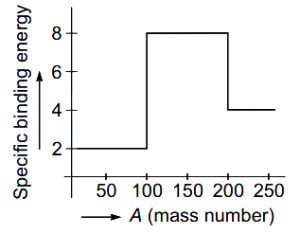
A
Fusion of two nuclei of mass number lying in the range of $100 < A < 200$ will release energy.
B
Fusion of two nuclei of mass number lying in the range of $51 < A < 100$ will release energy.
C
Fusion of two nuclei of mass number lying in the range of $1 < A < 50$ will release energy.
D
Fission of the nucleus of mass number lying in the range of $100 < A < 200$ will release energy when broken into two fragments.
Solution
(B) Energy is released in a nuclear reaction if the total binding energy of the products is greater than the total binding energy of the reactants. This corresponds to an increase in the specific binding energy (binding energy per nucleon).
From the graph:
$1$. For $1 < A < 100$,the specific binding energy is $2 \text{ MeV/nucleon}$.
$2$. For $100 < A < 200$,the specific binding energy is $8 \text{ MeV/nucleon}$.
$3$. For $200 < A < 250$,the specific binding energy is $4 \text{ MeV/nucleon}$.
If two nuclei with mass numbers in the range $51 < A < 100$ (each with specific binding energy $2 \text{ MeV/nucleon}$) fuse to form a nucleus with mass number in the range $100 < A < 200$ (with specific binding energy $8 \text{ MeV/nucleon}$),the final state has a higher specific binding energy. Thus,energy is released.
From the graph:
$1$. For $1 < A < 100$,the specific binding energy is $2 \text{ MeV/nucleon}$.
$2$. For $100 < A < 200$,the specific binding energy is $8 \text{ MeV/nucleon}$.
$3$. For $200 < A < 250$,the specific binding energy is $4 \text{ MeV/nucleon}$.
If two nuclei with mass numbers in the range $51 < A < 100$ (each with specific binding energy $2 \text{ MeV/nucleon}$) fuse to form a nucleus with mass number in the range $100 < A < 200$ (with specific binding energy $8 \text{ MeV/nucleon}$),the final state has a higher specific binding energy. Thus,energy is released.
0 likesView Solution
45
PhysicsEasyMCQKCET · 2010
Pick out the correct statement from the following.
A
Energy released per unit mass of the reactant is less in case of fusion reaction
B
Packing fraction may be positive or may be negative
C
$Pu^{239}$ is not suitable for a fission reaction
D
For stable nucleus,the specific binding energy is low
Solution
(B) The packing fraction $(f)$ is defined as the mass defect per nucleon,given by $f = \frac{m - A}{A}$,where $m$ is the mass of the nucleus and $A$ is the mass number.
Packing fraction is a measure of the stability of a nucleus.
$A$ smaller (or more negative) value of the packing fraction indicates higher stability of the nucleus.
The packing fraction can be positive,negative,or zero depending on the mass number of the nucleus.
Therefore,the statement that the packing fraction may be positive or negative is correct.
Packing fraction is a measure of the stability of a nucleus.
$A$ smaller (or more negative) value of the packing fraction indicates higher stability of the nucleus.
The packing fraction can be positive,negative,or zero depending on the mass number of the nucleus.
Therefore,the statement that the packing fraction may be positive or negative is correct.
0 likesView Solution
46
PhysicsMediumMCQKCET · 2010
$A$ radioactive sample $S_{1}$ having the activity $A_{1}$ has twice the number of nuclei as another sample $S_{2}$ of activity $A_{2}$. If $A_{2} = 2 A_{1}$,then the ratio of half-life of $S_{1}$ to the half-life of $S_{2}$ is
A
$4$
B
$2$
C
$0.25$
D
$0.75$
Solution
(A) The activity $A$ of a radioactive sample is given by $A = \lambda N = \frac{0.693}{T_{1/2}} N$,where $N$ is the number of nuclei and $T_{1/2}$ is the half-life.
From the given information,$N_{1} = 2 N_{2}$ and $A_{2} = 2 A_{1}$.
We can write the ratio of activities as:
$\frac{A_{1}}{A_{2}} = \frac{N_{1} / T_{1}}{N_{2} / T_{2}} = \frac{N_{1}}{N_{2}} \times \frac{T_{2}}{T_{1}}$
Rearranging for the ratio of half-lives $\frac{T_{1}}{T_{2}}$:
$\frac{T_{1}}{T_{2}} = \frac{A_{2}}{A_{1}} \times \frac{N_{1}}{N_{2}}$
Substituting the given values:
$\frac{T_{1}}{T_{2}} = \frac{2 A_{1}}{A_{1}} \times \frac{2 N_{2}}{N_{2}} = 2 \times 2 = 4$
Thus,the ratio of the half-life of $S_{1}$ to the half-life of $S_{2}$ is $4$.
From the given information,$N_{1} = 2 N_{2}$ and $A_{2} = 2 A_{1}$.
We can write the ratio of activities as:
$\frac{A_{1}}{A_{2}} = \frac{N_{1} / T_{1}}{N_{2} / T_{2}} = \frac{N_{1}}{N_{2}} \times \frac{T_{2}}{T_{1}}$
Rearranging for the ratio of half-lives $\frac{T_{1}}{T_{2}}$:
$\frac{T_{1}}{T_{2}} = \frac{A_{2}}{A_{1}} \times \frac{N_{1}}{N_{2}}$
Substituting the given values:
$\frac{T_{1}}{T_{2}} = \frac{2 A_{1}}{A_{1}} \times \frac{2 N_{2}}{N_{2}} = 2 \times 2 = 4$
Thus,the ratio of the half-life of $S_{1}$ to the half-life of $S_{2}$ is $4$.
0 likesView Solution
47
PhysicsEasyMCQKCET · 2010
When a neutron is disintegrated to give a $\beta$-particle,which of the following is also emitted?
A
a neutrino alone is emitted
B
a proton and neutrino are emitted
C
a proton alone is emitted
D
a proton and an antineutrino are emitted
Solution
(D) $\beta^{-}$-particle is an electron. The emission of a $\beta^{-}$-particle involves the transformation of a neutron into a proton,an electron,and a third particle called an antineutrino $(\bar{\nu})$.
The nuclear reaction is given by:
${ }_{0} n^{1} \rightarrow { }_{1} p^{1} + { }_{-1} e^{0} + \bar{\nu}$
The nuclear reaction is given by:
${ }_{0} n^{1} \rightarrow { }_{1} p^{1} + { }_{-1} e^{0} + \bar{\nu}$
0 likesView Solution
48
PhysicsEasyMCQKCET · 2010
$A$ point object $O$ is placed in front of a glass rod having a spherical end of radius of curvature $30 \,cm$. The image would be formed at
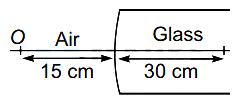
A
$30 \,cm$ to the left
B
infinity
C
$1 \,cm$ to the right
D
$18 \,cm$ to the left
Solution
(A) Given: Object distance $u = -15 \,cm$ (as it is placed to the left of the pole).
Radius of curvature $R = +30 \,cm$ (as the center of curvature is to the right of the pole).
Refractive index of air $\mu_1 = 1$.
Refractive index of glass $\mu_2 = 1.5$.
Using the refraction formula at a spherical surface:
$\frac{\mu_2}{v} - \frac{\mu_1}{u} = \frac{\mu_2 - \mu_1}{R}$
Substituting the values:
$\frac{1.5}{v} - \frac{1}{-15} = \frac{1.5 - 1}{30}$
$\frac{1.5}{v} + \frac{1}{15} = \frac{0.5}{30}$
$\frac{1.5}{v} = \frac{1}{60} - \frac{1}{15}$
$\frac{1.5}{v} = \frac{1 - 4}{60} = \frac{-3}{60} = -\frac{1}{20}$
$v = 1.5 \times (-20) = -30 \,cm$.
The negative sign indicates that the image is formed $30 \,cm$ to the left of the pole,on the same side as the object.
Radius of curvature $R = +30 \,cm$ (as the center of curvature is to the right of the pole).
Refractive index of air $\mu_1 = 1$.
Refractive index of glass $\mu_2 = 1.5$.
Using the refraction formula at a spherical surface:
$\frac{\mu_2}{v} - \frac{\mu_1}{u} = \frac{\mu_2 - \mu_1}{R}$
Substituting the values:
$\frac{1.5}{v} - \frac{1}{-15} = \frac{1.5 - 1}{30}$
$\frac{1.5}{v} + \frac{1}{15} = \frac{0.5}{30}$
$\frac{1.5}{v} = \frac{1}{60} - \frac{1}{15}$
$\frac{1.5}{v} = \frac{1 - 4}{60} = \frac{-3}{60} = -\frac{1}{20}$
$v = 1.5 \times (-20) = -30 \,cm$.
The negative sign indicates that the image is formed $30 \,cm$ to the left of the pole,on the same side as the object.
0 likesView Solution
49
PhysicsEasyMCQKCET · 2010
$A$ plano-convex lens is made of refractive index of $1.6$. The radius of curvature of the curved surface is $60 \,cm$. The focal length of the lens is (in $\,cm$)
A
$400$
B
$200$
C
$100$
D
$50$
Solution
(C) The lens maker's formula is given by $\frac{1}{f} = (\mu - 1) \left[ \frac{1}{R_1} - \frac{1}{R_2} \right]$.
For a plano-convex lens, one surface is plane $(R_1 = 60 \,cm)$ and the other is plane $(R_2 = \infty)$.
Given refractive index $\mu = 1.6$ and radius of curvature $R_1 = 60 \,cm$.
Substituting the values in the formula:
$\frac{1}{f} = (1.6 - 1) \left[ \frac{1}{60} - \frac{1}{\infty} \right]$
$\frac{1}{f} = 0.6 \times \left[ \frac{1}{60} - 0 \right]$
$\frac{1}{f} = \frac{0.6}{60} = \frac{6}{600} = \frac{1}{100}$
Therefore, the focal length $f = 100 \,cm$.
For a plano-convex lens, one surface is plane $(R_1 = 60 \,cm)$ and the other is plane $(R_2 = \infty)$.
Given refractive index $\mu = 1.6$ and radius of curvature $R_1 = 60 \,cm$.
Substituting the values in the formula:
$\frac{1}{f} = (1.6 - 1) \left[ \frac{1}{60} - \frac{1}{\infty} \right]$
$\frac{1}{f} = 0.6 \times \left[ \frac{1}{60} - 0 \right]$
$\frac{1}{f} = \frac{0.6}{60} = \frac{6}{600} = \frac{1}{100}$
Therefore, the focal length $f = 100 \,cm$.
0 likesView Solution
50
PhysicsEasyMCQKCET · 2010
Two beams of red and violet colours are made to pass separately through a prism of $A=60^{\circ}$. In the minimum deviation position,the angle of refraction inside the prism will be
A
greater for red colour
B
equal but not $30^{\circ}$ for both the colours
C
greater for violet colour
D
$30^{\circ}$ for both the colours
Solution
(D) For a prism,the angle of deviation is given by $\delta = (i + e) - A$.
In the position of minimum deviation,the angle of incidence is equal to the angle of emergence,i.e.,$i = e$.
Under this condition,the light ray inside the prism travels parallel to the base,and the angle of refraction $r$ is given by $r_1 = r_2 = r$.
Since $A = r_1 + r_2$,we have $A = 2r$.
Given the prism angle $A = 60^{\circ}$,the angle of refraction is $r = \frac{A}{2} = \frac{60^{\circ}}{2} = 30^{\circ}$.
This condition is independent of the wavelength or colour of the light.
Therefore,the angle of refraction is $30^{\circ}$ for both red and violet colours.
In the position of minimum deviation,the angle of incidence is equal to the angle of emergence,i.e.,$i = e$.
Under this condition,the light ray inside the prism travels parallel to the base,and the angle of refraction $r$ is given by $r_1 = r_2 = r$.
Since $A = r_1 + r_2$,we have $A = 2r$.
Given the prism angle $A = 60^{\circ}$,the angle of refraction is $r = \frac{A}{2} = \frac{60^{\circ}}{2} = 30^{\circ}$.
This condition is independent of the wavelength or colour of the light.
Therefore,the angle of refraction is $30^{\circ}$ for both red and violet colours.
0 likesView Solution
51
PhysicsDifficultMCQKCET · 2010
$A$,$B$ and $C$ are parallel-sided transparent media of refractive indices $n_{1}$,$n_{2}$ and $n_{3}$ respectively. They are arranged as shown in the figure. $A$ ray is incident at an angle $i$ on the surface of separation of $A$ and $B$. After refraction into medium $B$,the ray grazes the surface of separation of media $B$ and $C$. Then,$\sin i$ equals to
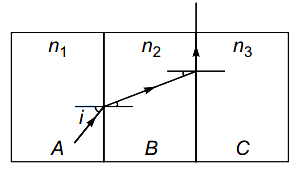
A
$\frac{n_{3}}{n_{1}}$
B
$\frac{n_{1}}{n_{3}}$
C
$\frac{n_{2}}{n_{3}}$
D
$\frac{n_{1}}{n_{2}}$
Solution
(A) Applying Snell's law at the interface of media $A$ and $B$:
$n_{1} \sin i = n_{2} \sin r_{1} \quad \text{...(i)}$
Applying Snell's law at the interface of media $B$ and $C$:
$n_{2} \sin r_{1} = n_{3} \sin r_{2} \quad \text{...(ii)}$
Since the ray grazes the surface of separation of media $B$ and $C$,the angle of refraction $r_{2} = 90^{\circ}$.
Substituting $r_{2} = 90^{\circ}$ in equation (ii):
$n_{2} \sin r_{1} = n_{3} \sin 90^{\circ} = n_{3}$
Now,substitute $n_{2} \sin r_{1} = n_{3}$ into equation $(i)$:
$n_{1} \sin i = n_{3}$
$\sin i = \frac{n_{3}}{n_{1}}$
$n_{1} \sin i = n_{2} \sin r_{1} \quad \text{...(i)}$
Applying Snell's law at the interface of media $B$ and $C$:
$n_{2} \sin r_{1} = n_{3} \sin r_{2} \quad \text{...(ii)}$
Since the ray grazes the surface of separation of media $B$ and $C$,the angle of refraction $r_{2} = 90^{\circ}$.
Substituting $r_{2} = 90^{\circ}$ in equation (ii):
$n_{2} \sin r_{1} = n_{3} \sin 90^{\circ} = n_{3}$
Now,substitute $n_{2} \sin r_{1} = n_{3}$ into equation $(i)$:
$n_{1} \sin i = n_{3}$
$\sin i = \frac{n_{3}}{n_{1}}$
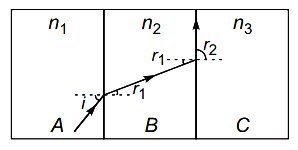
0 likesView Solution
52
PhysicsMediumMCQKCET · 2010
$A$ boat has a green light of wavelength $\lambda = 500 \ nm$ on the mast. What wavelength would be measured and what colour would be observed for this light as seen by a diver submerged in water by the side of the boat? Given,$n_{w} = 4/3$.
A
Green of wavelength $376 \ nm$
B
Red of wavelength $665 \ nm$
C
Green of wavelength $500 \ nm$
D
Blue of wavelength $376 \ nm$
Solution
(D) When light travels from a rarer medium (air) to a denser medium (water),its frequency remains constant,but its wavelength changes.
The wavelength in water is given by the formula $\lambda_{w} = \frac{\lambda_{a}}{n_{w}}$,where $\lambda_{a}$ is the wavelength in air and $n_{w}$ is the refractive index of water.
Substituting the given values: $\lambda_{w} = \frac{500 \ nm}{4/3} = 500 \times \frac{3}{4} \ nm = 375 \ nm$.
Rounding this value,we get $\lambda_{w} \approx 376 \ nm$.
Since the wavelength of light shifts towards the blue end of the spectrum ($376 \ nm$ falls in the blue region),the diver will observe the light as blue.
The wavelength in water is given by the formula $\lambda_{w} = \frac{\lambda_{a}}{n_{w}}$,where $\lambda_{a}$ is the wavelength in air and $n_{w}$ is the refractive index of water.
Substituting the given values: $\lambda_{w} = \frac{500 \ nm}{4/3} = 500 \times \frac{3}{4} \ nm = 375 \ nm$.
Rounding this value,we get $\lambda_{w} \approx 376 \ nm$.
Since the wavelength of light shifts towards the blue end of the spectrum ($376 \ nm$ falls in the blue region),the diver will observe the light as blue.
0 likesView Solution
53
PhysicsEasyMCQKCET · 2010
In a $p-n$ junction diode not connected to any circuit:
A
the potential is the same everywhere
B
the $p$-type side has a higher potential than the $n$-type side
C
there is an electric field at the junction directed from the $n$-type side to $p$-type side
D
there is an electric field at the junction directed from the $p$-type side to $n$-type side
Solution
(C) When a $p-n$ junction is formed,electrons diffuse from the $n$-region to the $p$-region,and holes diffuse from the $p$-region to the $n$-region. This leaves behind immobile ionized donors in the $n$-region (positive charge) and immobile ionized acceptors in the $p$-region (negative charge).
This creates a depletion region at the junction with a built-in potential difference. The $n$-side becomes positive relative to the $p$-side.
Since the electric field lines are directed from positive potential to negative potential,the electric field at the junction is directed from the $n$-type side to the $p$-type side.
This creates a depletion region at the junction with a built-in potential difference. The $n$-side becomes positive relative to the $p$-side.
Since the electric field lines are directed from positive potential to negative potential,the electric field at the junction is directed from the $n$-type side to the $p$-type side.
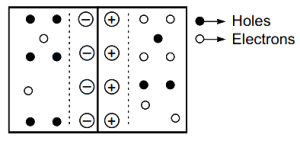
0 likesView Solution
54
PhysicsEasyMCQKCET · 2010
The forbidden energy gap in $Ge$ is $0.72 eV$. Given $hc = 12400 eV-Å$. The maximum wavelength of radiation that will generate an electron-hole pair is: (in $Å$)
A
$172220$
B
$172.2$
C
$17222$
D
$1722$
Solution
(C) The energy required to generate an electron-hole pair is equal to the forbidden energy gap $E_{g}$.
For a photon to create an electron-hole pair,its energy must be at least equal to $E_{g}$.
The relationship between energy and wavelength is given by $E = \frac{hc}{\lambda}$.
To find the maximum wavelength $\lambda_{max}$,we use the minimum energy $E_{g}$:
$\lambda_{max} = \frac{hc}{E_{g}}$
Substituting the given values:
$\lambda_{max} = \frac{12400 eV-Å}{0.72 eV}$
$\lambda_{max} = 17222.22 Å$
Rounding to the nearest integer,we get $\lambda_{max} = 17222 Å$.
For a photon to create an electron-hole pair,its energy must be at least equal to $E_{g}$.
The relationship between energy and wavelength is given by $E = \frac{hc}{\lambda}$.
To find the maximum wavelength $\lambda_{max}$,we use the minimum energy $E_{g}$:
$\lambda_{max} = \frac{hc}{E_{g}}$
Substituting the given values:
$\lambda_{max} = \frac{12400 eV-Å}{0.72 eV}$
$\lambda_{max} = 17222.22 Å$
Rounding to the nearest integer,we get $\lambda_{max} = 17222 Å$.
0 likesView Solution
55
PhysicsEasyMCQKCET · 2010
Identify the logic operation performed by the circuit given here.
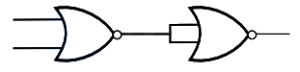
A
$OR$
B
$NOR$
C
$NOT$
D
$NAND$
Solution
(A) The given circuit consists of a $NOR$ gate followed by a $NOR$ gate with its inputs shorted together,which acts as a $NOT$ gate.
Let the inputs to the first $NOR$ gate be $A$ and $B$. The output of the first $NOR$ gate is $Y' = \overline{A+B}$.
This output $Y'$ is fed into both inputs of the second $NOR$ gate. The output of the second $NOR$ gate is $Y = \overline{Y' + Y'} = \overline{Y'} = \overline{\overline{A+B}}$.
Using the law of double negation,$\overline{\overline{X}} = X$,we get $Y = A+B$.
This is the Boolean expression for an $OR$ gate.
Let the inputs to the first $NOR$ gate be $A$ and $B$. The output of the first $NOR$ gate is $Y' = \overline{A+B}$.
This output $Y'$ is fed into both inputs of the second $NOR$ gate. The output of the second $NOR$ gate is $Y = \overline{Y' + Y'} = \overline{Y'} = \overline{\overline{A+B}}$.
Using the law of double negation,$\overline{\overline{X}} = X$,we get $Y = A+B$.
This is the Boolean expression for an $OR$ gate.
0 likesView Solution
56
PhysicsDifficultMCQKCET · 2010
Red light of wavelength $625 \, nm$ is incident normally on an optical diffraction grating with $2 \times 10^{5} \, \text{lines}/m$. Including the central principal maxima, how many maxima may be observed on a screen which is far from the grating?
A
$15$
B
$17$
C
$8$
D
$16$
Solution
(B) The condition for principal maxima in a diffraction grating is given by $d \sin \theta = n \lambda$, where $d = \frac{1}{N}$ is the grating element and $N$ is the number of lines per unit length.
Thus, $\frac{\sin \theta}{N} = n \lambda$, which implies $n = \frac{\sin \theta}{N \lambda}$.
Given $\lambda = 625 \, nm = 6.25 \times 10^{-7} \, m$ and $N = 2 \times 10^{5} \, \text{lines}/m$.
The maximum possible order $n$ is determined by the condition $\sin \theta \leq 1$, so $n < \frac{1}{N \lambda}$.
$n < \frac{1}{(2 \times 10^{5}) \times (6.25 \times 10^{-7})} = \frac{1}{0.125} = 8$.
Since $n$ must be an integer, the maximum order is $n = 8$.
The total number of maxima observed is given by $2n + 1$ (including the central maximum at $n=0$, and $n$ orders on both sides).
Total maxima $= 2(8) + 1 = 17$.
Thus, $\frac{\sin \theta}{N} = n \lambda$, which implies $n = \frac{\sin \theta}{N \lambda}$.
Given $\lambda = 625 \, nm = 6.25 \times 10^{-7} \, m$ and $N = 2 \times 10^{5} \, \text{lines}/m$.
The maximum possible order $n$ is determined by the condition $\sin \theta \leq 1$, so $n < \frac{1}{N \lambda}$.
$n < \frac{1}{(2 \times 10^{5}) \times (6.25 \times 10^{-7})} = \frac{1}{0.125} = 8$.
Since $n$ must be an integer, the maximum order is $n = 8$.
The total number of maxima observed is given by $2n + 1$ (including the central maximum at $n=0$, and $n$ orders on both sides).
Total maxima $= 2(8) + 1 = 17$.
0 likesView Solution
57
PhysicsMediumMCQKCET · 2010
What is the minimum thickness of a thin film required for constructive interference in the reflected light from it (in $ nm$)? Given, the refractive index of the film $= 1.5$, wavelength of the light incident on the film $= 600 \, nm$.
A
$100$
B
$300$
C
$50$
D
$200$
Solution
(A) The condition for constructive interference in reflected light from a thin film is given by $2 \mu t = (2n + 1) \frac{\lambda}{2}$, where $n = 0, 1, 2, \dots$ and $\mu$ is the refractive index, $t$ is the thickness, and $\lambda$ is the wavelength.
For the minimum thickness, we take $n = 0$.
Substituting the values: $2 \mu t = \frac{\lambda}{2}$.
Rearranging for $t$: $t = \frac{\lambda}{4 \mu}$.
Given $\lambda = 600 \, nm$ and $\mu = 1.5$, we get $t = \frac{600}{4 \times 1.5} = \frac{600}{6} = 100 \, nm$.
For the minimum thickness, we take $n = 0$.
Substituting the values: $2 \mu t = \frac{\lambda}{2}$.
Rearranging for $t$: $t = \frac{\lambda}{4 \mu}$.
Given $\lambda = 600 \, nm$ and $\mu = 1.5$, we get $t = \frac{600}{4 \times 1.5} = \frac{600}{6} = 100 \, nm$.
0 likesView Solution
58
PhysicsEasyMCQKCET · 2010
Critical angle for a certain medium is $\sin ^{-1}(0.6)$. The polarizing angle of that medium is
A
$\tan ^{-1}(1.5)$
B
$\sin ^{-1}(0.8)$
C
$\tan ^{-1}(1.6667)$
D
$\tan ^{-1}(0.6667)$
Solution
(C) The critical angle $C$ is given by $\sin(C) = 0.6$.
The refractive index $\mu$ of the medium is related to the critical angle by the formula $\mu = \frac{1}{\sin(C)}$.
Substituting the value,$\mu = \frac{1}{0.6} = \frac{10}{6} = 1.6667$.
According to Brewster's Law,the polarizing angle $i_p$ is given by $\tan(i_p) = \mu$.
Therefore,$i_p = \tan^{-1}(\mu) = \tan^{-1}(1.6667)$.
The refractive index $\mu$ of the medium is related to the critical angle by the formula $\mu = \frac{1}{\sin(C)}$.
Substituting the value,$\mu = \frac{1}{0.6} = \frac{10}{6} = 1.6667$.
According to Brewster's Law,the polarizing angle $i_p$ is given by $\tan(i_p) = \mu$.
Therefore,$i_p = \tan^{-1}(\mu) = \tan^{-1}(1.6667)$.
0 likesView Solution
59
PhysicsEasyMCQKCET · 2010
The wavelength of the light used in Young's double slit experiment is $\lambda$. The intensity at a point on the screen is $I$,where the path difference is $\frac{\lambda}{6}$. If $I_{0}$ denotes the maximum intensity,then the ratio of $I$ and $I_{0}$ is
A
$0.866$
B
$0.5$
C
$0.707$
D
$0.75$
Solution
(D) The phase difference $\phi$ is related to the path difference $\Delta x$ by the formula: $\phi = \frac{2\pi}{\lambda} \times \Delta x$.
Given the path difference $\Delta x = \frac{\lambda}{6}$,we calculate the phase difference: $\phi = \frac{2\pi}{\lambda} \times \frac{\lambda}{6} = \frac{\pi}{3} = 60^{\circ}$.
The intensity $I$ at any point on the screen is given by $I = I_{0} \cos^{2}\left(\frac{\phi}{2}\right)$,where $I_{0}$ is the maximum intensity.
Substituting the value of $\phi$: $\frac{I}{I_{0}} = \cos^{2}\left(\frac{60^{\circ}}{2}\right) = \cos^{2}(30^{\circ})$.
Since $\cos(30^{\circ}) = \frac{\sqrt{3}}{2}$,we have $\frac{I}{I_{0}} = \left(\frac{\sqrt{3}}{2}\right)^{2} = \frac{3}{4} = 0.75$.
Given the path difference $\Delta x = \frac{\lambda}{6}$,we calculate the phase difference: $\phi = \frac{2\pi}{\lambda} \times \frac{\lambda}{6} = \frac{\pi}{3} = 60^{\circ}$.
The intensity $I$ at any point on the screen is given by $I = I_{0} \cos^{2}\left(\frac{\phi}{2}\right)$,where $I_{0}$ is the maximum intensity.
Substituting the value of $\phi$: $\frac{I}{I_{0}} = \cos^{2}\left(\frac{60^{\circ}}{2}\right) = \cos^{2}(30^{\circ})$.
Since $\cos(30^{\circ}) = \frac{\sqrt{3}}{2}$,we have $\frac{I}{I_{0}} = \left(\frac{\sqrt{3}}{2}\right)^{2} = \frac{3}{4} = 0.75$.
0 likesView Solution
60
PhysicsMediumMCQKCET · 2010
In a given direction,the intensities of the scattered light by a scattering substance for two beams of light are in the ratio of $256:81$. The ratio of the frequency of the first beam to the frequency of the second beam is:
A
$64:127$
B
$1:2$
C
$64:27$
D
None of these
Solution
(D) According to the Rayleigh scattering law,the intensity of scattered light $(I)$ is proportional to the fourth power of its frequency $(f)$,i.e.,$I \propto f^4$.
Given the ratio of intensities $\frac{I_1}{I_2} = \frac{256}{81}$.
Therefore,the ratio of frequencies is $\frac{f_1}{f_2} = (\frac{I_1}{I_2})^{1/4} = (\frac{256}{81})^{1/4} = \frac{4}{3}$.
Since the ratio $4:3$ is not provided in the options,the correct answer is 'None of these'.
Given the ratio of intensities $\frac{I_1}{I_2} = \frac{256}{81}$.
Therefore,the ratio of frequencies is $\frac{f_1}{f_2} = (\frac{I_1}{I_2})^{1/4} = (\frac{256}{81})^{1/4} = \frac{4}{3}$.
Since the ratio $4:3$ is not provided in the options,the correct answer is 'None of these'.
0 likesView Solution
Vedclass Products
For Students
Vedclass Test Series
Mock tests in real KCET style covering Physics with performance analysis. 5-day free trial.
Start Free TrialFor Teachers
Exam Paper Generator
Generate Set A/B/C/D Physics papers from 7.5L+ questions in 2 minutes. 3 chapters free.
Try FreeFor Institutes
Online Exam Module
Run live KCET mock exams with unlimited students, 360° analytics & white-label branding.
See DemoFrequently Asked Questions
How many Physics questions are in KCET 2010?
There are 60 Physics questions from the KCET 2010 paper on Vedclass, each with a detailed step-by-step solution in English.
Are KCET 2010 Physics solutions available in English?
Yes. All solutions on this page are in English. You can also switch to English or Hindi using the language buttons above the questions.
Can I practice KCET 2010 Physics as a timed test?
Yes. Use the Vedclass Test Series to attempt a full KCET mock test covering Physics with time limits and instant score analysis.
Can teachers create Physics papers from KCET previous year questions?
Yes. The Vedclass Exam Paper Generator lets teachers mix KCET Physics questions and generate Set A/B/C/D papers in minutes.
For Teachers & Institutes
Build a Custom Physics Paper
Pick KCET 2010 Physics questions, set difficulty, and generate Set A/B/C/D in 2 minutes.