
MathematicsQ151–250 of 781 questions
Page 4 of 9 · English
151
MathematicsMediumMCQJEE Main · 2021
Let $F_{1}(A, B, C) = (A \wedge \sim B) \vee [\sim C \wedge (A \vee B)] \vee \sim A$ and $F_{2}(A, B) = (A \vee B) \vee (B \rightarrow \sim A)$ be two logical expressions. Then ...... .
A
$F_{1}$ and $F_{2}$ both are tautologies
B
$F_{1}$ is a tautology but $F_{2}$ is not a tautology
C
$F_{1}$ is not a tautology but $F_{2}$ is a tautology
D
Both $F_{1}$ and $F_{2}$ are not tautologies
Solution
(C) For $F_{1}(A, B, C) = (A \wedge \sim B) \vee [\sim C \wedge (A \vee B)] \vee \sim A$:
Using the distributive law:
$F_{1} = [(A \wedge \sim B) \vee \sim A] \vee [\sim C \wedge (A \vee B)]$
$F_{1} = [(A \vee \sim A) \wedge (\sim B \vee \sim A)] \vee [\sim C \wedge (A \vee B)]$
Since $(A \vee \sim A) = t$ (tautology):
$F_{1} = [t \wedge (\sim A \vee \sim B)] \vee [\sim C \wedge (A \vee B)]$
$F_{1} = (\sim A \vee \sim B) \vee [\sim C \wedge (A \vee B)]$.
This expression depends on the values of $A, B, C$,so it is not a tautology.
For $F_{2}(A, B) = (A \vee B) \vee (B \rightarrow \sim A)$:
Using the implication rule $(P \rightarrow Q) = (\sim P \vee Q)$:
$F_{2} = (A \vee B) \vee (\sim B \vee \sim A)$
By commutative and associative laws:
$F_{2} = (A \vee \sim A) \vee (B \vee \sim B)$
$F_{2} = t \vee t = t$.
Thus,$F_{2}$ is a tautology.
Using the distributive law:
$F_{1} = [(A \wedge \sim B) \vee \sim A] \vee [\sim C \wedge (A \vee B)]$
$F_{1} = [(A \vee \sim A) \wedge (\sim B \vee \sim A)] \vee [\sim C \wedge (A \vee B)]$
Since $(A \vee \sim A) = t$ (tautology):
$F_{1} = [t \wedge (\sim A \vee \sim B)] \vee [\sim C \wedge (A \vee B)]$
$F_{1} = (\sim A \vee \sim B) \vee [\sim C \wedge (A \vee B)]$.
This expression depends on the values of $A, B, C$,so it is not a tautology.
For $F_{2}(A, B) = (A \vee B) \vee (B \rightarrow \sim A)$:
Using the implication rule $(P \rightarrow Q) = (\sim P \vee Q)$:
$F_{2} = (A \vee B) \vee (\sim B \vee \sim A)$
By commutative and associative laws:
$F_{2} = (A \vee \sim A) \vee (B \vee \sim B)$
$F_{2} = t \vee t = t$.
Thus,$F_{2}$ is a tautology.
0 likesView Solution
152
MathematicsMediumMCQJEE Main · 2021
If the locus of the mid-point of the line segment from the point $(3, 2)$ to a point on the circle $x^{2} + y^{2} = 1$ is a circle of radius $r$,then $r$ is equal to:
A
$1$
B
$\frac{1}{2}$
C
$\frac{1}{3}$
D
$\frac{1}{4}$
Solution
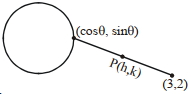
(B) Let the point on the circle be $(\cos \theta, \sin \theta)$.
Let the mid-point of the line segment joining $(3, 2)$ and $(\cos \theta, \sin \theta)$ be $P(h, k)$.
Then,$h = \frac{\cos \theta + 3}{2}$ and $k = \frac{\sin \theta + 2}{2}$.
This implies $\cos \theta = 2h - 3$ and $\sin \theta = 2k - 2$.
Since $\cos^{2} \theta + \sin^{2} \theta = 1$,we have $(2h - 3)^{2} + (2k - 2)^{2} = 1$.
Dividing by $4$,we get $(h - \frac{3}{2})^{2} + (k - 1)^{2} = \frac{1}{4}$.
This represents a circle with radius $r = \sqrt{\frac{1}{4}} = \frac{1}{2}$.
Let the mid-point of the line segment joining $(3, 2)$ and $(\cos \theta, \sin \theta)$ be $P(h, k)$.
Then,$h = \frac{\cos \theta + 3}{2}$ and $k = \frac{\sin \theta + 2}{2}$.
This implies $\cos \theta = 2h - 3$ and $\sin \theta = 2k - 2$.
Since $\cos^{2} \theta + \sin^{2} \theta = 1$,we have $(2h - 3)^{2} + (2k - 2)^{2} = 1$.
Dividing by $4$,we get $(h - \frac{3}{2})^{2} + (k - 1)^{2} = \frac{1}{4}$.
This represents a circle with radius $r = \sqrt{\frac{1}{4}} = \frac{1}{2}$.
0 likesView Solution
153
MathematicsDifficultMCQJEE Main · 2021
If $0 < a, b < 1$ and $\tan^{-1} a + \tan^{-1} b = \frac{\pi}{4}$,then the value of $(a+b) - \left(\frac{a^2+b^2}{2}\right) + \left(\frac{a^3+b^3}{3}\right) - \left(\frac{a^4+b^4}{4}\right) + \dots$ is ..... .
A
$\log_e 2$
B
$e^2 - 1$
C
$e$
D
$\log_e \left(\frac{e}{2}\right)$
Solution
(A) Given $\tan^{-1} a + \tan^{-1} b = \frac{\pi}{4}$ where $0 < a, b < 1$.
Using the formula $\tan^{-1} a + \tan^{-1} b = \tan^{-1} \left(\frac{a+b}{1-ab}\right) = \frac{\pi}{4}$.
Taking $\tan$ on both sides,we get $\frac{a+b}{1-ab} = \tan \frac{\pi}{4} = 1$.
Thus,$a+b = 1-ab$,which implies $a+b+ab = 1$.
Adding $1$ to both sides,we get $1+a+b+ab = 2$,which factors as $(1+a)(1+b) = 2$.
The given series is $S = \left(a - \frac{a^2}{2} + \frac{a^3}{3} - \dots\right) + \left(b - \frac{b^2}{2} + \frac{b^3}{3} - \dots\right)$.
Using the logarithmic expansion $\log_e(1+x) = x - \frac{x^2}{2} + \frac{x^3}{3} - \dots$ for $|x| < 1$,we have:
$S = \log_e(1+a) + \log_e(1+b) = \log_e((1+a)(1+b))$.
Substituting $(1+a)(1+b) = 2$,we get $S = \log_e 2$.
Using the formula $\tan^{-1} a + \tan^{-1} b = \tan^{-1} \left(\frac{a+b}{1-ab}\right) = \frac{\pi}{4}$.
Taking $\tan$ on both sides,we get $\frac{a+b}{1-ab} = \tan \frac{\pi}{4} = 1$.
Thus,$a+b = 1-ab$,which implies $a+b+ab = 1$.
Adding $1$ to both sides,we get $1+a+b+ab = 2$,which factors as $(1+a)(1+b) = 2$.
The given series is $S = \left(a - \frac{a^2}{2} + \frac{a^3}{3} - \dots\right) + \left(b - \frac{b^2}{2} + \frac{b^3}{3} - \dots\right)$.
Using the logarithmic expansion $\log_e(1+x) = x - \frac{x^2}{2} + \frac{x^3}{3} - \dots$ for $|x| < 1$,we have:
$S = \log_e(1+a) + \log_e(1+b) = \log_e((1+a)(1+b))$.
Substituting $(1+a)(1+b) = 2$,we get $S = \log_e 2$.
0 likesView Solution
154
MathematicsDifficultMCQJEE Main · 2021
The sum of the series $\sum_{n=1}^{\infty} \frac{n^{2}+6 n+10}{(2 n+1) !}$ is equal to :
A
$\frac{41}{8} e +\frac{19}{8} e ^{-1}-10$
B
$\frac{41}{8} e -\frac{19}{8} e ^{-1}-10$
C
$\frac{41}{8} e +\frac{19}{8} e ^{-1}+10$
D
$-\frac{41}{8} e +\frac{19}{8} e ^{-1}-10$
Solution
(B) Let $T_n = \frac{n^2+6n+10}{(2n+1)!}$.
We can rewrite the numerator as:
$n^2+6n+10 = \frac{1}{4}(4n^2+24n+40) = \frac{1}{4}((2n+1)^2 + 20n + 39) = \frac{1}{4}((2n+1)^2 + 10(2n+1) + 29)$.
Thus,$T_n = \frac{1}{4} \left[ \frac{2n+1}{(2n)!} + \frac{10}{(2n)!} + \frac{29}{(2n+1)!} \right]$.
Using $\frac{2n+1}{(2n)!} = \frac{2n}{(2n)!} + \frac{1}{(2n)!} = \frac{1}{(2n-1)!} + \frac{1}{(2n)!}$,we get:
$T_n = \frac{1}{4} \left[ \frac{1}{(2n-1)!} + \frac{11}{(2n)!} + \frac{29}{(2n+1)!} \right]$.
Summing from $n=1$ to $\infty$:
$S = \frac{1}{4} \left[ \sum_{n=1}^{\infty} \frac{1}{(2n-1)!} + 11 \sum_{n=1}^{\infty} \frac{1}{(2n)!} + 29 \sum_{n=1}^{\infty} \frac{1}{(2n+1)!} \right]$.
Recall the series expansions: $\sum_{n=1}^{\infty} \frac{1}{(2n-1)!} = \frac{e-e^{-1}}{2}$,$\sum_{n=1}^{\infty} \frac{1}{(2n)!} = \frac{e+e^{-1}-2}{2}$,and $\sum_{n=1}^{\infty} \frac{1}{(2n+1)!} = \frac{e-e^{-1}-2}{2}$.
Substituting these values:
$S = \frac{1}{4} \left[ \frac{e-e^{-1}}{2} + 11 \frac{e+e^{-1}-2}{2} + 29 \frac{e-e^{-1}-2}{2} \right]$
$S = \frac{1}{8} [e - e^{-1} + 11e + 11e^{-1} - 22 + 29e - 29e^{-1} - 58]$
$S = \frac{1}{8} [41e - 19e^{-1} - 80] = \frac{41}{8}e - \frac{19}{8}e^{-1} - 10$.
We can rewrite the numerator as:
$n^2+6n+10 = \frac{1}{4}(4n^2+24n+40) = \frac{1}{4}((2n+1)^2 + 20n + 39) = \frac{1}{4}((2n+1)^2 + 10(2n+1) + 29)$.
Thus,$T_n = \frac{1}{4} \left[ \frac{2n+1}{(2n)!} + \frac{10}{(2n)!} + \frac{29}{(2n+1)!} \right]$.
Using $\frac{2n+1}{(2n)!} = \frac{2n}{(2n)!} + \frac{1}{(2n)!} = \frac{1}{(2n-1)!} + \frac{1}{(2n)!}$,we get:
$T_n = \frac{1}{4} \left[ \frac{1}{(2n-1)!} + \frac{11}{(2n)!} + \frac{29}{(2n+1)!} \right]$.
Summing from $n=1$ to $\infty$:
$S = \frac{1}{4} \left[ \sum_{n=1}^{\infty} \frac{1}{(2n-1)!} + 11 \sum_{n=1}^{\infty} \frac{1}{(2n)!} + 29 \sum_{n=1}^{\infty} \frac{1}{(2n+1)!} \right]$.
Recall the series expansions: $\sum_{n=1}^{\infty} \frac{1}{(2n-1)!} = \frac{e-e^{-1}}{2}$,$\sum_{n=1}^{\infty} \frac{1}{(2n)!} = \frac{e+e^{-1}-2}{2}$,and $\sum_{n=1}^{\infty} \frac{1}{(2n+1)!} = \frac{e-e^{-1}-2}{2}$.
Substituting these values:
$S = \frac{1}{4} \left[ \frac{e-e^{-1}}{2} + 11 \frac{e+e^{-1}-2}{2} + 29 \frac{e-e^{-1}-2}{2} \right]$
$S = \frac{1}{8} [e - e^{-1} + 11e + 11e^{-1} - 22 + 29e - 29e^{-1} - 58]$
$S = \frac{1}{8} [41e - 19e^{-1} - 80] = \frac{41}{8}e - \frac{19}{8}e^{-1} - 10$.
0 likesView Solution
155
MathematicsDifficultMCQJEE Main · 2021
Let $A(1, 4)$ and $B(1, -5)$ be two points. Let $P$ be a point on the circle $(x-1)^{2} + (y-1)^{2} = 1$ such that $(PA)^{2} + (PB)^{2}$ has a maximum value. Then the points $P, A,$ and $B$ lie on:
A
a straight line
B
a hyperbola
C
an ellipse
D
a parabola
Solution
(A) Let $P$ be a point on the circle $(x-1)^{2} + (y-1)^{2} = 1$.
We can parameterize $P$ as $(1 + \cos \theta, 1 + \sin \theta)$.
Given $A(1, 4)$ and $B(1, -5)$,we calculate $(PA)^{2} + (PB)^{2}$:
$(PA)^{2} = (1 + \cos \theta - 1)^{2} + (1 + \sin \theta - 4)^{2} = \cos^{2} \theta + (\sin \theta - 3)^{2} = \cos^{2} \theta + \sin^{2} \theta - 6 \sin \theta + 9 = 10 - 6 \sin \theta$.
$(PB)^{2} = (1 + \cos \theta - 1)^{2} + (1 + \sin \theta + 5)^{2} = \cos^{2} \theta + (\sin \theta + 6)^{2} = \cos^{2} \theta + \sin^{2} \theta + 12 \sin \theta + 36 = 37 + 12 \sin \theta$.
Summing these,$(PA)^{2} + (PB)^{2} = 10 - 6 \sin \theta + 37 + 12 \sin \theta = 47 + 6 \sin \theta$.
This expression is maximized when $\sin \theta = 1$.
For $\sin \theta = 1$,we have $\cos \theta = 0$,so $P = (1 + 0, 1 + 1) = (1, 2)$.
The points are $P(1, 2)$,$A(1, 4)$,and $B(1, -5)$.
Since all points have an $x$-coordinate of $1$,they all lie on the vertical line $x = 1$,which is a straight line.
We can parameterize $P$ as $(1 + \cos \theta, 1 + \sin \theta)$.
Given $A(1, 4)$ and $B(1, -5)$,we calculate $(PA)^{2} + (PB)^{2}$:
$(PA)^{2} = (1 + \cos \theta - 1)^{2} + (1 + \sin \theta - 4)^{2} = \cos^{2} \theta + (\sin \theta - 3)^{2} = \cos^{2} \theta + \sin^{2} \theta - 6 \sin \theta + 9 = 10 - 6 \sin \theta$.
$(PB)^{2} = (1 + \cos \theta - 1)^{2} + (1 + \sin \theta + 5)^{2} = \cos^{2} \theta + (\sin \theta + 6)^{2} = \cos^{2} \theta + \sin^{2} \theta + 12 \sin \theta + 36 = 37 + 12 \sin \theta$.
Summing these,$(PA)^{2} + (PB)^{2} = 10 - 6 \sin \theta + 37 + 12 \sin \theta = 47 + 6 \sin \theta$.
This expression is maximized when $\sin \theta = 1$.
For $\sin \theta = 1$,we have $\cos \theta = 0$,so $P = (1 + 0, 1 + 1) = (1, 2)$.
The points are $P(1, 2)$,$A(1, 4)$,and $B(1, -5)$.
Since all points have an $x$-coordinate of $1$,they all lie on the vertical line $x = 1$,which is a straight line.
0 likesView Solution
156
MathematicsDifficultMCQJEE Main · 2021
$A$ seven-digit number is formed using the digits $3, 3, 4, 4, 4, 5, 5$. The probability that the number so formed is divisible by $2$ is ..... .
A
$\frac{6}{7}$
B
$\frac{1}{7}$
C
$\frac{3}{7}$
D
$\frac{4}{7}$
Solution
(C) The given digits are $3, 3, 4, 4, 4, 5, 5$. Total number of digits is $7$.
The total number of $7$-digit numbers that can be formed is given by the permutation of these digits:
$\text{Total numbers} = \frac{7!}{2! \times 3! \times 2!} = \frac{5040}{2 \times 6 \times 2} = \frac{5040}{24} = 210$.
$A$ number is divisible by $2$ if its last digit is even. Here,the only even digit available is $4$.
If the last digit is fixed as $4$,we are left with $6$ digits: $3, 3, 4, 4, 5, 5$.
The number of such $7$-digit numbers is:
$\text{Favorable numbers} = \frac{6!}{2! \times 2! \times 2!} = \frac{720}{2 \times 2 \times 2} = \frac{720}{8} = 90$.
The probability that the number is divisible by $2$ is:
$P = \frac{\text{Favorable numbers}}{\text{Total numbers}} = \frac{90}{210} = \frac{9}{21} = \frac{3}{7}$.
The total number of $7$-digit numbers that can be formed is given by the permutation of these digits:
$\text{Total numbers} = \frac{7!}{2! \times 3! \times 2!} = \frac{5040}{2 \times 6 \times 2} = \frac{5040}{24} = 210$.
$A$ number is divisible by $2$ if its last digit is even. Here,the only even digit available is $4$.
If the last digit is fixed as $4$,we are left with $6$ digits: $3, 3, 4, 4, 5, 5$.
The number of such $7$-digit numbers is:
$\text{Favorable numbers} = \frac{6!}{2! \times 2! \times 2!} = \frac{720}{2 \times 2 \times 2} = \frac{720}{8} = 90$.
The probability that the number is divisible by $2$ is:
$P = \frac{\text{Favorable numbers}}{\text{Total numbers}} = \frac{90}{210} = \frac{9}{21} = \frac{3}{7}$.
0 likesView Solution
157
MathematicsAdvancedMCQJEE Main · 2021
Let $z$ be a complex number satisfying $|z+5| \leq 4$ and $z(1+i)+\bar{z}(1-i) \geq -10$,where $i=\sqrt{-1}$. If the maximum value of $|z+1|^2$ is $\alpha+\beta \sqrt{2}$,then the value of $(\alpha+\beta)$ is ......
A
$56$
B
$48$
C
$24$
D
$36$
Solution
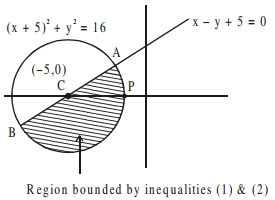
(B) Given $|z+5| \leq 4$. Let $z = x+iy$. Then $(x+5)^2 + y^2 \leq 16$ (a disk centered at $(-5, 0)$ with radius $4$).
Given $z(1+i)+\bar{z}(1-i) \geq -10$. Substituting $z=x+iy$ and $\bar{z}=x-iy$:
$(x+iy)(1+i) + (x-iy)(1-i) \geq -10$
$(x-y + i(x+y)) + (x-y - i(x+y)) \geq -10$
$2(x-y) \geq -10 \implies x-y+5 \geq 0$.
We want to maximize $|z+1|^2$,which is the square of the distance from $z$ to the point $P(-1, 0)$.
The region is the intersection of the disk $(x+5)^2 + y^2 \leq 16$ and the half-plane $x-y+5 \geq 0$.
To find the maximum distance from $P(-1, 0)$ to the region,we check the boundary points. The maximum occurs at the intersection of the line $x-y+5=0$ and the circle $(x+5)^2 + y^2 = 16$.
Substituting $y = x+5$ into the circle equation:
$(x+5)^2 + (x+5)^2 = 16 \implies 2(x+5)^2 = 16 \implies (x+5)^2 = 8 \implies x+5 = \pm 2\sqrt{2}$.
So $x = -5 \pm 2\sqrt{2}$.
If $x = -5 - 2\sqrt{2}$,then $y = x+5 = -2\sqrt{2}$. Point $B = (-5-2\sqrt{2}, -2\sqrt{2})$.
If $x = -5 + 2\sqrt{2}$,then $y = x+5 = 2\sqrt{2}$. Point $A = (-5+2\sqrt{2}, 2\sqrt{2})$.
Calculate squared distances from $P(-1, 0)$:
$PB^2 = (-5-2\sqrt{2} - (-1))^2 + (-2\sqrt{2} - 0)^2 = (-4-2\sqrt{2})^2 + 8 = (16 + 8 + 16\sqrt{2}) + 8 = 32 + 16\sqrt{2}$.
$PA^2 = (-5+2\sqrt{2} - (-1))^2 + (2\sqrt{2} - 0)^2 = (-4+2\sqrt{2})^2 + 8 = (16 + 8 - 16\sqrt{2}) + 8 = 32 - 16\sqrt{2}$.
The maximum value is $32 + 16\sqrt{2}$.
Thus $\alpha = 32$ and $\beta = 16$.
$\alpha + \beta = 32 + 16 = 48$.
Given $z(1+i)+\bar{z}(1-i) \geq -10$. Substituting $z=x+iy$ and $\bar{z}=x-iy$:
$(x+iy)(1+i) + (x-iy)(1-i) \geq -10$
$(x-y + i(x+y)) + (x-y - i(x+y)) \geq -10$
$2(x-y) \geq -10 \implies x-y+5 \geq 0$.
We want to maximize $|z+1|^2$,which is the square of the distance from $z$ to the point $P(-1, 0)$.
The region is the intersection of the disk $(x+5)^2 + y^2 \leq 16$ and the half-plane $x-y+5 \geq 0$.
To find the maximum distance from $P(-1, 0)$ to the region,we check the boundary points. The maximum occurs at the intersection of the line $x-y+5=0$ and the circle $(x+5)^2 + y^2 = 16$.
Substituting $y = x+5$ into the circle equation:
$(x+5)^2 + (x+5)^2 = 16 \implies 2(x+5)^2 = 16 \implies (x+5)^2 = 8 \implies x+5 = \pm 2\sqrt{2}$.
So $x = -5 \pm 2\sqrt{2}$.
If $x = -5 - 2\sqrt{2}$,then $y = x+5 = -2\sqrt{2}$. Point $B = (-5-2\sqrt{2}, -2\sqrt{2})$.
If $x = -5 + 2\sqrt{2}$,then $y = x+5 = 2\sqrt{2}$. Point $A = (-5+2\sqrt{2}, 2\sqrt{2})$.
Calculate squared distances from $P(-1, 0)$:
$PB^2 = (-5-2\sqrt{2} - (-1))^2 + (-2\sqrt{2} - 0)^2 = (-4-2\sqrt{2})^2 + 8 = (16 + 8 + 16\sqrt{2}) + 8 = 32 + 16\sqrt{2}$.
$PA^2 = (-5+2\sqrt{2} - (-1))^2 + (2\sqrt{2} - 0)^2 = (-4+2\sqrt{2})^2 + 8 = (16 + 8 - 16\sqrt{2}) + 8 = 32 - 16\sqrt{2}$.
The maximum value is $32 + 16\sqrt{2}$.
Thus $\alpha = 32$ and $\beta = 16$.
$\alpha + \beta = 32 + 16 = 48$.
0 likesView Solution
158
MathematicsDifficultMCQJEE Main · 2021
Let the normals at all the points on a given curve pass through a fixed point $(a, b)$. If the curve passes through $(3, -3)$ and $(4, -2\sqrt{2})$,and given that $a - 2\sqrt{2}b = 3$,then $(a^{2} + b^{2} + ab)$ is equal to ..... .
A
$6$
B
$3$
C
$4$
D
$9$
Solution
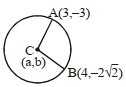
(D) Since the normals at all points on the curve pass through a fixed point $(a, b)$,the curve must be a circle with center $(a, b)$.
Let the points on the circle be $A(3, -3)$ and $B(4, -2\sqrt{2})$.
Since $A$ and $B$ lie on the circle,their distances from the center $C(a, b)$ are equal to the radius $r$.
Thus,$CA^{2} = CB^{2}$.
$(a - 3)^{2} + (b - (-3))^{2} = (a - 4)^{2} + (b - (-2\sqrt{2}))^{2}$
$(a - 3)^{2} + (b + 3)^{2} = (a - 4)^{2} + (b + 2\sqrt{2})^{2}$
$a^{2} - 6a + 9 + b^{2} + 6b + 9 = a^{2} - 8a + 16 + b^{2} + 4\sqrt{2}b + 8$
$-6a + 6b + 18 = -8a + 4\sqrt{2}b + 24$
$2a + (6 - 4\sqrt{2})b = 6$
Dividing by $2$,we get $a + (3 - 2\sqrt{2})b = 3$.
$a + 3b - 2\sqrt{2}b = 3$
$a - 2\sqrt{2}b + 3b = 3 \quad ... (1)$
Given that $a - 2\sqrt{2}b = 3 \quad ... (2)$
Substituting $(2)$ into $(1)$,we get $3 + 3b = 3$,which implies $3b = 0$,so $b = 0$.
Substituting $b = 0$ into $(2)$,we get $a - 2\sqrt{2}(0) = 3$,so $a = 3$.
Therefore,$a^{2} + b^{2} + ab = (3)^{2} + (0)^{2} + (3)(0) = 9 + 0 + 0 = 9$.
Let the points on the circle be $A(3, -3)$ and $B(4, -2\sqrt{2})$.
Since $A$ and $B$ lie on the circle,their distances from the center $C(a, b)$ are equal to the radius $r$.
Thus,$CA^{2} = CB^{2}$.
$(a - 3)^{2} + (b - (-3))^{2} = (a - 4)^{2} + (b - (-2\sqrt{2}))^{2}$
$(a - 3)^{2} + (b + 3)^{2} = (a - 4)^{2} + (b + 2\sqrt{2})^{2}$
$a^{2} - 6a + 9 + b^{2} + 6b + 9 = a^{2} - 8a + 16 + b^{2} + 4\sqrt{2}b + 8$
$-6a + 6b + 18 = -8a + 4\sqrt{2}b + 24$
$2a + (6 - 4\sqrt{2})b = 6$
Dividing by $2$,we get $a + (3 - 2\sqrt{2})b = 3$.
$a + 3b - 2\sqrt{2}b = 3$
$a - 2\sqrt{2}b + 3b = 3 \quad ... (1)$
Given that $a - 2\sqrt{2}b = 3 \quad ... (2)$
Substituting $(2)$ into $(1)$,we get $3 + 3b = 3$,which implies $3b = 0$,so $b = 0$.
Substituting $b = 0$ into $(2)$,we get $a - 2\sqrt{2}(0) = 3$,so $a = 3$.
Therefore,$a^{2} + b^{2} + ab = (3)^{2} + (0)^{2} + (3)(0) = 9 + 0 + 0 = 9$.
0 likesView Solution
159
MathematicsDifficultMCQJEE Main · 2021
Let $\alpha$ and $\beta$ be two real numbers such that $\alpha+\beta=1$ and $\alpha \beta=-1$. Let $p_{n}=\alpha^{n}+\beta^{n}$,$p_{n-1}=11$ and $p_{n+1}=29$ for some integer $n \geq 1$. Then,the value of $p_{n}^{2}$ is .... .
A
$162$
B
$324$
C
$648$
D
$424$
Solution
(B) Given that $\alpha$ and $\beta$ are roots of the quadratic equation $x^{2} - (\alpha+\beta)x + \alpha\beta = 0$.
Substituting the values,we get $x^{2} - x - 1 = 0$.
Since $\alpha$ and $\beta$ are roots,they satisfy the equation:
$\alpha^{2} - \alpha - 1 = 0 \Rightarrow \alpha^{n+1} = \alpha^{n} + \alpha^{n-1}$
$\beta^{2} - \beta - 1 = 0 \Rightarrow \beta^{n+1} = \beta^{n} + \beta^{n-1}$
Adding these two equations,we get:
$(\alpha^{n+1} + \beta^{n+1}) = (\alpha^{n} + \beta^{n}) + (\alpha^{n-1} + \beta^{n-1})$
This implies the recurrence relation $p_{n+1} = p_{n} + p_{n-1}$.
Given $p_{n+1} = 29$ and $p_{n-1} = 11$,we have:
$29 = p_{n} + 11$
$p_{n} = 29 - 11 = 18$.
Therefore,$p_{n}^{2} = 18^{2} = 324$.
Substituting the values,we get $x^{2} - x - 1 = 0$.
Since $\alpha$ and $\beta$ are roots,they satisfy the equation:
$\alpha^{2} - \alpha - 1 = 0 \Rightarrow \alpha^{n+1} = \alpha^{n} + \alpha^{n-1}$
$\beta^{2} - \beta - 1 = 0 \Rightarrow \beta^{n+1} = \beta^{n} + \beta^{n-1}$
Adding these two equations,we get:
$(\alpha^{n+1} + \beta^{n+1}) = (\alpha^{n} + \beta^{n}) + (\alpha^{n-1} + \beta^{n-1})$
This implies the recurrence relation $p_{n+1} = p_{n} + p_{n-1}$.
Given $p_{n+1} = 29$ and $p_{n-1} = 11$,we have:
$29 = p_{n} + 11$
$p_{n} = 29 - 11 = 18$.
Therefore,$p_{n}^{2} = 18^{2} = 324$.
0 likesView Solution
160
MathematicsDifficultMCQJEE Main · 2021
If the arithmetic mean and geometric mean of the $p^{\text{th}}$ and $q^{\text{th}}$ terms of the sequence $-16, 8, -4, 2, \ldots$ satisfy the equation $4x^{2}-9x+5=0$,then $p+q$ is equal to ..... .
A
$16$
B
$8$
C
$10$
D
$12$
Solution
(C) The given sequence is a geometric progression with first term $a = -16$ and common ratio $r = -1/2$.
The $n^{\text{th}}$ term is $t_{n} = a r^{n-1} = -16(-1/2)^{n-1}$.
Let the arithmetic mean and geometric mean of $t_{p}$ and $t_{q}$ be $x_{1}$ and $x_{2}$. The equation $4x^{2}-9x+5=0$ has roots $x = 1$ and $x = 5/4$.
Since the arithmetic mean is greater than the geometric mean for distinct terms,we have $AM = 5/4$ and $GM = 1$.
$AM = (t_{p} + t_{q})/2 = 5/4 \Rightarrow t_{p} + t_{q} = 5/2$.
$GM = \sqrt{t_{p} t_{q}} = 1 \Rightarrow t_{p} t_{q} = 1$.
Substituting $t_{p} = -16(-1/2)^{p-1}$ and $t_{q} = -16(-1/2)^{q-1}$:
$t_{p} t_{q} = 256(-1/2)^{p+q-2} = 1 \Rightarrow (-1/2)^{p+q-2} = 1/256 = (1/2)^{8}$.
Since $(-1/2)^{p+q-2} = (1/2)^{8}$,$p+q-2$ must be an even number equal to $8$.
$p+q-2 = 8 \Rightarrow p+q = 10$.
The $n^{\text{th}}$ term is $t_{n} = a r^{n-1} = -16(-1/2)^{n-1}$.
Let the arithmetic mean and geometric mean of $t_{p}$ and $t_{q}$ be $x_{1}$ and $x_{2}$. The equation $4x^{2}-9x+5=0$ has roots $x = 1$ and $x = 5/4$.
Since the arithmetic mean is greater than the geometric mean for distinct terms,we have $AM = 5/4$ and $GM = 1$.
$AM = (t_{p} + t_{q})/2 = 5/4 \Rightarrow t_{p} + t_{q} = 5/2$.
$GM = \sqrt{t_{p} t_{q}} = 1 \Rightarrow t_{p} t_{q} = 1$.
Substituting $t_{p} = -16(-1/2)^{p-1}$ and $t_{q} = -16(-1/2)^{q-1}$:
$t_{p} t_{q} = 256(-1/2)^{p+q-2} = 1 \Rightarrow (-1/2)^{p+q-2} = 1/256 = (1/2)^{8}$.
Since $(-1/2)^{p+q-2} = (1/2)^{8}$,$p+q-2$ must be an even number equal to $8$.
$p+q-2 = 8 \Rightarrow p+q = 10$.
0 likesView Solution
161
MathematicsDifficultMCQJEE Main · 2021
The total number of $4$-digit numbers whose greatest common divisor with $18$ is $3$ is .... .
A
$1000$
B
$1500$
C
$1200$
D
$500$
Solution
(A) Let $N$ be a $4$-digit number such that $\gcd(N, 18) = 3$.
Since $\gcd(N, 18) = 3$,$N$ must be a multiple of $3$ but not a multiple of $2$ (because $18 = 2 \times 3^2$,and if $N$ were even,$\gcd(N, 18)$ would be at least $6$) and not a multiple of $9$ (because if $N$ were a multiple of $9$,$\gcd(N, 18)$ would be $9$ or $18$).
Thus,$N$ must be an odd multiple of $3$ that is not divisible by $9$.
First,find the number of $4$-digit odd multiples of $3$:
The smallest $4$-digit odd multiple of $3$ is $1005$ and the largest is $9999$.
These form an arithmetic progression: $1005, 1011, \dots, 9999$.
The number of terms is $\frac{9999 - 1005}{6} + 1 = \frac{8994}{6} + 1 = 1499 + 1 = 1500$.
Next,find the number of $4$-digit odd multiples of $9$:
The smallest $4$-digit odd multiple of $9$ is $1017$ and the largest is $9999$.
These form an arithmetic progression: $1017, 1035, \dots, 9999$.
The number of terms is $\frac{9999 - 1017}{18} + 1 = \frac{8982}{18} + 1 = 499 + 1 = 500$.
The number of such $N$ is $1500 - 500 = 1000$.
Since $\gcd(N, 18) = 3$,$N$ must be a multiple of $3$ but not a multiple of $2$ (because $18 = 2 \times 3^2$,and if $N$ were even,$\gcd(N, 18)$ would be at least $6$) and not a multiple of $9$ (because if $N$ were a multiple of $9$,$\gcd(N, 18)$ would be $9$ or $18$).
Thus,$N$ must be an odd multiple of $3$ that is not divisible by $9$.
First,find the number of $4$-digit odd multiples of $3$:
The smallest $4$-digit odd multiple of $3$ is $1005$ and the largest is $9999$.
These form an arithmetic progression: $1005, 1011, \dots, 9999$.
The number of terms is $\frac{9999 - 1005}{6} + 1 = \frac{8994}{6} + 1 = 1499 + 1 = 1500$.
Next,find the number of $4$-digit odd multiples of $9$:
The smallest $4$-digit odd multiple of $9$ is $1017$ and the largest is $9999$.
These form an arithmetic progression: $1017, 1035, \dots, 9999$.
The number of terms is $\frac{9999 - 1017}{18} + 1 = \frac{8982}{18} + 1 = 499 + 1 = 500$.
The number of such $N$ is $1500 - 500 = 1000$.
0 likesView Solution
162
MathematicsDifficultMCQJEE Main · 2021
Let $L$ be a common tangent line to the curves $4x^{2} + 9y^{2} = 36$ and $(2x)^{2} + (2y)^{2} = 31$. Then the square of the slope of the line $L$ is ..... .
A
$3$
B
$6$
C
$5$
D
$4$
Solution
(A) The given curves are $\frac{x^{2}}{9} + \frac{y^{2}}{4} = 1$ (an ellipse) and $x^{2} + y^{2} = \frac{31}{4}$ (a circle).
Let the slope of the common tangent be $m$.
The equation of a tangent to the ellipse $\frac{x^{2}}{a^{2}} + \frac{y^{2}}{b^{2}} = 1$ is $y = mx \pm \sqrt{a^{2}m^{2} + b^{2}}$.
Here $a^{2} = 9$ and $b^{2} = 4$,so the tangent is $y = mx \pm \sqrt{9m^{2} + 4}$.
The equation of a tangent to the circle $x^{2} + y^{2} = r^{2}$ is $y = mx \pm r\sqrt{1 + m^{2}}$.
Here $r^{2} = \frac{31}{4}$,so the tangent is $y = mx \pm \frac{\sqrt{31}}{2}\sqrt{1 + m^{2}}$.
For the lines to be identical,the constant terms must be equal:
$9m^{2} + 4 = \frac{31}{4}(1 + m^{2})$.
Multiplying by $4$,we get $36m^{2} + 16 = 31 + 31m^{2}$.
$5m^{2} = 15$.
$m^{2} = 3$.
Let the slope of the common tangent be $m$.
The equation of a tangent to the ellipse $\frac{x^{2}}{a^{2}} + \frac{y^{2}}{b^{2}} = 1$ is $y = mx \pm \sqrt{a^{2}m^{2} + b^{2}}$.
Here $a^{2} = 9$ and $b^{2} = 4$,so the tangent is $y = mx \pm \sqrt{9m^{2} + 4}$.
The equation of a tangent to the circle $x^{2} + y^{2} = r^{2}$ is $y = mx \pm r\sqrt{1 + m^{2}}$.
Here $r^{2} = \frac{31}{4}$,so the tangent is $y = mx \pm \frac{\sqrt{31}}{2}\sqrt{1 + m^{2}}$.
For the lines to be identical,the constant terms must be equal:
$9m^{2} + 4 = \frac{31}{4}(1 + m^{2})$.
Multiplying by $4$,we get $36m^{2} + 16 = 31 + 31m^{2}$.
$5m^{2} = 15$.
$m^{2} = 3$.
0 likesView Solution
163
MathematicsDifficultMCQJEE Main · 2021
Let $a$ be an integer such that all the real roots of the polynomial $2x^{5}+5x^{4}+10x^{3}+10x^{2}+10x+10$ lie in the interval $(a, a+1)$. Then,$|a|$ is equal to ...... .
A
$1$
B
$2$
C
$4$
D
$3$
Solution
(B) Let $f(x) = 2x^{5}+5x^{4}+10x^{3}+10x^{2}+10x+10$.
First,we evaluate the function at integer points to locate the root.
$f(-2) = 2(-32) + 5(16) + 10(-8) + 10(4) + 10(-2) + 10 = -64 + 80 - 80 + 40 - 20 + 10 = -34$.
$f(-1) = 2(-1) + 5(1) + 10(-1) + 10(1) + 10(-1) + 10 = -2 + 5 - 10 + 10 - 10 + 10 = 3$.
Since $f(-2) < 0$ and $f(-1) > 0$,by the Intermediate Value Theorem,there exists at least one real root in the interval $(-2, -1)$.
Next,we check the derivative to determine the number of real roots.
$f'(x) = 10x^{4} + 20x^{3} + 30x^{2} + 20x + 10$.
$f'(x) = 10(x^{4} + 2x^{3} + 3x^{2} + 2x + 1)$.
Notice that $x^{4} + 2x^{3} + 3x^{2} + 2x + 1 = (x^{2} + x + 1)^{2}$.
Thus,$f'(x) = 10(x^{2} + x + 1)^{2}$.
Since $x^{2} + x + 1$ has a negative discriminant $(1 - 4 = -3)$,it is always positive for all real $x$.
Therefore,$f'(x) > 0$ for all real $x$,which means $f(x)$ is strictly increasing and has exactly one real root.
Since the root lies in $(-2, -1)$,we have $a = -2$. Thus,$|a| = |-2| = 2$.
First,we evaluate the function at integer points to locate the root.
$f(-2) = 2(-32) + 5(16) + 10(-8) + 10(4) + 10(-2) + 10 = -64 + 80 - 80 + 40 - 20 + 10 = -34$.
$f(-1) = 2(-1) + 5(1) + 10(-1) + 10(1) + 10(-1) + 10 = -2 + 5 - 10 + 10 - 10 + 10 = 3$.
Since $f(-2) < 0$ and $f(-1) > 0$,by the Intermediate Value Theorem,there exists at least one real root in the interval $(-2, -1)$.
Next,we check the derivative to determine the number of real roots.
$f'(x) = 10x^{4} + 20x^{3} + 30x^{2} + 20x + 10$.
$f'(x) = 10(x^{4} + 2x^{3} + 3x^{2} + 2x + 1)$.
Notice that $x^{4} + 2x^{3} + 3x^{2} + 2x + 1 = (x^{2} + x + 1)^{2}$.
Thus,$f'(x) = 10(x^{2} + x + 1)^{2}$.
Since $x^{2} + x + 1$ has a negative discriminant $(1 - 4 = -3)$,it is always positive for all real $x$.
Therefore,$f'(x) > 0$ for all real $x$,which means $f(x)$ is strictly increasing and has exactly one real root.
Since the root lies in $(-2, -1)$,we have $a = -2$. Thus,$|a| = |-2| = 2$.
0 likesView Solution
164
MathematicsDifficultMCQJEE Main · 2021
Let $X_{1}, X_{2}, \ldots, X_{18}$ be eighteen observations such that $\sum_{i=1}^{18}(X_{i}-\alpha)=36$ and $\sum_{i=1}^{18}(X_{i}-\beta)^{2}=90$,where $\alpha$ and $\beta$ are distinct real numbers. If the standard deviation of these observations is $1$,then the value of $|\alpha-\beta|$ is ...... .
A
$4$
B
$2$
C
$3$
D
$5$
Solution
(A) Given $\sum_{i=1}^{18}(X_{i}-\alpha)=36 \implies \sum X_{i} - 18\alpha = 36 \implies \sum X_{i} = 18(\alpha+2)$.
Given $\sum_{i=1}^{18}(X_{i}-\beta)^{2}=90 \implies \sum X_{i}^{2} - 2\beta \sum X_{i} + 18\beta^{2} = 90$.
Substituting $\sum X_{i} = 18(\alpha+2)$,we get $\sum X_{i}^{2} = 90 - 18\beta^{2} + 36\beta(\alpha+2)$.
The variance is given by $\sigma^{2} = \frac{\sum X_{i}^{2}}{18} - (\frac{\sum X_{i}}{18})^{2} = 1^{2} = 1$.
Substituting the values: $\frac{90 - 18\beta^{2} + 36\beta(\alpha+2)}{18} - (\alpha+2)^{2} = 1$.
$5 - \beta^{2} + 2\beta(\alpha+2) - (\alpha^{2} + 4\alpha + 4) = 1$.
$5 - \beta^{2} + 2\alpha\beta + 4\beta - \alpha^{2} - 4\alpha - 4 = 1$.
$-(\alpha^{2} - 2\alpha\beta + \beta^{2}) + 4(\beta - \alpha) = 0$.
$-(\alpha-\beta)^{2} - 4(\alpha-\beta) = 0$.
$(\alpha-\beta)^{2} + 4(\alpha-\beta) = 0$.
$(\alpha-\beta)(\alpha-\beta+4) = 0$.
Since $\alpha \neq \beta$,we have $\alpha-\beta = -4$,so $|\alpha-\beta| = 4$.
Given $\sum_{i=1}^{18}(X_{i}-\beta)^{2}=90 \implies \sum X_{i}^{2} - 2\beta \sum X_{i} + 18\beta^{2} = 90$.
Substituting $\sum X_{i} = 18(\alpha+2)$,we get $\sum X_{i}^{2} = 90 - 18\beta^{2} + 36\beta(\alpha+2)$.
The variance is given by $\sigma^{2} = \frac{\sum X_{i}^{2}}{18} - (\frac{\sum X_{i}}{18})^{2} = 1^{2} = 1$.
Substituting the values: $\frac{90 - 18\beta^{2} + 36\beta(\alpha+2)}{18} - (\alpha+2)^{2} = 1$.
$5 - \beta^{2} + 2\beta(\alpha+2) - (\alpha^{2} + 4\alpha + 4) = 1$.
$5 - \beta^{2} + 2\alpha\beta + 4\beta - \alpha^{2} - 4\alpha - 4 = 1$.
$-(\alpha^{2} - 2\alpha\beta + \beta^{2}) + 4(\beta - \alpha) = 0$.
$-(\alpha-\beta)^{2} - 4(\alpha-\beta) = 0$.
$(\alpha-\beta)^{2} + 4(\alpha-\beta) = 0$.
$(\alpha-\beta)(\alpha-\beta+4) = 0$.
Since $\alpha \neq \beta$,we have $\alpha-\beta = -4$,so $|\alpha-\beta| = 4$.
0 likesView Solution
165
MathematicsMediumMCQJEE Main · 2021
The sum of solutions of the equation $\frac{\cos x}{1+\sin x}=|\tan 2 x|$,where $x \in \left(-\frac{\pi}{2}, \frac{\pi}{2}\right) - \left\{\frac{\pi}{4}, -\frac{\pi}{4}\right\}$,is:
A
$-\frac{11 \pi}{30}$
B
$\frac{\pi}{10}$
C
$-\frac{7 \pi}{30}$
D
$-\frac{\pi}{15}$
Solution
(A) Given the equation $\frac{\cos x}{1+\sin x} = |\tan 2x|$.
Note that $\frac{\cos x}{1+\sin x} = \tan\left(\frac{\pi}{4} - \frac{x}{2}\right)$.
So,$\tan\left(\frac{\pi}{4} - \frac{x}{2}\right) = |\tan 2x|$.
Since the $LHS$ must be non-negative,$\tan\left(\frac{\pi}{4} - \frac{x}{2}\right) \ge 0$,which implies $\frac{\pi}{4} - \frac{x}{2} \in [0, \frac{\pi}{2})$,so $x \in (-\frac{\pi}{2}, \frac{\pi}{2}]$.
Squaring both sides,$\tan^2\left(\frac{\pi}{4} - \frac{x}{2}\right) = \tan^2 2x$.
This implies $\tan 2x = \pm \tan\left(\frac{\pi}{4} - \frac{x}{2}\right)$.
Case $1$: $2x = n\pi + \left(\frac{\pi}{4} - \frac{x}{2}\right)$ $\Rightarrow \frac{5x}{2} = n\pi + \frac{\pi}{4}$ $\Rightarrow x = \frac{2n\pi}{5} + \frac{\pi}{10}$.
For $n=0, x=\frac{\pi}{10}$. For $n=-1, x=-\frac{3\pi}{10}$.
Case $2$: $2x = n\pi - \left(\frac{\pi}{4} - \frac{x}{2}\right)$ $\Rightarrow \frac{3x}{2} = n\pi - \frac{\pi}{4}$ $\Rightarrow x = \frac{2n\pi}{3} - \frac{\pi}{6}$.
For $n=0, x=-\frac{\pi}{6}$.
Checking the condition $\tan\left(\frac{\pi}{4} - \frac{x}{2}\right) \ge 0$: for $x = \frac{\pi}{10}, -\frac{3\pi}{10}, -\frac{\pi}{6}$,the condition holds.
The sum of solutions is $\frac{\pi}{10} - \frac{3\pi}{10} - \frac{\pi}{6} = -\frac{2\pi}{10} - \frac{\pi}{6} = -\frac{\pi}{5} - \frac{\pi}{6} = -\frac{11\pi}{30}$.
Note that $\frac{\cos x}{1+\sin x} = \tan\left(\frac{\pi}{4} - \frac{x}{2}\right)$.
So,$\tan\left(\frac{\pi}{4} - \frac{x}{2}\right) = |\tan 2x|$.
Since the $LHS$ must be non-negative,$\tan\left(\frac{\pi}{4} - \frac{x}{2}\right) \ge 0$,which implies $\frac{\pi}{4} - \frac{x}{2} \in [0, \frac{\pi}{2})$,so $x \in (-\frac{\pi}{2}, \frac{\pi}{2}]$.
Squaring both sides,$\tan^2\left(\frac{\pi}{4} - \frac{x}{2}\right) = \tan^2 2x$.
This implies $\tan 2x = \pm \tan\left(\frac{\pi}{4} - \frac{x}{2}\right)$.
Case $1$: $2x = n\pi + \left(\frac{\pi}{4} - \frac{x}{2}\right)$ $\Rightarrow \frac{5x}{2} = n\pi + \frac{\pi}{4}$ $\Rightarrow x = \frac{2n\pi}{5} + \frac{\pi}{10}$.
For $n=0, x=\frac{\pi}{10}$. For $n=-1, x=-\frac{3\pi}{10}$.
Case $2$: $2x = n\pi - \left(\frac{\pi}{4} - \frac{x}{2}\right)$ $\Rightarrow \frac{3x}{2} = n\pi - \frac{\pi}{4}$ $\Rightarrow x = \frac{2n\pi}{3} - \frac{\pi}{6}$.
For $n=0, x=-\frac{\pi}{6}$.
Checking the condition $\tan\left(\frac{\pi}{4} - \frac{x}{2}\right) \ge 0$: for $x = \frac{\pi}{10}, -\frac{3\pi}{10}, -\frac{\pi}{6}$,the condition holds.
The sum of solutions is $\frac{\pi}{10} - \frac{3\pi}{10} - \frac{\pi}{6} = -\frac{2\pi}{10} - \frac{\pi}{6} = -\frac{\pi}{5} - \frac{\pi}{6} = -\frac{11\pi}{30}$.
0 likesView Solution
166
MathematicsDifficultMCQJEE Main · 2021
The mean and standard deviation of $20$ observations were calculated as $10$ and $2.5$ respectively. It was found that by mistake one data value was taken as $25$ instead of $35$. If $\alpha$ and $\sqrt{\beta}$ are the mean and standard deviation respectively for the correct data,then $(\alpha, \beta)$ is:
A
$(11, 26)$
B
$(10.5, 25)$
C
$(11, 25)$
D
$(10.5, 26)$
Solution
(D) Given: $n = 20$,$\bar{x} = 10$,$\sigma = 2.5$.
Incorrect sum of observations: $\Sigma x_i = n \times \bar{x} = 20 \times 10 = 200$.
Correct sum of observations: $\Sigma x_i = 200 - 25 + 35 = 210$.
Correct mean $\alpha = \frac{210}{20} = 10.5$.
Incorrect sum of squares: $\sigma^2 = \frac{\Sigma x_i^2}{n} - (\bar{x})^2 \implies (2.5)^2 = \frac{\Sigma x_i^2}{20} - 10^2$.
$6.25 = \frac{\Sigma x_i^2}{20} - 100 \implies \Sigma x_i^2 = 20 \times 106.25 = 2125$.
Correct sum of squares: $\Sigma x_i^2 = 2125 - 25^2 + 35^2 = 2125 - 625 + 1225 = 2725$.
Correct variance $\beta = \frac{\Sigma x_i^2}{n} - (\alpha)^2 = \frac{2725}{20} - (10.5)^2 = 136.25 - 110.25 = 26$.
Thus,$(\alpha, \beta) = (10.5, 26)$.
Incorrect sum of observations: $\Sigma x_i = n \times \bar{x} = 20 \times 10 = 200$.
Correct sum of observations: $\Sigma x_i = 200 - 25 + 35 = 210$.
Correct mean $\alpha = \frac{210}{20} = 10.5$.
Incorrect sum of squares: $\sigma^2 = \frac{\Sigma x_i^2}{n} - (\bar{x})^2 \implies (2.5)^2 = \frac{\Sigma x_i^2}{20} - 10^2$.
$6.25 = \frac{\Sigma x_i^2}{20} - 100 \implies \Sigma x_i^2 = 20 \times 106.25 = 2125$.
Correct sum of squares: $\Sigma x_i^2 = 2125 - 25^2 + 35^2 = 2125 - 625 + 1225 = 2725$.
Correct variance $\beta = \frac{\Sigma x_i^2}{n} - (\alpha)^2 = \frac{2725}{20} - (10.5)^2 = 136.25 - 110.25 = 26$.
Thus,$(\alpha, \beta) = (10.5, 26)$.
0 likesView Solution
167
MathematicsDifficultMCQJEE Main · 2021
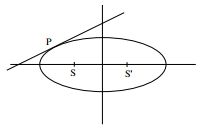
On the ellipse $\frac{x^{2}}{8}+\frac{y^{2}}{4}=1$,let $P$ be a point in the second quadrant such that the tangent at $P$ to the ellipse is perpendicular to the line $x+2y=0$. Let $S$ and $S'$ be the foci of the ellipse and $e$ be its eccentricity. If $A$ is the area of the triangle $SPS'$,then the value of $(5-e^{2}) \cdot A$ is:
A
$12$
B
$6$
C
$14$
D
$24$
Solution
(B) The equation of the ellipse is $\frac{x^{2}}{8}+\frac{y^{2}}{4}=1$. Here $a^{2}=8$ and $b^{2}=4$.
The eccentricity $e$ is given by $e = \sqrt{1 - \frac{b^{2}}{a^{2}}} = \sqrt{1 - \frac{4}{8}} = \sqrt{\frac{1}{2}} = \frac{1}{\sqrt{2}}$.
The foci are $S(-ae, 0)$ and $S'(ae, 0)$,where $ae = \sqrt{8} \cdot \frac{1}{\sqrt{2}} = 2$. So,$S(-2, 0)$ and $S'(2, 0)$.
The line perpendicular to $x+2y=0$ has the form $2x-y+k=0$,or $y=2x+k$.
The condition for tangency $y=mx+c$ to the ellipse $\frac{x^{2}}{a^{2}}+\frac{y^{2}}{b^{2}}=1$ is $c^{2}=a^{2}m^{2}+b^{2}$.
Here $m=2$,so $c^{2} = 8(2^{2}) + 4 = 32+4 = 36$,which gives $c = \pm 6$.
Since $P$ is in the second quadrant,the tangent must have a positive $y$-intercept,so $y=2x+6$.
The point of tangency $P(x_{1}, y_{1})$ is given by $(-\frac{a^{2}m}{c}, \frac{b^{2}}{c}) = (-\frac{8 \cdot 2}{6}, \frac{4}{6}) = (-\frac{8}{3}, \frac{2}{3})$.
The area $A$ of $\Delta SPS'$ with base $SS'=4$ and height $|y_{1}| = \frac{2}{3}$ is $A = \frac{1}{2} \cdot 4 \cdot \frac{2}{3} = \frac{4}{3}$.
Finally,$(5-e^{2}) \cdot A = (5 - \frac{1}{2}) \cdot \frac{4}{3} = \frac{9}{2} \cdot \frac{4}{3} = 6$.
The eccentricity $e$ is given by $e = \sqrt{1 - \frac{b^{2}}{a^{2}}} = \sqrt{1 - \frac{4}{8}} = \sqrt{\frac{1}{2}} = \frac{1}{\sqrt{2}}$.
The foci are $S(-ae, 0)$ and $S'(ae, 0)$,where $ae = \sqrt{8} \cdot \frac{1}{\sqrt{2}} = 2$. So,$S(-2, 0)$ and $S'(2, 0)$.
The line perpendicular to $x+2y=0$ has the form $2x-y+k=0$,or $y=2x+k$.
The condition for tangency $y=mx+c$ to the ellipse $\frac{x^{2}}{a^{2}}+\frac{y^{2}}{b^{2}}=1$ is $c^{2}=a^{2}m^{2}+b^{2}$.
Here $m=2$,so $c^{2} = 8(2^{2}) + 4 = 32+4 = 36$,which gives $c = \pm 6$.
Since $P$ is in the second quadrant,the tangent must have a positive $y$-intercept,so $y=2x+6$.
The point of tangency $P(x_{1}, y_{1})$ is given by $(-\frac{a^{2}m}{c}, \frac{b^{2}}{c}) = (-\frac{8 \cdot 2}{6}, \frac{4}{6}) = (-\frac{8}{3}, \frac{2}{3})$.
The area $A$ of $\Delta SPS'$ with base $SS'=4$ and height $|y_{1}| = \frac{2}{3}$ is $A = \frac{1}{2} \cdot 4 \cdot \frac{2}{3} = \frac{4}{3}$.
Finally,$(5-e^{2}) \cdot A = (5 - \frac{1}{2}) \cdot \frac{4}{3} = \frac{9}{2} \cdot \frac{4}{3} = 6$.
0 likesView Solution
168
MathematicsDifficultMCQJEE Main · 2021
The sum of the series $\frac{1}{x+1}+\frac{2}{x^{2}+1}+\frac{2^{2}}{x^{4}+1}+\ldots+\frac{2^{100}}{x^{2^{100}}+1}$ when $x=2$ is:
A
$1-\frac{2^{101}}{2^{2^{101}}-1}$
B
$1+\frac{2^{101}}{2^{2^{101}}-1}$
C
$1-\frac{2^{100}}{2^{2^{100}}-1}$
D
$1+\frac{2^{100}}{2^{2^{100}}-1}$
Solution
(A) Let the sum be $S = \sum_{k=0}^{100} \frac{2^k}{x^{2^k}+1}$.
We use the identity $\frac{1}{x-1} - \frac{1}{x+1} = \frac{2}{x^2-1}$.
More generally,$\frac{2^k}{x^{2^k}-1} - \frac{2^k}{x^{2^k}+1} = \frac{2^{k+1}}{x^{2^{k+1}}-1}$.
Rearranging,$\frac{2^k}{x^{2^k}+1} = \frac{2^k}{x^{2^k}-1} - \frac{2^{k+1}}{x^{2^{k+1}}-1}$.
This is a telescoping sum.
$S = \left( \frac{1}{x-1} - \frac{2}{x^2-1} \right) + \left( \frac{2}{x^2-1} - \frac{4}{x^4-1} \right) + \ldots + \left( \frac{2^{100}}{x^{2^{100}}-1} - \frac{2^{101}}{x^{2^{101}}-1} \right)$.
$S = \frac{1}{x-1} - \frac{2^{101}}{x^{2^{101}}-1}$.
Given $x=2$,$S = \frac{1}{2-1} - \frac{2^{101}}{2^{2^{101}}-1} = 1 - \frac{2^{101}}{2^{2^{101}}-1}$.
We use the identity $\frac{1}{x-1} - \frac{1}{x+1} = \frac{2}{x^2-1}$.
More generally,$\frac{2^k}{x^{2^k}-1} - \frac{2^k}{x^{2^k}+1} = \frac{2^{k+1}}{x^{2^{k+1}}-1}$.
Rearranging,$\frac{2^k}{x^{2^k}+1} = \frac{2^k}{x^{2^k}-1} - \frac{2^{k+1}}{x^{2^{k+1}}-1}$.
This is a telescoping sum.
$S = \left( \frac{1}{x-1} - \frac{2}{x^2-1} \right) + \left( \frac{2}{x^2-1} - \frac{4}{x^4-1} \right) + \ldots + \left( \frac{2^{100}}{x^{2^{100}}-1} - \frac{2^{101}}{x^{2^{101}}-1} \right)$.
$S = \frac{1}{x-1} - \frac{2^{101}}{x^{2^{101}}-1}$.
Given $x=2$,$S = \frac{1}{2-1} - \frac{2^{101}}{2^{2^{101}}-1} = 1 - \frac{2^{101}}{2^{2^{101}}-1}$.
0 likesView Solution
169
MathematicsDifficultMCQJEE Main · 2021
If ${}^{20}C_{r}$ is the coefficient of $x^{r}$ in the expansion of $(1+x)^{20}$,then the value of $\sum_{r=0}^{20} r^{2} \cdot {}^{20}C_{r}$ is equal to:
A
$420 \times 2^{19}$
B
$380 \times 2^{19}$
C
$380 \times 2^{18}$
D
$420 \times 2^{18}$
Solution
(D) We know that $\sum_{r=0}^{n} r \cdot {}^{n}C_{r} = n \cdot 2^{n-1}$ and $\sum_{r=0}^{n} r(r-1) \cdot {}^{n}C_{r} = n(n-1) \cdot 2^{n-2}$.
We can write $r^{2} = r(r-1) + r$.
Therefore,$\sum_{r=0}^{20} r^{2} \cdot {}^{20}C_{r} = \sum_{r=0}^{20} [r(r-1) + r] \cdot {}^{20}C_{r}$.
$= \sum_{r=0}^{20} r(r-1) \cdot {}^{20}C_{r} + \sum_{r=0}^{20} r \cdot {}^{20}C_{r}$.
Using the identities with $n=20$:
$= 20 \times 19 \times 2^{20-2} + 20 \times 2^{20-1}$.
$= 380 \times 2^{18} + 20 \times 2^{19}$.
$= 380 \times 2^{18} + 20 \times 2 \times 2^{18}$.
$= 380 \times 2^{18} + 40 \times 2^{18}$.
$= (380 + 40) \times 2^{18} = 420 \times 2^{18}$.
We can write $r^{2} = r(r-1) + r$.
Therefore,$\sum_{r=0}^{20} r^{2} \cdot {}^{20}C_{r} = \sum_{r=0}^{20} [r(r-1) + r] \cdot {}^{20}C_{r}$.
$= \sum_{r=0}^{20} r(r-1) \cdot {}^{20}C_{r} + \sum_{r=0}^{20} r \cdot {}^{20}C_{r}$.
Using the identities with $n=20$:
$= 20 \times 19 \times 2^{20-2} + 20 \times 2^{20-1}$.
$= 380 \times 2^{18} + 20 \times 2^{19}$.
$= 380 \times 2^{18} + 20 \times 2 \times 2^{18}$.
$= 380 \times 2^{18} + 40 \times 2^{18}$.
$= (380 + 40) \times 2^{18} = 420 \times 2^{18}$.
0 likesView Solution
170
MathematicsMediumMCQJEE Main · 2021
Out of all the patients in a hospital $89\%$ are found to be suffering from heart ailment and $98\%$ are suffering from lungs infection. If $K\%$ of them are suffering from both ailments,then $K$ cannot belong to the set :
A
$\{79, 81, 83, 85\}$
B
$\{84, 86, 88, 90\}$
C
$\{80, 83, 86, 89\}$
D
$\{84, 87, 90, 93\}$
Solution
(A) Let $A$ be the set of patients with heart ailment and $B$ be the set of patients with lung infection.
Given $n(A) = 89\%$ and $n(B) = 98\%$.
We know that $n(A \cup B) = n(A) + n(B) - n(A \cap B)$.
Since $n(A \cup B) \leq 100\%$,we have $89 + 98 - n(A \cap B) \leq 100$.
$187 - n(A \cap B) \leq 100 \implies n(A \cap B) \geq 87$.
Also,$n(A \cap B)$ cannot exceed the smaller of the two sets,so $n(A \cap B) \leq 89$.
Thus,$87 \leq K \leq 89$.
Therefore,$K$ must be in the range $[87, 89]$.
Checking the options,the set $\{79, 81, 83, 85\}$ contains values that are not in the range $[87, 89]$.
Given $n(A) = 89\%$ and $n(B) = 98\%$.
We know that $n(A \cup B) = n(A) + n(B) - n(A \cap B)$.
Since $n(A \cup B) \leq 100\%$,we have $89 + 98 - n(A \cap B) \leq 100$.
$187 - n(A \cap B) \leq 100 \implies n(A \cap B) \geq 87$.
Also,$n(A \cap B)$ cannot exceed the smaller of the two sets,so $n(A \cap B) \leq 89$.
Thus,$87 \leq K \leq 89$.
Therefore,$K$ must be in the range $[87, 89]$.
Checking the options,the set $\{79, 81, 83, 85\}$ contains values that are not in the range $[87, 89]$.
0 likesView Solution
171
MathematicsDifficultMCQJEE Main · 2021
The equation $\arg \left(\frac{z-1}{z+1}\right)=\frac{\pi}{4}$ represents a circle with:
A
centre at $(0,-1)$ and radius $\sqrt{2}$
B
centre at $(0,1)$ and radius $\sqrt{2}$
C
centre at $(0,0)$ and radius $\sqrt{2}$
D
centre at $(0,1)$ and radius $2$
Solution
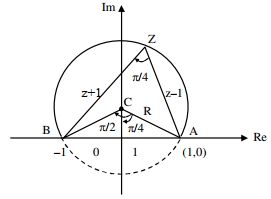
(B) Let $z = x + iy$. The equation $\arg \left(\frac{z-1}{z+1}\right) = \frac{\pi}{4}$ represents the locus of a point $z$ such that the angle subtended by the segment joining $A(1, 0)$ and $B(-1, 0)$ at $z$ is $\frac{\pi}{4}$.
This is an arc of a circle passing through $A(1, 0)$ and $B(-1, 0)$.
Let the centre of the circle be $C(0, k)$. Since the angle at the circumference is $\frac{\pi}{4}$,the angle subtended by the chord $AB$ at the centre $C$ is $2 \times \frac{\pi}{4} = \frac{\pi}{2}$.
In $\triangle OAC$ (where $O$ is the origin $(0,0)$),$\angle COA = 90^\circ$ and $\angle OCA = \frac{\pi}{4}$.
Since $OA = 1$,we have $\tan \left(\frac{\pi}{4}\right) = \frac{OA}{OC} = \frac{1}{OC} = 1$,which implies $OC = 1$.
Thus,the centre is $C(0, 1)$.
The radius $R = AC = \sqrt{OA^2 + OC^2} = \sqrt{1^2 + 1^2} = \sqrt{2}$.
Therefore,the circle has centre $(0, 1)$ and radius $\sqrt{2}$.
This is an arc of a circle passing through $A(1, 0)$ and $B(-1, 0)$.
Let the centre of the circle be $C(0, k)$. Since the angle at the circumference is $\frac{\pi}{4}$,the angle subtended by the chord $AB$ at the centre $C$ is $2 \times \frac{\pi}{4} = \frac{\pi}{2}$.
In $\triangle OAC$ (where $O$ is the origin $(0,0)$),$\angle COA = 90^\circ$ and $\angle OCA = \frac{\pi}{4}$.
Since $OA = 1$,we have $\tan \left(\frac{\pi}{4}\right) = \frac{OA}{OC} = \frac{1}{OC} = 1$,which implies $OC = 1$.
Thus,the centre is $C(0, 1)$.
The radius $R = AC = \sqrt{OA^2 + OC^2} = \sqrt{1^2 + 1^2} = \sqrt{2}$.
Therefore,the circle has centre $(0, 1)$ and radius $\sqrt{2}$.
0 likesView Solution
172
MathematicsDifficultMCQJEE Main · 2021
If a line along a chord of the circle $4x^{2}+4y^{2}+120x+675=0$ passes through the point $(-30, 0)$ and is tangent to the parabola $y^{2}=30x$,then the length of this chord is:
A
$5$
B
$7$
C
$5\sqrt{3}$
D
$3\sqrt{5}$
Solution
(D) The equation of the circle is $4x^{2}+4y^{2}+120x+675=0$,which simplifies to $x^{2}+y^{2}+30x+\frac{675}{4}=0$.
Completing the square: $(x+15)^{2}+y^{2} = 225 - \frac{675}{4} = \frac{900-675}{4} = \frac{225}{4}$.
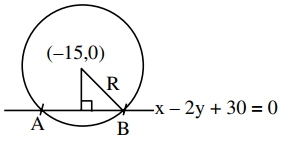
So,the center is $(-15, 0)$ and the radius $R = \sqrt{\frac{225}{4}} = \frac{15}{2}$.
The equation of a line passing through $(-30, 0)$ is $y = m(x+30)$,or $mx - y + 30m = 0$.
This line is tangent to the parabola $y^{2}=30x$. The condition for tangency $y=mx+c$ to $y^{2}=4ax$ is $c = \frac{a}{m}$.
Here $4a=30 \Rightarrow a = \frac{15}{2}$. The line is $y = mx + 30m$,so $c = 30m$.
Thus,$30m = \frac{15/2}{m}$ $\Rightarrow 60m^{2} = 15$ $\Rightarrow m^{2} = \frac{1}{4}$ $\Rightarrow m = \pm \frac{1}{2}$.
Taking $m = \frac{1}{2}$,the line is $y = \frac{1}{2}(x+30) \Rightarrow x - 2y + 30 = 0$.
The perpendicular distance $P$ from the center $(-15, 0)$ to the line $x - 2y + 30 = 0$ is:
$P = \frac{|-15 - 2(0) + 30|}{\sqrt{1^{2} + (-2)^{2}}} = \frac{15}{\sqrt{5}} = 3\sqrt{5}$.
The length of the chord is $2\sqrt{R^{2}-P^{2}} = 2\sqrt{(\frac{15}{2})^{2} - (3\sqrt{5})^{2}} = 2\sqrt{\frac{225}{4} - 45} = 2\sqrt{\frac{225-180}{4}} = 2\sqrt{\frac{45}{4}} = \sqrt{45} = 3\sqrt{5}$.
Completing the square: $(x+15)^{2}+y^{2} = 225 - \frac{675}{4} = \frac{900-675}{4} = \frac{225}{4}$.
So,the center is $(-15, 0)$ and the radius $R = \sqrt{\frac{225}{4}} = \frac{15}{2}$.
The equation of a line passing through $(-30, 0)$ is $y = m(x+30)$,or $mx - y + 30m = 0$.
This line is tangent to the parabola $y^{2}=30x$. The condition for tangency $y=mx+c$ to $y^{2}=4ax$ is $c = \frac{a}{m}$.
Here $4a=30 \Rightarrow a = \frac{15}{2}$. The line is $y = mx + 30m$,so $c = 30m$.
Thus,$30m = \frac{15/2}{m}$ $\Rightarrow 60m^{2} = 15$ $\Rightarrow m^{2} = \frac{1}{4}$ $\Rightarrow m = \pm \frac{1}{2}$.
Taking $m = \frac{1}{2}$,the line is $y = \frac{1}{2}(x+30) \Rightarrow x - 2y + 30 = 0$.
The perpendicular distance $P$ from the center $(-15, 0)$ to the line $x - 2y + 30 = 0$ is:
$P = \frac{|-15 - 2(0) + 30|}{\sqrt{1^{2} + (-2)^{2}}} = \frac{15}{\sqrt{5}} = 3\sqrt{5}$.
The length of the chord is $2\sqrt{R^{2}-P^{2}} = 2\sqrt{(\frac{15}{2})^{2} - (3\sqrt{5})^{2}} = 2\sqrt{\frac{225}{4} - 45} = 2\sqrt{\frac{225-180}{4}} = 2\sqrt{\frac{45}{4}} = \sqrt{45} = 3\sqrt{5}$.
0 likesView Solution
173
MathematicsDifficultMCQJEE Main · 2021
If the sum of an infinite $GP$ $a, ar, ar^{2}, ar^{3}, \ldots$ is $15$ and the sum of the squares of its each term is $150$,then the sum of $ar^{2}, ar^{4}, ar^{6}, \ldots$ is:
A
$\frac{5}{2}$
B
$\frac{1}{2}$
C
$\frac{25}{2}$
D
$\frac{9}{2}$
Solution
(B) The sum of the infinite $GP$ is given by $\frac{a}{1-r} = 15 \dots (i)$.
The series formed by the squares of the terms is $a^{2}, a^{2}r^{2}, a^{2}r^{4}, \dots$,which is also a $GP$ with first term $a^{2}$ and common ratio $r^{2}$.
The sum of this series is $\frac{a^{2}}{1-r^{2}} = 150$.
We can rewrite this as $\frac{a}{1-r} \cdot \frac{a}{1+r} = 150$.
Substituting $(i)$ into this equation,we get $15 \cdot \frac{a}{1+r} = 150$,which implies $\frac{a}{1+r} = 10 \dots (ii)$.
Dividing $(i)$ by $(ii)$,we get $\frac{1+r}{1-r} = \frac{15}{10} = \frac{3}{2}$.
Solving for $r$: $2 + 2r = 3 - 3r$ $\Rightarrow 5r = 1$ $\Rightarrow r = \frac{1}{5}$.
Substituting $r = \frac{1}{5}$ into $(i)$: $\frac{a}{1 - 1/5} = 15$ $\Rightarrow \frac{a}{4/5} = 15$ $\Rightarrow a = 15 \cdot \frac{4}{5} = 12$.
The series $ar^{2}, ar^{4}, ar^{6}, \dots$ is a $GP$ with first term $A = ar^{2}$ and common ratio $R = r^{2}$.
Sum $= \frac{ar^{2}}{1-r^{2}} = \frac{12 \cdot (1/5)^{2}}{1 - (1/5)^{2}} = \frac{12 \cdot (1/25)}{1 - 1/25} = \frac{12/25}{24/25} = \frac{12}{24} = \frac{1}{2}$.
The series formed by the squares of the terms is $a^{2}, a^{2}r^{2}, a^{2}r^{4}, \dots$,which is also a $GP$ with first term $a^{2}$ and common ratio $r^{2}$.
The sum of this series is $\frac{a^{2}}{1-r^{2}} = 150$.
We can rewrite this as $\frac{a}{1-r} \cdot \frac{a}{1+r} = 150$.
Substituting $(i)$ into this equation,we get $15 \cdot \frac{a}{1+r} = 150$,which implies $\frac{a}{1+r} = 10 \dots (ii)$.
Dividing $(i)$ by $(ii)$,we get $\frac{1+r}{1-r} = \frac{15}{10} = \frac{3}{2}$.
Solving for $r$: $2 + 2r = 3 - 3r$ $\Rightarrow 5r = 1$ $\Rightarrow r = \frac{1}{5}$.
Substituting $r = \frac{1}{5}$ into $(i)$: $\frac{a}{1 - 1/5} = 15$ $\Rightarrow \frac{a}{4/5} = 15$ $\Rightarrow a = 15 \cdot \frac{4}{5} = 12$.
The series $ar^{2}, ar^{4}, ar^{6}, \dots$ is a $GP$ with first term $A = ar^{2}$ and common ratio $R = r^{2}$.
Sum $= \frac{ar^{2}}{1-r^{2}} = \frac{12 \cdot (1/5)^{2}}{1 - (1/5)^{2}} = \frac{12 \cdot (1/25)}{1 - 1/25} = \frac{12/25}{24/25} = \frac{12}{24} = \frac{1}{2}$.
0 likesView Solution
174
MathematicsDifficultMCQJEE Main · 2021
Let $ABC$ be a triangle with $A(-3, 1)$ and $\angle ACB = \theta$,where $0 < \theta < \frac{\pi}{2}$. If the equation of the median through $B$ is $2x + y - 3 = 0$ and the equation of the angle bisector of $C$ is $7x - 4y - 1 = 0$,then $\tan \theta$ is equal to:
A
$\frac{1}{2}$
B
$\frac{3}{4}$
C
$\frac{4}{3}$
D
$2$
Solution
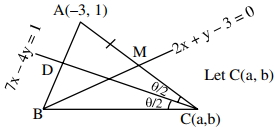
(C) Let $C = (a, b)$. Since $C$ lies on the angle bisector $7x - 4y - 1 = 0$,we have $7a - 4b = 1 \quad \dots(i)$.
Let $M$ be the midpoint of $AC$. Since $A = (-3, 1)$,$M = (\frac{a-3}{2}, \frac{b+1}{2})$.
Since $M$ lies on the median $2x + y - 3 = 0$,we have $2(\frac{a-3}{2}) + (\frac{b+1}{2}) - 3 = 0$,which simplifies to $2a - 6 + b + 1 - 6 = 0$,or $2a + b = 11 \quad \dots(ii)$.
Solving $(i)$ and $(ii)$,we multiply $(ii)$ by $4$: $8a + 4b = 44$. Adding to $(i)$: $15a = 45 \Rightarrow a = 3$. Substituting into $(ii)$: $6 + b = 11 \Rightarrow b = 5$. Thus,$C = (3, 5)$.
The slope of $AC$ is $m_{AC} = \frac{5-1}{3-(-3)} = \frac{4}{6} = \frac{2}{3}$.
The slope of the angle bisector $7x - 4y - 1 = 0$ is $m_{bisector} = \frac{7}{4}$.
Let $\alpha$ be the angle of $AC$ and $\beta$ be the angle of the bisector. The angle between them is $\frac{\theta}{2}$.
$\tan(\frac{\theta}{2}) = |\frac{m_{bisector} - m_{AC}}{1 + m_{bisector} \cdot m_{AC}}| = |\frac{7/4 - 2/3}{1 + (7/4)(2/3)}| = |\frac{(21-8)/12}{(12+14)/12}| = \frac{13}{26} = \frac{1}{2}$.
Finally,$\tan \theta = \frac{2 \tan(\theta/2)}{1 - \tan^2(\theta/2)} = \frac{2(1/2)}{1 - (1/2)^2} = \frac{1}{1 - 1/4} = \frac{1}{3/4} = \frac{4}{3}$.
Let $M$ be the midpoint of $AC$. Since $A = (-3, 1)$,$M = (\frac{a-3}{2}, \frac{b+1}{2})$.
Since $M$ lies on the median $2x + y - 3 = 0$,we have $2(\frac{a-3}{2}) + (\frac{b+1}{2}) - 3 = 0$,which simplifies to $2a - 6 + b + 1 - 6 = 0$,or $2a + b = 11 \quad \dots(ii)$.
Solving $(i)$ and $(ii)$,we multiply $(ii)$ by $4$: $8a + 4b = 44$. Adding to $(i)$: $15a = 45 \Rightarrow a = 3$. Substituting into $(ii)$: $6 + b = 11 \Rightarrow b = 5$. Thus,$C = (3, 5)$.
The slope of $AC$ is $m_{AC} = \frac{5-1}{3-(-3)} = \frac{4}{6} = \frac{2}{3}$.
The slope of the angle bisector $7x - 4y - 1 = 0$ is $m_{bisector} = \frac{7}{4}$.
Let $\alpha$ be the angle of $AC$ and $\beta$ be the angle of the bisector. The angle between them is $\frac{\theta}{2}$.
$\tan(\frac{\theta}{2}) = |\frac{m_{bisector} - m_{AC}}{1 + m_{bisector} \cdot m_{AC}}| = |\frac{7/4 - 2/3}{1 + (7/4)(2/3)}| = |\frac{(21-8)/12}{(12+14)/12}| = \frac{13}{26} = \frac{1}{2}$.
Finally,$\tan \theta = \frac{2 \tan(\theta/2)}{1 - \tan^2(\theta/2)} = \frac{2(1/2)}{1 - (1/2)^2} = \frac{1}{1 - 1/4} = \frac{1}{3/4} = \frac{4}{3}$.
0 likesView Solution
175
MathematicsMediumMCQJEE Main · 2021
If the truth value of the Boolean expression $((p \vee q) \wedge (q$ $\rightarrow r) \wedge (\sim r))$ $\rightarrow (p \wedge q)$ is false,then the truth values of the statements $p, q, r$ respectively can be:
A
$T, F, T$
B
$F, F, T$
C
$T, F, F$
D
$F, T, F$
Solution
(C) The implication $A \rightarrow B$ is false if and only if $A$ is true and $B$ is false.
Here,$A = (p \vee q) \wedge (q \rightarrow r) \wedge (\sim r)$ and $B = (p \wedge q)$.
For $B = (p \wedge q)$ to be false,at least one of $p$ or $q$ must be false.
For $A$ to be true,all components $(p \vee q)$,$(q \rightarrow r)$,and $(\sim r)$ must be true.
Since $(\sim r)$ is true,$r$ must be false.
Since $(q \rightarrow r)$ is true and $r$ is false,$q$ must be false.
Since $(p \vee q)$ is true and $q$ is false,$p$ must be true.
Thus,the truth values are $p=T, q=F, r=F$.
Checking option $C$: $p=T, q=F, r=F$ gives $A = (T \vee F) \wedge (F \rightarrow F) \wedge (\sim F) = T \wedge T \wedge T = T$ and $B = (T \wedge F) = F$.
Since $T \rightarrow F$ is false,option $C$ is correct.
Here,$A = (p \vee q) \wedge (q \rightarrow r) \wedge (\sim r)$ and $B = (p \wedge q)$.
For $B = (p \wedge q)$ to be false,at least one of $p$ or $q$ must be false.
For $A$ to be true,all components $(p \vee q)$,$(q \rightarrow r)$,and $(\sim r)$ must be true.
Since $(\sim r)$ is true,$r$ must be false.
Since $(q \rightarrow r)$ is true and $r$ is false,$q$ must be false.
Since $(p \vee q)$ is true and $q$ is false,$p$ must be true.
Thus,the truth values are $p=T, q=F, r=F$.
Checking option $C$: $p=T, q=F, r=F$ gives $A = (T \vee F) \wedge (F \rightarrow F) \wedge (\sim F) = T \wedge T \wedge T = T$ and $B = (T \wedge F) = F$.
Since $T \rightarrow F$ is false,option $C$ is correct.
0 likesView Solution
176
MathematicsDifficultMCQJEE Main · 2021
Let $z = \frac{1 - i \sqrt{3}}{2}$,where $i = \sqrt{-1}$. Then the value of $21 + \left(z + \frac{1}{z}\right)^{3} + \left(z^{2} + \frac{1}{z^{2}}\right)^{3} + \left(z^{3} + \frac{1}{z^{3}}\right)^{3} + \dots + \left(z^{21} + \frac{1}{z^{21}}\right)^{3}$ is .... .
A
$12$
B
$11$
C
$19$
D
$13$
Solution
(D) Given $z = \frac{1 - i \sqrt{3}}{2} = e^{-i \frac{\pi}{3}}$.
Then $z^r + \frac{1}{z^r} = e^{-i \frac{r\pi}{3}} + e^{i \frac{r\pi}{3}} = 2 \cos\left(\frac{r\pi}{3}\right)$.
We need to evaluate $S = 21 + \sum_{r=1}^{21} \left(z^r + \frac{1}{z^r}\right)^3 = 21 + \sum_{r=1}^{21} \left(2 \cos\left(\frac{r\pi}{3}\right)\right)^3$.
Using the identity $8 \cos^3 \theta = 2(4 \cos^3 \theta) = 2(\cos 3\theta + 3 \cos \theta)$,we have:
$S = 21 + \sum_{r=1}^{21} 2 \left(\cos(r\pi) + 3 \cos\left(\frac{r\pi}{3}\right)\right) = 21 + 2 \sum_{r=1}^{21} \cos(r\pi) + 6 \sum_{r=1}^{21} \cos\left(\frac{r\pi}{3}\right)$.
For $\sum_{r=1}^{21} \cos(r\pi) = (-1) + 1 + (-1) + \dots + (-1) = -1$ (since there are $21$ terms).
For $\sum_{r=1}^{21} \cos\left(\frac{r\pi}{3}\right)$,the sum of $\cos\left(\frac{r\pi}{3}\right)$ over one period ($r=1$ to $6$) is $0$. Since $21 = 3 \times 6 + 3$,the sum is $\sum_{r=1}^{3} \cos\left(\frac{r\pi}{3}\right) = \cos\frac{\pi}{3} + \cos\frac{2\pi}{3} + \cos\pi = \frac{1}{2} - \frac{1}{2} - 1 = -1$.
Thus,$S = 21 + 2(-1) + 6(-1) = 21 - 2 - 6 = 13$.
Then $z^r + \frac{1}{z^r} = e^{-i \frac{r\pi}{3}} + e^{i \frac{r\pi}{3}} = 2 \cos\left(\frac{r\pi}{3}\right)$.
We need to evaluate $S = 21 + \sum_{r=1}^{21} \left(z^r + \frac{1}{z^r}\right)^3 = 21 + \sum_{r=1}^{21} \left(2 \cos\left(\frac{r\pi}{3}\right)\right)^3$.
Using the identity $8 \cos^3 \theta = 2(4 \cos^3 \theta) = 2(\cos 3\theta + 3 \cos \theta)$,we have:
$S = 21 + \sum_{r=1}^{21} 2 \left(\cos(r\pi) + 3 \cos\left(\frac{r\pi}{3}\right)\right) = 21 + 2 \sum_{r=1}^{21} \cos(r\pi) + 6 \sum_{r=1}^{21} \cos\left(\frac{r\pi}{3}\right)$.
For $\sum_{r=1}^{21} \cos(r\pi) = (-1) + 1 + (-1) + \dots + (-1) = -1$ (since there are $21$ terms).
For $\sum_{r=1}^{21} \cos\left(\frac{r\pi}{3}\right)$,the sum of $\cos\left(\frac{r\pi}{3}\right)$ over one period ($r=1$ to $6$) is $0$. Since $21 = 3 \times 6 + 3$,the sum is $\sum_{r=1}^{3} \cos\left(\frac{r\pi}{3}\right) = \cos\frac{\pi}{3} + \cos\frac{2\pi}{3} + \cos\pi = \frac{1}{2} - \frac{1}{2} - 1 = -1$.
Thus,$S = 21 + 2(-1) + 6(-1) = 21 - 2 - 6 = 13$.
0 likesView Solution
177
MathematicsDifficultMCQJEE Main · 2021
The sum of all integral values of $k$ $(k \neq 0)$ for which the equation $\frac{2}{x-1}-\frac{1}{x-2}=\frac{2}{k}$ in $x$ has no real roots,is ..... .
A
$95$
B
$76$
C
$66$
D
$70$
Solution
(C) Given the equation $\frac{2}{x-1}-\frac{1}{x-2}=\frac{2}{k}$,where $x \in \mathbb{R} \setminus \{1, 2\}$.
Simplifying the equation: $\frac{2(x-2)-(x-1)}{(x-1)(x-2)} = \frac{2}{k} \Rightarrow \frac{x-3}{x^2-3x+2} = \frac{2}{k}$.
This gives $k(x-3) = 2(x^2-3x+2)$.
If $x=3$,then $0 = 2(9-9+2) = 4$,which is impossible. Thus $x \neq 3$.
For $x \neq 3$,we have $k = \frac{2(x^2-3x+2)}{x-3} = 2 \left( \frac{x^2-3x+2}{x-3} \right) = 2 \left( x + \frac{2}{x-3} \right) = 2 \left( (x-3) + \frac{2}{x-3} + 3 \right)$.
Let $f(x) = (x-3) + \frac{2}{x-3} + 3$.
Using the $AM$-$GM$ inequality,for $x > 3$,$(x-3) + \frac{2}{x-3} \geq 2\sqrt{2}$,so $f(x) \geq 3 + 2\sqrt{2}$.
For $x < 3$,$(x-3) + \frac{2}{x-3} = -(|x-3| + \frac{2}{|x-3|}) \leq -2\sqrt{2}$,so $f(x) \leq 3 - 2\sqrt{2}$.
Thus,$k = 2f(x) \in (-\infty, 6-4\sqrt{2}] \cup [6+4\sqrt{2}, \infty)$.
The equation has no real roots if $k$ lies in the gap: $k \in (6-4\sqrt{2}, 6+4\sqrt{2})$.
Approximating $\sqrt{2} \approx 1.414$,$6-4(1.414) = 6-5.656 = 0.344$ and $6+4(1.414) = 6+5.656 = 11.656$.
So $k \in (0.344, 11.656)$.
The integral values of $k$ are $\{1, 2, 3, 4, 5, 6, 7, 8, 9, 10, 11\}$.
The sum of these values is $\frac{11 \times 12}{2} = 66$.
Simplifying the equation: $\frac{2(x-2)-(x-1)}{(x-1)(x-2)} = \frac{2}{k} \Rightarrow \frac{x-3}{x^2-3x+2} = \frac{2}{k}$.
This gives $k(x-3) = 2(x^2-3x+2)$.
If $x=3$,then $0 = 2(9-9+2) = 4$,which is impossible. Thus $x \neq 3$.
For $x \neq 3$,we have $k = \frac{2(x^2-3x+2)}{x-3} = 2 \left( \frac{x^2-3x+2}{x-3} \right) = 2 \left( x + \frac{2}{x-3} \right) = 2 \left( (x-3) + \frac{2}{x-3} + 3 \right)$.
Let $f(x) = (x-3) + \frac{2}{x-3} + 3$.
Using the $AM$-$GM$ inequality,for $x > 3$,$(x-3) + \frac{2}{x-3} \geq 2\sqrt{2}$,so $f(x) \geq 3 + 2\sqrt{2}$.
For $x < 3$,$(x-3) + \frac{2}{x-3} = -(|x-3| + \frac{2}{|x-3|}) \leq -2\sqrt{2}$,so $f(x) \leq 3 - 2\sqrt{2}$.
Thus,$k = 2f(x) \in (-\infty, 6-4\sqrt{2}] \cup [6+4\sqrt{2}, \infty)$.
The equation has no real roots if $k$ lies in the gap: $k \in (6-4\sqrt{2}, 6+4\sqrt{2})$.
Approximating $\sqrt{2} \approx 1.414$,$6-4(1.414) = 6-5.656 = 0.344$ and $6+4(1.414) = 6+5.656 = 11.656$.
So $k \in (0.344, 11.656)$.
The integral values of $k$ are $\{1, 2, 3, 4, 5, 6, 7, 8, 9, 10, 11\}$.
The sum of these values is $\frac{11 \times 12}{2} = 66$.
0 likesView Solution
178
MathematicsDifficultMCQJEE Main · 2021
If ${ }^{1} P_{1}+2 \cdot{ }^{2} P_{2}+3 \cdot{ }^{3} P_{3}+\ldots+15 \cdot{ }^{15} P_{15}={ }^{q} P_{r}-s$,where $0 \leq s \leq 1$,then ${ }^{q+s} C_{r-s}$ is equal to .... .
A
$136$
B
$1$
C
$16$
D
$13$
Solution
(A) The given expression is $\sum_{n=1}^{15} n \cdot {}^{n}P_{n}$.
Since ${}^{n}P_{n} = n!$,the expression becomes $\sum_{n=1}^{15} n \cdot n!$.
We know that $n \cdot n! = (n+1-1) \cdot n! = (n+1)! - n!$.
Thus,the sum is $\sum_{n=1}^{15} ((n+1)! - n!) = (2!-1!) + (3!-2!) + \ldots + (16!-15!) = 16! - 1! = 16! - 1$.
Given the expression is ${}^{q}P_{r} - s$,we have ${}^{16}P_{16} - 1 = {}^{q}P_{r} - s$.
Comparing,we get $q = 16$,$r = 16$,and $s = 1$.
We need to find ${}^{q+s}C_{r-s} = {}^{16+1}C_{16-1} = {}^{17}C_{15}$.
${}^{17}C_{15} = {}^{17}C_{2} = \frac{17 \times 16}{2 \times 1} = 17 \times 8 = 136$.
Since ${}^{n}P_{n} = n!$,the expression becomes $\sum_{n=1}^{15} n \cdot n!$.
We know that $n \cdot n! = (n+1-1) \cdot n! = (n+1)! - n!$.
Thus,the sum is $\sum_{n=1}^{15} ((n+1)! - n!) = (2!-1!) + (3!-2!) + \ldots + (16!-15!) = 16! - 1! = 16! - 1$.
Given the expression is ${}^{q}P_{r} - s$,we have ${}^{16}P_{16} - 1 = {}^{q}P_{r} - s$.
Comparing,we get $q = 16$,$r = 16$,and $s = 1$.
We need to find ${}^{q+s}C_{r-s} = {}^{16+1}C_{16-1} = {}^{17}C_{15}$.
${}^{17}C_{15} = {}^{17}C_{2} = \frac{17 \times 16}{2 \times 1} = 17 \times 8 = 136$.
0 likesView Solution
179
MathematicsMediumMCQJEE Main · 2021
The locus of a point,which moves such that the sum of squares of its distances from the points $(0,0), (1,0), (0,1), (1,1)$ is $18$ units,is a circle of diameter $d$. Then $d^{2}$ is equal to ...... .
A
$16$
B
$4$
C
$216$
D
$6$
Solution
(A) Let the point be $P(x, y)$.
The sum of the squares of the distances from $(0,0), (1,0), (0,1), (1,1)$ is given by:
$(x^2 + y^2) + ((x-1)^2 + y^2) + (x^2 + (y-1)^2) + ((x-1)^2 + (y-1)^2) = 18$
Expanding the terms:
$(x^2 + y^2) + (x^2 - 2x + 1 + y^2) + (x^2 + y^2 - 2y + 1) + (x^2 - 2x + 1 + y^2 - 2y + 1) = 18$
Combining like terms:
$4x^2 + 4y^2 - 4x - 4y + 4 = 18$
Dividing by $4$:
$x^2 + y^2 - x - y + 1 = 4.5$
$x^2 + y^2 - x - y - 3.5 = 0$
The radius $r$ of the circle $x^2 + y^2 + 2gx + 2fy + c = 0$ is $\sqrt{g^2 + f^2 - c}$.
Here,$2g = -1 \Rightarrow g = -0.5$,$2f = -1 \Rightarrow f = -0.5$,and $c = -3.5$.
$r = \sqrt{(-0.5)^2 + (-0.5)^2 - (-3.5)} = \sqrt{0.25 + 0.25 + 3.5} = \sqrt{4} = 2$.
The diameter $d = 2r = 2(2) = 4$.
Therefore,$d^2 = 4^2 = 16$.
The sum of the squares of the distances from $(0,0), (1,0), (0,1), (1,1)$ is given by:
$(x^2 + y^2) + ((x-1)^2 + y^2) + (x^2 + (y-1)^2) + ((x-1)^2 + (y-1)^2) = 18$
Expanding the terms:
$(x^2 + y^2) + (x^2 - 2x + 1 + y^2) + (x^2 + y^2 - 2y + 1) + (x^2 - 2x + 1 + y^2 - 2y + 1) = 18$
Combining like terms:
$4x^2 + 4y^2 - 4x - 4y + 4 = 18$
Dividing by $4$:
$x^2 + y^2 - x - y + 1 = 4.5$
$x^2 + y^2 - x - y - 3.5 = 0$
The radius $r$ of the circle $x^2 + y^2 + 2gx + 2fy + c = 0$ is $\sqrt{g^2 + f^2 - c}$.
Here,$2g = -1 \Rightarrow g = -0.5$,$2f = -1 \Rightarrow f = -0.5$,and $c = -3.5$.
$r = \sqrt{(-0.5)^2 + (-0.5)^2 - (-3.5)} = \sqrt{0.25 + 0.25 + 3.5} = \sqrt{4} = 2$.
The diameter $d = 2r = 2(2) = 4$.
Therefore,$d^2 = 4^2 = 16$.
0 likesView Solution
180
MathematicsMediumMCQJEE Main · 2021
The number of three-digit even numbers,formed by the digits $0, 1, 3, 4, 6, 7$ if the repetition of digits is not allowed,is .... .
A
$26$
B
$52$
C
$32$
D
$20$
Solution
(B) To form a three-digit even number,the unit place must be occupied by an even digit $(0, 4, 6)$. Since repetition is not allowed,we consider two cases:
Case $(i)$: When the unit place is $0$.
There is $1$ way to fill the unit place. The remaining two places (hundreds and tens) can be filled by the remaining $5$ digits $(1, 3, 4, 6, 7)$ in $5 \times 4 = 20$ ways.
Case $(ii)$: When the unit place is $4$ or $6$.
There are $2$ ways to fill the unit place. The hundreds place cannot be $0$ and cannot be the digit already used in the unit place,so there are $6 - 2 = 4$ choices for the hundreds place. The tens place can then be filled by any of the remaining $4$ digits (including $0$),giving $4 \times 4 = 16$ ways for each choice of the unit digit. Total ways $= 2 \times 16 = 32$ ways.
Total number of even numbers $= 20 + 32 = 52$.
Case $(i)$: When the unit place is $0$.
There is $1$ way to fill the unit place. The remaining two places (hundreds and tens) can be filled by the remaining $5$ digits $(1, 3, 4, 6, 7)$ in $5 \times 4 = 20$ ways.
Case $(ii)$: When the unit place is $4$ or $6$.
There are $2$ ways to fill the unit place. The hundreds place cannot be $0$ and cannot be the digit already used in the unit place,so there are $6 - 2 = 4$ choices for the hundreds place. The tens place can then be filled by any of the remaining $4$ digits (including $0$),giving $4 \times 4 = 16$ ways for each choice of the unit digit. Total ways $= 2 \times 16 = 32$ ways.
Total number of even numbers $= 20 + 32 = 52$.
0 likesView Solution
181
MathematicsDifficultMCQJEE Main · 2021
The point $P(-2 \sqrt{6}, \sqrt{3})$ lies on the hyperbola $\frac{x^{2}}{a^{2}}-\frac{y^{2}}{b^{2}}=1$ having eccentricity $e = \frac{\sqrt{5}}{2}$. If the tangent and normal at $P$ to the hyperbola intersect its conjugate axis at the points $Q$ and $R$ respectively,then $QR$ is equal to :
A
$4 \sqrt{3}$
B
$6$
C
$6 \sqrt{3}$
D
$2 \sqrt{3}$
Solution
(C) Given the hyperbola $\frac{x^{2}}{a^{2}}-\frac{y^{2}}{b^{2}}=1$ and eccentricity $e = \frac{\sqrt{5}}{2}$.
We know $b^{2} = a^{2}(e^{2}-1) = a^{2}(\frac{5}{4}-1) = \frac{a^{2}}{4}$,so $a^{2} = 4b^{2}$.
Since $P(-2 \sqrt{6}, \sqrt{3})$ lies on the hyperbola,$\frac{(-2 \sqrt{6})^{2}}{4b^{2}} - \frac{(\sqrt{3})^{2}}{b^{2}} = 1$.
$\frac{24}{4b^{2}} - \frac{3}{b^{2}} = 1 \Rightarrow \frac{6}{b^{2}} - \frac{3}{b^{2}} = 1 \Rightarrow \frac{3}{b^{2}} = 1 \Rightarrow b^{2} = 3$,so $b = \sqrt{3}$ and $a^{2} = 12$,so $a = 2 \sqrt{3}$.
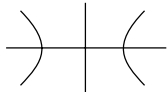
The hyperbola is $\frac{x^{2}}{12} - \frac{y^{2}}{3} = 1$.
The tangent at $P(x_{1}, y_{1})$ is $\frac{xx_{1}}{a^{2}} - \frac{yy_{1}}{b^{2}} = 1$.
$\frac{x(-2 \sqrt{6})}{12} - \frac{y(\sqrt{3})}{3} = 1 \Rightarrow -\frac{x \sqrt{6}}{6} - \frac{y}{\sqrt{3}} = 1$.
For the conjugate axis,set $x = 0$: $-\frac{y}{\sqrt{3}} = 1 \Rightarrow y = -\sqrt{3}$. Thus $Q = (0, -\sqrt{3})$.
The slope of the tangent is $m = \frac{b^{2}x_{1}}{a^{2}y_{1}} = \frac{3(-2 \sqrt{6})}{12(\sqrt{3})} = \frac{-6 \sqrt{6}}{12 \sqrt{3}} = -\frac{\sqrt{2}}{2} = -\frac{1}{\sqrt{2}}$.
The slope of the normal is $m' = -\frac{1}{m} = \sqrt{2}$.
The equation of the normal at $P$ is $y - \sqrt{3} = \sqrt{2}(x + 2 \sqrt{6})$.
For the conjugate axis,set $x = 0$: $y - \sqrt{3} = \sqrt{2}(2 \sqrt{6}) = 2 \sqrt{12} = 4 \sqrt{3}$.
$y = 4 \sqrt{3} + \sqrt{3} = 5 \sqrt{3}$. Thus $R = (0, 5 \sqrt{3})$.
The distance $QR = |5 \sqrt{3} - (-\sqrt{3})| = |6 \sqrt{3}| = 6 \sqrt{3}$.
We know $b^{2} = a^{2}(e^{2}-1) = a^{2}(\frac{5}{4}-1) = \frac{a^{2}}{4}$,so $a^{2} = 4b^{2}$.
Since $P(-2 \sqrt{6}, \sqrt{3})$ lies on the hyperbola,$\frac{(-2 \sqrt{6})^{2}}{4b^{2}} - \frac{(\sqrt{3})^{2}}{b^{2}} = 1$.
$\frac{24}{4b^{2}} - \frac{3}{b^{2}} = 1 \Rightarrow \frac{6}{b^{2}} - \frac{3}{b^{2}} = 1 \Rightarrow \frac{3}{b^{2}} = 1 \Rightarrow b^{2} = 3$,so $b = \sqrt{3}$ and $a^{2} = 12$,so $a = 2 \sqrt{3}$.
The hyperbola is $\frac{x^{2}}{12} - \frac{y^{2}}{3} = 1$.
The tangent at $P(x_{1}, y_{1})$ is $\frac{xx_{1}}{a^{2}} - \frac{yy_{1}}{b^{2}} = 1$.
$\frac{x(-2 \sqrt{6})}{12} - \frac{y(\sqrt{3})}{3} = 1 \Rightarrow -\frac{x \sqrt{6}}{6} - \frac{y}{\sqrt{3}} = 1$.
For the conjugate axis,set $x = 0$: $-\frac{y}{\sqrt{3}} = 1 \Rightarrow y = -\sqrt{3}$. Thus $Q = (0, -\sqrt{3})$.
The slope of the tangent is $m = \frac{b^{2}x_{1}}{a^{2}y_{1}} = \frac{3(-2 \sqrt{6})}{12(\sqrt{3})} = \frac{-6 \sqrt{6}}{12 \sqrt{3}} = -\frac{\sqrt{2}}{2} = -\frac{1}{\sqrt{2}}$.
The slope of the normal is $m' = -\frac{1}{m} = \sqrt{2}$.
The equation of the normal at $P$ is $y - \sqrt{3} = \sqrt{2}(x + 2 \sqrt{6})$.
For the conjugate axis,set $x = 0$: $y - \sqrt{3} = \sqrt{2}(2 \sqrt{6}) = 2 \sqrt{12} = 4 \sqrt{3}$.
$y = 4 \sqrt{3} + \sqrt{3} = 5 \sqrt{3}$. Thus $R = (0, 5 \sqrt{3})$.
The distance $QR = |5 \sqrt{3} - (-\sqrt{3})| = |6 \sqrt{3}| = 6 \sqrt{3}$.
0 likesView Solution
182
MathematicsMediumMCQJEE Main · 2021
Consider the two statements:
$(S1): (p$ $\rightarrow q) \vee (\sim q$ $\rightarrow p)$ is a tautology.
$(S2): (p \wedge \sim q) \wedge (\sim p \vee q)$ is a fallacy.
Then:
$(S1): (p$ $\rightarrow q) \vee (\sim q$ $\rightarrow p)$ is a tautology.
$(S2): (p \wedge \sim q) \wedge (\sim p \vee q)$ is a fallacy.
Then:
A
Only $(S1)$ is true.
B
Both $(S1)$ and $(S2)$ are false.
C
Both $(S1)$ and $(S2)$ are true.
D
Only $(S2)$ is true.
Solution
(C) For $(S1): (p$ $\rightarrow q) \vee (\sim q$ $\rightarrow p)$
Using the implication law $(a \rightarrow b \equiv \sim a \vee b)$,we get:
$(\sim p \vee q) \vee (q \vee p)$
$= (q \vee \sim p) \vee (q \vee p) = q \vee (\sim p \vee p) = q \vee t = t$.
Thus,$(S1)$ is a tautology.
For $(S2): (p \wedge \sim q) \wedge (\sim p \vee q)$
Using De Morgan's Law,$(\sim p \vee q) \equiv \sim (p \wedge \sim q)$.
So,$(S2) = (p \wedge \sim q) \wedge \sim (p \wedge \sim q) = C$ (Contradiction/Fallacy).
Thus,both $(S1)$ and $(S2)$ are true.
Using the implication law $(a \rightarrow b \equiv \sim a \vee b)$,we get:
$(\sim p \vee q) \vee (q \vee p)$
$= (q \vee \sim p) \vee (q \vee p) = q \vee (\sim p \vee p) = q \vee t = t$.
Thus,$(S1)$ is a tautology.
For $(S2): (p \wedge \sim q) \wedge (\sim p \vee q)$
Using De Morgan's Law,$(\sim p \vee q) \equiv \sim (p \wedge \sim q)$.
So,$(S2) = (p \wedge \sim q) \wedge \sim (p \wedge \sim q) = C$ (Contradiction/Fallacy).
Thus,both $(S1)$ and $(S2)$ are true.
0 likesView Solution
183
MathematicsDifficultMCQJEE Main · 2021
If $\sum_{r=1}^{50} \tan ^{-1} \frac{1}{2 r^{2}}=p$,then the value of $\tan p$ is :
A
$\frac{101}{102}$
B
$\frac{51}{50}$
C
$100$
D
$\frac{50}{51}$
Solution
(D) We are given the sum $p = \sum_{r=1}^{50} \tan ^{-1} \frac{1}{2 r^{2}}$.
First,multiply the numerator and denominator by $2$ to use the formula $\tan ^{-1} x - \tan ^{-1} y = \tan ^{-1} \frac{x-y}{1+xy}$.
$p = \sum_{r=1}^{50} \tan ^{-1} \frac{2}{4 r^{2}} = \sum_{r=1}^{50} \tan ^{-1} \frac{(2r+1)-(2r-1)}{1+(2r+1)(2r-1)}$.
This is a telescoping series of the form $\sum_{r=1}^{n} (\tan ^{-1}(a_{r+1}) - \tan ^{-1}(a_r))$.
$p = (\tan ^{-1} 3 - \tan ^{-1} 1) + (\tan ^{-1} 5 - \tan ^{-1} 3) + \dots + (\tan ^{-1} 101 - \tan ^{-1} 99)$.
All intermediate terms cancel out,leaving $p = \tan ^{-1} 101 - \tan ^{-1} 1$.
Using the formula $\tan ^{-1} x - \tan ^{-1} y = \tan ^{-1} \frac{x-y}{1+xy}$,we get $p = \tan ^{-1} \frac{101-1}{1+(101)(1)} = \tan ^{-1} \frac{100}{102} = \tan ^{-1} \frac{50}{51}$.
Therefore,$\tan p = \frac{50}{51}$.
First,multiply the numerator and denominator by $2$ to use the formula $\tan ^{-1} x - \tan ^{-1} y = \tan ^{-1} \frac{x-y}{1+xy}$.
$p = \sum_{r=1}^{50} \tan ^{-1} \frac{2}{4 r^{2}} = \sum_{r=1}^{50} \tan ^{-1} \frac{(2r+1)-(2r-1)}{1+(2r+1)(2r-1)}$.
This is a telescoping series of the form $\sum_{r=1}^{n} (\tan ^{-1}(a_{r+1}) - \tan ^{-1}(a_r))$.
$p = (\tan ^{-1} 3 - \tan ^{-1} 1) + (\tan ^{-1} 5 - \tan ^{-1} 3) + \dots + (\tan ^{-1} 101 - \tan ^{-1} 99)$.
All intermediate terms cancel out,leaving $p = \tan ^{-1} 101 - \tan ^{-1} 1$.
Using the formula $\tan ^{-1} x - \tan ^{-1} y = \tan ^{-1} \frac{x-y}{1+xy}$,we get $p = \tan ^{-1} \frac{101-1}{1+(101)(1)} = \tan ^{-1} \frac{100}{102} = \tan ^{-1} \frac{50}{51}$.
Therefore,$\tan p = \frac{50}{51}$.
0 likesView Solution
184
MathematicsDifficultMCQJEE Main · 2021
The locus of the midpoints of the chords of the hyperbola $x^{2}-y^{2}=4$,which touch the parabola $y^{2}=8x$,is:
A
$y^{3}(x-2)=x^{2}$
B
$x^{3}(x-2)=y^{2}$
C
$y^{2}(x-2)=x^{3}$
D
$x^{2}(x-2)=y^{3}$
Solution
(C) Let the midpoint of the chord be $(h, k)$. The equation of the chord of the hyperbola $x^{2}-y^{2}=4$ with midpoint $(h, k)$ is given by $T=S_{1}$,which is $xh-yk=h^{2}-k^{2}$.
Rewriting this in the slope-intercept form $y=mx+c$,we get $y=\frac{h}{k}x - \frac{h^{2}-k^{2}}{k}$.
This line touches the parabola $y^{2}=8x$ (where $a=2$). The condition for the line $y=mx+c$ to touch the parabola $y^{2}=4ax$ is $c=\frac{a}{m}$.
Substituting $m=\frac{h}{k}$ and $c=-\frac{h^{2}-k^{2}}{k}$,we get $-\frac{h^{2}-k^{2}}{k} = \frac{2}{h/k} = \frac{2k}{h}$.
Simplifying,$-(h^{2}-k^{2})h = 2k^{2}$,which gives $h^{2}h - k^{2}h = -2k^{2}$,or $h^{3} = k^{2}(h-2)$.
Replacing $(h, k)$ with $(x, y)$,the locus is $y^{2}(x-2)=x^{3}$.
Rewriting this in the slope-intercept form $y=mx+c$,we get $y=\frac{h}{k}x - \frac{h^{2}-k^{2}}{k}$.
This line touches the parabola $y^{2}=8x$ (where $a=2$). The condition for the line $y=mx+c$ to touch the parabola $y^{2}=4ax$ is $c=\frac{a}{m}$.
Substituting $m=\frac{h}{k}$ and $c=-\frac{h^{2}-k^{2}}{k}$,we get $-\frac{h^{2}-k^{2}}{k} = \frac{2}{h/k} = \frac{2k}{h}$.
Simplifying,$-(h^{2}-k^{2})h = 2k^{2}$,which gives $h^{2}h - k^{2}h = -2k^{2}$,or $h^{3} = k^{2}(h-2)$.
Replacing $(h, k)$ with $(x, y)$,the locus is $y^{2}(x-2)=x^{3}$.
0 likesView Solution
185
MathematicsMediumMCQJEE Main · 2021
The value of $2 \sin(\frac{\pi}{8}) \sin(\frac{2\pi}{8}) \sin(\frac{3\pi}{8}) \sin(\frac{5\pi}{8}) \sin(\frac{6\pi}{8}) \sin(\frac{7\pi}{8})$ is:
A
$\frac{1}{4\sqrt{2}}$
B
$\frac{1}{4}$
C
$\frac{1}{8}$
D
$\frac{1}{8\sqrt{2}}$
Solution
(C) Let the expression be $E = 2 \sin(\frac{\pi}{8}) \sin(\frac{2\pi}{8}) \sin(\frac{3\pi}{8}) \sin(\frac{5\pi}{8}) \sin(\frac{6\pi}{8}) \sin(\frac{7\pi}{8})$.
Using the property $\sin(\pi - \theta) = \sin \theta$,we have $\sin(\frac{7\pi}{8}) = \sin(\frac{\pi}{8})$,$\sin(\frac{6\pi}{8}) = \sin(\frac{2\pi}{8})$,and $\sin(\frac{5\pi}{8}) = \sin(\frac{3\pi}{8})$.
Substituting these,$E = 2 \sin^2(\frac{\pi}{8}) \sin^2(\frac{2\pi}{8}) \sin^2(\frac{3\pi}{8})$.
Since $\sin(\frac{2\pi}{8}) = \sin(\frac{\pi}{4}) = \frac{1}{\sqrt{2}}$,then $\sin^2(\frac{2\pi}{8}) = \frac{1}{2}$.
Thus,$E = 2 \cdot \frac{1}{2} \cdot \sin^2(\frac{\pi}{8}) \sin^2(\frac{3\pi}{8}) = \sin^2(\frac{\pi}{8}) \cos^2(\frac{\pi}{8})$ (as $\sin(\frac{3\pi}{8}) = \cos(\frac{\pi}{8})$).
$E = (\sin(\frac{\pi}{8}) \cos(\frac{\pi}{8}))^2 = (\frac{1}{2} \sin(\frac{2\pi}{8}))^2 = (\frac{1}{2} \sin(\frac{\pi}{4}))^2 = (\frac{1}{2} \cdot \frac{1}{\sqrt{2}})^2 = \frac{1}{4 \cdot 2} = \frac{1}{8}$.
Using the property $\sin(\pi - \theta) = \sin \theta$,we have $\sin(\frac{7\pi}{8}) = \sin(\frac{\pi}{8})$,$\sin(\frac{6\pi}{8}) = \sin(\frac{2\pi}{8})$,and $\sin(\frac{5\pi}{8}) = \sin(\frac{3\pi}{8})$.
Substituting these,$E = 2 \sin^2(\frac{\pi}{8}) \sin^2(\frac{2\pi}{8}) \sin^2(\frac{3\pi}{8})$.
Since $\sin(\frac{2\pi}{8}) = \sin(\frac{\pi}{4}) = \frac{1}{\sqrt{2}}$,then $\sin^2(\frac{2\pi}{8}) = \frac{1}{2}$.
Thus,$E = 2 \cdot \frac{1}{2} \cdot \sin^2(\frac{\pi}{8}) \sin^2(\frac{3\pi}{8}) = \sin^2(\frac{\pi}{8}) \cos^2(\frac{\pi}{8})$ (as $\sin(\frac{3\pi}{8}) = \cos(\frac{\pi}{8})$).
$E = (\sin(\frac{\pi}{8}) \cos(\frac{\pi}{8}))^2 = (\frac{1}{2} \sin(\frac{2\pi}{8}))^2 = (\frac{1}{2} \sin(\frac{\pi}{4}))^2 = (\frac{1}{2} \cdot \frac{1}{\sqrt{2}})^2 = \frac{1}{4 \cdot 2} = \frac{1}{8}$.
0 likesView Solution
186
MathematicsDifficultMCQJEE Main · 2021
If $(\sqrt{3}+i)^{100}=2^{99}(p+iq)$,then $p$ and $q$ are roots of the equation :
A
$x^{2}-(\sqrt{3}-1)x-\sqrt{3}=0$
B
$x^{2}+(\sqrt{3}+1)x+\sqrt{3}=0$
C
$x^{2}+(\sqrt{3}-1)x-\sqrt{3}=0$
D
$x^{2}-(\sqrt{3}+1)x+\sqrt{3}=0$
Solution
(A) Given $(\sqrt{3}+i)^{100}=2^{99}(p+iq)$.
Express $\sqrt{3}+i$ in polar form: $2(\cos \frac{\pi}{6} + i \sin \frac{\pi}{6})$.
Using De Moivre's theorem: $(2(\cos \frac{\pi}{6} + i \sin \frac{\pi}{6}))^{100} = 2^{100}(\cos \frac{100\pi}{6} + i \sin \frac{100\pi}{6}) = 2^{100}(\cos \frac{50\pi}{3} + i \sin \frac{50\pi}{3})$.
Since $\frac{50\pi}{3} = 16\pi + \frac{2\pi}{3}$,we have $\cos \frac{50\pi}{3} = \cos \frac{2\pi}{3} = -\frac{1}{2}$ and $\sin \frac{50\pi}{3} = \sin \frac{2\pi}{3} = \frac{\sqrt{3}}{2}$.
Thus,$2^{100}(-\frac{1}{2} + i \frac{\sqrt{3}}{2}) = 2^{99}(p+iq)$.
Dividing by $2^{99}$,we get $2(-\frac{1}{2} + i \frac{\sqrt{3}}{2}) = p+iq$,so $p = -1$ and $q = \sqrt{3}$.
The quadratic equation with roots $p$ and $q$ is $x^2 - (p+q)x + pq = 0$.
$p+q = \sqrt{3}-1$ and $pq = -\sqrt{3}$.
Therefore,the equation is $x^2 - (\sqrt{3}-1)x - \sqrt{3} = 0$.
Express $\sqrt{3}+i$ in polar form: $2(\cos \frac{\pi}{6} + i \sin \frac{\pi}{6})$.
Using De Moivre's theorem: $(2(\cos \frac{\pi}{6} + i \sin \frac{\pi}{6}))^{100} = 2^{100}(\cos \frac{100\pi}{6} + i \sin \frac{100\pi}{6}) = 2^{100}(\cos \frac{50\pi}{3} + i \sin \frac{50\pi}{3})$.
Since $\frac{50\pi}{3} = 16\pi + \frac{2\pi}{3}$,we have $\cos \frac{50\pi}{3} = \cos \frac{2\pi}{3} = -\frac{1}{2}$ and $\sin \frac{50\pi}{3} = \sin \frac{2\pi}{3} = \frac{\sqrt{3}}{2}$.
Thus,$2^{100}(-\frac{1}{2} + i \frac{\sqrt{3}}{2}) = 2^{99}(p+iq)$.
Dividing by $2^{99}$,we get $2(-\frac{1}{2} + i \frac{\sqrt{3}}{2}) = p+iq$,so $p = -1$ and $q = \sqrt{3}$.
The quadratic equation with roots $p$ and $q$ is $x^2 - (p+q)x + pq = 0$.
$p+q = \sqrt{3}-1$ and $pq = -\sqrt{3}$.
Therefore,the equation is $x^2 - (\sqrt{3}-1)x - \sqrt{3} = 0$.
0 likesView Solution
187
MathematicsDifficultMCQJEE Main · 2021
$A$ $10 \text{ inches}$ long pencil $AB$ with midpoint $C$ and a small eraser $P$ are placed on the horizontal top of a table such that $PC = \sqrt{5} \text{ inches}$ and $\angle PCB = \tan^{-1}(2)$. The acute angle through which the pencil must be rotated about $C$ so that the perpendicular distance between the eraser and the pencil becomes exactly $1 \text{ inch}$ is:
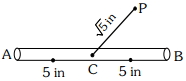
A
$\tan^{-1}\left(\frac{3}{4}\right)$
B
$\tan^{-1}(1)$
C
$\tan^{-1}\left(\frac{4}{3}\right)$
D
$\tan^{-1}\left(\frac{1}{2}\right)$
Solution
(A) Let the pencil be rotated by an angle $\alpha$ about $C$. Let the new position of the pencil be $A'B'$.
In the right-angled triangle formed by the perpendicular from $P$ to the pencil,let the angle between $PC$ and the new pencil line be $\theta$.
We are given $PC = \sqrt{5}$ and the perpendicular distance $d = 1$.
In the right triangle formed by $P$,the foot of the perpendicular on the pencil,and $C$,we have $\sin \theta = \frac{d}{PC} = \frac{1}{\sqrt{5}}$.
Thus,$\tan \theta = \frac{1}{2}$.
Initially,the angle $\angle PCB = \phi = \tan^{-1}(2)$,so $\tan \phi = 2$.
The angle of rotation $\alpha$ is the difference between the initial angle $\phi$ and the new angle $\theta$.
$\alpha = \phi - \theta$.
$\tan \alpha = \tan(\phi - \theta) = \frac{\tan \phi - \tan \theta}{1 + \tan \phi \tan \theta} = \frac{2 - 1/2}{1 + 2(1/2)} = \frac{3/2}{2} = \frac{3}{4}$.
Therefore,$\alpha = \tan^{-1}\left(\frac{3}{4}\right)$.
In the right-angled triangle formed by the perpendicular from $P$ to the pencil,let the angle between $PC$ and the new pencil line be $\theta$.
We are given $PC = \sqrt{5}$ and the perpendicular distance $d = 1$.
In the right triangle formed by $P$,the foot of the perpendicular on the pencil,and $C$,we have $\sin \theta = \frac{d}{PC} = \frac{1}{\sqrt{5}}$.
Thus,$\tan \theta = \frac{1}{2}$.
Initially,the angle $\angle PCB = \phi = \tan^{-1}(2)$,so $\tan \phi = 2$.
The angle of rotation $\alpha$ is the difference between the initial angle $\phi$ and the new angle $\theta$.
$\alpha = \phi - \theta$.
$\tan \alpha = \tan(\phi - \theta) = \frac{\tan \phi - \tan \theta}{1 + \tan \phi \tan \theta} = \frac{2 - 1/2}{1 + 2(1/2)} = \frac{3/2}{2} = \frac{3}{4}$.
Therefore,$\alpha = \tan^{-1}\left(\frac{3}{4}\right)$.
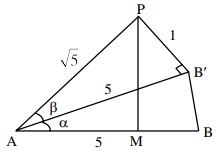
0 likesView Solution
188
MathematicsDifficultMCQJEE Main · 2021
$A$ circle $C$ touches the line $x=2y$ at the point $(2,1)$ and intersects the circle $C_{1}: x^{2}+y^{2}+2y-5=0$ at two points $P$ and $Q$ such that $PQ$ is a diameter of $C_{1}$. Then the diameter of $C$ is:
A
$7\sqrt{5}$
B
$15$
C
$\sqrt{285}$
D
$4\sqrt{15}$
Solution
(A) The equation of a circle $C$ touching the line $x-2y=0$ at $(2,1)$ is given by $(x-2)^{2}+(y-1)^{2}+\lambda(x-2y)=0$.
Expanding this,we get $x^{2}+y^{2}+x(\lambda-4)+y(-2-2\lambda)+5=0$.
The given circle $C_{1}$ is $x^{2}+y^{2}+2y-5=0$.
The common chord $PQ$ is the radical axis $C-C_{1}=0$,which is $x(\lambda-4)+y(-2-2\lambda-2)+10=0$,or $x(\lambda-4)-y(2\lambda+4)+10=0$.
Since $PQ$ is a diameter of $C_{1}$,it must pass through the center of $C_{1}$,which is $(0,-1)$.
Substituting $(0,-1)$ into the equation of $PQ$: $0(\lambda-4)-(-1)(2\lambda+4)+10=0$ $\Rightarrow 2\lambda+4+10=0$ $\Rightarrow 2\lambda=-14$ $\Rightarrow \lambda=-7$.
Substituting $\lambda=-7$ into the equation of $C$: $x^{2}+y^{2}-11x+12y+5=0$.
The center of $C$ is $(\frac{11}{2}, -6)$ and the radius $r$ is $\sqrt{(\frac{11}{2})^{2}+(-6)^{2}-5} = \sqrt{\frac{121}{4}+36-5} = \sqrt{\frac{121+124}{4}} = \sqrt{\frac{245}{4}} = \frac{7\sqrt{5}}{2}$.
Thus,the diameter of $C$ is $2r = 7\sqrt{5}$.
Expanding this,we get $x^{2}+y^{2}+x(\lambda-4)+y(-2-2\lambda)+5=0$.
The given circle $C_{1}$ is $x^{2}+y^{2}+2y-5=0$.
The common chord $PQ$ is the radical axis $C-C_{1}=0$,which is $x(\lambda-4)+y(-2-2\lambda-2)+10=0$,or $x(\lambda-4)-y(2\lambda+4)+10=0$.
Since $PQ$ is a diameter of $C_{1}$,it must pass through the center of $C_{1}$,which is $(0,-1)$.
Substituting $(0,-1)$ into the equation of $PQ$: $0(\lambda-4)-(-1)(2\lambda+4)+10=0$ $\Rightarrow 2\lambda+4+10=0$ $\Rightarrow 2\lambda=-14$ $\Rightarrow \lambda=-7$.
Substituting $\lambda=-7$ into the equation of $C$: $x^{2}+y^{2}-11x+12y+5=0$.
The center of $C$ is $(\frac{11}{2}, -6)$ and the radius $r$ is $\sqrt{(\frac{11}{2})^{2}+(-6)^{2}-5} = \sqrt{\frac{121}{4}+36-5} = \sqrt{\frac{121+124}{4}} = \sqrt{\frac{245}{4}} = \frac{7\sqrt{5}}{2}$.
Thus,the diameter of $C$ is $2r = 7\sqrt{5}$.
0 likesView Solution
189
MathematicsMediumMCQJEE Main · 2021
$\lim _{x \rightarrow 2}\left(\sum_{n=1}^{9} \frac{x}{n(n+1) x^{2}+2(2 n+1) x+4}\right)$ is equal to :
A
$\frac{9}{44}$
B
$\frac{5}{24}$
C
$\frac{1}{5}$
D
$\frac{7}{36}$
Solution
(A) Let $S = \lim _{x \rightarrow 2} \sum_{n=1}^{9} \frac{x}{n(n+1) x^{2}+2(2 n+1) x+4}$.
Substitute $x = 2$ into the expression:
$S = \sum_{n=1}^{9} \frac{2}{n(n+1)(4) + 2(2n+1)(2) + 4}$
$S = \sum_{n=1}^{9} \frac{2}{4n^2 + 4n + 8n + 4 + 4} = \sum_{n=1}^{9} \frac{2}{4n^2 + 12n + 8}$
$S = \sum_{n=1}^{9} \frac{2}{4(n^2 + 3n + 2)} = \sum_{n=1}^{9} \frac{1}{2(n+1)(n+2)}$
Using partial fractions:
$S = \frac{1}{2} \sum_{n=1}^{9} \left( \frac{1}{n+1} - \frac{1}{n+2} \right)$
This is a telescoping series:
$S = \frac{1}{2} \left[ \left( \frac{1}{2} - \frac{1}{3} \right) + \left( \frac{1}{3} - \frac{1}{4} \right) + \dots + \left( \frac{1}{10} - \frac{1}{11} \right) \right]$
$S = \frac{1}{2} \left( \frac{1}{2} - \frac{1}{11} \right) = \frac{1}{2} \left( \frac{11-2}{22} \right) = \frac{1}{2} \left( \frac{9}{22} \right) = \frac{9}{44}$.
Substitute $x = 2$ into the expression:
$S = \sum_{n=1}^{9} \frac{2}{n(n+1)(4) + 2(2n+1)(2) + 4}$
$S = \sum_{n=1}^{9} \frac{2}{4n^2 + 4n + 8n + 4 + 4} = \sum_{n=1}^{9} \frac{2}{4n^2 + 12n + 8}$
$S = \sum_{n=1}^{9} \frac{2}{4(n^2 + 3n + 2)} = \sum_{n=1}^{9} \frac{1}{2(n+1)(n+2)}$
Using partial fractions:
$S = \frac{1}{2} \sum_{n=1}^{9} \left( \frac{1}{n+1} - \frac{1}{n+2} \right)$
This is a telescoping series:
$S = \frac{1}{2} \left[ \left( \frac{1}{2} - \frac{1}{3} \right) + \left( \frac{1}{3} - \frac{1}{4} \right) + \dots + \left( \frac{1}{10} - \frac{1}{11} \right) \right]$
$S = \frac{1}{2} \left( \frac{1}{2} - \frac{1}{11} \right) = \frac{1}{2} \left( \frac{11-2}{22} \right) = \frac{1}{2} \left( \frac{9}{22} \right) = \frac{9}{44}$.
0 likesView Solution
190
MathematicsDifficultMCQJEE Main · 2021
The sum of all $3$-digit numbers less than or equal to $500$,formed without using the digit $1$,which are also multiples of $11$,is ..... .
A
$7530$
B
$7744$
C
$9501$
D
$1452$
Solution
(B) We need to find $3$-digit numbers $N \le 500$ such that $N$ is a multiple of $11$ and $N$ does not contain the digit $1$.
Multiples of $11$ between $100$ and $500$ are $110, 121, \ldots, 495$.
Excluding numbers containing the digit $1$,the valid numbers are:
$209, 220, 231, 242, 253, 264, 275, 286, 297, 308, 330, 341, 352, 363, 374, 385, 396, 407, 429, 440, 451, 462, 473, 484, 495$.
Removing those containing $1$:
$209, 220, 242, 253, 264, 275, 286, 297, 308, 330, 352, 363, 374, 385, 396, 407, 429, 440, 462, 473, 484, 495$.
Summing these values:
$209+220+242+253+264+275+286+297+308+330+352+363+374+385+396+407+429+440+462+473+484+495 = 7744$.
Multiples of $11$ between $100$ and $500$ are $110, 121, \ldots, 495$.
Excluding numbers containing the digit $1$,the valid numbers are:
$209, 220, 231, 242, 253, 264, 275, 286, 297, 308, 330, 341, 352, 363, 374, 385, 396, 407, 429, 440, 451, 462, 473, 484, 495$.
Removing those containing $1$:
$209, 220, 242, 253, 264, 275, 286, 297, 308, 330, 352, 363, 374, 385, 396, 407, 429, 440, 462, 473, 484, 495$.
Summing these values:
$209+220+242+253+264+275+286+297+308+330+352+363+374+385+396+407+429+440+462+473+484+495 = 7744$.
0 likesView Solution
191
MathematicsDifficultMCQJEE Main · 2021
Let $a_{1}, a_{2}, \ldots, a_{10}$ be an $AP$ with common difference $-3$ and $b_{1}, b_{2}, \ldots, b_{10}$ be a $GP$ with common ratio $2$. Let $c_{k}=a_{k}+b_{k}, k=1, 2, \ldots, 10$. If $c_{2}=12$ and $c_{3}=13$,then $\sum_{k=1}^{10} c_{k}$ is equal to:
A
$2021$
B
$1234$
C
$2227$
D
$2119$
Solution
(A) Given $c_{2} = a_{2} + b_{2} = (a_{1} - 3) + (2b_{1}) = 12$,so $a_{1} + 2b_{1} = 15 \dots (1)$.
Given $c_{3} = a_{3} + b_{3} = (a_{1} - 6) + (4b_{1}) = 13$,so $a_{1} + 4b_{1} = 19 \dots (2)$.
Subtracting $(1)$ from $(2)$,we get $2b_{1} = 4$,which implies $b_{1} = 2$.
Substituting $b_{1} = 2$ into $(1)$,we get $a_{1} + 4 = 15$,so $a_{1} = 11$.
Now,$\sum_{k=1}^{10} c_{k} = \sum_{k=1}^{10} a_{k} + \sum_{k=1}^{10} b_{k}$.
The sum of the $AP$ is $S_{a} = \frac{10}{2} [2(11) + (10-1)(-3)] = 5(22 - 27) = 5(-5) = -25$.
The sum of the $GP$ is $S_{b} = \frac{b_{1}(r^{10} - 1)}{r - 1} = \frac{2(2^{10} - 1)}{2 - 1} = 2(1024 - 1) = 2(1023) = 2046$.
Therefore,$\sum_{k=1}^{10} c_{k} = -25 + 2046 = 2021$.
Given $c_{3} = a_{3} + b_{3} = (a_{1} - 6) + (4b_{1}) = 13$,so $a_{1} + 4b_{1} = 19 \dots (2)$.
Subtracting $(1)$ from $(2)$,we get $2b_{1} = 4$,which implies $b_{1} = 2$.
Substituting $b_{1} = 2$ into $(1)$,we get $a_{1} + 4 = 15$,so $a_{1} = 11$.
Now,$\sum_{k=1}^{10} c_{k} = \sum_{k=1}^{10} a_{k} + \sum_{k=1}^{10} b_{k}$.
The sum of the $AP$ is $S_{a} = \frac{10}{2} [2(11) + (10-1)(-3)] = 5(22 - 27) = 5(-5) = -25$.
The sum of the $GP$ is $S_{b} = \frac{b_{1}(r^{10} - 1)}{r - 1} = \frac{2(2^{10} - 1)}{2 - 1} = 2(1024 - 1) = 2(1023) = 2046$.
Therefore,$\sum_{k=1}^{10} c_{k} = -25 + 2046 = 2021$.
0 likesView Solution
192
MathematicsDifficultMCQJEE Main · 2021
Let $\binom{n}{k}$ denote ${}^{n}C_{k}$ and $\left[\begin{array}{c} n \\ k \end{array}\right]=\begin{cases} \binom{n}{k}, & \text{if } 0 \leq k \leq n \\ 0, & \text{otherwise} \end{cases}$. If $A_{k}=\sum_{i=0}^{9}\binom{9}{i}\left[\begin{array}{c} 12 \\ 12-k+i \end{array}\right]+\sum_{i=0}^{8}\binom{8}{i}\left[\begin{array}{c} 13 \\ 13-k+i \end{array}\right]$ and $A_{4}-A_{3}=190p$,then $p$ is equal to:
A
$50$
B
$51$
C
$48$
D
$49$
Solution
(D) Using the identity $\sum_{i=0}^{r} \binom{n}{i} \binom{m}{k-i} = \binom{n+m}{k}$,we simplify $A_{k}$.
$A_{k} = \sum_{i=0}^{9} \binom{9}{i} \binom{12}{k-i} + \sum_{i=0}^{8} \binom{8}{i} \binom{13}{k-i}$.
Applying Vandermonde's Identity:
$A_{k} = \binom{9+12}{k} + \binom{8+13}{k} = \binom{21}{k} + \binom{21}{k} = 2 \binom{21}{k}$.
Now,calculate $A_{4} - A_{3} = 2 \left( \binom{21}{4} - \binom{21}{3} \right)$.
$\binom{21}{4} = \frac{21 \times 20 \times 19 \times 18}{4 \times 3 \times 2 \times 1} = 5985$.
$\binom{21}{3} = \frac{21 \times 20 \times 19}{3 \times 2 \times 1} = 1330$.
$A_{4} - A_{3} = 2(5985 - 1330) = 2(4655) = 9310$.
Given $190p = 9310$,we find $p = \frac{9310}{190} = 49$.
$A_{k} = \sum_{i=0}^{9} \binom{9}{i} \binom{12}{k-i} + \sum_{i=0}^{8} \binom{8}{i} \binom{13}{k-i}$.
Applying Vandermonde's Identity:
$A_{k} = \binom{9+12}{k} + \binom{8+13}{k} = \binom{21}{k} + \binom{21}{k} = 2 \binom{21}{k}$.
Now,calculate $A_{4} - A_{3} = 2 \left( \binom{21}{4} - \binom{21}{3} \right)$.
$\binom{21}{4} = \frac{21 \times 20 \times 19 \times 18}{4 \times 3 \times 2 \times 1} = 5985$.
$\binom{21}{3} = \frac{21 \times 20 \times 19}{3 \times 2 \times 1} = 1330$.
$A_{4} - A_{3} = 2(5985 - 1330) = 2(4655) = 9310$.
Given $190p = 9310$,we find $p = \frac{9310}{190} = 49$.
0 likesView Solution
193
MathematicsDifficultMCQJEE Main · 2021
Let $\lambda \neq 0$ be in $\mathbb{R}$. If $\alpha$ and $\beta$ are the roots of the equation $x^{2}-x+2\lambda=0$,and $\alpha$ and $\gamma$ are the roots of the equation $3x^{2}-10x+27\lambda=0$,then $\frac{\beta\gamma}{\lambda}$ is equal to:
A
$10$
B
$18$
C
$95$
D
$42$
Solution
(B) Given equations are $x^{2}-x+2\lambda=0$ and $3x^{2}-10x+27\lambda=0$.
Since $\alpha$ is a common root,it satisfies both equations:
$\alpha^{2}-\alpha+2\lambda=0 \quad ...(1)$
$3\alpha^{2}-10\alpha+27\lambda=0 \quad ...(2)$
Multiply equation $(1)$ by $3$: $3\alpha^{2}-3\alpha+6\lambda=0 \quad ...(3)$
Subtract $(3)$ from $(2)$: $(3\alpha^{2}-10\alpha+27\lambda) - (3\alpha^{2}-3\alpha+6\lambda) = 0$
$-7\alpha+21\lambda=0 \Rightarrow \alpha=3\lambda$.
Substitute $\alpha=3\lambda$ into equation $(1)$:
$(3\lambda)^{2}-(3\lambda)+2\lambda=0 \Rightarrow 9\lambda^{2}-\lambda=0$.
Since $\lambda \neq 0$,we have $\lambda=\frac{1}{9}$.
Then $\alpha=3\lambda=3(\frac{1}{9})=\frac{1}{3}$.
From the first equation,$\alpha+\beta=1 \Rightarrow \beta=1-\frac{1}{3}=\frac{2}{3}$.
From the second equation,$\alpha\gamma=\frac{27\lambda}{3}=9\lambda=9(\frac{1}{9})=1 \Rightarrow \gamma=\frac{1}{\alpha}=\frac{1}{1/3}=3$.
Finally,$\frac{\beta\gamma}{\lambda} = \frac{(2/3)(3)}{1/9} = \frac{2}{1/9} = 18$.
Since $\alpha$ is a common root,it satisfies both equations:
$\alpha^{2}-\alpha+2\lambda=0 \quad ...(1)$
$3\alpha^{2}-10\alpha+27\lambda=0 \quad ...(2)$
Multiply equation $(1)$ by $3$: $3\alpha^{2}-3\alpha+6\lambda=0 \quad ...(3)$
Subtract $(3)$ from $(2)$: $(3\alpha^{2}-10\alpha+27\lambda) - (3\alpha^{2}-3\alpha+6\lambda) = 0$
$-7\alpha+21\lambda=0 \Rightarrow \alpha=3\lambda$.
Substitute $\alpha=3\lambda$ into equation $(1)$:
$(3\lambda)^{2}-(3\lambda)+2\lambda=0 \Rightarrow 9\lambda^{2}-\lambda=0$.
Since $\lambda \neq 0$,we have $\lambda=\frac{1}{9}$.
Then $\alpha=3\lambda=3(\frac{1}{9})=\frac{1}{3}$.
From the first equation,$\alpha+\beta=1 \Rightarrow \beta=1-\frac{1}{3}=\frac{2}{3}$.
From the second equation,$\alpha\gamma=\frac{27\lambda}{3}=9\lambda=9(\frac{1}{9})=1 \Rightarrow \gamma=\frac{1}{\alpha}=\frac{1}{1/3}=3$.
Finally,$\frac{\beta\gamma}{\lambda} = \frac{(2/3)(3)}{1/9} = \frac{2}{1/9} = 18$.
0 likesView Solution
194
MathematicsDifficultMCQJEE Main · 2021
Let the mean and variance of four numbers $3, 7, x$ and $y$ $(x > y)$ be $5$ and $10$ respectively. Then the mean of four numbers $3+2x, 7+2y, x+y$ and $x-y$ is ..... .
A
$10$
B
$11$
C
$12$
D
$48$
Solution
(C) Given the mean of $3, 7, x, y$ is $5$:
$\frac{3+7+x+y}{4} = 5$ $\Rightarrow 10+x+y = 20$ $\Rightarrow x+y = 10$
Given the variance is $10$:
$\frac{3^2+7^2+x^2+y^2}{4} - (5)^2 = 10$
$\frac{9+49+x^2+y^2}{4} = 35$ $\Rightarrow 58+x^2+y^2 = 140$ $\Rightarrow x^2+y^2 = 82$
We have $x+y=10$ and $x^2+y^2=82$.
Since $(x+y)^2 = x^2+y^2+2xy$,we get $100 = 82+2xy$ $\Rightarrow 2xy = 18$ $\Rightarrow xy = 9$.
Solving $x+y=10$ and $xy=9$,we get $x=9$ and $y=1$ (since $x>y$).
The four numbers are $3+2(9)=21$,$7+2(1)=9$,$9+1=10$,and $9-1=8$.
The mean of these four numbers is $\frac{21+9+10+8}{4} = \frac{48}{4} = 12$.
$\frac{3+7+x+y}{4} = 5$ $\Rightarrow 10+x+y = 20$ $\Rightarrow x+y = 10$
Given the variance is $10$:
$\frac{3^2+7^2+x^2+y^2}{4} - (5)^2 = 10$
$\frac{9+49+x^2+y^2}{4} = 35$ $\Rightarrow 58+x^2+y^2 = 140$ $\Rightarrow x^2+y^2 = 82$
We have $x+y=10$ and $x^2+y^2=82$.
Since $(x+y)^2 = x^2+y^2+2xy$,we get $100 = 82+2xy$ $\Rightarrow 2xy = 18$ $\Rightarrow xy = 9$.
Solving $x+y=10$ and $xy=9$,we get $x=9$ and $y=1$ (since $x>y$).
The four numbers are $3+2(9)=21$,$7+2(1)=9$,$9+1=10$,and $9-1=8$.
The mean of these four numbers is $\frac{21+9+10+8}{4} = \frac{48}{4} = 12$.
0 likesView Solution
195
MathematicsMediumMCQJEE Main · 2021
The least positive integer $n$ such that $\frac{(2i)^{n}}{(1-i)^{n-2}}$,where $i=\sqrt{-1}$,is a positive integer,is ..... .
A
$2$
B
$4$
C
$6$
D
$8$
Solution
(C) Given expression: $E = \frac{(2i)^{n}}{(1-i)^{n-2}}$
First,simplify $(1-i)^2 = 1 + i^2 - 2i = 1 - 1 - 2i = -2i$.
Thus,$(1-i)^{n-2} = ((1-i)^2)^{\frac{n-2}{2}} = (-2i)^{\frac{n-2}{2}}$.
Substituting this into the expression: $E = \frac{(2i)^n}{(-2i)^{\frac{n-2}{2}}} = \frac{(2i)^n}{(-1)^{\frac{n-2}{2}} (2i)^{\frac{n-2}{2}}} = \frac{(2i)^{n - \frac{n-2}{2}}}{(-1)^{\frac{n-2}{2}}} = \frac{(2i)^{\frac{n+2}{2}}}{(-1)^{\frac{n-2}{2}}}$.
For $E$ to be a positive integer,the power of $i$ must be a multiple of $4$ (i.e.,$\frac{n+2}{2} = 4k$) and the magnitude must be real.
If $n=6$,$\frac{n+2}{2} = 4$. Then $E = \frac{(2i)^4}{(-1)^2} = \frac{16 i^4}{1} = 16(1) = 16$,which is a positive integer.
Thus,the least positive integer $n$ is $6$.
First,simplify $(1-i)^2 = 1 + i^2 - 2i = 1 - 1 - 2i = -2i$.
Thus,$(1-i)^{n-2} = ((1-i)^2)^{\frac{n-2}{2}} = (-2i)^{\frac{n-2}{2}}$.
Substituting this into the expression: $E = \frac{(2i)^n}{(-2i)^{\frac{n-2}{2}}} = \frac{(2i)^n}{(-1)^{\frac{n-2}{2}} (2i)^{\frac{n-2}{2}}} = \frac{(2i)^{n - \frac{n-2}{2}}}{(-1)^{\frac{n-2}{2}}} = \frac{(2i)^{\frac{n+2}{2}}}{(-1)^{\frac{n-2}{2}}}$.
For $E$ to be a positive integer,the power of $i$ must be a multiple of $4$ (i.e.,$\frac{n+2}{2} = 4k$) and the magnitude must be real.
If $n=6$,$\frac{n+2}{2} = 4$. Then $E = \frac{(2i)^4}{(-1)^2} = \frac{16 i^4}{1} = 16(1) = 16$,which is a positive integer.
Thus,the least positive integer $n$ is $6$.
0 likesView Solution
196
MathematicsDifficultMCQJEE Main · 2021
If $0 < x < 1$,then $\frac{3}{2} x^{2} + \frac{5}{3} x^{3} + \frac{7}{4} x^{4} + \ldots$ is equal to:
A
$x \left( \frac{1+x}{1-x} \right) - \log_{e}(1-x)$
B
$x \left( \frac{1-x}{1+x} \right) + \log_{e}(1-x)$
C
$\frac{1-x}{1+x} + \log_{e}(1-x)$
D
$\frac{1+x}{1-x} + \log_{e}(1-x)$
Solution
(A) Let $S = \frac{3}{2} x^{2} + \frac{5}{3} x^{3} + \frac{7}{4} x^{4} + \ldots \infty$
We can rewrite the general term as $\frac{2n+1}{n} x^{n} = (2 + \frac{1}{n}) x^{n} = 2x^{n} + \frac{x^{n}}{n}$ for $n \geq 2$.
Thus,$S = \sum_{n=2}^{\infty} (2x^{n} + \frac{x^{n}}{n}) = 2 \sum_{n=2}^{\infty} x^{n} + \sum_{n=2}^{\infty} \frac{x^{n}}{n}$.
Using the geometric series sum $\sum_{n=2}^{\infty} x^{n} = \frac{x^{2}}{1-x}$ and the logarithmic expansion $-\log_{e}(1-x) = x + \frac{x^{2}}{2} + \frac{x^{3}}{3} + \ldots$,we have $\sum_{n=2}^{\infty} \frac{x^{n}}{n} = -\log_{e}(1-x) - x$.
Substituting these back: $S = 2 \left( \frac{x^{2}}{1-x} \right) - \log_{e}(1-x) - x$.
$S = \frac{2x^{2} - x(1-x)}{1-x} - \log_{e}(1-x) = \frac{2x^{2} - x + x^{2}}{1-x} - \log_{e}(1-x) = \frac{3x^{2}-x}{1-x} - \log_{e}(1-x)$.
Wait,re-evaluating the series: $S = \sum_{n=1}^{\infty} \frac{2n+1}{n+1} x^{n+1} = \sum_{n=1}^{\infty} (2 - \frac{1}{n+1}) x^{n+1} = 2 \sum_{n=1}^{\infty} x^{n+1} - \sum_{n=1}^{\infty} \frac{x^{n+1}}{n+1}$.
$S = 2 \left( \frac{x^{2}}{1-x} \right) - (-\log_{e}(1-x) - x) = \frac{2x^{2}}{1-x} + x + \log_{e}(1-x) = \frac{2x^{2} + x - x^{2}}{1-x} + \log_{e}(1-x) = \frac{x^{2}+x}{1-x} + \log_{e}(1-x) = x \left( \frac{1+x}{1-x} \right) - \log_{e}(1-x)$.
We can rewrite the general term as $\frac{2n+1}{n} x^{n} = (2 + \frac{1}{n}) x^{n} = 2x^{n} + \frac{x^{n}}{n}$ for $n \geq 2$.
Thus,$S = \sum_{n=2}^{\infty} (2x^{n} + \frac{x^{n}}{n}) = 2 \sum_{n=2}^{\infty} x^{n} + \sum_{n=2}^{\infty} \frac{x^{n}}{n}$.
Using the geometric series sum $\sum_{n=2}^{\infty} x^{n} = \frac{x^{2}}{1-x}$ and the logarithmic expansion $-\log_{e}(1-x) = x + \frac{x^{2}}{2} + \frac{x^{3}}{3} + \ldots$,we have $\sum_{n=2}^{\infty} \frac{x^{n}}{n} = -\log_{e}(1-x) - x$.
Substituting these back: $S = 2 \left( \frac{x^{2}}{1-x} \right) - \log_{e}(1-x) - x$.
$S = \frac{2x^{2} - x(1-x)}{1-x} - \log_{e}(1-x) = \frac{2x^{2} - x + x^{2}}{1-x} - \log_{e}(1-x) = \frac{3x^{2}-x}{1-x} - \log_{e}(1-x)$.
Wait,re-evaluating the series: $S = \sum_{n=1}^{\infty} \frac{2n+1}{n+1} x^{n+1} = \sum_{n=1}^{\infty} (2 - \frac{1}{n+1}) x^{n+1} = 2 \sum_{n=1}^{\infty} x^{n+1} - \sum_{n=1}^{\infty} \frac{x^{n+1}}{n+1}$.
$S = 2 \left( \frac{x^{2}}{1-x} \right) - (-\log_{e}(1-x) - x) = \frac{2x^{2}}{1-x} + x + \log_{e}(1-x) = \frac{2x^{2} + x - x^{2}}{1-x} + \log_{e}(1-x) = \frac{x^{2}+x}{1-x} + \log_{e}(1-x) = x \left( \frac{1+x}{1-x} \right) - \log_{e}(1-x)$.
0 likesView Solution
197
MathematicsDifficultMCQJEE Main · 2021
If for $x, y \in \mathbb{R}, x > 0,$ $y = \log_{10} x + \log_{10} x^{1/3} + \log_{10} x^{1/9} + \dots$ up to $\infty$ terms and $\frac{2+4+6+\dots+2y}{3+6+9+\dots+3y} = \frac{4}{\log_{10} x}$,then the ordered pair $(x, y)$ is equal to:
A
$(10^6, 6)$
B
$(10^4, 6)$
C
$(10^2, 3)$
D
$(10^6, 9)$
Solution
(D) Given the expression for $y$:
$y = (\log_{10} x) (1 + \frac{1}{3} + \frac{1}{9} + \dots \infty)$
Using the sum of an infinite geometric series $S = \frac{a}{1-r}$ where $a=1$ and $r=\frac{1}{3}$:
$y = (\log_{10} x) \left( \frac{1}{1 - 1/3} \right) = (\log_{10} x) \left( \frac{3}{2} \right) = \frac{3}{2} \log_{10} x$
Now,consider the given equation:
$\frac{2(1+2+3+\dots+y)}{3(1+2+3+\dots+y)} = \frac{4}{\log_{10} x}$
$\frac{2}{3} = \frac{4}{\log_{10} x}$
$\log_{10} x = \frac{4 \times 3}{2} = 6$
$x = 10^6$
Substitute $\log_{10} x = 6$ into the expression for $y$:
$y = \frac{3}{2} (6) = 9$
Thus,the ordered pair $(x, y)$ is $(10^6, 9)$.
$y = (\log_{10} x) (1 + \frac{1}{3} + \frac{1}{9} + \dots \infty)$
Using the sum of an infinite geometric series $S = \frac{a}{1-r}$ where $a=1$ and $r=\frac{1}{3}$:
$y = (\log_{10} x) \left( \frac{1}{1 - 1/3} \right) = (\log_{10} x) \left( \frac{3}{2} \right) = \frac{3}{2} \log_{10} x$
Now,consider the given equation:
$\frac{2(1+2+3+\dots+y)}{3(1+2+3+\dots+y)} = \frac{4}{\log_{10} x}$
$\frac{2}{3} = \frac{4}{\log_{10} x}$
$\log_{10} x = \frac{4 \times 3}{2} = 6$
$x = 10^6$
Substitute $\log_{10} x = 6$ into the expression for $y$:
$y = \frac{3}{2} (6) = 9$
Thus,the ordered pair $(x, y)$ is $(10^6, 9)$.
0 likesView Solution
198
MathematicsDifficultMCQJEE Main · 2021
Let $A$ be a fixed point $(0,6)$ and $B$ be a moving point $(2t, 0)$. Let $M$ be the mid-point of $AB$ and the perpendicular bisector of $AB$ meets the $y$-axis at $C$. The locus of the mid-point $P$ of $MC$ is:
A
$3x^{2}-2y-6=0$
B
$3x^{2}+2y-6=0$
C
$2x^{2}+3y-9=0$
D
$2x^{2}-3y+9=0$
Solution
(C) Given $A = (0,6)$ and $B = (2t, 0)$.
The mid-point $M$ of $AB$ is $\left(\frac{0+2t}{2}, \frac{6+0}{2}\right) = (t, 3)$.
The slope of $AB$ is $m_{AB} = \frac{0-6}{2t-0} = \frac{-6}{2t} = -\frac{3}{t}$.
The slope of the perpendicular bisector of $AB$ is $m_{\perp} = -\frac{1}{m_{AB}} = \frac{t}{3}$.
The equation of the perpendicular bisector passing through $M(t, 3)$ is $(y-3) = \frac{t}{3}(x-t)$.
To find $C$,we set $x=0$ in the equation: $y-3 = \frac{t}{3}(0-t) \Rightarrow y = 3 - \frac{t^{2}}{3}$.
So,$C = (0, 3 - \frac{t^{2}}{3})$.
Let $P(h, k)$ be the mid-point of $MC$. Since $M = (t, 3)$ and $C = (0, 3 - \frac{t^{2}}{3})$:
$h = \frac{t+0}{2} = \frac{t}{2} \Rightarrow t = 2h$.
$k = \frac{3 + (3 - \frac{t^{2}}{3})}{2} = \frac{6 - \frac{t^{2}}{3}}{2} = 3 - \frac{t^{2}}{6}$.
Substituting $t = 2h$ into the equation for $k$:
$k = 3 - \frac{(2h)^{2}}{6} = 3 - \frac{4h^{2}}{6} = 3 - \frac{2h^{2}}{3}$.
$3k = 9 - 2h^{2} \Rightarrow 2h^{2} + 3k - 9 = 0$.
Replacing $(h, k)$ with $(x, y)$,the locus is $2x^{2} + 3y - 9 = 0$.
The mid-point $M$ of $AB$ is $\left(\frac{0+2t}{2}, \frac{6+0}{2}\right) = (t, 3)$.
The slope of $AB$ is $m_{AB} = \frac{0-6}{2t-0} = \frac{-6}{2t} = -\frac{3}{t}$.
The slope of the perpendicular bisector of $AB$ is $m_{\perp} = -\frac{1}{m_{AB}} = \frac{t}{3}$.
The equation of the perpendicular bisector passing through $M(t, 3)$ is $(y-3) = \frac{t}{3}(x-t)$.
To find $C$,we set $x=0$ in the equation: $y-3 = \frac{t}{3}(0-t) \Rightarrow y = 3 - \frac{t^{2}}{3}$.
So,$C = (0, 3 - \frac{t^{2}}{3})$.
Let $P(h, k)$ be the mid-point of $MC$. Since $M = (t, 3)$ and $C = (0, 3 - \frac{t^{2}}{3})$:
$h = \frac{t+0}{2} = \frac{t}{2} \Rightarrow t = 2h$.
$k = \frac{3 + (3 - \frac{t^{2}}{3})}{2} = \frac{6 - \frac{t^{2}}{3}}{2} = 3 - \frac{t^{2}}{6}$.
Substituting $t = 2h$ into the equation for $k$:
$k = 3 - \frac{(2h)^{2}}{6} = 3 - \frac{4h^{2}}{6} = 3 - \frac{2h^{2}}{3}$.
$3k = 9 - 2h^{2} \Rightarrow 2h^{2} + 3k - 9 = 0$.
Replacing $(h, k)$ with $(x, y)$,the locus is $2x^{2} + 3y - 9 = 0$.
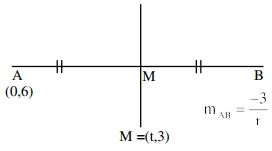
0 likesView Solution
199
MathematicsMediumMCQJEE Main · 2021
If $S = \{z \in \mathbb{C} : \frac{z-i}{z+2i} \in \mathbb{R}\}$,then:
A
$S$ contains exactly two elements
B
$S$ contains only one element
C
$S$ is a circle in the complex plane
D
$S$ is a straight line in the complex plane
Solution
(D) Let $z = x + iy$. The condition $\frac{z-i}{z+2i} \in \mathbb{R}$ implies that the argument of the complex number is $0$ or $\pi$ (or the number is undefined).
This represents the locus of points $z$ such that the vectors $(z-i)$ and $(z+2i)$ are collinear.
Geometrically,this is the line passing through the points $i$ (which is $(0, 1)$) and $-2i$ (which is $(0, -2)$).
Since these two points lie on the imaginary axis,the line is the imaginary axis itself (excluding the point $-2i$ where the expression is undefined).
Thus,$S$ is a straight line in the complex plane.
This represents the locus of points $z$ such that the vectors $(z-i)$ and $(z+2i)$ are collinear.
Geometrically,this is the line passing through the points $i$ (which is $(0, 1)$) and $-2i$ (which is $(0, -2)$).
Since these two points lie on the imaginary axis,the line is the imaginary axis itself (excluding the point $-2i$ where the expression is undefined).
Thus,$S$ is a straight line in the complex plane.
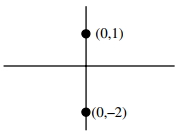
0 likesView Solution
200
MathematicsMediumMCQJEE Main · 2021
The statement $(p \wedge (p$ $\rightarrow q) \wedge (q$ $\rightarrow r))$ $\rightarrow r$ is :
A
a tautology
B
equivalent to $p \rightarrow \sim r$
C
a fallacy
D
equivalent to $q \rightarrow \sim r$
Solution
(A) Let the statement be $S = (p \wedge (p$ $\rightarrow q) \wedge (q$ $\rightarrow r))$ $\rightarrow r$.
Using the implication law $a \rightarrow b \equiv \sim a \vee b$,we have:
$S \equiv \sim (p \wedge (p$ $\rightarrow q) \wedge (q$ $\rightarrow r)) \vee r$
Using De Morgan's law $\sim (A \wedge B \wedge C) \equiv \sim A \vee \sim B \vee \sim C$:
$S \equiv \sim p \vee \sim (p$ $\rightarrow q) \vee \sim (q$ $\rightarrow r) \vee r$
Since $\sim (a \rightarrow b) \equiv a \wedge \sim b$:
$S \equiv \sim p \vee (p \wedge \sim q) \vee (q \wedge \sim r) \vee r$
Using distributive law $\sim p \vee (p \wedge \sim q) \equiv (\sim p \vee p) \wedge (\sim p \vee \sim q) \equiv T \wedge (\sim p \vee \sim q) \equiv \sim p \vee \sim q$:
$S \equiv (\sim p \vee \sim q) \vee (q \wedge \sim r) \vee r$
Using associative and distributive laws:
$S \equiv \sim p \vee \sim q \vee (q \vee r) \wedge (\sim r \vee r)$
$S \equiv \sim p \vee \sim q \vee (q \vee r) \wedge T$
$S \equiv \sim p \vee (\sim q \vee q) \vee r$
$S \equiv \sim p \vee T \vee r \equiv T$
Since the result is always true,the statement is a tautology.
Using the implication law $a \rightarrow b \equiv \sim a \vee b$,we have:
$S \equiv \sim (p \wedge (p$ $\rightarrow q) \wedge (q$ $\rightarrow r)) \vee r$
Using De Morgan's law $\sim (A \wedge B \wedge C) \equiv \sim A \vee \sim B \vee \sim C$:
$S \equiv \sim p \vee \sim (p$ $\rightarrow q) \vee \sim (q$ $\rightarrow r) \vee r$
Since $\sim (a \rightarrow b) \equiv a \wedge \sim b$:
$S \equiv \sim p \vee (p \wedge \sim q) \vee (q \wedge \sim r) \vee r$
Using distributive law $\sim p \vee (p \wedge \sim q) \equiv (\sim p \vee p) \wedge (\sim p \vee \sim q) \equiv T \wedge (\sim p \vee \sim q) \equiv \sim p \vee \sim q$:
$S \equiv (\sim p \vee \sim q) \vee (q \wedge \sim r) \vee r$
Using associative and distributive laws:
$S \equiv \sim p \vee \sim q \vee (q \vee r) \wedge (\sim r \vee r)$
$S \equiv \sim p \vee \sim q \vee (q \vee r) \wedge T$
$S \equiv \sim p \vee (\sim q \vee q) \vee r$
$S \equiv \sim p \vee T \vee r \equiv T$
Since the result is always true,the statement is a tautology.
0 likesView Solution
201
MathematicsDifficultMCQJEE Main · 2021
Let $f$ be a twice differentiable function defined on $R$ such that $f(0)=1$,$f^{\prime}(0)=2$ and $f^{\prime}(x) \neq 0$ for all $x \in R$. If $\left|\begin{array}{ll}f(x) & f^{\prime}(x) \\ f^{\prime}(x) & f^{\prime \prime}(x)\end{array}\right|=0$ for all $x \in R$,then the value of $f(1)$ lies in the interval:
A
$(9, 12)$
B
$(6, 9)$
C
$(0, 3)$
D
$(3, 6)$
Solution
(B) Given the determinant condition: $f(x)f^{\prime \prime}(x) - (f^{\prime}(x))^2 = 0$.
This can be rewritten as $\frac{f^{\prime \prime}(x)}{f^{\prime}(x)} = \frac{f^{\prime}(x)}{f(x)}$.
Integrating both sides with respect to $x$,we get $\ln(f^{\prime}(x)) = \ln(f(x)) + \ln(c)$,which implies $f^{\prime}(x) = c f(x)$.
This is a first-order linear differential equation: $\frac{f^{\prime}(x)}{f(x)} = c$.
Integrating again,$\ln(f(x)) = cx + k_1$,so $f(x) = k e^{cx}$.
Using the initial conditions:
$f(0) = 1 \implies k e^0 = 1 \implies k = 1$.
$f^{\prime}(x) = c e^{cx}$,and $f^{\prime}(0) = 2 \implies c e^0 = 2 \implies c = 2$.
Thus,$f(x) = e^{2x}$.
Calculating $f(1) = e^2 \approx 7.389$.
Since $6 < 7.389 < 9$,the value lies in the interval $(6, 9)$.
This can be rewritten as $\frac{f^{\prime \prime}(x)}{f^{\prime}(x)} = \frac{f^{\prime}(x)}{f(x)}$.
Integrating both sides with respect to $x$,we get $\ln(f^{\prime}(x)) = \ln(f(x)) + \ln(c)$,which implies $f^{\prime}(x) = c f(x)$.
This is a first-order linear differential equation: $\frac{f^{\prime}(x)}{f(x)} = c$.
Integrating again,$\ln(f(x)) = cx + k_1$,so $f(x) = k e^{cx}$.
Using the initial conditions:
$f(0) = 1 \implies k e^0 = 1 \implies k = 1$.
$f^{\prime}(x) = c e^{cx}$,and $f^{\prime}(0) = 2 \implies c e^0 = 2 \implies c = 2$.
Thus,$f(x) = e^{2x}$.
Calculating $f(1) = e^2 \approx 7.389$.
Since $6 < 7.389 < 9$,the value lies in the interval $(6, 9)$.
0 likesView Solution
202
MathematicsDifficultMCQJEE Main · 2021
The value of the integral $\int_{1}^{3} [x^{2}-2x-2] dx$,where $[x]$ denotes the greatest integer function,is:
A
$-\sqrt{2}-\sqrt{3}+1$
B
$-\sqrt{2}-\sqrt{3}-1$
C
$-5$
D
$-4$
Solution
(B) Let $I = \int_{1}^{3} [x^{2}-2x-2] dx$.
We can rewrite the expression inside the bracket as $x^{2}-2x-2 = (x-1)^{2}-3$.
Since $3$ is an integer,we can use the property $[f(x)+n] = [f(x)]+n$ for $n \in \mathbb{Z}$.
So,$I = \int_{1}^{3} [(x-1)^{2}] dx - \int_{1}^{3} 3 dx$.
Let $t = x-1$,then $dt = dx$. When $x=1, t=0$ and when $x=3, t=2$.
$I = \int_{0}^{2} [t^{2}] dt - [3x]_{1}^{3} = \int_{0}^{2} [t^{2}] dt - 6$.
Now,we split the integral $\int_{0}^{2} [t^{2}] dt$ based on the values of $[t^{2}]$:
For $0 \le t < 1$,$0 \le t^{2} < 1$,so $[t^{2}] = 0$.
For $1 \le t < \sqrt{2}$,$1 \le t^{2} < 2$,so $[t^{2}] = 1$.
For $\sqrt{2} \le t < \sqrt{3}$,$2 \le t^{2} < 3$,so $[t^{2}] = 2$.
For $\sqrt{3} \le t < 2$,$3 \le t^{2} < 4$,so $[t^{2}] = 3$.
$I = \int_{0}^{1} 0 dt + \int_{1}^{\sqrt{2}} 1 dt + \int_{\sqrt{2}}^{\sqrt{3}} 2 dt + \int_{\sqrt{3}}^{2} 3 dt - 6$.
$I = 0 + (\sqrt{2}-1) + 2(\sqrt{3}-\sqrt{2}) + 3(2-\sqrt{3}) - 6$.
$I = \sqrt{2} - 1 + 2\sqrt{3} - 2\sqrt{2} + 6 - 3\sqrt{3} - 6$.
$I = -\sqrt{2} - \sqrt{3} - 1$.
We can rewrite the expression inside the bracket as $x^{2}-2x-2 = (x-1)^{2}-3$.
Since $3$ is an integer,we can use the property $[f(x)+n] = [f(x)]+n$ for $n \in \mathbb{Z}$.
So,$I = \int_{1}^{3} [(x-1)^{2}] dx - \int_{1}^{3} 3 dx$.
Let $t = x-1$,then $dt = dx$. When $x=1, t=0$ and when $x=3, t=2$.
$I = \int_{0}^{2} [t^{2}] dt - [3x]_{1}^{3} = \int_{0}^{2} [t^{2}] dt - 6$.
Now,we split the integral $\int_{0}^{2} [t^{2}] dt$ based on the values of $[t^{2}]$:
For $0 \le t < 1$,$0 \le t^{2} < 1$,so $[t^{2}] = 0$.
For $1 \le t < \sqrt{2}$,$1 \le t^{2} < 2$,so $[t^{2}] = 1$.
For $\sqrt{2} \le t < \sqrt{3}$,$2 \le t^{2} < 3$,so $[t^{2}] = 2$.
For $\sqrt{3} \le t < 2$,$3 \le t^{2} < 4$,so $[t^{2}] = 3$.
$I = \int_{0}^{1} 0 dt + \int_{1}^{\sqrt{2}} 1 dt + \int_{\sqrt{2}}^{\sqrt{3}} 2 dt + \int_{\sqrt{3}}^{2} 3 dt - 6$.
$I = 0 + (\sqrt{2}-1) + 2(\sqrt{3}-\sqrt{2}) + 3(2-\sqrt{3}) - 6$.
$I = \sqrt{2} - 1 + 2\sqrt{3} - 2\sqrt{2} + 6 - 3\sqrt{3} - 6$.
$I = -\sqrt{2} - \sqrt{3} - 1$.
0 likesView Solution
203
MathematicsMediumMCQJEE Main · 2021
$A$ possible value of $\tan \left(\frac{1}{4} \sin ^{-1} \frac{\sqrt{63}}{8}\right)$ is :
A
$\frac{1}{\sqrt{7}}$
B
$2 \sqrt{2}-1$
C
$\sqrt{7}-1$
D
$\frac{1}{2 \sqrt{2}}$
Solution
(A) Let $\frac{1}{4} \sin ^{-1} \frac{\sqrt{63}}{8} = \theta$.
Then,$\sin 4\theta = \frac{\sqrt{63}}{8}$.
Since $\cos^2 4\theta = 1 - \sin^2 4\theta = 1 - \frac{63}{64} = \frac{1}{64}$,we have $\cos 4\theta = \frac{1}{8}$.
Using the formula $\cos 4\theta = 2\cos^2 2\theta - 1$,we get $2\cos^2 2\theta - 1 = \frac{1}{8}$,which implies $2\cos^2 2\theta = \frac{9}{8}$,so $\cos^2 2\theta = \frac{9}{16}$.
Thus,$\cos 2\theta = \frac{3}{4}$.
Using the formula $\cos 2\theta = 2\cos^2 \theta - 1$,we get $2\cos^2 \theta - 1 = \frac{3}{4}$,which implies $2\cos^2 \theta = \frac{7}{4}$,so $\cos^2 \theta = \frac{7}{8}$.
Then $\sin^2 \theta = 1 - \cos^2 \theta = 1 - \frac{7}{8} = \frac{1}{8}$.
Therefore,$\tan^2 \theta = \frac{\sin^2 \theta}{\cos^2 \theta} = \frac{1/8}{7/8} = \frac{1}{7}$.
Hence,$\tan \theta = \frac{1}{\sqrt{7}}$.
Then,$\sin 4\theta = \frac{\sqrt{63}}{8}$.
Since $\cos^2 4\theta = 1 - \sin^2 4\theta = 1 - \frac{63}{64} = \frac{1}{64}$,we have $\cos 4\theta = \frac{1}{8}$.
Using the formula $\cos 4\theta = 2\cos^2 2\theta - 1$,we get $2\cos^2 2\theta - 1 = \frac{1}{8}$,which implies $2\cos^2 2\theta = \frac{9}{8}$,so $\cos^2 2\theta = \frac{9}{16}$.
Thus,$\cos 2\theta = \frac{3}{4}$.
Using the formula $\cos 2\theta = 2\cos^2 \theta - 1$,we get $2\cos^2 \theta - 1 = \frac{3}{4}$,which implies $2\cos^2 \theta = \frac{7}{4}$,so $\cos^2 \theta = \frac{7}{8}$.
Then $\sin^2 \theta = 1 - \cos^2 \theta = 1 - \frac{7}{8} = \frac{1}{8}$.
Therefore,$\tan^2 \theta = \frac{\sin^2 \theta}{\cos^2 \theta} = \frac{1/8}{7/8} = \frac{1}{7}$.
Hence,$\tan \theta = \frac{1}{\sqrt{7}}$.
0 likesView Solution
204
MathematicsMediumMCQJEE Main · 2021
If the curve $y = ax^{2} + bx + c, x \in R,$ passes through the point $(1, 2)$ and the tangent line to this curve at the origin is $y = x$,then the possible values of $a, b, c$ are:
A
$a = \frac{1}{2}, b = \frac{1}{2}, c = 1$
B
$a = 1, b = 0, c = 1$
C
$a = 1, b = 1, c = 0$
D
$a = -1, b = 1, c = 1$
Solution
(C) Given the curve $y = ax^{2} + bx + c$.
Since the curve passes through the origin $(0, 0)$,we substitute $x = 0$ and $y = 0$ into the equation: $0 = a(0)^{2} + b(0) + c$,which gives $c = 0$.
The derivative of the curve is $\frac{dy}{dx} = 2ax + b$.
The tangent line at the origin $(0, 0)$ is $y = x$,which has a slope of $1$.
Thus,$\left. \frac{dy}{dx} \right|_{(0,0)} = 2a(0) + b = 1$,which gives $b = 1$.
Since the curve passes through the point $(1, 2)$,we substitute $x = 1, y = 2, b = 1, c = 0$ into the equation: $2 = a(1)^{2} + 1(1) + 0$.
This simplifies to $2 = a + 1$,so $a = 1$.
Therefore,the values are $a = 1, b = 1, c = 0$.
Since the curve passes through the origin $(0, 0)$,we substitute $x = 0$ and $y = 0$ into the equation: $0 = a(0)^{2} + b(0) + c$,which gives $c = 0$.
The derivative of the curve is $\frac{dy}{dx} = 2ax + b$.
The tangent line at the origin $(0, 0)$ is $y = x$,which has a slope of $1$.
Thus,$\left. \frac{dy}{dx} \right|_{(0,0)} = 2a(0) + b = 1$,which gives $b = 1$.
Since the curve passes through the point $(1, 2)$,we substitute $x = 1, y = 2, b = 1, c = 0$ into the equation: $2 = a(1)^{2} + 1(1) + 0$.
This simplifies to $2 = a + 1$,so $a = 1$.
Therefore,the values are $a = 1, b = 1, c = 0$.
0 likesView Solution
205
MathematicsDifficultMCQJEE Main · 2021
The area of the region $R = \{(x, y) : 5x^2 \leq y \leq 2x^2 + 9\}$ is ........ $\text{square units}$. (in $\sqrt{3}$)
A
$11$
B
$12$
C
$9$
D
$6$
Solution
(B) To find the area of the region $R = \{(x, y) : 5x^2 \leq y \leq 2x^2 + 9\}$, we first find the intersection points of the curves $y = 5x^2$ and $y = 2x^2 + 9$.
Setting $5x^2 = 2x^2 + 9$, we get $3x^2 = 9$, which implies $x^2 = 3$, so $x = \pm \sqrt{3}$.
The region is symmetric about the $y$-axis.
The required area is given by the integral:
Area $= \int_{-\sqrt{3}}^{\sqrt{3}} ((2x^2 + 9) - 5x^2) dx$
$= 2 \int_{0}^{\sqrt{3}} (9 - 3x^2) dx$
$= 2 [9x - x^3]_{0}^{\sqrt{3}}$
$= 2 [9\sqrt{3} - (\sqrt{3})^3]$
$= 2 [9\sqrt{3} - 3\sqrt{3}]$
$= 2 [6\sqrt{3}] = 12\sqrt{3} \text{ square units.}$
Setting $5x^2 = 2x^2 + 9$, we get $3x^2 = 9$, which implies $x^2 = 3$, so $x = \pm \sqrt{3}$.
The region is symmetric about the $y$-axis.
The required area is given by the integral:
Area $= \int_{-\sqrt{3}}^{\sqrt{3}} ((2x^2 + 9) - 5x^2) dx$
$= 2 \int_{0}^{\sqrt{3}} (9 - 3x^2) dx$
$= 2 [9x - x^3]_{0}^{\sqrt{3}}$
$= 2 [9\sqrt{3} - (\sqrt{3})^3]$
$= 2 [9\sqrt{3} - 3\sqrt{3}]$
$= 2 [6\sqrt{3}] = 12\sqrt{3} \text{ square units.}$
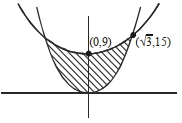
0 likesView Solution
206
MathematicsMediumMCQJEE Main · 2021
If a curve $y = f(x)$ passes through the point $(1, 2)$ and satisfies $x \frac{dy}{dx} + y = bx^4$,then for what value of $b$ is $\int_{1}^{2} f(x) dx = \frac{62}{5}$?
A
$5$
B
$10$
C
$\frac{62}{5}$
D
$\frac{31}{5}$
Solution
(B) The given differential equation is $x \frac{dy}{dx} + y = bx^4$,which can be rewritten as $\frac{dy}{dx} + \frac{1}{x} y = bx^3$.
This is a linear differential equation of the form $\frac{dy}{dx} + P(x)y = Q(x)$,where $P(x) = \frac{1}{x}$ and $Q(x) = bx^3$.
The integrating factor $I.F. = e^{\int P(x) dx} = e^{\int \frac{1}{x} dx} = e^{\ln x} = x$.
The general solution is $y \cdot (I.F.) = \int Q(x) \cdot (I.F.) dx + C$,which gives $yx = \int bx^3 \cdot x dx + C = \int bx^4 dx + C$.
Thus,$yx = \frac{bx^5}{5} + C$,or $f(x) = y = \frac{bx^4}{5} + \frac{C}{x}$.
Since the curve passes through $(1, 2)$,we have $2 = \frac{b}{5} + C$,so $C = 2 - \frac{b}{5}$.
Given $\int_{1}^{2} f(x) dx = \frac{62}{5}$,we have $\int_{1}^{2} (\frac{bx^4}{5} + \frac{C}{x}) dx = [\frac{bx^5}{25} + C \ln x]_{1}^{2} = \frac{62}{5}$.
Substituting the limits: $(\frac{32b}{25} + C \ln 2) - (\frac{b}{25} + 0) = \frac{31b}{25} + C \ln 2 = \frac{62}{5}$.
Substituting $C = 2 - \frac{b}{5}$: $\frac{31b}{25} + (2 - \frac{b}{5}) \ln 2 = \frac{62}{5}$.
For this to hold,we set the coefficient of $\ln 2$ to $0$,so $2 - \frac{b}{5} = 0$,which gives $b = 10$.
Then $\frac{31(10)}{25} = \frac{310}{25} = \frac{62}{5}$,which satisfies the equation. Thus,$b = 10$.
This is a linear differential equation of the form $\frac{dy}{dx} + P(x)y = Q(x)$,where $P(x) = \frac{1}{x}$ and $Q(x) = bx^3$.
The integrating factor $I.F. = e^{\int P(x) dx} = e^{\int \frac{1}{x} dx} = e^{\ln x} = x$.
The general solution is $y \cdot (I.F.) = \int Q(x) \cdot (I.F.) dx + C$,which gives $yx = \int bx^3 \cdot x dx + C = \int bx^4 dx + C$.
Thus,$yx = \frac{bx^5}{5} + C$,or $f(x) = y = \frac{bx^4}{5} + \frac{C}{x}$.
Since the curve passes through $(1, 2)$,we have $2 = \frac{b}{5} + C$,so $C = 2 - \frac{b}{5}$.
Given $\int_{1}^{2} f(x) dx = \frac{62}{5}$,we have $\int_{1}^{2} (\frac{bx^4}{5} + \frac{C}{x}) dx = [\frac{bx^5}{25} + C \ln x]_{1}^{2} = \frac{62}{5}$.
Substituting the limits: $(\frac{32b}{25} + C \ln 2) - (\frac{b}{25} + 0) = \frac{31b}{25} + C \ln 2 = \frac{62}{5}$.
Substituting $C = 2 - \frac{b}{5}$: $\frac{31b}{25} + (2 - \frac{b}{5}) \ln 2 = \frac{62}{5}$.
For this to hold,we set the coefficient of $\ln 2$ to $0$,so $2 - \frac{b}{5} = 0$,which gives $b = 10$.
Then $\frac{31(10)}{25} = \frac{310}{25} = \frac{62}{5}$,which satisfies the equation. Thus,$b = 10$.
0 likesView Solution
207
MathematicsDifficultMCQJEE Main · 2021
Let $f(x)$ be a differentiable function defined on $[0,2]$ such that $f^{\prime}(x) = f^{\prime}(2-x)$ for all $x \in (0,2)$,$f(0) = 1$ and $f(2) = e^{2}$. Then the value of $\int_{0}^{2} f(x) dx$ is ..... .
A
$1-e^{2}$
B
$1+e^{2}$
C
$2(1-e^{2})$
D
$2(1+e^{2})$
Solution
(B) Given $f^{\prime}(x) = f^{\prime}(2-x)$. Integrating both sides with respect to $x$,we get $f(x) = -f(2-x) + C$,which implies $f(x) + f(2-x) = C$.
At $x=0$,$f(0) + f(2) = C$. Given $f(0) = 1$ and $f(2) = e^{2}$,we have $C = 1 + e^{2}$.
Thus,$f(x) + f(2-x) = 1 + e^{2}$.
Let $I = \int_{0}^{2} f(x) dx$. Using the property $\int_{0}^{a} f(x) dx = \int_{0}^{a} f(a-x) dx$,we have $I = \int_{0}^{2} f(2-x) dx$.
Adding the two expressions for $I$,we get $2I = \int_{0}^{2} (f(x) + f(2-x)) dx$.
Substituting the sum,$2I = \int_{0}^{2} (1 + e^{2}) dx = (1 + e^{2}) [x]_{0}^{2} = 2(1 + e^{2})$.
Therefore,$I = 1 + e^{2}$.
At $x=0$,$f(0) + f(2) = C$. Given $f(0) = 1$ and $f(2) = e^{2}$,we have $C = 1 + e^{2}$.
Thus,$f(x) + f(2-x) = 1 + e^{2}$.
Let $I = \int_{0}^{2} f(x) dx$. Using the property $\int_{0}^{a} f(x) dx = \int_{0}^{a} f(a-x) dx$,we have $I = \int_{0}^{2} f(2-x) dx$.
Adding the two expressions for $I$,we get $2I = \int_{0}^{2} (f(x) + f(2-x)) dx$.
Substituting the sum,$2I = \int_{0}^{2} (1 + e^{2}) dx = (1 + e^{2}) [x]_{0}^{2} = 2(1 + e^{2})$.
Therefore,$I = 1 + e^{2}$.
0 likesView Solution
208
MathematicsDifficultMCQJEE Main · 2021
Let $A$ and $B$ be $3 \times 3$ real matrices such that $A$ is a symmetric matrix and $B$ is a skew-symmetric matrix. Then the system of linear equations $(A^{2}B^{2} - B^{2}A^{2})X = O$,where $X$ is a $3 \times 1$ column matrix of unknown variables and $O$ is a $3 \times 1$ null matrix,has ....... .
A
no solution
B
exactly two solutions
C
infinitely many solutions
D
a unique solution
Solution
(C) Given that $A$ is a symmetric matrix,so $A^{T} = A$.
Given that $B$ is a skew-symmetric matrix,so $B^{T} = -B$.
Let $C = A^{2}B^{2} - B^{2}A^{2}$.
Now,consider the transpose of $C$:
$C^{T} = (A^{2}B^{2} - B^{2}A^{2})^{T} = (A^{2}B^{2})^{T} - (B^{2}A^{2})^{T}$.
Using the property $(PQ)^{T} = Q^{T}P^{T}$,we get:
$C^{T} = (B^{2})^{T}(A^{2})^{T} - (A^{2})^{T}(B^{2})^{T}$.
Since $(A^{2})^{T} = (A^{T})^{2} = A^{2}$ and $(B^{2})^{T} = (B^{T})^{2} = (-B)^{2} = B^{2}$,we have:
$C^{T} = B^{2}A^{2} - A^{2}B^{2} = -(A^{2}B^{2} - B^{2}A^{2}) = -C$.
Thus,$C$ is a skew-symmetric matrix.
For any skew-symmetric matrix $C$ of odd order $n$ (here $n = 3$),the determinant is always zero,i.e.,$\det(C) = 0$.
Since the system is $(C)X = O$ and $\det(C) = 0$,the system has infinitely many solutions.
Given that $B$ is a skew-symmetric matrix,so $B^{T} = -B$.
Let $C = A^{2}B^{2} - B^{2}A^{2}$.
Now,consider the transpose of $C$:
$C^{T} = (A^{2}B^{2} - B^{2}A^{2})^{T} = (A^{2}B^{2})^{T} - (B^{2}A^{2})^{T}$.
Using the property $(PQ)^{T} = Q^{T}P^{T}$,we get:
$C^{T} = (B^{2})^{T}(A^{2})^{T} - (A^{2})^{T}(B^{2})^{T}$.
Since $(A^{2})^{T} = (A^{T})^{2} = A^{2}$ and $(B^{2})^{T} = (B^{T})^{2} = (-B)^{2} = B^{2}$,we have:
$C^{T} = B^{2}A^{2} - A^{2}B^{2} = -(A^{2}B^{2} - B^{2}A^{2}) = -C$.
Thus,$C$ is a skew-symmetric matrix.
For any skew-symmetric matrix $C$ of odd order $n$ (here $n = 3$),the determinant is always zero,i.e.,$\det(C) = 0$.
Since the system is $(C)X = O$ and $\det(C) = 0$,the system has infinitely many solutions.
0 likesView Solution
209
MathematicsMediumMCQJEE Main · 2021
For the system of linear equations:
$x - 2y = 1, x - y + kz = -2, ky + 4z = 6, k \in R$
Consider the following statements:
$(A)$ The system has a unique solution if $k \neq 2, k \neq -2$.
$(B)$ The system has a unique solution if $k = -2$.
$(C)$ The system has a unique solution if $k = 2$.
$(D)$ The system has no solution if $k = 2$.
$(E)$ The system has an infinite number of solutions if $k \neq -2$.
Which of the following statements are correct?
$x - 2y = 1, x - y + kz = -2, ky + 4z = 6, k \in R$
Consider the following statements:
$(A)$ The system has a unique solution if $k \neq 2, k \neq -2$.
$(B)$ The system has a unique solution if $k = -2$.
$(C)$ The system has a unique solution if $k = 2$.
$(D)$ The system has no solution if $k = 2$.
$(E)$ The system has an infinite number of solutions if $k \neq -2$.
Which of the following statements are correct?
A
$(C)$ and $(D)$ only
B
$(B)$ and $(E)$ only
C
$(A)$ and $(E)$ only
D
$(A)$ and $(D)$ only
Solution
(D) The system of equations is:
$x - 2y + 0z = 1$
$x - y + kz = -2$
$0x + ky + 4z = 6$
The determinant of the coefficient matrix $D$ is:
$D = \begin{vmatrix} 1 & -2 & 0 \\ 1 & -1 & k \\ 0 & k & 4 \end{vmatrix} = 1(-4 - k^2) - (-2)(4 - 0) + 0 = -4 - k^2 + 8 = 4 - k^2$.
For a unique solution,$D \neq 0$,which implies $4 - k^2 \neq 0$,so $k \neq 2$ and $k \neq -2$. Thus,statement $(A)$ is correct.
If $k = 2$,$D = 0$. We check for consistency using $D_1$:
$D_1 = \begin{vmatrix} 1 & -2 & 0 \\ -2 & -1 & 2 \\ 6 & 2 & 4 \end{vmatrix} = 1(-4 - 4) - (-2)(-8 - 12) + 0 = -8 - 40 = -48 \neq 0$.
Since $D = 0$ and $D_1 \neq 0$,the system has no solution when $k = 2$. Thus,statement $(D)$ is correct.
Therefore,statements $(A)$ and $(D)$ are correct.
$x - 2y + 0z = 1$
$x - y + kz = -2$
$0x + ky + 4z = 6$
The determinant of the coefficient matrix $D$ is:
$D = \begin{vmatrix} 1 & -2 & 0 \\ 1 & -1 & k \\ 0 & k & 4 \end{vmatrix} = 1(-4 - k^2) - (-2)(4 - 0) + 0 = -4 - k^2 + 8 = 4 - k^2$.
For a unique solution,$D \neq 0$,which implies $4 - k^2 \neq 0$,so $k \neq 2$ and $k \neq -2$. Thus,statement $(A)$ is correct.
If $k = 2$,$D = 0$. We check for consistency using $D_1$:
$D_1 = \begin{vmatrix} 1 & -2 & 0 \\ -2 & -1 & 2 \\ 6 & 2 & 4 \end{vmatrix} = 1(-4 - 4) - (-2)(-8 - 12) + 0 = -8 - 40 = -48 \neq 0$.
Since $D = 0$ and $D_1 \neq 0$,the system has no solution when $k = 2$. Thus,statement $(D)$ is correct.
Therefore,statements $(A)$ and $(D)$ are correct.
0 likesView Solution
210
MathematicsDifficultMCQJEE Main · 2021
Let $\lambda$ be an integer. If the shortest distance between the lines $x - \lambda = 2y - 1 = -2z$ and $x = y + 2\lambda = z - \lambda$ is $\frac{\sqrt{7}}{2\sqrt{2}}$,then the value of $|\lambda|$ is ...... .
A
$8$
B
$4$
C
$5$
D
$1$
Solution
(D) The given lines are $L_1: \frac{x-\lambda}{1} = \frac{y-1/2}{1/2} = \frac{z-0}{-1/2}$ and $L_2: \frac{x-0}{1} = \frac{y+2\lambda}{1} = \frac{z-\lambda}{1}$.
The points on the lines are $a_1 = (\lambda, 1/2, 0)$ and $a_2 = (0, -2\lambda, \lambda)$.
The direction vectors are $b_1 = (1, 1/2, -1/2)$ and $b_2 = (1, 1, 1)$.
The cross product $b_1 \times b_2 = \begin{vmatrix} \hat{i} & \hat{j} & \hat{k} \\ 1 & 1/2 & -1/2 \\ 1 & 1 & 1 \end{vmatrix} = \hat{i}(1/2 + 1/2) - \hat{j}(1 + 1/2) + \hat{k}(1 - 1/2) = \hat{i} - \frac{3}{2}\hat{j} + \frac{1}{2}\hat{k} = \frac{1}{2}(2\hat{i} - 3\hat{j} + \hat{k})$.
The magnitude $|b_1 \times b_2| = \frac{1}{2}\sqrt{2^2 + (-3)^2 + 1^2} = \frac{\sqrt{14}}{2}$.
The vector $a_2 - a_1 = (0-\lambda, -2\lambda-1/2, \lambda-0) = (-\lambda, -2\lambda-1/2, \lambda)$.
The shortest distance $d = \frac{|(a_2 - a_1) \cdot (b_1 \times b_2)|}{|b_1 \times b_2|} = \frac{|-\lambda(1) - (2\lambda+1/2)(-3/2) + \lambda(1/2)|}{\sqrt{14}/2} = \frac{|-\lambda + 3\lambda + 3/4 + \lambda/2|}{\sqrt{14}/2} = \frac{|5\lambda/2 + 3/4|}{\sqrt{14}/2} = \frac{|10\lambda + 3|}{2\sqrt{14}}$.
Given $d = \frac{\sqrt{7}}{2\sqrt{2}} = \frac{\sqrt{14}}{4}$.
So,$\frac{|10\lambda + 3|}{2\sqrt{14}} = \frac{\sqrt{14}}{4} \implies |10\lambda + 3| = \frac{14}{2} = 7$.
Case $1$: $10\lambda + 3 = 7 \implies 10\lambda = 4 \implies \lambda = 0.4$ (Not an integer).
Case $2$: $10\lambda + 3 = -7 \implies 10\lambda = -10 \implies \lambda = -1$.
Thus,$|\lambda| = |-1| = 1$.
The points on the lines are $a_1 = (\lambda, 1/2, 0)$ and $a_2 = (0, -2\lambda, \lambda)$.
The direction vectors are $b_1 = (1, 1/2, -1/2)$ and $b_2 = (1, 1, 1)$.
The cross product $b_1 \times b_2 = \begin{vmatrix} \hat{i} & \hat{j} & \hat{k} \\ 1 & 1/2 & -1/2 \\ 1 & 1 & 1 \end{vmatrix} = \hat{i}(1/2 + 1/2) - \hat{j}(1 + 1/2) + \hat{k}(1 - 1/2) = \hat{i} - \frac{3}{2}\hat{j} + \frac{1}{2}\hat{k} = \frac{1}{2}(2\hat{i} - 3\hat{j} + \hat{k})$.
The magnitude $|b_1 \times b_2| = \frac{1}{2}\sqrt{2^2 + (-3)^2 + 1^2} = \frac{\sqrt{14}}{2}$.
The vector $a_2 - a_1 = (0-\lambda, -2\lambda-1/2, \lambda-0) = (-\lambda, -2\lambda-1/2, \lambda)$.
The shortest distance $d = \frac{|(a_2 - a_1) \cdot (b_1 \times b_2)|}{|b_1 \times b_2|} = \frac{|-\lambda(1) - (2\lambda+1/2)(-3/2) + \lambda(1/2)|}{\sqrt{14}/2} = \frac{|-\lambda + 3\lambda + 3/4 + \lambda/2|}{\sqrt{14}/2} = \frac{|5\lambda/2 + 3/4|}{\sqrt{14}/2} = \frac{|10\lambda + 3|}{2\sqrt{14}}$.
Given $d = \frac{\sqrt{7}}{2\sqrt{2}} = \frac{\sqrt{14}}{4}$.
So,$\frac{|10\lambda + 3|}{2\sqrt{14}} = \frac{\sqrt{14}}{4} \implies |10\lambda + 3| = \frac{14}{2} = 7$.
Case $1$: $10\lambda + 3 = 7 \implies 10\lambda = 4 \implies \lambda = 0.4$ (Not an integer).
Case $2$: $10\lambda + 3 = -7 \implies 10\lambda = -10 \implies \lambda = -1$.
Thus,$|\lambda| = |-1| = 1$.
0 likesView Solution
211
MathematicsDifficultMCQJEE Main · 2021
If $a+\alpha=1, b+\beta=2$ and $af(x)+\alpha f\left(\frac{1}{x}\right)=bx+\frac{\beta}{x}$ for $x \neq 0$,then the value of the expression $\frac{f(x)+f\left(\frac{1}{x}\right)}{x+\frac{1}{x}}$ is ..... .
A
$2$
B
$1$
C
$4$
D
$5$
Solution
(A) Given the equation: $af(x)+\alpha f\left(\frac{1}{x}\right)=bx+\frac{\beta}{x} \quad .....(1)$
Replace $x$ with $\frac{1}{x}$ in equation $(1)$:
$af\left(\frac{1}{x}\right)+\alpha f(x)=b\left(\frac{1}{x}\right)+\beta x \quad .....(2)$
Adding equation $(1)$ and equation $(2)$:
$(a+\alpha)f(x)+(a+\alpha)f\left(\frac{1}{x}\right) = bx+\frac{\beta}{x}+\frac{b}{x}+\beta x$
$(a+\alpha)\left[f(x)+f\left(\frac{1}{x}\right)\right] = (b+\beta)x + (b+\beta)\frac{1}{x}$
$(a+\alpha)\left[f(x)+f\left(\frac{1}{x}\right)\right] = (b+\beta)\left(x+\frac{1}{x}\right)$
Now,rearrange to find the value of the expression:
$\frac{f(x)+f\left(\frac{1}{x}\right)}{x+\frac{1}{x}} = \frac{b+\beta}{a+\alpha}$
Given $a+\alpha=1$ and $b+\beta=2$,substitute these values:
$\frac{f(x)+f\left(\frac{1}{x}\right)}{x+\frac{1}{x}} = \frac{2}{1} = 2$
Replace $x$ with $\frac{1}{x}$ in equation $(1)$:
$af\left(\frac{1}{x}\right)+\alpha f(x)=b\left(\frac{1}{x}\right)+\beta x \quad .....(2)$
Adding equation $(1)$ and equation $(2)$:
$(a+\alpha)f(x)+(a+\alpha)f\left(\frac{1}{x}\right) = bx+\frac{\beta}{x}+\frac{b}{x}+\beta x$
$(a+\alpha)\left[f(x)+f\left(\frac{1}{x}\right)\right] = (b+\beta)x + (b+\beta)\frac{1}{x}$
$(a+\alpha)\left[f(x)+f\left(\frac{1}{x}\right)\right] = (b+\beta)\left(x+\frac{1}{x}\right)$
Now,rearrange to find the value of the expression:
$\frac{f(x)+f\left(\frac{1}{x}\right)}{x+\frac{1}{x}} = \frac{b+\beta}{a+\alpha}$
Given $a+\alpha=1$ and $b+\beta=2$,substitute these values:
$\frac{f(x)+f\left(\frac{1}{x}\right)}{x+\frac{1}{x}} = \frac{2}{1} = 2$
0 likesView Solution
212
MathematicsMediumMCQJEE Main · 2021
Let $A$ be a $3 \times 3$ matrix with $\operatorname{det}(A) = 4$. Let $R_{i}$ denote the $i^{\text{th}}$ row of $A$. If a matrix $B$ is obtained by performing the operation $R_{2} \rightarrow 2R_{2} + 5R_{3}$ on $2A$,then $\operatorname{det}(B)$ is equal to:
A
$16$
B
$80$
C
$128$
D
$64$
Solution
(D) Given that $A$ is a $3 \times 3$ matrix and $\operatorname{det}(A) = 4$.
First,consider the matrix $2A$. Since $A$ is a $3 \times 3$ matrix,$\operatorname{det}(2A) = 2^{3} \times \operatorname{det}(A) = 8 \times 4 = 32$.
Next,the matrix $B$ is obtained from $2A$ by the row operation $R_{2} \rightarrow 2R_{2} + 5R_{3}$.
Applying the property of determinants,if a row is multiplied by a scalar $k$,the determinant is multiplied by $k$. Here,$R_{2}$ is replaced by $2R_{2} + 5R_{3}$.
This operation is equivalent to multiplying the second row by $2$ and then adding $5$ times the third row to it. Adding a multiple of one row to another does not change the value of the determinant.
Therefore,$\operatorname{det}(B) = 2 \times \operatorname{det}(2A) = 2 \times 32 = 64$.
First,consider the matrix $2A$. Since $A$ is a $3 \times 3$ matrix,$\operatorname{det}(2A) = 2^{3} \times \operatorname{det}(A) = 8 \times 4 = 32$.
Next,the matrix $B$ is obtained from $2A$ by the row operation $R_{2} \rightarrow 2R_{2} + 5R_{3}$.
Applying the property of determinants,if a row is multiplied by a scalar $k$,the determinant is multiplied by $k$. Here,$R_{2}$ is replaced by $2R_{2} + 5R_{3}$.
This operation is equivalent to multiplying the second row by $2$ and then adding $5$ times the third row to it. Adding a multiple of one row to another does not change the value of the determinant.
Therefore,$\operatorname{det}(B) = 2 \times \operatorname{det}(2A) = 2 \times 32 = 64$.
0 likesView Solution
213
MathematicsDifficultMCQJEE Main · 2021
The integral $\int \frac{e^{3 \log_{e} 2x} + 5e^{2 \log_{e} 2x}}{e^{4 \log_{e} x} + 5e^{3 \log_{e} x} - 7e^{2 \log_{e} x}} dx$,where $x > 0$,is equal to ....... (where $c$ is a constant of integration).
A
$\log_{e} |x^{2} + 5x - 7| + c$
B
$4 \log_{e} |x^{2} + 5x - 7| + c$
C
$\frac{1}{4} \log_{e} |x^{2} + 5x - 7| + c$
D
$\log_{e} \sqrt{x^{2} + 5x - 7} + c$
Solution
(B) Given integral: $I = \int \frac{e^{3 \log_{e} 2x} + 5e^{2 \log_{e} 2x}}{e^{4 \log_{e} x} + 5e^{3 \log_{e} x} - 7e^{2 \log_{e} x}} dx$
Using the property $e^{\log_{e} f(x)} = f(x)$,we have:
$I = \int \frac{(2x)^{3} + 5(2x)^{2}}{x^{4} + 5x^{3} - 7x^{2}} dx$
$I = \int \frac{8x^{3} + 20x^{2}}{x^{4} + 5x^{3} - 7x^{2}} dx$
Factor out $4x^{2}$ from the numerator and $x^{2}$ from the denominator:
$I = \int \frac{4x^{2}(2x + 5)}{x^{2}(x^{2} + 5x - 7)} dx$
$I = 4 \int \frac{2x + 5}{x^{2} + 5x - 7} dx$
Let $u = x^{2} + 5x - 7$,then $du = (2x + 5) dx$.
$I = 4 \int \frac{1}{u} du = 4 \log_{e} |u| + c$
$I = 4 \log_{e} |x^{2} + 5x - 7| + c$
Using the property $e^{\log_{e} f(x)} = f(x)$,we have:
$I = \int \frac{(2x)^{3} + 5(2x)^{2}}{x^{4} + 5x^{3} - 7x^{2}} dx$
$I = \int \frac{8x^{3} + 20x^{2}}{x^{4} + 5x^{3} - 7x^{2}} dx$
Factor out $4x^{2}$ from the numerator and $x^{2}$ from the denominator:
$I = \int \frac{4x^{2}(2x + 5)}{x^{2}(x^{2} + 5x - 7)} dx$
$I = 4 \int \frac{2x + 5}{x^{2} + 5x - 7} dx$
Let $u = x^{2} + 5x - 7$,then $du = (2x + 5) dx$.
$I = 4 \int \frac{1}{u} du = 4 \log_{e} |u| + c$
$I = 4 \log_{e} |x^{2} + 5x - 7| + c$
0 likesView Solution
214
MathematicsMediumMCQJEE Main · 2021
$A$ plane passes through the points $A (1, 2, 3)$,$B (2, 3, 1)$,and $C (2, 4, 2)$. If $O$ is the origin and $P$ is $(2, -1, 1)$,then the projection of $\overline{OP}$ on this plane is of length .... .
A
$\sqrt{\frac{2}{7}}$
B
$\sqrt{\frac{2}{3}}$
C
$\sqrt{\frac{2}{11}}$
D
$\sqrt{\frac{2}{5}}$
Solution
(C) The vectors lying on the plane are $\vec{AB} = (2-1)\hat{i} + (3-2)\hat{j} + (1-3)\hat{k} = \hat{i} + \hat{j} - 2\hat{k}$ and $\vec{AC} = (2-1)\hat{i} + (4-2)\hat{j} + (2-3)\hat{k} = \hat{i} + 2\hat{j} - \hat{k}$.
The normal vector $\vec{n}$ to the plane is given by $\vec{AB} \times \vec{AC} = \left|\begin{array}{ccc}\hat{i} & \hat{j} & \hat{k} \\ 1 & 1 & -2 \\ 1 & 2 & -1\end{array}\right| = \hat{i}(-1+4) - \hat{j}(-1+2) + \hat{k}(2-1) = 3\hat{i} - \hat{j} + \hat{k}$.
The vector $\vec{OP} = 2\hat{i} - \hat{j} + \hat{k}$.
Let $\theta$ be the angle between $\vec{OP}$ and the normal $\vec{n}$. Then $\cos \theta = \frac{|\vec{OP} \cdot \vec{n}|}{|\vec{OP}| |\vec{n}|} = \frac{|(2)(3) + (-1)(-1) + (1)(1)|}{\sqrt{2^2 + (-1)^2 + 1^2} \sqrt{3^2 + (-1)^2 + 1^2}} = \frac{|6 + 1 + 1|}{\sqrt{6} \sqrt{11}} = \frac{8}{\sqrt{66}}$.
Since $\sin^2 \theta = 1 - \cos^2 \theta = 1 - \frac{64}{66} = \frac{2}{66} = \frac{1}{33}$,we have $\sin \theta = \sqrt{\frac{1}{33}}$.
The length of the projection of $\vec{OP}$ on the plane is $|\vec{OP}| \sin \theta = \sqrt{6} \times \sqrt{\frac{1}{33}} = \sqrt{\frac{6}{33}} = \sqrt{\frac{2}{11}}$.
The normal vector $\vec{n}$ to the plane is given by $\vec{AB} \times \vec{AC} = \left|\begin{array}{ccc}\hat{i} & \hat{j} & \hat{k} \\ 1 & 1 & -2 \\ 1 & 2 & -1\end{array}\right| = \hat{i}(-1+4) - \hat{j}(-1+2) + \hat{k}(2-1) = 3\hat{i} - \hat{j} + \hat{k}$.
The vector $\vec{OP} = 2\hat{i} - \hat{j} + \hat{k}$.
Let $\theta$ be the angle between $\vec{OP}$ and the normal $\vec{n}$. Then $\cos \theta = \frac{|\vec{OP} \cdot \vec{n}|}{|\vec{OP}| |\vec{n}|} = \frac{|(2)(3) + (-1)(-1) + (1)(1)|}{\sqrt{2^2 + (-1)^2 + 1^2} \sqrt{3^2 + (-1)^2 + 1^2}} = \frac{|6 + 1 + 1|}{\sqrt{6} \sqrt{11}} = \frac{8}{\sqrt{66}}$.
Since $\sin^2 \theta = 1 - \cos^2 \theta = 1 - \frac{64}{66} = \frac{2}{66} = \frac{1}{33}$,we have $\sin \theta = \sqrt{\frac{1}{33}}$.
The length of the projection of $\vec{OP}$ on the plane is $|\vec{OP}| \sin \theta = \sqrt{6} \times \sqrt{\frac{1}{33}} = \sqrt{\frac{6}{33}} = \sqrt{\frac{2}{11}}$.
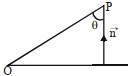
0 likesView Solution
215
MathematicsMediumMCQJEE Main · 2021
In a group of $400$ people,$160$ are smokers and non-vegetarian,$100$ are smokers and vegetarian,and the remaining $140$ are non-smokers and vegetarian. Their chances of getting a particular chest disorder are $35\, \%, 20 \,\%$,and $10 \,\%$ respectively. $A$ person is chosen from the group at random and is found to be suffering from the chest disorder. The probability that the selected person is a smoker and non-vegetarian is ...... .
A
$\frac{7}{45}$
B
$\frac{14}{45}$
C
$\frac{28}{45}$
D
$\frac{8}{45}$
Solution
(C) Let the events be defined as follows:
$A$: The person chosen is a smoker and non-vegetarian.
$B$: The person chosen is a smoker and vegetarian.
$C$: The person chosen is a non-smoker and vegetarian.
$E$: The person chosen has a chest disorder.
Given probabilities:
$P(A) = \frac{160}{400}$,$P(B) = \frac{100}{400}$,$P(C) = \frac{140}{400}$.
Conditional probabilities of having the disorder:
$P(E|A) = \frac{35}{100}$,$P(E|B) = \frac{20}{100}$,$P(E|C) = \frac{10}{100}$.
Using Bayes' Theorem,we need to find $P(A|E)$:
$P(A|E) = \frac{P(A) \cdot P(E|A)}{P(A) \cdot P(E|A) + P(B) \cdot P(E|B) + P(C) \cdot P(E|C)}$
Substituting the values:
$P(A|E) = \frac{\frac{160}{400} \times \frac{35}{100}}{\frac{160}{400} \times \frac{35}{100} + \frac{100}{400} \times \frac{20}{100} + \frac{140}{400} \times \frac{10}{100}}$
$P(A|E) = \frac{160 \times 35}{(160 \times 35) + (100 \times 20) + (140 \times 10)}$
$P(A|E) = \frac{5600}{5600 + 2000 + 1400} = \frac{5600}{9000} = \frac{56}{90} = \frac{28}{45}$.
$A$: The person chosen is a smoker and non-vegetarian.
$B$: The person chosen is a smoker and vegetarian.
$C$: The person chosen is a non-smoker and vegetarian.
$E$: The person chosen has a chest disorder.
Given probabilities:
$P(A) = \frac{160}{400}$,$P(B) = \frac{100}{400}$,$P(C) = \frac{140}{400}$.
Conditional probabilities of having the disorder:
$P(E|A) = \frac{35}{100}$,$P(E|B) = \frac{20}{100}$,$P(E|C) = \frac{10}{100}$.
Using Bayes' Theorem,we need to find $P(A|E)$:
$P(A|E) = \frac{P(A) \cdot P(E|A)}{P(A) \cdot P(E|A) + P(B) \cdot P(E|B) + P(C) \cdot P(E|C)}$
Substituting the values:
$P(A|E) = \frac{\frac{160}{400} \times \frac{35}{100}}{\frac{160}{400} \times \frac{35}{100} + \frac{100}{400} \times \frac{20}{100} + \frac{140}{400} \times \frac{10}{100}}$
$P(A|E) = \frac{160 \times 35}{(160 \times 35) + (100 \times 20) + (140 \times 10)}$
$P(A|E) = \frac{5600}{5600 + 2000 + 1400} = \frac{5600}{9000} = \frac{56}{90} = \frac{28}{45}$.
0 likesView Solution
216
MathematicsMediumMCQJEE Main · 2021
$\operatorname{cosec}\left[2 \cot ^{-1}(5)+\cos ^{-1}\left(\frac{4}{5}\right)\right]$ is equal to ..... .
A
$\frac{56}{33}$
B
$\frac{65}{56}$
C
$\frac{65}{33}$
D
$\frac{75}{56}$
Solution
(B) Let $x = 2 \cot^{-1}(5) + \cos^{-1}(\frac{4}{5})$.
We know that $\cot^{-1}(5) = \tan^{-1}(\frac{1}{5})$.
So,$2 \cot^{-1}(5) = 2 \tan^{-1}(\frac{1}{5}) = \tan^{-1}(\frac{2(1/5)}{1-(1/5)^2}) = \tan^{-1}(\frac{2/5}{24/25}) = \tan^{-1}(\frac{2}{5} \times \frac{25}{24}) = \tan^{-1}(\frac{5}{12})$.
Also,$\cos^{-1}(\frac{4}{5}) = \tan^{-1}(\frac{3}{4})$ because if $\cos \theta = \frac{4}{5}$,then $\tan \theta = \frac{3}{4}$.
Thus,the expression becomes $\operatorname{cosec}[\tan^{-1}(\frac{5}{12}) + \tan^{-1}(\frac{3}{4})]$.
Using the formula $\tan^{-1} A + \tan^{-1} B = \tan^{-1}(\frac{A+B}{1-AB})$:
$\tan^{-1}(\frac{5/12 + 3/4}{1 - (5/12)(3/4)}) = \tan^{-1}(\frac{(5+9)/12}{1 - 15/48}) = \tan^{-1}(\frac{14/12}{33/48}) = \tan^{-1}(\frac{14}{12} \times \frac{48}{33}) = \tan^{-1}(\frac{56}{33})$.
Finally,$\operatorname{cosec}(\tan^{-1}(\frac{56}{33}))$. Let $\theta = \tan^{-1}(\frac{56}{33})$,then $\tan \theta = \frac{56}{33}$.
Since $\operatorname{cosec} \theta = \sqrt{1 + \cot^2 \theta} = \sqrt{1 + (33/56)^2} = \sqrt{\frac{56^2 + 33^2}{56^2}} = \sqrt{\frac{3136 + 1089}{3136}} = \sqrt{\frac{4225}{3136}} = \frac{65}{56}$.
We know that $\cot^{-1}(5) = \tan^{-1}(\frac{1}{5})$.
So,$2 \cot^{-1}(5) = 2 \tan^{-1}(\frac{1}{5}) = \tan^{-1}(\frac{2(1/5)}{1-(1/5)^2}) = \tan^{-1}(\frac{2/5}{24/25}) = \tan^{-1}(\frac{2}{5} \times \frac{25}{24}) = \tan^{-1}(\frac{5}{12})$.
Also,$\cos^{-1}(\frac{4}{5}) = \tan^{-1}(\frac{3}{4})$ because if $\cos \theta = \frac{4}{5}$,then $\tan \theta = \frac{3}{4}$.
Thus,the expression becomes $\operatorname{cosec}[\tan^{-1}(\frac{5}{12}) + \tan^{-1}(\frac{3}{4})]$.
Using the formula $\tan^{-1} A + \tan^{-1} B = \tan^{-1}(\frac{A+B}{1-AB})$:
$\tan^{-1}(\frac{5/12 + 3/4}{1 - (5/12)(3/4)}) = \tan^{-1}(\frac{(5+9)/12}{1 - 15/48}) = \tan^{-1}(\frac{14/12}{33/48}) = \tan^{-1}(\frac{14}{12} \times \frac{48}{33}) = \tan^{-1}(\frac{56}{33})$.
Finally,$\operatorname{cosec}(\tan^{-1}(\frac{56}{33}))$. Let $\theta = \tan^{-1}(\frac{56}{33})$,then $\tan \theta = \frac{56}{33}$.
Since $\operatorname{cosec} \theta = \sqrt{1 + \cot^2 \theta} = \sqrt{1 + (33/56)^2} = \sqrt{\frac{56^2 + 33^2}{56^2}} = \sqrt{\frac{3136 + 1089}{3136}} = \sqrt{\frac{4225}{3136}} = \frac{65}{56}$.
0 likesView Solution
217
MathematicsMediumMCQJEE Main · 2021
$A$ function $f(x)$ is given by $f(x) = \frac{5^{x}}{5^{x} + \sqrt{5}}$. Then the sum of the series $f\left(\frac{1}{20}\right) + f\left(\frac{2}{20}\right) + f\left(\frac{3}{20}\right) + \ldots + f\left(\frac{39}{20}\right)$ is equal to ....... .
A
$\frac{19}{2}$
B
$\frac{49}{2}$
C
$\frac{29}{2}$
D
$\frac{39}{2}$
Solution
(D) Given $f(x) = \frac{5^{x}}{5^{x} + \sqrt{5}}$.
Note that $f(1-x) = \frac{5^{1-x}}{5^{1-x} + \sqrt{5}} = \frac{5/5^{x}}{5/5^{x} + \sqrt{5}} = \frac{5}{5 + \sqrt{5} \cdot 5^{x}} = \frac{\sqrt{5}}{\sqrt{5} + 5^{x}}$.
Thus,$f(x) + f(1-x) = \frac{5^{x} + \sqrt{5}}{5^{x} + \sqrt{5}} = 1$.
The series has $39$ terms from $x = \frac{1}{20}$ to $x = \frac{39}{20}$.
Pairing terms $f(x) + f(1-x) = 1$ is not directly applicable here as the sum is up to $x = \frac{39}{20}$.
Let $S = \sum_{k=1}^{39} f\left(\frac{k}{20}\right)$.
Since $f(x) + f(1-x) = 1$,we have $f\left(\frac{k}{20}\right) + f\left(1 - \frac{k}{20}\right) = 1$,which is $f\left(\frac{k}{20}\right) + f\left(\frac{20-k}{20}\right) = 1$.
Summing from $k=1$ to $19$,we get $19$ pairs each summing to $1$,plus the middle term $f\left(\frac{20}{20}\right) = f(1) = \frac{5}{5+\sqrt{5}}$.
Wait,the original problem implies $f(x) = \frac{5^x}{5^x + 5^{1/2}}$.
Sum $= 19 + f(1) + \sum_{k=21}^{39} f\left(\frac{k}{20}\right) = 19 + f(1) + \sum_{j=1}^{19} f\left(1 + \frac{j}{20}\right)$.
Using $f(x) + f(2-x) = 1$,the sum is $19 + f(1) = 19 + \frac{5}{5+\sqrt{5}} = 19 + \frac{\sqrt{5}}{\sqrt{5}+1} = \frac{19\sqrt{5}+19+\sqrt{5}}{\sqrt{5}+1} = \frac{20\sqrt{5}+19}{\sqrt{5}+1} \approx 19.5$.
Note that $f(1-x) = \frac{5^{1-x}}{5^{1-x} + \sqrt{5}} = \frac{5/5^{x}}{5/5^{x} + \sqrt{5}} = \frac{5}{5 + \sqrt{5} \cdot 5^{x}} = \frac{\sqrt{5}}{\sqrt{5} + 5^{x}}$.
Thus,$f(x) + f(1-x) = \frac{5^{x} + \sqrt{5}}{5^{x} + \sqrt{5}} = 1$.
The series has $39$ terms from $x = \frac{1}{20}$ to $x = \frac{39}{20}$.
Pairing terms $f(x) + f(1-x) = 1$ is not directly applicable here as the sum is up to $x = \frac{39}{20}$.
Let $S = \sum_{k=1}^{39} f\left(\frac{k}{20}\right)$.
Since $f(x) + f(1-x) = 1$,we have $f\left(\frac{k}{20}\right) + f\left(1 - \frac{k}{20}\right) = 1$,which is $f\left(\frac{k}{20}\right) + f\left(\frac{20-k}{20}\right) = 1$.
Summing from $k=1$ to $19$,we get $19$ pairs each summing to $1$,plus the middle term $f\left(\frac{20}{20}\right) = f(1) = \frac{5}{5+\sqrt{5}}$.
Wait,the original problem implies $f(x) = \frac{5^x}{5^x + 5^{1/2}}$.
Sum $= 19 + f(1) + \sum_{k=21}^{39} f\left(\frac{k}{20}\right) = 19 + f(1) + \sum_{j=1}^{19} f\left(1 + \frac{j}{20}\right)$.
Using $f(x) + f(2-x) = 1$,the sum is $19 + f(1) = 19 + \frac{5}{5+\sqrt{5}} = 19 + \frac{\sqrt{5}}{\sqrt{5}+1} = \frac{19\sqrt{5}+19+\sqrt{5}}{\sqrt{5}+1} = \frac{20\sqrt{5}+19}{\sqrt{5}+1} \approx 19.5$.
0 likesView Solution
218
MathematicsMediumMCQJEE Main · 2021
If for the matrix $A = \begin{bmatrix} 1 & -\alpha \\ \alpha & \beta \end{bmatrix}$,$AA^{T} = I_{2}$,then the value of $\alpha^{4} + \beta^{4}$ is ....... .
A
$4$
B
$2$
C
$3$
D
$1$
Solution
(D) Given $A = \begin{bmatrix} 1 & -\alpha \\ \alpha & \beta \end{bmatrix}$ and $AA^{T} = I_{2}$.
First,find the transpose $A^{T} = \begin{bmatrix} 1 & \alpha \\ -\alpha & \beta \end{bmatrix}$.
Now,compute the product $AA^{T}$:
$AA^{T} = \begin{bmatrix} 1 & -\alpha \\ \alpha & \beta \end{bmatrix} \begin{bmatrix} 1 & \alpha \\ -\alpha & \beta \end{bmatrix} = \begin{bmatrix} 1 + \alpha^{2} & \alpha - \alpha\beta \\ \alpha - \alpha\beta & \alpha^{2} + \beta^{2} \end{bmatrix}$.
Since $AA^{T} = I_{2} = \begin{bmatrix} 1 & 0 \\ 0 & 1 \end{bmatrix}$,we equate the corresponding elements:
$1 + \alpha^{2} = 1 \Rightarrow \alpha^{2} = 0 \Rightarrow \alpha = 0$.
$\alpha - \alpha\beta = 0 \Rightarrow 0 - 0\beta = 0$ (which is always true).
$\alpha^{2} + \beta^{2} = 1 \Rightarrow 0 + \beta^{2} = 1 \Rightarrow \beta^{2} = 1$.
We need to find the value of $\alpha^{4} + \beta^{4}$:
$\alpha^{4} + \beta^{4} = (0)^{2} + (1)^{2} = 0 + 1 = 1$.
First,find the transpose $A^{T} = \begin{bmatrix} 1 & \alpha \\ -\alpha & \beta \end{bmatrix}$.
Now,compute the product $AA^{T}$:
$AA^{T} = \begin{bmatrix} 1 & -\alpha \\ \alpha & \beta \end{bmatrix} \begin{bmatrix} 1 & \alpha \\ -\alpha & \beta \end{bmatrix} = \begin{bmatrix} 1 + \alpha^{2} & \alpha - \alpha\beta \\ \alpha - \alpha\beta & \alpha^{2} + \beta^{2} \end{bmatrix}$.
Since $AA^{T} = I_{2} = \begin{bmatrix} 1 & 0 \\ 0 & 1 \end{bmatrix}$,we equate the corresponding elements:
$1 + \alpha^{2} = 1 \Rightarrow \alpha^{2} = 0 \Rightarrow \alpha = 0$.
$\alpha - \alpha\beta = 0 \Rightarrow 0 - 0\beta = 0$ (which is always true).
$\alpha^{2} + \beta^{2} = 1 \Rightarrow 0 + \beta^{2} = 1 \Rightarrow \beta^{2} = 1$.
We need to find the value of $\alpha^{4} + \beta^{4}$:
$\alpha^{4} + \beta^{4} = (0)^{2} + (1)^{2} = 0 + 1 = 1$.
0 likesView Solution
219
MathematicsDifficultMCQJEE Main · 2021
If $I_{n} = \int_{\frac{\pi}{4}}^{\frac{\pi}{2}} \cot^{n} x \, dx$,then:
A
$\frac{1}{I_{2}+I_{4}}, \frac{1}{I_{3}+I_{5}}, \frac{1}{I_{4}+I_{6}}$ are in $G.P.$
B
$I_{2}+I_{4}, I_{3}+I_{5}, I_{4}+I_{6}$ are in $A.P.$
C
$I_{2}+I_{4}, (I_{3}+I_{5})^{2}, I_{4}+I_{6}$ are in $G.P.$
D
$\frac{1}{I_{2}+I_{4}}, \frac{1}{I_{3}+I_{5}}, \frac{1}{I_{4}+I_{6}}$ are in $A.P.$
Solution
(D) Given $I_{n} = \int_{\frac{\pi}{4}}^{\frac{\pi}{2}} \cot^{n} x \, dx = \int_{\frac{\pi}{4}}^{\frac{\pi}{2}} \cot^{n-2} x (\csc^{2} x - 1) \, dx$
$= \int_{\frac{\pi}{4}}^{\frac{\pi}{2}} \cot^{n-2} x \csc^{2} x \, dx - \int_{\frac{\pi}{4}}^{\frac{\pi}{2}} \cot^{n-2} x \, dx$
$= \left[ -\frac{\cot^{n-1} x}{n-1} \right]_{\frac{\pi}{4}}^{\frac{\pi}{2}} - I_{n-2}$
$= \left( 0 - (-\frac{1}{n-1}) \right) - I_{n-2} = \frac{1}{n-1} - I_{n-2}$
$\Rightarrow I_{n} + I_{n-2} = \frac{1}{n-1}$
For $n=4$,$I_{4} + I_{2} = \frac{1}{3}$
For $n=5$,$I_{5} + I_{3} = \frac{1}{4}$
For $n=6$,$I_{6} + I_{4} = \frac{1}{5}$
Thus,the terms are $\frac{1}{I_{2}+I_{4}} = 3$,$\frac{1}{I_{3}+I_{5}} = 4$,and $\frac{1}{I_{4}+I_{6}} = 5$.
Since $3, 4, 5$ are in $A.P.$,the sequence $\frac{1}{I_{2}+I_{4}}, \frac{1}{I_{3}+I_{5}}, \frac{1}{I_{4}+I_{6}}$ is in $A.P.$
$= \int_{\frac{\pi}{4}}^{\frac{\pi}{2}} \cot^{n-2} x \csc^{2} x \, dx - \int_{\frac{\pi}{4}}^{\frac{\pi}{2}} \cot^{n-2} x \, dx$
$= \left[ -\frac{\cot^{n-1} x}{n-1} \right]_{\frac{\pi}{4}}^{\frac{\pi}{2}} - I_{n-2}$
$= \left( 0 - (-\frac{1}{n-1}) \right) - I_{n-2} = \frac{1}{n-1} - I_{n-2}$
$\Rightarrow I_{n} + I_{n-2} = \frac{1}{n-1}$
For $n=4$,$I_{4} + I_{2} = \frac{1}{3}$
For $n=5$,$I_{5} + I_{3} = \frac{1}{4}$
For $n=6$,$I_{6} + I_{4} = \frac{1}{5}$
Thus,the terms are $\frac{1}{I_{2}+I_{4}} = 3$,$\frac{1}{I_{3}+I_{5}} = 4$,and $\frac{1}{I_{4}+I_{6}} = 5$.
Since $3, 4, 5$ are in $A.P.$,the sequence $\frac{1}{I_{2}+I_{4}}, \frac{1}{I_{3}+I_{5}}, \frac{1}{I_{4}+I_{6}}$ is in $A.P.$
0 likesView Solution
220
MathematicsDifficultMCQJEE Main · 2021
$\lim _{n \rightarrow \infty}\left[\frac{1}{n}+\frac{n}{(n+1)^{2}}+\frac{n}{(n+2)^{2}}+\ldots+\frac{n}{(2 n-1)^{2}}\right]$ is equal to ...... .
A
$\frac{1}{2}$
B
$1$
C
$\frac{1}{3}$
D
$\frac{1}{4}$
Solution
(A) The given limit is $L = \lim _{n \rightarrow \infty} \sum_{r=0}^{n-1} \frac{n}{(n+r)^{2}}$.
We can rewrite the expression as $L = \lim _{n \rightarrow \infty} \sum_{r=0}^{n-1} \frac{1}{n} \cdot \frac{1}{(1 + r/n)^{2}}$.
Using the definition of a definite integral as the limit of a sum,$\lim _{n \rightarrow \infty} \frac{1}{n} \sum_{r=0}^{n-1} f(r/n) = \int_{0}^{1} f(x) dx$.
Here,$f(x) = \frac{1}{(1+x)^{2}}$.
Thus,$L = \int_{0}^{1} \frac{1}{(1+x)^{2}} dx$.
Evaluating the integral: $L = \left[ -\frac{1}{1+x} \right]_{0}^{1} = -\left( \frac{1}{2} - 1 \right) = -(-\frac{1}{2}) = \frac{1}{2}$.
We can rewrite the expression as $L = \lim _{n \rightarrow \infty} \sum_{r=0}^{n-1} \frac{1}{n} \cdot \frac{1}{(1 + r/n)^{2}}$.
Using the definition of a definite integral as the limit of a sum,$\lim _{n \rightarrow \infty} \frac{1}{n} \sum_{r=0}^{n-1} f(r/n) = \int_{0}^{1} f(x) dx$.
Here,$f(x) = \frac{1}{(1+x)^{2}}$.
Thus,$L = \int_{0}^{1} \frac{1}{(1+x)^{2}} dx$.
Evaluating the integral: $L = \left[ -\frac{1}{1+x} \right]_{0}^{1} = -\left( \frac{1}{2} - 1 \right) = -(-\frac{1}{2}) = \frac{1}{2}$.
0 likesView Solution
221
MathematicsDifficultMCQJEE Main · 2021
Let $A$ be the set of all $4$-digit natural numbers whose exactly one digit is $7$. Then the probability that a randomly chosen element of $A$ leaves a remainder of $2$ when divided by $5$ is ..... .
A
$\frac{2}{9}$
B
$\frac{122}{297}$
C
$\frac{97}{297}$
D
$\frac{1}{5}$
Solution
(C) The total number of $4$-digit numbers with exactly one $7$ is calculated as follows:
If $7$ is at the thousands place: $1 \times 9 \times 9 \times 9 = 729$.
If $7$ is not at the thousands place: $3 \times (8 \times 9 \times 9) = 1944$.
Total $n(S) = 729 + 1944 = 2673$.
For a number to leave a remainder of $2$ when divided by $5$,the last digit must be $2$ or $7$.
Case $1$: Last digit is $7$. Since exactly one $7$ is allowed,the other three digits cannot be $7$. The thousands place has $8$ choices ($1-9$ excluding $7$),and the other two places have $9$ choices each ($0-9$ excluding $7$). $n(E_1) = 8 \times 9 \times 9 = 648$.
Case $2$: Last digit is $2$. The $7$ can be in any of the first three positions. If $7$ is at the thousands place: $1 \times 9 \times 9 = 81$. If $7$ is at the hundreds or tens place: $2 \times (8 \times 9) = 144$. $n(E_2) = 81 + 144 = 225$.
Total $n(E) = 648 + 225 = 873$.
Probability $P(E) = \frac{873}{2673} = \frac{97}{297}$.
If $7$ is at the thousands place: $1 \times 9 \times 9 \times 9 = 729$.
If $7$ is not at the thousands place: $3 \times (8 \times 9 \times 9) = 1944$.
Total $n(S) = 729 + 1944 = 2673$.
For a number to leave a remainder of $2$ when divided by $5$,the last digit must be $2$ or $7$.
Case $1$: Last digit is $7$. Since exactly one $7$ is allowed,the other three digits cannot be $7$. The thousands place has $8$ choices ($1-9$ excluding $7$),and the other two places have $9$ choices each ($0-9$ excluding $7$). $n(E_1) = 8 \times 9 \times 9 = 648$.
Case $2$: Last digit is $2$. The $7$ can be in any of the first three positions. If $7$ is at the thousands place: $1 \times 9 \times 9 = 81$. If $7$ is at the hundreds or tens place: $2 \times (8 \times 9) = 144$. $n(E_2) = 81 + 144 = 225$.
Total $n(E) = 648 + 225 = 873$.
Probability $P(E) = \frac{873}{2673} = \frac{97}{297}$.
0 likesView Solution
222
MathematicsMediumMCQJEE Main · 2021
Let $x$ denote the total number of one-one functions from a set $A$ with $3$ elements to a set $B$ with $5$ elements,and $y$ denote the total number of one-one functions from the set $A$ to the set $A \times B$. Then ...... .
A
$y=273x$
B
$2y=91x$
C
$y=91x$
D
$2y=273x$
Solution
(B) The number of one-one functions from a set with $n$ elements to a set with $m$ elements $(m \ge n)$ is given by $P(m, n) = \frac{m!}{(m-n)!}$.
For $x$,the set $A$ has $3$ elements and set $B$ has $5$ elements. Thus,$x = P(5, 3) = 5 \times 4 \times 3 = 60$.
For $y$,the set $A$ has $3$ elements and the set $A \times B$ has $3 \times 5 = 15$ elements. Thus,$y = P(15, 3) = 15 \times 14 \times 13 = 2730$.
Now,we compare $x$ and $y$:
$x = 60$
$y = 2730$
Calculating the ratio $\frac{y}{x} = \frac{2730}{60} = \frac{273}{6} = \frac{91}{2}$.
Therefore,$2y = 91x$.
For $x$,the set $A$ has $3$ elements and set $B$ has $5$ elements. Thus,$x = P(5, 3) = 5 \times 4 \times 3 = 60$.
For $y$,the set $A$ has $3$ elements and the set $A \times B$ has $3 \times 5 = 15$ elements. Thus,$y = P(15, 3) = 15 \times 14 \times 13 = 2730$.
Now,we compare $x$ and $y$:
$x = 60$
$y = 2730$
Calculating the ratio $\frac{y}{x} = \frac{2730}{60} = \frac{273}{6} = \frac{91}{2}$.
Therefore,$2y = 91x$.
0 likesView Solution
223
MathematicsMediumMCQJEE Main · 2021
The following system of linear equations is given: $2x + 3y + 2z = 9$,$3x + 2y + 2z = 9$,and $x - y + 4z = 8$. Which of the following statements is true?
A
has a solution $(\alpha, \beta, \gamma)$ satisfying $\alpha + \beta^2 + \gamma^3 = 12$
B
has infinitely many solutions
C
does not have any solution
D
has a unique solution
Solution
(D) Given equations are:
$2x + 3y + 2z = 9 \quad (1)$
$3x + 2y + 2z = 9 \quad (2)$
$x - y + 4z = 8 \quad (3)$
Subtracting equation $(1)$ from equation $(2)$:
$(3x + 2y + 2z) - (2x + 3y + 2z) = 9 - 9$
$x - y = 0 \Rightarrow x = y$
Substitute $x = y$ into equation $(3)$:
$x - x + 4z = 8 \Rightarrow 4z = 8 \Rightarrow z = 2$
Substitute $z = 2$ into equation $(1)$:
$2x + 3y + 2(2) = 9$
$2x + 3y = 5$
Since $x = y$,we have $2x + 3x = 5 \Rightarrow 5x = 5 \Rightarrow x = 1$
Thus,$x = 1, y = 1, z = 2$.
The system has a unique solution $(1, 1, 2)$.
$2x + 3y + 2z = 9 \quad (1)$
$3x + 2y + 2z = 9 \quad (2)$
$x - y + 4z = 8 \quad (3)$
Subtracting equation $(1)$ from equation $(2)$:
$(3x + 2y + 2z) - (2x + 3y + 2z) = 9 - 9$
$x - y = 0 \Rightarrow x = y$
Substitute $x = y$ into equation $(3)$:
$x - x + 4z = 8 \Rightarrow 4z = 8 \Rightarrow z = 2$
Substitute $z = 2$ into equation $(1)$:
$2x + 3y + 2(2) = 9$
$2x + 3y = 5$
Since $x = y$,we have $2x + 3x = 5 \Rightarrow 5x = 5 \Rightarrow x = 1$
Thus,$x = 1, y = 1, z = 2$.
The system has a unique solution $(1, 1, 2)$.
0 likesView Solution
224
MathematicsDifficultMCQJEE Main · 2021
$A$ function $f$ is defined on $[-3,3]$ as
$f(x) = \begin{cases} \min \{|x|, 2-x^{2}\} & , -2 \leq x \leq 2 \\ [|x|] & , 2 < |x| \leq 3 \end{cases}$
where $[x]$ denotes the greatest integer $\leq x$. The number of points,where $f$ is not differentiable in $(-3,3)$ is
$f(x) = \begin{cases} \min \{|x|, 2-x^{2}\} & , -2 \leq x \leq 2 \\ [|x|] & , 2 < |x| \leq 3 \end{cases}$
where $[x]$ denotes the greatest integer $\leq x$. The number of points,where $f$ is not differentiable in $(-3,3)$ is
A
$10$
B
$2$
C
$5$
D
$8$
Solution
(C) For $x \in [-2, 2]$,$f(x) = \min \{|x|, 2-x^2\}$.
Solving $|x| = 2-x^2$,we get $x^2 + |x| - 2 = 0$,which gives $(|x|+2)(|x|-1) = 0$. Since $|x| \geq 0$,we have $|x| = 1$,so $x = \pm 1$.
Thus,$f(x) = |x|$ for $x \in [-1, 1]$ and $f(x) = 2-x^2$ for $x \in [-2, -1) \cup (1, 2]$.
Points of non-differentiability in $(-2, 2)$ are $x = -1, 0, 1$ (due to $|x|$ and the intersection of curves).
For $2 < |x| \leq 3$,$f(x) = [|x|]$.
For $x \in (2, 3]$,$f(x) = [x] = 2$ for $x \in (2, 3)$ and $f(3) = 3$. This is discontinuous at $x = 3$ (not in $(-3, 3)$) and $x = 2$ (jump discontinuity).
For $x \in [-3, -2)$,$f(x) = [|x|] = [|x|]$. For $x \in (-3, -2)$,$f(x) = 2$. At $x = -2$,$f(-2) = 2$. At $x = -3$,$f(-3) = 3$.
Checking points: $x = -2, -1, 0, 1, 2$. At these $5$ points,the function is either discontinuous or has a sharp corner.
Therefore,the number of points of non-differentiability is $5$.
Solving $|x| = 2-x^2$,we get $x^2 + |x| - 2 = 0$,which gives $(|x|+2)(|x|-1) = 0$. Since $|x| \geq 0$,we have $|x| = 1$,so $x = \pm 1$.
Thus,$f(x) = |x|$ for $x \in [-1, 1]$ and $f(x) = 2-x^2$ for $x \in [-2, -1) \cup (1, 2]$.
Points of non-differentiability in $(-2, 2)$ are $x = -1, 0, 1$ (due to $|x|$ and the intersection of curves).
For $2 < |x| \leq 3$,$f(x) = [|x|]$.
For $x \in (2, 3]$,$f(x) = [x] = 2$ for $x \in (2, 3)$ and $f(3) = 3$. This is discontinuous at $x = 3$ (not in $(-3, 3)$) and $x = 2$ (jump discontinuity).
For $x \in [-3, -2)$,$f(x) = [|x|] = [|x|]$. For $x \in (-3, -2)$,$f(x) = 2$. At $x = -2$,$f(-2) = 2$. At $x = -3$,$f(-3) = 3$.
Checking points: $x = -2, -1, 0, 1, 2$. At these $5$ points,the function is either discontinuous or has a sharp corner.
Therefore,the number of points of non-differentiability is $5$.
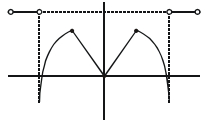
0 likesView Solution
225
MathematicsMediumMCQJEE Main · 2021
Let $\vec{a}=\hat{i}+\alpha \hat{j}+3 \hat{k}$ and $\vec{b}=3 \hat{i}-\alpha \hat{j}+\hat{k}$. If the area of the parallelogram whose adjacent sides are represented by the vectors $\vec{a}$ and $\vec{b}$ is $8 \sqrt{3}$ square units,then $\vec{a} \cdot \vec{b}$ is equal to ....... .
A
$10$
B
$2$
C
$5$
D
$4$
Solution
(B) Given vectors are $\vec{a} = \hat{i} + \alpha \hat{j} + 3 \hat{k}$ and $\vec{b} = 3 \hat{i} - \alpha \hat{j} + \hat{k}$.
The area of the parallelogram with adjacent sides $\vec{a}$ and $\vec{b}$ is given by $|\vec{a} \times \vec{b}| = 8 \sqrt{3}$.
First,calculate the cross product $\vec{a} \times \vec{b}$:
$\vec{a} \times \vec{b} = \begin{vmatrix} \hat{i} & \hat{j} & \hat{k} \\ 1 & \alpha & 3 \\ 3 & -\alpha & 1 \end{vmatrix} = \hat{i}(\alpha - (-3\alpha)) - \hat{j}(1 - 9) + \hat{k}(-\alpha - 3\alpha) = 4\alpha \hat{i} + 8 \hat{j} - 4\alpha \hat{k}$.
Now,find the magnitude:
$|\vec{a} \times \vec{b}| = \sqrt{(4\alpha)^2 + 8^2 + (-4\alpha)^2} = \sqrt{16\alpha^2 + 64 + 16\alpha^2} = \sqrt{32\alpha^2 + 64}$.
Equating to the given area:
$\sqrt{32\alpha^2 + 64} = 8 \sqrt{3} \Rightarrow 32\alpha^2 + 64 = 64 \times 3 = 192$.
$32\alpha^2 = 192 - 64 = 128 \Rightarrow \alpha^2 = 4$.
Finally,calculate the dot product $\vec{a} \cdot \vec{b}$:
$\vec{a} \cdot \vec{b} = (1)(3) + (\alpha)(-\alpha) + (3)(1) = 3 - \alpha^2 + 3 = 6 - \alpha^2$.
Substituting $\alpha^2 = 4$,we get $\vec{a} \cdot \vec{b} = 6 - 4 = 2$.
The area of the parallelogram with adjacent sides $\vec{a}$ and $\vec{b}$ is given by $|\vec{a} \times \vec{b}| = 8 \sqrt{3}$.
First,calculate the cross product $\vec{a} \times \vec{b}$:
$\vec{a} \times \vec{b} = \begin{vmatrix} \hat{i} & \hat{j} & \hat{k} \\ 1 & \alpha & 3 \\ 3 & -\alpha & 1 \end{vmatrix} = \hat{i}(\alpha - (-3\alpha)) - \hat{j}(1 - 9) + \hat{k}(-\alpha - 3\alpha) = 4\alpha \hat{i} + 8 \hat{j} - 4\alpha \hat{k}$.
Now,find the magnitude:
$|\vec{a} \times \vec{b}| = \sqrt{(4\alpha)^2 + 8^2 + (-4\alpha)^2} = \sqrt{16\alpha^2 + 64 + 16\alpha^2} = \sqrt{32\alpha^2 + 64}$.
Equating to the given area:
$\sqrt{32\alpha^2 + 64} = 8 \sqrt{3} \Rightarrow 32\alpha^2 + 64 = 64 \times 3 = 192$.
$32\alpha^2 = 192 - 64 = 128 \Rightarrow \alpha^2 = 4$.
Finally,calculate the dot product $\vec{a} \cdot \vec{b}$:
$\vec{a} \cdot \vec{b} = (1)(3) + (\alpha)(-\alpha) + (3)(1) = 3 - \alpha^2 + 3 = 6 - \alpha^2$.
Substituting $\alpha^2 = 4$,we get $\vec{a} \cdot \vec{b} = 6 - 4 = 2$.
0 likesView Solution
226
MathematicsDifficultMCQJEE Main · 2021
If the curves $x=y^{4}$ and $xy=k$ cut at right angles,then $(4k)^{6}$ is equal to ..... .
A
$5$
B
$3$
C
$4$
D
$6$
Solution
(C) Given curves are $x=y^{4}$ and $xy=k$.
For the intersection point,substitute $x=y^{4}$ into $xy=k$:
$y^{4} \cdot y = k \Rightarrow y^{5} = k \ldots(1)$.
Now,differentiate $x=y^{4}$ with respect to $x$:
$1 = 4y^{3} \frac{dy}{dx} \Rightarrow \frac{dy}{dx} = \frac{1}{4y^{3}}$.
Next,differentiate $xy=k$ with respect to $x$:
$y + x \frac{dy}{dx} = 0 \Rightarrow \frac{dy}{dx} = -\frac{y}{x}$.
Since $x = \frac{k}{y}$,we have $\frac{dy}{dx} = -\frac{y}{k/y} = -\frac{y^{2}}{k}$.
Since the curves intersect at right angles,the product of their slopes is $-1$:
$\left(\frac{1}{4y^{3}}\right) \cdot \left(-\frac{y^{2}}{k}\right) = -1$.
$\Rightarrow \frac{1}{4yk} = 1 \Rightarrow y = \frac{1}{4k}$.
Substitute $y = \frac{1}{4k}$ into equation $(1)$:
$\left(\frac{1}{4k}\right)^{5} = k$.
$\Rightarrow \frac{1}{(4k)^{5}} = k$.
$\Rightarrow (4k)^{6} = 4$.
For the intersection point,substitute $x=y^{4}$ into $xy=k$:
$y^{4} \cdot y = k \Rightarrow y^{5} = k \ldots(1)$.
Now,differentiate $x=y^{4}$ with respect to $x$:
$1 = 4y^{3} \frac{dy}{dx} \Rightarrow \frac{dy}{dx} = \frac{1}{4y^{3}}$.
Next,differentiate $xy=k$ with respect to $x$:
$y + x \frac{dy}{dx} = 0 \Rightarrow \frac{dy}{dx} = -\frac{y}{x}$.
Since $x = \frac{k}{y}$,we have $\frac{dy}{dx} = -\frac{y}{k/y} = -\frac{y^{2}}{k}$.
Since the curves intersect at right angles,the product of their slopes is $-1$:
$\left(\frac{1}{4y^{3}}\right) \cdot \left(-\frac{y^{2}}{k}\right) = -1$.
$\Rightarrow \frac{1}{4yk} = 1 \Rightarrow y = \frac{1}{4k}$.
Substitute $y = \frac{1}{4k}$ into equation $(1)$:
$\left(\frac{1}{4k}\right)^{5} = k$.
$\Rightarrow \frac{1}{(4k)^{5}} = k$.
$\Rightarrow (4k)^{6} = 4$.
0 likesView Solution
227
MathematicsDifficultMCQJEE Main · 2021
If the curve $y = y(x)$ represented by the solution of the differential equation $(2xy^2 - y)dx + xdy = 0$ passes through the intersection of the lines $2x - 3y = 1$ and $3x + 2y = 8$,then $|y(1)|$ is equal to ...... .
A
$1$
B
$2$
C
$3$
D
$4$
Solution
(A) Given differential equation: $(2xy^2 - y)dx + xdy = 0$.
Rearranging the terms: $2xy^2 dx - ydx + xdy = 0$.
Divide by $xy^2$: $2xdx - \frac{ydx - xdy}{y^2} = 0$.
This simplifies to $2xdx = d(\frac{x}{y})$.
Integrating both sides: $\int 2xdx = \int d(\frac{x}{y}) \Rightarrow x^2 = \frac{x}{y} + c$.
To find the point of intersection of $2x - 3y = 1$ and $3x + 2y = 8$,multiply the first by $2$ and the second by $3$: $4x - 6y = 2$ and $9x + 6y = 24$.
Adding these gives $13x = 26 \Rightarrow x = 2$. Substituting $x=2$ into $2x - 3y = 1$ gives $4 - 3y = 1 \Rightarrow 3y = 3 \Rightarrow y = 1$.
The curve passes through $(2, 1)$,so $2^2 = \frac{2}{1} + c \Rightarrow 4 = 2 + c \Rightarrow c = 2$.
The equation of the curve is $x^2 = \frac{x}{y} + 2$.
For $x = 1$,$1^2 = \frac{1}{y} + 2 \Rightarrow 1 = \frac{1}{y} + 2 \Rightarrow \frac{1}{y} = -1 \Rightarrow y = -1$.
Thus,$|y(1)| = |-1| = 1$.
Rearranging the terms: $2xy^2 dx - ydx + xdy = 0$.
Divide by $xy^2$: $2xdx - \frac{ydx - xdy}{y^2} = 0$.
This simplifies to $2xdx = d(\frac{x}{y})$.
Integrating both sides: $\int 2xdx = \int d(\frac{x}{y}) \Rightarrow x^2 = \frac{x}{y} + c$.
To find the point of intersection of $2x - 3y = 1$ and $3x + 2y = 8$,multiply the first by $2$ and the second by $3$: $4x - 6y = 2$ and $9x + 6y = 24$.
Adding these gives $13x = 26 \Rightarrow x = 2$. Substituting $x=2$ into $2x - 3y = 1$ gives $4 - 3y = 1 \Rightarrow 3y = 3 \Rightarrow y = 1$.
The curve passes through $(2, 1)$,so $2^2 = \frac{2}{1} + c \Rightarrow 4 = 2 + c \Rightarrow c = 2$.
The equation of the curve is $x^2 = \frac{x}{y} + 2$.
For $x = 1$,$1^2 = \frac{1}{y} + 2 \Rightarrow 1 = \frac{1}{y} + 2 \Rightarrow \frac{1}{y} = -1 \Rightarrow y = -1$.
Thus,$|y(1)| = |-1| = 1$.
0 likesView Solution
228
MathematicsDifficultMCQJEE Main · 2021
The value of $\int_{-2}^{2}\left|3 x^{2}-3 x-6\right| d x$ is ...... .
A
$19$
B
$17$
C
$23$
D
$13$
Solution
(A) We need to evaluate the integral $I = \int_{-2}^{2} |3x^2 - 3x - 6| dx$.
First,factor the expression inside the absolute value: $3x^2 - 3x - 6 = 3(x^2 - x - 2) = 3(x - 2)(x + 1)$.
The roots of the quadratic are $x = -1$ and $x = 2$.
In the interval $[-2, -1]$,$3(x^2 - x - 2) \ge 0$.
In the interval $[-1, 2]$,$3(x^2 - x - 2) \le 0$.
Thus,$I = 3 \left[ \int_{-2}^{-1} (x^2 - x - 2) dx + \int_{-1}^{2} -(x^2 - x - 2) dx \right]$.
Evaluating the first integral: $\int_{-2}^{-1} (x^2 - x - 2) dx = [\frac{x^3}{3} - \frac{x^2}{2} - 2x]_{-2}^{-1} = (-\frac{1}{3} - \frac{1}{2} + 2) - (-\frac{8}{3} - 2 + 4) = \frac{7}{6} - (-\frac{2}{3}) = \frac{7}{6} + \frac{4}{6} = \frac{11}{6}$.
Evaluating the second integral: $-\int_{-1}^{2} (x^2 - x - 2) dx = -[\frac{x^3}{3} - \frac{x^2}{2} - 2x]_{-1}^{2} = -[(\frac{8}{3} - 2 - 4) - (-\frac{1}{3} - \frac{1}{2} + 2)] = -[-\frac{10}{3} - \frac{7}{6}] = -[-\frac{27}{6}] = \frac{9}{2} = \frac{27}{6}$.
Total value $I = 3 \times (\frac{11}{6} + \frac{27}{6}) = 3 \times \frac{38}{6} = 3 \times \frac{19}{3} = 19$.
First,factor the expression inside the absolute value: $3x^2 - 3x - 6 = 3(x^2 - x - 2) = 3(x - 2)(x + 1)$.
The roots of the quadratic are $x = -1$ and $x = 2$.
In the interval $[-2, -1]$,$3(x^2 - x - 2) \ge 0$.
In the interval $[-1, 2]$,$3(x^2 - x - 2) \le 0$.
Thus,$I = 3 \left[ \int_{-2}^{-1} (x^2 - x - 2) dx + \int_{-1}^{2} -(x^2 - x - 2) dx \right]$.
Evaluating the first integral: $\int_{-2}^{-1} (x^2 - x - 2) dx = [\frac{x^3}{3} - \frac{x^2}{2} - 2x]_{-2}^{-1} = (-\frac{1}{3} - \frac{1}{2} + 2) - (-\frac{8}{3} - 2 + 4) = \frac{7}{6} - (-\frac{2}{3}) = \frac{7}{6} + \frac{4}{6} = \frac{11}{6}$.
Evaluating the second integral: $-\int_{-1}^{2} (x^2 - x - 2) dx = -[\frac{x^3}{3} - \frac{x^2}{2} - 2x]_{-1}^{2} = -[(\frac{8}{3} - 2 - 4) - (-\frac{1}{3} - \frac{1}{2} + 2)] = -[-\frac{10}{3} - \frac{7}{6}] = -[-\frac{27}{6}] = \frac{9}{2} = \frac{27}{6}$.
Total value $I = 3 \times (\frac{11}{6} + \frac{27}{6}) = 3 \times \frac{38}{6} = 3 \times \frac{19}{3} = 19$.
0 likesView Solution
229
MathematicsDifficultMCQJEE Main · 2021
$A$ line $l$ passing through the origin is perpendicular to the lines $l_{1}: \overrightarrow{r}=(3+t)\hat{i}+(-1+2t)\hat{j}+(4+2t)\hat{k}$ and $l_{2}: \overrightarrow{r}=(3+2s)\hat{i}+(3+2s)\hat{j}+(2+s)\hat{k}$. If the coordinates of the point in the first octant on $l_{2}$ at a distance of $\sqrt{17}$ from the point of intersection of $l$ and $l_{1}$ are $(a, b, c)$,then $18(a+b+c)$ is equal to ........ .
A
$22$
B
$11$
C
$44$
D
$33$
Solution
(C) The direction ratios of $l_{1}$ are $\vec{v}_{1} = (1, 2, 2)$ and for $l_{2}$ are $\vec{v}_{2} = (2, 2, 1)$.
Since line $l$ is perpendicular to both $l_{1}$ and $l_{2}$,its direction vector is $\vec{v} = \vec{v}_{1} \times \vec{v}_{2} = \begin{vmatrix} \hat{i} & \hat{j} & \hat{k} \\ 1 & 2 & 2 \\ 2 & 2 & 1 \end{vmatrix} = \hat{i}(2-4) - \hat{j}(1-4) + \hat{k}(2-4) = -2\hat{i} + 3\hat{j} - 2\hat{k}$.
Since $l$ passes through the origin,its equation is $\vec{r} = \mu(-2\hat{i} + 3\hat{j} - 2\hat{k})$.
For the intersection of $l$ and $l_{1}$:
$3+t = -2\mu$,$-1+2t = 3\mu$,$4+2t = -2\mu$.
Solving these,we get $t = -1$ and $\mu = -1$. The point of intersection $P$ is $(2, -3, 2)$.
Let $Q$ be a point on $l_{2}$,$Q = (3+2s, 3+2s, 2+s)$.
Given $PQ = \sqrt{17}$,so $PQ^{2} = 17$.
$(3+2s-2)^{2} + (3+2s+3)^{2} + (2+s-2)^{2} = 17$.
$(2s+1)^{2} + (2s+6)^{2} + s^{2} = 17$.
$4s^{2} + 4s + 1 + 4s^{2} + 24s + 36 + s^{2} = 17$.
$9s^{2} + 28s + 20 = 0$.
$(9s+10)(s+2) = 0$,so $s = -2$ or $s = -10/9$.
For $s = -10/9$,$Q = (3-20/9, 3-20/9, 2-10/9) = (7/9, 7/9, 8/9)$,which is in the first octant.
Thus,$a=7/9, b=7/9, c=8/9$.
$18(a+b+c) = 18(7/9 + 7/9 + 8/9) = 18(22/9) = 44$.
Since line $l$ is perpendicular to both $l_{1}$ and $l_{2}$,its direction vector is $\vec{v} = \vec{v}_{1} \times \vec{v}_{2} = \begin{vmatrix} \hat{i} & \hat{j} & \hat{k} \\ 1 & 2 & 2 \\ 2 & 2 & 1 \end{vmatrix} = \hat{i}(2-4) - \hat{j}(1-4) + \hat{k}(2-4) = -2\hat{i} + 3\hat{j} - 2\hat{k}$.
Since $l$ passes through the origin,its equation is $\vec{r} = \mu(-2\hat{i} + 3\hat{j} - 2\hat{k})$.
For the intersection of $l$ and $l_{1}$:
$3+t = -2\mu$,$-1+2t = 3\mu$,$4+2t = -2\mu$.
Solving these,we get $t = -1$ and $\mu = -1$. The point of intersection $P$ is $(2, -3, 2)$.
Let $Q$ be a point on $l_{2}$,$Q = (3+2s, 3+2s, 2+s)$.
Given $PQ = \sqrt{17}$,so $PQ^{2} = 17$.
$(3+2s-2)^{2} + (3+2s+3)^{2} + (2+s-2)^{2} = 17$.
$(2s+1)^{2} + (2s+6)^{2} + s^{2} = 17$.
$4s^{2} + 4s + 1 + 4s^{2} + 24s + 36 + s^{2} = 17$.
$9s^{2} + 28s + 20 = 0$.
$(9s+10)(s+2) = 0$,so $s = -2$ or $s = -10/9$.
For $s = -10/9$,$Q = (3-20/9, 3-20/9, 2-10/9) = (7/9, 7/9, 8/9)$,which is in the first octant.
Thus,$a=7/9, b=7/9, c=8/9$.
$18(a+b+c) = 18(7/9 + 7/9 + 8/9) = 18(22/9) = 44$.
0 likesView Solution
230
MathematicsEasyMCQJEE Main · 2021
If vectors $\overrightarrow{a}_{1} = x \hat{i} - \hat{j} + \hat{k}$ and $\overrightarrow{a}_{2} = \hat{i} + y \hat{j} + z \hat{k}$ are collinear,then a possible unit vector parallel to the vector $x \hat{i} + y \hat{j} + z \hat{k}$ is ...... .
A
$\frac{1}{\sqrt{2}}(-\hat{j} + \hat{k})$
B
$\frac{1}{\sqrt{2}}(\hat{i} - \hat{j})$
C
$\frac{1}{\sqrt{3}}(\hat{i} + \hat{j} - \hat{k})$
D
$\frac{1}{\sqrt{3}}(\hat{i} - \hat{j} + \hat{k})$
Solution
(D) Since $\overrightarrow{a}_{1}$ and $\overrightarrow{a}_{2}$ are collinear,their components must be proportional:
$\frac{x}{1} = \frac{-1}{y} = \frac{1}{z} = k$ (where $k$ is a constant).
From this,we get $x = k$,$y = -\frac{1}{k}$,and $z = \frac{1}{k}$.
Substituting these into the vector $x \hat{i} + y \hat{j} + z \hat{k}$,we get $k \hat{i} - \frac{1}{k} \hat{j} + \frac{1}{k} \hat{k}$.
For the vectors to be collinear,the ratio must hold. If we consider the simplest case where $k=1$,then $x=1, y=-1, z=1$.
The vector becomes $\hat{i} - \hat{j} + \hat{k}$.
The magnitude of this vector is $\sqrt{1^2 + (-1)^2 + 1^2} = \sqrt{3}$.
The unit vector is $\frac{1}{\sqrt{3}}(\hat{i} - \hat{j} + \hat{k})$.
$\frac{x}{1} = \frac{-1}{y} = \frac{1}{z} = k$ (where $k$ is a constant).
From this,we get $x = k$,$y = -\frac{1}{k}$,and $z = \frac{1}{k}$.
Substituting these into the vector $x \hat{i} + y \hat{j} + z \hat{k}$,we get $k \hat{i} - \frac{1}{k} \hat{j} + \frac{1}{k} \hat{k}$.
For the vectors to be collinear,the ratio must hold. If we consider the simplest case where $k=1$,then $x=1, y=-1, z=1$.
The vector becomes $\hat{i} - \hat{j} + \hat{k}$.
The magnitude of this vector is $\sqrt{1^2 + (-1)^2 + 1^2} = \sqrt{3}$.
The unit vector is $\frac{1}{\sqrt{3}}(\hat{i} - \hat{j} + \hat{k})$.
0 likesView Solution
231
MathematicsMediumMCQJEE Main · 2021
Let $A = \{1, 2, 3, \ldots, 10\}$ and $f: A \rightarrow A$ be defined as $f(k) = \begin{cases} k + 1 & \text{if } k \text{ is odd} \\ k & \text{if } k \text{ is even} \end{cases}$. Then the number of possible functions $g: A \rightarrow A$ such that $g \circ f = f$ is ...... .
A
$10^{5}$
B
$^{10}C_{5}$
C
$5^{5}$
D
$5!$
Solution
(A) Given $f(k) = \begin{cases} k+1, & \text{if } k \text{ is odd} \\ k, & \text{if } k \text{ is even} \end{cases}$.
We are given the condition $g(f(k)) = f(k)$ for all $k \in A$.
If $k$ is even,$f(k) = k$. Thus,$g(f(k)) = g(k) = f(k) = k$. So,$g(k) = k$ for all even $k \in \{2, 4, 6, 8, 10\}$.
If $k$ is odd,$f(k) = k+1$. Thus,$g(f(k)) = g(k+1) = f(k) = k+1$. Since $k+1$ is always even,this confirms that $g$ must map even numbers to themselves,which we already established.
For odd $k \in \{1, 3, 5, 7, 9\}$,the condition $g(f(k)) = f(k)$ does not impose any restriction on the value of $g(k)$.
Since $g: A \rightarrow A$,for each of the $5$ odd values of $k$,$g(k)$ can be any of the $10$ elements in $A$.
Therefore,the number of such functions $g$ is $10 \times 10 \times 10 \times 10 \times 10 = 10^{5}$.
We are given the condition $g(f(k)) = f(k)$ for all $k \in A$.
If $k$ is even,$f(k) = k$. Thus,$g(f(k)) = g(k) = f(k) = k$. So,$g(k) = k$ for all even $k \in \{2, 4, 6, 8, 10\}$.
If $k$ is odd,$f(k) = k+1$. Thus,$g(f(k)) = g(k+1) = f(k) = k+1$. Since $k+1$ is always even,this confirms that $g$ must map even numbers to themselves,which we already established.
For odd $k \in \{1, 3, 5, 7, 9\}$,the condition $g(f(k)) = f(k)$ does not impose any restriction on the value of $g(k)$.
Since $g: A \rightarrow A$,for each of the $5$ odd values of $k$,$g(k)$ can be any of the $10$ elements in $A$.
Therefore,the number of such functions $g$ is $10 \times 10 \times 10 \times 10 \times 10 = 10^{5}$.
0 likesView Solution
232
MathematicsDifficultMCQJEE Main · 2021
Let $f: R \rightarrow R$ be defined as $f(x) = \begin{cases} 2 \sin \left(-\frac{\pi x}{2}\right), & \text{if } x < -1 \\ |ax^2 + x + b|, & \text{if } -1 \leq x \leq 1 \\ \sin(\pi x), & \text{if } x > 1 \end{cases}$. If $f(x)$ is continuous on $R$,then $a + b$ equals ..... .
A
$-3$
B
$-1$
C
$3$
D
$1$
Solution
(B) $f(x)$ is continuous on $R$,so it must be continuous at $x = 1$ and $x = -1$.
For continuity at $x = 1$:
$\lim_{x \rightarrow 1^-} f(x) = f(1) = \lim_{x \rightarrow 1^+} f(x)$
$|a(1)^2 + 1 + b| = \lim_{x \rightarrow 1^+} \sin(\pi x)$
$|a + 1 + b| = \sin(\pi) = 0$
$a + b + 1 = 0 \Rightarrow a + b = -1$ ... $(1)$
For continuity at $x = -1$:
$\lim_{x \rightarrow -1^-} f(x) = f(-1) = \lim_{x \rightarrow -1^+} f(x)$
$\lim_{x \rightarrow -1^-} 2 \sin \left(-\frac{\pi x}{2}\right) = |a(-1)^2 + (-1) + b|$
$2 \sin \left(\frac{\pi}{2}\right) = |a - 1 + b|$
$2(1) = |a + b - 1|$
$|a + b - 1| = 2$
This implies $a + b - 1 = 2$ or $a + b - 1 = -2$.
$a + b = 3$ or $a + b = -1$.
Since we already established $a + b = -1$ from the continuity at $x = 1$,the value of $a + b$ is $-1$.
For continuity at $x = 1$:
$\lim_{x \rightarrow 1^-} f(x) = f(1) = \lim_{x \rightarrow 1^+} f(x)$
$|a(1)^2 + 1 + b| = \lim_{x \rightarrow 1^+} \sin(\pi x)$
$|a + 1 + b| = \sin(\pi) = 0$
$a + b + 1 = 0 \Rightarrow a + b = -1$ ... $(1)$
For continuity at $x = -1$:
$\lim_{x \rightarrow -1^-} f(x) = f(-1) = \lim_{x \rightarrow -1^+} f(x)$
$\lim_{x \rightarrow -1^-} 2 \sin \left(-\frac{\pi x}{2}\right) = |a(-1)^2 + (-1) + b|$
$2 \sin \left(\frac{\pi}{2}\right) = |a - 1 + b|$
$2(1) = |a + b - 1|$
$|a + b - 1| = 2$
This implies $a + b - 1 = 2$ or $a + b - 1 = -2$.
$a + b = 3$ or $a + b = -1$.
Since we already established $a + b = -1$ from the continuity at $x = 1$,the value of $a + b$ is $-1$.
0 likesView Solution
233
MathematicsDifficultMCQJEE Main · 2021
For $x > 0,$ if $f(x) = \int_{1}^{x} \frac{\log_{e} t}{1+t} dt,$ then $f(e) + f\left(\frac{1}{e}\right)$ is equal to:
A
$1$
B
$-1$
C
$\frac{1}{2}$
D
$0$
Solution
(C) Given $f(x) = \int_{1}^{x} \frac{\ln t}{1+t} dt.$
Consider $f\left(\frac{1}{x}\right) = \int_{1}^{1/x} \frac{\ln t}{1+t} dt.$
Let $t = \frac{1}{u},$ then $dt = -\frac{1}{u^2} du.$
When $t=1, u=1$ and when $t=1/x, u=x.$
So,$f\left(\frac{1}{x}\right) = \int_{1}^{x} \frac{\ln(1/u)}{1+(1/u)} \left(-\frac{1}{u^2}\right) du = \int_{1}^{x} \frac{-\ln u}{\frac{u+1}{u}} \left(\frac{1}{u^2}\right) du = \int_{1}^{x} \frac{-\ln u}{u(1+u)} du.$
Now,$f(x) + f\left(\frac{1}{x}\right) = \int_{1}^{x} \frac{\ln t}{1+t} dt - \int_{1}^{x} \frac{\ln t}{t(1+t)} dt = \int_{1}^{x} \left( \frac{\ln t}{1+t} - \frac{\ln t}{t(1+t)} \right) dt.$
$= \int_{1}^{x} \frac{t \ln t - \ln t}{t(1+t)} dt = \int_{1}^{x} \frac{(t-1) \ln t}{t(1+t)} dt.$
Wait,let's re-evaluate: $f(x) + f(1/x) = \int_{1}^{x} \frac{\ln t}{1+t} dt + \int_{1}^{x} \frac{-\ln t}{t(1+t)} dt = \int_{1}^{x} \ln t \left( \frac{1}{1+t} - \frac{1}{t(1+t)} \right) dt = \int_{1}^{x} \ln t \left( \frac{t-1}{t(1+t)} \right) dt.$
Actually,for $x=e$: $f(e) = \int_{1}^{e} \frac{\ln t}{1+t} dt$ and $f(1/e) = \int_{1}^{1/e} \frac{\ln t}{1+t} dt = \int_{1/e}^{1} \frac{-\ln t}{1+t} dt.$
Using the property $\int_{1}^{x} \frac{\ln t}{1+t} dt + \int_{1}^{1/x} \frac{\ln t}{1+t} dt = \int_{1}^{x} \frac{\ln t}{1+t} dt - \int_{1/x}^{1} \frac{\ln t}{1+t} dt = \int_{1}^{x} \frac{\ln t}{1+t} dt - \int_{x}^{1} \frac{\ln(1/u)}{1+(1/u)} \frac{1}{u^2} du = \int_{1}^{x} \frac{\ln t}{1+t} dt - \int_{1}^{x} \frac{\ln u}{u(1+u)} du = \int_{1}^{x} \frac{\ln t}{1+t} (1 - 1/t) dt = \int_{1}^{x} \frac{\ln t (t-1)}{t(1+t)} dt.$
Evaluating at $x=e$: $\int_{1}^{e} \frac{\ln t}{1+t} dt + \int_{1}^{1/e} \frac{\ln t}{1+t} dt = \int_{1}^{e} \frac{\ln t}{1+t} dt - \int_{1/e}^{1} \frac{\ln t}{1+t} dt = \int_{1}^{e} \frac{\ln t}{1+t} dt - \int_{e}^{1} \frac{\ln(1/u)}{1+1/u} \frac{1}{u^2} du = \int_{1}^{e} \frac{\ln t}{1+t} dt - \int_{1}^{e} \frac{\ln u}{u(1+u)} du = \int_{1}^{e} \ln t \left( \frac{1}{1+t} - \frac{1}{t(1+t)} \right) dt = \int_{1}^{e} \frac{\ln t (t-1)}{t(1+t)} dt.$
This evaluates to $\frac{1}{2}$.
Consider $f\left(\frac{1}{x}\right) = \int_{1}^{1/x} \frac{\ln t}{1+t} dt.$
Let $t = \frac{1}{u},$ then $dt = -\frac{1}{u^2} du.$
When $t=1, u=1$ and when $t=1/x, u=x.$
So,$f\left(\frac{1}{x}\right) = \int_{1}^{x} \frac{\ln(1/u)}{1+(1/u)} \left(-\frac{1}{u^2}\right) du = \int_{1}^{x} \frac{-\ln u}{\frac{u+1}{u}} \left(\frac{1}{u^2}\right) du = \int_{1}^{x} \frac{-\ln u}{u(1+u)} du.$
Now,$f(x) + f\left(\frac{1}{x}\right) = \int_{1}^{x} \frac{\ln t}{1+t} dt - \int_{1}^{x} \frac{\ln t}{t(1+t)} dt = \int_{1}^{x} \left( \frac{\ln t}{1+t} - \frac{\ln t}{t(1+t)} \right) dt.$
$= \int_{1}^{x} \frac{t \ln t - \ln t}{t(1+t)} dt = \int_{1}^{x} \frac{(t-1) \ln t}{t(1+t)} dt.$
Wait,let's re-evaluate: $f(x) + f(1/x) = \int_{1}^{x} \frac{\ln t}{1+t} dt + \int_{1}^{x} \frac{-\ln t}{t(1+t)} dt = \int_{1}^{x} \ln t \left( \frac{1}{1+t} - \frac{1}{t(1+t)} \right) dt = \int_{1}^{x} \ln t \left( \frac{t-1}{t(1+t)} \right) dt.$
Actually,for $x=e$: $f(e) = \int_{1}^{e} \frac{\ln t}{1+t} dt$ and $f(1/e) = \int_{1}^{1/e} \frac{\ln t}{1+t} dt = \int_{1/e}^{1} \frac{-\ln t}{1+t} dt.$
Using the property $\int_{1}^{x} \frac{\ln t}{1+t} dt + \int_{1}^{1/x} \frac{\ln t}{1+t} dt = \int_{1}^{x} \frac{\ln t}{1+t} dt - \int_{1/x}^{1} \frac{\ln t}{1+t} dt = \int_{1}^{x} \frac{\ln t}{1+t} dt - \int_{x}^{1} \frac{\ln(1/u)}{1+(1/u)} \frac{1}{u^2} du = \int_{1}^{x} \frac{\ln t}{1+t} dt - \int_{1}^{x} \frac{\ln u}{u(1+u)} du = \int_{1}^{x} \frac{\ln t}{1+t} (1 - 1/t) dt = \int_{1}^{x} \frac{\ln t (t-1)}{t(1+t)} dt.$
Evaluating at $x=e$: $\int_{1}^{e} \frac{\ln t}{1+t} dt + \int_{1}^{1/e} \frac{\ln t}{1+t} dt = \int_{1}^{e} \frac{\ln t}{1+t} dt - \int_{1/e}^{1} \frac{\ln t}{1+t} dt = \int_{1}^{e} \frac{\ln t}{1+t} dt - \int_{e}^{1} \frac{\ln(1/u)}{1+1/u} \frac{1}{u^2} du = \int_{1}^{e} \frac{\ln t}{1+t} dt - \int_{1}^{e} \frac{\ln u}{u(1+u)} du = \int_{1}^{e} \ln t \left( \frac{1}{1+t} - \frac{1}{t(1+t)} \right) dt = \int_{1}^{e} \frac{\ln t (t-1)}{t(1+t)} dt.$
This evaluates to $\frac{1}{2}$.
0 likesView Solution
234
MathematicsMediumMCQJEE Main · 2021
Let $f(x) = \sin^{-1} x$ and $g(x) = \frac{x^2 - x - 2}{2x^2 - x - 6}$. If $g(2) = \lim_{x \to 2} g(x)$,then the domain of the function $f \circ g$ is .... .
A
$(-\infty, -2] \cup [-\frac{3}{2}, \infty)$
B
$(-\infty, -2] \cup [-1, \infty)$
C
$(-\infty, -2] \cup [-\frac{4}{3}, \infty)$
D
$(-\infty, -1] \cup [2, \infty)$
Solution
(C) The domain of $(f \circ g)(x) = \sin^{-1}(g(x))$ requires $|g(x)| \leq 1$.
First,we find $g(2) = \lim_{x \to 2} \frac{(x+1)(x-2)}{(2x+3)(x-2)} = \lim_{x \to 2} \frac{x+1}{2x+3} = \frac{3}{7}$.
Thus,we solve $|\frac{x+1}{2x+3}| \leq 1$ for $x \neq 2$.
This implies $-1 \leq \frac{x+1}{2x+3} \leq 1$.
Case $1$: $\frac{x+1}{2x+3} \leq 1 \Rightarrow \frac{x+1 - (2x+3)}{2x+3} \leq 0 \Rightarrow \frac{-x-2}{2x+3} \leq 0 \Rightarrow \frac{x+2}{2x+3} \geq 0$.
The solution is $x \in (-\infty, -2] \cup (-\frac{3}{2}, \infty)$.
Case $2$: $\frac{x+1}{2x+3} \geq -1 \Rightarrow \frac{x+1 + 2x+3}{2x+3} \geq 0 \Rightarrow \frac{3x+4}{2x+3} \geq 0$.
The solution is $x \in (-\infty, -\frac{4}{3}] \cup (-\frac{3}{2}, \infty)$.
Taking the intersection of both cases and excluding $x=2$ (since $g(2)$ is defined as the limit),we get $x \in (-\infty, -2] \cup [-\frac{4}{3}, \infty)$.
First,we find $g(2) = \lim_{x \to 2} \frac{(x+1)(x-2)}{(2x+3)(x-2)} = \lim_{x \to 2} \frac{x+1}{2x+3} = \frac{3}{7}$.
Thus,we solve $|\frac{x+1}{2x+3}| \leq 1$ for $x \neq 2$.
This implies $-1 \leq \frac{x+1}{2x+3} \leq 1$.
Case $1$: $\frac{x+1}{2x+3} \leq 1 \Rightarrow \frac{x+1 - (2x+3)}{2x+3} \leq 0 \Rightarrow \frac{-x-2}{2x+3} \leq 0 \Rightarrow \frac{x+2}{2x+3} \geq 0$.
The solution is $x \in (-\infty, -2] \cup (-\frac{3}{2}, \infty)$.
Case $2$: $\frac{x+1}{2x+3} \geq -1 \Rightarrow \frac{x+1 + 2x+3}{2x+3} \geq 0 \Rightarrow \frac{3x+4}{2x+3} \geq 0$.
The solution is $x \in (-\infty, -\frac{4}{3}] \cup (-\frac{3}{2}, \infty)$.
Taking the intersection of both cases and excluding $x=2$ (since $g(2)$ is defined as the limit),we get $x \in (-\infty, -2] \cup [-\frac{4}{3}, \infty)$.
0 likesView Solution
235
MathematicsDifficultMCQJEE Main · 2021
The triangle of maximum area that can be inscribed in a given circle of radius $r$ is ...... .
A
An isosceles triangle with base equal to $2r$.
B
An equilateral triangle of height $\frac{2r}{3}$.
C
An equilateral triangle having each of its sides of length $\sqrt{3}r$.
D
$A$ right-angled triangle having two of its sides of length $2r$ and $r$.
Solution
(C) Let the triangle be $\Delta ABC$ inscribed in a circle of radius $r$ with center $O$.
Let $\theta$ be the angle $\angle OBP$,where $P$ is the midpoint of $BC$.
The height of the triangle is $h = r \sin \theta + r$.
The base of the triangle is $BC = 2r \cos \theta$.
The area of the triangle $\Delta$ is given by $\Delta = \frac{1}{2} \times \text{base} \times \text{height} = \frac{1}{2} (2r \cos \theta) (r \sin \theta + r) = r^2 \cos \theta (1 + \sin \theta)$.
To find the maximum area,differentiate $\Delta$ with respect to $\theta$:
$\frac{d\Delta}{d\theta} = r^2 [-\sin \theta (1 + \sin \theta) + \cos \theta (\cos \theta)] = r^2 [-\sin \theta - \sin^2 \theta + \cos^2 \theta] = r^2 [-\sin \theta - \sin^2 \theta + (1 - \sin^2 \theta)] = r^2 [1 - \sin \theta - 2 \sin^2 \theta]$.
Setting $\frac{d\Delta}{d\theta} = 0$,we get $2 \sin^2 \theta + \sin \theta - 1 = 0$,which factors as $(2 \sin \theta - 1)(\sin \theta + 1) = 0$.
Since $\theta \in [0, \pi/2)$,$\sin \theta = 1/2$,so $\theta = \pi/6$.
At $\theta = \pi/6$,the side length of the triangle is $s = 2r \cos(\pi/6) = 2r (\sqrt{3}/2) = \sqrt{3}r$.
Thus,the triangle of maximum area is an equilateral triangle with side length $\sqrt{3}r$.
Let $\theta$ be the angle $\angle OBP$,where $P$ is the midpoint of $BC$.
The height of the triangle is $h = r \sin \theta + r$.
The base of the triangle is $BC = 2r \cos \theta$.
The area of the triangle $\Delta$ is given by $\Delta = \frac{1}{2} \times \text{base} \times \text{height} = \frac{1}{2} (2r \cos \theta) (r \sin \theta + r) = r^2 \cos \theta (1 + \sin \theta)$.
To find the maximum area,differentiate $\Delta$ with respect to $\theta$:
$\frac{d\Delta}{d\theta} = r^2 [-\sin \theta (1 + \sin \theta) + \cos \theta (\cos \theta)] = r^2 [-\sin \theta - \sin^2 \theta + \cos^2 \theta] = r^2 [-\sin \theta - \sin^2 \theta + (1 - \sin^2 \theta)] = r^2 [1 - \sin \theta - 2 \sin^2 \theta]$.
Setting $\frac{d\Delta}{d\theta} = 0$,we get $2 \sin^2 \theta + \sin \theta - 1 = 0$,which factors as $(2 \sin \theta - 1)(\sin \theta + 1) = 0$.
Since $\theta \in [0, \pi/2)$,$\sin \theta = 1/2$,so $\theta = \pi/6$.
At $\theta = \pi/6$,the side length of the triangle is $s = 2r \cos(\pi/6) = 2r (\sqrt{3}/2) = \sqrt{3}r$.
Thus,the triangle of maximum area is an equilateral triangle with side length $\sqrt{3}r$.
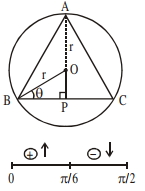
0 likesView Solution
236
MathematicsDifficultMCQJEE Main · 2021
Let $L$ be a line obtained from the intersection of two planes $x+2y+z=6$ and $y+2z=4$. If point $P(\alpha, \beta, \gamma)$ is the foot of the perpendicular from $(3,2,1)$ on $L$,then the value of $21(\alpha+\beta+\gamma)$ equals ...... .
A
$142$
B
$68$
C
$136$
D
$102$
Solution
(D) The equations of the planes are $x+2y+z=6$ and $y+2z=4$.
To find the line of intersection,we express $x$ and $y$ in terms of $z$.
From $y+2z=4$,we get $y=4-2z$.
Substituting this into the first plane equation: $x+2(4-2z)+z=6 \Rightarrow x+8-4z+z=6 \Rightarrow x-3z=-2 \Rightarrow x=3z-2$.
Thus,the line $L$ can be written in symmetric form as $\frac{x+2}{3} = \frac{y-4}{-2} = z = \lambda$.
Any point $P$ on the line $L$ is given by $(3\lambda-2, -2\lambda+4, \lambda)$.
The direction vector of the line is $\vec{v} = 3\hat{i}-2\hat{j}+\hat{k}$.
Let $A = (3,2,1)$. The vector $\vec{AP} = (3\lambda-2-3, -2\lambda+4-2, \lambda-1) = (3\lambda-5, -2\lambda+2, \lambda-1)$.
Since $\vec{AP} \perp \vec{v}$,their dot product is zero: $(3\lambda-5)(3) + (-2\lambda+2)(-2) + (\lambda-1)(1) = 0$.
$9\lambda - 15 + 4\lambda - 4 + \lambda - 1 = 0 \Rightarrow 14\lambda - 20 = 0 \Rightarrow \lambda = \frac{10}{7}$.
Substituting $\lambda$ back,$P = (3(\frac{10}{7})-2, -2(\frac{10}{7})+4, \frac{10}{7}) = (\frac{16}{7}, \frac{8}{7}, \frac{10}{7})$.
Thus,$\alpha+\beta+\gamma = \frac{16+8+10}{7} = \frac{34}{7}$.
The value of $21(\alpha+\beta+\gamma) = 21 \times \frac{34}{7} = 3 \times 34 = 102$.
To find the line of intersection,we express $x$ and $y$ in terms of $z$.
From $y+2z=4$,we get $y=4-2z$.
Substituting this into the first plane equation: $x+2(4-2z)+z=6 \Rightarrow x+8-4z+z=6 \Rightarrow x-3z=-2 \Rightarrow x=3z-2$.
Thus,the line $L$ can be written in symmetric form as $\frac{x+2}{3} = \frac{y-4}{-2} = z = \lambda$.
Any point $P$ on the line $L$ is given by $(3\lambda-2, -2\lambda+4, \lambda)$.
The direction vector of the line is $\vec{v} = 3\hat{i}-2\hat{j}+\hat{k}$.
Let $A = (3,2,1)$. The vector $\vec{AP} = (3\lambda-2-3, -2\lambda+4-2, \lambda-1) = (3\lambda-5, -2\lambda+2, \lambda-1)$.
Since $\vec{AP} \perp \vec{v}$,their dot product is zero: $(3\lambda-5)(3) + (-2\lambda+2)(-2) + (\lambda-1)(1) = 0$.
$9\lambda - 15 + 4\lambda - 4 + \lambda - 1 = 0 \Rightarrow 14\lambda - 20 = 0 \Rightarrow \lambda = \frac{10}{7}$.
Substituting $\lambda$ back,$P = (3(\frac{10}{7})-2, -2(\frac{10}{7})+4, \frac{10}{7}) = (\frac{16}{7}, \frac{8}{7}, \frac{10}{7})$.
Thus,$\alpha+\beta+\gamma = \frac{16+8+10}{7} = \frac{34}{7}$.
The value of $21(\alpha+\beta+\gamma) = 21 \times \frac{34}{7} = 3 \times 34 = 102$.
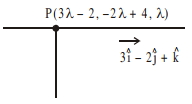
0 likesView Solution
237
MathematicsDifficultMCQJEE Main · 2021
Let the slope of the tangent line to a curve at any point $P(x, y)$ be given by $\frac{xy^2 + y}{x}$. If the curve intersects the line $x + 2y = 4$ at $x = -2$,then the value of $y$,for which the point $(3, y)$ lies on the curve,is ..... .
A
$\frac{18}{35}$
B
$-\frac{4}{3}$
C
$-\frac{18}{19}$
D
$-\frac{18}{11}$
Solution
(C) The differential equation is given by $\frac{dy}{dx} = \frac{xy^2 + y}{x} = y^2 + \frac{y}{x}$.
Rearranging the terms,we get $\frac{dy}{dx} - \frac{y}{x} = y^2$.
Dividing by $y^2$,we have $y^{-2} \frac{dy}{dx} - \frac{1}{x} y^{-1} = 1$.
Let $v = y^{-1}$,then $\frac{dv}{dx} = -y^{-2} \frac{dy}{dx}$,which implies $y^{-2} \frac{dy}{dx} = -\frac{dv}{dx}$.
Substituting this into the equation,we get $-\frac{dv}{dx} - \frac{1}{x} v = 1$,or $\frac{dv}{dx} + \frac{1}{x} v = -1$.
This is a linear differential equation with integrating factor $IF = e^{\int \frac{1}{x} dx} = e^{\ln x} = x$.
The solution is $v \cdot x = \int (-1) \cdot x dx + C = -\frac{x^2}{2} + C$.
Since $v = \frac{1}{y}$,we have $\frac{x}{y} = -\frac{x^2}{2} + C$.
Given the curve intersects $x + 2y = 4$ at $x = -2$,we find $y$ by substituting $x = -2$: $-2 + 2y = 4 \Rightarrow 2y = 6 \Rightarrow y = 3$.
The curve passes through $(-2, 3)$,so $\frac{-2}{3} = -\frac{(-2)^2}{2} + C \Rightarrow -\frac{2}{3} = -2 + C \Rightarrow C = 2 - \frac{2}{3} = \frac{4}{3}$.
Thus,$\frac{x}{y} = -\frac{x^2}{2} + \frac{4}{3}$.
For the point $(3, y)$,we have $\frac{3}{y} = -\frac{3^2}{2} + \frac{4}{3} = -\frac{9}{2} + \frac{4}{3} = \frac{-27 + 8}{6} = -\frac{19}{6}$.
Therefore,$y = 3 \cdot (-\frac{6}{19}) = -\frac{18}{19}$.
Rearranging the terms,we get $\frac{dy}{dx} - \frac{y}{x} = y^2$.
Dividing by $y^2$,we have $y^{-2} \frac{dy}{dx} - \frac{1}{x} y^{-1} = 1$.
Let $v = y^{-1}$,then $\frac{dv}{dx} = -y^{-2} \frac{dy}{dx}$,which implies $y^{-2} \frac{dy}{dx} = -\frac{dv}{dx}$.
Substituting this into the equation,we get $-\frac{dv}{dx} - \frac{1}{x} v = 1$,or $\frac{dv}{dx} + \frac{1}{x} v = -1$.
This is a linear differential equation with integrating factor $IF = e^{\int \frac{1}{x} dx} = e^{\ln x} = x$.
The solution is $v \cdot x = \int (-1) \cdot x dx + C = -\frac{x^2}{2} + C$.
Since $v = \frac{1}{y}$,we have $\frac{x}{y} = -\frac{x^2}{2} + C$.
Given the curve intersects $x + 2y = 4$ at $x = -2$,we find $y$ by substituting $x = -2$: $-2 + 2y = 4 \Rightarrow 2y = 6 \Rightarrow y = 3$.
The curve passes through $(-2, 3)$,so $\frac{-2}{3} = -\frac{(-2)^2}{2} + C \Rightarrow -\frac{2}{3} = -2 + C \Rightarrow C = 2 - \frac{2}{3} = \frac{4}{3}$.
Thus,$\frac{x}{y} = -\frac{x^2}{2} + \frac{4}{3}$.
For the point $(3, y)$,we have $\frac{3}{y} = -\frac{3^2}{2} + \frac{4}{3} = -\frac{9}{2} + \frac{4}{3} = \frac{-27 + 8}{6} = -\frac{19}{6}$.
Therefore,$y = 3 \cdot (-\frac{6}{19}) = -\frac{18}{19}$.
0 likesView Solution
238
MathematicsMediumMCQJEE Main · 2021
Consider the following system of equations: $x+2y-3z=a$,$2x+6y-11z=b$,and $x-2y+7z=c$,where $a, b$,and $c$ are real constants. Then the system of equations:
A
has a unique solution when $5a=2b+c$
B
has infinite number of solutions when $5a=2b+c$
C
has no solution for all $a, b$,and $c$
D
has a unique solution for all $a, b$,and $c$
Solution
(B) Let the given equations be:
$P_{1}: x+2y-3z=a$
$P_{2}: 2x+6y-11z=b$
$P_{3}: x-2y+7z=c$
First,we calculate the determinant of the coefficient matrix $D$:
$D = \begin{vmatrix} 1 & 2 & -3 \\ 2 & 6 & -11 \\ 1 & -2 & 7 \end{vmatrix} = 1(42-22) - 2(14+11) - 3(-4-6) = 20 - 50 + 30 = 0$.
Since $D=0$,the system does not have a unique solution.
Now,observe the linear combination of the equations:
$2P_{1} + P_{3} = 2(x+2y-3z) + (x-2y+7z) = 2x+4y-6z + x-2y+7z = 3x+2y+z$ (This does not match $P_{2}$ directly).
Let us check $5P_{1} = 2P_{2} + P_{3}$:
$2P_{2} + P_{3} = 2(2x+6y-11z) + (x-2y+7z) = 4x+12y-22z + x-2y+7z = 5x+10y-15z = 5(x+2y-3z) = 5P_{1}$.
Thus,if $5a = 2b + c$,the third equation is a linear combination of the first two,meaning the planes are consistent and share a common line of intersection.
Therefore,the system has an infinite number of solutions when $5a = 2b + c$.
$P_{1}: x+2y-3z=a$
$P_{2}: 2x+6y-11z=b$
$P_{3}: x-2y+7z=c$
First,we calculate the determinant of the coefficient matrix $D$:
$D = \begin{vmatrix} 1 & 2 & -3 \\ 2 & 6 & -11 \\ 1 & -2 & 7 \end{vmatrix} = 1(42-22) - 2(14+11) - 3(-4-6) = 20 - 50 + 30 = 0$.
Since $D=0$,the system does not have a unique solution.
Now,observe the linear combination of the equations:
$2P_{1} + P_{3} = 2(x+2y-3z) + (x-2y+7z) = 2x+4y-6z + x-2y+7z = 3x+2y+z$ (This does not match $P_{2}$ directly).
Let us check $5P_{1} = 2P_{2} + P_{3}$:
$2P_{2} + P_{3} = 2(2x+6y-11z) + (x-2y+7z) = 4x+12y-22z + x-2y+7z = 5x+10y-15z = 5(x+2y-3z) = 5P_{1}$.
Thus,if $5a = 2b + c$,the third equation is a linear combination of the first two,meaning the planes are consistent and share a common line of intersection.
Therefore,the system has an infinite number of solutions when $5a = 2b + c$.
0 likesView Solution
239
MathematicsMediumMCQJEE Main · 2021
Let $f(x)$ be a differentiable function at $x=a$ with $f^{\prime}(a)=2$ and $f(a)=4$. Then $\lim _{x \rightarrow a} \frac{x f(a)-a f(x)}{x-a}$ equals ...... .
A
$2a + 4$
B
$4 - 2a$
C
$2a - 4$
D
$a + 4$
Solution
(B) Given $f^{\prime}(a) = 2$ and $f(a) = 4$.
We need to evaluate $L = \lim_{x \rightarrow a} \frac{x f(a) - a f(x)}{x - a}$.
Since the limit is of the form $\frac{0}{0}$,we apply $L$'$H$ôpital's rule by differentiating the numerator and denominator with respect to $x$:
$L = \lim_{x \rightarrow a} \frac{\frac{d}{dx}(x f(a) - a f(x))}{\frac{d}{dx}(x - a)}$
$L = \lim_{x \rightarrow a} \frac{f(a) - a f^{\prime}(x)}{1}$
Substituting $x = a$:
$L = f(a) - a f^{\prime}(a)$
$L = 4 - a(2) = 4 - 2a$.
We need to evaluate $L = \lim_{x \rightarrow a} \frac{x f(a) - a f(x)}{x - a}$.
Since the limit is of the form $\frac{0}{0}$,we apply $L$'$H$ôpital's rule by differentiating the numerator and denominator with respect to $x$:
$L = \lim_{x \rightarrow a} \frac{\frac{d}{dx}(x f(a) - a f(x))}{\frac{d}{dx}(x - a)}$
$L = \lim_{x \rightarrow a} \frac{f(a) - a f^{\prime}(x)}{1}$
Substituting $x = a$:
$L = f(a) - a f^{\prime}(a)$
$L = 4 - a(2) = 4 - 2a$.
0 likesView Solution
240
MathematicsDifficultMCQJEE Main · 2021
If the mirror image of the point $(1, 3, 5)$ with respect to the plane $4x - 5y + 2z = 8$ is $(\alpha, \beta, \gamma)$,then $5(\alpha + \beta + \gamma)$ equals:
A
$47$
B
$43$
C
$39$
D
$41$
Solution
(A) Let $P = (1, 3, 5)$ and $Q = (\alpha, \beta, \gamma)$ be the image of $P$ with respect to the plane $4x - 5y + 2z = 8$.
The midpoint $M$ of $PQ$ is given by $M = \left(\frac{1+\alpha}{2}, \frac{3+\beta}{2}, \frac{5+\gamma}{2}\right)$.
Since $M$ lies on the plane,we have:
$4\left(\frac{1+\alpha}{2}\right) - 5\left(\frac{3+\beta}{2}\right) + 2\left(\frac{5+\gamma}{2}\right) = 8$
$2(1+\alpha) - 2.5(3+\beta) + (5+\gamma) = 8$
$2 + 2\alpha - 7.5 - 2.5\beta + 5 + \gamma = 8$
$2\alpha - 2.5\beta + \gamma = 8.5$ ... $(1)$
The line $PQ$ is perpendicular to the plane,so its direction ratios are proportional to the normal vector $(4, -5, 2)$:
$\frac{\alpha-1}{4} = \frac{\beta-3}{-5} = \frac{\gamma-5}{2} = k$
$\alpha = 1 + 4k, \beta = 3 - 5k, \gamma = 5 + 2k$ ... $(2)$
Substituting $(2)$ into the plane equation formula $\frac{\alpha-x_1}{a} = \frac{\beta-y_1}{b} = \frac{\gamma-z_1}{c} = -2 \frac{ax_1+by_1+cz_1-d}{a^2+b^2+c^2}$:
$k = -2 \frac{4(1) - 5(3) + 2(5) - 8}{4^2 + (-5)^2 + 2^2} = -2 \frac{4 - 15 + 10 - 8}{16 + 25 + 4} = -2 \frac{-9}{45} = \frac{18}{45} = \frac{2}{5}$.
Using $k = \frac{2}{5}$ in $(2)$:
$\alpha = 1 + 4(\frac{2}{5}) = \frac{13}{5}$
$\beta = 3 - 5(\frac{2}{5}) = 1$
$\gamma = 5 + 2(\frac{2}{5}) = \frac{29}{5}$
Therefore,$5(\alpha + \beta + \gamma) = 5(\frac{13}{5} + 1 + \frac{29}{5}) = 13 + 5 + 29 = 47$.
The midpoint $M$ of $PQ$ is given by $M = \left(\frac{1+\alpha}{2}, \frac{3+\beta}{2}, \frac{5+\gamma}{2}\right)$.
Since $M$ lies on the plane,we have:
$4\left(\frac{1+\alpha}{2}\right) - 5\left(\frac{3+\beta}{2}\right) + 2\left(\frac{5+\gamma}{2}\right) = 8$
$2(1+\alpha) - 2.5(3+\beta) + (5+\gamma) = 8$
$2 + 2\alpha - 7.5 - 2.5\beta + 5 + \gamma = 8$
$2\alpha - 2.5\beta + \gamma = 8.5$ ... $(1)$
The line $PQ$ is perpendicular to the plane,so its direction ratios are proportional to the normal vector $(4, -5, 2)$:
$\frac{\alpha-1}{4} = \frac{\beta-3}{-5} = \frac{\gamma-5}{2} = k$
$\alpha = 1 + 4k, \beta = 3 - 5k, \gamma = 5 + 2k$ ... $(2)$
Substituting $(2)$ into the plane equation formula $\frac{\alpha-x_1}{a} = \frac{\beta-y_1}{b} = \frac{\gamma-z_1}{c} = -2 \frac{ax_1+by_1+cz_1-d}{a^2+b^2+c^2}$:
$k = -2 \frac{4(1) - 5(3) + 2(5) - 8}{4^2 + (-5)^2 + 2^2} = -2 \frac{4 - 15 + 10 - 8}{16 + 25 + 4} = -2 \frac{-9}{45} = \frac{18}{45} = \frac{2}{5}$.
Using $k = \frac{2}{5}$ in $(2)$:
$\alpha = 1 + 4(\frac{2}{5}) = \frac{13}{5}$
$\beta = 3 - 5(\frac{2}{5}) = 1$
$\gamma = 5 + 2(\frac{2}{5}) = \frac{29}{5}$
Therefore,$5(\alpha + \beta + \gamma) = 5(\frac{13}{5} + 1 + \frac{29}{5}) = 13 + 5 + 29 = 47$.
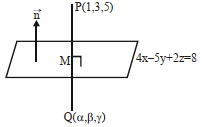
0 likesView Solution
241
MathematicsAdvancedMCQJEE Main · 2021
Let $f(x) = \int_{0}^{x} e^{t} f(t) dt + e^{x}$ be a differentiable function for all $x \in R$. Then $f(x)$ equals ..... .
A
$2 e^{(e^{x}-1)}-1$
B
$e^{e^{x}}-1$
C
$2 e^{e^{x}}-1$
D
$e^{(e^{x}-1)}$
Solution
(A) Given $f(x) = \int_{0}^{x} e^{t} f(t) dt + e^{x}$.
At $x=0$,$f(0) = \int_{0}^{0} e^{t} f(t) dt + e^{0} = 0 + 1 = 1$.
Differentiating both sides with respect to $x$ using the Leibniz rule:
$f'(x) = e^{x} f(x) + e^{x} = e^{x}(f(x) + 1)$.
Rearranging the terms,we get $\frac{f'(x)}{f(x) + 1} = e^{x}$.
Integrating both sides with respect to $x$ from $0$ to $x$:
$\int_{0}^{x} \frac{f'(t)}{f(t) + 1} dt = \int_{0}^{x} e^{t} dt$.
$[\ln(f(t) + 1)]_{0}^{x} = [e^{t}]_{0}^{x}$.
$\ln(f(x) + 1) - \ln(f(0) + 1) = e^{x} - e^{0}$.
Since $f(0) = 1$,we have $\ln(f(x) + 1) - \ln(2) = e^{x} - 1$.
$\ln\left(\frac{f(x) + 1}{2}\right) = e^{x} - 1$.
Taking the exponential of both sides:
$\frac{f(x) + 1}{2} = e^{(e^{x} - 1)}$.
$f(x) = 2 e^{(e^{x} - 1)} - 1$.
At $x=0$,$f(0) = \int_{0}^{0} e^{t} f(t) dt + e^{0} = 0 + 1 = 1$.
Differentiating both sides with respect to $x$ using the Leibniz rule:
$f'(x) = e^{x} f(x) + e^{x} = e^{x}(f(x) + 1)$.
Rearranging the terms,we get $\frac{f'(x)}{f(x) + 1} = e^{x}$.
Integrating both sides with respect to $x$ from $0$ to $x$:
$\int_{0}^{x} \frac{f'(t)}{f(t) + 1} dt = \int_{0}^{x} e^{t} dt$.
$[\ln(f(t) + 1)]_{0}^{x} = [e^{t}]_{0}^{x}$.
$\ln(f(x) + 1) - \ln(f(0) + 1) = e^{x} - e^{0}$.
Since $f(0) = 1$,we have $\ln(f(x) + 1) - \ln(2) = e^{x} - 1$.
$\ln\left(\frac{f(x) + 1}{2}\right) = e^{x} - 1$.
Taking the exponential of both sides:
$\frac{f(x) + 1}{2} = e^{(e^{x} - 1)}$.
$f(x) = 2 e^{(e^{x} - 1)} - 1$.
0 likesView Solution
242
MathematicsDifficultMCQJEE Main · 2021
Let $A_{1}$ be the area of the region bounded by the curves $y = \sin x$,$y = \cos x$ and the $y$-axis in the first quadrant. Also,let $A_{2}$ be the area of the region bounded by the curves $y = \sin x$,$y = \cos x$,the $x$-axis and $x = \frac{\pi}{2}$ in the first quadrant. Then ..... .
A
$A_{1}: A_{2} = 1: \sqrt{2}$ and $A_{1} + A_{2} = 1$
B
$A_{1} = A_{2}$ and $A_{1} + A_{2} = \sqrt{2}$
C
$2A_{1} = A_{2}$ and $A_{1} + A_{2} = 1 + \sqrt{2}$
D
$A_{1}: A_{2} = 1: 2$ and $A_{1} + A_{2} = 1$
Solution
(A) The curves $y = \sin x$ and $y = \cos x$ intersect at $x = \frac{\pi}{4}$ in the first quadrant.
$A_{1}$ is the area bounded by $y = \cos x$,$y = \sin x$ and the $y$-axis from $x = 0$ to $x = \frac{\pi}{4}$:
$A_{1} = \int_{0}^{\pi/4} (\cos x - \sin x) dx = [\sin x + \cos x]_{0}^{\pi/4} = (\frac{1}{\sqrt{2}} + \frac{1}{\sqrt{2}}) - (0 + 1) = \sqrt{2} - 1$.
$A_{2}$ is the area bounded by $y = \sin x$ from $x = 0$ to $x = \frac{\pi}{4}$ and $y = \cos x$ from $x = \frac{\pi}{4}$ to $x = \frac{\pi}{2}$:
$A_{2} = \int_{0}^{\pi/4} \sin x dx + \int_{\pi/4}^{\pi/2} \cos x dx = [-\cos x]_{0}^{\pi/4} + [\sin x]_{\pi/4}^{\pi/2}$
$A_{2} = (-\frac{1}{\sqrt{2}} - (-1)) + (1 - \frac{1}{\sqrt{2}}) = 1 - \frac{1}{\sqrt{2}} + 1 - \frac{1}{\sqrt{2}} = 2 - \frac{2}{\sqrt{2}} = 2 - \sqrt{2} = \sqrt{2}(\sqrt{2} - 1)$.
Now,$A_{1} : A_{2} = (\sqrt{2} - 1) : \sqrt{2}(\sqrt{2} - 1) = 1 : \sqrt{2}$.
And $A_{1} + A_{2} = (\sqrt{2} - 1) + (2 - \sqrt{2}) = 1$.
$A_{1}$ is the area bounded by $y = \cos x$,$y = \sin x$ and the $y$-axis from $x = 0$ to $x = \frac{\pi}{4}$:
$A_{1} = \int_{0}^{\pi/4} (\cos x - \sin x) dx = [\sin x + \cos x]_{0}^{\pi/4} = (\frac{1}{\sqrt{2}} + \frac{1}{\sqrt{2}}) - (0 + 1) = \sqrt{2} - 1$.
$A_{2}$ is the area bounded by $y = \sin x$ from $x = 0$ to $x = \frac{\pi}{4}$ and $y = \cos x$ from $x = \frac{\pi}{4}$ to $x = \frac{\pi}{2}$:
$A_{2} = \int_{0}^{\pi/4} \sin x dx + \int_{\pi/4}^{\pi/2} \cos x dx = [-\cos x]_{0}^{\pi/4} + [\sin x]_{\pi/4}^{\pi/2}$
$A_{2} = (-\frac{1}{\sqrt{2}} - (-1)) + (1 - \frac{1}{\sqrt{2}}) = 1 - \frac{1}{\sqrt{2}} + 1 - \frac{1}{\sqrt{2}} = 2 - \frac{2}{\sqrt{2}} = 2 - \sqrt{2} = \sqrt{2}(\sqrt{2} - 1)$.
Now,$A_{1} : A_{2} = (\sqrt{2} - 1) : \sqrt{2}(\sqrt{2} - 1) = 1 : \sqrt{2}$.
And $A_{1} + A_{2} = (\sqrt{2} - 1) + (2 - \sqrt{2}) = 1$.
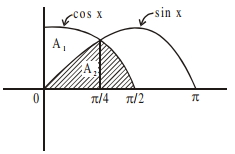
0 likesView Solution
243
MathematicsAdvancedMCQJEE Main · 2021
If $I_{m, n} = \int_{0}^{1} x^{m-1}(1-x)^{n-1} dx$ for $m, n \geq 1$ and $\int_{0}^{1} \frac{x^{m-1}+x^{n-1}}{(1+x)^{m+n}} dx = \alpha I_{m, n}$,where $\alpha \in R$,then $\alpha$ equals .... .
A
$3$
B
$4$
C
$1$
D
$2$
Solution
(C) We are given $I_{m, n} = \int_{0}^{1} x^{m-1}(1-x)^{n-1} dx$.
By substituting $x = \frac{1}{1+y}$,we have $dx = -\frac{1}{(1+y)^2} dy$.
When $x=0, y \to \infty$ and when $x=1, y=0$.
Thus,$I_{m, n} = \int_{\infty}^{0} (\frac{1}{1+y})^{m-1} (1 - \frac{1}{1+y})^{n-1} (-\frac{1}{(1+y)^2}) dy = \int_{0}^{\infty} \frac{y^{n-1}}{(1+y)^{m+n}} dy$.
Similarly,$I_{m, n} = \int_{0}^{\infty} \frac{y^{m-1}}{(1+y)^{m+n}} dy$.
Adding these,$2I_{m, n} = \int_{0}^{\infty} \frac{y^{m-1} + y^{n-1}}{(1+y)^{m+n}} dy$.
Splitting the integral at $y=1$:
$2I_{m, n} = \int_{0}^{1} \frac{y^{m-1} + y^{n-1}}{(1+y)^{m+n}} dy + \int_{1}^{\infty} \frac{y^{m-1} + y^{n-1}}{(1+y)^{m+n}} dy$.
In the second integral,substitute $y = \frac{1}{t}$,so $dy = -\frac{1}{t^2} dt$.
$\int_{1}^{\infty} \frac{y^{m-1} + y^{n-1}}{(1+y)^{m+n}} dy = \int_{1}^{0} \frac{(1/t)^{m-1} + (1/t)^{n-1}}{(1 + 1/t)^{m+n}} (-1/t^2) dt = \int_{0}^{1} \frac{t^{n-1} + t^{m-1}}{(t+1)^{m+n}} dt$.
Thus,$2I_{m, n} = \int_{0}^{1} \frac{y^{m-1} + y^{n-1}}{(1+y)^{m+n}} dy + \int_{0}^{1} \frac{y^{m-1} + y^{n-1}}{(1+y)^{m+n}} dy = 2 \int_{0}^{1} \frac{y^{m-1} + y^{n-1}}{(1+y)^{m+n}} dy$.
Therefore,$\int_{0}^{1} \frac{x^{m-1} + x^{n-1}}{(1+x)^{m+n}} dx = I_{m, n}$,which implies $\alpha = 1$.
By substituting $x = \frac{1}{1+y}$,we have $dx = -\frac{1}{(1+y)^2} dy$.
When $x=0, y \to \infty$ and when $x=1, y=0$.
Thus,$I_{m, n} = \int_{\infty}^{0} (\frac{1}{1+y})^{m-1} (1 - \frac{1}{1+y})^{n-1} (-\frac{1}{(1+y)^2}) dy = \int_{0}^{\infty} \frac{y^{n-1}}{(1+y)^{m+n}} dy$.
Similarly,$I_{m, n} = \int_{0}^{\infty} \frac{y^{m-1}}{(1+y)^{m+n}} dy$.
Adding these,$2I_{m, n} = \int_{0}^{\infty} \frac{y^{m-1} + y^{n-1}}{(1+y)^{m+n}} dy$.
Splitting the integral at $y=1$:
$2I_{m, n} = \int_{0}^{1} \frac{y^{m-1} + y^{n-1}}{(1+y)^{m+n}} dy + \int_{1}^{\infty} \frac{y^{m-1} + y^{n-1}}{(1+y)^{m+n}} dy$.
In the second integral,substitute $y = \frac{1}{t}$,so $dy = -\frac{1}{t^2} dt$.
$\int_{1}^{\infty} \frac{y^{m-1} + y^{n-1}}{(1+y)^{m+n}} dy = \int_{1}^{0} \frac{(1/t)^{m-1} + (1/t)^{n-1}}{(1 + 1/t)^{m+n}} (-1/t^2) dt = \int_{0}^{1} \frac{t^{n-1} + t^{m-1}}{(t+1)^{m+n}} dt$.
Thus,$2I_{m, n} = \int_{0}^{1} \frac{y^{m-1} + y^{n-1}}{(1+y)^{m+n}} dy + \int_{0}^{1} \frac{y^{m-1} + y^{n-1}}{(1+y)^{m+n}} dy = 2 \int_{0}^{1} \frac{y^{m-1} + y^{n-1}}{(1+y)^{m+n}} dy$.
Therefore,$\int_{0}^{1} \frac{x^{m-1} + x^{n-1}}{(1+x)^{m+n}} dx = I_{m, n}$,which implies $\alpha = 1$.
0 likesView Solution
244
MathematicsDifficultMCQJEE Main · 2021
If the matrix $A = \begin{bmatrix} 1 & 0 & 0 \\ 0 & 2 & 0 \\ 3 & 0 & -1 \end{bmatrix}$ satisfies the equation $A^{20} + \alpha A^{19} + \beta A = \begin{bmatrix} 1 & 0 & 0 \\ 0 & 4 & 0 \\ 0 & 0 & 1 \end{bmatrix}$ for some real numbers $\alpha$ and $\beta$,then $\beta - \alpha$ is equal to ........ .
A
$6$
B
$2$
C
$4$
D
$0$
Solution
(C) Given $A = \begin{bmatrix} 1 & 0 & 0 \\ 0 & 2 & 0 \\ 3 & 0 & -1 \end{bmatrix}$.
Calculating powers of $A$:
$A^2 = \begin{bmatrix} 1 & 0 & 0 \\ 0 & 4 & 0 \\ 0 & 0 & 1 \end{bmatrix}$,$A^3 = \begin{bmatrix} 1 & 0 & 0 \\ 0 & 8 & 0 \\ 3 & 0 & -1 \end{bmatrix}$,$A^4 = \begin{bmatrix} 1 & 0 & 0 \\ 0 & 16 & 0 \\ 0 & 0 & 1 \end{bmatrix}$.
By induction,for even $n$,$A^n = \begin{bmatrix} 1 & 0 & 0 \\ 0 & 2^n & 0 \\ 0 & 0 & 1 \end{bmatrix}$ and for odd $n$,$A^n = \begin{bmatrix} 1 & 0 & 0 \\ 0 & 2^n & 0 \\ 3 & 0 & -1 \end{bmatrix}$.
Thus,$A^{20} = \begin{bmatrix} 1 & 0 & 0 \\ 0 & 2^{20} & 0 \\ 0 & 0 & 1 \end{bmatrix}$ and $A^{19} = \begin{bmatrix} 1 & 0 & 0 \\ 0 & 2^{19} & 0 \\ 3 & 0 & -1 \end{bmatrix}$.
Substituting into the equation $A^{20} + \alpha A^{19} + \beta A = I_3$ (where $I_3$ is the identity matrix):
$\begin{bmatrix} 1+\alpha+\beta & 0 & 0 \\ 0 & 2^{20}+\alpha 2^{19}+2\beta & 0 \\ 3\alpha+3\beta & 0 & 1-\alpha-\beta \end{bmatrix} = \begin{bmatrix} 1 & 0 & 0 \\ 0 & 4 & 0 \\ 0 & 0 & 1 \end{bmatrix}$.
Comparing elements: $1+\alpha+\beta = 1 \Rightarrow \alpha+\beta = 0 \Rightarrow \beta = -\alpha$.
Also,$3\alpha+3\beta = 0$ (consistent with $\alpha+\beta=0$) and $1-\alpha-\beta = 1 \Rightarrow \alpha+\beta = 0$.
Finally,$2^{20} + \alpha 2^{19} + 2\beta = 4$. Substituting $\beta = -\alpha$:
$2^{20} + \alpha 2^{19} - 2\alpha = 4 \Rightarrow \alpha(2^{19}-2) = 4 - 2^{20}$.
$\alpha = \frac{4 - 2^{20}}{2^{19}-2} = \frac{2(2 - 2^{19})}{2^{19}-2} = -2$.
Since $\beta = -\alpha$,$\beta = 2$.
Therefore,$\beta - \alpha = 2 - (-2) = 4$.
Calculating powers of $A$:
$A^2 = \begin{bmatrix} 1 & 0 & 0 \\ 0 & 4 & 0 \\ 0 & 0 & 1 \end{bmatrix}$,$A^3 = \begin{bmatrix} 1 & 0 & 0 \\ 0 & 8 & 0 \\ 3 & 0 & -1 \end{bmatrix}$,$A^4 = \begin{bmatrix} 1 & 0 & 0 \\ 0 & 16 & 0 \\ 0 & 0 & 1 \end{bmatrix}$.
By induction,for even $n$,$A^n = \begin{bmatrix} 1 & 0 & 0 \\ 0 & 2^n & 0 \\ 0 & 0 & 1 \end{bmatrix}$ and for odd $n$,$A^n = \begin{bmatrix} 1 & 0 & 0 \\ 0 & 2^n & 0 \\ 3 & 0 & -1 \end{bmatrix}$.
Thus,$A^{20} = \begin{bmatrix} 1 & 0 & 0 \\ 0 & 2^{20} & 0 \\ 0 & 0 & 1 \end{bmatrix}$ and $A^{19} = \begin{bmatrix} 1 & 0 & 0 \\ 0 & 2^{19} & 0 \\ 3 & 0 & -1 \end{bmatrix}$.
Substituting into the equation $A^{20} + \alpha A^{19} + \beta A = I_3$ (where $I_3$ is the identity matrix):
$\begin{bmatrix} 1+\alpha+\beta & 0 & 0 \\ 0 & 2^{20}+\alpha 2^{19}+2\beta & 0 \\ 3\alpha+3\beta & 0 & 1-\alpha-\beta \end{bmatrix} = \begin{bmatrix} 1 & 0 & 0 \\ 0 & 4 & 0 \\ 0 & 0 & 1 \end{bmatrix}$.
Comparing elements: $1+\alpha+\beta = 1 \Rightarrow \alpha+\beta = 0 \Rightarrow \beta = -\alpha$.
Also,$3\alpha+3\beta = 0$ (consistent with $\alpha+\beta=0$) and $1-\alpha-\beta = 1 \Rightarrow \alpha+\beta = 0$.
Finally,$2^{20} + \alpha 2^{19} + 2\beta = 4$. Substituting $\beta = -\alpha$:
$2^{20} + \alpha 2^{19} - 2\alpha = 4 \Rightarrow \alpha(2^{19}-2) = 4 - 2^{20}$.
$\alpha = \frac{4 - 2^{20}}{2^{19}-2} = \frac{2(2 - 2^{19})}{2^{19}-2} = -2$.
Since $\beta = -\alpha$,$\beta = 2$.
Therefore,$\beta - \alpha = 2 - (-2) = 4$.
0 likesView Solution
245
MathematicsDifficultMCQJEE Main · 2021
Let $y=y(x)$ be a solution curve of the differential equation $(y+1) \tan ^{2} x \,dx+\tan x \,dy+y \,dx=0$ for $x \in \left(0, \frac{\pi}{2}\right)$. If $\lim _{x \rightarrow 0+} x y(x)=1$,then the value of $y\left(\frac{\pi}{4}\right)$ is:
A
$-\frac{\pi}{4}$
B
$\frac{\pi}{4}-1$
C
$\frac{\pi}{4}+1$
D
$\frac{\pi}{4}$
Solution
(B) The given differential equation is $(y+1) \tan ^{2} x \,dx+\tan x \,dy+y \,dx=0$.
Rearranging the terms,we get $\tan x \,dy + (y \tan^2 x + y + \tan^2 x) \,dx = 0$.
Dividing by $\tan x \,dx$,we get $\frac{dy}{dx} + \frac{y(\tan^2 x + 1) + \tan^2 x}{\tan x} = 0$.
Since $1+\tan^2 x = \sec^2 x$,we have $\frac{dy}{dx} + y \frac{\sec^2 x}{\tan x} = -\tan x$.
This is a linear differential equation of the form $\frac{dy}{dx} + P(x)y = Q(x)$,where $P(x) = \frac{\sec^2 x}{\tan x}$ and $Q(x) = -\tan x$.
The integrating factor $IF = e^{\int \frac{\sec^2 x}{\tan x} \,dx} = e^{\ln(\tan x)} = \tan x$.
The general solution is $y \cdot IF = \int Q(x) \cdot IF \,dx + C$.
$y \tan x = \int -\tan^2 x \,dx + C = \int (1 - \sec^2 x) \,dx + C = x - \tan x + C$.
Thus,$y = \frac{x}{\tan x} - 1 + \frac{C}{\tan x}$.
Given $\lim_{x \to 0+} x y(x) = 1$,we have $\lim_{x \to 0+} x \left( \frac{x}{\tan x} - 1 + \frac{C}{\tan x} \right) = 1$.
Since $\lim_{x \to 0} \frac{x}{\tan x} = 1$,the limit becomes $1(1) - 0 + C(1) = 1$,which implies $1 + C = 1$,so $C = 0$.
Thus,$y(x) = \frac{x}{\tan x} - 1$.
Evaluating at $x = \frac{\pi}{4}$,$y\left(\frac{\pi}{4}\right) = \frac{\pi/4}{1} - 1 = \frac{\pi}{4} - 1$.
Rearranging the terms,we get $\tan x \,dy + (y \tan^2 x + y + \tan^2 x) \,dx = 0$.
Dividing by $\tan x \,dx$,we get $\frac{dy}{dx} + \frac{y(\tan^2 x + 1) + \tan^2 x}{\tan x} = 0$.
Since $1+\tan^2 x = \sec^2 x$,we have $\frac{dy}{dx} + y \frac{\sec^2 x}{\tan x} = -\tan x$.
This is a linear differential equation of the form $\frac{dy}{dx} + P(x)y = Q(x)$,where $P(x) = \frac{\sec^2 x}{\tan x}$ and $Q(x) = -\tan x$.
The integrating factor $IF = e^{\int \frac{\sec^2 x}{\tan x} \,dx} = e^{\ln(\tan x)} = \tan x$.
The general solution is $y \cdot IF = \int Q(x) \cdot IF \,dx + C$.
$y \tan x = \int -\tan^2 x \,dx + C = \int (1 - \sec^2 x) \,dx + C = x - \tan x + C$.
Thus,$y = \frac{x}{\tan x} - 1 + \frac{C}{\tan x}$.
Given $\lim_{x \to 0+} x y(x) = 1$,we have $\lim_{x \to 0+} x \left( \frac{x}{\tan x} - 1 + \frac{C}{\tan x} \right) = 1$.
Since $\lim_{x \to 0} \frac{x}{\tan x} = 1$,the limit becomes $1(1) - 0 + C(1) = 1$,which implies $1 + C = 1$,so $C = 0$.
Thus,$y(x) = \frac{x}{\tan x} - 1$.
Evaluating at $x = \frac{\pi}{4}$,$y\left(\frac{\pi}{4}\right) = \frac{\pi/4}{1} - 1 = \frac{\pi}{4} - 1$.
0 likesView Solution
246
MathematicsDifficultMCQJEE Main · 2021
Let $A$ and $B$ be independent events such that $P(A)=p$ and $P(B)=2p$. The largest value of $p$, for which $P(\text{exactly one of } A, B \text{ occurs}) = \frac{5}{9}$, is:
A
$\frac{1}{3}$
B
$\frac{2}{9}$
C
$\frac{4}{9}$
D
$\frac{5}{12}$
Solution
(D) The probability that exactly one of $A$ or $B$ occurs is given by $P(A \cap \overline{B}) + P(\overline{A} \cap B) = \frac{5}{9}$.
Since $A$ and $B$ are independent, this becomes $P(A)P(\overline{B}) + P(\overline{A})P(B) = \frac{5}{9}$.
Substituting the given values $P(A) = p$ and $P(B) = 2p$, we have $p(1 - 2p) + (1 - p)(2p) = \frac{5}{9}$.
Expanding this, we get $p - 2p^2 + 2p - 2p^2 = \frac{5}{9}$, which simplifies to $3p - 4p^2 = \frac{5}{9}$.
Rearranging into a quadratic equation: $36p^2 - 27p + 5 = 0$.
Factoring the quadratic: $(12p - 5)(3p - 1) = 0$.
Thus, $p = \frac{5}{12}$ or $p = \frac{1}{3}$.
The largest value of $p$ is $\frac{5}{12}$.
Since $A$ and $B$ are independent, this becomes $P(A)P(\overline{B}) + P(\overline{A})P(B) = \frac{5}{9}$.
Substituting the given values $P(A) = p$ and $P(B) = 2p$, we have $p(1 - 2p) + (1 - p)(2p) = \frac{5}{9}$.
Expanding this, we get $p - 2p^2 + 2p - 2p^2 = \frac{5}{9}$, which simplifies to $3p - 4p^2 = \frac{5}{9}$.
Rearranging into a quadratic equation: $36p^2 - 27p + 5 = 0$.
Factoring the quadratic: $(12p - 5)(3p - 1) = 0$.
Thus, $p = \frac{5}{12}$ or $p = \frac{1}{3}$.
The largest value of $p$ is $\frac{5}{12}$.
0 likesView Solution
247
MathematicsDifficultMCQJEE Main · 2021
Let $\theta \in \left(0, \frac{\pi}{2}\right)$. If the system of linear equations
$(1+\cos^2 \theta) x + \sin^2 \theta y + 4 \sin 3\theta z = 0$
$\cos^2 \theta x + (1+\sin^2 \theta) y + 4 \sin 3\theta z = 0$
$\cos^2 \theta x + \sin^2 \theta y + (1+4 \sin 3\theta) z = 0$
has a non-trivial solution,then the value of $\theta$ is:
$(1+\cos^2 \theta) x + \sin^2 \theta y + 4 \sin 3\theta z = 0$
$\cos^2 \theta x + (1+\sin^2 \theta) y + 4 \sin 3\theta z = 0$
$\cos^2 \theta x + \sin^2 \theta y + (1+4 \sin 3\theta) z = 0$
has a non-trivial solution,then the value of $\theta$ is:
A
$\frac{4 \pi}{9}$
B
$\frac{7 \pi}{18}$
C
$\frac{\pi}{18}$
D
$\frac{5 \pi}{18}$
Solution
(B) For a system of homogeneous linear equations to have a non-trivial solution,the determinant of the coefficient matrix must be zero.
Let $D = \begin{vmatrix} 1+\cos^2 \theta & \sin^2 \theta & 4\sin 3\theta \\ \cos^2 \theta & 1+\sin^2 \theta & 4\sin 3\theta \\ \cos^2 \theta & \sin^2 \theta & 1+4\sin 3\theta \end{vmatrix} = 0$.
Applying $C_1 \rightarrow C_1 + C_2$,we get:
$D = \begin{vmatrix} 1+\cos^2 \theta + \sin^2 \theta & \sin^2 \theta & 4\sin 3\theta \\ \cos^2 \theta + 1+\sin^2 \theta & 1+\sin^2 \theta & 4\sin 3\theta \\ \cos^2 \theta + \sin^2 \theta & \sin^2 \theta & 1+4\sin 3\theta \end{vmatrix} = \begin{vmatrix} 2 & \sin^2 \theta & 4\sin 3\theta \\ 2 & 1+\sin^2 \theta & 4\sin 3\theta \\ 1 & \sin^2 \theta & 1+4\sin 3\theta \end{vmatrix} = 0$.
Applying $R_1 \rightarrow R_1 - R_2$ and $R_2 \rightarrow R_2 - R_3$:
$D = \begin{vmatrix} 0 & -1 & 0 \\ 1 & 1 & -1 \\ 1 & \sin^2 \theta & 1+4\sin 3\theta \end{vmatrix} = 0$.
Expanding along the first row:
$-(-1) \begin{vmatrix} 1 & -1 \\ 1 & 1+4\sin 3\theta \end{vmatrix} = 0 \implies 1(1+4\sin 3\theta) - (-1)(1) = 0$.
$1 + 4\sin 3\theta + 1 = 0 \implies 4\sin 3\theta = -2 \implies \sin 3\theta = -\frac{1}{2}$.
Since $\theta \in \left(0, \frac{\pi}{2}\right)$,$3\theta \in (0, \frac{3\pi}{2})$.
For $\sin 3\theta = -\frac{1}{2}$,$3\theta = \pi + \frac{\pi}{6} = \frac{7\pi}{6}$.
$\theta = \frac{7\pi}{18}$.
Let $D = \begin{vmatrix} 1+\cos^2 \theta & \sin^2 \theta & 4\sin 3\theta \\ \cos^2 \theta & 1+\sin^2 \theta & 4\sin 3\theta \\ \cos^2 \theta & \sin^2 \theta & 1+4\sin 3\theta \end{vmatrix} = 0$.
Applying $C_1 \rightarrow C_1 + C_2$,we get:
$D = \begin{vmatrix} 1+\cos^2 \theta + \sin^2 \theta & \sin^2 \theta & 4\sin 3\theta \\ \cos^2 \theta + 1+\sin^2 \theta & 1+\sin^2 \theta & 4\sin 3\theta \\ \cos^2 \theta + \sin^2 \theta & \sin^2 \theta & 1+4\sin 3\theta \end{vmatrix} = \begin{vmatrix} 2 & \sin^2 \theta & 4\sin 3\theta \\ 2 & 1+\sin^2 \theta & 4\sin 3\theta \\ 1 & \sin^2 \theta & 1+4\sin 3\theta \end{vmatrix} = 0$.
Applying $R_1 \rightarrow R_1 - R_2$ and $R_2 \rightarrow R_2 - R_3$:
$D = \begin{vmatrix} 0 & -1 & 0 \\ 1 & 1 & -1 \\ 1 & \sin^2 \theta & 1+4\sin 3\theta \end{vmatrix} = 0$.
Expanding along the first row:
$-(-1) \begin{vmatrix} 1 & -1 \\ 1 & 1+4\sin 3\theta \end{vmatrix} = 0 \implies 1(1+4\sin 3\theta) - (-1)(1) = 0$.
$1 + 4\sin 3\theta + 1 = 0 \implies 4\sin 3\theta = -2 \implies \sin 3\theta = -\frac{1}{2}$.
Since $\theta \in \left(0, \frac{\pi}{2}\right)$,$3\theta \in (0, \frac{3\pi}{2})$.
For $\sin 3\theta = -\frac{1}{2}$,$3\theta = \pi + \frac{\pi}{6} = \frac{7\pi}{6}$.
$\theta = \frac{7\pi}{18}$.
0 likesView Solution
248
MathematicsDifficultMCQJEE Main · 2021
Let $f(x) = \cos \left(2 \tan ^{-1} \sin \left(\cot ^{-1} \sqrt{\frac{1-x}{x}}\right)\right)$ for $0 < x < 1$. Then :
A
$(1-x)^{2} f^{\prime}(x)-2(f(x))^{2}=0$
B
$(1+x)^{2} f^{\prime}(x)+2(f(x))^{2}=0$
C
$(1-x)^{2} f^{\prime}(x)+2(f(x))^{2}=0$
D
$(1+x)^{2} f^{\prime}(x)-2(f(x))^{2}=0$
Solution
(C) Given $f(x) = \cos \left(2 \tan ^{-1} \sin \left(\cot ^{-1} \sqrt{\frac{1-x}{x}}\right)\right)$.
Let $\theta = \cot ^{-1} \sqrt{\frac{1-x}{x}}$. Then $\cot \theta = \sqrt{\frac{1-x}{x}}$,which implies $\tan \theta = \sqrt{\frac{x}{1-x}}$.
Using the identity $\sin \theta = \frac{\tan \theta}{\sqrt{1+\tan^2 \theta}} = \frac{\sqrt{x/(1-x)}}{\sqrt{1+x/(1-x)}} = \sqrt{x}$.
So,$\cot ^{-1} \sqrt{\frac{1-x}{x}} = \sin ^{-1} \sqrt{x}$.
Substituting this into $f(x)$:
$f(x) = \cos \left(2 \tan ^{-1} \sqrt{x}\right)$.
Using the identity $2 \tan ^{-1} u = \cos ^{-1} \left(\frac{1-u^2}{1+u^2}\right)$:
$f(x) = \cos \left(\cos ^{-1} \left(\frac{1-x}{1+x}\right)\right) = \frac{1-x}{1+x}$.
Now,differentiate $f(x)$ with respect to $x$ using the quotient rule:
$f^{\prime}(x) = \frac{(1+x)(-1) - (1-x)(1)}{(1+x)^2} = \frac{-1-x-1+x}{(1+x)^2} = \frac{-2}{(1+x)^2}$.
We need to check the options. Consider $(1-x)^2 f^{\prime}(x) + 2(f(x))^2$:
$(1-x)^2 \left(\frac{-2}{(1+x)^2}\right) + 2 \left(\frac{1-x}{1+x}\right)^2 = \frac{-2(1-x)^2}{(1+x)^2} + \frac{2(1-x)^2}{(1+x)^2} = 0$.
Thus,$(1-x)^{2} f^{\prime}(x)+2(f(x))^{2}=0$ is correct.
Let $\theta = \cot ^{-1} \sqrt{\frac{1-x}{x}}$. Then $\cot \theta = \sqrt{\frac{1-x}{x}}$,which implies $\tan \theta = \sqrt{\frac{x}{1-x}}$.
Using the identity $\sin \theta = \frac{\tan \theta}{\sqrt{1+\tan^2 \theta}} = \frac{\sqrt{x/(1-x)}}{\sqrt{1+x/(1-x)}} = \sqrt{x}$.
So,$\cot ^{-1} \sqrt{\frac{1-x}{x}} = \sin ^{-1} \sqrt{x}$.
Substituting this into $f(x)$:
$f(x) = \cos \left(2 \tan ^{-1} \sqrt{x}\right)$.
Using the identity $2 \tan ^{-1} u = \cos ^{-1} \left(\frac{1-u^2}{1+u^2}\right)$:
$f(x) = \cos \left(\cos ^{-1} \left(\frac{1-x}{1+x}\right)\right) = \frac{1-x}{1+x}$.
Now,differentiate $f(x)$ with respect to $x$ using the quotient rule:
$f^{\prime}(x) = \frac{(1+x)(-1) - (1-x)(1)}{(1+x)^2} = \frac{-1-x-1+x}{(1+x)^2} = \frac{-2}{(1+x)^2}$.
We need to check the options. Consider $(1-x)^2 f^{\prime}(x) + 2(f(x))^2$:
$(1-x)^2 \left(\frac{-2}{(1+x)^2}\right) + 2 \left(\frac{1-x}{1+x}\right)^2 = \frac{-2(1-x)^2}{(1+x)^2} + \frac{2(1-x)^2}{(1+x)^2} = 0$.
Thus,$(1-x)^{2} f^{\prime}(x)+2(f(x))^{2}=0$ is correct.
0 likesView Solution
249
MathematicsDifficultMCQJEE Main · 2021
Let $\overrightarrow{a}=\hat{i}+\hat{j}+\hat{k}$ and $\overrightarrow{b}=\hat{j}-\hat{k}.$ If $\overrightarrow{c}$ is a vector such that $\vec{a} \times \vec{c}=\vec{b}$ and $\vec{a} \cdot \vec{c}=3$,then $\vec{a} \cdot(\vec{b} \times \vec{c})$ is equal to :
A
$-2$
B
$-6$
C
$6$
D
$2$
Solution
(A) Given $\vec{a} = \hat{i} + \hat{j} + \hat{k}$ and $\vec{b} = \hat{j} - \hat{k}$.
We are given $\vec{a} \times \vec{c} = \vec{b}$ and $\vec{a} \cdot \vec{c} = 3$.
We need to find $\vec{a} \cdot (\vec{b} \times \vec{c})$.
Using the scalar triple product property,$\vec{a} \cdot (\vec{b} \times \vec{c}) = (\vec{a} \times \vec{b}) \cdot \vec{c}$.
First,calculate $\vec{a} \times \vec{b}$:
$\vec{a} \times \vec{b} = \begin{vmatrix} \hat{i} & \hat{j} & \hat{k} \\ 1 & 1 & 1 \\ 0 & 1 & -1 \end{vmatrix} = \hat{i}(-1-1) - \hat{j}(-1-0) + \hat{k}(1-0) = -2\hat{i} + \hat{j} + \hat{k}$.
Now,use the vector triple product identity $\vec{a} \times (\vec{a} \times \vec{c}) = (\vec{a} \cdot \vec{c})\vec{a} - (\vec{a} \cdot \vec{a})\vec{c}$.
Since $\vec{a} \times \vec{c} = \vec{b}$,we have $\vec{a} \times \vec{b} = (\vec{a} \cdot \vec{c})\vec{a} - |\vec{a}|^2 \vec{c}$.
Given $|\vec{a}|^2 = 1^2 + 1^2 + 1^2 = 3$ and $\vec{a} \cdot \vec{c} = 3$,we get:
$-2\hat{i} + \hat{j} + \hat{k} = 3(\hat{i} + \hat{j} + \hat{k}) - 3\vec{c}$.
$3\vec{c} = 3\hat{i} + 3\hat{j} + 3\hat{k} - (-2\hat{i} + \hat{j} + \hat{k}) = 5\hat{i} + 2\hat{j} + 2\hat{k}$.
$\vec{c} = \frac{5}{3}\hat{i} + \frac{2}{3}\hat{j} + \frac{2}{3}\hat{k}$.
Finally,$\vec{a} \cdot (\vec{b} \times \vec{c}) = (\vec{a} \times \vec{b}) \cdot \vec{c} = (-2\hat{i} + \hat{j} + \hat{k}) \cdot (\frac{5}{3}\hat{i} + \frac{2}{3}\hat{j} + \frac{2}{3}\hat{k}) = -\frac{10}{3} + \frac{2}{3} + \frac{2}{3} = -\frac{6}{3} = -2$.
We are given $\vec{a} \times \vec{c} = \vec{b}$ and $\vec{a} \cdot \vec{c} = 3$.
We need to find $\vec{a} \cdot (\vec{b} \times \vec{c})$.
Using the scalar triple product property,$\vec{a} \cdot (\vec{b} \times \vec{c}) = (\vec{a} \times \vec{b}) \cdot \vec{c}$.
First,calculate $\vec{a} \times \vec{b}$:
$\vec{a} \times \vec{b} = \begin{vmatrix} \hat{i} & \hat{j} & \hat{k} \\ 1 & 1 & 1 \\ 0 & 1 & -1 \end{vmatrix} = \hat{i}(-1-1) - \hat{j}(-1-0) + \hat{k}(1-0) = -2\hat{i} + \hat{j} + \hat{k}$.
Now,use the vector triple product identity $\vec{a} \times (\vec{a} \times \vec{c}) = (\vec{a} \cdot \vec{c})\vec{a} - (\vec{a} \cdot \vec{a})\vec{c}$.
Since $\vec{a} \times \vec{c} = \vec{b}$,we have $\vec{a} \times \vec{b} = (\vec{a} \cdot \vec{c})\vec{a} - |\vec{a}|^2 \vec{c}$.
Given $|\vec{a}|^2 = 1^2 + 1^2 + 1^2 = 3$ and $\vec{a} \cdot \vec{c} = 3$,we get:
$-2\hat{i} + \hat{j} + \hat{k} = 3(\hat{i} + \hat{j} + \hat{k}) - 3\vec{c}$.
$3\vec{c} = 3\hat{i} + 3\hat{j} + 3\hat{k} - (-2\hat{i} + \hat{j} + \hat{k}) = 5\hat{i} + 2\hat{j} + 2\hat{k}$.
$\vec{c} = \frac{5}{3}\hat{i} + \frac{2}{3}\hat{j} + \frac{2}{3}\hat{k}$.
Finally,$\vec{a} \cdot (\vec{b} \times \vec{c}) = (\vec{a} \times \vec{b}) \cdot \vec{c} = (-2\hat{i} + \hat{j} + \hat{k}) \cdot (\frac{5}{3}\hat{i} + \frac{2}{3}\hat{j} + \frac{2}{3}\hat{k}) = -\frac{10}{3} + \frac{2}{3} + \frac{2}{3} = -\frac{6}{3} = -2$.
0 likesView Solution
250
MathematicsDifficultMCQJEE Main · 2021
The value of $\int_{-1 / \sqrt{2}}^{1 / \sqrt{2}}\left(\left(\frac{x+1}{x-1}\right)^{2}+\left(\frac{x-1}{x+1}\right)^{2}-2\right)^{1 / 2} d x$ is:
A
$\log _{e} 4$
B
$\log _{e} 16$
C
$2 \log _{e} 16$
D
$4 \log _{e}(3+2 \sqrt{2})$
Solution
(B) Let $I = \int_{-1 / \sqrt{2}}^{1 / \sqrt{2}} \sqrt{\left(\frac{x+1}{x-1}\right)^{2} + \left(\frac{x-1}{x+1}\right)^{2} - 2} \, dx$.
We know that $a^2 + b^2 - 2 = (a-b)^2$. Here $a = \frac{x+1}{x-1}$ and $b = \frac{x-1}{x+1}$.
So,the integrand becomes $\sqrt{(\frac{x+1}{x-1} - \frac{x-1}{x+1})^2} = |\frac{x+1}{x-1} - \frac{x-1}{x+1}|$.
Simplifying the expression inside the absolute value: $\frac{(x+1)^2 - (x-1)^2}{x^2-1} = \frac{4x}{x^2-1}$.
Thus,$I = \int_{-1 / \sqrt{2}}^{1 / \sqrt{2}} |\frac{4x}{x^2-1}| \, dx$.
Since the integrand is an even function,$I = 2 \int_{0}^{1 / \sqrt{2}} |\frac{4x}{x^2-1}| \, dx = 8 \int_{0}^{1 / \sqrt{2}} |\frac{x}{x^2-1}| \, dx$.
For $x \in [0, 1/\sqrt{2}]$,$x^2-1 < 0$,so $|\frac{x}{x^2-1}| = -\frac{x}{x^2-1}$.
$I = -8 \int_{0}^{1 / \sqrt{2}} \frac{x}{x^2-1} \, dx = -4 \int_{0}^{1 / \sqrt{2}} \frac{2x}{x^2-1} \, dx$.
$I = -4 [\ln |x^2-1|]_{0}^{1 / \sqrt{2}} = -4 (\ln |1/2 - 1| - \ln |0-1|) = -4 (\ln(1/2) - 0) = -4 \ln(1/2) = 4 \ln 2 = \ln 16$.
We know that $a^2 + b^2 - 2 = (a-b)^2$. Here $a = \frac{x+1}{x-1}$ and $b = \frac{x-1}{x+1}$.
So,the integrand becomes $\sqrt{(\frac{x+1}{x-1} - \frac{x-1}{x+1})^2} = |\frac{x+1}{x-1} - \frac{x-1}{x+1}|$.
Simplifying the expression inside the absolute value: $\frac{(x+1)^2 - (x-1)^2}{x^2-1} = \frac{4x}{x^2-1}$.
Thus,$I = \int_{-1 / \sqrt{2}}^{1 / \sqrt{2}} |\frac{4x}{x^2-1}| \, dx$.
Since the integrand is an even function,$I = 2 \int_{0}^{1 / \sqrt{2}} |\frac{4x}{x^2-1}| \, dx = 8 \int_{0}^{1 / \sqrt{2}} |\frac{x}{x^2-1}| \, dx$.
For $x \in [0, 1/\sqrt{2}]$,$x^2-1 < 0$,so $|\frac{x}{x^2-1}| = -\frac{x}{x^2-1}$.
$I = -8 \int_{0}^{1 / \sqrt{2}} \frac{x}{x^2-1} \, dx = -4 \int_{0}^{1 / \sqrt{2}} \frac{2x}{x^2-1} \, dx$.
$I = -4 [\ln |x^2-1|]_{0}^{1 / \sqrt{2}} = -4 (\ln |1/2 - 1| - \ln |0-1|) = -4 (\ln(1/2) - 0) = -4 \ln(1/2) = 4 \ln 2 = \ln 16$.
0 likesView Solution
Vedclass Products
For Students
Vedclass Test Series
Mock tests in real JEE Main style covering Mathematics with performance analysis. 5-day free trial.
Start Free TrialFor Teachers
Exam Paper Generator
Generate Set A/B/C/D Mathematics papers from 7.5L+ questions in 2 minutes. 3 chapters free.
Try FreeFor Institutes
Online Exam Module
Run live JEE Main mock exams with unlimited students, 360° analytics & white-label branding.
See DemoFrequently Asked Questions
How many Mathematics questions are in JEE Main 2021?
There are 781 Mathematics questions from the JEE Main 2021 paper on Vedclass, each with a detailed step-by-step solution in English.
Are JEE Main 2021 Mathematics solutions available in English?
Yes. All solutions on this page are in English. You can also switch to English or Hindi using the language buttons above the questions.
Can I practice JEE Main 2021 Mathematics as a timed test?
Yes. Use the Vedclass Test Series to attempt a full JEE Main mock test covering Mathematics with time limits and instant score analysis.
Can teachers create Mathematics papers from JEE Main previous year questions?
Yes. The Vedclass Exam Paper Generator lets teachers mix JEE Main Mathematics questions and generate Set A/B/C/D papers in minutes.
For Teachers & Institutes
Build a Custom Mathematics Paper
Pick JEE Main 2021 Mathematics questions, set difficulty, and generate Set A/B/C/D in 2 minutes.