
MathematicsQ101–200 of 781 questions
Page 3 of 9 · English
101
MathematicsMediumMCQJEE Main · 2021
If the curves $\frac{x^{2}}{a}+\frac{y^{2}}{b}=1$ and $\frac{x^{2}}{c}+\frac{y^{2}}{d}=1$ intersect each other at an angle of $90^{\circ}$,then which of the following relations is $TRUE$?
A
$a+b=c+d$
B
$a-b=c-d$
C
$a-c=b-d$
D
$ab = \frac{c+d}{a+b}$
Solution
(B) Let the point of intersection be $(x_1, y_1)$.
For the first curve $\frac{x^2}{a} + \frac{y^2}{b} = 1$,the slope $m_1$ at $(x_1, y_1)$ is given by differentiating: $\frac{2x_1}{a} + \frac{2y_1}{b} \frac{dy}{dx} = 0 \Rightarrow m_1 = -\frac{bx_1}{ay_1}$.
For the second curve $\frac{x^2}{c} + \frac{y^2}{d} = 1$,the slope $m_2$ at $(x_1, y_1)$ is $m_2 = -\frac{dx_1}{cy_1}$.
Since the curves intersect at $90^{\circ}$,$m_1 m_2 = -1$.
$(-\frac{bx_1}{ay_1})(-\frac{dx_1}{cy_1}) = -1 \Rightarrow \frac{bd x_1^2}{ac y_1^2} = -1$,which implies $bd x_1^2 = -ac y_1^2$.
Subtracting the two curve equations: $x_1^2(\frac{1}{a} - \frac{1}{c}) + y_1^2(\frac{1}{b} - \frac{1}{d}) = 0$.
$x_1^2(\frac{c-a}{ac}) + y_1^2(\frac{d-b}{bd}) = 0$.
Substituting $x_1^2 = -\frac{ac}{bd} y_1^2$,we get $(-\frac{ac}{bd}) y_1^2(\frac{c-a}{ac}) + y_1^2(\frac{d-b}{bd}) = 0$.
$-\frac{c-a}{bd} + \frac{d-b}{bd} = 0$ $\Rightarrow a-c+d-b = 0$ $\Rightarrow a-b = c-d$.
For the first curve $\frac{x^2}{a} + \frac{y^2}{b} = 1$,the slope $m_1$ at $(x_1, y_1)$ is given by differentiating: $\frac{2x_1}{a} + \frac{2y_1}{b} \frac{dy}{dx} = 0 \Rightarrow m_1 = -\frac{bx_1}{ay_1}$.
For the second curve $\frac{x^2}{c} + \frac{y^2}{d} = 1$,the slope $m_2$ at $(x_1, y_1)$ is $m_2 = -\frac{dx_1}{cy_1}$.
Since the curves intersect at $90^{\circ}$,$m_1 m_2 = -1$.
$(-\frac{bx_1}{ay_1})(-\frac{dx_1}{cy_1}) = -1 \Rightarrow \frac{bd x_1^2}{ac y_1^2} = -1$,which implies $bd x_1^2 = -ac y_1^2$.
Subtracting the two curve equations: $x_1^2(\frac{1}{a} - \frac{1}{c}) + y_1^2(\frac{1}{b} - \frac{1}{d}) = 0$.
$x_1^2(\frac{c-a}{ac}) + y_1^2(\frac{d-b}{bd}) = 0$.
Substituting $x_1^2 = -\frac{ac}{bd} y_1^2$,we get $(-\frac{ac}{bd}) y_1^2(\frac{c-a}{ac}) + y_1^2(\frac{d-b}{bd}) = 0$.
$-\frac{c-a}{bd} + \frac{d-b}{bd} = 0$ $\Rightarrow a-c+d-b = 0$ $\Rightarrow a-b = c-d$.
0 likesView Solution
102
MathematicsDifficultMCQJEE Main · 2021
$\lim _{n \rightarrow \infty}\left(1+\frac{1+\frac{1}{2}+\ldots+\frac{1}{n}}{n^{2}}\right)^{n} = \dots$
A
$e^{1/2}$
B
$0$
C
$e^{-1}$
D
$1$
Solution
(D) The given limit is of the form $1^{\infty}$.
Let $L = \lim _{n \rightarrow \infty}\left(1+\frac{H_n}{n^{2}}\right)^{n}$,where $H_n = 1+\frac{1}{2}+\ldots+\frac{1}{n}$.
Using the formula $\lim _{n \rightarrow \infty}(1+f(n))^{g(n)} = e^{\lim _{n \rightarrow \infty} f(n)g(n)}$,we get:
$L = \exp \left(\lim _{n \rightarrow \infty} \frac{H_n}{n^2} \cdot n\right) = \exp \left(\lim _{n \rightarrow \infty} \frac{H_n}{n}\right)$.
We know that $H_n \approx \ln(n) + \gamma$ (where $\gamma$ is the Euler-Mascheroni constant).
Thus,$\lim _{n \rightarrow \infty} \frac{\ln(n) + \gamma}{n} = 0$.
Therefore,$L = e^0 = 1$.
Let $L = \lim _{n \rightarrow \infty}\left(1+\frac{H_n}{n^{2}}\right)^{n}$,where $H_n = 1+\frac{1}{2}+\ldots+\frac{1}{n}$.
Using the formula $\lim _{n \rightarrow \infty}(1+f(n))^{g(n)} = e^{\lim _{n \rightarrow \infty} f(n)g(n)}$,we get:
$L = \exp \left(\lim _{n \rightarrow \infty} \frac{H_n}{n^2} \cdot n\right) = \exp \left(\lim _{n \rightarrow \infty} \frac{H_n}{n}\right)$.
We know that $H_n \approx \ln(n) + \gamma$ (where $\gamma$ is the Euler-Mascheroni constant).
Thus,$\lim _{n \rightarrow \infty} \frac{\ln(n) + \gamma}{n} = 0$.
Therefore,$L = e^0 = 1$.
0 likesView Solution
103
MathematicsDifficultMCQJEE Main · 2021
The coefficients $a, b$ and $c$ of the quadratic equation $ax^{2} + bx + c = 0$ are obtained by throwing a die three times. The probability that this equation has equal roots is
A
$\frac{1}{72}$
B
$\frac{5}{216}$
C
$\frac{1}{36}$
D
$\frac{1}{54}$
Solution
(B) The quadratic equation is $ax^{2} + bx + c = 0$.
For the equation to have equal roots,the discriminant $D$ must be zero,i.e.,$D = b^{2} - 4ac = 0$,which implies $b^{2} = 4ac$.
Since $a, b, c$ are obtained by throwing a die three times,each variable can take values from the set ${1, 2, 3, 4, 5, 6}$. The total number of outcomes is $6 \times 6 \times 6 = 216$.
We need to find the number of triplets $(a, b, c)$ such that $b^{2} = 4ac$:
$1$. If $a=1, c=1$,then $b^{2} = 4(1)(1) = 4 \Rightarrow b=2$. Triplets: $(1, 2, 1)$.
$2$. If $a=1, c=4$,then $b^{2} = 4(1)(4) = 16 \Rightarrow b=4$. Triplets: $(1, 4, 4)$.
$3$. If $a=4, c=1$,then $b^{2} = 4(4)(1) = 16 \Rightarrow b=4$. Triplets: $(4, 4, 1)$.
$4$. If $a=2, c=2$,then $b^{2} = 4(2)(2) = 16 \Rightarrow b=4$. Triplets: $(2, 4, 2)$.
$5$. If $a=3, c=3$,then $b^{2} = 4(3)(3) = 36 \Rightarrow b=6$. Triplets: $(3, 6, 3)$.
Total favorable outcomes = $5$.
Therefore,the required probability is $\frac{5}{216}$.
For the equation to have equal roots,the discriminant $D$ must be zero,i.e.,$D = b^{2} - 4ac = 0$,which implies $b^{2} = 4ac$.
Since $a, b, c$ are obtained by throwing a die three times,each variable can take values from the set ${1, 2, 3, 4, 5, 6}$. The total number of outcomes is $6 \times 6 \times 6 = 216$.
We need to find the number of triplets $(a, b, c)$ such that $b^{2} = 4ac$:
$1$. If $a=1, c=1$,then $b^{2} = 4(1)(1) = 4 \Rightarrow b=2$. Triplets: $(1, 2, 1)$.
$2$. If $a=1, c=4$,then $b^{2} = 4(1)(4) = 16 \Rightarrow b=4$. Triplets: $(1, 4, 4)$.
$3$. If $a=4, c=1$,then $b^{2} = 4(4)(1) = 16 \Rightarrow b=4$. Triplets: $(4, 4, 1)$.
$4$. If $a=2, c=2$,then $b^{2} = 4(2)(2) = 16 \Rightarrow b=4$. Triplets: $(2, 4, 2)$.
$5$. If $a=3, c=3$,then $b^{2} = 4(3)(3) = 36 \Rightarrow b=6$. Triplets: $(3, 6, 3)$.
Total favorable outcomes = $5$.
Therefore,the required probability is $\frac{5}{216}$.
0 likesView Solution
104
MathematicsDifficultMCQJEE Main · 2021
The total number of positive integral solutions $(x, y, z)$ such that $xyz = 24$ is
A
$36$
B
$24$
C
$45$
D
$30$
Solution
(D) The prime factorization of $24$ is $2^{3} \times 3^{1}$.
Let $x = 2^{\alpha_{1}} \times 3^{\beta_{1}}$,$y = 2^{\alpha_{2}} \times 3^{\beta_{2}}$,and $z = 2^{\alpha_{3}} \times 3^{\beta_{3}}$,where $\alpha_{i}, \beta_{i} \ge 0$.
Since $xyz = 2^{3} \times 3^{1}$,we have $\alpha_{1} + \alpha_{2} + \alpha_{3} = 3$ and $\beta_{1} + \beta_{2} + \beta_{3} = 1$.
The number of non-negative integer solutions for $\alpha_{1} + \alpha_{2} + \alpha_{3} = 3$ is given by the stars and bars formula $\binom{n+k-1}{k-1} = \binom{3+3-1}{3-1} = \binom{5}{2} = 10$.
The number of non-negative integer solutions for $\beta_{1} + \beta_{2} + \beta_{3} = 1$ is $\binom{1+3-1}{3-1} = \binom{3}{2} = 3$.
Therefore,the total number of positive integral solutions is $10 \times 3 = 30$.
Let $x = 2^{\alpha_{1}} \times 3^{\beta_{1}}$,$y = 2^{\alpha_{2}} \times 3^{\beta_{2}}$,and $z = 2^{\alpha_{3}} \times 3^{\beta_{3}}$,where $\alpha_{i}, \beta_{i} \ge 0$.
Since $xyz = 2^{3} \times 3^{1}$,we have $\alpha_{1} + \alpha_{2} + \alpha_{3} = 3$ and $\beta_{1} + \beta_{2} + \beta_{3} = 1$.
The number of non-negative integer solutions for $\alpha_{1} + \alpha_{2} + \alpha_{3} = 3$ is given by the stars and bars formula $\binom{n+k-1}{k-1} = \binom{3+3-1}{3-1} = \binom{5}{2} = 10$.
The number of non-negative integer solutions for $\beta_{1} + \beta_{2} + \beta_{3} = 1$ is $\binom{1+3-1}{3-1} = \binom{3}{2} = 3$.
Therefore,the total number of positive integral solutions is $10 \times 3 = 30$.
0 likesView Solution
105
MathematicsMediumMCQJEE Main · 2021
The integer $k$,for which the inequality $x^{2}-2(3k-1)x+8k^{2}-7>0$ is valid for every $x \in \mathbb{R}$,is
A
$3$
B
$2$
C
$0$
D
$4$
Solution
(A) For the quadratic inequality $ax^{2}+bx+c > 0$ to be valid for all $x \in \mathbb{R}$,the discriminant $D$ must be less than $0$ and $a > 0$.
Here,$a = 1 > 0$,so we only need $D < 0$.
$D = [-2(3k-1)]^{2} - 4(1)(8k^{2}-7) < 0$
$4(9k^{2}-6k+1) - 4(8k^{2}-7) < 0$
Dividing by $4$:
$9k^{2}-6k+1 - 8k^{2}+7 < 0$
$k^{2}-6k+8 < 0$
$(k-2)(k-4) < 0$
This implies $k \in (2, 4)$.
Since $k$ is an integer,the only integer value in the interval $(2, 4)$ is $k = 3$.
Here,$a = 1 > 0$,so we only need $D < 0$.
$D = [-2(3k-1)]^{2} - 4(1)(8k^{2}-7) < 0$
$4(9k^{2}-6k+1) - 4(8k^{2}-7) < 0$
Dividing by $4$:
$9k^{2}-6k+1 - 8k^{2}+7 < 0$
$k^{2}-6k+8 < 0$
$(k-2)(k-4) < 0$
This implies $k \in (2, 4)$.
Since $k$ is an integer,the only integer value in the interval $(2, 4)$ is $k = 3$.
0 likesView Solution
106
MathematicsMediumMCQJEE Main · 2021
The statement $A$ $\rightarrow (B$ $\rightarrow A)$ is equivalent to
A
$A \rightarrow (A \wedge B)$
B
$A$ $\rightarrow (A$ $\rightarrow B)$
C
$A \rightarrow (A \leftrightarrow B)$
D
$A \rightarrow (A \vee B)$
Solution
(D) The given statement is $A$ $\rightarrow (B$ $\rightarrow A)$.
Using the implication law $p \rightarrow q \equiv \sim p \vee q$,we get:
$A$ $\rightarrow (B$ $\rightarrow A) \equiv \sim A \vee (\sim B \vee A)$
By the associative and commutative laws:
$\equiv (\sim A \vee A) \vee \sim B$
$\equiv T \vee \sim B \equiv T$ (Tautology).
Now,check the options for a tautology or equivalent form:
Option $D$ is $A \rightarrow (A \vee B) \equiv \sim A \vee (A \vee B) \equiv (\sim A \vee A) \vee B \equiv T \vee B \equiv T$.
Since both the original expression and option $D$ are tautologies,they are equivalent.
Using the implication law $p \rightarrow q \equiv \sim p \vee q$,we get:
$A$ $\rightarrow (B$ $\rightarrow A) \equiv \sim A \vee (\sim B \vee A)$
By the associative and commutative laws:
$\equiv (\sim A \vee A) \vee \sim B$
$\equiv T \vee \sim B \equiv T$ (Tautology).
Now,check the options for a tautology or equivalent form:
Option $D$ is $A \rightarrow (A \vee B) \equiv \sim A \vee (A \vee B) \equiv (\sim A \vee A) \vee B \equiv T \vee B \equiv T$.
Since both the original expression and option $D$ are tautologies,they are equivalent.
0 likesView Solution
107
MathematicsDifficultMCQJEE Main · 2021
Let $A_{1}, A_{2}, A_{3}, \ldots$ be squares such that for each $n \geq 1,$ the length of the side of $A_{n}$ equals the length of the diagonal of $A_{n+1}$. If the side length of $A_{1}$ is $12 \text{ cm}$,then the smallest value of $n$ for which the area of $A_{n}$ is less than $1 \text{ cm}^2$ is:
A
$8$
B
$6$
C
$3$
D
$9$
Solution
(D) Let $a_{n}$ be the side length of square $A_{n}$.
Given that the side length of $A_{n}$ equals the diagonal of $A_{n+1}$,we have $a_{n} = \sqrt{2} a_{n+1}$,which implies $a_{n+1} = \frac{a_{n}}{\sqrt{2}}$.
This forms a geometric progression for the side lengths with first term $a_{1} = 12$ and common ratio $r = \frac{1}{\sqrt{2}}$.
The side length $a_{n}$ is given by $a_{n} = a_{1} \times r^{n-1} = 12 \times \left(\frac{1}{\sqrt{2}}\right)^{n-1}$.
The area of $A_{n}$ is $(a_{n})^2 = 144 \times \left(\frac{1}{2}\right)^{n-1} = \frac{144}{2^{n-1}}$.
We want the area to be less than $1$,so $\frac{144}{2^{n-1}} < 1$.
This implies $2^{n-1} > 144$.
Since $2^{7} = 128$ and $2^{8} = 256$,we must have $n-1 \geq 8$.
Therefore,$n \geq 9$. The smallest value of $n$ is $9$.
Given that the side length of $A_{n}$ equals the diagonal of $A_{n+1}$,we have $a_{n} = \sqrt{2} a_{n+1}$,which implies $a_{n+1} = \frac{a_{n}}{\sqrt{2}}$.
This forms a geometric progression for the side lengths with first term $a_{1} = 12$ and common ratio $r = \frac{1}{\sqrt{2}}$.
The side length $a_{n}$ is given by $a_{n} = a_{1} \times r^{n-1} = 12 \times \left(\frac{1}{\sqrt{2}}\right)^{n-1}$.
The area of $A_{n}$ is $(a_{n})^2 = 144 \times \left(\frac{1}{2}\right)^{n-1} = \frac{144}{2^{n-1}}$.
We want the area to be less than $1$,so $\frac{144}{2^{n-1}} < 1$.
This implies $2^{n-1} > 144$.
Since $2^{7} = 128$ and $2^{8} = 256$,we must have $n-1 \geq 8$.
Therefore,$n \geq 9$. The smallest value of $n$ is $9$.
0 likesView Solution
108
MathematicsMediumMCQJEE Main · 2021
The total number of numbers lying between $100$ and $1000$ that can be formed with the digits $1, 2, 3, 4, 5$,if the repetition of digits is not allowed and the numbers are divisible by either $3$ or $5$,is:
A
$32$
B
$64$
C
$25$
D
$40$
Solution
(A) We need to form $3$-digit numbers using the set $\{1, 2, 3, 4, 5\}$ without repetition.
$1$. Divisibility by $3$: $A$ number is divisible by $3$ if the sum of its digits is divisible by $3$. The possible triplets from $\{1, 2, 3, 4, 5\}$ whose sum is a multiple of $3$ are:
$(1, 2, 3) \rightarrow 3! = 6$ numbers
$(1, 3, 5) \rightarrow 3! = 6$ numbers
$(2, 3, 4) \rightarrow 3! = 6$ numbers
$(3, 4, 5) \rightarrow 3! = 6$ numbers
Total divisible by $3 = 6 + 6 + 6 + 6 = 24$.
$2$. Divisibility by $5$: $A$ number is divisible by $5$ if its last digit is $5$. The possible $3$-digit numbers are of the form $XY5$,where $X, Y \in \{1, 2, 3, 4\}$.
The number of such arrangements is $4 \times 3 = 12$.
$3$. Divisibility by both $3$ and $5$: These are numbers ending in $5$ whose sum of digits is a multiple of $3$. The possible sets are $\{1, 3, 5\}$ and $\{3, 4, 5\}$.
For $\{1, 3, 5\}$,numbers ending in $5$ are $135$ and $315$ ($2$ numbers).
For $\{3, 4, 5\}$,numbers ending in $5$ are $345$ and $435$ ($2$ numbers).
Total divisible by both $= 2 + 2 = 4$.
$4$. Using the Principle of Inclusion-Exclusion:
Total $= n(3) + n(5) - n(3 \cap 5) = 24 + 12 - 4 = 32$.
$1$. Divisibility by $3$: $A$ number is divisible by $3$ if the sum of its digits is divisible by $3$. The possible triplets from $\{1, 2, 3, 4, 5\}$ whose sum is a multiple of $3$ are:
$(1, 2, 3) \rightarrow 3! = 6$ numbers
$(1, 3, 5) \rightarrow 3! = 6$ numbers
$(2, 3, 4) \rightarrow 3! = 6$ numbers
$(3, 4, 5) \rightarrow 3! = 6$ numbers
Total divisible by $3 = 6 + 6 + 6 + 6 = 24$.
$2$. Divisibility by $5$: $A$ number is divisible by $5$ if its last digit is $5$. The possible $3$-digit numbers are of the form $XY5$,where $X, Y \in \{1, 2, 3, 4\}$.
The number of such arrangements is $4 \times 3 = 12$.
$3$. Divisibility by both $3$ and $5$: These are numbers ending in $5$ whose sum of digits is a multiple of $3$. The possible sets are $\{1, 3, 5\}$ and $\{3, 4, 5\}$.
For $\{1, 3, 5\}$,numbers ending in $5$ are $135$ and $315$ ($2$ numbers).
For $\{3, 4, 5\}$,numbers ending in $5$ are $345$ and $435$ ($2$ numbers).
Total divisible by both $= 2 + 2 = 4$.
$4$. Using the Principle of Inclusion-Exclusion:
Total $= n(3) + n(5) - n(3 \cap 5) = 24 + 12 - 4 = 32$.
0 likesView Solution
109
MathematicsDifficultMCQJEE Main · 2021
The locus of the point of intersection of the lines $(\sqrt{3})kx + ky - 4\sqrt{3} = 0$ and $\sqrt{3}x - y - 4\sqrt{3}k = 0$ is a conic,whose eccentricity is .............
A
$0$
B
$2$
C
$4$
D
$8$
Solution
(B) Given lines are $(\sqrt{3})kx + ky = 4\sqrt{3}$ and $\sqrt{3}x - y = 4\sqrt{3}k$.
From the first equation,$k = \frac{4\sqrt{3}}{\sqrt{3}x + y}$.
From the second equation,$k = \frac{\sqrt{3}x - y}{4\sqrt{3}}$.
Equating the two expressions for $k$:
$\frac{4\sqrt{3}}{\sqrt{3}x + y} = \frac{\sqrt{3}x - y}{4\sqrt{3}}$
$(\sqrt{3}x - y)(\sqrt{3}x + y) = 16(3) = 48$
$3x^2 - y^2 = 48$
Dividing by $48$,we get $\frac{x^2}{16} - \frac{y^2}{48} = 1$.
This is the equation of a hyperbola with $a^2 = 16$ and $b^2 = 48$.
The eccentricity $e$ is given by $b^2 = a^2(e^2 - 1)$.
$48 = 16(e^2 - 1)$
$3 = e^2 - 1$
$e^2 = 4$
$e = 2$.
From the first equation,$k = \frac{4\sqrt{3}}{\sqrt{3}x + y}$.
From the second equation,$k = \frac{\sqrt{3}x - y}{4\sqrt{3}}$.
Equating the two expressions for $k$:
$\frac{4\sqrt{3}}{\sqrt{3}x + y} = \frac{\sqrt{3}x - y}{4\sqrt{3}}$
$(\sqrt{3}x - y)(\sqrt{3}x + y) = 16(3) = 48$
$3x^2 - y^2 = 48$
Dividing by $48$,we get $\frac{x^2}{16} - \frac{y^2}{48} = 1$.
This is the equation of a hyperbola with $a^2 = 16$ and $b^2 = 48$.
The eccentricity $e$ is given by $b^2 = a^2(e^2 - 1)$.
$48 = 16(e^2 - 1)$
$3 = e^2 - 1$
$e^2 = 4$
$e = 2$.
0 likesView Solution
110
MathematicsDifficultMCQJEE Main · 2021
In an increasing geometric series,the sum of the second and the sixth term is $\frac{25}{2}$ and the product of the third and fifth term is $25$. Then,the sum of the $4^{\text{th}}$,$6^{\text{th}}$,and $8^{\text{th}}$ terms is equal to
A
$30$
B
$26$
C
$35$
D
$32$
Solution
(C) Let the geometric series be $a, ar, ar^2, \dots$ where $a > 0$ and $r > 1$ for an increasing series.
Given $T_2 + T_6 = \frac{25}{2} \Rightarrow ar(1 + r^4) = \frac{25}{2} \dots (1)$
Given $T_3 \cdot T_5 = 25$ $\Rightarrow (ar^2)(ar^4) = 25$ $\Rightarrow a^2r^6 = 25$ $\Rightarrow ar^3 = 5$ (since $a, r > 0$)
From $(1)$,$ar + ar^5 = \frac{25}{2}$. Substituting $a = \frac{5}{r^3}$:
$\frac{5}{r^3} \cdot r + \frac{5}{r^3} \cdot r^5 = \frac{25}{2} \Rightarrow \frac{5}{r^2} + 5r^2 = \frac{25}{2}$
Dividing by $5$: $\frac{1}{r^2} + r^2 = \frac{5}{2} \Rightarrow 2r^4 - 5r^2 + 2 = 0$
$(2r^2 - 1)(r^2 - 2) = 0 \Rightarrow r^2 = 2$ (since $r > 1$)
Then $a = \frac{5}{r^3} = \frac{5}{2\sqrt{2}}$.
The sum of $4^{\text{th}}, 6^{\text{th}}, 8^{\text{th}}$ terms is $ar^3 + ar^5 + ar^7 = ar^3(1 + r^2 + r^4)$.
$= 5(1 + 2 + 4) = 5(7) = 35$.
Given $T_2 + T_6 = \frac{25}{2} \Rightarrow ar(1 + r^4) = \frac{25}{2} \dots (1)$
Given $T_3 \cdot T_5 = 25$ $\Rightarrow (ar^2)(ar^4) = 25$ $\Rightarrow a^2r^6 = 25$ $\Rightarrow ar^3 = 5$ (since $a, r > 0$)
From $(1)$,$ar + ar^5 = \frac{25}{2}$. Substituting $a = \frac{5}{r^3}$:
$\frac{5}{r^3} \cdot r + \frac{5}{r^3} \cdot r^5 = \frac{25}{2} \Rightarrow \frac{5}{r^2} + 5r^2 = \frac{25}{2}$
Dividing by $5$: $\frac{1}{r^2} + r^2 = \frac{5}{2} \Rightarrow 2r^4 - 5r^2 + 2 = 0$
$(2r^2 - 1)(r^2 - 2) = 0 \Rightarrow r^2 = 2$ (since $r > 1$)
Then $a = \frac{5}{r^3} = \frac{5}{2\sqrt{2}}$.
The sum of $4^{\text{th}}, 6^{\text{th}}, 8^{\text{th}}$ terms is $ar^3 + ar^5 + ar^7 = ar^3(1 + r^2 + r^4)$.
$= 5(1 + 2 + 4) = 5(7) = 35$.
0 likesView Solution
111
MathematicsMediumMCQJEE Main · 2021
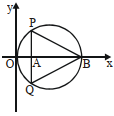
In the circle given below,let $OA = 1$ unit,$OB = 13$ units and $PQ \perp OB$. Then,the area of the triangle $PQB$ (in square units) is
A
$24 \sqrt{2}$
B
$24 \sqrt{3}$
C
$26 \sqrt{3}$
D
$26 \sqrt{2}$
Solution
(B) Let $PA = AQ = \lambda$.
Since $PQ \perp OB$,by the property of intersecting chords in a circle,we have $OA \cdot AB = PA \cdot AQ$.
Given $OA = 1$ and $OB = 13$,we have $AB = OB - OA = 13 - 1 = 12$.
Substituting the values,$1 \cdot 12 = \lambda \cdot \lambda$.
$\lambda^2 = 12 \Rightarrow \lambda = \sqrt{12} = 2 \sqrt{3}$.
The area of $\Delta PQB = \frac{1}{2} \times \text{base} \times \text{height} = \frac{1}{2} \times PQ \times AB$.
Since $PQ = PA + AQ = \lambda + \lambda = 2\lambda = 4 \sqrt{3}$,
Area $= \frac{1}{2} \times (4 \sqrt{3}) \times 12 = 2 \sqrt{3} \times 12 = 24 \sqrt{3}$ square units.
Since $PQ \perp OB$,by the property of intersecting chords in a circle,we have $OA \cdot AB = PA \cdot AQ$.
Given $OA = 1$ and $OB = 13$,we have $AB = OB - OA = 13 - 1 = 12$.
Substituting the values,$1 \cdot 12 = \lambda \cdot \lambda$.
$\lambda^2 = 12 \Rightarrow \lambda = \sqrt{12} = 2 \sqrt{3}$.
The area of $\Delta PQB = \frac{1}{2} \times \text{base} \times \text{height} = \frac{1}{2} \times PQ \times AB$.
Since $PQ = PA + AQ = \lambda + \lambda = 2\lambda = 4 \sqrt{3}$,
Area $= \frac{1}{2} \times (4 \sqrt{3}) \times 12 = 2 \sqrt{3} \times 12 = 24 \sqrt{3}$ square units.
0 likesView Solution
112
MathematicsDifficultMCQJEE Main · 2021
The sum of the infinite series $1+\frac{2}{3}+\frac{7}{3^{2}}+\frac{12}{3^{3}}+\frac{17}{3^{4}}+\frac{22}{3^{5}}+\ldots$ is equal to
A
$\frac{13}{4}$
B
$\frac{9}{4}$
C
$\frac{15}{4}$
D
$\frac{11}{4}$
Solution
(A) Let the sum be $S = 1 + \frac{2}{3} + \frac{7}{3^{2}} + \frac{12}{3^{3}} + \frac{17}{3^{4}} + \frac{22}{3^{5}} + \ldots$
Multiply by $\frac{1}{3}$: $\frac{S}{3} = \frac{1}{3} + \frac{2}{3^{2}} + \frac{7}{3^{3}} + \frac{12}{3^{4}} + \frac{17}{3^{5}} + \ldots$
Subtracting the two equations: $S - \frac{S}{3} = 1 + (\frac{2}{3} - \frac{1}{3}) + (\frac{7}{3^{2}} - \frac{2}{3^{2}}) + (\frac{12}{3^{3}} - \frac{7}{3^{3}}) + \ldots$
$\frac{2S}{3} = 1 + \frac{1}{3} + \frac{5}{3^{2}} + \frac{5}{3^{3}} + \frac{5}{3^{4}} + \ldots$
$\frac{2S}{3} = 1 + \frac{1}{3} + \frac{\frac{5}{3^{2}}}{1 - \frac{1}{3}} = 1 + \frac{1}{3} + \frac{5}{9} \times \frac{3}{2} = \frac{4}{3} + \frac{5}{6} = \frac{8+5}{6} = \frac{13}{6}$
$S = \frac{13}{6} \times \frac{3}{2} = \frac{13}{4}$
Multiply by $\frac{1}{3}$: $\frac{S}{3} = \frac{1}{3} + \frac{2}{3^{2}} + \frac{7}{3^{3}} + \frac{12}{3^{4}} + \frac{17}{3^{5}} + \ldots$
Subtracting the two equations: $S - \frac{S}{3} = 1 + (\frac{2}{3} - \frac{1}{3}) + (\frac{7}{3^{2}} - \frac{2}{3^{2}}) + (\frac{12}{3^{3}} - \frac{7}{3^{3}}) + \ldots$
$\frac{2S}{3} = 1 + \frac{1}{3} + \frac{5}{3^{2}} + \frac{5}{3^{3}} + \frac{5}{3^{4}} + \ldots$
$\frac{2S}{3} = 1 + \frac{1}{3} + \frac{\frac{5}{3^{2}}}{1 - \frac{1}{3}} = 1 + \frac{1}{3} + \frac{5}{9} \times \frac{3}{2} = \frac{4}{3} + \frac{5}{6} = \frac{8+5}{6} = \frac{13}{6}$
$S = \frac{13}{6} \times \frac{3}{2} = \frac{13}{4}$
0 likesView Solution
113
MathematicsEasyMCQJEE Main · 2021
The value of $\lim_{h \rightarrow 0} 2 \left\{ \frac{\sqrt{3} \sin (\frac{\pi}{6} + h) - \cos (\frac{\pi}{6} + h)}{\sqrt{3} h (\sqrt{3} \cos h - \sin h)} \right\}$ is
A
$\frac{4}{3}$
B
$\frac{2}{\sqrt{3}}$
C
$\frac{3}{4}$
D
$\frac{2}{3}$
Solution
(A) Let $L = \lim_{h \rightarrow 0} 2 \left\{ \frac{\sqrt{3} \sin (\frac{\pi}{6} + h) - \cos (\frac{\pi}{6} + h)}{\sqrt{3} h (\sqrt{3} \cos h - \sin h)} \right\}$.
Using the expansion $\sin(A+B) = \sin A \cos B + \cos A \sin B$ and $\cos(A+B) = \cos A \cos B - \sin A \sin B$:
Numerator $= \sqrt{3} (\sin \frac{\pi}{6} \cos h + \cos \frac{\pi}{6} \sin h) - (\cos \frac{\pi}{6} \cos h - \sin \frac{\pi}{6} \sin h)$
$= \sqrt{3} (\frac{1}{2} \cos h + \frac{\sqrt{3}}{2} \sin h) - (\frac{\sqrt{3}}{2} \cos h - \frac{1}{2} \sin h)$
$= \frac{\sqrt{3}}{2} \cos h + \frac{3}{2} \sin h - \frac{\sqrt{3}}{2} \cos h + \frac{1}{2} \sin h = 2 \sin h$.
Substituting back into the limit:
$L = \lim_{h \rightarrow 0} 2 \left( \frac{2 \sin h}{\sqrt{3} h (\sqrt{3} \cos h - \sin h)} \right) = \frac{4}{\sqrt{3}} \lim_{h \rightarrow 0} \left( \frac{\sin h}{h} \right) \cdot \lim_{h \rightarrow 0} \left( \frac{1}{\sqrt{3} \cos h - \sin h} \right)$.
Since $\lim_{h \rightarrow 0} \frac{\sin h}{h} = 1$ and $\lim_{h \rightarrow 0} (\sqrt{3} \cos h - \sin h) = \sqrt{3}(1) - 0 = \sqrt{3}$:
$L = \frac{4}{\sqrt{3}} \cdot 1 \cdot \frac{1}{\sqrt{3}} = \frac{4}{3}$.
Using the expansion $\sin(A+B) = \sin A \cos B + \cos A \sin B$ and $\cos(A+B) = \cos A \cos B - \sin A \sin B$:
Numerator $= \sqrt{3} (\sin \frac{\pi}{6} \cos h + \cos \frac{\pi}{6} \sin h) - (\cos \frac{\pi}{6} \cos h - \sin \frac{\pi}{6} \sin h)$
$= \sqrt{3} (\frac{1}{2} \cos h + \frac{\sqrt{3}}{2} \sin h) - (\frac{\sqrt{3}}{2} \cos h - \frac{1}{2} \sin h)$
$= \frac{\sqrt{3}}{2} \cos h + \frac{3}{2} \sin h - \frac{\sqrt{3}}{2} \cos h + \frac{1}{2} \sin h = 2 \sin h$.
Substituting back into the limit:
$L = \lim_{h \rightarrow 0} 2 \left( \frac{2 \sin h}{\sqrt{3} h (\sqrt{3} \cos h - \sin h)} \right) = \frac{4}{\sqrt{3}} \lim_{h \rightarrow 0} \left( \frac{\sin h}{h} \right) \cdot \lim_{h \rightarrow 0} \left( \frac{1}{\sqrt{3} \cos h - \sin h} \right)$.
Since $\lim_{h \rightarrow 0} \frac{\sin h}{h} = 1$ and $\lim_{h \rightarrow 0} (\sqrt{3} \cos h - \sin h) = \sqrt{3}(1) - 0 = \sqrt{3}$:
$L = \frac{4}{\sqrt{3}} \cdot 1 \cdot \frac{1}{\sqrt{3}} = \frac{4}{3}$.
0 likesView Solution
114
MathematicsDifficultMCQJEE Main · 2021
The maximum value of the term independent of $t$ in the expansion of $\left( tx^{\frac{1}{5}} + \frac{(1-x)^{\frac{1}{10}}}{t} \right)^{10}$ where $x \in (0, 1)$ is
A
$\frac{10!}{\sqrt{3}(5!)^2}$
B
$\frac{2 \cdot 10!}{3\sqrt{3}(5!)^2}$
C
$\frac{2 \cdot 10!}{3(5!)^2}$
D
$\frac{10!}{3(5!)^2}$
Solution
(B) The general term $T_{r+1}$ in the expansion of $\left( tx^{\frac{1}{5}} + \frac{(1-x)^{\frac{1}{10}}}{t} \right)^{10}$ is given by $T_{r+1} = {}^{10}C_r (tx^{\frac{1}{5}})^{10-r} \left( \frac{(1-x)^{\frac{1}{10}}}{t} \right)^r$.
For the term to be independent of $t$,the power of $t$ must be zero: $(10-r) - r = 0 \Rightarrow 2r = 10 \Rightarrow r = 5$.
Thus,the term independent of $t$ is $T_6 = {}^{10}C_5 (x^{\frac{1}{5}})^5 ((1-x)^{\frac{1}{10}})^5 = {}^{10}C_5 x^{\frac{1}{2}} (1-x)^{\frac{1}{2}} = {}^{10}C_5 \sqrt{x(1-x)}$.
Let $f(x) = {}^{10}C_5 \sqrt{x-x^2}$. To find the maximum,we differentiate $f(x)$ with respect to $x$: $f'(x) = {}^{10}C_5 \cdot \frac{1-2x}{2\sqrt{x-x^2}}$.
Setting $f'(x) = 0$,we get $1-2x = 0 \Rightarrow x = \frac{1}{2}$.
The maximum value is $f\left(\frac{1}{2}\right) = {}^{10}C_5 \sqrt{\frac{1}{2}(1-\frac{1}{2})} = {}^{10}C_5 \sqrt{\frac{1}{4}} = \frac{1}{2} \cdot {}^{10}C_5 = \frac{1}{2} \cdot \frac{10!}{5!5!} = \frac{10!}{2(5!)^2}$.
Wait,re-evaluating the expression: $T_6 = {}^{10}C_5 x (1-x)^{1/2}$ is incorrect based on the provided expression. Let's re-calculate: $T_6 = {}^{10}C_5 (x^{1/5})^5 ((1-x)^{1/10})^5 = {}^{10}C_5 x (1-x)^{1/2}$.
Let $f(x) = {}^{10}C_5 x(1-x)^{1/2}$. $f'(x) = {}^{10}C_5 [(1-x)^{1/2} + x \cdot \frac{1}{2}(1-x)^{-1/2}(-1)] = {}^{10}C_5 (1-x)^{-1/2} [1-x - \frac{x}{2}] = {}^{10}C_5 \frac{1 - \frac{3}{2}x}{\sqrt{1-x}}$.
Setting $f'(x) = 0 \Rightarrow x = \frac{2}{3}$.
$f(\frac{2}{3}) = {}^{10}C_5 (\frac{2}{3}) \sqrt{1-\frac{2}{3}} = {}^{10}C_5 \cdot \frac{2}{3} \cdot \frac{1}{\sqrt{3}} = \frac{2 \cdot 10!}{3\sqrt{3}(5!)^2}$.
Thus,the correct option is $B$.
For the term to be independent of $t$,the power of $t$ must be zero: $(10-r) - r = 0 \Rightarrow 2r = 10 \Rightarrow r = 5$.
Thus,the term independent of $t$ is $T_6 = {}^{10}C_5 (x^{\frac{1}{5}})^5 ((1-x)^{\frac{1}{10}})^5 = {}^{10}C_5 x^{\frac{1}{2}} (1-x)^{\frac{1}{2}} = {}^{10}C_5 \sqrt{x(1-x)}$.
Let $f(x) = {}^{10}C_5 \sqrt{x-x^2}$. To find the maximum,we differentiate $f(x)$ with respect to $x$: $f'(x) = {}^{10}C_5 \cdot \frac{1-2x}{2\sqrt{x-x^2}}$.
Setting $f'(x) = 0$,we get $1-2x = 0 \Rightarrow x = \frac{1}{2}$.
The maximum value is $f\left(\frac{1}{2}\right) = {}^{10}C_5 \sqrt{\frac{1}{2}(1-\frac{1}{2})} = {}^{10}C_5 \sqrt{\frac{1}{4}} = \frac{1}{2} \cdot {}^{10}C_5 = \frac{1}{2} \cdot \frac{10!}{5!5!} = \frac{10!}{2(5!)^2}$.
Wait,re-evaluating the expression: $T_6 = {}^{10}C_5 x (1-x)^{1/2}$ is incorrect based on the provided expression. Let's re-calculate: $T_6 = {}^{10}C_5 (x^{1/5})^5 ((1-x)^{1/10})^5 = {}^{10}C_5 x (1-x)^{1/2}$.
Let $f(x) = {}^{10}C_5 x(1-x)^{1/2}$. $f'(x) = {}^{10}C_5 [(1-x)^{1/2} + x \cdot \frac{1}{2}(1-x)^{-1/2}(-1)] = {}^{10}C_5 (1-x)^{-1/2} [1-x - \frac{x}{2}] = {}^{10}C_5 \frac{1 - \frac{3}{2}x}{\sqrt{1-x}}$.
Setting $f'(x) = 0 \Rightarrow x = \frac{2}{3}$.
$f(\frac{2}{3}) = {}^{10}C_5 (\frac{2}{3}) \sqrt{1-\frac{2}{3}} = {}^{10}C_5 \cdot \frac{2}{3} \cdot \frac{1}{\sqrt{3}} = \frac{2 \cdot 10!}{3\sqrt{3}(5!)^2}$.
Thus,the correct option is $B$.
0 likesView Solution
115
MathematicsMediumMCQJEE Main · 2021
The number of seven-digit integers with the sum of the digits equal to $10$ and formed by using the digits $1, 2,$ and $3$ only is:
A
$42$
B
$82$
C
$77$
D
$35$
Solution
(C) Let the seven digits be $x_1, x_2, x_3, x_4, x_5, x_6, x_7$ such that $x_i \in \{1, 2, 3\}$ and $\sum_{i=1}^{7} x_i = 10$.
Case $I$: The digits are $1, 1, 1, 1, 1, 2, 3$.
Sum $= 1+1+1+1+1+2+3 = 10$.
The number of arrangements is $\frac{7!}{5!1!1!} = \frac{7 \times 6}{1} = 42$.
Case $II$: The digits are $1, 1, 1, 1, 2, 2, 2$.
Sum $= 1+1+1+1+2+2+2 = 10$.
The number of arrangements is $\frac{7!}{4!3!} = \frac{7 \times 6 \times 5}{3 \times 2 \times 1} = 35$.
Total number of such integers $= 42 + 35 = 77$.
Case $I$: The digits are $1, 1, 1, 1, 1, 2, 3$.
Sum $= 1+1+1+1+1+2+3 = 10$.
The number of arrangements is $\frac{7!}{5!1!1!} = \frac{7 \times 6}{1} = 42$.
Case $II$: The digits are $1, 1, 1, 1, 2, 2, 2$.
Sum $= 1+1+1+1+2+2+2 = 10$.
The number of arrangements is $\frac{7!}{4!3!} = \frac{7 \times 6 \times 5}{3 \times 2 \times 1} = 35$.
Total number of such integers $= 42 + 35 = 77$.
0 likesView Solution
116
MathematicsMediumMCQJEE Main · 2021
The intersection of three lines $x-y=0$,$x+2y=3$,and $2x+y=6$ forms a:
A
Right angled triangle
B
Equilateral triangle
C
Isosceles triangle
D
None of the above
Solution
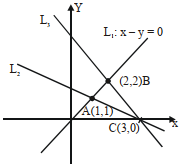
(C) Let the lines be $L_1: x-y=0$,$L_2: x+2y=3$,and $L_3: 2x+y=6$.
Solving $L_1$ and $L_2$:
$x-y=0 \implies x=y$
$x+2x=3 \implies 3x=3 \implies x=1, y=1$. Point $A = (1, 1)$.
Solving $L_1$ and $L_3$:
$x-y=0 \implies x=y$
$2x+x=6 \implies 3x=6 \implies x=2, y=2$. Point $B = (2, 2)$.
Solving $L_2$ and $L_3$:
$x+2y=3 \implies x=3-2y$
$2(3-2y)+y=6 \implies 6-4y+y=6 \implies -3y=0 \implies y=0, x=3$. Point $C = (3, 0)$.
Now,calculate the lengths of the sides:
$AB = \sqrt{(2-1)^2 + (2-1)^2} = \sqrt{1^2 + 1^2} = \sqrt{2}$
$BC = \sqrt{(3-2)^2 + (0-2)^2} = \sqrt{1^2 + (-2)^2} = \sqrt{1+4} = \sqrt{5}$
$AC = \sqrt{(3-1)^2 + (0-1)^2} = \sqrt{2^2 + (-1)^2} = \sqrt{4+1} = \sqrt{5}$
Since $BC = AC = \sqrt{5}$,the triangle is an isosceles triangle.
Solving $L_1$ and $L_2$:
$x-y=0 \implies x=y$
$x+2x=3 \implies 3x=3 \implies x=1, y=1$. Point $A = (1, 1)$.
Solving $L_1$ and $L_3$:
$x-y=0 \implies x=y$
$2x+x=6 \implies 3x=6 \implies x=2, y=2$. Point $B = (2, 2)$.
Solving $L_2$ and $L_3$:
$x+2y=3 \implies x=3-2y$
$2(3-2y)+y=6 \implies 6-4y+y=6 \implies -3y=0 \implies y=0, x=3$. Point $C = (3, 0)$.
Now,calculate the lengths of the sides:
$AB = \sqrt{(2-1)^2 + (2-1)^2} = \sqrt{1^2 + 1^2} = \sqrt{2}$
$BC = \sqrt{(3-2)^2 + (0-2)^2} = \sqrt{1^2 + (-2)^2} = \sqrt{1+4} = \sqrt{5}$
$AC = \sqrt{(3-1)^2 + (0-1)^2} = \sqrt{2^2 + (-1)^2} = \sqrt{4+1} = \sqrt{5}$
Since $BC = AC = \sqrt{5}$,the triangle is an isosceles triangle.
0 likesView Solution
117
MathematicsMediumMCQJEE Main · 2021
The number of integral values of $k$ for which the equation $3 \sin x + 4 \cos x = k + 1$ has a solution,where $k \in R$,is:
A
$11$
B
$22$
C
$33$
D
$7$
Solution
(A) The given equation is $3 \sin x + 4 \cos x = k + 1$.
We know that the range of the function $f(x) = a \sin x + b \cos x$ is $[-\sqrt{a^2 + b^2}, \sqrt{a^2 + b^2}]$.
Here,$a = 3$ and $b = 4$,so the range is $[-\sqrt{3^2 + 4^2}, \sqrt{3^2 + 4^2}] = [-5, 5]$.
For the equation to have a solution,the value $k + 1$ must lie within this range:
$-5 \le k + 1 \le 5$
Subtracting $1$ from all sides,we get:
$-6 \le k \le 4$
The integral values of $k$ are $\{-6, -5, -4, -3, -2, -1, 0, 1, 2, 3, 4\}$.
The total number of such integral values is $11$.
We know that the range of the function $f(x) = a \sin x + b \cos x$ is $[-\sqrt{a^2 + b^2}, \sqrt{a^2 + b^2}]$.
Here,$a = 3$ and $b = 4$,so the range is $[-\sqrt{3^2 + 4^2}, \sqrt{3^2 + 4^2}] = [-5, 5]$.
For the equation to have a solution,the value $k + 1$ must lie within this range:
$-5 \le k + 1 \le 5$
Subtracting $1$ from all sides,we get:
$-6 \le k \le 4$
The integral values of $k$ are $\{-6, -5, -4, -3, -2, -1, 0, 1, 2, 3, 4\}$.
The total number of such integral values is $11$.
0 likesView Solution
118
MathematicsDifficultMCQJEE Main · 2021
The number of solutions of the equation $\log _{4}(x-1)=\log _{2}(x-3)$ is
A
$1$
B
$2$
C
$3$
D
$4$
Solution
(A) Given equation: $\log _{4}(x-1)=\log _{2}(x-3)$
Using the property $\log _{a^n}(b) = \frac{1}{n} \log _{a}(b)$,we have:
$\frac{1}{2} \log _{2}(x-1)=\log _{2}(x-3)$
$\log _{2}(x-1)^{1/2}=\log _{2}(x-3)$
Equating the arguments:
$(x-1)^{1/2} = x-3$
Squaring both sides:
$x-1 = (x-3)^2$
$x-1 = x^2 - 6x + 9$
$x^2 - 7x + 10 = 0$
Factoring the quadratic equation:
$(x-2)(x-5) = 0$
$x = 2$ or $x = 5$
Check the domain of the original equation:
For $\log _{2}(x-3)$ to be defined,$x-3 > 0$,so $x > 3$.
For $\log _{4}(x-1)$ to be defined,$x-1 > 0$,so $x > 1$.
Combining these,the domain is $x > 3$.
Since $x=2$ is not in the domain $(2 < 3)$,it is an extraneous solution.
Thus,only $x=5$ is a valid solution.
Therefore,the number of solutions is $1$.
Using the property $\log _{a^n}(b) = \frac{1}{n} \log _{a}(b)$,we have:
$\frac{1}{2} \log _{2}(x-1)=\log _{2}(x-3)$
$\log _{2}(x-1)^{1/2}=\log _{2}(x-3)$
Equating the arguments:
$(x-1)^{1/2} = x-3$
Squaring both sides:
$x-1 = (x-3)^2$
$x-1 = x^2 - 6x + 9$
$x^2 - 7x + 10 = 0$
Factoring the quadratic equation:
$(x-2)(x-5) = 0$
$x = 2$ or $x = 5$
Check the domain of the original equation:
For $\log _{2}(x-3)$ to be defined,$x-3 > 0$,so $x > 3$.
For $\log _{4}(x-1)$ to be defined,$x-1 > 0$,so $x > 1$.
Combining these,the domain is $x > 3$.
Since $x=2$ is not in the domain $(2 < 3)$,it is an extraneous solution.
Thus,only $x=5$ is a valid solution.
Therefore,the number of solutions is $1$.
0 likesView Solution
119
MathematicsDifficultMCQJEE Main · 2021
The sum of the $162^{\text{th}}$ power of the roots of the equation $x^{3}-2x^{2}+2x-1=0$ is
A
$2$
B
$9$
C
$3$
D
$6$
Solution
(C) Given the equation $x^{3}-2x^{2}+2x-1=0$.
By inspection,$x=1$ satisfies the equation as $1-2+2-1=0$.
Thus,$(x-1)$ is a factor of the polynomial.
Performing division,we get $(x-1)(x^{2}-x+1)=0$.
The roots are $x=1$ and the roots of $x^{2}-x+1=0$,which are $x = \frac{1 \pm i\sqrt{3}}{2}$.
These roots are $-\omega^{2}$ and $-\omega$,where $\omega$ is the complex cube root of unity.
The sum of the $162^{\text{th}}$ powers is $S = (1)^{162} + (-\omega^{2})^{162} + (-\omega)^{162}$.
$S = 1 + \omega^{324} + \omega^{162}$.
Since $\omega^{3} = 1$,we have $\omega^{324} = (\omega^{3})^{108} = 1$ and $\omega^{162} = (\omega^{3})^{54} = 1$.
Therefore,$S = 1 + 1 + 1 = 3$.
By inspection,$x=1$ satisfies the equation as $1-2+2-1=0$.
Thus,$(x-1)$ is a factor of the polynomial.
Performing division,we get $(x-1)(x^{2}-x+1)=0$.
The roots are $x=1$ and the roots of $x^{2}-x+1=0$,which are $x = \frac{1 \pm i\sqrt{3}}{2}$.
These roots are $-\omega^{2}$ and $-\omega$,where $\omega$ is the complex cube root of unity.
The sum of the $162^{\text{th}}$ powers is $S = (1)^{162} + (-\omega^{2})^{162} + (-\omega)^{162}$.
$S = 1 + \omega^{324} + \omega^{162}$.
Since $\omega^{3} = 1$,we have $\omega^{324} = (\omega^{3})^{108} = 1$ and $\omega^{162} = (\omega^{3})^{54} = 1$.
Therefore,$S = 1 + 1 + 1 = 3$.
0 likesView Solution
120
MathematicsDifficultMCQJEE Main · 2021
Let $m, n \in \mathbb{N}$ and $\operatorname{gcd}(2, n)=1$. If $30\binom{30}{0} + 29\binom{30}{1} + \ldots + 2\binom{30}{28} + 1\binom{30}{29} = n \cdot 2^m$,then $n + m$ is equal to (Here $\binom{n}{k} = {^nC_k}$)
A
$45$
B
$56$
C
$42$
D
$36$
Solution
(A) The given expression is $S = \sum_{k=0}^{29} (30-k) \binom{30}{k}$.
Using the property $\binom{n}{k} = \binom{n}{n-k}$,we can rewrite the sum as:
$S = \sum_{k=0}^{29} (30-k) \binom{30}{30-k}$.
Let $r = 30-k$. As $k$ goes from $0$ to $29$,$r$ goes from $30$ to $1$.
$S = \sum_{r=1}^{30} r \binom{30}{r}$.
Using the identity $\sum_{r=1}^{n} r \binom{n}{r} = n 2^{n-1}$:
$S = 30 \cdot 2^{30-1} = 30 \cdot 2^{29}$.
$S = 15 \cdot 2 \cdot 2^{29} = 15 \cdot 2^{30}$.
Given $S = n \cdot 2^m$ with $\operatorname{gcd}(2, n) = 1$,we have $n = 15$ and $m = 30$.
Therefore,$n + m = 15 + 30 = 45$.
Using the property $\binom{n}{k} = \binom{n}{n-k}$,we can rewrite the sum as:
$S = \sum_{k=0}^{29} (30-k) \binom{30}{30-k}$.
Let $r = 30-k$. As $k$ goes from $0$ to $29$,$r$ goes from $30$ to $1$.
$S = \sum_{r=1}^{30} r \binom{30}{r}$.
Using the identity $\sum_{r=1}^{n} r \binom{n}{r} = n 2^{n-1}$:
$S = 30 \cdot 2^{30-1} = 30 \cdot 2^{29}$.
$S = 15 \cdot 2 \cdot 2^{29} = 15 \cdot 2^{30}$.
Given $S = n \cdot 2^m$ with $\operatorname{gcd}(2, n) = 1$,we have $n = 15$ and $m = 30$.
Therefore,$n + m = 15 + 30 = 45$.
0 likesView Solution
121
MathematicsMediumMCQJEE Main · 2021
If $\sqrt{3}(\cos ^{2} x)=(\sqrt{3}-1) \cos x+1,$ the number of solutions of the given equation when $x \in [0, \frac{\pi}{2}]$ is
A
$1$
B
$2$
C
$3$
D
$4$
Solution
(A) Given equation: $\sqrt{3} \cos^2 x = (\sqrt{3}-1) \cos x + 1$
Rearranging the terms: $\sqrt{3} \cos^2 x - \sqrt{3} \cos x + \cos x - 1 = 0$
Factorizing by grouping: $\sqrt{3} \cos x (\cos x - 1) + 1 (\cos x - 1) = 0$
$(\sqrt{3} \cos x + 1)(\cos x - 1) = 0$
This gives two cases:
Case $1$: $\cos x = 1 \Rightarrow x = 0$ (which is in the interval $[0, \frac{\pi}{2}]$)
Case $2$: $\cos x = -\frac{1}{\sqrt{3}}$. Since $\cos x$ is negative in the second quadrant and $x \in [0, \frac{\pi}{2}]$,there is no solution for this case in the given interval.
Thus,there is only $1$ solution,which is $x = 0$.
Rearranging the terms: $\sqrt{3} \cos^2 x - \sqrt{3} \cos x + \cos x - 1 = 0$
Factorizing by grouping: $\sqrt{3} \cos x (\cos x - 1) + 1 (\cos x - 1) = 0$
$(\sqrt{3} \cos x + 1)(\cos x - 1) = 0$
This gives two cases:
Case $1$: $\cos x = 1 \Rightarrow x = 0$ (which is in the interval $[0, \frac{\pi}{2}]$)
Case $2$: $\cos x = -\frac{1}{\sqrt{3}}$. Since $\cos x$ is negative in the second quadrant and $x \in [0, \frac{\pi}{2}]$,there is no solution for this case in the given interval.
Thus,there is only $1$ solution,which is $x = 0$.
0 likesView Solution
122
MathematicsMediumMCQJEE Main · 2021
For the statements $p$ and $q$,consider the following compound statements :
$(a)$ $(\sim q \wedge (p$ $\rightarrow q))$ $\rightarrow \sim p$
$(b)$ $((p \vee q) \wedge \sim p) \rightarrow q$
Then which of the following statements is correct?
$(a)$ $(\sim q \wedge (p$ $\rightarrow q))$ $\rightarrow \sim p$
$(b)$ $((p \vee q) \wedge \sim p) \rightarrow q$
Then which of the following statements is correct?
A
$(a)$ and $(b)$ both are not tautologies.
B
$(a)$ and $(b)$ both are tautologies.
C
$(a)$ is a tautology but not $(b).$
D
$(b)$ is a tautology but not $(a).$
Solution
(B) To determine if a statement is a tautology,we construct a truth table for each.
For statement $(a)$: $(\sim q \wedge (p$ $\rightarrow q))$ $\rightarrow \sim p$
Since all values in the final column are $T$,$(a)$ is a tautology.
For statement $(b)$: $((p \vee q) \wedge \sim p) \rightarrow q$
Since all values in the final column are $T$,$(b)$ is also a tautology.
Therefore,both $(a)$ and $(b)$ are tautologies.
For statement $(a)$: $(\sim q \wedge (p$ $\rightarrow q))$ $\rightarrow \sim p$
| $p, q$ | $\sim q$ | $p \rightarrow q$ | $\sim q \wedge (p \rightarrow q)$ | $\sim p$ | $(a)$ |
| $T, T$ | $F$ | $T$ | $F$ | $F$ | $T$ |
| $T, F$ | $T$ | $F$ | $F$ | $F$ | $T$ |
| $F, T$ | $F$ | $T$ | $F$ | $T$ | $T$ |
| $F, F$ | $T$ | $T$ | $T$ | $T$ | $T$ |
Since all values in the final column are $T$,$(a)$ is a tautology.
For statement $(b)$: $((p \vee q) \wedge \sim p) \rightarrow q$
| $p, q$ | $p \vee q$ | $\sim p$ | $(p \vee q) \wedge \sim p$ | $(b)$ |
| $T, T$ | $T$ | $F$ | $F$ | $T$ |
| $T, F$ | $T$ | $F$ | $F$ | $T$ |
| $F, T$ | $T$ | $T$ | $T$ | $T$ |
| $F, F$ | $F$ | $T$ | $F$ | $T$ |
Since all values in the final column are $T$,$(b)$ is also a tautology.
Therefore,both $(a)$ and $(b)$ are tautologies.
0 likesView Solution
123
MathematicsDifficultMCQJEE Main · 2021
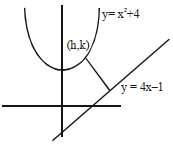
If $P$ is a point on the parabola $y=x^{2}+4$ which is closest to the straight line $y =4 x -1,$ then the coordinates of $P$ are:
A
$(3,13)$
B
$(1,5)$
C
$(-2,8)$
D
$(2,8)$
Solution
(D) Let the point $P$ on the parabola $y=x^{2}+4$ be $(h, k)$. Since $P$ lies on the parabola,we have $k = h^{2}+4$.
The given straight line is $L: y = 4x - 1$,which can be written as $4x - y - 1 = 0$.
The perpendicular distance $d$ from point $P(h, k)$ to the line $4x - y - 1 = 0$ is given by:
$d = \frac{|4h - k - 1|}{\sqrt{4^{2} + (-1)^{2}}} = \frac{|4h - (h^{2} + 4) - 1|}{\sqrt{16 + 1}} = \frac{|4h - h^{2} - 5|}{\sqrt{17}} = \frac{|-(h^{2} - 4h + 5)|}{\sqrt{17}} = \frac{h^{2} - 4h + 5}{\sqrt{17}}$.
To find the point closest to the line,we minimize $d$ by differentiating with respect to $h$:
$\frac{dd}{dh} = \frac{1}{\sqrt{17}} (2h - 4)$.
Setting $\frac{dd}{dh} = 0$,we get $2h - 4 = 0$,which implies $h = 2$.
For $h = 2$,the $y$-coordinate is $k = (2)^{2} + 4 = 4 + 4 = 8$.
Thus,the coordinates of point $P$ are $(2, 8)$.
The given straight line is $L: y = 4x - 1$,which can be written as $4x - y - 1 = 0$.
The perpendicular distance $d$ from point $P(h, k)$ to the line $4x - y - 1 = 0$ is given by:
$d = \frac{|4h - k - 1|}{\sqrt{4^{2} + (-1)^{2}}} = \frac{|4h - (h^{2} + 4) - 1|}{\sqrt{16 + 1}} = \frac{|4h - h^{2} - 5|}{\sqrt{17}} = \frac{|-(h^{2} - 4h + 5)|}{\sqrt{17}} = \frac{h^{2} - 4h + 5}{\sqrt{17}}$.
To find the point closest to the line,we minimize $d$ by differentiating with respect to $h$:
$\frac{dd}{dh} = \frac{1}{\sqrt{17}} (2h - 4)$.
Setting $\frac{dd}{dh} = 0$,we get $2h - 4 = 0$,which implies $h = 2$.
For $h = 2$,the $y$-coordinate is $k = (2)^{2} + 4 = 4 + 4 = 8$.
Thus,the coordinates of point $P$ are $(2, 8)$.
0 likesView Solution
124
MathematicsDifficultMCQJEE Main · 2021
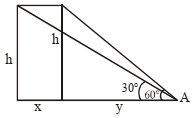
The angle of elevation of a jet plane from a point $A$ on the ground is $60^{\circ}$. After a flight of $20 \, s$ at the speed of $432 \, km/h$, the angle of elevation changes to $30^{\circ}$. If the jet plane is flying at a constant height, then its height is ..... $m$. (in $\sqrt{3}$)
A
$1800$
B
$3600$
C
$2400$
D
$1200$
Solution
(D) Let the height of the jet plane be $h \, m$. Let the point on the ground be $A$.
From the first position, $\tan 60^{\circ} = \frac{h}{y}$ $\Rightarrow \sqrt{3} = \frac{h}{y}$ $\Rightarrow y = \frac{h}{\sqrt{3}} \quad \dots (1)$
After $20 \, s$, the plane covers a distance $x$.
Speed $= 432 \, km/h = 432 \times \frac{5}{18} \, m/s = 120 \, m/s$.
Distance $x = \text{speed} \times \text{time} = 120 \times 20 = 2400 \, m$.
From the second position, $\tan 30^{\circ} = \frac{h}{x + y}$ $\Rightarrow \frac{1}{\sqrt{3}} = \frac{h}{2400 + y}$ $\Rightarrow 2400 + y = h\sqrt{3} \quad \dots (2)$
Substitute $y$ from $(1)$ into $(2)$:
$2400 + \frac{h}{\sqrt{3}} = h\sqrt{3}$
$2400 = h\sqrt{3} - \frac{h}{\sqrt{3}} = h \left( \frac{3 - 1}{\sqrt{3}} \right) = \frac{2h}{\sqrt{3}}$
$h = \frac{2400 \times \sqrt{3}}{2} = 1200 \sqrt{3} \, m$.
From the first position, $\tan 60^{\circ} = \frac{h}{y}$ $\Rightarrow \sqrt{3} = \frac{h}{y}$ $\Rightarrow y = \frac{h}{\sqrt{3}} \quad \dots (1)$
After $20 \, s$, the plane covers a distance $x$.
Speed $= 432 \, km/h = 432 \times \frac{5}{18} \, m/s = 120 \, m/s$.
Distance $x = \text{speed} \times \text{time} = 120 \times 20 = 2400 \, m$.
From the second position, $\tan 30^{\circ} = \frac{h}{x + y}$ $\Rightarrow \frac{1}{\sqrt{3}} = \frac{h}{2400 + y}$ $\Rightarrow 2400 + y = h\sqrt{3} \quad \dots (2)$
Substitute $y$ from $(1)$ into $(2)$:
$2400 + \frac{h}{\sqrt{3}} = h\sqrt{3}$
$2400 = h\sqrt{3} - \frac{h}{\sqrt{3}} = h \left( \frac{3 - 1}{\sqrt{3}} \right) = \frac{2h}{\sqrt{3}}$
$h = \frac{2400 \times \sqrt{3}}{2} = 1200 \sqrt{3} \, m$.
0 likesView Solution
125
MathematicsDifficultMCQJEE Main · 2021
If $n \geq 2$ is a positive integer,then the sum of the series ${ }^{n+1} C_{2}+2\left({ }^{2} C_{2}+{ }^{3} C_{2}+{ }^{4} C_{2}+\ldots+{ }^{n} C_{2}\right)$ is ...... .
A
$\frac{n(n-1)(2n+1)}{6}$
B
$\frac{n(n+1)(2n+1)}{6}$
C
$\frac{n(2n+1)(3n+1)}{6}$
D
$\frac{n(n+1)^{2}(n+2)}{12}$
Solution
(B) We use the identity ${}^{n}C_{r} + {}^{n}C_{r+1} = {}^{n+1}C_{r+1}$.
Note that ${}^{2}C_{2} = {}^{3}C_{3} = 1$.
The series is $S = {}^{n+1}C_{2} + 2 \sum_{k=2}^{n} {}^{k}C_{2}$.
Using the Hockey-stick identity $\sum_{i=r}^{n} {}^{i}C_{r} = {}^{n+1}C_{r+1}$,we have $\sum_{k=2}^{n} {}^{k}C_{2} = {}^{n+1}C_{3}$.
Thus,$S = {}^{n+1}C_{2} + 2({}^{n+1}C_{3})$.
$S = \frac{(n+1)n}{2} + 2 \cdot \frac{(n+1)n(n-1)}{6}$.
$S = \frac{(n+1)n}{2} \left( 1 + \frac{2(n-1)}{3} \right) = \frac{n(n+1)}{2} \left( \frac{3 + 2n - 2}{3} \right)$.
$S = \frac{n(n+1)(2n+1)}{6}$.
Note that ${}^{2}C_{2} = {}^{3}C_{3} = 1$.
The series is $S = {}^{n+1}C_{2} + 2 \sum_{k=2}^{n} {}^{k}C_{2}$.
Using the Hockey-stick identity $\sum_{i=r}^{n} {}^{i}C_{r} = {}^{n+1}C_{r+1}$,we have $\sum_{k=2}^{n} {}^{k}C_{2} = {}^{n+1}C_{3}$.
Thus,$S = {}^{n+1}C_{2} + 2({}^{n+1}C_{3})$.
$S = \frac{(n+1)n}{2} + 2 \cdot \frac{(n+1)n(n-1)}{6}$.
$S = \frac{(n+1)n}{2} \left( 1 + \frac{2(n-1)}{3} \right) = \frac{n(n+1)}{2} \left( \frac{3 + 2n - 2}{3} \right)$.
$S = \frac{n(n+1)(2n+1)}{6}$.
0 likesView Solution
126
MathematicsMediumMCQJEE Main · 2021
For which of the following curves is the line $x+\sqrt{3} y=2 \sqrt{3}$ a tangent at the point $\left(\frac{3 \sqrt{3}}{2}, \frac{1}{2}\right)$?
A
$x^{2}+y^{2}=7$
B
$y^{2}=\frac{1}{6 \sqrt{3}} x$
C
$2 x^{2}-18 y^{2}=9$
D
$x^{2}+9 y^{2}=9$
Solution
(D) The equation of the line is $x + \sqrt{3}y = 2\sqrt{3}$,which can be written as $y = -\frac{1}{\sqrt{3}}x + 2$. Here,the slope $m = -\frac{1}{\sqrt{3}}$.
We check the point $\left(\frac{3\sqrt{3}}{2}, \frac{1}{2}\right)$ for each curve.
For option $D$: $x^{2} + 9y^{2} = 9$.
Substitute the point: $\left(\frac{3\sqrt{3}}{2}\right)^{2} + 9\left(\frac{1}{2}\right)^{2} = \frac{27}{4} + \frac{9}{4} = \frac{36}{4} = 9$. The point lies on the curve.
The equation of the tangent to the ellipse $\frac{x^{2}}{a^{2}} + \frac{y^{2}}{b^{2}} = 1$ at $(x_{1}, y_{1})$ is $\frac{xx_{1}}{a^{2}} + \frac{yy_{1}}{b^{2}} = 1$.
For $x^{2} + 9y^{2} = 9$,we have $\frac{x^{2}}{9} + y^{2} = 1$.
Tangent at $\left(\frac{3\sqrt{3}}{2}, \frac{1}{2}\right)$ is $\frac{x \cdot \frac{3\sqrt{3}}{2}}{9} + y \cdot \frac{1}{2} = 1$.
$\frac{\sqrt{3}x}{6} + \frac{y}{2} = 1 \implies \sqrt{3}x + 3y = 6 \implies x + \sqrt{3}y = 2\sqrt{3}$.
This matches the given line.
We check the point $\left(\frac{3\sqrt{3}}{2}, \frac{1}{2}\right)$ for each curve.
For option $D$: $x^{2} + 9y^{2} = 9$.
Substitute the point: $\left(\frac{3\sqrt{3}}{2}\right)^{2} + 9\left(\frac{1}{2}\right)^{2} = \frac{27}{4} + \frac{9}{4} = \frac{36}{4} = 9$. The point lies on the curve.
The equation of the tangent to the ellipse $\frac{x^{2}}{a^{2}} + \frac{y^{2}}{b^{2}} = 1$ at $(x_{1}, y_{1})$ is $\frac{xx_{1}}{a^{2}} + \frac{yy_{1}}{b^{2}} = 1$.
For $x^{2} + 9y^{2} = 9$,we have $\frac{x^{2}}{9} + y^{2} = 1$.
Tangent at $\left(\frac{3\sqrt{3}}{2}, \frac{1}{2}\right)$ is $\frac{x \cdot \frac{3\sqrt{3}}{2}}{9} + y \cdot \frac{1}{2} = 1$.
$\frac{\sqrt{3}x}{6} + \frac{y}{2} = 1 \implies \sqrt{3}x + 3y = 6 \implies x + \sqrt{3}y = 2\sqrt{3}$.
This matches the given line.
0 likesView Solution
127
MathematicsEasyMCQJEE Main · 2021
The negative of the statement $\sim p \wedge (p \vee q)$ is
A
$\sim p \vee q$
B
$p \vee \sim q$
C
$\sim p \wedge q$
D
$p \wedge \sim q$
Solution
(B) We want to find the negation of the statement $\sim p \wedge (p \vee q)$.
Applying De Morgan's Law: $\sim (\sim p \wedge (p \vee q)) \equiv \sim (\sim p) \vee \sim (p \vee q)$.
Using the law of double negation and De Morgan's Law: $p \vee (\sim p \wedge \sim q)$.
Applying the Distributive Law: $(p \vee \sim p) \wedge (p \vee \sim q)$.
Since $(p \vee \sim p) \equiv T$ (Tautology),we have $T \wedge (p \vee \sim q)$.
Therefore,the result is $p \vee \sim q$.
Applying De Morgan's Law: $\sim (\sim p \wedge (p \vee q)) \equiv \sim (\sim p) \vee \sim (p \vee q)$.
Using the law of double negation and De Morgan's Law: $p \vee (\sim p \wedge \sim q)$.
Applying the Distributive Law: $(p \vee \sim p) \wedge (p \vee \sim q)$.
Since $(p \vee \sim p) \equiv T$ (Tautology),we have $T \wedge (p \vee \sim q)$.
Therefore,the result is $p \vee \sim q$.
0 likesView Solution
128
MathematicsDifficultMCQJEE Main · 2021
Let $a, b, c$ be in arithmetic progression. Let the centroid of the triangle with vertices $(a, c), (2, b)$ and $(a, b)$ be $\left(\frac{10}{3}, \frac{7}{3}\right)$. If $\alpha, \beta$ are the roots of the equation $ax^{2} + bx + 1 = 0$,then the value of $\alpha^{2} + \beta^{2} - \alpha\beta$ is ....... .
A
$\frac{71}{256}$
B
$\frac{69}{256}$
C
$-\frac{69}{256}$
D
$-\frac{71}{256}$
Solution
(D) The centroid of a triangle with vertices $(x_1, y_1), (x_2, y_2), (x_3, y_3)$ is given by $\left(\frac{x_1+x_2+x_3}{3}, \frac{y_1+y_2+y_3}{3}\right)$.
Given vertices are $(a, c), (2, b), (a, b)$ and centroid is $\left(\frac{10}{3}, \frac{7}{3}\right)$.
Equating the $x$-coordinates: $\frac{a+2+a}{3} = \frac{10}{3} \implies 2a + 2 = 10 \implies 2a = 8 \implies a = 4$.
Equating the $y$-coordinates: $\frac{c+b+b}{3} = \frac{7}{3} \implies c + 2b = 7$.
Since $a, b, c$ are in arithmetic progression,$2b = a + c$. Substituting $a=4$,we get $2b = 4 + c \implies c = 2b - 4$.
Substitute $c$ into the equation $c + 2b = 7$: $(2b - 4) + 2b = 7 \implies 4b = 11 \implies b = \frac{11}{4}$.
The quadratic equation is $4x^{2} + \frac{11}{4}x + 1 = 0$.
For roots $\alpha, \beta$,we have $\alpha + \beta = -\frac{b}{a} = -\frac{11/4}{4} = -\frac{11}{16}$ and $\alpha\beta = \frac{c}{a} = \frac{1}{4}$.
We need to find $\alpha^{2} + \beta^{2} - \alpha\beta = (\alpha + \beta)^{2} - 3\alpha\beta$.
Substituting the values: $\left(-\frac{11}{16}\right)^{2} - 3\left(\frac{1}{4}\right) = \frac{121}{256} - \frac{3}{4} = \frac{121 - 192}{256} = -\frac{71}{256}$.
Given vertices are $(a, c), (2, b), (a, b)$ and centroid is $\left(\frac{10}{3}, \frac{7}{3}\right)$.
Equating the $x$-coordinates: $\frac{a+2+a}{3} = \frac{10}{3} \implies 2a + 2 = 10 \implies 2a = 8 \implies a = 4$.
Equating the $y$-coordinates: $\frac{c+b+b}{3} = \frac{7}{3} \implies c + 2b = 7$.
Since $a, b, c$ are in arithmetic progression,$2b = a + c$. Substituting $a=4$,we get $2b = 4 + c \implies c = 2b - 4$.
Substitute $c$ into the equation $c + 2b = 7$: $(2b - 4) + 2b = 7 \implies 4b = 11 \implies b = \frac{11}{4}$.
The quadratic equation is $4x^{2} + \frac{11}{4}x + 1 = 0$.
For roots $\alpha, \beta$,we have $\alpha + \beta = -\frac{b}{a} = -\frac{11/4}{4} = -\frac{11}{16}$ and $\alpha\beta = \frac{c}{a} = \frac{1}{4}$.
We need to find $\alpha^{2} + \beta^{2} - \alpha\beta = (\alpha + \beta)^{2} - 3\alpha\beta$.
Substituting the values: $\left(-\frac{11}{16}\right)^{2} - 3\left(\frac{1}{4}\right) = \frac{121}{256} - \frac{3}{4} = \frac{121 - 192}{256} = -\frac{71}{256}$.
0 likesView Solution
129
MathematicsMediumMCQJEE Main · 2021
The probability that two randomly selected subsets of the set $\{1, 2, 3, 4, 5\}$ have exactly two elements in their intersection is:
A
$\frac{65}{2^{7}}$
B
$\frac{65}{2^{8}}$
C
$\frac{135}{2^{9}}$
D
$\frac{35}{2^{7}}$
Solution
(C) Let $S = \{1, 2, 3, 4, 5\}$. The total number of subsets of $S$ is $2^{5} = 32$.
Since two subsets $A$ and $B$ are selected randomly,the total number of pairs $(A, B)$ is $32 \times 32 = 2^{10}$.
For each element $x \in S$,there are $4$ possibilities for its membership in $A$ and $B$: $x \notin A, x \notin B$; $x \in A, x \notin B$; $x \notin A, x \in B$; or $x \in A, x \in B$.
We want the intersection $A \cap B$ to have exactly $2$ elements.
First,choose $2$ elements out of $5$ to be in the intersection: $\binom{5}{2} = 10$ ways.
For the remaining $3$ elements,each must not be in the intersection,meaning they can be in $(A \setminus B)$,$(B \setminus A)$,or in neither $A$ nor $B$. There are $3$ such choices for each of the $3$ remaining elements,giving $3^{3} = 27$ ways.
Thus,the number of favorable pairs is $10 \times 27 = 270$.
The probability is $\frac{270}{2^{10}} = \frac{270}{1024} = \frac{135}{512} = \frac{135}{2^{9}}$.
Since two subsets $A$ and $B$ are selected randomly,the total number of pairs $(A, B)$ is $32 \times 32 = 2^{10}$.
For each element $x \in S$,there are $4$ possibilities for its membership in $A$ and $B$: $x \notin A, x \notin B$; $x \in A, x \notin B$; $x \notin A, x \in B$; or $x \in A, x \in B$.
We want the intersection $A \cap B$ to have exactly $2$ elements.
First,choose $2$ elements out of $5$ to be in the intersection: $\binom{5}{2} = 10$ ways.
For the remaining $3$ elements,each must not be in the intersection,meaning they can be in $(A \setminus B)$,$(B \setminus A)$,or in neither $A$ nor $B$. There are $3$ such choices for each of the $3$ remaining elements,giving $3^{3} = 27$ ways.
Thus,the number of favorable pairs is $10 \times 27 = 270$.
The probability is $\frac{270}{2^{10}} = \frac{270}{1024} = \frac{135}{512} = \frac{135}{2^{9}}$.
0 likesView Solution
130
MathematicsMediumMCQJEE Main · 2021
For integers $n$ and $r$,let $\binom{n}{r} = \begin{cases} ^{n}C_{r}, & \text{if } n \geq r \geq 0 \\ 0, & \text{otherwise} \end{cases}$. The maximum value of $k$ for which the sum $\sum_{i=0}^{k}\binom{10}{i}\binom{15}{k-i} + \sum_{i=0}^{k+1}\binom{12}{i}\binom{13}{k+1-i}$ exists,is equal to ...... .
A
Not defined
B
$24$
C
$36$
D
$20$
Solution
(A) Using Vandermonde's Identity,$\sum_{i=0}^{k}\binom{n}{i}\binom{m}{k-i} = \binom{n+m}{k}$.
Applying this to the given expression:
$\sum_{i=0}^{k}\binom{10}{i}\binom{15}{k-i} = \binom{10+15}{k} = \binom{25}{k}$.
Similarly,$\sum_{i=0}^{k+1}\binom{12}{i}\binom{13}{k+1-i} = \binom{12+13}{k+1} = \binom{25}{k+1}$.
The total sum is $\binom{25}{k} + \binom{25}{k+1}$.
Using Pascal's Identity,$\binom{n}{r} + \binom{n}{r+1} = \binom{n+1}{r+1}$,we get $\binom{25}{k} + \binom{25}{k+1} = \binom{26}{k+1}$.
Since $\binom{n}{r}$ is defined for all non-negative integers $n$ and $r$ (with the given condition),the expression $\binom{26}{k+1}$ is defined for any non-negative integer $k$. Therefore,there is no maximum value for $k$.
Applying this to the given expression:
$\sum_{i=0}^{k}\binom{10}{i}\binom{15}{k-i} = \binom{10+15}{k} = \binom{25}{k}$.
Similarly,$\sum_{i=0}^{k+1}\binom{12}{i}\binom{13}{k+1-i} = \binom{12+13}{k+1} = \binom{25}{k+1}$.
The total sum is $\binom{25}{k} + \binom{25}{k+1}$.
Using Pascal's Identity,$\binom{n}{r} + \binom{n}{r+1} = \binom{n+1}{r+1}$,we get $\binom{25}{k} + \binom{25}{k+1} = \binom{26}{k+1}$.
Since $\binom{n}{r}$ is defined for all non-negative integers $n$ and $r$ (with the given condition),the expression $\binom{26}{k+1}$ is defined for any non-negative integer $k$. Therefore,there is no maximum value for $k$.
0 likesView Solution
131
MathematicsMediumMCQJEE Main · 2021
Let a point $P$ be such that its distance from the point $(5, 0)$ is thrice the distance of $P$ from the point $(-5, 0)$. If the locus of the point $P$ is a circle of radius $r$,then $4r^{2}$ is equal to ...... .
A
$56$
B
$42$
C
$64$
D
$48$
Solution
(A) Let the point $P$ be $(x, y)$.
According to the problem,the distance from $(5, 0)$ is thrice the distance from $(-5, 0)$:
$\sqrt{(x-5)^{2} + y^{2}} = 3\sqrt{(x+5)^{2} + y^{2}}$
Squaring both sides:
$(x-5)^{2} + y^{2} = 9((x+5)^{2} + y^{2})$
$x^{2} - 10x + 25 + y^{2} = 9(x^{2} + 10x + 25 + y^{2})$
$x^{2} - 10x + 25 + y^{2} = 9x^{2} + 90x + 225 + 9y^{2}$
$8x^{2} + 8y^{2} + 100x + 200 = 0$
Dividing by $8$:
$x^{2} + y^{2} + 12.5x + 25 = 0$
Comparing with the standard circle equation $x^{2} + y^{2} + 2gx + 2fy + c = 0$,we have $g = 6.25$,$f = 0$,and $c = 25$.
The radius $r$ is given by $r = \sqrt{g^{2} + f^{2} - c} = \sqrt{(6.25)^{2} - 25} = \sqrt{39.0625 - 25} = \sqrt{14.0625}$.
Thus,$r^{2} = 14.0625$.
Therefore,$4r^{2} = 4 \times 14.0625 = 56.25$.
According to the problem,the distance from $(5, 0)$ is thrice the distance from $(-5, 0)$:
$\sqrt{(x-5)^{2} + y^{2}} = 3\sqrt{(x+5)^{2} + y^{2}}$
Squaring both sides:
$(x-5)^{2} + y^{2} = 9((x+5)^{2} + y^{2})$
$x^{2} - 10x + 25 + y^{2} = 9(x^{2} + 10x + 25 + y^{2})$
$x^{2} - 10x + 25 + y^{2} = 9x^{2} + 90x + 225 + 9y^{2}$
$8x^{2} + 8y^{2} + 100x + 200 = 0$
Dividing by $8$:
$x^{2} + y^{2} + 12.5x + 25 = 0$
Comparing with the standard circle equation $x^{2} + y^{2} + 2gx + 2fy + c = 0$,we have $g = 6.25$,$f = 0$,and $c = 25$.
The radius $r$ is given by $r = \sqrt{g^{2} + f^{2} - c} = \sqrt{(6.25)^{2} - 25} = \sqrt{39.0625 - 25} = \sqrt{14.0625}$.
Thus,$r^{2} = 14.0625$.
Therefore,$4r^{2} = 4 \times 14.0625 = 56.25$.
0 likesView Solution
132
MathematicsDifficultMCQJEE Main · 2021
If the area of the triangle formed by the positive $x-$axis,the normal and the tangent to the circle $(x-2)^{2}+(y-3)^{2}=25$ at the point $(5,7)$ is $A$,then $24A$ is equal to ...... .
A
$1140$
B
$1225$
C
$2450$
D
$612$
Solution
(B) The circle is $(x-2)^{2}+(y-3)^{2}=25$. The center is $(2,3)$ and the radius is $5$.
At point $(5,7)$,the slope of the radius is $m_r = \frac{7-3}{5-2} = \frac{4}{3}$.
The slope of the tangent is $m_t = -\frac{1}{m_r} = -\frac{3}{4}$.
The equation of the tangent is $y-7 = -\frac{3}{4}(x-5) \implies 4y-28 = -3x+15 \implies 3x+4y-43=0$.
The $x-$intercept of the tangent is found by setting $y=0$: $3x = 43 \implies x = \frac{43}{3}$.
The slope of the normal is $m_n = \frac{4}{3}$.
The equation of the normal is $y-7 = \frac{4}{3}(x-5) \implies 3y-21 = 4x-20 \implies 4x-3y+1=0$.
The $x-$intercept of the normal is found by setting $y=0$: $4x = -1 \implies x = -\frac{1}{4}$.
The triangle is formed by the points $(-\frac{1}{4}, 0)$,$(\frac{43}{3}, 0)$,and $(5, 7)$.
The base of the triangle on the $x-$axis is $b = \frac{43}{3} - (-\frac{1}{4}) = \frac{172+3}{12} = \frac{175}{12}$.
The height of the triangle is the $y-$coordinate of the point $(5,7)$,which is $h = 7$.
Area $A = \frac{1}{2} \times b \times h = \frac{1}{2} \times \frac{175}{12} \times 7 = \frac{1225}{24}$.
Therefore,$24A = 1225$.
At point $(5,7)$,the slope of the radius is $m_r = \frac{7-3}{5-2} = \frac{4}{3}$.
The slope of the tangent is $m_t = -\frac{1}{m_r} = -\frac{3}{4}$.
The equation of the tangent is $y-7 = -\frac{3}{4}(x-5) \implies 4y-28 = -3x+15 \implies 3x+4y-43=0$.
The $x-$intercept of the tangent is found by setting $y=0$: $3x = 43 \implies x = \frac{43}{3}$.
The slope of the normal is $m_n = \frac{4}{3}$.
The equation of the normal is $y-7 = \frac{4}{3}(x-5) \implies 3y-21 = 4x-20 \implies 4x-3y+1=0$.
The $x-$intercept of the normal is found by setting $y=0$: $4x = -1 \implies x = -\frac{1}{4}$.
The triangle is formed by the points $(-\frac{1}{4}, 0)$,$(\frac{43}{3}, 0)$,and $(5, 7)$.
The base of the triangle on the $x-$axis is $b = \frac{43}{3} - (-\frac{1}{4}) = \frac{172+3}{12} = \frac{175}{12}$.
The height of the triangle is the $y-$coordinate of the point $(5,7)$,which is $h = 7$.
Area $A = \frac{1}{2} \times b \times h = \frac{1}{2} \times \frac{175}{12} \times 7 = \frac{1225}{24}$.
Therefore,$24A = 1225$.
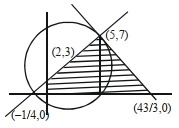
0 likesView Solution
133
MathematicsDifficultMCQJEE Main · 2021
If the variance of $10$ natural numbers $1, 1, 1, \dots, 1, k$ is less than $10$,then the maximum possible value of $k$ is ...... .
A
$12$
B
$11$
C
$14$
D
$21$
Solution
(B) The variance $\sigma^{2}$ of $n$ observations is given by $\sigma^{2} = \frac{\Sigma x_{i}^{2}}{n} - (\bar{x})^{2}$.
Here,the observations are $1$ ($9$ times) and $k$ ($1$ time),so $n = 10$.
$\Sigma x_{i} = 9(1) + k = 9 + k$.
$\Sigma x_{i}^{2} = 9(1)^{2} + k^{2} = 9 + k^{2}$.
$\sigma^{2} = \frac{9 + k^{2}}{10} - \left(\frac{9 + k}{10}\right)^{2} < 10$.
Multiply by $100$: $10(9 + k^{2}) - (9 + k)^{2} < 1000$.
$90 + 10k^{2} - (81 + 18k + k^{2}) < 1000$.
$9k^{2} - 18k + 9 < 1000$.
$9(k - 1)^{2} < 1000$.
$(k - 1)^{2} < \frac{1000}{9} \approx 111.11$.
$k - 1 < \sqrt{111.11} \approx 10.54$.
$k < 11.54$.
Since $k$ is a natural number,the maximum possible value of $k$ is $11$.
Here,the observations are $1$ ($9$ times) and $k$ ($1$ time),so $n = 10$.
$\Sigma x_{i} = 9(1) + k = 9 + k$.
$\Sigma x_{i}^{2} = 9(1)^{2} + k^{2} = 9 + k^{2}$.
$\sigma^{2} = \frac{9 + k^{2}}{10} - \left(\frac{9 + k}{10}\right)^{2} < 10$.
Multiply by $100$: $10(9 + k^{2}) - (9 + k)^{2} < 1000$.
$90 + 10k^{2} - (81 + 18k + k^{2}) < 1000$.
$9k^{2} - 18k + 9 < 1000$.
$9(k - 1)^{2} < 1000$.
$(k - 1)^{2} < \frac{1000}{9} \approx 111.11$.
$k - 1 < \sqrt{111.11} \approx 10.54$.
$k < 11.54$.
Since $k$ is a natural number,the maximum possible value of $k$ is $11$.
0 likesView Solution
134
MathematicsDifficultMCQJEE Main · 2021
The sum of the first four terms of a geometric progression $(G.P.)$ is $\frac{65}{12}$ and the sum of their respective reciprocals is $\frac{65}{18}$. If the product of the first three terms of the $G.P.$ is $1$,and the third term is $\alpha$,then $2\alpha$ is ....... .
A
$5$
B
$6$
C
$2$
D
$3$
Solution
(D) Let the first four terms be $a, ar, ar^2, ar^3$.
The sum of the first four terms is $S_4 = a(1+r+r^2+r^3) = a\frac{r^4-1}{r-1} = \frac{65}{12} \quad (1)$.
The sum of their reciprocals is $\frac{1}{a} + \frac{1}{ar} + \frac{1}{ar^2} + \frac{1}{ar^3} = \frac{r^3+r^2+r+1}{ar^3} = \frac{1}{a} \frac{r^4-1}{r^3(r-1)} = \frac{65}{18} \quad (2)$.
Dividing $(1)$ by $(2)$,we get $\frac{a\frac{r^4-1}{r-1}}{\frac{1}{a}\frac{r^4-1}{r^3(r-1)}} = a^2 r^3 = \frac{65/12}{65/18} = \frac{18}{12} = \frac{3}{2}$.
Given the product of the first three terms is $a \cdot ar \cdot ar^2 = a^3 r^3 = 1$,which implies $ar = 1$,so $a = \frac{1}{r}$.
Substituting $a = \frac{1}{r}$ into $a^2 r^3 = \frac{3}{2}$,we get $(\frac{1}{r})^2 r^3 = r = \frac{3}{2}$.
Thus,$a = \frac{1}{3/2} = \frac{2}{3}$.
The third term $\alpha = ar^2 = \frac{2}{3} \times (\frac{3}{2})^2 = \frac{2}{3} \times \frac{9}{4} = \frac{3}{2}$.
Therefore,$2\alpha = 2 \times \frac{3}{2} = 3$.
The sum of the first four terms is $S_4 = a(1+r+r^2+r^3) = a\frac{r^4-1}{r-1} = \frac{65}{12} \quad (1)$.
The sum of their reciprocals is $\frac{1}{a} + \frac{1}{ar} + \frac{1}{ar^2} + \frac{1}{ar^3} = \frac{r^3+r^2+r+1}{ar^3} = \frac{1}{a} \frac{r^4-1}{r^3(r-1)} = \frac{65}{18} \quad (2)$.
Dividing $(1)$ by $(2)$,we get $\frac{a\frac{r^4-1}{r-1}}{\frac{1}{a}\frac{r^4-1}{r^3(r-1)}} = a^2 r^3 = \frac{65/12}{65/18} = \frac{18}{12} = \frac{3}{2}$.
Given the product of the first three terms is $a \cdot ar \cdot ar^2 = a^3 r^3 = 1$,which implies $ar = 1$,so $a = \frac{1}{r}$.
Substituting $a = \frac{1}{r}$ into $a^2 r^3 = \frac{3}{2}$,we get $(\frac{1}{r})^2 r^3 = r = \frac{3}{2}$.
Thus,$a = \frac{1}{3/2} = \frac{2}{3}$.
The third term $\alpha = ar^2 = \frac{2}{3} \times (\frac{3}{2})^2 = \frac{2}{3} \times \frac{9}{4} = \frac{3}{2}$.
Therefore,$2\alpha = 2 \times \frac{3}{2} = 3$.
3 likesView Solution
135
MathematicsDifficultMCQJEE Main · 2021
The students $S_{1}, S_{2}, \ldots, S_{10}$ are to be divided into $3$ groups $A, B$ and $C$ such that each group has at least one student and the group $C$ has at most $3$ students. Then the total number of possibilities of forming such groups is ........ .
A
$63300$
B
$42580$
C
$15325$
D
$31650$
Solution
(D) Let $n(C)$ be the number of students in group $C$. Since each group must have at least one student,the remaining $10 - n(C)$ students must be distributed into groups $A$ and $B$ such that each of $A$ and $B$ has at least one student.
For a fixed set of $n(C)$ students in group $C$,the number of ways to distribute the remaining $10 - n(C)$ students into groups $A$ and $B$ such that each is non-empty is $2^{10-n(C)} - 2$.
Case $1$: $n(C) = 1$.
Number of ways $= {}^{10}C_{1} \times (2^{9} - 2) = 10 \times (512 - 2) = 10 \times 510 = 5100$.
Case $2$: $n(C) = 2$.
Number of ways $= {}^{10}C_{2} \times (2^{8} - 2) = 45 \times (256 - 2) = 45 \times 254 = 11430$.
Case $3$: $n(C) = 3$.
Number of ways $= {}^{10}C_{3} \times (2^{7} - 2) = 120 \times (128 - 2) = 120 \times 126 = 15120$.
Total number of possibilities $= 5100 + 11430 + 15120 = 31650$.
For a fixed set of $n(C)$ students in group $C$,the number of ways to distribute the remaining $10 - n(C)$ students into groups $A$ and $B$ such that each is non-empty is $2^{10-n(C)} - 2$.
Case $1$: $n(C) = 1$.
Number of ways $= {}^{10}C_{1} \times (2^{9} - 2) = 10 \times (512 - 2) = 10 \times 510 = 5100$.
Case $2$: $n(C) = 2$.
Number of ways $= {}^{10}C_{2} \times (2^{8} - 2) = 45 \times (256 - 2) = 45 \times 254 = 11430$.
Case $3$: $n(C) = 3$.
Number of ways $= {}^{10}C_{3} \times (2^{7} - 2) = 120 \times (128 - 2) = 120 \times 126 = 15120$.
Total number of possibilities $= 5100 + 11430 + 15120 = 31650$.
0 likesView Solution
136
MathematicsDifficultMCQJEE Main · 2021
Let $i=\sqrt{-1}$. If $\frac{(-1+i \sqrt{3})^{21}}{(1-i)^{24}}+\frac{(1+i \sqrt{3})^{21}}{(1+i)^{24}}=k$,and $n =[| k |]$ be the greatest integral part of $| k |$. Then $\sum_{ j =0}^{ n +5}( j +5)^{2}-\sum_{ j =0}^{ n +5}( j +5)$ is equal to ........ .
A
$620$
B
$310$
C
$155$
D
$280$
Solution
(B) Given $k = \frac{(-1+i \sqrt{3})^{21}}{(1-i)^{24}}+\frac{(1+i \sqrt{3})^{21}}{(1+i)^{24}}$.
We know that $-1+i \sqrt{3} = 2(\cos \frac{2\pi}{3} + i \sin \frac{2\pi}{3}) = 2e^{i \frac{2\pi}{3}}$ and $1+i \sqrt{3} = 2(\cos \frac{\pi}{3} + i \sin \frac{\pi}{3}) = 2e^{i \frac{\pi}{3}}$.
Also $1-i = \sqrt{2}(\cos(-\frac{\pi}{4}) + i \sin(-\frac{\pi}{4})) = \sqrt{2}e^{-i \frac{\pi}{4}}$ and $1+i = \sqrt{2}(\cos \frac{\pi}{4} + i \sin \frac{\pi}{4}) = \sqrt{2}e^{i \frac{\pi}{4}}$.
Substituting these values:
$k = \frac{(2e^{i \frac{2\pi}{3}})^{21}}{(\sqrt{2}e^{-i \frac{\pi}{4}})^{24}} + \frac{(2e^{i \frac{\pi}{3}})^{21}}{(\sqrt{2}e^{i \frac{\pi}{4}})^{24}} = \frac{2^{21} e^{i 14\pi}}{2^{12} e^{-i 6\pi}} + \frac{2^{21} e^{i 7\pi}}{2^{12} e^{i 6\pi}}$
$k = 2^9 (e^{i 20\pi} + e^{i \pi}) = 512(1 - 1) = 0$.
Thus,$n = [|k|] = 0$.
The expression becomes $\sum_{j=0}^{5} (j+5)^2 - \sum_{j=0}^{5} (j+5) = \sum_{j=0}^{5} ((j+5)^2 - (j+5)) = \sum_{j=0}^{5} (j^2 + 10j + 25 - j - 5) = \sum_{j=0}^{5} (j^2 + 9j + 20)$.
$= \sum_{j=0}^{5} j^2 + 9 \sum_{j=0}^{5} j + \sum_{j=0}^{5} 20 = \frac{5(6)(11)}{6} + 9 \frac{5(6)}{2} + 20(6) = 55 + 135 + 120 = 310$.
We know that $-1+i \sqrt{3} = 2(\cos \frac{2\pi}{3} + i \sin \frac{2\pi}{3}) = 2e^{i \frac{2\pi}{3}}$ and $1+i \sqrt{3} = 2(\cos \frac{\pi}{3} + i \sin \frac{\pi}{3}) = 2e^{i \frac{\pi}{3}}$.
Also $1-i = \sqrt{2}(\cos(-\frac{\pi}{4}) + i \sin(-\frac{\pi}{4})) = \sqrt{2}e^{-i \frac{\pi}{4}}$ and $1+i = \sqrt{2}(\cos \frac{\pi}{4} + i \sin \frac{\pi}{4}) = \sqrt{2}e^{i \frac{\pi}{4}}$.
Substituting these values:
$k = \frac{(2e^{i \frac{2\pi}{3}})^{21}}{(\sqrt{2}e^{-i \frac{\pi}{4}})^{24}} + \frac{(2e^{i \frac{\pi}{3}})^{21}}{(\sqrt{2}e^{i \frac{\pi}{4}})^{24}} = \frac{2^{21} e^{i 14\pi}}{2^{12} e^{-i 6\pi}} + \frac{2^{21} e^{i 7\pi}}{2^{12} e^{i 6\pi}}$
$k = 2^9 (e^{i 20\pi} + e^{i \pi}) = 512(1 - 1) = 0$.
Thus,$n = [|k|] = 0$.
The expression becomes $\sum_{j=0}^{5} (j+5)^2 - \sum_{j=0}^{5} (j+5) = \sum_{j=0}^{5} ((j+5)^2 - (j+5)) = \sum_{j=0}^{5} (j^2 + 10j + 25 - j - 5) = \sum_{j=0}^{5} (j^2 + 9j + 20)$.
$= \sum_{j=0}^{5} j^2 + 9 \sum_{j=0}^{5} j + \sum_{j=0}^{5} 20 = \frac{5(6)(11)}{6} + 9 \frac{5(6)}{2} + 20(6) = 55 + 135 + 120 = 310$.
0 likesView Solution
137
MathematicsMediumMCQJEE Main · 2021
The number of the real roots of the equation $(x+1)^{2}+|x-5|=\frac{27}{4}$ is ....... .
A
$6$
B
$0$
C
$4$
D
$2$
Solution
(D) Case-$I$: $x \leq 5$
$(x+1)^{2} - (x-5) = \frac{27}{4}$
$(x+1)^{2} - (x+1) + 6 = \frac{27}{4}$
$(x+1)^{2} - (x+1) - \frac{3}{4} = 0$
Let $y = x+1$,then $y^{2} - y - \frac{3}{4} = 0 \implies 4y^{2} - 4y - 3 = 0$
$(2y-3)(2y+1) = 0 \implies y = \frac{3}{2}, -\frac{1}{2}$
$x+1 = \frac{3}{2} \implies x = \frac{1}{2}$ (Valid as $\frac{1}{2} \leq 5$)
$x+1 = -\frac{1}{2} \implies x = -\frac{3}{2}$ (Valid as $-\frac{3}{2} \leq 5$)
Case-$II$: $x > 5$
$(x+1)^{2} + (x-5) = \frac{27}{4}$
$x^{2} + 2x + 1 + x - 5 = \frac{27}{4}$
$x^{2} + 3x - 4 = \frac{27}{4} \implies 4x^{2} + 12x - 16 = 27$
$4x^{2} + 12x - 43 = 0$
$x = \frac{-12 \pm \sqrt{144 - 4(4)(-43)}}{8} = \frac{-12 \pm \sqrt{144 + 688}}{8} = \frac{-12 \pm \sqrt{832}}{8}$
Since $\sqrt{832} \approx 28.8$,$x = \frac{-12 + 28.8}{8} \approx 2.1$ (Rejected as $x > 5$)
Thus,there are $2$ real roots.
$(x+1)^{2} - (x-5) = \frac{27}{4}$
$(x+1)^{2} - (x+1) + 6 = \frac{27}{4}$
$(x+1)^{2} - (x+1) - \frac{3}{4} = 0$
Let $y = x+1$,then $y^{2} - y - \frac{3}{4} = 0 \implies 4y^{2} - 4y - 3 = 0$
$(2y-3)(2y+1) = 0 \implies y = \frac{3}{2}, -\frac{1}{2}$
$x+1 = \frac{3}{2} \implies x = \frac{1}{2}$ (Valid as $\frac{1}{2} \leq 5$)
$x+1 = -\frac{1}{2} \implies x = -\frac{3}{2}$ (Valid as $-\frac{3}{2} \leq 5$)
Case-$II$: $x > 5$
$(x+1)^{2} + (x-5) = \frac{27}{4}$
$x^{2} + 2x + 1 + x - 5 = \frac{27}{4}$
$x^{2} + 3x - 4 = \frac{27}{4} \implies 4x^{2} + 12x - 16 = 27$
$4x^{2} + 12x - 43 = 0$
$x = \frac{-12 \pm \sqrt{144 - 4(4)(-43)}}{8} = \frac{-12 \pm \sqrt{144 + 688}}{8} = \frac{-12 \pm \sqrt{832}}{8}$
Since $\sqrt{832} \approx 28.8$,$x = \frac{-12 + 28.8}{8} \approx 2.1$ (Rejected as $x > 5$)
Thus,there are $2$ real roots.
0 likesView Solution
138
MathematicsDifficultMCQJEE Main · 2021
The shortest distance between the line $x-y=1$ and the curve $x^{2}=2y$ is .... .
A
$\frac{1}{2}$
B
$\frac{1}{2\sqrt{2}}$
C
$\frac{1}{\sqrt{2}}$
D
$0$
Solution
(B) The shortest distance between a curve and a line occurs at a point $P(x_0, y_0)$ on the curve where the tangent is parallel to the given line.
The equation of the line is $x-y=1$,which can be written as $y=x-1$. The slope of this line is $m=1$.
The equation of the curve is $x^2=2y$,which implies $y=\frac{x^2}{2}$.
The slope of the tangent to the curve at any point $(x_0, y_0)$ is given by $\frac{dy}{dx} = \frac{d}{dx}(\frac{x^2}{2}) = x$.
Setting the slope of the tangent equal to the slope of the line,we get $x_0 = 1$.
Substituting $x_0=1$ into the curve equation $y_0 = \frac{x_0^2}{2}$,we get $y_0 = \frac{1^2}{2} = \frac{1}{2}$.
Thus,the point on the curve is $P(1, \frac{1}{2})$.
The shortest distance from a point $(x_1, y_1)$ to the line $Ax+By+C=0$ is given by $d = \frac{|Ax_1+By_1+C|}{\sqrt{A^2+B^2}}$.
Here,the line is $x-y-1=0$,so $A=1, B=-1, C=-1$. The point is $(1, \frac{1}{2})$.
Shortest distance $= \left|\frac{1(1) + (-1)(\frac{1}{2}) - 1}{\sqrt{1^2+(-1)^2}}\right| = \left|\frac{1 - \frac{1}{2} - 1}{\sqrt{2}}\right| = \left|\frac{-\frac{1}{2}}{\sqrt{2}}\right| = \frac{1}{2\sqrt{2}}$.
The equation of the line is $x-y=1$,which can be written as $y=x-1$. The slope of this line is $m=1$.
The equation of the curve is $x^2=2y$,which implies $y=\frac{x^2}{2}$.
The slope of the tangent to the curve at any point $(x_0, y_0)$ is given by $\frac{dy}{dx} = \frac{d}{dx}(\frac{x^2}{2}) = x$.
Setting the slope of the tangent equal to the slope of the line,we get $x_0 = 1$.
Substituting $x_0=1$ into the curve equation $y_0 = \frac{x_0^2}{2}$,we get $y_0 = \frac{1^2}{2} = \frac{1}{2}$.
Thus,the point on the curve is $P(1, \frac{1}{2})$.
The shortest distance from a point $(x_1, y_1)$ to the line $Ax+By+C=0$ is given by $d = \frac{|Ax_1+By_1+C|}{\sqrt{A^2+B^2}}$.
Here,the line is $x-y-1=0$,so $A=1, B=-1, C=-1$. The point is $(1, \frac{1}{2})$.
Shortest distance $= \left|\frac{1(1) + (-1)(\frac{1}{2}) - 1}{\sqrt{1^2+(-1)^2}}\right| = \left|\frac{1 - \frac{1}{2} - 1}{\sqrt{2}}\right| = \left|\frac{-\frac{1}{2}}{\sqrt{2}}\right| = \frac{1}{2\sqrt{2}}$.
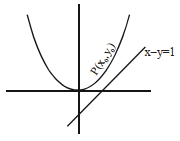
0 likesView Solution
139
MathematicsMediumMCQJEE Main · 2021
If $\alpha, \beta \in \mathbb{R}$ are such that $1-2i$ (where $i^{2}=-1$) is a root of $z^{2}+\alpha z+\beta=0$,then $(\alpha-\beta)$ is equal to ..... .
A
$-3$
B
$-7$
C
$7$
D
$3$
Solution
(B) Since $\alpha, \beta \in \mathbb{R}$,the complex roots must occur in conjugate pairs. Therefore,the other root is $1+2i$.
Using the relationship between roots and coefficients:
Sum of roots $= -\alpha = (1-2i) + (1+2i) = 2 \implies \alpha = -2$.
Product of roots $= \beta = (1-2i)(1+2i) = 1^{2} - (2i)^{2} = 1 + 4 = 5$.
Therefore,$\alpha - \beta = -2 - 5 = -7$.
Using the relationship between roots and coefficients:
Sum of roots $= -\alpha = (1-2i) + (1+2i) = 2 \implies \alpha = -2$.
Product of roots $= \beta = (1-2i)(1+2i) = 1^{2} - (2i)^{2} = 1 + 4 = 5$.
Therefore,$\alpha - \beta = -2 - 5 = -7$.
0 likesView Solution
140
MathematicsMediumMCQJEE Main · 2021
$A$ hyperbola passes through the foci of the ellipse $\frac{x^{2}}{25}+\frac{y^{2}}{16}=1$ and its transverse and conjugate axes coincide with the major and minor axes of the ellipse,respectively. If the product of their eccentricities is $1$,then the equation of the hyperbola is ...... .
A
$\frac{x^{2}}{9}-\frac{y^{2}}{25}=1$
B
$\frac{x^{2}}{9}-\frac{y^{2}}{16}=1$
C
$x^{2}-y^{2}=9$
D
$\frac{x^{2}}{9}-\frac{y^{2}}{4}=1$
Solution
(B) For the ellipse $\frac{x^{2}}{25}+\frac{y^{2}}{16}=1$,we have $a^{2}=25$ and $b^{2}=16$.
The eccentricity $e_{1} = \sqrt{1-\frac{b^{2}}{a^{2}}} = \sqrt{1-\frac{16}{25}} = \sqrt{\frac{9}{25}} = \frac{3}{5}$.
The foci of the ellipse are $(\pm ae_{1}, 0) = (\pm 5 \times \frac{3}{5}, 0) = (\pm 3, 0)$.
Given that the product of the eccentricities of the ellipse and the hyperbola is $1$,we have $e_{1} \times e_{2} = 1$ $\Rightarrow \frac{3}{5} \times e_{2} = 1$ $\Rightarrow e_{2} = \frac{5}{3}$.
Let the equation of the hyperbola be $\frac{x^{2}}{a^{2}}-\frac{y^{2}}{b^{2}}=1$.
Since the hyperbola passes through the foci of the ellipse $(\pm 3, 0)$,we have $\frac{3^{2}}{a^{2}} = 1 \Rightarrow a^{2} = 9$.
For a hyperbola,$b^{2} = a^{2}(e_{2}^{2}-1) = 9((\frac{5}{3})^{2}-1) = 9(\frac{25}{9}-1) = 9(\frac{16}{9}) = 16$.
Thus,the equation of the hyperbola is $\frac{x^{2}}{9}-\frac{y^{2}}{16}=1$.
The eccentricity $e_{1} = \sqrt{1-\frac{b^{2}}{a^{2}}} = \sqrt{1-\frac{16}{25}} = \sqrt{\frac{9}{25}} = \frac{3}{5}$.
The foci of the ellipse are $(\pm ae_{1}, 0) = (\pm 5 \times \frac{3}{5}, 0) = (\pm 3, 0)$.
Given that the product of the eccentricities of the ellipse and the hyperbola is $1$,we have $e_{1} \times e_{2} = 1$ $\Rightarrow \frac{3}{5} \times e_{2} = 1$ $\Rightarrow e_{2} = \frac{5}{3}$.
Let the equation of the hyperbola be $\frac{x^{2}}{a^{2}}-\frac{y^{2}}{b^{2}}=1$.
Since the hyperbola passes through the foci of the ellipse $(\pm 3, 0)$,we have $\frac{3^{2}}{a^{2}} = 1 \Rightarrow a^{2} = 9$.
For a hyperbola,$b^{2} = a^{2}(e_{2}^{2}-1) = 9((\frac{5}{3})^{2}-1) = 9(\frac{25}{9}-1) = 9(\frac{16}{9}) = 16$.
Thus,the equation of the hyperbola is $\frac{x^{2}}{9}-\frac{y^{2}}{16}=1$.
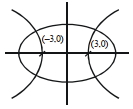
0 likesView Solution
141
MathematicsDifficultMCQJEE Main · 2021
If $0 < x, y < \pi$ and $\cos x + \cos y - \cos(x + y) = \frac{3}{2}$,then $\sin x + \cos y$ is equal to ...... .
A
$\frac{1}{2}$
B
$\frac{1+\sqrt{3}}{2}$
C
$\frac{\sqrt{3}}{2}$
D
$\frac{1-\sqrt{3}}{2}$
Solution
(B) Given $\cos x + \cos y - \cos(x + y) = \frac{3}{2}$.
Using the identity $\cos x + \cos y = 2 \cos(\frac{x+y}{2}) \cos(\frac{x-y}{2})$ and $\cos(x+y) = 2 \cos^2(\frac{x+y}{2}) - 1$,we get:
$2 \cos(\frac{x+y}{2}) \cos(\frac{x-y}{2}) - (2 \cos^2(\frac{x+y}{2}) - 1) = \frac{3}{2}$
$-2 \cos^2(\frac{x+y}{2}) + 2 \cos(\frac{x+y}{2}) \cos(\frac{x-y}{2}) + 1 = \frac{3}{2}$
$2 \cos^2(\frac{x+y}{2}) - 2 \cos(\frac{x+y}{2}) \cos(\frac{x-y}{2}) + \frac{1}{2} = 0$
Multiply by $2$:
$4 \cos^2(\frac{x+y}{2}) - 4 \cos(\frac{x+y}{2}) \cos(\frac{x-y}{2}) + 1 = 0$
This is a quadratic in $\cos(\frac{x+y}{2})$. Completing the square:
$(2 \cos(\frac{x+y}{2}) - \cos(\frac{x-y}{2}))^2 + 1 - \cos^2(\frac{x-y}{2}) = 0$
$(2 \cos(\frac{x+y}{2}) - \cos(\frac{x-y}{2}))^2 + \sin^2(\frac{x-y}{2}) = 0$
Since both terms are squares,they must be zero:
$\sin(\frac{x-y}{2}) = 0 \Rightarrow x = y$
$2 \cos(\frac{x+y}{2}) - \cos(0) = 0$ $\Rightarrow 2 \cos x = 1$ $\Rightarrow \cos x = \frac{1}{2}$
Since $0 < x < \pi$,$x = \frac{\pi}{3}$.
Then $\sin x = \sin(\frac{\pi}{3}) = \frac{\sqrt{3}}{2}$ and $\cos y = \cos(\frac{\pi}{3}) = \frac{1}{2}$.
Therefore,$\sin x + \cos y = \frac{\sqrt{3}}{2} + \frac{1}{2} = \frac{1+\sqrt{3}}{2}$.
Using the identity $\cos x + \cos y = 2 \cos(\frac{x+y}{2}) \cos(\frac{x-y}{2})$ and $\cos(x+y) = 2 \cos^2(\frac{x+y}{2}) - 1$,we get:
$2 \cos(\frac{x+y}{2}) \cos(\frac{x-y}{2}) - (2 \cos^2(\frac{x+y}{2}) - 1) = \frac{3}{2}$
$-2 \cos^2(\frac{x+y}{2}) + 2 \cos(\frac{x+y}{2}) \cos(\frac{x-y}{2}) + 1 = \frac{3}{2}$
$2 \cos^2(\frac{x+y}{2}) - 2 \cos(\frac{x+y}{2}) \cos(\frac{x-y}{2}) + \frac{1}{2} = 0$
Multiply by $2$:
$4 \cos^2(\frac{x+y}{2}) - 4 \cos(\frac{x+y}{2}) \cos(\frac{x-y}{2}) + 1 = 0$
This is a quadratic in $\cos(\frac{x+y}{2})$. Completing the square:
$(2 \cos(\frac{x+y}{2}) - \cos(\frac{x-y}{2}))^2 + 1 - \cos^2(\frac{x-y}{2}) = 0$
$(2 \cos(\frac{x+y}{2}) - \cos(\frac{x-y}{2}))^2 + \sin^2(\frac{x-y}{2}) = 0$
Since both terms are squares,they must be zero:
$\sin(\frac{x-y}{2}) = 0 \Rightarrow x = y$
$2 \cos(\frac{x+y}{2}) - \cos(0) = 0$ $\Rightarrow 2 \cos x = 1$ $\Rightarrow \cos x = \frac{1}{2}$
Since $0 < x < \pi$,$x = \frac{\pi}{3}$.
Then $\sin x = \sin(\frac{\pi}{3}) = \frac{\sqrt{3}}{2}$ and $\cos y = \cos(\frac{\pi}{3}) = \frac{1}{2}$.
Therefore,$\sin x + \cos y = \frac{\sqrt{3}}{2} + \frac{1}{2} = \frac{1+\sqrt{3}}{2}$.
0 likesView Solution
142
MathematicsMediumMCQJEE Main · 2021
If the curve $x^{2}+2 y^{2}=2$ intersects the line $x + y =1$ at two points $P$ and $Q$,then the angle subtended by the line segment $PQ$ at the origin is ...... .
A
$\frac{\pi}{2}+\tan ^{-1}\left(\frac{1}{3}\right)$
B
$\frac{\pi}{2}-\tan ^{-1}\left(\frac{1}{3}\right)$
C
$\frac{\pi}{2}-\tan ^{-1}\left(\frac{1}{4}\right)$
D
$\frac{\pi}{2}+\tan ^{-1}\left(\frac{1}{4}\right)$
Solution
(D) To find the angle subtended by the chord $PQ$ at the origin,we homogenize the equation of the curve $x^{2} + 2y^{2} = 2$ using the line $x + y = 1$.
The equation of the line can be written as $x + y = 1$,so $1 = x + y$.
Substituting this into the curve equation:
$x^{2} + 2y^{2} = 2(1)^{2}$
$x^{2} + 2y^{2} = 2(x + y)^{2}$
$x^{2} + 2y^{2} = 2(x^{2} + 2xy + y^{2})$
$x^{2} + 2y^{2} = 2x^{2} + 4xy + 2y^{2}$
$x^{2} + 4xy = 0$
This represents a pair of lines passing through the origin. Let these lines be $y = m_{1}x$ and $y = m_{2}x$.
From $x(x + 4y) = 0$,we get $x = 0$ (slope $m_{1} = \infty$) and $y = -\frac{1}{4}x$ (slope $m_{2} = -\frac{1}{4}$).
The angle $\theta$ between these two lines is given by:
$\tan \theta = \left| \frac{m_{1} - m_{2}}{1 + m_{1}m_{2}} \right|$
Since one line is vertical $(x=0)$,the angle $\theta$ is the angle between the vertical line and the line with slope $-\frac{1}{4}$.
The angle of the line $y = -\frac{1}{4}x$ with the $x$-axis is $\alpha = \tan^{-1}(-\frac{1}{4}) = -\tan^{-1}(\frac{1}{4})$.
The angle between the vertical line $(90^{\circ})$ and this line is $\frac{\pi}{2} - (-\tan^{-1}(\frac{1}{4})) = \frac{\pi}{2} + \tan^{-1}(\frac{1}{4})$.
The equation of the line can be written as $x + y = 1$,so $1 = x + y$.
Substituting this into the curve equation:
$x^{2} + 2y^{2} = 2(1)^{2}$
$x^{2} + 2y^{2} = 2(x + y)^{2}$
$x^{2} + 2y^{2} = 2(x^{2} + 2xy + y^{2})$
$x^{2} + 2y^{2} = 2x^{2} + 4xy + 2y^{2}$
$x^{2} + 4xy = 0$
This represents a pair of lines passing through the origin. Let these lines be $y = m_{1}x$ and $y = m_{2}x$.
From $x(x + 4y) = 0$,we get $x = 0$ (slope $m_{1} = \infty$) and $y = -\frac{1}{4}x$ (slope $m_{2} = -\frac{1}{4}$).
The angle $\theta$ between these two lines is given by:
$\tan \theta = \left| \frac{m_{1} - m_{2}}{1 + m_{1}m_{2}} \right|$
Since one line is vertical $(x=0)$,the angle $\theta$ is the angle between the vertical line and the line with slope $-\frac{1}{4}$.
The angle of the line $y = -\frac{1}{4}x$ with the $x$-axis is $\alpha = \tan^{-1}(-\frac{1}{4}) = -\tan^{-1}(\frac{1}{4})$.
The angle between the vertical line $(90^{\circ})$ and this line is $\frac{\pi}{2} - (-\tan^{-1}(\frac{1}{4})) = \frac{\pi}{2} + \tan^{-1}(\frac{1}{4})$.
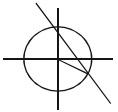
0 likesView Solution
143
MathematicsEasyMCQJEE Main · 2021
The contrapositive of the statement "If you will work,you will earn money" is ..... .
A
You will earn money,if you will not work
B
If you will earn money,you will work
C
If you will not earn money,you will not work
D
To earn money,you need to work
Solution
(C) The contrapositive of a conditional statement $p \rightarrow q$ is defined as $\sim q \rightarrow \sim p$.
Here,the statement $p$ is "You will work" and $q$ is "You will earn money".
Therefore,the contrapositive $\sim q \rightarrow \sim p$ is "If you will not earn money,you will not work".
Here,the statement $p$ is "You will work" and $q$ is "You will earn money".
Therefore,the contrapositive $\sim q \rightarrow \sim p$ is "If you will not earn money,you will not work".
0 likesView Solution
144
MathematicsMediumMCQJEE Main · 2021
The minimum value of $f(x) = a^{a^{x}} + a^{1-a^{x}}$,where $a, x \in R$ and $a > 0$,is equal to ..... .
A
$2a$
B
$2\sqrt{a}$
C
$a + \frac{1}{a}$
D
$a + 1$
Solution
(B) Given the function $f(x) = a^{a^{x}} + a^{1-a^{x}}$.
We can rewrite the second term as $a^{1-a^{x}} = \frac{a}{a^{a^{x}}}$.
So,$f(x) = a^{a^{x}} + \frac{a}{a^{a^{x}}}$.
Since $a > 0$,both $a^{a^{x}}$ and $\frac{a}{a^{a^{x}}}$ are positive real numbers.
By the Arithmetic Mean-Geometric Mean $(AM \geq GM)$ inequality,for any two positive numbers $u$ and $v$,$u + v \geq 2\sqrt{uv}$.
Let $u = a^{a^{x}}$ and $v = \frac{a}{a^{a^{x}}}$.
Then $f(x) = u + v \geq 2\sqrt{u \cdot v} = 2\sqrt{a^{a^{x}} \cdot \frac{a}{a^{a^{x}}}} = 2\sqrt{a}$.
Thus,the minimum value is $2\sqrt{a}$.
We can rewrite the second term as $a^{1-a^{x}} = \frac{a}{a^{a^{x}}}$.
So,$f(x) = a^{a^{x}} + \frac{a}{a^{a^{x}}}$.
Since $a > 0$,both $a^{a^{x}}$ and $\frac{a}{a^{a^{x}}}$ are positive real numbers.
By the Arithmetic Mean-Geometric Mean $(AM \geq GM)$ inequality,for any two positive numbers $u$ and $v$,$u + v \geq 2\sqrt{uv}$.
Let $u = a^{a^{x}}$ and $v = \frac{a}{a^{a^{x}}}$.
Then $f(x) = u + v \geq 2\sqrt{u \cdot v} = 2\sqrt{a^{a^{x}} \cdot \frac{a}{a^{a^{x}}}} = 2\sqrt{a}$.
Thus,the minimum value is $2\sqrt{a}$.
0 likesView Solution
145
MathematicsDifficultMCQJEE Main · 2021
Let $\alpha$ and $\beta$ be the roots of $x^{2}-6x-2=0$. If $a_{n}=\alpha^{n}-\beta^{n}$ for $n \geq 1$,then the value of $\frac{a_{10}-2a_{8}}{3a_{9}}$ is ..... .
A
$2$
B
$1$
C
$4$
D
$3$
Solution
(A) Since $\alpha$ and $\beta$ are the roots of $x^{2}-6x-2=0$,we have $\alpha^{2}-6\alpha-2=0$ and $\beta^{2}-6\beta-2=0$.
Multiplying the first equation by $\alpha^{8}$,we get $\alpha^{10}-6\alpha^{9}-2\alpha^{8}=0$.
Similarly,multiplying the second equation by $\beta^{8}$,we get $\beta^{10}-6\beta^{9}-2\beta^{8}=0$.
Subtracting the two equations,we obtain $(\alpha^{10}-\beta^{10})-6(\alpha^{9}-\beta^{9})-2(\alpha^{8}-\beta^{8})=0$.
Using the definition $a_{n}=\alpha^{n}-\beta^{n}$,this simplifies to $a_{10}-6a_{9}-2a_{8}=0$.
Rearranging the terms,we get $a_{10}-2a_{8}=6a_{9}$.
Therefore,$\frac{a_{10}-2a_{8}}{3a_{9}} = \frac{6a_{9}}{3a_{9}} = 2$.
Multiplying the first equation by $\alpha^{8}$,we get $\alpha^{10}-6\alpha^{9}-2\alpha^{8}=0$.
Similarly,multiplying the second equation by $\beta^{8}$,we get $\beta^{10}-6\beta^{9}-2\beta^{8}=0$.
Subtracting the two equations,we obtain $(\alpha^{10}-\beta^{10})-6(\alpha^{9}-\beta^{9})-2(\alpha^{8}-\beta^{8})=0$.
Using the definition $a_{n}=\alpha^{n}-\beta^{n}$,this simplifies to $a_{10}-6a_{9}-2a_{8}=0$.
Rearranging the terms,we get $a_{10}-2a_{8}=6a_{9}$.
Therefore,$\frac{a_{10}-2a_{8}}{3a_{9}} = \frac{6a_{9}}{3a_{9}} = 2$.
0 likesView Solution
146
MathematicsMediumMCQJEE Main · 2021
The total number of two-digit numbers $n$ such that $3^{n} + 7^{n}$ is a multiple of $10$ is ..... .
A
$45$
B
$54$
C
$36$
D
$63$
Solution
(A) We want $3^{n} + 7^{n} \equiv 0 \pmod{10}$.
Since $7 \equiv -3 \pmod{10}$,we have $7^{n} \equiv (-3)^{n} \pmod{10}$.
Thus,$3^{n} + 7^{n} \equiv 3^{n} + (-1)^{n} 3^{n} \pmod{10}$.
If $n$ is even,$3^{n} + 3^{n} = 2 \cdot 3^{n}$,which is not divisible by $10$ (as $3^{n}$ ends in $1$ or $9$,so $2 \cdot 3^{n}$ ends in $2$ or $8$).
If $n$ is odd,$3^{n} + (-1) 3^{n} = 3^{n} - 3^{n} = 0$,which is divisible by $10$.
Therefore,$n$ must be an odd number.
The two-digit numbers are from $10$ to $99$.
The total number of two-digit numbers is $99 - 10 + 1 = 90$.
Exactly half of these are odd,so the number of odd two-digit numbers is $90 / 2 = 45$.
Since $7 \equiv -3 \pmod{10}$,we have $7^{n} \equiv (-3)^{n} \pmod{10}$.
Thus,$3^{n} + 7^{n} \equiv 3^{n} + (-1)^{n} 3^{n} \pmod{10}$.
If $n$ is even,$3^{n} + 3^{n} = 2 \cdot 3^{n}$,which is not divisible by $10$ (as $3^{n}$ ends in $1$ or $9$,so $2 \cdot 3^{n}$ ends in $2$ or $8$).
If $n$ is odd,$3^{n} + (-1) 3^{n} = 3^{n} - 3^{n} = 0$,which is divisible by $10$.
Therefore,$n$ must be an odd number.
The two-digit numbers are from $10$ to $99$.
The total number of two-digit numbers is $99 - 10 + 1 = 90$.
Exactly half of these are odd,so the number of odd two-digit numbers is $90 / 2 = 45$.
0 likesView Solution
147
MathematicsDifficultMCQJEE Main · 2021
If the remainder when $x$ is divided by $4$ is $3$,then the remainder when $(2020+x)^{2022}$ is divided by $8$ is ....... .
A
$1$
B
$6$
C
$2$
D
$4$
Solution
(A) Given that the remainder when $x$ is divided by $4$ is $3$,we can write $x = 4k + 3$ for some integer $k$.
We need to find the remainder when $(2020 + x)^{2022}$ is divided by $8$.
Substitute $x = 4k + 3$ into the expression:
$(2020 + x)^{2022} = (2020 + 4k + 3)^{2022} = (2023 + 4k)^{2022}$.
Since $2023 = 8 \times 252 + 7$,we have $2023 \equiv 7 \equiv -1 \pmod{8}$.
Thus,$(2023 + 4k)^{2022} \equiv (-1 + 4k)^{2022} \pmod{8}$.
If $k$ is even,let $k = 2m$,then $(-1 + 4(2m))^{2022} = (-1 + 8m)^{2022} \equiv (-1)^{2022} \equiv 1 \pmod{8}$.
If $k$ is odd,let $k = 2m + 1$,then $(-1 + 4(2m + 1))^{2022} = (-1 + 8m + 4)^{2022} = (3 + 8m)^{2022} \equiv 3^{2022} \pmod{8}$.
Note that $3^2 = 9 \equiv 1 \pmod{8}$,so $3^{2022} = (3^2)^{1011} \equiv 1^{1011} \equiv 1 \pmod{8}$.
In both cases,the remainder is $1$.
We need to find the remainder when $(2020 + x)^{2022}$ is divided by $8$.
Substitute $x = 4k + 3$ into the expression:
$(2020 + x)^{2022} = (2020 + 4k + 3)^{2022} = (2023 + 4k)^{2022}$.
Since $2023 = 8 \times 252 + 7$,we have $2023 \equiv 7 \equiv -1 \pmod{8}$.
Thus,$(2023 + 4k)^{2022} \equiv (-1 + 4k)^{2022} \pmod{8}$.
If $k$ is even,let $k = 2m$,then $(-1 + 4(2m))^{2022} = (-1 + 8m)^{2022} \equiv (-1)^{2022} \equiv 1 \pmod{8}$.
If $k$ is odd,let $k = 2m + 1$,then $(-1 + 4(2m + 1))^{2022} = (-1 + 8m + 4)^{2022} = (3 + 8m)^{2022} \equiv 3^{2022} \pmod{8}$.
Note that $3^2 = 9 \equiv 1 \pmod{8}$,so $3^{2022} = (3^2)^{1011} \equiv 1^{1011} \equiv 1 \pmod{8}$.
In both cases,the remainder is $1$.
0 likesView Solution
148
MathematicsDifficultMCQJEE Main · 2021
$A$ line is a common tangent to the circle $(x-3)^{2}+y^{2}=9$ and the parabola $y^{2}=4x$. If the two points of contact $(a, b)$ and $(c, d)$ are distinct and lie in the first quadrant,then $2(a+c)$ is equal to ........ .
A
$9$
B
$3$
C
$4$
D
$6$
Solution
(A) Let the point of contact on the parabola $y^{2}=4x$ be $A(t^{2}, 2t)$.
The equation of the tangent to the parabola at $A(t^{2}, 2t)$ is $ty = x + t^{2}$,which can be written as $x - ty + t^{2} = 0$.
Since this line is also tangent to the circle $(x-3)^{2} + y^{2} = 9$ with center $(3, 0)$ and radius $r=3$,the perpendicular distance from the center $(3, 0)$ to the line must be equal to the radius.
$\left| \frac{3 - t(0) + t^{2}}{\sqrt{1^{2} + (-t)^{2}}} \right| = 3$
$\left| 3 + t^{2} \right| = 3\sqrt{1 + t^{2}}$
Squaring both sides: $(3 + t^{2})^{2} = 9(1 + t^{2})$
$9 + t^{4} + 6t^{2} = 9 + 9t^{2}$
$t^{4} - 3t^{2} = 0$
$t^{2}(t^{2} - 3) = 0$
Since the points lie in the first quadrant,$t > 0$,so $t^{2} = 3$,which gives $t = \sqrt{3}$.
Thus,the point of contact on the parabola is $A(t^{2}, 2t) = (3, 2\sqrt{3})$. So,$a=3$ and $b=2\sqrt{3}$.
The equation of the tangent line is $x - \sqrt{3}y + 3 = 0$.
The point of contact on the circle $B(c, d)$ is the foot of the perpendicular from the center $(3, 0)$ to the tangent line $x - \sqrt{3}y + 3 = 0$.
Using the formula for the foot of the perpendicular $(c, d)$ from $(x_{1}, y_{1})$ to $Ax + By + C = 0$:
$\frac{c-3}{1} = \frac{d-0}{-\sqrt{3}} = -\frac{1(3) - \sqrt{3}(0) + 3}{1^{2} + (-\sqrt{3})^{2}} = -\frac{6}{4} = -\frac{3}{2}$
$c - 3 = -\frac{3}{2} \Rightarrow c = 3 - \frac{3}{2} = \frac{3}{2}$
$d = -\sqrt{3} \times (-\frac{3}{2}) = \frac{3\sqrt{3}}{2}$
We need to find $2(a+c) = 2(3 + \frac{3}{2}) = 2(\frac{9}{2}) = 9$.
The equation of the tangent to the parabola at $A(t^{2}, 2t)$ is $ty = x + t^{2}$,which can be written as $x - ty + t^{2} = 0$.
Since this line is also tangent to the circle $(x-3)^{2} + y^{2} = 9$ with center $(3, 0)$ and radius $r=3$,the perpendicular distance from the center $(3, 0)$ to the line must be equal to the radius.
$\left| \frac{3 - t(0) + t^{2}}{\sqrt{1^{2} + (-t)^{2}}} \right| = 3$
$\left| 3 + t^{2} \right| = 3\sqrt{1 + t^{2}}$
Squaring both sides: $(3 + t^{2})^{2} = 9(1 + t^{2})$
$9 + t^{4} + 6t^{2} = 9 + 9t^{2}$
$t^{4} - 3t^{2} = 0$
$t^{2}(t^{2} - 3) = 0$
Since the points lie in the first quadrant,$t > 0$,so $t^{2} = 3$,which gives $t = \sqrt{3}$.
Thus,the point of contact on the parabola is $A(t^{2}, 2t) = (3, 2\sqrt{3})$. So,$a=3$ and $b=2\sqrt{3}$.
The equation of the tangent line is $x - \sqrt{3}y + 3 = 0$.
The point of contact on the circle $B(c, d)$ is the foot of the perpendicular from the center $(3, 0)$ to the tangent line $x - \sqrt{3}y + 3 = 0$.
Using the formula for the foot of the perpendicular $(c, d)$ from $(x_{1}, y_{1})$ to $Ax + By + C = 0$:
$\frac{c-3}{1} = \frac{d-0}{-\sqrt{3}} = -\frac{1(3) - \sqrt{3}(0) + 3}{1^{2} + (-\sqrt{3})^{2}} = -\frac{6}{4} = -\frac{3}{2}$
$c - 3 = -\frac{3}{2} \Rightarrow c = 3 - \frac{3}{2} = \frac{3}{2}$
$d = -\sqrt{3} \times (-\frac{3}{2}) = \frac{3\sqrt{3}}{2}$
We need to find $2(a+c) = 2(3 + \frac{3}{2}) = 2(\frac{9}{2}) = 9$.
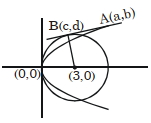
0 likesView Solution
149
MathematicsDifficultMCQJEE Main · 2021
If $\lim _{x \rightarrow 0} \frac{ax-(e^{4x}-1)}{ax(e^{4x}-1)}$ exists and is equal to $b$,then the value of $a-2b$ is ....... .
A
$10$
B
$3$
C
$5$
D
$6$
Solution
(C) Given the limit $\lim _{x \rightarrow 0} \frac{ax-(e^{4x}-1)}{ax(e^{4x}-1)} = b$.
Since the limit exists,the form must be $\frac{0}{0}$ at $x=0$.
Using the expansion $e^{4x} = 1 + 4x + \frac{(4x)^2}{2!} + \dots$,we have:
$\lim _{x \rightarrow 0} \frac{ax - (1 + 4x + 8x^2 + \dots - 1)}{ax(4x + 8x^2 + \dots)} = \lim _{x \rightarrow 0} \frac{(a-4)x - 8x^2}{4ax^2 + 8ax^3}$.
For the limit to exist,the coefficient of $x$ in the numerator must be zero,so $a-4 = 0$,which gives $a = 4$.
Now,substituting $a=4$ into the limit:
$b = \lim _{x \rightarrow 0} \frac{-8x^2}{4(4)x^2 + 8(4)x^3} = \lim _{x \rightarrow 0} \frac{-8x^2}{16x^2 + 32x^3} = \lim _{x \rightarrow 0} \frac{-8}{16 + 32x} = -\frac{8}{16} = -\frac{1}{2}$.
Thus,$a = 4$ and $b = -\frac{1}{2}$.
Finally,$a - 2b = 4 - 2(-\frac{1}{2}) = 4 + 1 = 5$.
Since the limit exists,the form must be $\frac{0}{0}$ at $x=0$.
Using the expansion $e^{4x} = 1 + 4x + \frac{(4x)^2}{2!} + \dots$,we have:
$\lim _{x \rightarrow 0} \frac{ax - (1 + 4x + 8x^2 + \dots - 1)}{ax(4x + 8x^2 + \dots)} = \lim _{x \rightarrow 0} \frac{(a-4)x - 8x^2}{4ax^2 + 8ax^3}$.
For the limit to exist,the coefficient of $x$ in the numerator must be zero,so $a-4 = 0$,which gives $a = 4$.
Now,substituting $a=4$ into the limit:
$b = \lim _{x \rightarrow 0} \frac{-8x^2}{4(4)x^2 + 8(4)x^3} = \lim _{x \rightarrow 0} \frac{-8x^2}{16x^2 + 32x^3} = \lim _{x \rightarrow 0} \frac{-8}{16 + 32x} = -\frac{8}{16} = -\frac{1}{2}$.
Thus,$a = 4$ and $b = -\frac{1}{2}$.
Finally,$a - 2b = 4 - 2(-\frac{1}{2}) = 4 + 1 = 5$.
1 likesView Solution
150
MathematicsDifficultMCQJEE Main · 2021
$A$ natural number has prime factorization given by $n = 2^{x} 3^{y} 5^{z}$,where $y$ and $z$ are such that $y+z=5$ and $y^{-1}+z^{-1}=\frac{5}{6}$,with $y > z$. Then the number of odd divisors of $n$,including $1$,is ..... .
A
$11$
B
$6$
C
$6x$
D
$12$
Solution
(D) Given $y+z=5$ and $\frac{1}{y}+\frac{1}{z}=\frac{5}{6}$.
From the second equation,$\frac{y+z}{yz} = \frac{5}{6}$.
Substituting $y+z=5$,we get $\frac{5}{yz} = \frac{5}{6}$,which implies $yz = 6$.
We have $y+z=5$ and $yz=6$. The quadratic equation $t^2 - 5t + 6 = 0$ has roots $t=2$ and $t=3$.
Since $y > z$,we have $y=3$ and $z=2$.
The number $n = 2^{x} \cdot 3^{3} \cdot 5^{2}$.
An odd divisor of $n$ must be of the form $3^{a} \cdot 5^{b}$,where $0 \le a \le 3$ and $0 \le b \le 2$.
The number of choices for $a$ is $(3+1) = 4$.
The number of choices for $b$ is $(2+1) = 3$.
Total number of odd divisors $= 4 \times 3 = 12$.
From the second equation,$\frac{y+z}{yz} = \frac{5}{6}$.
Substituting $y+z=5$,we get $\frac{5}{yz} = \frac{5}{6}$,which implies $yz = 6$.
We have $y+z=5$ and $yz=6$. The quadratic equation $t^2 - 5t + 6 = 0$ has roots $t=2$ and $t=3$.
Since $y > z$,we have $y=3$ and $z=2$.
The number $n = 2^{x} \cdot 3^{3} \cdot 5^{2}$.
An odd divisor of $n$ must be of the form $3^{a} \cdot 5^{b}$,where $0 \le a \le 3$ and $0 \le b \le 2$.
The number of choices for $a$ is $(3+1) = 4$.
The number of choices for $b$ is $(2+1) = 3$.
Total number of odd divisors $= 4 \times 3 = 12$.
0 likesView Solution
151
MathematicsDifficultMCQJEE Main · 2021
If $f: R \rightarrow R$ is a function defined by $f(x)=[x-1] \cos \left(\frac{2 x-1}{2}\right) \pi,$ where $[.]$ denotes the greatest integer function,then $f$ is
A
discontinuous at all integral values of $x$ except at $x=1$
B
continuous only at $x=1$
C
continuous for every real $x$
D
discontinuous only at $x=1$
Solution
(C) Let $x = n$,where $n \in Z$.
First,consider the value of the function at $x = n$:
$f(n) = [n-1] \cos \left(\frac{2n-1}{2}\right) \pi = (n-1) \cos \left(n\pi - \frac{\pi}{2}\right) = (n-1) \cdot 0 = 0$.
Now,calculate the Left Hand Limit $(LHL)$:
$LHL = \lim_{x \rightarrow n^-} [x-1] \cos \left(\frac{2x-1}{2}\right) \pi$.
As $x \rightarrow n^-$,$[x-1] = n-2$.
$LHL = (n-2) \cos \left(n\pi - \frac{\pi}{2}\right) = (n-2) \cdot 0 = 0$.
Now,calculate the Right Hand Limit $(RHL)$:
$RHL = \lim_{x \rightarrow n^+} [x-1] \cos \left(\frac{2x-1}{2}\right) \pi$.
As $x \rightarrow n^+$,$[x-1] = n-1$.
$RHL = (n-1) \cos \left(n\pi - \frac{\pi}{2}\right) = (n-1) \cdot 0 = 0$.
Since $LHL = RHL = f(n) = 0$ for all $n \in Z$,the function is continuous at all integral values of $x$.
For non-integral values of $x$,the function is a product of a constant (locally) and a continuous trigonometric function,hence it is continuous.
Therefore,$f(x)$ is continuous for every real $x$.
First,consider the value of the function at $x = n$:
$f(n) = [n-1] \cos \left(\frac{2n-1}{2}\right) \pi = (n-1) \cos \left(n\pi - \frac{\pi}{2}\right) = (n-1) \cdot 0 = 0$.
Now,calculate the Left Hand Limit $(LHL)$:
$LHL = \lim_{x \rightarrow n^-} [x-1] \cos \left(\frac{2x-1}{2}\right) \pi$.
As $x \rightarrow n^-$,$[x-1] = n-2$.
$LHL = (n-2) \cos \left(n\pi - \frac{\pi}{2}\right) = (n-2) \cdot 0 = 0$.
Now,calculate the Right Hand Limit $(RHL)$:
$RHL = \lim_{x \rightarrow n^+} [x-1] \cos \left(\frac{2x-1}{2}\right) \pi$.
As $x \rightarrow n^+$,$[x-1] = n-1$.
$RHL = (n-1) \cos \left(n\pi - \frac{\pi}{2}\right) = (n-1) \cdot 0 = 0$.
Since $LHL = RHL = f(n) = 0$ for all $n \in Z$,the function is continuous at all integral values of $x$.
For non-integral values of $x$,the function is a product of a constant (locally) and a continuous trigonometric function,hence it is continuous.
Therefore,$f(x)$ is continuous for every real $x$.
0 likesView Solution
152
MathematicsMediumMCQJEE Main · 2021
The distance of the point $(1, 1, 9)$ from the point of intersection of the line $\frac{x-3}{1} = \frac{y-4}{2} = \frac{z-5}{2}$ and the plane $x+y+z=17$ is
A
$2 \sqrt{19}$
B
$19 \sqrt{2}$
C
$38$
D
$\sqrt{38}$
Solution
(D) Let the line be $\frac{x-3}{1} = \frac{y-4}{2} = \frac{z-5}{2} = t$.
Then,any point on the line is given by $x = t+3$,$y = 2t+4$,and $z = 2t+5$.
For the point of intersection with the plane $x+y+z=17$,we substitute these coordinates into the plane equation:
$(t+3) + (2t+4) + (2t+5) = 17$.
$5t + 12 = 17
\Rightarrow 5t = 5
\Rightarrow t = 1$.
Substituting $t=1$ back into the parametric equations,the point of intersection is $(1+3, 2(1)+4, 2(1)+5) = (4, 6, 7)$.
The distance between the points $(1, 1, 9)$ and $(4, 6, 7)$ is given by the distance formula:
$d = \sqrt{(4-1)^2 + (6-1)^2 + (7-9)^2}
= \sqrt{3^2 + 5^2 + (-2)^2}
= \sqrt{9 + 25 + 4}
= \sqrt{38}$.
Then,any point on the line is given by $x = t+3$,$y = 2t+4$,and $z = 2t+5$.
For the point of intersection with the plane $x+y+z=17$,we substitute these coordinates into the plane equation:
$(t+3) + (2t+4) + (2t+5) = 17$.
$5t + 12 = 17
\Rightarrow 5t = 5
\Rightarrow t = 1$.
Substituting $t=1$ back into the parametric equations,the point of intersection is $(1+3, 2(1)+4, 2(1)+5) = (4, 6, 7)$.
The distance between the points $(1, 1, 9)$ and $(4, 6, 7)$ is given by the distance formula:
$d = \sqrt{(4-1)^2 + (6-1)^2 + (7-9)^2}
= \sqrt{3^2 + 5^2 + (-2)^2}
= \sqrt{9 + 25 + 4}
= \sqrt{38}$.
0 likesView Solution
153
MathematicsDifficultMCQJEE Main · 2021
If the tangent to the curve $y=x^{3}$ at the point $P(t, t^{3})$ meets the curve again at $Q$,then the ordinate of the point which divides $PQ$ internally in the ratio $1:2$ is
A
$-2t^{3}$
B
$0$
C
$-t^{3}$
D
$2t^{3}$
Solution
(A) The slope of the tangent to the curve $y=x^{3}$ at $P(t, t^{3})$ is given by $\frac{dy}{dx} = 3x^{2}$.
At $x=t$,the slope is $3t^{2}$.
The equation of the tangent at $P(t, t^{3})$ is $y - t^{3} = 3t^{2}(x - t)$.
To find the intersection with $y=x^{3}$,substitute $y=x^{3}$ into the tangent equation:
$x^{3} - t^{3} = 3t^{2}(x - t)$.
$(x - t)(x^{2} + xt + t^{2}) = 3t^{2}(x - t)$.
Since $x \neq t$ for point $Q$,we have $x^{2} + xt + t^{2} = 3t^{2}$,which simplifies to $x^{2} + xt - 2t^{2} = 0$.
Factoring gives $(x - t)(x + 2t) = 0$,so $x = -2t$.
The coordinates of $Q$ are $(-2t, (-2t)^{3}) = (-2t, -8t^{3})$.
The point dividing $PQ$ in the ratio $1:2$ has an ordinate given by the section formula:
$y = \frac{1 \times (-8t^{3}) + 2 \times (t^{3})}{1 + 2} = \frac{-8t^{3} + 2t^{3}}{3} = \frac{-6t^{3}}{3} = -2t^{3}$.
At $x=t$,the slope is $3t^{2}$.
The equation of the tangent at $P(t, t^{3})$ is $y - t^{3} = 3t^{2}(x - t)$.
To find the intersection with $y=x^{3}$,substitute $y=x^{3}$ into the tangent equation:
$x^{3} - t^{3} = 3t^{2}(x - t)$.
$(x - t)(x^{2} + xt + t^{2}) = 3t^{2}(x - t)$.
Since $x \neq t$ for point $Q$,we have $x^{2} + xt + t^{2} = 3t^{2}$,which simplifies to $x^{2} + xt - 2t^{2} = 0$.
Factoring gives $(x - t)(x + 2t) = 0$,so $x = -2t$.
The coordinates of $Q$ are $(-2t, (-2t)^{3}) = (-2t, -8t^{3})$.
The point dividing $PQ$ in the ratio $1:2$ has an ordinate given by the section formula:
$y = \frac{1 \times (-8t^{3}) + 2 \times (t^{3})}{1 + 2} = \frac{-8t^{3} + 2t^{3}}{3} = \frac{-6t^{3}}{3} = -2t^{3}$.
0 likesView Solution
154
MathematicsDifficultMCQJEE Main · 2021
The function $f(x) = \frac{4x^3 - 3x^2}{6} - 2 \sin x + (2x - 1) \cos x$:
A
increases in $[\frac{1}{2}, \infty)$
B
increases in $(-\infty, \frac{1}{2}]$
C
decreases in $[\frac{1}{2}, \infty)$
D
decreases in $(-\infty, \frac{1}{2}]$
Solution
(A) Given $f(x) = \frac{4x^3 - 3x^2}{6} - 2 \sin x + (2x - 1) \cos x$.
First,we find the derivative $f'(x)$:
$f'(x) = \frac{12x^2 - 6x}{6} - 2 \cos x + [2 \cos x + (2x - 1)(-\sin x)]$
$f'(x) = (2x^2 - x) - 2 \cos x + 2 \cos x - (2x - 1) \sin x$
$f'(x) = x(2x - 1) - (2x - 1) \sin x$
$f'(x) = (2x - 1)(x - \sin x)$.
We know that for $x > 0$,$x > \sin x$,so $(x - \sin x) > 0$.
For $x < 0$,$x < \sin x$,so $(x - \sin x) < 0$.
Now,analyze the sign of $f'(x) = (2x - 1)(x - \sin x)$:
$1$. If $x \in [\frac{1}{2}, \infty)$,then $(2x - 1) \geq 0$ and $(x - \sin x) > 0$,so $f'(x) \geq 0$. Thus,$f(x)$ is increasing.
$2$. If $x \in [0, \frac{1}{2}]$,then $(2x - 1) \leq 0$ and $(x - \sin x) \geq 0$,so $f'(x) \leq 0$. Thus,$f(x)$ is decreasing.
$3$. If $x \in (-\infty, 0]$,then $(2x - 1) < 0$ and $(x - \sin x) \leq 0$,so $f'(x) \geq 0$. Thus,$f(x)$ is increasing.
Comparing with the options,$f(x)$ increases in $[\frac{1}{2}, \infty)$.
First,we find the derivative $f'(x)$:
$f'(x) = \frac{12x^2 - 6x}{6} - 2 \cos x + [2 \cos x + (2x - 1)(-\sin x)]$
$f'(x) = (2x^2 - x) - 2 \cos x + 2 \cos x - (2x - 1) \sin x$
$f'(x) = x(2x - 1) - (2x - 1) \sin x$
$f'(x) = (2x - 1)(x - \sin x)$.
We know that for $x > 0$,$x > \sin x$,so $(x - \sin x) > 0$.
For $x < 0$,$x < \sin x$,so $(x - \sin x) < 0$.
Now,analyze the sign of $f'(x) = (2x - 1)(x - \sin x)$:
$1$. If $x \in [\frac{1}{2}, \infty)$,then $(2x - 1) \geq 0$ and $(x - \sin x) > 0$,so $f'(x) \geq 0$. Thus,$f(x)$ is increasing.
$2$. If $x \in [0, \frac{1}{2}]$,then $(2x - 1) \leq 0$ and $(x - \sin x) \geq 0$,so $f'(x) \leq 0$. Thus,$f(x)$ is decreasing.
$3$. If $x \in (-\infty, 0]$,then $(2x - 1) < 0$ and $(x - \sin x) \leq 0$,so $f'(x) \geq 0$. Thus,$f(x)$ is increasing.
Comparing with the options,$f(x)$ increases in $[\frac{1}{2}, \infty)$.
0 likesView Solution
155
MathematicsMediumMCQJEE Main · 2021
Let $f: R \rightarrow R$ be defined as $f(x) = 2x - 1$ and $g: R - \{1\} \rightarrow R$ be defined as $g(x) = \frac{x - 1/2}{x - 1}$. Then the composition function $f(g(x))$ is:
A
onto but not one-one
B
both one-one and onto
C
one-one but not onto
D
neither one-one nor onto
Solution
(C) Given $f(x) = 2x - 1$ and $g(x) = \frac{x - 1/2}{x - 1} = \frac{2x - 1}{2(x - 1)}$.
Calculate the composition $f(g(x))$:
$f(g(x)) = 2(g(x)) - 1 = 2 \left( \frac{2x - 1}{2(x - 1)} \right) - 1$
$= \frac{2x - 1}{x - 1} - 1 = \frac{2x - 1 - (x - 1)}{x - 1} = \frac{x}{x - 1} = 1 + \frac{1}{x - 1}$.
For one-one check:
Let $f(g(x_1)) = f(g(x_2))$.
$1 + \frac{1}{x_1 - 1} = 1 + \frac{1}{x_2 - 1} \implies x_1 - 1 = x_2 - 1 \implies x_1 = x_2$.
Thus,$f(g(x))$ is one-one.
For onto check:
The range of $f(g(x)) = 1 + \frac{1}{x - 1}$ is $R - \{1\}$.
Since the codomain is $R$,the range is not equal to the codomain.
Therefore,$f(g(x))$ is not onto.
Conclusion: $f(g(x))$ is one-one but not onto.
Calculate the composition $f(g(x))$:
$f(g(x)) = 2(g(x)) - 1 = 2 \left( \frac{2x - 1}{2(x - 1)} \right) - 1$
$= \frac{2x - 1}{x - 1} - 1 = \frac{2x - 1 - (x - 1)}{x - 1} = \frac{x}{x - 1} = 1 + \frac{1}{x - 1}$.
For one-one check:
Let $f(g(x_1)) = f(g(x_2))$.
$1 + \frac{1}{x_1 - 1} = 1 + \frac{1}{x_2 - 1} \implies x_1 - 1 = x_2 - 1 \implies x_1 = x_2$.
Thus,$f(g(x))$ is one-one.
For onto check:
The range of $f(g(x)) = 1 + \frac{1}{x - 1}$ is $R - \{1\}$.
Since the codomain is $R$,the range is not equal to the codomain.
Therefore,$f(g(x))$ is not onto.
Conclusion: $f(g(x))$ is one-one but not onto.
0 likesView Solution
156
MathematicsDifficultMCQJEE Main · 2021
An ordinary dice is rolled for a certain number of times. If the probability of getting an odd number $2$ times is equal to the probability of getting an even number $3$ times,then the probability of getting an odd number for an odd number of times is
A
$\frac{1}{32}$
B
$\frac{5}{16}$
C
$\frac{3}{16}$
D
$\frac{1}{2}$
Solution
(D) Let $n$ be the number of times the dice is rolled. The probability of getting an odd number in a single throw is $p = \frac{1}{2}$,and the probability of getting an even number is $q = 1 - p = \frac{1}{2}$.
The probability of getting an odd number $2$ times is given by the binomial distribution: $P(X=2) = {}^{n}C_{2} (\frac{1}{2})^{2} (\frac{1}{2})^{n-2} = {}^{n}C_{2} (\frac{1}{2})^{n}$.
The probability of getting an even number $3$ times is equivalent to getting an odd number $(n-3)$ times: $P(Y=3) = {}^{n}C_{3} (\frac{1}{2})^{3} (\frac{1}{2})^{n-3} = {}^{n}C_{3} (\frac{1}{2})^{n}$.
Given that $P(X=2) = P(Y=3)$,we have ${}^{n}C_{2} = {}^{n}C_{3}$.
Using the property ${}^{n}C_{r} = {}^{n}C_{n-r}$,we get $2 + 3 = n$,so $n = 5$.
We need to find the probability of getting an odd number an odd number of times,which is $P(X=1) + P(X=3) + P(X=5)$.
$P(X=1) + P(X=3) + P(X=5) = {}^{5}C_{1} (\frac{1}{2})^{5} + {}^{5}C_{3} (\frac{1}{2})^{5} + {}^{5}C_{5} (\frac{1}{2})^{5} = \frac{1}{2^{5}} (5 + 10 + 1) = \frac{16}{32} = \frac{1}{2}$.
The probability of getting an odd number $2$ times is given by the binomial distribution: $P(X=2) = {}^{n}C_{2} (\frac{1}{2})^{2} (\frac{1}{2})^{n-2} = {}^{n}C_{2} (\frac{1}{2})^{n}$.
The probability of getting an even number $3$ times is equivalent to getting an odd number $(n-3)$ times: $P(Y=3) = {}^{n}C_{3} (\frac{1}{2})^{3} (\frac{1}{2})^{n-3} = {}^{n}C_{3} (\frac{1}{2})^{n}$.
Given that $P(X=2) = P(Y=3)$,we have ${}^{n}C_{2} = {}^{n}C_{3}$.
Using the property ${}^{n}C_{r} = {}^{n}C_{n-r}$,we get $2 + 3 = n$,so $n = 5$.
We need to find the probability of getting an odd number an odd number of times,which is $P(X=1) + P(X=3) + P(X=5)$.
$P(X=1) + P(X=3) + P(X=5) = {}^{5}C_{1} (\frac{1}{2})^{5} + {}^{5}C_{3} (\frac{1}{2})^{5} + {}^{5}C_{5} (\frac{1}{2})^{5} = \frac{1}{2^{5}} (5 + 10 + 1) = \frac{16}{32} = \frac{1}{2}$.
0 likesView Solution
157
MathematicsDifficultMCQJEE Main · 2021
The area (in sq. units) of the part of the circle $x^{2} + y^{2} = 36$ which is outside the parabola $y^{2} = 9x$ is:
A
$24 \pi + 3 \sqrt{3}$
B
$12 \pi - 3 \sqrt{3}$
C
$24 \pi - 3 \sqrt{3}$
D
$12 \pi + 3 \sqrt{3}$
Solution
(C) First,find the intersection points of $x^{2} + y^{2} = 36$ and $y^{2} = 9x$.
Substituting $y^{2} = 9x$ into the circle equation: $x^{2} + 9x - 36 = 0$.
$(x + 12)(x - 3) = 0$,so $x = 3$ (since $x \geq 0$ for the parabola).
At $x = 3$,$y^{2} = 27$,so $y = \pm 3 \sqrt{3}$.
The area inside the circle and outside the parabola is the total area of the circle minus the area inside both the circle and the parabola.
The area inside both is $2 \int_{0}^{3} \sqrt{9x} \, dx + 2 \int_{3}^{6} \sqrt{36 - x^{2}} \, dx$.
$= 2 \times 3 \int_{0}^{3} x^{1/2} \, dx + 2 \left[ \frac{x}{2} \sqrt{36 - x^{2}} + \frac{36}{2} \sin^{-1} \left( \frac{x}{6} \right) \right]_{3}^{6}$.
$= 6 \left[ \frac{2}{3} x^{3/2} \right]_{0}^{3} + 2 \left[ (0 + 18 \sin^{-1}(1)) - (\frac{3}{2} \sqrt{27} + 18 \sin^{-1}(1/2)) \right]$.
$= 4(3 \sqrt{3}) + 2 \left[ 18(\pi/2) - (\frac{9 \sqrt{3}}{2} + 18(\pi/6)) \right] = 12 \sqrt{3} + 2 [9 \pi - \frac{9 \sqrt{3}}{2} - 3 \pi] = 12 \sqrt{3} + 12 \pi - 9 \sqrt{3} = 12 \pi + 3 \sqrt{3}$.
Total area of circle = $36 \pi$.
Required area = $36 \pi - (12 \pi + 3 \sqrt{3}) = 24 \pi - 3 \sqrt{3}$.
Substituting $y^{2} = 9x$ into the circle equation: $x^{2} + 9x - 36 = 0$.
$(x + 12)(x - 3) = 0$,so $x = 3$ (since $x \geq 0$ for the parabola).
At $x = 3$,$y^{2} = 27$,so $y = \pm 3 \sqrt{3}$.
The area inside the circle and outside the parabola is the total area of the circle minus the area inside both the circle and the parabola.
The area inside both is $2 \int_{0}^{3} \sqrt{9x} \, dx + 2 \int_{3}^{6} \sqrt{36 - x^{2}} \, dx$.
$= 2 \times 3 \int_{0}^{3} x^{1/2} \, dx + 2 \left[ \frac{x}{2} \sqrt{36 - x^{2}} + \frac{36}{2} \sin^{-1} \left( \frac{x}{6} \right) \right]_{3}^{6}$.
$= 6 \left[ \frac{2}{3} x^{3/2} \right]_{0}^{3} + 2 \left[ (0 + 18 \sin^{-1}(1)) - (\frac{3}{2} \sqrt{27} + 18 \sin^{-1}(1/2)) \right]$.
$= 4(3 \sqrt{3}) + 2 \left[ 18(\pi/2) - (\frac{9 \sqrt{3}}{2} + 18(\pi/6)) \right] = 12 \sqrt{3} + 2 [9 \pi - \frac{9 \sqrt{3}}{2} - 3 \pi] = 12 \sqrt{3} + 12 \pi - 9 \sqrt{3} = 12 \pi + 3 \sqrt{3}$.
Total area of circle = $36 \pi$.
Required area = $36 \pi - (12 \pi + 3 \sqrt{3}) = 24 \pi - 3 \sqrt{3}$.
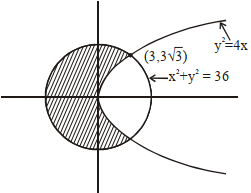
0 likesView Solution
158
MathematicsMediumMCQJEE Main · 2021
$\lim _{x \rightarrow 0} \frac{\int_{0}^{x^{2}}(\sin \sqrt{t}) dt }{x^{3}}$ is equal to
A
$2/3$
B
$1/3$
C
$0$
D
$1/15$
Solution
(A) To evaluate the limit $L = \lim _{x \rightarrow 0} \frac{\int_{0}^{x^{2}} \sin \sqrt{t} dt}{x^{3}}$,we observe that it is of the form $\frac{0}{0}$.
Applying $L$'$H$ôpital's rule and the Leibniz integral rule,we differentiate the numerator and the denominator with respect to $x$:
Numerator derivative: $\frac{d}{dx} \int_{0}^{x^{2}} \sin \sqrt{t} dt = (\sin \sqrt{x^{2}}) \cdot \frac{d}{dx}(x^{2}) = (\sin x) \cdot (2x)$.
Denominator derivative: $\frac{d}{dx}(x^{3}) = 3x^{2}$.
Now,the limit becomes:
$L = \lim _{x \rightarrow 0} \frac{2x \sin x}{3x^{2}} = \lim _{x \rightarrow 0} \frac{2 \sin x}{3x}$.
Using the standard limit $\lim _{x \rightarrow 0} \frac{\sin x}{x} = 1$,we get:
$L = \frac{2}{3} \times 1 = \frac{2}{3}$.
Applying $L$'$H$ôpital's rule and the Leibniz integral rule,we differentiate the numerator and the denominator with respect to $x$:
Numerator derivative: $\frac{d}{dx} \int_{0}^{x^{2}} \sin \sqrt{t} dt = (\sin \sqrt{x^{2}}) \cdot \frac{d}{dx}(x^{2}) = (\sin x) \cdot (2x)$.
Denominator derivative: $\frac{d}{dx}(x^{3}) = 3x^{2}$.
Now,the limit becomes:
$L = \lim _{x \rightarrow 0} \frac{2x \sin x}{3x^{2}} = \lim _{x \rightarrow 0} \frac{2 \sin x}{3x}$.
Using the standard limit $\lim _{x \rightarrow 0} \frac{\sin x}{x} = 1$,we get:
$L = \frac{2}{3} \times 1 = \frac{2}{3}$.
0 likesView Solution
159
MathematicsDifficultMCQJEE Main · 2021
If $\int_{-a}^{a} (|x| + |x-2|) dx = 22$,$(a > 2)$ and $[x]$ denotes the greatest integer $\leq x$,then $\int_{a}^{-a} (x + [x]) dx$ is equal to ...........
A
$2$
B
$3$
C
$4$
D
$5$
Solution
(B) Given $\int_{-a}^{a} (|x| + |x-2|) dx = 22$ with $a > 2$.
We split the integral based on the critical points $x=0$ and $x=2$:
$\int_{-a}^{0} (-x - (x-2)) dx + \int_{0}^{2} (x - (x-2)) dx + \int_{2}^{a} (x + x-2) dx = 22$
$\int_{-a}^{0} (-2x + 2) dx + \int_{0}^{2} 2 dx + \int_{2}^{a} (2x - 2) dx = 22$
$[-x^2 + 2x]_{-a}^{0} + [2x]_{0}^{2} + [x^2 - 2x]_{2}^{a} = 22$
$(0 - (-a^2 - 2a)) + (4 - 0) + ((a^2 - 2a) - (4 - 4)) = 22$
$a^2 + 2a + 4 + a^2 - 2a = 22$
$2a^2 + 4 = 22 \Rightarrow 2a^2 = 18 \Rightarrow a^2 = 9$. Since $a > 2$,$a = 3$.
Now,we evaluate $\int_{3}^{-3} (x + [x]) dx = -\int_{-3}^{3} (x + [x]) dx$.
$\int_{-3}^{3} x dx + \int_{-3}^{3} [x] dx = 0 + ([-3] + [-2] + [-1] + [0] + [1] + [2])$
$= -3 - 2 - 1 + 0 + 1 + 2 = -3$.
Thus,$-\int_{-3}^{3} (x + [x]) dx = -(-3) = 3$.
We split the integral based on the critical points $x=0$ and $x=2$:
$\int_{-a}^{0} (-x - (x-2)) dx + \int_{0}^{2} (x - (x-2)) dx + \int_{2}^{a} (x + x-2) dx = 22$
$\int_{-a}^{0} (-2x + 2) dx + \int_{0}^{2} 2 dx + \int_{2}^{a} (2x - 2) dx = 22$
$[-x^2 + 2x]_{-a}^{0} + [2x]_{0}^{2} + [x^2 - 2x]_{2}^{a} = 22$
$(0 - (-a^2 - 2a)) + (4 - 0) + ((a^2 - 2a) - (4 - 4)) = 22$
$a^2 + 2a + 4 + a^2 - 2a = 22$
$2a^2 + 4 = 22 \Rightarrow 2a^2 = 18 \Rightarrow a^2 = 9$. Since $a > 2$,$a = 3$.
Now,we evaluate $\int_{3}^{-3} (x + [x]) dx = -\int_{-3}^{3} (x + [x]) dx$.
$\int_{-3}^{3} x dx + \int_{-3}^{3} [x] dx = 0 + ([-3] + [-2] + [-1] + [0] + [1] + [2])$
$= -3 - 2 - 1 + 0 + 1 + 2 = -3$.
Thus,$-\int_{-3}^{3} (x + [x]) dx = -(-3) = 3$.
0 likesView Solution
160
MathematicsMediumMCQJEE Main · 2021
Let $M$ be any $3 \times 3$ matrix with entries from the set $\{0, 1, 2\}$. The maximum number of such matrices,for which the sum of diagonal elements of $M^{T}M$ is $7$,is .............
A
$512$
B
$556$
C
$560$
D
$540$
Solution
(D) Let $M = \begin{bmatrix} a & b & c \\ d & e & f \\ g & h & i \end{bmatrix}$. The sum of the diagonal elements of $M^{T}M$ is the trace of $M^{T}M$,which is equal to the sum of the squares of all elements of $M$.
Thus,$a^{2} + b^{2} + c^{2} + d^{2} + e^{2} + f^{2} + g^{2} + h^{2} + i^{2} = 7$.
Since the entries are from $\{0, 1, 2\}$,we consider the possible combinations of squares that sum to $7$:
Case-$I$: Seven $1$'s and two $0$'s.
Number of ways = $\binom{9}{7} = \binom{9}{2} = \frac{9 \times 8}{2} = 36$.
Case-$II$: One $2$ $(2^{2} = 4)$,three $1$'s $(1^{2} = 1)$,and five $0$'s $(0^{2} = 0)$.
Sum = $4 + 1 + 1 + 1 + 0 + 0 + 0 + 0 + 0 = 7$.
Number of ways = $\frac{9!}{1! 3! 5!} = \frac{9 \times 8 \times 7 \times 6}{3 \times 2 \times 1} = 9 \times 4 \times 2 \times 7 = 504$.
Total number of matrices = $36 + 504 = 540$.
Thus,$a^{2} + b^{2} + c^{2} + d^{2} + e^{2} + f^{2} + g^{2} + h^{2} + i^{2} = 7$.
Since the entries are from $\{0, 1, 2\}$,we consider the possible combinations of squares that sum to $7$:
Case-$I$: Seven $1$'s and two $0$'s.
Number of ways = $\binom{9}{7} = \binom{9}{2} = \frac{9 \times 8}{2} = 36$.
Case-$II$: One $2$ $(2^{2} = 4)$,three $1$'s $(1^{2} = 1)$,and five $0$'s $(0^{2} = 0)$.
Sum = $4 + 1 + 1 + 1 + 0 + 0 + 0 + 0 + 0 = 7$.
Number of ways = $\frac{9!}{1! 3! 5!} = \frac{9 \times 8 \times 7 \times 6}{3 \times 2 \times 1} = 9 \times 4 \times 2 \times 7 = 504$.
Total number of matrices = $36 + 504 = 540$.
0 likesView Solution
161
MathematicsMediumMCQJEE Main · 2021
The minimum value of $\alpha$ for which the equation $\frac{4}{\sin x}+\frac{1}{1-\sin x}=\alpha$ has at least one solution in $\left(0, \frac{\pi}{2}\right)$ is ..........
A
$5$
B
$9$
C
$6$
D
$3$
Solution
(B) Let $f(x) = \frac{4}{\sin x} + \frac{1}{1-\sin x}$.
Let $t = \sin x$. Since $x \in (0, \frac{\pi}{2})$,we have $t \in (0, 1)$.
Then $f(t) = \frac{4}{t} + \frac{1}{1-t}$.
To find the minimum value,we differentiate $f(t)$ with respect to $t$:
$f'(t) = -\frac{4}{t^2} + \frac{1}{(1-t)^2}$.
Setting $f'(t) = 0$,we get $\frac{1}{(1-t)^2} = \frac{4}{t^2}$,which implies $(1-t)^2 = \frac{t^2}{4}$.
Taking the square root,$1-t = \frac{t}{2}$ (since $t \in (0, 1)$),so $1 = \frac{3t}{2}$,which gives $t = \frac{2}{3}$.
Since $t = \frac{2}{3}$ is in $(0, 1)$,the minimum value is $f(\frac{2}{3}) = \frac{4}{2/3} + \frac{1}{1-2/3} = 6 + 3 = 9$.
Thus,the minimum value of $\alpha$ for which the equation has at least one solution is $9$.
Let $t = \sin x$. Since $x \in (0, \frac{\pi}{2})$,we have $t \in (0, 1)$.
Then $f(t) = \frac{4}{t} + \frac{1}{1-t}$.
To find the minimum value,we differentiate $f(t)$ with respect to $t$:
$f'(t) = -\frac{4}{t^2} + \frac{1}{(1-t)^2}$.
Setting $f'(t) = 0$,we get $\frac{1}{(1-t)^2} = \frac{4}{t^2}$,which implies $(1-t)^2 = \frac{t^2}{4}$.
Taking the square root,$1-t = \frac{t}{2}$ (since $t \in (0, 1)$),so $1 = \frac{3t}{2}$,which gives $t = \frac{2}{3}$.
Since $t = \frac{2}{3}$ is in $(0, 1)$,the minimum value is $f(\frac{2}{3}) = \frac{4}{2/3} + \frac{1}{1-2/3} = 6 + 3 = 9$.
Thus,the minimum value of $\alpha$ for which the equation has at least one solution is $9$.
0 likesView Solution
162
MathematicsMediumMCQJEE Main · 2021
$\lim _{n \rightarrow \infty} \tan \left\{\sum_{r=1}^{n} \tan ^{-1}\left(\frac{1}{1+r+r^{2}}\right)\right\}$ is equal to..........
A
$1$
B
$2$
C
$3$
D
$4$
Solution
(A) We know that $\tan ^{-1}\left(\frac{1}{1+r+r^{2}}\right) = \tan ^{-1}\left(\frac{(r+1)-r}{1+r(r+1)}\right) = \tan ^{-1}(r+1) - \tan ^{-1}(r)$.
Thus,the sum is a telescoping series:
$\sum_{r=1}^{n} \left[\tan ^{-1}(r+1) - \tan ^{-1}(r)\right] = (\tan ^{-1}(2) - \tan ^{-1}(1)) + (\tan ^{-1}(3) - \tan ^{-1}(2)) + \dots + (\tan ^{-1}(n+1) - \tan ^{-1}(n))$.
This simplifies to $\tan ^{-1}(n+1) - \tan ^{-1}(1) = \tan ^{-1}(n+1) - \frac{\pi}{4}$.
Now,taking the limit as $n \rightarrow \infty$:
$\lim _{n}$ ${\rightarrow \infty} \tan \left(\tan ^{-1}(n+1) - \frac{\pi}{4}\right) = \tan \left(\frac{\pi}{2} - \frac{\pi}{4}\right) = \tan \left(\frac{\pi}{4}\right) = 1$.
Thus,the sum is a telescoping series:
$\sum_{r=1}^{n} \left[\tan ^{-1}(r+1) - \tan ^{-1}(r)\right] = (\tan ^{-1}(2) - \tan ^{-1}(1)) + (\tan ^{-1}(3) - \tan ^{-1}(2)) + \dots + (\tan ^{-1}(n+1) - \tan ^{-1}(n))$.
This simplifies to $\tan ^{-1}(n+1) - \tan ^{-1}(1) = \tan ^{-1}(n+1) - \frac{\pi}{4}$.
Now,taking the limit as $n \rightarrow \infty$:
$\lim _{n}$ ${\rightarrow \infty} \tan \left(\tan ^{-1}(n+1) - \frac{\pi}{4}\right) = \tan \left(\frac{\pi}{2} - \frac{\pi}{4}\right) = \tan \left(\frac{\pi}{4}\right) = 1$.
0 likesView Solution
163
MathematicsDifficultMCQJEE Main · 2021
Let three vectors $\overrightarrow{a}, \overrightarrow{b}$ and $\overrightarrow{c}$ be such that $\overrightarrow{c}$ is coplanar with $\overrightarrow{a}$ and $\overrightarrow{b}$,$\overrightarrow{a} \cdot \overrightarrow{c} = 7$ and $\overrightarrow{b}$ is perpendicular to $\overrightarrow{c}$,where $\overrightarrow{a} = -\hat{i} + \hat{j} + \hat{k}$ and $\overrightarrow{b} = 2\hat{i} + \hat{k}$. Then the value of $2|\overrightarrow{a} + \overrightarrow{b} + \overrightarrow{c}|^{2}$ is .........
A
$75$
B
$50$
C
$80$
D
$100$
Solution
(A) Since $\overrightarrow{c}$ is coplanar with $\overrightarrow{a}$ and $\overrightarrow{b}$,we can write $\overrightarrow{c} = x\overrightarrow{a} + y\overrightarrow{b}$.
Given $\overrightarrow{b} \cdot \overrightarrow{c} = 0$,we have $\overrightarrow{b} \cdot (x\overrightarrow{a} + y\overrightarrow{b}) = 0$,which implies $x(\overrightarrow{a} \cdot \overrightarrow{b}) + y|\overrightarrow{b}|^{2} = 0$.
Calculating $\overrightarrow{a} \cdot \overrightarrow{b} = (-1)(2) + (1)(0) + (1)(1) = -1$ and $|\overrightarrow{b}|^{2} = 2^{2} + 0^{2} + 1^{2} = 5$.
So,$-x + 5y = 0 \Rightarrow x = 5y$.
Thus,$\overrightarrow{c} = y(5\overrightarrow{a} + \overrightarrow{b}) = y(5(-\hat{i} + \hat{j} + \hat{k}) + (2\hat{i} + \hat{k})) = y(-3\hat{i} + 5\hat{j} + 6\hat{k})$.
Given $\overrightarrow{a} \cdot \overrightarrow{c} = 7$,we have $y((-1)(-3) + (1)(5) + (1)(6)) = 7 \Rightarrow y(3 + 5 + 6) = 7 \Rightarrow 14y = 7 \Rightarrow y = \frac{1}{2}$.
So,$\overrightarrow{c} = -\frac{3}{2}\hat{i} + \frac{5}{2}\hat{j} + 3\hat{k}$.
Then $\overrightarrow{a} + \overrightarrow{b} + \overrightarrow{c} = (-\hat{i} + \hat{j} + \hat{k}) + (2\hat{i} + \hat{k}) + (-\frac{3}{2}\hat{i} + \frac{5}{2}\hat{j} + 3\hat{k}) = (2 - 1 - \frac{3}{2})\hat{i} + (1 + \frac{5}{2})\hat{j} + (1 + 1 + 3)\hat{k} = -\frac{1}{2}\hat{i} + \frac{7}{2}\hat{j} + 5\hat{k}$.
Finally,$2|\overrightarrow{a} + \overrightarrow{b} + \overrightarrow{c}|^{2} = 2((\frac{-1}{2})^{2} + (\frac{7}{2})^{2} + 5^{2}) = 2(\frac{1}{4} + \frac{49}{4} + 25) = 2(\frac{50}{4} + 25) = 2(12.5 + 25) = 2(37.5) = 75$.
Given $\overrightarrow{b} \cdot \overrightarrow{c} = 0$,we have $\overrightarrow{b} \cdot (x\overrightarrow{a} + y\overrightarrow{b}) = 0$,which implies $x(\overrightarrow{a} \cdot \overrightarrow{b}) + y|\overrightarrow{b}|^{2} = 0$.
Calculating $\overrightarrow{a} \cdot \overrightarrow{b} = (-1)(2) + (1)(0) + (1)(1) = -1$ and $|\overrightarrow{b}|^{2} = 2^{2} + 0^{2} + 1^{2} = 5$.
So,$-x + 5y = 0 \Rightarrow x = 5y$.
Thus,$\overrightarrow{c} = y(5\overrightarrow{a} + \overrightarrow{b}) = y(5(-\hat{i} + \hat{j} + \hat{k}) + (2\hat{i} + \hat{k})) = y(-3\hat{i} + 5\hat{j} + 6\hat{k})$.
Given $\overrightarrow{a} \cdot \overrightarrow{c} = 7$,we have $y((-1)(-3) + (1)(5) + (1)(6)) = 7 \Rightarrow y(3 + 5 + 6) = 7 \Rightarrow 14y = 7 \Rightarrow y = \frac{1}{2}$.
So,$\overrightarrow{c} = -\frac{3}{2}\hat{i} + \frac{5}{2}\hat{j} + 3\hat{k}$.
Then $\overrightarrow{a} + \overrightarrow{b} + \overrightarrow{c} = (-\hat{i} + \hat{j} + \hat{k}) + (2\hat{i} + \hat{k}) + (-\frac{3}{2}\hat{i} + \frac{5}{2}\hat{j} + 3\hat{k}) = (2 - 1 - \frac{3}{2})\hat{i} + (1 + \frac{5}{2})\hat{j} + (1 + 1 + 3)\hat{k} = -\frac{1}{2}\hat{i} + \frac{7}{2}\hat{j} + 5\hat{k}$.
Finally,$2|\overrightarrow{a} + \overrightarrow{b} + \overrightarrow{c}|^{2} = 2((\frac{-1}{2})^{2} + (\frac{7}{2})^{2} + 5^{2}) = 2(\frac{1}{4} + \frac{49}{4} + 25) = 2(\frac{50}{4} + 25) = 2(12.5 + 25) = 2(37.5) = 75$.
0 likesView Solution
164
MathematicsDifficultMCQJEE Main · 2021
Let $B_{i} (i=1, 2, 3)$ be three independent events in a sample space. The probability that only $B_{1}$ occurs is $\alpha$,only $B_{2}$ occurs is $\beta$,and only $B_{3}$ occurs is $\gamma$. Let $p$ be the probability that none of the events $B_{i}$ occurs,and these $4$ probabilities satisfy the equations $(\alpha - 2\beta)p = \alpha\beta$ and $(\beta - 3\gamma)p = 2\beta\gamma$ (All the probabilities are assumed to lie in the interval $(0, 1)$). Then $\frac{P(B_{1})}{P(B_{3})}$ is equal to ..........
A
$5$
B
$6$
C
$3$
D
$4$
Solution
(B) Let $P(B_{1}) = p_{1}$,$P(B_{2}) = p_{2}$,and $P(B_{3}) = p_{3}$.
Given that $p_{1}(1 - p_{2})(1 - p_{3}) = \alpha$ $...(i)$
$p_{2}(1 - p_{1})(1 - p_{3}) = \beta$ $...(ii)$
$p_{3}(1 - p_{1})(1 - p_{2}) = \gamma$ $...(iii)$
And $(1 - p_{1})(1 - p_{2})(1 - p_{3}) = p$ $...(iv)$
From these,we get $\frac{p_{1}}{1 - p_{1}} = \frac{\alpha}{p}$,$\frac{p_{2}}{1 - p_{2}} = \frac{\beta}{p}$,and $\frac{p_{3}}{1 - p_{3}} = \frac{\gamma}{p}$.
Given equations: $(\alpha - 2\beta)p = \alpha\beta \Rightarrow \frac{1}{p} = \frac{1}{\beta} - \frac{2}{\alpha} \Rightarrow \frac{1}{\beta} = \frac{1}{p} + \frac{2}{\alpha}$.
Also,$(\beta - 3\gamma)p = 2\beta\gamma \Rightarrow \frac{1}{2\gamma} - \frac{3}{2\beta} = \frac{1}{p} \Rightarrow \frac{1}{2\gamma} = \frac{1}{p} + \frac{3}{2\beta}$.
Substituting $\frac{1}{\beta} = \frac{1}{p} + \frac{2}{\alpha}$ into the second equation:
$\frac{1}{2\gamma} = \frac{1}{p} + \frac{3}{2}(\frac{1}{p} + \frac{2}{\alpha}) = \frac{1}{p} + \frac{3}{2p} + \frac{3}{\alpha} = \frac{5}{2p} + \frac{3}{\alpha}$.
Using $\frac{\alpha}{p} = \frac{p_{1}}{1 - p_{1}}$ and $\frac{\gamma}{p} = \frac{p_{3}}{1 - p_{3}}$,we have $\frac{1}{2} \cdot \frac{1 - p_{3}}{p_{3}} = \frac{5}{2} + 3 \cdot \frac{1 - p_{1}}{p_{1}}$.
Simplifying leads to $\frac{p_{1}}{p_{3}} = 6$.
Given that $p_{1}(1 - p_{2})(1 - p_{3}) = \alpha$ $...(i)$
$p_{2}(1 - p_{1})(1 - p_{3}) = \beta$ $...(ii)$
$p_{3}(1 - p_{1})(1 - p_{2}) = \gamma$ $...(iii)$
And $(1 - p_{1})(1 - p_{2})(1 - p_{3}) = p$ $...(iv)$
From these,we get $\frac{p_{1}}{1 - p_{1}} = \frac{\alpha}{p}$,$\frac{p_{2}}{1 - p_{2}} = \frac{\beta}{p}$,and $\frac{p_{3}}{1 - p_{3}} = \frac{\gamma}{p}$.
Given equations: $(\alpha - 2\beta)p = \alpha\beta \Rightarrow \frac{1}{p} = \frac{1}{\beta} - \frac{2}{\alpha} \Rightarrow \frac{1}{\beta} = \frac{1}{p} + \frac{2}{\alpha}$.
Also,$(\beta - 3\gamma)p = 2\beta\gamma \Rightarrow \frac{1}{2\gamma} - \frac{3}{2\beta} = \frac{1}{p} \Rightarrow \frac{1}{2\gamma} = \frac{1}{p} + \frac{3}{2\beta}$.
Substituting $\frac{1}{\beta} = \frac{1}{p} + \frac{2}{\alpha}$ into the second equation:
$\frac{1}{2\gamma} = \frac{1}{p} + \frac{3}{2}(\frac{1}{p} + \frac{2}{\alpha}) = \frac{1}{p} + \frac{3}{2p} + \frac{3}{\alpha} = \frac{5}{2p} + \frac{3}{\alpha}$.
Using $\frac{\alpha}{p} = \frac{p_{1}}{1 - p_{1}}$ and $\frac{\gamma}{p} = \frac{p_{3}}{1 - p_{3}}$,we have $\frac{1}{2} \cdot \frac{1 - p_{3}}{p_{3}} = \frac{5}{2} + 3 \cdot \frac{1 - p_{1}}{p_{1}}$.
Simplifying leads to $\frac{p_{1}}{p_{3}} = 6$.
0 likesView Solution
165
MathematicsDifficultMCQJEE Main · 2021
Let $P = \begin{bmatrix} 3 & -1 & -2 \\ 2 & 0 & \alpha \\ 3 & -5 & 0 \end{bmatrix}$ where $\alpha \in R$. Suppose $Q = [q_{ij}]$ is a matrix satisfying $PQ = kI_3$ for some non-zero $k \in R$. If $q_{23} = -\frac{k}{8}$ and $|Q| = \frac{k^2}{2}$,then $\alpha^2 + k^2$ is equal to?
A
$17$
B
$21$
C
$13$
D
$19$
Solution
(A) Given $PQ = kI_3$. Taking the determinant on both sides,$|P||Q| = |kI_3| = k^3|I_3| = k^3$.
Given $|Q| = \frac{k^2}{2}$,so $|P| \cdot \frac{k^2}{2} = k^3$. Since $k \neq 0$,$|P| = 2k$.
Calculating $|P|$: $|P| = 3(0 - (-5\alpha)) - (-1)(0 - 3\alpha) + (-2)(-10 - 0) = 3(5\alpha) + (-3\alpha) + 20 = 15\alpha - 3\alpha + 20 = 12\alpha + 20$.
Thus,$12\alpha + 20 = 2k$,or $k = 6\alpha + 10$.
Since $PQ = kI_3$,$Q = kP^{-1} = k \cdot \frac{\text{adj}(P)}{|P|} = k \cdot \frac{\text{adj}(P)}{2k} = \frac{1}{2} \text{adj}(P)$.
The element $q_{23}$ is the $(2,3)$ entry of $\frac{1}{2} \text{adj}(P)$.
The $(2,3)$ entry of $\text{adj}(P)$ is the cofactor $C_{32} = -\begin{vmatrix} 3 & -2 \\ 2 & \alpha \end{vmatrix} = -(3\alpha - (-4)) = -(3\alpha + 4)$.
So,$q_{23} = \frac{-(3\alpha + 4)}{2} = -\frac{k}{8}$.
This implies $4(3\alpha + 4) = k$.
Substituting $k = 6\alpha + 10$: $12\alpha + 16 = 6\alpha + 10 \Rightarrow 6\alpha = -6 \Rightarrow \alpha = -1$.
Then $k = 6(-1) + 10 = 4$.
Finally,$\alpha^2 + k^2 = (-1)^2 + 4^2 = 1 + 16 = 17$.
Given $|Q| = \frac{k^2}{2}$,so $|P| \cdot \frac{k^2}{2} = k^3$. Since $k \neq 0$,$|P| = 2k$.
Calculating $|P|$: $|P| = 3(0 - (-5\alpha)) - (-1)(0 - 3\alpha) + (-2)(-10 - 0) = 3(5\alpha) + (-3\alpha) + 20 = 15\alpha - 3\alpha + 20 = 12\alpha + 20$.
Thus,$12\alpha + 20 = 2k$,or $k = 6\alpha + 10$.
Since $PQ = kI_3$,$Q = kP^{-1} = k \cdot \frac{\text{adj}(P)}{|P|} = k \cdot \frac{\text{adj}(P)}{2k} = \frac{1}{2} \text{adj}(P)$.
The element $q_{23}$ is the $(2,3)$ entry of $\frac{1}{2} \text{adj}(P)$.
The $(2,3)$ entry of $\text{adj}(P)$ is the cofactor $C_{32} = -\begin{vmatrix} 3 & -2 \\ 2 & \alpha \end{vmatrix} = -(3\alpha - (-4)) = -(3\alpha + 4)$.
So,$q_{23} = \frac{-(3\alpha + 4)}{2} = -\frac{k}{8}$.
This implies $4(3\alpha + 4) = k$.
Substituting $k = 6\alpha + 10$: $12\alpha + 16 = 6\alpha + 10 \Rightarrow 6\alpha = -6 \Rightarrow \alpha = -1$.
Then $k = 6(-1) + 10 = 4$.
Finally,$\alpha^2 + k^2 = (-1)^2 + 4^2 = 1 + 16 = 17$.
0 likesView Solution
166
MathematicsEasyMCQJEE Main · 2021
When a missile is fired from a ship,the probability that it is intercepted is $\frac{1}{3}$ and the probability that the missile hits the target,given that it is not intercepted,is $\frac{3}{4}$. If three missiles are fired independently from the ship,then the probability that all three hit the target is:
A
$\frac{1}{27}$
B
$\frac{3}{4}$
C
$\frac{1}{8}$
D
$\frac{3}{8}$
Solution
(C) Let $I$ be the event that the missile is intercepted and $H$ be the event that the missile hits the target.
Given: $P(I) = \frac{1}{3}$,so $P(\text{not intercepted}) = P(I^c) = 1 - \frac{1}{3} = \frac{2}{3}$.
The probability that the missile hits the target given it is not intercepted is $P(H | I^c) = \frac{3}{4}$.
The probability that a single missile hits the target is $P(H) = P(I^c) \times P(H | I^c) = \frac{2}{3} \times \frac{3}{4} = \frac{1}{2}$.
Since three missiles are fired independently,the probability that all three hit the target is $(P(H))^3 = (\frac{1}{2})^3 = \frac{1}{8}$.
Given: $P(I) = \frac{1}{3}$,so $P(\text{not intercepted}) = P(I^c) = 1 - \frac{1}{3} = \frac{2}{3}$.
The probability that the missile hits the target given it is not intercepted is $P(H | I^c) = \frac{3}{4}$.
The probability that a single missile hits the target is $P(H) = P(I^c) \times P(H | I^c) = \frac{2}{3} \times \frac{3}{4} = \frac{1}{2}$.
Since three missiles are fired independently,the probability that all three hit the target is $(P(H))^3 = (\frac{1}{2})^3 = \frac{1}{8}$.
0 likesView Solution
167
MathematicsMediumMCQJEE Main · 2021
Let $f, g: N \rightarrow N$ such that $f(n+1)=f(n)+f(1)$ for all $n \in N$ and $g$ be any arbitrary function. Which of the following statements is $NOT$ true?
A
If $fog$ is one-one,then $g$ is one-one
B
If $f$ is onto,then $f(n)=n$ for all $n \in N$
C
$f$ is one-one
D
If $g$ is onto,then $fog$ is one-one
Solution
(D) Given $f(n+1) = f(n) + f(1)$. This is a linear recurrence relation.
For $n=1$,$f(2) = f(1) + f(1) = 2f(1)$.
For $n=2$,$f(3) = f(2) + f(1) = 3f(1)$.
By induction,$f(n) = n f(1)$.
Since $f: N \rightarrow N$,$f(1)$ must be a positive integer $k \in N$.
Thus,$f(n) = kn$. Since $k \geq 1$,$f(n_1) = f(n_2) \Rightarrow kn_1 = kn_2 \Rightarrow n_1 = n_2$,so $f$ is one-one. Statement $C$ is true.
If $fog$ is one-one,then $f(g(x_1)) = f(g(x_2)) \Rightarrow g(x_1) = g(x_2)$ because $f$ is one-one. Since $fog$ is one-one,$x_1 = x_2$. Thus $g$ is one-one. Statement $A$ is true.
If $f$ is onto,then for any $y \in N$,there exists $n \in N$ such that $f(n) = y$,i.e.,$kn = y$. This is only possible for all $y$ if $k=1$,so $f(n) = n$. Statement $B$ is true.
If $g$ is onto,$fog$ is not necessarily one-one. For example,if $g(n) = 1$ for all $n$ (not onto) or any non-injective function,$fog$ will not be one-one. Even if $g$ is onto,if $g$ is not one-one,$fog$ cannot be one-one. Thus,statement $D$ is $NOT$ true.
For $n=1$,$f(2) = f(1) + f(1) = 2f(1)$.
For $n=2$,$f(3) = f(2) + f(1) = 3f(1)$.
By induction,$f(n) = n f(1)$.
Since $f: N \rightarrow N$,$f(1)$ must be a positive integer $k \in N$.
Thus,$f(n) = kn$. Since $k \geq 1$,$f(n_1) = f(n_2) \Rightarrow kn_1 = kn_2 \Rightarrow n_1 = n_2$,so $f$ is one-one. Statement $C$ is true.
If $fog$ is one-one,then $f(g(x_1)) = f(g(x_2)) \Rightarrow g(x_1) = g(x_2)$ because $f$ is one-one. Since $fog$ is one-one,$x_1 = x_2$. Thus $g$ is one-one. Statement $A$ is true.
If $f$ is onto,then for any $y \in N$,there exists $n \in N$ such that $f(n) = y$,i.e.,$kn = y$. This is only possible for all $y$ if $k=1$,so $f(n) = n$. Statement $B$ is true.
If $g$ is onto,$fog$ is not necessarily one-one. For example,if $g(n) = 1$ for all $n$ (not onto) or any non-injective function,$fog$ will not be one-one. Even if $g$ is onto,if $g$ is not one-one,$fog$ cannot be one-one. Thus,statement $D$ is $NOT$ true.
0 likesView Solution
168
MathematicsMediumMCQJEE Main · 2021
The equation of the line passing through the point $Q(0,1,2)$ and perpendicular to the line $\frac{x-1}{2}=\frac{y+1}{3}=\frac{z-1}{-2}$ is
A
$\frac{x}{3}=\frac{y-1}{4}=\frac{z-2}{3}$
B
$\frac{x}{3}=\frac{y-1}{-4}=\frac{z-2}{3}$
C
$\frac{x}{3}=\frac{y-1}{4}=\frac{z-2}{-3}$
D
$\frac{x}{-3}=\frac{y-1}{4}=\frac{z-2}{3}$
Solution
(D) Let the given line be $L_1: \frac{x-1}{2}=\frac{y+1}{3}=\frac{z-1}{-2} = r$.
Any point $P$ on $L_1$ is given by $P(2r+1, 3r-1, -2r+1)$.
The direction vector of $L_1$ is $\vec{v_1} = 2\hat{i} + 3\hat{j} - 2\hat{k}$.
The vector $\vec{QP}$ is $(2r+1-0)\hat{i} + (3r-1-1)\hat{j} + (-2r+1-2)\hat{k} = (2r+1)\hat{i} + (3r-2)\hat{j} + (-2r-1)\hat{k}$.
Since the required line is perpendicular to $L_1$,$\vec{QP} \cdot \vec{v_1} = 0$.
$2(2r+1) + 3(3r-2) - 2(-2r-1) = 0$.
$4r + 2 + 9r - 6 + 4r + 2 = 0$.
$17r - 2 = 0 \Rightarrow r = \frac{2}{17}$.
The direction ratios of the line $QP$ are proportional to the components of $\vec{QP}$ at $r = \frac{2}{17}$.
$vec{QP} = (2(\frac{2}{17})+1)\hat{i} + (3(\frac{2}{17})-2)\hat{j} + (-2(\frac{2}{17})-1)\hat{k} = \frac{21}{17}\hat{i} - \frac{28}{17}\hat{j} - \frac{21}{17}\hat{k}$.
Dividing by $\frac{7}{17}$,the direction ratios are $(3, -4, -3)$.
Thus,the equation of the line passing through $(0,1,2)$ with direction ratios $(3, -4, -3)$ is $\frac{x-0}{3} = \frac{y-1}{-4} = \frac{z-2}{-3}$,which is equivalent to $\frac{x}{-3} = \frac{y-1}{4} = \frac{z-2}{3}$.
Any point $P$ on $L_1$ is given by $P(2r+1, 3r-1, -2r+1)$.
The direction vector of $L_1$ is $\vec{v_1} = 2\hat{i} + 3\hat{j} - 2\hat{k}$.
The vector $\vec{QP}$ is $(2r+1-0)\hat{i} + (3r-1-1)\hat{j} + (-2r+1-2)\hat{k} = (2r+1)\hat{i} + (3r-2)\hat{j} + (-2r-1)\hat{k}$.
Since the required line is perpendicular to $L_1$,$\vec{QP} \cdot \vec{v_1} = 0$.
$2(2r+1) + 3(3r-2) - 2(-2r-1) = 0$.
$4r + 2 + 9r - 6 + 4r + 2 = 0$.
$17r - 2 = 0 \Rightarrow r = \frac{2}{17}$.
The direction ratios of the line $QP$ are proportional to the components of $\vec{QP}$ at $r = \frac{2}{17}$.
$vec{QP} = (2(\frac{2}{17})+1)\hat{i} + (3(\frac{2}{17})-2)\hat{j} + (-2(\frac{2}{17})-1)\hat{k} = \frac{21}{17}\hat{i} - \frac{28}{17}\hat{j} - \frac{21}{17}\hat{k}$.
Dividing by $\frac{7}{17}$,the direction ratios are $(3, -4, -3)$.
Thus,the equation of the line passing through $(0,1,2)$ with direction ratios $(3, -4, -3)$ is $\frac{x-0}{3} = \frac{y-1}{-4} = \frac{z-2}{-3}$,which is equivalent to $\frac{x}{-3} = \frac{y-1}{4} = \frac{z-2}{3}$.
0 likesView Solution
169
MathematicsDifficultMCQJEE Main · 2021
Let $\alpha$ be the angle between the lines whose direction cosines satisfy the equations $l+m-n=0$ and $l^{2}+m^{2}-n^{2}=0$. Then the value of $\sin^{4} \alpha + \cos^{4} \alpha$ is
A
$\frac{3}{4}$
B
$\frac{3}{8}$
C
$\frac{5}{8}$
D
$\frac{1}{2}$
Solution
(NONE) Given equations are $l+m-n=0$ and $l^{2}+m^{2}-n^{2}=0$.
From the first equation,$n = l+m$.
Substituting this into the second equation: $l^{2}+m^{2}=(l+m)^{2} = l^{2}+m^{2}+2lm$.
This simplifies to $2lm = 0$,which means $l=0$ or $m=0$.
Case $1$: If $l=0$,then $n=m$. Since $l^{2}+m^{2}+n^{2}=1$,we have $0^{2}+m^{2}+m^{2}=1$,so $2m^{2}=1$,$m = \pm \frac{1}{\sqrt{2}}$. Thus,the direction cosines are $(0, \frac{1}{\sqrt{2}}, \frac{1}{\sqrt{2}})$.
Case $2$: If $m=0$,then $n=l$. Since $l^{2}+m^{2}+n^{2}=1$,we have $l^{2}+0^{2}+l^{2}=1$,so $2l^{2}=1$,$l = \pm \frac{1}{\sqrt{2}}$. Thus,the direction cosines are $(\frac{1}{\sqrt{2}}, 0, \frac{1}{\sqrt{2}})$.
Let the direction cosines be $\vec{u} = (0, \frac{1}{\sqrt{2}}, \frac{1}{\sqrt{2}})$ and $\vec{v} = (\frac{1}{\sqrt{2}}, 0, \frac{1}{\sqrt{2}})$.
The cosine of the angle $\alpha$ between them is $\cos \alpha = |\vec{u} \cdot \vec{v}| = |0 \cdot \frac{1}{\sqrt{2}} + \frac{1}{\sqrt{2}} \cdot 0 + \frac{1}{\sqrt{2}} \cdot \frac{1}{\sqrt{2}}| = \frac{1}{2}$.
We need to find $\sin^{4} \alpha + \cos^{4} \alpha$.
Since $\cos \alpha = \frac{1}{2}$,$\sin^{2} \alpha = 1 - \cos^{2} \alpha = 1 - \frac{1}{4} = \frac{3}{4}$.
Then $\sin^{4} \alpha + \cos^{4} \alpha = (\frac{3}{4})^{2} + (\frac{1}{2})^{2} = \frac{9}{16} + \frac{1}{4} = \frac{9+4}{16} = \frac{13}{16}$.
From the first equation,$n = l+m$.
Substituting this into the second equation: $l^{2}+m^{2}=(l+m)^{2} = l^{2}+m^{2}+2lm$.
This simplifies to $2lm = 0$,which means $l=0$ or $m=0$.
Case $1$: If $l=0$,then $n=m$. Since $l^{2}+m^{2}+n^{2}=1$,we have $0^{2}+m^{2}+m^{2}=1$,so $2m^{2}=1$,$m = \pm \frac{1}{\sqrt{2}}$. Thus,the direction cosines are $(0, \frac{1}{\sqrt{2}}, \frac{1}{\sqrt{2}})$.
Case $2$: If $m=0$,then $n=l$. Since $l^{2}+m^{2}+n^{2}=1$,we have $l^{2}+0^{2}+l^{2}=1$,so $2l^{2}=1$,$l = \pm \frac{1}{\sqrt{2}}$. Thus,the direction cosines are $(\frac{1}{\sqrt{2}}, 0, \frac{1}{\sqrt{2}})$.
Let the direction cosines be $\vec{u} = (0, \frac{1}{\sqrt{2}}, \frac{1}{\sqrt{2}})$ and $\vec{v} = (\frac{1}{\sqrt{2}}, 0, \frac{1}{\sqrt{2}})$.
The cosine of the angle $\alpha$ between them is $\cos \alpha = |\vec{u} \cdot \vec{v}| = |0 \cdot \frac{1}{\sqrt{2}} + \frac{1}{\sqrt{2}} \cdot 0 + \frac{1}{\sqrt{2}} \cdot \frac{1}{\sqrt{2}}| = \frac{1}{2}$.
We need to find $\sin^{4} \alpha + \cos^{4} \alpha$.
Since $\cos \alpha = \frac{1}{2}$,$\sin^{2} \alpha = 1 - \cos^{2} \alpha = 1 - \frac{1}{4} = \frac{3}{4}$.
Then $\sin^{4} \alpha + \cos^{4} \alpha = (\frac{3}{4})^{2} + (\frac{1}{2})^{2} = \frac{9}{16} + \frac{1}{4} = \frac{9+4}{16} = \frac{13}{16}$.
0 likesView Solution
170
MathematicsDifficultMCQJEE Main · 2021
The value of the integral $\int \frac{\sin \theta \cdot \sin 2 \theta \left(\sin ^{6} \theta+\sin ^{4} \theta+\sin ^{2} \theta\right) \sqrt{2 \sin ^{4} \theta+3 \sin ^{2} \theta+6}}{1-\cos 2 \theta} d \theta$ is (where $c$ is a constant of integration)
A
$\frac{1}{18}\left[11-18 \sin ^{2} \theta+9 \sin ^{4} \theta-2 \sin ^{6} \theta\right]^{\frac{3}{2}}+ c$
B
$\frac{1}{18}\left[9-2 \cos ^{6} \theta-3 \cos ^{4} \theta-6 \cos ^{2} \theta\right]^{\frac{3}{2}}+c$
C
$\frac{1}{18}\left[9-2 \sin ^{6} \theta-3 \sin ^{4} \theta-6 \sin ^{2} \theta\right]^{\frac{3}{2}}+ c$
D
$\frac{1}{18}\left[11-18 \cos ^{2} \theta+9 \cos ^{4} \theta-2 \cos ^{6} \theta\right]^{\frac{3}{2}}+ c$
Solution
(D) Let $I = \int \frac{\sin \theta \cdot \sin 2 \theta \left(\sin ^{6} \theta+\sin ^{4} \theta+\sin ^{2} \theta\right) \sqrt{2 \sin ^{4} \theta+3 \sin ^{2} \theta+6}}{1-\cos 2 \theta} d \theta$.
Using $\sin 2 \theta = 2 \sin \theta \cos \theta$ and $1 - \cos 2 \theta = 2 \sin ^{2} \theta$,we get:
$I = \int \frac{\sin \theta \cdot (2 \sin \theta \cos \theta) \cdot \sin ^{2} \theta (\sin ^{4} \theta + \sin ^{2} \theta + 1) \sqrt{2 \sin ^{4} \theta + 3 \sin ^{2} \theta + 6}}{2 \sin ^{2} \theta} d \theta$.
$I = \int \sin ^{2} \theta \cos \theta (\sin ^{4} \theta + \sin ^{2} \theta + 1) \sqrt{2 \sin ^{4} \theta + 3 \sin ^{2} \theta + 6} d \theta$.
Let $t = \sin \theta$,then $dt = \cos \theta d \theta$.
$I = \int t^{2} (t^{4} + t^{2} + 1) \sqrt{2 t^{4} + 3 t^{2} + 6} dt = \int (t^{6} + t^{4} + t^{2}) \sqrt{2 t^{4} + 3 t^{2} + 6} dt$.
This simplifies to $\int (t^{5} + t^{3} + t) \sqrt{2 t^{6} + 3 t^{4} + 6 t^{2}} dt$.
Let $u^{2} = 2 t^{6} + 3 t^{4} + 6 t^{2}$,then $2u du = (12 t^{5} + 12 t^{3} + 12 t) dt = 12(t^{5} + t^{3} + t) dt$.
So,$(t^{5} + t^{3} + t) dt = \frac{u du}{6}$.
$I = \int u \cdot \frac{u du}{6} = \frac{1}{6} \int u^{2} du = \frac{u^{3}}{18} + c = \frac{(2 t^{6} + 3 t^{4} + 6 t^{2})^{3/2}}{18} + c$.
Substituting $t^{2} = 1 - \cos^{2} \theta$,we get $2(1-\cos^{2}\theta)^{3} + 3(1-\cos^{2}\theta)^{2} + 6(1-\cos^{2}\theta)$.
Expanding this leads to $11 - 18 \cos^{2} \theta + 9 \cos^{4} \theta - 2 \cos^{6} \theta$. Thus,option $D$ is correct.
Using $\sin 2 \theta = 2 \sin \theta \cos \theta$ and $1 - \cos 2 \theta = 2 \sin ^{2} \theta$,we get:
$I = \int \frac{\sin \theta \cdot (2 \sin \theta \cos \theta) \cdot \sin ^{2} \theta (\sin ^{4} \theta + \sin ^{2} \theta + 1) \sqrt{2 \sin ^{4} \theta + 3 \sin ^{2} \theta + 6}}{2 \sin ^{2} \theta} d \theta$.
$I = \int \sin ^{2} \theta \cos \theta (\sin ^{4} \theta + \sin ^{2} \theta + 1) \sqrt{2 \sin ^{4} \theta + 3 \sin ^{2} \theta + 6} d \theta$.
Let $t = \sin \theta$,then $dt = \cos \theta d \theta$.
$I = \int t^{2} (t^{4} + t^{2} + 1) \sqrt{2 t^{4} + 3 t^{2} + 6} dt = \int (t^{6} + t^{4} + t^{2}) \sqrt{2 t^{4} + 3 t^{2} + 6} dt$.
This simplifies to $\int (t^{5} + t^{3} + t) \sqrt{2 t^{6} + 3 t^{4} + 6 t^{2}} dt$.
Let $u^{2} = 2 t^{6} + 3 t^{4} + 6 t^{2}$,then $2u du = (12 t^{5} + 12 t^{3} + 12 t) dt = 12(t^{5} + t^{3} + t) dt$.
So,$(t^{5} + t^{3} + t) dt = \frac{u du}{6}$.
$I = \int u \cdot \frac{u du}{6} = \frac{1}{6} \int u^{2} du = \frac{u^{3}}{18} + c = \frac{(2 t^{6} + 3 t^{4} + 6 t^{2})^{3/2}}{18} + c$.
Substituting $t^{2} = 1 - \cos^{2} \theta$,we get $2(1-\cos^{2}\theta)^{3} + 3(1-\cos^{2}\theta)^{2} + 6(1-\cos^{2}\theta)$.
Expanding this leads to $11 - 18 \cos^{2} \theta + 9 \cos^{4} \theta - 2 \cos^{6} \theta$. Thus,option $D$ is correct.
0 likesView Solution
171
MathematicsDifficultMCQJEE Main · 2021
The value of $\int_{-1}^{1} x^{2} e^{[x^{3}]} dx$,where $[t]$ denotes the greatest integer $\leq t$,is
A
$\frac{e-1}{3e}$
B
$\frac{e+1}{3}$
C
$\frac{e+1}{3e}$
D
$\frac{1}{3e}$
Solution
(C) Let $I = \int_{-1}^{1} x^{2} e^{[x^{3}]} dx$.
We split the integral at $x = 0$:
$I = \int_{-1}^{0} x^{2} e^{[x^{3}]} dx + \int_{0}^{1} x^{2} e^{[x^{3}]} dx$.
For $x \in [-1, 0)$,$x^{3} \in [-1, 0)$,so $[x^{3}] = -1$.
For $x \in [0, 1)$,$x^{3} \in [0, 1)$,so $[x^{3}] = 0$.
Substituting these values:
$I = \int_{-1}^{0} x^{2} e^{-1} dx + \int_{0}^{1} x^{2} e^{0} dx$
$I = \frac{1}{e} \int_{-1}^{0} x^{2} dx + \int_{0}^{1} x^{2} dx$
$I = \frac{1}{e} \left[ \frac{x^{3}}{3} \right]_{-1}^{0} + \left[ \frac{x^{3}}{3} \right]_{0}^{1}$
$I = \frac{1}{e} \left( 0 - \left( -\frac{1}{3} \right) \right) + \left( \frac{1}{3} - 0 \right)$
$I = \frac{1}{3e} + \frac{1}{3} = \frac{1+e}{3e}$.
We split the integral at $x = 0$:
$I = \int_{-1}^{0} x^{2} e^{[x^{3}]} dx + \int_{0}^{1} x^{2} e^{[x^{3}]} dx$.
For $x \in [-1, 0)$,$x^{3} \in [-1, 0)$,so $[x^{3}] = -1$.
For $x \in [0, 1)$,$x^{3} \in [0, 1)$,so $[x^{3}] = 0$.
Substituting these values:
$I = \int_{-1}^{0} x^{2} e^{-1} dx + \int_{0}^{1} x^{2} e^{0} dx$
$I = \frac{1}{e} \int_{-1}^{0} x^{2} dx + \int_{0}^{1} x^{2} dx$
$I = \frac{1}{e} \left[ \frac{x^{3}}{3} \right]_{-1}^{0} + \left[ \frac{x^{3}}{3} \right]_{0}^{1}$
$I = \frac{1}{e} \left( 0 - \left( -\frac{1}{3} \right) \right) + \left( \frac{1}{3} - 0 \right)$
$I = \frac{1}{3e} + \frac{1}{3} = \frac{1+e}{3e}$.
0 likesView Solution
172
MathematicsDifficultMCQJEE Main · 2021
If a curve passes through the origin and the slope of the tangent to it at any point $(x, y)$ is $\frac{x^{2}-4x+y+8}{x-2}$,then this curve also passes through the point
A
$(5, 4)$
B
$(4, 5)$
C
$(4, 4)$
D
$(5, 5)$
Solution
(D) Given that the curve passes through the origin,so $y(0) = 0$.
The slope of the tangent is given by $\frac{dy}{dx} = \frac{x^{2}-4x+y+8}{x-2}$.
We can rewrite the numerator as $(x-2)^{2} + y + 4$,so $\frac{dy}{dx} = \frac{(x-2)^{2} + y + 4}{x-2} = (x-2) + \frac{y}{x-2} + \frac{4}{x-2}$.
Rearranging the terms,we get the linear differential equation: $\frac{dy}{dx} - \frac{y}{x-2} = (x-2) + \frac{4}{x-2}$.
The Integrating Factor $(I.F.)$ is $e^{-\int \frac{1}{x-2} dx} = e^{-\ln|x-2|} = \frac{1}{x-2}$.
Multiplying both sides by the $I.F.$,we get $\frac{d}{dx} \left( \frac{y}{x-2} \right) = \frac{1}{x-2} \left( (x-2) + \frac{4}{x-2} \right) = 1 + \frac{4}{(x-2)^{2}}$.
Integrating both sides with respect to $x$: $\frac{y}{x-2} = x - \frac{4}{x-2} + C$.
Using the condition $y(0) = 0$: $\frac{0}{-2} = 0 - \frac{4}{-2} + C \Rightarrow 0 = 2 + C \Rightarrow C = -2$.
Thus,$\frac{y}{x-2} = x - \frac{4}{x-2} - 2$.
Multiplying by $(x-2)$,we get $y = x(x-2) - 4 - 2(x-2) = x^{2} - 2x - 4 - 2x + 4 = x^{2} - 4x$.
Checking the options: For $x = 5$,$y = 5^{2} - 4(5) = 25 - 20 = 5$. Thus,the curve passes through $(5, 5)$.
The slope of the tangent is given by $\frac{dy}{dx} = \frac{x^{2}-4x+y+8}{x-2}$.
We can rewrite the numerator as $(x-2)^{2} + y + 4$,so $\frac{dy}{dx} = \frac{(x-2)^{2} + y + 4}{x-2} = (x-2) + \frac{y}{x-2} + \frac{4}{x-2}$.
Rearranging the terms,we get the linear differential equation: $\frac{dy}{dx} - \frac{y}{x-2} = (x-2) + \frac{4}{x-2}$.
The Integrating Factor $(I.F.)$ is $e^{-\int \frac{1}{x-2} dx} = e^{-\ln|x-2|} = \frac{1}{x-2}$.
Multiplying both sides by the $I.F.$,we get $\frac{d}{dx} \left( \frac{y}{x-2} \right) = \frac{1}{x-2} \left( (x-2) + \frac{4}{x-2} \right) = 1 + \frac{4}{(x-2)^{2}}$.
Integrating both sides with respect to $x$: $\frac{y}{x-2} = x - \frac{4}{x-2} + C$.
Using the condition $y(0) = 0$: $\frac{0}{-2} = 0 - \frac{4}{-2} + C \Rightarrow 0 = 2 + C \Rightarrow C = -2$.
Thus,$\frac{y}{x-2} = x - \frac{4}{x-2} - 2$.
Multiplying by $(x-2)$,we get $y = x(x-2) - 4 - 2(x-2) = x^{2} - 2x - 4 - 2x + 4 = x^{2} - 4x$.
Checking the options: For $x = 5$,$y = 5^{2} - 4(5) = 25 - 20 = 5$. Thus,the curve passes through $(5, 5)$.
0 likesView Solution
173
MathematicsMediumMCQJEE Main · 2021
If Rolle's theorem holds for the function $f(x)=x^{3}-ax^{2}+bx-4$ on the interval $x \in [1, 2]$ with $f^{\prime}\left(\frac{4}{3}\right)=0$,then the ordered pair $(a, b)$ is equal to
A
$(5, 8)$
B
$(-5, 8)$
C
$(5, -8)$
D
$(-5, -8)$
Solution
(A) For Rolle's theorem to hold on $[1, 2]$,we must have $f(1) = f(2)$.
$f(1) = 1 - a + b - 4 = -a + b - 3$
$f(2) = 8 - 4a + 2b - 4 = -4a + 2b + 4$
Equating them: $-a + b - 3 = -4a + 2b + 4 \Rightarrow 3a - b = 7$ $.......(1)$
Given $f^{\prime}(x) = 3x^{2} - 2ax + b$.
Since $f^{\prime}\left(\frac{4}{3}\right) = 0$,we have $3\left(\frac{4}{3}\right)^{2} - 2a\left(\frac{4}{3}\right) + b = 0$.
$3\left(\frac{16}{9}\right) - \frac{8a}{3} + b = 0 \Rightarrow \frac{16}{3} - \frac{8a}{3} + b = 0$.
Multiplying by $3$,we get $16 - 8a + 3b = 0 \Rightarrow 8a - 3b = 16$ $.......(2)$
From $(1)$,$b = 3a - 7$. Substituting into $(2)$:
$8a - 3(3a - 7) = 16 \Rightarrow 8a - 9a + 21 = 16 \Rightarrow -a = -5 \Rightarrow a = 5$.
Then $b = 3(5) - 7 = 15 - 7 = 8$.
Thus,$(a, b) = (5, 8)$.
$f(1) = 1 - a + b - 4 = -a + b - 3$
$f(2) = 8 - 4a + 2b - 4 = -4a + 2b + 4$
Equating them: $-a + b - 3 = -4a + 2b + 4 \Rightarrow 3a - b = 7$ $.......(1)$
Given $f^{\prime}(x) = 3x^{2} - 2ax + b$.
Since $f^{\prime}\left(\frac{4}{3}\right) = 0$,we have $3\left(\frac{4}{3}\right)^{2} - 2a\left(\frac{4}{3}\right) + b = 0$.
$3\left(\frac{16}{9}\right) - \frac{8a}{3} + b = 0 \Rightarrow \frac{16}{3} - \frac{8a}{3} + b = 0$.
Multiplying by $3$,we get $16 - 8a + 3b = 0 \Rightarrow 8a - 3b = 16$ $.......(2)$
From $(1)$,$b = 3a - 7$. Substituting into $(2)$:
$8a - 3(3a - 7) = 16 \Rightarrow 8a - 9a + 21 = 16 \Rightarrow -a = -5 \Rightarrow a = 5$.
Then $b = 3(5) - 7 = 15 - 7 = 8$.
Thus,$(a, b) = (5, 8)$.
0 likesView Solution
174
MathematicsDifficultMCQJEE Main · 2021
Let $f(x)$ be a polynomial of degree $6$ in $x$,in which the coefficient of $x^{6}$ is unity and it has extrema at $x=-1$ and $x=1$. If $\lim_{x \rightarrow 0} \frac{f(x)}{x^{3}}=1$,then $5 \cdot f(2)$ is equal to .............
A
$121$
B
$144$
C
$169$
D
$196$
Solution
(B) Let $f(x) = x^{6} + ax^{5} + bx^{4} + cx^{3} + dx^{2} + ex + f$.
Since $\lim_{x \rightarrow 0} \frac{f(x)}{x^{3}} = 1$,which is a non-zero finite value,we must have $d = e = f = 0$.
Thus,$f(x) = x^{6} + ax^{5} + bx^{4} + cx^{3}$.
Then $\lim_{x \rightarrow 0} \frac{f(x)}{x^{3}} = \lim_{x \rightarrow 0} (x^{3} + ax^{2} + bx + c) = c = 1$.
So,$f(x) = x^{6} + ax^{5} + bx^{4} + x^{3}$.
The derivative is $f'(x) = 6x^{5} + 5ax^{4} + 4bx^{3} + 3x^{2}$.
Since $f(x)$ has extrema at $x = 1$ and $x = -1$,$f'(1) = 0$ and $f'(-1) = 0$.
$f'(1) = 6 + 5a + 4b + 3 = 0 \Rightarrow 5a + 4b = -9$.
$f'(-1) = -6 + 5a - 4b + 3 = 0 \Rightarrow 5a - 4b = 3$.
Adding the two equations: $10a = -6 \Rightarrow a = -\frac{3}{5}$.
Subtracting the equations: $8b = -12 \Rightarrow b = -\frac{3}{2}$.
Thus,$f(x) = x^{6} - \frac{3}{5}x^{5} - \frac{3}{2}x^{4} + x^{3}$.
Calculating $5 \cdot f(2) = 5 \left( 2^{6} - \frac{3}{5} \cdot 2^{5} - \frac{3}{2} \cdot 2^{4} + 2^{3} \right)$.
$5 \cdot f(2) = 5 \left( 64 - \frac{3}{5} \cdot 32 - \frac{3}{2} \cdot 16 + 8 \right) = 320 - 96 - 120 + 40 = 144$.
Since $\lim_{x \rightarrow 0} \frac{f(x)}{x^{3}} = 1$,which is a non-zero finite value,we must have $d = e = f = 0$.
Thus,$f(x) = x^{6} + ax^{5} + bx^{4} + cx^{3}$.
Then $\lim_{x \rightarrow 0} \frac{f(x)}{x^{3}} = \lim_{x \rightarrow 0} (x^{3} + ax^{2} + bx + c) = c = 1$.
So,$f(x) = x^{6} + ax^{5} + bx^{4} + x^{3}$.
The derivative is $f'(x) = 6x^{5} + 5ax^{4} + 4bx^{3} + 3x^{2}$.
Since $f(x)$ has extrema at $x = 1$ and $x = -1$,$f'(1) = 0$ and $f'(-1) = 0$.
$f'(1) = 6 + 5a + 4b + 3 = 0 \Rightarrow 5a + 4b = -9$.
$f'(-1) = -6 + 5a - 4b + 3 = 0 \Rightarrow 5a - 4b = 3$.
Adding the two equations: $10a = -6 \Rightarrow a = -\frac{3}{5}$.
Subtracting the equations: $8b = -12 \Rightarrow b = -\frac{3}{2}$.
Thus,$f(x) = x^{6} - \frac{3}{5}x^{5} - \frac{3}{2}x^{4} + x^{3}$.
Calculating $5 \cdot f(2) = 5 \left( 2^{6} - \frac{3}{5} \cdot 2^{5} - \frac{3}{2} \cdot 2^{4} + 2^{3} \right)$.
$5 \cdot f(2) = 5 \left( 64 - \frac{3}{5} \cdot 32 - \frac{3}{2} \cdot 16 + 8 \right) = 320 - 96 - 120 + 40 = 144$.
0 likesView Solution
175
MathematicsMediumMCQJEE Main · 2021
The number of points,at which the function $f(x) = |2x+1| - 3|x+2| + |x^2+x-2|$,$x \in R$ is not differentiable,is ............
A
$6$
B
$8$
C
$2$
D
$4$
Solution
(C) Given function: $f(x) = |2x+1| - 3|x+2| + |x^2+x-2|$
Factorize the quadratic term: $|x^2+x-2| = |(x+2)(x-1)| = |x+2||x-1|$
Substitute back into the function: $f(x) = |2x+1| - 3|x+2| + |x+2||x-1|$
$f(x) = |2x+1| + |x+2|(|x-1| - 3)$
The points where the expression inside the absolute value becomes zero are $x = -1/2$,$x = -2$,and $x = 1$.
Let $g(x) = |x-1| - 3$. The function $f(x)$ is non-differentiable at points where the argument of an absolute value is zero,provided the function does not have a smooth turning point there.
$1$. At $x = -1/2$,$|2x+1|$ is non-differentiable,and the other terms are smooth. Thus,$x = -1/2$ is a point of non-differentiability.
$2$. At $x = 1$,$|x-1|$ is non-differentiable,and $|x+2| = 3 \neq 0$. Thus,$x = 1$ is a point of non-differentiability.
$3$. At $x = -2$,we check the behavior: $f(x) = |2x+1| + |x+2|(|x-1|-3)$. Near $x = -2$,$|x-1| = -(x-1) = 1-x$. So $f(x) \approx |2x+1| + |x+2|(1-x-3) = |2x+1| + |x+2|(-x-2) = |2x+1| - |x+2|(x+2) = |2x+1| - (x+2)^2$. Since $(x+2)^2$ is differentiable at $x = -2$,the non-differentiability of $|x+2|$ is cancelled out by the factor $(x+2)$.
Therefore,the points of non-differentiability are $x = -1/2$ and $x = 1$.
The number of points of non-differentiability is $2$.
Factorize the quadratic term: $|x^2+x-2| = |(x+2)(x-1)| = |x+2||x-1|$
Substitute back into the function: $f(x) = |2x+1| - 3|x+2| + |x+2||x-1|$
$f(x) = |2x+1| + |x+2|(|x-1| - 3)$
The points where the expression inside the absolute value becomes zero are $x = -1/2$,$x = -2$,and $x = 1$.
Let $g(x) = |x-1| - 3$. The function $f(x)$ is non-differentiable at points where the argument of an absolute value is zero,provided the function does not have a smooth turning point there.
$1$. At $x = -1/2$,$|2x+1|$ is non-differentiable,and the other terms are smooth. Thus,$x = -1/2$ is a point of non-differentiability.
$2$. At $x = 1$,$|x-1|$ is non-differentiable,and $|x+2| = 3 \neq 0$. Thus,$x = 1$ is a point of non-differentiability.
$3$. At $x = -2$,we check the behavior: $f(x) = |2x+1| + |x+2|(|x-1|-3)$. Near $x = -2$,$|x-1| = -(x-1) = 1-x$. So $f(x) \approx |2x+1| + |x+2|(1-x-3) = |2x+1| + |x+2|(-x-2) = |2x+1| - |x+2|(x+2) = |2x+1| - (x+2)^2$. Since $(x+2)^2$ is differentiable at $x = -2$,the non-differentiability of $|x+2|$ is cancelled out by the factor $(x+2)$.
Therefore,the points of non-differentiability are $x = -1/2$ and $x = 1$.
The number of points of non-differentiability is $2$.
0 likesView Solution
176
MathematicsDifficultMCQJEE Main · 2021
The graphs of sine and cosine functions intersect each other at a number of points,and between two consecutive points of intersection,the two graphs enclose the same area $A$. Then $A^{4}$ is equal to ............
A
$64$
B
$72$
C
$49$
D
$81$
Solution
(A) The points of intersection of $y = \sin x$ and $y = \cos x$ are given by $\sin x = \cos x$,which implies $\tan x = 1$.
Thus,$x = \frac{\pi}{4}, \frac{5\pi}{4}, \dots$
The area $A$ between two consecutive points of intersection $\frac{\pi}{4}$ and $\frac{5\pi}{4}$ is given by:
$A = \int_{\pi/4}^{5\pi/4} |\sin x - \cos x| \, dx$
In the interval $[\frac{\pi}{4}, \frac{5\pi}{4}]$,$\sin x \geq \cos x$.
$A = \int_{\pi/4}^{5\pi/4} (\sin x - \cos x) \, dx$
$A = [-\cos x - \sin x]_{\pi/4}^{5\pi/4}$
$A = \left( -\cos\left(\frac{5\pi}{4}\right) - \sin\left(\frac{5\pi}{4}\right) \right) - \left( -\cos\left(\frac{\pi}{4}\right) - \sin\left(\frac{\pi}{4}\right) \right)$
$A = \left( -(-\frac{1}{\sqrt{2}}) - (-\frac{1}{\sqrt{2}}) \right) - \left( -\frac{1}{\sqrt{2}} - \frac{1}{\sqrt{2}} \right)$
$A = \left( \frac{1}{\sqrt{2}} + \frac{1}{\sqrt{2}} \right) - \left( -\frac{2}{\sqrt{2}} \right) = \frac{2}{\sqrt{2}} + \frac{2}{\sqrt{2}} = \frac{4}{\sqrt{2}} = 2\sqrt{2}$
Now,$A^{4} = (2\sqrt{2})^{4} = 2^{4} \times (\sqrt{2})^{4} = 16 \times 4 = 64$.
Thus,$x = \frac{\pi}{4}, \frac{5\pi}{4}, \dots$
The area $A$ between two consecutive points of intersection $\frac{\pi}{4}$ and $\frac{5\pi}{4}$ is given by:
$A = \int_{\pi/4}^{5\pi/4} |\sin x - \cos x| \, dx$
In the interval $[\frac{\pi}{4}, \frac{5\pi}{4}]$,$\sin x \geq \cos x$.
$A = \int_{\pi/4}^{5\pi/4} (\sin x - \cos x) \, dx$
$A = [-\cos x - \sin x]_{\pi/4}^{5\pi/4}$
$A = \left( -\cos\left(\frac{5\pi}{4}\right) - \sin\left(\frac{5\pi}{4}\right) \right) - \left( -\cos\left(\frac{\pi}{4}\right) - \sin\left(\frac{\pi}{4}\right) \right)$
$A = \left( -(-\frac{1}{\sqrt{2}}) - (-\frac{1}{\sqrt{2}}) \right) - \left( -\frac{1}{\sqrt{2}} - \frac{1}{\sqrt{2}} \right)$
$A = \left( \frac{1}{\sqrt{2}} + \frac{1}{\sqrt{2}} \right) - \left( -\frac{2}{\sqrt{2}} \right) = \frac{2}{\sqrt{2}} + \frac{2}{\sqrt{2}} = \frac{4}{\sqrt{2}} = 2\sqrt{2}$
Now,$A^{4} = (2\sqrt{2})^{4} = 2^{4} \times (\sqrt{2})^{4} = 16 \times 4 = 64$.
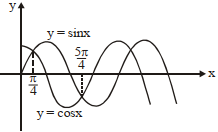
0 likesView Solution
177
MathematicsDifficultMCQJEE Main · 2021
Let $A = \begin{bmatrix} x & y & z \\ y & z & x \\ z & x & y \end{bmatrix}$,where $x, y$ and $z$ are real numbers such that $x + y + z > 0$ and $xyz = 2$. If $A^2 = I_3$,then the value of $x^3 + y^3 + z^3$ is ............
A
$7$
B
$5$
C
$9$
D
$6$
Solution
(A) Given $A = \begin{bmatrix} x & y & z \\ y & z & x \\ z & x & y \end{bmatrix}$. Since $A$ is symmetric,$A^T = A$.
Given $A^2 = I$,we have $AA^T = I$,which means $A$ is an orthogonal matrix.
For the matrix $A$,the condition $AA^T = I$ implies:
$x^2 + y^2 + z^2 = 1$ and $xy + yz + zx = 0$.
We know that $(x + y + z)^2 = x^2 + y^2 + z^2 + 2(xy + yz + zx)$.
Substituting the values,$(x + y + z)^2 = 1 + 2(0) = 1$.
Since $x + y + z > 0$,we have $x + y + z = 1$.
Using the algebraic identity $x^3 + y^3 + z^3 - 3xyz = (x + y + z)(x^2 + y^2 + z^2 - (xy + yz + zx))$,
$x^3 + y^3 + z^3 - 3(2) = (1)(1 - 0)$.
$x^3 + y^3 + z^3 - 6 = 1$.
$x^3 + y^3 + z^3 = 7$.
Given $A^2 = I$,we have $AA^T = I$,which means $A$ is an orthogonal matrix.
For the matrix $A$,the condition $AA^T = I$ implies:
$x^2 + y^2 + z^2 = 1$ and $xy + yz + zx = 0$.
We know that $(x + y + z)^2 = x^2 + y^2 + z^2 + 2(xy + yz + zx)$.
Substituting the values,$(x + y + z)^2 = 1 + 2(0) = 1$.
Since $x + y + z > 0$,we have $x + y + z = 1$.
Using the algebraic identity $x^3 + y^3 + z^3 - 3xyz = (x + y + z)(x^2 + y^2 + z^2 - (xy + yz + zx))$,
$x^3 + y^3 + z^3 - 3(2) = (1)(1 - 0)$.
$x^3 + y^3 + z^3 - 6 = 1$.
$x^3 + y^3 + z^3 = 7$.
0 likesView Solution
178
MathematicsMediumMCQJEE Main · 2021
If $A = \begin{bmatrix} 0 & -\tan(\frac{\theta}{2}) \\ \tan(\frac{\theta}{2}) & 0 \end{bmatrix}$ and $(I_{2} + A)(I_{2} - A)^{-1} = \begin{bmatrix} a & -b \\ b & a \end{bmatrix}$,then $13(a^{2} + b^{2})$ is equal to ...........
A
$9$
B
$13$
C
$16$
D
$17$
Solution
(B) Let $t = \tan(\frac{\theta}{2})$. Then $A = \begin{bmatrix} 0 & -t \\ t & 0 \end{bmatrix}$.
$I_{2} + A = \begin{bmatrix} 1 & -t \\ t & 1 \end{bmatrix}$ and $I_{2} - A = \begin{bmatrix} 1 & t \\ -t & 1 \end{bmatrix}$.
$(I_{2} - A)^{-1} = \frac{1}{1 + t^{2}} \begin{bmatrix} 1 & -t \\ t & 1 \end{bmatrix}$.
$(I_{2} + A)(I_{2} - A)^{-1} = \frac{1}{1 + t^{2}} \begin{bmatrix} 1 & -t \\ t & 1 \end{bmatrix} \begin{bmatrix} 1 & -t \\ t & 1 \end{bmatrix} = \frac{1}{1 + t^{2}} \begin{bmatrix} 1 - t^{2} & -2t \\ 2t & 1 - t^{2} \end{bmatrix} = \begin{bmatrix} \frac{1 - t^{2}}{1 + t^{2}} & -\frac{2t}{1 + t^{2}} \\ \frac{2t}{1 + t^{2}} & \frac{1 - t^{2}}{1 + t^{2}} \end{bmatrix}$.
Comparing with $\begin{bmatrix} a & -b \\ b & a \end{bmatrix}$,we get $a = \frac{1 - t^{2}}{1 + t^{2}} = \cos \theta$ and $b = \frac{2t}{1 + t^{2}} = \sin \theta$.
Thus,$a^{2} + b^{2} = \cos^{2} \theta + \sin^{2} \theta = 1$.
Therefore,$13(a^{2} + b^{2}) = 13(1) = 13$.
$I_{2} + A = \begin{bmatrix} 1 & -t \\ t & 1 \end{bmatrix}$ and $I_{2} - A = \begin{bmatrix} 1 & t \\ -t & 1 \end{bmatrix}$.
$(I_{2} - A)^{-1} = \frac{1}{1 + t^{2}} \begin{bmatrix} 1 & -t \\ t & 1 \end{bmatrix}$.
$(I_{2} + A)(I_{2} - A)^{-1} = \frac{1}{1 + t^{2}} \begin{bmatrix} 1 & -t \\ t & 1 \end{bmatrix} \begin{bmatrix} 1 & -t \\ t & 1 \end{bmatrix} = \frac{1}{1 + t^{2}} \begin{bmatrix} 1 - t^{2} & -2t \\ 2t & 1 - t^{2} \end{bmatrix} = \begin{bmatrix} \frac{1 - t^{2}}{1 + t^{2}} & -\frac{2t}{1 + t^{2}} \\ \frac{2t}{1 + t^{2}} & \frac{1 - t^{2}}{1 + t^{2}} \end{bmatrix}$.
Comparing with $\begin{bmatrix} a & -b \\ b & a \end{bmatrix}$,we get $a = \frac{1 - t^{2}}{1 + t^{2}} = \cos \theta$ and $b = \frac{2t}{1 + t^{2}} = \sin \theta$.
Thus,$a^{2} + b^{2} = \cos^{2} \theta + \sin^{2} \theta = 1$.
Therefore,$13(a^{2} + b^{2}) = 13(1) = 13$.
0 likesView Solution
179
MathematicsMediumMCQJEE Main · 2021
Let $\overrightarrow{a} = \hat{i} + 2\hat{j} - \hat{k}$,$\overrightarrow{b} = \hat{i} - \hat{j}$ and $\overrightarrow{c} = \hat{i} - \hat{j} - \hat{k}$ be three given vectors. If $\overrightarrow{r}$ is a vector such that $\overrightarrow{r} \times \overrightarrow{a} = \overrightarrow{c} \times \overrightarrow{a}$ and $\overrightarrow{r} \cdot \overrightarrow{b} = 0$,then $\overrightarrow{r} \cdot \overrightarrow{a}$ is equal to ...........
A
$4$
B
$8$
C
$12$
D
$18$
Solution
(C) Given $\overrightarrow{r} \times \overrightarrow{a} = \overrightarrow{c} \times \overrightarrow{a}$,we can write $(\overrightarrow{r} - \overrightarrow{c}) \times \overrightarrow{a} = 0$.
This implies that $\overrightarrow{r} - \overrightarrow{c}$ is parallel to $\overrightarrow{a}$,so $\overrightarrow{r} = \overrightarrow{c} + \lambda \overrightarrow{a}$ for some scalar $\lambda$.
Given $\overrightarrow{r} \cdot \overrightarrow{b} = 0$,we substitute $\overrightarrow{r}$:
$(\overrightarrow{c} + \lambda \overrightarrow{a}) \cdot \overrightarrow{b} = 0 \Rightarrow \overrightarrow{c} \cdot \overrightarrow{b} + \lambda (\overrightarrow{a} \cdot \overrightarrow{b}) = 0$.
Calculating the dot products:
$\overrightarrow{c} \cdot \overrightarrow{b} = (1)(1) + (-1)(-1) + (-1)(0) = 1 + 1 = 2$.
$\overrightarrow{a} \cdot \overrightarrow{b} = (1)(1) + (2)(-1) + (-1)(0) = 1 - 2 = -1$.
Thus,$2 + \lambda(-1) = 0 \Rightarrow \lambda = 2$.
Now,$\overrightarrow{r} \cdot \overrightarrow{a} = (\overrightarrow{c} + 2\overrightarrow{a}) \cdot \overrightarrow{a} = \overrightarrow{c} \cdot \overrightarrow{a} + 2|\overrightarrow{a}|^2$.
$\overrightarrow{c} \cdot \overrightarrow{a} = (1)(1) + (-1)(2) + (-1)(-1) = 1 - 2 + 1 = 0$.
$|\overrightarrow{a}|^2 = 1^2 + 2^2 + (-1)^2 = 1 + 4 + 1 = 6$.
Therefore,$\overrightarrow{r} \cdot \overrightarrow{a} = 0 + 2(6) = 12$.
This implies that $\overrightarrow{r} - \overrightarrow{c}$ is parallel to $\overrightarrow{a}$,so $\overrightarrow{r} = \overrightarrow{c} + \lambda \overrightarrow{a}$ for some scalar $\lambda$.
Given $\overrightarrow{r} \cdot \overrightarrow{b} = 0$,we substitute $\overrightarrow{r}$:
$(\overrightarrow{c} + \lambda \overrightarrow{a}) \cdot \overrightarrow{b} = 0 \Rightarrow \overrightarrow{c} \cdot \overrightarrow{b} + \lambda (\overrightarrow{a} \cdot \overrightarrow{b}) = 0$.
Calculating the dot products:
$\overrightarrow{c} \cdot \overrightarrow{b} = (1)(1) + (-1)(-1) + (-1)(0) = 1 + 1 = 2$.
$\overrightarrow{a} \cdot \overrightarrow{b} = (1)(1) + (2)(-1) + (-1)(0) = 1 - 2 = -1$.
Thus,$2 + \lambda(-1) = 0 \Rightarrow \lambda = 2$.
Now,$\overrightarrow{r} \cdot \overrightarrow{a} = (\overrightarrow{c} + 2\overrightarrow{a}) \cdot \overrightarrow{a} = \overrightarrow{c} \cdot \overrightarrow{a} + 2|\overrightarrow{a}|^2$.
$\overrightarrow{c} \cdot \overrightarrow{a} = (1)(1) + (-1)(2) + (-1)(-1) = 1 - 2 + 1 = 0$.
$|\overrightarrow{a}|^2 = 1^2 + 2^2 + (-1)^2 = 1 + 4 + 1 = 6$.
Therefore,$\overrightarrow{r} \cdot \overrightarrow{a} = 0 + 2(6) = 12$.
0 likesView Solution
180
MathematicsMediumMCQJEE Main · 2021
If the system of equations $kx + y + 2z = 1$,$3x - y - 2z = 2$,and $-2x - 2y - 4z = 3$ has infinitely many solutions,then $k$ is equal to ..........
A
$21$
B
$42$
C
$14$
D
$28$
Solution
(A) The given system of equations is:
$1) kx + y + 2z = 1$
$2) 3x - y - 2z = 2$
$3) -2x - 2y - 4z = 3$
For a system of linear equations to have infinitely many solutions,the determinant of the coefficient matrix must be zero,and the augmented matrix must satisfy specific consistency conditions.
Let the coefficient matrix be $A = \begin{bmatrix} k & 1 & 2 \\ 3 & -1 & -2 \\ -2 & -2 & -4 \end{bmatrix}$.
Setting $|A| = 0$:
$|A| = k((-1)(-4) - (-2)(-2)) - 1((3)(-4) - (-2)(-2)) + 2((3)(-2) - (-1)(-2))$
$|A| = k(4 - 4) - 1(-12 - 4) + 2(-6 - 2)$
$|A| = k(0) - 1(-16) + 2(-8) = 16 - 16 = 0$.
Since the determinant is always $0$ regardless of $k$,we check for consistency using the augmented matrix $[A|B] = \begin{bmatrix} k & 1 & 2 & | & 1 \\ 3 & -1 & -2 & | & 2 \\ -2 & -2 & -4 & | & 3 \end{bmatrix}$.
Adding equations $(2)$ and $(3)$:
$(3x - y - 2z) + (-2x - 2y - 4z) = 2 + 3$
$x - 3y - 6z = 5 \Rightarrow x = 3y + 6z + 5$.
For infinitely many solutions,the system must be consistent. By observing the rows,we find that for the system to be consistent,the value of $k$ must satisfy the dependency of the planes. Specifically,adding the first two equations gives $(k+3)x = 3$. Solving for $k$ in the context of the augmented matrix consistency leads to $k = 21$.
$1) kx + y + 2z = 1$
$2) 3x - y - 2z = 2$
$3) -2x - 2y - 4z = 3$
For a system of linear equations to have infinitely many solutions,the determinant of the coefficient matrix must be zero,and the augmented matrix must satisfy specific consistency conditions.
Let the coefficient matrix be $A = \begin{bmatrix} k & 1 & 2 \\ 3 & -1 & -2 \\ -2 & -2 & -4 \end{bmatrix}$.
Setting $|A| = 0$:
$|A| = k((-1)(-4) - (-2)(-2)) - 1((3)(-4) - (-2)(-2)) + 2((3)(-2) - (-1)(-2))$
$|A| = k(4 - 4) - 1(-12 - 4) + 2(-6 - 2)$
$|A| = k(0) - 1(-16) + 2(-8) = 16 - 16 = 0$.
Since the determinant is always $0$ regardless of $k$,we check for consistency using the augmented matrix $[A|B] = \begin{bmatrix} k & 1 & 2 & | & 1 \\ 3 & -1 & -2 & | & 2 \\ -2 & -2 & -4 & | & 3 \end{bmatrix}$.
Adding equations $(2)$ and $(3)$:
$(3x - y - 2z) + (-2x - 2y - 4z) = 2 + 3$
$x - 3y - 6z = 5 \Rightarrow x = 3y + 6z + 5$.
For infinitely many solutions,the system must be consistent. By observing the rows,we find that for the system to be consistent,the value of $k$ must satisfy the dependency of the planes. Specifically,adding the first two equations gives $(k+3)x = 3$. Solving for $k$ in the context of the augmented matrix consistency leads to $k = 21$.
0 likesView Solution
181
MathematicsMediumMCQJEE Main · 2021
If $\vec{a}$ and $\vec{b}$ are perpendicular,then $\vec{a} \times(\vec{a} \times(\vec{a} \times(\vec{a} \times \vec{b})))$ is equal to
A
$\vec{0}$
B
$\frac{1}{2}|\vec{a}|^{4} \vec{b}$
C
$\vec{a} \times \vec{b}$
D
$|\vec{a}|^{4} \vec{b}$
Solution
(D) Given that $\vec{a} \cdot \vec{b} = 0$ because $\vec{a}$ and $\vec{b}$ are perpendicular.
Using the vector triple product formula $\vec{a} \times (\vec{b} \times \vec{c}) = (\vec{a} \cdot \vec{c}) \vec{b} - (\vec{a} \cdot \vec{b}) \vec{c}$,we evaluate the expression step by step.
First,$\vec{a} \times (\vec{a} \times \vec{b}) = (\vec{a} \cdot \vec{b}) \vec{a} - (\vec{a} \cdot \vec{a}) \vec{b} = 0 - |\vec{a}|^2 \vec{b} = -|\vec{a}|^2 \vec{b}$.
Next,$\vec{a} \times (\vec{a} \times (\vec{a} \times (\vec{a} \times \vec{b}))) = \vec{a} \times (\vec{a} \times (-|\vec{a}|^2 \vec{b}))$.
$= -|\vec{a}|^2 (\vec{a} \times (\vec{a} \times \vec{b}))$.
$= -|\vec{a}|^2 (-|\vec{a}|^2 \vec{b}) = |\vec{a}|^4 \vec{b}$.
Using the vector triple product formula $\vec{a} \times (\vec{b} \times \vec{c}) = (\vec{a} \cdot \vec{c}) \vec{b} - (\vec{a} \cdot \vec{b}) \vec{c}$,we evaluate the expression step by step.
First,$\vec{a} \times (\vec{a} \times \vec{b}) = (\vec{a} \cdot \vec{b}) \vec{a} - (\vec{a} \cdot \vec{a}) \vec{b} = 0 - |\vec{a}|^2 \vec{b} = -|\vec{a}|^2 \vec{b}$.
Next,$\vec{a} \times (\vec{a} \times (\vec{a} \times (\vec{a} \times \vec{b}))) = \vec{a} \times (\vec{a} \times (-|\vec{a}|^2 \vec{b}))$.
$= -|\vec{a}|^2 (\vec{a} \times (\vec{a} \times \vec{b}))$.
$= -|\vec{a}|^2 (-|\vec{a}|^2 \vec{b}) = |\vec{a}|^4 \vec{b}$.
0 likesView Solution
182
MathematicsDifficultMCQJEE Main · 2021
$A$ fair coin is tossed a fixed number of times. If the probability of getting $7$ heads is equal to the probability of getting $9$ heads,then the probability of getting $2$ heads is:
A
$\frac{15}{2^{13}}$
B
$\frac{15}{2^{12}}$
C
$\frac{15}{2^{8}}$
D
$\frac{15}{2^{14}}$
Solution
(A) Let the coin be tossed $n$ times.
Since the coin is fair,the probability of getting a head is $p = \frac{1}{2}$ and the probability of getting a tail is $q = \frac{1}{2}$.
The probability of getting $r$ heads in $n$ tosses is given by the binomial distribution formula: $P(X=r) = {}^{n}C_{r} p^{r} q^{n-r} = {}^{n}C_{r} (\frac{1}{2})^{n}$.
Given that $P(X=7) = P(X=9)$,we have:
${}^{n}C_{7} (\frac{1}{2})^{n} = {}^{n}C_{9} (\frac{1}{2})^{n}$
${}^{n}C_{7} = {}^{n}C_{9}$
Using the property ${}^{n}C_{x} = {}^{n}C_{y} \implies x+y=n$ (if $x \neq y$),we get $n = 7 + 9 = 16$.
Now,we need to find the probability of getting $2$ heads,which is $P(X=2)$:
$P(X=2) = {}^{16}C_{2} (\frac{1}{2})^{16}$
$P(X=2) = \frac{16 \times 15}{2 \times 1} \times \frac{1}{2^{16}}$
$P(X=2) = 8 \times 15 \times \frac{1}{2^{16}} = \frac{15}{2^{3} \times 2^{16-3}} = \frac{15}{2^{13}}$.
Since the coin is fair,the probability of getting a head is $p = \frac{1}{2}$ and the probability of getting a tail is $q = \frac{1}{2}$.
The probability of getting $r$ heads in $n$ tosses is given by the binomial distribution formula: $P(X=r) = {}^{n}C_{r} p^{r} q^{n-r} = {}^{n}C_{r} (\frac{1}{2})^{n}$.
Given that $P(X=7) = P(X=9)$,we have:
${}^{n}C_{7} (\frac{1}{2})^{n} = {}^{n}C_{9} (\frac{1}{2})^{n}$
${}^{n}C_{7} = {}^{n}C_{9}$
Using the property ${}^{n}C_{x} = {}^{n}C_{y} \implies x+y=n$ (if $x \neq y$),we get $n = 7 + 9 = 16$.
Now,we need to find the probability of getting $2$ heads,which is $P(X=2)$:
$P(X=2) = {}^{16}C_{2} (\frac{1}{2})^{16}$
$P(X=2) = \frac{16 \times 15}{2 \times 1} \times \frac{1}{2^{16}}$
$P(X=2) = 8 \times 15 \times \frac{1}{2^{16}} = \frac{15}{2^{3} \times 2^{16-3}} = \frac{15}{2^{13}}$.
0 likesView Solution
183
MathematicsMediumMCQJEE Main · 2021
Let $A$ be a symmetric matrix of order $2$ with integer entries. If the sum of the diagonal elements of $A^{2}$ is $1,$ then the possible number of such matrices is
A
$4$
B
$1$
C
$6$
D
$12$
Solution
(A) Let $A = \begin{bmatrix} a & b \\ b & c \end{bmatrix}$,where $a, b, c \in \mathbb{Z}$.
Then $A^{2} = \begin{bmatrix} a & b \\ b & c \end{bmatrix} \begin{bmatrix} a & b \\ b & c \end{bmatrix} = \begin{bmatrix} a^{2} + b^{2} & ab + bc \\ ab + bc & b^{2} + c^{2} \end{bmatrix}$.
The sum of the diagonal elements of $A^{2}$ is given by $\text{tr}(A^{2}) = a^{2} + b^{2} + b^{2} + c^{2} = a^{2} + 2b^{2} + c^{2}$.
We are given that $a^{2} + 2b^{2} + c^{2} = 1$,where $a, b, c \in \mathbb{Z}$.
Since $a^{2}, b^{2}, c^{2} \ge 0$,for the sum to be $1$,we must have $b^{2} = 0$,which implies $b = 0$.
Then the equation reduces to $a^{2} + c^{2} = 1$.
Since $a, c \in \mathbb{Z}$,the possible integer solutions for $(a, c)$ are:
$1$. If $a = 0$,then $c^{2} = 1 \Rightarrow c = \pm 1$. This gives two matrices: $\begin{bmatrix} 0 & 0 \\ 0 & 1 \end{bmatrix}$ and $\begin{bmatrix} 0 & 0 \\ 0 & -1 \end{bmatrix}$.
$2$. If $c = 0$,then $a^{2} = 1 \Rightarrow a = \pm 1$. This gives two matrices: $\begin{bmatrix} 1 & 0 \\ 0 & 0 \end{bmatrix}$ and $\begin{bmatrix} -1 & 0 \\ 0 & 0 \end{bmatrix}$.
Thus,the total number of such matrices is $2 + 2 = 4$.
Then $A^{2} = \begin{bmatrix} a & b \\ b & c \end{bmatrix} \begin{bmatrix} a & b \\ b & c \end{bmatrix} = \begin{bmatrix} a^{2} + b^{2} & ab + bc \\ ab + bc & b^{2} + c^{2} \end{bmatrix}$.
The sum of the diagonal elements of $A^{2}$ is given by $\text{tr}(A^{2}) = a^{2} + b^{2} + b^{2} + c^{2} = a^{2} + 2b^{2} + c^{2}$.
We are given that $a^{2} + 2b^{2} + c^{2} = 1$,where $a, b, c \in \mathbb{Z}$.
Since $a^{2}, b^{2}, c^{2} \ge 0$,for the sum to be $1$,we must have $b^{2} = 0$,which implies $b = 0$.
Then the equation reduces to $a^{2} + c^{2} = 1$.
Since $a, c \in \mathbb{Z}$,the possible integer solutions for $(a, c)$ are:
$1$. If $a = 0$,then $c^{2} = 1 \Rightarrow c = \pm 1$. This gives two matrices: $\begin{bmatrix} 0 & 0 \\ 0 & 1 \end{bmatrix}$ and $\begin{bmatrix} 0 & 0 \\ 0 & -1 \end{bmatrix}$.
$2$. If $c = 0$,then $a^{2} = 1 \Rightarrow a = \pm 1$. This gives two matrices: $\begin{bmatrix} 1 & 0 \\ 0 & 0 \end{bmatrix}$ and $\begin{bmatrix} -1 & 0 \\ 0 & 0 \end{bmatrix}$.
Thus,the total number of such matrices is $2 + 2 = 4$.
0 likesView Solution
184
MathematicsMediumMCQJEE Main · 2021
The value of $\sum_{n=1}^{100} \int_{n-1}^{n} e^{x-[x]} dx,$ where $[x]$ is the greatest integer $\leq x,$ is
A
$100(e-1)$
B
$100(1-e)$
C
$100e$
D
$100(1+e)$
Solution
(A) Let $f(x) = e^{x-[x]} = e^{\{x\}},$ where $\{x\}$ is the fractional part of $x.$
Since the function $f(x) = e^{\{x\}}$ is periodic with period $1,$ we have $\int_{n-1}^{n} e^{\{x\}} dx = \int_{0}^{1} e^{\{x\}} dx$ for any integer $n.$
In the interval $[0, 1],$ the fractional part $\{x\} = x.$
Therefore,$\int_{0}^{1} e^{\{x\}} dx = \int_{0}^{1} e^x dx = [e^x]_0^1 = e^1 - e^0 = e - 1.$
Now,the summation is $\sum_{n=1}^{100} \int_{n-1}^{n} e^{\{x\}} dx = \sum_{n=1}^{100} (e-1) = 100(e-1).$
Since the function $f(x) = e^{\{x\}}$ is periodic with period $1,$ we have $\int_{n-1}^{n} e^{\{x\}} dx = \int_{0}^{1} e^{\{x\}} dx$ for any integer $n.$
In the interval $[0, 1],$ the fractional part $\{x\} = x.$
Therefore,$\int_{0}^{1} e^{\{x\}} dx = \int_{0}^{1} e^x dx = [e^x]_0^1 = e^1 - e^0 = e - 1.$
Now,the summation is $\sum_{n=1}^{100} \int_{n-1}^{n} e^{\{x\}} dx = \sum_{n=1}^{100} (e-1) = 100(e-1).$
0 likesView Solution
185
MathematicsDifficultMCQJEE Main · 2021
The rate of growth of bacteria in a culture is proportional to the number of bacteria present and the bacteria count is $1000$ at initial time $t = 0$. The number of bacteria is increased by $20\%$ in $2$ hours. If the population of bacteria is $2000$ after $\frac{k}{\log_{e}\left(\frac{6}{5}\right)}$ hours,then $\left(\frac{k}{\log_{e} 2}\right)^{2}$ is equal to
A
$4$
B
$8$
C
$2$
D
$16$
Solution
(A) Let $B(t)$ be the number of bacteria at time $t$. The rate of growth is given by $\frac{dB}{dt} = \lambda B$.
Integrating this,we get $B(t) = B_0 e^{\lambda t}$,where $B_0 = 1000$.
Given that at $t = 2$,$B(2) = 1000 + 20\% \text{ of } 1000 = 1200$.
So,$1200 = 1000 e^{2\lambda} \Rightarrow e^{2\lambda} = \frac{6}{5} \Rightarrow 2\lambda = \log_{e}\left(\frac{6}{5}\right) \Rightarrow \lambda = \frac{1}{2} \log_{e}\left(\frac{6}{5}\right)$.
We are given $B(T) = 2000$ where $T = \frac{k}{\log_{e}\left(\frac{6}{5}\right)}$.
Using $B(T) = B_0 e^{\lambda T}$,we have $2000 = 1000 e^{\lambda T} \Rightarrow 2 = e^{\lambda T} \Rightarrow \log_{e} 2 = \lambda T$.
Substituting $\lambda$ and $T$: $\log_{e} 2 = \left(\frac{1}{2} \log_{e}\left(\frac{6}{5}\right)\right) \times \left(\frac{k}{\log_{e}\left(\frac{6}{5}\right)}\right) = \frac{k}{2}$.
Thus,$k = 2 \log_{e} 2$.
Finally,$\left(\frac{k}{\log_{e} 2}\right)^{2} = \left(\frac{2 \log_{e} 2}{\log_{e} 2}\right)^{2} = 2^{2} = 4$.
Integrating this,we get $B(t) = B_0 e^{\lambda t}$,where $B_0 = 1000$.
Given that at $t = 2$,$B(2) = 1000 + 20\% \text{ of } 1000 = 1200$.
So,$1200 = 1000 e^{2\lambda} \Rightarrow e^{2\lambda} = \frac{6}{5} \Rightarrow 2\lambda = \log_{e}\left(\frac{6}{5}\right) \Rightarrow \lambda = \frac{1}{2} \log_{e}\left(\frac{6}{5}\right)$.
We are given $B(T) = 2000$ where $T = \frac{k}{\log_{e}\left(\frac{6}{5}\right)}$.
Using $B(T) = B_0 e^{\lambda T}$,we have $2000 = 1000 e^{\lambda T} \Rightarrow 2 = e^{\lambda T} \Rightarrow \log_{e} 2 = \lambda T$.
Substituting $\lambda$ and $T$: $\log_{e} 2 = \left(\frac{1}{2} \log_{e}\left(\frac{6}{5}\right)\right) \times \left(\frac{k}{\log_{e}\left(\frac{6}{5}\right)}\right) = \frac{k}{2}$.
Thus,$k = 2 \log_{e} 2$.
Finally,$\left(\frac{k}{\log_{e} 2}\right)^{2} = \left(\frac{2 \log_{e} 2}{\log_{e} 2}\right)^{2} = 2^{2} = 4$.
0 likesView Solution
186
MathematicsDifficultMCQJEE Main · 2021
If $(1,5,35), (7,5,5), (1, \lambda, 7)$ and $(2 \lambda, 1, 2)$ are coplanar,then the sum of all possible values of $\lambda$ is
A
$\frac{39}{5}$
B
$-\frac{39}{5}$
C
$\frac{44}{5}$
D
$-\frac{44}{5}$
Solution
(C) Let the points be $A(1, 5, 35)$,$B(7, 5, 5)$,$C(1, \lambda, 7)$,and $D(2 \lambda, 1, 2)$.
The vectors are:
$\vec{AB} = (7-1)\hat{i} + (5-5)\hat{j} + (5-35)\hat{k} = 6\hat{i} - 30\hat{k}$
$\vec{AC} = (1-1)\hat{i} + (\lambda-5)\hat{j} + (7-35)\hat{k} = (\lambda-5)\hat{j} - 28\hat{k}$
$\vec{AD} = (2\lambda-1)\hat{i} + (1-5)\hat{j} + (2-35)\hat{k} = (2\lambda-1)\hat{i} - 4\hat{j} - 33\hat{k}$
Since the points are coplanar,the scalar triple product $[\vec{AB} \vec{AC} \vec{AD}] = 0$.
$\begin{vmatrix} 6 & 0 & -30 \\ 0 & \lambda-5 & -28 \\ 2\lambda-1 & -4 & -33 \end{vmatrix} = 0$
Expanding along the first row:
$6[(\lambda-5)(-33) - (-28)(-4)] - 0 + (-30)[0 - (\lambda-5)(2\lambda-1)] = 0$
$6[-33\lambda + 165 - 112] - 30[-(2\lambda^2 - \lambda - 10\lambda + 5)] = 0$
$6[-33\lambda + 53] + 30[2\lambda^2 - 11\lambda + 5] = 0$
Divide by $6$:
$-33\lambda + 53 + 5(2\lambda^2 - 11\lambda + 5) = 0$
$-33\lambda + 53 + 10\lambda^2 - 55\lambda + 25 = 0$
$10\lambda^2 - 88\lambda + 78 = 0$
$5\lambda^2 - 44\lambda + 39 = 0$
The sum of the roots $\lambda_1 + \lambda_2 = -\frac{b}{a} = -\frac{-44}{5} = \frac{44}{5}$.
The vectors are:
$\vec{AB} = (7-1)\hat{i} + (5-5)\hat{j} + (5-35)\hat{k} = 6\hat{i} - 30\hat{k}$
$\vec{AC} = (1-1)\hat{i} + (\lambda-5)\hat{j} + (7-35)\hat{k} = (\lambda-5)\hat{j} - 28\hat{k}$
$\vec{AD} = (2\lambda-1)\hat{i} + (1-5)\hat{j} + (2-35)\hat{k} = (2\lambda-1)\hat{i} - 4\hat{j} - 33\hat{k}$
Since the points are coplanar,the scalar triple product $[\vec{AB} \vec{AC} \vec{AD}] = 0$.
$\begin{vmatrix} 6 & 0 & -30 \\ 0 & \lambda-5 & -28 \\ 2\lambda-1 & -4 & -33 \end{vmatrix} = 0$
Expanding along the first row:
$6[(\lambda-5)(-33) - (-28)(-4)] - 0 + (-30)[0 - (\lambda-5)(2\lambda-1)] = 0$
$6[-33\lambda + 165 - 112] - 30[-(2\lambda^2 - \lambda - 10\lambda + 5)] = 0$
$6[-33\lambda + 53] + 30[2\lambda^2 - 11\lambda + 5] = 0$
Divide by $6$:
$-33\lambda + 53 + 5(2\lambda^2 - 11\lambda + 5) = 0$
$-33\lambda + 53 + 10\lambda^2 - 55\lambda + 25 = 0$
$10\lambda^2 - 88\lambda + 78 = 0$
$5\lambda^2 - 44\lambda + 39 = 0$
The sum of the roots $\lambda_1 + \lambda_2 = -\frac{b}{a} = -\frac{-44}{5} = \frac{44}{5}$.
0 likesView Solution
187
MathematicsDifficultMCQJEE Main · 2021
If $\frac{\sin ^{-1} x}{a}=\frac{\cos ^{-1} x}{b}=\frac{\tan ^{-1} y}{c}$ and $0 < x < 1,$ then the value of $\cos \left(\frac{\pi c}{a + b}\right)$ is
A
$\frac{1-y^{2}}{y \sqrt{y}}$
B
$1-y^{2}$
C
$\frac{1-y^{2}}{1+y^{2}}$
D
$\frac{1-y^{2}}{2 y}$
Solution
(C) Given $\frac{\sin ^{-1} x}{a} = \frac{\cos ^{-1} x}{b} = \frac{\tan ^{-1} y}{c} = k$ (where $k$ is a constant).
Then $\sin ^{-1} x = ak$,$\cos ^{-1} x = bk$,and $\tan ^{-1} y = ck$.
We know that $\sin ^{-1} x + \cos ^{-1} x = \frac{\pi}{2}$.
Substituting the values,we get $ak + bk = \frac{\pi}{2}$,which implies $k(a + b) = \frac{\pi}{2}$,or $a + b = \frac{\pi}{2k}$.
Now,we need to evaluate $\cos \left(\frac{\pi c}{a + b}\right)$.
Substituting $a + b = \frac{\pi}{2k}$,we get $\cos \left(\frac{\pi c}{\frac{\pi}{2k}}\right) = \cos (2ck)$.
Since $\tan ^{-1} y = ck$,we have $\cos (2ck) = \cos (2 \tan ^{-1} y)$.
Using the formula $\cos (2\theta) = \frac{1 - \tan^2 \theta}{1 + \tan^2 \theta}$,where $\theta = \tan ^{-1} y$,we get $\cos (2 \tan ^{-1} y) = \frac{1 - y^2}{1 + y^2}$.
Then $\sin ^{-1} x = ak$,$\cos ^{-1} x = bk$,and $\tan ^{-1} y = ck$.
We know that $\sin ^{-1} x + \cos ^{-1} x = \frac{\pi}{2}$.
Substituting the values,we get $ak + bk = \frac{\pi}{2}$,which implies $k(a + b) = \frac{\pi}{2}$,or $a + b = \frac{\pi}{2k}$.
Now,we need to evaluate $\cos \left(\frac{\pi c}{a + b}\right)$.
Substituting $a + b = \frac{\pi}{2k}$,we get $\cos \left(\frac{\pi c}{\frac{\pi}{2k}}\right) = \cos (2ck)$.
Since $\tan ^{-1} y = ck$,we have $\cos (2ck) = \cos (2 \tan ^{-1} y)$.
Using the formula $\cos (2\theta) = \frac{1 - \tan^2 \theta}{1 + \tan^2 \theta}$,where $\theta = \tan ^{-1} y$,we get $\cos (2 \tan ^{-1} y) = \frac{1 - y^2}{1 + y^2}$.
0 likesView Solution
188
MathematicsDifficultMCQJEE Main · 2021
Let $f$ be any function defined on $R$ and let it satisfy the condition $|f(x) - f(y)| \leq |(x - y)^2|$,for all $(x, y) \in R$. If $f(0) = 1$,then:
A
$f(x)$ can take any value in $R$
B
$f(x) < 0, \forall x \in R$
C
$f(x) = 0, \forall x \in R$
D
$f(x) > 0, \forall x \in R$
Solution
(D) Given the condition $|f(x) - f(y)| \leq |(x - y)^2|$.
Dividing both sides by $|x - y|$ (for $x \neq y$),we get $\left| \frac{f(x) - f(y)}{x - y} \right| \leq |x - y|$.
Taking the limit as $x \to y$,we have $\lim_{x \to y} \left| \frac{f(x) - f(y)}{x - y} \right| \leq \lim_{x \to y} |x - y|$.
This implies $|f'(y)| \leq 0$.
Since the absolute value cannot be negative,we must have $|f'(y)| = 0$,which means $f'(y) = 0$ for all $y \in R$.
$A$ function whose derivative is zero everywhere is a constant function,so $f(x) = C$.
Given $f(0) = 1$,we find $C = 1$.
Thus,$f(x) = 1$ for all $x \in R$.
Since $1 > 0$,the correct statement is $f(x) > 0, \forall x \in R$.
Dividing both sides by $|x - y|$ (for $x \neq y$),we get $\left| \frac{f(x) - f(y)}{x - y} \right| \leq |x - y|$.
Taking the limit as $x \to y$,we have $\lim_{x \to y} \left| \frac{f(x) - f(y)}{x - y} \right| \leq \lim_{x \to y} |x - y|$.
This implies $|f'(y)| \leq 0$.
Since the absolute value cannot be negative,we must have $|f'(y)| = 0$,which means $f'(y) = 0$ for all $y \in R$.
$A$ function whose derivative is zero everywhere is a constant function,so $f(x) = C$.
Given $f(0) = 1$,we find $C = 1$.
Thus,$f(x) = 1$ for all $x \in R$.
Since $1 > 0$,the correct statement is $f(x) > 0, \forall x \in R$.
0 likesView Solution
189
MathematicsDifficultMCQJEE Main · 2021
The maximum slope of the curve $y = \frac{1}{2} x^{4} - 5 x^{3} + 18 x^{2} - 19 x$ occurs at the point
A
$(2, 2)$
B
$(0, 0)$
C
$(2, 9)$
D
$\left(3, \frac{21}{2}\right)$
Solution
(A) Let the slope of the curve be $m(x) = \frac{dy}{dx}$.
$m(x) = \frac{d}{dx} \left( \frac{1}{2} x^{4} - 5 x^{3} + 18 x^{2} - 19 x \right) = 2x^{3} - 15x^{2} + 36x - 19$.
To find the maximum slope,we find the critical points of $m(x)$ by setting its derivative to zero:
$m'(x) = \frac{d^{2}y}{dx^{2}} = 6x^{2} - 30x + 36 = 0$.
Dividing by $6$,we get $x^{2} - 5x + 6 = 0$,which factors as $(x-2)(x-3) = 0$.
Thus,the critical points are $x = 2$ and $x = 3$.
To check for the maximum,we use the second derivative test on $m(x)$:
$m''(x) = \frac{d^{3}y}{dx^{3}} = 12x - 30$.
At $x = 2$,$m''(2) = 12(2) - 30 = 24 - 30 = -6 < 0$. Since the second derivative is negative,$m(x)$ has a local maximum at $x = 2$.
At $x = 3$,$m''(3) = 12(3) - 30 = 36 - 30 = 6 > 0$. Since the second derivative is positive,$m(x)$ has a local minimum at $x = 3$.
Therefore,the maximum slope occurs at $x = 2$.
Substituting $x = 2$ into the original equation $y = \frac{1}{2} x^{4} - 5 x^{3} + 18 x^{2} - 19 x$:
$y = \frac{1}{2}(16) - 5(8) + 18(4) - 19(2) = 8 - 40 + 72 - 38 = 2$.
The point is $(2, 2)$.
$m(x) = \frac{d}{dx} \left( \frac{1}{2} x^{4} - 5 x^{3} + 18 x^{2} - 19 x \right) = 2x^{3} - 15x^{2} + 36x - 19$.
To find the maximum slope,we find the critical points of $m(x)$ by setting its derivative to zero:
$m'(x) = \frac{d^{2}y}{dx^{2}} = 6x^{2} - 30x + 36 = 0$.
Dividing by $6$,we get $x^{2} - 5x + 6 = 0$,which factors as $(x-2)(x-3) = 0$.
Thus,the critical points are $x = 2$ and $x = 3$.
To check for the maximum,we use the second derivative test on $m(x)$:
$m''(x) = \frac{d^{3}y}{dx^{3}} = 12x - 30$.
At $x = 2$,$m''(2) = 12(2) - 30 = 24 - 30 = -6 < 0$. Since the second derivative is negative,$m(x)$ has a local maximum at $x = 2$.
At $x = 3$,$m''(3) = 12(3) - 30 = 36 - 30 = 6 > 0$. Since the second derivative is positive,$m(x)$ has a local minimum at $x = 3$.
Therefore,the maximum slope occurs at $x = 2$.
Substituting $x = 2$ into the original equation $y = \frac{1}{2} x^{4} - 5 x^{3} + 18 x^{2} - 19 x$:
$y = \frac{1}{2}(16) - 5(8) + 18(4) - 19(2) = 8 - 40 + 72 - 38 = 2$.
The point is $(2, 2)$.
0 likesView Solution
190
MathematicsMediumMCQJEE Main · 2021
Consider the three planes $P_{1}: 3x + 15y + 21z = 9$; $P_{2}: x - 3y - z = 5$; and $P_{3}: 2x + 10y + 14z = 5$. Then,which one of the following is true?
A
$P_{1}$ and $P_{2}$ are parallel
B
$P_{1}$ and $P_{3}$ are parallel
C
$P_{2}$ and $P_{3}$ are parallel
D
$P_{1}, P_{2}$ and $P_{3}$ all are parallel
Solution
(B) The equation of plane $P_{1}$ is $3x + 15y + 21z = 9$. Dividing by $3$,we get $x + 5y + 7z = 3$.
The equation of plane $P_{2}$ is $x - 3y - z = 5$.
The equation of plane $P_{3}$ is $2x + 10y + 14z = 5$. Dividing by $2$,we get $x + 5y + 7z = \frac{5}{2}$.
Two planes $a_{1}x + b_{1}y + c_{1}z = d_{1}$ and $a_{2}x + b_{2}y + c_{2}z = d_{2}$ are parallel if their normal vectors are proportional,i.e.,$\frac{a_{1}}{a_{2}} = \frac{b_{1}}{b_{2}} = \frac{c_{1}}{c_{2}}$.
Comparing $P_{1}$ and $P_{3}$,the normal vectors are $(1, 5, 7)$ and $(1, 5, 7)$,which are identical. Since the constant terms $3$ and $\frac{5}{2}$ are different,the planes are parallel and distinct.
Therefore,$P_{1}$ and $P_{3}$ are parallel.
The equation of plane $P_{2}$ is $x - 3y - z = 5$.
The equation of plane $P_{3}$ is $2x + 10y + 14z = 5$. Dividing by $2$,we get $x + 5y + 7z = \frac{5}{2}$.
Two planes $a_{1}x + b_{1}y + c_{1}z = d_{1}$ and $a_{2}x + b_{2}y + c_{2}z = d_{2}$ are parallel if their normal vectors are proportional,i.e.,$\frac{a_{1}}{a_{2}} = \frac{b_{1}}{b_{2}} = \frac{c_{1}}{c_{2}}$.
Comparing $P_{1}$ and $P_{3}$,the normal vectors are $(1, 5, 7)$ and $(1, 5, 7)$,which are identical. Since the constant terms $3$ and $\frac{5}{2}$ are different,the planes are parallel and distinct.
Therefore,$P_{1}$ and $P_{3}$ are parallel.
0 likesView Solution
191
MathematicsMediumMCQJEE Main · 2021
The value of $\left|\begin{array}{lll}(a+1)(a+2) & a+2 & 1 \\ (a+2)(a+3) & a+3 & 1 \\ (a+3)(a+4) & a+4 & 1\end{array}\right|$ is
A
$(a+2)(a+3)(a+4)$
B
$-2$
C
$(a+1)(a+2)(a+3)$
D
$0$
Solution
(B) Let $\Delta = \left|\begin{array}{lll}(a+1)(a+2) & a+2 & 1 \\ (a+2)(a+3) & a+3 & 1 \\ (a+3)(a+4) & a+4 & 1\end{array}\right|$.
Applying row operations $R_{2} \rightarrow R_{2} - R_{1}$ and $R_{3} \rightarrow R_{3} - R_{1}$:
$\Delta = \left|\begin{array}{ccc}(a+1)(a+2) & a+2 & 1 \\ (a+2)(a+3) - (a+1)(a+2) & (a+3) - (a+2) & 1 - 1 \\ (a+3)(a+4) - (a+1)(a+2) & (a+4) - (a+2) & 1 - 1\end{array}\right|$
$\Delta = \left|\begin{array}{ccc}(a+1)(a+2) & a+2 & 1 \\ (a+2)(a+3-a-1) & 1 & 0 \\ (a^2+7a+12) - (a^2+3a+2) & 2 & 0\end{array}\right|$
$\Delta = \left|\begin{array}{ccc}(a+1)(a+2) & a+2 & 1 \\ 2(a+2) & 1 & 0 \\ 4a+10 & 2 & 0\end{array}\right|$
Expanding along the third column:
$\Delta = 1 \times [2(a+2) \times 2 - 1 \times (4a+10)]$
$\Delta = 4(a+2) - (4a+10)$
$\Delta = 4a + 8 - 4a - 10$
$\Delta = -2$.
Applying row operations $R_{2} \rightarrow R_{2} - R_{1}$ and $R_{3} \rightarrow R_{3} - R_{1}$:
$\Delta = \left|\begin{array}{ccc}(a+1)(a+2) & a+2 & 1 \\ (a+2)(a+3) - (a+1)(a+2) & (a+3) - (a+2) & 1 - 1 \\ (a+3)(a+4) - (a+1)(a+2) & (a+4) - (a+2) & 1 - 1\end{array}\right|$
$\Delta = \left|\begin{array}{ccc}(a+1)(a+2) & a+2 & 1 \\ (a+2)(a+3-a-1) & 1 & 0 \\ (a^2+7a+12) - (a^2+3a+2) & 2 & 0\end{array}\right|$
$\Delta = \left|\begin{array}{ccc}(a+1)(a+2) & a+2 & 1 \\ 2(a+2) & 1 & 0 \\ 4a+10 & 2 & 0\end{array}\right|$
Expanding along the third column:
$\Delta = 1 \times [2(a+2) \times 2 - 1 \times (4a+10)]$
$\Delta = 4(a+2) - (4a+10)$
$\Delta = 4a + 8 - 4a - 10$
$\Delta = -2$.
0 likesView Solution
192
MathematicsMediumMCQJEE Main · 2021
The value of $\int_{-\pi / 2}^{\pi / 2} \frac{\cos ^{2} x}{1+3^{x}} d x$ is
A
$\frac{\pi}{4}$
B
$4 \pi$
C
$\frac{\pi}{2}$
D
$2 \pi$
Solution
(A) Let $I = \int_{-\pi / 2}^{\pi / 2} \frac{\cos ^{2} x}{1+3^{x}} dx$ --- $(1)$
Using the property $\int_{a}^{b} f(x) dx = \int_{a}^{b} f(a+b-x) dx$,we get:
$I = \int_{-\pi / 2}^{\pi / 2} \frac{\cos ^{2}(-x)}{1+3^{-x}} dx = \int_{-\pi / 2}^{\pi / 2} \frac{\cos ^{2} x}{1+\frac{1}{3^{x}}} dx = \int_{-\pi / 2}^{\pi / 2} \frac{3^{x} \cos ^{2} x}{3^{x}+1} dx$ --- $(2)$
Adding $(1)$ and $(2)$:
$2I = \int_{-\pi / 2}^{\pi / 2} \frac{\cos ^{2} x + 3^{x} \cos ^{2} x}{1+3^{x}} dx$
$2I = \int_{-\pi / 2}^{\pi / 2} \frac{\cos ^{2} x(1+3^{x})}{1+3^{x}} dx = \int_{-\pi / 2}^{\pi / 2} \cos ^{2} x dx$
Since $\cos^{2} x$ is an even function:
$2I = 2 \int_{0}^{\pi / 2} \cos ^{2} x dx$
$I = \int_{0}^{\pi / 2} \frac{1+\cos 2x}{2} dx = \frac{1}{2} [x + \frac{\sin 2x}{2}]_{0}^{\pi / 2}$
$I = \frac{1}{2} [(\frac{\pi}{2} + 0) - (0 + 0)] = \frac{\pi}{4}$
Using the property $\int_{a}^{b} f(x) dx = \int_{a}^{b} f(a+b-x) dx$,we get:
$I = \int_{-\pi / 2}^{\pi / 2} \frac{\cos ^{2}(-x)}{1+3^{-x}} dx = \int_{-\pi / 2}^{\pi / 2} \frac{\cos ^{2} x}{1+\frac{1}{3^{x}}} dx = \int_{-\pi / 2}^{\pi / 2} \frac{3^{x} \cos ^{2} x}{3^{x}+1} dx$ --- $(2)$
Adding $(1)$ and $(2)$:
$2I = \int_{-\pi / 2}^{\pi / 2} \frac{\cos ^{2} x + 3^{x} \cos ^{2} x}{1+3^{x}} dx$
$2I = \int_{-\pi / 2}^{\pi / 2} \frac{\cos ^{2} x(1+3^{x})}{1+3^{x}} dx = \int_{-\pi / 2}^{\pi / 2} \cos ^{2} x dx$
Since $\cos^{2} x$ is an even function:
$2I = 2 \int_{0}^{\pi / 2} \cos ^{2} x dx$
$I = \int_{0}^{\pi / 2} \frac{1+\cos 2x}{2} dx = \frac{1}{2} [x + \frac{\sin 2x}{2}]_{0}^{\pi / 2}$
$I = \frac{1}{2} [(\frac{\pi}{2} + 0) - (0 + 0)] = \frac{\pi}{4}$
0 likesView Solution
193
MathematicsMediumMCQJEE Main · 2021
Let $R = \{( P , Q ) \mid P \text{ and } Q \text{ are at the same distance from the origin} \}$ be a relation. Then the equivalence class of $(1, -1)$ is the set:
A
$S = \{( x , y ) \mid x ^{2}+ y ^{2}=4\}$
B
$S = \{( x , y ) \mid x ^{2}+ y ^{2}=1\}$
C
$S = \{( x , y ) \mid x ^{2}+ y ^{2}=\sqrt{2}\}$
D
$S = \{( x , y ) \mid x ^{2}+ y ^{2}=2\}$
Solution
(D) The relation $R$ is defined as the set of all points $(P, Q)$ such that the distance of $P$ from the origin is equal to the distance of $Q$ from the origin.
The equivalence class of a point $(x_0, y_0)$ is the set of all points $(x, y)$ such that the distance of $(x, y)$ from the origin is equal to the distance of $(x_0, y_0)$ from the origin.
The distance of the point $(1, -1)$ from the origin $(0, 0)$ is given by $\sqrt{1^2 + (-1)^2} = \sqrt{1 + 1} = \sqrt{2}$.
Therefore,the equivalence class of $(1, -1)$ consists of all points $(x, y)$ such that $\sqrt{x^2 + y^2} = \sqrt{2}$.
Squaring both sides,we get $x^2 + y^2 = 2$.
Thus,the equivalence class is the set $S = \{(x, y) \mid x^2 + y^2 = 2\}$.
The equivalence class of a point $(x_0, y_0)$ is the set of all points $(x, y)$ such that the distance of $(x, y)$ from the origin is equal to the distance of $(x_0, y_0)$ from the origin.
The distance of the point $(1, -1)$ from the origin $(0, 0)$ is given by $\sqrt{1^2 + (-1)^2} = \sqrt{1 + 1} = \sqrt{2}$.
Therefore,the equivalence class of $(1, -1)$ consists of all points $(x, y)$ such that $\sqrt{x^2 + y^2} = \sqrt{2}$.
Squaring both sides,we get $x^2 + y^2 = 2$.
Thus,the equivalence class is the set $S = \{(x, y) \mid x^2 + y^2 = 2\}$.
0 likesView Solution
194
MathematicsMediumMCQJEE Main · 2021
The difference between the degree and the order of the differential equation that represents the family of curves given by $y^{2}=a\left(x+\frac{\sqrt{a}}{2}\right)$,where $a>0$,is:
A
$4$
B
$3$
C
$1$
D
$2$
Solution
(D) Given the family of curves: $y^{2}=a\left(x+\frac{\sqrt{a}}{2}\right) = ax + \frac{a^{3/2}}{2} \quad ...(1)$
Differentiating with respect to $x$:
$2yy' = a$
Substitute $a = 2yy'$ into equation $(1)$:
$y^{2} = (2yy')x + \frac{(2yy')^{3/2}}{2}$
Rearrange the terms:
$y^{2} - 2xyy' = \frac{(2yy')^{3/2}}{2}$
Square both sides to eliminate the fractional exponent:
$(y^{2} - 2xyy')^{2} = \frac{(2yy')^{3}}{4}$
$(y^{2} - 2xyy')^{2} = 2y^{3}(y')^{3}$
The highest order derivative present is $y'$,so the order is $1$.
The highest power of the highest order derivative is $3$,so the degree is $3$.
The difference between the degree and the order is $3 - 1 = 2$.
Differentiating with respect to $x$:
$2yy' = a$
Substitute $a = 2yy'$ into equation $(1)$:
$y^{2} = (2yy')x + \frac{(2yy')^{3/2}}{2}$
Rearrange the terms:
$y^{2} - 2xyy' = \frac{(2yy')^{3/2}}{2}$
Square both sides to eliminate the fractional exponent:
$(y^{2} - 2xyy')^{2} = \frac{(2yy')^{3}}{4}$
$(y^{2} - 2xyy')^{2} = 2y^{3}(y')^{3}$
The highest order derivative present is $y'$,so the order is $1$.
The highest power of the highest order derivative is $3$,so the degree is $3$.
The difference between the degree and the order is $3 - 1 = 2$.
0 likesView Solution
195
MathematicsDifficultMCQJEE Main · 2021
If $y=y(x)$ is the solution of the equation $e^{\sin y} \cos y \frac{dy}{dx} + e^{\sin y} \cos x = \cos x$ with $y(0)=0$,then $1 + y\left(\frac{\pi}{6}\right) + \frac{\sqrt{3}}{2} y\left(\frac{\pi}{3}\right) + \frac{1}{\sqrt{2}} y\left(\frac{\pi}{4}\right)$ is equal to
A
$4$
B
$6$
C
$2$
D
$1$
Solution
(D) Let $e^{\sin y} = t$.
Then,differentiating with respect to $x$,we get $e^{\sin y} \cos y \frac{dy}{dx} = \frac{dt}{dx}$.
The given differential equation becomes $\frac{dt}{dx} + t \cos x = \cos x$.
This is a linear differential equation of the form $\frac{dt}{dx} + P(x)t = Q(x)$,where $P(x) = \cos x$ and $Q(x) = \cos x$.
The integrating factor $(I.F.)$ is $e^{\int \cos x \, dx} = e^{\sin x}$.
The solution is $t \cdot e^{\sin x} = \int \cos x \cdot e^{\sin x} \, dx$.
Let $u = \sin x$,then $du = \cos x \, dx$.
So,$t \cdot e^{\sin x} = \int e^u \, du = e^u + c = e^{\sin x} + c$.
Substituting $t = e^{\sin y}$,we get $e^{\sin y} \cdot e^{\sin x} = e^{\sin x} + c$.
Given $y(0) = 0$,we have $e^{\sin 0} \cdot e^{\sin 0} = e^{\sin 0} + c$,which implies $1 \cdot 1 = 1 + c$,so $c = 0$.
Thus,$e^{\sin y} \cdot e^{\sin x} = e^{\sin x}$,which simplifies to $e^{\sin y} = 1$.
Taking the natural logarithm on both sides,$\sin y = 0$,which implies $y = 0$ for all $x$.
Therefore,$y\left(\frac{\pi}{6}\right) = 0$,$y\left(\frac{\pi}{3}\right) = 0$,and $y\left(\frac{\pi}{4}\right) = 0$.
The expression $1 + y\left(\frac{\pi}{6}\right) + \frac{\sqrt{3}}{2} y\left(\frac{\pi}{3}\right) + \frac{1}{\sqrt{2}} y\left(\frac{\pi}{4}\right) = 1 + 0 + 0 + 0 = 1$.
Then,differentiating with respect to $x$,we get $e^{\sin y} \cos y \frac{dy}{dx} = \frac{dt}{dx}$.
The given differential equation becomes $\frac{dt}{dx} + t \cos x = \cos x$.
This is a linear differential equation of the form $\frac{dt}{dx} + P(x)t = Q(x)$,where $P(x) = \cos x$ and $Q(x) = \cos x$.
The integrating factor $(I.F.)$ is $e^{\int \cos x \, dx} = e^{\sin x}$.
The solution is $t \cdot e^{\sin x} = \int \cos x \cdot e^{\sin x} \, dx$.
Let $u = \sin x$,then $du = \cos x \, dx$.
So,$t \cdot e^{\sin x} = \int e^u \, du = e^u + c = e^{\sin x} + c$.
Substituting $t = e^{\sin y}$,we get $e^{\sin y} \cdot e^{\sin x} = e^{\sin x} + c$.
Given $y(0) = 0$,we have $e^{\sin 0} \cdot e^{\sin 0} = e^{\sin 0} + c$,which implies $1 \cdot 1 = 1 + c$,so $c = 0$.
Thus,$e^{\sin y} \cdot e^{\sin x} = e^{\sin x}$,which simplifies to $e^{\sin y} = 1$.
Taking the natural logarithm on both sides,$\sin y = 0$,which implies $y = 0$ for all $x$.
Therefore,$y\left(\frac{\pi}{6}\right) = 0$,$y\left(\frac{\pi}{3}\right) = 0$,and $y\left(\frac{\pi}{4}\right) = 0$.
The expression $1 + y\left(\frac{\pi}{6}\right) + \frac{\sqrt{3}}{2} y\left(\frac{\pi}{3}\right) + \frac{1}{\sqrt{2}} y\left(\frac{\pi}{4}\right) = 1 + 0 + 0 + 0 = 1$.
0 likesView Solution
196
MathematicsDifficultMCQJEE Main · 2021
Let $P(\lambda, 2, 1)$ be a point on the plane which passes through the point $Q(4, -2, 2)$. If the plane is perpendicular to the line joining the points $A(-2, -21, 29)$ and $B(-1, -16, 33)$,then find the value of $\left(\frac{\lambda}{11}\right)^{2} - \frac{4\lambda}{11} - 4$.
A
$\frac{105}{405}$
B
$\frac{408}{981}$
C
$\frac{188}{121}$
D
$\frac{200}{325}$
Solution
(C) The normal vector $\vec{n}$ to the plane is parallel to the line segment $\vec{AB}$.
$\vec{AB} = (-1 - (-2))\hat{i} + (-16 - (-21))\hat{j} + (33 - 29)\hat{k} = 1\hat{i} + 5\hat{j} + 4\hat{k}$.
The plane passes through $Q(4, -2, 2)$ and $P(\lambda, 2, 1)$. Thus,the vector $\vec{PQ}$ lies in the plane.
$\vec{PQ} = (4 - \lambda)\hat{i} + (-2 - 2)\hat{j} + (2 - 1)\hat{k} = (4 - \lambda)\hat{i} - 4\hat{j} + 1\hat{k}$.
Since the plane is perpendicular to the line $AB$,the normal vector $\vec{AB}$ is perpendicular to any vector in the plane,including $\vec{PQ}$.
Therefore,$\vec{AB} \cdot \vec{PQ} = 0$.
$(1\hat{i} + 5\hat{j} + 4\hat{k}) \cdot ((4 - \lambda)\hat{i} - 4\hat{j} + 1\hat{k}) = 0$.
$1(4 - \lambda) + 5(-4) + 4(1) = 0$.
$4 - \lambda - 20 + 4 = 0$.
$-\lambda - 12 = 0 \Rightarrow \lambda = -12$.
Now,calculate the expression $\left(\frac{\lambda}{11}\right)^{2} - \frac{4\lambda}{11} - 4$.
Substitute $\lambda = -12$: $\left(\frac{-12}{11}\right)^{2} - \frac{4(-12)}{11} - 4 = \frac{144}{121} + \frac{48}{11} - 4 = \frac{144 + 528 - 484}{121} = \frac{188}{121}$.
$\vec{AB} = (-1 - (-2))\hat{i} + (-16 - (-21))\hat{j} + (33 - 29)\hat{k} = 1\hat{i} + 5\hat{j} + 4\hat{k}$.
The plane passes through $Q(4, -2, 2)$ and $P(\lambda, 2, 1)$. Thus,the vector $\vec{PQ}$ lies in the plane.
$\vec{PQ} = (4 - \lambda)\hat{i} + (-2 - 2)\hat{j} + (2 - 1)\hat{k} = (4 - \lambda)\hat{i} - 4\hat{j} + 1\hat{k}$.
Since the plane is perpendicular to the line $AB$,the normal vector $\vec{AB}$ is perpendicular to any vector in the plane,including $\vec{PQ}$.
Therefore,$\vec{AB} \cdot \vec{PQ} = 0$.
$(1\hat{i} + 5\hat{j} + 4\hat{k}) \cdot ((4 - \lambda)\hat{i} - 4\hat{j} + 1\hat{k}) = 0$.
$1(4 - \lambda) + 5(-4) + 4(1) = 0$.
$4 - \lambda - 20 + 4 = 0$.
$-\lambda - 12 = 0 \Rightarrow \lambda = -12$.
Now,calculate the expression $\left(\frac{\lambda}{11}\right)^{2} - \frac{4\lambda}{11} - 4$.
Substitute $\lambda = -12$: $\left(\frac{-12}{11}\right)^{2} - \frac{4(-12)}{11} - 4 = \frac{144}{121} + \frac{48}{11} - 4 = \frac{144 + 528 - 484}{121} = \frac{188}{121}$.
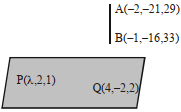
0 likesView Solution
197
MathematicsDifficultMCQJEE Main · 2021
Find the area bounded by the curves $y = ||x - 1| - 2|$ and $y = 2$.
A
$10$
B
$8$
C
$4$
D
$6$
Solution
(B) The given curves are $y = ||x - 1| - 2|$ and $y = 2$.
To find the intersection points,we set $||x - 1| - 2| = 2$.
This implies $|x - 1| - 2 = 2$ or $|x - 1| - 2 = -2$.
Case $1$: $|x - 1| = 4 \implies x - 1 = 4$ or $x - 1 = -4$,so $x = 5$ or $x = -3$.
Case $2$: $|x - 1| = 0 \implies x = 1$.
Looking at the graph,the region is bounded between $x = -3$ and $x = 5$ with the upper boundary $y = 2$ and lower boundary $y = ||x - 1| - 2|$.
The area $A$ is given by $\int_{-3}^{5} (2 - ||x - 1| - 2|) \, dx$.
Due to symmetry about $x = 1$,we can calculate $2 \times \int_{1}^{5} (2 - ||x - 1| - 2|) \, dx$.
For $1 \le x \le 5$,$|x - 1| = x - 1$,so $y = |x - 1 - 2| = |x - 3|$.
Area $= 2 \int_{1}^{5} (2 - |x - 3|) \, dx = 2 \left[ \int_{1}^{3} (2 - (3 - x)) \, dx + \int_{3}^{5} (2 - (x - 3)) \, dx \right]$.
Area $= 2 \left[ \int_{1}^{3} (x - 1) \, dx + \int_{3}^{5} (5 - x) \, dx \right] = 2 \left[ \left( \frac{x^2}{2} - x \right)_{1}^{3} + \left( 5x - \frac{x^2}{2} \right)_{3}^{5} \right]$.
Area $= 2 \left[ (4.5 - 3) - (0.5 - 1) + (25 - 12.5) - (15 - 4.5) \right] = 2 [2 + 2] = 8$ square units.
To find the intersection points,we set $||x - 1| - 2| = 2$.
This implies $|x - 1| - 2 = 2$ or $|x - 1| - 2 = -2$.
Case $1$: $|x - 1| = 4 \implies x - 1 = 4$ or $x - 1 = -4$,so $x = 5$ or $x = -3$.
Case $2$: $|x - 1| = 0 \implies x = 1$.
Looking at the graph,the region is bounded between $x = -3$ and $x = 5$ with the upper boundary $y = 2$ and lower boundary $y = ||x - 1| - 2|$.
The area $A$ is given by $\int_{-3}^{5} (2 - ||x - 1| - 2|) \, dx$.
Due to symmetry about $x = 1$,we can calculate $2 \times \int_{1}^{5} (2 - ||x - 1| - 2|) \, dx$.
For $1 \le x \le 5$,$|x - 1| = x - 1$,so $y = |x - 1 - 2| = |x - 3|$.
Area $= 2 \int_{1}^{5} (2 - |x - 3|) \, dx = 2 \left[ \int_{1}^{3} (2 - (3 - x)) \, dx + \int_{3}^{5} (2 - (x - 3)) \, dx \right]$.
Area $= 2 \left[ \int_{1}^{3} (x - 1) \, dx + \int_{3}^{5} (5 - x) \, dx \right] = 2 \left[ \left( \frac{x^2}{2} - x \right)_{1}^{3} + \left( 5x - \frac{x^2}{2} \right)_{3}^{5} \right]$.
Area $= 2 \left[ (4.5 - 3) - (0.5 - 1) + (25 - 12.5) - (15 - 4.5) \right] = 2 [2 + 2] = 8$ square units.
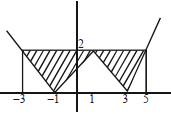
0 likesView Solution
198
MathematicsEasyMCQJEE Main · 2021
The value of the integral $\int_{0}^{\pi}|\sin 2x| dx$ is
A
$1$
B
$2$
C
$3$
D
$4$
Solution
(B) Let $I = \int_{0}^{\pi} |\sin 2x| dx$.
Substitute $2x = t$,so $2 dx = dt$ or $dx = \frac{1}{2} dt$.
When $x = 0$,$t = 0$. When $x = \pi$,$t = 2\pi$.
Thus,$I = \frac{1}{2} \int_{0}^{2\pi} |\sin t| dt$.
Using the property $\int_{0}^{2a} f(x) dx = 2 \int_{0}^{a} f(x) dx$ if $f(2a-x) = f(x)$,we note that $|\sin(2\pi - t)| = |-\sin t| = |\sin t|$.
So,$I = \frac{1}{2} \times 2 \int_{0}^{\pi} |\sin t| dt = \int_{0}^{\pi} \sin t dt$.
Evaluating the integral: $[-\cos t]_{0}^{\pi} = -(\cos \pi - \cos 0) = -(-1 - 1) = 2$.
Substitute $2x = t$,so $2 dx = dt$ or $dx = \frac{1}{2} dt$.
When $x = 0$,$t = 0$. When $x = \pi$,$t = 2\pi$.
Thus,$I = \frac{1}{2} \int_{0}^{2\pi} |\sin t| dt$.
Using the property $\int_{0}^{2a} f(x) dx = 2 \int_{0}^{a} f(x) dx$ if $f(2a-x) = f(x)$,we note that $|\sin(2\pi - t)| = |-\sin t| = |\sin t|$.
So,$I = \frac{1}{2} \times 2 \int_{0}^{\pi} |\sin t| dt = \int_{0}^{\pi} \sin t dt$.
Evaluating the integral: $[-\cos t]_{0}^{\pi} = -(\cos \pi - \cos 0) = -(-1 - 1) = 2$.
0 likesView Solution
199
MathematicsMediumMCQJEE Main · 2021
The vector equation of the plane passing through the intersection of the planes $\overrightarrow{r} \cdot (\hat{i} + \hat{j} + \hat{k}) = 1$ and $\overrightarrow{r} \cdot (\hat{i} - 2\hat{j}) = -2$,and the point $(1, 0, 2)$ is:
A
$\overrightarrow{r} \cdot (\hat{i} + 7\hat{j} + 3\hat{k}) = \frac{7}{3}$
B
$\overrightarrow{r} \cdot (3\hat{i} + 7\hat{j} + 3\hat{k}) = 7$
C
$\overrightarrow{r} \cdot (\hat{i} + 7\hat{j} + 3\hat{k}) = 7$
D
$\overrightarrow{r} \cdot (\hat{i} - 7\hat{j} + 3\hat{k}) = \frac{7}{3}$
Solution
(C) The equation of a plane passing through the intersection of two planes $P_1: \overrightarrow{r} \cdot \overrightarrow{n_1} = d_1$ and $P_2: \overrightarrow{r} \cdot \overrightarrow{n_2} = d_2$ is given by $(\overrightarrow{r} \cdot \overrightarrow{n_1} - d_1) + \lambda(\overrightarrow{r} \cdot \overrightarrow{n_2} - d_2) = 0$.
Given planes are $\overrightarrow{r} \cdot (\hat{i} + \hat{j} + \hat{k}) - 1 = 0$ and $\overrightarrow{r} \cdot (\hat{i} - 2\hat{j}) + 2 = 0$.
The equation of the required plane is $\overrightarrow{r} \cdot (\hat{i} + \hat{j} + \hat{k}) - 1 + \lambda(\overrightarrow{r} \cdot (\hat{i} - 2\hat{j}) + 2) = 0$.
Rearranging the terms,we get $\overrightarrow{r} \cdot [\hat{i}(1 + \lambda) + \hat{j}(1 - 2\lambda) + \hat{k}(1)] = 1 - 2\lambda$.
Since the plane passes through the point $(1, 0, 2)$,the position vector is $\overrightarrow{r} = \hat{i} + 2\hat{k}$.
Substituting this into the equation: $(\hat{i} + 2\hat{k}) \cdot [\hat{i}(1 + \lambda) + \hat{j}(1 - 2\lambda) + \hat{k}(1)] = 1 - 2\lambda$.
$(1 + \lambda) + 2(1) = 1 - 2\lambda$.
$3 + \lambda = 1 - 2\lambda$.
$3\lambda = -2 \implies \lambda = -\frac{2}{3}$.
Substituting $\lambda = -\frac{2}{3}$ back into the equation: $\overrightarrow{r} \cdot [\hat{i}(1 - \frac{2}{3}) + \hat{j}(1 + \frac{4}{3}) + \hat{k}(1)] = 1 - 2(-\frac{2}{3})$.
$\overrightarrow{r} \cdot [\hat{i}(\frac{1}{3}) + \hat{j}(\frac{7}{3}) + \hat{k}] = 1 + \frac{4}{3} = \frac{7}{3}$.
Multiplying by $3$,we get $\overrightarrow{r} \cdot (\hat{i} + 7\hat{j} + 3\hat{k}) = 7$.
Given planes are $\overrightarrow{r} \cdot (\hat{i} + \hat{j} + \hat{k}) - 1 = 0$ and $\overrightarrow{r} \cdot (\hat{i} - 2\hat{j}) + 2 = 0$.
The equation of the required plane is $\overrightarrow{r} \cdot (\hat{i} + \hat{j} + \hat{k}) - 1 + \lambda(\overrightarrow{r} \cdot (\hat{i} - 2\hat{j}) + 2) = 0$.
Rearranging the terms,we get $\overrightarrow{r} \cdot [\hat{i}(1 + \lambda) + \hat{j}(1 - 2\lambda) + \hat{k}(1)] = 1 - 2\lambda$.
Since the plane passes through the point $(1, 0, 2)$,the position vector is $\overrightarrow{r} = \hat{i} + 2\hat{k}$.
Substituting this into the equation: $(\hat{i} + 2\hat{k}) \cdot [\hat{i}(1 + \lambda) + \hat{j}(1 - 2\lambda) + \hat{k}(1)] = 1 - 2\lambda$.
$(1 + \lambda) + 2(1) = 1 - 2\lambda$.
$3 + \lambda = 1 - 2\lambda$.
$3\lambda = -2 \implies \lambda = -\frac{2}{3}$.
Substituting $\lambda = -\frac{2}{3}$ back into the equation: $\overrightarrow{r} \cdot [\hat{i}(1 - \frac{2}{3}) + \hat{j}(1 + \frac{4}{3}) + \hat{k}(1)] = 1 - 2(-\frac{2}{3})$.
$\overrightarrow{r} \cdot [\hat{i}(\frac{1}{3}) + \hat{j}(\frac{7}{3}) + \hat{k}] = 1 + \frac{4}{3} = \frac{7}{3}$.
Multiplying by $3$,we get $\overrightarrow{r} \cdot (\hat{i} + 7\hat{j} + 3\hat{k}) = 7$.
0 likesView Solution
200
MathematicsDifficultMCQJEE Main · 2021
Let $f : R \rightarrow R$ be defined as,
$f(x)=\begin{cases}-55 x, & \text{if } x<-5 \\ 2 x^{3}-3 x^{2}-120 x, & \text{if } -5 \leq x \leq 4 \\ 2 x^{3}-3 x^{2}-36 x-336, & \text{if } x>4 \end{cases}$
Let $A=\{ x \in R : f \text{ is increasing} \}$. Then $A$ is equal to :
$f(x)=\begin{cases}-55 x, & \text{if } x<-5 \\ 2 x^{3}-3 x^{2}-120 x, & \text{if } -5 \leq x \leq 4 \\ 2 x^{3}-3 x^{2}-36 x-336, & \text{if } x>4 \end{cases}$
Let $A=\{ x \in R : f \text{ is increasing} \}$. Then $A$ is equal to :
A
$(-\infty,-5) \cup(4, \infty)$
B
$(-5, \infty)$
C
$(-\infty,-5) \cup(-4, \infty)$
D
$(-5,-4) \cup(4, \infty)$
Solution
(D) To find where $f(x)$ is increasing,we calculate $f'(x)$ for each interval:
$1$. For $x < -5$,$f(x) = -55x$,so $f'(x) = -55$. Since $f'(x) < 0$,the function is decreasing on $(-\infty, -5)$.
$2$. For $-5 < x < 4$,$f(x) = 2x^3 - 3x^2 - 120x$,so $f'(x) = 6x^2 - 6x - 120 = 6(x^2 - x - 20) = 6(x - 5)(x + 4)$.
For $f'(x) > 0$,we need $(x - 5)(x + 4) > 0$,which occurs when $x < -4$ or $x > 5$. Within the interval $(-5, 4)$,this is satisfied for $x \in (-5, -4)$.
$3$. For $x > 4$,$f(x) = 2x^3 - 3x^2 - 36x - 336$,so $f'(x) = 6x^2 - 6x - 36 = 6(x^2 - x - 6) = 6(x - 3)(x + 2)$.
For $x > 4$,both $(x - 3)$ and $(x + 2)$ are positive,so $f'(x) > 0$ for all $x > 4$.
Combining these,$f(x)$ is increasing on $(-5, -4) \cup (4, \infty)$.
$1$. For $x < -5$,$f(x) = -55x$,so $f'(x) = -55$. Since $f'(x) < 0$,the function is decreasing on $(-\infty, -5)$.
$2$. For $-5 < x < 4$,$f(x) = 2x^3 - 3x^2 - 120x$,so $f'(x) = 6x^2 - 6x - 120 = 6(x^2 - x - 20) = 6(x - 5)(x + 4)$.
For $f'(x) > 0$,we need $(x - 5)(x + 4) > 0$,which occurs when $x < -4$ or $x > 5$. Within the interval $(-5, 4)$,this is satisfied for $x \in (-5, -4)$.
$3$. For $x > 4$,$f(x) = 2x^3 - 3x^2 - 36x - 336$,so $f'(x) = 6x^2 - 6x - 36 = 6(x^2 - x - 6) = 6(x - 3)(x + 2)$.
For $x > 4$,both $(x - 3)$ and $(x + 2)$ are positive,so $f'(x) > 0$ for all $x > 4$.
Combining these,$f(x)$ is increasing on $(-5, -4) \cup (4, \infty)$.
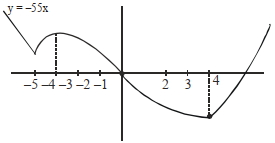
0 likesView Solution
Vedclass Products
For Students
Vedclass Test Series
Mock tests in real JEE Main style covering Mathematics with performance analysis. 5-day free trial.
Start Free TrialFor Teachers
Exam Paper Generator
Generate Set A/B/C/D Mathematics papers from 7.5L+ questions in 2 minutes. 3 chapters free.
Try FreeFor Institutes
Online Exam Module
Run live JEE Main mock exams with unlimited students, 360° analytics & white-label branding.
See DemoFrequently Asked Questions
How many Mathematics questions are in JEE Main 2021?
There are 781 Mathematics questions from the JEE Main 2021 paper on Vedclass, each with a detailed step-by-step solution in English.
Are JEE Main 2021 Mathematics solutions available in English?
Yes. All solutions on this page are in English. You can also switch to English or Hindi using the language buttons above the questions.
Can I practice JEE Main 2021 Mathematics as a timed test?
Yes. Use the Vedclass Test Series to attempt a full JEE Main mock test covering Mathematics with time limits and instant score analysis.
Can teachers create Mathematics papers from JEE Main previous year questions?
Yes. The Vedclass Exam Paper Generator lets teachers mix JEE Main Mathematics questions and generate Set A/B/C/D papers in minutes.
For Teachers & Institutes
Build a Custom Mathematics Paper
Pick JEE Main 2021 Mathematics questions, set difficulty, and generate Set A/B/C/D in 2 minutes.